ADVANCING ROBOTICS, SECURING SOLUTIONS
2026 ANNUAL REPORT • COLLEGE OF ENGINEERING AND COMPUTING
Table of Contents Research
Students
4 By the Numbers
36 Goal-Oriented Robots
6 Leading the Way in Robotics
38 No GPS, No Problem
8 A CAREER in Robot Learning
40 Access Granted
10 Making AI More Mindful
41 A One-Woman Team Puts Many Eyes in the Skies
12 Robot Repartee
42 Drones Over Disaster
14 Smart Systems, Smarter Scheduling
43 Student Impact at a Glance
16 Recommended for You(th)
44 Purr-fect Engineering
From the Dean DEAR ALUMNI AND FRIENDS,
At George Mason University’s College of Engineering and Computing, we are united by a bold vision to address society’s grand challenges. Our faculty, students, and alumni are not simply responding to the shifting landscape of higher education and the world—they are shaping the future with determination and creativity. This year’s report celebrates groundbreaking achievements in robotics and autonomous systems. From launching Virginia’s first PhD program in robotics to spearheading the Mason Autonomy and Robotics Center, our community is leading the way in secure, intelligent technologies that transform lives. Our researchers are developing robots that search forests for lost people, AI that learns like the human brain, and autonomous systems that make travel and disaster response safer and more accessible. Five of our young faculty received NSF Early CAREER Awards. These five grants will have a transformative impact across engineering, computing, and society. Collectively they support pioneering research, education, and outreach that strengthen the college’s leadership in robotics, AI, and inclusive technology. Our students embody resilience and teamwork, winning national competitions and tackling real-world challenges with passion. They graduate to become alumni like Chigozie Erondu, Pamela S. Wood, and Shawn Chambliss Purvis who are advancing innovation in industry and government with knowledge and skills gained at George Mason.
KEN BALL
18 Spaces That Spark Synergy 20 Award-Winning Faculty
Alumni and Giving
22 RobotiXX in Rough Terrain
45 Mason Now: Fueling What’s Next
24 A Helping Hand for Stroke Recovery 26 Securing the Self-Driving Future
46 Dean’s Academy of Engineering and Computing Excellence
28 Sensing a Breakthrough
48 Alum Profile: Chigozie Erondu
30 Bridge Inspection, Above and Beyond
50 Alum Profile: David Eichinger
32 Distributed Learning, Common Goal
52 Alum Profile: Pamela S. Wood
34 Managing Smart Swarms
54 Honoring a Pioneer, Empowering the Next Generation
14
24
50
Inclusivity is at the heart of our mission. We honor pioneers who broke barriers and empower the next generation through scholarships, outreach, and accessible technology. Projects like B-Drive and SkyEyes demonstrate how engineering can improve independence and security for all. Together, we are not just responding to change—we are creating it. Join us as we drive forward the Power the Possible campaign and empower the next generation of leaders. Your support—through gifts, mentorship, and partnership—fuels these efforts. Together, we are making the world cleaner, safer, and more prosperous. Thank you for being part of our journey and for helping us drive sustainable systems forward. We hope you enjoy reading about our accomplishments, will visit us on the web, and connect with us in the future. KEN BALL, PHD, PE Dean, College of Engineering and Computing
34
College of Engineering and Computing 2026 Annual Report
Martha Bushong
Designed and produced by College of Engineering and Computing Office of Communications and External Relations
Nathan Kahl
Editor in Chief
Contributing Writer and Copy Editor
Teresa Donnellan
Managing Editor and Contributing Writer
2
2026 ANNUAL REPORT | College of Engineering and Computing
Raissa Macasieb-Ludwig Art Director and Production Manager
Ron Aira John Boal Evan Cantwell Teresa Donnellan Rafael Suanes Photographers
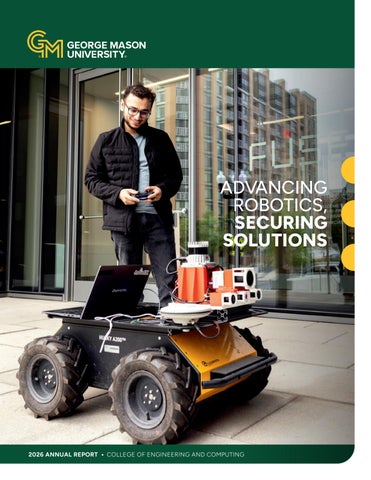
ON THE COVER: A computer science master’s student, Amit Paudel, remotely controls Husky, a robotic research platform developed by Clearpath Robotics, during data collection for training and evaluating autonomous navigation models. The robot has been enhanced with custom modifications tailored to specific research needs, enabling robust operation in both off-road environments and urban sidewalk settings. PHOTO BY RON AIRA, OFFICE OF UNIVERSITY BRANDING
College of Engineering and Computing | 2026 ANNUAL REPORT
3
By the Numbers FACULTY
RESEARCH
258
TENURED
INSTRUCTIONAL FACULTY
55 96 55 TENURE TRACK
TERM
● AWARDS
$116.8M
120
RESEARCH FACULTY
U.S. DOLLARS (MILLIONS)
107
● EXPENDITURES
100 $83.7M
80
$74.7M
$75M
$83.7M
$70.1M $62.4M
60
$49.7M $57.8M
40 20 0
$64.4M
$22.9M $18.8M $16.6M FY 2016
$61.6M
$66.1M
$62.8M
$66.8M
$52M $47.2M
$46.9M
$30.4M $22M FY 2017
FY 2018
FY 2019
FY 2020 FY 2021 FY 2022
FY 2023 FY 2024 FY 2025 FY 2026
ENROLLMENT Academic year 2026-27: We are focusing our energy on new recruitment strategies and tactics to support our students and streamlining curricula.
$47.2M
$52M
610
$340M
IN EXPENDITURES FY26
7,900
1,350
530
● UNDERGRADUATE
10000
8000
PROJECTIONS AS OF AUGUST 2026
6000
4,894
5,488
6,083
6,359
6,700
6,956
2000
● UNDERGRADUATE ● MASTER’S ● PHD
4
● GRADUATE
7,328
7,836
8,177 8,283
AUGUST PROJECTION
2,780 3,097 2,897 1,829
1,805
7,900
FY26 PROPOSALS
4000
1,790
1,857
1,863
2,149
2,361
1,880
AUGUST PROJECTION
0
2026 ANNUAL REPORT | College of Engineering and Computing
2016 FALL
2017 FALL
2018 FALL
2019 FALL
2020 FALL
2021 FALL
IN AWARDS FY26
2022 FALL
2023 FALL
2024 FALL
2025 FALL
2026 FALL
FY26 TOTAL
$9.3M FY26 INDIRECT COSTS
College of Engineering and Computing | 2026 ANNUAL REPORT
5
Leading the Way in Robotics GEORGE MASON UNIVERSIT Y’S Department of Mechanical Engineering led the way in robotics with the approval of Virginia’s first PhD program in robotics, launched in fall 2025.
Mechanical Engineering Chair Leigh McCue and robotics faculty across the College of Engineering and Computing combined forces to create the multidisciplinary program spanning mechanical engineering, electrical and computer engineering, computer science, and cybersecurity.
George Mason is a powerhouse in robotics,” said McCue. “With faculty like Missy Cummings, Cameron Nowzari, Quentin Sanders, Daigo Shishika, Ningshi Yao, and many more, plus centers and labs across our Northern Virginia campuses, the time was right to put this together.” The Mason Autonomy and Robotics Center (MARC), which opened in spring 2024, is pioneering the design of secure and intelligent autonomous systems. “Every robotics PhD student has a home in MARC. It spans expertise across the college and the university,” said Missy Cummings, the PhD program director.
PHOTO BY RON AIRA
As the program grows, Cummings, McCue, and Jeffrey Moran, Mechanical Engineering’s associate chair for graduate studies, anticipate great opportunities for students. “I hope to see the types of projects diversify over the next ten years. Robotics is everywhere, and I want us to break into new research areas,” said Moran.
6
2026 ANNUAL REPORT | College of Engineering and Computing
College of Engineering and Computing | 2026 ANNUAL REPORT
7
A CAREER in Robot Learning GEORGE MASON UNIVERSIT Y Assistant Professor Xuan Wang received a five-year, $640,000
Faculty Early Career Development (CAREER) award from the National Science Foundation (NSF) to improve how robots learn from one another. The NSF CAREER award recognizes outstanding early-career faculty who demonstrate the potential to become leaders in research and education.
Wang’s research focuses on helping robots transfer knowledge across different tasks, environments, and hardware platforms. Rather than requiring every robot to learn through extensive trial and error, his work will enable robots to determine when another robot’s experience can be reused and when it should be discarded. “We want robots to reason about when transfer learning is beneficial and when it is not,” Wang said. Potential applications include teams of aerial and ground robots working together during disaster response, sharing information to search damaged buildings more efficiently. Agricultural robots could reuse knowledge gathered by other machines instead of repeatedly mapping fields from scratch. Security robots could improve patrol routes by learning from previous deployments. The award supports education and outreach, including RoboArt, a program that encourages elementary school students to design robots through drawings that are transformed into 3D-printed models.
PHOTOS BY RAFAEL SUANES
The grant will also provide research opportunities for graduate and undergraduate students while developing new educational materials that connect robotics theory with real-world applications.
XUAN WANG 8
2026 ANNUAL REPORT | College of Engineering and Computing
College of Engineering and Computing | 2026 ANNUAL REPORT
9
Making AI More Mindful ELECTRICAL AND COMPUTER ENGINEERING Assistant Professor Maryam Parsa
received a five-year, $655,286 NSF CAREER Award to develop a new generation of artificial intelligence systems inspired by the way the human brain learns, remembers, and adapts. While modern AI has achieved remarkable success, it often requires enormous computing power, consumes significant energy and water, and struggles to adapt to unfamiliar situations.
AI was originally inspired by the brain,” Parsa said. “Concepts such as neurons, synapses, and neural networks all came from trying to understand how biological brains process information. But over time, AI has moved farther away from some of the biological principles that first inspired it.” Her research seeks to reconnect AI with recent advances in neuroscience by developing algorithms based on three key principles of biological intelligence: dimensionality, heterogeneity, and nonlinearity. Together, those concepts could make future AI systems more efficient, resilient, transparent, and adaptable. “We know some of the key challenges AI still faces,” Parsa said. “It can be difficult to understand how these systems reach their decisions, and they do not always transfer well when conditions, data, or environments change. That is where biological intelligence can offer useful design principles.”
ISTOCK IMAGE
PHOTO BY OFFICE OF UNIVERSITY BRANDING
The project builds on years of earlier research supported by the NSF, Department of Energy, and U.S. Army and includes educational activities spanning K-12 through graduate education. By bringing together neuroscience and computing, Parsa hopes to create AI systems that learn more like biological brains.
10
2026 ANNUAL REPORT | College of Engineering and Computing
MARYAM PARSA
College of Engineering and Computing | 2026 ANNUAL REPORT
11
Robot Repartee FOR DAIGO SHISHIKA, robots are not just machines that move. . . they can also be communication experts. With an NSF CAREER award, he is advancing research that asks a deceptively simple question: What if robots could “talk” to each other—and to humans—without ever sending a signal?
Shishika, an assistant professor in George Mason University’s Department of Mechanical Engineering, will lead a five-year, $549,000 project focused on how autonomous systems can signal intent through motion alone. The idea is comparable to how drivers read each other’s behavior on the road through speed, positioning, and subtle cues. “There’s a lot of information that comes from pure observation of movement. So how can robots take that into account?” he said. A central concept is the spectrum between transparency and deception. In some cases, robots must signal intent to build trust and operate safely alongside humans. In others, such as defense applications, limiting the information revealed through motion can be just as important.
If a system moves in a certain way, it may unintentionally reveal what it’s trying to do. So the question becomes, how much information are you giving away through your actions, and can you control that?” said Shishika. The project will integrate theoretical and experimental work through Shishika’s RoboGame Arena, a platform combining mathematical modeling with physical robot experiments. Learning how systems behave and how humans interpret those behaviors, he bridges the gap between theory and practice.
PHOTOS BY EVAN CANTWELL
Delivery robots could plan routes that make destinations less predictable, improving security for shipments. Robots that better communicate intent can navigate more smoothly around people, reducing confusion and improving safety. This is Shishika’s first project developed as a full lab effort, bringing together students working across theory, machine learning, and hands-on robotics. DAIGO SHISHIKA 12
2026 ANNUAL REPORT | College of Engineering and Computing
College of Engineering and Computing | 2026 ANNUAL REPORT
13
PHOTOS BY RON AIRA AND RAFAEL SUANES
NINGSHI YAO
Smart Systems, Smarter Scheduling THE NATIONAL SCIENCE FOUNDATION also awarded Ningshi Yao, assistant professor
in the Department of Electrical and Computer Engineering at George Mason University, a CAREER Award. Funded by the Energy, Power, Control, and Learning program, the five-year, $628,000 grant supports her work on improving the safety, reliability, and efficiency of interconnected real-time control systems. Modern infrastructure—from transportation networks to smart manufacturing—relies on shared resources such as power grids, computing systems, and communication networks. Simultaneous demands can create “correlated resource contention,” leading to unpredictable delays and potential system failures. Yao’s research introduces a new theoretical framework called “schedu-stability,” which jointly guarantees scheduling feasibility and system stability. Her team is also developing decentralized optimization tools that allow large-scale systems to manage resources more effectively in real time, while generating high-quality data to improve machine learning models. A key component of the project is education and workforce development. Yao is expanding the Airborne Robotics Cup, a low-cost robotic blimp competition for middle and high school students. Participants receive hands-on training and compete in aerial “soccer” matches using safe, affordable robots built from everyday materials. The program emphasizes problem-solving, resilience, and accessibility.
The project also strengthens Yao’s leadership in autonomous systems research. As director of the Control, Intelligent Autonomy, and Optimization Lab, she leads interdisciplinary work supported by multiple federal agencies, including the National Institutes of Health and Office of Naval Research, highlighting the broad impact of her research across infrastructure, health care, and defense sectors.
14
2026 ANNUAL REPORT | College of Engineering and Computing
College of Engineering and Computing | 2026 ANNUAL REPORT
15
Recommended for You(th) ADOLESCENCE IS A TIME of figuring out who you are. Increasingly, that unfolds alongside social media feeds, algorithms, and AI chatbots. George Mason University’s Nora McDonald received an NSF CAREER award for $748,000 to understand how adolescents experience and are shaped by these AI and other personalized digital environments.
McDonald, an assistant professor in the Department of Information Sciences and Technology, also wants to learn how teens can develop skills and capacities to maintain their sense of self, autonomy, and agency within those environments.
The conversation is about how algorithms influence what kids see and how we go down rabbit holes,” McDonald said. “I’m interested in: How do algorithms shape self-understanding, and how do teens make sense of themselves in environments increasingly personalized and shaped by algorithms and AI?” McDonald’s research suggests that while teenagers view chatbots and recommendation systems as tools, those systems become important spaces for self-exploration and self-presentation. If recommendation systems influence what young people see, what feedback they receive, and what content captures their attention, how will that affect how they see themselves? McDonald will examine how adolescents recognize, interpret, and respond to algorithmic influence and how it relates to the coherence of their sense of self. One major outcome will be the development of practical resources and activities designed with teenagers to help them navigate personalized digital environments.
NORA MCDONALD 16
2026 ANNUAL REPORT | College of Engineering and Computing
PHOTOS BY RAFAEL SUANES
The effort differs from traditional digital literacy initiatives that focus primarily on explaining how algorithms work. “It helps them reflect on algorithmic influence and develop strategies that are really rooted in managing attention and maintaining perspective on who they are outside of digital experiences,” McDonald said. The CAREER award also supports substantial educational activities. McDonald plans to develop a new undergraduate course focused on algorithmic self-defense from a human-computer interaction perspective.
College of Engineering and Computing | 2026 ANNUAL REPORT
17
PHOTOS BY RON AIRA / EVAN CANTWELL / EDUARDO MACEDO
Spaces That Spark Synergy Science and Technology Campus Encompassing 132,000 square feet of space, the Life Sciences Engineering Building is designed to promote collaboration and engagement among students and faculty. The four-story building includes ground-level engineering labs and student design competition bays that open directly onto exterior pathways, allowing visibility into the work happening inside. Elsewhere on the campus, a new clean room and nanofabrication facility promote research in nano particles and chip manufacturing.
Fairfax Campus The five-story Long and Kimmy Nguyen Engineering Building is the administrative home to the college. A large three-story atrium provides light and open spaces for students to meet and study, while classrooms, conference rooms, labs, and offices occupy separate wings. Across the northern patio, students and faculty use the Mason Autonomy and Robotics Center to build, program, and operate robots.
18
2026 ANNUAL REPORT | College of Engineering and Computing
Mason Square The newest building at Mason Square, Fuse, serves as a central hub where researchers, entrepreneurial partners, students, and faculty combine their talents. The campus houses such labs and spaces as the NuScale E2 Center, a cutting-edge nuclear reactor control room simulator, and the Imaging and Vision Lab, which features tools for augmented reality, virtual reality, and 3D visualization. The building also boasts shared common spaces and a large conference center, which provide opportunities for collaboration, co-working, and signature events.
College of Engineering and Computing | 2026 ANNUAL REPORT
19
Award-Winning Faculty NSF CAREER Awards
Newly Inducted Fellows
Assistant Professor Nora McDonald Department of Information Sciences and Technology for “CAREER: Resilience in the Age of AI: Helping Adolescents Manage Generative AI and Personalization”
Professor Burak Tanyu Sid and Reva Dewberry Department of Civil, Environmental, and Infrastructure Engineering American Society of Civil Engineering Fellow (ASCE)
Assistant Professor Maryam Parsa Department of Electrical and Computer Engineering for “CAREER: CORTEX: Next-Generation Computing with Brain-Inspired Resilient, Transformative, and Explainable Intelligence”
Dean Ken Ball College of Engineering and Computing American Society for Engineering Education Fellow (ASEE)
Assistant Professor Daigo Shishika Department of Mechanical Engineering for “CAREER: Signaling through Motion: A Game-Theoretic Framework for Deception and Cooperation in Mobile Multi-Agent Systems” Assistant Professor Xuan Wang Department of Electrical and Computer Engineering for “CAREER: A Dynamical Systems Approach to Reliable and Efficient Knowledge Transfer in Robot Learning” Assistant Professor Ningshi Yao Department of Electrical and Computer Engineering for “CAREER: A Unified Event-triggered Real-Time Scheduling and Control Co-Design Framework for Networked Safety-critical Control Systems”
20
2026 ANNUAL REPORT | College of Engineering and Computing
Professor Lizhi Wang Department of Bioengineering and Department of Systems Engineering and Operations Research Institute of Industrial and Systems Engineers Fellow (IISE)
Fulbright Awards Associate Professor Nathalia Peixoto Fulbright Specialist in Uganda, summer 2025 Mbarara University of Science and Technology PhD Student Cora Sula Fulbright Specialist in Estonia, fall 2026 Tallinn University of Technology
State Council of Higher Education for Virginia Outstanding Faculty Award Assistant Professor Xuesu Xiao Department of Computer Science
George Mason University Presidential Awards Associate Professor Bo Han Department of Computer Science Faculty Excellence in Research Award Professor Parag Chitnis Department of Bioengineering Faculty Excellence in Research Award Professor Peggy Brouse Department of Cyber Security Engineering John Toups Presidential Medal for Excellence in Teaching
National Leadership Professor Janis Terpenny Department of Mechanical Engineering elected president of the American Society of Mechanical Engineers (ASME)
College of Engineering and Computing | 2026 ANNUAL REPORT
21
RobotiXX in Rough Terrain XUESU XIAO LIGHTS UP WHEN DESCRIBING HIS OFF-ROAD ROBOTICS TESTBED in Fuse at Mason Square.
PHOTOS BY RON AIRA
“It’s one of a kind,” said the computer science assistant professor. Studying off-road autonomy is difficult, he noted, because it requires terrain, vehicles, and specialized facilities. “We have all of that.”
A roboticist, Xiao develops algorithms that make robots both capable and intelligent, with a goal of deploying them where humans cannot— or should not—go. “We want them to search forests for lost people,” he said. “We’re also proposing robot firefighters and systems for scientific exploration in places like the South Pole.”
XUESU XIAO
His research centers on motion planning: using machine learning to guide robots from start to goal while avoiding obstacles. The testbed in the RobotiXX Lab spans about 700 square feet, with rocks and faux vegetation built at one-tenth scale. Sixteen motioncapture cameras track each vehicle with six degrees of freedom. Together, the facility and the research it enables are pushing the boundaries of where robots can operate. The impact has not gone unnoticed: Xiao earned George Mason’s 2025 Presidential Award for Faculty Excellence and the College of Engineering and Computing’s Excellence in Research Award, followed by the State Council of Higher Education for Virginia’s 2026 Outstanding Faculty Award.
22
2026 ANNUAL REPORT | College of Engineering and Computing
College of Engineering and Computing | 2026 ANNUAL REPORT
23
A Helping Hand for Stroke Recovery FOR MILLIONS OF STROKE SURVIVORS, something as simple as picking up
a glass of water or holding a sandwich is a daily challenge. Quentin Sanders wants to make those moments easier through wearable robotic technology designed to restore hand function.
The George Mason University assistant professor of bioengineering is developing wearable hand exoskeletons that help stroke survivors regain hand function by amplifying the muscle activity they still have. His latest prototype fits like a glove over the hand and arm, assisting users as they attempt to open or close their hand. “We sense whatever residual activity they have, and then the exoskeleton amplifies that,” Sanders said. His lab is testing two approaches. One uses wearable ultrasound technology, developed with collaborator Siddhartha Sikdar in the Department of Bioengineering, to detect muscle movement. A second, simpler design uses a button built into the glove, making it easier to manufacture and potentially bring to users sooner. Sanders said the work addresses a growing need. While more people survive strokes thanks to medical advances, many lack access to long-term rehabilitation, and commercially available hand exoskeletons remain expensive and limited. “I’m hoping we can make this kind of low-cost, accessible version that people can use to improve some aspect of their life,” he said.
PHOTO BY RON AIRA
His long-term goal is to create rehabilitation technologies that are affordable, practical, and effective for the broadest possible range of stroke survivors.
QUENTIN SANDERS 24
2026 ANNUAL REPORT | College of Engineering and Computing
College of Engineering and Computing | 2026 ANNUAL REPORT
25
Securing the Self-Driving Future ASSISTANT PROFESSOR TANVIR ARAFIN of the
Department of Cyber Security Engineering (CYSE) conducts widely recognized research in hardware security, with a growing focus on protecting transportation and autonomous systems. His work examines how subtle physical-layer characteristics and computing capabilities for modern hardware improve security of autonomous systems. Building on industry experience with Bosch and Philips, including patented work in secure automotive authentication, Arafin now leads research on vulnerabilities in connected and autonomous vehicles, showing how attackers can extract sensitive data or manipulate system behavior. Arafin also directs major federally funded initiatives, including National Science Foundation projects on securing AI foundation models for autonomy and cybersecurity training for automotive systems. Across his career, he has helped secure more than $9 million in research and education funding, $1.5 million of which funded his own work, while prioritizing student support and workforce development.
Equally impactful is his mentorship of undergraduate researchers. In his CYSE courses and lab, students engage in hands-on, adversarial research, often producing publishable results. One capstone team he advised developed a timing-based attack on robotic navigation systems, earning acceptance at the prestigious 2026 IEEE International Symposium on Hardware Oriented Security and Trust. PHOTOS BY RAFAEL SUANES
His students have also swept national competitions and received international awards, demonstrating both the rigor of Arafin’s research program and the strength of undergraduate innovation at George Mason. TANVIR ARAFIN 26
2026 ANNUAL REPORT | College of Engineering and Computing
College of Engineering and Computing | 2026 ANNUAL REPORT
27
Sensing a Breakthrough GEORGE MASON UNIVERSIT Y Mechanical Engineering Associate Professor Pilgyu Kang is leading research to improve hydrogen sensors critical for safely powering nextgeneration autonomous systems. Supported by 4-VA funding, Kang partnered with University of Virginia researcher Stephen Baek to explore hybrid nanocomposite materials that outperform traditional palladium-based sensors, which often suffer from low sensitivity and slow response times.
Kang’s team integrates advanced materials with machine learning to predict how design factors such as nanoparticle size, distribution, and porosity affect sensor performance. This approach accelerates discovery by rapidly identifying optimal designs that would be time-consuming to test experimentally. Mechanical engineering faculty member Peter Cho contributed expertise in fuel cell applications, while undergraduate researchers helped advance fabrication and testing. Students Philip Acatrinei and Graham Harper focused on laser-induced graphene and nanocomposites for sensing, Noemi Lily Umanzor explored cross-disciplinary applications, and Diego Enrique Colmenarez led fabrication and characterization efforts. Colmenarez earned the Outstanding Project Award at the College of Engineering and Computing’s Undergraduate Research Celebration.
PHOTOS BY TERESA M. DONNELLAN
The team has published in leading journals and continues to expand collaborations with NASA Goddard Space Flight Center and industry partner N5 Sensors, positioning the work for real-world deployment and future funding.
PILGYU KANG 28
2026 ANNUAL REPORT | College of Engineering and Computing
College of Engineering and Computing | 2026 ANNUAL REPORT
29
Bridge Inspection, Above and Beyond TECHNOLOGY IS INCREASINGLY HELPING COMMUNITIES STAY SAFE by identifying problems before they become crises. For postdoctoral
researcher Mehrdad Ghyabi, that mission has centered on using drones, computer vision, and autonomous sensing systems to monitor critical infrastructure and provide engineers with more reliable information about structural performance.
PHOTO BY OFFICE OF UNIVERSITY BRANDING
As a civil engineering researcher at George Mason University, Ghyabi investigated how unmanned aerial vehicles (UAVs) can serve as intelligent inspection tools for bridges and other infrastructure. Rather than relying solely on traditional sensors attached directly to a structure, his work uses drone-captured video and computer vision algorithms to measure structural deformations from a distance. By transforming ordinary video imagery into engineering data, these approaches can reduce inspection costs, improve efficiency, and increase access to hard-to-reach locations.
MEHRDAD GHYABI
Ghyabi’s research also explored ways to enhance the quality of motion measurements by filtering noise from deformation signals and integrating the resulting data into digital twin models. These virtual representations of physical infrastructure can help engineers better understand structural behavior and support informed maintenance and operational decisions.
A major milestone in his work was the publication of “Vision-Based Measurements to Quantify Bridge Deformations” in the ASCE Journal of Bridge Engineering. The study demonstrated that computer vision methods can produce bridge movement measurements comparable to those obtained from conventional instrumentation, highlighting the potential of UAV-enabled monitoring systems to support safer, smarter, and more resilient infrastructure.
30
2026 ANNUAL REPORT | College of Engineering and Computing
ISTOCK IMAGE
Today, as a member of George Mason’s Injury Analytics Lab, Ghyabi continues advancing computer vision and AI technologies that transform visual data into actionable insights.
College of Engineering and Computing | 2026 ANNUAL REPORT
31
PHOTO BY EVAN CANTWELL
LILY WANG
Distributed Learning, Common Goal STATISTICS PROFESSOR LILY WANG is advancing the frontiers of federated and
distributed learning through her interdisciplinary research at the intersection of statistics, artificial intelligence, and data science. Her work focuses on developing rigorous, scalable, and interpretable methodologies for analyzing complex, large-scale data generated across decentralized environments, where data privacy, heterogeneity, and communication constraints are critical challenges. Federated systems, an emerging paradigm that enables collaborative model training without sharing raw data, are central to Wang’s research portfolio. By designing statistical learning frameworks that integrate information across distributed sources while preserving privacy, her work supports applications in engineering, infrastructure, and real-time decision systems. These contributions are particularly relevant to autonomous systems, which increasingly rely on learning from diverse, geographically dispersed data streams while maintaining robustness and reliability.
Wang’s innovations in trustworthy and interpretable AI provide foundations for the deployment of autonomous technologies. Her emphasis on uncertainty quantification and transparent modeling helps ensure that autonomous systems can make reliable decisions in dynamic and safety-critical environments.
ISTOCK IMAGE
Through this research, Wang is strengthening the College of Engineering and Computing’s leadership in data-driven innovation, laying the groundwork for next-generation autonomous systems to operate securely, efficiently, and responsibly across distributed networks.
32
2026 ANNUAL REPORT | College of Engineering and Computing
College of Engineering and Computing | 2026 ANNUAL REPORT
33
Managing Smart Swarms
DAIGO SHISHKA
FACULT Y IN THE COMPUTER SCIENCE , Electrical
and Computer Engineering, and Mechanical Engineering Departments are developing new ways for humans to control large groups of robots with efficiency and clarity. Alexander Brodsky, Cameron Nowzari, and Daigo Shishika are designing “smart-swarm technologies” to help military planners coordinate unmanned aerial and ground vehicles within Human-Machine Integrated Formations.
How does one person manage 100 different robots?” Nowzari asked, an increasingly urgent question as drone activity grows worldwide. “One person cannot directly remote control them all,” he explained, pointing instead to scalable coordination systems that allow a small number of operators to oversee large robotic fleets. The team’s solution emphasizes simplicity, usability, and modular design. Rather than relying solely on complex AI, using simpler robots enables operators to understand and control behavior more effectively. Their smart swarm system, including decision guidance, operations, and risk components, aims to reduce cognitive load while supporting real-time decision-making.
CAMERON NOWZARI
PHOTOS BY RON AIRA / OFFICE OF UNIVERSITY BRANDING
To refine these ideas, the team is also developing a video game simulator. This allows players to design swarm behaviors and generates data used to test algorithms for real-world applications. Supported by a $966,836 U.S. Army award, the project runs through 2028 and will advance both theory and practice in scalable robotics.
ALEXANDER BRODSKY 34
2026 ANNUAL REPORT | College of Engineering and Computing
College of Engineering and Computing | 2026 ANNUAL REPORT
35
PHOTOS BY TERESA M. DONNELLAN
Goal-Oriented Robots AT GEORGE MASON UNIVERSIT Y, the Mason Autonomy and Robotics Center (MARC) is becoming the engine behind a new kind of hands-on learning that blends engineering, competition, and creativity into what faculty call cyber-physical sports.
Associate Professor Cameron Nowzari and Assistant Professor Ningshi Yao are leading that vision, using MARC as a collaborative space where students and researchers design, test, and refine autonomous systems before bringing them into competition settings. “You are playing a video game, but also, that means you don’t get to complain about latency issues or unresponsiveness of the system—you have to fix it now yourself,” Nowzari said, describing the unique mix of theory and practice that defines these experiences. Nowzari is playing a key role in expanding the use of robotics competitions for education and research by hosting national events inside EagleBank Arena. Most recently, George Mason hosted the Raytheon Autonomous Vehicle Competition’s northeast regional competition for the first time, with plans for growing such activities. Meanwhile, Yao mentored high school students through the Aspiring Scientists Summer Internship Program (ASSIP) as they built robots that launched and collected tennis balls for a World Cup–inspired match on the Fairfax Campus. She also hosted the Airborne Robotics Competition in EagleBank Arena, where students modifed blimps to guide balloons through hoops. “These competitions give students a chance to learn by building, testing, and playing,” Yao said. “They make engineering exciting, accessible, and collaborative.”
By providing mentorship and practical challenges, MARC faculty are positioning George Mason as a hub for innovative, hands-on learning, where students at every level can explore robotics through fun, fast-paced competition.
36
2026 ANNUAL REPORT | College of Engineering and Computing
College of Engineering and Computing | 2026 ANNUAL REPORT
37
No GPS, No Problem GEORGE MASON UNIVERSIT Y STUDENTS affiliated
with the Mason Autonomy and Robotics Center (MARC) earned first place at the 2026 Raytheon Autonomous Vehicle Competition, held at EagleBank Arena. Competing without GPS in a new indoor format, teams were challenged to design autonomous aerial and ground systems capable of completing increasingly complex missions using onboard sensing and visual navigation. The team successfully completed all three challenges, including autonomous drone launch and landing from a moving vehicle, target detection and coordination between air and ground systems, and obstacle avoidance— earning the top overall score.
What made the victory especially notable was the team’s structure: participation was entirely voluntary, with no course credit or formal requirements. Students from electrical engineering, computer engineering, mechanical engineering, and computer science collaborated across drone and ground sub-teams, gaining handson experience in systems integration, software, and hardware design. Working over two semesters with limited funding and late-arriving resources, the team relied on shared lab equipment and intensive testing sessions to refine their system. Their use of visual-inertial simultaneous localization and mapping enabled precise navigation without GPS.
PHOTOS BY RON AIRA
The first-place finish highlights both the technical excellence and the passion-driven teamwork of George Mason students.
38
2026 ANNUAL REPORT | College of Engineering and Computing
College of Engineering and Computing | 2026 ANNUAL REPORT
39
A One-Woman Team Puts Many Eyes in the Skies
Access Granted
FATIMA MAJID, a cyber security engineering student, was not just the only
FOR OWAIS YOUSUF, inspiration began at home. Watching
“I went in, and they were all professional teams. I thought, ‘I want to go home,’” said Majid with a laugh.
one-person team in the top 10 winners at a National Defense Industrial Association competition; she was the only student team. Majid placed ninth out of 51 teams, most comprising industry experts.
his father, who contracted polio as a child, navigate airports on crutches revealed how challenging travel can be for people with mobility limitations. Along with fellow George Mason mechanical engineering students Turner Applegate, Javier Carpio Jota, and Calvin Nguyen, Yousuf set out to make travel more independent and less stressful.
Her project was about how the Department of Defense can protect critical U.S. infrastructure against low-cost drone attacks at scale, informed by Ukraine’s “Operation Spiderweb,” which used 117 drones to attack Russian air bases in June 2025.
Their solution, B-Drive, is a senior capstone project that combines autonomous navigation, computer vision, and adaptive mobility technology to help wheelchair users move through airports independently. The project was supported by a GO Virginia–funded initiative led by the Nexus234 Innovation District, which connects students with industry mentors.
Majid’s lightbulb moment came with a flash as bright as a Virginia speed camera catching a lead-footed driver. Considering Virginia’s significant network of traffic cameras, she conceived SkyEyes. This applies an AI model to the live feed of the Virginia 511 camera network. SkyEyes demonstrated how a low-cost, AI-enabled surveillance layer could differentiate threats from non-threats, employing geofencing logic to define safe versus threat zones around sensitive sites.
To better understand user needs, the team participated in the National Science Foundation’s I-Corps program, conducting interviews with travelers, accessibility advocates, and industry professionals. Feedback consistently highlighted a desire for greater dignity and control while traveling.
“I understand how drones work because of what I’ve done at George Mason’s MIX (Mason Innovation Exchange) lab—and since I know how to build it, I also know how to jam it.” Majid is still pleasantly shocked by her top-10 finish. She is working with Associate Professor Mohamed Gebril on expanding the research.
PHOTO BY RON AIRA
Designed to integrate with existing airport wheelchairs, B-Drive focuses on practical application, such as navigating from the Silver Line Metro to terminals at Washington Dulles International Airport. With guidance from industry mentor Robert “Bob” Schneider, the team refined their approach and advanced toward commercialization.
ISTOCK IMAGE
The project prompted Yousuf to rethink what it means to be an engineer. “Engineering is ultimately about people,” said Yousuf. “Technology is only valuable if it improves someone’s life. That’s what motivated us from the beginning, and it’s what continues to motivate us now.”
40
2026 ANNUAL REPORT | College of Engineering and Computing
FATIMA MAJID
College of Engineering and Computing | 2026 ANNUAL REPORT
41
THE OFFICE OF OUTREACH, STUDENT SUCCESS, AND ENGAGEMENT (OSSE) drives student success in the College of Engineering and Computing through engagement and financial support.
STUDENT IMPACT AT A GLANCE
WHAT BEGAN AS A CAPSTONE PROJECT became an award‑
winning innovation for a team of George Mason University systems engineering students. Their concept took first place in the Patriot Pitch Social Impact Track, earned a People’s Choice Award, and secured top honors at the U.S. Military Academy Systems Engineering Design Competition.
•F all into STEM, for K–12 educators •S pring into STEM, for middle-schoolers
296
Seeking a better solution, the team explored heavy‑lift electric drones, then addressed their battery limitations with an innovative catenary power system. Their design, an Automated Floating Power Line System (AFPLS), uses floating, self‑positioning poles to provide con‑ tinuous power, enabling fast, cost‑effective drone delivery.
2026 ANNUAL REPORT | College of Engineering and Computing
Two signature programs:
Meeting Basic Needs
Using a stochastic simulation model, the students evaluated helicopters, ferry boats, and floating causeways to deliver 10,000 pallets over 90 days. Each option presented tradeoffs: ferries were cost‑effective but slow, helicopters fast but expensive, and causeways costly and time‑intensive to deploy.
42
K–12 STUDENTS REACHED
2,446 29 48
STUDENTS SERVED THROUGH THE CEC–MICRON FOOD PANTRY
ISTOCK IMAGE
The CEC–Micron Food Pantry, alongside a completely free professional clothing closet, supports students
students engaged through OSSE events and programs signature events hosted student volunteers serving as OSSE Ambassadors, event assistants, and judges
$67.9K
Direct Support Keeps Students Moving Forward How funding was used:
The team focused on a pressing global challenge: delivering humanitarian aid more efficiently. With an average of 380 natural disasters annually requiring assistance, improving logistics is critical. A key bottleneck is transporting supplies from cargo ships, often anchored miles offshore, to temporary distribution centers.
The project highlights the power of systems engineering to solve complex, real‑world challenges while improving disaster response outcomes worldwide.
362
BUILDING THE STEM PIPELINE
Drones Over Disaster
Engaging Students Where They Are
CONFERENCE TRAVEL AND PARTICIPATION
24.1%
EMERGENCY RETENTION FUNDS
33.8%
SPONSORED SCHOLAR PROGRAMS
41.9%
Welcoming New Students
1,759 STUDENTS
participated in BLAST-Off Week, a week-long experience helping first-year students build community and confidence.
The Computing and Engineering Development Spaces Designed and Resource Information Center (CEDRIC) Patriot Place Student Lounge for Student Success Collaborative Study Lounge
DATA PROVIDED BY THE OSSE TEAM: Christopher Carr, Associate Dean for Outreach, Student Success, and Engagement; Christi Wilcox, Director of Programs and Research; Siri Meghana Annamdevula, Data and Events Operations Analyst; Erin Fay, Graduate Research Assistant; Gina DiGuilio, Office Administrator
PHOTO BY RON AIRA
132
SCHOLARSHIP RECIPIENTS
$312K IN STUDENT SCHOLARSHIP SUPPORT
ALEXIA MARIE DE COSTA
Purr‑fect Engineering STUDENTS from George Mason University’s College of Engineering and Computing (CEC) drew widespread attention at Saucethon 2025, a hardware-focused hackathon hosted by Open Sauce and the National Havoc Robot League. Earning second place, the interdisciplinary team showcased CEC’s collaborative strength before thousands of livestream viewers.
Tasked with transforming a $500 combat robot kit for an apocalyptic rescue scenario, students in computer science, electrical engineering, mechanical engineering, and information technology joined two external collaborators to develop a creative, cat-themed robot. What began as a playful idea—adding cat ears—evolved into functional design elements, including static paws for herding, a pan‑tilt tail for maneuverability, and modified wheels for stability. The 24-hour competition tested both ingenuity and endurance. Despite a late-night power outage and the pressure of constant filming and commentary by popular YouTubers, the team adapted quickly, completing two successful rescue runs. Improvised “emergency repairs” between rounds helped them outperform even high-profile competitors.
campaign
progress
$39M RAISED FOR CEC
1,217 DONORS
Blending creativity, technical expertise, and resilience, the team’s success highlights CEC’s innovative spirit and commitment to hands-on, interdisciplinary learning—qualities they hope to bring to future competitions.
FUELING WHAT’S NEXT Mason Now support is driving real results across CEC, opening doors for students, advancing breakthrough research, empowering faculty, and strengthening the region’s innovation and workforce pipeline.
44
2026 ANNUAL REPORT | College of Engineering and Computing
PHOTO BY EVAN CANTWELL
Usually hackathons are software-focused, so building a robot was so much fun,” said computer science major Alexia Marie De Costa.
45
Dean’s Academy of Engineering and Computing Excellence TO CELEBRATE THE 40TH ANNIVERSARY of the College of Engineering and Computing (CEC) Dean Ken Ball created the Academy of Engineering and Computing Excellence in 2025. This prestigious academy comprises individuals who have made significant contributions to the engineering and computing community at George Mason and in Northern Virginia through their career accomplishments. This is an annual tradition, ensuring that excellence within our college continues to be recognized and honored.
On February 27, 2026, the college welcomed inductees and guests to the second annual celebration. The evening began by recognizing honorary members Ernst and Sara Volgenau and Long Nguyen and Kimmy Duong for their steadfast and generous support of the college. Following the induction of these Honorary Members, Dean Ball announced and congratulated the newest class of Emerging Leaders and Distinguished Alumni.
Honorary Members
Distinguished Alumni
Ernest and Sara Volgenau, Friend
Bary Azmi, BS, Electrical Engineering ‘90
Long Nguyen and Kimmy Duong, Friend
Jason Bales, BS, Electrical Engineering ‘04, MS, Electrical Engineering ‘09
W. Murray Black, Former Dean
Cerasela Cristei, MS, Civil and Infrastructure Engineering ‘05, PhD, Civil and Infrastructure Engineering ‘10
Emerging Leader
Esmael Dinan, PhD, Electrical Engineering ‘01
Nashaat Rasheed, PhD, Bioengineering ‘18
Clay Kirkendall, BS, Electrical Engineering ‘87, MS, Electrical Engineering ‘91
Steven Roberts, PhD, Bioengineering ‘18
Meena Krishnan, MS, Systems Engineering ‘88
Jazzmin Robinson, BS, Electrical Engineering ‘21
Todd Martin, MS, Systems Engineering ‘06, PhD, Systems Engineering and Operations Research ‘16
Pamela S. Wood, MS, Data Analytics Engineering ‘17
Christopher McFadden, BS, Computer Science ‘96 Vu T. Nguyen, BS, Information Technology ‘05, MS, Telecommunications ‘07 Kelsey Ryan, BS, Civil and Infrastructure Engineering ’14, MS, Civil and Infrastructure Engineering ‘15 Sirin Tekinay, PhD, Information Technology ‘94 PHOTOS BY JOHN BOAL
Vijay Venkateswaran, BS, Electrical Engineering ‘90 Charles Worrell, PhD, Information Technology ‘03
46
2026 ANNUAL REPORT | College of Engineering and Computing
College of Engineering and Computing | 2026 ANNUAL REPORT
47
ALUM PROFILE:
PHOTO PROVIDED
Chigozie Erondu
CHIGOZIE ERONDU
AT GEORGE MASON UNIVERSIT Y’S College of Engineering and
Computing, Chigozie Erondu built his path through a strong commitment to hands-on learning and collaboration. Entering as a mechanical engineering student determined to focus on robotics, he immersed himself in student organizations and research, designing competitive robots while expanding both technical and teamwork skills. Erondu’s interests led him to undergraduate research at the Mason Autonomy and Robotics Center (MARC) under Associate Professor Cameron Nowzari. There, he helped design and optimize robotic blimps in an interdisciplinary lab environment that brought together students and researchers across fields and degree levels.
His experience culminated in a senior capstone project focused on autonomous robotics. His team enhanced George Mason’s blimps for the Defend the Republic competition, enabling them to capture multiple balloons in a single run and increasing scoring potential by 33 percent. After graduating, Erondu joined Northrop Grumman as an automation engineer, where he develops robotic systems to streamline aircraft manufacturing. He credits his research experience with preparing him for this work on the development side of R&D.
PHOTO BY RON AIRA
“I’ve definitely learned a lot,” he said. “I love the context that I’ve gotten so far. I like the process of taking something, learning about it, adding it to my bucket, and then carrying that bucket into the next thing to see how I can apply that context to whatever I set my eyes on next.”
48
2026 ANNUAL REPORT | College of Engineering and Computing
College of Engineering and Computing | 2026 ANNUAL REPORT
49
ALUM PROFILE:
David Eichinger AS A FEDERAL GOVERNMENT SCIENTIST, Naval
After noticing patterns in his work, Eichinger realized he needed computational tools to solve complex problems. “I chose the computer science program because I was interested in learning computer vision, machine learning, deep learning, and robotics to understand pattern recognition in data,” he said.
PHOTO BY RAFAEL SUANES
Reservist David Eichinger’s path to a computer science master’s degree was not traditional. A microbiology major turned technologist, Eichinger is now a graduate researcher in robotics.
DAVID EICHINGER
For graduate school, he sought proximity to his job and veteran support, in addition to an excellent program. The support George Mason provided was critical as he balanced studies with military life, work, and family.
Just as important was faculty access. Eichinger works in Xuesu Xiao’s RobotiXX Lab in Fuse at Mason Square, working on off-road mobility and social navigation robotics. The lab is lively, collaborative, and hands‑on. “It’s like a little makerspace to geek out on with different toys,” he said. “It is a joy to play with these.” Eichinger appreciates that George Mason creates space for varied pathways. For veterans, career changers, and returning adults, his path shows how the computer science master’s program meets students where they are.
PHOTO BY RON AIRA
“It is not a walk in the park,” he said, “but it is worth doing if you believe in it.”
50
2026 ANNUAL REPORT | College of Engineering and Computing
College of Engineering and Computing | 2026 ANNUAL REPORT
51
ALUM PROFILE:
PAMELA S. WOOD, a graduate of George Mason University’s Data Analytics Engineering (DAEN) master’s program, exemplifies the impact of lifelong learning in advancing both career and field. Now a Senior Project Leader in the Vehicle Autonomy and System Trust Department at The Aerospace Corporation, Wood applies her expertise at the intersection of robotics, autonomy, and AI systems engineering.
Her path was marked by significant personal and professional challenges, which ultimately led her to discover the power of data analytics. Through employer-sponsored continuing education, Wood enrolled as one of the first students in George Mason’s DAEN program while working full time. The program’s multidisciplinary curriculum, spanning statistics, computing, algorithms, and data visualization, equipped her with immediately applicable skills.
PHOTO BY JOHN BOAL
Pamela S. Wood
PAMELA S. WOOD
The program provided a holistic foundation that I use every day,” Wood said, noting that she brought new technical capabilities to her role from day one. At Aerospace, Wood focuses on integrating AI into autonomous systems, helping advance next-generation robotics technologies. Her career trajectory underscores how George Mason’s emphasis on interdisciplinary, applied learning empowers professionals to pivot, grow, and lead innovation.
PHOTO PROVIDED
Wood, who was inducted into the college’s Academy of Engineering and Computing Excellence in February of 2026, encourages others to embrace continuous learning: “Stay humble, stay curious, and keep connecting what you learn across disciplines.”
52
2026 ANNUAL REPORT | College of Engineering and Computing
College of Engineering and Computing | 2026 ANNUAL REPORT
53
Honoring a Pioneer, Empowering the Next Generation GEORGE MASON UNIVERSIT Y Board of Visitors member Shawn
Purvis, president and CEO of Sabel Systems and a veteran technology executive, credits her father with instilling a passion for problem-solving and innovation. A Norfolk State University graduate, Chambliss moved his family to Northern Virginia in the 1960s to join IBM Federal Systems in Manassas, Virginia, where he worked for more than two decades as a chief engineer. Known for his curiosity and ability to fix and build nearly anything, he approached challenges with determination and creativity.
SPENCER CHAMBLISS SR. (left) AND SHAWN CHAMBLISS PURVIS
PHOTO PROVIDED
Chambliss Purvis, MS, Information Systems ’99, has established the Spencer Chambliss Senior Scholarship Endowment with a $50,000 gift to support students in the Department of Electrical and Computer Engineering. The scholarship honors her father, Spencer Chambliss Sr., a pioneering engineer whose career and character inspired her success.
Purvis also remembers her parents as among the first Black employees to integrate IBM. She admired her father’s professionalism, patience, and commitment to helping others succeed despite the barriers he faced as an engineer of color. The scholarship will give preference to student leaders involved in College of Engineering and Computing (CEC) organizations and help attract talented future engineers. The endowment also supports Virginia’s Tech Talent Investment Program and Mason Now: Power the Possible, the university’s $1 billion campaign focused on expanding student opportunities and strengthening research and academic programs.
A longtime supporter of George Mason, Purvis is serving her second term on the Board of Visitors and the CEC Advisory Council. She was named a Distinguished Alumna in 2022 and inducted into the college’s Academy of Engineering and Computing Excellence in 2026. Through this scholarship, she hopes to help future engineers leave the world “better for someone else.”
PHOTO BY EVAN CANTWELL
CEC Dean Ken Ball praised the gift, noting that it will ease financial burdens and create opportunities for students to pursue research, internships, leadership, and innovation.
A full version of this article can be found at https://www.gmu.edu/news/2026-08/ visitor-shawn-chambliss-purvis-honors-family-legacy-investment-future-engineers 54
2026 ANNUAL REPORT | College of Engineering and Computing
College of Engineering and Computing | 2026 ANNUAL REPORT
3
College of Engineering and Computing 4400 University Drive, MS 4A3 Fairfax, VA 22030 cec.gmu.edu
Nonprofit Organization U.S. Postage PAID Fairfax, Virginia Permit No.1532