ISSUE #7
SEPTEMBER/OCTOBER 2026 www.Tapestry-Journal.com
Tapestry Journal Indie Publishing
Stitching together literature, art, and indie spirit.
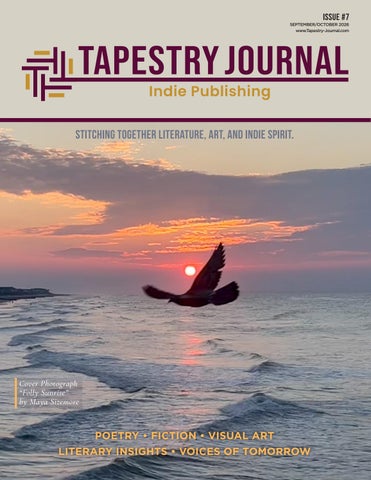
Cover Photograph “Folly Sunrise” by Maya Sizemore
POETRY • FICTION • VISUAL ART LITERARY INSIGHTS • VOICES OF TOMORROW
These Haunted Hills Book 8
A reflective spiritual journey through faith, memory, and healing By Kathleen M. Jacobs Available Friday, October 9th from Jan-Carol Publishing
September/October 2026 | Volume 1 | Issue 7
Dear Reader, There’s something about September that always feels like a little reset. The days get shorter, the air gets cooler, and suddenly we’re reaching for sweaters, warm drinks, and a little more time to slow down and reflect. And for all of us here at Tapestry Journal, this fall feels especially meaningful because our magazine is turning one! One year. Four seasons. So many poems, stories, photographs, art pieces, and conversations with writers who have shared their creativity with us. It’s hard to believe how much has filled these pages since our very first issue. When we started Tapestry, we wanted to create a place where different kinds of creative work could sit side by side; a place for voices, ideas, images, and stories to find each other. And, for me, that still resonates. For this special September/October anniversary issue, we’re leaning into the autumn season with work that captures some of what fall brings with it: change, reflection, nostalgia, new beginnings, and, of course, the beauty of letting things shift. Inside, you’ll find a selection of poetry, art, photography, author interviews, and more, each adding their own thread to this growing collection. We have you, the reader, to thank for helping us build it! Whether you’ve submitted your work, shared an issue, told a friend about Tapestry, or simply sat down and spent some time reading, we’re glad you’re here. So, grab your favorite fall drink, find a cozy spot, and settle in. Happy one year of Tapestry Journal! We can’t wait to see what we’ll weave together next. With warmth and gratitude,
Allison Lawson,
Managing Editor of Tapestry Journal: Indie Publishing
www.Tapestry-Journal.com | September/October 2026 | 3
In this issue Dear Reader
A TALE OF TWO STATES
Our Bookshelf
Voices of Tomorrow
Author Q & A: Jessica Brimer
The Visual Thread
Allison Lawson 3
John H. Hilton 18
5
20
Allison Lawson 6
OUR TENNESSEE SISTER: REMEMBERING DOLLY PARTON
24
EVERY PAINTING HAS A STORY: TEMPLE REECE’S “BUNTONTOWN GOLD” 26
9
Poetry Corner
Author Q & A: KEN CARTISANO
10
Draco Bailey 28
Witness Marks
Tapestry JOURNAL Submissions
Cynn Chadwick 16
Tapestry Journal Indie Publishing
PUBLISHED BY JAN-CAROL PUBLISHING, INC. (Issue 7) MISSION: Tapestry Journal: Indie Publishing is a literary journal dedicated to celebrating the vibrant world of independent publishing. We weave together voices from across the creative spectrum—featuring compelling short fiction, insightful author interviews, evocative photography and art, thoughtful book reviews, and more. Our mission is to champion emerging and underrepresented voices, foster creative dialogue, and provide a platform where storytelling in all its forms can flourish. Like its namesake, Tapestry Journal brings together diverse threads to create something rich, textured, and meaningful. While every precaution has been taken to ensure accuracy of the published material, Jan-Carol Publishing, Inc./Tapestry Journal: Indie Publishing cannot be held responsible for opinions or facts provided by its authors, advertisers or agencies. All rights are reserved. Reproduction in whole or part is prohibited without written permission. Agencies, Advertisers and other contributors will indemnify and hold the publisher harmless for any loss or expense resulting from claims or suits based upon contents of any advertisement, defamation, libel, right of privacy, plagiarism and/or copyright infringement. The views expressed in Tapestry Journal: Indie Publishing are not necessarily those of the publisher. © 2026
4 | September/October 2026 | www.Tapestry-Journal.com
30
PUBLISHER Jan-Carol Publishing, Inc. PO Box 701 Johnson City, TN 37605
EDITOR-IN-CHIEF Janie C Jessee, 423.926-9983 publisher@jancarolpublishing.com
Allison Lawson Managing Editor Tapestry Journal: Indie Publishing submissions@tapestry-journal.com
Draco Bailey Communications Director & Publishing Assistant submissions@tapestry-journal.com
GRAPHICS/PRODUCTION Tara Sizemore Senior Graphics Designer submissions@tapestry-journal.com
OUR BOOKSHELF Featured JCP Amazon Reviews The White Room by Jeff Geiger Jr.
The Breath of Darkness by Daryll Simcox
“I really enjoyed this book, and it was a page-turner full of surprises. I have read some of the author’s short stories before, so I definitely wanted to read his first novel! Would recommend!”
“My husband purchased this book for me because he knows my love of mystery and the unknown. Even though this is a work of fiction, I found myself quickly drawn into the story and turning each page. I won’t give away any spoilers, but the tale is very suspenseful, making for the perfect campfire read. I really enjoyed it and can’t wait for hopefully a TV adaptation. Ordering a copy
— Amazon Reviewer
for a friend.”
— Amazon Reviewer
CATCH UP ON BOOKMARKED! Tune in to Jan-Carol Publishing’s Bookmarked podcast for author interviews, special readings, writing inspiration, and conversations about new books.
Eliette Olivia, author of Estey Grey Plays Her Own Way ....................... Alex Campbell and the Elizabethton High School student investigators
www.Tapestry-Journal.com | September/October 2026 | 5
AUTHOR Q&A
Let’s Chat with Jessica Brimer,
Author of the Messy Bookshop Mysteries Series and Featured in These Haunted Hills: Book 8 By Allison Lawson
F
or this issue of Tapestry Journal, we sat down with author Jessica Brimer to talk about her Messy Bookshop Mysteries series and her contributions to the These Haunted Hills anthology series over the years. She also gives some great writing advice and reveals what inspires her. Q: How long have you been writing now, and what first got you into writing? A: I’ve been a published author for five years. My first published work was a short story featured in an anthology in 2021. However, I’ve been writing stories since I was little. I remember writing my first story in first grade with an immediate urge to do another one. Over time, I wrote more and more. My author journey truly took off when I became a stay-at-home mom. It took years to learn how to craft my writing skills—more than just coming up with ideas. I read more books, joined a writer’s group, and met other writers. I also prayed to God for this blessing—a lot. With God and help from my husband, I wrote eight novels and countless short stories before a small publisher accepted my manuscript. The book is called A Binding Chance. Q: Who are some of your inspirations when it comes to writing? A: Mainly mystery authors. Ellie Alexander, a cozy mystery author, inspired me a lot at the beginning. I did a coaching lesson with her and learned a lot. Over the years, more and more authors have inspired and challenged me. A few others include Vicki Delany and Darcy Coates. It’s a long list. Outside of authors, my husband and kids. They’re my biggest cheerleaders, especially my kids. I’m timid about telling people I’m an author. My husband and kids have zero hesitance. They’ll tell anyone!
6 | September/October 2026 | www.Tapestry-Journal.com
Q: What would you want new readers to know about your Messy Bookshop Mysteries series? A: Cozy mysteries are my favorite genre, and I read a lot of them. I love what cozies offer: a friendly community, a main character readers can connect with, cats, and murder without the gore. Bookstore cozies are my favorite within the genre. When I started planning to write one, I wanted to spice up the tropes, which are great! In Messy Bookshop Mysteries, readers are transported to a charming small town in East Tennessee, where the story revolves around Garnet Stone, a young woman who works at a used bookstore. The bookstore has a reputation for being a little messy. Garnet is far more organized than her boss. When murder disrupts her life, affecting her loved ones, she takes it upon herself to investigate with the help of her friends and her law enforcement relatives. I try to blend humor while characters tackle a murder and personal obstacles. A perfect balance of mystery and fun. Q: You’ve also been featured in several These Haunted Hills installments over the years. How do you approach writing a short story versus a novel? A: With short stories, I focus on a single location or an objective. There’s not enough page time to dive deep into characters or have big character growth. Each word and paragraph has to count and progress the story while not rushing any parts of the story. Writing short stories can sometimes be harder than a novel. Character wants and fears have to be clear and introduced early. There can’t be a lot of backstories, but just enough for readers to understand, and it has to matter to the plot. If the backstory doesn’t affect the plot, then it’s not necessary—cut it.
Q: What can you tell readers about your story in this year’s These Haunted Hills, called “The Living Homestead”? A: This short story was hard. I’ve been wanting to write a story set at an abandoned pioneer homestead for a few years. Though it was a cool idea, I struggled with what to write. Then two things hit me while I was brainstorming. One: What would happen if two Native American cultures came together by accident? Which culture would be dominant? How would that affect the characters? Two: It’s a surprise. If I told you, then readers will know what’ll happen. But what I can say without spoiling the story is that this thing is often found at pioneer settlements that creeps, creeps me out. You’ll know it when you read “The Living Homestead.” Also, my grandpa owned a lot of them when I was growing up, so I had several encounters and nightmares about this thing. So once these two thoughts hit me, the story came together. Out of the other stories I’ve written for These Haunted Hills, this one spooked me the most. I hope it does the same for you, and of course, that readers enjoy it. Q: Do you have any tips for crafting a spooky short story? A: If you let your mind wander, you can find anything and everything creepy or spooky. It might take some time, but it can. My last two spooky short stories came from places I love: caves and old pioneer homesteads—so let’s write a horror story. Oftentimes, you don’t have to look far to find how that location has the heebie-jeebies. Once I find that factor, I plot my characters: Why are they there? What do they want/fear? Overall, make your characters’ actions and wants matter. Give them risks. Without these motivations or problems, characters might fall flat, and when danger closes in, readers won’t care how the story ends.
But I don’t always start with my setting. Other times, I start with the characters. If I had to visit a haunted house as a kid, I would bring my dog. Dogs are protective, and I wouldn’t be “technically” alone. I know not all dogs are brave; I had a Chow, and he wasn’t always brave. Needless to say, I didn’t have to think hard about how to make that story spooky (that story is in These Haunted Hills: Book 5). When it comes to writing horror, I feel like writers can overthink it. You don’t have to base it off what scares you the most. Does it help? Yes, but lots of things can be spooky or creepy without being a deep core fear that disturbs you. My biggest fears are too dark for me to read, let alone write. That being said, do I want to be stuck in a graveyard at night? No. Or tour through a haunted house? Definitely not. So, there you go. Make it to where your characters have to go wherever; a need or want that’s so strong that they have to go. When the reason matters to your characters, your readers will care or at least understand their actions. Q: What’s some writing advice you’ve received that has really stuck with you or helped you? A: Write the rough draft and take a break. Step away from the story. It can be a week or a month. That advice helped me the most. Writers can get so wrapped up in a story that we can overlook minor plot holes, realizing a certain part was over-explained, had a weak middle…The list goes on. Taking a break doesn’t mean to stop writing. I often brainstorm my next project or review another story while I’m stepping away from a rough draft. I find mistakes better when I step away. Also, getting feedback is helpful. Yes, it’s scary. Almost like reading a horror novel, but trust me, another set of eyes helps. Asking feedback from people you trust is a good way. My husband is my perfect example. If my story sounds weird instead of being creepy like it sounded like in my head, he’ll tell me; he’s honest. However, that doesn’t mean I’ll ask www.Tapestry-Journal.com | September/October 2026 | 7
every family member or friend. Some won’t be honest, and I want honesty. I’d rather my work gets ripped apart while I can correct and improve before the story gets published, because if readers find those mistakes, they’ll remember and might not pick up any more books. Getting feedback is hard and sometimes stings, but look at it like this: the feedback will make your manuscript stronger. If writers don’t have anyone close, I also recommend making a post on Goodreads or a Facebook group. Some people will read for free. There are other sites too. Overall, a handful of beta readers can make your story better. Those are my two big pieces of advice for every writer, whether you’re new to the community or a plotter or “pantser” writer. Q: What are you working on next? Anything you can preview? A: I have a few upcoming projects. Of course, there’s These Haunted Hills: Book 8 that will have “The Living Homestead.” Coming out on October 13, I’m also featured in another anthology, The Splintered Spindle: Grimm Tales of
Mystery and Malice. All the short stories are based on a Brothers Grimm tale with a twist of coziness. I’ll have two stories in that anthology. One is based on “The White Snake” and the classic, “Hansel and Gretel.” You can check my Facebook and Instagram pages for more details. As for the Messy Bookshop Mystery series, I have a novella called Reading All the Lime coming soon. Hopefully before Thanksgiving. Once that has been submitted to my publisher, I’ll start working on the final book in that series before starting a new cozy series! Q: Is there anything else you’d like to add? A: I’m excited for all my projects. Currently, I don’t have plans to write a horror novel or novella. I’m content writing them as short stories. That being said, I plan to write another for the following These Haunted Hills installment. What will I write? That’s for me to find out, and for you to read in 2027! I hope everyone has a great fall, and that your only spooks come from reading books. You can find Jessica’s novels, as well as all installments of These Haunted Hills, through Amazon.
Now 2 Hours of Live, Local Fun! Weekdays at 9 a.m.
10 a.m.
8 | September/October 2026 | www.Tapestry-Journal.com
Our Tennessee Sister:
Remembering Dolly Parton By Allison Lawson
T
ennessee has lost one of its brightest lights, but the warmth Dolly Parton brought to our state, and the world, will not soon fade. For Tennesseans, Dolly was more than just a country music legend. She was our “Tennessee Sister,” a woman who never forgot where she came from or the people who helped shape her. Born into a large, humble family in the mountains of East Tennessee, Dolly carried the spirit of those hills with her throughout a remarkable life. Even as she became an international superstar, she remained deeply connected to the people and places that made her. Her legacy can be seen most vividly in Sevier County, where her generosity helped transform the region. Through the Dollywood Foundation, Dolly invested in education and opportunities for children in her home community. Dollywood, the beloved theme park she helped establish in 1986, became not only a tourist destination but also an enduring symbol of Appalachian culture, music, and hospitality. But perhaps Dolly’s most profound gift to Tennessee—and to children everywhere—was the Imagination Library. Launched in 1995 in Sevier County, the program began with a simple, beautiful idea: put a good book into the hands of every young child, regardless of the family’s income. Each enrolled child receives a free, carefully selected book every month from birth to age 5. What started as a hometown effort grew into an international literacy movement, with more than 300 million books distributed to children around the world. The program reflected Dolly herself. She understood what it meant to grow up without much, and she understood the power of imagination to carry a child beyond the boundaries of circumstance. Her father, who could not read or write, was one of the inspirations behind the program. Dolly turned that personal history into an extraordinary promise
to generations of children: that every child should have the chance to dream. That generosity was never limited to books. Dolly also supported hospitals, disaster relief, education, medical research, and countless other causes. Her philanthropy was often personal and practical, rooted in the belief that if you have the ability to help someone, you should. Now, as Tennessee mourns her passing, there is a sense that we are not simply saying goodbye to a famous daughter of the state. We are saying goodbye to someone who made Tennessee feel bigger, kinder, and more hopeful. Dolly once turned the story of a poor girl from the Smokies into an inspiration for the world. In return, Tennessee claimed her as one of our own. She was our singer, storyteller, neighbor, and Tennessee Sister. And through every song, every child holding an Imagination Library book, and every dream she helped make possible, Dolly’s voice will continue to echo through these Tennessee hills.
www.Tapestry-Journal.com | September/October 2026 | 9
Fall Folly
Monarch
By Raven Howell
By Jim Carroll
Fall arrives on a nutmeg breeze,
On your way
in crispy caramelized
to Mexico,
apple cobbler clouds,
you landed
by tossing leaves about,
on a flower
persuading black cats out of shadowed corners,
in our garden,
propping bad-hair-day witches on flying
a late season
broomsticks,
red zinnia.
and dropping an acorn on my head in squirrely snickers.
You used the flower’s petals
______________________________________________________ Raven Howell is an award-winning author and poet of children’s books. She’s a journalist for Story Monsters Ink magazine and contributes stories to several educational publishers. Her poems can be found in publications such as Highlights for Children and Cricket magazine. Raven aims to inspire magic, hope, and wonder.
as your dance floor for your long skinny legs. Your wings pulsed as if you were still flying.
Seasons By Raven Howell
Seasons
By Raven Howell
Illustrated By Ann Pilicer
Children learn about the seasons and weather through the diversity of a year, joyfully encountering birds and butterflies, adventuring at beaches, jumping in colorful leaf piles, and dashing through the whitest winter snow.
www.RavenHowell.com 10 | September/October 2026 | www.Tapestry-Journal.com
Lucky flower! Beautiful butterfly! Nothing looks better in orange than you. _____________________________________________________ Jim Carroll lives in Easton, Maryland. A graduate of George Washington University, he worked over 40 years in golf course maintenance and landscape contracting. He is husband to Kathy and father of Lisa.
Watercolors By Amanda Reed
Lightning bug sparkles dwindle, their numbers growing low. In their tiny bodies, they feel the chilly air that has begun to grow. Have they crossed across the moon glade? A path where no one else can go, an ancient road revealed, that only the watercolors know.
Scents of spicebush with notes of pawpaw fruit are carried on the wind, An essence released in the valley signaling summer’s end. Clinch Mountain is adorned in finery created by a master artist’s hand, Welcoming fall with lovely bright and russet arbor strands.
They drip down into the Holston, and watercolors run. The river welcomes their autumnal beauty, still holding warmth of the fading summer sun. As I sit and rock on my porch built a hundred years ago, I intently watch as the Rose of Sharons fade, and lingering butterflies elegantly let go…
Succumbing to a season that’s coming to an end but gently ushers in another upon the river’s bend. And for generations now, so has this story gone; cicadas sing of August fogs that soon will turn to snow. Where has the summer drifted to? Listen now to the song the river sings. Its words are not for show; there’s wisdom in the song the watercolors know. ________________________________________________________________________________________________________________________ Amanda Reed is a resident of Kingsport, Tennessee. She is a Christian wife, mother, careerwoman, and small business owner. She graduated from King University with a Bachelor of Business Administration and a minor in Appalachian studies. She enjoys writing about the Appalachian Mountains and landscapes she calls home.
www.Tapestry-Journal.com | September/October 2026 | 11
She Waits By Corey Gibson
She sits beneath the awning, Where the afternoon has gathered itself in small pools of gold. Around her, chairs wait too. Tables wait. But she is waiting differently. Her eyes are turned toward a place just beyond the painted edge of the world, where every passing shadow might become an answer. There is a heaviness in her—not sadness exactly, but the ache that comes when hope has stayed too long inside the heart. She has dressed for the moment, not knowing when it will arrive. A footstep. A familiar shape appearing at the corner. A voice she has carried so carefully inside herself that even silence sounds like it. She sits there holding the fragile space between what has happened and what still might happen. The world continues around her, and somewhere beneath all that quiet anticipation her heart keeps breaking for a reason she will never tell us. _____________________________________________________________________________________________________ Corey Weylon Gibson has been writing poetry since he was in grade school, but only recently found the courage to share it with the world. His poems are drawn from real experiences—decades spent navigating addiction, schizophrenia, heartbreak, recovery, and moments of unexpected grace. When he’s not writing, Corey works as an electrician and continues to pursue growth through meditation, mindfulness, and self-inquiry.
COREY W. GIBSON A raw, intimate collection of poems exploring the depths of schizophrenia, addiction, heartbreak, and fleeting love. Each verse reveals a journey toward clarity, capturing the struggle and beauty of a mind trying to be free.
12 | September/October 2026 | www.Tapestry-Journal.com
A STORY OF
GENERATIONS, ADVENTURE, & BELONGING Blending rural sociology with nature’s healing power, Rivers and Roads follows a journey through grief, belonging, self-discovery, and the courage to begin again.
Rivers and Roads by Alicia M. Bynum
AVAILABLE NOW
It Is Not Loss
Back to School
By Micah Burgoyne
By Sharon Harrington
It is not loss when trees are gold
Mother uses a dab of bleach
And filled with autumn’s wealth untold,
to clean my grass-stained feet
For even though the days are wan,
and pin-curls my hair
A poignant pleasure still is drawn
into springy coils.
From times that are more dim and cold. And those ugly, sturdy brown shoes Yet autumn is not fully sold
sit in the closet, waiting to harness my freedom.
To with’ring ways of years grown old,
The mailman delivers new dresses from Sears—
While milder life still lingers on;
two plaid, one polka dot.
It is not loss. Mother doesn’t need to tell me The world in summer, hot and bold,
Summer games are done,
Must weaken as the months unfold.
and strawberries are just May memories.
The time makes known that it is gone, And yet while hopes and patterns hold,
She says, “There!”
It is not loss.
“You are ready for school.” But I am not.
_________________________________________ Micah Burgoyne is a student majoring in English at the University of Wisconsin Parkside. Previously, his poems “There Came a Stranger” and “The Winter Comes” have appeared in the Voices of Tomorrow section of Tapestry Journal, and his poems “Snow Ballad” and “As I Gaze into the Embers” have appeared in the general poetry section of Tapestry.
I am an autumn leaf falling into an unknown winter. _______________________________________________________ Sharon Harrington did not know she was a storyteller, that she had words in her head clamoring to get on paper. She had explored other dreams, such as going to New York at 18 to study acting, returning to college in her 30s to get a master’s degree, and attending culinary school in her 60s while still fulfilling the role of wife and mother. She joined a local writer’s group, found she had a knack for writing, and never looked back. Her work has been published in Tapestry Journal and Coping, both online magazines, and in the anthology Where the Eastern Shore Begins. Her book of poetry, December Cotton, can be found on Amazon. www.Tapestry-Journal.com | September/October 2026 | 13
The Robins of Fall By Mary Ann Maine
Like farmers heading out for the harvest— Some local, others having traveled long distances for the work at hand, Or fans of the big season (after a long road trip to an out-of-conference game), They gather. Raising their voices to match the festive event— Enthusiasts become key players, in the intimate arena. They chant their common mantra, cheering teammates towards the goal. Balmy temperatures just now broken Give way to a slight coolness in the air. Their rust-colored sweaters reflect the heat of fall bonfires, Lit with the kindling of newly cleared thickets— They spread their wings to fan the flames While donning also their gray-brown jackets. Whatever the motivation, they arrive in droves— Inhabiting the old-fashioned dogwoods which were once so common But now seem like rudimentary specimens harkening a simpler time. Like bees in a hive, they meet, But instead of pollen, they hunt the red-ripe berries Hidden amongst the first-dried leaves of autumn. They zip back and forth within their host grove— Looking more like mallard hens as they fly than songbirds, Having no doubt been fattened by the generous buffet As they gathered for this reunion of kinsmen.
ef
14 | September/October 2026 | www.Tapestry-Journal.com
A Gathering Rhyme By Mary Ann Maine
Meet me under the persimmon tree— Persimmon tree, persimmon tree. Oh, how happy we will be… Meet me under the persimmon tree! Fruit too high to reach—I swear! Fruit suspended in the air! Golden orbs above, they hover. We’ll look way up, then at one another! Meet me under the persimmon tree— Persimmon tree, persimmon tree. Below that tree, we’ll find our lot— We’ll gather them up, even though it’s hot! Delicate fruits lay where they fell; Faintly sweet, mixed with a stronger smell! Meet me under the persimmon tree— Persimmon tree, persimmon tree. Oh, how happy we will be… Meet me under the persimmon tree. On the ground, we’ll find our bounty— Most lovely tree in the whole dang county! Meet me under the persimmon tree— Persimmon tree, persimmon tree. We’ll gather them up in a handkerchief— Four corners up—put in as many as you wish! Meet me under the persimmon tree— Persimmon tree, persimmon tree.
Once we’ve found our fill, that’s dandy— We’ll head to the house to find a pot that’s handy! Meet me under the persimmon tree— Persimmon tree, persimmon tree. Oh, how happy we will be… Meet me under the persimmon tree. We’ll stir them up on the warm stovetop, Then we’ll add a little sugar and see what we got! Meet me under the persimmon tree— Persimmon tree, persimmon tree. We’ll get a little biscuit, spoon it all on top. We’ll split it down the middle— Ya know we just can’t stop! Meet me under the persimmon tree— Persimmon tree, persimmon tree. When we’ve eaten our fill, It’ll be jim-dandy! It’ll be so delicious—tasting just like gummy candy! Meet me under the persimmon tree— Persimmon tree, persimmon tree. Oh, how very happy—we will surely be… Just come on and meet me under that persimmon tree! _________________________________________________________ A Virginia native, Mary Ann Maine has called Blountville, Tennessee home for more than three decades. Inspired by the natural world and the people and culture of East Tennessee, she writes about the relationships that shape her and the changing seasons of life.
www.Tapestry-Journal.com | September/October 2026 | 15
Witness Marks By Cynn Chadwick
Creative witness marks are seen as the “scars or notches” in our own lives that signify past experiences, growth, and the processes that shape us.
Introduction
A
s a writer and artist, I am curious about the creative process—my own, and that of all creatives. I visit artists’ studios, seek demonstrations by makers, listen to readings, wander galleries, and seem to have tried my own hand at a variety of artistic endeavors, never to master, mostly only to try, always returning to the writing. And so, I am most interested in how ideas go from envisioning to manifesting. I see these “witness marks” as those flashes of brilliance bringing on a poem, painting, photo, or the machinations leading to stories, prompting sculptures in stone, sewn, scenes in glass, woven on looms, strummed strings, playing keys, trumpeting toons, and singing the songs of angels. This column shares chapters from Cynn Chadwick’s upcoming memoir, Witness Marks, which explores the author’s journey to becoming a writer.
r
An excerpt from a later chapter in Witness Marks
When the Words on the Page Are Your Own…
I
am not unappreciative, believe me. I understand the gift of being able to write and publish and live as close to my core as possible. I love to see, feel, touch—yes, even smell—a book when it first arrives from the publisher. I’m a little like Gollum when the box of newly printed words—my words— drops at my back door. I am the first to see them. I open them in private, in my office where I am surrounded by all things dear to me, my sacred space. Residing in this very occupied room are my favorite books; books by my favorite authors, books about my craft, and my own books. My diplomas adorn the walls alongside photos, paintings, posters, and other sorts of hanging stuff. There is a giant red teddy bear (exactly my age) who’s been with me since the day I was born. He is worn smooth in places, his missing eyes are sewn dangling buttons, and his nose is only a black spot. His name is Red (give me a break—I was two when I named him) and he resides in a mahogany rocker brought from Scotland more than a century ago.
16 | September/October 2026 | www.Tapestry-Journal.com
There is artwork found, given, inherited, made by true artists, many by artist friends, and my own attempts. Tchotchkes and memorabilia that only I know their meaning litter every surface. I have collections by choice: Wade Whimsies, children’s books, blown-glass Christmas ornaments, and other collections by surrender to the well-meant gifting by those compelled to nod to my writerly self: pens— quills to Monte Blanc—typewriters, pencil holders, journals, and framed pictures of authors, quotes, and writerly phrases are in my possession. When folks visit this sacred space, there is a sort of reverence often uttered—So this is where the magic happens? Which I still totally get for those who are not writers, but even for those of us who are—truth is? Yes, actually, this is where the magic happens. I make up worlds, and that’s sort of a magical thing, as any creator’s space must be. My writerly self wants to say, “No, actually, here’s where the magic happens,” and then crack open my skull and let them have a gander at my brain, but that seems rude. Mesmerized, as I, myself, have been in the art-spaces of all kinds of creators: the spaces occupied by painters, sculptors, weavers, glass blowers, musicians, and potters have always intrigued me. And so, I see my visitors scan every spare bit of covered space in my office. When they point
to some oddity hanging, propped, or lying on a surface, before they ask, I warn, “Be careful. Every single thing in this room has a story behind it—even the stapler, so best decide which curiosity you’d like clarified, or we’ll be here till dark.” Of all these objects with a compelling backstory is a 1938 Royal typewriter: iron, heavy, black with a worn wood spacebar, and old-school typewriter keys. Its sides are beveled glass, and it is the very typewriter model featured in Stephen King’s Misery. In the story, by chance, superfan Annie Wilkes rescues her favorite author Paul Sheldon from a car crash in a snowstorm. Trapped in isolation, as the former nurse heals the writer, she learns he’s ended the book series she loves and goes bat-shit crazy. She demands he write the next one, and after smashing his ankles with a sledgehammer, finds this old Royal typewriter and drops the weighty mother on Paul’s already broken legs. That very same model Royal typewriter resides in my office. I’d been teaching Misery in an advanced fiction workshop, when one morning I walked into my office at the university, and this typewriter was on my desk. A piece of white paper in its roller with a sort of gibberish message banged out on it. I knew it was a student prank, probably from my class. Whoever it was would’ve had to employ the help of our admin to open my office door. After asking at the main desk and around, it seemed no one had a clue how the machine got there. I found it a tad unsettling, and so I’d moved the typewriter to the top of a file cabinet where it taunted me until finally, a week or so later, the prankster herself confessed. You see, the student was from Maine. And she told me that she’d bought the typewriter for twenty-five bucks at a yard sale just two houses down from Stephen King’s home. She went on to tell the story of the yard sale seller who told her he’d found it in Stephen King’s trash nearly twenty years before. Scoff, you may, and perhaps it’s too good to be true (she was a fiction writer, after all), but for me what was handed over wasn’t just a featured object in a famous novel, a film-star typewriter, or even the center of a student prank, but the best part is all the stories, true or not, that came with it. I offered the vulnerably poor student fifty bucks for it, which she grabbed without a blink. The best gift from one writer to another. A lie for a lie. I write at an old wooden schoolteacher’s desk I bought at auction, maybe thirty years ago, and it is as much a part of the writing as the computer that sits upon it. It’s never
been refinished, it is scarred and stained, chipped, and cranky, and one of my children carved his name into it… Don’t ask. I know writers who must retreat to colony to write their books or go to quiet places with ocean or mountain views. They seem to require time away from family and home to get the work done. Me? I seem only to be able to write in this space surrounded by all things—me. It is the home to my shattering places. When my kids lived here, and I was in graduate school, I had a poster of a screaming lady on my office door. I told them that if the screaming lady was on the door, they could only disturb me for blood, flood, or fire. About five years after I’d finished my studies, one of my kids asked, “When’s the screaming lady coming off the door?” Turns out, she came down when they both moved out. Sometimes I imagine after I die, and my sons have to come into this space to decide what to do with the 43M memories that lay within. I can picture one pricing out the antiques and the other wondering over the meaning of a certain saved pencil. I hope they take the whole thing apart with a bottle of whisky—let the keening and giggling begin. And so, this is the sacred space where I crack open the next box of my very own newly minted books; it’s where I fondle them, pet them, smell them (I do not lick them), look them over crack to pages, just to see my own words on them. I close my eyes and hold them to my heart. I pour my favorite scotch, build a tower of books, and lift a glass: Sköl, I nod and down the shot. I don’t know what other writers do, but it seems a ritual to have accompanied the last six or seven of my releases. I love having an ISBN number and a place in the catalog at the Library of Congress in perpetuity. That’s pretty cool. But what keeps me alive in every way is the writing itself. I achieve my own version of writing success every time I finish a story, because for me that is the whole point—to write it down. Selling it, publishing it, sharing it with the world? Those are bonuses. It’s the imagining, the stories, the characters, the troubles, and the writing that drive me to the page. __________________________________________ Cynn Chadwick is the author of eight novels, including Lambda Literary Award nominee Cat Rising, the contemporary women’s fiction novel Things That Women Do, and the international bestselling historical novel The Incorrigible Rogue. She is a Senior Lecturer Emeritus of Creative Writing at the University of North Carolina at Asheville. Nestled in the Blue Ridge Mountains, she writes and adores her silly spaniel, Andy. Reach out on Facebook at Cynn Chadwick Author.
www.Tapestry-Journal.com | September/October 2026 | 17
APPALACHIAN HISTORY
A Tale of Two States By John H. Hilton
W
est Virginia is a state of unimaginable beauty and natural resources, home to generations of a virtuous and principled people. It became, however, almost two distinct places during the late 19 th and early 20 th centuries. Unique in that all of its 55 counties reside in the official designated region we call Appalachia, West Virginia shares much of the same history and culture with the rest of the states containing Appalachian counties. By the turn of the last century, the state became unique again in that its economy and politics came to be dominated by a single industry: coal. The above paragraphs describe in concrete terms what I will be writing about, here and in several upcoming history pieces—the Gilded Age, as it was made manifest in Southern Appalachia. My relating this period of history to you will hopefully do justice to the time-honored tradition of southern storytelling, for the teaching of history is more than mere remembrance of fact and folklore. It is also the art of the good old mountain tale, which I like to call front porch poetry. This kind of oral tradition has its own particular cadence, one that can never be captured in the classroom. Now that this is all clear, let’s you and I step back into the not-so-distant past. The Gilded Age is generally considered to be the era of American History between 1870 and 1900. It was a time of unprecedented economic power, growth, and technological progress, when stupendous fortunes were made. But it came with an underbelly of equally stupendous political corruption and widespread crushing poverty. Yes, the United States of America came into its own as a world power during this unparalleled time, but not without a price. For purposes of this essay and the ones to follow, I shall extend the standard time period of the Gilded Age in Southern Appalachia to the years following World War I and the decade of the Roaring Twenties
18 | September/October 2026 | www.Tapestry-Journal.com
and combine them into a 60-year uninterrupted epoch of the wheeling and dealing, high flying, risk tasking, rule breaking, social climbing, and fabulous fortune making of the rich and powerful. At the same time, I mean to show the other side of things: people losing their houses and farms, scores of needy souls crowding into the coal fields to suffer a dangerous and unhealthy subsistence. As we shall explore, a great many of these miners and their families turned their very lives over to a coal company, to an industry—living in a company house, having to buy their goods in the company store. And all in direct contradiction of that great mountain tradition of fierce and noble independence that characterized Appalachian settlers from the beginning. It is indeed an old, tragic tale of necessity triumphing over liberty! And at a high cost. The month of October 1914 illustrates my point as well as any example I can conjure up. In Kanawha County, not 20 miles from the state’s capital of Charleston, over 7,000 coal miners had endured the awful consequences of a massive strike, which began in 1912, and periods of martial law where the state forces were not friendly to the miners’ cause. Dozens of coal field workers had been killed, and the region endured tens of millions of dollars in economic damage during the first of four major coal wars in the great state of West Virginia. Just 80 miles of stream and forest to the east separated paradise from inferno, in the form of the Greenbrier Hotel in picturesque and fertile Greenbrier County. Since 1858, the posh grand hotel, and its natural mineral springs, has served as a mountain getaway for many of the most fabulously wealthy families in America. Among them, in late October 1914, were newlyweds Joe and Rose Kennedy, not yet rich by Gilded Age standards but well off and “up and coming” by any measure. They golfed and wined and dined with other would-be and established elite couples for two weeks of their honeymoon at the majestic palace in the hills.
Of course, Joe would go on to make a colossal fortune, and he and his wife would be the parents of President John F. Kennedy. Yes, Greenbrier County, West Virginia seemed light years away from the coal fields in the southwest—rolling hill Piedmont country with its mountains, farms, and fertile valleys that almost define the color green. Greenbrier County was a natural paradise. It is one of the great tragic pieces of this tale that Kanawha County, with its mountains and narrow gorges and streams, having a different feel from the eastern counties, its terrain rougher—but before all of the coal dust and run-off and fragile shanty homes were built along the creeks—had nearly equal claim to natural beauty and wonder as any other place around. Now, the mammoth coal deposits discovered there in the 19th century were destined to be mined and shipped out in order to power the demand for electricity during the biggest boom era of our country’s history. These coal conflicts certainly were not one-sided, and jobs, production, and growth are essentials to a free and prosperous people. But remember this truth, folks. There are two laws in economics: the law of intended consequences, and the law of unintended consequences!
History is much like the lead character of Homer’s Odyssey, Odysseus—full of “twists and turns.” The easiest thing to be in this business is a Monday morning quarterback. But I prefer to employ what Julius Caesar regarded as the essential ingredient for a leader: foresight. He who can see around the corner and negotiate those twists and turns is clearly the best pilot. Perhaps the best most of us can hope for is to gain wisdom and avail ourselves of history’s lessons. This concludes the first of my Gilded Age Appalachian essays. The saga is rich and has more twists and turns waiting for us. Until the next issue, dear reader.
BIBLIOGRAPHY
Nasaw, David. The Patriarch. The Penguin Group. New York. 2012. Lee, Howard B. Bloodletting in Appalachia. West Virginia University. Morgantown. 1969. Twain, Mark. The Gilded Age. Penguin Books. New York. 2001 ________________________________________________________ John H. Hilton, the author of this article, is a novelist and historian from Arlington, Virginia. He is a descendant of Abraham and Sarah Fulkerson.
NEW RELEASE FROM JOHN H. HILTON
THE HARLOT OF
GLOUCESTER A NOVEL OF THE AMERICAN REVOLUTION
"...A fascinating trip through the American Revolution." - MIKE GRINDSTAFF, AUTHOR
At the dawn of the American Revolution, fiery-willed Henrietta Cromwell is betrayed by her father and the man she loves. As her world turns toward liberty and war, will she survive—or become another casualty of a nation in upheaval?
www.Tapestry-Journal.com | September/October 2026 | 19
VOICES OF TOMORROW “Voices of Tomorrow” showcases the creativity and insight of young writers and artists ages 10–18. This section celebrates emerging talent, offering a platform for the next generation to share their unique perspectives through words and visual art.
FRONT COVER FEATURED ART Maya Sizemore “Folly Sunrise” Photography _________________________________________________________________________ Maya Sizemore is a 15-year-old sophomore from East Tennessee who loves all kinds of art. She enjoys drawing, photography, and graphic design. In addition to visual art, Maya plays viola, guitar, and mandolin.
20 | September/October 2026 | www.Tapestry-Journal.com
Savannah Balli, 10 years old “Autumn Night in the Mountains” Artist Statement: “Autumn Night in the Mountains” reflects the beauty of the fall season with its earlier nightfall in the peaceful setting of the Appalachian Mountains.
Alexandra Balli, 13 years old “A Cozy Autumn Night” Artist Statement: “A Cozy Autumn Night” connects to autumn, because during that time of year, brightly colored yellow, orange, and red leaves fall down, nights get a certain crisp in the air, and all around you see pumpkins, warm-colored lights, bright moons, and many other beautiful autumn-inspired things.
www.Tapestry-Journal.com | September/October 2026 | 21
Campfire
A Portrait of Fall
By Olivia Matras
By Sofia Balli
A golden light flickers before me—
Golden light streams
Not from the flames that heat up the body,
through the forest canopy.
But from the people around
Off the vibrant leaves, it gleams,
That warm the heart.
singing silently.
I no longer seek heat.
The silence is broken
The friends near scare the chills away.
by a gentle snap
A snug knitted sweater wraps around my body,
of a leaf that is falling, onto the path.
Yet nothing compares To a tight hug from my closest friends. ______________________________________________________ Olivia Matras is a 14-year-old writer from Kansas who loves creating poetry with emotional themes. When she isn’t writing, she plays competitive volleyball and enjoys reading. Her goal is for people to find connections between themselves and her work, while finding beauty and strength in their own personal experiences, and learning to grow past them and find the good in everything.
One by one, Each leaf changes color and floats to the floor, not one like another. Some are carried far from home on a chilly breeze, whispering of coming cold, while others lay, so peacefully, under their tree, crunching underfoot of strolling feet. By November, the trees have lost all their leaves and are ready for Winter to come. The sun, day by day, rests more and more, while the moon comes alive, surrounded by thousands of stars.
22 | September/October 2026 | www.Tapestry-Journal.com
Holidays By Sofia Balli
Leaves are falling;
Everyone digs in,
the fire is crackling,
filling their plates tall and high,
which means soon,
chatting with mouths
family will be here,
full of potatoes and pie,
crowding the room,
reaching for seconds
arguing, laughing, running about,
and thirds and fourths,
kids shouting and playing
until someone, filled to the brim,
till the littlest pouts.
gets up and shouts, “Alright, everyone,
From the kitchen, chatter, clatter,
to the couch!”
and smells of pumpkin and spice waft through the house,
There’s a slow shifting
reaching towards the ceiling,
as chairs and family move,
enhancing this cozy feeling.
to stretch out, relax, and digest their food.
The cooks finally call for everyone to gather
The children, jumping around, watch,
and give thanks
confused,
for every lovely platter.
as Grandpa, bursting, starts to snooze. A cousin turns on “The Christmas Song,”
For the herbed bird,
and everyone enjoys
who gave its life
when family comes along.
so everyone can enjoy the food tonight. For the dish of buttered beans, the mountain of cornbread,
_________________________________________________ Sofia Balli is a 16-year-old who enjoys cooking, being outside in nice weather, and reading.
the syrupy cranberries— which look oh, so dark red!
www.Tapestry-Journal.com | September/October 2026 | 23
THE VISUAL THREAD
Draco Sage “Patches the Ghost” Acrylic paint on canvas
April Shattuck Illustration from the children’s book: Scarily the Scarecrow Written by Seldon V. Johnson Jr. (Jan-Carol Publishing, Inc.)
24 | September/October 2026 | www.Tapestry-Journal.com
Boo-tiful Halloween Craft Ideas
H
alloween is a highlight of fall, as children and even adults anxiously await October 31. Similar to the holiday season, people often decorate their homes for Halloween, and even do so well in advance of late October to maximize the amount of time they get to enjoy the trinkets and other items. Many people enjoy getting hands-on for Halloween. It’s possible to craft decorations, personalized treats, and festive costumes. Consider these ideas for Halloween craft projects.
3D Pumpkins Carving pumpkins is a popular Halloween tradition. But there are many people who feel the job is too messy. Instead, a fun way to add personality to pumpkins comes by way of some hot glue and paint. Use a hot glue gun to create a pattern on the outside of the pumpkin. It can be designs, a jack-o’-lantern face or just about anything. Once dry and hardened, use craft paint to go over the entire pumpkin. The raised design will be evident and add dimension.
it, draw a beard shape on the back of the faux fur, and cut it out. Attach the beard to the lower part of the cone over the sock. Use a crew-length patterned sock to create a hat for the gnome, and glue it to the top part of the cone. Glue on a large wood bead for the nose. Decorate the gnome any way you’d like, such as adding felt patches to the sock hat. Halloween can be even more fun with some creative crafts the entire family can enjoy.
Spooktacular Wreath Adorn the front door with something creative. It can be utterly frightening or something more festive. Start with a premade spring greenery wreath or a wreath frame that you cover with your own greenery. Purchase a round, unfinished wooden sign panel, and paint it with black chalkboard paint. Add your own message with chalk or chalk paint. “Keep Away” or “Enter at Your Own Risk” are great Halloween phrases to consider. Attach the sign in the middle of the wreath. You also can add some embellishments to the wreath, including black moss and floral stems and leaves. A glittery black and green ribbon or bow is the finishing touch before hanging.
Boo Treasure Box Purchase a wooden treasure chest or box from the hobby store. Paint it all black or your favorite Halloween colors. Then add additional designs like spider webs, bats or pumpkins. Fill the box with treats or small toys. Kids can have fun picking out their treasures.
Halloween Gnomes Gnomes have been popular for years, and they keep turning up in different iterations. You can craft your own gnomes for Halloween with a few supplies. Start with a 9-inch-tall foam cone. Cut the bottom off the toe part of a solid colored ankle sock just past the heel, and pull it up so it covers the lower few inches of the cone. Add some hot glue to secure www.Tapestry-Journal.com | September/October 2026 | 25
house was cold in the winter and food wasn’t always Every Painting Has a Story: The plentiful. The house was about a half mile from Campbell’s
Temple Reece’s
“Buntontown Gold” By Temple Reece
F
or me, it all began with a painting of an old familiar homeplace of days gone by. Some would call the old house a shack, others a barn; but to me it had character and a story. I did the painting along with a series of three other paintings for Craig’s Coffeehouse in Mountain City, Tenn., in the early 2000s. It was not until a few years later that I actually heard the story of the gold. I remembered the family and stories about them from my childhood. They grew up hard like many families nearby.
Country Store, where we went as children and sold pop bottles, probably for about two cents each. We thought we were rich. I remember seeing Crate Blevins there at Campbell’s many times. He wore bibbed overalls and usually ended his sentences with “ugh.” One time, he gave me a nickel or dime—I can’t remember what kind of coin. This was about the time my daddy told me that I would see men in Mountain City wearing bibs with “backer” on their chins and looking like they didn’t have a dollar to their names but would be rich, especially according to our standards. I have found that to be true, usually minus the “backer” nowadays. Well, little did I know that Crate may have been one of these men. You see, it all goes back to the painting. I had made a copy for Crate’s nephew Johnny and Johnny’s mom, Sandy. They, like me, appreciated the heritage and sentimental value. It was not until I was asked for another copy by Charlie Gregg for his brother, Claude, that I was told the story of the gold. Claude was a friend of Crate and his family, and Charlie knew that Claude would love to have a copy of the painting. Charlie began asking me if I knew the story about the gold.
“Buntontown Gold” by Temple Reece 26 | September/October 2026 | www.Tapestry-Journal.com
There was a glimmer of farm. I recently remembered “The painting is wonderful, and it is exactly like the memory about this, so I asked having a little crush on a boy house. This house is over 100 years old. Seven adults him to tell me the story. He from Buntontown when I was and two children lived in it. It was torn down in 2026. said Crate was digging under about 14. His name was Billy My grandson will put a home there to keep the an old stump on their property Blevins. Hundreds of descenBlevins homestead going for the future.” and found a pot full of gold. I dants of Billy Bunton and the — Sandra “Sandy” Blevins asked my mom if she and Dad Blevins family remain. knew about it. She said my daddy always said that the revenuers Crate has been dead for several years now, buried, I’m sure, came and took it from him. The story was, they paid him for it, in his bibs in the cemetery that sits on a hill near the old homebut not what it was worth. place that I painted, under beautiful old trees at peace with his My mom and dad had Odom’s Grocery in Elk Mills, where family. I lived as a small child in the early 1960s. The store was a oneThe gold…Is it still hidden there as well? The coin he gave room little block building with old fashioned gas pumps out me, do you think…? Or is there a hidden pile of cash? The story front. There was no bathroom or running water, of course. is in the archives of the Elizabethton Star along with the origHow it was a store and home for three, I don’t know. A nearby inal 1951 story. The stories of family, friends, and neighbors store, which has since fallen, was on the corner of Heaton’s will continue on about the Buntontown gold. For me, the gold Branch Road and Poga Road. The Pilktons, which we pro- I’ve found is in the hearts of the people who live there and the nounced “Pilks,” owned the store. It was told that Crate took beauty of our mountains. some of the gold to their store in the 1950s, and they told him that they had no way of cashing it in. It was also said that the Writer’s Note: I wrote this story about 20 years ago. Since that time, many of mailman was a friend of Crate, and he trusted him to see and help him count the money, believed to be an amount around the people I mentioned have passed away. The little store building that was once Odom’s Grocery when I was a small child was taken $17,000. In the ’50s, I’m sure that was a lot of money. Charlie Gregg brought me a newspaper clipping from the down the river with Hurricane Helene. Craig’s Coffeehouse closed Elizabethton Star of a story written by Frank Robinson. He and the paintings hanging there were sold at Johnson County Center for the Arts to a collector just passing through. Where they are now recounted reading a copy of the Star from June 1951 written by is a mystery. his brother, Herman. It was about this pot of gold. The story The old Buntontown homeplace was falling down with the is about William “Billy” Bunton, who came to this area of the passing of time and was eventually torn down to build a new home mountains after the American Revolutionary War with the for Tyler, a descendant of the family. The story of the gold will forever British Army when he was about 18. This is where he married be told, and a print of this painting will hang in the new house in Bunand settled in the Buntontown area of Johnson County. tontown and will be passed down to generations to come. Most people didn’t have a lot of money. They also didn’t trust banks to keep money back then, and they didn’t want to keep it in their houses. Bunton was one of the few who had money, and to keep it safe, he took it from his house and buried it on his property. He later became ill and died, unable to tell his wife where the money was hidden. People knew that he was wealthy, and they searched for his hidden treasure, never to find it. It was told that his grandson, U.S. Bunton, spent most of his lifetime looking for the money. It was about 150 years later that Crate Blevins claimed to have found this money on what was then his family’s homeplace and was once the Billy Bunton farm. The claim was that he didn’t trust anyone and wouldn’t talk about the gold. His sister, Winnie, claimed to have seen a piece of it, and siblings believed him even though his father was a bit leery. One of Crate’s brothers took to his sick bed shortly after this, and some believe that the gold was hidden under his mattress as sick people were not to be disturbed. Billy Blevins told Herman that he and his family of five sons and one daughter had lived all their lives on the Billy Bunton www.Tapestry-Journal.com | September/October 2026 | 27
AUTHOR Q&A
From Morgue File to Haunted Hills: Let’s Chat with Author Ken Cartisano By Draco Bailey
K
en Cartisano has always been drawn to the unexpected. A lifelong lover of science fiction, mystery, and horror, he came to writing seriously later in life, turning decades of ideas into stories filled with curiosity, suspense, and humor. In this interview, he talks about finding his voice, the inspirations behind his work, and finally seeing his stories in print through Jan-Carol Publishing’s These Haunted Hills anthologies.
Q: When and why did you start writing? Can you tell us a little about the first work you ever completed? A: Well, I wrote a short story in college that was well-received by the professor, who read the story to the entire class before handing it back to me. It was a short story about my own inability to save a juvenile swordfish from a greedy captain on a fishing boat. It was called “Blue Monday.” The professor discussed my creativity with me a few times in conferences, but I was married, working full-time, going to school, and could barely stay awake during our brief meetings. In any case, I didn’t write another story for about twenty years. My favorite genre is science fiction, especially short stories. At some point, I believe my mother suggested I keep a “morgue file,” or a file of ideas that one doesn’t yet know what to do with. After more than forty years of reading, I had about a dozen ideas that I thought were unique. And I got it in my head, nearing the age of 60, that I should give these ideas to an author of some skill and authority, who could take them and turn them into something fabulous. I wanted no money. I just thought they were great ideas, and a skilled author could do wonders with them. I wrote to several authors, and to my consternation, I was not just scoffed at; I was rebuked for daring to offer something I 28 | September/October 2026 | www.Tapestry-Journal.com
thought was of literary value to someone with literary talent. (Although one author in particular was very kind and pleasant— Dean Koontz—but still firmly uninterested.) The general theme of the responses I got was that if I thought these ideas were so good, I should write them myself. At the same time, a book appeared on my nightstand one day, authored by none other than one of my idols, Isaac Asimov. I started reading it and, frankly, thought the plot was good, but the dialogue was not. And I thought, “I can write better dialogue than this.” A few months later, my work schedule was severely and gratefully curtailed, and my future almost-wife gifted me a laptop. I located that morgue file I’d been saving for all those years, opened it, and started with the first idea on the list— which, it turns out, did not seem to go anywhere interesting. I wrote eighteen pages and gave up on it and moved on to the second idea on the list. That one turned into a rather lengthy trilogy that is good, but needs a serious final edit, and then proofreading. It’s an epic adventure that spans several genres, from science fiction to mystery to horror/suspense/thriller/ police procedural. Despite its uncertain pedigree, it’s an entertaining tale.
Q: What made you decide to start submitting your work for publication? How did it feel the first time one of your stories got accepted? A: Pretty good, actually. While I was writing the second idea on my list, I stumbled upon a writing site on LinkedIn, which then migrated to its own website, freeing the participants from some inconvenient restrictions incompatible with writing short fiction. There were just seven or eight writers when I joined the group, and it was set up as a good-natured biweekly contest that boasted as many as twenty writers from time to time but hovered mostly around twelve “unredeemable” diehards who submitted stories so faithfully we sometimes apologized if we had to skip a week or two. I joined the group in 2014 and stayed engaged for nine years. The skill level of the other writers varied from week to week. One gentleman did not make more than four mistakes (that I could find) in eight years. And he still swears he only made three mistakes, and one was deliberate. Another writer admitted that he just expected to win every contest. (Which he did not, but his skill and craftsmanship were such that he
simply never expected to lose.) I hope that conveys some sense of the quality of the competition. At some point, after posting about one-hundred and fifty stories, a discussion arose about whether our stories were published, or whether we were simply in a writer’s workshop. I exited the group when it appeared to me that the decision on whether my work was already published or not was at the sole discretion of the moderator. Most of the stories that I consider published are trademarked and should not be copied, but they’re available to read wherever one can find them. To be brutally frank, I’ve never had anything that I consider published until Jan-Carol Publishing accepted my stories for These Haunted Hills—a gesture and an offer for which I will remain eternally grateful.
Q: You’ve been in several of JCP’s These Haunted Hills anthologies. What draws you to the horror and mystery genres? A: Horror and mystery are fertile fields for creative fiction. One can hardly avoid veering off into the macabre and creepy these days. I mean, as a culture, I think we’ve outgrown Reader’s Digest. It’s not that there isn’t plenty of room for light-hearted writing, but mystery and horror are compelling in their own right, if done correctly. To put it in literary terms, graham crackers should be eaten with milk while reading a suspense thriller, especially alone, at night, but there should be no graham crackers in the story itself. (That’s just common sense.)
Q: Can you share the inspiration behind some of your spooky stories? How do your ideas come to you? A: Oh sure, I can tell you where my ideas come from, but then I’d have to kill you. (I’m kidding, of course.) People are afraid of the unknown, what they can’t see or understand. Anyone who has a smattering of scientific curiosity knows how odd the natural world can be and yet stay perfectly harmless. Personally? I’ve seen a lot of strange things and had a lot of strange experiences; none of them supernatural, but it’s easy to make the leap from the unlikely to the inexplicable, and from the inexplicable to the unknown. I’ll give you an example. One of my stories published in These Haunted Hills is about a man who thinks there is something in the woods near his house and stubbornly refuses to disregard it. This was based on a walk my wife and I took through the woods near our cabin. We really did find an extremely large hole, and it was clear that there were trails leading off in several directions from this hole. The trails had been in use, but what it was or is that used the trails or the hole—who knows? Likely nothing more frightening than a group of miniature aliens or a really fast-moving turtle. See what I mean? Certainly nothing supernatural.
Q: What other genres do you enjoy writing or reading? A: While my favorite genre is sci-fi or speculative fiction, I find that I’ve gained a great deal of pleasure out of authors who create series of books that blend fiction with history. Imogen Robertson writes about solving murder mysteries in the late 1700s. (They’re referred to as The Crowther Mysteries.) Another writer, Ruth Downie, writes about a doctor in ancient Roman-occupied Britain in The Medicus Series. Another writer I’ve read with great satisfaction, Bernard Cornwell, depicts a similar ancient time of strife between the Danes and the Saxons. Two writers who collaborate well, Douglas Preston and Lincoln Child, do some great modern horror and mystery blended into the history of New York City’s Museum of Natural History. That incredibly prescient book, The Egyptian, exemplifies the perfect blend of historical accuracy and fictional storytelling, but that was only one book.
Q: Besides JCP’s anthologies, where else can readers find your work? A: Almost nowhere. I mean, I can’t help with that. They’re on various websites, several that I’ve created, and frankly, renewing the sites every couple of years has not proved simple or easy of late. I’ve had websites, site names, and domain names stolen, compromised, corrupted, or simply forgotten about. Although a few of my stories can be found on Reedsy and a few on Medium, I don’t recommend either site unless you want to read other people’s stories; for that, they’re great. And I honestly can’t remember the address or name of the site that has over a hundred of my stories. I couldn’t remember it when I was actively participating. Something like—Creative Flash Fiction. I have compiled a list of what I think are some of my best and most recent short stories, and I’m considering their fate as we speak.
Q: What tip do you have for writers who want to break into the world of frightful short stories? A: Think it over very carefully. It’s a bit like standing on the seashore, looking at the ocean and having someone say, “Will I need a snorkel for this?” No. You’d be better served with a bathysphere, but they’re kind of expensive. But go ahead, jump in. What’s the worst that could happen? You get pulled out by a riptide, gashed by a shark, and harpooned by a lobster fisherman who mistakes you for a furless harbor seal. But if you don’t even give it a try, you’ll never know if it was meant to be or not. You can check out some of Ken’s stories in These Haunted Hills, available on Amazon. www.Tapestry-Journal.com | September/October 2026 | 29
Tapestry Journal Indie Publishing
Call for Submissions: Tapestry Journal’s November/December Issue
Theme: Theme: The Holidays are Here! Tapestry Journal invites submissions for our upcoming November/December issue that explore the holiday season and all its complexities. The lights are going up, the days are getting shorter, kitchens are filling with familiar smells, and somewhere between the celebration and quiet reflection, we find ourselves gathering with family and friends. What does this time of year mean to you? Maybe it’s joy, wonder, tradition, family, faith, or community. Maybe it’s nostalgia, grief, or change. Or maybe it’s a favorite tradition, a winter landscape, a crowded table, a childhood memory, or a holiday you’ve invented entirely for yourself. We’re seeking original works in the following categories: • Short Stories • Poetry • Photography • Art (digital or traditional) • Book Reviews • Opinion Pieces related to the literary world
30 | September/October 2026 | www.Tapestry-Journal.com
Submissions Deadline: October 31st, 2026 How to Submit: Email us your submissions at submissions@tapestry-journal.com. Full submission guidelines will be shared soon at tapestry-journal.com. Questions? Reach out to us at: submissions@tapestry-journal.com. We look forward to seeing how you interpret the holidays!
Tapestry Journal Indie Publishing
A VIBRANT NEW SPACE FOR INDIE VOICES, CREATIVE VISION, AND LITERARY DISCUSSION. Each issue weaves together short stories, poetry, photography, author interviews, book reviews, opinion pieces, and more— highlighting the dynamic world of
DRIVEN BY RAGE FUELED BY DIESEL The Forgotten Victims of the Tennessee Highway Hunters
independent publishing and the artists shaping its future.
Explore the threads. Discover the voices. Celebrate the craft.
TAPESTRY JOURNAL — Stitching together literature, art, and indie spirit. For more information: Tapestry-Journal.com
By Elizabethton High School Tennessee Student Investigators
A gripping true-crime account of the student investigation that brought renewed attention to the forgotten victims of the Tennessee Highway Hunters.
ALSO FEATURED IN THE PRIME VIDEO DOCUSERIES MURDER 101
Tin Can Kids Book Club
FUN ON THE FARM ADVENTURES CHAPTER BOOK #2
Pearl
the Show Pig
Story and Artwork by Denise Frances DiJoseph
Laugh, Love, and Learn Together AGES 6–10 • CHAPTER BOOK Betsy finally gets her chance to show Pearl at the Fun Fall Festival—but her spirited piglet has ideas of her own. Can Betsy help Pearl shine in the spotlight? And will Mikey find the confidence to give his speech about Blackberry?
Now Available!
“every story needs a book”
GET YOUR BOOK PUBLISHED! Jan Jan-Carol n-Carol Pu Publishing, ublish hing, kn known nown ass JCP, JCP, is the thee largest book region with over b oo ok publisher publisher iin n tthe he re egio on w itth o ver 400 titles books of b ooks and publishing publishing the th he monthly monthlyy magazine, Voice Magazine for over 20 for Women, for o ver 2 0 yyears. ears. We W are locally l ll owned d and d operated. d • How do you get your book published? • How do you submit your manuscript? • What steps are needed for editing? • How do I get an ISBN? • Will your book be on Amazon, Barnes and Noble, etc? Let us assist you in navigating through the book publishing process! 423.926.9983 submissions@jancarolpublishing.com www.jancarolpublishing.com