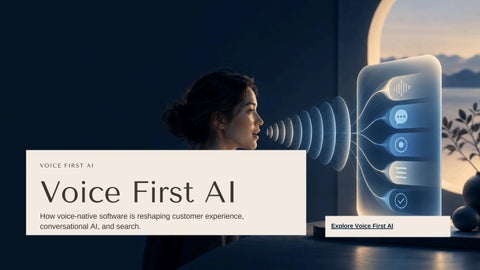
VOICE FIRST AI
Voice First AI How voice-native software is reshaping customer experience, conversational AI, and search.
Explore Voice First AI
THE EXPERIENCE LAYER
Voice is becoming an experience layer, not just a feature Voice-first technology lets people express intent in their own words instead of navigating menus, forms, and screens. The strategic question for leaders: where can conversation remove interface labor without creating new friction?
SPEAKING A REQUEST IS ROUGHLY 3× FASTER THAN TYPING IT Why now is when we will all start talking to our computers
CATEGORY DEFINITION
What “Voice First” means in practice VOICE-ENABLED
VOICE FIRST
Adds speech to an existing flow
Designs around conversation
The screen remains the centre of the interaction. Voice is an optional control layered on top.
Context, correction, timing, and outcome shape the experience from the beginning.
The experience can still be visually rich when visuals help, but the user does not need a screen to control it. Explore the Voice First approach
DESIGN PRINCIPLES
The principles that make conversational AI feel useful Conversational and context-aware Remember the thread, not just the last command.
Interruptible and correctable Let people redirect, undo, and recover mid-flow.
Ambiguity-aware Make smart guesses, then ask when accuracy matters.
Tool-routed Infer the task from the request, not the screen.
Adaptive Learn preferences and adjust the experience over time. Read the ten principles of VoiceFirst applications
CUSTOMER SERVICE
Where voice can remove friction from customer service Hands-free and eyes-free
Speed-critical
Support customers while they are driving, working, or moving through a task.
Shorten high-frequency questions and status checks.
Complex queries
Accessibility
Let customers describe a multicondition need in one sentence.
Make more interactions usable for people with limited vision or finemotor control.
See the indicators for a voice user interface
SEO ARCHITECTURE
Own the topic without stuffing it PRIMARY
voice first technology One clear category phrase anchors the page.
SECONDARY
conversational AI for customer service voice-native software voice user interface voice AI customer experience
RELATED
conversational interface · speechto-speech AI · hands-free customer support · voice search optimization · AI customer service automation · natural language interaction
Use one primary phrase per page, then build depth with closely related questions and use cases. Use the homepage as the category hub
ANSWER-ENGINE CONTENT
Answer the questions buyers actually ask What is voice-first technology? How is conversational AI used in customer service? When should a company add a voice user interface? What makes a voice assistant feel natural and trustworthy? When is voice the wrong interface? Writing pattern: direct answer first, then examples, caveats, and links to deeper pages. Build from real voice-interface questions
INTERNAL LINKING
Give every page a clear next step Anchor text
Destination
Voice-first technology
https://voicefirst.ai/
Read the first chapter
https://voicefirst.ai/#chapter
Explore the book
https://voicefirst.ai/#inside
Ten principles of VoiceFirst applications
https://voicefirst.ai/articles/ten-principles-of-voicefirst-applications/
Why now is when we will all start https://voicefirst.ai/articles/why-now-is-when-we-will-all-start-talking-to-our-computers/ talking to our computers Use contextual anchor text that tells the reader why the next page is worth opening.
CONTENT CLUSTER
Turn the topic into a useful content cluster PILLAR
Cluster 1 · Customer service
Voice First AI
Intent recognition, escalation, and trust.
Voice-native software and the category story.
Cluster 2 · Voice user interface design Interruption, ambiguity, personality, and latency.
Cluster 3 · Search and answers Voice search optimization and answer-engine content for natural-language questions. Link each cluster back to the pillar and forward to the most relevant article or chapter. Explore the future of voice interfaces