William Monroe Middle + High School
Greene County Public Schools


![]()


A 2015 Long-Range Strategic Visioning Study identified the capacity of core program areas (dining, kitchen, library) at William Monroe Middle and High Schools as well as site improvements to the Stanardsville Campus as first priorities in a long list of potential improvements to Greene County Public Schools’ facilities. While previous solutions to enrollment growth primarily concentrated on additional classroom space, the public shared spaces of both schools, as of 2015, were drastically undersized for current enrollments.
Design solutions for both projects centered around the need for more space in dining areas and libraries. While the new dining and library spaces were planned with future enrollment growth in mind, the final solutions center around providing shared, flexible, and adaptable space use. This strategy creates appropriate-sized spaces while avoiding creating spaces that are too large, and thus less flexible – ultimately resulting in a more cost-effective solution than considering each space individually.
Flexible, widened circulation areas can be utilized by different program areas at different times of day. Former dining and library spaces have been converted into flexible learning suites that will enable GCPS to match project-based programs with spaces better suited to their needs. All new spaces are designed to maximize daylight and increase opportunities for views to the site and nature, which are not characteristic of the existing building.
The Stanardsville Campus houses four schools on a tight site that more resembles a community college. Site improvements focused on clarifying and reorganizing traffic flows to improve circulation and pedestrian safety. Landscaping improvements seek to make the campus feel more like Greene County, while stormwater improvements are exposed as landscape elements and provide learning opportunities for students and the community.

The design of the additions empowers individual school identities while reflecting a unified campus aesthetic. The additions introduce buff ground-face CMU piers and volumes with large wood roofs to the campus material palette, to monumentally mark the public program and major entry points in concert with the larger moves on the site. The quality of the additions signals the importance of this project for the community, while the new campus landscape contributes to a greater sense of place, creates an increased sense of identity for the campus / individual schools, and showcases Greene County’s commitment to learning.


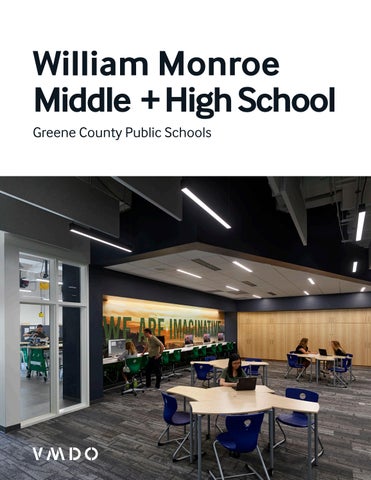
The existing middle school was primarily classrooms and windowless corridors, and the school in the middle of the campus with an odd relationship to the street. The primary renovation move was the relocation of the main entrance, administration, and library to the east façade. Combined with a reorientation of Monroe Drive to create a more formal entry plaza, this move allowed for greater access to natural light for the library, freed up the interior of the plan to connect various corridors with a new multi-function student commons, and provided a secure entry vestibule setup for the administration with clear sightlines to the entry and parking. Displaced classrooms were accommodated elsewhere in the existing building, and newer classroom typologies for project-based learning were created off the commons.

In addition to providing much needed additional capacity for dining and the library, the renovation of the high school greatly improved the circulation and access to these large public program areas. With a new glazed connector, all program areas in the high school can now be accessed without leaving the building. The massing of the renovation/ addition is rooted in an understanding of the realities of phased construction, as the existing kitchen and dining facilities had to remain operational until the new facilities were up and running. This led to the creation of the flexible learning suite within the former cafeteria, and the creation of the Maker Terrace to the south, in the area of the former kitchen, encouraging further connections to the site.


While the primary goal is to design the core program spaces for projected enrollment growth, the design seeks to find synergies between program areas and avoid the construction of large volume spaces that are only occupied a few hours per day. In reconsidering the roles, functions, and boundaries of dining, library, and classroom spaces, the architect sought to reduce the overall square footage required for these functions and programs while increasing the use and functionality of the spaces –ultimately promoting the idea that learning can happen anywhere.
The design approach to the interiors of both schools centered around the creation of spaces that students want to be in, while reinforcing the schools’ sense of community, and providing frequent connections to the site and campus. The new complement of commons spaces, small group meeting rooms, larger public spaces and functional, flexible outdoor spaces now provides both schools with a greater diversity of space sizes and types to meet current and future needs.

“This project not only provides additional capacity needed in our schools but also includes high-quality educational spaces for learning and a safe campus for our students and staff. All spaces have been designed to be both ‘flexible’ and ‘timeless’. The renovated areas are the first spaces specifically designed for 21st Century education in our schools.”

CHARLOTTESVILLE OFFICE
200 East Market Street Charlottesville, VA 22902
WASHINGTON DC OFFICE
2000 Pennsylvania Avenue NW
Suite 7000 Washington, DC 20006
vmdo.com | 434.296.5684