

VMDO Trav el Fellowship
Sonic Berlin: Aural Architecture in the German City
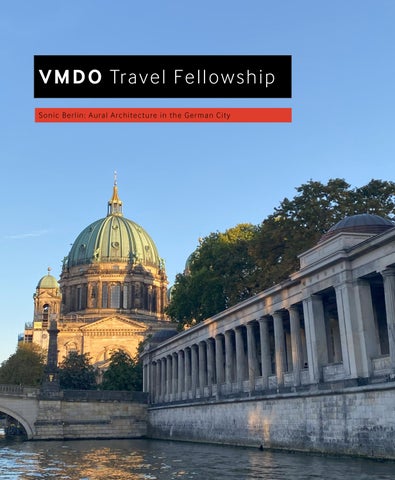
Sonic Berlin
Aural Architecture in the German City
James Atkins
Travel Fellowship Overview
Architects’ travels have long been a core component of their training, whether they are part of a structured academic expedition or a selfdirected excursion. From the “Grand Tours” of the 18th and 19th centuries to Le Corbusier’s Voyage d’Orient, travel has played a major role in the continued development or architectural thought and production. Travel helps build familiarity with culture, enhances the architect’s spatial and technical vocabulary and build’s a reserve of historical precedent that is key to the continued execution of good design. Travel is an important way to see past architectural successes and learn from them. Notes, sketches, and travel experiences are never ends in themselves --- but become active agents for application to the design process. In addition to the enjoyment of wonderful places, travel is a tool to advance ideas and for making better architecture.
The VMDO Travel Fellowship is an annual award that gives VMDOers the opportunity to pursue unique investigations into architectural topics that are of particular interest to them. The Fellowship is intended to support an autonomous and self-directed course of study that complements the work being done at VMDO. Topics of inquiry and sites of study are determined by the applicant.

James Atkins
Destination: Berlin, Germany
With this Travel Fellowship, I focused my study on important places of aural architecture in and around Berlin, Germany. Aural architecture is defined as “properties of a space that can be experienced by listening”; and, when designed correctly, these properties can greatly amplify the meaning or use of a space. I chose Berlin for its rich and complicated history, its numerous sites of remembrance, and the prevalence of performance venues. The timing of the trip happened to fall during Berlin Musikfest, and I took advantage of hearing many of these great spaces in action.
This book is organized into two sections based on the sonic spatial effect: spaces of peace and contemplation, and spaces for organized performance and worship. As an architect and musician, I consider the sound of space as a critical design factor, and I hope you are inspired by the many ways sound can enhance a space.


Berlin-Brandenburg
Brandenburg
Berlin Wall Memorial
Memorial for the Murdered Jews of Europe
Jewish Museum
Berlin Philharmonie
Staatsoper
Deutsche Oper
Berlin Dom Thomaskirche
Tauber Philharmonie
Quentin Boutique Hotel
Fernsehturm
Checkpoint Charlie
Gethsemanekirche
Sachsenhausen
Bode Museum
Konzerthaus Berlin
Olympic Stadium
Unite d’Habitacion
Reichstag
Hauptbahnhof
All Saints’ Church - Wittenburg
AEG Turbinenfabrik
Bauhaus Archive
Klosteruine
Neue Nationalgalerie
Alte Oper - Frankfurt
Kaiser Wilhelm Memorial Church
Schloss Charlottenburg
Tiergarten
The Method
Before embarking on this journey, I had not fully finalized my methods for documenting these sites. I tried to be as equipped with tools as possible and carry an open mindset to every place I visited. For visual documentation, I relied on photographs and some live sketching. For auditory documentation, I relied on a number of apps: voice memos for recording, Decibel X for measuring sound pressure, and ClapIR for measuring spatial reverberation. The latter app gave me mixed results for exact reverberation time, but I think the graphs illustrate a general trend well. For experiential documentation, I relied on mapping on printed floor plans of these buildings and note-taking. And, of course, a lot of clapping and snapping to get a sense of the acoustic. Ultimately, I wanted to be mentally present and engaged as I visited these sites, to absorb as much as I could and then synthesize everything upon my return.

Sketches at Kaiser Wilhelm Memorial Church

Reverberation Time (in sec)
Berlin Philharmonie applause
Nikolaikirche full organ
prelude at Berlin Dom Tauber Philharmonie dinner emergency vehicle siren inside the U-Bahn
pre-concert chatter drums at Jewish Museum
Chapel of Reconciliation distant roar of street Brandenburg Gate Charlottenburg fountain Reichstag dome
Raum der Stille ambient sounds of nature
Sound Pressure Scale (in dB)

Absorption
Raum der Stille (Berlin-Brandenburg Airport)
Brandenburg Gate
Berlin Wall Memorial
Memorial to Murdered Jews of Europe
Jewish Museum


Reflection
Berlin Philharmonie
Staatsoper & Deutsche Oper Berlin
Berlin Dom
Thomaskirche
Tauber Philharmonie
Spaces for Contemplation and Remembrance Absorption
Raum der Stille
Building type: Airport
Dates: Constructed 2008-2020
Architect: gmp Architekten
The Raum der Stille, or “Room of Silence”, is an interfaith meditation space inside the BerlinBrandenburg airport. Located in what looks like a service corridor, this space offers a quiet retreat from the stress of international travel. The circulation experience to this space is peculiar: one side of the corridor feels like a service space, and the other side features a rubbed concrete wall with a Paul Valery quote about the importance of silence.
Inside the Raum, the experience is quite intimate. The floors and walls are all finished with stone. The vaults in the ceiling add some height to the space without sacrificing the intimate scale. Lighting comes only from the vault overhead or from floor reveals at the bases of walls. The side exit corridors are very dark and create a sense of foreboding. There are no windows in the raum, other than the full lite door at the entrance. Minimal furniture and religious ornaments keep the space from being overstimulating. The sound pressure measured at 34 dB, and the reverberation test revealed significant propagation of lower frequencies.
I spent a few minutes in the Raum and was impressed by how removed I felt from the airport. For a moment, I forgot where I was because the space is so transporting. The space is very quiet, almost to the point of discomfort, and I became preoccupied with being alone in such a quiet space. I wonder if my experience would have been better if other people were present.


01 - Main airport terminal
02 - Mezzanine in Main Terminal
03 - Corridor behind cafe
04 - Raum der Stille corridor
05 - Raum entrance
06 - Raum der Stille


20 Raum der Stille


Raum der Stille
Brandenburg Gate
Building type: Monument
Dates: 1788
Architect: Carl Gotthard Langhans
The Brandenburg Gate is arguably the most recognizable landmark in Berlin. Opened in the late 1700s, it was built as a gate of peace that welcomed people into the city. Atop the gate is a statue of the Goddess of Victory triumphantly entering the city. In the twentieth century, this portal assumed a different meaning when it became a part of the Berlin wall. For a period of nearly thirty years, it symbolized a divided city and a divided country. When the wall fell, the Gate resumed its symbol of a reunified city and a reunified Germany.
The gate punctuates Unter den Linden, the main avenue that crosses the Tiergarten and connects the different sides of the city. From the gate one can see the Victory column to the west and the Fernsehturm to the east. Along the street in the Tiergarten are a number of monuments and memorials, including one dedicated to Soviet soldiers who died during World War II. Closer to the Gate, a large plaque in the sidewalk bears Ronald Reagan’s famous “Mr. Gorbachev: tear down this wall” from a speech given at the Brandenburg Gate.
I visited the Gate on several occasions during my trip, and every time I was there so were a lot of people both in formal and informal assemblies. On one occasion, there was a grandstand stage set up with people giving speeches. At other times people were zooming through the threshold on bikes, taking pictures of the landmark, and going about their lives in the city center.


Brandenburg Gate, from Unter den Linden

Brandenburg Gate, site plan
see p. 26 for Raum der Stille plan

Built into the Brandenburg Gate is a Raum der Stille, the idea of which originated prior to the collapse of the Berlin Wall. It is a simple room that invites anyone, regardless of their religious or political background, to enter and meditate in silence for however long they wish. It is a spatial symbol of tolerance. The room has little decoration inside other than some hanging blinds to filter light from windows and a few chairs. A single woven wall hanging by Hungarian artist Ritta Hager symbolizes light penetrating darkness. I spent some time in this room and found the experience refreshing and restorative. On both occasions when I visited the Raum, there were other people inside and plenty of activity outside. Very minimal sound bleed from the exterior penetrates the room, so it must be acoustically very well sealed. From my measurements, there was almost a 30 dB difference between the noise inside and outside the Raum der Stille.


Woven art hanging by Ritta Hager
Sign at entrance to Raum der Stille
Blinds hanging along exterior walls
Main entrance to Raum der Stille
Berlin Wall Memorial
Building type: Monument
Dates: 2002
Architect: Peter Sassenroth, Rudolph Reiterman
It is virtually impossible to walk around Berlin and ignore markers of its complicated history. Plaques embedded in the sidewalks identify the many lives lost during the Holocaust and post-war era. One such site is the Berlin Wall Memorial, a park that occupies a former death strip from the Cold War. This site hosts 200 meters of the former 155 kilometer wall, and it allows tourists to get a sense of the scale of the wall and death strip in real space. Along the path in this park, visitors encounter several exhibits including a window wall memorial to victims, archaeological windows in ground that show former foundations, and markers on the ground that illustrate boundaries of escape tunnels. The park even contains a preserved section of walls with guard tower that seems untouched since 1961.
Like many sites in Berlin, this one makes it very obvious that the city is not afraid to openly express the painful events of its history. The sidewalk becomes an immersive lesson in twentieth-century history.


View of preserved “Death Strip” from observatory tower


see p. 35 for Chapel of Reconcilation plan


Plan from pamphlets on site


Locations of walls marked by steel plates in the ground.
The Chapel of Reconciliation commemorates a church that was torn down in 1985 because it existed in the path of the wall. In contrast to the cruciform cathedral that once stood on this site, the chapel is an oval-shaped rammed earth building with a wood screen exoskeleton. The aggregate for the rammed earth uses clay from the original church structure and foundation. A simple plywood on wood beam structure forms the ceiling with two skylights over the altar and cross providing most of the light for the space.
The experience of this chapel is very grounding as if every surface was hand-crafted. I felt very connected to the earth and the sky in this space. Were it not for the ambient noise of the street filtering into the building, I would have felt totally transported. Though this building is a functioning chapel as opposed to a raum der stille, there was a similar intimacy about it, a space that promotes tolerance and reconciliation.


View of old church’s foundation through metal grate. Texture of rammed earth walls.
01 - Arcade perspective

03 02
Chapel entrance
Organ loft above
Altar


Berlin Wall Memorial
Chapel skylights
02 - Skylight

03 - Chapel altar
Memorial to Murdered Jews of Europe
Building type: Memorial
Dates: 2003-2004
Architect: Peter Eisenman
Constructed in the early-2000s, Peter Eisenman’s design for the Memorial to Murdered Jews of Europe is a field of stelae: columns meant to hold memorial inscriptions. The stelae measure 3’-0” wide and 7’6” long, and they are arranged in a grid with 3’-0” clear space between them on all sides. The ground under the stelae undulates toward the middle of the urban block so that the visitors’ perspective changes depending on where they are. While many interpret the blocks as tombs, Eisenman asserts that they are only meant to create a sense of disorientation within the field.
The design is highly successful in achieving this intent. The deeper I walked into the field, the stranger the experience became. When the columns rise far above your head, you lose a sense of relation to the street and where you came from. The only uninterrupted view is upward. The sharp corners around the blocks offer no visibility to crossing paths of travel; thus, every intersection is a surprise and a shock, especially when you encounter another visitor at the same location.
The blocks create a similar acoustic disorientation effect. When walking through the field, the only sound comes from overhead until you pass through an intersection. At that point there is a sudden presence of sound on either side of you, especially if there is another person nearby.

Tiergarten


The field of stelae


Periodically, while walking through the field, I would snap my fingers to observe any resonant activity. Toward the middle, when the stelae reach a height of at least 15’-0”, the snaps would resonate on pitch (somewhere around 190 Hz, which sounds like the semitone between the F# and G below middle-C). For a brief moment, the spacing between the stelae would behave like a pipe, vibrating at an audibly-discernable frequency based on its width and height.


Acoustic diagram of flutter echo
Jewish Museum
Building type: Museum
Dates: 1999
Architect: Daniel Liebeskind
The Jewish Museum is a cultural history museum that exhibits Jewish cultural heritage and the story of the German Jewish experience. The complex consists of several buildings including a Baroque era building that has served as a palace and college academic building and the famous addition designed by Daniel Liebeskind. The visual tension between baroque symmetry and expressive deconstructivism highlights the complex history to be discovered in the exhibits within.
The striking form of the Liebeskind addition is meant to represent an unfolded Star of David. The facade is clad in zinc-coated standing seam metal panels articulated by diagonal crossing apertures. The windows appear to be cuts and gashes in the building volume heightened against the rigid verticality of the standing seam metal. On the interior, this tension continues in dialogues of black and white walls and the use of voids in space. The addition is intentionally disconnected from the original building at the ground plane. One enters the Liebeskind addition by descending underground, where the bulk of the Holocaust exhibits are located. Sloping floors against a level ceiling and dim lighting create a sense of imbalance and foreboding. One of the exhibits on this level features a loud video of drums playing that can be heard from at least 100’ down the hall. As visitors ascend to the upper level, the character of the museum changes. Vibrant and interactive exhibits allow one to feel relaxed and engaged with the culture with bold reminders of the history coming in the form of gash windows and glimpses of the voids in the building.


“Old Building” at the Jewish Museum


Alley between the Liebeskind addition and Holocaust Tower

Exterior of Holocaust Tower


Plans from museum pamphlets
Memory Voids


Memory voids and axes through the building.

Ground level exhibit
This building is full of poetic moments where light, materiality, and proportion create compelling spaces that elicit an emotional response. One such space is the Holocaust Tower, a cathedral-like concrete room with only a sliver of natural light poking through near the ceiling. This space is quite disorienting due to the dim lighting, cavernous acoustic, and stretched proportion. I remember feeling hopeless and uneasy thinking about how unreachable the light source is and about what might be lurking in that very dark corner. The space provides a powerful emotional connection to a tragic history.


Axon of the Holocaust Tower


Exhibitions throughout the museum
Additional Sites


Kaiser Wilhelm Memorial Church
Schloss Charlottenburg


Neue Wache
Sachsenhausen
Spaces for Performance and Worship Reflection
Berlin Philharmonie
Building type: Concert Hall
Dates: 1963
Architect: Hans Scharoun
One of the main reasons for choosing Berlin as the city of study was to visit this building. The Berlin Philharmonie, designed by Hans Scharoun in the 1960s, is globally known for its distinct volume and for being a pioneer of the innovative “vineyard style” of concert hall design. The Berlin Philhamonie has two concert halls: the Large Hall seats 2,440 people, and the Chamber Music Hall seats 1,180.
A vineyard style hall is one in which the stage inhabits the middle of the room with the audience surrounding it on all fronts. Audience seating tends to be organized in terraces or trays, mimicking the rolling hills of a vineyard, rather than a series of linear rows. The interior volume is very spacious, and mazes of stairs and paths lead spectators to their seats. The large entry foyer hosts several amenities including concessions stations, coat check booths, and a gift shop.


Berlin Philharmonie, with Richard Serra’s “Berlin Junction” in the foreground Inset: Hans Scharoun gestural sketch of the Philharmonie


Balcony
9/14/23: Jonchaies (Xenakis)
9/13/23: Mass in B-minor (Bach)


Building Section
Concert Hall plan
9/12/23: Symphony No. 2 (Mahler)

View of lobby from balcony level


View of maze of stairs to seating tray
Inside the Large Hall, no surfaces are directly at right angles to each other. Even the floors are sloped, leading to a staggered effect from the tops of seats. The walls and floors of the space are all wood. Triangular pyramid folds in the ceiling and high on the walls permit better sound diffusion. The stage is composed of several platforms on lifts whose position can be tailored to the ensemble. Above the stage, floating diffusion clouds help project sound out into the hall.
I was fortunate to attend three different concerts here featuring three different scales of performance, and I made sure to sit in a different location in the hall each time. First, I heard a performance of Mahler’s Symphony No. 2 performed by the Munich Symphony Orchestra. With 100 musicians in the orchestra, an offstage brass ensemble, a chorus of 80 singers, and two vocal soloists, there were nearly 200 people onstage. This is the exact type of ensemble that the Large Hall is suited to host, and the room enhanced the sound without it feeling overwhelming. The Mahler performance is easily the most transcendent experience I’ve had in a concert hall. The following evening, I heard a performance of Bach’s Mass in B-minor given by the Vocal Collegium of Ghent. In stark contrast to the previous evening’s performance, this ensemble featured 18 singers and a chamber orchestra of about 20 musicians. While this performance was astounding, I found that the hall was too large for the work. Bach composed the Mass to be performed in a church, and I think that scale of room would have been more appropriate. On the final evening, I heard the Berlin Philhamonic in a concert of contemporary works, featuring a piece by Modernist architect and musician Iannis Xenakis.


Angled surfaces provide better acoustic diffusion in the concert hall.


Standing ovation for the Mahler

Standing ovation for the Bach
sketches during the concerts


Figure
Staatsoper
Building type: Opera House
Dates: 1742
Architect: Georg Wenzeslaus von Knobelsdorf
The Staatsoper Berlin is the oldest opera house in the city, and the first independent theater building in Europe. Dating back to 18th century, the building was originally designed by Georg Wenzeslaus von Knobelsdorf with a post-war re-construction to resemble its original form designed by Richard Paulick. The architecture draw inspiration from both Palladian style and the cruciform shape of a cathedral.
Like many theaters of its era, the Staatsoper has multiple halls of different sizes. The smaller Appollosaal is a marble-clad space designed for chamber music performances. This space could be categorized as a classic shoebox style, promoting maximum flexibility and a cubic volume that works
for smaller works and speech. The curved large hall has a seating capacity of nearly 1,400 people. The deep orchestra pit is supported by a hydraulic lift that can be raised and lowered based on the size of the orchestra. The large orchestras associated with pioneering German composers like Wagner and Strauss require more space. A second larger lift behind the stage serves the dual function of transporting full set pieces to be elevated to the main stage between acts and storing sets for other concurrent productions.
Recently, the large hall has experienced some significant acoustic improvements to the Paulick reconstruction. The ceiling above the hall was raised by nearly 5 meters in order to increase the cubic volume and extend the reverberation time. This creation of a reverberation gallery allowed the average reverberation time in the hall to extend from 1.1 seconds to 1.6 seconds.

The Deutsche Oper was originally founded in the early twentieth century, although its current building only dates to 1961. The largest opera house in Berlin, it was designed as a cultural counter to the Staatsoper that could accommodate more patrons (closer to 2,000) in a more “democratic” style (i.e. without private boxes). Not only does this allow the hall to hold more people, but it creates a house and stage volume better equipped for large-scale works by composers like Wagner and Strauss. The current building, designed by Fritz Bornemann, exemplifies a Bauhaus-inspired Modernist building with a large, pure form with light articulation and exposed industrial materials.
In contrast to the Staatsoper, the Deutsche Oper does
Deutsche Oper
Building type: Opera House
Dates: 1961
Architect: Fritz Bornemann
not boast multiple halls, but rather one large hall and a more open foyer space for patrons to gather between acts. The openness of the public hall is made possible by modern architectural and structural design advancements. The large hall is designed in more of a “fan” style, where seating is radially arranged around center-stage. This creates the effect of “no bad seat in the house”. Like the Staatsoper, this hall has limited balcony overhangs to maximize the volume in the middle of the hall. A terraced forestage reflector at the proscenium projects sound into the hall, and angled wood paneling around the balconies allows for the reflection and diffusion of sound in the hall. Concrete floors throughout the hall maximize reflection and metal grates along the ceiling plane and around the proscenium help with diffusion.


Staatsoper corridor, lounge, and lobby


Main Hall
Main stage
Backstage area
Orchestra pit
Deutsche Oper corridor, lounge, and lobby


The Staatsoper has a more square section...
Photo: Gordon Welters


while the Deutsche Oper has a more rectangular section...
Photo: Deutsche Oper Berlin


View of orchestra pit and under-stage set storage at Staatsoper


Set design sketches from Il viaggio
a Reims
Berlin Dom
Building type: Religious
Dates: 1750
Architect: Karl Friedrich Schinkel
The Berlin Dom is a Lutheran cathedral located near the museum island in the heart of Berlin that is active both as a church and as a concert venue. Originally constructed in the mid-1700’s under the rule of Kaiser Wilhelm II, the Dom has been renovated several times, most recently in the 1970’s following damage from World War II. The interior of the Dom features a lot of granite and marble stone work with gold-leaf accents, and measures nearly 70 meters in height. Apart from a carpet aisle cloth and pew cushions, there were no noticeable absorptive surfaces.
I visited this building on two different occasions. The first was to attend an evensong service on a Sunday evening. This service featured organ music, hymn singing, and a sermon from the priest. The reverberation from the low-frequency organ sounds was extremely long, measuring almost 7 seconds. To my surprise, speech was clear and intelligible, and the live space was not distracting for hymn singing. A few days later, I attended a tour of the organ by the cathedral’s main organist Andreas Sieling. He explained that the Sauer organ, comprised of over 7,000 pipes, was placed to the side of the nave so that the Kaiser could sit at the back in the center (where organs were most commonly located in large cathedrals built during this period). He demonstrated a few different pieces for us, and I was surprised to hear how clear the intricacies of Bach sounded in such a large space. The organist elaborated that he doesn’t feel restricted by repertoire, although he avoids playing contemporary French music due to the timbre of pipes.


Berlin Dom
The central dome

Dom floor plan
Arcade Main Dome Altar
Organ loft (above)
Crypt


Berlin Dom
Sauer organ console and pipe chest

Thomaskirche
Building type: Religious
Dates: 1480
Architect: Unknown
The Thomaskirche is a late-Gothic era cathedral most known for being the final church post of Johann Sebastian Bach. Bach was the organist here during the last 27 years of his life, and this church is where he composed some of his most notable masterworks. The church was catholic when this building was constructed; but following the Protestant Reformation, it became a Lutheran cathedral.
The building’s religious conversion necessitated some architectural changes. Secondary altars, numerous religious icons, and the rood screen were removed, and a relocated pulpit and wooden seating boxes were added to accommodate more people. Because the Reformers wanted church services to be conducted in the vernacular language rather than in Latin, improved speech intelligibility became a paramount goal. These architectural changes accomplished the Reformers’ ideological and acoustic goals, reducing the reverberation time of the nave to resemble that of a small concert hall. The church also has two organs: one that dates to Bach’s time, and one that was added in the late1800s. The baroque instrument is in the balcony along the north side of the nave while the new organ is in the back of the church in the choir loft. I was fortunate to hear a Bach cantata performed in this cathedral as a part of a weekend concert. The larger organ in the back was used to accompany the choir, while the smaller Bach organ was used to accompany hymns. The closer proximity of the Bach organ to the congregation makes it a better instrument for accompanying singing as the lag between the organist and congregation is minimized.


Chancel at the Thomaskirche The altar
Standing in the nave looking toward the organ


Standing in the nave looking toward the altar

J.S. Bach’s grave in the chancel


The two organs of Thomaskirche


Altar Nave
Organ loft (above)
Tauber Philharmonie
Building type: Concert Hall
Dates: 2019
Architect: HENN Architekten
Following my trip to Berlin, I had an opportunity to travel to Baden-Württemberg and Bavaria to attend a conference hosted by VS, a German school furniture company. Fellow VMDO-ers Kelly Callahan and Tyler Jenkins joined me on this adventure. During the conference, we attended a dinner at the Tauber Philhamonie, a concert hall located in Weikersheim.
Designed by HENN Architekten, this building opened in 2019. The building features two concert halls (one small, one large) that are designed for classical music performances, although they can be easily adapted for a variety of uses including art exhibitions. The large hall is shaped by angled wall surfaces and a trapezoidal stage. The wall construction is very dense, consisting of a steelreinforced concrete wall with wood panels on a plasterboard substrate and metal lath. These walls serve the dual purpose of containing sound withing the space and diffusing sound throughout the room. Acoustic sails above the ceiling grid and the ability to hang large curtains in the back also contribute to the well-tuned acoustic environment. Air conditioning through floor vents help maintain maximum silence during performances, and acoustic fasteners reduce excess vibrations in the mechanical units.


98 Tauber Philharmonie
(top) main lobby; (bottom) main hall

Site plan by HENN Architekten
Large Hall
Chamber Music Hall Lobby
Admin. Suite
Steel-reinforced concrete wall
Plasterboard substrate
Wood panel on metal lath; angled for acoustic performance


100 Tauber Philharmonie
Interior wall section


Panorama of main hall

102 Tauber Philharmonie

This hall is especially meaningful to me because I got to perform in it! Through a crazy VMDO smallworld connection to Claudius Reckord, the CEO of VS, who is a pianist himself, I was invited to play as a part of the post-dinner program. I chose to play one of my favorite compositions, Debussy’s “Clair de Lune”, as it is one that brought me a lot of comfort in architecture school. And it was one that I felt I could play reasonably well under such short notice and minimal practice time!
Additional Sites
gethsemanekirche

nikolaikirche


Berlin Konzerthaus
alte oper frankfurt
Other important architectural sites


hauptbahnhof cube building checkpoint charlie bode museum unite d’habitacion fernsehturm


olympic stadium all saints wittenburg
aeg turbinenfabrik

bauhaus archive neue nationalgalerie reichstag dome


Acknowledgements
I am so grateful to the many people who made this trip possible, and I am especially thankful to:
• VMDO for creating this Travel Fellowship program that gives young designers an opportunity to study their design passions and explore the world; for giving me the time to pursue this study and covering my project duties while I was away; and for being patient with me as I compiled this document.
• To Tatum Conner for helping me assemble this book and for keeping me honest about deadlines. To Kelly Callahan and Tyler Jenkins for being great travel companions for the last week of my trip. And to Tyler Jenkins again for recording my little performance at the Tauber Philharmonic!
• To my friend Chip Slawson for being a great travel buddy for the first week of this trip, and for not making too much fun of me for snapping and clapping my way through Berlin.
• To my many music teachers and choir directors (Betsy Arnold, Pamela Beasley, Alex Johnson, Alice Layman, Ed Patterson, Barbara Raedeke, Justin Rojek, Lorna Schrier, James Seay, Michael Slon, and Becky Taylor) for nurturing my gift and helping me develop my knowledge and love of music. And especially to Ed Patterson, who is a great mentor both in art and life.
• To my family, especially my parents and my sister Leigh Anne, for encouraging and supporting my passions for architecture and music. None of this would be possible without y’all. I love you!
• And finally, to you for reading this compilation. I hope you feel as inspired by reading my thoughts as I was in experiencing these great places.


Currywurst and fries by the Brandenburg gate
References
“About Deutsche Oper Berlin.” Accessed March 11, 2025. https://deutscheoperberlin.de/en_EN/aboutthe-house.
Bagenal, Hope. Practical Acoustics And Planning Against Noise, 1942. http://archive.org/details/ in.ernet.dli.2015.212034.
“BERLIN: Deutsche Oper Presents Its Season 2018/2019 | Around the Music Festival.” Accessed March 11, 2025. https://m-festival.biz/en/3716.
Blesser, Barry, and Linda-Ruth Salter. Spaces Speak, Are You Listening ? Experiencing Aural Architecture. Cambridge, Mass: MIT Press, 2007.
Boren, Braxton B. “Acoustic Simulation of J.S. Bach’s Thomaskirche in 1723 and 1539.” Acta Acustica 5 (2021): 14. https://doi.org/10.1051/aacus/2021006.
Ermann, Michael A. Architectural Acoustics Illustrated. 2nd ed. Somerset: John Wiley & Sons, Incorporated, 2014.
kamchingtung. “Berlin Philharmonie – Hans Scharoun.” Modern Architecture: A Visual Lexicon (blog), October 4, 2017. https://visuallexicon.wordpress.com/2017/10/04/berlin-philharmonic-hansscharoun/.
Libeskind, Daniel, Bernhard Schneider, Stefan Müller, and Daniel Libeskind. Jewish Museum Berlin: Between the Lines. Munich: Prestel, 1999.
Rasmussen, Steen Eiler. Experiencing Architecture. 23rd ed. Cambridge (Mass.): MIT press, 1992.
“Raum Der Stille Im Brandenburger Tor - In the Brandenburg Gate.” Accessed March 11, 2025. http:// www.raum-der-stille-im-brandenburger-tor.de/english/brandenburggate.htm.
“Reconstruction | Staatsoper Berlin.” Accessed March 11, 2025. https://www.staatsoper-berlin.de/en/ staatsoper/unter-den-linden/reconstruction/.
“Sounding Space.” Accessed March 11, 2025. https://www.berliner-philharmoniker.de/en/about-us/ philharmonie/acoustic/.
“TauberPhilharmonie | HENN.” Accessed March 11, 2025. https://www.henn.com/en/project/tauberphilharmonie.
