
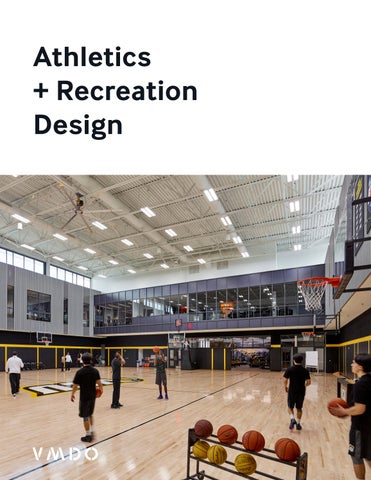
Athletics + Recreation Design

Page 1


Athletics + Recreation Design

Athletic Precinct Planning

Defining Campus Relationships

Responding to Campus Contexts

Collegiate Athletics

Creating a Memorable Game Day Experience

Elevating Competition through Design

Athletic Training Facilities

Daily Routine of an Athlete

Data-Driven Design

Recreation

Hybrid Athletic + Recreation Spaces

Fostering Flexibility of Uses

Wellness

Celebrating Health + Wellness

Healthy Dining for Athletes

Student Success

Designing for Success On and Off the Field

Maintaining an Academic Focus

Athletic Precinct Planning

ABOVE
University of Virginia Athletic Precinct Master Plan
University of Virginia Athletics Complex

Defining Campus Relationships

Many of VMDO’s significant college and university relationships started with a precinct or campus plan – detailed roadmaps for attaining an institution’s highest aspirations. By looking through a wide lens to see an entire picture, VMDO’s design team is able to distinguish both the details and the broader long-range view of a campus or precinct. This dual vision supports our designers in developing insightful yet pragmatic design solutions that respond to the challenges of campus growth, aging infrastructure, and environmental and human health issues affecting campuses today.

Responding to Campus Contexts

Our athletics work is embedded across a range of diverse settings, from historic collegiate campuses to K-12 educational landscapes. Through our firm-wide knowledge of campus planning, we offer a contextual sensitivity that builds on what is most powerful – socially, emotionally, and physically – about a place in order to embed those details into the architectural strategy of an iconic athletic facility.

Work Examples

Athletic Precinct Planning

Collegiate Athletics

ABOVE
Roanoke College Cregger Athletic Center
University of Virginia John Paul Jones Arena

Creating a Memorable Game Day Experience

The game day experience is a highlight for communities large and small. No matter the event, the venue should provide an exceptional atmosphere for competition and connection. Beyond the arenas, stadia, and track & field complexes that serve as magnetic venues on game day, practice & training facilities as well as recreation & fitness spaces are integral to creating active, healthy players and communities.

The architecture behind the game day experience must facilitate exciting competition while also supporting the fans – students, alumni, benefactors, and other patrons who deserve facilities that provide a high level of comfort, convenience, and connection. VMDO specializes in designing facilities that are both exciting and intimate – places where interaction and engagement are not just witnessed, but also felt and remembered. By integrating outside-the-box design strategies with a detailed understanding of amenities and event logistics, we encourage fans to come back again and again.

Elevating Competition through Design

Athletics venues are not only spaces for competition; they can actually play a role in enhancing team performance. Attention to site orientation, player and spectator views, and the integration of additional athlete resources can give a team a “home field advantage” that proves a competitive edge.

Palmer Park, the University of Virginia’s new softball stadium, is a state-of-the-art facility situated in a prominent site at the center of the University’s Athletic Precinct. In addition to heightened visibility, the softball team’s move has allowed the team to work together in a single location for training, practice, and competition - creating efficient operations that allow players to focus on development and training. The transformational stadium has elevated the prominence of the softball program; the Athletics Department’s goal of selling 40 season tickets for its opening season was exceeded threefold. The park went on to help launch the team into an NCAA tournament for the first time since 2010.

University of Virginia Palmer Park

Work Examples

Collegiate Athletics

Athletic Training Facilities

“I

think one thing that separates (our facility) is a lot of people have practice gyms, but ours is an actual development center. We’ve got the latest in technology, state-of-the-art things that can not only help you become a better basketball player, but can develop parts of your body, can develop things for the rest of your life that you’ll need.”

The daily routine of a VCU athlete...

COURT: Keira Robinson’s day begins with an early morning practice with her team - mates on a court that is exclusively theirs – the new facility houses separate but identical courts and locker rooms for the men’s and women’s teams. The athletes have 24-hour access to their own gym, which enables them to work on their game whenever and as often as possible.

VIDEO ROOM: The practice courts are equipped with five cameras to record practices and workouts. Each court has an adjoining film room for coaches and athletes to review practice footage and assess their performance as individuals and as a team.

STRENGTH + CONDITIONING: Robinson continues her training in the strength and conditioning area with Buddy Donnelly (B.S.’14/ H&S), director of sports performance for women’s basketball. Donnelly works with the players to build the strength necessary to improve their skill.

Will Wade, Former Men’s Basketball Head Coach Virginia Commonwealth University

DINING / HUB: After a morning of training, Robinson heads to the facility’s dining hall, which offers the men’s and women’s basketball teams buffet-style meals. A lounge area featuring televisions, gaming systems and an air hockey table gives the players a place to unwind and socialize.

ACADEMIC SPACES: Coaches’ offices and several quiet spaces enable the studentathletes to meet with their academic advisors and stay caught up on school work.

HYDROTHERAPHY: The facility’s sports medicine area has a hot tub, a cold tub and a hydrotherapy tub. An adjustable treadmill platform in the hydrotherapy tub lowers players into the water for low-impact cardiovascular training while cameras monitor their movements.

Virginia Commonwealth University Basketball Development Center

“For a recruit to come in and see the ‘wow factor,’ you see the building. Then you walk into the lobby and there’s another ‘wow factor.’ Then you go to the courts and go up in the team lounge and in the locker rooms — every turn it’s a ‘wow.’ We tell a great story in this building about both programs.”

Virginia
Virginia Commonwealth University Basketball Development Center
Liberty University Science Center

Data-Driven Design

Elite athletic programs require high-performance, high-design environments that optimize recruitment, recovery, and peak performance. Modern training facilities must seamlessly integrate biometric tracking, AI-enhanced training, and high-performance nutrition with recovery and performance resources.

VMDO designs data-driven, human-centered spaces that enhance athlete cognition, resilience, and well-being.

Work Examples

Athletic Training Facilities

ABOVE
Piedmont Family YMCA
Brooks Family YMCA

Brooks Family YMCA

Hybrid Athletic + Recreation Spaces

Universities are developing flexible, multi-purpose athletic facilities that serve athletes, students, and the broader campus community. Schools will prioritize cost-effective, adaptable spaces that maximize donor appeal and serve multiple functions across the university. VMDO specializes in designing versatile, future-proofed facilities that blend athletics, academics, and student life, ensuring every space has long-term value

Fostering Flexibility of Uses

For collegiate athletes, facilities need to meet their specialized needs and schedules while seamlessly supporting opportunities for training, study, and socializing. For the client, flexibility is key to ensuring a facility satisfies the needs of a diversity of users, for a variety of uses. VMDO ensures both audiences are satisfied by designing multipurpose facilities that are as finely tuned as they are flexible. Examples of such flexibility include collegiate arenas that support competition, concerts, and tradeshows, and field houses that host track competitions while also housing intramural sports for basketball, tennis, and volleyball.

Multipurpose Arena, UVA College at Wise

Work Examples

Recreation

ABOVE
University of Virginia Contemplative Commons

Academic + Performance Center, Liberty University

Celebrating Health + Wellness

Health-centered design elements – such as biophilia, views to nature, or access to daylighting – can enhance well-being, support mental clarity and physical performance, and expedite healing. These outcomes are nourishing for most all communities, particularly for student athletes – who experience intensive physical wear and tear as well as emotional exertion, among other pressures.

“We realized our students are trying to check off all of these academic boxes. But when they graduate, they often can’t check the box that says, ‘I was happy and healthy and left school knowing how to cope with stress and other life challenges.’ We want the overall student experience to be successful and purposeful, and the Well-Being Center is one way to do that.”

Design Strategies for Wellness

Specific strategies for promoting proactive and reactive health outcomes:

Provide Fresh, Clean Air. There is abundant evidence linking cognitive function, depression, and anxiety to air quality. High ventilation rates, good filtration, and pollutant control are critical to any healthy environment.

Select Healthy Materials. The materials and products used to construct a space directly impact the health of occupants, as well as the health of those up and down the supply chain. Choosing materials with safer, known chemistry, and that avoid the production of volatile organic compounds (VOCs), supports occupant health and performance.

Provide Daylighting and Views. The health and performance benefits of natural light and views is one of the most welldocumented correlations in building science research. Indoor/ outdoor connections and exposure to changing lighting over the course of the day and seasons reduces stress and contributes to increased productivity.

Select Supportive Lighting. Electric lighting design is a key component of health, from reducing glare and flicker, to providing proper color rendering, to supporting good sleep hygiene and occupants’ circadian rhythms.

Control Glare. Visual discomfort, especially during extended tasks like reading or computer work, can lead to increased fatigue, headaches and reduced productivity. Controlling glare through a mixture of design and user control, while still allowing variable daylight, support health and wellness.

Support Healthy Eating. Poor nutrition, food insecurity and high rates of eating disorders amongst today’s students are key drivers of the push for increased nutrition education on campuses.

Design for Acoustics. One of the most common complaints in buildings is acoustics, and for good reason: poor acoustics is a significant impediment to cognitive function and increases stress levels. Providing a range of environments with a range of acoustic qualities – from quiet to active – allows students to select environments appropriate to the task at hand.

Design for Movement. Lack of movement is as negatively impactful as smoking when it comes to health. Encouraging occupants to “move more, sit less” through proper ergonomics, adjustable workstations, circulation design and the location of amenities can help to integrate movement within the everyday.

Provide Restorative Spaces/Access to Nature. Connection to nature lowers stress, whether through direct access, views, imagery or patterns. Establishing meaningful views and relying primarily on daylighting are not only provide energy benefits, they also support student and staff health, especially when integrated with interior vegetation and natural materials.

Reinforce Community. Students who have a sense of belonging are happier and do better academically. Providing a spaces to connect with others and the surrounding community at a range of scales helps to reduce social isolation and encourage collaboration for both staff and students alike.

Design for Inclusion. Designing environments that are welcoming to all is essential for today’s campus. In addition to going beyond the requirements of the American with Disabilities Act, opportunities for providing a more inclusive built environment include gender neutral facilities, stakeholder engagement, and enhanced wayfinding and environmental graphics.

Create Safe Spaces. Today’s students expect an integrated and comprehensive approach to safety. Crime Prevention Through Environmental Design (CPTED) best practices encourage appropriate passive and active safety approaches while also reinforcing connectivity and community.

Outcomes

Healthy Lifestyle

Education. Environmental graphics and wayfinding tied to health topics, and occupant engagement through dynamic displays, communicates the health-promoting strategies in place and encourages behavior change.

Strategies

Provide Fresh Clean Air

Select Healthy Materials Provide Daylighting + Views

Select Supportive Lighting

Control

Glare

Design for Acoustics

Incorporate Active Design

Provide Restorative Spaces / Nature

Reinforce Community

University of Virginia John Paul Jones Arena
VCU Basketball Development Center

Healthy Dining for Athletes

Nutrition is increasingly recognized as a core component of success. Schools are integrating teaching kitchens, athlete-focused dining halls, and recovery-focused meal plans into their athletics facilities. Universities will expand performance-based nutrition programming, ensuring that student-athletes receive personalized meal plans and access to top-tier dining experiences.

VMDO integrates performance dining spaces, nutrition labs, and teaching kitchens into facility designs, ensuring athletes have the fuel they need to optimize performance and recovery.

Wellness + Teaching Kitchens

Dining components satisfy not only the basic need for food, but a deeper appreciation for the role food plays in physical performance. Integrating such programming into athletics centers provides an array of healthy food options, as well as another tool for training, education, and social connection.

A teaching kitchen includes space for classes that focus on healthy eating habits and nutrition, with open-air demonstration to easily view and practice techniques and gain a real sense of the importance of fresh food. These integrated programs also allow athletes to more easily access nutritional expertise from dining staff that can be integrated into their daily routines.

University of Miami Centennial Village
University of Virginia Student Health + Wellness Center

Work Examples

Wellness

Designing for Success On and Off the Field

Athletic facilities also represent a vital resource for student athletes in their time off the field or court. Essential programming adjacencies provide for a comprehensive approach to student athlete life, bringing together spaces for dining, recreation, socialization, and academic study all under one roof. This creates a home-base for shared community so athletes can maintain a fully balanced student experience while remaining on the top of their game.

Basketball Practice + Well-being Center, University of Richmond

Maintaining an Academic Focus

The life of student athlete is intensive; the balance between practice and study is a challenge to master. Our approach to athletics centers considers a full breadth of academic resources that allow students to stay on top of their classes, as well as their game.

At the University of Richmond’s Basketball Practice Center, the previous Millhiser Gym was re-imagined and transformed into a dedicated Academic Success Center. This adaptive re-use component fosters intensive academic tutoring, both from faculty and amongst peers. Group study rooms and seminar spaces surround a large, flexible learning lounge space that provides comfortable seating for informal group and individual study. Computer workstations, and printing and copying stations are provided as resources, and each group study space has the full complmenet of digital tools to permit both virtual and in-person academic training. Basketball operations and coaches’ offices occupy the new mezzanine level above the previous gymnasium space- the floor of which is still visible beneath active study groups.

Work Examples

Student Success

200 E Market St Charlottesville, VA 22902

434.296.5684 vmdo.com

202.843.2036 vmdo-dc.com

Turn static files into dynamic content formats.
Create a flipbook
Athletics + Recreation Design by VMDO Architects - Issuu