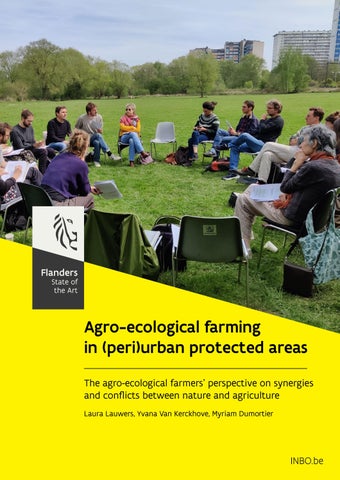
Agro-ecological farming in (peri)urban protected areas The agro-ecological farmers’ perspective on synergies and conflicts between nature and agriculture Laura Lauwers, Yvana Van Kerckhove, Myriam Dumortier
INBO.be
Authors: Laura Lauwers , Yvana Van Kerckhove, Myriam Dumortier Research Institute for Nature and Forest (INBO) Reviewers: Sanders Jacobs, Liesa Lammens The Research Institute for Nature and Forest (INBO) is an independent research institute of the Flemish government. Through applied scientific research, open data and knowledge, integration and disclosure, it underpins and evaluates biodiversity policy and management. Location: Herman Teirlinckgebouw INBO Brussel Havenlaan 88 bus 73, 1000 Brussel vlaanderen.be/inbo e-mail: myriam.dumortier@inbo.be Way of quoting: Lauwers L., Van Kerckhove Y. & Dumortier M. (2022). Agro-ecological farming in (peri)urban protected areas: the agro-ecological farmers’ perspective on synergies and conflicts between nature and agriculture. Reports of the Research Institute for Nature and Forest 2022 (19). Research Institute for Nature and Forest , Brussels. DOI: doi.org/10.21436/inbor.82125372 D/2022/3241/215 Reports of the Research Institute for Nature and Forest 2022 (19) ISSN: 1782-9054 Responsible publisher: Maurice Hoffmann Cover photograph: Workshop in Ganshoren (Photo: Myriam Dumortier) This research was carried out on behalf of : AVEC LE SOUTIEN DE MET DE STEUN VAN
bruxelles environnement leefmilieu brussel .brussels
This work is licensed under a Creative Commons Attribution 4.0 International License.
AGRO-ECOLOGICAL FARMING IN (PERI)URBAN PROTECTED AREAS The agro-ecological farmers’ perspective on synergies and conflicts between nature and agriculture Laura Lauwers, Yvana Van Kerckhove and Myriam Dumortier
doi.org/10.21436/inbor.82125372
Acknowledgments We would like to specially thank ● Wietse Bakker (CSA Land in Zicht), Alexandre Cazajous (Feuilles, Fruits et Compagnie), Jos De Clercq (Natlandhoeve), Bert Dhondt (Het Voedselbos), Brecht Laukens (Speckbosch), Joao Melo (Quinta do Pisão Nature Park), Jonathan Scohier (Savoir Terre), Elise Van Broeckhoven (Plukboerderij Grondig), the farmers that shared their knowledge and experiences during the in-depth interviews; ● All farmers that shared their knowledge and experiences in the online survey; ● Lison Hellebaut and Jan Pille (Brussels Environment) for giving us the opportunity to conduct this study and for the constructive collaboration throughout the project; ● Antoine Gérard (Terre-en-vue) for his support during the preparation of the workshop; ● Sven Van Assche (BRAL), Kenny Meganck (Natuurpunt), Bernadette Stallaert (De Brusselse Hoge Raad voor Natuurbehoud), Marina Gonzalez (Natagora) for providing us as members of the advisory committee with useful feedback throughout the project; ● Maarten Roels (Terre-en-Vue), Delphine Lecomte (Gemeente Ganshoren), Aurélien Linclau (Gemeente Ganshoren), Gaëtane Charlier (Fédération bruxelloise des professionnel.le.s de l'agriculture urbaine), Thomas Bogaert (urban.brussels), François Lohest (ERU urbanisme), Tine Van Eycken (Atelier Groot Eiland), Mathias Engelbeen (Brussels Environment) for participating and providing interesting ideas in the workshop; ● INBO-colleagues Julie Callebaut for helping with the workshop, Liesa Lammers and Sander Jacobs for reviewing the report and others from the team Nature & Society (INBO) for inspiring us. This study was financed by Brussels Environment (Brussels-Capital Region).
///////////////////////////////////////////////////////////////////////////////////////////////////////////////////////////// //////////// Page 2 of 102
doi.org/10.21436/inbor.82125372
Abstract The Research Institute for Nature and Forest conducted a study for Brussels Environment on synergies and coexistence of agriculture and nature in urban and peri-urban areas, with the objectives of: ● inspiring the Brussels-Capital Region on the possibilities of agro-ecological agriculture in protected areas; ● exploring the synergies and conflicts between agro-ecological agriculture and nature conservation in these areas, on the basis of analysis of cases elsewhere in Belgium and Western Europe; ● creating a first dialogue on this theme between relevant stakeholders in the BrusselsCapital Region. The study focused on potential synergies in (former) agricultural land designated as protected area in the Brussels-Capital Region. The focus was on agro-ecological farming and not on conventional farming. The question was how agro-ecological farming could contribute to the restoration of these areas, while contributing to local food supply. The study included five phases: 1. Creation of a theoretical framework on the challenges and opportunities between agro-ecological farming and nature conservation based on scientific and grey literature. This framework was used during the next phases of the study. 2. Identification of agro-ecological practices in protected areas in Europe through an online survey. This survey yielded 76 replies disclosing valuable insights. 3. In-depth interviews with eight agro-ecological farmers selected from the longlist through a set of criteria. These interviews further deepened the insights generated by the survey. 4. Local validation of the study results through a workshop with local actors in one specific case in the Brussels-Capital Region. This further refined the conclusions. 5. Presentation of the final study results to the relevant administrations and cabinets of the Brussels-Capital Region. This helped us finalise the report. 6. The study was guided by an advisory committee with some important stakeholder organisations. The survey found far more advantages than disadvantages and far more synergies than conflicts between agro-ecological farming and nature conservation. Among the advantages were the benefits of biodiversity for agriculture and the pleasure of working in beautiful landscapes. A major asset was the positive branding of the farm. Most farmers are spontaneously involved in nature conservation and restoration. The major drawback was the regulatory complexity, rigidness and lack of clarity. Obtaining a permit for minor but essential infrastructure proved a major difficulty for most farmers. Also the social dimension of the farms was considered having more positive than negative consequences for biodiversity. Citizens got involved in nature conservation, which allowed them to experience and connect with nature. The presence of many of them however could also disturb nature. There was a lot of evidence on collaboration among farmers and between farmers and nature organisations. The interviews further demonstrated the intrinsic motivation for biodiversity among agroecological farmers. The same applies for their social engagement. This makes them interesting allies for public authorities. These farmers are however facing a multitude of societal
///////////////////////////////////////////////////////////////////////////////////////////////////////////////////////////// //////////// doi.org/10.21436/inbor.82125372
Page 3 of 102
expectations. It is important to provide them with sufficient support to fulfil these societal tasks. Fortunately, their connectedness with society offers them a lot of citizens’ support. It however proves difficult to reach out beyond the white middle class and become more inclusive. The regulatory complexity they struggle with is partially related to the grey zone between biodiversity and agricultural legislation in which they operate. In order to allow them to explore innovative practices, it is important to give them sufficient leeway. Reducing the prescriptiveness of the legislation in favour of experiments agreed upon within the framework of a nature management plan could be a way out. Agro-ecological farming in synergy with nature conservation and restoration is a continuous learning process, which is evolving through mutual exchanges among farmers and between farmers and nature conservation organisations. The longer term access to land is another cause of concern. Short term contracts conflict with the long term scope of agro-ecological projects, in terms of restoring agro-ecosystems as well as societal engagement. This brings us to the following final recommendations towards Brussels Environment: 1. Ensure long-term access to land, so as to allow the long term scope of agro-ecological projects in support of protected areas; 2. Clarify what is allowed and is not allowed from the start of an agro-ecological project, so as to prevent later disagreements; 3. Facilitate the dialogue between agro-ecological farmers, nature conservation organisations, and other stakeholders, before initiating a new farming project, so as to foster constructive cooperation; 4. Support agro-ecological farmers for their public services, so as to ensure they can fulfil the multitude of societal demands; 5. Monitor ecological, social and economic progress, in order to check and adjust practices towards the long term objectives of the protected area; 6. Integrate agro-ecological, nature and societal interests, so as to join forces towards transformative change in order to address the planetary crisis. The Brussels-Capital Region is a valuable experimentation ground for agro-ecological projects in protected areas. Its small size and the connectedness between the administration, nature conservation organisations and farmers allows an agile exploration of innovative grounds, which can become an important catalysator for transformative change, also elsewhere. This study is based on eight in-depth interviews with agro-ecological farmers in Flanders, Wallonia, the Netherlands, France and Portugal. An additional study of nature conservation organisations, conventional farmers and other stakeholders would improve the insights and recommendations.
///////////////////////////////////////////////////////////////////////////////////////////////////////////////////////////// //////////// Page 4 of 102
doi.org/10.21436/inbor.82125372
Recommendations for management and/or policy
Ensure long-term cooperation with farmers e.g. by ● ● ● ●
prioritising the installation of agro-ecological farming models, through pre-emptive rights for agro-ecological farmers to lease farmland in protected areas; predefining agro-ecological activities appropriate in specific zones of protected areas, based on the biological value score of these zones; integrating the agro-ecological practices into the nature management plan; engaging in long term contracts with farmers, so that the work in the protected area can become part of the farming model.
Clarify what is allowed and is not allowed at the start of an agro-ecological project, e.g. by ●
● ●
drafting the nature management plan together with the farmers and nature conservation organisations, including a list of protective measures and restrictions on the farming activities applicable within clearly delimited zones in the protected area; applying jointly for permits for necessary infrastructure so the conditions in which the farmers will operate are clear from the beginning; conducting a baseline assessment of all potential risks and conflicts that could occur throughout the project.
Facilitate the dialogue between agro-ecological farmers, nature conservation organisations, and other stakeholders, e.g. by ●
●
●
assigning a person or organisation the role to facilitate the dialogue between agroecological farmers, nature conservation organisations and other stakeholders (such as Regional Landscapes in Flanders); creating a consortium at the beginning of each agro-ecological project in a protected area, including the farmers, local nature conservation organisations, and other relevant partners; organising a platform per protected area several times a year that brings together the farmers, nature conservation organisations and other relevant partners .
Support agro-ecological farmers for their public services, e.g. by ● ● ●
embedding the agro-ecological farmers in the local social and ecological networks; providing the agro-ecological farmers with necessary expertise and financial or material support (public money for public goods); structuring the multiple uses of the protected area.
Monitor ecological, social and economic progress, e.g. by ● ● ●
conducting a baseline survey combined with clear objectives; involving volunteers from local networks; involving research institutions.
///////////////////////////////////////////////////////////////////////////////////////////////////////////////////////////// //////////// doi.org/10.21436/inbor.82125372
Page 5 of 102
Integrate agro-ecological, nature and societal interests, e.g. by
●
applying a landscape approach to find synergies between different interests within a same area; developing a shared vision from the start;
●
working in a multidisciplinary team representing these different interests.
●
///////////////////////////////////////////////////////////////////////////////////////////////////////////////////////////// //////////// Page 6 of 102
doi.org/10.21436/inbor.82125372
Table of contents Acknowledgments ..................................................................................................................... 2 Abstract ..................................................................................................................................... 3 Recommendations for management and/or policy .................................................................... 5 List of figures.............................................................................................................................. 9 List of pictures............................................................................................................................ 9 List of tables ............................................................................................................................... 9 1
Introduction ..................................................................................................................... 10
2
METHODOLOGY ............................................................................................................... 12
3
2.1
Theoretical framework ............................................................................................. 12
2.2
Online survey ........................................................................................................... 12
2.3
In-depth interviews .................................................................................................. 13
2.4
Local validation workshop ........................................................................................ 13
2.5
Final presentation for Brussels-Capital Region administrations and ministries ......... 14
2.6
Advisory committee ................................................................................................. 14
Results.............................................................................................................................. 16 3.1
Theoretical framework ............................................................................................. 16
3.2
Online survey ........................................................................................................... 21
3.2.1
Restrictions & obligations imposed by the protected area ............................... 21
3.2.2
Advantages & disadvantages of working in a protected area............................ 22
3.2.3
Measures taken for nature conservation .......................................................... 24
3.2.4
Synergies & conflicts between nature conservation and agro-ecological farming 25
3.2.5
Implications of the social dimension for nature conservation ........................... 27
3.2.6
Interactions with public authorities and the neighbourhood ............................ 28
3.3
In-depth interviews .................................................................................................. 32
3.3.1
Overview of the eight selected cases ................................................................ 32
3.3.2
Interview results ............................................................................................... 40
3.4
Local validation of the results ................................................................................... 44
3.4.1
How can the farm(s) support and/or benefit from the protected area? ........... 44
3.4.2
How to involve the neighbourhood?................................................................. 46
3.4.3
How can governments facilitate this project? ................................................... 48
4
Conclusions ...................................................................................................................... 49
5
Limitations of the study.................................................................................................... 50
6
References ....................................................................................................................... 51
///////////////////////////////////////////////////////////////////////////////////////////////////////////////////////////// //////////// doi.org/10.21436/inbor.82125372
Page 7 of 102
Appendix .................................................................................................................................. 53 Appendix A - Literature search strings .................................................................................. 53 Appendix B - Survey design .................................................................................................. 53 Appendix C - Agro-ecological networks ................................................................................ 59 Appendix D - Nature conservation networks ........................................................................ 71 Appendix E - Agro-ecological projects identified in advance ................................................ 75 Appendix F - Interview script in-depth interviews (in Dutch) ................................................ 81 Appendix G - Interview script in-depth interviews (in French).............................................. 85
///////////////////////////////////////////////////////////////////////////////////////////////////////////////////////////// //////////// Page 8 of 102
doi.org/10.21436/inbor.82125372
List of figures Figure 1 Number of respondents identifying certain restrictions (multiple answers possible) Figure 2 Number of respondents identifying certain obligations (multiple answers possible) Figure 3 Number of respondents taking certain nature conservation measures (multiple answers possible) Figure 4 Number of respondents identifying certain synergies (multiple answers possible) Figure 5 Number of respondents identifying certain conflicts between nature conservation and farming (multiple answers possible) Figure 6 Judgement by respondents of the implications of the social dimension for nature conservation (only one answer possible) Figure 7 Number of respondents reporting about problems with public authorities and/or the neighbourhood (multiple answers possible) Figure 8 Number of respondents reporting about collaboration with public authorities and the neighbourhood (multiple answers possible)
21 22 24 25 26 27 28 31
List of pictures Photo 1 Natlandhoeve (©Natlandhoeve) Photo 2 SpeckBosch (©SpeckBosch) Photo 3 Quinta do Pisão Nature Park (©Cascais 2022) Photo 4 Het Voedselbos (©Het Voedselbos) Photo 5 Plukboerderij Grondig (©Plukboerderij Grondig) Photo 6 Photo 6 : Savoir Terre (©Savoir Terre) Photo 7 Feuilles, Fruits et Compagnie (©Feuilles, Fruits et Compagnie) Photo 8 CSA Landinzicht (©csa-landinzicht) Photo 9 Local validation workshop (©Julie Callebaut)
32 33 34 35 36 37 38 39 44
List of tables Table 1 Overview of the ecological challenges and opportunities of combining nature conservation and agro-ecological farming 16 Table 2 Overview of the economic challenges and opportunities of combining nature conservation and agro-ecological farming 17 Table 3 Overview of the institutional challenges and opportunities of combining nature conservation and agro-ecological farming 18 Table 4 Overview of the social challenges and opportunities of combining nature conservation and agro-ecological farming 19
///////////////////////////////////////////////////////////////////////////////////////////////////////////////////////////// //////////// doi.org/10.21436/inbor.82125372
Page 9 of 102
1 INTRODUCTION This report is the result of a study on synergies and coexistence of agriculture and nature in urban and peri-urban areas that was conducted by the Research Institute for Nature and Forest in an assignment for Brussels Environment (2021G0190). The main objectives of this study were to: ● Inspire the Brussels-Capital Region on the possibilities of agro-ecological agriculture in protected areas; ● Explore the synergies and conflicts between agro-ecological agriculture and nature conservation in protected areas, on the basis of analysis of cases elsewhere in Belgium and Western Europe; ● Create a first dialogue on this theme between relevant stakeholders in the BrusselsCapital Region, involved in practices or policies related to nature protection and agroecological farming. The study focuses on protected areas, including different levels of protection, such as Natura 2000, nature reserves, green areas and heritage landscapes. All of them have their own objectives and legal conditions. Through these different levels of protection, the BrusselsCapital Region is aiming at conserving and restoring biodiversity. Meanwhile, through its Good Food strategy, the Brussels-Capital Region is also aiming at protecting and restoring its local food production. In certain semi-natural habitats, in particular those with lower biological values, there are possibilities to combine food production with the preservation or restoration of nature (e.g. grazing or mowing grasslands, planting hedges, planting fruit trees, cultivating fallowland). This is the delicate balance that this study is exploring. The Brussels-Capital Regional Land Use Plan (PRAS) includes green areas which have de facto been maintained through agriculture. Conventional agriculture however is known for its detrimental impacts on biodiversity, which led to reluctance to cooperate with farmers in protected areas. This study will explore how agro-ecological farming can support biodiversity, how biodiversity can support agro-ecological farming and how legal conditions of protected areas can simultaneously saveguard biodiversity objectives and allow agro-ecological experimentation. Also the leasehold law (pachtwet in Dutch - loi sur le bail à ferme in French) plays a role here, with the potential not only to protect the farmer, but also the ecological values. The PRAS also includes agricultural areas, but these are outside the scope of this study. The authors want to stress that agricultural areas are the real areas for food production. Agricultural activities in protected areas are searching for synergies in support of biodiversity. Agricultural activities in protected areas can in no way compensate for the negative impact of conventional farming on biodiversity, which requires an agro-ecological transformation in order to address today’s planetary crisis. These activities in protected areas can nevertheless serve as a testing ground for the agro-ecological transformation of the agricultural area. The PRAS also includes areas designated for residential or industrial use which are de facto green areas. Also these are outside the scope of this study. The authors nevertheless stress ///////////////////////////////////////////////////////////////////////////////////////////////////////////////////////////// //////////// Page 10 of 102
doi.org/10.21436/inbor.82125372
the urgency to reconsider certain designations in the light of the planetary crisis, in particular in order to anticipate climate change conditions (heath waves, extreme rainfall, extreme drought). The focus was on opportunities within the Brussels-Capital Region. The role of agro-ecological farming in the vicinity of the region was not the subject of this study either. Given the rural nature of a number of municipalities around Brussels, it is clear that they could become a major source of good food for Brussels. The focus is on agro-ecological farming, given its sensitivity for ecological and social realities. The practices should at least comply with the conditions for organic farming in the relevant EU regulations. They could include agriculture, horticulture or animal husbandry, as long as they contribute to local food production and provide opportunities for viable businesses. According to FAO, agro-ecology is a set of ten principles that help strengthen the links between development and humanitarian activities by promoting diversity, reducing risks and engaging farmers and other producers in knowledge sharing and political decision-making: 1. Diversity: diversification is key to agroecological transitions to ensure food security and nutrition while conserving, protecting and enhancing natural resources. 2. Co-creation and sharing of knowledge: agricultural innovations respond better to local challenges when they are co-created through participatory processes. 3. Synergies: building synergies enhances key functions across food systems, supporting production and multiple ecosystem services. 4. Efficiency: innovative agroecological practices produce more using less external resources. 5. Recycling: more recycling means agricultural production with lower economic and environmental costs. 6. Resilience: enhanced resilience of people, communities and ecosystems is key to sustainable food and agricultural systems. 7. Human and social values: protecting and improving rural livelihoods, equity and social well-being is essential for sustainable food and agricultural systems. 8. Culture and food traditions: by supporting healthy, diversified and culturally appropriate diets, agroecology contributes to food security and nutrition while maintaining the health of ecosystems. 9. Responsible governance: sustainable food and agriculture requires responsible and effective governance mechanisms at different scales – from local to national to global. 10. Circular and solidarity economy: circular and solidarity economies that reconnect producers and consumers provide innovative solutions for living within our planetary boundaries while ensuring the social foundation for inclusive and sustainable development.
///////////////////////////////////////////////////////////////////////////////////////////////////////////////////////////// //////////// doi.org/10.21436/inbor.82125372
Page 11 of 102
2 METHODOLOGY The study was conducted from 3th of January, 2022 until the 29th of April, 2022. The study consisted of five major phases: 1. Creation of a theoretical framework on the challenges and opportunities between agro-ecological farming and nature conservation based on scientific and grey literature. 2. Identification of agro-ecological practices in protected areas in Europe through an online survey. 3. Selection and analysis of eight agro-ecological practices to inspire the Brussels-Capital Region through eight in-depth interviews with agro-ecological farmers working in protected areas in Flanders, Wallonia, the Netherlands, France and Portugal. 4. Local validation of the study results in a case in the Brussels-Capital Region through a workshop in Ganshoren. 5. Presentation of the final study results to the relevant administrations and cabinets of the Brussels-Capital Region. The project was co-developed with members of an advisory committee.
2.1
THEORETICAL FRAMEWORK
We conducted a scientific literature search using the Web of Science (WOS), by combining search strings for NATURE AND AGRO-ECOLOGICAL FARMING (Appendix A, the search strings). We restricted ourselves to a title search and to Western European countries. The search resulted in 21 relevant articles to build up the theoretical framework. We complemented the scientific literature with the insights of a recent report of the European Union (2018) on “Managing farmland in Natura 2000” (European Union, 2018). The structure of the framework including an ecological, economic, political and social dimension was inspired by the report on “Agroecology initiatives in Europe” (Agroecology Europe, 2020).
2.2
ONLINE SURVEY
We created an online survey to identify agro-ecological practices applied in protected areas in Europe (Appendix B, the survey design). The survey included questions on: ● Obligations & restrictions imposed by the protected area; ● Advantages & disadvantages of working in a protected area; ● Agro-ecological measures and measures taken for nature conservation; ● Synergies & conflicts between nature conservation and agro-ecological farming; ● Implications of social dimensions for nature conservation; ● Problems & collaborations with authorities and the neighbourhood. The survey was launched on the 20th of January, 2022 and was open for response until the 20th of February, 2022. It was spread through 124 agro-ecological networks (Appendix C), 13 nature conservation networks (Appendix D) and 51 agro-ecological projects (Appendix E) that we already identified in our own network.
///////////////////////////////////////////////////////////////////////////////////////////////////////////////////////////// //////////// Page 12 of 102
doi.org/10.21436/inbor.82125372
In our invitation to the survey we asked to only fill out the survey if the project or business of the participant complied with the following criteria:
● ● ●
Agro-ecological farming practice (farming in cooperation with nature, in a circular and sustainable way, without chemical inputs); Applied in a protected area (area with legal restrictions in support of nature or landscape conservation); Economically viable (providing at least one part-time employment).
The results of the survey were analysed by the intern Yvana Van Kerckhove at our institute.
2.3
IN-DEPTH INTERVIEWS
Based on the survey results we made a first selection of practices complying with the following criteria: ● Complete answer ● Urban/Peri-urban OR Rural (<= 10 ha) ● Situated in or nearby a protected area ● Having an ecological dimension ● Having a social dimension ● Experience with conflicts AND/OR collaborations with authorities / neighbourhood ● Economic viability (providing at least one part time employment) ● Economic stability (having a fairly stable or stable income over time) This first selection resulted in eighteen relevant practices. Together with our advisory committee we finally selected eight cases to be included in the in-depth analysis. Additional criteria were the complementarity of the cases and their relevance for the Brussels-Capital Region. For the foreign practices (and one of the Belgian practices) we held an online interview, the other Belgian farms we visited and interviewed in situ. The interviews lasted between 1-2 hours. We applied a semi-structured interviewing method, supported by a simplified version of our interview script (Appendix F and G). The script contained some general questions regarding the farm, questions related to the protective status of the area, and questions linked to the ecological, social and economic dimension of the farm, to finalise with questions on the role of institutions and their future vision on integrating agro-ecological farming and nature conservation. The complete interviews were transcribed, carefully read, and thematically structured and analysed. The presentations of the results during the workshop and for the Brussels-Capital Region administrations and ministries helped to set the final structure of the interview themes.
2.4
LOCAL VALIDATION WORKSHOP
For the local validation of the study results, we organised a workshop on a site in Ganshoren municipality that would potentially serve future agro-ecological farming projects. The site is situated within a NATURA 2000 site, adjacent to NATURA 2000 habitat, called Moeras van Jette-Ganshoren. The choice of this site was based on suggestions from Brussels Environment ///////////////////////////////////////////////////////////////////////////////////////////////////////////////////////////// //////////// doi.org/10.21436/inbor.82125372
Page 13 of 102
and Terre-en-Vue, a non-profit association facilitating access to land in Belgium for farmers with agro-ecological projects. The workshop took place on the 19th of April, 2022. 13 people participated in the workshop with representatives from the municipality of Ganshoren, Urban.Brussels, Terre-en-Vue, Atelier Groot Eiland, Natuurpunt, Natagora, Brussels Environment, the Brussels High Council for the Conservation of Nature and ERU urbanisme. After a short presentation of the study results, we applied a World Café formula and invited three subgroups to work subsequently 20 minutes on each of the following three topics: 1. How can the farm(s) support and/or benefit from the protected area? 0. What farming practices are appropriate in this place? (crop cultivation, agroforestry, food forest, livestock grazing) 1. What natural elements can be part of the farming practice? 2. Are there opportunities for cooperation between the nature reserve and the farm(s)? 3. What are the potential conflicts between the nature reserve and the farm(s)? 2. How can the farm(s) involve the neighbourhood? 0. How can the neighbourhood (e.g. residents of the apartment blocks) benefit from the farm? 1. How can the neighbourhood contribute to the farm? 2. How can this interaction be facilitated? 3. How will you deal with potential social issues (free running dogs, vandalism, etc.)? 3. How can governments facilitate this project? 0. What longer term perspectives can be assured for the farming activity? 1. How can the administrative and legislative burden be reduced for the farmer? 2. What could hinder governments from continuing such projects? 3. How can nature inclusive farming be ensured? Each topic was facilitated by one researcher from our institute, summarising the input from the preceding subgroup(s). After the group sessions, we presented the results of each session to the whole group, allowing some final feedback.
2.5
FINAL PRESENTATION FOR BRUSSELS-CAPITAL REGION ADMINISTRATIONS AND MINISTRIES
On the 25th of April 2022, we presented our study results to representatives from cabinet Vervoort, cabinet Maron, Perspective Brussels, CityDev, Erfgoed Brussels, Brussels Environment, … and received some final feedback to support our final conclusions.
2.6
ADVISORY COMMITTEE
The advisory committee included representatives from Brussels Environment, the Brussels High Council for the Conservation of Nature, the nature organisations Natuurpunt and Natagora, and Citizens Action Brussels (BRAL). We tried to involve the agro-ecological farming ///////////////////////////////////////////////////////////////////////////////////////////////////////////////////////////// //////////// Page 14 of 102
doi.org/10.21436/inbor.82125372
sector, however they were too busy with work on their fields and therefore could not participate. The advisory committee met twice: on the 16th of February and the 1st of April, 2022. They also participated in the local validation workshop. They mainly provided feedback on the criteria for the selection of cases and the questions to be asked during the in-depth interviews. They suggested including Brussels cases in the in-depth interviews, however Brussels Environment preferred collecting new inspiration outside Brussels. The advisory committee also helped reshape the foreseen workshop to a local validation workshop. Important issues for the advisory committee were (1) that the study was limited to protected areas and that the threat of building development in green areas designated for residential or industrial development were not considered and (2) that the study focused on the perspective of agroecological farmers and insufficiently on the perspective of nature conservation organisations.
///////////////////////////////////////////////////////////////////////////////////////////////////////////////////////////// //////////// doi.org/10.21436/inbor.82125372
Page 15 of 102
3
RESULTS
3.1
THEORETICAL FRAMEWORK
Tables 1 to 4 provide a theoretical overview of opportunities and challenges of combining nature conservation and agro-ecological farming. Table 1 Overview of the ecological challenges and opportunities of combining nature conservation and agro-ecological farming
ECOLOGICAL DIMENSION CHALLENGES
OPPORTUNITIES
Potential negative impacts of agroecological farming on biodiversity ● No guarantee for biodiversity gains (Topping, 2011) ● Some practices may increase emissions (Landert et al. 2020) ● Diversifying is not per se an asset (Altieri & Nicholls. 2018) ● Risk for more pests and diseases (Redlich et al. 2020) ● Competition for natural resources (water) (Ricart and Rico-Amorós, 2021)
Potential positive impacts of agro-ecological farming on biodiversity ● Targeted measures to benefit individual species or biodiversity (Topping, 2011) ● Organic farmers: positive attitudes toward biodiversity (Gabel et al., 2018) ● Agricultural management essential for the conservation of certain semi-natural habitats (Halada et al. 2011) ● Low input management can increase biodiversity (Halada et al 2001) ● Reduced water pollution (Altieri & Nicholls. 2018) ● Control of erosion and water runoff (Altieri & Nicholls. 2018) ● Natural pest / disease control (Altieri & Nicholls. 2018) ● Climate mitigation ● Enhanced pollination ● Improved soil quality (Altieri & Nicholls. 2018, survey) ● Improved biodiversity (Díaz-Pereira, Romero-Díaz and de Vente, 2020) (Altieri & Nicholls. 2018) ● Improved esthetic landscape value
Difficulties of assessing ecological impact ● Lack of metrics and targets (Balfour et al., 2021) ● Lack of methods and tools (Penvern et al., 2019; Balfour et al., 2021) ● Expensive and time consuming (Balfour et al., 2021) ● Many confounding variables (Penvern et al., 2019) ● Complex to interpret results (Penvern et al., 2019; Balfour et al., 2021) ● Insufficient data (Landert et al 2020.) ● Difficult to involve farmers (Noe, Halberg and Reddersen, 2005) Every farming context is different ● Different solutions to problems (Landert et al. 2020) ● Different species’ responses (Topping, 2011; Loos and von Wehrden, 2018)
Options for assessing ecological impact ● Clearly define desired outcome ● Indicators that include both compositionalist and functionalist ideas of nature quality (Noe, Halberg and Reddersen, 2005) ● Indicators should: (Noe, Halberg and Reddersen, 2005) o be easily recognizable o relate to positive associations (e.g. low mobility butterflies) o be easy to understand and acceptable to farmers (e.g. % uncultivated biotope area) o reflect farmers’ actions or be able to guide farmers’ future actions ● Ecological field survey data (Wossink et al., 1997) ● Integration of criteria other than productivity e.g. contribution to flood mitigation and carbon sequestration, soil quality (Magda et al., 2015)
///////////////////////////////////////////////////////////////////////////////////////////////////////////////////////////// //////////// Page 16 of 102
doi.org/10.21436/inbor.82125372
● Measures taken on small spatial scales (farms, field margins) ● Impact on a scale of square kilometres is less clear (Loos and von Wehrden, 2018) ● Agro-ecological measures might be very fragmented on a landscape scale (Dutton et al., 2008) Agri-environment schemes insufficient to halt biodiversity loss in farming land (Magda et al., 2015) ● Fragmented and incoherent conservation actions across the landscape (Dutton et al., 2008) ● Trade-off between biodiversity gain and flexibility and ease of implementation (Dutton et al., 2008)
● ●
Gain a solid understanding of how farming practices influence ecosystem functions and services (Wittwer et al., 2021) Agroscope tool to test multifunctionality outcome of different cropping systems (Wittwer et al., 2021) Monitoring process in dialogue with farmer (Noe, Halberg and Reddersen, 2005)
Adapt management to context of site (Balfour et al., 2021) ● E.g. “Adopt a sheep scheme”: the specificity of the scheme, its appropriateness to its environmental and social context, is fundamental to its success (Holloway et al., 2006) ● Account for different understandings of sustainability developed in specific contexts (Holloway et al., 2006) Integrated landscape approach (Dutton et al., 2008) ● Consider the collective performance of different sites (Balfour et al., 2021) ● Integrate farming and non-farming activities throughout a larger area (Wezel et al., 2016) Focusing on effective agri-environment schemes ● Management plan for the whole farm (European Union, 2018) ● Alignment between schemes (Dutton et al., 2008) ● Low-input agriculture and semi-natural habitats contribute to biodiversity (Gabel 2018)
Table 2 Overview of the economic challenges and opportunities of combining nature conservation and agroecological farming
ECONOMIC DIMENSION CHALLENGES
OPPORTUNITIES
Decreased value ● Possible decrease of standard farmland values (Lehn and Bahrs, 2018) ● Lower productivity due to loss of productive land (European Union, 2018; Wittwer et al., 2021) ● Difficulty to monetise environmental costs and gains (Wittwer et al., 2021) ● Protection of toxic plants devalorise forage (European Union, 2018)
Added value (European Union, 2018) ● Higher productivity through over yielding (Altieri & Nicholls 2018) ● Better income (Díaz-Pereira, Romero-Díaz and de Vente, 2020; Wittwer et al., 2021) ● Better quality products (Díaz-Pereira, Romero-Díaz and de Vente, 2020) ● Side activities add value to basic products (e.g. tourism, crafts, farm shop, etc.). (Holloway 2006)
Extra costs ● Branding and finding buyers → extra workforce (European Union, 2018) ● Maintaining habitats and landscape elements (survey) Economic viability ● Less financial autonomy due to dependence on external financial mechanisms (Slámová and Belcáková,
Less costs ● Energy saving (Penvern et al., 2019) ● Less veterinary costs (Magda et al., 2015) ● Natural pest control (Altieri & Nicholls 2018) Cooperative networks ● Shares provide some economic and consumer stability, and help to reconnect consumer with agricultural production process (e.g. adopt a sheep scheme) (Holloway 2006) ● Cooperative nature of projects allow to develop in size and scope, and to encompass a range of
///////////////////////////////////////////////////////////////////////////////////////////////////////////////////////////// //////////// doi.org/10.21436/inbor.82125372
Page 17 of 102
●
2019) Often limited to part-time employment opportunities or some additional income (Slámová and Belcáková, 2019)
Competition for land ● Rise in lease prices (European Union, 2018) Constraints of financial compensation through AES ● How to prioritise support? (Balfour et al., 2021) ● Complex administration (European Union, 2018; Dutton et al., 2008; Hammes et al., 2016) ● Lack of alignment between different programs (Hammes et al., 2016) ● Uncertainty linked to political changes (European Union, 2018) ● High demands not in proportion to compensation (Magda et al., 2015; Hammes et al., 2016) ● Lack of flexibility to compensate for extra measures or to respond to exceptional circumstances (Hammes et al., 2016) ● Dependency on compensation due to low productivity (European Union, 2018) ● Transaction costs to join schemes (Dutton et al., 2008)
●
activities (Holloway 2006) Alternative Food Networks: involve farm businesses in the building of local, speciality brands within specialised food networks (Holloway 2006)
Advantages of financial compensation through AES ● Steady income (Dutton et al., 2008) ● Creating employment (European Union, 2018) ● Flexibility to compensate extra measures (survey)
Table 3 Overview of the institutional challenges and opportunities of combining nature conservation and agro-ecological farming
INSTITUTIONAL DIMENSION CHALLENGES
Tackling dilemma
●
OPPORTUNITIES
the
ecological-economic
Securing the economic sustainability of farms while providing environmental benefits (Landert et al. 2020)
Risks of transposing nature protection into farming laws ● May damage positive intended behaviour towards nature conservation (Gabel et al., 2018) ● Legal protective status may conflict with private farmer rights (Ricart and Rico-Amorós, 2021) Integrated management approach
The institutionalisation of ‘ecology’ in the social practices and institutions of production and consumption Focus on farmers’ attitude rather than legislation ● Policy based on understanding attitudes more appropriate than extra legislation (Gabel et al., 2018) ● Additional mechanisms needed to supplement legislation (Gabel et al., 2018) Integrated management approach ● Integration of site management in other policies (European Union, 2018) ● High level agreement and dialogue (European Union, 2018) ● Integration of conservation into entire cultural landscape with recognition of backbone role of small-scale farmers (Loos and von Wehrden, 2018) ● Connect changes at different organisational levels (Magda et al., 2015)
///////////////////////////////////////////////////////////////////////////////////////////////////////////////////////////// //////////// Page 18 of 102
doi.org/10.21436/inbor.82125372
● ●
Takes time (European Union, 2018) Complex to involve different operational levels (Balfour et al., 2021)
● ●
Global system pressures ● can lead to land-use intensification or abandonment (Loos and von Wehrden, 2018)
Agroecology as a promising approach (Ricart 2021) Consider agriculture and nature protection as one system in: o the interpretation and symbolism of a hybrid system (wetland or pond?) o the complementary functions associated with the system o the management of the system and governance o address main challenges from both perceptions (is farmers’ activity survival a risk or a request for ensuring the maintenance of a wetland?) (Ricart 2021)
Deep system changes ● Required to create a sustainable food system with environmentally-friendly agriculture (Loos and von Wehrden, 2018) Cooperation between authorities, NGOs and other stakeholders to assure change (Wezel et al., 2016) ● Farmers associations ● Cooperatives ● Nature conservation organisations ● Water agencies ● Protected areas administration
Table 4 Overview of the social challenges and opportunities of combining nature conservation and agroecological farming
SOCIAL DIMENSION CHALLENGES
OPPORTUNITIES
Contrasts between farmers and nature conservation organisations ● Different views on desired outcome (Noe, Halberg and Reddersen, 2005; Magda et al., 2015) ● Difference in preferred species (forage vs rare species) (Magda et al., 2015) ● Different environmental understanding (daily engagers vs nondaily observers) (Ricart and Rico-Amorós, 2021) ● Lack of mutual recognition and comprehension between stakeholders’ roles (Ricart and Rico-Amorós, 2021) ● Widespread view that species-rich grasslands have no farming value (Magda et al., 2015) ● Belief of unavoidable trade-off between agricultural production and conservation (Noe, Halberg and Reddersen, 2005; Magda et al., 2015) ● Different views on nature and nature quality (Noe, Halberg and Reddersen,
Reconciliation between farmers and nature conservation organisations ● Common ground: good soil quality (Gabel et al., 2018; Balfour et al., 2021) ● Increase comprehension and build trust (Ricart and Rico-Amorós, 2021) ● Process-supporting tools (Ricart and Rico-Amorós, 2021) ● agro-ecological farming: most multi-functional and best compromise between people and nature needs (Balfour et al., 2021) ● Environment must be an ally, not an enemy (Ricart and Rico-Amorós, 2021) ● Dialogue between farmers and biologists (Noe, Halberg and Reddersen, 2005) ● Involving farmers in monitoring process can challenge farmers’ assumptions on ecological impact and increase reflections on future management (Noe, Halberg and Reddersen, 2005) Knowledge creation ● Consider cultural aspects and local identity as key issues to ensure the transmission of local
///////////////////////////////////////////////////////////////////////////////////////////////////////////////////////////// //////////// doi.org/10.21436/inbor.82125372
Page 19 of 102
2005) Knowledge gaps ● Loss of knowledge, skills and expertise due to rural depopulation and ageing of farmers (European Union, 2018) ● Lack of ecological horticultural skills (Altieri & Nicholls. 2018) ● Lack of knowledge of ecological processes and ecosystem services (Ricart and Rico-Amorós, 2021) ● Wildlife advisors lack knowledge and tools (Noe, Halberg and Reddersen, 2005)
● ● ● ● ● ●
Lack of communication ● Lack of sufficient advertisement of new agro-ecological measures (European Union, 2018) Social challenges linked to AES: ● People vs nature needs (Balfour et al., 2021) ● Creation and training of farm advisory services (European Union, 2018) ● Raised expectations of farmers towards advisory services (European Union, 2018) ● Little effect on changing attitudes of conventional farmers (Magda et al., 2015) ● Complicated communication due to diverse audience (Dutton et al., 2008)
knowledge to new generations of farmers (Ricart and Rico-Amorós, 2021) Knowledge transfer and skills retention between farmers and nature conservation organisations (European Union, 2018) Generating new knowledge on synergistic relationships between agricultural and ecological functioning (Magda et al., 2015) Training, information, exchange of experience, public incentives (Bachev, no date) International exchange of best practices (Slámová and Belcáková, 2019) Understanding relationship between humans and environment Backbone role of ecological entrepreneurs (Holloway et al., 2006)
Promoting agro-ecological measures ● Regional activities to promote agro-ecological measures, e.g. flowering meadow competition (Magda et al., 2015)
Networking ● Connect into media networks, e.g. international and national news communications networks (Holloway et al., 2006) Taking social dimension into account in development and implementation of AES: ● Direct link between actions and desired outcome (Magda et al., 2015) ● Greater flexibility (e.g. retain free choice in actions, focus on maintenance of indicator species instead of fixed actions, make actions farmer-led) (European Union, 2018) ● Cooperative, dialogue-oriented process (European Union, 2018; Noe, Halberg and Reddersen, 2005) ● Problem-solving and open-ended approach (European Union, 2018) ● Obtain information on farmers’ perceptions (Wossink et al., 1997) ● Demonstrating successful implementation (Dutton et al., 2008) ● Clarifying goals behind subsidies improves farmer’s willingness to include public goals (Noe, Halberg and Reddersen, 2005)
///////////////////////////////////////////////////////////////////////////////////////////////////////////////////////////// //////////// Page 20 of 102
doi.org/10.21436/inbor.82125372
3.2
ONLINE SURVEY
99 respondents participated in the online survey (Appendix H), of which 76 respondents fully completed the questionnaire. The amount of respondents for each country were as follow: ● Belgium: 32; ● France: 36; ● Netherlands: 2; ● Germany, United Kingdom, Luxembourg, Portugal, Georgia, Philippines: each 1. The full set of responses was anonymised and is available online.
3.2.1
Restrictions & obligations imposed by the protected area
Most participating projects are situated in an area where at least one type of protection is applied. Natura 2000 was the type of protection mentioned most frequently, followed by Protected Landscape. 16 projects are situated in an unprotected area (according to the responses). The more types of protection the respondent mentioned, the more restrictions and obligations he/she generally mentioned.
Figure 1 Number of respondents identifying certain restrictions (multiple answers possible)
The restrictions mentioned most often were restrictions on the use of manure, fertiliser or plant protection products, and restrictions on the construction of buildings, roads, etc (Figure 1). Restrictions on changing the existing vegetation, on ploughing or tilling and on changing water bodies and wetlands were also common among participants.
///////////////////////////////////////////////////////////////////////////////////////////////////////////////////////////// //////////// doi.org/10.21436/inbor.82125372
Page 21 of 102
Figure 2 Number of respondents identifying certain obligations (multiple answers possible)
32 out of 76 respondents indicated that the protected area in which their project is situated did not impose any obligations (Figure 2). The most common obligation was to maintain certain landscape elements (e.g. hedges, coppice), followed by obligations to maintain certain vegetation (e.g. high nature value grassland) and obligations to apply certain measures (e.g. mowing, grazing).
3.2.2
Advantages & disadvantages of working in a protected area
33 respondents indicated that they experience both advantages and disadvantages of working in a protected area, 21 said to only experience advantages. No respondents could only identify disadvantages. 48 participants responded to the open question: Do you experience certain (dis)advantages of working in a protected area? The advantages most commonly mentioned were biodiversity and ecosystem services. Respondents mentioned that the diversity in plants makes good fodder, and that biodiversity enhances pollination at their farm. Other ecosystem services that were mentioned were shadow for livestock, buffering and soil fertility. Absence of pollution was also mentioned. Various respondents also mentioned nature conservation as an advantage. They are happy to see rare or protected species at their farm and that ecologically valuable ecosystems are conserved. Sustainability is another advantage of working in a protected area. One participant was glad to be situated in a place free from industrial agriculture.
///////////////////////////////////////////////////////////////////////////////////////////////////////////////////////////// //////////// Page 22 of 102
doi.org/10.21436/inbor.82125372
Many respondents mentioned they felt satisfaction in their job choice. It is a pleasure to live in such an environment, they feel connected with nature and they are supporting what they think is right. The beauty of the landscape was also mentioned. “Vivre et travailler dans et pour une nature remarquable.” “Het beheren van 4ha natuurweide en landschapsontwikkeling in waardevol agrarisch gebied dat voorheen jarenlang een monocultuur maïs was. Onze bedrijfsmissie heeft als onderdeel "Landbouw kan niet zonder natuur dus zijn zij hier één." Wij zijn hier vurig van overtuigd en onze ligging (deels natuurgebied) zorgt er mede voor dat wij dit standpunt kunnen waarmaken. Wij zijn een jong bedrijf maar hebben toch in ons eerste jaar al veel beheerwerken uitgevoerd om de biodiversiteit vooruit te helpen.”
The possibility to build a social network (and to involve others in their project), education and reflection are other advantages that were mentioned. “Réflexion globale mêlant pérennité du projet agricole et préservation des milieux, de leurs fonctionnalités ainsi que de la biodiversité.”
Some respondents mentioned economic advantages. The positive branding of their farm and publicity attracts consumers. Quote: “The fact we produce inside a protected area work as a beacon and attract consumers who look for healthy products, organic and fresh, at the same time they enjoy the fact the farm it's outside the urban fringe, gives a good pretext to go for a walk and enjoy nature and meet the farm animal and natural environment.”
Tourism and the possibility to fund certain actions or measures were mentioned by a few, and one respondent said there is free land available. Lastly, only a few institutional advantages were mentioned. Those were water contracts and the protection of pastoral areas. The disadvantages most frequently mentioned are the many restrictions imposed by the protected area. Examples are prohibitions on the use of manure, too rigid mowing times, restrictions concerning pest and weed control, many obstacles concerning urban planning (difficulty of getting permits to build necessary infrastructure) and prohibitions on changing habitats (e.g. planting hedges). Respondents mentioned that the legislation lacks clarity and is too rigid and complicated. It does not take farming realities into account, even where this would not hinder biodiversity objectives. “De lijst van verbodsbepalingen is heel lang. De controle heel streng, de boetes heel hoog, de administratie heel zwaar,... en er is geen inspraak.” “Trying to put in necessary infrastructure is not guaranteed, with even something simple like a composting toilet needing planning permission, and no guarantee it will be granted. There is no dwelling on site, which makes things a lot more complicated.” “La production agricole en est rendue difficile en comparaison d'autres contrées, et les réglementations sont de plus en plus compliquées pour ceux qui se trouvent dans une zone préservée. C'est parfois un
///////////////////////////////////////////////////////////////////////////////////////////////////////////////////////////// //////////// doi.org/10.21436/inbor.82125372
Page 23 of 102
sentiment de double peine: produire moins pour sauver le bien commun, et des emmerdements paysagers ou administratifs en plus…”
One respondent mentioned a lack of trust in their expertise and good intentions: “Het biedt kansen, maar de milieu- en natuurwetgeving maakt ons vaak nerveus. We voelen aan dat onze intrinsieke waarde "we willen het goed doen" niet wordt herkend en dat onze expertise als boer en boerin niet wordt vertrouwd, maar ook niet wordt aangescherpt. Dit maakt dat we de wetgeving als heel vijandig beschouwen tegenover ons terwijl wij de natuur en haar believers als bondgenoot zien... En we deel willen uitmaken van een habitat of een ecosysteem.”
Another disadvantage is a low(er) productivity. It also takes time to create an economically viable agricultural model. Lastly, a few participants mentioned some trade-offs between nature and agriculture. The high plant diversity also results in toxic plants or even in low quality fodder, and the low productivity is hard to combine with animal health. “Relatie tussen landbouw en natuur nogal gespannen.”
3.2.3
Measures taken for nature conservation
Figure 3 Number of respondents taking certain nature conservation measures (multiple answers possible)
64 out of 76 respondents indicated to maintain habitats with trees and shrubs (Figure 3). Other measures for nature conservation popular among participants are the maintenance of habitats with water, field margins and conservation strips, the maintenance of non-natural
///////////////////////////////////////////////////////////////////////////////////////////////////////////////////////////// //////////// Page 24 of 102
doi.org/10.21436/inbor.82125372
habitats (e.g. nesting boxes), cropland measures dedicated to wildlife foraging and nesting, and both grazing and mowing in high value nature grassland.
3.2.4
Synergies & conflicts between nature conservation and agroecological farming
Figure 4 Number of respondents identifying certain synergies (multiple answers possible)
Almost every respondent indicated to experience certain synergies between nature conservation and their agricultural business or project (two respondents did not know, while one indicated that he was still restoring his farm). The most common synergy was positive branding of the farm, followed by natural pest/disease control, climate change mitigation (e.g. less drought, less heat, less flooding), enhanced pollination and extra funding opportunities (e.g. subsidies for specific actions). Other synergies mentioned included the beauty and pleasure of the working environment, moral satisfaction, better soil and biodiversity.
///////////////////////////////////////////////////////////////////////////////////////////////////////////////////////////// //////////// doi.org/10.21436/inbor.82125372
Page 25 of 102
Figure 5 Number of respondents identifying certain conflicts between nature conservation and farming (multiple answers possible)
20 respondents indicated that they do not experience any conflicts between nature conservation and their agricultural business or project, while most respondents that do experience conflicts mentioned 1–3 different types. The number of conflicts was thus inferior to the number of synergies. Weed pressure was the most common conflict, followed by extra costs, lower productivity, and damage to crops by grazing animals or wildlife (e.g. birds, rodents). Participants who indicated that they experience other conflicts mentioned a higher workload and problems with obtaining permits.
///////////////////////////////////////////////////////////////////////////////////////////////////////////////////////////// //////////// Page 26 of 102
doi.org/10.21436/inbor.82125372
3.2.5
Implications of the social dimension for nature conservation
Figure 6 Judgement by respondents of the implications of the social dimension for nature conservation (only one answer possible)
Figure 6 provides an overview of how respondents judge the implications of the social dimension for nature conservation. 57 participants provided further clarification. The most direct positive implication of the social character of agro-ecological projects on nature conservation is the contribution of citizens/organisations. Participants and volunteers help with maintenance, building (e.g. bird shelters), planting (e.g. hedges, trees), monitoring, removing invasive species and mowing. By educating people on biodiversity and agroecology, projects raise awareness about the possibilities of cultivation methods that are in line with nature conservation. Also the discussions raise awareness on current environmental issues, helping people to make more sustainable choices and broadening the support base of this type of food production. “Mobiliser les habitants du territoire pour défendre le vivant aux côtés des agriculteurs engagés, considérant que si on ajoute les motivations alimentaires aux motivations biodiversité, l'impact pour la biodiversité est bien supérieur.” “Samenhang natuur en landbouw wordt bij elk boerderijbezoek in de kijker gezet.”
Related to the previous point is the fact that the social dimension of agro-ecological projects lets people experience and connect with nature. This also leads to more understanding and support for agro-ecological farming and sustainable choices. “Par exemple, quand des personnes de l'extérieur, adultes ou enfants, participent pour la première fois à l'éclaircissage d'une mare ou à la plantation d'une haie sur la ferme, elles mettent la main à la terre et à la Terre. En partant, elles emmènent un peu de cette expérience avec elles, et auront tendance à
///////////////////////////////////////////////////////////////////////////////////////////////////////////////////////////// //////////// doi.org/10.21436/inbor.82125372
Page 27 of 102
participer à de nouvelles opérations collectives ou personnelles en lien avec la conservation de la nature.” “Zelfplukkers krijgen weer meer verbinding met de natuur, ervaren de seizoenen.”
A first negative implication of social aspects on nature conservation is disturbance. Some projects attract many visitors who can disturb local fauna and flora. Another negative point is pollution by tourists: “Iedereen wil komen kijken en wandelen maar de boer kan blikken en afval rapen.”
Lastly, two respondents indicated that high numbers of visitors lead to more constraints: “Meer en meer controle van burgers, tot klachten bij de overheid voor vermeende verwaarlozing van de dieren. Inmenging in het beheer vanuit de maatschappij waarbij hun stem druk zet om het beheer in natuurgebieden verder te beknotten. Al deze wetten, verplichtingen met bijhorende administratie en onzekerheid over toelatingen en sancties maken het werken in natuurgebieden heel onzeker en emotioneel uitputtend.”
3.2.6
Interactions with public authorities and the neighbourhood
Figure 7 Number of respondents reporting about problems with public authorities and/or the neighbourhood (multiple answers possible)
Most respondents encountered no problems with public authorities or the neighbourhood (Table 7). The problems that were most frequently mentioned were problems concerning urban planning, neighbouring inhabitants or associations and neighbouring farmers.
///////////////////////////////////////////////////////////////////////////////////////////////////////////////////////////// //////////// Page 28 of 102
doi.org/10.21436/inbor.82125372
33 participants explained their problems in an open question: The biggest problem concerning urban planning is the difficulty of getting permits to build infrastructure. Various respondents mentioned how hard it is to convince authorities of the necessity of the infrastructure they need. Even small things, such as small sheds or a composting toilet, and landscape elements (trees or hedges) don’t always get permission. This leads to a lot of frustration. Urbanisation pressure was also mentioned. “It took 1,5 years to make the planning authority understand that an agricultural project needed certain infrastructure to be able to generate income (e.g. tunnel greenhouses).”
“Le patrimoine retarde toutes les étapes d'installation, enterrer le réseau d'irrigation, installer les serres, tout prend des mois avant d'être validé, m'obligeant à tricher, contourner, cacher ce qu'ils n'ont pas encore validé jusqu'à ce qu'ils le valident (car il n'ont aucune raison de me le refuser).” The permits that do get granted are sometimes appealed against by neighbours. Residents chose to live in a protected area partly for the beautiful and natural landscape. They don’t like to see new buildings such as shelters and greenhouses appearing in the landscape. The city council can decide to grant this appeal, even though all external advisory bodies gave positive advice. neighbours also complain about the disturbance of their tranquillity. Agro-ecological projects attract volunteers, visiting groups and customers, leading to more passage. “Ils habitent près d'un espace protégé et ne veulent absolument pas voir de changements (ex: passage de riverains pour venir donner un coup de main), passage de tracteur,.... De plus, ils ont du temps à consacrer à leur lutte, ils ont les moyens financiers (frais d'avocats) et ils sont souvent compétents (juriste à la retraite,...). C'est un véritable problème!” “Le terrain était une prairie jusque 2014, et peu bâti jusque 2018. Nouveaux bâtiments (rénovation, abris, serres), bâches, présence de groupes (visites, bénévoles), marché, sont possibles sources de conflits avec un voisinage aisé, qui a choisi sa localisation en partie pour un paysage "paisible" et "naturel".” “De buren van deze beschermde gebieden zijn niet allemaal welwillend. Educatieve en sociale activiteiten (zelfs indien beperkt) kunnen zeer onwelkom zijn en aanleiding geven tot gerechtelijke stappen (gebruik van de verordening als een gelegenheid om het project aan te vallen).”
Both neighbours and neighbouring farmers sometimes complain about tidiness. For example, one respondent mentioned complaints about primitive infrastructure and messiness, while another one mentioned that low-density use of grassland (with shrubs) is seen as “messy”. Other conflicts with neighbouring farmers include border conflicts and problems concerning land access. Some respondents mentioned a negative attitude of neighbouring farmers, using words like “rejection”, “anti-organic” and “jealousy”. One respondent mentioned problems with farmer federations, mostly supporting conventional farmers:
///////////////////////////////////////////////////////////////////////////////////////////////////////////////////////////// //////////// doi.org/10.21436/inbor.82125372
Page 29 of 102
“Notre projet vient contredire le discours selon lequel on ne peut pas protéger la nature et gagner correctement sa vie. C'est la FNSEA, le syndicat majoritaire productiviste qui mobilise quelques agriculteurs hostiles, mais notre durée d'existence, les liens nombreux avec la population et la multiplication des installations similaires annihilent.”
Problems related to nature conservation were also common, but not many respondents clarified them. Problems included the presence of new species (leading to high costs for protection and habitat change), problems with fertigation and disagreements with (other) conservation organisations (mowing vs grazing): “Na 26 jaar nog zo goed als geen enkele natuurexpert op het erf gekregen ? Duidelijk tweesplitsing natuur/landbouw?”
A commonly mentioned problem was the difficulty of finding land and land grabbing. Respondents mentioned that they faced uncertainty about the continuation of their access to land and that they miss opportunities to expand due to competition with more resourceful associations and wealthy people. “Voorkooprecht in Natura 2000. Je kan nog moeilijk uitbreiden door grondaankoop. Concurrentie bij aankoop vanuit gesubsidieerde terreinbeherende verenigingen leidt ook tot enorm sterk gestegen grondprijzen in natuurgebied, dit in verhouding tot alle verbodsbepalingen.” “De problemen met rijken is de druk op landbouwgrond en de argeloze manier waarop kapitaalkrachtige actoren landbouwgrond en boerderijen verwerven. Hun insteek is veel minder ecologisch en sociaal, maar met hun dikke geldbeurs kan het niet op. We wille hun initiatieven als kansen voor ons percipiëren, maar we voelen aan dat wij voor hen niet 'meetellen' want we zijn geen 'groten'.”
Some respondents have had problems with (local) authorities, e.g. in the form of fines. One respondent mentioned a lack of recognition and facilitation by authorities. “Iedereen praat wel over nieuwe landbouw, maar de politiek lijkt hopeloos achter te lopen.” “European Cross-compliance rules make it hard for the farmer to participate in such projects without losing subsidies. A lot of conflict with the Farming Ministry, which also sees rewilding projects as "destroying good agricultural land".”
///////////////////////////////////////////////////////////////////////////////////////////////////////////////////////////// //////////// Page 30 of 102
doi.org/10.21436/inbor.82125372
Figure 8 Number of respondents reporting about collaboration with public authorities and the neighbourhood (multiple answers possible)
The majority of respondents collaborates with multiple actors. Also here, there is far more evidence about collaboration than about problems. The most common collaborations are those with neighbouring farmers, nature conservation organisations and neighbouring inhabitants or associations. Other collaborations include those with education, (local) governments, research centres and agro-ecological farming associations. 57 participants explained their collaborations in an open question: Respondents listed many actors of nature conservation with whom they collaborate. Examples are Regionaal Landschap (Flanders), Brussels Environment (Brussels), Ligue pour la Protection des Oiseaux (France), Paysans de nature (France), Conservatoire d'espaces naturels (?), Bosgroep (Flanders), Natuurpunt (Flanders) and Natagora (Wallonia). Together they study the site and define management plans. They share information and (monitoring) data, and farmers can get advice on work that is to be carried out. The collaborations also result in many actions in the field, such as placing nest boxes, bird ringing, inventories, volunteer visits and educational visits. Many respondents indicated that there is mutual aid between agro-ecological farmers. neighbouring farmers exchange products (e.g., hay, fodder, manure, plants), work equipment and services (e.g. help with cultivation and harvest, mowing, grazing). They also exchange information and experience with each other. Multiple farmers mentioned they get moral support from their colleagues. Projects get aid from neighbouring inhabitants and associations as well. Farmers organise training, workshops and participative workcamps, and get help from participants and
///////////////////////////////////////////////////////////////////////////////////////////////////////////////////////////// //////////// doi.org/10.21436/inbor.82125372
Page 31 of 102
volunteers. Some respondents collaborate with local schools for education, and some get help from the students. Several farmers indicated to be members of agricultural associations/networks. A few French farmers are part of a cooperative in which they exchange and share agricultural material (CUMA). Several respondents mentioned they have agreements to collaborate with (local) governments. One mentioned that he collects leaf litter from the municipality, another mentioned he is able to buy shredded wood at an affordable price.
3.3 3.3.1
IN-DEPTH INTERVIEWS Overview of the eight selected cases
Natlandhoeve bvba
Photo 1 Natlandhoeve (©Natlandhoeve) http://www.natlandhoeve.be/ The Natlandhoeve was founded in 1995. Nature and agriculture form a symbiosis that can be found on the farm and in the products. The cattle eat a lot of hay from nature reserves. In the winter this is hay that they eat in their stables. Through their unique digestion, most of the minerals end up in the manure. This manure is used to fertilise fields. On these fields potatoes, vegetables and grains grow. We grow several authentic grains. Wheat, spelt, barley and oats. In this way we once again bring a local product to the customer. These grains are then alternated with 2 years of grass-clover. That means 2 years of no tillage, i.e. 2 years of rest. Investing in agroforestry: high-stem fruit trees, chestnuts and nut trees in grassland for cows. In line with Haspengouw’s tradition of tall-stemmed fruit trees. Habitat creation and protection for salamanders. Involved in research with the Research Institute for Agriculture, Fisheries and Food (Bert Reubens). https://www.youtube.com/watch?v=JDUHSVwYD68&t=1s
///////////////////////////////////////////////////////////////////////////////////////////////////////////////////////////// //////////// Page 32 of 102
doi.org/10.21436/inbor.82125372
Location
Sint-Truiden, Belgium
Farming practice
Perennial crops,Seasonal crops, livestock
Surface
55 ha
Context
Peri-urban (adjacent to a city or urban area), rural
Type of protection
Habitat/species management area, Natura 2000, provinciaal domein
SpeckBosch
Photo 2 SpeckBosch (©SpeckBosch)
https://speckbosch.wordpress.com/ Vision is based on the difficult balance between nature and production, with a touch of culture and history: 1.
Nature: The main objective is always nature, this starts from maintaining grasslands without pesticides to outlining and working together towards a certain management objective. Management of different nature reserves linked to walks.
2. Production: There is an immense pressure on land, due to construction, agriculture and nature. By grazing land that is normally not considered for food production, and by converting for humans non-digestible grass, into the basic products meat, wool and possibly milk, we not only contribute to a sustainable food source but also alleviate the pressure on land by the various actors.
///////////////////////////////////////////////////////////////////////////////////////////////////////////////////////////// //////////// doi.org/10.21436/inbor.82125372
Page 33 of 102
3. Culture and history: Over the centuries, sheep have always been on the margins. The margin or edge of society, literally. Sheep and goats were used to convert unusable land into nutrients, wool and manure. Shaped by these customs, we are trying to put these animals back to grazing on the margins. Old customs also require old techniques. We therefore work with sheepdogs and prefer to shear with scissors. This next to the use of our old Belgian breeds makes us pick up a piece of culture and history, and in this way the knowledge which is related to this also moves along a generation. Living heritage (choice for native breeds of sheep and goats linked to their specificity in habitat management) https://www.youtube.com/watch?v=tZ5Nkf20KhM Location
Herent , België
Farming practice
Perennial crops, livestock
Surface
45 ha
Context
Urban, peri-urban (adjacent to a city or urban area), rural
Type of protection
Nature reserve or wilderness area, habitat/species management area, protected landscape (significant ecological, biological, cultural, scenic value), protected area with sustainable use of natural resources, Natura 2000
Quinta do Pisão Nature Park
Photo 3 Quinta do Pisão Nature Park (©Cascais 2022) https://ambiente.cascais.pt/pt/quinta-do-pisao Aim and vision: • Recover and restore the landscape mosaic • Preservation and restoration of natural habitats • Traditional, extensive and organic farming activities • Historical heritage recovery • Opening of the Park Interpretation Centre in December 2017 • Porto Covo cave preservation
///////////////////////////////////////////////////////////////////////////////////////////////////////////////////////////// //////////// Page 34 of 102
doi.org/10.21436/inbor.82125372
A living landscape where nature and human activities interact in harmony, promoting and providing services for both the community and visitors. A place where nature re-establishes its natural dynamics and enhances nature tourism. Uniqueness of the project: In the metropolitan area of Lisbon, the capital and the largest city of Portugal, Quinta do Pisão represents a semi-wild area where nature finds its way through the natural process of recovery, and where biological diversity gains a new dimension with endangered habitat/species being fully recovered and protected. Man and nature are working together and helping each other to maintain a living landscape. Other activities: Community involved, eco tourism, education, other, recreational activities, research, sale of sustainable products https://www.youtube.com/watch?v=P8HznLqc9LU Location
Cascais, Portugal
Farming practice
Perennial crops, seasonal crops, livestock, others: vegetables, orchids
Surface
2,5 ha of vegetable gardens and orchards 55 ha of meadows grazed by cattle
Context
Peri-urban (adjacent to a city or urban area)
Type of protection
Nature reserve or wilderness area, habitat/species management area, protected landscape (significant ecological, biological, cultural, scenic value), protected area with sustainable use of natural resources, Natura 2000
Het Voedselbos
Photo 4 Het Voedselbos (©Het Voedselbos) https://www.hetvoedselbos.be/ You pick kiwis, naships, persimmons, mulberries, figs, peaches and mirabelles. Everywhere the most delicious raspberries grow in all colours, and the garden is never empty. Here you can harvest in every
///////////////////////////////////////////////////////////////////////////////////////////////////////////////////////////// //////////// doi.org/10.21436/inbor.82125372
Page 35 of 102
season. An herbaceous layer with more than 600 species of edible plants, from pineapple strawberry to black chervil easily fills many plates daily. Oyster mushrooms, shiitakes and beet pit mushrooms grow in the shade of heartwoods, Japanese onion trees and fragrant lilacs. This edible jungle interweaves biodiversity and food production in a hopeful way. They have a broad educational programme including formation on permaculture, on developing food forests, volunteering days, etc. https://www.youtube.com/watch?v=SHEjyBzEKAQ&t=16s Location
Nokere, Belgium
Farming practice
Educational demonstration garden
Surface
0,7 ha
Context
Rural
Type of protection
Scenically valuable agricultural area adjacent to classified landscape
Plukboerderij GRONDIG
Photo 5 Plukboerderij Grondig (©Plukboerderij Grondig)
https://plukboerderijgrondig.be/site/ Plukboerderij GRONDIG grows more than 50 varieties of organic vegetables and potatoes for the short chain through a self-harvesting system and the principles of Community Supported Agriculture (CSA). The vegetable selection follows the rhythm of the seasons and includes many forgotten vegetables. GRONDIG cooperates with the city of Ghent and the organic farm de Zwaluw for nature management through grazing in the nature reserve Gentbrugse Meersen.
///////////////////////////////////////////////////////////////////////////////////////////////////////////////////////////// //////////// Page 36 of 102
doi.org/10.21436/inbor.82125372
What does Plukboerderij GRONDIG do? -
They grow fruits and vegetables for self-harvesting - hyper fresh, at a fair price and without the need for transportation.
- They do not consider 'organic' as an end goal, but as a starting point. The farmers reserve a considerable part of the field for the development of nature and biodiversity. In one year they planted hundre ds of trees and shrubs, created beetle banks and flowering borders and built dozens of metres of branch embankment. Another ecological pool and coppice woodland edge are planned in the coming year. -
They involve participants in the business. Through intensive communication via mail and in the field, the farmers are always close by. All our children know them.
-
They share what they do and know. Through the network "Experience the farm" classes from the neighbourhood can learn on the spot where their food comes from and how important the role of nature is in it. Location
Heusden (Destelbergen), Belgium
Farming practice
Perennial crops, seasonal crops, livestock, others: supervision of the grazing of the Gentbrugse Meersen
Surface
10 ha
Context
Urban, peri-urban (adjacent to a city or urban area)
Type protection
of
4 ha pasture with nature designation, 3 ha agricultural area
Savoir Terre
Photo 6 Photo 6 : Savoir Terre (©Savoir Terre)
///////////////////////////////////////////////////////////////////////////////////////////////////////////////////////////// //////////// doi.org/10.21436/inbor.82125372
Page 37 of 102
https://www.facebook.com/SavoirTerre Savoir Terre is a market gardening project that promotes sustainable production methods: market gardening on living soil and conservation agriculture. The objective is to produce healthy vegetables and to transmit them to all ages. Inspired for years by no-till techniques, permaculture and regenerative agriculture, I was lucky enough to be supported by the Domaine Saint Roch in Couvin to launch a market gardening project. The owners are involved in the transition community and immediately took a liking to my vision of the soil. They put a meadow and tools at my disposal. The dimension of sharing being important for me, I would also like, once the project is launched, to give courses, training sessions, training on the themes of the transition, agroecology, autonomy,... Considering the little mechanisation required by gardening on living soil, I can start despite my young age and my meagre means. My reserves should allow me to take care of the investments in the greenhouses, but it will not be enough to support the operational expenses as well as the acquisition of certain tools and infrastructures. https://www.facebook.com/101601665389917/videos/641858713634406 Location
Couvin, Belgium
Farming practice
Perennial crops, seasonal crops
Surface
1 ha
Context
Peri-urban (adjacent to a city or urban area)
Type of protection
Heritage estate and high biodiversity cultivated around the field
Feuilles, Fruits et Compagnie
Photo 7 Feuilles, Fruits et Compagnie (©Feuilles, Fruits et Compagnie)
https://www.facebook.com/contactFFC/
///////////////////////////////////////////////////////////////////////////////////////////////////////////////////////////// //////////// Page 38 of 102
doi.org/10.21436/inbor.82125372
Diversified garden of aromatic and medicinal plants, vegetables, fruit trees, cereals, hedges. The agroecological farmers of the region united themselves in a network called “Paysans de la Nature”, in collaboration with the nature organisation Ligue de Protection des Oiseaux. The aims of the network are: ● ●
Dissemination and implementation of agricultural systems where the protection of wild biodiversity is a central activity Creation and management of natural agricultural areas
Location
44680 Saint Hilaire de Chaléons, France
Farming practice
Perennial crops,Seasonal crops
Surface
6 ha
Context
Rural
Type of protection
Paysans de Nature (LPO 44)
CSA-LandinZicht
Photo 8 CSA Landinzicht (©csa-landinzicht) https://csa-landinzicht.nl/
This CSA self-harvesting project moved this year to a beautiful location on the border of Hilversum and Loosdrecht. Buy a share of the harvest, and throughout the green season, enjoy fresh vegetables that you can come and harvest yourself each week. It's delicious, educational, healthy and affordable! The vegetables are grown by gardener Wietse Bakker and a large number of volunteers with love and skill in a natural way: with all attention to the health of the soil and the environment. All the plants, seeds and seeds for sowing are of organic origin, just like the manure/compost. So they do not use any chemical pesticides, artificial fertilisers or genetically modified vegetable plants and seeds. At LandinZicht gardener's you will also find the store with regional products and a terrace for a pleasant chat (in winter, of course, a heated conservatory).
///////////////////////////////////////////////////////////////////////////////////////////////////////////////////////////// //////////// doi.org/10.21436/inbor.82125372
Page 39 of 102
Location
Hilversum, Nederland
Farming practice
Perennial crops, seasonal crops
Surface
1,5 ha
Context
Urban
Type of protection
Protected landscape (significant ecological, biological, cultural, scenic value)
3.3.2
Interview results
Strong intrinsic motivation towards nature & high job satisfaction All farmers we interviewed had already from the beginning of their project a strong natureoriented mindset and motivation to work hand-in-hand with and contribute to nature. For some farmers this nature connectedness was already strongly present since their childhood, others gained this interest through personal experiences or nature-related studies. “Dierenwelzijn is altijd belangrijk geweest in mijn familie. Die dingen als jonge gast blijven u bij, zo word je gevormd.” “Ik ben vanuit natuurbehoud en -beheer heel vroeg in aanraking gekomen met landbouwvormen die biodiversiteitsdoelstellingen hebben, maar ik heb dat nooit gezien als iets dat los kan staan van elkaar. Toen ik permacultuur ontdekte, kwam dat eigenlijk als model naar voor, maar nog veel meer vond ik mijn ziel en dat huwelijk tussen landbouw en natuur terug in een voedselbos.”
This motivation was strengthened by the high quality of life and job satisfaction that the farmers experienced by working in these natural environments. Profit was never put forward as the starting point of these farms. “Avoir le chant des oiseaux autour de nous, voir les papillons, c'est génial, une vraie qualité de vie.” “A colleague from Italy has this issue with milk production from specific cows in specific pastures, that the farmers are getting old and not replaced by new farmers as they don’t see the positive side of farming in this way. So it is also about showing the people that this can be a way of living where you can gain happiness through other perspectives than just economic gains.”
Strong social dimension Agro-ecological farms in protected areas are known for their peaceful environment so they automatically attract more people, especially those with care needs. The interviews made clear that these farms are facing a multitude of societal expectations. Generally, the farmers showed great willingness to fulfil these societal demands, but also felt undervalued and missed support to manage these extra tasks. ///////////////////////////////////////////////////////////////////////////////////////////////////////////////////////////// //////////// Page 40 of 102
doi.org/10.21436/inbor.82125372
“Als je praat over natuurwaarde en respect voor de natuur, dat spreekt veel meer mensen aan om in de tuin komen werken. Als het rustig is, zonder machines, en alles met de hand gebeurt, vinden mensen het ook leuker.” “Mensen met burnout, mensen die zich aanbieden omdat ze het niet meer weten, scholen die zorgvragen hebben, timeout projecten voor jongeren. De verwachtingen van een boerderij zijn heel groot en onze wilskracht ook. Maar ook daar is dat allemaal op eigen initiatief en binnen onze eigen tijd.”
Most projects gained in turn a lot of support from the community associated with their farm, in terms of helping in the field, bringing in expertise, taking over administrative tasks, etc, which stimulates a kind of shared ownership. “Iemand die wel echt uit de hemel is gevallen, is een deelnemer die advocaat is en die is ook gespecialiseerd in omgevingsrecht en die heeft zichzelf vrijwillig aangeboden om ons beroepsdossier te schrijven. Dat zijn cadeaus. Dat is een voorbeeld van gemeenschapsgedrag in de landbouw.”
Since nature is strongly integrated in these farms or the farming activity is strongly integrated in the natural environments, they play an important role in reconnecting citizens with nature. Some projects explicitly included an educational program to transmit knowledge on natureinclusive farming and farming-inclusive nature management. “We praten niet over natuur, maar het is wel de stepping stone naar de natuur toe omdat je veel groen hebt, en veel dieren, en dezelfde planten die zomaar uit zichzelf ergens groeien. Ik denk dat daar de winst in zit: het inzichtelijk maken, educatie.” “The park is close to Lisboa so it needs a place where people can park, do a trail and can visit an interpretation centre to learn about the ecosystem.”
Most projects indicate a struggle to get beyond the typical white middle class and become more socially inclusive, partly because of the difficulty to compete with low cost supermarkets. “Sinon il y a la question des prix, ou j’aimerais rester accessible comme c’est une région assez pauvre, mais en même temps, on se fait déjà un misère donc c’est pas évident. Et sinon dans l’idée, c’est juste par rapport de domaine, pas de maraichage, que ça m'embête qu’on se trouve dans un bulle bobo.”
Struggle with legislation and administration As already emerged from the survey, a lot of the interviewed farmers experienced difficulties to get permits for constructions or other necessary infrastructure. An important argument was that these constructions would interfere with the scenic value of the landscape. Public authorities fear that it starts with a small shed for animals and ends up in other uses, like a cafeteria. This often resulted in long and demotivating processes with the local municipality or other authorities. “The biggest problem is for instance if you want to build a shelter for the animals in the landscape, if it did not preexist in the land, you will have to clearly explain why you need it and that the purpose will not change over time.”
Additionally, they were often lost in what they were allowed or not allowed to do on their terrain as they work in a greyzone between nature legislation and agriculture legislation. The highly fragmented structure of both worlds, in terms of administrations and organisations, made it difficult to know where to get the correct information.
///////////////////////////////////////////////////////////////////////////////////////////////////////////////////////////// //////////// doi.org/10.21436/inbor.82125372
Page 41 of 102
Some farmers mentioned to be hindered in experimenting with new techniques that are not recognised by or do not fit within current legislation. “Par contre le problème de maraîchage au sol vivant, c’est le semis direct, par exemple, on peut pas repiquer les carottes, donc on est obligé de faire un semille directe, mais sans travail de sol, j’ai pas un substrat superfin dessus, et donc je mets un couche de composte, et puis je sème dans le composte. Et ça c’est illégal en fait, mettre un couche comme ça j’ai pas le droit. Sur 10 ha et sur un sol travaillé qui lessivé plus facilement, ça a du sens, mais au maraîchage de sol vivant il y a beaucoup moins de lessivage. C’est de nouveau un cadre fixé, qui ne permet pas de le faire autrement, même si c’est plus logique et sans risque. La méthode de sol vivant n'est pas reconnue et connue.” “Bijvoorbeeld hakhoutbeheer is zeer interessant omdat je dan je hakhout kan hakselen en op jou landbouwgrond kan opvoeren, maar hakhoutbeheer mag niet in een agroforestry systeem want bij aanplant van een agroforestry systeem moet het zoveel jaren ongemoeid blijven, maar als je hakhout wilt, moet je eigenlijk al een keer na 2 jaar kortzetten zodat je stoppels krijgt.”
Uncertainty about long-term access to land Farmers in protected areas often only get very short term contracts. This is mainly due to negative experiences in the past with conventional farmers damaging the natural environment. In nature reserves, farmers often work with 1-year contracts, without any longterm perspectives for their farming business. The current leasehold law does not allow restrictions on the farming activities, which prevents private owners from entering into longterm lease contracts. “De meeste boeren die in natuurgebied boeren, die krijgen een contract van 1 jaar of die zitten met een concessie van ANB waar boer moet betalen terwijl ze zouden betaald moeten worden. De pachtwetgeving zit daar voor een stuk tussen want als de boer pacht heeft dan heeft de eigenaar daar geen wetten meer voor te stellen terwijl vanuit natuur je toch altijd een aantal restricties zou moeten kunnen opleggen of afspraken zou moeten kunnen maken van zo of zo of zo moet je het beheren. Van het ogenblik dat er pacht is kan dat niet meer.” “Hier in de kasteelparken leggen de eigenaars vrij veel beperkingen op aan de landbouwers vb. ze willen niet dat er maïs staat of ze willen een bepaald zicht openhouden,.. en dat wordt vrij goed opgevolgd door de landbouwers, maar zij zitten vaak niet echt in een pachtovereenkomst, dus zitten in een onzekere toestand terwijl er wel veel potentieel in zit. Ik zie daar veel kansen voor ecologische landbouw en natuurbeheermaatregelen, maar het stukje voedsel ligt dan vaak lastig omdat die eigenaars eigenlijk vooral rust en een mooi park willen terwijl voedselproductie dat brengt beweging en volk, transport met zich mee.”
Short-term contracts block important principles of agro-ecological farming, such as the restoration of the soil, building a stable community, integrating trees into the production system, etc. Additionally, this lack of long-term perspectives does not allow the farmer to get familiar with and adapt to the natural environment. “Ik denk dat het moeilijk is voor steden om ruimte te vinden die ze kunnen en durven op heel lange termijn te bestendigen want idealiter blijft zo een voedselbos wel 100 jaar bestaan.”
Synergies and trade-offs between nature and agriculture The projects showed that nature and agro-ecological farming can mutually support each other. The farmers referred to a range of ecosystem services that enhanced their production, such as pollination, natural pest control, climate mitigation, etc. Most farmers invested in creating and
///////////////////////////////////////////////////////////////////////////////////////////////////////////////////////////// //////////// Page 42 of 102
doi.org/10.21436/inbor.82125372
maintaining natural habitats, in particular the grazing activities were explicitly linked to the creation and conservation of nature. “Nous avons par exemple des chauves-souris, et comme nous avons un problème avec beaucoup de chenilles qui se nichent dans les tomates et se développent de l'intérieur vers l'extérieur, avec les chauves-souris le système naturel est réparé car les papillons volent pendant la nuit et sont mangés, ainsi la population reste sous contrôle.” “Een leuke is de Driehoornmestkever die ons volgt, dus waar wij gekomen zijn, zie je hem nu voorkomen en dat is voor mij toch een indicatieve soort.” “The farming activity is one of the habitat management tools. So the sheep have an important function in managing the meadows, which are in turn important predatory areas for birds and other small mammals.”
On the other hand, the farmers were also challenged by the extra time and costs linked to the maintenance of these natural elements. Some ways of dealing with this issue were covered in the interviews. “Doordat wij zo korte keten werken, kunnen wij het permitteren om binnen onze arbeidstijd ook aan natuurbeheer te doen. En daarbij helpt de gemeenschap enorm. Een takkenwal bouwen is typisch iets dat de vrijwilligers of deelnemers doen.” “In Westouter heb je het project waarbij boeren met Europese steun onderhoudsmaterialen kochten en waarbij dan één boer in staat voor het bijscheren van de hagen van alle andere boeren.”
Lifelong learning and experimenting The farmers taught us that their way of farming with nature demands a lot of knowledge both on farming techniques and nature management. Their eagerness to learn was reflected in a lot of self-study, experimenting, following courses and workshops, involving interns from nature management and conservation, etc. However, this lifelong learning and experimenting comes again with extra costs. “Mijn bedrijf is nooit echt rendabel geweest omdat ik altijd veel geëxperimenteerd heb, en dat kost geld om allerhande dingen te proberen.”
Probably the most important source of knowledge that was mentioned, is the knowledge exchange between farmers and local nature managers or organisations through dialogue. “Ik weet als boer wat zo een natuurgebied mij kan bieden, dus ik kan hen ook vertellen wat voor mij niet gaat gaan, ik kan in dialoog gaan.” “Daar is het voor stuk ook belangrijk dat de beheerder voldoende kennis heeft van wat daar gaande is. Neem nu bijvoorbeeld Vossenstaart, als er dominantie is van Vossenstaart dan mag die grond nog zo arm worden, die Vossenstaart blijft daar actief. Dan wordt de beheerder ongeduldig dat Vossenstaart niet verdwijnt en moet de boer weg omdat zijn werking het probleem niet oplost. Het is de beheerder die had moeten zeggen dat die Vossenstaart niet meer in bloei mag komen opdat het kan verdwijnen. Dus kennis moet van twee kanten komen.”
///////////////////////////////////////////////////////////////////////////////////////////////////////////////////////////// //////////// doi.org/10.21436/inbor.82125372
Page 43 of 102
3.4
LOCAL VALIDATION OF THE RESULTS
Photo 9 Local validation workshop (©Julie Callebaut)
3.4.1
How can the farm(s) support and/or benefit from the protected area?
What farming practices are appropriate in this place? The participants suggested creating a fruit orchard in the farthest part of the terrain as it is the only farming activity that is allowed at this close distance to the NATURA 2000 habitat. A food forest would be less appropriate as the preservation of the open view on the nature reserve is a major concern during the process of gaining authorisation for the project. Reference was made to the sheep at Zavelenberg that maybe also could come and graze in the orchard at this site. The walk with the sheep between Zavelenberg and Moeras van Jette/Ganshoren could be promoted as a social activity in the neighbourhood. For the field that would serve crop cultivation, the participants emphasised to have a high crop diversity, but to avoid crops that risk to become invasive in the nature reserve (e.g. plants with plenty of seeds). One participant indicated that a pick-your-own farm model is perhaps not ideal at this place, because the park is very open to visitors and therefore could more easily lead to misuse of the system. So it would require extra surveillance. The installation of a greenhouse and storage will be necessary, but participants suggested that this could maybe be done in a less intrusive way, e.g. a walipini greenhouse or mobile infrastructure that can easily be removed. The participants had the idea of creating a buffer zone between the nature reserve and the field with edible wild plants that occur in the nature reserve. However, the potential risk exists that visitors start foraging edible plants within the nature reserve. Therefore, it might be necessary to restrict this wild foraging to organised workshops, where there is the possibility to explain differences between the farming area and nature reserve.
///////////////////////////////////////////////////////////////////////////////////////////////////////////////////////////// //////////// Page 44 of 102
doi.org/10.21436/inbor.82125372
What natural elements can be part of the farming practice? Besides this buffer zone, participants suggested the creation of habitats for species occurring in the nature reserve. The list of present species in the nature reserve from Brussels Environment could serve as a guide. It would be very helpful if this list would already assign appropriate habitat structures to each species on the list. To clearly illustrate the boundaries of the farming project, the participants had the idea of creating natural fences that could serve as habitats (hedges, wooden walls), which could be created together with the citizens. For the crop cultivation itself, it was proposed to include flower strips. Are there opportunities for cooperation between the nature reserve and the farm(s)? Most participants emphasised the importance of bringing the farmer(s) and local nature managers and organisations together from the start of the project. This could help to identify win-wins for both parties. It could also enable the co-development of a nature management plan with clear actions, budget and workforce requirements at the beginning of the farming project. They could collaborate as well to define some restrictions on the farming activities in advance (e.g. where is it allowed to fertilise) and clearly communicate these restrictions to future farmer(s). Create a nature management plan from the beginning with clear actions and needed budgets or workforces. This dialogue could perhaps be facilitated by the local municipality. Local nature organisations often have a stable group of volunteers that could help in the farming project, e.g. to create a twig wall. Again a good dialogue between the farmer(s) and nature conservation organisations is necessary to develop well-framed activities or tasks for the volunteers. Most participants liked the idea of monitoring the impact of the farming activities on biodiversity. Monitoring, however, is very costly and time consuming, so collaborations with nature organisations or universities to support this process were suggested. Participants also mentioned that wood snippers from the forest could be recuperated in the farm(s) as part of the compost or to create small paths. More in general terms, participants supported the use of the biological value map to identify appropriate farming activities in protected areas based on their biological value scores. What are the potential conflicts between the nature reserve and the farm(s)? The fact that visitors or inhabitants will probably have to follow different rules when entering the farm(s) and the nature reserve, could lead to confusion and misuse of the different spaces. Participants from the nature organisations mentioned the risk of nature becoming an amusement park by entering all kinds of extra activities in relation to the farm(s). The attraction of extra people through the farming activities could disturb the peace in nature. ///////////////////////////////////////////////////////////////////////////////////////////////////////////////////////////// //////////// doi.org/10.21436/inbor.82125372
Page 45 of 102
To avoid a potential water conflict between the nature reserve and the farm(s), the farmer(s) should prepare a water plan to maximise water captivation from the rain, and minimise extracting groundwater which could potentially damage the nature reserve. The farmer should always be in direct contact with the green service of the municipality or Brussels Environment to report any difficulties with the nature reserve e.g. fallen tree on terrain. The farmer(s) cannot take full responsibility for the maintenance of the natural elements. Therefore, it was suggested to make a clear division in the project plan between the zone that can purely serve production and the zone that serves as a buffer between the productive and natural system. In the first zone, apart from some basic restrictions, the farmer(s) should aim to improve biodiversity within the cultivation, but also retain sufficient freedom to create an economically viable production system. In this zone, the necessary infrastructure should already be indicated on the project plan. For the buffer zone there should be strong agreements with the nature reserve on the maintenance of these zones. It was also suggested to co-write the application for permits for the project together with a consortium of relevant local experts and stakeholders, such as Brussels Environment, to avoid conflicts to occur.
3.4.2
How to involve the neighbourhood?
How can the neighbourhood (e.g. residents of the apartment blocks) benefit from and contribute to the farm? The commune has two projects in preparation that could be linked to the farming project: a community centre with a social grocery and an urban agriculture project. The participants emphasised that the products from the farm should be sold locally, whereby the production could be tailored to local preferences and financial constraints. Relevant questions to ask are: How can the products be made affordable for vulnerable groups? Can these people get consumption cheques? What would neighbours like to buy from the farm? Another idea was to install a composting facility, where neighbours can bring their organic waste. They could be guided by a composting master. This would fit into the circular economy plans of the Brussels-Capital Region. Compost with non-verifiable components is not allowed in organic farming for production, but it could be used in the community garden. Participants emphasised to look at the neighbourhood both as a potential consumer and as a participant. The neighbourhood should be involved in the farm from the beginning, but it needs to be realistic. There could be a design workshop together with the neighbours providing ideas to the farmers. They could participate in activities, for instance weeding, planting trees/hedges or taking care of bigger ecological structures. They could care for nature, and by doing this learn about, with and in nature. There was also the idea of creating a free zone, where neighbours can pick edible plants, e.g. nettles or an edible hedge. It would support social cohesion and educational opportunities. Precautions should however be taken to avoid stimulating foraging in the nature reserve. ///////////////////////////////////////////////////////////////////////////////////////////////////////////////////////////// //////////// Page 46 of 102
doi.org/10.21436/inbor.82125372
A certain tree could be designated as a meeting place. There could be a place to organise parties for example to celebrate the harvest. With a project such as La pousse qui pousse, the project could extend beyond the farm by guiding neighbours on how they could grow the herbs or crops from the farm at their own place. Guided tours could be organised to get the neighbourhood involved, e.g. bird watching tours. A well involved community will automatically take part in the role of surveilling the farm(s) and warn the farmer(s) if they observe some problems. How can this interaction be facilitated? For this question the participants referred to several existing organisations or authorities: the municipality (green service, prevention service, local stuarts, and others), Centre Écologique Urbaine (CEU), Natagora, CEBO (Commission d'Environnement de Bruxelles-Ouest), Natuurpunt, agricultural schools (could send trainees), schools in the neighbourhood, other farmers, Terre-en-Vue, Velt (Vereniging voor Ecologisch Leven en Tuinieren), Brussels Environment, community and youth centres, children’s farms, forest guards (to enforce the rules) and police (to inform the people), people from the existing allotments. How will you deal with potential social issues (free running dogs, vandalism, …)? According to the participants, dogs should always be laced in these areas. There is currently no social control on free running dogs. Creating a clear framework might solve part of the problem. There are many alternative places in the neighbourhood to let the dogs out, so it is important to inform dog owners about these places. This information could be presented on clear sign boards with additional information on the project. Participants suggested organising an information campaign, bringing together all stakeholders to raise awareness about the project. The community garden could play a role in this campaign. The municipality should inform the neighbourhood on locations where dogs can run freely or where children can play. A system of voluntary rangers could be set up (after training), who could act as local ambassadors. For example, together with youth living in the neighbourhood to share responsibilities regarding this area. The phone of the farmer(s) could be shared in the neighbourhood, so neighbours can inform the farmer(s) if there is a problem with the farm(s) (e.g. vandalism) or if they have any questions.
///////////////////////////////////////////////////////////////////////////////////////////////////////////////////////////// //////////// doi.org/10.21436/inbor.82125372
Page 47 of 102
3.4.3
How can governments facilitate this project?
What longer term perspectives can be assured for the farming activity? The project in Ganshoren has a timeframe of 27 years, which assures a long term perspective for the future farmer(s). In Jette, there is only certainty for 10 years. Many farmers with contracts for Natuurpunt or Natagora only get contracts for 1 year. How can the administrative and legislative burden be reduced for the farmer? Very positive in the project of Ganshoren is that the agricultural land use has been recognised in the nature management plan. Terre-en-Vue is currently asking the authorities to certify the principle of putting up 2 containers (1 for the community garden and one for the farmer), greenhouses and a tank to collect water. They are doing this before the call for tenders, so that the farmers know what will be possible. Containers are necessary because there is serious risk of vandalism. Farmers need certainty about what is possible and what is not. Access to electricity would be an additional asset. The farmers will still need to apply themselves for their permits. If such certification is not obtained, only very basic farming activities will be possible. A main drawback is that there are too many demands towards the farmers. They have to apply for permits, restore nature, and be involved in social activities,… A subsidised neighbourhood farm could be an option. Farmers should receive some financial support for their services towards the community. What could hinder governments from continuing such projects? There is a risk of governments losing public support for the project, to which they might respond by withdrawing their support. This could originate from neighbours no longer able to let their dogs out, from neighbours or schools losing space for recreation and sports, from environmentalists claiming the area for nature restoration,… At the same time, children could be important ambassadors of the project, when they arrive home and explain about it to their families. It is important to monitor and take into account all current uses and social needs regarding this area to avoid too many complaints. Terre en Vue is anticipating the risk of losing public support by including the three functions in their call for tenders: candidates will have to explain how they will merge agricultural production, nature conservation and social inclusion. Offers failing to address these three functions will not be selected. But who will be able to develop projects including these three functions? Maybe the farmers have to develop a joint offer together with environmental and social organisations. How can nature inclusive farming be ensured? Terre-en-Vue will have a contract with the farmers, including environmental conditions. It is important to support the farmers to comply with these conditions.
///////////////////////////////////////////////////////////////////////////////////////////////////////////////////////////// //////////// Page 48 of 102
doi.org/10.21436/inbor.82125372
4
CONCLUSIONS
“The first impact on nature is agriculture, so agriculture needs to make an effort”. This statement underlines the high commitment of agro-ecological farmers to farm with nature and not against nature. This intrinsic motivation towards nature formed the basis of all projects we visited during the in-depth interviews. It reflected their eagerness to learn from and experiment with their environment, which are both essential to strengthen the synergies and minimise the conflicts between agro-ecological farming and nature conservation. The results from the survey and in-depth interviews show that the agro-ecological farmers experienced much more advantages than disadvantages of working in protected areas. These advantages included the added value of working in protected areas in terms of quality of life, but also in terms of positive branding of their products. The surrounding nature provided ecosystem services, such as pollination, climate mitigation and natural pest control, improving the farming system. The agro-ecological farms also improved the natural system by conserving or restoring natural habitats, which contributed to a high job satisfaction among the farmers. The natural environment and way of working with nature automatically attracted more people, often resulting in a strong community supporting the farmers with a broad range of tasks. However, these farmers also faced some important challenges that should be addressed when developing future agro-ecological farming projects in protected areas. First of all, all farmers struggled with the unclear and complex administration and legislation, creating uncertainty, often resulting in long procedures to get permits, or not getting permits at all. The major difficulty was getting a permit for a shed to serve as a storage or a barn, even if it was a temporary construction solely dedicated to farming activity and they committed to full removal afterwards. Secondly, the farmers often struggled with short-term contracts, not allowing them to develop long-term perspectives for their farming project and blocking a lot of agro-ecological principles (e.g. sustainable community, agroforestry). Finally, these farmers showed a strong willingness to meet social needs, but were restricted to their own time and budget to fulfil these additional societal tasks. The study learns that the agro-ecological farmers working in protected areas are very committed to ecological and social objectives, making them valuable partners for governments. The Brussels-Capital Region is a valuable experimentation ground for the agroecological transition. Its small size, the absence of a unifying agro-syndicate and the connectedness between the administration, nature conservation organisations and farmers allows an agile exploration of innovative grounds, which can become an important catalysator for transformative change, also elsewhere. Not only nature and agriculture legislation may enter new grounds, but also the land tenure law could play an important role.
///////////////////////////////////////////////////////////////////////////////////////////////////////////////////////////// //////////// doi.org/10.21436/inbor.82125372
Page 49 of 102
5
LIMITATIONS OF THE STUDY
The study aimed at analysing agro-ecological farming practices within protected areas. This led us to interview farmers and thus only get the farmers’ perspective on the cases. To get a fuller picture, also nature organisations, neighbours and public authorities should be interviewed. Additionally, the timing of the project did not permit the agro-ecological farmers to take part in our advisory committee and workshop due to the heavy workload in this season. Therefore, we could unfortunately not create a direct dialogue between agro-ecological farmers, nature conservation organisations and the authorities. Finally, the fact that we focused on agroecological farmers, we addressed nature-oriented farmers and missed the perspectives from conventional farmers. It would be interesting as a follow-up to investigate the challenges and needs of conventional farmers as well.
///////////////////////////////////////////////////////////////////////////////////////////////////////////////////////////// //////////// Page 50 of 102
doi.org/10.21436/inbor.82125372
6 REFERENCES Agroecology Europe (2020). Agroecology initiatives in Europe. Corbais, Belgium, 232 pages. Altieri, M.A. and Nicholls, C.I., 2018. Urban agroecology: designing biodiverse, productive and resilient city farms. Agro Sur, 46(2), pp.49-60. doi:10.4206/agrosur.2018.v46n2-07 Bachev, H. (2021) Ecosystem Services https://ssrn.com/abstract=3769808.
of
Bulgarian
Agriculture.
Available
at:
Balfour, N.J. et al. (2021) “People, nature and large herbivores in a shared landscape: A mixedmethod study of the ecological and social outcomes from agriculture and conservation,” People and Nature, 3 (2), pp. 418–430. doi:10.1002/pan3.10182. Díaz-Pereira, E., Romero-Díaz, A. and de Vente, J. (2020) “Sustainable grazing land management to protect ecosystem services,” Mitigation and Adaptation Strategies for Global Change, 25 (8), pp. 1461–1479. doi:10.1007/s11027-020-09931-4. Dutton, A. et al. (2008) Ecological and social challenges to biodiversity conservation on farmland: reconnecting habitats on a landscape scale. Gabel, V.M. et al. (2018) “Motivations for swiss lowland farmers to conserve biodiversity: Identifying factors to predict proportions of implemented ecological compensation areas,” Journal of Rural Studies, 62, pp. 68–76. doi:10.1016/j.jrurstud.2018.07.007. Halada, L., Evans, D., Romão, C. and Petersen, J.E., 2011. Which habitats of European importance depend on agricultural practices?. Biodiversity and Conservation, 20(11), pp.23652378. doi: 10.1007/s10531-011-9989-z Hammes, V. et al. (2016) “The attitude of grassland farmers towards nature conservation and agri-environment measures—A survey-based analysis,” Land Use Policy, 59, pp. 528–535. doi:10.1016/j.landusepol.2016.09.023. Holloway, L. et al. (2006) Managing sustainable farmed landscape through “alternative” food networks: a case study from Italy, The Geographical Journal. Landert, J., Pfeifer, C., Carolus, J., Schwarz, G., Albanito, F., Muller, A., Smith, P., Sanders, J., Schader, C., Vanni, F. and Prazan, J., 2020. Assessing agro-ecological practices using a combination of three sustainability assessment tools. Landbauforschung, 70(2), pp.129-144. doi:10.3220/LBF1612794225000 Lehn, F. and Bahrs, E. (2018) “Land-use competition or compatibility between nature conservation and agriculture? The impact of protected areas on German standard farmland values,” Sustainability (Switzerland), 10 (4). doi:10.3390/su10041198. Loos, J. and von Wehrden, H. (2018) “Beyond biodiversity conservation: Land sharing constitutes sustainable agriculture in European cultural landscapes,” Sustainability (Switzerland), 10 (5). doi:10.3390/su10051395. Magda, D. et al. (2015) “Integrating Agricultural and Ecological Goals into the Management of Species-Rich Grasslands: Learning from the Flowering Meadows Competition in France,” Environmental Management, 56 (5), pp. 1053–1064. doi:10.1007/s00267-015-0553-6. ///////////////////////////////////////////////////////////////////////////////////////////////////////////////////////////// //////////// doi.org/10.21436/inbor.82125372
Page 51 of 102
European Union (2018) Managing farmland in Natura 2000 CASE STUDIES Prepared under an initiative of the European Commission Guidance on management of farmland in Natura 2000. Technical report. Noe, E., Halberg, N. and Reddersen, J. (2005) “Indicators of biodiversity and conservation wildlife quality on danish organic farms for use in farm management: A multidisciplinary approach to indicator development and testing,” Journal of Agricultural and Environmental Ethics, pp. 383–414. doi:10.1007/s10806-005-7044-3. Penvern, S. et al. (2019) “Farmers’ management of functional biodiversity goes beyond pest management in organic European apple orchards,” Agriculture, Ecosystems and Environment, 284. doi:10.1016/j.agee.2019.05.014. Redlich, S., Martin, E.A. and Steffan‐Dewenter, I., 2021. Sustainable landscape, soil and crop management practices enhance biodiversity and yield in conventional cereal systems. Journal of Applied Ecology, 58(3), pp.507-517. doi: 10.1111/1365-2664.13821 Ricart, S. and Rico-Amorós, A.M. (2021) “Water for food, water for birds: How to manage conflicting rural-natural interfaces? Deepening on the socio-ecological system of El Hondo Natural Park (Alicante, Spain),” Journal of Rural Studies, 86, pp. 24–35. doi:10.1016/j.jrurstud.2021.05.019. Slámová, M. and Belcáková, I. (2019) “The role of small farm activities for the sustainable management of agricultural landscapes: Case studies from Europe,” Sustainability (Switzerland), 11 (21). doi:10.3390/su11215966. Topping, C.J. (2011) “Evaluation of wildlife management through organic farming,” Ecological Engineering, 37 (12), pp. 2009–2017. doi:10.1016/j.ecoleng.2011.08.010. Wezel, A. et al. (2016) “Agroecology territories: places for sustainable agricultural and food systems and biodiversity conservation,” Agroecology and Sustainable Food Systems, 40 (2), pp. 132–144. doi:10.1080/21683565.2015.1115799. Wittwer, R.A. et al. (2021) Organic and conservation agriculture promote ecosystem multifunctionality, Sci. Adv. Available at: https://apps.agroscope.info/sp/fast/emf. Wossink, A. et al. (1997) The What, How And Where of Nature Conservation and Agriculture: The Coordination of Ecological-Economic, Behavioural and Spatial Aspects, AAEA Annual Meeting.
///////////////////////////////////////////////////////////////////////////////////////////////////////////////////////////// //////////// Page 52 of 102
doi.org/10.21436/inbor.82125372
APPENDIX APPENDIX A - LITERATURE SEARCH STRINGS TI=((biological diversity OR biodivers* OR living natural resource* OR living resource* OR natur* diversity OR diversity in nature OR *species diversity OR int*-speci* diversity OR genetic diversity OR diversity of gene* OR ecosystem* OR ecological system* OR ecosystem service* OR landscape service* OR environmental service* OR ecological service* OR natur* OR natur* capital* OR nature based solution* OR environmental capital* OR green infrastructure OR greenspace* OR green space* OR flora* OR fauna* OR wildlife OR natural habitat* OR ecological habitat OR wildlife habitat* OR natur* space* OR natur* environment* OR landscape OR species OR habitat) AND (protect* OR reserve* OR conserv* OR manag*)) AND TI=((ecologic* OR sustainable OR nature-based OR nature based OR nature friendly OR naturefriendly OR regenerative nature inclusive OR nature-inclusive OR agro-ecolog* OR agroecolog* OR agri-environmental*OR agro-environmental* OR agro-ecosystem* OR organic OR biodynamic OR biological) AND (agricultur* OR farm* OR garden* OR cultivat* OR agronom* OR horticultur* OR shepherd* OR crop* OR livestock OR grazing OR food system*) ) AND GERMANY or FRANCE or ENGLAND or ITALY or DENMARK or SPAIN or SWEDEN or SWITZERLAND or BELGIUM or POLAND or CZECH REPUBLIC or GREECE or HUNGARY or LATVIA or NORWAY or ROMANIA or WALES or LITHUANIA or NETHERLANDS or SCOTLAND or BULGARIA or ESTONIA or IRELAND or FINLAND or AUSTRIA or SLOVAKIA (Countries/Regions)
APPENDIX B - SURVEY DESIGN Survey on agriculture and nature conservation in protected areas Start of Block: Background Name of your agricultural business/project *: ________________________________________________________________ Location of your agricultural business/project (country and city)*: ________________________________________________________________ Email address*: ________________________________________________________________ Website of your agricultural business/project : ________________________________________________________________ What is your farming practice?* (multiple answers possible) ▢ Perennial crops ▢ Seasonal crops ▢ Livestock ▢ Others: ________________________________________________
///////////////////////////////////////////////////////////////////////////////////////////////////////////////////////////// //////////// doi.org/10.21436/inbor.82125372
Page 53 of 102
Total area of your agricultural business/project (in ha)*: ________________________________________________________________ Location of your agricultural business/project *: (multiple answers possible) ▢ Urban ▢ Peri-urban (adjacent to a city or urban area) ▢ Rural If my project/business is selected as a good example to serve the study, I am willing to: (multiple answers possible) ▢ participate to an in-depth interview (online) ▢ participate to a round-table discussion (online) ▢ organise a visit to our farming project My email address can be shared with the other partners involved in the study (Brussels Environment, BRAL, Natuurpunt, Natagora, the Brussels Council of Nature Conservation, Boerenforum, and the other selected farming projects)*: o Yes o No Start of Block: Legal protection of the area What type of protection applies to your agricultural business/project ?* (multiple answers possible) ▢ Nature reserve or wilderness area ▢ National park ▢ Habitat/species management area ▢ Protected landscape (significant ecological, biological, cultural, scenic value) ▢ Protected area with sustainable use of natural resources ▢ Natura 2000 ▢ Others: ________________________________________________ ▢ None What restrictions does the protected area impose?* (multiple answers possible) ▢ Restrictions on the construction of buildings, roads, etc. ▢ Restrictions on making changes to the existing vegetation ▢ Restrictions on the cultivation of fallow land ▢ Restrictions on the choice of crop or livestock species ▢ Restrictions on the use of manure, fertiliser, or plant protection products ▢ Restrictions on ploughing or tilling ▢ Restrictions on the water use ▢ Restrictions on changing water bodies and wetlands ▢ Other restrictions: ________________________________________________ ▢ No restrictions ▢ Further clarifications: ________________________________________________ What obligations does the protected area impose?* (multiple answers possible) ▢ Obligations to maintain certain vegetations (e.g. high nature value grassland)
///////////////////////////////////////////////////////////////////////////////////////////////////////////////////////////// //////////// Page 54 of 102
doi.org/10.21436/inbor.82125372
▢ Obligations to apply certain measures (e.g. mowing, grazing) ▢ Obligations to maintain certain landscape elements (e.g. hedges, coppice) ▢ Obligations to restore certain habitats ▢ Obligations to apply certain species protection measures ▢ Other obligations: ________________________________________________ ▢ No obligations ▢ Further clarifications: ________________________________________________ Do you experience certain (dis)advantages of working in a protected area?* o Yes, advantages o Yes, disadvantages o Both, advantages and disadvantages o No Please explain these (dis)advantages: ________________________________________________________________ Start of Block: Ecological dimension What ecological characteristics are present in the area?* (multiple answers possible) ▢ Wetland ▢ High nature value grassland ▢ Presence of hedgerows, trees,... ▢ Small forest patches ▢ Shrubs ▢ Fallow ground ▢ Others: ________________________________________________ ▢ None What specific measures for nature conservation are applied in your agricultural business/project ?* (multiple answers possible) ▢ Maintenance of habitats with trees and shrubs (e.g. hedgerows, small woodlands, shrubland, single trees, tree rows, coppice) ▢ Maintenance of habitats with water (e.g. ponds, riparian edges of ditches and rivers) ▢ Maintenance of non-natural habitats (e.g. insect hotels, nest boxes, constructions in stones, farm buildings, cellars and caves for bats, birds, reptiles) ▢ Protecting nests ▢ Cropland measures dedicated to wildlife foraging and nesting (e.g. winter cover, dedicated crops, flowering field margins) ▢ Grazing in high nature value semi-natural grasslands ▢ Mowing in high nature value semi-natural grasslands ▢ Intensive restoration measures (e.g. reversing soil enrichment and re-introducing native vegetation, restoring biodiversity, controlling scrub, controlling invasive weeds and alien species) ▢ Restoring hydrological management (e.g. managing hydrological units, reversing drainage, restoring groundwater levels and regimes, and flooding and river regulation)
///////////////////////////////////////////////////////////////////////////////////////////////////////////////////////////// //////////// doi.org/10.21436/inbor.82125372
Page 55 of 102
▢ Exchange with nature reserves (e.g. processing of residues from nature management, managing buffer areas) ▢ Collaboration with conservation experts (e.g. knowledge exchange, research involvement, part of network, shared management with shepherds, beekeepers) ▢ Field margins and conservation strips ▢ Others: ________________________________________________ ▢ No specific measures for nature conservation What agroecological measures are applied in your crop farming?* (multiple answers possible) ▢ Planting and managing of perennial crops (e.g. vines, orchards, nut groves, olive groves) ▢ Planting and managing of trees or shrubs (agroforestry) ▢ Harvesting from natural vegetation ▢ Well-considered cultivation rotation ▢ Crop mixtures ▢ On-farm generated compost ▢ Reduced tillage ▢ Measures encouraging natural pest control ▢ Paludiculture (agriculture and forestry in wetlands) ▢ Others: ________________________________________________ What agroecological measures are applied in your livestock farming?* (multiple answers possible) ▢ Fully herbfed animals ▢ Animals fed with local feed (from own farm or neighbouring farms) ▢ Local or traditional breeds ▢ No or very limited use of antibiotics and other pharmaceutical products ▢ Extensive grazing regimes with low to moderate stocking levels ▢ Silvo-pastoral systems (livestock grazing combined with trees) ▢ High nature value semi-natural grasslands (e.g. pastures, heath and scrub) ▢ Herb-rich grassland ▢ Others: ________________________________________________ Do you experience synergies between nature conservation and your agricultural business/project ?* (multiple answers possible) ▢ Yes, higher productivity ▢ Yes, natural pest / disease control ▢ Yes, climate mitigation (e.g. less drought, less heat, less flooding) ▢ Yes, enhanced pollination ▢ Yes, positive branding of farm ▢ Yes, extra funding opportunities (e.g. subsidies for specific actions)
///////////////////////////////////////////////////////////////////////////////////////////////////////////////////////////// //////////// Page 56 of 102
doi.org/10.21436/inbor.82125372
▢ Others: ________________________________________________ ▢ No Do you experience conflicts between nature conservation and your agricultural business/project ?* (multiple answers possible) ▢ Yes, lower productivity ▢ Yes, more pests and diseases ▢ Yes, weed pressure ▢ Yes, damage to crops by grazing animals or wildlife (e.g. birds, rodents) ▢ Yes, disturbing the local climate (e.g. more shade, more flooding, more drought) ▢ Yes, negative branding of farm ▢ Yes, extra costs ▢ Others: ________________________________________________ ▢ No Start of Block: Economical dimension What is the most important income of your farming practice?* (multiple answers possible) ▢ Unprocessed product sale ▢ Processed product sale (e.g. fruit juice, jam, fermented vegetables) ▢ Pick-your-own-products farm ▢ Restaurant / cafe at your practice ▢ Activities (e.g. workshops, team buildings, educational program) ▢ Funds (e.g. subsidies, project funding, sponsorships) ▢ Shares ▢ Memberships ▢ Ecotourism ▢ Others: ________________________________________________ How is your agricultural business/project economically viable?* (multiple answers possible) ▢ It provides full time employment ▢ It provides part time employment ▢ It provides some additional income ▢ Others: ________________________________________________ How would you describe the stability of income?* o Rather uncertain and variable income o Fairly stable income o Stable income o Others: ________________________________________________ Start of Block: Social dimension What social aspect applies to your agricultural business/project?* (multiple answers possible) ▢ Heritage (e.g. traditional breeds, methods, knowledge, or culture)
///////////////////////////////////////////////////////////////////////////////////////////////////////////////////////////// //////////// doi.org/10.21436/inbor.82125372
Page 57 of 102
▢ Horizontal and participative decision-making ▢ Education (e.g. workshops, activities, training) ▢ Social inclusion (e.g. gender equity, work integration of vulnerable groups, cultural exchange) ▢ Solidarity mechanisms (e.g. adapted pricing categories, free distribution of leftover) ▢ Cooperation (e.g. Community-Supported Agriculture, engagement in networks or associations, collaboration with other partners of the food chain) ▢ Others: ________________________________________________ ▢ No social aspects Does the social dimension have implications for nature conservation?* o Yes, positive implications (e.g. citizens involvement in nature protection activities) o Yes, negative implications (e.g. disturbance of protected nature) o Both positive and negative implications o No implications Please explain these social implications for nature conservation: ________________________________________________________________ Did your agricultural business/project encounter any problems with authorities, associations or the neighbourhood? (multiple answers possible) ▢ Yes, problems related to nature conservation ▢ Yes, problems related to heritage ▢ Yes, problems related to urban planning ▢ Yes, problems related to neighbouring inhabitants or associations ▢ Yes, problems related to neighbouring farmers ▢ Others: ________________________________________________ ▢ No Please explain these problems: ________________________________________________________________ Does your agricultural business/project collaborate with authorities, associations or the neighbourhood?* (multiple answers possible) ▢ Yes, collaborations with actors of nature conservation ▢ Yes, collaborations with actors of heritage ▢ Yes, collaborations with actors of urban planning ▢ Yes, collaborations with neighbouring inhabitants or associations ▢ Yes, collaborations with neighbouring farmers ▢ Others: ________________________________________________ ▢ No Please explain these collaborations: ________________________________________________________________
///////////////////////////////////////////////////////////////////////////////////////////////////////////////////////////// //////////// Page 58 of 102
doi.org/10.21436/inbor.82125372
APPENDIX C - AGRO-ECOLOGICAL NETWORKS Network name
Country
Website
Uniseco project (AGROECOLOGICAL KNOWLEDGE HUB)
Europe
https://uniseco-project.eu/
uniseco@geonardo.com
EIT FOOD
Europe
https://www.eitfood.eu/blog/post/farm ing-for-a-better-climate-five-examplesof-regenerative-agriculture-done-well
info@eitfood.eu
Neo-Agri association
Europe
http://neo-agri.org/en/
contact@neo-agri.org.
European Federation City Farmers
Europe
https://cityfarms.org/
info@cityfarms.org
Agroecology Europe
Europe
https://www.agroecology-europe.org/
alain.peeters@agroecologyeurope.org
Agroecology Europe
Europe
Climate Farmers
Europe
https://www.climatefarmers.org/aboutus/
info@climatefarmers.org
Fabulous Farmers (interreg)
Europe
https://www.fabulousfarmers.eu/en
https://www.fabulousfarmers. eu/en/contact; callum.weir@nationaltrust.org .uk (UK); LBowles@soilassociation.org (UK); matzdorf@zalf.de (Germany); gert.vandeven@provincieantw erpen.be (Belgium); mathias.dhooghe@boerennat uur.be (Belgium); paulcjvanrijn@gmail.com (Nederland); wico.dieleman@zlto.nl (Nederland);
of
info@miekevanhemert.eu
///////////////////////////////////////////////////////////////////////////////////////////////////////////////////////////// //////////// doi.org/10.21436/inbor.82125372
Page 59 of 102
michel.thielen@lta.lu (Luxembourg); pauline.goret@bretagne.cham bagri.fr (France); yann.pivain@normandie.cham bagri.fr (France); Laura.PEREZ@pl.chambagri.fr (France); Celine.BOURLET@pl.chambagr i.fr (France); marieline.faure@pl.chambagri.fr (France) AGROMIX
Europe
https://agromixproject.eu/project/
info@agromixproject.eu
ECAF (European Conservation Agriculture Federation)
Europe
https://ecaf.org/
https://ecaf.org/contact/
European Forum on Nature Conservation and Pastoralism
Europe
http://www.efncp.org/
info@efncp.org
Access To Land
Europe
https://www.accesstoland.eu/
https://www.accesstoland.eu/ Contact
IFOAM
Europe
https://www.ifoam.bio/
contact@ifoam.bio
European Agroforestry Federation
Europe
https://euraf.isa.utl.pt/welcome
info@europeanagroforestry.e u
Vereniging voor BiologischDynamische Landbouw en Voeding
The Netherl ands
https://bdvereniging.nl/
mariaenkees@hetnet.nl
Federatie AgroEcologische Boeren Nederland
The Netherl ands
info@federatieagroecologisch eboeren.nl
Landbouw Natuur
The Netherl ands
e.krommendijk@mnh.nl; mernst@zmf.nl; Info@natuurenmilieuoverijssel .nl; l.bokhoven@milieufederatie.nl ; j.tiemens@nmfgroningen.nl; j.vd.berg@nmfdrenthe.nl
met
///////////////////////////////////////////////////////////////////////////////////////////////////////////////////////////// //////////// Page 60 of 102
doi.org/10.21436/inbor.82125372
e.bijleveld@natuurenmilieugel derland.nl CSA Netwerk Nederland
The Netherl ands
michel@ushof.nl; bregje@ushof.nl; solawi@kattendorfer-hof.de; info@degroenteamsterdamm er.nl; drechtstadsboer@gmail.com; info@tuinderijdeveldhof.nl; info@csa-landinzicht.nl
Nature and Rural Area (Netherlands Environmental Assessment Agency)
The Netherl ands
Clara.Veerkamp@pbl.nl
WWOOF Nederland
The Netherl ands
Research Institute of Organic Agriculture (FiBL), Frick, Switzerland
Swiss
jan.landert@fibl.org
innovation network of urban agroecology (INUA) in Zurich
Swiss
herrigel.johanna@gmail.com
InnovationsNetzwerk Urbane Agrarökologie (INUA)
Swiss
info@ernaehrungsforumzueri.ch
Landwirtschaft mit Zukunft
Swiss
https://wwoofnetherlands.org/
https://www.landwirtschaftmitzukunft. ch/
info@wwoofnetherlands.org
hallo@landwirtschaftmitzukun ft.ch
///////////////////////////////////////////////////////////////////////////////////////////////////////////////////////////// //////////// doi.org/10.21436/inbor.82125372
Page 61 of 102
Transition Zürich
Swiss
https://transition-zuerich.ch/
kontakt@transition-zuerich.ch
IG Agroforst
Swiss
https://www.agroforst.ch/
lisa.nilles@agridea.ch
Deutsche Fachverband für Agroforstwirtsch aft (DeFAF)
German y
https://agroforst-info.de/
info@defaf.de
Hochstamm Deutschland e.V. (Duitse boomgaardenve reniging)
German y
Netwerk Solidarische Landwirtschaft (SOLAWI)
German y
https://www.solidarischelandwirtschaft.org/startseite
info@solidarischelandwirtschaft.org
Weideverein TAURUS e.V.
German y
www.weideprojekte-hessen.de
info@weideprojektehessen.de
BioBoden Genossenschaft
German y
info@bioboden.de
Kulturland eG
German y
info@kulturland.de
Netzwerk Existenzgründun g in der Landwirtschaft
German y
https://existenzgruendunglandwirtschaf t.wordpress.com/
nel.office@gmx.at
WWOOF Germany
German y
https://wwoof.de/en
https://wwoof.de/en/contactus
agrobeheercentr um Eco²
Belgium
http://www.agrobeheercentrum.be/
maarten.raman@agrobeheerc entrum.be
Boerenforum
Belgium
kontakt@hochstammdeutschland.de
tijs@lokaalhalle.be
///////////////////////////////////////////////////////////////////////////////////////////////////////////////////////////// //////////// Page 62 of 102
doi.org/10.21436/inbor.82125372
De Landgenoten
Belgium
http://www.delandgenoten.be
contact@delandgenoten.be
Greenotec (agroécologie et agriculture de conservation)
Belgium
https://www.greenotec.be/
dierickx.s@greenotec.be
Voedsel Anders (mama Silke)
Belgium
ingrid.pauwels@voedselanders.be
Velt
Belgium
yacine@velt.nu
Wervel
Belgium
xander@wervel.be
Landwijzer
Belgium
info@landwijzer.be; marijke.vintevogel@landwijzer .be
Bioforum (Bio Mijn Natuur)
Belgium
info@bioforumvl.be
Boeren & Buren
Belgium
helpdesk@boerenenburen.be
CSA-netwerk
Belgium
info@csa-netwerk.be
Linked.Farm
Belgium
we@linkedfarm.eu
Voedselteams
Belgium
info@voedselteams.be
Centre d'écologie urbaine BXL
Belgium
francisco@urban-ecology.be
Groen (papa Belgium Silke) - lang directeur Natuurpunt
chris.steenwegen@groen.be
Urbanising Place
chiara.tornaghi@coventry.ac.u k.
in
Belgium
///////////////////////////////////////////////////////////////////////////////////////////////////////////////////////////// //////////// doi.org/10.21436/inbor.82125372
Page 63 of 102
PERMAPROJECTS
Belgium
https://www.permaprojects.be/en/
Soil Capital Farming
Belgium
https://www.soilcapitalfarming.ag/abou t
hello@scf.ag
Farm for Good
Belgium
https://farmforgood.org/
CONTACT@FARMFORGOOD.O RG
Boerennatuur
Belgium
https://www.boerennatuur.be/
info@boerennatuur.be
https://foodforestinstitute.com/voedsel bos-netwerk/
info@foodforestinstitute.com
http://aggra.org/
contact@aggra.org
Food Institute
Forest Belgium
AGGRA
Belgium
Michaël DOSSIN
Belgium
Terre-en-Vue
Belgium
http://www.terre-en-vue.be/
info@terre-en-vue.be
WWOOF Belgium
Belgium
https://www.wwoof.be/
info@wwoof.be
VVSG lokale voedselstrategie
Belgium
https://www.vvsg.be/milieu-klimaatduurzaamheid/lokale-voedselstrategie
steven.desair@vvsg.be
Boomgaardensti chting
Belgium
https://www.boomgaardenstichting.be/
info@boomgaardenstichting.b e
GASAP
Belgium
https://gasap.be/
Coordination@gasap.be
Boerenbond
Belgium
https://www.boerenbond.be/
vlaamsbrabant@boerenbond. be; antwerpen@boerenbond.be; limburg@boerenbond.be; oostvlaanderen@boerenbond. be; westvlaanderen@boerenbond .be; boerenbond@boerenbond.be
hortus.naturalis@hotmail.be
///////////////////////////////////////////////////////////////////////////////////////////////////////////////////////////// //////////// Page 64 of 102
doi.org/10.21436/inbor.82125372
boerenbruxselpa ysans
Belgium
https://www.boerenbruxselpaysans.be/
com@boerenbruxselpaysans.b e
FedeAU Fédération bruxelloise des professionnels de l'agriculture urbaine (FEDEAU)
Belgium
http://www.fedeau.be/
COORDINATION@FEDEAU.BE
GoodFood Brussels
Belgium
https://goodfood.brussels/fr
info@goodfood.brussels
Reseau Transition
Belgium
https://www.reseautransition.be/
info@ reseautransition.be
FIAN Belgium
Belgium
http://www.fian.be/?lang=nl
fian@fian.be
Portail l'agriculture wallonne
de
Belgium
polagri.dgo3@spw.wallonie.be
FUGEA, Fédération Unie de Groupements d’Eleveurs et d’Agriculteurs asbl
Belgium
http://www.fugea.be
information@fugea.be
Fédération wallonne l'Agriculture
Belgium
http://www.fwa.be/
fwa@fwa.be
VILT Vlaams Belgium Infocentrum voor Land- en Tuinbouw
www.vilt.be
info@vilt.be
L'asbl Pas a Pas
https://pas-a-pas.be/
INFO@PAS-A-PAS.BE
Belgium
info@terreetconscience.be
de
Belgium
L'asbl Terre & Conscience
///////////////////////////////////////////////////////////////////////////////////////////////////////////////////////////// //////////// doi.org/10.21436/inbor.82125372
Page 65 of 102
Fédération Nationale Fabricants Produits Conserves Viande
Belgium
www.fenavian.be
info@fenavian.be
BIOWallonie
Belgium
https://www.biowallonie.com/
info@biowallonie.be
Agence wallonie pour la promotion d'une agriculture de qualite
Belgium
https://www.apaqw.be/fr/alimentation -durable
j.vandersteen@apaqw.be
Réseau wallon de Développement Rural
Belgium
https://www.reseau-pwdr.be/
info@reseau-pwdr.be
Projet Agr'eau
Belgium
http://www.agreau.be/fr/page/32/qui_ sommes_nous.html
info@agreau.be
VAC
Belgium
https://vac.eu/
vac@vacvzw.be
Natagriwal
Belgium
https://www.natagriwal.be/fr/natagriw al/identite
info@natagriwal.be
Plukgeluk
Belgium
https://www.plukgeluk.vlaanderen/
plukgelukvzw@gmail.com
Living Lab AgroEcologie en Biolandbouw (ILVO)
Belgium
Ecological Land Cooperative
UK
UK CSA Network
UK
https://communitysupportedagriculture .org.uk/
csanetworkuk@gmail.com
Biodynamic Land Trust
UK
http://www.biodynamiclandtrust.org.uk /
biodynamiclandtrust@gmail.c om
des de et de
sonia@ecologicalland.coop
///////////////////////////////////////////////////////////////////////////////////////////////////////////////////////////// //////////// Page 66 of 102
doi.org/10.21436/inbor.82125372
Real Trust
Farming
UK
the
UK
Farming Future
http://www.feanetwork.org/who-weare/real-farming-trust
info@feanetwork.org
info@farmingthefuture.uk
WWOOF UK
UK
https://wwoof.org.uk/
socialmedia@wwoof.org.uk
Soil Association
UK
https://www.soilassociation.org/theland-trust/
rcurtis@soilassociation.org
UK Orchard Network
UK
https://ptes.org/campaigns/traditionalorchard-project/orchardnetwork/about/
enquiries@ptes.org
Landworkers Alliance
UK
https://landworkersalliance.org.uk/
info@landworkersalliance.org. uk
SOLAWI Agriculture solidaire
Collectifs Agroécologie
–
Luxemb ourg
France
agri@oeko.lu
https://collectifs-agroecologie.fr/
laurence.albert@bretagne.cha mbagri.fr; elodie.betencourt@centre.cha mbagri.fr; marie.boitelet@occitanie.cha mbagri.fr; clemence.bouvart@agriculture -npdc.fr; fabrice.deligne@agriculture.go uv.fr; f.fraisse@paca.chambagri.fr; emmanuel.gsell@normandie.c hambagri.fr; s.lesieur@hautsdefrance.cham bagri.fr; anne.papin@idf.chambagri.fr; calypso.picaud@occitanie.cha mbagri.fr; virginie.saingery@aura.chamb agri.fr; carine.tagliamonte@na.chamb agri.fr; johanna.zaffagni@grandest.ch ambagri.fr;
///////////////////////////////////////////////////////////////////////////////////////////////////////////////////////////// //////////// doi.org/10.21436/inbor.82125372
Page 67 of 102
julie.zannetty@normandie.cha mbagri.fr; celine.vachon@na.chambagri.f r; francoisxavier.schott@grandest.cham bagri.fr; patrick.regnault@normandie.c hambagri.fr; laure.peron@pl.chambagri.fr; pauline.murgue@bfc.chambag ri.fr; anne.leduigou@bretagne.cha mbagri.fr; robin.freycenon@aura.chamb agri.fr; melani.espi@hautecorse.chambagri.fr; anne.brunet@centre.chambag ri.fr; lise.bourglan@idf.chambagri.fr ; anne.bibolet@pl.chambagri.fr
Association d'agriculture urbaine professionnelle
France
http://www.afaup.org/
contact@afaup.org
Chapeau Paille
France
https://www.chapeaudepaille.fr/
contact@chapeaudepaille.fr
Carte Carotte
France
https://www.cartecarotte.fr/
contact@cartecarotte.fr
Chambres d'agriculture
France
https://chambres-agriculture.fr/
accueil@apca.chambagri.fr
Ver de Terre Production
France
https://www.verdeterreprod.fr/
contact@verdeterreprod.fr
Pour Agriculture Vivant
un du
France
https://agricultureduvivant.org/
https://agricultureduvivant.or g/contact/
L’association Animatrices et Animateurs pour la Terre et l’Humanisme
France
https://transmettrelagroecologie.org/q ui-sommes-nous/
contact@reseau-aae.org
de
///////////////////////////////////////////////////////////////////////////////////////////////////////////////////////////// //////////// Page 68 of 102
doi.org/10.21436/inbor.82125372
(ATH)
Adage
France
http://www.adage35.org/associationadage/
contact@adage35.org
CIVAM Campagnes Vivantes
France
https://www.civam.org/
contact@civam.org
Initiatives Pour une agriculture Citoyenne et Territoriale" (InPACT)
France
https://inpact-centre.fr/inpactcentre/inpact-centre-acteurs
https://inpact-centre.fr/nouscontacter
OSez l'AgroEcologie
France
https://osez-agroecologie.org/
communication@solagro.org
Agriculture de Conservation
France
https://agriculture-deconservation.com/
https://agriculture-deconservation.com/Contact.ht ml
Association Française d'AgroForesterie
France
http://www.agroforesterie.fr/
contact@agroforesterie.fr
Association pour la Promotion d’une Agriculture Durable (APAD)
France
http://www.apad.asso.fr/
contact@apad.asso.fr
B.A.S.E. Biodiversité Agriculture Sol et Environnement
France
https://asso-base.fr/
https://assobase.fr/Formulaire-deContact.html
Herbea
France
http://www.herbea.org/
http://www.herbea.org/fr/con tact
France
https://www.fnab.org/
contact@fnab.org
Fédération Nationale l'Agriculture
de
///////////////////////////////////////////////////////////////////////////////////////////////////////////////////////////// //////////// doi.org/10.21436/inbor.82125372
Page 69 of 102
Biologique (Fnab)
Innov-Eco²
France
https://innov-eco2.fr/
x.barat@innov-eco2.fr
La CAVEB : coordinateur projet "Pâturage Tournant Dynamique"
France
https://www.life-ptd.com/lam%C3%A9thode-ptd/
lifeptd@caveb.net; jcliquet@caveb.net
Opaline Lysiak
France
https://opalinelysiak.wixsite.com/websi te
opalinelysiak@gmail.com
Agrifaune
France
http://www.agrifaune.fr/
http://www.agrifaune.fr/prati que/contact/
Chambre d'Agriculture
France
francois.birmant@apca.chamb agri.fr
Fédération Nationale des Syndicats d’Exploitants Agricoles
France
;claire.lafargue@reseaufnsea.f r
Terre de Liens
France
https://terredeliens.org/
mouvement@terredeliens.org
SlowFood
France
https://slowfood.fr/
https://slowfood.fr/contact/ EN https://slowfood.fr/producteu rs-slow-food-france-artisanssentinelles-alimentationbiodiversite/
WWOOF France
France
https://wwoof.fr/en/
support@wwoof.fr
Arbre et Paysage du Gers
France
https://ap32.fr/
contact@ap32.fr
Institut Agriculture Durable
France
https://agridurable.top/
https://agridurable.top/contac t/
France
http://agreau.fr/
contact@agroforesterie.fr
Agreau
d'
///////////////////////////////////////////////////////////////////////////////////////////////////////////////////////////// //////////// Page 70 of 102
doi.org/10.21436/inbor.82125372
Association Paysans nature
France
https://www.paysansdenature.fr/
contact@paysansdenature.fr
de
APPENDIX D - NATURE CONSERVATION NETWORKS Network Name
Country
Website
Ecosystem Restoration Camps
Europe
https://ecosystemrestorationcamps.org/cam p-embercombe/
info@ecosystemrestorationc amps.org
Birdlife Europe
Europe
https://www.birdlife.org/europe-andcentral-asia/
birdlife@birdlife.org
Eurosite
Europe
https://www.eurosite.org/
info@eurosite.org
EUROPARC Federation
Europe
https://www.europarc.org/about-us/
europarc@europarc.org
Farming in Protected Landscape Programme
UK
https://www.southdevonaonb.org.uk/opport unities-for-farmers-2021-24/
FiPL@southdevonaonb.org.u k
National Trust
UK
https://www.nationaltrust.org.uk/
lse.customerenquiries@nati onaltrust.org.uk, sw.customerenquiries@nati onaltrust.org.uk, ResearchSW@nationaltrust. org.uk, EE.customerenquiries@nati onaltrust.org.uk, n.customerenquiries@natio naltrust.org.uk, mi.customerenquiries@nati onaltrust.org.uk, ni.customerenquiries@natio naltrust.org.uk, wa.customerenquiries@nati onaltrust.org.uk
///////////////////////////////////////////////////////////////////////////////////////////////////////////////////////////// //////////// doi.org/10.21436/inbor.82125372
Page 71 of 102
Landscapes for Life
UK
https://landscapesforlife.org.uk/aboutaonbs/aonbs/overview
office@landscapesforlife.org .uk
Natural England
UK
https://www.gov.uk/government/organisatio ns/natural-england
enquiries@naturalengland.o rg.uk
Open Spaces Society
UK
https://www.oss.org.uk/
hq@oss.org.uk
Agence Regional
France
drh@institutparisregion.fr
Plante & Cite
France
contact@plante-et-cite.fr
Fédération des parcs naturels régionaux
France
https://www.parcs-naturels-regionaux.fr/
info@parcs-naturelsregionaux.fr
Fédération des Conservatoir es d’espaces naturels
France
https://reseau-cen.org/
contact@reseau-cen.org; francois.salmon@reseaucen.org
Reserves nationales de France
France
https://www.reserves-naturelles.org/
https://www.reservesnaturelles.org/contact
Pour Une France Autre Pac
https://pouruneautrepac.eu/
contact@pouruneautrepac.e u
Centre national de la propriété forestière (CNPF)
https://www.cnpf.fr/
cnpf@cnpf.fr
France
///////////////////////////////////////////////////////////////////////////////////////////////////////////////////////////// //////////// Page 72 of 102
doi.org/10.21436/inbor.82125372
Naturschutzb und Deutschland e.V. (NABU)
German y
https://www.nabu.de/natur-undlandschaft/naturschutz/deutschland/index.ht ml
NABU@NABU.de
Deutscher German Verband für y Landschaftsp flege
https://www.dvl.org/
bluemlein@lpv.de
Landcare Association Central Black Forest
https://satoyama-initiative.org/about/
isi@unu.edu
German y
Stichting Natuur en Milieu
The Netherla nds
https://www.natuurenmilieu.nl/
info@natuurenmilieu.nl
Staatsbosbe heer
The Netherla nds
https://www.staatsbosbeheer.nl/contact
info@staatsbosbeheer.nl
Landschappe n
The Netherla nds
https://www.landschappen.nl/
info@landschappen.nl
Natuurmonu menten
The Netherla nds
https://www.natuurmonumenten.nl/service/ contact
info@natuurmonumenten.n l
Natuurpunt
Belgium
nils.iwens@cvn.natuurpunt. be; benno.geertsma@natuurpu nt.be; kenny_meganck@me.com; kenny_meganck@icloud.co m
///////////////////////////////////////////////////////////////////////////////////////////////////////////////////////////// //////////// doi.org/10.21436/inbor.82125372
Page 73 of 102
Natagora
Belgium
Regionale Landschappe n
Belgium
info@regionalelandschappe n.be
> Regionaal Landschap Dijleland
Belgium
hoogstamboomgaarden: an.devroey@rld.be; vijfsterrenlandschap voor boer en natuur: annabel.pennings@rld.be; landbouwbedrijfsplanning: hans.roosen@vlm.be
Landelijk Vlaanderen
Belgium
https://landelijk.vlaanderen/
info@landelijk.vlaanderen; (natuur) valérie.vandenabeele@priva atbeheer.be; (algemeen directeur) jurgen.tack@landelijk.vlaand eren
Bond Beter Leefmilieu
Belgium
www.bondbeterleefmilieu.be
info@bblv.be
BOS+
Belgium
https://www.bosplus.be/ nl/
info@bosplus.be; bert.desomviele@bosplus.b e; sanne.vandenberge@bosplu s.be
vzw Durme
Belgium
info@vzwdurme.be
Stichting Limburgs Landschap
Belgium
info@limburgs-landschap.be
///////////////////////////////////////////////////////////////////////////////////////////////////////////////////////////// //////////// Page 74 of 102
doi.org/10.21436/inbor.82125372
ANB
Belgium
naturschutz durch landwirtscha ftliche nutzung
Luxemb urg
aves.ant.anb@vlaanderen.b e; aves.lim.anb@vlaanderen.b e; aves.ovl.anb@vlaanderen.be ; aves.vbr.anb@vlaanderen.b e; aves.wvl.anb@vlaanderen.b e
file:///C:/Users/laura_lauwers/Downloads/N atursch_landw_nu_pdf.pdf
jan.herr@anf.etat.lu, kerstin.hipp@anf.etat.lu, fanny.schaul@sicona.lu, sias@sias.lu, eva.rabold@naturparkour.lu, mireille.schanck@naturparkour.lu, ecology@naturpark-sure.lu
APPENDIX E - AGRO-ECOLOGICAL PROJECTS IDENTIFIED IN ADVANCE Project Name
City
Count ry
Website
UNISECO Project case studies
https://uniseco-project.eu/case-studies
UNISECO Project case studies
> https://unisecoproject.eu/assets/content/casestudies/France/Fiche-UNISECO-France.pdf
Stanmer Organics
Brighto n
UK
https://stanmerorganics.com/projects/
Contact
Catherine (Stanmerorganics@gmail .com)
///////////////////////////////////////////////////////////////////////////////////////////////////////////////////////////// //////////// doi.org/10.21436/inbor.82125372
Page 75 of 102
Hearts and Flowers
Brighto n
UK
http://www.heartsandflowersbrighton.org
Helen and Rona (info@heartsandflowers brighton.org)
Brighton Brighto Permacult n ure Trust (The Fruit Factory)
UK
https://brightonpermaculture.org.uk/ https://brightonpermaculture.org.uk/orcha rds-and-fruit/racehill-communityorchard/about-racehill/
admin@brightonpermac ulture.org.uk
Fork and Dig It
Brighto n
UK
http://www.forkanddigit.co.uk/?page_id=2 5
enquiries@forkanddigit.c o.uk
Woodland Londen s Trust Farm
UK
https://www.thewoodlandsfarmtrust.org/c onservation.html
admin@thewoodlandsfa rmtrust.org
Sitopia Farm
Londen
UK
https://www.sitopiafarm.com/
hello@sitopiafarm.com
WOLVES LANE CENTRE
Londen
UK
https://www.wolveslane.org/
info@wolveslane.org
CoFarm Cambridg e
Cambri dge
UK
https://www.cofarm.co/cambridge
peter.wrapson@cofarm. co and dominic.walsh@cofarm.c o
KNEPP REWILDIN G
Sussex
UK
https://www.kneppestate.co.uk/
admin@knepp.co.uk
Meh als Gmües
Zurich
Zwits erlan d
https://mehalsgmues.ch/
info@mehalsgmues.ch
Bio Waidhof
Zurich
Zwits erlan d
https://biowaidhof.business.site/
info@biowaidhof.ch
///////////////////////////////////////////////////////////////////////////////////////////////////////////////////////////// //////////// Page 76 of 102
doi.org/10.21436/inbor.82125372
Quartierh Zurich of und Acker Wynegg
Zwits erlan d
http://www.quartierhof-wynegg.ch/
naturschutz@quartierho f-weinegg.ch; (landbouwactiviteiten Ursula Schmid) schmid2266@bluewin.ch
Hofkooper ative Ortoloco
Dietiko n (naast Zurich)
Zwits erlan d
https://www.ortoloco.ch/
info@ortoloco.ch
PuraNatur a
Zurich
Zwits erlan d
https://www.puraverdura.ch/
info@puraverdura.ch
Basimilch
Dietiko n (naast Zurich)
Zwits erlan d
https://basimil.ch/
info@basimil.ch
Plankon, die Gemüseko operative aus der Stadt
Basel
Zwits erlan d
https://planktonbasel.ch/das-abo/
hallo@planktonbasel.ch
Hof Hartmann Rettmer
Lunebu rg
Duitsl and
https://www.hof-hartmannrettmer.de/unser-weg/projekt-agroforst/
info@hof-hartmannrettmer.de
Eichelsch wein
Possen heim
Duitsl and
https://www.eichelschwein.de/
info@eichelschwein.de
Stadtbaue rnhof Saarbrück en e.V.
Saarbrü cken
Duitsl and
https://stadtbauernhof.org/
nils.pendl@stadtbauern hof.org
Ökodorf Brodowin
Brodow in
Duitsl and
https://www.brodowin.de/en/contact/cont act-persons/
https://www.brodowin.d e/en/contact/contactpersons/
Wald 21
Uffenh eim
Duitsl and
https://wald21.com/wir-ueber-uns/
kontakt@wald21.com
///////////////////////////////////////////////////////////////////////////////////////////////////////////////////////////// //////////// doi.org/10.21436/inbor.82125372
Page 77 of 102
Silvopasto rales Agroforsts ystem in Schloss Turnich
Duitsl and
https://www.schlosstuernich.de/home.html
golombek@schlosstuernich.de
AgroforstHühnerau slauf Dormagen
Dormag en (dichtbi j Düsseld orf)
Duitsl and
kudlich@wald21.com
Waldschw ein
Rosenh eim
Duitsl and
https://www.waldschwein.com
info@waldschwein.com
Hof-Crone
Werdo hl (dichtbi j Münste r)
Duitsl and
http://www.hof-crone.de/
post@hof-crone.de
BioLiebert
Geratsh ofen
Duitsl and
https://bioliebert.de/
creator@bioliebert.de
BioSaalbergh of Berghaus
Meiner zhagenValbert
Duitsl and
https://www.bio-dorfladenberghaus.de/Startseite
dorfbaeckerei.berghaus @t-online.de
Graditz Stud Farm
Torgau Aleman ia
Duitsl and
Haetteliho f
Konsta nz
Duitsl and
https://haettelihof.de/
online formulier
Partnerbe trieb Naturschu tz"
Rheinla ndPfalz
Duitsl and
https://www.partnerbetriebnaturschutz.rlp.de/
katharina.metternich@dl r.rlp.de; Pascal.Paulen@dlr.rlp.de
Ingelbaum
Ingelhe im
Duitsl and
https://ingelbaum.de/kontakt/
info@kirnobstkulturen.de
info@herefordgraditz.de
///////////////////////////////////////////////////////////////////////////////////////////////////////////////////////////// //////////// Page 78 of 102
doi.org/10.21436/inbor.82125372
Ökohof Halfmann
Boos
Duitsl and
https://oekohof-halfmann.de/
info@oekohofhalfmann.de
Sortenviel falt sowie die Förderung historisch er Nutzpflanz en
Kreuzn ach
Duitsl and
https://www.biodiversitaet.dlr.rlp.de/Biodi versitaet/Service/Kontakt
biodiversitaet@dlr.rlp.de
Burren farming for conservati on programm e
Burren
Ierlan d
http://burrenprogramme.com/contact/
info @ burrenprogramme.com
Belgie
https://farmforgood.org/les-fermes/#
Farm good
for
Ferme du Bex
BecHelloui n
Frank rijk
https://www.fermedubec.com/english/?_g a=2.67417491.367924787.16420818371757268191.1642081837
ecocentre@fermedubec.co m
La Ferme Agroécolo gique de la Papelotte
Waterl oo
Belgie
https://www.papelotte.be/
tom@permaprojects.be
De Zoetenhof
Merelb eke
Belgie
https://www.dezoetenhof.be/
info@dezoetenhof.be
Eetbos Deinze
Deinze
Belgie
https://www.eetbos-deinze.be/
info@eetbos-deinze.be
Baarbeekh oeve
Mechel en
Belgie
https://baarbeekhoeve.be/
biohofke@hotmail.com
De Zwaluw
Lievege m
Belgie
biodezwaluw@outlook.c om
///////////////////////////////////////////////////////////////////////////////////////////////////////////////////////////// //////////// doi.org/10.21436/inbor.82125372
Page 79 of 102
BoerEnCo mpagnie
Leuven
Belgie
https://www.boerencompagnie.be/
info@boerencompagnie. be
Molenkou Vinderh ter oute (klimaatbo (Gent) erderij via Climate Farmers)
Belgie
https://www.molenkouter.com/hoe-werkthet
info@molenkouter.com
Ramskape lle Demonstr ation Site
Ramska pelle (Nieuw poort)
Belgie
https://northsearegion.eu/partridge/demo nstration-sites/ramskapelle-belgium/
Habitat measures: Bram Conings Bram.Conings@vlm.be +3250458148 Farmer cluster group: Korneel Verslyppe Korneel.Verslyppe@agro beheercentrum.be +32470363101 Habitat experiments and farm walks: Willem Vancolen willem.vancolen@inagro .be +3251273200 Winter feeding and predator control: Kathleen Vanhuyse kathleen.vanhuyse@hvv. be +3222420045
Stadsboer derij Nieuw Slagmaat
Utrecht
Neder land
https://www.nieuwslagmaat.nl/
info@nieuwslagmaat.nl
Fruittuin van West (via climate farmers)
Amster dam
Neder land
https://fruittuinvanwest.nl/
info@fruittuinvanwest.nl
///////////////////////////////////////////////////////////////////////////////////////////////////////////////////////////// //////////// Page 80 of 102
doi.org/10.21436/inbor.82125372
Bodemzic Nijmeg ht en (klimaatbo erderij via Climate Farmers)
Neder land
https://www.bodemzicht.nl/
info@bodemzicht.nl
NATUURD ERIJ
Neder land
https://www.keizersrande.nl/
info@keizersrande.nl
Devent er
APPENDIX F - INTERVIEW SCRIPT IN-DEPTH INTERVIEWS (IN DUTCH) Algemene vragen Opstartjaar
Sinds wanneer bestaat jullie bedrijf / project?
Grond
Wie is eigenaar van de grond die je bewerkt?
Capaciteit
Hoeveel mensen hebben jullie in dienst? Voltijds / halftijds
Producten
Wat zijn jullie voornaamste producten voor verkoop?
Beschermingsstatuut Open vraag: Toon en vertel ons graag welke vorm van bescherming gelinkt is aan dit gebied en hoe het jouw landbouwactiviteiten beïnvloedt? Voordelen / nadelen
Welke voor- en nadelen ervaar je inzake dit beschermingsstatuut? Gelinkt aan eventuele boetes / beloningen?
Restricties / obligaties
Legt het beschermingsstatuut jullie bepaalde beperkingen of verplichtingen op? Hoe ervaar je die?
Conflicten samenwerkingen Wetgeving
/
Heeft het beschermingsstatuut reeds geleid tot conflicten? Of gaat het net gepaard met bepaalde samenwerkingen? Zijn jullie onderworpen aan bepaalde wetgevingen? Hoe ervaren jullie deze?
Per dimensie Open vraag: Jullie project / bedrijf heeft zowel een economische, ecologische als sociale dimensie. Vertel ons graag in het kort hoe elke dimensie tot stand is gekomen? Volgorde
In welke volgorde is elke dimensie tot stand gekomen?
///////////////////////////////////////////////////////////////////////////////////////////////////////////////////////////// //////////// doi.org/10.21436/inbor.82125372
Page 81 of 102
Duur
Moeilijk makkelijk
Hoe lang heeft het geduurd om elke dimensie op een duurzame manier te ontwikkelen? /
Wat was gemakkelijk/moeilijk bij de ontwikkeling van elke dimensie?
Ecologisch Open vraag: Vertel ons graag over hoe natuur een rol speelt in jullie project/bedrijf? Natuurmaatregelen
Hoe draagt jullie bedrijf/project bij aan natuur? Welke maatregelen worden door de landbouwers genomen?
Drijfveer
Wat zorgde ervoor dat je extra maatregelen nam voor natuur?
Kennis & informatie
Hoe heb je kennis verworven over interacties tussen natuur en landbouw? Over natuurbehoud? Hoe word je momenteel geïnformeerd over mogelijke natuurmaatregelen die je kan nemen? Heb je het gevoel dat je bepaalde kennis of informatie tekort komt? Hoe kan volgens jou de nodige kennis en informatie beter tot de landbouwer komen?
Noden
Welke behoeften hebben landbouwers op het gebied van natuurbehoud?
Impact op natuur
Ervaar je reeds een impact op natuur van de maatregelen die je neemt? Is er al een monitoring geweest of staat dit gepland om de effecten van jullie werking op natuur te ‘meten’?
Landschap
Hoe verhouden jullie natuurmaatregelen zich tot het bredere landschap? Welke rol speel je als landbouwer bij het beheer van de natuur op in de omgeving (bufferzones)? Wie moet deze overgangszones onderhouden of wie kan helpen om deze zones te onderhouden? (Beperkt tot eigen terrein of geïntegreerd in landschap? Afstemmingen in maatregelen tussen andere actoren in het landschap?)
Context
Conflicten samenwerkingen
Beïnvloedt de specifieke context van jouw domein, denk hierbij aan de topografie, de aanwezige dier- en plantsoorten, de omvang, etc. de natuurmaatregelen die je neemt? /
Werken jullie samen met natuurorganisaties/instanties? Ervaren jullie conflicten met natuurorganisaties/instanties (anb, natuurpunt, vlm, departement Landbouw & Visserij, regionale landschappen...)?
///////////////////////////////////////////////////////////////////////////////////////////////////////////////////////////// //////////// Page 82 of 102
doi.org/10.21436/inbor.82125372
Sociaal Open vraag: Is er een sociale dimensie gekoppeld aan jullie project/bedrijf? Welke? Linkt deze expliciet ook met de integratie van natuur in jullie landbouwsysteem? Kennisoverdracht
Op welke manier delen jullie kennis over en ervaringen met de natuur-landbouw interacties met andere projecten, de samenleving, of eventueel het beleid?
Connectie
Welke rol speelt jullie project in het samenbrengen van mensen? Hebben jullie het gevoel dat jullie project ook een rol speelt de mensen terug verbinden met natuur? Zo ja, hoe? Zetten jullie hier actief op in? Hebben deelnemers hun ervaringen al gedeeld?
Activiteiten
Organiseren jullie concrete sociale activiteiten? (vb. Donatie voedseloverschotten, seizoenstafel, etc.)
Inclusie
Slagen jullie een breed sociaal cultureel publiek te bereiken of blijven jullie hangen zoals vele projecten hangen in witte middenklasse publiek? Indien nee, wat zijn de uitdagingen? Wat zou beter kunnen? Indien ja, Hoe doen jullie dat? Ervaren jullie een meerwaarde voor jullie project?
Netwerk
Zijn jullie betrokken in bepaalde netwerken (lokaal, of zelfs internationaal)? Is er interactie met andere organisaties / landbouwprojecten? Verspreiden jullie inzichten zich verder in samenleving? Hoe delen jullie jullie visies / werkingen? Ervaren jullie elders ook impact? … Weten jullie van andere nieuwe projecten of individuen die via inspiratie bij jullie, hun eigen project hebben gestart? Straalt het verder uit in de samenleving?
Economisch Open vraag: Vertel ons graag over hoe de integratie van natuur in jullie landbouwsysteem de economie van jullie bedrijf beïnvloedt? Voordelen Nadelen Inkomsten Afzet distributie
/
Welke economische voor- en nadelen ervaar je door natuur te integreren in jouw landbouwsysteem? Wat vormen jullie belangrijkste inkomsten?
/ Waar en hoe worden de producten verkocht? Hoe is de distributie van de producten georganiseerd? Hoe toegankelijk zijn de producten? (qua prijs en bereikbaarheid)
Langetermijn
Wat is nodig opdat jullie bedrijf / project op de lange termijn kan blijven bestaan?
Compensaties
Hoe word je als boer betaald voor de natuurmaatregelen die je op het terrein en in de omgeving verleent? Wat is jouw ervaring met financiële compensatiemiddelen voor het nemen van
///////////////////////////////////////////////////////////////////////////////////////////////////////////////////////////// //////////// doi.org/10.21436/inbor.82125372
Page 83 of 102
natuurbeschermingsmaatregelen binnen de landbouw? (Welke compensaties? Is de compensatie voldoende in verhouding tot de inzet? Hoe ervaar je de aanvraag van deze financiële middelen? Verbeteringen nodig? Zou je beschermingsmaatregelen nemen indien niet gecompenseerd?) Indien geen ervaring, wat is jouw mening over financiële compensatiemiddelen voor het nemen van natuurbeschermingsmaatregelen in de landbouw? In welke gevallen is het nodig vergoedingen in te voeren voor de boeren om te overleven?
Politiek Open vraag: Welke rol speelt de politiek in jullie project/bedrijf? (denk hierbij aan lokale besturen, het beleid, overheidsinstellingen) Ondersteuning moeilijkheden
/
Ervaren jullie ondersteuning van politieke instanties? Ervaren jullie moeilijkheden met politieke instanties?
Beleid
Hoe beïnvloedt het huidig voedsel/landbouwbeleid jouw project/bedrijf? Positieve / negatieve kanten?
Participatie
Hebben jullie het gevoel dat er geluisterd wordt naar de stem van de boer, en dan specifiek misschien de agro-ecologische boer? Werden jullie reeds betrokken in participatieve processen, voor adviezen of ontwikkelingsplannen?
VRAGEN OVER DE THEMATIEK ALS AFSLUITER Toekomstvisie
Wat is jouw toekomstvisie rond de integratie van landbouw en natuur? Wat is daarvoor nodig? OF Welke rol zien jullie weggelegd voor de boer inzake natuur? Wat is hiervoor nodig?
Dialoog
Wat is volgens jou nodig opdat er beter samengewerkt wordt tussen de landbouw en natuur?
Systeem
Welke systeemveranderingen zijn hiervoor nodig?
Rol politiek
Welke rol kan de politiek hierin opnemen?
Advies steden
voor
Wat kunnen de steden doen om korteketen te faciliteren? Welk advies zouden jullie aan steden geven voor ontwikkeling van lokale voedselstrategie? Waar moet aan gedacht worden?
///////////////////////////////////////////////////////////////////////////////////////////////////////////////////////////// //////////// Page 84 of 102
doi.org/10.21436/inbor.82125372
APPENDIX G - INTERVIEW SCRIPT IN-DEPTH INTERVIEWS (IN FRENCH) Questions générales Année de départ
Depuis quand votre entreprise / projet existe-t-il ?
Terrain
Qui est propriétaire des terres que vous cultivez ?
Capacité
Combien de personnes employez-vous ? Temps plein / mi-temps
Produits
Quels sont vos principaux produits à vendre ?
Statut de protection Veuillez montrer et nous dire quelle forme de protection est liée à cette zone et comment ell e affecte vos activités agricoles ? Avantages inconvénients
/
Quels sont les avantages et les inconvénients de ce statut de protection ? Lié à d'éventuelles amendes / honoraires?
Restrictions obligations
/
Le statut de protection vous impose-t-il des restrictions ou des obligations ? Comment les vivez-vous ?
Conflits collaborations
/
Le statut de protection a-t-il déjà entraîné des conflits ? Ou bien cela va-t-il de pair avec certaines coopérations ?
Législation
Êtes-vous soumis à certaines lois ? Comment les vivez-vous ?
Dimensions Votre projet / entreprise a une dimension économique, écologique et sociale. Pouvez-vous nous dire brièvement comment chaque dimension est née ? Ordre
Dans quel ordre chaque dimension de votre projet a-t-elle vu le jour ? (Économique Écologique - Social)
Durée
Combien de temps a-t-il fallu pour développer chaque dimension de manière durable ?
Difficultés facilités
/
Quelles facilités / difficultés avez-vous rencontré durant le développement de chaque dimension?
///////////////////////////////////////////////////////////////////////////////////////////////////////////////////////////// //////////// doi.org/10.21436/inbor.82125372
Page 85 of 102
Ecologique Dites-nous comment la nature joue un rôle dans votre projet/activité agricole? Mesures
Comment votre entreprise/projet contribue-t-il à la nature ? Quelles mesures sont prises par les agriculteurs ?
Motivation
Qu'est-ce qui vous a poussé à prendre des mesures pour la nature ?
Connaissances informations
et
Comment avez-vous acquis des connaissances sur les interactions entre la nature et l'agriculture ? Sur la conservation de la nature ? Comment êtes-vous actuellement informé des éventuelles mesures de protection de la nature que vous pouvez prendre ? Avez-vous le sentiment qu'il vous manque certaines connaissances ou informations ? Comment pensez-vous que les connaissances et les informations nécessaires pourraient mieux atteindre l'agriculteur ?
Besoins
De quoi un agriculteur a-t-il besoin pour prendre des mesures en faveur de la nature ?
Impact sur la nature
Constatez-vous déjà un impact sur la nature des mesures que vous prenez ? Une surveillance a-t-elle déjà eu lieu ou est-elle prévue pour "mesurer" les effets de votre exploitation sur la nature ?
Paysage
Comment votre projet avec ses mesures s'inscrit-il dans le grand paysage ? Quel rôle jouez-vous dans la gestion de la nature dans les environs (zones tampons) ? Qui devrait maintenir ces zones de transition ou qui peut aider à maintenir ces zones ? Les mesures sont-elles limitées à des terrains propres ou font-elles partie d'un paysage plus large ? Les mesures en faveur de la nature sont-elles coordonnées avec d'autres acteurs du paysage?
Contexte
Conflits collaborations
Le contexte spécifique de votre domaine, par exemple la topographie, les espèces présentes, la surface, etc., influence-t-il les mesures de protection de la nature que vous prenez ? /
Travaillez-vous en collaboration avec des organisations/agences de la nature ? Rencontrez-vous des conflits avec des organisations/agences de protection de la nature (anb, natuurpunt, vlm, département de l'agriculture et de la pêche, paysages régionaux...) ?
Sociale Dites-nous en plus sur la dimension sociale de votre projet? Est-elle liée à l'intégration de la nature dans votre système agricole ?
///////////////////////////////////////////////////////////////////////////////////////////////////////////////////////////// //////////// Page 86 of 102
doi.org/10.21436/inbor.82125372
Transfert connaissances
de
De quelle manière partagez-vous les connaissances et les expériences sur les interactions nature-agriculture avec d'autres projets, la société ou éventuellement la politique ?
Connexion
Quel rôle votre projet joue-t-il dans la mise en relation des personnes? Quel rôle votre projet joue-t-il dans le retour des gens à la nature ? Si oui, comment ?
Activités
Quelles sont les activités sociales que vous organisez ?
Inclusion
Réussissez-vous à toucher un large public socio-culturel ou restez-vous bloqué comme beaucoup de projets sur un public blanc de classe moyenne ?
Réseau
Comment vos idées se répandent-elles dans la société ?
Economique Pouvez-vous nous dire comment l'intégration de la nature dans votre système agricole affecte la dimension économique de votre exploitation ? Avantages désavantages
/
Quels sont les avantages et les inconvénients économiques de l'intégration de la nature dans votre système agricole ?
Revenus
Quel est votre revenu principal ?
Vente / distribution
Où et comment les produits sont-ils vendus ?
Comment est organisée la distribution des produits ? Dans quelle mesure les produits sont-ils accessibles ? (en termes de prix et d'accessibilité)
Long terme
Que faut-il pour que votre entreprise / projet se poursuive à long terme ?
Compensations
Comment êtes-vous rémunéré pour les mesures de protection de la nature que vous prenez sur vos terres et dans les environs ? Quelle est votre expérience en matière de compensation financière pour les mesures agricoles de conservation de la nature ? Quelle est votre opinion sur les compensations financières pour la prise de mesures de protection de la nature dans l'agriculture ? Dans quels cas est-il nécessaire d'introduire une compensation pour les agriculteurs afin de survivre ?
///////////////////////////////////////////////////////////////////////////////////////////////////////////////////////////// //////////// doi.org/10.21436/inbor.82125372
Page 87 of 102
Politique Quel rôle la politique joue-t-elle dans votre projet/entreprise ? (pensez aux gouvernements locaux, aux politiques, aux agences gouvernementales) Soutien Difficultés
/
Bénéficiez-vous du soutien des autorités politiques ? Rencontrez-vous des difficultés avec les institutions politiques ?
Politique
Comment la politique alimentaire/agricole projet/entreprise ? Aspects positifs / négatifs ?
actuelle
affecte-t-elle
votre
Participation
Avez-vous le sentiment que la voix de l'agriculteur est écoutée ? Avez-vous déjà été impliqué dans des processus participatifs, pour des conseils ou des plans de développement ?
Questions finales Vision d'avenir
Quelle est votre vision future de l'intégration de l'agriculture et de la nature ? Que faut-il faire pour y parvenir ?
Système
Quels changements de système sont nécessaires pour y parvenir ?
Dialogue
Selon vous, qu'est-ce qui est nécessaire pour une meilleure coopération entre l'agriculture et la nature ?
Rôle de politique Conseils villes
la
aux
Quel rôle la politique peut-elle jouer dans ce domaine ?
Que peuvent faire les villes pour faciliter les chaînes courtes ? Quels conseils donneriez-vous aux villes pour développer une stratégie alimentaire locale ? Que faut-il prendre en compte ?
APPENDIX H - SURVEY PARTICIPANT LIST
Name of business/projec t
Country
Farming practice
Total area (in ha)
Location
Type of protection
///////////////////////////////////////////////////////////////////////////////////////////////////////////////////////////// //////////// Page 88 of 102
doi.org/10.21436/inbor.82125372
Les moutons bruxellois
Belgium
Livestock
8
Urban
Nature reserve or wilderness area,Protected landscape (significant ecological, biological, cultural, scenic value),Natura 2000
De zwaluw
Belgium
Seasonal crops,Livestock,Other s:
150
Peri-urban (adjacent to a city or urban area)
Nature reserve or wilderness area,Protected landscape (significant ecological, biological, cultural, scenic value),Others:
Forest farm vzw
Belgium
Others:
5
Rural
None
Potagers, verger et pépinière de la Ferme Nos Pilifs
Belgium
Perennial crops,Seasonal crops
0.5
Urban
Protected landscape (significant ecological, biological, cultural, scenic value),Protected area with sustainable use of natural resources
Boterhoek nv
Belgium
Perennial crops,Seasonal crops,Livestock
42
Rural
Protected landscape (significant ecological, biological, cultural, scenic value),Protected area with sustainable use of natural resources
///////////////////////////////////////////////////////////////////////////////////////////////////////////////////////////// //////////// doi.org/10.21436/inbor.82125372
Page 89 of 102
Les Garçons Maraîchers
Belgium
Seasonal crops
0,25
Peri-urban (adjacent to a city or urban area),Rural
Natura 2000
De Groentelaar
Belgium
Perennial crops,Seasonal crops,Others:
8
Rural
Protected landscape (significant ecological, biological, cultural, scenic value),None
Le Champ du Chaudron (Commune Racince ASBL)
Belgium
Perennial crops,Seasonal crops
0,8
Peri-urban (adjacent to a city or urban area)
Protected landscape (significant ecological, biological, cultural, scenic value)
Biologisch Tuinbouwbedrijf Den Dries
Belgium
Perennial crops,Seasonal crops
3
Rural
Nature reserve or wilderness area,Habitat/specie s management area,Protected landscape (significant ecological, biological, cultural, scenic value)
Plan Leeuwerik, Regionaal Landschap ZuidHageland
Belgium
Others:
1600
Rural
None
PDPO biodiverse fruitteelt in een klimaatbestendi g landschap
Belgium
Others:
0
Rural
Protected landscape (significant ecological, biological, cultural, scenic value),Others:
///////////////////////////////////////////////////////////////////////////////////////////////////////////////////////////// //////////// Page 90 of 102
doi.org/10.21436/inbor.82125372
SpeckBosch
Belgium
Perennial crops,Livestock
45
Urban,Periurban (adjacent to a city or urban area),Rural
Nature reserve or wilderness area,Habitat/specie s management area,Protected landscape (significant ecological, biological, cultural, scenic value),Protected area with sustainable use of natural resources,Natura 2000
Sdb boerderij
Belgium
Livestock
16
Urban
None
't Legumenhofke
Belgium
Perennial crops,Seasonal crops
2
Peri-urban (adjacent to a city or urban area)
Protected landscape (significant ecological, biological, cultural, scenic value)
Dries Claes
Belgium
Perennial crops,Seasonal crops,Livestock,Other s:
30
Peri-urban (adjacent to a city or urban area)
Nature reserve or wilderness area,National park,Habitat/specie s management area,Protected landscape (significant ecological, biological, cultural, scenic value),Protected area with sustainable use of natural resources,Natura 2000
///////////////////////////////////////////////////////////////////////////////////////////////////////////////////////////// //////////// doi.org/10.21436/inbor.82125372
Page 91 of 102
vert 2 terres
Belgium
Seasonal crops
5
Peri-urban (adjacent to a city or urban area)
Natura 2000,None
Vandepoel LV
Belgium
Perennial crops,Seasonal crops,Livestock
90
Rural
Others:
Kleibeek
Belgium
Perennial crops,Seasonal crops
2
Peri-urban (adjacent to a city or urban area)
None
Les Brebis de Cravent
Belgium
Perennial crops,Livestock,Other s:
43
Rural
None
Savoir Terre
Belgium
Perennial crops,Seasonal crops
1
Peri-urban (adjacent to a city or urban area)
Others:
csa
Belgium
Perennial crops
25
Peri-urban (adjacent to a city or urban area)
Voedselteam Eeklo
Belgium
Others:
23
Rural
La ferme du Champ des Noces srlea meunerie et boulangerie
Belgium
Seasonal crops
23
Rural
None
Voedselbos De Zoetenhof
Belgium
Perennial crops,Seasonal crops
1
Peri-urban (adjacent to a city or urban area)
None
Courjette
Belgium
Seasonal crops
1.8
Urban
Others:
FedeAU
Belgium
Others:
0
Urban
None
///////////////////////////////////////////////////////////////////////////////////////////////////////////////////////////// //////////// Page 92 of 102
doi.org/10.21436/inbor.82125372
FleurAkker
Belgium
Perennial crops,Seasonal crops
1
Peri-urban (adjacent to a city or urban area)
Plukhof
Belgium
Perennial crops,Seasonal crops
1,895
Rural
None
Het Voedselbos
Belgium
Others:
0,7
Rural
Others:
eatmosphere
Belgium
Molenkouter
Belgium
Seasonal crops
,6
Peri-urban (adjacent to a city or urban area)
Protected landscape (significant ecological, biological, cultural, scenic value)
Natagora
Belgium
Pomona Puur Natuur
Belgium
Perennial crops,Seasonal crops
10
Peri-urban (adjacent to a city or urban area),Rural
Others:
ferme de Grange
Belgium
Perennial crops,Seasonal crops,Livestock
80
Rural
Natura 2000
Plukboerderij GRONDIG
Belgium
Perennial crops,Seasonal crops,Livestock,Other s:
10
Urban,Periurban (adjacent to a city or urban area)
Others:
De Goedinge
Belgium
Perennial crops,Seasonal crops
5
Peri-urban (adjacent to a city or urban area)
Protected landscape (significant ecological, biological, cultural, scenic value)
///////////////////////////////////////////////////////////////////////////////////////////////////////////////////////////// //////////// doi.org/10.21436/inbor.82125372
Page 93 of 102
Smala Farming
Belgium
Perennial crops,Seasonal crops
/
Peri-urban (adjacent to a city or urban area),Rural
Protected landscape (significant ecological, biological, cultural, scenic value)
La Coopérative du Chant des Cailles
Belgium
Perennial crops,Seasonal crops,Livestock,Other s:
9
Urban,Periurban (adjacent to a city or urban area)
Habitat/species management area,Protected landscape (significant ecological, biological, cultural, scenic value),Protected area with sustainable use of natural resources,Natura 2000
Bellichèvre
Belgium
Livestock
40
Rural
Nature reserve or wilderness area,Protected landscape (significant ecological, biological, cultural, scenic value),Natura 2000
Purfruit
Belgium
Perennial crops
10
Rural
Protected landscape (significant ecological, biological, cultural, scenic value)
///////////////////////////////////////////////////////////////////////////////////////////////////////////////////////////// //////////// Page 94 of 102
doi.org/10.21436/inbor.82125372
Abdijhoeve Herkenrode BV
Belgium
Perennial crops,Seasonal crops,Livestock
85
Peri-urban (adjacent to a city or urban area)
Nature reserve or wilderness area,Protected landscape (significant ecological, biological, cultural, scenic value)
t' Reigershof cv
Belgium
Perennial crops,Seasonal crops,Livestock
20 ha
Rural
Habitat/species management area,Protected landscape (significant ecological, biological, cultural, scenic value),Natura 2000
Natlandhoeve bvba
Belgium
Perennial crops,Seasonal crops,Livestock
55
Peri-urban (adjacent to a city or urban area),Rural
Habitat/species management area,Natura 2000,Others:
RadisKale
Belgium
Perennial crops,Seasonal crops
1ha exploité, 1.5ha terrain
Urban,Periurban (adjacent to a city or urban area)
Others:,None
Gestion Agroécologique du plateau de Chastel-Marlhac (Le Monteil - 15)
France
Livestock,Others:
30
Rural
Protected area with sustainable use of natural resources,Others:
isara
France
Others:
0
Urban,Rura l
Others:
Entreprise Individuelle GAUTIER Alexis/ Marais Prédevie
France
Others:
2
Peri-urban (adjacent to a city or urban area),Rural
Natura 2000,Others:
///////////////////////////////////////////////////////////////////////////////////////////////////////////////////////////// //////////// doi.org/10.21436/inbor.82125372
Page 95 of 102
EARL ELEVAGE DE LA MAISON NEUVE
France
Livestock
80
Peri-urban (adjacent to a city or urban area)
None
GAEC des Hautes Terres
France
Perennial crops,Livestock
60
Rural
Habitat/species management area,Protected landscape (significant ecological, biological, cultural, scenic value),Natura 2000
Elevage Star Spicéen
France
Livestock
4.5
Rural
Others:
GILBERT Marie Françoise
France
Perennial crops,Seasonal crops,Livestock,Other s:
36
Rural
None
L'abeille de Lanvaux
France
Livestock,Others:
18 hectares
Rural
Nature reserve or wilderness area,Habitat/specie s management area,Protected landscape (significant ecological, biological, cultural, scenic value),Protected area with sustainable use of natural resources
///////////////////////////////////////////////////////////////////////////////////////////////////////////////////////////// //////////// Page 96 of 102
doi.org/10.21436/inbor.82125372
earl ARNICA
France
Livestock
100
Rural
Habitat/species management area,Protected landscape (significant ecological, biological, cultural, scenic value),Protected area with sustainable use of natural resources,Natura 2000
gaec la bergerie de penn krec'h
France
Livestock
27ha
Rural
Others:
les vergers du moulin des noues
France
Perennial crops
7.15
Rural
None
GAEC LES 4 SAISONS
France
Perennial crops,Seasonal crops,Livestock
260
Rural
None
Legumaj Kergwenn
France
Perennial crops,Seasonal crops
5ha
Peri-urban (adjacent to a city or urban area),Rural
None
SCEA Les Oliviers de Notre-Dame
France
Perennial crops,Seasonal crops
96,5
Rural
Protected landscape (significant ecological, biological, cultural, scenic value),Natura 2000,Others:
EARL FERME DE LACONTAL
France
Perennial crops,Seasonal crops,Livestock
55
Rural
Others:
///////////////////////////////////////////////////////////////////////////////////////////////////////////////////////////// //////////// doi.org/10.21436/inbor.82125372
Page 97 of 102
Akkerranden + fauna-akkers + Boer zoekt vogel + Project Kievit
France
Seasonal crops,Others:
15
Rural
None
GAEC LA FERME DU TROGLO
France
Perennial crops,Seasonal crops,Livestock
45
Rural
Others:
Life ptd
France
GAEC LA BARGE, élevage bovin
France
Livestock
170
Rural
Habitat/species management area,Protected area with sustainable use of natural resources,Natura 2000,Others:
Le Chaudron du Jura
France
Livestock,Others:
31
Rural
Habitat/species management area,Natura 2000
Earl des basses vallées
France
Livestock
185
Peri-urban (adjacent to a city or urban area)
Habitat/species management area,Natura 2000
GAEC des jardins de la rivière
France
Perennial crops,Seasonal crops,Livestock
8
Rural
None
GAEC DE LA CARRIERE
France
Livestock
198
Rural
Nature reserve or wilderness area,Natura 2000
EARL Rochelles
France
Seasonal crops
9,5
Peri-urban (adjacent to a city or urban area)
Protected area with sustainable use of natural resources,Others:
Feuilles, Fruits et Compagnie
France
Perennial crops,Seasonal crops
6
Rural
Others:
///////////////////////////////////////////////////////////////////////////////////////////////////////////////////////////// //////////// Page 98 of 102
doi.org/10.21436/inbor.82125372
Château Yvonne
France
Perennial crops
19
Rural
Protected landscape (significant ecological, biological, cultural, scenic value),Natura 2000
FRCUMA AURA
France
Conservatoire d'espaces naturels de Provence-AlpesCôte d'Azur (CEN PACA
France
Livestock
7500
Rural
Nature reserve or wilderness area,Natura 2000
GDAB36
France
EI l'aube verte
France
Perennial crops,Seasonal crops,Livestock
60
Rural
Natura 2000
ferme d'esbintz
France
Perennial crops,Seasonal crops,Others:
1
Rural
None
Huet JeanChristophe
France
Livestock
45
Rural
Natura 2000
La Ferme des Gigoteurs (élevage de brebis)
France
Livestock
300
Rural
Natura 2000,Others:
Ferme du Brûlon
France
Seasonal crops,Livestock
20
Rural
None
Sophie des Touches
France
Livestock
220
Rural
Natura 2000
SAS Aubépin
France
Seasonal crops
20
Peri-urban (adjacent to a city or urban area)
None
Jean-Michel Bonnin
France
Seasonal crops,Livestock,Other s:
71
Rural
National park,Natura 2000
///////////////////////////////////////////////////////////////////////////////////////////////////////////////////////////// //////////// doi.org/10.21436/inbor.82125372
Page 99 of 102
Le Cos-PIGUET
France
Perennial crops,Seasonal crops,Livestock,Other s:
60
Rural
Habitat/species management area,Others:
Cissey Chouette
France
Perennial crops,Seasonal crops,Livestock
3,14
Rural
Protected landscape (significant ecological, biological, cultural, scenic value)
La Ferme des Grands nNoyers
France
Perennial crops,Seasonal crops,Livestock
62
Rural
None
Gene Banking of Agrobiodiversity in Georgia
Georgia
Perennial crops,Seasonal crops,Livestock
250
Peri-urban (adjacent to a city or urban area),Rural
Nature reserve or wilderness area,National park,Protected landscape (significant ecological, biological, cultural, scenic value),Natura 2000
Wiesnobst GbR
Germany
Perennial crops,Seasonal crops
40
Peri-urban (adjacent to a city or urban area)
Nature reserve or wilderness area,Habitat/specie s management area,Protected landscape (significant ecological, biological, cultural, scenic value),Natura 2000
Administration de la nature et des forêts
Luxembour g
Livestock
2000
Rural
Nature reserve or wilderness area,Natura 2000
MECDD
Luxembour g
///////////////////////////////////////////////////////////////////////////////////////////////////////////////////////////// //////////// Page 100 of 102
doi.org/10.21436/inbor.82125372
LAKU
Luxembour g
Others:
1000+
Rural
EcologicalEconomic Relationships Between the Agusan Marsh and Interconnected Agroecosystems
Philippines
Perennial crops,Seasonal crops
over a thousan d hectares
Rural
Nature reserve or wilderness area,Habitat/specie s management area,Protected area with sustainable use of natural resources
Quinta do Pisão Nature Park
Portugal
Perennial crops,Seasonal crops,Livestock,Other s:
55
Peri-urban (adjacent to a city or urban area)
Nature reserve or wilderness area,Habitat/specie s management area,Protected landscape (significant ecological, biological, cultural, scenic value),Protected area with sustainable use of natural resources,Natura 2000,Others:
ortoloco - Die Hofkooperative im Fondli
Swiss
Perennial crops,Seasonal crops,Livestock
20
Peri-urban (adjacent to a city or urban area)
None
CSA-LandinZicht
The Netherland s
Perennial crops,Seasonal crops
1,5
Urban
Protected landscape (significant ecological, biological, cultural, scenic value)
///////////////////////////////////////////////////////////////////////////////////////////////////////////////////////////// //////////// doi.org/10.21436/inbor.82125372
Page 101 of 102
Staatsbosbehee r
The Netherland s
Perennial crops,Livestock
6000
Rural
Nature reserve or wilderness area,National park,Habitat/specie s management area,Protected landscape (significant ecological, biological, cultural, scenic value),Protected area with sustainable use of natural resources,Natura 2000
Natuurlijk Boeren
The Netherland s
Others:
0
Urban,Periurban (adjacent to a city or urban area),Rural
Others:
Platform Natuurinclusiev e landbouw Gelderland
The Netherland s
Brighton Permaculture Trust
UK
Perennial crops,Seasonal crops
1
Peri-urban (adjacent to a city or urban area)
St Giles Farm
UK
Perennial crops,Seasonal crops,Livestock
12
Rural
National park
///////////////////////////////////////////////////////////////////////////////////////////////////////////////////////////// //////////// Page 102 of 102
doi.org/10.21436/inbor.82125372