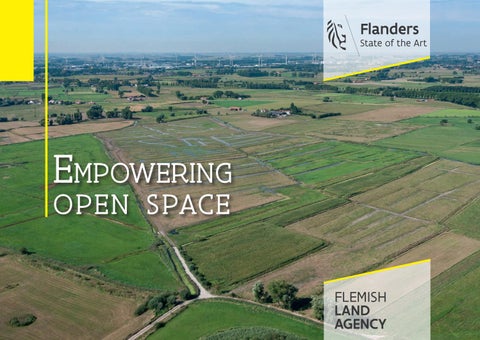
Empowering open space
FLEMISH LAND AGENCY
2
&
Our countryside and open spaces are of vital importance
The Flemish Land Agency promotes the countryside and open spaces in Flanders on many fronts. For the Flemish Land Agency, a resilient open space teeming with life is the answer to challenges such as urbanisation and climate change. We can see that the open space and the countryside have to satisfy many demands: food and energy production, biodiversity, social cohesion, and so on. Open space is scarce and thus increases in importance.
Chair of the Board of Directors of the Flemish Land Agency
Huub Broers
Managing Director
Toon Denys
This publication shows how the Flemish Land Agency is strengthening the open space and the countryside, and what the organisation stands for. We take a look at some recent achievements and look ahead to new challenges that are waiting. Our aim is to inspire municipalities and civil society organisations struggling with complex issues relating to the open space, and show them that we are achieving fine results through collaboration and by deploying the appropriate instruments and expertise.
3
Flemisch Land Agency
A passion for open space
4
A dynamic open space and rural policy
Waterways and landscapes brimming with life
In action for the climate
p. 6
p. 16
p. 34
Developing the open space
Buying, selling and exchanging land
A passion for open space
p. 44
p. 62
p. 74
5
A dynamic open space rural policy
&
ADVISING ON LAND USE POLICY AND THE PROGRAMMING OF PROJECTS The Programme Committee for land use planning has taken the initiative to combine the open space investment programmes. This is the first step in the process towards a Flemish investment programme for the open space. In 2019, the programme committee produced its first advice on the land use policy. It designated priority areas in which the future deployment of land use planning may be considered.
AN OFFENSIVE APPROACH TO THE OPEN SPACE AND THE ESTABLISHMENT OF THE OPEN SPACE PLATFORM In 2013, the Flemish Land Agency presented six future scenarios which made clear how the open space could play a more determining role in future developments. On the basis of these scenarios, four partners (Flemish Land Agency, Spatial Development Department Flanders, Association of Flemish Cities and Municipalities, and Association of Flemish Provinces) took the initiative to set up an Open Space platform. This platform brings together various forms of expertise, to achieve a new collaboration that can strengthen the open space. The Open Space platform looks for issues that can benefit from a collaborative approach, to ensure that the objectives on the ground are achieved faster.
6
Torwoud, Torhout
7
8
K apittelbeek , B eersel Locatie van de foto
© Bob Van Mol
W orkshop W ater +L and +S cape
Water+Land+Scape Following a call in 2018, 14 area coalitions were selected to simulta neously tackle similar water-related problems in Flanders. With the aid of the Water-Land-Scape Programme, users of those areas look for solutions to water problems together. Stronger agriculture, a sustainable water supply, good water quality and a stronger landscape are the objectives. The area coalitions can take the next step, but they are fully supported by the Flemish programme team. Best practices are shared, resources and instruments are offered. The programme team bundles the energy and enthusiasm of 9 players: Flemish Land Agency, Flanders Environment Agency, Department of Environment and Spatial Development, Department of Agriculture and Fisheries, Agency for Nature and Forests, Research Institute for Nature and Forest, Institute for Agricultural and Fisheries Research, Flemish Institute for Technological Research, Flanders Knowledge Center Water and Architecture Workroom Brussels.
‘ It is refreshing to see how the Flemish level
and the local level can become stronger when they tackle problems together. I hope this programme will contribute to Flanders shifting up a gear in order to work on adaptation, and be ready to address the climate challenges awaiting us.
’
Water+Land+Scape
Barbara Vael, Flanders Environment Agency
9
10
V illage
of
N ieuwkapelle
DESIGNING AND IMPLEMENTING THE RURAL POLICY The Flemish rural policy exposes the challenges in the countryside and tackles them, together with other policy areas, administrative levels and actors. These challenges are in the areas of villages, landscape management, climate, mobility, social cohesion and innovation. We are working as much as possible with a bottomup approach. Acquiring knowledge through on-site experience or research and applying it in policy: this is a logical choice for a policy field in which many local and regional players are active. The Inter-Administrative Rural Association (IPO) advises across administrations and disciplines on current themes. Examples include the following advice on: Sustainable landscape maintenance (2019), Harvestable landscapes, Local and regional valorisation of biomass from forest, nature and landscape management (2017), A future for quality surroundings with attention for silence, tranquillity and space in Flanders (2016), Local food strategies (2015). The IPO advice has led to many concrete initiatives, such as the Rural Area Maintenance Desk.
Village policy Since 2008, various bottom-up initiatives for achieving objectives on social cohesion, participation and liveability in villages have been stimulated and supported. Examples are the Flemish Association for Village Interests, Village Studios of National Guilds non-profit organisation and the project appeal Neighbourhoods in the Countryside, in collaboration with the King Baudouin Foundation. In addition, the Flemish Land Agency has been organising the Village Power competition since 2017. A publication on the village policy offers local administrations concrete ways to start dealing with challenges. The insights and experiences from the projects, supplemented with information from 3 dialogue days in 2017, are included in an advice on the village policy in Flanders. This can be further elaborated in the upcoming policy period, and it may lead to new initiatives.
The Platform for rural research brings universities, research institutes, university colleges and practition centres together to let them work more closely together on rural research and put forward better solutions. The Platform has drawn up a Rural Research Agenda, which led, for example, to the stimulating study on Ageing in the countryside. The Flemish Land Agency has organised an administrative trial of strength for rural municipalities. That enquiry has led to a support programme with best practices. Rural subsidies support initiatives and actors tackling the challenges of the Flemish countryside, such as organising participation in villages, stimulating the rural economy, ensuring food production, organising allotments, promoting environmental quality and involving vulnerable groups.
community garden in
A sse , Z ellik
11
A sse
V oeren van de foto Locatie
12
The area-based operation of the European programme for rural development Provinces, municipalities and other local players are also involved in the area-specific implementation of the rural policy. The area-based operation of the Flemish Rural Development Programme (PDPO), the Flemish implementation of the European rural development policy, is an important instrument for this. It creates a framework to support bottom-up projects that contribute to rural development. In PDPO III (2914-2020), the area-specific approach is an important pillar. In addition to the Flemish Government and the European Commission, the provinces are an important partner in funding the rural policy. Measures are being prepared to further build a Flemish rural policy for the next programming period of the Common Agricultural Policy (CAP post-2020).
LEADER LEADER is a bottom-up approach in which citizens, organisations and municipalities work together on the development of their rural area. The total state aid intended for the area-based policy amounts to around 75 million euros. Projects relate to rural entrepreneurship, social cohesion, tourism, landscape, heritage and/or village centre regeneration.
Dorpspunt Carpe ©XPAIR.be, Thomas De Boever
13
14
D e W ijers
15
&
Waterways landscapes brimming with life LAYING OUT VALUABLE AGRICULTURAL AND NATURE AREAS FOR GREATER BIODIVERSITY
Farmers are an important ally to the Flemish Land Agency, to strengthen the open space and maintain biodiversity. Despite the pressure of urbanisation, there are still strategic agricultural areas with high natural value and opportunities. The Flemish Land Agency is at the same time strengthens agricultural areas and objectives for water, nature and climate. This is only possible by interacting with owners and users and by deploying strong instruments. Through land consolidation, the Flemish Land Agency is working to improve the agricultural structure, a better design of the valleys and the implementation of European nature goals. With nature development, we strengthen natural areas by going into dialogue with owners and users. We exchange land and aim for better environmental conditions by raising the water level and by excavating nitrate-rich soil.
16
G hent C anal Z one
17
18
Land consolidation Rijkevorsel-Wortel In Rijkevorsel-Wortel, we are investing in a sustainable agricultural structure, and at the same time we aim to secure the European protected nature area along the Mark. By investing in building up a land reserve over many years, we can achieve this through land consolidation and reparcelling: wet nature such as carrs and marsh marigold land will have their place there, good for a total of 120 hectares of landscaped and European protected nature. By investing in the valley in this way, we will also make the area more climate-robust.
R ijkevorsel -W ortel
19
20
Nature development in De Blankaart The project area of De Blankaart forms part of the IJzer Valley bird directive area. De Blankaart is an important rest and foraging area for birds. The project has created a more suitable habitat for birds, with specific attention for marsh birds. Raising the water level and restoring the reed marsh were the most important measures. With the help of a local land bank, reparcelling and land consolidation, and with adjustments to the water level and paying compensation to the owners and users involved, an area of nearly 1000 hectares of new nature was created. With great results, such as the increase of the number of brooding Eurasian spoonbill.
D e B lankaart
21
‘ PARTRIDGE
shows that you need at
3 elements for an agro-environmental measure to succeed: Area-based policy, a large support base and continuity. The 5-year management agreements guarantee this. More than half of all farmers in the selected areas participate in the project. They are well informed and are listened to. After all, they know best what grows well on their land. least
’
Willem Van Colen Inagro non-profit organisation
22
P artridge
M ontagu ’ s
harrier
© Adobe Stockfoto’s
PROMOTING AND SUPPORTING VOLUNTARY NATURE, ENVIRONMENT AND LANDSCAPE MANAGEMENT IN FLANDERS
Farmers play a key role in strengthening biodiversity, managing landscapes and improving the quality of water and soil. Thanks to management agreements, farmers receive a financial incentive to take up this role and go beyond the legal obligations. The management agreements are part of the Flemish Programme for Rural Development. The business planners of the Flemish Land Agency provide guidance for farmers. By applying the management agreements in a more area-focused way and by stimulating collaboration between farmers, the effect of the measures can be increased. Farmers can choose from a range of management measures, clustered into 6 themes: managing field margins, tackling erosion, protecting field and meadow birds, Montagu’s harrier and hamster, maintaining small landscape elements, botanical management and improving water quality.
In 2019, 3,569 farmers had one or more management agreements, good for a total area of more than 11,344 hectares. The number of farmers with management agreements has risen sharply in every province in recent years. You can find more information about management agreements in the brochure ‘Collaborating with farmers on biodiversity, environment and landscape’.
Harrier plan In the Flemish loam region, in the Moeren and in the surroundings of Peer, farmers and various partners aim to attract 15 pairs of Montagu’s harriers by laying bird fields for food and shelter.
‘T
Harrier Plan is rooted in collaboration. We maintain a continuous dialogue, he strength of the
both the project partners and the people on the ground.
The
good
thing is that farmers can still undertake agricultural work on
Partridge In Assenede and in Ramskapelle the aim is to have 30% more biodiversity by 2020, by planting flower and herb strips on fields.
the bird fields.
They
harvest the
alfalfa and process it into fodder for their animals.
’
Hanne Vandewaerde, Regional Landscape Zuid-Hageland
23
24
Bertem
Delaying mowing date and wetland pumps help meadow birds The farmers in the valley of the Zwarte Beek [Black Brook] in Limburg and in the polder areas between Ostend and Knokke are increasing brooding success among meadow birds by delaying the mowing date and by creating wetlands.
Pastures filled with herbs and flowers In the Demer Valley between Aarschot and Testelt, farmers with management agreements are developing species-rich grasslands through the natural reduction of the grasslands.
Y ellow W agtail
‘A
fter
5
years, we are seeing clear
results on many plots:
the grasslands are bursting with a variety of species.
’
Mathias Lemmens Flemish Land Agency business planner
A lfalfa
25
DESIGNING AND IMPLEMENTING THE FLEMISH MANURE POLICY The manure policy tackles pollution of surface and ground water with nitrates and phosphates by the agricultural and horticultural sector. Research supplies input for the manure policy. This research determines agricultural and environmentally responsible phosphate fertilisation standards, improved feeding strategies, fertilisation strategies to decrease the nitrate residue, and the impact of fertilisation on nutrient depletion along the waterways. The Flemish manure policy is based on the ‘4C principle’: ‘Correct dosage’, ‘Correct time’, ‘Correct type of fertiliser’ and ‘Correct fertilisation technique’.
‘T
6th Manure action plan allows a more targeted monitoring of the manure legislation. The tightened area-based policy, the expansion of smart instruments such as AGR-GPS and the digital artificial fertiliser register, and the deployment of the nitrate residue provision as a supporting instrument, are the spearheads in the plan. The aim is to improve water quality he
together with the agricultural and horticultural sector.
’
Bart De Schutter, Head of Division, Manure Bank
M anure
26
sampling
27
28
MONITORING COMPLIANCE WITH THE MANURE LEGISLATION AND STIMULATING A MORE SUSTAINABLE FERTILISER USE
Monitoring compliance of the manure legislation is the final element of the manure policy. In the previous policy period, the focus was shifted from administrative controls to control on site, with on the one hand a thorough risk analysis of the available data, which led to targeted business evaluations, and on the other hand the measurements of the nitrate residue. In addition, the existing field checks were retained and tightened where necessary. In the fertilisation practices, we look at the time, the dosage, the application techniques and the distance to waterways. Infringements with a direct impact on the environment, such as manure discharge and installations for manure processing and manure storage, are being tackled. The current status can be found in the annual Manure Report.
M onitoring
manure transport
29
30
Company review In 2015, the Flemish Land Agency set up the Company review department within the Manure Bank. During a company review, we take a close look at an entire agricultural business. We check the complete operation and the collaboration with other companies, such as manure transporters or operators of manure processing installations.
VODKA action
‘C
ompany reviews allow us to tackle in
Since 2014, we have been performing extra inspections in the areas where water quality is below standard. We call these inspections VODKA actions. VODKA stands (in Dutch) for ‘Responsible Handling of Livestock Manure, Chemical Fertiliser and Other Fertilisers’. We have seen that the more we are present in an area, the better the compliance with the manure legislation. Even outside the period in which manure spreading is allowed, the inspectors are often present in the VODKA municipalities to detect problems.
a targeted way those companies where things are going wrong.
This
way of
working delivers the best results for the sector and for the environment.
For
2015-2018, our was to perform 3,000 company surveys. the period
’
Stefan De Neef, head of company survey unit
aim
Inspection of manure transport Manure bank inspectors check manure transportation. These checks can be performed in a targeted way, thanks to the AGR-GPS obligation for recognised manure transporters and the mandatory prior reporting in the Manure Transport Internet Counter [MTIL]. In addition to transportation by recognised manure transporters, other transports are also inspected, such as transport via neighbour arrangement or transport by a company to its own land. The Manure Bank performs both planned inspections and inspections in response to a report.
31
32
P lateau
van
M oorsel ,H et Z een , Z aventem
33
Taking ACTION for the climate
‘W
e are seeing the need to clearly register all
relevant
Flemish Land Agency
actions, to quantify
and frame them in the climate measures of the
Flemish Flemish
2021-2030 and the plan. For this, we assess the
climate policy plan adaptation
best
methods. It is even more important to increase our
contribution where possible through monitoring and adjustment.
We
are ambitious andfor the climate
we want to address various challenges; both with
regard to adaptation (lessening the climate impact) and mitigation (reducing greenhouse gases).
’
Sibylle Verplaetse, chair of the climate working group of the Flemish Land Agency
34
Z win
plain
35
36
The intake of open space leads to additional emissions of greenhouse gas, reduced adaptation possibilities, loss of biodiversity and loss of ecosystem services. The social cost of all this is high. The challenge in the years ahead will be to reverse this trend. The Flemish Land Agency is taking steps to mitigate the effect of climate change. In order to tackle flooding, we are opening basins and allowing them to meander again. Flood basins retain water after heavy rainfall and serve as water reservoirs in dry periods. Planting greenery in the built environment provides cooling. We work with farmers to fight erosion together. In addition, we are taking specific climate measures to combat further warming. We are doing that by restoring peat areas, improving the carbon content of the soil, planting trees, reducing agricultural traffic by having plots closer to each other and closer to the company, stimulating short supply chains and focusing on safe and functional bicycle connections. Our instruments stimulate local players to take measures on their own plots. It is precisely at this level that a major gain can be achieved in the area of climate adaptation and mitigation.
F orest
situated in
G hent
and
L ievegem
37
MITIGATING THE EFFECTS OF CLIMATE CHANGE Better dykes and more natural flood areas With the Sigma plan, Flemish Waterways plc and the Agency for Nature and Forests are investing in stronger and higher dykes and in a chain of natural flood areas in the river valleys of the Scheldt and its tributaries. The Flemish Land Agency is focusing its expertise in land acquisition and land exchange on the acquisition or exchange of agricultural land in these projects, for example in the Kleine Nete sub-area.
Climate adaptation in the ‘Molenbeek Valley’ With the ‘Molenbeek Valley’ land development project, we are protecting the villages of Alsemberg and Sint-Genesius-Rode against flooding. The Flemish Land Agency is creating more water storage possibilities by acquiring ponds between the Sonian Forest and the Zenne. Attention is also being paid to recreation. There will be more opportunities for soft mobility, such as cycling and hiking.
On the coast The coastal area is one of the areas where the consequences of climate change will be most felt. The Zwin has been expanded. The construction of appropriate dykes and waterways proved essential for combating salinization in the surrounding polder area. The Flemish Land Agency will further focus on necessary land acquisition and provide subsidies for the landscape measures. We are also focusing on knowledge exchange through European projects such as SALFAR, FRESH4Cs, CARBON CONNECTS, COASTAL and VEDETTE.
R iver
38
of the
K leine N ete
D une
vegetation ,
C oastal
V alley
zone
D e P anne
of the ZZeebermduinen warte B eek
39
40
U rban
nature reserve
B ourgoyen -O ssemeersen ( city
of
G hent )
TAKING MEASURES TO COUNTERACT FURTHER GLOBAL WARMING Less air pollution and more CO2 capture in the soil
‘ BL
y planting woodlands, the
and
Agency
Flemish
is helping us to make
the city more climate-robust and to improve the air quality.
Also
offers benefits.
the landscape
The Flemish Land Agency implements the supporting policy’ Programmatic Approach to Nitrogen’ (PAS). This will help limit ammoniac deposits in nature areas. The Manure Action Plan (MAP) indirectly ensures that greenhouse gas emissions from manure, including methane and nitrous oxide, will be considerably reduced. The current acreage of cover crops, which capture CO2 from the air and surplus nitrogen from the soil, will be increased with MAP 6. In addition, fields will be converted into grass strips, for the field margin management agreement. This will capture more CO2 in the soil and in biomass.
for
other aspects, a collaboration often
Besides,
and the open space do not stop at the city limits: an added value of
Flemish Land Agency is that they implement cross-border projects, in the
which several cities and municipalities are involved.
We
can therefore work
on a larger scale and achieve greater progress.
We
are certainly keen to
collaborate with the
Agency
in the future.
Flemish Land
’
Mathias De De Clercq Marnix Smet, voorzitter....... mayor of the city of Ghent
Peat restoration in the Valley of the Zwarte Beek [Black Brook]
out further and decomposes, it could, according to Leuven University, release 1 million tonnes of CO2. With the Zwarte Beek [Black Brook] nature development project, we are ensuring that the peat is wetted and restored.
Woodland expansion Vinderhoute Forests The Vinderhoute Forests is one of the four green areas on the outskirts of Ghent. The woods form a large recreational and nature area on the transition from the city to the countryside. In addition to the expansion of a recreational (infra)structure, the planting of a new forest is also an important action plan for this project. In the years ahead, 107 hectares - or 70% - of the woodland expansion will take shape. For the farmers who are still working in the area, a supporting agricultural policy has been drawn up.
Peat is important in the fight against climate change. Peat acts as a sponge and it therefore prevents both flooding and drought. In addition, growing and wellpreserved peat draws CO2 from the air. There is an exceptionally large, contiguous peat area between the Nieuwendjk (Beringen) and the ‘Kamp van Beverlo’ (Leopolsburg) military zone. With a surface area of 200 hectares, a width of between 300 and 600 metres and a thickness that locally can be as much as 5 metres, this area is unique in Western Europe. The peat plot is reasonably well preserved but it is under considerable pressure from drought. Hydrological restoration measures are required. If the peat dries
41
42
43
© Adobe Stockfoto
Developing the open space
EXPANDING GREEN-BLUE NETWORKS IN SUBURBAN AREAS The Flemish Land Agency designs open space in such a way that local residents and users can all benefit from it. We connect municipalities by building safe hiking and cycling trails, install reception facilities, and we create links that unite landscapes, water and nature. The demand for empowering the open space and improving the quality of the surroundings is high, particularly in suburban surroundings that are under considerable pressure. Moreover, the realisation of green-blue networks also has a cooling climate effect in more urban regions.
44
D e W ijers
45
46
F lemish
periphery around
B russels
The Flemish Periphery The Flemish Periphery is densely populated. The expected population growth and a strong urbanisation pressure affect and cause the remaining open space to become increasingly fragmented. In such areas, it is important to invest in the remaining open space. We are doing that through 3 land planning projects (Molenbeek-Maalbeek, Plateau of Moorsel, Land of Teirlinck) and 10 planning schemes. Since the project was approved on 16 May 2014, many things have been done. In Zaventem, the park Het Zeen underwent a true metamorphosis. The Kleine Maelbeek was opened up, so that rain and ground water would once again have a place in the Woluwe Valley. You can easily stroll in and out of the park thanks to bridges over the brook. There is a new playground that extends as far as the water. Walkers can take a longer circuit around the existing sport fields, and for joggers there is a separate bark path. A part of the Land of Teirlink land planning project has also been implemented in the municipality of Beersel. The Kapittelbeek has been given more room, thanks to a series of ecological measures.
47
P ark H alfweg , M alem
F ish
48
ladders
M elsenbeek , M erelbeke
Lys and Scheldt land use planning In the area of Ghent, within the Lys and Scheldt land use planning, we managed to clearly strengthen the open space. We for instance helped to create city forests and large-scale nature areas, implementing the targets of the Flemish Government. • The Flemish Land Agency provided support in expanding the woodlands and opening up the Parkbos [park forest]. The Flemish Land Agency also started working on the Vinderhoute Forests green area. The agro-economical situation of the area was taken into account in this project. • The nature targets in the Bourgoyen-Ossemeersen were achieved with the implementation of important infrastructural works. • The Merelbeekse Scheldemeersen nature development project provided important additional habitats and foraging areas for meadow birds and fish. Nature lovers are already calling this area ‘the second Bourgoyen’. • Planning schemes in the Assels, the valley of the Oude Kale, the Latemse Meersen and also Malem (near the city centre) provide a string of additional green pearls with added value in nature, ecology, landscape and recreation.
A ncient R ailroad B ed G hent
49
50
D e W ijers
De Wijers De Wijers is the area of the 1000 ponds in Middle-Limburg, encircling Hasselt and Genk. As part of the ‘Stiemerbeek Valley land development project’, work is being done on the green-blue veining of De Wijers, at three strategic locations in the valley - Schansbroek, Slagmolen (Genk) and Dauteweyers (Diepenbeek) . The European Union is also contributing to the implementation of this land development project via the LIFE+ project Green4Grey. The other valleys will be tackled under the De Wijers land development project. The first land development scheme from that new programme is the ‘Mijn Mangelbeek land development scheme’. The objective of this plan is to landscape the Mangelbeek Valley in a more natural way and as a central link between Heusden and Zolder. It will have its own recognisable identity that is linked to its mining past. In this way, the valley should become a place where visitors like to linger and where nature is given every possible chance.
‘F
or many cities and municipalities, the
trusted partner.
Greater
Flemish Land Agency
is a
consolidation and more open space are
Association of Flemish Cities and Municipalities and its members. It is good that, together with the Flemish Land Agency, we can aim for a broadly also one of the important challenges facing the
supported approach and that we can develop new methods that can make a difference on the site.
Agency
That
the
Flemish Land
attaches such importance to partnerships and induces
municipalities to collaborate in the implementation of projects is highly appreciatedeerd.
’
Wim Dries Chair of the Association of Flemish Cities and Municipalities and Mayor of the city of Genk
51
52
V isualization
of village layout
K essenich
53
IN ACTION FOR THE OPEN SPACE Restricting the claim on space and effectively reducing asphalt will demand considerable efforts from local administrations. The land use planning decree provides administrations with instruments and know-how to carry out these difficult tasks. This enables them to work effectively, for example with the reparcelling instrument, involving planning exchange.
Nieuwmunster In the polder village of Nieuwmunster, in the municipality of Zuienkerke, there is an area of 1.5 hectares earmarked as a residential area and protected as a village conservation area. In that zone there is an uninhabited farmhouse that has been designated as architectural heritage. It is spatially undesirable to develop the farmhouse and the surrounding land as a residential area. Utilising track 2 from the land use planning decree, the municipality has access to the ‘Reparcelling by force of law with planning exchange’ instrument so that the residential area in its entirety can be shifted to a more suitable place in the village. Simultaneously, the ownership and use of lands of approximately 25 owners/users are being exchanged, and new public space is being created for a safe bicycle and hiking path. The protected farmhouse has been redesigned as a meeting space for the village residents.
W orkshop
54
with residents
N ieuwmunster
N ieuwmunster
55
56
P ark H et Z een , Z aventem
57
STRENGTHENING THE QUALITY OF THE SURROUNDINGS IN RURAL AREAS Merode Rural development project Thanks to intensive collaboration, local consensus, the deployment of resources under the rural development policy and the land use planning and nature development instruments, the former domain of the Princes de Merode on the border of the provinces of Antwerp, Flemish Brabant and Limburg has developed into the lovely Merode countryside. On 20 October 2017, the coordination of the project was transferred to the provinces involved, but the Flemish Land Agency is still investing in the area via land use planning. Recreational users are also catered for, with the popular hiking network. To support visitors, the various reception areas have been further expanded and provided with all necessary information. Gerhagen and the abbeys of Tongerlo and Averbode are important catalysts for this, Gerhagen and the vicinity of the abbey of Averbode have already been upgraded and in the coming years investments will be made in the quality of the surroundings of the abbey of Tongerlo. Improvement of the water regime in the moats and the indigenous greenery is also on the agenda. Fauna and flora flourish particularly well in the Merode. Averbode Bos and Heide has become a hotspot for the abundance of species, several of which are once more gaining ground. We are still working on stronger ecological and rural connections. .
A verbode A bbey S quare
58
G erhagen , T essenderlo
M aiden ’ s T ower
in
Z ichem
59
60
61
Buying, selling and exchanging land
WORKING ON SOLUTIONS FOR OPEN SPACE USERS AND OWNERS Each infrastructure project in Flanders is an opportunity for strengthening environmental quality Strengthening the area surroundings can also help to increase public support. The Flemish Land Agency buys, sells and exchanges land in order to realise complex plans. For large infrastructure projects, we devise solutions that mitigate or compensate the impact on the environment or on the owners and users concerned. With a land bank, the Flemish Land Agency can acquire a project area and take measures that serve the common interest. A land bank ensures that farmers who have plots in the project area can obtain other land in exchange. This way, they can continue their farming activities on other plots. In addition, we ensure access to land for important open space functions, such as food supply and biodiversity.
62
Fintele, Lo-Reninge
63
64
D e A11
The A11 The A11 is a new motorway that connects the N31 in Bruges with the N49 in Westkapelle, and that prevents freight transport to the port of Zeebrugge from clogging up the local roads and villages. For the A11, the Flemish Land Agency succeeded, via local land banks, in freeing up and acquiring the land under the projected route for the timely realisation of the nature compensations. The land use exchange placed the plots of all farmers involved on one side of the A11 and provided a better structure and accessibility of the agricultural plots. This means that the farmers encounter no nuisance from the work and a bridge across the A11 could be avoided. The plans took shape in consultation with the residents of Dudzele and were implemented using collective resources of the Agency for Roads and Traffic, the city of Bruges and land use planning. Together they provided measures for a high-quality landscape design. This design primarily aimed to strengthen the landscape instead of choosing a traditional linear buffering, which would primarily emphasise the road infrastructure. The approach stimulated local consensus. Because of this, only a few objections were raised against the building application for the A11.
© Flemish Agency for Road and Traffic, 2018
65
D oornzele -N oord
D oornzele -N oord
66
D esteldonk -Z uid
Canal area in Ghent All the ports in Flanders are currently being expanded. This has an enormous impact on their surroundings. To guarantee the quality of life in the centres of the Canal area in Ghent, the Flemish Land Agency drew up planning schemes for most of the 16 connecting areas. This took place in close interaction with the residents. Four connecting areas have already been completed. A satisfaction survey performed in 2012 and comments from the residents during organised walks showed that all residents felt highly satisfied and involved. In the parts of the connecting areas that have an agricultural designation, farmers could plant additional buffering nature elements on a voluntary basis. For this they were paid by a landscaping fund that was set up by the Flemish Land Agency, and is sponsored by the companies. The Flemish Land Agency took care of the land acquisition for creating the green zones in the connecting areas and for the nature compensations via the local land bank. A number of exchange files have already been achieved.
‘I
n the beginning, the local residents were doubtful
about major adaptations.
Now
that the benefits of
the connection area have become clear, most people
are reacting positively. In the new design, the finest views in the neighbourhood are being highlighted, while the industry remains subtly hidden. bicycle paths, picnic benches and fish
There are quays, and
a new cycling loop leads cyclists via a beautiful route around the old arm of the polluted industrial sites used to new nature.
’
Moervaart. Where be, you will now find
Marnix De Smet, chair residents group Sint-Kruis-Winkel, in Buitenkans March 2019
67
Local land bank Right and Left Scheldt bank Within the local land bank of the Scheldt Right Bank, the necessary land was freed up in order to achieve the port expansion of Antwerp on the Right Bank of the Scheldt. Over a period of 6 years, the land bank was able to acquire 45 hectares of exchange land. Thanks to this, the Flemish Land Agency could offer a concrete solution to farms that wished to continue their operations. On the Scheldt Left Bank, 675 hectares of agricultural land was acquired for the realisation of nature development and for the logistics Park West, for a sum of 38 million euros, funded by the Flemish Region, the Scheldt Left Bank Company and the Antwerp Port Authority. Supporting measures, including 125 hectares of exchange land, were made available to affected farmers. Thanks to this, legal expropriations were avoided.
N ature
68
reserve
D oelpolder N oord
Z win N ature P ark
IMPLEMENTING NATURE COMPENSATIONS FOR PORT EXPANSIONS AND OTHER MAJOR INFRASTRUCTURE WORKS Nature compensations Zeebrugge Through the land bank operation, the Flemish Land Agency ensured the voluntary, direct acquisition and exchange of land (326 hectares) in designated compensation areas. The Flemish Land Agency developed 230 hectares of this land to compensate for the European nature targets, so that the port expansion of Zeebrugge could take place on time. The ‘Nature Compensations Zeebrugge’ land bank has already delivered the following positive results: •
Around 50% of the acquired land in the search areas has been exchanged (114 ha / 230 ha). We found exchange land for the farmers involved.
•
More than half of the farms involved increased their share of arable land after the exchange.
•
The average area per owner involved was increased by 13%.
•
The average distance to be driven was lower for 2/3 of the businesses involved.
•
The designated spatial use has been improved for the farmers involved.
69
FACILITATING LAND MOBILITY FOR FLEMISH PARTNERS VIA THE FLEMISH LAND BANK The Flemish Land Agency supports partners in the acquisition of land by offering exchange land to farmers in the intended project areas. In this way, the farmers involved can continue their activities on other plots. The Flemish Land Agency works for various partners in around 30 land banks, to implement water objectives, nature targets and infrastructural projects. In addition, through supporting policies we implement solutions for farmers who are impacted the most by the European nature targets. The Flemish Land Agency opened up a rolling fund to purchase land at strategic locations, to solve bottlenecks. In addition, the Flemish Land Bank made an important administrative simplification and helped notaries and beneficiaries of a pre-emption right to save costs, by setting up an e-helpdesk. This helpdesk can easily be consulted to find out which pre-emtion rights are attached to a lot, it can offer the lots and exercise a pre-emption right.
70
Z win N ature P ark
71
Pre-emption right
Solutions for tenant farmers
With the land use planning decree, the Flemish Land Bank obtained a right of pre-emption, which means that since 2014 the Flemish Land Bank is the first partner in the sale of immovable goods by local administrations. This enables lands to be used optimally within the administration. To date, we have used the right of pre-emption to buy 142 hectares, spread throughout Flanders. The land are being used as exchange land for the implementation of nature targets, integral water policy, infrastructure and in the context of land consolidation projects.
Gaining access to land is not always easy in Flanders. The pressure on land is so high that land prices continue to rise and are no longer in proportion to the agricultural production on the lots. It is thus essential for a sustainable agricultural production that supporting measures are taken, especially in suburban areas with high pressure on land. Currently, the Flemish land bank holds 500 hectares under lease. We want to focus more strongly on this by creating an additional range of land for temporary use, for farmers who do not own the land that they use. Initially we will concentrate on farmers who are affected by government projects.
Land Bank supporting policy IHD-PAS The aim of the supporting policy to the land bank IHD is to offer solutions to farmers whose land is obstructing the implementation of European nature targets. This primarily takes place by exchanging the farmers’ land for land outside of the the search areas that have been designated for European nature targets. To enable the land bank to function, it is necessary to build a reserve of exchange land. To date, 410 hectares have been acquired throughout Flanders. In 2017 we purchased 287 hectares in Mol, together with the Agency for Nature and Forests. In addition to implementing the European nature targets, this acquisition makes it easier to align the various initiatives that have an impact on future spatial use in Mol-Postel.
72
C antelmolinie , Z win N ature P ark
73
A passion for open space Effective means The Flemish Land Agency has powerful legal instruments at its disposal. These include subsidies for rural development, the Flemish land banks, environmental agreements, the Manure Decree, land development, land reparcelling, nature conservation and digital services via E-helpdesks. Thanks to land development track 2, these instruments are also available to other administrations.
Consultation and partnership Consultation and partnership are part and parcel of our culture. We build bridges and consult with all stakeholders. We do this by bringing everyone to the table: farmers, nature associations, provinces, municipalities, regional landscapes, Flemish and European partners, researchers, companies, citizens and local communities.
Driven experts The Flemish Land Agency: approximately 600 talented employees with a heart for open space and the countryside. Together they harness their expertise to improve the quality of the countryside and open space in Flanders. Thus ensuring a landscape that is resilient, dynamic, and brimming with life, so that the open space and the rural areas are ready for the challenges of tomorrow!
‘T
he
‘F’
in
FLA
first and foremost stands for ‘fresh’, fresh and innovative in
approach, instruments, attitude and scope. In second place, that for ‘trust’.
Employees
‘F’
stands
Flemish Land Agency exude trust through their knowledge and process skills. These enable them to create mutual trust with others in the field. The Flemish Land Agency is, as a policy-implementing agency, adept at testing the waters of policy preparation at Flemish level. of the
’
Hans Leinfelder, teacher, assistant professor, Leuven University
74
Z win N ature P ark
75
76
agri - environment scheme ,
B ertem
77
S chansbroek , G enk
Colophon This pictorial review is a publication by the Flemish Land Agency. VU: Toon Denys, managing director Flemish Land Agency Editing and layout Flemish Land Agency Consciencegebouw Koning Albert II-laan 15, 1210 Brussels Tel. 02 543 72 00 www.vlm.be pers.vlm.be Photography © Flemish Land Agency, unless stated otherwise in the photo caption Cover image Aerial Photography Damme © Flemish Land Agency Date november 2020 Depository number: D/2021/3241/001 - Flemish Land Agency - Consciencegebouw, Koning Albert II-laan 15, 1210 Brussels Follow us on social media
FLEMISH LAND AGENCY
FLEMISH LAND AGENCY
VLM.be