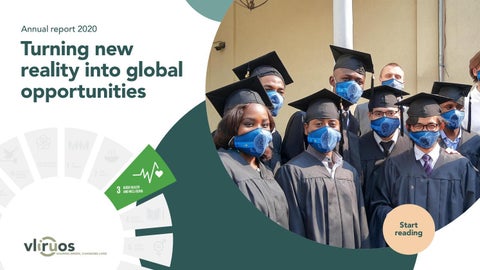
Annual report 2020
Turning new reality into global opportunities
Start reading
Preface 2020, when everything changed
There can be no doubt about it: corona virus spread across the world in 2020 and will not be leaving any time soon. Each of us will remember what the pandemic looked like for the rest of our lifetimes: empty streets, deserted squares, abandoned railway stations, a shutting down of all entertainment and cultural activities, travel disruption with flights suspended… The Covid-19 outbreak had a catastrophic impact on hospitals. Frontline healthcare workers went to great lengths to provide the best care in unprecedented circumstances. The pandemic disrupted all aspects of society and affected everyone, in one way or another. The pandemic had a huge impact on VLIR-UOS projects, since mobility and bringing together large groups of students, researchers and stakeholders are key to our international partnerships. Many activities have been delayed by at least a year with huge delays in achieving planned results as a consequence. However, at the same time, we proved to be agile, even in these unusual circumstances, and managed to stay connected and look for ways of turning the new reality of how we live and work into global opportunities. By switching to virtual meetings, we realised how close our local partners actually are. Through the virtual Covid-19 platform developed in May 2020 we enabled our partners to stay connected and exchange valuable information, knowledge and experiences on how to cope with the Covid-19 virus. We have realised that this new way of working is here to stay.
Agenda 2030, the impact of global learning on society
We held consultations on numerous topics, but instead of in-person meetings we settled into the new reality of digital meetings. Thanks to these virtual meetings we were able to involve our partners in various focus group discussions and continue sharing minds, the input of which was used for our new five-year programme (2022-2026). Our new programme will start on 1 September 2022 and will be built upon the SDG Framework and Agenda 2030. The focus will be on cooperation and connectedness, valorisation of project results, and collective learning.
Joining forces of higher education actors for sustainable development
We are committed to investing in cooperation, connectedness and collective learning, not only at the level of VLIR-UOS, but also through the new thematic Joint Strategic Framework for Higher Education and Science for Sustainable Development we will gradually develop in partnership with Académie de Recherche et d’Enseignement Supérieur (ARES), our French-speaking sister organisation in Belgium, and the Institute of Tropical Medicine in Antwerp (ITM). The framework is geared towards Belgian academic actors and partners joining forces to contribute to academically inspired, science-driven societal change connecting higher education institutions to wider society. This framework will evolve gradually and remain dynamic in order to respond to opportunities and policy priorities.
Moving forward together for impact
Our new vision is set and will soon take shape in our new programme! We are continuing on this journey with passionate academic experts from partner countries as well as our Flemish universities and university colleges, with dedicated ICOS and GEO, our board members and colleagues, and a great deal of ambition to pursue our mission! So in this new global reality with new opportunities, we are ready to shape the future, with each other, for each other. To conclude, we would like to take this opportunity to thank all the academics, students, alumni and other VLIRUOS advocates for their relentless efforts in continuing to act as change agents in development cooperation and rethink cooperation formats and processes as required in a changing reality. We also wish to thank the government for its confidence and continued support, which enables us to move forward and achieve our goals. Happy reading! Johan De Tavernier, VLIR-UOS Chairperson Kristien Verbrugghen, VLIR-UOS Director
Contents
Preface
p. 02
Colophon
p. 57
1
2
Highlights
Zooming in on global health
23
p. 05
38
p. 24
3
4
5
2020 in retrospect
Overview budget
The people behind VLIR-UOS
p. 39
51
p. 52
53
p. 54
56
Highlights Thinking and acting globally: Agenda 2030 and SDGs VLIR-UOS ambition to be SDG-proof in the near future Our new gender policy Trajectory to our new five-year programme Evaluation ‘Creating the conditions for impact’ Mid-term evaluation of the incremental funding to ICPs Mid-term evaluation of Global Minds Benchmark study on selection systems Thematic JSF on Higher Education and Science for Sustainable Development Reform of the Bureau UOS
Thinking and acting globally: Agenda 2030 and SDGs
M
ore than ever, the year 2020 has made us realise that global challenges require joint efforts between international communities to achieve sustainable development. Back in 2000, the leaders of the United Nations (UN) signed the historic Millennium Declaration, in which they committed to achieving a set of eight measurable international goals. These ‘Millennium Development Goals’ (MDGs) range from halving extreme poverty and hunger to promoting gender equality and reducing child mortality, by the target date of 2015. While some goals, such as halving the number of people living in extreme poverty, have been achieved, less success was achieved with regard to other goals, such as reducing maternal and child mortality. As a next call to action, 17 Sustainable Development Goals (SDGs) were defined in 2015 as part of the UN 2030 Agenda for Sustainable Development, with 169 associated targets to be reached by 2030. Unlike the MDGs, which only targeted developing countries, the SDGs apply to all countries across the globe. The SDGs are more universal and encourage us all to look in the same direction, and they are also nationally owned giving each country the freedom to establish a national framework in achieving the SDGs.
To me, the strength of the SDGs lies in the principles and the fact that they are a universal framework. The focus is not only on the so-called developing countries but it is urging everyone everywhere in the world to take responsibility to not leave anyone behind, whoever that person or group might be in a particular community or society. Lisa Popelier, Strategy & Quality Advisor
Lisa joined VLIR-UOS in November 2020. Discover how she experienced taking up this new challenge in the middle of the pandemic here!
The SDGs introduced a new way of thinking for the entire development cooperation architecture, including the UN development system. Belgium, as a development cooperation donor, is committed to contributing to the realisation of those ambitious goals. The Belgian Development Cooperation has therefore decided to use the SDGs as building blocks, making the SDGs our compass that provides the overall orientation of our efforts towards comprehensive Belgian development cooperation. Belgian development cooperation is still adapting to the new setting, and now wants to internalize and mainstream the SDGs. The ambition is to move from silos towards an integrated approach using the SDGs as a compass, to ensure complementarity between the Belgian structures and instruments of development cooperation, to monitor the Belgian contribution to the SDGs, and to invest in a process of action-based learning. To guide the Belgian government in its ambitions to further align Belgian development efforts with the SDG framework, a Policy Supporting Research study (PSR) on the SDGs as a compass for Belgian development cooperation was carried out by professor Huib Huyse (KU Leuven) in cooperation with the University of Antwerp (UAntwerp). The main challenge this research project addressed is changing the approach from retrofitting the SDGs to the Belgian development cooperation towards using the SDGs as the basis for our policies. VLIR-UOS organises PSR together with ARES, so all Belgian universities are considered. The research team produced (1) a mapping of current practices related to the SDGs in the Belgian landscape; (2) an assessment of the extent to which policies are aligned to the 2030 agenda, exploring how the Belgian contribution to the SDGs can be monitored; (3) a comparison between the insights from this assessment in Belgium with practices in the field (Uganda and Benin); and finally (4) frameworks and tools that can support the integration of the SDGs in the different channels of Belgian development cooperation. The project was prolonged with some very specific objectives: to support and inform the DGD decision-making process regarding SDG integration and the integration of SDG principles in the programme cycle as well as the operationalisation of SDG monitoring and reporting frameworks.
Policy Supporting Research (PSR) Click to learn more
DGD Click to learn more
The SDGs introduced a new way of thinking for the entire development cooperation architecture, including the UN development system. Belgium, as a development cooperation donor, is committed to contributing to the realisation of those ambitious goals. The Belgian Development Cooperation has therefore decided to use the SDGs as building blocks, making the SDGs our compass that provides the overall orientation of our efforts towards comprehensive Belgian development cooperation. Belgian development cooperation is still adapting to the new setting, and now wants to internalize and mainstream the SDGs. The ambition is to move from silos towards an integrated approach using the SDGs as a compass, to ensure complementarity between Policy supporting research (PSR) is an integral part of the five-year programme for the Belgian structures and instruments of development cooperation, to monitor university the cooperation for development of the umbrella organisations VLIR-UOS Belgian contribution to the SDGs, and to invest in a process of action-based learning. and ARES and involves all Belgian universities. PSR delivers research output to the Directorate-General for Development Cooperation and Humanitarian Aid (DGD) To guide the Belgian government in its ambitions to further align Belgian development Policy Supporting with regard to the international framework of sustainable and inclusive development. efforts with the SDG framework, a Policy Supporting Research study (PSR) on The the objective is to enhance Research (PSR) DGD’s knowledge on specific themes of interest to SDGs as a compass for Belgian development cooperation was carried out by professor Click to learn more Belgian development cooperation and improve the relevance and performance of Huib Huyse (KU Leuven) in cooperation with the University of Antwerp (UAntwerp). the Belgian development cooperation policy. Themes include gender policy, SDGs The main challenge this research project addressed is changing the approach from as a compass for Belgian development cooperation, climate & security, and private retrofitting the SDGs to the Belgian development cooperation towards using the SDGs sector development opportunities targeting smallholder farmers’ cooperatives. as the basis for our policies. VLIR-UOS organises PSR together with ARES, so all Belgian universities are considered. Two types of policy-supporting research are considered from 2019 to 2021: long-
PSR
term PSR and short-term PSR. Long-term PSR allows delving deeper into a subject. The research team produced (1) a mapping of current practices related to the SDGs The term is one year, renewable twice after an assessment of the products and the in the Belgian landscape; (2) an assessment of the extent to which policies are aligned continued needs. Short-term PSR serves to mobilise universities to provide punctual to the 2030 agenda, exploring how the Belgian contribution to the SDGs can support be in the short term (3 months). DGD monitored; (3) a comparison between the insights from this assessment in Belgium with Click to learn more practices in the field (Uganda and Benin); and finally (4) frameworks and tools that can As a rule, a PSR policy commission (consisting of DGD, VLIR-UOS, ARES and the support the integration of the SDGs in the different channels of Belgian development cabinet) meet once a year to discuss current PSR projects, results and uptake, and cooperation. The project was prolonged with some very specific objectives: to support discuss matters of general interest for PSR. Annually, the policy committee evaluates and inform the DGD decision-making process regarding SDG integration and the functioning of the PSR and proposes adjustments if necessary. integration of SDG principles in the programme cycle as well as the operationalisation of SDG monitoring and reporting frameworks.
The SDGs introduced a new way of thinking for the entire development cooperation architecture, including the UN development system. Belgium, as a development cooperation donor, is committed to contributing to the realisation of those ambitious goals. The Belgian Development Cooperation has therefore decided to use the SDGs as building blocks, making the SDGs our compass that provides the overall orientation of our efforts towards comprehensive Belgian development cooperation. Belgian development cooperation is still adapting to the new setting, and now wants to internalize and mainstream the SDGs. The ambition is to move from silos towards an integrated approach using the SDGs as a compass, to ensure complementarity between the Belgian structures and instruments of development cooperation, to monitor the Belgian contribution to the SDGs, and to invest in a process of action-based learning. To guide the Belgian government in its ambitions to further align Belgian development efforts with the SDG framework, a Policy Supporting Research study (PSR) on the SDGs as a compass for Belgian development cooperation was carried out by professor Huib Huyse (KU Leuven) in cooperation with the University of Antwerp (UAntwerp). The main challenge this research project addressed is changing the approach from retrofitting the SDGs to the Belgian development cooperation towards using the SDGs as the basis for our policies. VLIR-UOS organises PSR together with ARES, so all Belgian universities are considered.
DGD
The research team produced (1) a mapping of current practices related to the SDGs in the Belgian landscape; (2) an assessment of the extent to which policies are aligned to the 2030 agenda, exploring how the Belgian contribution to the SDGs can be monitored; (3) a comparison between the insights from this assessment in Belgium with practices in the field (Uganda and Benin); and finally (4) frameworks and tools that can support the integration of the SDGs in the different channels of Belgian development cooperation. The project was prolonged with some very specific objectives: to support and inform the DGD decision-making process regarding SDG integration and the integration of SDG principles in the programme cycle as well as the operationalisation of SDG monitoring and reporting frameworks.
The Directorate-General for Development Cooperation and Humanitarian Aid Policy Supporting (DGD) is the Belgian administration for Development Cooperation integrated into Research the Federal Public (PSR) Service (FPS) Foreign Affairs, Foreign Trade and Development Clicksince to learn more DGD’s priority objective is sustainable human development Cooperation 2002. while reducing poverty, within a context of partnerships, and respecting criteria of relevance to development. DGD’s role is also to generate and increase the Belgian public’s support for international solidarity and Belgian cooperation policy. DGD is the funding agency for governmental, multilateral and indirect cooperation. VLIR-UOS is funded by DGD, as part of indirect cooperation. DGD creates a collective vision on development cooperation through dialogue with all public stakeholders for development policy, stakeholders involved in Belgian development cooperation and the European and international institutions. DGD translates this vision into strategic DGD and operational priorities for the central administration and for the field. Click to learn more
VLIR-UOS ambition to be SDG-proof in the near future Leave no one behind Click to learn more
I
n 2020, VLIR-UOS started developing its next five-year programme (FYP2) for 2022-2026. The new five-year programme is built using the SDG framework and its three underlying principles ( leave no one behind, interconnectedness and multi-stakeholder partnerships) as a compass when reformulating its vision and Theory of Change (ToC) and revising its portfolio of programmes and scholarships. In FYP2, the focus will be more on connecting individual projects, partners and networks to valorisation of academic output and collective learning trajectories. The UN Agenda 2030 and the Sustainable Development Goals (SDGs) are an important reference point for sustainable development policies at international, national and institutional level. We decided to integrate the underlying principles of Agenda 2030 in our FYP2: instead of addressing the SDGs in a superficial and ad hoc manner, the desired strategy for VLIR-UOS is to meaningfully mainstream the SDG principles throughout its goals, policies and interventions. In sum, our aim is to render our five-year programme, portfolio, projects and scholarships and related activities, results and impact ‘SDG-proof’. To achieve this, we organised a series of theme-based group discussions with experts from the Flemish Higher Education Institutions (HEIs) and partner institutions. The main purpose of the online discussion groups was to gather substantive input that would feed directly into the step-by-step development of FYP2.
Theory of Change Multi-stakeholder partnerships Click to learn more
Interconnectedness Click to learn more
Click to learn more
VLIR-UOS ambition to be SDG-proof in the near future Leave no one behind
Leave no one behind Click to learn more
I
n 2020, VLIR-UOS started developing its next five-year programme (FYP2) for 2022-2026. The new five-year programme is built using the SDG framework and its three underlying principles ( leave no one behind, interconnectedness and multi-stakeholder partnerships) as a compass when reformulating its vision and Theory of Change (ToC) and revising its portfolio of programmes and scholarships. In FYP2, the focus will be more on connecting individual projects, partners and networks to valorisation of academic output and collective learning trajectories. The UN Agenda 2030 and the Sustainable Development Goals (SDGs) are an important reference point for sustainable development policies at international, national and institutional level. We decided to integrate the underlying principles of Agenda 2030 in our FYP2: instead of addressing the SDGs in a superficial and ad hoc manner, the desired strategy for VLIR-UOS is to meaningfully mainstream the SDG principles throughout its goals, policies and interventions. In sum, our aim is to render our five-year programme, portfolio, projects and scholarships and related activities, results and impact ‘SDG-proof’. To achieve this, we organised a series of theme-based group discussions with experts from the Flemish Higher Education Institutions (HEIs) and partner institutions. The main purpose of the online discussion groups was to gather substantive input that would feed directly into the step-by-step development of FYP2.
Leave No One Behind (LNOB) is one of the guiding principles of the UN Agenda 2030 and its Sustainable Development Goals (SDGs). The principle requires that the Agenda’s goals and targets should be met for all nations and people and for all segments of society, even reaching first those who are left behind the furthest. It requires that every single person is included in the rate of progress, since many of the barriers people face in accessing services, resources and equal opportunities are not simply accidents of fate or a lack of availability of resources, but rather the result Multi-stakeholder of discriminatory laws, policies and social practices that leave particular groups of partnerships people increasingly far behind. Click to learn more
Women and girls are often at the top of the ‘most marginalised’ list. LNOB focuses on tackling the structural causes of inequality and marginalisation that affect them. It requires a collective effort to identify and share effective strategies to operationalise this concept. VLIR-UOS’s commitment to mainstream gender equality is part of its Equality and Inclusion Policy, for which an action plan was developed for the period 2020-2024. Click to read more about our new gender policy. Interconnectedness Click to learn more
Theory of Change Click to learn more
VLIR-UOS ambition to be SDG-proof in the near future Leave no one behind
Interconnectedness
Click to learn more
I
n 2020, VLIR-UOS started developing its next five-year programme (FYP2) for 2022-2026. The new five-year programme is built using the SDG framework and its three underlying principles ( leave no one behind, interconnectedness and multi-stakeholder partnerships) as a compass when reformulating its vision and Theory of Change (ToC) and revising its portfolio of programmes and scholarships. In FYP2, the focus will be more on connecting individual projects, partners and networks to valorisation of academic output and collective learning trajectories. The UN Agenda 2030 and the Sustainable Development Goals (SDGs) are an important reference point for sustainable development policies at international, national and institutional level. We decided to integrate the underlying principles of Agenda 2030 in our FYP2: instead of addressing the SDGs in a superficial and ad hoc manner, the desired strategy for VLIR-UOS is to meaningfully mainstream the SDG principles throughout its goals, policies and interventions. In sum, our aim is to render our five-year programme, portfolio, projects and scholarships and related activities, results and impact ‘SDG-proof’. To achieve this, we organised a series of theme-based group discussions with experts from the Flemish Higher Education Institutions (HEIs) and partner institutions. The main purpose of the online discussion groups was to gather substantive input that would feed directly into the step-by-step development of FYP2.
In the face of the global crisis caused by Covid-19, it has become evident that our world is deeply interconnected and that global solutions are needed more than ever. Interconnectedness is one of the principles at the heart of Agenda 2030, which points to the fact that all 17 SDGs are interlinked and mutually influence each other. To accelerate progress towards realising the Agenda, a more integrated approach that addresses multiple goals simultaneously is needed, rather than narrow, sectorial approaches that focus on one goal, or an excessively narrow subset of goals, at a Multi-stakeholder time. Furthermore, the importance of transnational approaches is underscored by the partnerships interlinked and universal nature of the global challenges to sustainable development. Click to learn more HEIs can play an important role in providing development-relevant knowledge to address complex global challenges. Creating and sharing knowledge across disciplines is essential to making societal impact, inform systemic change and accelerate progress towards SDGs. It is also important to equip future change agents with a diverse set of skills and knowledge in different disciplines enabling societal transformations.
Interconnectedness Click to learn more
Theory of Change Click to learn more
VLIR-UOS ambition to be SDG-proof in the near future Leave no one behind Click to learn more
I
n 2020, VLIR-UOS started developing its next five-year programme (FYP2) for 2022-2026. The new five-year programme is built using the SDG framework and its three underlying principles ( leave no one behind, interconnectedness and multi-stakeholder partnerships) as a compass when reformulating its vision and Theory of Change (ToC) and revising its portfolio of programmes and scholarships. In FYP2, the focus will be more on connecting individual projects, partners and networks to valorisation of academic output and collective learning trajectories. The UN Agenda 2030 and the Sustainable Development Goals (SDGs) are an important reference point for sustainable development policies at international, national and institutional level. We decided to integrate the underlying principles of Agenda 2030 in our FYP2: instead of addressing the SDGs in a superficial and ad hoc manner, the desired strategy for VLIR-UOS is to meaningfully mainstream the SDG principles throughout its goals, policies and interventions. In sum, our aim is to render our five-year programme, portfolio, projects and scholarships and related activities, results and impact ‘SDG-proof’. To achieve this, we organised a series of theme-based group discussions with experts from the Flemish Higher Education Institutions (HEIs) and partner institutions. The main purpose of the online discussion groups was to gather substantive input that would feed directly into the step-by-step development of FYP2.
Multi-stakeholder partnerships The principle of multi-stakeholder partnership promotes cooperation and partnerships at different stages and spanning the boundaries of civil society, private sector, government, andMulti-stakeholder academia. The concerted effort of a variety of stakeholders is required given the complexity, scale, and interconnectedness of the current societal partnerships challenges. Multi-stakeholder partnerships are a strong instrument for achieving Click to learn more development goals, as stakeholders have “unique complementary strengths” that add value to development efforts and allow them to pool their resources and assets in solving problems, thereby creating sustainable and significant impact at all levels of action.
Interconnectedness Click to learn more
Theory of Change Click to learn more
VLIR-UOS ambition to be SDG-proof in the near future Theory of Change
Leave no one behind Click to learn more
VLIR-UOS proposes a Theory of Change (ToC) approach that outlines how and why VLIR-UOS can be expected to achieve its intended societal impact through changes by and in higher education institutes (HEIs), local communities/civil society, governments, and the private sector. The ToC has been developed based on earlier experience and learning extracted from Annual Progress Reports, evaluations organised by VLIR-UOS or government, and inspiration gathered from other n 2020, VLIR-UOS started developing its next five-year programme (FYP2) for international cooperation actors. In addition, the ToC takes into account current and emerging 2022-2026. The new five-year programme is built using the SDG framework and policy priorities and evolutions (e.g. on gender, uptake, global citizenship). Multi-stakeholder its three underlying principles ( leave no one behind, interconnectedness and VLIR-UOS sustainable and equitable development: partnerships multi-stakeholder partnerships) as a compass when reformulating its vision and identifies three impact areas to foster Theory of Change (ToC) and revising its portfolio of programmes and scholarships. Click to learn more 1. Knowledge-driven global partnerships In FYP2, the focus will be more on connecting individual projects, partners and networks to valorisation of academic output and collective learning trajectories. 2. Skilled individuals act as global citizens in relevant sectors
I
The UN Agenda 2030 and the Sustainable Development Goals (SDGs) are an important 3. Applied solutions and evidence-based policies reference point for sustainable development policies at international, national and institutional level. We decided to integrate the underlying principles of Agenda in upon the SDG Principles of leaving no one behind, interconnectedness and multiBy 2030 relying our FYP2: instead of addressing the SDGs in a superficial and ad hoc manner, the desired actor partnerships as our compass, VLIR-UOS envisions that contributions to these impact areas strategy for VLIR-UOS is to meaningfully mainstream the SDG principles throughout its equality and inclusion in higher education systems and society at large. Moreover, will foster goals, policies and interventions. In sum, our aim is to render our five-year programme, depending on the thematic focus of the supported projects and resultant knowledge, the impact portfolio, projects and scholarships and related activities, results and impact ‘SDG-proof’. areas may reflect contributions to all global goals coveredInterconnectedness by the 2030 Agenda for Sustainable To achieve this, we organised a series of theme-based group discussions with experts Development. Click to learn more from the Flemish Higher Education Institutions (HEIs) and partner institutions. The main purpose of the online discussion groups was to gather substantive input that would feed directly into the step-by-step development of FYP2.
Theory of Change Click to learn more
A key feature of the SDG framework is that all SDGs are interconnected. I think the common understanding is that you cannot just go for one SDG, you have to consider the linkages and even the tradeoffs in many ways. For instance, if you try to increase agricultural productivity, what does that actually mean for the environment? This kind of question is very relevant to ask. Steven Schoofs, Programme Manager Belgium (Global Minds) & The Philippines
From Research Fellow to Programme Manager, click to meet Steven Schoofs!
Our new gender policy
I
n July 2020 VLIR-UOS published a new gender policy for the period 20202024 reflecting on how to contribute to gender equality by mainstreaming gender in university cooperation for development. The policy impacted the new VLIR-UOS vision, Theory of Change, and the new portfolio of programmes and scholarships, as well as the selection system, and the operational working modalities such as the availing of tools for gender mainstreaming to projects, formulation and reporting formats and guidelines. For the period 2020-2024, VLIR-UOS and its partners will engage in fixing the numbers, fixing the knowledge and fixing the organisation, based on the theoretical 3-fixes model of Londa Schiebinger. VLIR-UOS will further encourage gender analysis in project formulation and strive for a diverse, gender-balanced team composition in new projects. A gender-balanced representation will be established at the level of Bureau UOS and efforts will be made for a better understanding of the “gender numbers/data” and underlying causes impeding women and men from applying for and being awarded scholarships. VLIR-UOS has started working on a broad policy development trajectory taking up the LNOB principle, starting with a new gender policy. Various diversity issues will be the subject of the next phase that will result in a complete equality and inclusion policy of VLIR-UOS. Click to read the New Gender Policy In January 2020, the VLIR-UOS New Year’s Event on Gender was the starting point for communicating our new gender policy within the VLIR-UOS community.
The ultimate goal of VLIR-UOS is to contribute to equitable and sustainable development. The road to achieving the SDGs in 2030 will be challenging. “Alone you can go fast, but if you want to go far, you need to go together”. It is only by doing this together - everyone in the VLIR-UOS community - that we can make sure no one is left behind. Every project should start from this mindset and this should be more reflected in the project proposals. Annelien Gansemans, Programme Manager Kenya & Indonesia & Focal Point for Gender & Policy Supporting Research
Annelien is one of our new colleagues who joined VLIR-UOS during the pandemic in 2020. Find out here how she experienced this remarkable journey!
Trajectory to our new five-year programme
T
he next step was to align the various elements of FYP2 with this revised VLIR-UOS vision and ToC. These elements include country list, country framework, selection system, portfolio of programmes, budget framework, global context analysis, lessons learned from M&E, focus group sessions, and institutional input from member organisations.
FYP2
Evaluation ‘Creating the conditions for impact’
Mid-term evaluation of the incremental funding to ICPs
Mid-term evaluation of Global Minds
Benchmark study on selection systems
Thematic JSF on Higher Education and Science for Sustainable Development
Evaluation ‘Creating the conditions for impact’
L
eading up to the year 2020, we published the results from the external evaluation we commissioned, which focused on a sample of concluded VLIR-UOS South initiatives (SI) and TEAM projects. These projects emerge from a local development problem/need addressed through a common initiative taken by one or more academics from a partner country in collaboration with one or more Flemish academics. The VLIR-UOS ToC envisions that – in addition to an improvement in research and educational capacities – there will be an uptake of project results and thus a wider use by early adopters and the wider population of the knowledge, applications and/or services generated by the intervention. Creating the conditions for uptake in order to contribute to developmental change is an integral part of VLIR-UOS projects. Prior to this thematic evaluation, little clarity existed on how uptake of knowledge, services or applications takes place, and little orientation on how to create the conditions for uptake. These observations defined the two main objectives of the evaluation. First, it aimed to assess effectiveness and impact of VLIR-UOS-funded SI and TEAM projects, including field visits to nine projects, and learn how they can create more impact by improving the conditions for uptake of the knowledge, services or applications generated by the projects. Secondly, it aimed to develop a conceptual framework that clarifies different strategies linked to creating the conditions for uptake.
Click to read the full Evaluation Report
Implemented between March and October 2019, the thematic evaluation covered a sample of 47 TEAM and SI projects in five countries (Cuba, Democratic Republic of Congo, South Africa, Tanzania and Uganda) that were concluded before/in 2019. The evaluation offers an invaluable resource for VLIRUOS and the interventions it supports, to create more societal impact in the future.
Main findings Uptake as a key component of funded projects
Strengthening research and generating knowledge
Long-term impact in society
Impact on educational capacity
Towards a more proactive and consistent approach
Main findings Uptake as a key component of funded projects
Strengthening research and generating knowledge
Strengthening research and generating knowledge
Long-term impact in society
SI and TEAM projects are generally evaluated as being effective with regards to strengthening research and educational capacity. This type of project improves curricula and research methodologies as well as teaching and research equipment at the partner organisations. The projects are equally successful in generating new knowledge, technologies and services, which are also often integrated into the teaching of the respective local partner universities.
Impact on educational capacity
Towards a more proactive and consistent approach
Main findings Uptake as a key component of funded projects
Long-term impact in society
Strengthening research and generating knowledge
Long-term impact in society
Room for improvement was identified regarding the uptake of newly generated knowledge, applications and/or services: research results are either not taken up outside of the respective university or only used by beneficiaries directly involved in the project. As a result, conditions are not set to achieve the intended long-term impact as foreseen in the Theory of Change of this type of VLIR-UOS projects.
Impact on educational capacity
Towards a more proactive and consistent approach
Main findings Uptake as a key component of funded projects
Uptake as a key component of funded projects
Strengthening research and generating knowledge
Long-term impact in society It was also found that the creation of conditions for uptake is not perceived as a key component of the funded projects, in particular by Flemish promoters, reflecting a ‘division of labour’: whereas Flemish promoters viewed their role mainly as academic sparring partners to improve the rate of publications or quality of research and teaching, for example, local promoters saw one of their main roles as promoting the uptake of research in their particular country/region. This ‘division of labour’ does not necessarily negatively impact the projects’ effectiveness, but it means that local promoters do not receive the necessary support through the project and that a better interlocking of research, dissemination and outreach would be necessary to achieve more uptake and Towards a more thus more impact. proactive and Impact on educational capacity
consistent approach
Main findings Uptake as a key component of funded projects
Impact on educational capacity
Strengthening research and generating knowledge
Impact on educational capacity
Long-term impact With respect the VLIR-UOS portfolio approach, consolidation of VLIR-UOS projects with into society other (VLIR-UOS) interventions was found to have a positive effect on the strengthening of departments’ research and educational capacity. Continuity was indicated as a major factor in increasing the potential for impact. South Initiatives’ impact is generally more modest due to more limited duration and budget but can be optimised, especially in combination with scholarships and/or preceding/follow-up projects. Expectations therefore should not only vary for SI and TEAM projects, but also even more for standalone and follow-up projects, as the devotion of resources to establishing crucial networks limits the time and resources available for research and other dissemination activities. The analysis also demonstrated that trainings and sensitisation regarding (methods for) Towards a more research uptake, community engagement, etc. also greatly enhanced the creation of proactive and conditions for research uptake. consistent approach
Main findings Uptake as a key component of funded projects
Towards a more proactive and consistent approach
Strengthening research and generating knowledge
Long-term impact in society
Overall, it was observed that a clear and comprehensive strategy regarding the creation of conditions for uptake has not yet been fully developed in this type of projects. A more proactive and consistent approach by VLIR-UOS and its funded projects to this topic could enhance the future likelihood of reaching the intended impact of these projects.
Impact on educational capacity
Towards a more proactive and consistent approach
When we published the evaluation report ‘Creating the conditions for impact’ in December 2019, we committed to helping academics generate societal impact with their international research. After some delay caused by Covid-19, we put our words into action and created an easy-to-use guide to inspire academics on how to generate societal impact with international research and help them create better conditions for uptake of project results.
on this permanent Expert Group for advice on the conceptualisation and operationalisation of lessons learned regarding the valorisation of research results. Based on the conclusions and recommendations from the evaluation, there is now better awareness of and support for the need for an uptake strategy and action plan. The optimisation of the uptake strategy is part of the trajectory towards the development of FYP2 and will therefore be aligned with it at every level.
Strong relationship with stakeholders and collaboration with end-users
As a step towards a more integrated toolbox, this practical guide is based on success factors identified by external evaluators of VLIR-UOS projects and supported by an academic Expert Group. The Expert Group on Uptake was created as a sounding board for the evaluation, which has contributed to the finalisation of the evaluation report. VLIR-UOS relies
Programming
Formulation
Selection
Implementation
Evaluation
Uptake needs to be part of every step in the project cycle (programming). Implementing a project and holding a one-off dissemination workshop at the end of a project is not sufficient.
A project needs to integrate reflections about uptake at the time of the project formulation and identify actions to create the conditions for uptake (uptake strategy).
In the selection phase, the suggested strategy will as of now be assessed in the light of the uptake dimension of the projects (appropriate uptake strategy).
In the implementation phase, projects need to continuously pay attention to uptake, implement planned actions, and look for opportunities to further strengthen the conditions for uptake (e.g. new opportunities may arise through stakeholder engagement).
When closing a project (or when formulating a follow-up project), the evaluation should focus on ways for the partners or stakeholders involved to take the next step and valorise their results in society.
Click to download the brochure ‘Creating the conditions for uptake’
When we published the evaluation report ‘Creating the conditions for impact’ in December 2019, we committed to helping academics generate societal impact with their international research. After some delay caused by Covid-19, we put our words into action and created an easy-to-use guide to inspire academics on how to generate societal impact with international research and help them create better conditions for uptake of project results. As a step towards a more integrated toolbox, this practical guide is based on success factors identified by external evaluators of VLIR-UOS projects and supported by an academic Expert Group. The Expert Group on Uptake was created as a sounding board for the evaluation, which has contributed to the finalisation of the evaluation report. VLIR-UOS relies
Programming
Uptake needs to be part of every step in the project cycle (programming). Implementing a project and holding a one-off dissemination workshop at the end of a project is not sufficient.
on this permanent Expert Group for advice on the conceptualisation and operationalisation of lessons learned regarding the valorisation of research results. Based on the conclusions and recommendations from the evaluation, there is now better awareness of and support for the need for an uptake strategy and action plan. The optimisation of the uptake strategy is part of the trajectory towards the development of FYP2 and will therefore be aligned with it at every level.
Strong relationship with stakeholders and collaboration with end-users
Strong relationship with stakeholders and collaboration with end-users
In Cuba, Universidad de Cienfuegos (UCf) and KU Leuven teamed up for the Cleaner Production (CP) project from 2015 to 2019. The aim was to generate knowledge on cleaner production and sustainability in the Cuban context by intensifying research on cleaner production through training in cleaner production and by increasing the implementation of cleaner production in the Cuban industry and service sector.
A main success factor in this project were close relations with Cuban companies as the intended users of research results, ensuring that research centred on the companies’ core challenges and fuelled their commitment to effectively apply the research results. The practice-oriented research resulted in many Formulation Selection Implementation Evaluation concrete examples of adaptations of production processes, which in turn led to savings (in energy, water, etc.) and diminution of contamination, e.g. in the coffee sector, cement production, oil refineries, etc. The project’s success further facilitated by the factInthat universitiesphase, in general have strongclosing relations A project needs to integrate In thewas selection phase, the theCuban implementation When a project (or the fact that working students can apply for a Master’s degree and that Master a follow-up reflections about uptake at with the their environment, projects need to continuously when formulating suggested strategy will only as of students are financially supported by light their employer, well as the fact the project could build the time of the project formulation payasattention to that uptake, project), theon evaluation should now be assessed in the relations and of a predecessor project onplanned Cleaneractions, Production. and identify actions to create of experiences the uptake dimension of the TEAMimplement and focus on ways for the partners the conditions for uptake projects (appropriate uptake look for opportunities to further or stakeholders involved to take This strong connection with the target group (i.e. companies) ensured that research aligned with/addressed (uptake strategy). strategy). strengthen the conditions for the next step and valorise their their core challenges and created a strong commitment from the end-users to apply the research results. uptake (e.g. new opportunities results in society. may arise through stakeholder engagement).
Click to download the brochure ‘Creating the conditions for uptake’
Mid-term evaluation of the incremental funding to ICPs
B
y supporting relevant, high-quality educational programmes in Flanders and by providing scholarships for these programmes VLIR-UOS contributes to generating future changemakers. A selection of accredited International Master Programmes ( ICPs) focusing on subjects in line with the Agenda 2030 and SDG principles are organised within one or more Flemish Universities. In March 2020, an external mid-term evaluation of the IF to ICPs was conducted. Focus of this mid-term evaluation was the incremental funding (IF) allocated by the VLIR-UOS to 15 selected International Master Programmes (ICPs) for the years 2017-2021. The main objective of this mid-term evaluation was to provide a mapping of ICPs IF projects giving insight in what is being done and how it is working, given the fact that the new concept of IF was only introduced in 2017. For this purpose, it offers an analysis of how incremental funding is used and how it relates to working with local institutions and organisations, the contribution to capacity development and the management of partnerships in order to strengthen
the local dimension. The report also includes a mapping of characteristics of interuniversity collaboration and an analysis of emerging changes. Finally, the evaluators draw conclusions in terms of effectiveness and sustainability, relevance and efficiency including recommendations primarily aimed at VLIR-UOS.
Click to read the Mid-term evaluation of the Incremental funding to ICPs Click to read VLIR-UOS Management response to the evaluation
ICP in close-up Click to learn more
Mid-term evaluation of the incremental funding to ICPs
B
y supporting relevant, high-quality educational programmes in Flanders and by providing scholarships for these programmes VLIR-UOS contributes to generating future changemakers. A selection of accredited International Master Programmes ( ICPs) focusing on subjects in line with the Agenda 2030 and SDG principles are organised within one or more Flemish Universities. In March 2020, an external mid-term evaluation of the IF to ICPs was conducted. Focus of this mid-term evaluation was the incremental funding (IF) allocated by the VLIR-UOS to 15 selected International Master Programmes (ICPs) for the years 2017-2021. The main objective of this mid-term evaluation was to provide a mapping of ICPs IF projects giving insight in what is being done and how it is working, given the fact that the new concept of IF was only introduced in 2017. For this purpose, it offers an analysis of how incremental funding is used and how it relates to working with local institutions and organisations, the contribution to capacity development and the management of partnerships in order to strengthen
ICP in close-up ICPs are one-year two-year the local dimension. The or report alsoInternational includes Master Programmes at the Flemish universities on a specific relevant to development, such as food technology, water resources, epidemiology …. Many a mappingsubject of characteristics of interuniversity of and these are of interuniversity programmes that pool relevant expertise from different Flemish collaboration anICPs analysis emerging changes. has been in supporting Finally, theuniversities. evaluators VLIR-UOS draw conclusions terms these programmes with funding, in the form of incremental funding (IF)sustainability, since 2017. This new funding of effectiveness and relevance andscheme presented a major change as compared to the funding modalitiesrecommendations of ICPs in the past (based on a lump sum for the host institution/department), requiring efficiency including primarily ICP host institutions to develop a project with activities, expected results and budget. It is aimed at aimed at VLIR-UOS. supporting the ICPs to gradually build and strengthen the international dimension of the programme in terms of content, mobility of staff and students and didactics, through cooperation with partners countries and co-creation and exchange of knowledge and expertise. Click to read the Mid-term evaluation of the Incremental fundingsupports to ICPs a selection of 15 ICPs and provides an annual intake of 12 new first-year scholarships VLIR-UOS per ICP. A key assumption behind the funding scheme is that through the professional impact of students Click to read VLIR-UOS Management response after their graduation, the ICPs and the to IF will contribute to the development of these students’ countries the evaluation of origin. The students will have increased individual performance and will manifest this through changes in knowledge and behaviour acting as change agents. The IF also aims to support a contribution to development by local partner institutions having a link with the Flemish ICP host institution and receiving capacity building support. The present 15 ICPs receive funding for 2017-2021. ICP in close-up Click to learn more
New strategic scholarship framework
A
s part of the preparations of new ICP calls in FYP2, a series of consultations were organised with representatives of the ICP programmes and other stakeholders to discuss and validate the new ToC for ICPs, as well as a new strategic scholarship framework. This new scholarship framework, including an alumni policy, has been developed integrating insights from this mid-term evaluation as well as from brainstorm sessions in view of FYP2. Alumni work and policy will be described more explicitly, taking into account initiatives at different levels and within different programmes in the new conceptual ICP framework for FYP2.
ICP Connect: new conceptual framework for ICPs
New strategic scholarship framework
ICP Connect: new conceptual framework for ICPs In the run-up to the new five-year programme, VLIR-UOS has started working on ICP Connect, a new framework for ICPs that will contribute to the attainment of the main VLIR-UOS impact areas. ICP Connect aims to more systematically integrate global perspectives and strengthen partner countries and network dimensions into existing Master’s programmes. This implies a strategy that aims to spur internationalisation and networking of the programme by: 1. adapting content, didactics and approaches 2. foreseeing modalities to enhance the quality of the learning process and engage participation of international students
Each Master’s programme selected in the framework of ICP Connect is also awarded a number of scholarships for students from one of the VLIR-UOS scholarship countries. The ICP scholarships also fit into the general VLIR-UOS scholarship framework whereby scholars are seen as potential agents of change that can contribute to societal change in their home country (or region) after finishing their studies. Scholars become embedded in a coordinated network of students, alumni, staff, partner institutions and possible other partners (e.g. NGOs, private sector), allowing them to build long-term collaborations and contribute to positive change in their country/region.
3. linking it with the local context of one or more partner countries by means of student and / or professor mobility partial delocalisation of the programme to (one s part of the preparations of new ICP calls in FYP2, a series and/or of consultations were or other more)stakeholders partner institutions organised with representatives of the ICP programmes and
A
to discuss and validate the new ToC for ICPs, as well as a new strategic 4. staying connected with Master’s programme graduates, scholarship framework. This new scholarship framework, including an alumni ICPwith Connect: and by connecting alumni with each other and policy, has been developed integrating insights from this mid-term evaluation as well as conceptual students and (network) partners, providing new learning from brainstorm sessions in view of FYP2. Alumni work and policy will be described more framework for ICPs opportunities and support mechanisms to alumni explicitly, taking into account initiatives at different levels and within different programmes in the new conceptual ICP framework for FYP2.
Over the years, thousands of students and professionals have received VLIR-UOS scholarships for ICPs. This has resulted in an active network of alumni across our partner and scholarship countries. Alumni act as ambassadors for our Flemish universities and, by extension, for Flanders and Belgium. They strengthen our global network, as they go on to build international careers and become community-building and change agents. Due to Covid-19 restrictions, our HEIs could not organise alumni events in 2020 as they had done before. During these events, alumni students and experts were brought together to share stories on how they contributed to the development of their countries. These informal meetings offer a platform for international cooperation and academic diplomacy by establishing links with partner institutions and the local economy.
Mid-term evaluation of Global Minds
T
he Global Minds Programme (GM) emerged from the university cooperation for development policy discussions held within VLIR-UOS in 2016. GM is intended as an instrumental programme to enable HEIs to deepen and broaden expertise, explore partnerships, gain support from all levels of the HEI, raise awareness about world citizenship, and be able to participate effectively and qualitatively in competitive calls for projects by VLIR-UOS. GM focuses on integrating a development dimension in Flemish higher education and in its research in line with the priorities of the institution, as well as on raising awareness on development challenges among students, personnel and other stakeholders of the Flemish HEIs. VLIR-UOS organised a mid-term evaluation of the GM programme. The evaluation objectives were “learning”, “steering” and “accountability”. Looking ahead to the next five-year programme (FYP2) and future programmes, this mid-term evaluation had an important learning function for VLIR-UOS and the Flemish institutions. Therefore, several moments were organised throughout the evaluation process for input and feedback from the institutions. The mid-term evaluation of GM confirmed the overall relevance of the programme to strengthen the capacities of Flemish HEIs to perform effective university cooperation for development. Furthermore, the evaluation concluded that GM meets a need to innovate and explore new approaches to university development cooperation, such as “decolonisation of knowledge”, “global citizenship education” and a more holistic approach to “global engagement”.
Benchmark study on selection systems
A
s part of the optimisation of the VLIR-UOS selection system, the decision was made to undertake thorough analysis and benchmarking of the current VLIR-UOS selection system through the commissioning of an external study. The purpose of the benchmark study was to map and benchmark project selection systems, including analysis and evaluation of the current VLIR-UOS system, and focus on systems and recent developments within a number of selected Belgian/international organisations. The study concluded that the current VLIR-UOS selection system surpasses the comparison with other similar organisations with distinction, with some points of improvement on the processes, such as the peer review system, the formulation of selection criteria, and feedback to applicants. The study addressed the intervention-specific analysis of the selection process to TEAM/SI/JOINT and ICP/ITP. Consultations continued in 2020 as part of the FYP2 development, focusing on the links between the selection system and the vision/ToC, country framework and the entire portfolio of VLIR-UOS.
Joint Strategic Framework (JSF) on Higher Education and Science for Sustainable Development (HES4SD)
D
rawing from their experience with geographic Joint Strategic Frameworks (JSFs) over the last five years, ARES, VLIR-UOS and the Institute of Tropical Medicine (ITM) concluded that developing a thematic JSF as academic actors would be a much better way to reach the objectives in the Royal Decree and Law of 2016 on coordination and concertation, synergy and complementarity and collective learning in a more effective and strategic manner. The three initiators submitted a proposal for a thematic Joint Strategic Framework on Higher Education and Science for Sustainable Development (HES4SD) to DGD in April 2020. Higher Education and Science for Sustainable Development is driven by academic freedom, whereby each project starts from the specific field of expertise of the academics and researchers involved. From here, a developmental problem is tackled. All academics and researchers are involved in international thematic networks. It is within this framework of international thematic networks that new projects and partnerships are conceived. When other actors, be it governments, bilaterals, multilaterals, private companies or CSOs, look for academic support for their projects, they look for this specific expertise. Relevant expertise for sustainable development is the starting point for each type of partnership with academics and researchers. A country focus can be interesting for academics’ work, but is not the primary starting point. The choice for a thematic JSF is also based on the conclusions and recommendations
from the external JSF evaluation and on the perception of academic and scientific cooperation for development as having huge developmental potential, but also an ill-defined position within the Belgian development cooperation sector. Organising HES4SD within the framework of this thematic JSF will allow for a clearer positioning within the Belgian and international development sector and a better understanding of its nature, objectives and working modalities by the development cooperation sector. Moreover, higher education and research are, by definition, transnational and international, and also often interdisciplinary with regard to development relevant research. In this regard, it is believed that the thematic JSF, as opposed to the geographic JSFs, will enhance access and exchange of academic and scientific expertise available within Belgian HEIs and their international networks beyond themes, disciplines, sectors, and geographical borders. It will also allow for a more flexible framework for working with calls for proposals.
Joint Strategic Framework (JSF) Click to learn more
ARES Get to know our partner
ITG/ITM Get to know our partner
Joint Strategic Framework (JSF) on Higher Education and Science for Sustainable Development (HES4SD)
D
rawing from their experience with geographic Joint Strategic Frameworks (JSFs) over the last five years, ARES, VLIR-UOS and the Institute of Tropical Medicine (ITM) concluded that developing a thematic JSF as academic actors would be a much better way to reach the objectives in the Royal Decree and Law of 2016 on coordination and concertation, synergy and complementarity and collective learning in a more effective and strategic manner. The three initiators submitted a proposal for a thematic Joint Strategic Framework on Higher Education and Science for Sustainable Development (HES4SD) to DGD in April 2020. Higher Education and Science for Sustainable Development is driven by academic freedom, whereby each project starts from the specific field of expertise of the academics and researchers involved. From here, a developmental problem is tackled. All academics and researchers are involved in international thematic networks. It is within this framework of international thematic networks that new projects and partnerships are conceived. When other actors, be it governments, bilaterals, multilaterals, private companies or CSOs, look for academic support for their projects, they look for this specific expertise. Relevant expertise for sustainable development is the starting point for each type of partnership with academics and researchers. A country focus can be interesting for academics’ work, but is not the primary starting point. The choice for a thematic JSF is also based on the conclusions and recommendations
from the external JSF evaluation and on the perception of academic and scientific cooperation for development as having huge developmental potential, but also an ill-defined position within the Belgian development cooperation sector.
JSF
ARES
The Joint Strategic Frameworks (JSF) were framework to Organising HES4SD within the framework of established this thematicin 2016 as part of the Get know our partner agreement Belgian government onthe theBelgian future ofand Belgian Development Cooperation. JSF will allowwith for athe clearer positioning within In a JSF, thedevelopment non-governmental actors (NGA) set strategic goals that they work on jointly or international sector and a better understanding complementary ways, based on a Common Context (CCA) of a country or theme. ofinits nature, objectives and working modalities by Analysis the JSF participants are all recognised so in principle development cooperation sector.NGAs, Moreover, higher only Civil Society Organisations (CSOs) and Institutional Actors (IAs). Thetransnational objectives ofand the JSFs are to: education and research are, by definition, international, and also often interdisciplinary with regard to • Promote coordination and consultation on itand of strategies between actors development relevant research. In this regard, is believed that the thematic JSF, as opposed to the geographic • Create complementarity or synergy within non-governmental cooperation JSFs, will enhance access and exchange of academic and scientific HEIs and their • Ensureexpertise collectiveavailable learningwithin on theBelgian strategies and risks international networks beyond themes, disciplines, sectors, and geographical borders. It will also allow a more flexible • Conduct a strategic dialogue with the for government framework for working with calls for proposals.
Joint Strategic Framework (JSF) Click to learn more
ITG/ITM Get to know our partner
Joint Strategic Framework (JSF) on Higher Education and Science for Sustainable Development (HES4SD)
D
rawing from their experience with geographic Joint Strategic Frameworks (JSFs) over the last five years, ARES, VLIR-UOS and the Institute of Tropical Medicine (ITM) concluded that developing a thematic JSF as academic actors would be a much better way to reach the objectives in the Royal Decree and Law of 2016 on coordination and concertation, synergy and complementarity and collective learning in a more effective and strategic manner. The three initiators submitted a proposal for a thematic Joint Strategic Framework on Higher Education and Science for Sustainable Development (HES4SD) to DGD in April 2020. Higher Education and Science for Sustainable Development is driven by academic freedom, whereby each project starts from the specific field of expertise of the academics and researchers involved. From here, a developmental problem is tackled. All academics and researchers are involved in international thematic networks. It is within this framework of international thematic networks that new projects and partnerships are conceived. When other actors, be it governments, bilaterals, multilaterals, private companies or CSOs, look for academic support for their projects, they look for this specific expertise. Relevant expertise for sustainable development is the starting point for each type of partnership with academics and researchers. A country focus can be interesting for academics’ work, but is not the primary starting point. The choice for a thematic JSF is also based on the conclusions and recommendations
from the external JSF evaluation and on the perception of academic and scientific cooperation for development as having huge developmental potential, but also an ill-defined position within the Belgian development cooperation sector.
ARES
ARES
is ourofFrench-speaking thattorepresents Organising HES4SD within the ARES framework this thematic sister organisation Get know our partner the French-speaking JSF will allow for a clearer positioning within the BelgianHEIs and and federates 127 HEIs in Wallonia (including 86 higher education institutions for social international development sectorand andBrussels a better understanding promotion that are by notthe involved in cooperation). ARES has a of its nature, objectives and working modalities broaderMoreover, mandate than cooperation, covering academic affairs, development cooperation sector. higher data abouttransnational education, international representation, and common education and research are, by definition, and exams. The core of both VLIR-UOS and ARES as umbrella international, and also often interdisciplinary withbusiness regard to create policy frameworks and operational development relevant research. organisations In this regard, itisistobelieved frameworks forgeographic processes and modes of operation. Initiating and that the thematic JSF, as opposed to the implementing projects isand the responsibility of individual academics JSFs, will enhance access and exchange of academic and Belgian HEIS. Both organisations rely on competitive calls scientific expertise available within HEIsumbrella and their for proposals and high quality, independent selection processes international networks beyond themes, disciplines, sectors, ITG/ITM and allow committees to assign and geographical borders. It will also for a more flexiblegrants. framework for working with calls for proposals.
Joint Strategic Framework (JSF) Click to learn more
Get to know our partner
Joint Strategic Framework (JSF) on Higher Education and Science for Sustainable Development (HES4SD)
D
rawing from their experience with geographic Joint Strategic Frameworks (JSFs) over the last five years, ARES, VLIR-UOS and the Institute of Tropical Medicine (ITM) concluded that developing a thematic JSF as academic actors would be a much better way to reach the objectives in the Royal Decree and Law of 2016 on coordination and concertation, synergy and complementarity and collective learning in a more effective and strategic manner. The three initiators submitted a proposal for a thematic Joint Strategic Framework on Higher Education and Science for Sustainable Development (HES4SD) to DGD in April 2020. Higher Education and Science for Sustainable Development is driven by academic freedom, whereby each project starts from the specific field of expertise of the academics and researchers involved. From here, a developmental problem is tackled. All academics and researchers are involved in international thematic networks. It is within this framework of international thematic networks that new projects and partnerships are conceived. When other actors, be it governments, bilaterals, multilaterals, private companies or CSOs, look for academic support for their projects, they look for this specific expertise. Relevant expertise for sustainable development is the starting point for each type of partnership with academics and researchers. A country focus can be interesting for academics’ work, but is not the primary starting point. The choice for a thematic JSF is also based on the conclusions and recommendations
from the external JSF evaluation and on the perception of academic and scientific cooperation for development as having huge developmental potential, but also an ill-defined position within the Belgian development cooperation sector.
ITG/ITM
ARES
Get to Organising HES4SD within the framework of this thematic know our partner JSF will allowITM forisathe clearer positioning within the Belgian and Institute of Tropical Medicine in Antwerp that promotes the advancement internationalof development a better understanding science andsector healthand for all, through innovative research, advanced education, of its nature, objectivesservices and working modalities byofthe professional and capacity building partner institutions internationally. development sector. Moreover, higher As acooperation Flemish academic institution it shares ARES and VLIR-UOS’s commitment education and researchand are, academic by definition, transnational to science collaboration asand its point of entry for sustainable international, and also oftenITM interdisciplinary development. cooperates with with regard some to 25 science institutes in partner development relevant research. In this regard, it is believed countries, and employs 400 scientists and technicians. At ITM, 500 doctors, that the thematic JSF, as opposed and to the geographic veterinarians, biomedicals nurses from all over the world take courses and JSFs, will enhance and exchange of academic andtheir doctoral theses each year. around access 100 PhD student researchers work on scientific expertise withinposition BelgianinHEIs theiracademic landscape, the track Becauseavailable of its unique the and Belgian internationalrecord networks beyond themes, disciplines, sectors, of cooperation with ARES, VLIR-UOS and many of the individual Belgian ITG/ITM and geographical borders. It will also allow a more flexible HEIs and the opportunities forfor continued and new synergy & complementarity Get to framework for working withlearning, calls for ITM proposals. and collective is the third initiator of this thematic JSF proposal.
know our partner
Joint Strategic Framework (JSF) Click to learn more
I joined VLIR-UOS because I like being challenged by other visions and ideas. University cooperation adds an extra dimension to development cooperation especially in today’s context with the ongoing wave of decolonisation. Over the years, I have seen the evolution from a situation in which one country has the money and the other is the beneficiary, to a true cooperation between partners in a university development context I which, I believe, we are overcoming this difference. Christophe Goossens, Programme Manager Cambodia, Vietnam, South Africa, Mozambique & Rwanda
Struck by the virus... of international development Click to read
I joined VLIR-UOS because I like being challenged by other visions and ideas. University cooperation adds an extra dimension to development cooperation especially in today’s context with the ongoing wave of decolonisation. Over I got struck by the international the years, I have seen the evolution from development virus a long time a situation in which one country has the ago, back in my student years. money and the other is the beneficiary, to Christophe Goossensns a true cooperation between partners in a After finishing his thesis at the VUB on Rwanda, Christophe university context which, I proceededdevelopment on the subject at the Université Libre deIBruxelles (ULB). He worked as a Research Fellow at UGent and VUB believe, we are overcoming this difference.
before he joined UNICEF in 2002 and started an international career as an Assistant Programme Officer in Namibia. He was Christophe Goossens, Programme Manager Cambodia, Vietnam, South well aware of VLIR-UOS and what it stands for as he already Africa, Mozambique & Rwanda worked on a project supported by VLIR-UOS when he was doing research at the VUB. In 2008, Christophe became part of our team as Programme Manager.
Struck by the virus... of international development Click to read
Reform of the Bureau UOS
2
020 was also the year in which the Internal Regulation (IR) of the Bureau UOS was updated and approved by the VLIR. As an immediate result of the updated gender policy, we adjusted the composition of the Bureau UOS to guarantee real gender balance. Instead of six members, the Bureau UOS will be represented by 12 members consisting of six men and six women. In July 2021 the Rectors’ Bureau will appoint ten members based on nominations from the five individual Flemish universities. The remaining two members will be appointed by the Council of Flemish University Colleges (Vlaamse Hogescholenraad) to ensure the representation of university colleges within VLIR-UOS. The individual universities and the Vlaamse Hogescholenraad will each nominate one male and one female member. This composition will be effective from September 2021.
Zooming in on global health VLIR-UOS and Corona The worldwide battle against infectious diseases Changing lives, one number at a time
VLIR-UOS and Corona
F
riday, 13 March, 2020: Belgian authorities decide to close schools, bars, restaurants, gyms, and cinemas. Flights at Brussels airport are cancelled. A state of emergency is declared. After the outbreak of a new coronavirus was reported on 31 December 2019 in Wuhan, China, the world is facing a Covid-19 pandemic that has already taken millions of lives around the world. On 17 March 2020, Sophie Wilmès, Belgium’s Prime Minister (at that time) announced a nationwide lockdown to prevent further spread of Covid-19 in the country. Individuals were only allowed to travel to medical doctors, supermarkets and pharmacies, or in case of an emergency. Gatherings of people were prohibited. Individuals could go outside for physical activity, including walking or cycling, as long as social distancing of 1.5 m was practiced. Companies were asked to allow employees to work remotely. If that was not possible, staff had to remain at a distance from each other. Police officers were deployed to enforce the lockdown. For a while, the Corona measures seemed to be effective and schools reopened, but coronavirus figures started rising again
during summer and a ‘second wave’ was confirmed during a press conference on 14 October 2020. The world ushered in 2021 without the usual New Year’s celebrations due to the coronavirus pandemic restrictions. In Belgium, as in many other countries, schools, non-food stores and hairdressers closed one week before Easter in a renewed lockdown designed to contain a rising ‘third wave’ of Covid-19 infections. Meanwhile, the vaccination campaign started slowly in January 2021 with nearly a third of the adult population having received at least one dose of a coronavirus vaccine up to May 2021.
Impact of Corona on VLIR-UOS projects and missions
Corona measures have had a severe impact on the implementation of VLIR-UOS projects and grants, given the international travel ban and the lockdown situation at local partner universities. Many activities were delayed by at least a year. The pandemic that changed life and work all around the world has also challenged UOS to adapt. As in partner countries,
Coronavirus pandemic up to 25 June 2021: (Source: WHO)
3.9 million total deaths globally
25,152
total deaths in Belgium
higher education institutions in Flanders have been forced to shift to digital platforms for their teaching and research. Sustainable mobility was already an important policy theme, but in the aftermath of the pandemic, the question of assessing usefulness and necessity of international mobility is even more pressing. Many academic activities and events in particular had to be reinvented in this new reality of online working, studying and doing research. Given these circumstances, ARES and VLIRUOS requested DGD to prolong their 2017-2021 programme in order to allow the project stakeholders more time to realise the intended results, with the desired impact on society. The request for prolongation was submitted by VLIR-UOS at the explicit request of the project promoters. At the end of March 2021 the Minister agreed to extend the implementation period of the current FYP to 31 Augustus 2022 instead of ending it on 31 December 2021. By granting this request, the Minister acknowledges that the Covid-19 pandemic negatively affected the implementation of VLIRUOS projects, thus jeopardising the process of achieving the envisaged results by the end of 2021, the deadline by which most of the projects were due to end. Consequently, FYP 2022-2026 will start on 1 September 2022. Calls for new projects due to start in FYP 2022-2026 were postponed correspondingly and will be launched in the last quarter of 2021.
Exploring new opportunities
There are also benefits to this new reality: our partners around the world have never been so close. Through online meetings, they are now more and more directly involved in our operations and decisionmaking. A great example of this is our Covid-19 platform that was initiated in April 2020. Through biweekly online webinars, partners from all over the world were offered the opportunity to share how they are working on research, product development, prevention and health care in the context of the Covid-19 pandemic in their countries. Next to the health care aspects, socio-cultural aspects were highlighted and everyone’s input was - and still is welcomed. An exceptional way to bring our slogan ‘Sharing minds, changing lives’ into practice!
Dreaming of a digital ecosystem… click to meet Tim Zeuwts!
I think we all feel that the transformation to working together in a digital environment would never have succeeded so quickly had it not been for corona and teleworking. Also, in terms of reaching out to the partner countries, I think we always underestimated their capacity and willingness to hold meetings with us online which has helped us a lot in the past year and shown us, at least to some extent, that there is no real need to wait to talk to each other until we are physically present. Before corona, in my role as technical facilitator of communication, I didn’t really have a part to play in the communication between VLIR-UOS partners - but this shifted because of corona and digital working. Tim Zeuwts, Information Manager
higher education institutions in Flanders have been forced to shift to digital platforms for their teaching and research. Sustainable mobility was already an important policy theme, but in the aftermath of the pandemic, the question of assessing usefulness and necessity of international mobility is even more pressing. Many academic activities and events in particular had to be reinvented in this new reality of online working, studying and doing research. Given these circumstances, ARES and VLIRUOS requested DGD to prolong their 2017-2021 programme in order to allow the project stakeholders more time to realise the intended results, with the desired impact on society. The request for prolongation was submitted by VLIR-UOS at the explicit request of the project promoters. At the end of March 2021 the Minister agreed to extend the implementation period of the current FYP to 31 Augustus 2022 instead of ending it on 31 December 2021. By granting this request, the Minister acknowledges that the Covid-19 pandemic negatively affected the implementation of VLIRUOS projects, thus jeopardising the process of achieving the envisaged results by the end of 2021, the deadline by which most of the projects were due to end. Consequently, FYP 2022-2026 will start on 1 September 2022. Calls for new projects due to start in FYP 2022-2026 were postponed correspondingly and will be launched in the last quarter of 2021.
Exploring new opportunities
There are also benefits to this new reality: our partners around the world have never been so close. Through online meetings, they are now more and more directly involved in our operations and decisionmaking. A great example of this is our Covid-19 platform that was initiated in April 2020. Through biweekly online webinars, partners from all over the world were offered the opportunity to share how they are working on research, product development, prevention and health care in the context of the Covid-19 pandemic in their countries. Next to the health care aspects, socio-cultural aspects were highlighted and everyone’s input was - and still is welcomed. An exceptional way to bring our slogan ‘Sharing minds, changing lives’ into practice!
Dreaming of a digital ecosystem… click to meet Tim Zeuwts!
I think we all feel that the transformation to working together in a digital environment would never have succeeded so quickly My dream is to have some kind of had it not been for corona and teleworking. ecosystem that allows us to communicate Also, in terms of reaching out to the partner flawlessly and automatically with all the countries, I think we always underestimated systems we need to communicate with our their capacity and willingness to hold universities. I hope digitalisation will help meetings with us online which has helped shift our role from purely administrative to us a lot in the past year and shown us, at a more dynamic organisation that takes on least to some extent, that there is no real the umbrella role of connecting not only our need to wait to talk to each other until we universities but also all of our partners. are physically present. Before corona, in my role as technical facilitator of communication, Tim Zeuwts has been working for VLIR-UOS for over eight years as Information I didn’t really have a part to play in the Manager. As a student, he applied for a short-term job at VLIR-UOS and started his journey with us. Although he hadbetween no prior knowledge about the organisation, communication VLIR-UOS partners he soon developed a great interest in the subject of development cooperation. - but this shifted because of corona and digital working. Tim Zeuwts, Information Manager
Reinventing communication... discover our online platforms!
The Covid-19 platform was a first experiment for better communication about the opportunities, results and impact of UOS in general and VLIRUOS projects in particular. Beginning of 2020, we developed a new communication strategy with the core idea of profiling UOS as a platform, with an online platform linked to it. Key principles are activating the VLIR-UOS network (‘platform’) via cocreation, focusing on lessons learned, impact stories, providing more recipient-oriented communication, equality in communication between institutions and partner countries, authentic communication with success stories and lessons learned and installing systems to get the stories out there via automation, standardisation and digitisation.
Pieter Van den Broeck was one of the guest speakers of our 8th Covid-19 platform talk that took place on 19 August 2020. He is Assistant Professor at the Urban Design, Urbanism, Landscape and Planning unit of KU Leuven. He presented a 7 day/6 week online writing process within the framework of the ITP programme International Module in Spatial Development Planning (IMSDP). Forced by the Covid-19 lockdown, 31 authors produced ‘Cahier 4’ of the website INSIST (www.insist.earth), on how actors from civil society, governments and the private sector have formulated socially innovative responses during the COVID-19 pandemic. The findings of the research concentrated on nine themes associated with the Covid-19 pandemic, such as climate change and the role of governments, the challenges of food systems, mobility and public spaces and the impact of living conditions on communities’ response to the pandemic. During his presentation, Van den Broeck questioned the good and the bad sides of the bottom-linked writing process and the limits and potential of physical and online collaboration.
The power of digital is clear, we could not have done this without being in touch with digital methods. However, you feel the need for physical presence for a number of things. In my view, you cannot just switch to an alldigital environment. The whole point of an ITP programme is networking and cross-cutting relations. By reducing the number of people that come to teach, we can lower the ecological footprint, but we need people to come to Leuven that are available for tutoring in person. Pieter Van den Broeck, KU Leuven
As a reflection on Cahier 4, professor Han Verschure (KU Leuven) highlighted the social relationships and lack of solidarity of people during these Covid days. This will be subject of later research and is definitely a step back in social innovation. Click to read Cahier 4 on Social Innovation in the Face of the Covid-19 Pandemic In our 14th Covid-19 talk, on 25 November 2020, Aziza Menouni presented the MAROCOVID study, sharing insights on Covid-19 impacts on the environment and the wellbeing in Morocco. She is a PhD student at University Moulay Ismail (UMI) in Morocco and KU Leuven. To assess whether knowledge, attitude, and perceptions of the Covid-19 pandemic predicted changes in behaviours among the general Moroccan population, a cross-sectional online survey was conducted between 30 March and 20 April involving a total of 14,157 participants. The results showed that public knowledge, attitude, and responses to the pandemic were relatively high. More than half the respondents (63.2%) reported that they complied with more than five of nine recommended safety measures, including avoiding going out (93.2%), and frequent handwashing with soap and water (78.2%).
Total compensation for CO² emission by KU Leuven (in a non-Covid-19 impacted year)
32,000 EUR
This study is an incentive for scientists and policymakers not only to assess the impact of the outbreak on air quality but also to increase effectiveness as an alternative action programme to improve air quality. Aziza Menouni, PhD student at University Moulay Ismail (UMI) in Morocco and KU Leuven
Join our Community Talks!
Last year, the Corona platform was mostly limited to the Covid-19 context with a closed circle of academics. With the new concept of Community Talks we are attempting to break out of this closed circle and broaden the scope.
As a reflection on Cahier 4, professor Han Verschure (KU Leuven) highlighted the social relationships and lack of solidarity of people during these Covid days. This will be subject of later research and is definitely a step back in social innovation. Click to read Cahier 4 on Social Innovation in the Face of the Covid-19 Pandemic In our 14th Covid-19 talk, on 25 November 2020, Aziza Menouni presented the MAROCOVID study, sharing insights on Covid-19 impacts on the environment and the wellbeing in Morocco. She is a PhD student at University Moulay Ismail (UMI) in Morocco and KU Leuven. To assess whether knowledge, attitude, and perceptions of the Covid-19 pandemic predicted changes in behaviours among the general Moroccan population, a cross-sectional online survey was conducted between 30 March and 20 April involving a total of 14,157 participants. The results showed that public knowledge, attitude, and responses to the pandemic were relatively high. More than half the respondents (63.2%) reported that they complied with more than five of nine recommended safety measures, including avoiding going out (93.2%), and frequent handwashing with soap and water (78.2%).
Total compensation for CO² emission by KU Leuven (in a non-Covid-19 impacted year)
32,000 EUR
Join our Community Talks! This study is an incentive for scientists and policymakers not only to assess the impact of the outbreak on air quality but also to increase Community Talks Playlist effectiveness as an alternative Interested? up here action Sign programme to improve air quality.
Our monthly Community Talks are webinars during which experts from Flanders and abroad meet and share their knowledge and academic research insights. It is a platform that aims to build sustainable research connections and increase local (societal) impact through sharing knowledge and practices on a global scale. The next step is to keep growing and further develop the digital infrastructure to better support and monitor the platform.
Aziza Menouni, PhD student at University Moulay Ismail (UMI) in Morocco and KU Leuven
Join our Community Talks!
Last year, the Corona platform was mostly limited to the Covid-19 context with a closed circle of academics. With the new concept of Community Talks we are attempting to break out of this closed circle and broaden the scope.
The worldwide battle against infectious diseases
T
he battle against infectious diseases had been going on long before Covid-19 struck the world. Although improvements have been made, the fight to guarantee basic health to every person and child worldwide is far from over and now in jeopardy more than ever. ‘The biggest area of need is probably in infectious disease prevention and treatment,’ the New York Times wrote in February 2019. These words became all the more meaningful against the unprecedented backdrop of the coronavirus pandemic one year later. With the coronavirus pandemic outbreak, SDG3 (Good Health and Well-being) stands out as one of the most fundamental goals aimed at improving the lives and prospects of everyone across the world. VLIR-UOS is committed to the 2030 Agenda and supports university cooperation projects to realise one of the key targets of SDG3: support the research and development of vaccines and medicines for infectious and chronic diseases that primarily affect developing countries, and provide access to affordable essential medicines and vaccines. For the past 10 years, VLIR-UOS has been funding research projects in the Democratic Republic of the Congo (DR Congo) in the field of infectious diseases, among other things. Following a visit to DR Congo as a student, development cooperation was an obvious career choice for Jean-Pierre Van geertruyden, professor at UAntwerp’s Health Sciences Department and founder of the university’s Global Health Institute. Following graduation, he worked, among others, as a researcher and teacher at the Antwerp Institute of Tropical Medicine and as a doctor and coordinator for Médecins Sans Frontières and the World Health Organisation (WHO) in the field for many years, before finally entering academia at UAntwerp.
If your educational programmes are better, if the people who graduate are better, if our professors are better, and if your educational system has been strengthened, in the long term, this will result in better advisors for the government, more research-based policies, and ultimately in a stronger society.
Over the past ten years, Van geertruyden has been conducting a VLIR-UOS research projects in many different countries, in particular his area of specialisation: malaria. For example, he worked on the elimination of malaria in the Peruvian Amazon and on the cognitive, psychomotor and physical impact of malaria and other (infectious) diseases on school-aged children in Tanzania. His extensive VLIR-UOS portfolio also includes projects on human papillomavirus (HPV), cervical cancer, non-communicable disease control, and community health. In an opinion paper published in the Flemish newspaper De Standaard on 13 May, Van geertruyden and his colleagues expressed their concern about the consequences of the corona epidemic on children and young people: “Next to physical safety, schools also offer psychological and social safety and are important in the primary care system. Problems are often first noticed by (special care) teachers. Schools have insight into problems that other care providers are often unaware of and teachers can make targeted referrals and follow this up on a long-term basis. Schools are also safe havens - children and young people are among peers and listened to in an age-appropriate manner.”
Global Health Institute
Over the past ten years, Van geertruyden has been conducting a VLIR-UOS research projects in many different countries, in particular his area of specialisation: malaria. For example, he worked on the elimination of malaria in the Peruvian Amazon and on the cognitive, psychomotor and physical impact of malaria and other (infectious) diseases on school-aged children in Tanzania. His extensive VLIR-UOS portfolio also includes projects on human papillomavirus (HPV), cervical cancer, non-communicable disease control, and community health. In an opinion paper published in the Flemish newspaper De Standaard on 13 May, Van geertruyden and his colleagues expressed their concern about the consequences of the corona epidemic on children and young people: “Next to physical safety, schools also offer psychological and social safety and are important in the primary care system. Problems are often first noticed by (special care) teachers. Schools have insight into problems that other care providers are often unaware of and teachers can make targeted referrals and follow this up on a long-term basis. Schools are also safe havens - children and young people are among peers and listened to in an age-appropriate manner.”
Global Health Institute The Global Health Institute is running several projects in partner countries, some of which are VLIR-UOS projects. The organisation connects a large network of alumni, other research groups and partner institutions, and offers – in addition from several short courses – both an International Master Programme (Master in Epidemiology), for which VLIR-UOS scholarships are available, and, jointly with all Flemish universities, an interuniversity Master in Global Health.
Global Health Institute
Clinical trials and vaccination in DR Congo
S
ince 2010, UAntwerp and University of Kinshasa (UNIKIN) have been joining forces to construct a research clinic at the local Department of Tropical Medicine at UNIKIN, in order to develop expertise on a range of topics including HPV and malaria. As a result of this ten-year relationship, researchers from UNIKIN’s Department of Tropical Medicine were able to gain vast expertise, and cooperate on an Ebola vaccine trial with the Centre for the Evaluation of Vaccination and the Global Health institute of UAntwerp, in which four former VLIR-UOS PhD students are involved. “The VLIR-UOS projects at the Department of Tropical Medicine allowed funding for two clinical trials on malaria, in which we gained expertise that is now recognised by the National Malaria Control Programme, the technical branch of the Ministry of Health,” says Hypolite Muhindo Mavoko, a former PhD student from the three original VLIR-UOS projects at UNIKIN, who is now the main investigator on the Ebola vaccine trial. In 2020, as part of the research team from UAntwerp and UNIKIN, he investigated the level of adherence to Covid-19 prevention measures and Covid-19 vaccine acceptance in DRC.
From UAntwerp honorary degree to Covid-19 Expert
A
nother important partner in the Ebola research project and local promoter of two VLIR-UOS projects on infectious diseases is Jean-Jacques Muyembe Tamfum. He is director of the National Institute for Biomedical Research and professor at UNIKIN. In 1977, he was involved in the investigation of the first Ebola outbreak. Now, almost forty-five years later, he has become one of the leading authorities on infectious diseases. On 15 May 2019, when the five Flemish universities jointly awarded UOS honorary degrees for the first time, at the suggestion of VLIR-UOS, Muyembe Tamfum received an honorary degree from UAntwerp for his lifetime contribution to the fight against Ebola. In our Annual Report 2019, we presented the five academics from Brazil, Cuba, Liberia and DR Congo who were awarded the title ‘Doctor Honoris Causa’ by the Flemish rectors, on behalf of their universities during a unique joint ceremony at BOZAR, Brussels. Muyembe Tamfum is now leading the national response to Covid-19 in DRC. In 1995, he led one of the first studies of convalescent antibodies, partnering with the U.S. National Academies of Science, Engineering, and Medicine, and Swiss laboratories, to isolate a monoclonal antibody capable of curing infected monkeys. This ultimately led to successful Ebola trials in 2018 and 2019, and paved the way for the experimental use of antibody therapies against Covid-19. When the novel coronavirus emerged, national health institutions and pharmaceutical companies rushed to follow a parallel path to develop Covid-19 monoclonal antibodies. As with Ebola, the early results appear promising. (Source: STAT, October 15, 2020)
Community engagement and awareness-raising campaigns are key to winning the battle. (World Bank Group, 19 May 2020)
Biodiversity and Covid-19
V
accinating people in case of an outbreak is one thing, but what about figuring out the Covid-19 pathogen’s origins?
In July 2020, the World Health Organisation (WHO) and China began the groundwork for studies to identify the zoonotic source of the virus (infectious diseases transmitted between animals and humans) and the route of introduction to the human population, including the possible role of intermediate hosts. The aim is to prevent both reinfection with the virus in animals and humans and the establishment of new zoonotic reservoirs, thereby reducing further risk of the emergence and transmission of zoonotic diseases. The report (updated 6 April 2021) pointed to the potential disease risks of contact between wildlife and people, showing the life-threatening risk of natural ecosystem destruction, which is breaking down the buffer zone that, according to scientists, protects us from wildlife-borne viruses. The same questions were asked by the Ebola research team when they took up the task of determining the origins of the Ebola pathogen. “As a spin-off of the VLIR-UOS IUC programme with the University of Kisangani (UNIKIS), the Centre de Surveillance de la Biodiversité, the Royal Belgium Institute of Natural Sciences and UAntwerp have joined forces under the EBOVAC3 project to screen mammals in DR Congo for the incidence of pathogens such as Ebola,” says Erik
Verheyen from the Royal Belgian Institute of Natural Sciences and UAntwerp. “This research is crucial, as it is still unclear from which wild animal types the Congolese Ebola virus is transmitted to humans.” The EBOVAC3 project is an EU funded Innovation Medicine Initiative project, in which researchers further document the safety and immunogenicity of the Johnson and Johnson candidate Ebola vaccine through the conduct of large vaccine trials in different age groups, including healthcare providers in DR Congo. Regarding the link between biodiversity and the spread of zoonotic diseases, Verheyen confirms there is a loss of biodiversity in the Congo basin, primarily because of deforestation, bushmeat consumption, and the use of pesticides. One scientific hypothesis of the dilution effect suggests that increased biodiversity reduces the risk of transmitting infectious agents. VLIR-UOS projects at UNIKIS have laid the foundations for a One Health approach to this issue, which basically means multiple sectors, such as Biology and Medicine, communicate and work together to improve public health outcomes (in this case, for Ebola).
Biodiversity loss can have a huge impact on the incidence of zoonotic diseases.
Changing lives, one number at a time
A
nother key target of SDG 3 is to strengthen the capacity of all countries, in particular developing countries, in the areas of early warning, risk reduction and management of national and global health risks. By ensuring and improving access to knowledge, improving the quality of research and stimulating innovation, VLIR-UOS aims to contribute to the development of countries and create sustainability and impact in the long run.
Pandemic and the power of data
A
s a biostatistician at UAntwerp and Hasselt University, Niel Hens specialises in epidemiological modelling. Hens utilises and develops mathematical and statistical methods to solve epidemiological questions and provide insight into the spread of infectious diseases.
Relying on this mathematical epidemiology, Hens developed an individual-based model for Belgium’s population of 11 million very early on in the corona crisis. This enabled the simulation of further spread of Covid-19 or other viruses. In the simulations, our contact behaviour was combined with physical distancing measures. This allowed estimation of the effects of certain measures. By contrasting different scenarios, scientists learn about the most important factors in this epidemic. Hens is also affiliated with the Centre for Statistics (CenStat), part of the Interuniversity Institute for Biostatistics and Statistical Bioinformatics (I-BioStat) and the Data Science Institute at Hasselt University. Hens has been consulted by ECDC and WHO, amongst others with regard to the Ebola epidemic in West-Africa (2013-2016) and DRC (2019). He is currently advising the Belgian government on managing the Covid-19 pandemic. Hens points out the importance of local partners engaging in data-driven research.
In projects and programmes that work together with or focus on problems in partner countries, local researchers are often the ones collecting the data. Data processing, however, takes place in the West, mostly to the benefit of western actors and institutions. We wanted to change this and give local partners, organisations and institutions more ownership of the data they had collected.
From fighting hepatitis B in Vietnam to the pandemic
A
s one of Flanders’ top scientists in the area of infectious diseases, Pierre Van Damme is presently often called upon by the media regarding the corona pandemic. As a vaccine specialist, he stresses that it is critical to the whole community that everyone is vaccinated against Covid-19. He was involved in a unique project to accelerate Covid-19 vaccine development in 2020 based on a technique that involves use of ‘controlled human infection models’ or CHIM studies. Van Damme is the chairperson of the UAntwerp Vaccine & Infectious Disease Institute, head of the Centre for the Evaluation of Vaccination and professor at the UAntwerp Medicine and Health Sciences Faculty. He manages various scientific projects in the field of infectious disease epidemiology and advises national and international health authorities. He has been active within VLIR-UOS projects for a long time. In one of the VLIR-UOS South Initiative projects, Van Damme carried out research into the coverage and timeliness of hepatitis B vaccination with infants in the Vietnamese Mekong Delta. In this region, numerous mothers are carriers of the hepatitis B virus. They often give birth at home and in more difficult circumstances. Nevertheless, it is crucial for babies to be vaccinated within 24 hours after birth, so that the child does not become ill or become a carrier of the virus itself. Among the main research findings is the conclusion that both coverage and timeliness of the vaccines must improve if the region is to reach targets set by the World Health Organization (WHO),
which prescribes a rate of 95% of new-borns being vaccinated within 24 hours after birth. Five main reasons for the lack of vaccination coverage were discovered and several solutions for increasing neonatal hepatitis B vaccination coverage were put forward. Findings were transmitted to society via a workshop attended by ten neighbouring countries, which created the opportunity to share knowledge on problem solving and implementation of programmes. Van Dame concludes: “The WHO was also present at that meeting, which has given more weight to our recommendations. Public health officials immediately said ‘Let’s translate the recommendations from that research into recommendations for the government’.” Another renowned expert on the subject of infectious diseases is professor Robert (Bob) Colebunders (UAntwerp). Previously, he was mainly involved in research on HIV, tuberculosis and haemorrhagic fevers. He was among the first to describe the clinical manifestations of HIV infection in Africa. Currently, he is involved in research to identify the cause of nodding syndrome and epilepsy in onchocerciasis endemic regions. He is also the initiator and coordinator of the International Citizen Project Covid-19, an initiative to investigate the impact of the Covid-19 pandemic on the lives of people in low and middle income countries. This project was initiated shortly after the outbreak of Covid-19. UAntwerp created space for this project within its Global Minds programme, as a rapid response to the global crisis.
Changing global health, one statistical formula at a time
A
fter finishing his Master’s degree, Setia Pramana obtained a PhD at UHasselt in collaboration with Janssen Pharmaceutics within a project on drug development for schizophrenia, and went on to a post-doc cancer research position in Stockholm. In 2014, he returned to Indonesia, back to his former employer, the Institute of Statistics in Jakarta. “I don’t produce statistics myself, but I teach students to produce statistical data,” Pramana explains. He teaches data mining, survival analysis and use of the statistical software ‘R’. “This software is something I got to know at UHasselt. R was not commonly used in Indonesia before I introduced it in the institute’s student courses. All students are now given a course on this free and flexible software used for statistical computing and graphics. I’ve also published three books on this statistical software because of the growing interest in it.” Pramana feels that the Master programme has left him well equipped for capacity building. “The knowledge and practical skills I can pass on to my students are reinforced by the professional international network that I was able to build. Still, the connection with Belgium is strong, with Flemish experts visiting Indonesia for guest lectures and collaborative research.”
In our Annual Report 2019, we shared some success stories of our 20-year publication ‘Sharing minds, changing lives. 20 years of impact’. We are happy to announce that the complete publication is now available! It is a compilation of success stories, and a tribute to the people who have been the driving force behind all the impact that university cooperation for development has generated. Click to read/download
It all started in Belgium. A biostatistician’s job is not just about calculating and working with statistics, but being able to explain these calculations to people from different backgrounds. That is one of the most important things that I learnt at UHasselt.
2020 in retrospect Meanwhile in Uganda Adapting to a new reality Employee spotlight Sustainable mobility Share4change: looking back on a great event Selection new IUC partnerships (incl. Institutional Assessments) Management response on impact evaluation
Meanwhile in Uganda and Cuba
I
n early February 2020, before the Covid-19 pandemic put a stop to our missions, a Flemish delegation from Ghent University, VUB and Howest went on a mission at the Mountains of the Moon University (MMU) in Uganda. The entire team had the opportunity to see PhD students presenting their research, visited two project sites and had meetings with representatives of the Austrian organisation for international development cooperation (APPEAR) and the Embassy personnel in Kampala.
management aspects for increased productivity and income. The second project titled “Transversal Institutional Strengthening” is strategically linked to the first. Both complement each other in unique ways. The second project specifically aims at building competencies of university staff to become more efficient and effective in performing institutional roles of teaching, research and community engagement to promote adoption of sustainable agricultural practices.
The Partner Programme with Mountains of the Moon University (MMU) essentially targets capacity building and institutional strengthening in areas relevant to MMU as well as the community it serves. In its second phase of implementation, the programme aims to strengthen the academic capacity of MMU by developing the culture of integration of research with teaching and community engagement. It is anticipated that this transformation will better position MMU as an effective agent of change and a partner with farmer communities and other stakeholders to promote adoption sustainable agricultural practices, hence ultimately influencing the standard of living in the Rwenzori Region.
The Kyembogo Dairy Development Center (KDDC) is an important part of the IUC outreach programme as it serves as a centre for dairy training, demonstrations, education and research. Currently the centre is still quite small but more activities will be organized, a larger group of animals will be kept, and the area will be further developed.
One of two core projects is titled “Action research and community engagement” and specifically targets strengthening MMU’s ability to develop and deliver innovative solutions in dairy nutrition, dairy-water management, aquaculture-water management and soil fertility management so as to promote sustainable agriculture in the Rwenzori region. Concurrently, the project aims to empower farmers in the region to be able to successfully improve their farming practices linked to dairy nutrition, dairy as well as aquaculture water management and soil fertility
MMU radio was the second project to visit. The main objective of MMU radio is to inform and sensitise communities in the region about subjects that have an impact on their lives. Since the Rwenzori region is mainly a rural and agricultural area, a great deal of information is being provided about improved agricultural techniques, family farmer management, and more. In addition to socially-oriented themes such as living with HIV/AIDS or school dropout. A second training studio was installed for the department of journalism and mass communication, where students can practice and develop their skills. The audience of MMU radio is increasing so well that it can apply to become a public radio and to apply for state funding.
Supporting the quality of life of young people living with HIV/AIDS
I
n the Rwenzori region, the delegation visited two South Initiatives (SI) at the School of Health Sciences. The first SI aims to strengthen local capacity to support the quality of life of young people living with HIV/AIDS. In addition to practically oriented research and data collection, a WhatsApp social media group was created for external valorisation of the projects’ work and facilitate internal communication. Moreover, sensitising and promotion have been taken over by MMU radio and other radios in the region.
Reducing food losses and community awareness
T
he second SI aims at reinforcing family farmer capacity to improve crop storage and reduce food losses in the region. Training on food loss assessment based on expertise from World Resources Institute and Ghent University was conducted. This developed capacity at the local level enabled the subsequent food losses sensitisation exercise, with promotion activities. The process to develop and broadcast a radio programme aimed at increasing community awareness of food losses as well as creating an avenue to promote food storage technologies to the wider community. These storage technologies are based on traditional techniques and local materials but have been improved thanks to the project. They remain simple and low cost, so can be multiplied by the farmers themselves. The project has also used MMU radio to disseminate project results and attract other farmers in the region.
Universidad Higher Education Conference in Havana
O
n 13 February our Head of Programmes, Peter De Lannoy, was invited as speaker at the 2020 edition of the two-yearly Universidad Higher Education Conference in Havana, Cuba. The delegation was welcomed by Belgian ambassador Jehanne Roccas. VLIR-UOS is renowned in Cuba thanks to the successful higher education cooperation of Flemish HEIs with their Cuban counterparts. A large Flemish delegation of project leaders of the VLIR-UOS funded ICT Network programme for Cuba and an institutional delegation from Vrije Universiteit Brussel (VUB) attended the conference and participated in internationalisation, virtualisation (D4D) and gender workshops. The different themes of the workshops were aligned with the SDGs, as was the conference setting.
Adapting to a new reality
D
espite the changed way of life and work, HEIs continued their research and learning, and students persisted to obtain their degrees. Like many organisations, VLIR-UOS took the chance to reinvent itself according to the needs of its community and the prevailing safety rules. The digital wave forced us in a certain direction and at the same time gave us the opportunity to reinvent ourselves. And 2020, with the pandemic, accelerated this process. VLIR-UOS has been exploring ways to be ready to continue this path, by developing a new tools and strategies to connect more directly with partner countries.
How big was the impact of the coronavirus pandemic on VLIR-UOS projects? 227 ongoing projects in 2020, of which 203 with partner countries, were directly affected by strict health measures and travel restrictions.
New employee spotlight We are happy to report that the pandemic did not stop us from welcoming four enthusiastic colleagues to our team! While Steven joined us at the end of 2019, a few months before the coronavirus reached our country, Micha, Annelien and Lisa had their start in full pandemic mode! Click on their pictures to get to know them!
New employee spotlight We are happy to report that the pandemic did not stop us from welcoming four enthusiastic colleagues to our team! While Steven joined us at the end of 2019, a few months Lisa Popelier has been our new Strategy and Quality before the coronavirus reached our country, Micha, Annelien Advisor since November 2020, which means she and Lisa had their start in full pandemic mode! is both looking back and ahead in time. She is currentlytoexamining evaluations Click on their pictures get to know them! and working on the development of the new FYP that will determine VLIR-UOS direction for the coming five years. Lisa started working with us in very unusual pandemic conditions: “I felt that there was little time and space to get to know the people behind the scenes. I am looking forward to really connecting with the people I work with and linking their ideas with the person they are.” Before joining VLIR-UOS she worked as a research and teaching assistant and did her PhD at the Institute of Development Policy (IOB) of the University of Antwerp. As the institute is part of a global network with other education institutes, it benefits from VLIRUOS funding in the form of ICP incremental funding. This is how she got acquainted with the work and mission of VLIR-UOS.
I think digitalisation should be a transversal theme, where we try to avoid digitalisation being developed at different speeds across countries causing a gap between ‘North’ and ‘South’. The danger I see is that, once again, we are the ones developing the knowledge using the data we receive from partner countries. The goal should be to make them owner of their data and be able to use it and enable them to develop their own knowledge. This is what VLIR-UOS tries to promote through its programmes.
New employee spotlight We are happy to report that the pandemic did not stop us from welcoming four enthusiastic colleagues to our team! Annelien Gansemans is our
Programme Manager for Kenia & While Steven joined us at the end of 2019, a few months Indonesia and at the same time our before the coronavirus reached our country, Micha, Annelien Focal Point for Gender & PSR. Like and Lisa had their start in full pandemic mode! Lisa, she joined the VLIR-UOS team theto pandemic was them! still raging Click on theirwhen pictures get to know with full fury. As teleworking became the rule everywhere, she still hasn’t met all colleagues in person to this day. She experienced first-hand how the line between work life and private life has almost vanished since everybody started working online.
My mission is to promote gender mainstreaming in our programmes and projects and also to bring the research results closer to policy makers and beneficiaries so they actually use the evidence from our projects. When I was doing my PhD at the department of Agriculture Economics at UGent, I heard about VLIR-UOS on different occasions. I had several colleagues from Africa, Asia, Latin-America and also a promotor that were involved in VLIR-UOS projects and that’s how I got to know more about the organisation. My experience at the International Labour Organization (ILO) in Geneva and FairFruit, a sustainable trade company with production sites in Peru and Guatemala, was also a driver to continue working on sustainable development in my role as programme manager offering support to researchers in VLIR-UOS projects.
Sustainable mobility
Flemish institutions and sustainable mobility
O
ne of the greatest climatic challenges the world faces today is mobility. There is a growing awareness in Belgian society that mobility should be as sustainable as possible. In particular, there is increased awareness of the environmental impact of air travel on the environment as a result of its CO2 emissions. The Flemish HEIs are also sensitive to the issue, considering, on the one hand, mobility at the level of academics, staff and students and, on the other, the research they conduct on the subject, both in Belgium and in the context of international projects. Awareness is also growing among the partner institutions. Sustainable mobility has become an important policy theme for the Flemish HEI. Each university and a number of university colleges have recently drawn up a policy framework based on awareness focusing on CO2 compensation by discouraging air travel for journeys up to a certain number of kilometres and encouraging alternatives. This is a particular challenge for the Belgian development cooperation sector as well, as intercontinental air travel is a key instrument for project realisation. Also, for university cooperation for development, intercontinental mobility is, after all, a necessity since physical meetings are often a determining factor for the creation and development of new international partnerships as well as for staff and student exchanges and joint fieldwork.
VLIR-UOS and CO2 compensation
A
lready at the end of 2019, VLIR-UOS mapped the policies developed by the institutions for higher education in the field of sustainable travel. The mapping shows that institutions have the same set of interventions in mind: raising awareness, discouraging air travel and encouraging sustainable alternatives and CO2 compensation. Covid-19 related measures drastically reduced air travel in 2020. Limited travel options accelerated the shift to reduce air travels. This has pushed the individual institutions as well as VLIR-UOS to reinvent our way of working and has taught us that many activities can be organised remotely. While considering whether it is necessary to fly somewhere, the fact remains that certain trips - for research, fieldwork and cooperation in development cooperation - cannot be replaced by an online alternative. Air traffic will therefore remain indispensable, and that makes CO2 compensation a continued highly relevant issue. It is important to mention that Agenda 2030, the SDGs and the concept of sustainable development are central to the next five-year programme. VLIR-UOS developed a policy that provides a framework for the issue of CO2 compensation within the project and scholarship activities and within VLIR-UOS as an organisation. VLIR-UOS, as umbrella organisation of the Flemish HEIs, will play a role in raising awareness and exchanging knowledge and good practices between the institutions and at the same time inform a broader public about the efforts of the Flemish HEIs in the area of sustainable mobility.
Share4change: looking back on a great event
O
n Monday 7 December 2020, over 200 of our ICP scholarship students had the pleasure to connect and share experiences in the online #Share4Change event. It was a unique opportunity for them to meet our new minister of Development, Meryame Kitir, who explained why they are given a scholarship and what they can give in return as changemakers.
I believe in the strength of universities as laboratories of innovation and change. Not only on a scientific level, but also mainly on a societal level. Critical thinking, the key 21st century skill, is something even more important than mere knowledge. And using that critical thinking in a constructive manner, in a dialogue with peers and strangers, is when innovation truly happens. Click to read the minister’s full speech.
BIO Minister Kitir
Meryame Kitir has been a member of the De Croo Government since 1 October 2020. She is the Federal Minister of Development Cooperation and of Major Cities of the new federal government. Kitir’s father left Morocco as a migrant worker in the early sixties. He settled in Limburg to work in the coal mines. Her mother joined him in Maasmechelen, the city where Meryame Kitir was born. After losing her mother as a toddler and her father on the verge of adulthood, she started working at the Ford automotive factory in Genk at 19 to take care of her brothers and sisters. At the factory she took up trade union
activities, standing up for solidarity and equal opportunities. These values were at the core of her engagement when she was first elected into Parliament at the age of 27. Kitir continued working at the factory during her parliamentary mandate to maintain the strong bond with the workers that voted for her. Today - as a Minister of Development Cooperation and of Major Cities – solidarity, equality of opportunities and decent work continue to guide her engagement. The peer review report by OECD-DAC in November 2020 indicated that Belgian development cooperation has made significant progress in a number of areas. Kitir welcomes this review and plans to integrate the report’s recommendations into her policy as soon as possible. Belgian Development Cooperation is committed to spend 0.7% of GDP on development aid and points at the need for a pragmatic roadmap, especially in difficult economic Covid-times. (source: diplomatie.belgium.be)
During a Q&A session, students from each university had the chance to ask the minister some questions, ranging from the impact of the pandemic to their role as change agents in future policy decisions. There was also a Covid Debate room hosted by Prof. Colebunders (UAntwerp) and his colleagues Prof. Vanham (UAntwerp) and Prof. Jansen (University of Rwanda), where interesting findings were shared and discussed Covid-19 vaccination and Covid-19 and education.
Selection new IUC partnerships After a delay due to the Covid-19 pandemic, the following 5 partner institutions were selected to move into a new IUC Phase In:
Tanzania Kenya
Vietnam
DR Congo
Uganda
Selection new IUC partnerships After a delay due to the Covid-19 pandemic, the following 5 partner institutions were selected to move into a new IUC Phase In:
Tanzania Kenya
DR Congo
Main institution south
Université de Lumbumbashi
Proposed local coordinator
César Nkuku Khonde
Programme title
Flemish Institution
DR Congo
Proposed coordinator Flemish Uganda Institution
Challenges and opportunities for a sustainable socio-ecology of in the Katangese Copperbelt Area UHasselt Virginie Bito
Vietnam
Selection new IUC partnerships After a delay due to the Covid-19 pandemic, the following 5 partner institutions were selected to move into a new IUC Phase In:
Tanzania Kenya
Kenya
Main institution south
Jaramogi Oginga Odinga University of Science and Technology
Proposed local coordinator
Benson Estambale
Programme title
Flemish Institution
DR Congo
Proposed coordinator Flemish Institution
Uganda
Strengthening Jaramogi Oginga Odinga University of Science and Technology Capacity in Natural Resource Management, Food Security and Health Vrije Universiteit Brussel Ann Van Griensven
Vietnam
Selection new IUC partnerships After a delay due to the Covid-19 pandemic, the following 5 partner institutions were selected to move into a new IUC Phase In:
Tanzania Kenya
Tanzania
Main institution south
Ardhi University
Proposed local coordinator
Gabriel Kassenga
Programme title
Flemish Institution
DR Congo
Proposed coordinator Flemish Institution Uganda
Building Capacity in Education, Research, Innovation and Societal Outreach to Foster an Inclusive and Sustainable Built Environment in a Rapidly Urbanising City, Dar Es Salaam (SDG 11 In Dar Es Salaam) UHasselt Rob Cuyvers
Vietnam
Selection new IUC partnerships After a delay due to the Covid-19 pandemic, the following 5 partner institutions were selected to move into a new IUC Phase In:
Tanzania Kenya
Uganda
Main institution south
Mbarara University of Science and Technology
Proposed local coordinator
Charles Tushabomwe-Kazooba
Programme title
Flemish Institution
DR Congo
Proposed coordinator Flemish Institution
Uganda
University as a Facet for Community Based Sustainable Solutions to Demographic Challenges in South Western Uganda (UCoBS) Vrije Universiteit Brussel Gily Coene
Vietnam
Selection new IUC partnerships After a delay due to the Covid-19 pandemic, the following 5 partner institutions were selected to move into a new IUC Phase In:
Tanzania Kenya
Vietnam
Main institution south
Quy Nhon University
Proposed local coordinator
Thi Ngan Vu
Programme title
Flemish Institution
DR Congo
Proposed coordinator Flemish Uganda Institution
Improving livelihoods and living conditions by the sustainable development of the SouthCentral Coast and Central Highlands of Vietnam through enhancing the capacity of Quy Nhon University KU Leuven Kristiaan Temst
Vietnam
Management response on impact evaluation
O
n 8 June 2020, DGD organised a meeting to discuss follow-up of the management responses by VLIR-UOS, ARES and DGD on the impact evaluation of the Belgian University Cooperation for Development completed in 2018. This follow-up is part of a broader effort by The Special Evaluation Office (SEO) of Development Cooperation to more closely observe the management responses of all development actors involved in order to get a better view on the use and impact of the SEO evaluations and as an incentive to the organisations to take appropriate actions. As an important indicator of the use of DGD evaluations, the follow-up of the management response on impact evaluation is included – in the form of a critical analysis of the follow-up by the actors involved – in the annual report to Parliament. The Annual Report 2019 presented the findings of the evaluation and the DGD follow-up of the management response was addressed in the Annual Report 2020. The aim is to include the VLIR-UOS and ARES follow-up of the management responses in the 2021 Annual Report. The follow-up meeting also served as the first opportunity since the evaluation to consult with all actors involved. The discussion was based on a number of guiding questions, looking at both the ‘instrumental’ and ‘conceptual’ use of the evaluations: what concrete action is being taken in response to the strategic and operational recommendations? In what way are the evaluation results influencing the broader debate and feeding new processes, both within the umbrella organisations themselves and in the interaction with higher education institutions, associated organisations and DGD? This discussion also contributed to the design of the new FYP2. Click to read our Management Response Click to read the SEO Evaluation Report
Overview budget
Overview budget The following table outlines the VLIR-UOS budget for 2020, based on the contractual engagements between VLIR-UOS and the Flemish universities and university colleges.
OPERATIONAL COSTS
28,501,138
88.24%
SOUTH
15,327,988
47.45%
Institutional university cooperation (IUC)
5,605,000
17.35%
University Cooperation Network (NETWORK)
1,000,000
3.10%
TEAM
3,785,108
11.72%
South Initiatives (SI)
3,182,260
9.85%
JOINT
1,755,620
5.44%
13,173,150
40.78%
Policy Supporting
428,500
1.33%
Policy Supporting Research (PSR)
428,500
1.33%
Capacity-building, Flemish institutions
4,776,406
14.79%
Global Minds Universities
3,890,396
12.04%
Global Minds University colleges
560,698
1.74%
Flemish Doctoral Grants (VLADOC)
325,312
1.01%
Education
2,188,304
6.77%
International Master Programmes (ICP)
1,990,664
6.16%
200,681
0.62%
Scholarships
5,779,940
17.89%
ICP scholarships
5,418,630
16.78%
ITP scholarships
386,310
1.20%
MANAGEMENT COSTS
634,157
1.96%
Evaluation & Audit
300,499
0.93%
Preparation, monitoring, general management
333,658
1.03%
3,165,500
9.80%
32,300,795
100%
BELGIUM
Internationale Training Programmes (ITP)
ADMINISTRATION COSTS TOTAL
The people behind VLIR-UOS Bureau UOS Our staff
Bureau UOS In 2020, the Bureau UOS consisted of a representative of each Flemish university and a representative of the university colleges. On 31 December, the members were: Johan De Tavernier, KU Leuven (Chair); Stefaan Smis, VUB (vice-chair); Peter Bols, UAntwerp; Guido Van Huylenbroeck, UGent; Jean-Michel Rigo, UHasselt, Kurt Debaere, Howest (VLHORA Representative).
Our staff Part of our staff showing their support on International Women’s Day’
ICOS/GEO
VLIR-UOS staff
Our staff Part of our staff showing their support on International Women’s Day’
VLIR-UOS staff
General management
On 31 December 2020, 21 people were employed in the Brussels office with a 50/50 gender balance.
Transversal functions
Kristien Verbrugghen, Director
HR & Finance
• Peter Verbeeck, Head of Finance • Els Celis, HR and Finance Officer
• Lisa Popelier, Strategy and Quality Advisor • Anouk Courtin, Communication Advisor • Tim Zeuwts, Information Manager • Michaela Stubbers, Process Analyst
Programme & thematic management
• Peter De Lannoy, Head of Programmes and managing Cuba, Ecuador & Nicaragua
• Bart Van den Bossche, Chief Accountant • Jan Geussens, Finance Advisor
Support
ICOS/GEO
• Stefan Wellens, Head of Support
• Dominique De Bondt, Administrative Officer • Nicky Haezebrouck, Administrative Officer • Kristof Van Der Perren, Administrative Officer • Veerle Versele, Administrative Officer
• Ragna Frans, Programme Manager Belgium (ICP and ITP) and Tanzania • Christophe Goossens, Programme Manager Cambodia, Vietnam, South Africa, Mozambique & Rwanda, Focal Point for D4D & Educaid • Steven Schoofs, Programme Manager Belgium (Global Minds) & the Philippines, Focal Point for private sector development • Annelien Gansemans, Programme Manager Belgium (PSR), Kenya & Indonesia, Focal Point for Gender • Wannes Verbeeck, Programme Manager Ethiopia, Bolivia, Peru and Suriname • Kathleen Wuytack, Programme Manager DR Congo, Morocco, Uganda and Burundi
VLIR-UOS staff
Our staff Part of our staff showing their support on International Women’s Day’
ICOS/GEO
The Institutional Coordinators for Development Cooperation (abbreviated in Dutch to ICOS) serve as the VLIR-UOS contacts at the Flemish universities. They inform academics at their own universities and the associated university colleges concerning opportunities for cooperation. In addition they provide advice ICOS/GEO on designing project proposals and support in the implementation of projects. The university colleges have Global Engagement Officers (GEO), who serve as VLIR-UOS contacts for their own institutions. An overview of these contacts is available at our website www.vliruos.be.
Ethics & Integrity
VLIR-UOS is committed to the highest levels of ethics and integrity. This is evidenced by a number of actions that were taken in 2020: • VLIR-UOS drafted an integrity policy and procedures as well as an ethical code. • A basic complaint procedure was created along with an e-mail address on the VLIR-UOS website to turn to in case of complaints, and all stakeholders were notified about the procedure. No integrity complaints were filed in 2020.
VLIR-UOS • We are investigating the possibilities of including an integrity clause in the project agreements, together staff with the integration of a human rights clause, for agreements starting in 2022.
Colophon VLIR-UOS – part of the Flemish Interuniversity Council (VLIR) – is the platform through which Flemish universities and university colleges pool expertise and efforts and work together in the context of university cooperation for development. VLIR-UOS supports partnerships between universities and university colleges in Flanders and partner countries that seek answers to global and local challenges. This international network of experienced and committed academics, researchers, institutional coordinators and students works across the boundaries of institutions, disciplines, languages, countries and continents. Funded by the Belgian Federal Government (DGD), VLIR-UOS is the main sponsor of partnership projects between academics from Flanders and partner countries, as well as scholarships for students and professionals from Flanders and partner countries. These partnership projects aim to improve the research and educational performance of local higher education institutions through capacity building, while at the same time developing innovative solutions (new knowledge, applications or services) to global, developmental problems. Through these partnerships, institutes for higher education evolve into key actors that shape the economic and societal systems in their countries. By supporting relevant, high-quality educational programmes in Flanders and by providing scholarships for students from partner countries, VLIRUOS invests in future changemakers, and contributes to the globalisation, diversity and quality of Flemish higher education.
Text realisation Yigit Communications Proofreading Sonix Communications Coordination Anouk Courtin and Sevil Yigit Design Josworld.org Responsible editor Kristien Verbrugghen, VLIR-UOS, Julien Dillensplein 1, Box 1A, 1060 Brussels, Belgium Additional information: www.vliruos.be D/2021/10.960/4