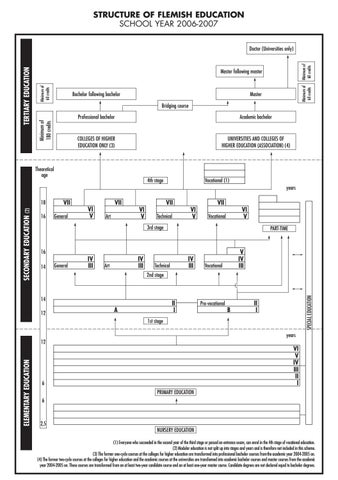
STRUCTURE OF FLEMISH EDUCATION SCHOOL YEAR 2006-2007
Bachelor following bachelor
Minimum of 60 credits Minimum of 60 credits
Minimum of 60 credits
Master following master
Master Bridging course
Minimum of 180 credits
TERTIARY EDUCATION
Doctor (Universities only)
Professional bachelor
Academic bachelor
COLLEGES OF HIGHER EDUCATION ONLY (3)
UNIVERSITIES AND COLLEGES OF HIGHER EDUCATION (ASSOCIATION) (4)
Theoretical age
Vocational (1)
4th stage
years
16
VII General
VI V
VII Art
VI V
VII Technical
VI V
VII
VI V
Vocational
3rd stage
16 14
General
IV III
IV III
Art
PART-TIME
IV III
Technical
V IV III
Vocational
2nd stage
14 12
II I
A
Pre-vocational
B
SPECIAL EDUCATION
SECONDARY EDUCATION (2)
18
II I
1st stage years
ELEMENTARY EDUCATION
12
VI V IV III II I
6 PRIMARY EDUCATION 6
2,5
NURSERY EDUCATION
(1) Everyone who succeeded in the second year of the third stage or passed an entrance exam, can enrol in the 4th stage of vocational education. (2) Modular education is not split up into stages and years and is therefore not included in this scheme. (3) The former one-cycle courses at the colleges for higher education are transformed into professional bachelor courses fromthe academic year 2004-2005 on. (4) The former two-cycle courses at the colleges for higher education and the academic courses at the universities are transformed into academic bachelor courses and master courses from the academic year 2004-2005 on. These courses are transformed from an at least two-year candidate course and an at least one-year master course. Candidate degrees are not declared equal to bachelor degrees.
PUPILS
The number of pupils in this leaflet refers to the number of pupils and students enrolled on February 1, 2007. For non-university tertiary education and university education regular (first) enrolments in professional and academic bachelor courses, master courses and basic and initial teacher training courses are registered. In social advancement education, part-time education in the arts and supervised individual study (B.I.S.), enrolment rates are recorded. These rates may be higher than the number of physical persons as a pupil may be enrolled in several courses. In social advancement education, enrolments are counted for training programmes which were started in the period of reference (from 1 February 2006 up to and including 31 January 2007). In order to avoid double counts, the pupils enrolled in special education due to long-term illness (pupils in type 5 special education) are not included in the figures of special education (109 pupils in special nursery education, 185 pupils in special primary education and 235 pupils in special secondary education). Pupils and students enrolled in French language schools or in French language sections of Dutch language schools coming under the authority of the Flemish authorities are not included in the figures either. Yet, for higher education, courses in other languages are included in the figures. Since the 2004-2005 academic year, Flemish tertiary education has been organising courses leading to Bachelor and Master degrees. In Flanders, Bachelor courses are professionally oriented or academically oriented. Academically oriented bachelor programmes are mainly intended to make students pass on to master courses. A professionally oriented bachelor can take a master course after successful completion of a bridging programme. The study volume of bachelor courses amounts to minimum 180 credits. The study volume of master courses amounts to minimum 60 credits. As from the 2005-2006 academic year, the traditional year system is replaced by a more flexible system of credits.
SCHOOLS
A school is an institution which provides education and which is managed by one school head. In continuing education, the term “centre for adult education� is used. Institutions providing special education type 5 are not included in the figures (6 schools in special nursery education, 6 schools in special primary education and 4 schools in special secondary education).
STAFF
Staff statistics only register staff members either paid directly by the Education and Training policy domain or staff members whose salaries are covered by the block grant awarded to higher education. As a consequence, staff members benefiting from the pre-pension scheme (TBS55+) are included in the figures. Maintenance, technical and service staff in subsidised educational networks is not included. Subsidised contractual staff is not taken into account either, as these staff members are not fully paid by the Education and Training policy domain. Contractual staff in tenured posts are included in the figures. Staff data relate to the month of January 2007, as known in June 2007. University staff data were provided by the Flemish Interuniversity Council (Vl.I.R.) and relate to February 1, 2006. Data on the 20062007 academic year were not available at the time of going to press of this publication.
As far as education staff is concerned, a distinction is made between managing and teaching staff on the one hand and other staff categories on the other. Managing staff consists of school heads and deputy heads. Teaching staff carries out a teaching assignment. Other staff categories comprise administrative staff, manual staff of Community education, educational support staff, paramedic staff, staff of Pupil Guidance Centres, inspectorate staff, educational supervision staff, staff in boarding schools and child carers in nursery education. In elementary education, managing and teaching staff includes, as of the 2003-2004 school year, physical education teachers (in nursery education) and special care co-ordinators. Numbers of staff members are expressed in physical persons. From the 2003-2004 edition onwards, short replacements are taken into account (of less than one year). Physical persons are registered for the education level and education network where they carry out their main teaching assignment. The number of staff members expressed in full-time equivalents is the sum of all partial assignments of all staff members (in other words including the replacements of less than one year). In colleges of higher education, teaching assignments of visiting professors and mandate fees are not included in the full-time equivalents. As for university education, figures on staff include visiting professors and early retired in terms of staff members, but not in the budgetary full-time equivalents.
BUDGET
The budget is expressed in terms of available operating appropriations which are estimated annually and entered into the (adjusted) expenditure budget of the Flemish authorities. The operating appropriations comprise non-differentiated appropriations, differentiated commitment appropriations, variable appropriations, authorisations and additional appropriations of previous years, decreased by appropriations intended to cover the liquidation of commitments and by expenditure intended to cover debt load. The term available appropriations means that these appropriations in addition to the appropriations mentioned above also comprise the share of overall provisions (mainly index and collective agreement) and reallocations of appropriations. Data for 2007 relate to the appropriations after the first budgetary control. Certain cross-level expenses, of which the breakdown among the different levels is known, are allocated to the respective levels (amongst other things educational priority policy and investments). Without this adjustment one gets a distorted picture of the actual expenses per level. For 2007 the actual data are not available yet and the same breakdown as in 2006 was proposed. Thus, these figures do not take account of the efforts paid by other (local) authorities, nor of the efforts paid by parents, schools and private companies. The cost per pupil/student is calculated on the basis of the number of pupils/students eligible for funding. A pupil/student eligible for funding is a regularly registered pupil/student who gets a weighting factor on the grounds of certain criteria such as education level, course of study, origin, ... The number of pupils/students eligible for funding defines the size of the operating budget and the staff of each education institution. Amounts are expressed in thousands of euros, unless specified otherwise.
B UD G ET Overall education budget (policy credits 2007): 8,788,577 thousand euro. Share of the education budget in the Flemish budget: 40.03% In 2006, the BBB operation, which aims to improve administrative management, remodelled the
education budget by educational level
2006 - 2007
Flemish authorities into 13 homogeneous policy domains that are built on the same internal structure.
flemis h e d u c at i o n
(in thousands of euros)
4,000,000
• five autonomous bodies, which make up the Flemish education administration: n:
3,500,000 3,000,000
in images
The Education and Training policy domain is the umbrella name for:
3,573,137
o the Department of Education and Training that designs Flemish policy on education and training, and four agencies that implement this policy:
2,811,735
o the Agency for Higher and Adult Education o the Agency for Infrastructure in Education
2,500,000
o the Agency for Educational Communication o the Agency for Educational Services (nursery and primary education, secondary
2,000,000
education, part-time education in the arts, pupil guidance centres, education inspectorate, educational supervision) The Department as well as the four agencies function autonomously and are each managed
1,500,000
by a senior civil servant.
1,000,000
803,709
668,768
463,403
500,000
servants of the five entities, sits on the Policy Council that directs and follows up on the policy
467,825
domain.
The Policy Council is the forum where the political and administrative levels consult each other and which supports the government in managing the policy domain.
elementary education
secondary education
non-university tertiary education
university education
lifelong learning
not related to educational levels
percentage distribution of the education budget not related to educational levels 5.3% lifelong learning 5.3% university education 9.1%
• the Flemish Education Council (VLOR), which acts as a strategic advisory body for the policy domain. The education inspectorate monitors the quality of education on the authority of the Flemish authorities.
Minister
elementary education 32.0%
Education and Training policy area
Flemish Education Council (VLOR) Policy board
non-university tertiary education 7.6%
secondary education 40.7%
Agency for Infrastructure in Education (AGIOn)
Agency for Educational Services (AgODi)
Agency for Higher and Adult Education (AHOVOS)
Agency for Educational communication (AOC)
Department of Education and Training
Responsible editor: L. Van Buyten, Secretary General.
0
• the Flemish Minister for Education and Training, who, together with the senior civil
SCHOOL P O P ULATION
INSTITUTIONS
school population in full-time education: 1,270,072 school population nursery education primary education elementary education
by educational level: 235,251 413,951 649,202 secondary education (1)
non-university tertiary education university education tertiary education (2)
457,527
102,477 60,866 163,343
500,000
413,951
institutions for full-time education: 3,573
number of staff members (1): 185,706
institutions by educational level: autonomous nursery schools 168 autonomous primary schools 280 schools providing nursery and primary education 2,057 elementary education (1) 2,505
number of staff members by educational level: elementary education 68,682 secondary education 77,246 non-university tertiary education 11,647 university education (1) 11,044
2,500
nursery education primary education
457,527
secondary education (2) 1,039
non-university tertiary education university education tertiary education
22 7 29
nursery education primary education
non-university tertiary education university education
200,000
non-university tertiary education university education
55+
15,603
15,000
12,193
10,000
8,236
500
3.507 3.192
5,000 0
elementary education
secondary education
0
tertiary education
distribution over the educational networks in elementary and secondary education regular elementary and secondary education
OGO 16.5%
special elementary and secondary education
GO 15.0%
OGO 14.7%
VGO 68.5%
22 elementary education
secondary education
0
20-29
tertiary education
distribution over the educational networks in elementary and secondary education regular elementary and secondary education
GO 22.5%
7
OGO 18.1%
VGO 62.8%
special elementary and secondary education
GO 17.9%
OGO 16.3%
VGO 64.0%
adult education
social advancement education
tertiary adult basic education (3) B.I.S. (Supervised Individual Study) (4)
linear modular linear modular
part-time art education: 165,157
(1) Not included: number of pupils in part-time secondary education: 6,577. (2) Bachelor courses, Master courses and basic courses (declining).
(3) Work year 2005-2006. (4) Work year 2006.
30,700 271,413 4,049 22,830 31,838 21,118
adult education
VGO 66.0%
social advancement education adult basic education
secondary tertiary
60+
107 61 29
GO stands for Community education VGO stands for subsidised private-authority education OGO stands for subsidised public-authority education
age
15,595 42,686 58,281 18,128 50,747 68,875
non-university tertiary education
part-time art education: 167
(1) The sum of the number of nursery schools and primary schools is higher than the number of elementary schools as 2,057 schools provide nursery as well as primary education. (2) Number of institutions in part-time secondary education: 48.
50-59
secondary education
LIFELONG LEARNING secondary
40-49
staff members expressed as full-time equivalents
3,481 5,873 9,354
university education (1)
LIFELONG LEARNING
30-39
elementary education
GO 17.7%
13,287 16,827
19,822
20,000
102,477 60,866
29,632
25,221
25,000
1,039
1,000
100,000
32,393
30,000
1,500
235,251
7,094 5,246 4,747
35,907
men women
35,000
2,000
300,000
social advancement education part-time art education other (2)
40,000
2,337
2,225
400,000
STAFF
8,155
social advancement education
2,180 3,021 5,201
part-time art education
1,030 2,887 3,917
other (2)
1,176 2,692 3,868 0
10
temporary posts tenured posts total 20
30
40
50
60
(1) Data for university education: academic year 2005-2006. These data are not included in upper chart. (2) Staff of Pupil Guidance Centres, education inspectorate, pedagogic counselling, boarding schools,...
70
80
BUDGET Budget elementary education (policy credits 2007): 2,811,735 thousand euro. Share of elementary education in the overall education budget: 31.99%. Budget regular elementary education: 2,450,330 thousand euro of which 13.09% for operation, 3.96% for investment and 82.94% for salaries paid directly by the Ministry of Education and Training. Budget special elementary education: 361,405 thousand euro of which 7.76% for operation, 2.08% for investment and 89.94% for salaries paid directly by the Ministry of Education and Training.
distribution over the educational networks regular elementary education
special elementary education
Cross educational networks 0.2% OGO 22.9% GO 15.2%
OGO 13.6%
VGO 61.9%
GO 30%
VGO 56.2%
regular elementary education
special elementary education
15,000 11,971.82
12,000 9,566.03
10,265.00
10,613.07
12,545.30
11,217.75
ELEMENTA RY E D U C AT I O N
This division is responsible for policy preparation, policy assessment and drawing up regulations on organizational and financing mechanisms of education institutions in mainstream and special nursery and primary education and part-time education in the arts (more specifically issues concerning staffing hours, school structures, funding, equal opportunities in education, truancy policy, rights and duties of parents and pupils etc, …). You can contact this division at basisonderwijsbeleid@vlaanderen.be and deeltijdskunstonderwijsbeleid@vlaanderen.be.
in images
Agency for Educational Services – Schools of Elementary Education and Pupil Guidance Centres This division provides services to nursery and primary schools as well as to pupil guidance centres (CLBs).
Schools can call on this division for: • accreditation, financing or funding of institutions • changing school structures and educational provision • checking pupil numbers and pupil attendance rates • calculation and audit of staffing support • calculation and audit of the different types of funding • composition and staffing hours of school clusters • derogations from the organisation of the school year • support of local consultative bodies (LOPs) • support of school administrations
Parents, pupils and schools can contact the agency for: • recognition of equivalence of foreign diplomas • reports of school screenings • home education • follow-up of compliance with compulsory education requirements • resources that help pupils with special needs to go through the learning process in an ordinary school. • questions on the rights and duties of pupils You can contact the agency at scholen.basisonderwijs.agodi@vlaanderen.be and clb.agodi@vlaanderen.be. Department of Education and Training – Working conditions policy
This division is responsible for the working conditions policy in the education sector (with the exception of higher education). In order to develop the most appropriate working conditions policy, this division works in close consultation with Flemish, federal and international organizations and interest groups, taking into account labour market evolutions, recent evolutions in the education sector as well as the views of policy makers. Evolutions in working conditions in other sectors are studied and if necessary incorporated into policy proposals. You can contact this division at personeelsbeleid.onderwijs@vlaanderen.be.
9,000
6,000 3,424.42
3,627.98
3,704.67
3,911.43
4,087.11
3,000
2002
2003
2004
2005
2006
2007
This agency ensures that staff members of mainstream and special nursery and primary education, Pupil Guidance Centres, the education inspectorate and educational supervision are paid correctly and on time. It manages personnel files containing financial and administrative information. This includes: • keeping up to date, following up on and processing of various systems of leave such as sick leave, career break, different systems of leave or absence in the context of part-time work or the performance of other tasks in the education sector ,… • keeping up to date, following up on and processing of various systems of placing staff members on a redundancy list in education (due to illness, because of lack of jobs, for personal reasons, before retiring, ...) The agency provides information and data to both internal and external customers. You can contact the agency at personeel.basisonderwijs.agodi@vlaanderen.be and clb.agodi@vlaanderen.be.
Responsible editor: L. Van Buyten, Secretary General.
Agency for Educational Services – Staff of Elementary Education and Pupil Guidance Centres
3,215.85
0
2006 - 2007
Department of Education and Training – Institutions and Pupils in Elementary Education and Parttime Education in the Arts
CLBs can call on this agency for: • accreditation, financing or funding of pupil guidance centres • calculation and audit of staffing support • calculation and audit of the different types of funding
evolution of the educational expenditure per pupil (in euros)
As a result of the BBB operation (better administrative policy), the Elementary Education Administration disappeared and was replaced by four separate bodies that have joint responsibility for mainstream and special elementary education. Of those four bodies, two are competent for policy preparation and the other two for policy implementation.
PUPILS number of pupils: nursery education regular special
primary education 233,344 1,907
total
INSTITUTIONS
235,251
number of schools:
regular special
387,157 26,794
total
elementary education (1)
nursery education
primary education
regular
2,315
regular
2,133
regular
190
special
92
special
special
413,951
S TA F F
total
2,505
total
2,225
2,147 190
total
2,337
total elementary education: 649,202
7,247
nursery education
100,000
primary education
regular special
800
regular special
700
elementary education (1) regular special
44
600
3,874
5,295
60,000
20,000
4,352
435
285
302 72,669
64,280
0
47,869
Antwerp
30
69,664 39,463
Flemish Brabant and B.C.R. West Flanders
87,377 52,329
50,019 29,383
East Flanders
Limburg
100 0
10,913
57,769
68,682
11 30
23
11,229
460
540
Antwerp
OGO 21.7% GO 15.6%
regular primary 59.6%
417
433
428
419
501
404
Flemish Brabant and B.C.R. West Flanders
285
East Flanders
Limburg
VGO 62.7%
GO 16.8%
3,268
3,185
279
1,848
2,027
1,407
585 0
20-29
30-39
40-49
50-59
60+
age
staff members expressed in full-time equivalents
VGO 62.0%
tenured posts in regular elementary education
OGO 23.0% GO 14.0%
tenured posts in special elementary education
OGO 13.6%
VGO 63.0%
GO 28.7%
VGO 57.7%
primary education
primary education
(1) Not included in the chart: Henegouwen Province.
310
475
OGO 21.2%
OGO 21.8%
distribution over the educational networks
GO 14.3%
469
nursery education
special nursery 0.3%
OGO 22.2%
55+
14 28 5,000
562
2,290
10,000
28
610
6,928
16,919 15,371
12,843
distribution over the educational networks
regular nursery 35.9%
VGO 63.1%
59,121 9,561
15,000
21 43
45
elementary education
nursery education
men women
200
special primary 4.1%
GO 14.1%
45
400
proportion nursery/primary/regular/special
OGO 22.7%
total
49,820 7,949
20,000
primary education regular special 43
300
400 107,416
women
9,301 1,612
staff members by gender and age
nursery education regular special
44
23
500
485
40,000
total
distribution over the provinces (2)
6,026
80,000
men
regular elementary education special elementary education total elementary education: 68,682
distribution over the provinces (1) 120,000
number of staff members:
GO 16.6%
temporary posts in regular elementary education
OGO 23.2%
VGO 61.6%
VGO 63.5% B.C.R. stands for Brussels Capital Region (1) The sum of the number of nursery schools and primary schools is higher than the number of VGO stands for Community Education elementary schools as 2,057 schools provide nursery as well as primary education. GO stands for Community Education (2) Not included in the chart: Henegouwen Province. OGO stands for subsidised public-authority education
GO 21.3%
temporary posts in special elementary education
VGO 55.5%
managing and teaching staff regular elementary education 46,019 other staff regular elementary education 3,972
OGO 12.4% GO 37.9%
VGO 49.7%
special elementary education 5,684 special elementary education 2,606
BUDGET With the introduction of the BBB operation (better administrative policy), the Higher Education and Scientific Research Administration was abolished. Today, two entities – one of which is competent for policy preparation and the other for policy implementation – are responsible for higher education.
Tertiary education budget (policy credits 2007): 1,480,729 thousand euro. Share of tertiary education in the overall education budget: 16.85% Non-university tertiary education budget (policy credits 2007): 668,768 thousand euro. University education budget (policy credits 2007): 803,709 thousand euro. Budget for co-ordination tertiary education (policy credits 2007): 8,252 thousand euro.
evolution of the tertiary education budget university education (1)
1,000,000 800,000 600,000
598,073
587,867
559,674
778,633
774,640
751,293
735,439
716,165
648,208
610,310
803,709 668,768
400,000 200,000 0
2002
2003
2004
2005
2006
2007
evolution of the expenditure per student (2) (in euros)
non-university tertiary education
15,000 13,262.81
13,592.56
13,841.32
university education (1)
9,000 6,093.56
6,219.37
6,322.92
6,666.06
3,000 0
2002
2003
2004
2005
2006
in images
The entity will: • contribute to the development of the knowledge-based society by continuously increasing the quality and the relevance of higher education and research; • strengthen the ability to adapt and innovate of colleges of higher education and universities and of the higher education system by extending the autonomy of colleges of higher education and universities through deregulation and simplification; • increase the international recognition and recognisability of the Flemish higher education system; • ensure high-quality and relevant regulations; • provide timely and correct information to all stakeholders so as to allow them to correctly interpret Flemish Parliament Acts and Decrees; • ensure good communication, dialogue and consultation with all stakeholders, especially with students and institutions; • contribute to international developments in the fields of higher education and scientific research. It is also responsible for drawing up regulations for the institutions of higher education (colleges of higher education and universities) as well as regulations on the legal position of the staff of colleges of higher education. This entity also monitors the integration of higher education into a European and international context, for instance as regards the policy for the recognition of diplomas. You can contact the Division at hogeronderwijsbeleid@vlaanderen.be. Agency for Higher and Adult Education – Higher Education Division. This agency is responsible for implementing the policy on higher education It is, among other things, in charge of the funding/financing of the colleges of higher education and universities and acts as social secretariat vis-à-vis the colleges of higher education.
14,326.61
12,000
6,000 5,791.06
TERTIARY E D U C AT I O N
2007
(1) Including the credits for scientific research incorporated in the education budget. From 2002 on additional means from the special research fund were incorporated in the education budget. (2) From the academic year 2004-2005 on the financiable students for the universities are not registrated anymore. From 2005-2006 on the financiable students for the non-university tertiary education are not registrated anymore. This makes it impossible to calculate the expenditure per student.
The Division has set itself the following goals: • It provides financial services to the staff of the colleges of higher education, so that the salaries can be paid correctly and on time. • It grants the operating budget to the institutions of higher education. This implies, among other things, providing estimates on time, correctly calculating the operating resources and paying them on time, and drawing up budget proposals on time. • It is responsible for managing the data relating to higher education. This includes, among other things, the timely and correct collection of student data, so as to make these available for purposes of financing, public accountability and information provision. • It examines the feasibility of new regulatory initiatives, in order to inform those who prepare policy about the consequences of the regulations for the implementation. • It examines and provides the equivalence of foreign diplomas. • It organises the entry examination for doctors/dentists. • The Division ensures a customer-friendly provision of services to institutions, students and staff. The support of the Flemish Government commissioners for the universities and the colleges of higher education respectively also comes under this entity. You can contact the Division at hogeronderwijs@vlaanderen.be.
Responsible editor: L. Van Buyten, Secretary General
non-university tertiary education
(in thousands of euros)
2006 - 2007
Department of Education and Training – Higher Education This entity is in charge of preparing and evaluating policy. Together with colleges of higher education, universities and intermediary organisations, the Higher Education Division wishes to proactively develop, promote and expand future-oriented initiatives in the fields of higher education and research.
STUDENTS
STUDENTS
NON-UNIVERSITY TERTIARY EDUCATION
TERTIARY EDUCATION
number of enrolments (bachelor and master courses; basic courses and initial teacher courses (old system, declining)) (1) men 32,756 14,046 46,802
PBA + one cycle ABA + MA + two cycles total non-university tertiary
women 45,770 9,905 55,675
total 78,526 23,951 102,477
NUMBER OF ENROLMENTS PER COLLEGE FOR HIGHER EDUCATION (‘HOGESCHOOL’)
men
women
2,441 5,328 7,769
EHSAL - Europese Hogeschool Brussel
1,667 2,094 3,761 1,125
Hogeschool Antwerpen
3,032 3,544 6,576
Hogeschool Gent
6,577 6,911 13,488
Hogeschool Sint-Lukas Brussel
418
57
364
women
total
Professionally oriented non-university tertiary education Total professionally oriented tertiary education Academically oriented non-university tertiary education Academically oriented university education
32,756 32,756 14,046 27,324
45,770 45,770 9,905 33,542
78,526 78,526 23,951 60,866
Total academically oriented tertiary education
41,370
43,447
84,817
Total tertiary education
74,126
89,217
163,343
total
27,324
managing and teaching staff
4,943
4,646
9,589
647
1,411
2,058
5,590
6,057
11,647
other staff total
managing and teaching staff 2,000
other staff 1,346
1,930
men
871 1,439 1,415
1,500
women
1,414
1,209
number of enrolments (in academic basic courses) (1) (2) men women
493 1,618
Hogere Zeevaartschool
444
number of enrolments in tertiary education per finality (1) (2) men
UNIVERSITY EDUCATION
2,044 2,285 4,329
Groep T - Leuven Hogeschool
number of staff members to be paid by the operation block-grant funding of non-university men women total
total
Arteveldehogeschool Erasmushogeschool Brussel
S TA F F
1,000
total
33,542
55+
60,866
500
501 NUMBER OF ENROLMENTS PER UNIVERSITY
men
women
782
110
914
total
0
446
391
269
162
20-29
30-39
40-49
50-59
60+
87 leeftijd
20-29
30-39
382 203
178
166 159
55+
468
360
177
40-49
20 35
50-59
60+
number of staff members to be paid by the operation allowances of university education: academic year 2005-2006 men women total
Hogeschool voor Wetenschap & Kunst
3,106 2,312 5,418
Universiteit Gent
9,326 12,445 21,771
Hogeschool West-Vlaanderen
2,436 1,584 4,020
Karel de Grote-Hogeschool
3,720 3,918 7,638
Katholieke Universiteit Leuven
10,314 12,571 22,885
3,186 1,409
724 1,285
3,910 2,694
Katholieke Hogeschool Brugge-Oostende
1,348 1,861 3,209
Vrije Universiteit Brussel
autonomous academic staff assisting academic staff
2,851 3,608 6,459
administrative and technical staff
1,994
2,446
4,440
Katholieke Hogeschool Kempen
2,450 3,208 5,658
173
200
6,589
4,455
11,044
Katholieke Hogeschool Leuven
1,801 3,041 4,842
Katholieke Universiteit Brussel Universiteit Hasselt
757
605 1,362
Katholieke Hogeschool Limburg
2,182 2,856 5,038
Katholieke Hogeschool Mechelen
1,534 2,471 4,005
Katholieke Hogeschool Sint-Lieven
2,815 1,909 4,724
Katholieke Hogeschool Zuid-West-Vlaanderen
2,556 3,882 6,438
Lessius Hogeschool
Plantijn-Hogeschool
1,153 1,914 3,067
Provinciale Hogeschool Limburg
1,628 2,053 3,681
XIOS Hogeschool Limburg
1,570 1,535 3,105 0
3,000
6,000
9,000
12,000
(1) It concerns the first enrolment of the students in an institution of tertiary education in the recent academic year. PBA stands for Professional Bachelor ABA stands for Academic Bachelor MA stands for Master
autonomous academic staff
Universiteit Antwerpen
0
5,000
10,000
332 15,000
222
1,061
25,000
800 624 654
437
202 13 8
703
631
434
140
291 176
204
496
55+
244 102
47 55+
20-29 30-39 40-49 50-59 60+
853 758
602
495
492
200 0
556
men women
400
(1) Bachelor courses, Master courses, Masters following professional oriented bachelors, Candidate and Licence courses. (2) It concerns the first enrolment of the students in an institution of tertiary education in the recent academic year.
1,125
785
600
15,000
administrative and technical staff
1,000
554 20,000
assisting academic staff 1,112
1,200
3,571 3,891 7,462
transnationale Universiteit Limburg
755 2,055 2,810
total
373
age
20-29 30-39
44
20-29 30-39 40-49 50-59 60+
BUDGET operation, Training. operation, Training.
distribution over the educational networks regular secondary education
special secondary education
Cross educational networks 0.8%
Cross educational networks 0.2%
GO 19.8%
OGO 9.1%
GO 23.6%
VGO 70.3%
OGO 13.4%
VGO 62.8%
evolution of the educational expenditure per pupil (in euros)
regular secondary education
special secondary education
20,000
15,186.67
15,000
14,764.72
14,695.43
15,177.90
15,900.90
13,692.70
10,000 6,641.83
6,878.73
7,009.84
7,037.71
7,207.85
7,373.10
5,000
0
2002
2003
2004
2005
2006
2007
As a result of the BBB operation (better administrative policy), the Secondary Education Administration was abolished. Four separate bodies have joint responsibility for mainstream full-time secondary education, special secondary education and part-time secondary education. Of those four bodies, two are competent for policy preparation and the other two for policy implementation.
2006 - 2007
SECONDA RY E D U C AT I O N
Department of Education and Training – Institutions and Pupils in Secondary Education and Adult Education This division is responsible for policy preparation, policy assessment and drawing up regulations on organisational and funding mechanisms of education institutions in mainstream and special secondary education and adult education (more specifically issues concerning staffing hours, school structures, funding, equal opportunities in education, rights of pupils, Regional Technological Centres etc,…). You can contact this division at secundaironderwijsbeleid@vlaanderen.be and volwassenenonderwijsbeleid@vlaanderen.be.
in images
Agency for Educational Services - Schools of Secondary Education and Part-time Education in the Arts This agency provides services to secondary schools and pupils as well as to Part-time Education in the Arts. This includes amongst other things: • different models of allocation of teaching staff and credits; • allocation of different types of funding; • checking pupil data; • recognition of equivalence of foreign diplomas; • follow-up of truancy problem. You can contact this agency at scholen.secundaironderwijs.agodi@vlaanderen.be and deeltijdskunstonderwijs.agodi@vlaanderen.be. Department of Education and Training – Working conditions policy This division is responsible for the working conditions policy in the education sector (with the exception of higher education). In order to develop the most appropriate working conditions policy, this division works in close consultation with Flemish, federal and international organizations and interest groups, taking into account labour market evolutions, recent evolutions in the education sector as well as the views of policy makers. Evolutions in working conditions in other sectors are studied and if necessary incorporated into policy proposals. You can contact this division at personeelsbeleid.onderwijs@vlaanderen.be. Agency for Educational Services - Staff of Secondary Education and Part-time Education in the Arts This agency ensures that staff members of mainstream and special secondary education as well as parttime education in the arts are paid correctly and on time. It manages personnel files containing financial and administrative information. This includes: • keeping up to date, following up on and processing of various systems of leave such as sick leave, career break, different systems of leave or absence in the context of part-time work or the performance of other tasks in the education sector,… • keeping up to date, following up on and processing of various systems of placing staff members on a redundancy list in education (due to illness, because of lack of jobs, for personal reasons, before retiring,...) The agency provides information and data to both internal and external customers. You can contact this agency at personeel.secundaironderwijs.agodi@vlaanderen.be and deeltijdskunstonderwijs.agodi@vlaanderen.be.
Responsible editor: L. Van Buyten, Secretary General
Budget secondary education (policy credits 2007): 3,573,137 thousand euro. Share of secondary education in the overall education budget: 40.66%. Budget regular secondary education: 3,285,601 thousand euro of which 11.49% for 2.64% for investment and 85.20% for salaries paid directly by the Ministry of Education and Budget special secondary education: 287,536 thousand euro of which 7.33% for 1.90% for investment and 90.52% for salaries paid directly by the Ministry of Education and
PUPILS
INSTITUTIONS
number of pupils:
number of schools:
full-time secondary education regular 439,338
part-time secondary education 18,189 special total full-time:
457,527
part-time secondary education part-time vocational secondary education
6,573
regular secondary education specialpart-time secondaryoffshore education fishing secondary education 4 total part-time
6,577
929
part-time secondary education (1) part-time vocational secondary education
special
110
part-time offshore fishing secondary education
total full-time
1,039
300
652
3,912
3,920
121,915
Antwerp
3,246
72,296
84,843
Flemish Brabant and B.C.R. West Flanders
96,971
63,313
East Flanders
Limburg
100
OGO 7.8%
GO 16.5%
0
GO 22.2%
VGO 75.7%
VGO 64.6%
181
193
BSO 35.7% KSO 2.1%
ASO 39.0% TSO 23.1%
KSO 1.3%
BSO 23.0% TSO 32.6%
6,646
7,172
10,812
7,354 5,977
6,000
55+
4,444
136 3,000
1,491 1,288
Antwerp
Flemish Brabant and B.C.R. West Flanders
East Flanders
Limburg
0
20-29
OGO 8.1%
VGO 67.6%
GO 17.3%
OGO 15.5%
30-39
40-49
50-59
60+
age
staff expressed in full-time equivalents
special secondary education
VGO 67.2%
tenured posts in regular secondary education
GO 17.7%
GO 26.6%
distribution over education types in the 2nd, 3rd and 4th stage and modular education of regular full-time secondary education VGO
13,404
8,974
emporary posts in regular secondary education
GO
77,246
12,486
9
regular secondary education
GO 24.3%
47,168
11,016
distribution over the educational networks
special secondary education
OGO 13.2%
160
30,078
men women
9,000
50
distribution over the educational networks regular secondary education
25
20
17 259
70,221 7,025
11
19
150
820
2,200
60,000
6
total
42,765 4,403
15,000
12,000
200
women
total secondary education: 77,246
12
10
1,396
90,000
0
part-time secondary education
250
1,159
total
men 27,456 2,622
staff members by gender and age
29
2,550 4,911
1 48
special secondary education
regular secondary education
part-time secondary education
150,000
30,000
total part-time
47
regular secondary education special secondary education
distribution over the provinces
special secondary education
regular secondary education
number of staff members:
full-time secondary education regular
distribution over the provinces
120,000
S TA F F
OGO 9.4%
OGO 9.6%
VGO 72.9%
VGO 63.8%
GO 21.6%
GO 27.9%
OGO 14.0%
OGO 12.1%
tenured posts in special secondary education
VGO 64.4%
temporary posts in special secondary education
VGO 60.0%
OGO
ASO 43.1%
ASO 12.3%
BSO 44.5%
TSO 35.6% KSO 7.7%
(1) The centres for part-time secondary education are always ljnked to a school for regular full-time secondary education.
B.C.R stands for Brussels Capital Region GO stands for Community Education VGO stands for subsidised private-authority education OGO stands for subsidised public-authority education
ASO stands for general secondary education TSO stands for technical secondary education KSO stands for artistic secondary education BSO stands for vocational secondary education
managing and teaching staff other staff
regular secondary education 55,834 - lower secondary school teachers and approved 25,405 - higher secondary school teachers and approved 19,809 - other 10.,620 regular secondary education 6,741
special secondary education 5,369
special secondary education
931
BUDGET Lifelong learning budget (policy credits 2007): 463,403 thousand euro. Share of lifelong learning in the overall education budget: 5.27%.
ADULT EDUCATION Adult education aims to teach the knowledge, skills and attitudes course participants need to: - function in society, - participate in further education, - exercise a profession, - master a language and enables the course participant to obtain a recognised course certificate, certificate or diploma.
distribution of the budget (1) (in thousands of euros)
245,081
250,000 200,000
in images
Particular forms of adult education are adult basic education and B.I.S. (Supervised Individual Study): * Adult basic education focuses on low-skilled adults and is provided by means of a very different teaching method tailored to suit the needs of the target group. * Supervised Individual Study (B.I.S.) offers correspondence courses through distance learning for prisoners and candidates preparing for the Examination board. Participants are coached by an expert teacher/mentor.
100,000 50,000
22,385
15,951
853
social advancement adult basic education education (1)
B.I.S. (Supervised Individual Study)
part-time art education
co-ordination lifelong learning
social advancement education
(in euros)
1,147.30
1,000
969.57
910.00
800 624.19
649.83
Part-time education in the arts provides easily accessible arts education to young people and adults. There are four courses of study: visual arts, music, wordcraft and dance. Each of those courses of study is subdivided into a number of options.
part-time art education
1,200 1,001.92
692.13
1,104.92
1,028.37
710.95
739.01
Dutch Language Houses Since September 2004, 8 Dutch Language Houses have been active in Flanders. Non-native Dutch speaking adults can turn to the Dutch Language Houses for information on the NT2 course provision (Dutch as a second language course). They also co-ordinate the intake, testing and choice of NT2 provision that is best suited to meet the needs of the course participant. PART-TIME EDUCATION IN THE ARTS
evolution of the cost per course participant
755.21
All aspects of perception and practice of art are dealt with. Participants gain artistic insight, learn basic techniques and acquire theoretical knowledge that can be applied in practice. Music education provides music classes teaching how to play 70 different musical instruments, the visual arts course of study organises 30 types of workshops. Courses in wordcraft and dance largely involve hands-on sessions. Young people can prepare themselves in a serious and goal-oriented way for higher education in the arts. For adults, education in the arts can be an interesting pass time or a first step towards becoming an amateur or professional arts practitioner. It is evident that part-time education in the arts offers everyone a chance to fully develop their own artistic personality.
You can contact the following bodies using these e-mail addresses:
600
Educational Services Centre for Higher and Adult Education - Staff and Institutions of Lifelong Learning: levenslangleren@vlaanderen.be - Supervised Individual Study (BIS): bis@vlaanderen.be
200
2002
2003
2004
2005
(1) The credits for social advancement education mainly include wages. Enrolment fees are used to finance the operation of social advancement education.
2006
2007
Agency for Educational Services - Schools of Secondary Education and Part-time Education in the Arts: deeltijdskunstonderwijs.agodi@vlaanderen.be - Staff of Secondary Education and Part-time Education in the Arts: deeltijdskunstonderwijs.agodi@vlaanderen.be
Responsible editor: L. Van Buyten, Secretary General
Department of Education and Training - Institutions and Pupils in Elementary Education and Part-time Education in the arts: deeltijdskunstonderwijsbeleid@vlaanderen.be - Institutions and Pupils in Secondary Education and Adult Education: volwassenenonderwijsbeleid@vlaanderen.be - Working conditions policy: personeelsbeleid.onderwijs@vlaanderen.be
400
0
LIFELO N G L E A R N I N G
Social advancement education or “evening classes” is probably the best known form of adult education. It is organised both at the level of secondary education and at the level of one-cycle higher education. It enables the participant to obtain a recognised certificate. The scope of this type of education is varied and broad. Moreover, in a number of institutions the course participant can also pursue the “General Education” area of study. In this way, the course participant can still obtain the full diploma of secondary education.
179,133
150,000
0
2006 - 2007
A D U L T E D U C AT I O N
A D U L T E D U C AT I O N
PA R T- T I M E A R T E D U C AT I O N
SOCIAL ADVANCEMENT EDUCATION
ADULT BASIC EDUCATION
SCHOOL POPULATION
SCHOOL POPULATION
work year 2005-2006 number of course participants: 31,838 number of centres for adult basic education: 29
number of course participants: secondary social advancement education men women total linear 9,784 20,916 30,700 modular 111,853 159,560 271,413 total 121,637 180,476 302,113
tertiary social advancement education men women total linear 1,879 2,170 4,049 modular 9,429 13,401 22,830 total 11,308 15,571 26,879
distribution of participants hours over the various learning fields
Information and Communication Technology (ICT) 7.6%
other 3.6%
arithmetic 2.4%
literacy education for non-Dutch speakers 23,4%
distribution over the educational networks 120,000
secondary social advancement education
110,628
linear modular
71,773
80,000
Dutch as a mother tongue 6.1%
60,000 40,000 20,000
12,604
10,283
0
GO
7,813
VGO
709 5,775
2,80311,704
537 5,351
GO
VGO
OGO
OGO
combined courses 0.5%
Dutch as a second language 50.0%
social knowledge and skills 6.4%
120,000 100,000
0
60 50 40 30 20 10 0
distribution over the educational networks
work year 2005-2006 number of course participants: 21,118 number of tutors (December 2006): 151
120
53
distribution of course participants over the various learning fields
90
secondary social advancement education tertiary social advancement education
32
26
17
VGO
1,000 800
tertiary social advancement education: men women total staff members expressed in physical persons: 738 532 1,270 full-time equivalents: 389 343 732 tertiary social advancement education (full-time equivalents)
1,041 814
702
768
tenured posts temporary posts
794
GO
VGO
OGO
youngsters (-18)
adults
147
30
languages 41.2%
15
0
5
GO
VGO
science 5.5%
OGO
STAFF men 2,289 1,804
staff members expressed in physical persons: staff members expressed in full-time equivalents:
economics 4.4%
3,000
mathematics 2.4% administration 2.1%
600
other 5.5%
informatics 16.0%
2,000
116
97
200 GO
VGO
OGO
GO
190 173 VGO
85
71 OGO
GO stands for Community education VGO stands for subsidised private-authority education OGO stands for subsidised public-authority education
1,500
500 0
total 5,246 3,917
2,617
tenured posts temporary posts
2,500
women 2,957 2,113
927
1,000
400 0
1,893
60
OGO
STAFF
1,200
technics 6.4%
BIS Online 16.6%
12
secondary social advancement education (full-time equivalents)
18,777 20,923
2,452 7,573
number of institutions: 167
150
secondary social advancement education: men women total staff members expressed in physical persons: 2,059 3,765 5,824 full-time equivalents: 1,610 2,859 4,469
38,768
INSTITUTIONS
SUPERVISED INDIVIDUAL STUDY (B.I.S.)
GO
53,200
distribution over the educational networks
tertiary social advancement education: 61
28
total 57,545 107,612 165,157
86,689
40,000 20,000
adults 18,777 20,923 39,700
proportion youngsters/adults
100,039
visual arts music, wordcraft and dance
60,000
INSTITUTIONS number of centers for adult education: secondary social advancement education: 107
youngsters (-18) 38,768 86,689 125,457
distribution over the educational networks
80,000
tertiary social advancement education
89,012
100,000
number of course participants visual arts music, wordcraft and dance total part-time art education
229
91 GO
41 OGO
12 OGO