Key Factors to Consider When Choosing a Logistics Optimization Company in India
1. Introduction
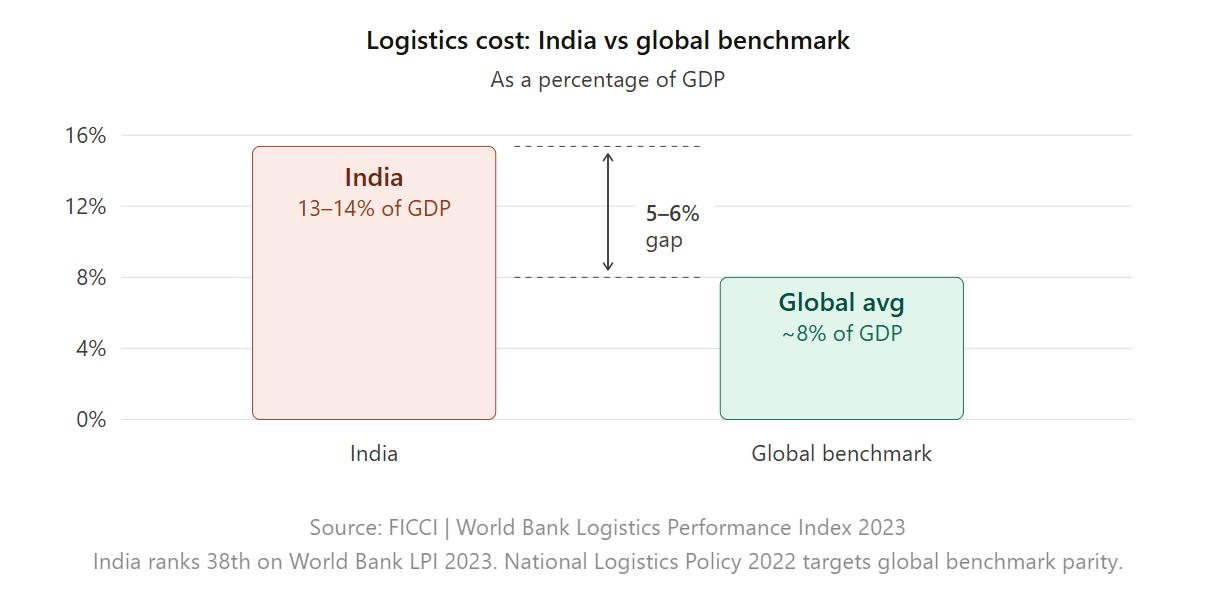
India's logistics sector is one of the most complex and cost-intensive in the world. The logistics sector in India is estimated at more than USD 380 billion by the year 2025, according to the Federation of Indian Chambers of Commerce and Industry (FICCI). Yet despite this scale, the sector remains burdened by deep structural inefficiencies Logistics expenditure in India comprises 13 to 14% of GDP, compared to the global standard rate of 8%. This 5 to 6 percentage point gap translates into hundreds of billions of rupees in avoidable costs that manufacturing and distribution businesses absorb every year.
India currently stands at the 38th position on the World Bank Logistics Performance Index 2023
To address this structural gap, the Indian Government launched the National Logistics Policy in 2022, which aims at optimizing logistics cost and performance in the country.
For businesses operating across India's complex distribution landscape, this context makes choosing the right logistics optimization partner a critical strategic decision, not merely a procurement exercise The wrong partner delivers a diagnostic report with no actionable follow-through. The right partner delivers quantified cost reductions, a redesigned network, and an implementation roadmap that creates lasting competitive advantage.
This article outlines the 10 most important factors to evaluate before selecting a logistics optimization company in India.
2. Industry Experience and Domain Expertise
The single most important differentiator between logistics consulting firms is not their presentation quality but their depth of sector-specific operational knowledge This is why choosing the right logistics optimization company in India requires a close evaluation of industry experience, as logistics requirements vary fundamentally across sectors. Cold chain compliance in pharmaceuticals bears no resemblance to bulk chemical transport under PESO regulations, which in turn bears no resemblance to last-mile FMCG delivery across general trade channels
When evaluating a firm, assess whether they have documented experience across the supply chain types relevant to your business:
● Pharmaceutical and Healthcare: GDP-compliant distribution hub configuration, temperature-controlled last-mile delivery, CDSCO and WHO-GDP aligned 3PL qualification
● Food and Beverage: FSSAI-compliant ambient, chilled, and frozen network design, perishable inventory management, seasonal replenishment planning
● Chemical Manufacturing: PESO and ADG-compliant hazardous goods logistics, dedicated fleet configuration for reactive and flammable materials, CPCB-aligned waste logistics
● FMCG and Consumer Goods: High-frequency replenishment across general trade, modern trade, and e-commerce; direct store delivery route optimization; D2C last-mile fulfillment
● Industrial Products: OEM and aftermarket spare parts distribution, multimodal routing via dedicated freight corridors, bonded warehouse structuring for imported components
Any business operating a supply chain in India with logistics costs above 8 to 10% of revenue has a significant optimization opportunity. However, capturing that opportunity requires a partner who understands the product-specific, compliance-specific, and channel-specific constraints of your industry A firm that applies a generic transportation benchmarking template regardless of sector is not a specialist and should not be selected as one
Ask prospective firms to provide project references in your specific industry vertical, not just in "supply chain consulting" broadly. Ask specifically whether they have managed cold chain design, hazardous goods logistics, or agri-input seasonal surge planning, depending on your sector.
3. Data Analytics and Technology Capabilities
Logistics optimization in the modern sense is fundamentally a data and modeling exercise. Network design decisions, route optimization, carrier selection, and inventory positioning all require quantitative modeling against real operational data Firms that rely primarily on benchmarking databases and interview-based assessments without building quantitative models of your specific network are delivering opinions, not optimization.
The minimum technology capabilities a qualified logistics optimization firm should demonstrate include:
● Network Modeling and Simulation: Ability to model multi-node warehouse and transportation networks, testing consolidation scenarios, hub-and-spoke configurations, and regional depot placements against actual freight cost data
● Route Optimization Tools: Software-based route planning incorporating real traffic data, infrastructure quality, carrier availability, and volume constraints, not manual route mapping
● Transportation Management System (TMS) Advisory: Experience assessing, selecting, and implementing TMS platforms appropriate to the client's volume, complexity, and carrier ecosystem
● Real-Time Visibility Integration: Capability to design and implement GPS-based shipment tracking, digital freight management platforms, and exception management dashboards
● Freight Contract Analytics: Tools to benchmark carrier rates against market rates, identify contractual leakage, and model renegotiation scenarios
Inefficiencies in Indian manufacturing and logistics are seldom obvious from financial accounting, since they manifest themselves in terms of suboptimal warehouse locations, ill-structured shipping contracts, unnecessary handling operations, and route systems based on no consideration of real-life traffic flows, infrastructural capabilities, and seasonality. Only a data-driven, quantitative approach can identify these hidden cost drivers.
Verify that the firm uses quantitative network modeling and logistics optimization to determine specific reasons for extra costs, not just high-level frameworks and rule-of-thumb benchmarks
4. Network Design and Supply Chain Assessment Expertise
One of the highest-value activities in logistics optimization is redesigning the physical distribution network: where warehouses are located, how many distribution centers are needed, which markets are served from which nodes, and how inventory is positioned across the network Poor network design is often the single largest source of logistics cost inefficiency, yet it is also among the most complex to diagnose and restructure.
A qualified firm should demonstrate:
● Capability to conduct full supply chain diagnostics covering freight spend analysis, warehouse network assessment, carrier performance review, and delivery reliability benchmarking
● Experience conducting GST-informed warehouse rationalization, which is specifically relevant in India because GST eliminated the state-level tax rationale for multi-depot structures
GST eliminated state entry taxes that previously made state-level depot proliferation financially necessary, enabling manufacturers to consolidate fragmented pre-GST depot networks into fewer, larger regional distribution centres without tax disadvantage. Many businesses continue operating legacy multi-depot structures that carry excess cost and inventory without the tax justification that originally created them
● Ability to model optimal depot configurations based on current service requirements and freight economics, quantifying the cost reduction and inventory consolidation available from network rationalization
● Experience designing transition roadmaps that manage operational continuity during network reconfiguration
Firms should also demonstrate experience with India's emerging logistics infrastructure. IMARC Engineering keeps itself abreast with the latest developments in infrastructure under PM Gati Shakti, Multimodal Logistics Parks, and Freight Corridor Commissioning, thereby enabling it to
provide logistics optimization services that consider the changing infrastructure within the project timeline and not designs that become obsolete once implemented
This forward-looking infrastructure awareness is critical. A warehouse network designed today should account for freight corridors and expressways that will be operational within the next three to five years, not just current road conditions.
5. Cost Reduction and ROI Focus
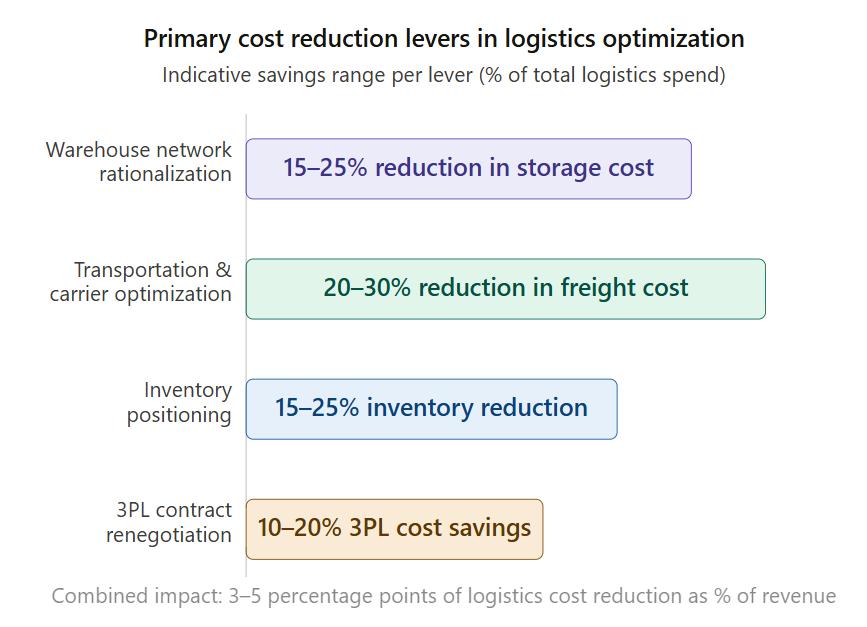
Logistics optimization has one primary purpose: reducing operating costs while maintaining or improving service levels. A firm that cannot articulate a specific, quantified cost reduction methodology and cannot demonstrate measurable savings from previous engagements should not be shortlisted.
The key cost reduction levers in Indian logistics optimization include:
● Transportation Cost Reduction: Carrier rate benchmarking and renegotiation, mode optimization (road vs. rail vs. multimodal), load consolidation, and route optimization
● Warehouse Cost Reduction: Network rationalization to eliminate redundant depots, layout redesign for throughput improvement, and inventory positioning to reduce safety stock requirements
● Inventory Cost Reduction: Safety stock optimization, demand-adjusted replenishment, and positioning of inventory closer to demand points to reduce order-to-delivery lead time
● 3PL Cost Optimization: Competitive tendering, SLA-based contracting, and performance management to prevent cost inflation in outsourced logistics
The baseline gap is large Logistics costs in India amounting to 13 to 14% of GDP as against an international benchmark of 8% have a severe impact on manufacturing competitiveness and distribution economics. For an individual business, closing even half of this gap through systematic optimization can represent 2 to 3 percentage points of revenue improvement, which for a mid-size manufacturer with INR 500 crore in revenue equates to INR 10 to 15 crore in annual savings.
Evaluate firms on their ability to quantify the opportunity upfront through a rapid diagnostic, and on their track record of delivering realized savings consistent with initial projections. The diagnostic-to-savings correlation is the most important commercial measure of a firm's credibility
6. Customized Solutions vs. Template-Based Approaches
A persistent weakness in logistics consulting is the application of standardized frameworks regardless of client context Template-based assessments are faster and more profitable for the consulting firm, but they systematically miss the company-specific and market-specific drivers of cost inefficiency.
Genuine customization in logistics optimization requires:
● Starting from the client's actual freight spend data, carrier contracts, warehouse lease terms, and delivery performance records, not industry average benchmarks
● Designing network and route recommendations based on the client's specific customer locations, order profiles, and service level requirements
● Accounting for regulatory requirements specific to the client's product category, whether GDP for pharma, FSSAI for food, PESO for chemicals, or CIB and RC for agrochemicals
● Addressing the client's specific channel complexity, including the very different logistics economics of general trade, modern trade, e-commerce, and D2C channels
Logistics optimization programs which focus on one aspect of the logistics chain, whether transportation or warehousing, often tend to shift the cost burden to other aspects of logistics without actually reducing costs, thereby optimizing one parameter at the expense of another.
A credible firm will conduct an integrated, end-to-end assessment rather than optimizing individual nodes in isolation Ask prospective firms specifically how they handle trade-offs between transportation cost and inventory cost, or between warehousing consolidation and delivery lead time. Their answer will reveal whether they are working from a systems-level model or a single-variable template.
7. Pan-India Market Understanding
India is not a single logistics market. It is a collection of distinct regional markets with different infrastructure quality, carrier availability, regulatory environments, and operational constraints. A logistics optimization firm that lacks genuine pan-India operational experience will produce recommendations calibrated to the markets they know, typically metro cities and national highways, while underestimating the complexity and cost of serving secondary and rural markets.
Key dimensions of pan-India market understanding include:
● Regional Infrastructure Variability: State highway quality varies dramatically between, for example, Gujarat and Bihar A network model that applies uniform transit time assumptions regardless of state will produce unreliable results.
● Monsoon and Seasonal Disruption Management: Road corridors in Maharashtra, Odisha, and Northeast India face seasonal flooding that can disrupt supply chains for weeks IMARC Engineering's logistics optimization incorporates seasonal pattern analysis into network design, establishing pre-positioned inventory buffers before disruption-prone periods, alternative routing protocols for flood-affected corridors, surge carrier arrangements for peak demand periods, and advance freight booking strategies that reduce spot market dependence during capacity-constrained seasons
● Tier II and Rural Distribution: IMARC Engineering's logistics optimization explicitly addresses Tier II city and rural market distribution, the fastest-growing consumption segments in India and the most logistics-cost-intensive to serve.
● Regulatory and Compliance Landscape: State-specific permits, toll structures, RTO requirements, and pollution compliance for commercial vehicles vary significantly and must be factored into route and fleet recommendations.
Firms should also demonstrate alignment with national policy frameworks. IMARC Engineering's logistics optimization is explicitly aligned with India's National Logistics Policy 2022 objectives: reducing logistics costs, improving the Logistics Performance Index ranking, and strengthening supply chain digitisation