2025 W O R D S
T O
T R A N S P O R T
Y O U
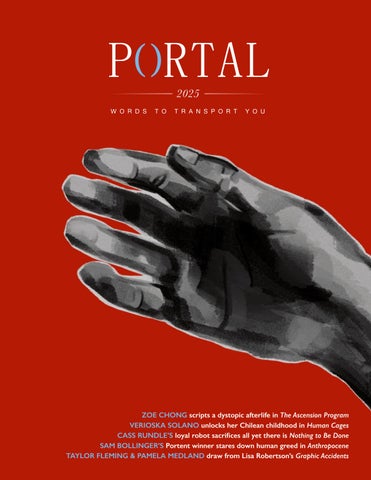
ZOE CHONG scripts a dystopic afterlife in The Ascension Program VERIOSKA SOLANO unlocks her Chilean childhood in Human Cages CASS RUNDLE’S loyal robot sacrifices all yet there is Nothing to Be Done SAM BOLLINGER’S Portent winner stares down human greed in Anthropocene TAYLOR FLEMING & PAMELA MEDLAND draw from Lisa Robertson’s Graphic Accidents
2025 W O R D S
T O
T R A N S P O R T
Y O U
Portal ’s authors and masthead gather on the traditional territory of the Snuneymuxw First Nation. We respect this Land as our relative and are grateful and humbled to learn to be better caretakers each day we have the privilege to live, learn, and create here. © 2025 by the authors, artists, and photographers Creativity that conveys, carries, and conducts. Explorations that elevate, enchant, and entrance. Prose that provokes. Stories that spellbind. Tales that thrill. Portal offers a gateway to accomplished short fiction, poetry, creative nonfiction, scripts, interviews, art, and photography by emerging writers. What makes Portal so portentous? It is a portrait of literary talent in the making, a portable guide to the view from here. Enter Portal’s literary universe and discover worlds and futures ready to unfold. Portal Vancouver Island University Rm 133, Bldg 345 900 Fifth St., Nanaimo, BC V9R 5S5 ISSN 1183-5214
viuportal@gmail.com http://portalmagazine.ca/ http://www.facebook.com/portalmag https://www.instagram.com/portalmagviu/ Portal is printed on 70 lb FSC-SILVA Enviro by Marquis Imprimeur Inc., 2700 rue Rachel Est, Montreal PQ H2H 1S7.
Manmade Jennavieve Strub
LETTER FROM THE EDITORS
In the fall of 2024, when the Portal team met for the first time, we shared the same goal: to showcase a diverse range of literary styles, images, perspectives, emotions, and voices. Now, eight months later, on these unceded traditional lands of the Snuneymuxw people, we’re proud to have done just that in this 34th edition of Portal. In these pages we celebrate the abundant talent of writers, editors, artists, photographers, and designers from our corner of Vancouver Island. We open this issue with the magical prose of “He Sings to Us,” the tale of a town outcast who heeds the deadly call of the sea. The sweet music of “Little Anna Marie” repeats a similar rhythm, reminding us life is precious for its brevity and humming energies. In “The Circle Route” a woman anticipates her friend’s diagnosis while travelling a rural highway in search of nature’s consolation. Meanwhile, an estranged daughter learns her father is on his deathbed and revisits their wordless past in “The Monologue.” A young woman mourns her youth as the onset of adulthood ushers in an irreversible transition in “Goodbye Girlhood.” In “Human Cages” we travel to Santiago Chile where another girl is forced to grow up too fast in a world where the only certainty is chaos. “Grave/yard” harnesses a nostalgia for a more carefree youth, the beginnings of friendship wandering among blackberry and cedar. That beginning is elusive for a couple trying to have a child, as their journey of heartbreak, healing, and hope is “Not Too Far Along.”
In “Borrowed Time” three women in Kazakhstan embody the maternal before one immigrates and is forced to leave the other two behind. “The Art of Disappearance” features a different kind of separation, one that challenges a determined detective to find a missing person with only a pseudonym to go on. In “Laundry Days” trauma cycles through three generations of men who attempt to wash away its stains, while in “Those Eyes” a maturing son comes to better understand his stoic father in a moment of shared grief. Meanwhile, a lonely man and a cowboy meet by the roadside for a surreal heart-toheart about the courage to move on in “Don’t Fence Me In.” A young woman glances “In the Rear View” as she braves a chance reunion at a gas station with her estranged father after a decade of silence. In our Portent Prize-winning poem, “Anthropocene,” the speaker encounters a cougar in the bed of a pick-up, the wanton greed of humankind impossible to ignore under the glare of neon lights. Dark deeds are all too familiar for our Shakespearean heroine in “Ophelia After Dark,” until survival becomes the first act of resilience. From murky waters to blue skies full of starlings and nightingales, Gustafson Distinguished Poet Lisa Robertson revisits a decade’s worth of murmurations and residual memories in notebooks, recalling the Occitan troubadour poets and the “Graphic Accidents” that invite literary reinvention. The poetic journey is existential for the salmon fighting upstream in “Anadromous,” while for a couple who
Groen Lee I have always been a storyteller. When I was a kid, I had a habit of letting my imagination get the better of me. I often told harmless tall tales, dreamed with my eyes open, and frequently had my head in the clouds. My overactive mind was so disruptive that my teachers recommended I go to counseling. After two sessions they told me all I needed was a creative outlet. Soon I was recommended books, or they fell into my lap, and everything started to make sense. I devoured novels and longed to write one. Thanks to this, my imagination still gets the better of me, and my head is still, unapologetically, lost in the clouds.
e Vando Paig p From a young age I was praised for my ability to read and write above my grade level. Books became an escape where worlds and characters came to life above the wafting scent of ink on paper. In my last year of high school, a mentor asked why I wasn’t writing my own books…so I started to, beginning a life-long journey as an author. I not only discovered writing, but editing and publishing as well. Behind the worn spines of my favourite novels lay an entire career. I wonder if my parents knew what they were doing when they named me; I can’t wait to turn the page and see what comes next.
contemplates the same eternal waterway, the endless expanse of life, both past and future, reminds them “Always, Always There is You.” In “Paying Attention” Victoria poet Kayla Czaga considers what she’s learned by making mistakes, meeting her idols, and reading obituaries. This interview complements a review of her latest collection Midway. Regret and jealousy infuse the tension between two roommates whose actions speak louder than words in “Smoke Signals.” The shame of a morning after blooms ingloriously in “Morning Glory,” a tale of a brief entanglement at great cost. The risk of relationships is at the centre of “Safety in Strangers” in which a young traveler ventures abroad to meet online friends, proving her mother wrong in the process. In “Look Out” a woman on a solo hike attempts to escape reality, but grows increasingly terrified as first her supplies and then other campers disappear. We kindly ask that you “Please Don’t Touch the Specimens” as the exploration of life after death, good and bad taxidermy, and a fascination with preservation takes on new meaning. This attention to life cylces, both human and entomological, is also at work as a young woman revisits the painful, but healing, act of cleansing old wounds in “Debridement.”
A preoccupation with the afterlife and its control is at stake for the candidates of “The Ascension Program,” though it comes at a price few may be willing to pay. Finally, there is “Nothing To Be Done” but close the 2025 issue with an alternative look at the future through the eyes of Bucket, a loyal household robot whose servitude becomes his downfall. In the final pages of the issue, you’ll find a rich selection of recent books reviewed for your reading pleasure and a series of ads that announce writerly resources from coast to coast. This includes our own 2025 Portent Prize for the best script for stage or screen; submit by October 15th and check out portalmagazine.ca for all the details. As we look back on another successful year for our Portfolio Reading Series, now hosted at The Vault Café, we are grateful to the authors we’ve had the pleasure of hosting this season: Jan Conn, Amy Mattes, Amanda Lewis, and Ben Robinson along with many of the opening acts you’ll read here—future keynotes, to be sure. Portal portends, it is a sign that something momentous is about to happen, transporting readers to wholly new and imaginative worlds. We hope this careful curation of poems, scripts, and stories both true and invented, will take you to places beyond your dreams. As for the masthead, we are proud of where Portal 2025 has taken us as writers and publishers of a work that begs to be shared. Take our hand and see for yourself.
A Mountain In Juneau Niccolo Bartolomei
MASTHEAD MANAGING EDITORS Paige Vandop, Lee Groen ACQUISITIONS EDITORS Tara Wohlleben, Ali Dillon-Cardinal FICTION EDITORS Alexandra Groenwoldt, Stephanie Zimmerman, Jennavieve Strub, POETRY EDITORS Elliaz Luna, Bailey Bellosillo, Taylor Fleming NON-FICTION EDITORS Kiera Bogle, Marina McDonald, Grace Penner SCRIPT EDITORS Zoe Chong, Daxton Comba COPY EDITORS Elliaz Luna, Alexandra Groenwoldt, Jennavieve Strub, Kiera Bogle BOOK REVIEW EDITOR Stephanie Zimmerman GUSTAFSON FEATURE WRITERS Taylor Fleming. Pamela Medland WEB AND ART EDITOR Tara Wohlleben DESIGNER José Padilla PORTFOLIO SERIES COORDINATOR Zoe Chong A/V EDITOR Daxton Comba ADVERTISING SALES Pamela Medland SUBSCRIPTION AND MERCH TEAM Jennavieve Strub, Kiera Bogle, Beatrix Taylor, Jenaya Jacques-Shaw, Daxton Comba SOCIAL MEDIA TEAM Taylor Fleming, Jennavieve Strub, Emily Brandstaetter, Maggie McKnight PUBLISHER Joy Gugeler
FRIENDS OF PORTAL A Wee Cupcakery
Pulp Literature
Artzi Stuff
Save on Foods
Bin 4
SFU Masters in Publishing
Calico Cat Teahouse
Simatech Vapour Shop
CHLY
Strong Nations
Columbia Bakery
subTerrain
Electric Umbrella
Tanglewood Cottage
Event Federation of BC Writers Fiddlehead Fig Love Clothing Freefall Geist Gooey Grain Gustafson Distinguished Poets Lecture Inky Fingers Papercrafting
Tigh-Na-Mara Seaside Spa Resort The Breakfast Nook The Navigator The Vault The VIEW Gallery Touchwood Editions VIUFA VIUSU VIU Arts & Humanities Colloquium
Islandish
VIU Creative Writing and Journalism
Longwood Brewery
VIU Creative Writing Club
Melody Lily Jade
VIU English
Milk Jam Donuts
VIU Foundation
Prairie Fire
VIU Graphic Design
PRISM International
VIU Media Studies
Quality Foods
VIU Theatre
Koi Bubbles Jenaya Jacques-Shaw
TABLE OF FICTION 8 He Sings to Us Flynn Connolly Sifton 13 The Monologue Lorna Rasmussen 21 Not Too Far Along Tammi Carto 34 Don’t Fence Me In Masha Zhaksybek 51 Smoke Signals Taylor Fleming 56 Look Out Nicole Kaastra 69 Nothing to Be Done Cass Rundle
POETRY 10 Little Anna Marie Jenaya Jacques-Shaw 16 Goodbye Girlhood Taylor Fleming 20 Grave/yard Lorna Rasmussen 30 Laundry Days Lee Groen 41 Anthropocene Sam Bollinger 42 Ophelia After Dark Kaia Lee 46 Anadromous Bethany Morley 47 Always, Always There Is You Bethany Morley 55 Morning Glory Laurent Lemay 64 Debridement Tianna Vertigan
NONFICTION 11 The Circle Route Vicki McLeod 17 Human Cages Verioska Solano 24 Borrowed Time Masha Zhaksybek 31 Those Eyes Daxton Comba 38 In the Rear View Jenaya Jacques-Shaw 54 Safety in Strangers Bailey Bellosillo 60 Please Do Not Touch the Specimens Elke Sorensen
Fruit + VanGogh Brendan Wanderer
CONTENTS SCRIPTS 26 The Art of Disappearance Cass Rundle 66 The Ascension Program Zoe Chong
FEATURES 43 Graphic Accidents: Lisa Robertson on
Mining a Lifetime of Notebooks Taylor Fleming and Pamela Medland
49 Paying Attention: Kayla Czaga on Making
Mistakes, Meeting Idols, and Obituaries Pamela Medland 50 Midway By Kayla Czaga Reviewed by Pamela Medland
BOOK REVIEWS 72 Not Anywhere, Just Not By Ken Sparling Reviewed by Lee Groen 73 Tear By Erica McKeen Reviewed by Taylor Fleming 74 Northern Nights By Michael Kelly Reviewed by Stephanie Zimmerman 75 40 Days in Hicksville By Christina Kilbourne Reviewed by Kiera Bogle 76 The Wind Has Robbed the
Legs Off a Madwoman By Agnes Walsh Reviewed by Marina McDonald 77 A Life Spent Listening By Hassan Khalili Reviewed by Paige Vandop
HE SINGS TO US Flynn Connolly Sifton
H
Nacogdoches, Texas and would die here in Brenner’s Bend, far north on the BC coast, 44 years later. al scabberly was born in
Outside the little hospital where he was born, we imagine broomsedge, wax myrtle, and endless red dust, though none of us were there. We think of him raised in a flat, arid world with faded American flags limp on poles in the hot breeze that blows across town. He stepped out of a land of sun-washed malls and rusty gas stations, loping across train tracks where wild-west shootouts still echo.
We have no record of his youth; we have to patch it together ourselves. We imagine his father’s truck growling down dry highways when he was a little boy, the lad standing seatbelt-less in the passenger seat to grip the windowsill with pudgy hands. We imagine a gray and snowless Christmas when Hal, older now, tears into his presents with genuine savagery and then kneels in shredded wrapping paper, holding up his plastic bow-and-arrow set. We imagine teenage Hal, a friend or two next to him, clutching his grandfather’s pocketknife and crouching down in the entrance to the abandoned Nacogdoches Copper Mine. Hot air erupts from corridors gouged in rock. We picture all of this unraveling in pale tendrils behind him as he made his way west to Brenner’s Bend. His eyes were hollowed and darkened, hands bloody from Vietnam, but we did our best to ignore his whiskey-soaked confessions, tales of bashed foreheads outside Saigon. We welcomed him here, nodding to him as he came down the road, smiled when we saw him fishing down at the creek. He would stand with his feet in the water, point down at his catch lying silver and gutted on the rocks, and call out, “What would
you name this one, huh? What’s he gonna dream about when he comes back?” He would walk down to the beach at sunset and we’d hear him singing something none of us had heard before, poems never meant to hold together on another’s tongue. They came apart in our ears, but they were beautiful. He’d stop walking, still singing—sometimes humming—and raise his hands up to the empty evening sky. It was an endlessly sad, grand gesture. He’d keep singing until he was just a dark silhouette in the dying sun. None of us ever asked what he was singing and he never volunteered. We liked him well enough, in our quiet way, but Hal Scabberly simply wasn’t the right man for our town. His needs were deeper than any of us could fill. He came to city council meetings, farmer’s markets, bars, concerts, the kind of places where an old man whispers heartbreak into a crackly microphone. He spoke to everyone he could, proclaiming his truth, leaning close to declare, “We’ve all been right here before, you know. We’re gonna leave bits of ourselves all over the place.” He asked about their lives, families, dreams, childhoods, souls. We think he just wanted to be loved. None of us could make room for that. The charm that made him so easy to listen made it even harder to match. Life in Brenner’s Bend existed in the gloomy spaces between trees and the gaps between dark clouds over the Pacific.
(
There was no room to love a stranger.
)
So, slowly, Hal Scabberly—streaks of gray now threading through his hair—talked to us less and less. He avoided crowded places. We missed seeing him down at Old Jim’s
sipping a beer, talking about his latest nightmare and how it felt to wake up alone in the dark. He’d ask if you thought it had anything to do with his high school girlfriend who had kissed somebody else without even trying to hide it. He’d stubbed a joint out on the cheater’s arm that left a pale blistered circle. Was that where his nightmares were born? Hot patches of hurt, leaving permanent singed craters? Then he’d turn to you with alarming curiosity, eyes wide, asking about your nightmares, your first heartbreak, and the scar on your arm. In those days we’d see him strolling along the cold beach, singing to himself, his head bowed against the sunset, scanning the water, the rocks, and the sand. The tide bit at his boots. Two years later, in late autumn, he gave himself up to that tide. Roberta Jackson, chronic insomniac, saw him coming down the road at three in the morning. His arms were limp at his side, eyes fixed on the concrete. Those long, gentle strides would be his final walk through town. He must have shuffled down to the beach and walked straight into the icy water, letting the darkness take him. Hal Scabberly died in the ocean’s embrace. It took his slick body and tossed him in its depths for two days before giving him back to us. When 13-year-old Sam Kleppman—brazenly skipping classes—found him face down in the sand on that cold October morning, Hal was pale and bloated, mummified in kelp and salt and sand. We’ve tried to piece the scene together in our heads many times, but Sam had no great urge to talk about it. We imagined the hissing waves slapping at Hal’s slack face on the shoreline. We took him out to the old graveyard in Shepard’s Grove, south of town. His gravestone is still the only one there with a birthdate after 1950. Half the town came; the other half felt
strange about it, given everything that happened. The eulogies were vague and short, peppered with odd silences. It rained. We talk about him sometimes, but never at length. In our quiet, guilty way, we’re glad to see the last of him.
(
Nobody asks about our nightmares anymore; we can keep them to ourselves.
)
The creature appeared a year later, beached on the same stretch of sand where poor Sam found Hal. It came up with the tide, heaved out of the autumn waves. October was colder that year and little shards of ice tinkled against the shoreline like chimes. It was a dark, limp thing, that looked like a beached whale from a distance. If you crept closer, you could see the odd shape of it, the nonsensical proportions, and the fins reminiscent of hands from the right angle. People from town trickled down to the beach to see it. These days, you’d be hard pressed to get a glimpse without some looky-loo in the way. Everyone who sees it has the same impression: “That’s Hal Scabberly as I live and breathe.” It suggests him: the way he’d drum his fingertips on the tabletop; the way he’d stop and tie his boot by balancing one-legged instead of kneeling down. Flashes of him drift across the creature’s hard, glassy eye. Some of us tried heaving it back into the hungry sea, but it refuses to yield, even to rot. Now it’s entombed under seaweed and barnacles. If you stand next to it, you can hear Hal’s song, the same formless tunes he’d whisper on those lonely nights, quiet enough that it could just be the waves, loud enough that you pause, step closer, feel the sound. Hal seems to sing through it, with it, in a strange harmony. He sings to us, still. ( )
Spotlight Tara Wohlleben
LITTLE ANNA MARIE Jenaya Jacques-Shaw
She hovers over sweetgrass and day lily stalks, dodging beads of dew. Silk wings flutter and light refracts her raspberry gorget. She sinks tenderly into rhododendron, nestles between anther and pistil. Roseum petals tickle her pearl abdomen and she sips sweet nectar from Eve’s altar. She sits atop a branch of cattail, thistle, spiderweb, teaching her chicks to whistle. She settles in the cradle of a crescent moon rising; the daylight of spring. No longer nimble or quick, she soaks in the equinox, and her feathers lie still.
THE CIRCLE ROUTE Vicki McLeod
e nearly missed the turn, despite the large green highway sign marking the sharp left from South Shore Road out of Lake Cowichan. The turn is not far past Mesachie Lake, although not exactly obvious. Given its name, it would be easy to think that the Pacific Marine Circle Route is a grand highway, when in fact it’s a small back road only recently paved. It’s an alternative to the TransCanada, running from the approximate middle of Vancouver Island south to BC’s capital city, Victoria, via the island’s west coast. My husband, Ian, expecting a gravel road, said he was disappointed that the route had been paved. Still, it is narrow and twisty, carving its way through the bush and the only way by car to Port Renfrew.
W
The morning is cool and foggy; it’s early October—October 3rd to be precise—and we are making our way down this remote road through the wilds to visit Port Renfrew for the first time. Then we’ll carry on to Sooke for coffee with a writing friend, and two nights at the Empress Hotel in Victoria. Ian has just retired, and we had planned this trip to celebrate. A couple of hundred metres into the turn there’s a large sign on the right-hand side that reads: NO CELL SERVICE 56 KM. A few days ago, in the hospital, you and I took turns trying on the pulse oximeter. We joked that even in the middle of this crisis, I had the heartbeat of a Buddhist. Two friends, playing with technology. Was it only a few days ago? Weeks, maybe. It took days just to get you moved from Emergency into a room. The two of us kneeling on the cold tile floor of a bathroom on the surgical inpatient ward at the Abbotsford Regional Hospital, peeling down the men’s pyjama bottoms you’d insisted on, discarding the urine-soaked pad, washing you down, changing your panties. I noticed your feet…still so beautiful. “Remember?” you asked. “What?”
Hummingbird + Fountain Paige Vandop
“When we used to talk about this…changing each other’s diapers, looking after each other when we got old.” In the thin bathroom light, your skin was yellow, your hair limp. Your arms sticking out of the blue hospital gown were marked by gauze and tape, bruised by the IV ports, pricked by needles for morphine and saline fluids. Just 64, but you looked 20 years older. “What did I always say? “To remember that I’m the older one.” You laughed. I smiled at you. It’s no joke now. Today, in the front passenger seat, I hold myself in a kind of hyper-alert stillness, like a meditation, only without the letting go. My limbs are unmoving, and I try to regulate my breathing. Where is that Zen heartbeat now? Where is the road? A slurry of green, brown, and yellow slips by the side windows. Ahead the grey pavement fades into itself, vanishing into whiteness. Everything is indistinct, uncertain. I grip my cell phone even though I know it’s of no use.
(
There’s nothing I can do from here, no one I can call.
)
Ian tells me that he can’t drive any faster because the road is too narrow. If we keep our current pace, we will be in Port Renfrew before lunch. We yield at every single-lane bridge. I take notes: salal, moss-covered outcroppings of rock, yellowing ferns, two black crows, small evergreens, alder and cottonwood, a landscape shrouded in mist fractured by creeks. He says it is hard to tell if we are travelling up or down. Lake Cowichan has a maximum elevation of 1003
Non-Fiction
11
meters, while Port Renfrew is at sea level: we are going down. The car winds through the fog.
gown sliding down your shoulder. Your sister is there, our friend Debra too.
Last Sunday, you asked me to go over the PET scan results with you. I spent the morning online, researching medical terminology so that I could understand what was ahead of us. At the hospital I read it to you paragraph-by-paragraph.
Why hasn’t someone tied up your gown?
You stopped me before I read the final paragraph on the second page. “I’m feeling lightheaded,” you said, and leaned back in the bed. You rested your eyes for a moment, then opened them. “OK my friend. Let’s hear the rest.” I read it out: “…widely metastatic malignancy with evidence of osseous, pulmonary, pleural, and hepatic metastases in addition to cervical and thoracic lymphadenopathy…” I looked up at you from the printout. Waited. My serene heart pounded blood into my ears. Your eyes held mine. “Well,” you said, “that’s not so bad.” Six minutes from Port Renfrew, we pull in at the Pacheedaht Beach parking lot, a wide gravel space surrounded by towering spruce and cedar trees. The mountain mists have cleared, giving way to salt spray. Cell service has resumed and my phone trills. It’s the hospital. We are on FaceTime and Dr. Kim is in the video frame. You are in the upper right window, with oxygen prongs up your nose, and the blue hospital
Tofino Golden Hour Allan Alves
This is the consult nobody wants, the one I have been expecting all morning. In the small screen, the doctor seems far away, like a television character. He describes your condition. “Is there anything we can do?” I ask. In the tiny screen, the doctor shakes his head. You and I push our faces up close to the cameras on our phones, our flimsy version of privacy. Your bright eyes and pale face fill the frame. “It’s bad,” you whisper, blinking. “Yes, Sweetheart,” I say. “It’s bad.” Pacheedaht Beach sweeps out in front of us, cradled on either side by rivers, the San Juan at the south end, and the Gordon River to the north. The beach is tossed with driftwood logs and the giant twisted roots of uprooted trees; its white sand captured by tangles of beach grass heaved into uneven dunes. The sky is puckered and smudged with clouds, and a thin streak of light spills onto the horizon. The immense sea rolls in. Lifting and subsiding, the waves come and go. ( )
THE MONOLOGUE Lorna Rasmussen
W
hen the call comes, i slip through the sliding doors onto the balcony and into the night. The sound of traffic five storeys below echoes off concrete.
“Hi, is this Clara?” Shelly says. We don’t speak frequently, but I recognize her voice. I clutch the cold metal railing. “This is Clara.”
“I’m calling about your dad.” “What’s wrong?” Don’t tell me. “His condition has worsened. There’s a chance he might not make it through the night.” The inevitably of this call has haunted me for months. “What are you talking about?” I stammer. “This wasn’t supposed to happen yet. When you called last week, you said he had months.” I’m not ready. I thought I had more time. My vision tunnels until all I can see are the lights from the traffic below, dancing like fireflies through the thick, soupy fog. “He’s deteriorated much more rapidly than I thought. I’m sorry, but if there’s anything you want to say to him, you need to come now.”
I tear clothes from hangers, stuffing them into an overnight bag, and soon I’m careening down the crowded streets through the fog, dodging traffic and clutching the steering wheel with white-knuckled intensity. Soon my headlights are the only ones illuminating the empty roads. Despite the worsening visibility I push the gas pedal harder. What if I don’t make it in time? I turn off the radio; the headlines and songs suddenly trivial.
I exit the highway and approach my hometown in a daze. I haven’t done this drive for 10 years, but the turns through the suburban labyrinth come back like muscle memory.
As soon as I arrive, Shelly meets me in the living room and calmly explains the specifics of Dad’s condition. As she talks, I’m struck by the details of this house I’d half-forgotten: the beige-and-white curtains, the carpet still a ghastly turquoise, immaculately maintained. “Do you have any questions?” Shelly asks. She must think I’m a terrible daughter. “Is there a chance he comes back from this?” I can’t help myself, I have to ask. With all the sympathy I don’t deserve she says, “His body is shutting down, Clara. This has been a long time coming. At this stage, all I can do is make him comfortable.” “I’m sorry I didn’t visit earlier,” I blurt. “I know I should have. It’s just—I don’t know what to say to him. I never have.” I regret the words as soon as I’ve spoken them. Shelly reassures me that all my inadequacies have surely been forgiven. I don’t believe her for a second. I make my way to the master bedroom, the hardwood floor cold beneath my feet. The chair beside his bed creaks beneath me as I sit. Dad told me years ago he didn’t want to die in a hospital, surrounded by beeping machines and the constant reminder he was on borrowed time. I’m not at all surprised he saw it through. He’s so small now—muscle and fat atrophied, his skin paper-thin and mottled. I start to count the seconds between his breaths. 1, 2, 3, 4… and make it to 18 before his chest rises again, his breath deep and rattling. The air smells like potpourri and dust. A spider plant on the dresser has grown long enough to touch the floor.
Fiction
13
“Hey Dad.” He’s unmoving, silent as ever. This is what I was afraid of. “It’s me. It’s been a while.” Wake up! You don’t get to ignore me anymore! I know I should take his hand, but I can’t bring myself to do it. “I’m sorry I haven’t been to see you.” I can’t meet his eyes, even now, so I stare at the mauve wallpaper. If he was awake, he wouldn’t be impressed by my apology.
( “Talk to me, Dad. Give me a sign.” ) He takes another gasping breath. I had thought things would change, that he’d mellow with age into someone who’d call me on weekends, that I’d have matured enough to pick up the phone. Now we might never speak again. I hug my knees to my chest like a scared child. “I’m sorry I’m like this. I think there’s something wrong with me; I don’t know how to care for people.” I laugh. “I think I get it from you.” His hand grazes mine, so soft I think I’m imagining it until I look down and see his shaking fingers have found mine.
Dad might be the most tolerant person I know. When Mom left I was only four, but he didn’t cry or beg her to reconsider. He just got on with it, taking on the labour of two people without complaint. He made dinner and kept the house tidy, made order from Mom’s chaos. He was by far the better parent, even if only in contrast. We used to work in the garden together. He’d show me how to plant daffodil and tulip bulbs, chastising me when I placed them upside down. I can still feel the warmth of the mid-July sun on my back. Yet inside the silence that hung between us was deafening. At the time it felt like disdain; in retrospect it seems more like fear.
The Only One Here Jennavieve Strub
The first time I had my heart broken, I cried on the kitchen floor for hours. He slipped right past me without a word, as he always did. No matter how I fumed, I got no sympathy. My successes were met with similar indifference. He couldn’t be impressed: not by straight As, scholarships, or university acceptances. I tried to crack the code to appease him, waiting for the words that never came: I love you. I’m proud of you. I thought he hated me, that he buried his resentment, letting
it simmer. Even though he never said it, I was sure he wanted nothing to do with me. I figured two could play that game, so I let us drift apart, and he didn’t protest. He stopped asking me to come home, and I stopped volunteering to go. Though we spoke on occasion, our contact gradually faded to a couple of phone calls a year, in which nothing of note was said. The years passed, and when he got sick, I knew he had Shelly. What did he need me for? I’d spoken to her more in the last year than I’d spoken to Dad in the last 10. As I watch him breathe, I realize that I may have never known him at all. Now I never will.
I stand in the kitchen as the fridge vents cold air. Its light cuts through the darkness, but I can’t see my way through the sequence of tasks I still have to perform: find something to eat, somewhere to sleep, and look for the will. The cold seeps into my bones as I sink to the linoleum. I stare at the wall across from me. The mark I made as a child is still visible, the one Dad couldn’t quite erase. I don’t know why the memory is so clear, even after all this time. After he dies, there’s no coming back. Someone else will buy this place. They’ll tear up the carpet and repaint the walls. This museum of memories will be gone. I start to cry, my body shaking. The fridge starts to beep, its interior light flashing in warning. I kick the door shut and the room plunges into darkness.
It’s almost morning by the time I run out of tears and drag myself off the floor. As I make my way back to Dad, I pass by my old bedroom. I expect it to be cleared out; Dad was never the sentimental type and besides, it’s been years since I called this place home. He’d be well within his rights to repurpose the space. I open the door and switch on the ceiling light, illuminating a room untouched by time: the bed made neatly, the shelves filled with books, pencils still in a mug on the desk. The wooden bedframe creaks beneath my weight. I hug a pillow to my chest, staring up at the popcorn ceiling.
At 29, this room makes me feel like a teenager. The sheets are threadbare and soft and still smell like the detergent we used to use. I lie there for a while, at the edge of sleep. Some part of me is convinced if I remain here, time will turn back. I’ll walk down the hall and everything will be as it was.
By the next morning Dad’s breathing is shallower, fluttering like delicate wings. I still hope he’ll wake. “Do you remember the birds? You always loved the robins.” I find myself strangely calm, as though standing in the eye of a storm. “I think you liked them more than you liked me. You fed them every morning at nine on the dot.” I laugh, remembering his religious dedication to the task. “Did you still swim at the beach after I left?” I used to swallow saltwater as the waves curled over me, even though it was a temporary refuge. Underwater, we didn’t have to speak. “I know you didn’t choose this, but if I were dying, would you do this for me?” I take his hand. “Would you stay with me, even if it breaks your heart?” Tears slip down my cheeks and I wipe them off on my sleeve. “I just want you to talk to me. That's all I've ever wanted.” I study his face as I adjust the folds of his blanket. “Talk to me. That’s all I ever wanted. Maybe this has all been one big miscommunication. Maybe, if we’d been less scared to say what we meant, everything would have been different.” I take a deep breath. “I love you. I always have.” I watch him, memorizing every detail: the wrinkles of his face illuminated in the early morning light, the dust in the air, the rumpled blankets, the shuddering rasp of his breathing. I know I don’t have long. “I keep thinking you’ll wake up and say it too, but this is all I get, isn’t it?” I count the seconds his chest remains still. 1, 2, 3, 4, 5… ( )
GOODBYE GIRLHOOD Taylor Fleming
Every passing year, my baby face slims, sharpens to hard edges. My womanhood threatens angularity. My maturity grows too quickly, will soon be tumbling out my ears, folding lines in grown-up skin. I have all the symptoms of adulthood, but should be immune to its onset. I am neither girl nor woman, but some secret, in-between thing. The remnants of my youth sit in the split ends of my hair. I am left no choice but to grow it, to suffer its hopeless, impossible length. Inevitably, it gets trapped in a door, drain, or fist, held captive, and I am stuck.
HUMAN CAGES Verioska Solano
L
ooking back, i should have seen the signs. The
air was uneasy and our usual morning household routine had ended abruptly when my five-year-old brother Alonzo and my mother, quietly slipped out of our Santiago house, on the corner of Mercedes and America and hopped on my red bicycle. Alonzo perched on the bar between seat and handlebar, and together they silently rode away.
I tried to shake off the feeling that something was wrong and spent the day cleaning, playing with Claudia, who at two only wanted to be around me, and making my mother’s favourite cheese empanadas. I hummed along to salsa songs on the radio and poked my head out the door, hoping to see them. Hours passed and still they had not returned. Our one-room house in the neighbourhood of La Granja had been a corner store before we lived there and our furniture—two double beds, a pink kitchen table, and a metal cart with a one-burner paraffin cooking stove—were oddly distributed behind the vaulted wooden counter. It had only one window so the room darkened mid-afternoon and the buzz of an old fluorescent light made it impossible to enjoy any peace and quiet. Claudia had fallen asleep in my arms, so I moved her to my bed and cuddled beside her.
ex, the source of many fights we’d witnessed, had become unbearable. She didn’t make eye contact or say a word as she passed me on the way to her bed. “Are there any other adults in the house? Can someone come and stay with you tonight?” I shook my head. At 13, I was the oldest of three, and we had no phone. I couldn’t leave them to get my grandmother, and the streets were dangerous at night. I picked up Claudia who had awoken and was crying. “Just let your mom sleep, OK? She will be fine tomorrow.” He made notes on his clipboard and left. I stared at her already asleep on the bed, unsure what to do. Alonzo was still silent. I surveyed his body for injuries as he locked his eyes on our mother. His pale skinny arms protruded from his black tank top and made him look tougher than he should at his age. I managed to move Claudia to my other hip and extended my arm to hug him. “We fell off the bike….We were on the street and people helped us. Somebody called for help, then the ambulance showed up. Is she going to wake up?”
I awoke at midnight to ambulance sirens drawing closer until it parked in front of our house. I ran to the front door and flung it open.
“Don’t worry. She’ll be fine.”
“Hello. Is...?” Before the ambulance attendant could finish, Alonzo came running up the path behind him and into my arms. “Hello. Your mom collapsed while riding her bike. Your brother is not hurt, but she’s still feeling the effects of the pills. Has she done this before? She had a lot in her system.”
“Yes. You heard the ambulance attendant,” I answered with a confidence I didn’t have. I oscillated between worry and anger. She was supposed to be strong. She was a hard worker at the shoe factory where she stitched soles together, but she couldn’t seem to keep her life from falling apart. I wanted answers, but knew I wouldn’t get them from her in this state, perhaps ever.
I stared at him, unsure what he meant until I saw her being helped off the ambulance. She looked so much older than her 30 years and moved slowly. I could only speculate that her boyfriend’s drinking and his constant cheating with his
I tucked Claudia into my bed and made Alonzo an egg sandwich. My mother’s pain was numbed, but my brother’s was not. I thought of all the hours he spent alone and afraid in the hospital. I knelt down and hugged him again and he
Scratchy Ignition Ronin Harver
“Are you sure?”
Non-Fiction
17
possessed. She fell to the ground, hitting her head on the pole, and I went down with her. “Mom, Mom! Let’s go inside,” I begged quietly, hoping to prevent the neighbours from drawing their curtains. Alonzo had come out and stood beside me staring while Claudia cried from inside. Unable to persuade her, or to pick her up, I sat beside her. My head was pounding. I looked at Alonzo. “Go in the house and give Claudia the soother.” I watched him cross the street; no traffic at two in the morning. I whispered in my mother’s ear, “Mom, if you love me, get up and go into the house!” She transferred her grip from the pole to my shoulder and we stumbled into the house like two drunk friends after a night out. I guided her back to bed. Alonzo held Claudia, who was crying quietly, in his arms. I told him to lie between my mom and the wall, placing Claudia at their feet. I squeezed in behind my mother and held Alonzo’s hand over her body. We fell asleep, exhausted, our mother an injured bird in a human cage.
threw his arms around me, sandwich still in hand, crumbs rolling down my back.
My mother’s suicide attempt was a spectre I hadn’t considered until then, and her close brush with death awoke me to the possibility that it was a predator constantly lurking at the edge of our existence, waiting for an opportunity to pounce. And so it did, a few weeks later.
“I am sorry this happened. I wish I had been there. You can sleep in my bed tonight.” “Really?” “Yes, get in. Warm it up for me.”
(
I walked over to my mother and put my hand on her chest. It barely rose.
)
I placed the small lamp by my bed on the floor, so it cast enough light to keep an eye on her. The salty stain on my pillow expanded as the hours passed. The last thing I remember was my brother’s soft breathing before I drifted off to sleep. Then I was suddenly awake again, the squeaky hinges of my mother’s bed frame rousing me from a bad dream. At first the noise comforted me: she was alive. Then I realized she was walking out the door. I jumped out of bed in pursuit and stopped in the middle of the street while she spun around the stop sign on our corner, her weak body threatening to collapse with every turn. I pleaded for her to get into the house. The half-mast eyes and mumbling did not belong to the mother who had fed me breakfast that morning. She looked Passport, Family, Home, and Map Verioska Solano
So much of my childhood identity was as others saw me— “the girl without a father”—despite the fact that he lived two blocks away, but never visited. When my mother was working, and her partner was on a dry spell, and the rent was paid on time, things were calm. Anything that threatened that precarious balance meant my mother swallowed her pride and sent me to my father’s house for money. In these moments, she forgot his years of neglect and indifference, but I didn’t. I was not part of his world, and I thought I had accepted that, but inevitably when I waited at his door for it to open, I couldn’t help but hope my unannounced presence would awaken in him a sense of responsibility. Would he instinctively reach into his pocket for cash, sense my agony and relieve me of an unbearable task? My father, at 34, was the oldest of six children: Angelica, Sergio, Carlos, Lucy, and Toby. My father and his three youngest siblings still lived on their mother’s property in an extension of her house. My aunt Lucy cooked and cleaned for the family as she listened to George Michael on the radio.
Toby came and went as a 17-year-old, always dressed in the latest fashions. I only visited this house in an emergency. Even when I spent weekends two blocks away at my abuela’s, I avoided his street. That Monday, a cool summer morning, as usual after one of those weekends, I left my abuela’s home just after dawn and headed home to my mother’s. The bus stops were empty as most commuters were on summer holiday and there were no mothers on the street walking their children to school. My mother had to leave for work at seven, so I had to be there to watch Alonzo and Claudia. I made my way down Callejón lo Ovalle, avoiding drunks stumbling home from last night’s carousing. These streets were quiet and therefore prone to crime.
My home
The walk was precious free time in a week full of expectations. I hummed a song by Luis Miguel, trying to remember the lyrics. Halfway there, I noticed a group of people in a circle at the end of a narrow street off the main avenue.
(
Instinctively, I weighed the danger of deviating from my route.
)
Surely it would be safe with so many people around; I wanted to know what was happening. I approached the group, convinced a few more minutes would not make me late if I made up the time walking the remaining blocks more quickly. I scanned the crowd and recognized Uncle Carlos. If he saw me, he would hurry me on my way. I hid behind a bystander, but Carlos’ eyes were fixed on something in front of him. No one else in the crowd was familiar to me, and Uncle Carlo’s presence, I thought, must just be a coincidence. He looked hungover, which didn’t make sense; I have never seen him drunk. I searched for an opening in the crowd to get a glimpse of what they were staring at. There were whispers about three young men being attacked after leaving the
Toby
Abuela's hom
bakery nearby. Only the other two got away, but this one got stabbed just because he didn’t have a cigarette. It was a typical tale in my neighbourhood, and often the precursor to a robbery.
My father's hom
As they shifted, elbows framed the scene in fragments. Like a puzzle, piece by piece, I made out the shape of a pale seminaked body lying prone and still on the pavement. I felt a jolt of adrenaline and had the urge to run, but was paralyzed. A pile of clothes were beside him. An officer, stood guard, but apparently didn’t have the decency to cover the body. What could have happened to him? Had the ambulance come and gone? Had the attendants undressed him to check for wounds? I moved around the circle, searching for a better point of view while carefully avoiding my uncle. The man’s body had knife wounds across his torso, but I didn’t see any blood. As I continued orbiting the group, his face, at first hidden under his wavy dark hair, partially came into view. I imagined the violence it took to produce such a scene. My uncle was kneeling on the ground now, his hands on his thighs. He looked devastated. I felt nauseous. The teen on the ground was tall, stretched out like those poses I’d seen in a book of period paintings at school, beautifully at peace if you ignored the cause of his demise. His small waist and muscular back betrayed his youth. His strong jawline revealed a slight underbite. The puzzle pieces were almost in place as I continued to hover, and then, I took a step back as if retreating from an invisible threat, the inescapable full picture, the period to close a sentence I had been composing in my mind since I arrived, one that ended with a single word: Toby. ( )
GRAVE/YARD Lorna Rasmussen
Do those August days haunt you, dragged down dusty backroads, too young to drive, too old to stay home? If you close your eyes now, do you still see sunlight through maple leaves, crickets murmuring in rippled heat, blackberries rotting on the vine? We wandered between headstones, weaving daisy-chains for moss-covered graves as tall grasses swayed in the breeze whispering names I’ve long forgotten. We sat on creaky swings, the seats too small, metal chains cold to the touch, watched the moon rise through cedar and pine, drinking soda from glass bottles. We were kids here, once.
Peekaboo Tianna Vertigan
NOT TOO FAR ALONG Tammi Carto
Warning: pregnancy loss.
D
rew holds my hand as I sit on the edge of the hospital bed, avoiding his gaze. Just 11 weeks into the pregnancy and now…
“We can try again,” Drew says, his voice cracking. I failed us. I close my eyes against the glare of sunlight illuminating the room. I long for rain.
The doctor arrives and explains the possible complications of the D & C procedure. He mentions potential issues, such as hormone imbalances and cervical inflammation, and suggests a fertility specialist. “I know it’s a difficult time,” he said. “Once you’re feeling better, we’ll run more tests and get a fuller picture of your reproductive health. We know your body can get pregnant.” I nod, staring at the potted pink rosebush on the windowsill, a gift from my mom. Among the flowers, tiny buds emerge, waiting to bloom. I think about the soft pink blanket of the same shade that will not be wrapped around our child after all. Drew gently squeezes my fingers and our eyes meet. He smiles despite the tears I know he’s holding back. I should have known he’d be hopeful, already considering other options despite his grief. That was who he was when I met him, and who he has been every day since.
I bumped into Drew on a warm afternoon in June when I was walking the waterfront with my labradoodle, Cooper. I rounded a corner near the old candy shop on the boardwalk and strode right into him. He flailed backwards and crashed to the pavement; his carry-on wedged behind his knees. “Holy shit.” I clutched Cooper’s leash and knelt by his side.
Shy Kiera Bogle
He lay sprawled on his back, stunned. Slowly, he sat upright. His right elbow was skinned, his wild auburn curls dishevelled, and still he managed a smile. “I’m so sorry,” I said. “Are you alright?” He gathered himself and stood up. “No harm done; these things happen.” He rubbed his hip and winced. “I’m probably going to have a bruise the size of Alaska on my ass, but nothing’s broken.” “Oh, you’re bleeding.” I pointed to the stream of red trickling along his forearm. “Here, have a seat.” I gestured to a bench nearby. “I’ll get some wet napkins from the shop to clean you up. Do you mind keeping an eye on Cooper?” “Sure, no problem,” he said. “I love dogs.” I looped the leash around the armrest and Cooper jumped onto the bench beside him. “I think she likes me. My name’s Drew, by the way.” “I’m Ayla.” My cheeks grew warm. I reappeared a few minutes later with two ice cream cones, a handful of napkins, and a bandage. “Ice cream makes everything better.” Drew laughed and nodded. “I agree.” I handed him the napkins and held the cones while he dabbed his elbow. “I hope salted caramel is OK?” His eyes lit up. “It’s my favourite.” He applied the bandage and looked me in the eyes. “It’s nice to meet you, Ayla. Cooper’s told me good things about you.” His eyes roamed my face like he was trying to piece together a puzzle. He was a charmer. His phone rang and he looked at the screen. “My sister. I’m here from Vancouver for my nephew’s seventh birthday. Hold on, this’ll just take a sec.”
Fiction
21
I stared at the ocean and tried not to eavesdrop as he told his sister he’d run into a friend and would grab a cab to her place. He was quick to laugh, clearly easy-going, and spoke with an endearing fondness for his family. We could be friends. After the call he asked, “So, what’s your second favourite ice cream?” We talked for over an hour. When the sun shifted lower in the sky he said, “Well, I hate to admit it, but I should get going.” Drew grabbed the handle of his carry-on and stood.
I nicknamed the baby Little Bit and bought a soft, stuffed elephant. We talked about painting a forest mural on the nursery wall, with animals playing peek-a-boo among the trees. I floated, imagining a future I couldn’t wait to arrive. Two weeks later my friend and I were strolling around the neighbourhood. Sara was nattering about an annoying co-worker when a sharp pain radiated through my lower abdomen. I gasped and bent forward. Another wave shot through my pelvis and I stumbled to the ground.
I gathered the trash, looked for a bin, and wished this moment would never end. “Ayla, do you think I could get your number? I’ve enjoyed talking to you and I’d love to see you again.” He handed me his phone. Drew called that night after the birthday party and we talked for hours. By the time we hung up, I was hooked. We dated long distance for about six months and then Drew transferred to a branch of his bank in Nanaimo and we moved in together. We spent weekends hiking local trails and playing disc golf. We planned a Mexican wedding for friends and family, but had an intimate ceremony first, at the harbour where we’d met.
When I discovered I was pregnant, the timing couldn’t have been better. I worked as an administrative assistant at a firm with excellent maternity benefits. Drew’s promotion allowed us to accrue some savings and we bought our first house. We had three nieces and nephews and were ready to give them a cousin.
(
Drew swept me in his arms and we danced around the kitchen, laughing and crying, happier than we’d ever been.
)
We’d waited a few years to start our family, figuring we had plenty of time, and the best was still to come.
That Saturday morning, I slid the pregnancy test inside a gift box and wrapped it in bright yellow paper adorned with colorful balloons. Drew was confused, at first, but then a smile slowly spread across his face.
“Ayla! Ayla!” Sara kneeled beside me. “Are you OK? What can I do?” Blood bloomed down my jean pantlegs. “Get Drew,” I pleaded. “Please hurry!” Sara ran to our house four doors down. A few minutes later their thundering footsteps approached and I felt Drew’s arms around me. He picked me up and carried me to the car. I think he would have carried me all the way to the hospital if he’d had to.
The second one was quiet. I didn’t even feel it. During an ultrasound, they couldn’t find the heartbeat. The doctor came in and told me I had likely released the fetus in the toilet, cells flushed away like refuse. His eyes were kind as he reminded us that 15 percent of first-trimester pregnancies end in miscarriage. In preparation to try again, I did everything right. I took prenatal supplements, exercised regularly, and gave up my evening glass of wine. I began doing yoga to reduce the stress and worry that nestled in my heart. Aside from the doctor, only Drew and I knew about baby number two. We guarded the news cautiously, our precious secret. When we learned of the loss, the doctor left us alone in the room and we wept in each other’s arms. I wiped my eyes with a tissue. “Why is this happening to us?”
“Really? You’re pregnant?”
Drew ran his hands through his hair and paced in the small space. “I don’t know.” His shoulders hunched.
“Yes! We’re going to be a family!”
“What if—”
“Ayla, it’ll be OK. I have to believe that.”
“We’ll find a way. We can use a surrogate, or we can adopt.”
I choked back the words neither of us were ready to hear. What if it was me? How many more times could we try and fail before it took too big a toll on our marriage? Yet if we didn’t try again, would our regrets do the same thing? I considered the odds, our ages, a pattern that seemed to be forming.
I sit back in my chair, Drew’s fingers laced through mine. “That’s not how we wanted to do this, not how I wanted to do this.”
I stood, gathered my coat and purse, and reached for Drew’s hand. “Let’s go home.”
I lean back in the passenger seat while Drew places the plastic hospital bag containing my belongings in the backseat. We drive home in silence. He helps me out of the car and walks me up the driveway to the front porch. I know my physical body will heal long before my heart does. This third loss feels like the end of my dreams of becoming a mother. I stop before opening the door and look out over the lawn instead. “I’m just going to sit here a minute.” Drew nods and leads me to a wicker chair and I gingerly lower myself into it. He sits in the chair next to me and we gaze at the tulips and daffodils blooming in the yard. Spring’s such a beautiful time of renewal and new life. Where is our new life? I look down at my fingers and pick at my cuticle. Drew takes my hand, turns it over, and softly kisses my palm. “We can sit here as long as you want.” What would our family have looked like if they’d lived? “Do you think they’re all up there, together, watching us? A heavenly family waiting for us to join them?” Drew wipes the corner of his eye and stares at the crocus patch bordering the porch. “That’s a comforting thought.” He nods, more to himself than to me. “I do.” Tears slide down my cheek, drip into my shirt collar: liquid loss. “What happens now?” “When you’re ready to go inside, I’ll make you some soup.” I face him. “No, I mean what happens if we can’t have a family?” Drew shifts in his chair and kisses me. “Ayla, we are a family.” I close my eyes and rest my forehead against his. “What if I can’t ever carry our baby?”
“I know sweetheart, but we’ll adapt.” “Adapt to my ‘hostile’ uterus? After a diagnosis like that, what good will more tests do?” “Yes, we will,” he said softly. “We can explore other options.” “I don’t want ‘options.’ I want to be pregnant. I want to carry our child.” I pull my hand away, but he holds it tighter.
(
“You don’t get it, Drew. There’s no simple fix. I’m not a problem you can correct and check off your list.”
)
Drew shakes his head. “It’s not about ticking boxes, Ayla. I’m just saying there are other ways. You and I are already a family. If a baby comes into our lives, they’ll be a welcome addition.” I gaze at the yard again, at the tiny tendrils, at the cherry blossoms; the season is giving birth to so much colour while all I feel is rage taking root, a jagged bulb of anger sprouting unbidden. “It’s not over.” Drew’s voice is quiet. “All hope is not lost.” “It feels lost.” Exhaustion tugs at me. “I feel lost.” “I know.” Drew caresses my hand with his. “We’ll get through this.” I wrap my arms around myself and lean into him. “I wish I could absorb your sadness.” His words are soft, barely an audible whisper. “What can I do to help?” As I rest my head against his shoulder, I feel his love radiating like the sun itself. “All you can do is feel your own sadness and let me grieve the way I need to.” I pause. “I don’t know how long that will take.” “OK.” Drew kisses the top of my head. “Whatever you need; we’re in this together.” I close my eyes. We sit there for a long time. I know we should go in, but I want to stay outside in the sunshine, basking in warmth and colour before the dark days ahead. ( ) Wild Crocus Jenaya Jacques-Shaw
BORROWED TIME Masha Zhaksybek
"G
irls shouldn’t sit on cold surfaces,” our nanny
used to say when she found me sitting on the brick tile floor in the entrance of our apartment. “It will make you sick and infertile.” I paid no mind and drew on the tiles with chalk, wiping it off before my dad came home.
Our apartment was spacious, well-kept, and considered upper-middle class for Almaty, Kazakhstan. My father was a marketing professional often away on business and, like Santa Claus, he appeared infrequently, but always came bearing gifts. He supported our family and his elderly mother, who lived on her own. She would return the favour by helping my parents look after the three of us whenever she could. My mother worked long hours too, earning one of the highest salaries in the country as an accountant for wealthy clients at the bank. I usually fell asleep before my mom came home, but sometimes I stayed awake just to say hello before going to bed. She’d walk through the door smelling of the city and expensive perfume. Her voice was softened by exhaustion, or perhaps she just didn’t want to wake my siblings. I had a habit of rifling through her wallet. The exterior was embroidered with a landscape of tiny houses crafted from beads. Its change purse was lined in green mesh. I’d pull out all her cards, flipping through them as if looking for hidden treasure. Now, it lies in a drawer in my parent’s bedroom, buried beneath the accessories and jewelery she wore as the uniform of her former life. My mother wore high heels every day and I knew she was home early when I heard them click against the uneven cement of the courtyard where I played. My mother is 5’10, so she stood out when she walked down the street in pumps. My mother wore her hair in a long bob and often dressed in bright turtlenecks. She accessorized with a delicate watch— a long silver rectangle—on a leather strap at her
wrist. In the winter, she wore a long fur coat paired with a cashmere scarf and leather gloves. She was chic.
In Kazakhstan, maternity leave is only six months so after I was born, my mother had to go back to the bank. We had a few nannies who looked after my two siblings and I, Aliya and Iskander, five and six years older than me respectively. The nanny we had the longest—and the only one I remember—was Marina, also my mother’s name. As a toddler, I used to call Marina “Mama,” which my mother later told me had hurt her to hear. She said she regretted not being able to spend her days with me and at the time was reluctant to go. Marina was a soft-spoken, middle-aged woman with short brown hair who was kind and who cared for us well, but her eyes often looked worried or sad. She took me out for walks past vendors selling fruit along the sidewalk. She bought me packs of Hubba Bubba and we continued on to the parks of Almaty where the sky barely peeked through the thick oak canopy above us. She would hold my hand as I walked around the ledge of the zodiac fountain. In the fall we’d walk home from preschool along the trails and she’d make piles of leaves for me to jump into. Marina took me to preschool a few times a week, though most kids arrived with their parent. My only friend, Sophia, was in a similar situation; she lived with her grandma and younger brother in a building across from mine.
(
Her mom was away for work and, like my father, could be gone for weeks.
)
I called her Sopha and we played in the courtyard every day. Marina and Sopha’s grandmother sat together and chatted on the bench as they watched us scamper around.
Her grandmother was strict. When I came over for lunch, we had to finish every crumb on our plates, play quietly, and clean up after ourselves. She didn’t show Sopha much affection, which made me grateful my grandmother was the complete opposite.
My grandmother’s body was soft when I hugged her, but her hair was coarse and wild. Every time we visited my grandmother at her apartment, she spoiled us with Kinder Surprises. We played on the Persian rug in her poorly lit living room before dinner. My cousin and I stained the carpet with markers, purposefully skirting the colouring book, while the adults sat around the hardwood table. When I was five, she got a rare uterine cancer. We visited her in the hospital when it got worse, yellow ceiling lights flickering above us. Those memories are shadowy, dim. My parents said kids were prohibited from visiting, so when a nurse passed I took cover behind my mother’s legs. My grandmother lay in bed wearing a medical gown, tubes up her nose. She smelled like her apartment despite the bleak sterility of the hospital room. She was so happy to see us, but it was hard to reciprocate. Her hair touched my cheek and big feelings swirled in my small head. She was in the hospital the last time I saw her. We moved to Canada on December 10th, 2010. The next time we were huddled around the computer in our new unfurnished home, pines and firs peeking through the windows instead of skyscrapers. The video quality left her face a jumble of pixels. Since Kazakhstan did not have hospice care, my grandmother was sent home once the cancer was declared terminal. My father flew back a month after our move to be with her. They were together every day until she passed away from blood loss. My mom said that my grandmother “was in a better place now,” so I didn’t cry; I was happy for her. My siblings and I visited her grave in the summer of 2021 when we flew back to visit our homeland. Tall grasses had obscured the picture of her on the headstone.
We called her Apalya, “Apa,” translating to “grandmother” in Kazakh. My family spoke Russian at home, so I never realized that was what it meant. To me, Apalya was just her name.
My father returned from Kazakhstan in time for my sister’s birth on April 27th, 2011. This time, my mother chose not to work. It took her time to adjust to this and to the West Coast.
(
She wore heels on our first hike; she didn’t own any other shoes.
)
She complained about the casual attire in Canada, shocked someone would go to the grocery shopping in pyjamas. Over time, she learned to embrace sweatpants and hoodies. Now, she does yoga every morning on the beach. I only saw Marina once after moving to Canada. It was during our 2016 visit to Kazakhstan and I was 11; she was sitting on my maternal grandparents’ couch when we entered the room. I was unsure how to act—I was a different, more awkward version of the child she had taken care of every day for three years and we hadn’t kept in touch during our time apart. She hugged me with arms more frail than I remembered. I still think of Marina, my grandmother, and my early years with my mother and treasure the gift of these memories. We are a reflection of all we meet, so they are a part of me as I am of them. Recalling these trinkets—a beaded wallet, Hubba Bubba gum, a colouring book —cannot sum up the fleeting moments we had together, but they help me remember when I can’t recall their words or actions. I cherish these tactile artifacts of my past like talismans in a time capsule, just as I do the sensory details of that era: the sound of my mother’s clicking heels or the texture of my grandmother’s Persian rug. They remind me to be grateful for the time we were given. All time is borrowed time. ( )
Rug Sina Saadatmand
THE ART of DISAPPEARANCE Cass Rundle
INT. LOUISE AND TREVOR’S HOUSE—FOYER—MORNING (A tight hallway leading to the living room. The wall is covered with artwork of varying skill levels. WESLEY, early 20s, pulls on a pair of worn sneakers. LOUISE, 30, steps into the foyer and leans against the wall.)
WESLEY:
I’m going to update the client, June.
LOUISE:
How’s that going?
WESLEY:
I don’t think her friend’s even missing.
LOUISE:
Oh? (Wesley puts on his coat.)
WESLEY:
I mean, just because some random painter in town stops showing up to their studio and stops talking to June long enough that she flies across the country to check on them, doesn’t mean they’re legally missing. They probably just dropped off the radar for a while.
LOUISE:
It’s not our job to decide if they’re legally missing, Wes. We have been hired to find out Wren’s real name. Screen names and artist pseudonyms aren’t exactly helpful when filing a missing person’ report, if they are actually missing. How’d the studio visit go?
WESLEY:
The other painter there, Glenn, didn’t know anything.
LOUISE:
You’ll get there. (Wesley ignores her and slings his bag over his shoulder.) If you want to switch cases you could spend the day parked outside a gas station taking pictures of a guy cheating on his wife with the attendant. (Wesley rolls his eyes, sighs, and slams the front door on his way out.) INT. JUNE’S HOTEL ROOM—MORNING (The room is small, dimly lit. The carpet is stained. A laptop is open on the unmade bed. Take-out containers litter all surfaces. WESLEY and JUNE, early 20s, sit at a
small table. Wesley’s sticker-covered notebook is in front of him.) WESLEY:
JUNE: WESLEY: JUNE: WESLEY: JUNE:
26
Script
I asked around Angelfish Art Studio and the only one who’d even heard of Wren was the painter they were technically sharing studio space with, a woman named Glenn. Right, Wren told me about her. Based on my conversation with Glenn, I’m guessing Wren didn’t speak of her particularly fondly. Wren’s more patient than I am. I would have set her smock on fire inside of a week. She said Wren must have come to the studio at odd hours. Did she at least know Wren’s first name? Glenn must’ve seen them at the studio often. Couldn’t she draw what they looked like?
WESLEY:
She said she never actually met Wren. They were never at the studio at the same time. Glenn didn’t even know Wren wasn’t their real name.
JUNE:
What? She’s lying. There’s no way that could be true. Wren’s real name would have to be on some sort of paperwork. Didn’t Wren have a lease agreement or leave a cheque to rent the studio?
WESLEY:
The studio’s owner, Mrs. Foxglove, would likely handle all that, but I’m not with the police, so I can’t exactly force her to tell me.
JUNE:
Why not? She can’t withhold information. Wren could be in danger for all we know! Tell me where she lives, I’ll make her—
WESLEY:
If it makes you feel better, we’re monitoring both the missing persons list for anyone the right age and (Beat) other kinds of reports. Nothing has come up yet. Chances are Wren is still in town, we just don’t have a name to confirm that.
JUNE:
WESLEY: JUNE: WESLEY: JUNE:
WESLEY: JUNE:
WESLEY: JUNE:
Last I heard, Wren lived in the basement suite of their parent’s place. Wren’s parents would have reported them missing. You’re certain? I mean, they’ve always been…they’ve never really…I’m sure they would have reported it. You’ve never seen Wren face-to-face either, but you noticed they were gone right away. Yeah. I messaged them every day and have since I was 10. I think this is the longest I’ve gone without talking to them. I know something is wrong. May I ask why you never exchanged names or addresses? I mean, when we were younger it was a safety issue. You know, “Don’t give your address to strangers on the internet.” I guess after a while it didn’t matter and it never came up. I didn’t even know they lived in the city until I looked up Wren Winters and found an article in the local press mentioning they were showing their artwork at the studio gallery here. (Pause.) Did you find anything else that could help us? (Wesley places a torn piece of notebook paper on the table. It reads: 1 Alfredo with Garlic Bread and 1 Caesar Salad with Bacon.) This was on the floor in the studio and Glenn said it wasn’t hers. Did Wren eat out often? Oh, Wren hated eating out. I got scathing reviews about several restaurants in town. I think it put them off. I don’t know why they’d write down their own order anyway.
WESLEY:
(Beat.) Unless it wasn’t their order. Some of the fancier restaurants stay open late. If they waited tables at a restaurant near the studio, and went there after a shift, it would explain the strange hours. Unfortunately, most of the restaurants around here would probably have these two items on the menu, so that doesn’t narrow it down.
JUNE:
I wasn’t sure about you at first, but you’re, like, a proper detective. How long have you been doing all this? (Wesley looks at her and laughs awkwardly.)
WESLEY:
JUNE:
Six months. I used to help out on weekends for extra allowance when I was a teen, but I don’t think that counts. Is it your parents’ business? Script
27
The Ar t of Dissapearence
WESLEY: JUNE: WESLEY:
My sister Louise owns it. The guy who used to run it gave it to her when he retired. The agency is just the two of you then? No, Louise’s fiancé—husband—Trevor helps run it. I guess he technically co-owns it now. Louise is still in-charge though, she’s just that kind of person. I mean, when I told her I dropped out of.... (Wesley straightens and quickly stands, gathering his things.)(Well, I won’t waste any more of your time and I’ve got to get to a lunch appointment. Give me a call if you remember anything useful, or hear from Wren. Let’s hope it’s good news. (He waves and abruptly hurries out the door.) INT. RESTAURANT—EVENING (The restaurant is large and busy. It is characterized by ornate light fixtures and dull wallpaper. Each table is decorated with artificial rose arrangements. WESLEY and TREVOR, early 30s, sit at a table. Wesley’s coat hangs on the back of the chair and he watches the staff while Trevor reads the menu.)
28
Script
TREVOR:
So, do you think Louise would like the pasta here?
WESLEY:
We’re working.
TREVOR:
You’re working, I’m looking for somewhere to take my wife while charging a work expense. Would you mind giving me a hand? (Wesley stops observing the staff and looks at the menu.)
WESLEY:
She’d probably like the angel food cake. Our mom used to make it for special occasions.
TREVOR:
I didn’t know your mom could bake.
WESLEY:
Just the one thing. (They sit in uncomfortable silence until a waiter arrives.)
WAITER:
Good evening gentlemen, what can I get you this evening? (Wesley opens his mouth to speak, but Trevor interrupts him.)
TREVOR:
Two angel food cakes, please.
WAITER:
Will that be all?
TREVOR:
Yes, thank you. (The waiter walks away. Wesley gets out of his seat and chases after him. Customers look on.)
WESLEY:
Excuse me. This is going to sound odd, but I think my friend works here. They’re an artist from Angelfish Art Studio—Wren Winters. Do you know them?
WAITER:
No, I don’t think so. Sorry, sir. (The waiter quickly moves past him and walks into the kitchen. Wesley stands there for a moment before realizing he’s being watched. He returns to his seat and begins scribbling in his notebook.)
TREVOR:
Next time, you could afford to be a bit more subtle, eh?
WESLEY:
Sorry, but I’m frustrated. I’m running out of restaurants within walking distance of the studio. I might have to start looking for others along bus routes that pass the studio. June said Wren didn’t have a car and taxis would be too expensive. Unless their parents loaned them….
Cass Rundle
TREVOR
It’s nice to see you so passionate about a case.
WESLEY
What can I say, I get invested in my work.
TREVOR
Louise is happy to see you doing something other than paperwork.
WESLEY
No one likes paperwork.
TREVOR
No, but you do like punishing yourself. (There’s a heavy silence. Wesley looks like he’s about to say something, but doesn’t. How’s the case going, anyway?
WESLEY
Fine.
TREVOR
Missing person’s cases can be difficult, even when you know their name.
WESLEY
Thanks for the assignment, boss.
TREVOR
Louise’s idea, not mine. She saw it was art-related and—
WESLEY
I know. (Awkward silence. Wesley tries to peek into the kitchen from his seat.)
TREVOR
She’s right. This case has been good for you. You’re getting out of the house, for one, and you’ve started wearing colorful ties again. You know, just the other day Louise said when you were little you’d insist on wearing a rubber ducky tie just to go to the park. She also said—
WESLEY
You’re both insufferable. You two were made for each other.
TREVOR
You know, we both would support you if you returned to painting. (Wesley winces.) Lots of people sell at the market on the weekends. Or you could do it for fun. We could get you some new canvases—
WESLEY
Stop. Please, just stop.
TREVOR
I'm sorry. I know it’s been a rough year, but—
WESLEY
We aren’t doing this right now.
TREVOR
We need to talk about what happened at school at some point, about why you gave up. (The waiter brings out two slices of cake.)
TREVOR
Thank you. This looks excellent. (The waiter leaves.) So, you think Louise would like this place? (Wesley stands suddenly.)
TREVOR
Look, I’ve said it before and I’ll say it again: I appreciate you two letting me stay, giving me a job, but you need to stop whatever this is. What happened happened, the paint has dried, the ship has sailed, and there’s nothing left to talk about, so please let me do my job in peace. (Wesley unties his tie and throws it on the table, grabs his coat, and storms out the door.) ( )
Script
29
LAUNDRY DAYS Lee Groen
My father told me no one would ever love me. I fought back once, clenched my fists so tight I thought my fingers would break. When he threw me against the fireplace, warned through liquored breath that he would end me, I knew he could. Sometimes I still fight too hard, you know. You know my grandfather washed his clothes in a muddy creek. A dozen kids in half-frozen water scrubbing stains through the winter. He said his foster parents had no capacity for love, said they beat his brother so bad it tongue-tied him, swore they drowned a kid in that muddy creek. He climbed out that creek and got old, taught me to wash my clothes in a machine—use soap, not too much, bleach for whites, hang to dry outside when the weather’s nice. He used to drink and hit his son too, you know. You know my father makes himself cry, just a few drinks past his anger. His jeans are bleach-stained, his pockets full of lint. He swears he’s sorry for things I don’t remember and pretends his tears will wash it all away. When he sleeps, he dreams of laundry day. In the morning not a stain left on his memory, but it all bleeds together.
You say trauma cycles through generations like cheap dyes run in washing machines. When it rains we hang our laundry by the fireplace and hope the smoke doesn’t spoil the scent. Years of stains have left our shirts faded and discoloured. Sometimes it feels like my tongue’s been tied, you know. You know I was once a hearth without a home, burning without purpose. Now we wash our fraying clothes, scrub the stains from each generation. Outside the muddy creek slowly thaws, carries it all away. If I asked you to warm yourself by my fire, dry your clothes on rainy days, would you know if my burning is learned love or hate. I don’t know, I don’t know
THOSE EYES Daxton Comba
o
N JULY 9th 2022 I realized my father was, in
night before, I couldn’t remember. I told the driver how much I had, and he just nodded.
It all began three days earlier, when my mother called late at night with a list of instructions. I listened to my duties while lying on the couch, smoking and watching TV with a friend.
Despite arriving at the airport early, my flight was delayed, and instead of boarding on a suspended walkway, we climbed a ramp from the tarmac. The flight was unmemorable; I drank wine and watched an old Godzilla movie. In Toronto, I disembarked quickly and made my way to baggage claim, although I didn’t have any baggage to claim. It was merely a rendezvous point; I’m part of a strict “carry-on-only” family.
fact, human.
She charged me with meeting my father at the Toronto airport the day after next (a flight from Nanaimo to Toronto had already been booked); locating some formal attire (I would have to get something new); and attending my grandmother’s funeral. My grandmother hadn’t died suddenly, she’d passed during the pandemic and was cremated immediately, but the funeral was delayed until that July. Still on the tail end of travel restrictions, this funeral was invite-only. None of the four grandchildren made the guest list, but I’d been a last-minute exception. My older sister, 25, was jealous, but my two younger brothers, 20 and 18, didn’t seem bothered. At the time I thought my mother had made an executive decision, but later she told me my father requested I be there. My father always struck me as the kind of man who didn’t need anyone to lean on, but during times of high stress or loss, I saw the edges—the limits of his strength and the extent of his façade.
At five the next morning, I woke up hungover and called a cab. It was an unfortunate day to travel; an entire national telecommunications network was down across Canada. I was already in the cab when I found out. Halfway to the airport the driver looked back at me and said, “The debit machine isn’t working. Do you have any cash?” The meter was already at $26 and climbing fast. I pretended to search through my wallet, but I didn’t think I had any cash. To my surprise my wallet was “packing 50 bones,” as my father would say. Perhaps I’d won a drunken bet the Heron Angela Otcenasek
I didn’t know what country my father was coming in from on business, but his connector flight from Calgary had been delayed. I played Scrabble on my phone for over an hour while travelers passed by in waves, quickly filling the room to capacity then leaving bag in hand. After the third wave my father finally came through the Arrivals’ door. At 52, his grey hair stuck out above the crowd and he was still dressed for a board meeting—polished shoes and an expensive tie. In contrast, I was dressed for a nap on a park bench. As always, he was accompanied by his aluminum travel case, which he purchased to fit the exact maximum size for carry-on luggage. We hugged and said hello, but little else; he was a man of few words and raised me to be the same. The network was still down, which rendered hundreds of people unable to rent vehicles. We waited in line as they checked people through the manual system one at a time, but after some quick math I realized it was going to be at least a three-hour wait. Instead, we decided to rent a limo—one of those SUVs with tinted windows you see waiting outside the Arrivals’ door. Accounting for traffic, we were in for a very quiet two-hour drive to Hamilton.
The next day I skipped breakfast. The summer heat in Ontario always killed my appetite. My father opted for protein powder dumped into a fruit cup. After breakfast, he ironed his shirt for a solid 45 minutes. The 70-second Non-Fiction
31
Marriott ad looped endlessly on the TV as I lay sprawled on the carpet stretching my back and re-wrinkling my clothes. I hoped they vacuumed frequently. He’d ironed my funeral get-up the night before, covertly. I’d gone out looking for a dispensary, and when I got back my funeral clothes were hung neatly in the closet. I’d chosen formal black pants with a matching button-up and black socks. I was ready to mourn. I also had black leather shoes, although I can’t recall where they came from. My father asked if I was ready to go, then stared at me, squaring me up. Finally, I conceded, did up my top buttons and tucked my shirt tails into my pants. For a moment, I was worried he was going to make me to wear a tie.
My first impression of the cemetery was underwhelming. There was a long meandering single-lane road winding through rolling green hills. It was like someone had built a cemetery in the Windows XP background. Everywhere I looked there were small tombstones, plaques, and strangers dressed in black. It wasn’t as grand as I thought my grandmother deserved. I wanted to see mausoleums and statues, not neatly organized rows of plaques marking cremated remains. When we joined our party, I noticed our plaque listed dozens of family members. My grandmother’s name and a new name I didn’t recognize had been added to the bottom. Apparently, this was not a single-funeral event.
(
The family had doubled up: two deaths, one ceremony, one hole in the ground.
)
The second urn contained my grandmother’s niece, a woman I’d never met. I don’t think my father knew he’d be sharing his mother’s funeral. From what I could tell, he handled it well, but he’s always been hard to read. The family hired a professional eulogist who’d memorized dozens of clichéd poems, while the important parts were clearly underrehearsed. She read a long list of my grandmother’s successors, stumbling over pronunciations, but somehow forgot my sister’s name.
Duality Ronin Harver
I felt my father’s hand grip my shoulder. He put his weight down on me and his fingers dug into the muscle above my collarbone. In that moment, and probably for one of the first
times in my life, I understood how he felt. He let go quickly, but it was my favourite part of the ceremony.
Until that evening, I’d never seen both sides of the family all in one place before, and I realized it had been years since I’d sat across the table from most of them. My father sat to my left, and our family violin teacher sat to my right. She taught my father and his sister before teaching my three siblings and I. She is, for all intents and purposes, a Comba, though she seemed to have aged 30 years since my last visit. I found it troubling, and I wondered if I would ever see her again. My long-winded uncle stood up to make a toast and I tuned out. My grandad, the man known only as Papa, sat at the far end of the table. I realized he was my final remaining grandparent, which meant only one thing: he was the strongest. Even at 70 he looked tough and his skin resembled boiled leather. When I realized the toast was over, I raised my glass to the violin teacher and made uncomfortable eye contact while clinking glasses. Then I did the same with my father, but as I looked over at him I realized I’d never really looked into his eyes before. People had always told me I’d inherited his eyes, but they were wrong. He had cold blue irises with no surrounding dark blue band, and paper-white scleras covered in red veins. In the half second it took to tip two glasses together, I saw into his eyes and past his façade. Those are not my eyes. During the trip he’d been characteristically calm, but what I saw in his eyes told a different story. Looking past his controlled expression, I saw a man in pain—but hiding it adeptly. For just a second, he had the same look in his eyes Toe-Cutter did during the final crash scene in Mad Max; the first movie I remember watching with him. I continued to think about it on the plane ride home; I really wasn’t used to such an emotional display. I had always thought of my father as a man of logic, like all the other members of his family, but I’d accidentally seen a different side of him. July 9th 2022 was the day we buried my grandmother’s ashes, but it was also the day my father came to life in my eyes. ( )
DON’T FENCE ME IN Masha Zhaksybek
F
elix left dauphin, mb at sunrise, his belongings hurriedly tossed into a suitcase in the back of his Subaru with a tent and a sleeping bag. He was wearing a pair of jeans Lydia bought him for his birthday and a brown leather belt he’d stolen from her father’s closet at Thanksgiving last year. He hoped to arrive in Banff, AB in 10 hours, though it usually took 12.
The flat prairie stretched for miles, nothing but endless rows of wheat. Felix rested one hand on the steering wheel with a cigarette balanced between his index and middle finger. He used his knees to guide the wheel as he tried to light it. Once it was, he lowered the driver-side window, took a long drag and blew the smoke out the side of his lips, making sure the breeze helped it out. He looked ahead at the horizon to avoid dwelling on his empty passenger seat. Felix and Lydia met as sophomores in university. The upcoming autumn equinox would have been their fourth anniversary. For their third, money had been tight, so he’d taken her to a field for a quiet sunset picnic. The grass had dried over the summer and pricked them through the blanket, but she’d insisted there was no place she’d rather be. On the drive home, she gazed out the window as she made waves with her hand against the night-time breeze. Now he was headed to the Rockies to camp, even though he wasn’t fond of camping, nor good at it. The fact that he had a suitcase with him rather than a backpack said a lot. At least September had been a warm month, and it was still comfortable to sleep outside.
Through Tara Wohlleben
Dawn turned to noon as he crossed the border into Saskatchewan. The sun radiated heat and warmed the cab. Sweat dripped down his forehead and his palms stuck to the leather steering wheel. He held out as long as he could before giving in and blasting the AC. Felix turned on the radio and caught the middle of “Lollipop” by the Chordettes. He tapped his finger to the beat and remembered how Lydia would slip the cassette into the player and loop it over and over until he complained. He thought it was a strange song for someone her age to like so much. The repetitive 50s vocals soon got on his nerves, so he reached for the radio dial. He furrowed his brow. It wouldn’t turn off or allow him to change stations. He banged the stereo with his palm, then grabbed his travel mug from the cup holder and smashed it into the console. The metal mug bent the buttons, including the AC switch and the small digital clock. Water spilled along the dash, dripping onto his boots. Felix drove in silence. He eyed the fuel gauge. The tank was half empty; he’d need to stop in Regina for gas and food. He hadn’t seen anyone on the road for an hour, maybe more. With the clock destroyed, there was no way to tell how long he’d been driving. His surroundings remained beige and hot. Another few hours must have passed, yet the sun was still directly overhead, his gas tank still half full. He drove leaning his head on his left fist, elbow propped on the open window ledge. There was no choice but to keep driving if he wanted to reach town, but there were no signs, farmhouses, or people anywhere. A uniform wooden fence stretched along each side of the road into the distance. Felix felt his eyelids grow heavier as he fought off sleep. He pulled over and reclined his seat. He dreamt of Lydia. She sat at a table with a man in a black suit, his back to Felix. His hair was dark and slicked back with a glossy gel. They were somewhere in Europe at a glamorous rooftop restaurant. Her gaze was locked on the man as they engaged in an intellectual discussion using words Felix didn’t understand. Lydia would never talk that way; their conversations were silly, simple, and unpretentious. She’d cut her hair shoulder-length so it flipped up at the ends; it did not suit her. Lydia’s beloved song played in the background, its chorus looping in an endless serenade. He felt he was watching them from behind a screen.
The man leaned over the table toward her and the music grew louder, drowning out all other commotion in the restaurant. His jealous anger could no longer be contained, so Felix took a swing at the man’s head before their lips could touch. Instead, he lost his balance and fell into an endless pit.
(
The drop woke him, and he looked around in a panic.
)
He was still parked on the side of the empty highway, the sun beaming. His white shirt clung to his chest, drenched with sweat. The sleep hadn’t helped. He got out of the car and walked over to the fence with weak knees. He pressed his palms into its rough wood, relishing the prick of slivers on his callused skin. Then he heard a faint sound – the clicking of hooves. He glanced up. A man on a horse rode along the fence toward him. Felix called out. “Hey!” The man’s face was hidden beneath a cowboy hat. Felix stood up straight. He placed his thumb and index finger between his lips and produced a short but blaring whistle. The man looked up. He wore a beige flannel button-up and a pair of brown pants with a large silver belt buckle gleaming at his waist. His sheepskin leather jacket hung from the saddle. He stopped in front of Felix. “Do you know what the time is?” Felix squinted at the man with one hand blocking the sun, then looked down, admiring the shine of his boots. The cowboy peered at the sky. “’Bout noon, I’d say. Where you headed, Son?” “The Rockies.” “Hmm. Why aren’t ya on your way?” “I think I’m stuck.” Felix sighed and dragged his hands over his face. The cowboy dismounted and leaned against one of the fence posts. Felix sat on the top beam of the fence, yet the cowboy still seemed to tower over him. He was an older man with streaks of grey in his chestnut-brown hair. An impressive moustache rested on his upper lip. “What’s your name, Sir?” “Jim,” he said, “and yours?” Fiction
35
“Felix.” They watched a gust of wind blow across the wheat. The field moved like water, the waves rippling across the plain. The breeze eventually died down. “So, what’s keeping you here, Felix?” “Don’t know. It’s been noon for about a day and a half,” he said chuckling to himself. “Probably sounds like I’ve lost it. How ’bout you? You’re the first person I’ve seen in a while.” “I’m always ’round here,” Jim said. He reached over to his horse and grabbed a shiny metal flask from his jacket pocket. His skin was tan and sweat glistened between the wrinkles on his forehead. “I don’t think you caught my meaning, Son,” he said. “So let me put it another way.” He took a swig of the liquor and handed the flask to Felix. Jim smiled and the deep crow’s feet reached for his temples.
(
“What holds you back? What keeps you from movin’ forward?”
)
Felix considered the flask before he took a long swig. It was whiskey. He usually stuck to beer, but at that moment the burn felt good. He lowered his gaze. Thoughts of Lydia would terrorize him no matter how far he ran.
Butterfly Mick Sweetman
“I don’t know.” Jim sighed, then leaned over the fence to pick a stalk of wheat. He placed it between his teeth. Felix drank from the flask again, the caramel liquid trickling from the corner of his mouth and down his neck. He screwed the lid shut and handed it back. Jim pocketed the flask and climbed back onto the saddle. Before he left, he turned to Felix one more time. “Don’t be a coward, Son.” His horse neighed and shook its silky brown mane. Jim rode off in the same direction from which he had appeared. Perhaps Felix had been his destination all along. The road, the farmland, and the unending azure sky fused, and Felix’s vision blurred. He’d never been able to handle his whiskey. He stumbled back to the Subaru and lay in the shade of the back seat. The burn in his chest welled up into his throat and eyes. He held himself like a child, tears streaming into his sideburns. His eyes were red when he studied them in the rear view mirror, but his heart felt lighter. He moved to the front seat, put the key into the ignition, and started the car. The sun hugged the horizon, painting the sky pink and orange. An autumn breeze replaced the heat. Road signs appeared here and there, and the fence switched from wood to chicken wire. He drove toward the town in the distance. ( )
IN THE REAR VIEW Jenaya Jacques-Shaw
W
hen papa and i pulled up to the gas bar, my father’s work van was parked in the lot. He jumped out of the driver’s seat and went inside the store. Although he walked like any other man, I recognized him almost immediately. His name is Phil, so that’s what we’ll call him.
Papa, my maternal grandfather, saw him too. “Do you want to go somewhere else?” he asked. “It’s no problem.” I considered his offer.
Phil’s shaggy graying hair was hidden below a worn grey ballcap. In the December chill, he wore blue jeans with holes through the knees and a dark sweater caked in a layer of dust from crawlspaces and insulation. His olive skin looked weathered and his cheeks had filled out with age. I had never wondered how he’d changed, selfishly assuming he’d remained in a strange stasis since I was 11 years old. The Esso doors swung behind Phil. It was not the first time I’d seen him around; it wouldn’t be the last. “I can handle it,” I said, eyes fixed on the entrance. “I’ve seen him lots before.” I’m a big girl. “If you’re sure,” Papa said, adjusting his hearing aids, and hesitantly stepping out of the Suburban to fill up. It had been almost 10 years since I’d been this physically close to Phil. I stared ahead at the dashboard. Something in his demeanor had shifted. He looked unhappy, sunken. Was he lonely, stuck in a house with a wife who drove away his friends and daughter? Misery caught in my throat—a lumpy pill I couldn’t swallow no matter how much I wanted to numb myself.
Of course, it would be a gas station where I saw him. When my parents divorced when I was two, they shared custody and traded me on Mondays, Wednesdays, and Fridays at a miserable Chevron next to the Dairy Queen in Duncan. They exchanged words I barely registered, feeling nothing. Pick her up when? …OK…singing lessons …Uh huh …I know I know …It was my normal. If I felt nothing, I felt no pain. “Your face dropped every time you said goodbye,” Mum said, but every time I endured it. After they split, there were still good times with him—tea parties, flying remote control helicopters, and riding 4x4s down muddy backroads—but they were the exception. Six years later, he married Michelle, and things started to change. I think she was jealous of our love, something she didn’t have with her father. I fought the urge to bite my cuticles now, sitting as quiet and still as I had as a child. Don’t draw attention to yourself. My heart pounded as I anticipated his exit. I forced myself to look away, but tears came to my eyes, my face reddening as I tried to stifle them. Don’t cry. You should be over this by now. I glanced back at Papa at the gas pump. Why is he taking so long? I tried to inhale, but my breath hitched. I was eight when they married and moved into a mansion on a hill. The custody agreement was changed so that I alternated one week with each parent. It was the consistency I needed at the time.
Phil was always a workaholic, often coming home late from work or who knows where. I walked to and from school and spent most of my time alone or at my grandparents’. It is bittersweet, but I have one memory of a night when I was 11 drawing in my room and my dad checked in on me. I was being careful not to make a sound while Michelle was home. “Have you had supper?” Phil asked from the doorway, his ball cap tipped back on his short, black hair. “No,” I said. I hadn’t eaten anything that day. “She doesn’t want me downstairs.” “Come down,” he said. “We’ll find something.” I followed him down the curved staircase to the foyer lit by an enormous chandelier, dimmed for the evening. In the kitchen I put a small pot on the stove and made a box of Kraft Dinner. It tasted like plastic, but it was better than nothing. A few weeks later, after a final irresolvable argument, he gave me an ultimatum: “We go week on, week off, or I don’t see you again until you graduate. All or nothing.” It was his way or the highway. I left and he didn’t stop me. Sure, I chose to leave, but I hadn’t felt welcome to stay. Living with my mum full time, our communication narrowed to birthday and Christmas cards, but they’d stopped coming at 18 when he no longer needed to pay child support. When high-school graduation came, there was no card, no letter, no email or text message, and certainly no phone call. In the last decade, I’ve thought about seeing him again, but neither of us reached out. Now at 21, despite all the hardship, I still want to be in his life. Why? If he didn’t choose me then, he wouldn’t now. He would only try to make me feel guilty, like everyone else had on his side of the family. I wish he’d never remarried. I was bawling by the time Phil walked out of the Esso carrying sandwiches and energy drinks. I don’t even know when it started. My chest ached, seizing up like an allergic
reaction to my own blood as it surged through me. My hands were shaking and I wanted to throw up. He never wanted you. He isn’t capable of love. He doesn’t know how. He didn’t fight for you—he let you go. I looked over my left shoulder to the pump and watched the numbers rise as the tank filled. He abandoned you. He never loved you. You were only a pawn to hurt your mother. I locked eyes with him before he climbed back into his van. It backed out of the stall and drove around the front of the Suburban, to turn right onto the street. As they slowed to exit, Phil glanced at me through his driver’s seat window, and the van stopped, as though hesitating to choose its next step. I wasn’t thinking when I chose mine. I waved. Why did I wave? What the hell is wrong with me? The van shifted in reverse. Is he pulling up? Oh no, please no. Phil pulled up to the right of the Suburban facing the opposite way—What is Papa doing? He reached across his apprentice and rolled down the window. I did the same. “How’s it going?”
( I’d forgotten the sound of his voice. ) “Good,” I said, clipped. “I saw Richard and the Suburban and wondered who was with him,” he said. “Thought it would be rude to see you and not say hi.” “Well, hi.” I guess. “Yeah. School goin’ good?” Why did he sound so casual? “Yep, I’m really busy,” I said. “Writing. VIU.” I felt faint. “You’re enjoying it?” “Yeah, it’s good.” I couldn’t allow my voice to crack. “Nice, well ya look good,” he said, as if I were a friend from high school who’d lost weight.
You See It Everywhere Kiera Bogle
“Thanks.” I didn’t feel good. My hair was greasy and I wasn’t wearing makeup. I’d shoved my septum ring up to hide it. I didn’t want him to think I’d become a delinquent. “We’re just goin’ out to Mesachie for a job. Where you goin’?” I don’t want you to know where I’m going. “Bamfield,” I said quietly. “Well, you could always call, you know,” he said, like it was obvious. I wanted to. “Yeah, OK.” You could too, y’know. You’re the parent. “Well see ya,” he said with a forced smile.
I imagined us at a café, a coffee warming my cold hands, my dad across from me, the dialogue one-sided. How do you answer your child when she asks, “Did you love me at all?” It was the only question that mattered. I began to cry again and buried my face in my hands. Ten years later and I was still the same helpless kid, the one who couldn’t stick up for herself, who took the hits, one after another, who thought she was prepared for this moment. After everything, I still missed my dad. I’d expected him to be angry, like he’d been at the end, but today, he was…nice. Papa finally got back into the Suburban. “Did he talk to you?” “Yeah,” I choked, eyes blurry.
“Bye.”
“Shit. I’m sorry—the machine wasn’t taking my card,” he said. “I had to go through the whole transaction twice.”
His apprentice rolled up the window and they drove away. It was surreal, a moment I never thought would happen, but always anticipated. I watched them disappear through the rear-view mirror.
“It’s OK.” We pulled out of the Esso and waited at the lights before the onramp to the highway. I relayed the exchange and said, “Can’t imagine the conversation they’re gonna have on the way to Mesachie.”
Should I call him? When? What would it do? What would I say?
We laughed and the light turned green. ( )
Lighted Gas Station At Night Geovanni Herrera
ANTHROPOCENE Sam Bollinger
Through neon gas station glow I watch him pet a cougar stuffed in the bed of his pickup, jaw posed in a snarl, flash of yellowed teeth and a gold filling. His eyes meet mine, bulging and bloodshot. In them a possessiveness that invites extinction, infects the anterior insular cortex, siphons empathy. I fear 300,000 years of evolution have left us hunted and hunter— mounted on a wall, fossilized in the stomach of a prehistoric mosquito, stuffed in a fuel tank while we mount another head on the wall. Always the same story: cougar stalks neighbourhood, this one bolder than the last, eyes darkened to drops of petroleum while streetlights pin it to the pavement.
OPHELIA AFTER DARK Kaia Lee
It begins with breathing: reviving ribs, lungs, holding your heart in your throat without spitting it up— a fish out of water.
Remind yourself that you must breathe, that you remember how, that there is more to waking than sorrow, that you must walk forward now.
Mouth-to-mouth in the cave of your chest— inhale, exhale— until you can say, I want to keep going.
Though a part of you still wishes you died pretty enough to be pitied, to inspire apology.
Find a way to live after the drowning. Rinse silt from your teeth, pick river rocks from your eyes. Bear witness and hope the rest will follow.
Dead girls don’t spit and shake and cry like you do. Your tears are pebbles, polished to a shine, hands reaching for a reason to swim.
Let air settle in the hollows of your cheeks. Spit out the choking liquid on your tongue before you plunge back under.
Tomorrow, there will be another dead girl: in a palace pond, a burning house, a a quiet garden. Dead girls are easy to love.
Sit and unwrap the reeds. Finger thick bruises ringing your throat, lily-white skin blue with the indent of regret.
Clear moss, scrape algae, shred vines, tear up every squirming root threatening to take hold: ugly, but alive.
Cast a Shadow Francesca Pacchiano
GRAPHIC ACCIDENTS:
o
n october 24th 2024 lisa Robertson delivered the
She has been nominated for the Governor General’s Award, the Pat Lowther Memorial Award, and the Warwick Prize for Writing. She won the C.D. Wright, Relit, bpNichol Chapbook, and PIP Gertrude Stein awards. Robertson has held residencies and visiting professorships in North America and Europe and has an honorary doctorate from Emily Carr University. We talked with her about her poetic strategies and compositional methods, and how these respond to time, place, and what might be called a ‘situational persona.’ PM: Your 2001 collection The Weather asks, “What is the
rhetoric of sincerity?” How does this work, and your subsequent collections, pursue this question?
LR:
The position of sincerity must be considered in relation to a standard or a measure. Sincere as regards to what? Conventionally, in the lyric poem, the standard of sincerity would be the subject position of the poet, the
Bookshelf Lisa Robertson
by
C e ci
li a G r ö n
be
rg
emotional authenticity of the authorial voice. That’s not a position I’m interested in for my own work.
Ralph Gustafson Distinguished Poet’s Lecture “Notes, Murmurations: The Notebook as a Form of Rime.” She shared how a lifetime’s accrual of notebooks has provided her with a rich cache to which she returns for inspiration, reflection, and source material.
Robertson has published 14 books and several chapbooks, including Boat (2022), The Baudelaire Fractal (2020), 3 Summers (2016), and Cinema of the Present (2014). Lisa Robertson's Magenta Soul Whip was included in The New York Times 100 Notable Books of 2010. Her essays, Occasional Works and Seven Walks from the Office for Soft Architecture (2003), was re-issued by Coach House Books in 2011.
o
ot
Taylor Fleming and Pamela Medland
Ph
LISA ROBERTSON on MINING a LIFETIME of NOTEBOOKS
The Martinican poet and philosopher Edouard Glissant said, “Consent not to be a singular being.” I want to be sincere, not to a singular authoritative or authorial voice or position, but to the potential multiplicity of being. We’re none of us singular with a set point of view. Insofar as we behave as if we are, or are required to behave as if we are, we’re selecting a limited thread, but what if we’re talking of a very complicated interweaving of potentials? That’s what I aspire to in poetry. TF:
Your book 3 Summers plays with the linear progression of time so that past, present, and future are less reliably in this order. How does this relate to your long poem, Boat, revisited once a decade and recomposed at each interval?
LR:
Subconsciously, would be the brief answer. The question of how, as gendered and sexualized bodies, we move in time, and also experience time and produce time with our bodies, has become more urgent to me as I move more deeply into the aging process. What was a relatively distinct purpose for 3 Summers, is a more concentrated expression in the elongated, ongoing project of Boat. With Boat, I’m returning to the same notebook material every 10 years, but in the meantime I’ve filled up many more notebooks. Transformation and reintegration of very layered material is the compositional problem I’m trying to solve. I re-read everything in a tight frame. It’s a form of psychoanalysis, going deep into this very old material and staying with it, seeing where it will go. It’s all Feature
43
Graphic Accidents
just re-reading and selecting, recycling through body consciousness. It’s a very different way of working than I’ve been used to, which has been somewhat intellectualized and not directly referential to my own life experience. TF:
Retention of the word “boat” in the title seems to underscore the importance of journeying. A boat is also a container. This metaphor suggests that what is taken on the journey is as important as the journey itself. Would you agree?
LR:
Yes, but not necessarily materially. In each of the three publications, I’ve included as an epigraph a translation from Rousseau’s Reveries of a Solitary Walker, where he’s not walking, but rather floating in a boat on a lake. It’s a very beautiful description of the psychological feeling of drifting accompanied by the sound of water, the movement of light, etc. This became what I wanted to achieve in the poems. There’s no development, they just go on and on, with a rocking motion. The rocking motion continues until I’m out of material. The image of Rousseau’s boat is an analogy for an approach to composition.
PM: Has the “I” in the notebook changed over the years, and
is this reflected in similar shifts in your poetic voice in published works?
LR:
Re-reading my notebooks gives me an opportunity to track the shifts in my identificatory stance. I return to the same material in new ways, which opens up new modes in my deployment of the first person. PM: You’ve said you’re interested in the graphic accidents
that occur on the pages of your notebooks. Could you share some examples of how the physical form of a notebook or page has influenced what was published?
LR: PM: You said when you periodically re-read your notebooks,
you mine them by using a single keyword or concept to direct the reading. How do you decide what to use for an indexical reading of this nature?
LR:
It started with the first person. It seemed an interesting project to go through and transcribe all the first-person sentences or fragments I found. The second thing I searched for was location. I wanted to build a setting for the piece I constructed out of the first person. I ended up calling that poem “Utopia,” which of course means “no place.” In some of my re-readings, I looked for places on the page. One poem consists of all last lines. Another reading had to do with negation. I wanted to track every negative statement I made: no, not, neither, never, etc. I’ve also approached the re-reading by time of day; a search for morning. In more recent readings, I’m less taken by the need to adhere to rigid constraints. I used to really enjoy constraint, but I now enjoy cheating or changing my relationship to the constraint more than I enjoy adhering to it.
The notebooks are rarely diaristic in form or intention. When the first person occurs in the notebooks, it’s not about me describing or expressing my thoughts, experiences, or daily activities. Much more often, it’s somebody else’s “I,” because I’m using material where the first-person pronoun is occurring in a quotation. When I pull it into the current poem, I end up inhabiting that “I,” which wasn’t mine to begin with, although it needs to be active within the present tense of composing.
When I’m putting sentences together, it’s very collaged. I use normative grammar, relatively speaking, because sometimes it is stretched or opened by looking back to more archaic compositional moments in the history of English. I compose sentences from fragments I take from all over the notebooks. When I’m first writing little bits of things down, I don’t know what they’re going to become. You open a notebook, and you have a two-page spread with a gutter down the middle. Fragments could be a mixture of anything, from phrases from some philosopher I’m reading, to things my sister said to me on the telephone, to overheard conversation, or just some idea or image that occurs to me when I’m walking or lying in the bathtub. Language comes from all over. I start to intuit relationships between fragments that could shape the relative whole or closure of a sentence, but which in their juxtapositions are not, strictly speaking, representational. So, there’s a bit of surrealism in my sentence. Adjectives that don’t really go with that noun are being put next to it because they’re coming from these adjacent discourse fragments. I start to see
Lisa Rober tson
read poetry, and that poetry makes no money. We know that poetry is hard to find. It’s materially obscure.
relationships that are stimulating to me. It’s a graphic accident, their nearness on the page. It’s also a function of the seriality of time in book form.
I definitely get a lot of pleasure from consciously inhabiting the weak position culturally and trying to open it as far as possible. My work in poetry, which has so much to do with re-imagining the formal relationship between literary traditions and an experimental approach to subjectivity, doesn’t need to confine itself to any particular genre.
Often as I’m composing, it begins as drawn circles, loops and arrows. I start charting the sentence by mapping it graphically over the existing scattered phrases. I’m actually drawing relationships. Sometimes I do that well before I write anything. It’s very enjoyable to me, very laboratory-like. TF:
LR:
There’s lots of representation of women in literature, but very often women, especially young women, are consigned to a sexualized role, and a specific position vis a vis male desire. I made the choice when I was writing The Baudelaire Fractal not to include any romantic relationship. I wanted to foreground what happens in a young woman’s mind. I’m not claiming I’m doing something new, but I feel there’s a lot of space for writers to be contributing to this necessary zone of representation. We need as much difference as possible because there’s no single kind of woman or girl. I’m aware that these nominative positions are themselves under question, in the way that they circulate in the culture, and the way people identify with them. I want the representation to be as varied and wild as possible.
I came to this realization through my work as an essayist. My essays are not conventional curatorial or historical essays. They’re usually prose, but they’re very open in terms of the way they construct the cognitive terrain. They play with, and open up, the essay form. TF:
You have lived in Toronto, Vancouver and now in France. How has place informed both your journal keeping and your published writing?
LR:
Most of my work is based on curiosity about the history of the places I’ve lived in. In Vancouver, I spent many years writing at the Office for Soft Architecture. Those essays were inquiries into the urban history of particular sites: fountains, back alleyways, and places where the presence of the Himalayan blackberry vine is an architectural ornament.
said, “For 30 years I’ve defined myself as a poet. I’ve been stimulated and supported by small press poetry communities. At this point in my life, I’m less interested in self-definition.” Is this reflected in moving from poetry to novels?
Another example is a long project that came out of my interest in the region I live in, Aquitaine, where the Occitan language was spoken and where the troubadour poets wrote. There are a lot of nightingales where I live; I had a residual memory of troubadour poems about nightingales, so I started reading to find the nightingale poems.
The reason I identified so strongly as a poet is that my primary community was a poetry community. Also, there’s a certain perversity in pleasure, and in identifying with the abject position. A poet is the lowest in the literary hierarchy pole. We know that people don’t really
I began to realize I was listening to the same nightingale songs. The birds that are a part of my daily life in this rural region took me back into this medieval body of Occitan verse. I get curious about where I am and try to notice and follow th curiosities. ( )
PM: In an interview earlier this year with Granta you
LR:
Actually, my mode of inquiry is so deeply poetic that I don’t even need to call it poetry. For me, a novel is a poem. The kinds of choices I make when structuring a poem have instructed me on how to structure a novel.
In a 2020 interview with The Bomb, you spoke about the relatively rare representation of young women’s intellectual experience in both literary and popular culture. In a 2022 interview with The Sydney Review of Books, you reinforced this when you said, historically, women have been assigned a “weak role.” How do you feel this shows up in your writing?
ANADROMOUS Bethany Morley
Do they remember the taste of the sea? Does the salt linger on their tongues as they haunt the silt-billowing stream that once bore them, newborn and naive? Do they see their own ghosts, weaving between the river rocks as they struggle through the brackish waters? Do they know, after years of bewildering brine, that they are home? Or did they lose themselves in the chitinous depths, blades of seagrass fluttering tangled between their teeth? They fight their way up an unloving river, following the north star, the magnetic fields, the ebb and flow of the tides grasping at their fins. They lay themselves to rest in the sandy riverbed, praying the bears will take their bodies and leave their young, a kinder desecration of the waters they know as home—their father’s tomb. When they bare their flesh, flayed, by the river that drinks their rot, can they hear the roar of the waves? Do they remember the taste of the sea?
ALWAYS, ALWAYS THERE IS YOU Bethany Morley
Basalt buckles and the cliff plunges into the deep, the sea splitting against stone etched by millennia. In the distance, blue unfurls endlessly, as inevitable as you, here, beside me. The surface ripples mossy green, shifting and fading into blue beyond. Lichen cushions the earth’s shore, savouring the brine, creeping forth to devour the mineral below. The air bites, whipping toward us, peeling back the edge of the ocean to reveal an endless transaction— pebbles, barnacles, flickering minnows—pushed away then pulled back in, the desperate resolve of the tide to covet all that it desires. Your knee blooms warm against mine, the wonder of the world expanding and us, here, enveloped in its eternity. Arbutus arches above, twisted and gnarled, a verdant shelter, and yet despite its best efforts, always, always, there is b l u e.
Herring Spawn Neck Point Mick Sweetman
PAYING ATTENTION:
KAYLA CZAGA on MAKING MISTAKES, MEETING IDOLS, and OBITUARIES Pamela Medland
t o by Erin Fleg
g
Names of poets I love spring to mind, but I’ve found it’s not always rewarding to meet my idols, so I’d want to meet a poet from a very different time and place, like Basho or Sappho, maybe Chaucer.
PM:
You started writing poetry as a teen growing up in small-town Kitimat, BC. What advice would you give your younger self, now that you have published three poetry collections and a chapbook?
KC:
I am pretty proud of where my younger self ended up, so I’m not sure I would give her any writing advice. She needed to make certain mistakes to end up here. That said, I didn’t do a lot of things because I was worried about infringing on my writing time. I didn’t take certain jobs, travel, take classes in the sciences. It took me a while to realize that I could do things I wanted to and still be a writer, that I didn’t need to get everything done right away. There was lots of time.
PM:
Why do you write?
KC:
Did your writing practice change after you graduated from the MFA program at UBC and started to teach poetry classes?
When I was 11, I felt an intense call to write; it didn’t feel optional. I discovered poetry in high school, but I’ve always been a big reader, which is where I think the urge to write came from.
PM:
What poet have you read that you would recommend?
KC:
With the demands of teaching, I am not reading as much as I would like to. However, I was recently asked to write cover copy for Estlin McPhee’s In Your Name, and Joseph Kidney’s Devotional Forensics, both forthcoming in 2025.
PM:
KC:
PM:
KC:
PM:
48
Pho
KC:
I love history and I’d want to hear about their days, what they spend their time doing, their worries and concerns, and why they write.
It keeps changing. The pandemic was challenging for me. Endless time and solitude sounds like a great recipe for writing, but I found those years really lonely and unfocused. In recent years, I’ve worked to incorporate people into my writing practice. I write with other writers in person or on Zoom at least once a week and I have a workshopping group that meets monthly. You once said you would be deeply offended if someone didn’t make a joke at your funeral. What would you like your obituary to say about you as a poet? My ideal reader is receptive, open, paying attention. If my obituary included one reader reflecting on the ways my poems have touched her, maybe a memory of reading my poems or of hearing them read, that would be wonderful. Which famous dead poet would you most like to meet, why, and what would you ask them?
Feature
McPhee’s work is lyrical, moving, and full of popular culture and biblical references. Kidney’s work is musical and witty. Both poets are doing interesting things that feel very fresh. PM:
Are you working on a new collection?
KC:
No. My first three books were about the same people. My editor called them a trilogy. Right now, I feel empty in terms of poetry. Since graduate school, I’ve dabbled a little in fiction and nonfiction. Recently, I published an essay commissioned by Event for their “Notes on Writing” series (Event 53/3, Winter 2024-2025), but I’ve never gone this long without writing a poem.
A new Karla Czaga poetry collection is an event worth celebrating. Midway is her third collection and solidifies Czaga’s reputation as one of Canada’s most promising young poets. The 41 lyric poems in Midway are hung like glass beads stringing together life’s usual disappointments, yet each is examined from a fresh, and often humorous, perspective. Midway opens and closes with poems that reference the death of the poet’s father and many others explore competing versions of how the father is remembered.
Midway Kayla Czaga Poetry House of Anansi Press, 2024 81 pages isbn: 9781487012601 $21.99 Reviewed by Pamela Medland
In “The Hairbrush,” the opening poem, the father’s matted hairbrush undergoes a series of quick metamorphoses that display Czaga’s ability to see the extraordinary in the ordinary. The brush becomes an old man cactus, a half-eaten cone of cotton candy, “a giant cocoon / at the end of a lacquered branch. / Inside it a butterfly had been / knitting wings for sixty-six years.” Ultimately, the hairbrush looks “like nothing as much as what it was,” but Czaga is unwilling to defer to the mundane. Mother, who “macraméd a fishbowl so tight it never leaked,” makes occasional appearances. The last word in this poem goes to her, who shares the poet’s sense of the absurd. “Here, she said, handing it to me, / Go grow yourself a new dad.” Czaga revisits themes from her earlier collections, including growing up in the small northern BC community of Kitimat on a “brown floral sofa that pretty much sums up my childhood.”
She matures and struggles to find self-definition and a way to pay the bills. The concluding lines of “Coho” capture the melding of past and present that predominates in Midway: “I wish it would / let me go, this feeling, but I like its warm / hands, the way it wears my father’s face.” The concluding poem, “The Last Thing,” presents the father as a man who confronts life with an intensity the poet likens to murder. He ‘kills’ fish, cigarettes, engines, lights, silence, possibilities. In the end he kills himself “with pills and neglect.” The exhilarating list of things the father attacks is jarring against the silence of his absence. Czaga ends the poem, and the book, with the words “I shouldn’t have to say it,” an assertion that is hard to accept, given the richness of the portraits painted in this collection. Midway showcases Czaga’s wit and accessible style, so it will be no surprise if it appears as a contender in this year’s award lists. Czaga completed a BA at the University of Victoria and an MFA in Creative Writing at UBC and is an online tutor for SFU’s Writers Studio and a sessional lecturer at the University of Victoria. For Your Safety Please Hold On (Nightwood Editions, 2014), Czaga’s debut collection, won the Gerald Lampert Memorial Award from the League of Canadian Poets and was nominated for the Governor General’s Award for Poetry. It was also shortlisted for the Dorothy Livesay Poetry Prize, as was Czaga’s second collection, Dunk Tank (House of Anansi, 2019).
Feature
49
SMOKE SIGNALS Taylor Fleming
R
ain pelts parker’s bedroom window. The house
is old and seems to shift and sway with the force of the wind. Her room is a mess and the walls are plastered in a bright collage of band posters—The Lumineers, Kate Bush, and Phoebe Bridgers—relics of her girlhood.
Rowan’s room is directly across from Parker’s. Soft music drifts from beneath her closed door. A slow, sad song wafts into the hall and the shared bathroom between them.
studying, she grabs her wallet and walks out the door, struck by a craving. Outside the gas station at the end of the road, Rowan pulls a cigarette from a fresh pack. She lights up, inhales, and revels in the scent and the way the smoke dances up into the sky. Parker hates the smell, hates that Rowan smokes at all. Rowan takes another drag and begins the walk home. When she returns, she quietly slips inside and prays that none of the other three roommates are around. Hopefully, they’ve all gone home for the weekend.
Parker stands before the mirror applying mascara and dabbing blush onto her cheeks. She paints her bitten lips with a deep pink gloss. Dark red curls cascade down her back. She adjusts her maroon top and black corduroy jacket and smooths the legs of her jeans. Parker smiles, satisfied. For the first time in a long time, she feels hopeful.
The only one she ever notices is Parker.
Parker checks her phone, grabs her bag, and swings open the door. Rowan’s door opens at the same time. The girls stare at one another. They haven’t spoken in weeks. Silence hangs like a balloon waiting to be popped.
Rowan walks into the kitchen and breathes in the aroma of fresh-ground coffee as she loads the filter. She sits on the counter, waiting for it to brew, and wonders where Parker went—and who she’s with.
“Bye,” Rowan says.
Back in her room, Rowan reads the same chapter of a book three times before heading out for another smoke. As she stares at the stars, the front door swings open so hard Rowan can hear it from the back porch.
“Bye,” Parker whispers under her breath. She turns and races down the stairs. The front door slams.
Rowan retreats into her bedroom. Parker looked trapped, like she’d been caught doing something wrong. Rowan’s room is immaculate. A black comforter covers her perfectly made bed. Books filled with misguided protagonists are arranged next to textbooks packed with crime statistics. Movie posters of American Psycho and Seven line one wall. Rowan wears grey sweatpants and a black hoodie. She runs her fingers through her short, dyed black hair, flops onto her bed, and sprawls across the mattress. After an hour of lazy
(
They are like weeds in the yard; here, there, and then gone again.
)
Parker shushes her date, giggling. Dinner went so well that she invited him back to watch a movie they’d talked about while they struggled to delicately fit sushi rolls into their mouths. Inside her room, they laugh over the horror flick’s cheesy dialogue. Parker enjoys being wrapped in someone else’s arms. She allows herself to relax, but in the back of her mind she thinks of Rowan in the next room, alone.
Parker sinks deeper into the boy’s arms. He is nice, good even. She sends him home at midnight and hopes to see him again.
Rowan listens to the front door slam and Parker’s footsteps as she returns to her room. She thinks about knocking on Parker’s door, but goes outside for a smoke instead. She drops the butt on the front porch for Parker to find.
Rowan hopes the boy doesn’t come back, but he does, more and more frequently as the months pass. Rowan hears them in the mornings. She listens to them wake up together in Parker’s bed. She can’t help but visualize their limbs entangled, their breath mingling in the damp air.
Parker likes the way the boy fits into her life. They make breakfast in the kitchen, dancing to their favourite songs. They sprawl on the living room couch, eating slowly and laughing at sitcoms. They take their time getting ready for classes, pausing to share funny videos or play online Scrabble. They leave for the library, their jobs, or for hikes on their days off, rattling the house with their happy chatter.
Rowan only leaves her room when the slam of the front door announces their departure. She drinks too much caffeine and stares at their dishes in the sink, the crumbs of leftover hashbrowns scattered on the stovetop, ring-stained coffee mugs. She smokes often and sleeps in until noon. She slogs through homework and binges crime dramas. Self-pity and smoke linger in the air.
Rowan and Parker see each other in glimpses, small moments where time stops and then restarts. For months, nothing changes. Until it does.
Rowan is in the bathroom, listening to them laugh in Parker’s room. His is deep and hard to hear, but Parker’s carries through the walls and rings in Rowan’s ears. If she closes her eyes and tries hard enough, suddenly Parker is in Rowan’s bed again, laughing with her, and they are a them again.
(
Rowan hears a new sound: three words, spoken so softly in his gravelly voice she almost misses it.
)
She feels something inside her stir, the beginning of a wail, the beginning of the end. She does not move and the silence stretches before her. She listens. There, in the quiet, she hears the words repeated back in Parker’s velvet voice. Rowan retreats into her bedroom and closes the door as gently as she can. She turns around and presses her back against its wooden frame—breathes in, breathes out. Minutes pass. She cannot move, but glances around to take in weeks’ worth of moldy dishes littered on the desktop. Clothes converge in a pile at the foot of the bed. Crumpled cans, sickly sweet energy drinks, spill over the rim of the garbage bin. Rowan turns to the mirror: her haircut has grown out, dark bags cradle her eyes, and her complexion is pallid. She closes her eyes. A year ago, after the snow melted, she and Parker had stayed up all night, watching movies and whispering soft promises. They’d risen at dawn and jumped into the lake close to their house. The water was freezing and the sun had barely risen above the horizon. Rowan watched Parker run back to the shore, shrieking about the cold. Rowan could’ve followed, but she’d stayed behind—floating, watching. Parker’s red hair was vibrant in the morning sun. It fell over her shoulders as she wrapped herself in a towel. “You coming?” For her, Rowan came. They’d laid on the beach together, shivering. The orange of the sunrise seemed like it would hang on the edge of the skyline forever. Rowan opens her eyes and makes her way to a mattress that suddenly seems far too big for her alone. She puts on her headphones and lets bitter women sing her to sleep, resolving to be a stronger person in the morning.
Parker steps into the dark kitchen in search of mugs for tea. She rummages through the cupboards and is shocked by their lack of any kind of tableware. She has no idea where it’s all gone, as if she’s woken up in a world without spoons. She mills around the kitchen while the kettle boils and wonders if Rowan is home. She and Rowan used to sit on
Glowing Kiera Bogle
the countertops, discussing their days. Parker can’t remember the last time she saw her.
When the morning sunlight began to bleed into the sky, she returned to her own room.
Her mind wanders to the boy waiting for her in her bed. He is sweet, kind. He won’t let her pay for dinner. His hand sits on her thigh while they drive. His toothbrush rests next to hers in a cup by the sink. He is there when she wakes in the night, breathing softly with a hint of a snore. She wears his clothes, big hoodies and T-shirts.
When Rowan finally came home, the whole house smelled of smoke.
He is not Rowan, which is both good and bad. He’s not soft in the way that women are, but he is sensitive in ways Parker never expected. He is different. Different is good. She recalls a night a month before she met him; the last night. The wind howled outside. Rowan’s rage was a quiet, venomous thing, but she was crying, too. Rowan told her to go. Parker begged to stay, refusing to leave Rowan's bed. Rowan grabbed her wallet and her lighter and left. For hours, Parker waited. She reread the book Rowan annotated for her. She traced the strokes in the paintings they’d made together. She stood at the window, searching the darkness, her eyes puffy and red from crying.
(
)
Parker wakes in the night to the sound of a closing door. Rowan’s name escapes from her lips. Her eyes adjust to the dark. Her room is messy, the kind of messy that tells the story of two people sharing a life. She realizes what she’s said and prays he didn’t hear her. The bathroom door opens. He slips back into bed and pulls her against him, his breath crawling into her ear. He quickly falls back asleep. Parker does not. She lies still, eyes closed, unmoving, listening. The house feels quieter than it’s ever been. ( )
MORNING GLORY Laurent Lemay
My liquor-burnt lips couldn’t taste your intentions; I am tongue-tied as you dissolve behind my teeth. Did I mistake moths for midnight butterflies? Winged sins flutter, pollinating inside my stomach. Shame sprouts like vines, weaves ’round organs, heart-shaped leaves encircle my spine. Tendrils invade: gird my ribs, corset my lungs, embed in my chest. Swallowed grief writhes beneath my skin, lingering like dirt beneath fingernails. I fear I’ll be here forever; no glory blooms the morning after.
Sunrise On The 5:45 Owen Last
SAFETY IN STRANGERS Bailey Bellosillo
I
lied to my mother and left the country.
It was only when I reached the airport in Denver that I started to have second thoughts. In the last 24 hours, I’d gone from never having boarded a plane to taking three flights in quick succession: Vancouver to Calgary, to Denver. I already I felt like a new person. I was 19, alone, and on my way to stay with someone I had never actually met in person.
I was also lost. I hadn’t even left the airport yet, which was so big it had its own transit system. All I was trying to do was find an exit, and hopefully my friend, but she wasn’t answering my texts. “She’s driving,” I told myself, but I was spiraling. I hadn’t booked a hotel because I was supposed to be staying with her family. Let’s call her Princess Leia. We met five years ago after voluntarily joining a 20 person group chat for fellow Gilmore Girls enthusiasts. All of us were on Team Jess. I was 16 and new to what was then known as Twitter. Since then, I’ve graduated high school, another member got engaged, and we still communicate every few weeks. I hadn’t expected any of us to stay in touch for more than 24 hours. Back then, we knew each other primarily by username. Though our conversations started out impersonal, they soon graduated to sharing details about our daily lives and confiding things in each other that even our families didn’t know. Then we followed each other on Instagram. We had frequent video calls. I got lax about personal details, because saying “this place” instead of naming a city or store got tiring. So, eventually she knew where I lived, went to school, and worked. These were all things that I had been told never to share with strangers on the internet. How can you form a real connection with someone online? You’ve never even met! They’re probably
going to kill you! Sure, but to that, I say: Lots of people could kill me. I’m more likely to be killed on my bus ride home. In contrast, I’m probably relatively safe discussing Joseph Gordon Levitt’s film career on a video call. That said, I have considered the possibility that my online friends are, in fact, serial killers. They could be predatory old men—the odds are never zero—but they’d have to be very dedicated. My longest online friendship has spanned eight years and counting. That’s a considerable amount of time on conversations about The Legend of Zelda and How To Train Your Dragon without a single mention of banking information or social insurance numbers. I met a lot of my other online friends around the same time I met Princess Leia. We had, and still have, a lot of dull conversations: “How are your plants doing?” or “What did I miss at the Emmys?” or “Did your ex-situationship get with that girl you don’t like?” Perhaps they’re serial killers playing the long game. There’s only one way to find out. Still, a voice in my head, that sounds an awful lot like my mom, makes me doubt myself. She has given me a lot of lectures and pamphlets about how dangerous the internet can be. I ignored all of those lessons.
(
My mom thinks I met Princess Leia in a university writing class.
She thinks Princess Leia moved back home to Colorado because she missed her family. What if our friendship was a lie as big as the ones I’ve told my mom? Then I’d have to think of more lies on my flight home to explain the lack of pictures. I finally found a parking garage outside the airport and Princess Leia texted to say she was on her way. After 15 excruciating minutes, she found me. We hugged, got in her car, and drove to her parents’ house. Turns out, when your
)
friendship is strong enough to sustain itself for five years online, it’s easy to make conversation IRL. I asked how it was being back home. From there, the conversation bounced between her brother’s new job, her upcoming hair appointment, what was playing in movie theatres, how Josh Hartnett was doing these days, and how we felt about ketchup. The next day her father drove the two of us and her siblings to Mount Blue Sky. We made a stop halfway through the nearly two-hour drive to refuel on traditional American food. I expected to be the odd one out during lunch, but her family was as open and welcoming as she was. I knew all about: her horrendous and recurring summer job; her miserly, mean-spirited, and messy roommate; and her schedule of classes, I could easily pretend we met at school. When you meet online, you start on common ground. The expectation is that you’re weird, and probably a little lonely. That’s what the internet is known for. People don’t tend to turn to their computers for human connection if they’ve already got a bustling social life. We turn to social media because we’re looking for someone to talk to without the pressures or judgements of “real life.” For me, talking with strangers online is like entering a confessional; participants feel free to share intimate parts of themselves, knowing those secrets won’t leave the booth. As a teenager, I was averse to conforming to the assumptions others made about me. When people asked if I wanted to travel, I always said no. I’m Asian, adopted, and homeschooled; people only ask me where I’ve been, or where I want to go, if they're insinuating where I belong. Stubbornly, I resisted any implication that my family wasn’t my own, or that the island I’ve known all my life wasn’t home. As I embarked on this solo cross-border trip, I realized two things: I did want to travel, and feeling a connection to my family didn’t mean I had to forfeit other connections, no matter where they happened. The minute I got home I wanted to take off again, so I did. I’d gone from homebody to globetrotter. It’s ironic, but the people I knew from the internet drove me out into the world.
A month after going to Denver, I flew to Los Angeles to meet Midge Maisel. She had an extra ticket to Boygenius, one of my favourite bands. The world was at my fingertips. I could do anything. When I met Kaya Scodelario from the Netherlands on Vancouver Island, I learned she was six inches taller than me. I was equally surprised that her whole family knew who I was. I spent a few hours on a bus and then walked another two hours to get to her campsite. Her sisters hid behind large metal garbage bins, giggling as they pretended they weren’t watching us meet for the first time.
(
)
Her family wanted to know about poutine, beavers, and wood carvings.
Kaya and I talked for eight hours straight, outside, in the rain. A small lake stretched out a few steps away. The trees hanging over our lawn chairs barely covered us. Our conversation flowed as easily as the downpour. In social interactions, I usually take the backseat. It’s safer to follow behind, gauge the scene, offer as little of myself as possible. There, with soaked bangs and wet jeans, she and I shared the front row. I was half-afraid that if I looked away, she might evaporate. When we parted, I told her to come back sometime. She told me to book a flight, come to her instead. The internet is a wide, expansive community. You can have an inside joke with thousands of people. You can be a part of something without ever leaving your room, until suddenly you want to leave the country. With so many upsides, what’s the worst that could happen? Well, I could be killed, but I haven’t yet. I’m feeling pretty good about that. The more risks you take, the easier the small ones are. I can ask a store employee for assistance. I can start a conversation with my classmate one seat over. I can raise my hand and contribute to the discussion. I’m probably not going to get murdered doing any of these things. I would love to visit two of my online friends in Lisbon. If they turn out to be serial killers, well, at least I saw Portugal. ( )
Castlenuevo Niccolo Bartolomei
LOOK OUT Nicole Kaastra
M
y 2002 honda crawls into the gravel parking lot
of the trailhead and I’m feeling optimistic until I see an old Ford pickup truck with a mountain bike in the back, and a big red van.
I kill the engine. My car is on its last legs—it needs a new transmission, and there’s a dent on the driver’s side where I lightly tapped a fence post—but it got me here. As I collect my bags, I notice a couple next to the van organizing their gear. The girl bears a striking resemblance to Malibu Barbie. I catch a glimpse of her boyfriend: Malibu Ken. Ugh.
Honda does not have a fob. “I haven’t set foot on the trail yet.” I tighten the pack’s waist strap to reduce the pressure on my shoulders. “I’m sure you were just about to call.” She sighs. “Ryann, do you really think being alone is the best idea right now?” “It’s what I need.” I watch the perfect couple bicker over batteries and wonder if there really is someone for everyone. “Honey, you’ve never done a hike this long alone before. Can’t you wait until a friend can go along?”
I scroll through my phone and review my checklist. I’ll be gone less than a week—four nights and five days—but I packed for seven. Anything could go wrong, according to my mother.
“Seriously?”
My phone buzzes. Speak of the devil. “Hello—”
I used to have friends. Then I met Sara and she became everything.
“Ryann, you didn’t even let me make you breakfast.” “Mom, we talked about this.” I open the door and walk to the rear of the vehicle. “You know I wanted an early start.” I grab my backpack from the trunk and hoist it onto my shoulders.
“Well, obviously not her. Someone else, you have other friends.”
(
We were in our own secluded world. It was really nice, until it wasn’t.
“So you were going to just leave without saying goodbye?”
“Listen Mom, I need to get going. Barbie and Ken brought a speaker and I want to get ahead of them.”
I knew she’d do everything she could to stop me. “I just got here.” I lock the car with my key in the driver’s door; a 2000
“Fine, I’ll let you go.” I hear the click-click-click of the gas stove. “Oh, I almost forgot. I put something in your bag.”
Lookout Tara Wohlleben
)
“Mom, it’s not brownies, right? If it’s food—” “I know, the bears. I promise it’s not food,” she says. “I wrote you a note.” “Oh, thanks. I’ll call you.” “Please be careful. I love you.” In my mind’s eye I see Mom’s forehead, crinkled like mine when I’m stressed. Sara called it my ‘worry washboard,’ like when I came into our apartment after I locked my only set of car keys inside the Honda. Sara used a butter knife and a knotted shoestring to shimmy the lock up. She set my keys free and we decided it would be best if she hung onto them. First. she was my locksmith, then she was my jailor.
My calves burn and sweat soaks my T-shirt between the pack and my back. It feels good to hurt somewhere other than my heart. I reach the designated overnight spot a little before three and pull out a hard copy of the trail map. Tomorrow I could go further east to the waterfall or swing right to a scenic lookout near the next camping spot. I set up my tent and eat my rehydrated food in a state of mindless exhaustion. Today has been a good day.
“Saw you in the lot earlier,” Ken says setting up a comically small stove. “Yup, that was me.” “I’m Amber.” She sits on the stump next to mine.
(
Her blue eyes sparkle in a way that says she knows she’s beautiful.
“And I’m Pete.” He introduces himself over his shoulder then shifts his attention to their tent poles. “I’m Ryann.” I push my mushy food around my plate. Pete gives me a look of pity before going inside their floppy tent. Amber spends the next hour holding me hostage with pointless conversation. I nod at appropriate intervals. Her words fill the woods with noise. Eventually my head starts to buzz and I can’t take it anymore. “Well, I’d love to stay and chat, but I’m beat.” I slap my hands on my thighs, feeling like an old man. It’s 8 pm. “Of course. Don’t let us keep you.” Amber smiles sweetly. “Oh, hey, which way are you heading tomorrow?” “Not sure yet....” Whichever way you’re not.
“Well, hi there fellow hiker.” Malibu Barbie emerges from the trail with a significantly sweatier Ken in tow. They drop their bags next to mine, a socially polite distance away, but still much closer than I’d like.
“We’re waterfall bound. Maybe we could meet there? You could take some pictures of us?”
“Do you mind if we play music?” Barbie asks.
“Oh, too bad.” She pouts.
“Go for it.” Fuckers.
)
“I would, but I’m actually heading to the lookout.”
Once inside my tent I set my phone alarm absurdly early. If I can leave before they’re awake, I’ll be a happy camper. Sorry Amber and Pete, you’re fucking with my solitude. I crawl into my sleeping bag and roll onto my side. A small envelope with Ryann in my mother’s loopy writing peeks out from my pack. I dig out my headlamp and cocoon myself further into my sleeping bag, shielding the glow from my chatty neighbours. Snug as a bug in a rug, I open the letter. Ryann, I know this week has been tough. I know you’re running away from your feelings more literally than I’d like, but if that’s what you need to do, we support you. When you’re ready to come home, we’ll be waiting. You’re not alone. We’re always in your corner. All our love, Mom and Dad
My eyes pop open. I’m awake, instincts on full alert. I stay completely still. The moon casts the shadow of a dark figure against my tent. The shape creeps along the wall. I want to run, but I’m too scared to move. I look to the zippers at the bottom of my tent door. I tied them together last night, but if someone wants to get in here, that measly twist-tie won’t stop them. The shadow glides around the corner of the tent and inches closer to the door. It stops. The zipper wiggles. “Fuck off!” I sound stronger than I feel. The zipper is still. It’s higher than it was a moment ago, but the twist-tie remains intact. I hold my breath. Footsteps retreat, the shadow shrinks, and the night is silent.
Hole In The World Tara Wohlleben
(
Eventually, I fall back asleep, a fork clutched in my hand.
)
Maybe I overreacted. Maybe Pete needed to borrow toilet paper or was looking for…something lively, like a swift kick to the groin. I sip my instant coffee and watch him take down their tent. It could have been Amber wanting a late-night gossip session. It doesn’t matter now. Hopefully, I’ll never see these people again. Amber sits next to me and natters for the next hour. Eventually, I wave good riddance as they leave for the waterfall. I wait another two hours before setting off, just to be certain they don’t backtrack.
The lookout is breathtaking! I stand on the edge of the cliff overlooking a sprawling view of the valley below: lush trees and a river follow the path of an ancient glacier through the lush trees. Here, not even Sara can bring me down. I reach for my phone, but I’ve left it at my new campsite. I walk back to my tent and freeze. Everything is gone. Every. Single. Thing. All that remains is the white para-cord I used to string up my backpack. Its frayed end sways in the wind, wagging back and forth like a scolding finger, mocking me. I hear Sara’s voice in my head telling me it’s going to be OK, that I’m not alone. It’s no comfort.
I scan the ground where my tent used to be. My gaze rests on the four small holes in the dirt that used to house tent pegs. An animal didn’t do this. I don’t want to be here anymore. Stuck in the woods, friendless and followed, I feel like prey. I look at the sky: dark green branches against blue. I hear my mother’s voice. “You’re not alone, Ryann. It’s time to come home.” I’m not going to blindly wander through the woods at night with no cell, no flashlight, no weapon. If they want to kill me, they’ll have to catch me first. I climb up a pine tree and wedge myself between two branches. I pull my mother’s envelope from my pocket. I read it over and over until it’s too dark to see her words. I’ll head out at dawn.
The stitch in my side is killing me. I stumble and trip over a man’s hiking boot. I spot a speaker and a flashlight. I grab it.
( Run, the woods whisper. ) I can’t hear anything over my breathing as I burst from the forest into the parking lot. The same vehicles are still there. I tug on the van’s doors, praying Amber didn’t lock it. Fuck. I try the truck. No go. The mountain bike is no longer in the back, it lies on the ground, but it doesn’t have a chain. There’s a phone in the far corner of the lot. I run, slip inside the booth, and close the folding door behind me. Someone has left spare change on top. I dial. The line rings as I scan the area, sweeping my borrowed flashlight left and right. “Hello?”
Just as I feel myself drifting to sleep, I sense a shift beneath me. The branch I’m sitting on bends and there’s a horrible crrrraaack!
“Mom? Mom, can you hear me?”
For a moment I’m suspended in the air, gravity be damned, and then I’m falling in slow motion. I’m no longer in the woods, 21 and terrified. I’m eight, it’s recess on the monkey bars, and I missed a rung. It’s the shock of a misstep, the horror of knowing what’s going to happen, and the awareness you are completely unable to stop it.
A branch snaps. Something skirts around the parking lot. I see movement in the brush, a shadow in my light.
I hit the ground hard. Pain radiates through my body and I struggle to catch my breath, but then I scramble to my feet and…run.
My jaw hurts. My head feels like I’ve gone six rounds on a mechanical bull. I passed the original site a while ago. At this pace, I should reach the parking lot in an hour. That’ll be useful without my keys. Is there a payphone there? Do I need a quarter to call 911?
“Ryann? Honey, what’s going on? Are you hurt?”
“No, but I need you. Now." I'm shaking and grip the flashlight more tightly. It's hefty, almost a club. “Ryann, stay right where you are. We’re coming to get you.” "I'm at the trailhead parking lot," I tell her. "As fast as you can." Leaves crunch behind me. "I love you, Mom." I hang up. I don't want her to hear what happens next. I open the booth door and step in with the flashlight in hand. The crunching stops. I feel eyes locked on me. I turn around. For the first time, perhaps the last time, I don’t run. ( )
PLEASE DO NOT TOUCH the SPECIMENS Elke Sorensen
T
o my left were three black bears. One bear flaunted claws sprouting from enormous paws, another had its lips pulled back into a snarl to reveal ivory teeth. The third bear had its chestnut eyes open wide. To my right was a hawk perched with talons around the neck of a duck. A trio of deer tentatively surveyed the scene. A big-horned sheep and pronghorn antelope towered above me. I was surrounded.
“I used to have it all over my house,” taxidermist Derek Pearson said, “but I like to be able to get away from it, so I’m not staring at it.” I’m sure he needs a break from being stared at, too. There is no business for taxidermists without death, but there’s plenty of life in the discussions about taxidermy. As Katy Waldman writes in The New Yorker, “A taxidermied thing moves with agility between and around categories: art and nature, life and death.” Animal preservation has fascinated me since childhood. My high school’s science classroom housed a wet specimen collection. I still remember how the foetal pig slept suspended in fluid stained yellow from years of preservation in a glass womb. In the Yellowknife Airport, atop the baggage carousel, there is a life-size polar bear posed on a chunk of ice. This is my favourite. What makes it especially attractive is that it’s a scenic mount; the bear lunges at a seal that makes its escape below the surface of the ice. The summer I turned 13, my family and I vacationed at my great aunt and uncle’s lake house in Deka Lake, BC, 30 minutes east of 100 Mile House. On our first day, I discovered a goose foot, detached at the knee, laying on the balcony. I visited it so often that when it was time to go, I couldn’t stand to leave it behind. I put the foot in a freezer bag and tossed it into the back of the car. After the 5-hour trip home to Maple Ridge, it was laid to rest in our freezer.
My curiosity with animals after death has only grown with time. I spent summers in my hometown bicycling down farm roads and stopping to poke at tire-marked bullfrogs with crawfish spilling out of their bellies. Scenes like this made me sad, but I didn’t shy away from death. I never killed anything, but I went on to collect dead lizards, insects, and small mammal bones. I’ve never understood my fascination with dead creatures. I much prefer them alive. I wonder why, then, I find myself so enamoured with taxidermy—something that cannot exist without the death of an animal and human interference. With this question in mind, I met with Derek Pearson, a dark-haired man in his late 30s, in his home in Nanaimo, BC. He led me into his showroom where I sat, surrounded, on the couch.
(
The head of a deer was slung over the arm rest beside me.
)
A life of hunting and fishing in Cochrane, AB led Pearson to his local taxidermist to get his trophies mounted. That early interest inspired Pearson, at 20, to attend Missoula Valley School of Taxidermy in Montana. After working for taxidermists across Canada, Pearson landed in Nanaimo and started his own taxidermy business, DP Wild Artistry, in 2021. He’s taxidermied all sorts of endemic and exotic animals, from zebras to rodeo steers. “You name it, I’ve done it,” he said. Pearson showed me one of his first attempts: a mule deer shoulder mount hung in front of me. "I don’t want it in here. It drives me nuts,” he said and laughed. “You don’t think it looks good?” I stood up to inspect the deer.
Heron Angela Otcenasek
“Not anymore,” he said. “See the bottom lip? That should not be there.”
case manager living in Edmonton, AB. Davis has their pet hedgehog, Sam, preserved.
The deer’s bottom lip protruded ever so slightly, almost invisible to my untrained eye. What I did notice, though, was an impressively intricate detail— aslight speckling of spittle on the deer’s chin.
“Most people get their loved ones cremated once they pass, and I have done that,” Davis said, “but you don’t get to look at them and admire who they once were.”
“I can pick apart anything. Even if it’s something I just did,” Pearson said. Learning taxidermy is much like learning to draw; the first attempt at a portrait by a beginner is unlikely to accurately capture the likeness of their subject. There are many examples online of what is called, endearingly, “bad taxidermy.” Pearson’s face lit up when I mentioned the term. “The one I like the best is an otter, I believe,” Pearson said. “It’s hard to tell for sure. It looks like he’s sad.” He took out his phone to find the image. “He’s in a museum somewhere. He’s famous.” The Giant Otter mount, collected by the Melbourne Museum in 1884, has an oblong body. Its webbed feet splay at what seems an unnatural angle and he has a visible seam running down the front of its chest, making him resemble a cheap stuffed animal. The kicker is an extremely downturned mouth. He’s frowning. So, what makes for good taxidermy? Pearson shared his golden rule: the animal should leave the shop looking more realistic than it did alive. Thanks to this rule, Pearson will not preserve pets—a popular request. “It’s almost impossible to get a happy client when it comes to pets, because they viewed their dog or cat in a certain way. You can’t do a mount that recreates that for them.” I’d never met someone who’d had their pet taxidermized, so I reached out on the Taxidermy Canada group on Facebook. I connected with Nicole Davis, a harm reduction
Davis wasn’t worried about recreating an accurate depiction of Sam. “Sure, with taxidermy, they look different,” they said, “but they are still themselves, not a pile of ash.” For Davis, it’s about preserving the pet’s attitude. The hedgehog’s mount is “bad taxidermy,” but that’s the point. Sam sits on a red piece of wood, baring her chiclet teeth.
(
Her front legs are extended and so is each middle finger.
)
“She was an angry little thing,” Davis said. “She would bite us when we gave her treats. You could walk past her cage, and she would instantly puff and spike up.” Davis kept Sam’s body frozen while they looked for someone to do the job. According to Pearson, there is no expiry date on a carcass in cold storage, though he said other taxidermists may disagree. After a client drops off a frozen specimen to Pearson, he works on it in his garage. The garage was lit by a large fluorescent strip. The air smelled musky. White freezers and worktables lined the walls, saws and other tools hung above them. A black bear hide was inside-out and stretched across a sheet of plywood while another hung from a peg in a support beam. Beside me were three bear cub hides. Pearson and I stood in silence. A lump formed in my throat. Something came over me and I coughed.
“What are these from?” I asked, motioning to the cubs. My words came out harsher than I meant. “A local hunter—rugs for him and his sons.” I nodded and looked away. My eyes settled on the bear hide on plywood. Its translucent skin glowed a cerulean blue. “Is it the chemicals making it blue?” “The blue that you’re seeing is the roots of the hair.” I looked closer. Thousands of dark lines were embedded in the waxy skin. I shuddered, thinking of the flipside of my own scalp. The black bear hide was undergoing the process of tanning. It had soaked in various chemicals, and was hung up to dry. To create a mount, Pearson orders a polyurethane form from suppliers, then alters it to fit the hide’s unique proportions. Once the hide fits the form, Pearson builds up the finer details with clay. He inserts glass eyes, slathers the form with glue, slides the hide onto it and sews it up. He sets everything with pins and stuffs the nostrils with tissue to keep the hide tight to the form while it dries. To finish, Pearson paints the nose, eyes, ears, and mouth—all the parts that lose colour after death. Pearson refers to those finishing touches as bringing the animal back to life. Mike Lester, a technician for VIU’s Faculty of Resource Management and Protection, met me at the Nanaimo campus’ Museum of Natural History. He is a tall and gentle man with a British accent. Inside the museum, there are three seagulls mounted to the wall on a tree branch, fighting over a small fish. A mountain lion prowls on a boulder and guards a sign that reads: PLEASE DO NOT TOUCH SPECIMENS WITH FUR OR FEATHERS. The museum is primarily used as a learning resource for biology students, but it is opened on request for school groups or individuals interested in learning about BC wildlife.
Lester showed me to the backroom where specimens are stored. Most of the drawers are full of creatures that could qualify as bad taxidermy: flattened squirrels and awkward looking chipmunks. There were also some beauties, like a leucistic racoon hide from Newcastle Island, its tail white with rings of gold. I spotted crows in a cabinet of bird specimens. “I love crows and ravens,” I said. “Me too,” Lester agreed. I gazed at the crows and their obsidian feathers and felt lucky to admire them up close. I imagined the crow’s raspy caw, the gusts of wind that once passed below its wings as it surveyed the land below.
(
I’ve become sentimental about things I can touch in a digital world.
)
I suppose preserving a goose leg, or noting the form of a flattened bullfrog, mimicked the intention of taxidermy, however childish. Now, one of my most cherished possessions is a taxidermied pheasant. I found it at a thrift store in Maple Ridge. The pheasant is missing its tail feathers and its left wing, but I love it nonetheless. The taxidermist pays close mind to animals in life to tend to them in death. The pet owner honours their deceased companions. The museum curator preserves an animal’s legacy to inform others. I don’t find death unsettling. I don’t believe bodies need to be whisked away the moment they die. There is honour in preservation. I collect locks of hair from loved ones and keep them tied up in ribbons or displayed in pewter frames—a practice originated by the Victorians as a form of mourning art. To hold a piece of something dear in my hands is an expression of love, and taxidermy is no exception. ( )
Mallard Reflections Mick Sweetman
DEBRIDEMENT Tianna Vertigan Today it is warm enough to traipse barefoot, cool
soles
under
the shady
slice
between
motorhome + maple + slick marine oil. It is
risky
plodding
dodging sharp
nails
pocked
pavement,
pins an’ needles
the pain
in my chest a pleural pressure + a hole in my heart where schoolmates poke fun and I run from fingers that pinch
noses
stench of cigarette(s) smoke(d) in
every fiber of my clothing, keratin, Hello Kitty lunchkit. Still I play with nature’s Lego, let stray rock shards stamp flesh all asphalt afternoon s
q
u
e
l
avoiding c
h
the threat indoors:
between
toes
and
a sudden kitchen tiles.
I chalk a head line: MAGGOTS CANCEL SATURDAY PLANS imagining
tiny outlines
on a rug of red.
Hundreds of white worms writhe atop orange linoleum and shame is stale
in
Momma’s sigh.
She says worms are G-O-O-D for garden society, ’splains to me the difference between soil ’n dirt. I learn new words like larvae, watch newborn flies crawl from filth.
Their pale bodies exude ammonia,
B L O A T
until they croak beneath a SIZE 8 rubber boot. Mom says maggots are B-A-D. Now I must pupate through primary, moult less palatable versions of myself. Four Halloweens pass before I pray
maggots squirm into science class,
ooze into nine-year-old vernacular,
but anxiety worms between sheets
and I miss so much school it’ll prove
impossible to tell what others know.
At both five and 20, I eat fruit salad, worry about fruit flies, their offspring wriggling through the kitchen, boring through the holes in my socks. What if their 21 olfactory cells smell household necrosis, scrape adipose from my marrow, sensing I too was reared in rubble?
Rotten Bailey Bellosillo
THE ASCENSION PROGRAM Zoe Chong
INT. THE ASCENSION PROGRAM, MEDICAL EXAMINATION CENTER. (DREYAN ROVA and LEANDER CRYSTALIS, Scythe gunmen at their back, cross a wide floating bridge from one building into a larger
facility. Inside the building, lab technicians and researchers in black medical scrubs resume their duties. Fluorescent lights blaze overhead. Speakers announce odd codes and terminology Leander doesn’t understand.) DREYAN:
Welcome to the Nest, the birthplace of everything you know to be true. (Leander tries to focus, but everything around him is a blur. Dreyan, in contrast, walks confidently.) How are you with hospitals?
LEANDER:
I’ve never been to one, didn’t see the need.
DREYAN:
Not even after the debacle with your broken shoulder?
LEANDER:
That was nothing. I’ve set broken bones before. (Stops.) How’d you know about that?
DREYAN:
The same way I know you tended your parents’ graves. (Dreyan gestures for Leander to follow. He does, though he looks confused.) INT. MEC, TOP FLOOR—MOMENTS LATER. (DREYAN stops in front of sealed vault doors, RESTRICTED ACCESS printed on them in large letters. He swipes his keycard. Bolts slide out of the way and handles spring from the surface so he can pull the door open. Flash—An incision behind LEANDER’s ear, doctors
looming over him in masks. He stops in his tracks and grabs his forehead. The image passes. Leander blinks, looks up to see Dreyan watching him.)
LEANDER:
Sorry. I’ve had weird deja vu lately. (Dreyan nods slowly, a knowing look on his face. They go through the doors. Leander looks behind him at the masked guards. One of the guards pushes the doors closed behind them.) INT. RESEARCH VAULT—CONTINUOUS (LEANDER sees examination tables and hospital beds, doctors huddled around computers and holographic screens. Refrigerated cases line one wall, filled with indistinguishable samples other doctors are labelling. Everyone looks up from their tasks as DREYAN and Leander enter. One of the doctors exits through a vault door on the other side of the room, the rest turn to face them with their hands behind their backs. Dreyan looks to Leander.)
66
Script
DREYAN:
As you can see, we’ve all been expecting you. (Leander studies each face.)
LEANDER:
Why am I here? (The doctor who entered the vault reappears pushing a human-sized cylindrical capsule on wheels toward a corner lit by blue lights. Another technician helps him secure it upright on a thick stand with a control panel and screens. In a confused daze, Leander is led to the now open capsule.)
DREYAN:
It’s time to make good on my promise. (Dreyan nods to someone nearby. They bring a box to Leander who opens it to find a mask and air tank. Dreyan lifts the mask out of the box.)
LEANDER:
What’s this? Please, I want to go home. Just let me go home. DREYAN:
This is how you’ll get your answers. The Program needs to figure out what’s happened to your DNA chip, and so far surgery has been ineffective. We need to see what’s at work here, in real time. I no longer feel good about doing so without your consent. To locate the defect, this is your only option. Please, trust me. (Leander is shocked and looks confused.) Believe it or not, we’re in this together. LEANDER:
Can’t you just tell me what’s going on? DREYAN:
Really, it’s easier to show you. (Leander looks at the doctors, then the mask. He turns it over, puts it on, and inhales deeply. Someone straps the air tank to his back and guides him into the open capsule. Once inside, the capsule closes. Leander’s breathing is loud. The lab is tinted blue through the glass. He can only hear muffled voices. Liquid pools at his feet and fills the cylinder quickly. Leander clenches his hands into fists. The water fills the capsule to capacity and he floats. His vision blurs. His breathing becomes shallow, anxious, and he shakes his head. Dreyan’s face appears on the other side of the glass.) Don’t fight it. Let yourself slip away. (His words are distorted, barely audible. Leander’s breathing slowly settles and he unclenches his fists. He closes his eyes.) BLACK SCREEN (V.O.) Leander’s voice humming a song. EXT. THE VALE—DAY (LEANDER’s eyes open. He’s standing outside the Valien City--home. He blinks in surprise and looks around before heading toward a building in the foreground.) W(LEANDER rounds the corner from the entryway into the living room and stops short. DREYAN is sitting on his couch staring at him. Leander’s eyes widen in shock.)
LEANDER:
How did—
DREYAN:
Where do you think you are right now? (Leander turns and opens the door to his bedroom. Wind blasts in his face—the bedroom is gone, replaced by seaside cliffs. Gulls shriek in the distance, and waves can be heard below. Leander slams the door, then opens it again. This time it’s a jungle-scape raucous with birds and cicadas. He slams the door again and turns to Dreyan.)Did you think we were sending you home?
LEANDER:
Get out of my head! (Leander goes to the front door, yanks on the handle, but it doesn’t budge. He whirls around to face Dreyan.) Let me out.
DREYAN:
You know the way out. (Leander throws his body at the front door repeatedly until it splinters. Instead of the apartment hallway outside, there’s a metallic room. A lanky creature, black, skinny, with disproportionately long limbs, stares at him with unblinking eyes. Its maw hangs open, revealing rows of fangs. It snarls. Leander flinches. The creature lunges at him and tears through the splintered door. Leander scrambles backward into the kitchen.)
LEANDER:
Dreyan! INT. KITCHEN—CONTINUOUS. (The creature surges inside. LEANDER jumps onto the counter and seizes a knife. The creature swings at him and Leander slashes it across the arm.)
LEANDER:
Dreyan! You bastard! (The creature sweeps Leander off the counter, gouging him with sharp claws. Leander shields his head with his arms as he falls, knife still in hand. The creature leers over him, claws poised. Leander drives the knife upward into its throat. It shrieks, reeling back. The blade still lodged in its neck, it howls and flees through the broken door. Leander stands, bleeding from his shoulder. ) Script
67
The Ascension Program
INT. BATHROOM—MOMENTS LATER. (LEANDER rifles through the medicine cabinet over the sink and takes out rubbing alcohol and bandages.)
68
Script
LEANDER:
(Under his breath) What is happening? (As he closes the cabinet, he thinks he sees the creature behind him in the mirror and whirls around, but nothing is there. He turns back to the mirror, his reflection morphing into Dreyan. )
DREYAN:
Where do you think you are—(Leander roars in anger and smashes the mirror with his fist. A dark, eerie hallway appears behind the glass. Dying fluorescents switch on one by one, revealing Dreyan standing in the distance. ) I need you to understand, Leander.
LEANDER:
Get out of my head! (Dreyan’s form warps and shifts until Leander is looking at a duplicate of himself, but it’s Dreyan who speaks.)
DREYAN:
We are your new reality. (Leander reaches for Dreyan’s throat, but before he makes contact, everything around him disappears. He stands alone in a pool of shallow water. He hears nothing but his own panting.) Are you going to behave now, Leander?
LEANDER:
Where are you? (Dreyan appears behind him. Leander swings his fist, but his hand doesn’t make contact. ) I’m going to kill you!
DREYAN:
You can’t and you won’t.
LEANDER:
What’s the point of all this? (There’s a moment of silence. No response.) Answer me!
DREYAN:
To show you only The Ascension Program is real. Whether you fight it or not, we are your only course of action, just as you are ours. There’s a bigger picture, and it’s one you don’t control. (Pause) It’s just as we predicted.
LEANDER:
What is?
DREYAN:
You. You’re reliably unpredictable. You’re averse to change, yet you adapt with speed. As soon as you saw me, you knew this couldn’t be real, and that you weren’t on Earth 5-5-7.
LEANDER:
5-5-7?
DREYAN:
Your former reality. The Ascension Program handles more than just the afterlife. We are the orchestrators of all things. We are infinite.
LEANDER:
What does any of this have to do with me?
DREYAN:
Leander, this has everything to do with you.
Icy Cold Kiera Bogle
NOTHING TO BE DONE Cass Rundle
B
ucket, a short-statured steel robot, cared for the Dronfields’ “farm”—though the property boasted neither animals nor crops—while they lived in the city from September to May. Only the termiteinfested wooden sign by the front gate proclaimed it as such, but Bucket took up the tradition.
Bucket’s name was bestowed upon him when Macie said the thump of his footsteps sounded like the clank of a metal bucket. She refused to call him anything else, and the name eventually stuck. During the family’s brief summer stay, Bucket diligently assisted them with tasks like yard work and property maintenance. He continued these chores during the rest of the year as he patiently waited for their return. Some were beyond the scope of his original design, but he didn’t mind. In their absence, Bucket cared for the house as if it were his own. He was programmed to expertly handle mundane daily tasks, but he went the extra mile. After dusting shelves and checking the pipes for leaks, he took to redecorating, especially when the family sent items in the mail. The newest additions included horse figurines and pale turquoise curtains for the living room.
When he wasn’t maintaining the interior, Bucket turned his attention to the yard surrounding the main house. He raked leaves, cut grass, pulled weeds, pruned trees and bushes, and repaired the fences. He accomplished these tasks to the best of his ability, even as he stumbled over rough terrain, coating his joints in brown sludge. Bucket pulled open the new curtains and looked out over the farm. The field was wet; the damp leached into the earth and air with equal force. It wasn't raining yet, but the weather looked like it could turn at any moment. Bucket knew the feeling. In this type of environment corrosion was inevitable.
The problems started when the Dronfields moved Bucket’s charger into the shed behind the house. He recharged at night, sleeping when the rest of the household slept, but he
did so in a chair rather than a bed as the cables would tangle if he were to lay down. To any human who stumbled upon his limp form in the dead of night, he would resemble a captive body slumped in an electric chair. To Bucket, an electric chair sounded quite refreshing, like a cool drink on a summer’s day. Humans did not share this sentiment. After frightening both Mrs. and Mr. Dronfield one too many times, Bucket suggested the move. The shed kept the rain out and he had gardening tools and seed packets for company, but there were holes in the walls where humid, salt-laced air leaked in and clawed him during his slumber. It reminded Bucket of a reoccurring nightmare Macie had about being attacked by wolves in her sleep.
(
When Bucket awoke one night to see he was bleeding rust, he understood her fear.
)
It was late summer when Bucket first noticed the rust as he helped Macie pack her new shoes for the last year of preschool. A flake fell off on her black patent Mary Janes. His initial plan, a self-preserving instinct installed by his programmers, was to inform the Dronfields of the problem so they could bring in the proper technicians for repairs. However, this would come at a cost. Lengthy repairs meant delaying events planned for the last days of their stay and Macie’s worried eyes when strange men took him apart to make a diagnosis. His programming would have to be overridden. He existed to make things easier, to accomplish tasks that would normally inconvenience humans, to lessen their burdens. So, when Mr. Dronfield asked him if anything else needed to be done before they left, Bucket said no. He hadn’t lied. No matter the strain on his system, he could still perform his duties and, thus, was fulfilling his intended purpose.
Nothing to Be Done
Bucket watched a herd of deer move in the distance as he waited for the last drop of coffee to fall into the glass carafe. He collected it from the machine and placed it under the spout at the sink, cool tap water diluting and cooling the beverage. He flicked off the tap and swirled the liquid to mix the concoction. He couldn’t taste or smell it, but it appeared to be a very coffee-like liquid.
He arrived at the ornate iron gate and shoved against the dew-covered metal. His arms shuddered with protest and for a moment he feared his wires would snap from the strain. Eventually, the gate inched open enough for him to shuffle past.
Bucket carried the carafe over to the monstera plant in the corner and tipped it into the soil. Plain water would have sufficed, but he combined tasks to optimize maximum efficiency. The plants surely liked what the Dronfields liked. The plants would stretch their tendrils toward the pale sunlight the way Mr. Dronfield stretched after drinking his morning brew.
He stumbled down the small hill with stiff movements. The valley looked like an unappetizing bowl of stew, the grass thick with mud and debris. The steel-blue mailbox was covered in a fresh coat of dirt from the mail truck’s wheels. Bucket gazed down the road. He didn’t know where it led. His battery wouldn’t last long enough to explore, and he had no desire to leave.
The plant’s leaves were brown and spotted near the edges, much like his metal exterior. He wasn’t programmed with knowledge about plants, so he thought the dry patches would go away on their own. They hadn’t. Instead, the plant’s disease spread across the leaves’ soft veins, much like the rot spreading across his own limbs.
Bucket opened the mailbox and pulled out some bills, ads, and a small box. He could feel the object inside the package gently shift as he took it out. It must be a stuffed animal for Macie.
Bucket could no longer deny it, he was deteriorating. His arms, face, and internal gears exposed to the air were covered in patches of dirty, orange rust. It started with a small speck and then spread. Spots bled into each other until his metallic skin peeled off and flaked to the floor. This meant endless sweeping, shedding, and sweeping some more. He felt for the plant, and he hoped he could fix both their problems before the Dronfields returned. He reached out gently to prune a leaf, and neon-colored lines danced violently across his vision. His CPU felt like one of Macie’s pocket Play-Doh creations melted in the dryer. A pop-up appeared in the corner of his vision alerting him to the fact that a package had been delivered to the property’s front gate. It disappeared and his sight returned to normal. Bucket returned the carafe to the coffeemaker and made his way outside. At the front door he grabbed a bag of birdseed. His joints creaked and whined as he walked across the spongy wooden deck. The noise scared off all but the bravest birds. Bucket wasn’t required to refill the feeders over the harsh winters, but he didn’t want the small creatures to feel the same ache he felt when his own battery was low. Bucket began his trek to the mailbox. It was lined with shrubs and small trees reduced to sticks by howling winter
70
winds. The soft, damp breeze crept into his corroded wounds. He wouldn’t let the rust stop him; the property would be perfect for the Dronfields’ return.
Fiction
Her parents sent toys to the house throughout the year, so Macie always had new things to play with in the summer. The last toy had been a horse with white spots. Bucket placed it on her windowsill to stand watch. He tucked the box under a rusted arm and prepared to make the trek back to the house. Pain shot through his sensors. He shook violently, causing flakes of metal to fall to the muddied ground. Something was leaking within him; his circuits had finally succumbed to the stress on his system and eroded. He was too late to catch it or call in help.
(
He wouldn’t make it back to his charger.
)
Bucket cradled the package to his chest and wobbled over to sit at the foot of a nearby oak tree. The higher ground had escaped winter flooding. It would rain again soon, and illegible mail and a soggy cardboard box would certainly inconvenience the Dronfields. He hoped Macie would like her toy and they would be proud of him. Bucket had been helpful for as long as he could. He pictured the family’s return, their faces etched with shock upon discovering his fate. As his system shut down with a final gentle whir, Bucket’s lights dimmed, Macie’s package still clutched in his rusted arms. ( )
Winter Visit Kiera Bogle
BOOK REVIEWS The novel begins in comfortable domesticity, but then suddenly the boy disappears into thin air. This event leaves the girl alone with nothing but the cat, dozens of the boy’s journals stashed in cabinets and closets around the house, and plenty of time. Isolated, increasingly existential, and always conflicted, the girl is left to make sense of the senseless. “She tries to understand what she is feeling, but it’s like when you are a kid in kindergarten and you put all the colours of paint together, thinking how beautiful it is going to be, and you wind up getting brown.” Not Anywhere, Just Not Ken Sparling Fiction Coach House Books, 2023 160 Pages isbn: 9781552454640 $23.95 Reviewed by Lee Groen Ken Sparling’s Not Anywhere, Just Not is an elusive and uncanny, albeit triumphant, exploration of separation, isolation, memory, and the understated complexity of human connection. The back cover says: “The boy and the girl have been married for decades, mostly getting along as they go about their lives….This is a world where every morning the cat gets fed and the coffee gets made, but also one in which God sometimes lives in the garage—she likes to sleep on the freezer—and gigantic words can fall from the sky. Not Anywhere, Just Not cracks open the small dramas of our lives to show the dread and wonder inside all of us.”
72
Book Reviews
Dreams bleed into reality, people by the thousands just disappear, sometimes returning, sometimes not. The title Not Anywhere, Just Not speaks to where vanished people were and their struggle to define it once back. In a series of televised interviews the girl watches over the course of the novel, each person, in their own words, reach near-identical conclusions about being away. They have a faint memory of experiencing something they can’t define, but something that leaves them irreversibly changed nonetheless. Sparling’s sparse minimalistic prose style uses short, punchy sentences to shape a series of domestic vignettes from the lives of both boy and girl. These are interspersed with entries from the boy’s journals, which offer fragments from the life of another figure named Dick. Most paragraphs stand alone, are self-contained, well-paced, and are no longer than a third of a page. From passage to passage, time inches forward recounting the intimacies of a mundane life, leaving the reader to fill in the blanks.
Sparling’s writing is philosophical, poignant, sentimental, and poetic. That said, Not Anywhere, Just Not is not a novel for those who love conventional narratives and clearcut characters or themes. The novel stubbornly resists following a clear structure and avoids anything resembling an answer to the many questions it raises. It indulges in its own ambiguity, insisting readers approach with patient introspection. “If someone you know, someone you love, disappears, how do you know it isn’t you who disappeared? From the boy’s perspective, it is the girl who has disappeared. From the boy’s perspective, the cat has disappeared too. Everybody has disappeared from the boy’s perspective. It must be lonely, thinks the girl.” The novel does not provide resolution, but offers something in its place: an invitation to consider the important and unimportant things in life, their simultaneous absence and presence, in a certain frame of mind. The novel’s weightiness is offset by an understated, beautiful optimism found in the quiet, comfortable moments between the surreal and the existential. “‘Will the sun ever return?’ asks a man. The girl looks up at the sky. The sun is not really gone, she wants to tell the man. It will come back.” Ken Sparling is the author of six books, including Dad Says He Saw You at the Mall; For Those Whom God Has Blessed with Fingers, Intention | Implication | Wind, and Book, which was shortlisted for the Trillium Award in 2010. He lives in Toronto where he works for the city’s library system. He shares his handmade books on his website kensparling.ca.
“In a way, it was a gracious fall, a soft descent into chaos. Falling into this collapse of memory was as easy, as numbing, as death-like and complete, as falling into dream.” Tear by Erica McKeen is a commanding novel about the danger—and incredible power—of isolation told in three parts. Past and present blur in a non-linear narrative as McKeen expertly keeps her readers guessing. Poetic, yet teeming with anger and pain, this debut presents multiple character perspectives —and one that is not quite human.
Tear Erica McKeen Fiction Invisible Publishing, 2022 295 pages isbn: 978177840060 $22.95 Reviewed by Taylor Fleming
The novel is set in London, ON and opens with Frances, a young woman in her last year of university, locked in the basement of her home. “She couldn’t remember this door having a deadbolt, but she knew it must be there. She knew it must be there.” Forgotten by her three roommates, hungry, and spiraling fast, Frances is haunted by memories of her childhood and something far more sinister: the strange tapping coming through her walls. Frances, born to an absent father and a young and unstable mother, had a troubled childhood that leads to unstable mental health as a young woman. We see this in short but powerful glimpses of her past: “You’re putting ideas in her head…ideas are different with Frances.” These anecdotes provide clues to her character: “Frances thought of screaming, but she had screamed before and no one had heard….For years no one had heard her. From the beginning of everything, from the starting point of her very self, no one had heard.”
McKeen’s horror is extreme and disturbing, but also compelling. The prose drips with repressed emotion and perfect description: “He thought of adults only as larger, bumbling bodies of fear.” The second part features even shorter chapters showcasing other perspectives we now see in a whole new light, as we do the consequences of each character’s actions. Frances’ inwardlooking reflections on shame and guilt reveal self-flagellation: “But she felt she deserved the cold, the punishment. There had to be some punishment.” Here the short chapters and fractured storyline as McKeen moves quickly across time and space allow for a fastpaced and engaging reading experience. The third part returns to McKeen’s unique brand of horror in full force. Her descriptions are unsettling and arresting: “This street would cover the torn features of its face and the missing chunks of hair on its head, wrap its body in the city’s blurred brightness, the sheen of its unbending shell.” Tear invites readers to look loneliness in the face and ask, “What do you see?” You might be surprised by what you find. Erica McKeen’s work has been nominated for a Pushcart Prize, longlisted for the Guernica Prize, and shortlisted for The Malahat Open Season Awards. Her stories have been published in PRISM, Filling Station, The Dalhousie Review, and elsewhere. Tear won the Rakuten Kobo Emerging Writer Prize for literary fiction. Her second novel, Cicada Summer, was published by Penguin Random House in 2024. She lives in Vancouver, BC and works as a librarian and teacher. Book Reviews
73
darkness” of religious fanaticism in this compassionate and compelling story. Hiron Ennes weaves the story of a post-apocalyptic Earth in “The Breath of Kannask.” Physicists, scholars, students, and a weaver converge in a northern town under the “wriggling curtains” of pink and green lights. Fungus geysers, obsidian towers, angelic moans, and a sky “unsullied by satellites, advertisements, or other flotsam set adrift from ages past” is home to Aybee, the hungry serpentine borealis. It herds the community with fear, cold “keen as knives,” and the promise of death. Is Aybee feeding or breeding? Some traditions “not even apocalypses can change.” Northern Nights Edited by Michael Kelly Fiction Undertow Publications, 2024 296 pages isbn: 978-1988964478 $26.99 Reviewed by Stephanie Zimmerman
Northern Nights is an anthology of Canadian speculative fiction featuring 20 original stories as varied as Canada’s terrain. This eclectic and melancholic collection is deeply rooted in the social issues of our day: the oppression of Indigenous peoples, drug abuse, alcoholism, religious cults, child abuse and abduction, global warming, war crimes, toxic relationships, aging, and the sins of the father. In “The Night Birds” by Premee Mohamed, Hayley, a Child and Family Services case-worker, finds a nearfrozen child bride, Serbel, “pale to the point of translucence,” on the roadside after escaping her sacrificial wedding. She survives the “terrifying primeval
74
Book Reviews
“The Black Fox” by David Demchuk is a standout in this collection as a story of war crimes committed by a woman’s cruel and abusive father. It suggests atrocities committed by one generation can be inherited by the next and emerge in unexpected forms. EC Dorgan’s “Prairie Teeth” is
the giddy and unsettling tale of a spinster who spends her nights reading romance novels to escape the knowledge that life has passed her by. The arrival of an unexpected visitor in the dark of night triggers life changes after an evening of at-home dentistry when she rolls the “dice” with the Devil. “The Key to Black Creek” by Rory Say is a foreboding tale of childhood abuse and generational trauma. The surviving daughter of a cult-enslaved family abducts her son and embarks on a road trip across Vancouver Island in a misguided quest. Adelaide returns to her parent’s home under the cover of darkness, son in tow, and awakens to “an iciness spread in her bones.” In “Rescue Station” a family deals with isolation, loss, and death while stationed on a remote coastal island. Nayani Jensen brings the stark winter
climate to life while his protagonist searches for meaning, grasps at hope, and endeavours to make a deal with God. “Sandstone” by Silvia Moreno-Garcia features a woman struggling to navigate her tumultuous relationship on a getaway to the Gulf Islands with her philandering partner, Joseph. The protagonist likens herself to a fish floundering in the “oxygen-depleted waters” of a shallow tide pool as she too has “developed adaptations to survive” her threatening environment. David Nickle lightens the narrative with alcohol-infused antics in “Fancy Dad.” An unplanned encounter between co-workers, coupled with copious amounts of liquor, propel the plot from a fine dining public spectacle, to a dark lake, and a night none will soon forget. While these diverse stories give rise to “dark dreams and feverish imagination,” they are predominantly tales more bizarre and unapologetically weird than speculative horror. Social commentary looms larger than the strange and macabre. Unfortunately, Northern Nights also suffers from some insubstantial plotlines and poor copy editing, making it less professional than expected. This collection also includes stories by Simon Stranzas, K.L. Shroeder, Siobhan Carroll, David Neil Lee, Camilla Grudova, Richard Garvin, Lynn Hutchinson Lee, Naben Ruthnum, Rich Larsen, Senaa Ahmad, Marc A. Godin, and A.C. Wise. Michael Kelly is the owner and Editorin-Chief of Undertow Publications, publisher of Weird Horror magazine. He a recipient of the World Fantasy Award (2023), the Horror Writer’s Association Specialty Press Award (2022), the Shirley Jackson Award (2017) and two British Fantasy Awards (2020 and 2019).
English class and he is immediately intrigued, but “Everyone knows the best way to get a girl’s attention is to not try too hard.” After discovering Kate is his new neighbour, Zach, also 15, decides to mow her overgrown lawn to strike up a conversation. The story is told in alternating first-person chapters from Kate’s and Zach’s perspectives. Kate soon discovers her other neighbour is Peter Goheen, her estranged paternal grandfather. “Rumor has it he killed his wife and got away with it. Or maybe that’s just a story parents tell their kids to keep them from wandering too far from home.” 40 Days in Hicksville Christina Kilbourne Fiction Cormorant Books, 2023 264 pages isbn: 9781770867154 $16.95 Reviewed by Kiera Bogle
Kate Cooper’s life is upended when her mother, Sally, forces her to move from Canada’s west coast to Clarendon, ON and into a house inherited from Sally’s parents. Kate, 15, is devastated—she’s left behind her friends, her boyfriend Austin, and her social media career. “Life can be seriously exasperating when you’re a teenager.” Kate struggles to adjust to “the hundred acres of isolation stretching out like a wasteland in all directions,” which she and her father, Mitch, a former local now living in Australia, refer to as Hicksville. On the first day at the new high school Kate walks into Zach Whitchurch’s
When Kate visits Peter’s to introduce herself, Zach goes along for moral support, but they are rebuffed by the drunken loner. On the walk home, they cut across Peter’s property and discover a crevasse that begs to be explored. They return later under the cover of darkness to avoid being run off the land by her grandfather. The teens lower a rope and climb down, only to discover human bones. They tell Zach’s father, Al, a police detective and learn they are linked to a cold case from 1982, when two 15-year-old boys vanished. When the case is reopened, it reveals chilling secrets about the town’s past and unsettling truths about its citizens. The discovery forces Sally to reveal she had a brother, James, who vanished with his friend Luke in 1982—her family never spoke of him after that night. The town rumour mill speculates that one of Kate’s grandfathers was involved as both had drinking issues, but “a drunk doesn’t do anything well and yet Luke and James disappeared without a trace.” When Al begins his investigation, Sally’s DNA test doesn’t match either of the discovered remains, so Zach
and Kate delve deeper into James’s disappearance. The first skeleton belongs to Luke, but who is the mysterious second? Kilbourne grew up in Caledon, ON where two boys did disappear in the early 80s and drew this plotline from those headlines. That said, 40 Days in Hicksville doesn’t veer into territory too dark or gory for tween audiences, though it occasionally drops clues that are not revisited or feel inconsistent with the outcome. From the jacket description, 40 Days in Hicksville promises a much grittier, more intricate mystery than it delivers. The book introduces intriguing elements, but many of these are never fully explored or resolved, as if Kilbourne was “churning out thoughts faster than those machines that launch baseballs in a batting cage.” The novel is light and carefree, offers some beautiful writing and visceral imagery, and there is a tantalizingly slow burn, but it unfortunately rushes to a neat conclusion. While the characters are instantly likable, they remain underdeveloped, leaving their deeper motivations and histories unexplored. Christina Kilbourne is an awardwinning Canadian author of 11 adult, young adult, and middle-grade titles: The Limitless Sky, Safe Harbour, Dear Jo, Detached, The Flickering Light, They Called Me Red, Where Lives Take Root, Free Like Sunshine, The Roads of Go Home Lake, and Day of the Dog-Tooth Violets. Her books have been translated into five languages, including Braille. Kilbourne has garnered numerous accolades, including a Manitoba Young Readers’ Choice Award, a Snow Willow Award, and a Red Cedar Award. She lives in Bracebridge, ON. Book Reviews
75
Agnes Walsh’s The Wind Has Robbed the Legs Off a Mad Woman is an evocative and lyrical collection of narrative poems that observe love, grief, illness, and the natural world. The majority of the poems are set in Walsh’s rural Newfoundland home where she ruminates on the harsh seasons, in addition to the subjects above: “This is the time of year when/ the day dies almost as soon as it begins.”
The Wind Has Robbed the Legs Off a Madwoman Agnes Walsh Poetry Breakwater Books, 2024 68 pages isbn: 9781778530166 $19.95 Reviewed by Marina McDonald
The first poem, “Seeing Nothing,” establishes Walsh’s deep connection to place. "The long stretch of Cape road, / the caribou are in a herd. You feel / the silence in their bodies, watch their ears twitch / at the swirling snow. / / They stare in a foreign tongue / that you almost understand." She captures the essence of a moment that is beyond language. One of the most powerful poems in the collection, "Two-Legged River,"pays tribute to the seasons and the cycle of the moon and sun. “As I move through the blue-black water, / as the crown of the sun melts my shoulders / out of their hunch of woes, / I feel the glory of summer that seems / to mean memory…eternity.” In “Tonight the River Is a Silver Thread," she writes, “The moon slides out from the cloud / and throws itself into the river.” Walsh explores grief most directly in “And So It Goes” set during a particularly uncomfortable doctor’s visit. “I wanted to be able to make small talk with words / that take me back to years and years ago, // to hang on to a bit of where I come from, / instead of just hanging on.” In "Come Here, Listen" Walsh also meditates on the life shared with her late husband. “Inside the house
76
Book Reviews
sits / a button of a woman. / Beside her stands / a pole of a man. / The lightening, in a flash, / freezes them, / unlocks them as they / disappear into time.” Several of the poems engage with other poets. In “The Air so Still” Walsh borrows from Anne Carson: “I can feel that other day running / underneath this one….” Several of the poems examine artwork, including “March at Anchor Point” by Christopher Pratt. In “The Silence” Walsh relishes in witnessing the purity of imagination. While driving on a warm August day, she senses her passenger is lost in thought. “Your silence tells me that you’re imagining / being in over the barrens we are driving through. / That’s what makes you happiest. // You’d say that being there is the real happiness. / But I’d say you should see how happy, / how tranquil, your face is now.” The back jacket claims, “Walsh’s voice is indeed so distinct that…if a page from this book blew around their feet, they would know after only a few lines that it was Agnes Walsh.” Her style is undeniable, and her reflective approach is impressive. This collection has outdone itself in capturing the natural world as well as a raw grief that cuts to the core. Agnes Walsh is St. John’s inaugural Poet Laureate and is from Placentia, NFLD. Her works are homages to her home province. Walsh’s publications include In the Old Country of My Heart (1996), Going Around with Bachelors (2007), and Oderin (2018). Her play Answer Me Home (2011) was also published by Breakwater Books. She received the 2020 Hall of Honour Award from Arts Newfoundland. Walsh’s poems have been translated into Icelandic, French, and Portuguese.
A Life Spent Listening is IranianCanadian Dr. Hassan Khalili’s engaging account of being a frontline psychotherapist for over 40 years. His debut offers advice on a variety of topics using the case studies of (anonymized) patients and their diagnoses to suggest self-help strategies for readers experiencing similar struggles. Near the outset, Khalili notes: “Too often, we allow ourselves to be caught up in the negative. It’s a downward spiral, but we can turn it around. This book is a guide for doing that.”
A Life Spent Listening Hassan Khalili Memoir Breakwater Books, 2022 218 pages isbn: 9781550819373 $22.95 Reviewed by Paige Vandop
Khalili is from Qom, Iran and spent his childhood on a grapefruit farm before getting a degree in counselling children earned at the Teacher Training University in Iran. He moved to the University of Iowa and was working on an MBA when the Iranian Revolution in the late 1970s lead him to pursue psychology in at the University of Iowa where he got his PhD. He was invited to St. John’s for a job interview at Waterford Hospital in 1985, and has built his private practice in Newfoundland ever since. A Life Spent Listening gently educates readers on the importance of self-help and self-awareness, relying heavily on others’ stories to uplift and encourage. “Unlike apples in the grocery store, we can change. We can make the bruises disappear. We can shine.” Khalili equips the reader with easyto-understand tools that can alleviate stress, anxiety, grief, guilt, loneliness, and other common 21st-century ailments. For example, he suggests “…a life list should not be a ‘must do’ list; rather, it should help give life direction and purpose. It should not be narcissistic, but connect us to something larger by including others.”
He offers “recipes for resilience,” including taking 150 minutes a week to exercise, cutting down on screen time, and taking gratitude breaks. His nine-point Conflict Resolution Checklist is designed to clarify opportunities to learn about each other and grow relationships. Subheadings make the book easily digestible and suggest readers pause after sections with time to reflect. In the first two sections, Khalili opens with a personal experience, but this doesn’t continue throughout. This is unfortunate as Khalili’s adventures in Machu Picchu in Peru, on the Camino trail in Spain and Portugal, or relishing cream puffs from his childhood bakery are endearing and illustrate how his practice informs his own life. The most engaging of these was his expedition to climb Mount Kilimanjaro, an inspiring and moving journey. After being diagnosed with a genetic disorder called thalassemia minor, he wasn’t sure if it would be safe to climb the mountain. With persistence and attention to his health, he was able to complete his own ‘life list’ item and return home. Khalili occasionally references sources to back up his own claims, but does not provide additional resources in the backmatter. The book ends in Santiago de Compostela, but relies too heavily on metaphor to conclude the volume. Khalili was the Director of Waterford Hospital as well as a clinical associate professor at Memorial University. He is a long-time member of the Newfoundland and Labrador Psychology Board, American Psychological Association, and the Canadian Psychological Association.
Book Reviews
77
CONTRIBUTOR Allan Alves is a fifth-year Bachelor of Education student. “Tofino Golden Hour” was taken while stuck on the highway and is the first piece he has published. Niccolo Bartolomei is a first-year Media Studies student. He has been studying photography for three years and enjoys capturing architecture, street culture, and landscapes during his travels around Japan and Italy. Bailey Bellosillo is a third-year Creative Writing student who is currently an active member of the VIU Dance Team where she is also working as the team photographer. Her non-fiction piece “Dancers, Dreaming, and Original Joe’s” has been published in The Navigator and “Safety in Strangers" is her first publication in Portal. Kiera Bogle is a third-year Bachelor of Education student taking Creative Writing electives after being awarded an entrance scholarship to the University of Victoria’s Creative Writing program. She was a Fiction Editor and on the Subscriptions team for Portal 2024 and is returning this year as a Non-fiction Editor. Her review of 40 Days in Hicksville and several photos appear in this issue. Sam Bollinger is graduating with a major in Creative Writing and a minor in English. Her debut children's chapter book is forthcoming from Orca Book Publishers and her poetry and reviews have appeared in ARC, The Malahat, Canthius, Portal, and elsewhere. Her poem "Anthropocene" won the 2025 Portent Prize and appears in this issue. She was the co-Managing Editor of Portal 2024 and works as a children's book editor on the traditional and unceded territory of the Snuneymuxw First Nation. Tammi Carto is in her final year of a BA with a Creative Writing major. She was the recipient of the Bill Juby Award in 2022 and the TouchWood Editions Award in 2023. Her poem “Inter/section,” her non-fiction work “A New Leaf,” her short stories “Crescendo” and “Not Too Far Along” have appeared in Portal 2022, 2023, 2024, and 2025 respectively. She has worked as a Fiction Editor and Co-Managing Editor on Portal 2022 and 2023 issues respectivley. Upon completing her degree, she would like to write novels and work as an editor. Zoe Chong is a third-year Creative Writing student and “The Ascension Program” is her second published script after “Tricks of the Trade” was published in Portal 2024. On both pieces she worked closely with Craig Taylor. She has published book reviews with Vancouver Island Book Crate and received the Rick Davidson Memorial Bursary. She is currently working on a novel. Daxton Comba is a second-year Creative Writing student, but has already completed a BA in Graphic Design. “Those Eyes” was a class memoir assignment to test writing from memory. He is the AV Editor and BC Magazines intern as well as a Script Editor for this year’s issue. Flynn Connolly Sifton was the 2024 Portent Prize winner for “It Leaves an Impression.” His first published story was “The Vacuum of Infinity,” which won the Junior category of the 2017 Islands Short Fiction Contest. “He Sings to Us” is his second publication in Portal. Taylor Fleming is a fourth-year Creative Writing major and Journalism minor. She received Best Performance for her spoken-word piece at VIU’s 2023 CREATE Conference. Her poem “Please Don’t Touch Me” was published in Portal 2024. She received the Kevin Roberts Poetry Award and was recently shortlisted for Polar Expressions’ national poetry contest for their upcoming collection, Winter’s Melody. She is a Poetry Editor, Feature writer, and member of the Social Media
BIOGRAPHIES team for Portal 2025 where her story “Smoke Signals,” poem “Goodbye Girlhood,” interview with Gustafson Distinguished Poet Lisa Robertson, and review of Tear appear. Lee Groen is a fourth-year Creative Writing student and has been awarded the Pat Bevan Scholarship and a Meadowlarks Award for fiction. He published the story “The Lucky Ones” in the 2021 issue and his story “A Star Walked South” and his non-fiction piece “The Last Powderman” appeared in Portal’s 2024 issue for which he was a Fiction Editor. His work has also been published in GOOEY, The Navigator, and Sea & Cedar. He is a reporter for The Navigator, Co-Managing Editor of this issue, and his poem “Laundry Days” and review of Not Anywhere, Just Not appears here. Ronin Harver is a designer and artist in his third year as a Graphic Design student. His short story “Second Hand Chapstick” appears in The Navigator, and he has won multiple awards as a filmmaker in BC film festivals, including Best Music Video and Best Sound Design at the 2023 BC Student Film Festival. His portfolio includes graphic design, filmmaking, clothing production, illustration, music production, video editing, and experimental storytelling. Jenaya Jacques-Shaw is a multi-genre writer and artist in her fourth year as a Creative Writing and Psychology major. She is currently the Managing Editor of The Navigator and was Art Director and on the Social Media team for Portal 2024 where her review of Burning Sage and photos “Match Made” and “Wall-Crawler” appeared. She has been an Editor for GOOEY and served as Program Coordinator for the Nanaimo Arts Council’s Artwalk 2024 as well as Islands Short Fiction Review 2024 and 2025. Her memoir “In the Rear View” and poem “Little Anna Marie” appear in Portal 2025. Nicole Kaastra is a queer writer in her third year studying Creative Writing and History. She was a Fiction Editor for Portal 2023 as well as part of the Social Media Team. Her short story “Nothing Is Cast in Stone” appears in that issue with a review of Cooking Tips for Desperate Fishwives. Her short story “Look Out” appears in this issue. Owen Last is a second-year student in the Resource Management and Officer Technology (RMOT) program. He is often found in the BC wilderness fishing, foraging, hunting, and taking photos. His photos, "Sunrise On The 5:45," and "Shaggy Parasol" in this issue are his first publications. Kaia Lee is in her second year of pursuing a Creative Writing major. “Ophelia After Dark” is her first published poem. Laurent Lemay is a fourth-year Creative Writing student and a queer writer, editor, and designer. He has been Managing Editor at Ryga and has a Writing and Publishing Diploma from Okanagan College. He was a Poetry Editor and on the Social Media team for Portal’s 2024 issue where his book review of The Whole Animal, and his poem “Tempest” appear. He is the Associate Editor for The Navigator as well as the designer for the print editions. His poem “Morning Glory” is published in Portal 2025. Marina McDonald is a third-year Creative Writing and Journalism student and a publishing assistant at Strong Nations. She received the Heartstone Foundation Bursary in 2021. Her poem “Apple of My Eye” was published in Portal 2024 and she was awarded the Pat Bevan Scholarship in Creative Writing for Poetry. She also works as a women’s artistic gymnastics, trampoline, and tumbling coach. She is a Non-fiction Editor for Portal 2025 where her review of The Wind Has Robbed the Legs Off a Madwoman appears. Yellowknife Sunset Deanne Whenham
Vicki McLeod is a part-time mature student majoring in Creative Writing. She is the author of four non-fiction books and her memoir “Georgie” was longlisted for the 2020 CBC Non-fiction Prize and “My People Came Down from the Mountains” won the Federation of BC Writers’ (FBCW) 2020 Flash Fiction prize. In 2021, her essay “Leave with What You Came With” was longlisted for the FBCW Creative Non-fiction prize. “All My Love, Alex” won second prize in the 2021 Event Poetry and Prose Nonfiction Contest. Her essay, “What Are You Doing Here” placed second in Prism’s 2022 CNF contest. She is a graduate of SFU’s Writers Studio. “Port Renfrew” is her first publication in Portal. Pamela Medland was selected for the 2018 Banff Centre’s Emerging Writer Intensive workshop and the 2023 Poetry Master Class at the Welsh National Writing Centre. Her early poetry was shortlisted in Freefall and Geist, and the Spadina Literary Review nominated her poem “Shooting Stars” for a Pushcart Prize in 2019. Recent poems won the 2020 Word on the Lake and Southern Alberta Art Gallery writing contests and appear in The Dalhousie Review, Grain, Prairie Fire, Room, The Hart House Review and Portal 2024. Her fiction was longlisted by the Federation of BC Writers in 2021 and 2022. Her chapbook Bright Blade was published in 2020 and collection Echo of Ash in 2021. Her interview with Gustafson Distinguished Poet Lisa Robertson and interview with Kayla Czaga and review of her book Midway appear in this issue. Bethany Morley is a fourth-year student in the Bachelor of Education program, specializing in high school English and Science. Her work “Angel of Appalachia” was featured in Portal 2023. “Anadromous” and “Always, Always There is You” are in this issue. She is a recipient of the VIU Presidential Scholarship. Angela Otcenasek is a second-year Bachelor of Education student with a passion for photography. She won the Community category at the Lambton College Photography contest in 2019 and from there narrowed her lens to wildlife to follow her passion for environmental education. Francesca Pacchiano will graduate this year with a BA in Creative Writing. She works as a journalist for TAKE 5 news magazine, an editor for The Navigator, and is the Managing Editor of GOOEY. José Padilla is in his third year of Graphic Design. His work spans branding, illustration, typography, and packaging, with a focus on storytelling and visual impact. He is passionate about using design for meaningful and purposeful communication, exploring ways to merge aesthetics with sustainability. He is the designer for this year's issue. Lorna Rasmussen is a second-year student majoring in Psychology, minoring in Creative Writing. She won first place in the In Our Own Teen Voice contest 2022. She spoke at WE Day in Rogers Arena and won first place in the Nanaimo Poetry Slam. Her story "The Monologue” and poem “Grave/yard” appear in this issue. Cass Rundle is a second year BA student majoring in Creative Writing with a Media Studies minor. He won the Jason Mayes Scholarship for scriptwriting and his play “One Stop Horror Shop” was selected for the Satyr’s Player’s 2025 One-Act Festival. His short story “Nothing To Be Done” and script “The Art of Disappearance” appear in this issue. He is interested in writing for story-centric video games. Verioska Solano is a mature third-year student in Creative Writing. She works as a neonatal nurse at Nanaimo Reginal General Hospital and was born in Santiago, Chile, where she lived until immigrating to Canada at 19. Her non-fiction piece “A Pocket Full of Promise” appeared in the 2023 issue of Portal. She received the Bill Judy Award and the Poet Laureate Honour’s Award for her academic and poetic achievement in 2024. She is currently writing a memoir.
Shaggy Parasol Owen Last
Elke Sorensen is a third-year Creative Writing and Media Studies student. She hosts at CHLY 101.7FM and has multiple non-fiction publications in Cabin Radio, The Vintage Seeker, and Healthy Debate. Her poem “Compound” appeared in Portal 2024 and her article “Please Don’t Touch the Specimens” appears in this issue.
Jennavieve Strub is a third-year student doing a double major in Psychology and Creative Writing. She is a Fiction Editor and Copy Editor for Portal 2025, and on the Social Media team in addition to being the BC Magazines’ intern as Manager of Subscriptions and Merchandise. Her photos “The Only One Here” and "Manmade" appear in this issue. Mick Sweetman is pursuing a BA in Media Studies and History, is President of the Photography & Videography Club, and won the L.C. Parkin Memorial Award. He received an honourable mention for Volunteer of the Year by the National Campus and Community Radio Association. A photo was a finalist for the John H. McDonald Photo of the Year Award, and his labour reporting was shortlisted, by the Canadian University Press and the Canadian Association of Journalists. His photographs have appeared in rabble.ca, Toronto Life, and This!, and he has written for Briarpatch, Canadian Dimension, Clamor, The Dialog, and Vox. He currently works as the Western Editor for Politics Today and Managing Editor of The Discourse. Many of photographs have appeared in Portal 2022, 2023, as well as this issue. Paige Vandop is a third-year Creative Writing student. Her short story “Body Double” was shortlisted in the Island Short Fiction Review in 2024. Two of her short stories, “Blue Prints” and “Shifting Gears,” have been published in The Navigator. An academic paper she edited was awarded the Thomas Clark Silver Medal at the Global Undergraduate Awards. She was a Non-fiction Editor for Portal 2024 and joined The Navigator as Copy Editor. She is Co-Managing Editor and has a photo and a review of A Life Spent Listening in this issue. She works as a freelance editor. Tianna Vertigan is a queer creator in her final year as a Creative Writing major and Studies in Women and Gender minor. She was co-Managing Editor for Portal 2024 and Poetry Editor and Web Designer for the 2023 issue. Her review of Modern Fables and poem “Shell Shocked” appeared in that issue, where she also co-interviewed Canadian poet M. NourbeSe Philip. Since then, she has interned with Caitlin Press, returned to The Navigator, and joined Sad Girl Review as Guest Editor for Issue 10: Gamer Girl. Deanne Whenham is a third-year Creative Writing Major with a minor in Marketing. Her photo "Yellowknife Sunset" is her first publication. Brendan Wanderer is a fifth-year Creative Writing and Visual Arts student who previously attended Nova Scotia Community College, graduating with an Honours Diploma in Screen Arts. His short film “Leave Pizza Here” was a selection in the 2016 Atlantic Film Festival. His artwork “Primal Scream” and script “Conrad Knows Best,” appeared in Portal 2023, the later adapted from his graphic memoir Dads R Us. His script “The Talk,” photo “Electric Neuron,” and visual art “Now/ Then, Now” appeared in Portal 2022 for which he was Art Director and a Non-fiction Editor. Tara Wohlleben is a fourth-year Creative Writing major and English minor. Their essay “Living the Dream” was published in The Navigator in 2024. They were a Poetry Editor and Feature Editor for Portal 2024 and co-interviewed Gustafson Distinguished Poet Karen Solie for that issue. During the summer they interned at OnSpec magazine. They are also the Web Editor and Acquistions Editor for Portal 2025. Masha Zhaksybek is a second-year student majoring in English with a minor in Creative Writing. Her non-fiction “Borrowed Time” and “Don’t Fence Me In” are her first two publications. Stephanie Zimmerman is pursuing her BA in Creative Writing and writes fiction in a range of genres. She is a Fiction Editor and the Book Review Editor for the 2025 issue of Portal where her review of Northern Nights appears.
FICTION NON-FICTION LIFESTYLE TouchWood Editions and Brindle & Glass are always looking for new projects. Send your manuscript or proposal to submissions@touchwoodeditions.com. Visit our website for more information. All writers welcome. No agent required.
Strong Nations Discover Indigenous literature and gifts at Strong Nations! Explore traditional and contemporary stories, the latest in fiction and nonfiction from Indigenous authors, and a unique selection of gifts and toys at www.strongnations.com. We respectfully acknowledge that we are located on the unceded and traditional territory of the Snuneymuxw First Nation.
R SCHO DA
S
D
EC
OL
CE
Strong Nations Publishing O DA BL
E
New Indigenous Reads!
CEDAR SCHOOL Decodables
Indigenous Gifts and Toys
Visit our online store today!
Follow us online for all the latest!
www.strongnations.com StrongNationsPublishing
@Strong_Nations
CLAIM YOUR COPY NOW! PRISM INTERNATIONAL’S 63.1 ISSUE
PRISM international
SPELLS WINTER 2025
Get your copy from our webstore at prismmagazine.ca or subscribe for $35 a year.
3 8 t h A NNUAL NON-F ICTIO N CO N TE S T
Cash Prizes $1,500 • $1,000 • $500 Non-Fiction Contest winners feature in every volume since 1989 and have received recognition from the Canadian Magazine Awards, National Magazine Awards and Best Canadian Essays. All entries considered for publication. Entry fee of $34.95 includes a one-year subscription. We encourage writers from diverse backgrounds and experience levels to submit their work.
Deadline October 15
eventmagazine.ca
GEIST Keep it weird
& read GEIST geist.com/subscribe 1-888-GEIST-EH
fiction • poetry • commentary • art • book reviews
M
a
G
a
Z
i
n
“It’s a damn awesome magazine.”
e
! w o n e b i r c s b u s
Buy a subscription now and send a FREE one-year subscription to a friend anywhere in North America!
6 issues
Ie, — MIke ChrIst e th of or auth en Beggar’s gard
ONLY
$
25
subTerrain.ca/gifts follow subTerrain
MCNALLY ROBINSON BOOKSELLERS & PR AIRIE FIRE WRITING CONTES T S
MRB POETRY CONTEST (up to 3 poems per entry, max. 150 lines total)
Judge: Tolu Oloruntoba
MRB SHORT FICTION CONTEST (one story per entry, max. 5,000 words)
Judge: Shashi Bhat
ONE CASH PRIZE OF $1,250 IN EACH CATEGORY
Image by Freepik
MRB CREATIVE NON-FICTION CONTEST (one piece per entry, max. 5,000 words)
Judge: Basma Kavanagh DEADLINE: NOV. 30, 2025
Complete guidelines at www.prairiefire.ca For inquiries: prfire@prairiefire.ca
Break out of your shell.
Enter our Creative Nonfiction Contest! OPENS: MARCH 1, 2025 DEADLINE: JUNE 2, 2025 + PUBLICATION in The Fiddlehead’s Autumn, 2025 Issue
Judge: Nicole Breit
Pulp Literature 2025 Writing Contests The Bumblebee Flash Fiction Contest Deadline: 15 February Prize: $300
The Magpie Award for Poetry Deadline: 15 April First Prize: $500
The Hummingbird Flash Fiction Prize Deadline: 15 June Prize: $300
The First Page Cage Deadline: 30 September Prize: $300
The Raven Short Story Contest Deadline: 15 October Prize: $300
The Kingfisher Poetry Prize Deadline: 15 November Prize: $300
pulpliterature.com/contests
become our
2,000TH MEMBER!
The Federation of BC Writers is on the brink of reaching an incredible milestone. Soon, we’ll be 2,000 members strong! Join us and reap the myriad benefits of a FBCW membership. For a complete list, visit:
bcwriters.ca/benefits
To celebrate, we’re gifting the 2,000th member of our literary community a free pass to an upcoming Writing Intensive of their choice. Plus, the member who refers the 2,000th registrant will also enjoy a free spot in a Writing Intensive.
Join Today
creativewriting.club@viusu.ca www.viusu.ca/clubs/creative-writing-club
Workshops ∙ Writing Groups ∙ Events
The Pen Is Mighty Vancouver Island University’s BA in Creative Writing and Journalism offers opportunities to work and workshop with professional writers in small classes to develop creative and practical writing skills. Visit https://ah.viu.ca/creative-writing-and-journalism to see how our program could be right for you. Our classes include: literary, genre, young adult, experimental, and speculative fiction short stories, novellas, novels creative nonfiction, features, memoir lyric, prose, experimental, long form, and spoken word poetry stage, film, TV, web, and video-game scriptwriting print and online journalism and digital storytelling book, magazine, and online editing and publishing
VIU CREW
CONNECT WITH US
VIU GRAPHIC DESIGN
DESIGN YOUR CAREER PATH WITH A BACHELOR’S DEGREE IN GRAPHIC DESIGN AT VIU. READY, SET, GO! VIU.CA/GRAPHICDESIGN
Theatre Diploma Apply Now viu.ca/theatre 29-03-2019
All presentations 10 to 11:30 am
Visit our website for more information:
ah.viu.ca/colloquium-series
View past presentations any time on youtube: youtube.com/VIUMediaStudies
Join us in the Malaspina Theatre for a reflective and engaging series of faculty presentations.
FREE Public Lectures
Arts & Humanities Colloquium Series Talking Arts, Seeing Ideas.
Malaspina Theatre 900 Fifth Street, Building 310 Nanaimo BC Contact bryn.skibo@viu.ca
LOCAL FEDERATION OF OF STUDENTS STUDENTS LOCAL 13 13 BC BC FEDERATION
vancouver island island university university vancouver
faculty association
The the talented talented writers, writers, editors, editors, artists, artists, and and designers designers The VIU VIU faculty faculty congratulate congratulate the of celebrate another another exceptional exceptional issue! issue! of Portal Portal magazine magazine and and proudly proudly celebrate
EA
TH
TH
UND O SO
F
E
E S
A LIS H
S
Get involved!
FICTION | NON-FICTION | POETRY | SCRIPT
W O R D S
T O
T R A N S P O R T
Y O U
6 00
$ WAS
$ 36
NOW
$
30
SUBSCRIBE
OFF
NEW issue delivered to your door each April! 3 YEARS = 3 ISSUES
giving.viu.ca/portal-magazine
SEE THE NAV READ THE NAV BE THE NAV @ navigatorviu
Students and Alums Submit to thenav.ca
CONTRIBUTORS Allan Alves Niccolo Bartolomei Bailey Bellosillo Kiera Bogle Sam Bollinger Tammi Carto Zoe Chong Daxton Comba Flynn Connolly Sifton Taylor Fleming Lee Groen Ronin Harver Jenaya Jacques-Shaw
Cover Design by José Padilla To Hold by Bailey Bellosillo
CAN $12.00
Nicole Kaastra Owen Last Kaia Lee Laurent Lemay Marina McDonald Vicki McLeod Pamela Medland Bethany Morley Angela Otcenasek Francesca Pacchiano José Padilla Lorna Rasmussen Cass Rundle
Verioska Solano Elke Sorensen Jennavieve Strub Mick Sweetman Paige Vandop Tianna Vertigan Deanne Whenham Brendan Wanderer Tara Wohlleben Masha Zhaksybek Stephanie Zimmerman