2024 W O R D S
T O
T R A N S P O R T
Y O U
MEGAN ZOLORYCKI slows down to Brace for Impact LEE GROEN contemplates a Saskatchewan sky in A Star Walked South FLYNN CONNOLLY SIFTON wins the Portent Prize and It Leaves an Impression FRAN PACCHIANO AND TARA WOHLLEBEN follow Karen Solie on The Path of the Hare QWALSUSTUNTUNAUT / TANIS ELLIOTT riffs on luminary rubble in Orbiting a Blues Moon
Develop production skills for: TV/Film Web Design (UI/UX) Social Media Video Games Radio/Podcasts
Critically analyze: News Audiences Advertising Pop Culture Propaganda & PR
CERTIFICATION
Learn what we mean by: Globalization Media Literacy Cultural Studies Digital Identities Political Economy
Create: Zines Soundscapes Documentaries Game Interfaces Digital Narratives
ah.viu.ca/media-studies
2024 W O R D S
T O
T R A N S P O R T
Y O U
We are privileged and grateful to be allowed to work and study on the unceded traditional territories of the Snuneymuxw First Nation of the Coast Salish Peoples and pay respect to their rich cultural heritage and natural environment each day we live and learn on VIU’s Nanaimo campus. © 2024 by the authors, artists, and photographers Creativity that conveys, carries, and conducts. Explorations that elevate, enchant, and entrance. Prose that provokes. Stories that spellbind. Tales that thrill. Portal offers a gateway to accomplished short fiction, poetry, creative non-fiction, and scripts, as well as art and photography by emerging talents. What makes Portal so portentous? It is a portrait of literary talent in the making, a portable guide to the view from here. Enter Portal’s literary universe and discover worlds and futures ready to unfold. Portal Vancouver Island University Rm 133, Bldg 345 900 Fifth St., Nanaimo, bc v9r 5s5 issn 1183-5214 viuportal@gmail.com portalmagazine.ca facebook.com/portalmag instagram.com/portalmagviu twitter.com/portalmagazine Portal is printed on 70 lb fsc-silva Enviro by Marquis Imprimeur Inc., 2700 rue Rachel Est, Montreal pq h2h 1s7.
State of Mind Ellen Addison
LETTER FROM THE EDITORS The 33rd issue of Portal collects the diverse perspectives of new and established writers and artists. With every day bringing more news of the ongoing genocide in Palestine, we are reminded that the ability to share our stories is both a privilege and a necessary act of survival. The 29 literary works enclosed in these pages are testimony to the power of language and prove that resiliency transcends genre, time, and borders.
Spotlight shines on three writers who share memories of their home countries—a visit to the zoo in Myanmar, the aromatic spices of Nigeria, and Carnival celebrations in Ecuador.
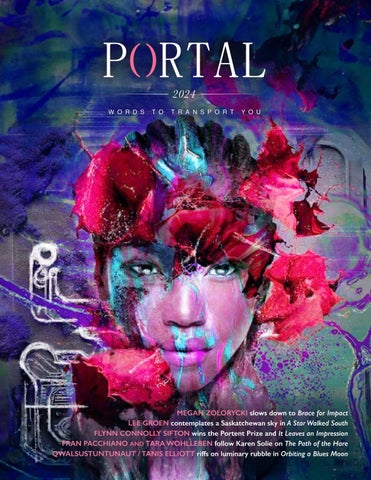
In a departure from recent issues that have featured striking photography on the cover, Jack Corfield’s “Circuit Girl” is a captivating portal into an issue full of speculative wonder and transformations.
The futuristic “Almost Human” holds up a mirror to contemporary beauty standards, while a woman questions the ‘femininity’ imposed on her by a doctor’s prescription of “Compound” chemicals. Bodily autonomy bends across the gutter into “Please Don’t Touch Me,” where the speaker fights to move on from the men who haunt her.
“A Star Walked South” opens the issue with a grand look into our universe as two brothers examine the night sky to reflect on their life on Earth. Stars align in “Orbiting a Blues Moon” as rhythm reveals a cherished childhood constellation. In “Lions of the Sea,” a man bravely plunges into frigid oceans and new experiences. “Fry” takes us deeper underwater as a bubble of innocence bursts around two young siblings’ lives. On dry land, test results weigh heavily on a young woman as she witnesses an accident in “Crescendo.”
“Apple of My Eye” preserves an extraordinary mother in all her wrinkles, while love speaks louder than “The Silence between Words” even when a mystical marriage seals the deal.
A 23rd-century woman risks revealing all under the guise of independence on “The Last Day of Quiet,” while a teenage boy gambles on a windfall in “Tricks of the Trade.” One thing’s for sure when it comes to this year’s Portent Prize-winning work of fiction: “It Leaves an Impression” as a boy makes a head-scratching discovery.
A daughter cares for her ailing mother in “You Are Golden,” while a storm brews in “Tempest,” a cup of tea growing cold and bitter as a relationship comes to an end.
We take a moment in the middle of the issue to celebrate the exceptional debut titles of three VIU CREW alumni—Spenser Smith, Amy Mattes, and Sabrina Voerman. These books mark the beginning of long literary careers.
After crossing a turbulent ocean in “Until We Meet Again” as an immigrating family sails toward a new life, our Portfolio
The folkloric “In the Cradle of the Night” plagues a mother’s love with doubt and dark tales. Centuries later, “Grief
Tianna Vertigan I had it all planned out pre-K : I would be an artist, veterinarian, video game designer, astronaut, lifeguard, and spelling bee champion. Writing wasn’t on my To-Do list until I wrote a 20-page short story about a girl and her magical pet cow in Grade 5. It wasn’t good, but I had fun writing and even more fun editing it. Though I may not be juggling all these professions as my four-year-old self had predicted, I’m grateful for the ability to feed my many passions through creative portals like this one.
Sam Bollinger One year into the Engineering program, I was miserable. It had been months since I’d opened a book without Calculus or Advanced Physics in the title. My decision to drop out and pursue a BA in Creative Writing was a shock to family and friends, but writing was not such a leap given that it embraced these interests and more. It didn’t make me choose between scientific exploration and artistic expressions, but instead embraced both in new and exciting ways.
Blooms Unbidden” as a woman takes up gardening to remember a lost friend while layers peel from the earth as “Defossus” defines connection. This year’s Gustafson Distinguished Poet Karen Solie speaks to our editors about “The Path of the Hare.”
years of Portal possible. We’d also like to thank the Black Rabbit Kitchen, White Sails, and everyone who came out to support our Portfolio Reading Series with keynote authors Délani Valin, D. M. Bradford, and Sabrina Voerman along with a dozen student readers whose work we hope to hear more of in future issues.
“Start Here” and “The Taste of Happiness” take us by train through India while “Brace for Impact” crosses the ocean to Ecuador as all three speakers rediscover their desires. We return to familiar landscapes of the Pacific Northwest in “Field Notes” and “The Last Powderman,” with grueling depictions of the isolation of the forestry and mining industries.
We look forward to next year’s $500 prize-winning poem with our annual Portent Contest open to all writers across Canada until October 15, 2024. For entry details, submission guidelines, recordings, and reviews, check out portalmagazine.ca and consider investing in a subscription to have Portal delivered to your door at a discounted rate for the next three years.
Finally, “Nobody’s Fool” offers moments of humour as a man’s date catches him in the act and “Notice of Eviction” offers a reminder that we are oh so temporary and replaceable.
The 22 people on our masthead have worked tirelessly with authors and each other to rewire and connect past, present and future in a literary circuit, just as these worlds collide on the page both visually and textually. Like the burst of fuchsia on our cover, we are confident much will bloom from what is planted here in our collective imaginations.
We are so grateful to the local businesses, advertisers, donors, and VIU’s students and professors who have made over 30
Saltspring Sunset Melissa Watt
MASTHEAD
MANAGING EDITORS Sam Bollinger, Tianna Vertigan ACQUISITIONS EDITOR Beatrix Taylor FICTION EDITORS Lee Groen, Katie Carroll,
Sophia Wasylinko, Kiera Bogle POETRY EDITORS Fran Pacchiano, Ali Dillon-Cardinal,
Laurent Lemay, Tara Wohlleben SCRIPT EDITOR Casey Tweedy NON-FICTION EDITORS Megan Zolorycki, Paige Vandop,
Nicole Kaastra COPY EDITORS Sam Bollinger, Tianna Vertigan,
Katie Carroll GUSTAFSON FEATURE Fran Pacchiano, Tara Wohlleben GRADUATE FEATURE Megan Zolorycki, Sophia Wasylinko,
Maggie Stvns ART DIRECTOR Jenaya Shaw DESIGNER Celia Brand EVENT COORDINATORS Paige Vandop, Casey Tweedy,
Gabrielle Josefsson AD TEAM Lee Groen, Tara Wohlleben SOCIAL MEDIA Beatrix Taylor, Jenaya Shaw, Laurent Lemay WEB/AV EDITOR Katie Carroll PUBLISHER Joy Gugeler
Fan Tan Alley Kashmir Lesnick-Petrovicz IWASHI
Claire Gordon
FRIENDS OF PORTAL
CHLY VIU Graphic Design VIUSU VIU Creative Writing VIUFA VIU Creative Writing Club The Navigator VIU Campus Store VIU Theatre VIU Foundation VIU English VIU Food Services VIU Media Studies The VIEW Gallery
Nanaimo Arts Council Canadian Letters & Images Project VIU Arts & Humanities Colloquium Gustafson Distinguished Poets Lecture
Event Geist GOOEY FreeFall Fiddlehead The Malahat Sad Girl Review subTerrain
PRISM International Strong Nations Windowseat Books Longwood Brewery Touchwood Editions Simatech Vapour Shop Federation of BC Writers UBC Masters of Fine Arts
FICTION 8 16 22 28 31 36 44 52 64 74
A Star Walked South Lee Groen Crescendo Tammi Carto Until We Meet Again Carson Woodman The Silence between Words Ann Hoffmann Almost Human Jack Corfield The Last Day of Quiet Liz Baltzer It Leaves an Impression Flynn Connolly Sifton In the Cradle of the Night Sophia Wasylinko The Taste of Happiness Arshi Arora Nobody’s Fool Katie Carroll
SCRIPT 40
Tricks of the Trade Zoe Chong
POETRY 11 15 21 27 34
Orbiting a Blues Moon Qwalsustuntunaut / Tanis Elliott
35 58 63 70 75
Please Don’t Touch Me Taylor Fleming
Fry Pamela Medland Tempest Laurent Lemay Apple of My Eye Marina McDonald Compound Elke Sorensen Defossus Sam Bollinger Start Here Claire Gordon Field Notes Claire Gordon Notice of Eviction Sam Bollinger
NON-FICTION 12 18 56 67 71
Water’s Edge Kashmir Lesnick-Petrovicz
Lions of the Sea Will Arnold You Are Golden Emma-Kate Larochelle Grief Blooms Unbidden Yvonne Salsman Brace for Impact Megan Zolorycki The Last Powderman Lee Groen
FEATURES 24
Ecuador’s Exceptional Beauty
25
No Place Like Nigeria
26
Memories of Myanmar
46
Down a Rabbit Hole with Spenser Smith
47
A brief relief from hunger
48
Navigating the Nostalgic with Amy Mattes
49
Late September
50
Into the Woods with Sabrina Voerman
51
Blood Coven
59
A Paradox of Wonder and Fear: Karen Solie Walks Poetry’s Perimeter
Daniela Alejandra Guevara Sotomayor Ataene Dieyne
Kaisuan Llewellyn Maggie Stvns
Reviewed by Maggie Stvns Megan Zolorycki
Reviewed by Megan Zolorycki Sophia Wasylinko
Reviewed by Sophia Wasylinko
Fran Pacchiano and Tara Wohlleben
BOOK REVIEWS 76
77
Crushed Wild Mint By Jess Housty Reviewed by Sam Bollinger
Burning Sage: Poems from the Lytton fire By Meghan Fandrich Reviewed by Jenaya Shaw
78
Crying Wolf
79
If It Gets Quiet Later On, I Will Make a Display
By Eden Boudreau Reviewed by Katie Carroll
By Nick Thran Reviewed by Beatrix Taylor
80
Any Other City
81
The Whole Animal
By Hazel Jane Plante Reviewed by Fran Pacchiano
By Corinna Chong Reviewed by Laurent Lemay
A STAR WALKED SOUTH Lee Groen
F
ar up in the cool October sky, stars gazed down
over fields of barley, mustard, and cattle. They saw farmhouses and chicken coops, dirt roads that wandered toward the familiar lights of the city.
In the middle of everything, the stars saw a pickup truck, faint as a distant sun surrounded by a black sea of ever-shifting shadows. Two brothers—the younger right on the cusp of adulthood, and the other a year older—had spent the last three hours stretched out gazing skyward, quietly hoping for something more than stillness. They watched the stars, and the stars watched them back.
Lucas’ eyes went wide. “I just saw a star disappear.”
“Where was it then?” Lucas pointed up to a small patch of space, his finger settling somewhere between the Little Dipper and what might have been a distant planet. “Right about there, I think.” “You saw a star disappear and you’re not even sure where it was?” Lucas shrugged. “It was somewhere around those parts.” “I think you’re joshin’ me. Are you joshin’ me?” “I wouldn’t do that.”
“What?”
“Is this like that time you told me that huntin’ dog winked at you?”
“A star. It just vanished.”
“He did wink at me.”
“I don’t believe you.”
“No way a German Shorthaired Pointer winked at you.”
Both men wore dirt-stained bunny hugs and blue jeans. The laces of their scuffed work boots were loosened, the ends hanging unevenly over the tailgate. Crushed beer cans—all that remained of the six-pack stolen from their father’s fridge—lay scattered around them.
“I told you already—it was a German Wirehaired Pointer. He looked right at me—”
High above, the last fragments of a lazy cloud drifted out of view. The Saskatchewan night sky was now entirely clear, filled with innumerable stars, as if someone had spent an eternity flicking white paint across a black canvas. “It disappeared.” Lucas placed his hand over his chest. “Swear on my life. Yours too.” Logan reached out and gently punched his brother. “Don’t go betting my life on your B.S.”
8
“I’m just saying I was focused is all.”
“How else is somethin’ supposed to wink at you?” “—right in my eyes, tipped his head, and winked.” “You’re full of shit.” “He smiled at me too.” “Next you’re gonna tell me the chickens talk to you.” “I talk to them sometimes, but they don’t talk back.”
“I was looking at that exact star for about five minutes.”
“You’ve got one hell of an imagination there, little brother.” Logan coughed into his elbow, cleared his throat. “Stars don’t just disappear though.”
“What’s that got to do with anything?”
“This one did. I saw it stand up and walk right across the sky.”
Fiction
“Did it disappear? Or did it walk off?” “Both, I guess. Must’ve closed the door behind itself too, because after it wandered off, it just went dark all of the sudden.” “Now I know you’re fuckin’ with me.” “Word of honour. I’ve never seen anything like it, a star walking across the sky like that.”
Lucas breathed in the cool autumn air, wondering how much fresher it might be high up in the sky. “Makes me sort of jealous. They’re a lot closer to it all than we are.” “I think the view is a lot nicer from down here.” “What a life, to be a star. Could you imagine?”
( “Stars don’t have lives.” )
“Where do you think it was goin’?”
“’Course they do. Maybe not like ours, but they do.”
“Wherever stars go when they up and walk away, I guess.”
“I’m supposed to believe that like I’m supposed to believe that star walked south, eh?”
“Why didn’t you say somethin’ when it started walkin’?” “It happened too fast. By the time I could find the words, it was already gone.” Logan let out a deep sigh. “But why would a star do that?” “Maybe that’s what stars do, like birds flying south for winter. Maybe they go south, come back in spring?” “Maybe they do.” “Which way do you think is south for a star?” “Which way did you say that star walked off?” Lucas traced his finger across the same patch of sky. “That way.” “I guess that’s south then.” A flock of noisy Canada geese flew overhead. Their V-formation was like the hull of an icebreaker cutting through the endless expanse, breaking off chunks of space that drifted in its wake. The frantic honking faded into the night, leaving the world more silent than it was before.
“That’s right.” “The moon looks nice—I believe that.” The moon sat plainly in the sky, a thin yellow crescent surrounded by pinpoints of pale light, each bigger and brighter than the moon could ever be. The brothers stayed quiet for a time, each wondering where a star might go for winter. Both pairs of eyes stayed locked on the sky, like the answer to the question might be found there. A yawn bounced back and forth, until both brothers were teary-eyed and drowsy under the blanket of night. It was getting late, but neither wanted to be the first to acknowledge it. Logan blinked, trying to shake off sleep. “There ain’t nothin’ out there for a star but darkness. That’s what I think.” “Darkness or nothingness?” “What’s the difference? Darkness, I guess.” “Well, the way I see it, darkness is the absence of light. That’s still something, even if it doesn’t count for much.
Truck Under the Stars Jason Bonnickson
Nothingness is, well, nothing. That’s what I think is out there, beyond the stars. A whole lot of nothing.” “You lost me.” Logan crossed his arms over his chest. “I always knew you’d get too smart for us.” “Yeah, right.” “You think I’m lying?” “No, I just—I don’t know. It’s not a lie, but it’s like how you knew the Roughriders were going to win the Grey Cup last year. It’s not a lie, it’s just not true.” “That’s a whole lot of words just to call me a liar.” “Why do you care?” “I care because I’m serious, Lucas. I always said that one of these days you’d start speaking a different language, somethin’ none of us understood. Eventually you’d get tired of no one knowing what the hell you’re talkin’ about, and you’d just up and leave, like that walkin’ star. I’ve been saying that for years, but nobody listens to me.”
of barley, all your talkin’ chickens and winkin’ dogs too.” For the first time in hours Logan’s eyes left the stars moving down the horizon to where the fields of grain seemed to stretch as far across the earth as the stars did across the sky. “Listen, Lucas, this is my place. I’ll live and die on this farm, right under these same stars. But you, little brother, if you’re still here this time next year, wasting your life stealing beers and watchin’ stars, I’ll kick your goddamn ass. You belong somewhere far away.” “Yeah? Where’s that?” “There.” Logan pointed up at the empty space where the star once was. “You belong up there with those walkin’ stars.” “So, you admit it walked off then?” “Shit, it might have.” Logan reached out and patted his little brother on the chest. “I’m gonna miss this when you’re gone.”
“I’m not going anywhere.”
Lucas took his brother’s outstretched hand in his and squeezed hard. “Me too.”
( “One of us has gotta make it outta here.” )
“I guess we should probably get goin’.”
“I’d miss it all too much if I left.”
Lucas looked at his brother. “Let’s watch the stars for just a little longer.”
“You’ll get over that.” For a long while the barley shifting in the wind was the only sound to break the silence. Lucas’s voice fell to a faint whisper. “I listen.” “Yeah. I know you do.” This time the silence that followed was comfortable, familiar. Logan cleared his throat. “Do you really think it’s all nothingness out there?” “I don’t know. Seems like it.” “What a fuckin’ waste.” Lucas knew his brother had more to say, so he waited for the rest. “Y’know, one day all this is gonna be mine. All these fields
Big Dipper Photo Bomb Chuck Miller
“Yeah, all right. Just for a little longer.” The wind picked up and shook the barley in a symphony of bittersweet music that carried far up into space. Hearing the music made of wind and barley, a star gazed past the endless darkness, the far-off planets and the crescent moon, past the lazy clouds and the birds flying south, to two brothers a few feet apart, but closer than they’d ever been. When the star knew the brothers were looking right back at it, it winked, stood up, and walked slowly across the sky. It opened the door to the great beyond and passed through. Gently closing the door behind it, the star disappeared out of sight. ( )
ORBITING A BLUES MOON Qwalsustuntunaut / Tanis Elliott
The Very Best of Otis Redding drifts through open windows in your parents’ house, the subtle rebound of the trampoline echoing in our chests as we catch our breath and the last note of dusk.
Streetlights line Celeste Drive and illuminate your face, as freckled as the sky. You never miss a chance to point out Orion and his belt, but I can’t choose just one.
A childhood later, we gaze out to the yard where we once lay claim to luminary rubble, last box packed, and hum a familiar tune. “For old time’s sake,” you say, slipping vinyl from the sleeve.
These arms of mine, they are burning. You pull out your lighter and interrupt the moonless night with a flame that flickers below the sprawl of stars across your nose, my favourite constellation.
Match Made Jenaya Shaw
LIONS OF THE SEA Will Arnold For all of the Lions of the Sea who reminded me of my own bravery.
I
t’s october and i’m minutes away from my first cold-
water immersion at Departure Bay beach in Nanaimo. Although I can’t see the state of the weather—since I’m blind—I can feel its deep chill on my skin. I’m excited to try something new, but my second thoughts are rolling in like waves rippling the water’s surface. At 33, it’s been 12 years since I’ve seen this beach, but I can still feel the ocean’s pull.
Last summer I was sitting in Nori Sushi when I overheard a couple discussing cold-water swimming. I was familiar with the local polar bear swim on Boxing Day, but people did this year-round? When I struck up a conversation, Jessie, one-half of the pair, told me about the benefits of cold dipping—from community (bonding over mutual discomfort) to improved physiological and psychological health. I was immediately curious. After doing my own research, I found other results to recommend immersion, including cardiovascular health, reduced joint pain and inflammation, and fewer symptoms of depression when standard protocols fail. It also fostered friendships and a sense of belonging among participants. Cold-water swimmers seemed to find each other like aquatic creatures pooling on certain shores of a vast and chaotic ocean. I met Vicki in my Creative Writing class. She had been coldwater swimming for three years, and she and her friend Julie offered to help me with my first immersion.
Qualicum Beach Erica Low
“Will, over here!” Vicki’s voice carries from down the beach. I walk in her direction and my runners hit a patch of sand. Vicki and Julie are part of an informal cold-water swimming group who gather a few times a week as the ebb and flow of their schedules allow. I’m sweating and I wonder whether the butterflies in my stomach are from the morning’s coffees or the thought of truly leaving my comfort zone. Julie says hello and I can hear the soft crunch of her neoprene boots as she walks toward me. She will guide me through the process as Vicki won’t be going in the water today, but is there to cheer me on. Vicki and her community of swimmers adopt a “no shame” rule that gives you permission to honour your body in the moment, rather than force yourself into discomfort. When it comes to the nervous system, this patience is necessary. I’ll need a robust dose today. My anxiety slowly transforms into excitement. I find a piece of driftwood and stash my phone, towel, and thermos of hot chocolate. As I turn toward the water, the smell of seaweed is pungent; I can taste it. Julie says the water is the same temperature as the air, a balmy nine degrees. Suddenly, I hear a commotion to my left. Someone’s spotted a sea lion in the bay. Julie describes it for me: its mouth holds a fish, which a seagull attempts to snatch.
Excitement ripples along the beach like goosebumps. I wonder if I can imitate the boldness of this unexpected creature. I remove my hoodie, T-shirt, and sweatpants until I stand only in my swim trunks and an old pair of runners. “Cold yet?” Julie asks. I feel vulnerable and a little comical, but not yet cold. I grip Julie’s arm, which feels muscular and solid, and manoeuver toward the water. Julie is gentle as she guides me to the edge. Here I go. Slimy rocks slide under my runners. What if people are wrong about this? I wobble. What if the sea lion is closer than I think? My toe jams into a stone jutting up. I steady myself: You’re safe, just a little uncomfortable. Julie tells me to take three deep inhales and long exhales to prepare my body. I delay my last exhale, then tentatively step forward. I feel the water gently lapping through the mesh of my shoes. I flinch. This is cold and with every step it grows colder. The water bobs at my knees. I can smell the thick salt of the ocean and feel it in my lungs. I hear lively chatter on the beach, perhaps children excited to see adults brave the ice-cold water. The many cold showers I endured for the last two weeks did not prepare me for this.
Beneath the surface, my legs feel numb and disconnected from my torso. The ocean belongs to itself and its creatures. This domain is not my own, yet somehow it reminds me of my small place in this world. This thought is oddly comforting, like a blade of kelp curled around my calf. I am a Pisces, after all. When the cold knife reaches my neck, I dive in. Needles stab every square inch of my skin, inject every pore with icy water. I hear Julie’s muffled encouragement above me. I come up three seconds later, flailing. Salt coats my lips. Julie notices my panic and tells me to place my hands together in prayer position to keep my arms above the water and reduce the risk of shock. This calms me and my breathing slows. I dive under again, emerging to splash water on my face.
The water reaches my waist. The surface feels like the edge of a cold knife scraping against me as if to remove scales.
When you’re blind, it’s rare to experience meditative stillness. There is limited opportunity for focus when stimuli compete in the mind’s dark cave. However, if you can filter out the noise, you can sometimes find comfort in this darkness, pull inward, and wrap yourself around it. The shock of the cold does just that—drowns out everything except sensation. My awareness reduces to one singular thought in this expansive and unpredictable body of water: I am here. I am present.
Ironically, I am a fish out of water compared to the others.
After a minute or two, even the awareness of cold slips away. Just when I start to accept the water, Julie asks if I’m ready to go back to shore. I want to, but I also know
(
)
I could stay in longer. It occurs to me that the potential therapy of cold-water swimming is also the precursor to hypothermia: a dream-like space where I walk a fine line between vitality and shock. Swimmers must maintain this boundary in order to safely endure these temperatures. After three minutes, I return to the shore with Julie. I offer more and more of my skin to the October air. I tighten my grip on Julie’s arm. She doesn’t mention it. Once I’m on shore, the numbness spreads to my brain. I feel everything and nothing. In my mind, I’m still drifting in the ocean. This may be the first sign of shock. Julie senses my discomfort and guides me to a log where Vicki is waiting. She asks how I’m feeling, and I want to answer, but can’t. I see the words floating, suspended. My mouth feels frozen. Is this the natural high cold-water swimmers talk about? “It’s pure awareness,” I finally answer. Shivering, I pull my towel toward me with clumsy joy. I dry off and swap my waterlogged runners and swim trunks for sweatpants and a hoodie. I open the lid of my thermos and with a heightened sense of smell sniff the cocoa as its warmth seeps through my body. The three of us sit in shared gratitude while the endorphins flood my bloodstream. Julie and Vicki tell me the sea lion has also left the bay, and I envision it travelling along its own liquid highway.
On the way home, I am in an altered state. It feels as though a braver parallel self is walking beside me, following me from the ocean to sit by the fire. As its warmth moves through me, I feel myself thaw and come back to life like a salamander emerging from muddy hibernation. For the next few days, my mind feels clear and balanced. The ocean has so much to teach us. I realize how much time I have spent resisting my circumstances, my disability. For a few moments, I feel I can let go. I remember Vicki calling herself a “thalassophile,” a lover of the sea. I think of the local communities of coldwater swimmers and realize the ocean calls us together. I am determined to continue, to endure the freezing temperatures to return to myself and the resiliency of which I know I am capable. I too might be a thalassophile. With each swim, I am closer to coexisting with the ocean and its creatures, to becoming a lion of the sea. ( )
Cuddle Puddle Jenaya Shaw
FRY Pamela Medland
I licked the glass, tried to catch a tetra with my tongue, tasted neon, fuzz on blue rocks, hum and gurgle. Fish! Fish! screeched my sister with a punch to the tank, startling an explosion of teal and gold. Her arm socket popped as Dad yanked her away, fry darting through castles, all the towers in our small world toppling.
Smiling Puffer Seth Scott
CRESCENDO Tammi Carto
T
he warm water of the shower courses over Gia’s shoulders as she closes her eyes and deeply inhales, slowly counting to 10. She rinses conditioner from her dark curls then turns off the tap.
Gia unclenches her aching jaw. If her mom were here, she’d remind Gia that life will never give her more than she can handle, but at 22 it suddenly feels like the world has tilted on its axis. She is daunted by the magnitude of this shift. She wraps a towel around her hair and shrugs into a robe, then moves to the sink and swipes her hand to clear a patch in the foggy mirror. Dark hollows are visible beneath her eyes and her usually full cheeks look gaunt. Gia wonders when she should tell Ben about the results she got yesterday. Certainly not over the phone while she’s here in New Orleans for the dental hygienist conference. Next week he has a final exam to be certified as an electrician. Hopefully she can sit on the news; after a year together, she knows distraction will only stress him out. Once that’s out of the way, she’ll cook her grandma’s famous spaghetti and lay it all on the table. Mascara wand in hand, she looks into her own hazel eyes: Everything will be fine. Over the hum of the bathroom fan, she hears the screech of metal-on-metal followed by a muted wail. Gia opens the bathroom door and steps into the hotel bedroom to listen. A shout floats through the open window. She walks past the unmade bed and ornate desk chair to peer out. Sunlight streams into the room as her gaze takes in the building across the narrow street, its shutters bracketing intricate black balconies. Wrought-iron lampposts stand like sentries on the sidewalk. From her third-floor view she surveys the scene below as though interpreting a dream. Steam billows from the hood of a compact grey car, its crumpled metal wrapped around a tilting lamppost. In the rush of the gathering crowd, Gia sees
16
Fiction
a slender blonde woman standing at the car’s open door. Her face is in her hands, shoulders shaking violently. Pressing one palm to the cool glass and the other to her heart, Gia inhales and holds her breath. She tries to open the window further, but it won’t budge. Sirens wail in the distance and people on the street shout instructions as they rush to help. Her eyes rove over the scene before landing on the mangled frame of a small orange bike, its front tire wedged into the storm drain.
( Where is the child? ) She strains to see through the onlookers. When the crowd shifts, she catches sight of the bottom half of a small body lying at unnatural angles. The child’s lime green shorts are twisted around skinny, caramel-coloured legs. Only one foot wears a sneaker. The screaming sirens get closer. A hotel bellhop in a starched suit and crisp black hat weaves through the crowd toward the child. A woman barrels around the corner, her fuchsia T-shirt vibrant against her dark skin; her yellow scarf slips from black curls as she runs. She shrieks, “Leon? Leon, where are you? Leon!” as she pushes through the crowd of tourists and luggage at the taxi stand. The woman lets out a strangled cry when she sees her son’s body lying in the street. The bellhop turns in time to catch her as she collapses. “My son,” she sobs, a crescendo that pierces Gia’s heart. The bellhop helps the mother to the boy’s side, and she kneels beside his motionless body and caresses the roundness of his cheek with an excruciating tenderness. A firetruck arrives and then an ambulance lurches in beside it, parking on the diagonal. The flashing red lights
bounce off the stone buildings as two paramedics rush to the rear of the rig. They grab bags and push a gurney next to the boy and his mother. A firefighter approaches the driver of the car while others begin crowd control, pushing people back and re-routing cars.
(
Gia looks on in horror as the two paramedics hunch over the small body.
)
They check his vitals and fasten a protective collar around his neck. The boy’s mother rocks slowly and sweeps her gaze from her son to the sky and back again. The bellhop crouches beside her and reaches for her hand, his black hat askew and the keychain hanging from his belt glinting in the sunshine. The driver of the car stands with her arms wrapped tightly around herself, occasionally wiping tears from her face. A firefighter talks to her, his head bent. She shakes her head before he leads her away, blocking her view of the little boy. The crowd parts and the slap of the mother’s flip-flops rap in time with the squeaky wheels of the gurney as the boy is lifted into the ambulance. His mother jumps in beside him. The siren’s wail pierces the air as the rig makes its way through the crowd, short blasts urging people to part before it disappears around the corner. Gia closes her eyes and listens as it fades and the street begins to clear, as if the boy was never there. On trembling legs, she tilts toward the bathroom, then lurches to the garbage and retches into the cold metal can. The towel around her hair falls to the carpet. Her eyes blur with tears and strands of wet hair tangle around her throat. Once the heaving stops, she sits back on the bed. Her hands caresses the roundness of her belly with an excruciating tenderness. ( ) Side Street Savanna Lawless
YOU ARE GOLDEN Emma-Kate Larochelle
H
er mother could be hard. Madeline affectionately
referred to her as a prickly pear cactus: a fruit born of a harsh environment—painful to crack, but sweet on the inside. It was that sweetness she cherished in the months leading up to her mother’s death.
Madeline gladly accepted a tree-planting contract an hour from her family home; spring work on the coast was different from her usual summer gigs, but short grey days and unrelenting rain allowed her the freedom to visit her mother on a weekly basis. Madeline would pack up after a shift, drive the same roads and sit next to her mother’s bed.
When her mother’s mobility had declined, Madeline’s family decided to set her mother up next to the kitchen, where she felt most comfortable. They’d replaced the dining room table with a reclining hospital bed, secured the phone to its frame—adorned with an emergency home care buzzer—and set up a desk for mealtimes. Madeline had also placed a 12-inch TV at her mother’s feet so she could watch all her favorite shows. Her mother had glanced at the TV quickly before pointing toward the dining room door, where an old analogue clock ticked lazily on the wall. “That thing needs new batteries.” The clock was several minutes too slow, a reminder of the kind of neglect that had gotten her mother into this situation; it was still ticking, but it was in rough shape. Madeline pulled up a stool and sat at the floating counter that separated the dining room from the kitchen. She glanced toward the ashtray and the pile of empty beer cans next to her mother’s bed. Her stomach churned. Her mother’s drinking was a slow suicide and had already caused several falls. Madeline had moved to a hotel a few minutes away to offer whatever help she could. Her mother usually had a list of errands or tasks around the house when she arrived, but this time they sat in silence. Her mother drew from her cigarette and let out a long exhale, a haze of smoke hanging between them.
18
Non-Fiction
“You’re sure you don’t need anything?” Madeline asked. “Not this time.” “Can I tuck in your toes?” Her mother nodded. Madeline rose and began hastily adjusting the hospital linens. “Do you want more water?” “Would you quit fussing?” her mother snapped. “I ain’t dead yet, kid.” Madeline stared, wide-eyed. She considered for a moment whether all this was worth it. It wasn’t like her mother had ever come to visit her. The clock above them ticked half-heartedly as Madeline’s thoughts circled from one topic to the next. It’s different now. Dad’s been gone so long that doesn’t matter anymore, but if I lost Mom too? Madeline felt her heart squeeze. She paused and then gently, with deliberate care, tucked the last of the blankets in around her mother’s feet. Madeline settled back on the stool and scanned her mother’s face. Her skin was grey and paper-thin with deep lines etched around her mouth. Her cheeks were gaunt and skeletal. Her mother flicked a cigarette into the ashtray, let out a dry, rattling cough, and gazed up at the muted TV. The clock struggled on. Madeline looked for a reason to linger. All you can do is try, she reminded herself. “Well, I’ll be back then,” Madeline said. She rose and slowly pulled on her boots. “How long?” “I work three days on, one day off,” she replied. Her mother said nothing. “Alright...” Madeline said, hoping for more. She looked at the screen where The Golden Girls played wordlessly, then at the ticking clock, then back at her mother’s TV PJ Gal-Szabo
face, lingering just a moment longer before reaching for the doorhandle.
every year. Her mother always feigned half-hearted protest, but Madeline could tell she secretly loved it.
“Oh, would you turn the heat up on your way out?”
When she entered the dining room, her mother smirked. “Stealing from the neighbours again?”
Madeline couldn’t help but smile. “Of course, Mom. Anything you need.”
Madeline stared out the motel window as the rain gently pattered against the glass. She had just removed her rubber boots, dried her hair with a towel, and changed into dry clothes after a day in the bush. Her fingers ached, burning and bright pink as she fumbled with her phone. Her brother had texted that their mother was in the hospital again, this time with a urinary tract infection. She shivered as she dialed. “Yeah, what do you want?” Her mother answered. “Just checking to see how you are,” Madeline replied.
Madeline grinned. “Only the best for you, Mom.” She held up the bouquet with pride. Her mother wrinkled her nose and laughed. “Weeds,” she remarked, clasping Madeline’s hands for a moment before accepting the gift. “Did you bring the eggs?” her mother asked as Madeline removed her coat. “Does it look like I have eggs?” Madeline raised an eyebrow, holding up her empty hands. She dragged a stool from the counter and sat next to the bed. Her mother muted the TV and lit a cigarette, the blue-grey smoke coiling between them.
“Oh, geez, Jeopardy is on. Can you call me later?”
“So...” Madeline started. She waved the smoke away with one hand, thumbing the seam of her pants with the other. “Did they give you antibiotics?”
Madeline bit her lip.
Her mother sighed heavily. “Yes.”
(
This is more important than your goddamn show.
)
For a moment she held her breath, and then noticed she could hear hospital machinery whirring and beeping faintly in the background. “Yeah,” she said. “Sure, Mom.... I’ll try you later.” The line clicked and Madeline put down the phone, rain drumming on the roof.
“And?” “And what? They poked and prodded me and I told them I wanted to go home.” She reached for the remote. “You know I hate that place.” Madeline scowled. “Well, you wouldn’t have to go in so often if you’d—” “Stop.” “Just let them run a few—” “Maddie, stop.”
Madeline decided to surprise her mother now that she was out of the hospital. Spring flowers were starting to bloom, a stubborn insistence of colour against the oppressive gloom of the coastal weather. She picked a small bouquet of snowdrops and crocuses and sprinkled in a few dandelions for good measure. When Madeline was very young, she had toddled into the neighbour’s yard and plucked a tulip, the bulb still dangling from the stem. “For you, Momma,” she’d cooed. Her mother couldn’t help but laugh. She’d performed this same ritual ever since, her bouquets growing more elaborate Curtains Mingwei Lim
“Maybe you’d start to get better if—” “Madeline. I said stop.” Madeline slammed her palm against the bedside table and stood up. Her mother’s ferocious green eyes glared at her. Their strength was such a contrast to the frail body that lay huddled and pale against the hospital linens. Madeline stood, blinking back tears. “Really?” she said in barely a whisper, her trembling palms turned upwards.
Non-Fiction
19
Madeline returned to the house, eggs in hand, and stomped off the remaining drops of water from her boots in the front hall. Even through the closed dining room door, she could hear the TV on full blast. She entered, glancing at her mother in bed. “Are you hungry?” Madeline asked over the noise. “No, just leave them in the fridge,” her mother replied. Madeline obliged and then sat on the stool, staring up at the TV. The Golden Girls was on again. Three women sat on a couch together, laughing. Madeline wondered if she and her mother had ever shared a couch. A commercial came on and her mother hit the mute button. Her mother looked away. “Madeline,” she said, softly this time. “Leave it alone.” Madeline opened her mouth, looked at her mother, then closed it again. She took a deep breath and headed for the door. “I’ll…go get the eggs.”
The squeak of Madeline’s windshield wipers was music to her ears, anything to distract her. For the first time in a long time, she worried about something other than her mother—like hydroplaning. Madeline wandered up and down several aisles before remembering her task. She looked down at the cart she didn’t really need. Its wheels spun slower and slower as she approached the refridgerator. Madeline shivered and stared at the cartons of eggs. She wondered why her mother had never been able to be fully present with her. She hovered over a dozen labelled free-range. What about cage-free? Madeline knew it was because of the pain her mother lived with, but still. Some part of her was determined to show up for her mother because she couldn’t show up for herself. Madeline opened a carton, checking for broken shells, and gently placed it on the top basket of her cart. Maybe she’s just harder to crack than I thought.
20
Non-Fiction
“You know,” she began, “I never thought you’d turn out this way.” Madeline debated changing the channel. “What way?” “I never thought you’d turn out to be so…” She paused, her mouth suspended mid-thought. “Y’know….” Madeline kept the commercial in her peripheral. “So responsible—coming to see me, and….” Her mother’s eyes flickered as she offered a soft smile. “How did that happen?” Madeline stared for a moment. Never in her adult life had her mother so freely given her a compliment, let alone an affirmation.
(
The words moved through her like warm honey.
)
“Thanks, Mom.” She felt a grin tug at her face. Her mother waved a hand and looked back at the TV. Madeline stood to get a glass of water. “I don’t know,” she replied sheepishly. “I guess I just…love you?” Her mother raised the remote. “OK,” she said with a smile. “Mom?” “Hmm?” “I’ll watch with you this time,” Madeline said from the kitchen. Her mother unmuted the TV. “Hurry up,” she said. “You don’t want to miss anything.” ( ) Caffeine Buzz Tianna Vertigan
TEMPEST Laurent Lemay
wrap me in silk bathe me in boiling water steep until the essence seeps out of me hold me by a thread drag me up for breath dunk me under again in a steamy baptism pull me closer inhale my sweet aroma intoxicating leaves infused with spice & dread swallow me whole the water scalding your tongue burnt with bitter herb —— abandon me in this cold bath empty and drained waiting to get my fill when you come home
Expect a Miracle Ellen Addison
UNTIL WE MEET AGAIN Carson Woodman
he smell inside the cabin reminds me of my grandmother’s farm, a deep, musty scent Mamma said came from years of damp and neglect.
“But why does he need this job?” I ask, unsatisfied with her answer. “Pabbi has a job here in Iceland. Why do we have to go all the way across the ocean to Candida?”
“This place smells like Amma Gislason’s mamma,” my older sister complains.
“Hush Helga,” Mamma says, exhausted. “Watch your sister while Pabbi and I sort the luggage.” Helga huffs at this, but quickly joins me on the cabin floor as Mamma and Pabbi continue.
“It’s Canada, Inga.” A woman cuts between us. Helga sighs. “We have to go because the mill where Pabbi and Uncle Kristjan worked shut down. There are no more jobs for them here. Mamma says the whole world changed after the war. Everyone got greedy and some risked everything on ventures that have left others, like us, with nothing.”
“How long do you think we’ll be gone?” I ask Helga.
“But what about Gunnar?”
“Forever, silly. Pabbi has a new job.”
Uncle Kristjan’s voice bellows “Helga, Inga, are your parents onboard?” from a cabin doorway down the hall.
T
Mamma had told me about it, but she didn’t say it was forever. “You’re lying! We can’t be going for good. What about Gunnar?” “You know he’s—” “Inga, Helga,” Pabbi calls, “make sure your cousins and Uncle Kristjan got onboard, Krútts.” “Yes Pabbi,” I say, eager to escape the smell of the cabin. We join the other passengers shuffling through the corridors in search of their cabins. “This way,” Helga says, pulling my sleeve to tug me out of the way of a large man with a funny long beard. It hangs like a scruffy rug over the old wooden trunk in his arms.
22
“Yes, Uncle,” Helga says, relieved that we’ve found him. I peer at Uncle Kristjan from behind Helga’s back. He is nice to us most of the time, but his face is so much sterner than Pabbi’s. He looks even more serious in the dim hallway lights. “Good. Is everyone alright?” he asks. “Yes, Mamma and Pabbi are just dealing with the luggage,” Helga replies. He nods. “Good. Tell them we’ll meet you all on the thirdclass deck once the ship departs.” “Yes Uncle,” we answer in unison.
We squeeze past a group of men reeking of liquor and sweat. I do my best to keep up with Helga. “Why does Pabbi have to take a job so far away?”
“Oh, and give this to your mamma.” His big arm stretches toward Helga as he hands her an envelope addressed to my parents.
“Why do you think? He needs to make money.”
She takes it and says nothing on our way back to our cabin.
Fiction
Alaska Erica Low
When we give Mamma the envelope, she opens it right away. Inside is a letter and a photograph. Tears fall from her eyes as she reads. “What’s wrong Mamma?” I ask, trying to see the photograph. “Your bróðir is safe and doing well in his new home.” She sniffs and shows me the image of a woman I don’t recognize with a familiar-looking man cradling Gunnar. “Jón says they found a local girl to nurse him and he’s sleeping through the night,” Mamma says to Pabbi, handing him the letter and picture. “Why is Gunnar there and not here with us?” I ask. “Who are those people?” “Helga, Krútt, take Mamma out for some air,” Pabbi says. As she and Mamma leave, Pabbi sits on one of the bunks and calls me over. I sit beside him and he shows me the photograph.
Gunnar with us on this ship, he would not be strong enough to survive the journey. Your uncle and aunt can’t have any children of their own, so they offered to care for him and raise him in Iceland.” My eyes fill with tears. The idea of never seeing my bróðir again, that he could have died, is too much. I am leaving him worst of all, but also my friends, my house, my toys. Pabbi grabs my hand. “What’s wrong, Krútt?” Tears roll down my cheeks.
(
“I’m never going to see Gunnar or home again, am I?”
)
“Who said that?” he asks, wiping the tears from my face. “Helga.”
“You see this man in the picture Inga?” he asks. I nod. “That’s your Mamma’s bróðir Jón—your other uncle— and his wife Amelia.” I look at the photograph again and notice that the man looks like Mamma the way I look like Helga. “You’ve never met them because they live five hours north of Reykjavik, near Húsavík.”
“Oh Inga, she doesn’t know. No one does. The future is not set in stone. We may not be back for a while, but that doesn’t mean we’re gone forever.”
“But why do they have Gunnar? Why is he not here?”
He chuckles. “Of course not, Krútt.”
Pabbi sighs. “You know that since Gunnar was born six months ago,” he pauses to clear his throat, “he’s never really been well, yes?”
Just then, the ship’s horn blares, signalling the vessel is about to depart.
I nod, remembering the late nights of coughing and crying. “Well, the doctors warned us that if we brought
“It doesn’t?” I ask, looking up as Pabbi wipes a few tears from his own eyes.
“Come on,” Pabbi says. “Let’s go find Mamma and Helga. We can all take one last look at Iceland and send our love to Gunnar. We have to trust they will take care of each other, until we meet again.” ( )
Fiction
23
Ph
ECUADOR’S EXCEPTIONAL BEAUTY
ot
o
by
Jen aya Sh
Daniela Alejandra Guevara Sotomayor
aw
W
hen someone asks me about my home
country, it is an opportunity to share the richness of Ecuador’s culture and landscape. When I say this is where I’m from it is often met with puzzled expressions, inviting my go-to introduction: “Have you heard of the Galapagos Islands?” Most respond with a resounding “Yes, of course! I wish I could go.” It’s a proud moment when I reveal these awe-inspiring islands are part of Ecuador. However, Ecuador is not confined to this renowned archipelago. Despite being a relatively small country bordered by Colombia and Peru, it features four main regions: the Pacific Coast, the Andes, the Amazon, and the Galapagos. Each region has dozens of unique microclimates and ecosystems that produce different local ingredients. This rich biodiversity contributes to the novelty of Ecuador’s cuisine and fosters an unparalleled level of natural diversity. Ecuador is also situated at the equator, so tourists can visit “the middle of the world” when the sun appears directly overhead during the spring and fall equinoxes. Some people believe the gravitational pull of the sun on these days can keep an egg standing on its end, but I have yet to see this proven!
Tourists may associate Ecuador with hot green spaces, but its 18 million people also live in cities like I did in the capital Quito, which is a UNESCO World Heritage Site tucked between mountain peaks. Its historic downtown, replete with examples of colonial architecture, highlights the fusion of Moorish, Spanish, and Indigenous influences. Ecuador’s diverse street culture, lively marketplaces, and expansive vistas from “El Panecillo” offer a fascinating window into the country’s rich cultures. One of the biggest Indigenous marketplaces in South America is in Otavalo; many Indigenous villages pepper the countryside. Ibarra is a city dubbed the “City to Which One Always Returns” for its picturesque landscapes, pleasant summer climate, and amiable residents. When I was
24
Portfolio Spotlight
a child, we often took a two-hour bus ride to visit my grandfather there, eat ice cream, and enjoy time in the pool while my cousin and I attempted to compose a song that riffed on the city’s motto. It was the perfect way to forge lasting connections with my family during the summer weeks. Carnival in Atuntaqui, a city close to Ibarra, also became an annual tradition and even now, at 21, I eagerly awaited the date mid-February. When Carnival arrives, the festivities in Ecuador extend beyond parades, dance troupes, flower floats, and costumes; they become immersive experiences. For five days the air is filled with laughter as every manner of things are thrown at you—water, flour, eggs, foam— but mostly water. Battles ensue, with everyone getting in on it from toddlers to seasoned adults. Soap bubbles float through the streets creating an atmosphere of pure merriment. This holiday, for me, has always been about the collective experience. It’s a unique sight to witness the entire community coming together to revel in playful chaos. The tradition of dousing each other with water during Carnival traces back to the pre-colonial era when our ancestors welcomed the new year by purifying and cleansing with water before embarking on the months ahead; fresh faces made for fresh outlooks. The tradition serves as a connection to that time, and the blending of old customs with contemporary celebrations. It showcases the dynamic nature of Ecuador’s culture, where the past continues to shape the present in colorful and unexpected ways. Anticipating Carnival each year is not just about the revelry, but also about participating in a living tradition. It’s an opportunity to connect to my roots, to contribute to the communal joy that defines this extraordinary celebration. I am a long way away on Vancouver Island, so I rely on my family for photos and videos, allowing me to relive those memories and savour the taste of delicious delicacies I will always associate with the homeland I miss and cherish. ( )
Di
ey n
e
NO PLACE LIKE NIGERIA
n
e
Ataene Dieyne
I
went back to my hometown of Port Harcourt, “The Garden City” capital of Rivers State in Nigeria, for the summer holiday of 2022 after spending my first two years studying in Vancouver. Going back made me realize how much I had missed it—my keepsakes and mementos of home couldn’t summon the feeling of truly being there.
When most people hear I’m from Nigeria, they think of Lagos or Abuja, but they may not know Nigeria is a country of 213 million people, bordered by Niger, Chad, Cameroon, and Benin, and made up of 36 states and 1150 dialects. There are enough similarities in culture and tradition across Christian, Muslim, and Indigenous faiths to identify three major ethnic groups and languages: Yoruba (southwest), Igbo (southeast), and Hausa (north). Each has their own unique traditions, but there are a few things that unite us— food, music, good humour, and easy friendships with our fellow citizens. Popular meals like jollof rice made with tomato paste, paprika, thyme, bay leaves, and meat stock are well known, as is fufu, a dish made from cassava roots, but a very popular meal that may not be as well known to outsiders is the “swallow,” a mix of different soups eaten with eba, a bun rolled from dried cassava dough. My personal favorite, afang soup, is a combination of okazi leaves, spices, and smoked fish or meat. Nigerian cuisine is served at smaller occasions like house parties, get togethers, and office meetings, but it is also a staple of festivals and larger city-wide or national celebrations like our Independence Day celebration on October 1st or our annual Bole Festival in Port Harcourt. Although these meals are well known across the country, people have their own special way of preparing them in each region. These dishes put a smile on my face and though we all know how to prepare them at home, it’s more fun eating them out with friends and family in the local neighbourhood restaurants.
Pho
aA t o vi
ta e
Music also binds us together. Afrobeat, the umbrella term to describe our music, has been a part of my life as long as I can remember. Before I started paying attention to other genres of music like rap and hip hop, this was the only form of music I knew. Nigerian stars like Davido, Wizkid, and Burna Boy have gained international acclaim; Burna Boy made history by being the first African artist to sell out Scotiabank Arena in Toronto. They follow in the footsteps of those who came before them like Fela Kuti, an important figure in African music who has been dubbed “the king of Afrobeat.” Younger artists like Rema, Omah Lay, and Ayra Starr have brought their own style to the genre and have inspired other talents coming up behind them to pursue similar goals. The popularity of this genre continues to grow in countries outside Africa as people around the world can now be introduced to our music more easily than ever before. The enthusiasm of these artists is reflective of Nigerian attitudes generally; we are an amazingly optimistic people and can find joy in any situation. Even though things may appear hard, we still find a way to see the upside or have a laugh. We don’t allow anything, or anyone, to stop us from getting what we want. We will push through any challenge and find a way to achieve our goals. This is consistent with a motto that went viral on social media early in 2024: “No gree for anybody,” which is a Nigerian slang term for “Don’t let anyone bully or cheat you,” but has been used as a motto for self-reliance. That trip back to Nigeria in the summer of 2022 reminded me of what I love most about my country and what makes it truly special. No matter where I live or visit, I will strive to embody the unique character and culture of my homeland. Nigeria is a place worth visiting, and I assure you you’ll have a great time once you’re there—so what are you waiting for? ( )
Portfolio Spotlight
25
Ph ot o
MEMORIES OF MYANMAR
v ia
Ka
isu
an
Ll ew
e lly n
T
Kaisuan Llewellyn
wo months after i was born, my father arrived in Canada from his homeland Myanmar (formerly known as Burma). He left his parents, brother, and two sisters behind, but eventually his brother also emigrated to the US and his parents and one sister passed. Now only his sister, a retired history professor, remains in the country.
Myanmar is surrounded by China, India, Bangladesh, Laos, and Thailand and is the largest country in area in mainland Southeast Asia. Yangon (formerly Rangoon) is the country’s capital. Myanmar is home to 135 officially recognized ethnic groups including the Shan, Lahu, Karen, and Kacchin peoples, all with different traditions, practices, and religious beliefs. The Burmese are 68% of the country’s 55 million people as its former name (until 1989) suggests, and its citizens are primarily Buddhist. My father’s people are Chin, a much smaller tribal group who were traditionally mostly Animists, but over the years have become primarily Christian. The Chin people were of Mongol origin before the modern era and the formation of Myanmar. Their beliefs were rooted in the ability to hunt, which decided their place in the afterlife. Wrestling is an important Chin tradition and one of the key events of Chin National Day, which celebrates their emancipation from slavery. My father didn’t raise me as Myanma because he saw the freedom people had in the West as a better life than his restrictive homeland and he didn’t want to burden me or my sister with that history. I was born in Canada and only lived in Myanmar for two years between the ages of three and five, during which some of its sights, smells, and sounds left an impression. I remember going to a zoo and riding an elephant as well as feeding baby elephants and gorillas. I remember the smell of the street where people sold freshly caught fish. Other
26
Portfolio Spotlight
memories are fuzzy, so I asked my parents about their feelings about the country to trigger my own recollections. Until two decades ago, Myanmar’s laws were considered more a suggestion than an enforceable policy—as long as you knew the right people. My dad was in the army, as were his father and grandfather, but he was denied a promotion beyond captain because he was Christian and the people in power were Buddhist. My dad’s connections allowed my parents to get married. In Myanmar there are two visas, tourist and social. The social visa allows longer stays, but can only be granted if one has family living in Myanmar. Thanks to some favours, my dad was able to get my mom a social visa before they were married. The country was under a military dictatorship. If locals talked to tourists or outsiders, they were at risk of being arrested without trial. Officials expected my mother to pay more money for items in stores, or for her visa, as foreign currency was worth more than Myanmar’s kyat. Over the last 70 years, Myanmar has gone from a Communist dictatorship to a military regime, to a weak republic, to a civil war. It has received international condemnation for its human rights abuses and genocide of 800,000 Rhohingya Muslims. Since 2021, more than 600,000 people have been displaced due to violence and more than three million people are in need of humanitarian assistance. Ironically, it has taken the country’s public profile in international news to make me think of myself as Myanma. The coup brought the country to the media’s attention and gave me more reason to think about that half of my history. If the country recovers, I will attempt to visit and experience firsthand everything I can about the Chin people. ( )
APPLE OF MY EYE Marina McDonald
Her oncology bed, safety rails raised to restrain. A resting place more coffin than cradle. Doctors diagnose “abnormal growths.” She says, “Normal is just the second cycle on the washing machine.” At home, apple dolls sun on the windowsill, dusted in rose blush and berry lipstick. Here my mother paints pink over open sores, shaky strokes on a hollow smile. Fingers that once laced up boots and buttoned vests now swell and fumble to tie up her gown. She leaves me bandanas and hats, wonderous red curls to wash down the drain. Her playful voice once the life of my bedtime stories, reduced to a whisper a final goodnight. My mother, an apple doll left too long in the sun.
Apple Corina Rainer
THE SILENCE BETWEEN WORDS Ann Hoffmann
D
o you remember the day you agreed to marry me?
It was nearly fall. The air was damp, a harbinger of the storms to come, and the breeze already had a winter chill. I was collecting oysters. You followed behind me, looking quite out of place on the muddy shore.
Back then, when we were still finding our footing, you looked like a porcelain figurine. Your dark curls were always neatly tied back and your clothes were far tidier than any other young man’s in Ankcorn Point. Despite your height, you looked dainty, fragile even. I told you that my father had been talking about the two of us getting married. It wasn’t the first time you and I had discussed it, but it had always been half-jokingly, a plan to save face in case neither of us found someone else worth courting. “Not you and Millie?” you asked. I told you not to be foolish. I’d have married her ages ago if it were possible, but who had ever heard of two women being wed? I was quick to point out you didn’t have many good prospects either. In school, the girls had been drawn in by your pretty face, but they never stuck around. You were too quiet, too unsure of yourself and none of them wanted to court a young man with the disposition of a mouse. I jokingly asked whether you were going to marry Old Lady Bertram; she’d have taken your name just to paint a half-dozen portraits of you. I had thought it a rather clever question at the time, but you just stared out to sea. You always did that, when we were children, when you should have been studying, even at our wedding. You were always drawn to the ocean. Sometimes I wonder whether
Sea Birds Savanna Lawless
it was just in your nature or because it was forbidden to you. It was the only rule your grandmother had ever bothered to enforce, and you listened to her. Even after she passed, just before your 19th birthday, you didn’t dare step beyond the shore. It had seemed a rather ridiculous rule, but I understand it now. I apologize for all the times I called your grandmother a “silly old loon.” Old Lady Bertram ended up painting a portrait after all— our engagement portrait. We were in front of the seawall overlooking the ocean. Your hair came loose in the wind, but you let her paint you that way. You finally seemed comfortable, more yourself. We were slightly turned away from each other. I was looking at Millie sitting off to the side, while you looked out to sea. We wed in the summer, just as everyone in our stormy little town does. Only a fool would do otherwise. Yet in the end the ocean paid no mind. We’d hardly begun our vows when the rain and wind began. Most folks went home, except Millie and my parents. The priest hurried things along, skipping passages in his haste. He wasn’t from Ankcorn Point, nor used to our storms. After a few moments, he fled to his rented cottage. My parents hurried home in the downpour, then Millie kissed me on the cheek and sought cover herself. We were alone and absolutely drenched, clinging to each other in the gale. Your mother and father’s wedding had apparently been the same, a sudden and unexpected storm descending as they exchanged their vows. Yet neither of these storms compared to the one that struck the night you were born, the night your mother disappeared. That one has become legend in Ankcorn Point. It came as no surprise to me when you sought work on Captain Mulligan’s fishing boat, The Evangeline. It broke your grandmother’s rule, sure, but the way you’d been staring at the ocean all those years, it was only a matter of time.
Millie held my hand as we watched The Evangeline sail out of the bay. So many had been taken from Ankcorn Point that we worried this would be our last view of you. It was the ocean’s way to give and take without concern for us, for any creature. She would have what she wanted and give back what she didn’t. The Evangeline was still in sight when she went down. Captain Mulligan’s wife was the first to see the signs. It was just as it was when your father’s ship had sunk, and all the others taken in recent years without explanation.
(
No one dared ask why or speak a word at all.
)
Over hands clasped together, Millie and I watched The Evangeline sink beneath the waves. We sat on the dock all night, Millie and I, staring out at the bay. My mother came to sit with us, and said nothing, just cradling me in her arms. Millie didn’t manage to get me home until early the next morning. I sat frozen by the window, waiting for you to come over the wall, to walk up our pathway, to be there with us. Millie tried to get me to eat something, to have some tea, to change out of my wet clothes. We hardly spoke. I don’t think either of us had the words. I don’t think anyone did. That afternoon the Mulligan’s eldest boy, Hugh, washed ashore. At first, no one dared to venture close enough to check whether he was dead or alive. It didn’t seem possible that he could survive, and no one wanted to be the bearer of bad news. Some folks went to find his mother, while others just stared. It was Old Lady Bertram who finally helped Mrs. Mulligan to her son. When his mother put a hand on his cheek, tears in her eyes, Hugh stirred. It didn’t
make sense, but the people of Ankcorn Point weren’t the sort to question miracles, not when we had so many tragedies to ponder. Millie and I weren’t allowed to see Hugh until well into the evening, once he was warm and dry. At his bedside, I asked him if he knew what had happened to you. He didn’t. I asked how he survived, knowing I wouldn’t have been the first. “A seal,” he said. He’d been rescued by a seal. His mother told us he was still a bit delirious and shooed us back outside. I never doubted what he said. Strange things happened in Ankcorn Point. No one could explain the storms that that plagued us through three seasons and into our dreams. Millie and I returned to our place in front of the wall, speaking less with words than with our bodies. Millie cared for you in her own way, but was strong for my sake. I was alone when I heard the splash, saw a seal disappearing behind a log. I waited, some part of me afraid I was jumping to an impossible conclusion. After a long moment, I stood and took a few slow steps forward. There you were, half nude, tangled in your seal skin. Your dark curls fell over your shoulders, wild and immense. In your eyes there was a spark, a liveliness I’d never known. I finally saw all that you were, all that you were meant to be: a wild, beautiful creature. “I can’t stay,” you said. I told you I understood and I did. We stayed at the shore all night, hidden behind rocks and driftwood, basking in our words and the silences between them. After that night, I didn’t think you’d ever return, but you did, and you have many times since. I’ve told you all of this before of course, but it’s lovely to relive it. Sometimes I’m sad you don’t remember much about who you were, who we were. Still, I’m glad you’re driven to the shore, to me, like you once were to the ocean. ( )
Moonlights Jack Corfield
ALMOST HUMAN Jack Corfield
I
don’t see nukids very often, so I can’t help but stare.
As I walk backstage, I am awestruck by their eerily symmetrical faces, their programmable locks, eye, and skin colours. One girl paints opalescent makeup onto her eyelids with the stroke of her finger. She catches my eye in the mirror and sneers like I’m gum on her shoe.
“Get out of my frame,” she says. “Frame?” I’m confused because she’s looking into empty space. Then she realizes I’m not one of them. I don’t have implants, or piercings, or even smart-glasses. Mom thinks I’d be so distracted reading the ads on the lenses that I’d walk into the street and get hit by a bus. She hasn’t even let me get a phone. (What 15-year-old doesn’t have a phone?) Mom says they’re “mind control devices that manipulate the truth, feed the patriarchy, and polarize the masses for profit.” Who cares! I just want to text my friends. “Oh, you’re low-tech,” the girl says, leaning back like I’m contagious. “Can you move? You’re standing in my vanity.” “S—sorry?” I say, hopping back. “Whatever.” She goes back to applying makeup from an invisible palette.
I know I should let it go, but I just can’t. “Just because I’m non-GMO doesn’t give you the right to treat me like I’m nothing.”
I expect her to bite my head off, but she doesn’t say anything. She’s frozen. Has she switched off her emotions? I heard NuKids can do that. I turn on my heel and stomp off. A few strides away, out of her line of sight, I look over my shoulder to make sure she’s OK . She’s resumed applying her makeup and is making a motion in the air like pinching clay. Her bones shift under her skin. I look away in disgust and head off to find my mom. She’s in the lighting booth, looking down over the crowd of wealthy middle-aged mothers anxiously awaiting the catwalk. They sit in clusters separated by 360° VR-streaming cameras placed throughout the audience so people can pretend they’re at the show while watching from the comfort of their homes.
(
These parents don’t care who’s watching, just how many.
)
They market their children like products, selling their clothing, genetics, and faces to “friends” and followers. At least I have real friends, despite not being allowed to attend public school. Mom sees right away that I’m upset. “What’s up, Em?” Of course, I tell her what happened and she gives me a hug I don’t really need. “Oh Em, that’s hard. Sounds like she was pretty harsh.”
The girl rolls her eyes.
“Whatever. I’m fine,” I say, trying to head her off before she launches into a speech about self-empowerment and inner beauty. She can’t help herself.
“Can you hear me?” I ask, sounding more hurt than I mean to.
“If you say so. We can talk more after the show.”
“Too bad you’re not pretty, then people might actually listen to you.”
The NuKids come out on stage. I take out my inks, charcoal sticks, and the heavy recycled paper Mom and I made. I’m looking forward to testing out my new luminous inks— they’re a perfect match for the outfits on display tonight— but my heart isn’t in it. I can’t even put pen to paper.
“Fine. I’ll let you get back to fixing the face your parents bought you!” I feel bad as soon as I say it, but I’m too angry to take it back.
Fiction
31
The NuKids start pouring onstage, taking turns on the catwalk before lining up along the back curtain, posing in their bioluminescent smart-fiber clothes, and smiling at their parents in the half-empty theatre. They’re too beautiful to be real. The kids move with an air of stilted grace far less animated than the clothing they wear. The tendrils of a girl’s gelatinous jellyfish dress trip her as she pivots for the crowd, nearly sending her hurtling off the stage. Another has crystals and mushrooms growing from her aqua skin. The spotlight bounces off her flesh like sunlight on water. Between their poses, they answer questions from the judges. Most are rhetorical: “Are you ready for the crown?” Anya, the wannabe NuKid and former-pageant-winnerturned-judge with the latest in synthetic surgery, has an agenda: “What can parents learn from their children?” Then there’s the perennial Charlie with a token question on politics: “Is democracy working?” The room fills with applause, whatever the answer. Last out is the girl from backstage, except she’s changed her face to look older, like a caricature of a politician I can’t place. The shadows dig deep into her cheekbones and eye sockets where the spotlight cannot reach. Definitely not in style. She’s wearing a frilly powder-blue dress, like one of my mother’s old-fashioned dolls, but with white smartfiber lights glowing beneath the folds. The effect is mesmerizing, like dew on gossamer. There’s a gap between her and the rest of the Nukids, who refuse to even look at her. When it’s her turn to be interviewed, the judges don’t compliment her appearance the way they did for the other contestants. “Laika, what is the greatest challenge facing your generation?” Charlie asks. Laika takes too long to answer, unlike the other girls who’d prepared perfectly timed and over-rehearsed answers. “I don’t know. I—I think my generation is the problem.” My jaw drops. Mom lets out an appreciative chuckle. I’ve never heard anyone at these pageants answer a question
32
Fiction
with such honesty. Neither has the crowd. The judges nod like she’s said something very astute, but you can tell they’re hiding their discomfort. Mine might be the last generation of naturally born humans.The fear that our species will soon be extinct, that these perfect children will replace us, is something no one wants to openly acknowledge. I fight the impulse to clap even though no one else is. She may be vain, but at least she tells the truth. The judges smile and swipe their screens, calling up the next contestant. Laika leaves the spotlight and returns to her place against the curtain. The other contestants shoot her dirty looks. Her face is frozen in the same way I’d seen earlier, but there’s something familiar in her expression, something almost human. I start to draw her. I make her face asymmetrical, and put luminescent ink on her eyelids, letting it drip down into her dress as if she could cry. After the show, I pack up my stuff and Mom sees my drawing. “Is that for Laika?” “This? No.” “It’s beautiful. Why don’t you give it to her as a peace offering? Take the high road.” “She wouldn’t want it.” The picture doesn’t look remotely like Laika, and I’m sure she wouldn’t want anything from me. Mom looks a little disappointed. “Give her a chance.” “She doesn’t like me.” “Oh, Em. When you share your light, it will help you see others more clearly.” “Mom, stop.” She winks. “Never.” “What if I don’t like what I see?” I ask. “How you feel about what you see is up to you.” “What about what she sees?” Mom shrugs. “You are so much more than what others see.” Spotlights Daniel van den Berg
I look down at the picture of Laika. “I guess.” “I could go with you if you’d like.” “Absolutely not.” I take the catwalk from the lighting booth to the flyway above the stage. Just as I’m about to start downstairs, I hear one of the mothers speaking in an angry whisper, the kind that’s worse than yelling. “Do you know what I had to do to get those questions for you?” Laika says, in the smallest voice, “I’m sorry.” “Sorry isn’t good enough. How could you end your last show like this? Honestly, I’m glad you’re aging out. Your sister’s been very patient. It’ll be so nice to have her on tour next year.” “Good! At least I won’t have to do any more of these stupid—” “Mute.” Laika chokes on her words. I involuntarily raise my hand to my lips in sympathy and lean over the railing, looking down at them through the rigging. Laika’s mother’s face is obscured by her sapphire perm.
her speaking to me the way Laika’s mom spoke to her, let alone muting me. I know Mom would tell me to be there for Laika, the way Mom would be for me. I will myself to open the door. Laika’s sitting on the edge of the metal balcony, feet dangling. I sit next to her, looking out at the city shimmering in the rain. Ultraviolet streetlights flicker on making her dress even more ethereal. I set my drawing supplies down under the overhang. “What do you want?” she asks, her voice flat. “I wanted to thank you for what you said.” “For calling you ugly?” “What? No. For what you said to the judges. That was the most human response anyone’s ever given.” “Yeah, well human’s not in style anymore,” she says, mocking her mother’s tone. “Is your mom always like that?” I ask. Laika takes a sharp breath, then lets it out slowly. “Like you said, she paid so I could be pretty and perfect.”
“I’m going to convince the judges to adjust your scores and the film crew to cut your answer from the recording. God knows what that will cost. Why don’t you think about what you’ve done and what you’re going to do with the rest of your pathetic life?”
“I shouldn’t have said that. I’m sorry.”
She reaches out and adjusts Laika’s bangs. “Now tell your mother you love her.”
I hand her my drawing. Laika looks at the paper, then at me, then back at the portrait.
“Love you, Mom,” Laika says automatically.
“I made it for you,” I say. It’s a lie, but it doesn’t feel like one.
Her mom walks toward someone hidden in the wings. She says in a sing-song voice, “Charlie, darling. Great questions as always. Say, maybe we could chat a moment?”
She takes my drawing, holds it up like a mirror, and then puts it down between us. Her features have adjusted to match it, opalescent makeup running like tears down her face. “It’s beautiful,” she says. “I’m—”
Laika watches her go, then turns and walks out the back door to the fire escape. Once I’m sure her mother has gone, I slink down the steps to follow her. I hesitate with my hand on the doorknob. This is a bad idea. A small part of me has always resented Mom for giving birth to me “the old-fashioned way,” but I can’t imagine
(
“Why do you care? I’m not even human.”
)
“—beautiful,” I offer. A droplet falls on the paper, smudging the face. At first, I think it’s a rain drop, then I realize Laika can cry. Her lip trembles. She shakes her head. “Human.” ( )
Fiction
33
COMPOUND Elke Sorensen
I have swallowed pink pills day after day for 42 months. At 17, the Dr. said I had too much testosterone in my bloodstream and as a balancing act prescribed me: Girlhood. I dilute myself to bond to the binary I have evaded since birth. I know there is nothing normal about the aching of my blistered ovaries but I cannot concentrate. Estrogen and progesterone titrate on the tip of my tongue. I continue to control the symptoms, weigh my options, cross off dates and pop pill packs. Moments before each dose, I hesitate— an inkling of who I was before the intervention urges Let your body
be.
PLEASE DON’T TOUCH ME Taylor Fleming
The first time I tasted someone else’s spit between my lips, I paused to swallow my innocence and went back for more.
Angels ought to be dressed in white but crimson never looked so pure. I hovered above myself, every wound I’ve ever known bleeding out until I was clean.
Today, I steam my best dress to visit the imaginary grave of the man who split me in half, who kept me from rooms where I belonged.
I refuse to be haunted, sleeping as deeply as the dead until reborn a child, knowing only fresh-faced wonder.
Now I roam rows of buried bone and place flowers on a headstone that doesn’t belong to him— I never belonged to him.
I remind myself I am more than the things others do to me. Even with scarred skin, I am soft on the outside, soft on the inside. I am still soft.
I correct every year I called myself naive: 14, 17, 18, 19, 20— I was a child learning how to live.
There are moments when I revert to that hollow beautiful girl, but now I am whole, eclipsing everything that’s ever touched me.
When they found me, my eyelashes were matchsticks striking foolish cheeks. No food could fill the hole I tore open with fingers raw and red.
Please don’t touch me.
Mountain Girl Jack Corfield
THE LAST DAY OF QUIET Liz Baltzer
F
loating above dr. mcmahon’s right hand was a hologram of my brain. He sat comfortably in a high-backed chair and leaned across the desk. My interpreter, Lena, sat on a stool beside me. He angled the image so I could see my Broca and the visual cortex below. I watched as he pointed at various sections of the hologram, serious but matter-of-fact.
Lena spoke his words to me as he explained the surgery would stimulate this area and replace the missing brain receptor required for telepathic communication. He closed his hand into a fist and the hologram disappeared. “He wants to know if you are sure you want to do this,” said Lena. Dr. McMahon was not vocal. Lena had studied for years to learn to speak out loud. She had accompanied me to all my appointments and important meetings for the past 10 years. “Yes.” “And you understand this is irreversible?” “Yes.” Dr. McMahon stared at me for a few seconds. “As long as you’re sure it will work. I wouldn’t want to get my hopes up for nothing.” I waited while Lena confirmed this with Dr. McMahon.
I picked up the tablet and a hologram waiver appeared. I scrolled to the bottom and touched my thumb print to the signature line. Dr. McMahon took back the tablet and did the same. “It’ll be nice not to have to check in with a surveillance officer every week.” I stood up and grabbed my jacket from the coat rack. “He says I guess there’s nothing more suspicious than a person with nothing on her mind.” “Apparently.” “He says he will see you tomorrow at 2:00 PM for your surgery.” Lena and I walked out of the office onto the street still wet from a warm spring rain earlier in the day. We walked together toward the Maglev train station, but I stopped at the station’s coffee shop on the way. “Do you want me to come in with you?” asked Lena, causing a man walking past us to turn and stare at her for a second, clearly shocked to hear someone speaking aloud in public. “No, I can handle it. See you tomorrow.”
“Well, you are an anomaly,” said Lena. Dr. McMahon smiled empathetically at me. “He says it’s experimental, but there’s a 90% chance it will be successful.”
“OK, see you then.” I felt a pang of guilt for a moment as I walked up to the counter. Lena would soon be out of a job. The barista smiled at me, but her smile faded when she realized she couldn’t hear my thoughts.
“Am I the first patient he’s seen without telepathic abilities?”
“Can I get two medium oat milk lattes?”
“You’re the first one anyone has seen in over 100 years. You’re sure you want to give that up?”
Her eyes widened as she nodded in reply. The amount owing flashed on the screen and she gestured to it. I touched the pay pad with my thumb and a bell chimed. I waited for my coffees, painfully aware of the staff and customers doing their best not to stare. I bobbed awkwardly to the music playing through the cheap store speakers.
“Yes. I want my independence.” I glanced at Lena. “No offense.” She nodded politely to indicate her understanding. I knew she could see I was growing tired of needing her.
Lights David Harvey
Liz Baltzer
Historians say it was a genetic mutation that first appeared at the end of the 21st century. Parents were giving birth to babies who were able to communicate using their thoughts. As time went on, this became the standard across the globe. By the start of the 23rd century, there were no vocal children left. The world had become silent. Anyone who wanted to be vocal had to invest in years of training to be able to speak aloud. The only industry employing people who were vocal was the movie industry; telepathy didn’t translate to film so onscreen entertainers had to nurture their vocal chords. Maybe the customers were trying to place me in celebrity circles. Was I a musician? A film star? Comedian? When my order was ready, I grabbed it and bolted for the train station. Tomorrow couldn’t come fast enough. I entered the surveillance headquarters and placed my palm on the tablet; all of my identification appeared as a hologram above my head. At the bottom, in bold red letters, it read VOCAL . My surveillance officer, Arlo White, worked on the 40th floor. His door was the first on the left when I stepped off the elevator. I knocked on the clouded glass panel and it cleared, becoming fully transparent. Arlo smiled and motioned for me to come inside.
“Sonora Jaswal.” “How old are you?” “24.” “What is your date of birth?” “May 6th, 2204.” “Have you met with anyone outside of your approved list of associates in the past seven days?” “No.” “Have you left your designated city in the past seven days?” “No.”
(
“Are you a member of any VOCAL groups or clubs?”
“No.” “Have you been contacted by a member or members of any VOCAL groups or clubs?” “No.”
“Sonora, it’s good to see you.” I sat in the chair across from him. “How did your pre-op with Dr. McMahon go?”
Eventually, the light turned green, and a checkmark appeared next to the date. A pass.
“Good. Surgery is booked for tomorrow at 2:00 PM.” I replied, passing him one of the coffees.
“Are you sure you want to do the surgery?”
“Oh! Thank you. You nervous?” “Not really. It’ll be nice to have that red VOCAL label off my ID.” “I bet.” Arlo opened a drawer and pulled out a tablet. He gave me an apologetic look as he prepared to do our weekly check-in. “New suit?” I asked and he nodded. He was wearing a dark grey suit and tie that I hadn’t seen before. His brown hair was neatly slicked back. As he leaned forward to place the sensors on my head, I caught a whiff of his cologne. “OK, you know the drill. The sensors will monitor your answers for accuracy. Let’s start with…. What’s your name?”
)
“Yes,” I answered. He had asked me this question every week since I’d announced my plans. He looked slightly hurt every time I said I was going through with it. Like Lena, Arlo studied vocalization and speech at university. He was 25 and happy I’d been assigned to him. I was one of only a few people with whom he could practice. He gave me a half smile and raised his eyebrows. I knew he was disappointed I wanted to be like everyone else. “I’m sorry,” I whispered, suddenly feeling that I was. “Do you have someone to pick you up after your surgery tomorrow?” “No, but I’ll be fine.” “You can always call me.”
Fiction
37
The Last Day of Quiet
“If I need you, I will.” “OK. Let me know how it goes?” “Sure.” “Good luck.” He took a long sip of his coffee. “I’ll miss our conversations.” He looked as if he wanted to say more, but held back. I gave him a wave and left his office. I awoke to bright lights. Hello Sonora, can you hear me? This was my first time hearing a telepathic voice and it threw me a little. I nodded in response and Dr. McMahon made eye contact with the nurse. He touched my head with his hand and smiled at me.
She wheeled me into the waiting room, now even noisier than in the operating room. It unnerved me to hear so many conversations happening at once: the chatter of the staff behind the desk, two parents playing with their child, and the old man getting the receptionist’s attention. I suddenly missed the quiet. Arlo was waiting for me in the lobby. He was wearing jeans, a white T-shirt, and a beige jacket. He stood to greet me and took over pushing me in the wheelchair.
Can you speak?
“What are you doing here?” I asked aloud; I wasn’t used to using my mind yet. He pulled out two oblong shaped objects from his jacket pocket and handed them to me.
“I think so,” I answered and manoeuvered to sit up.
“I imagine it’s suddenly very loud for you.”
Say it inside your head. Don’t vocalize it, he said.
“What are these?”
I think so, I responded, looking around at their faces to see if my words had registered. It’s a success, said the nurse. You’ve done it! We’ll do a couple more tests and then discharge you, he said excitedly. As they mulled about filling out forms on tablets, I could hear them collectively express their relief and surprise at the success of my surgery. I closed my eyes to try to block out their voices, but the noise was unrelenting. Lena leaned over me, a mask covering her face. “Are you OK?” She asked, gently grabbing my hand. I gave it a light squeeze. Having her familiar face there really helped.
(
“Thought blockers. I called in a favour and smuggled out a pair.”
)
I placed the oblong shapes into my ears and suddenly everything went silent. Once we were in his car, I took the thought blockers out. “Thank you. You really didn’t have to come.” “I know, I was worried about you though.” He’s always been so kind even though I haven’t been the easiest client. “You know you’re my favourite client.” “I didn’t want you to hear that. Are all my thoughts fair game now?”
Once I got the all-clear, Lena gathered her things and prepared to leave.
“Without training, yes. You’ll notice you can’t hear mine.”
“Take care of yourself Sonora,” she said.
“I guess I should practice using my thoughts instead of my voice,” I said.
“I will.” Thank you.
38
Lena smiled at me and left the recovery room. It was strange to think that I wouldn’t need to rely on her anymore. When the nurse came to escort me out, I was able to communicate with her by myself for the first time in my life. It was liberating, but difficult to get used to focusing on one voice at a time.
Fiction
“There’s no need to rush,” he said, clearly unnerved. Abalone Girl Jack Corfield
Want to try? After four years of vocal conversations, this was the first time he’d heard me communicate this way. If you feel ready. Why did you decide to pick me up? I wanted to see you, one last time. My head started to hurt again. Arlo passed me a small paper bag and a bottle of water. Inside was a bottle of pills for the headaches. I popped one into my mouth and took a sip of the water. “Your surgery was a success, so you’re no longer a danger to the government.” “As if I ever was.” Besides, now that I’m ordinary.... We pulled into my driveway, and he looked at me for a moment as if taking a photograph. We’re here. He put the car in park and helped me to the front door. I looked at my feet, sad to say goodbye. I’ve grown to enjoy our friendship. I have too. Arlo smiled at me. “I’ll miss talking to you. Stop in and say hi once in a while,” he said. I smiled and nodded. “You’ll need someone to practice with. If you don’t use it, you’ll lose it!” I teased. Arlo nodded and waved goodbye as he drove away. I watched his car grow smaller in the distance and realized I didn’t feel any less alone in the loud than I had in the quiet. ( )
TRICKS OF THE TRADE Zoe Chong
FADE IN: INT. BEVERLY HILLS, L.A.—FRENCHMEN’S REIGN CASINO—MIDNIGHT (ELIOTT D’AUREVILLE, 17, slightly built, shaggy brown hair, approaches a high-stakes poker table. LOUIS ROWE, 51, thin but muscular, draws a straight flush and cleans out three of the eight players at the table. Eliott sits next to TERRENCE BARROWS, 44, a tough-looking member of Louis’ inner circle.)
ELIOTT:
Room for another?
LOUIS:
Confident are we?
ELIOTT:
It’s started to rain, so there’s nowhere else to be. (A look crosses Louis’ face, as he recognizes the password used by potential hires.)
LOUIS:
It’s a $500 buy-in. Can you handle that?
ELIOTT:
I came prepared. I’m on a winning streak.
LOUIS:
Where are you from, kid?
ELIOTT:
I’m from the Port.
TERRENCE:
(Terrence laughs in disbelief.) With $500! I’ve got a kid your age, and there’s no way he’s coming home with that much cash.
LOUIS:
You can talk or you can play, Terrence, but not both. You ready, kid?
ELIOTT:
Let’s go. (The game begins. Eliott, to everyone’s surprise, holds his own, but eventually Louis wins.)
TERRENCE:
No one can beat him. I’m outta here.
LOUIS:
Tell me, kid, what really brought you here tonight?
ELIOTT:
I’m looking to make it rain.
LOUIS:
Let’s get a drink. CONTINIOUS: INT. CASINO FLOOR (Louis counts his chips and leads Eliott to the bar.)
BARTENDER:
Let’s see some ID, kid.
LOUIS:
He’s with me. We’ll take Scotch. (The bartender does as he’s told and gives them both a glass.)
LOUIS:
How did you even get in here?
Poker Chips Amanda Jones
ELIOTT:
Your bouncer doesn’t check IDs very closely.
LOUIS:
Well, he’s fired. I applaud you. Now, you want a job. I’m not in the business of handouts, so either you have a compelling reason for underage gambling and drinking, or I’m tossing you out.
ELIOTT:
My mom is sick, lung cancer. She can’t work much longer.
LOUIS:
Where does she work?
ELIOTT:
Dahlia Hotel.
LOUIS:
Sketchy, unless you’re a fan of unsolved murders. And your father?
ELIOTT:
Trades, construction and odd jobs. He can’t afford her treatment. I wouldn’t be here if I had other options, believe me.
LOUIS:
You don’t have any friends who can loan it to you?
ELIOTT:
No, and I can’t get a job that will pay what we need. My dad would kill me if he found out I was here.
LOUIS:
Well kid, you’ve sold me. There’s a house on the corner of Third and Bruxton, Santa Monica. Open house at 10. EXT. THIRD & BRUXTON CORNER HOUSE—MORNING (Eliott approaches the house, the age-stained FOR SALE sign swinging gently. Eliott props his bike against a side wall and slips through a back window into
the living room.
CONTINIOUS: INT. LIVING ROOM (White sheets cover the furniture. A phone mounted on the wall rings.)
ELIOTT:
Hello?
LOUIS:
You made it.
ELIOTT:
Apparently. I love what you’ve done with the place. It’s not actually for sale, I assume.
LOUIS:
Of course not. Where else would I meet potential candidates under the radar?
ELIOTT:
Whatever. What’s the job? I really need this and would rather not play games.
LOUIS:
I know you wouldn’t, but that’s half the fun. If you don’t want to work for it, you can leave. Say goodbye to $200K.
ELIOTT:
No, I want the job. (Louis laughs.)
LOUIS:
Very well. Find the book.
ELIOTT:
The what? (Louis hangs up. Eliott wanders around the house searching for a book. All the bookcases are empty.) CONTINIOUS: INT. ATTIC (Eliott finds a locked chest and after looking for several minutes locates a skeleton
key in the rafters. The chest has a single book inside, covered in dust with the binding barely intact. The phone downstairs rings again.) Wall-Crawler Jenaya Shaw
CONTINIOUS: INT. LIVING ROOM
ELIOTT:
Do you have this place wired? What now?
LOUIS:
Inside the book, you’ll find your next clue.
ELIOTT:
I’m not going on a bloody treasure hunt!
LOUIS:
Think about your life if you had this money. Say goodbye to the Port; get your mom her treatment. All you need is the book to figure it out. There’s a burner phone in the kitchen. My number’s in it. EXT. THE PORT OF LOS ANGELES—SAN PEDRO BAY—EARLY EVENING (Eliott bikes home, dusty and tired from spending the day in the house looking through the book. The DAHLIA HOTEL on his right casts a shadow over the road as the sun sets. Two SEX WORKERS sit in a shadowed doorway and an UNHOUSED MAN leans against the bricks. They ignore each other.) INT. ELIOTT’S HOUSE—ENTRYWAY (Eliott enters, welcomed by the scent of something cooking. The lights flicker and one bulb goes out. A window on the back wall is boarded up. It’s drafty.) INT. ELIOTT’S HOUSE—KITCHEN (Eliott’s mom JACQUELINE, 34, very thin due to her failing health, washes dishes in the sink. She’s wearing her Dahlia housekeeping uniform.)
ELIOTT: JACQUELINE: ELIOTT: JACQUELINE ELIOTT: JACQUELINE:
Hi Mom. You didn’t come home last night. I know. I’m sorry. Don’t tell me. I don’t want to know. Do you need help? No. CONTINIOUS: INT. ELIOTT’S HOUSE—BEDROOM (There’s a mattress on the floor, a box of tattered
schoolbooks, and one lamp. He sits on the mattress and opens the book. There’s are numbers and diagrams on the pages, but few words. The BURNER PHONE in his pocket rings.)
ELIOTT: TERRENCE:
ELIOTT: TERRENCE:
ELIOTT: TERRENCE:
Skeleton Key Everyday Basics
Hello? Hey, it’s Terrence, from the game. Before you get spooked, hear me out. I’m not calling for a share of the money. You need help, kid. Louis plays games. He sends people on wild goose chases. He takes pleasure in pushing rookies to their breaking point. Thanks for the warning, but I can handle myself. This job could be a suicide mission. What do you think you’ll have to do for $200K? Nothing easy, that’s for sure. Can I trust you, kid? I have no loyalty to Louis, if that’s what you mean. There’s a mole in Louis’ operations. The FBI is about to blow the lid off his illegal gambling ring on the west coast so he needs the head of their investigation taken out. I have no loyalty to Louis either, and have made that much known to the FBI. They’re promising me a deal if I help them.
ELIOTT: TERRENCE:
ELIOTT: TERRENCE:
But what about my money? I overheard Louis talking. Your mission is to find out who the investigator is, but don’t worry, I won’t let that happen. He’s my contact, but even I don’t know his name. Apparently, something in the book will out him. Once we figure that out, I’ll make sure you get the money and I get my deal. No one needs to die. My own boy got caught up with a bad crowd, and I’d hate for you to end up like him. Can you meet me at the Black Dahlia? Give me an hour. Don’t let Louis break you, kid. (Terrence ends the call. Jacqueline calls him for dinner.) CONTINIOUS: INT. ELIOTT’S HOUSE—KITCHEN (Eliott’s father CHARLES, 45, sits at the table, his build is strong from manual labour. No one speaks until the meal is over.)
CHARLES:
Where were you last night?
JACQUELINE:
It doesn’t matter, Charlie.
CHARLES: ELIOTT: CHARLES: ELIOTT: CHARLES:
JACQUELINE:
I’ve earned some honesty here. (mumbling) I didn’t ask you to move us into this dump. Listen son. You have no idea what we’ve been through. You’re barely 17, running around without a clue. I take care of myself. Who came home crying last week because he got beat up? Who got 12 stitches in his forehead because he ran through a glass door to escape some bullies? Charles, please.
CHARLES:
Who thought he could make a fortune playing poker when he can barely handle fractions?
ELIOTT:
You. You couldn’t keep your hands off the deck and now we’re here. You should be proud. I’m just like you.
CHARLES: JACQUELINE: CHARLES: JACQUELINE: CHARLES:
That’s enough! (Eliott storms to his room, slamming the door behind him.) He’s just a boy, Charlie. I don’t want him to end up like me. I don’t want him to fail you too. You haven’t failed me. It’s not over yet. I can’t give him a future. God, what have I done to this family? CONTINIOUS: INT. ELIOTT’S HOUSE—BEDROOM (Eliott hurls Louis’s book at the wall. A piece of
paper slips out of the binding. He picks it up. It says: Elizabeth Short. The burner rings again. Eliott answers.)
LOUIS:
So, what’s your next move? ( )
Pillars of Colour Jenaya Shaw
IT LEAVES AN IMPRESSION Flynn Connolly Sifton
I
found a head when I was 12.
I’ve never told anyone about it in the decade since it happened. As the years have gone by, the head has become a kind of stage prop that looms in my dreams and memories, something decorative, distant. Then a few days ago, when I stepped onto the bus at my usual stop, the sight of that head stopped me in my tracks. The woman boarding behind me lurched into my back. “Sorry,” I muttered as I moved to take a seat. The bus was nearly empty, just a few lonely travelers spaced far apart, so I should have followed the unspoken rule and sat as far away from him as possible. Instead, I lowered myself onto the seat right across from him. He gave me a slight nod, his jaw clenched. I nodded back and pretended to stare out the window, sneaking glances at him whenever I was sure he wasn’t looking. He was gaunt, his features sharp, that scraggly mustache of black bristle punctuating his pale face. His hands protruded from sleeves that were too short, revealing a web of blue-black veins. Cat hair clung to his slacks. Itchy rivulets of sweat crept down my back. The rattling growl of the bus made me nauseous. I knew it couldn’t possibly be him, but maybe a relative? He wasn’t a perfect match, but those eyebrows, that Roman nose were so close to what I remembered. I stared at him and was transported to that horrible August when it all began. It was the summer of burnt hot dogs, of cracking stucco, of Dad shouting at Bill Clinton’s face flickering on the TV while kids in the neighbourhood splashed in their leaky inflatable pools. I boiled alive in the backyard, transfixed by the hum and buzz of bugs crawling between my toes in the dead grass. The houses were all the same, one after another, a seamless grid sizzling in the heat. I walked into the middle of the road and pressed my hand on the sticky tarmac; my palm was black with gum.
44
Fiction
The last days of August were precious as a new school year loomed, but there was nobody I could complain to about it. The events of the morning leading up to the discovery have bled into all the others as if they were a single moment. Hours became days, every minute stretching out like a clothesline sagging under the weight of too many wet towels. Mom told me to go outside and I’d obliged, but once I got out there, the heat made me feel like a butterfly pinned to a corkboard, wings still flapping. I’d spent most of the summer alone in an empty overgrown lot a few streets over. I headed back there, tapping the sun-bleached fences with a droopy sapling. Sometimes I could see people in the windows of the houses on either side of the lot, vaguely shaped strangers moving in distant silence. I suspected they hated me. They radiated adult disapproval, an aura I couldn’t escape. Once I got there, I realized water had been leaking from a drainpipe and had seeped through the grass, turning it into a swamp overnight. I wandered through, looking for water bugs as the stagnant air hung above me like an accusation.
( That’s when I saw it. ) It was just lying there, undisturbed, bloodless. He looked middle-aged, pale. His ears stuck out, and the slit of his mouth hung open like a dark wound. I couldn’t see his eyes because he was blindfolded with a pink silk ribbon, the effect of which was almost playful. His thin mustache was a raggedy burst of black in the white expanse of his face. Disembodied, alone, hollow, it reminded me of the stiff faces at the wax museum Dad had dragged us to the summer before. I don’t know how long I stood there looking at it. I was strangely calm, struck by the way it seemed to fit in the grass, the trickle from the pipe running nearby, the pink blindfold shining in the dying light. It was almost beautiful, but the image haunted me as I walked home.
It wasn’t until later that the horror really set in. I poked at dinner with my fork, dragging bits of cold food around my plate, ignoring Mom’s attempts at conversation. I thought about the head while we were watching TV too. I imagined mafia thugs climbing the trellis to the second floor. I was a loose end. I wasn’t supposed to find it, I knew that much. All my knowledge of organized crime came from the police procedurals Mom watched with religious fervour. I knew if you told anyone—if you were a snitch—hardened cigar-smoking gangsters would soon be on your doorstep, switchblades gleaming. Maybe they’d tie concrete blocks to my feet and toss me in the harbour. That night I heard leaves rustle outside in the wind and was convinced somebody was crouched just beneath my window, waiting for the right moment to slip inside. I could have told someone, but I hated the idea of anyone else knowing. It was my discovery, my secret, a thrilling story I alone was stepping into. I wasn’t going to go running to Dad to do something about it, not that he was around much anyway. I’d go back and check on it in the morning and figure it out on my own. But the next day, the head was gone. It had left an impression in the grass, but anybody else would think it was from a soccer ball or pool toy. I was the only one who’d know it was a partial grave, a place forever cursed. A millipede lay coiled in the indentation and I watched it straighten out and march away.
(
I poked around in the tall grass, half hoping to find a hand or leg.
)
It was as if I had imagined the whole thing, as if it had erupted from some uncanny place I’d never want to visit. Birds flew overhead. Shadows moved in the houses nearby, and for the first time, I wondered if they were watching me. I lay awake that night with the sheet draped over my head like a shroud, acutely aware of all the veins and muscles in my neck and the ways they could be severed. Clothes draped on a chair in the corner looked like an intruder. I breathed in the still night air and listened to my blood pump, the hollow drum of my heart beating rhythmic and red. The next day, Dad invited me to throw a football around in the front yard. He made these apologetic gestures as a kind of penance when he’d been angry or distant. The ball whistled
through the air toward me and I guess I didn’t look ready because he shouted, “Heads up!” I froze. The ball thumped next to me on the lawn, flattening the dandelions. It was all too much. I stood motionless for a moment before mechanically marching back inside. Dad didn’t ask about it when he came in later, and I didn’t offer an explanation. I think that’s when I knew for sure I wasn’t going to tell anybody about what I’d seen. I kept waiting for something to happen. I took an interest in the evening news hoping to hear about a disembodied head someone else had found in another part of town, or a missing person’s report at the very least. I kept an eye out for posters featuring a gaunt, haunted-looking man. Maybe the rest of the body would be found floating down the river, townspeople whispering “Lock your doors!” Now here I was staring at a ghost. I couldn’t help it. Sure, I could have approached him, let him know he reminded me of a dead person I’d seen as a kid, but what was he supposed to do with that? There have been moments, huddled around a campfire or on a long road trip, when I’ve almost told somebody the whole story, but I always talked myself out of it. When I met new people, I wondered when they’d found their body part, like it was a rite of passage everyone goes through, but never mentions. I pulled the string to get off at the next stop and considered him one last time as he shifted uncomfortably, writhing under the weight of my gaze. For years I’d felt guilty for shirking my 12-year-old responsibility to do the right thing. Someone had probably loved him and I’d let them down because I’d been too scared, too selfish, to call the cops. As I stepped off the bus into the sharp morning air and watched it pull away, I thought about how it would have been nice, after all this time, to share my burden. The truth is, I was just a kid wandering around an empty lot. Nobody would’ve believed me anyway. Would you? ( ) Elevated Perspective Neil Parsons
.S
m it
h
DOWN A RABBIT HOLE P hot o
Maggie Stvns MS: SS:
Have you always had a fascination with poetry?
MS:
The title of poet is often something we’re left to bestow upon ourselves. Was there a moment early on, or perhaps an achievement, that led you to start identifying yourself as a poet?
SS:
Titles like “poet” and “university student” are interesting to me because I dropped out of high school when I was in my addiction. I got into VIU as a mature student after I did a Grade 12 English equivalency exam. I maybe grew into the title of poet as a first-year student, not only because I was studying Creative Writing, but because I had the time and space to write poetry. I know some people are hesitant to call themselves a writer or a poet until they’ve published something substantial, but I don’t think that’s been the case for me. I’m a person with a lot of hobbies. Recently, I moved from Vancouver to Winnipeg and got into ice fishing. I’ll call myself an angler or fisherman. I do so many different things and I love to get into something new.
MS:
SS:
Did you set out to write A brief relief from hunger as a collection from the beginning, or did it emerge after the individual poems had been written?
a by H
It started out as individual poems that I wrote at
VIU. In 2016, the province declared a public health
I don’t think I knew that I’d been interested in poetry for most of my life until I visited my parents a few years ago and found this chapbook I made when I was a little kid. I had stapled together a few pages and made my own book. I think first and foremost, I’ve just been interested in language for a long time, but poetry itself as a form. I was in a club in elementary school called Act 2000 and the idea was to come together and eliminate racism before the year 2000, which was a lofty goal. I remember writing a poem about racism when I was young and my teacher wanted me to read it in front of the school. I’ve always had this urge to write about social issues. It’s definitely been a part of me for a long time.
rK
WITH SPENSER SMITH
emergency due to rising overdose deaths. I had friends dying from overdose and I thought, This is something I need to write about. I think I recognized early on that there was the potential for a collection, but it didn’t really become a collection until I started my MFA at UBC and needed to come up with a thesis. The idea came naturally and was centered around these poems that I’d been writing about the toxic drug crisis, overdosing, masculinity, and isolation. MS: Do you have any fond memories of your undergrad at VIU? SS:
I really loved all my poetry classes with Jay, Sonnet, and Robert. Being part of Portal for two years was very meaningful to me, too. Now that I’m out of university and working full time, I definitely like my job and there’s things that I’m doing that I enjoy. Though, sometimes I look back and I think, “Oh, to just be in a poetry class on a rainy day on Vancouver Island, that sounds so nice right now.”
MS: Has the work of contemporary poets been influential on
your own writing?
SS:
Jordan Abel is an Indigenous poet who writes really interesting found poetry where he takes Western novels and reframes them to explore colonialism, among other things. That really inspired my poem “We Met on 5th,” which takes text from news stories and cobbles it all together.
MS: Do you have any advice to offer people who want to start
experimenting with form in poetry?
SS:
Find a topic you’re passionate about and try to get weird with it. Find some source texts that talk to your topic, whether it’s discussion boards or court documents. I’ll read a Wikipedia page on some really specific topic for some fresh language, and it’ll spark something new for me. Go down the rabbit hole and try to get weird.
rp
e
A brief relief from hunger
A brief relief from hunger Spenser Smith Poetry Gordon Hill Press, 2023 64 pages isbn: 9781774220986 $20.00 Reviewed by Maggie Stvns
Smith’s debut A brief relief from hunger responds to addiction, recovery, stigma, and masculinity using the rhetoric of digital citizenship, nature imagery, and a journal-like voice. For accuracy, a notes section is included in the backmatter, giving context to the online comments featured throughout the collection.
In other cases, Smith’s audience is well-defined, particularly as victims of the ongoing opioid epidemic and those who judge them. A brief relief ’s third and final section contains a prose poem titled “Treatment: Three Yelp reviews,” a light-hearted yet unflinching take on the experience of attending treatment facilities across Canada.
Its ambitious use of these formats and devices begins with childhood memories as in “Let’s go to The Lake,” a beat-style take on a family trip to the water: “A dirty sock pops a pimple in The Lake.”
Challenging the perception that all recovery programs are created equal, Smith says: “Knew something was up when the staff handed me a stack of L. Ron Hubbard books. For fifty days, I drank olive oil and bird seed before sweating six straight hours in a sauna. Also yelled at ashtrays.”
In “Comment section II,” the speaker aims to reduce the harmful language of comments through an erasure poem taking “every Facebook comment posted to a CBC Vancouver article” as its subject material. In contrast to Smith’s largely informal poetic style, “Hundreds of Men: A case study” is more deliberately academic in its consideration of how male identity is constructed among blue-collar role models. Smith continually plays with formatting, setting poems parallel to the margin, writing in prose, cantos, and casting lines across the page using multiple indented spaces to refresh each page as it reinvents form. At times, it can be difficult to tell whether the speaker is musing to themselves, or addressing the reader, or calling out to a partner as in the line: “Surround yourself with only addicts (a necessary survival act), and your name will gradually dissolve.” This ambiguity often increases the work’s affective power and widens the scope of its possible audience.
A brief relief from hunger is part recollection part catharsis best illustrated by the first lines of the final piece, “Social media:” “Strangers want me dead / but I am here, needle in arm, / veins blooming with 1,000 lilies. / The flowers, of course, are fragile. / Pull the needle out and this room will flutter / with petals that no invisible hand can arrange, / once more, into flowers.” Regina-born Smith won the Blodwyn Memorial Prize for poetry in 2017 and received an honourable mention at the Lush Triumphant Literary Awards in 2020. His work has appeared in The Malahat, Prairie Fire, CV2 , The Capilano Review, Poetry is Dead, Vallum, subTerrain, The Ex-Puritan, and SAD Mag. He has a BA in Creative Writing and Journalism from VIU and an MFA in Creative Writing from UBC .
Feature
47
Megan Zolorycki
MZ:
The book’s protagonist, Ines, must navigate grief, mental illness, and life in an unfamiliar city. How do these experiences inform her as a character?
AM:
Those experiences are essentially what I experienced. There’s a lot of me as an adolescent in Ines and what truly inspired me is how young people can feel invincible, but also invisible. I like the idea of humans acting tough, but also being super vulnerable. Ines is anonymous in a new place and she had to trust that she was either going to make it or she wasn’t.
MZ:
Late September is set in Montreal. Have you been there before, or was there a lot of research involved to portray the culture of the city accurately?
AM:
I hopped on a Greyhound bus and moved to Montreal by myself at age 19. There’s a lot of facts in the story, but also a lot of fiction. On this crazy whim I said, “I’m going to Montreal, I’m taking my skateboard, my Walkman, and I’m out of here.” The Montreal described in the story is very early 2000s. I haven’t been there for quite a few years and I’m certain the city has changed, but that’s how I remembered it.
MZ:
Ines and Max have a captivating yet toxic relationship. Can you tell me more about the process of developing these key characters?
AM:
I think again of the power of youth in contrast to their naivety. When you’re young you meet someone and then you like them more or they like you more, and it gets muddled. You don’t know how to communicate rejection. I think that most people can relate to wanting a relationship, but not really having any clue about how to give or receive intimacy, and fearing it at the same time. I think
aP op
WITH AMY MATTES
e
NAVIGATING THE NOSTALGIC P hot o b
you add another complex layer when somebody is experiencing mental health challenges. MZ: Why did you choose Nightwood Editions? AM: I sent out Late September to three publishers that
accepted unsolicited manuscripts right before I had my son. They were returned, and that was OK . I thought, I’m not going to give up, and started researching Canadian presses. Once I found my agent, we did a lot of rewrites, and then she took over pitching from there. In all honestly, it was pitched to the Big 5 and it was rejected. It was then between Nightwood and one other. I was a bit familiar with Nightwood’s work and had done some digging into the books they had published, and their artwork was just so beautiful. I’m now with an indie press and I think for my type of work it might be preferable. The editing at Nightwood was personal and attentive.
MZ: I know you’re working on a second novel. Does
this book also explore trauma and heartbreak?
AM: I don’t write about rainbows and bubble gum. I
really gravitate to identity, addiction, and sexuality. The premise of this novel is about a woman in her early 30s who is experiencing infertility, and she returns to the small town of her childhood. It’s a walk down memory lane through these memories and histories and stories. The woman is navigating her own relationship and ability to reproduce and thinking about what mothering means to the female experience.
MZ: What advice can you offer new writers who are
working on their first book?
AM: Read widely, write often.
y
e Ch
ls e
Late September
from a small town in Quebec. Still in the shadow of her younger sister Clara’s tragic drowning 10 years before, Ines is determined to start fresh in a new city: “When I stepped off the bus, zombified from days of stillness, the buzz of the Montreal summer hit me like a jet engine.”
Late September Amy Mattes Fiction Nightwood Editions, 2024 240 pages isbn: 9780889714564 $22.95 Reviewed by Megan Zolorycki
Amy Mattes’s debut novel Late September charts the path of grief through four sections and seasons and through Ines, 20 years old, newly off the bus to Montreal
Ines soaks up the culture of Quebecers in Eté (Summer) and finds her way to a skatepark where she soon makes friends with Marie and Felix, and flirts with fellow boarder Max in the midst of a bar fight. She also meets latex-loving goth April, a cam girl who gets Ines her first job performing erotic acts live online for money and the uncomfortable attention of regulars to the studio. “I went to a thrift store and bought some lingerie—a teddy-style nightie in cheap black lace. It was too big in the chest and puckered when I moved. I did what I guessed was sexy.” Slowly readers learn Ines’ sexual history and the pain that draws her to repeat past traumas. Her first sexual experience was not consensual, so Ines is cautious with her sexuality and questions the definition of pleasure. Working as a cam girl with April, she starts to explore both herself and the feelings she has toward women in this queer coming-of-age novel. “April washed my hair for me. Her hands massaged my scalp and I was totally excited by her. I wanted to be her. I wanted her to be me.” Through flashbacks to Clara’s death, Mattes reveals Ines’ struggle to live in the present: “The rain poured down on me, hot and galvanic on my skin, unlike any downpour there ever was at home. I didn’t run or try to escape it; I let it hit me.”
As Automne (Fall) begins so does Ines’ dark infatuation with the copper-haired Max. “We clamped onto each other, freckles dotting his creamy skin from his shoulder down to his nail bed. We held on.” However, Max is struggling mentally, so their intoxicating love takes a dark turn into Hiver (Winter), the agony of loving someone who won’t save themselves and who can only cope through substance abuse. Eventually Ines faces the hard truth: “I stood there, suspended between adolescence and adulthood, clinging to the promise of a future I didn’t want anymore. I burned with rage at the sight of myself; an angry lost girl.” Mattes infuses each sentence with raw emotion and the desire to be healed: “There was a song about daffodils that always reminded me of Clara. My heartbeat was echoing in my chest, hurried and heavier from the heat. I rose from the bathtub like it had been a baptism.” Late September navigates a route through sexual self-discovery, romantic escape, family tensions, and mental illness. Ines discovers the highs and lows of living for yourself when you thought you had nothing more to lose. Fans of Heather O’Neill and Zoe Whittall have just found a new writer to love. Amy Mattes has a degree in anti-oppressive social work from the University of Victoria and is currently a Creative Writing student at VIU. She won second place in the Islands Short Fiction Contest in 2023 and has published in The Globe and Mail and Portal. Mattes is working on a second novel and lives in Nanaimo, BC .
Feature
49
oo m
INTO THE WOODS
Bo
rsb
WITH SABRINA VOERMAN P hot o b
SW:
What draws you to dark fantasy?
SV:
I like writing morally grey characters. The attitude toward the hero who’s never done anything wrong has changed. We are, as humans, not black and white. We make decisions based on our circumstances, upbringing, opinions, and so what is right and wrong? I like to see how far I can push my characters before somebody says, “This is an evil character.”
SW:
Where did the idea for the Blood Bound series come from?
SV:
I wanted to do a retelling of Little Red Riding Hood. The first book was written over a number of years and changed a lot in that time. I added a second book that was a standalone with subtle connections. That’s when I went, “I have something here that could be brought into a bigger world.”
SW:
SV:
In Blood Coven, the first book of the series, you explore themes of toxic love and familial abuse. Were they part of the original draft? They were, but were more subtle. Throughout the story, there are different versions of abuse: power, family, different magics, and it comes down to what these characters deem right and wrong and what benefits them. I hope that I’ve done justice to the themes and not stepped on any toes. I want to show these things exist without taking ownership as if I’d gone through them. You’ve previously self-published your novels. Why did you switch to traditional publishing? How did the editing process change?
SV:
I was proud of what I had done, but I could not afford to keep self-publishing. I went with Friesen Press, and this cost a lot of money, so I was never going to be able to finish publishing the series on my own. I submitted Ashen Heart to Quill & Crow
y
yl e Ca
because I thought they might publish it because it’s a standalone. They ended up wanting the entire series and that was the right call. With Friesen Press, they had an editor go through one time, and I made the changes they recommended based on my personal preference. With Quill & Crow, they have a copy editor, then the content editor, and then they do two more rounds of editing. I also have an editor who has read the entire series to look for consistency errors. They have so many eyes on my story that it’s really helping bring it together as a proper series. I like their decision-making and that they are very open to what I have to say. SW: You’ve had numerous short stories selected for anthologies.
Can you share any tips for new writers who want to submit their work to magazines or anthologies?
SV:
It’s always good to have a couple of short stories in your back pocket. Sometimes the story will fit in that theme with just minor changes. The more people that are in an anthology and are sharing it, the more it’s getting your name out there. It’s a lot easier to write a short story than it is to write a novel.
SW: Which publishing path would you advise new writers
to take, traditional or self-publishing?
SV: SW:
i
gh
Sophia Wasylinko
There’s pros and cons to both. There are some people who just thrive on self-publishing. They’ve figured out the Amazon algorithm. They have the time to spend marketing and going to book events. For me, the traditional publishing path has worked better because I constantly have somebody giving me a deadline. Self-publishing was rewarding in terms of “I did this by myself,” but it is more exhausting, and if you aren’t seeing results, it becomes draining. One route is not the right route; everyone is going to have a different path that works for them.
Blood Coven
Lilianna. Despite their efforts to protect her, Red’s father sacrifices her to the Wolf, a fearsome creature of lore. However, his plans go awry; Red discovers the Wolf is not what the stories say and uses him to get revenge. The second plotline, set 400 years before, follows Matthias, who has been cursed and turned into a werewolf. He is forced to rely on his mother, the witch Azalea, for a cure. When he falls for Ana, unhappily married to Blaez, Matthias decides to use him to break his curse. His actions and those of Azalea, who schemes to keep Matthias from leaving her again, have devastating consequences for Blaez, Matthias’ sister Juniper, and future generations. Blood Coven Sabrina Voerman Fiction Quill & Crow Publishing, 2023 252 pages isbn: 9781958228302 $17.00 content warning: violence, domestic abuse, and mentions of rape
Reviewed by Sophia Wasylinko
“Men are more dangerous than wolves.” Blood Coven is a dark reimagining of Little Red Riding Hood, as the main protagonist’s name suggests, and is told within two timelines. The first one follows Red, who is abused by her father and grandmother. Going against their warning, “Never stray from the path,” she joins a coven of witches: Alina, Sorin, and sisters Tatiana and
In Blood Coven, witchcraft is the key to female empowerment, connecting women such as Red to the Mørke Forest. After joining the coven, she becomes who she’s meant to be: “Denying myself this power, am I denying myself what it means to be a woman?” In the process of enacting revenge, however, Red’s bloodlust threatens to consume her: “Despite the innocence of her youthful features, she looked hungry for more carnage.” The Wolf tries to stop Red from becoming corrupted by the bloodshed and the darkness lurking within her: “She doesn’t understand what comes after killing—the guilt, the selfloathing, the nightmares.” Unlike Red, who uses her powers to destroy her abusers, Azalea uses magic to keep her son close, having killed his former lover to prevent his abandonment. Craving the ultimate power, she is willing to sacrifice her family to achieve it: “To have everything, I will first have to lose everything.” Unsurprisingly, Matthias despises all witches except Juniper and wishes to eliminate Azalea, avenging the people she has hurt or killed. Throughout his crusade, his actions
become increasingly villainous, taking even her by surprise: “He’s not so different from me after all.” Blaez also endures abuse from Ana, but he stays because he loves her: “He was weak, he knew, but he prided himself on knowing his love for her was strong and undying.” When presented with the opportunity to leave, he instead chooses to help Ana, even if it means death: “[D]oing what was morally right was more important than doing the right thing for himself.” Despite being introduced by other characters as vile monsters, he and the Wolf are the most humane creatures. At times, Blood Coven struggles to balance both plotlines and keep the stakes as high for Red as it does for Matthias. In Red’s timeline, the pacing is uneven and several characters are left unexplored. The novel leaves several questions unanswered, including the origins of Matthias’ curse and Red’s mother’s eventual fate. The book could also have benefited from more development of Red and Alina’s romance and time spent showing Red’s training in witchcraft. Despite these weaknesses, Blood Coven is required reading for dark fantasy enthusiasts. With morally grey and tragic characters and a complex narrative, it’s a story of broken people who, despite good intentions, become corrupted by love, power, and vengeance. Sabrina Voerman studied Creative Writing and Journalism at VIU. She previously self-published Blood Coven and another novel before securing a four-book deal with Quill & Crow. Voerman has also been published in several anthologies, including Haunted Mansion and Carnival Macabre. Ashen Heart, the second installment of the Blood Bound series, was published in March 2024. She lives on Vancouver Island. Feature
51
IN THE CRADLE OF THE NIGHT Sophia Wasylinko
I
woke in the middle of the night to tapping on
hardwood. “Someone’s at the door.”
“You’re imagining things,” Grieg murmured. “No, listen.”
proposal, Grieg set to work building a cabin outside the village. I fell in love with it from the moment he carried me over the threshold. Built of fir and smelling of the forest, it was bare except for our bed and a table with two chairs.
“What? That’s impossible.”
We moved in the day we got married. It was a lonely ceremony, just the two of us, the minister, Ola, and Peer, who left halfway through to drink at the pub. That night, Grieg had hinted at Ola’s odd habits, but she’d exhibited no sign of them.
He rejoined me, placing his hand on my swollen stomach. “It was probably just a branch in the wind.”
Ola looked from the cradle Grieg was sanding to the uncut trees outside. “Where did you find this wood?”
Ola arrived the next morning with a sack over her shoulder and a basket under her arm. Grieg didn’t attempt to conceal his displeasure. “We were going to call you when the baby came.”
Grieg paused to wipe his brow. “A cabin stood in this spot. It was an eyesore, but the wood was good, so I tore it down.”
Grieg waited to hear the knocks before rising and opening the door. “No one’s there.”
“Pregnancy is a dangerous time,” she said, letting herself in. “Anything could steal the child away: accidents, sickness, spirits.” “Spirits?” I repeated. “Yes, especially in these woods.” Grieg whispered, “Don’t mention the tap at the door last night. She’ll say we’ve let in daemons.” “Should we be worried?” “No, she’s just an old gossip who believes in silly folk legends.” His eyes followed Ola’s every move regardless. We’d met after my parents’ death, both of us strangers to Verand even though our families had lived in this part of Norway since 1801. After I’d accepted his
Ola’s voice was sharp. “You can’t assume everything’s yours for the taking!” “Don’t raise your voice at me in my house. It was on our property—how could I not use it? You’re welcome to leave if you’re so anxious.” She shook her head. “Of course not. If I go, who will protect your baby?” Later, I asked Grieg, “Has she always been like this?” He sighed. “Mother grew up with nomads, listening to their tales of hexes and ghosts. Marrying Father didn’t get rid of that nonsense.” “Do you love her, Grieg?” He hesitated then laughed. “What sort of question is that? Of course I do. She’s my mother.” He kissed my warm forehead. “If she’s troubling you, we can ask her to go.”
I shook my head. It was cruel to throw out an old woman who took comfort in her superstitions. “No, it’s alright. She’s harmless.” The baby grew, insistent on making its presence known. Grieg and I thought it was a boy, while Ola said she knew it was a girl. She fed me over-steeped teas and bitter soups to strengthen me for the hours of labour, as if preparing me for childbirth was her sole mission. Above the door, she hung lavender and sage, which she also burned in the hearth. I tried not to inhale the strong smell. “Do you truly believe your grandchild is in danger?” Ola’s head bobbed like a crow’s. “Ever since I arrived, I’ve sensed another presence in this house. It has spared you and the child so far, but I won’t take any chances.” A chill crept up my spine, but I forced a laugh. “And you think keeping the house hot and pungent will ward off evil spirits?”
(
“If it weren’t for me, your baby would be dead by now.”
)
The late summer rain came and went. Close to my time for giving birth, Grieg and I went for a walk, as I was uncomfortable with the endless sitting. We found a patch of golden chrysanthemums, which he bent to pick as I glanced back at the house. A girl stood before me, her belly large despite appearing no older than 16. Her eyes held sorrow and rebuke. Inhaling sharply, I stumbled backward and felt something warm trickle down my legs. I pushed my skirts aside, expecting to see water. It was blood, too much blood. I dropped to the ground, barely aware of Grieg’s arms around me, his panicked calls for Ola. The young woman vanished. I was in labour for one day and one night, my screams growing more feral as the pain intensified. The house stank of blood, fire, and those dreadful herbs. Yet it was all forgotten when I finally held Esme in my arms. She had my blue eyes and Grieg’s dimples. She
fell asleep suckling, but Grieg and I lay awake, not daring to believe this miracle had occurred. Ola’s voice stirred me from the sleep I didn’t know had come. “Elise, who was that woman with you?” My breath caught. “What woman?” “Don’t lie to me. I saw a strange woman with you when your water broke.” I could have told the truth, admitted to seeing her, but I didn’t want to give Ola further reason to believe we were being haunted. “There was no other woman.” Summer turned to autumn. Esme began to smile and coo, bringing us joy despite the many sleepless nights. In contrast, Ola’s moods grew darker. She burned sage and sweetgrass in every corner, muttering under her breath in an unfamiliar tongue. She argued often with Grieg, snippets drifting my way: “You’ve helped enough, Mother. Just go.” “Esme isn’t even a year old. You won’t get rid of me that easily.” “I’m sure Peer would love to have you back.” “He’s a useless drunk who doesn’t care if I’m around.” “We can manage without you. Our house is peaceful now.” “Vulnerable, you mean.” “Your paranoia has caused enough grief and heartbreak in this family already. If it weren’t for you, Father would still be alive.” “He died because he refused my help.” That night, I awoke to Ola lowering a cloth over Esme’s face. I screamed, Esme joining in with her loud howls. Grieg leapt up and pushed Ola back. “What are you doing?” “This house is haunted,” she answered, a tremor in her voice. “Better to kill the child before the ghost takes her.”
Mount Arrowsmith Erica Low
In the Cradle of the Night
“You’re mad!”
“Elise, what’s wrong?” Grieg asked.
“Elise knows. She saw the spirit.”
“Just another nightmare. I must have been sleepwalking.”
Grieg turned to me, rage and confusion on his face. “What is she talking about?”
He glanced at the cradle, then looked more closely. Letting out a strangled cry, he reached down and picked up Esme. I ran to his side and rested my trembling hands on our daughter’s cold, still body.
Shaken by Ola’s attempt on Esme’s life, I answered, “I don’t know.” He grabbed the cloth from his mother’s hand and threw it to the floor. “You must go. Now.” “Grieg!” Tears rolled down her cheeks. “Elise, don’t do this.” My words were quiet but firm. “I’m sorry, Ola, but Esme is not safe with you here.” Those were the last words I ever spoke to her. Grieg threw away the herbs and scrubbed the fireplace until the smell had gone. Ola’s absence lifted a heavy weight off his shoulders; he smiled more and even whistled. The opposite happened to me. I started having nightmares. We were in the woods, Esme taking her first steps. A mist rolled in toward us, the young girl appearing with it. Grieg kept walking, his tight grasp pulling Esme away. I stood, frozen, as they vanished into the fog. The dreams scared me and I began to fear sleep. When I tried to explain them to Grieg, he became confused, then frustrated. “Mother’s gone. Why now?” Then Esme fell ill. She coughed often and for long periods of time. Her skin grew pale, and she lay listless, no longer feeding or smiling.
We buried Esme where the chrysanthemums grew, now withered and brown. I couldn’t stop kissing her lifeless face. Grieg begged, “Elise, stop. She’s gone now. You have to let her go.” “No!” The air shook with my sobs, my pleas to God, Ola’s spirits, fate to bring Esme back. I’d carried her, birthed her, loved her.
( How could she be gone? ) Grieg hid the cradle and baby clothes away with the unspoken hope that we’d try again once I’d healed. I wished he’d burned them. No one could replace Esme. I dreamt of seeing her grow into a beautiful woman, picking chrysanthemums with her little ones. Along with the dreams came sickening regret: I should have let Ola stay. Esme’s dead because of me. Peer visited a few days later. For once, he was sober and came bearing sobering news: Ola had died after the onset of a strange illness. “She got sick after she returned from your house,” he said. “It wasn’t too bad at first, but then the delirium set in. She kept going on about a woman’s ghost.” He caught the look on my face. “So, the story was true.”
One night, I heard footsteps approach her cradle. I thought they were Grieg’s until I felt his body against mine, his breath in my hair.
“What story?” I asked.
I opened my eyes. The girl stood there, no longer pregnant, a bundle in her arms. She turned and silently walked toward the door.
“No, Elise deserves to know.”
“Wait!” I ran out of bed and grabbed her arm. My fingers clutched empty air.
54
Fiction
“It’s nothing,” Grieg said.
Peer told me of an unmarried girl, a suspected witch who had been found with child. Unwilling to shed blood, but believing the baby cursed, the villagers locked her in the old cabin on our property without
food or water. Several days later, they returned to find it empty. “After that, Verand was plagued by stillbirths and infant deaths,” Peer said, shaking his head. My voice quavered. “When was this?” “About 50 years ago. We heard the tale from some old woodsmen. They warned Grieg not to move here.” Grieg tried to reason with me. “It was a stupid story. I didn’t want you to get upset.” “Like Ola, you mean?” I swatted his outstretched hand.“I should have listened to her instead of you.” Grieg went out after the winter’s first snow, promising to find venison. Within an hour, a vicious storm had surrounded the house. A month later, he still hasn’t returned. Maybe he lost his way and froze to death. Maybe he was eaten by wild animals. Maybe he meant to leave. I don’t know or care. I hate him—his silence killed Esme—and yet part of me still loves him, longs for his voice, his touch. I want them all back: Esme, Grieg, even Ola. It’s so cold. I’ve eaten every morsel of food, burned every piece of wood. Now I lie in bed, waiting to die like that poor young woman. I begin to count down the minutes, hours, days as I grow weaker. “Elise?” Ola stands beside me holding Esme, my daughter’s dimpled smile real again instead of only a heart-wrenching memory. Ola’s eyes meet mine, and I find forgiveness and an apology where I had expected only blame. I take Esme. My tears fall on her perfect cheek and I inhale her sweet scent. “Come.” The young girl is here, too. She carries a freckled boy, her eyes full of tenderness. Clasping Esme to me, I surrender to the cold comfort of snow and follow them into the cradle of the night. ( )
Chrysanthemums Usha Kiran
GRIEF BLOOMS UNBIDDEN Yvonne Salsman
D
ear trevor,
When you can barely keep yourself alive, nurturing a seed into a mature plant feels like a miracle. As you know, I struggle with anxiety and depression and for the past eight years both these conditions have plagued every waking hour, insomnia ensuring there were too many of those.
Yet like a plant, what seemed to help was sunshine, vitamin D, that warming balm that could drive me outside long enough to plant and slowly transform the lawn into a source of nourishment, literally and figuratively. Pristine garden beds were meticulously filled with rich brown soil, and eventually my labours produced a lush and abundant garden. Tall green stalks stood in one corner, hiding their buttery yellow corn, while rows of purple cauliflower lined another.
A half hour into our chat I remember asking you, “Do you still juggle?” “No, that was part of the mania. I don’t know why I didn’t realize it at the time, or any of the other times I picked up a new hobby. The goal was always to learn something new and get really good at it, as fast as I could,” you said, sadness flickering across your brown eyes. “One time I started a mealworm farm because I heard it was the most efficient protein. I bought all of the supplies, looked after them for two weeks, then ditched the whole project. A few months ago I decided I wanted to do more math. So instead of hanging out with my girlfriend, I did math equations. What was I thinking?” you said, hanging your head in your hands, fingers grasping at your dark hair. “You weren’t thinking clearly. It wasn’t really you,” I said, trying to offer comfort.
Orange peeked through patches of dirt, hinting at crisp carrots hidden beneath. Raspberries crowned the tops of densely clustered green stems, and lanky tomato plants bent under the weight of their crimson fruit.
“I don’t know who I am anymore,” you said, so dejected you slumped lower in the chair.
I was attending to all this wild growth when I got your message after eight years. We’d been friends since we’d first met in 2006 as teenagers, but somewhere along the way we’d chosen different paths, gotten lost in the busyness of our own lives and illnesses. You were struggling with bipolar disorder, but hadn’t yet been diagnosed.
Soon these garden rendezvous became weekly occurrences, you and I on the back deck, passing the hours playing Crazy 8s, Settlers of Catan, venting about our struggles, swapping therapy tips, and reassuring each other that it would all improve, one day and one visit at a time.
It wreaked havoc in your life, causing things to slip and fray, but like my yard slowly coming back to life, I thought perhaps we could re-till the soil and start fresh. My garden was the perfect spot for our reunion. That first visit was humbling for both of us, but once got past the first awkward moments and apologies, it brought forgiveness and a reminder of what we’d missed.
Purple Pansies Joshua Hoehne
You were taking new medication that allowed you to rediscover old passions and fresh sources of joy. You joined a dance class and found you had a flair for cooking. The e-bicycle you’d built, long before it was cool, was still your prized possession. You were going to see America by working as a travelling nurse the following year. Amid these highs we talked about the lows, the grief of losing the person you thought you were, the need to
BC Mental Health & Crisis Response: 310-6789 National Suicide Crisis Helpline: 9-8-8
Vancouver Island Crisis Line: 1-888-494-3888 BC Suicide Prevention and Intervention Line: 1-800-784-2433
mourn a life you no longer led, and the people who left when you needed them most.
If only you’d been able to trust that in your darkest moments.
Like the season, winter darkness brought a bleak time in your life. Twice in January your family brought you to the psychiatric ward. Both times you were sent home for lack of beds, lack of staff, and lack of funding. You were dealing with overdoses in the opioid crisis, COVID, and exhaustion. Just after your 30th birthday, in early February, you had a full psychotic episode believing you were the son of the Pope. A stranger found you naked in the trunk of her car where you’d been for almost four days without food or water. She filmed your departure, gaining millions of views despite some who rose to your defence in comments calling out her cruelty or who tried to educate. Your family considered legal action to take it down. You were a vulnerable person in crisis, not amusement for onlookers. People needed to know your strength; you had worked in one of Vancouver’s busiest ICUs at St. Paul’s at the peak of the pandemic. You were a healthcare hero. Despite the lifting of many stigmas around mental illnesses like anxiety and depression, for those living with bipolar disorder or schizophrenia, the stigma is very real. Society has yet to normalize psychosis, instead concluding you are different and therefore dangerous, unpredicatable. People have long feared what they don’t understand.
I think of your father reading from the diary you kept in the month leading up to your death. You believed you would become a demon, like the ones in the Bible your devout parents feared. How devastating that you couldn’t see what we saw.
Now, I am once again alone in the garden. I can’t look at the table where we played cards for fear of tearing up. When I hear your name, sometimes it’s comforting—a sign you’re never truly gone—but other times I’m shocked someone can utter it so casually, without understanding the pain it leaves in its wake. I grieve all you were, but also all you could have been.
( Those unlived decades haunt me. ) I imagine you in your kitchen, cooking new dishes for the family you will never have. I think of all the places you would have traveled, the pictures you would have shared and stories you would have told. I picture you in your scrubs helping strangers with their struggles, even sharing a bit about your own to ease their pain. I see us sitting together on the deck, the garden in the background changing with the seasons as the years slip by. I try in these moments to return to my reciprocal relationship with the land, and the plants, water, insects, and sun that are our relatives. I try to celebrate my connections to you and all beings and spirits.
After three weeks in hospital, as a patient instead of a nurse, you were released to spend the February Family Day weekend with your parents. On the third morning, you snuck out of your bedroom window and went to Departure Bay beach for the last time.
To honour this, and you, I created a flower bed with splashes of colour for your vibrant life—dainty pansies in yellow, orange, pink, and periwinkle circling a rhododendron with violet blooms. I scoured the racks of perennials at the garden centres, bringing home the flowerpots and returning once again to the renewing energy of the soil.
At your church funeral I sat in the pews with dozens of people I’d never met—extended family, friends, nurses, dancers, old schoolmates, military co-workers—all linked by their love for you.
Although I wish you were here, I hope death brought you the peace you ached for. When I am old and gray, and I finally succumb to the siren call of Mother Earth, I trust we will meet again in a garden of your choosing. ( )
DEFOSSUS Sam Bollinger
Dermatitis derived from derma: to flay, to slough, peel off layers of bark dead skin pores nerve endings subcutaneous tissue humus detritus colloid leached soil derived from solum: how the earth softens against your touch, barefoot after the storm revealing unweathered stones and the pain that follows sole: alone but not lonely sol: sun how, looking up from the rootside, it fills the stratosphere with soul: the space within ourselves chlorophyllic and overgrown with moss soaking up light and the sediment of all the people we’ve ever known.
Christmas in July Ellen Addison
A PARADOX OF WONDER AND FEAR: KAREN SOLIE WALKS POETRY’S PERIMETER
na ya
Sha w
Fran Pacchiano and Tara Wohlleben
“And though it was running slowly, it ran for its life. Sometimes that can happen.” — John Berger aren solie opened this year’s Ralph Gustafson Distinguished Poets Lecture on March 14 with a quote from John Berger’s And Our Faces, My Heart, Brief as Photos—a paragraph that has remained with her for the last 20 years. Her lecture traced “The Path of the Hare,” an uncanny and unexpected symbolic creature, to the edge of a metaphysical forest where poetry lives.
K
Karen Solie has published six books, Short Haul Engine, Modern and Normal, Pigeon, The Living Option, The Road In Is Not the Same Road Out, and The Caiplie Caves. She won the Dorothy Livesay Poetry Prize for Short Haul Engine and the Griffin Poetry Prize, the Pat Lowther Award, and the Trillium Book Award for Pigeon. In 2015, she was awarded the Latner Writer’s Trust Poetry Prize. She has been nominated or shortlisted for the T.S. Eliot, Derek Walcott, Gerald Lampert, and ReLit awards. She was the Associate Director of the Banff Writing Studio and now teaches at the University of St. Andrews in Scotland. She has also taught at the University of Manchester, and been the writer-inresidence at U of T and the Holloway Visiting Writer at the University of California Berkeley. Her work has been translated into eight languages. We talked with her about the heart of poetry, identity, and how to hold onto wonder.
P h o to
by
Je
TW: In your interview with The Rumpus in 2018, you
said a poem should “think itself on the page, to generate a mood the way thought can.” Is that still true for you?
KS:
Yes, of course. It’s something that I think we all aspire to, but the goal is not to over-determine the poem, to try to go into it in the spirit of exploration rather than having an idea that some question has been resolved and here, dear reader, is the resolution. Life doesn’t work like that and neither do poems.
TW: In a 2021 interview with The Los Angeles Review
of Books, you talked about how you believe in wonder as a way to live in the world, as a way to maintain one’s spirit, and how there are remarkable things to be learned from the everyday and the now. I found this echoed in your poem “Real Life” from Short Haul Engine: “A woman walking in her city, / sees something beautiful…. / Sometimes, / small things give themselves up to us, / or we to them.” Is this an idea that still informs your poetry?
KS:
Something that’s emerged for me is how hard it is to maintain that wonder. It’s not like one can take this kind of philosophical, abstract maxim and go skipping off through the world, marveling at its wonders. It’s a very difficult thing to maintain, and it takes a lot of discipline. That kind of paradox is at the heart of a lot of poetry for me.
Last to Go Home James O’Reilly
Fanny Howe talks about it a lot in her essays. It’s about wonder as a kind of faith, although I don’t know that she particularly likes that word. She writes a lot about how difficult it is to maintain faith, how much of an act of discipline it is and how brutal it is. FP:
The poem “Prospect” has a line about “disposable needles” and the poem “Tractor” talks about fracking. How does social justice fit into your creative and literal landscape?
KS:
The writer has to fulfill the pact to provide enough for the reader, and details are a big part of that. So, to put those needles on the ground is to create a kind of landscape—an emotional landscape, a physical landscape, a landscape of implication—that addresses the reality of what’s there. I write in the current context of the climate crisis, but my upbringing informs how I think about that. I can’t neglect the complications of people who work in resource industries and farming. There’s no way to address social justice issues, of which the climate crisis is one. You can’t really separate out racist government policies from the climate crisis. So, the only way through these things is right through the center of their complications and one’s own position in those systems.
TW: You were a journalist for three years in Lethbridge.
How has that career complemented or contrasted your work as a poet?
KS:
60
I think that was good training. It was about managing a sentence and seeing a sentence not just
Feature
as a way to convey information. I covered court a lot. I went to traffic accidents. I wrote about people’s misfortune. I wrote about injustice and tragedy. That gives you an idea of the world. I also talked to a lot of people and heard a lot of voices and a lot of different usages of language. When you listen to people, you hear beautifully descriptive sentences, metaphorical, hilarious, inventive. When you run across somebody who curses well and descriptively, it’s great. FP:
A lot of your poems describe the regional landscapes of Canada. Where do you feel most connected to the land?
KS:
I grew up in the middle of nowhere Saskatchewan, but when I grew up, it was just where I was. A person doesn’t necessarily go out and look around and think, “Oh, the glories of nature.” We’re more inclined to think of it as, “Oh my God, I can’t wait to get out of here.” When I did leave, I started thinking about home in a different way because I had something to put it in relief against, and in relief I started to feel more drawn back to the prairies than I had when I lived there. When I came back, I saw things I hadn’t seen before. Any place that generates--whether it’s the prairies or the forest or the ocean—any place that creates that feeling of a person, of the self being just a little speck, this little inconsequential blip in time and space, I like that feeling. It’s again that paradox of wonder and fear. I feel most connected when I allow myself
to recognize my own inconsequentiality, which I find oddly comforting. TW: What drew you to the topic “The Path of the Hare”
Marilyn Chin in your lecture. How do they connect to the liminality of poetry for you? KS:
Well, it was because I found the figure of the hare in all of those poems to be illustrative of pathways I was interested in following. I’ve long been interested in how to articulate what can’t be articulated—but one can walk the perimeter. Poetry is using language as its material. Often what the poem wants to address is that thing that lies beyond our ability to articulate it. In each of the poems I ran across from those writers, the hare appears, and the poems also try to address those ideas.
FP:
Your poems often include multiple voices or perspectives. Do you hold the speakers in your mind as a fiction author might hold their characters?
KS:
We can’t completely get out of our own heads. We’re stuck in here, but at the same time, you use a persona or a character, or another voice in a poem. With The Caiplie Caves, the Ethernan figure was a 7th-century Irish hermit who came to Scotland. He wasn’t a hermit at the time, but he was a missionary who then became disillusioned and withdrew to the caves to figure out whether to pursue a life of solitude or a life of service by establishing a priory. So, I stuck him in that cave and imagined what that experience would be like.
for your lecture? The abstract for it referenced folklore and literature in which the hare is a transitional figure that hides in plain sight, appears out of nowhere, and skirts unknown borders. How does this relate to how poems are realized, their capacity to invoke sounds, and how we follow poems through their last lines?
KS:
I seemed to find a number of poems in which the hare appears as a kind of transformational figure, one that evades capture, that symbolizes experiences that can’t be experiences, that have a core to them that can’t be articulated. There’s something about experience—there’s a black hole at the center of it that can’t really be articulated, but one can walk the perimeter of that void and draw that idea forth. The hare seemed to appear in a lot of these kinds of poems. So, I just started to follow it. In a lot of folklore and mythology, the hare is a harbinger of bad luck and of transformation. In other mythologies and stories, it’s a symbol of generosity and good luck. In some stories, it’s a menacing figure, and in others, it’s a timid and cowardly figure. That’s often what poems are about: uncertainty and paradox. So, that’s why I started to follow the hare and eventually lost sight of it again at the end.
TW: You reference Seamus Heaney, William Cowper,
Czeslaw Milan, Diane Seuss, Lisel Mueller, and
Many Days Many Nights James O’Reilly
It was a chance both to think about how I am attracted and repelled and fearful of extreme solitude, duress, and of trying to make a choice and being unable to make it. That scenario inspires certain feelings in me that I was interested in exploring, but I was also interested in creating a voice that was unlike the way I usually write and speak and think.
Feature
61
FP:
KS:
In 2021, you discussed in an interview with Concordia University the complexities of writing about Scotland since you were a visitor and not a local. How did you learn to write in that space?
or interesting.” If you were to define yourself as something other than a poet, what would it be? KS:
It was a concern, and it was part of the reason I didn’t want to attempt to write as a 7th-century Irish hermit who came to Scotland would, because it would have been ridiculous in so many ways. I did a lot of research. I found some local words I wanted to use because they felt more accurate to the time and place. If it didn’t feel like I needed it for the poem to be fully itself, I didn’t use it. My way in was the fact that I was so interested in what this story evoked for me, which was “How does one make a decision?” To get into the poems, I wrote them as someone who needed to do research, who needed to find out stuff. I also had a Scottish editor, Don Patterson, and he’d say, “No, that’s just wrong. Nobody would say that here. That fact is wrong.” I had a safety net. That was helpful. The problem of writing about a place I was not from was not solved or not resolved, but it became an opportunity to engage with it.
FP:
In an interview with Poetry in Voice, you said, “Thinking of myself as a poet is not something I’ve done or really do. I don’t find it particularly helpful
Short Haul Engine (2001)
Modern and Normal (2005)
Pigeon (2009)
It’s hard to define oneself, isn’t it? I think it might be impossible. I’m not a particularly complicated individual, but I still don’t think I could define myself. It just feels weird to identify oneself as a poet. To call oneself a poet sounds like you’ve learned how to do it. If you say you’re a mechanic, it means you’ve learned how to fix stuff. You don’t call yourself a mechanic if you can’t do it and there’s something about being a poet that feels like you’re saying that you’ve learned how to do it, but there is no learning how to do it ever. You take your best shot at it, but every time you face the blank page, it starts all over again. You have to work your way through a poem, not knowing how to do it. It’s also hard to define yourself as one facet of who you are, you know?
TW:
What lesson do you wish you had learned earlier regarding the craft of poetry or the life of a writer?
KS:
Sometimes things aren’t going to be alright and you have to find a way to go through it. That whole, “Oh, I would go back and tell myself, ‘Don’t worry, things are going to work out. You’ll be OK ,’” doesn’t feel true to me. Sometimes we’re not OK and things don’t work out, but you have to go on regardless. So, steel yourself. Get ready. ( )
The Living Option The Road In Is Not The Caiplie Caves (2013) the Same Road Out (2019) (2015)
START HERE Claire Gordon
on the roof of a jungle bungalow in Southern India where the sun simmers us hopeless and I swear vampire bats bare fangs hungry for my neck or was that an hallucination from the sleepless nights on the train, rusted brakes squealing as it stops in the mountains where a humble shower room hidden amid smoke and snow offers a window pain begging to be opened; I let the sun shine on my naked skin and I swear I hear a ringing bell sing Go there.
Black Bell Aman Upadhyay
THE TASTE OF HAPPINESS Arshi Arora
uvi clutched the strap of her shoulder bag with one hand and carefully gathered her heavy maroon sari in the other as she stepped from Platform 1 onto the Mumbai Central Railway car. She scanned the cabin for a vacant seat, avoiding the curious gazes of passengers. Why was a bride, dressed in her ornate wedding sari, in a second-class mail car? She sat down in the only available berth, hoping the window seat wasn’t already taken.
S
“CHAI! CHAI!”
“Take care of yourself and call me when you reach Delhi,” a man said from outside the open window.
Evenings were also when she and Tanya had sipped hot masala chai from small plastic cups and listened to the Arabian Sea washing onto the shore. This memory and the sound of Tanya’s laughter were so inseparable, it was as if one couldn’t exist without the other.
Those words could have been meant for her, but a woman in her 50s in the adjacent seat got up to grasp the man’s hand. As her slender figure stretched through the frame to her husband, Suvi took in the fragrance of her talcum powder, not unlike the bottle she had left behind on her dresser. The mangalsutra, a string of black beads around the woman’s neck, swayed like a pendulum, as if trying to lure Suvi into matrimony the way they had convinced their owner. A sudden jolt of the train made Suvi gasp and tighten her grip on her bag. As the train gained momentum, so did the parade of images from her wedding—lights, smiling faces, flowers, henna—the same wedding she’d left less than an hour ago. Her family would’ve realized by now that she was missing. The groom would arrive with his friends and family in two hours only to find her parents’ heads hung in shame. Suvi could almost hear her relatives gossiping. She tried to picture her father’s angry face, but his fury at the humiliation she had caused him was beyond imagining. She broke into a sudden sweat at the very idea of facing her parents.
64
Fiction
Hot steam wafting out of an aluminium kettle held by a chaiwala broke her reverie. Suvi shook her head at the hawker and looked outside at rows of trees sprinting against a sky darkening by the minute. She loathed this time of day. Evenings always left her feeling vulnerable—a time when she could neither hide in a crowd, nor shroud herself in the darkness.
( Suvi last saw her nearly two years ago. ) “Arranged marriage?” Suvi was startled by the voice of the woman she’d just watched say goodbye to her husband. “Was he ugly?” Suvi looked away. “Either that or you have a boyfriend. Let me guess—he is from a different caste and your parents don’t approve of him.” “I don’t have a boyfriend.” “Oh, then it’s settled—an ugly groom!” “It’s not…never mind.” Suvi continued staring out the window. “You are making a huge mistake, you know. Where will you go? How will you survive? A dainty woman like you needs a man to protect her. Many years ago, when I was your age, I was about to make the same mistake. Thank goodness my
best friend talked some sense into me. Look at me now—I am happy. He provides for me. That is all that matters.” Suvi got up and left the cabin. Her chest felt heavy, the wedding jewellery around her neck threatening suffocation. She rushed to the restroom and started to take off the elaborate gold earrings and chunky necklaces one at a time. As she opened her bag to place them inside, the picture she’d packed of Tanya and herself at the mall reminded her why she’d run. She could recall the exact day when the picture was taken. It was Tanya’s 18th birthday, and the two of them had ditched their classes to celebrate at a mall. Tanya had looked stunning in her worn denim jacket, her pixie haircut messy as always. Suvi zipped up the bag and walked out of the lavatory. She wanted to go back to her seat, but sitting next to the ‘agony aunt’ wasn’t something she could endure. She turned around only to find herself on the threshold between her car and the next. She jumped back. She could see the railway track hurtling beneath her. Her stomach churned at the thought of falling as she tried to cross. As she stood there, a sudden gust of cold wind resurrected a moment she had intentionally buried—the touch of Tanya’s lips on hers, adamant on a breezy evening. It had become a part of her, an indelible tattoo hidden beneath the garb of propriety. She’d pushed Tanya back. “I can’t do this. You know my family would never accept us. I need...I need to go now.” As Suvi abruptly got up and walked away, she could hear Tanya calling her name, pleading with her to come back. She kept walking until Tanya’s voice faded into silence. Suvi unzipped her bag again and pulled out her phone. In its reflection she saw her bridal bindi. “Are you alright?” A voice pulled Suvi back to the present. She gasped as the lady from the cabin appeared behind her.
“I was starting to worry about you, so I came looking. Are you waiting to get off at the next station? Is that why you’re standing here? Good, good. You’re doing the right thing. We’re in the Mumbai suburbs and the next station is only five minutes away. If you take a taxi, you should be home in less than an hour,” she said.
(
“Go, get married, be a good wife, and make your husband happy.”
)
Suvi turned her back to the woman and stowed her phone in her bag. The train began to decelerate. A couple, burdened with large suitcases, now also stood behind her. Suvi gripped the handrail with her sweaty palms until the train came to a complete halt. Hesitantly, she stepped out to clear a path for the other passengers. A line of people got off one by one, each in a hurry. As Suvi stood still on the platform, hawkers approached her one after the other with samosas and newspapers, trying to persuade her to make a purchase. She was reeling from the images that scrolled before her mind’s eye: her father’s angry face, Tanya’s twinkling eyes, garlands of flowers, ocean waves, smiling relatives, Tanya’s slender fingers holding a cup of tea. With a jerk, the train slowly set into motion once more. Instinctively, Suvi started to walk beside it, her eyes fixed on the door. The train was gradually gaining momentum and it was getting harder to keep up. Suvi broke into a measured run, trying to buy time before she had to decide. Should I get back on? Will Tanya want to see me again after so long? Is it worth risking Father’s rebuke if she won’t accept me? Just then, she heard a familiar voice. “CHAI! CHAI!” The same tea hawker from earlier ran past her and quickly stepped onto the train. In that moment, Suvi knew. She followed the intoxicating fragrance of the sweet tea Tanya hadn’t been able to get enough of and undaunted by the unknowable distance that stretched before her, she gathered her sari...and took a leap. ( )
Prepare for the Journey Seth Scott
Walking into Walpinga Melissa Watt
BRACE FOR IMPACT Megan Zolorycki
Puerto Lopez, Ecuador, February 2019:
I
awoke from a deep sleep to realize the walls were shaking. Most people would panic, leap under a desk, or pray/beg their deity of choice to be spared. What did I do? Nothing. I just lay there in the hostel bed—paralyzed. I looked at my roommate Amanda and she too was doing nothing. In fact, neither of us said a word.
Mornings were meant to be a sacred time of silence, but surely this was an exception. Or perhaps words failed us because we were preoccupied with the idea that we’d traveled halfway across the world only to be taken out by an earthquake in less than a week. The shaking eventually stopped. No windows were broken and our loft was still intact. We both got up and went about our routine, making our way to the cabana for the 6:00 AM asana. We were surprisingly zen in the wake of aftershocks, but then again, shaking things up was why we were here.
At home on Vancouver Island it had been about staying the course, laying foundations, and developing a masterplan. Everyone felt entitled to offer unsolicited advice about what that should look like. Even worse, there was an unsettling consensus when it came to key benchmarks. I would earn a 100K salary doing something respectable (dentistry, law, human resources), marry my husband at a destination wedding, buy a three-bedroom house with a spacious backyard, birth and raise children (yes, plural), and get on with being happy. So, when my grandma passed away and left me some money, you can imagine their reaction when I said I was going to Ecuador to become a yoga teacher. I’d been practicing yoga for a few years, but had only taken it seriously in the last six months, a period of time that coincided with having my heart broken, dropping
out of university, and losing my sense of purpose. I had a hard time getting out of bed until I found salvation at my local Modo hot yoga studio. Every time I stepped onto the mat, I released years of self-doubt and unworthiness that only sweat could dissolve. So it was that, just weeks after my 20th birthday, I would board a 747 from Vancouver to Houston to Panama City and then a tiny plane to Guayaquil, Ecuador. There I would catch a bus to Puerto Lopez, a tiny fishing village rumoured to have lively townsfolk, ocean beaches, and pelicans that could eat you whole. The month-long yoga teacher training there would be the beginning of a whole new me, provided I could make it out of the airport.
My parents weren’t completely onboard with how I was spending my inheritance, but when my mom dropped me off at the ferry terminal, she gave me a tight embrace and said, “I’m glad you’re doing something for yourself. I love you.” My dad picked me up from Horseshoe Bay and drove me to YVR . We parted ways at security, where he said what every dad would say: “Watch your back.” He gave me a long hug and I knew he was proud. Just like that I was on my own. I managed to find my gate without crying, survived US customs without yelling “I’m just a little girl!” at the officer peppering me with questions, and placed my fate in the hands of United Airlines. Then I met Tammy. I was wandering around the Panama airport, jetlagged and uncertain as to the whereabouts of my luggage. It was my first time flying, but I knew airlines lost baggage, leaving passengers with nothing but a single pair of underwear for a week. I was going to a very humid climate—this wasn’t an option. I have always been a keep-my-head-down-please-don’t-talkto-me type in a crowd of strangers, and in crises. This was both, but my Lululemon hat and yoga mat made me an Non-Fiction
67
Brace for Impact
easy target for anyone travelling for the same certification. When Tammy approached me, I suddenly forgot my default defenses and instead felt relieved. She reminded me of my mom with her big smile and soft hands as she grabbed mine to introduce herself. So, I let my guard down and struck up a conversation that went something like this: Tammy: “Where are you staying once you get into Guayaquil? The buses don’t pick us up until morning.” Me: “Oh, I’m just going to sleep at the airport.” Tammy: “You can’t do that! You’ll get kidnapped. You’re staying with me. My hotel room has a couch.” Tammy was a married woman in her early 50s who lived in Vancouver and taught piano lessons. She fed me soup, crackers, and tea and told me she wanted to be a yoga teacher to fill her extra time with something meaningful. She reminded me that my luggage was safe and sound—and so was I. That night I had one of the best sleeps of my life.
The four-hour bus trip from Guayaquil to Puerto Lopez began in the bustling city where drivers opted to blare horns rather than acknowledge traffic signals, then left the hustle behind for vibrant fields of green cornstalks and loamy earth. As we wound through small towns with vendors selling fresh papaya from street stalls, I stared out the window, taking it all in as a blissful tourist…until we were pulled over. Our driver yelled at us in Spanish to fasten our seatbelts, and although I’m a type-A stressor, all I could do was laugh as 20 adults not-so-subtly darted for straps tucked under seat cushions. The heated discussion between law and driver did not seem to be about vehicle safety. Eventually, he paid up, and we were permitted to pass. Blackmail? I didn’t want to know. Two hours later, sweaty but brimming with anticipation, I stepped into the Hosteria Oceanic Yoga Centre’s beach cabana, an indoor/outdoor room with sky-high ceilings. Large open windows with flowing curtains provided a full view of the beach only 100 metres to the shore.
68
judge us). Modo Yoga co-founder Ted Grand opened by explaining Modo’s six pillars: be healthy, be accessible, be green, be community, live to learn, and be peace. Then it was our turn to explain our purpose. What’s said remains in the circle, where there’s no room for judgement. Many of the 50 participants were American and confirmed some of the stereotypes while defying others. I learned people from New York are quite a bit more… vocal than Canadians. I did sense a connection with one woman from Quebec though, and approached her after the circle. I learned Amanda had a master’s degree in human geography and was not only staying at the same hostel, she was my roommate. “I’m really glad I’m with you,” she said. “Those New Yorkers were something else.” “You’re telling me!” Amanda was confident, sure of herself. I felt it rub off on me the moment we spoke. I had a feeling we were meant to meet. We laughed and chatted the whole five-minute walk to our accommodation. She was from Montreal and had a contagious accent that I found myself trying to imitate. We laughed even harder about that.
My alarm went off at 5:00 AM. I dragged myself to the sink, splashed water on my face, and threw on a tank top and leggings for my first class. Since mornings were silent, I left without Amanda, but was met with other silent trainees along the way. We were all half-awake in a foreign town at six in the morning. Stray dogs growled at our heels and followed us through the cobblestone streets.
( What part of this was a retreat again? )
A warm breeze wafted through the bamboo leaves and drew me to the water, bare feet on silky sand. Paradise found.
Obviously, the training consisted of a lot of yoga, but also lectures, which involved a lot of sitting…on the floor. I’d brought a cushion from home, but my back still ached, my legs went numb, and I had to keep getting up so I wouldn’t fall asleep. Luckily, one of the first lessons was about how to heal the body through movement and breath (and how to mindfully eat a piece of chocolate—yes, you heard that right). I was finally getting an education I valued.
Before heading to our own booked accommodations offsite, we gathered for an opening Sangha circle in the cabana. We all sat cross-legged and held hands (don’t
After the morning’s class, we’d have fresh fruit—golden mango that melted on my tongue—as well as porridge with every topping imaginable and flaky croissants. For
Non-Fiction
Megan Zolorycki
lunch or dinner there was delicious lentil stew with fluffy rice, plantain chips, and creamy cheese. I hadn’t felt so nourished in a long time. On our few days off, we’d venture into the nearby towns by taxi. Driving laws in Ecuador are simply suggestions. I didn’t know much Spanish, but I quickly learned “Santa mierda!” as we drove like there was someone about to give birth in the back seat. “Estás bien?” The driver asked at the end of the ride. “Si,” I lied. As the weeks progressed, we took turns leading Modo classes, following a sequence of 40 standing and floor poses that we learned to cue with body language, key phrases, and transitions. When it was my turn to teach a class, I found a voice I’d never heard before. It was powerful, yet soft. Suddenly I was gliding around the room with grace. I could feel the room breathe as I cued, “Feel your belly rise and fall with each long inhale…and each soft exhale.” I heard my fellow yogis’ toes gripping the mat as I told them to imagine their feet were rooted into the earth. As I laid everyone down into savasana, the final pose, I was caught off guard by my own calmness.
(
You are exactly where you need to be. Take one more deep breath.
)
With each asana, I was taking my own advice, listening to an instinctual voice I had been too hurried to hear until now. I was becoming the woman I’d always wanted to be.
Each sunset swim and heartfelt chat with a fellow yogi helped quiet my mind. I began to hear that powerful voice more clearly. I learned not to gauge my worth by how another person felt about me, how my body looked in the mirror, or how I met my family’s expectations. As every yoga teacher will tell you, yoga isn’t about the perfect downward dog or child’s pose—it’s about accepting where you are and learning to take an extra breath when things get hard. Of course, every therapist will tell you not to jump on a plane to fix your problems, but for me it felt like the cure. Sure, I still had to confront the deeper origins of these feelings I was learning to let go, and I still had to own my choices and future, but I had skills. I could cope. I wasn’t the only one struggling. I grew more comfortable with tears—my own and others—as well as the tremors that come with facing real and imagined fears. By the end of the month, I’d earned my 300-hour yoga teacher training certificate and felt more balanced than I had in years. My closing Sangha circle speech alluded to a new skill set that was so much longer than this summary: “In 30 days, I’ve learned what not to do in an earthquake, how to survive a cab ride to Ayampe, and that when life gets stressful, we exhale.”
On the way home, the airport seemed less daunting, the busyness less likely to swallow me whole. I was glad to be returning to a land where traffic signals were more than a suggestion, to my own bed, and to a masterplan that was my own to make. The next time I was shaken, or felt myself slipping through the cracks, I would brace for impact and reach for something steady, safe, unwavering: the sound of my own calm voice at the epicentre of a world I was making my own. ( )
Airplane Wing Yuanzhe Ma
FIELD NOTES Claire Gordon
i
ii
iii
I bushwhack through salal past my waist, clear cedar boughs that snap with each tap of the tip of the bar.
I was the only woman in the chainsaw course. The old timer called me kiddo. He taught us how to relieve tension from loaded limbs, told stories to scare us straight.
I drink black coffee at the arborite kitchen table in Strathcona Park. Treetop silhouettes disappear with the rising sun, whirled wood grain and stunted needles, the slow grow of old growth.
The 362 is hungry, pops, sputters, burps vibrations from the powerhouse, shears nerves in my hands, pulses through my body.
He said he knew this fella, real hardworking type, years on the saw, never had an accident. Then he started taking shortcuts, didn’t side notch alders leaning loaded like elastic bands.
I love the citrus of Douglas fir, crass gasoline and honey bar oil on my sleeves, cottonwood buds in the springtime breeze.
I push the chain brake forward with my left forearm, lift my leg through hazardous green. My shoelaces snag below the brush as I swing the Stihl over blowdown.
He went in for his back cut and the tree exploded, the faller flung 50 feet, dead before he smacked into the mighty fir branch that impaled him.
I count lifeless branches more than 10-centimetre in diameter, signs of structural weakness I mark DANGEROUS.
The saw purrs, the chain puckers, kickback. I fight the knee-jerk need to tighten my grip, then exhale, the old timer’s words in my ears:
Heart rot in the subalpine, the mountain hemlock I surveyed last June. I flip through the fluorescent notebook: HAZARD TREE CRITERIA, touchscreens obsolete in rain.
You put too much weight on that saw, you’re gonna kill your hands, man. Death grip.
It’s another dewy morning— my body a dull ache, steam rising in rays and raindrops on blueberry bushes that glitter like broken glass at a highway accident.
Autumn Tumbling Jenaya Shaw
THE LAST POWDERMAN Lee Groen
T
here’s a point in everyone’s life when they’re deemed obsolete, antiquated by nothing more than the inevitable passage of time. Some accept this fate with quiet resignation, while others reject it, stubbornly protesting into their final days. Some—like 85-year-old retired miner, Gary—just don’t want to be forgotten.
“No, I never thought I’d live to 80. Never,” he says. Gary began his life in poverty, passed through a broken foster care system, and subsequently ended up homeless and alone on the streets of Vancouver—all before the age of 12.
The phone rings several times before a deep and unfamiliar voice answers.
There he was forced to live in the now, rarely daring to dream of anything beyond his next meal. At that age, many people wonder what they’ll be like when they’re older, but not Gary.
“Hello?” There’s annoyance in his voice, like I just interrupted something important.
“I never thought about it,” he says. “I only thought about eating. I was always so goddamn hungry.”
“It’s Lee,” I say.
“What did you do about that?”
His tone lightens immediately and he drops his grumpy façade. “Hold on, let me just turn the TV down. I can barely hear you.”
( “I was a survivor,” he says. “I survived.” )
I listen as he searches for the clicker, cursing loudly against the sound of the evening news. He fumbles with the phone when he lifts it back up to his ear. “Go ahead,” he says, louder than necessary. “Do you mind if I ask you some questions? The ones we talked about?” Gary still doesn’t understand why I would want to interview him of all people, but he agrees nonetheless. I get halfway through my first question when I hear chewing on the other end of the line. “Are you eating dinner?” “I made spaghetti,” he says. “Just eating while it’s hot.” “Why don’t I call you back?” “That would be great,” he says. The second time he answers his voice is clear, but heavy. I ask if he ever expected to live this long. Mountain Mine Luca Maffeis
One morning, an old miner found Gary sleeping in the lobby of Vancouver’s Balmoral Hotel. The man took Gary to his employer’s office. “Foggy Thompson was the name of the guy who brought me in. I didn’t know it at the time, but he was a good man.” A difficult life had hardened Gary, aged him beyond his years. He lied about his age—saying he was 18—and was sent just north of Vancouver to the Britannia Mines in 1952 at just 13 years old. “I started hand-mucking,” he says, describing clearing rock, mud, and debris from the mine cart tracks, an exhausting, thankless job given to the lowest of the low. “I was a hard worker. They had me drilling and blasting in three or four months. I was lucky I took to mining.” I ask him how someone so young could survive like that, all alone. “I mostly looked after myself. Though I bunked with ‘Buckshot’ Benjamin Cook for a couple of years.” Gary didn’t know why they called him Buckshot, and he never asked. “Ben and his wife kept an eye on me, kept me out of trouble. You know, old Ben would sleep with one eye open….” Non-Fiction
71
He drifts off topic, but I don’t stop him. I know he’ll come around eventually. “I was 25 when I married Ellen in ’64, and Byron was born in ’69. I was working all over the country by then.” His voice goes quiet. “After that, I lost contact with a lot of people.” “How did you stay in contact with your wife and son while you were working?” “In those days, you went wherever the work was. I would be gone four, five months—sometimes a year at a time,” he says. “If you were lucky, there might be a phone somewhere in camp. All the young married fellas would stand in line for hours just to talk to their families back home.” “And you?” “Hmm?” “Did you wait with them?” “I didn’t bother,” he says. Gary would be the first to tell you he wasn’t the nicest guy in those days. By his account he was an absent, troublemaking, chain-smoking, womanizing drunkard who picked fights every chance he got and had a terrible mean streak that would eventually land him a stint in prison for armed robbery. “How did you pass the time for two and a half years in prison?” “I kept to myself,” he says, “and I lifted weights.” But now in his 80s—two decades after a stroke temporarily took his ability to walk and talk, and permanently altered his capacity for names and faces—it’s apparent that Gary is no longer a powder keg. All that remains is an old man with a bitter taste in his mouth. “Do you ever wish you had kept in better touch with anyone from your past?” “Sure, I do,” he says. “but it’s too late for that now.” “Why’s that?” “They’re all gone. Forgotten.” “Do you think you’re one of the last old-school miners left?” “I think I’m the last powderman alive.”
72
Non-Fiction
Joining a dangerous industry at such a young age, Gary’s mentors, co-workers, and friends have all long since passed, their names and faces slowly slipping from his mind, vanishing into the cavernous tunnels of his failing memory. Most died from accidents, mining-related lung disease or cancer, or if they were lucky, old age. Most weren’t. “Tell me about Vic Warren.” “Vic Warren,” he repeats. The name falls heavily from his lips, tumbling through the phone like loose rocks down a mine shaft. “The rock hit him in just the right spot,” he says. “It was only about the size of my fist.” I picture him holding his fist high, fingers gnarled and misshapen by decades of unforgiving labour, his knuckles worn flat. I can tell from his voice that he’s back in that mine shaft, watching his best friend die in front of him faster than he can blink. “Safety wasn’t what it is now,” he finally says.
(
There’s a bitterness in his voice, but acceptance too.
)
I suggest that surely nothing is the same anymore, and he quietly agrees. The way Gary tells his stories suggests he’s stuck somewhere in the distant past, still working in a mining camp up north labouring until he’s sore and sweat-stained and can’t work a minute more. I imagine him washing up and heading out to the local hole-in-the-wall, welcoming the first sign of trouble with open arms. Yet talking to him also tells me the miner from these stories died a long time ago, and from his ashes a different man was born into an unfamiliar world. Technology frustrates him, and in a society dependent on it, he frustrates easily. He insists on paying with cash and only cash, never plastic. He loves old films— the black-and-white sort starring rugged men with transatlantic accents—but newer movies move too fast for him to follow. He believes the internet is just a fancier phone book where someone can look up a name that’s just come to mind, but no one has the heart to tell him he’s chasing ghosts. Gary struggles to adapt to the times, but he’s smart enough to know that if you don’t, you’ll be left behind, or worse, forgotten. Lanterns Vincent Corriveau
Lee Groen
We’ve been talking for nearly an hour, so I thank Gary for answering my questions and say goodnight. He tells me to take care of myself several times. I linger silently on the other end of the phone and wait for him to hang up. A couple of days later, I notice I have several missed calls from him. The phone rings half a dozen times before he finally picks up. “You tried calling me earlier,” he says in place of a greeting. I tell him I didn’t, but he’s insistent. “This goddamn phone,” he says. “I would throw it in the trash if I could.” His cellphone is a relic, an ancient flip-phone with buttons so big it wouldn’t be unfair to mistake it for a toy phone—the sort with farm animals on speed-dial. “I wouldn’t blame you,” I say, but both of us know he’d never willingly sever this precious connection to the world. “Listen, I had a few more questions to ask you anyway. Is that all right?” “Sure. I can do that for you, Byron,” he says. Gary has called me by the wrong name before, the names of his beloved but dead Schnauzers, even longlost connections. I don’t bother correcting him this time when he uses his only child’s name. A few questions later Gary’s off topic again. He tells me about his adventures as a young man—breaking
Gary Lee Groen
tables arm wrestling, smuggling horses into hotels, bottling bootleg liquor, and whatever else crosses his mind. He doesn’t seem to understand what the word “interview” means, but I don’t mind. I just try to keep him talking, remembering. He describes work camps, mine shafts, and the many women he once dated. In the hanging silence between these tales I ask, “Where were you when you were shot?” I imagine he’s thumbing the scar on his forehead, the deep-set indentation still visible through his wrinkles. “Let’s see,” he says, the question a source of light against the wall of his memory, an oil headlamp in a mine hundreds of feet underground. “That would’ve been in Hudson’s Hope about…1963.” He falls silent and it’s clear he’s travelling back in time. “Can you tell me about it?” His voice is clear, possessed of a youthful timbre, as if a lifetime of burdens had fallen from his shoulders. He finds the story, like veins of copper and gold, illuminated by reminiscence. My grandfather doesn’t hesitate. “He was a no-good bastard, that Steinbeck. I’m sure he meant to kill me.” “But he didn’t.” “But he didn’t.” ( )
NOBODY’S FOOL Katie Carroll
llan closed his front door and fell heavily against it, unsure of what to do next. Why hadn’t he just told Sherri when they first met? He felt sick with embarrassment when he thought about how easy it would have been to tell her the truth from the start. She might have been put off, or laughed and ended it on the spot, but at least he would have spared himself the pain of witnessing that look of shock on her face today.
A
Allan sighed as he slipped his feet out of his large red shoes and shuffled toward his bedroom, stopping to plug in the kettle as he walked by. He played the moment over and over again in his mind as he undressed, taking care to stow each brightly coloured garment on its designated hanger. His memory of her eyes told the story, familiar and bright at first, then darkening as the seed of an absurd idea bloomed into disbelief. Shame overtook him. He collapsed onto the end of his bed like a deflated balloon, the cheap polyester comforter scratching against his bare legs. He took a deep breath and tried to suppress the wave of nausea that washed over him. He saw again the shape of her lips, falling open ever so slightly as she mouthed his name, her face twisting in confusion. He anchored his feet to the cold linoleum floor and tried to be present. It’s over, Allan told himself. Just forget about it. You’re nothing but a joke to her now. He pressed his hands into his eyes, trying, unsuccessfully, to block out the image of the first time he had met Sherri, her shy smile, the way her cheeks had flushed ever so slightly when he had shaken her hand a little too enthusiastically. When he pulled his hands away from his face, they were smudged with white. He groaned and lumbered to the bathroom sink.
My Mother’s Cosmos Claire Gordon
The water ran red, then blue, then white, each colour circling the drain, turning the water a murky grey. He dragged a thin facecloth across his skin, scrubbing the stubborn bits of colour. With his dripping face over the sink, he grabbed a towel and dried off. Allan stared into the mirror. He rubbed at the small splotches of paint that stubbornly dotted his earlobes, the edge of his receding hairline, his nostrils. He wiped harder and harder, trying to erase everything that had happened, stopping only when his nose was red and raw. Allan dragged a cheap plastic comb through his thinning hair and contemplated his reflection. This is who Sherri thought she was getting.
(
She had once told him, not unkindly, that his face “had character.”
)
He assessed his slightly crooked nose and deep-set laugh lines. She was getting a pretty raw deal either way. He grimaced as he pictured her effortless beauty, the way her eyes crinkled when she smiled, the charm of her infectious laugh. He was embarrassed to have entertained the idea that a woman like Sherri would fall for a lame act like his. What a fool I’ve been. The whistle of the boiling kettle called Allan back to reality. He threw on his threadbare robe and trooped into the kitchen. Opening a drawer to grab a spoon in one hand, he reached for a mug from the dish rack, then a box of instant soup from the pantry with the other, juggling them on his way to the counter. Allan was pouring the still gurgling water into the cup when he heard a faint buzzing noise coming from his pocket. It was a text from Sherri. Holding his breath, Allan opened her message. Four words said it all. “I’m down to clown.” ( )
NOTICE OF EVICTION Sam Bollinger
Brumal storms leave the lake brimming with debris: cedar boughs, plastic bags, phytoplankton. The house has become shoreline, waves breaking against flimsy foundations. When the basement floods, I burrow, freeze ectothermic hydro bills. The house blooms in my sleep. Endophytic fungi spore; rhizomes sprout through photo-synthetic carpet. Cattails stalk the hallways; a marshland inhabits the living room and applies for conservation status. My body becomes a home, a terrarium of eat-and-be-eaten. Mosquito siphons salamander / swallows larvae. When I emerge from my diapause, a great blue heron delivers me a notice of eviction: I am disrupting the balance of the ecosystem— and I am four months behind on rent.
In the Green Kashmir Lesnick-Petrovicz
BOOK REVIEWS
Crushed Wild Mint Jess Housty Poetry Nightwood Editions, 2023 132 pages isbn: 9780889714502 $19.95 Reviewed by Sam Bollinger
“If I cracked open your bones, what would I find / thriving in the loam of your marrow? / ...what / medicines / would be nourished by the body you’d leave behind?” Jess Housty’s debut collection of poetry turns “grief / into ceremony” while exploring the natural cycles of pain and healing within both the ecosystem and the body. The speaker, a member
76
Book Reviews
of the Heiltsuk Nation, converses with the geography of their territory to honour their ancestors’ wisdom.
through barnacles, teeth, and shards of bone to find something softer: feathers, daylight, cleansing smoke.
As the title suggests, the poems in Crushed Wild Mint are delicious, appealing to an insatiable appetite for ripe berries and tender meats. More figurative elements are consumed as well. Desire is devoured in “Wild Crab Apples” while grief eats away at the speaker in “Prayer (I)”: “Take the terrible holiness / of our bodies / and make us consumable. // Make us each / into a sacred feast.”
The last section of the book is a love letter to Mount Keyes and Mount Merritt: “the mountain is risen / and my loves with heels of flesh and bone / can rise a little higher too.” Housty redefines our understanding of community, meditating upon the sustaining layers of life all around us.
The destructive nature of hunger is contrasted with its restorative power. Drawing on their knowledge as an Indigenous herbalist, the speaker honours the sacred medicines of rose petals, nettle, yarrow root, and mint. With a mouthful of herbs, we are reminded that we are all “healer and nourisher and edible prayer.” Housty’s words, inspired and transportive, are even more potent medicine than the natural remedies they describe. Bursting with pain, passion, chaos, and harmony, Crushed Wild Mint invites the reader to sit with the full weight of their own emotions and consider their own physical connection to the land: “Where in your body do you feel / a hummingbird’s flight pattern? Is the tenacity of chlorophyll / held in your taught muscles?” The landscape of the Pacific Northwest is examined stone by stone: “the shorelines [the speaker knows] so intimately, / the slow swell of islands, / the low valleys and hills.” To read Housty’s collection is to be buried beneath a layer of topsoil to witness the intimate decay and rebirth of body and earth. The speaker sifts
It is easy, then, to understand how the speaker’s connection to their Indigenous heritage is inextricably tied to their ancestral territory: “To learn the language, you said, / I should first eat a mouthful of soil from the / motherland / each day, then pray aloud the words I tasted.” Heiltsuk words appear throughout the collection, making these poems feel like a familiar conversation. A glossary of English translations is included at the back of the book. There is no better remedy for grief than the resounding cry in the collection’s final poem: “The flood has come / and we have survived the flood. // The flood may come again / and we will survive it again.” This cycle of destruction and creation frames not only the collection, but the ecosystem itself. The poems in Crushed Wild Mint stay with the reader as both prayer and blessing, “giving a voice and anatomy / to futurity” while honouring everything that has come before. Jess Housty (‘Cúagilákv) is a freelance writer, poet, and Indigenous activist of Heiltsuk and mixed settler ancestry. They work as an herbalist and land-based educator in their unceded ancestral territory in the community of Bella Bella, BC.
a batch of bannock is sizzling as it fries. Try a piece, piping hot, with a layer of homemade huckleberry jam…. Fall into the rhythm of the silvery birdsong…. Remember this moment…because tomorrow, it will all be gone.” The retelling of Meghan Fandrich’s experience in the Lytton fire is an emotional debut. Burning Sage explores love and loss in the year following the wildfire of June 2021 that destroyed 90% of the town in the interior of BC during an historic heat wave that saw 50-degree temperatures and high winds. The fire killed two residents and forced citizens to leave everything they knew behind. Burning Sage: Poems from the Lytton fire Meghan Fandrich Poetry Caitlin Press, 2023 88 pages isbn: 9781773861289 $20.00 Reviewed by Jenaya Shaw
“Take a deep breath in, letting the sweet morning air fill your lungs… people are laughing and setting up market tables in the cool shade…
Fandrich and her five-year-old daughter Helen were evacuated and returned to a horrifying scene where “the trees have burned / and the sky turns into a river // the blackened pines let go // …mountain rushes down.” The schools and roads closed and they were trapped once again. She gathers what she can to survive as messages flood in by the hundreds from friends, family, and reporters. “Keep your windows up, / they say // …don’t breathe in the toxins // (oh no, there’s no dust now, but one day there could be).” They reinhabited collapsing homes while officers and clean-up crews attempted to be helpful. Fandrich’s frustration is palpable: “don’t look through that security fence / don’t look at those crumbled buildings / don’t look at the piles of ash // don’t look at us while we clean this up / don’t look at us while we stand / (and laugh) // … don’t look at us // don’t breathe.” Thunder and ash rain down as fire consumes Lytton in “Lightning”: “On
the second night / a storm / moves through // every strike // (there) // means the possibility / of another fire // (there) // I rush from window to window / looking for flames // (there).” This poem uses typography to illustrate the electricity as it strikes the sky. In other pieces as well, words such as “truth,” “together,” and “healing” use this technique to underscore Frandrich’s key themes. The cover’s calming slate-gray contrasts the bright orange fire at the centre of her poetry. The words on each page are tightly typeset, as if to communicate a suffocating constriction as the smoke rolls in. Fandrich’s small business, Klowa Art Café, opened in 2014 on Lytton’s Main Street to showcase the art of the Nlaka’pamux Peoples there and featured an outdoor garden and courtyard. Though Fandrich’s home escaped the tragedy, the café did not: “melted glass greenhouse / charred skeleton trees / my blanket of ash / the glass still intact / just scorched…on the sidewalk / beside me / and one by one / I smashed them.” In the title poem, Fandrich and her partner embrace: “The smell of my childhood /…beside the river // …the fragrant grey kAwquoo,” as they take back the power of fire in a cleansing ceremony. This collection is dedicated to the Lytton community, Helen, and the 2021 tragedy. Fandrich has lived in Alberta, on Vancouver Island, and in Mexico, but always returns to Lytton. She describes herself as a “surprised poet,” who only began to write poetry after the fire. “It felt like it was coming from beyond me,” said Fandrich in Tom Power’s CBC podcast Q.
Book Reviews
77
the risks of a first date with a stranger, Boudreau followed the rules “shared with every young girl at some point in her early life in order to help her stay safe when dating.” She emphasizes that she picked a public setting, avoided alcohol, and drove herself to the date to “avoid the uncomfortable passenger-seat groping when he’d undoubtedly ask how I planned ‘to pay him back’ for the drive home.”
Crying Wolf Eden Boudreau Non-fiction Book*hug Press, 2023 232 pages isbn: 9781771668088 $25.00 content warning: discussion of sexual assault
Reviewed by Katie Carroll
In her memoir, Crying Wolf, Eden Boudreau, a bisexual and polyamorous woman, challenges the way female victims of sexual assault are scrutinized and questioned, as if their clothing, occupation, or sexuality was to blame rather than their attackers. Boudreau begins by recounting the night of her own assault. She meets Liam, a man she had connected with on a dating app specifically for polyamorous people. Well aware of
78
Book Reviews
Although Boudreau was initially excited about the date, upon meeting Liam in person, she began to have reservations. When she left the date early, Liam caught up with her and forced her into his vehicle before she could get to her own. “What should I do? Don’t make him mad. Should I get out and run? You’re overreacting. Will anyone hear me if I scream from inside the car? Not if he shuts you up first. Just sit quietly and keep your hands to yourself. Thank him and get out as soon as you can. At that moment, the internal dialogue was mine, but it also belonged to all of the women who had been in this position before me. My older sister Kami, my mother, grandmother, aunts, cousins, co-workers, and friends.” Following the opening account of her attack, Boudreau explores the minutes and hours immediately following her assault: how she made her way home, her husband Joe’s reaction, and her subsequent trip to the emergency room. The book progresses through the weeks, months, and years as she traces her challenging path to recovery with unflinching honesty and vulnerability. Although Boudreau speaks only for herself, the book emphasizes that her experience is by no means unique. Through the overarching narrative of her healing journey, Boudreau threads a poignant commentary on social conditioning regarding
acceptable female sexuality. She speaks openly of the triumphs and pitfalls of her polyamorous marriage and how her sexuality contributed to her hesitation to report her assault to the police, or even to share it with her closest friends and family. “Liam was a man with primal instincts; he couldn’t be held responsible for what he’d done in the heat of the moment. But because I had chosen to explore my sexuality, with and without my husband, by opening our marriage, educating myself on sex positivity and the kink community, engaging in respectful intimate relationships with men and women, I was clearly a whore.” Her meeting with Detective McKinnon is one of the most eyeopening passages in the book as it exposes the harsh reality of reporting a sexual assault. McKinnon informs Boudreau that, “If you do go to court…and this is the part I hate telling people, but it’s important to know, there is only a four percent chance you would get a conviction.” Given these statistics, Boudreau has thus far opted not to press charges against her attacker, but has found her own sense of justice through writing this book. Although it is correctly classified as a memoir, Boudreau’s writing often reads more like a manifesto, calling for significant change in the way that our society views and treats survivors of sexual assault. Eden Boudreau was born and raised in a small rural town just outside Halifax. In 2016, she relocated to Georgina, Ontario with her family. Her essays have been featured in Flare, Today’s Parent, and Runner’s World, among others. She is the host and creator of the podcast, Dear Lonely Writer, destigmatizing mental health struggles associated with the writing process. Crying Wolf is her first book.
“This poem reminds me why, as a writer, as a bookseller, as a person, I inhabit myself most fully when I am around many different kinds of books, or different kinds of art, or different kinds of trees.” Although If It Gets Quiet Later On, I Will Make a Display is about Nick Thran’s life as a bookseller, it is really about connection. Thran utilizes a fractured narrative to discuss everything from nature to puppetry so that the book itself is a display of what he has in common with his fellow booklovers.
If It Gets Quiet Later On, I Will Make a Display Nick Thran Non-fiction/Fiction/Poetry Nightwood Editions, 2023 129 pages isbn: 9780889714489 $22.95 Reviewed by Beatrix Taylor
The jacket copy describes this genrebending work as “a quietly powerful meditation on a life of reading, writing, and bookselling [that] captures the rare magic of reading communities. Here, the bookstore itself sits in the middle of an expanding root system, connecting lives, nurturing interests, and stoking passions. It is a place for both private daydreaming and the small talk that staves off loneliness.” Throughout the book, Thran writes about trees and their network of connection as a kind of metaphor for what he is doing on the page: “It was a relief, then, to turn the corner into a makeshift room with three complete walls and a partial fourth, to suddenly find myself among (deep, recollecting breath) a series of towering, silent, black-and-white photographs of trees.” Thran invites his audience to connect with both the material and the idea of connection writ large. Thran describes his captivating approach to making book displays by way of explaining how he curates his collections. The book’s essays about other people, real and imagined, are bookended by the author’s own experiences. What is
a bookseller’s job if not to promote others’ stories? Thran admires “a texture of writing as well: dense, but turning suddenly from leaf to stem to light, and creating a kind of shade in which to consider the unbearable heat of the world as it currently is.” In pieces that reflect the state of the world, and how books fit into it, he is doing something quite unique in his approach to structure. If It Gets Quiet Later On has the “do-not-disturb-me air of someone quietly reading books.” Reading it is like peeking over Thran’s shoulder as he flips through his notebook, brief glimpses before he turns the page to another captivating moment. The downside of short narratives, however, is that readers may find it difficult to invest deeply before he moves on. Perhaps Thran had too many topics to cover in too few pages. The elements he incorporated are strong, but they need more room to breathe and take shape. Eventually, “the book is carried out into the world, and I place a new one on the stand. I sweep up the leaves on the floor.” Nick Thran is the author of three books of poetry: Mayor Snow; Earworm, which won the Trillium Book Award for poetry; and Every Inadequate Name, a finalist for the Gerald Lampert Memorial Award. He has lived in Toronto, Victoria, Calgary, Montreal, New York, and Madrid and now works as a poetry editor for Brick Books and is a bookseller in Fredericton, New Brunswick.
Book Reviews
79
Any Other City by Hazel Jane Plante is a moving but fictional two-sided (in an ode to a record that must be flipped) memoir about Tracy St. Cyr as she discovers her trans identity, fosters queer kinships, and expresses herself through songwriting. Side A opens with Tracy’s life in 1993. She’s in her early 20s and has moved to a new city to pursue art. This side is told through letters and memories for Tracy’s first girlfriend. The prose is tender and emotive: “The first time you kissed me wasn’t when I fell for you, but that first kiss was when I knew I was so deeply into you that I didn’t know if I could ever dig my way out.” Any Other City Hazel Jane Plante Fiction Arsenal Pulp Press, 2023 285 pages isbn: 9781551529127 $22.95 Reviewed by Fran Pacchiano
On her path to make it as an artist, Tracy falls under the tutelage of the famed artist Sadie Tang. Tang’s work is visceral, evocative, and hypersexual. She uses the human body and trans identity to explore and break perceptions: “No two were alike. Some had flat chests, and others had breasts. Some were thin, some were muscular, some were fat…but they were all messing with our expectations of male and female bodies.” Through Tang’s guidance and connections, Tracy begins to explore her own identity and attraction. She quickly makes friends in the local queer community who encourage her to test her curiosity. “I felt a wildness thrumming in me. It’s bewildering and bewitching.” Tracy’s experiences as a closeted trans woman struggling with her identity are heartbreaking and real. She is uncomfortable and dysphoric in contrast to how her friends accept and express their queerness: “At first I thought, Ah, right, flawed beauty! Then, I thought, No, it’s just an aspect of how she looks that she likes and wants to accentuate.” Side B jumps to 2019 when Tracy is now a popular musician. She’s
80
Book Reviews
back in the city of her youth to process a traumatic incident through her songwriting. This side of the memoir is directed to her ex, Johnny. “I transitioned because being an invisible girl became intolerable. I needed to make my femininity legible. Now I’m trying to make other sides of myself visible.” Tracy’s explicit sexual experiences are important to her arc, but on the second side of the memoir one scene is very graphic and lasts for 17 pages. While the scene is explored in a positive light, its detail is uncomfortable, intentional, and warrants a warning. On the B side, Tracy writes and develops songs, noting her intentions: “It’s an album slathered in postapocalyptic sleaze, but it also fucks with gender in a fun way.” She also frequently collaborates with friends and makes no concessions about how the music industry works: “My recent life has been steeped in sex, trauma, and rock ’n’ roll, and it feels important to delve into those topics.” Hazel Jane Plante is a Vancouver librarian, musician, and author whose first novel Little Blue Encyclopedia (for Vivian) was published in 2019. In Any Other City, Plante becomes a character, playing the editor of Tracy’s memoir. She writes the forward to the A side and describes meeting Tracy for coffee to discuss the book’s structure. On the B side, Plante appeals to readers and says, “Perhaps you will feel things in your body as you read this memoir. I hope you do. Perhaps you will be reminded that trans femmes are smart, hilarious, messy, and hot as fuck…. Perhaps you will text a friend, I’m reading Any Other City by Tracy St. Cyr. It’s pretty fucking good. You should read it.” She’s right, you should.
them. The jacket copy alludes to our fascination with bodies’ “strange effluences, growths, and protrusions, and the dangerous ways we play with their power to inflict harm on ourselves and on others.” The Whole Animal’s flawed characters are eerily familiar and hold up a mirror we desperately try to avoid. Chong’s contemporary Canadian references modernize scenarios that otherwise might feel timeless and offer an unflinching look at home.
The Whole Animal Corinna Chong Fiction Arsenal Pulp Press, 2023 184 pages isbn: 9781551529158 $19.95 Reviewed by Laurent Lemay
Corinna Chong’s debut collection of 13 short stories, The Whole Animal, is an intimate—and frequently uncomfortable—exploration of what it means to be so fallibly and vulnerably human. Chong investigates our animalistic tendencies, tangled relationships, and ill-advised decisions with the medical precision of a surgeon pulling back fascia to expose sores and reopen scars. The collection embraces unsettling and even grotesque descriptions of human and animal bodies, drawing parallels where we refuse to see
In “Porcelain Legs,” a pre-teen named Queenie fixates on the long, thick hair growing from her Chinese mother’s eyelid. Her own hair becomes the target of racist remarks on the playground, altering Queenie’s self-image and acceptance. The title refers to Queenie’s envious admiration of the story’s antagonist, Erica and her doll-like legs. Erica asks Queenie: “Your mom’s not the Chinese one?… I always thought you lived with the white one…. Weren’t you born in China?” In the end, Queenie tries to use humour to deflect the pain: “She laughed too. Laughed along with the others, along with Erica, tried to copy the sound of her giggling, the look of her open mouth.” Chong’s talent for strong opening lines doesn’t disappoint in “Kids in Kindergarten,” when the protagonist recalls the teacher saying, “The ones whose mothers didn’t really want them were the best behaved.” While reading to a kindergarten class, the protagonist laments her IVF difficulties in her same-sex relationship. She has just dropped off her miscarried foetus for testing and refers to it as “the specimen” or “the sample” to distance herself from the life that briefly was. Contained in a mason jar once used for spiced peaches, the sample did not look like the ultrasound’s “bulbous head [with] little frog arms waving.”
Instead it looked like a “purplish-red sac, like chicken liver.” The story “the snare. the arm. the guinea pig. the bottle. the bus. the night.” is composed of six snapshots of bystanders who feel guilty for various sins of inaction. It begins with the line: “The three-legged cat shat in our yard eighteen times before Simon began calling it a public menace.” Simon sets up a snare to catch the cat, but ends up catching a guinea pig instead. When Simon’s stepdaughter is confronted at the bus stop by a girl putting up posters for the lost guinea pig, she hides the fact that she has been taking them down. The stepdaughter’s mother, like the guinea pig, has disappeared, for reasons unrelated, but that provoke similar feelings. The final story, “Kevin Bombardo,” asks the haunting question, “When do we stop regretting the people we once were?” Chong’s dark humour is disarming and makes the characters’ afflictions in this uneasy narrative easier to bear. Its open ending leaves us craving another bite of Chong’s delicious prose, even if we don’t always recognize what we are eating or its odd but addictive taste. Corinna Chong received her MA in English and Creative Writing from the University of New Brunswick. Her first novel, Belinda’s Rings, was published in 2013 and her reviews and short fiction have appeared in Grain, Ricepaper, Room, Riddle Fence, The Malahat, and PRISM. She won the 2021 CBC Short Story Prize for “Kids in Kindergarten.” Her upcoming novel, Bad Land, is set in the Canadian badlands of Drumheller, Alberta. She lives in Kelowna, BC, on the traditional and unceded territory of the Syilx/Okanagan people, where she teaches English and Fine Arts at Okanagan College. Book Reviews
81
CONTRIBUTOR Ellen Addison is completing a double major in Creative Writing and Media Studies. She is a painter who enjoys using discarded materials. Her chapbook Poems of the Heart was published in 1998. Her artwork “Waves of Abundance,” “Freedom from the Pain of the Past,” and “Heaven is Home” were published in Portal 2023. Her photographs “State of Mind” and “Blueberry Wine” and artwork “Expect a Miracle” and “Christmas in July” appear in this issue. Will Arnold is a third-year Creative Writing major. His non-fiction story “Lions of the Sea” was created in a class taught by Susan Juby and is his first published work. Arshi Arora is a high school teacher from India pursuing a Master’s in Educational Leadership. Her aim is to authentically portray Indian characters, values, and challenges through her writing. Her short story “The Taste of Happiness” appears in this issue. Liz Baltzer is a fourth-year Creative Writing major. She was awarded a BA in History and English in 2011. In 2012, she moved to Yokohama, Japan for seven years and returned to Canada in 2019 to pursue further education. Her short story “Shōganai” was published in the 2023 edition of Portal, where she served as a Fiction Editor and was on the Social Media team. Her story “The Last Day of Quiet” is included in this issue. Sam Bollinger is a fourth-year Creative Writing and English student. She was a Poetry Editor and Copy Editor for Portal 2023, and is currently the Copy Editor for The Navigator and an editor at Strong Nations Publishing. Her writing was an honourable mention for the Priscilla Uppal Memorial Award and has appeared in Arc, The Malahat, Canthius, Portal 2023, and elsewhere. She is the recipient of the Rhonda Bailey Publishing Award and a scholarship from the BC Arts Council. Her poems “Notice of Eviction” and “Defossus” and a review of Crushed Wild Mint appear in this issue, for which she is co-Managing Editor. Celia Brand is pursuing her BA in Graphic Design with a background in Criminology. She is the Art Director and Illustrator at The Navigator and the Designer for Portal 2024. She received the Top Artist award in two categories from the BC Royal Canadian Legion in 2018 and received an award for the design of her 2023 Crime Stoppers’ Campaign. Katie Carroll is a fourth-year student pursuing an Honours degree in English. She has been awarded both the Kathryn Barnwell BA Scholarship and the VIU Faculty Association Degree Entrance Scholarship. Her essay “‘Out-of-Field’: Cinematography of the Unseen in Portrait of a Lady on Fire and In the Mood for Love” won the English annual essay contest (second-year category). She is a Fiction Editor, and the AV/Web Editor for Portal 2024. Her review of Crying Wolf as well as her short story “Nobody’s Fool” appear in this issue. Tammi Carto is a fourth-year Creative Writing student. She was the recipient of the Bill Juby Award in 2022 and the TouchWood Editions Award in 2023. Her poem “Inter/section” was published in Portal 2022 and her non-fiction work “A New Leaf” appeared in Portal 2023, where she served as co-Managing Editor. Her short story “Crescendo” is included in this issue. She is currently working on a YA novel. Zoe Chong is a second-year student working toward a major in Creative Writing. Her passion for fiction and script writing led to working with Craig Taylor on “Tricks of the Trade,” as well as other scripts, and Joy Gugeler encouraged her to share her work with the world. Flynn Connolly Sifton has focused on writing in his first year at VIU, where he developed the 2024 Portent Prize winner “It Leaves an Impression.” His first published story was “The Vacuum of Infinity,” which won the Junior category of the 2017 Islands Short Fiction Review. Jack Corfield is a fourth-year Creative Writing and Media Studies student. Their poetry, script, and artwork have been published in Portal, where they were co-Managing Editor in 2023 and a Poetry Editor and AV Editor in 2022. They are also the former president of VIU’s Creative Writing Club. Blueberry Wine Ellen Addison
BIOGRAPHIES Their podcasts for The Navigator can also be found on Spotify. They have received the TouchWood Editions Award for publishing and the Pat Bevan Scholarship for poetry. Their story “Almost Human” and artwork “Mountain Girl,” “Abalone Girl,” and “Moonlights” appear in this issue while “Circuit Girl” is featured on the cover. Ataene Dienye is a third-year Media Studies student and a graphic artist inspired by technology, games, and movies. He was the Social Media and Marketing Coordinator for the Vancouver Island Leadership Conference held in April 2024. “No Place Like Nigeria” is his first published work. Qwalsustuntunaut W/ Tanis Elliott is a first-year student pursuing a BA with a major in Journalism. She grew up in Stz’uminus, but her travel experiences have influenced her writing. Her poem “Orbiting a Blues Moon” is her first publication. Taylor Fleming is a third-year BA student with a major in Creative Writing and a minor in Journalism. Last year she won the Best Performance Award at VIU’s 2023 CREATE Festival for her spoken-word poem. “Please Don’t Touch Me” was created and workshopped in Sonnet L’Abbé’s Advanced Poetry class. She read this work and others at the Portfolio Reading Series. Claire Gordon is graduating from VIU with a major in English. Her poem “Dig the Dogs In” appeared in Portal 2022, and other work in The Navigator, Canadian Yogi, CloudBurst, Sea & Cedar, Humans of the World, Comox Valley Collective, and Beyond Worlds. Her poems “Field Notes” and “Start Here” as well as her photos “IWASHI” and “My Mother’s Cosmos” appear in this issue. Lee Groen is a third-year Creative Writing major. In 2020 he was awarded the Pat Bevan Scholarship for fiction. His work “The Lucky Ones” appeared in the 2021 issue of Portal. He is a Fiction Editor for Portal 2024 as well as a member of the Advertising team. His short story “A Star Walked South,” non-fiction piece “The Last Powderman,” and photo “Gary” appear in this issue. David Harvey is enrolled in the Visual Arts Diploma program. He has had several cartoons published in the ACMG’s The Arête. Ellen McCluskey has played a pivotal role in shaping his artistic vision and fostering his growth as a visual artist. His photo “Lights” appears in this issue. Ann Hoffmann is pursuing a BSc, majoring in Computer Science and minoring in Creative Writing. Her short story “Would You Show Me How?” appeared in the 2023 edition of Portal. She was published in In Our Own Teen Voice in both 2019 and 2020. “The Silence between Words” is included in this issue. Emma-Kate Larochelle is working toward a Social Work degree. She has spent years sharing her stories and her writing online as a mental health advocate. She hopes to explore topics related to mental health and complicated relational dynamics as she has in her first published work of nonfiction, “You Are Golden.” Savanna Lawless is a third-year Graphic Design student. She attended school in the Netherlands on exchange for a term in 2023. Her photos “Side Street” and “Sea Birds” appear in this issue. Laurent Lemay is a third-year Creative Writing student and a queer writer, editor, and designer. He earned a Writing and Publishing Diploma from Okanagan College and was the Managing Editor for the 2023 issue of Ryga. He is a Poetry Editor and a member of the Social Media team for Portal 2024, where his poem “Tempest” and review of The Whole Animal appear. Kashmir Lesnick-Petrovicz is in her final year of a BA in Visual Arts and Global Studies. Her work has appeared in Progressions 2019 and other art shows at VIU and the University of Guelph. She won the Photography Award of Excellence in 2019. This is her fourth time being published in Portal, where she has previously served as Art Director. Her works “Water’s Edge,” “Fan Tan Alley,” and “In the Green” appear in this issue.
Kaisuan Llewellyn is a second-year BA student in Creative Writing. He was awarded the Lord Strathcona Medal by the Junior Canadian Rangers in 2022. “Memories of Myanmar” is his first published work. Erica Low is a Creative Writing student and an artist, inspired and mentored by her mother, Robin Shannon, a previous VIU Visual Art student. Her watercolour paintings “Alaska,” “Mt. Arrowsmith,” “Qualicum Beach,” and “Parksville Beach” appear in this issue. Marina McDonald is a second-year Creative Writing and Journalism student. “Apple of My Eye” is one of her first poems. In 2021, she received the Heartstone Foundation Bursary. When she’s not flipping through the pages of a book, she’s flipping around the gymnastics centre where she is a women’s artistic, trampoline, and tumbling gymnastics coach. Pamela Medland was selected for the 2018 Banff Centre’s Emerging Writer Intensive workshop and the 2023 Poetry Master Class at the Welsh National Writing Centre. Her early poetry was shortlisted in FreeFall and Geist, and the Spadina Literary Review nominated her poem “Shooting Stars” for a Pushcart Prize in 2019. Recent poems won the 2020 Word on the Lake and Southern Alberta Art Gallery writing contests and appear in The Dalhousie Review, Grain, Prairie Fire, Room, FreeFall, Geist, The Hart House Review, and elsewhere. Her fiction was longlisted by the Federation of BC Writers in 2021 and 2022. Her chapbook Bright Blade was published in 2020 and collection Echo of Ash in 2021. Her poem “Fry” appears in this issue. James O’Reilly is studying for his BA in Graphic Design. His photography has been published on the cover of Portal 2022, and “Bam” and “Some Places Are Cooler Than Others” appear in the 2023 issue. He received the VIU Bursary Committee Award, Indspire’s Building Brighter Futures Bursary, and was accepted in the EleV scholarship program. His photos “Last to Go Home” and “Many Days Many Nights” appears in this issue. Fran Pacchiano is a queer author and fourth-year Creative Writing major. She is a Poetry Editor and Feature Editor for Portal 2024, for which she co-interviewed Gustafson Distinguished Poet Karen Solie and reviewed Any Other City. She is the Managing Editor of GOOEY Magazine. Her pieces “Purple,” “Superstition FAQ,” and “Sasquatch Sightings” appear in the first issue of GOOEY published in 2023. She has also been a recipient of the Meadowlarks Award for fiction. Neil Parsons is a third-year Graphic Design student with a passion for analog photography. He’s primarily self-taught, honing his skills in his personal darkroom. He recently held a solo exhibition featuring 40 of his prints at The Vault Cafe. His photo “Elevated Perspective” appears in this issue. Yvonne Salsman is a second-year student in the Early Childhood Education and Care program. Her short story “Birds of a Feather” was published in the 2023 edition of Portal, and her non-fiction piece “Grief Blooms Unbidden” appears in this issue. Seth Scott is currently completing a BA in Politics and Journalism. In 2021, he received a scholarship to attend the Photo Evidence workshop in southern France. He has traveled to over 80 nations and extensively in Lebanon, Iraq, Afghanistan, Egypt, Somalia, and the Sudan. He also completed The Mongol Rally, a charity intercontinental roadtrip from the United Kingdom to Mongolia. In addition to “Afghan Swans” on the cover of Portal 2023, his photographs “Flamingo,” “Snowy River,” “Mount Washington,” “Pack of Cigarettes,” and “Kenya Sunrise” appeared in that issue, where he also served as Art Director and an AV Editor. His photos “Prepare for the Journey” and “Smiling Puffer” appear in this issue. Jenaya Shaw is a third-year Creative Writing and Psychology student. She is the Art Director and a member of the Social Media team for Portal 2024, where her review of Burning Sage and photos “Match Made,” “Cuddle Puddle,” “Wall-Crawler,” “Pillars of Colour,” and “Autumn Tumbling” appear. She has been an Editor at The Navigator since 2023. Parksville Beach Erica Low
Elke Sorensen is a second-year Creative Writing major and Media Studies minor. Her short essay about the COVID -19 pandemic, “Finding Comfort in Doing the Right Thing,” was published in Healthy Debate in 2022. “Compound” is her first published poem, which she read at the Portfolio Reading Series. Daniela Alejandra Guevara Sotomayor is an international student from Quito, Ecuador and a fourth-year Media Studies major. She co-produced the student documentary The Seaweed Challenge, exploring the intersection of culinary arts and biology, and she volunteers at CHLY where she hosts The VIU Meter, an indie rock, pop, hiphop, and electronica program that aligns her love of music and her own singing ambitions. She is a Theatre work-op student and has participated in many feminist panels and readings on campus. “Ecuador’s Exceptional Beauty” is her first published work. Maggie Stvns is a transexual poet, musician, and editor. Attending VIU since 2015, she has been an open mic host at The Vault and is a Research Associate for the Nanaimo Arts Council. In 2023, she received the Kevin Roberts Poetry Award. She is a Feature Editor for Portal 2024, where she interviewed Spenser Smith. Beatrix Taylor has taken Visual Arts, English, and Creative Writing classes. She is the Acquisitions Editor and on the Social Media team for Portal 2024 after serving as a Non-fiction Editor and Launch Coordinator for the 2023 issue. In the summer of 2023, she interned at Caitlin Press. Her review of If It Gets Quiet Later On, I Will Make a Display appears in this issue. Tianna Vertigan is a queer creator in her final year as a Creative Writing major and Studies in Women and Gender minor. She became co-Managing Editor for Portal 2024 after working on the previous issue as a Poetry Editor and Web Designer. Her review of Modern Fables and poem “Shell Shocked” appeared in that issue, where she also co-interviewed Canadian poet M. NourbeSe Philip. Since then, she has interned with Caitlin Press, returned to The Navigator as Associate Editor, and joined Sad Girl Review as Guest Editor for Issue 10: Gamer Girl. Her photo “Caffeine Buzz” is included in this issue. Sophia Wasylinko is a fifth-year Creative Writing student. She previously worked on Portal 2022 as a Poetry Editor and Gustafson Feature writer. Her review of The Prairie Chicken Dance Tour appeared in that issue. For Portal 2024, she is a Fiction Editor and Feature Editor. She writes for The Navigator, co-hosts WorldVIU Radio, and volunteers as a Peer Helper with International Education. She has interned with the Canadian Letters and Images Project and Seoulbox. In 2023, she received the Meadowlarks Award for fiction. Her short story “In the Cradle of the Night” and interview with Sabrina Voerman appear in this issue. Melissa Watt is a third-year Graphic Design student. She has been awarded the Peter Robert Driedger Scholarship for academic achievement. In 2023, she spent a semester in the Visual Communications department at the University of Canberra. She has a background in dance, choreography, and design and completed a workshop in Digital Photography at the Pacific Design Academy in Victoria. Her photos “Saltspring Sunset” and “Walking Into Walpinga” appear in this issue. Carson Woodman is a third-year student of the Bachelor of Education program. He was nominated for the first-year English Essay Competition in 2021 and worked with Jay Ruzesky to develop “Until We Meet Again” in this issue. He is currently a sponsored student of the Métis Nation of BC and is grateful for the opportunities it has made possible. Tara Wohlleben is a third-year Creative Writing major and English minor. They enjoy writing genre fiction and experimenting in poetry. They are a Poetry Editor and Feature Editor for Portal 2024 where they co-interviewed Gustafson Distinguished Poet Karen Solie. Megan Zolorycki is a fourth-year Creative Writing and Business student. She is the Managing Editor at The Navigator and an Editorial Intern for Vancouver Magazine and Western Living. She was the recipient of the Barry Broadfoot Award in 2022 and 2023 and has had two op-eds published in The Province. She is a Non-fiction Editor and Feature Editor for Portal 2024, where her non-fiction piece “Brace for Impact” and interview with Amy Mattes appear.
Imagine. Create. Find Your Voice. Study with our faculty of internationally renowned, award-winning authors in a dynamic and inclusive environment that encourages artistic experimentation and community building.
creativewriting.ubc.ca
Commit these deadlines to memory
Open Season Awards $6000 prize money in three categories • poetry • short fiction • creative nonfiction $35 fee | enter by November 1
February 1, 2025 Long Poem Prize | $2500 Two writers split the winnings
May 1, 2025 Far Horizons Award for Short Fiction | $1250 One writer gets the prize
August 1, 2025 Constance Rooke Creative Nonfiction Prize | $1250 One winner takes all
malahatreview.ca malahat@uvic.ca
3 7 t h A NNUAL NON-F ICTIO N CO N TE S T
Cash Prizes $1,500 • $1,000 • $500 Non-Fiction Contest winners feature in every volume since 1989 and have received recognition from the Canadian Magazine Awards, National Magazine Awards and Best Canadian Essays. All entries considered for publication. Entry fee of $34.95 includes a one-year subscription. We encourage writers from diverse backgrounds and experience levels to submit their work.
Deadline October 15
eventmagazine.ca
$
3,000
IN CASH PRIZES
FIctIon •poetry• NoN-FictioN “It could best be described as ‘unafraid’ and as a result has some interesting surprises.” — t h e b l o g C a n a d I a n M a g az I n e s
DEADLINE FOR ENTRIES: MAY 15, 2024 INFORMATION: subterrain.ca Entry fEE: $30 (includes a one-year subscription to subterrain Magazine) no simultaneous submissions
Sea Wolf Magazine – Island Wide – Coming Soon Late 2024 The Nanaimo Arts Council is proud to present Sea Wolf Magazine, an upcoming print magazine featuring fiction from NAC’s Island Short Fiction Review as well as original visual art and haiku poetry from our Ekphrastic Celebration. Please visit nanaimoartscouncil.ca to find out more about literary and art competitions, internship opportunities, free student memberships, and more. Follow us on Social media @seawolfmag and @nanaimoartscouncil
SAD GIRL REVIEW
SADGIRLREVIEW.COM
SPRING 2024 ~ ISSUE 10: GAMER GIRL
FICTION | NON-FICTION | POETRY | SCRIPT
W O R D S
T O
T R A N S P O R T
Y O U
6 00
$ WAS
$ 36
NOW
$
30
SUBSCRIBE
OFF
NEW issue delivered to your door each April! 3 YEARS = 3 ISSUES
giving.viu.ca/portal-magazine
Join Today
creativewriting.club@viusu.ca www.viusu.ca/clubs/creative-writing-club
Workshops ∙ Writing Groups ∙ Events
GOOEY magazine self -absorbed and deeply meaningless
Read all issues online at: gooeymagazine.ca
Join a Student Collective at CHLY 101.7FM!
#02 Fall Issue 2024
CONNECT WITH US
VIU GRAPHIC DESIGN
DESIGN YOUR CAREER PATH WITH A BACHELOR’S DEGREE IN GRAPHIC DESIGN AT VIU. READY, SET, GO! AH.VIU.CA/GO-GRAPHIC-DESIGN
Theatre Theatre Diploma Diploma ApplyNow Now Apply
Whether you’re a Major, Minor, Honours student or elective, English courses help develop essential reading, writing, and research skills for every career. viu.ca/theatre
viu.ca/theatre
Delve into the histories and contexts that make sense of our changing world or learn more 29-03-2019 about the cultures in your own backyard. From courses in film and popular culture to medieval, global, or West Coast literatures, English has the right course for you! 29-03-2019
2022
Nov 25, 2022 2022 portalmagazine.ca/submit
The Pen Is Mighty Vancouver Island University’s BA in Creative Writing and Journalism offers opportunities to work and workshop with professional writers in small classes to develop creative and practical writing skills. Visit https://ah.viu.ca/creative-writing-and-journalism to see how our program could be right for you. Our classes include: literary, genre, young adult, experimental, and speculative fiction short stories, novellas, novels creative nonfiction, features, memoir lyric, prose, experimental, long form, and spoken word poetry stage, film, TV, web, and video-game scriptwriting print and online journalism and digital storytelling book, magazine, and online editing and publishing
VIU CREW
The VIEW Gallery AFTERPIECE: Annual Visual Art Graduaang Student Exhibiion April 19 to May 10, 2024 THREADBARE: Connie Michele Morey September 3 to November 1, 2024 IMPRESS: Student printmaking group exhibiion November 7 to December 6, 2024 ANNUAL STUDENT ART SALE: Wednesday December 11, from 11am to 5pm LANDLINES & THE PARADISE SYNDROME: Sonny Assu February 13 to April 11, 2025 The VIEW Gallery is housed on the unceded territory of the Snuneymuxw First Naaon in Building 330 on the Nanaimo Campus of Vancouver Island University
It's all here.
From supplies to snacks, we have everything you need to succeed. ART & SCHOOL SUPPLIES • TEXTBOOKS • MARINERS' GEAR • APPAREL & GIFTS • SNACKS & DRINKS • PRINTSHOP
Campus Store
campus-store.viu.ca
LOCAL 13 BC FEDERATION OF STUDENTS
vancouver island university
faculty association
The designers The VIU faculty congratulate the talented writers, editors, artists, and designers of of Portal Portal magazine and proudly celebrate another exceptional issue!
What’s Cooking?
Check out https://services.viu.ca/food-services/whats-cooking
for menus, hours, and more!
2025 A HARBINGER OF NEW TALENT
POETRY CONTEST $25 entry fee | $500 prize Deadline: October 15, 2024 portalmagazine.ca
The Nav
CONTRIBUTORS
Cover Design by Celia Brand Circuit Girl by Jack Corfield
CAN $12.00
Ellen Addison
Kashmir Lesnick-Petrovicz
Will Arnold
Kaisuan Llewellyn
Arshi Arora
Erica Low
Liz Baltzer
Marina McDonald
Sam Bollinger
Pamela Medland
Celia Brand
James O’Reilly
Katie Carroll
Fran Pacchiano
Tammi Carto
Neil Parsons
Zoe Chong
Yvonne Salsman
Flynn Connolly Sifton
Seth Scott
Jack Corfield
Jenaya Shaw
Ataene Dieyne
Elke Sorensen
Qwalsustuntunaut / Tanis Elliott
Daniela Alejandra Guevara Sotomayor
Taylor Fleming
Maggie Stvns
Claire Gordon
Beatrix Taylor
Lee Groen
Tianna Vertigan
David Harvey
Sophia Wasylinko
Ann Hoffmann
Melissa Watt
Emma-Kate Larochelle
Carson Woodman
Savanna Lawless
Tara Wohlleben
Laurent Lemay
Megan Zolorycki