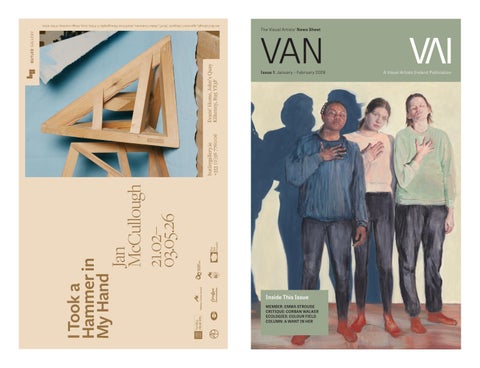
The Visual Artists' News Sheet – January February 2026

Page 1


The Visual Artists’ News Sheet

January – February 2026

On The Cover

Emma Stroude, Three Towers. Impenitent., 2025, oil on canvas, 150cm x 150cm; photograph by Dickon Whitehead, courtesy of the artist.

First Pages

6. Roundup. Exhibitions and events from the past two months. 8. News. The latest developments in the arts sector.

Columns

9. Winter Bookends. Cornelius Browne punctuates the shorter days with dawn paintings and winter nocturnes.

A Want in Her. Grace O’Boyle reflects on Myrid Carten’s awardwinning documentary film.

10. A Walking Library. Lian Bell outlines some reading material on walking and related fields.

What is Creative Production? Nathan O’Donnell reflects on his participation in Kunstverein Projects’ Creative Producers Programme.

11. Colour Field. Hollie Kearns discusses a new artist’s dye garden and associated workshop programme at Workhouse Union.

Exhibition Profile

12. Acts of Creation. Dr Kate Antosik-Parsons reviews the Hayward Gallery touring exhibition currently at VISUAL.

14. Pa ern Recognition. Paula Barre outlines a recent exhibition at Riverbank Arts Centre presenting 15 Kildare-based artists.

16. Reverse Migration. Grace O’Boyle considers Cecilia Vicuña exhibition at IMMA.

18. The Paradise [mother, unmothered]. Pauline Keena and Dr Loïc Bourdeau discuss the Motherhood Project. From the Earth. Sean Walsh interviews Margo McNulty about her studio residency and solo exhibition at Esker Arts.

Critique

19. Sharon Kelly, Roman Book Page, 2025

20. Corban Walker at Solomon Fine Art

21. ‘Fallen Tree / Crann Leagtha’ at Cultúrlann McAdam Ó Fiaich

22. Geraldine O’Neill at Kevin Kavanagh

23. Susan MacWilliam at Ormston House

24. Brian Harte at Butler Gallery

International Profile

26. The Medium is the Message. Pádraic E. Moore considers the current exhibition at the College of Psychic Studies in London.

Organisation Profile

28. A to Z of ACA. Michele Horrigan presents a glossary of Askeaton Contemporary Arts, now celebrating 20 years.

VAI Policy

30. The Visual Artists Bill of Rights. The protections, entitlements, and standards for artists working within Ireland and the EU.

Performance Art

32. How We Get Free. Clodagh Assata Boyce outlines a Black Feminist Performance Art Programme at PS² in Belfast.

Member Profile

33. Core Heat. Emma Stroude outlines the trajectory and ongoing concerns of her figurative painting practice.

34. In Transit. Maria Ginnity outlines the evolution of her painting practice.

35. Dethroned Icons. Mags Geaney discusses her artistic practice.

36. Symplegmatic Portals. Miguel Amado considers the evolving practice of artist and VAI member Samir Mahmood. Brave Spaces. Dr Sinéad Mccann outlines some of her recent socially engaged projects.

Last Pages

37. Public Art Roundup. Site-specific works beyond the gallery.

38. VAI Lifelong Learning. Helpdesks, cafés, and webinars.

The Visual Artists’ News Sheet:

Editor: Joanne Laws

Production/Design: Thomas Pool

News/Opportunities: Thomas Pool, Mary McGrath, Lewis Olivier

Proofreading: Paul Dunne

Visual Artists Ireland:

CEO/Director: Noel Kelly

Office Manager: Grazyna Rzanek

Member & Artists Advice, Advocacy & Development: Mary McGrath

Advocacy & Advice NI: Brian Kielt

Services Design & Delivery: Emer Ferran

News Provision: Thomas Pool

Publications: Joanne Laws

Accounts: Grazyna Rzanek

Special Projects: Robert O‘Neill

Impact Measurement: Rob Hilken

Shared Island Advocacy: Brian Kielt

Board of Directors:

Deborah Crowley, Michael Fitzpatrick (Chair), Lorelei Harris, Maeve Jennings, Gina O’Kelly, Deirdre O’Mahony (Secretary), Samir Mahmood, Paul Moore, Ben Readman.

Republic of Ireland Office

Visual Artists Ireland

First Floor

2 Curved Street

Temple Bar, Dublin 2

T: +353 (0)1 672 9488

E: info@visualartists.ie

W: visualartists.ie

Northern Ireland Office

Visual Artists Ireland

109 Royal Avenue

Belfast

BT1 1FF

T: +44 (0)28 958 70361

E: info@visualartists-ni.org

W: visualartists-ni.org

Fingal County Council Fingal Artists’ Support Scheme 2026

Fingal County Council invites applications from artists for up to €5,000 to support travel and professional development opportunities, a residency, or the development of work. The award is open to practising artists at all stages in their professional careers working in music, visual art, lm, drama, literature, and dance.

To be eligible to apply, applicants must have been born, have studied, or currently reside in the Fingal administrative area.

For further information and to apply please visit ngalarts.ie or ngal.ie/arts

Closing date for receipt of applications: Friday 27th February 2026 at 4.00pm ngalarts.ie ngal.ie/arts

Fingal, A Place for Art

Pallas Projects/Studios

Artist-Initiated

January–December

Paddy Critchley

22/01–07/02

Fiona Marron

12/03–28/03

Finn Nichol

09/04–25/04

Emma Brennan & Thomas Wells

07/05–23/05

Ciara Rodgers

04/06–20/06

Struàn Bell

02/07–18/07

Christopher Mahon

30/07–15/08 neonatus.exe

26/11–12/12

Sophie

Sarah

17 January - 28 February 2026

Curated by Helena Tobin & Iris Vos

Mermaid Arts Centre, Bray, Co Wicklow, A98 N5P1
Mermaid Arts Centre, Main Street, Bray, County Wicklow, A98 N5P1
In partnership with the National Irish Visual Arts Library (NIVAL), NCAD

Dublin

Belfast

Dublin Gallery Weekend

From 6 to 9 November, Ireland’s Contemporary Art Gallery Association brought the country’s most exciting artists, galleries, cultural institutions and creative spaces together to stage a city takeover for Dublin Gallery Weekend. A citywide showcase of Ireland’s bold, experimental and unapologetic contemporary art energy, Dublin Gallery Weekend will light up the capital, morning to late night, with new exhibitions, behind the scenes studio tours, meet the artists, industry talks, a DGW+ fringe programme and hands-on workshops. dublingalleryweekend.ie

‘ASSETS’ by Alan Butler was on display from 7 November to 12 December. e exhibition is typically interdisciplinary and features a collection of works which re ect the artist’s interest in 3D graphics, networked technologies and the mechanics of image production. ‘ASSETS’ is Alan Butler’s second solo exhibition since his debut in 2017, and since then, his work has been the subject of over one hundred exhibitions at galleries, museums and festivals around the world.

greenonredgallery.com

Reds Gallery

‘Us, Nature’ was an exhibition of plein air paintings, with each participating artist having a di erent approach. All !nd ways to both commune with the nature around them, and to capture the beauty of a moment and exist in it for a time. Serving as a gateway into the world of landscapes, the exhibition explored our intoxicating yet fragile relationship with nature. Curated by Tony Strickland, it was on display from 4 to 10 December.

@reds_gallery_dublin

Flux Gallery

e Minaw Collective presented ‘Street to Studio’, a group exhibition running from 27 to 30 November. Known for their murals across Ireland and internationally, the Minaw Collective brought their work into the gallery, translating the boldness of street art into intimate studio pieces. ‘Street to Studio’ explored how muralists move between large-scale public walls and their own studio practices, creating paintings, works on paper, and mixed media that carry the same energy and imagination found in their outdoor work.

fluxdublin.ie

Kerlin Gallery

‘Look at the Harlequins!’ by Isabel Nolan was on display from 11 October to 22 November. Ahead of Nolan’s forthcoming representation of Ireland at the 61st Venice Biennale in 2026, this exhibition o ered an insight into the artist’s practice characterised by its shifting movement between mediums, where sculpture, textiles and works on paper are held in lively dialogue, celebrating and communing with historical !gures and works of art that speak to us across centuries.

kerlingallery.com

Rua Red

‘Patient Labyrinth’, a new artwork and exhibition from Junk Ensemble, explores the delicate boundary between two worlds: the one in which we lose our way, and the one we try to !nd our way out of. e exhibition weaves together myth, folk magic, and ritual to explore how we navigate uncertainty, entrapment, and transformation. As our constructed and natural world unravels to near collapse, we rely on storytelling as a tool for connection, a tool for protection. On display from 12 December to 7 February.

ruared.ie

ArtisAnn Gallery

e celebrated watercolour artist, Barbara Allen, returned to Belfast for her latest show, ‘Homeward’, on display from 5 November to 13 December. e exhibition comprised mainly watercolour renderings of points on Ireland’s west and north coasts, alongside studies of vernacular architecture and marine life. Allen is a six-time winner of the Watercolour Prize at the Royal Ulster Academy, who has exhibited extensively, including at the White House and in Bergen in Norway.

artisann.org

Golden Thread Gallery

‘ e Border at Crossed Me’, on display from 22 November to 31 January, is a multi-sensory collaborative exhibition exploring surveillance technology, border infrastructures, and climate-induced migration. is exhibition has been devised for the Golden read Gallery in collaboration with FLAX Artist Studios, Belfast and Azzedine Saleck. Presented in the Upper Gallery, ‘ e Border at Crossed Me’ examines the political and emotional geographies of divided territories across the globe.

goldenthreadgallery.co.uk

Queens Street Studios

e annual group ‘Christmas Exhibition’ ran from 7 to 16 December at Queen Street Studios in Belfast. Over 50 QSS studio artists and Associate Members showed select pieces across the two gallery spaces. Works displayed in Gallery 1 were priced under £300, while works shown in Gallery 2 were priced accordingly and shown alongside individual prints and smaller sculptural objects. All proceeds from exhibition sales and the annual QSS Fundraising Ra%e will go towards gallery programming and studio upkeep.

queenstreetstudios.net

Atypical Gallery

‘Half Light’ by Charys Wilson was on display at Atypical from 13 November to 17 December. e work is inspired in part by the practice of forest bathing, or shinrin-yoku, a Japanese tradition of spending quiet, mindful time among trees. Research shows that this kind of intentional time in nature can reduce stress, improve mood, and even boost the immune system. For many of us, especially during the colder months or in urban environments, this kind of immersive experience can feel out of reach.

universityofatypical.org

Room2

‘Across Eurasia, Encountering Ulster’ by Lin Li was on display from 4 December to 8 January, featuring a series of oil paintings that depict the landscapes of Ulster, reimagined through a unique fusion of Eastern aesthetic thought and Western painting materials. Rather than illustrating Asian geography, Lin Li’s practice brings East Asian philosophical concepts – such as qiyun (spirit resonance), the vitality of mountains and clouds, and meditative modes of observation – into dialogue with the dramatic hills, coastlines, and atmospheric shifts of Ulster. @lilinpale e

The MAC ‘LAST ACT’, on display from 9 October to 4 January, is a synchronised video installation by artist Marie Hanlon and composer Rhona Clarke. e work presents climate change as something both real and abstract; as such it mirrors the human response to a changing earth. Visual imagery draws on footage of real weather events, while sequences are coordinated to make them di erent from daily media reportage. Opening and closing sections of the installation allude to industry and rise of emission levels following the industrial revolution.

themaclive.com

[Left]: Lynda Bremner, Dingle Swallows, 2025, oil on old OS map, 55 x 78 cm; image courtesy of the artist and Linn Gallery. [Middle]: Isabel Nolan, Splendid and Pointless, 2025, 10mm solid round steel, paint, 4 elements, 2/2 from a variable edition of 2, each edition in different colours 240.5 x 119.7 x 119.7 cm; photograph courtesy of the artist and Kerlin Gallery. [Right]: Marian O'Donoghue, Summer Hedgerow 2025, oil on canvas; image courtesy of the artist and Solas Art.
Green On Red Gallery

Regional & International

Backwater Artists

Backwater Artists Group’s annual endof-year Members Exhibition, featuring 25 artists from across their network, was on display from 19 September to 19 December. e exhibition was an opportunity to highlight the high calibre of artistic practice within the memberships, while providing the artists with opportunities to sell their works to the wider public. It was also an opportunity for the studio to raise additional funds through commission on sales, to support artists by delivering a programme of developmental supports. backwaterartists.ie

Hambly & Hambly

‘ e Lough Erne Collection’ brought together exceptional works by renowned award-winning artists across Ireland, including Eamon Colman, Ani Mollereau, Brian Byrne, Neal Greig, Colman-Mazur, Geo O’Keefe, Maria Noonan-McDermott, and Billy Moore. e collection spans evocative landscapes, intimate wildlife studies, and works inspired by the poetry of W.B. Yeats, o ering a rich visual dialogue between Ireland’s natural beauty, cultural legacy, and contemporary artistic expression. On dsiplay from 16 December. hamblyandhambly.com

Mermaid Arts Centre

Crickets (2025), a !lm by visual artist Bea McMahon, was shown at Mermaid Arts Centre on 10 December. is was a screening of a work-in-progress of a potential sixpart TV series by McMahon and a crew of collaborators: Deniz Buga, Artémise Ploegaerts, Nathan O’Donnell, and Díc Walsh, among others. Working in the genre of ‘cringe tragedy’ and improvising script, set, characters, costumes and direction on location in France and Ireland, the screening marked an opportunity to delve behind the scenes. mermaidartscentre.ie

Centre Culturel Irlandais

e Centre Culturel Irlandais in Paris presented a selection of works from Daragh Soden’s latest series of large-format portraits. ‘Ladies and Gentlemen’ raised questions around gender roles, photographer-subject relationships, and performative expressions of identity. Speaking about this work, Soden said: “I decided to play out my role in front of the camera, addressing the sometimes awkward relationship between the author and the subject.” On display from 13 November to 21 December.

centreculturelirlandais.com

Irish Arts Center

‘Irish Gothic’ by Patricia Hurl, ran from 5 September to 18 January at the Irish Arts Center in New York City (an international member organisation of VAI). For more than four decades, the painter Patricia Hurl has portrayed the lives of Irish women and their experiences as housewives, child-bearers, caretakers, providers, and warriors navigating a male-dominated world, evoking the broad spectrum of emotions felt by her subjects through expressionistic, layered brushstrokes and blending the !gurative and abstract.

irishartscenter.org

Solas Art Gallery

e Winter Group Exhibition’ runs from 21 November to 9 January in the Island eatre, Ballinamore. is exhibition brings together over 20 artists whose works showcase an array of intriguing mediums, diverse materials, and vibrant artistry. From traditional !ne art processes (drypoint etching, pen and ink, oils, acrylics, watercolours, and photography) to contemporary and textural forms (embroidery, knitting, wet felt, decorator’s emulsion and mixed-media collage), together these pieces celebrate texture, technique, and the shared joy of making. solasart.ie

Flat Time House

Lyónn Wolf’s ‘De-production’ creates an installation running through a succession of spaces in Flat Time House in London. Playing upon the narrative and spatial tropes of popular Science Fiction, ‘De-production’ has grown into an ongoing project for Wolf, tracing states of transition through what he describes as “an intentional re-patterning of reproductive logics.” emes are drawn from close readings of Ridley Scott’s !lm Alien – monstrous motherhood, alienated embodiments, and transitional states. On display from 28 November to 25 January. fla imeho.org.uk

Lavit Gallery

Lavit Gallery’s Winter Exhibition presents the best in Irish art, craft, and design including paintings, prints, sculpture, ceramics, textiles and much more, with prices to suit every budget in the run-up to Christmas. Each year, the exhibition features work by over 50 artists and makers, including regular contributors and new additions. Cork Arts Society (trading as Lavit Gallery) is a not-for-pro!t arts organisation and registered charity, founded in 1963 to promote an appreciation of art in Cork. Exhibition 2025 continues until 31 January. lavitgallery.com

Town Hall Theatre Gallery

‘Coiscéimeanna/footsteps’ by Deirdre Stephens was on display at the Town Hall eatre in Galway from 10 November to 10 December. Supported by Ealaín na Gaeltachta, this was Stephens’ !rst solo exhibition and showed creative and colourful interpretations of the links between traditional Aran Island clothing and the landscape of the islands. Also on display was a wall hanging which was made with the intention of inviting re ection both on the beauty of the Inverin blanket bog and the damage caused to it by climate change. tht.ie

Galway City Library

In ‘Closed Doors’, Galway-based artists Helen Fahey and Louise Blasi brought together two strikingly di erent yet deeply connected explorations of absence, memory, and transition. e exhibition created a conversation between the physical spaces we abandon and the emotional thresholds we quietly cross throughout a life. Together, Fahey and Blasi o ered a tender, unsettling re ection on what remains when something or someone is no longer there. On display from 24 November to 6 December.

galwaycity.ie

Linn Gallery

Linn Gallery, a new art gallery in Clonmel, launched their inaugural exhibition, ‘skylines’, on 29 November. e group show features the work of seven Irish artists: Alison Barry, Lynda Bremner, Eugene de Leastar, Gary Kearney, Marine Kearney, Diane Magee, and Lee Shanahan. e show invited the artists to look beyond the literal horizon, exploring the theme not only as depictions of urban or natural landscapes but also as representations of artistic innovation, personal journeys, and evolving perspectives. linngallery.ie

Void Art Centre

‘Pollanroe Burn’ by artist Emily McFarland, was on display from 27 September to 13 December. ‘Pollanroe Burn’ unfolds through a series of new !lms and archival fragments, forming part of McFarland’s ongoing research into the shifting ecology of the Sperrin Mountains, in the shadow of proposed, major, industrial-scale, gold extraction. e project asks: How can we cultivate modes of thinking that allow intellect and empathy to apprehend the long-standing and delicate connections between humans and their environments? derryvoid.com

[Left]: Janet Murran, In an Inch of Spring Sun, 2024, acrylic on solid wood panel, 60 x 75 cm; image courtesy of the artist and the Lavit Gallery. [Right]: Mural development by The Minaw Collective, featuring Jess Tobin (aka Novice); image by DGM Photography, courtesy of The Minaw Collective.

THE LATEST FROM THE ARTS SECTOR

Michael D. Higgins Concludes Term As Ninth President Of Ireland

On Wednesday 5 November 2025, Uachtarán na hÉireann, President Michael D. Higgins and his wife Sabina received the President Elect, Ms. Catherine Connolly at Áras an Uachtaráin. President and Sabina Higgins subsequently departed Áras an Uachtaráin on Monday 10 November 2025, ahead of the conclusion of his term of office as the ninth President of Ireland.

President Higgins first took office at his inauguration on 11 November 2011 and commenced his second term at his second inauguration on 11 November 2018. His second term concluded at midnight on Monday 10 November 2025.

In a statement, President Higgins said: “Serving as President of Ireland

AI Ban at Vault Christmas Market

Organisers of the annual Christmas market at Vault Artist Studios in Belfast o&cially banned the sale of artworks generated by arti!cial intelligence, on the basis that “AI cannibalises the work of low-paid creatives” and poses a tangible threat to artists’ livelihoods.

Speaking to Agence France-Presse (AFP) during the event, co-organiser and visual artist Jonathan Brennan, said: “We have to take a stand,” adding that “people come here to appreciate unique gifts, handmade things that you won’t !nd anywhere else.” Using AI to produce art equates to “jumping to a solution without any of the hard graft, discipline or potential happy accidents that can happen in the creative process,” he added. “You end up with something which is kind of soulless.”

Rob Hilken, who is also an artist at Vault Artist Studios, stated that: “AI-generated art is directly a ecting Vault members’ ability to !nd opportunities and make a living. We are competing with machines on price, licensing terms, and speed of delivery, and we are not winning. AI is literally stealing our ideas to undercut us in the market. Taking a stand against AI-generated art is important and urgent.” Up to 80 artists participated in the two-day market (which ran on 6 and 7 December 2025), selling original artworks, prints, and clothing.

New Aosdána Members

At its 43rd General Assembly at IMMA, Aosdána, the a&liation of creative artists in Ireland, elected nine new members: Paul Brady (Music), Alan Gilsenan (Visual Art), Shih-Fu Peng (Architecture), Paul Mercier (Literature), Orla Barry (Visual Arts), Áine Ní Ghlinn (Literature), Locky Morris (Visual Arts), Mufutau Yusuf (Choreography), and Nuala O’Connor (Literature). is brings the membership to 250 members.

Addressing the General Assembly, Maura McGrath, Arts Council Chair said: “Aosdána is a cherished part of the Arts Council and of the wider arts community. Today we gather to celebrate the spirit of creativity while also honouring and remembering those members who are no longer with us.”

was a great privilege, and I would like to thank the people of Ireland for the warmth of reception which they gave to both Sabina and myself over the past 14 years. How valuable it was to be able to join with them in engaging with the issues, projects and ideas that will help us to achieve the best of our country and the best representation of Ireland and its values abroad –an inclusive citizenship and a creative society in a real Republic. Guím gach beannacht do mhuintir na hÉireann do’n todhchaí.”

Winner of AIB Portrait Prize 2025 Late Spring (2025), by Daniel Nelis, has been announced as the winner of the AIB Portrait Prize 2025. Biddy Boy (2025) by John Foley, and e Final Portrait (2025) by Conor O’Leary were ranked as Highly Commended by the judges.

e annual competition showcases contemporary portraiture and invites submissions from artists working in all media and disciplines, from across the island of Ireland and from Irish artists living abroad. e prize aims to celebrate and encourage interest in contemporary portraiture, while raising the pro!le of the evolving National Portrait Collection at the National Gallery of Ireland.

e winner of the competition receives a cash prize of €15,000 and will be commissioned to create a work for the National Portrait Collection, for which they will be awarded a further €5,000. Two additional awards of €1,500 are given to highly commended works. e winners were announced at an award ceremony at the National Gallery on 25 November 2025, chosen by the members of this year’s judging panel: Gareth Reid, Professor Emily Mark-Fitzgerald, and Dr Barbara Dawson.

Myrid Carten Wins Three BIFAs Fís Éireann/Screen Ireland congratulated Myrid Carten and the team behind the Screen Ireland-supported documentary, A Want in Her (2024), on the !lm’s British Independent Film Awards (BIFAs) award wins on 30 November. e !lm won all three awards it was nominated for: Best Feature Documentary, the Raindance Maverick Award, and Best Debut Director – Feature Documentary.

When her mother goes missing somewhere in Ireland, artist Myrid Carten returns from London to !nd her. Her search takes her into a feuding family, a contested house, and a history that threatens to take everyone down, including herself. e !lm received its World Premiere at the International Documentary Film Festival 2024 (IDFA) and went on to win several awards over the course of its festival run, including Best Documentary at the 2025 Dublin International Film Festival, and the DocPoint Award at DocPoint, Helsinki’s

Documentary Film Festival.

A Want in Her is Myrid Carten’s feature directorial debut, proudly supported by Screen Ireland and the BFI Doc Society Fund in association with New Dawn and the Netherlands Film Fund. e !lm is an Inland Films Production in co-production with Snowstorm Productions and Basalt Film.

Irish production company Element Pictures also strongly featured among this year’s BIFA winners, with their productions Pillion (2025) and My Father’s Shadow (2025) winning a total of !ve awards on the night.

Honorary Doctorates

NCAD: is year’s recipients of the NCAD Honorary Doctorates, Dorothy Cross and Anthony Dunne, were formally conferred their awards at University College Dublin as part of the 2025 Autumn Conferring ceremony. eir distinguished careers have made signi!cant and lasting contributions to the !elds of art and design, enriching cultural discourse in Ireland and internationally.

Dorothy Cross’s exceptional artistic practice, spanning sculpture, installation, !lm, and ambitious live events, has profoundly in uenced contemporary art in Ireland and beyond. Her work explores the intersections of nature, history, and the human body with extraordinary depth and imagination, continuously challenging and expanding our understanding of life and the non-human world. Anthony Dunne, an NCAD alumnus, has been a pioneering !gure in critical and speculative design, shaping contemporary design thinking and practice globally. His work uses design as a tool to provoke critical re ection and imagine alternative futures, emphasising design’s powerful role beyond aesthetics, as a cultural and societal catalyst. Together, their careers re ect NCAD’s enduring commitment to fostering creativity, critical inquiry, and cultural leadership.

Trinity College Dublin: On Friday November 28, four honorary degrees were conferred to Pietro Perona, Kathy Prendergast, Ifrah Ahmed, and Mei Lin Yap at a Commencement Ceremony in the Public

Honorary Degrees are awarded to individuals of integrity, character, judgment and exceptional achievement “whose acceptance of an honorary degree would add lustre to this University”.

Candidates can be nominated by any student, sta , or alumni of Trinity College. Nominations occur across the year on a rolling basis and award ceremonies occur biannually. Applications are assessed by the Advisory Committee on Honorary Degrees (ACHD) which is composed of the chancellor, the registrar, and the vice-provost, as well as representatives of the sta and student body.

NUIG: University of Galway has conferred its 2025 honorary degrees, celebrating six distinguished individuals for their outstanding contributions across the arts, literature, music, law, and public life. e awards were formally presented at a special ceremony on-campus on 27 November 2025. e six recipients were: Brian Bourke, Anna Heussa , Kathleen Loughnane, Peadar Mac Fhlannchadha, Pádraig Ó Céidigh, and Micheál Ó Cuaig.

Professor David Burn, President of University of Galway, said: “Our honorary degrees recognise individuals whose achievements re ect the values and aspirations of our University community. is year’s recipients represent excellence across creative, cultural, academic and civic life and we are honoured to welcome them into our University community.”

ree nominees, Margo Harkin, Olwen Fouéré and Kerby A. Miller, declined degrees due to the University’s participation in an EU Horizon Europe research project involving an Israeli university.

Professor Burn continued: “We respect the decision of other nominees to not participate today. Discussion and debate are the cornerstones of University life, and we are committed to !nding a way forward with our community.”

eatre.
President and Sabina Higgins receive the President Elect, Ms. Catherine Connolly at Áras an Uachtaráin on Wednesday 5 November 2025; photograph courtesy of the Office of the President.

Plein Air Winter Bookends

CORNELIUS BROWNE PUNCTUATES THE SHORTER DAYS WITH DAWN PAINTINGS AND WINTER NOCTURNES.

A YEAR ENDS and a year begins; between them, a whisper of time. Last January, after a surprise nocturnal snowfall, I nipped outside to paint the timid dawn. My winter paintings, re ecting the narrow presence of daylight, are smaller than those made across the expansive days of summer. e freezing air constricts painting sessions. at bitter daybreak, I was soon stamping the ground to boost circulation, my breath a plume of fog. e outdoor painter is always, !rst and foremost, a body.

As fresh snow blew in over the tops of our pine trees, I felt my own presence narrowing to the points of my numb !ngertips, jabbing the tine of a slender brush, dipped repeatedly into pristine white. A mesmeric aura descended upon the rough pocket of garden quietly !lling with snow. Painting individual oating akes, the world drifted away. is snowscape may have been a tiny receptacle, yet into it, I poured all of my energy.

Retreating indoors, I neglected to pack away my exterior studio, leaving easel and paints exposed to the short day. It was almost dark, the tail end of a gloomy afternoon, when I realised my mistake. Having come to see errors as pokes of the unconscious, I stepped back into my painting garb.

Snow was falling again, as I embarked on a companion to the morning picture. e temperature had plummeted once the sun fell behind the hills. I moved my studio closer to the house, almost slipping on our icy rutted lane. e owerpots that in summer hosted bright cornet blasts of blossoms, now sat in silence, accumulating snow. Memories !lled my vision as I painted for the umpteenth time, the lake I had grown up beside. I am a speck in the ‘Big Snow’ of 1982, walking across frozen water, daydreaming colourful futures.

Bookending short days with paintings became my way of exalting scarce sunlight. Not until the evenings brightened did the need vanish. Now, with November days

shortening, I return to these winter diptychs to bookend the year.

On the day my easel stood forgotten in the snow, I was immersed in Andrew Miller’s novel, e Land in Winter (Hodder & Stoughton, 2024), set during 1962-63, the coldest European winter of the twentieth century. ose snowbound months also call to mind the British painter, Joan Eardley. In January 1963, her last winter on earth, she painted her !nal large landscape, the now famous Catterline in Winter is work is often mistaken for a nocturne of the moonlit Scottish village. Villagers who were children at the time remember seeing Eardley painting this winter scene, about ten metres from her front door. Gravely ill with the cancer that would end her life the following summer, here she stood, working in historic cold. It was afternoon. It is the sun, not the moon, that hangs low in the lead-grey sky. Eardley was painting the dying of the light.

During the winter of 1958, Catterline was cut o for weeks, food stocks ran low, milk was brought in by sledge, and the painter’s front door was blown in by a gale. Eardley painted two landscapes depicting the same vista. Snow (1958) was painted from the back of Eardley’s cottage, in the communal vegetable plot. To paint Fields Under Snow (1958), she moved north, closer to the garden fence, leaving herself even more open to the elements. As she remarked in a letter written in February 1958: “You really need to be tough for this game.”

Eardley is a painter who crosses my thoughts almost every day of the year. I wonder about her life in the snowstorms, between these majestic winter bookends. All we know is that, while marooned from the outside world by blizzards, she was reading Marcel Proust’s monumental 4,300-page novel, Remembrance of ings Past (Grasset and Gallimard, 1913-1927).

Cornelius Browne is a Donegal-based artist.

Moving Image

A Want in Her

GRACE O’BOYLE REVIEWS MYRID CARTEN’S AWARD - WINNING DEBUT FEATURE FILM, SET IN RURAL NORTH DONEGAL.

MYRID CARTEN IS an artist and !lmmaker from the Gaeltacht region in Donegal. A graduate of Central Saint Martins and Goldsmith College in London, her practice utilises documentary and !ction to examine the struggle for intimacy and how the past continues to shape us. Carten’s debut feature !lm, A Want in Her (2024), is an immersive, !rst-person account of her relationship with her mother, Nuala, who is embroiled in the struggles of mental illness and addiction.

Carten interweaves prophetic camcorder footage from her youth with 16mm shots of Northwest Donegal, intimate phone calls, and previous artistic projects, into an aesthetic tapestry that is strikingly original.

e 81-minute documentary is not didactic, nor is it an inquiry into the source of her mother’s condition, but rather the artistic expression of a daughter navigating an impossibly thick world of responsibility, guilt, and unconditional love.

After the death of the family’s matriarch 20 years prior, the family home becomes a contested site as Kevin, Nuala’s brother, solely inherits the house. Isolated and brooding in the Donegal terrain, the home is the !rst character we meet. It is an anthropomorphic entity – correlating with the interior lives of the family members who inhabit it. Carten does not present the home as a static object or set design; instead, she renders the domestic space alive through a surreal and haptic treatment of everyday materials.

e camera follows water droplets fall from the ceiling; it shoots from ashes in the !replace, and tunnels lace curtains. Its oneiric imagery takes on a ghostly quality, suggesting that an energy remains at large in the house. Within the home, the !lm’s central container, certain constants persist; boiling the kettle, smoking cigarettes, and gathering around the !replace become grounding, life-sustaining rituals.

With a camera in hand, Carten makes a clearing through thick foliage to access an abandoned caravan just outside the family home. Her other uncle, Danny, is sheltering, but the natural world has already crept in. It is now reclaimed – wild, rotting, and

unruly. Danny’s presence makes familial con ict visible to the viewer, allowing Carten’s diaristic exploration to unfold. Fractured and non-linear, the !lm’s timeline relies on Carten’s intuition and technical skill to construct the contours of her and her mother’s complex dynamic. She resists straightforward explanation and embraces a form of !lmmaking that thinks through trauma.

A woman wearing a grey hoodie is collapsed on a public bench in Belfast city. She clenches a bottle of wine, her legs crossed, as a pink double-decker bus passes with the words “You Can Get rough is,” pasted on an advertisement. It feels scripted in its cosmic irony. Carten identi!es her mother who has been missing: “I knew straight away it was mammy because of the heels.” She !lms at a distance, preserving the quiet, implicit agreement to remain discreet whenever Nuala is drinking. In this moment, as with many throughout the !lm, the viewer is an participating subject, who must reckon with themes of consent, trust, and the necrotic forces at play within the human experience.

Although systemic issues are not directly addressed in the !lm, they inevitably linger. As a Donegal native, Carten’s depiction of Errigal, the Muckish Mountains and Gortahork evoke familiar feelings of desolation and disadvantage. ey are mythic in their presentation, but those who live at the foot of Errigal understand the ominous ambiguity of this landscape. Carten’s debut is a profoundly vulnerable account of mental illness, addiction in rural Ireland, and the tension between survival and responsibility.

Grace O’Boyle is a curator and writer from Donegal, based in Dublin.

Myrid Carten’s film, A Want in Her, premiered at the International Documentary Film Festival 2024 (IDFA) and won several awards during its festival run, before winning three British Independent Film Awards (BIFAs) in November 2025. myridcarten.com

Cornelius Browne, January Dawn and Dusk, 2025; photograph by Paula Corcoran, courtesy of the artist.
Myrid Carten, A Want in Her, 2024; film still courtesy of the artist and Inland Films.

Art Work A Walking Library

LIAN BELL OUTLINES A SELECTED BIBLIOGRAPHY OF READING MATERIAL ON THE SUBJECT OF WALKING AND RELATED FIELDS.

IF YOU WERE on Rathmines Road in the mid-1980s, you might have spotted a lone child with white-rimmed glasses and a triangular haircut, reading a book while walking. At that time, I was methodically working my way through the Rathmines Library children’s section, choosing my loans for the week by reading the last page of each book. If the stories ended to my satisfaction, I wanted to get straight into how they began. Once I had a rough sense of where I was going, I was happy to be carried along.

In the world of art walking, there is much value placed on drifting and the dérive – a term mainly associated with the Situationist International’s urban explorations of 1950s Paris. e dérive is a technique used to build up a psychogeography; simplistically put, a mapping of place that factors personal relationships, feelings, and randomness. In some ways, it is a tactic of anti-capitalist resistance – a refusal to be swept along on the monotonous and predictable paths and rhythms of everyday life, but instead to intentionally tune into and note the shifting ambiences of urban space. Drifting means losing track of location, moving through not-knowing, and sharpening observation.

ere are many ways to embark on a walk. I’m not by nature a drifter; I don’t necessarily like to get lost. I like to get to know places in detail by walking them repeatedly, accruing knowledge over time. I usually use maps to help me chart a route, even roughly, before I set out. Navigation is personal. In her self-published book, Suite Vénitienne (1980), Sophie Calle famously followed strangers in Parisian streets, seeing where they led her. One of them she followed all the way to Venice.

Since walking has been a part my life and practice that I return to, it’s not surprising that I’ve accrued a small library of books on the topic. I’m sharing some here, although this is in no way an exhaustive bibliography. Some books are not about walking per se but are aligned with aspects of walking that I’m currently interested in: a refusal of busyness; strategies for grouping well; and the experiences of women in public space.

I no longer read the last page !rst. ese days, much of my reading comes from other people’s recommendations. I use the Libraries mobile app (available in most counties) to reserve books I like the look of, anywhere in the country. Maybe you can borrow one of these books from your library and test it out?

A Selected Bibliography of Walking

• Andrews, Kerri, Wanderers: A History of Women Walking (Reaktion Books, 2020)

• Beaumont, Matthew, How We Walk: Frantz Fanon and the Politics of the Body (Verso, 2024)

• Billinghurst, Helen, Hind, Claire, and Smith, Phil (Eds.), Walking Bodies: Papers, Provocations, Actions from Walking’s New Movements, the Conference (Triarchy Press, 2020)

• De Certeau, Michel, e Practice of Everyday Life, trans. Stephen F. Rendall (University of California Press, 1984)

• Elkin, Lauren, Flâneuse: Women Walk the City in Paris, New York, Tokyo, Venice and London (Vintage, 2016)

• Hall, Harry, e Pedestriennes: America’s Forgotten Superstars (Dog Ear Publishing, 2014)

• Kagge, Erling, Walking, Trans. Becky L. Crook (Vintage, 2019)

• Kern, Leslie, Feminist City: Claiming Space in a Man-Made World (Verso Books, 2021)

• Laing, Olivia, Everybody: A Book About Freedom (Picador, 2021)

• MacFarlane, Robert, e Old Ways: A Journey on Foot (Penguin, 2012)

• Matrix, Making Space: Women and the Manmade Environment (Pluto Press Ltd., 1984)

• Milstein, Cindy Barukh, Constellations of Care: Anarcha-Feminism in Practice (Pluto Press, 2024)

• Mueller, Ellen, Walking as Artistic Practice (SUNY Press, 2023)

• Odell, Jenny, How to Do Nothing Resisting the Attention Economy (Melville House Publishing, 2019)

• O’Mara, Shane, In Praise of Walking: e new science of how we walk and why it’s good for us ( e Bodley Head Ltd., 2019)

• O’Neill, Maggie, and Roberts, Brian, Walking Methods: Research on the Move (Routledge, 2020)

• O’Rourke, Karen, Walking and Mapping: Artists as Cartographers (MIT Press, 2013)

• Pennick, Nigel, Mazes and Labyrinths (Robert Hale, 1990)

• Rose, Morag, e Feminist Art of Walking (Pluto Press, 2025)

• Sinclair, Iain, London Orbital (Penguin, 2002)

• Solnit, Rebecca, Wanderlust: A History of Walking (Penguin, 2001)

• Stewart, Lizzy, Walking Distance (Avery Hill Publishing, 2019)

Creative Producers

What is Creative Production?

NATHAN O’DONNELL REFLECTS ON HIS PARTICIPATION IN KUNSTVEREIN PROJECTS’ CREATIVE PRODUCERS PROGRAMME.

I’M SURE THAT I am not alone in confessing that I do not know exactly what the term ‘creative production’ means. It is a term that has begun to crop up more in recent years, in Ireland at least, for reasons that are not immediately clear. I say this as someone involved in a pilot programme, designed to explore and support creative production across art forms: Kunstverein Projects’ Creative Producers Programme (2025–27) led by Kate Strain and Michelle Darmody. e other !ve other participants are Aisling Murray, Fatoumata Gandega, Iarlaith Ní Fheorais, Rachel Botha, and Seán Ward. But I can also fairly con!dently attest that none of us involved in the programme really know what creative production actually is.

is is not to say that I think it an unhelpful or un-generative term. On the contrary, it feels like a sort of provocation, inviting us to think more carefully about what it means to work with artists, institutions, and others, in curatorial, technical, critical, or otherwise supporting capacities. In the context of contemporary art, the idea of ‘creative production’ could present certain possibilities, helping perhaps to rede!ne, clarify, or make transparent the kinds of relationships and processes through which things actually happen. Of course, this presents as many questions (about the role of the artist, the power of the institution, the authority of the artwork, and so on) as it could ever resolve.

ese were some of the loose ideas and propositions discussed on an afternoon last October, in the upstairs o&ces of EVA International in Limerick, with EVA’s Director Matt Packer and Creative Producer Ailbhe W. Drohan, as well as artist Eimear Walshe, during one of the !rst ‘training days’, through which the Creative Producers Programme (CPP) will unfold over the next year or so. e conversation that afternoon hinged initially upon logistical questions. How can producers be useful to artists or to the process of art-making? How might this role di er from – or overlap with – that of a curator? Is it, in fact, a distinct role, or rather a re-composition of certain elements of existing roles, between the curatorial, the operational, the technical? And if so, what are the advantages to de!ning it as a somehow distinct category?

labour.

We are all engaged in production processes on several fronts, in ways that are dif!cult to bracket together, except, perhaps, that across this variety of processes, each of our practices involves working with others Ultimately, this seemed the most useful frame for thinking through the infrastructural possibilities of this idea of ‘creative production’: as a way of quantifying the labour and exploring the ethics of co-operation and collegiality within the !eld of contemporary art and exhibition-making. e discussion that afternoon felt enrichingly speculative, if somewhat nebulous; it struck me as just the beginning of a conversation we all wanted to continue pursuing. e next day, we assembled at Ormston House for a session of an entirely di erent order. IMMA Lead Technician, Dave Trunk, had been invited to run a very practical workshop on the process of installing exhibitions. He began with a general discussion about the nature of the relationship between artist, curator, producer, technician, and the value of communication and exchange across these roles and sets of expertise.

After that, Dave took his position to lead the workshop, the two connected trestle tables before him covered in work tools, nails, !xtures, tape measures – the familiar paraphernalia of the install – and proceeded to talk to us about the technicalities, particularly about unpacking, measuring, moving, and hanging wall-based work. It felt at moments like we were an audience at a cookery demonstration, except with an art technician showing us how to take measurements and attach !xtures into frames. I loved it. I also wondered what we were doing here! But this might be, I’m coming to suspect, the real value of a programme like this: bringing practitioners together to query what it is we’re actually doing, and why, and with whom, and to think about ways in which these things might be fruitfully rede!ned.

Nathan O’Donnell is a writer and curator who works in the fields of experimental publishing, artists’ writing, and participatory practice.

Lian Bell is an artist and arts worker based in Dublin. lianbell.com

It quickly became clear that there was no general consensus on these questions. e CPP participants are also engaged in art-making in other ways – as curators, artists, writers, programmers, festival directors, and art publishers. For some of us, these professional terms are helpful; for others, they imply particular power relations, hierarchies, institutional structures. We talked, in particular, of course, about the role of the ‘curator’, with its muddied relationship to cultural and reputational capital, as well as to copyright, intellectual property, and

Kunstverein Projects’ Creative Producers Programme is an 18-month training and development programme, established to support the development of creative producers and freelance curators, working in the visual arts.

kunstverein.ie

Ecologies

Colour Field

HOLLIE KEARNS DISCUSSES A NEW ARTIST’S DYE GARDEN AND ASSOCIATED WORKSHOP PROGRAMME AT WORKHOUSE UNION.

IN DECEMBER 2024, friends of Workhouse Union gathered in a community meitheal to clear a small section of an adjacent paddock. It was the !rst public moment of the Colour Field – an artist’s garden cultivated to nurture colour-giving plants for use in art and textile practices. Many plants that we know as pervasive weeds are in fact colour-giving and medicinal companions that our ancestors would have been in relationship with. e Colour Field is already home to dock, nettle, willow, hawthorn, and yarrow plants, and our plan was to enhance the plot with an abundance of colour-giving plants.

e Colour Field weaves many long threads of practice and connection together; environmental, community, art, and practices of place. Workhouse Union is home to PrintBlock Callan, established there by Liz Nilsson. Last year, artist facilitator Michelle McMahon, Rosie Lynch (Creative Director) and Noortje van Deursen (Creative Producer & Co-Design Facilitator), were rethinking the ongoing Pattern Makers programme, and ways to reduce toxic art materials, when the idea of the Colour Field emerged. I was invited to develop the Colour Field and to share my personal practice in natural dyeing, textiles and nature connection. I am, by training, an art historian, but natural dyeing has always felt close to alchemy, combining my research into the colourful, pre-colonial, textile history in Ireland, with intuitive nature connection and just the right amount of scienti!c process to achieve strong colours from plants on cotton and linen.

Luke, a young grower in our community, grew the plants from seeds which we sourced from Irish companies and friends. Our plant list is long but includes traditional dye plants such as woad to make blue, weld to make yellow, and madder and Lady’s Bedstraw to make red. We are growing introduced plants, such as Dyer’s Coreopsis and Dyer’s Camomile, and lesser-known dye plants, such as native medicinal St. John’s Wort, and novel colour-making plant, Black Knight Scabiosa.

A free public workshop programme launched in April 2025 with GREEN, a full day spent with nettle. We gathered, drank and ate nettles, dyed on cotton, and embroidered nettle motifs with naturally dyed threads. e response to the programme launch was immense, and we have been blown away by the diverse and engaged participant group across the year. e natural dyeing process is long and slow, and the workshops were intended as introductory skills for working with natural colour on textiles.

Workshops in RED and YELLOW in May and June explored further printing and dyeing techniques with madder, weld, onion skins and fresh owers. Finally, at Skill Share in September, Michelle

and I !nished the public programme with BLUE, a two-hour workshop using fresh indigo leaves, which thrived in our polytunnel, to achieve a range of turquoise and teal on lengths of silk. roughout the workshops, our conversations explored the plant connections that can inform contemporary artworks. e process of producing colour on textiles has been a sacred practice across cultures and across time until the exploitative fashion industry practices of the last 150 years took hold. What layers of meaning can natural colour produce in a contemporary cultural context?

Making Colour was an open-call supported residency programme last July. Marielle MacLeman, Annie Hogg and Sylvia Maher undertook a week of rich and experimental dye research in the new outdoor dye studio, exploring deep questions of process, labour, and care. In August, I led the Open Studio Workshop, a three-day collaboration with six artists, which allowed us to go through the process from preparation of fabric to !nished dye together. We chose three plants to work with: madder, dock seeds, and dyer’s camomile, which we then modi!ed with iron, alkaline, acid, and copper solutions. By the third day, we laid out a beautiful spectrum of strong colour on cloth.

Many dye plants in the Colour Field will take a few years to mature – a natural cycle that ensures a long-term commitment to the place and the practice. For the coming year, we have commissioned two artists to make new work which will explore plant colour stories and support the development of the garden. Our workshop and event programme will deepen our connection with natural colour and the sacred, ancient, and innovative potential of plant-based colour for artists. More information can be found on the Workhouse Union website.

Hollie Kearns is Co-Founder of Workhouse Union and an independent curator. workhouseunion.com

[Top]: Marielle MacLeman, Annie Hogg and Sylvia Maher, Making Colour residency, outdoor dye studio, July 2025; photograph by Alex Thomson, courtesy of the author and Workhouse Union. [Bo om]: Open Studio Workshop, Day 3, August 2025; photograph courtesy of the author and Workhouse Union.

Acts of Creation

DR KATE ANTOSIK - PARSONS REVIEWS THE HAYWARD GALLERY TOURING EXHIBITION CURRENTLY AT VISUAL.

MOTHERHOOD IS A subject often idealised or hastily dismissed as unworthy of critical attention within contemporary art. However, ‘Acts of Creation: On Art and Motherhood’, curated by Hettie Judah at VISUAL Carlow (27 Sep 2025 – 11 Jan 2026), o ers an important corrective. is impressive, large-scale, group exhibition brings together over 60 international artists from the 1960s to present day. Organised thematically by Creation, Loss, Maintenance and e Temple, it considers the richness and complexities of motherhood through art. A Hayward Gallery touring exhibition, staged at four UK venues over the past two years,( in its current iteration for VISUAL, it includes additional works by Irish artists, which help to anchor the curatorial inquiry within the immediate landscape.

In Creation, wonderous and strange, sometimes monstrous, maternal bodies are imagined, as new selves emerge and interdependent relationships develop. Angela Forte’s tapestry, Birth of Two Selves (1994), envisions birth as a rupture and a continuance of the self. In Hermione Wiltshire’s vinyl images, Nicola Preparing for Birth (2008), pregnant bodies assume athletic labour poses, with birthing understood as both an event and a process. e Frankenstein-esque altered bodies of Annegret Soltau’s photographs evoke birthing interventions like episiotomies and c-sections. Liss LaFleur’s digital audio libretto But they can’t steal my joy (2022) queers maternal embodiment by translating spoken word into synthesised sound, encapsulating the experience of (m)others.

Inspired by neonatal intensive care experiences, Pauline Cummins’s video Becoming Beloved (1995) deals with autonomy, survival, and the unfolding connections between maternal and infant bodies. Similarly, Fani Parali’s Incubator/Flight (2022) – a delicate pencil drawing of a pre-mature baby resting solemnly in an iron-

All images: ‘Acts of Creation: On Art and Motherhood’, installation view, VISUAL, September 2025; photographs by Ros Kavanagh, courtesy of the artists, VISUAL, and Hayward Gallery.

framed incubator – hovers between fragility and resilience. Other works, like Lea Cetera’s womb-shaped hourglass, and timelapse textile images by Tabitha Soren, skew temporalities, with maternal time running counter to linear time.

In Loss, artists sensitively explore miscarriage, forced adoption, abortion, and death. In the un inching Annonciation (2009-13), Elina Brotherus’s photographs navigate her journey through infertility treatments. Emma Finucane’s sculpture, Politics of the Womb (2017/2025), charts the legal restrictions of the (since repealed) Eighth Amendment of the Irish Constitution and its consequences for reproducing bodies, including maternal deaths and terminations for medical reasons. Patricia Hurl’s Study for Jingle Bells (1987) depicts a haunting emptiness in the aftermath of a stillbirth. Dealing with stigma, Paula Rego’s stark etchings, Abortion Series (1999), and Tracey Emin’s confessional video How It Feels (1996) o er candid insights into the lived experiences of abortion. Nearby, Rachel Fallon’s Aprons of Power (2018) gesture to the absences, and invisible (re)productive labour, of the women and girls sent to Magdalene Laundries and Mother and Baby Homes.

In Maintenance, named for Mierle Laderman Ukeles’ Manifesto for Maintenance Art (1969), the labour and responsibilities of motherhood become a generative force. e stunning, large-scale images of Clare Gallagher’s photographic series, Second Shift (2019), elevate the mundane daily minutia of domestic care. Billie Zangewa’s exquisite hand-stitched collage of a sleeping child, Temporary Reprieve (2017), is a moment of quiet beauty amidst the chaos of childrearing. Rachel Fallon’s Maternal Chain of O ce – Order of Our Blessed Lady of the Food Bank (2018) raises issues about class and the impact of economic austerity on mothers’ abilities to provide their children basic necessities. e absent body of the child from Cassie Arnold’s school uniform, constructed from bulletproof vest material, calls to mind maternal fears for school-attending children in the United States, where gun violence is sadly normalised. Alongside this, Christine Voge’s black and white images in the sanctuary of a women’s shelter contemplate mothering in di&cult circumstances.

e ‘kitchen table’ area in VISUAL’s main gallery space suggests a matricentric activism, reframing the mother as a force for societal change. e archival documents and photographs that represent the interventions of second wave feminist collectives, like e Hackney Flashers and Polvo de Gallina Negra, scrutinise the conditions of artists and mothers in the 1970s and 80s. However, this section may have bene!tted from the inclusion of a contemporary feminist art collective, to give a sense of current maternal art activism. Situated at waist height, the small touchscreen displaying Bobby Baker’s Timed Drawings (198384) o ers glimpses into brief moments in which an artist mother must eke out her creativity. Marlene Dumas’s collaborative mother-daughter works subvert the separation between art and life, the parent-child relationship becoming a creative, artmaking force.

e Temple o ers sensitive and nuanced self-portraits of motherhood. Renee Cox’s portrait of Black maternal power,

Yo Mama Series (1992-94), is anked by Leni Dothan’s Sleeping Madonna (2011), and Catherine Opie’s Self-Portrait/Nursing (2004), upending classical Madonna and Child imagery and complicating dominant notions of motherhood. e composition of Ishbel Myerscough’s family portrait, All (2016), is evocative of nesting dolls, its intimacy and realism revealing a mother’s emotional labour, just as Trish Morrissey’s Eupnea (2023) entwines memories and dreams with maternal hopes and anxieties by focusing on breath. It highlights the fragility of life, and for this writer, it recalled the intense realisation of the impossibility of protecting a child from every potential harm. Overall, this exhibition complicates patriarchal or simplistic understandings of motherhood, instead o ering numerous thought-provoking and challenging engagements with the messiness of art and motherhood.

Dr Kate Antosik-Parsons is a contemporary art historian and a mother of four, who writes about reproductive justice, feminist art and embodiment. kateap.com

( Past exhibition tour venues and dates: Dundee Contemporary Arts (19 April – 13 July 2025); Millennium Gallery, She&eld (24 October 2024 – 19 January 2025); Midland Arts Centre, Birmingham (22 June –29 September 2024); Arnol!ni, Bristol (9 March – 26 May 2024).

ART DOES NOT just re ect the world; often, it organises it. Pattern recognition, a fundamental cognitive process, allows us to interpret and categorise. It is how we perceive order in chaos and construct meaning from experience. is process is central to ‘Pattern Recognition: Architectures of Seeing,’ (1 November – 23 December 2025) an exhibition at Riverbank Arts Centre that brings together 15 artists spanning 15 years of practice in County Kildare.

Pattern Recognition

ARTISTS.

Curating such an exhibition is both a creative and ethical challenge. e curatorial task: to make sense of 15 distinct practices without reducing them to a single narrative. To be a curator is to be a pattern-seeker: thread-!nding, meaning-making. Faced with a multitude of possible permutations, the challenge is to discern thematic threads or visual coherence through resonant motifs. In this exhibition, pattern is positioned as both a visual language and a conceptual framework.

‘Pattern Recognition’ also gestures toward a broader cultural moment: the rise of arti!cial intelligence and its promise of objective decision-making. AI systems, celebrated for their ability to detect patterns at scale, are often positioned as antidotes to human bias. But in doing so, do we risk overlooking the value of subjectivity? e richness of human perspective?

In a time when AI is learning to see, and human vision is increasingly manipulated and mediated by screens and algorithms, this exhibition asks: Whose perspectives are ampli!ed or excluded? Are we outsourcing too much of our interpretive agency? And how might art help us to see di erently – not just more, but more deeply?

Material, Memory, and Meaning

Michelle McBride’s pattern, which wraps around the exhibition

PAULA BARRETT OUTLINES AN EXHIBITION AT RIVERBANK ARTS CENTRE BY KILDARE - BASED
‘Pa ern Recognition’, installation view, November 2025, McKenna Gallery, Riverbank Arts Centre; photograph by Johnny Mallin, courtesy of the artists and Riverbank Arts Centre.

catalogue, is a stark reminder of the world’s selective gaze. rough a careful and tedious mark-making process, Michelle conveys the scale of loss in Yemen through thousands of red marks, each representing a child’s life. Her presentation of numerical data does not just inform – it confronts. Installed within the gallery, it takes up space.

Caoimhe McGuckin’s sculptural work, using the human body as a unit of measurement, draws attention to the corporeality of human comprehension of scale. Exploration of materiality runs throughout the exhibition: Shane Hynan o ers a poignant re ection of human interaction with the natural world. Martina McDonald and Brenda Kearney’s work is tactile and intuitive. Both playful arrangements of pattern-repeat shift our engagement from conceptual understanding to a more embodied relationship with material.

Quiet Structures and Disruptions

Isobel Egan’s delicate porcelain miniatures invite quiet contemplation, encouraging us to notice subtle shifts in light and form. is meditative appreciation of pattern is echoed in Noel Hensey’s video work, which reveals the quiet poetry and variation within seemingly rigid infrastructures.

Disruption of structural systems is central to Katie Whyte’s video piece, where glitching processes introduce unpredictable visual disturbances, challenging the stability of digital imagery. Denis Kelly plays with the tension between order and chaos through repetition and variation in his geometric, yet organic, paintings. Gavin Casey’s work is intuitive but also delves into conceptual systems of representation, drawing on experimental notation where sound is mapped through colour and gesture rather than traditional musical scores.

Cultural Patterns and Belonging

Brian Cregan’s photograph invites re ection on how spaces carry the weight of cultural memory, national identity, and the invisible architecture of knowledge. Kym Tracey, Fiyin Oluokun, Marta Golubowska, and Mary-Jo Gilligan use pattern to interrogate cultural norms and ideologies. eir work shows how living within a pattern can re ect belonging, while stepping outside of it may re ect displacement or resistance. eir artworks highlight the tension between conformity and individuality and invite us to consider how cultural frameworks are formed, challenged, and reimagined.

Embodied Vision

‘Pattern Recognition: Architectures of Seeing’ celebrates the uniquely human capacity to observe, interpret, and feel. In an age increasingly shaped by algorithms and automated seeing, the artists in this exhibition reclaim the act of looking as a deeply personal, embodied, and culturally situated experience.

eir work reminds us that pattern recognition is not just a technical skill – it is a cognitive and emotional art form. is exhibition honours the richness of human interpretation, not as a aw, but as a lens through which meaning is made.

Paula Barre is Assistant Arts Officer at Kildare County Council. ‘Pa ern Recognition: Architectures of Seeing’ (1 November – 23 December 2025) marked 15 years of the Emerging Visual Artist Solo Exhibition Bursary Award, a partnership between Kildare County Council Arts Service and Riverbank Arts Centre. kildarecoco.ie

Marta Golubowska, Be-Longing 2017, ceramic installation; photograph by Johnny Mallin, courtesy of the artist and Riverbank Arts Centre.
[Top]: Michelle McBride, 50,000 (detail), 2018, paper and oil pastel; photograph by Johnny Mallin courtesy of the artist and Riverbank Arts Centre.
[Bo om]: Shane Hynan, Facebank where peat was recently extracted for turf production Allenwood, Co. Kildare 2020, archival pigment print from the series 'Beneath | Beofhód'; photograph © and courtesy of the artist.

CONTINUING AT THE Irish Museum of Modern Art until 5 July is ‘Reverse Migration, a Poetic Journey’ – the !rst solo exhibition in Ireland by Chilean artist, poet, and activist Cecilia Vicuña (b.1948, Santiago). Curated by Mary Cremin (Head of Programming at IMMA), this major exhibition provides context to Vicuña’s multi-disciplinary practice, with a dedicated section (curated by Miguel A. López) introducing her earlier work as an artist and activist.

Reverse Migration

GRACE O’BOYLE CONSIDERS CECILIA VICUÑA’S EXHIBITION

Spanning the breadth of Vicuña’s career, this extensive exhibition also presents a series of new commissions, including paintings, a soundscape, and site-speci!c sculptures, produced in collaboration with museum visitors and local makers.

In October 2025, Vicuña invited IMMA visitors to collect plant matter from native plants in their surroundings. e resulting natural debris, decaying twigs, sprigs, stalks, and shoots are rendered into a large, site-speci!c sculpture which is suspended from the ceiling. is work is titled Foraging Quipu – referring to the ‘quipu’ practice in Andean culture, which encodes information through knotted threads. e installation is lightweight, ephemeral, and sways tenderly with the ow of air through the gallery, like an Alexander Calder mobile. It o ers a gently stirring introduction to Vicuña’s practice.

Perhaps one of the most formative periods of Vicuña’s artistic career occurred at just 22 years old, when Salvador Allende was elected President of Chile, becoming the !rst democratically elected socialist president in Latin America. Allende’s policies sought to nationalise major industries, such as copper mining, implement agrarian reform, and redistribute wealth. Amidst intense social change, Vicuña’s practice begins to emerge as a force aligned with socialism and against capitalist, imperialist, and anthropogenic

Cecilia Vicuña, ‘Reverse Migration: A Poetic Journey’, installation view, Irish Museum of Modern Art, November 2025; photograph by Ros Kavanagh, courtesy of the artist and IMMA.

violence. In 1972, Vicuña was awarded a British Council scholarship to attend the Slade School of Fine Art in London. A few months after her arrival in September 1973, Augusto Pinochet seized power in Chile in a military coup supported by the CIA. Vicuña has been in exile ever since.

e spaces at the start of the show chronicle Vicuña’s early artistic life and, in turn, demonstrate her commitment to creating socially and politically engaged work. Protest banners, documentation of performances like Vaso de leche, Bogotá (1979), archival materials, and !lms !ll these rooms, highlighting the artist’s steadfast devotion to art as activism. Vicuña’s work has clear intentions: to warn about ecological deterioration, to protest social injustices in Chile, and to cultivate communality.

Although ‘Reverse Migration, a Poetic Journey’ is Vicuña’s !rst exhibition in Ireland, this is not her !rst time here. In 2006, following Vicuña’s discovery of her Irish heritage, she and her partner, poet James O’Hern, visited archaeological sites across the island and honoured them with rituals of gratitude. is ancestral connection inspired the exhibition, which explores various narrative threads, including indigenous traditions, and personal and collective memory.

On loan from the National Museum of Ireland, the Seir Kieran Sheela na Gig from County O aly stands on a wooden plinth in the gallery, surrounded by Vicuña’s paintings, inspired by Sheela na Gigs and by feminist imagery from Chilean and indigenous Andean traditions. Vicuña draws striking connections between the life-giving and fertile associations of Sheela na Gig and the Andean deity, Pachamama. e distinctive call of the curlew reverberates through the !nal rooms of the exhibition with a new sound work, Mourning Dialog (2025). e composition moves between the cry of this native, endangered bird, and an acapella piece by Vicuña that embodies oral traditions of indigenous cultures. e high walls of the space are painted deep, dark green, with listeners invited to linger by resting on beanbags. e experience feels rather haunting, since one senses that the curlew’s call may soon fade from memory.

In the !nal space, wool from sheep farmed in Irish !elds hangs from the ceil-

ing like calci!ed stalactites. e !bres react to the faintest breeze; they beckon us to walk through, touch, or press the wool against exposed skin. e installation, titled Aran Quipu (2025), was inspired by the hand-knitted Aran sweaters of Inishmore, and was created in collaboration with local makers. Vicuña makes connections between the lineage of Aran designs – with patterns unique to speci!c families, to help identify those drowned at sea – and the quipu as an information system that communicates ancestral knowledge.

As vibrantly chronicled within ‘Reverse Migration, a Poetic Journey’, Vicuña’s approach to creation makes a case for community and collective action. Unwaveringly hopeful, authentic, and free of cynicism, her art is emboldened by ancient knowledge and her belief in humanity’s potential for radical empathy.

Grace O’Boyle is a curator and writer from Donegal, based in Dublin.

[Top and Bo om]: Cecilia Vicuña, Qué es para usted la poesía (What is poetry to you?), 1980, video, sound, 23 min 20 sec; [Middle]: Cecilia Vicuña, Unknown Sheela 2025, oil on canvas, 55.9 x 66 x 2.5 cm; photographs by Ros Kavanagh, courtesy of the artist and IMMA.

The Paradise [mother, unmothered]

PAULINE KEENA AND DR LOÏC BOURDEAU DISCUSS THEIR COLLABORATION AS PART OF THE MOTHERHOOD PROJECT.

Pauline Keena: When I reached out to Dr Loïc Bourdeau as part of Maynooth University’s ‘Motherhood Project’, I was exploring how art could serve as a body of knowledge. My new work, e Paradise [mother, unmothered] (2025) comprises a short !lm, works on paper, and a large tapestry, assembled with obstetric clamps, which took several years to complete. Each day’s labour was physical and repetitive, yet this exertion became part of the work’s meaning. e duration of making allowed certain ideas – such as shame, punishment, isolation, slavery, loss, and silence – to emerge in the practice rough the slow process of stitching and remembering, the work began to speak back. e tapestry became a form of embodied knowledge, a place where women’s untold stories of con!nement and endurance – of forced adoptions and the Magdalene Laundries – could begin to appear. For every clamp, a child. For every thread, a silence.

Loïc Bourdeau: When I !rst encountered Pauline’s un!nished tapestry, my body reacted before my mind: a tightening in the chest, a sudden stillness. As an academic, trained to analyse, I found myself unlearning. Pauline’s “vague sensation of things” unsettled the tidy frameworks through which universities often measure knowledge. Her work reminded me that sensation precedes strategy; that the body sometimes knows before language arrives.

As a scholar who facilitates narrative medicine workshops – spaces where close reading, storytelling, and creative practice help healthcare professionals attend more deeply to experience – this collaboration rea&rmed my conviction that art is neither a decorative supplement nor a soft skill to be added after the fact. It is a mode of inquiry; a way of producing and transmitting knowledge. Art does not simply accompany medicine; it is integral to medical education and to how we understand, teach, and practise care. e art studio and the seminar room, though worlds apart, can each become spaces of hospitality: places that welcome vulnerability, ambiguity, and contradiction. Both can dwell with what is unresolved.

PK: For me, the act of making is itself a form of thinking, where dialogues become established in the work because of how it is made. e coarse white fabric, the bundled clamps, recall the domestic and the institutional – the hidden sewing rooms of the laundries, the labour of the women who could not speak. ese stories of deprivation, endurance, and trauma are stitched into the surface. In Ireland, these histories still reverberate through collective memory. Art and research have a shared ethical task here: to make space for witnessing without exploitation, for remembering without appropriation. In e Paradise [mother, unmothered], the obstetric clamp – an instrument of both care and harm –becomes a device to hold these tensions. In our dialogue, we began to see that collaboration itself is a form of attention, a way of staying with di&culty rather than explaining it away.

LB: Universities and art institutions often operate on di erent timescales: funding cycles versus studio time; deliverables versus process. Yet when these temporalities meet, something important happens. e artist teaches the researcher to slow down; the researcher helps the artist contextualise and connect with new audiences. Together, they model what interdisciplinary practice can be, when grounded in mutual respect, rather than translation anxiety. Artists and researchers share a commitment to curiosity, rigour, and care, but they often work in parallel, not in partnership. Our experience shows that collaboration need not dilute expertise; it deepens it.

Pauline Keena is a visual artist based in Kildare. The Paradise [mother, unmothered] was shown at Studio 12, Backwater Artists Group from 17 October to 14 November 2025. backwaterartists.ie

Dr. Loïc Bourdeau is Associate Dean for Research and Engagement in the Faculty of Arts and Humanities at Maynooth University maynoothuniversity.ie

From the Earth

Sean Walsh: Margo, you were resident in the studio at Esker Arts from February to September 2025. Did you go into the residency with a particular plan, or did you decide to see how it would unfold?

Margo McNulty: When I applied for the residency, my main purpose was to have the time and space to develop a new body of work. In addition, I wanted to consolidate and further develop my painting practice. For the previous ten years, I had been primarily focused on printmaking. My overall objective for this residency was to achieve a greater balance between printmaking and painting.

SW: Was there a particular highpoint of the residency?

MMcN: Yes, the residency exceeded my expectations in many ways. One of the most rewarding outcomes was the development of new ideas that have led my work in an exciting new direction. My technical skills have also improved signi!cantly. e highpoint was realising how much progress I could make by painting every day. Having that consistency really helped me to grow. I could see my technical abilities improving, and I began to trust my instincts more. Spending more time in the studio also helped me get into a rhythm – I was completely focused on the work. e daily routine made me feel deeply connected to the process and gave me a great deal of con!dence in what I was doing.

SW: Do you !nd residencies useful for your practice in general? If so, what are the bene!ts?

MMcN: Yes, I !nd residencies very useful. ey take me out of my comfort zone, which can be unsettling at !rst, but that’s also what makes them so valuable. When I’m away from my usual surroundings, I have uninterrupted time to think more deeply about my work and to focus on new ideas.

Other bene!ts include being able to work without distractions and really pay attention to the direction my practice is taking. It’s also inspiring to meet other artists, to exchange ideas, and see how they approach their work.

SW: Can you tell me about the artworks in your solo exhibition, ‘From the Earth’, running at Esker Arts from January to March?

MMcN: Most of the work in ‘From the Earth’ was made during the residency, and is based on ideas of place, time, and memory. I am interested in how place holds memory, and how traces of experience can in uence what we see and feel. e exhibition continues my ongoing exploration of how personal and collective histories become embedded within objects and landscapes.

Margo McNulty is an artist based in County Roscommon. margomcnulty.com

Sean Walsh is Artistic Director of Esker Arts in Tullamore. ‘From the Earth’ is curated by Catherine Marshall and runs from 10 January until 28 March. eskerarts.ie

Pauline Keena, ‘The Paradise [mother, unmothered]’, installation view, Studio 12, Backwater Artists Group, October 2025; photograph courtesy of the artist.
SEAN WALSH INTERVIEWS MARGO MCNULTY ABOUT HER STUDIO RESIDENCY AND SOLO EXHIBITION AT ESKER ARTS.
Margo McNulty, Still-Life series, 2025, oil on canvas; photograph by Paul Moore, courtesy of the artist and Esker Arts.

The Visual Artists’ News Sheet

Critique

Edition 83: January – February 2026

Sharon Kelly, Roman Book Page, 2025, watercolour on found printed book page; photograph courtesy of the artist and Cultúrlann McAdam Ó Fiaich.

Critique

23 October – 15 November 2025

IN 1967 THE sculptor Richard Serra set down on paper, in his own hand, a list of what he described as “actions to relate to oneself, material, place and process.” Entitled Verb List, it comprised 107 possessives and in!nitives, such as to fold, to bend, of refraction, to scatter, to join, to gather, to continue. In the context of the weighty muscular works of torqued steel he would go on to make, this single piece of paper with four columns of crabby handwriting might seem almost comically slight. But what is so wonderful about Verb List is the way in which it serves to animate even his most monumental and imposing works with a sense of their matter-of-fact history as contingent things, existing in time like ourselves, subject to procedures and activities that can shape, twist or break metal and the human body alike.

Corban Walker, with a practice now spanning four decades has, like Serra, developed a remarkably consistent sculptural vocabulary, albeit one more varied, and equally at ease with glass, ceramic, wood and aluminium as well as steel and paper. Walker, too, has paid meticulous attention to the artwork not simply as a self-contained object but as something situated: in the gallery, in public space, in time – in a lifeworld. However, this kind of exploration of the relationship between the artwork and the lifeworld – the experiential, opening/closing, turning space that we navigate with our distinctive bodies and needs – has in fact been signi!cantly expanded and enriched by Walker’s concern with the question of normativity.

His work has consistently asked us to consider exactly whose lifeworld gets to determine the physical structures of our everyday existence. Walker’s many e ective strategies for achieving this include attention to scale and carefully utilising material fragility. To move through an exhibition of Walker’s work is to be rendered awkward and physically self-consciousness; the viewer senses that one’s lumbering presence among stacked ‘corbanscale’ constructions of glass, plywood or ceramic poses a danger to such carefully balanced, borderline-precarious assemblages. In this way, the viewer is invited to rethink how the world is moulded around presumed bodily norms, and how it may be moulded otherwise.

At !rst glance, it might seem that ‘RESIST’, Walker’s recent solo presentation at Solomon Fine Art, is simply a continuation of such preoccupations and strategies. e familiar forms and materials are there. Upon entering, we see Untitled (116 Stack @ 5°) (2024), birch plywood stacked in a sideways listing form, like a geometric Tower of Pisa. Other architecturally infused works, such as Untitled (RESIST) (2025) in oiled ash wood and Untitled (Gen Joe) (2025), a set of three interconnected aluminium stacks, stand nearby o ering the satisfactions of a minimalism meticulously achieved.

However, in the company of works like Untitled (Obliterated) (2000-25), in which a bronze form wrapped in muslin resembling a multiple amputee lies on a notched ashwood plinth, or Untitled (Healing, will it come?) (2025), two porcelain cast-like

objects glazed with ink-black handprints, it’s clear that Walker’s preoccupations here have broadened to encompass the kinds of existential precariousness that come with political turmoil. In Untitled (Reuse It Again) (2010-25), blown glass forms are wedged between chunks of I-beam steel, like eggs ready to be cracked. Likewise in Untitled (Baby Annihilation) (2025), at pieces of dried porcelain clay rest between two columns of aluminium, while nearby, Untitled (Annihilation Stream) (2025) has a similar form, but substitutes !red porcelain between the aluminium columns. ese contrasting material densities and strengths bring the viewer right through the looking glass of fragility, all the way to its determining factor: the limit of any material’s ability to precisely resist pressure and maintain its integrity. It’s a question, in other words, of how to survive.

is is not to say that we have not seen intimations of mortality in Walker’s work before. His 2023 collaborative exhibition with Katherine Sankey in e Dock, County Leitrim, hinted at it with Pigeons (2023), a set of 72 cast porcelain urine receptacles, referencing the artist’s time in hospital, recovering from serious back surgery. But here, the anxieties are more acute, as the spectre of death straddles the personal and the political. A series of works in bronze, some cast as stacked panels, some actual casts of cardboard packaging, take on the appearance both of bombed, pummelled buildings and the detritus that such destruction leaves in its wake. Meanwhile, Untitled (Reuse It, For M.W.) (2025) with its simple length of pine erected on a steel base is undoubtedly a tribute to the sculptor Michael Warren, who passed away in July 2025.

Ultimately the show’s success rests on its seamless incorporation of emotion and vulnerability into the kind of artistic practice that is too often seen as cold, abstract or detached from everyday life. is synthesis of form and feeling is perhaps nowhere better encapsulated than in Untitled (Worry Beads Starvation) (2025). Presented on an artist-made plinth, dotted with the colours of the Palestinian ag, ten bronze and six glazed porcelain cubes lay casually grouped. ey appear black or white, some with spills in the glaze. e cube form, such an integral part of the modernist vocabulary, has here been moulded by Walker’s !ngers, akin to Urs Fischer’s imposing aluminium casts of squeezed clay, but at a far more intimate scale. e soft edges and the concave surfaces precisely register the pressure of the artist’s touch and the limits of the material’s resilience. Like Beckett’s sucking stones, they have an air of compulsion about them: they are coping mechanisms; strategies for survival. Yet they are also monuments in their own way – memorials for the dead and tributes to the living. As matter resists, so must we.

Aengus Woods is a writer and critic based in County Louth.

@aengus_woods

Corban Walker [Top]: Untitled (In Less Than One Month), 2025, patinated bronze, 20.5 x 20 x 25 cm; [Bo om]: Untitled (RESIST) 2025, ash wood and tung oil, 76.8 x 66 x 53.5 cm; photographs by Roland Paschhoff courtesy of the artist and Solomon Fine Art.

Sharon Kelly and Pádraig MacCana

‘Fallen Tree / Crann Leagtha’ Cultúrlann McAdam Ó Fiaich 23 October – 27 November 2025

‘FALLEN TREE / CRANN LEAGTHA’ is a collaborative exhibition at Cultúrlann by Sharon Kelly and Pádraig MacCana – Belfast-based artists who are also a married couple. e exhibition features six mixed-media works and three collections of drawings, all dating from 2025.

With the majority of works being attributed to both artists, it was very much a collaborative endeavour (rather than a two-person show) or, to cite the contraction employed by Ellen Mara De Wachter in her research on artist collaborations, an example of ‘co-art’ in which “dialogue between sameness and di erence, and the practice of sharing and contesting ideas [remain] essential.”(

Opening the exhibition is e Tower / An Túr. At almost six metres tall, the piece takes full advantage of the gallery’s multi-storey height and vertically curved wall. A gallery text informs visitors of the artists’ “conscious decision […] to utilise basic everyday materials”. As with several works in the show, e Tower makes ample use of corrugated cardboard packaging; three large, shallow boxes are stacked precariously to form the eponymous tower. Balanced at the summit is a female !gure, whose outstretched arm dangles a set of ‘listening cans’, like the scales in the allegorical hand of justice. A primitive form of communication, this tin-can telephone has previously appeared in other works by MacCana (not exhibited here), while the broken or fragmented body is a central motif in Kelly’s practice.

Inside the cardboard structure are two more !gurative cut-outs, anking a continuous collage of an Ordnance Survey map of Hadrian’s Wall. e orange line that traces the Roman-built barrier echoes the twine linking the tin cans. In the lowest box is a small cut-out tree. is conjunction of tree, Hadrian’s Wall, truncated !gure, and the general destabilising nature of the tall piece, calls to mind the act of environmental vandalism visited upon the Sycamore Gap Tree in 2023. Speaking about the work, the pair said that the “long strip of map could also reference parts of the world that are under oppression and attack.”

e body-tree juxtaposition features more explicitly in subsequent works. e Treatment / An Chóir Leighis, for example, shows a slender curving branch overlapping an extended arm, painted in red on primed cardboard. e positioning of the branch, as well as the artwork title, suggests an intravenous drip. Elsewhere, in He Died / Fuair Sé Bás and Manuscript / Lámhscríbhinn, the words ‘He Died’ appear in the former as frottage in a Roman font, over scribbled, black crayon; in the latter, it is written repeatedly in black ink. Both works suggest personal loss and attempts, perhaps, at acceptance. In Fallen Tree / Crann Leagtha, rags are tied in strips to a section of a found tree, reminiscent of the rag trees located near holy wells, often dedicated to speci!c cures.

ree sets of drawings appear towards the end of the show, each attributed to an individual artist. MacCana’s Roman Tree Series is a grid of 20 graphite sketches of several tree species, some visible in their

entirety and others cropped. ey each have a sense of being completed works, rather than preparatory studies. Many contain lines at right angles that hint at borders, tiered terraces, pathways, or background buildings, generally indicating a constructed landscape.

Kelly’s Roman Book Pages comprise red watercolour studies on pages of text, repurposed from Italian and French vintage books. Here, and in the adjacent Statues / Dealbha series, female forms are variously juxtaposed or merged with trees. I later learn that the depicted trees are those of the Villa Borghese Gardens, drawn by the artists while on residency at the British School in Rome. I think of Bernini’s marble sculpture, Apollo and Daphne (1622-25), housed in the Galleria Borghese, located within the same gardens, which depicts the nymph’s transformation into a laurel tree –her hair becoming foliage and esh turning to bark, as her feet grow roots. In other drawings, and indeed other collaborative pieces throughout the exhibition, trees are represented as struts or supports to missing limbs, suggesting the natural world as an armature for healing.

Jonathan Brennan is a multi-disciplinary artist based in Belfast. jonathanbrennanart.com

( Ellen Mara De Wachter, Co-Art: Artists on Creative Collaboration (Phaidon Press, 2017).

Sharon Kelly and Pádraig Mac Cana [Top]: Lámhscríbhinn | Manuscript 2025, watercolour, ink on paper, cardboard and gesso surround; [Bo om]: Saorthitim | The Treatment, 2025, cardboard, gesso, gouache, found tree part; photographs by Sharon Kelly, courtesy of the artists and Cultúrlann McAdam Ó Fiaich.

Critique

16 October – 15 November 2025

ACROSS GERALDINE O’NEILL’S latest solo exhibition at Kevin Kavanagh, there are spatial, temporal, and linguistic dualities at play. e !rst, relating to scale, is immediately apparent upon entering the gallery. At over two metres square, the painting that informs the exhibition title, Flicker, Flicker, Age of Unreason (2025), is by far the largest work, and occupies a wall on its own.

Here, we see a multitude of animals and manmade objects, including a vacuum cleaner and a pair of helium balloons, that root the work in the domestic and the everyday. Due to its commanding size and composition, this painting dominates the space, even when not being directly looked at. e other three walls contain a dozen smaller oil paintings, which vary slightly in size. With their tighter framings, these smaller works feel like microcosms of the more expansive ecosystem shown in O’Neill’s titular work.

e exhibition title references a scienti!c paper on how ecosystems are at a tipping point; rapid alternations in climate, known as ‘ ickers’, are warning signals of potentially catastrophic e ects.( Acknowledging the urgent critical debate surrounding the climate crisis, O’Neill engages with the Anthropocene, a term describing humanity’s role as the driving force of planetary change over the last century.

e binaries of contemporary and historical time also manifest across this exhibition. e backgrounds of several paintings draw inspiration from the art historical cannon of past masters. ese landscapes serve as sedimentary and layered backdrops, onto which the artist adds various motifs and objects. In the smaller works, objects, often depicted in pairs, include children’s toys, ice-cream cones, and squeezed tubes of oil paint in modern, saturated colours, understood as byproducts of petrochemicals, which contrast with the muted tones of the historical underlayers. Depicted throughout are dead animals, !sh, and birds, as well as skulls – common motifs within seventeenth-century European painting, particularly the hunting still life and vanitas genres, where they symbolise transience and the fragility of life.

Across the exhibited works, permanent and transient things are captured by the artist. Fluctuations of pace re ect both the urgency of the climate crisis, and the artist’s slow process. Her works are exquisitely and meticulously painted, and the time required to complete them contrasts with the ephemeral moments they simultaneously represent. Several paintings feature the addition of rough linear forms, including box structures and rainbows, rendered in the style of children’s chalk drawings. Plastic toys with elongated lifecycles exist alongside moments perceived as eeting –namely, childhood itself.

A further dichotomy is evident in the artist’s use of dual languages. Nine of the works have Irish titles, providing a rich history of their own. Some are descriptive –for example, Cre Mharbh (2025), meaning ‘Dead Bird’ – whilst others denote places, both tangible and intangible, such as Gort Na Fola (2025) and Alltarach (2025) respectively. Others highlight forgotten phrases,

like ‘bothántaíocht’, meaning to visit houses to play games or gossip. rough these works, we are reminded of the fragility of language. Scéadamán Pangur Bán (2025) draws on an anonymous ninth-century Old Irish poem called Pangur Bán, which tells the story of an Irish monk and his cat who !nd contentment in their respective tasks of studying and hunting.

Some of the backgrounds, objects, and motifs can be observed in past works. For example, in Bothántaíocht (2025), we can see a variation on the background of Macnas Balbh (2022), previously exhibited in O’Neill’s show, ‘Solastalgia’ at Kevin Kavanagh in 2022. is self-re ective method suggests that alongside the wider canon of art history, O’Neill is also continually revisiting and interrogating her own painting lexicon.

Aidan Kelly Murphy is an artist and writer living in Dublin. He is co-editor of OVER Journal.

( Trauth, M.H., Asrat, A., Fischer, M.L. et al. ‘Early warning signals of the termination of the African Humid Period(s)’, Nature Communications, 15, 3697 (2024).

Geraldine O’Neill [Top]: Cré Mharbh 2025, oil on linen; [Bo om]: Neach Neamhbeo 2025, [detail], oil on linen; images courtesy of the artist and Kevin Kavanagh.

Susan MacWilliam, ‘Table Turning’ Ormston House

20 November 2025 – 21 February 2026

FROM 1916 TO 1920, an engineering lecturer, William J. Crawford, regularly visited Kathleen Goligher’s Belfast home, conducting elaborate experiments to investigate her apparent psychic powers. As Goligher and her siblings sat hand-in-hand in a circle, the table between them levitated and tilted. Rapping was heard and footprints were found in bowls of damp clay that Crawford had placed on the oor. Clay appeared on Goligher’s stockings, even when her feet had been encased in tight boots. Emanations ectoplasm? muslin? were photographed appearing from under her skirt. Crawford concluded that these were physical traces of what he called ‘psychic rods’. He theorised that, when acting in concert with her circle and with her spirit ‘operators’ these projected from Goligher’s body, manipulating the table, touching the participants, and dabbling in the clay.

ree of Crawford’s books are included in Susan MacWilliam’s exhibition of new work, ‘Table Turning’, at Ormston House in Limerick. MacWilliam’s work in a range of di erent media emanates from her own fascination with late nineteenth-century and early twentieth-century mediums and the men who probed their powers. Addressing “phenomena contested by orthodox science such as clairvoyance, telepathy, and precognition,” MacWilliam reminds us of the “gendered relations of mediumship” in that “in many cases, the mediums were female, while those ‘investigating’ them were men,” who attempted either to reconcile science and the supernatural or to debunk the powers of those claiming psychic talent. (ormstonhouse.com)

e vitrines forming part of several exhibits are sturdily and simply built (by the artist) and recall the tables of the table-turners. e !rst contains photos of the mediums and works of psychical literature, open to pertinent passages. In e ree Arts Clubs with Fifty-six Telepaths (2025), images of the female telepaths (imprinted on table-tennis balls) hover over an enlarged photograph of women reading in the comfortable library of the London ree Arts Club, which provided accommodation and facilities to women engaged in art, music, and drama and literature. From the start, MacWilliam suggests reading as a metaphor for telepathy, a means of intellectual exchange, and a force for female liberation. Art and sculpture can perform similar functions: for MacWilliam, “the realisation of ideas and objects in the studio” resembles “the manifestations and materialisations of the séance room.”

Ormston House is an ideal space for this work: ‘Table Turning’ responds to the gallery’s ornate columns, both in the ways the viewer’s movement is directed, and in some of the sculpted elements. Book Reader with Leaves (2025) – a series of wall plinths featuring books, hands, and spheres – echoes the building but also invokes funerary sculpture and the attention paid by investigators to the hands of their mediums.

A wall of di erent con!gurations in Telepathy Hoops (2025) prompts consideration about what or who those versed in scrying might !nd beyond. Nearby, in Apparatusphere (2014) fragments of surfaces, set

at di erent heights, tilt, rise and subside. Spheres some marbled or clouded and others with glimpses of “images of experimental testing apparatus from the laboratory of parapsychologist Dr. J. B. Rhine” balance, seemingly precariously, like a model of an orbiting solar system. In Geraldine C: Rocks and Vortex (2025), the vortex is sewn into felt, as spheres, hands and sculpted ‘rocks’ merge, collide or, perhaps, y apart. In her ‘automatic writing’ Geraldine Cummins, a Corkwoman, claimed conversations with historical !gures and described alternate planes of existence. I found myself circling this piece several times, and the layout of the exhibition in general encourages the viewer to encircle both the room and the presented works.

roughout, MacWilliam manipulates her materials to create impressions of both lightness and weight. Appropriately, the viewer !nds themselves wondering at the sleight of hand involved. e table-tennis balls, from which the faces of the ‘!fty-six telepaths’ peer, as if from another dimension, aptly represent the interplay of materiality and immateriality that MacWilliam invokes so deftly. If so inclined, you could follow this exhibition with a visit to the ancient crystal ball / luck stone on display down the road in the Hunt Museum.

e most striking of MacWilliam’s works is Séance Room, 1931 (2025), a large felt wall hanging stitched with cotton thread, which (almost) faithfully renders a Canadian parapsychologist’s map of a séance, meticulously marking where the medium and the circle sat, the location of the table, and the cameras and ‘phonograph’ set to record. Loose threads, like tendrils of psychic ‘stu ’, wend across the surface, and between the sitters. Viewed alongside the rest of MacWilliam’s conjurings, it is as arresting an act of invoking other worlds as any of the 1931 circle might ever have hoped to experience.

Clodagh Tait lectures in History in Mary Immaculate College, Limerick.

Susan MacWilliam [Top]: ‘Table Turning’, installation view, Ormston House, September 2025; [Bo om]: Book Reader with Leaves, 2025, cast Jesmonite; photographs by Jed Niezgoda, courtesy of the artist and Ormston House.

Critique

Brian Harte ‘For Smart Living’

Butler Gallery

22 November 2025 – 8 February 2026

TO BEGIN WITH, a confession: I didn’t know Brian Harte’s work until I wandered into his show at the Butler Gallery in November; however, I have been living in a sea of his primary colours ever since – yellow and blue, especially. Other artists use colour in powerful ways, but what is transportive about Harte’s painting is that the colour seems to have attached itself to the linen ground e ortlessly, like the softest snow, falling onto an already saturated landscape.

When asked to talk about his work, both Harte and the critics who write about it tend to go straight to content; references to his domestic life in Clonmel (where he grew up), Kinsale (where he lives now), or other elements that inform his consciousness, are !ltered through knowledge of Philip Guston, Georg Baselitz, and other historic painters. But for me, Harte’s use and application of colour is the primary experience against which all other references must be positioned.

It’s not easy to be a painter these days, but being di&cult is its own reward for those who can handle it – and Harte certainly can. While unprecedented change is happening around us – in terms of arti!cial intelligence, the climate emergency, and political power-grabbing – it takes courage to stay with the banalities close to us, knowing that those grounding forces are simply the familiar vehicle through which the ultimate aesthetic challenge is presented. How do you remain alive to the potential of personal experience in the face of overwhelming forces? You remind yourself that you are a painter and must create magic, like an alchemist, from the ingredients to hand, since it is their very ordinariness that forces understanding of the issue of representation itself.

Since graduating from Crawford College of Art & Design in 2002, Harte has been shown widely around the world and is currently represented by three commercial galleries: the MAKI Gallery in Tokyo, GNYP Gallery in Berlin, and the Simchowitz Gallery in Los Angeles. But global recognition doesn’t impinge on his mission as an artist; he has the good sense and courage to embrace the local. Patrick Kavanagh noted that: “[All] great civilizations are based on parochialism… To be parochial a man needs the right kind of sensitive courage and the right kind of sensitive humility.”( Harte values the local and makes it the centre of his work.

Painting has its origins in magic, and that is key to Harte’s practice. ere is magic in the glittering vitality he brings to his domestic springboards, brought out in the careful installation on the walls of the Butler Gallery, but there is a new element too. A mixed-media sculptural arrangement, Corner Piece (2025), occupies the centre of the show, extending the world of the paintings in its accumulation of di erent objects: insulation boards, dangling electricity wires, Italian marble, and a polystyrene head. For his previous exhibition, ‘To e Harbour Place’ at the Molesworth Gallery (13 March – 11 April 2025), Harte anticipated this “movement towards more ambiguous spaces, towards landscapes and the outer world.” (molesworthgallery.com) Corner

Piece is in a process of becoming, partially constructed in dull brown chipboard and tatty silver-grey insulation material. In its drabness, apparent state of incompletion, and angular arrangement, it directs the eye back to the paintings, playing with the same fragments of ambiguous narrative which artist and audience must decipher for themselves.

Looking at the future of painting at the end of the twentieth century, Stephen McKenna presciently claimed that the invention of photography made painting indispensable. “For it is painting that paradoxically rea&rms its own spiritual reality and that of the viewer by stressing the physicality and abstraction of its method of representation.”* Harte’s latest artworks deeply assert this connection between the self and the other. For this viewer, the takeaway sensation was like Angus Fairhurst’s beautiful three-colour screenprint, When I Woke Up in the Morning the Feeling Was Still ere (1992), in which the artist tries to hold onto a sense of colour that hovers within reach, but cannot be held down.

Catherine Marshall is a curator, art writer, and founder member of the Na Cailleacha art collective. nacailleacha.weebly.com

( Patrick Kavanagh, ‘ e Parish and the Universe’, Collected Pruse (London: MacGibbon & Kee,1967)

* Stephen McKenna, ‘Introduction’, e Pursuit of Painting (Dublin: IMMA, 1997) p 15.

[Top]: Brian Harte, For Smart Living, 2025, oil on linen, 80 x 70cm; image courtesy of the artist and MAKI Gallery, Tokyo. [Bo om]: Brian Harte, ‘For Smart Living’, installation view, November 2025; photograph by Ros Kavanagh, courtesy of the artist and Butler Gallery.
[Top Left]: Brian Harte, Corner Piece, 2025, mixed media, dimensions variable, installation view, November 2025; photograph by Ros Kavanagh, courtesy of the artist and Butler Gallery. [Top Right & Bo om Left]: Brian Harte, ‘For Smart
Living’, installation view, November 2025; photograph by Ros Kavanagh, courtesy of the artist and Butler Gallery. [Bo om Right]: Brian Harte, Cu er, 2025, oil on linen, 180 x 140cm; image courtesy of the artist and Tatjana Pieters Gallery, Ghent.

The Medium is the Message

RECENT YEARS HAVE seen a profusion of institutional exhibitions foregrounding occultism as a vital catalyst for cultural progress. A noteworthy example is the major show, ‘ e Medium is the Message’, featuring over 40 artists, which continues at London’s College of Psychic Studies until 31 January. As the McLuhanesque title suggests, the emphasis here is not on any theme or subject but rather upon the methods of producing art via psychic means.

Artists featured can be divided into two groups. Deceased historical !gures from the mid-twentieth century onwards, who actually engaged in forms of artmaking via channelling. en there is the smaller group of living artists, whose work demonstrates the contemporary renaissance of interest in the esoteric. Of the contemporary artists, the work of Ireland-based artists, Samir Mahmood and Susan MacWilliam, is worthy of mention. MacWilliam’s work focus upon female luminaries from the history of mediumship, while Mahmood’s delicate, juicy watercolours resemble thought forms or tulpas – a term originating from Tibetan Buddhism relating to the visualisation of sentient beings through spiritual practice.

A notable aspect distinguishing this exhibition is the synergy between the venue and the material on display. Since 1925, this ostentatious, six-storey Kensington townhouse has been a locus for research into spiritualism and has amassed an impressive archive. Some of these holdings are on permanent display and are literally part of the furniture, such as the portraits of luminarPÁDRAIC E. MOORE CONSIDERS THE CURRENT EXHIBITION AT THE COLLEGE OF PSYCHIC STUDIES IN LONDON.

[Left]: Ethel Le Rossignol, The Creative Power Of The Spirit No. 31 of ‘A Goodly Company’ series, 1920–33, gouache and gilding on card; photograph by Siyu Chen Lewis, Collection of The College of Psychic Studies. [Right]: Paulina Peavy, Untitled 1980, ink, polymer film on paper; photograph by Siyu Chen Lewis, Paulina Peavy Estate, courtesy of Andrew Edlin Gallery, New York.

ies associated with the history of psychical research adorning the stairwells. Two years before her death, the clairvoyant painter, Ethel Le Rossignol (1873–1970) donated her visionary artworks to this organisation, and they constitute a vital foundational element of the show. Like many, Le Rossignol sought solace in spiritualism during the unprecedented trauma of World War I. In collaboration with her spirit guide (who was named J.P.F.), she cultivated a distinctive visual language that merges prismatic mandalas with whirling art nouveau motifs. e clustering of artists into thematic categories (such as Between Worlds, e Mediums, Messages from e Unseen, and so on) lends cohesion to what would otherwise be an unwieldy multitude. A&nities and causal connections are emphasised, and art historical lineages are drawn between individuals that were previously positioned as solitary outliers. is is demonstrated by the protean Ann Churchill, whose visionary and intuitive work has recently been the focus of greatly-deserved attention. Represented here via drawings that possess a !ligree quality, such as the jewel-like Iamblicus from 1975, Churchill’s works resonate with that of Le Rossignol. One of several enlightening wall texts punctuating this exhibition reveals that Churchill encountered Le Rossignol’s paintings during a visit to this organisation in the 1960s and clearly found the work of the older artist instructive.

In the 1980s, Churchill was an active participant in the Campaign for Nuclear Disarmament (CND) at the Women’s Peace Camp in Greenham Common, where she created textile artworks that embellished fences of the military base. is instance exempli!es how artists, invested in exploring unseen worlds and spirit realms, are frequently also committed to social and humanitarian issues. Indeed, the history of modern esotericism is replete with individuals who were active within causes such as women’s su rage, anti-vivisection, and paci!sm. is is attested to in the permanent display in the President’s Room, where, amongst the many photographs of past luminaries, is Charlotte Despard (1844–1939), the Anglo-Irish Sinn Féin activist and founding member of the Women’s Freedom League.

Utopian tendencies are also certainly present in the work of polymath Paulina Peavy (1901–1999), one of several artists in this show with a room devoted to their work. is is the !rst time Peavy’s work has been presented in the UK, and she is represented here via several works on paper and two videos, all of which were created under the direction of a nonhuman entity known as Lacamo. Peavy’s work draws heavily from New Age philosophies and is infused by the conviction that humankind was on the brink of an epoch in which feminine intelligence and ‘ovarian wisdom’ would ourish. e presented videos are visually scintillating, merging images of ancient Egyptian edi!ces with geometric graphics. rough these works, Peavy promulgates her conviction that we are all moving towards – and must aspire to – the state of androgyny as a means of achieving spiritual enlightenment.

Aside from the contributions of contemporary artists, most of the work in this show would once have been designated by that problematic but nevertheless useful term, ‘outsider art’, coined by Roger Cardinal in the early 1970s. Only recently has art historical scholarship become equipped to interpret such art, the makers of which were invested in practices beyond the purview of academia. is points to the importance of shows such as this one, which emphasise the seriousness of the devotional, didactic, and in some instances, even scienti!c intentions of these artists. And so, the most exhilarating aspect of this exhibition is the unselfconscious and assured nature of the presented work. It is gratifying to encounter artworks that have been created according to criteria that transcends any trends or art market forces and are instead the outcome of a creative union between an artist and their kindred spirit.

Pádraic E. Moore is a writer, art historian, curator, and Director of Ormston House. padraicmoore.com

[Top Left]: ‘The Medium is the Message’, installation view, The College of Psychic Studies, London, October 2025, featuring works by Ithell Colquhoun (vitrine), Nicole Frobusch, Chantal Powell; photograph by Dan Weill, courtesy of the artists and The College of Psychic Studies. [Top Right]: Samir Mahmood, Supplication 2025, and Wisaal, 2024, both gouache, pigments and pencil on wasli; photograph by Eva Herzog, courtesy the artist and The College of Psychic Studies. [Bo om Right]: Ann Churchill, IAMBLICUS 1975, ink on paper, 29.7 x 20.9 cm; photograph by David Bebber, courtesy of the artist and The College of Psychic Studies.

Askeaton: An ancient town in rural County Limerick with a population of 1,205. In the annals of history, Askeaton had many names: Eas caed tinne translates as ‘one hundred !res’; while Eas Geitine derives its name from a tribe called the Geiphtine. eir chieftain, Gared, fought alongside Fionn mac Cumhaill. Other names for the town include Imkesti, Escloon, Yneskitun, and Ashiodon

A to Z of ACA

MICHELE HORRIGAN PRESENTS A GLOSSARY OF ASKEATON CONTEMPORARY ARTS, NOW CELEBRATING 20 YEARS.

Beeves Rock Lighthouse: Built upon a rock on the Shannon Estuary, the lighthouse guides ships in and out of Ireland’s primary waterway. e lighthouse’s onshore dwellings are now part of the Askeaton Contemporary Arts (ACA) residency programme.

Chicago: Bringing together artist-led activities in Ireland and the American Midwest, ACA have developed exhibitions and projects in Chicago, a centre of social practice and DIY culture. is includes the participation of ACA in EXPO Chicago – an annual showcase of contemporary art held each April. (expochicago.com)

Daly: For years, Wayne Daly (of Daly & Lyon) has designed our artbooks, publications, printed matter, and ephemera.

Eco Showboat: Anne Cleary and Denis Connolly’s vessel navigated Ireland’s inland waterways, visiting Askeaton in 2022 to meet artists, ecologists, and communities and to explore the unbridled potential of freshwater environments. (schoolo ooking.org)

Flat Time House: Located in London, the gallery are comrades and con!dants of ACA. Lyónn Wolf’s !rst UK solo exhibition, ‘De-production’, continues at Flat Time House until 25 January. ( attimeho.org.uk)

Tina O’Connell and Neal White, Study for a Pavilion, 2017, installation view, Askeaton Community Hall, July 2017; photograph courtesy of the artists and Askeaton Contemporary Arts.

Google Maps: Check out the junction of the Askeaton-Rathkeale road at the edge of town. You will see Dutch artist Berndnaut Smilde’s intervention, juxtaposing a life-size replica of a Wisconsin barn in Askeaton, which was captured and digitised by the all-seeing eye.

Hell!re Club: Back in 1967, Brian O’ Doherty wrote that re-inhabitation of Ireland’s Hell!re Clubs could be a new spatial paradigm, a devolution of the progress of e Enlightenment’s ideals. In the middle of the town, you can see the ruins of Askeaton Hell!re Club, where the devil is still recounted.

Independent Curators International: Headquartered in New York, the ICI are long-term ACA collaborators and supporters. e organisation celebrates 50 years this year! (curatorsintl.org)

John Carson: e Northern Irish artist’s life and work over decades in Belfast, Los Angeles, London, and elsewhere, encompass strains of conceptual art, everyday life, and storytelling, peppered with insightful wit. See our publication, John Carson: what not – selected artworks and ephemera 1975–96 (ACA, 2021), which traces some of his activities.

Knights Templar Tower: is structure was built in the 13th century in the middle of Askeaton. No one really knows what the crusaders were up to; another story tells of the building being constructed by the strength of three sisters.

Little Republics: Adrian Duncan’s decade-long investigation into Bungalow Bliss culture included a book and a substantial exhibition in 2023, curated by Askeaton Contemporary Arts and the Irish Architectural Archive in Dublin.

Mussel Lane: e livelihoods of over !ve hundred !sherwomen and men collecting seaweed was taken from them by the introduction of chemical nitrates in the 1950s. Artist Robin Price’s 2024 street sign remembers their working-class spirit and connection with nature.

Natural Heritage: Askeaton’s Special Areas of Conservation range from brackish estuary life, shipwreck ecologies, and a gaggle of multinational companies who use its waters. Local social movements, groups and action plans continue to grapple with these complexities.

Only in Askeaton: ACA’s online media channel, established during the Covid-19 pandemic, contains artist videos and a series of documentary productions by Michael Holly, pro!ling how artists work in Askeaton, the social contexts, and challenges. Check out Michael’s new video, Ardshanbally (2025), exploring stolen Ogham stones, Ryder Cup golf, and fracked gas infrastructure. (askeatonarts.com/media)

Publishing: Making publications and books is a regular activity at ACA. Our forthcoming book, A Waulking Set, !nds resilience in the textile artworks of Mice Hell, Emily Waszak, and Tara Baoth-Mooney.

Quim Packard: In 2015, the Catalan artist in!ltrated and followed a local hunt around the Askeaton hinterland, frantically running along riverbanks and over ditches to keep up with packs of dogs, minks and cunning otters, who all escaped to safety. (quimpackard. com)

Ringforts: ACA’s 2020 publication, Men Who Eat Ringforts, is now in its third reprint. Sinéad Mercier, Eddie Lenihan, and Michael Holly delve into why tens of thousands of ringforts in Ireland have disappeared in the rush of ‘progress’, and what we should do with the remaining ones.

Seanie Barron: Askeaton’s woodworker of renown. Rooting and !nding branches and timber down boher-

eens and in undergrowth, shaping them into walking sticks and sculptures of every conceivable shape and form – seahorses, weasels, dancers, extra-terrestrials, dolphins, foxes, swimmers…

Tate Library and Archives: Irish artist Frank Wasser’s recent research residency was a collaboration between Askeaton and Tate. An emergent and innovative prac tice, Frank’s public performance, e Irish Face bank (17 October 2025) focused on how the perception of Irish art in the UK is still a postcolonial construction, one ripe for investigation. (tate.org.uk)

Urgency Agency: ACA’s ongoing public programme of artworks, talks, and public encounters explores the relationships between art and ecology.

Venues: ere are no ‘white cube’ gallery spaces in Askeaton. However, art and artists evoke the public realm here in nuanced and ever surprising ways: on the river, in supermarket aisles, the petrol forecourt, whitethorn bushes, medieval ruins, and the hardware store.

Welcome to the Neighbourhood!: Every summer since 2006, artists have come to live and work in our town for ACA’s festival of contemporary art, !nding new ways to describe this place and what it can be. Bravo to them all!

X Marks the Spot: Mapping the geography of Askea ton continues. Artists whose experimental geographies critique and reinvent where we all are, include Deirdre O’Mahony, Amanda Rice, and Niamh Schmidtke, to mention a few.

Yes to Artist-Run: Yes to artist-led, yes to research, collaboration, and yes to art beyond the gallery.

Zig-zag: In and out of art and life, and all the encoun ters to be had everywhere, everyday!

Michele Horrigan is an artist, curator, and found er of Askeaton Contemporary Arts in 2006. askeatonarts.com

[Top]: Wayne Daly, Askeaton Colourway 4, 2025; image courtesy of the artist and Askeaton Contemporary Arts. [Bo om]: Stuart Whipps, Askeaton Hands, 2025, HD Video, 12 mins, 58 secs; image courtesy of the artist and Askeaton Contemporary Arts.
Askeaton Colourway 4 Wayne Daly and Askeaton Contemporary Arts You search for

The Visual Artists’ Bill of Rights

The Visual Artists’ Bill of Rights establishes fundamental protections, entitlements, and standards for artists working within Ireland and the European Union. This document enshrines the principles of fair pay, intellectual property rights, social protections, artistic freedom, workplace safety, and equitable access to opportunities. It aligns with EU Directives, Irish legislation, and Arts Council policies to ensure that artists are recognised as essential contributors to society and the economy.

* Asterisks indicate further clarifications below in additional notes

1. Right to Fair Pay and Working Conditions *

Fair and Equitable Pay: Artists are entitled to fair compensation for their work.

e EU Directive on Adequate Minimum Wages establishes a framework to improve the adequacy of minimum wages and promotes collective bargaining. (employment-social-a airs.ec.europa.eu)

Transparent Contracts: Artists should receive clear contracts outlining fees, deadlines, and conditions. e Copyright and Related Rights Act, 2000 in Ireland emphasises the importance of clear agreements regarding the use and remuneration of artistic works. (irishstatutebook.ie)

2. Right to Social Protection and Support **

Social Welfare Protections: Artists should have access to social welfare bene!ts, including unemployment bene!ts, pensions, and sick pay, as supported by the EU Framework for Working Conditions.

Public Funding and Grants: Artists have the right to equal opportunity in access to public funding and grants, with transparent criteria for application and selection, as outlined by e Department of Tourism, Culture, Arts, Gaeltacht, Sport and Media, Arts Council of Ireland, Local Authorities, and other State Agencies funding the Arts.

3. Right to Intellectual Property and Copyright Protection

Ownership of Copyright: Under the Irish Copyright and Related Rights Act, 2000, artists own the copyright of their work. Section 17 states: “Copyright shall subsist… in original literary, dramatic, musical or artistic works.” (irishstatutebook.ie)

Equitable Remuneration: Artists have the right to fair compensation when their work is used, shared, or reproduced. e Act provides for rights related to reproduction and distribution.

Right of Attribution (Paternity Right): is right ensures that artists are recognised as the authors of their works. Section 107 of the Irish Copyright and Related Rights Act, 2000 states: “ e author of a work shall have the right to be identi!ed as the author.” (irishstatutebook.ie)

Right of Integrity: is right allows artists to object to any derogatory treatment of their work that could harm their honour or reputation. Section 109 of the Act provides: “ e author of a work shall have the right to object to any distortion, mutilation or other modi!cation of, or other derogatory action in relation to, the work which would prejudice his or her reputation.” (Ibid.)

4. Right to Freedom of Expression and Artistic Integrity ***

Freedom from Censorship: Artists have the right to create without censorship, in line with Article 11 of the EU Charter of Fundamental Rights, which guarantees freedom of expression.

Protection of Artistic Expression: e Arts Council of Ireland supports artistic freedom and integrity, ensuring artists can express themselves without undue interference.

5. Right to Safe and Inclusive Workspaces ****

Protection from Discrimination: Under the Irish Employment Equality Acts (19982015), artists are protected from harassment, discrimination, and exploitation.

Safe Working Environment: Artists have the right to a safe and healthy work environment, with adequate safety measures in place, as mandated by Irish health and safety legislation.

6. Right to Access Public Funding and Opportunities

Equal Access to Funding: e Arts Council of Ireland ensures equal and non-discriminatory access to grants, bursaries, and residency programmes for artists.

Transparency in Funding: e Council is committed to transparency in funding allocations, providing clear criteria and processes.

7. Right to Recognition and Representation *****

Right to Engage: Artists have the right to engage in collective bargaining, as protected under EU labour laws.

Inclusion in Policy-Making: Artists should be included in policy-making processes a ecting the arts sector at national and EU levels.

8. Right to Mobility and Cross-Border Work

Free Movement: Artists have the right to free movement within the EU, including access to visas, residency permits, and tax agreements that support international collaboration.

Recognition of Quali!cations: Artistic quali!cations should be recognised across EU member states, facilitating cross-border work.

9. Right to Digital and AI Protections

Protection Against Unauthorised Use: Artists are protected against unauthorised use of their work by AI and are entitled to fair compensation for digital reproductions, under the EU Directive on Copyright in the Digital Single Market.

Transparency in AI Use: ere should be transparency in the use of AI-generated content, with safeguards against misuse, as outlined in EU ethical guidelines.

Additional Notes

is Artists’ Bill of Rights re ects core principles from EU and Irish law, ensuring fair treatment, economic security, and creative freedom for artists.

* In addition to the EU Directive on Adequate Minimum Wages, the Arts Council of Ireland has established a comprehensive policy titled “Paying the Artist”, which underscores the importance of fair and equitable remuneration for artists. is policy mandates that arts organisations provide clear statements on fair pay and transparently identify payments to artists within their budgets. e Arts Council emphasises that the underpaid or unpaid contributions of artists represent a hidden subsidy to the cultural life of Ireland, recognising this as unfair and unsustainable. (artscouncil.ie)

Furthermore, Visual Artists Ireland (VAI) has been a staunch advocate for fair pay and equitable treatment of artists.

rough initiatives like the 2011 to 2013 “Ask! Has the Artist Been Paid?” campaign, VAI has actively engaged with policymakers to develop and promote guidelines and policies that support fair payment for visual artists. is advocacy has led to signi!cant policy changes, including the Arts Council’s requirement for funded organisations to remunerate artists appropriately. (visualartists.ie)

ese concerted e orts by both the Arts Council and Visual Artists Ireland aim to create an environment where artists can pursue sustainable careers, ensuring that their contributions are valued and fairly compensated.

** In addition to the EU Framework for Working Conditions, the Right to Social Protection and Support for artists in Ireland is reinforced by initiatives led by Visual Artists Ireland (VAI). VAI has been instrumental in advocating for artists’ access to social welfare bene!ts, particularly the Jobseeker’s Allowance.

In collaboration with the Department

of Social Protection and the Department of Arts, Heritage, Regional, Rural and Gaeltacht A airs, VAI contributed to the development of a pilot scheme launched in 2017. is initiative was designed to make it easier for professional artists to access Jobseeker’s Allowance during periods of low income. Under this scheme, eligible self-employed artists can receive Jobseeker’s Allowance while focusing on their artistic work and developing their portfolio for the !rst year they are out of work. is approach acknowledges the unique employment patterns of artists and provides them with a safety net during times of !nancial instability. (creativeireland.gov.ie)

To qualify for this scheme, artists must be members of a recognised professional body, such as VAI, and meet speci!c criteria, including:

• Being unemployed and capable of work.

• Being available for full-time work and genuinely seeking work.

• Satisfying a means test and the habitual residence condition.

• Providing a certi!cate or declaration from a professional body con!rming their status as a professional artist.

• Being registered as self-employed.

Additionally, at least 50% of the artist’s income in the previous year should be derived from their work as a professional artist. (gov.ie) is scheme represents a signi!cant advancement in recognising the professional status of artists within the social welfare system, ensuring they have access to necessary supports during periods of !nancial need.

*** De!nition of Freedom of Expression: Freedom of expression is the right to seek, receive, and impart information, opinions, and ideas without interference or censorship, regardless of the medium used.

Legal Basis:

Article 10 of the European Convention on Human Rights (ECHR): “Everyone has the right to freedom of expression. is right shall include freedom to hold opinions and to receive and impart information and ideas without interference by public authority and regardless of frontiers.”

(Source: European Court of Human Rights)

Article 11 of the EU Charter of Funda-

mental Rights: “ e freedom and pluralism of the media shall be respected.”

(Source: EU Charter of Fundamental Rights)

Irish Constitution (Article 40.6.1.i): “ e State guarantees liberty for the exercise of the right of citizens to express freely their convictions and opinions.”

(Source: Irish Statute Book)

Scope of Freedom of Expression:

• Covers speech, art, writing, and digital communication.

• Protects both popular and controversial viewpoints.

• Encompasses artistic and journalistic expression.

• Allows limitations only when necessary (e.g., hate speech, defamation, or threats to public order).

It is important to recognise when freedom of expression is legally infringed and when it is not.

1. Notable Case Law Examples

European Court of Human Rights (ECtHR):

Murphy v. Ireland (2003): e ECtHR upheld a blanket ban on religious advertising in Ireland, ruling that it did not violate Article 10 of the European Convention on Human Rights. e Court recognised the state’s margin of appreciation in balancing freedom of expression with the protection of public order and the rights of others. (hudoc.echr.coe.int)

Irish Case Law:

Cogley v. RTÉ (2005): e Irish High Court emphasised the importance of freedom of expression in the context of broadcasting, stating that any restrictions must be justi!ed by a pressing social need and be proportionate to the legitimate aim pursued.

2. Limitations and Justi!cations

While freedom of expression is a fundamental right, it is not absolute. Both European and Irish laws recognise certain limitations:

Public Order and Morality: Expressions that incite violence, hatred, or are deemed obscene can be restricted to maintain public order and decency.

Protection of Reputation: Defamation laws in Ireland, such as the Defamation

Act 2009, balance freedom of expression with the right to protect one’s good name. e Act expanded the defence for fair and reasonable publication on matters of public interest. (legalblog.ie)

National Security: Expressions that threaten national security may be curtailed. For instance, the prohibition of publications inciting terrorism is a recognised limitation. ese restrictions must be prescribed by law, pursue a legitimate aim, and be necessary in a democratic society.

3. Protections for Artistic Expression

Artistic expression is a vital component of freedom of expression, encompassing various forms such as visual arts, literature, music, and performance.

European Context: e ECtHR has acknowledged that artistic expression warrants a high level of protection, given its role in promoting cultural diversity and societal debate.

Irish Context: e Irish Constitution protects artistic expression under Article 40.6.1.i. Additionally, organisations like the Irish Council for Civil Liberties advocate for the removal of restrictions, such as the constitutional o ense of blasphemy, viewing them as unwarranted limitations on freedom of expression. (iccl.ie)

It’s important to note that while artistic expression enjoys robust protection, it is subject to the same limitations as other forms of expression, especially concerning hate speech, defamation, and public morality.

ese facets illustrate the nuanced balance between safeguarding freedom of expression and recognising the necessity of certain limitations within European and Irish legal frameworks.

**** In addition to the protections provided under the Irish Employment Equality Acts (1998-2015), artists in Ireland bene!t from initiatives aimed at fostering safe and supportive working environments:

Safe to Create: is is a Dignity at Work programme designed to transform workplace culture within the Irish arts and creative sectors. It o ers resources, training, and support to prevent harmful behaviours and promote respectful working conditions. Key components include:

Training Programmes: Courses on topics such as addressing unconscious bias, tackling bullying and harassment, and active bystander intervention. ese are tailored speci!cally for the arts and creative sectors. screenireland.ie

Support Services: Access to counselling, legal advice, and a 24/7 helpline for individuals a ected by workplace issues. safetocreate.ie

Resources: Guidance on rights and responsibilities, toolkits, and templates to assist organisations and individuals in creating safer workplaces.

Minding Creative Minds: is organisation o ers a free 24/7 well-being and support programme for those working in Ireland’s creative sector. Services include:

Counselling: Con!dential support for mental health and well-being.

Legal Assistance: Consultations for queries or advice related to legal matters unique to the entertainment sector.

Career Guidance: Mentorship programmes, peer support groups, and one-on-one advisory sessions to assist with professional development. (mindingcreativeminds.ie)

ese initiatives complement existing legislation, ensuring that artists have access to safe, healthy, and supportive working environments.

***** VAI’s Role in Collective Bargaining Advocacy

Promotion of Fair Pay Standards

VAI developed and promotes the Payment Guidelines for Visual Artists, a critical resource for artists negotiating fair compensation.

eir campaign “Ask! Has the Artist Been Paid?” pushed for transparency in remuneration for artists engaging with publicly funded projects.

VAI advocate for binding agreements on artist pay when working with cultural institutions and galleries.

Engagement with Government & Policy Makers

VAI works closely with the Arts Council

of Ireland and the Department of Culture, Heritage, and the Gaeltacht to improve conditions for visual artists.

eir advocacy contributed to the Basic Income for the Arts pilot scheme, which provides !nancial support to artists.

ey have consistently called for formal recognition of artists as workers, ensuring that self-employed artists have better social protections.

Support for Collective Representation

VAI supports artists in contract negotiations and signposts to professional independent advice in dispute resolution.

ey encourage artists to assert their rights in dealings with employers, commissioners, and funding bodies.

VAI aligns itself with international organisations advocating for artists’ labour rights.

Why Collective Bargaining for Artists Matters

Unlike traditional employees, most artists work on a freelance or contract basis, meaning they lack the protections of collective bargaining agreements that workers in other industries enjoy.

VAI’s advocacy e orts seek to:

• Ensure fair minimum fees for artistic work.

• Secure better legal protections against unfair treatment.

• Promote social welfare access for artists (e.g., Jobseeker’s Allowance for artists).

• Encourage equal pay and transparency in cultural sector funding.

How We Get Free

CLODAGH ASSATA BOYCE OUTLINES A BLACK FEMINIST PERFORMANCE ART PROGRAMME AT PS ² IN BELFAST.

SINCE 2023, I have been Curator-in-Residence at PS+, an artist-led visual arts organisation located in Belfast city centre. Over the last two years, I have worked across multiple projects while developing an extensive body of research that culminated in ‘How We Get Free: A Black Feminist Performance Art Programme’ (13 November – 20 December).

‘How We Get Free’ invited Black and Brown artists, from the island of Ireland and internationally, to engage with Black feminist theory and practices through the lens of performance art. Hosted at PS+, the participating artists worked across performance, photography, and !lm, engaging with and unpacking ideas of refusal and marginalisation posed by radical Black, queer, feminist artists in the late-twentieth century.

e public programme activated the space through discussions, interventions, and collective encounters that challenged mainstream narratives around identity today. e programme culminated with a presentation of material generated throughout, including visual and written documentation and performative traces.

For this programme, I collaborated with Outburst Queer Arts Festival, commissioning two artists (Macy Stewart and Diana Bamimeke) as well as curating an event within the festival and programme context. Other artists involved in ‘How We Get Free’ included: Venus Patel, Beulah Ezeugo, Osaro Azams, Fiona Fitwi, Kerry Sinanan, Soft Fiction Projects, Ghaliah Conroy, Caroline Déodat, Basyma Saad,

Rashaad Newsome, and Cheryl Dunye.

For the duration of my two-year residency, I sought to truly ground my curatorial practice in Black feminist thought and praxis. Equally, Belfast’s social and political landscape was the essential context that shaped the programme. For me, centring Black, queer, disabled, and migrant women in conversations about borders, love, history, and care, remains a strong counter to white supremacy.

e Combahee River Collective Statement (1977), its articulation of intersectional and compounded oppression, and its recognition of art as a tool for political resistance, was central to the programme’s ethos. Working with participating artists through residencies, commissions, and long-form collaborations, the development of ‘How We Get Free’ held a distinctly collective spirit. e work that was produced honoured our Black feminist ancestors and our shared inheritance. A vital output of this journey was a Black Feminist Library, both physical and digital, holding the research, references, and cosmologies that informed the programme and its artists.

e programme opened in collaboration with Outburst Queer Arts Festival with a night of Black, Brown, and queer jubilation. e event celebrated personal and political acts of resistance to the state and bureaucratic binaries. rough Black feminist praxis in performance and !lm, the event interrogated systems of oppression while cultivating modes of community-making.

e night began with a !lm screening charged by agency, sex, and sexuality. is

was followed by an autobiographical performance from Diana Bamimeke, re ecting on the realities of being a young Black artist in Ireland. Fiona Fitwi brought us closeness through a set of spoken and culinary o erings that embodied care as a creative act. e evening was documented by Belfast-based visual artist Macy Stewart, whose practice employs and honours a Black gaze.

A History of Feminist Collectivity with Anaka Women’s Collective – a Belfast-based group for women with experience in the asylum system – explored feminist and diasporic strategies of community building, resistance, and world-making. ere was a screening of Sunken Works/ Don’t Bite (2024) by Ghaliah Conroy and Under the Sky of Fetishes (2023) by Caroline Déodat, presented in conjunction with an online lecture from Kerry Sinanan, titled Seeing rough Whiteness (2025). Sinanan wove themes of fetishisation, colonial gaze, and resistance, grounding the two !lms in a broader historical and Black feminist context.

On the following Sunday, Beulah Ezeugo presented A Reasonable Note on Refusal and Withdrawal (2025), a performance lecture shaped by research into practices of fugitivity and deviance. Developed through the Research Association at CCA Derry~Londonderry and in collaboration with other programme artists and Soft Fiction Projects, the event blended proclamation, lecture, and embodied thought.

During the !nal weekend of performances, Osaro Azams presented ings Are Tough – ings Are Glorious (2024). Curated

by !lm programmer Ruairí McCann, this Super 8 !lm carries a sense of reconnection through intimate scenes of Osaro’s family, held in frame until they blur out. Osaro performed live in front of the projection, voice and bass guitar resonating, vibrating with the !lm’s shifting image, merging sound, body, and memory.

e !nal event was Venus Patel’s speculative walking tour. Patel addressed the historical erasure of queer people and people of colour in Ireland. Acting as a guide, she led audiences through the streets of Belfast, uncovering erased pasts and imagining a civilisation of queer monsters that might once have lived among us. is event served as a counter-archive to systemic denial and disappearance.

‘How We Get Free’ welcomed lively, intergenerational, and diverse audiences. e programme fostered Black gazes and shifting lenses; kink and consent; dystopia and ancestral memory; refusals and queer fabulations; unapologetic poems; hospitality and love. It stands as both a culmination of my residency and the beginning of a legacy project; it is a commitment to continue building spaces where refusal, care, collectivity, and liberation can take form.

Clodagh Assata Boyce is a Dublin-based independent curator and artist, who was Curator-in-Residence (2023-25) at PS² in Belfast. pssquared.org

[Left]: Performance by Diana Bamimeke at PS2, 16 November 2025; photograph by Macy Stewart, courtesy of the artist, PS2 , and Outburst Queer Arts Festival.
[Right]: Launch of the Black Feminist Library at PS2, 13 November 2025; photograph by Macy Stewart, courtesy of PS2.

Core Heat

EMMA STROUDE OUTLINES THE TRAJECTORY AND ONGOING CONCERNS OF HER FIGURATIVE PAINTING PRACTICE.

IN 1991, WITH a foundation course under my belt, I made my way from the North of England to London, where I later graduated with a BA in Painting from Chelsea College of Arts and a Postgraduate Higher Diploma from e Slade School of Fine Art. My third-level education was guided by extraordinary artists. Clyde Hopkins, Mali Morris, Freya Perdue, Brian Dawn Chalkley, and Noel Forster were among my tutors at Chelsea, while Tess Jaray, Ian McKeever, Lucy Jones, and Jock McFadyen tutored at e Slade. I wasn’t taught to ‘draw’ or to ‘paint’ through theory or demonstration; learning came from conversations with tutors and peers, who guided me on where to look and who to read. ey challenged me to try harder, dig deeper, and fail better. I learned the necessity of committing to the work – something that proved a serious challenge in following years.

Once in Dublin, the need to make ends meet, and a sincere interest in young people, led me to teaching. While rearing a young family, I worked for Youthreach for 12 years before my body refused to continue. Vicarious trauma. Compassion fatigue. Burnout. I realised I had denied myself my own identity as an artist and this was the price. In 2012, I committed myself fully to my art practice. Some may see such a hiatus as a negative thing, but I don’t – the years in between shaped me.

Life drawing re-engaged me with my practice and, although it took a while to surface in my painting, curiosity of the human body emerged as my central focus: how we experience it, how we communicate, and our responses to the bodies of others. Being awarded the Irish Arts Review/ Ireland-U.S. Council Portraiture Prize at the RHA in 2021 led to commissions in King’s Inns (Ireland’s oldest school of law) and the Seanad, honouring women in Irish history.

Collaboration with performing artists became key to my process. Together with acrobats and actors, I have explored bodily expression of themes of uncertainty, taking up space, potential, reframing shame, vulnerability, and power. Source materials developed in sessions are starting points for investigations in charcoal and paint. Researching links (suggested by pose and theme) to archetypes, narratives embedded in our cultural DNA, or other artists’ work, leads to further learning, enriching each piece. e resulting work explores embodiment of emotions, describing the challenges of women who face the restrictions of a patriarchal society.

Lively conversations with my mentor, Dr Tamsin Cavaliero (Department of Social Sciences, ATU Sligo) and her guidance towards a deeper understanding of my themes have become integral to my practice. My recent solo exhibition at Claremorris Gallery, ‘Slow Heat’ (27 September – 25 October 2025), took its title from Virginia Woolf’s use of heat as metaphor

for the energy necessary for transformation. I painted the performed experiences of three female bodies, exploring questions of women’s potentiality, their ability to endure, acknowledgement of their innate capabilities, and the need to move beyond preconceptions. In the work, young women undergo transformation, while protecting each other and themselves. ey experience love, loss, and hope without shame, and they invite the viewer to do the same.

With thanks to Custom House Studios + Gallery and Sligo Arts Service, I am currently on residency at AIR Niederösterreich in Austria, where I have collaborated with a dancer from Vienna to produce a new series of drawings, titled ‘Room to Become’. ese works are included in the group exhibition, ‘Kulturpreise des Landes Niederösterreich’, which continues at NÖDOK, St. Pölten, until 11 January.

ree decades their senior, my own experience is poured into the youthful bodies of my subjects. My understanding of the challenges that may await them informs the content of each piece. e !gures experience the necessity of enduring discomfort, uncertainty, fear, the lure of the void, collapse, and loss. Emotions are expressed unashamedly and without apology. A purposefully un!nished aesthetic suggests their potential to develop and evolve further, o ering hope and room to become.

Emma Stroude is a visual artist based in County Sligo. emmastroude.com

Emma Stroude, Three Towers. Impenitent. 2025, oil on canvas, 150cm x 150cm; photographs by Dickon Whitehead, courtesy of the artist.
Emma Stroude, Seeds, 2025, oil on canvas, 100cm x 150cm; photographs by Dickon Whitehead, courtesy of the artist.

In Transit

MARIA

GINNITY OUTLINES THE EVOLUTION OF HER PAINTING PRACTICE.

I PAINT BECAUSE I want to, because I can, and because I am driven to capture a moment in life. My creative journey has been far from straightforward. After an early immersion in art, a 40-year hiatus led me through the world of business – a domain far removed from the creative environment I longed for.

As a child, my family moved frequently for my father’s work, and by the age of 11, I had attended four di erent primary schools. Always the ‘new girl’, I lived with a sense of outsideness – never fully part of what was going on. Drawing became my way of making sense of the world, a quiet space where I could belong. At 16, I enrolled in the School of Art in Dún Laoghaire, but practicality soon prevailed. I joined my father’s motor business and studied accountancy –balancing a diverse career and motherhood, art was set aside. Yet a quiet, creative ache persisted – no amount of themed birthday cakes or face-painting could !ll that void.

Decades later, I returned to painting with renewed purpose. ree factors were pivotal: reclaiming my daughter’s former bedroom as a studio; leaving the ‘day job’; and investing in further study at the RHA School. Under the mentorship of artists such as Una Sealy, Dorothy Smith, and Blaise Smith, I re!ned both my technical and conceptual approach, earning a Diploma (with distinction) accredited by TU Dublin. RHA School Principal, Colin Martin, played a signi!cant role; his quiet yet incisive guidance pushed me to achieve far more than I thought possible. Just as vital was the network of fellow artists who continue to o er mutual support – an essential antidote to the solitude of artistic practice.

I genuinely believe our life experiences infuse our creative output, whether consciously or not. In my studio, I prefer silence – a space to simply be. I relish the moment of trepidation before making the !rst mark on a blank canvas, surrendering to the rhythm of the brush and the viscosity of paint. I use my own photographs as reference and relate to that moment captured, its transience, and sense of place. Figurative painters, such as Jenny Saville and Marlene Dumas, inspire me for their un inching authenticity, while Emma Stroude and Peter Rothmeier Ravn in uence my interest in disquiet and the subtleties of human connection.

ArtNetdlr provided an invaluable platform for my re-emergence as an artist, facilitating my !rst solo exhibition, ‘Perspectives’, in 2023. is exploration of self-portraiture brought a profound sense of freedom, such that some described the way in which I depicted myself as merciless. However, I like to think I balanced candour with sensitivity, revealing the resilience and vulnerability we all share.

My second solo exhibition, ‘In Transit’, held in October 2025 at REDS Gallery, marked a signi!cant turning point.

Inspired by my daily journeys on the Luas, I observed how people navigate intimate proximity with strangers – the subtle choreography of glances avoided, phones used as barriers, bags held as shields, and postures staking out territory. is body of work led to further recognition: a painting exhibited in the RHA Annual; a drawing selected for the Ballinglen Arts Foundation International Biennial (which won the Claremorris Gallery Award and a future exhibition opportunity); and media features in the Sunday Independent and Dublin Inquirer. rough these experiences, I have learned that promoting one’s art is as essential as creating it. Social media o ers exposure but also highlights the vast number of artists vying for attention. In this crowded space, I strive to remain authentic – to let my perspective, history, and vulnerabilities shape my work. e greatest reward is when a viewer connects emotionally with what I have portrayed.

As my practice evolves, I continue to explore the themes of being – our physicality, presence, fragility, and transience –and the profound value of human contact and connection. I am always ‘on’, alert to that eeting scene, gesture, or glance – the painting waiting to happen.

Maria Ginnity is an artist based in Dublin, whose works emphasises the value of human contact, sense of being, and connectedness. mariaginnityart.com

[Top]: Maria Ginnity, On the Way, detail view 2025, oil on canvas, 40 x 50 cm; image © and courtesy of the artist.
[Bo om]: Maria Ginnity, Tight Squeeze, 2025, oil on canvas, 60 x 60 cm; image © and courtesy of the artist.

Dethroned Icons

MAGS GEANEY DISCUSSES HER ARTISTIC PRACTICE.

I WAS BORN in Cork and studied Fine Art Painting at Limerick School of Art and Design. After graduating in 1988, I returned to Cork and began to juggle being an artist whilst teaching, developing public commissions, and working as a gallery assistant in Cork Public Museum. I moved to Belfast in 1993, where I worked as Education O&cer at the Ormeau Baths Gallery and had a studio at Paragon Studios.

In 1997, I went to live in New York for a year. Exposure to the work of artists like Philip Guston, Francesco Clemente, Ida Applebroog, Sue Williams, Diane Arbus, and Marlene Dumas, as well as institutions like e Frick Collection, the Met, and MoMA, alongside the contemporary exhibitions in Manhattan, radically transformed my thinking and practice. is illustrated for me the importance of travel in an artist’s work.

On my return to Cork, I became a studio member of Backwater Artists. Residencies in Lithuania and Berlin changed my practice, particularly seeing the prints and drawings of German artist, Käthe Kollwitz. I had my !rst solo show, ‘Tryst’ at the Tig Fili Gallery in Cork, and Siamsa Tíre in Tralee, in 2000. I exhibited 25 charcoal drawings that dealt with my experience of meeting my birth mother, being adopted, and being treated like a second-class Irish citizen as a result. I would revisit these themes of identity, adoption, grief, and loss throughout my career.

In 2010, I completed a Masters by Research at Crawford College of Art & Design. As part of my research into the e ects of physical and psychological trauma on an artist’s work, I visited the Louise Bourgeois retrospective at Tate Modern. Bourgeois’ eclectic practice was so diverse, incorporating drawing, painting, printmaking, and installations using clothes and sculptures, which hugely in uenced me.

I did a performance at Straylight, as part of Darklight Film Festival 2009, curated by Amanda Coogan. After my mother su ered a stroke, I wore her favourite clothes and danced one last time to her favourite music. I painted her beloved out!ts on young Vogue models. My solo exhibition, ‘By Request’, presented a series of paintings, photographs (documenting a fashion shoot I staged, wearing my mother’s clothes), a video of the hospital stroke rehabilitation unit, and an installation of my mother’s wardrobe. In his review of the Crawford graduate exhibitions, Aidan Dunne wrote: “Mags Geaney’s incantatory revival of her mother’s discarded clothes is moving and disturbing in equal measure.”( Research into fashion, costume, and clothing as signi!ers of meaning has been part of my practice ever since, informed by my collection of media images from fashion and celebrity culture. My solo exhibition, ‘Penumbra’, at Sternview Gallery in 2019, presented a series of paintings exploring the recognition of gesture, and the concept of ‘giving face’ – meaning to show respect or deference to someone. ‘Penumbra’ was created in the aftermath of grief. My adoptive mother died unexpectedly, and these paintings were imbued with melancholy and loss, conveyed in the detached gaze of the fashion models, and through my use of a very dark palette. As Catherine Harty wrote: “Occasionally, drips and rivulets are deployed that visually double as tears.”* ere seemed to be a masculine, or certainly an androgynous, energy in these portraits. Irresistible Force (2019) was the !rst of these new paintings. It encapsulates the rawness of grief and helplessness in the face of loss. Alongside e New Natural (2019) and Minimal Chic (2019), these three paintings were acquired by Crawford Art Gallery for the National Collection. Irresistible Force and Minimal Chic were shown as part

of ‘All Eyes On Us’ (18 November 2023 – 24 March 2024) – a portraiture exhibition at Crawford, curated by Dr Michael Waldron and Matt Ryan – and in ‘Gra’ (12 July to 20 September 2025), an exhibition from Crawford Art Gallery Collection, selected by Salt & Pepper LGBTQI+ Art Collective with Toma McCullim at Uillinn: West Cork Arts Centre.

‘Making Faces’ (16 May – 8 June 2024), a two-person show with the artist Katherine Boucher Beug, was presented by the Lavit Gallery. I am currently working from my home studio on a series of new paintings, drawings and performance/ video, which will culminate in a solo exhibition in 2027. My work is currently showing at Uillinn as part of ‘Fragments of Silence’, a winter showcase of artists from Cork city and county, which continues until 7 February.

Mags Geaney is an artist based in Cork. magsgeaney.com

( Aidan Dunne, ‘Introducing Magic To e Familiar’, e Irish Times, 23 June 2010.

* Catherine Harty, review of ‘Penumbra’ at the Sternview Gallery, 2019.

Mags Geaney [Top Left]: Irresistible Force, 2019, acrylic on canvas, 40.6 x 30.5 cm; [Top Right]: Minimal Chic, 2019, acrylic and pencil on canvas, 36 x 25 cm; [Bo om]: The New Natural 2019, acrylic and pencil on canvas, 40 x 30 cm; photographs by Roland Paschhoff, courtesy of the artist.

Symplegmatic Portals

MIGUEL AMADO CONSIDERS THE EVOLVING PRACTICE OF DUBLIN - BASED VISUAL AND VAI MEMBER SAMIR MAHMOOD.

SAMIR MAHMOOD IS a Pakistani artist based in Dublin. In his country of origin, Mahmood trained and practised as a medical doctor. He immigrated to Ireland in 2008 to pursue studies in medicine, specically public health, but then abandoned this career to embrace art and has been practising as an artist since the mid-2010s, after completing studies in this eld.

At the core of Mahmood’s production are works that draw from the techniques and materials of miniature painting in the Indian subcontinent. It is characterised by complex and expressive visuality, richly detailed storytelling capacity, symbolism, and the use of wasli, a type of handmade paper common and speci c to the region. is type of imagery typically involved scenes of power relations and structures, royalty, upper-class leisure, wildlife, and mythology, but Mahmood subverts this by introducing motifs that explore his lived experience as a queer person with an Islamic upbringing.

Mahmood draws from multiple sources, both visual and intellectual. ese include references to Su sm (a branch of Islam); Christianity; the writings of the fourteenth-century Persian poet Hafez; architecture, objects, and practices associated with rituals, ceremonies, mysticism, folklore, and iconographies from the Indian subcontinent and/or Islam; alternative theories of consciousness; and narratives of queer existence.

Some of Mahmood’s pieces are small in format, for instance the 2023 series Primal State (a diptych), Dissolve, and Unboundedness = Connectedness. In all of them, a man engages with framing devices that enclose the picture plane, often with oral or religious designs. He extends and expands beyond these ‘borders’ in sexually suggestive movements and poses. Elements emerge from the gure, from leakages of red to owers evoking sexual organs and uids. e body is rendered in pink – a colour that, in a queer context, alludes to same-sex sexual attraction.

Large-scale pieces reminiscent of scrolls are also common in Mahmood’s production. ey invoke the shamiana, a South Asian ceremonial shelter used by emperors and employed today in various situa-

tions, for instance wedding celebrations. e undersides are typically decorated. In the diptych Tongue of the Invisible Mysteries (2024), re ection and introspection are illustrated by the pair of men interconnecting and receding into a cloud outline, while oating oral shapes intersperse with ori ces and luminous portals. On the other hand, the inclusion of sites of politics, such as courthouses and administrative chambers, indicates control associated with conservative customs and values.

Across all of his works, Mahmood focuses on the male form. He portrays gures within, interacting with, or surrounded by nature – trees, vegetation, water courses, mountains, and more – in varying states of intimacy or introspection. Bodies undergo a process of transcendence that speaks to a personal transformative potential. For example, they manifest in joyous celebrations of sexual freedom, connected to the motif of the garden as a symbol of paradise across religions, and thus epitomising a union with the divine or, more broadly, a spiritual awakening, as well as a subversion of normative lifestyles.

e term ‘symplegma’ encapsulates Mahmood’s concerns and interests. Originally, ‘symplegma’ meant two connected rings, or anything entwined or entangled. It evolved to convey explicit renderings of sexual intercourse in art and archaeology, particularly representations of intricate and unconventional positions, as well as unusual pairings. A familiar example is the so-called Dresden Symplegma, a replica of a lost Roman sculptural group from the second century BCE in which Hermaphroditus and Satyr appear in a half-combative, half-erotic embrace, the former attempting to escape and the latter trying to hold him back.

Overall, these interpretations of ‘symplegma’ speak to Mahmood’s adoption of hybridity, especially gender indeterminacy and uidity, as well as his own blended cultural experiences. ey enable him to create what he calls ‘queerscapes’ – spaces of liberation where bodies are linked, mutating, dissolving, and coalescing.

Miguel Amado is a curator

Centre.

Brave Spaces

DR SINÉAD MCCANN OUTLINES SOME OF HER RECENT SOCIALLY ENGAGED PROJECTS.

FOR TWO DECADES, I have forged a multidisciplinary, socially engaged practice rooted in lived experience, research, and collaboration. Raised in a single-parent household in a working-class community in 1980s Dublin, I carry that formative landscape into my work. It is the lens through which I approach themes of social justice, structural inequality, institutional trauma, and marginalisation.

I graduated in 2005 from DIT (now TU Dublin) with a degree in interdisciplinary sculptural practice, before completing a master’s degree, and practice-based PhD at NCAD in 2015, titled Does it fail if it’s only art? is central question – probing the limits, aspirations, and transformative potential of art – echoes throughout my work. It does not claim to solve social problems, but creates active, engaged and brave spaces where experiences can be articulated, shared, and held with care in public.

I have worked extensively with cross-sector partnerships, including with sociologists, historians, people working in or supported by charities and community organisations, and other artists – often over signi cant periods of time, allowing trust and complexity to develop. ese partnerships enable projects that are both artistically ambitious and socially relevant. My practice spans live performance, theatre-based production, immersive installations, video and sculptural environments, multi-channel audio/visual works, site-speci c works, radio, and street performance. Across these forms, lived testimony and documentary elements are central, grounding the work in real experiences and histories.

NO BABIES WERE BORN THERE. (2025) and “I’m still there” (2025), a collaboration with sociologist and writer Dr Louise Brangan, were presented at e LAB Gallery as part of the two-person exhibition, ‘What does it mean to know?’ (12 June – 9 August 2025) with Ethna Rose O’Regan. Both works invite consideration of the narrative and statistical ctions that guide our thinking on the Magdalene Laundries today, prompting re ection on the question: What do we chose to remember?

In September 2024, I presented Our Place at the RHA, an immersive sound and sensory installation made in collaboration with artist Alan James Burns and Saint John of

God Services. is ve-year collaboration with adults with intellectual disabilities explores themes of belonging, autonomy and human rights through a sensitive and co-created process. e project, supported by Rethink Ireland, and the Arts Council Touring Award, will tour nationally in 2026, marking an important expansion of accessible, collaborative installation work in Ireland. e project recently won a Business to Arts partnership award.

e multidisciplinary performance, e Ireland We Dreamed Of, premiered at Smock Alley eatre in May 2024. is work was also made in collaboration with Brangan and examines the emotional aftershocks of the Magdalene Laundries and Mother and Baby Homes through the intimate setting of a domestic environment. Combining performance, dance, aerial, script, musical composition with research and archival materials, the piece surfaces the intergenerational impact of institutional control, not just on those behind the looming grey walls, but also on ordinary Irish family life. My project e Trial was created with the UCD School of History and e Bridge Project. A four-channel audio-visual installation was presented at Kilmainham Gaol in 2019, followed by a national tour supported by the Arts Council. It explores the intersections of healthcare, punishment, and human rights within the Irish prison system. Trigger for Change (2022), a radio documentary made with e Bridge Project, further extended this inquiry by examining the barriers facing people with criminal convictions as they seek employment. I teach part-time at NCAD, leading the Studio+ Dublin 8 Neighbourhood Residency, and teaching on the MA in Art and Social Action. I also mentor emerging socially engaged artists through the Create mentoring programme. I sit on funding panels and advisory groups, as well as o ering consultancy services. is work builds on my previous professional experience at TU Dublin, where I spent 12 years coordinating socially engaged research projects for students across disciplines.

Dr Sinéad McCann is a multidisciplinary, socially engaged artist, researcher and educator.

@sineadmccann_artist

and critic, and Director of Sirius Arts
Samir Mahmood, ‘Symplegmatic Portals’, installation view, Sirius Arts Centre, July 2025; photograph by John Beasley, courtesy of the artist and Sirius Arts Centre.
The Ireland We Dreamed Of (2024), a collaboration by artist Sinead McCann and writer and sociologist Louise Brangan, theatre and dance performance for stage, which premiered at Smock Alley theatre, Dublin, featuring Kate Finegan and Fiona Quillan; photograph by Gemma Bovenizer, courtesy of the artist.

Guiding Light / Solas Treorach

Visual Artist: Marie Farrington

Artwork Title: Guiding Light / Solas Treorach

Commissioning Body: Dublin and Dún Laoghaire Education and Training Board

Site: Ardgillan Community College, Balbriggan, County Dublin

Date Sited: January 2024

Budget: €54,000

Commission Type: Per Cent for Art

Curator: Jennie Guy

Production Partner: Space Forms Ltd.

With thanks to Caroline Cowley, Public Art Co-ordinator, Fingal Arts O&ce

Guiding Light / Solas Treorach (2024) was made by artist Marie Farrington in collaboration with the students at Ardgillan Community College. It is a sculpture that celebrates their sense of community and resilience through the concept of light.

e sculpture recreates the nine pillars at the entrance to the school, translating a sense of ‘support’ from the architecture into a curved structure of steel bars joined by panels of clear cast resin, drawing light through the connection points of the sculpture.

e panels contain speculative ‘fossils’ that may be found at Ardgillan in the future, re ecting the positive marks the students want to leave behind. ese textures and patterns were developed through engagement workshops with 1st, 2nd, Transition Year, and 5th year art classes. e artwork recognises and honours the ethos of collectivity and community among the students and materialises an idea of strength in togetherness.

e sculpture is accompanied by an expansive digital resource pack, made in collaboration with design collective, Models & Constructs, and creatively produced by Laura Ní Fhlaibhín.

e downloadable resource pack contains: documentation of the artist’s collaborative process with the students; 2nd year visual thinking strategy responses, led by Laura Ní Fhlaibhín; an interview between the artist and students; creative writing responses by Transition Year students, facilitated through workshops with poet Rafael Mendes; and a Leaving Certi!cate learning resource about the sculpture, to support students with their preparation for the ‘Today’s World’ question in the Leaving Certi!cate exam.

Curated by Jennie Guy, Guiding Light / Solas Treorach was funded by the Department of Education and Skills and the Per Cent for Art Scheme, and advanced through a onestage invited shortlist competition, developed in collaboration with Ardgillan Community College.

Trove

Visual Artist: Marielle MacLeman

Artwork Title: Trove

Commissioning Body: Glenveagh

Site: Semple Woods, Donabate, County Dublin

Date Sited: August 2025

Budget: €50,000

Commission Type: Private Commission Curator: Aisling Prior

Production Partner: Glenveagh, Fingal County Council

Commissioned for a new housing community, being built by Glenveagh, of 264 homes at Semple Woods, Donabate, County Dublin, Trove (2025) calls to mind seashore adventures collecting beach treasure. Two pebbles sit beside the familiar outlines of a razor clam, butter!sh, limpet, periwinkle, and barnacles, all cast in terrazzo using beach glass collected from Irish shores.

Inspired by the rockpools of local beaches and Lady Betty Cobbe’s collection of seashells in the Cabinet of Curiosities at nearby Newbridge House, the work asks questions of what and how we care for, and collect from, our coastlines.

Made in collaboration with Dublin-based terrazzo specialist, Colm Ryan, the commission process was supported by Fingal County Council Arts O&ce and Caroline Cowley, Deputy Arts O&cer Public Art at Fingal County Council. e commission was curated by Aisling Prior.

Trove forms part of Fingal’s growing portfolio of public art, realised through Fingal County Council encouraging private residential developments to include public art inspired by the area as a condition of planning. is approach has paved the way for contemporary works of art to live in the heart of new communities across the region.

Marielle MacLeman, Trove, 2025, beach glass, mother of pearl, terrazzo; photograph by Tom Flanagan, courtesy of the artist.
Marie Farrington, Guiding Light / Solas Treorach 2024, clear cast resin, stainless steel, 3500 x 2600 x 600 mm; photographs by Brian Cregan, courtesy of the artist.

Lifelong Learning

Winter 2026

Webinars & Online Clinics

ARTIST’S EFFECTIVE USE OF EXCEL: A STEP-BY-STEP GUIDE

Date: Tuesday 13 January

Time: 11am – 1pm

Places: Unlimited

Cost: €5 (VAI Members); €10 (General Admission)

FUNDING APPLICATIONS: A STEP-BYSTEP GUIDE

Date: Thursday 15 January

Time: 11am – 1pm

Places: Unlimited

Cost: €5 (VAI Members); €10 (General Admission)

APPROACHING AND WORKING WITH GALLERIES

Date: Tuesday 20 January

Time: 11am – 1pm

Places: Unlimited

Cost: €5 (VAI Members); €10 (General Admission)

BUILDING A SUSTAINABLE PRACTICE AND CAREER

Date: Tuesday 27 January

Time: 11am – 1pm

Places: Unlimited

Cost: €5 (VAI Members); €10 (General Admission)

CONNECTED HORIZONS: NORTHWEST SHOWCASE

Date: Thursday 29 January

Time: 11am – 1pm

Places: Unlimited

Cost: €5 (VAI Members); €10 (General Admission)

In Person Events

BELFAST

NI HELP DESKS (IN PERSON) WITH BRIAN KIELT

Date: Wednesday 4 February

Time: 2pm – 4:30pm

Location: Cultúrlann McAdam Ó Fiaich, 216 Falls Road, Belfast, BT12 6AH Places: 5

Cost: FREE

TAX ADVICE FOR ARTISTS IN NORTHERN IRELAND

Date: Tuesday 17 February

Time: 11am – 1:30pm

Location: VAI Belfast Office, 109–113

Royal Avenue, Belfast, BT1 1FF

Places: 15

Cost: €5 (VAI Members); €10 (General Admission)

CONNECTED HORIZONS: THE IRISH DIASPORA

Date: Tuesday 10 February

Time: 3pm – 4:45pm

Places: Unlimited

Cost: €5 (VAI Members); €10 (General Admission)

TAX ADVICE FOR ARTISTS IN NORTHERN IRELAND

Date: Wednesday 11th February

Time: 11am - 1:30pm

Places: Unlimited

Cost: €5 (VAI Members); €10 (General Admission)

BUILDING PROFESSIONAL NETWORKS

Date: Thursday 12 February

Time: 11am – 1pm

Places: Unlimited

Cost: €5 (VAI Members); €10 (General Admission)

WORKING INTERNATIONALLY: WHERE TO START

Date: Thursday 19 February

Time: 11am – 1pm

Places: Unlimited

Cost: €5 (VAI Members); €10 (General Admission)

AN ARTIST’S STEP-BY-STEP GUIDE TO SOCIAL MEDIA

Date: Thursday 26 February

Time: 11am – 1pm

Places: Unlimited

Cost: €5 (VAI Members); €10 (General Admission)

VAI Helpdesks

HELPDESK WITH MARY MCGRATH

Date: Tuesday 6 January

Time: 2pm – 4:30pm

Places: 5

Cost: Free

HELPDESK WITH MARY MCGRATH

Date: Thursday 15 January

Time: 2pm – 4:30pm

Places: 5

Cost: Free

HELPDESK WITH MARY MCGRATH

Date: Friday 23 January

Time: 2pm – 4:30pm

Places: 5

Cost: Free

HELPDESK WITH MARY MCGRATH

Date: Thursday 29 January

Time: 2pm – 4:30pm

Places: 5

Cost: Free

VAI NI Helpdesks

NI HELPDESK WITH BRIAN KIELT

Date: Wednesday 7 January Time: 2pm – 4:30pm Places: 5

Cost: Free

NI HELPDESK WITH BRIAN KIELT

Date: Wednesday 14 January Time: 2pm – 4:30pm Places: 5

Cost: Free

NI HELPDESK WITH BRIAN KIELT

Date: Wednesday 21 January Time: 2pm – 4:30pm Places: 5

Cost: Free

NI HELPDESK WITH BRIAN KIELT

Date: Tuesday 27 January Time: 2pm – 4:30pm Places: 5

Cost: Free

NI HELPDESK WITH BRIAN KIELT

Date: Wednesday 11 February Time: 2pm – 4:30pm Places: 5

Cost: Free

NI HELPDESK WITH BRIAN KIELT

Date: Wednesday 18 February Time: 2pm – 4:30pm Places: 5

Cost: Free

NI HELPDESK WITH BRIAN KIELT Date: Tuesday 24 February Time: 2pm – 4:30pm Places: 5

Cost: Free

Information and Bookings

ROI Information and Bookings

To register a place or to find information on any of our upcoming Professional Development events in the Republic of Ireland, visit: visualartists. ie/professional-development

Fees

VAI members receive preferential discount of 50% on fees for all VAI training and professional development events.

NI Information and Bookings

To contact the NI Helpdesk or to inquire about upcoming Professional Development events in Northern Ireland, visit: visualartists.ie/ni-portal/ help-desk-advice

Fingal County Council Professional Development Opportunities

Fingal County Council Arts O ce invites artists to apply for three unique professional development opportunities.

To be eligible to apply, applicants must have been born, have studied, or currently reside in the Fingal administrative area.

→ Fingal Artist Mentoring Programme

The Fingal Artist Mentoring Programme provides a 12 month-long, developmental 1:1 Artist Mentoring Programme for six professional Fingal artists. Open to artists in the Visual Arts at any career stage, the programme is led by Sharon Murphy, artist, curator and mentor.

Closing date for applications: Friday 13th March 2026

→ Graphic Studio Dublin Fine Art Print Residency 2026

The Graphic Studio Dublin Fine Art Print Residency 2026 is open to two professional artists at any stage of their careers, in any discipline, but who are interested in exploring print processes. This 2-week residency o ers the opportunity to make a ne art print with the guidance and assistance of a Master Printer and the team at Graphic Studio Dublin.

Closing date for applications: Friday 20th March 2026

→ Age & Opportunity and Tyrone Guthrie Centre Residency Award

2026

The Age & Opportunity and Tyrone Guthrie Centre Residency Award 2026 o ers a professional visual artist and a professional writer over the age of 50+ the opportunity to research or develop new work. Recipients will receive a 2-week long residency including a stipend.

For further information and to apply please visit . ngalarts.ie or . ngal.ie/arts . ngalarts.ie ngal.ie/arts

Closing date for applications: Friday 27th March 2026

Fingal, A Place for Art

Turn static files into dynamic content formats.

Create a flipbook
The Visual Artists' News Sheet – January February 2026 by VisualArtistsIreland - Issuu