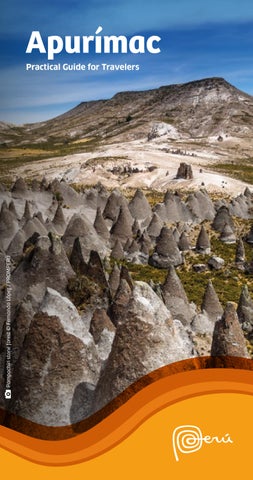
Pampachiri stone forest © Fernando López / PROMPERÚ
Apurímac Practical Guide for Travelers
What to visit? Abancay Province Cathedral Plaza de Armas The oldest church in the city is dedicated to the patron saint, the Virgen del Rosario. Documents indicate that it was in 1645 that the first brick of this simple single-tower temple with a bell tower was laid.
El mirador de Taraccasa 6 miles (9 km) north of the city of Abancay (20 min by bus or 10 min by car) The Taraccasa viewpoint offers an incredible view of the city of Abancay and the neighboring district of Tamburco. It is crowned by an immense white cross that watches over the city from above. You can enjoy its swimming pools and a visit to the zoo, which houses species from the area: spectacled bears, foxes, vicuñas, condors, and owls.
Ex casa hacienda Illanya-Museo Arqueológico Antropológico de Apurímac 4 miles (7 km) from the city of Abancay (20 min by car) The construction of this former Manor House dates back to the early seventeenth century. At the time it was considered the most important house, due to its architecture and “L” -shaped layout. It has two levels, built from adobes, lime and stones, plastered, a large cobbled courtyard, at the western end of which there is a long gallery where the Anthropological Archaeological Museum of Apurímac has been set up, managed by the Decentralized Culture Directorate (DDC).
Ex casa hacienda de Yaca 23 miles (37 km) south of the city of Abancay, Circa district (45 min by car) Surrounded by sugarcane groves, cane brandy was produced on this colonial manor house. After the entrance arch, a small square and the chapel welcome visitors. At the back is the trapiche (a mill used to extract juice from sugar cane). You can also do outdoor activities, such as boating and fishing on the Pachachaca river.
Santuario nacional de Ampay 3 miles (5 km) drive north of the city of Abancay (15 min drive) and, from the visitor center, 1.2 miles (2 km) (1 h 30 min walk) to the Angasq'ocha lagoon. Entrance after registration and paying for admission. Its territory ranges from an altitude of 9,350 ft to 17,388 ft (2,850 m to 5,300 m). It is home to the intimpa, an endangered tree, as well as orchids, bromeliads, and ferns. Almost 200 species of birds and 20 species of mammals have been recorded here, such as pumas, foxes, deers, and vizcachas.
Baños termales de Cconoc 45 miles (73 km) northeast of the city of Abancay to the town of Curahuasi (1 h 30 min by bus), then 13 miles (21 km) to the thermal baths (45 min by bus). Entrance fee charged. Cconoc hot springs are located on the banks of the Apurímac river and are famous for their therapeutic properties against arthritis, muscle pain, and rheumatism. A perfect combination of relaxation and nature between carob trees and reeds.
Cañón del río Apurímac 45 miles (73 km) north of the city of Abancay (2 h 30 min by bus) In its descent from 16,404 ft (5,000 m), the flow of the Apurímac river forms one of the deepest canyons on the continent. A privileged place to enjoy this landscape is the Honda ravine, on the road from Abancay to Cusco. Adventure lovers can go canoeing on their Category II and IV rapids.
Conjunto arqueológico de Saywite 29 miles (47 km) northeast of the city of Abancay (45 min by car). Entrance fee charged. The Saywite archaeological complex is composed of nine fountains, monoliths, a rectangular platform that served as an altar of sun worship and as an astronomical observation point, and the Intihuatana, a carved stone. Among all of them, the Saywite monolith stands out, which in its 8 ft (2.5 m) height has carved motifs of the flora and fauna of the area.
Mirador natural de San Cristóbal 3 miles (5 km) northeast of the city of Curahuasi (8 min drive) From the observatory of this natural viewpoint, you can get a panoramic view of the meandering path of the Apurímac river, the Cunyac bridge that connects the region with Cusco, the Salcantay range, the Choquequirao archaeological site and the Curahuasi valley. Fields of anise and fruits complete the landscape.
Mirador de Capuliyoc 42 miles (67 km) from the city of Abancay (1 h 40 min by car) This viewpoint is a privileged place to see the imposing canyon of the Apurímac River, one of the deepest in the world. It is located at an elevation of 9,573 ft (2,918 m) and can be accessed through a dirt road that goes to the Capuliyoc bus stop, and from there a walk to the viewpoint, from where you also have the first view of the Choquequirao archaeological park.
Andahuaylas Province Plaza de Armas de Andahuaylas 80 miles (128 km) west of the city of Abancay (3 h by car) In the center, there is a two-level fountain, built in a single piece of ashlar stone, on a circular base, with carvings of puma heads. At one end of the square there is a bell dating from 1875 in honor of the Most Holy Virgin of Loreto. The square is surrounded by colonial buildings, such as the Town Hall / Municipal Palace, a two-story building with imposing balconies. In its green areas, stone-carved figures of animals from the Andes can be seen, such as puma, bull, condor, and deer.
Templo San Pedro de Andahuaylas The construction of the San Pedro de Adahuaylas temple began during the 16th century in the colonial era and was completed in 1633, taking approximately 32 years. Its architecture is of a colonial type, built with lime and ashlar stone. It has stone walls, Ionic columns, and a tiled roof. It has a unique 79 ft (24 m) high tower, which inside has a spiral-shaped staircase, with 56 stands of carved and polished stone that leads to the bell towers. A carved cross of 11 ft (3.5 m) also stands out, which shows a shield carved in stone in honor of Bishop Ladrón de Guevara.
Ampay National Sanctuary © Fernando López / PROMPERÚ
Saywite stone © Miguel Mejía / PROMPERÚ
Mirador de Waywaka 1.2 miles (2 km) south of the city of Andahuaylas (20 min walk) From the Waywaka viewpoint you can see the entire city of Andahuaylas and the Chumbao valley, where a large cross protects the city. It was considered an important huaca, which also represents the Andean worldview. In this place there is also the Chanka museum, which houses pieces and mummies from the pre-Inca period.
Santuario de Campanayocc 3 miles (5 km) south of the city of Andahuaylas (30 min by car) The Campanayocc sanctuary is a modern church that brings together both the faithful and those who wish to enjoy the idyllic landscape of the city of Andahuaylas and the Chumbao valley.
Petroglifos de Sachapucro 9 miles (14.4 km) from the city of Andahuaylas (30 min by car) The Sachapucro petroglyphs are images carved in stone representing abstract, anthropomorphic, and zoomorphic figures, as well as the Andean worldview and its astronomical observation; heritage of the Chanka culture. They show the use of stone tools and coexistence with their natural environment.
Gruta de Sutoqmachay 9 miles (15 km) from the city of Andahuaylas (25 min by car) Its name comes from Quechua and in Spanish means “Grotto of drops” or “Cave of rain.” This natural grotto has stalactites and stalagmites inside. The geography of the area is pronounced to the formation of a canyon through which the Chumbao and Orcconmayu rivers flow, whose waters make solid everything that gets in their way due to their high content of silica and other minerals.
Complejo arqueológico de Curamba 9 miles (15 km) east of Kishuara District (15 min drive) Between different quadrangular and rectangular buildings of the Curamba archaeological complex, which served as houses and warehouses, the Ushno stands out. It is a truncated pyramid with three platforms, whose function was sacred. Every June, the Curamba Archaeological Complex is the scenario of the Tinkuy Curamba, a representation of the visit of the Inca Pachacutec.
Laguna de Pacucha 11 miles (17 km) northeast of the city of Andahuaylas (20 min by car) The Pachuca lagoon is located at an elevation of 10,141 ft (3,091 m) and is characterized by its deep blue waters. The sandbanks and totorals that surround it are home to distinct species of ducks.
Petroglifos de Llamachayoq
arb
a.C
Qd
13 miles (20.9 km) from the city of Andahuaylas (40 minutes by car) The Llamachayoq petroglyphs are engraved on stone walls, showing representations of South American camelids, felines, human figures in daily hunting and farming activities, and the sun god. In their surroundings you can appreciate landscapes of great splendor with native plants, such as alder and queñua.
u da .H
na
na
ca
on
Complejo arqueológico de Sóndor 13 miles (21 km) northeast of the city of Andahuaylas (30 min by car) Entrance fee charged. The Sondor archaeological center is made up of pyramidal constructions surrounded by walls and platforms. The Chankas (1100-1400) were its first inhabitants, but then it was occupied by the Incas (1400-1532).
Bosque de piedras de Pampachiri 75 miles (121 km) south of the city of Andahuaylas (2 h 30 min by car) and 75 miles (121 km) northwest of Abancay (Sañayca 3 h by car). Entrance fee charged. Wind and the passage of time have sculpted the rocks of volcanic material into the Pampachiri Stone Forest. Some have pyramidal shapes and others show mushroom-like silhouettes, reaching 26 ft (8 m) in height. Their porous surfaces contain minerals, such as quartz, obsidian, and basalt.
Chincheros Province Templo colonial de Cocharcas 68 miles (110 km) northwest of the city of Andahuaylas (3 h by bus) The Cocharcas colonial temple was built 1598 and 1625 in white ashlar. Its carved stone walls, its two towers and majestic dome make it a fine example of colonial architecture. Its interior has an altar carved and covered in gold leaf and in it are preserved works of the Cusco school and of Spanish Masters.
Antabamba Province Templo San Salvador de Antabamba Antabamba square San Salvador de Antabamba Temple displays a sober construction of lime and common masonry stone with simple covers. The main altar of this 17th-century temple is Baroque, carved in wood and covered in gold leaf.
Templo Nuestra Señora de Asunción de Huaquirca
ua
na y
Huaquirca square Its limestone and mud façade are in mestizo Baroque style. Built in the 17th century, the Nuestra Señora de Asunción de Huaquirca Temple is adorned with rustic murals and a carved wooden pulpit.
Pacucha lagoon © Fernando López / PROMPERÚ
Aymaraes Province Chalhuanca City 75 miles (120 km) southwest of the city of Abancay (2 h by car) Quiet city at an elevation of more than 9,186 ft (2,800 m) that preserves beautiful churches with altars carved in wood and covered in gold leaf as a testimony to its colonial brilliance.
Templo colonial Nuestra Señora de las Mercedes de Pampamarca 15 miles (23.5 km) south of the city of Chalhuanca (45 min by car) The Nuestra Señora de las Mercedes de Pampamarca Colonial Temple was built between the seventeenth and eighteenth centuries, with a 66 ft (20 m) high stone tower that houses the Maria Angola Menor, a mythical bell.
Baños termales de Pincahuacho 4 miles (6 km) northwest of the city of Chalhuanca (15 min by car). Requires an admission ticket. Crystalline mineral waters sprout from the soil and form the Pincahuacho thermal springs, which reach 163 °F (73 °C). Due to their composition, they are considered therapeutic against conditions such as rheumatism and bronchitis.
Cotabambas Province Ccacca Cárcel 656 ft (200 m) south of Plaza de Armas of Haquira (5 min walk) This 49 ft (15 m) high rock, during colonial times, served as a prison for those who broke the Law, hence its name, which means “stone prison.” In the middle part was the court where the accused were tried; if they were found guilty, they went to the caves that functioned as cells.
Pachachaca bridge © Alonso Molina / PROMPERÚ
18
Abancay City Center
Boundary of the Historic Center Main river Urban area
1
Catedral
2
El mirador de Taraccasa
3
Plaza de Armas de Tamburco
Medical center
Apurímac Tourism Police
Police
Post office
Town hall
nv
ala
ci ón
2
cu
ció
la
Cir
n
uancav elica
co
Av. Tambu
o Palma
rco Av. Juan
bur
am v. T
Av. Ricard
Prlg. H
Cl
to Santuario Nacional de Ampay
.C
to Cusco
i rc un va
Cl.
A
enci a marra
a .C
Cl
e
id
c
te
cú
ha
ac
Parque Centenario
Parque Daniel Alcides Carrión
Río
656/200
1,312/400 ft / m
Altitude: 7,802 ft / 2,378 m
ac Ama ru s
ca
Jr. Garcilazo
Jr. A
Av. Nú
ndré
ñez
s Ave
lino C
ácere
ncaveli
Jr. Junín
Jr. Hua
Jr. Cusco
Jr. Arica
Jr. Puno
rino
Ma
Jr. Atahualpa
io ran
. An
Qda
to Ex Casa Hacienda Illanya
ro
Mercado Central
e
sG
. Lo
Av
o
Jr. Tacna
an
Ju
hu
.P
s
Baj
Av. Mariño
. Av
b Pa
Ca
io
Jr. Ma
lo
Av
. Av
Jr. G r
au
iR
do
Plaza de Armas 1
st
Terminal terrestre
ch
n Si
Pra
uipa
a
ancay
a oc
uel
Jr. Areq
Jr. Lim
riscal Ga
pend
Inde
8
.2
Av
Man
Av. Díaz Bárcenas
r uásca Av. H
Av. Martinel li nva lac ión
rcu
Av. Ab
lP
anue
Av. M
Jr. Apurímac
Av. Centenar
. Ci
J
Prlg. Arica
ane Seo Jr.
Av. Panamá Av
de
io ul
Jr.
to Andahuaylas
0 Parque e Nort La Victoria o d a r
Pje. Valdivia
Av. Chile Paradero de colectivos a Andahuaylas
sa
Paradero de colectivos a Cusco
Prlg. Cusco
lle
Parque El Olivo
os
Av. Paseo de los Artesan
Av.
nta Ro
Av. Túp
aca
SERNANP
o
huide
Pablo II
rc
auc
Jr.
Jr. Sa
tí Hay
am
bu
Parque Señor de la Caída
Av. Perú
.T
3
M Av.
Cementerio Puca Puca
Av. Ca
Av
ina
Av. Bella Abanqu
Estadio Condebamba
Plaza Micaela Bastidas Av. Arenas Av. Enrique Pelach
Losa deportiva “Los Chancas”
Cementerio General
ba
ndebam
Av. Co
ayjo ishu
Apurímac Location
South mountain area of Peru
Capital
Abancay (at 7,802 ft / 2,378 m)
Altitude Min.: 3,018 ft (920 m) (Pasaje) Max.: 17,841 ft (5,438 m) (Huaña) Weather Temperature
Dec-Mar
Mar-Jun
Jun-Sept
Sept-Dec
Max.: 75 °F (24 °C) Min.: 53 °F (12 °C)
How to get here? By land Lima-Nasca-Puquio-Abancay: 567 miles (912 km) / 18 h Lima-Ayacucho-Chincheros-Andahuaylas-Abancay: 602 miles (969 km) / 17 h Cusco-Abancay: 123 miles (198 km) / 4 h
By air Lima-Andahuaylas: 1 h 15 min
Apurímac Department capital Province capital Provincial border
CUSCO CHINCHEROS Huaccana
Paved road Airport Main river Lake or lagoon
s ampa Río P
Dirt road
Río Apurímac
Ongoy
CHINCHEROS
Ocobamba
Uripa
Ranracancha
Huanipaca Kaquiabamba
Laguna Pacucha
Cocharcas Uranmarca
Cachora
Andarapa
Nevado Ampay
Santuario Nacional Curahuasi de Ampay
Pacobamba
Pacucha Talavera de la Reyna San Jerónimo Santa María ANDAHUAYLAS de Chicmo
Tamburco
Huancarama
ABANCAY
Kishuara
ABANCAY
Huancaray
Protected Natural Area
San Antonio de Cachi
Chiara
Laguna Antaccocha
Turpo
ANDAHUAYLAS
Laguna Suytuccocha
Pichirhua
San Juan de Chacña Lucre Tintay Chapimarca
Curpahuasi
CHUQUIBAMBILLA
Huayllo Pichihua
Pampachiri
Soraya Sañayca
Pocohuanca
AYACUCHO CHALHUANCA
Nevado Pisti
TAMBOBAMBA
COTABAMBAS
Curasco Vilcabamba
Progreso
Mara
Ayrihuanca
Nevado Challhuahuacho Santa Rosa San Antonio Nevado Inticancha Pataypampa Nevado Quesperaque Nevado Mallmanya Nevado Huashuaccasa Turpay Haquira Mamara Parcacirca
Tapairihua Yanaca
Huayllati
GRAU
Toraya Capaya
Palpacachi
Laguna Orjococha
Chacoche
Colcabamba Huayana Umamarca Pomacocha
Coyllurqui
Lambrama
Circa
Chaccrampa
Cotabambas
Río Vil ca ba mb a
District capital
Ayahuay Pachaconas
Virundo
Sabaino Huaquirca
Oropesa
Río Or op es a
ANTABAMBA Cotaruse
Caraybamba
AYMARAES
a mb aba Ant Río
Mollebamba
ANTABAMBA
Laguna Anchacata
Nevado Huayunca
Pachachaca river © Miguel Mejía / PROMPERÚ
Nevado Tranca
Laguna Huacullo
AREQUIPA
Graphic scale (miles / km)
0
12/20
25/40
37/60
Silco Huaylia © Pilar Olivares / PROMPERÚ The Huaylia of the Antabamba Province has been a National Cultural Heritage since 2004. Each town in this province has its own style, characterized by its clothing, dance, choreography, and tonalities of music and songs.
Distances
By private transportation, from the city of Abancay DESTINATION
DISTANCE
TIME
Chalhuanca (Aymaraes Province)
75 miles (120 km)
2h
Andahuaylas (Andahuaylas Province)
80 miles (128 km)
3h
Chuquibambilla (Grau Province)
88 miles (142 km)
4h
Antabamba (Antabamba Province)
89 miles (144 km)
5h
Chincheros (Chincheros Province)
130 miles (209 km)
5h
Tambobamba (Cotabambas Province)
206 miles (331 km)
7h
Illanya Manor © Miguel Mejía / PROMPERÚ
2 days
Tours
(minimum recommended stay)
½ day
Tamburco square, Micaela Bastidas square, Ex Casa Hacienda Illanya, and Pachachaca bridge
½ day
Casa Hacienda Yaca and canoeing on the Pachachaca river
1 day
Tunnels of Karkatera-Cascada Qello Yaku-Mirador de Ccoya-Comunidad de Ccoya Route
½ day
City tour in Abancay (square, temple, museum and Taraccasa viewpoint)
1 day
Cconoc thermal springs
1 day 1 day
National Sanctuary of Ampay
½ day
Surroundings of Andahuaylas (Pacucha lagoon and Sóndor archaeological complex)
1 day
Páncula Pampa de Pabellones de Pampachiri
City tour in Andahuaylas (Paccha José María Arguedas, Waywaka viewpoint, Hualalachi, Talavera square, and Granja Santa Rosa)
2 days Bosque de Piedras Pampachiri (Ayamachay, Bosque de Piedras and Aukillaqta, Larkay thermal springs, and Pampachiri waterfall)
Agenda Feb-Mar
Abanquino, Apurimeño and Tikapallana Carnivals
Mar
Encuentro Nacional del Carnaval Originario Pukllay
Mar-Apr
Easter Week
Apr 28
Anniversary of the Apurimac region
Jun 19
Sóndor Raymi “The Chanka Epic” (Andahuaylas)
Jun 21
Anniversary of Andahuaylas
Jul 28-30
Yawar Fiesta (Cotabambas)
Jul 31 - Aug 3
Main Festival of Señor de Ánimas (Aymaraes)
Sept 8
Feast of Virgen de Cocharcas (Chincheros)
Sept 14
Feast of Señor de la Exaltación (Grau - Abancay) Feast of Señor de Huanca (Andahuaylas)
Oct 1-7
Feast of Virgen del Rosario (Abancay)
Nov 3
Anniversary of Abancay
Nov. 25
Feast of Santa Catalina (Curahuasi)
Dec 24-31
Niñuchanchik Christmas Festival (Andahuaylas)
Dec 24 - Jan 6
Feast of Huaylia (Antabamba)
What to eat? Guinea pig (“cuy”) plays a prominent role in regional dishes, for example, cuy chactado (breaded with corn flour and deep-fried) and pepián de cuy (stewed meat with peanuts and spices). Other emblematic preparations are huatia (potatoes cooked on hot stones with rocoto and aromatic herbs) and homemade noodles, served with chicken stew and chuño kapchi. The meal is accompanied by a delicious ponche, a punch served with grated coconut and cañazo.
What to buy? Furniture carved in huaranhuay wood, among other decorative and household objects. Ceramics, alpaca fabrics made on waist looms, objects carved with the cornoplasty technique, and dolls with typical costumes of the region.
ANDAHUAYLAS Apurímac (+51-1) 616-7300, ext. 1900 Jr. Constitución 626, Plaza de Armas of Andahuaylas iperuandahuaylas@promperu.gob.pe
Open
24 / 7 (+51-1) 574-8000 (+51) 944-492-314 iperu@promperu.gob.pe VisitPeru
www.peru.travel www.ytuqueplanes.com
The information contained in this brochure has been updated in September 2023. To prepare it, PROMPERÚ has used official information sources, as well as the Regional Directorate of Foreign Trade and Tourism (DIRCETUR) of Apurímac. The opening hours and telephone numbers are subject to vary at each tourist attraction. Confirm the hours and telephone numbers with IPERÚ.
Published by PROMPERÚ - Peru for Exports and Tourism Promotion Agency Calle Uno Oeste 50, 14th Floor, Urb. Córpac, San Isidro, Lima, Perú Tel. +511 616-7300 www.promperu.gob.pe © PROMPERÚ. All rights reserved Legal Deposit in Biblioteca Nacional del Perú No. 2023-10872 Printed by WORK UP E. I. R. L. (Calle Albert Einstein 165, Ate, Lima) Lima, October 2023
FREE DISTRIBUTION. NOT FOR SALE.