SELF-GUIDED GEOLOGY : SLIEVE GULLION & CAMLOUGH MourneGullionStrangfordGeopark.com
Slieve Gullion
1
Note: This excursion requires driving between stops. The geology map only shows main routes, and excludes a large network of minor roads. If you do not know the area it is recommended that you use a road map (Ordnance Survey of Northern Ireland, Discoverer Series Sheet 29 - The Mournes).
Camlough Meigh
Jonesborough
Carrickcarnan
A one-way system operates within the Slieve Gullion Forest Park (stops 1 & 2), enter via the Slieve Gullion Courtyard, sign-posted from the Meigh-Forkhill road.
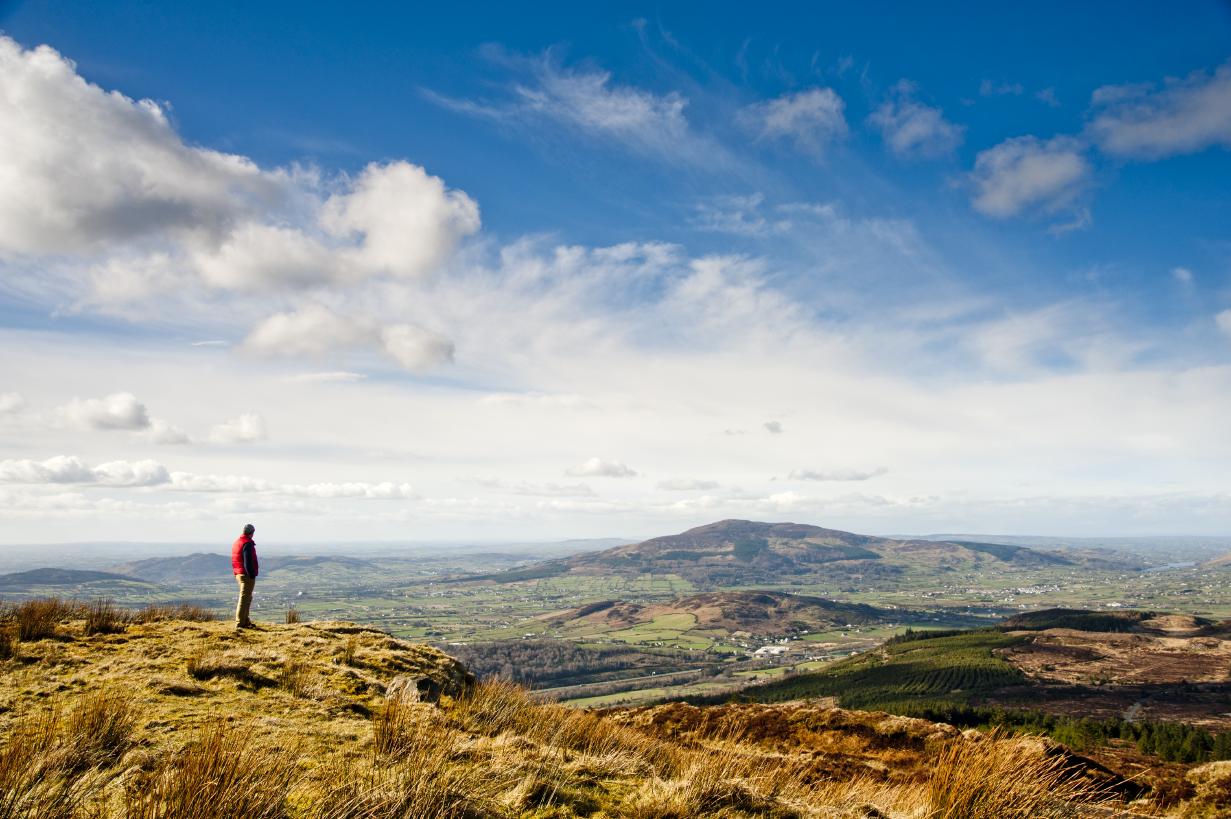
A spectacular panorama of Slieve Gullion and the surrounding Ring of Gullion can be seen from the top of Black Mountain. This landscape is shaped by the eroded roots of a volcano that was active 60 million years ago. The ring is a world-famous example of a “ring-dyke”, a feature formed when the magma chamber roof collapsed, forcing magma up through a ring-shaped fracture around its edges. This event would have been extremely explosive, with pyroclastic eruptions from vents all around the ring. Slieve Gullion is made of alternating layers of light microgranite and dark gabbro, which later intruded as sheets into the volcanic edifice. Another microgranite forms Black Mountain and represents the final phase of activity at the volcano. Large geological faults cross the region, forming characteristic linear valleys. From this vantage point you can follow a fault through Camlough lake, where it offsets the ring, southeast through Ravensdale where it now forms the valley. Camlough 5 A2 Cam Lough
Central Layered Complex
2 Dolerite
Microgranite
4
Lislea
1 /M A1
Porphyritic rhyolite / vent rocks
Slieve Gullion
Mullaghbane
3
2
Microgranite
Meigh
3
Carrickcarnan
Newry granodiorite Metasedimentary rocks (Silurian) Fault
Jonesborough
This map is adapted from The Geology of Northern Ireland: Our Natural Foundation (2004), Geological Survey of Northern Ireland, Belfast, 318pp, Crown Copyright.
4
Forkhill
North 0
Ring-dyke
le nsda
3
Porphyritic microgranite / breccia
Rave
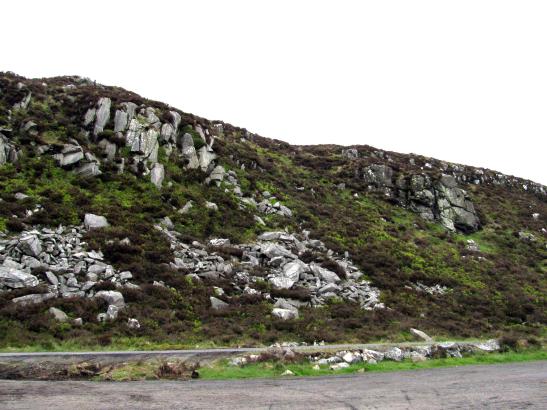
There are excellent views of the south-west quadrant of the ring-dyke as you follow the forest road up Slieve Gullion, through what is known as the “Central Layered Complex”. There are 13 layers in total, 2 of which can be easily investigated from the summit car park. Here, an inclined microgranite sheet underlies a gabbro sheet. The microgranite forms a very characteristic blocky grey scree, while the gabbro forms smooth, dark outcrops. A pipe of microgranite formed where this less dense felsic magma rose up through partially solidified, dense gabbro.
Ring-dyke
B11
Microgranite
i
5
Dolerite & gabbro
Microgranite pipe
Newry
2 km
Ring-dyke
1 Black Mountain
Ring fault
5
Microgranite
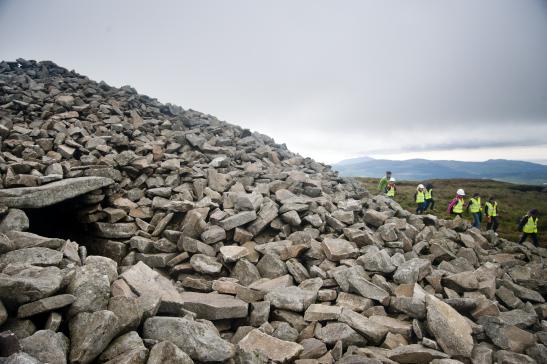
A path to the summit of Slieve Gullion leaves from just north of the car park. At the summit you will find a ~5000-year-old passage grave, the highest of its kind in Ireland. It is constructed of microgranite blocks, and the passage is lit by the setting sun of the winter solstice. Even our Stone Age ancestors appreciated this spectacular location and the panoramic view of the ring-dyke! The low ground between Slieve Gullion and the ring is formed of a much older igneous rock called granodiorite, which intruded 400 million years ago. It extends north-east as far as Slieve Croob.
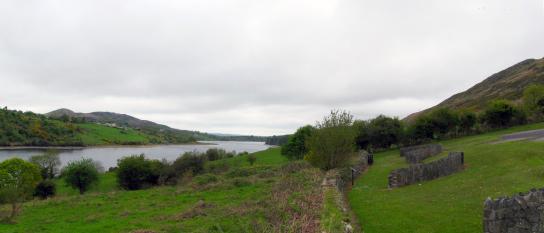
At Camlough car park we can see the nearby ring-dyke meet the east side of the lake but the western continuation is much further along the lake-side. This is due to the movement of a fault after volcanic activity had ceased. There has been almost 2 km of off set along this fault. This would have occurred as multiple movements, each of which would have caused an earthquake. Compiled by Dr F.C. Meade with contributions from Prof V.R. Troll & Dr C.H. Emeleus.
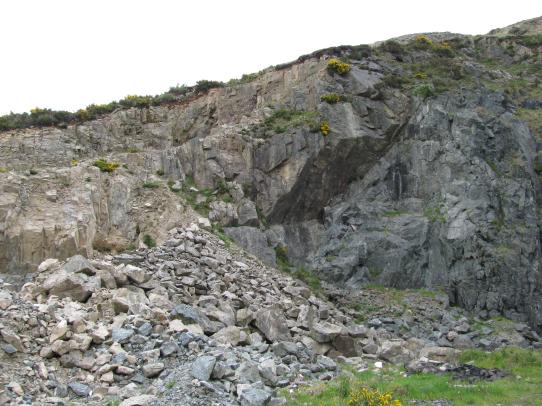
Metasedimentary rocks Ring-dykes are cylindrical intrusions, with steep outward dipping sides. Cam Lough quarry cuts right through the ring-dyke, giving an excellent 3D exposure. Here we see the walls of the microgranite ring-dyke, forming an overhang and dipping outwards to the north. Metamorphosed sedimentary rocks are in contact with the dyke. The surface between them is known as the ring-fault. This is the plane along which the magma chamber roof collapsed to form the ring-dyke. The south wall of the quarry exposes some of the older granodiorite.