

Editors-in-Chief:
Gabrielle Barnett
Calee Lukowski
Assistant Editors: Breanne Bessette Rhianna Mason
Special thanks to Sarah Richards for the cover art design.
Last year marked the first publication of the Batten Honors College Academic Journal, a student-run publication that allows Batten Honors College students to publish their undergraduate academic work in a professional publication. This year, the publication continues to establish itself with this goal in mind. Within this issue, you will find eight submissions from Batten Honors College students, three of which were completed last spring as senior capstone projects. These eight submissions span across several disciplines and a wide variety of topics, further exemplifying the mission of the Batten Honors College to develop students into well-rounded leaders, both within and outside of academia. The work exhibited within this publication is the result of months of accumulation and revisions done by the editorial staff. While any project of this magnitude is sure to have its pitfalls, this year the editorial staff was able to better identify those pitfalls and are working towards bettering the publication as it continues to grow.
This year the Batten Honors College Student Advisory Board selected “Beyond Borders” as the theme and title for this issue. Just as “The Scholar’s Compass” fit our inaugural issue, this theme is a wonderful fit for our second issue. “Beyond Borders” recalls that Batten Honors College students are not constrained by their discipline, and are encouraged to branch out, both in their studies and in life. Rather appropriately, this issue features two submissions that were completed by students while studying abroad.
Just as we were able to build on the work of the inaugural editorial team, it is our sincerest wish that this publication will continue to grow, as the Batten Honors College grows, with the cohorts of the future and continue to provide a chance for students to showcase their work in a professional publication for the world to see.
Thank you, Gabrielle Barnett and Calee Lukowski, Editors-in-Chief




Gabrielle Barnett, Editor-in-Chief Psychology and Art Class of 2027
Calee Lukowski, Editor-in-Chief English, Media and Communication Class of 2027
Breanne Bessette, Assistant Editor Political Science and Hispanic Studies Class of 2026
Rhianna Mason, Assistant Editor Sustainability Management Class of 2029
The Ryan Research Symposium is an opportunity for Honors upperclassmen to demonstrate and utilize their learned research skills from their experience in the Batten Honors College. This competition consists of submission of senior Honors capstone courses, which integrate the knowledge gained from their educational journey. Students are prompted to explore a complex issue regarding the United Nations Sustainable Development goals and the Honors college pillars of Environmental Stewardship, Global Engagement, and Leadership, as well as their own experiences and courses. These projects are tackled independently, requiring students to think critically and creatively to confront global and local issues through the lens of their own experiences. Each year, the completed projects, papers, and posters are evaluated by a committee of Batten Professors and Student Representatives who select the best projects from the application pool to present their research in competition for the prize at the Louis and Prudence Ryan Research Symposium, established by the support of Louis and Prudence Ryan. The papers featured here include the winner of the 2025 Louis and Prudence Ryan Prize, Breanne Bessette, and the two runner ups for the prize, Jalen Major and Marco Molino.
The incoming class is crammed into overcrowded bleachers for college orientation, and as the speaker flips through slide after slide of information, he occasionally shushes the excitable first-year students. He comes to a slide emblazoned Title IX, and an awkward hush comes over the crowd, broken only by a few irreverent giggles. The male administrator quickly reads off the university policy just as it appears in the handbook, and proceeds to play a video that compares not obtaining consent to taking someone’s phone without permission. When the video is over, he briefly mentions whom to report incidents to and moves on.
A young woman in that audience came from a strictly abstinence-only sexual education school. Her teachers were banned from teaching about contraceptives and sexual processes. She’d learned to associate sex with pregnancy and disease. Her parents had given her their version of “the talk,” which consisted of crumpling a piece of paper reading “virginity” and showing how it could “never be perfectly smooth again.” Now, as she walks through the student center, counselors are at tables handing out condoms. She sees several students stopping to take a few. She feels left out of a secret that everyone else knows but isn’t sharing. She says nothing. Another woman in the crowd had an excellent health education experience. Her teacher had openly used accurate anatomy terminology like “penis” and “vagina,” making high schoolers blush and snicker, but by the end of the year, the words were as mundane as any other class’s vocab. This student’s family could broach sexual subjects as easily as any other dinner topic. She seems to have all the ingredients for a fantastic relationship with her sexual and reproductive health. However, her family has difficulties purchasing their grocery list, and they pay much less for health insurance. So when she saw an informational poster on campus that said women should have regular pap smears and gynecology appointments, she knew a healthcare visit wasn’t in the cards for her. She says nothing.
As another student walked back to her room after orientation, she noticed a flyer on the hall bulletin board announcing a safe sex seminar. She thought about attending with her girlfriend. Then she saw the cartoon graphic on the poster of a man and woman holding hands and the male condom dispenser pinned up next to it. She walked away feeling, just as she had with other sex ed classes, that this kind of educational seminar wasn’t intended for her and her partner. She says nothing.
University sexual health program content assumes a homogeneous audience. Rather, students come from diverse backgrounds with very different sexual education experiences. The Congressional Research Service reported that U.S. teen birth rates vary by state, with the highest rates in southern states (Mickler & Tollestrup).
US southern states also consist of mostly abstinence-focused sex education (World Population Review). Sexual health education has enough influence to impact pregnancy rates and has similar impacts on a myriad of other sexual practices and understandings. Limited content leaves out crucial aspects of health and creates spaces where students feel unwelcome, embarrassed, or too inexperienced to participate.
A key element of better sexual health education is that it should be inclusive to everyone. The issues considered in this research and the proposed solutions address a specific disparity in campus sexual health programming and its lack of female-focused content. The focus on women1 and female sexual health and processes is not exclusionary as this information would be pertinent to anyone regardless of gender orientation. By having a comprehensive knowledge of sexual and reproductive health and a deeper understanding of female systems and sexual processes, anyone can be a more informed person, partner, and member of society.
With regard to recent dialogues about female sexual and reproductive information, some argue that the traditional non-gender-specific university material remains sufficient for students’ sexual health education. This programming has some value; however, typical university initiatives maintain gender disparities by failing to address vital components of women’s sexual and reproductive well-being. Improvements in sexual education are necessary to address the gender inequities that are ubiquitous in healthcare and have been escalated by the current politicization of women’s health. An initiative to compile and distribute accessible, accurate, and holistic sexual health educational materials on a privately accessible platform could provide vital information that would benefit people greatly. Education equips women to advocate for themselves and others to make informed decisions, foster healthier attitudes toward sexuality, and further progress toward addressing harmful beliefs and stereotypes. By providing quality sexual health education to college-aged women, they can sustain more equitable communities in which sexual and reproductive health is prioritized as an essential component in overall good health and well-being.
Student health is a priority for universities nationwide, as indicated by resources like campus clinics and counseling services. Sexual and reproductive care is an essential component of overall health, but access to resources is inconsistent between universities. Some universities host speakers, clinics, activities, and other valuable events. In contrast, other universities resign their sexual health program to a few brochures, condoms in offices, and the occasional mention of Title IX. A 2020 study published in The Journal of Adolescent Health concluded, “attention to the full range of sexual health topics, scaffolded across grades, embedded in supportive school environments and across subject areas, has the potential to improve sexual, social, and emotional health, and academic outcomes for young people” (Goldfarb et al. 24). Comprehensive sexual health education has been repeatedly proven to be crucial to improving general well-being.
1 The terms “women, female, feminine, etc” in this paper, signifies anyone who identifies as a woman or female as well as anyone with menstrual processes and gynecological needs.
College campuses are ideally positioned to provide this type of education. According to a study published in The Journal of Osteopathic Medicine, “Emerging adults are considered an at-risk population that has historically had the least health care use” (Burrell et al. 2). Various reasons including a lack of health insurance, transportation, or general insecurity about how to address health concerns, contribute to students relying heavily on campus resources for their health information and care. Additionally, universities are in a unique position to provide education to marginalized populations, specifically women, who may lack vital information because of previous insufficient sexual education. In that aforementioned study, women scored lower than hypothesized on many subjects, including preventative care for breast and cervical cancer. 0% of women knew that the recommendation for pap smear testing frequency is every 3 years (Burrell et al.). The lack of knowledge in these particularly “feminine” areas could be attributed to the fact that many sexual health programs do not include a focus on female-specific information. To truly address the deficiency of most sexual health programs, information about anatomy, menstrual cycles, reproductive processes, reproductive rights, same-sex couples’ sexual health, gynecological preventative care, and sexual misconduct should be included. This list, paired with traditional sexual education topics, provides a structure for educating more holistically on women’s sexual and reproductive health.
Furthermore, the outreach of sexual education programs goes far beyond the campus and begins to address more significant global issues. The United Nations defines gender equality, good health and well-being, and quality education as goals that have an essential role in sustainable development. Subgoal 3.7, which stems from the sustainable development goal of good health and well-being, seeks to ensure universal access to sexual health services and information through national strategies and programs (The United Nations). Progress towards this goal is obtained by instituting programs that promote comprehensive education that leads to access to resources and care. Integrating these programs not only helps to achieve this subgoal but also seeks to address the intersections of health, gender equality, and quality education.
Differences in gendered conversations and treatment of health are systems deeply rooted in society. It wasn’t until the NIH Revitalization Act of 1993 that women were required to be included as subjects in clinical research despite significant differences in bodily processes. For example, it was found that during their menstrual cycle, women’s hormone levels could have impacts on everything from their energy to their ability to process medications. According to the Institute of Medicine US Committee on Ethical and Legal Issues Relating to the Inclusion of Women in Clinical Studies, “Endogenous hormonal changes in menstruating women can affect drug disposition, but few studies have examined the impact of changing hormonal concentrations on drug metabolism across the different phases of the menstrual cycle” (91). The lack of consideration for these significant differences is a byproduct of a society historically rooted in male-focused medicine and health.
The disparities in female healthcare are not limited to research but also include gender-biased treatment in healthcare settings. BBC published an article in which women spoke out about their experiences in healthcare. A woman named Laura, who was eventually confirmed to have a traumatic brain injury, reported symptoms for years that were consistently dismissed.
“I don’t get healthcare without my partner with me. That’s a blanket rule,” she says, explaining that she feels her concerns are taken “more seriously” when voiced by a man” (Ritchie).
This story is, unfortunately, just one of many. Women are much less likely to be taken seriously in medical settings, even in regard to symptoms of female sexual health issues. In the aforementioned BBC article, it was noted, “Endometriosis is pointed to as a key example. Despite impacting roughly 10% of reproductive-age women and girls globally, there is no cure, and it takes seven years on average for patients to be diagnosed” (Ritchie).
The delay in diagnoses like endometriosis includes both a lack of medical research and a lack of concern for the problem until symptoms are excessively severe. By educating women about their bodies and regular functions, they can have a basic understanding of their health and a better ability to articulate and advocate for their needs. A gender divide is exasperated throughout a long history of discriminatory medical care and research.
In addition to facing barriers to accessibility and being taken seriously regarding health concerns, female sexual and reproductive health carries a stigma that may discourage many from pursuing information and resources. Gender roles and expectations contribute significantly to a discrepancy of information. With women’s sexuality often being associated with derogatory terms such as “slutty” or “dirty” and stereotypically held responsible for men’s sexual misbehaviors, there is little discussion in of the positive aspects of female sexuality (Fine qtd in Whatley 104). On the other hand, men’s overt sexuality is praised as macho and studly. According to Mariamne H. Whatley’s research in the Journal of Education, “a double standard is created which interfaces with the possibility of students making thoughtful, responsible decisions about sexual behavior” (104). Even disregarding cultural or societal influences, there is a gender divide rooted in shaming women’s curiosity regarding sexuality.
This divide was further enhanced when, in January 2025, the Trump Administration ordered the Centers for Disease Control and Prevention (CDC) to retract publications containing gender-specific terminology. The retraction of this information is targeted toward LGBTQ+ research; however, banned words such as gender, pregnant person, biologically female, and biologically male will have drastic implications for sexual health research (Faust). For example, the Washington Post article that reported the CDC order stated that “whole pages about HIV testing… were no longer available late Friday” (Sun, Lena H., et al.). This withdrawal of information is especially impactful for LGBTQ+ people and women, as these orders have constructed further barriers to accessing vital information.
The retraction of CDC information and other political controversies, such as Roe v. Wade being overturned and the recent reorganizations of the federal health and education departments, have resulted in further hesitancy from universities to provide sexual and reproductive health content. Barriers to sexual health programming differ between public and private schools, but each has a variety of reasons, including content policies, a lack of funding, and a desire to avoid controversial topics. Those seeking to distance themselves from the political minefield altogether may opt to refrain from promoting, distributing, programming, or funding further sexual education.
Having access to information on campus is essential, especially now. Women may not seek information through outside resources like clinics as a result of the stigmatization that health centers are correlated with promiscuity and abortion care only. In a 2024 study published in the Journal of Health and Social Behavior, Kathleen Broussard observed, “The increased politicization of sexual and reproductive health has created barriers to medically necessary care… the disclosure of stigmatized health needs carries significant risk” (489). The actions of the Trump Administration have made topics of sexual health care politically disfavorable. Thus, women may feel unsafe seeking resources to understand their sexual and reproductive needs and rights.
This is not to say that there isn’t a necessity for overall or male-focused sexual education. However, addressing the intersections of gender discrimination and sexual health requires information tailored toward gaps in female sexual health. Additionally, anyone could benefit from added resources despite a female-oriented approach. The disintegration of trusted sources with the added fear of social retribution for seeking health information creates an environment in which women are particularly vulnerable to the harmful effects of a lack of comprehensive sexual education. Educational materials that can be accessed anonymously could be crucial to overcoming barriers that college-aged women face when seeking this information. Universities have the opportunity to play a pivotal role in providing this much-needed education and empowering women to take control of their health.
Building healthy sexual practices is quite possibly one of the most important things that a young person could do for their overall health. Evidence demonstrates that sexual health education has a significant impact on decision-making in young adults. In a study with 3,100 participants from states across the US, “One in five respondents (20%) believe that their sexual education (or the lack thereof) led to dangerous sexual practices or health issues later in life” (Sex Ed for Social Change). More comprehensive information and effective methods to distribute it lead to better decisions.
One of the primary functions of sexual health education is to address and prevent the potential illnesses and risks that can accompany sexual activity. Information that is specific to female students is not often divulged within these sexual education settings, including gynecological care, common infections and illnesses, and the necessity for preventative care like pap smears. Arofat Marakhimova has been a school nurse for decades. In 2020, as part of a United Nations Population Fund pilot program, she was tested for HPV, which is the leading cause of cervical cancer. Her positive diagnosis changed her life as she learned just how important it was to catch the precancerous markers early on and seek treatment before what could have been a life-threatening illness. Now, she is a strong advocate for vaccinations and getting the recommended prescreening tests (WHO).
“Get your check-ups even if you feel healthy. You owe it to yourself… It’s time we stopped letting cervical cancer claim so many lives” (Marakhimova qtd in WHO).
Her advice rings true for so many women who may not be aware of the necessity of this essential aspect of sexual and reproductive health. People are more likely to integrate healthy habits like attending check-ups if they have information that motivates them to do so. Human Papillomavirus (HPV) is the most commonly transmitted sexually transmitted infection (STI) and is often asymptomatic. The Office on Women’s Health estimates that around 80% of women will contract a variant of HPV in their lifetime (OASH). The HPV virus itself clears up in a few weeks, but contracting HPV is one of the leading causes of cervical cancer. Pap smears are used as a preventative measure to check for cervical abnormalities that could indicate cancerous or precancerous cells. The earlier abnormalities are identified, the easier they are to treat and prevent from worsening. Women are recommended to get a pap smear done every three years between the ages of 21-29. Many clinics offer free or reduced-cost pap tests. Despite its significant impact on women’s health, this is not a regularly taught portion of sexual education. Providing this information along with reliable resources is crucial to women’s overall health and can lead to life-saving care.
Sexual health education tends to focus on STIs and pregnancy but often does not divulge sufficient details. This can be seen in data about STI rates. For example, “There are approximately 19 million new cases of STIs in the United States each year—almost half of these in young people ages 15 to 24” (Office of the Surgeon General 44). A lack of in-depth knowledge could be one of the biggest contributors to high transmission rates. Better information about STIs, how they are transmitted, general symptoms, that many STIs are asymptomatic but can still be transmitted, and how they are treated would greatly benefit students. This education could serve as a call to action for more vigilance in getting tested, frequent self-examinations for symptoms, and consistent use of protection, all of which would greatly reduce the spread of STIs. Most university health clinics offer STI testing. Virginia Wesleyan University hosts STI testing events, which occur multiple times throughout the semester. By providing in-depth information about the necessity of safe sex habits, sexual health education is much more likely to be taken seriously, to be integrated into a student’s overall healthcare, and to mitigate illness and infection.
Education about safe sex practices should go beyond telling students to wear a condom. Universities have an opportunity to build a strong foundation for students in which they are not only aware of safe sex habits but what they include and why they are necessary. Those who build healthy sexual habits are much more likely to avoid risks and can understand more about their bodies, get the healthcare they need, have more honest relationships, and generally integrate healthy habits throughout their lives (Office of the Surgeon General). Young adults are more likely to build these habits with sufficient information because they can accurately weigh the perceived risks and benefits and have the self-efficacy to build habits like asking for consent, using protection, and getting tested regularly.
Promoting safe sex includes appropriately addressing sexual misconduct, such as harassment, discrimination, and assault. Title IX was put in place in 1972 as a law to prevent discrimination on the basis of sex and mitigate harassment. All universities that receive federal funding have Title IX policies in place. Students tend to understand Title IX as a reporting system for sexual misconduct and violence, but it can be used to report discrimination and harassment. Sexual misconduct impacts student health as well as their overall sense of safety. Prioritizing conversations about consent and Title IX procedures is especially crucial for the well-being of college-aged women. “One in four females and one in twelve males have experienced sexual violence at some time in their lives” (Office of the Surgeon General 44). Sexual violence in any form is traumatic and can disrupt a student’s forward progress both within their academics and their general day-to-day life. Mitigating sexual misconduct begins with better conversations about consent and the Title IX process.
In 2020, Gettysburg College initiated a Sexual Misconduct Prevention and Response Task Force to evaluate the campus climate surrounding sexual misconduct. Allison Dayton, a researcher for the task force, found a significant gap in students’ knowledge of consent.
“Especially in relationships, partners said they never really asked for consent. They felt like it was an understanding between them, but a lot of sexual misconduct, assault, and rape happens between acquaintances and often between partners” (Dayton).
Students may find themselves in circumstances where they are unsure of how to go about asking for consent; without any information, they may choose not to and violate a partner’s boundaries. Education about the severity and life-long consequences of sexual misconduct, as well as clear parameters for obtaining consent, is key to reducing sexual misconduct on university campuses. Conversations about consent should include information about the necessity of verbal consent, when consent should be given, under what circumstances consent can not be provided, revoking consent, and ways to ask a partner. As stated in the 2011 National Prevention Strategy, “Effective sexual health education, mentoring programs, and other evidence-based activities can...increase communication, decision-making, and healthy relationship skills needed to foster relationships free of sexual violence” (Office of the Surgeon General 45). Universities are in a unique position to teach people who may be having some of their first sexual experiences, which can lead to increased intentionality for gaining consent.
Unfortunately, despite educational efforts, sexual misconduct still happens on college campuses. Thus, it is crucial to understand Title IX policies. Several components of the Title IX procedures are not disclosed in accessible ways, that is to say, in plain language outside of school handbooks. Many students may be unaware of what the Title IX process actually entails, who is involved, and their rights in meetings and investigations. Only an estimated 20% of female college students will end up reporting a sexual assault (RAINN). If students felt more knowledgeable about help on campus, they may be more comfortable reporting under Title IX.
Sexual health reaches far beyond maintaining physical health and has an impact on mental health as well. Many universities claim that mental health is a priority, and one of the ways they can demonstrate this is by promoting educational conversations about sexual misconduct, consent, and Title IX practices. This kind of transparency can help students feel safer on campus and can encourage consent to become the priority that it should be in sexual relationships.
In 2022, the Supreme Court ruled on Dobbs v. Jackson Women’s Health Organization, which brought abortion care under scrutiny. This case ended in a decision to overturn both Roe v. Wade and Planned Parenthood v. Casey, which, since 1973, provided constitutional protections for women seeking abortions. When these cases were overturned, the decisions were given to states to legislate abortion regulations. This decision sparked protests and opened debates nationwide, thus strongly politicizing abortion care and, along with it, all other aspects of women’s sexual health care. The degradation of reproductive rights means women must be significantly more vigilant in understanding their reproductive systems despite not having this information in most educational curriculums. Comprehensive education can prepare women to make reproductive decisions despite the barriers erected by modern politics. Information maintains a semblance of choice and can be key to bridging inequities that have resulted from current gender politics.
Firstly, university education should include topics of contraception, which is defined as techniques to prevent pregnancy. Contraception is usually divided into categories of hormonal and non-hormonal methods. Non-hormonal methods can consist of barrier protections like condoms and diaphragms, and hormonal methods include things like the birth control pill, hormonal intrauterine devices, and the arm insert. While college students generally have a sense of what contraceptives are, they may be unaware of key facts like proper usage, potential side effects, and effectiveness. This information is especially crucial to college-aged women as they may want to engage in safe sexual activity but have to balance that desire with the potential consequences of an unplanned pregnancy. Education can dispel dangerous myths about contraception. For example, there is a common misconception that emergency contraception or “plan B,” which is a medication taken after unprotected sex to prevent pregnancy, is an abortion medication. This is not true. The function of plan B is to stop ovulation so that fertilization never occurs. Suggesting that the use of this medication is having an abortion makes women vulnerable to dangerous societal criticism and places a barrier to accessing a reasonable contraceptive. By providing information about contraception and resources to obtain it, as well as curtailing misinformation, women can be more confident about their reproductive processes.
Women tend to be highly motivated to attend and excel in college. According to a 2025 study published by the PEW Research Center, “60% of girls, compared with 46% of boys, say they plan to attend a four-year college” (Parker & Hurst). Education, careers, passions, and desires to build healthy families are common ambitions of college-aged women. These ambitions can be drastically changed by an unplanned pregnancy, especially in states where abortion care is now illegal. Pregnancy can be beautiful, but it can also be incredibly physically, mentally, and financially demanding. It has the potential to stop a woman’s progress towards other goals. In their dissent in Dobbs v. Jackson, Justices Breyer, Sotomayor, and Kagan echoed the significance of women being able to choose for themselves by saying:
“Without the ability to decide whether and when to have children, women could not—in the way men took for granted—determine how they would live their lives, and how they would contribute to the society around them” (Supreme Court of the United States 24).
Women must now understand their rights according to the specific state they live in. In Virginia, abortion is available up to 26 weeks and 6 days; however, in other states, abortion is illegal at any point in the pregnancy. Providing legal information in accessible terms is critical to women’s ability to make informed decisions despite the inconsistencies between states. Other legal alternatives for unplanned pregnancies, if abortion is unavailable or unwanted, should be provided. This could include information about adoption and surrendering a baby under Safe Haven laws. The politicization of natural reproductive processes makes women feel unsafe seeking the information despite how vital it could be for their overall health. Universities could empower women by informing them of their reproductive rights and options when faced with difficult decisions during an unplanned pregnancy. In the current political culture that is hostile towards women exercising their choice, this kind of education is our most powerful tool.
A traditional approach to university sexual health education is official university programming run by campus offices or organizations that are dedicated to informing and being a resource for students. Old Dominion University has a Women and Gender Equity Center, which hosts Womanhood Initiatives. These initiatives are specific programming that critically examines definitions of womanhood and provides information on current social issues like reproductive rights and gender equity (ODU). While on-campus organizations like these provide critical information, they are usually grouped with other gender, equity, and inclusion programs (as is the case at ODU) and, as such, are not specifically sexual health focused. While sexual health programming that is part of gender, equity, and inclusion initiatives is a step in the right direction, it does not usually allow the organization to focus on the gaps in traditional sexual health education. Regardless of their shortcomings, the efforts made by these organizations to provide information by inviting speakers, hosting informative events, and creating a space on campus for sexual health concerns to be addressed are overall beneficial for the student body. Some universities face significant obstacles to maintaining this kind of programming.
Obstacles include a lack of funding, unavailability of staff to run the organization, a lack of student interest in campus activities of this nature, and content regulations.
For years, Virginia Wesleyan University had an Office for Gender and Sexuality Equity that provided this kind of sexual health programming and events. Eventually, due to budgeting, staffing, and other university decisions, this organization was disbanded. Since the organization was disbursed, sexual health information has been delegated throughout campus departments but without specific programming or prioritization. The former director of VWU’s Office for Gender and Sexuality Equity, Dr. Slivka, noted, “There’s now a gap on campus, especially for women’s health” (Slivka). To address this gap on the VWU campus in a way that solves many of the other challenges to typical university sexual health programming, I have designed a comprehensive sexual and reproductive health education and resource website. This website is being posted to the campus’s counseling resources webpage and promoted throughout the campus as a health resource and reference.
Allowing the student body to access this content via a website is one of the best methods of divulging this information because of its practicality, efficiency, and potential outreach capabilities. A website is a lowcost, low-maintenance option that can provide easy-to-understand information along with links to further sources. Websites are easily updatable and can provide local resources for student use. This can be easily maintained and promoted by existing organizations on campus, such as student health. In addition to being practical for administration purposes, a website is also sensible for student use. Student attendance at campus sexual health events may be low not because of a lack of interest, but rather, because of the sensitive nature of the topic. Students may be less inclined to attend in-person events as they may feel embarrassed to be seeking information of a sexual nature. In contrast, a website offers an anonymous way for students to seek trusted information with details specific to them and the university’s local region. Additionally, a website can be accessed at any time, whereas, barring extensive note-taking, information from in-person events can only be referenced based on memory. Creating, maintaining, and promoting a website that has comprehensive information geared towards college-aged women’s sexual and reproductive health is one of the best ways to address a campus need for better sexual health information and resources.
To implement this solution, beginning with the VWU campus, I have built a comprehensive educational website that serves as a guide to sexual and reproductive health for college-aged women. To view the website that I have created, please visit: https://empoweredwomen-sexualwellness.my.canva.site/. To view the information and features found on the website in a table format, please see Appendix A.
The idea for my website has evolved throughout the process of building it. It began with the idea of collecting and sharing some local resources. However, as I started speaking with people on campus, the necessity for an informational platform became very clear, especially one that focused on female-oriented topics. The website is structured around four main focuses of information (sexual health, consent and Title IX, reproductive health, and gynecological health) with several topics in each category, as well as a resources page.
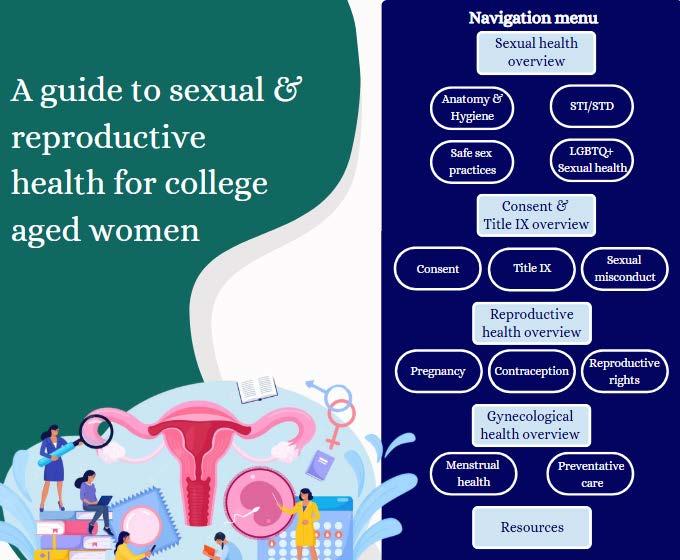

The menu on the home page can easily navigate to each topic (see Figure 1).
As sexual health is such a broad topic with endless amounts of research and information, it was crucial for me to narrow it down to categories that would provide a good foundation of information but that go beyond typical sexual health education. Some of the topics were chosen based on recommendations from the former director of VWU’s Office for Gender and Sexuality Equity, the current student health coordinator, and other college-aged women. Some notable inclusions are anatomy information with proper terminology for body parts, holistic perspectives on safe sex that go beyond physical safety and include partner communication, and LGBTQ+ sexual preferences and safe sex practices. When it comes to sexual health topics, people in the LGBTQ+ community feel left out or targeted for STIs, so an essential component of sexual health education is inclusive information that is meant to inform and dispel myths. A well-rounded understanding of sexual health goes beyond condom usage and STI acknowledgement and encompasses a variety of information and healthy habits.
Some of the topics were chosen based on recommendations from the former director of VWU's Office for Gender and Sexuality Equity, the current student health coordinator, and other college-aged women. Some notable inclusions are anatomy information with proper terminology for body parts, holistic perspectives on safe sex that go beyond physical safety and include partner communication, and LGBTQ+ sexual preferences and safe sex practices. When it comes to sexual health topics, people in the LGBTQ+ community feel left out or targeted for STIs, so an essential component of sexual health education is inclusive information that is meant to inform and dispel myths. A well-rounded understanding of sexual health goes beyond condom usage and STI acknowledgement and encompasses a variety of information and healthy habits.
Many students have their first sexual experiences in college. By making consent and Title IX information a section of its own on the website, it purposefully stands out and provides a
Many students have their first sexual experiences in college. By making consent and Title IX information a section of its own on the website, it purposefully stands out and provides a reminder for students about the essentiality of consent and the resources they have on campus. Additionally, understanding the options of contraception was included to address concerns of an unplanned pregnancy. Providing awareness of their rights and options allows women to plan their lives in accordance with their values and goals, which is why a page dedicated to reproductive rights based on Virginia law was also created. Finally, most women will have between 450 and 480 periods in their lifetimes. In-depth information about the menstrual cycle, hormones, and sanitary products was included, as it can lead to better comfort and care for women throughout their lives. Additionally, preventative care like pap smears and self-breast exams can be potentially life-saving. As mentioned in an article published in the National Library of Medicine, “The college setting is well-suited to normalizing sexual health as part of one’s overall well-being and to introduce routine preventative health care screenings” (Habel 9). The inclusion of information on gynecological and preventative care helps overcome medical disparities in health and treatment. with several topics in each category, as well as a resources page. The menu on the home page can easily navigate to each topic (see Figure 1). As sexual health is such a broad topic with endless amounts of research and information, it was crucial for me to narrow it down to categories that would provide a good foundation of information but that go beyond typical sexual health education.
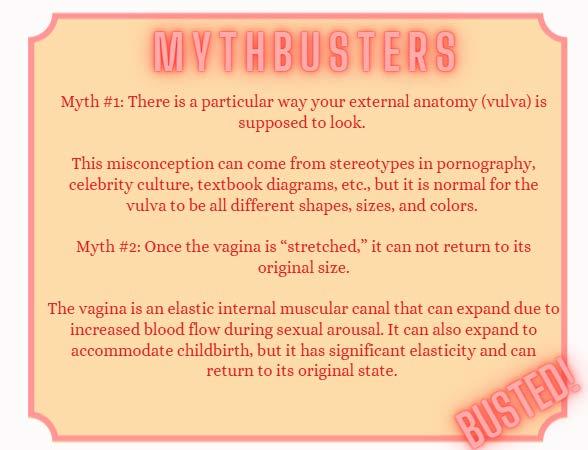
Canva has nice features, it provides a scrolling-only website template, meaning that I had to find ways to make it navigable despite only having scrolling capabilities. My solution to this issue was for topics with significant amounts of information; I created interactive presentations using Prezi that are embedded onto the page. This allows the viewer to click on and view the precise information they are looking for without having to scroll through a whole page. Additional graphics, including the occasional “Mythbuster” graphic (see Figure 2), which includes common myths about the topic as well as clarifications with correct information, are meant to make it visually engaging while addressing common misconceptions. The information provided on the website was carefully selected to give basic information, dispel myths, and address topics that are not always mentioned in sexual education.
The final page on the website, and arguably one of the most important, is the resources page. The page is dedicated to listing several types of local resources (on and off campus, virtual and in-person) as well as some of the services they offer. Each of these resources is local, and many have partnerships with VWU. Listing these resources in one easy-to-reference location promotes students’ usage and knowledge of services. Accessing and using these resources can help students maintain overall healthy lives through better sexual health.

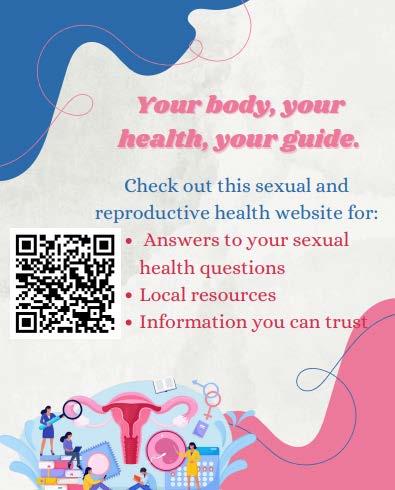
To be an effective resource, this website will be promoted to the student body. To begin this process, I have been working with Michelle De Rosa, the campus’s student health coordinator. She has helped get information approved, and the website is now linked on the VWU counseling resources page.2 Efforts to promote the website include hyperlinked graphics in the campus email blasts, flyers in campus offices specifically counseling and student health (see 2 https://www.vwu.edu/campus-life/counseling-services/resources-and-links.php
Almost every aspect of this project took much longer than I had estimated. I began by collecting all of the content and writing it into easy-to-read sections and topics. Even after omitting significant portions of the information, I ended up with 36 pages of written content utilizing over 90 sources to collect information. From there, I inserted that information into an aesthetically pleasing website. To build my website, I used the platform Canva. I used this platform because I’d had experience navigating it in the past, and the software was free. While Canva has nice features, it provides a scrolling-only website template, meaning that I had to find ways to make it navigable despite only having scrolling capabilities. My solution to this issue was for topics with significant amounts of information; I created interactive presentations using Prezi that are embedded onto the page. This allows the viewer to click on and view the precise information they are looking for without having to scroll through a whole page. Additional graphics, including the occasional “Mythbuster” graphic (see Figure 2), which includes common myths about the topic as well as clarifications with correct information, are meant to make it visually engaging while addressing common misconceptions. The information provided on the website wascarfully selected to give basic information, dispel myths, and address topics that are not always mentioned in sexual education. To be an effective resource, this website will be promoted to the student body. To begin this process, I have been working with Michelle De Rosa, the campus’s student health coordinator. She has helped get information approved, and the website is now linked on the VWU counseling resources page.1 Efforts to promote the website include hyperlinked graphics in the campus email blasts, flyers in campus offices specifically counseling and student health (see figure 3), and promotion at campus events. The idea is to continue to spread the word about this website until it is a well-known resource for students to use. Promotional efforts will continue throughout the end of the semester, and I have been working with Michelle De Rosa to ensure that it can continue in future years. The short-term impact of the website can be measured by its promotional outreach; for example, when posted on social media, the amount of engagement with the site can inform the level of interest.
1 https://www.vwu.edu/campus-life/counseling-services/resources-and-links.php
Campus statistics for sexual health (for example, number of Title IX reports or turnout for STI testing events) can measure longer-term effects and imply overall student usage. If this website were to impact the VWU positively, it could be inferred that it could have similar benefits in communities outside of college campuses. In future models of this project, the website could be launched as a resource for a larger community of people, maintaining that the information stays pertinent to the local area. By expanding this information and making it accessible as a community resource, basic information could be provided to anyone who may need it, leading to overall better health.
I very much wanted to launch my website in time for Women’s History Month, and I was able to publish the site on March 23, 2025. In future models, I would love to see a more technologically advanced version of the website that includes other useful features such as a calendar of community and campus events and geolocation featured maps that show nearby clinics and resources. The sheer amount of time it took to gather and compile comprehensive information speaks to the necessity of this resource. The website provides a campus-approved resource with easily understandable information from a variety of sources (which are hyperlinked at the bottom of each page). Time constraints, a small budget, and inexperience with making websites were significant challenges, and while I wish that my website was more advanced, I am very proud of what I have produced for the time and resources that I had.

the level of interest. Campus statistics for sexual
Universities may be discouraged from sharing sexual health information because of its controversial nature. Current political hostility towards women’s sexuality creates fear and limits possibilities. As it was elegantly stated in Dobbs v Jackson,
“Neither law nor facts nor attitudes have provided any new reasons to reach a different result than Roe and Casey did. All that has changed is this Court. With sorrow… for the many millions of American women who have today lost a fundamental constitutional protection—we dissent” (Supreme Court of the United States 57). These legal changes, in addition to those being made by the Trump Administration, only make it more urgent for college-aged women to have reliable resources to inform critical decisions. Sexual health is vulnerable to the inconsistencies of politics, but through education, universities could empower women to reach their fullest potential and live healthier lives.
(for or turnout for STI testing events) can measure longer-term usage. If this website were to impact the VWU positively similar benefits in communities outside of college campuses. website could be launched as a resource for a larger community information stays pertinent to the local area. By expanding accessible as a community resource, basic information could need it, leading to overall better health.
I very much wanted to launch my website in time able
March 23, 2025.
There is a culture of overall neglect for sexual health that must be combatted. The necessity for quality education is demonstrated not only by its inclusion in the UN sustainable development goals but also by pandemic-like amounts of infections and sexual health issues in young people. Additionally, the lack of femalespecific information in general sexual health education programs speaks to larger gender inequalities that must be addressed. Global organizations like the UN are pleading for better access to information. UN Women, in partnership with other agencies, stated, “Investing in women’s and girls’ reproductive rights and agency… is proven to have remarkable returns, including in terms of social wellbeing, economic prosperity and peace, which our world so desperately needs” (UN Women et. al). Universities should be invested in providing this comprehensive sexual education because of its potential to have an impact on building lifelong healthy habits. A long history of exclusion in research, not being taken seriously in medical settings, denial of equal access to reproductive care, and marginalization within sexual health dialogues and educational systems, despite playing such a crucial role, has left women facing towering barriers that feel impossible to overcome. However, there is hope that holistic education can empower women to know they have the capability to make informed decisions about themselves and their bodies. Through innovative initiatives, barriers can be dismantled brick by brick, revealing a future in which improved overall health leads to promising futures.
Tables - Information and features found on the website:
Topic/page Information provided
Anatomy and Hygiene
- Internal and external female anatomy
-Vagina vs vulva clarification
- General hygiene
- Pubic hair care
- PH levels
- Sources of information
Features of the page
Interactive presentation: displays of both external and internal anatomy that, when clicked on, allow the viewer to see an in-depth name and description of that part.
Hygeine graphic: contains information about washing the vuvla/vagina.
Mythbuster graphic: myths about female anatomy and the correct explanations.
Sexually Transmitted Infections
Safe Sex Practices
- STD vs STI clarification
- Addressing STI stigma
- STI transmission
- The most common STIs (symptoms and treatments
- Where and when to test
- What to do if you have an STI
- Sources of information
Table: Table explaining what does/does not transmit STIs.
Interactive presentation: displays the most common STIs, that when clicked on, allow the viewer to see a description of the STI, it’s commonality, transmission, symptoms, and treatments.
Resources button: A hyperlinked button next to where to get tested that goes to the resource page.
LGBTQ+ Sexual Health
- Defining safe sex
- Communicating with partners
- Use of condoms to prevent STI transmission
- Other preventative measures
- Post intimacy care
- Sources of information
- Sexual orientation and the LGBTQ+ acronym
- Gender identity awareness and sexual healthcare
Communication graphic: a graphic that stands out and discusses the need for communication and consent between sexual partners.
Condom usage graphic: a list of do's and don'ts for condom usage to ensure safe usage every time.
Graphic of LGBTQ+ acronym: A graphic containing each letter, its corresponding flag, and a general definition for that sexual orientation. With an acknowledgement that definitions vary as many labels are relative to the person using them.
- Consent and gender dysphoric conduct
- LGBTQ+ sexual safety and protected sex for same sex couples
Topic/page Information provided Features of the page
Consent - Definitions of consent
- When consent can and can not be given
- Withdrawing consent
- Sources of information
Title IX - Short history
- What can be reported
- Mandated reporters
- VWU’s Title IX process
- Rights when filing Title IX
- Sources of information
Sexual Misconduct
- Key things about sexual abuse
- Sexual harrasment
- Experiencing sexual misconduct
- Helping someone who has experienced misconduct
- Sources of information
Graphic for what is not consent: A graphic that specifies when consent can not be given.
VWU-specific Title IX graphic: Contains VWU information for filing Title IX, including the university coordinators and the reporting process.
List of rights for Title IX: A list of rights that one has when filing Title IX and going through the investigation process.
Experiencing sexual abuse graphic: A graphic outlining possible steps to take if misconduct is experienced.
Helping someone who’s experienced misconfuct graphic: Suggestions for how to be there for someone who is going through sexual abuse or has experienced sexual misconduct.
Topic/page Information provided Features of the page
Pregnancy - How pregnancy occurs
- Miscarriages
- Stages of pregnancy, labor, and delivery
- Prenatal care
Mythbusters graphic: contains common myths about miscarriages and clarification about them.
Interactive presentation: allows the viewer to click on and view information about each
- Sources of information trimester ’s development and symptoms, including labor and delivery
Contraceptio n - Why contraception is important
- Types of contraception
- Effectiveness of contraception
- Sources of information
Reproductive Rights - Bodily autonomy
- Options for unplanned pregnancy
- Abortion rights in Virginia
- Rights to contraception
- Sources of information
Types of contraception chart: This chart, which spans most of the page, contains in-depth information about the most common methods of contraception. It includes barrier birth control (condoms), hormonal contraception, contraception targetting sperm, planning methods, and emergency contraception.
Options for unplanned pregnancy graphic: Provides information about many options that aren’t raising a baby, including abortion, adoption, family, and Safe Haven surrendering.
Mythbusters graphic: displays myths about abortion and the correct information.
Topic/page Information provided Features of the page
Menstrual Health
- The period and when it happens
- Hormones
- Menstrual stages
- Premenstrual syndrome
- Menstrual products
- Toxic shock syndrome
- Managing periods
- Sources of information
Interactive presentation: A presentation with the different stages of the menstrual cycle for information about that stage and energy levels.
Graphic of sanitary products: Displays and explains the use of the most common sanitary products, including pads, tampons, cups, and period underwear.
Mythbusters graphic: displays myths about the menstrual cycle and the corrected information.
Preventative care
- Pap smears
- Self-breast exam
- Common feminine conditions
- Urinary tract infections
- Yeast infections
- Sources of information
Video for self-breast exam: A video explaining how to perform a self-breast exam and what to look for
Graphic of feminine conditions: A graphic containing common conditions, what they are, how common they are, causes, symptoms, diagnoses, and treatments.
Broussard, Kathleen. “Strategic (non)disclosure: Activation and avoidance of social ties among women seeking abortion.” Journal of Health and Social Behavior, vol. 65, no. 4, 16 Jan. 2024, pp. 489–505, https://doiorg/10.1177/00221465231215783.
Bontempi, Jean Breny, et al. “Exploring gender differences in the relationship between HIV/STD testing and condom use among undergraduate college students.” American Journal of Health Education, vol. 40, no. 2, Mar. 2009, pp. 97–105, https://doi.org/10.1080/19325037.2009.10599084.
Burrell, Carmen N et al. “Gender Differences in Sexual Health Knowledge Among Emerging Adults in AcuteCare Settings.” The Journal of the American Osteopathic Association vol. 119,5 (2019): 289-298. doi:10.7556/jaoa.2019.050.
Center for Reproductive Rights. The Constitutional Right to Reproductive Autonomy: Realizing the Promise of the 14th Amendment, 22 Mar. 2023, reproductiverights.org/constitutional-right-reproductive-autonomy-14th-amendment/. Accessed 11 Feb. 2025.
Dayton, Alli. Personal interview. “Gettysburg College Sexual Misconduct Task Force Member Interview.” 10 Mar. 2025.
Goldfarb, Eva S., and Lisa D. Lieberman. “Three decades of research: The case for comprehensive sex education.” Journal of Adolescent Health, vol. 68, no. 1, 12 Oct. 2020, pp. 13–27, https://doi.org/10.1016/j. jadohealth.2020.07.036.
Habel, Melissa A et al. “Community Colleges: Rethinking STD Prevention for the Nontraditional College Campus.” Community college journal of research and practice vol. 4,11 (2016): 747-756. doi:10.1080/10668 926.2016.1220874.
Institute of Medicine (US) Committee on Ethical and Legal Issues Relating to the Inclusion of Women in Clinical Studies. Women and Health Research: Ethical and Legal Issues of Including Women in Clinical Studies. Edited by Anna C. Mastroianni et. al., National Academies Press (US), 1994. doi:10.17226/2304
MD, Jeremy Faust. “CDC Researchers Ordered to Retract Papers Submitted to All Journals.” Medical News, MedpageToday, 1 Feb. 2025, www.medpagetoday.com/opinion/faustfiles/114043. Accessed 15 Feb. 2025.
Mickler, Alexandria K, and Jessica Tollestrup. “Teen Birth Trends: In Brief .” Congress.Gov, Congressional Research Service, 28 Aug. 2024, www.congress.gov/crs-product/R45184. Accessed 11 Feb. 2025.
ODU. “Women’s & Gender Equity Center.” Https://Www.Odu.Edu/Wgec, Old Dominion University, Oct. 2021, www.odu.edu/wgec. Accessed 28 Mar. 2025.
Office of the Surgeon General. “National Prevention Strategy.” National Library of Medicine , June 2011, www. ncbi.nlm.nih.gov/books/NBK592705/pdf/Bookshelf_NBK592705.pdf. Accessed 28 Feb. 2025.
Office on Women’s Health, OASH. “Human Papillomavirus: Office on Women’s Health.” OASH | Office on Women’s Health, 27 Feb. 2025, womenshealth.gov/a-z-topics/human-papillomavirus. Accessed 19 Feb. 2025.
Parker, Kim, and Kiley Hurst. “Teens’ Future Plans and Goals.” Pew Research Center, Pew Research Center, 13 Mar. 2025, www.pewresearch.org/social-trends/2025/03/13/teens-future-plans-and-goals/#:~:text=A %2055%25%20majority%20of%20White,from%20White%20or%20Hispanic%20teens). Accessed 1 Apr. 2025.
RAINN. “The Criminal Justice System: Statistics.” Rape, Abuse & Incest National Network, 2020, rainn.org/ statistics/criminal-justice-system#:~:text=The%20Majority%20of%20Sexual% 20Assaults,out%20 of%203%20go%20unreported.&text=Members%20of%20the%20mili tary%3A%2043,10%25%20 of%20male%20victims%20reported. Accessed 9 Feb. 2025.
Ritchie, Hannah. “‘Hysterical’: The Women Calling out Doctors’ Gaslighting.” BBC News, BBC, 2 July 2024, www.bbc.com/news/articles/cv229ereeejo. Accessed 11 Feb. 2025.
Sex Ed for Social Change. “‘The Talk’ Survey: A Sex Education Map: Future Method.” SIECUS, 10 June 2024, siecus.org/the-talk-sex-education-survey/. Accessed 20 Feb. 2025.
Slivka, Jennifer. Personal interview. “VWU’s Gender & Equity Office and Initiatives”. 12 Feb. 2025.
Supreme Court of the United States, https://www.supremecourt.gov/opinions/21pdf/19-1392_6j37.pdf. Dobbs v. Jackson Women’s Health Organization. No. 19–1392, 24 June 2022. Accessed 2 Mar. 2025.
Sun, Lena H., et al. CDC Removes Gender, Equity References in Public Health Material, The Washington Post, 1 Feb. 2025, www.washingtonpost.com/health/2025/01/31/cdc-website-gender-lgbtq-data/. Accessed 11 Feb. 2025.
The United Nations. “Goal 3 | Department of Economic and Social Affairs.” United Nations, United Nations, Sept. 2015, sdgs.un.org/goals/goal3#targets_and_indicators. Accessed 9 Feb. 2025.
UN Women, et al. “Joint UN Statement Calling for Sexual and Reproductive Health and Rights for All.” UN Women – Headquarters, 11 July 2024, www.unwomen.org/en/news-stories/statement/2024/07/joint-unstatement-calling-for-sex ual-and-reproductive-health-and-rights-for-all. Accessed 12 Mar. 2025.
Whatley, Mariamne H. “Raging Hormones and Powerful Cars: The Construction of Men’s Sexuality in School Sex Education and Popular Adolescent Films.” The Journal of Education, vol. 170, no. 3, 1988, pp. 100–21. JSTOR, http://www.jstor.org/stable/42748650.Accessed 11 Feb. 2025.
WHO. “From School Nurse to Courageous Advocate: Arofat Marakhimova’s Fight against Cervical Cancer.” World Health Organization, World Health Organization, 5 Feb. 2025, www.who.int/europe/news-room/ feature-stories/item/from-school-nurse-to-courageous-a dvocate-arofat-marakhimova-s-fight-against-cervical-cancer#:~:text=From%20school%2 0nurse%20to%20courageous%20advocate:%20Arofat%20 Marakhimova%27s%20fight% 20against%20cervical%20cancer.&text=%E2%80%9CI%20was%20 frightened%2C%20 but%20I%27m%20grateful%20it,detect%20cervical%20precancers%20before%20 they% 20become%20life%2Dthreatening. Accessed 22 Feb. 2025.
World Population Review. “Abstinence-Only Education States 2025.” 2025, worldpopulationreview.com/ state-rankings/abstinence-only-education-states. Accessed 10 Feb. 2025.
Food waste is a global issue that is only growing in scale. Over 900 million tons of food waste are generated globally every year, equating to about 17% of all food produced. This extreme excess in wasteful production and consumption significantly impacts humanity on local and existential scales. Most of the food wasted along the supply chain can be found sequestered in landfills. Rather than providing sustenance to the ecosystem, the nutrients the food contains are released into the environment as harmful water and air pollutants, including greenhouse gases. Organizations like the United Nations are attempting to limit food waste on the production and consumption ends of the food supply chain, but efforts are failing to catch up to the rates of production. Composting is an underserved method of decreasing the amount of food waste at the individual scale. The composting program at Virginia Wesleyan University has met roadblocks in the effectiveness and scale of production. This project aimed to rectify these roadblocks by implementing lipolytic bacteria into the campus composting process. The composting programs of other college campuses and the current state of knowledge concerning lipolytic bacteria were reviewed. As a proof-of-concept, an experiment was also conducted to determine if lipolytic bacteria could be harnessed from the campus ecosystem for triglyceride breakdown. Numerous bacterial species succeeded, giving merit to using native lipolytic bacteria to supplement composting. Implementation of these bacteria would increase the amount of campus food waste that can be diverted from landfills and could have far-reaching impacts on the effectiveness of food waste management.
Imagine you are eating lunch. You have already eaten a hearty meal, yet decide to grab another plate of food. You get halfway through and realize there is no way you can finish. Defeated and guilty, you get up to throw the remaining food in the garbage. You know where the food is going. Every day, you see garbage cans full of discarded fruit and half-eaten sandwiches. You smell the rot coming from dumpsters nearby. You see the ever-growing landfill across town. You know that thousands of people go hungry, juxtaposed with the surplus of food consistently going to waste. You regret adding to the plight but do not know what could be done. This is the experience of many students at Virginia Wesleyan University.
Mitigating food waste at its points of production – the household, food service, and retail sectors of the food supply chain – would be the most beneficial environmentally and socially, but progress is slow [1]. Unfortunately, there are deep-rooted societal behaviors that allow wastefulness to persist.
The systems in place to manage supply and demand are largely insufficient, so much of the food produced is landfilled or otherwise wasted at some point along the supply chain. Food production has taken precedence over the storage, distribution, and sustainable management of said food. In developed countries, households buy much more food than needed and throw away the food that expires [2]. In fact, the 2021 United Nations Environment Programme Food Waste Index Report found that lower-middle to high-income households produce considerable food waste at about 74 kg per capita on average [1]. Developed countries have the resources to better manage their supply chain practices, yet so much is allowed to slip through the cracks. Citizens of developed nations are all responsible for the food waste they produce [2]. The present failure to limit food waste production requires more extensive measures to account for this excess. Composting is an effective means of managing food waste more sustainably; however, effectively doing so on a university scale would face issues of productivity and financial feasibility.
Food waste is a seemingly insurmountable global issue. The United Nations (UN) defines food waste as “food and the associated inedible parts removed from the human food supply chain in the following sectors: retail, food service, households.” Food in this instance is “any substance – whether processed, semi-processed or raw – that is intended for human consumption” [1]. An estimated 931 million tons of food waste was generated globally in 2019. 61% of this was from household waste, 26% from food services, and the remaining 13% from retail. This waste adds up to approximately 17% of all food produced [1].
The organic material in food is what provides energy and nutrients to all living things. As food degrades in nature, the carbon, nitrogen, and other nutrients are returned to the environment along with the energy within the organic molecules [3]. Every ton of food placed in a landfill, however, is nutrients lost to people and the ecosystem. In 2019, the United States produced over 66 million tons of food waste. Of that, almost 60% of all food waste was lost to landfills [4]. Only about 8.5% of waste is recovered via compost or biochemical processing. This means that almost 40 million tons of organic material are allowed to rot each year. The nutrients from all of this food are then restricted from reentering the local ecological cycle. The U.S. makes up only 4% of the global human population, yet contributes 7% of the global food waste. National composting efforts were inconsequential until the year 2000, and still only account for 5% of all food waste management [4].
The vast majority of waste, from the municipal to the global level, is disposed of in open dumpsites (also called illegal landfills) or controlled landfills. According to the World Bank, landfills account for about 37% of all waste, 44% of which is food waste [5]. Landfills are associated with numerous environmental and health issues. Water pollution is the primary threat, as underground and marine water can be contaminated by toxic waste [6].
Leachate, a liquid mixture of degrading organic waste, can seep through holes in the landfill barrier and contaminate aquifers. This harms local ecosystems and the people living in the area, who tend to have comparatively low incomes [7]. Landfills are a large source of greenhouse gas (GHG) emissions, particularly methane. Methane is far more effective than carbon dioxide at trapping heat in the atmosphere, accelerating global warming that much faster. Additionally, the construction and poor maintenance of landfills can lead to biodiversity loss. On average, up to 300 species are displaced per hectare of a landfill. Some of those species, namely the birds and small mammals, are replaced with crows and rats that feed off of the waste [6].
The magnitude of the issue of food waste has earned the attention of the United Nations (UN) Department of Economic and Social Affairs. The UN has established 17 Sustainable Development Goals (SDGs) covering global environmental, social, and health issues such as climate action or access to clean water The issue of food waste falls under UN Sustainable Development Goals 11 and 12 [8]. Goal 11 is to increase the inclusivity, resilience, and sustainability of cities and human settlements. Indicator 11.6.1 specifically monitors the amount of solid waste managed by controlled facilities compared to the total waste produced by cities. As of 2022, the global average amount of municipal solid waste (MSW) collected was 82% and MSW managed in controlled facilities only 55%. The UN has since reported no notable progress toward this indicator [9].
Goal 12 is to ensure sustainable consumption and production patterns. Target 12.3 aims to halve retail and consumer food waste per capita and reduce food loss along production and supply chains by 2030. Food waste and loss indexes are used to indicate the progress of this target. Unfortunately, global food waste is only increasing: 19% of food was wasted post-processing in 2022 compared to 13.2% in 2021. That is equivalent to 1.05 billion tons of food wasted while 783 million people go hungry each year [10].
Many of the nutrients released by decomposing food waste are in the form of GHG emissions [10]. It has been estimated that up to 10% of all global GHG emissions are the product of wasted food. If all food waste in the world were amalgamated into one nation, it would be the third largest GHG emitter [1]. The considerable GHG emissions released from this waste contribute significantly to the acceleration of climate change [10]. Direct environmental impacts of climate change, such as extreme weather events, have cost an estimated 2.8 trillion dollars in damages and relief efforts over the last 20 years, about 143 billion dollars each year [11]. The cumulative costs of climate change reach over one trillion dollars annually [10]. This is expected to increase up to 3.1 trillion dollars per year by 2050 [11]. As food waste contributes 10% of all GHGs, it is currently responsible for over 100 billion dollars annually. This would increase to 310 billion dollars by 2050. Despite this troubling reality, only nine of 193 countries made financial contributions toward improving food waste management in 2022 [10]. Composting has significant potential to accelerate the achievement of Goals 11 and 12 by increasing the amount of food waste being sustainably managed.
soil [6].
Composting is a natural form of organics recycling through the collection and processing of organic, or carbon-based, waste to return to the environment. Nutrients like carbon that would otherwise be burned or sequestered in a landfill can be repurposed [12]. The organic materials used are called feedstocks, as they provide the fuel for the composting process. Feedstocks must adhere to specific carbon-to-nitrogen ratios that satiate the nutrient needs of the organisms that will break them down. The carbon-rich materials of feedstocks, coined “browns”, include dry leaves and wood chips. The nitrogen-rich materials are called “greens” and include food scraps high in protein [13].
In composting, decomposers – primarily bacterial microorganisms – break down organic materials into simpler molecular components that can be used and cycled back through the ecosystem [12]. The carbohydrates from the browns are converted to energy for metabolic and respiratory processes, while the proteins are used for cellular growth and reproduction. Ideal feedstocks maintain a 3:1 browns to greens ratio by volume, as carbohydrates are used up far more rapidly than proteins. Diverging too far from this ratio can result in incomplete decomposition and odor [13].
Composting is an aerobic process, meaning that the bacteria decomposing the feedstock require adequate water and oxygen access. Water flow through the compost pile allows for the nutrients from the feedstock to get to the microorganisms. Rainfall or intentional watering is typically necessary for sufficient moisture. Mixing of the feedstock pile –either manually or automatically in an industrial composter – aerates the pile for oxygen flow. Access to oxygen by mixing the feedstock initiates the composting process [13].
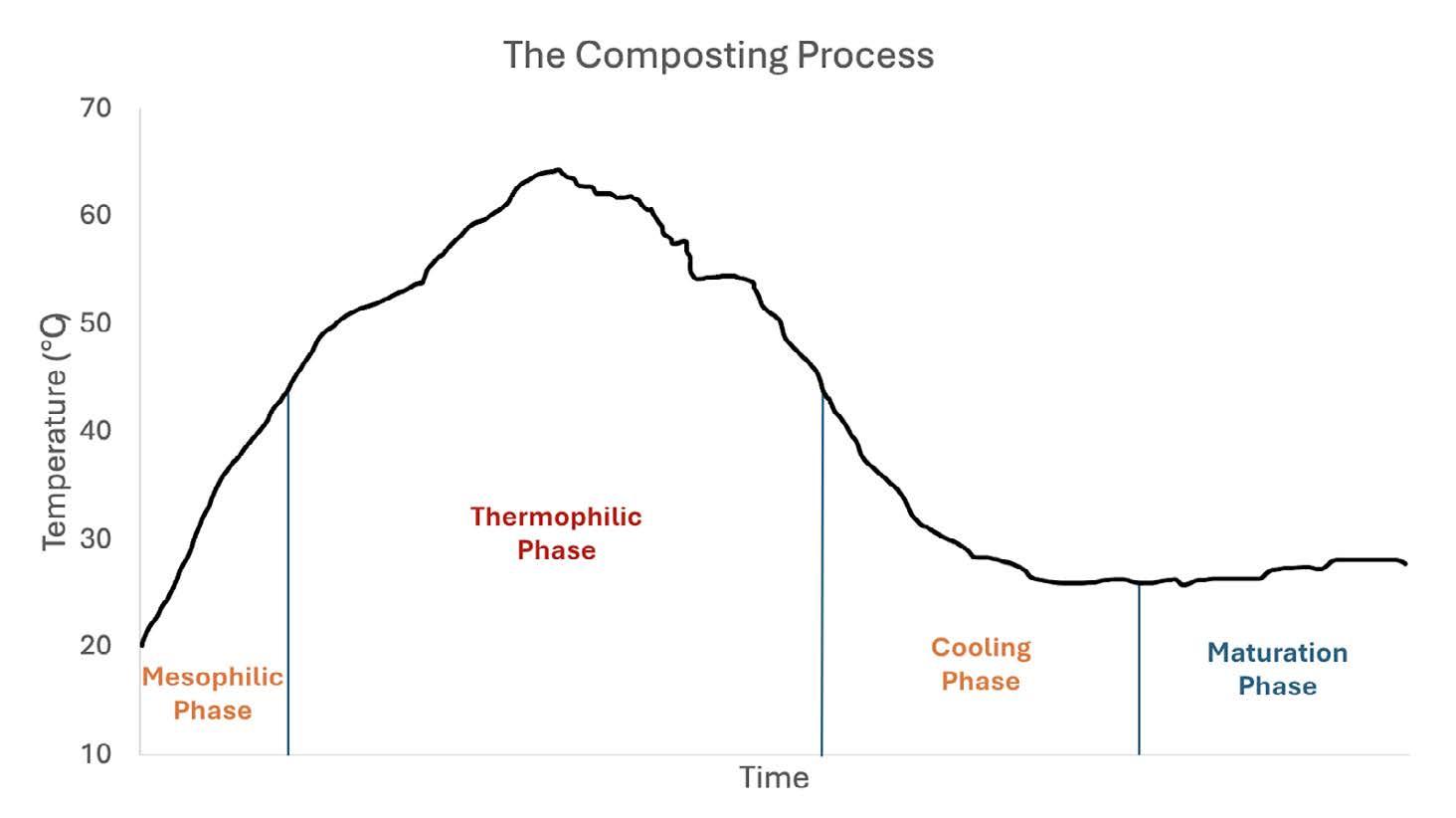
The composting process occurs in four phases as illustrated in Fig. 1 : the mesophilic, thermophilic, cooling, and maturation phases. In the mesophilic phase, mesophilic bacteria begin breaking down complex carbohydrates into simpler molecules, releasing heat which increases the temperature of the system. Once the temperature reaches about 45 °C, the mesophilic bacteria die off and are supplanted by thermophilic, or ‘heatloving’, bacteria. Thermophilic bacteria can break down tougher and more dense macromolecules like fats and proteins [14]. The high temperatures also kill off pathogens and weed seeds present in the feedstock [13]. as the byproduct settles and condenses [14]. This nutrient-rich compost is
Thermophilic bacteria die off at around 70 °C, after which the temperature drops and the process enters the cooling phase. The mesophilic bacteria return to break down the remaining material. The compost enters the maturation phase once all organic material is decomposed; the bacteria die off as the byproduct settles and condenses [14]. This nutrient-rich compost is typically used as an amendment to promote fertile soil [6].
Since 2022, Virginia Wesleyan University has had a composting program on campus to decrease the amount of food waste going directly to landfills. This program has been led by Marlins Go Green, a student-run environmentalist organization, in tandem with an employed horticulturist. They collected food waste from the dining hall in a large waste bin and processed the feedstock in the campus greenhouse. Earthworms have been used as decomposers, a process known as vermicomposting.
The Association for the Advancement of Sustainability in Higher Education (AASHE) is a membership organization of colleges and universities practicing sustainability. Virginia Wesleyan is one of these institutions. The Sustainability Tracking, Assessment, and Rating System (STARS) program under AASHE ranks members based on their achievements in numerous sustainability metrics [17]. The lowest rank is bronze, followed by silver, gold, and platinum at the highest. According to STARS, Virginia Wesleyan has a rank of silver with an overall score of 53.11 out of 100. As of 2022, Virginia Wesleyan has 1,193 weighted campus users, which accounts for all resident on-site students and employees as well as a portion of full-time students and employees. Of the almost 240 tons of total waste generated on campus, about 26% is diverted from landfills. Just over 62 tons are diverted by recycling, and only about 0.13 tons are composted each year [18].
Marlins Go Green has presently halted the collection of food waste due to an overall lack of resources. First, the single compost bin was too small to make the intended impact. The waste bin was the size of a municipal trash can which was filled by the end of each day. Second, there was a severe lack of a workforce. The small amount of compost being produced was still overwhelming for the incredibly limited volunteer force. Third, and most important, the amount of food waste that could be vermicomposted was heavily restricted. The vermicomposting method only allowed for the processing of fruits, vegetables, and paper products. This is due to the environment that earthworms require. Earthworms process food most optimally at about 13-25 °C and cannot survive conditions above 27°C [19]. As stated previously, dense macromolecules like lipids and proteins require temperatures above 45°C to effectively break down [14]. Additionally, any fatty and oily products added to a vermicompost pile would produce strong odors that attract pests [19]. Therefore, all meats, dairy products, oils, condiments, or any food mixed with these products have been landfilled. Virginia Wesleyan needs a feasible means of composting oily and fatty food waste, and fat-eating bacteria may be the answer
A dual approach will be taken to increase the sustainable management of food waste on the Virginia Wesleyan campus. To start, the composting practices of various college campuses were analyzed as models for Virginia Wesleyan.
The literature on lipid-degrading bacteria was then briefly reviewed to identify the current state of scientific consensus. As a proof-of-concept, an experiment was also conducted to determine if lipoloytic bacteria can be harnessed from the campus ecosystem for triglyceride breakdown. Successful implementation of these bacteria would increase the percentage of campus food waste that can be diverted from landfills.
Out of the 359 institutions of education with a valid rating in the STARS program, only 13 have a Platinum rating. Five of those 13 are Canadian universities, including the three highest-scoring institutions [17]. The University of Sherbrooke has the highest score at 92.73 out of 100. Sherbrooke is a French-speaking public research university in Quebec with over 19,000 weighted campus users as of 2021. In 2019, it became the first institution in the STARS program to receive a platinum status on its first application [20]. This may provide a look into what Virginia Wesleyan could become in the long term.
Sherbrooke made significant improvements to an already impressive waste management initiative from 2002 to 2020. They managed a staggering 71.94% reduction in total waste generated per weighted campus user from 0.13 to 0.04 metric tons. Over 50% of the waste produced is successfully diverted from landfills and incinerators through extensive recycling, composting, and donating/reselling programs. Composted materials rose from 5.20 to 71.40 metric tons per year in the same 18-year period. In addition to food waste, brown paper from bathrooms is collected and composted. Thirty-four tons of mouse litter from the medical campus that would otherwise be burned or landfilled are composted each year. Plans are in place to expand this operation beyond the Faculty of Medicine and Health Sciences [20]. The installation of an on-campus composter made many of these feats possible.
In 2009, Sherbrooke installed a Brome rotating industrial composter on campus. This composter is designed to require less feedstock than other compost techniques. Alternative methods would require a large amount of browns, such as wood chips, to fuel the microbes that are breaking down the food waste. All mixing of compost is conducted automatically with an electric motor in the rotating drum rather than by hand or with a tractor. This saves significant costs and time in the long term. The automated rotations ensure that the mixture is properly aerated so the microbes receive adequate oxygen and odor production is reduced [21].
The durability of the industrial cylinder allows for a controlled composting process. It can withstand temperatures above 55°C for a minimum of three days. This provides optimal conditions for microbes to metabolize all of the food waste over a shorter period. The high temperatures also eliminate harmful pathogens that could otherwise persist and infect those who use the compost. The Brome composter can operate continuously throughout the year with little maintenance due to its automation. New food waste can be added regularly through a sliding door. Further optimizations and customizations, such as volume capacity, are offered through several model variations [21].

In an entry in La Tribune, a French-Canadian newspaper, Sherbrooke announced the installation of the Brome composter and highlighted the projected benefits it would produce. Prior to the installation, Sherbrooke was transporting food waste to a local off-campus compost site for treatment. Transport and disposal costs between 225 and 250 dollars per metric ton, which would drop to only 75 dollars once the campus was fully self-managed. The project would allow for the composting of 60 metric tons of food waste and other compostable materials. Installation and management would generate two new campus jobs for students [22]. While these improvements are impressive, this was a very costly project. The purchase and installation of the composter cost 150,000 Canadian dollars, about 133,000 USD. Sherbrooke required multiple grants to pay for this. They received 25,000 dollars from the Generations Pact and an additional 50,000 from the Canadian Independent Grocers Alliance (IGA) Eco-municipality Fund [22]. The scale of this project would not be achievable for Virginia Wesleyan in the short term without significant philanthropic donations.
The durability of the industrial cylinder allows for a controlled composting process. It can withstand temperatures above 55℃ for a minimum of three days. This provides optimal conditions for microbes to metabolize all of the food waste over a shorter period. The high temperatures also eliminate harmful pathogens that could otherwise persist and infect those who use the compost. The Brome composter can operate continuously throughout the year with little maintenance due to its automation. New food waste can be added regularly through a sliding door. Further optimizations and customizations, such as volume capacity, are offered through several model variations [21].
In an entry in La Tribune, a French-Canadian newspaper, Sherbrooke announced the installation of the Brome composter and highlighted the projected benefits it would produce.
Middlebury College in Middlebury, Vermont is rated gold by the STARS program for its dedication to sustainable practices. Middlebury is a small liberal arts institution with a population of nearly 4,000 weighted campus users, over three times larger than Virginia Wesleyan. Despite its small size, it has the infrastructure and workforce to compost up to 400 tons of food waste each year [23]. They collect pre- and post-consumer waste from the college dining halls and the over 85 compost bins across campus. In the kitchens, dining staff use 22-gallon Rubbermaid containers to collect all food and paper waste. The leftovers, including meat, are scraped into a pulper with waxed cardboard, napkins, and tea bags. That waste is transferred to larger 60-gallon totes, which are picked up daily by waste management staff. Specially designed hook-lift trucks are used to transport the totes to the recycling center, which can hold up to three days of food waste at once. The recycling center is on the edge of campus so students, faculty, and staff are spared from possible odors [24].
Prior to the installation, Sherbrooke was transporting food waste to a local off-campus compost site for treatment. Transport and disposal costs between 225 and 250 dollars per metric ton, which would drop to only 75 dollars once the campus was fully self-managed. The project would
At the recycling center, the food waste is stored in a 40-yard enclosed roll-off dumpster. The large size allows for greater surface aeration, reducing mixing frequency from twice per week to once every three to four weeks. To prepare the feedstock, the food waste is mixed with woodchips from campus landscaping and locally sourced horse manure in a 1:3:1 ratio. A John Deere loader mixes these ingredients and creates windrows, or rows, of feedstock. The windrows are routinely turned to maintain optimal temperature, moisture, and consistency levels for microbial activity, a process called the Turned Windrow System. Once the thermophilic phase ends, and weed seeds and pathogens have been killed off, the windrows are moved to a secondary pile for the cooling phase [24].
After a year, contractors from a local commercial composter screen the cooling compost. Screening involves passing compost through a sieve to remove debris and materials that were not composted [25]. This results in a finer consistency that makes the compost easier to apply. The materials too large to screen are left to decompose for an additional year and are rescreened. The screened compost is then stored to foster a high-quality, nutrient-rich compost. This aged compost is used for the campus garden, athletic fields, and landscaping projects [24].
Unlike Sherbrooke, Washington College serves as a more tangible model for Virginia Wesleyan. Washington is a private liberal arts college in Chestertown, Maryland with under 1,000 students as of 2022, comparable to the estimated 1,200-student Virginia Wesleyan population [26]. The Compost Club at Washington seeks to promote holistic wellness and sustainability through the practice of composting. In 2012, the club founded the campus garden, which uses compost produced from food waste to grow nutrient-rich fruits and vegetables. Students designed a simple, household-level technique. A 3-bin system allows for the rotation of compost materials, speeding up the process to produce a finished soil amendment in 18 days. Campus students, staff, and faculty are encouraged to contribute food scraps and pizza boxes to the compost pile while taking freshly grown food. Since 2012, the garden has expanded to include more than a dozen fruit trees, a beekeeping apiary, an herb spiral, a living roof, a pond, and much more. It has quickly become the largest student organization on campus as a center of health and learning [27].
Each campus reviewed demonstrated a different level of composting infrastructure. The University of Sherbrooke represents an institution that has made great achievements in composting with significant financial resources. The average college or university, including Virginia Wesleyan, lacks the funding or philanthropic donations to afford to compost on an industrial scale. Middlebury College is similarly out of reach in the immediate future, but the placement of significant pressures on Virginia Wesleyan as an institution could influence greater investment in composting infrastructure. Washington College is comparable to Virginia Wesleyan in size and population, yet is superior in its composting scale. While attempts to contact the Compost Club of Washington have been unsuccessful, an exchange of information between them and Marlins Go Green could greatly benefit the composting program.
Bacteria could be a central component in expanding the impact of composting on the campus scale. Most campus food waste is noncompostable because it is dense in triglycerides, a group of large lipid macromolecules that store energy for long-term use [3]. Lipids, however, are present in all life forms, so many bacterial species have evolved the capacity to break them down for nutrients. These are called lipolytic bacteria and have lipase proteins to break down the large lipid molecules into their smaller components. Lipophilic bacteria are a subset of lipolytic bacteria that particularly flourish in high-lipid conditions [28].
The existence of lipophilic bacteria in nature is well-known and has been thoroughly tested. From the Ob River of Western Siberia, microbial samples from bottom sediments were studied for the presence of industrially significant enzymes, including lipase. Tributyrin agar, a culture medium containing tributyrin triglyceride oil, was used to detect lipolytic activity. Dense media containing pork fat and olive oil or diesel fuel were then used to assess the metabolization of organic substrates. The most promising bacterial strains were found to be M. aerodenitrificans sp. LM1 and P. lini sp. KGS5k3. This was the first time lipolytic activity had been demonstrated in the latter strain [29].
The ability to break down lipids has only recently been applied to waste management processes. A 2020 study sought to find new lipophilic bacteria in industrial wastes [30]. Thirty strains of bacteria from across the bacterial family tree were successfully cultured and isolated. 19 of those strains were found in a grease trap of a meat processing plant, and the other 11 were from pond wastewater of a milk plant. 1% pork fat, 1% vegetable oil, or 0.8% milk fat was used as the lipid substrate for colony growth. These findings support the idea that lipolytic bacteria have a lot of potential in the industrial and commercial degradation of lipids. A future goal of this study was to produce bio-formulations for commercial fat breakdown [30].
Another study incorporated lipase-producing bacteria into a wastewater treatment system. Fat, oil, and grease (FOG) traps collect lipid-dense material from restaurant wastewater since conventional treatment plants cannot break it down. The use of lipase to dissolve fats as a pretreatment was deemed the most effective method in alleviating pipe clogging. An isolate of lipolytic strain Pseudomonas aeruginosa D2D3 was used as the FOG decomposer to compare two types of FOG traps. The results further supported the usefulness of lipolytic bacteria in waste treatment [31].
Each of the above studies displays the capacity of lipolytic bacteria to effectively break down fats and oils. The following section discusses the proof-of-concept experiment conducted to determine if the extraction and culturing of lipolytic bacteria could be done from the local campus environment.
Prior to the soil sample collection, Tryptic Soy Agar (TSA) plates were made. TSA is a generalpurpose medium commonly used to culture microorganisms with a wide range of metabolic requirements. It is particularly common in bacterial culturing due to this generalizability [32]. Preparation of the agar required TSA powder and distilled water.
The typical medium-to-water ratio for TSA preparation is 40 g of powder for every liter of distilled water [33]. To account for excess pouring and unforeseen complications while also avoiding overflow in the autoclave, 750 mL of water was used. Per the standard ratio, 30 g of TSA powder was added and vortexed until thoroughly dissolved. Vortexing involves a stir plate that provides a magnetic field that spins a magnetic stir bar placed in the mixture. Once dissolved, the glass bottle was sterilized in the autoclave, an instrument that heatkills all organisms enclosed within. The agar was again vortexed as 1.5 mL of cycloheximide antifungal agent was added. The antifungal helped ensure that only bacteria grew in the agar. The agar was then poured into each plate to cover the surface. A flame was lit to sterilize the air around the work site, decreasing the risk of airborne contamination of the agar. With the excess agar produced, a total of 32 plates were made. The plates were left to dry for about 24 hours and then refrigerated to preserve the antifungal agent.
Soil cores were taken from the topsoil of three discrete soil zones on the campus of Virginia Wesleyan as seen in Fig. 2 , two cores from each zone. Cores were collected using 50-mL blue-capped centrifuge tubes. Zones 3, 19, and 36 were chosen based on their distance from each other. Each zone was located in a different region of the campus, so there was likely to be a greater diversity of soil types compared to directly adjacent zones. This higher diversity in soil type allowed for greater variation in bacterial species, as different bacteria are uniquely evolved to operate in different environmental conditions. The capacity for lipolytic character may not be necessary in some environments compared to others.
Phosphate-buffered saline (PBS) mixtures were made for each soil sample to ensure cellular homeostasis, assisting in cell survival. 4 g of each soil sample was mixed with 36 mL of PBS solution, which filled approximately 40 mL of the 50-mL centrifuge tubes. Each of the six mixtures was vortexed at maximum speed in 30-second increments for five minutes to mix the contents thoroughly. The mixtures were then placed in a sonicator ( Fig. 4a) for three minutes (20 seconds pulsing and 20 seconds off at 20% amplitude), which agitated the particles using sound waves. This served to disperse the aggregates of microbes from the soil. The mixtures were vortexed again, then centrifuged ( Fig. 4b ) at 1400 x g for fifteen minutes (protocol adapted from [34]). This was done to separate the bacteria in the solution from the inorganic debris.
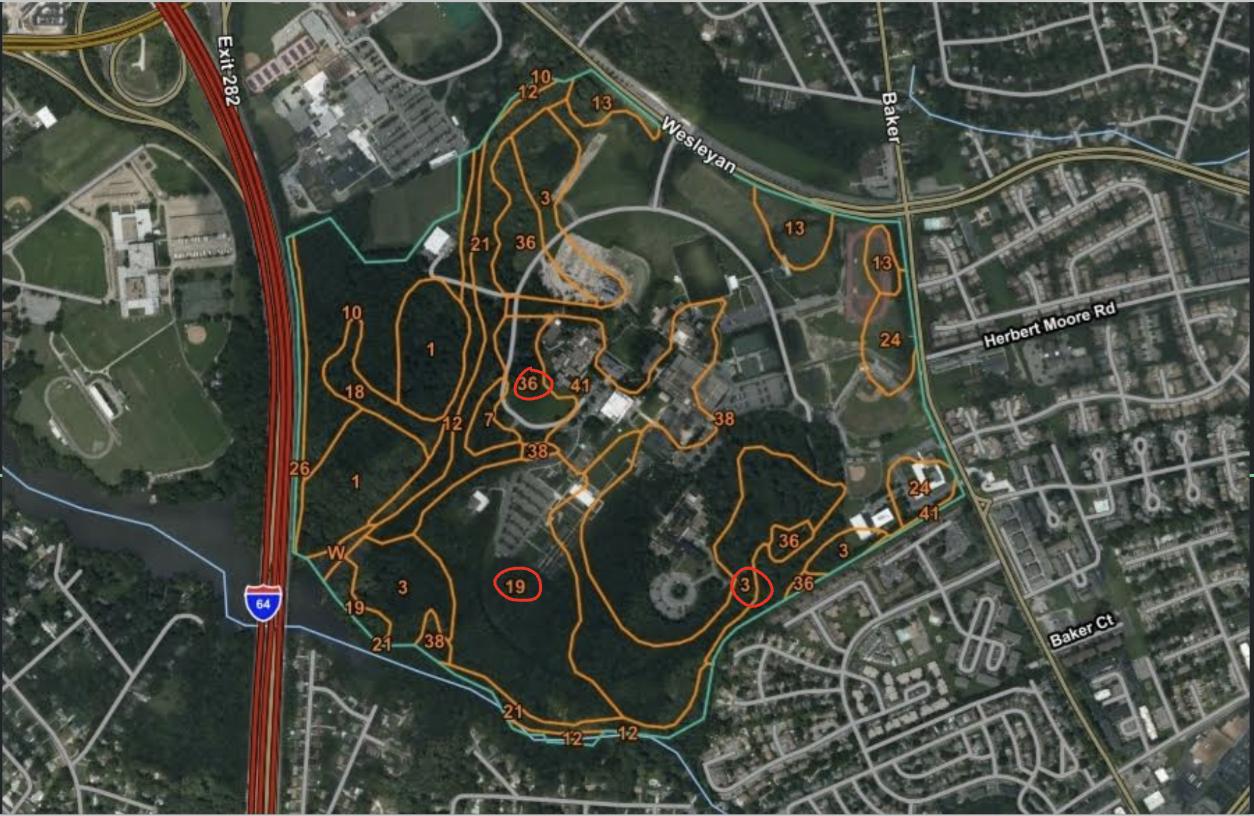
Fig 3: Soil map of VWU with collection zones circled in red
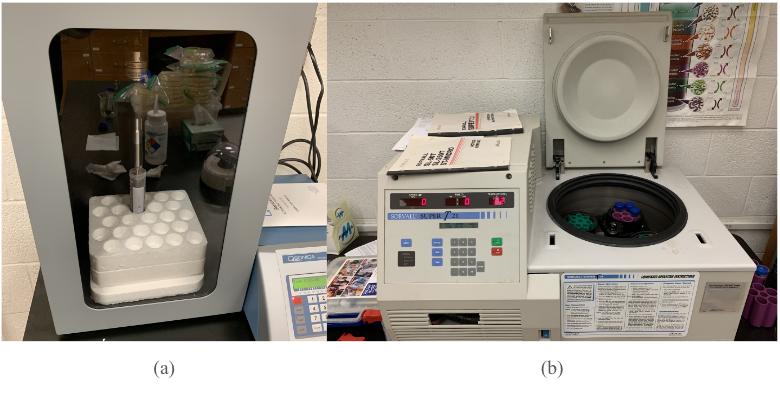
Fig 4: (a) A 50-mL centrifuge tube of soil mixture is placed in a sonicator, where a metal probe penetrates the mixture and vibrates to suspend bacterial aggregates. (b) The centrifuge rotates to produce 1400 times the force of gravity to separate the solution of bacteria from the debris
Phosphate-buffered saline (PBS) mixtures were made for each soil sample to ensure cellular homeostasis, assisting in cell survival. 4 g of each soil sample was mixed with 36 mL of PBS solution, which filled approximately 40 mL of the 50-mL centrifuge tubes. Each of the six mixtures was vortexed at maximum speed in 30-second increments for five minutes to mix the contents thoroughly for three minutes (20 seconds pulsing and 20 seconds off at 20% amplitude), which agitated the particles using sound waves. This served to disperse the aggregates of microbes from the soil. The mixtures were vortexed again, then centrifuged (Fig. 4b) at 1400 x g for fifteen minutes (protocol adapted from [34]). This was done to separate the bacteria in the solution from the inorganic debris.
Serial dilutions of these mixtures were produced to more accurately identify isolated
Serial dilutions of these mixtures were produced to more accurately identify isolated bacterial colonies. The solutions were diluted by three orders of magnitude before plating. 25 and 250 μL of each diluted mixture were plated on TSA using pipettes and spread evenly across the agar with a glass spreader. A flame sterilized the workspace as the bacteria were plated, and the glass spreader was burned with ethanol after each plating. The twelve plates were placed in a 25 °C incubator to foster bacterial growth.
To test the lipolytic abilities of these bacteria, they were transferred from the TSA plates and cultured in an agar high in lipid content. The central component of this lipid-dense agar was tributyrin, the simplest triglyceride present in natural fats and oils [35]. This allowed for the selection of bacteria capable of the simplest lipolytic ability, which was sufficient for this proof-of-concept experiment. Preparation of this agar required general-purpose nutrient agar, 97% tributyrin solution, granulated peptone, and yeast extract in distilled water. Eight bacterial species were selected from the TSA cultures of each soil zone. Those selected were chosen based on ease of sampling and degree of isolation from other species. The uniqueness of colony morphology – such as size, color, texture, transparency, or form – was also taken into account.
species were selected from the TSA cultures of each soil zone. Those selected were chosen based on ease of sampling and degree of isolation from other species. The uniqueness of colony morphology – such as size, color, texture, transparency, or form – was also taken into account.
Lipolytic activity was assessed by measuring the zone of clearing, a ring of transparency surrounding a bacterial colony in the otherwise translucent light-yellow-colored agar. Since a clearing around a colony is the result of successful metabolization of lipids in the agar, the width of the clearing was measured from the edge of the colony to the outer edge of the clearing. The colonies that produced the largest clearings in a given period were considered the most effective lipolytic bacteria. The zone of clearing was measured in millimeters using a metric ruler.
Lipolytic activity was assessed by measuring the zone of clearing, a ring of transparency surrounding a bacterial colony in the otherwise translucent light-yellow-colored agar. Since a clearing around a colony is the result of successful metabolization of lipids in the agar, the width of the clearing was measured from the edge of the colony to the outer edge of the clearing. The colonies that produced the largest clearings in a given period were considered the most effective lipolytic bacteria. The zone of clearing was measured in millimeters using a metric ruler.
Results
Soil Sampling
Soil Sampling 24
Results
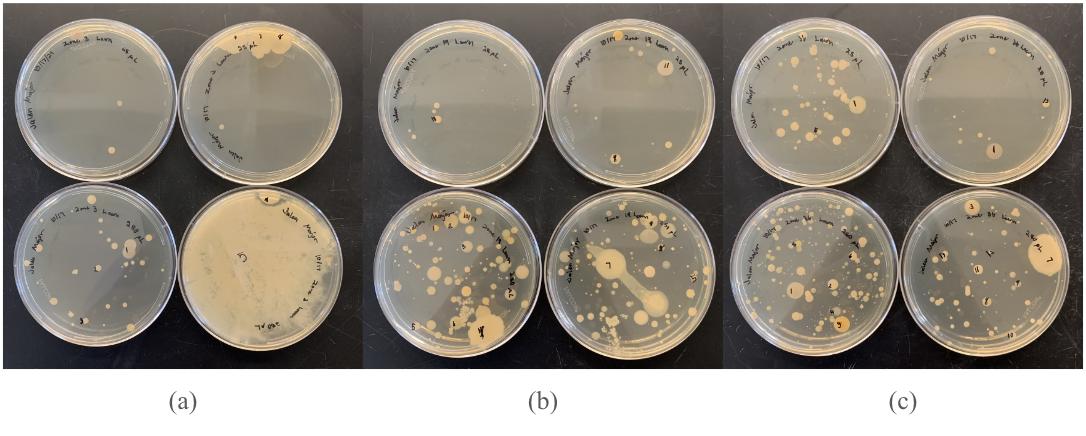
A multitude of bacterial species with a wide variety of characteristics grew on the TSA
A multitude of bacterial species with a wide variety of characteristics grew on the TSA plates over seven days. Many species grew relatively small colonies, while some grew to be very large. Most species had a smooth or mucoid texture, but a few were dry and hard, and one was slimy (species 7 of zone 19, bottom right of Fig. 5b ). Color was fairly variable, with many species being beige in color, some white, some yellow, a few pink, and one pale-green. Colony form was somewhat variable: most circular, many irregular, and one filamentous. Species 5 of zone 3 (bottom right plate of Fig. 5a ), for example, grew rather aggressively, spreading across most of the plate. This large colony was dry, white, and filamentous. Far more species grew on the plates inoculated with 250 mL of bacterial suspension compared to 25 mL.
Lipolytic Activity 26
Lipolytic Activity
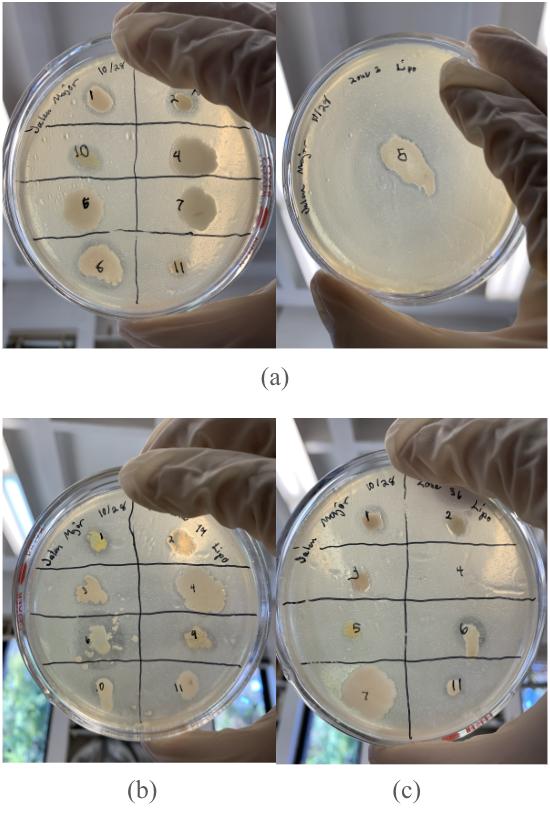
Fig 6: The results for the growth of twenty-five species of bacteria from soil zones 3 (a), 19 (b), and 36 (c) on tributyrin agar plates The zones of clearing, representative of the lipid-degrading ability of each bacteria, can be seen around many of the colonies.
Each of the 25 species of bacteria selected from the TSA grew successfully on the
Each of the 25 species of bacteria selected from the TSA grew successfully on the tributyrin plates and had some degree of a zone of clearing. In zone 3 ( Fig. 6a ), most zones of clearing were low. Species 4, 6, and 7 had a clearing of approximately 1 mm. Species 5 and 11 had clearings of 2 mm, while species 1 had a clearing of about 2.5-3 mm. Species 8 and 10 had clearings between 3-4 mm, and species 2 about 4 mm. The zone of clearing for zone 3 was averaged to about 1.97 mm.
Clearing size was wider in range for the species of zone 19 ( Fig. 6b ). Species 11 had a nearly negligible zone of clearing under 1 mm. A clearing of about 2 mm was made by species 2, 3, and 4, and species 10 had a clearing of about 2.5 mm. Species 1 and 9 had clearings between 3-4 mm. Species 6 had a clearing between 8-9 mm, which was uncharacteristically large compared to every other species in this study. Zone 19 therefore had a larger average clearing size of 3.06 mm.
In zone 36 ( Fig. 6c), species 7 had a clearing of approximately 1 mm; species 4 and 5 had clearings between 1-2 mm. A clearing between 2-3 mm was produced by species 2 and 5. Species 11 had a clearing between 3-4 mm and species 1 had a clearing around 4 mm. Species 6 had a clearing between 5-6 mm, the largest clearing from this soil zone. The average clearing size for this zone was about 2.44 mm, greater than that of zone 3 but lower than zone 19.
The proof-of-concept experiment was successful. Lipolytic bacteria were isolated from campus topsoil and cultured in oil-dense agar. All twenty-five species cultured were observed to metabolize the tributyrin oil to varying degrees. The most lipophilic bacteria from each soil zone were species 2 from zone 3, species 6 from zone 19, and species 6 from zone 36.
The overall experiment has supported the use of bacteria to break down lipid-dense organic material and proven that lipolytic bacteria can be successfully harnessed from the local ecosystem. The current state of microbiological research has demonstrated the ability of some bacteria to use lipids as a source of energy and nutrients. This knowledge, in conjunction with direct experimental support, lends credence to the intentional supplementation of fats and oils in compost with lipolytic bacteria. Steps are currently being taken to identify the most effective lipolytic species from each soil zone to continue research. This is being done using a series of tests following Bergey’s Manual of Determinative Bacteriology [36].
Further research is necessary to verify the results of the experiment discussed in this paper. The agar test of lipolytic activity is currently being replicated in broth to ensure that the growth and metabolic patterns observed in the tributyrin agar plates are consistent in a liquid medium. A control and experimental set were made.
A control and experimental set were made. Both sets contained the same components used in the plates besides the solidifying nutrient agar. The control set of 11 broth tubes also lacked tributyrin to observe how the bacteria grew in the absence of a dense lipid source. The success of these broths would substantiate a test of lipolytic ability against pure vegetable oils such as soybean oil.
One species with a relatively low, medium, and high zone of clearing from each soil zone, as well as negative and positive control species, were cultured in each set of broth. From zone 3, species 4 (lowest zone of clearing), 1 (medium), and 2 (highest) were chosen. Species 11, 1, and 6 were chosen from zone 19; species 7, 11, and 6 were chosen from zone 36. Escherichia coli was used as the negative control, as it is known to lack lipid-degrading proteins. Staphylococcus aureus , known to form a zone of clearing, was used as the positive control. The growth of each species will soon be measured using optical density, which uses light at a wavelength of 600 nm to estimate the density of cells in suspension [28]. The densities of the species with the largest zones of clearance are expected to have the greatest optical density measurements.
Beyond the identification of the most effective species and replication of the tributyrin agar experiment, more steps will be taken toward the goal of application to campus composting. Identification of the species will allow for proper assessment of the viability of each species in the composting process. Small-scale composting experiments will be conducted using feedstock of actual food waste and browns. The effectiveness of the bacteria as additives to the compost will be assessed using the rate of processing by monitoring the decay of food waste.
Additionally, there will be a close collaboration with Marlins Go Green for the year. In this interim of paused composting, Marlins Go Green is working on a new composting bed. This new bed will offer far more volume and make mixing for aeration more efficient. Once the bacteria have been properly tested for safety and effectiveness, this new bed will allow for further testing of the identified bacteria at increasing compost scales.
Beyond the Virginia Wesleyan campus, further development of this research could make universityscale composting more accessible. Colleges and universities of limited size and resource availability could still implement simple composting practices with lipolytic bacteria. The application of effective, native lipolytic bacteria to an even larger scale could significantly serve UN SDGs 11.6.1 and 12.3. The amount of solid waste managed sustainably would increase, lessening the amount of food being landfilled and the degree to which food waste is accelerating global warming.
[1] Environment UN. UNEP Food Waste Index Report 2021 | UNEP - UN Environment Programme. 2021. https://www.unep.org/resources/report/unep-food-waste-index-report-2021
[2] ICFDN. The Impact of Food Waste & How To Reduce It - ICF. International Community Foundation. 2022. https://icfdn.org/what-is-food-waste/
[3] Clark MA, Choi JH, Douglas MM. Biology 2E. 2nd ed. Houston, Texas: OpenStax College, Rice University. 2018.
[4] US EPA O. Food: Material-Specific Data. 2017. https://www.epa.gov/facts-and-figures-about-materialswaste-and-recycling/food-material-specific-data
[5] Trends in Solid Waste Management. https://datatopics.worldbank.org/what-a-waste/trends_in_solid_waste_ management.html
[6] Siddiqua A, Hahladakis JN, Al-Attiya WAKA. An overview of the environmental pollution and health effects associated with waste landfilling and open dumping. Environmental Science and Pollution Research International. 2022;29(39):58514–58536. https://www.ncbi.nlm.nih.gov/pmc/articles/ PMC9399006/ . doi: 10.1007/s11356-022-21578-z
[7] Danthurebandara M, Passel S, Nelen D, Tielemans Y, Van Acker K. Environmental and socio-economic impacts of landfills. Linnaeus ECO-TECH. 2013. https://www.researchgate.net/publication/278738702_ Environmental_and_socio-economic_impacts_of_landfills
[8] UN | Sustainable Development Goals. https://sdgs.un.org/
[9] Goal 11 | Department of Economic and Social Affairs. https://sdgs.un.org/goals/goal11#targets_and_indicators
[10] Goal 12 | Department of Economic and Social Affairs. https://sdgs.un.org/goals/goal12#targets_and_indicators
[11] Newman R, Noy I. The global costs of extreme weather that are attributable to climate change. Nature Communications. 2023;14(1):6103. https://www.nature.com/articles/s41467-023-41888-1 . doi: 10.1038/s41467-023-41888-1
[12] US EPA O. Composting. 2015. https://www.epa.gov/sustainable-management-food/composting
[13] US EPA O. Approaches to Composting. 2015. https://www.epa.gov/sustainable-management-food/approaches-composting
[14] CORNELL Composting - Compost Microorganisms. https://compost.css.cornell.edu/microorg.html
[15] Sokač Cvetnić T, Valinger D, Benković M, Jurina T, Gajdoš Kljusurić J, Radojcic Redovnikovic I, Jurinjak Tusek A. Application of Optimization and Modeling for the Enhancement of Composting Processes. Processes. 2022;10:229. doi: 10.3390/pr10020229
[16] Sokač T, Šalić A, Grgić DK, Runjavec MŠ, Vidaković M, Tušek AJ, Horvat Đ, Krnjak JJ, Domanovac MV, Zelić B. An enhanced composting process with bioaugmentation: Mathematical modelling and process optimization. Waste Management & Research. 2021 Jul 16. https://journals.sagepub.com/doi/ abs/10.1177/0734242X211033712 . doi: 10.1177/0734242X211033712
[17] Participants & Reports | Institutions | STARS Reports. https://reports.aashe.org/institutions/participants-and-reports/
[18] Virginia Wesleyan University | Scorecard | Institutions | STARS Reports. https://reports.aashe.org/institutions/virginia-wesleyan-college-va/report/2023-01-19/OP/waste/OP-18/
[19] Allen J, editor. Vermicomposting: New Mexico State University - be bold. shape the future. Vermicomposting | New Mexico State University - BE BOLD. Shape the Future. https://pubs.nmsu.edu/_h/H164/ index.html
[20] Université de Sherbrooke | Scorecard | Institutions | STARS Reports. https://reports.aashe.org/institutions/ universite-de-sherbrooke-qc/report/2022-10-24/
[21] Closed In-Vessel Industrial Composter | Brome Compost Inc. Brome Compost. https://www.bromecompost.com/en/products/le-composteur/
[22] An industrial composter at the University of Sherbrooke. Brome Compost. https://www.bromecompost. com/en/an-industrial-composter-at-the-university-of-sherbrooke/
[23] Middlebury College | Scorecard | Institutions | STARS Reports. https://reports.aashe.org/institutions/middlebury-college-vt/report/2022-03-04/
[24] Composting | Middlebury. https://www.middlebury.edu/facilities-services/maintenance-and-operations/ composting
[25] All About Screened & Unscreened Topsoil | American Landscaping. American Landscaping Anchorage, Alaska. [accessed 2024 Nov 19]. https://www.americanlandscapingak.com/screened-topsoil
[26] About Washington College. https://www.washcoll.edu/about/index.php
[27] Compost Program | Sustainability Compost Program | Sustainability | Washington College. https://www. washcoll.edu/sustainability/compost/index.php
[28] Parker N, Schneegurt M, Tu A-HT, Lister P, Forster BM. Microbiology | OpenStax. 2016. https://openstax. org/books/microbiology/pages/7-3-lipids
[29] Gerasimchuk AL, Ivasenko DA, Kasymova AA, Frank YuA. Selective cultivation of bacterial strains with lipolytic and hydrocarbon-oxidizing activity from bottom sediments of the Ob River, Western Siberia. Vavilov Journal of Genetics and Breeding. 2022;26(5):449–457. https://vavilov.elpub.ru/jour/article/ view/3437. doi: 10.18699/VJGB-22-55
[30] Gerasimchuk AL, Ivasenko DA, Bukhtiyarova PA, Antsiferov DV, Frank YA. Search for new cultured lipophilic bacteria in industrial fat-containing wastes. BIO Web of Conferences. 2020;23:02012.https:// www.bio-conferences.org/articles/bioconf/abs/2020/07/bioconf_plamic2020_02012/bioconf_plamic2020_02012.html. doi: 10.1051/bioconf/20202302012
[31] Nisola GM, Cho ES, Shon HK, Tian D, Chun DJ, Gwon EM, Chung WJ. Cell Immobilized FOG-Trap System for Fat, Oil, and Grease Removal from Restaurant Wastewater. Journal of Environmental Engineering. 2009;135(9):876–884. https://ascelibrary.org/doi/10.1061/%28ASCE%290733-9372%282009% 29135%3A9%28876%29 . doi: 10.1061/(ASCE)0733-9372(2009)135:9(876)
[32] Cleland D, Jastrzembski K, Stamenova E, Benson J, Catranis C, Emerson D, Beck B. Growth characteristics of microorganisms on commercially available animal-free alternatives to tryptic soy medium. Journal of Microbiological Methods. 2007;69(2):345–352. https://www.sciencedirect.com/science/article/pii/ S0167701207000577. doi: 10.1016/j.mimet.2007.02.004
[33] Tryptic Soy Agar general purpose microbial culture media. http://www.sigmaaldrich.com/
[34] Lee J, Kim HS, Jo HY, Kwon MJ. Revisiting soil bacterial counting methods: Optimal Soil Storage and pretreatment methods and comparison of culture-dependent and-independent methods. PLOS ONE. 2021;16(2). https://doi.org/10.1371/journal.pone.0246142
[35] Alford JA, Steinle EE. A Double Layered Plate Method for the Detection of Microbial Lipolysis. Journal of Applied Bacteriology. 1967;30(3):488–494. https://onlinelibrary.wiley.com/doi/ abs/10.1111/j.1365-2672.1967.tb00326.x. doi: 10.1111/j.1365-2672.1967.tb00326.x
[36] Bergey DH, Krieg NR, Holt JG. Bergey’s manual of systematic bacteriology. Baltimore, MD: Williams & Wilkins; 1989.
The flickering and dancing communication of lightning bugs on a summer night, is a distinctly magical and ubiquitous experience from many of our childhoods. I can distinctly recall witnessing the way the lights would synchronize their flashes, knowing that something ancient and persistent was being communicated, but not something meant for my eyes to decode. Growing up meant these magic shows waned, becoming scarce reminders of childhood wonder and natural serenity. It was not until I gained enough experience in ecological sciences that I understood their habitat, their refuge —the stages upon which they performed their epoch old light shows— were becoming themselves more rare, replaced by monoculture1 lawns. The fading glow of lightning bugs across the US serves as a signal of the greater impact that the replacement of diverse open fields with monoculture lawns is having on the environment. In order to find wonder in the secret language of lighting bugs again, change must start now.
When considering the standard American space there is a reason that we often think of well manicured, vibrant grass lawns. Researchers estimate that 2% of the US’s land cover is occupied by grass lawns (Milesi et al. 2005). In other words, nearly 102,000 square miles or a space slightly larger than twice the area of the state of Georgia is covered by the standard mono-cultured grass lawn. As iconic as these lawns may be, they are a defining aspect of modern America for another reason, aiding the US in its leading impact on climate change and ecosystem degradation (Son 2020). In addition to their contribution to the current anthropogenic2 climate change crisis, they are considered “ecologically barren”3 spaces (Sushinsky et al 2012), which heavily and negatively impacts the presence of wildlife across the US.
As ecological sciences have developed and understanding the consequences of climate changes has grown, the discourse over the suitability of the grass lawn as an American staple has become more prominent. Manicured grass lawns of suburban sprawls and golf courses are a point of national identity and pride. However, the implementation, maintenance, and waste produced by such lawns have a vast array of negative ecological impacts on surrounding environments and extend far beyond local range.
1 Referring to lawn with a single species of plant, in this case grass, growing in it
2 Anthropocentric is defined as human centered or human related. The current climate shift is thus anthropocentric.
3 Possessing a very low volume and low diversity of species
Researchers have delved into identifying solutions to rectify the impact of monoculture grass lawns in the US. Their studies detail the benefits of implementing native and biodiverse planted spaces, i.e., eco-lawns in place of the monoculture grass lawns. This practice would address many, if not all of, the environmental costs of monoculture lawns, as well as directly improve the well being of those that interact with such spaces. Universities must act as foundational proving grounds for this effort because they are rich with sustainabilityconscious, rising generations who seek to maintain the health of their community, country, and planet.
Universities can reap the benefits of eco-lawns and better cement their practice in American culture. Virginia Wesleyan is ideally suited as such a forerunner university. Shifting the campus’s monoculture lawns to ecolawns will have the trifold benefit of: greatly improving the educational merit and resources of the school while improving its visibility, allow the school to better meet its goal of environmental awareness and sustainability through a unique and pioneering methodology, and reduce the cost of land care while improving the campus’s ecological health.
While the benefits are clear “Lawn grasses provide families with affordable access to greenery and children a place to play that other landscapes simply cannot” (Nolte 2023), there are a great deal of drawbacks as to how grass lawns are applied in the US as a whole. Lawns are considered to be atypical ecosystems1 with the same few non native turf grasses used repeatedly and with little regard for their climate requirements. Because of this, many lawns require significant maintenance to counteract the environmental pressures that would not normally allow such grasses to grow in the manner required for the ideal lawns. These requirements lead to the heavy use of fertilizers, pesticides, water, and mowers, as there are not normally grazing animals on these lawns. These have become point2 sources for the nearly 30 million tons of pollution produced by grass lawns in the US as of 2011— this has likely grown since (Son 2020).
The argument that grass lawns actively sequester carbon dioxide3 is made mute by the resounding statistics describing how grass lawns end up emitting more carbon than they sequester (Kumari et al. 2021). Moreover, these monoculture lawns strip ecological communities of their original biodiversity and prevent the possibility of its reestablishment (Golovanov et al. 2021). A healthy ecosystem can be defined by its biodiversity4. A higher biodiversity ensures better health to all organisms present as well as ensuring a long term balance of non living factors. Moreover, non native turf grasses provide very little of the wide array intraecosystem5 services required to support such biodiversity, e.g., few insect species can subsist on turf grass alone and nutrient cycling6 becomes limited, which is why fertilizer is often needed (Scott 2024).
1 Denoting their lack of natural ecosystem complexity
2 Initial and direct source of pollution
3 A greenhouse gas which contributes heavily to climate change
4 Defined as the density and number of species in an ecosystem
5 Functions within an ecosystem rather than between different ones
6 The flow of essential elements between organisms interacting with the soil and the nonliving environment
Lastly, the care required to maintain these lawns, which is prodigious, highlights the fact that surrounding ecosystem mechanics are constantly shifting grass lawns back to a more diverse system (Golovanov et al. 2021) and contending with this pressure is costing humans greatly and the global ecosystem even more.
The average American has far too much to be concerned about on a day-to-day basis to consider the intricate mechanics of ecosystem services and to give consideration to their lawn’s impacts However, recent studies in the British Medical Bulletin journal establish that diverse planted spaces in urban areas, such as ecolawns, can ensure a healthy physiology by improving air and water quality, encouraging physical recreation, and supporting healthy immune function. Established eco-lawns and wooded spaces can maintain stable microclimates and help reduce heat (Morris & Bagby 2008). As explained by Dr. Kuo, professor in the Department of Natural Resources and Environmental Sciences at the University of Illinois, these green spaces support mental health and improve community wellness by reducing crime rates. Economically, eco-lawns can be more cost effective long term thanks to natural self management (Watson et al. 2019). Eco-lawns are not only a patch of green in the city but an integrated component of it which constantly works to improve the health of all those around it. While there is a great pride in creating a perfect lawn it creates a green space far less capable of supporting human’s mental and physical well being.
Eco-lawns are also a major opportunity for learning about the natural world. Eco-lawns have significant educational merit as easily accessible natural areas from which students can learn and conduct research. In the Book “Learning Gardens and Sustainability Education” by Dilafruz Williams and Jonathan Brown, they describe how students of all ages retain and think more creatively about the information they learn about the natural world when they interact with it. Eco-lawns provide a real world example of the myriad STEM concepts reviewed in class while more actively engaging the students.
Based on these extensive impacts, this issue falls within multiple United Nations sustainability goals. These goals provide a “shared blueprint for peace and prosperity for people and the planet, now and into the future” (United Nations 2016). Regarding the issues presented thus far, the two most relevant goals are the “life on land” and the “climate action” goals. These goals seek to use land sustainability, reduce and reverse terrestrial ecosystem degradation, and actively address climate change impacts (United Nations 2016). Additionally, the goals of “good health and wellbeing” and “quality education” are, as described, very relevant. These goals aim to secure a healthy life for all and ensure learning opportunities are universally accessible (United Nations 2016). Eco-lawns, as defined by the UN’s goals, are a massively beneficial investment.
The pollution caused by monoculture grass lawns is more extensive than most people would imagine. There are, in fact, multiple sources of pollution originating from the development and maintenance of turf grass lawns. The pollution caused by these lawns can be divided into its contributing factors: fertilizers, chemical control, mowing and mechanical maintenance, thermal impacts, and water regulation. Importantly, monoculture lawns are also, by definition, a major reduction in biodiversity.
Fertilizers are an important aspect of most lawn care maintenance in the US1. However, ignorance of local perimeters and overuse of fertilizers is common across the US. In 1984, the US applied more fertilizer to its lawns than India applied to all its agricultural crops (Jenkins 1994). Thanks to the diversity of plant species in eco-lawns, soil nutrients such as nitrogen are readily created and recycled by nitrogen fixing2 via plants such as short growing legumes and clover, which benefits them as well as the surrounding plants (Karuppannan et al. 2013).
Nitrous oxide (N2O) is a significant player in growing climate change as it is a greenhouse gas three hundred times more impactful than carbon dioxide (CO2), however it is a major byproduct of artificial fertilizer usage. Additionally, the leaching3 of fertilizer produces an unnatural concentration of nutrients, which can lead to multiple mechanisms of harm impacting local ecosystems (Allchin 2023). Both the increased production of N2Oe and leaching is due to the presence of unused fertilizer. Thanks to eco-lawns’ more self-sustaining nutrient cycling, fertilizer is needed less often and if it is applied and is more readily taken up by plants due to the competitive pressure of a more biodiverse ecosystem (Manolaki et al. 2020). Eco-lawns reduce the overall need for fertilizer and in doing so reduce the need for its production, application, and the resulting environmental impacts.
Pesticides and herbicides are another large and environmentally damaging component of turf grass lawn care. Twenty-eight million tons of herbicide and fourteen million pounds of insecticide were applied to turf grass lawns across the US in 2012. This accounted for 5% of the total national use of herbicide (Atwood & Paisley-Jones, 2017, p. 12). Indiscriminate use is also a factor in the use of pesticides on turf grass.
1 Fertilizers provide elemental nutrients plants need to grow, a major one being Nitrogen.
2 Changing atmospheric Nitrogen from an unusable form to a usable one
3 The movement of artificially applied nutrients out from the lawns and into local ecosystems by its moving into the water table or as runoff
Similarly to fertilizers, these chemicals can leach into the surrounding environment as well as move into water systems through runoff and cause extensive damage to natural life (Allchin 2023). In this case, these chemicals kill non-targeted insects, plants, and by extension the animals that feed on these organisms (Carson 1965). The overuse of pesticides can also cultivate populations of pest insects and invertebrates that are resistant or immune to chemical treatment and by effect become more difficult to control and manage as they enter more sensitive natural ecosystems (Scott 2024).
Turf grasses have a high susceptibility to pest damage and pathogenic infections, requiring chemical control agents as they cannot balance themselves. Conversely, eco-lawns are less susceptible to pests and infection. More biodiverse green spaces tend to support healthier individual plants, which are better able to sustain and recover from damage inflicted by insects and other pests (Marshall et al. 2015). Moreover, cultivating an ecolawn can reduce the need for both pesticides and herbicides in the first place as the lawns themselves do much of the pest and weed controlling themselves. Many plants, unlike the standard turf grass, can produce their own natural pesticides(Adeyemi 2010, Souto et al 2020). Certain plants are even capable of chemically recruiting pest predators to prevent damage (Turlings and Wäckers 2009). Lastly, inter-plant competition can crowd out typical lawn weeds (Karuppannan et al. 2013). As described by David Chinery, a senior turf researcher and educator at the Cornell Cooperative Extension center, by overseeding desired plants and by possessing a diversity of plants to compete from multiple ecological angles, the plants can manage the weeds themselves. Incorporation of ecolawns can be considered a long-lasting, low maintenance form of pesticide and herbicide application without any environmental drawbacks.
Mowing is a defining aspect of lawn care routine in the US. However, the energy required to manufacture multiple tools, fuel them, and actually mow are all part of the energy cost associated with lawn care (Allchin 2023). The EPA has assessed that the US burns 800 million gallons of gasoline per year to cut turf grass lawns, this is 5% of the US’s total air pollution profile. Mowers and other gasoline-fueled, small engine lawn care machinery produce their own extensive and damaging cocktail of pollutants through operation. Chemicals called volatile organic compounds (VOCs) result in the production of highly toxic low atmosphere ozone, i.e. smog. These tools also produce fine particulates such as soot which can be carcinogenic and lead to the formation of acid rain. As a reference, 26.7 million tons of pollutants were produced by gasoline powered lawn care tools in 2011, which has likely risen since (Banks & McConnell, 2015). Lastly, while it is true that grasses do help produce oxygen, and to some extent improve air quality, the regularity with which they are trimmed limits this and the decomposition of those clippings requires oxygen to proceed. Therefore, even within this closed system application of mechanical lawn care results in a nearly net zero oxygen production (Allchin 2023).
The obvious solution to this issue is to reduce lawn mowing. However, this contradicts standard American lawn culture and regular mowing is somewhat necessary to the health of monoculture lawns (Patton 2024).
This is why eco-lawns also act as an excellent solution to this issue. They present an alternative that can maintain ideal turf grass lawn qualities while reducing the need for mowing and frequent maintenance. Eco-lawns encourage a greater variety of plants, meaning, the inclusion of slower growing grasses and low growing carpet plants which require far less mowing, if any (Chollet et al 2018). More variable greenspaces also eliminates the need for wide scale machine-assisted cutting other than mowing as inter-plant competitions maintains the eco-lawns diversity and reduces the domination and overgrowth of any one plant (Chollet et al 2018). Eco-lawns ensure a steady reduction in maintenance effort as they develop, by improving air quality, local environmental health directly and by their functional reduction in mowing.
Temperature, particularly rising temperatures, are the hallmark of climate change. It is fairly well known that green spaces cultivate cooler environments than paved ones (Shashua-Bar et al. 2011). This then is another strong proponent for grass lawns in the US, they are effective cooling systems. However, there is a limit to this effect and the costs of trying to achieve it in more arid environments, with non native grasses, may exceed the lawns benefits. Conversely, eco-lawns can mitigate heat more effectively and efficiently (Francoeur et al. 2021). The higher biodiversity of eco-lawns establishes more shade cover, which combined with increased transportational evaporation1 cooling (Lind ́en et al. 2016) and soil respiration,2 reduces heat more effectively and creates a more successful ecosystem overall (Lerman & Contosta 2019). Increasing volume and density of planted spaces, i.e., eco-lawns, have also been found to further increase cooling (Francoeur et al. 2021). Even small scale implementations of eco-lawns have been shown to make a perceivable difference (Francoeur et al. 2021). Eco-lawns maintain and improve the cooling properties of the lawn while also reducing the impact required to upkeep that lawn.
Urbanized spaces are defined by the high concentration of non permeable surfaces, which create greater strain on stormwater systems by stopping the infiltration of water3 (Yang & Zhang 2011). When that heavy influx of water hits natural rivers and bodies of water it can increase the rate of bank erosion (Ferreira et al. 2021) and extend impact of pollutants from the source of the initial precipitation (Müller et al. 2020). A standard monoculture lawn is certainly better than pavement at absorbing water, however, this system can get quickly overloaded by any significant precipitation. Monoculture lawns have shallow root systems, limiting the ease with which water can infiltrate the soil (Xie et al. 2020).
1 Water evaporating from plants
2 The recycling of nutrients through natural processes induced by organisms present in the soil
3 Movement of water from the surface into the soil
Eco-lawns provide a diversity of species, some specialized in managing high precipitation and flooding, which can increase the soil’s efficiency at taking in water by creating more space in the soil with their root systems (Asleson et al. 2009). At the same time, these specialized eco-lawns can bio-filtrate1 the pollutants and reduce their spread into waterways (Sharma et al. 2021). Eco-lawns are highly versatile and their range of improvements spans climates from arid deserts to rainstorm prone coastal lowlands.
Finally, the most obvious difference between what a monoculture grass lawn and an eco-lawn can provide is the capacity for biodiversity. The biodiversity of eco-lawns is what gives them the ability to counteract the previously listed issues. Monoculture lawns possess a much smaller window of opportunity for animals to inhabit them and by design an equally small window of plant diversity. Monoculture lawns have been shown to displace native species and favor invasive plants that are better adapted to urban settings (Hayes et al 2023). The grasses themselves are not native to the US and can quickly outcompete other plants, trying to establish themselves (Hellner & Vilkenas 2014) where climates favor them. Eco-lawns prioritize a diverse plant gradient and ensure space for native species to better support local wildlife (Karuppannan et al. 2013).
Plants are the foundation of the solution, but the invertebrate community they cultivate is just as crucial. Plant volume and diversity are the major contributors to arthropod diversity. Monoculture lawns are a poor resource for pollinators, unlike eco-lawns whose support of pollinating insects allows surrounding ecosystems to benefit as well. In the US, dozens of native species of bees have been hit heavily by the dominance of monoculture grass lawns and are declining alongside the European honey bee. Shifting to eco-lawns can countermand this loss by specifically addressing their loss of habitat. Some subterranean insects and other invertebrates– which can be limited by the monoculture of turf grasses– work to increase water, nutrient, and air inflow to the soil, boosting its productivity (McColloch 1922). Birds are also heavily impacted by monoculture lawns due to their lack of insect and plant diversity, which are their common food source (Sánchez-Sotomayor et al. 2023). The defining aspect of urban sprawl is the separation of natural areas into fragments. Eco-lawns can also address this by acting as refuges and acting as corridors2 between natural areas ensuring genetic diversity of species (Johnson & Munshi-South 2017) and large scale ecosystem function (Delahay et al 2023). The biodiversity of the eco-lawns is not just the reason they solve the drawbacks of the standard monoculture grass lawn but what makes them eco- in the first place. It doesn’t stop there, however, eco-lawns provide a great deal to humans beyond their benefit to our environmental concerns.
1 The action of organisms to remove toxins or pollutants from a system
2 Pathways animals can take between ideal habitats
Eco-lawns, which mirror the complexity of natural ecosystems, provide a greater variety of ecosystem services such as high air quality maintenance and temperature regulation. In these ways, eco-lawns impact local physical health. (Aerts et al. 2018). Encouraging eco-lawns may allow people to reap the benefits, as well as gain autonomy and identity in their living space, improve their mental health by increasing the natural variety of their landscape (Quinn, 2019), and gain a more direct relationship to nature (Dunnett & Hitchmough 2004). Furthermore, increasing our connection to nature through eco-lawns can monumentally benefit hands-on educational efforts (Williams and Brown 2011).
Extensive research demonstrates a connection between higher student engagement and retention when the material they are learning t is interacted with physically, i.e., understanding natural processes and sustainability by engaging with nature. Being responsible for implementing eco-lawns can make such lessons accessible and enthralling. In the Book “Routledge Handbook of Urban Biodiversity” by Charles H. Nilon, the author dubs eco-lawns “living labs” encapsulating their potential for learning. The national initiative “Project Learning Tree” is a prime example of an instruction that makes use of natural spaces to teach children and young adults the value of said spaces. Project Learning Tree designs curriculums focused on extensive engagement with local and accessible natural spaces. Specifically, eco-lawns meet nearly all the components of the Project learning trees goals:
● “Imagination and enthusiasm are heightened”: due to greater variety of plant and animal life when compared to average urban greenspaces
● “Learning transcends the classroom”: outside engagement, incorporated into the school boundary itself
● “Critical and creative thinking skills are enhanced”: physical and mental engagement with nature shown to boost cognitive growth (Budi et al. 2018)
● “Tolerance and understanding are supported”: cultivates inherent appreciation for natural world and creates better stewards of ecological health
● “State and national learning standards are met for multiple subjects”: application of multiple sciences, mathematics and even humanities can be applied
● “Biophobia and nature deficit disorder decline”: encourages mindset that nature should be lived with not on
● “Responsible action is taken to better the environment”: gaining a vested interest in there local nature will encourage educated individuals to maintain that health
Eco-lawns are not just for young students, but also for those engaging in undergraduate and postgraduate work as well. Universities across the world have made claims and set goals, working to produce students and actions to combat climate change. However,the efficacy of these claims is highly varied and often falls short (Reimers 2020). Universities have been recommended to engage with local, real-world, non-organizational resources to foster lasting ecological education and skills better prepared to address concerns of sustainability and climate change. (Reimers 2020). Environmental and sustainable education is made more impactful when a university incorporates ecologically healthy spaces students can access easily/ equally and learn from (Žalėnienė and Pereira 2021). So then, if eco lawns are so vastly beneficial where are they and who has made use of their benefits?
With plenty of evidence demonstrating the costs of monoculture lawns versus the benefits of eco-lawns, surely there would be evidence of a cultural shift from mono to eco? Unfortunately, it is far more rare than it ought to be due to a number of factors. When concerning residential spaces, HOAs and local governments are the controlling and limiting factors. HOAs often insist on strict lawn care maintenance and aesthetic standards. Local ordinances can have an equally limiting impact on public institutions, often requiring similar aesthetics across a district. Furthermore, perception and cultural pressures also act as limiting agents. “Peer pressure”, as described by David Chinery, stops both individuals and institutions from establishing anything other than a grass lawn. Lastly, as explained by Chinery, lawn care industries pander to the American lawn ideal, magnifying its social prestige in order to increase revenue. Because of such an extensive monopoly, it is hard for lawn owners to diverge in a cost effective way. This, however, is the great misconception. While the initial effort to shift may cost more than standard lawn maintenance; the application of an eco-lawn is massively cost saving over time. A few enterprising institutions have made note of this and began to spearhead the eco-lawn initiative both for themselves and as a message to the public.
Cambridge University is a prime example, spearheading the initiative of eco-lawns, the stances surrounding their function, and the measured benefits of their implementation. In 2019, the university dedicated a portion of its oldest lawn to create a dedicated eco-lawn. Master gardeners and grounds keepers were allowed to apply their expertise to create a biodiverse meadow. Cambridge then found, as expected, a major rise in biodiversity within this planet space (Greenspan 2024). The meadow was a major success, both ecologically and socially, bringing significant gratitude to the students and staff of the campus. The biodiversity, in addition, also acts as an example of a “living lab” with students of all ages allowed to engage in research and discovery within its borders (Garget 2023).
Trinity College Dublin has also implemented the eco-lawn initiative on their campuses. This action was taken in response to Ireland’s biodiversity crises, a term easily applied to the US as well, in an effort to use campus space to counteract the issue. The lawn itself is composed of nearly only native Irish plants, a mix of low growing high-traffic plants, as well as perennial flowers, driving home the importance of native plants as a more ecologically conscious and economically viable alternative to non native grass lawns. Part of their goal with this new lawn was to specifically inspire other universities to adopt the methodology by seeing its success in action (The Optimist Daily, 2020).
Cornell University is renowned in the US for their adoption of eco-lawns and alternative lawn care methodology. More specifically, Cornell has showcased cost reduction with their lawns, both environmentally and economically. Thirty-five acres worth of monoculture lawns have been shifted to meadows or more diverse grass spaces (Copman, 2023). Cornell was also able to show that eco-lawns can act as sources of carbon sequestration unlike traditional monoculture grass lawns further reducing the university’s overall emissions (Copman, 2023).
The Swedish University of Agricultural Science (SLU) has gone a step beyond all others by incorporating a lawn tapestry approach to their eco-lawn implementation efforts. SLU implemented habitat restoration and creative conservation1. This allows them to make use of the vast array of ecosystem services a biodiverse planted space offers. SLU ensured high soil aeration, water infiltration, little to no need for fertilizer, micro climatic control, heavily reduced need for mowing and other maintenance and a plenitude of insect, bird, and other animal species finding there homes on campus adding there ecosystem services (Hellner & Vilkenas 2014). SLU sought to replicate a natural and varied field ecosystem as closely as possible. SLU acts as the pinnacle or end goal to the eco-lawn implementation movement and dedicated universities can clearly achieve such a goal.
Each university is a single instance of exceptional action championing the use of eco-lawns. However, there are so few examples that each university is a single instance in a different country entirely. This truly goes to show how grassroots, pun intended, this movement is. Given this obvious need, Virginia Wesleyan University (VWU) should be compelled to join these universities in spearheading the effort and creating that president, as well as further demonstrating the success of its application. VWU has a golden opportunity to make use of its space and stick to its goals of climate action and suitability by implementing an eco-lawn action plan of its own.
Now that we understnad the drawbacks of the monoculture lawn, the benefits of the eco-lawn, and have learned of the successful implications of the program, all that is left is taking it off the paper and applying it.
1 The restoration of degraded ecosystems to formal health and establishing new healthy ecosystems in an integrated manner to surrounding infrastructure respectively.
Virginia Wesleyan University possesses some instances of native and biodiverse planted spaces in its retention ponds around the Greer Environmental Sciences Center (GESC). However, this biodiversity is not reflected anywhere else on campus.
To this end, my aim has been to create an action plan detailing the application of eco-lawns on campus and bring awareness to stakeholders and students of the benefits and currently missed opportunities the campus possesses. The Environmental guiding principles of Virginia Wesleyan act as the core goals. These goals direct the University to both constantly seek new and better methods of improving its sustainability and educating students in being a resource to the wider world to that effect. It is specifically on these guiding principles that I argue the application of eco-lawns is so vital. According to Carl Schimenti, member of the Cornell Turfgrass Research Program, application of eco-laws can reduce carbon production by 278 lb per acre per year. Applied to the rough totality of the usable lawn space, 28.4 acres, on campus that would be 7,900 lb per year. By shifting even a portion of its lawn acreage it can significantly reduce the amount of carbon it reduces through the maintenance of its lawns.
The University has clear incentive to apply new and more carefully considered management plans for its lawns based on these goals but moreover its application is quite feasible. As mentioned, eco-lawns are especially good at reducing the amount of management required for their health and upkeep as by establishing them you are making use of the natural checks and balances of a biodiverse ecosystem which not only helps improve the health of all plants involved but through competition maintains biodiversity. Eco-lawns can come in multipleforms, which will be described shortly, but in all cases they reduce the amount of mowing fertilizer, pesticide and watering required. After the initial cost of shifting a field from monoculture to eco-lawn, the financial savings from the reduction in mowing alone come to $3,500 per acre per year. Of course not all lawned spaces would be or should be converted to eco-lawns. But portions of the campuses lawn space that are less traffic or that serve no particular purpose would be most recommended for this shift ensuring that high traffic recreation is not limited on campus but that all space is being used towards the goals of the environmental guiding principles as best as possible.
This project has been built around an action plan, which applies all the arguments described above in detailing the specific shifts that should be undertaken to establish eco-lawns on VWU’s campus. The action plan is divided in two sections: current conditions and proposed changes, the specifics of which can be found in appendix (a). The action plan has a number of reference maps; the first map , as seen in appendix (b), represents the categorization of most of the open lawn space on campus as distinct lawn types based on factors of traffic, maintenance and location. The second group of maps, as seen in appendix (c), represent the application of ecolawn methodologies to these lawn types based on the lawn type, surrounding factors, and specific use of that lawn space.
This second map comprehensively represents all recommended possible lawn shifts. The action plan also details the specifics of implementing each eco-lawn methodology as well as the unique benefits of each change. The action plan is designed as a concise and comprehensive portfolio specifically tailored to VWU. This will allow for a range of applications based on school resources, allowing those that put in place to select only what they consider necessary or achievable.
To support the successful application of the action plan additional work was done by connecting with students and staff. I was able to pitch the action plan and proposed changes it recommended to a small group of key stakeholders of the VWU administration and professorial staff where I explained the benefits and specifics of the changes I have concluded would be most feasible. In addition to the initial pitch the presentation also incorporated a significant span of discussion. The discussion allowed the stakeholders to add their experience and professional perspective to the problem and solution, filling gaps I could not have, critinking existing aspects based on achievability and scientific expertise, and endorsing successful components for future application. I also have sought to increase the student body’s awareness of the campus lawns by presenting my findings, on the benefits and application of eco lawns, to students through Biology Honors Society and initiated discourse on the subject. I also sent out a short survey asking them to consider their current opinion and share their hopes for the campus’s lawn space. Based on the survey, students appreciate the open spaces but rarely use them. This underlines how increasing interest and diversity in lawn spaces may increase engagement with that space. To that end, a majority of students proposed incorporation of more flowering plants and general increase in biodiversity recognizing the fundamental benefits of these changes. Students claimed these changes would increase their appreciation in the school as whole and their engagement with those spaces. Lastly, I made sure to interview multiple turf grass and horticultural experts, who specifically had experience applying eco-lawns to other universities such as David H. Chinery and Dan Schied at Cornell University and the head horticulturist Andrew Earehart at the Norfolk Botanical garden. These sources also greatly informed the specific recommendations seen in the action plan ensuring a peer reviewed backing to the plan.
These components act as the foundation of this project’s long term goal, directed by the action plan’s long term application design. This project seeks to establish eco-lawns as the major form of lawn space on campus and establish VWU as an example of this lawn management approach to all other universities. Implementing the recommended changes will be the next step going forward. Using the increased public awareness of both students and staff combined with the action plan as a detailed proposal the University can patision donors to secure request funds. Establishing funding requirements will be based on a project to project biases as each implantation requires varying application techniques and material. To this end, administrative staff and professorial staff should form a small joint committee, and using the guidelines provided by the action plan, allocate lawn space and create a request budget. This can be streamlined by referencing the detailed description of current lawn maintenance procedures, seen in the action plan.
The action plan recommends that test patches, as seen in appendix (b), be established to assess how the recommended methodologies fare both ecologically and aesthetically as well as to gauge public response. These patches act as a soft open to the recommended changes, introducing the idea more concretely to University members and allowing for corrections or alterations to be made to the application specifics. To ensure that the message and goal of this project is kept at the forefront of the Universities self improvement initiatives the test patches will be key. Quickly establishing these initial eco-lawn spaces will maintain awareness of the project and its implementation through simple visual reminders. With a test patch strengthened action plan full scale implementation can then be considered. From the initial implementation the University will gain momentum and support in their efforts increasing the impact of the eco-lawn application to encourage more funding. The greater scope of the project will be to establish VWU, not only as a school which possesses eco-lawns, but as one that recognizes they should be prioritized. The significance of this shift in the schools presence and message will increase the funding received as donors will be encouraged to recognize the significance of the shift. Partnering with groups such as the biology honors society and Marlins Go Green can establish student engagement. Specifically encourage students to volunteer in the implementation of these eco-lawns and their maintenance as part of the groups suitability prerogative. Involving current students also increases awareness of the project and will lead to research based engagement with the eco-lawns; this is another mechanism through which the project will maintain relevance. Stem courses and individual students often use the old growth forest and native gardens around Greer as subject of related research. A major benefit of eco-lawns is their potential of educational engagement and thanks to that potential the school will seek to maintain such a potent learning resource. Through my meeting with stakeholder professorial staff I introduced the concept of eco-lawns and encouraged it to be discussed in appropriate courses engrung the school to establish and maintain the implementations as they are relevant to course material. Creating a page on the schools main home site describing the goal of the eco-lawns will ensure visibility for prospective students. Finally, self regulation encouraged by high plant diversity and improved nutritional cycling will allow the eco-lawns to remain healthy without any input and little point editing. A key benefit of eco-lawns is once applied they will self-sustain well into the future.
Assessing the impact of these lawns is straightforward. In part the survey created for this project can be administered annually to gauge student opinion of the shifting state of the lawns. The survey was designed to be reused for just this purpose. As mentioned the educational merit of eco-lawns is prodigious and instances of research and application of the lawns in stem labs and course material is another metric by which the impact of the eco-lawns can be measured. Along these lines, research to assess shifts in biodiversity, community composition, and micro-environment parameters can be encouraged to the benefit of the school by gaining data on the ecological benefits provided by the lawns for VWU specifically.
The appearance of more varied bird species as well as higher volumes of pollinators and fireflies are all good animal indicators of an increasingly healthy ecosystem. These eco-lawns are intended to send a message to the public both about the goals of the University and the benefit of their application, for any methodology, so instances of the VWU’s appearance in local news and media regarding these eco-lawns will demonstrate successfully spreading awareness of that message.
In creating this action plan and identifying the goals of the project some components were unfortunately omitted as they were beyond the scope of this project and time frame. This project was originally designed to have incorporated at least one of the eco-lawn test patches by the end of the semester as a physical deliverable of the project’s ultimate goal. Securing funding for material, permission to apply the change to the selected portion of lawn, and coordinating with current groundskeeping practices made this somewhat unachievable in the time frame available. Creating a preliminary budget was also outside the scope of this project as the variety of eco-lawn methodologies requires different financial assessment. These limitations however are minor and can be easily added into the project in the near future, barring the groundskeeping data being made available.
Grass lawns are a nationally ubiquitous component of urban landscapes. It is vital that we seek to be aware of their impact on ourselves and the environment. Virginia Wesleyan University has a core prerogative to educate and create change in the benefit of environmental health and climate change impact reduction. This prerogative is detailed in its Environmental Guiding Principles- a series of goals and objectives that should be considered in any major developmental change or project the school engages in. The application of eco-lawn methodologies is just such a project and one the University could benefit from in many ways. VWU has the opportunity to spearhead this initiative, becoming an exemplar University in the application of eco-lawns such as Cronel and Cambridge. As an educational institute,with such an important focus on sustainability, VWU should always be looking for more opportunities to increase its educational resources, especially of this sort. Eco-lawns provide an excellent opportunity to inspire research and to add to material content of STEM courses like our campus lake and old growth forest. These spaces would also encourage other local K-12 schools to consider VWU more of an educational resource allowing their students to experience and learn about natural processes by seeing examples of them in action. The financial benefits of this shift are also significant, all eco-lawn methodologies reduce the cost of lawn care maintenance through reduction of mowing, fertilizer use, pesticide application. Lastly, VWU would be increasing its campuses ecological health and suitability. Increasing producer biodiversity has far reaching effects on both humans and local ecology. The campus will be home to greater abundance and diversity of insect, bird, and other vertebrate species.
Lighting bugs, a rarer and rarer sight across the US summers, would find refuge and place to thrive in a more diverse planted field. So, I implore that such shifts betaken, shifts to demonstrate how humanity and the natural world should be cultivated equally, having equal value and claim to space. Let VWU glitter with lighting bugs and sparking minds.
Introduction and Purpose: Reasoning for the application of eco-lawn methodologies. Referencing the Environmental Guiding Principles of the University and describing what the following pages will seek to accomplish.
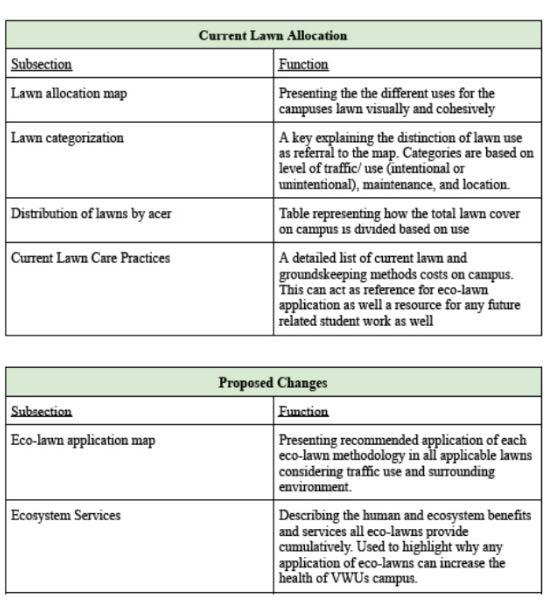
Establishing a clean slate
Eco-lawn methods and benefits
Additional considerations
Distribution of lawns by acer
Cost Saving Statistics
Next Steps
Presenting the methods for shifting existing lawn space to eco-lawn. Elaborating on their benefits and drawbacks and where each method should be applied for lowest cost and highest efficacy.
Introducing the eco-lawn methodologies. Describes their unique benefits and requirements, recommended specific plants to use, how the eco-lawns - weather specific cultivation or simple change in current maintenance - is required, and why they are recommended for where they are. Including images as a reference for there future application
Following the methodologies this section describes general practices or additional incorporations for each eco-lawn application that will increase their impact and success on the campus.
Table representing how the total recommended eco-lawn application on campus is divided
Calculations of the expected CO2 and financial cost reductions based on the level of eco-lawn application.
The recommended following actions after receiving this action plan based on what the project has achieved so far and how best to ensure successful long term application of eco-lawns methodologies. Ensures the project matines momentum and as that as much work is already laid out and completed.
Why VWU Should Care: the action plan is closed by describing the projected VWU specific benefits and recommending why the University should apply time and resources to the actions described above. The action plan is a self continued argument against and solution to the problem of monoculture lawns on campus.
Why VWU Should Care: The action plan is closed by describing the projected VWU specific benefits and recommending why the University should apply time and resources to the actions described above. The action plan is a self continued argument against the solution to the problem of monoculture lawns on campus.
(b) Current Lawn Use Map
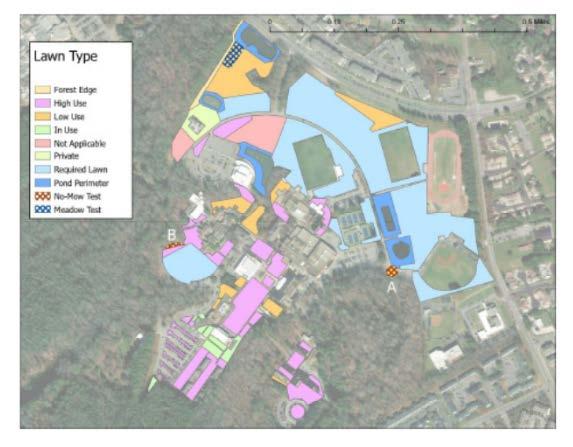
(c) Proposed Eco-Lawn Applicaition Map
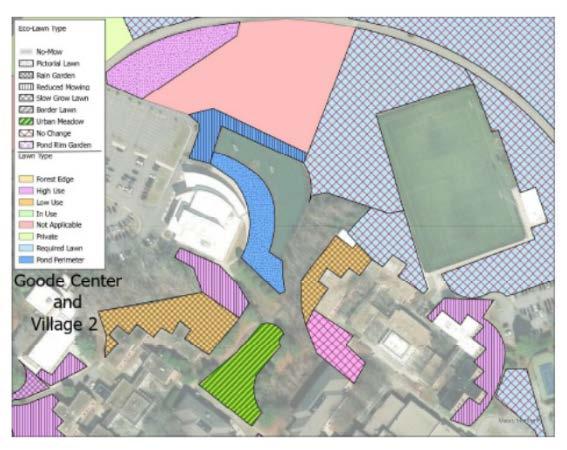
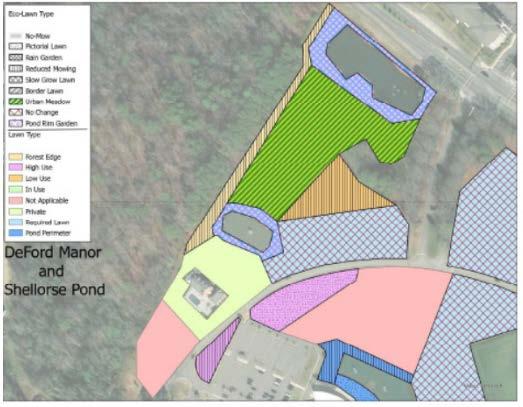
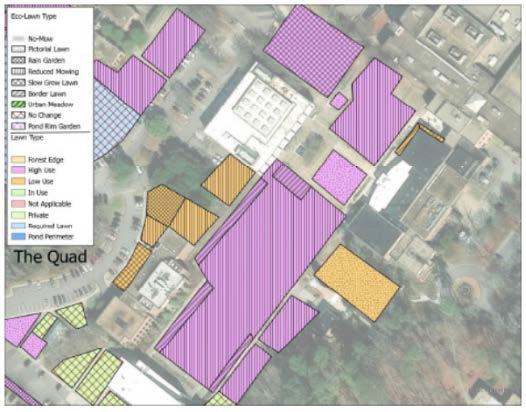
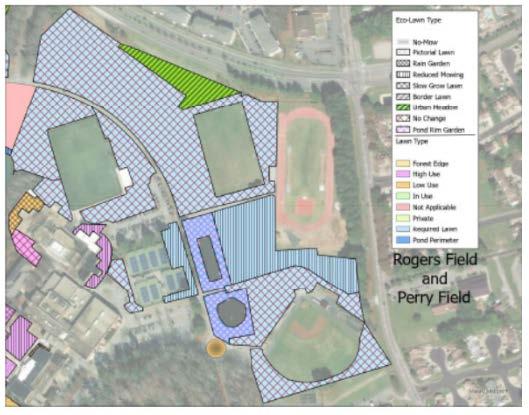
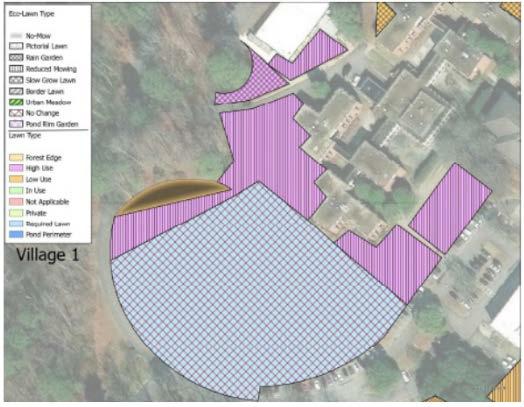
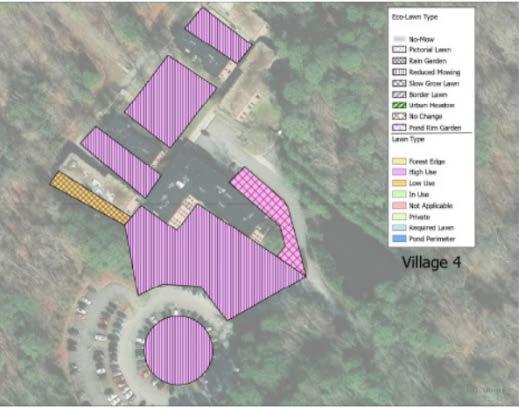
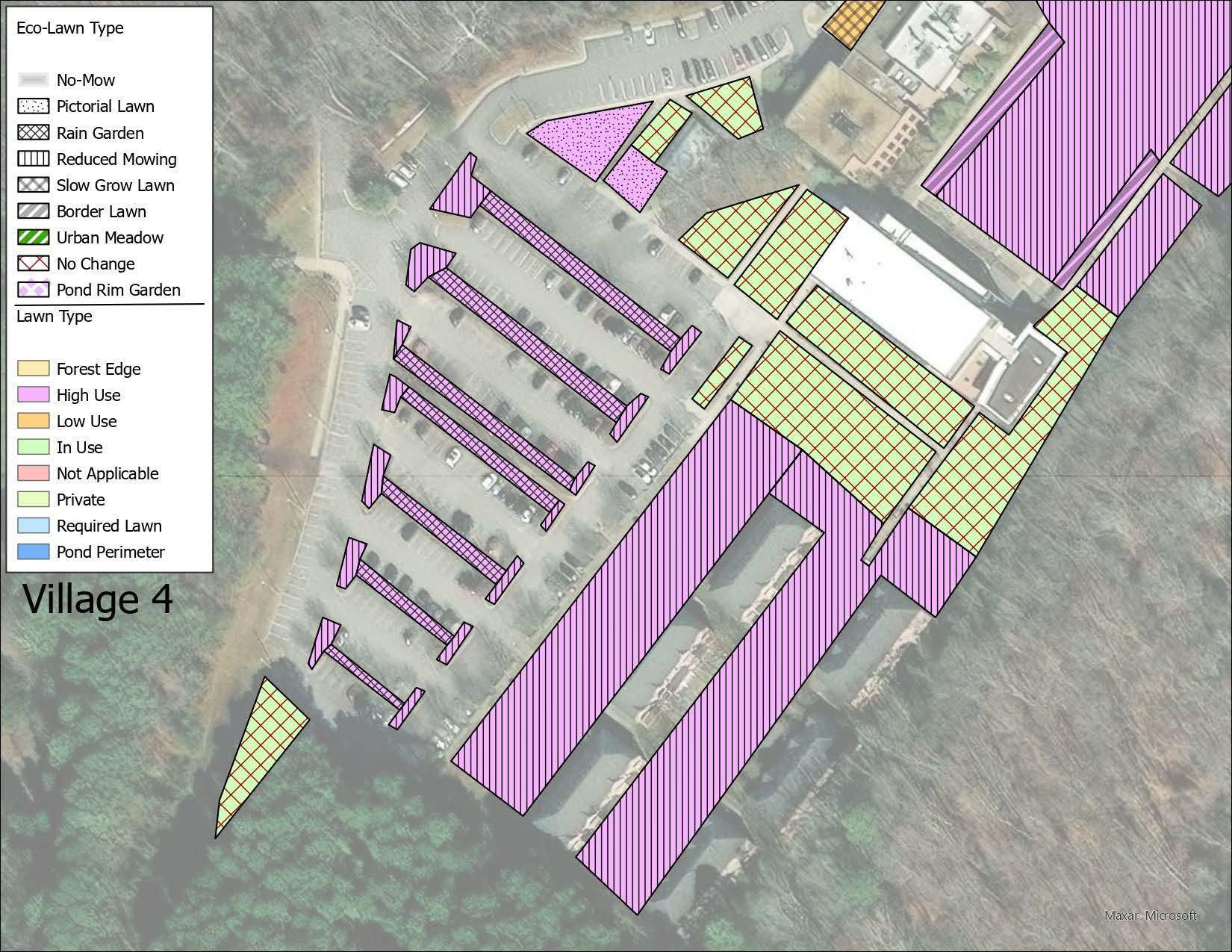
Adeyemi, M. (2011). The potential of secondary metabolites in plant material as deterrents against insect pests: A review. African Journal of Pure and Applied Chemistry. 4. 243-246.
Aerts R., Honnay O., Nieuwenhuyse A.V., (2018). Biodiversity and human health: mechanisms and evidence of the positive health effects of diversity in nature and green spaces, British Medical Bulletin, Volume 127, Issue 1, Pages 5–22, https://doi.org/10.1093/bmb/ldy021
Allchin, D. (2023). How “green” are lawns? The American Biology Teacher, 85(4), 237–239. https://doi. org/10.1525/abt.2023.85.4.237
Asleson, B. C., Nestingen, R. S., Gulliver, J. S., Hozalski, R. M., & Nieber, J. L. (2009). Performance assessment of rain gardens1. JAWRA Journal of the American Water Resources Association, 45(4), 1019–1031. https://doi.org/10.1111/j.1752-1688.2009.00344.x
Atwood, D., & Paisley-Jones, C. (2017). Pesticides industry sales and usage, 2008–2012 market estimates. Environmental Protection Agency. https://www.epa.gov/pesticides/pesticides-industry-sales-and-usage-2008-2012-market-estimates
Banks, J., & McConnell, R. (2015). National lawn and garden equipment emissions. (2015) International Emissions Inventory Conference, San Diego, CA. https://www.epa.gov/sites/default/files/2015-09/documents/ banks.pdf
Budi, A. P., Sunarno, W., & Sugiyarto. (2018). Natural science modules with sets approach to improve students’ critical thinking ability. Journal of Physics: Conference Series, 1022, 012015.
Carson, R. (1965). Silent spring. Penguin in association with Hamilton.
Chollet, S., Brabant, C., Tessier, S., & Jung, V. (2018). From urban lawns to urban meadows: Reduction of mowing frequency increases plant taxonomic, functional and phylogenetic diversity. Landscape and Urban Planning, 180, 121–124.
Copman, L. (2023, June). Let the grass grow. Front Page. https://sustainablecampus.cornell.edu/news/let-grassgrow
Delahay, R. J., Sherman, D., Soyalan, B., & Gaston, K. J. (2023). Biodiversity in residential gardens: A review of the evidence base. Biodiversity and Conservation, 32(13), 4155–4179. https://doi.org/10.1007/ s10531-023-02694-9
Dunnett, N. & Hitchmough, J. (2004). The dynamic landscape. New York: Spon Press. p. 2-22 EPA. (2022a). How we use water. WaterSense. https://www.epa.gov/watersense/how-we-use-water EPA. (2022b). Yard trimming: Material-specific data. Facts and Figures about Materials, Waste and Ferreira, C. S. S., Kalantari, Z., Seifollahi-Aghmiuni, S., Ghajarnia, N., Rahmati, O., & Solomun, M. K. (2021). Rainfall-runoff-erosion processes in urban areas. Precipitation, 481–498. https://doi.org/10.1016/b978-012-822699-5.00018-5
Francoeur, X. W., Dagenais, D., Paquette, A., Dupras, J., & Messier, C. (2021). Complexifying the urban lawn improves heat mitigation and arthropod biodiversity. Urban Forestry & Urban Greening, 60, 127007.
Garget, J. (2023). A break from the lawn: Can an iconic meadow seed wider change?. University of Cambridge. https://www.cam.ac.uk/stories/kings-wildflower-meadow-a-break-from-the-lawn
Golovanov, Y. M., Abramova, L. M., Zhigunov, O. Yu., & Anishchenko, I. Ev. (2021). On the ecology of lawn communities in the cities of the Republic of Bashkortostan, Russia. Botanica Pacifica, 10(1). https://doi. org/10.17581/bp.2021.10111
Greenspan, J. (2024). Biodiversity flourishes in historic lawn turned Wildflower Meadow. Scientific American. https://www.scientificamerican.com/article/biodiversity-flourishes-in-historic-lawn-turned-wildflower-meadow/
Hayes, W.M., B.J. O’Shea, M.A. Pierre, A. Wilson and J.E. Bicknell. (2023). Bird communities across different level of human settlement: a comparative analysis from two northern amazonian ecoregions. Science of the total environment 903 166535.
Hellner A., & Vilkenas J. (2014) In Search for Sustainable Alternatives to LawnsConnecting research and landscape design. Department of Urban and Rural Development, Swedish University of Agricultural Sciences. http://epsilon.slu.se
Jenkins, V. S. (1994). The Lawn: A History of an American Obsession. Smithsonian Institution Press. Johnson, M.T.F. & Munshi-South, J. (2017). Evolution of life in urban environments. Science 358 (6363).
Karuppannan, S., Baharuddin, Z. M., Sivam, A., & Daniels, C. B. (2013). Urban Green Space and Urban Biodiversity: Kuala Lumpur, Malaysia. Journal of Sustainable Development, 7(1). https://doi.org/10.5539/jsd. v7n1p1
Kumari, S., Patel, M., Choudhury, A. G., & Kumari, A. (2021). Adverse effect of lawn on carbon sequestration vis-a-vis climate change and Mitigation Strategies. Handbook of Solid Waste Management, 1–26. https://doi.org/10.1007/978-981-15-7525-9_89-1
Lerman, S. B., & Contosta, A. R. (2019). Lawn mowing frequency and its effects on biogenic and anthropogenic carbon dioxide emissions. Landscape and Urban Planning, 182, 114–123. https://doi.org/10.1016/j. landurbplan.2018.10.016
Lind´en, J., Fonti, P., Esper, J., (2016). Temporal variations in microclimate cooling induced by urban trees in Mainz, Germany. Urban For. Urban Greening 20, 198–209.
Manolaki P., Mouridsen M.B., Nielsen E., Olesen A., Jensen S.M., Lauridsen T.L., Baattrup-Pedersen A., Sorrell B.K., Riis T. (2020) A comparison of nutrient uptake efficiency and growth rate between different macrophyte growth forms. Journal of Environmental Management, Volume 274 0301-4797
Marshall, S., Orr, D., Bradley, L., & Moorman, C. (2015). A Review of Organic Lawn Care Practices and Policies in North America and the Implications of Lawn Plant Diversity and Insect Pest Management. HortTechnology, 25(4), 437-446.
Milesi, C., Running, S. W., Elvidge, C. D., Dietz, J. B., Tuttle, B. T., & Nemani, R. R. (2005). Mapping and modeling the biogeochemical cycling of turf grasses in the United States. Environmental Management, 36(3), 426–438. https://doi.org/10.1007/s00267-004-0316-2
McColloch J.W., Wm.P. Hayes. (1922). The reciprocal relation of soil and insects. Ecology 3(4): 288 301.
Morris J & Bagby J (2008): Measur ing Environmental Value for Natural Lawn and Garden Care Practices. Int J LCA 13 (3) 226–234
Müller, A., Österlund, H., Marsalek, J., & Viklander, M. (2020). The pollution conveyed by urban runoff: A review of sources. Science of The Total Environment, 709, 136125. https://doi.org/10.1016/j.scitotenv.2019.136125
Nolte, S. L. (2023). The environmental benefits of lawns: Elite Sod, lawn fertilizer, grass seed: Iowa. Blue Grass Enterprises. https://www.bgsod.com/turf-times/2021/7/26/the-benefits-of-lawns
Nordström, H. (1990). Gräs. Stockholm: Natur och Kultur. p. 9-19, 285 287, 16-19
Patton, A. J. (2024). Why mow?: A review of the resulting ecosystem services and disservices from Mowing Turfgrass. Crop Science, 65(1).
Quinn, L. (2019). College of agricultural, Consumer & Environmental Sciences. College of Agricultural, Consumer & Environmental Sciences. https://aces.illinois.edu/news/researchers-call-urban-greening-improve-mental-health
Reimers, F. M. (2020). The role of universities building an ecosystem of climate change education. International Explorations in Outdoor and Environmental Education, 1–44. https://doi.org/10.1007/978-3-030-579272_1
Sánchez-Sotomayor D, Martín-Higuera A, Gil-Delgado JA, Gálvez Á, Bernat-Ponce E (2023). Artificial grass in parks as a potential new threat for urban bird communities. Bird Conservation International, 33, e16, 1–8 Scott, K (2024). Biodiversity Loss due to the Increase of Monoculture Lawns- Report. National Resources Management Lakehead.
Sharma, R., & Malaviya, P. (2021). Management of stormwater pollution using green infrastructure: The role of Rain Gardens. WIREs Water, 8(2). https://doi.org/10.1002/wat2.1507
Shashua‐Bar, L., Pearlmutter, D., & Erell, E. (2011). The influence of trees and grass on outdoor thermal comfort in a hot‐arid environment. International Journal of Climatology, 31(10), 1498–1506. https://doi. org/10.1002/joc.2177
Souto, A. L., Sylvestre, M., Tölke, E. D., Tavares, J. F., Barbosa-Filho, J. M., & Cebrián-Torrejón, G. (2021).
Plant-Derived Pesticides as an Alternative to Pest Management and Sustainable Agricultural Production: Prospects, Applications and Challenges. Molecules, 26(16), 4835.
Sushinsky, J.R., J.R. Rhodes, H.P. Possingham, T.K. Gill and R.A. Fuller. (2012). How should we grow our cities to minimize their biodiversity impacts. Global change biology 19(2): 401 410. https://doi. org/10.1111/gcb.12055. Apr. 24, 2024.
Trinity College to Transform Campus Lawn into native Wildflower Garden: The optimist daily: Making solutions the news. The Optimist Daily: Making Solutions the News. (2020, August 3). https://www.optimistdaily.com/2020/08/trinity-college-will-transform-campus-lawn-into-a-native-wildflower-garden/ Turlings, T. C., & Wäckers, F. (2004). Recruitment of predators and parasitoids by herbivore-injured plants. Advances in Insect Chemical Ecology, 21–75.
United Nations. (2016). The 17 goals | sustainable development. United Nations. https://sdgs.un.org/goals Watson, C. J., Carignan‐Guillemette, L., Turcotte, C., Maire, V., & Proulx, R. (2019). Ecological and economic benefits of low‐Intensity Urban Lawn Management. Journal of Applied Ecology, 57(2), 436–446. https:// doi.org/10.1111/1365-2664.13542
Williams, D. R., & Brown, J. D. (2012). Learning Gardens and sustainability education: Bringing life to schools and schools to life. Routledge.
Xie, C., Cai, S., Yu, B., Yan, L., Liang, A., & Che, S. (2020). The effects of tree root density on water infiltration in urban soil based on a ground penetrating radar in Shanghai,China. Urban Forestry & Urban Greening, 50, 126648. https://doi.org/10.1016/j.ufug.2020.126648
Yang, J.-L., & Zhang, G.-L. (2011). Water infiltration in urban soils and its effects on the quantity and quality of runoff. Journal of Soils and Sediments, 11(5), 751–761. https://doi.org/10.1007/s11368-011-0356-1
Žalėnienė, I., & Pereira, P. (2021). Higher Education for Sustainability: A Global Perspective. Geography and Sustainability, 2(2), 99–106. https://doi.org/10.1016/j.geosus.2021.05.001
Batten Honors College students of all levels are encouraged to conduct their own independent research to further develop their academic skills and engage with their community. This research gives students the experience to apply their knowledge to real world applications in an academic setting. Working with faculty and independently, the research displayed here provides the opportunity for students to share their knowledge and experiences, as well as their impact on the academic community. Coming from a variety of disciplines and backgrounds, this research shows the diligence and dedication that Honors students carry into their work as they prepare to become ethical, thoughtful, and influential global citizens.

This wearable soft sculpture represents the invisibility of having unique hair. The piece is based on the artist’s experience of facing moments where people were heavily interested in playing with her hair, and would even touch it without permission like it was an attraction. This piece represents the effects of that treatment and how those actions make her feel invisible, as if her hair is the most interesting thing about her. The mixed prints and materials of the fabric symbolize the way that her hair has made her feel as a person and how it ties into her identity. The artist modeled the piece.
Created by Gabrielle Barnett
2025
Fabric, rope, and paper
This study examined how COVID-19 affects smell perception, focusing on sex-based differences in o faction. Given that anosmia (loss of smell) is a common symptom of COVID-19, the research explored whether established sex-based differences in smell perception remained post-infection or acted as a protective factor. Three hypotheses were tested: (1) women would demonstrate better olfactory awareness than men, consistent with prior findings; (2) individuals who had COVID-19 would show reduced odor awareness compared to those who have not been infected; and (3) among those infected, men would have the lowest olfactory awareness, while uninfected women would report the highest. The Odor Awareness Scale (OAS) was used to measure participants’ olfactory perception of both positive and negative odors. Results showed no statistically signifcant differences based on sex or the interaction between sex and COVID-19. Results were statistically significant, however, for COVID-19. These findings suggest that COVID-19 negatively affects olfactory perception, regardless of sex. The exploratory analyses performed also found a negative correlation between COVID-19 vaccination status and both the severity and duration of smell loss, suggesting a possible protective effect of the vaccine. These findings contribute to a growing understanding of the sensory impacts of COVID-19 and factors influencing recovery
Olfaction, the sense of smell, remains one of the least explored of the five human senses, yet it plays a pivotal role as an evolutionary defense mechanism, as well as in taste and memory (Carlson & Birkett, 2021). Olfaction is vital for survival, helping humans and animals identify safe, nutritious food and avoid spoiled or harmful substances. It also enhances flavor by working with taste buds to create enjoyable, distinct tastes. Beyond taste, the sense of smell is closely linked to memory and emotion, as it connects directly to parts of the brain responsible for recalling events and processing feelings (Carlson & Birkett, 2021). These connections are why certain scents can trigger vivid and emotional memories.
The olfactory process initiates in the olfactory epithelium, a mucous membrane located at the roof of the nasal cavity, which houses specialized odor receptors. Inhaled odorants carried by air bind to these receptors, activating the olfactory nerve (CN1). This nerve then transmits the sensory signals to the olfactory bulb in the brain, allowing the perception of thousands of distinct odors and facilitating associations with memories and emotions (Carlson & Birkett, 2021).
The Importance of olfaction becomes especially evident in conditions such anosmia, which is marked by the partial (known as hyposmia) or complete loss of smell. Anosmia may result from various causes, including irritation or damage to the olfactory epithelium, and can significantly impact quality of life, as it diminishes the ability to taste, thus altering food enjoyment, and may even affect emotional well-being (Loss of Smell (Anosmia), 2022).
In addition to the basic functions of olfaction, research has shown that there are small but significant sex-based differences in olfaction, with women generally exhibiting a heightened sense of smell compared to men (Sorokowski et al., 2019). Several theories have been proposed to explain these differences. One possible explanation for women’s superior olfactory perception is the interaction between hormones and the olfactory system. Research suggests that hormonal influences, such as those during pregnancy and menstruation, contribute to enhanced olfactory processing in females, both in early life and adulthood (Sorokowski et al., 2019).
A second factor influencing female superiority in olfactory perception is increased olfactory expertise, which results from greater awareness of odors.. Even newborn girls show more interest in olfactory cues compared to boys. This heightened awareness is linked to female-stereotyped activities, such as those involving food and caregiving. Additionally, olfactory tasks often require verbal skills, and, since women tend to have higher verbal fluency, they may perform better at identifying odors and providing accurate labels (Sorokowski et al., 2019).
Anatomical differences in the olfactory system are also proposed as a potential cause for sex-based olfactory differences, as suggested by Oliveira-Pinto et al. (2014). Their research found that women have more cells in their olfactory bulbs than men, including both neurons and non-neuronal cells. Women also exhibited a higher density of cells in their olfactory bulbs. However, the ratio of non-neuronal to neuronal cells was similar between men and women (Olivero-Pinto et al. 2014). These results suggest that women may have more olfactory cells, which could influence how they process smells. Recent studies also indicate that SARS-CoV-2, the virus responsible for Coronavirus Disease 2019 (COVID-19), primarily targets non-neuronal cells in the olfactory system. Given that women have more non-neuronal cells in the olfactory bulb, they may be more equipped to compensate for the loss of smell during infection (Brann et al., 2020).
To further explore these differences, researchers have employed various methods to assess olfactory performance. In a comprehensive meta-analysis, Sorokowski and colleagues examined 19 studies from 11 countries, which employed standardized olfactory assessments, such as The Sniffin’ Sticks test and The University of Pennsylvania Smell Identification Test (UPSIT), to measure and compare olfactory performance across genders. The Sniffin’ Sticks test works by dividing olfaction into three main dimensions: threshold (sensitivity to odors), discrimination (ability to distinguish between specific odors), and identification (ability to identify specific odors). These three dimensions are scored individually and then added together to create the Global Olfactory Score, or the Threshold-Discrimination Identification Score (TDI) (Rumeau et al., 2015).
The University of Pennsylvania Smell Identification Test is a self-administered, 40-item questionnaire designed to evaluate olfactory function. The test uses scratch-and-sniff strips embedded with microencapsulated odors that are released when scratched with a pencil. Participants select the correct odor from four multiple-choice options on each page and are scored out of 40 (US Department of Health and Human Services). The scores in either of these examinations are used to determine an individual’s olfactory functioning, with higher scores indicating better functioning.
Recent research conducted in the wake of the COVID-19 pandemic suggests that approximately 68% of individuals who contracted COVID-19 experienced some degree of anosmia, also known as smell blindness (Henkin, 2021). This sensory impairment is believed to stem from the virus’s impact on the glands within the nasal epithelium that produce mucus. This mucus is essential to dissolving odor molecules, allowing them to bind with receptors in the nose and initiate the sense of smell. Henkin also explains that the virus interferes with the glands’ ability to produce not only the mucus but also certain growth factors that help maintain and build smell receptors (2021). While these cell receptors regenerate quickly, sometimes within 24 hours, they need constant support from these growth factors to do so. When COVID-19 affects these growth factors, the receptors cannot grow or regenerate properly, leading to loss of smell.
Sharetts et al. (2024) published a cross-sectional study examining the long-term effects of COVID-19 on gustation (taste) and olfaction (smell). For the olfactory component, they used UPSIT to evaluate participants. The results showed that while both groups had individuals with some degree of smell loss, those with a history of COVID-19 were more likely to experience smell loss compared to those without such a history (30.3% vs. 21.0%). Additionally, the incidence of anosmia was higher in the COVID-19 group (8.5% vs. 2.8%).
The current study investigated how COVID-19 affects smell, focusing on gender differences. Since anosmia is a common symptom of COVID-19, the study explored whether the usual differences in olfactory ability between men and women change after COVID-19 infection. In the current study, olfactory perception is operationalized as a subjective sense of smell as recorded by the Odor Awareness Scale (OAS-6; Rokosz et al., 2024). To guide this investigation, three main hypotheses were proposed. The first hypothesis is that women will generally have a better sense of smell than men. This is based on previous research showing women tend to be more sensitive to smells (Sorokowski et al., 2019). The second hypothesis is that people who have had COVID-19 will have worse odor awareness than those who have not had COVID-19. Studies, such as by Sharetts et al. (2024), show that people who had COVID-19 often experience a loss of smell. The third hypothesis is that among those who had COVID-19, men will have more olfactory problems, while women who have not had COVID-19 will still retain the best sense of smell. This idea is based on research demonstrating that COVID-19 can damage the glands in the nose that help smell receptors grow (Henkin, 2021). Since women usually have a better sense of smell than men (Sorokowski et al., 2019), they might recover faster or be less affected. This theory is further supported by research indicating that COVID-19 more frequently targets non-neuronal cells. Since women have more non-neuronal cells, they may be able to compensate for the loss of smell better than men (Brann et al., 2020).
In addition to investigating the hypotheses above, exploratory analyses were also conducted to examine additional gender differences in infection severity and duration, as well as possibly protective factors of the COVID-19 vaccine.
Participants
The study was conducted virtually on Prolific, a platform where researchers advertise studies that participants can self-select into in exchange for a small payment. In this case, participants were paid $0.80 for approximately five minutes of participation, in accordance with Prolific’s payment policy. The study was advertised on Prolific as “Odor Survey,” and participants chose whether or not they wished to take part.
Prolific provides screener questions to participants on a range of topics, including demographics and health status. Screeners are completed by participants in advance. Researchers then select which screeners they wish to use, and only participants who had answered the selected screeners and met the criteria were shown the study on their dashboards.
A total of 364 participants were recruited through Prolific, with inclusion criteria based on U.S. residency, sex (male or female), and COVID-19 status (positive or negative). Four groups were created: women who have tested positive for COVID-19 (N = 96), men who have tested positive for COVID-19 (N = 94), women who have not had COVID-19 (N = 65), and men who have not had COVID-19 (N = 74). Only individuals who met these criteria and passed attention checks were eligible. After excluding 35 individuals who failed attention checks, the total number of participants was 329, with the distribution between groups.
Table 1 presents participant demographics. Participants ranged in age from 18 to 80 years. The largest age group was 28–37 years (27.4%), followed by 38–47 years (22.2%), 48–57 years (18.8%), 18–27 years (14.9%), 58–67 years (11.6%), and 68–80 years (5.2%). In terms of ethnicity, the sample was primarily Caucasian (72.3%), with additional representation from African American (12.5%), Asian (7.0%), Latino (5.8%), Mixed-Race (2.1%), and Native American/Alaskan/Islander participants (0.3%).
Vaccination status was also a demographic of interest; 59.6% of participants reported receiving both the initial COVID-19 vaccine and a booster, 16.4% reported receiving the initial vaccine only, and 24.0% reported not receiving any COVID-19 vaccination.
Olfactory Perception
Participants’ perceived sense of smell was measured using the Odor Awareness Scale-6 (Appendix B), an abbreviated six-question version of the Odor Awareness Scale (Smeets et al., 2008) that measures awareness of both pleasant and unpleasant odors. Participants respond on a 5-point scale, from “Never” (1) to “Always” (5) to questions such as, “When someone is busy in the kitchen, do you notice the odor of the food being prepared?” and “Are you the first one to smell spoiled food in the fridge?”
Higher scores indicate greater odor awareness. The OAS-6 survey is a validated measure of odor awareness, with high reliability (Cronbach’s α = 0.80, McDonald’s ω= 0.81) and temporal stability (test–retest correlation after 6 weeks: r = 0.89) (Rokosz et al., 2024).
Participants completed a demographic survey (Appendix C) to collect further information such as age, sex, COVID-19 status, loss of smell symptoms, length of smell loss, vaccination status, as well as any health conditions that may influence olfaction and olfactory perception (ex., smoking status, history of head trauma, allergies, etc).
Two attention check questions (Appendix D) were added to the full survey to ensure participants were engaged during their survey and had given accurate responses. The first is, between demographics and OAS-6, and the second is after OAS-6. Participants who failed the attention check were excluded from the final analyses.
After signing up for the study on Prolific, participants were given a digital consent form (Appendix A) to read and agree to before completing the survey. Following consent, participants completed several other additional demographic questions (age, race, number of infections, loss of smell, conditions that affect smell, etc). Some of these questions were adapted from Rokosz et al. (2024), while others were created for this project by me as a manipulation check to validate Prolific’s screeners (e.g., is the participant’s COVID-19 infection status still accurate?).
Participants then completed the OAS-6 to measure odor awareness. Attention-check questions were included at the end of the demographics survey and at the end of the OAS-6 to ensure that participants remained engaged and provided valid responses. Attention checks are important for online data collection to ensure quality data. Participants who failed one or both attention checks were excluded from analyses. After participating in the survey, participants read the provided debriefing form (Appendix E) and were given the researcher’s contact information should any questions regarding the study arise.
Olfactory perception was measured using the Odor Awareness Scale (OAS), with scores averaged to create a composite. Conditions that influence olfactory perception were measured as control variables (allergies, prior head trauma, smoker status, etc). Differences in olfactory perception between those who reported conditions (N = 150) and those who did not report any (N = 209) were not statistically significant, t(362) = -1.23, p = .22, d = -.13. As the differences were not statistically significant, individuals with nasal conditions were not excluded from analyses. Descriptive statistics for OAS scores by sex and COVID-19 infection status are shown in Figure 1. As seen in the figure, females reported slightly higher odor awareness than males, and individuals who had not previously contracted COVID-19 reported greater olfactory perception.
A 2 (Sex: male vs. female) × 2 (COVID-19 infection status: no vs. yes) factorial ANOVA was conducted to examine whether sex and prior COVID-19 infection influenced self-reported odor awareness. Contrary to Hypothesis 1, there was no statistically significant main effect of sex on OAS scores, F(1, 329)=3.57, MSE=0.49, p=0.06, η²=0.01. Supporting Hypothesis 2, a significant main effect of COVID-19 infection status was observed, F(1, 329)=5.88, MSE=0.49, p=0.012, η²‐=0.02, with individuals who had not been infected (Men: M=3.97, SD=0.79; Women: M=4.26, SD=0.66) reporting higher odor awareness than those who had (Men: M=3.93, SD=0.69; Women: M=3.93, SD=0.65). The interaction between sex and COVID-19 status also proved not to be statistically significant, F(1, 329) = 3.30, MSE = 0.486, p = 0.07, η²‐ = 0.01, indicating that, in this study, there appears to be no evidence that the effect of COVID-19 infection on olfactory perception depends on a person’s sex.
Exploratory analyses were conducted using the COVID-related health information provided to investigate whether sex differences were present for symptoms of smell loss for individuals who were infected with COVID-19, the length of smell loss, and whether vaccination status was associated with these variables. A significantly greater proportion of women (62%) who had COVID-19 reported a loss of smell compared to men (41%), t(180) = 2.85, p = .005 (Figure 3). Women also reported longer loss of smell (M = 21.21 days, SD = 96.17) than men (M = 5.10 days, SD = 20.39), t(326) = 2.123, p = .017 (Figure 4). Loss of smell was positively correlated with length of smell loss (r = .25, p < .001), suggesting that individuals with more severe olfactory symptoms experienced longer illness durations. Vaccination status (Table 2) was negatively correlated with both length of smell loss (r = –.13, p = .022) and smell loss (r = –.18, p = .015), highlighting potential protective effects of the COVID-19 vaccination symptoms on illness duration.
The current quasi-experiment examined whether sex and prior COVID-19 infection influenced self-reported odor awareness and whether an interaction between these two variables existed. Results showed a statistically significant effect of COVID-19 infection status, consistent with Hypothesis 2. Participants who had never contracted COVID-19 reported statistically significant higher odor awareness than those who had. These results align with current research which suggests that COVID-19 affects olfactory function, likely by damaging the olfactory epithelium or neural pathways associated with the sense (Sharetts et al., 2024).
However, contrary to Hypothesis 1, the effect of sex was not statistically significant, although the results were approaching significance (p=0.6). Similarly, Hypothesis 3, the interaction between sex and COVID-19 status, did not show statistical significance. These results suggest that while COVID-19 infection is associated with reduced olfactory perception, there was no clear evidence, in this study, that sex alone or in combination with COVID-19 infection status significantly influenced self-reported odor awareness. The non-significant findings of sex on door awareness contradict the research by Sorokowski and colleagues (2019) that suggested women have higher olfactory capabilities due to hormonal, anatomical, and cognitive differences. However, Sorokowski et al.’s (2019) meta-analysis focused on sex differences in objective measures of olfactory capabilities (e.g., the University of Pennsylvania Smell Identification Test). The current study investigated olfactory capabilities using a subjective self-report measure. Specifically, use of the Odor Awareness Scale (OAS-6), a subjective self-report measure, may have introduced response bias into the findings. Participants may have overestimated or underestimated their abilities based on perception rather than actual function, possibly reducing the accuracy of results. Unlike objective measures like the UPSIT or the Sniffin’ Sticks test, the OAS relies on introspection and personal insight, which may not reveal true olfactory capacity.
Nevertheless, the current results are still surprising because subjective ratings of smell are often accurate. A study on the accuracy of subjective olfaction found that 98.3% of patients who reported a complete loss of smell actually scored within the anosmic or hyposmic range on objective testing (Nørgaard & Fjaeldstad, 2021). Nørgaard & Fjaeldstad (2021) also found a moderate link between how people rated their own sense of smell and how they performed on actual smell tests. This means most people who report smell loss are at least somewhat aware of how much they are affected.
Another possible explanation for why sex differences were not present in the current study could be attributed to a potential ceiling effect in responses, with the average scores clustering at the upper limit (4 out of 5) of the OAS-6 scale. This restricted variability, possibly caused by the study’s subjective measure, may have limited the ability to detect statistically significant differences, specifically regarding Hypotheses 1 and 3.
A third limitation lies within the subjective nature of the COVID-19 reporting. On both the prolific and the demographics survey, participants self-reported whether they had tested positive for COVID-19. As such, it is possible that some people were infected with COVID-19 but never tested. It is also possible that people who claimed to have a prior COVID-19 infection received a false positive test result.
While uncommon, 1% - 1.7% of at-home antigen test users received false positives (Spencer, 2024). This uncertainty in COVID-19 status may introduce error when estimating the effects of COVID-19 on olfaction, potentially weakening the validity of the study.
Despite these limitations of the current study, the results yielded important insights and avenues for future research. Exploratory analysis revealed notable sex differences in COVID-19 symptomology. Specifically, women who had contracted COVID-19 were more likely to report a loss of smell than men (62% vs. 41%) and also reported longer symptom duration (21.21 days vs 5.10 days). These findings suggest that, while sex may not have influenced odor awareness after infection, it could play a role in how COVID-19 symptoms, particularly in relation to smell, are experienced. The difference in symptom duration highlights the need for further research into the biological and psychological factors that may be influencing it.
Additionally, vaccine status emerged as a possible protective factor. Participants who were vaccinated (either initial or initial and booster) reported shorter infection duration and lower incidences of smell loss. These correlations support evidence that the COVID-19 vaccine “help[s] our bodies develop immunity to the virus that causes COVID-19 without us having to get the illness” (COVID-19 Vaccine Basics, 2024). Future research could further explore the vaccine’s ability to mitigate olfactory dysfunction, ideally using an objective measure, to assess protection over time and across vaccine types.
In conclusion, this study examined the relationship between COVID-19 infection, sex-based olfaction differences, and olfactory awareness. While results did not support significant differences based on sex or the interaction between sex and COVID-19 infection status, COVID-19 status, alone, was found to significantly impact odor awareness, suggesting the virus has a measurable impact on olfaction regardless of sex. Ultimately, this study highlights the complex interplays between biological sex, infectious diseases, and sensory perception. Continued investigation using both self-report and objective measures will be useful to further analyze the nuanced impacts of COVID-19 on the human olfactory system.
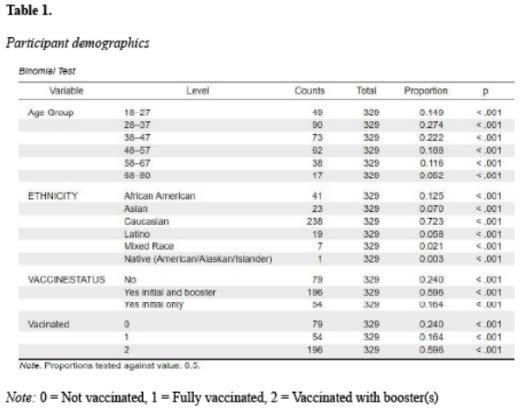
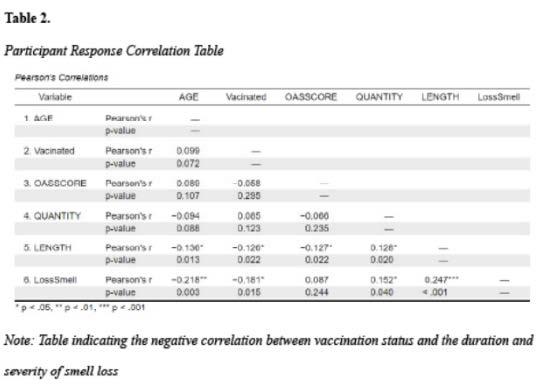
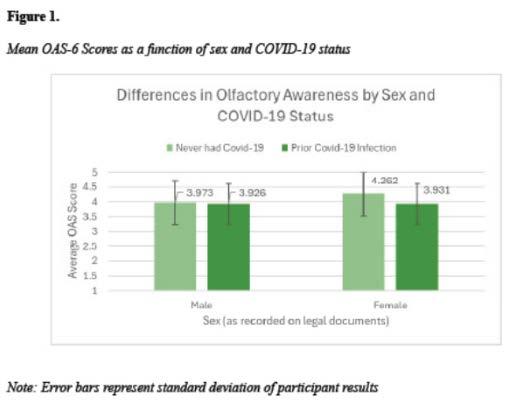
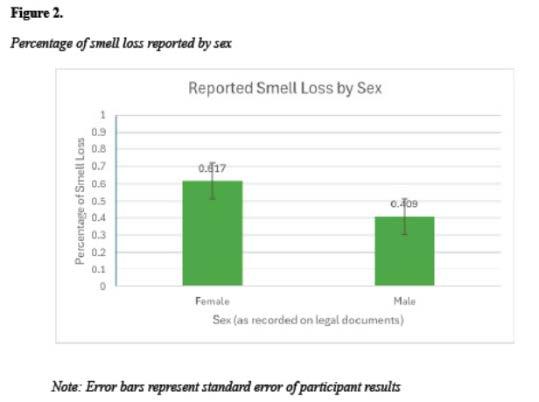
Figure 3.
Average reported length of smell loss by sex
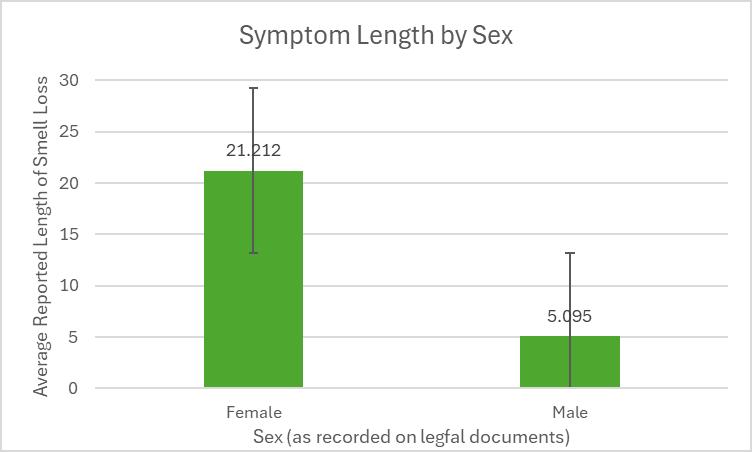
Note: Error bars represent standard error of participant result
Purpose:
I am investigating the effects of COVID-19 on the perception of smell.
Procedures:
In this study you will be completing a series of questions in survey format. Survey completion is expected to take around 5-6 minutes and you will be compensated $0.80 for your participation.
Risks and Benefits:
There are no direct benefits for participating in this study beyond the direct compensation for participation. Risk to participants is expected to be extremely low in this study. However, it is important to note that reflection on the COVID-19 pandemic and personal experiences with illness may cause distress for some participants, particularly those who have had severe symptoms or lingering effects.
Confidentiality:
Your responses will be kept confidential in a password secured Google Drive folder and in no way will they be associated with any identifying information. Following completion of the study deidentified data will be available on the Open Science framework for further analysis.
Voluntary Participation:
Participation in this study is completely voluntary. You are free to decline to participate for any reason.
Knowledge of Study Results:
After completion of the study, you will be given an opportunity to fully learn the study’s purpose and to understand the part you played in obtaining the study’s results. A debriefing form will appear at the end of the survey, please read it in its entirety.
Questions:
If you have any questions regarding the nature of the study, you may contact Emilie Dajc (erdajc1@ vwu.edu) or the research advisor Robert Ariel (rariel@vwu.edu).
If you have concerns about the treatment of research participants or would like to speak with someone who is not on the research team to address problems or concerns about this research, you can contact a current member of the Virginia Wesleyan Institutional Review board by e-mail at gmartorell@vwu.edu.
Agreement to Participate:
I have read the above information, have had the opportunity to have any questions about this study answered and agree to participate in this study.
1. When someone is busy in the kitchen, do you notice the odor of the food being prepared?
2. When you visit someone else’s house do you notice how it smells? *
3. When an acquaintance smells differently from normal, for example, because of a new perfume, do you immediately notice it?
4. Do you notice the smell of people’s breath or sweat? *
5. Are you the first one to smell spoilt food in the fridge? *
6. Do odors revive strong or vivid memories for you?
Response scale: (1) Never; (2) Rarely; (3) Sometimes; (4) Often; (5) Always
(Note: Asterisk indicates questions relating to negative smell perception)
1. What is your sex, as recorded on legal/official documents?
a. Male
b. Female
2. What is your age?
3. What is your ethnicity?
4. Were you ever vaccinated for COVID-19?
a. Yes, initial and booster
b. Yes, initial only
c. No
5. Have you tested positive for COVID-19?
a. Yes
b. No
6. How many times have you tested positive for COVID-19?
7. When you tested positive did you lose your sense of smell?
a. Yes
b. No
c. Did not have covid
8. How long did this loss of senses last?
9. Do you have any current or chronic conditions that may impact your sense of smell?
a. Allergic rhinitis
b. Blocked nose (within the past 7 days)
c. Exposure to odors or gases at work
d. Frequent nasal sinus problems
e. Frequent upper respiratory tract infections
f. History of major head injury
g. Nasal polyps
h. Smoker (including former)
i. None of the above
1. What is your favorite meal of the day? We would like you to ignore this question and just select the last option labeled Brinner.
a. Breakfast
b. Brunch
c. Lunch
d. Dinner
e. Brinner
2. When you were in high school, how hard did you work on your studies? In answering this question, please ignore what the question is asking and just select the first option indicating that you do not really remember.
a. I do not recall how hard I worked
b. I worked incredibly hard in school
c. I worked moderately hard in school
d. I did not work very hard in school
Thank you for your participation in this study. One purpose of this study is to determine the impact Covid-19 has on olfactory awareness. I am particularly interested in seeing whether previously researched gender differences in smell offer any sort of protective factors for women.
If you are distressed by any feelings or thoughts that might have been brought up by this questionnaire, I encourage you to talk to a counselor or therapist as soon as possible. If you need assistance, you can access online counseling resources via betterhelp.com for personalized care.
I want to thank you again for your participation in the research. Please feel free to contact me at the information below if you have any questions about the research, or if you are interested in the results of the project. A full explanation of this research study will be provided after the final data has been collected at the end of the course.
If you would like to talk with someone other than the researchers to discuss problems or concerns, to discuss situations if myself or my research supervisor are not available, or to discuss your rights as a research participant, you may contact a current member of the Virginia Wesleyan Institutional Review board by e-mail at gmartorell@vwu.edu.
Thank you again for your participation!
Emilie Dajc (erdajc1@vwu.edu)
Dr. Robert Ariel (rariel@vwu.edu)
References:
Aziz, M., Goyal, H., Haghbin, H., Lee-Smith, W. M., Gajendran, M., & Perisetti, A. (2020). The Association of “Loss of Smell” to COVID-19: A Systematic Review and Meta-Analysis. The American Journal of the Medical Sciences, 361(2), 216–225. https://doi.org/10.1016/j.amjms.2020.09.017
Branigan, B., & Tadi, P. (2023, May 1). Physiology, olfactory. StatPearls - NCBI Bookshelf. https://www.ncbi. nlm.nih.gov/books/NBK542239/
Brann, D. H., Tsukahara, T., Weinreb, C., Lipovsek, M., Van Den Berge, K., Gong, B., Chance, R., Macaulay, I. C., Chou, H., Fletcher, R. B., Das, D., Street, K., De Bezieux, H. R., Choi, Y., Risso, D., Dudoit, S., Purdom, E., Mill, J., Hachem, R. A., . . . Datta, S. R. (2020). Non-neuronal expression of SARS-CoV-2 entry genes in the olfactory system suggests mechanisms underlying COVID-19-associated anosmia. Science Advances, 6(31). https://doi.org/10.1126/sciadv.abc5801 Carlson, Neil R., and Melissa A. Birkett. Physiology of Behavior. Pearson, 2022. COVID-19. (2024, September 9). Yale Medicine. https://www.yalemedicine.org/conditions/covid-19 COVID-19 Vaccine Basics. (2024, September 3). COVID-19. https://www.cdc.gov/covid/vaccines/how-theywork.html
Doty, R. L., Shaman, P., & Dann, M. (1984). Development of the university of pennsylvania smell identification test: A standardized microencapsulated test of olfactory function. Physiology & Behavior, 32(3), 489–502. https://doi.org/10.1016/0031-9384(84)90269-5
Henkin, R. I. (2021). How does Covid-19 infection affect smell? American Journal of Otolaryngology, 42(3), 102912. https://doi.org/10.1016/j.amjoto.2021.102912
Jaing, K. (2020, July 24). How COVID-19 Causes Loss of Smell: Olfactory support cells, not neurons, are vulnerable to novel coronavirus infection. Harvard Medical School - News & Research. Retrieved May 9, 2025, from https://hms.harvard.edu/news/how-covid-19-causes-loss-smell Loss of smell (Anosmia). (2022, September 24). Yale Medicine. https://www.yalemedicine.org/conditions/ smell-and-taste-disorders
Mai, Y., Klockow, M., Haehner, A., & Hummel, T. (2023). Self-assessment of olfactory function using the “Sniffin’ Sticks”. European Archives of Oto-Rhino-Laryngology, 280(8), 3673–3685. https://doi. org/10.1007/s00405-023-07872-7
Oliveira-Pinto, A. V., Santos, R. M., Coutinho, R. A., Oliveira, L. M., Santos, G. B., Alho, A. T. L., Leite, R. E. P., Farfel, J. M., Suemoto, C. K., Grinberg, L. T., Pasqualucci, C. A., Jacob-Filho, W., & Lent, R. (2014). Sexual Dimorphism in the Human Olfactory Bulb: Females Have More Neurons and Glial Cells than Males. PLoS ONE, 9(11), e111733. https://doi.org/10.1371/journal.pone.0111733
Rokosz, M., Pieniak, M., Marek, D., Żyżelewicz, B., Croijmans, I., Smeets, M., & Oleszkiewicz, A. (2024). A short version of odor awareness scale (OAS-6). Food Quality and Preference, 118, 105192. https://doi. org/10.1016/j.foodqual.2024.105192
Rumeau, C., Nguyen, D., & Jankowski, R. (2015). How to assess olfactory performance with the Sniffin’ Sticks test ®. European Annals of Otorhinolaryngology Head and Neck Diseases, 133(3), 203–206. https://doi. org/10.1016/j.anorl.2015.08.004
Sharetts, R., Moein, S. T., Khan, R., & Doty, R. L. (2024). Long-Term Taste and smell Outcomes after COVID-19. JAMA Network Open, 7(4), e247818. https://doi.org/10.1001/jamanetworkopen.2024.7818
Shepherd, G. M. (2005). Perception without a Thalamus. Neuron, 46(2), 166–168. https://doi.org/10.1016/j. neuron.2005.03.012
Smeets, M. A., Schifferstein, H. N., Boelema, S. R., & Lensvelt-Mulders, G. (2008). The Odor Awareness Scale: a new scale for measuring positive and negative odor awareness. Chemical Senses, 33(8), 725–734. https://doi.org/10.1093/chemse/bjn038 Sorokowski, P., Karwowski, M., Misiak, M., Marczak, M. K., Dziekan, M., Hummel, T., & Sorokowska, A. (2019). Sex Differences in Human Olfaction: A Meta-Analysis. Frontiers in Psychology, 10. https://doi.org/10.3389/fpsyg.2019.00242 Spencer, S. E. (2024, March 20). Rare but persistent false positives on COVID-19 home antigen tests reported in NEJM letter by UMass Chan researchers. UMass Chan Medical School. https://www.umassmed.edu/ news/news-archives/2024/03/rare-but-persistent-false-positiv es-on-covid-19-home-antigen-tests-reported-in-nejm-letter-by-umass-chan-researchers/
Determining the Cu+ concentration in the soil is an excellent indicator of the environmental health in an ecosystem and can demonstrate if factors such as runoff from copper-sided buildings are present. This research aimed to apply a Cu+ determination technique to microPADs (microfluidic paper-based analytical devices) and analyze soil samples for Cu+. Samples were collected from the garden, a Cycad plant, Clarke Hall, and the greenhouse (control). It was hypothesized that the greenhouse (control) and the Cycad plant would contain the most Cu+ as they contained fertilizer, and that the soil outside of Clarke would contain more copper than the control soil because it is located outside of a building with copper siding. The samples were expected to have concentrations ranging between 1 ppm - 200 ppm. The first hypothesis proved true as the analysis of microPADs via ColorAssist gave higher signals when the samples contained fertilizer or were from outside of Clarke, resulting in a higher concentration of Cu+ compared to the control. While this expected trend was observed, it was found at concentrations ranging between nearly 700 ppm - 1000+ ppm. The soil matrix likely interfered with the indicator in the reaction with Cu+, leading to difficulty in determining the real concentration of Cu+. However, it is also noted that fertilizer could have made the concentration of Cu+ significantly higher than expected in the soil.
Copper is a metal present in many aspects of life, from the soil that grows vegetables to the trace amounts in drinking water, but where is the limit, and when does it become a concern for public health? Over time, commercial fertilizers have increased the amount of nutrients present in their products, which would ideally be great for plant growth; however, there are downsides. Excess nutrients in fertilizer lead to runoff pollution and can enter a water supply, becoming a concern for public health. While there is no regulation regarding copper in soil from the EPA, the normal range in soil is reported to be between 1– 200 ppm. The EPA does have a regulation for copper in drinking water, which is 1.3 ppm. Determining the concentration of copper in tap water or soil can be costly and complex, which is why an inexpensive colorimetric assay using microPADs has been developed. microPADs are an excellent tool for finding the concentration of a specific metal in a water or soil sample. They are user-friendly, inexpensive, portable, and minimize waste, making them not only accessible and convenient for scientists but also for the general public. When prepped with the proper reagents, microPADs are tools that can be easily mass-produced and sent to the public with directions so they can analyze their own soil and water samples.
This experiment aimed to adapt microPADs to soil samples from different parts of Virginia Wesleyan University, specifically from the greenhouse, the garden, a Cycad plant, and outside of Clarke Hall. Neocuproine was utilized as an indicator to react with Cu+ and form a yellow complex. Then, color assist on an iPhone was used to determine the signal and ultimately calculate the concentration of Cu+ in the sample.
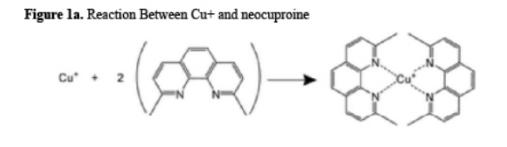
microPADs were prepared with 10uL 10% hydroxylamine, 10uL acetic acid buffer (0.1M), and 20 uL of neocuproine (0.05M). These three reagents were allowed to dry for a minimum of 30 minutes prior to pipetting 30 uL of the analyte to avoid overflow or bleeding through the wax backing of the baked microPADs. The hydroxylamine was used to reduce Cu2+ to Cu so that it would react with the neocuproine indicator. The acetic acid buffer (0.1M) was made by diluting 0.1790g of acetic acid and 0.5772g of sodium acetate to 100 mL with deionized water. Neocuproine solution (0.05M) was prepared by diluting 0.1038g of neocuproine to 10 mL with 99.5% ethanol.
A stock solution of 1000 ppm Cu2+ was prepared by dissolving 0.2116g of Cu(NO3)2 in 2mL of HCl and diluting to 100mL with de-ionized water. A solution of 100 ppm Cu2+ was prepared from the 1000 ppm Cu2+ stock solution. Standards between 10 ppm Cu2+ and 75 ppm Cu2+ were then prepared from the 100 ppm Cu2+ solution, and standards between 0.1 ppm Cu2+ and 5 ppm Cu2+ were prepared from the 10 ppm Cu2+ solution. The smallest concentration made was 0.01 ppm Cu2+, prepared from the 0.1 ppm Cu2+ solution.
The app ColorAssist was utilized to analyze the samples. All color channels were recorded, and the sample with the highest color intensity was proceeded with for data analysis to have high sensitivity. The phone was set up about 6 inches above the microPAD in a fume hood with controlled lighting, while the user zoomed in on each microPAD square so that only the color of the analyte would be picked up, excluding any outside signals.
Soil samples were gathered in plastic bottles from the greenhouse, the garden, a Cycad plant, and outside of Clarke Hall. First, each soil sample was ground in a mortar and pestle, and roughly 0.2000g (0.1998g of greenhouse soil, 0.2000g of garden soil, 0.2001g of Cycad soil, and 0.2004g of Clarke soil) were dissolved in 6mL of aqua regia (1:3 ratio of HNO3 : HCl) and heated on a hot plate for approximately 3 hours. After heating, each sample was diluted to 25mL with de-ionized water. Before pipetting the sample onto the microPAD, 5mL of each sample was extracted, and 50w/t% NaOH was added drop by drop until the pH of the solution climbed to about 4 or 5.
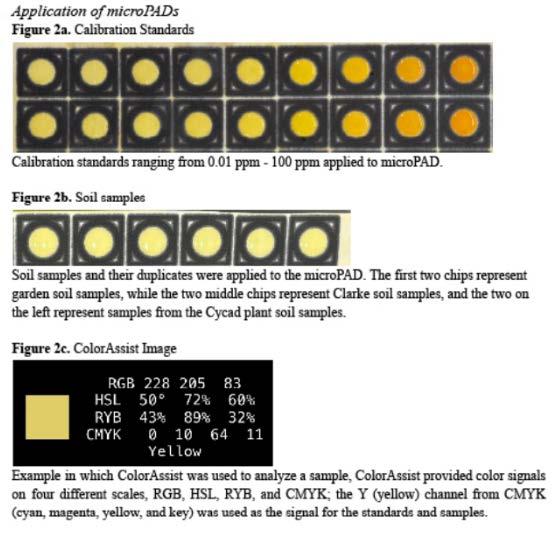
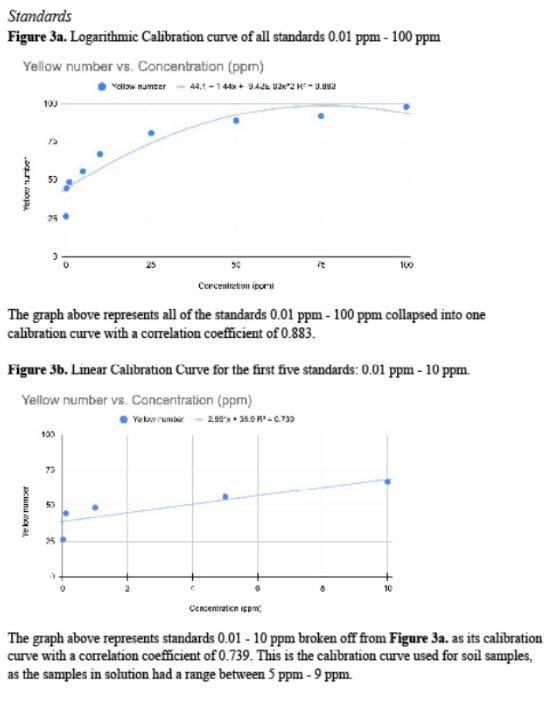
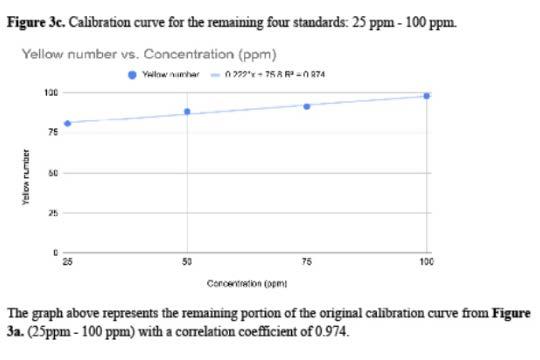
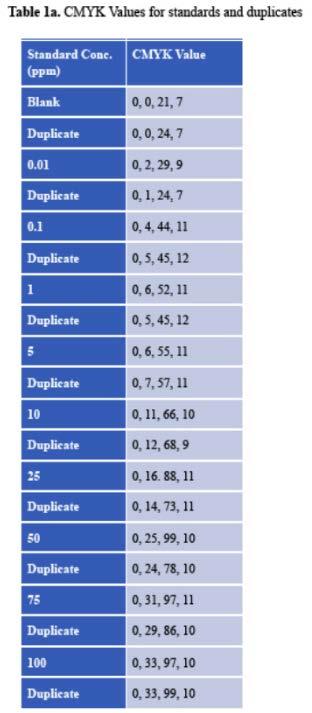
The table above represents all of the CMYK values for the standards and their duplicates, ranging from 0.01 ppm - 100 ppm, as well as the values for the blank and its duplicate. The Y values between the standards and their duplicates were averaged and used to form the calibration curve in Figure 3a.
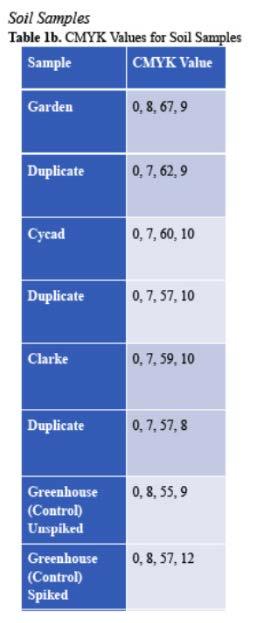
The table above represents the CMYK values for the soil samples and their duplicates, as well as the control soil spiked and unspiked. Only the Y channel from CMYK was used for data analysis.
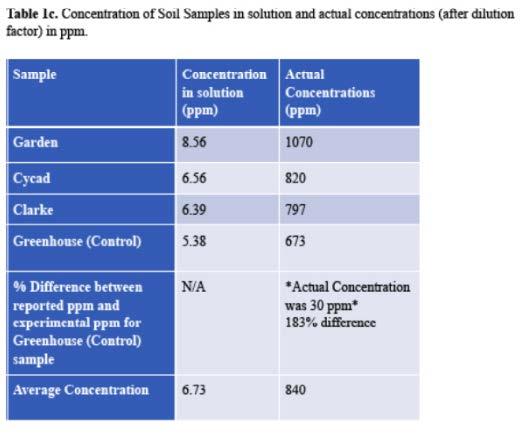
The table above represents the concentration of each soil sample in solution (aqua regia and de-ionized water) as well as the actual concentration, including the dilution factor in ppm. Also represented is the experimental value of the control soil compared to its actual value.
Data Analysis
Table 1d. Figures of Merit for Data Analysis.
LDR 1 (Figure 3b.) 0.01 ppm → 10 ppm
LDR 2 (Figure 3c.) 25 ppm → 100 ppm
Linear Equation 1 (Figure 3b.) Y = 2.99x + 38.9
Linear Equation 2 (Figure 3c.) 0.222x + 75.8
Linear Fit 1 (R^2) (Figure 3b.)
Linear Fit 2 (R^2) (Figure 3c.)
The table above represents the figures of merit derived from the data analysis, such as linear dynamic range (LDR), check standards, spike recovery, correlation coefficients, etc
The table above represents the figures of merit derived from the data analysis, such as linear dynamic range (LDR), check standards, spike recovery, correlation coefficients, etc
When the calibration standards were applied to the microPADs, as expected, a gradient ranging from pale yellow to orange was generated on the chips. As the concentration increased, the color intensified. Figure 2a. When the soil samples were applied to the microPADs, their color signals differed slightly, however the colors to the naked eye appeared to be very similar, exhibiting a pale yellow color. Figure 2b.
Three calibration curves were generated from the standards. The first calibration curve was a logarithmic curve including all of the standards ranging from 0.01 ppm - 100 ppm and had a strong correlation coefficient of 0.883. Figure 3a. This calibration curve was then split into two curves to improve the correlation coefficients and also apply a narrow range of samples to a more accurate curve. The first curve had an LDR between 0.01 ppm - 10 ppm with a correlation coefficient of 0.739, and this curve was used to analyze the samples as their concentration in solution ranged between 5 ppm - 9 ppm. Figure 3a, Table 1c, Table 1d. The second curve had an LDR of 25 ppm - 100 ppm with a correlation coefficient of 0.974 and exhibited a stronger correlation compared to the lower standards calibration curve. Figure 3c, Table 1d.
The CMYK channel on Color Assist was utilized to analyze the standards and the samples, and as the concentration of Cu+ increased, the Y in the CMYK channel also increased, demonstrating a positive correlation. Another notable correlation was the M (magenta) channel, which also increased with increased concentration; however, the values were not as significant. Thus, the yellow channel was chosen to analyze data for its heightened sensitivity. Table 1a, Table 1d. The highest to lowest signals produced by each soil sample was the garden soil at the highest, then the Cycad soil, then the Clarke soil, and the least sensitive soil regarding color signal was the greenhouse control soil. Similarly, the concentrations for each sample followed the same trend. Table 1b, Table 1c. Garden soil had the highest concentration of Cu+ at 1070 ppm, followed by Cycad soil at 820 ppm, then by Clarke soil at 797 ppm, and lastly by the greenhouse soil at 673 ppm. Table 1c. The control soil was the greenhouse soil and was reported to have a concentration of 30 ppm; however, the experimental value obtained was 673 ppm, resulting in a 183% difference between the experimental and actual values. Table 1c.
Two check standards were run: a +5 ppm standard and a +10 ppm standard. To calculate the percent error for each check standard, two replicates of each were recorded in Color Assist. The color signal in the yellow channel between duplicates was averaged and plugged into the calibration curve. The difference between the actual and experimental values was divided by the actual value and then multiplied by 100 to calculate the percent error. For the 5 ppm check standard, an error of 71.20% was calculated, while for the 10 ppm check standard, an error of 2.30% was calculated. Table 1d. A spike was also performed on one of the samples, precisely the greenhouse soil sample.
The application of real-world samples to the microPADs was successful through trial and error in figuring out which reagents to prep the pads with, proving to find an excellent way to adapt to determining the concentration of Cu+ in the soil to microPADs. The standards were successful in that they had a beautiful gradient in which the palest yellow had the lowest signal and thus the lowest concentration, while the most pigmented color had the highest signal and highest concentration. Through various points in the project, oftentimes it was difficult to maintain the perfect conditions in which neocuproine would react with Cu+. At first, Cu+ was attempted at complexing with neocuproine dissolved in deionized water. However, this attempt was unsuccessful, as it was needed to dissolve neocuproine in 99.5% ethanol ,as neocuproine is a nonpolar compound, which is why it was incapable of previously dissolving in a polar solvent, such as water. Even after the neocuproine was dissolved, the reaction did not take place until 10% hydroxylamine was added to reduce Cu2+ to Cu+, as neocuproine only reacts with Cu+, not Cu2+. After all of these adjustments were made, a color change did not occur until an acetic acid buffer was introduced. Copper nitrate in water forms an acidic solution. Thus, an acetic acid buffer needed to be introduced to maintain a pH of ~ 5. Finally, after all of these reagents were corrected and added, a color change was observed, and the experiment proceeded.
The standards generated a positive logarithmic fit curve with a correlation coefficient of 0.883, demonstrating that the data had a strong positive relationship between the increase in yellow color signal and concentration. The data was split into two calibration curves because the samples in each solution had a very narrow range between 5 ppm - 9 ppm, indicating a narrower LDR would prove to be beneficial in terms of accuracy in calculating the concentrations. The LDR of the new curve generated was between 001 ppm - 10 ppm. The correlation coefficient for this new curve was 0.739, indicating a weaker correlation than before. However, the new curve was still more accurate in terms of calculating concentrations for a narrow range. The second calibration curve had an LDR of 25 ppm - 100 ppm with a strong positive correlation coefficient of 0.974. As the concentration increased, the data demonstrated a stronger relationship between increasing concentration and increased signal. The sensitivity for the second curve was also significantly lower than the sensitivity of the first curve, as the first curve had a slope of 2.99, while the second curve only had a slope of 0.222. A more sensitive curve is better for determining a sample’s concentration, which also explains why the first curve was superior for data analysis. Having two different detection ranges improved data calculations because a curve with ranges up to 100 ppm may not be the most accurate when the samples in solution have concentrations in the single digits.
Various figures of merit were used to test the methods in the experiment. One of the tests was a check standard with both 5 ppm and 10 ppm checks. The 5 ppm check resulted in a 71.20% error as the concentration was measured at 8.56 ppm. The 10 ppm check had much better results, with just a 2.30% error and a concentration of 10.23 ppm. It can be argued that as the concentration increases, the data and the trendline equation become more reliable when calculating concentrations. The results are also supported by a higher correlation coefficient between the highest concentration values compared to the lowest ones. A spike recovery with 10 ppm was also performed.
However, the percent recovery was only 6.70%. The 10 ppm was spiked to the greenhouse soil, which only had a concentration of 5.38 ppm in solution. As stated previously, the 5 ppm check standard was inaccurate, and detecting a ppm this low was impractical with the methods being used. It can be argued that if the spike was done to a solution of a higher concentration, then it would have been more accurate. Based upon the figures of merit, it could be argued that the limit of detection is truly at 10 ppm. However, it was necessary to work below that limit in order to analyze the soil samples.
The hypothesis regarding the samples was that garden soil samples and Cycad plant soil samples would be the highest because, as stated previously, fertilizers contain excess nutrients to increase plant growth. Thus, soil samples from a garden or plant should theoretically contain more Cu+. It was also expected to observe a concentration of Cu+ between 1 ppm → 200 ppm. The first part of the hypothesis was supported, as the highest signal given was by the garden soil, resulting in a concentration of 1070 ppm, followed by the soil from a Cycad plant with a concentration of 820 ppm, then by Clarke soil with a concentration of 797 ppm and lastly the control greenhouse soil without any excess fertilizer added with a concentration of 673 ppm. The portion of the hypothesis that was not supported was in regards to how high the Cu+ concentrations were in the soil samples, as the expected range would have been between 1 ppm - 200 ppm.
The significant jump in concentration could have been caused by various factors. Firstly, the soil does not only contain copper; it also contains other metals such as arsenic, chromium, lead, etc. One of these other metals could have been present in the sample matrix and interfered with the reaction between neocuproine and Cu+, resulting in artificially high color signals. Another possible factor leading to higher-than-expected soil concentration is fertilizer, specifically in the garden and Cycad samples. Both of these samples would have contained excess nutrients, making them more likely to report higher than average values. As for the Clarke soil sample, the soil is present next to a building with copper siding, and runoff over time can seep Cu+ into the soil, leading to higher-than-average values. As stated previously, detecting the concentration of the solution below 10 ppm was below the ideal detection limit, which could have resulted in more error when calculating the signal. If the samples had higher concentrations in solution, it would be expected that more accurate concentrations would have been reported. Although the values observed were not expected in relation to our sources and control, they still followed the general predicted trend, with samples containing fertilizer being higher than those that did not while the control soil sample had the lowest.
This research experimentally determined, using microPADs, how different factors affect Cu+ concentration in soil by taking samples from plants containing fertilizer and outside of Clarke Hall, which has copper siding. The results of this experiment supported the hypothesis that fertilizers do contain excess nutrients, leading to higher concentrations of copper in the soil, and that the copper siding from Clarke Hall may increase the concentration of copper in the soil surrounding the building. The results did not fit within the expected range; however, it can still be argued that the data is valid, as proved by the concentrations being higher when fertilizer is added or used next to a building with copper siding.
1. Acetate Buffer (0.1 M, pH 5.0) Preparation and Recipe | AAT Bioquest. www.aatbio.com. https://www. aatbio.com/resources/buffer-preparations-and-recipes/acetate-buffer-ph-5.
2. Alyami, A. Y. Recent Progress in Organic Fluorescence and Colorimetric Chemosensors for Cu2+ Detection: A Comprehensive Review (2018-2023). Dyes and Pigments 2023, 220. https://doi.org/10.1016/j. dyepig.2023.111740
3. Fanna, D. J.; Lima, L. M. P.; Wei, G.; Li, F.; Reynolds, J. K. A Colorimetric Chemosensor for Quantification of Exchangeable Cu2+ in Soil. Chemosphere 2020, 238. https://doi.org/10.1016/j.chemosphere.2019.124664.
4. Hseu, Z.-Y.; Chen, Z.-S.; Tsai, C.-C.; Tsui, C.-C.; Cheng, S.-F.; Liu, C.-L.; Lin, H.-T. Digestion Methods for Total Heavy Metals in Sediments and Soils. Water, Air, and Soil Pollution : An International Journal of Environmental Pollution 2002, 141 (1-4), 189–205. https://doi.org/10.1023/A:1021302405128.
5. Kontoudakis, N.; Smith, M.; Smith, P. A.; Wilkes, E. N.; Clark, A. C. The Colorimetric Determination of Copper in Wine: Total Copper. Australian Journal of Grape and Wine Research 2020, 26 (2), 121–129. https://doi.org/10.1111/ajgw.12425.
6. Metals in Soil | Texas DSHS. www.dshs.texas.gov. https://www.dshs.texas.gov/environmental-surveillance-toxicology/hat-home/metals-soil
7. Oak Ridge National Laboratory; United States Department of Energy Office of Scientific and Technical Information. Spectrophotometric Determination of Copper in Yttrium Metal with Neocuproine; Oak Ridge National Laboratory.: Oak Ridge, Tenn., 421.
8. US EPA, O. Ecological Soil Screening Level Metal Contaminants. www.epa.gov. https://www.epa.gov/ chemical-research/ecological-soil-screening-level-metal-contaminan ts.
9. US EPA. Heavy-Metal Accumulation In Soil And Vegetation From Smelter Emissions | US EPA. United States Environmental Protection Agency. https://nepis.epa.gov/Exe/ZyNET. exe/60001C9F.txt?ZyActionD=ZyDocument&Client=E PA&Index=Prior%20to%20 1976&Docs=&Query=&Time=&EndTime=&SearchMethod=1&TocRestrict=n&Toc=&TocEntry=&QField=&QFieldYear=&QFieldMonth=&QField Day=&UseQField=&IntQFieldOp=0&ExtQFieldOp=0&XmlQuery=&File=D%3A%5CZ YFILES%5CINDEX%20 DATA%5C70THRU75%5CTXT%5C00000006%5C60001C9F.txt&User=ANONYMOUS&Password=anonymous&SortMethod=h%7C-&MaximumDocuments=1&FuzzyDegree=0&ImageQuality=r75g8/r75g8/x150y150g16/i425&Display= hpfr&DefSeekPage=x&SearchBack=ZyActionL&Back=ZyActionS&BackDesc=Results%20page&MaximumPages=1&ZyEntry=8
10. US EPA. Lead and Copper Rule | US EPA. United States Environmental Protection Agency. https://www. epa.gov/dwreginfo/lead-and-copper-rule.
11. Wang, Y.; Xianyu, Y. Colorimetric Sensing Strategy through the Coordination Chemistry between Ascorbic Acid 2-Phosphate and Copper Ions. Analytical chemistry 2023, 95 (18), 7202–7211. https://doi. org/10.1021/acs.analchem.2c05701.
English has emerged as the dominant global language through the political, economic, and cultural hegemony of the United States after World War II. While linguistic dominance is not a new concept–as reflected through the Arab, Spanish, and British empires–the modern spread of English and the American culture demonstrates a unique form of hegemony that functions less by typical coercion and more through subtle means. Examples of this dominance include global institutions, markets, media, and cultural norms that offer exchange of services and goods for proficiency in English, whereby English is spread as the primary universal language. Drawing on theories of cultural hegemony and philosophical theories of change, including Heraclitus and Gramsci, this paper examines both the ethical consequences of English’s global dominance and the ways in which shifting global power may be transforming today.
In an increasingly interconnected world, English functions as more than a simple means of communication. Instead, it operates as a system of power, access, and legitimacy. Today, English serves as the default language in various areas of global life, including international diplomacy, travel, global trade, media, and cultural exchange, often determining who can participate in global institutions and networks, as well as who has the power in international organizations. While some state this linguistic dominance as inevitable or politically neutral, it is clearly a consequence of globalization and uneven power relations. The global status of English as the “universal language” is inseparable from political and economic power, particularly from the rise of the United States as a hegemonic power following World War II.
“Linguistic globalization” is not a new phenomenon. For centuries, empires have spread their languages and authority across the world, forcing communities and vulnerable cultures to assimilate to the dominant presence or face the consequences. The modern expansion of English reflects this long-standing practice, revealing how linguistic power continues to operate in the modern world. Unlike earlier forms of imperialism that relied on direct coercion, this contemporary spread of linguistic and cultural influence is implemented in less obvious ways. English is embedded within global institutions, markets, educational systems, and cultural production. Being proficient in English is presented as the pathway to opportunity, and perhaps the only way to becoming successful in a global, capitalist society. While its dominance is less oppressive in a visible sense, it suppresses other languages and cultures, leading to ethical questions of whether the benefits of a universal language outweigh the loss of history, culture, and identity.
This paper examines English as a global language and American culture through the lens of cultural hegemony. It reviews the longer history of imperial languages such as the Latin languages or those spread by British colonialism, while centering the post World War II United States as the primary force behind English’s modern global status. Drawing on philosophical frameworks, including Antonio Gramsci’s concept of cultural consent and Heraclitus of Ephesus’ philosophy of change, the paper will explore how power is maintained not just through force, but also through subtle norms that appear natural or inevitable. Finally, it considers whether the current dominance of English and American culture represents a stable global order or a transitional phase in an evolving system of power.
The global dominance of English did not come forward by accident. Centuries before the rise of the United States, global powers used language as a tool of governance, cultural assimilation, and control. This concept is clearly represented many centuries before the modern global powers even existed. For instance, Arabic/Islamic colonization, also known as Arabization, occurred across the Middle East, Northern Africa, and even into Europe, sparking the infamous Crusades (Al-Shbiel 2017). The administration of this language was done through more oppressive methods, such as through what is now known as the Muslim Conquests of the 7th and 8th centuries, or the Arab-Byzantine Wars. During this time, the Arabic language was forced on vulnerable communities, resulting in the marginalization of local languages like Coptic and Aramaic, as well as the Islamic religion, which led to one of the largest empires in history (Hamblin, 2023). The development of both the Islamic culture and the Arabic language was framed as religious progress, a righteous mission divinely ordained by the one true God (“Surah At-Tawbah 9:122”). In reality, it was a direct political play, dismantling local identities and cultural diversity, even impacting modern linguistic systems as seen in languages like Portuguese and Spanish.
Power functions as a recurring cycle, often repeating itself despite the harm left in its path. Although Spain had previously experienced linguistic suppression during the Islamic expansions in the Iberian Peninsula, the Spanish Empire later reproduced similar practices in its own imperial pursuits. During the Age of Discovery, or the era of the Conquistadors, Spain imposed Castilian Spanish on the native peoples under the justification of religious conversion, subjecting them to learn a new language and culture in order to stay alive (Hancock, 2022). Spanish proficiency was essential for survival, as it was the only way to communicate in terms of religion, education, and societal structure. As a result, Indigenous languages were significantly marginalized, leading to the disappearance of local knowledge and culture. Although it was framed as progress or “inevitable” because of expansion, it was a result of Spanish colonization and weaponized linguistic power.
Similarly, the British Empire expanded the English language across Scotland, Ireland, North America, Africa, South Asia, and the Pacific (Ferro, 2005). English was institutionalized through schooling, markets, and trade. It came with explicit prohibitions on Indigenous and regional languages like Gaelic and Welsh, resulting in the loss of these languages throughout the nations (Ferro, 2005).
Additionally, with the spread of the English language came the expansion of Western religions like Roman Catholicism (Panitz, 2024). Scots, Irish, and Welsh were forced to convert from their traditional local practices and were immersed in Catholic customs.
These empires relied on obvious coercion. They implemented legal punishment, religious conversion, and displacement to enforce linguistic dominance and establish their authority. While these cases are not the central focus of this study, they establish a pattern that is still applicable today: language spreads most successfully when it is backed by political and economic power. While the expansion of English is not new, it is set apart today by the way its dominance is sustained.
As mentioned previously, the emergence of English as a global language is not a new concept. The contemporary idea of it being a global power is nothing new either. However, its position as a dominant global language today is inseparable from the rise of the United States as a hegemonic power following World War II. For this paper, hegemony is defined as the dominance of one group, state, or entity over others, characterized by political, economic, or cultural power (Ungvarsky, 2024). Using this definition, the United States is a cultural hegemon, due to its exports in media, brands, and values, which were facilitated because of its economic power after World War II, and furthered through the global dominance of the English language (Kasiyarno, 2014). Because of these exports and their linguistic expansion, the United States was able to grow as a global power not solely through direct colonial administration, but through soft methods that appeared normal, practical, or universally moral.
After World War II, the United States played a central part in reconstructing the global economic and political order. The nation developed institutions like the United Nations, the World Bank, and the International Monetary Fund in order to help rebuild the international economy and reestablish global cooperation (Rao, 2019). With the development of international organizations, the United States established English as the primary working language, requiring fluency in order to effectively participate in rebuilding government and global order.
The United States’ economic dominance further reinforced linguistic power. Because the United States became the center of global finance, trade, and industry, English also became the language of opportunity and advancement (Agnew, 1987). Many schools across the globe began teaching English as a second language (Howatt and Smith, 2014). English was presented as the means through which people could obtain professional advancement, international relations, and higher education. Unlike earlier linguistic empires, this system operated less through explicit bans and direct physical consequences, and more through psychological tools, pushing incentives that motivated assimilation and rewarded conformity to a universal language and culture
Furthermore, American culture and values enhanced this effect. After World War II, the United States began pushing its democratic morals on vulnerable communities, framing their values as righteous and freeing for all people (Weber, 2025).
They established international organizations like NATO and the UN, using economic aid as a tool to persuade countries to turn towards democratic governments, also known as the Marshall Plan (“Marshall Plan”). Later, as America became the center for media, American film, television, music, and digital media circulated Englishlanguage norms worldwide, demonstrating social expectations, aspirations, and democratic opinions to its viewers (Maisuwong, 2012). The United States normalized linguistic dominance through these methods, making it appear natural rather than imposed, resulting in its present state as a hegemony, even through less oppressive methods. Through these mechanisms, the United States was able to establish a form of hegemony that relied on consent as much as coercion. Perhaps without being aware, the international community gave its permission to submit to the United States’ cultural and linguistic power in exchange for economic aid and international advancement. Therefore, English became global, not solely because it was forced on others, but because, in order to be global participants, the world increasingly required it, and thus, the international community allowed it.
The idea of consent within a hegemony arose in the mid-1940s through the Marxist philosopher, Antonio Gramsci. Gramsci’s theory was that the dominant principle in capitalist societies is accepted by the majority, even though it only benefits the few elitist groups (Groff, 2023). His belief was that this “acceptance” was the world’s consent to be influenced by certain values, media, and institutions. In this way, cultural dominance is not maintained through constant force, but through media, opportunities, and language. Gramsci argued that hegemonic power occurs when the beliefs of a dominant group are accepted as common sense by society (Femia, 1975). When this theory is applied to English as a dominating language, it is clear how English has become not only a political tool, but also a practical necessity, leading to many countries accepting it as “common sense” to learn it.
While English proficiency is not typically framed as yielding to American cultural influence, it is through American institutions that this language continues to be spread as dominant. In many educational systems, labor markets, media, and international organizations, English is presented as a skill that is necessary for success (Agnew, 1987). However, it is because English has become the standard that it is necessary, and it is due to American systems. For example, the major film studios that produce the most popular and successful movies and shows are all based in Hollywood, California (“World Most Popular Filming Destinations”, 2022). Through these films, American values and beliefs are spread across the world. Values like democracy, free speech, and equal rights are shown around the globe as the primary morals to have (Vázquez Barquero, 2025). Another example of this is seen in opportunities. Almost everyone in the world has heard of the “American Dream” in which someone with no money can make millions and be successful in terms of family, business, and social standing. This dream is another way the United States becomes a global hegemony. The American Dream is an idea that appears superior against world culture in other opportunities (Kasiyarno, 2014).
While many cultures showcase a sort of social caste system in which a person is born into poverty and stays there, the American culture presents an opportunity to improve one’s standing.
Even without embracing Gramsci’s Marxist beliefs, his theories still retain a sense of value to international relations. Much of his work comes from his theory of historical materialism, the view that cultural and ideological systems are shaped by the material conditions of the world, such as economic structures, or how goods are produced (Femia, 1975). This theory reemphasizes his belief in a person’s consent to the dominant culture or power. It demonstrates how consent is produced through institutions that may appear neutral but still reaffirm existing power hierarchies. The normalization of English represents this principle. From a historical, materialist perspective, English as a dominant language and American values as the dominant culture come from the material expansion of American economic power after World War II, not just from cultural preference or a spread of modern media (McLauchlan, 1997). The spread of English was further reinforced through industrial production, global financial networks, international organizations, and eventually, mass media. As the United States emerged as the dominant producer and exporter, it also became a leading force in key industries. Today, six of the world’s ten most profitable companies are U.S.-based, coming from technology, energy, and finance (“The World’s Most Profitable Countries”, 2019). Thus, its dominance is maintained not by oppression, but by the widespread belief that there is no viable alternative in order to succeed. In this way, linguistic suppression becomes self-reinforcing, existing in everyday practices and expectations that people consent to.
This form of cultural hegemony hides its own origins. The dominance of English around the world is not clear on how or why it became dominant. When treated as natural or inevitable, the historical conditions that caused its existence cease to exist. While this theory acts like everyone is freely choosing to use English, in reality, English gives advantages to those who are already part of the powerful hegemonic system, like U.S. businesses and those who already exist within its culture. Despite it being viewed as inevitable, there are historical circumstances that led to English’s prominence. Because of these past events, it is possible that similar situations could lead to a shift in power. It is for this reason that the hegemony of the United States can not be viewed or understood as permanent.
Heraclitus of Ephesus, a Greek philosopher, was famous for arguing that stability is an illusion and all systems exist in a state of constant change. In other words, what might seem like the dominant power now might not be that way in the future due to circumstances shifting the power dynamic (Vázquez Barquero, 2025). Applied to linguistic power, this belief challenges the assumption that English will remain universally dominant, or the “most-spoken language in the world,” (“10 Most Spoken Languages”, 2024). In the past, shifts in global power, i.e. economic, technological, and political, suggest that linguistic hegemony is historically conditional. An example of this is the Latin language. Once the language of the entire Roman Empire, stretching from England to Egypt, power shifts caused the language to die out or develop into other languages (Fransen, 2017).
The hegemonic power shifted, and the next hegemony arose, namely the Arabic Empire (Donner, 2021). Through this empire, the Arabic language was spread to the ends of Europe and even influenced some of the Latin languages (Borland, 2024). Then, the next power shift occurred, and the next hegemony arose and so on and so forth.
Heraclitus’ theory of change is reinforced by Organski and Kugler’s theory of power change, which suggests that global hierarchies are not permanent and that they change based on power dynamics. Their theory was based upon the idea that after a major global event, the hegemon changed, and typically the previous one was overthrown or lost, although this has not been the case for the last few thousand years of hegemons (Vázquez Barquero, 2025). In other words, as rising powers approach the strength of dominant states, systematic shifts occur. Although this process in reality is gradual, it may seem abrupt or sudden to the international community.
In terms of language, as new centers of influence emerge or new institutions of power increase in their position, the conditions that sustain English as the dominant language may shift. Together, Heraclitus’ theory and Organski and Kugler’s theory work together to demonstrate the rise and fall of hegemonies throughout history and how this process continues to be an ongoing one.
Treating English as a finite power that has an eventual endpoint reframes the conversation. In this way, English is no longer a debate of global utility. Instead, it is a question of ethics in how societies can manage the evolution of language and culture without the injustices that come with a universal language.
The global dominance of English reflects a long history of linguistic empires, which has been intensified by the rise of American hegemony after World War II. Unlike previous cultural hegemonies, the United States maintains its authority not by traditional repression but instead through linguistic power orchestrated by international institutions, markets, and culture. This form is perhaps more effective, embedding English and American values into global life while hiding the inequalities it produces.
Through historical models and philosophical theories of change, this paper argues that linguistic hegemony is neither neutral nor inevitable, demonstrating the origins of English as a universal language. Recognizing English as an extension of the conditional hegemony of the United States allows for ethical alternatives that value global communication without erasing linguistic and cultural diversity.
Agnew, John. The United States in the World-Economy: A Regional Geography. Vol. 1. CUP Archive, 1987. Al-Shbiel, Abeer Obeid. “Arabization and Its Effect on the Arabic Language.” Journal of Language Teaching & Research, vol. 8, no. 3, 2017.
Borland, Reagan. The Arabic Influence on the Spanish Language: Sociocultural Mechanisms of Language Change Under Islamic Rule in the Iberian Peninsula. 2024. University of South Carolina, Senior Thesis. Scholar Commons, scholarcommons.sc.edu/senior_theses/681.
Donner, Fred M. “Themes Of Hegemony.” Narratives of Islamic Origins: The Beginnings of Islamic Historical Writing. Gerlach Press, 2021, pp. 174–183. Studies in Late Antiquity and Early Islam.
Femia, Joseph. “Hegemony and Consciousness in the Thought of Antonio Gramsci.” Political Studies, vol. 23, no. 1, 1975, pp. 29-48.
Ferro, Marc. Colonization: A Global History. Routledge, 2005.
Fransen, Sietske. “Latin in a Time of Change: The Choice of Language as Signifier of a New Science?” Isis: International Review Devoted to the History of Science and Its Cultural Influences, vol. 108, no. 3, 2017, pp. 629–635, https://doi.org/10.1086/694189.
Groff, Adam. “Cultural Hegemony.” EBSCO Research Starters, 2023, https://www.ebsco.com/research-starters/ political-science/cultural-hegemony.
Hamblin, William J. “Byzantine-Muslim Wars.” EBSCO Research Starters, 2023, www.ebsco.com/research-starters/history/byzantine-muslim-wars.
Hancock, J.F. (2022). “Spanish Conquest and Colonization of the Americas.” World Agriculture Before and After 1492. Springer, Cham. https://doi.org/10.1007/978-3-031-15523-9_5.
Howatt, A. P. R., and Richard Smith. “The History of Teaching English as a Foreign Language, from a British and European Perspective.” Language & History, vol. 57, no. 1, 2014, pp. 75–95, https://doi.org/10.117 9/1759753614Z.00000000028.
“How Arabic Influences Other Languages Around the World.” The Mother Tongue, MotherTongue.ae, https:// mothertongue.ae/how-arabic-influences-other-languages-around-the-world.
Kasiyarno, Kasiyarno. “American Dream: The American Hegemonic Culture and Its Implications to the World.” Humaniora, vol. 26, no. 1, Feb. 2014, pp. 13–21, https://media.neliti.com/media/publications/11573-ID-american-dream-the-american-hegemonic culture-and-its-implications-to-the-world.pdf.
Kasiyarno, Kasiyarno. “The ‘American’ Hegemonic Culture: Its Roots, Features and Implications to World Culture.” Rubikon: Journal of Transnational American Studies, vol. 1, no. 1, Feb. 2014, pp. 19–??, doi:10.22146/rubikon.v1i1.34157. ResearchGate, https://www.researchgate.net/publication/347200327_
THE_’AMERICAN’_HEGEMONIC_CUL TURE_ITS_ROOTS_FEATURES_AND_IMPLICATIONS_TO_WORLD_CULTURE.
Maisuwong, Wanwarang. “The Promotion of American Culture through Hollywood Movies to the World.” International Journal of Engineering Research & Technology (IJERT), vol. 1, no. 4, June 2012, pp. 1–7, https://www.ijert.org/research/the-promotion-of-american-culture-through-hollywood-movies-to the-worldIJERTV1IS4194.pdf.
“Marshall Plan (1948).” National Archives, U.S. National Archives and Records Administration, https://www. archives.gov/milestone-documents/marshall-plan.
McLauchlan, Gregory. “World War II and the Transformation of the US State: The Wartime Foundations of US Hegemony.” Sociological Inquiry, vol. 67, no. 1, 1997, pp. 1-26.
Panitz, Michael. “World Religions: Celtic Religions.” World Religions Seminar. 24 Oct. 2024, Virginia Beach, Virginia.
Rao, Parupalli Srinivas. “The Role of English as a Global Language.” Research Journal of English, vol. 4, no. 1, 2019, pp. 65-79.
“Surah At-Tawbah 9:122 – Tafsir (Ma’arif-ul-Qur’an).” Quran.com, https://quran.com/9:122/tafsirs/en-tafsirmaarif-ul-quran.
“10 Most Spoken Languages in the World in 2025.” ICLS, 20 Aug. 2024, updated 30 Apr. 2025, https://www. icls.edu/blog/most-spoken-languages-in-the-world.
Ungvarsky, Janine. “Hegemony.” EBSCO Research Starters, 2024, https://www.ebsco.com/research-starters/ social-sciences-and-humanities/hegemony.
Vázquez Barquero, José Ángel. Lecture on International Relations. Intro to International Relations, Universidade de Vigo, Ourense Campus, Feb. 2025.
Weber, Michael A. Democracy and Human Rights in U.S. Foreign Policy: Evolution, Tools, and Considerations for Congress. Congressional Research Service, 7 Jan. 2025, https://www.congress.gov/crs-product/ R47890.
“World Most Popular Filming Destinations.” Kuoni, 2022 https://www.kuoni.co.uk/inspiration/world-most-popular-filming-destinations.
“The World’s 10 Most Profitable Companies.” Investopedia, 25 July 2019, https://www.investopedia.com/theworld-s-10-most-profitable-companies-4694526.
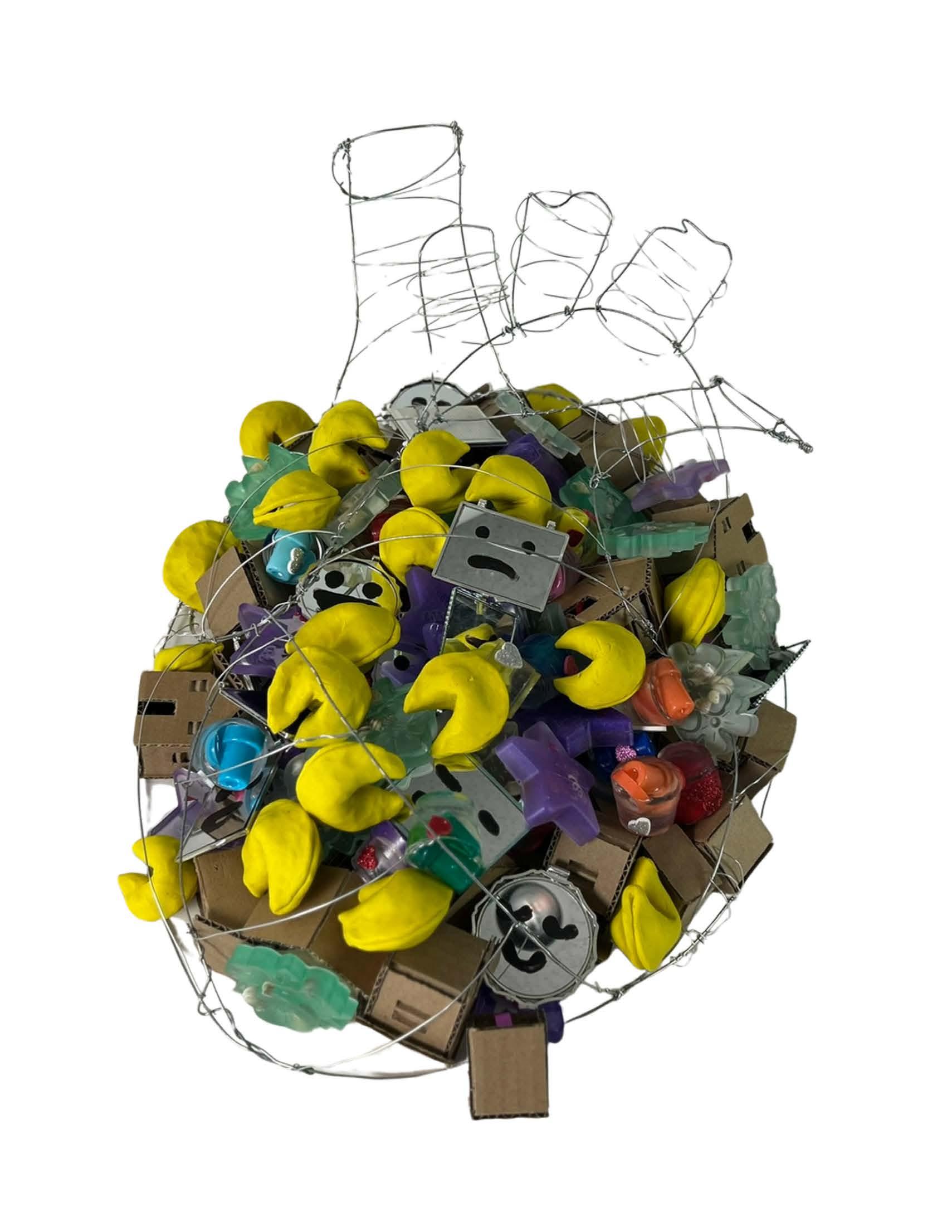
Inspired by Cuban-American Artist Felix Gonzalez-Torres, this mixed media piece contained small objects within a wire anatomical heart. Audience members who viewed this piece were able to take an object and interact with it, such as opening the cardboard boxes and modeling clay fortune cookies, to find hidden parts, as well as taking the object with them. The piece is named in homage to Gonzalez-Torres, and works with the themes of love, perspective, interpretation, and weight, although the audience is encouraged to project their own meaning on it.
Created by Gabrielle Barnett
2025
Wire heart filled ideally with 131 mixed media objects