Farm Bureau News
SEPTEMBER 2026
The Voice of Virginia’s Agricultural Producers
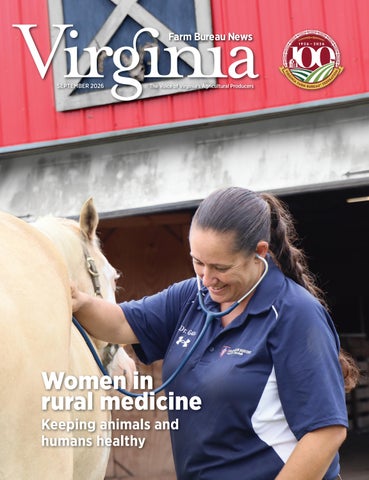
Women in rural medicine Keeping animals and humans healthy
Farm Bureau News
Volume 85, Number 3 September 2026
16
Features 12
14
16
21
H-2A REFORM CRITICAL
Virginia farmers rely on roughly 5,000 H-2A laborers, and recent delays have underscored the need for Congressional reform.
“We know better, we do better.” — DR. SHERRI GARD, founder Guardian Equine Veterinary Services, Suffolk
STOP THE BURN
Burns are among the common causes of injuries and death in agriculture, but farmers can stock supplies to treat non-emergency burns on site.
Kathy Dixon Assistant Director, Communications Nicole Zema Sr. Staff Writer/Photographer Christina Amano Dolan Sr. Staff Writer/ Photographer
PUBLICATION SCHEDULE
Producer members will receive their next issue of Virginia Farm Bureau News in November. The magazine is published quarterly, and back issues can be viewed at issuu.com/ virginiafarmbureau.
Departments By the numbers Save the date For your benefit Heart of the Home
All advertising is accepted subject to the publisher’s approval. Advertisers must assume liability for the content of their advertising. The publisher assumes no liability for products or services advertised. The publisher maintains the right to cancel advertising for nonpayment or reader complaints about services or products.
EDITORIAL TEAM
WE’RE SOCIAL!
4 5 7 28
Members — Address change? If your address or phone number has changed, or is about to change, contact your county Farm Bureau. They will update your membership and subscription information.
Asheley Jewett Chief Marketing & Communications Officer
Two multi-generational farmers share the responsibility of caring for the legacy of their forebears—for a century or more. To mark the International Year of the Woman Farmer, we feature three women in rural medicine—helping animals and humans.
Postmaster: Please send changes of address to, Virginia Farm Bureau Federation, Farm Bureau News, P.O. Box 27552, Richmond, VA 23261-7552; fax 804-290-1096. Editorial and business offices are located at 12580 West Creek Parkway, Richmond, VA 23238. Telephone 804-290-1000, fax 804-290-1096. Email virginiafarmbureaunews@vafb.com. Office hours are 8 a.m. to 4:30 p.m., Monday through Friday.
Member: Virginia Press Association
DEEP ROOTS
IYOWF: BODY AND MIND
NICOLE ZEMA
Virginia Farm Bureau News (USPS 017-763) (ISSN 1525-528X) is published four times a year. January, April, September, November. It is published by Virginia Farm Bureau Federation, 12580 West Creek Parkway, Richmond, VA 23238. Periodicals postage rate is paid at Richmond, VA and additional mailing offices. The annual Subscription Rate is $1.13 (included in membership dues).
ON THE COVER Mobile equine vet Sherri Gard makes straightforward recommendations to horse owners (Photo by Nicole Zema).
Kenny Kane Graphic Design Manager Eleanor Stickley Sr. Graphic Designer Alice Kemp Sr. Staff Writer/Advertising Coordinator Savannah Bragg Summer Fellow
VIRGINIA FARM BUREAU FEDERATION
Officers Scott E. Sink, President Robert J. Mills Jr., Vice President
Board of Directors DIRECTOR
DISTRICT
Emily F. Edmondson 1 Richard L. Sutherland 2 Bruce N. Stanger 3 Jeannie L. Dudding 4 Russell L. Williams II 5 Justin Pence 6 Thomas E. Graves 7 Leigh H. Pemberton 8 Patrick Murphy 9 A. Bruce Slagle 10 Matt T. Fimon 11 J. Barry Bates 12 Gary D. Cross 13 David L. Hickman 14 A. Faye Hundley * Thomas N. Henley **
COUNTY
Tazewell Grayson Montgomery Craig Rockbridge Shenandoah Orange Hanover Prince Edward Halifax Brunswick Essex Southampton Accomack Essex Goochland
*Women's Leadership Committee Chair **Young Farmers Committee Chair
2
VIRGINIA FARM BUREAU NEWS
President's Message
“Thank you for recognizing me.”
T
hose were the words spoken to me by an individual on the streets of England when I was there with my daughter’s high school band group. I greeted the man and asked him how he was getting along, and he was simply grateful to be seen instead of ignored. Isn’t that what we are all looking for in our personal and professional lives? We simply want to be acknowledged and appreciated. At Virginia Farm Bureau, we want every member to know they are seen, heard and valued. We appreciate our members every day, because without you, we would not be able to accomplish what we do on behalf of agriculture, rural communities and families across the commonwealth. You are the backbone of this organization and for the past 100 years, your support has allowed us to serve agriculture and celebrate the people who make it strong. This year, especially, has been one of appreciation and accolades as we celebrate Farm Bureau’s centennial. We also have marked the International Year of the Woman Farmer by featuring women in agriculture in our magazines, on our Real Virginia television program and across our social media channels. At our annual women’s conference, we recognized farm women from all 14 of the organization’s districts as Distinguished Women in Agriculture. We also were able to send 21 of our female members to the ACE (Advocate,
Farmers applaud Spanberger's legislation that defines agrivoltaics.
Cultivate, Empower) Summit in Washington, D.C., where Women’s Leadership Committee members joined about 450 attendees from across the U.S. and met with legislators to share about challenges facing Virginia agriculture. Our appreciation also extends to young farmers who are building the future of Virginia agriculture. Through young farmer events, leadership opportunities and awards, we recognize members who are growing their farms, strengthening their communities and stepping forward as the next generation of agricultural leaders. Our farmer members also have been seen and heard throughout the state this year. Southwest Virginia farmers
and agricultural stakeholders met with U.S. Sen. Mark Warner, D-Va., in June to discuss the stalled Farm Bill, disaster recovery, tariffs, artificial intelligence and the long-term workforce needs shaping rural communities. Also in June, on a farm in Loudoun County, Gov. Abigail Spanberger signed legislation that officially defines the term agrivoltaics in the Code of Virginia. The commonwealth previously lacked an official definition for agrivoltaics. This legislation helps to protect agricultural production while giving farmers operational flexibility. Additionally, one of our Surry County members hosted an agriculture bill signing by the governor and other agricultural dignitaries. During that gathering, the governor signed multiple bills supporting agriculture and Gov. Abigail Spanberger presents a proclamation forestry, as well as to Surry County farmer Breyon Pierce. community food access. She also presented a proclamation to that family celebrating producers of food, fiber and fuel during Virginia Agriculture Week, June 7–13. It’s important that legislators hear from farmers and learn how challenged they are right now. Farmland is being lost every year, and farmers are facing rising fuel and fertilizer costs, drought and early freezes, as well as prime farmland being taken by data centers and solar fields. Farmers need a competitive edge—or at least a sympathetic ear from lawmakers who can pass legislation to help them. Farm Bureau’s mission is to protect and cultivate the future for all Virginians, and we take pride in providing support for all our members. Thank you for recognizing that Virginia Farm Bureau is here for you—committed to meeting our customers’ needs. We hope you’ll consider renewing your membership and inviting a friend to join as well. That way, we can collaborate together to help the commonwealth thrive. Scott Sink, an agritourism operator and beef cattle and hay farmer in Franklin, Montgomery and Pulaski counties, is president of Virginia Farm Bureau Federation. vafb.com / SEPTEMBER 2026
3
ALICE KEMP
1,300 1,300
That’s how many volunteers read Virginia Agriculture in the Classroom’s Book of the Year, Farm Boots by Renée Kurilla, to 77,000 children during AITC’s annual Agriculture Literacy Week in March. Read more on page 19.
Virginia leads the U.S. in hard clam aquaculture production, on Real Virginia. Featured this month on Real Virginia, Virginia Farm Bureau’s weekly television program: • See how clam farmers are successfully harvesting these profitable and tasty bivalves. • Find out how to make a creamy, peppery summer soup out of radishes in the Heart of the Home segment. • Visit Dinwiddie County to see where farmers are producing tobacco, cotton and small grains and raising beef cattle, hogs, sheep and goats. Real Virginia airs nationwide at 8 a.m. on the first and third Thursdays of each month in the Voices of Agriculture program on RFD-TV on Dish Network and DirecTV, and on selected cable outlets around the state. Watch anytime at vafb.com. It airs weekly on WVVA Bluefield and WTKR Norfolk. It also airs on the first and third Sundays of each month at 7 a.m. on WHSV Harrisonburg and at 10 a.m. on WVIR Charlottesville; and on the first and third Saturdays at 5:30 a.m. on WSLS Roanoke and at 8 a.m. on WRLH Richmond.
Top membership counties for 2026
County Farm Bureau Members Bedford . . . . . . . . . . . . . . . . . . . . . . . . . . . . . . . . . . . 3,056 Hanover . . . . . . . . . . . . . . . . . . . . . . . . . . . . . . . . . . . .3,027 Charles City-James City-New Kent-York . . . . . . . 2,901 Washington . . . . . . . . . . . . . . . . . . . . . . . . . . . . . . . . .2,615 Henrico . . . . . . . . . . . . . . . . . . . . . . . . . . . . . . . . . . . . .2,550 Chesterfield . . . . . . . . . . . . . . . . . . . . . . . . . . . . . . . . .2,519 Franklin. . . . . . . . . . . . . . . . . . . . . . . . . . . . . . . . . . . . .2,379 Augusta . . . . . . . . . . . . . . . . . . . . . . . . . . . . . . . . . . . .2,354 Tazewell . . . . . . . . . . . . . . . . . . . . . . . . . . . . . . . . . . . .2,272 Rockingham . . . . . . . . . . . . . . . . . . . . . . . . . . . . . . . .2,189
County Farm Bureau
Percentage of goal
County Member s Farm Bureau retention rate %
Chesterfield. . . . . . 96.40 Roanoke. . . . . . . . . 95.44 P. William-Fairfax . . 94.34 Caroline . . . . . . . . . 94.01 Franklin. . . . . . . . . . 93.99 Louisa . . . . . . . . . . . 93.94 Wythe. . . . . . . . . . . 93.77 Henrico. . . . . . . . . . 93.72 Greene . . . . . . . . . . 93.68 Fauquier. . . . . . . . . 93.68
Charlotte. . . . . . . . 88.70% Southampton . . . 88.32% Pulaski . . . . . . . . . .88.00% Floyd . . . . . . . . . .87.75% Powhatan . . . . . . .87.57% Lunenburg . . . . . .87.13% Louisa . . . . . . . . . .86.44% Dinwiddie . . . . . . .86.13% Shenandoah. . . . .86.05% Smyth . . . . . . . . . .85.88%
*Membership year ends Oct. 31, 2026.
4
VIRGINIA FARM BUREAU NEWS
as of Aug. 18, 2026
Save the Date!
Register soon for the VFBF Annual Convention
The State Fair of Virginia returns: Key details to know
This year’s Virginia Farm Bureau Federation Annual Convention will take place Dec. 1-2 at The Omni Homestead Resort, America’s oldest luxury destination. The historic setting is a fitting location in which to celebrate VFBF’s 100 years, and programming will reflect that centennial milestone. The convention is open to all county Farm Bureau members, staff and any member of the public interested in learning more about Virginia agriculture. Registration for lodging and meals is now open for county Farm Bureaus and will close Oct. 31.
This year’s State Fair of Virginia theme, “Virginia’s Best of Show,” highlights the top traditions and talent from across the commonwealth, and the spirit of blue-ribbon excellence will be celebrated from Sept. 25 through Oct. 4. The Main Stage Concert Series will offer a variety of musical genres throughout the week, with performers including ‘90s country singer Sammy Kershaw; country-rock duo Lakeview; Richmond-based country and bluegrass group the Jack Wharff Band; country singer George Birge; Brencore tribute to Earth, Wind and Fire; country-rap singer and co-writer of Dirt Road Anthem Colt Ford; contemporary Christian artist Leanna Crawford; bluegrass band Red Camel Collective; the Amanda Cook Band; ‘90s boy band O-Town with LFO; and country music band Parmalee. This year, the fair is introducing the Equestrian Roundup, which includes an open horse show, the World Blacksmith Championship and the Greenlee Draft Horse Hitch. The roundup also will allow visitors to experience hands-on learning through blacksmith competitions and draft horse demonstrations. “Sunsets and Scholarships” will return as one of the fair’s scholarship fundraisers and will be offered Friday through Sunday evenings as a ticket add-on option. The experience provides a nightly gathering space where attendees can enjoy drinks, fellowship and listen to main stage performances. On Oct. 1, an elevated Western-themed night will feature cocktails, hors d’oeuvres and live music. In addition to scholarship events, each year Virginians compete for blue ribbons in State Fair contests. New this year is a 4-H and FFA veterinary science competition, along with themed America 250 contests in the art and horticulture categories. A new educational addition this year is the Virginia 250 “Give Me Liberty” history exhibit, offered daily in Meadow Hall as part of the commemoration of the 250th anniversary of the signing of the Declaration of Independence. A Freedom 250 truck also will be on-site from Sept. 30 through Oct. 4, serving as a mobile museum that gives visitors an opportunity to explore the American story about its founding. Mark your calendar and make it a fair to remember! For ticket and entertainment information, visit StateFairVa.org. Additional live updates can be found by following the fair on Facebook at Facebook.com/StateFairVa and Instagram @statefairva.
What to expect
Special plans to celebrate Virginia Farm Bureau’s 100th anniversary include centennial merchandise, a live band and a centennial celebration dinner on Wednesday, Dec. 2. Programming will feature guest speakers, workshops, legislative updates and policy discussions at the Annual Meeting of Voting Delegates. During this part of the convention, qualified county Farm Bureaus will establish VFBF state and federal policies for the coming year. Elections will be held for the offices of president and vice president, Women’s Leadership and Young Farmers committee chairs, as well as directors representing Districts 1, 4, 7, 10 and 13. Presentations and judging for the Young Farmers Discussion Meet contest also will take place, with winners announced during the convention. Additionally, recipients of the 2026 VFBF County Farm Bureau Awards of Excellence and the 2026 VFBF Journalism Awards will be recognized. Convention participants can take part in a service project hosted by the Women’s Leadership Committee, attend a fireside chat with the VFBF executive team and AFBF President Zippy Duvall, and join a panel discussion focused on local engagement.
Explore the area
The Omni Homestead offers a wide range of amenities for guests, including dining options, a market, spa, theater room, game room, equestrian center and zip line tours. Visitors to Hot Springs also can enjoy nearby attractions such as the Warm Springs pools, world class golf courses and scenic mountain hiking. For more information on tourist attractions, visit omnihotels.com
vafb.com / SEPTEMBER 2026
5
Farm Bureau Members Receive a
$500
Exclusive Cash Reward*
on an Eligible New* Ford Truck or Ford Blue Advantage™ Certified Used* Vehicle.
The Farm Bureau Exclusive Cash Reward* is now compatible with AXZD-Plans.
Ford F-150®
*Visit FordRecognizesU.com/FarmBureau today for complete offer details!
Virginia’s Golden Getaway!
SEPTEMBER 11-20, 2026 www.BeaverDamSunflowers.com
TM
beaver dam farm sunflower festival 6
VIRGINIA FARM BUREAU NEWS
For Your Benefit
Members save on health, communication and recreation Discounted prescriptions for over 1,000 medications Virtual Care Rx offers Virginia Farm Bureau members a discounted subscription rate for more than 1,100 acute and chronic medications at no cost. Plus, members will get access to virtual primary and urgent care 24/7/365. Subscription prices for the medication program start as low as $20.65 per month, which gives you access to 70,000 in-network retail pharmacies. After your first fill at a retail pharmacy, your chronic medication will be mailed monthly with free shipping. Members also have access to the Prescription Assistance Program for discounts on many medications over $200. Additionally, members will have access to the Insulin Discount Program, a one-stop solution for high quality brand and generic insulins and associated diabetes medications. Prices start as low as $94.99 a month for insulin, service and shipping. Through Virtual Rx’s Virtual Care Program, members can connect directly with a primary care or urgent care physician via phone or video conferencing 24/7. Virtual mental health support also is available for an additional cost of $35 per visit for a therapist or counselor. Virtual Care prices start at $26.95 per month. For complete pricing and to learn more, call 877-256-4248 and mention you are a VFB member, or visit virtualcare-rx.com/ home-virginia-farm-bureau-federation/.
Affinity Cellular offers discounted service, free activation Affinity Cellular operates on the nation’s largest and most dependable network, and has been providing service to membership organizations since 2011. Affinity Cellular offers a wide array of plans and phones with a focus on talk and text only, with lower data consumption. You select the phone and plan that best fit your needs! Virginia Farm Bureau members enjoy exclusive benefits, including a $75 airtime credit, free activation ($35 value) and free shipping. Members have the option to keep their current phones (subject to network compatibility), select from the latest iPhone or Android devices, or choose a simple flip phone. They also may keep their existing cell phone numbers. To set up a plan with Affinity Cellular, visit vafb.com/benefits, log in as a Virginia Farm Bureau member, and go to the Affinity Cellular tab. Use the dedicated website link or phone number provided. *Under Affinity Cellular’s Fair Use Policy, the company has established usage thresholds of 5,000 minutes for voice and 5,000 texts. On our Unlimited Data Plan, the fair use threshold is 35GB of data. If this amount is exceeded, it will result in throttling of data. Usage that exceeds the monthly usage will be considered a violation of this Fair Use Policy and subject to overage charges.”
Screen for risk of heart-related issues No one knows when a stroke or cardiovascular issue will arise, so why not get screened to assess your risk for stroke, heart attack and related issues? Virginia Farm Bureau members can save on four noninvasive vascular health screenings that may give you peace of mind. For just $135, members can be screened for carotid artery, abdominal aortic aneurysm, atrial fibrillation and peripheral arterial disease. They also receive a free osteoporosis scan. Healthcare professionals use the latest technology to provide hospital-quality preventive screenings, and boardcertified physicians carefully review your results. Visit vafb.com/benefits, go to the Life Line Screening tab and log in as a Virginia Farm Bureau member to sign up.
Get up to 20% discount on Wyndham properties Whether you’re looking for an upscale hotel, an all-inclusive resort or something in between, Wyndham Hotels & Resorts has the right hotel for you! As a Virginia Farm Bureau member, you will save up to 20% off the “best available rate” at over 8,000 participating hotels worldwide. Reservations are required, and blackout dates may apply. To take advantage of this discount rate, call 877-670-7088 or visit wyndhamhotels.com/farm-bureau. Use the Virginia Farm Bureau identification number, available at vafb.com/ benefits and from your county Farm Bureau, when making a reservation. Present your membership card when you check in.
Members receive up to $13 off admission to Biltmore Estate Biltmore Estate in Asheville, North Carolina, is America’s largest home. Built by George and Edith Vanderbilt, this 8,000acre property offers beautiful gardens, biking, carriage rides, horseback riding, kayaking, paddle boarding and more. Farm Bureau members in Virginia will receive up to $13 off daytime admission to the historic Biltmore estate. Members also can realize reduced rates at The Inn on Biltmore Estate, The Village Hotel and a variety of local accommodations. While there, browse through unique estate shops for wine lovers, gardeners, bookworms and everyone in between. Savor complimentary tastings of more than 20 handcrafted wines; view rare treasures from the Biltmore collection; and learn about the estate’s barnyard animals. Visit Biltmore.com/corporateperk for more information. Tickets must be purchased in advance. vafb.com / SEPTEMBER 2026
7
Celebrate 100 Years. Help Shape the Next 100. Farm Bureau’s grassroots efforts mean lawmakers are listening to us locally and then on up the ladder. You don’t find that anywhere else. Bob Moss Jr., Silver Spring Farm, Tazewell County
Bob Moss Jr.’s mom got involved with Virginia Farm Bureau when the government was trying to make farmers pay inheritance tax for the fourth time in 10 years. “Mom got real involved with Farm Bureau and actually participated in some hearings.” Virginia Farm Bureau heard farmers’ laments about the unfair taxes, and stepped in. After years of lobbying, they were successful. In 2007, the federal estate tax was permanently eliminated. “If you’re active in Farm Bureau, it doesn’t take long to see its importance,” Bob said. “Without lobbying representation, farmers would really have a tough time getting the ear of a local board of supervisors member or even at the state and federal levels.” The Moss family is just one of many Virginia farm families who have been supported by Farm Bureau over the last 100 years through advocacy, educational efforts and grassroots lobbying. As we celebrate all that our centennial of service means to rural Virginians, we invite you to help shape what comes next.
Help Grow Virginia Farm Bureau
The best ambassadors for Virginia Farm Bureau are you!
Scan the QR code to learn more, or visit vafb.com/grow
Keep your voice heard Renew your membership today, and invite someone to become part of the next 100 years.
Field staff changes to improve service to Farm Bureau members
S
everal staffing developments within Farm Bureau’s Membership and Field Services Department reflect the continued commitment to the communities and county organizations Virginia Farm Bureau serves across the commonwealth. “The dedication and talent of our team is what makes Virginia Farm Bureau a leader in serving our agricultural community,” noted VFBF President Scott Sink. Brian Walsh has been promoted to serve as Director of Field Operations. Brian brings a wealth of experience and a proven track record of strong field leadership to this role. He succeeds Mark Dawson, who is retiring as the director of field operations after serving Farm Bureau for 27 years. Walsh grew up in Shenandoah County and holds a bachelor’s degree in agribusiness from Virginia Tech. He previously worked as a high school agriscience instructor and FFA advisor. He joined the Virginia Farm Bureau Membership & Field Services team in 2019 as a field WALSH services director for District 6, which represents members in Clarke, Frederick, Loudoun, Page, Rappahannock, Shenandoah and Warren counties. In addition to Walsh’s promotion, two new Regional Field Services Manager roles have been created to support the continued growth and effectiveness of our field operations across Virginia. These positions will play a pivotal role in leading and mentoring regional teams of District Field Service Directors, while supporting county boards and office staff across the Eastern and Western regions of Virginia. Bryan Johnson will serve as the Eastern Regional Field Services Manager, and Justin Coleman will fill
the Western Regional Field Services Manager position. Both Johnson and Coleman will continue with their current responsibilities as well. Coleman has COLEMAN worked as the District 4 field services director since 2024, serving members in Alleghany, Bedford, Botetourt, Craig, Franklin, Henry, Patrick and Roanoke counties. Prior to that he was a Farm Bureau insurance agent in Pulaski County. He also operates a cattle farm in Floyd’s Indian Valley District. Johnson has worked as the District 12 field services director since 2022, serving members in Caroline, Essex, Gloucester, Mathews, King and Queen, King William, Middlesex, Northumberland, Lancaster, Richmond and Westmoreland counties. Johnson lives in King William County and helps with the family grain farm. “These leaders will help ensure JOHNSON our membership goals are met, regulatory compliance is maintained, and meaningful training and development programs are delivered consistently across all counties,” Sink said. New District 7 field services director plans to build strong relationships Loran Harney Lillard was hired as the new Virginia Farm Bureau Federation District 7 field services director and began April 6. In that role, she will work with Farm Bureau members in Culpeper, Fairfax, Fauquier, King George, Madison, Orange, Prince William, Spotsylvania and Stafford counties. Lillard previously served as the operations director for Creative Options
of DC, where she led organization-wide coordination across a multi million dollar staffing agency. Her work spanned strategic planning, systems implementation, CRM development, and marketing/administrative integration. She was instrumental in strengthening workflow efficiency, enhancing client and member engagement, and guiding compliance processes. With more than a decade of experience supporting rural communities, agricultural organizations and volunteer boards, Lillard brings a unique blend of strategic intuition, technical capability, and hands-on leadership. Her career includes roles in business management, financial and administrative operations, elections oversight, and customer facing service— each reinforcing her reputation for initiative, accuracy, and exceptional communication. Lillard has served as the Madison County Women’s Leadership Committee chair and currently co-chairs a communications LILLARD committee for the American National Cattle Women, Inc. She also holds certifications in Beef Quality Assurance and Virginia Master Certification. She holds a bachelor’s degree in agribusiness management from West Virginia University, with focuses on agricultural law, leadership and business development. “Loran is known for building strong relationships, improving organizational systems and supporting missiondriven work—especially within rural and small business environments,” said Mark Dawson, retiring director of field operations for VFB’s Membership & Field Services Department. “We’re excited to welcome her expertise, energy and collaborative spirit to our team.” vafb.com / SEPTEMBER 2026
9
Skip the wait: Save time with self service BY SAVANNAH BRAGG Virginia Farm Bureau Mutual Insurance Co. continues to put customers and their needs first through self-service options on vafb.com. Through their online accounts, VFBMIC customers can enroll in paperless billing, download policy ID cards, request policy changes, receive current policy documents, file claims, contact local offices and make payments with ease. “By making everyday services easier to access, self-service options help reduce policy service wait times, improve the overall member experience, and allow local offices and support teams to focus on more complex or personalized member needs,” said Brett Duncan, VFBMIC inside sales manager. Virginia Farm Bureau current and prospective customers also can shop for auto quotes at vafb.com/insurance/get-quote. In addition, a comprehensive library of insurance products including auto, business, home and life is available at vafb. com/insurance to help users find insurance coverage that best fits their needs. As VAFB members, customers enjoy exclusive discounts and the option to enroll in automatic renewal. Benefits
Boost your soil health with Blueblood Agricultural Compost! Our compost provides: • Improved soil structure • Increased moisture holding • •
Improved tilth Beneficial microorganisms
For more information, call Ken Newman at 540-297-3299 or by email at royaloakfarmllc@gmail.com
10
VIRGINIA FARM BUREAU NEWS
include savings on hotels, Ford, John Deere, Dollywood, and a wide range of additional offers that deliver value all year long. While these digital tools provide flexibility and ease of access, VFBMIC continues to value face-to-face interactions and personalized services. “Farm Bureau balances digital convenience with personal service by giving members flexible options for how they want to interact, over the phone or by email,” Duncan said. “At the same time, local agents remain central to the member experience by providing in-person interaction.” Customers who do not yet have an online account can easily register at vafb.com/register.
Applications open for the next Virginia Farm Bureau Ambassador Virginia’s rising agricultural leaders and innovators can bring visibility to their ideas and compete for cash prizes in the 2027 Virginia Farm Bureau Ambassador program! The annual competition recognizes a young agriculturalist for their interest and achievements in agriculture. Entry forms are now being accepted, and the deadline is Oct. 31. Applicants don’t have to be Farm Bureau members, but they must be at least 18 years old and not have reached their 24th birthday by the deadline. Participants are required to complete an application and take part in an interview by a panel of judges. They will be asked to discuss an agriculture-related project they plan to carry out during their tenure if selected. Finalists will present their platforms at the VFBF Women’s Leadership Conference April 9-11, 2027, at Kalahari Resorts in Fredericksburg. The winner will receive $2,000 and first runner-up will receive $500. To apply, go to bit.ly/27VFBAmbassador or email Christy Murphy, VFBF Women’s Leadership Program coordinator, at christy.murphy@vafb.com.
Contributed by Kati McCall, water supply planner, Virginia Department of Environmental Quality
E
ach year, water users across Virginia report volumes of water withdrawn from groundwater and surface water sources to the Virginia Department of Environmental Quality through its Annual Water Withdrawal Reporting process. Annual water withdrawal reporting facilitates appropriate planning for Virginia’s current and future water needs. Reporting data for the previous calendar year is due to DEQ by Jan. 31 of each year. Under the VWWR regulation, agricultural users must report if withdrawals exceed 1 million gallons per month for crop irrigation purposes or 10,000 gallons per day for all other purposes (300,000 gallons per month).
Reporting offers several potential benefits to farmers:
• It supports long term regional water supply planning
• It’s used in the water withdrawal
permitting process to simulate total reported water use within the watershed
• It helps document water use. For
example, when applying for a permit or determining if a permit is required.
Comparing current withdrawals to past withdrawals may help identify periods of unusual use caused by line breaks, leaks or other water loss. Calculating and reporting withdrawals may help anticipate future water needs as operations expand. Additionally, water reporters are notified when the Virginia Drought Monitoring Task Force establishes drought advisories affecting their region.
NICOLE ZEMA
Farmers encouraged to report water quality usage to the DEQ
DEQ has developed tools to assist in the water withdrawal reporting process. These include the Water Estimation Tool for Agricultural Withdrawals, which helps estimate agricultural water use, at: datascience.deq.virginia.gov/ Water-Budget-Estimation/ and the Water Withdrawal Dashboard, which displays previously reported data, at datascience.deq.virginia.gov/WaterWithdrawals-View/. Farmers are encouraged to register to report water usage to help ensure reliable water resources for Virginia’s agricultural future. Reporting data may be submitted online using the myDEQ Portal: portal.deq.virginia.gov/ or by mail. You also can contact the Water Supply Planning & Analysis Team at WaterSupplyPlanning@deq.virginia.gov to register your operation to report. For more information, visit the Water Withdrawal Reporting webpage: deq.virginia.gov/water/waterquantity/water-supply-planning/ water-withdrawal-reporting. vafb.com / SEPTEMBER 2026
11
Can Congress fix the farm labor system before growers fall behind? Virginia farmers push for federal changes as labor shortages, rising costs and processing delays strain farm operations ARTICLE AND PHOTOS BY NICOLE ZEMA
W
hen Pittsylvania County tobacco grower Robert Mills’ first group of H-2A workers failed to arrive as scheduled this spring, the problem wasn’t just on his farm—it was in Washington. A breakdown in federal processing delayed Mills’ 11 returning guest workers from arriving April 17 until late May, leaving him without his primary workforce during one of the most critical periods of the growing season. “We planted 105 acres of tobacco using local help, family and the Farm Bureau network,” said Mills, Virginia Farm Bureau Federation vice president. “I had my 70-year-old uncle and my six-month-pregnant daughter-in-law dropping plants.” Mills was one of more than 70 Virginia growers whose workers were delayed this year, exposing what farmers say are longstanding flaws in the federal H-2A agricultural guest worker program and underscoring why many are urging Congress to pass reforms. For farmers who rely on Virginia’s roughly 5,000 annual H-2A laborers, the debate is no longer just about workforce availability: It is about whether federal policies can deliver workers on time, control costs and keep U.S. food production competitive. Program demand continues growing The H-2A program allows agricultural employers to hire temporary foreign workers after demonstrating they cannot find domestic labor. According to American Farm Bureau Federation labor policy specialist Cameron Castillo, domestic interest in farm work remains extremely limited. “In fiscal year 2025, only 182 of nearly 415,000 advertised temporary agricultural positions were filled by a domestic 12
VIRGINIA FARM BUREAU NEWS
H-2A workers like those above are crucial to many Virginia farming operations. Pittsylvania tobacco grower Roberts Mills Jr., left in inset photo, relies on workers like Omar Avalos from Mexico, who has worked on the farm for 14 years.
applicant,” Castillo noted. At the same time, demand for H-2A labor is accelerating. H-2A certifications increased from 317,619 positions in fiscal year 2021 to 398,258 in fiscal year 2025. This year is on pace to set another record. “If you want to eat food grown in the U.S., you’ve got to have foreign labor,” said Nelson County farmer Jim Saunders. He views labor shortages as the greatest long-term threat facing agribusiness and food security. “If we don’t get labor from out of this country, you’ll get your food from out of this country.” A federal system under strain Farmers say the challenge is not simply securing workers— it is navigating a complicated federal process involving multiple federal and state agencies. That complexity has given rise to a network of firms that help farms manage filings, regulatory compliance and worker coordination. Corin Fox, business manager at Charlottesville-based másLabor, said many producers operate on slim margins and don’t have the staff or resources to manage the program in-house. Fox described this year’s disruptions experienced by farmers like Mills as a “perfect storm” that included consular staffing constraints, more workers moving through the appointment system, and added scrutiny for certain job orders. In some cases, he said, appointment availability pushed expected arrivals a month later than farms had planned. “Farmers pay us to help them go through this really complex filing, and then we have to tell them the earliest appointment is a month from now,” Fox said. “They’re very unhappy, and understandably so.”
ons. workers
Those delays also weigh on consultants who are watching the same seasonal clock farmers are, he added. “When it’s tough for them, it’s tough for us,” he added. “They’ve sent pictures of crops left to rot in fields.” While this year’s delays were exceptional for some producers, growers say the H-2A program is perennially troubled. “Every year I have a little H-2A hiccup,” Westmoreland County produce grower and farm market operator Dana Boyle said. “Never usually the same hiccup, but there’s some type of roadblock every year during the process.” Congress considers reforms Those challenges are driving producer support for the Securing Agriculture’s Workforce Act, H.R. 9535, legislation introduced in June by House Agriculture Committee Chairman Glenn “G.T.” Thompson. SAWA would make significant changes to the H-2A program by addressing three key concerns repeatedly raised by farmers: costs, administrative efficiency and eligibility. If passed into law, it would be the program’s first update in 40 years. “The H-2A program has been around since the early ’80s,” Mills said. “It’s been a workable program, but over time the expense of the program has continued to elevate, and the bureaucracy has become cumbersome.” He believes reforms could provide greater certainty both for employers and workers. Among its provisions, SAWA would:
• Streamline coordination among federal agencies. • Create a single online portal for program administration.
• Prioritize visa processing and improve consular capacity.
• Extend the validity of labor and housing certifications. • Limit unpredictable year-over-year wage changes. • Expand access to industries with year-round labor needs, including dairy and livestock operations.
It also would waive the in-person interview requirement for returning workers. “We have so many farms that have had workers coming for decades,” Fox said. “Having to go through the same exact process every year seems to be wasting a lot of professional resources, time, taxpayer dollars and the like.” Boyle is heartened by the bill’s inclusion of a three-year labor certification, which she said would provide greater stability for both agricultural operations and workers.
Addressing costs and misconceptions Supporters of reform also argue that public understanding of H-2A often lags behind reality. A common misconception is that growers use H-2A because it provides “cheap labor.” However, farmers pay federally mandated wage rates and are responsible for housing, transportation, visa-related expenses, recruitment costs and numerous administrative fees. “I have $1,000 invested in each worker before they pick their first peach,” Saunders said. Boyle agrees. “It’s not cheap labor,” she said. “I don’t get to choose what I pay them.” Many growers support reforms to the Adverse Effect Wage Rate system because annual fluctuations can make budgeting difficult. Producers say more predictable labor costs would allow them to make long-term business decisions with greater confidence at a time when the industry is struggling under higher production costs and deepening losses. More than a workforce While much of the policy discussion centers on economics and regulations, farmers emphasize that H-2A workers are not exploited or seen simply as labor units. Many workers return to the same farms year after year, building lasting relationships with farm families. “Our workers are like family with us,” Mills said. “When they arrive every year, there’s hugs, there’s handshakes.” One of those workers is Omar Avalos, who has spent 14 seasons working on Mills’ farm. “A very good boss; a very good person,” Avalos said of Mills. “I’ve been here working for him for 14 years, and all the workers who come with him are very happy.” Boyle has visited workers and their families in Mexico, attending weddings, funerals and baptisms over the years. “We’re all family here,” she said. What's at stake For VFBF members, the conversation surrounding H-2A ultimately comes back to federal policy and food production. Farmers say labor shortages have existed for decades, but growing demand, rising costs and recurring processing delays have increased pressure on a system many operations depend upon. Supporters view SAWA as an opportunity to address problems that producers have raised for years while preserving a legal workforce pathway that benefits both employers and workers. Mills believes the stakes extend well beyond individual farms. “In agriculture, there’s so much that’s out of our control,” he said. “Having our workers here in a timely manner should not be one of those.” vafb.com / SEPTEMBER 2026
13
Centennial Spotlight
Sara Brown is the 9th generation to farm her family's property in Loudoun County. The farmhouse was expanded around the original log cabin that still remains today. The farm has evolved over the years and has been a dairy, a bed and breakfast, and is currently a beef cattle farm and the site of an experimental horticulture operation.
BROWN FAMILY PHOTO
For centuries, Virginia farmers have cared for our land and provided for our citizens. In centennial celebration this year, we
ARTICLE BY NICOLE ZEMA Sara Brown: A steward for the next century PHOTOS BY MORGAN ROCKOVICH & NICOLE ZEMA
F
or Sara Brown, the story of agriculture is not something she reads about in history books. She lives it every day at Oakland Green Farm. On her family’s farm in western Loudoun County, Brown serves as the ninth generation to care for land her ancestors first settled in the early 1700s. The original deed, signed by Lord Fairfax, dates to 1741. Nearby stands a log house built by her ancestor Richard Brown and his son Henry, a tangible connection to nearly three centuries of Virginia agriculture. “I’m the keeper,” Brown said. That role carries both privilege and responsibility. Brown’s family traces its roots to Quaker settlers who migrated south from Pennsylvania into what is now Loudoun County. Their farming tradition began as subsistence agriculture but evolved alongside changing markets and community needs. Over generations, the farm produced dairy cattle, apples and livestock. The old barn, built around 1850, still bears the marks of a commercial dairy operation. “When dairy was a thing, we were a dairy. When orchards were a thing, we were an orchard,” Brown reflected. “Beef is my thing, so that’s what I’m doing.” That adaptability, she believes, explains how the farm has survived for nine generations. Today Brown maintains a beef operation while balancing a career in the technology sector—a combination that reflects the realities facing many Virginia farm families. Farming alone, she said, would not provide everything needed to sustain the operation. “I do need a job; I do need health care,” she noted. “It’s taken a lot of partnerships. It’s a team.” The contrast is especially striking in Loudoun County, 14
VIRGINIA FARM BUREAU NEWS
where farmland has increasingly shared space with booming technology and data center development. Brown has witnessed dramatic change. With a growing number of small farms, new farmers entering agriculture are contributing to the diversity among producers. “I think the demographic shift in Loudoun County over the past 30 or 40 years has been remarkable,” she said. “We have more farms in Loudoun County than we used to. Much smaller, but more.” Brown has worked to support that evolution through Farm Bureau. A longtime Loudoun County Farm Bureau board member and former vice president, she helped advocate for zoning protections that preserve prime agricultural soils amid development pressure. She is particularly proud of efforts that welcome nontraditional and beginning farmers into the organization. “Farm Bureau, across the board, needs to make space for the new people,” she said. “These new kids—they might have ideas about how to do some things!” Her stewardship extends beyond policy. Brown recently completed a stream fencing project that keeps livestock out of waterways, improving both water quality and herd health. The project reflects her practical approach to sustainability, one rooted in Quaker values of simplicity and stewardship. Much of the farm is protected by a conservation easement established by her parents in the 1990s, preserving 186 of its 200 acres. Yet Brown views stewardship as more than protecting land from development. “It’s not a piece of property,” she said. “It’s a sense of community and home and belonging. I don’t wish it’s always going to be the same. I wish that it always works for the current occupant of the house, of the farm.”
HARRIS FAMILY PHOTO
ens. In honor of Virginia Farm Bureau’s ear, we are featuring two farm families with deep roots in agriculture.
Bob Harris’ parents were members of Tazewell County Farm Bureau. He is an active county member, past board leader, and still holds “99% of our insurance” with Virginia Farm Bureau Mutual Insurance Co.
More than 100 years of holding on at Harris Farms ARTICLE AND PHOTOS BY NICOLE ZEMA
I
n Tazewell County, where ridgelines fold into pasture and memory still travels by horseback, Bob Harris can point to more than a farm. He can point to a century of family work. Harris, 83, is part of the family behind Harris Farm, recognized among Tazewell County’s 14 Virginia Century Farms. His grandfather, James “Will” Harris, bought the first tract in 1913, married the next year, and began building a living from the land. The original place started with about 122 acres, later joined with another 75. Over time, Harris and his family added adjoining land until the farm grew to more than 400 acres. “It’s something that we should be proud of, that we’ve held on to it that long,” Harris said. The farm’s story is one of constant adaptation. In the early years, Harris’ grandparents raised corn, wheat, hay, cattle, sheep and turkeys. The turkeys were shipped live by rail to Baltimore. His grandfather also was known as a horseman, buying and trading work teams at a time when horsepower still meant actual horses. Harris remembers hearing stories of horses brought home green, worked until they were useful, then traded again. Harris and little sister Mary Jane’s childhoods were stitched into those rhythms. Born in 1943, he spent much of his time at his grandparents’ place, walking about a mile and a half to visit “Papa’s and Mama’s.” His grandmother made him honey sandwiches, and he watched the men harness horses and stack hay in shocks around poles. In winter, that hay was forked back out to feed livestock. “It’s hard for me to comprehend how they got stuff done,” he said. “But they did.” His father, James Alexander Harris, carried the farm
forward while also working livestock markets and hauling cattle for neighbors. Bob Harris graduated from high school in 1961, married Deanna in 1970, and balanced farm work with a long career at the post office. When his father died in 1976, he stayed with both callings, eventually retiring after over 42 years of postal service. Today, Harris Farm remains a working livestock operation. Cattle and sheep are still part of the landscape, and family remains part of the labor. Harris credits his son, Jamie, with running much of the daily work. His daughter, Jennifer, is active in agriculture as well, with her own sheep herd. Her children, both married, are actively engaged in production agriculture. The next generation may not farm exactly as the last one did, Harris said, but “they all play a part.” That continuity is increasingly rare. Virginia has lost nearly 500,000 acres of farmland in recent years, and rural communities across the commonwealth are watching productive land give way to housing, commercial development, solar projects and other competing uses. Century Farm recognition does not shield land from development. What it does, Harris said, is honor the families who managed to endure droughts, markets, debt, emerging technology and changing times. His grandfather’s rule was simple: If he couldn’t pay for something, he didn’t buy it. Modern farming, Harris knows, often requires credit, scale and long hours. But the old lesson still lingers—be careful, stay grounded and protect what feeds people. For Harris, the future of Harris Farm is tied to a larger future for “the Great Southwest”—a region where farms like his are changing enough to survive, and holding on enough to remember why survival matters. vafb.com / SEPTEMBER 2026
15
Dr. Caitlyn Owens
Women in rural medicine
Licensed clinical psychologist, Augusta County BY CHRISTINA AMANO DOLAN
Caitlyn Owens’ passion for “listening to, walking alongside and empowering communities” is inspiring a critical movement in agriculture. While studying biology and psychology at James Madison University, the Chesterfield County native was first introduced to the agriculture community upon meeting her now-husband, a multi-generational cattle farmer. With a master’s degree in psychology and Ph.D. in school psychology from North Carolina State University, Owens devoted her early career to supporting families out of schools, homeless shelters, and private and primary care practices. She now trains future clinicians as a JMU associate professor of graduate psychology—leveraging her unique perspective to bridge the rural healthcare gap. “A lot of my focus has been equipping future clinicians to work in rural communities,” she explained. “I’m able to serve as a model and tell them: ‘Even though we might not come from this background, we can still partner, learn and build a sense of community.’” When Owens’ husband was an agriculture loan officer, he asked: “What do you do when someone talks about taking their own life?” 16
VIRGINIA FARM BUREAU NEWS
That question revealed an unexpected calling for Owens. “I did some digging into the high suicide rates among farmers and became disappointed in psychologists that weren’t talking about this more,” she said. Hoping to create a centralized resource for farmers and loved ones, Owens teamed up with JMU and Staunton’s ARROW Project, a community focused health and wellness nonprofit, to pilot an agricultural wellness program in Augusta County. With initial grant funding from Farm Credit of the Virginias, the AgriTHRIVE initiative has blossomed in its first year—guided by a “think tank” of clinicians, young farmers Morgan Slaven and Brandon Reeves, and other community advocates. The team provides workshops and free therapeutic services for farmers, and hosts farm tours for clinicians. Owens leads the program’s workshops for farmers—striving to create a “peer support system” by discussing wellness tips, signs of stress, support strategies and resources. “One participant counted off on their fingers the people they’ve lost to suicide,” she lamented. “We’re trying to let farmers know it’s OK to ask for help, start conversations, and create a safe place where they can seek support.” Owens recently hosted a farm stress workshop for 2026 Virginia Farm Bureau Federation Young Farmers Summer Expo attendees. She also helped secure a new partnership with
The University of Virginia, and looks forward to expanding AgriTHRIVE programming. Reach out to safety@vafb.com for more information on the developing program.
NICOLE ZEMA
CHRISTINA AMANO DOLAN
Body and mind:
Dr. Sherri Gard
Mobile equine vet, Suffolk BY NICOLE ZEMA
Dr. Sherri Gard knows horses. And she also understands the people who care for them. Rather than sugarcoating things, the mobile equine doctor of veterinary medicine provides straightforward recommendations and helps owners make informed decisions about animal care. “You spend four years in veterinary school learning to talk like a nerd and a doctor,” Gard said. “Then you spend the next lifetime learning how to talk to your clients.”
relationships with both horses and owners, has helped her practice grow largely through word-of-mouth referrals. “Because she’s honest and she’s upfront with you, and that’s such a rarity with a lot of vets,” said Jordan Jarrett, Tidewater Trails owner. “Sometimes you need the honest opinion to do what’s right for the animal, and she’s always done that for me.” For Gard, veterinary medicine is more than a profession. It is a commitment to helping horses thrive alongside the people who depend on them, one farm call at a time. PHOTO COURTESY OF DR. BOM HARRIS
The founder of Guardian Equine Veterinary Services in Suffolk, Gard has built a growing practice by combining medical expertise with a practical, no-nonsense approach to animal care. Since launching her mobile veterinary business in 2023, she has quickly earned a reputation among horse owners for being accessible and deeply invested in the well-being of her patients from Hampton Roads to northeastern North Carolina. On a July morning at Tidewater Trails horse boarding facility in Virginia Beach, Gard moved efficiently among an 11-horse herd, administering vaccines, checking body condition and discussing preventive care with owners. Her workday often starts early and ends late, providing routine wellness care, emergency services and consultations, plus niche services including equine acupuncture and chiropractic treatments. A native of Illinois and the wife of a Marine Corps pilot, Gard spent years moving around the country before attending veterinary school and graduating in 2016. She chose the more demanding equine field—despite being warned of limited opportunities. Instead, she found a need for dedicated horse veterinarians and eventually decided to create her own practice. Today, her business serves roughly 250 clients. As a startup, the number reflects both the demand for equine care and the trust Gard has developed with local horse owners. Her enterprise emphasizes preventive medicine, including regular examinations, vaccinations, dental care and nutrition management to help horses stay healthier and avoid costly emergencies later. She credits advances in veterinary medicine and owner education for helping horses live longer, healthier lives than they did decades ago. “We know better, we do better,” Gard said. “They’re not dying of dental disease. They’re not dying of parasites. We have a lot better nutrition now.” That transparency, combined with her willingness to build long-term
Dr. Bom Harris
Mobile large animal vet, Hanover County BY ALICE KEMP
Every day is an adventure for Dr. Bom Harris. One minute she’s conducting routine pregnancy checks or herd health inspections. The next, she’s rushing to treat injured livestock or assist with a difficult calving. “It’s very rare that what I’ve done at the end of the day is what I was expecting to do at the beginning,” she said. “That’s what’s both fun and hard about the job.” Harris didn’t grow up in agriculture, and her path to food animal medicine wasn’t a traditional one. She entered college pre-med before graduating with an archaeology degree.
“But by the time I graduated, I realized I wasn’t going to be Indiana Jones,” she joked. Her interests in medicine and animals led to the Virginia-Maryland Regional College of Veterinary Medicine where she studied small animal medicine before “falling in love with cattle. “Not just cattle, I fell in love with working with farmers.” Now instead of uncovering civilizations of the past, Harris cares for livestock and supports farmers who feed the nation today. Based in Hanover County, her mobile veterinary clinic— Old Dominion Veterinary Services— serves 26 counties across central and eastern Virginia. She often travels up to five hours each day treating cattle at cowcalf operations and dairies, pigs, llamas and small ruminants. Alongside running her practice, Harris serves as attending veterinarian at Virginia State University’s Randolph Farm, sits on VSU’s Animal Care and Use Committee, lectures in veterinary courses, and mentors aspiring vets. Regularly speaking at farmer roundtables, she’s a trusted voice on calving, emerging diseases, and preventive care. She serves on agricultural boards and educates 4-H and FFA students. “As veterinarians, we can offer unique perspectives,” she said. “And helping kids understand where their food comes from—that it isn’t from the grocery store—is worth every minute I put into it.” Balancing a demanding career and unpredictable schedule alongside being present for her children hasn’t always been easy, Harris admitted. But the relationships she’s built with farmers, many who have supported her throughout her career, make it worthwhile. “It’s not a hardship to go out for a middle-of-the-night emergency for someone who’s become like family to you,” she said. “Even on the long, hard days, there’s nothing else I’d rather be doing.” vafb.com / SEMPTEMBER 2026
17
Businesses, organizations and individuals support AITC Numerous organizations, businesses and individuals made contributions to the Virginia Foundation for Agriculture in the Classroom between July 1, 2025, and June 30, 2026.
Steward Level ($50,000+)
Virginia Farm Bureau Federation
Shepherd Level ($25,000-$49,999)
Virginia Farm Bureau Mutual Insurance Co.
Harvester Level ($10,000-$24,999)
Farm Credit of the Virginias Finys Southern Farm Bureau Life Insurance Co. Virginia Corn Board Virginia Farm Bureau Young Farmers Committee Virginia Pork Council Virginia Soybean Board Woodstock Moose Lodge
Grower Level ($5,000-$9,999)
Atlantic Union Bank Ballyshannon Fund Bank of America CCC Intelligent Solutions Inc. Enterprise Mobility Frederick “Freddy” W. and Charlotte Holland Insurance Auto Auctions Land O’Lakes Foundation Lexis Nexis Risk Solutions Universal Leaf Foundation Virginia Cotton Board Virginia Farm Bureau Membership and Field Services Department Virginia Farm Bureau Women’s Leadership Committee
Cultivator Level ($1,000-$4,999)
Accomack County Farm Bureau Albemarle County Farm Bureau Amelia County Farm Bureau American Agricultural Insurance Co. Amherst County Farm Bureau Augusta County Farm Bureau Augusta County Farm Bureau Women’s Committee Bedford County Farm Bureau Benchmark Community Bank Birdsong Peanuts Botetourt County Farm Bureau Women’s Committee Bruce Stanger Brunswick County Farm Bureau Women’s Committee Buckingham County Farm Bureau Campbell County Farm Bureau 18
VIRGINIA FARM BUREAU NEWS
Caroline County Farm Bureau Catherine and Larry Younger Cathy Teter Charles City-James City-New Kent-York Farm Bureau Chesapeake County Farm Bureau Chesterfield County Farm Bureau Women’s Committee Christine Fleet Christopher and Jennie B. Simms Cobb Technologies ColonialWebb Contractors Corteva Agriscience Culpeper County Farm Bureau Daniel Scott David L. and Chessie L. Hickman Dinwiddie County Farm Bureau Dominion Energy Charitable Foundation Farm Bureau Bank Farm Bureau of Shenandoah County Fauquier County Farm Bureau First Bank & Trust Co. Floyd County Farm Bureau Women’s Committee Fluvanna County Farm Bureau Women’s Committee Fuel Digital Grainger Greene County Farm Bureau Greene County Farm Bureau Women’s Committee Halifax County Farm Bureau Hanover County Farm Bureau Hanover County Farm Bureau Women’s Committee Henrico County Farm Bureau Hoober Inc. Horizon Farm Credit Houff Corp. Houff Family Foundation Hundley Farms Inc. Isle of Wight County Farm Bureau James H. III and Alice Faye Hundley James River Equipment Inc. Justin and Jamie Pence King William County Farm Bureau LaVa Technology Services LLC Lee County Farm Bureau Lee County Farm Bureau Women’s Committee
AGRICULTURE IN THE CLASSROOM virginia.agclassroom.org
Loudoun County Farm Bureau Loyal Order of Moose Louisa Loyal Order of Moose No. 829 Loyal Order of Moose Fredericksburg Lynwood and Becky Broaddus Madison Wood Preservers Inc. Meade Ferguson Welch Mecklenburg County Farm Bureau Middlesex County Farm Bureau Nansemond County Farm Bureau Old Dominion Electric Cooperative One Inc. Orange County Farm Bureau Page County Farm Bureau Powhatan County Farm Bureau Women’s Committee Prince George County Farm Bureau Prince William-Fairfax County Farm Bureau Women’s Committee Rappahannock Electric Cooperative Ricoh USA Rockbridge County Farm Bureau Women’s Committee Rockingham County Farm Bureau Women’s Committee Russell County Farm Bureau Women’s Committee SingleStone SMART Resources Smyth County Farm Bureau Spherient Advisors LLC Tazewell County Farm Bureau Women’s Committee The Bank of Charlotte County The Good Earth Peanut Company The Jane and Arthur Flippo Foundation Vellines, Glick & Whitesell, PC Attorneys at Law Virginia Egg Council Virginia Farm Bureau Health Insurance Services Virginia Peanut Growers Association Inc. Virginia Poultry Federation Virginia Spirits Board Virginia Tobacco Board Washington County Farm Bureau Washington County Farm Bureau Women’s Committee Westmoreland County Farm Bureau Williamsburg Moose Lodge
MIKE VOYACK ALICE KEMP
VFBF President Scott Sink reads to students at Barack Obama Elementary School, and Henrico County Extension agent Laila Ampy-Thomas does a hands-on activity with a student at Mehfoud Elementary School in Richmond.
Agriculture Literacy Week builds connections with students BY ALICE KEMP
D
uring Agriculture Literacy Week, stories connected children across the commonwealth to the agricultural community and the farmers who grow their food. Around 1,300 volunteers read AITC’s 2026 Book of the Year, Farm Boots by Renée Kurilla, to 77,000 children during Virginia Agriculture in the Classroom’s annual Agriculture Literacy Week March 23-27. Additionally, 3,200 copies of the book were donated to Virginia classrooms, including public and private schools, community clubs and local libraries. “We completely sold out of books!” said Lynn Black, AITC director of education. “This event creates so many fun farm-to-classroom connections with students. It’s not just reading a book—it’s an experience that sparks curiosity in children, encourages discussion, and demonstrates the crucial role farmers play in putting food on our tables.”
Along with reading aloud, many volunteers engaged with students through hands-on educational activities, demonstrations and Q&As. In Henrico County, Extension agents Carter Humphries and Laila AmpyThomas partnered with 4-H and FFA members to read to students at several area schools throughout the week. During the readings, they led lively discussions about farms, farm animals and produce, and led activities that taught students about various crops Virginia farmers grow throughout the year. “This year was especially fun because students were able to connect their learning about the seasons to real-life activities on the farm, like planting strawberries, collecting chicken eggs, picking pumpkins, and so much more,” Humphries said. “We enjoyed seeing their creativity as they designed their own farm boots and shared what type of farmer they would be. Those hands-on connections help bring the lessons to life, and it’s exciting to watch
youth make those connections to their everyday lives.” Now in its 17th year, Agriculture Literacy Week is AITC’s largest educational event. The program provides a fun, interactive way to increase children’s knowledge of farming, the sources of their food and fiber, and the importance of agriculture. Volunteer readers also included Gov. Abigail Spanberger; Virginia Secretary of Agriculture and Forestry Katie Frazier; Deputy Secretary of Agriculture and Forestry Ben Rowe; Virginia Department of Agriculture and Consumer Services Commissioner Charles Green; Virginia Farm Bureau President Scott Sink; members of Virginia’s legislature; county Farm Bureau leaders; employees of VDACS and Farm Credit; and FFA and 4-H club members. To learn more about Agriculture Literacy Week and how to support Virginia Agriculture in the Classroom, visit virginia.agclassroom.org. vafb.com / SEMPTEMBER 2026
19
20
VIRGINIA FARM BUREAU NEWS
NICOLE ZEMA
The barn was burning — but their piglets were inside BY NICOLE ZEMA
JASMINE CASSEL
F
armers Jasmine Cassel and fiancé Joey Hogan arrived home from a family trip to North Carolina on Jan. 10 just in time to notice sparks spewing from the middle of their barn. Housed inside were four sows and nine piglets. The couple raises Kunekune pigs and Highland cows for U.S. Department of Agriculture processing at Huddleston Hog and Highland Homestead in Bedford County. Cassel bought the property in 2019, investing in and building fences, farrowing stalls, a hay barn, a chicken coop, farm store and more—with Hogan’s help. As the sparks became flames, Hogan grabbed a water hose and Cassel called 911. “This was more than a hose could handle,” she said. “We realized the fire was growing so quickly, all we could do was just get the animals out. We started opening the pens and pushing pigs out.” But the last of the frightened piglets wouldn’t leave the burning barn. “So, I got in there, grabbed them one by one and tossed them to Joey,” Cassel recalled. After safely securing all the pigs, “I started feeling my back bubbling up,” she said. “I realized my hand was sore. And my leggings had melted in the back.” Cassel sustained second-degree burns on her hand and back. As a physician assistant with wound care certification, she treated her burns at home with Silvadene Cream and bandages. A faulty outlet may have sparked the fire that claimed four farrowing stalls and a hay barn storing around 550 bales to feed their livestock. Neighboring farmers generously donated some hay bales, which weren’t separately endorsed under Cassel’s insurance policy. She said she was unaware of that requirement before the fire. Quick response by fire crews prevented the loss of other structures.
sterile gauze sheets or wraps. “You want burns to stay wet,” she advised. “And covered with something that’s not going to actually adhere to the skin.” Burns are among the common causes of injuries and death in agriculture. The National Institute of Occupational Health & Safety reports that explosions and fires are often responsible for these farmworker accidents.
Jasmine Cassel holds one of the piglets she rescued from a burning barn.
Every moment mattered, Cassel said. “Had we gotten home any later, it chills me to even imagine it.” Never enter a burning structure is “fire safety 101,” she added. “But if your babies were in a fire squealing, what would you do? I’d take more burns any day over losing these precious piglets.”
Keep burns wet and covered The degree of burn typically is based on its skin depth, explained Katie Hammock, an emergency nurse from Pittsylvania County and farm safety advocate known as “The Dairy Wife.” “Second- and third-degree burns are what we see most commonly,” she said. “The unfortunate thing with burns is there’s not always a lot that you can do besides pain control. But burn gels or creams can help.” Hammock has treated rural patients seriously injured while burning brush or debris. Others were hurt by equipment fires. “Firing up gas generators can go bad,” she said. “We’ve had patients who tried to light it up and it essentially exploded on them. We get concerned about burns to the face and neck because the airway may start to swell.” Farmers can stock supplies to treat non-emergency burns on site, Hammock said. Rinse the burn with clean, cool water, and cover it with
Jessica Cassel returned home from a trip to find a burning barn. She treated her second-degree burns using supplies from a first aid kit, which she recommends always having on hand.
Farm emergency kits
Katie Hammock designed kits packed with emergency items for farmers. Kits include a tourniquet, QuikClot, non-adhesive wrap, CPR shield, a whistle, emergency weather blanket, trauma shears, gauze, bandages and burn gel, plus a comprehensive guide on how and when to use each item. See more safety resources and purchase emergency kits at thedairywife.com. Her emergency kits also are sold through Virginia Farm Bureau’s Products Division at products.vafb.com.
vafb.com / SEMPTEMBER 2026
21
Annual conference celebrates legacy of women in agriculture
ARTICLE AND PHOTOS BY ALICE KEMP AND NICOLE ZEMA
T
his year’s Virginia Farm Bureau Federation Women’s Leadership Conference brought together agricultural leaders during a landmark year—observing the organization’s centennial and the United Nations’ International Year of the Woman Farmer. “We have a lot to celebrate,” said Women’s Leadership Committee Chair Faye Hundley during the April conference held in Harrisonburg. “We’re celebrating women in agriculture, from local farms to leadership roles that shape our industry. Women have always been at the heart of farming—driving innovation, education and advocacy.” She added the dual milestones offered the “perfect opportunity” to recognize the contributions of women in agriculture and their enduring influence on the industry. Virginia Secretary of Agriculture and 22
VIRGINIA FARM BUREAU NEWS
Forestry Katie Frazier reinforced that message, noting that women account for 36% of U.S. farmers and are “crucial to our industry in the commonwealth and to ensuring global food security. “Globally, women are responsible for roughly half of the world’s food production,” she said. “Roughly 21,000 women farmers in Virginia farm about 2.5 million acres and generate $238.7 million in economic impact.” Also during the conference, keynote speaker Kiah Twisselman Burchett encouraged attendees to embrace how their individual talents contribute to their own—and agriculture’s—story. The sixth-generation cattle rancherturned-motivational-speaker called Coach Kiah said that building a legacy isn’t about simply following tradition. “Legacy is about contributing with our own unique gifts,” Coach Kiah said. “As you’re thinking about your involvement in agriculture—whether you’re in production agriculture, industry, education or extension—
Clockwise top middle, Women's Leadership Committee Chair Faye Hundley encouraged attendees to celebrate their achievements. "Coach" Kiah offered humorous words of encouragement that made some women laugh out loud. Secretary of Agriculture and Forestry Katie Frazier talked about women's contributions to the state's agriculture industry.
I want you to ask yourself, ‘What are the gifts that I bring to the table? What can I do differently?’ Instead of asking ‘Where do I fit,’ ask yourself, ‘What do I have to offer?’” In addition to celebrating and networking with peers, county Farm Bureau women’s committees and attendees collectively raised about $35,000 for Virginia Agriculture in the Classroom through the conference’s live and silent auctions and donations. Participants also attended farm tours and educational workshops on topics like county program planning, navigating difficult conversations, exploring new market opportunities, agritourism, unlocking compassion and confidence, and creating meaningful gatherings.
Distinguished Farm Bureau Woman Award honors 14 recipients Typically, the WLC honors a single Distinguished Farm Bureau Woman for her contributions to a farm business, agricultural enterprise or rural leadership. But this year, to celebrate IYWF, the committee recognized farm women from all 14 VFBF districts. “We thought it fitting to honor more than just one distinguished farmer this year,” said Coach Kiah as she emceed the awards ceremony. “We’ve had so many incredible women making a difference in agriculture every day.” Their roles run the gamut, Hundley said. “These remarkable ladies are leaders, educators and advocates. And true champions of the farm!” All 2026 Distinguished Farm Bureau Women won a paid trip to the annual American Farm Bureau Federation Convention in Charlotte, North Carolina, in January.
Appomattox County student named Farm Bureau Ambassador
DISTRICT 1 – Cindy Mullins, Wise County DISTRICT 2 – Kristy Waller, Smyth County DISTRICT 3 – Sheila Newman, Carroll County DISTRICT 4 – Monica Bowman, Franklin County DISTRICT 5 – Elaine Martin, Augusta County DISTRICT 6 – Kayla Lawrence, Frederick County DISTRICT 7 – Helen Taylor, Prince William–Fairfax County DISTRICT 8 – Cheryl Falvella, Fluvanna County DISTRICT 9 – Karen Jones, Chesterfield County DISTRICT 10 – Katie Hammock, Pittsylvania County DISTRICT 11 – Katrina Wells, Lunenburg County DISTRICT 12 – Stacy Richardson, King & Queen County DISTRICT 13 – Stephanie Ripchick, New Kent County DISTRICT 14 – Roxanne Stonecypher, Chesapeake-Virginia Beach Additional nominees include Aimee Adams of Charlotte County; Sandra Heath of Patrick County; Cheyenne Rhodes of Shenandoah County; Ashley Fisher of Tazewell County; and Shawn Carr of Isle of Wight County. Scan the QR code to read more about these incredible women and their contributions!
Savannah Jones, an Appomattox County High School senior, was named the 2026 Virginia Farm Bureau Ambassador. Recognizing a disconnect between consumers and the sources of their food led Jones to help “bridge the gap” through agricultural literacy. A fourthgeneration farmer who is active in FFA and 4-H, Jones plans to pursue a bachelor’s degree in animal science and become a large animal veterinarian. The award recognizes young adults for their achievements in agriculture and provides them with an opportunity to serve as ambassadors for Farm Bureau and the state’s largest industry. Jones has held leadership roles in her high school FFA chapter, served as a 4-H Youth Livestock State Ambassador, and is a member of the Appomattox Student Internship Program. She said her involvement in these youth programs has shaped her own path. Jones earned a $2,000 cash award courtesy of Colonial Farm Credit and Farm Bureau. Runner-up is Mindi Burch of Shenandoah County, who has a master’s in business administration from Perdue University Global. She owns Corner Market Farm to Table with her husband, Ben, serves as an EMT with Augusta County Fire and Rescue, and teaches part time at Bridgewater College. She was awarded a $500 cash prize.
vafb.com / SEMPTEMBER 2026
23
PAID ADVERTISEMENT
SAVANNAH BRAGG
SAVANNAH BRAGG
Young farmers celebrate ‘100 years strong’ with VFBF at 2026 Summer Expo
A boat ride, farm tours, educational workshops and a seafood boil were all part of this year's summer expo on the Northern Neck.
A
ARTICLE AND PHOTOS BY CHRISTINA AMANO DOLAN
hundred years of supporting the state’s No. 1 industry was at the heart of the 2026 Virginia Farm Bureau Federation Young Farmers Summer Expo in Tappahannock and surrounding areas July 24-26. Nearly 250 young farmers from across Virginia gathered for a weekend of networking, workshops, tours and philanthropy to commemorate the 100th anniversary of Virginia Farm Bureau. “What a way to celebrate 100 years,” remarked VFBF President Scott Sink during Saturday’s dinner at Cloverfield Farms. “The one thing that connects all of us is the vision that we have and what we’re working for: We’re building a legacy and lifestyle.” Themed “100 Years Strong: Still Farming with Virginia Farm Bureau,” young farmers explored the Northern Neck’s vibrant agricultural heritage and prepared for the industry’s next 100 years. Friday’s festivities featured afternoon tours of Edgewood Angus and the Northern Neck Farm Museum, followed by a networking dinner and Chesapeake Bay boat cruise at Buzzard’s Point Marina in Reedville. Saturday tours to area operations, including Parker Farms, Garners Produce, Cowart Seafood and Helena AgriEnterprises, highlighted the area’s diverse agricultural landscape. Embracing farmer-food bank partnerships, young farmers capped of their tour of Healthy Harvest Food Bank 24
VIRGINIA FARM BUREAU NEWS
by donating peanut butter and jelly to help fight hunger in the region. Saturday’s programming at Essex High School featured a pesticide applicator recertification course; an advocacy panel discussion with Essex County Board of Supervisors and Three Rivers Soil and Water Conservation District members; and workshops on equipment safety, serving as a county YF chair, and farm stress presented by Dr. Caitlyn Owens of Augusta County’s AgriTHRIVE. The expo’s keynote speaker, “Tarheel Farmer” Will Brinkley, emphasized the value of positivity, perseverance and community support in overcoming critical farmland loss and other challenges. Brinkley is a first-generation North Carolina grain farmer and agriculture influencer. “We’re the pillars of the community,” he remarked. “Thank you for your relentless pursuit of perfection, for pushing through the hard times, fighting through the daily toll that this business takes, and being a positive influence on the community and the type of people that inspire me every day.” Faye Hundley, VFBF Women’s Leadership Committee chair and host of Saturday’s seafood boil at her Essex County farm, recognized the community for their overwhelming support of the expo. “Everywhere I’ve gone in Tappahannock, everybody has asked, ‘What can we do to help?’” she marveled. “All of this was done because our community came together and made it happen.”
Pittsylvania County nurse wins Excellence in Agriculture Award
Katie Hammock of Pittsylvania County was named the 2026 VFBF Young Farmers Excellence in Agriculture Award winner. The award recognizes involvement in agriculture, leadership ability and participation in Farm Bureau and other organizations. Leveraging her first-hand experiences as an emergency room nurse and dairy farmer’s wife, Hammock has sought to strengthen farm safety, emergency preparedness and agricultural emergency health care through ongoing education and outreach, developing and distributing farm emergency kits, and sharing stories of farm life. She will receive a Kubota utility vehicle courtesy of Virginia Farm Bureau Insurance Services, a cash prize and a travel package to the 2027 American Farm Bureau Federation Annual Convention in North Carolina in January. Runner-up Cutler Blankenship of Spotsylvania County will receive $500 and a travel package to the AFBF convention.
Orange County couple wins Achievement Award
Hayley and Coty Goodwin of Orange County were named the winners of the 2026 VFBF Achievement Award, which recognizes young Farm Bureau members for their efforts and leadership in production agriculture. The couple co-owns and operates Coty’s multigenerational family farm alongside his brother and sister-inlaw, where they grow row crops and winter cover crops, raise beef cattle and grow hay. They also sell direct-to-consumer beef shares, grain and hay; are active in their local 4-H chapter; and advocate for farmland preservation to local leaders. They will receive a 250-hour lease on a piece of Kubota equipment, up to $10,000 toward a Kubota utility vehicle, a cash prize and a travel package to the 2026 AFBF convention. Runner-up John Showalter of Rockingham County will receive $500 and a trip to the AFBF convention.
Louisa County student named Outstanding Young Agriculturalist
Lily Hix of Louisa County was named the 2026 VFBF Outstanding Young Agriculturalist.
The recognition program is organized by the VFBF Young Farmers Committee and honors high school juniors and seniors for academic, community and agribusiness achievements. Hix has held various leadership positions, including serving as the Virginia FFA state reporter; the Louisa County FFA president, vice president, secretary and reporter; and 4-H president. She also has served as youth chair representative for the Louisa County Fair Board, volunteer firefighter with Mineral Volunteer Fire Department, EMT with Louisa County Rescue Squad, Beaverdam Baptist Church youth prayer leader, and ranch hand for Broken Arrow Livestock. She will receive a $1,500 scholarship, and runner-up Ainsley Davis of Hanover County will receive $500.
Discussion Meet finalists to compete at the VFBF Annual Convention
Young Farmers also participated in the annual Discussion Meet, which is a simulated committee meeting. Participants are judged on their active participation, understanding of agriculture issues and ability to build consensus on predetermined topics. This year’s finalists are Jack Dixon of Rockingham County; Dustin Francis of Halifax County; Ashley Kuhler of Shenandoah County; and Diaz Tompkins of Chesterfield County. They will compete at the VFBF Annual Convention in Hot Springs in December.
County YF committees awarded for activities
The Shenandoah County Young Farmers Committee was named the overall winner of the new Young Farmers County Activity Award. The award is designed to showcase Virginia young farmers who support the agriculture industry through activities in their communities. The Spotsylvania County YF Committee was awarded first in the educational events category, and the Stafford County YF Committee was named the winner of the special events and community outreach category. The category winners each will receive $250, and the overall winner will receive $500. The 2027 VFBF Young Farmers Winter Expo will be held at Graves Mountain Lodge in February. vafb.com / SEMPTEMBER 2026
25
26
VIRGINIA FARM BUREAU NEWS
Appomattox row crop farmer wins Sunbelt Farmer of the Year for Virginia ARTICLE AND PHOTO BY SAVANNAH BRAGG
G
lenn Dye has spent 19 years building a farming operation focused on long-term sustainability by implementing regenerative and conservation practices that improve the land for future generations. This year, Dye claimed the title of 2026 Sunbelt Ag Expo Farmer of the Year for Virginia and will compete against seven other farmers for the Sunbelt Ag Expo Southeastern Farmer of the Year Award this October. “Glenn is an early adopter of new technologies and innovations, and is not afraid to take a chance,” said Bruce Jones, a Virginia Cooperative Extension agricultural agent in Appomattox County, who nominated Dye for the award. “I have seen firsthand where other farmers have adopted new practices after seeing how those practices benefited Glenn’s farm operation first.” After graduating from Virginia Tech, Dye began with just 41 acres of rented land. Today, he owns 900 acres in Appomattox and rents an additional 575 acres.
From the start, Dye has maintained a no-till farming system to improve soil health and structure. When he purchased land in Appomattox that had previously been conventionally tilled, he transitioned those fields to no-till management to enhance soil quality and reduce erosion. He also has incorporated cover crops throughout most of his farming career, helping increase soil’s organic matter and improve overall soil productivity. “It’s been fun to see the change in the soil, the structure and the productivity,” Dye said. “It’s working.” While these conservation practices have been crucial to the foundation of the operation, Dye continually looks to further improve sustainability and long-term viability of the farm. In recent years, he has implemented several regenerative agricultural practices, including planting multispecies cover crops such as rye and vetch, reducing burndown herbicides and adopting techniques such as planting cash crops directly into cover crops. In addition to improving soil health, Dye has been working to reduce dependency on synthetic fertilizers. He uses chicken litter as an
organic nutrient source on his crops, then supplements with potash at a variable rate. “It’s a process,” Dye said. “It’s not a one and done thing. It’s a whole system that you have to buy into.” His commitment to sustainability extends beyond the field and into his equipment investments. The farm’s grain drying system features a mixedflow dryer designed for greater energy efficiency. The dryer uses a vacuumcooling system that reduces propane consumption without sacrificing grain test weight. Additionally, he invested in a newer tractor equipped with low-RPM engine technology, allowing it to operate more efficiently and reduce fuel usage. Dye hopes to never become stagnant in his farming practices. That’s one of the reasons he participates in Sustainable Chesapeake’s Innovation Roundtable, where he can learn from fellow farmers, share ideas and hear about the strategies and practices that are working well for others. “Our biggest asset is our soil,” Dye said. “The future of the farm depends on how well we take care of it.” vafb.com / SEMPTEMBER 2026
27
t s a f , h s e r F n w o r g a i n i g r i V s l a e m vors a l f l a c o l s s, s u e l o i r c o i l s e D te u n i m 0 in 3
EATWHEAT
Heart of the Home
A
s summer gives way to fall, calendars quickly fill up with school activities, work commitments, harvest season and busy days. And when time is tight, preparing an elaborate meal isn’t always practical—but that doesn’t mean you have to sacrifice flavor or quality. With fresh, Virginia ingredients at their seasonal peak, creating satisfying meals can be both simple and quick. September and the fall season bring a bounty of produce from broccoli, herbs and leafy greens to peppers, potatoes and squash. Pairing fresh produce with Virginia-raised eggs, beef, poultry and pork, along with locally crafted cheeses, honey and jams, offers endless possibilities for quick, delicious meals while enjoying the best of the commonwealth’s bounty.
Naan Breakfast Pizza INGREDIENTS
4 eggs ¼ cup low-fat milk salt and pepper Virginia-grown vegetables: diced bell peppers, spinach, mushrooms, tomatoes 4 strips bacon or crumbled breakfast sausage or diced ham 4 mini naan or pita bread ⅓ cup shredded cheese DIRECTIONS
Heat oven to 350°. In a mixing bowl, whisk together eggs, milk, salt and pepper. Scramble the eggs in skillet with vegetables over medium heat. Cook the bacon and crumble into small pieces (or prepare sausage if using).
Naan Breakfast Pizza
Place the mini naan bread on a prepared baking sheet. Spoon the scrambled eggs over naan, sprinkle with crumbled bacon and shredded cheese. Bake for 10 minutes or until cheese is melted.
—Recipe adapted from EatWheat 28
VIRGINIA FARM BUREAU NEWS
Cheesy Spinach and Artichoke Stuffed Spaghetti Squash
Stir-Fried Chicken with Broccoli and Mandarin Oranges
INGREDIENTS
INGREDIENTS
2½-3-pound spaghetti squash, cut in half lengthwise
4 chicken breast halves, boneless and skinless, cut into 1 inch cubes
3 tablespoons water, divided 2 cups baby spinach, chopped 10 ounces frozen or canned artichoke hearts 4 ounces reduced-fat cream cheese, cubed and softened ½ cup shredded Parmesan cheese, divided ¼ teaspoon salt ¼ teaspoon ground pepper crushed red pepper and chopped fresh basil for garnish
1 teaspoon Chinese five-spice powder Fresh Tomato, Beef & Penne Pasta
Fresh Tomato, Beef & Penne Pasta INGREDIENTS
1 pound ground beef (93% lean or leaner) 3 teaspoons fresh minced garlic 2 cups chopped tomatoes
2 tablespoons soy sauce 1 tablespoon rice wine vinegar 15-ounce can mandarin oranges, drained (reserve liquid) 1 tablespoon honey ¼ teaspoon red pepper flakes 1 tablespoon cornstarch 2 tablespoon vegetable oil 1 teaspoon toasted sesame oil 2 teaspoon minced fresh ginger
DIRECTIONS
¾ teaspoon salt
Place squash cut-side down in a microwave-safe dish and add 2 tablespoons of water. Microwave uncovered on high until tender, about 10-15 minutes. Or bake cut-side down on a baking pan for 40-50 minutes at 400° until tender.
¼ teaspoon pepper
¼ cup sliced scallions, divided
1½ cups penne pasta, cooked
2 tablespoon fresh chopped cilantro
In a large skillet over medium heat, combine the spinach and the remaining tablespoon of water. Cook, stirring occasionally for 3 to 5 minutes until the spinach is wilted. Drain and transfer to a large bowl. Position an oven rack in upper third of the oven and heat the broiler. Use a fork to scrape the squash from the shells into the bowl. Place the shells on a baking sheet. Stir the artichoke hearts, cream cheese, ¼ cup Parmesan, salt and pepper into the squash mixture. Divide it between the squash shells and top with the remaining ¼ cup Parmesan. Broil until the cheese is golden brown, about 3 minutes. Sprinkle with crushed red pepper and basil.
—Recipe adapted from North Carolina Cooperative Extension
2 cups broccoli florets
2 tablespoons sliced fresh basil leaves 3 tablespoons grated Parmesan cheese
DIRECTIONS
DIRECTIONS
In a bowl, toss the chicken with the five-spice powder.
Heat a large nonstick skillet over medium heat until hot. Add the ground beef and garlic and cook 8 to 10 minutes, breaking into ¾” crumbles and stirring occasionally. Pour off drippings. Stir in tomatoes, salt and pepper and cook over medium heat for 5 minutes, stirring occasionally. Add pasta and basil and toss. Sprinkle with cheese.
—Recipe courtesy of Beef. It’s What’s For Dinner.
Stir-Fried Chicken with Broccoli and Mandarin Oranges
In a small bowl, combine soy sauce, vinegar, reserved orange juice (about ¾ cup), honey, red pepper flakes, and cornstarch. Set aside. Heat a large sauté pan or wok over high heat and add the oils. Heat until just smoking. Add the ginger and chicken cubes and toss until browned, about 5 minutes. Remove the chicken from the pan, and place in a bowl. To the same pan, add the broccoli and toss until it’s bright green and crisp tender, about 6-8 minutes. Return the chicken to the pan. Add 3 tablespoons of sliced scallions and sauce. Stir until the sauce begins to thicken, about 3 minutes. Add the oranges and heat through. Serve over steamed rice. Garnish with remaining tablespoon of scallions and cilantro.
—Recipe adapted from Chicken Roost vafb.com / SEMPTEMBER 2026
29
Avoid the costly surprise of Medicare’s two-year income lookback
M
BY CHRISTINA AMANO DOLAN
edicare’s most overlooked rule may announce itself in a shocking premium notice—thrusting unprepared retirees into a financial nightmare. For many approaching retirement, Medicare planning revolves around the straightforward steps: enroll in Medicare; choose a plan type; then budget for premiums. But a lesser-known rule—known as the Income-Related Monthly Adjustment Amount—“blindsides countless retirees each year,” cautioned Charles Sowers, senior market account executive for VAFB Health Insurance Solutions.
30
VIRGINIA FARM BUREAU NEWS
“Understanding how IRMAA works, what triggers it, and how to appeal it can save retirees thousands of dollars and a lot of frustration,” he noted.
Understanding IRMAA
IRMAA is an additional charge added to Medicare Part B and Part D premiums for higher income beneficiaries. It applies to individuals whose Modified Adjusted Gross Income exceeds certain thresholds set annually by the federal government. While most assume Medicare premiums are based on current income, Social Security uses your MAGI from two years prior to determine whether you owe IRMAA. “IRMAA is a cliff—when you fall off,
you fall off,” Sowers noted. “Even one dollar over the threshold triggers the full surcharge for the entire year.” IRMAA can catch retirees off-guard when activated by income events that feel unconventional, including: » Retirement. Your last high-earning year controls premiums two years later. » Large Roth conversions » Capital gains from selling a home, rental property or business. » Severance packages or lump-sum payouts » Required Minimum Distributions » One-time investment distributions » A spouse’s death, which changes filing status and can push income into higher brackets.
Preparation is paramount
Appealing IRMAA
Since IRMAA uses income from two years prior, planning should begin before the lookback window, Sowers advised. Those approaching retirement can prepare by: • Planning the two years leading up to their retirement date. • Avoiding Roth conversions and other large taxable events during the lookback window. • Dispersing income events across multiple years. • Using qualified charitable distributions to reduce taxable income. • Coordinating required minimum distributions and investment withdrawals with a tax professional. • Consulting a fee-only financial planner specializing in retirement income; a certified public accountant familiar with MAGI and IRMAA thresholds; or a Medicare advisor who understands IRMAA brackets and appeals.
Retirees can submit an SSA-44 form to Social Security to request a reduction or elimination of IRMAA when income drops with a qualifying life-changing event: • Retirement • Work reduction • Marriage • Divorce • Death of a spouse • Involuntary loss of incomeproducing property • A loss or reduction of pension income • Employer settlement due to bankruptcy SSA-44 forms can be submitted any time after the qualifying event occurs, though updated income estimates may be required if filing early in the year. Social Security requires proof of both the event and income change— like an employer letter confirming retirement or reduced hours;
severance or pension documentation; a divorce decree; death certificate; insurance or disaster documentation for loss of property; pension plan statements; tax returns or estimated MAGI worksheets. Clear documentation can result in a smoother appeal process. However, winning an appeal does not guarantee a permanent fix— IRMAA may return the following year if your income rises again. Additionally, IRMAA may apply regardless of which Medicare plan type is chosen. Many beneficiaries find themselves in the lowest income range. However, since IRMAA is reviewed annually, it’s important to understand how it works. For current IRMAA income brackets, visit Medicare.gov/publications and search 11579. Contact your local Farm Bureau office, or call 1-800-229-7779 for more information.
vafb.com / SEMPTEMBER 2026
31