FBN Jan 2026

Page 1


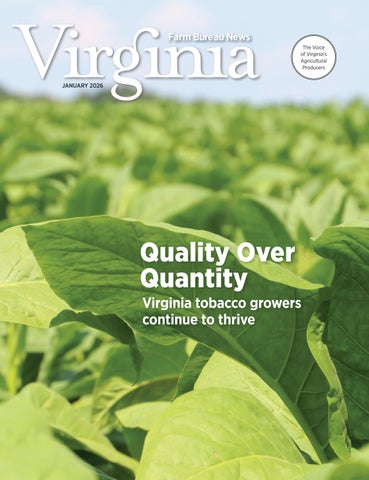
Quality Over Quantity

Virginia tobacco growers continue to thrive
Volume 85, Number 1

January 2026

Virginia Farm Bureau News (USPS 017-763) (ISSN 1525-528X) is published four times a year. January, April, September, November. It is published by Virginia Farm Bureau Federation, 12580 West Creek Parkway, Richmond, VA 23238. Periodicals postage rate is paid at Richmond, VA and additional mailing offices. The annual Subscription Rate is $1.13 (included in membership dues).

Postmaster: Please send changes of address to, Virginia Farm Bureau Federation, Farm Bureau News, P.O. Box 27552, Richmond, VA 23261-7552; fax 804-290-1096. Editorial and business offices are located at 12580 West Creek Parkway, Richmond, VA 23238. Telephone 804-290-1000, fax 804-290-1096. Email virginiafarmbureaunews@vafb.com. Office hours are 8 a.m. to 4:30 p.m., Monday through Friday.

Over 500 farmers and agriculture

2026

“Virginia is recognized for growing the best tobacco in the world.”
— David Reed, Virginia Cooperative Extension tobacco agronomist

PUBLICATION SCHEDULE

Members — Address change? If your address or phone number has changed, or is about to change, contact your county Farm Bureau. They will update your membership and subscription information. All advertising is accepted subject to the publisher’s approval. Advertisers must assume liability for the content of their advertising. The publisher assumes no liability for products or services advertised. The publisher maintains the right to cancel advertising for nonpayment or reader complaints about services or products.

Member: Virginia Press Association

EDITORIAL TEAM

Kathy Dixon Assistant Director, Communications

Nicole Zema Sr. Staff Writer/Photographer

Christina Amano Dolan Staff Writer/ Photographer

Kenny Kane Graphic Design Manager

Eleanor Stickley Sr. Graphic Designer

Alice Kemp Sr. Staff Writer/Advertising Coordinator

While

Producer members will receive their next issue of Virginia Farm Bureau News in April. The magazine is published quarterly, and back issues can be viewed at issuu.com/ virginiafarmbureau

VIRGINIA FARM BUREAU FEDERATION Officers

Scott E. Sink, President

Robert J. Mills Jr., Vice President

Board of Directors

DIRECTOR DISTRICT COUNTY

Emily F. Edmondson 1 Tazewell

Richard L. Sutherland 2 Grayson

Bruce N. Stanger 3 Montgomery

Jeannie L. Dudding 4 Craig

Russell L. Williams II 5 Rockbridge

Justin Pence 6 Shenandoah

Thomas E. Graves 7 Orange

Leigh H. Pemberton 8 Hanover

Patrick Murphy 9 Prince Edward A. Bruce Slagle 10 Halifax

Matt T. Fimon 11 Brunswick

J. Barry Bates 12 Essex

Gary D. Cross 13 Southampton

David L. Hickman 14 Accomack

A. Faye Hundley * Essex

Thomas N. Henley ** Goochland

*Women's Leadership Committee Chair

**Young Farmers Committee Chair

NICOLE ZEMA

A century of stewardship leads to new era of opportunities

To all Virginia Farm Bureau members,

2026 will be an eventful year as we look forward to celebrating 100 years of Virgina Farm Bureau serving the commonwealth’s farmers and rural communities. During our centennial celebration we will honor the present, remember the past, and look forward to the future of our organization.

As the Virginia General Assembly convenes this month and a new governor takes office, I want to express my heartfelt thanks to all of the VFB members who have taken time to build relationships with incoming legislators and advocate for our industry. We look forward to working with the new governor, legislators and the entire administration, and will continue to make every effort to encourage their support of agriculture and policies that will strengthen the state’s No. 1 industry.

Since its founding on Feb. 26, 1926, Virginia Farm Bureau has represented farmers at the local, state and national levels. Each decade has posed unique challenges to all who cultivate the food and fiber in the commonwealth and contribute to Virginia’s strongest economic sector.

For a century we have supported farmers and rural communities through the good times and bad, adapting to impactful changes—mechanization and technological advances, shifts in commodity markets and navigating the evolving conservation priorities and regulatory landscape. Throughout it all, our members have demonstrated a steadfast commitment to their families, the land they nurture and protect, and the communities they support.

And we continue to do that.

Advocacy and support

Virginia Farm Bureau has been successful on many advocacy campaigns throughout our history. We have fought to protect property rights, repeal the Virginia estate tax, ensure funding for voluntary, cost-share conservation practices, preserve your access to crop protectants, provide resources for large animal veterinarians, protect prime farmland, and so much more. The 2026 General Assembly presents new challenges and opportunities for our industry, and we continue to work on your behalf.

Our programming and volunteer engagement has a strong past with the Women’s Leadership Program having almost 70 years of leadership experience under its belt, and the Young Farmers marking their 50th year in 2025, growing from a handful of young agriculturalists to almost 60 Young Farmers committees across the commonwealth today. These programs continue to build the leadership of our future.

We have raised the visibility of Virginia Farm Bureau through the purchase of The Meadow Event Park property. As owners of The Meadow, we have successfully kept the State Fair of Virginia focused on agriculture and continue to provide an opportunity to showcase the best of Virginia agriculture to those who may not have a farming background.

Benefits for everyone

Our member benefits program continues to grow. The Products Division celebrated its 60th anniversary last year and has grown from selling a few tires to generating over $5 million in sales on behalf of our members. Our Products Division stands ready to provide you with reliable supplies and parts for your home or farm operation.

The Virginia Farm Bureau Mutual Insurance Co. has provided our members with peace of mind for more than 75 years. We know and understand the unique risks farmers face each day, and we continue to stand behind you to provide assurance and peace of mind.

We are looking forward to growing and expanding all of these programs in the next century.

But our legacy isn’t only in legislation or programs—it is in families who have been able to farm another year, in young people drawn to careers in agriculture, and in farmland protected and preserved for future generations. Our stewardship ethic will guide us into the next 100 years.

We will start celebrating the centennial next month. You will find a listing of upcoming events and commemorations on the following page and will have special centennial-related magazine content throughout the year.

Together, we can continue building on our solid foundation to ensure that Virginia’s farmers and rural communities thrive for generations to come. Scan the QR code and tell us how Farm Bureau has helped support you and how we can continue to do so.

Scott Sink, an agritourism operator and beef cattle and hay farmer in Franklin, Montgomery and Pulaski counties, is president of Virginia Farm Bureau Federation.

Centennial celebration to continue throughout the year

Virginia Farm Bureau Federation turns 100 on Feb. 26! In honor of that milestone, celebrations, commemorations and other events have been planned throughout the year.

The following is a timeline of upcoming/ongoing celebrations:

West Creek Office

All year – Historical artifact displays on each floor, which include the history of all VFBF companies over the last 100 years.

All year – Special photo panels dedicated to the 14 board districts and the Young Farmers and Women’s Leadership Program.

All year – Map of Virginia counties made with native Virginia woods from Farm Bureau members’ property.

Feb. 26 - Special anniversary celebration for invited guests.

County Offices

TBD – County-specific events

June –Centennial community service projects

State Fair of Virginia

Sept./Oct. – A new adult creative arts competition at the State Fair of Virginia that revolves around Farm Bureau memorabilia.

Annual Convention

Dec. 2 - Special celebration commemorating the centennial during the 2026 Annual Convention at the Homestead.

Join the new Centennial Club

Members who want to become part of an exclusive club can join this year’s Centennial Club. In recognition of Virginia Farm Bureau’s 100-year anniversary on Feb. 26, members who contribute $1,000 or more to one of VFB’s charitable organizations, are eligible to enroll.

Contributions must be given between July 1, 2025, and Oct. 31, 2026. Donations to eligible organizations include: Virginia Agriculture in the Classroom, the Virginia AgPAC, Virginia Foundation for Agriculture, Innovation and Rural Sustainability as well as VFB Women’s Leadership or Young Farmers programs.

Legislative

Day puts farmers in front of lawmakers

Virginia Farm Bureau Federation’s annual Legislative Day will be held Jan. 26

A legislative briefing with VFBF governmental relations staff will take place the evening of Jan. 25. Also planned for that evening is an orientation for first-time farmer advocates (See related article on page 14).

WHEN: Jan. 25-26

WHERE: Richmond Marriott, 500 E. Broad Street, Richmond, and the Virginia State Capitol

Young Farmers Winter Expo to be held in Colonial Heights

Nearly 200 young farmers will gather for the 2026 VFBF Young Farmers Winter Expo in February in Colonial Heights. Participants will learn about key agricultural issues, network with their peers, participate in educational workshops and explore local agricultural operations.

WHEN: Feb. 26-28

WHERE: Comfort Suites Southpark

REGISTRATION: Follow the Young Farmers Facebook page at facebook.com/vafbyoungfarmers for details, updates and registration information.

Celebrate National

Ag

Day, Agriculture Literacy Week this March

National Ag Day 2026 will be celebrated on March 24 during National Ag Week, March 22-28. The annual observances are organized by the Agriculture Council of America, a nonprofit organization dedicated to raising awareness of agriculture’s role in modern society.

Virginia Agriculture in the Classroom will hold its annual Agriculture Literacy Week March 23-27 (See related article on page 26).

Women’s Leadership Conference will be held in Harrisonburg

“Celebrate” is a fitting theme for the 2026 Women’s Leadership Conference, to be held April 10-12. Members of county Farm Bureau women’s committees will celebrate the International Year of the Woman Farmer and all the contributions of women in ag while attending informative workshops and engaging in fellowship.

WHEN: April 10-12

WHERE: Hotel Madison in Harrisonburg

REGISTRATION: Registration opens in mid-February. Visit bit.ly/436v9IF for details.

Annual golf tournament benefits AITC

Sponsors and teams of four are invited to tee off in the 29th annual Virginia Foundation for Agriculture in the Classroom Charity Golf Tournament in May. The tournament will offer two shotgun starts, with awards following each round of play. Food and refreshments will be available throughout the day.

WHEN: May 18

WHERE: The Dominion Club in Glen Allen REGISTRATION: Registration opens this month. Visit virginia.agclassroom.org/donors/events for details.

$33,000

That’s the amount of money Virginia Agriculture in the Classroom has awarded through 70 educational grants to 45 Virginia localities for the 2025-26 school year. See a list of recipients on page 26.

2025 Success Stories

Member Support

Agriculture, Development and Innovation

_ The VFB Grain Division connected with over 2,100 grassroot participants through county Farm Bureau annual meetings, local Extension meetings, commodity organization meetings, the 10th annual Virginia Wheat Tour and a trip to Washington to witness USDA’s Annual Crop Report release.

_ Despite facing rapidly changing regulations and receiving only 10 days’ notice to prepare, the Virginia Foundation for Agriculture, Innovation and Rural Sustainability team successfully submitted an application for the 2025 USDA Rural Cooperative Development Grant program. VA FAIRS received its largest federal grant to date, receiving $553,685 to support technical assistance services for Virginia agricultural producers and rural agribusinesses. VA FAIRS used its 2024 RCDG $200,000 award to assist multiple business and cooperatives in accessing more than $3.2 million in state and federal funding in 2025.

_ ADI and VA FAIRS worked with VFB producer members, Virginia Cooperative Extension, the Mecklenburg County Board of Supervisors and the Southside Planning District to secure a $512,000 grant from the Tobacco Region Revitalization Commission to establish the Southside Agricultural Labor Housing Pilot Program. Farmers in six Southside counties can apply for a 25% cost-share grant up to a maximum of $50,000 to renovate or construct seasonal farm labor housing.

Communications

_ VFB social media channels achieved a 37% increase in followers across Facebook, Instagram, Twitter and LinkedIn— the largest growth in at least five years. The most engaging post was the “I Farm. I Vote.” video featuring President Sink and producer members, which encouraged farmers to participate in the 2025 election and garnered more than 22,000 views in less than one month. This demonstrates our audience’s strong connection to grassroots advocacy content, which embodies the mission of Farm Bureau.

_ The Real Virginia television program is almost finished profiling agriculture in all 95 Virginia counties, plus three cities with significant agricultural production. Since 2017, it has featured 90 localities in its County Closeup segments.

_ Created materials in anticipation of Farm Bureau’s centennial celebration in 2026. Panels for all 14 board districts, plus the Women’s and Young Farmers programs, were designed for display in the West Creek atrium this year. A special centennial logo for use throughout the year also was created.

Governmental Relations

_ VFBF prevailed on 28 out of 46 policies during the 2025 General Assembly. Farm Bureau was instrumental in securing full funding for the Agricultural BMP Cost-Share Program, passage of a Large Animal Veterinary Grant Program, protection of local government authority over the siting of utility-scale solar facilities, and blocked the elimination of the farmworker exemption to the minimum wage requirements.

VFBF President Scott Sink, center, and Northampton County Farm Bureau
President Bruce Richardson, right, present a snack bag of Virginia farm products to Del. Don Scott, D-Portsmouth, during the annual Legislative Day.
Every board district will be represented on photo displays in the West Creek office throughout the year to commemorate Farm Bureau's centennial.
NICOLE ZEMA

_ Virginia Farm Bureau AgPAC successfully endorsed 73 of the 85 candidates who were elected to the Virginia House of Delegates. Both gubernatorial candidates participated in the Agriculture and Forestry Candidate Forum at the Young Farmers Summer Expo. And the “I Farm. I Vote.” campaign boosted civic engagement, generated over 22,000 social media views and led to the distribution of 450 yard signs.

_ Six county Farm Bureau leaders and three women’s leadership members participated in national advocacy training and followed up with visits to Washington congressional offices. Over 100 county leaders participated in 12 district congressional roundtables and farm tours

Growth & Service

_ We reached our membership goal for the ninth year in a row! We ended the membership year with 136,971 members—1,514 more than in 2024—and 54 of 88 county Farm Bureaus made quota. The member retention rate was 90.93%.

_ Franklin and Loudoun County Farm Bureaus received American Farm Bureau Federation County Activities of Excellence Awards for outstanding programs. Franklin won for its support of the 2024–25 school garden program at Franklin County Middle School, which provides students with hands-on agricultural education and outdoor learning experiences. Loudoun hosted a three-part series designed to explore the past, present and future of agriculture in the county. The events drew a total of 250 attendees who built community, shared dialogue and developed a vision for agriculture’s future.

_ The Products Division celebrated its 60th Anniversary and the division’s sales volume has tripled since 2021, with total sales now at $5 million. VFB Service Corporation first sold products in four states through commercial dealers, and now has partnerships with 275 dealers.

Farm Bureau leaders meet with lawmakers every year at Legislative Day to discuss agricultural priorities.
The VFB Products Division celebrated 60 years of serving members through partnerships with 275 dealers.
2025 *Membership year ended Oct. 31, 2025.
NICOLE ZEMA

Safety

Explore Virginia Agriculture

_ Sixteen applications for the inaugural SAFER Contest were received, and the campaigns collectively reached tens of thousands of Virginians through social media, news coverage and in-person events—raising awareness of safety issues and inspiring collaboration among schools, county Farm Bureaus and local governments.

_ Launched the Bovine Emergency Response Training with three full classes, marking a unique collaboration between fire departments, law enforcement, veterinarians, VDOT and towing professionals. This multidisciplinary approach ensures rapid, safe, and humane response to livestockrelated roadway emergencies.

_ The Safety Program significantly increased engagement with county Farm Bureaus and partner organizations that share the goal of making farms and farmers safer, fostering stronger collaboration and implementing community-driven safety initiatives.

Special Programs

Agriculture Literacy

_ Agriculture in the Classroom provided 68 grants to elementary, middle and high schools across the state, allowing 25,000 students to have hands-on agricultural experiences.

_ Educational materials, including the new Explore Virginia Agriculture interactive map, were provided to over 1,200 teachers, enabling them to better integrate agriculture into their curriculum.

_ In the 2024-2025 fiscal year, AITC achieved the thirdhighest fundraising total in its history, raising $431,738. The average gift was $594. Notably, AITC welcomed 124 new donors, reflecting strong engagement and growth in the donor base.

Women's Leadership

_ The Women’s Leadership Committee led a community service initiative for the Outreach Program, with volunteers packing 10,000 meals to enhance local food security.

_ Participation in AFBF programs like the Women’s Boot Camp, ACE Summit and FUSION has increased, reflecting the ongoing value and relevance these programs provide to WLC members. Over the last five years, eight WLC members have graduated from Boot Camp, with three of those in 2025.

_ The spring conference experienced increased attendance, with 275 registrants and a younger demographic. This remarkable shift was driven by Amberley Snyder, an inspiring motivational speaker and champion barrel racer

Members of the VFBF Women's Leadership Committee joined others at the Women's conference in packing 10,000 meals for those in need.
KATHY DIXON
Emergency workers learned how to handle cattle during a Bovine Emergency Response training.
AITC provides teachers with free resources like this interactive Virginia agriculture map.

known for her incredible resilience and determination. The heightened interest contributed to increased enrollment in the Leadership Academy, which further supports our mission to develop future leaders.

Young Farmers

_ The Young Farmers competed well nationally in the Discussion Meet, Excellence in Agriculture and Achievement Award competitions, with Morgan Slaven of Augusta County earning runner-up in the AFBF Excellence in Ag competition.

_ The Young Farmers Summer Expo, which was held in July in Franklin County, provided a well-deserved spotlight on farms and agribusinesses in that community, as well as Ferrum College’s Collegiate Young Farmers chapter. Attendees also got to participate in the 2025 Virginia Agriculture & Forestry Gubernatorial Candidates’ Forum.

_ In the fall, the Young Farmers Committee explored farming operations in central and eastern North Carolina, and spent time sharing ideas with NCFB young farmers and staff.

The Meadow Event Park

_ The State Fair of Virginia was a safe, successful event, with 215,000 attendees and record food gross revenues.

_ The Meadow experienced 33% growth in sponsorship engagement including welcoming new sponsors Amazon, Luck Stone, Floor and Decor, and Carter Machinery.

_ A new HVAC system was installed in the Farm Bureau Center, which will support and enhance the many AKC dog competitions and consumer trade shows that take place on an annual basis.

This year’s State Fair of Virginia was a success, and fairgoers were treated to an upgraded HVAC system in the Farm Bureau Center. Gov. Abigail Spanberger visited the fair and talked with Dr. Jewel Bronaugh, interim dean of the College of Agriculture at Virginia State University.

Young Farmers hosted a gubernatorial candidates’ forum at their summer expo and demonstrated their voting power.

Member Services

Thank you for your membership!

As a Farm Bureau member, you’ve put your support squarely behind your community and the farm families who produce the nation’s food and other important products. Here is the current package of member benefits and services.

Your Membership Advantage

Staff at your county Farm Bureau office are happy to provide details about any of these!

Travel Services

Avis Car Rental Savings – up to 35% off Avis base rates

Biltmore Estate – up to $8 off online ticket prices

Budget Car Rental Savings – up to 35% off Budget base rates

Budget Truck Rental Savings – up to 20% off Budget consumer rental rates

Choice Hotel Discounts – up to 20% off the “best available rates” at more than 7,000 locations

Dollywood & Dollywood Splash Country – Save $10 on regular or children’s tickets to world-renowned theme parks in Pigeon Forge, Tennessee.

NEW! Enterprise – Save between 5% and 20% on Enterprise, National and Alamo rental cars.

Wyndham Hotels and Resorts Discounts – up to 20% off at over 8,000 participating hotels worldwide.

Home/Business/Farm

Affinity Cellular – Exclusive benefits including a $75 airtime credit, free activation and free shipping.

Bush Hog Products – Save up to $250 when purchasing Bush Hog products valued at $5,000 or more.

Case IH Equipment Discounts – Save up to $800 on qualifying products from participating dealers.

Caterpillar Machine Discounts – Save up to $2,750 on qualifying new Cat machines from participating dealers, and receive an additional $250 credit on work tool attachments purchased with new equipment.

Farm Bureau Products Warehouse – competitively priced auto, truck and farm tires, and farm equipment parts

NEW! FieldClock – $10 off monthly pricing on farm data plans.

Ford Truck Savings – $500 toward the purchase or lease of a new Ford Maverick, Ranger, F-150, F-150 Lightning or Super Duty®*

Grainger Savings – Get deep discounts on equipment and supplies from Grainger, plus get free standard ground shipping on all standard Grainger products**.

John Deere Rewards Savings – Members eligible for a rewards upgrade to Platinum 1 to save on select agriculture and turf equipment.

KEY Apparel – Members receive a 10%-20% discount on all merchandise, plus free shipping on orders over $75.

Member Deals Plus®*** – lets you save wherever you go, with the nation’s largest private discount network on meals, clothing, vehicle care and other goods and services, with online access and show-your-phone technology.

Farm Bureau Products Warehouse – competitively priced auto, truck and farm tires, and farm equipment parts

Reward Protection Service – offers a $2,500 reward for information that results in a conviction in the event of theft or vandalism on a member’s property.

Vogue Towers – Members can get paid for leasing land to Vogue Towers for installing a wireless communication tower.

Yamaha Vehicles – Get a $250 rebate on select Yamaha 4WD ATV and SXS vehicles, excluding youth models under 350cc.

Healthy Living

Life Line Screenings – for four non-invasive cardiovascular screenings, plus a free osteoporosis screening

NEW! Virtual Care RX – Significant savings on 1,100 acute and chronic medications, and 24/7/365 virtual care.

Insurance Protection

New product offerings give members more options than ever before. Fast claims service when you need it most and personal, face-to-face service.

Auto, Home, Life – a wide array of auto, home, and life insurance products, as well as farm, business liability and personal property insurance

Health – Staff at your county Farm Bureau office can help you review and enroll in individual, group or Medicare supplemental health insurance plans with health insurance carriers on both the public and private health insurance marketplaces.

Financial

Farm Bureau Bank – including credit cards, deposit accounts and mortgage, vehicle, and education loans

Estate Planning Assistance – free, no-obligation analysis to help you set financial goals

* Excludes F-150 Raptor, F-600, F-650 and F-750 Super Duty

**FREE standard shipping on all orders shipped ground transportation. Other freight charges will be incurred for services such as expedited delivery, special handling by the carrier, sourcing orders and shipments outside the continental United States.

***Member Deals Plus® and Member Deals plus® are registered trademarks of Virginia Farm Bureau Federation.

To access your savings, visit vafb.com, and go to the “Membership at Work” tab on the lefthand menu.

Annual convention encompasses a year of successes

Virginia Farm Bureau Federation President Scott Sink told the 546 guests attending the 100th VFBF Annual Convention that he can only describe the last year as “wow!”

As he addressed the Annual Meeting of the Voting Delegates in Williamsburg, he said that there are “no words to describe the gratitude I have for everything you do in your counties.”

Sink said that during his past year as president, he has been impressed with the way Farm Bureau members and county leaders have embraced his four pillars of leadership: purpose, proactive, connected and transparent.

He added that as the organization marks its 100th anniversary on Feb. 26, it will embrace its past successes, reflect on its current activities, and will start planning for the next 100 years.

New Secretary of Agriculture addresses attendees

Just seven hours after the official confirmation of her appointment as the next Secretary of Agriculture and Forestry, Katie Frazier addressed attendees of the Virginia Farm Bureau Annual Convention on Dec. 3.

She shared that her career in agriculture started with Farm Bureau, “and you are the reason I caught the advocacy bug.”

Frazier will serve under Gov. Abigail Spanberger starting Jan. 17 and will continue her work supporting Virginia’s top industries— agriculture and forestry. Frazier said Spanberger “believes in having agriculture and forestry at the table, and I share that commitment.”

Gov. Youngkin reflects on growth of Virginia’s agricultural industry

In a farewell address to Virginia Farm Bureau Federation, former Gov. Glenn Youngkin reflected on the success and influence of the

state’s largest private industry during his tenure.

“You feed us,” he said. “You fuel us. You clothe us. And not just here in the commonwealth of Virginia, not just in America, but around the world. That is at the epicenter of why it's so important that we have a concerted effort to continue to drive forward Virginia's agriculture industry.”

Workshops equip farmers with tools to navigate mental health, share critical conversations with consumers

A mental health workshop Dec. 2 challenged Virginia farmers to reclaim control by confronting the uncomfortable.

When Mind Your Melon founders Marshal and Taylor Sewell asked workshop attendees why they may be reluctant to talk about mental health, they heard familiar responses.

“The idea that it reflects weakness—that’s something we’ve heard a lot in our work,” Marshal remarked.

The Mind Your Melon Foundation is a nonprofit organization focused on improving mental health and wellbeing among farmers and rural families. Through writing, workshops, speaking engagements and digital outreach, the foundation now reaches rural audiences across the country and around the world.

The workshop centered around “flipping perspectives” on mental health.

“You have to find a fine balance between being able to control what you can, and being able to admit and acknowledge the things that you can’t,” Marshal noted, sharing that he has dealt with grief and challenges of farm life when his father died by suicide amid a devastating crop failure.

Consumers urged to join food conversations

From seed oils and “big ag” to pesticides, misinformation circulating today is often grounded in skepticism, fearmongering and emotions instead of science, said Kelly Leighton, vice president of growth and engagement at the Center for Food Integrity. This misinformation frames agriculture as part of the problem.

Workshop co-chair and Madison County large animal veterinarian Dr. Amanda Weakley-Scott’s family is the first generation to farm a large-scale turkey operation.

“I wasn't exactly comfortable talking to consumers about the product I was raising, and I felt that most people viewed me as a factory farm instead of a family farm,” she shared.

Training through American Farm Bureau Federation’s GO Team and the Center for Food Integrity gave Weakley-Scott

VFB leaders, including Executive VP and General Manager of the Mutual Insurance companies, Bob Brown, left, President Scott Sink, center, and Mark Khatib, Executive VP of the healthcare companies, hosted a fireside chat, giving company updates and answering questions from convention attendees.
Marshal and Taylor Sewell led a workshop focusing on farmers' mental health.
ALICE KEMP
KATHY DIXON

insight on how consumers think, especially as Make America Healthy Again policy is developed in Washington.

MAHA strategy focuses on promoting healthier food production and improving nutrition outcomes, while increasing scrutiny of crop protectants.

Meanwhile, Growing a Healthier America is the food system’s coordinated, collaborative, values-led response to MAHA, led by the CFI. GaHA brings together farmers, food makers, retailers, scientists and health voices to counter misinformation and strengthen trust across the entire food value chain.

Women’s Leadership Committee spearheads packing of 15,000 meals

The VFBF Women’s Leadership Committee led an effort for volunteers to help pack 15,000 nonperishable meals, and they met that goal. Representatives from Williamsburg House of Mercy and Grove Christian Outreach picked up the boxes of food and will distribute to the community.

Two ag leaders recognized with Distinguished Service Awards

J.M. “Jerry” Jenkins of Blackstone received the Virginia Farm Bureau Federation Distinguished Service to Agriculture Award. Jenkins served 50 years on the VFBF state board of directors, and was recipient of the Distinguished Service to Virginia Farm Bureau in 2019.

As the organization’s previous District 11 director, Jenkins represented Farm Bureau producer members in Brunswick, Charlotte, Lunenburg and Mecklenburg counties.

As the longest-serving board member in the organization’s history, Sink said Jenkins’ wealth of knowledge and business acumen were influential in shaping the company’s vision and supporting its growth.

“Mr. Jenkins' contributions and strategic foresight were foundational in shaping the modern vision of the organization, and left an indelible mark on Virginia agriculture,” Sink said.

This year’s Distinguished Service to Virginia Farm Bureau Award was given to Wilmer Stoneman of Varina.

Stoneman has worked to improve the livelihoods of the state’s farmers since 1980, and has advocated for agriculture and rural business development over three decades with Farm Bureau.

Stoneman is the former vice president of agriculture, development and innovation, and is now serving in Washington as the Virginia state executive director of the U.S. Department of Agriculture Farm Service Agency, working on behalf of the state’s farmers.

He began his career at Farm Bureau in 1995 in the Public Affairs Department and later was appointed director of Farm Bureau’s Commodity/Marketing Department. He was founder and executive director of the Virginia Foundation for Agriculture, Innovation and Rural Sustainability—a division that fosters sustainable agricultural economic development opportunities. In that role, Stoneman helped secure more than $117 million in grants and funding for value-added agriculture expansion in the state.

For Stoneman, this wasn't just a job, noted Sink.

“It was a commitment to the land and the livelihood of every farmer in this state. As he answers the call to serve with the FSA, we take immense pride in knowing that Wilmer will continue to be a trusted ally to agricultural producers and the Farm Bureau organization.”

Franklin County farmer wins Warren Beach Award

Jason Thurman of Franklin County was honored with the 2025 Warren Beach Award for his contributions to the VFBF Young Farmers Program.

Thurman is president of Franklin County Farm Bureau and was recognized for his invaluable mentorship to the Collegiate Young Farmers’ Ferrum College chapter, and his support of the Young Farmers Program.

“As a mentor, he’s poured wisdom into countless young farmers,” said Jonathan Irragi, District 4 representative on the state Young Farmers Committee and a close friend of Thurman’s. “He’s built a bridge between classroom and cow pasture, ensuring our future leaders have the tools to succeed. Even as he’s stepped into greater roles, Jason has stayed interested and engaged in all things Young Farmers—always ready to encourage the next generation of farmers with his energy and insight.”

The Warren Beach Award is named for a veteran Farm Bureau leader whose support of young farmers is legendary.

Thurman has connected with the Franklin County High School FFA and the Ferrum College Young Farmers Collegiate program.

He also was instrumental in the success of the 2025 Young Farmers Summer Expo. When the 2025 Young Farmers Winter Expo was canceled due to inclement weather, Thurman’s ingenuity and leadership pivoted programming to the Summer Expo, turning it into one of the most well-attended expos in VFBF history.

In addition to serving as county Farm Bureau president, Thurman is chair of Franklin County Farm Bureau’s AgPAC and Budget Planning committees.

News professionals recognized for coverage of agriculture

The Galax Gazette, a twice-weekly newspaper based in Galax, was recognized Dec. 3 with Virginia Farm Bureau Federation’s 2025 Ishee-Quann Award for Media Excellence, the top honor in Farm Bureau’s annual Journalism Award program.

The paper also received first place in the award program’s non-

daily newspaper category.

Farm Bureau also awarded a top-place honor in its TV category to Rachel Lucas and the news crew at WSLS 10 in Roanoke.

Rachel Tillapaugh, a reporter with WSET 13 in Lynchburg, received an honorable mention.

Shenandoah County farmer wins Young Farmers Discussion Meet

Cheyenne Rhodes of Mount Jackson took top honors Dec. 2 in the Virginia Farm Bureau Federation Young Farmers Discussion Meet.

The Discussion Meet is designed to simulate a county Farm Bureau meeting in which members discuss problems and develop possible solutions. Relevant topics are presented to a panel of four competitors who are judged on their discussion skills, understanding of important agricultural issues and ability to build consensus.

This year’s discussion focused on urban sprawl and how Farm Bureau can help promote responsible growth in communities while mitigating the loss of farms and the agrarian way of life.

Rhodes and her husband own a commercial poultry, cattle, crop and agritourism operation near Northern Virginia’s metro area. She noted that their farm’s location has given her an opportunity to “connect with groups of consumers we otherwise wouldn’t have access to.”

Rhodes was scheduled to compete in the American Farm Bureau Federation Discussion Meet in Anaheim, Calif., in January.

First runner-up was Jack Dixon of Rockingham County. Other finalists were Cutler Blankenship of Spotsylvania County and Alli Phillips of Rockingham County

Prince Edward County cattleman elected to board of directors

Patrick Murphy of Prospect was elected Dec. 3 to a three-year term representing District 9 on the board of directors.

He will represent Amelia, Appomattox, Buckingham, Chesterfield, Cumberland, Nottoway, Powhatan and Prince Edward counties. He succeeds William F. “Bill” Osl Jr. of Columbia, who did not seek reelection.

Murphy formerly served for three years as vice president of Prince Edward County Farm Bureau. In addition to his Farm Bureau involvement, Murphy has served as county forester for the Virginia Department of Forestry for the past 25 years.

He is the owner and operator of Double M Cattle Company, a cow-calf operation that also produces beef cattle and custom hay. Murphy also manages 185 acres of timberland.

Board members reelected

District 3: Bruce Stanger of Montgomery County

District 6: Justin Pence of Shenandoah County

District 12: Barry Bates of Essex County

County Farm Bureaus awarded for excellence in programming

Loudoun County Farm Bureau, led by President Avis Renshaw, received a firstplace VFBF County Award of Excellence for creating a threepart event series exploring the past, present and future of

agriculture in the county. The county Farm Bureau hosted three events designed to build community, spark dialogue and develop a collective vision for agriculture’s future. More than 250 guests participated in the events in 2025.

The VFBF County Award of Excellence second-place winners were Chesapeake and Virginia Beach Farm Bureaus for their joint efforts to educate and engage the local community about agriculture. The counties’ Women’s Leadership committees led the construction of a mobile “Agricultural Wagon,” inspired by George Washington Carver’s mobile Jesup Wagon. It featured modular exhibits and handouts highlighting Carver’s contributions to agriculture, farming’s economic impact and Farm Bureau’s advocacy efforts and membership benefits.

New safety contest winners announced

The new Standing for Safety Awareness for Farm Equipment on Roadways, or SAFER, contest recognized organizations that raised awareness about the presence of farm equipment on roadways and promoted safety measures to prevent accidents. Winners are:

Category 1, Best Campaign Using a Display, and recipient of $4,000: Appomattox Senior FFA for their ACHS Drive a Tractor to School Day.

Orange County Farm Bureau placed 2nd and won $2,000, and Brentsville FFA took 3rd place and won $1,000.

Category 2, Best Campaign Without Using a Display, and recipient of $2,000: Campbell County Farm Bureau for their Farm Road Safety Initiative.

Loudoun County Farm Bureau won 2nd place and $1,000, and Shenandoah County Farm Bureau P&E Committee won 3rd and $500.

Category 3, Best Media Campaign, and recipient of $2,000: Appomattox Senior FFA for ACHS Drive a Tractor to School Day.

Franklin County Farm Bureau won 2nd place and $1,000, and Courtland and Massaponax FFA chapters took 3rd and $500.

LUCAS TILLAPAUGH

Farmers will discuss critical issues with legislators in January

he 2026 Virginia General Assembly session begins Jan. 14, and legislators will be considering several bills affecting agriculture. To help inform lawmakers on the impacts that legislation will have on the commonwealth’s farmers and their communities, Virginia Farm Bureau Federation is hosting its annual Legislative Day on Jan. 26.

“When our members come to the Capitol, it sends a message to legislators—that farmers must be at the decision-making table, not on the menu,” said Katelyn Jordan, VFBF assistant director of governmental relations. “Farmers manage risk, weather and volatile markets every day, and that kind of wisdom is critical to crafting good policy. We look forward to seeing our county leaders in January!”

Member-identified priority issues determined for the 2026 Virginia General Assembly include:

• Continue full funding of the state’s cost-share program: Since 2022, the General Assembly has fully funded the Agricultural Best Management Practices Cost-Share Program by dedicating monies in the Water Quality Improvement Reserve Fund. Support allocating over $319 million through fiscal year 2027-2028 to continue fully funding the program.

• Maintain farmworker exemption from minimum wage and overtime: Oppose legislation to eliminate the longstanding farmworker exemption from minimum wage and overtime.

• Protect working lands when siting solar facilities: Support legislation that incentivizes the location of solar facilities on previously developed lands such as parking lots, rooftops and brownfields. Support the creation of a farmerfriendly definition of agrivoltaics— a method of using the same land for agriculture and solar energy production—and incentives for smaller-scale agrivoltaics operations. Oppose legislation that would remove local zoning authority on the siting of utility-scale solar facilities.

• Prohibition of meat misbranding: Support legislation introduced to prohibit the mislabeling of alternative non-animal protein products.

• Continue addressing the large animal veterinary shortage: Support additional incentive grants for large animal veterinarians and funding to increase the number of eligible seats for Virginia students at the Virginia Maryland College of Veterinary Medicine for the Class of 2029. Support grants for students attending Lincoln Memorial University College of Veterinary Medicine.

• Protect use of Environmental Protection Agency-approved pesticides: Oppose legislation that prohibits the proper use of EPAapproved pesticides and current application methods.

Stay informed on important issues and updates with Action Alerts

Want to receive Farm Bureau Action Alerts directly to your phone? Scan the QR code to receive text message notifications when Farm Bureau sends out important legislative information.

If you prefer to receive Action Alerts by email, contact Tenille Nuckols at tenille.nuckols@vafb.com or 804-290-1293 with your name, membership number and contact information.

The more members who respond to alerts, the more effective Farm Bureau is in ensuring Virginia farmers’ voices are heard by legislators.

Scott Humphrey, legislative assistant to Sen. Bill DeSteph, R-Virginia Beach, talks with board member David Hickman, center, and other Farm Bureau leaders from the Eastern Shore about priority issues.
NICOLE ZEMA

If it weren’t for its members, Virginia Farm Bureau wouldn’t be the voice for agriculture it is today. Every policy priority, advocacy effort and victory begins with members coming to the table and shaping the organization’s direction.

And it all starts at the grassroots level—individual producer members identifying issues, voicing their concerns and staying engaged from the first policy development meeting through advocacy during the General Assembly session.

“Knowing what issues our members are facing ensures we can best represent them when talking with legislators,” said Sam Norman, operations manager for Virginia Farm Bureau Federation Governmental Relations. “And it makes sure Farm Bureau dedicates time and resources on issues critical to our members.”

From field to policy

Each spring, typically beginning in March, the policy development process gets underway. Individual farmers and county Farm Bureaus start surfacing a diverse range of challenges impacting their farms and communities—from property rights to environmental regulations.

“Issues and concerns around state road maintenance and wildlife governance come up most consistently,” Norman noted. “And solar has been a hot topic in recent years.”

Local concerns can be discussed and addressed at the county level, Norman said, while broader state and national issues advance through formal steps for potential inclusion in official Farm Bureau policy.

To guide the process, VFBF governmental relations staff participate

Members fuel Farm Bureau’s grassroots policy development

in regional spring policy development meetings that bring members together in an open forum. Staff give updates from the General Assembly and help to respond to members’ questions. These sessions are where local perspectives are discussed among broader audiences, and critical issues gain traction.

Throughout the summer and fall, farmers and counties deliberate and develop their resolutions—formal position statements—which are voted on during Farm Bureau’s Resolutions meeting. The approved resolutions then move onto VFBF’s Annual Meeting of Voting Delegates for inclusion in official Farm Bureau policy. By the time a policy is official, it’s been discussed, debated, refined and reflects consensus of farmers across Virginia.

“The voice of our members is crucial to Farm Bureau’s advocacy efforts,” Norman said. “Attend the meetings, ask questions along the way and watch surfaced issues go full circle.”

Proven successes

This member-driven approach has led to significant victories.

“In 2020, our members passed policy stating that Farm Bureau opposes legislation that would allow state authority over localities in developing utility-scale solar projects,” Norman explained. “And in 2025, a bill was introduced into the General Assembly that would do just that.”

Backed by member-driven policy, VFBF advocates mobilized and educated legislators during the General Assembly session about the potential impact on farmers and their land, and shared real stories from their communities. And when Farm Bureau’s ‘Action Alert’ system was activated and members contacted their individual legislators in response, the bill was defeated.

Another success grew from member proposals to support programs to recruit large animal veterinarians to Virginia. In 2024, a workgroup was

Regional policy development meetings allow producer members to discuss isuses of importance to them. Many of those topics become statewide policy at Farm Bureau's annual convention.

established to study the issue and the following year, grants were awarded to help recruit and retain veterinarians.

“The most effective way to communicate with legislators is through members who are passionate about an issue, stay engaged to make it policy and then share their story to legislators,” Norman commented.

Get Involved

Whether a seasoned county leader or new to the process, producer members are encouraged to use their voices to share perspectives and help shape policies.

In addition to the policy process, members also can take part in regional legislative meetings during the fall, where farmers meet and discuss issues directly with lawmakers. Building relationships and staying engaged with legislators helps members become trusted resources and strong voices for agriculture, Norman said.

To learn more about how to get involved, contact your local county Farm Bureau or the VFBF Governmental Relations team: sam.norman@vafb.com or 804-290-1014

Celebrating the ‘International Year of the Woman Farmer’

The immeasurable contributions of women in agriculture are capturing the global spotlight this year.

The United Nations General Assembly has declared 2026 as the International Year of the Woman Farmer, following a resolution proposed by the U.S. and supported by the Food and Agriculture Organization of the United Nations.

This initiative aims to increase awareness of the vital role that women farmers around the world play in agrifood systems, as well as their contributions to food security, nutrition and poverty eradication.

The observance also will highlight the essential role of rural women in ensuring the economic survival of their families, and contributing to both the rural and national economies.

“Women have been an integral part of agriculture from the very beginning, and I think we’re now truly seeing how much of an impact they have on the entire food chain,” remarked Sarah Sharpe, chair of the Virginia Women in Agriculture Gatherings.

farmers increase every year is very encouraging, and it really shows how much we need to support these women,” Sharpe added.

Annual Virginia Women in Agriculture Gatherings offer female farmers, landowners and agriculture enthusiasts opportunities to network with peers, hone technical skills and discuss solutions to unique challenges.

Several Virginia Cooperative Extension agents started that program in 2018 after identifying ongoing growth in the state’s female farmer population. There are more than 25,000 female producers in Virginia today, according to the 2022 U.S. Census of Agriculture.

“Watching the number of female

“The No. 1 issue we see is a lack of networking opportunities amongst female producers,” Sharpe noted. “These gatherings offer them a safe, warm and nurturing environment to learn from each other, and the confidence to be able to take on more active roles on the farm.”

The International Year of the Woman Farmer 2026 will serve as a

platform for the adoption of effective policies and actions that will address the barriers and challenges that women farmers face. It also promotes gender equality and the empowerment of all women in agriculture.

“Coming into a world that’s been male-dominated for a very long time, it’s great that women are now able to take on bigger leadership roles and show that we can do it too—sometimes a little bit differently,” Sharpe added. AFBF launches women in ag study

In honor of the international observance, American Farm Bureau Federation has launched a national Women in Agriculture Study to capture women’s voices from across all 50 states and Puerto Rico.

The study aims to better understand the experiences, leadership pathways and future needs of women in

agriculture. It will help identify what’s working, where there are gaps, and how to strengthen engagement and support systems across agriculture.

The survey remains open through March 31 to gather insight from women working in production agriculture, agribusiness, and education and advocacy. The survey also seeks input from men and others in related fields who can offer perspectives on women’s roles in agriculture. Visit fb.org to participate in the study.

“More than a million women play vital roles in U.S. agriculture, accounting for 36% of our country’s farmers,” said AFBF President Zippy Duvall. “We want to make sure we’re clearing barriers and providing opportunities for them. Understanding their perspectives is crucial.”

Sharpe noted that there are women

“growing, cooking and serving the food to their families and communities— that’s the whole cycle of the food chain. As women take on more visible roles in our food system, the more important it is to identify and understand the challenges they’re facing, and help come up with ways to overcome them.”

In celebration of the International Year of the Woman Farmer, Virginia Farm Bureau will feature outstanding Virginia women in agriculture in each upcoming edition of its member magazines in 2026.

Stay tuned for an International Year of the Woman Farmer spotlight in April’s Farm Bureau News.

7th Annual Women in Agriculture Gathering
VCE
Virginia women in agriculture are integral to the success of the state’s food system— championing tasks along every stop of the food chain, from research to active farm roles.
Robert Mills
Adam Gregory
Jay and Jim Jennings
Row of barns on the Jennings' farm operation where the tobacco is flue-cured.
2025 award-winning tobacco at the State Fair of Virginia
‘The Smoke Test’

Virginia growers optimize cultivation of top-quality tobacco desired by international buyers

Demand for Virginia-grown tobacco may have dipped over the decades, but grower efficiencies and commitment to quality keep the state’s surviving operations profitable.

Over 8,400 Virginia farms were producing tobacco in 1992. Today, only 173 farms in Virginia are growing the historically iconic crop, according to the 2022 Census of Agriculture. The 1998 Master Settlement Agreement and 2004 federal tobacco quota buyout pushed some growers into early retirement, while others transitioned to growing different crops.

Though acreage has dropped by almost half since the 2017 census to 12,634 acres, Virginia still ranks third nationally for tobacco production. The current generation of growers are building on centuries of expertise.

“Quality, quality, quality is how we stay in business,” said Robert Mills, Pittsylvania County tobacco grower and vice president of Virginia Farm Bureau Federation. “Efficiency is number one. One mistake will cost you profit for the year. You’ve got to grow that crop out, get the most pounds you can out of each acre, and cure every barn to the best of its ability. Our variety selection is important, plus disease management and soil fertility.”

Virginia tobacco is mostly blended into premium quality cigarettes.

“We don’t sell tobacco,” Mills added. “We show people how to use U.S. leaf in their product. They do the smoke test and realize it’ll cost them 50 cents more a pack to put ‘U.S. leaf’ on it, but now

they have our premium product and can charge $1.50 a pack more.”

Neon-tinted, yellow-green leaves were still being harvested, boxed, fluecured and baled in an unseasonably late October harvest at JF Leaf LTD in Mecklenburg County. Jim Jennings and son Jay cultivate around 350 acres of flue-cured tobacco in 36 barns for their company with the help of a returning team of guest workers.

Disease pressure slowed crop growth early in the season, followed by “perfect rain” from the end of July through September.

“It just made it come out and be extra bountiful,” Jay said. “So, we’re late, but fortunate.”

While Jim Jennings is a fourthgeneration farmer, he was the first to pursue a tobacco enterprise in 1976. Jay joined the operation in 2010. They sell their baled tobacco through contracts. They remain stewards of the land and the future, now raising a fifth generation to carry on the family’s modern tobacco tradition.

Trade disruption with China

China is the world’s largest tobacco consumer and global importer.

“And they’re the largest producer of tobacco, by far. But it’s all for internal consumption,” said David Reed, Ph.D., Virginia Cooperative Extension tobacco agronomist in Blackstone. “Right now, we’ve got so much dependency on exporting tobacco. And a big chunk of that in the last few years has been to China. So, the political climate is impacting everything we’re doing.”

The U.S. tobacco trade with China is in a state of uncertainty due to ongoing trade tensions and escalating tariffs between the two countries.

“Virginia is recognized for growing the best tobacco in the world,” Reed continued. “We’ve got that to fall back on. And there’s always demand for cigarette production. However, it’s much more expensive for us to grow tobacco here than somewhere else. There’s a balancing act between the quality and the price.”

Without tariffs and restrictions on selling tobacco, “we couldn’t grow enough to meet the demand, because that is the quality of U.S. tobacco,” Reed said. Young grower expands operation

Fifth-generation grower Adam Gregory in Pittsylvania County is a young farmer who started his own tobacco operation at Gregory Farms years after his dad took the federal buyout option in 2004.

“I grew up around it and love this way of life—watching tobacco grow and working the land,” he said. “It’s just all I ever dreamed of doing.”

Gregory started on 6.5 acres and has expanded to 110, with 22 box barns for conventional flue-cured tobacco.

Young farmers can access this sector, he said, “but you’ve got to be smart.

“When I started, I didn’t have the newest, nicest stuff,” Gregory said. “I started with all rack barns, which are a lot cheaper than box barns. I got what I could afford. As time has gone on, I’ve replaced things, and gotten newer, nicer equipment.”

Though fiscal restraint and hard work helped Gregory gain traction, he said the growing season is not the time to “pinch pennies.” The health of each plant counts.

“Normally, tobacco will give back what you give to it,” he said. “The more plants of tobacco out there, the more I can sell. Anything my crop needs, I give it to it.”

Diversifying his buyer contracts also helps Gregory find markets for his tobacco. Richmond-based Universal Corporation wants his bright, clean, lemon-style tobacco.

“And I’ll have a barn of tobacco that’s more orangey,” Gregory explained. “Philip Morris loves that style of tobacco. So, no matter what, you have a home for it, and you’re going to get top dollar!”

The Master Settlement Agreement and federal buyout

The $206 billion Master Settlement Agreement required major tobacco companies to make substantial annual indemnification payments to 46 states to

VFBF Vice President and tobacco grower

TRRC key investment areas:

Broadband Expansion

More than $150 million in broadband expansion, has resulted in 3,000 miles of fiber connecting over 71,000 homes and businesses across the TRRC region.

Sites & Infrastructure

cover smoking-related healthcare costs. This accelerated the decline of the U.S. tobacco market, rendering the federal quota system obsolete. Prior to the 2004 buyout, the federal government used a system of marketing quotas to manage tobacco supply and price.

The final legislation consolidated the House and Senate versions of the buyout bill. Former VFBF state board member and lifelong tobacco grower J.M. “Jerry” Jenkins was part of those negotiations.

“It was quite an argument,” Jenkins recalled. “I was glad to be a part of it, to have some input, because there were a lot of propositions that would have been very detrimental to the farmers. I think we ended up getting about as much as you could expect.”

Martha Moore, senior vice president of VFBF governmental relations, recalls her dad, the late tobacco grower Billy Johnson, having quota slashed after his crops had already been planted.

“It was from my heart when I was lobbying for that bill because I knew those people and their stories personally,” she said.

She worked with the late Al Glass, VFBF’s director of commodity/marketing.

“At each point during this process, egos were set aside and each other’s strengths were utilized for a collective advantage,” Glass wrote in a MSA paper documenting what happened. “Building consensus ultimately led to the legislation’s passage.”

The tobacco buyout in Virginia ended the federal tobacco quota program, ceasing all price supports.

The buyout occurred amid declining

profitability, labor shortages and increased land values.

“I took the buyout and just went into growing soybeans and corn,” Jenkins said. “And others just quit altogether.”

Tobacco Region Revitalization Commission’s rural lifeline

The Virginia General Assembly created the Virginia Tobacco Region Revitalization Commission in 1999 to manage 50% of the state’s portion of the national Master Settlement Agreement, with a mission to help tobacco-dependent communities transition to new economies and access education and workforce development opportunities.  To date, the commission has provided $309 million, and $170 million from other sources, in indemnification payments directly to Virginia tobacco growers and quota holders. That part of TRRC’s mission ended in 2013. They are now solely an economic development organization.

“So, instead of the farmers going bankrupt, you stabilize those families,” Moore said. “Which then helps to stabilize those communities.”

TRRC also has awarded over $1.1 billion in grants for economic development projects in the tobacco region.

“The commission has played a critical role in rebuilding the economy of Southern and Southwest Virginia, and we’re proud of the success we have had in bringing major employers to the region, building out our broadband infrastructure and more,” said TRRC chairman, Del. Will Morefield, R-North Tazewell.

The TRRC has played a role in developing nearly every business-ready site across Southern and Southwest Virginia, including Berry Hill where Microporous will be investing $1.35 billion and creating over 2,000 jobs; Wildwood Commerce Park, which will be home to Virginia’s largest greenhouse operation; and other major, high-quality manufacturing companies in Halifax, Henry and Wythe counties.

Education & Workforce Development

The commission has helped over 12,500 residents of Southern and Southwest Virginia receive GED credentials; more than 15,000 residents receive financial aid for community college; and over 9,000 students receive scholarships and loans for four-year degree programs. The commission also has invested heavily in community colleges and helped stand up and expand education hubs like the Southwest Virginia Higher Education Center in Abingdon and the Institute for Advanced Learning and Research in Danville.

Agriculture

The commission has worked with Virginia Cooperative Extension to offer various cost-share programs; provided funds to support the establishment of the Veterinary College at Lincoln Memorial University; and, most recently, made the first awards under the new Large Animal Vet Incentive Program. Investments in agriculture include cutting edge-controlled environment agriculture, to helping establish the Buckingham Cattlemen’s Association Beef Hub to give producers easier access to market.

Robert Mills discusses tobacco production with Gov. Abigail Spanberger during the 2025 State Fair of Virginia.

Imagine a field that’s frequently traversed. The grass springs back up at first, but falls flat after just enough footsteps—and doesn’t grow back.

The physiological effects of daily noises on the farm can look similar, according to Charlotte Halverson, AgriSafe Network health coach and former clinical director. AgriSafe is an educational nonprofit that teaches nationwide healthcare professionals, farmers and ranchers about important agricultural health and safety topics.

“I grew up on a farm, and we never thought about wearing hearing protection,” she recalled. “We didn’t know what we didn’t know.”

Halverson now lives with relentless ringing and chirping in her ears—a symptom of noiseinduced hearing loss. It also can affect blood pressure and pulse rate, and lead to depression, isolation, sleep disruptions and farm accidents.

With constant exposure to loud machinery, equipment and livestock, agriculture is listed in the top three occupations that cause hearing loss. Yet 74% of noise-exposed agriculture, forestry, fishing and hunting workers report not wearing hearing protection, according to the National Institute for Occupational Safety and Health.

“For a lot of years, nobody wore seatbelts. Now it’s common practice,” Halverson noted. “We need to remember that hearing loss is preventable, and we can do something about it.”

Hearing hazards abound

The Occupational Safety and Health Administration defines any noise level of 85 decibels or greater as dangerous.

“If you have to raise your voice

‘Had I only known’ Noise-induced hearing loss is permanent, but preventable

to be heard by someone an armslength away from you, you’re already experiencing hearing loss,” Halverson cautioned.

The amount of hearing loss from noise exposure depends on the decibel level of the noise and the duration of exposure.

One minute with a chainsaw— reaching 120 dBA—“will put you in trouble,” she noted.

Long exposures to lower noise intensities can still cause significant hearing loss—like pig squeals, a tractor at 50-80% load, power tools, ATVs or push mowers.

“The farm shop is one of the noisiest places on the farm,” Halverson noted. “By OSHA standards, shop vacuums and air compressors run at 95 decibels—you should not be exposed to that for more than 40 minutes.”

She recommends downloading the free NIOSH Sound Level Meter app to help measure workplace noise intensity.

Finding the right protection

Farmers can choose from a wide variety of protective canal caps, earplugs and earmuffs.

Consider AgriSafe’s “5 C’s of Hearing Protection”: Comfort is key to consistent use. Compatibility with other safety equipment.

Convenience to use in environments with intermittent noise.

Communication frequency and the need to hear speech. Cost and affordability.

It’s crucial to check the hearing protection device’s Noise Reduction

Rating, stamped as “NRR” on the label, and calculate the level of noise protection outside of a perfect factory setting:

1. Subtract 7dB from the NRR.

2. Divide that number by two.

3. Subtract that number from the measured average noise of the task or machine.

Aim for just enough noise reduction to bring exposure down to 75-85 dBA.

Wearing two types of protection won’t double your protection, but offers around five extra decibels of noise reduction.

Identifying hearing loss

“Unfortunately, once we start hearing ringing and buzzing in our ears, we are already experiencing significant hearing loss,” Halverson said. “Don’t be afraid to get a hearing test and see if you need hearing aids.”

Hearing aids have evolved to offer greater comfort, easier application and maintenance, and other modern features.

“They make a world of difference, and increase your safety level at work,” she added.

Halverson encourages 4-H and FFA chapters, organizations and businesses to help raise awareness of noiseinduced hearing loss by leveraging the wealth of resources online.

“Older people will say, ‘Had I only known,’” Halverson remarked. “A lot of this information wasn’t available 45 years ago, but it is now.”

For more information, visit CDC.gov/NIOSH and AgriSafe.org AgriSafe recently released an updated guide on hearing loss prevention for agricultural workers.

Two county Farm Bureaus win AFBF County Activity of Excellence Awards

Two county Farm Bureaus have received a prestigious American Farm Bureau Federation County Activities of Excellence Award.

Franklin County Farm Bureau’s school garden project and Loudoun County Farm Bureau’s discussion series were honored with a CAE Award at the AFBF Annual Convention in Anaheim, California, Jan. 11.

AFBF’s County Activities of Excellence program celebrates county Farm Bureaus that implement unique, volunteer-driven initiatives at the local level. The activities model innovation and development while recognizing local Farm Bureau volunteers working together to strengthen rural life and build prosperous agricultural communities.

Franklin and Loudoun were among 24 county Farm Bureaus that were selected to exhibit their work at the trade show during the AFBF Annual Convention.

For its winning project, Franklin County Farm Bureau’s Women’s Leadership Committee helped establish a school garden with math

teacher Jennifer Hatch at Benjamin Franklin Middle School. Through the garden, students discover how food is grown while having handson opportunities to apply concepts learned in the classroom.

The effort began as a small indoor hydroponics garden and soon expanded into a larger outdoor learning space with multiple raised beds. Cultivating the garden, students learn about plant life cycles, soil health, nutrition and more.

“It’s full circle,” said Monica Bowman, Franklin County Farm Bureau Women’s Committee member. “Students plant the garden, nurture the plants and learn how to cook and prepare their harvest.”

The students enjoy making pesto from garden-grown basil and fresh salads with leafy greens, tomatoes and sprouts. Bowman estimates over 500 students have been directly involved, with even more learning from the garden as teachers incorporate it into lessons.

explore the past, present, and future of agriculture in the county. The events were intentionally structured to build community, spark dialogue, and develop a shared vision for agriculture’s future. Each evening drew approximately 85 participants, totaling more than 250 attendees, including farmers, young aspiring producers, community members, and local officials.

Guests began each evening by sharing a meal and engaging in small group conversations led by volunteer facilitators. Sessions featured farmer panels and discussions that highlighted both historical and contemporary perspectives. The final evening culminated in a collaborative vision-setting session, where participants identified opportunities and concrete action items to support agriculture in Loudoun County. This program uniquely positioned Farm Bureau as a convener and leader in shaping the county’s agricultural future, fostering new partnerships and momentum that extended well beyond the series itself.

Outstanding Young Agriculturalist competition applications accepted through March

The application deadline for high school juniors or seniors interested in competing for the Virginia Farm Bureau Federation Outstanding Young Agriculturalist award is March 31.

The annual award recognizes youth for outstanding academic, community and agribusiness achievements. County-level winners will be notified

Loudoun County Farm Bureau hosted a three-part series designed to in early May.

Points are awarded for academics, agricultural experience, leadership, an oral presentation and recommendations.

The state winner will receive a cash scholarship of $1,500 from Virginia Farm Credit Associations, Southern Farm Bureau Life Insurance Co. and

the VFBF Young Farmers Committee. The runner-up receives $500, and finalists are awarded $250. The winner also receives a travel package to the VFBF Annual Convention.

For complete rules and a registration form, visit bit.ly/OYA26VFBF or email kelly.roberts@vafb.com.

Select warehouse products discounted 10% for members

Virginia Farm Bureau members can enjoy 10% off most inventory in stock at the Products Division’s Spring Open House, Feb. 23-27.

Crop packaging for silage, net wrap or baler twine are not included in the spring discount. Those items are already discounted for members participating in early booking for the 2026 Crop Packaging Program.

Visit products.vafb.com to view an array of other discounted items, including tires, batteries, oil, tillage components, apparel, hardware and more.

To place an order, call 800-476-8473

Discounted products are available only through pickup at the warehouse, located at 1541 Mary Street in Henrico County.

Products Division

Anthem Medicare drops Part D

Customers have until Feb. 28 to find alternative prescription coverage

Notices went out in October to Virginia Farm Bureau members with Medicare prescription drug coverage, informing them that Anthem was dropping the standalone Part D plans effective Jan. 1, 2026. VAFB Healthcare Solutions provided support through the changes, and shared resources for choosing another Medicare drug plan.

There is still time for those who lost coverage to get a new prescription drug plan before this year’s Feb. 28 deadline.

“You have to actively sign up,” said Brett Denton, vice president of VAFB Health Insurance Solutions. “If you do nothing, you will not have prescription drug coverage for 2026.”

Medicare Part D is the prescription drug plan that was launched during the George W. Bush administration in the 2000s, noted Mark Khatib, executive vice president and general manager of Farm Bureau’s healthcare companies.

“It gave much-needed prescription drug coverage to seniors,” he said. “When it first launched, there were over 1,400 Part D stand-alone prescription drug plans offered nationwide. Today, that has dropped to 360 with eight to 12 plans in each state. For 2026, Virginia has nine plan options for Medicare beneficiaries to choose from.”

That reduction in plan availability is driven by factors related to the Inflation Reduction Act of 2022. Legislative changes led to a redesign of Part D’s benefit structure, and introduced new cost-control measures, aimed at lowering drug costs for beneficiaries and the federal government. These measures shifted a greater share of cost and responsibility onto Part D plan insurers and drug manufacturers.

Anthem is the latest provider to drop Part D, affecting 4,200 VFB members, and 400,000 across Anthem’s multistate network.

“And now five insurance companies are left to pick up all of this enrollment, which is risky for them,” Khatib said. “This year and next will be very transitional because of these major changes. It’s catching a lot of people by surprise.

“Because time is not on our side," he continued, “If you have not already secured coverage, you will need to enroll in a new prescription drug plan as soon as possible, and then perhaps research more options during next year’s Annual Election Period.”

Denton said county Farm Bureau staff and his team are trying to find a home for affected enrollees between now and Feb. 28 for a March 1 effective date

Get help comparing plans:

Visit Medicare.gov for a list of Medicare prescription drug plans in your area. Click the “Find Plans Now” tab to compare the plans in your area.

Call 1-800-MEDICARE and tell them you received a letter saying your plan isn’t going to be offered next year and you want help choosing a new plan. This toll-free helpline is available 24/7 at 1-800-633-4227 (TTY users can call 1-877-486-2048).

Call the Virginia Insurance Counseling & Assistance Program at 1-800-552-3402. Free counseling is available to answer questions, discuss needs and share information about your options.

Anthem customers can call 888-983-9818 to walk through their options.

Missed open enrollment?

For those under age 65, the Affordable Care Act open enrollment period to purchase individual health insurance for 2026 runs through Jan. 30. Those who missed the deadline still have opportunities to secure some form of health coverage. Certain life events may qualify you for a special enrollment period. Individuals who don’t qualify for a special enrollment period may purchase short-term health insurance plans for temporary coverage, offering basic protection against catastrophic medical expenses. To learn more about your coverage options, contact your county Farm Bureau office or call VAFB Health Insurance Solutions at 800-229-7779.

Virginia Agriculture in the Classroom awards over $33,000 in grants for educational projects

Virginia Agriculture in the Classroom has awarded 70 grants in 45 Virginia localities for the 2025-26 school year. The grants will provide 26,000 youth in urban and rural areas unique agricultural experiences related to gardening, animal agriculture, nutrition, STEM integrations and leadership development. These grants and the projects they support also help youth gain a better understanding of food production and career opportunities in the agriculture field.

“Each year we are blown away by the creativity and dedication of the applicants, and this year was one of the most competitive rounds of entries we’ve received,” said Lynn Black, Virginia AITC director of education. “These hands-on projects connect students to agriculture and broaden their knowledge about the sources of their food and fiber. Youth from preschool through high school in public and private educational settings will be able to benefit from the experiences these projects will provide.”

Grants were received by:

• Accomack County: Chincoteague Elementary School

• Alexandria: Alexandria City High School

• Amelia County: Amelia Academy

• Arlington County: Campbell and Escuela Key elementary schools

• Augusta County: Valley Career and Technical Center

• Bedford County: Thomas Jefferson Elementary School and Forest Middle School

• Brunswick County: Brunswick Academy

• Caroline County: Bowling Green Elementary School

• Chesapeake: Grassfield High School

• Chesterfield County: Hening Elementary School, Millwood School and Beulah Recreation Center

• Culpeper County: Eastern View High School

• Fairfax County: Irving Middle School

• Fauquier County: Kettle Run and W.C. Taylor high schools

• Franklin County: Dudley Elementary School and Benjamin Franklin Middle School

• Frederick County: Eukarya Homeschool Academy and Middletown Elementary School

• Giles County: Giles High School

• Gloucester County: Ware Academy

• Goochland County: Byrd Elementary School

• Greene County: United Christian Academy

• Halifax County: Halifax County High School

• Hampton: Barron Elementary School

• Hanover County: Hanover Cooperative Extension 4-H

• Henrico County: Henrico Cooperative Extension 4-H and LeafSpring School at Three Chopt

• Henry County: Bassett High School

• Lancaster County: Chesapeake Academy and Lancaster Cooperative Extension 4-H

• Loudoun County: Catoctin, Kenneth W. Culbert, Meadowland and Mill Run elementary schools and Rock Ridge High School

• Lynchburg: Robert S. Payne Elementary

• New Kent County: New Kent Middle School

• Nottoway County: Kenston Forest School

• Patrick County: Patrick Springs Primary School

• Powhatan County: Flat Rock Elementary School and Blessed Sacrament Huguenot School

• Prince William: Featherstone Elementary School and C.D. Hylton High School

• Pulaski County: Pulaski Cooperative Extension 4-H

• Richmond: Mary Munford Elementary School and Franklin Military Academy

• Roanoke: Patrick Henry High School

• Rockingham County: Blue Ridge Christian School, Lacey Spring and Linville-Edom elementary schools, Spotswood and Turner Ashby high schools and Rockingham Cooperative Extension 4-H

• Russell County: Honaker Elementary School and Lebanon High School

• Shenandoah County: Stonewall Jackson High School

• Southampton County: Southampton Middle School

• Spotsylvania County: Post Oak Middle School

• Stafford County: Stafford Cooperative Extension 4-H

• Suffolk: Elephant’s Fork Elementary School

• Tazewell County: Tazewell Cooperative Extension 4-H

• Virginia Beach: Kempsville, Princess Anne and Salem elementary schools, St. John the Apostle Catholic School

• Wythe County: Wythe Cooperative Extension 4-H

The Virginia Foundation for Agriculture in the Classroom is a 501c3 nonprofit organization that promotes a greater understanding and appreciation of agriculture through education and outreach activities. To learn more and support, visit virginia.agclassroom.org.

Farm Boots named AITC Book of the Year

Virginia Agriculture in the Classroom has selected Farm Boots by Lisl H. Detlefsen as its 2026 Book of the Year.

The book will be read by volunteers to thousands of children during Virginia AITC’s annual Agriculture Literacy Week, March 23-27.

Playfully illustrated by Renée Kurilla, Farm Boots offers a delightful snapshot of farm life and the many different varieties of boots needed to complete farm chores. Readers can observe a diverse cast of farm families as they don their boots to work and play on the farm throughout the seasons, and also learn how the farmers care for their crops and animals.

“This year’s book introduces children to different kinds of farms and the important work that takes place on them during the year,” said Lynn Black, Virginia AITC’s director of education. “Agriculture Literacy

Week is a wonderful opportunity for volunteers to connect with children and share agriculture’s story with the next generation. Each year, volunteers from the agriculture community read to over 70,000 children, resulting in increased awareness and appreciation for the role that agriculture plays in their daily lives.”

Now in its 17th year, Agriculture Literacy Week is AITC’s largest educational event of the year, with thousands of volunteers reading to children across the commonwealth. The program helps teach youth about the importance of agriculture, farming and the sources of their food.

Copies of Farm Boots are available for purchase at $14 each from Virginia AITC. A book order form is located on the Virginia AITC website, virginia. agclassroom.org.

In addition to the book, orders will include free supplementary resources to expand learning at school and at

home. Books will be accompanied by a volunteer guide, as well as other teaching resources to be presented to the classroom educator.

Volunteers are encouraged to read Farm Boots to children in pre-K through third grade. Virginia AITC also will share highlights on its social media platforms throughout the week.

This year’s Agriculture Literacy Week is sponsored by Southern Farm Bureau Life Insurance. Participants include county Farm Bureau volunteers; Farm Bureau Women’s Leadership and Young Farmers committees; FFA and 4-H members; partners from the Virginia Department of Agriculture and Consumer Services and other state agencies; and members of other agricultural organizations and businesses. Colonial Farm Credit and Farm Credit of the Virginias have been supporters as well.

For details or to order books, visit virginia.agclassroom.org.

The ultimate party on a plate Nachos

Warm, crispy tortilla chips smothered with melted cheese and endless toppings gives partygoers a supreme snacking experience.

A favorite at game day gatherings and everyday hangouts, the origin of nachos dates to the 1940s in Piedras, Mexico, just across the Texas border. After a long day of shopping, a group of hungry customers stopped by the Victory Club’s restaurant just after it closed. With no chef on duty, the maître d’, Ignacio “Nacho” Anaya, didn’t want customers to go hungry, so he improvised. He fried tortillas and sprinkled them with cheese and pickled jalapenos before tossing them in the oven. His quick snack— ”Nacho’s special”—was a hit, and soon became a Tex-Mex favorite and global party staple.

Today, the dish has countless iterations, from simple and straightforward to gourmet. Celebrate Virginia’s agricultural abundance by incorporating farm-raised chicken, beef and pork, alongside locally grown produce like onions, peppers, tomatoes, cilantro and parsley. Many local farmers also craft artisan cheeses, salsas and sauces, offering more homegrown options.

Mexican-style Beef Sausage Nachos

INGREDIENTS

1 pound ground beef (93% lean or leaner)

2 tablespoons red wine vinegar

1½ teaspoons dried oregano

1½ teaspoons smoked paprika

1½ teaspoons chili powder

1 teaspoon garlic powder

½ teaspoon salt

½ teaspoon chipotle powder

FOR NACHOS:

½ cup salsa

4-ounce can diced mild green chiles, drained

8 ounces low-salt tortilla chips (about 60 chips)

1 cup canned low-sodium black beans, drained, rinsed

¾ cups shredded Mexican cheese blend

2 cups thinly sliced lettuce, such as iceberg or romaine

1 cup diced seeded tomatoes

Garnishes: sliced avocado, fresh chopped

cilantro leaves, sliced ripe olives, sour cream, sliced jalapeño peppers, lime wedges.

DIRECTIONS

In a large mixing bowl, add all the ingredients for the beef sausage and mix lightly but thoroughly.

Heat a large nonstick skillet over medium heat until hot. Add the sausage mixture, and cook 8-10 minutes, breaking into ½” crumbles and stirring occasionally.

Heat the oven broiler on high.

Add salsa and green chiles to the sausage mixture, and cook 2-3 minutes until heated through.

Line a baking sheet with aluminum foil and place chips in a single layer. Spread sausage mixture evenly over the chips, top with beans and sprinkle with cheese.   Broil 5-8 minutes or until the cheese is melted and begins to brown. Remove from the oven and top with lettuce and tomatoes. Garnish with avocado, cilantro, olives, sour cream, jalapeños and lime wedges, if desired.

—Recipe adapted from Beef. It’s What’s For Dinner.

Mexican-style Beef Sausage Nachos

BBQ Pulled Pork Nachos

DIRECTIONS

Tailgate Chicken Nachos

INGREDIENTS

4 ounces tortilla chips

1 tablespoon olive oil

½ yellow onion, diced

2 garlic cloves

15-ounce can black beans, drained, rinsed

½ teaspoon black pepper

1 cup salsa

2 cups cooked and chopped

chicken breast

½ cup shredded Mexican cheese

1 cup shredded lettuce

1 cup diced tomatoes

½ cup sour cream

DIRECTIONS

Heat oven to 375˚.

Line a 9-by-13-inch baking sheet with parchment paper. Place the tortilla chips in a single layer on the baking sheet and set aside.

Add olive oil to a skillet and sauté the onion and garlic for roughly 5 minutes or until the onions are translucent and the garlic is fragrant. Add the black beans and pepper to the pan, and sauté for 3 minutes. Spoon the black beans over the chips. In a small bowl, combine the salsa and cooked chicken. Spoon this over the top of the chips and bean mixture. Top with the shredded Mexican cheese and bake in the oven for 20 minutes.

Remove the pan from the oven, and top with lettuce, tomato and dollops of sour cream.

—Recipe adapted from Clemson University Cooperative Extension

INGREDIENTS

4-pound pork shoulder

1 teaspoon seasoned salt

½ teaspoon black pepper

FOR NACHOS:

11-ounce bag tortilla chips

3 cups shredded pork shoulder, warmed

1½ cup nacho cheese sauce

¾ cup barbecue sauce, divided

½ cup chopped bacon

½ cup chopped red onion

½ cup jalapeno slices

½ cup chopped green onions

Place the pork shoulder in a slow cooker. Sprinkle with seasoned salt and pepper, and cook on low for 7-8 hours or until the pork shreds easily.

Allow the pork to cool until it is easy to handle. Shred the pork.

In a medium bowl, combine the pulled pork and ½ cup of the barbecue sauce.

On a sheet pan, arrange the tortilla chips in an even layer. Add the pulled pork, nacho cheese sauce, remaining ¼ cup of sauce, bacon, red onion, jalapeno and green onions. Serve immediately.

Tip: For a vegetarian version, substitute black beans for the pork and bacon.

—Recipe adapted from the Iowa Pork Producers Association

Moroccan Chicken with Eggplant-Zucchini Ragout
Nachos lend themselves to endless variations, so have fun getting creative with different ingredients.
BBQ Pulled Pork Nachos

In Memoriam–David Wayne “Scooter” Dunaway

David Wayne “Scooter” Dunaway, president of NorthumberlandLancaster County Farm Bureau, died Nov. 1.

Mr. Dunaway, who was 60, lived in Callao and was elected as his county Farm Bureau’s president in January 2025. Prior to being president, he served as vice president in 2024 and was a member of the board of directors.

He was a NorthumberlandLancaster Farm Bureau member since 1988. Mike Bryant, the county Farm Bureau’s vice president and close friend, said Mr. Dunaway immediately took to his role as president, demonstrated strong

leadership and was heavily involved in Farm Bureau events.

“Scooter was the type of person where if he was tasked to do something, he took it seriously and did the absolute best job he could,” Bryant said.

Mr. Dunaway had a passion for cultivating the land and raised corn and soybeans part-time. He was active in his community and previously led the Northumberland and Lancaster Young Farmers. Bryant said he made connections wherever he went and “never met a stranger.”

“He was just a good all-around person,” Bryant said. “He did a lot for the community that people never knew

about. He wasn’t the type to brag or boast—he just did it because he wanted to and didn’t ask for any recognition.”

Beyond farming, Mr. Dunaway worked for the Virginia Department of Transportation and was a member of the Bauman Masonic Lodge, previously serving as Worshipful Master. Before VDOT, he was an agricultural technician at Virginia Tech’s Eastern Virginia Agricultural Research and Extension Center and was named Employee of the Year in 2016 by the College of Agriculture and Life Sciences.

He is survived by his wife, Angie; his daughter; his son; four brothers; four sisters; and four grandsons.

Fortify your farm business with a New Year’s policy review

When contemplating New Year’s resolutions, a call to your insurance agent should move to the top of the list.

For farmowners, a successful year hinges on careful review of “all aspects of the operation”—and eliminating any gaps in needed coverage, noted Kim Price, farm and field underwriting manager for Virginia Farm Bureau Mutual Insurance Co.

“Not touching base with your agent could result in financial vulnerability,” she cautioned.

To ensure that any needed coverage on valuable farm property is up to date, it’s a good idea to check in with your agent at least once a year or more for any sized farm operation.

Policyholders should examine their policy’s building values, listed equipment and livestock, and coverage endorsements. They also should immediately notify their agent of new farm assets or investments; and any downsizing, expansions or changes to their operations.

“Anytime a farm operation is evolving, the coverages should be reviewed by your agent to see what updates should be made to the insurance policy,” Price noted. “For example, are all farm entities reflected on the policy for the operations under the farm?”

Farmowners who are thinking of starting an agritourism business will need to purchase additional coverages.

“It is essential to advise your agent of any and all activities being conducted on the farm—especially when inviting the public on the premises,” she urged.

It’s also important to discuss what is covered by the contract and if there’s a need for other endorsements—like for potential winter-related losses.

The 2026 Old Farmers’ Almanac forecasts a colder-than-average, snowy winter in many areas of Virginia this year.

Policyholders can obtain additional protection from a variety of winter perils with added endorsements.

For farm dwellings, farm buildings and farm personal property, farmers should ensure they have coverage for common issues like frozen pipes, or roof collapse due to the weight of ice, snow or sleet.

Winter-related endorsements for livestock also are available.

Policyholders can get compensated for insured livestock that are lost due to ice, freezing temperatures or snow.

Farmers should take extra steps to protect their property from cold weather catastrophes. Price recommends maintaining consistent temperatures in farm dwellings to avoid costly water damage, and installing leak detectors and automatic shut off valves to help mitigate losses.

“Our agents are there to guide you regarding your insurance needs for your ever-changing and evolving operations,” she encouraged.

To learn more about farmowners insurance products, visit vafb.com/ insurance/farm or call your local Farm Bureau agent.

Former VFBF insurance agent Jason Seward, center, discusses farmowners coverage with clients.
KATHY DIXON

Turn static files into dynamic content formats.

Create a flipbook
Issuu converts static files into: digital portfolios, online yearbooks, online catalogs, digital photo albums and more. Sign up and create your flipbook.