Cultivate SUMMER 2026
Virginia Farm Bureau
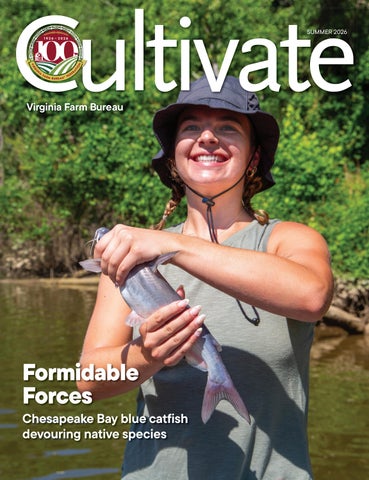
Formidable Forces
Chesapeake Bay blue catfish devouring native species
Volume 19, Number 3 Summer 2026 Cultivate (USPS 025051) (ISSN 1946-8121) is published four times a year. February, May, August, October. It is published by Virginia Farm Bureau Federation, 12580 West Creek Parkway, Richmond, VA 23238. Periodicals postage rate is paid at Richmond, VA and additional mailing offices. The annual Subscription Rate is $1.13 (included in membership dues).
16
Features 14
16
20
23
“Our proposed solution in
CENTURY OF SERVICE
Members have trusted Virginia Farm Bureau with their priceless classics for the last 100 years.
Virginia is to eat our way out of this problem.” — MIKE SCHWARZ, Associate Director, Virginia Seafood AREC
Kathy Dixon Assistant Director, Communications Nicole Zema Sr. Staff Writer/Photographer Christina Amano Dolan Sr. Staff Writer/ Photographer Kenny Kane Graphic Design Manager
SECOND LIFE
Eleanor Stickley Sr. Graphic Designer
Animal products that Americans deem inedible often become items on their shopping lists.
PUBLICATION SCHEDULE
Associate members will receive their next issue of Cultivate in October. The magazine is published quarterly, and back issues can be viewed at issuu.com/virginiafarmbureau. Loving this issue of Cultivate magazine?
Invite a friend to join Farm Bureau so they can enjoy it too!
Member: Virginia Press Association
EDITORIAL TEAM
The Chesapeake Bay blue catfish is a growing ecological threat; researchers encourage consumers to eat them.
Farmers are expanding their income by offering RVers unique experiences by camping on-site.
All advertising is accepted subject to the publisher’s approval. Advertisers must assume liability for the content of their advertising. The publisher assumes no liability for products or services advertised. The publisher maintains the right to cancel advertising for nonpayment or reader complaints about services or products.
Asheley Jewett Chief Marketing & Communications Officer
NEW BLUE THREAT
OVERNIGHT FARM STAYS
Postmaster: Please send changes of address to, Cultivate, Virginia Farm Bureau Federation, P.O. Box 27552, Richmond, VA 23261; fax 804-290-1096. Editorial and business offices are located at 12580 West Creek Parkway, Richmond, VA 23238. Telephone 804-290-1000, fax 804-290-1096. Email address is Cultivate@vafb.com. Office hours are 8 a.m. to 4:30 p.m., Monday through Friday.
Alice Kemp Sr. Staff Writer/Photographer/ Advertising Coordinator Savannah Bragg Summer Fellow
Departments 3
Did you know?
4
By the numbers
5
Save the date
7
For your benefit
28
Heart of the Home
ON THE COVER Grace Duregger, communications associate for the Virginia Seafood AREC, is happy to have caught an invasive blue catfish (Photo by Christina Amano Dolan).
VISIT US ONLINE vafb.com
WE’RE SOCIAL!
MEMBERS — Address change? If your address or phone number has changed, or is about to change, contact your county Farm Bureau. They will update your membership and subscription information.
Did you know? One of summer’s most prolific summer squashes— zucchini—contains more potassium than bananas!
Zucchini also are high in vitamin C, low in sodium, and are only 25 calories each. Dietitians often include zucchini in their cholesterol control and weight loss programs. Much of zucchini’s antioxidant nutrients are found in the seeds and skin of the plant, and not just its
flesh. So, it’s important to consume without peeling the skin. Zucchini are botanically fruit because they grow from a flower and contain seeds. As such, they are the only fruit that begin with the letter "z." Zucchini are one of three varieties of summer squash that grow well in Virginia. They are plentiful this time of year, and can be found in farmers markets and local grocery stores. According to the most recent census of agriculture, over 400 Virginia farms are growing squash, including zucchini, on 726 acres. Italians are credited for first introducing zucchini to North
America in the 1920s. The word zucchini is derived from the Italian word for squash, which is “zucca.” Fun fact: The flower of the zucchini plant also is edible. The blossoms may be stuffed, battered and fried, or made into soups, frittatas or quesadillas. The flowers have a subtle flavor and can be eaten raw. And another fun fact is that zucchini grow so fast that they often become massive. According to Guinness World Records, the longest zucchini was 8 feet 3 inches and grown in 2014.
vafb.com / SUMMER 2026
3
Professional farriers provide hoof care for horses, on Real Virginia Featured this month on Real Virginia, Virginia Farm Bureau’s weekly television program: • Watch how Virginia farriers keep the age-old tradition of shoeing horses alive. • Discover beauty products made from local goat’s milk! • Visit Nottoway County to see where farmers are producing significant crop yields and raising beef cattle, poultry and dairy cows. Real Virginia airs nationwide at 8 a.m. on the first and third Thursdays of each month in the Voices of Agriculture program on RFD-TV on Dish Network and DirecTV, and on selected cable outlets around the state. Watch anytime at vafb.com. It airs weekly on WVVA Bluefield and WTKR Norfolk. It also airs on the first and third Sundays of each month at 7 a.m. on WHSV Harrisonburg and at 10 a.m. on WVIR Charlottesville; and on the first and third Saturdays at 5:30 a.m. on WSLS Roanoke and at 8 a.m. on WRLH Richmond.
That’s the number of farm vehicles that are involved in highway crashes annually, according to the National Safety Council. See related article on page 12.
4
CULTIVATE
Save the Date!
Enjoy a blend of traditions and tunes at the State Fair
BY SAVANNAH BRAGG
The State Fair of Virginia will take place from Sept. 25 through Oct. 4 at The Meadow Event Park in Caroline County, where visitors can explore the traditions and experiences that make the fair special. This year’s theme, “Virginia’s Best of Show,” highlights the top traditions, talent and competitions from across the commonwealth, celebrating the spirit of blue-ribbon excellence. “The State Fair represents the culmination of counties' celebrations and fairs, bringing the best of Virginia from across the state to life into one place, a nod to the blue ribbon and all the fair's competitions,” said Sarah Jane Thomsen, SFVA manager of agriculture education and strategic programming. The Main Stage Concert Series will offer a variety of musical genres throughout the week, with performers including ʻ90s country singer Sammy Kershaw; country-rock duo Lakeview; Richmond-based country and bluegrass group the Jack Wharff Band; country singer George Birge; Brencore tribute to Earth, Wind and Fire; country-rap singer and co-writer of “Dirt Road Anthem” Colt Ford; contemporary Christian artist Leanna Crawford; bluegrass band Red Camel Collective; the Amanda Cook Band; ʻ90s boy band O-Town with LFO; and country music band Parmalee. This year, the fair is introducing the Equestrian Roundup, featuring premier equine events. These include an open horse show, the World Blacksmith Championship and the Greenlee Draft Horse Hitch. The roundup also will allow
visitors to experience hands-on learning through blacksmith competitions and draft horse demonstrations. Fairgoers can indulge in classic favorites like funnel cakes and turkey legs, while also trying new treats such as Korean corn dogs, Twisted Pickles, smashburgers and homemade glazed donuts. “Sunsets and Scholarships” will return as one of the fair’s scholarship fundraisers and will be offered Friday through Sunday evenings as a ticket add-on option. The experience provides a nightly gathering space where attendees can enjoy drinks, fellowship and listen to main stage performances. On Oct. 1, an elevated Westernthemed night will feature cocktails, hors d’oeuvres and live music. Since 2013, the fair has awarded 2,903 scholarships and over $1.1 million to support youth education. The fair offers more than $100,000 each year in scholarship funds through 4-H, FFA and vocational competitions and specific equine, fine arts and horticulture competitions. In addition to scholarship events, each year Virginians compete for blue ribbons in State Fair contests. New this year is a 4-H and FFA veterinary science competition, along with themed America 250 contests in the art and horticulture categories. These include an America 250 division in adult creative arts, an America 250 quilt competition, and themed container planting and floral design in both youth and open horticulture categories.
Virginia’s largest classroom continues to evolve with innovative learning opportunities. A new addition this year is the Virginia 250 “Give Me Liberty” history exhibit, offered daily in Meadow Hall as part of the commemoration of the 250th anniversary of the signing of the Declaration of Independence. A Freedom 250 truck also will be on-site from Sept. 30 through Oct. 4, serving as a mobile museum that gives visitors an opportunity to explore the American story and the nation’s founding. Mark your calendar, and make it a fair to remember! For ticket and entertainment information, visit StateFairVa.org. Additional live updates can be found by following the fair on Facebook at Facebook.com/StateFairVa and Instagram @statefairva.
vafb.com / SUMMER 2026
5
Farm Bureau Members Receive a
$500 Exclusive Cash Reward
*
on an Eligible New* Ford Truck or Ford Blue Advantage™ Certified Used* Vehicle.
Ford Maverick®
The Farm Bureau Exclusive Cash Reward* is now compatible with AXZD-Plans.
*Visit FordRecognizesU.com/FarmBureau today for complete offer details!
BEYOND THE Barn Success doesn’t just happen in the barn. It happens in the field, tractor, or at your kitchen table. Wherever the job takes you, our team is ready to provide you with reliable financial services that help you broaden your horizons. Visit our website to find your local office and learn how Farm Credit can help.
6
CULTIVATE
For Your Benefit
Unlock summer deals for health and relaxation VFB members save on prescriptions, virtual visits
Discounted health screenings can offer peace of mind
Virtual Care Rx offers Virginia Farm Bureau members a discounted subscription rate for more than 1,100 acute and chronic medications at no cost. Plus, members will get access to virtual primary and urgent care 24/7/365. Subscription prices for the medication program start as low as $20.65 per month, which gives you access to 70,000 in-network retail pharmacies. After your first fill at a retail pharmacy, your chronic medication will be mailed monthly with free shipping. Members also have access to the Prescription Assistance Program for discounts on many medications over $200. Additionally, members will have access to the Insulin Discount Program, a one-stop solution for high quality brand and generic insulins and associated diabetes medications. Prices start as low as $94.99 a month for insulin, service and shipping. Through Virtual Rx’s Virtual Care Program, members can connect directly with a primary care or urgent care physician via phone or video conferencing 24/7. Virtual mental health support also is available for an additional cost of $35 per visit for a therapist or counselor. Virtual Care prices start at $26.95 per month. For complete pricing and to learn more, call 877-256-4248 and mention you are a VFB member, or visit: virtualcare-rx.com/home-virginia-farm-bureau-federation/.
No one knows when a stroke or cardiovascular issue will arise, so why not get screened to assess your risk for stroke, heart attack and related issues? Virginia Farm Bureau members can save on four noninvasive vascular health screenings that may give you peace of mind. For just $135, members can be screened for carotid artery, abdominal aortic aneurysm, atrial fibrillation and peripheral arterial disease. They also receive a free osteoporosis scan. Healthcare professionals use the latest technology to provide hospital-quality preventive screenings, and boardcertified physicians carefully review your results. Visit vafb.com/benefits, go to the Life Line Screening tab and log in as a Virginia Farm Bureau member to sign up.
Receive up to $13 off admission to Biltmore Estate Biltmore Estate in Asheville, North Carolina, is America’s largest home. Built by George and Edith Vanderbilt, this 8,000acre property offers beautiful gardens, biking, carriage rides, horseback riding, kayaking, paddle boarding and more. Farm Bureau members in Virginia will receive up to $13 off daytime admission to the historic Biltmore estate. Members also can realize reduced rates at The Inn on Biltmore Estate, The Village Hotel and a variety of local accommodations. While there, browse through unique estate shops for wine lovers, gardeners, bookworms and everyone in between. Savor complimentary tastings of more than 20 handcrafted wines; view rare treasures from the Biltmore collection; and learn about the estate’s barnyard animals. Visit Biltmore.com/corporateperk for more information. Tickets must be purchased in advance.
Save when booking a stay at over 7,000 Choice hotels Your Farm Bureau membership entitles you to significant savings at thousands of hotel properties. Reservations are required, and blackout dates may apply. The Choice Hotels International program offers a 20% discount off “best available rates” for Farm Bureau members at more than 7,000 locations. To access this discount rate, visit choicehotels.com or go to vafb.com/benefits and log in with your membership number.
Get up to 20% off at thousands of Wyndham properties Whether you’re looking for an upscale hotel, an all-inclusive resort or something in between, Wyndham Hotels & Resorts has the right hotel for you! As a Virginia Farm Bureau member, you will save up to 20% off the “best available rate” at over 8,000 participating hotels worldwide. Reservations are required, and blackout dates may apply. To take advantage of this discount rate, call 877-670-7088 or visit wyndhamhotels.com/farm-bureau. Use the Virginia Farm Bureau identification number, available at vafb.com/ benefits and from your county Farm Bureau, when making a reservation. Present your membership card when you check in.
vafb.com / SUMMER 2026
7
GROW. SUCCEED. THRIVE.
Agricultural education professionals invest in students’ futures
DIXIE WATTS DALTON Ag economics professor, Virginia Tech BY NICOLE ZEMA
W
hile pursuing a pre-veterinary degree to work with animals, Dixie Watts Dalton, Ph.D., became captivated by a course of study that’s all too human. She was a student at Virginia Tech long before becoming an icon of agricultural economics in its College of Agriculture and Life Sciences. “I took an introduction to agricultural economics class with Dr. Wayne Purcell,” Dalton recalled from her freshman year. “He totally changed the direction of my future when he allowed me to see the economic theory that underlies every decision we make.” Economics is the allocation of scarce resources to competing needs, Dalton explained. It fundamentally shapes decisions about what and how farmers produce and how consumers decide what and how much to buy. Growing up on a Lunenburg County tobacco farm, economic theory was foundational to the Watts family livelihood. And her parents didn’t need an academic degree to apply its principles. “I learned economics from a very young age because I got to see the value of hard work,” Dalton said. “My parents invested in our futures by giving all of us kids our own crop of tobacco. I opened a credit account at our local farm supply store where I'd buy my inputs. When we went to market at the end of the year, I got to see that check with my name on it. Once I paid off debt and calculated profit, everything went into the bank account to pay for college.” Dalton now reinvests in students at Virginia Tech, where she is an associate professor of practice in the Department of Agricultural and Applied Economics, and coordinator of the agribusiness concentration of the Online Master of Agricultural 8
CULTIVATE
and Life Sciences degree. She also spent 11 years closer to home as professor and director of the agribusiness program at Southside Virginia Community College, plus dean of multiple departments. Of all Dalton’s advanced degrees, accolades and mastery of complex economic concepts, her academic leadership is rooted in humanity. “Students don't care how much you know until they know how much you care,” she said. Dalton remembers an advisee who dropped by her office one day to give her something. “They sat a bullet on my desk and said they had been struggling, and basically given up,” she said. “But then they realized that I had not given up on them, and they decided not to give up on themselves. You just never know what impact you might be making in the classroom.”
JESSICA M. JONES Tunstall High School agriculture education teacher & University of Mount Olive professor BY ALICE KEMP
A
career in agriculture education wasn’t what Jessica M. Jones envisioned when she was young. Growing up farming with relatives active in New Farmers of America and FFA, agriculture was woven into everyday life. But she wanted to be a doctor. That changed in high school when teachers recognized something in her she hadn’t yet seen in herself. Jones excelled in agriculture classes. She led projects, became the first girl in Virginia to compete in small engine repair, and won national agriculture competitions. “One of my mentors, Mr. McCann, said ‘I think you should
CUTLER BLANKENSHIP Courtland High School agriculture teacher and FFA advisor, Spotsylvania County BY CHRISTINA AMANO DOLAN
L become an ag teacher. You’ve got the farm business management team under control, and your peers listen to you,’ ” she recalled. Jones received a full scholarship to Virginia Tech and majored in agriculture education before earning her doctorate. Teaching since 2004, she’s the agriculture teacher and FFA advisor at Tunstall High School, a FIRST Robotics coach, and professor of agribusiness, communications and leadership at University of Mount Olive in North Carolina. From animal systems to turfgrass management, she’s “taught every agriculture course my high school offers.” Through “exploring the bigger world of agriculture,” she guides students to become productive citizens and active consumers. She helped students plant a “grow and give” school garden during COVID-19, creating a space for reflection while providing fresh produce to those in need. “We need to understand where our food, fiber and resources come from, the jobs behind it, and how everything helps us take care of ourselves and the greater community,” she said. Jones’ impact extends beyond classrooms. She serves as the superintendent’s Region VI representative and chairs the Advisory Board for Teacher Education and Licensure, shaping policies and standards defining statewide education. Although a respected leader in agriculture education, as a Black woman in the field, she’s faced instances where she wasn’t welcome and had to work harder to prove herself. Those experiences strengthened her commitment to “create opportunities for every student, regardless of their background or appearance. “You have to just keep going,” Jones said. “I’m trying to do good work for the greater purpose.” Her dedication earned her multiple honors throughout her career, including two General Assembly commendations. But ask about her proudest accomplishment and she’ll mention her students—several who now teach agriculture, including one in West Africa. “When I see them pursuing agriculture to help young people and they’re doing it because it’s the right thing to do in their hearts, that’s the good stuff.”
ike the agriculture teacher who transformed her life, Cutler Blankenship opens up budding minds to undiscovered possibilities. While the Pittsylvania County native always envisioned a future in agriculture, Blankenship’s mentor, Jessica Jones, unearthed her calling to the classroom. “She always told me that I was going to be an ag teacher, and I told her she was crazy,” Blankenship laughed. But after graduating from Ferrum College with a degree in animal science, agronomy and agribusiness, Blankenship took on her first teaching role at a high school. The role was not what she expected, so she left and began working for the Pittsylvania Soil and Water Conservation District. That opportunity helped her stumble upon the path she had previously walked away from. “We did a lot of educational programs for farmers, and I felt that calling to go back to the classroom,” she recalled. “When I came to Spotsylvania County, I really fell in love with teaching students who don’t come from a traditional agriculture background like I did.” The majority of her Courtland High School and Spotsylvania Career & Tech Center students are from suburban areas, so Blankenship finds fulfillment in nurturing untapped aptitudes for animal science, horticulture, agribusiness, welding and woodworking. “Some kids have never seen a chicken hatch, felt a sheep’s wool or bottle-fed a calf, so I try to expose them to as much as possible,” Blankenship said. With her boyfriend’s livestock farm nearby and support from other farmers, Blankenship can bring those enriching hands-on experiences to the classroom. Daily activities may include tending to the school’s garden or chicken coop, marketing eggs to staff or writing letters to legislators. “I show them that there’s lots of different career aspirations in agriculture, and that even if you don’t want a career in ag, you still need to know where your food comes from, how to read food labels, how the markets work and the importance of advocacy,” Blankenship noted. As the Courtland FFA advisor, Blankenship drives student interest in the chapter’s myriad leadership opportunities—with her former student and fellow competitor in the 2025 Virginia Farm Bureau Federation Young Farmers Summer Expo Discussion Meet, Franco Abud, now serving as Virginia FFA vice president. “I wouldn’t be the teacher I am if it weren’t for Farm Bureau, so I always encourage my students to get involved,” she reflected. Blankenship most cherishes “watching students grow, succeed and thrive in my classroom.” As a newly-appointed FFA National Teacher Ambassador, she looks forward to helping expand curricula for nationwide students from non-agricultural backgrounds. vafb.com / SUMMER 2026
9
Leave worries in the wake with watercraft insurance policies BY NICOLE ZEMA
or Virginia families who’ve spent generations on the water, lake life is more than a hobby—it’s a lifestyle. Mecklenburg County resident Alan Lenhart’s family has recreated on Buggs Island Lake for a lifetime, creating countless memories and experiences over the decades. “Boating has always been more than just a hobby for us,” he said. “It’s a tradition.” Mecklenburg County Farm Bureau insurance agent Trina Burns has worked with the family to craft policies that pinpoint exactly which coverages
and discounts apply to Lenhart’s recreational traditions on the water. His father, Charles Lenhart, comes from a generation of competitive skiers. “They once submitted a video of themselves performing a pyramid ski routine to Cypress Gardens (a Florida ski show destination) in hopes of winning a boat in a contest,” Lenhart recalled. “That competitive spirit has carried on, and to this day our family still competes to see who can ski, tube or kneeboard the best!” Over 250,000 motorboats, including 30,000 personal watercraft, are registered through the Virginia
These family photos from Mecklenburg County's Lenhart family show Charles Lenhart during his competitive waterski days, above, and Alan Lenhart's wife, Tabitha, and son Copeland, age 2, enjoying Buggs Island Lake. 10
CULTIVATE
Department of Wildlife Resources. The Chesapeake Bay, Potomac River, Lake Anna and Smith Mountain Lake are among the state’s major boating locations. Mecklenburg County is a premier "lake country" destination. It’s home to Buggs Island Lake, the state's largest lake located in the Kerr Reservoir, adjacent to the popular Lake Gaston. “When it came time for me to purchase a new boat, I contacted Trina Burns to add coverage,” Lenhart said. “She asked if I would be interested in refinancing through Farm Bureau to potentially secure a better interest rate. I decided to move forward with the application, and I’m glad I did. They were able to save me a significant amount by refinancing my brand-new boat.” Burns said Farm Bureau covers most personal-use boats, including pontoons, motorboats, fishing boats and personal watercraft, as well as the trailers, motors and equipment to transport them. “In other words,” Burns said. “You’ll be covered both on the water and on your way to it!”
SMOOTH SAILING STARTS WITH SMART COVERAGE
Your county Farm Bureau insurance agent can design watercraft policies with the following:
• Liability: Helps pay for injuries and
property damage to others if you’re legally liable in a boating accident.
• Replacement Property: Covers
vessels, motors and trailers that are acquired during the policy period to replace previously covered items.
• Newly Acquired Property: Protects
newly purchased vessels, motors and trailers obtained during the policy period.
• Medical Expense Benefit: Can
offset your health insurance deductible and pay for passengers’ injuries if necessary. It’s also an added buffer if you’re liable in an accident that causes serious injuries.
• Wreck Salvage & Removal: Pays for
the cost to raise, remove or destroy the wreckage of a covered vessel if it’s stranded, destroyed by fire or sunk.
• Towing and Emergency Services:
Includes on-the-water towing, fuel drops, soft ungroundings, dock-todock towing, and jump starts. Trailer tire changes are covered as well.
• Personal Property: Covers your
personal property in case something important is lost overboard.
• Uninsured/Underinsured Boater:
Kicks in if someone in an uninsured or underinsured watercraft causes damage to you and your boat.
• Additional options: Include
coverage for first aid and use of another vessel.
Virginia Farm Bureau Mutual Insurance Co. coverage options for watercraft include motor boats, pontoon boats and other personal watercraft devices.
Visit vafb.com/locations to find a local Farm Bureau insurance agent and discuss coverage options. Learn more about Virginia Farm Bureau boat insurance at vafb.com/insurance/boat.
vafb.com / SUMMER 2026
11
‘The ones who are still putting the food on your table’
Smaller farms, bigger equipment and increased rural traffic present dangers for both farmers and motorists
BY NICOLE ZEMA
K
ing William County Farm Bureau president and lifelong farmer Charlie Piersa can see all the extra traffic on the road from the vantage point up in his tractor cab. He said farms are getting smaller, equipment is getting bigger and rural roads are more congested as areas accommodate growing residential development. “I can see them coming,” Piersa said. “Some drivers take the back roads at 60 mph, going around curves on the wrong side of the road. My front end was almost hit twice this year. Eventually somebody won’t be so lucky, because one of us will get hit.” According to the National Safety Council, approximately 15,000 farm vehicles are involved in highway crashes annually. By and large, incidents involving passenger vehicles and farm equipment happen most frequently from May to October, from the start of spring planting through the fall harvest. Driver impatience is noticeably pervasive as Piersa moves 12
CULTIVATE
equipment between fields. “They’ll get behind you on the back road and blow their horn at you,” he said. Back roads, big risks While it can be tempting to try to pass farm equipment, motorists should remember that it’s illegal to pass on a solid yellow line, said Matt Nuckols, Virginia Farm Bureau safety coordinator. Even if passing is allowed, he advises against it. “Most of this equipment is not traveling very far, so if you do get behind one, just a little bit of patience can go a long way because they’re likely not going more than a mile or two.” Nuckols also urges motorists to slow down when approaching farm equipment, and leaving them enough space to stop. Even with a vantage point, equipment operators cannot see drivers who are following too closely. “There’s no benefit to being right on top of a tractor or piece of farm equipment,” he noted. “Just leave
some extra space, and remember that they will likely be turning pretty soon.” Piersa recalled several instances of highway crashes with agricultural equipment, including the loss of his planter and tractor hit by a wood truck a few years ago. There were no injuries, and the truck driver paid a small fine. “Even though he was on the wrong side of the road, on a short curve over dual lines,” Piersa said. Other farm equipment crashes in the region ended tragically, and Piersa wants motorists to consider the big picture when encountering farm equipment on roadways. “Even though farmers are getting smaller as a group, and family farms are slowly disappearing, remember to respect the ones who are still putting the food on your table.”
Visit vafb.com/safety to learn more about the Virginia Farm Bureau Safety Program.
l s
Centennial Spotlight
BY ALICE KEMP
A
s Virginia Farm Bureau Federation celebrates its centennial, one of its members showcases the relationships and service that have defined the organization for generations. Since 1950, Virginia Farm Bureau Mutual Insurance Co. has been part of that legacy, helping members protect what matters most. It could be a house filled with family memories or a farm or business that reflects years of hard work and dedication. Sometimes, it’s special vehicles that carry history. For Wayne Davis, it’s all of the above. For over 30 years, Davis has trusted VFBMIC to help protect the family home, farm and his prized classic cars. And like the farm, the vehicles are woven into the Davis family's story—carefully restored by hand, carrying memories and traditions. A family hobby Davis recalled a time he tried selling his 1965 Plymouth Sport Fury. “I put a for-sale sign on it and parked it on the street,” Davis said. When he returned home from work that evening, the sign was missing. He put it back. But the next day, it was gone again. “My son kept taking the for-sale sign off,” Davis reminisced with a
14
CULTIVATE
chuckle. “So, I decided I’d just keep the car.” Davis’ love for classic cars began while working at a Danville car dealership, “back in ’69, when all the good cars were out.” One day, a customer traded in the sleek Plymouth and Davis knew he had to have it. Today, his collection also includes a gleaming red 1951 GMC truck rescued after it had been sitting in a field, retired after years of farm work. And his 1965 Volkswagen Beetle—also bright red—is the same kind of car he drove when he and his wife, Amy, went on their first date over 50 years ago. “They were ground-up restorations,” he said fondly. “Every nut and bolt was replaced.” Restoring cars was a break from farmwork and became a family pastime. His two sons, Weldon and Winston, joined him in the shop as they grew older. Together, they spent years “piddling with” vehicles— restoring engines, tracking down parts and bringing old cars back to life. “We’ll go out and take rides in them
Vintage cars are parked on the Davis family's property. Trophies won in various vintage car shows are displayed in one of the workshops that used to be the old tobacco barn shown above. Photos by Alice Kemp.
on Sunday afternoons and go to cruise-ins,” Davis said. He has a “wall full of trophies” from car shows along the East Coast he’s attended with Amy and their sons— the latter sometimes driving alongside in their own restored cars. Longstanding relationships In 1993, Wayne and Amy found that insuring their Pittsylvania County farm, house and prized cars was becoming needlessly complicated with their carrier at the time. That changed when they switched to VFBMIC. “A friend of mine, Ricky Anderson, was an insurance agent there and he did a package deal for the whole thing.” Davis said Farm Bureau simplified the process. And when he had to file a claim, “they took care of it, no question.” What kept Davis loyal to Farm Bureau for decades hasn’t just been the coverage, but the people. When Anderson retired, Michael Ferrell inherited the account.
They still laugh about one of Ferrell’s first visits when they were checking out the cars and discovered a large black snake heading underneath the GMC. After the two unsuccessfully tried shooing it away with a two-by-four, Ferrell improvised. “I don’t know what came over me, but I reached under the truck, grabbed that snake’s tail, and slung it out into the hay field,” Ferrell laughed. “Then Wayne looked at me and said, ʻYou’re all right in my book.’” That set the tone for a relationship built on more than policies. For Ferrell, getting to know members and the things they care about provides a deeper understanding of what he’s helping safeguard. “The story behind those cars makes you realize there are certain things in life that go beyond the value of money,” he said. “If something were to ever happen to those cars, money wouldn’t replace what’s truly lost— but knowing there’d be something there to help makes me feel good. He knows that if he needs to call, I’ll pick up,” Ferrell said. And stories like those of the Davis family embody the relationships, trust and service that shape the organization. “They’ve been taking care of me and I’ve got no complaints,” Davis said. “Farm Bureau has treated me good.” Wayne Davis' classic 1951 GMC truck and 1965 Volkswagen Beetle have been insured with Virginia Farm Bureau since 1993, along with their farm and home. Davis said the Farm Bureau agents are what's kept him loyal to the company for decades. Photos by Michael Farrell.
vafb.com / SUMMER 2026
15
GRACE DUREGGER
Virginia blue catfish BY CHRISTINA AMANO DOLAN
A
fter decades of prowling Virginia’s waterways, an underestimated intruder has transformed into a formidable force— threatening ecosystems, economies and livelihoods. First introduced to the Chesapeake Bay’s freshwater tributaries for recreational fishing in the 1970s and 1980s, the blue catfish has gradually revealed its reproductive ability, survival superpowers and voracious appetite. “At first, nobody paid much attention to them,” said Mary Fabrizio, professor at the Batten School of Coastal & Marine Sciences at William & Mary and the Virginia Institute of Marine Science. “But as they started to increase in population size, they started moving into areas you 16
CULTIVATE
wouldn’t normally find them—like in brackish water.” The species began appearing in VIMS’ monthly surveys of the saltier portions of the James, York and Rappahannock rivers around 1990, with blue catfish catches “increasing markedly” into the 2000s. In a recent study, Fabrizio’s team uncovered their troubling year-round predation on juvenile blue crabs—one of many native species on their menu. “They’re mowing down menhaden, spot, clams, oysters, rockfish. There’s not a species in the bay that we harvest commercially or recreationally that’s not being negatively impacted by blue catfish,” lamented Mike Schwarz, associate director of the Virginia Seafood Agricultural Research and Extension Center. “All these things that you take for
MARY FABRIZIO AND VIMS
Devouring the bay’s native species
Mary Fabrizio, professor at the Batten School of Coastal & Marine Sciences and Virginia Institute of Marine Science, is studying ecological changes caused by blue catfish.
granted are there because of a healthy ecosystem,” Fabrizio noted. “When that ecosystem is no longer healthy, those things are not going to be there.”
CHRISTINA AMANO DOLAN
Above, Virginia State University and Virginia Seafood Agricultural Research and Extension Center representatives catch blue catfish for the State Fair on Fourmile Creek in Henrico County. MARY FABRIZIO AND VIMS
Throughout its biological history, the juvenile blue crab has learned how to hide from the predators it knows. “But now we have a predator who can smell and taste them from far away,” Fabrizio explained. As a newcomer, the Chesapeake Bay blue catfish has wielded the element of surprise over native wildlife. They lack worthy competitors, predators and other natural population controls. Simultaneously, they are generalist feeders, prolific breeders, nest guarders and uniquely equipped to withstand periods of starvation. “They can exploit resources, wait it out if the resources are gone, and they’ll still reproduce next summer,” Fabrizio explained. “That’s why they’re going to be so, so difficult to control.” And with “more mouths to feed” but not enough prey to go around, Fabrizio’s team has observed the population decline of the bay’s former top predators. “We’ve heard about a lot of watermen on the Potomac River setting their traps for striped bass and catching nothing but catfish,” she said. “And it’s a very difficult fish to handle. It takes time to remove the fish from the nets, and time is money.” While Hampton’s L.D. Amory & Co. didn’t carry blue catfish in 2006, the species made up 99% of the seafood distributor’s purchases from local watermen in 2023, according to Schwarz. “We have watermen that are catching less and less of everything else and more blue catfish than there are places to sell it,” he said. Last September, The Virginia Department of Agriculture and Consumer Services’ Blue Catfish Work Group sent the governor a list of recommendations for reducing the species’ ecological impact. Comprised of watermen, regulatory agencies and other stakeholders, the group largely explored methods of expanding the marketing, processing and sale of blue catfish in Virginia. “Our proposed solution in Virginia is to eat our way out of this problem,” Schwarz explained.
GRACE DUREGGER
Becoming an apex predator
Scientists from the Batten School of Coastal & Marine Sciences and Virginia Institute of Marine Science hold specimens of blue catfish. vafb.com / SUMMER 2026
17
JOSHUA MACLIN, VIRGINIA COOPERATIVE EXTENSION, AT VIRGINIA STATE UNIVERSITY, COLLEGE OF AGRICULTURE
Virginia blue catfish
Virginia Gov. Abigail Spanberger sampled fried blue catfish prepared by the Virginia State University College of Agriculture at the 2025 State Fair of Virginia. Fairgoers can purchase award-winning fried catfish at the VSU fish booth this year during the fair’s run, Sept. 25-Oct. 4. Find three tasty blue catfish recipes on page 28.
A tasty opportunity “Because of changing populations within the fisheries over the years, watermen have become very adaptable to moving from species to species out of necessity,” noted Tony Banks, senior assistant director of agriculture, development and innovation at Virginia Farm Bureau Federation. While the state has made some headway, beefing up blue catfish processing to support a new wild fishery requires significant investments in infrastructure and equipment. “Before processors invest a lot of money, they need to know there is a larger market out there,” Schwarz explained. “We need more people asking for blue catfish at restaurants, grocery stores and seafood markets.” To help drive demand, the Virginia Seafood AREC is prioritizing consumer education—raising awareness about the species’ superior taste, versatility and nutritional profile. Recent data collected by the AREC found that Chesapeake Bay blue catfish’s nutritional value outperforms other lean fish like tilapia, channel catfish and cod. 18
CULTIVATE
The AREC and Virginia State University introduced Chesapeake Bay blue catfish to thousands of visitors at the 2025 State Fair of Virginia—surprising many who dislike the muddy-like flavor of other catfish species. “It was a massive success. People were scarfing up our blue catfish nuggets, and almost none of them had ever heard of blue catfish before,” Schwarz beamed. “But once you have it, you won’t forget it.” Visitors to this year’s State Fair can look forward to even more Chesapeake Bay blue catfish samples, live fish and immersive educational displays at the VSU and Virginia Seafood AREC tent.
A marathon Schwarz estimates that a full-fledged blue catfish market in Virginia could yield up to a $400 million annual economic impact. Additionally, the Virginia Seafood AREC currently is researching untapped marketing opportunities for blue catfish byproducts that would otherwise occupy landfills, such as nutraceuticals, pharmaceuticals, cosmetic collagen, and fish cakes for schools and correctional facilities.
“We think we can turn this into a very positive story for the future of the Virginia seafood industry. We just need to do everything right,” Schwarz noted. “We need to harvest it down to a sustainable level—minimizing the negative impacts on other fisheries—and that level needs to be determined by research.” He added that additional funding is needed to fully gauge the species’ ecological harm and impact on the state’s fisheries. Fabrizio believes that expanding the commercial fishery is one way to start addressing the problem. “A problem that took decades to make is going to take decades to address,” she remarked. “Some people want to see a trophy fishery continue, and others want to get rid of every last one of them— which isn’t feasible. There’s lots of different objectives, and managers need to hear from the public as to what they want.” Fabrizio encourages reaching out to the Virginia Department of Wildlife Resources or the Virginia Marine Resources Commission for more information on how to get involved.
JAY FLEMING CHRISTINA AMANO DOLAN
Native white catfish (top), the invasive blue catfish (middle) and the non-native channel catfish (bottom).
Representatives of Virginia State University and the Virginia Seafood Agricultural Research and Extension Center wait to reel in blue catfish on Fourmile Creek in Henrico County.
Catching blue catfish
Consumers can help manage invasive blue catfish populations by catching them for dinner. Blue catfish are readily accessible to anglers fishing the commonwealth’s major river systems. Virginia DWR encourages the harvest of small blue catfish, following the consumption advisories set forth by the Virginia Department of Health. For helpful tips on identifying, catching and processing blue catfish for consumption, visit dwr.virginia.gov/ wildlife/information/blue-catfish. vafb.com / SUMMER 2026
19
| MULTI-GENERATIONAL ORCHARDS |
Agricultural rendering:
The sustainable science of second life BY NICOLE ZEMA
T
he 50% of animal products deemed “inedible” by American consumers today becomes essential household items on their shopping lists tomorrow. Agricultural rendering is the invisible, sustainable industry contributing to a more beautiful world—bountiful crops, healthy pets, luxury beauty products, nourished livestock, cleaner fuels and colorful interiors—all while significantly reducing greenhouse gas emissions. A high-volume, high-tech industry, U.S. renderers collect 56 billion pounds of raw materials from animal agriculture and grocery store leftovers each year. According to a 2020 North American Renderers Association report, materials are cooked and dried into 22 billion pounds of animal fats, oils and proteins. These raw materials are carefully processed and refined to deliver quality products used in agriculture and at home. “In French, ‘render’ means ‘to give back,’” said Amy Moulden, NARA director of operations and member relations based in Northern Virginia. “A lot of good comes from unwanted materials— reclaimed, renewed, returned.”
A circular system
The story of rendering begins when animal leftovers and oils are collected from meat lockers, packing plants, butcher shops, grocery stores and restaurants. These materials are ground to a uniform size and cooked to separate fat from protein. Fat is purified by centrifuge, and used in finished products from tallow to greases. Cooked protein is ground to 20
CULTIVATE
uniform size into ingredients for finished products like feeds and fertilizers, including meals from meat, blood bone, poultry and poultry byproduct and feathers. High cooking temperatures used in rendering destroys any pathogens. Rendering plant workers are extensively trained to use high-tech controls to operate ultra-hot temperature cookers, centrifuges and presses. “And renderers have a high labor retention rate,” Moulden said. “They continue to deliver high-quality, safe products that are sustainable long term.”
Products of rendering
“Rendering reflects a deep respect for the animal,” said NARA vice president of communications Anna D. Carlson. “Rather than discarding large portions of an animal after harvest, rendering ensures that nearly every part is put to beneficial use. To me, that’s a powerful example of responsible resource stewardship and sustainability!” The rendering process reclaims undesirable meat, bone and fat from cattle, fish, pigs and poultry, which is ultimately transformed into ingredients for an array of products:
• The “Big 4” rendered product markets
include animal feed or pet food; fertilizer; fuel; and oleochemical products as base materials in personal care items, foods and beverages, manufacturing and pharmaceuticals.
• Rendered fat alone is utilized for
production of antifreeze, biodiesel, candles, cement, ceramics, chalk,
cosmetics, crayons, deodorant, detergents, fabric softener, insulation, linoleum, lotion, lubricant, matches, medicines, paint, perfume, plastic, rubber, shaving cream, soap, textiles and waterproofing materials.
• Rendered bone chips are used
to create cosmetics, gel caps for supplements and drugs, and even tires.
Materials rendered from organs, hair, hooves and blood also contribute to other products:
• BLOOD—adhesives, dyes and inks,
laboratory materials and medicines.
• BONE—charcoal, fertilizer and glass. • BRAIN and INTERNAL ORGANS—
antiaging creams, enzymes, hormones, medicines, strings for musical instruments and tennis racquets, and vitamins.
• HAIR—air filters, brushes, felt, insulation, plaster and textiles.
• HIDES—adhesives, gelatin, medicines and sheetrock.
• HOOVES and HORNS—adhesives, lamination, photo film, plant food, plastics, plywood, shampoo and wallpaper.
-Information sourced for the North American Renderers Association
The ‘Original Recycling’
The U.S. rendering industry accounts for roughly $10 billion in annual economic activity, supporting jobs and circular economy while boosting other sectors. Of all the economic upsides and utility that agricultural rendering brings to humankind, its “deficits” are an advantage
vafb.com / SUMMER 2026
21
Agricultural rendering
for the environment too. Known as the “Original Recycling”—the upcycling of animal co-products sequesters at least five times as many greenhouse gas emissions as it emits. “Huge volumes of meat leftovers and used cooking oil are kept out of landfills, resulting in a net reduction of carbon emissions, a substantial greenhouse gas reduction, reduced food waste and saved landfill space,” wrote Carlson in the journal Animal Frontiers. According to her article, the rendering industry prevents an estimated carbon footprint reduction equivalent to taking over 18.5 million cars off the road each year. The rendering process also reclaims water from raw waste, reducing the overall quantity of product being processed. The reclaimed water undergoes rigorous filtration and treatment to perfectly align with water safety standards on every regulatory level.
From fries to fuel
Renderers recycle 1.6 billion pounds of used cooking oil every year, Carlson continued. Those restaurant oils are cleaned and recycled into ingredients for animal feed, and used in biodiesel and renewable diesel for cars, trucks, airplanes and other equipment. “Repurposing a large amount of this material averts what would otherwise go to other less-sustainable destinations,” she wrote. “Without the essential services that an animal rendering plant offers, the valuable properties used cooking oils provide would be lost to landfills.”
Rendering FACTOIDS » The core chemistry of rendering—using heat to separate fat
from tissue—was developed in antiquity. Ancient peoples, including the Egyptians, Romans and Greeks, routinely boiled animal fats. And for thousands of years, Native Americans used every part of a bison for food, clothing, shelter, tools, jewelry and in ceremonies.
» Renderers recycle roughly 1.6 billion pounds of used cooking oil from food items like French Fries into ingredients for animal feed, biodiesel and renewable diesel.
» There are approximately 250 to 300 rendering plants
operating nationwide in the U.S., with three prominent primary facilities in Virginia.
» Major food brands such as Steak ‘n Shake have transitioned
to cooking their fries in 100% beef tallow, reflecting growing demand for traditional cooking ingredients and animal-based fats, Carlson said. A resurgence of rendered tallow in personal care products signals consumers seek simpler and more natural ingredient options. Visit the North American Renderers Association website at nara.org to learn more about agricultural rendering.
22
CULTIVATE
SAVANNAH BRAGG
ome farmers are expanding their income by offering RVers the chance to camp on-site and experience a little bit of farm life. Through a program called Harvest Hosts, overnight stays are centered around unique experiences and meaningful connections. The following are two of those places where the setting is part of the adventure.
Sip and stay: James River Cellars and Winery welcomes RV travelers ARTICLE AND PHOTOS BY SAVANNAH BRAGG
Tucked just off state Route 1, James River Cellars and Winery is offering more than just wine tastings. Through its partnership with Harvest Hosts, the winery has expanded its reach, welcoming RV travelers and tapping into the tourism industry. Founded in 2001, James River Cellars is a family-owned winery that began as a hobby before growing into a business
venture. Nearly two decades later, in 2020, the winery joined Harvest Hosts, an online platform that connects RV travelers with unique overnight stays at local businesses. “Growing up, my family used to take RV trips, and I loved it,” said Mitzi Batterson, James River Cellars owner. “So, when this
opportunity came across my desk, I thought it sounded great.” Batterson explained that before platforms like Harvest Hosts, many RV travelers would often park overnight in parking lots or rest stops. Now, travelers have a more comfortable, experiencedriven alternative. vafb.com / SUMMER 2026
23
SAVANNAH BRAGG
Farmers expand reach to RVers S
H�r�e�t H�s�s
At Fauquier County’s Whiffletree Farm, overnight RV guests get to see some of the direct-to-consumer animals raised there, including lambs and hogs.
Beyond tourism, Harvest Hosts also supports agriculture by bringing visitors directly to farms, wineries and other rural businesses. This added exposure not only provides an additional stream of revenue for agricultural operations, it also serves as an economic boost for small businesses. According to Harvest Hosts, members have generated more than $200 million in revenue for local communities. “Harvest Hosts has been nice for us because it helps increase traffic on the weekdays,” Batterson said. James River Cellars welcomes a wide range of travelers, from locals to out-of-state visitors. At the winery, guests can enjoy wine tastings, guided tours, a gift shop and live music on Friday nights, creating an experience that goes beyond a simple overnight stay. To accommodate guests, the winery offers four RV parking spots in their large grass field at the front of the property, 24
CULTIVATE
and they can be booked online. While welcoming overnight guests has expanded the winery’s reach, its daily operations have remained largely consistent. “For us, it hasn’t changed our day-today operations, aside from making sure we plan ahead and block off booking dates for holidays and large events we have scheduled,” Batterson said. In addition to supporting the winery, visitors often explore nearby restaurants, shops and attractions, contributing to the community’s economy. By encouraging guests to engage with local businesses through tools like its QR code guide, James River Cellars is helping extend the impact beyond its own property. “We made our own tabletop QR code that visitors can scan to see a list of restaurants, RV places and facilities in the area,” Batterson explained.
As tourism continues to grow, partnerships like Harvest Hosts are creating new opportunities for small businesses to expand their reach while offering travelers a more meaningful and memorable experience. “It’s been a fantastic program,” Batterson said. “The people that come through in RVs are the nicest and most entertaining people.”
Parking among pastures at Whiffletree Farm ARTICLE AND PHOTOS BY ALICE KEMP
Whiffletree Farm offers road-weary RV travelers a different kind of overnight stop. Instead of a campground or parking lot, guests can settle beneath a shady oak tree and trade traffic noise for the gentle sounds of clucking hens, grazing cattle and the quieter pace of a working farm.
Jesse Straight, owner of Whiffletree Farm, checks on his flock of meat birds and cattle. While staying there, RVers can collect eggs and visit the animals before stopping at the farm’s store for pasture-raised meats, eggs, local honey and goods from area artisans.
“People are going from Florida to Maine, and they’ll need a place to stay,” said Jesse Straight, who owns the Fauquier County farm with his wife, Elizabeth. For the Straights, welcoming travelers offers a chance to share their farm and story. The couple didn’t come from an agricultural background, but Jesse was drawn to the farming lifestyle while studying pre-med in college. A calling and change of heart led to Whiffletree Farm’s purchase in 2009. The farm is where they have raised their family and built a regenerative farming operation spanning 82 acres, plus 800 acres of rented pasture for beef cattle. A few years ago, Jesse learned about Harvests Hosts, a network that connects RVers with unique overnight destinations. Already renting the farm’s manor house on VRBO, and with their location off one of the East Coast’s busiest traffic
corridors, Harvest Hosts was a natural fit. “And I thought it’d drive a little traffic and a little exposure,” he said. RVers quickly discover it’s more than a place to park their rig. Guests can collect eggs and visit the sheep, goats, hogs and dairy cows before stopping by the farm’s store for pasture-raised meats, eggs, local honey and goods from area artisans. A self-guided map leads visitors around the property with a path to an old racetrack where prized thoroughbreds once trained. Rolling hills, picnic areas and a tranquil pond offer quiet moments along the way. “They can join in on what’s happening here on the farm,” Jesse added. The experience offers more than hospitality. Whiffletree Farm’s direct-toconsumer operation raises thousands of meat birds, laying hens and turkeys alongside hundreds of hogs and cattle,
and hosting visitors creates connections and learning opportunities. “I think our culture is very segregated from agriculture and lots of people never see food being raised or understand how it works,” Jesse said. “It’s a good thing to have that exposure.” While Jesse admitted that balancing bookings with busy farming operations can sometimes be challenging, sharing the farm with others makes it worthwhile. “It’s satisfying to see people having a good time, enjoying the beauty of our farm, and hearing about their travels,” Straight said. “It’s nothing grand, but it’s the small, nice things that make it count.”
vafb.com / SUMMER 2026
25
Rockbridge County agent and award honoree, Jade Knick, with herding dog, Whiskey Rose, at her Breezy Hill Farm.
BY NICOLE ZEMA
Jade Knick is a West Virginia girl who never heard of Rockbridge County when she moved to Virginia for her first job after college in 1991. With an agricultural degree and willingness to work with farmers and rural residents, she was snatched up by the U.S. Department of Agriculture Farmers Home Administration, now known as USDA Rural Development. They sent her to Lexington. “Where is Lexington?” Knick asked. She served five years there conducting property inspections and appraisals for the government. Then her office relocated to Augusta County. But Knick wasn’t leaving Rockbridge County. She was hired as a Virginia Farm Bureau Mutual Insurance Co. agent in 1996. In 30 years serving Farm Bureau members, Knick has sold insurance policies that celebrated family milestones and provided coverage against calamity. In March, she was named the 2025 Ralph Stokes Career Achievement Award Honoree at the VFBMIC annual Sales Conference. This is the highest honor reserved for VFB sales leaders, named for the late Ralph Stokes, a 32-year Smyth County agent and disabled veteran. However, VFB’s celebrated sales star is more comfortable behind the scenes, 26
CULTIVATE
reluctant to accept the credit. As Virginia’s population grows, Knick quietly brokers connections. “I like to connect people in the community,” she said. “And see them succeed.”
Family roots in service
Knick’s grandfather sold insurance and her dad worked in banking. She accompanied them to houses and farms on business, learned to photograph properties, inspect equipment, follow up on claims and ask relevant questions. However, Knick saw herself as a career veterinarian. She graduated from West Virginia University in 1991 with a Bachelor of Science in Agriculture. “But chemistry and I didn’t get along,” she confessed. At Farm Bureau, Knick was mentored by retired agent Geoff Goodbar—a friend, neighbor, fellow churchgoer and 2009’s Ralph Stokes honoree. “Geoff really took me under his wing and shaped my career,” she said. “He was always right there and very willing to help. We both took the approach of educating people about what they were purchasing.” The annual award is an honor Knick “dreamed of” but never expected to receive. “I was fortunate enough to have met
NICOLE ZEMA
Rockbridge County agent Jade Knick– 2025 Ralph Stokes Career Achievement Award Honoree
Ralph many years ago and watched so many deserving agents receive this award,” she said. “This is the highlight of my career, and I will cherish that moment forever.”
In hope and hardship
Knick recalled going to meet a client who lost the interior of their home to fire. With years of experience, Knick knows what to say—and not say—in these situations. “I went over there, sat on the sidewalk and cried with them,” Knick recalled. She also has visited many widows and widowers to personally deliver life insurance benefit payouts following a death. Knick remembers one widow was taken aback by the dollar figure on the check. “I didn’t know it would be that much,” she said. “Well,” Knick said. “He loved you that much!” She said she’s always been “a fixer” who finds joy in taking care of people around her, making sure they’re covered for the unexpected. Knick resides at Breezy Hill Farm with daughter Harper, 23. A nearby dairy family are tenant farmers, grazing their replacement heifers on pastureland, alongside the Knicks’ senior horse Hunter and Irish Dexter cattle.
Flood insurance: A lifeline out of the maelstrom A flooded storage unit, left, and damaged front steps are items that can be covered by a flood insurance policy. Members should check with their agents to determine the best coverage.
BY CHRISTINA AMANO DOLAN
The most common and costly natural disaster can leave a greater storm in its wake. According to the National Flood Insurance Program, 90% of all presidentially declared U.S. natural disasters involve flooding. Andrew Bochman, flood claims coordinator for Virginia Farm Bureau Mutual Insurance Co., conjured up haunting images of Hurricane Helene’s aftermath in Southwest Virginia—from deluged Gate City roads to a Marion home carried “down the road” by a raging torrent. “It’s undefinable what a flood can do,” cautioned David Jewell, VFBMIC director of property claims. “It can be as minor as a damaged crawl space or basement, or a total devastation to a house.” While floods can wash away homes and uproot lives in mere minutes, picking up the pieces can be a lengthy, expensive and convoluted process—plunging property owners without flood insurance into an unimaginable maelstrom. Many property owners discover too late that their homeowners insurance does not cover flood damage. Flood insurance covers losses directly caused by flooding—ensuring policyholders are not left to assume repair and replacement costs alone.
Foreseeing the flood
According to the NFIP, a flood is a temporary condition where two or more acres of normally dry land or two or more properties—at least one of which is the policyholder’s property—are inundated by water or mudflow. This can be caused by an overflow of inland or tidal waters; unusual and rapid accumulation or runoff of surface waters from any source; mudflow; or the collapse of land along the shore of a lake or similar body of water. “Nine times out of 10, I’m seeing floods in Virginia occur in the
mountains and hollers—where the rainwater’s got nowhere to go,” Bochman remarked. However, an area’s flood risk level is based on myriad factors— like flood history, current weather patterns, natural changes in the environment and recent development in the community. Visit floodsmart.gov to determine your flood risk. Those who own a home or business in a Special Flood Hazard Area and have a government-backed mortgage are required to obtain flood insurance. “Even if you’re not in a designated flood zone but you live close to a creek or river in a mountainous area, you should strongly consider purchasing flood insurance,” Jewell urged. Between 2014 and 2024, almost one-third of NFIP flood claims came from outside of high-risk flood areas.
Know what’s covered
Homeowners, renters, condominium dwellers and commercial owners and renters can purchase both building and contents coverage under a flood policy. “Figuratively speaking, if you cut off the top of your house and tip it upside down, anything that sticks would be covered under building coverage. Anything that falls out would only be covered if you purchase contents coverage,” Jewell explained. Bochman and Jewell recommend policyholders familiarize themselves with their policies and know what’s covered. “And a flood policy does not provide full replacement cost for your building or goods,” Jewell noted. “As the components of a house decrease in value over time, the NFIP flood policy will only pay you the actual cash value of your damaged property or belongings based on highly refined tables that the government uses.” Additionally, the NFIP has set the maximum benefit for residential buildings at $250,000. Contact your Farm Bureau agent to explore coverage options. vafb.com / SUMMER 2026
27
PHOTOS COURTESY OF KERI ROUSE, VIRGINIA TECH
Heart of the Home
Blue catfish Put a fork in an invasive catch Blue Catfish Coconut Sliders
C
hesapeake Bay blue catfish are wreaking havoc on Virginia waterways—devouring native species and disrupting ecosystems. Fortunately, putting them on the menu can help reel in their populations. Mild and flaky with a clean, slightly sweet flavor similar to rockfish, blue catfish lack the muddy taste associated with other catfish species. Their versatility offers boatloads of possibilities at the dinner table, from tacos and gumbo, to pasta and curry. Swimming in nutrition, the healthy, lean and sustainable protein is rich in vitamin D, potassium and omega-3 fatty acids—supporting cardiovascular health, cognitive function and eye development. Research conducted by the Virginia Seafood Agricultural Research and Extension Center found blue catfish contain more omega-3s than several popular fish, trailing only more oily species like salmon and mackerel. The Eat More Fish initiative through Virginia Cooperative Extension 28
CULTIVATE
encourages consumers to explore the culinary potential of blue catfish. Enjoy some of these recipes developed by the Virginia Seafood AREC, Virginia Sea Grant, LSU AgCenter, Louisiana Sea Grant, University of Maryland Extension and Maryland Sea Grant.
Blue Catfish Coconut Sliders INGREDIENTS
2 tablespoons kewpie mayonnaise* 1 tablespoon sriracha 12-ounce bag coleslaw mix ¼ bunch cilantro, chopped 5-6 scallion greens, sliced on the diagonal 2-3 garlic cloves, grated ¾ cup mango salsa 2 tablespoons mirin ½ lime ½ tablespoon sugar salt and pepper, to taste
frying oil 1 cup sweetened coconut flakes 1 cup panko breadcrumbs 1½ cup all-purpose flour 2 eggs 2 tablespoons water 1 pound catfish fillets cut into 4-5 equal portions 4 slider-sized potato rolls *Kewpie mayonnaise is a Japanese-style mayonnaise that can be found in the international or Asian aisle at grocery stores, including Food Lion and Walmart. DIRECTIONS
In a small bowl, combine the mayo and sriracha and set aside. In a separate bowl, combine ingredients starting with the coleslaw mix through the sugar, adjusting seasoning to taste and adding salt and pepper as desired. Refrigerate until ready to serve. Pour the oil in a frying pan and heat to 350°.
Season the fillets with salt and pepper.
DIRECTIONS
Set up three separate containers big enough to dredge the catfish fillets. In one container, combine the coconut flakes and breadcrumbs. Place the flour in the second different container. In the third container, whisk together the eggs and water.
For the fish: Heat a sauté pan over medium high heat.
One at a time, place the fillets in the flour, coating both sides evenly and gently shaking off excess flour. Then, place the fillets in the egg wash and coat both sides thoroughly. Remove and allow excess egg to drip free. Lay the fillets flat in the coconut and breadcrumb mixture. Cover fillets with the mixture and press firmly to coat the fillets completely. Gently place the fillets in the frying pan and fry for 3-5 minutes on each side. Turn only once when cooking. Remove to a paper towel-lined plate. Toast the potato rolls. Assemble the sliders by spreading the mayo on the buns, then add the mango slaw and top with the fried fillets.
Season fillets with salt and pepper and lightly oil them. Add the remaining oil to the pan. Add the fillets to the pan and cook for 2-3 minutes. Carefully flip the fillets and cook for an additional 2-3 minutes. Remove the pan from the heat and place the fillets on a paper towel-lined plate. For the sauce: Return the pan to the heat. Add the sundried tomatoes. Stir for 1 minute, scraping any stuck to the bottom of the pan. Add the garlic and cook until fragrant, then add the stock to deglaze the pan. Bring the sauce to a boil before lowering the heat to a simmer. Allow to simmer until the sauce is reduced by half. Add the heavy cream and continue simmering until the sauce is thick enough to coat the back of a spoon. Add two-thirds of the parmesan cheese, return the fillets to the pan and cook for 1-2 minutes, gently stirring to avoid sticking. Move the fillets to one side of the pan and add the cooked pasta to heat and absorb some sauce. Once heated, transfer the pasta and fillets to a dish.
Tuscan Style Virginia Wild Blue Catfish
Add the arugula to the pan and remaining sauce, and let it wilt. Remove from heat. Serve the pasta with fillets on top, spooning on the sauce and arugula and sprinkling with remaining parmesan.
DIRECTIONS
Heat a medium sauté pan over medium high heat. Add the oil and sauté onions and peppers until semi-soft and shiny, about 4-5 minutes. Add the snow peas and cook until they start to soften. Add the curry paste, mix well, and allow to heat thoroughly. Add the vegetable broth and bring to a boil before letting simmer. Add the coconut milk, mix well, and bring to a boil before simmering. Add a pinch of salt and bring the mixture to a boil. Add the fish medallions, bringing them to a boil before reducing the temperature to simmer. Gently stir and turn the fish medallions once to cook evenly. Continue cooking until the medallions are firm, the sauce reduces and thickens enough to coat the back of a spoon. Remove from heat and transfer to a serving dish. Garnish with sliced onions and lime slices, and serve over rice.
INGREDIENTS
1-1½ pounds blue catfish fillets, cut into medallions salt and cracked pepper, to taste 1-2 tablespoons cooking oil 2 ounces sundried tomatoes, julienned 2 garlic cloves, grated 8-10 ounces chicken or vegetable stock or clam juice 2 ounces heavy cream 2 ounces shredded parmesan cheese ½ pound angel hair pasta, cooked al dente 2 ounces arugula
1 red bell pepper, julienned 1 yellow bell pepper, julienned 4-6 ounces snow peas, chopped into bitesize pieces 2 tablespoons red curry paste 8 ounces vegetable stock 13.5-ounce can coconut milk salt to taste 1-1½ pounds blue catfish fillets, cut into medallions ½ bunch scallions, sliced 1 lime, cut into 4-6 slices cooked jasmine or basmati rice
Scan the QR code to watch cooking demos and learn more about blue catfish.
Blue Catfish Curry INGREDIENTS
1-2 tablespoons cooking oil 1 medium onion, julienned
The Eat More Fish program is presented by Virginia Cooperative Extension, Virginia State University, and Virginia Tech’s Virginia Seafood Agricultural Research and Extension Center with support from Virginia Sea Grant. Additional support was received from the Virginia Seafood Agricultural Research and Extension Center, Virginia Marine Resources Commission, Virginia Marine Products Board, Virginia Department of Health, Virginia Institute of Marine Science and Oyster South.
vafb.com / SUMMER 2026
29
e’
atur n f o e s o d t h g ‘The ri
e r u t a d n n o a t y y t t i i v proxim Outdoor acti
s s e n l l e w d n ove health a
can impr
BY NICOLE ZEMA
Did you get your daily dose of nature? Even in Virginia’s urban neighborhoods, your necessary dose of “Vitamin N” is likely within reach. From tranquil state park trails to suburban green spaces or tree-lined city streets, spending time outdoors is shown to have health benefits for the body and brain. Outdoor activities in green spaces—called green exercise— have been linked to generally healthier lifestyles. But research shows that any exposure to nature, even in small doses, can have positive impacts. “There is a connection between nature, human health and well-being,” said Lara Johnson, Urban and Community Forestry Program manager for the Virginia Department of Forestry. “And you don’t need to venture 20 miles out to see all the benefits!” VDOF staff help Virginians expand and maintain healthy tree canopies and enhance green infrastructure, improving the environment and communities’ quality of life.
Mother Nature, M.D “When doctors prescribe a medication, the dosage is based on a lot of information,” Johnson continued. “There was a study in the Journal of Positive Psychology that found people spending just five minutes sitting in nature had a positive emotion. And there’s been a lot of research suggesting the magic number is around 20 minutes.” The University of Alabama at Birmingham found that spending 20 minutes in an urban green space can improve happiness and well-being—whether exercising or not. “A follow-up study from the University of Michigan showed that adults who spent 20-to-30 minutes sitting or walking outside had the greatest decrease of cortisol levels,” Johnson added. A 2004 Japanese study on forest bathing said concentrations 30
CULTIVATE
of cortisol are a direct indicator of stress. Overexposure to cortisol and other stress hormones has been linked to increased anxiety, depression, heart disease, weight gain and concentration difficulties. Nature plays a role in recovery too. The U.S. Forest Service’s Healthy Trees, Healthy Lives campaign referenced a 1984 study that found patients who had rooms with views of nature experienced shorter stays in the hospital compared to patients in rooms facing other buildings.
Green routine “When people make outdoor activity part of their routine— whether it’s a walk in the park or time on a trail—they’re investing in their health in a meaningful way,” said Tracy Cornatzer, director of sales at Virginia Farm Bureau Health Insurance Solutions®. “It’s one of the simplest, most accessible ways people can take charge of their health.” Johnson shared tips for being intentional about building nature time into an existing daily routine: MIDDAY BREAK:
Take a walk around your office or neighborhood EVENING COMMUTE:
Find a local park along your drive home WEEKEND RECREATION:
Visit your nearest state park or forest “The right dose for you comes down to getting out every day,” Johnson said. “Building it into your existing routine can have the biggest impact.”
Immerse yourself in nature!
Visit bit.ly/VaStateForests to find your nearest Virginia State Forest or scan the QR code.
VAFB Health Insurance Solutions Healthy habits like regular nature walks are a meaningful investment toward sustaining overall wellbeing, Cornatzer said. “But when we do need care, having the right health insurance can provide peace of mind.” VFB partners with multiple insurers to offer everything from traditional comprehensive benefits to high-deductible options with health savings accounts, self-funded Multiple Employer Welfare Arrangement plans, options for individuals, families, those on Medicare, and employers offering employee benefits. Request a free quote from your local Virginia Farm Bureau office, or call 1-800-229-7779 to find a health plan that fit your needs. Visit vafb.com/health for more information.
vafb.com / SUMMER 2026
31