VIRAT SPECIAL STEELS (P) LIMITED
+91-98140 21775 info@viratsteels.com
ISO-Certified Tool & Die Steel Manufacturer, Stockist & Exporter — Since Decades in Special Steel Industry
www.viratsteels.com
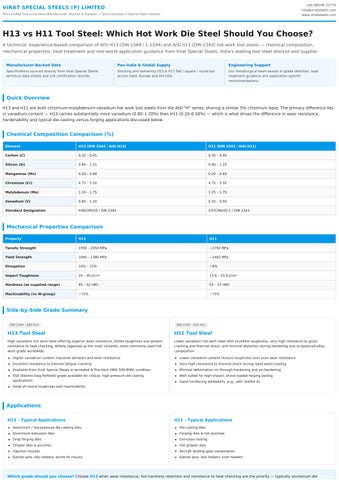
H13 vs H11 Tool Steel: Which Hot Work Die Steel Should You Choose? A technical, experience-based comparison of AISI H13 (DIN 2344 / 1.2344) and AISI H11 (DIN 2343) hot work tool steels — chemical composition, mechanical properties, heat treatment and real-world application guidance from Virat Special Steels, India's leading tool steel stockist and supplier. Manufacturer-Backed Data
Pan-India & Global Supply
Engineering Support
Specifications sourced directly from Virat Special Steels' technical data sheets and mill certification records.
Stocking and delivering H13 & H11 flat / square / round bar across India, Europe and the USA.
Our metallurgical team assists in grade selection, heat treatment guidance and application-specific recommendations.
Quick Overview H13 and H11 are both chromium-molybdenum-vanadium hot work tool steels from the AISI "H" series, sharing a similar 5% chromium base. The primary difference lies in vanadium content — H13 carries substantially more vanadium (0.80–1.20%) than H11 (0.20–0.50%) — which is what drives the difference in wear resistance, hardenability and typical die-casting versus forging applications discussed below.
Chemical Composition Comparison (%) Element
H13 (DIN 2344 / AISI H13)
H11 (DIN 2343 / AISI H11)
Carbon (C)
0.32 – 0.45
0.30 – 0.40
Silicon (Si)
0.80 – 1.25
0.80 – 1.25
Manganese (Mn)
0.20 – 0.60
0.20 – 0.60
Chromium (Cr)
4.75 – 5.50
4.75 – 5.50
Molybdenum (Mo)
1.10 – 1.75
1.25 – 1.75
Vanadium (V)
0.80 – 1.20
0.20 – 0.50
Standard Designation
X40CrMoV5 / DIN 2344
X37CrMoV5-1 / DIN 2343
Mechanical Properties Comparison Property
H13
H11
Tensile Strength
1550 – 2050 MPa
~1792 MPa
Yield Strength
1000 – 1380 MPa
~1482 MPa
Elongation
10% – 15%
~8%
Impact Toughness
20 – 40 J/cm²
13.6 – 33.9 J/cm²
Hardness (as supplied range)
45 – 52 HRC
52 – 57 HRC
Machinability (vs W-group)
~75%
~75%
Side-by-Side Grade Summary DIN 2344 · AISI H13
DIN 2343 · AISI H11
H13 Tool Steel
H11 Tool Steel
High vanadium hot work steel offering superior wear resistance, better toughness and greater resistance to heat checking. Widely regarded as the most versatile, most commonly used hot-
Lower vanadium hot work steel with excellent toughness, very high resistance to gross cracking and thermal shock, and minimal distortion during hardening due to balanced alloy
work grade worldwide.
composition.
Higher vanadium content improves abrasion and wear resistance
Lower vanadium content favours toughness over pure wear resistance
Excellent resistance to thermal fatigue cracking
Very high resistance to thermal shock during rapid water-cooling
Available from Virat Special Steels in annealed & Pre-Hard (460–500 BHN) condition
Minimal deformation on through-hardening and air-hardening
ESR (Electro-Slag Refined) grade available for critical, high-pressure die casting
Well suited for high-impact, shock-loaded forging tooling
applications
Good hardfacing weldability (e.g., with Stellite 6)
Good all-round toughness and machinability
Applications H13 – Typical Applications
H11 – Typical Applications
Aluminium / low-pressure die casting dies
Die casting dies
Aluminium extrusion dies
Forging dies & hot punches
Drop forging dies
Extrusion tooling
Gripper dies & punches
Hot gripper dies
Injection moulds
Aircraft landing gear components
Ejector pins, tool holders, shrink-fit chucks
Ejector pins, tool holders, liner holders
Which grade should you choose? Choose H13 when wear resistance, hot-hardness retention and resistance to heat checking are the priority — typically aluminium die
casting, extrusion dies and high-volume production tooling. Choose H11 when toughness, resistance to gross/thermal-shock cracking and dimensional stability during hardening matter most — typically forging dies, shock-loaded tooling and applications with severe mechanical impact. Our engineers can help confirm the right grade for your specific die design, working temperature and expected tool life.
Heat Treatment Snapshot Process
H13
H11
Annealing
871°C, slow cool 4°C/hr
871°C, slow cool 4°C/hr
Hardening Temp.
1030 – 1060°C, air/oil/salt bath quench
1000 – 1030°C, air/oil/salt bath quench
Hardness After Quench
~55 HRC
~54 HRC
Tempering Range
500 – 650°C (double tempering advised)
500 – 650°C (double tempering advised)
Normalizing
Not recommended
Not recommended (air-hardening grade)
Technical data compiled from Virat Special Steels product specifications: viratsteels.com/h13.html and viratsteels.com/h11.html.
Need Help Choosing Between H13 and H11 for Your Application? Talk to Virat Special Steels' technical team for grade selection, custom sizes (flat / square / round bar), ESR options and bulk stock availability across India, Europe and the USA.
Submit an Enquiry →
Visit Website →
Call: +91-98140 21775 | Email: info@viratsteels.com | www.viratsteels.com/enquiry.php
© Virat Special Steels (P) Limited. This comparison is provided for general technical guidance; always confirm exact chemistry, heat treatment and mechanical properties against the mill test certificate for your specific batch. Visit viratsteels.com for full product range, data sheets and enquiry form.