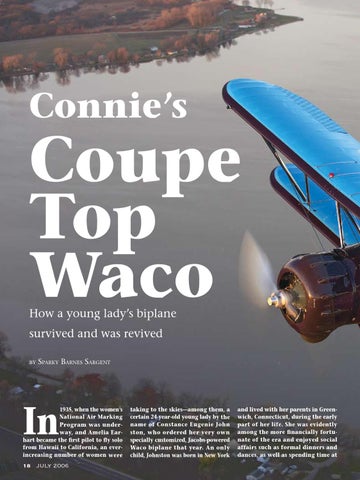
Connie’s
Coupe Top Waco How a young lady’s biplane survived and was revived by
Sparky Barnes Sargent
In
1935, when the women’s National Air Marking Program was underway, and Amelia Earhart became the first pilot to fly solo from Hawaii to California, an everincreasing number of women were
18 JULY 2006
taking to the skies—among them, a certain 24-year-old young lady by the name of Constance Eugenie John ston, who ordered her very own specially customized, Jacobs-powered Waco biplane that year. An only child, Johnston was born in New York
and lived with her parents in Greenwich, Connecticut, during the early part of her life. She was evidently among the more financially fortunate of the era and enjoyed social affairs such as formal dinners and dances, as well as spending time at
the Calhoun Beach Club in Minneapolis, Minnesota. When she took delivery of her Waco in November 1935, her address was listed as Wings Field in Ambler, Pennsylvania. By the following summer, she had changed her address to the prestigious Lafayette Club at Minnetonka Beach.
Yet little else has been discovered about her life, such as when and where she learned to fly; after all, the sporty Waco YPF, with its narrow tread, was not a beginner’s airplane. Waco built only two YPF models in 1935; they were the first of the new advanced “F” models, with an improved Clark Y airfoil, a
more sophisticated and complex fuselage, a new empennage design, a bump cowl, and a coupe top for the pilot. The front cockpit could hold two passengers or simply have a detachable metal cover placed over it. NC15700 is the only YPF still in existence. It measures 22 feet 10 inches from prop to rudder, stands
BR
EE
ZE
W AY /
RA
RE
AI
RC
RA
FT ,L TD
.
VINTAGE AIRPLANE 19
Note the bumps on the cowling, with Connie Johnston’s distinctively designed gold trim. 8 feet 5 inches tall, and has an upper wingspan of 30 feet with a lower wingspan of nearly 27 feet. With its 75 gallons of fuel and the Jacobs’ maximum fuel burn of 15 gph, it has a 575-statute-mile range with a 100-mile reserve. It’s easily capable of cruising 135 mph, with 140 mph indicated not uncommon. It made the 1,275-statute-mile fight from Owatonna, Minnesota, to Lake land, Florida, in only 9.2 hours of flying time. With this kind of performance, it’s easy to see that this Waco was truly the affluent sports-
20 JULY 2006
man pilot’s flying machine in 1935.
Bold Elegance Johnston embodied an assertive flair for bold elegance, as evidenced in her specifications to The Waco Aircraft Co. regarding the finishing touches for NC15700. She selected a deep metallic purple and a bright blue for its flying colors, highlighted by a trio of thin-line gold stripes, in which she cleverly entwined her initials. Her signature trim was designated for the fuselage, cowl bumps, and wheelpants, while shiny chrome
SPARKY BARNES SARGENT BREEZEWAY/RARE AIRCRAFT, LTD.
Owner Jerry Wenger with Ben and Jeremy Redman of Rare Aircraft Co.
struts and stainless flying wires accented the wing and tail structure. Grimes retractable landing light fittings were installed in the upper wings, and Johnston elevated her design a step beyond tradition by specifically requesting that there be no Waco logo on the biplane. “The way she designed the plane, you knew it was going to be neatlooking when it was finished. It’s just all her, and I hope I can find some of her family so they can see the plane and maybe tell me more about her,” said current owner Jerry Wenger of Wyoming, who wanted the biplane restored very close to its original configuration. “I also know that she was married twice. Her first husband, John K. O’Meara, was killed in 1941 at the age of 32 while testing a sailplane for an aircraft company in California. In 1944, she married John E. Beach on a ketch at the Nassau Yacht Club in the Bahamas. She lived the good life.” Johnston flew the biplane for about six months, until one early spring day in April 1936 in Madison, Wisconsin. “She had an incident that you can have when you’re starting a round engine, if you’re not careful,” explained Wenger, “and she got a fire going and apparently there was some damage to the airplane.” That may have discouraged her, because in August 1936, she sold the Waco to William Shaw and Robert Paul of Minneapolis, Minnesota, and they had it flying again in just a few months.
Colorful History NC15700 has been well known in the Waco community for years because of its rarity, and even though its original aircraft logs were lost, some interesting oral history and other aircraft records have been preserved that illuminate the biplane’s colorful life during its 600 hours of flying time. Ben and Jeremy Redman of Rare Aircraft (the folks who restored the plane) shared several noteworthy stories: In the late 1930s, Chuck Doyle Sr. (Minnesota Aviation Hall of Fame) made numerous parachute jumps from
BREEZEWAY/RARE AIRCRAFT, LTD.
the YPF during air shows as owner Bill Shaw flew it. Doyle couldn’t get into the front cockpit with his parachute on, though, so he stood out on the wing walk while the Waco climbed to jump altitude. About three owners later, the Waco was in Miami, Florida, during the early 1940s, where another woman owned it for a few months. Then early aviation pioneer Clyde Ice (South Dakota Aviation Hall of Fame), known for his record of “safe and sane flying,” traveled to Florida in September 1942 and purchased it for use in the World War II Civilian Pilot Training Program (CPTP). As he flew the Waco away from Florida at a low altitude, his attention was suddenly diverted to a German submarine that he saw surfaced in a river inlet. Ice landed at the nearest air base and informed them of the intruder so appropriate action could be taken. Ice continued homeward, flying NC15700 to Spearfish, South Dakota, where he used the Waco as an instrument trainer with the pilot’s coupe top canopy painted black, and the instructor in the front seat. After the CPTP disbanded, Ice sold the biplane in August 1944 to a Beulah, Wyoming, rancher by the name of Spencer Harper. It seems that Harper liked to hunt deer, and one day he landed out in a field with the Waco, shot a deer with a nice rack of antlers, and then loaded it in the front cockpit. When Harper landed back at the local airport, the deer’s head was quite visible to onlookers, who commented that it looked like a deer was flying the biplane from the front cockpit! Harper’s adventures with the Waco continued until one cold wintry day when a large snowdrift piled up in front of the hangar. The rancher decided that instead of shoveling the drift away, he’d just blast through it with the airplane. So he started the Waco and pushed the throttle to the firewall, attempting to make tracks through the snow—but instead the grand
“The way she designed the plane, you knew it was going to be neat-looking when it was finished.” —Jerry Wenger VINTAGE AIRPLANE 21
Note the tapered wing root where it joins the fuselage and the art deco style of the coupe top. old biplane nosed over and flipped on its back. It went back inside the hangar, and Harper stored it until 1974, when he sold it to Jim Horne of Eagan, Minnesota. Horne intended to restore it and carefully kept up with its parts and pieces for 25 years before selling the project to the Waco’s current owner, Jerry Wenger.
Intrigue and Inspiration Wenger has been flying since he was a teenager, when he earned free flying lessons in Cessna 120s and 140s by holding flags up in the fields for crop dusters. Today, he is no stranger to Waco restorations, as his collection spans about a 13-year period of Waco’s early history. “I’m intrigued by a really unique airplane, something that can and should be brought back to life. I appreciate the history of it,” said Wenger enthusiastically, partially explaining his attraction to NC15700 by adding, “I was kind of motivated because my grandfather was a pilot who owned a Waco 10, and he was
22 JULY 2006
BREEZEWAY/RARE AIRCRAFT, LTD.
SPARKY BARNES SARGENT PHOTOS
Connie Johnston selected the bold color combination of Berry Brothers’ Plum Bronze and bright Nassau Blue.
Look closely at the gold trim lines and you’ll notice Connie Johnston’s initials (lying sideways) in the leading portion. my inspiration. And my uncle barnstormed in Wacos from Iowa to Colorado down to Louisiana.”
Rare Aircraft Under the guidance of Wenger, the Rare Aircraft Ltd. restoration team was put to work bringing Connie Johnston’s Waco YPF back to life. “These older airplanes were built at a time where technology was really expensive and labor was cheap. Now the roles are reversed, and technology is cheap but labor is expensive. And these airplanes are still a hand-built, labor-intensive project,” explained 33-year-old Jeremy Redman of Rare Aircraft, who began learning the art of painting in his senior year of high school. His brother, 28-year-old Ben Redman, began welding taper-wing fuselages while still in high school and wholeheartedly agrees. He elabo-
rated with a chuckle, “We sometimes say that we’re John Deere mechanics working on flying tractors, just to remind ourselves how important it is to be able to step back from a project and remember that it’s a 1930s airplane. The airplane is wonderful because it’s simple—that’s its heart, its soul. It’s old and simple, and you can lose touch with that so fast with all the tools we have in the shop.” Rare Aircraft was established in 1991 in Owatonna, Minnesota, by the brothers’ father, Roy Redman. And as their award-winning work is unveiled for the public eye, it’s inter-
Right: These original Hill Aircraft Streamliner wheelpants were an amazing find; they were brand new old stock, still in their wooden packing crate.
SPARKY BARNES SARGENT PHOTOS
The one-of-a-kind 1935 Waco YPF, with its coupe top, was an eye-catcher on the flightline.
VINTAGE AIRPLANE 23
You’ll notice modern avionics in the Waco YPF’s panel—a concession to safe and practical operation of the biplane in today’s airspace. esting to see how this family business embraces the unique challenges— and pleasures—that go beyond the scope of the project at hand. “The biggest pleasure is being able to spend time together, and when you need the help and support, that’s really good. But when you’re that familiar, it can be tough because you might not hold back with family members the way you would with others,” explained Jeremy. The brothers, who exude more than just a youthful enthusiasm for their work, are also quick to recognize another important aspect of their aircraft restorations, by giving credit to
24 JULY 2006
at least half a dozen other full-time employees. “Our restorations are a group effort,” said Ben, “and I can’t state enough how fortunate we are to have the talent that we do have available every day. These people are almost like extended family.” All told, the Rare Aircraft restoration team spent about 9,000 hours during three years to complete the detailed and challenging restoration of NC15700.
Parts and Pieces Often if a nearly 70-year-old aircraft project is uncovered from the dusty corner of an old barn, there are very few of the original airframe com-
SPARKY BARNES SARGENT PHOTOS
The Waco YPF has a narrow tread, making it a bit more challenging to maneuver on the ground.
ponents left intact, creating quite a conundrum for those who want to restore it. “This is the third airplane project I’ve bought out of a barn,” explained Wenger, happily adding, “and it had at least a dozen significant original parts. Now that’s a lot!” Even so, it took a considerable amount of detective work to fabricate and reassemble the biplane. Rare Aircraft was able to obtain some Waco YPF drawings from the Smithsonian, adding to previous owner Jim Horne’s collection of more than a dozen sub-assembly drawings. Existing parts were used for patterns if they were no longer considered to be airworthy. According to Ben and Jeremy Redman, the original parts and pieces included the steel-tubular airframe, boot cowl, oil scoop, air intake scoop, and engine cowl. Additionally, there were many hardware items and fittings for the cockpits, such as the handle for the locking tail wheel, the throttle, foot tread, rudder pedals, and even the knob for the front cockpit door. The original struts showed signs of wear, so they decided to build new ones and had them chromed per Johnston’s original personal specifications. One interesting note is that the landing gear-to-fuselage attachment points—new for Waco on this model—were so well worn that it was necessary to go through the laborious process of fabricating and attaching new ones. While many of the wing fittings survived, the wings themselves served only as patterns, from which the Rare Aircraft team built new wood spars and ribs. Wood fuselage fairings, metal wing fairings, and the fuel and oil tanks were also valuable as patterns for new ones, and a new engine cowl was made by D&D Classic Restorations of Covington, Ohio. The coupe top structure and windshield were remanufactured using some original parts, as well as the factory drawing.
Score! The most significant original item that turned up with the project was encontinued on page 36
Top Waco
continued from page 24
cased innocuously in an old wooden gine and propeller. It was originally tions to it, but in the sunset silhoucrate. Ben Redman shared the discov- equipped with a 225-hp Jacobs L-4 en- ette, it’s still a Waco.” ery in his own words, a touch of awe gine with a fixed-pitch Curtiss Reed still in his voice: “Jeremy and I opened propeller, but today it has a new 275- Keep Her Flying! the box and took the top off—it still hp Jacobs R75-B2 from Radial Engines Now that Johnston’s coupe top had that old-fashioned wood straw Ltd. in Guthrie, Oklahoma, with a Waco has made its public debut at in it—and there were brand-spanking constant-speed Hamilton Standard Sun ’n Fun in Lakeland, Florida, 2006, new, never-been-used aluminum Hill propeller to maximize its power. And where it was awarded Reserve Grand Aircraft Streamliner Champion, what will wheelpants for the be the next leg of its YPF. They hadn’t even journey through time? been cut yet; they were Ben and Jeremy Redblanks! We didn’t even man are happy to be know what to say for a optimistic about the couple of minutes. We answer to that questhought, is this real? tion, since they “get Hill was really the big very attached to these fairing and streamline airplanes we restore, maker of the day, and and the fun thing is, it was just really cool to with Jerr y, we don’t see them. That was the have to worry about biggest score with that what is going to hapairplane. We mounted pen to the airplane. the original identificaWe know it’s going to tion tag on the inside Just imagine being 24 years old and having the privilege of ordering be loved and flown; it’s of the left wheelpant, this biplane brand new from the factory! got a great home. And at the lower edge of he loves sharing them the transition cuff between the gear one glance inside the cockpit reveals with people.” leg and wheelpant, where the owner an abundance of modern avionWenger’s answer corroborates the wanted it.” ics, including a Garmin GPS/comm, brothers’ feelings. “I want my airtransponder, encoder, intercom, and planes to fly,” he said, and expressed Shadin fuel flow monitor. And lying a bit of his own personal philosophy Modifications One of the primary principles that neatly in place atop the new cream- when he added, “I intend to take real Rare Aircraft advocates in its resto- colored leather seats are Hooker five- good care of it and take it to shows. As time goes on, I have to figure out rations is remaining as true to the point harnesses. The airframe is covered in Ceconite where I want my airplanes, and that’s aircraft’s original configuration as possible, while incorporating some 102. The solid primer coat contained not easy to do. I want a big grass field, modern features that facilitate the an ultraviolet blocker so a silver coat where you can pick your own runsafe and practical operation of an air- wasn’t required—nor was sanding, way. And I’d like to have a flying muplane like the 1935 Waco YPF in to- except for the cowling. The PPG color seum with historic gliders, biplanes, day’s general aviation environment, coats were matched to the original and other aircraft, where they will thereby protecting the owner’s in- Berry Brothers’ Bronze Plum and continue to fly. Even though you risk the bright Nassau Blue. “The color is banging them up, they’re still govestment in the project. For example, NC15700 doesn’t the top finish coat—there is no clear ing. Otherwise, no one will rememhave its original Hayes tires and me- coat,” said Jeremy Redman, adding, ber hearing the sound of an old radial chanical brakes. “But boy, do I feel “What you see is what you get out of engine, or seeing and smelling its better with those Cleveland wheels the gun, there’s no buffing or rubbing smoke, and feeling it throbbing in your heart.” and brakes while landing in a cross- to that finish.” Ultimately, and partially in rewind, or taxiing around on a hot It’s just a hunch, but you can bet that day and not having the brakes get sponse to those who are restoration if Johnston were still around, she would purists, Ben Redman declares that be very pleased indeed that her biplane grabby,” explained Ben Redman. There are other modifications “you could paint that airplane any has survived for 71 years and has been for the Waco YPF, including its en- color you want, and make modifica- so elegantly revived.
36 JULY 2006