North Shore Vintage Car Club
Your journal Your stories
Progress:
Your photos Your cars Your stories Your ideas
The monthly journal of the North Shore Vintage Car Club April 2020 Lockdown Edition
1
Your committee
Editorial
Progress
So here we are locked away in our little bubbles, “trying to find lots of things not to do” as the song says. To be serious for a moment I do hope that all our members are keeping safe and isolating as required.
April 2020
Whilst on that point we have around 15 members who do NOT have email and consequently will not receive this magazine. We normally print copies of Progress for distribution to those members. Of course our printers are now shut for the duration. If you happen to live near one of those members then you might consider printing out a copy and popping it in their letter box if you have a few moments to spare. These are trying times for us all, but please spare a thought for Trevor Larsen, a member of our spares shed team, who is one of the Kiwis stranded in Peru at present. Trevor says the conditions are grim and not at all pleasant. Hopefully when life returns to normal we’ll be able to welcome Trevor back into our fold as a valued member of the club. STOP PRESS Trevor is on his way to London Heathrow. I hope that you are all using your spare time well. I have just received a full SU Carb service kit for the MG from the UK and that will keep me busy for a while. It was also my intention to fix a paint patch on the car where water has crept in a seam and bubbled the surface. I had all the Trevor Larsen supplies ready, apart from the top colour, but my plans to go down to Car-Colours for a final match were thwarted by the lockdown. Unfortunately, however, my wife managed to buy 15 litres of decking oil before Mitre 10 shut down ….. Whoopee! All being well I hope to produce some sort of magazine next month but will really need your contributions to build up enough pages. So PLEASE send me Photos, Stories, Ideas in order to keep us all entertained and enlightened. Stay Safe Stuart (battersby56nz@gmail.com)
Chairman’s Message: Kevin Lord.
Can you guess what it is yet? Lockdown/Barnfind Special.
Club Captain’s Report: Richard Lloyd.
Club Run: Posh Picnic: Report and Photos.
Focus on the Marque: Rover Cars
Upcoming Events: There are none. Everything is off.
Workshop Updates: Updates on our project vehicles.
Mech Eng 101: Welding.
Committee Notes: A brief synopsis of last month’s NSVCC committee meeting.
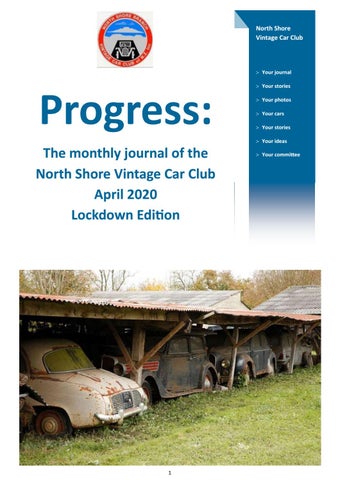
About Us: Who’s who and where’s where. LOCKDOWN ? A topical cover shot this month. Let’s hope that our cars don’t get locked away this long! Stay Safe, look after yourselves, your loved ones and your cars.
2
Chairman’s Report March 2020
Progress April 2020
Kevin Lord
After a brilliant summer of motoring, what a difference a week makes. Last month I was at “Brits on the Beach”, Americana, Concourse at Ellerslie and a motor home trip around Coromandel, Rotorua and Taranaki. Finally, a wonderful day for a posh picnic. Only spoiled by traffic back home, in fact I chose to spend a night at Matakana and come home the next day. Lockdown: All our activities postponed until further notice. Clubrooms, workshop and grounds CLOSED. The committee meeting conducted by e/mail and phone. The magazine and any other notices will be posted this way. Maybe get some resto’s going and keep in touch with fellow members. Look forward to more Happy Motoring when this is all over. Kevin
Posh Picnic: Kevin stops his dog from attacking the sandwiches 3
Lockdown Special: Barn-finds What can you see?
Progress April 2020
4
Club Captain’s Report
Progress April 2020
March 2020
There were several events scheduled to take place during March and some of our members took their cars to the “Brits and Euros” Car Show which was held in Lloyd Elsmore Park, Pakuranga. There were 1,200 cars on display including the club’s Morris 8. One of the highlights of the year is our annual Posh Picnic which was held on Sunday 15th March. We met at the Clubrooms and then followed a scenic route up to Warkworth and from there to Matakana and on to Campbells Beach where we set up our tables and chairs or rugs on the ground for the picnic. 16 cars took part with 36 people. It was a glorious day, no wind and a cloudless sky. The tide was in when we arrived and we were there until the tide went out again. This is a beautiful spot and it didn’t take long for everyone to set up and relax. There were plenty of large trees to sit under, especially pohutukawas which provided plenty of shade. Everyone was dressed up to the nines in their best vintage attire. Vivienne and Brian Guest were the judges and Richard and Angela Bampton’s was chosen “Best Table and Display”. The time flew by and the tide had retreated so it was time to head home again and face the dreaded Hill Street in Warkworth. The traffic was horrendous so we decided to go the long way round through Woodcocks Road and it proved to be a lot quicker than State Highway 1.
Many thanks to Paul for organising the Posh Picnic in such a lovely place and to Vivienne and Brian for judging. Hope everyone is enjoying their enforced “holiday” and avoiding the Covid-19. Keep fit and well and hopefully it won’t be too long before we are all back on the road again.
Richard Lloyd NSVCC Club Captain
5
A Message from The Club President, Diane Quarrie This message was received by our branch on Friday March 20th and so has been overtaken slightly by events. Nonetheless there is plenty within that still remains relevant.
Progress April 2020
Dear Member As you will be aware the COVID-19 crisis has had an impact on almost every aspect of life in New Zealand and the Vintage Car Club is no exception. This unprecedented and previously unimaginable situation is evolving daily, if not hourly. I sent an email out to branches on Tuesday advising that it was important that we took our time to evaluate options and to make the right decisions for our members, rather than knee jerk reactions. You will be aware that the Government has now issued a ban on groups exceeding 100 in number but that may be reduced further going forward. Expert advice is saying that the peak of the pandemic could possibly be as late as August.
Diane Quarrie
The Management Committee of the Vintage Car Club held an emergency meeting last night to discuss the crisis and the effects on upcoming national and branch events. In relation to the Vero International Festival of Historic Motoring, in conjunction with the Festival Director Greg Terrill, we have made the difficult decision to postpone the Festival until early 2022. This decision was not taken lightly. Due to the uncertainty around how long it will take for the pandemic to run its course and the potential of facing a financial loss, if due to lack of entries the event had to be cancelled, it is the right decision to make. The Executive Meeting which was due to be held in Wellington on Saturday 28 March is also cancelled and we have also decided that our National Day Daffodil Rally will also not go ahead for 2020. I also had no option yesterday but to cancel the National North Island Easter Rally and by now all entrants should have been directly contacted by the event organisers. During the next week or so we will be contacting the organisers of national events that are being held later this year and early next year to discuss what options we have in relation to those events. We will keep you posted on that. Because the International Rally will now not be held in 2021 it does give us room to move national events into next year.
Some branches have already made the hard decision to cancel meetings, club nights, branch runs and events and even to postpone annual general meetings. A communication has gone out to all branches today with a strong recommendation that they also review all of their events with a view to cancelling or postponing them, at least until the end of June or until the situation improves. The club website and Facebook page along with branch websites will keep you updated and the next issue of Beaded Wheels will have up-to-date information as of going to print. I hope you understand the reason for these actions. Over half of our members are in the high-risk bracket in terms of this pandemic. The cancellation of events now will mean that we’ve done our very best to keep our members safe.
Best regards and stay safe.
6
Posh Picnic photos: Thanks to Brian and Viv Guest
Progress April 2020
Richard Bampton in his ever reliable ??? …. (Oh I’ve forgotten) parked beside Mike Swanton’s fine 1929 Vauxhall 20/60
The sun beating down on a fine array of parked beauties… And the cars were impressive as well.
Plenty of shade on the edge of the beach
Gilt candlesticks set the tone for the whole luncheon.
7
Upcoming Events: There are none!
Progress April 2020
I’m sure that you are all aware that Covid 19 has affected our life in NZ. At the date of writing we have closed our club and cancelled all club activities. This includes The Northern Raid. A significant number of our members are in the ‘vulnerable’ age group and we cannot risk the health and well-being of our members. We are reviewing the situation regularly and hopefully it won’t be too long before life gets back to normal. I have NOT checked whether there are any external events are still in place, but even if they were we couldn’t in good conscience recommend them to our members at this time. Sorry.
Help required Just a short note from Club Treasurer, Ross Moon. Please help if you can with the following: February Club run: Someone on the club run to Orewa Beach overlooked to pay for part of their meal – (two prawn twisters at a cost of $27.80) Could they please reimburse the club’s account 12-3072-0376473-00. Petty cash: The purpose of the petty cash, administered by John Tombs, is to quickly reimburse members for items required for club projects. Prior to purchase, authorization should be given by the project supervisor. The petty cash is not for ad-hoc items you think the club should have. If you would like further clarification, please give me a call. Thanks. Ross Moon, Treasurer
Regular weekly timetable as below : • •
Every Wednesday Club-Night: coffee, tea and banter. Every Thursday Morning 9am—Noon : Restoration shed, Spares Shed and Library all open. Coffee, tea and cakes at 10.30. Over 40 members now regularly attending ‘smoko’.
8
One second in the life of a Rolls Royce Merlin From High Flight Magazine and written by Tom Fey
Progress April 2020
Thanks to Colin Austen for finding this and yes, I realise this isn’t about cars, but its about petrol engines. Originally written about P51 Mustang racing planes with Rolls Royce Merlin engines, this article analyses what happens in just ONE SECOND of flight time in such and engine. In that one second the V-12 Rolls-Royce Merlin engine would have gone through 60 revolutions, with each of the 48 valves slamming open and closed 30 times. The 24 spark plugs have fired 720 times. Each piston has travelled a total of 60 feet in linear distance at an average speed of 41 miles an hour, with the direction of movement reversing 180 degrees after every 6 inches. Three hundred and sixty power pulses have been transmitted to the crankshaft, making 360 sonic booms as the exhaust gas is expelled from the cylinder with a velocity exceeding the speed of sound. The water pump impeller has spun 90 revolutions, sending 15142cc of coolant surging through the engines and radiators. The oil pumps have forced 1,390 cc of oil through the engine, oil cooler and oil tank, scavenging heat and lubricating the flailing machinery. The supercharger rotor has completed 348 revolutions, its rim spinning at Mach 1, forcing 4.2 pounds or 1557 litres ambient air into the combustion chambers under 3 atmospheres of boost pressure. Around 265cc high-octane aviation fuel,7843 BTU’s worth of energy, has been injected into the carburettor along with 156cc methanol/water anti-detonant injection fluid. Perhaps 3.7cc of engine oil has been either combusted or blown overboard via the crankcase breather tube. Over 1.65 million foot pounds of work has been done, the equivalent of lifting a station wagon to the top of the Statue of Liberty. In that one second, the hard-running Merlin has turned the propeller through 25 complete revolutions, with each of the blade tips having arced through a distance of 270 metres at a rotational velocity of 0.8 Mach. 440cc of spray bar water has been atomised and spread across the face of the radiator to accelerate the transfer of waste heat from the cooling system to the atmosphere. In that one second, the aircraft itself has travelled 214 metres. The pilot’s heart has taken 1.5 beats, pumping 159cc of blood through his body at a peak pressure of an additional 70 pounds/ sq.ft above atmospheric norm . Our pilot happened to breathe-in during our measured second, inhaling approximately 30 cubic inches (0.5 litre) of oxygen from the on-board system, and 2.4 million (yes, million!) new red blood cells have been formed in the pilot’s bone marrow. All in just ONE SECOND of a precision engineered masterpiece! In the Battle of Britain, Spitfires and Hurricanes used Rolls-Royce engines: the Luftwaffe didn’t stand a chance! 9
Posh Picnic: A review and photos by Richard Bampton
Progress April 2020
The day dawned bright and clear – just right for a gentle meander in a 90 year old car to meet with friends and enjoy a picnic. And with 15 cars and around 38 people there were plenty of friend’s company to enjoy. The Mercedes Club was holding a Gymkhana on the Club field. Interestingly, although several Mercedes owners came over to examine our interesting cars, the Posh Picnic folk were less attracted by the Mercs. 3 vintage vehicles turned out and also Philip Stenger’s 1934 Chevrolet 2 seat tourer – the first time I have seen that particular car. Arnold and Marika’s beautiful Packard Victoria also graced us with its presence. Unusually there were 2 Fiats – Jim Masson’s 850 Sport and his friend and new member with another 850. Jim’s little Fiat was dwarfed by the Austin Light 16. Even more unusually there were two De Sotos! Catherine Macken with her 1929 Roadster and Brian Guest with a big blue 1950’s Sedan. The rest were mainly 60’s moderns.
Phil Stenger’s ‘34 Chev
The 3 vintage cars decided to keep an eye on each other and travelled in a loose convoy, to be joined along the way by Philip and we arrived, nearly without incident at the appointed picnic spot. ‘Nearly’ means that the lead car, Richard’s car, went straight on, missing the sign, and down to Baddeley’s Beach. Finding two other cars already there the occupants of the Austin descended, but the rest of their convoy did not appear. The suggestion was made that a sign may have been spotted at the junction, but the site was so perfect with Richard and Angela Bampton on the right, Pohutukawa trees for shade that we all waited a little longer. Still nowith their guests one else arrived. The Austin occupants re-embarked and started up the hill to be met by a small convoy of VCC vehicles. Undaunted, and relieved that others had made the same mistake, the correct turning was located and an even better beach, Campbell Beach, was located, where the majority of the rallyists had already arrived and were tucking into their lunches. Quite a number of excellent tables had been set up at which were seated gentlefolk dressed in the period of their vehicles. Some tables with candles, some with tiered cake stands, some utilising their trunks which doubled as picnic hampers while others were artfully arranged on rugs. Brian and Viv Guest, who had located the stunning site were also the judges and opted for the table with the jellies deeming Richard and Angela Bampton and their guests to be A relaxing afternoon. Sea, Sun, Shade, the winners. The journey back was slowed because of an incident south of Warkworth, but thanks to Catherine Macken who had left ahead of the rest and who telephoned in with the information, many cars drove along Woodcocks to Kaipara Coast Highway – a much more scenic route, and avoided the holdup. A really good day, a fantastic site for the picnic, which we had all to ourselves, the tide was in, and a good number of participants had entered into the spirit of the event by dressing up and arranging beautiful tables. Just what the posh picnic should be. Many thanks to all the organisers. 10
Focus on the Marque: Rover Progress April 2020
Early Years After developing a template for the modern bicycle with its Rover Safety Bicycle of 1885, the company moved into the automotive industry. It started building motorcycles then cars using their Viking Longship badge from 1904. The first Rover was a tricycle manufactured by Starley & Sutton Co. of Coventry, England, in 1883. The company was founded by John Kemp Starley and William Sutton in 1878. Starley had previously worked with his uncle, James Starley (father of the cycle trade), who began by manufacturing sewing machines and switched to bicycles in 1869. In the early 1880s, the cycles available were the relatively dangerous penny-farthings and high-wheel tricycles. J.K. Starley made history in 1885 by producing the Rover Safety bicycle—a rearwheel-drive, chain-driven cycle with two similar-sized wheels, making it more stable than the previous high-wheel designs. Cycling A “Six” Open two-seater 1906 Magazine said the Rover had "set the pattern to the world"; the phrase was used in their advertising for many years. Starley's Rover is usually described by historians as the first recognisably modern bicycle. In 1889, the company became J.K. Starley & Co. Ltd., and in the late 1890s, the Rover Cycle Company Ltd. In 1888, Starley made an electric car, but it never was put into production. Three years after Starley's death in 1901, and H. J. Lawson's subsequent takeover, the Rover company began producing automobiles with the two-seater Rover Eight to the designs of Edmund Lewis, who came from Lawson's Daimler. During the First World War, Rover made motorcycles, lorries to Maudslay designs and not having a suitable one of their own, ambulances to a Sunbeam design.
A “Twelve” Four Seat Open Tourer 1914
Restructure and reorganisation The business was not very successful during the 1920s and did not pay a dividend from 1923 until the mid-1930s. In December 1928 the chairman of Rover advised shareholders that the accumulation of the substantial losses of the 1923–1928 years together with the costs of that year's reorganisation must be recognised by a reduction of 60 per cent in the value of capital of the company. 11
Focus on the Marque: Rover contd.
Progress April 2020
During 1928 Frank Searle was appointed managing director to supervise recovery. Searle was by training a locomotive engineer with motor industry experience at Daimler and, most recently, had been managing director of Imperial Airways. On his recommendation Spencer Wilks was brought in from Hillman as general manager and appointed to the board in 1929. Frank Searle and Spencer Wilks set about reorganising the company and moving it upmarket to cater for people who wanted something "superior" to Fords and Austins (“IMPOSSIBLE� says Richard Bampton). In 1930 Spencer Wilks was joined by his brother, Maurice, who had also been at Hillman as chief engineer. Spencer Wilks was to stay with the company until 1962, and his brother until 1963. After losses in 1929 and 1930 the new assembly operations in Australia and New Zealand were closed.
A Ten 6-Light Saloon 1938
Second World War: Jet Engines and gas turbines
In the late 1930s, in anticipation of the potential hostilities that would become the Second World War, the British government started a rearmament programme, and as part of this, "shadow factories" were built. These were paid for by the government but staffed and run by private companies. Two were run by Rover: one, at Acocks Green, Birmingham, started operation in 1937, and a second, larger Rover w.2B/26 jet engine. Later to become The Rolls Royce Derwent one, at Solihull, started in 1940. Both were employed making aero engines and airframes. The original main works at Helen Street, Coventry, was severely damaged by bombing in 1940 and 1941 and never regained full production. In early 1940, Rover was approached by Frank Whittle to do work for Whittle's company, Power Jets. This led to a proposal in which Rover would put forward ÂŁ50,000 of capital in exchange for shares in Power Jets. Rover contacted the Air Ministry regarding the proposal, which ultimately led to an arrangement between Rover and a former Power Jets contractor to develop and produce Whittle's jet engine. Rover chief engineer Maurice Wilks led the team to develop the engine, improving the performance over the original Whittle design. A need for greater expertise within the project, led to Rover handing over their part in the jet engine project and the Barnoldswick factory to Rolls-Royce in exchange for the latter's Meteor tank engine factory at Ascot Road, Nottingham. In exchange for the jet engine project and its facilities, Rover was given the contract and production equipment to make Meteor tank engines, which continued until 1964. 12
Focus on the Marque: Rover Cont. Progress April 2020
Although Rolls-Royce under were soon to be able to start producing the Whittle-designed W.2B/23 engine (known within Rover as the B.23, later named by Rolls-Royce The Welland), they evaluated the 4 other jet engines and selected the Rover design for their own jet engine development (it became the Rolls-Royce Derwent engine).
In March 1950, Rover showed the JET1 prototype, the first car powered with a gas turbine engine, to the public. In June 1952, JET1 exceeded 150 mph. JET1 is currently on display at the London Science Museum.
The P4
Rover and the BRM Formula One team joined forces to produce the Rover-BRM, a gas turbinepowered sports prototype that entered the 1963 24 hours of Le Mans, driven by Graham Hill and Richie Ginther. It averaged 107.8 mph and had a top speed of 142 mph.
Golden years
The P5
The 1950s and '60s were fruitful years for the company. The Land Rover became a runaway success as well as the P5 and P6 saloons equipped with a 3.5L (215ci) aluminium V8 (the design and tooling of which was purchased from Buick) and pioneering research into gas turbine-fuelled vehicles. As the '60s drew to a close Rover was working on a number of innovative projects. Having purchased the Alvis company in 1965 Rover was working on a V8powered supercar to sell under the Alvis name. The prototype, called the P6BS, was completed and the finalised styling and engineering proposal, the P9, was drawn up. Rover was also working on the P8 project which aimed to replace the existing P5 large saloon with a modern design similar in concept to a scaled-up P6.
The P6
When Leyland Motors joined with British Motor Holdings and Rover and Jaguar became corporate partners these projects were cancelled to prevent internal competition with Jaguar products. The P8 in particular was cancelled in a very late stage of preparation- Rover had already ordered the dies and stamping equipment for making the car's body panels at Pressed Steel when ordered to stop work. 13
Workshop Updates A brief update on all the current workshop projects. Given that the workshop is now shut for at least a a month the project managers have given us a little more detail than usual.
Progress April 2020
The Chevrolet Taxi : Tony Sparkes: Upholstery was being worked on prior to the shutdown. After that, we will touch up the paint and polish it. It should then be ready for Vin. Fire engine: Tony Sparkes: No additional worked planned. For the moment. The Bedford AA Truck: Tony Sparkes: Stuart and Jim Drummond have now repaired all the splits, cracks rust and historical “bodged” repairs in the problem guard. The arch has also been completely re-wired. It is now very solid and needs a little more fettling prior to filling and sanding. Lesson learned however “strip back to bare metal before starting work”. We are going to have to respray some areas of the truck sides as a result of repairs required around the tool cupboard hinges. The Bus: Clive Sandham: Floor lino is laid and the ali trims fitted. Skirting trims all finished and all seats are fitted. There’s still a bit to do namely: wiring, fit rear wheels but need a new tube, touch up paint work around driver’s window, rear step /bumper and finally the tail-lights. The BSA Van: Neil Beckenham: The BSA project was slowly progressing with the rear van body roof support being removed from the old body shell. This part has been reworked to fit onto our new cab roof supports. Once the cab roof supports are in position we can gauge the height of the new van body shell. New lower fire wall - front cowling support blocks have been made and fitted to the cab floor runners. These will attach the steel cowling panels and secure the Apillars. The recently acquired large belt sander/linisher will surely make these intricate blocks more easily and accurate. The fire wall has been stripped and was undergoing cleaning in preparation for the panel repairs. …… Cannot wait to get back to the project! Wolseley: Paul Collins: No report 14
Sherlock Holmes and The Case Of The Corroded Carburettor A short story from the pen of Marsden Robinson
Progress April 2020
with some interesting old carburettors. Never have the astonishing powers of observation and deduction of my colleague and friend Sherlock Holmes been more ably demonstrated than in the Case Of The Corroded Carburettor. According to my archives it was in the spring of ‘90. Holmes and I were ensconced, as was our wont, in our parlour at 221b Baker Street, I buried in the depths of the latest medical journal (my old war-wound was troubling me again, and I was researching Rumble’s Remarkable Rheumatism Remedy) and he scraping away at his Stradivarius violin – unpleasant, but he intended to repolish it, and the old varnish had to be removed first. Suddenly, unexpectedly, there was a peremptory knock at the door, and into our humble chamber strode a man whom I instantly recognised, Mr. C_______ S_________, . . . . . . . . well, perhaps I had better not reveal his name; suffice it to say that it is debatable whether he has gained greater international fame as an Engineer or as a racing-car driver, or indeed as anything at all. Holmes waved our visitor imperiously to a chair, and subjected him to a long and close scrutiny. … “I perceive, Sir,” he observed, “that you are fond of eating Aardvark.” The expression on the face of our guest left no doubt as to the accuracy of my friend’s remark, and I myself, accustomed as I am to demonstrations of Holmes’ genius, was unable to restrain an involuntary ejaculation: “How on earth . . . . . .?” but Holmes interrupted. “Elementary, my dear Watson. You cannot have failed to observe the quite singular scratches on the back of our guest’s right hand, but you have, as usual, due to that Holley Model G obtuseness of intellect about which I have so frequently had cause to complain, failed to draw the obvious conclusions. Note the right-angle pattern: the longitudinal marks are made as the arm is thrust into the animal’s burrow, while the horizontal contusions result from the swift rotations of the wrist which are necessary in order to grasp the creature. Clearly, the owner of a limb which is subjected to such abuse, and whose waistcoat is so liberally stained with onion gravy and Chateau Henderson Plonk ‘88, has an over-whelming penchant for Aard-vark-au-vin. But, I digress. You have come, Sir, to consult my professional advice; pray tell me how I may be of service, omitting no details, no matter how slight, or seemingly insignificant.” Our visitor drew himself up to his full height. The gesture was, in his case, woefully unimpressive, but he was obviously a man who was used to making the most of the little with which nature had endowed him. In preparation, he cleared his throat, and then straightened his neck-tie and adjusted his dress in a single fluid motion which spoke eloquently of years of assiduous practice. He spoke in the arcane argot which is the fashion amongst racing-car drivers. “It’s like this, Mr. Holmes. There I was, out on the circuit in my jolly old racing-car, in the first race of the season, and I just couldn’t get any power out of the old girl. No horses at all under the bonnet. Nearly got seen off Model T Brass and Bronze Carb by a poncy blighter in a turbo Porsche. So I took the carburettor to a boffin fellow who said that it was all rusted up inside. Must have had water in it. Mystery is, I never go near the stuff. Well, except for a drop in me scotch.” Holmes brooded. “These are dark and murky water, Watson. I suspect foul play.” (Holmes has been obsessed, nay paranoid, about foul play since he solved ‘The Case Of The Nobbled Morgan’ – readers may recall it – in which the ostensibly innocent recarpeting of a Morgan sports-car had enabled the surreptitious insertion of an extra layer of felt under the accelerator pedal, preventing full opening of the throttle, and consequently the development of full power.) 15
Sherlock Holmes and The Case Of The Corroded Carburettor A short story from the pen of Marsden Robinson (Continued)
Progress April 2020
However, our client was able to assure us that his racing-car was uncarpeted, and Holmes, abandoning his customary lethargy, sprang into action. “There’s nothing else for it, Watson, we must visit the scene of the crime.” Thus it was, dear readers, that the following Sunday saw us at the famous International racing-car circuit at Pukekohe. Shall I ever forget the spectacle? The sights: shining classic cars and greasy-fingered mechanics. The sounds: revving engines and tortured tyres. The smells: racing fuel and barbecued sausages.
!950s Solex Stripped
And the scintillating conversations of the glamorous drivers. I jotted down a few in my pocket-book: “You cross-eyed twit! Call yourself a scrutineer? Don’t you know that all genuine RSRs have half a turn of free play in the steering? That’s how Dr. Ing. Ferdinand Porsche told God to make them.” . . . . . . “Wait ‘til I get my hands on the bloody mechanic! ‘Rev. it to nine-five’ he said. I’m going to ram the ends of that con-rod in both his ears at once!” . . . . . .. . “Listen, mate, when I fit that new camshaft I’m going to pass you twice every time you go down the back straight” . . . . . . “Cor, just look at that chassis; if I could take that away for a weekend I’d have a damn good try at setting a new world record.”
Meanwhile, Sherlock Holmes was busily absorbed in his task. Scurrying about, his magnifying glass glued to his eye (uncomfortable, one would be disposed to imagine, but he prefers to work that way), he seemed to be oblivious to everything happening about him, from a passing thunderstorm to a 944 set alight by sparks from his meerschaum pipe. As the day drew to a close I confessed myself to be as mystified as ever, but Holmes wore that sickeningly smug look of self-satisfaction which betokened that he had solved the case. “Elementary, my dear Watson.” he said, yet again, in that insufferably conceited manner that has got him so deservedly disliked in many circles, some of them concentric. “Our client keeps his racing fuel in a 20-litre can with plastic inserts in the top. When it rained, water collected on the drum. As evening drew nigh the ambient temperature dropped, cooling the contents, and thus shrinking them, causing the said water to be drawn into the container. No doubt this happened last racing season. When the fuel tank of the racing-car was replenished, moisture passed into it, from whence it was pumped into the carburettor, where, having a higher specific gravity than racing-fuel, it lay at the bottom of the float-chamber all winter, corroding the instrument.” “Brilliant!” I cried, but our companion was aghast. “Does this mean that I will have to give up motor-racing?” he gasped. “Not at all, my dear fellow,” Holmes reassured him, “the matter is susceptible of a ready solution. Purloin the plastic bags in which your wife brings home the shopping from the Supermarket. They are exactly the right size to draw over 20litre fuel cans, precluding the admission of unwanted moisture, dust, dirt and debris.” Our client wrung Holmes’ hand in gratitude, but Holmes was already at work solving his next problem: “Now, where the devil did I put my pipe when that Porsche exploded?” A pair of fully restored, twin H2 SU Carbs mounted on a 50s Aquaplane manifold 16
Progress April 2020
Another set of great shots from Terry Costello
Jim Woonton and friends
David Lane looking “dapper” at Art Deco
Arnold Van Zon’s amazing Packard
LEFT: “Fashion Victim”. Come-on! Own up! Whoever wore these shoes at The Posh Picnic, needs to explain themselves for this afront to fashion and good-taste. ;-)
RIGHT: Tony Sparkes at Art Deco in Napier this year, proving that it is possible to get a quart into a pint pot
17
Art-Deco Napier
Progress April 2020
Excellent Photos from Jacqui Medelin and Terry Costello. Sorry I don’t have room to publish more
A car is only original once Two old red cars (Quote by my Granddaughter)
“And this one has doors. Here’s how they work”
Chilly Morning
Terry and Joss Costello
No David (Lane) You can’t just leave it like that! 18
Mech Eng 101 Welding History, Methods and usage
Progress April 2020
Welding is the joining of two pieces of similar material by melting the edges and allowing the material from both pieces to mix, effectively making one single item. This method is significantly different to gluing or brazing where a 2nd substance is introduced to the join and ’stick’ the pieces together. There are many, many different methods of welding but in this introductory article we’ll just look at a few of the most common methods that we are likely to come across in vehicle restoration work. The history of joining metals goes back several millennia. The earliest examples come from the Bronze and Iron Ages in Europe and the Middle East. Welding was used in the construction of the Iron pillar of Delhi, erected in Delhi, India about 310 AD and weighing 5.4 metric tons. Forge Welding The earliest welding experimenters knew that it was possible to heat metal to melting point. The challenge for early metal-workers was how to create a welded join without reducing the two parts to be joined into a molten puddle. They discovered that by heating two pieces of metal to a lemon-yellow colour and then hammering them together the two surfaces to be joined would coalesce and become one. Forge welding becomes impractical as the size of the pieces to be joined increases. If you get a chance to visit a museum and look carefully at the blades of ancient swords (especially Japanese weapons) you’ll be able to see the various layers of metals forged together to strengthen the blade.
Forge welded Viking sword. Note the process added visual decoration as well as strengthening to the weapon.
Gas Welding The next logical step from forge welding was a means to apply heat very precisely so as to just heat up the edges of the two pieces to be joined and thus allow the edges to melt together. The basic process of gas welding is to create a small pool of molten metal and then slowly move that pool along the edges of the pieces to be joined and leaving a single joined piece of metal behind. The most common gas welding set-up involves two pressurised gas tanks , one Acetylene and one Oxygen. This is the set-up that we have at the club. Gas welding is a very versatile and comparatively simple method. 19
Mech Eng 101 Welding History, Methods and usage (continued)
Progress April 2020
The main downside of gas welding when working on thin sheet metal is distortion caused by heat expansion. When heated, metal (like most things) expands but without additional processing it does not shrink back to the same size as before. With perfectly prepared and tight-fitting pieces it is possible to weld (by melting both edges) two pieces together without any additional metal. Typically however a filler rod is required to add extra metal to fill the small gaps between surfaces to be joined. Arc Welding Arc-Welding is similar to gas welding but uses the power on an electrical arc to melt the metal rather than the heat of a flame. Arc welding, or at least in a basic form has been around for a long time. In 1802, Russian scientist Vasily Petrov created the continuous electric arc. In a subsequent scientific paper Petrov described the possible use for many applications, one being melting metals. One of the most common types of arc welding is which is also known as manual metal arc welding or stick welding. An electric current is used to strike an arc between the base material and a consumable electrode rod or stick. The electrode rod is made of a material that is compatible with the base material being welded and is covered with a flux that gives off vapours that serve as a shielding gas and provide a layer of slag, both of which protect the weld area from atmospheric contamination. The electrode core itself acts as filler material, making a separate filler unnecessary. Resistance Welding We all know that when we pass a current through metal the metal gets hot (as in an incandescent lamp). We also know that when the metal gets too hot it melts (as it in an old style electrical fuse). The most common application of resistance welding (in car manufacture and restoration) is Spot Welding. Resistance welding is the joining of metals by applying pressure and passing current for a length of time through the metal area which is to be joined. The key advantage of resistance welding is that no other materials are needed to create the bond, which makes this process extremely cost effective. 20
Mech Eng 101 Welding History, Methods and usage (continued)
Progress April 2020
We have a couple of spot welding machines in the club. They are big heavy machines that look a little like a giant metal crab claw. Spot welding is a very simple and fast method of fixing repair patches in place. The main downside with this and any other method of overlapping (as opposed to edge to edge welding) is the exposed gap and surfaces between the two layers. This gap allows moisture and thus rust to appear between the layers. It’s not really a method to be used in car restoration if possible. MiG Welding MIG welding is an ‘arc welding process’ in which a continuous solid wire electrode is fed through a welding gun and into the weld pool, joining the two base materials together. A shielding gas is also sent through the welding gun and protects the weld pool from contamination. In fact, MIG stands for metal inert gas. The technical name for it is gas metal arc welding (or GMAW). There is a variant of MiG welding that is especially suitable for outdoor work where wind may dissipate the shielding gas resulting in a messy weld. Gasless MiG Welding uses a cored wire that contains a flux that prevents oxidisation when the arc is formed. The club has a ancient MiG welding unit that support both Gasless and regular MiG welding. A correctly adjusted MiG welder with its concentrated heat pattern causes less distortion in thin sheet materials than traditional Oxy-Acetylene welding.
The business end of a MiG Welding gun. Note the welding wire emerging from the gun and the shroud to carry the shielding gas to the workpiece. 21
Mech Eng 101 Welding History, Methods and usage (continued)
Progress April 2020
TiG Welding TIG stands for Tungsten Inert Gas and is technically called gas tungsten arc welding (GTAW). The process uses a non-consumable tungsten electrode that delivers the current to the welding arc. The tungsten and weld puddle are protected and cooled with an inert gas, typically argon. TIG welding is similar to oxy-acetylene welding in that you use a filler material for build-up or reinforcement. If you have ever welded with an oxy-acetylene torch, you can easily weld with a TIG machine. The TIG process uses an electric torch, and the welder hand feeds filler rod into the molten puddle. Most TiG welding units offer the ability to soft start and soft stop the heat. This makes the TIG process different from other types of electric welding. Some people like the accelerator pedal to control the heat if they are working on a bench and others like fingertip remotes on the torch if they are working in areas that are considered out of position. The remote adjusts the heat while you are welding. Those of you that watch car restoration programmes, especially the professional hot-rod shows like Kindig Customs will see their craftsmen using a MiG Welder to ‘spot’ repair panels in place and then TiG to complete the weld seam and create an ‘invisible seam’.
The photographer gets snapped! Terry Costello using the Oxy-Acetylene kit on the Bedford truck guard.
22
Progress April 2020
Committee Notes: 30 March 2020
New Members: Nil Keith Steel has transferred to the Taranaki Branch The Monthly Committee meeting was held on 30 March 2020 but was held electronically: New Shed:
The electrical work has been completed for the new shed.
Club Activities:
All Club activities have been postponed until further notice, including the AGM. At this stage it is proposed that the Companies Office will be advised of the postponement and that the AGM will be held as soon as practicable. In the interim the existing committee will remain in office.
Aerial view of Brits and Euros Show. This photo shows about 30% of the vehicles on display. There were equal numbers behind and to the right of the camera. Our 3mx3m gazebo looks tiny from this distance. 23
Progress Dec– Jan 2019/20
About Us
Club Address: 40 Masons Rd, Albany, 0632 Phone: 09-4792779: email: northshorevcc@gmail.com Website: www.vintagecarclub-northshore.co.nz Club Nights: Every Wednesday from 7.30pm Restoration Shed: Every Tuesday & Thursday morning 9am - 12pm Committee Meetings: Last Monday of the month, 7.30pm Club Runs: Normally 12.30-1pm start, 3rd Sun. of month. Always check the ‘Upcoming events’ VERO Branch Reference Number: HO0300144 (Quoting this number when renewing your insurance gives a small commission back to the club)
Main Committee Chairman: Kevin Lord 09-413-9157 or 027-235-0142 Vice Chairman: John Higham 09-478-7973 Immediate Past Chairman: Paul Collins 09-422-0500 or 027-292-2204 Secretary: Maurice Whitham 09-627-0310 or 027-296-9293 Treasurer: Ross Moon 09-426-1508 Club Captain: Richard Lloyd 09-420-5048 or 027-483-2898 Assistant Club Captain: Neil Beckenham 09-426-5831 or 021-588-536 GENERAL COMMITTEE Members: John Tombs 09-478-5677 or 027-378-5590 Clive Sandham 09-486-6047 or 021-903-548 Tony Sparkes 09-473-5828 or 027-499-5588 Michael Dorbeck 09 415 8339 or 021 998 755 Magazine Editor: Stuart Battersby: Tel: 022 471 2759: Email battersby56nz@gmail.com THE INFORMATION IN THIS MAGAZINE IS SUPPLIED AS A SERVICE TO MEMBERS. ARTICLES OF INTEREST ARE ALWAYS WELCOMED. THE OPINIONS EXPRESSED IN THIS MAGAZINE OF THOSE OF THE AUTHORS AND THE CLUB ACCEPTS NO RESPONSIBILITY FOR THE ACCURACY OF ANY ARTICLES OR STATEMENTS HEREIN. All rights reserved. No part of this magazine may be reproduced in any form or by any means, electronic or mechanical without permission in writing from the copyright holder
24