North Shore Vintage Car Club
Your journal
Progress: The monthly journal of the North Shore Vintage Car Club October 2019
1
Your stories Your photos Your cars Your stories Your ideas Your committee
Editorial
Progress
It’s allegedly Spring, but it doesn’t yet feel like it! Having said that I don’t really mind the bad weather at present as I’ve a lot of maintenance and replacement tasks to complete on the MG. In the “Done” side of the list I have fitted my new Mota-Lita steering wheel (and collapsed my collapsible column in the process). I have also fitted LED Dash Lamps, replaced the Track Rod Ends, fitted new “comfort” Polybushes to the front suspension and fixed an overdrive box leak with some new gaskets and O-Rings. I’ve still got to replace all the rear end bushes and pads and then fit new front brake discs and pads before the current work sheet is complete. I’m doing all this work in preparation for my own personal North Island tour when I intend to catch up with friends in Taupo, Napier, Palmerston and Paraparaumu. I do enjoy driving the MG so what better excuse!
October 2019
I must take this opportunity to thank my growing team of regular correspondents and photographers. Articles from Mike Swanton, Bruce Skinner and photos from Terry Costello have been excellent. Should any of you have problems sending photographs, then Terry has kindly offered to travel, photograph and email photos of your car/project.
I’ve managed to get to the bottom of the Branch Library rumour and YES we do have a very well maintained library containing all manner of interesting books and magazines. We have shelves of Autocar and Motor going back to the 40s. Kevin Benseman is at the club every Thursday morning in the Library (door on your right as you enter the clubhouse and walk towards the bar). All members are invited to pop in, have a chat and borrow books, magazines and articles. Stuart Battersby: battersby56@sky.com
Chairman’s Message: Kevin Lord.
Santa needs a ride! Have you got an open 4-seater for a Christmas Parade?
Can you guess what it is yet? Complete mix this time.
Club Captain’s Report: Richard Lloyd.
Focus on the Marque: Next stop Spain...or is that Switzerland?
Upcoming Events: Club runs and independent events.
Workshop Updates: Updates on our project vehicles.
Oily Rag Restorations: Good or bad??
Mech. Eng. 101: “On the rebound!” Shock Absorbers.
Committee Notes: A brief synopsis of last month’s NSVCC Committee
About Us: Who’s who and where’s where.
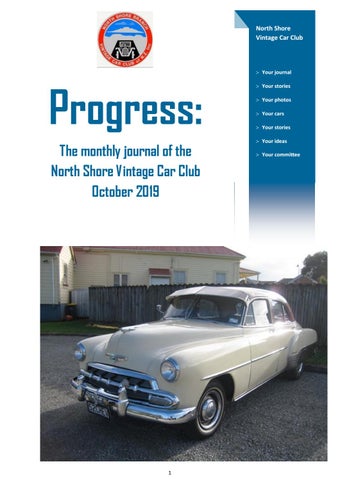
Cover Photo - Jim Drummond’s glorious, nay imperious, 52 Chevrolet Styleline De-Luxe Submit your photos to battersby56@sky.com
2
Chairman’s Report
Progress October 2019
Kevin Lord
The sun is shining today Sunday. Let’s hope it’s the end of the cold wet weather. Paul Collin’s Spring Splendour is about to start with his Nationwide Tour. Good luck all entrants and a big thanks to Paul for the huge effort he has put into this event. The new shed is now complete, just waiting for compliance. We are going to put a sealer on the floor before we commence to use. A big thankyou to all who have been painting and restoring the exterior of the club rooms, working through wet and cold weather to complete the task. Work on the B.S.A. van is progressing nicely with some wooden framing being done, following the original pattern. Jim and Bruce removed the head of the Chev Fire Engine and found a badly burnt valve, now being replaced. Morris 8. Kelvin and crew have nearly completed brake restoration and it will soon be road worthy again. From the Chairman’s Garage. Marlene’s M.G. got a bit nearer completion with the steering column correctly installed and seats and carpet replaced. This work was done while the Thunderbird was away for VIN inspection: it is now registered and vinned and ready for more restoration. I tackled what I thought was a small job replacing the soft top which, as usual, required additional work for this to go ahead: eg. Replacing tack strips, missing and broken bolts and screws etc. Which is to be expected on a car this age .. A True Rag Top. Happy Motoring.
Kevin
Literally a Rag-Top T-Bird
3
Santa needs a ride!
Progress October 2019
(and Summerset Homes want cars) Auckland Council are looking for a car or cars to help their Christmas events
Referring to our phone conversation, I am looking for a vintage vehicle for my Christmas events to drive Santa and Ms Claus (2 people) to the event site creating a classy and exciting entrance for the kids in the audience. Please see more details below. Events • Onehunga Christmas Lights at Jellicoe Park, Onehunga – Friday, 29th November 2019 at 7pm-8pm • Carols on the Green at Vellenoweth Green, St Heliers – Sunday, 1st December 2019 at 5pm-6pm • Puketapapa Christmas Event at Three Kings Reserve, Three Kings – Saturday, 7th December 2019 at 6pm-7pm • Carols at Potters Park at Potters Park, Balmoral – Sunday, 8th December 2019 at 5pm-6pm • Henderson Christmas Festival at Henderson Park, Henderson – Sunday, 15th December 2019 at 12pm-1pm Activity • Pickup Santa Claus and Ms Claus (2 people) near the event location • Drive Santa Claus and Ms Claus to the event site and drop them off near the stage • Staying for a short time (20-30 mins) for photo opportunity for kids Vintage car white or red • Cabrio (no top) is preferable • 4 seater – driver (owner) plus 2 seats for Santa Claus and Ms Claus • No presents Payment: As mentioned on the phone, we could pay a rental fee to a registered organisation based on presenting an invoice. We are not in the position to pay cash or koha. Angela Radosits | Event Organiser Arts, Community and Events
Angela.Radosits@aucklandcouncil.govt.nz Ph: 09 890 2332 | Extn (46) 2332 Mb: 021 827 326 Auckland Council Level 6 South, Bledisloe Building, 24 Wellesley Street, Auckland
In a second request Summerset Homes would like some cars to support the opening of Clark Cottage. Carol Andrews writes:
Hi, I am writing on the small hope that some of your members (and their cars) may like to come to our opening of Clark Cottage. This is the extract from our invite explaining the opening: “We’re very excited to invite you to the opening of the historic Clark Cottage at Summerset at Monterey Park.
Clark Cottage is an ornate early 1900s Italianate villa which has been carefully restored to its former glory by Summerset. To celebrate we’re hosting a garden party, with a delicious afternoon tea, a brass band providing top tunes and the opportunity to see Clark Cottage in all its glory. This is being held on Friday 4th October 12-2pm and it would be great to have some vintage cars of the period – if you guys were free. Carol Andrews Village Manager Summerset at Monterey Park - Hobsonville Tel: 09 951 8821 or 027 205 0193: email: carol.andrews@summerset.co.nz
So if you want to help out then please get directly in touch with Angela or Carol ASAP….
NOTE the Summerset event is Friday 4th October, so get your skates on!! NB. You are personally responsible and liable for any losses or claims at these events. Publication in this magazine is NOT a club endorsement of these events. 4
Can you guess what it is yet?
Progress October 2019
5
Club Captain’s Report
Progress October 2019
September 2019
We are well into Spring now so everyone should be taking advantage of the warmer weather and daylight hours. Having said that, it has been very wet throughout September so most members have tended to stay indoors, however plans are now afoot to get those rallies going again. Work on the club’s Morris 8 has continued and the brakes have been sorted by Kelvin Hawke. Now that the Morris has good brakes again, we should see it back on the road once more. Our fire engine has undergone major surgery with the head off and the valves next in line for a close inspection. Work will start shortly on the Wolseley. With expert attention, this car shouldn’t take too long to restore. The team of the BSA Van is progressing well and the parts are fairly easy to find so restoration should not take too long. This coming weekend (28/29 September)will see the start of the Spring Tour in Mangere, South Auckland and those touring North Cape to Bluff will join with us in Mangere to carry on their tour to Bluff. Those of us doing the club run will complete our tour in Tokoroa. Happy motoring everyone. Richard Lloyd, NSVCC Club Captain
Terry Costello lends a hand repairing the badly corroded Bedford right-hand guard
6
Oily Rag Restoration
Progress October 2019
1937 Vauxhall 14 DX
I’m not sure if you’ve picked up on the latest fad of “The oily rag restoration”. The philosophy here is that an old car should look like “an old car” and not one that has just come off the production line and is probably better now than the original car ever was. An oily rag restoration preserves the ‘patina’ and character of the car. I think the trend, perhaps, comes from the Antiques furniture world where a ‘restored’ item is almost ridiculed. Anyway Mike Swanton has sent us this interesting article of his oily rag restoration of his 1937 DX Vauxhall 14
In 2013 I found a great old 1937 DX Vauxhall 14 body shell that was just too good to ignore. Her doors all opened and closed properly which for a wooden bodied car is remarkable. I transported her home and put her aside whilst I decided what best to do with her. She was missing all her engine components and her front seat. Her floor was rotten but otherwise she was just great. I say that because the old darling sported 2 generations of old style registration stickers, an old generation of warrant of fitness sticker plus her 1979 Carless Day sticker proclaiming that she is not to be on the road on Tuesdays!
1937 DX Vauxhall 14
On her rear there is a clunky great towbar plus her original bayonet fitting light socket installed by the tail light to plug in her trailer light! She is still in her completely original paint, what's left of it, and has her original floor and ceiling linings plus door cards, what's left of them! She has all her original badges, including her original delivery Tappendens dealer plate positioned just under the mirror.
Original Interior in remarkable condition
7
Oily Rag Restoration
Progress October 2019
(Continued)
This old girl was too good to be stripped for parts and she didn’t have much of her mechanical parts anyway. Now I just happened to have a spare seat for her although I didn’t realise that at first, and I also had a surplus, restored, 1937 DX engine. So I looked out all the 1937 engine components and the missing body parts which I had acquired over the years, made up the ply floor, and rebuilt her as original. I’m not sure how she'll cope with the disintegrating window rubbers but that's just as she was so I have no plans to fill the gaps! I'm amazed at the original gear box. I've never driven a DX with such a perfect gearbox.
Dash, Wood Trim and seats look wonderful
The interest she created when I turned up at VTNZ to get her vinned was amazing. They work everyday on luxury imported cars or newer restorations, but to see an 80 year old car turn up in original condition was out of the box. I was there for some time explaining what I had done and they were really into her. They ended up spending all day on her but couldn’t find fault with anything which was also amazing.
The transplanted engine
So I stuck the warrant of fitness that they issued on the windscreen plus the new registration sticker and proudly drove her home. It was very noticeable how the motorway traffic held back and gave me lots of room when I pulled out into the fast lane! Now I have a road legal, “Oily Rag” Vauxhall 14 that is lots of fun. (Ed: I asked Mike if the DX designation was short for De-Luxe? It’s NOT. But that’s another story) 8
Workshop Updates A brief update on all the current workshop projects. Achievements last month and plans for coming months.
Progress October 2019
The Chev : Tony Sparkes: Progress is being made. The temperature gauge problem has now been solved and is waiting to be fitted. It has a new steering box as the old one had a skink living in it! It needs a couple more pieces for sound deadening fitted to the floor then Jim (upholstery) can work his magic on the interior.. The Bedford AA Truck: Tony Sparkes: All of the necessary welding has been done to the wheel arches. So they should be finished soon. When fitted, the running boards can be made to measure. We have a couple of lovely pieces of Kauri for those, kindly donated by Paul Collins The Bus: Clive Sandham: No update this month The BSA Van: Neil Beckenham: Neil sends his apologies, working on the BSA, viewing potential club purchases at the Bunce’s closing down auction and getting ready for the Spring Tour have taken their toll. Why not just come along one Thursday and check out the huge progress being made with your own eyes. The Lanchester: In storage in the garage. The Wolseley: Paul Collins: Now in the restoration shed, but nearly all the team are busy on other projects at present.
We have a poorly Fire Truck. Looks like a burnt out valve, but Jim’ll fix it! 9
Focus on the Marque Hispano Suiza … (leading to SEAT)
Progress October 2019
Early years In 1898 a Spanish artillery captain, Emilio de la Cuadra, started electric automobile production in Barcelona under the name of La Cuadra. In Paris, De la Cuadra met the Swiss engineer Marc Birkigt and hired him to work for the company in Spain. La Cuadra built their first petrol-powered engines from a Birkigt design. At some point in 1902, the ownership changed hands to José María Castro Fernández and became Fábrica Hispano-Suiza de Automóviles (Spanish -Swiss Automobile Factory) but this company went bankrupt in December 1903. Yet another restructuring took place in 1904, creating La Hispano-Suiza Fábrica de Automóviles, under Castro's direction, also based in Barcelona. Four new engines were introduced in the next year and a half; a 3.8-litre and 7.41912 Hispano-Suiza Alfonso litre four-cylinder and a pair of big six-cylinder engines were produced. This company managed to avoid bankruptcy and its largest operations remained in Barcelona until 1946, where cars, trucks, buses, aero engines and weapons were produced. Other factories in Spain were at Ripoll, Seville, and Guadalajara.
World War I With the start of World War I, Hispano-Suiza turned to the design and production of aircraft engines under the direction of Marc Birkigt. His chief engineer during this period was another Swiss, Louis Massuger. Traditionally, aircraft engines were manufactured by machining separate steel cylinders and then bolting these assemblies directly to the crankcase. Birkigt's novel solution called for the engine block to be formed from a single piece of cast aluminium, and into which thin steel liners were secured. Manufacturing an engine in this way simplified construction and resulted in a lighter, yet stronger more durable engine. Thus, Birkigt's new construction method created the first practical, and what are commonly known today as, "cast block" engines. His aluminium cast block V-8 design was also noteworthy for incorporating overhead camshafts, propeller reduction gearing and other desirable features that would not appear together on competitor's engines until the late 1920s. Hispano-Suiza HS.8A SOHC aviation engine from World War I Another major design feature, for the later HS.8B line was the use of a hollow propeller shaft for both the 8B and 8C gear-reduction versions, which when used for the HS.8C versions specifically engineered to accommodate one, to allow heavy calibre (usually 37 mm) projectile firing through the hollow propeller shaft, avoiding the need for a synchronization gear, a feature used in future Hispano-Suiza military engines. Hispano-Suiza's aero engines, produced at its own factories and under license, became the most commonly used aero engines in the French and British air forces, powering over half the alliance's fighter aircraft.
10
Progress October 2019
Focus on the Marque (cont.)
1918–1936 After World War I, Hispano-Suiza returned to automobile manufacturing and in 1919 they introduced the Hispano-Suiza H6. The H6 featured an inline 6-cylinder overhead camshaft engine based on the features of its V8 aluminium World War I aircraft engines with coachwork supplied by well known coachbuilders like Hibbard & Darrin and D'Ieteren.
Licences for Hispano-Suiza patents were much in demand from prestige car manufacturers world-wide. Rolls-Royce used a number of Hispano-Suiza patents. For instance, for many years Rolls Royce installed Hispano-Suiza designed power brakes in its vehicles. In 1923 the French arm of Hispano-Suiza was incorporated as the Société Française Hispano-Suiza, the Spanish parent company retaining control with 71% of the share capital. The French subsidiary was 1934 Hispano-Suiza H6B Million-Guiet Dual-Cowl Phæton (France) granted a large degree of financial and project independence to bring design and production direction into closer contact with its main markets but overall direction remained at Barcelona. This arrangement increased the importance of the Bois-Colombes plant near Paris as Hispano-Suiza's premier luxury car plant, and while the Spanish operations continued to produce luxury cars, mostly the smaller, less expensive models, production in Spain moved increasingly to the production of buses, trucks, and aircraft engines at several plants located around the country. Through the 1920s and into the 1930s, Hispano-Suiza built a series of luxury cars with overhead camshaft engines of increasing performance. On the other hand, in the 1930s, Hispano-Suiza's V-12 car engines reverted to pushrod valve actuation to reduce engine noise. During this time, the company released the 37.2HP H6B Hispano-Suiza car built at the Bois-Colombes works. The mascot statuette atop the radiator after World War I was the stork, the symbol of the French province of Alsace, taken from the squadron emblem painted on the side of a Hispano-Suiza powered fighter aircraft that had been flown by the World War I French ace Georges Guynemer.
1929 Hispano-Suiza T49 (Spain)
In 1925, Carlos Ballester obtained permission to represent Hispano-Suiza in Argentina. The agreement consisted of a phase in which the chassis were imported, followed by complete domestic production in Argentina. Thus Hispano Argentina Fábrica de Automóviles (HAFDASA) was born, for the production of Hispano-Suiza motors and automobiles, and also the production of spare parts for other car, truck, and bus manufacturers.
11
Focus on the Marque (cont.) Progress October 2019
Spanish Civil War and WWII After the outbreak of the Spanish Civil War in 1936, the regional government of Catalonia, on behalf of the Second Spanish Republic, centralised control of Hispano-Suiza's Spanish factories and placed the company on a war footing. The company was divided into three divisions:
•
aircraft engines and cannons
•
cars and trucks
•
machine tools
Because of the international isolation of the Spanish republic, the Spanish arm of the company suffered from shortages. In 1937, the French government took control of the French subsidiary of Hispano-Suiza with a 51 per cent share of the capital for the provision of war materiel, renaming the company La Société d’exploitation des matériels Hispano-Suiza. In 1938, the French company ceased automobile production and 1936 Hispano-Suiza Pourtout (France) concentrated on aircraft engine production. At the time, HispanoSuiza had just introduced a new series of water-cooled V-12 engines and the Hispano-Suiza 12Y was in great demand for practically every type of French aircraft. However, without the Spanish factories, Hispano-Suiza lacked the capacity to deliver enough engines for the rapidly growing French air force, and many new French fighter aircraft remained grounded for the lack of an engine when World War II began. In 1940, Hispano-Suiza, together with the Spanish bank Banco Urquijo and a group of Spanish industrial companies, founded the 'Sociedad Ibérica de Automóviles de Turismo' (S.I.A.T.). This led to Spain's first mass-production car maker, SEAT. After the civil war, Hispano-Suiza in Spain was severely affected by the devastated economy and the trade embargoes imposed by the allies. In 1946, Hispano-Suiza sold off its Spanish automotive assets to ENASA, the maker of Pegaso trucks.
1950s–Today After the Second World War, the French arm of Hispano-Suiza continued primarily as an aerospace firm. Between 1945 and 1955, it was building the Rolls-Royce Nene under licence, designing landing gear in 1950 and Martin-Baker ejection seats in 1955. The company's attention turned increasingly to turbine manufacturing and, in 1968, it was taken over and became a division of SNECMA. In 1999, Hispano-Suiza moved its turbine operations to a new factory in Bezons, outside Paris, using the original factories for power transmissions and accessory systems for jet engines. In 2005, SNECMA merged with SAGEM to form SAFRAN. The brand saw an attempt at a revival in the automotive sector with the showing of a model at the 2010 Geneva Motor Show. However the planned production never materialised. 12
Upcoming Events: Progress October 2019
October: October 9: Auckland VCC Midweek Run: (Note, a week earlier than usual so as to include the school holidays.) Starts from The Warehouse car-park at Westgate. 10-00 am for a 10-30 am departure. We will finish at the Parakai Domain Hot Springs. BYO or café. October 20: Run to Puhoi Cheese Factory and Restaurant for Lunch: Meet at clubhouse at 11.15 for 11.30 departure. A straightforward route will be available. Note the venue will NOT allow us to book tables, however there is a large covered deck and if the weather is kind plenty of BBQ Bench tables on their terraces. October 27: Caffeine and Classics: Smales Farm: 9-12.
November: TBA November 17: Club run, details to be confirmed. Potentially a very interesting destination, but we are awaiting confirmation of arrangements. November 20: Auckland VCC Midweek Run: Starts from the Drury Service Centre, on the Southern Motorway. 10-00 am for a 10-30 am departure. A 40 mile run BYO everything, we are going to visit somewhere completely new to us, an amazing eclectic collection of…. you name it. November 24: Caffeine and Classics: Smales Farm: 9-12.
December: December 11: Auckland VCC Midweek Run: (Note, A week earlier than usual, it’s Christmas). Starts from The Warehouse car-park at Westgate. 10-00am for a 10-30am departure. Jack will be taking us to Wenderholm for our annual picnic run. BYO everything. BBQ’s available. December 15: Club Run: A Mystery Run/Poker similar to 2018 is planned. Again details to be confirmed shortly.
Regular weekly timetable • •
Every Wednesday Club-Night: coffee, tea and banter. Every Thursday Morning 9am—Noon : Restoration shed, Spares Shed and Library all open. Coffee, Tea and Cakes at 10.30. Over 40 members now regularly attending at 10.30.
Longer term dates for your diary • February 13-16: Brits at the Beach, Whangamata • February 20-23: Art Deco Weekend Napier • March 1: Brits and Euros Show, Lloyd Elsmore Park, Pakuranga • 2020 National Easter Rally: Organised by Horewhenua Branch, Levin. Expressions of interest required ASAP
Jaguar SS Replica/Continuation By special request from Bruce Skinner
13
Napier Art Deco Weekend 2020 A special invitation from Hawkes Bay Branch VCC
Progress October 2019
Come to Napier and join the HBVCC for Art Deco Weekend 2020 from February 20th -23rd. Kindly sponsored again this year by Euro City Ltd In 2020 the Featured Group will be an A-Z of Motor Vehicles. We are aiming to have a motor vehicle representing each letter of the alphabet. This may be a make or model. There will be a mixture of cars, commercials and motorcycles. Also we expect a mix of veterans, vintage and PV’s… manufactured in UK, Europe and USA. We currently have several cars coming in 2020 that have not been to ADW before. These include NZ’s second Duesenberg, our first L29 Cord, and a Stutz to name a few. We are still looking for a “Napier” vehicle to represent the letter “N”. I am also trying to find the owner of the Willys Knight roadster circa 1929-31 era that has the unusual paint design on the doors. We would also like to get leads on vehicles or vehicle models starting with letters Q, U, X, Y, Z. Please email any leads or ideas to stevetrott@xtra.co.nz asap. For 2020 the annual rally is again on Friday and we plan to have a touring run plus a picnic lunch at a great lunch venue. On Saturday we will have the morning tea and car show and popular choice at the HBVCC clubrooms, followed by the grand parade. Sunday events include a breakfast surprise at the HBVCC clubrooms and the Gatsby picnic in the afternoon. There are many other ADT events to choose from on Friday and Saturday nights. Come and join the other 180 plus club eligible vehicles we expect to enter the 2020 Event. Go to the HBVCC website for an Entry Form. (www.hbvcc.org.nz). Entry forms for 2020 are available now. Accommodation in Napier is already filling up for Art Deco Weekend so book now to avoid disappointment. We suggest you plan to arrive in Napier on Thursday 20th so you can attend the Dinner at the Clubrooms that evening. We have prizes for the best dressed couples again this year. Contacts: STEVE TROTT stevetrott@xtra.co.nz or STEVE DONOVAN stevedon@xtra.co.nz
14
Progress October 2019
The Morris Eight Brake problem Kelvin Hawke explains all
As I’m sure you all know the branch owns a number of vehicles that may be used and driven by club members. One such vehicle is the Morris Eight. Last February Barry Thomson noted some misbehavior of the brakes on the way back from the Brits and Euros Show at Pakuranga. Since then we have being investigating the cause of the rather disturbing braking performance and over winter we have methodically worked to fix the issue. “Chief Morris Engineer” Kelvin Hawke, ably assisted by Barry have completely reviewed and re-invigorated the Morris brakes. Kelvin takes up the story: Over recent months on a Thursday morning I have been helping to get the Club 1936 Morris 8 roadworthy. The brakes have been relined with riveted linings, wheel cylinders and master cylinder have been refurbished and we have replaced one brake hose. When it came to bleeding the brakes the push rod to the master cylinder came apart at the ball joint after several pushes of the pedal, (see photo) The joint was found to be very worn, I suspect due for some reason the brake pedal push rod and the entry to the master cylinder were not correctly lining up. The reason for this at the time of writing is not clear. On checking another member’s Morris 8 of the same year, the push rod on that car was also very worn and falling apart but appears to lining up correctly I have also checked the push rod on my own car and found that to be ok, looks like this push rod may have been rebuilt at some time, which can be done by a member or someone with machining/engineering skills. Kelvin Hawke
Can anyone help re-manufacture a replacement Morris brake push rod ??
15
Cover Car
Jim Drummond’s ‘52 Chevrolet Styleline De-Luxe
Progress October 2019
After selling my 1927 Chevrolet Capital that I had owned for 55 years AND completely restored, I then also sold my 1938 Chev, which I’d owned for 45 years, to look for the 1952/53 Chevrolet that I had always wanted. In July 2016 after a full 8 months fruitless searching for my ideal car, Brian Cullen agreed to sell me his ‘52 Chev. Once I’d got my hands on the car of my dreams, and deciding that I wasn’t getting any younger I decided to give the car a 100% mechanical overhaul. The list of work seemed almost endless but included: •
Fuel tank out, repaired and sealed 1927 Chevrolet Capital • New Fuel Gauge • New front shock absorbers • New brake slave cylinders all round • New front wheel bearings • New King Pins • New Steering Idlers • Complete overhaul and service of handbrake mechanism • New Cooper Radial, whitewall tyres all round • Refurbished external sun visor cleaned, sprayed and fitted. That’s all before I took the engine out (original matching numbers) for a full overhaul that included: • Crank regrind • New Big-End shell bearings • Note cylinders had been previously re-bored to +10 thou, were immaculate and required no work • Strip and service, Fuel Pump, Carb, Starter Motor and Alternator • Strip and replace most of the engine bay wiring After that lot, I’m convinced that the car will keep going long after I’m gone, having only travelled 120k miles since new and everything is now fully restored.
Huge thanks to Jim Drummond for this (and indeed thanks to his good lady who transcribed Jim’s ramblings to a wonderful handwritten article.) For those who don’t know Jim, he’s a normally shy, retiring and quiet fellow who is a MAJOR contributor to the restoration shop.
16
Mech.Eng. 101: The Shock Absorber Progress
Even though shock absorbers have been in use since the early days of the October 2019 automobile, they are not well understood by the general driving public. Even automotive enthusiasts will neglect and often ignore the shock absorbers on their car, degrading the car’s handling performance and ride comfort. Even worse, worn shocks can be dangerous, especially during the severe manoeuvres that might be necessary to avoid an accident. As we will see, for such a simple yet effective device, shock absorbers seem to get little respect. The gravity of the situation Strangely enough, despite their name, shock absorbers don’t absorb shocks. In reality, that is the job of the springs in a vehicle’s suspension system. As a wheel encounters a bump, the wheel moves upward, compressing and storing the energy of the bump into the spring. This compression is actually what absorbs the shock of the bump. However, now that the spring is compressed, it contains potential energy that must be released. The spring does this by bouncing back to its original uncompressed length, at the same time pushing the vehicle’s body upward. In an example of the old adage “what goes up, must come down,” gravity pulls the weight of the body back down, recompressing the spring. If the shock absorbers are worn, the vehicle ends up bouncing its way down the road after every bump until all of the energy is used up. In the worst cases, this bouncing can actually pull a vehicle’s tyres off the ground, making the vehicle uncontrollable. Shock absorbers, more properly called dampers, are mounted alongside (or inside) the springs at each corner of the vehicle. A shock absorber’s job is to provide resistance to the movement of the spring. Technically speaking, it does this by taking some of the energy that is being used to compress the spring and turning it into heat. So whether the vehicle is bouncing up or down from a bump in the road, that motion is held in check by the shock absorber, and once again some of the kinetic energy released by the spring is changed into heat by the shock absorber. This conversion of energy keeps the vehicle’s body from bouncing more Friction Disc Dampers than once or twice, providing a controlled ride and helping to keep the vehicle’s tires safely in contact with the ground. Friction disc shock absorbers or André Hartford dampers were an early form of shock absorber or damper used for car suspension. They were commonly used in the 1930s but were considered obsolete post-war. The friction disc pattern was invented by Truffault, before 1900. These used oiled leather friction surfaces between bronze discs compressed by adjustable conical springs, with the disc pack floating between arms to both chassis and axle, in the distinctive style. From 1904 these were licensed to several makers including Mors, who had first applied shock absorbers to cars, and Hartford in the US. Similar dampers were also applied as steering dampers from this early date. The dampers rely, as their name suggests, on the friction within a stack of discs, clamped tightly together with a spring and clamp bolt. The friction disc material was usually a wooden disc between the two faces of the steel arms. As for the development of the clutch and brake shoes, the development of these friction materials was in its infancy. Treated leather had been used for clutches and although it offered good friction behaviour, it was prone to stiction when first moving off and also failed when overheated. Asbestos-based friction materials were sometimes used for racing, in an attempt to keep dampers working correctly even when overheating. The damping force of a friction shock absorber is adjusted with the central pivot As installed on 1923 Aston Martin and clamping bolt. A star-shaped spring applies a force to the stack of discs. The damping force is roughly proportional to this force and the clamping nut is provided with a pointer arm to indicate the approximate setting.
17
Mech.Eng. 101:
Progress October 2019
Shock Absorbers (continued)
Hydraulic shock absorbers were first introduced in 1936 in a Lever Arm configuration and that design was most commonly used in the 1950s and 1960s. Lever Arms were replaced by telescopic shock absorbers in the 1970s. One of the earliest patents for a hydraulic lever arm shock absorber was awarded in 1925 to Georges de Ram,who was already an established maker of friction disc shock absorbers. Hydraulic shock absorbers appeared as a development to replace the previous friction discs. These had, at best, provided a constant damping force, no matter what the size or speed of the suspension movement. With a viscous device using hydraulic oil, the resistance force increased with speed, so providing better damping for larger suspension bumps. Rotary Vane Lever Arm Dampers: The first hydraulic shock absorbers were of the rotary vane pattern. These consisted of a cylindrical oil-filled body, bolted to the chassis. A lever arm was attached to the axle and inside the cylinder, this rotated a spindle carrying a vane or paddle. This vane had only a small hole in it, through which the hydraulic oil could pass. Resistance to flow through the hole provided the damping effect. These were first developed by Maurice Houdaille around 1906, but remained largely ignored in favour of the simpler friction devices for some years. This type was most common pre-war, although Ferrari continued to use the Houdaille vane-type for Formula One racing cars into the late 1950s.
A post-war development was the Lever Arm Cylinder shock absorber. This had a large cast body containing a cylinder and pistons attached to a similar Rotary Vane Damper spindle and lever arm. Some used a pair of pistons for bump and rebound, others used a single double-acting piston. Some, such as the VW Beetle until 1949–1951, had only single-acting shock absorbers, with no rebound damping. Flow of hydraulic oil around the piston took place through valves mounted in the body. Separate valves were provided for each direction, giving the useful feature of a different resistance to bump and rebound. These valves were sometimes easily adjustable from outside the damper body. Many cars of this period began to use independent front suspension, often a double wishbone. The upper wishbone could conveniently also be used as the lever of the shock absorber, reducing the mass and bulk of the suspension, and also avoiding at least one ball joint. The spindle of the shock absorber now became the upper suspension pivot, usually double-ended. One of the last mass-production sports cars to still use lever arm shock absorbers was the MGB. (Ed: I know about this, having replaced all the worn rubber bushings on my MGB Suspension!!) This had a lever arm shock absorber as the upper wishbone. A popular handling upgrade in later years was to fit telescopic shock absorbers instead. The lever arm wishbone was still retained, but now as a simple wishbone with no damping.
MGB Lever Arm Shock Absorbers: Note the lever forming a top wishbone
Telescopic Shock Absorbers: During the 1960s, the lever arm was replaced by the telescopic shock absorber. This was encouraged by better roads and motorways, increasing average speeds and driver expectations of handling. The telescopic shock absorber dissipated heat more effectively, owing to its larger working volume of fluid and also the better ratio of surface area to fluid volume. The basic principle remains compressing and pushing oil through pistons and pathways to damp the spring movement.
18
Mech Eng. 101
Progress October 2019
Shock Absorbers (continued)
Telescopic shock absorbers could fulfil a complete article on their own. There are multiple designs and developments still being developed. Here’s a quick introduction to the various types: Twin-Tube, also known as a "two-tube" shock absorber, this device consists of two nested cylindrical tubes, an inner tube that is called the "working tube" or the "pressure tube", and an outer tube called the "reserve tube". At the bottom of the device on the inside is a compression valve or base valve. When the piston is forced up or down by bumps in the road, hydraulic fluid moves between different chambers via small holes or "orifices" in the piston and via the valve, converting the "shock" energy into heat which must then be dissipated. Twin-tube gas charged Variously known as a "gas cell two-tube" or similarly-named design, this variation represented a significant advancement over the basic twin-tube form. Its overall structure is very similar to the twin-tube, but a low-pressure charge of nitrogen gas is added to the reserve tube. The result of this alteration is a dramatic reduction in "foaming" or "aeration", the undesirable outcome of a twin-tube overheating and failing which presents as foaming hydraulic fluid dripping out of the assembly. Twin-tube gas charged shock absorbers represent the vast majority of original modern vehicle Twin Tube versus Mono Tube Telescopic Shock Absorbers. suspensions installations. Mono-tube The principal design alternative to the twin-tube form has been the mono-tube shock absorber which was considered a revolutionary advancement when it appeared in the 1950s. As its name implies, the mono-tube shock, which is also a gas-pressurized shock and also comes in a coil-over format, consists of only one tube, the pressure tube, though it has two pistons. These pistons are called the working piston and the dividing or floating piston, and they move in relative synchrony inside the pressure tube in response to changes in road smoothness. The two pistons also completely separate the shock's fluid and gas components. The mono-tube shock absorber is consistently a much longer overall design than the twin-tubes, making it difficult to mount in passenger cars designed for twin-tube shocks. However, unlike the twin-tubes, the monotube shock can be mounted either way— it does not have any directionality. It also does not have a compression valve, whose role has been taken up by the dividing piston, and although it contains nitrogen gas, the gas in a mono-tube shock is under high pressure (260-360 psi or so) which can actually help it to support some of the vehicle's weight, something which no other shock absorber is designed to do. Mercedes became the first auto manufacturer to install mono-tube shocks as standard equipment on some of their cars starting in 1958. They were manufactured by Bilstein, who patented the design and which first appeared in 1954s. Because the design was patented, no other manufacturer could use it until 1971 when the patent expired. So next time you are in the garage, have a little peek underneath and check what type of shock absorber you have fitted to your car. Let me know if any of you have a Lever Arm Vane damper! 19
Nelson Elliott’s REO
Progress October 2019
I like music. From the early 1960s I was a huge Beatles fan (Do you realise its 50 years almost to the day that Abbey Road was released?). I like most types of music but I have a particular penchant for Classic Rock, especially The Stones, The Who, The Doors and Jimi Hendrix. Listening to a lot of music my memories are flooded with weird band names and I often wonder “Where did that name come from?” …………..Read-On. Thursday mornings at the club are just getting better and better! Last week I was quietly working to get the club MIG welder operational prior to a bit of work on the Bedford Truck guard when an unfamiliar face walked in the shop. After introductions I was delighted to be chatting with club member Nelson Elliot. Always on the lookout for an article for this magazine, I casually asked what car Nelson owned. “A REO he replied” (Blank look on my face…..) Nelson explained that Ransom E Olds was the founder of the Olds Motor Vehicle Company, later to become Oldsmobile. Ransom left Olds Motor Vehicle Company in 1905 and set up REO. REO made cars from 1905 until the mid-30s and continued to make trucks through to the mid50s but really had limited commercial success after WW2. In 1939 REO produced a ’Light Truck” name the “REO Speedwagon” ……………….. So now we know the derivation of the name of the 80s soft-rock group REO Speedwagon….. But I digress, let’s get back to Nelson’s REO. It’s a rather striking looking Flying Cloud.
Partially restored REO Flying Cloud Coupe
Nelson also has a couple of 1930s Chryslers that I hope to feature in a later edition of Progress. I also rather like the story of Mr Olds and his REO company and will surely feature the company when we next visit the USA in “Focus on the Marque” 20
A new project in the restoration shed
Progress October 2019
Wolseley Six/Eighty
The Wolseley with club members: (l-r) Stuart Battersby, Ray Urbahn, Owen Sturgess, Paul Collins, Peter Lloyd and Mike Swanton
The 'six eighty' was something of an anachronism, built in the traditional style that flagship Wolseley buyers loved, yet the underpinnings were intended to be almost cutting edge for an immediate post-war saloon. It had pre-war style radiator, centre hinged bonnet, split windscreen, small oval rear window, and traditional elegant styling with a hint of running boards, and from inside the driver sat in leather seats and peered over a polished wood dashboard and down a long high bonnet to the flying W symbol. All dated features by the early fifties, yet it had a monocoque chassis, springless torsion bar suspension, twin telescopic shocks, column gears and powered by a feat of engineering in the shaft driven overhead camshaft big 6. Wolseley had needed to produce a new post-war engine, and turned to their own past experience adapting designs drawn from an aero engine called the Wolseley Viper V8 that started life in WWI aircraft, latterly the Bristol SE5a, to which there is a visual similarity, the engine appearing quite vintage even for the day. However the formula worked for there's no doubt the 'six eighty' made a lot of money for Lord Nuffield's corporation, and was the longest ever running favourite of Police forces who seemed to retain cars well into the 1960s when they were a favourite for skid pan and mechanical training. They are even today recognised as the iconic period British police car. 21
Progress October 2019
Great Uncle Rupe’s Car Can you guess what it is yet?
This is a personal story: indulge me here please. My Grandad was Alf Battersby. Alf came from a large family with 4 brothers and 2 sisters. The Battersby men were all Army folk going back at least two generations of NCOs. They certainly went back as far as “Redcoats”. Alf’s eldest brother was Rupert or “Rupe” as my Grandad used to call him. Rupe fought for the British in the Boer War. From South Africa he moved to India and I presume at least initially he was still in the military. Details get a little vague here but Rupert ended up in a fairly significant post. He was Head of the Government Printing Service; part of the British “Raj”. In 1913 Rupe married Amelia and they lived in Bangalore and in Delhi. I have seen a number of photos of Rupe and Amelia during their time in India and indeed when they returned for visits to the UK. As far as I can tell Amelia had both British and Indian heritage. The Battersby boys around 1920, Alf back Rupe was very successful in India, in addition to all his campaign left and Rupert back right medals and bars for the time in South Africa he was also awarded a series of civilian medals for his service culminating in an OBE. Rupe and Amelia seemed to have a very affluent lifestyle although sadly were unable to have children. They lived in a very impressive house in large grounds with servants (Although that was very common for the British Raj). I have a number of photographs of their houses and them together in the gardens. Anyway, to the point of this article. The photo below is of Amelia sitting in a car outside their house. The big question that I have is: What is the car? Judging from Amelia’s hat the photo was taken perhaps between 1915 and 1925 (But that’s a guess). Look at the shiny serpent adorning the right guard.
Name the car! (I have no idea)
22
Committee Notes: 23rd September 2019
Progress October 2019
NOTES OF COMMITTEE MEETING 23 September 2019
New Members: Rita Jorgensen – transfer from Wellsford Chris Field – transfer from Northland New Shed – The drainage has been installed with the final payment to be paid to Widespan Sheds and Code of Compliance Certificate to be obtained from Council. The floor has yet to be sealed however this is in hand and will be completed shortly. Immediate Past Chairman – Following concerns raised by members regarding voting rights being given to the Immediate Past Chairman, this matter has been re-considered and it was agreed that this decision of the committee was incorrect. As a result the move has been reversed and the Immediate Past Chairman does not have the right to vote. The committee respects Paul’s opinions on the committee and the removal of the right to vote is not a reflection upon Paul’s integrity. Photography Club – The Hibiscus Coast Photography Club has sought permission to take photographs on a Thursday morning for their personal use and use in photograph competitions. Need permission of members if they are involved in the photos. There is a possibility that we may receive some excellent promotional photos for our website. The concerns raised during the meeting will be discussed with the club members prior to any permission being granted. Gisborne Fire Engine – The Branch is not in a position to take on the fire engine offered and the Gisborne VCC to be notified accordingly. Car parking – The possibility of extending car parking along the driveway in front of the club rooms was briefly discussed but postponed until the weather improves. George Bunce Auction – An auction of workshop equipment is taking place on Saturday following the closure of George Bunce Motors. A couple of items of particular interest are the hoist and a compressor. Funds were allocated in the event that they may become available. Wolseley Project Manager – P. Collins offered to take over as Project Manager. Gas bottle leaks – Problems are still being experienced with the regulators being screwed right in and therefore left on. Consideration is being given to place locks on the sets in the future. Wedding cars – There are legislative issues which means the VCC Branch cannot organise wedding cars. Requests for wedding cars will be placed on the Notice Board for members information should they wish to undertake weddings. Mike Garner to arrange a notice to be put on the website.
23
Progress October 2019
About Us
Club Address: 40 Masons Rd, Albany, 0632 Phone: 09-4792779: email: northshorevcc@gmail.com Website: www.vintagecarclub-northshore.co.nz Club Nights: Every Wed from 7.30pm. Restoration Shed: Every Tuesday & Thursday mornings 9am - 12pm Committee Meetings: Last Monday of the month, 7.30pm Club Runs: Normally 1pm start, 3rd Sun. of month. Always check the ‘Upcoming events’ VERO Branch Reference Number: HO0300144 (Quoting this number when renewing your insurance gives a small commission back to the club)
Main Committee Chairman: Kevin Lord 09-413-9157 or 027-235-0142 Vice Chairman: John Higham 09-478-7973
Immediate Past Chairman: Paul Collins 09-422-0500 or 027-292-2204 Secretary: Maurice Whitham 09-627-0310 or 027-296-9293 Treasurer: Ross Moon 09-426-1508 Club Captain: Richard Lloyd 09-420-5048 or 027-483-2898 Assistant Club Captain: Neil Beckenham 09-426-5831 or 021-588-536 GENERAL COMMITTEE Members: John Tombs 09-478-5677 or 027-378-5590 Clive Sandham 09-486-6047 or 021-903-548 Tony Sparkes 09-473-5828 or 027-499-5588 Michael Dorbeck 09 415 8339 or 021 998 755 Magazine Editor: Stuart Battersby: Tel: 022 471 2759: Email battersby56@sky.com THE INFORMATION IN THIS MAGAZINE IS SUPPLIED AS A SERVICE TO MEMBERS. ARTICLES OF INTEREST ARE ALWAYS WELCOMED. THE OPINIONS EXPRESSED IN THIS MAGAZINE OF THOSE OF THE AUTHORS AND THE CLUB ACCEPTS NO RESPONSIBILITY FOR THE ACCURACY OF ANY ARTICLES OR STATEMENTS HEREIN. All rights reserved. No part of this magazine may be reproduced in any form or by any means, electronic or mechanical without permission in writing from the copyright holder
24