North Shore Vintage Car Club
Your journal Your stories
Progress:
Your photos Your cars Your ideas Your committee
The monthly journal of the North Shore Vintage Car Club March 2022
1
Editorial
Progress March 2022
Hi everyone, welcome to the March 2022 edition of Progress magazine. Thanks as always to all our contributors. I will need even more support from our contributors for the next two editions as Helen and I are taking the opportunity to travel to the UK and see our daughter and family for the first time in 27 months. During this time can I please ask for your photos from around the club and from runs and rallies. We have recently had a few new members and it would be great to have a couple of photographs and a few notes about your vehicles. Our existing members are truly interested to hear about new vehicles into the club. Your support will help immensely and give me more time to spend playing with our grandchildren. I do hope that you have all taken the opportunity to look at our new website and see some of the fabulous old photos on there. Any comments and/or contributions to the website, especially photographs, will be gratefully received. Finally a big thank you to all who voted on the “old versus new” badge head to head. We had a healthy response with some very interesting comments included. Stuart Battersby battersby56nz@gmail.com
In this edition: Chairman’s Report: Monthly message from Tony Sparkes Kauri Museum Run: Super report and photos from Andrew Lunt. The way we were. Club photos from 1975. Hydrogen Cell Power: John Duncan and team move from charcoal power to high-tech. What’s On: Still patchy. 1966 Vauxhall Viva: Graeme Banks, Branch secretary at Waitemata writes. Focus on the Marque: Riley. Inspired by our chairman’s new motor. Hibiscus Rodders visit clubrooms. Photos and comments. Contacts.
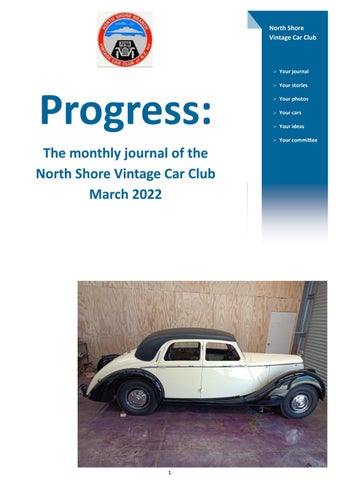
Cover girl this month and introducing this month’s “Focus on the Marque” is Tony Sparkes’ 1946 Riley RMA 1.5
2
Chairman’s Report: Tony Sparkes January 2022
Progress March 2022
February’s report always seems to come around too quickly. It gives me some idea of what Stuart goes through when producing our newsletter, Progress. Those of you that have been at the club will have noticed my new car, a 1946 RMA Riley. I think she looks great. In theory, there is only the interior and some mechanical fettling to do before I take her for a VIN. But you all know things are never that simple. I have my Daimler back on the road again, although the transmission leak is not entirely sorted. What with covid, my knee and the broken kick-down cable, I had not driven it for 5 months. When I did, I remembered what a lovely place it is to be. The Hibiscus Rodders enjoyed their visit to the club and were amazed at our facilities. They brought their own morning tea, which we enjoyed as well, and left the kitchen as tidy as when they started. I have told them they are welcome anytime. There seems to have been some miscommunication over Sunday’s run to Matakohe. Probably mea-culpa. However, it has highlighted the need for a designated Club Captain or Runs Coordinator. We are also without a vice-chairman. The AGM will be around before you know it, so I urge you to consider serving on the Committee. It is not onerous if we have the required number of people. We are trying the new time of 6pm for the start and meetings are usually finished in 1.5 hours. They are also pretty jovial. It is rare that we have to discuss anything controversial and even then, everyone has a chance to voice their opinion and opposing ideas are always respected. The Posh Picnic is coming up in March and the last winners, Arnold and Marika, are organising it. So polish your cars and get out your glad rags.
Stay safe and look after yourselves. Tony Sparkes Chairman Please note new email address; 29tony66@gmail.com
3
Matakohe Run: Report and photos by Andrew Lunt
Progress March 2022
The Kauri Museum run: A run that I had been looking forward to for some time to give my Zephyr, Sweet Pea a good trip, and finally the day had arrived. My good friend Tim arrived at my house at 7.30am so we could tootle down the road to the club rooms for the 8am departure. Alas we had a bit of a wait till directions for the run arrived. In the meantime I gave Tim a tour of our club grounds pointing out the various sheds and the club rooms. He remembered a few events held here in the past and I will see if he’s keen to join the club soon. Once we were all ready to leave Tim and I were advised that we were to be the lead vehicle in trusty old Sweet Pea, a choice that maybe was not so smart, but we were keen to give it a go anyway. With Tim navigating we turned left out of the club rooms instead of right (maybe a forewarning of things to come?). We were joined by 5 other vehicles on the run, 3 convertibles, two hard tops and a “best 4x4 by far”, which made for a nice cruise up through state highway 16 to Wellsford (where Tim thought our first stop was), missing 3 viewing and comfort stops on the way! That’s what happens when you’re yapping away discussing all manner of things, e.g. Zephyrs, boat gearboxes, working in a Mag and Turbo shop after owning your own mechanic business for 35 odd years, muppets on motorbikes (or temporary Kiwis as my Dad would have said) and “oh that would be a nice place to stop for a view”. With the cars all formed up opposite the Caltex station in Wellsford we all wandered up to a café and had a nice morning tea, glaring a bit at the rider of a nice red Ducati that practically clipped my wing mirror and scaring the you know what out of me on his way past, 10 minutes prior. Alas not a word was spoken in his direction as he was a fit looking fella and I’m not so brave. 4
Unplanned wait at the club before start.
Welcome breakfast stop in Wellsford.
‘Sweet-Pea’ with Andrew’s mate Tim.
Matakohe Run: cont.
Progress March 2022
Back in the cars after filling up Sweet Pea (never have I been grateful for $2.90 a litre) as fuel prices were well over $3 in Auckland, we all set off to our destination at Matakohe. A few travellers went via a gravel road, however the majority cruised up the main highway and pulled up outside the Kauri Museum. I had never stopped here before, as I’d always been in a hurry to get to Kai Iwi Lakes or to see my sister at Bayley’s beach, but my Dad had often raved about the place. After a really good look through the museum I was suitably impressed with the content, history, Kauri logs, slabs of wood and huge machinery set ups they have put together over the 60 odd years of the museum being open to the public. The younger generation certainly don’t know how good we have it, when compared with the hard graft and slog of those people felling and milling the Kauri and collecting Kauri gum by very primitive means. Dangerous and back breaking work for sure, however the innovation back then to speed up the process wherever they could was fascinating. If you have not been to the museum before I highly recommend spending 3 to 4 hours there on your way through or make it a day trip as we all did.
New member Charles Armstrong in his immaculate Series 1 Range Rover.
Jim Masson with his lovely Fiat.
We all then wandered over the road in quaint old Matakohe to enjoy lunch at the café, sitting outside in the sun and watching kids riding their bikes about the place. Corn fritters never tasted so good and I mused that this is what a lot of NZ was like, when I was a lad. We all bid our farewells and departed on our own and I was sure the Zephyr was not last to leave (in case, well it is a Ford after all) and headed back to Auckland. We made that fateful decision to go all the way home via State highway 1 and got stuck for a good half hour trying to get through Warkworth and then crawling a good 10 km afterwards as well. A good test of the recent birthday gift that I had given to the cooling system and was happy to say all was well in that department. Next time State highway 16 home methinks! How far away is that new motorway through to the north of Warkworth??
John and Catherine Cooke in their MG-F
We are truly blessed to be able to travel around our great country in our beautiful vehicles, and it’s so good to bring joy to those who wave and call out to us or just come and have a chat when you’re gassing up or parked. Many thanks to the organisers and I hope to see you on the next run, wherever we go to. Just don’t expect a comfort stop if the Zephyr is the lead vehicle! 5
The early days: Images from our past.
Progress March 2022
In building our new website (www.northshorevcc.com if you haven’t yet seen it) we have come across a treasure trove of really early photographs. 1983: Readying the house donated by Harold Kidd for relocation to the Oteha Valley Road property. The house was on the corner of Calliope Road and Summer street in Devonport. Frank De Lautour organised the moving and Keith Humphreys prepared the drawings for the building consent. Present but not in photographs were: Ross Moon, Keith Humphreys, Bruce Seaman, Gideon de Lautour & John Gairdner .
1976 November 12 1976 was a 24 hour Monster Dennis Workathon. People evident in this photo are: Mike Greig, Harold Kidd, John Wilmott, John Hearne, Ian Goldingham, Colin Keenan.
1975 Club line-up What do you recognise?
6
The early days: cont.
Progress March 2022
Here are a few more older photos, but perhaps not quite as old as the b/w shots on the previous page. Who can you recognise?
7
Hydrogen Fuel Cells: A new power source for our vehicles?
Progress March 2022
I’m sure that most of our members understand the basics of the internal combustion engine (compress a gas, ignite it and harness the explosive force with a piston and crankshaft). We also probably understand the electric motor (pass a current through a coil to generate a magnetic field and harness the power of magnetic attraction and repulsion). Indeed after their previous article on “Charcoal Burners” we should also be ‘au-fait’ with that technology. But what about this “Hydrogen Cell” stuff? What’s that all about? Regular correspondents John Duncan and his team have written this splendid article to explain the details.
Governments throughout the world are spending significant funds to develop hydrogen powered trucks, buses, cars and even planes. They are supporting pilot schemes for hydrogen production and refuelling stations. Auckland Transport has a bus running every day powered by a hydrogen fuel cell. The attraction, and it is a powerful one, is that the exhaust from a hydrogen-powered vehicle is water – pure, simple and non-polluting. Politicians love such a scenario and this one happens to be true (sort of). The technology is much less advanced than that of current electric battery vehicles and while hydrogen fuel cells have been operating in special applications for some time, their use in private passenger cars needs much further investigation. Even if the fuel cell itself becomes fully developed, there are still issues to be studied concerning the storage of hydrogen in a private vehicle, the generation of hydrogen in a sustainable manner and the infrastructure required for its distribution and sale. All chemical reactions are associated with heat transfer. Some reactions generate heat, as in the process of combustion, others draw in heat. In addition, chemical reactions generate or absorb electrical energy and it is this that makes batteries and fuel cells possible. As both fuel cells and batteries are closely related, it might be good to start with what we are familiar with, namely the true and trusty lead acid battery. The Lead-Acid Battery
Lead + Lead oxide
Sulphuric acid
Lead + Lead oxide
Lead sulphate
Sulphuric acid
Lead sulphate
Charge
Discharge
As shown in the diagram, a battery cell consists of two lead plates. When fully charged, the positive plate is covered with spongy lead and lead oxide. During discharge, the sulphuric acid 8
Hydrogen Fuel Cells: cont.
Progress March 2022
in the electrolyte converts this to lead sulphate which is deposited on the negative plate. This chemical reaction results in an electrical charge on the positive plate. The process also dilutes the sulphuric acid: it becomes watery. If the discharge is excessive, the cell ceases to provide the desired electrical energy, or put simply, we have the problem familiar to all old car people – a flat battery. Older enthusiasts will remember using a hydrometer to check the specific gravity and hence the concentration of the electrolyte. In a fully charged battery it is 1.84. If the battery is exhausted it will fall to 1.28. Just checking the open circuit voltage does not indicate the health of a battery, as is well-known, one needs to see how the voltage falls off under load. The open circuit voltage of the fully charged cell is 2.1 volts. The Hydrogen Fuel Cell The fuel cell is similar to the battery in that its output is electric power. It differs because it does not require recharging: it gets its energy from the chemical reaction of hydrogen and oxygen. The product, as mentioned, is water. We are familiar with the reverse of this reaction in the hydrolysis of water. If two terminals are placed in water and a voltage applied between them, hydrogen will bubble from one and oxygen from the other. How the reverse is managed in a fuel cell is illustrated in the diagram. Hydrogen
Oxygen
Hydroxide Proton Water
Permeable membrane
The fuel cell consists of two conducting plates sandwiched around an electrolyte. The electrolyte is usually a polymer membrane that is specially designed to be permeable only to hydrogen ions (protons). Hydrogen gas is fed into the negative terminal. Hydrogen gas consists of two atoms of hydrogen and is electrically neutral. Under the action of a chemical in an atomic layer of platinum on the membrane, the hydrogen molecule splits into two single, positively charged atoms. These, a fundamental nuclear particles called protons are small enough to pass through the membrane which is impervious to the larger hydrogen molecule. The proton can give up its positive charge to the positive terminal and the hydrogen reacts with oxygen to form water. Overall, the fuel, hydrogen, combining with oxygen absorbed from the air produces electrical energy. 9
Hydrogen Fuel Cells: cont.
Progress March 2022
and the good thing, from our point of view, is that the efficiency in terms of electrical energy produced is quite high. If one used hydrogen (replacing petrol or diesel) to fuel an internal combustion engine driving a generator, the electrical energy obtained would be much lower than that produced by the fuel cell. There is still some heat produced in the cell and, in a car, cooling would be necessary, but this is less than the radiator has to cope with in your car. The aim, as far as one can see, is to run the cell at about 100 deg. C. and the output voltage of a unit cell is about 0.7 volts, that is one-third the voltage of a lead-acid battery cell. Further considerations: There are cars on the road powered by hydrogen fuel cells, but full information is not available. It is appropriate to ask a few questions and hope they will be answered in time. Size and weight: As the output voltage of a single unit cell is low (0.7 V) many units will need to be combined in series to give sufficient voltage to drive the wheel motors. This is termed a “stack”. The output in terms of amps of a single unit is not known, but obviously many stacks will needed in parallel to give adequate power. One imagines that a continuous power output of at least 20 horsepower (15 kW) would be necessary for a passenger car. Various materials have been suggested for the plates of a cell. If these were metal, the thickness would need to be small, similar to domestic foil, in order to keep the weight down. Without further information, accurate predictions are not possible, but it does seem that problems of weight, cost, corrosion and deterioration are likely to be similar to those for current vehicle storage batteries. On-board storage: Hydrogen is transported as a liquid at a temperature of -259 deg, C, but it is not anticipated that liquid hydrogen could be used in passenger cars. Cylinders of gas at 5,000 psi have been proposed. This is a significant pressure requiring heavy cylinders and expensive energy absorbing gas compressors at filling stations. New Zealand has some experience to draw on. At the peak of import restrictions a number of cars were powered by compressed natural gas (CNG) stored in steel cylinders at 3,000 psi. This was moderately successful under Nothing to do with Hydrogen but a nice the existing conditions, but was abandoned quickly when shot of David Lane crossing restrictions were eased. Although it is outside the scope of the Bridge in his Corvette. this article, it should be mentioned that there is interest in other substances such as ammonia which is made up largely of hydrogen for power generation.
10
Hydrogen Fuel Cells: cont.
Progress March 2022
Production of hydrogen: Unlike natural gas, one cannot hope to drill a hole in the ground and pipe up hydrogen. It can, as already mentioned, be produced from water using electrical power. This is associated with the production of oxygen for which one would have to find a use. In any case, the use of electrical power to produce hydrogen which is then used to produce electricity is unlikely to be efficient. Hydrogen can, and is being produced from methane, which is a principal constituent of natural gas, by reacting it with superheated steam. A by-product is carbon dioxide which environmentally undesirable. Fuel cell response: It must be accepted that a fuel cell does not respond to a sudden demand for power as rapidly as an electric or petrol car. There is a slight delay in building up the power output and this is a particular problem for the passenger car. There is a certain type of human being that has an overwhelming urge to burn off other drivers at the traffic lights and to pass marginally slower drivers on hills with a great hiss and a roar. You and I are not like this (well hardly ever!) but woe betide any car maker who does not cater for this unfortunate characteristic. It may be necessary to supplement the fuel cell with a peak power battery pack and time will tell how much the hydrogen fuelled car becomes like the present day electric hybrid. It is interesting to recall that in the early 1900s the motorist had a number of options to choose from. Steam, petrol and electric vehicles all had their merits. By the 1920s, the petrol engine was the main contender. Now, one hundred years later we again have a choice. Petrol, hybrid electric and fully electric cars are available. Will the hydrogen fuel cell vehicle be added to the options in five or ten years? First off the block? Instead of a petrol engine, or a hybrid powertrain, the Hyundai Nexo is an electric vehicle fueled by hydrogen, similar to its closest rival, the Toyota Mirai sedan. Its driving range is impressive at up to 380 miles, but its acceleration is perhaps sleepier than most other EVs. The Nexo's downfall really is its limited market. Because it relies on hydrogen fueling stations, it can only be sold and owned in areas of the country where those are available. As such, Hyundai is currently only offering the Nexo for sale in California.
11
Upcoming Events: Events are a bit thin on the
Progress March 2022
ground at present because of you know what.
Please drop us a note if you know of an event that might be of interest to our members. Remember that North Shore Branch events are in RED, whilst other branch and private events are in our usual blue font. Obviously all these events are subject to Covid postponements.
March March 10: Mercedes Club holding an event at 40 Masons Road. March 12-13: Auckland Hunua 100 Rally: Entry forms at: https://avvcc.org.nz/entry-forms March 19: North Shore Posh Picnic. Meet in the clubhouse for coffee at 10.00am. Remember to dust off your glad-rags and make your cucumber sandwiches. Brits and Euros Show is CANCELLED
April March 17: North Shore Branch: Follow the Whale Tail trail! (Help shine a light on the Hauraki Gulf and the plight of its rarest resident, the Bryde's Whale. There's only 135 of these amazing whales left in the Hauraki Gulf and, interestingly, this particular species doesn't migrate: it actually lives here in our very own backyard)
May May 21: North Shore Branch: Currently t.b.c. perhaps we can run one of the events that fell foul of last year’s Covid restrictions? Who put their hand up to help and can now deliver on that suggestion?
Regular Diary Committee Meetings: Last Monday of every month, 7.30pm. Tuesday Mornings: Restoration shed open. Coffee and tea around 10 - ish. Wednesday Evenings: Club night. Coffee, tea and banter. Thursday Mornings: All sheds open. Why not come along and explore the parts shed? Fantastic experience, even if you don’t need any bits! Coffee, tea, cakes and savouries at 10.30am.
The lockdowns over the past two years have taken their toll on our club runs and rallies. Any ideas/volunteers to help get things moving again will gain the eternal gratitude of the rest of club members. Can you help please? The club will now be opening under the current Covid Protection Framework (Traffic Light System) Guidelines. Vaccine Passes are required for all club activities and events.
12
Finding happiness in a 1966 Vauxhall Viva: A letter from Graeme Banks, Waitemata Branch Secretary
Progress March 2022
Imagine my surprise when I opened your February magazine and found a picture of my 1966 Vauxhall Viva there. Two years ago, I decided that I would do the 2021 Vero rally and would probably use my 1955 MGTF 1500. Well in the intervening time I not only had a new hip and new knee but had mobility issues with my ankles requiring me to use a mobility scooter for any distance. Come mid-2021 and I was determined to go to the Taranaki rally now 2022 but sadly needed something bigger than the MG to carry my portable mobility scooter. I could have taken my 1989 MX5 but thought that something a bit older would be more applicable. I set a budget of $10,000 and looked around to see what 1960s cars were available. The price of Escorts and Cortinas has gone sky high but other makes hadn’t gone outside of my limit. I found a 1966 Viva that had recently been restored well within my budget and was pleased to find it also had hardened valve seats so it could use unleaded petrol. Son Andy and I went out to Pukekohe to view it and after a test drive were happy to buy it and drive it home to the North Shore. Its one thing to part own a workshop (Wairau Brakes) but another thing for them to find time to get my car serviced there. I managed to get son in law Stu to replace a wheel bearing a week before the rally and got him to check the radiator at the same time.
13
International Festival of Motoring: cont.
Progress March 2022
Woe-betides me there was a leak just under the header tank and so it was who could recore a radiator in a week. Stu managed to contact Western Radiators in Henderson and they said they could get it done by Friday however the courier hadn’t turned up with the new core until Friday morning and Western Radiators had it done for me to pick up 5pm Friday night. Stu put it in for me on Saturday morning and I was ready to head south. I hadn’t really driven the Viva on the motorway and thought that 80k was probably a good cruising speed and headed off to Taranaki. However, I found that the little one litre Viva would in fact cruise at 90K and so off we went. Navigating by myself I decided to miss the competition day on Tuesday but entered proceedings on Wednesday. Having no navigator, it was interesting following cars only to find they went the wrong way. Other cars came out of side roads and a few came in the opposite direction, so navigation became a bit of an issue. Nevertheless, I did end up at every lunch stop on time and the Viva never missed a beat. I was aware that my little HA Viva was very ordinary amongst the line up of amazing vintage cars, but I was amazed with the attention it got from people who had one in their family either their mothers or their first car. The 2022 Vero history of motoring was a great event, and I was thrilled that I could take part in every aspect of it in such an ordinary little car. On arriving home in Stanmore Bay, I had done 1200 trouble free kilometers in the car and had a wonderful time in a very successful rally. 2 ½ weeks after the rally the Morris Eight Sports that I had bought in mid December finally arrived from Temuka. My daughter suggested that I had too many cars so sadly it was decided to put the Viva on trade me. After a few days it was sold and on its way to Hawkes Bay. Hopefully the new owner will have as much fun and happiness in the Viva as I did. Graeme Banks 14
Progress March 2022
Focus on the Marque: Riley
Introduction: Riley was a British motorcar and bicycle manufacturer from 1890. Riley became part of the Nuffield Organization in 1938 and was merged into the British Leyland Motor Corporation in 1968. In July 1969 British Leyland announced the immediate end of Riley production, although 1969 was a difficult year for the UK automotive industry and many cars from Riley's inventory may have been first registered in 1970. Today, the Riley trademark is owned by BMW. Riley Cycle Company: The business began as the Bonnick Cycle Company of Coventry, England. In 1890 during the pedal cycle craze that swept Britain at the end of the 19th century William Riley Jr. who had interests in the textile industry purchased the business and in 1896 incorporated a company to own it named The Riley Cycle Company Limited. Later, cycle gear maker Sturmey Archer was added to the portfolio. Riley's middle son, Percy, left school in the same year and soon began to dabble in automobiles. He built his first car at 16, in 1898, secretly, because his father did not approve. By 1899, Percy Riley moved from producing motorcycles to his first prototype four-wheeled quadricycle. Little is known about Percy Riley's first "motor-car". It is, however, well attested that the engine featured mechanically 1907 4-wheel, 2-cylinder Riley by Riley Cycles operated cylinder valves at a time when other engines depended on the vacuum effect of the descending piston to suck the inlet valve (s) open. That was demonstrated some years later when Benz developed and patented a mechanically operated inlet valve process of their own but were unable to collect royalties on their system from British companies; the courts were persuaded that the system used by British auto-makers was based on the one pioneered by Percy, which had comfortably anticipated equivalent developments in Germany. In 1900, Riley sold a single three-wheeled automobile. Meanwhile, the elder of the Riley brothers, Victor Riley, although supportive of his brother's embryonic motorcar enterprise, devoted his energies to the core bicycle business. Despite Riley's founder William Riley being resolutely opposed to diverting the resources of his bicycle business into motor cars, he was eventually persuaded by his sons and bicycle production ceased in 1911. 1910 Riley 12/18 15
Progress March 2022
Focus on the Marque: cont.
Riley (Coventry) Limited: In early 1913, Percy was joined by three of his brothers (Victor, Stanley, and Allan) to focus on manufacturing entire automobiles. The works was located near Percy's Riley Engine Company. The first new model, the 17/30, was introduced at the London Motor Show that year. Soon afterwards, Stanley Riley founded yet another business, the Nero Engine Company, to produce his own 4cylinder 10 hp (7.5 kW) car. Riley also began manufacturing aeroplane engines and became a key supplier in Britain's build-up for World War I.
1930 Riley 9 in a Biarritz body.
In 1918, after the war, the Riley companies were restructured. Nero joined Riley (Coventry) as the sole producer of automobiles. Riley Motor Manufacturing under the control of Allan Riley became Midland Motor Bodies, a coachbuilder for Riley. Riley Engine Company continued under Percy as the engine supplier. At this time, Riley's blue diamond badge, designed by Harry Rush, also appeared. The motto was "As old as the industry, 1932 Riley 9 Monaco. Do we have one in the club? as modern as the hour." Riley grew rapidly through the 1920s and 1930s. The Riley Engine Company produced 4, 6, and 8-cylinder engines, while Midland built more than a dozen different bodies. Riley models at this time included: •
Adelphi, 'Continental' (Close-coupled Touring Saloon), Deauville, Falcon, Kestrel, Mentone, Merlin, Monaco, Stelvio, Victor, Ascot, Lincock, Alpine, Lynx, Gamecock, Brooklands, Imp, MPH, Sprite, Edinburgh, Winchester
Introduced in 1926 in a humble but innovatively designed fabric bodied saloon, Percy Riley's groundbreaking Riley 9 engine- a small capacity, high revving unitwas ahead of its time in many respects. Having hemispherical combustion chambers and inclined overhead valves, it has been called the most significant engine development of the 1920s. With twin camshafts set high in the cylinder block and valves operated by short pushrods, it provided power and efficiency without the servicing complexity of an OHC (overhead camshaft) layout.
1937 Riley 9 with a Briggs built Merlin body
1938 Kestrel 6. A style developing? 16
Focus on the Marque: cont.
Progress March 2022
It soon attracted the attention of tuners and builders of 'specials' intended for sporting purposes. One such was engineer/driver J.G. Parry-Thomas, who conceived the Riley 'Brooklands' (initially called the '9' Speed Model) in his workshops at the banked Surrey circuit. After Parry-Thomas was killed during a land speed record attempt in 1927, his close collaborator Reid Railton stepped in to finish the job. Officially backed by Riley, the Brooklands, along with later developments and variations such as the 'Ulster' Imp, MPH, and Sprite, proved some of the most successful works and privateer racing cars of the late 1920s and early 1930s. At Le Mans in 1934, Rileys finished 2nd, 3rd, 5th, 6th and 12th. Riley also distinguished themselves at the Ulster TT, at Brooklands itself, and at smaller events like hill climbs. For series production, the engine configuration was extended into a larger 12 horsepower '4', sixcylinder and even V8 versions, powering an increasingly bewildering range of touring and sports cars. The soundness and longevity of the engine design is illustrated by Mike Hawthorn's early racing success after WW2 in pre-war Rileys. By about 1936, however, the business had overextended, with too many models and few common parts, and the emergence of Jaguar at Coventry was a direct challenge. Nuffield Organization: By 1937, Riley began to look to other manufacturers for partnerships. A contract with Briggs Motor Bodies of Dagenham to provide all-steel bodies for a cheaper, more mass-market saloon had already turned sour, with dozens of unsold bodies littering the factory. It had withdrawn from works racing after its most successful year in 1934, although it continued to supply engines for the ERA. BMW of Munich, Germany was interested in expanding its range into England. But the Riley brothers were more interested in a larger British concern, and looked to Triumph Motor Company, also of Coventry, as a natural fit. In February 1938, all negotiations were suspended. On 24 February the directors placed Riley (Coventry) Limited and Autovia in voluntary receivership. On 10 March the Triumph board announced merger negotiations had been dropped. It was announced on 9 September 1938 that the assets 1938 2.5 litre Kestrel and goodwill of Riley Motors (Coventry) Limited had been purchased from the receiver by Lord Nuffield and he would on completion transfer ownership to Morris Motors Limited. Nuffield took quick measures to firm up the Riley business. Autovia was no more, with just 35 cars having been produced. Riley refocused on the 4-cylinder market with two engines: A 1.5-litre 12 hp engine and the "Big Four", a 2.5-litre 16 hp unit. Only a few bodies were produced prior to the onset of war in 1939, and some components were shared with Morris for economies of scale. Though they incorporated a number of mechanical improvements- notably a Nuffield synchromesh gearbox- they were essentially interim models, suffering a loss of Riley character in the process. The new management responded to the concerns of the marque's loyal adherents by reintroducing the Kestrel 2.5 litre Sports Saloon in updated form, but as the factory was turned over to wartime production this was a short-lived 17 development.
Progress March 2022
Focus on the Marque: cont.
After World War II, Riley took up the old engines in new models. The RMA used the 1.5-litre engine, while the RMB got the Big Four. The RM line of vehicles, sold under the "Magnificent Motoring" tag line, were to be a re-affirmation of Riley values in both road behaviour and appearance. 'Torsionic' front independent suspension and steering design inspired by the Citroën Traction Avant provided precise handling; their flowing lines were particularly well-balanced, marrying pre-war 'coach-built' elegance to more modern features, such as headlamps faired into the front wings. 1946 RMA resplendent in our Members’ Bay. The RMC and RMD were not marketing successes. The 1.5-litre RME and 2.5-litre RMF were later developments of the saloon versions, which continued in production into the mid-fifties. Victor Riley was removed by Nuffield in 1947. In early 1949 the Coventry works were made an extension of Morris Motors' engine branch. Riley production was consolidated with MG at Abingdon. Wolseley production was moved to Cowley. Nuffield's marques were then organised in a similar way to those of General Motors: Morris was the value line, and Wolseley the luxury marque. Aside from their small saloons MG largely offered spartan performance, especially with their open sports cars, while Riley sought to be both sporty and luxurious. With Wolseley also fighting for the top position, however, the range was crowded and confused. Next came BMC and the tussles between the multiple marques owned by the group eventually stifled the marque. Many BMC Rileys were actually badge-engineered versions of other BMC marques. One bright star and often known as the ‘Last True Riley” was the Pathfinder. This was the Pathfinder, with Riley's familiar 2.5-litre four developed to produce 110 bhp. The Pathfinder body was later reworked and, with a different engine and rear suspension, sold as the Wolseley 6/90. The Riley lost its distinct (though externally subtle) differences in 1958, and the 6/90 of that year was available badge engineered as a Riley Two-PointSix. Although this was the only post-war 6-cylinder Riley, its C-Series engine was actually less powerful than the Riley Big Four that it replaced. This was to be the last large Riley, with the model dropped in May 1959 and Riley refocusing on the under-2-litre segment. 1953 Riley RMH. The ‘Big=Four 2.5 litre Pathfinder 18
Hibiscus Rodders visit Masons Road: A report by Richard Bampton. We welcomed around 30 vehicles and 40 people from the Hibiscus Rodders who visited our NSVCC premises to see what we get up to. They arrived in a variety of vehicles and, although few were really radical – the ratrod being the most recognisable type, they were very well presented. Many were, outwardly, shiny examples of 60s Americana, with added chrome and mag wheels, but it was not possible to see what was under their bonnets although the sound gave some of them away and one wondered what big bore changes had been made to the engines. A really different one was the 1948 Bedford ute, converted from a van, belonging to Brian and Sandra Strickland (North Shore members), and that had a 350 Chev motor under the bonnet T400 transmission and disc brakes, all on a Mitsubishi chassis – a real wolf in sheep’s clothing. The Rodders were impressed with our facilities and interested in the projects – the Dennis Bus, of course, and they also admired the woodworking skills of John Ellis on the BSA van and were intrigued to learn that it had a pre-selector gear box. They couldn’t quite understand the storage shed because all the cars in it were un-molested, but they admired them all the same. A very likeable bunch, and nearly all of them, like Ford owners, appeared to be almost normal.
Anyone recognise this red car??
19
Progress March 2022
About Us
Progress March 2022
Club Address: 40 Masons Rd, Albany, 0632 Phone: 09-4792779: email: northshorevcc@gmail.com Website: www.northshorevcc.com Club Nights: Every Wednesday from 7.30pm. Restoration Shed: Every Tuesday & Thursday morning 9am - 12pm. Committee Meetings: Last Monday of the month, 7.30pm . Club Runs: Normally 12.30-1pm start, 3rd Sun. of month. Always check the ‘Upcoming events’. VERO Branch Reference Number: HO0300144 (Quoting this number when renewing your insurance gives a small commission back to the club).
Club Committee Chairman: Tony Sparkes 09-473-5872 or 027-499-5588 Secretary: Maurice Whitham 09-627-0310 or 027-296-9293 Treasurer: Ross Moon 09-426-1508 or 022 426 1508 Club Delegate: Stuart Battersby 022-471-2759
GENERAL COMMITTEE Members: John Higham 09-478-7973 Barry Thompson 09-959-0206 Peter Lloyd: 09-426-7179 or 021-298-8795 Richard Lloyd: 09-420-5048 or 027-483-2898 Mike Swanton: 09 426 0011 Arnold Van Zon: 09 473 5750 or 027 2765336 OTHER CLUB OFFICERS (Non Committee) Members’ Garage Manager: Kevin Lord 09 413 9157 Welfare Officer: Brian Bisset 09 554 1740 Librarian: Kevin Benseman 022 678 5629 Beaded Wheels Correspondent: Richard Bampton 09947 3042 Magazine Editor: Stuart Battersby: 022 471 2759 or email battersby56nz@gmail.com THE INFORMATION IN THIS MAGAZINE IS SUPPLIED AS A SERVICE TO MEMBERS. ARTICLES OF INTEREST ARE ALWAYS WELCOMED. THE OPINIONS EXPRESSED IN THIS MAGAZINE ARE THOSE OF THE AUTHORS AND THE CLUB ACCEPTS NO RESPONSIBILITY FOR THE ACCURACY OF ANY ARTICLES OR STATEMENTS HEREIN. All rights reserved. No part of this magazine may be reproduced in any form or by any means, electronic or mechanical without permission in writing from the copyright holder 20