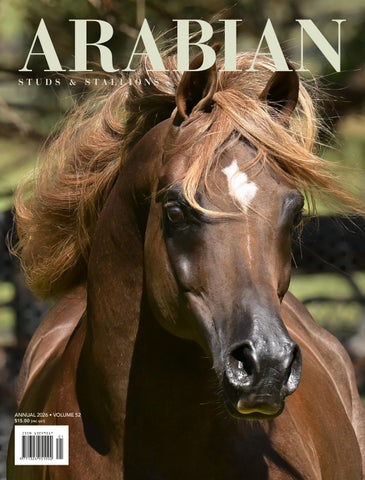
Arabian Studs and Stallions - Volume 52 (2026)

Page 1


PC: Javan, Lisa Gordon, Amy-Sue
Alston, Jennifer
Ogden, Dana, Oz Shotz, Equigeniek

THE EDITOR

Greetings to you all, and welcome to another edition of what I hope remains one of your favourite publications.

I like to think of this magazine as our annual catch-up — a moment when the Arabian horse community comes together in spirit. I picture you receiving your copy of Arabian Stud and Stallions, finding a quiet spot, a delicious drink, and immersing yourself in each carefully crafted page.

If you're anything like me, this magazine has long been a highlight of the year. Since the first time I discovered it, I’ve eagerly awaited each new edition, knowing it would bring fresh inspiration and connection to the breed we love.

This year, I have a small challenge for each of you: share this magazine with just one other person. Introduce someone new to the beauty, joy, and lifelong journey that comes with Arabian horses. We all know it’s a wonderful ride — so let’s invite others to get on board.

I hope you enjoy the articles we’ve put together for you. Each has been thoughtfully selected to reflect the rich diversity, heritage, and heart that the Arabian horse brings to our lives.

Warmest regards,

The Dream Continues… Step Into The Winners Circle

Congratulations to the owners and breeders of these recent Champions, all tracing to Naadirah.

Find us on social media The Naadirah Family

Marbling Novelle (Marbling Star of the East x Marbling N’Shala)
Zuhra Zalaanah (Zhura Zhadaan x Zahra Zvinaana)
Nejilah (RHR Heir of Marwan x Neytiri)
Dream Fever
(Gai El Jullyen x The Palms Uptown Girl)
Nahlenah (Sabtah Nassor x Nahlia)
Naasir Al Badr (Ulysium x Giselle V)
Ulyssia (Ulysium x Narcisse)
Photos by Glenys Lilley, Samantha Taylor and Sue Crockett

Simeon Sefa

(iiu Germany)

(Safeen x Mussallah)

Straight Egyptian Stallion

Standing at stud by natural service only

(Simeon Sefa x Stavs Simbel)

Straight Egyptian Mare

Soufeah MH

(Simeon Sefa x Soura Sihr)

Straight Egyptian Mare

DEDICATION:

This issue of Arabian Studs & Stallions is dedicated to the memory of its founders, JUDITH AND HERMAN VINK.

PO Box 8369, Woolloongabba Q 4102 Australia | 07 3334 8000

Publisher: Michael Vink, INTERACTIVINK | michael@interactivink.com.au

Editor: DAVID GILLETT | david@redmgmt.com.au

Production: Lauren Lavin, Richard Locke & Karen Belik

The advertising content is the responsibility of the advertisers. The price of $15.00 is a recommended price only. No part of this

by any means without the written consent of the publishers. Whilst every care is taken in the publication and preparation of the advertisements, the publishers cannot be held responsible for errors or their subsequent effects.

Above: Ben Hudson riding Razorback Porsche, PC Sarah Sullivan. Cover: Simeon Seifan (Simeon Shifran x CM Moussameh), PC Stuart Vesty.

An Arabian is poetry in motion, the pride of the desert.

Alkasir RA

Alkasir RA

DOB 1/12/21

Chelleason

Crown Jewel

Ramadan

Dream Maker

Gai El Jullyen (US)

Sophia WV (US)

Makers Mark

Ramadan Arabian Kadin

Jullyen El Jamaal

Gai Fantasha

Falcon BHF

Kharawind

Fame Maker R (US)

Karmaa (US)

Niarob Anwar-El-Sadat

Tristram Purette

GRACE FOCUS ON

This year, we set out to celebrate the soul and artistry behind Arabian horse photography by inviting a curated group of acclaimed photographers from around the world to contribute to a special feature. Each artist was asked to select one of their most treasured images an image that not only reflects their technical mastery, but also evokes the beauty, spirit, and timeless presence of the Arabian horse. The result is a visual anthology that spans continents and styles, yet is united by a shared reverence for the breed’s elegance and mystique. We are proud to present this global gallery, where each photograph tells its own unforgettable story.

Joanna Jonientz

AJMAL TAMEEN

Ansata Hejazi x Tabanya Egyptian stallion from the Ajmal Arabian Stud in Kuwait

It is a special honour for me that the readers of your Arabian Studs & Stallions magazine in Australia will learn about me and my work. I know that there are many very good Arabian horse breeders in Australia. Unfortunately I have never had the opportunity to come to Australia, but perhaps one day I will manage to see your wonderful country and perhaps even visit some Arabian breeders. With this photo I came 2nd out of 800 submitted photos in an international photo competition in Kuwait. The photo was taken about six years ago.

j.jonientz.horse.photography

Nicole Emanuel

BAGHIRA ERA

Eagleridge Rain Dancer (AU) x Om El Shareikh (US)

Owned by Jennifer Fairweather

Sometimes as a photographer, you capture a fleeting moment without realising its value until later. This final frame of the magnificent Arabian stallion Baghira ERA, taken on an overcast day in Kilmore, became that moment for me. After thousands of shots, his owner returned him to the box, and he gently craned his neck, looking for his mares. His dark head against the old corrugated iron backdrop that faded out to white, his silken forelock falling in a perfect arc over his kind eye—everything aligned. To me, it captures the grace and quality of the Arabian: velvet skin, fine detail, and soulful expression. This image later graced the covers of Arabian Studs & Stallions (2014) and my Equine Monochrome calendar (2011).

nicoleemanuel.photos

Photo: David Gillett
Photo: Jennifer Ogden

Bengin Ahmad

Breeder:

benginahmad

SHAHAL AL ZUBAIR
Joelle O.S x Bint Mizher Bozinka
2013 Stallion owned by Katin Club, Barzan, Kurdistan
Rasool Taiba’t Stud

Tariq Dajani

HLAYYIL RAMADAN

Kehilan Ajuz (Kamar El Zaman x Haboob) Photographed in 2007 at the Royal Jordanian Stud (using a painted studio backdrop, studio lights)

Iwill start by saying that I don’t have a ‘best’ of anything, music, food, pictures, or whatever! It all depends on mood, circumstances, and so on. But I do have some favourites. This portrait of Jordan’s breathtaking Arabian stallion, Hlayyil Ramadan, is one such favourite. A world champion of remarkable grace, power and ethereal beauty, he exuded both intelligence and charisma when I photographed him in 2007 at the Royal Jordanian Stud. His regal presence was undeniable—keenly aware of his own stature—yet he retained a playful, mischievous spirit when interacting with his handlers. After moments of spirited frolicking on set, this extraordinary horse settled into a composed elegance, offering me a series of striking poses, long enough for me to see him, to feel him, and to take his picture. I didn’t steal his portrait, he was offered it to me. Such a special creature!

tariqdajani.com

Cheroot Magnefique x Dahaak

Owned by Montahna Schroder-Curtis

This is Montahna riding her first 80kms at Towitta Trek 2021 in South Australia, for which I was the Ride Organiser. She is riding on Three Chain Road, past the 65km point at the time this photo was taken.

Cazz Schroder, her mum was riding with her and recalls me encouraging her to keep going while I took this photo.

rebekahbiancastudios.com

Rebekah Bianca
CHEROOT ALBERTA

ArretMalakeh

TRINCADA STRIKE x KIRRONG TUPPARA

Arret Nad m

MALLEEGROVE MANDALLA +S x JAKASSA

Arret Jam lah

RALVON VINTAGE x PASADENA ANGELINA
SERABI
SADIKS PSYCHE x FAIRVIEW AMIRA SHAKLAN

Elsa Marchenay

RAY OF LIGHT

Amaki’s Golden Imp X Amaki’s Impressionist

Owned by David Gillett

Ethereal, powerful and charismatic...Ray of Light is reminiscent of the finest marble horse statues of Rome. I had always wanted to photograph him and although I had been to the farm before, he had not been on the ‘shoot list’ until this visit. We tried him in a number of ways, and this was our final set up for the day. I remember that both David and I were anxious to finish, not only because we were losing the light, but we were teasing him up to another stallion, and Ray of Light was explosive. This whole sequence lasted about 90 seconds, with many shots to choose from. This one is my favourite.

elsamarchenay.com

ROUSING AFFIRMATION

“LET FREEDOM RING.” ~ Martin Luther King

MI

(VANGELIS MI x ELEGANCE MI by EMERALD J)

Thirteenth-Generation Mulawa-Bred Champion Member of the KARMAA Family

Australasian International Gold Champion Junior Colt | 2025

Emirates Arabian Horse Global Cup Champion Junior Colt | 2025

Australasian International Gold Champion Yearling Colt | 2023

Australian National Champion Yearling Colt | 2023

“AIM TO THE COMPANY OF IMMORTALS.” ~ David Ogilvy

“TRUE ELEGANCE IS ACCEPTED AND ADMIRED BECAUSE IT MAKES NO EFFORT TO BE ELEGANT.” ~ Paulo Cohelo

ODE TO JOY

“TRUE JOY RESULTS WHEN WE BECOME AWARE OF OUR CONNECTEDNESS TO EVERYTHING.” ~ Paul Pearsall

“TO

DEL PALAZZOTTO

(FA EL RASHEEM x D FEDDAH by SHANGHAI EA)

Proudly bred by Paolo Capecci & Susy Gurschler On lease from Il Palazzotto | Italy

Travagliato International Gold Champion Junior Colt | 2025

Travagliato International Highest Scoring Horse of the Show | 2025

Standing at Mulawa Arabian Stud for the 2025 & 2026 Breeding Seasons

Limited Breedings Available

TEN YEARS IN THE MAKING

A data-driven look at Arabian horse breeding in Australia

In the age of the internet, everyone has an opinion, and a platform to share it. For those involved in the Arabian horse world, online forums and social media groups can sometimes feel like echo chambers of discontent. Foal numbers are down. Everyone’s breeding for halter. Imported stallions are ruining the local gene pool. The list goes on. But how much of this narrative is based on hard evidence, and how much is driven by nostalgia or frustration?

With the invaluable support of the Arabian Horse Society of Australia (AHSA), I set out to examine what the data actually shows about the state of Arabian horse breeding in this country over the past decade. Covering the breeding seasons from 2014 to 2023, and touching on emerging 2024 data, we've built a statistical snapshot that captures trends, shifts, and surprising constants. Let’s take a look at what the numbers tell us, and explore how external factors like urbanisation, market demand, and social dynamics may be shaping the Arabian horse industry in Australia.

The Nnmbers: a decade of purebred registrations

Between 2014 and 2023, a total of 3,893 purebred Arabians were registered in Australia. This includes both Australian-born horses and those imported or born from imported semen or in-foal mares. The decade began with relative strength in 2014, with over 600 horses registered, but by 2023, that figure had halved. Notably, filly registrations fell from 321 in 2014 to 135 in 2023, while geldings dropped from 196 to 60 over the same period. Here’s a breakdown of colt and stallion data that offers even more insight:

The sharpest fall was seen in gelding registrations, a telling indicator of changing ownership or breeding patterns. It could be that breeders are retaining colts longer to assess quality, are reluctant to geld due to costs or reduced market demand, or simply are breeding fewer horses with performance careers in mind. I would say a more likely colts are being gelded and sold unregistered, hopefully inspiring a new generation of pony clubbers to love Arabians. But are fewer horses necessarily a problem?

The world has changed, and so have we

Over the past decade, the world has shifted dramatically in ways that impact horse ownership. Rising land prices, shrinking rural space, and the loss of agistment land near urban centres have made it more difficult than ever to keep horses.

In 2024, Australia’s greenfield land market saw a 25% increase in lot sales, with developers releasing 42,700 lots nationwide. Meanwhile, the total area of land under urban, industrial, and intensive use increased by 3.2 million hectares between 2010–2016 alone.

These figures aren’t just abstract statistics, they represent the slow erosion of paddocks, stables, and quiet country roads. Even heritage horse properties haven’t been spared. Just as England’s Crabbet Park and the USA’s Brentwood Farm were lost to development, Egypt’s legendary El Zahraa was moved in 2024 to make way for the ever encroaching city. The very landscapes that gave birth to our modern Arabian horses are changing, and Australia is no exception.

As housing demands push further into once-rural zones, the traditional idea of horse ownership as a common pastime is slipping from reach. Agistment prices climb. Riding trails disappear. And access to horses for city kids becomes ever rarer.

When horse ownership becomes a luxury

Generations ago, most Australians had some connection to “the bush” and, by extension, to horses. If you didn’t live on a farm, chances are a cousin or friend did. In urban areas like Sydney’s inner-west, properties like the Dame Eadith Walker Estate in Concord offered a rare oasis. For decades, horses grazed just 10km from the city. Bequeathed to the state for equine use in 1938, the estate was a thriving agistment property until 2013, when, despite community opposition, the horses were evicted to make the land useable ‘for the wider community’. Being known as ‘the parkland suburb’, Concord was not in need of more soccer fields at all and the land now sits vacant, a quiet, sad and decaying reminder of what was lost.

The lesson? It’s not just about declining breeding numbers, it’s about declining access – the powers that be in that instance did not recognise how important the connection to the horse is for many of us. Fewer horses are being bred because fewer people can keep them.

And yet, this trend may also signal a more thoughtful approach to breeding. Where once it was common to keep a herd of mares and foals on 100-acre properties, today’s breeders may be working from 10-acre lifestyle blocks, producing one or two foals a year with careful planning and long-term goals in mind.

Breed in decline? Or breed in transition?

It’s worth noting that this pattern isn’t unique to Arabians. Even the Australian Stock Horse, arguably the country’s most iconic breed, has seen a sharp decline, from 3,050 registrations in 2014/15 to just 1,264 in 2023/24.

Against that backdrop, the Arabian horse remains remarkably resilient. And if anything, the breed is evolving with the times.

Many new owners now prefer trained or mature horses over foals, and breeders are adjusting accordingly. There’s a growing market for Arabians as versatile pleasure and trail mounts, with demand rising particularly among adult riders, often “empty nesters” who are finally able to fulfil childhood dreams.

Bloodlines in focus: frozen, imported, or local?

There’s long been a perception that breeders are abandoning local bloodlines in favour of imported or frozen semen. While the use of international genetics has certainly increased, Australian-born stallions continue to sire the majority of foals. Here’s a breakdown of sires used from 2014 to 2023:

So yes, use of frozen semen is increasing, but it’s still the exception, not the rule. Australian born sires remain at the heart of the breeding landscape.

Above: Simeon, PC Stuart Vesty Top right: An iconic photo yes, and far from the
Stallion Naazim (Mustafa x Naadirah) photographed by Quentin Naylor

THE STALLIONS behind the stats

JADAAN AL SHAQAB (QA) Dominated early in the decade, topping the charts in 2014–2016 with up to 25 foals in a single year.

CRAVE FF (AU) Maintained consistent popularity, a testament to his influence on halter and ridden horses alike.

ALLEGIANCE MI (AU) Proved a mainstay across the decade, frequently appearing among top sires with double-digit foals each season. Volcom FF (AU) and Murano SPI (US) rose to prominence in the later years, as did RD Dynamo (CA) and RHR Heir of Marwan (US).

IMMESMERIZE (US)
ASFOUR (DE)
SIMEON SIMONE (AU)
IBTEHAG ALBADEIA (EG)
IMTAARIF (US)
MALIK (DE)
BINT MAREEKH AMIR (US)
HANAN (EG)
ASFOUR (DE)
BADRAN ALBADEIA (EG)
SIMEON SIMONA (AU)
HALAWAT ALBADEIA (EG)

What’s most encouraging is the diversity, both in the past and looking forward. A quick look at the 2024 season, although incomplete, shows a wide spread of sires, from international halter lines to Straight Egyptian programs and even Old Colonial blood. This is not a breed homogenised by trend, it’s a community breeding for diverse goals.

2024 REGISTRATIONS

Inspiring THE FUTURE

What we do now will shape the Arabian horse of tomorrow. While many people discover a love for horses in childhood, actual ownership often begins in adulthood. That means we need to spark interest early, and provide opportunities later. Teachers, librarians, parents, everyone has a role to play. From Phar Lap to The Black Stallion to The Silver Brumby, through books and film we can inspire the next generation to dream of horses.

You can donate books like Naadirah: The Arabian Dream or Hoofprints in History to your school library. Share positive stories online. Help organise open days. Every small effort counts. Contact the AHSA to talk about how you can help.

And on social media? Let’s promote, not complain. Nostalgia has its place, but growth comes from connection, not criticism.

The Takeaway

Are we breeding fewer Arabian horses? Yes. Are we breeding smarter, more intentionally, and with great diversity? Also yes.

The data shows a breed that is adapting, not collapsing. Australian breeders are making strategic choices, balancing imported genetics with strong local lines, riding market shifts, and continuing to produce beautiful, versatile horses.

The Arabian horse in Australia is not in decline. It is in transition. And from where I stand, the future looks bright.

We are each custodians of this noble breed. Let’s honour that responsibility, not with fear, but with vision.

Above: Inspiring the young people in your life is an important part of Arabian horse stewardship. Top right: Jade Park Astound. Owned by Belinda Zaiter, PC Sharon Meyers.

EQYPTIAN ARABIANS

The colourful history of IN AUSTRALIA

The legacy of the Straight Egyptian Arabian horse in Australia and New Zealand is a rich and multifaceted narrative of vision, dedication, and international collaboration. This unique strain of Arabian, prized for its purity and cultural significance, found fertile ground in Australasia, where a few breeders embraced the challenge of preserving its lineage while shaping its future.

Our relationship with the Straight Egyptian spans almost the entirety of. the Arabian horses history in this country, although we didn’t know it at the time. Sir James Bobcat of Quambi Stud, the very first breeder of purebred Arabians in Australia imported from Crabbet the stallion Faroun and mare Namusa in 1901, Australia’s first ‘straight Egyptians’. Faround, sired by Mesaoud and from the mare Fulama is the first and

only horse of straight Ali Pasha Sherif blood to be imported to Australia, both parents being bred at the famed stud. Namusa, Australia’s first straight Egyptian mare was tied by Azrek and from Nargehileh, also sired by Mesaoud and from Nefisa. It is interesting to note that these horses feature in the pedigrees of both Straight Egyptian and Pure Crabbet horses.

The Straight Egyptian Arabian horse traces its lineage directly to the desert horses of Egypt, renowned by those who admire them for their purity and distinct characteristics. These horses are descendants of the breeding programs initiated by the ruling families of Egypt, most notably Mohammed Ali the Great and his successor, Abbas Pasha I, in the 19th century. Abbas Pasha amassed a herd exceeding 1,000 purebred Arabian horses, laying the foundation for what would become the Straight Egyptian lineage. Abbas Pasha was assassinated in 1856 and his stud disbanded with Ali Pasha Sherif obtaining a vast number for Egypt, and Lady Anne Blunt of Crabbet Park securing horses for her breeding program. To qualify as a Straight Egyptian today, a horse must trace its pedigree exclusively to these original Egyptian bloodlines.

Above: The newest stallion at Simeon, Naadir KA (Makhnificent KA x Isabella KA). PC Stuart Vesty. Opposite: Omar Sakr pictured with Simeon Sakr (Simeon Shifran x Alwan Aal Ameen)

The Arrival of Straight Egyptian Arabians

Although there are early imports to Australia from England who would qualify, it was the 1970s that marked a turning point in Australian Arabian horse breeding with the introduction of what had become known as Straight Egyptian bloodlines. Australians were inspired by the Egyptian related imports of the time including Naadirah (Aswan x Napraslina), The Puritan (Talal x Miss Floco) and Mustafa (Hadban Enzahi x Massarah). It was Paul James of Arabian Park Stud who imported the first Straight Egyptian in 1973, the brown stallion Ansata El Hakim, by Ansata Ibn Halima.

Peter and Jenny Pond of Forest Hill Stud, initially emerged as a cornerstone of Australian Egyptian breeding. The Ponds were among the earliest to recognise the enduring value of Straight Egyptian bloodlines, and their acquisitions reflected a discerning eye for type and temperament. Forest Hill imported key individuals, including the stallions Ansata El Shahwan, Hansan and Prince Fa Moniet. These imports infused the Australian Arabian gene pool with the desired characteristics of the Straight Egyptian. Forest Hill continued to import valuable Straight Egyptians for many years, most recently Jadaan Al Shaqab, whose short time in Australia was notable for the number of excellent get he left behind.

In 1978, the mare 27 Ibn Galal V was imported from the Babolna Stud in Hungary to Simeon Stud. Bred by the Hungarian State Stud, she became a cornerstone of the Straight Egyptian breeding program in Australia. Through her daughters Simeon Safanad, Simeon Sheba, Simeon Sukari, and Simeon Simona, 27 Ibn Galal V established a prolific lineage that continues to influence Australian and international breeding programs.

Simeon Stud:

A LEGACY OF EXCELLENCE

At the heart of Australia’s Straight Egyptian story is Simeon Stud, established by the indomitable Marion Richmond and her parents, Peter and Ruth Simon. Through bold decisions and global foresight, Richmond assembled one of the most significant collections of Straight Egyptian horses in the world and with the subsequent breeding of their descendants, is recognised worldwide for their achievements. Simeon bred horses have enjoyed international acclaim, with exports to over 20 countries and numerous championship titles. Simeon has become a global beacon, attracting breeders from across the world eager to incorporate Simeon blood into their programs.

One of the stud’s most renowned stallions, Asfour, imported from Dr. Hans Nagel in Germany, became Australia’s leading Straight Egyptian sire. Asfour joined two stallions from the USA, the Australian Champion Imperial Madaar and Anaza Bay Shahh to form a holy trinity of sorts, complementing each other

beautifully. Their descendants form the nucleus of the Simeon program today, with stallions such as Simeon Shifran, by Asfour out of Simeon Shavit (Anaza Bay Shahh x Simeon Safanad), Simeon Sahron by Imperial Madaar out of Simeon Setavi (Simeon Sadik x Nameeza), and the striking Simeon Seifan by Simeon Shifran out of CM Moussameh, a German-bred mare whose sire Mulayh Ibn Maareesa also came to Simeon. Recently, Simeon imported the stallion Naadir KA (Makhnificent KA x Isabella KA) who is sired by a stallion Marion has admired for over 20 years. ‘We have recently sold a daughter of his to the UAE which is marvellous’ says Marion.

Simeon Stud has always competed in open halter and performance classes, as Australia historically lacked shows dedicated exclusively to Straight Egyptian Arabians. Marion Richmond has long held the belief that these horses should exhibit the quality, conformation, and presence to succeed in open competition against all Arabian types.

‘Unfortunately, it seems fewer breeders today are committed to preserving pure Straight Egyptian lines,’ she reflects. ‘Many are choosing to breed to fashionable outcross stallions. While this may bring short-term success in the ring, it also risks narrowing the genetic diversity that is so vital to the breed’s

future. For as long as I draw breath, I will continue striving to breed the finest Arabian horses possible. This passion has been with me since I was five years old— and that was quite a while ago!’

February 2025 was a special month at Simeon Stud, welcoming several distinguished international guests. Among them were Klaus Beste and Nils Ismer from Germany, two visitors from Poland, a group of American enthusiasts, and most notably the esteemed Egyptian breeder, Omar Sakr.

‘During their visit, we presented our stallions along with a selection of young horses available for sale. Omar was particularly captivated by a striking underyearling colt sired by our senior stallion, Simeon Shifran, and out of Alwan Al Ameen, a beautiful mare recently imported from Egypt. Omar expressed his surprise at finding a colt in Australia whose dam hails from one of the most prestigious families in Egypt. Nonetheless, he was thoroughly impressed and decided to acquire the colt, Simeon Sakr, who is now safely in quarantine en route to Egypt’.

‘I am deeply proud of our breeding program. Our horses continue to be exported overseas and are still achieving success in the show ring. I’m especially excited about our latest crop of foals. I remain steadfast in my goal: to breed the perfect Arabian horse’.

Saharri Park

Early horses and breeders inspired other breeders across Australia and New Zealand, who have since contributed to the development and promotion of Straight Egyptian Arabians. One of these is Saharri Park, a boutique breeding program specializing in Straight Egyptian and Egyptian-related Arabians.

‘I remember seeing the stallion Hansan on the cover of Studs and Stallions magazine,’ recalls owner Melissa Masliah. ‘I stared at that image like it was a window into a dream… a fairytale horse that lived in my imagination. Inside those pages were other Straight Egyptians who captivated me – Ansata El Shawan, Ibn Farazdac, and the mare Janidah. They lingered in my spirit long after I closed the magazine.’

Melissa’s passion for Straight Egyptians blossomed fully when she met Asfour and his daughter Simeon Sukari.

‘She awakened something sacred in me, a spark I couldn’t ignore. From that moment, I knew Asfour’s bloodlines had to be part of Saharri. Over the years, I visited Simeon Stud often, learning, listening, and slowly building a program grounded in vision and

Below: Saharri Park Su’jai (Japan Al Shaqab x Halimas Sudans). PC Elsa Marchenay

Simeon Shahaf (AU/NZ)

David Marshall and son, Trent

“Holly Farm” Leeston, New Zealand (near Christchurch - South Island)

P: +64 27 446 5593

E: hollyfarmnz@yahoo.com

Photo: Broderick Levens

heart. I brought home daughters of Asfour, Simeon Shai, Imperial Madaar, Anaza Bay Shahh, Simeon Shifran, Simeon Seifan, and a precious Kais Al Baydaa filly. Each one wove their own divine thread into the tapestry we were creating.’

Today, Melissa has established a fine band of broodmares, with Halimas Suddani (Royal Jamil x S.N. Sudani (NL)) standing out as a favourite. ‘She is the heartbeat of our program. Her influence flows through her sons, daughters, and grand get with both grace and power.’

A recent milestone was the importation of two exquisite fillies from Dr. Hans Nagel’s NK Katharinenhof Stud in Germany: NK Labibeh (NK Naban x NK Lateefa) and NK Nascha (NK Nabhan x NK Nakibya). ‘These fillies embody type, temperament, and timeless elegance. When I look at them, it feels as if I’m witnessing both memory and prophecy –a glimpse of the past and future in a single breath, as though they’ve stepped out of the sands of time to remind us of what true beauty looks like. I hold a deep belief in preserving the purity and heritage of these horses. They are more than animals; they are living echoes of a sacred history. My life’s purpose is to honour and protect that lineage. At Saharri, we don’t just breed horses – we honour them.’

‘To me, success isn’t measured by ribbons, trophies, or applause. It’s far quieter, far deeper. It’s waking each morning knowing I’ve been given another sunrise, another breath, another chance to live with more grace than the day before. It’s the stillness of dawn when the world hasn’t yet stirred, and the horses begin to move softly. The scent of hay, the softness of earth beneath my boots, the gentle nickers rising through the mist – it grounds me in truth. That, to me, is true wealth.’

MythArabiansHaven

Greg Egan of Myth Haven Arabian Farm, nestled in the Macleay Valley of New South Wales, was also inspired by horses such as Asfour.

‘A beautiful Straight Egyptian will always stand out, and we believe they are competitive in any arena. Egyptian horses possess exceptional type and, frankly, have greatly influenced what we see in the ring today. Like any individual within our breed, or any breed, some shine

brighter than others, yet to us, a wonderful Arabian horse is beautiful regardless of the label. However, it’s crucial to remember what’s in the pedigree and understand how each individual has bred. Egyptian horses are incredibly versatile and excel in any discipline. So, despite any perceptions, they are as successful today as ever in shaping our precious breed.’

‘Dedication is vital, intertwined with lifestyle and dreams; when these align, the life of a breeder becomes profoundly rewarding. From studying Arabian horses as a child to acquiring my first individuals, each day has been amazing, filled with the extraordinary qualities they possess. I have devoted my life to them.’

Over the years, Myth Haven has been home to many exceptional Arabian horses. When asked about favourites, Greg highlights a select few. ‘Safs Vavrah (Simeon Safsal x Pearson Valeeah) is a fabulous Egyptian-related mare. Her sire was with us for over 27 years, and she embodies the best of him, combined with the wonderful attributes of her dam – a Simeon Stav daughter from generations of Pearsons View breeding. I’ve always admired the Rowleys’ program, especially

their ethics and standards. I’m currently enjoying the Straight Egyptian Simeon Sefa daughters Simmina MH (x Stavs Simbel) and Soufeah MH (x Soura Sihr), both from two very special mares. They are beautiful representatives of our Straight Egyptians and bring immense joy. But my dream mare is Seema MH (Simeon Shadan x Stavs Simbel) – to me, she is everything I love to see.’

Today, Greg finds success and fulfillment through his ongoing dedication to the Arabian horse. ‘Each breeding season offers a chance to see your dreams come alive. If you have one, or even a few individuals born who ignite that fire within you and bring you joy, you are doing well. Being part of this historic breed is success in itself, especially knowing others appreciate your results and choices.’

‘Times have changed, but people haven’t. Social media makes it easier to see horses being bred, but we need to return to visiting farms, appreciating small breeders, and witnessing their joy as they lead out their favourite colt or filly. Listen to what they love about their program and share your stories – we have so much to learn from one another.’

Above: Simmina MH (Simeon Sefa x Stavs Simbel) is one of the younger mares at Myth Haven.
(Sayyad Al Jannat US x RNZ Foshalla NZ)
Photo by Trevor Belchambers

Zuhra Arabians

Travelling north to Queensland, Liz Christensen of Zuhra Arabians is a breeder who has danced to her own rhythm for many years. With a history of breeding Egyptian related horses since the 1990s, in 2013 Liz purchased her first straight Egyptian mare, Al-Daniifahh (Maf-Ue Shaienne x Al-Safiinahh).

Liz has admired Danifahh since she was a weanling, and she is now the taproot mare for Zuhra’s Egyptian program. Daniifahh has produced four foals since coming to the stud, with one filly retained, and now an older daughter bred by Daniifahh’s breeders has since joined the herd. ‘I also have get and grandget of Daniifahh’s first two sons by Jadaan Al Shaqab* here, including the colt ‘Zuhra Zajaahri’ (Zuhra Zhajaan x Halimas Fayisa).

‘I’ve generally tried to avoid the most popular sires and bloodlines, simply because the gene pool in Australia is small, and if we’re not careful, we’ll breed ourselves into a corner. It is also my attempt to be a point of difference.’

Success for Liz is breeding a typey, functional and healthy foal. ‘My early aspirations of Arabian fame faded with budget and time limitations, realizing that such recognition was out of my reach without major investment, promotion and advertising…so I continue to breed as I do for my own vision and satisfaction, and accept that is enough for me.

To keep the stud manageable and personable, Liz breeds only one foal a year on average, with a view to being able to enjoy her horses for some time to come. ‘I’ve not considered giving up breeding yet, it brings me great enjoyment. However, as life goes on discussions with other, older breeders begin to sit in perspective and as a conscientious breeder, my ability to continue care, and to assist or take back homebred horses into the future will be limited as I age. So that will be a consideration for me, I think, within the decade.

‘In Australia, the Egyptian horses are just as correct and typey as they have always been, but the current typical and successful show horse is usually more ‘dishy’ and ‘stretchy’ than the Straight Egyptians, in general. Straights are renowned to be slow maturing and don’t come into their own until say 7 or 8 years old. I always try to support any local Arabian shows with Straight Egyptian classes however as I age, it is harder to handle my own horses in the ring to their best advantage, and it can be difficult to find handlers. There will come a time when I’m simply unable to exhibit, and therefore promote, my homebred horses. One doesn’t consider this as a youngster.’

As potential retirement is on the horizon, future success for me would be to place any homebred horse/s into competitive show or performance home/s, and to support those owners in their endeavours’.

Above (top–down): Sayyidah EP (Sayyad Al Jannat x RNZ Foshalla) will represent Enayat in the future of the stud, PC Samantha Taylor; Zuhra Zajaahri (Zuhra Zhajaan x Halimas Fayisa) competing at the Top of the Range with Richard Sharman, PC M Pankhurst.

The Enayat Partnership

Enayat Park in South Australia is a small, preservation-focused Straight Egyptian Arabian stud, built on a foundation of passion, careful selection, and a deep respect for the heritage of the breed. Typically breeding one to two foals a year allows owners Peita Brown and Megan Borowiak to stay intentional and connected with each horse produced. ‘Our focus is on quality over quantity, every foal matters’.

Like Zuhra, Enayat Park focuses on bloodlines that are not found on most Straight Egyptian farms. Treasured mares Obeya EP (Al Adeed EP x RNZ Fluorelle), Nile Queen (Ansata Nile Pharoah x RNZ Tantalum), Nefara MA (Ansata Iemhotep x Aneesa), Sudarra EP (Sayyad Al Jannat x Akid Ihemhotep), and Sayyidah EP (Sayyad Al Jannat x RNZ Foshalla) each bring something unique to the program. ‘There’s something special about a well-bred Egyptian horse that draws the eye. They have an undeniable elegance, intelligence, and heart. With the right approach, they’re still very much at home in today’s show ring’.

‘Breeding horses can be emotionally and financially challenging. There are heartbreaks, setbacks, and times when it feels like the effort outweighs the reward. Especially when things don’t go to plan. What’s changed most since we started is that we’re seeing fewer foals being bred each year, even though there are still passionate breeders out there. The industry has become more selective, with people focusing on quality and purpose rather than numbers, and while that means we see smaller foal crops and fewer horses in the show ring, the standard of what is being produced remains very high’.

‘These horses are living works of art, with a lineage that traces back thousands of years. Breeding them isn’t just about producing beautiful animals—it’s about being part of a global community of preservation breeders who are committed to protecting a rare and treasured genetic pool’.

Talika Stud

Owned by Sharyn Ruskey-Fleming, Talika Arabian Stud is renowned for over 50 years of meticulous breeding, focusing on preserving rare Straight Egyptian lines. Before moving to Egyptians, the stud’s foundation mare, Himar (Count Manilla x Our Queen), played a pivotal role in establishing its reputation, producing 20 foals in total. Himar became the dam of several notable horses, including Talika Charismar, Talika Reflection, and Talika Splendour, who was by the captivating black straight Egyptian stallion Al Karim Sirhalima.

‘I had been researching straight Egyptian bloodlines through American magazines and various books for years and set out to study them in person on a trip to the USA. I was privileged and extremely excited to ride the magnificent Ibn Moniet El Nefous and drive the National Champion Harness mare, Roufah, at Bentwood Farms. Ibn Moniet’s incredible stature and his awe-inspiring presence was mesmerising. His intelligence matched his inimitable beauty. This experience cemented my resolve to use straight Egyptian bloodlines in my own program.’

Sharyn began experimenting with Egyptian lines, firstly by using stallions such as Mustafa (Hadban Enzahi x Massarah)

Breeding Purebred Arabians for over 35 years

Sire: Zuhra Zhajaan (by Jadaan Al Shaqab ) Dam: Halimas Fayisa (by Fayrid ) First Foals (SE) due January 2026

and his son Nile from Nara (Hadban Enzahi x Naadirah). The purchase of the straight Egyptian filly Janidah (Ibn Moniet El Nefous x Al Nahr Janie) led to Sharyn phasing into a Straight Egyptian only program, which continues to this day using the original damline of Janidah, and that of a second mare Shahmira (Ansata El Shawan x Omayma). Carefully combining these families, Sharyn is producing quality horses with many generations showing the Talika prefix… and often in black.

‘I first saw Janidah at Forrest Hill Stud and was attracted to her exquisite, dry desert beauty and body substance. The fact that she was by Ibn Moniet El Nefous, and out of the beautiful black mare, Al Nahr Janie (Ansata Abbas Pasha x Hannah) was especially attractive’.

‘The introduction of straight Egyptian horses into Australia has had a phenomenal influence on the domestic stock and in the showring, particularly in relation to adding increased type and conformation smoothness. The majority of horses who dominate the

championships in the Australian showring now carry some Egyptian bloodlines. Different strains naturally produce slightly different types, some more extreme than others, but all beautiful in their own right. I was very disappointed when the AHSA stopped noting strains on the pedigrees as these are extremely important when trying to set a particular ‘type’. It caused a hiccup in my own pedigree research. To my knowledge, Al Karim Sirhalima was the only pure in strain Arabian in the country, and he could possibly still hold that distinction’.

Sharyn’s influence extends beyond the confines of her stud and judging responsibilities. She is an active member of the Arabian horse community, often sharing her insights and experiences to inspire and educate others. ‘Talika Arabians has concentrated on breeding only straight Egyptians for many years now, and I’m thankful for the support, encouragement and knowledge I’ve received from other breeders, vets and judges during my never-ending research into their extended pedigrees and genetic traits. In accordance with the Talika Stud motto ‘in search of perfection’, it’s been a lifelong journey which continues to this day’

Holly Farm

AND AL BADI ARABIANS

Over in New Zealand, Holly Farm has been breeding Arabian horses since 1961 and is today owned by fourth generation David Marshall. ‘My parents, while breeding mounts for their family, discovered the benefits of Arabian influences and in 1961 began breeding purebred Arabians. News of Egyptian imports arriving in the US reached Dad’s attention, resulting in an Egyptian influence that continues today both at Holly Farm, and the sister program Al Badi Straight Egyptians.’

Using Egyptian horses in nonestraight breeding programs has been very successful for Holly Farm, like countless other programs. ‘There is no doubt the best Straight Egyptian Horses compare to the show winners of today, and their influence is still very evident around the world. In the past such greats as Aswan in Russia, most influences have been via the sirelines, integrated over domestic mares. A more current example is Anaza El Farid as sire of Gazal Al Shaqab. But on a recent tour, I could not get over the use of the Straight Egyptian as a direct damline in programs such as Dubai Stud and Al Faras in UAE’.

‘Over the years, the biggest change I have witnessed are my own expectations. My dream was huge, my means were meagre in comparison. The showring has changed from showing the breed better for the majority and what seems now, breeding to create the next sensation for the few. How is the average Arabian horse owner capable of showing against the professionals? I have been showing since, for ever but I struggle to prioritize my efforts at shows, which is why my sport of choice is Endurance. I sink no end of resources into the sport because the pleasure and genuine competition is so rewarding. The combination of horse and rider is life changing’.

I know my life would be less without Arabian horses and despite a period that seemed to dictate otherwise, when I asked myself, whose life would be the poorer, the answer was clear. The Arabian has contributed everything good in my life and whether my son continues or not, he has had a richer upbringing because of our Arabian horses.

There has never been a better time to start breeding or owning Arabian horses. The world of information, the affordability of choice, and the personal challenge

Above: Sharyn Rusky-Fleming pictured with Talika Fazahma (Talika Fazir Ibn Shahmira x Himar).

is only outweighed by the pleasure of creating your dreams to become your reality.

Today, David’s Straight Egyptian stallion include the homebred Shulbaan Al Badi, El Farid RB, recently imported from the USA and the black stallion Fayrid, original imported to Australia by Forest Hill Arabians, and now standing in New Zealand. David’s most recently import is the impressive Simeon Shahaf, sired by Simeon Shifran, and the last foal of Simeon Shoshana.

From the beginning of my journey toward establishing a SE program, it has always been the athletic potential reflected in pedigree and quality of

self that has been most important. My personal experience has been consolidated by horses of the world’s most widespread and successful sireline, Morafic. Their character is all or nothing, win their trust and they will give you everything. Their beauty is extreme, they are tough, and I believe metabolically superior.

The challenges to preserve the families I have invested in, to build their next generations, and stay away from opinions or evaluations is important. I want my horses to establish themselves as proven athletes using my chosen sport, the official equestrian discipline of Endurance.

Rifat Arabians

Mirroring the studs David mentioned in the Middle East, Hasan Rifat and Nicole Sheely of Victoria are also enjoying success using Straight Egyptian mares crossed with show stallions to produce exceptional horses. Their two generation hombred mare Serene Al Hasan’s (Ashour Al Hasan x Alianna Serene), success as a dam highlights the power of this approach. Through carefully chosen pairings, her foals blend the best of her historical strengths with the show presence of modern international bloodlines. ‘For me Egyptian blood is a necessity and only my humble opinion but it is the glue that gets everything together. Times are tough but a good horse still holds and commands a good price. We all need to understand what we are trying to breed but also stay true to our beliefs and not just chase fads and fashions’ says Hasan. At just ten years old, she has produced three exceptional progeny; Maheer (by Ulysium), Mouna Al Hasan (by Al Tino), and Maisa Al Hasan (by Magic Magnifique) –all have all distinguished themselves as multi-champions. The 2025 Emirates Global Cup was a defining moment, as Mouna Al Hasan and Maisa Al Hasan both claimed Gold Championships, solidifying their place among Australia’s finest Arabian horses. Hasan has imported to Australia several stallions, all of them Straight Egyptian. The most famous of these is probably MB Mayal (El Halimaar x Imperial Maysama), who won many championships in Australia and left quality progeny, before being exported to Saudi Arabia. Hasan then imported Royal Phariel (Royal Jalliel x Royal Pharriel) who later went to Europe, and Sundance KA (breeding), an interesting and athletic horse, with a sireline to Sameh. In a win for Rifat Arabians and Australian Arabians in general, the Magic Magnifique filly out of Serene Al Hasan has just been exported to Ted Carson in the USA.

‘In partnership with Frank and Claudia Piacquadio of Mt Franklin Arabians Frank we have recently purchased a beautiful two year old colt by AJ Nawash from Johanna Ullström in France. He will be released from quarantine in June this year, and continues with our philosophy of having Egyptian blood in all our horses.’

Left (top–down): David Marshall showing his filly Hallelujah Al Badi’a (Simeon Sefa x Gloriana Al Saba) in Australia, a longhand dream come true. PC Sue Crockett; Rifat Arabians’ elite broodmare Serene Al Hasan ((Ashour Al Hasan x Alianna Serene).

Lavender Park Arabians

Founded in 1996 by a horse-crazy teenager, Lavender Park Arabians began like so many of us…with a partbred mare. Over time, founder Lisa Whitehead transitioned from partbreds to purebreds and eventually onto Straight Egyptians. That particular turning point came with the purchase of the SE stallion Dunwingeri El Shaareef (Imperial Maakir x Dunwingeri Samiha), whose toughness and classic style embodied everything she sought in the breed.

‘I loved the strength of bone and athleticism that Shaareef had. He was tough and hardy without forsaking classic beauty. I was also beginning to see these traits slowly disappearing, not to mention the number of decent outcrosses to the bloodlines available. So, we went into preservation mode’ says Lisa.

Dunwingeri El Shareef is tail female to the mare Shareefa (Kaisoon x Salha), who was imported to Australia by none other than Judy Vink, creator of this magazine. The combination of this bloodline with that of Al Karim Sirhalima (Ansata Ibn Halima x Sirhabba) makes him an interesting outcross to much of the Straight Egyptian bloodlines currently in Australia.

In 2009 the first Straight Egyptian mares arrived. With a current herd of 15 SE horses, Lavender Park now focuses entirely on preserving and enhancing this rare and significant bloodline. While modern show trends may favour different styles, the stud’s mission remains unchanged: to breed Arabians that are functional, versatile, and true to their heritage.

Lisa is candid about her concerns regarding today’s show ring, citing a loss of bone, hardiness, and versatility among modern halter horses. She stresses that true Arabian quality should extend beyond the show ring and into real-world capability. ‘Some highly awarded horses haven’t aged well,’ she notes. ‘We’re pampering them too much, and it’s costing the breed its legendary resilience.’

Despite the ups and downs, quitting was never a serious option. For Lisa these horses have acted as a vessel, shaping her into a more informed person and enriching her family life. Success today is measured not by ribbons but by the impact her horses have beyond the

ring—becoming treasured companions and therapy animals.

Reflecting on changes in the industry, she laments the loss of genuine human connection in the age of social media and the overreliance on imported semen, which she believes is narrowing genetic diversity. Still, she hopes that local breeders maintain faith in their own stallions and preserve their place in the breed’s future.

At Lavender Park Arabians, the herd is steadily growing. The current group includes daughters of Dunwingeri El Shaareef and chief sire Ghazaal M (Laheeb Al Nasser x Ghazala Al Saba), plus a promising colt by Simeon Sefa,

Transcendent LP. The focus remains on retaining quality fillies and preserving cherished bloodlines. Among the most beloved mares is Jazz Rah Amira (Simeon Stav x Dunwingeri Samiha), the first SE mare at the stud and half-sister to Shaareef. Despite heartbreaks in breeding attempts, hope remains with one last effort planned. Another favourite is Simcha LP (Ghazaal M x El Zahabi Tanisha), affectionately called the ‘loyal Bedouin mare’ for her devoted personality.

Special horses such as these hold deep sentimental value for Lisa, each with remarkable stories representing three decades of memories, lessons, and unshakeable love for the Arabian horse.

Elfderling Arabians

‘In my many past lives,’ says Catherine Garth of Elfderling Arabians with a wry smile, ‘Since establishing the stud in 1989, I’ve raised children, bred Crabbet Arabians, Welsh Mountain Ponies, Arabian Derivatives, Hereford cattle, sheep, and working dogs.’ A former horse breaker and deeply involved in jockeying and training racing Arabians in Australia, Catherine has lived a life immersed in animals and their purpose. But when it came time to find her heart horse—a companion to carry her into a new chapter—it had to be someone special. That someone was Simeon Saraaf.

Bred by the world-renowned Simeon Stud, Simeon Saraaf (Anaza Bay Shahh x Simeon Setavi) was originally sold to Rhodium Stud in New Zealand, where he sired several significant offspring, most notably the striking black stallion RNZ Scorza. Later repatriated to Australia through Al Sahrae Arabians, it was with Catherine that Saraaf would finally find his forever home.

‘I was looking for a Straight Egyptian stallion,’ she recalls, ‘one who had been broken in, had already made a name for himself in the show ring, and most importantly, had an exceptional temperament. I wanted a horse I could ride in any discipline, but being of mature age, he had to be kind and trustworthy. My journey with Simeon Saraaf had to be one we could ride together.’

Not only have they enjoyed hours under saddle together, but Saraaf has also excelled as a sire. Of the foals he has given Catherine, all four have been fillies, including one Straight Egyptian and an Anglo Arabian filly Elfderling Safanna. Also, a granddaughter of Catherine’s foundation stallion Balboa (Santarabia Camelot x Blackwood Park Marceena), this filly brings Catherine much pride, being a full circle moment bringing together the blood of her two most favoured stallions.

Now a breast cancer survivor, Catherine reflects on her life with fresh eyes. ‘I now look for memories,’ she says. ‘Life is meant to be lived, and Simeon Saraaf is a big part of that.’

The legacy of Saraaf at Elfderling Arabians is set to continue with the recent addition of his son, Naasr MF, bred by Mount Franklin Arabians. Out of El-Masri Sadah (Halimas El Nizr x Halimas Bint Nizr), Naasr MF is expected to follow in his father’s hoofprints, not just in the show ring, but as a reliable, familyfriendly ridden stallion.

Hellfire Arabians

At Hellfire Arabians, the love affair with Straight Egyptian Arabians began much like it has for many breeders, through the pages of glossy magazines, the electric atmosphere of horse shows, and unforgettable visits to legendary studs like Pearsons View, Arundel House, and Simeon. For owners Dixie and Matt, it wasn’t long before admiration turned into a lifelong dedication.

Left:

Above: Simeon Saraaf (Anaza Bay Shahh x Simeon Stave) and Catherine, PC Glenys Lilley.

For Catherine, it’s all about heart, heritage, and horses that ride the journey with you. ‘Breeding Straight Egyptians has afforded me many cherished friendships, including Deborah Anne of Annabar Stud from whom I purchased Saraaf, and of course his breeder Marion Richmond. What a wonderful thing it is to share a passion with others.

Drawn in by the refined beauty of Straight Egyptians; the sculpted heads, large soulful eyes, and powerful, elegant movement, they found horses that spoke not only to their aesthetic sensibilities but also to their experience as riders. ‘There’s a rich history behind these horses,’ they explain, ‘and their pedigrees are easier to trace thanks to excellent documentation and preservation efforts by groups like The Pyramid Society.’

Lisa Whitehead riding stallion Dunwingeri El Shareef (Imperial Maakir x Dunwingeri Samiha), PC Sharon Meyers.

Hellfire Arabians’ introduction to the Straight Egyptian world came through a gelding by Asfour, who proved to be an exceptional teacher and a brilliant start to their journey in halter showing. Soon after came a daughter of Simeon Samaal, and in time, their crown jewel: Hani’ah, an exquisite daughter of Simeon Stav, purchased from Pearsons View Arabians.

While Dixie and Matt are committed to Straight Egyptians, they also believe in blending the best of both worlds. ‘We’ve had great success using SE mares with top show stallions,’ says Dixie. ‘Egyptian-related horses often mature more quickly than their Straight counterparts, which allows us to enjoy the junior show classes without pushing young horses too hard. It’s something we plan to do again.’

When asked about the competitive edge of Straight Egyptians in the modern show ring, the answer is clear: ‘A good horse is a good horse, no matter the pedigree. SEs might make up less than 3% of the global Arabian population, but when they step into the ring, they often punch well above their weight. There’s still time for a renaissance.’

Among their most admired Straight Egyptians are breed icons: Al Adeed Al Shaqab, a stallion who excelled in every arena; Al Ayal AA, whose fairytale beauty and prepotency epitomize Ariela Arabians; the unforgettable Simeon Shuala and The Vision HG, both legendary broodmares; and foundational names like Hanan and the modern sire Naseem Al Rashedia.

But beyond bloodlines and blue ribbons, what Dixie and Matt cherish most is time spent with their horses. ‘Their personalities bring us endless joy,’ they say. ‘Showing is just one part of what we do. We love a beach gallop or a quiet walk through the national park just as much. They’re more than show horses, they’re our companions.’

At Hellfire Arabians, it’s not just about breeding beautiful horses. It’s about honouring the past, embracing the present, and creating a legacy, one ride at a time.

Above: (left–right) Hani’ah (Simeon Stav x Abiebi) and Dixie from Hellfire Arabians, PC Kerry Frame; Mares at Caramea Stud, PC Sharon Meyers.

Caramea Arabians

Kim Cox of Caramea Arabians may be known for Russian and Polish bloodlines, however she has a long history of using Egyptian blood in her stud. ‘Combining these three bloodlines gave me horses that offered both beauty and versatility, a winning combination’ says Kim. ‘I always liked Straight Egyptians (SE), but they were virtually unobtainable at that time. I managed to purchase Simeon Sur (Anaza Bay Shahh x Simeon Savion) of Russian and Egyptian blood and eventually mares with some Egyptian lines’.

After Sur, Kim moved deeper into Russian pedigrees, albeit with a healthy dose of Aswan (Nazeer x Yosreia) blood, a Straight Egyptian. The sudden loss of the stud’s cherished Straight Russian stallion, Moondancer DSA, forced a pivotal decision. With few Russian stallions available in Australia, Caramea turned to SE bloodlines to preserve and expand its program. Today, the arrival of Simeon Shiur (Immesmerize x Simeon Simone) and Simeon Saadli (Asfour x Ibtehag Albadeia) both from the now-retired Undurra Stud, marks an exciting new chapter for Caramea, blending Russian mares with elite Straight Egyptian sires.

‘One of my inspirations over the years has been the mare Ibtehag Albadeia (Badran Albadeia x Halwat Albadeia), who

was a National Champion in both Egypt and Australia. She was so impressive… big, strong, and so very beautiful. They called her the Queen of Egypt. She had the most incredible movement; she would have been a very competitive endurance horse. I am so excited to now have her son Simeon Saadli in the stud and he can produce half as good as his mother, I will be very pleased.’

The Arabian show ring has changed significantly. There’s a resurgence of interest in SE and Egyptian-related horses, reflected in dedicated classes and new breeder groups. International events such as the WAHO Conference and Sharjah International Show showcased just how refined and beautiful these bloodlines have become – especially in the UAE.

Like many long-time breeders, the thought of stepping away has crossed Kim’s mind, but inspiration is never far.

A new magazine, a promising foal in the paddock, or a conversation with fellow breeders renews the passion. While the industry has shifted toward modern aesthetics and fashion-driven breeding, often via international AI access, the foundational desire to breed horses with heart, type, and purpose remains intact.

Success today isn’t about trophies but legacy. It lies in seeing the next generation of Caramea horses – infused with SE blood – come to life, continuing decades of careful selection and vision.

The two Simeon stallions bring the opportunity to create something new while honouring the stud’s Russian and Monogramm roots.

Asked whether others should breed Arabians, the answer is a resounding yes: ‘do your research, follow your heart, and the rewards can be deeply fulfilling’. Over the years, Caramea has produced many special horses with a touch of Egyptian blood – treasured not just for show success, but for the joy and partnership they bring beyond the arena.

Conclusion

The journey of Straight Egyptian Arabians in Australia is a narrative of passion and dedication, and an unwavering commitment to preserving Arabians that epitomize grace, endurance, and nobility. From their early introductions to the establishment of world-renowned studs, these horses have become an integral part of Australia’s equine landscape. As breeders continue to uphold and advance the legacy of the Straight Egyptian Arabian, Australia remains a beacon of excellence in the global Arabian horse community.

Palma El Ameira

In foal to Titanium FX (Ekstern x Funkia)

ECAHO (PL)

Palma El Ameira

D.O.B 03/03/2007

PILICA (PL)

PEPTON (PL)

ETRURIA (PL)

FAWOR (PL)

PIPI (PL)

BANDOS (PL)

PEMBA (PL)

PALAS (RU)

ETNA (PL)

PROBAT (SE)

FATMA (PL)

BANAT (PL)

PILARKA (PL)

PC DAVID GILLETT

Giselle V

D.O.B 12/08/2012

GHAZAL IBN ESTOPA (AU)

Giselle V

In foal to Silvereen ERA (Gatsby CC x Ishtaar ERA) On lease from Tanya Hosking

ADANA AL NADIRA (AU)

ESTASAN IBN ESTOPA (DE)

WINDELLA

SILVER SEQUIN (AU)

AFRIKAH ERA (AU)

NAASAMA B.G.A. (AU)

IBN ESTOPA (DE)

BINT ESTAWA (DE)

S K SHAKLA KHAN (US)

SILVER GLINT (GB)

SANADIK EL SHAKLAN (DE)

ARABIAN PARK EGYPTIAN ECHO (AU)

AMIR EL SHAKLAN (GB)

NAADYA (EXP/IMP NZ) (AU)

Passion, Purpose, and the Legacy of a Horsewoman

ARABIER ARABIANS

PHOTOS NICOLE EMANUEL

Nestled along the banks of Lake Hindmarsh Victoria’s Wimmera region lies Arabier Arabians, a boutique Arabian horse stud run by Alicia Rosewall and her husband Chris. With deep roots in the region and a lifetime devoted to horses, Alicia has built her breeding program on a foundation of passion, dedication and quiet achievement. Arabier Arabians is more than a stud, it’s the continuation of a family legacy and a testament to one woman’s enduring love for the Arabian horse.

A Life With Horses

Alicia’s connection to horses began in early childhood. Born into a horseloving family, her mother, Sue Kavanagh, founded Booligal Park in 1981 after purchasing a striking partbred mare by Harmonic (Greylight x Harmony) named Arnurna. Alicia was just five years old. The stud would go on to influence Alicia’s path and become the catalyst for Arabier Arabians.

After a formative stint at Forest Hill Arabians in New South Wales, Alicia returned to the town of Jeparit, where she’s lived since the age of nine. She balances work in healthcare with her

equine pursuits, all while serving the community as a long-standing CFA lieutenant and Ambulance Victoria First Responder CERT volunteer.

Chris, Alicia’s husband since 2001, had no prior horse experience when they met. Today, he’s an integral part of the stud’s operation and equally committed to emergency services in his role at Fire Rescue Victoria. ‘Chris had never touched a horse before we met and I’m sure some days he regrets marrying a horse girl!’

From Childhood Dreams to Arabier Arabians

After her mother’s sudden passing in 1998, Alicia continued Booligal Park before launching her own identity under the prefix Arabier Arabians. The name, inspired by the Afrikaans word for Arabian, was suggested by South African colleagues of Chris and resonated with the couple’s desire to forge their own legacy.

Arabier Arabians is not a high-volume operation; Alicia emphasises quality over quantity. ‘We’re not big breeders,’ she explains. ‘I’m not one to breed for the sake of breeding – decisions are not made lightly.’

Foundation Stallions and Lasting Influence

One of the cornerstones of Alicia’s journey was Masafi Pasthal (Ralvon Progress x Masafi Moonet), a gentle purebred stallion who became her trusted companion. From stockwork to ag shows, ‘Jack’ was the horse who instilled Alicia’s love for Arabians under saddle. His untimely death in 1998, just days after the loss of her mother, marked the end of an era – but also set the stage for a new chapter.

That chapter had began with the arrival of Moonshine Bey in 1995, Alicia’s first personal purebred purchase. Sired by the American import Sunshine Bey and out of Dantarah, Moonshine Bey enjoyed a successful show career and, at nearly 30, still lives at Arabier Arabians today. His only purebred daughter, Arabier Shannara Moon (ex Clintana Valeera), holds a special place in Alicia’s future breeding plans.

Left: Kahlanii Bey PD (Brandon Bey JCA x Nasahn Georgia). Below: Ubiquitous AAJ (Ulysium x Gaisha Girl).

Both stallions at stud by private treaty
Nicole Emanuel

More recent acquisitions include the impressive Kahlanii Bey PD (Brandon Bey JCA x Nasahn Georgia), whose commanding presence has already been passed on to a handful of promising foals. Then there’s Bianca MI (ZT Marwteyn x LLC Briana), acquired in 2023 and dam to the standout filly Furiosa AAJ by Marshawan.

Ubiquitous AAJ: A Rising Star

Among the brightest lights of Arabier Arabians is Ubiquitous AAJ. The product of Gaisha Girl (Gai El Jullyen x The Palms Uptown Girl) and Ulysium (US), this typey grey colt has quickly made a name for himself in the show ring.

‘I have always admired Gai El Jullyen but never thought that I would be lucky enough to own a daughter. When I saw Gaisha Girl advertised, I decided it’s now or never. She was sold with a service to Ulysium (US) as her owner was retiring from Arabians, a win win really! Of course, we were hoping for a filly but certainly were very pleased with the resulting colt.’

From a Bronze Championship at the Australian National Championships as a yearling to wins at the Victorian Classic

and South Australian Championships (where he was awarded Supreme Exhibit), his 2025 season culminated in a trip to Willinga Park to attend the Australasian Arabian International Championships and the Emirates Arabian Horse Global Cup.

Expertly shown by Jason Hodgins, Ubiquitous AAJ was the highest scoring stallion in the heats and then awarded Silver Champion Senior Stallion in the EAHGC and Bronze Champion Senior Stallion in the AAIC. Alicia then showed him for Silver Champion NPTH Entire in the AAIC.

Alicia hopes Ubiquitous AAJ will be a cornerstone sire in the stud’s future, and a handful of mares are lined up for him in the upcoming breeding season.

Breeding the Next Generation

Arabier Arabians maintains a modest but well-considered breeding program. Derivatives play a key role, with Alicia continuing her mother’s tradition of breeding Arabian Ponies and Partbreds. One of their most notable Arabian Ponies is Arabier Camamoon Bey (Moonshine Bey x Tarrangaw Camisue), now thriving in Queensland as a versatile all-rounder.

The stud’s first Arabian Riding Pony, Ava Rose AAJ (Kelbri Inception x Gaisha Girl), is a filly that Alicia believes will make her mark in the show ring in the coming seasons.

Building Community and Legacy

Beyond breeding, Alicia is deeply involved in supporting and promoting the Australian Arabian community. She founded the Australian Arabian Horse Results Facebook group in 2013, and in 2022 launched Arabian Horses of Australia, a vibrant and inclusive group that now boasts over 6,000 members.

Her commitment to accessibility recently inspired an online winter show for Arabian and derivative owners –particularly those who might not regularly attend in-person events. ‘Hopefully this show will be a success and can be run in future years,’ Alicia says, noting the generous sponsors who have stepped up to support the initiative.

Looking Ahead

With her nursing studies complete, Alicia plans to return to the show ring with Ava Rose AAJ and Furiosa AAJ. Meanwhile, Chris continues to improve infrastructure on their 100-acre property. As always, their focus remains on thoughtful breeding and nurturing the horses they already have.

Future foals by Ubiquitous AAJ and Kahlanii Bey PD are eagerly anticipated. ‘We look forward to seeing what these two stallions will contribute to our small but passionate breeding program,’ Alicia notes.

‘Although I have always been surrounded by Arabians, I have dabbled in other breeds such as Welsh, Australian Ponies, Quarter Horses and Paints but I have always come back to the Arabian horse.’

Alicia is quick to acknowledge the mentors and peers who have influenced her journey: Norma Walker of Bluegrass Arabians for her training and breeding techniques, Heath Rowbottom for his friendly and giving nature, Katherine McMahon for her knowledge and tenacity, and Jayne and Trevor Bellchambers of Westacres Arabians for their dedication to the breed, among others. Yet her greatest admiration lies with the everyday breeders – the ones who balance family, work and the demands of horse breeding with quiet determination.

Her message to newcomers is one of encouragement and patience: ‘Research and don’t be afraid to ask a lot of questions. Don’t just follow fads – have a vision. Visit studs, both big and small, and find what works for your program. And most importantly, trust your instincts.’

Above: Gaisha Girl (Gai El Jullyen x The Palms Uptown Girl) with Ava Rose AAJ (x Kelbri Inception)

DESTINATION ARABIAN The US edition

Thanks to the Arabian horse, our world is a much smaller place, and we can literally get on a plane and be assured of a warm welcome the other end. Following on from my piece in last years Studs & Stallions, Destination Arabian, I am digging a little deeper this year and focusing on the depth of opportunities that await those who go to the United States of America in search of an Arabian horse fix. From East Coast to West, there is plenty to enjoy in terms of breeding barns, horse shows, and so much more. Add in a trip to a vineyard or two, and you have the perfect holiday for an Arabian horse aficionado.

For Arabian horse lovers, the United States is a treasure trove of legendary farms, iconic bloodlines, and worldclass breeding programmes. Scattered across the country’s most horsefriendly regions, from the sun-drenched coasts of California to the rolling hills of Kentucky, lie the beating hearts of the American Arabian horse industry. Each state offers its own experience, rooted in heritage, beauty, and hospitality. Whether you’re a breeder, exhibitor, or simply an admirer of the breed, these landmark farms and centres are worth the pilgrimage across this vibrant country.

This article is here to highlight some of the many incredible Arabian horse breeding farms that there are in the States, and apologies to those who I could not include this time around. I think we could fill a thousand copies of this publication if we delved deeper into all that each country in the world has to offer, and thus I have selected some places that stand out for me among my many travels across the United States.

The natural place to start is, of course, the Sunshine State, Florida. For those who have followed the Arabian horse over the years, there is perhaps one name that stands out above all others here – Rohara Arabians. Founded by Roxann Hart, Rohara Arabians has been home to some of the greatest names in the Arabian world – indeed, it was Roxann who won the battle to buy QR Marc (Marwan al Shaqab x Swete Dreams) ahead of everyone else, and he was just one of the many great horses who have shaped the history of this farm. Arriving through the gates and seeing the Spanish moss – also known as Old Man’s Beard –trailing down, and you know that you are stepping into history.

With over 100 acres of undulating pastures, majestic oak trees, and ponds full of flora and fauna, Rohara Arabians is an idyllic environment in which to watch Arabian horses. If you are lucky, you can sit as the sun goes down and watch mares galloping down the pastures to be fed, a magical moment that will stay with you forever. Rohara Arabians is the perfect starting point, and the farm is home to an active breeding programme that has exported high-quality horses to around the globe.

Rohara Arabians is near Ocala, the Floridan equine capital, and if you are making the visit, I would urge you to go to Hennessey Arabians. Importers and breeders of Polish Arabians, Frank and Carol Hennessey have a beautiful farm, lovingly designed as a heaven for horses. The paddocks are brimming with broodmares whose pedigrees are, quite simply, captivating.

Below: The entrance to Rohara Arabians, showing the Spanish Moss, PC April Visel. Opposite: PC April Visel.

Add in a strong performance side, notably with their homebred super sire H Mobility H (MHR Mobility x RY Fire Ghazi), whose wealth of titles across the States include US National Reserve Champion English Pleasure Futurity, and it’s clear to see why this tranquil haven is well worth a stop.

A state border hop to Georgia and you find Talaria Farms – the must-visit if you are a fan, and breeder of, the straight Egyptian. Owned by Allison Mehta and the late Curt Westly, Talaria Farms has been instrumental in welcoming new people to our magical world, and they stood some of the leading straight Egyptian stallions in the world. This includes multiple leading sire Botswana (Thee Desperado x The Minuet), who sadly passed away in June. Allison remains at the helm, and she is a driving force in the Region 12 Classic Egyptian Championships. A warm welcome awaits. As a side note, Talaria Farms has an even more significant place in Arabian horse history as it was once home to the Ramses herd of Straight Egyptian Arabians, brought to Georgia in 1988. Allison and Curt were dedicated to preserving these horses and very successfully incorporated many of them into their own breeding programme. And on a personal note, my bond with Curt and Allison was so strong that they named a foal after me in 2008 –TF Samantha! A rare grey daughter of

Right (top–down): Hennessey Mares, PC April Visel; Hennessey Arabians, PC Stuart Vesty.

Botswana and out of Temima (ZT Faa’iq x Tasaqqara), she was Reserve Champion in a huge class at the US Egyptian Event, and has proven to be a successful broodmare for them.

Allgood in Alabama should be your next stop, to visit Ted Carson and his family. Woven into the quiet countryside, Allgood is one of the most respected centres in the United States for Arabian horse breeding and training. At the heart of this is Ted himself, who is trainer, breeder, and rider. He has handled horses such as ML Mostly Padron (Padrons Psyche x ML Mostly), Excalibur EA (Shanghai EA x Essence of Marwan EA) – who he propelled to global fame – KM Bugatti (Versace x Sanegors Lady D), Exxalt (Excalibur EA x Vesperra), and Elle Mustique (FA el Rasheem x Elle Jaharra), to name but a few. Ted and his wife Brandi – who, incidentally, bred Alexxanderr (Excalibur EA x AR Most Irresistible), with Frances Butler – love nothing more than opening their doors to fans of the Arabian horse, and you can be sure to find that everything is all good in Allgood.

I am going to jump to Texas now, and another straight Egyptian farm – Kehilan Arabians. This family-run affair is located along the Trinity River in Fort Worth –great access from Dallas airport – and remains one of my highlight visits in recent years. Again, Kehilan Arabians has the most idyllic setting, with beautiful

pastures filled with Arabian horses grazing under the shade of the oak trees. It is truly special, and you will linger long after you should have left.

Horses to have grazed these pastures such as Marquis I (Makhsous x Antigua Dance), Makhnificent KA (Makhsous x Star bint Hafiza) and his son Sakhr KA (ex Simpli Iresistibl) are incredible examples of the breed – and of course, they bred and stand KA Damascus (Makhnificent KA x Rahimah KA), who is owned by Azizah Arabians International in WA. Visitors can expect a true southern welcome, with sisters Nancy Rogers Blankenship and Becky Rogers, supported by lifelong friend Janice Bush, showcasing the history of their farm, founded with their parents Jean and Herb. Like so many of my favourite places, Kehilan Arabians is a place where history nudges the contemporary, with whispers of Gleannloch Farms, Ansata Stud and Imperial Egyptian Stud present everywhere you look.

There are so many wonderful places I am missing out in this Stateside canter, but we must push on because Arizona awaits – home to Scottsdale and offering so much more than just a horse show. Royal Arabians, Rae-Dawn Arabians, Arabians International, Orrion Farms, Midwest, and Sahara Scottsdale are just a tiny glimpse into what this extraordinary part of the world has to offer. Yes, by all

means visit during the show and tie farm visits in with that – they run wonderful open houses during the Scottsdale Show – but this part of the world is well worth a visit out of peak time. Here, you will find international champions, as well as mares whose sons have gone on to change the world. This place is truly special: it is where dreams are made, visions realised, and where you can never feel alone amid such iconic company.

We must end this jaunt in California, a place that just even a decade or so ago was the beating heart of Arabian horse breeding. It is here where so many settled down to create their own vision – Om El Arab being a shining modern example, but there were also Gainey Arabians, Silver Maple Farms, Day Dream Arabians, Gallún Farms, Jade Creek Arabians… The list is never ending.

Om El Arab remains one of the most prestigious and historic Arabian horse breeding programmes in the world, being founded 55 years ago this year in the Black Forest in Germany before Sigi Siller and then husband, Heinz Merz, moved to the stunning Santa Ynez Valley with their children, Janina and Benni. ‘Om El Arab’ means mother of all Arabians in Arabic –

Above (left–right): Ted and SF Veraz, PC Javan; Makhnificent KA (Makhsous x Star Bint Hafiza), PC Darryl Larson

A SIRE OF AUSTRALIAN NATIONAL CHAMPIONS

Producing champions in both purebred and derivative categories, for halter and ridden events. Renowned for his well-conformed, functionally correct build, and exceptional legs and feet, Cruise is SCID, CA, and LFS clear. Standing at stud for 2025 via AI (fresh/chilled). – Stud Fee: $1200

PC: Nicole Emanuel
Avondale
CRAVE FF x AVONDALE GRACE
HIS PROGENY
Avonview
AVONDALE CRUISE X AVONDALE BEL SPIRIT

fitting for a farm whose horses have shaped the pedigrees of breeding programmes around the world, most notably through foundation mare Estopa (Tabal x Uyaima).

The Estopa influence remains at the heart of the programme, where mares are celebrated above all other and the stallions are allowed their own chance to shine. New boy on the block Om El Maximus (Magic Magnifique x Om El Bint Beneera) is making waves with his progeny, and Janina has successfully evolved Om El Arab into the next generation.

While many of the great breeding farms from Santa Ynez have either moved or closed, Antheia Arabians, run by Diane Brown and home to US National Champion Stallion AOTH Om El Benecio (WH Justice x Om El Benecia) and the ethereal mare Gloria Apal (Psytadel x SA Misha Apal), is always with a visit. And no mention of the Valley would be complete without a visit to Aljassimya Farms, at 100 Oaks Ranch. It is here were so many World Champions were born, and you can sense the history in the air as you wander under the vast oak trees that give the farm its name.

Heading north to Arroyo Grande you will find the iconic Varian Arabians, a place that remains a spiritual home for many. Founded by the late Sheila Varian, who was one of the most influential figures in Arabian horse history, the property and its horses are honoured every year through annual events and legacy programmes. Here – and also at the Santa Ynez Historical Museum and the Cow Palace in San Francisco – you will find the Varian Museum. At Arroyo Grande, you can also find the final resting places of the horse that started it all for Sheila, Bay el Bey (Bay Abi x Naganka) and his son, Bey Shah (ex Star of Ofir) among other legendary horses from the Varian breeding programme.

As you head to Los Angeles International Airport, it is worth driving on a bit further to San Diego. Here you will find Anvil Arabians, home to Oula Aljassimya (Marwan al Shaqab x El Sanadika IA), a relatively new farm owned by Alejandro and Ana Virgil, and who are breeding some impressive foals.

Once you have finished this adventure and exhausted yourself looking at these amazing Arabian horses, I suggest you pause a while in California before returning to reality. You are in the right place to relax, as California is home to some of the best vineyards in the world. Having enjoyed your coast-to-coast journey, pull up a chair, take out your phone, and relive the amazing memories you have made, while enjoying a chilled glass of wine, and idly beginning to plan your next Arabian adventure.

Apologies to the great number of incredible farms and breeders I have missed out in this piece, designed to whet the appetite and encourage readers to visit the farms suggested – and then head off track, creating their own path.

Samantha Mattocks is an award-winning journalist and writer. Founder of UK-based The Arabian Magazine in 2004, Samantha has also published several fiction books, including Sandstorm under the name Adelaide Halsey – a romping romantic read set in the mystical world of the Arabian horse. Her latest children’s book, The Magic of Mister Mishkins, is out in August. Find out more at SAMANTHAMATTOCKS.COM

Above (top–down): Janina, Bryon and Om El Belasina, PC Kelly Campbell; Bey Ambition, PC April Visel.

FENWICK STUD A Legacy of Excellence in Australia's Arabian Horse Breeding

Fenwick Stud, one of the most respected and influential names in the Australian Arabian horse industry, has played a pivotal role in shaping the future of the breed in Australia. Founded by Dora Maclean, Fenwick became a cornerstone of Arabian horse breeding, with a history that this year celebrates its Centenary. The stud’s dedication to producing high-quality Arabian horses, many of them descendants of the famed Crabbet Stud in England, has left an indelible mark on the Australian equine landscape.

For any true enthusiast of the Arabian horse, the name ‘Fenwick’ resonates with history, quality and unwavering purpose. Just an hour from Melbourne, the landscape remains much as it was when the first Crabbet Arabians set foot on the property in 1925. Towering silver gums stand as living sentinels to a century of continuity, while the drystone walls echo the Scottish heritage of the Maclean family, whose stewardship still guides this iconic stud with care and dedication.

The Early Years: Dora Maclean’s Vision and Dedication

Dora Maclean’s journey into the world of Arabian horses was born out of a deep passion for breeding and a fascination with the Arabian breed. Dora, born on April 12, 1892, at North Fitzroy, Melbourne, was the second of four children of Samuel William Gibson, a draper from Glasgow, Scotland, and his wife Mary. The Gibson family emigrated to Australia in 1889, and Dora spent her life in the suburbs of Melbourne, but it was the rural property of Fenwick in Yan Yean, Victoria, that would become her spiritual home and the site where she made history in the Arabian horse world.

Fenwick was a 320-acre property, purchased by Dora’s father in 1903 and named after the village in Scotland where he had been born. While her father bred Clydesdales on the property, it was Dora who, after his death in 1918, would shape the future of Fenwick, first alongside her sister Eva and then alone after Eva’s passing in 1923. At Fenwick, Dora turned her attention to establishing a world-class Arabian and Shetland pony stud. Her vision was clear: to breed horses of exceptional quality with strong Crabbet bloodlines, laying the foundation for a stud that would go on to influence the Arabian horse breeding landscape in Australia for decades.

Above: Mares at Fenwick, PC Vicki Johnson. Opposite: Sindh (Silver Vanity x Silfina).

The Beginnings of Fenwick Stud

In 1924, Dora’s passion for Arabian horses took flight when she began importing horses to build her breeding program. Her first major acquisition was the mare Rafina (Rustem x Risala), who arrived in Australia in 1925, pregnant with her colt foal Raseel by Nureddin. This marked the beginning of a series of carefully chosen importations that would define the Fenwick breeding program. Through these early acquisitions, Dora forged a close relationship with Lady Wentworth, the owner of the famed Crabbet Stud in England, and her influence would be instrumental in shaping the future of Fenwick.

The relationship with Lady Wentworth proved pivotal in securing some of the finest horses of the time, establishing a solid foundation of Crabbet bloodlines at the stud. These horses, alongside those of local Australian origins, would form

the core of the stud’s breeding program for decades. It was Dora’s keen eye for quality and her ability to identify potential in horses long before others could see it that set her apart as a breeder.

Key Importations: Shaping the Fenwick Legacy

Throughout the years, Dora Maclean made numerous important importations that contributed immeasurably to the growth of the Arabian horse industry in Australia. From the early 1920s to the 1960s, Fenwick became home to a significant number of imported horses, with nearly all of them coming from the Crabbet Stud. Each new addition brought valuable traits that would enhance the Fenwick program and further solidify its reputation.

In 1935 the stallion Indian Light (Naseem x Nisreen) was imported from Crabbet Park along with the mare Nasirieh (Skowronek x Nisreen). She was the only progeny of the famous Skowronek to ever come to Australia, and her damline has been the most successful in the Australian show ring for the past three years, a significant achievement.

One of the most influential of these early horses was Fayrial (Fayal x Raxina), imported in 1946. Though Fayrial was not a long-term addition to Fenwick, his

grandson Fabulous (Riffal x Fadoura), who was bred and stood at Fenwick, carried his legacy forward. Similarly, the stallion Riffal (Naufal x Razina), bred by Lady Yule and imported in 1947 alongside the mare Carlina (Rissam x Shamnar), became a cornerstone of Fenwick’s breeding program. His offspring, such as the renowned Oran (ex Astrella) sired before he left for Australia, would go on to become key contributors to the development of Arabian horses in the mid-20th century.

Throughout the 1950s and 1960s, all of Fenwick’s imports came from Crabbet Park. In 1950, the stallion Electric Silver (Raktha x Silfina) arrived, but due to an injured hock, he never showed. When Dora expressed her disappointment to Lady Wentworth, she offered Silver Moonlight (Indian Magic x Silver Fire) as a replacement. From the famous Silver Fire family, Silver Moonlight produced many foals before being sold to Sir Clarence Leggett in Queensland and later exported to the USA.

In 1956, Rosinella (Oran x Rosalina) arrived, producing the colt Rossfennick (x Indian Magic), who had a promising but short career. Rosinella had also produced Crystal Fire (x Dargee) before coming to Australia, along with the mares Roselight, Rosegrey, and Roanne by Greylight.

That same year also saw the arrival of the somewhat controversial stallion

Shafreyn (Royal Diamond x Sharfina), a chestnut stallion known for his striking white markings. Although rumours circulated that Dora had been unaware of the extent of his white markings before purchasing him, it was later proven that these rumours were untrue. Shafreyn went on to become a key sire of endurance horses, further enhancing the Fenwick legacy. His son Shalawi, from Helawi (Rakib x Carlina), won the first Tom Quilty Endurance Ride.

In 1958, Royal Radiance (Royal Diamond x Silver Gilt) was imported in foal to Bright Shadow, resulting in the foal Greylight. Famous for his bloodied shoulder markings and loud personality, he became a successful show horse and one of Australia’s leading sires through the 1970s and 1980s.

Among the Australian horses that came to the stud, the stallion Rakib (Nax x Rythama) played a pivotal role. Though not imported by Mrs. Maclean herself –Rakib arrived in 1938, brought in by Mr. and Mrs. Edward Hirst of Springmead Farm, Sydney – she recognised his value and made extensive use of him in the Fenwick breeding program.

While Fenwick boasted a number of imported mares, another most influential female line is that of Barada II (Raisuli x Gadara), a mare whose roots trace back to Namusa, bred by the Boucaut family. Foaled in 1934 at the Glenwood Stud of Mr. A.J. McDonald in Dubbo, NSW, Barada II became the matriarch of what is now one of Australia’s largest and most significant Arabian families.

The Fenwick Bloodlines: Legacy and Impact

The Fenwick breeding program was built on a foundation of strong, consistent bloodlines, and it was this commitment to breeding quality horses that led to the stud’s success. The 1960s marked the peak of Fenwick’s influence on the Australian Arabian horse industry. Under Dora’s stewardship, Fenwick expanded to 640 acres and became home to more than 70 Arabians and nearly 100 Shetland ponies. Fenwick’s Arabian horses were not only highly regarded for their conformation and temperament but also for their athletic ability, producing horses that excelled in various disciplines, from halter to endurance racing.

The last horse imported from Crabbet was Sindh, by Silver Vanity from Silfina. It has been said that from the beginning, Sindh was no ordinary colt. There was

IMPORTED STALLIONS

RASEEL (Nurredin II x Rafina), 1925

INDIAN LIGHT (Naseem x Nisreen), 1935

FAYRIAL (Fayal x Raxina), 1946

RIFFAL (Naufal x Razina) (from Lady Yule), 1947

ELECTRIC SILVER (Raktha x Silfina), 195O

SILVER MOONLIGHT (Indian Magic x Silver Fire), 1951

SHAFREYN (Royal Diamond x Sharfina), 1956

ROSSFENNICK (Indian Magic x Rosinella), 1958

GREYLIGHT (iiu) (Bright Shadow x Royal Radiance), 1959

SINDH (Silver Vanity x Silfina), 1961

IMPORTED MARES

RAFINA (Rustem x Risala), 1925

NASIRIEH (Skowronek x Nisreen), 1935

NURALINA (Hassam x Nasira), 1936

CARLINA (Rissam x Shamnar) (from Lady Yule), 1947

RIZALA (Rissam x Ghezala), 1947

GREY CORONET (Oran x Grey Royal), 1951

ROSINELLA (Oran x Rosalina), 1956

ROYAL RADIANCE (Royal Diamond x Silver Gilt), 1958

Above: Riffal with Dora Maclean.

a fire in his eye and a strength in his frame that caught the attention of all who saw him. Built with the balance, athleticism and beauty that defined the Crabbet ideal, Sindh grew into a powerful chestnut stallion with commanding presence and royal stature.

Sindh’s arrival brought a new level of quality to the stud and his influence was almost immediate. He sired foals that possessed his refinement, his athletic frame and his unmistakable charisma. His daughters, in particular, became the foundation mares for some of Australia’s most enduring lines, passing on his elegance, movement and sound temperament. His sons, though fewer, also carried his stamp and were used with care across emerging studs.

The Role of Women at Fenwick: Pioneering in Stud Management

One of the unique aspects of Fenwick’s operation was Dora’s forward-thinking approach to staff and stud management. Prior to World War II, Fenwick was run by a predominantly male staff, but during the war, Dora saw the potential of women working on the property when girls from the Australian Women’s Land Army arrived. After the war, Dora made the decision to employ only women at Fenwick, providing them with thorough training in stud management and show preparation.

This decision proved to be ahead of its time and had a lasting impact on the Australian Arabian horse industry. Many of the women trained at Fenwick went on to establish their own studs, spreading the knowledge and expertise they gained at Fenwick throughout the Arabian horse community in Australia. Dora’s mentorship and training programs helped create a generation of successful breeders and equine professionals.

One of these women was Gudrun Martini, who was 16 when she applied for a job at Fenwick. ‘It was 1964, and I remember my father taking me to the interview. On arrival we were met by a little old lady wearing a head scarf, this was Mrs Maclean (Mrs Mac as she was known to the staff). Mrs Mac was very kind and took me around to meet the stallions. It was a strange interview as Mrs Mac didn’t ask many questions, which was probably good, as I was very shy in my younger years. Mrs Mac was more interested in my interaction with the horses and thankfully I passed the test’.

Gudrun stayed at Fenwick for eight years, rising from an inexperienced junior to Assistant Manageress. As Fenwick only employed single women, when Gudrun was to be married in 1972 it was time to say goodbye, at which time she received a leaving party (which was unusual) and three purebred fillies to begin her own stud.

‘One of my favourite horses at Fenwick was Silver Spot, the last son of the great Riffal (GB) and out of Royal Radiance (GB), this making him a half brother to Greylight (iid). ‘Spottie’ enjoyed a very successful show career in both led and ridden classes. He was a Melbourne Royal Show Rami sash winner as a three year old. The Rami sash was awarded to the best filly and colt each year at this show.

‘Silver Spot was the first horse I had broken in, so it was a learning curve for both of us. He was an excellent student and learned very quickly what was required

of him and I too, learned as we progressed. We trusted one another and I did so many out of the norm things with him. I rode bare-back quite a lot in those days and it was no different when riding Spot.

‘Mrs Mac did not like stable names and only a handful of the horses actually had official stable names. These were approved by Mrs Mac and while Spottie was not one of them, she did not seem to mind me calling him that, probably because it was part of his name. That said, I used his full name around her most of the time. The stable names for some of the other horses were undignified to Mrs Mac, she preferred their full names to be used. When I was preparing Perfection (Sindh x Helawi) for the show season, I used to call her Patty amongst the girls. One day, Mrs Mac came into the stables and announced to me that I could call her Patty, which made me giggle.’

Above: Greylight (Bright Shadow x Royal Radiance), PC Pat Slater. Opposite: Fenwick Bright Pearly (Fenwick Phantom x Fenwick Briella), PC Vicki Johnson.

The Fenwick Arabian Horses Today

Dora Maclean passed away in 1978, entrusting the stewardship of Fenwick Stud to her daughter-in-law, Heather Maclean. Amongst the most prominent horses bred during Heather’s time was the stallion Fenwick Panache (Sardonyx x Perfection), who became known as the ‘Equitana Fairy Horse’. In 1982, Fenwick welcomed its most recent import, El Serene (El Kasaka x CHF Serenata), a striking stallion from Canada. In 1987, Heather Maclean left Fenwick to establish her own successful breeding program at Booralie Park, focusing on Arabians and Welsh Mountain Ponies, where El Serene continued to stand at stud. The care of Fenwick then passed to Dora’s granddaughter, Vicki Maclean (Johnson).

Vicki proved to be a masterful breeder, who was not afraid to try new things. In 2001 she leased the mare Ennerdale Galaxy (Fable x El Magic Stardust) and bred her to Renasar (Sarafire x Fenwick Renaq) to produce the well known and loudly marked sabino stallion Fenwick Orion. His daughter Meadow View Maya carries his line forward in the stud.

‘I have grown up surrounded by the legacy my grandmother created. I was only ten when she passed away so I sadly never really got to learn much directly from her,’ says Vicki. ‘As a youngster my favourite of the Arabian stallions was Fabulous. He was the one most willing to chat to an annoying little girl. When I took over the stud, a young Fenwick Phantom became my ‘Heart Horse’. I showed him in hand and under saddle and we competed in all sorts of saddle classes and had a ball. I have no doubt he could

May 1925 saw the arrival of the mare Rafina and her colt foal at foot Raseel and the beginning of Arabian breeding at Fenwick. In 2025 we continue to run a small band of broodmares along with our resident stallion Jamahl - a direct descendant of Rafina.

have achieved so much more with a professional rider but we enjoyed our time together and I would never change that.

‘I have also been lucky enough to have inherited my grandmother’s extensive collection of handwritten studbooks and all of her notes and correspondence, all of which are treasured. I have been in charge of her legacy for almost 40 years now. The Arabian side of things has definitely wound down as I have had my own family and gotten older. Even though it has been much scaled back since the heyday of the stud I like to think that the handful of Arabians and derivatives I have bred with the Fenwick prefix will continue representing what my grandmother set out to achieve all those years ago.’

Today, although the stud is smaller, it remains home to a treasured band of eleven purebred mares and fillies. Jamahl, the one remaining stallion, is sired by Boomori Finale (Chip Chase Kaiwanna x Dandaloo Balylini) and from Fenwick Vision (Fenwick Phantom x Fenwick Venetia). Bred by Linda Henley, his return to Fenwick brings back a lost mare line to the stud, and in a nod to those who supported them, also incorporates several of the breeding programs that began with Fenwick-bred stock.

One of the younger stand out Fenwick-bred stallions of today is Fenwick Just Brilliant (Jamahl x Fenwick Brilliance). A flashy bay, he is owned by Shanadar Arabians in New South Wales.

Recently, two mares in foal to this rising superstar were exported, one to England and one to New Zealand.

Anne Brown says, ‘The Boomerang Gang in the UK, on their mission to bring back lost Crabbet genes, chose Fenwick Just Brilliant to cover the first of their four mares in 2024. Kendra Park Zaraelia by the glamorous Arfaja Starfire (Arfaja Robard x Arfaja Moonfire) and out of Kendra Park Zefia (Arfaja Nassif x Zeta Benay), is scanned in foal and travels to England in August. The five-year-old grey mare is owned jointly by Anne Brown of Gadebrook Stud and Deborah Duncan of Moorland Arabian Stud.

A century since its founding, Fenwick remains unwavering in its mission: to breed Arabians that are both beautiful and functional. The legacy of Dora Maclean and her dedication to the Arabian breed continues to influence the Australian Arabian horse industry. Through the careful breeding practices established at Fenwick, the stud has produced numerous champions and has maintained a reputation for excellence in both conformation and performance. Fenwick’s impact extends beyond just breeding; it has played a crucial role in the development of the Arabian Horse Studbook of Australia, as well as Arabian horse shows and competitions. Fenwick Arabians remains a symbol of quality and tradition, producing horses that continue to excel in the show ring, on endurance trails, and in breeding programs across the country.

Fenwick Arabians stands as a testament to the vision, dedication and passion of Dora Maclean. From its thoughtful beginnings in the 1920s to its position as one of Australia’s premier Arabian horse studs, Fenwick’s legacy is woven into the fabric of Australian equine history. Dora’s commitment to preserving and enhancing the Arabian breed, her pioneering approach to stud management, and her role in promoting the Arabian horse throughout Australia have left a permanent mark on the industry. As Fenwick Arabians continues to breed onwards, the principles established by Dora Maclean remain at the heart of its success, ensuring that her legacy will endure for generations to come.

Left (top–down): Meadow View Maya (Fenwick Orion x Meadow View Princess) foal Fenwick Maximillian (x Jamahl) now owned by Shannaye Bennett, PC Vicki Johnson; Fenwick Silver Bells (Fenwick Silver Spur x Fenwick Silver Dream), PC Vicki Johnson.

ANTOLA LODGE

Antola Lodge is a boutique endurance-horse operation based in South Australia. For nearly 45 years, owners Paula Van Eck and husband Tony have been known and appreciated within the Australian Equestrian Endurance Riding Association circuit as helpful, generous and supportive members of the community. Theirs is a journey that began modestly and has since evolved into a family legacy rooted in passion, partnership, and endurance.

The Antola Lodge story started with a partbred palomino gelding named Golden Commander (Santa-fey x Jayem Blondie) and a chestnut Anglo Arabian mare called El Shahb Tiffany (Phantom x Forward Miss). ‘I began showing our horses in breed shows’ says Paula, ‘often leading Golden Commander through palomino and partbred Arabian classes. The show world brought us joy and early success, and soon after, we added Woodlyn Golden Emperor (Woodlyn Royal Gem x Woodlyn Golden Holiday) also a palomino partbred Arabian stallion. From him, we bred eight beautiful foals, each carrying a touch of his golden charm’.

As time passed, the lure of endurance riding drew Paula and Tony away from the show ring. The idea of camping out and riding through stunning countryside on a fit, forward-moving Arabian was just too irresistible. With their two daughters, Kimberly and Danielle, the family embraced this new adventure together. Both girls began at Pony Club and local riding clubs, but it was endurance riding that truly ignited their spirits. It wasn’t long before the entire family was out on the trails, riding together.

‘Endurance helped shape our daughters into confident and courageous horsewomen. One of our proudest moments was watching Kim complete the legendary Shahzada Memorial Marathon…400 km over five days, at just 11 years old. Two years later, Danni also

Below, previous page: Antola Exstream (Pyrenees Impala x Castlebar Gulfstream). Right: Pyrenees Impala and Paula Van Eck, PC Rob Featonby.

shone, becoming Junior Champion at the 2002 SAERA 160km State Championships, also at age 11. Each of us…Kim, Danni, and myself, has earned three Tom Quilty buckles, testament to years of dedication, preparation, and heart’.

Endurance has always been more than a sport for Team Antola, it’s a way of life. Over the years, they have regularly hosted the Antola endurance rides from their property, helping grow the sport they love. Tony and Paula have proudly supported every Tom Quilty held in South Australia in some capacity, from behind the scenes to on the ground. Paula have served as a Chief Steward for many years, a role that has taken her across the country, including to New South Wales, Western Australia, and most recently Tasmania.

Antola Lodge operates on a smaller scale compared to famed studs like Castlebar Endurance or OSO Arabians, whose detailed breeding programs, extensive infrastructures, and international success are well.

Nonetheless, Antola’s consistent participants in heavy endurance classes speak to focus and specialization.

When asked about her favourite horses, Paula is quick to reply. ‘There are horses that leave a mark, and then there are horses like Pyrenees Impala who leave a legacy’ she muses.

A finely built 14.3hh chestnut Arabian mare, Pyrenees Impala was foaled on December 7, 2002, bred by Geoff Jolly and Dianne Erwin. Sired by Avondale Image from Pyrenees Phoenix, began her endurance career in 2008, accumulating an impressive 2,093 kilometers in the Heavyweight Division, alongside another 1,067 kilometres in Intermediate and Introductory rides. ‘But it wasn’t just the kilometres that made her special, it was her attitude. At every ride start, while others pranced nervously, the mare would quietly stand, ears forward, patiently waiting. She always seemed mildly disapproving of the fuss around her, preferring instead to calmly get on with the job’.

She gave her rider not one, but three Tom Quilty Buckles…in 2011, 2016, and 2017. Though these remain cherished milestones, it was never about the accolades. The real treasure was the bond between horse and rider. ‘She was a no-nonsense partner who always gave her all, every single time’.

After successfully completing the 2011 Tom Quilty in South Australia, Paula and Tony were offered a generous gift by Meg and Chris of Castlebar Stud: a service to their endurance stallion, Castlebar Gulfstream (Chip Chase Sadaqa x Franklin Rajul). ‘I gratefully accepted, and from that came Antola Exstream. Now 12 years old, he embodies everything I value in an endurance horse: intelligence, exuberance, and an unwavering work ethic’.

Antola Exstream has proven himself time and again, completing three 240km Marathons, a Tom Quilty at Wirrina SA, and three 160km State Championships. In 2024, he was named SAERA State Champion…a title hard-earned and well-deserved. He has also sired five

purebred Arabian foals, and Paula is excited to see what the future holds for his offspring. With a careful approach to his development, waiting patiently before campaigning him as a stallion, the results speak for themselves: he is a horse that knows his job and loves every stride of it.

At home in the Adelaide Hills, Tony and Paula have created a haven for horse and rider alike…literally. The Antola Lodge Obstacle Playground spans five acres and features a wide variety of confidencebuilding challenges for riders seeking to improve their connection with their horses. They regularly welcome clubs and individuals from all over, offering overnight stays with amenities including a spacious shed, kitchen, toilet, and shower facilities.

In a wonderful turn of events, the next generation of the family is already well on its way to embracing the Antola legacy.

The four grandchildren—two boys and two girls—are growing up with horses in their blood. Lyric, Danni’s eight-year-old daughter, has already made her mark, completing the Micro Marathon at Easter

this year aboard the dear Pyrenees Impala. ‘At 23 years old, she remains as steady and wise as ever, now teaching Lyric the ropes of endurance, just as she did with me. Meanwhile, four-year-old Amelia, Kim’s daughter, already claims purebred mare Antola Sheezastar (Mill Park Amastar x Callawadda Clancy) as her own and frequently asks to visit the farm to ride’.

For Paula, the heart of a great endurance horse lies in their work ethic. ‘They have to want to do the kilometres, to love the job as much as we do. And when you find a horse with that mindset, everything else falls into place’.

Antola Lodge showcases how dedicated family operations, driven by rider-horse partnership, can make meaningful contributions to the endurance Arabian sphere. Looking back, what began with a golden palomino and a chestnut mare has blossomed into a life rich with horses, memories, achievements, and above all, love. At Antola Lodge, endurance is not just a sport, it’s their way of life.

Meet Antola Exstream – a striking 15hh bay stallion born in 2012, bred from endurance royalty and proudly continuing the legacy. Sired by the legendary Castlebar Gulfstream and out of Pyrenees Impala, both proven competitors in the endurance world, Exstream is showing he’s every bit their equal.

With a temperament that turns heads and a work ethic to match, Exstream combines strength, style, and stamina in one powerful package. He’s already achieved an impressive record, successfully completing three 240km marathons, three 160km state championships, and earning a Tom Quilty buckle at Wirrina in 2024 –all with consistency and heart.

He stands out with his excellent conformation, powerful legs, and a big heart – both physically and in spirit. He’s got presence, personality, and that rare spark that makes him a favourite wherever he goes.

If you’re looking to infuse your breeding program with proven endurance performance, reliable temperament, and serious presence, he’s the stallion to watch. Exstream is SCID, LFS, and CA clear by testing.

Exstream is offered at stud via AI only for $1,000.

RIZALA Leading Ladies

In 1947 Dora Maclean of Fenwick Stud travelled to the United Kingdom for three months, hoping to acquire both Arabians and Shetlands for her stud. During this time, she visited both Crabbet Park and Hanstead Stud. From Hanstead she purchased the stallion Riffal (Naufal x Razina) and the mare Carlina (Rissam x Shannar), both of whom had a considerable influence on the Arabians in Australia. From Crabbet Park she purchased the subject of our article, the chestnut mare Rizala.

Born in 1943, Rizala was sired by Rissam (Naseem x Rim) from Ghezala (Paris x Rasana). She was a successful show horse, winning Champion Arab Mare at the 1954 Royal Melbourne Show and placed second at the 1957 Sydney Royal. Her daughter Rizaletta was also a winner, including Reserve Champion Arab Mare at the 1962 Sydney Royal Show.

Rizala produced four colts, however only one bred on. An impressive dark brown horse, Ranald was sired by the Lady Yule of Hanstead-bred Riffal (GB) (Naufal x Razina) and was sold as a young horse to Leo Campbell of Santarabia

Stud. Ranald was a Rami Sash winner in Australia before being exported to the United States of America, where he was a winner in halter, harness and ridden classes. He was a very successful Park Horse, winning many championships.

All of six Rizala’s fillies were retained by Fenwick, although two were later sold on. It is said that her best daughter was Renita, although all the daughters would breed on with some significance. It is the success of the tail female descendants of Renita in the last twelve months that have been the major catalyst for Rizala’s rise to Leading Lady in 2025.

When Sheila Jones was searching for a foundation mare for her stud, she found her at Fenwick. A Rizala great granddaughter, Fenwick Ramona (Fabulous x Renura) proved to be a colt producer, and did not produce a filly until her very last foal. This mare, Romance’N Roses, by the Straight Egyptian Monteego Bay (US) (Anaza Bay Shahh x Monietta Mareekha), was in turn bred to the lofty and exquisite BP Naajman, by European sensation Ajman Moniscione

(WH Justice x Anthea Moniscione) from T Naazifah (Simeon Sa’ar x Naazirah), bred by Tanya Hawley.

This mating produced Narcisse, chestnut like her great ancestor Rizala, and the dam to two full sisters by Ulysium (US) (JA Urbino x Marc if Ali CBA), the incredible bay beauties Ulyssia and Ulysiana. In the last year alone, Ulyssia has won Gold Champion Mare at the Emirates Global Cup, then following that win up with Gold Champion Mare in the International Championships. She was also Gold Senior Champion Mare at the AHBAA Breeders Cup at Equitana, Champion Mare at the VADOBA Australian Arabian Alliance Championships and East Coast Reserve Champion Mare. Her final show for 2025 was an impressive Reserve Senior Champion Mare award at the Australian National Championships.

Above: Rizala (Rissam x Ghezala).

Another winner from the past twelve months hailing from the Renita branch of the family is Marbling Aden (Ralvon Pilot x Marbling Amelia). His great grandmother Regale (Fabulous x Renita) was purchased by Lady Nola Cameron for her Marbling Stud in Western Australia, and her daughter Princess Arkana (by Shermoon) in turn became one of the most important broodmares for the stud. With no less than eight fillies to her credit, of which all but one were retained, the tail female line of Rizala is one of the strongest within this program. All of Princess Arkana’s foals were sired by Naasser (Mustafa x Naadirah).

Marbling Aden is from the Naasser x Princess Arkana daughter Marbling Amelia. It is no easy feat to travel a horse approximately 4,000km from home in Western Australia to campaign in both Halter and Ridden classes on the East Coast, however Pam Smit and her team at Koojan Hills Performance Arabians showed us all how it could, and should, be done. A beautiful, silvery white stallion, Marbling Aden demonstrated

the true versatility of the Arabian by competing successfully in several disciplines, with one of the highlights being his outstanding 1.3 Preliminary Dressage score of over 75%.

The Rizala family being shown right now is quite small, and interestingly the remainder of her tail female descendants who contributed to the chart this year were in either South Australia or Western Australia, and all won a Championship.

The Rizala family is not only known for its show ring accomplishments, in fact quite the opposite. Rizala’s 1960 daughter Rossala (by Rossfennick) was the dam of Silala (by Silver Spot), dam of none other than Chip Chase Sadaqa, perhaps the most renowned endurance horse sire of all time.

At Fenwick, the fountainhead from which this line begins, Rizala’s Pure Crabbet tail female descendants shine bright. Mares such as Fenwick Regal Lady (Fenwick Phantom x Fenwick Regina) and her daughters Fenwick Regal Radiance and Fenwick Silver Lady, both by Fenwick Silver Spur (Fenwick

Rendevous x Fenwick Silver Charm), perpetuate this damline into the future.

In the year that Fenwick celebrates 100 years of breeding, it is somewhat fitting that we in turn celebrate the mares imported for the breeding program and their contribution to the Arabian gene pool that continues today. With Nasirieh (Skowronek x Nisreen), the leading mare family now for three years (her story can be found in our 2023 issue), and now Rizala, the foresight and tenacity of Mrs Dora Maclean still echoes throughout our industry.

Below: Ulyssia (Ulysium x Narcisse), PC Samantha Taylor. Right (top–down): Ranald (Riffal x Rizala); Marbling Aden (Ralvon Pilot x Marbling Amelia), PC Rodneys Photography; Chip Chase Sadaqa (Cherokee Mecca x Silala), PC Sharon Meyers; Far right: Fenwick Silver Lady (Fenwick Silver Spur x Fenwick Regal Lady) continues the Rizala damline at Fenwick, PC Vicki Johnson.

RIZALA BREEDING RECORD

1948: R’AD Grey colt by Rakib (GB) (Nax x Rythama) –sold to Nyngan and sired derivatives

1949: PIROUZE Bay filly by Rakib – put down after accident in 1951

1950: RIZKIB Grey colt by Rakib – sold RD Kempe ‘Mount Barry Station’ Oodnadatta

1951: Slipped colt foal by Rakib

1952: ELECTRIC STORM Chestnut colt by Electric Silver – died

1953: not bred

1954: ELECTRIZ (exp NZ) Chestnut colt by Electric Silver – sold to Walter D Fernie Wanganui NZ

1955: ELECTRIC FLASH Chestnut filly by Electric Silver (Raktha x Silfina) – retained

1956: SILVER REFLECTION Chestnut filly by Electric Silver (Raktha x Silfina) – retained

1957: SHARIZ Chestnut gelding by Shafreyn (GB) –(Royal Diamond x Sharfina) – sold to Mr Eric James

1958: RIZALETTA Chestnut filly by Shafreyn (GB) (Royal Diamond x Sharfina) – retained

1959: RUFUS Chestnut gelding by Shafreyn (GB) (Royal Diamond x Sharfina) – sold to Mr K Whitehead

1960: ROSSALA Chestnut filly by Rossfennick (iid GB) (Indian Magic x Rosinella) – retained and later sold to Mr Lewis Jackson of Chapala Stud

1961: RANALD (exp US) Brown colt by Riffal (GB) (Naufal x Razina) – sold Mr Leo Campbell (who then exported him to US)

1962: RENITA Chestnut filly by Greylight (iid GB) (Bright Shadow x Royal Radiance) – retained

1963: not bred

1964: RIZZIE Chestnut filly by Greylight (iid GB) (Bright Shadow x Royal Radiance) – sold in 1972

When is a horse

TOO OLD?

Looking back at the ‘50s and ‘60s, especially in rural Australia, horses were still very much a part of the landscape. Many kids rode horses. Some even rode to school in outlying districts where one teacher schools were the norm. It seems almost unbelievable that many families did not own a car in those days, especially those in towns and ‘two car families’ were unheard of!

Most farms had a horse even if it was simply an ageing, retired draft animal. Pony clubs were thriving and agricultural shows were the ‘Mecca’ for equestrian enthusiasts from all disciplines.

Due to constant importation of Arabians throughout our history – only interrupted by two world wars – horses with Arabian blood filled the needs for many equestrian activities in the growing age of riding for leisure and competition. Indeed, the modern thoroughbred race horse would not be where it is today without the infusion of Arabian blood during the 17th and 18th centuries – particularly in England – hence it is well accepted that most modern breeds owe some of their ancestry to the purest of equine breeds, our beloved Arabians, remarkably still in existence today.

Above: Starling, a significant 18th century racehorse/stallion. Painted by Thomas Spencer (1700-1763). Opposite: 'The Bloody Shouldered Arabian', painted by John Wooton (1682 -1764). Both images are from the book ‘Racing in Art', John Fairley, John Murray Publishers Ltd, 1990.

Apart from various pony breeds, many pony clubbers enjoyed the versatility of Arabian-bred horses and ponies at their scheduled rallies as well as a variety of other competitions such as ODEs, gymkhanas and inter-pony club games – those horses did it all. It was rare however to see a pure Arabian, such horses were far too expensive in those days and I suspect, essentially kept for breeding and showing, rather than used for fun stuff like pony club!

Back in the day no one worried much about a horse’s age, apart from those too young to be ridden, and indeed an older horse was often more reliable across all levels of competition with years of training and conditioning under its girth.

Horses have always been a substantial investment so it follows they would generally live a long ‘working’ life. For instance, in early Australia a carriage horse’s working life often ended around 15 to 20 years of age and similar life spans were common in farm and draught animals. During the 50’s and 60’s it was not unusual to be riding and competing with horses and ponies well into their teens.

But something gradually changed after that time I believe – possibly due to the concept that ‘younger is better i.e. faster’ becoming entrenched via the racing industry. All of a sudden any horse over ten years old was considered ‘aged,’ insinuating their useful life was now in decline. This idea seemed to filter across most of the equine disciplines during the latter part of the 20th century.

WORDS JIL BOURTON

Remarkably, with the ‘Age of the Horse’ sliding into decline as modernism and technology rapidly take over our lives, one sport that salutes the more mature equine is beginning to stand out – the sport of Endurance Riding, which began in Australia with the first Tom Quilty Gold Cup 100 mile race in 1966. One needs to understand however, long distance riding has involved horses and men for millennia and certainly since colonisation in this country. Horses, quite small horses, carried Genghis Khan and his armies from the East to Western Europe – a formidable war machine. Horses carried the Crusaders from Western Europe to the East to ‘reclaim’ the Holy Land and so on goes the list of cavalry exploits over millennia as mankind continued to invade and conquer each other. Something that could never have been achieved on such a scale without the strength and stamina of the equine. Without question, the taming of Equus, instead of hunting and eating them, was one of the most important technological breakthroughs for mankind and so fortunate for us today where we can still enjoy riding these animals instead of them being driven to extinction like so many other species.

Endurance riding in Australia has a strict code of horse welfare overseen by the peak body ‘The Australian Endurance Rider’s Association’ or AERA and our dedicated equine vets. Not only are there extensive Veterinary parameters competitors must adhere to, but developing the endurance athlete is achieved over a period of time, with dedicated training through novice, introductory and intermediate stages, including a strict ‘starting age’ code, which ultimately underpins the longevity of these amazing equine athletes. Purpose breeding, particularly with Arabian blood, is also a big factor in the growing numbers of veteran horses in the sport.

The AERA has developed a robust database – Aeraspace – which records distance and achievements of every horse and rider involved in the sport, right back to that first Tom Quilty. Perusing Aeraspace today one can find many mature horses, well into their teens and some in their 20s still competing successfully and this is no mean feat, when you consider they contest endurance rides of 80km minimum! Even aged horses completing 40 and 20km – in a time frame – is extraordinary nowadays when you think of it.

Another point of interest on the database is the Decade Teams. This section includes a huge list of horse and rider combinations that have successfully competed in endurance for at least ten years – that says a lot for their breeding, care and management, not to mention the high priority of horse welfare across the sport.

The following pages include several interviews with Endurance Riders who have had the good fortune to partner with a horse into its mature years and are still competing! The passion and respect they have for their horses is compelling and quite unique to our sport.

THE ENDURANCE HORSE

'You're only as old as you think you are!'

Endurance riding in Australia has become a significant equine sport over the decades since it began in the 1960s. One of its trademarks has been the growth in popularity and value of Arabian horses, along with specific aspects of the horse industry such as dedicated endurance saddlery and tack, performance feeds and nutrition and professional training stables to name but a few. What was once regarded as a bit of a ‘cowboy’ pastime now takes its place on the world stage with significant FEI events in many different countries, National Championships in each of those countries and Bi Annual World Endurance Championships (WEC) as well as a World Youth Championship every other year.

For people involved in the sport, endurance riding becomes a lifestyle and once ‘bitten by the bug’, a lot of time, energy and money is dedicated to the quest, some might call it an obsession!

It is no secret that a lot of effort goes into the training of an endurance horse, plus good breeding and rearing of young horses. Hours in the saddle training – rain or shine – before work or after work. First with the long slow distance conditioning, later followed by longer, faster work outs and then travelling all over the country to competitions. Personal fitness and determination are a must. Then there are the highs of completing or winning – the lows of vetting out. There is no prize money to be had at any endurance rides in Australia. So why, do you ask, would people want to pursue such a sport?

Halo Rhapsody in Blue AND SAASHA GROGAN

Halo Rhapsody In Blue is currently 20 years old. He is a registered purebred Arabian bred by Bernadette Dobbyn. I have owned ‘Blue’ for his entire Endurance career. He is a grey gelding standing 15.2½HH. He is by purebred Arabian Mount Sunrise Shimmer out of Niarla Elia Shaklan

Blue began his Endurance career in 2015 and progressed to competing at a top level throughout Australia including multiple Far-A-Way 320km Marathons, 2 x Tom Quiltys and 3 x State Championship events. He has successfully completed over 3,000km of Endurance and won the Arabian Endurance Horse of the Year in 2022. Blue has only ever been an Endurance horse.

Every day is a pleasure to ride Blue. He was diagnosed with navicular disease and arthritis in 2018, but with good management we have overcome any problems with his ability to shine in the sport. One of my favourite rides on him would have to be the 2022 Tom Quilty in NSW.

Blue was a late starter in Endurance and completed his first ride at 10 years of age. I believe if he was started like most horses around six, he would have far more kilometres on his record.

During his career there have been three other riders who completed 40km Endurance rides on Blue, however, I am the only one who has really competed in the bigger events on him.

Blue and I have a bond. We love and understand each other, and he would do anything for me. He gives his all every time. I genuinely believe that he would not do this for just anyone. Anyone who has met him can see his love for me and the feeling is mutual. He knows his job and loves doing it with me.

Even though some may think Blue is too ‘old’ to compete in a sport as demanding as Endurance, I don’t think he is ready to retire yet, although it is in the back of my mind. I believe he will tell me when the time comes but for now, we will continue to have adventures together. Hopefully one of those will be achieving another Tom Quilty buckle on him, maybe next year.

Ausden Prince Mahal AND SAMANTHA YATES

Ausden Prince Mahal, is a 22-year-old bay Arabian gelding standing at 15.1HH by Ausden Picasso out of Mahalee. His first owner wasn’t able to continue with him in her chosen equestrian field and offered him to Jay Randle at Splendacrest, Toowoomba, when he was around seven years old, and has been there ever since.

I travel the world and ride horses for a living, usually as a Trail Guide or endurance rider. Ausden Prince Mahal started his competitive endurance career in 2010 with Splendacrest Endurance, and I first competed on him in 2014. He has completed 4,850km over his career in rides of 80-160km. In 2011 he was the QERA Junior Distance Horse of the Year! He has two Tom Quilty buckles with two different riders (one for me!) and has helped numerous young riders achieve their FEI 2* qualifications over 120km, with two riders achieving 3* status, plus a 320km marathon. Over half of his rides have been with junior riders. This is my

7th season in Australia and over the years I’ve fallen in love with him, and he has become my main competition horse when I am here. He is currently the oldest FEI registered Endurance horse competing in the world out of over 6,500 active horses!

In 2013 there was a push to introduce Arabian Racing into Australia. Only purebred registered horses were eligible, and Jay became very involved. Over the next five years Ausden Prince Mahal was competing in endurance and flat racing at the same time. He enjoyed it very much! He came second in his first race at the Gold Coast, competing against much younger horses, even then. He went on to have the most starts of any Arabian over that timeframe as well as winning and placing many Endurance rides. Ausden Prince Mahal was awarded the AARC (Australasian Arabian Racing Club) Horse of the Year in 2018 at the age of 16! Around 2019 he became a fulltime endurance horse again, although with a greatly improved trophy shelf!

In 2019 I was hoping to get a Quilty Buckle with him, but in the excitement he suffered a minor ‘tie up’ prior to the

start, so he was pulled from the event. I really thought that would be our last opportunity, as he was now 17. When 2023 TQ came around, he was still as fit and as keen as ever, so Jay offered me another crack at it. He still wanted to race at the front so I had to insist we take it a bit easier. We completed 35th middleweight. In my 20 years of competition I have ridden many horses around the world, but I have ridden the most kilometres with Ausden Prince Mahal. It was very special to finish the Quilty together with a horse I know so well.

Ausden Prince Mahal is a very sensitive horse. He can be anxious so he needs a very calm and quiet rider. Although he can be quite strong, back in 2019 I decided to get rid of his bit! Jay thought I was mad, but I ultimately proved the pressure in his mouth was making him more anxious and he doesn’t really pull anymore – he lets me know he wants to go faster with his excess bouncing!

I feel like I know every quirk and facet of his personality and I trust him 100%. I have withdrawn him during competitions

several times when I felt the slightest difference from his ‘normal’. Sometimes I am probably over cautious but he deserves it as his happiness and comfort are always my priority.

Just recently we entered the FEI 2* 120km at Widgee – a big ask for a 22-year-old, especially as FEI races are normally faster than average. Going for a completion, we took it nice and steady and managed 3rd place in a small field.

Our eyes are now set on the Australian National FEI Championships. With how well he went at Widgee, we plan to enter the 160km 3* but I have no goals for speed or placing – just a finish with a happy, healthy horse. If he does well there, he can have a nice long rest, after which we may finish the season with a fast 80km at the last ride of the year.

Above (left–right): Halo Rhapsody in Blue ridden by Saasha Grogan, PC Sarah Sullivan; Ausden Prince Mahal and Samantha Yates, PC Sarah Sullivan.

Kholonial Bartholomew AND CARLA JONES

Kholonial Bartholomew is a strikingly handsome, bay purebred Arabian gelding. He will be 20 years of age this Christmas, officially born on Christmas Eve, 2005. Standing a neat 14.3HH, he displays excellent conformation, athleticism, strong bone and fluid, and groundcovering paces. He was bred by Marty Branigan and Jo Hamilton-Branigan of Kholonial Performance Horses, in Kholo, South East Queensland.

Our partnership started in 2013 when I moved to Kholo. After many kilometres, events and much time in the saddle competing and training we formed an inseparable bond. So, in 2019, his breeders selflessly gifted him to me. His dam was Kemal Sweet Dreams (Arabesque Balio x Kemal Sweet Miracle) and sire Abrock Maestro (Abrock Springfire x Wagga Melody). Abrock Springfire is the son of the incomparable Chip Chase Sadaqa.

Kholonial Bartholomew is quite the accomplished endurance gelding, competing successfully and soundly in endurance for 13 years. He completed his novice rides and earned yellow book status in 2013 and up until last year I was the only person to ever compete on him at an event (and in training). He has completed over 3,000km in endurance events, and in 2024 he received the QERA Silver Distance Award for recognition of 1,500km without a vet out. Barty has completed four Tom Quiltys in four different states – NSW, VIC, QLD and SA.

He has also dabbled in the show scene winning at least one garland and several crystal trophies to add to his Quilty Buckle collection. He was Champion Endurance Gelding at the Top of The Range Arabian Horse Show (Darling Downs Arabian Club, Toowoomba, SE Qld) not once, but three times, under three different judges! Firstly, the inaugural event in 2015 with veterinarian Dr Francois Viljoen judging; then again in 2016 and 2018 with

endurance legend judges, Meg Wade and Olga Bartlett respectively.

Winning under judges like Francois, Meg and Olga – each with impressive credentials in endurance and equine expertise – makes his achievements even more meaningful. It’s not just about one good performance but a pattern of excellence over the years, which really speaks to his consistency and versatility.

I treasure his whole career and every ride we have done together, he has given me so much over the past 13 years. Achieving our first Quilty buckle together in 2015 alongside his breeder Jo Hamilton-Branigan would be one of my most treasured achievements, but 2024 Tom Quilty in SA, over a very tough and technical 160km course, would be the highlight. He had minimal training, travelled alone the entire way there and home, ate and drank like a trooper and dug so deep for me up and down those gruelling hills of Wirrina Cove to receive our 4th buckle together.

Some may say that 3,000km is not much for a 19-year-old endurance

horse, however those 3,000km were accomplished with 100% completion (except one withdrawal that didn’t go to plan) and includes a break of four years when we did not compete because I was living overseas.

In 2024 my partner learned to ride on this special gelding and is now the only other person to compete on him at an endurance event. Thus far their partnership is 100% successful and we hope it stays that way.

Hopefully, there are still many more wonderful rides and memories to be made. He is showing no signs of wanting to slow down, so until he does, Dylan and I will continue to enjoy his cheeky antics in training and at rides. And when he is ready to hang up his shoes we will be sure to provide him with the absolute best retirement a champion like him deserves.

DancingOrabandaJessica

AND MELISSA KELLY

Orabanda Dancing Jessica came to me in 2016 as a ten-year-old purebred broodmare, as the stud she was from was dispersing and she was the last to be rehomed. She had been broken in at four years old but then ‘turned out’ to be a broodmare.

Orabanda Dancing Jessica was bred by Debbie and Chris White of Orabanda Stud in southern Tasmania and born on in 2006. Her sire was Volcano and dam Mill Park Strictly Ballroom. White in colour, she stands 14.1HH. At the time we acquired Jessica I really didn’t have a use for her so got her going under saddle and leased her out for three years to a young girl who attended the local pony club and didn’t have a horse of her own.

decided she would like to give endurance riding a go, and in 2022 they completed their first 40km together…and have never looked back! That year they qualified as ‘Endurance’ rider and horse and completed 424km together coming away with runner up Junior Distance horse in the annual TEERA awards, then backed it up with 520km by the end of 2023. In the same year they entered their first 160km State Championship resulting in third place and Best Conditioned Junior horse.

In 2024 they travelled to the Tom Quilty at Wirrina Cove in South Australia where they were successful in a time of 18 hours 16 mins. A dream come true for this inseparable team.

Below: Orabanda Dancing Jessica and Piper Braid, PC Sarah Sullivan; Opposite: Kholonial Bartholomew and Carla

In 2020 the mare returned to us and my daughter Piper, at the age of eight, began riding her, establishing a beautiful connection between horse and rider. Piper took the mare to pony club but

In 2025 Jessica has only been to one ride, where she was given the job of taking aspiring endurance rider nine-yearold Kenzie Rattray around her first 40km event, successfully of course. Piper has plans to take her favourite grey mare to Scottsdale in August and hopefully more rides after that. To date she has done a total of 1266 endurance kilometres in a relatively short career and is about to turn 19 years of age.

Jones, PC Sarah Sullivan.

Maxwell Eve AND

Maxwell Eve is a 14.2HH purebred Arabian mare, aged 19 going on nine. I put up a notice online with the heading ‘Wanted – small mare’, describing my perfect horse. My friend, fellow endurance rider Caroline Windle, contacted me about a purebred mare she and her partner had bred from Caroline’s good endurance horse Miss Gorby, by the stallion Santarabia El Rafil. I made the trip from Kurrajong to Tenterfield and bought Evie at the age of six as a green-broken endurance prospect.

Evie completed her first 40km rides in 2013 and progressed to 80km events in 2014. Her best performances came in 2017, when she took out a second Middleweight placing and Best Conditioned at Mudgee, followed by a Middleweight win and equal first across the line at Windeyer.

But soon after, she began to show signs of a strange and shifting muscular lameness. Tying up was ruled out. Extensive x-rays and scans and treatment found nothing. She would typically be bounding happily along, then suddenly seize up and become tense, stiff and unhappy.

This was heart-wrenching, as she is a gentle, willing, sweet-natured horse who aims to please. She was clearly trying her best, but something was very wrong. It got so bad that I twice decided to retire her. I even leased her to a friend for trail riding.

At the end of 2023 came a breakthrough. Through sheer luck I learned of a condition called Myofibrillar Myopathy (MFM), caused by a very specific amino acid deficiency. After lengthy discussions with vets and other horse professionals, and much on-line research, I began a regime of amino acid supplementation, specifically N Acetyl Cysteine and L-Lysine.

Cautiously I unretired her at the start of 2024. One completion followed another until I began to really believe that maybe I had found the solution to her problem. The Shahzada 400km marathon would be the final test, as we had never before attempted more than 80km. I was quite prepared to vet out on Tuesday. Instead we kept going…and going…and going… and ended up not only completing the 400km ride, we shortlisted for the Best Managed Horse award! Maxwell Evie then bounced back for one more 80km completion after Shahzada, putting her at 3rd place distance horse (NSW) and 7th place (National) for 2024.

So far 2025 has seen 3/3 completions putting her lifetime total at 2,085km. Not high for an older horse – my previous mare Malu Vale Embers retired at age 19 with over 5,500km – but I am confident we have many more years ahead of us.

Below: Maxwell Eve and Fiona Meller, PC Sarah Sullivan.

ENDURANCE RIDING IN AUSTRALIA

Celebrates a vast age range of participants both human and equine.

Proving you’re never too young or too old TO RIDE AN ARABIAN!

For six decades the AERA has been the peak body for the fabulous sport of long distance competition in all states, with kudos as a world leader in the field, the breeding of superior Arabian athletes and producing top Australian riders.

There are many endurance enthusiasts dedicated to retaining proven bloodlines that have come to our shores over the past two centuries. Having thrived in our unique and diverse climate and terrain they have proven over and over again their inherent ability in this extreme sport.

It is no surprise that Australian endurance riders match the grit and determination of their horses with many individuals and stables hitting achievements at home and abroad.

Endurance riding is a rewarding equine sport for people from all walks of life, with many levels offered such as: introductory and intermediate programs over short distances, up to competitive events of 80kms plus, with the 160km Tom Quilty Gold Cup a must do for many.

Age is no barrier – for horse or rider. It’s a fact that Arabians have the longest average lifespan of any breed of horse and it’s not unusual for them to still compete well into their upper teens and twenties.

There are no limits on rider age – and here’s the thing – we all compete together over the same courses, making it very attractive as a family sport. Some of our top riders started as small children and now they are guiding their children through the sport.

If you love horses, fresh air and camping out, plus riding with like-minded people in often panoramic terrain, give endurance riding a crack. And if you partner with an Arabian – that’s a bonus!

aera.asn.au – general endurance information aeraspace.com.au – official event, horse & rider database aeraonline.com.au – all current event listings & information

PC: Sarah Sullivan
PC: Rebekah Bianca
PC: Sarah Sullivan
From top: 8 y/o Alex Ellison riding in his first endurance ride on Boonara Shere Khan led by mum Bec Miller; Two grannies in their 70s, smashing the kilometres on their Arabians; Family sport – The Rowleys riding their three related pure Arabians.

2O25 TOM QUILTY GOLD CUP

Arabian horses shine at the in Tasmania

WORDS YVONNE DOWNES PHOTOS SARAH SULLIVAN

‘Pat’s Paddock’, a well-known landmark within the Tasmanian endurance riding community, was transformed into a hive of activity for the 2025 Tom Quilty Gold Cup; one of the most revered and challenging events on the Australian equestrian calendar. Nestled just south of Sassafras in north-west Tasmania, this usually modest five-acre venue expanded dramatically to accommodate the influx of competitors, horses, support crews, officials and spectators for the 59th running of the iconic endurance ride.

Where a single paddock would typically host the entire setup for a local ride, this year’s event saw Pat’s Paddock mushroom into three distinct areas. The central grounds housed the ride office, veterinary inspection areas, treatment bays, finish line, weigh-in stations and a lively dining marquee flanked by food vendors, coffee vans and merchandise stands. Nearby, the ‘hill paddock’ became a vibrant makeshift village of float yards and campfires, while the quieter ‘leafy paddock’ offered a more tranquil setting for riders and horses to rest and prepare.

Since its founding in 1966 by legendary Australian bushman R.M. Williams, the Tom Quilty Gold Cup has stood as the ultimate test of horse and rider endurance. Named in honour of cattleman and philanthropist Tom Quilty, who generously donated £1,000 for the original solid gold cup, the event was designed to showcase the potential of long-distance riding in Australia. The very first Quilty was held in Colo, New South Wales, and its legacy has only grown stronger over nearly six decades. Each year, the ride rotates among the Australian states, drawing national and international attention and serving as a proving ground for the world’s most capable endurance horses.

What sets the Quilty apart is not just the distance; 160 gruelling kilometres to be completed within 24 hours…but the camaraderie, horsemanship and gritty resilience it demands. This year’s course offered a rich tapestry of Tasmania’s natural beauty: winding bush trails, open farmland, steep climbs, sandy paths and stonestrewn tracks. Riders passed through an apple orchard (a nod to Tasmania’s ‘Apple Isle’ moniker), crossed beneath the Bass Highway and took in breathtaking views

of the majestic Mount Roland. Though spectacular, the terrain tested even the most seasoned competitors.

Being an island all of its own, the location itself added a unique challenge. Access to Tasmania with horses is limited, and only those who had planned well in advance were able to secure passage aboard the Spirit of Tasmania ferry. Riders had to be flexible and patient, often arriving early and prepared for extended stays, all part of the commitment to compete at the Quilty.

At 11:30pm on Friday, 9 May, 135 horses and riders gathered at the start gate under a moonlit sky, surrounded by strappers, officials, vets and well-

wishers. Just after midnight, they set off into the darkness and by ride’s end, 78 had completed the course successfully, earning the coveted Quilty buckle, an honour worn proudly by every endurance rider who achieves one.

Line honours were claimed by endurance royalty Matty and Nikki Sample, who rode Brookleigh Danu and Razorback Blue Avatar, respectively. Finishing hand-in-hand in 10 hours and 43 minutes, they etched a new chapter into their family’s enduring legacy. The Sample family’s name is synonymous with the Quilty: Bob Sample won in 1993, his son Brook is a multi-time champion, and now the next generation

Left: Nikki Sample riding Razorback Blue Avatar and Matty Sample riding Brookleigh Danu.
Right (top-down): Ben Hudson riding Razorback Porsche; Poppy Kettlewell riding Oso Enigma.

is continuing the tradition with the same grit and determination. Taylor Grogan, Bob Sample’s granddaughter, completed her first Quilty with a 3rd place finish in the Junior division aboard Anastazia VA (Odyssey White Tiger x Simeon Astarte), continuing the Sample legacy.

Both winning horses reflect the critical role of the Arabian breed in endurance sport. Razorback Blue Avatar (Razorback Wings on Fire x Razorback Kooee Blue) is a Purebred Arabian gelding registered with the AHSA. The mare Brookleigh Danu, though unregistered, traces back to Sindh, Ruberto and Fabulous. These bloodlines, whether documented or simply visible in conformation and temperament, embody the qualities that have made Arabians the undisputed champions of endurance.

In fact, the 2025 Quilty was a resounding celebration of the Arabian horse. Every horse in the top ten of the Heavyweight, Middleweight and Lightweight divisions, and all twelve Junior entries, were either Purebred or Derivative Arabians. Each successful

Left (top-down): Alan Mackinder riding Hill Stone Dakirah; Molly Napier riding Pyro FF; Kristie Taprell riding Castlebar Mstake & Chloe Hayden riding Castlebar Centurion. Opposite: Naomi McGaffin with Kelkette Park Faris, 2nd Leg Vetting.

Natural
Shahzada
Natural
Hidalgo

Junior completion, nine in total, was on an Arabian horse. That’s not coincidence, it’s confirmation of a truth that endurance riders have known for decades: no breed excels in this discipline quite like the Arabian.

The Best Conditioned Horse and Heavyweight winner, Khan Sadyk (Tora Sardeeka x Kenar (US)), a deep bay Half-Arabian stallion and grandson of endurance legend Chip Chase Sadaqa, was awarded the prestigious Pat Slater Award. His ability to recover quickly and present sound and fresh the next morning is testament to the Arabian’s hallmark trait: incredible heart and resilience.

A historic milestone was reached by Kristie Taprell, who earned her 22nd Quilty buckle, setting a new record for the event. Her commitment to the sport and consistency across decades of competition exemplify the spirit of the Quilty.

Behind the scenes, the TasTQ25 committee delivered an event of exceptional calibre. From veterinary teams and timers to ground crews and catering staff, every detail was handled with professionalism and care. The atmosphere was warm and communal, a true gathering of passionate horse people from across the country and beyond.

On Sunday morning, in the golden Tasmanian sunshine, crowds gathered to watch the final workouts for the Pat Slater and Best Conditioned awards. Riders led their horses, who just hours earlier had conquered 160 kilometres, proudly before the judges. These animals, many with ears pricked and spirits still high, reminded everyone of the incredible power and grace of the Arabian horse.

The 2025 Tom Quilty Gold Cup was not just a competition; it was a celebration of endurance, of heritage, and above all, of the Arabian horse. With every buckle earned, every story shared and every bond between horse and rider strengthened, the spirit of the Quilty continues to gallop strong.

1990 – Brook Sample on Sharahd Caprice (Flambeau x unknown)

1993 – Bob Sample on Sharahd Caprice

1995 – Brook Sample on Sharahd Cavalier (Tallangatta Muftakher x Sharahd Caroline)

2002 – Brook Sample on Pinnacle Park Nishka (T Nadji x Pinnacle Park Casselle)

2009 – JOINT WINNERS – Matthew Sample on Brookleigh Ricardo and Brook Sample on Tarrangower Crecendo (Arabian Park Saiyid x Mincott Crystal Belle)

2012 & 2013 – Brook Sample on Brookleigh Excalibur

2025 – Nikki Sample on Razorback Blue Avatar (Razorback Wings on Fire x Razorback Cooee Blue) and Matty Sample on Brookleigh Danu

Above: Jil Bourton riding Veloce Legend.

14 January 2003 - 28 May 2025 IN A all his own

The Arabian horse world bid farewell to one of its greatest and most beloved global ambassadors with the premature passing of KLASS on the 28th of May 2025. The definitive Mulawa-bred Arabian of the new millennium and a show horse and sire without equal in Australia, KLASS epitomised the classic Arabian in every respect – exemplifying both the undeniable phenotypic appeal and the infinitely versatile utility for which the breed has been revered for centuries. The ultimate ‘beautiful athlete’, KLASS not only raised the standard for what is achievable for the Arabian horse in all his ambitious pursuits, but he also, even more profoundly, transmitted his exceptional attributes with remarkable consistency onto generations of descendants who continue to enrich the breed the world over.

Creating KLASS

A colt of KLASS’ quality and promise had long been in the planning at Mulawa, beginning first with the purchase of his glorious dam KARMAA in 1989. The daughter of World Champion KABORR (Naborr x Bint Kholameh by Adibyez) and United States Reserve National Champion AN MARIETA (AN Malik x AN Fayrosa by Fadjeyn), KARMAA was sagaciously purchased by a honeymooning Greg and Julie Farrell at the Tom Chauncey Auction during the annual Scottsdale All-Arabian Horse Show in 1989. Although acquired well into Mulawa’s second decade of existence, KARMAA revolutionised the programme in short order, capturing not

only the Senior Mare Championship titles in her very first outings at the prestigious National Stud Show and East Coast Championships, but also by blessing the breed with twelve superlative progeny, a remarkable nine of which were daughters. Branches of her invaluable family still thrive at Mulawa through four of those precious daughters – MULAWA ARIA (by Arrival), MULAWA KARA MIA MI (by GLF Apollo), MAE MARIE (by TS Al Malik) and MULAWA KARISMAA (by Magnum Psyche) – making the KARMAA dam family at Mulawa the most abundant, the most beloved and unquestionably the most successful.

A subsequent trip to Scottsdale just seven years later resulted in the paternal piece of the puzzle, when Greg, Julie and Jane discovered the young Brazilianbred TS AL MALIK (Hello Barich ELS x BF Tiffany Select by BF Rageymazon) at Midwest Training Center while searching for future herd sires. With a strong Gainey, Raffles, Spanish blend pedigree with just a touch of reliable Polish bloodlines through both his sire and dam, MALIK represented a genetic gamble for the Mulawa programme in spite of his more than pleasing phenotype. Tall, substantial, superbly conformed and imposingly masculine, AL MALIK was blessed with an incredibly long, wellshaped and perfectly placed neck, a magnificently long laid-back shoulder, and a full square powerful hindquarter, the combination of which powered his impressive natural athleticism.

While the perfect complement for a large portion of the Mulawa

broodmare band, the greatest hopes for AL MALIK were with KARMAA, as the Farrells were convinced that the genotypes and phenotypes of both would blend perfectly. So successful would this ‘Golden Cross’ prove to be that is was repeated four years in succession, resulting in daughters MAE MARIE (November 1999) and MULAWA MARIETA (January 2002), as well as sons KARBON (November 2000) and KLASS (January 2003). All would mature into horses of merit and prestige, both in the show ring and within breeding programmes Australia-wide, but none more so than KLASS, the fitting bookend to this famous quartet of siblings and, most poignantly, the final son for the immortal KARMAA.

‘From the moment I first saw KLASS as a young foal’, Greg fondly recalls, ‘I knew he was special. He had the structure and scope of his sire TS AL MALIK and the refinement and elegance of his dam KARMAA, just as we had hoped.’ Julie remembers KLASS as a ‘cheeky young colt who loved being the

Previous page, above: Klass (TS Al Malik x Karmaa) Left: Klass as a foal, PC A. Lowe.

centre of attention, with a spark that drew people in from the very beginning.’ Jane vividly recollects ‘this calm, confident, chestnut colt walking around the side of KARMAA’ on her first visit postarrival. ‘He just stopped, completely square and correct on all four legs with an improbable self-confidence, looking straight into your soul as if to say ‘YES – I AM HERE’. For Greg, who was incredibly pleased with the final product from the cross in which he had placed so much expectation, the choice about what to call this promising colt was obvious and matter of fact. ‘He named himself, truly - as he was totally a class above any colt to that time that had been produced by Mulawa.’ Greg’s appreciation of that young colt would blossom and mature over the course of the next two and half decades, in the roles of trainer, handler, caretaker, breeder and ultimately, as a companion, into the closest and most rewarding relationship he would share with any horse in his lifetime.

The Trailblazing Show Horse

Being born into greatness carries its own sense of responsibilities and burdens, and for KLASS, that inevitably meant a career as a show horse. Fortunately, his superlative structure, his exceptional type and quality along with his inherent self-confidence and imposing presence made him a standout as a halter horse, even if his enthusiasm for this necessary endeavour was seriously lacking. Despite KLASS’ reluctance, Greg remains reassured, nonetheless, that ‘Klass enjoyed an exemplary show career with records that remain unbeaten in Australia.’ Shedding insight on KLASS’ unique personality, Greg describes the late legend as ‘not a natural, finding repetition tedious and boring, with the inability to see the point in performing the classic halter pose more than once, let alone successively in training or at a show. As a handler he taught me

There was never a more aptly named horse than Klass! I saw him for the first time in 2009 when I was delighted to award him the title of Australian National Champion Senior Stallion, when I judged the Nationals that year. In fact, I still have notes from that show and here is what I said: “The first thing that struck me when I saw him was how impressive he was in all ways. He was big, beautiful and sexy!!! I always look for a horse that is a “complete package” and Klass was that horse. His balance, type and absolute correct structure grabbed me instantly!” Klass was the ideal combination of a big, beautiful stallion exuding type and charisma while being beautifully balanced and possessing very correct structure. In essence, what I am always looking for in judging—the complete horse!

Beauty is as beauty does, however, so how do you put that form into function? By proving that function does follow form—as a working stock horse!! How many breeders put their National Champion halter horses into a demanding performance discipline? I discovered the answer to that question when judging the Australian National Stud Show the following year. As a working western person, I was hoping to see the Australian Working Stock Horse Class, as it was a good test of a horse’s working ability, and the flourish and use of the stockman’s whip during the class adds a dramatic flair. I rushed over from the halter arena to watch the class. In came a vision in white—performing the pattern—including flying lead changes, gallop at speed, turn back on the haunches and walk to the judge while the rider cracks a stock whip— just inches from the horse’s ear-- all manoeuvres that a good stock horse must be able to do handily. And Klass did, earning the Working Stock Horse Championship.

Klass ticked every box - type, structure, performance and, even more significantly, as a profound sire. He did it all, producing National and International halter and breeding horses as well as performance champions. He even produced Tom Quilty Endurance ride horses. Everything you could ask for from a sire. Perhaps he was most known outside of Australia to horse lovers as the “horse playing with a huge inflatable ball”. Video of him playing with his toy went viral. In fact, my favourite memory of him will be of driving up past the paddocks on a visit and seeing him on his hind legs in his paddock, playing with his ball—still a breathtaking vision in white.

~Cindy Reich | International Judge, Author, Historian & Arabian Horse Expert, USA

to think differently, challenging me to find new methods to keep him happy and engaged, so that his best abilities could be appreciated despite his lack of interest. KLASS pushed me further than any horse before or since; he made me a better horseman.’

The debut show for KLASS in early 2004, just days after his first birthday, would prove to be the event at which he would establish his first unprecedented, and still yet unbeaten, record of achievement in the show ring. This was the prestigious East Coast Championships, where his dam KARMAA had been named Senior Champion Mare fourteen years earlier, which in the first decade of the new millennium, was the largest and most competitive Arabian horse show in Australasia. Jane still recalls his debut with great clarity, ‘a very proud Greg at his side while KLASS entered the ring with that same calm arresting surety I had witnessed soon after his arrival, drawing the attention of all by simply being.’ KLASS would go on to not only win the Yearling Colt Championship in his premiere performance, but he would also finish his career undefeated at the East Coast Championships over the

course of four successive years, winning the championship in each age division for which he was eligible, concluding with the Senior Stallion Championship at the earliest age possible in 2007. ‘His four East Coast wins were my favourite memories of KLASS as a halter horse’, Jane fondly reminisces. ‘He made us all so proud, even with his casual approach. You just couldn’t deny his completeness.’

That same record of unprecedented achievement took some serious practice at the Australian National Championships, the event that boasted the most coveted title on the continent, with KLASS having to settle for the title of Australian National Reserve Champion twice, first as a Junior Colt in 2006 and again as a Senior Stallion in 2007, before blowing both covers off the record books. In 2009, the very first year the international score card was introduced for halter horses at the Aussies, KLASS was the direct beneficiary of a vastly improved method of evaluation that favoured objectivity and adherence to the standard rather than a more subjective ‘which horse put on the best show?’ approach. In a strong collection of contenders, KLASS was justly sashed Australian National

Champion Stallion with Greg Andrews at the lead, making this pinnacle moment the only occasion someone else other than Greg Farrell led KLASS to winners’ circle, as the latter was recovering from surgery. With both Mulawa-bred paternal brother FIRE ALERT (TS Al Malik x Fire Flame by Fame Maker R) as Reserve National Champion Stallion and an elated Team Mulawa beaming with pride standing alongside for the celebration win shot, it was a moment for the ages and, once again, for the record books. This was to be KLASS’ final foray in the show ring as a halter horse at just seven years of age, capstoning an unparalleled career with the most prestigious title in Australasia, before embarking on a revolutionary turn as a performance horse that both redefined excellence and reestablished versatile capability for the breed in the modern era.

Having already begun saddle work to assist with psychological and physiological training and preparation during his final years as a halter horse, KLASS made an easy transition to the more demanding and disciplined daily schedule of a top level performance horse. With resident trainer Daniella Dierks in the saddle,

KLASS embarked on a full show season as a Ridden Arabian Stallion, which presented its own set of challenges for a full-time breeding stallion during the first few outings in the spring. Jane is quick to praise Daniella’s skill and experience ‘as KLASS had a preference for grey mares in the breeding barn. Knowing this, Daniella soon learned to steer clear of any other grey stallions on the circle that might prove a distraction, and any irresistibly appealing grey horses in the championship final.’ After a few animated and invigorating starts, KLASS and Daniella hit all the right notes at the Australian National Championships in early March to conclude the season, taking home the highest honours of Champion Ridden Arabian Stallion. With this hard earned triumph, KLASS was elevated to the rarified status of Arabian stallions honoured as National Champion in both halter and performance, an elite club of icons that includes some of the most legendary and influential stallions in the breed from the last century, such as BASK, KHEMOSABI and ARAMUS. Making the achievement even more significant was its occurrence right on the heels of his win as Australian National Champion Senior Stallion, making KLASS the only horse to ever be named back-to-back National Champion as both a halter and as a ridden stallion in the Australian show ring.

For his next and final act as a show horse, KLASS was fortunate enough to find another supremely talented and masterfully skilled horseperson, the third in succession in his improbably charmed life, to teach him the fundamentals of a uniquely Australian discipline, that of Working Stock Horse. In this pursuit, KLASS would not only be competing against the most athletic and intelligent Arabians continent wide of all genders, he would also have to outperform the best Arabian Derivatives in the country as well, including those crossed with stockhorse breeds that invariably granted them a distinct advantage in the sport. Undaunted by the challenge,

I remember very well when I visited Mulawa for the first time. I was so impressed by Klass. I loved everything about him – his conformation, his attitude, his character and his type. He was exactly the kind of stallion I wanted to use on my mares, but unfortunately he had no frozen semen available for export to Europe. As a consolation, I was so happy to buy Klassical Dream MI for Al Khalediah Stud in Saudi Arabia, who remains one of my all-time favourite mares. It gave me great satisfaction to see Dream win all around the world, especially in Menton, where she was named Gold Champion Senior Mare ahead of World Champion Najdah Al Zobair! I can still see Dream so clearly in my mind, as I do Klass. For me, he was such an amazing horse and sire, and I still regret being unable to use him in my breeding programme.

~Christine Jamar

Jadem Arabians, Belgium

I was extraordinarily sad when I read that Klass had passed away. Years ago, when I first saw him in the show ring, Klass stopped me in my tracks with his regal bearing, effortless movement and charismatic presence. I was an instant fan and continued to follow his progress throughout his life. Klass was a magnificent stallion and sire, saddle horse, show horse and ambassador for the breed!

~Sharon Meyers

Former Editor of the Arabian Horse News, QLD

When I heard of the passing of Klass, I felt a great sadness that this incredible Arabian from the Mulawa breeding programme had died. I also felt blessed, to have seen this superlative stallion in the flesh, both in the show-ring and at home with the Farrells. It was on my very first trip to Australia that I saw Klass, winning his performance championship at the Aussies. From that very moment, he captivated meeven more so once I met his incredible dam, Karmaa. Klass was so aptly named; he truly was in a class of his own and from this one gentle giant, a whole dynasty was born that has reached around the world. I send my deepest sympathies to the Farrells on the passing of their beloved Klass and thank them for breeding such a horse - one who truly changed the Arabian world for the better.

~Samantha Mattocks

The Arabian Magazine, UK

Far left: Klass as a young halter horse, PC Rob Hess. Left: Klassical Dream at Menton.

Rodney Brown and KLASS set to work just weeks after his record-setting Aussies win under saddle, and according to Greg ‘KLASS had finally found his happy place as a show horse. The inherent energy and variety of the stock horse work suited KLASS’ intelligence and disposition, while his natural athleticism and superior structure made the work easy and fun.’

‘Greg never believes in repeating a goal successfully achieved,’ Jane explains, ‘which made KLASS’ evolution from traditional halter and ridden stallion to Working Stock Horse all the more exciting and challenging. Together, Rodney and KLASS were a marvellous pair, mastering the fast runs, quick turns, ground ties and crackling stock whips with characteristic confidence and ease. Their first win at the National Stud Show was an eye-opener for many. Once the pair was crowned Australian National Champion in Tamworth, a fitting setting in the heart of Australian Stockhorse country, there was no denying that KLASS, under Rodney’s incomparable guidance, was like no other Arabian horse in the country.’ Sashed in Aussie red, white and blue in honour of the show’s 30th anniversary, KLASS once again made show horse history as not only the first

National Champion Arabian halter and/or ridden stallion ever to be named National Champion Working Stock Horse against all Arabian-related breeds, but also, most impressively, as the one and only stallion ever to be named three-time successive Australian National Champion in separate competitive divisions.

When asked innocently by an enthusiastic spectator and KLASS superfan at Tamworth what was next for KLASS as a show horse, Greg mused ‘that with nothing left to achieve in the show ring, KLASS will most likely now pursue a career as an astronaut.’ This whimsical response reflected not only Greg’s immense pride and satisfaction with KLASS’ record-shattering accolades in the show ring, but also his belief in the limitless possibility of KLASS as both a performer and as a sire. From the moment of his arrival, Greg had remained KLASS’ greatest advocate and most ardent supporter, the two sharing a special bond that transformed both their lives immeasurably. Yet, despite eight years of unprecedented show ring achievement, KLASS’ most laudable era of his career was already underway: that of Mulawa chief sire, and his eventual veneration as international sire of significance.

The KLASS Daughters

The very first KLASS foals had arrived with great expectation in the 20082009 foaling season, while KLASS was prepping for his final year as a halter horse, resulting in three purebred fillies and one Arabian Pony colt. Amongst the trio of promising fillies was the superbly conformed KLASSIC HARMONY MI (out of Fames Harmony), a natural show horse and athlete who affirmed the wisdom of mating KLASS with the FAME MAKER R (Fame VF x Inschallah El Shaklan by El Shaklan) daughters. Not only was the alluringly complete KLASSIC HARMONY the very first KLASS progeny to be honoured with an Australian National Champion title, but she would also become the first KLASS daughter to gain notoriety from foreign breeders, catching the eye of Al Shaqab Stud in Qatar, to whom she was exported in 2011. Acting as the catalyst for increased demand over the next decade and half, KLASSIC HARMONY was followed, most impressively, by fifteen other exportations of KLASS daughters worldwide.

The other transformational filly from the very first foal crop was KLASSICAL DREAM MI (out of Mustang’s Magnum), the trendsetter responsible for what

became the ‘Golden Cross’ of the new millennium at Mulawa, that of KLASS with the daughters of MAGNUM FORTY FOUR (Magnum Psyche x WH Nashahna by Bey Shah). A next level show horse of uncompromising beauty and presence, KLASSICAL DREAM was the singular superstar unequivocally responsible for the recognition of KLASS as a serious global sire of importance, while simultaneously elevating Mulawa’s status as breeders of significance. A trailblazer on multiple fronts, KLASSICAL DREAM was the first KLASS progeny to win a major show ring accolade, honoured as East Coast Champion Yearling Filly in 2010. Her inaugural Australian National Championship, and the first for KLASS as a sire, was that of Champion Junior Filly in 2011, the same year KLASS took his final famous turn as National Champion Working Stock Horse. Three years later, KLASSICAL DREAM would set the stage for an unprecedented, and yet unchallenged, run for KLASS daughters by claiming the ultimate honour of Australian National Champion Senior Mare by unanimous decision.

Soon after, DREAM would depart on a world tour as a show horse, claiming titles on no less than four continents over several seasons, the pinnacle of which was Gold Champion Senior Mare at the All Mediterranean and Arabic Countries Championship in Menton, France. As international banner carrier extraordinaire, KLASSICAL DREAM not only made the world sit up and take notice of Mulawa and the Australian Arabian horse, she made KLASS daughters a sought after commodity for leading breeders all around the globe. Recently acquired by Sheikh Khaled’s younger brother HRH Prince Abdulmajeed bin Sultan bin Abdulaziz Al Saud for his Akmal Stud, KLASSICAL DREAM now enjoys renewed hope as a broodmare of enduring influence, buoyed all the more recently by the success of her daughter TL YASMINE (by Ghaith Al Zobair) as 2025 Qassim Arabian Horse Show Gold Champion Yearling Filly.

KLASSICAL DREAM’s triumph as Australian National Champion Senior Mare in 2014 was made even more spectacular by the accomplishments of her stablemates KLASSICAL DEVOTION MI (out of Mulawa Kiara by Magnum Psyche) and KLASSICAL PRESENCE MI (out of Parada by Magnum Forty Four), each of whom were honoured as Australian National Champion Yearling Filly and Junior Filly, respectively. In another

record-shattering clean sweep, Mulawa was not only the proud breeder of all three Australian National Champion Females, but the programme also raised the bar of achievement with the recognition of KLASS as the sire of every single newly crowned National Champion Mare and Filly, an unforgettable moment captured in time post-show by the incomparable talent of Stuart Vesty. From this singular moment on, the fates of KLASSICAL DEVOTION and KLASSICAL PRESENCE were inextricably intertwined, the pair showing twice more together at Aussies: in 2015 with PRESENCE repeating her win as Australian National Champion Junior Filly and DEVOTION just behind in reserve; and again in 2016 with DEVOTION winning the very first Australian National Gold Champion Junior Filly title, and PRESENCE victorious as unanimous Australian National Gold Champion Senior Mare, securing her status as one of the greatest show horses in Australian history by becoming the first undefeated three-time successive Australian National Champion female. Soon after their gold standard triumphs in 2016, both KLASSICAL DEVOTION and KLASSICAL PRESENCE were exported to Schoukens Training Center in Belgium, where they soon caught the eye of HE Sheikh Abdullah bin Mohammed Al Thani. In a fortunate turn of events, both

mares were acquired by Sheikh Abdullah for his Al Zobair Stud in the United Arab Emirates, where they both continue to flourish and have produced a number of champion descendants.

The third of KLASS’ Australian National Champion Senior Females was MI KLASSIC FANTASY, the younger full sister to the iconic KLASSICAL DREAM MI, born two seasons later in 2010. Having followed faithfully in the footsteps of her older, immensely famous, sister as East Coast Champion Yearling Filly in 2012, FANTASY was bested by stablemate MI HARMONY (Guiliano x Fames Harmony by Fame Maker R) at the Australian National Championships in the same division, taking home the title of Australian National Reserve Champion Yearling Filly at her very first Aussies. She would return five years later, following a very successful career as a matron in the Mulawa broodmare band, to elevate her sire’s status once again as 2017 Australian National Gold Champion Senior Mare. In 2022, KLASSIC FANTASY

Left: MI Klassic Fantasy.
Above (left-right): Klassical Devotion MI, Klassical Presence MI & Klassical Dream MI.

Klass will always be remembered as the quintessential Arabian horse. He had, first and foremost, an excellent disposition, and a playful spirit. Who does not remember Stu’s classic photos of him playing with giant ball in his paddock or galloping through the river under saddle? Additionally, you can add superior conformation and athleticism to his list of stellar attributes, qualities that became his hallmarks, not the least of which, was his abundant Arabian type that encompassed the complete package. All of that would be enough to warrant making his mark in the Arabian breed, but his greatest asset was his ability as a sire. I still remember seeing his daughter Klassical Dream for the first time when she took my breath away. It gave me great joy to see the same reaction a couple years later from my friend Rodolfo Guzzo, when he leapt of the Land Cruiser to get a closer look at Alabama. This was long before Klass was a household name, but Dream would change all that, bringing worldwide recognition to his incredible ability as a sire. My condolences to Greg, Julie, Jane, and the entire Mulawa crew. I was fortunate to know first-hand just how much he was loved by you all.

~Jeffrey Wintersteen

WA Ventures Equine Services, USA

It was with immense sadness we read of the passing of the incomparable Klass from Mulawa Arabian Stud. The Klass daughters are such treasured females throughout programs worldwide and we are so privileged to have his influence in our program via his daughters Klassic Elegance MI, Klassical Aspiration MI (now owned by Kelaray Stud), and granddaughters Eternity RA ( by Allegiance MI), Naya RA (by D Nayel) and Domelle RA (by Dominic M) - all retained by us and the oldest to be bred this coming season.

When we initially decided to gather our broodmare band - our first choice was some beautiful Klass daughters. Already super show mares and producers for Mulawa, we desired that same strong character, tail bone, snort, substance and beauty for our broodmare band. And as he stamps his foals, his daughters have done the same with their progeny. It is a blessing to have experienced his presence, and to witness his legacy in our paddocks daily. What a legacy he leaves - woven throughout so many pedigrees and programs both in here Australia and worldwide.

~Ricky Carver & Carlie Beer

Re-Ality Arabians, NSW

was acquired by Steve and Christina Poore of Orrion Farms in the United States, residing now at their breeding operation in Ellensburg, Washington, where she is cherished amongst their elite broodmares.

The show career of the fourth KLASS daughter to claim the title of Australian National Champion Senior Mare was well underway when MI KLASSIC FANTASY concluded her stellar show career at Aussies. As a two year old the following season, KLASSICAL FAME (out of Forever Fame by Fame Maker R) had matured into a formidable contender, winning her first unanimous Australian National Gold Championships as a junior filly in 2018 and again in 2019. KLASSICAL FAME’s final performance at the Australian National Championships in 2020 became a monumental triumph for several reasons, firstly and foremostly by becoming the fourth Australian National Champion Senior Mare sired by KLASS, and in the process elevating to him to unchallenged status as the all-time leading sire of Australian National Champions in the mare and filly divisions at the event. Like three-quarter sister KLASSICAL PRESENCE MI before her, KLASSICAL FAME also became only the second mare to ‘three-peat’ at the Australian National Championships, winning three successive titles as an undefeated Australian Natioanal Champion. KLASSICAL FAME also happened to be lucky number ten, the tenth Mulawa-bred mare in succession to be, most astoundingly, named Australian National Champion Senior Mare, an unprecedented record of achievement that now extends to fourteen mares in total from 1984 to 2025, including the most – four – sired by any single sire: KLASS.

In total, KLASS was the sire of thirty-eight purebred daughters, all honoured, with the exception of two, with some variation of his namesake, prefaced with KLASSIC, KLASSICAL or KLASSICALLY. These mares have been the heart and soul of the Mulawa breeding

programme for over a decade and are responsible for the greatest number of promising breeding females of the newest generation. Just seven invaluable KLASS daughters remain at Mulawa, while several more remain prized matrons for breeders all across Australia and New Zealand. Those exported overseas continue to leave an indelible mark in their new homes, most notably: Ajman Gold Champion KLASSICAL DEVOTION MI, as the dam of UAE National Gold Champion DANY AL ZOBAIR (D Seraj) and All Galilee Silver Champion RAYA AL ZOBAIR (FA El Rasheem); and KLASSICAL INSPIRATION MI (out of Aspired by Parkview Audacious) at Xinda Bohan Stud in China, whose daughter XI WA NA (by Gaudi J) was named Gold Champion Junior Filly, and granddaughter AI MI LI (Gaudi J x Linggan by Allegiance MI) was named Gold Champion Yearling Filly at the 2025 China Breeders Cup Arabians Tour in April.

‘We tend to think of the KLASS daughters as a whole,’ Jane explains, ‘for as a group they are so homogenous and similar in phenotype. Unlike the MAGNUM FORTY FOUR and ALLEGIANCE MI progeny, who tend to predictably develop as mini versions

of themselves from youngsters, the KLASS progeny require patience and time, becoming drier, more refined, more coordinated and more impressive with each passing year. The patience we have learned to develop for the KLASS progeny has always been well rewarded.’

Julie often finds the best of her beloved KARMAA in the KLASS daughters, keenly appreciating ‘their ethereal femininity with a soft turn to the throat, long lean elegant necks, vascular capacious nostrils, and large black liquid eyes that look straight into your soul’. Greg is ‘especially proud of the KLASS daughters and all they have achieved as both show horses and broodmares. Some of his very best daughters remain prized matrons at many of the leading stud farms around the world, and no other horse has been more responsible for establishing the respect and reputation Mulawa now enjoys on the global stage than KLASS. Although my expectations for KLASS as a sire were most certainly high, he has exceeded all of them multiple times over. He has left an indelible mark on the Mulawa programme, and even more rewardingly, continues to do so within the greater Arabian breed worldwide.’

The KLASS Sons

While the KLASS daughters receive much of the well-deserved attention that have attributed to their sire’s acclaim, KLASS sons are no less worthy of recognition and respect. Of the thirty-two purebred sons sired by KLASS, six found fortune as sires in Australia, including Australian National Reserve Champion KONFIDENCE MI (out of Karess by Magnum Forty Four), later exported to Thailand where he enjoys a very successful tenure as a sire of elite level endurance horses. Of all the KLASS sons that have enjoyed careers as sires, none has been more successful than MI KLASSIQUE, current Mulawa chief sire who is responsible for a growing number of champion progeny with just twenty-six foals to his credit. With the size, substance, structure and imposing masculinity of both KLASS and TS AL MALIK, KLASSIQUE is advancing his tail-male heritage with an added dose of type and elegance, courtesy of his incomparable dam MUSTANG’S MAGNUM (Magnum Forty Four x Sahtarah by Sahjat). The leading dam of champions in Australian Arabian history, ‘Maggie’, as she is affectionately known, has produced more foals by KLASS – eight in total, including five daughters and three sons – than any other mare. The four of these full siblings that have been shown are all Australian National Champions, while MI KLASSIQUE looks to extend the triumphant inclination of his family to its greatest levels of achievement.

Like the KLASS daughters of the previous generation, the KLASSIQUE daughters of the present generation continue to raise the standard of excellence at Mulawa. ‘We recently weaned a colt foal out of twice Australasian International Gold Champion and two-time Australian National Champion BALLET MI (out of Bree MI by Allegiance MI),’ Greg illuminates, ‘one of our very best MI KLASSIQUE daughters, in her maiden season in the programme. Sired by DOMINIC M (Da Vinci FM x Rosa La Valentina by DA Valentino), this great grandson of KLASS possesses so many of the same qualities we appreciated about his famous ancestor at the same age – the size, structure, poise and commanding charisma that makes you feel as if you are in the presence

Far left: Archangel MI, PC Glenys Lilley. Left: MI Klassique

of something special. Given the name BAROQUE MI, this promising prospect is, in my opinion, the finest colt foal produced at Mulawa in over a decade.’ Even amidst the grief of losing KLASS too prematurely, hope continues to spring eternal generations on, reinforcing the Mulawa mantra of ‘advancing equine excellence’ with all the essential elements of its invaluable past.

For twenty five of the other KLASS sons, those whose destinies were defined as geldings, the stories of their successes as both show horses and equine athletes serve only to advance the legend of KLASS as a sire. An impressive fourteen of these geldings have earned championship honours in the show ring, many in both halter and performance divisions as one might expect as direct descendants of the archetypal ‘beautiful athlete’. KLASS’s oldest gelding son, the phenomenally talented MYSTERE MI (out of Mystic Fame), has been, in true KLASS style, a trailblazer in the broader equestrian world around Australia, competing very successfully with his owner/

rider Stephanie Debaecker as an open Show Hunter and Ridden Hack. Joining several other KLASS sons in endurance, an Olympic discipline in which his descendants continue to thrive and excel, are former Australian National Champion show horses KANE MI (out of Parada) and ARCHANGEL MI (out of Mulawa Dark Angel), both of whom are now pursuing endurance careers in the UAE.

The lifetime total of foals for KLASS, who never stood at public stud, was just seventy purebreds, with an additional two Arabian derivatives to his credit. To have accomplished all he did as a sire with just a fraction of the foals so many of the other leading sires around the world enjoy as their legacy is an aweinspiring achievement in and of itself. To realise further that all of the KLASS progeny were the product of a single breeding vision – that of the Farrell Family at Mulawa Arabian Stud – makes the enduring legacy of KLASS, the sire, one of the most extraordinary and impressive success stories of the Arabian breed in the new millennium.

The Privileged KLASS

Beyond the show ring and the breeding barn, KLASS enjoyed a privileged existence and pride of place wherever he resided on a Mulawa property. Greg especially enjoyed his time with KLASS in Sydney, even if from afar, ‘as his pasture and stable were situated directly below our family home. Like his sire, TS AL MALIK, KLASS enjoyed playing with objects to keep himself amused, the predictable outcome for an intelligent horse with an abundance of energy and a curious mind. I would often find myself distracted in my office, which overlooked both their paddocks from the second floor of our home, by the vision of two alabaster white stallions rearing across the fence line from each other, twirling long kikuyu grass runners they had plucked from their paddocks in the mouths. They would each spend hours picking, twirling and rearing, before flicking the amusement away only to chase after it and resume the game again. Those moments, when much less work was done than would I have liked, are some of my most precious memories of both stallions, each of whom has had a profound influence on the Mulawa programme and our lives.’

As full time sire beginning with the 2011-12 breeding season, it made logical sense for KLASS to reside at Alabama Stud, the 1500-acre Mulawa property in the Upper Hunter Valley near Scone that housed the entirety of the Mulawa breeding programme, including all the broodmares, foals, youngstock and active breeding stallions. KLASS was reluctantly moved to Alabama with one proviso from Greg - ‘if he disliked his life at Alabama for any reason, he could return to Sydney, no questions asked, and to his paddock’ directly below Greg’s home office. Special housing was purpose-built for KLASS prior to his arrival, a more spacious indooroutdoor stable and yard construction with adjacent paddock, a design based upon the housing the farm had fortuitously inherited when the Riverslee section of the property was purchased, and in which all of the other resident stallions resided. Suffice it to say, the keenly intelligent, supremely laid back KLASS loved his life at Alabama, or more precisely Cronk Coar, the exact name of the sister property, all part of the same Alabama stud holding, which housed the stallions, the collecting area and most of the growing yearling and two year old fillies. As far as KLASS was concerned,

Left: Klass the Working Stock Horse with Rodney Brown

SUCCESS OF KLASS DESCENDANTS at the Australian National Championships

Cronk Coar was horse heaven, and with his gelding companion SOVEREIGN WINGS (Magnum Psyche x On Angels Wings by TS Al Malik) stabled alongside, he remained contently the king of his domain in the Hunter Valley amongst the equine elite of Australia for the vast majority of his indisputably charmed life.

So privileged was KLASS at Alabama Stud that he had not only one, but two stable complexes built for him on site. The first, closest to the other stallion yards but separated by a tall hedge, was used during the breeding season, given its proximity to the collecting area and KLASS’ intense use in the breeding programme. The Team soon discovered, however, that KLASS preferred the second location, complete with a larger, gently sloping, turn-out paddock and sweeping views of the verdant Riverslee paddocks in which the youngstock, Arabian and warmblood alike, were routinely housed, not to mention the site of a steady stream of nightly visits by the local kangaroos and wallabies. After only a few rotations between the two complexes, KLASS chose for himself the more spacious accommodation with the amazing vistas, and there he remained for over a decade.

It was here that most international visitors remember first meeting KLASS, most often in his natural state, which was a considerably dirtier hue than alabaster white. ‘One of KLASS’ greatest joys’, Julie recalls amusingly, ‘was a good mud bath. He would always find the muddiest spot in his paddock, roll with absolute delight, and then stand there proudly, covered nose to tail. He would roll with such enthusiasm, as if he knew the extra attention he’d get with a good bath or groom afterward — or perhaps he just loved the horrified expressions on our faces when he went back for round two!’ As a homozygous grey sire, KLASS’ inclination to be filthy from head to toe was also inherited by the majority of his get, all of them grey, or various shades of ‘earth tones’ depending on how soon after a fresh rain fall one encountered his descendants. Visitors to the farm today can still spot the KLASS descendants from a mile away – if it is covered in mud, rest assured the horse is related to KLASS.

Although challenging to motivate as a show horse, KLASS, according to Jane ‘loved a photo shoot!’ So many of the most iconic photos of Mulawa involve KLASS doing something amazing, from the early days in Sydney as a halter horse amongst the characteristic gum trees at Ambition, to the unforgettable series of

KLASS working cattle in the Pages River at Alabama with Daniella. For the vast majority of the horse’s life, Stuart Vesty has been KLASS’ personal photographer, capturing more photos of KLASS than any other single animal at Mulawa since 2009. Courtesy of Stuart, KLASS has graced the cover of several of the leading industry publications worldwide, including The Arabian Magazine, the Arabian Horse World and the Arabian Horse News, as well as Arabian Studs and Stallions. Some of the most renowned and celebrated photos of KLASS taken by Stuart include the ‘Blue Period’ teasing shot, Rodney Brown aboard erupting from bush, the original ‘strike’ pose from year one, Rodney Brown cracking the stock whip, KLASS and the jacaranda, and those world famous ‘Klass at play’ images rearing with his big red ball. The final photos taken of KLASS by Stuart in 2023 with the Farrells and at home in his favourite paddock remain especially poignant, as does the world-famous image of ‘KLASS at the billabong’ taken in 2010. Selected to represent Australia and the Australian Arabian horse in the international hall of the Arabian Horse Galleries at the

Kentucky Horse Park in Lexington, this perfect portrait hangs proudly in one of the most visited equine attractions in world, forever immortalising KLASS as an idyll for both his homeland and the Arabian breed.

Unforgettable video footage of KLASS has also played an essential role in perpetuating his global renown. Jen Miller and Sophie Pegrum of Horsefly Films first captured KLASS under saddle in high definition, most memorably barrelling down the Pages River at full gallop with Daniella Dierks, moments memorialised in the opening segment of the seminal Mulawa farm film. A short two minute clip of KLASS playing fervently with his favourite red ball in his paddock in Sydney went viral on social media in 2020 when released to celebrate the holidays. It is through these images – both photos and videos – that many of our most indelible memories of KLASS live on, forever captured in time and commemorating the extraordinary existence of a once-in-a-lifetime horse.

Above (left-right): Klass at play in Sydney; Klass at Alabama with Jane, Greg & Julie Farrell in his final Vesty

photo shoot in 2023

Farewell to a Legend

The loss of KLASS, although somewhat expected for a horse in the third decade of life, hit especially hard for Greg, Julie and Jane. Julie reminisces fondly of the ‘unique bond shared by KLASS and Greg, one I was fortunate enough to witness first-hand. They understood each other in a way that needed no words – their connection was instinctive, quiet, and almost telepathic.’ Julie is still intent on remembering all the best times with KLASS, ‘his sense of humour, his intensity at play, and the fact that he could turn his hoof at everything handed to him. During his idyllic retirement at Alabama, KLASS loved attention and especially a carrot from visitors, and was always keen for a cuddle. I will miss those quiet times, with a carrot and a gentle scratch of affection, the most.’

In Jane’s words, ‘KLASS just made you feel good! There was a grounded surety about him, a quiet confidence and self-assurance. He was so secure about his place in the world, that he was rarely upset or ruffled, a trait that

was shared by ARRIVAL, another of the unforgettable and life-changing stallions born and raised, and who lived their entire charmed existences, at Mulawa. While we remain confident his influence will continue to thrive both at Mulawa and in other fortunate breeding programmes around the globe, his quiet, unassuming, but nonetheless improbably imposing, presence will be hugely missed.’

In 2015, as a fitting honour for his lifetime of unprecedented achievement as a show horse and his growing influence as a sire of significance around the world, KLASS was awarded the WAHO Trophy for Australia. Reflecting back now, ten years later, this recognition seems all the more profound, given the legendary status he has attained as both a sire and as an unrivalled exemplar of the classic Arabian horse. The consummate breed ambassador, without equal in the new millennium, KLASS departs this world a legend, one firmly established and still in the making, whose legacy is secure amongst the pantheon of immortals.

For Greg, KLASS will be remembered as the transformative force that forever changed Mulawa for the better. In the show ring, he exemplified the classic desert war horse, distinctly appealing yet supremely capable of any athletic endeavour, epitomising the Mulawa ideal of the beautiful athlete.

As the first Mulawa-bred stallion to gain notoriety internationally for his prodigious get, he affirmed Mulawa’s position in the global marketplace as a source of world class breeding stock and show horses, with generations of excellence representative on both sides of the pedigree. Most definitively, KLASS was the horse closest to Greg’s heart, the horse with whom he shared his most intimate kinship and most enduring bond.

‘At Mulawa,’ Greg confidently imparts, ‘our business has a fundamental core value – ‘to leave things better than we found them’. It brings me great joy and satisfaction to know, that KLASS has left the breed, and everyone fortunate enough to have known him and to have shared in his extraordinary life, unquestionably for the better.’

KIRRA: sire - Shamaria (by Shah Dara) dam - Cudglebar Kaskara (by Cudglebar Manak)

Just 14.2hh in her shoes, over 3,000kms, 2 Quilty buckles, more than 50 rides and ridden by 24 different riders, many of them beginners. Plus, a second job as a school horse at Clifton SHS for 5 years.

FAIRVIEW ARABIANS

An interview with Peter Hall

Synonymous with Arabian horses in Australia, Fairview Arabians stood for decades as one of the nation’s most prestigious and successful studs.

Fairview Arabians was the vision of Peter and Vivienne Hall, whose passion for the Arabian horse was matched only by their meticulous approach to breeding. Founded in early 1968 on the lush pastures of Jindera in NSW, the stud transitioned from humble beginnings to one with a clear purpose: to create worldclass Arabians that combined classic beauty with athleticism and charisma.

An innate ability to both inspire others and appreciate a good horse, led Peter and Vivienne to a series of events and partnerships which have helped shape not only Fairview Arabians, but that of the Australian Arabian horse landscape.

At age 14, Peter finally talked his father into buying him a horse and together they worked their way up the Pony Club ranks. Peter became an accomplished horseman and purchased his first purebred Desert Girl (Desert Chief x Desert Lady) as his foundation, keeping her in his backyard in the outer Melbourne suburb of Templestowe.

The family soon moved to 300 acres near Albury, with room for more Arabians. The purebred females Flash Debra (Brigadier x Flash Vail) and Fastidious (Sindh (GB) x Fascination), as well as the colt San Salvador (Sindh (GB) x Precious Pearl) were purchased. Not long after, the stallion Lord Bahram (Crystal Fire (GB) x Fantasy) joined the stud and for these few years, the horses were bred and shown with success at local events.

By 1974, after meeting and falling in love with Vivienne and in due course having three sons of their own, Peter had decided that Arabian horses would be his life’s work, and other aspects of farming life were phased out. He became interested in new bloodlines and had started to breed some of his mares to Kapehr (Ansata Ibn Halima x Kamolci), a half Egyptian stallion owned by Joan Lehmann of Lee Jamil Stud. Peter and Joan ran their studs in a partnership of sorts, and through this relationship Peter learned about the process of importing horses.

‘At that time, one must understand that it was very difficult to purchase a purebred Arabian filly in Australia. And if you did, they could cost more than a car, or even the average home. There were few studs, and even fewer available mares…so I thought that mares brought in from overseas would be of great

interest to Australian breeders, and to make an event of it.’

Full of possibility and bravado, and perhaps the naivety of youth, Peter fronted up to the local stock and station agent, asking for a loan. His plan was to travel to the United Kingdom, buy a handful of Arabian mares and bring them back to Australia to sell at auction. The stock and station agent agreed and thus, the inaugural Fairview Production Sale was slated for Saturday 16th April, 1977.

That first trip to England yielded a total of seven purebred mares, the largest single import of new blood to Australia in some time. Many of them prize winners in England, they included Polish, Spanish and Russian blood that was somewhat new for this country.

The auction gained considerable interest. Three of the imported mares were sold for more than the record price, being Indian Astra (Ludo x Indian Starlight) with her filly Bint Seraph by El Santo (Ludo x Inshida), Radosny (Grojec x Carina) and her filly by Magic Argosy (Argos x Fairy Magic), and Sariah (Nasmeshnik x Suda), who foaled a filly by Silver Rain (Indian Magic x Silver Sheen) within two weeks of the auction, a great bonus for her purchaser.

Sariah would be well known to many as the dam of Sarika (by Kapehr), a vital foundation mare for Syrah Arabians, and her full brother Sakhan, an important sire for Kelkette Park Arabians.

These efforts contributed significantly to the development of the breed in the region. Peter paid back the loan and with the remaining profit, planned for another auction in 1978. The second

auction would be plagued by hurdle after hurdle, beginning with the Australian government imposing a ban on importing horses from the UK after the appearance of a contagious equine metritis in Britain, then later in Australia.

To add insult to injury, after the auction, the board of the Arabian Horse Society of Australia then imposed restrictions on selling imported Arabians for a period of one year after arrival.

‘I guess that some people on the board at the time did not appreciate the opportunities the auction was giving to Australian breeders,’ reflects Peter. ‘We worked around it by leasing the mares sold during the second auction for a year in the first instance, however the writing was on the wall and so although we held several more auctions, they did not include imported mares.’

During the trip to buy mares for the second auction, Peter and Vivienne also purchased mares for themselves. ‘It had become very obvious to us that we were not breeding the type of Arabian horses we could see in our mind’s eye. We sold all our horses and started the search for Arabians that fulfilled our ideal.’

Twice British National Champion Sheer Magic (Scindian Magic x Mafari) was amongst those chosen. A famous show mare, after her purchase she was shown once more at the British Nationals and the International Show, where she was awarded the Mare Championship at both shows. Interestingly this was the year that Ralvon Pilgrim (Rikham x Trix Silver) won International Champion Stallion at the same show, an historic double win for Australia.

Sheer Magic, in foal to Indian King arrived in Australia to much fanfare. She would prove to be a difficult breeder and after producing a colt by Indian King, she had a filly by Arabian Park Egyptian Prince. Named Fairview Sheer Perfection, she would be the last foal from Sheer Magic. She became a broodmare for Redwood Lodge before being exported to New Zealand where she was judged National Champion Mare.

‘During the 1977 trip, we were delighted to meet a fabulous Arabian colt at Om El Arab in Germany, who captivated our imagination. He had everything, an exotic face, great conformation, length of leg and he oozed Arabian type. He was very exciting and he was also not for sale. His name, El Shaklan (Shaker El Masri x Estopa).’

A visit to the German State Stud Marbach followed, with the express purpose of buying a mare to be bred to El Shaklan. There in the pasture, Peter chose a young grey mare Sascha, by Saher (Ghazal x Sahmet) from Smoky (Kanzler x Hathor), in foal to the EAO-bred Gharib (Anter x Souhar). Statuesque and very beautiful with large, soulful eyes, Sascha offered both line breeding with

Egyptian blood, and the hybrid vigour of the outcross Polish blood in her pedigree. She was however, not for sale…and it would take some convincing before she was allowed to leave Germany to fulfil her destiny.

‘Sascha went to England to be covered by El Shaklan, as at that time he was on lease to Major Pat Maxwell of Lodge Farm. She foaled a filly there, Sashgar, and was then moved to Lodge Farm to be bred to El Shaklan. Sascha was shown at the International All Arabian Show, where it was discovered that she was not in foal as expected. With El Shaklan’s return to Germany imminent, our last chance was to have her covered then and there.’

As has become Arabian folklore, El Shaklan bred Sascha at the Royal Ascot Showgrounds carpark, wearing his championship ribbon. Eleven months later, an incredible chestnut colt was born…the profoundly influential Amir El Shaklan.

‘I had wanted so badly for a colt from this mating, and when I received word that Sascha had foaled not only a colt, but a ‘really good colt’, I was really excited. I thought he would be the perfect sire for my recently purchased mares, and I couldn’t wait to get them all home to Australia.’

These included the filly Esperanza, by the Straight Egyptian Shahks (Morafic x Shiaa) from the Spanish Esperada (Tabal x Berlannga) who was purchased at auction in England. She was bred exclusively to Amir El Shaklan for 13 foals, including three Australian National Champions. Her sons Fairview Exclusive and Espiration were judged Australian National Champion Colt and Stallion respectively, in the same year. Esperanza’s daughters were great broodmares, among their notable progeny being Eastwinds Explosion (Simeon Sa’ar x Amira Bint Esperanza), Viva Espana (Eastwinds Axplosion x Fairview Amira Espana), and Euphoria SPA (Padrons Psyche x Fairview Amira Enschallah).

Previous Page: Shakla’s Silver Dream (SK Shakla Khan x Silver Glint) (foreground), and Windella Silver Shadow (Amir El Shaklan x Windella Silver Glitter), PC Stuart Vesty. Left: Indian Astra (Ludo x Indian Starlight). Above: Silver Glint (El Shaklan x Silver Shimmer), Kreoluka (Silver Scenario x Ksarina) and Esperanza (Shakhs x Esperada), PC Pat Slater.

The birth of Amir El Shaklan marked a pivotal moment in the stud’s history, while marking a shift in the breed at a national level. With his shapely neck, height and balanced body, Amir captivated judges and spectators alike, quickly becoming a cornerstone of the breeding program. More than a show ring star, he stamped his get with consistency and brilliance, producing a generation of champions that would go on to define the Fairview look: exotic, athletic and undeniably Arabian.

Amir is the all-time leading sire of Australia with close to 400 purebred foals registered, and the Arabian Horse Society of Australia awarded him the first Lifetime Achievement Award in 2006, after his passing. Impossible to do justice even to his Australian National Champion progeny alone, of which they are no less than 14, some of his most famous get include Malmsbury Samira and Malmsbury Sami (ex Sarika), Cranston Park Khan (ex Nahrilla), Coolinda Park Aflame (ex Orionette (GB)) and Windella Silver Fascination (ex Silver Glint). He was also the sire of the well performed palomino stallion Niarla Amiracle, bred by Nicole Gassner.

One of Amir’s most recognised sons internationally is the US and Australian National Champion Fairview Klassique (ex Kreoluka (GB)), owned by Quentin Naylor. His full brother Fairview Kaptivation was National Champion Stallion of New Zealand.

During 1987, one of the most impactful partnerships of all time was struck when Peter and Vivienne became involved with Sheila Stump of Windella Arabians, who owned three imported mares and their offspring. These mares Wings of Gold (King Cotton Gold x Silent Wings), Silver Shimmer (Fari I x Silver Sheen) and her daughter Silver Glint (by El Shaklan) were to live at Fairview and be bred to Amir El Shaklan, and the foals would be shared.

These initial pairings with Amir produced game changing progeny. The first foal from Silver Glint was Windella Silver Fascination, an Australian National Champion Mare of the highest quality, who quickly put to bed any doubt of mating the half siblings. Interestingly, the year Silver Fascination was Australian Champion Mare, her half sister Coolinda Park Aflame by Amir was Reserve to her.

The marriage between Amir and the Windella mares was a lasting one. In those first years, Silver Shimmer produced New Zealand National Champion Mare Windella Silver Fire, while Wings of Gold produced Windella Golden Wings, foundation mare for Chelleason Arabian Stud. Another Silver Glint daughter, Windella Silver Glitter (by Bremervale Colombia) produced the 1997 Australian National Champion Mare Windella Silver Shadow. Silver Glint produced a full brother to Windella Silver Fascination, namely Soolai’mon, who became New Zealand National Champion Stallion.

By 1990, Peter and Vivienne were riding high on the success of Amir and his progeny, and had moved to Queensland to a property that was more set up for show horses. Many visiting mares were being bred, and the Amir daughters were becoming of age to make their mark as broodmares. Enter S K Shakla Khan (Sanadik El Shaklan x Sun King Raindrop), imported in partnership with Donald and Pat Amor of D’Amors Arabians.

‘I didn’t go looking specifically for El Shaklan blood. I had success with breeding Silver Glint to Amir of course, however I was not sure such close line breeding would work every time. I saw Anaza Bay Shahh (Shaikh Al Badi x Bint Deenaa) in the USA and wanted to buy him, however he was very expensive. The search continued.

‘It was Sigi Merz (Constanti) of Om El Arab who put me onto S K Shakla Khan. She had phoned me to say she had found the most beautiful Arabian colt that she thought would suit the Fairview breeding program and the daughters of Amir El Shaklan. She said she would get the colt delivered to her stud and give him some halter training before we arrived in the USA to search for our next stallion, such was her belief that he was the right one.’

It was at the Australian National Championships that S K Shakla Khan cemented his reputation, not just as a stallion, but as a showman. At the peak of his popularity, he entered the ring full of fire and excitement, tail plumed, head held high. Although the highest scoring horse in the class, rules are rules and another stallion Anaza El Nizr received two tens from the judges and thus won the Champion Stallion title, with S K Shakla Khan Reserve Champion, although first on points.

This would be the second time that S K Shakla Khan would be Reserve at the Australian Championships, and he was not shown again. His consistency as a sire had become evident from the very beginning, and he eventually became one of the most widely used stallions in Australian history.

The first filly born by S K Shakla Khan in Australia was from Silver Glint, and her name was Shakla’s Silver Dream. This filly ended any doubts of line breeding

Right: Amir El Shaklan with Vivienne and Peter; PC Pat Slater.

Malmsbury Samira

Fairview Amira Al Fujairah

Malmsbury Sami

Fairview Klassique

Amir El Shataan

FAIRVIEW ARABIANS at the Australian National Championships

Amir El Shaklan

Amir El Shaklan

Amir El Shaklan

Amir El Shaklan

Amir El Shaklan

Sarika 1986 Champion Junior Filly

Esperanza 1987 Champion Junior Filly

Sarika 1988 Champion Junior Colt

Kreoluka 1991 Reserve Champion Junior Colt

Estrella 1922 Reserve Champion Junior Colt

S K Shakla Khan Sanadik El Shaklan Sunking Raindrop 1992 Reserve Champion Stallion

Amir Magic

Fairview Klassique

Shakla's Silver Dream

Fairview Exlusive

Espiration

Amir El Shaklan

Amir El Shaklan

S K Shakla Khan

Amir El Shaklan

Amir El Shaklan

Sky Lyn 1993 Reserve Champion Junior Colt

Kreoluka 1993 Champion Stallion

Silver Glint 1994 Champion Junior Filly

Esperanza 1994 Champion Junior Colt

Esperanza 1994 Champion Stallion

Hazeldean Esperanza Especial Hazeldean Silk 1995 Champion Junior Filly

S K Shakla Khan Sanadik El Shaklan Sunking Raindrop 1995 Reserve Champion Stallion

D'Amors Montabi Khan

Windella Silver Fascination

Coolinda Park Aflame

Windella Silver Sensation

Windella Silver Shadow

Safiyah

S K Shakla Khan Amira El Saghira FA 1996 Champion Junior Colt

Amir El Shaklan

Silver Glint 1996 Champion Mare

Amir El Shaklan Orionette 1996 Reserve Champion Mare

S K Shakla Khan Windella Silver Fascination 1997 Champion Junior Filly

Amir El Shaklan Windella Silver Glitter 1997 Champion Mare

S K Shakla Khan Malmsbury Samira 1998 Reserve Champion Filly

Afling Kingxui Fairview Egyptian Fantasy 1998 Champion Mare

Shakla's Fame N. Fortune S K Shakla Khan Joda Abela 1999 Reserve Champion Junior Colt

Tristan Replicaa Amir El Shaklan Tristan Bandalera 1999 Champion Mare

Sarezin Simeon Sa'ar Malmsbury Samira 1999 Champion Stallion

Shakla's Silver Dream S K Shakla Khan Silver Glint 2000 Champion Mare

Karinka Fairview Klassique Dantes Serenade 2001 Champion Mare

Windella Silver Sensation S K Shakla Khan Windella Silver Fascination 2002 Champion Mare

Safiyah S K Shakla Khan Malmsbury Samira 2002 Reserve Champion Mare

Always An Angel S K Shakla Khan Angel of Fame 2003 Reserve Champion Yearling Filly

Symbolik Abu Shaklan Magdalena 2003 Champion Yearling Colt

Malabu Abu Shaklan Lamira 2003 Reserve Champion Junior Colt

Malabu Abu Shaklan Lamira 2004 Reserve Champion Junior Colt

D'Amors Maaritza Khan S K Shakla Khan Amira El Marieshaah 2004 Reserve Champion Mare

Ghazal Ibn Estopa Estasan Ibn Estopa Windella Silver Sequin 2005 Champion Yearling Colt

Malabu Abu Shaklan Lamira 2004 Reserve Champion Stallion

Psynecia SPA Padrons Psyche Fairview Amira Nikita 2005 Champion Mare

Mystica Jameelah Focus On Me FA Windella Precious As Gold 2007 Reserve Champion Yearling Filly

Ghazal Ibn Estopa Estasan Ibn Estopa Windella Silver Sequin 2007 Champion Junior Colt

Fairview Dare To Dream Maximus ERA Fairview Just A Dream 2010 Champion Yearling Filly

Cedarwood Lodge Hy Rolla Shakla's Fame N Fortune D'Amors Sensational Flame 2010 Reserve Champion Yearling Colt

Fairview True Believer Al Kha-zar Sharter True Love 2012 Reserve Champion Yearling Colt

to El Shaklan and his dam Estopa, a knowledge that is now shared around the world, yet at that time was too early to judge. Shakla’s Silver Dream was a revelation and a revolution.

Shakla’s Silver Dream would become synonymous with the Fairview brand. Bred at the height of Fairview’s visionary breeding program, she embodied everything her breeding promised and more – breathtaking type, feminine elegance and a show-stopping presence. Her refined face, with its deep jowls and large, expressive eyes, echoed the classic desert ideal, while her movement was light, floating and effortlessly balanced. Silver Dream wasn’t just a beauty queen; she was a matriarch and her influence would extend beyond the show ring into the heart of Fairview’s broodmare band, where she laid the foundation for future generations.

Her daughters and granddaughters continued to carry her legacy, each stamped with that unmistakable Fairview signature – a blend of grace, strength and timeless Arabian allure. Fairview Just A Dream (Dassefa x Shakla’s Silver Dream) was retained by Fairview, and produced

the Australian National Champion Filly Fairview Dare to Dream (by Maximus ERA), exported to Dubai.

Shakla’s Silver Dream would win the Australian National Champion Filly title in 1994, and as an adult mare would become both East Coast Champion and Australian National Champion Mare. After judging her, famed breeder Lenita Peroy of Brazil visited Shakla’s Silver Dream at Fairview, leading to a lifelong friendship between the two studs.

Her sire became renowned for his exceptional type and charisma, and the ability to pass on these qualities to his offspring, S K Shakla Khan remains a significant figure in the Arabian horse community. His influence extended beyond Australia. His son Khouros became the 2005 New Zealand National Champion Stallion while his daughter Windella Silver Sensation, from Windella Silver Fascination (Amir El Shaklan x Silver Glint) would travel to England and win 2006 British National Champion Mare, after winning Australian National Champion as a Junior and Senior Mare.

Interestingly, the same year Windella Silver Sensation was Australian Champion

Mare, her three quarter sister Saafiyah (S K Shakla Khan x Malmsbury Samira) was Reserve Champion.

As the industry evolved through the early 2000s, Fairview remained at the forefront, not by following trends, but by setting them. Twice World Champion, British and Middle Eastern National Champion, the charismatic Estasan Ibn Estopa would make his way to Fairview Arabians as Australia hosted the Olympics at the turn of the century.

A striking grey stallion of timeless elegance, Estasan Ibn Estopa was another priceless jewel from Om El Arab in Germany. Sired by World Champion Ibn Estopa, a full brother to El Shaklan, Estasan was out of Bint Estawa, herself a daughter of the Straight Egyptian Malik (Hadban Enzahi x Malikah) and out of European Champion Mare Estawa, a full sister to both El Shaklan and Ibn Estopa. By this time the world knew that line breeding to Estopa was a winning recipe, and the outcross to Malik, also the sire of Asfour, provided access to extraordinary movement, a trait inherited by Estasan Ibn Estopa.

Estasan was also admired for his sculpted head, expressive eyes and natural charisma, hallmarks of the Estopa legacy. Though not as widely used as some of his stablemates, his influence at Fairview Arabians was both meaningful and refined, with his offspring reflecting his ethereal quality and balanced conformation. In him, the beauty of the Spanish-Egyptian cross reached a poetic harmony, and his legacy quietly endures in the lines that followed.

‘The best son of Estasan Ibn Estopa was undoubtedly Ghazal Ibn Estopa. He is very special to me.’ Born in 2003, Ghazal is out of Windella Silver Sequin, a full sister to Shaka’s Silver Dream. He embodies the very best of the classic Fairview breeding program.

‘Much like Silver Dream, we knew we had something special right out the gate with Ghazal. The overall shape and balance, the neck set, and those incredible eyes. What was more was his extraordinary bone, with short canons and large feet – a real horseman’s horse.’

Under the careful watch of handler Anthony Geyteman, Ghazal thrived and during his formative years was crowned Australian National Champion Colt as both a Yearling and as a Junior. His early promise to be a ‘horseman’s horse’ came true as he matured into a sensible and willing ridden horse, winning Australian National Reserve Champion Under Saddle.

Above: Fairview Klassique (Amir El Shaklan x Kreoluka). Right (top-down): Silver Glint (El Shaklan x Silver Shimmer), PC Pat Slater; Amir El Shaklan (El Shaklan x Sascha), PC Pat Slater; Ghazal Ibn Estopa (Estasan Ibn Estopa x Windella Silver Sequin), PC Jodie Dinucci.

‘I had many offers over the years from people wanting to buy Ghazal, the only one that came close was my good friend Lenita Peroy from Brazil. We could not reach an agreement that suited us both. When I moved to Queensland he came with me, so that decision suited me well. He was my eye candy for many years, and the last horse to live on the farm in Queensland when I moved to town.’

Ghazal is now living with David Gillett at Diamond Road Arabians. ‘Ghazal has a very beautiful daughter Giselle V, who was bred by Tanya Hosking and Anthony Geyteman when Ghazal was on lease to them. They leased a mare from David, Adana Al Nadira, by Afrikah ERA (Sanadik El Shaklan x Arabian Park Egyptian Echo) from Naasama BGA, who was by Amir El Shaklan out of the Naadirah (Aswan x Napraslina) daughter, Naadya.

I enjoyed a friendship with Naasama’s breeder Bill Gale when I lived in Jindera, and he bred some of his best mares to Amir El Shaklan.

‘David has been wanting to send mares to Ghazal for years, however I did not want visiting mares at the stud. I thought this would be the perfect home for him in his old age. He is a stallion of perfect manners, always easy to do anything with and he has already settled mares in foal since arriving in NSW.

‘We do miss him here at the farm. My grandkids would collect him now and then, climb up on his back and ride him in a halter. We would laugh as eventually he would put his head down to graze, and not being able to pull his head back up, they would slide down his neck. Such a wonderful horse.

‘I feel incredibly humbled to have a horse like Ghazal at my farm,’ says David. ‘Peter has always been very good to me…when I was very young and just starting out, Amaki’s Golden Imp and her foal Ray of Light lived at Fairview in Cobbitty, which was not such a long trip from where I lived in Darlinghurst at the time. I would spend a lot of time there, just brushing or washing them, and then a few years later when Clifton Park Nefisa (Nile x Nazelle) went there to be bred to Al Kha-zar, I did the same. I was probably quite annoying looking back, however Peter and Vivienne didn’t let on. It was not a long time, however it was an important time and I learned a lot.’

Other mares that became important at the stud were Joda Abela and EW Halina’s Estana, both of whom were linebred to Estopa while also offering outcross blood, a winning formula within

the program. Joda Abela, sired by Simeon Sanegor (Simeon Sa’ar x Simeon Shirli) from Bint Mohena (El Shaklan x Mohena), a full sister to Sanadik El Shaklan, was already a well known broodmare for Simeon Stud before coming to Fairview, where she produced another ten foals including the champion stallion Shakla’s Fame N Fortune.

EW Halina’s Estana was sired by Estashan (Malik x Estasha), a stallion imported from Germany that had spent two years at Fairview in the 1980s. Her mother was an imported El Shaklan daughter named Halina Shaklan. ‘I had wanted to bring back the blood of Estashan, and Estana was a beautiful young mare who I thought would work well with my stallions. My hunch proved correct as she produced what I believed to be Amir’s best son, Ibn Amir El Shaklan.’

Ibn Amir El Shaklan was lined up as a replacement for his sire, offering both linebreeding and an outcross to the now predominantly Silver Glint line mares at the stud. When Peter started to wind down the stud, Ibn Amir went to longtime handler Anthony Geyteman and his then partner Tanya Hosking, who continued showing him with much success until his premature passing.

In the Fairview Newsletter of Spring, 2007, Vivienne wrote, ‘After five years of searching the world for a colt…then, the one. Arriving in Atlanta on a cold wet night, Peter wasted no time in going straight to Al Kha-zar for the first time. As Peter looked at this colt, who was shivering from the cold, he could feel butterflies in his stomach…we had no hesitation in knowing that Al Kha-zar was our colt.’

Sired by USA Egyptian Event Champion Stallion Thee Asil (Thee Desperado x Alia Barakaa) from Infidels Princess (Thee Infidel x Princess Jahara), the straight Egyptian Al Kha-zar was the next stallion for Fairview. Known for his wedged shaped, dishy face and long, well shaped neck, Al Kha-zar was very popular at stud and produced very well for Fairview and the many other breeders who sent mares to him. At the time of writing, Al Kha-zar has 81 registered progeny and is now owned by Dara Park Arabians.

In 2010, Vivienne passed away and the number of horses at the stud were drastically reduced. Horses were sold, including key breeding stock such as S K Shakla Khan and Ibn Amir El Shaklan. The famous Silver Trio, Shakla’s Silver Dream, Windella Silver Fascination and Windella

Above (top-down): Windella Silver Sensation (S K Shakla Khan x Windella Silver Fascination), PC Michael Vink; Shakla’s Silver Dream (S K Shakla Khan x Silver Glint) with foal; Windella Silver Fascination (Amir El Shaklan x Silver Glint), PC Michael Vink.

Silver Shadow went to Mystica Arabians in Western Australia, and in 2012, Peter moved to Maryborough in Queensland to be close to family. He took with him the stallion Ghazal Ibn Estopa, and a small collection of mares, some straight Egyptian and the rest all being tail female to Silver Glint.

Around this time a relationship grew with Al Shaqab, who wanted to lease some of Peter’s mares in exchange for breedings to World Champion Al Adeed Al Shaqab (Ansata Halim Shah x Sundar Alisayyah). Poor timing one might say, however in the Fairview Arabian spirit of fruitful partnerships, this too begot bountiful rewards.

With Fairview Mah-lee-kah (True Colours x Coolong Park Haanicia), Al Sahqab bred a filly by Marwan Al Shaqab, Malaka Al Shaqab, exported to Italy. Fairview Just A Dream was also leased by Al Shaqab, and unfortunately she died while in foal to Marwan Al Shaqab.

It was during this time that a breeder by the name of Dixie SkaifeElliott contacted Peter with a view to purchasing semen from Wadee Al Shaqab for her straight Egyptian mare, Jai-Rahn Sahabieha, by Jai-Rahn Sudaahr (Imperial

Madaar x Simeon Sariel) from Simeon Shahkor (Anaza Bay Shahh x Simeon Soosa). A beautiful filly was born and in turn, so was a beautiful friendship.

‘By this time, although I still loved my horses, the day to day care and training of the younger horses was becoming more and more difficult. I had a mare by Al Adeed Al Shaqab, Fairview Al Adira that I didn’t want to sell, I just wanted to give her a good home. I had noticed Dixie’s posts on Facebook were always positive, always uplifting. Too many people are negative, especially about horses and ‘the industry’ and I wanted a loving home for Adira.’

‘Peter has been so generous with his time, offering breeding advice and showing a keen interest in our Wadee Al Shaqab filly, She Talks To Angels HF,’ says Dixie. ‘This led to Peter coming to shows to offer his support and friendship. During one farm visit things took an exciting turn when he asked if he could lease her dam Jai Rhan Sahabieha to breed to Al Adeed Al Shaqab.

‘Peter told us how he and Vivienne had been invited by Michael Byatt to visit Al Adeed Al Shaqab at the stables in Paris after he had just been crowned

Saqqara Al Adeed

Saqqara’s incredible sire needs no introduction, being known as the King of Qatar and winning World Champion Stallion at the Salon Du Cheval in Paris. To complement this, his dam is also a Straight Egyptian Blueblood, with her sire being a son of the powerhouse Imperial Madaar out of the incredible double Asfour daughter Simeon Sareli. Her dam, Simeon Shakhor is a stunning jet black daughter of Anaza Bay Shahh from the beautiful Simeon Sadik daughter Simeon Soosa.

world champion stallion, and how they were left in awe of this incredible Arabian horse. Peter reminisced that ‘he was like a porcelain statue that the sculptor had improved through artistic licence’.’

In 2023 a beautiful grey colt was born, Saqqara Al Adeed, who has since been sold to Dixie. ‘Not only has it been an honour to have Peter select our mares to breed with, but far more importantly we have enjoyed watching Peter and his grandson share time together with Saqqara along with meeting some of Peter’s lifelong friends who have no end of fascinating tales to share over many a long lunch.

‘And while Saqqara Al Adeed is everything a breeder could wish for, we still need to fulfil Peter’s dream of breeding a truly magical Straight Egyptian filly by Al Adeed Al Shaqab so the journey continues…..lunch anybody?’

‘When I think of the Arabian horse and my lifetime with them, it brings me a lot of joy. I feel very lucky to have been a part of something so special, and I feel it was exactly the right time. Things were exciting, you could make a living from your life’s passion and enjoy wonderful friends.

‘There is a picture in my mind’s eye of an Arabian and many of the show horses today don’t look like that to me. When I was young, I went to visit other studs, see their horses, talk to people, and people came to visit us…but that appears to be all over now. The cost of everything to do with horses is so high now – horse floats, powerful cars, feed, tack…the list is endless. It can be hard for the average person to make it all work...and yet the passion still drives us, albeit perhaps not as many of us as before. I have enjoyed my horses immensely, they have given me so much.’

Peter and Vivienne Hall’s dedication has been recognised through their induction into the Australasian Arabian Breeders Hall of Fame. This honour reflects their significant impact on the breed’s development and their role in shaping the Arabian horse community in Australasia. Their contributions to the breed remain immeasurable, and Fairview Arabian Stud’s influence persists in competitions and breeding farms the world over.

Fairview Arabian Stud remains a testament to the enduring legacy of dedicated breeding, thoughtful stewardship and a deep understanding of the Arabian horse. The Fairview name continues to carry weight both nationally and internationally, thanks to its consistent production of typey, correct and charismatic Arabians that embody the breed’s essential qualities: refinement, movement and spirit.

Peter and Vivienne Hall’s commitment to preserving and promoting the essence of the Arabian horse ensures that Fairview remains not just a historical name, but an active and visionary force within the breed. With each new generation, Fairview Arabians’ descendants reaffirm its place as one of Australia’s most influential and respected Arabian horse breeding programs.

Left (top-down): S K Shakla Khan (Sanadik El Shaklan x Sun King Raindrop), PC Stuart Vesty; Colt foal sired by Al Adeed Al Shaqab with Peter and Jacob Hall.

WAHO Reflections

WORDS & PHOTOS SHARON MEYERS

The 2025 World Arabian Horse Organization (WAHO) Conference held in Abu Dhabi, United Arab Emirates (UAE) from April 5 through to April 12 was a resounding success.

Due to the extraordinary generosity of the Emirates Arabian Horse Society, their Chairman HH Sheikh Mansour bin Zayed Al Nayan, Deputy Chairman HE Sheikh Zayed bin Hamad Al Nahyan and Director General Mohamed Alharbi covering the costs of the WAHO registration fee, pre-conference tours and the Heritage of Emirates Days for attendees, a record breaking 56 countries attended the conference. In this story I am sharing my photographic reflections about our memorable visit to the United Arab Emirates.

The conference venue was the luxurious St. Regis Saadiyat Island Resort which had picturesque views of the sapphire blue Arabian Gulf. It was a fastpaced week packed with unique tourist destinations, an illuminating two-day conference and beautiful horses. It was also pleasing to note quite a few people attended the conference for the first time and that WAHO enthusiasts from around the world joyfully engaged in countless discussions about our much-loved equine – the Arabian horse.

The UAE is a world-class tourist destination and Abu Dhabi is a truly remarkable city. I was fascinated by Abu Dhabi’s architectural ingenuity, attention to detail and their passion for perfection which shone through as we explored

Previous Page: Sheikh Zayed Grand Mosque. Far Left (top-down): 2024 World Champion Bronze Junior Female D Raseel (D Seraj x Elle Flamenca); Falcon keeping birds away from restaurants; Tower at Qasr Al Hosn Fort; Qasr Al Watan (Presidential Palace). Above (top-down): Exciting Arabian racing at Al Ain; Beautiful interior of the Qasr Al Watan; Doorway at Dubai’s Al Fahidi Heritage Souk, this area was founded in the late 1800s.

the city. We were fortunate to do preconference tours to several magnificent and iconic venues including the Louvre Abu Dhabi, Qasr Al Watan (Presidential Palace) and Sheikh Zayed Grand Mosque. We also happily meandered around souks and cultural sites. Social events such as lunches and dinners were held at outstanding venues with many meals featuring delicious and vibrant blends of traditional Emirati dishes. The hospitality extended to WAHO members during our visit was exceptional.

Many of us spent a full day in Sharjah ‘The Pearl of the Gulf’, visiting the fabulous Sharjah Museum of Islamic Civilization and other fascinating places. Late afternoon our group dropped into their vast and well-appointed equestrian centre to see Arabian horses competing at the 26th Sharjah International Arabian Horse Festival. It was a memorable and thrilling evening watching impressive Arabian horses vie for the championship awards. Other days we attended exciting Arabian horse racing at Al Ain and Abu Dhabi racecourses. At Abu Dhabi we had the perfect opportunity to view some of the athletic and successful racehorses owned by HH Sheikh Tahnoon bin Zayed Al Nahyan’s Al Reef Stables.

A breathtaking highlight for the WAHO group was when we were honoured with a visit to Dubai Arabian Horse Stud, where we viewed 61 of their glorious Arabian mares, some with foals at foot. The mares were sympathetically and professionally exhibited in family groups, which was very educational. Such a joy seeing these splendid mares, many were world champions as well as being dams and grand dams of world champions. At the conclusion of the parade when we began moving towards the dining room, we were taken utterly by surprise when two of the stud’s celebrated stallions, FA El Rasheem (FA El Shawan x Virtuosa MLR) and his handsome son D Seraj (dam Ladi Veronika), stormed into the arena putting on a brilliant show for us. What a thoughtful and unexpected finale to an unforgettable day.

WAHO Conferences are vital for the wellbeing of Arabian horse communities and registries worldwide. They are educational, fun and you meet fascinating people and experience different cultures.

Left (top-down): Sharjah Museum of Islamic Civilization; Saddle at Museum of Islamic Civilization; World Champion FT Shaella (Shael Dream Desert x Soul Pretty TGS), dam of champions. Above (top-down): Aussies at the Conference; World Champion D Shahla (Marajj x FT Shaella); Racing stallion owned by Al Reef Stables; Verandah at Qasr Al Hosn Fort.

JANGHARMThe mares of ARABIAN

STUD

WORDS CORALIE GORDON

In December 2024 we were all saddened by the loss of a most knowledgeable and well loved Arabian breeder Marion Sharman, wife of Tom Sharman, mother of 4, owner of one of Australia’s most celebrated stallions, Royal Domino. She was 93 years of age and had influenced several generations of young breeders, as well as breeding several hundred Arabian horses. Marion was an Arabian judge, an Honorary Life Member of the Arabian Horse Society of Australia, an Honorary Life Member of the Queensland Horse Council, and several other horse groups.

While the great stallion Royal Domino tends to dominate any story of the Jangharm Stud, that Marion and her husband Tom operated together for over 60 years, the mares that began it all are such an interesting bunch that have branches and descendants even today in a lot of great Australian breeding programs. So this time let’s look at the stories of the MARES that produced the Jangharm foals.

To do so we have to dip right back to the early 1950’s, when the first three mares were MOTALGA, MURRA and MUTRIF. They all were acquired from Marion’s great friend and mentor Elwyn Bligh, who owned the world-famous Bostocks Stud at Brookstead, not too far from where a young Marion lived on ‘Murralah’, at Milmerran, the farm of her famous artist father, Kenneth Macqueen. Marion’s mother Olive Crane, who was also an artist, had died when Marion was very young.

Motalga F13

You only have to note the low registered number of Motalga to see how early she fits into Arabian history, although this was a time when Australian breeders were making the shift from the English Stud Books to one of our own. Motalga, a grey, was foaled in 1936, bred by pioneer breeder Mr HJ McDonald’s Glenwood Stud at Dubbo. Volume VII of the English Stud Book describes her as being ‘Grey with black spots on body’. She was sold to R.R. Bligh (Elwyn’s husband Ron), in 1951, and thence to Marion Macqueen in 1952 and she had quite a few foals before Marion bought her. Her sire was Indian Light (Naseem x Nisreen) of Fenwick Stud while her dam was Tatima (Shahzada GB x Sa-Id by Harir GB). Volume VII registers her foals Makalla (1948), Najan, Shalan and

Siralga (by Sirdar). Siralga became the dam of a mare Sirinth (by Darinth) who was exported by Dick Best of Newbridge Stud to New Zealand, where her family became prolific through Waimeha and Ngapa Studs. Her full-sisters Darella and Daralga were also prolific in Australia.

In 1952 when Marion acquired her, Motalga was in foal to Nekhl (Rashid 2 nd x Nasirieh GB the only Skowronek offspring to come to Australia) a liver chestnut stallion with which Mrs Bligh was very successful in the showring, including winning a Championship at Brisbane Royal. A chestnut colt was foaled, the first of 8 colts she proceeded to present in rapid succession. His name was Khazib and he spent his whole life at Jangharm Stud. In time he was swamped by the sheer popularity of Royal Domino, but he left some very useful horses including the much-loved gelding Khazdom who was a great saddlehorse but also appeared often in harness. Mr Lionel de Landelles of Cherokee Stud at Tanby (near Rockhampton) had great breeding success with Motalga’s daughter Nura (by Nekhl) when bred with the great ( Silwan GB Dargee x Silwa) , leaving such females as Cherokee Silwa, and Cherokee Silura (dam of 16 foals) whose son Iraki Iskander became a legend in the performance showring, especially in costume and harness. Of late his daughter Saracen Shukulata is the dam of Bullio Blue Sue, Sheikh Mohammed Bin Rashid Al Maktoum’s World Champion endurance mare.

Murra F29

Murra was a chestnut Ibn Fayrial mare from Medina (by Rakib GB), who soon joined Motalga at ‘Murralah’. This mare had been bred in 1951 by Bostocks Stud who had bought her Rakib GB dam Medina from Fenwick Stud. She was from the tail female Deryabar family. Most of her 10 foals were by Royal Domino, but she began with two daughters of different sires who are distinguished in their own right. Her first foal was a filly MELISSA by Melriff in 1955. The sire was a son of Riffal GB and brought his innate elegance to the table in the breeding. Melissa was owned by Erica Williams, producing the very talented fleabitten grey stallion Shiekie by Royal Domino (iiu) in 1962. A picture of health and strength, his coat always gleamed like steel. Although he sired 116 foals during his stud career, Shiekie was no paddock ornament. Both RM and Erica Williams rode him in endurance events such as the first Quilties with success, but he was also shown under saddle by the Williams family. The renowned hack trainer Vince Corvi once rode him to Champion Stallion U/S at Sydney Royal. He actually managed a Quilty completion plus Sydney Royal in the same couple of months, perfectly prepared for each!

Above: Marion Sharman pictured with Barabas (NL). PC Pat Slater. Opposite: Ashtrif (Rikash x Mutrif), PC Pat Slater.

Quarter Horse breeder Greg Lougher of Clover Leaf Stud, once rode him in some Western demonstrations at a Gatton College Western School, and was very impressed with his intelligence and lightness in hand. Some of his notable offspring were the Purebred mare Ralvon Spree, and the very leggy, elegant bay stallion Killinchy Mikardo, owned by Eve and Barry Gibson and ridden in performance events by their daughter Leonie Williamson.

Melissa’s next foal was a filly named Countess Melissa in 1960 by the renowned Bostocks stallion Count Manilla (GB). She had 11 foals with some of her daughters remaining for a time at Jangharm Stud, one of them being the bay mare Countess Royal by Royal Domino. This pretty mare produced the tall, handsome bay stallion Royal Ishmael by Spindrift (GB) while on lease to the Carmichael family of El Shalao Arabians at Maclagan. He became a well-known show and breeding stallion for Nanine Bradfield of Tallow Wood Stud. Countess Royal also bred a vibrant chestnut stallion named Bedouin (by the Royal Domino son, Mildom) which was owned and shown by artist Clo Moore. While Bedouin produced mostly Partbred stock he was the sire of four Purebred sons from Mrs Moore’s Mahif GB mare Kathryn. Countess Royal’s son Count Comet by Khazib, went to the Ely family in Tasmania.

The wider Melissa family produced some of Jangharm’s valued broodmares, such as Jangharm Countess Melash, Susa, Ashroyal and Miss Eclipse. Bill Riley of Arabian Lodge at Tenterfield owned Countess Josephine.

I’m backtracking now to Murra, who was bred mostly to Royal Domino; one of her colts was named Dominico. His contribution to Jangharm breeding was a daughter Bethseba from Safari, leased back for a time by Jangharm during which she produced a bay filly Ammana by Royal Domino, who became a valued show mare, a Champion Mare at the Queensland Challenge Show. Bethseba went on to Trevor and Cathy Bonney’s Jedda Park Stud near Brisbane. Murra had 7 fillies altogether and was always strongly represented in the Jangharm broodmare band. Her daughter Marmul (by Bandom) had 15 foals, mostly colts. Murral the 1962 Royal Domino daughter went on to Pam Roydhouse’s Chip Chase Park where she had 4 foals by Cherokee Mecca, and 4 by Silwan. Murmur was owned by Marion Alcorn and then by Maria Bennett-Elliot. Milands Royal Fashion, a Moon Fashion daughter, was a well-known daughter of Murmur.

The Murra daughter Royal Murra (x Royal Domino) remained at Jangharm for her whole life. She started with six colts some of whom became very successful. Ashmael by Rikash (on lease from Ralvon Stud while Royal Domino was at Ralvon) was foaled in 1970. Khasmur, Blue Jay and Rommel were all gelded for use by the Sharman family. Siva by Ansata el Shahwan US, the bold, chestnut 1976 colt, was retained in the stud. Happily 1977 brought Royal Murra’s first filly, the very feminine Haisumi by Egyptian stallion Hansan US. She also was a keeper whose daughter Dancing Silver (by Canadian imported stallion Viktory) was the dam of 2007 Australian Champion Stallion, Baranski, bred and owned by Jangharm Stud.

Electricia F110

Motalga and Murra were both in the Stud when a third female was purchased from Bostocks Stud in 1954. This one stayed only briefly, leaving no influence at Jangharm, although she was most influential elsewhere. She was ELECTRICIA by Electric Silver GB from Rakib GB daughter Baksheesh. She was a bay. Mrs Bligh had been to Fenwick to inspect the horses there, and particularly liked the stallion Electric Silver GB (Raktha x Silfina), so she booked fillies for herself and Marion Macqueen, from the next year’s foal drop. In due course the fillies arrived in Queensland, but Marion sold Electricia on before she was bred, to Mr J. Hough who was working out West and couldn’t take delivery of her straight away. To help defray agistment costs Electricia was bred to Royal Domino, and the filly Trix Silver was foaled in 1958. In 1959, with a full-brother Fasarieh at foot, Electricia went to her new owner, leaving Trix Silver at Jangharm. In 1961 Electricia had another filly, Royal Tricia full-sister to Trix Silver, later owned by Ken and Jan Coombe of Roxborough Stud. Three generations later the magnificent stallion Roxborough Bandoleer (exp Zimbabwe) descended from this family. Electricia herself died young of a cancer, leaving just these three offspring.

Trix Silver, now known in hindsight as one of Australia’s great matriarchs, is known chiefly in association with Ralvon Stud, who owned her since 1968. However she produced 6 foals first for Jangharm Stud. Fire Trix, the

first foal in 1962 was by Crystal Fire GB, and went to Paul James’ Arabian Park Stud, as did the 1966 filly Silver Orbe by Khazib. Silver Crystal was a 1963 Crystal Fire colt. Ibn Khazib and Wee Khazib were both gelded. In 1968, after being leased to NSW breeder Tony Croft, Trix Silver was sold in foal to Count Manilla GB. The resultant colt foal was Ralvon Sundowner, and the story of how this flashy, flaxen-maned colt caught the eye of American entertainer Wayne Newton, is well-known. He went off to Wayne’s Stud in the US and won his Legion of Merit points in the US showrings.

The stage was set for Trix Silver’s most celebrated son, Ralvon Pilgrim, sired by the great Ralvon stallion Rikham GB (Rissam x Rafeena) and he deserves his own paragraph. He was foaled in 1969, just in time for the huge 1970’s explosion in Arabian numbers in Australia, as well as the development of many of the specialist Arabian Shows we all recognize. He was showy, charismatic, a huge mover, and a very prolific sire. After winning everything he could in Australia, Ralvon Pilgrim was flown to England to compete in a new International Show at Ascot, where Ron Males proudly showed him for the Stallion Championship then Supreme International Champion. Some of us stayed up all night to hear the result! We welcomed him back on his return, at the National Stud Horse Show where he literally floated across old Sydney Showgrounds. Pilgrim became one of our most popular stallions with 493 foals to his name. He also had a full-brother Ralvon Progress, owned by

Masafi Stud in South Australia. Trix Silver went on to foal several colts by The Puritan US including a show favourite, the outstanding deep chestnut Ralvon Nazarene who garnered many fans with the same big red presence and the same outstanding movement that had helped Pilgrim to an international championship. He was owned and shown by Frank and Leanne Partridge of Pinosa Park, where he sired 174 foals. Among them was the splendid look-alike son Ralvon Elijah (from Mill Park Sharmal) who headed off overseas, first to the UK and then to the US where he was successfully shown in both countries.

In 1982 the first Australian National Championship Show was held in Melbourne. As the years went by the progeny and grand-progeny of Ralvon Pilgrim made their mark. In Brisbane 1998 the National Champion Stallion was the flaxen-maned Kyremi Illustraa (from Arjai Tammie) of double Pilgrim breeding. The 2000 National Champion Stallion was the dappled grey River Oak Imprint by the Pilgrim stallion Arjai Summitt from Princess Lukizzi. 1993 had seen the big moving mare Jaytee Giselle by Arjai Summitt take out the National Mare Championship.

Above (left-right): Trix Silver in Old age (archives Ron & Val Males); Ralvon Pilgrim Sparagowski photo Sharon archive. Opposite (top-down): Mares at Jangharm, PC Pat Slater; Royal Murra (Royal Domino x Murra); Marmul (Bandom x Royal Murra).

Mutrif F14

We can now move on to the fourth of the broodmares, and the third of the ‘foundation’ mares, MUTRIF. The last to arrive in 1959, when Tom and Marion had married, she more than any of the others has built the reputation of the Jangharm horses. She had 19 foals altogether, 11 of them by her lifelong mate, Royal Domino. Foaled in 1947, bred by Bostocks by the Fenwick stallion Rakib GB from the mare Matoufa (Indian Light x Deryabar), Mutrif was specially selected for Royal Domino although she was in foal to Count Manilla when she arrived. Mutilla was her Count Manilla daughter. Mutrif’s first Royal Domino foal, the mare Princess Royal, had been born at Bostocks in 1955. Princess Royal when sold to Mr Lionel de Landelles of Cherokee Stud at Tanby, founded such a strong family. Reflecting, her most influential daughter appears to be the mare Cherokee Royal Sarong by Silwan GB son Akbar. Others were the mare Cherokee Little Sky and the stallion Cherokee Casino Royal by Silwan. None however could hold a candle to the liver chestnut son bought by Chip Chase Stud’s Cherokee Mecca. What a supersire he was, with 159 foals including so many notable ones! Mares of the calibre of Chip Chase Salome, Chip Chase Nile Princess, Chip Chase Kaiema, Chip Chase Anyetta were bred, His best-known sons included Australian National Champion Stallion Chip Chase Meccali, Western Australian show great and AAROM Supreme Chip Chase Jehane, my own versatile saddlehorse

and sire Chip Chase Desert Wind (himself with 149 foals), and of course that super endurance sire and Quilty winner, Chip Chase Sadaqa. Princess Royal herself was sold to New Zealand in 1970, but died there soon after her arrival.

The Royal Domino x Mutrif sons have all but passed into legend. Actually there are no ‘all buts’ about it! The four fullbrothers – Mildom, Ibn Domino, Royaljan and Arim – are all multi-Champions themselves, all the sires of countless winning stock. Mildom, the 1964 foal, was Champion Stallion at Brisbane Royal Show in 1970, Reserve Champion in 1971, Supreme Exhibit at the Queensland Division Show (later the Challenge Show) in 1971, among many awards. He was owned by Mr Digger Hill of Bundaberg, then Dr Eva Berriman, and finally by Peter Wright of ‘She Oaks’ Stud. The latter had some beautiful Crabbet mares waiting for him where he bred some of his best foals in that ownership, living to a great old age. He sired 194 foals, including his multi Royal Champion sons Scimitar Piradom and Shadowy Night.

Ibn Domino was sold to Pimpala Stud on the Sydney outskirts, where the managers then were Ron and Val Males. His major successes included the Stallion Under Saddle Class at the National Stud Horse and Pony Show in 1971, and at Sydney Royal in 1972. These four brothers were great saddle horses as well as halter Champions! Ibn Domino was also owned by Evaline Antonsson of Windsor Park Stud (she also owned Bayang GB), and finally by longtime

breeder May Gresinger of Wollumbin Stud at Murwillumbah.

Royaljan found his forever home with Ron and Val Males at Ralvon Stud. He helped put their stud on the map with a plethora of wins that included Reserve Champion Stallion as a 2YO and then again as a 3YO at Sydney Royal, 1st and Rami Sash winner at Melbourne Royal, plus Junior Champion at the National Show. He also won the coveted Stallion Under Saddle Class at Melbourne Royal in 1976 and at Sydney Royal in 1977. In Harness he has been placed in Open Harness Stallion Classes at Sydney Royal.

Arim, the youngest of the quartet (named after bushman RM Williams), was perhaps the most successful halter showhorse of them all, having won Championships at Brisbane, Sydney, Melbourne, Adelaide and Perth Royal Shows. His owners, Hilary and Bryce Nichol of Talquah Stud, South Australia, always had a lot of fun travelling with their horses. I know we always looked forward to their Queensland visits. Arim was, like his full-brothers, a most prolific sire. The beautiful bay mares Jamaica Shuni and Talquah Stella show the quality of his stock. He sired 269 foals. He was also ridden to many wins under saddle by Jen Gilligan, daughter of his owners.

Mutrif also had her influential daughters, most of them full-sisters to the four stallions. Royal Tiff was shown in the Sydney area by Pimpala Stud. Domtif’s 1960 foal was a filly Tiffal by Crystal Fire GB before she was leased for several years to Paul James of Arabian

Park where she foaled a lovely filly Arabian Candle Glow by Count Manilla. Another filly was the significant Arabian Park Bandif by Banderol. Domtif returned to Queensland with a refined upstanding bay colt by Banderol at foot. This was Bandom who became a legend in the stud of Mrs Gloria Toombs of Cascade Arabians, who owned some quality mares for him – Gay Cascade and her daughters by the Gatton College stallions, and Oxford Gem, the daughter of Sir Clarence Leggett’s wonderful multi-Champion Contessa. The 1983 Australian National Champion Mare Bandonna was a Bandom daughter. Another beauty widely shown in the Sydney area was the mare Banita Bint Cascade. In 1965 Mutrif foaled a chestnut filly, Royal Mutrif, who was retained as a broodmare. The 1966 daughter Royal Rif, was owned by Chuck and Marty Stephens, for whom she produced twin fillies!

Mutrif also foaled daughters Ashtrif by Rikash whose daughter Gaiallie by Gai General US remained in the broodmare band while Mutrif’s last foal and last colt Gai Gallalea by Gai Galizon US, was used at Jangharm for a season or two.

Misik F993

The close association with Bostocks Stud continued in 1970 when the elegant bay mare Misik was acquired. She was by Abiram GB from the significant mare Nefertiti, her most memorable foals for Jangharm being the bay full-brothers by Royal Domino, Royal Gindi and Domignon, both of whom became super successful showhorses and sires. Domignon was from the last foal drop of Royal Domino, and stayed his whole life at Jangharm. He sired 80 foals, including a group of 3 for Mrs Bazy Tankersley of the renowned American Al Marah Stud. They were 2 fillies and a colt. Both stallions were versatile, upstanding athletic performance horses and sires of significance. Royal Gindi was owned by Balna Stud and then by Jaytee Stud. Among his foals were the mares Jaytee Royal Princess and Jaytee Royal Dancer.

THE STALLIONS

With a history of more than 60 years, quite a few stallions made their homes at Jangharm for various periods of time:

Royal Domino (Blue Domino x Scherzade) foaled 1952, underlined it all. He was imported in utero to Bostocks Stud, and was first shown as a baby foal with his dam at Brisbane Royal. Scherzade GB went on to produce amazing show and breeding horses such as Sirocco, Sahib, Lady Blunt and Fantasy.

Khazib (Nekhl x Motalga) foaled 1952

Rikash (Rikham GB x Rashidiya) foaled 1966

Providence (Rikham GB x Rosetta GB) foaled 1969

Karnak (Fable x Karun) foaled

Domignon (Royal Domino x Misik) foaled 1975

Gai Gallalea (Gai Galizon US x Mutrif) foaled 1972

Tallangatta Tsar (AP Faraz US x Tallangatta Hanifa) foaled 1986

Viktory CA (El Kasaka x WM Mistique)(imp and exp Canada) foaled 1982

Abiram (Noran x Rythoura) foaled 1961. He lived out his old age at Jangharm Stud.

Barabas (Nadejni x Barhatnaja) foaled 1988 and his son the Australian National Champion Baranski became the last stallion of Jangharm Stud: 4 generations on from the foundation mare Murra. His stylish son Rose Gum Valenski, of Peter and Marissa McDonald’s Wollumbin Stud which once owned Ibn Domino, has been so successful in the showring and is just starting an endurance career. He has multiple lines to Murra, Electricia and Mutrif which is a nice full circle to this story.

Above: Domignon, a versatile son of Royal Domino, pictured with Kathy Sharman. Opposite (left-right): Domtif (Royal Domino x Mutrif) in 1977; Royal Mutrif, PC Coralie Gordon; Misik (Abiram GB x Nerfertiti), PC Pat Slater

DESERT LEGENDS, EASTERN DREAMS: The rise of the Arabian horse in China

In recent years, horse riding has surged in popularity across China, transitioning from an elite niche to a mainstream leisure pursuit. Equestrian sports have been growing steadily since China’s participation in the 2008 Beijing Olympics, and today, over 2000 equestrian clubs operate nationwide. This boom reflects both increased affluence and a cultural shift toward wellness and lifestyle experiences.

At the heart of this movement is a growing fascination with elite horse breeds, including and especially the Arabian horse. With a reputation for elegance, endurance, and intelligence, the Arabian has found a natural place within China’s burgeoning equestrian scene. Its refinement and historic prestige align well with Chinese equestrian consumers’ taste for luxury

and cultural cachet. Chinese breeders and riders alike are increasingly drawn to the Arabian horse for leisure riding, endurance competitions, and show events.

Government policy has further fuelled this momentum. National fitness initiatives have promoted equestrian activities as part of a broader wellness strategy, while private investment has flooded into training centres and horse imports. The Arabian horse, with its versatility and manageable temperament, is often favoured in these settings, especially among beginner and amateur riders seeking both beauty and rideability.

Economically, the equestrian industry now contributes over 60 billion yuan annually, with Arabian horses commanding premium prices and adding prestige to breeding and riding programs.

Imports of high-quality Arabian stock from the worlds premium stud farms are becoming more common, with Chinese breeders now beginning to establish small but selective Arabian breeding programs of their own.

Ran Eric Xu, President of the China Arabian Horse Promotion Association (CAHPA) organizes national-level shows, open days at leading studs, auctions, breeder forums, training programs for handlers and grooms, and publishes educational material about Arabian horses. CAHPA is also responsible for securing China’s associate membership with ECAHO and expanding international cooperation.

‘China has a horse culture that dates back over 5,000 years’ says Eric, ‘with horses playing a vital role in military, agriculture, and cultural traditions.

However, the Arabian horse as a distinct breed did not feature prominently in China’s native horse history. Instead, the breed became known primarily through ancient trade routes like the Silk Road, which brought foreign bloodlines and knowledge into the East’.

The earliest documented importation of purebred Arabian horses into China occurred in the 1930s, when the Chinese military imported over 30 Arabian horses from Iraq for cavalry and breeding purposes. However, these horses were not integrated into a long-term civilian breeding program and had limited impact on the broader equine population.

The modern era of Arabian horse development in China began in the early 2000s, when private breeders and equestrian enthusiasts started importing high quality Arabian horses from Europe, the Middle East, The United States and Australia. This marked the beginning of a structured breeding industry centred around halter shows, endurance, and recreational riding.

‘In the earliest stages, there were fewer than five dedicated Arabian horse breeders in China. Today, that number has grown to over 30 active Arabian studs across the country. Annually, approximately 300 plus purebred Arabian foals are bred domestically, with growing interest in both Straight Egyptian and Polish bloodlines.’

‘When thinking of the most well known Arabians in China, among the most iconic is Spades LRA (DA Valentino x Serenata El Jamaal), a Scottsdale Champion and as many of your readers may remember, a former Australian National Champion. He is widely regarded as the most famous Arabian stallion in China’ says Eric. ‘Several other influential horses from Australia have come to China, notably from Mulawa Arabians and Simeon Stud. Australian-bred horses are respected for their balance of beauty and athleticism and have made a visible impact in Chinese show rings’.

‘Others famous imports from around the worls include AJ Sabran (AJ Kafu x AJA Caprice), a stallion with a strong show record, and Mishal Ibn Laheeb (Laheeb x So True), a Straight Egyptian stallion with international bloodlines standing at Dynasty Arabians. There are other top quality stallions such as Sultan GK (WW Stivallea x Al Magna), Aria Midas (Conquest BR x RH Triana) and Mikado K.A. (QR Marc x Migracja) These horses are leaving a strong genetic legacy across the country’.

Chinese Arabian studs are spread across several provinces, with key regions being Beijing, Hebei Province (especially Tangshan and Langfang), Shandong (Dongying), Inner Mongolia (Xiwuzhumuqin Qi), Tianjin, and Xinjiang. Each of these regions offers diverse climates, from coastal plains to grassland steppes, providing varied environments for breeding and training.

‘In recent years, Chinese breeders have begun hosting their own national championship-level events, such as the China Breeders Cup Arabians Tour and the China National Arabian Horse Championship’.

‘Endurance riding is growing steadily, particularly in Beijing area, Inner Mongolia, Jiangxi Province, Hebei Province, and Xinjiang. Arabians are the dominant breed in local endurance circuits, they are gaining popularity due to their stamina and temperament. CAHPA is working to build bridges between the Arabian show and endurance communities’.

Erics experience with Chinese owners is that they are often passionate newcomers who view Arabian horses as cultural symbols of elegance and status. Many are entrepreneurs or cultural enthusiasts. They value beauty and exotic bloodlines, often preferring show-quality halter horses. Increasingly, they are also drawn to the social and tourism aspects of horse ownership.

The Arabian horse has taken Eric to many parts of the world that perhaps previously he would not have thought to visit. ‘Poland stands out for its historic breeding programs and deep-rooted traditions. Italy, Belgium and German represent the top quality of horses from Europe. Qatar and the UAE are remarkable for their scale, ambition, and quality. The United States offers diversity

and style, while Australia combines athleticism with type. Each country brings something unique, and we aim to blend these influences in China’.

‘Visiting Australia left a deep impression, the level of professionalism and love for the Arabian breed is unparalleled. The facilities were worldclass, the horses exceptional in quality and presentation, and the hospitality of the breeders was warm and genuine. The experience significantly shaped our understanding of show standards and breeding systems’.

While economic fluctuations have recently challenged some sectors of the equestrian market, the Arabian horse continues to captivate China’s growing class of horse enthusiasts. As both a symbol of ancient legacy and modern sophistication, the Arabian is helping to shape the future of horse riding and ownership in China.

‘China is entering a new phase of professionalization. With associate membership in ECAHO, an increasing number of high-level shows, and better breeder education, we are positioning China as a future leader in the global Arabian community. We are also developing international partnerships and planning to export top-quality Chinesebred Arabians in the coming years, while developing youth involvement and growth in Halter competitions domestically. It’s an exciting time to own an Arabian here in China!’

Above: Arabian shows in China are gaining more and more traction. Opposite: The traditional “Dotting of the Eye” ( 画龙点 睛) ceremony marks a powerful opening at the Xinda Bohan Stud Farm Open House, symbolizing vitality and good fortune for the Arabian horse showcase and cultural exchange.

FEMALE CHOICE

The impact of assisted reproduction technology on the lives of stallions and mares.

WORDS MONIKA SAVIER

The loss of natural reproduction in Arabian horse breeding and the effects of modern reproductive technologies affect breeders and horses all over the world. In this respect, the opportunity to discuss the issue at the WAHO conference in Abu Dhabi was a fantastic opportunity to highlight the problems. It is a reminder to fellow breeders that Arabian horse breeding should also meet sustainability requirements to preserve a healthy breed for the future. Mr Basil Jadaan, Syrian breeder and member of the WAHO Board told me in an interview many years ago: ‘The horses can't talk. You have to speak for them and write what they would say…’

Do we consider the natural reproduction and the effects of ‘assisted reproduction technologies’ (ART) and breeding methods from the perspective of our horses? The contrast between the original natural processes of reproduction, from which this noble breed has emerged, with the widespread use of today's reproductive technologies, is vast. Of course, reproduction technology can be a great help in special cases, but as an industry it has greatly increased the costs of breeding and in some contexts it is counterproductive. Somewhere along the line, the mental and physical welfare of the horses themselves has been almost totally forgotten.

When we talk about horses today, we reveal not only something about the nature of the animals and their breeding, but also about the society in which they live. Lifestyle, prosperity and self-interest have fundamentally changed the way we deal with the horses entrusted to us in recent years. Just a generation ago, responsible horse breeders would have retired a stallion that had low fertility and taken him out of breeding. Or a mare with a noble pedigree who does not want to accept her foal. Today, these cases are a welcome challenge for ‘assisted reproductive technology’ (A.R.T.) And thus, these genetic problems are now spread around the world.

Surprisingly, modern reproduction technology is taken for granted. A ‘shifting baseline’ has taken place in some countries whereas in others, resistance is growing in the interests of the horses and the question of economic sense.

When I watch the vets at my stud freeze the semen, and straws containing billions of sperm are suspended in nitrogen containers, I wonder how the Arabian horse has managed to

successfully spread from the Arabian Peninsula across the continents for thousands of years, healthy and lively, without ultrasound, swab tests and hormone administration.

The decision of whether to allow artificial insemination and embryo transfer have been left to individual countries to decide. There are mandatory rules which have been in place for many years, stating that foals produced by any form of in-vitro fertilization, gene editing or cloning cannot be registered in a WAHO approved stud book. They are difficult for the Registries to police. By readjusting a few important parameters in the rules and regulations, we can initiate changes.

Today, there are many owners of Arabian horses who do not know the real world of their animals, neither their social behaviour nor their communication with each other. The character of their horses, a truly important element, is unknown to many. They are investors. Their horses are kept in large training stables to be trained and mated. For these owners, the horses are often little more than collector's items. They trust their experts, veterinarians and trainers, and usually leave the breeding decisions to them.

Some experienced breeders believe that by artificially interfering with reproduction, they are depriving the horses of an important part of their lives: the desire and joy of sexual communication. Who does not know from breeding practice in the past that mares did not show heat at all in front of certain stallions, although the veterinarian measured a four centimetre large follicle? Meanwhile, reproduction itself has become an expensive problem area. In veterinary medicine, the background of these behaviours is rarely reflected upon, because the pharmaceutical industry, the food industry and reproduction technology take care of the problems themselves. Artificial hormones in every phase of the heat or as accompaniment and ‘protection’ of the pregnancy are standard today. Most veterinarians follow a protocol without considering the situation and condition of the mare individually and including it in the treatment.

Opposite: A group of brumbies, Australia’s wild horses, in Kosciusko National Park, PC David Gillett.

The most common current husbandry conditions for stallions and mares, which require strict separation, stallion quarantine, and controlled matings, can be traced back in many countries to national laws for the prevention of infectious diseases, a price we have to pay for the globalisation of reproduction, i.e. the shipment of semen.

Much has changed in the behavioural psychology of horses, and the reality at stud farms today shows that not only do breeders suffer from the cost explosion caused by artificial reproduction, but that stallions and mares have also had to change and adapt their lives immensely. So how do we make their lives better, from a horse's point of view?

Just a reminder: if you are stallion and want a mare, you have to be nice! In principle, it has always been about one thing, at least for stallions: showing yourself, courting, convincing the mare... and finally breeding. This is what makes the stallion charming and peaceful, quite unlike his reputation. In practice, he tries to get along well with everyone, as he never knows when an opportunity to breed a mare might arise. Yet to be able to behave in this way, he needs a minimum of behavioural options, exercise, hopefully the chance of turn-out on the pastures and at least an opportunity to see, smell and touch his mares.

In biology, there is the scientifically proven term ‘female choice’. This term refers to a mating system whose most important characteristic is the fact that in the animal world, the male must work for the mating. He must perform. For example, he can sing particularly beautifully, or present himself in bright colours, perform dances or bring gifts - in every species, the male has his specific advertising behaviour to keep his competitors in check. He has to impress the female and convince her that he is ‘the one’. The competitors are always the other male animals, which must be defeated.

Stallions show their charisma and athletic bodies, accompanied by a lot of shouting, to be heard by the mare. They advertise themselves to be able to have sex, because females are choosy in nature, setting high demands and conditions.

Left (top–down): RHR Heir of Marwan, PC Glenys Lilley; A healthy, beautiful foal is always worth the effort, PC David Gillett.
Right: Purebred filly Foxwood Secret Love (Nalla Casanova x Simeon Salma), PC Glenys Lilley.

‘Female Choice says that the reproductive strategies of the sexes are completely different. Simply put: ‘Males go for quantity and try to mate with as many females as possible. Females, on the other hand, go for quality and only mate with the best male. This is because reproduction is much more costly, time-consuming and long-term for them. So, the male must gather many around him, and the female must fend off many. One of the most important characteristics is that most males in nature rarely or never find a mate,’ writes biologist Meike Stoverock.

Charles Darwin once wrote: ‘he who conquers, mates,’ and the conqueror had to be not only strong but also intelligent to be able to take on the evolutionary challenges. Darwin called this principle ‘sexual selection.’

If a mare is to produce a good stallion, she must have a dominant role in the herd, intelligence, pride and composure to produce a confident son. A normal foal, raised with a submissive mother, is unlikely to feel any desire to fight for the role of a leading mare or stud stallion. Breeders know that a timid mother usually produces timid foals,

but a dominant lead mare imprints this character to her foals, which is passed on for generations and, for example, creates the best conditions for a future racehorse. Trainers look for horses whose social behaviour in the herd shows the mentality of ‘better dead than second’. They are looking for those that will not let themselves be overtaken by the others on the racetrack, and will always fight their way to the front, even when the situation is difficult.

Even if some behavioural scientists assume that the stallion is the leader of the mare herd, observations of wild horses have repeatedly shown that the stallion has to fight for entry and his leadership role in the mare herd at the beginning of the mares' heat period until the lead mare accepts him. Only then can it be said that he is the boss in the reproductive area, while the lead mare continues to take care of the important decisions in the general herd life. This includes the vital search for food and the early warning system of the mares with foals in front of a predator on the horizon.

There is a fine balance between the mating behaviour of the sexes, and even

if the stallion is finally allowed to mate with the mares after a long courtship and with a great deal of posturing, he still must work for each individual mare.

In doing so, he must be careful and inventive, because every mare is different and the mating act itself requires the stallion to recognise whether the mare is really ready, from a hormonal point of view, to let him mount her without fighting him off and potentially causing him serious injury. This forces the stallion to use his intelligence and charm to woo the mare, to convince her to succeed, and is an important aspect to his social behaviour and part of his behavioura code.

Today, for so many of our horses, the stallion no longer has to be charming to be able to breed, and the mare no longer has any decision-making power over the stallions. In fact, today's stallions are sometimes rather difficult, even dangerous. They may no longer know natural limits; they lack the education from the mares and the realisation that they must submit to certain conditions in order to succeed. As a result, they can develop not only health problems

but also stable vices which are signs of severe mental stress. Instead of being able to advertise themselves, they wait for the vet with the artificial vagina. No self-promotion, no competitors, just delivering semen. The stallion may be famous, but sad.

The principle of Female Choice is also fast disappearing in today's horse breeding. This had previously defined their reproductive cycles, able to decide at least to some extent whether or not to accept the advances of a particular stallion. But now the breeder decides, and the vet does his job and inseminates the mare - she no longer has a choice.

It has taken a long time for horse breeding to reach this present point of extensive de-naturalisation of the reproduction process. So, what was the trigger?

One of the technical innovations of the 20th century had a particularly significant impact on breeding and ultimately on the living environment of horses – Frozen Semen and as a result, Artificial Insemination. At first only used locally, before too long the ability to chill or freeze semen and ship it worldwide was developed. Arabian horses became part of globalised markets. Semen could be bought and sold online, and unlimited storage in liquid nitrogen without an expiry date made it possible to send it across all continents. Now the semen came to the mares. This was certainly an advantage in connection with risky horse transport and an enormous gain for the stallion owners, who were now able to sell many more breedings.

With the increasing use of artificial insemination, an existential disadvantage for colts born of those breedings arose. From then on, they lost value everywhere. Before the widespread use of transported semen, we looked for interesting stallions that fitted into our breeding concept. We went to shows or visited them at their home stables. We took their temperament into consideration, and how they would complement our mares. Their sons could usually be bought for a reasonable price.

But with unlimited access to the semen of champions, mare owners choose to breed to those sires, rather than buy their sons. Which in some cases also led to the market being saturated with their colts, so the breeder would discover that their market value was below their production costs. Unlike the breeders of Thoroughbred racehorses - their rules forbid anything other than natural covering, for very good reason.

Above (left–right): Simeon Salma and Foxwood Secret Love PC Glenys Lilley; A well mannered and socialised stallion is a joy for both handlers and mares. Owned by Arabeska Arabians, Shanghai Star (FR) (Shanghai EA x Avalon Shiva) is both a ridden and halter stallion, and a gentle breeding stallion, PC Marian Duncan.

While on the race track and in endurance sports, breeding selection is largely based on the athletic performance of mares and stallions, the selection of show horses and certain bloodlines is left to their own markets. On the catwalk of Arabian horse shows, we find perfect beauty, sometimes bordering on the unacceptable, because the functionality of the animals is subordinate to it. These winners share the market of good mares, because their stud fees are too expensive to experiment.

Less fashionable stallions are often overlooked, so as a result, we also risk a reduction in stallion quality, because as the great breeders said before the turn of the century: ‘You need 50 young stallions to be able to select 2-3 top stallions that will advance breeding’.

As a result, the gene pool of our current horse breeding has narrowed. A look at a modern pedigree often shows a high degree of inbreeding, but far too

rarely with a strategic breeding concept. Inbreeding is a tool to successfully implement our idea of breed type, which today means beauty, functionality and brand homogeneity. Inbreeding can also be used to successfully suppress bad genes. However, not everything that meets an ideal of beauty is also healthy for the development of the breed. Therefore, inbreeding should only be used up to a certain percentage and according to scientific criteria.

How did the already quite high level of inbreeding in Arabian horses come about? The genetic makeup of champions, whether on the racetrack or at an ECAHO show, is highly coveted and expensive. Using them in breeding is a status symbol for many. In addition, there is the hope of being able to repeat this success with their own mares. But it's not that easy, because genetics is a broad field. Sons and daughters or siblings each have a very different genetic makeup,

although parallels and similarities are often recognisable. The semen of champions is now used everywhere. More than 1000 foals sired in his lifetime is not uncommon for outstanding champions due to artificial insemination and the shipment of frozen semen. Unlike in nature, these winning chromosomes spread all over the world. Many stallions, on the other hand, are hardly used at all. When the champions' offspring are then mated with each other to consolidate the famous characteristics, the so-called popular-sire effect arises. Genetic defects can now become dominant and homozygous, causing diseases that can be passed on genetically. You could match two beautiful, perfect looking show champions, neither of which show any physical or genetic defects, and yet their offspring can have a lack of type for the show ring and inherit both conformational issues and genetic disorders. Why is that?

Luckily, nature has packed a second set of chromosomes into each working cell. This is how a functioning organism can develop from two blueprints of life, even if there are disorders on one set of chromosomes. One of the chromosomes must be free of defects to ensure health. However, this life-saving heterozygosity could be lost through repeated inbreeding. If, unfortunately, two equally defective chromosomes meet due to mating, we have bred a homozygosity with regard to these genes. In nature, these horses will probably become ill and thus be eliminated from reproduction by natural selection. Other genes are suppressed, some lines die out due to old age or because they are often considered unpopular, and healthy genetic diversity is slowly lost. When the inbreeding level rises to a dangerous level, this can result in both genetic disorders and physical defects.

Fortunately, genetic testing is now widely available. Through education and dissemination of information, WAHO and our breed societies actively encourage testing both stallions and broodmares, with the simple slogan ‘To prevent affected foals, test before you breed’.

The next revolution in reproduction technology was the invention of embryo transfer (ET). Within the past 25 years or so, Embryo Transfer as a method of breeding has become commonplace practice in many countries. In the earlier

years, breeders considered that ET would be helpful in certain rare cases, for example, for an exceptional mare with a medical indication that prevented her from carrying a foal to term herself. Gradually the popular concept crept in that if stallions could produce multiple foals in a year, then why couldn't mares do the same.

Valuable mares could carry on with their show or ridden careers while the recipient mare got on with the business of carrying and raising her ET foal. Then breeders realised that they could produce several foals from one mare in one year out of several recipient mares, and thus in theory sell more foals more quickly, as after all, time costs money in the breeding business. Only a small percentage of those multiple ET foals born in the same year will be top quality, and regardless of how they were conceived, there is a limited market for below average foals.

‘Only rare things have added value,’ said the economist Karl Marx 150 years ago. Producing several siblings in the same year from the same parents makes the foals part of a series and also trivialises the pedigree. What we need is quality, not quantity!

And have we thought enough about the welfare of both the donor and recipient mares during this time? Creating an embryo transfer foal is not that easy. Various veterinary procedures

are required, hormones are used to synchronize the donor and recipient mares, with regular internal ultrasound scans. Then, sometimes 2-3 or more flushings of the uterus are necessary to retrieve a single viable embryo. There is also a health risk for the dam's uterus and future fertility. It takes a lot of time, a lot of work, a lot of hormone injections and high veterinary costs for each successful ET pregnancy.

Epigenetics involve genetic control influenced by factors other than the horse's DNA sequence. Epigenetic changes, which can be developmental or environmental, can switch genes on or off and are required for normal development and health. In this case I am referring to the influence of the mares on the foals they give birth to and raise.

A natural daughter or son of the two parents is the so-called A foal. It is the foal that was carried by its own mother. This foal not only carries her DNA, but also her charisma, her character, her movements and everything that the foal receives in utero from the mother mare, who carries it for 11 months, caring for it and educating it for further months until weaning, thus consolidating all these heritable traits.

You could say that an ET foal, i.e. the B or C foal from the same year, has three parents - the genetic sire and dam and the unrelated recipient mare. These foals will be heavily influenced by the

mare that actually carries and gives birth to them, in just the same that way foal A is. Many recipient mares are not even Arabians, which can affect the in-utero growth of the foal, this in turn affects their eventual adult height, their limbs in particular, and their movement. The behaviour and temperament of the recipient mare also has a strong influence. Various clinical studies have clearly shown that these epi-genetic changes in humans and animals can be and are passed on to the next generations. I think this is something that would benefit from further research in our Arabians.

Regardless of which artificial method is used to produce the embryo, the greatest risk of changing the Arabian horse breed gradually but fundamentally is the effect of epi-genetics on the development of the foal through recipient mares of a different breed, character and body size.

However, the adoption of the A.R.T. method for the reproduction of our horses was not yet complete. The next step was the development of in-vitro reproduction, which also makes use of embryo transfer and is therefore also subject to all the possible risks and side effects, as previously mentioned. For good reasons, the registration of foals produced by any form of in-vitro reproduction is not permitted by WAHO, and all Registries have been asked to

add a declaration to foal registration application forms stating this method was not used.

In-vitro reproduction involves removing the oocyte (egg) from the donor mare and placing it in a glass dish in a laboratory. There, the egg to be fertilised is brought together with the sperm. This can either be by ICSI (Intracytoplasmic Sperm Injection) which involves manually selecting a spermatozoon under a microscope and injecting it into the oocyte with a fine needle; or by IVF (in vitro fertilisation). This method involves ovum pick-up, which is the collection of multiple oocytes from the donor mare, which is not a pleasant procedure for her, incubating them with sperm and allowing natural fertilisation to occur without human intervention. Once at the required growth stage, the resulting embryo can then be implanted in a recipient mare, or frozen and stored until it is needed.

Live embryos are then frozen and float by the hundreds in the nitrogen containers of large laboratories or specialised stud farms. Many embryos are full siblings, as the expensive and complex methods are only worthwhile if several embryos can be produced at the same time. In most cases, these embryos are sold at auctions, most likely without declaring the method used to produce them, possibly exported and then used in the recipient mares with

all the risks of epi-genetic influence, as already described.

We should ask ourselves what consequences follow from the findings outlined above? How can we better control selection? What trade-offs could be made between A.R.T. and the life quality of horses?

Today, after thousands of years, it seems that we have somehow neglected the most important natural reproduction behaviours of our horses, leading to an irresolvable conflict with profit-orientated reproduction technology. Sexual selection by the choosy mares was both the tool and the origin of evolutionary adaptation. It is the adjusting screw that determines the success, health and survival of individuals and species.

The common denominator across all the differences should be our care and support of the horses and the realisation that they only need assisted reproduction in rare cases. This makes it all the more important to honour and preserve healthy Arabian horse breeding in all its natural diversity and sustainability.

Below (left–right): Arabian derivative filly PC Glenys Lilley; The famous Kiandra Greys have been together in Kosciusko National Park for many years, stallion on left, PC David Gillett; Wild brumby stallion Posterboy checks in with his mare, PC Melissa McCullough.

EQUINE MELANOMA

WORDS CINDY REICH

Afraid of having grey horses because of a fear of melanoma? You now have a new tool to determine what horses are prone to develop melanoma. Researchers at the University of California at Davis in the United States have found the markers for genetic predisposition to develop equine melanoma.

Melanomas are tumours of the skin in both humans and horses. The tumours arise from the cells that produce melanocytes, which are the cells that give skin its colour. In humans, melanomas are often aggressive and are caused by exposure to U.V. light.

In horses, however, melanomas have a genetic cause. Equine melanomas are often benign (non-cancerous) and usually slow growing. They are the third most diagnosed skin problem in horses and most often found in grey horses, although horses of any colour can have melanomas. In fact, if a non-grey horse develops melanomas, it is much more serious.

According to the University of California at Davis in the United States, equine melanomas affect approximately

80% of grey horses over the age of 15 years old. While it is more common for horses to develop melanomas after the age of 7 or 8 years old, researchers have determined they can develop at any age. Therefore, Arabian breeders and owners are likely to encounter equine melanomas especially if they have older, grey horses.

Benign (non-cancerous) melanomas are often small, dark, hard nodules and can occur anywhere on the body. They are usually slow growing, remain localised and do not invade the horse internally. These dermal melanomas usually do not cause a problem unless they interfere with bodily function. One example would be external tumours around the anus that block the horse’s ability to pass manure.

Malignant melanomas can become invasive and spread to other parts of the body and are usually irregular in shape rather than small, smooth nodules. Malignant melanomas are aggressive and can spread quickly to organs and throughout the body cavity. Internal tumours that have originated from skin cells tend to be more serious. There is

discussion that no melanoma is totally benign, as benign melanomas do have the ability to become malignant but generally do not.

There are several types of melanomas in horses but the most common in grey horses are dermal melanomas. These usually appear in older grey horses and are frequently found under the tail and around the anus. They can also form in the skin around the ears and eyes or lips. They are usually slow growing and are often benign.

Melanomas can also be found in the throat and parotid gland area, where, even if large, generally do not obstruct the horse’s function of breathing or eating. However, if there are melanomas in the guttural pouch, it may indicate that these are melanomas that have spread throughout the body and are more serious.

Below (left-right): Melanoma on the head; Melanoma on the anus.

In most cases, melanomas in grey horses appear in middle age and often do not become a problem as the horse ages.

Diagnosis can often be made by your veterinarian visually, as the tumours in the skin are very distinctive, but testing a sample is the best diagnostic tool.

Most horse owners are very observant of their horse’s health and condition. Any abnormal black, hard growths on top of a grey horse’s skin should be examined by your veterinarian. Growths under the skin are even more important to be examined, as they can be invasive. Based on your veterinarian’s findings, treatment options can be discussed. Treatments can range from just monitoring the tumours for growth to surgery to chemotherapy to cryo-therapy to immunotherapy.

Researchers at the University of California at Davis have made an important discovery in the role that genes play in the development of melanomas in grey horses. Grey genes are significant in the Arabian breed and this information may help breeders to understand whether a horse may be prone to developing melanoma or not.

Some people refuse to buy or breed grey horses because of the fear of melanomas. However, with the findings of this study from U.C. Davis, horse owners and breeders can screen their horses genetically to see if they will be at risk for melanoma development.

All grey horses are born with a base colour of red or brown and the grey gene will override the base colour as the horse matures. The findings showed that two different alleles (different versions of the same gene in a portion of DNA) are responsible for the greying gene. If a horse has no duplications of the grey allele (G1) the horse will not turn grey and will not be at risk for melanoma. The G2 allele causes slow greying and a reduced risk of melanoma. The G3 allele causes fast greying and carries the most risk for melanoma.

Horses can have one copy of the allele or duplicate copies. Horses with one copy of G3 (G1/G3) grey more quickly and are more at risk to develop melanoma. If they have two copies of the allele (G3/G3), they have the fastest interval of turning grey and the highest risk for melanoma. Horses that have

either one (G1/G2) or two copies of the G2 allele (G2/G2) were slower to grey and did not have as high a risk of melanoma. Stem cells make more melanocytes as the horse’s hair grows and sheds out. The reason horses that turn grey more quickly are more prone to melanomas is that the rapid coat colour change uses up the stem cell supply more quickly and can predispose the horse to develop malignant cells that can lead to melanoma.

U.C. Davis can now test for these alleles and give the owner or breeder the tools to determine the incidence and/or possibilities of producing grey horses that may be at higher risk for developing melanomas.

All that is required for testing is a hair sample including the root, which is very similar to submitting a hair sample for DNA testing for parent verification.

2O25 LEADING SIRES & DAMS OF CHAMPIONS

The following pages represent in numbers, an analysis of the most successful bloodlines currently on the Arabian show scene.

Classes featured in this study include all age group halter classes, and excludes specialty classes such as Classic Head or Classic Trot, or any jackpot or sweepstakes events. The ridden section is calculated from Ridden Breed classes only, it does not include for example Bridle Path Hack or Western, it does include Ridden Purebred

Mare, Gelding and Stallion classes. The results have been deemed correct as supplied, and we do not make any claim that the horses represented here are ranked in any other system than which we describe in these pages.

The dam line chart is based on the first mare imported to Australia from the line. Imported horses who achieved points during the year do not have points allocated to their dam line as she was not imported to Australia.

Results have been calculated from the East Coast Arabian Championships, Australian National Arabian Championships, Australasian Breeders Cup, Emirates Global Cup, WA Championships, SA Championships, AABC International Championships, Yarra Valley Extravaganza, VADOBA Alliance Championships and Western Districts Spring Spectacular and partial provided results from the QLD Challenge (Purebred Halter only).

Leading Sire of Purebred Champions
ULYSIUM (JA Urbino x Marc of Ali CBA)
PC Trevor Bellchambers

NATIONAL COMBINED 2O25 LEADING SIRES OF PUREBRED CHAMPIONS

NATIONAL COMBINED 2O25 LEADING SIRES OF DERIVATIVE CHAMPIONS

2O25 LEADING DAMS OF PUREBRED CHAMPIONS

2O25 LEADING DAMLINES OF PUREBRED CHAMPIONS

Left column (top-down): Allegiance MI, PC Stuart Vesty; LC Prince Magnum; Dominic M, PC Stuart Vesty.
Right column (top-down): Crave FF, PC Samantha Taylor; Kilimanjaro, PC Samantha Taylor; Ray Of Light, PC Elsa Marchenay.

2O25 LEADING ENDURANCE HORSES

2 Rocky Point Sands of Sinhalite Meadow View Blazking Glory Propadollah Almost An Angel Avondale The Toff (Jantason Cass Ibn Rish x Avondale Elite)

3 Burralga Thunderbolt Addiction Dunwingeri Tahaan Windemere Imperial Nahdejni (Barabas x Moniet)

5 Valinor Park Madras Adras (GB) Wimsey Matilda Kyremi Ultra (Ralvon Pilgrim x Arjai Tammie

6 Sundale Bellagio Bellario (DE) Rivlyn Maalee

Dunwingeri Maareef (Imperial Maakir x Shareefa0

7 Alan Pendragon Pye Park Cosmopolitain Fenwick Flight of Fancy Luck Roona (Bahroona x Smart Eileen)

7 Woodsong Indiana Rose Khozmonaut Anderton Parl El Ashar Jonah (Fenwick Ellusion x Bellaney Jenahel Teyr)

9 Mountain Breeze Jacobite Mindari Aellusion

10 Flemingo Rose-a-leen Summit Park Ras Picnic Park Aberleen Makers Mark (Fame Maker R x Karmaa)

MIDDLEWEIGHT

1 Brynjell Dynamo Uther J Pendragon Ledarb Farm Nadjarl T Nadji (Simeon Sa'ar x Nara)

2 Girilambone Usain Girilambone

Beer Street Tarkine Kelkette Park Duplication Beer Street Tigerlilly Tamirah Metaan (Dunwingeri Tamam x Berke Meaca Bint Ilbn Moniet)

5 Newbury Magneticaa Cherox Zalam Aloha Kylix

Arabian Park Desert Dashar (Arabian Park Egyptian Magnetic x Desert Queen)

6 Beer Street Dezhda Beer Street Takone Carington Park Rahl Naaman Gala Fashion (Moon Fashion x Windsor Valley Falanie)

7 Maxwell Eve Santarabia El Rafil Miss Gorby Talika Shahin (Simeon Shai x Janidah)

8 Almazaan Aero Adras (GB) Tarrandene Anjuli Bey Delville Affair (Misy Hue x Delville Lass)

ADVERTISER INDEX

Antola

Turn static files into dynamic content formats.

Create a flipbook
Arabian Studs and Stallions - Volume 52 (2026) by Vink Publishing - Issuu