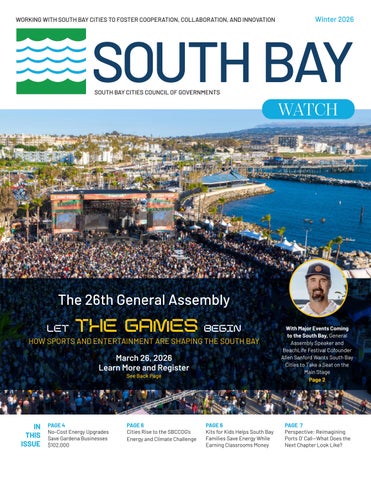
South Bay Watch

Page 1


Let the Games Begin

Register for the 26th General Assembly

Let the Games Begin: How Sports and Entertainment are Shaping the South Bay

See Back Cover

With Major Global Events Coming to the South Bay, General Assembly Speaker and BeachLife Festival Cofounder Allen Sanford Wants South Bay Cities to Take a Seat on the Main Stage

On March 26, the South Bay Cities Council of Governments (SBCCOG) will host its 26th annual conference, bringing together South Bay communities to address emerging issues facing the subregion. While the South Bay has always been the home of great beaches, fine art and culture, it is now facing unprecedented opportunities for exposure on the world stage as it serves as a major axis point for upcoming major events, such as the FIFA World Cup 2026, Super Bowl LXI, and the 2028 Summer Olympic and Paralympic Games. This year’s General Assembly will explore the South Bay’s transformation into a hub for sports and entertainment and the impact this evolution is having on the economy and environment. Allen Sanford, a South Bay native and entrepreneur who created BeachLife Festival and recently opened California Surf Club in The Waterfront, Redondo Beach will be a speaker at the event. He shares his insights about how sports and entertainment are shaping the South Bay.

Q: Why did you believe the time was ripe to bring a major music festival like BeachLife here?

A: Growing up in the South Bay, I watched my parents go to The Strand [former club in Redondo Beach] and enjoy top-level music, so I understood the demand early. Yet most of the sports and entertainment we experienced as a family meant driving out of the South Bay. Everyone likes to be entertained and our hypothesis was that putting music together for the enjoyment of the beach community would be interesting to the public. This was further fueled by an experience at the Hollywood Bowl in 2016, going to see Paul Simon, whereby I spent a few hours in traffic, finally got to my seat halfway through the show and realized that the juice was no longer worth the squeeze. That night served as the beginning of the road toward BeachLife.

Q: What makes the South Bay appealing for event and venue developers?

A: The South Bay is unique to Los Angeles and a unique differentiator in the LA28 campaign. The music and sporting communities have a plethora of options related to large, corporate arenas in our subregion. However, boutique and curated outdoor events—with the beach and culture Los Angeles is known for as the backdrop—are

unique and in short supply but have a great demand. Additionally, brands that desire to make a meaningful and genuine impact on potential consumers have a hard time doing that in a corporate, indoor arena environment. As we contemplate millions of fans visiting Los Angeles for the Olympics, our thesis is that a large majority are there for the party … and the South Bay is what tourists imagine Los Angeles to be. My wife, born and raised in Germany, continues to remind me that she grew up watching subtitled episodes of Baywatch, dreaming of coming to Southern California to see the beaches, ocean, palm trees, skateboards and surfboards. That anecdotal evidence has inspired much of our forward movement.

Q: The South Bay has flown under the radar for a long time, with its proximity to but also distance from higher-profile neighbors such as the City of Los Angeles and Hollywood. What challenges and opportunities did this pose for you when creating BeachLife?

A. The biggest challenge for me is a cultural challenge. When you have experienced something amazing and beautiful like the South Bay, my initial reaction is to want to

From left: Longtime friends and cofounders of BeachLife
Rob Lissner and Allen Sanford at the Redondo Beach waterfront festival. Photo credit: JP Cordero

be inclusive and share that experience. However, my secondary reaction is to protect that experience and make sure it doesn’t change or get ruined with an increase in volume. I believe BeachLife has been successful in addressing this. We have not increased our footprint or forgotten our attention to detail over the years. The opportunity is obvious—though I’m subjective. As a born and bred Angelino raised in this area, I truly believe we have one of the best coastal living areas in the world, so it’s easy for me to see the opportunity, however subjective that may be.

Q: Now with so many major venues, the South Bay holds a fair share of the cards when it comes to hosting the subregion’s major entertainment and sporting events. How can the South Bay leverage this to attract tourism and recognition on the global stage?

A: I think it’s imperative that the South Bay understands its power in banding together and creating a collective rather than individual win. More specifically, if communication is sparse and each city in the South Bay operates as an island, the success will be incremental. If the cities can achieve communication and start dreaming bigger collectively, I believe the South Bay could play a major part of the fan experience in Los Angeles in 2028.

Q: With this higher profile, will we see more attractions in the future, like the West Harbor development that’s coming to the San Pedro waterfront?

A: I believe that with success in the South Bay, more entrepreneurs will learn about the area and try to capitalize on the opportunity, Having spent my career in the South Bay, though, I believe there are some significant obstacles that many people don’t or won’t see without having the direct experience of building in the South Bay. So yes, I think we’ll see an increase in business endeavors, but I do believe that the South Bay has limited capacity.

Q. Public transit is not widely used in the South Bay. How has this impacted your event?

A: I’m not a transportation expert, but the lack of public transportation affects all of Los Angeles and has since I was a kid. It creates “borough” type environments, and

this has positive and negative effects. With BeachLife, we understood the community’s need, for example, for bike and skateboard parking at the festival, which largely ameliorated any parking or traffic concerns the public initially had.

Q: How does BeachLife impact the local economy and that of the greater South Bay?

A: BeachLife does a third-party economic study annually around this question, and I’m always humbled at the results. We bring two types of currency to Redondo Beach and the greater South Bay: 1) real dollars (eight figures) that are invested into the community through consumer spending, hotel tax, employment increases, etc., and 2) intangible earned media value by spotlighting the South Bay as a beautiful area. Just recently, In-NOut Burger, a major California corporation, brought a large event to Redondo Beach as a result of the owner attending BeachLife several times and seeing what was possible. Word of mouth is one of the most underrated growth engines out there.

Q: What has been the local government’s role as an encourager and a regulator of your business endeavors? How has BeachLife’s host city Redondo Beach supported you? Are there improvements that would help?

A: Traditionally, government has been viewed as an impediment or obstacle to event success. Two people believed in BeachLife initially, which truly helped me realize the vision: Bill Brand, former mayor of Redondo Beach, and Mike Witzansky, the current city manager. When I first came to Redondo Beach with this idea, the city was in turmoil surrounding coastal development, and BeachLife served as a lightning bolt to inspire imagination on what the Harbor could be other than a large parking lot. Though confidence was not high that BeachLife would succeed initially, these two individuals, along with former chief of police Keith Kauffman and deputy public works director Mike Klein, helped us reduce obstacles—not create them—by starting from a place of “yes.” Coming back from COVID, it truly felt like the City of Redondo Beach was a business partner helping a struggling partner come back from nothingness, and as a result we were able to continue building momentum into what BeachLife is today. Fast-forward: Today there is a different

council, a different city staff and a new historical perspective, but we continue to put forth our best effort to be great partners with the community, delivering a unique experience that has come to be loved by the South Bay. The key to success really is municipalities creating mutually beneficial partnerships as opposed to short-term vendor relationships.

Q: As a business owner, are you doing anything to prepare for the coming 2028 Summer Olympic and Paralympic Games?

A: Yes. The South Bay has an unbelievably unique opportunity to play a major role in the 2028 Olympics. My memory of being a kid and watching the torch run through the South Bay in 1984 continues to inspire me to play some part in one of the greatest events in the world. The reason I’m doing this interview and participating with this body is that I want to capture the imagination of the local city councils and public figures. Now is the time for planning, communication and partnering—and I don’t see nearly enough of it right now. Our businesses are already preparing for the Olympics and have been in communication with LA28, and I credit Mayor Light of Redondo Beach for pushing the initiative forward. But I am not in a position to control the outcome of the cities in the South Bay—only to advocate that now is the time to act. The window for opportunity is small, and the complexities are significant. Only those who fully embrace the opportunity and work toward success will see the fruits of their labor.

Q: Are you excited about the future of sports and entertainment in the South Bay?

A: It depends on whether it fits the character and soul of the South Bay. Bringing beneficial economics and attention to the South Bay without preserving its communal fabric is self-defeating. At the same time, living in denial that change is not only inevitable but needed is equally destructive to the community, and those who fight against all forms of growth and change usually end up opening the door to the worst type of change they tried to prevent. Most of us love sports and entertainment and would love to see more of it—in a quality, measured and optimal form. Threading that needle is difficult, but I believe it’s possible, and I look forward to participating and assisting in this progression. •

No-Cost Energy Upgrades Collectively Save Gardena Businesses $102,000

Since 1991 Jesus Baltran’s father has owned and operated Yas’ Market in Gardena, a corner grocery store that offers produce, fresh meats and hot food. During the last four years, Baltran has been managing the market—a popular stop for families in the community.

Last fall, Eleanor Murphy, energy programs project coordinator for the South Bay Cities Council of Governments (SBCCOG), stopped by Yas’ Market to share information about an opportunity being offered through the SBCCOG’s partner, the SoCalREN. The new program enabled small businesses in the Gardena community to receive no-cost energy equipment upgrades. These upgrades could save businesses like Baltran’s an average of $4,000 per year in energy bill savings.

“I had my doubts at first because I thought it was a sales pitch, but when she explained it further she made me comfortable, and I realized, ‘Oh this is the real thing,’” Baltran said. “If she hadn’t visited my store, I never would have heard about it.”

By enrolling in the Food Desert Energy Efficiency Equity program offered through SoCalREN’s commercial energy efficiency programs, Baltran’s business qualified to receive exterior LED lighting upgrades, two tankless water heaters and a new cooler—all at no cost.

Baltran’s customers often stop by the market on their way home from work. This winter, Baltran says that they have already commented on how much

Small businesses in the City of Gardena celebrated energy efficiency upgrades made possible through the SoCalREN Commercial Energy Efficiency Programs at a recent ribbon-cutting ceremony at Yas’ Market. From left: Lujuana Medina, County of Los Angeles, Environmental Initiatives Division Manager; Refugio Sanchez, owner, La Pasadita (the meat counter at Yas’ Market); Tasha Cerda, mayor, City of Gardena; Jesus Baltran, owner, Yas’ Market; and Bernadette Suarez, City of Lawndale Council member and SBCCOG board chair

brighter the parking lot is, thanks to the new LED lighting.

“The lighting has made a huge difference. A lot of families stop by, sometimes close to 9 or 10 p.m. They say the lighting makes them feel safer and more comfortable.”

The new cooler has enabled Baltran to offer his customers an expanded variety of milk, cheese and other dairy products that he couldn’t previously offer.

Two wall-mounted tankless water heaters save space in the market’s storage area. Instead of continually burning energy to keep water hot at all times, tankless water heaters heat water instantly only when needed. They can increase energy efficiency by up to 34%, which provides long-term savings through lower utility bills.

Through the SBCCOG’s on-foot canvassing, 24 small businesses in the Gardena area have enrolled in the program and received upgrades. These costs have collectively saved 340,000 kilowatt-hours of energy and reduced annual energy costs by approximately $102,000—savings that small business owners can reinvest into their operations to better serve their communities.

“We’re so proud to partner with the SoCalREN and the SBCCOG to bring these resources directly to our businesses,” said Tasha Cerda, mayor of the City of Gardena. “Gardena is steadfast in becoming a greener, cleaner city and solidifying our commitment to innovation and environmental stewardship. Our hope is that it encourages other businesses to participate in the future.”

Business owners who participated in the program received comprehensive support from dedicated business energy advisors like Murphy, who guide them through every step of the process—from initial assessment through

Two space-saving tankless water heaters, obtained through the program, now supply Yas’ Market with hot water.

Customers at Yas’ Market say the new LED lighting makes them feel safer.

Since May 2025, participating businesses in the community have collectively saved 340,000 kilowatthours of energy.

installation and beyond.

“This personalized approach helps build trust and ensures businesses receive upgrades tailored to their specific needs,” said Murphy.

BENEFITS FOR PARTICIPATING BUSINESSES INCLUDE:

• Reduced monthly utility bills.

• Upgraded, efficient equipment that improves operations and customer experience.

• Enhanced capacity to stock and sell fresh, healthy food options.

• Improved store appearance and safety through exterior upgrades.

• Ongoing support from local Business Energy Advisors who understand the community.

Building on the success in Gardena, the SoCalREN commercial programs have now served nearly 80 small businesses throughout Southern California, strengthening their operations while contributing to the environmental and economic health of their neighborhoods.

For more information on these programs, visit socalren.org/commercial

These area businesses received equipment upgrades through the Food Desert Energy Efficiency Equity program offered through the SoCalREN’s commercial energy efficiency programs.

Shawarma Factory
Market
Fish Tacos & Ceviche
Bei & Karaoke Art's Cleaners
Toys / Nail Spa / Bake Shop
The LA Pit Albus Coin Laundry Aunties Cafe Yas' Market/ La Pasadita La Mexicana Market & Carniceria
Southern California Regional Energy Network is administered by the County of Los Angeles and funded by California utility ratepayers under the auspices of the California Public Utilities Commission

Cities Rise to Energy and Climate Challenge

The South Bay Cities Council of Governments (SBCCOG), in partnership with the Southern California Regional Energy Network (SoCalREN) and Southern California Gas Company (SoCalGas), recognized South Bay cities for their efforts in pursuut of energyefficiency initiatives and sustainabilityrelated tasks through the South Bay Energy and Climate Recognition Awards. While all cities earned recognition, four cities--Carson, Gardena, Manhattan Beach and Torrance-rose to the newly created platinum level.

Steps taken to earn platinum:

Carson

• Starting an EV Charging Wallet program through the Clean Power Alliance—residents receive reimbursement for use of electric vehicle charging stations

• Increasing EV charging capacity throughout the city Gardena

• Implementing a waste diversion education program

• Participating in the SoCalREN’s Commercial Direct Install program in partnership with the SBCCOG

Manhattan Beach

• Creating an Energy Resilience Action Plan

• Adopting a Climate Action and Adaptation Plan

Torrance

• Implementing an employee rideshare program

• Hosting Coastal Cleanup events

Other South Bay cities earned gold-, silverand bronze-level achievement.

• Gold: El Segundo, Hawthorne, Rolling Hills Estates

• Silver: Hermosa Beach, Inglewood, Lomita, Rancho Palos Verdes

• Bronze: Lawndale, Palos Verdes Estates, Redondo Beach, Rolling Hills

To earn points toward recognition, cities had to complete at least one activity within the categories of climate action and adaptation, education and engagement, and technical assistance and implementation. Participating cities were honored at a luncheon at the Harold E. Hofmann Community Center in Lawndale. •

To learn more about the program, visit southbaycities.org/energy-efficiency. To watch a video featuring the winners, visit bit.ly/energyawards2025.

A third grade classroom

From left: Rodney Tanaka, council member, City of Gardena, and immediate past chair, SBCCOG; Kim Nolan, administrative analyst, City of Gardena; Allan Rigg, director of Public Works, City of Gardena; Hong Lee, program manager, City of Gardena; Mark Henderson, mayor pro tem, City of Gardena; and Kevin Thomas, superintendent of Public Works, City of Gardena, with their platinum-level award

South Bay Classrooms Receive $19,000 for Energy-Saving Efforts

The South Bay Cities Council of Governments and Southern California Regional Energy Network teamed up to award 19 South Bay classrooms grants of $1,000 each ($19,000 total) for taking energy-saving actions at home. Classrooms representing Hawthorne School District and Los Angeles Unified School District earned the rewards through the SoCalREN’s Kits for Kids program for third and fourth grade students. The program provides hands-on education about the benefits of energy efficiency.

Participating students receive no-cost items including LED bulbs, an efficientflow showerhead and faucet aerators

that help their families save money and improve their comfort at home. Classrooms simultaneously participate in engaging online activities, including interactive games and an online scavenger hunt to make learning about energy-saving practices fun. Through the SoCalREN’s Kits for Kids Program, participating classrooms can earn a $1,000 incentive when at least 65% of students complete the energy-saving curriculum.

To watch video highlights of the celebration at Ramona Elementary School, visit bit.ly/kitsforkidscelebration

at Jefferson Elementary School in Hawthorne celebrates earning $1,000 through the Kits for Kids program.

Reimagining Ports O’ Call: West Harbor and the South Bay’s Next Chapter

As the South Bay prepares to welcome visitors for the FIFA World Cup 2026™, Super Bowl LXI and the 2028 Summer Olympic and Paralympic Games, we are entering a once-in-a-generation period for our region. Major venues, infrastructure upgrades and transportation improvements are changing how our community and visitors move through and experience Los Angeles.

The destination will feature an expanded San Pedro Fish Market, the new satellite location of Hollywood landmark Yamashiro, and a collection of first-in-market and Michelin-recognized culinary concepts such as Tacos El Franc, alongside strong regional operators. We were deliberate about assembling independent businesses that reflect Southern California’s global character and San Pedro’s personality.

Along the San Pedro waterfront, West Harbor is part of that shift—not just as a new dining, shopping and entertainment destination but as a continuation of this community’s relationship with the water. Opening in phases beginning this summer, West Harbor spans 42 acres and a full mile of waterfront property at the previous location of Ports O’ Call Village.

Ports O’ Call was built in the early 1960s, and for many of us who grew up nearby, it represented something special. It took a working industrial harbor and made it accessible. Families could walk the docks, share a meal and experience the port up close.

While that chapter has closed, the goal remains the same: Create a place that is authentic, welcoming and worth returning to. We designed West Harbor to be unique, authentic and fun—three principles that guide every decision.

Beyond dining, West Harbor introduces new ways to gather at the water, including a boutique amusement park, waterfront excursions and open park space designed for daily use as well as larger events. The 6,200-seat harbor-facing amphitheater, developed in partnership with Nederlander Concerts, brings something the South Bay has never had before: a true waterfront venue capable of hosting concerts and regional programming at a meaningful scale.

This summer, the amphitheater will welcome its first major public activation as an Official Los Angeles World Cup 26™ Fan Zone. West Harbor is one of only two locations in Greater Los Angeles selected to host final-round match viewings, including the semifinals and the World Cup Final. It’s an exciting way to introduce the amphitheater, not just as a concert venue, but as a place where the community can gather for shared global moments.

The Fan Zone will also mark the beginning of consistent programming throughout 2026, as additional phases open and the waterfront comes fully to life. Importantly, this isn’t about building something solely for large-scale events. It’s about creating a place that works every day, for families, for local residents, for small businesses and for the broader South Bay.

As we look toward March 26 and the SBCCOG ‘s General Assembly, “Let the Games Begin: How Sports and Entertainment are Shaping the South Bay,” I’m encouraged by the collaboration that has made this progress possible. If we do this right, projects like West Harbor will ensure that long after the final whistle blows, the South Bay has stronger public spaces, a more connected waterfront and a destination that truly belongs to the community. •

A rendering of the West Harbor development.

FREE EVENT

South Bay Watch is a quarterly bulletin by the South Bay Cities Council of Governments to inform local leaders of subregional progress and alert them to emerging issues.

Governing Board: Chair

Bernadette Suarez, Lawndale 1st Vice Chair

Bill Uphoff, Lomita 2nd Vice Chair

Alex Monteiro, Hawthorne

Immediate Past Chair

Rodney Tanaka, Gardena

Members:

Carson, Los Angeles County, El Segundo, Gardena, Hawthorne, Hermosa Beach, Inglewood, Lawndale, Lomita, Los Angeles, Manhattan Beach, Palos Verdes Estates, Rancho Palos Verdes, Redondo Beach, Rolling Hills, Rolling Hills Estates, Torrance

SBCCOG Executive Director

Jacki Bacharach

Legal Counsel

Michael Jenkins, Best Best & Krieger LLP

Treasurer

Matthew Robinson

Editor

Colleen Farrell, Senior Project Manager, Communications

Contributors

Rosemary Lackow, Administrative Assistant Design

Vincent Rios Creative, Inc.

To subscribe to SBCCOG newsletters or view past editions, visit southbaycities.org/newsletter

To view a schedule of SBCCOG meetings, visit southbaycities.org/calendar

Follow us: facebook.com/SBCCOG facebook.com/SBESC @SouthBayCCOG @SBESC @southbayccog

Turn static files into dynamic content formats.

Create a flipbook