




Julie Reeder
The annual Southwest Regional Economic Forecast, presented by the Temecula Valley Chamber of Commerce, brought together economists and economic development leaders and hundreds of business people from across Southwest Riverside County to discuss regional trends and each city’s economic strategy.
Southwest Riverside County has reached a pivotal moment in its evolution, growing beyond its reputation as a collection of commuter communities into a region pursuing specialized economic development strategies designed to attract employers, visitors and investment.
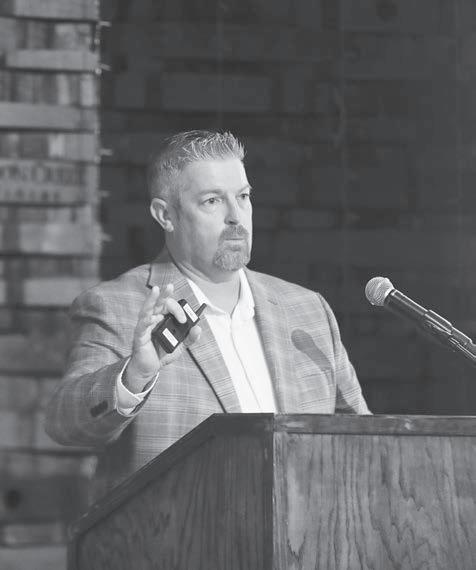
That was the overarching message delivered from regional economist Matthew Tate, who outlined the area’s economic strengths before leaders from Temecula, Murrieta, Menifee and Lake Elsinore explained how each city plans to capitalize on those advantages.
“The region already has the population, workforce and consumer spending to support significant additional investment,” Tate said, arguing that Southwest Riverside County’s next chal-
see FORCAST, page A-5


MENIFEE, CA — Samaj Daniel, an eighth-grade student at Menifee Valley Middle School, has been officially selected to the USA World Baseball Classic team and will travel to Italy this July to compete against top international talent. Daniel earned this spot following a historic year of elite athletic performance paired with an equally remarkable academic and community service record right here in Menifee.
The national team selection highlights a series of major milestones Daniel achieved throughout his middle school career. On the academic front, he recently received the Presidential Educational Award for maintaining a perfect 4.0 GPA across all three
years of middle school. He was also honored with the Golden Pyramid Scholar Award, presented by the National Urban League of San Diego and the University of San Diego, which recognizes only about 200 students across San Diego, Orange, and Riverside counties who maintain a 3.5 GPA or higher. Alongside his academic load, Daniel has committed himself to local volunteerism, completing over 1,000 hours of community service with non-profit organizations, including the March of Dimes.
“Samaj’s work ethic is second to none, and it shows in everything he does,” said Fernando A. Meza, Coach and Campus Supervisor at Menifee Valley Middle School. “He is a phenomenal athlete on the diamond, but just as importantly, he is a great student who puts that same dedication into his academics. What truly sets him apart from other players his age is this relentless drive to excel in all areas. We are blessed to have an abundance of incredible talent in our region, but having Samaj chosen to represent us on the USA WBC team is a massive honor. There isn’t a single player more deserving to carry that torch for our community, and I know he’s going to make us all proud.”
“Having a student-athlete like Samaj represent the Menifee Union School District on a global stage brings an immense amount
see SAMAJ, page A-5
Valley Outlook B-1


Joe Naiman for Valley News
A watercolor painting by Murrieta artist Susan Keith was awarded Best of Show for the 2026 San Diego County Fair’s Exhibition of Fine Art.
In addition to being selected as Best of Show the painting Keith titled “Great Is His Faithfulness” also received first place in the Watercolor - Representational, Landscapes class. Keith also took first place in the Watercolor - Representational, Still Life and Florals category for “Velvet, Draped, And Graped” and won a donated award for her painting “Only Daisies Will Do”.
“I got some wonderful awards this year,” Keith said. Keith was raised in Hacienda Heights. She and her husband moved from Moreno Valley to Murrieta in 2001. Keith had been teaching art at Jurupa Valley High School before joining the Murrieta Valley High School faculty
in 2000. She commuted from Moreno Valley for part of her first year at Murrieta Valley High School before moving closer to the school. Keith retired as a high school art teacher in 2012.
“When I retired, I started painting watercolors professionally,” Keith said. Initially, Keith painted using soft pastels. “Within six months I started painting watercolors, and I fell in love with the medium,” she said.
Approximately 2,000 pieces of artwork were submitted for the 2026 San Diego County Fair’s Exhibition of Fine Art, and 600 were accepted for display at the fair. Keith entered five paintings, and four were chosen to hang in the gallery. Keith painted all four of those pieces during 2025.
Eucalyptus trees are featured in Great Is His Faithfulness. A closer perspective doesn’t include the entire tree but allows portions. Keith took a photograph she used to turn the image into a watercol-
or painting.
“This part of the day I had all these beautiful colors from the shadow and the leaves,” Keith said.
Keith estimated that painting Great Is His Faithfulness took between 40 and 50 hours. “I get up in the morning and that’s the first thing I do, just paint,” she said. When she is painting another piece Keith may look at what she initially deemed to be a finished painting and make additions. “It’s very difficult to determine when you’re done,” she said.
The Best of Show is the first for Keith at the San Diego County Fair. “That was amazing. I was floored by that and very honored,” she said. “I was really surprised. I’ve never won a Best of Show, so that was pretty exciting for me.”
The title reflects Keith’s own faith as well as the greatness of the trees. “They’re big, large
those responses, personalized awards were created for them.
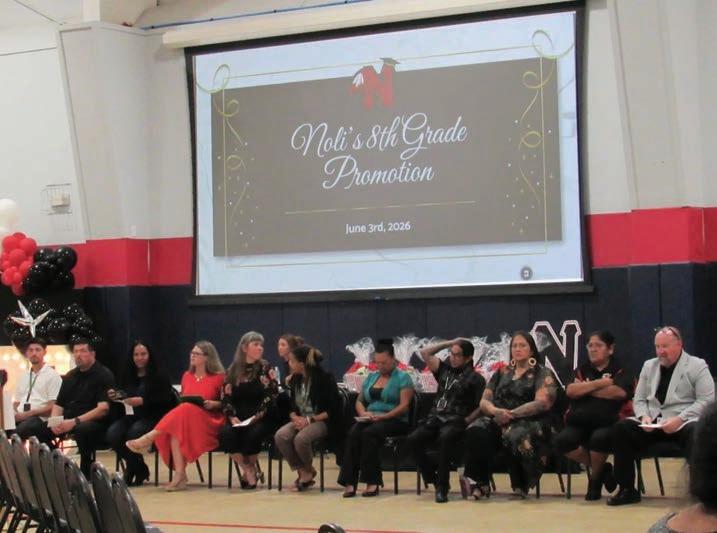
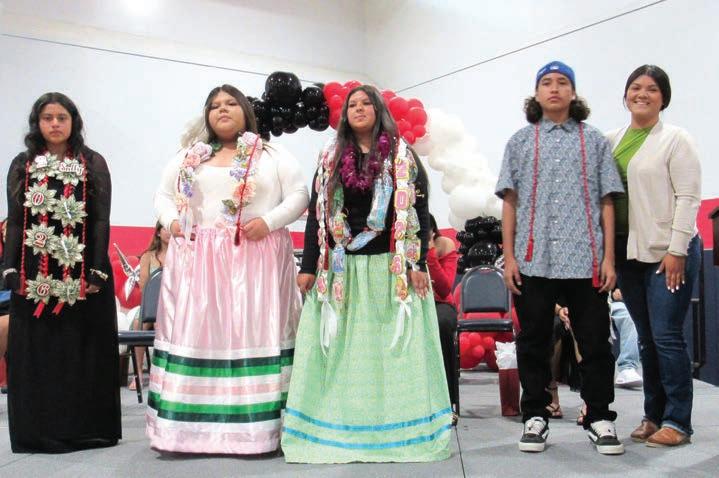
Eleven Noli Indian School students were recognized for completing eighth grade with a promotion ceremony at the Soboba Sports Complex on June 3. After a welcome from Principal Donovan Post, a blessing was provided by Damon Miranda Jr. The Torres Martinez Desert Cahuilla Bird Singers and Dancers shared a few songs for the special occasion.
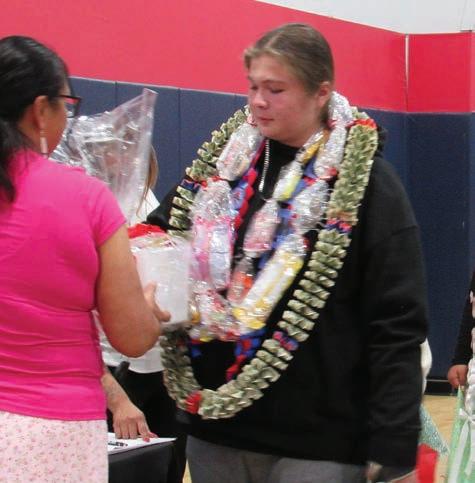
Post said he has been at the school for 30 years, starting out as a teacher, and enjoys seeing the children of former students now attending Noli. He thanked the Soboba Tribal Council for their continued support and generosity that enable these students to be successful. Post also a cknowledged the tireless efforts of the Noli Booster Club, which hosts fundraisers to assist the athletic and academic programs throughout the 6-12 grade school. Members also volunteer at events and provide special gift baskets for each of the students being promoted. Post thanked his entire staff for the hard work, dedication, and love they put into their jobs every single day which he said makes his job easier.
In what has been a long-standing tradition at the ceremony, Post offers students the opportunity to give a speech if they choose to do so. This year, Monica Rivera came forward to share her thoughts with her peers and the families and friends who were there to support them all. She said she was grateful to have been able to play sports and be part of ASB, AVID, and the Beading Club while in middle school.
English and Culture teacher Emma Avellaka Herrera served as one of the emcees for the event and explained that, being a small school, all staff members are given the unique opportunity to get to really know each and every student on campus. She sent out a survey to all staff members asking them to describe each student. Based on
“Every passion, skill, breakthrough, and even every mistake is visible,” Herrera said.
“As you can imagine, this can be a very intimidating place to learn because learning demands that we make mistakes. Regardless of the audience these students have, they have persevered through many challenges in their classes and in sports. I have never seen a group more willing to stand up for one another.”
Students, with their Tribal affiliations, were recognized for their distinctive attributes.
Aliyah Brane, Mesa Grande Band of Digueño Indians, received the Peacekeeper Award for always looking out for her friends and community members. Candace Devore, Soboba Band of Luiseño Indians, was given the Náavut Award for being a strong and admirable young woman. Aydreean Garcia, Soboba Band of Luiseño Indians, was acknowledged as a Firekeeper for making connections in all she does. Sally Lopez-Reyes, Kumeyaay and Tongva, was singled out for being a Critical Thinker who is beyond her years in thinking, risk-taking, and rigor.
Nadillyn Mendoza, Soboba Band of Luiseño Indians, earned the Omqée’is Award for looking after others with the same care and grace as only an “older sister” can. Su Kutt Morreo, Soboba Band of Luiseño Indians, received the Storyteller Award because he is constantly creating through stories, art, or business endeavors. Angel Reyes, Texas Band of Yaqui Indians, was given the Áswut Award for being observant and intentional in his interactions with others.
Monica Rivera, Soboba Band of Luiseño Indians, earned the Stewardship Award for taking responsibility for the care of friends, family, teammates, and her school community.
Destiny Saucedo, Torres Martinez Desert Cahuilla Indians, received the Kwíila
Award because of her confidence in character, writing, and r eflection that inspires others to become better versions of themselves. Avasily Témanwanvish, Los Coyotes Band of Cahuilla and Cupeño Indians, was given the Móomat Award for her ability to bring life to every relationship she cultivates. Samuel Venegas, Soboba Band of Luiseño Indians, received the ‘Íswut Award for taking pride in leading other young men on campus. The event also included the awarding of additional recognition to several students. Spanish teacher Andrea Duran serves as an AVID advisor and gave recognition to four students who are making a difference. She said they have challenged themselves and know how to make the most of every opportunity They are Aydreean Garcia, Sally Lopez-Reyes, Angel Reyes, and Monica Rivera.
Science teacher Sabrina Smith is Noli’s ASB Coordinator and presented certificates to three students who have stood out as leaders in and out of the classroom and can always be relied upon. They are Aliyah Brane, Candace Devore, and Monica Rivera. Herrera presented Destiny Saucedo with a Culture Recognition award for having remarkable accountability for her words and actions and practicing restraint and respect regardless of any difficulties or obstacles.
After certificates of completion were presented to the students, they were congratulated by Noli teachers and School Board members President Sandy Boniface, Vice President A ntonia Briones Venegas, Secretary Avellaka Arviso, and Members at Large Lucille Briones and Mia Gonzalez. The students were then free to join their family members and friends who were there for the important event that had them looking forward to transitioning into high school.






























KEITH from page A-1 trees, but they’re hardened and very resilient, and that speaks to my faith, too,” she said.
Keith attends Cornerstone Community Church in Wildomar.
“The hope that I have in God and my faith and my trust in Jesus Christ as my Savior, that sustains me,” she said.
Velvet, Draped, And Graped features grapes on a tablecloth and a pitcher in the background.
“I was drawn to that fabric,” Keith said.
“I hadn’t really painted anything in the way of a still life that had fabric below,” Keith said. “I found out that I really enjoy painting elaborate fabric.”
Keith uses her bedroom as her studio. The window faces east, and she tends to paint between 9:00 a.m. and 11:00 a.m. “It’s all about the light and the color and the shadows,” she said.
Velvet, Draped, and Graped also needed the appropriate shadowing. “That table has to be moved and set up so I get the shadows,” Keith said.
Two of Keith’s paintings were in the Watercolor - Representational, Still Life and Florals class.
Although “Only Daisies Will Do” did not place in that category, the painting was given a donated award from the North County Society of Fine Arts.
“That painting is predominantly complementary colors, oranges and blues,” Keith said. “That was fun to paint because of the shapes and the shadows that were created from the daisies.”
The daisies are in a bowl, and eggs are in a bowl next to the flowers. “I like daisies. They’re simple, and you get beautiful colors off the whole petals,” Keith said. “You get beautiful color off of the whole eggshells.”
Keith utilizes photographs to formulate her paintings. “I take hundreds of pictures of still life from all different directions,” she said. “You never know what you’re going to end up with.”
An owl is the subject of Keith’s painting “Looking Ahead”, which did not place in the Watercolor – Representational, Animals competition.
“I’ve always done well at the fair with my paintings,” Keith said.


FORCAST from page A-1
lenge is capturing more of the wealth already being generated by its residents and visitors.
Tate, executive vice president of Capital Rivers Connect, presented data showing Southwest Riverside County has grown into a regional economic powerhouse with an estimated 445,000 residents, a workforce of approximately 214,000 people and an average household income of $122,510.
Nearly 62% of employed residents work in professional, managerial, healthcare, education, administrative or business occupations, reflecting a workforce increasingly dominated by white-collar employment.
Researchers also found the region is largely made up of established homeowners and families. Homeownership rates among the largest consumer groups range from 88% to 97%, creating strong purchasing power that supports restaurants, entertainment, travel, and retail spending.
“The demographics retailers seek are already here,” Tate said.
Perhaps one of the presentation’s most significant and surprising findings was that Southwest Riverside County has become a shopping destination well beyond its own population.
Using mobility and consumer spending data, researchers found shoppers regularly travel from Los Angeles, Orange, Riverside, San Bernardino and San Diego counties to visit businesses throughout the region. Visitors were also identified from metropolitan areas including New York, Seattle, Phoenix, Dallas-Fort Worth and Miami, with much of that travel occurring along the Interstate 15, Interstate 5, State Route 91 and Interstate 10 corridors.
Certain retail sectors already generate more spending than local residents alone could support.
Warehouse clubs and superstores produce a retail surplus of approximately $261 million annually, while general merchandise stores generate a $181 million surplus and family clothing stores another $41 million. Combined, those categories attract nearly $500 million in outside spending.
Despite that success, Tate said Southwest Riverside County continues to lose an estimated $1.19 billion in annual consumer spending because many residents leave the area for certain purchases.
The largest opportunities identified include:
• $506 million in motor vehicle and parts sales.
$364 million in restaurants and drinking establishments.
$325 million in building materials and garden equipment stores.
Those sectors represent some of the region’s greatest opportunities for future commercial recruitment.
Tate said retailers continue looking for communities with growing populations, higher household incomes, skilled workforces, convenient transportation and entertainment destinations that encourage repeat visits.
Southwest Riverside County, he argued, increasingly offers all of those characteristics.
Cities pursue different economic identities
While Tate focused on regional trends, city leaders demonstrated how each community is carving out its own niche within the larger economy.
SAMAJ from page A-1
of pride to our entire community,” said MUSD Governing Board President J. Kyle Root.
Temecula bets on innovation
Temecula is positioning itself as the region’s innovation and research center.
Economic Development Manager Christine Damko described the city’s next chapter as “The Renaissance Is Now,” highlighting investments in infrastructure, advanced manufacturing, entrepreneurship, and life sciences.
Major projects include the French Valley Parkway Phase 3 expansion, designed to improve mobility while opening additional commercial opportunities along the Interstate 15 corridor.
Damko also highlighted recent expansions by MilliporeSigma’s organoid research laboratory, American Modular Systems and continued growth in biotechnology and advanced manufacturing.
Rather than relying primarily on residential development, Temecula’s strategy emphasizes creating higher-paying jobs through business recruitment and innovation.
Murrieta expands healthcare and professional services
Murrieta’s presentation focused on strengthening industries already driving its economy.
Economic Development Director Scott Agajanian highlighted continued growth in healthcare anchored by Loma Linda University Medical Center-Murrieta, Rancho Springs Medical Center, and Inland Valley Medical Center.
The city also emphasized workforce development, educational partnerships, business incubators, and technology recruitment while maintaining the quality of life that has helped make Murrieta one of California’s fastest-growing and safest cities.
Officials said the goal is to attract employers whose jobs match the skills of the city’s increasingly educated workforce.
Menifee turns population growth into economic growth
Menifee, one of California’s fastest-growing municipalities, is working to ensure commercial development keeps pace with residential expansion.
Economic Development Manager Kayla Charters outlined efforts to recruit retailers, restaurants, healthcare providers, and employers capable of serving both today’s residents and the city’s future population.
Commercial corridors, industrial development, and infrastructure improvements are intended to reduce the need for residents to commute elsewhere for employment while creating a more balanced local economy.
Officials also cited Menifee’s available land, strategic location and young workforce as competitive advantages for attracting new investment.
Lake Elsinore embraces tourism and action sports
Lake Elsinore presented perhaps the conference’s most ambitious rebranding effort.
Economic Development Director Gina Gonzalez said the city is transforming itself from a pass-through recreation community into a tourism destination centered on waterfront experiences, downtown revitalization and action sports.
Plans include continued investment in lake improvements, the proposed Diamond Entertainment District, new hotels, expanded tourism infrastructure, and a revitalized downtown featuring a new City Hall, library, and outdoor amphitheater.
The city is also pursuing an identity as Southern California’s action sports capital through projects including a new indoor hockey rink, expanded motorsports facilities, yacht club improvements, recreation master planning, and year-round sporting events.
Officials believe tourism can become a major economic engine generating new tax revenue, private investment, and overnight visitors.
Wildomar’s Economic Development Manager Ryan Miller said Wildomar is focusing on strategic commercial growth along the Interstate 15 corridor while maintaining a family-oriented character. He highlighted the city’s growing retail base, expanding restaurant scene, new hotels, healthcare facilities and major commercial projects, including new Walmart, Sprouts Farmers Market and Dutch Bros developments. The city also reported a median household income exceeding $103,000, a homeownership rate of 78.3% and continued population growth, positioning Wildomar as one of the Inland Empire’s fastest-growing suburban markets.
Wildomar also used Placer.ai mobility data to demonstrate its growing regional draw. During the past year, the city recorded approximately 283,000 visitor trips, including more than 164,000 overnight visits and an estimated $4.3 million in visitor spending. Visitors originated not only from Southern California but also from metropolitan areas such as Phoenix, underscoring the city’s growing role as a commercial stop along Interstate 15.
One region, complementary strategies
Although each city highlighted different priorities, a common theme emerged throughout the conference.
• Temecula is building an innovation economy.
• Murrieta is strengthening healthcare, education, and professional services.
• Menifee is converting rapid population growth into commercial investment.
• Lake Elsinore is leveraging tourism, recreation, and entertainment.
• Wildomar is capitalizing on strategic commercial growth, neighborhood retail and interstate accessibility.
Together, those complementary strategies represent a broader shift occurring across Southwest Riverside County.
Rather than competing solely for new housing, local leaders are increasingly focused on attracting employers, capturing retail spending, expanding tourism, supporting entrepreneurs, and creating higher-paying jobs closer to home.
If Tate’s economic analysis describes where Southwest Riverside County stands today, the presentations from each city illustrated where local leaders believe the region is headed: a collection of distinct but interconnected economic centers positioned to become one of Southern California’s most dynamic business regions.
The Southwest Regional Economic Forecast is a Temecula Valley Chamber of Commerce event held each year. The 2026 event was held at Wilson Creek Winery, with the Title Sponsor being Loma Linda University Medical Center - Murrieta.
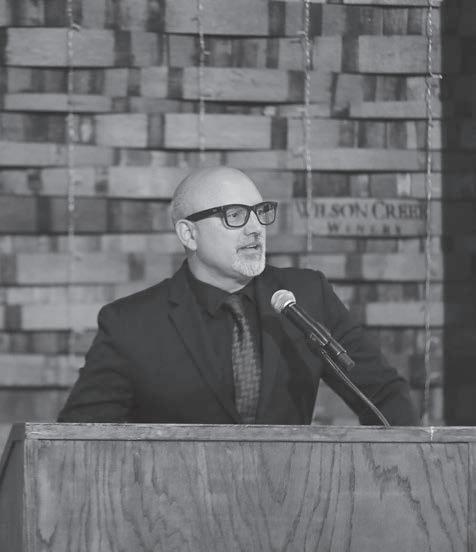

“Putting on the USA jersey is an incredible honor. It makes me proud to represent my family, my community, and my country,”
Samaj Daniel said. “I’m grateful to my teachers, coaches, and the Menifee community for
“To maintain a perfect 4.0 GPA over three years while dedicating 1,000 hours to community service is exceptional. Samaj truly exemplifies the standard of leadership, character, and academic excellence we strive to cultivate in all of our students, and we cannot wait to see him shine in Italy.”
District Education Center | 29775 Haun Road, Menifee, CA 92586 | www.menifeeusd.org always supporting, encouraging, and believing in me. I wouldn’t be here without them.” Daniel credits his faith as a foundational anchor for his journey, drawing inspiration from Joshua 1:9.

A gate that was installed where Leon Road once aligned with Briggs Road will now allow that former portion of Leon Road to be closed to traffic.
A 5-0 Riverside County Board of Supervisors vote on June 9
approved the use of the gate. The gate will be locked to prevent normal public access but may be opened by responders in the event of an emergency.
When the County of Riverside extended Clinton Keith Road from Interstate 215 to State Route 79, a lockable gate was installed along the southern right-of-way on Leon Road at its intersection with the former alignment of Briggs Road. The gate will prevent access of Leon Road to and to the former alignment of Briggs Road by public non-emergency traffic.
Section 966(a) of the California Streets and Highways Code allows a local government
to provide for the erection and maintenance of gates on county highways to avoid the necessity of building highway fences. Because that portion of Leon Road is no longer being traveled by the general public, the erection and maintenance of a gate will not impact residents or businesses. The gate is intended to protect
the public while preserving essential emergency connectivity. It will be opened in the event of an emergency requiring access by public safety agencies or other authorized emergency responders. The county will be responsible for the maintenance of the gate.
SAN JACINTO, CA — In a heartfelt tribute to patriotism and community pride, American Legion Post 848 hosted a special Flag Day recognition event on June 14 at Valley-Wide Regional Park, also known as Larry Minor Regional Park.
Centered around the theme, “One Flag, One Nation, One Community,” the event brought together local residents, businesses, and city representatives to honor those who demonstrate exceptional respect and pride in
displaying the American flag. Flag Day commemorates the adoption of the United States flag on June 14, 1777, when the Second Continental Congress approved the design of a national flag. The observance was officially established in 1916 and later recognized by Congress in 1949 as a day to celebrate the history and symbolism of the flag as a representation of freedom, unity, and national identity.
A highlight of the ceremony was a formal 13-fold Flag Recit-
al, a time-honored tradition that reflects the symbolic meaning behind each fold of the United States flag. The recital served as a powerful reminder of the values, sacrifices, and unity the flag represents.
Awards were presented to businesses, community members, and cities that have shown outstanding dedication in their display of the U.S. flag, helping to foster a sense of patriotism throughout the San Jacinto Valley and surrounding communities.
The event was led by Post Commander Lester Fountain, with significant support from 1st Vice Commander Joel Ortiz, who helped organize the program.
3rd Vice Commander Jamie Swan added to the celebratory atmosphere by serving as the event’s DJ.
The gathering was made possible in part through the support of the Lamas Housing Project, reinforcing the collaborative spirit that defined the day.
Attendees enjoyed a meaning-
ful and uplifting ceremony that not only honored the nation’s flag but also strengthened community bonds. Events like this continue to highlight the important role local organizations play in preserving traditions and bringing people together.
For many in attendance, the message of the day was clear: the American flag remains a powerful symbol of unity, pride, and shared identity.
Joe Naiman for the Valley News
The Riverside County Flood Control and Water Conservation District will undertake six proposed projects, including Azusa Channel in Menifee Valley and Stage 3 of the Morgan Valley Wash in Temecula Creek.
The Riverside County Board of Supervisors members are also the board members of the Riverside County Flood Control and Water
Conservation District. The county supervisors voted 5-0 on June 9 to direct the district to pursue the projects.
The Riverside County Flood Control and Water Conservation District Act requires the county supervisors acting as the district board to adopt a resolution specifying the district’s intent to undertake new projects and to notice and conduct a public hearing to consider any public objections regarding the pro-
posed projects. A 5-0 vote on May 12 set the June 9 hearing date. Each proposed project will require additional detailed engineering, environmental studies, California Environmental Quality Act compliance determinations, and property acquisitions. The necessary actions, including appropriations for each project, will return to the flood control district board for subsequent approval prior to construction.
The Azusa Channel project is
on the east side of the Menifee campus of Mt. San Jacinto College. The project would reduce street and community flooding by collecting flows from two channels into a large inlet structure.
The flows would be conveyed north in 1,400 feet of open channel and then discharged into the La Piedra Road Culvert, which is owned by the City of Menifee and which outlets to Menifee Lakes.
The flood control district would be responsible for the operation and maintenance of the Azusa Channel once it is constructed. The current estimated construction cost, including pre-construction phases, is $5,100,000. Stage 3 of the Morgan Valley Wash project would install toe and sideslope protection to stabilize and restore the stream function of the portion of Morgan Valley Wash between Woolpert Lane and Via Pascal. The estimated total cost is $3,700,000.
Joe Naiman for the Valley News
The Riverside County Board of Supervisors created a community facilities district for a Horsethief Village tract.
A 5-0 vote June 9 approved a resolution certifying the results of the election to create the CFD. The action also approved the property tax assessment to fund the CFD expenses.
A community facilities district includes a special tax (sometimes known as Mello-Roos taxes due to the state legislators who authored the option for services on new development to be funded by an annual assessment) to fund the services and/or infrastructure.
A Joint Communities Facilities Agreement stipulates the collection and distribution process for the taxes. If the one percent property tax is not sufficient to pay for maintenance, fire protection, and other services, a CFD may be formed for those services and that CFD would be perpetual.
A CFD may also pay for infrastructure, including capacity fees, which are charged to developers to cover the new development’s share of existing infrastructure, and that assessment ends when the bonds are paid off. The CFD may also pay for the reimbursement to government agencies for their staff time and other expenses to form the CFD, the cost to issue bonds, and the annual costs to ad-

F
uneral arrangements are a difficult topic to discuss, especially when the funeral will be your own. But having these conversation will make it easier for your survivors. We offer the most options and best value in the preplanning market, plus easy funding plans to meet your individual needs. Call for information today and receive our free Personal Arrangement Guide. It
minister the CFD. An assessment must be approved by a majority of property owners, although a developer who owns a property before it is subdivided may cast the sole vote in favor of a CFD which will be binding upon subsequent property owners.
The 49-acre Horsethief Village tract is slated to be subdivided into 226 single-family residential units. The property is currently unoccupied. MRP HTMB, LLC, currently owns the land.
The CFD for Horsethief Village will be perpetual and will fund street lighting, regional sports facilities, landscape and trail maintenance, and stormwater facilities maintenance along with the administrative costs
for the CFD. The street lighting expenses include energy charges, operation, maintenance, and administration. The expenses for the regional sports facilities will include maintenance and servicing of trees, plant material, sod, irrigation systems, sidewalks, drainage facilities, signs, monuments, buildings, playgrounds, and fences along with weed control and other abatement, graffiti removal, and security as needed. The landscaping maintenance will include turf, ground cover, shrubs, trees, plants, irrigation and drainage system, ornamental lighting, masonry walls or other fencing, and park and trail maintenance. The trail maintenance may include servicing and
maintenance of vinyl fencing. The stormwater facilities costs include the administration, inspection, and maintenance of water quality basins, fossil filters, and basin forebays built to meet best management practices to assure proper vegetation and functioning irrigation while remediating operational or structural deficiencies, weeds, erosion, trash, silt, and sediment build-up. The CFD assessment for Fiscal Year 2025-26 will be $768 per taxable unit for residential property and $4,175 per acre for any multi-family residential or non-residential property. The assessment will increase annually by the larger of 2 percent or the Consumer Price Index increase.










Wildomar and Canyon Lake to share planning and development review services
Joe Naiman for the Valley News
The City of Wildomar and the City of Canyon Lake will be sharing planning and development review services personnel and other resources.
The Wildomar City Council voted 5-0 on June 10 to approve an agreement between the two cities for planning and development review services. A City of Wildomar employee will perform the services, and the city will be
reimbursed by the City of Canyon Lake.
City of Wildomar planning personnel have experience in municipal planning, zoning administration, development review, environmental review, and customer service. The City of Canyon Lake needs additional planning resources to assist with the administration of land use, zoning, development review, permit processing, limited environmental review, and related planning functions. Staff from
the City of Canyon Lake inquired about assistance from the City of Wildomar in planning and development review.
The City of Wildomar had previously identified the need to fill one Associate Planner position. That position will now be shared with the City of Canyon Lake, which will provide 50 percent of the costs for that person’s salary and benefits. The City of Wildomar will create a new Planning Technician position, which will not be shared. The agreement will
also allow the City of Wildomar to reduce the number of hours being paid to outside consultants for overflow planning work.
The initial term of the agreement will begin July 1. The development proposals the Wildomar staff member may review include residential, commercial, industrial, and mixed-use projects. The services Wildomar may provide also include review of zoning clearances, business registrations, sign permits, preparation of planning comments, correction
Wildomar adds two streets to road resurfacing program
By Joe Naiman For the Valley News
The Wildomar City Council has amended its Fiscal Year 2026-27 Road Repair and Accountability Act project list to add resurfacing work on Monte Vista Drive and Union Street.
The council approved the
By Joe Naiman For the Valley News
letters, technical memoranda, assistance with staff reports, conditions of approval, public hearing materials, limited environmental review and California Environmental Quality Act compliance assistance, and remote public counter and customer service support. The City of Canyon Lake will retain all final authority regarding land use approvals, permit issuance, permit denial, CEQA determinations, enforcement actions, appeals, and other discretionary decisions.
changes unanimously June 10.
Monte Vista Drive will be resurfaced from Bundy Canyon Road to Wildomar Trail, while Union Street will be improved between Sheila Lane and Gruwell Street.
The city expects to receive approximately $981,270 in Road Repair and Accountability Act funding, generated through the state’s gas tax and vehicle registration fee increases approved in 2017.
City
The Wildomar City Council has approved a $459,225 contract with Albert A. Webb & Associates to prepare the city’s longplanned Old Town Specific Plan. The council voted 4-1 on June 10 to award the professional services agreement to the Riverside-based firm, with Coun -
Wildomar’s Public Works Department prioritizes road projects using pavement conditions, roadway importance, future construction plans, public input and rehabilitation costs. Staff added Monte Vista Drive after receiving
additional community feedback. To accommodate the revisions, Raynor Street and Almond Street were removed from the project list. Other planned resurfacing work includes portions of The Farm Road, Harvest Way, Lemon Street, Gruwell Street, Cherry Street, Grand Avenue, Wesley Street, Clinton Keith Road, Bun-
dy Canyon Road and Mission Trail, along with chip seal and slurry seal treatments on various residential streets.
The California Transportation Commission allows cities to revise project lists before construction contracts are awarded if costs, funding or public input warrant changes.
cilmember Joseph Morabito casting the lone dissenting vote.
The planning effort will focus on the historic Old Town area surrounding Palomar Street, formerly U.S. Highway 395, and Wildomar Trail, once known as Central Avenue. The city previously established a Historic and Downtown District Overlay Zone to guide development until a specific plan is completed.
The specific plan will provide a comprehensive framework for future land use, transportation, infrastructure, economic development, historic preservation, urban design and public improvements. City officials say the document will coordinate future growth, provide greater certainty for property owners and developers, and streamline project review. The plan could also lay the
groundwork for a local historic district, which would establish preservation standards for historically significant properties. Creating such a district would require additional studies, environmental review, public outreach and hearings, and is expected to take 12 to 24 months.
The city issued a request for proposals in December and received six responses. A staff
evaluation panel reviewed each proposal based on qualifications, project understanding, public engagement, environmental planning, schedule and cost. Albert A. Webb & Associates was selected as the best-qualified firm in accordance with California law, which requires professional services contracts to be awarded based on qualifications rather than the lowest bid.
Wildomar extends deadlines for new Palomar Street park improvements
By Joe Naiman For the Valley News
The Wildomar City Council has approved an extension of deadlines for improvements to the city’s future 20-acre park near Palomar Street and Gierson Avenue.
The council voted 5-0 on June 10 to amend agreements with the former property owner, allowing more time to complete required improvements while the city finalizes park design and secures approvals from outside agencies.
The park, purchased by the city in 2023, is planned to include
trails, picnic areas, exercise stations, community and pollinator gardens, a disc golf course, bird observation areas, restrooms and other recreational amenities. A new pedestrian bridge will eventually connect the park to a parking lot on Palomar Street. The amendments extend dead-
lines for fencing and bridge gates to Feb. 28, 2027, and push completion of the new pedestrian bridge to Sept. 30, 2027. The city also extended temporary access and water agreements needed while permanent infrastructure is installed.
City officials expect to open
Wildomar renews animal control agreement
Joe Naiman for the Valley News
The agreement between the City of Wildomar and Animal Friends of the Valley for animal control services within the city has been renewed.
A 5-0 Wildomar City Council vote on June 10 approved a new agreement. The agreement is for three years and an optional oneyear renewal term will allow city staff to extend the agreement for that period without subsequent city council approval.
Animal Friends of the Valleys is a non-profit organization that leases land in Wildomar from the Elsinore Valley Municipal Water District. Construction on the 32,000 square foot shelter in the 33700 block of Mission Trail began in 2008 and the shelter opened to the public in October 2010. The city has contracted with Animal Friends of the Valley for animal control and sheltering services since 2014. The most recent agreement was approved in 2023 and has a June
30, 2026, expiration date. The City of Wildomar is a member agency of the Southwest Communities Financing Authority, which was established to construct, finance, and support a regional animal shelter facility for southwest Riverside County; the joint powers authority also includes the County of Riverside and the cities of Canyon Lake, Lake Elsinore, Menifee, Murrieta, and Temecula.
The new agreement calls for compensation of up to $290,819 over the initial three-year term.
An animal control officer will be available to the City of Wildomar eight hours per day, five days per week, as well as for emergency calls after hours and on weekends and holidays. The work hours will include administrative hearings, routine mobile patrols, investigative and rescue activity, court appearances, and impoundment of dangerous, wild, injured, or loose animals. Animal Friends of the Valley will assign a sufficient number of field service employees to duty at all times to meet the needs of the agreement.
Animal Friends of the Valley will assist law enforcement, fire department, and California Department of Fish and Game officers as requested as well as in extreme situations such as the removal of vicious dogs in drug raids, cock fighting, organized dog fighting, or the evacuation of animals during disasters. The animal facility personnel will also investigate and pursue action on complaints of public nuisances, leash law violations, and barking dog complaints and hold hearings in compliance with municipal codes regarding public nuisances and potentially dangerous or vicious animals.
Response to medical emergencies and other emergencies involving danger to humans will occur within 30 minutes or less during regular service hours while the response time for non-emergency calls will be within 24 hours, and barking dog and public nuisance complaints will be handled within 72 hours. The top priorities that will be handled immediately are
animals endangering the health or safety of the public, aggressive stray animals at large, animal bites involving animals at large, animal cruelty or neglect complaints, and law enforcement of fire department requests for emergency service. The second-priority activities are sick or injured stray animals, animals in distress, humane investigation of a life-threatening situation, and livestock or equine at large. Dead animals on public property will be the third priority.
Animal Friends of the Valley will implement a licensing program, including dog licenses and license renewal letters for individual dogs. Dog licenses will be issued with appropriate proof of rabies vaccinations, and licenses will also be issued to operate dog kennels and catteries within the city (which will require city approval for land use and zoning requirements).
Animal Friends of the Valley will have a verification system so that dog owners can verify the status of their dog’s license by telephone, electronic mail, or an online access

The Southern California Corvette Club (SCCC) would like to invite Corvette car owners to our monthly lunch runs.
We are looking for new members all the time. Text (619) 665-3999 for more information or email magerkurths@yahoo.com


the park in its initial condition by winter 2026, with access from Gierson Avenue and temporary parking. Access from Palomar Street is expected after the bridge and permanent parking lot are completed in 2027.
portal. At least two one-day clinics which will provide for dog licensing and rabies vaccination at cost, will be held each year.
Warning notices or citations will be issued by Animal Friends of the Valley if necessary, and the duties will also include impounding animals if necessary and releasing those animals when appropriate. Animal bites will be investigated, and for each incident, Animal Friends of the Valley will locate and quarantine the suspected animal or assist complaining or injured parties to trap the suspected animal.
The city’s current dog license fees are $15 for one year, $20 for two years, and $25 for three years with senior citizens paying $8 for one year, $10 for two years, and $12 for three years. The one-year fee for a hobby breeder license is $200.
Either the city or Animal Friends of the Valley may terminate the agreement upon 30 days notice.

Bella Kent Valley News Intern
For author Harrison Rose Tate, a conversation during a Spanish immersion trip to Mexico led to an unexpected career as a novelist.
Before publishing books, Tate spent 20 years working as a technical copywriter. While attending a Spanish immersion program in San Miguel de Allende, Mexico, she met a local tour guide who shared details about his life and experiences.
After returning home, Tate said she continued thinking about the man and the story he had told her. “If I don’t write this incredible

story, it will be lost,” Tate said.
The experience inspired her first novel, The Tour Guide. Tate said the project marked her transition from technical writing to writing books.
Although she had spent years writing professionally, Tate said she initially questioned whether she could write a novel. “I wasn’t sure if I could be a novelist,” she said.
Since then, Tate has written several fiction and nonfiction books. She said many of her projects are inspired by real people, historical events and personal experiences.
One of her nonfiction books, The Proxy Condition, explores

the concept of living through digital identities and technology. Another of her books, Heavy Metal Is a Sin, tells the story of two California brothers and their families. Tate said the novel was inspired by real people and events.
Tate said many of her writing projects begin with stories she believes should be documented and preserved. “Anything that is cultural and true and permanent, where it needs to be documented,” she said.
Rather than describing herself simply as an author, Tate said she views herself as a chronicler. “I call myself a chronicler because I’m not really an author,” Tate






said. “These are not my stories.”
Travel has also played a significant role in her life and writing.
Tate said she has lived in England, Denmark, Chicago, Mexico and California and has traveled throughout much of the world, describing how those experiences have influenced the way she views people and cultures.
“When you go somewhere, you learn about humanity and about how people are exactly the same,” Tate said. “Humans are the same everywhere.”
For aspiring writers, Tate offers simple advice. “Just write,” she said. “If you have a story to tell, it’s the message that we need to hear.”
Whether writing about a tour guide in Mexico, family histories or the experiences of everyday people, Tate said her focus remains on preserving stories that might otherwise be lost.
“I call myself a chronicler,” she said. “These are not my stories. They’re other people’s stories.”
Professional reviews of her early books encouraged her to continue writing. Tate said positive responses from reviewers, along with support from librarians, helped validate her work and motivated her to pursue additional projects.



























































College
students
la Young and Marisa Salazar have been selected to participate in the highly competitive Partners in Peace (PiP) program, a national initiative of the National Collegiate Honors Council in collaboration with the Nobel Peace Center in Oslo, Norway.
The Partners in Peace initiative challenges honors students from across the United States to examine the work and strategies of Nobel Peace Prize laureates and to develop projects that promote peace, understanding, and conflict resolution in their own communities. Guided by the philosophy of “think globally, act locally,” participants engage in meaningful dialogue, leadership development, and community-based action throughout the program.
Young and Salazar were selected through a competitive application process that recognizes academic achievement, leadership potential, and a commitment to creating positive change.
“Being accepted into the Partners in Peace program means a great deal to me,” said Young. “My journey has taught me resilience, compassion, and the importance of building bridges between people from different backgrounds. I am grateful for this opportunity to grow as a leader and contribute to creating positive change in my community.”
Salazar expressed her excitement about joining students from across the nation in the program.
“I am truly honored to have been selected for the Partners in Peace program and to represent Mt. San Jacinto College in this once-in-a-lifetime experience,” said Salazar. “I am especially excited to learn from Dr. Henrik Syse and collaborate with students across the nation who share a similar commitment to creating positive change. Overall, I am eager to continue expanding my knowledge of the mechanisms by which peace is created and sustained through this collaboration and thoughtful dialogue. I hope to share what I learn throughout the upcoming semester with my college and community, especially through local advocacy that supports and uplifts marginalized communities. Meaningful change may begin with one person, but it ripples out further as each action inspires another, creating a cascade of positive change that can reach far beyond the individual.” MSJC
gratulated the students on their achievement and recognized the faculty mentors who helped prepare them for this opportunity.
“Danela and Marisa exemplify the curiosity, compassion, and leadership that define our Honors students at MSJC,” said Schultz. “Their selection to the Partners in Peace program is a remarkable accomplishment and a testament to their commitment to making a positive

impact in the world. We are incredibly proud of them and excited to see how they apply what they learn to strengthen our communities. I would also like to thank Christina Yamanaka-Vu and Erik Ozolins for their outstanding leadership of the Honors Enrichment Program. Their dedication to student success continues to create transformative opportunities that empower our students to

thrive both academically and as engaged global citizens.”
The students were nominated and supported through MSJC’s Honors Enrichment Program, led by Christina Yamanaka-Vu and Erik Ozolins. The program provides academically motivated students with opportunities for advanced scholarship, leadership development, undergraduate research, and participation in national and international
educational experiences.
The selection of two MSJC students for the Partners in Peace program reflects the college’s ongoing commitment to developing informed, engaged, and socially responsible leaders who are prepared to address the challenges of an increasingly interconnected world.



































I began installing solar systems in my new homes in about 2012. I soon began to get referrals and started installing new systems for other clients besides my new houses. The word began to spread that my abilities went beyond just slapping up panels and wiring them in. I have the ability and the tradesmen to fully integrate the solar for the benefit of all the mechanical systems in the house, such as the furnaces, water heaters etc.
This business was crawling along until I decided to participate in the Sourcebook 2018 with a full page ad. Along with the ads, I ran a full length editorial in the Village News and the Temecula Valley News, which is owned by the Village News. Suddenly my business “grew legs” and went from a crawl to a walk and is now jogging along at a fairly good pace. The ads and editorial got the word out that I could solve a number of other issues for homeowners while integrating the Solar in to their home. I started getting calls right away from the Fallbrook and Temecula areas for Solar quotes.
I have since installed several projects that were a direct result of the Sourcebook Ad. I have upped the size of my bi-weekly newspaper ads to a half page as a result of this great response. Using a combination of the Sourcebook and the informational ads, the public is beginning to realize and appreciate the difference between a company that simply knows how to stick solar panels on the roof and connect the wires from a company that is very conscientious about the aesthetics of the not very attractive addition to a property.


I plan to run three pages in next year’s Sourcebook and am considering a fourth.
Mark Kirk, MBK Solar - a division of Mark B. Kirk, Inc.








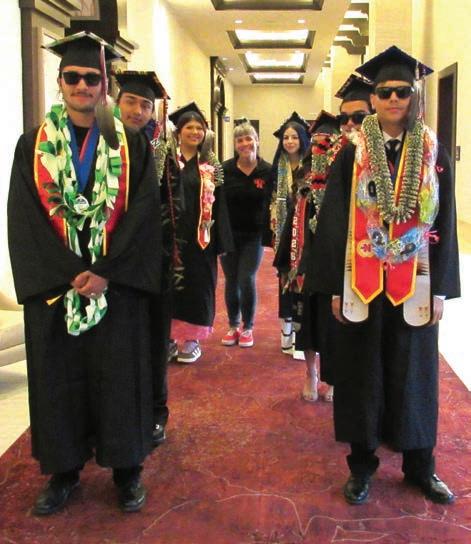

Family and friends who gathered at the Soboba Casino Resort Center Event Center loudly cheered when eight Noli Indian School seniors walked through the room to take their seats on the stage. Then one by one, each student stood front and center while a pre-recorded message played. Their personal messages thanked those who helped them reach this important milestone as well as their fondest memories of Noli and future plans. Each ended with a chosen quote that reflected a message they wanted to pass along.
Francisco Lemus cited one from author Dr. Seuss: “Sometimes you will never know the value of a moment until it becomes a memory.” Ronald Morillo, who is headed to UC Berkeley to major in environmental studies, appropriately echoed the words of cultural and Tribal leader Dr. Harry Paul Cuero Jr., who said, “You can have all the money in the world and if everything goes wrong, what does that money buy you if you don’t know what plant to eat or what medicine to give.” Sophia Resvaloso shared a quote from singer Lana Del Rey: “I believe in the person I want to become.”
Principal Donovan Post welcomed everyone who came to support the students as they have done throughout their educational journeys. He was pleased to announce that this class of seniors has the highest college acceptance rate in Noli’s history, with six of them pursuing higher education at various colleges.
After a blessing by Damon Miranda Jr., who worked with students to help them facilitate Talking Circles organized by ASB members, several seniors joined guest birdsingers and dancers. Guest speaker Benjamin Pachito is a Soboba Tribal member who returned to his Tribe in 2021 to join the Soboba Legal Department. Three years later, he became the Tribal Attorney for Soboba and is now on the Board of Directors for the Soboba-owned Legacy Bank.
“None of these things happened without cost, of your time and sacrifices,” Pachito said. “Personal advancement is not a group project. Education does not always make your life easier, but it gives you invaluable skills and meaningful purpose. I encourage all of you to continue with your personal development. What matters is that you keep moving forward with intention.
“Every generation before you made sacrifices so you could be in this exact moment right now. Now it is your turn to decide what you will do for the next generation. Your journey starts now so learn, go train, go do all the things you have to do to be successful. But remember where you came from, remember that your Tribe needs you. Our Tribes advance when people return with their skills and continue personal development. Come back to your Tribes and contribute to something bigger than yourself,” Pachito said.
Valedictorian Shawna Rivera and Salutatorian Sophia Resvaloso are members
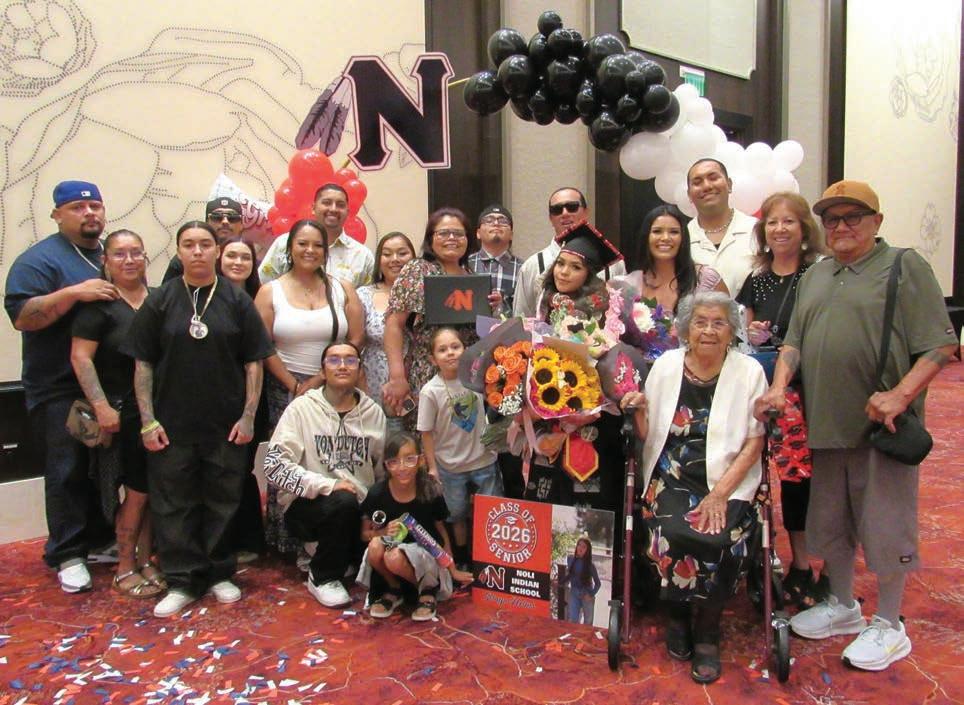
Band of Luiseño Indians and have both been students at Noli since sixth grade. In their speeches, they expressed gratitude to family, friends, teachers, staff and fellow graduates.
“Our education can be used as a weapon against the very systems that have and are still hurting us. But we’ll stay resilient and have a chance to confront these systems by choosing to educate ourselves,” Resvaloso said. “Ultimately, people can try and steal everything from us, but they can’t take the knowledge that we hold as a people.”
Rivera appreciated that the all-Native school has been a place where she could learn while being surrounded by people who understand Native American backgrounds and beliefs. “At Noli, I learned the importance of staying connected to my culture while working towards my future,” she said. “Here I have grown as both a student and a person thanks to my teachers and my mentors. To my fellow graduates, don’t forget the memories we have built together.”
Other members of the Noli Indian School Class of 2026 are Edgar Gladin, Oglala Sioux; Serena Hawk, Santa Ysabel; Selaya Helms, Soboba Band of Luiseño Indians; Francisco Lemus, Oglala Sioux; Ronald Morillo, Soboba Band of Luiseño Indians; and Leland Razon, Soboba Band of Luiseño Indians.
Earlier in the day, seniors were treated to a special luncheon that honored them for their achievements and recognized those who have committed to colleges in the fall. Six of the seniors applied to 23 colleges and universities combined, as some students applied to the same school. A total of 30 acceptance letters were received, allowing the students to decide which one to commit to. Two will be attending UC Berkeley while others are headed to Humboldt State University, San Diego
State University, California State University, San Bernardino, and Crafton Hills College.
A highlight was the presentation of the inaugural Noli Scholar Athlete Award in honor of the late Robert “Bobby” Salgado Sr. to Shawna Rivera for excellence in academics, leadership, and athletics. The annual scholarship will continue to recognize dedication, perseverance, and commitment to both education and athletic excellence. The award, which came with a $500 scholarship, was made possible by proceeds of the annual Native American Trail Running Organization (NATRO).
Several of Salgado’s family members, including his widow, Claudia, and daughter, Baseemah Arlene, were at the event to congratulate Shawna and share a little bit about Bobby’s love and devotion to all things sports-related. He coached many youth sports teams. Baseemah said, “Everything he did was for his people.” The family personally contributed an additional $3,300 to this year’s scholarship.
Science teacher Jay Dagostino presented four students with certificates of completion for the solar program that included classroom and off-site training and installation. They were Edgar Gladin, Serena Hawk, Francisco Lemus, and Ronald Morillo.
Edgar Gladin received Jonathan Ruiz’s Coaches Award for football, while Ronald Morillo was named MVP for the football season and received a Coaches Award for basketball.
English and Culture teacher Emma Herrera presented a Native Excellence certificate to Leland Razon for outstanding writing, character, and leadership. All teachers took part in voting for the awards for Outstanding Improvement, Leland Razon; Outstanding Leadership, Shawna Rivera; and for being an outstanding example of the school’s 3 Rs (respect, responsibility and
reflection), Sophia Resvaloso.
Kekai Bryant presented a Math award to a student who has been in her classes all four years of high school and has continually excelled: Sophia Resvaloso.
As salutatorian, Sophia was presented with the “Shining Star” crystal award “in celebration of your exemplary performance.”
Valedictorian Shawna Rivera received the “Above & Beyond” crystal award for her exceptional performance, which read in part,
“Your efforts have resulted in an impressive achievement.”
The Noli Booster Club presented each student with a money box, and Principal Post concluded the catered luncheon by telling the seniors, “We need you to reach your goals and come back; you are our hopes for the future; we want you to return and be successful again. After I give you your diplomas tonight, you will officially become alumni of Noli Indian School.”

By Bob Garver
Simply put, “Toy Story” is my favorite movie franchise of all time. The 1995 original about cowboy doll Woody (Tom Hanks) fighting for relevance against hi-tech spaceman action figure Buzz Lightyear (Tim Allen) was a groundbreaking first for computer animation – not to mention about the most fun a kid could possibly have at a theater… until three worthy sequels came along. I’ve seen the original six times in theaters – my personal record. I was disappointed that “only” the third film in the series was nominated for Best Picture at the Oscars. I didn’t think that 2019’s “Toy Story 4” was in any way a step down from its predecessors. And yet here I am, saying that “Toy Story 5” is the first significant misstep in the franchise (not counting 2022’s sorta-spinoff “Lightyear,” which I’d like to banish to infinity and beyond).
Despite all the emphasis on the Woody/Buzz reunion in the film’s advertising, the main character of this movie is actually Jessie the Cowgirl (Joan Cusack), a doll companion of Woody’s introduced in the second movie, where she shared a tragic backstory of being abandoned by her human owner. Now owned by 8-year-old Bonnie (Scarlett Spears), along with Buzz and other familiar figures, Jessie spends her days as the youngster’s favorite plaything. But Bonnie has a hard time making human friends, despite the toys’ best efforts to add to the number of children playing in the house. Her parents decide that the best way to connect with other kids in the neighborhood is to get her on social media, which is why they present her with frogthemed tablet LilyPad (Greta Lee). Soon Bonnie is addicted to the screen, “socializing” with so-called friends that aren’t in the room, and the cowgirl has to fight for relevance against the hi-tech newcomer.
The film bafflingly never really comments on the parallels to the first movie. Couldn’t Woody say, “I’ve been through this before…” or Buzz ask, “Is this what is what is was like for you?” as he’s being replaced by something flashier? For all its reliance on nostalgia,
the film is missing a lot of potential for callbacks here.
A sleepover for Bonnie organized by LilyPad turns disastrous for Jessie, and she finds herself rejected, abandoned, and returned to the home to the home of her original owner. There’s a bright girl named Blaze (Mykal-Michelle Harris) living there now, but no time for her, Jessie has to get back to Bonnie. And the only way to do that is with the help of nearly-dead electronic potty-training device Smarty Pants (Conan O’Brien), even though Jessie is averse to all tech. Meanwhile, a reunited Buzz (who wants to marry Jessie) and Woody (taking a break from his life as “lost toy”) organize a rescue effort that will eventually lead them to a whole squadron of lost Buzz figures.
The emphasis on helping humans make human friends is a nice touch, but too much of the movie is just a series of par-forthe-course toy rescues. Or overly-familiar jokes and bickering. Or throwaway lines given to returning characters just to remind viewers that they’re still alive (as toys go). Even heavy emotional moments are hit-and-miss, with one at a tree being suitably effective, but others (usually involving bullying) feeling like the writers just needed a “down” story beat. It’s also worth mentioning that the usually bright, agreeable, effective animation is often murky and ugly here, and not in a “haunting” way, more in a “shoddy” way.
Don’t get me wrong, I’m recommending “Toy Story 5.” This franchise on its worst installment is better than a lot of franchises on their best. There’s enough heart and laughter and creativity here to save it… but just barely. And for someone like me who puts “Toy Story” on a pedestal, a movie that I can “just barely” recommend is a big disappointment.
Grade: B-
“Toy Story 5” is rated PG for some thematic elements and rude humor. Its running time is 102 minutes.
Contact Bob Garver at rrg251@nyu.edu.

day ____
8. Onomatopoeia for splash
9. *Drink at a barbecue
10. Weary walk 11. Ireland, once
12. *Patriots ____ over Loyalists 15. Long John Silver’s pet 20. Crocus, pl.
22. Ooh partner
24. Last part (2 words)
25. 1st letter of Hebrew alphabet
26. Famous Memphis street
27. Felt concern
29. *”...twilight’s ____ gleaming”
31. Lady of “A Star is Born”
32. Smell
33. Post-it user
34. *”Born on the Fourth of July” director
36. *Popular July 4th decoration
38. Captain of Nautilus
42. Phlegms 45. Sully one’s reputation
49. Go bad
51. Public announcement
54. Fowl perch
56. Exclamation of delight or dismay (2 words)
57. Bridge, in Paris
58. Colloquial approval
59. Ditty
60. Back of neck
61. Ascus, pl.
62. Ne
63. Glitch
64. Part of O.H.M.S.
66. Strive

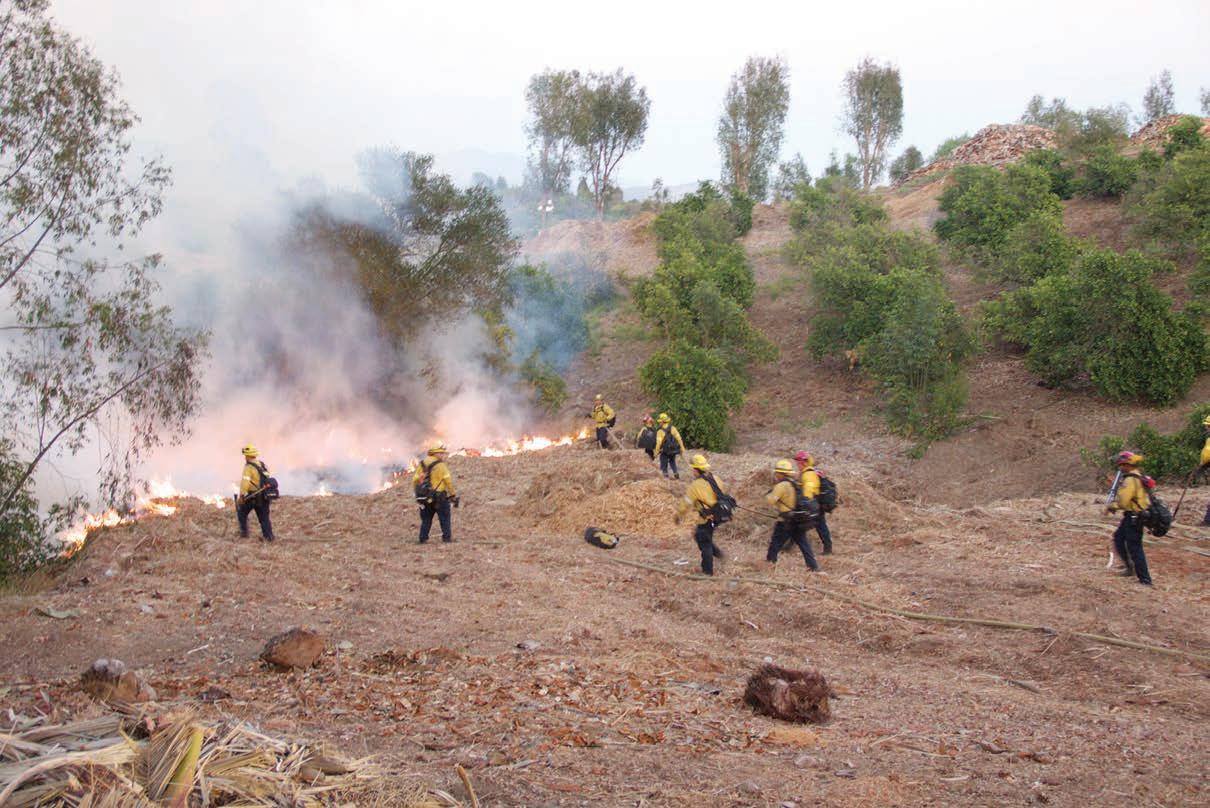
naturally as organic materials decompose.
This week, one of the fires that had to be extinguished in Fallbrook was a mulch fire. Depending on how long that mulch has been sitting in your yard and how large the pile is, it could be a fire danger.
As temperatures rise and landscaping projects increase during the summer months, piles of mulch and wood chips become a common sight at homes, businesses and construction sites. While mulch provides numerous benefits for gardens and landscapes, fire officials say improperly stored mulch can pose an unexpected fire risk.
Large mulch fires occur every year across the United States, often requiring days to extinguish and consuming thousands of cubic yards of material. Many of these fires are believed to begin through a process known as spontaneous combustion.
Contrary to popular belief, nitrogen is not the primary cause of mulch fires. Instead, the danger comes from heat generated
Fresh wood chips contain moisture and organic matter that bacteria and fungi begin breaking down almost immediately after the material is chipped. That microbial activity creates heat. In smaller piles, the heat dissipates harmlessly into the surrounding air. However, in large piles, the heat can become trapped inside.
As temperatures continue to rise within the pile, chemical oxidation of the wood fibers can begin, generating even more heat. If enough oxygen reaches the heated material, ignition can occur without any external flame or spark.
The risk increases significantly when piles contain freshly chipped green material, grass clippings, leaves or other organic matter that decomposes rapidly.
These materials contain higher levels of nutrients that accelerate microbial activity and increase heat production.
Experts say moisture also plays a role. While extremely dry mulch does not generate much biological heat, freshly chipped material
with moderate moisture provides ideal conditions for microorganisms. Ironically, both moisture and trapped heat contribute to the risk of spontaneous combustion.
Storage practices can dramatically reduce that danger.
The first recommendation is limiting pile size. Large commercial mulch operations often maintain piles no taller than about 10 feet and separate piles with adequate spacing to reduce fire spread. Homeowners should avoid creating large stockpiles altogether and instead spread mulch as soon as practical after delivery.
Turning mulch piles periodically also helps release trapped heat while improving airflow throughout the material. Commercial composting facilities routinely monitor pile temperatures with long-stem thermometers, particularly during warm weather. If internal temperatures approach 160 degrees Fahrenheit, operators typically turn or spread the pile to allow it to cool.
Location is another important consideration. Mulch piles should be stored away from buildings, fences, propane tanks, vehicles
and other combustible materials.
Maintaining adequate clearance allows firefighters access if a fire develops and reduces the chance of flames spreading to nearby structures. Finished mulch should also be applied carefully around buildings. Many fire agencies recommend keeping mulch several inches away from the foundation of homes and avoiding its use directly against combustible siding, decks or wooden fences. Instead, decorative rock, gravel or other noncombustible landscaping materials can create a safety buffer immediately adjacent to structures.
Another important precaution is avoiding contamination of mulch piles with cigarettes, fireworks, charcoal ashes or hot landscaping equipment. While spontaneous combustion receives much of the attention, many mulch fires begin when an outside ignition source comes into contact with dry material.
Firefighters responding to mulch fires often rely on heavy equipment to dismantle the pile because simply spraying water
Joe Naiman for the Valley News
Edward Finger won a Hobby Stocks heat race at Barona Speedway for the first time since the Murrieta driver began racing in that class this year, and Finger also finished third in the June 20 main event.
“The car felt really good,” Finger said.
Finger, a 2020 Vista Murrieta High School graduate, began racing in Barona’s Sport Compact division in June 2021 and raced in that class through 2022. He had one Pure Stocks race in 2022 and also competed in that division from 2023 to 2025.
Finger and his family pur-
chased a Hobby Stock with a 2020 Dodge Charger chassis from a Las Vegas driver. He made his debut in that car April 11 and finished second in the heat race; Finger was running second in the main event before his ignition coil broke and he went into the pits.
Heat races at Barona Speedway are eight laps. Finger had a start on the outside of the third row for the June 20 heat. “Got into second pretty quick,” he said. On turn four of the fifth lap Finger moved to the inside and was able to pass Yuma’s Scott Tenney for the lead. “Was able to get the lead and maintain it,” Finger said. “The car felt really good.” Tenney began the 20-lap main
event on the pole while Brawley’s Cody Daffern had the inside of the front row. Finger took the original green flag on the outside of the second row.
Daffern took the initial lead. Finger was fifth at the end of the first lap. After spending several laps in fourth Finger passed Tenney in the 17th lap to move into
on the surface rarely extinguishes the fire. Deep-seated hot spots can remain buried for days or even weeks, reigniting after appearing to be out. Thermal imaging cameras are frequently used to identify hidden pockets of heat. Although spontaneous mulch fires are relatively uncommon for homeowners with small landscaping projects, they remain a recognized hazard for commercial landscapers, municipalities, recycling facilities and businesses storing large volumes of organic material. Proper storage, regular monitoring and thoughtful landscaping practices can significantly reduce the risk while allowing homeowners and businesses to continue enjoying the many benefits mulch provides, including moisture retention, weed suppression and improved soil health.
By understanding how mulch generates heat and following recommended storage guidelines, property owners can help prevent an ordinary landscaping material from becoming an unexpected fire hazard.
third, where Finger finished. “This is the most comfortable I’ve felt all year,” Finger said. “I had more of a handle on the car tonight than I’ve had all year.”




Diane Sieker Staff Writer
The Hamilton High School cheer team is calling on the community for support through a clothing and household item donation drive aimed at helping the athletes raise funds for their upcoming competition season. Organizers say the team members are working hard to represent both their school and the Anza Valley community, and proceeds generated from donated items will directly benefit the program.
Community members are encouraged to clean out closets, garages and storage areas and contribute gently used items before the donation deadline of Thursday, July 30. All donations must be picked up or dropped off by that date to ensure they can be processed in time for the team’s competition schedule.
Accepted donations include men’s, women’s and children’s clothing, coats, shoes, scarves, handbags, wallets, fashion accessories, belts and backpacks.
The team is also collecting household linens and bedding, including comforters, blankets,

Diane Sieker Staff Writer
As the hot, dry days of summer settle over the Anza Valley, hillsides and washes begin to brighten with the familiar blooms of California buckwheat. Though not related to wheat, this hardy native shrub is one of the region’s most beneficial and beautiful plants.
California buckwheat (Eriogonum fasciculatum) is native to the southwestern United States and grows naturally on slopes, canyons, chaparral-covered hillsides and dry washes from San Diego County to Marin County, California. It is also found in Utah, Arizona and northwestern Mexico.
The shrub forms a compact, spreading bush that can reach up to 6 feet tall and 9 feet wide. Its small leaves grow in clusters along the branches and are leathery, with fuzzy undersides and rolled edges. During summer, dense clusters of tiny pink and white flowers appear, gradually turning a rich reddish-rust color as seed heads develop.
California buckwheat is especially attractive to honey bees and other pollinators, providing an important nectar source in dry habitats where flowering plants can be scarce. Four varieties occur across its range, each adapted to different environments from coastal regions to desert mountain slopes.
The shrub is drought tolerant and easy to grow, making it a popular choice for native landscaping. Once established, it thrives in sunny, well-drained locations without supplemental irrigation. As flowers and leaves dry and fall, they create a natural mulch that helps enrich the soil.
The hardy plant plays an important role in sage scrub ecosystems and is an excellent addition to wildlife and butterfly gardens. According to the U.S. Department of Agriculture, the species has demonstrated excellent performance as a conservation plant on difficult sites, including serpentine soils, decomposed granite and high-pH soils. Its long flowering season also makes it valuable in integrated pest man-

Native California buckwheat is drought tolerant, an important nectar source for pollinators and beautiful to look at. Anza Valley Outlook/Diane Sieker photo
agement programs, providing nectar for beneficial insects when planted near agricultural crops.
The shrub has a long history of use by Native Tribes. The small seeds and young shoots are edible, and California buckwheat leaves were traditionally used by Indigenous Peoples to line granaries and help keep stored acorns dry.
The Cahuilla brewed tea from the leaves to treat headaches and stomach ailments. Hot root tea was used for colds and laryngitis, while poultices made from mashed roots were applied to wounds. Teas prepared from dried flowers or roots were also taken to help prevent heart problems. Modern studies have identified compounds known as leucoanthocyanidins in other Eriogonum species that may provide cardiovascular benefits.
California buckwheat also supports a wide variety of wildlife. Its seeds provide food for insects, rodents and birds, including native quail, songbirds, kangaroo rats and ants.
The shrub’s dense flower clusters will continue blooming well into October, quietly enduring another summer while serving as one of the Anza Valley’s most valuable native plants.
Diane Sieker can be reached by email at dsieker@reedermedia.com.
Diane Sieker Staff Writer
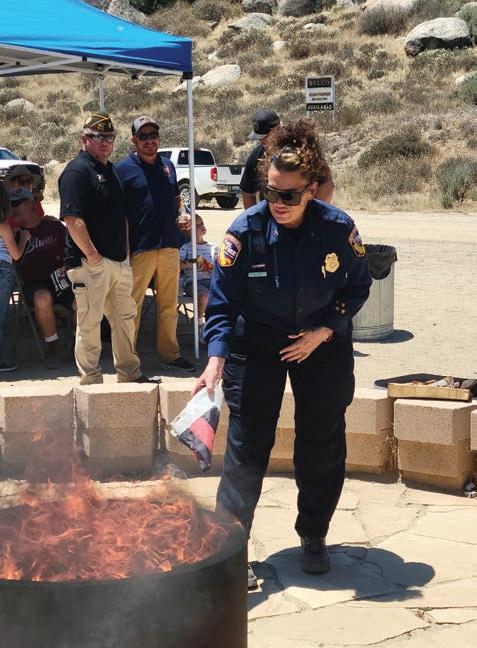
A group of dedicated veterans organized a National Flag Day U.S. flag retirement ceremony Saturday, June 13 at the Lake Riverside Estates Veterans Memorial, bringing together residents, first responders and veterans for a solemn tribute to the nation’s flag.
The lakeside Memorial holds special significance for the community. It is the site of a bench honoring hometown hero Marine Corps mortarman Jeromy West, who was 20 when he was killed in Iraq in 2006. The location was one of West’s favorite fishing spots.
The ceremony drew a large crowd of local residents and their families. A total of 312 worn American flags were retired with dignity and respect.
Veteran Debbie Fitchett delivered the first flag to be retired by horseback. Fitchett served 25 years as an Army nurse and completed three tours in Saudi Arabia, Iraq and Afghanistan.
Costas Jimenez, a 14-year-old Hamilton High School freshman, performed Taps. His grandfather, a Vietnam veteran, passed away three months ago.
Lake Riverside Estates pilots Don Mastrangelo and Adi Nasohn performed a flyover, complete with smoke trails, in honor of the occasion.
American Legion member and Riverside National Cemetery Honor Guard leader Daniel Mason joined Vietnam veteran, Army Ranger, Gold Star and Silver Star recipient Ronnie Imel in conducting a brief ceremony honoring the Stars and Stripes.
Sgt. Maj. William Shaw, a 10year Marine Corps veteran and commander of Anza VFW Post 1873, addressed the crowd. Event organizer and Marine Corps veteran Dan Sandoval and Imel also shared remarks.
Mason retired the first flag as Sandoval invited attendees to participate in the ceremonial retirement of the hundreds of tattered flags brought to the event.
One by one, the flags were gently placed into a fire burning in the Veterans Memorial fire pit. Veterans saluted as each flag was
see FLAG page B-2

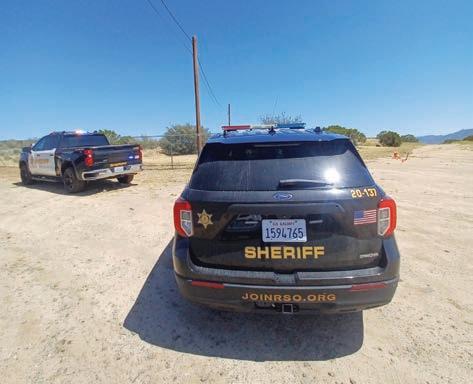
to know what criminal activity is occurring
Diane Sieker Staff Writer
The Anza Valley Outlook Sheriff’s Blotter is a list of calls that allows residents to see what law enforcement activity is occurring in their communities.
The Sheriff’s Blotter data is obtained from the official calls for service records kept by the Riverside County Sheriff’s Department. However, calls where the release of the information could cause harm to an individual or jeopardize the investigation of a criminal case are excluded.
All calls listed are for service within the Sheriff’s Department jurisdiction in the unincorporated areas of Anza, Lake Riverside Estates, Cahuilla and Aguanga from June 13 through June 19.
June 13
• Assist other department–09:16 p.m., 5400 *** block Cave Rock Rd., Anza
Suspicious circumstance–11:20 a.m., 6300 *** block Table Mountain Truck Trl./Wild Horse Trl., Anza
Assist other department–10:39 a.m., 4100 *** block Saddleback Dr., Lake Riverside
June 14
• Shots fired–07:51 p.m., 5800 *** block La Colina Ln., Anza Found runaway–11:02 a.m., address withheld, Anza, report taken
June 15
• Emergency notification–08:02 p.m., address withheld, Anza
• Assist other department–12:29 p.m., address undefined, Aguanga
• Illegal dumping–08:05 a.m., address undefined, Anza
June 16
• Trespassing–09:00 a.m., 4500 *** block Bonny Ln., Anza
June 17
DRIVE from page B-1
sheets, towels, tablecloths, curtains and pillows.
Small household goods are welcome as well, including pots, pans, dishes, silverware, glasses, serving pieces, hand-held appliances, home décor items, knickknacks, toys, games and small electronics.
Book donations are also being accepted. Organizers request that media items be boxed separately. Encyclopedias and textbooks cannot be accepted.
Residents wishing to donate can text Hamilton High School Cheer at (951)234-9734 to ar-

• Public disturbance–11:50 p.m., 5900 *** block Burnt Valley Rd., Anza
• Battery–07:01 p.m., 3800 *** block Cary Rd., Anza
• Trespassing–10:28 a.m., 5400 *** block Haupert Rd., Anza
• Suspicious vehicle–09:58 a.m., 6000 *** block Indian Paint Brush Rd., Anza
• Area check–02:20 a.m., 6100 *** block Indian Paint Brush Rd., Anza
June 18
• Unknown trouble–10:10 p.m., 4300 *** block Bonny Ln., Anza
• Assist other department–09:52 p.m., address undefined, Anza
• Assist other department–06:39 p.m., 3900 *** block El Toro Rd., Anza
• Assist other department–03:14 p.m., 3600 *** block Old Cary Rd., Anza
• Assa ult w/ deadly weapon–01:08 p.m., address undefined, Anza, report taken
• Harassing phone calls–12:37 p.m., address withheld, Anza Harassing phone calls–09:22 a.m., address withheld, Anza
June 19
• Shots fired–08:26 p.m., address undefined, Anza, arrest made
• Suspicious person–10:03 a.m., 3700 *** block Woodview Rd., Anza
No assumption of criminal guilt or affiliation should be drawn from the content provided in the Sheriff’s Blotter.
Residents with information regarding any crimes are encouraged to contact the Hemet Sheriff’s Station at (951)791-3400.
Criminal activity can also be reported through the WeTip Crime Reporting Hotline, (909)987-5005 or https://wetip. com.
Diane Sieker can be reached by email at dsieker@reedermedia.com.
range a convenient pickup or drop-off time.
“Thank you so much for supporting us,” said organizer Darian Saisan. “Let’s help these athletes shine.”
Drive coordinators hope the community will rally behind the team and help turn unwanted household items into opportunities for local student-athletes as they prepare to represent Hamilton High School in the coming season.
Diane Sieker can be reached by email at dsieker@reedermedia.com.







committed to the flames, while parents guided their children through the solemn tradition.
Following the ceremony, members of VFW Post 1873 served burgers, chips and cold drinks. Proceeds from the meal will help support veterans, community programs and ongoing post activities.
“I wish to thank Jeremy Albert, US Navy veteran; Ronnie Imel and my dad, Sandy Sandoval for their help putting this event together,” said Sandoval. “We were pleased that the community gave us so many flags to be retired. I feel so proud of everyone.”
National Flag Day happens each year on June 14 to honor Old Glory and commemorate the adoption of the United States flag on June 14, 1777. The holiday is a day that Americans show respect for the U.S. Flag and what it represents.
Diane Sieker can be reached by email at dsieker@reedermedia.com.
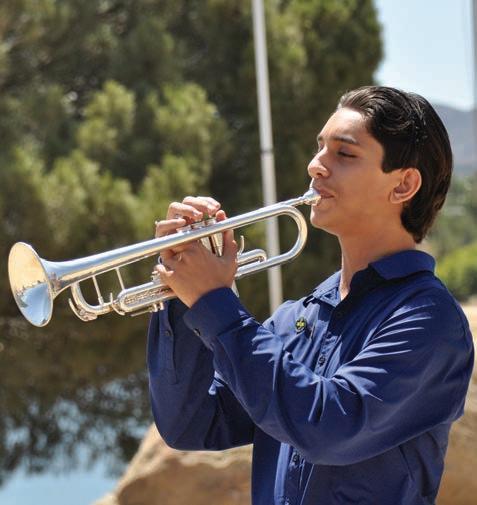
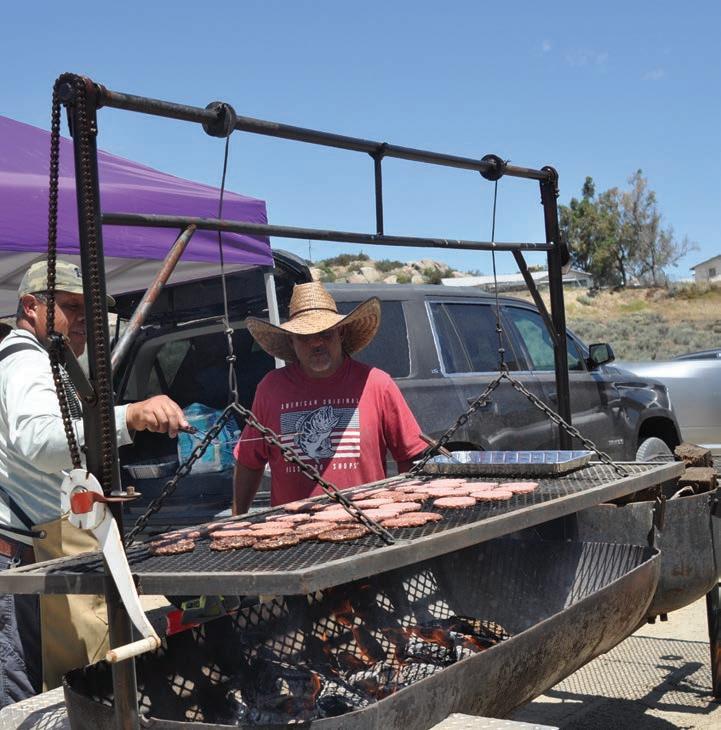
If you have an upcoming community event, email it to valleyeditor@reedermedia. com , put “attention events” in the subject line. Readers should call ahead on some listed events for the latest updates. Please also email us if any of these listings have new or updated information. Thank you!
Regular Happenings
Anza Farmers’ Market
Located at 56333 CA-371, Anza farmers’ market hours are every Thursday from 4 to 8 p.m. through October. Various farmers, musicians, artisans and food vendors set up weekly. Ample parking in the field and lot to the west and east of the field. The market is operated by the High Country Conservancy, a 501(c) (3), and is a California certified farmers market. Market Manager
RAINERI,
DIANE SIEKER, Staff
JOE NAIMAN, Ind. Contractor
ROGER BODDAERT, Ind. Contractor
Advertising
JOSEPHINE MACKENZIE
CINDY DAVIS
Production FOREST RHODES, Production Layout, IT
SAMANTHA GORMAN, Graphic Artist

Annika Knoppel can be reached at 951-234-1314 or email anzafarmersmarket@gmail.com
Anza Community Hall Swap Meet–Every 1st and 3rd Saturday of the month. $15 for a spot with membership. $18 for a spot without membership. Vendors wanted. The hall is located at 56630 CA-371 in Anza. See membership information under “Organizations.”
Mobile Food Pantry – Anza Electric Cooperative and F.I.N.D. Food Bank offers a free mobile food pantry the second Saturday of every month at the AEC office, 58470 CA-371, from 8 to 10 a.m. All are welcome. Cal-Fresh application assistance and free community health services are also available. Bring your own reusable bags to take food home. Volunteers welcome. For more information, contact the AEC office at 951-763-4333.
Friends of Anza Valley Community Library – Anza Valley Community Library is located at Hamilton High School, 57430 Mitchell Road. The library is open to the public, but not during school hours. Hours are 4-7 p.m. on Thursday and Friday, 10 a.m.4 p.m. Saturday and 12-4 p.m. on Sunday. Closed Monday through Wednesday.
Hamilton High School – Find out what is happening using Hamilton’s online calendar at www.hamiltonbobcats.net/apps/ events/calendar.
Hamilton Museum – 10 a.m. to 2 p.m. Open Wednesdays and Saturdays at 39991 Contreras Road in Anza. For more information, call 951-763-1350 or visit www.hamiltonmuseum.org. Find them on Facebook at “Hamilton-Museum-and-Ranch-Foundation.”
Backcountry Horsemen Redshank Riders – Meetings on the second Thursday of each month at 6 p.m. Locations change, so please contact Mike by email at stumblinl55@gmail.com or by calling 951-760-9255.
Health, exercise, resources and recovery meetings
Fit after 50 – 10:30-11:30 a.m. Tuesday and Friday mornings at Anza Community Hall. Free. Wear comfortable clothes and supportive shoes. Call or text instructor Teresa Hoehn at 951751-1462 for more information.
Veterans’ Gathering Mondays – 9-11 a.m. The Church of Jesus Christ of Latter-day Saints, 39075 Contreras Road in Anza. Men and women veterans come to share and help each other deal with post-traumatic stress disorder and other difficulties. Call John Sheehan at 951-923-6153. If you need an advocate to help with VA benefits, call Ronnie Imel at 951-659-9884.
The Most Excellent Way – A Christ-centered recovery program for all kinds of addiction meets once a week on Fridays from 6-8 p.m. Program is court approved. The group meets at Valley Gospel Chapel, located at 43275 Chapman Road, Anza.
AA Mixed Open Discussion Meeting – 6 p.m. Meeting based on AA literature. Thursdays at the Rancho California RV Resort small clubhouse. 45525 CA-79, Aguanga, CA 92536. Make a right turn before the security gate. The small clubhouse is on the right. No need to pass through the security gate.
AA Men’s Meeting – 7 p.m. Meetings take place Thursdays at 39551 Kirby Road in Anza, south of CA-371.
Alcoholics Anonymous – 8 p.m. Wednesday and Friday evenings at Shepherd of the Valley Lutheran Church, 56095 Pena Road in Anza. For more information, please email Barbara at chicasita55@gmail.com.
Bereaved Parents of the USA – The Aguanga-Anza Chapter of BPUSA will hold its meetings at 6 p.m. on the 1st and 3rd Wednesday of each month at 49109 Lakeshore Blvd. in Aguanga. For more information, contact chapter leader Linda Hardee at 951-551-2826.
Free Mobile Health Clinic Open every third Wednesday of the month from 9 a.m. to 2 p.m. No appointment is needed. Uninsured may only be seen in the Anza Community Hall’s parking lot or inside the hall.
Medication Assistance and Treatment for Opioid Dependence – Get treatment for heroin addiction. Transportation to the clinic is provided. For more information, contact Borrego Health’s Anza Community Health Center, 58581 CA-371, Anza. For more information, 951-763-4759.
Narcotics Anonymous –Tuesday meetings, 8 p.m. at Shepherd of the Valley Church, Anza, 56095 Pena Road, Anza. For more information, please email Barbara at chicasita55@gmail. com.
Women’s Alcoholics Anonymous –Thursdays at 12 noon. Meetings at Shepherd of the Valley Church, 56095 Pena Road in Anza. For more information, please email Barbara at chicasita55@gmail.com.
Food ministries
Food for the Faithful – 8 a.m. The food bank hands out food the last Thursday of the month until the food is gone. Emergency food handed out as needed at Sacred Heart Catholic Church. FFF is a nondenominational nonprofit. All in need are welcome; call Esther Barragan at 951-763-5636.
Bible studies
Living Hope Thursday Men’s Breakfast and Bible Study – 8 a.m. at 58050 CA-371 in Anza. All are welcome.
Living Hope Christian Fellowship Sunday Service – 10 a.m. at the Anza Community Hall, 56630 CA-371 in Anza.
The Church of Jesus Christ of Latter-day Saints in Anza’s Sunday Sacrament is at 10 a.m.; Sunday School is 11 a.m. Priesthood/Relief Society meets at noon; Wednesday, Boy Scouts gathers 6 p.m. and Youth Night is


Upcoming July Election for Anza Electric Board of Directors
Anza Electric Cooperative, Inc. is governed by seven directors representing the three districts of the cooperative’s service area for both electric and internet services. Three seats on the Anza Electric Cooperative board of directors will be open for election this July, each for a three-year term. The following individuals are running for the three open seats.
DISTRICT I Douglas E. Hay DISTRICT 2 Hope Adams DISTRICT 3 Stephan Lauzier Tabitha Dawes-Vollmer
Since only one petition was received for District I, candidate Douglas E. Hay, is declared elected per AEC bylaws. One petition was received for District 2; candidate Hope Adams is declared elected by AEC bylaws. Election material will be sent to members arriving via mail and email in the upcoming weeks. Voting opens June 17, 2026, and closes July 18, 2026. An independent election processor will handle the election and the election results will be announced at the Annual Membership Meeting on Saturday, July 25, 2026.
7 p.m. For more information, call Ruiz at 951-445-7180 or Nathan at 760-399-0727. The Wednesday Genealogy/Family History Class, 5-8 p.m., is open to the public at 39075 Contreras Road in Anza.
Native Lighthouse Fellowship – 10 a.m. The group meets the first Saturday of the month, and breakfast is served. All are welcome to fellowship together at the “Tribal Hall” below the casino in Anza. For more information, call Nella Heredia at 951-763-0856.
Monthly Christian Men’s Breakfast – 9 a.m. Breakfast takes place the 4th Saturday of each month and rotates to different locations. Contact Jeff Crawley at 951-763-1257 for more information.
Shepherd of the Valley Lutheran Church – 10 a.m. Weekly Wednesday Bible study takes place at 56095 Pena Road in Anza. Call 951-763-4226 for more information.
Valley Gospel Chapel – 7 a.m. Saturday Men’s Study meets weekly with breakfast usually served at 43275 Chapman Road in the Terwilliger area of Anza. For more information, call 951763-4622.
Anza Baptist Church–Begin your week with Sunday School for adults at 9 a.m. followed by Sunday morning worship at 10:30 a.m. We have an optional Children’s Church service during the main service. On Sunday nights from 6:00 p.m. to 7:00 p.m. we have a rotating schedule of Bible Studies, fellowship, and prayer. We also have a prayer circle which meets on Wednesday mornings at 11 a.m. The church office is open Wednesday through Friday from 9 a.m. to 3 p.m. The church is located at 39200 Rolling Hills Road, just off Burnt Valley Road, in Anza. For more information, please contact the church at 951-763-4937 or visit https://www.anzabaptistchurch. com
Clubs
Anza Valley VFW Post 1873, Capt. John Francis Drivick III Post – The Ladies’ and Men’s Auxiliaries are located at 59011 Bailey Road in Anza. Mail P.O. Box 390433. Request monthly newsletter and or weekly menu by email at vfw1873anzaca@ gmail.com. For more information, call 951-763-4439 or visit http://vfw1873.org.
High Country 4-H Club – 4 p.m. Meetings are on the third Tuesday of the month, except February, at Anza Community Hall. 4-H Club is for youth 5 to 19 years old offering a variety of projects. High Country 4-H Club is open to children living in the Anza, Aguanga and surrounding areas. For more information, call Allison Renck at 951-663-5452.
Anza Valley Artists Meetings – Meetings at 1 p.m. are the third Saturday of each month at various locations. Share art, ideas and participate in shows. Guest speakers are always needed. For more information, call president Rosie Grindle at 951-928-1248. Find helpful art tips at www.facebook.com/AnzaValleyArtists.
Anza Quilter’s Club – Meetings are held at 9:30 a.m. on the first Tuesday of each month at the Shepherd of the Valley Lutheran
Church, 56095 Pena Road, Anza. For more information see our Facebook page or contact Pat Sprint at jpsprint@gmail.com or Ellen Elmore at luvtoquilt2@ gmail.com.
Anza Valley Lions Club The Anza Valley Lions Club has been reinstated and is open to all men and women who want to work together for the betterment of the community. The group is working on securing a new venue for meetings. Meetings and events are posted on the Anza Lions Club of Anza Valley Facebook page at www.facebook.com/LionsofAnzaValley. For more information, email president Greg Sandling at President.AnzaLions@gmail.com or Chris Skinner at Secretary. AnzaLions@gmail.com.
Fire Explorer Program – 6 p.m. The program meets every second, third and fourth Tuesday of the month at Fire Station 29 on CA-371 in Anza. Call 951-7635611 for information.
Anza Thimble Club – The club meets the 1st Thursday of the month at the Anza Community Hall, 56630 CA-371, Anza, CA 92539. The social hour is 11:30 a.m., and lunch is served at noon. Contact Carol Wright at 951-7632884 for more information.
Organizations
Terwilliger Community Association – 6 p.m. Second Monday of the month at VFW Post 1873, 59011 Bailey Road, in Anza. Potluck dinner open to all. For more information, call Tonie Ford at 951-763-4560.
Civil Air Patrol – Squadron 59 is looking for new members of all ages. For more information, call squadron commander Maj. Dennis Sheehan from the Anza area at 951-403-4940. To learn more and see the club’s meeting schedule, visit www.squadron59.org.
Anza Community Hall –7 p.m. General membership meetings are held the fourth Thursday of the month. Single memberships are $30 and include discounts to events for one person and 1 vote in elections and meetings. Family memberships are $50 and include discounts for a family up to 5 members and 1 vote in elections and meetings. Business memberships are $50 and allows an employer to receive discounts for up to 5 people, including themselves, and includes 1 vote on elections and meetings. No government funds are allocated for the Hall, which pays its bills through memberships and swap meets. Mail membership to: Anza Community Building Inc. at P.O. Box 390091, Anza, CA 92539. The hall is located at 56630 CA-371 in Anza. For more information, call 951-282-4267 or email achageneral@gmail. com or visit www.anzacommunitybuilding.org.
Anza Civic Improvement League – 9 a.m. meets the first Saturday of each month at the Little Red Schoolhouse. The league maintains Minor Park and the Little Red School House, which are both available to rent for events. No government funds are allowed; the membership pays the bills – $10 a person, $18 family or $35 business membership. For more information, visit www.anzacivic.org.



Julie Reeder Publisher
WASHINGTON — Newly declassified intelligence records released by Director of National Intelligence Tulsi Gabbard have renewed scrutiny of former National Institute of Allergy and Infectious Diseases Director Dr. Anthony Fauci, detailing a series of allegations involving the origins of COVID-19, U.S. funding of coronavirus research in China, interactions with intelligence officials and testimony before Congress.
The release, consisting of hundreds of pages of emails, memoranda, interview summaries and intelligence records, represents the most extensive public disclosure to date of internal government communications surrounding the pandemic. Administration officials say the documents demonstrate a coordinated effort by senior government officials and outside scientists to shape the public narrative toward a natural origin for the virus while minimizing evidence supporting a possible laboratory accident.
Fauci has repeatedly denied any wrongdoing, denied participating in a cover-up and maintained that scientific evidence available at the time supported continued investigation of multiple possible origins of the virus. He also has denied misleading Congress regarding research funding or his interactions with intelligence officials.
Wuhan research funding
Among the most significant findings are renewed allegations that Fauci approved millions of dollars in National Institutes of Health grants that ultimately funded coronavirus research conducted through EcoHealth Alliance at the Wuhan Institute of Virology.
The documents revisit grants awarded for research on bat coronaviruses and allege that experiments conducted under
those grants increased the pandemic potential of certain viruses. Administration officials argue those projects amounted to gainof-function research despite previous government determinations that they did not meet the federal definition then in effect.
Fauci has consistently testified that neither he nor NIAID funded gain-of-function research in Wuhan as defined by federal policy, although, as Dr. Rand Paul pointed out during Senate hearings, the definition of gain-of-function was changed, facilitating that point.
Alleged influence on intelligence assessments
One of the more significant disclosures involves previously undisclosed contacts between Fauci and the Central Intelligence Agency during the government’s investigation into COVID-19’s origins.
According to summaries released by the Office of the Director of National Intelligence, Fauci met with CIA officials in June 2021 while intelligence agencies were preparing assessments for President Joe Biden regarding whether the virus originated naturally or escaped from a laboratory.
The documents allege Fauci recommended outside experts who favored a natural spillover theory and discussed scientific evidence supporting that conclusion.
Current intelligence officials contend those interactions raise questions about whether outside scientific advisors improperly influenced intelligence assessments. Fauci has denied attempting to direct or influence the intelligence community’s conclusions.
Pangolin research and Wuhan market concerns
The records also summarize discussions in which Fauci reportedly questioned CIA officials about coronavirus research involving pangolins at the Wuhan Institute of Virology.
According to the released summaries, Fauci expressed concern that Chinese authorities had rapidly sanitized the Huanan Seafood Wholesale Market before investigators could fully examine potential evidence of the outbreak’s origin.
The documents suggest those conversations acknowledged unanswered questions surrounding the earliest days of the pandemic even as public messaging increasingly emphasized a natural origin.
Congressional testimony questioned
The declassified records also challenge portions of Fauci’s sworn congressional testimony.
Administration officials argue newly released communications conflict with Fauci’s repeated statements that NIH-funded research did not support gainof-function experiments at the Wuhan laboratory.
The records further allege Fauci inaccurately testified regarding his involvement with intelligence officials investigating the pandemic’s origins.
The documents stop short of concluding that criminal conduct occurred but suggest the newly released evidence warrants additional congressional review.
Fauci has repeatedly denied lying to Congress and has maintained that his testimony accurately reflected the government’s definitions (which they changed) and the information available to him at the time.
Whistleblower complaint
The release includes records concerning a 2021 intelligence-community whistleblower complaint alleging Fauci made false statements to Congress.
According to the documents, then-Director of National Intelligence Avril Haines referred the complaint to the Department of Health and Human Services rather than to the Intelligence Community Inspector General.
Current ODNI officials crit-
Julie Reeder Publisher
LONDON — An independent inquiry released this week alleges that British authorities failed for decades to protect as many as 250,000 white English girls, primarily from working families, who were abused by rape gangs throughout the United Kingdom.
Authorities failed to protect vulnerable girls from organized sexual exploitation, including rape, trafficking, sexual exploitation and other abuse by organized grooming gangs over several decades. The report says many of the organized groups it examined consisted predominantly of Pakistani Muslim men. Some girls were taken out of the country.
The report concludes that political sensitivities, fears of being called racist, and institutional failures allowed abuse to continue largely unchecked across numerous communities.
People who spoke about it on social media were arrested. Fathers who tried to rescue their daughters were reported to have been arrested instead of the accused rapists.
Girls gave testimony of being raped by as many as 600 men, having glass crushed inside of them, abuse involving dogs and verbal abuse accusing the girls of being Christian, dirty, and immoral, unlike Muslim girls.
Some testified that they had babies, and the babies were abused as well. The girls testifying were as young as 12. One girl testified that when she was taken to a hospital for the bleeding and injuries, she didn’t tell because she was warned if she did, they would hurt her family members. Other victims testified that police officers joined in the abuse.
The 219-page report, known as the Independent Rape Gang Inquiry and led by British lawmaker Rupert Lowe, examines evidence from criminal cases, survivor testimony and previous
investigations into organized child sexual exploitation throughout the United Kingdom.
The report argues that police, local governments, child protection agencies and political leaders repeatedly failed to intervene despite mounting evidence of organized abuse. It contends that officials often avoided discussing the ethnicity, religion or cultural background of offenders because of concerns about accusations of racism or damaging community relations.
The inquiry says those concerns contributed to delayed investigations, reduced prosecutions and failures to protect children who were often instead viewed as troubled teenagers rather than victims of organized sexual abuse.
The findings echo several conclusions reached in previous government reviews, including an audit led by Baroness Louise Casey, which found that authorities had often avoided collecting or discussing ethnicity data surrounding grooming gang cases and that institutional reluctance to address the issue hampered investigations.
Casey’s review concluded there had been a “collective failure” across multiple public institutions and recommended mandatory collection of ethnicity and nationality data in future investigations involving organized child sexual exploitation.
The independent inquiry also criticizes decades of national governments from multiple political parties, arguing that successive administrations failed to fully investigate the scope of the abuse despite repeated scandals in communities including Rotherham, Rochdale, Telford and other English towns.
Among the report’s recommendations are nationwide criminal investigations into unresolved cases, expanded support services for survivors, stronger accountability for public officials who
icized that decision, arguing it limited an independent review of the allegations. The “Proximal Origin” paper
The documents also revisit the publication of the influential scientific paper “The Proximal Origin of SARS-CoV-2,” published in March 2020.
Congressional investigators previously concluded that Fauci, then-NIH Director Dr. Francis Collins and other federal officials participated in discussions preceding publication of the paper after initially expressing concern that a laboratory accident appeared scientifically plausible.
The paper ultimately concluded that a natural origin was the most likely explanation for the virus.
Critics have argued the publication discouraged broader scientific debate over the lab-leak theory. Fauci has maintained the paper reflected the independent scientific judgment of its authors.
EcoHealth Alliance
The release also focuses extensively on EcoHealth Alliance and its president, Dr. Peter Daszak.
According to the documents, EcoHealth served as the intermediary through which NIH funding reached the Wuhan Institute of Virology.
The records allege EcoHealth failed to adequately monitor grant compliance and did not promptly report research findings required under federal grant conditions.
EcoHealth has disputed many of those allegations while acknowledging certain reporting deficiencies identified during later federal reviews.
Intelligence community divisions
The documents highlight longstanding disagreements within the U.S. intelligence community regarding the virus’s origin.
Several agencies now assess, with varying degrees of confidence, that a laboratory-related incident is the most likely explanation for the pandemic, while
others continue to conclude that a natural animal-to-human transmission remains plausible.
Broader review of overseas laboratories
The Fauci records were released as part of a broader review of U.S.-supported biological research overseas.
Earlier this month, Gabbard released information concerning more than 120 U.S.-supported biological laboratories operating in more than 30 countries. Administration officials said the review is intended to examine oversight of research involving dangerous pathogens and to ensure similar controversies do not recur.
Many public health experts note that numerous overseas laboratories funded through U.S. programs conduct disease surveillance, vaccine development and public health monitoring rather than weapons research.
Fauci’s response
Fauci has consistently denied allegations that he participated in any effort to conceal the origins of COVID-19 or mislead Congress.
He has maintained that NIAID funding complied with existing federal regulations, that the Wuhan research did not constitute gain-of-function research under government policy at the time, and that his communications with scientists reflected normal scientific collaboration during a rapidly evolving public health emergency.
To date, no court has found Fauci liable for wrongdoing, and no criminal charges have been filed against him.
The newly released documents are expected to receive additional scrutiny from Congress as lawmakers continue investigating the federal government’s handling of the COVID-19 pandemic and the origins of the virus that ultimately claimed millions of lives worldwide.
ignored evidence of abuse, reforms to child protection laws and mandatory collection of demographic data relating to offenders in organized exploitation cases.
The report further recommends greater scrutiny of organized criminal networks and calls for public agencies to prioritize child protection over political or cultural sensitivities.
The publication comes as the British government is preparing its own statutory national inquiry into grooming gangs. Home Secretary Yvette Cooper has accepted recommendations from the Casey review, including reopening hundreds of historic investigations and establishing a national inquiry with legal powers to compel testimony.
While the independent report has intensified debate over the ethnic and religious backgrounds of offenders, experts and government officials continue to emphasize that organized grooming gangs represent only one form of child sexual abuse and that offenders come from a variety of backgrounds. Previous government reviews have noted that incomplete national data has made it difficult to draw definitive conclusions about offender demographics nationwide, even as multiple high-profile cases have involved groups of predominantly Pakistani heritage men.
Survivors and victims’ advocates have welcomed renewed attention to the scandal, saying the central issue remains the decades-long failure of institutions charged with protecting vulnerable children.
Editor’s Note: This issue is not unique to the United Kingdom. Authorities in several countries, including the United States, Canada, Australia, New Zealand, France, Germany, Sweden, Norway, the Netherlands and Belgium, have investigated or-
see SCANDAL, page B-7
Julie Reeder Publisher
A series of legal cases, policy developments and funding changes have created challenges for LGBTQ advocacy organizations during Pride Month, coinciding with several high-profile criminal prosecutions and ongoing legal battles involving transgender issues.
Among the most prominent developments, former New Hampshire state legislator Stacie Marie Laughton, who became the first openly transgender person elected to a state legislature in the United States, was sentenced to more than 33 years in federal prison after pleading guilty to child sexual exploitation charges. Federal prosecutors announced the sentence in Boston.
Separately, a pediatric urologist associated with providing gender-affirming care for transgender youth was indicted on federal child pornography charges. The indictment is unrelated to the physician’s medical practice, but the case has drawn national attention because of the doctor’s involvement in pediatric transgender care. Court proceedings are ongoing.
The cases come as litigation involving transgender medical care continues nationwide. The Federal Trade Commission has pursued legal action involving the World Professional Association for Transgender Health, while several states continue to debate restrictions on gender-affirming treatments for minors.
Corporate support for Pride events has also declined in some areas this year. Several advocacy organizations have reported reductions in corporate sponsorships, with some organizers saying companies have scaled back financial support or chosen not to participate in Pride celebrations amid changing political and
consumer landscapes.
In Massachusetts, a planned event focused on menstruation awareness and transgender inclusion drew public criticism and was relocated after its original venue declined to host it. Organizers later announced plans to move the event to another location.
Meanwhile, organizers of a Pride celebration in Cazenovia, New York, canceled the event after the lead organizer, a local drag performer, was arrested on child pornography-related charges. Authorities have not alleged any connection between the criminal case and the Pride event itself.
Internationally, Scotland has implemented policies restricting transgender women who retain male anatomy from being housed in women’s prisons, reflecting broader debates over prison housing policies throughout the United Kingdom.
In the United States, the Supreme Court of the United States is expected to issue rulings in cases involving transgender athletes and participation in women’s sports, decisions that could shape national policy on the issue. The developments have occurred against the backdrop of a broader national debate over transgender rights, medical care for minors, participation in women’s sports, and corporate involvement in LGBTQ advocacy. Supporters of LGBTQ organizations argue that the legal cases involving individual defendants should not be viewed as representative of the broader community, while critics contend the events reflect growing public scrutiny of policies related to gender identity. Several of the criminal cases remain pending or are subject to appeals, while court decisions on transgender-related policies are expected later this year.
Julie Reeder Publisher
After Juneteenth I think it is a good time to answer the question
I’ve heard over dinner from my Democrat friends, “How can you be a Republican?”
As though being a Republican is something that requires an apology. It doesn’t. But it’s a fair question.
I have never believed that Republicans have all the answers. Like every political party, Republicans have made mistakes. Some have spent too much, compromised too easily, abandoned conservative principles, or disappointed those who elected them.
But I remain a Republican because I believe in the principles upon which the party was founded and because history tells a story that too many Americans have forgotten.
The Republican Party was founded in 1854 for one overriding purpose: to halt slavery, an institution that had taken root during America’s colonial era under British rule.
Six years later, its first president, Abraham Lincoln, was elected, preserving the Union, issuing the Emancipation Proclamation and championing the 13th Amendment abolishing slavery. Under Republican leadership came the 14th Amendment, guaranteeing equal protection under the law, and the 15th Amendment, protecting the right of Black Americans to vote.
Republicans also passed the Civil Rights Act of 1866 over Democrat President Andrew Johnson’s veto and enacted the Enforcement Acts to combat the Ku Klux Klan, an organization founded by Democrats, while protecting newly freed slaves as they exercised their newly secured constitutional rights.
For decades following the Civil War, many of the laws enforcing racial segregation throughout the South—including Jim Crow laws, literacy tests and poll tax-
es—were enacted by Democratic-controlled state governments. Those laws systematically denied Black Americans many of the rights guaranteed under the Constitution. Remembering that history is not about assigning blame to today’s voters; it is about acknowledging the historical record and understanding how both political parties have evolved over time. Today I would certainly vote for JFK.
Those weren’t symbolic victories. They fundamentally changed America.
The first Black United States senator, Hiram Revels, was a Republican.
The first Black member of the House of Representatives, Joseph Rainey, was a Republican.
Many of the first Black governors, legislators and local elected officials during Reconstruction were Republicans because, at that time in our history, the Republican Party was leading the fight for civil rights.
That history deserves to be remembered—not because one party deserves perpetual credit, but because facts matter.
Likewise, many Americans are surprised to learn that the movement for women’s suffrage received overwhelming Republican support in Congress. When the 19th Amendment finally passed, a significantly higher percentage of Republicans voted in favor than Democrats. Republican presidents from Ulysses S. Grant through William Howard Taft publicly supported expanding women’s voting rights long before the amendment became law.
History is more complicated than today’s political slogans suggest, and it’s bigger than one leader who you think is too boiserterous.
One of the greatest myths repeated today is that Republicans have never cared about conservation or the environment.
Nothing could be further from the truth.
Republican President Theo -
dore Roosevelt arguably became America’s greatest conservationist.
He established five national parks, created 18 national monuments, and protected more than 230 million acres of public land. He created dozens of bird sanctuaries and wildlife refuges. He established the United States Forest Service and forever changed the way America viewed conservation.
Decades later, another Republican president, Richard Nixon, signed legislation creating the Environmental Protection Agency. During his administration came the Clean Air Act, the Endangered Species Act, the creation of NOAA, and some of the strongest environmental protections ever enacted.
Conserving God’s creation has never been incompatible with conservative values.
Republican presidents have repeatedly shaped modern America in ways many people overlook.
Abraham Lincoln signed the Morrill Land-Grant Act, helping establish the public university system that educated millions of Americans.
Lincoln also signed the Pacific Railway Act, helping connect our nation from coast to coast.
Dwight Eisenhower created the Interstate Highway System, transforming commerce, travel and national defense.
Ronald Reagan helped restore American confidence after years of economic stagnation, rebuilt the nation’s military, and worked with Soviet leader Mikhail Gorbachev to help bring an end to the Cold War without firing a shot between the world’s two nuclear superpowers.
George H.W. Bush signed the Americans with Disabilities Act, one of the most important civil rights laws protecting Americans with disabilities.
Republicans were also instrumental in passing the Civil Rights Act of 1964 and the Voting Rights Act of 1965. While both parties ultimately supported
those landmark laws, a higher percentage of congressional Republicans voted in favor of each measure than congressional Democrats.
That, too, is part of our history. Does that mean Republicans have always been right?
Of course not.
Political parties evolve.
Coalitions shift.
The South changed.
The Northeast changed.
The parties of 1860 are not identical to those of 2026.
History isn’t frozen in time.
But neither should history be erased simply because it doesn’t fit today’s political narratives.
I don’t call myself a Republican because I believe Republicans are morally superior.
I don’t believe Democrats are evil.
I have Democratic friends whom I deeply respect, and I know many sincerely want what’s best for America.
We simply disagree about how to get there.
I believe government works best when it recognizes its limits.
I believe free people make better decisions than centralized bureaucracies.
I believe entrepreneurs create prosperity more effectively than government planners.
I believe parents—not government—should have the primary responsibility for raising children.
I believe freedom requires responsibility.
I believe opportunity produces better outcomes than dependency.
I believe taxes should be as low as practical while still funding the essential functions of government.
I believe a secure border is not an act of hostility but one of national sovereignty.
I believe public safety matters.
I believe the Constitution is not an outdated document but the greatest framework for self-government ever written.
I believe the Bill of Rights ap-
plies equally whether the speech is popular or unpopular.
And yes, I believe America remains the greatest experiment in liberty the world has ever known—not because we are perfect, but because we have continually corrected our imperfections through freedom rather than tyranny.
Today’s Republican Party is often criticized for emphasizing economic freedom, domestic energy production, constitutional originalism, secure borders, manufacturing, deregulation and school choice. Whether one agrees with those priorities or not, they are rooted in a belief that strong communities are built from the bottom up—not managed from the top down.
At its heart, the Republican philosophy places extraordinary trust in ordinary people.
It trusts workers.
It trusts business owners. It trusts churches.
It trusts families.
It trusts local communities.
And perhaps most importantly, it trusts individual Americans to build meaningful lives without asking permission from Washington.
The Republican Party has never been perfect.
Neither has America.
But I believe both are at their best when they defend liberty, reward hard work, protect equal opportunity under the law, conserve both our natural resources and our constitutional freedoms, and remember that government exists to serve the people—not the other way around.
That is why I am a Republican.
Not because Republicans are always right.
But because I still believe in the principles that first gave birth to the party more than 170 years ago: liberty, equality under the law, personal responsibility, limited government, free enterprise and the enduring promise that every American should have the opportunity—not the guarantee—to build a better life.
A federal appeals court has temporarily blocked enforcement of key provisions of California’s AB 1955, ruling that the state likely cannot prevent parents from being informed when their children adopt a different gender identity at school.
In a June 18 decision, a threejudge panel of the U.S. Court of Appeals for the Ninth Circuit granted a preliminary injunction in City of Huntington Beach v. Newsom, preventing enforcement of portions of the law against seven parent-plaintiffs while the case proceeds. The ruling follows the U.S. Supreme Court’s recent decision in Mirabelli v. Bonta, which found that California’s school gender identity policies likely violate parents’ constitutional rights. (America First Legal)
AB 1955, signed into law in 2024, prohibits school districts from requiring employees to noti-
fy parents when a student requests to use a different name, pronouns or gender identity at school.
The Ninth Circuit concluded that, in light of the Supreme Court’s ruling in Mirabelli, the challenged provisions of AB 1955 likely conflict with constitutional protections for parental rights.
“In light of Mirabelli, AB 1955 thus forbids the mandatory policies that the Constitution requires,” the appellate panel wrote, according to the court’s order. (America First Legal)
The court also cited longstanding Supreme Court precedent recognizing that parents, rather than the state, have primary authority over the upbringing of their children. The panel said that authority includes the right to participate in decisions involving a child’s mental health.
The judges also rejected California’s argument that the parents lacked legal standing because they could not prove their own children would seek to socially
transition at school. The panel found that parents challenging the law are directly affected by the state’s policy and therefore likely have standing to pursue their claims. (America First Legal)
The injunction applies only to the seven parents who brought the lawsuit and does not suspend enforcement of AB 1955 statewide.
The lawsuit was filed by the City of Huntington Beach and several California parents, who argue the law violates parents’ constitutional rights to direct the upbringing and care of their children. They are represented by America First Legal and co-counsel Schaerr Jaffe. (America First Legal)
Supporters of the lawsuit hailed the ruling as a significant victory for parental rights.
“The Ninth Circuit’s decision is a powerful vindication of parental rights,” America First Legal Senior Counsel Nick Barry said in a statement. “The Constitution is clear — parents have the right
to know what is happening with their children and make decisions regarding their mental health.”
The California Family Council, which has advocated for parental notification policies, also praised the decision.
“For years, Sacramento told parents they had no right to know when their own child was living as a different sex at school,” California Family Council Vice President Greg Burt said. “The Ninth Circuit now agrees.”
Chino Valley Unified School District Board President Sonja Shaw, whose district was among the first to adopt a parental notification policy before AB 1955 was enacted, called the ruling “a major win for parents everywhere
who believe schools should not operate behind closed doors.”
California Attorney General Rob Bonta has defended the state’s policies, arguing they protect students’ privacy and civil rights. His office continues to appeal the underlying Mirabelli decision, and the broader constitutional questions surrounding parental notification policies remain before the courts. (ACLU of Socal)
Because the injunction is preliminary, the Ninth Circuit’s ruling does not represent a final decision on the constitutionality of AB 1955. The litigation is expected to continue as the appeals process moves forward.
ganized child sexual exploitation and sex-trafficking networks involving groups of offenders.
In some European countries, including Norway, Denmark and parts of Germany, high-profile prosecutions have involved offenders of Pakistani or other South Asian backgrounds, while
SCANDAL from page B-6 other cases have involved perpetrators from a wide range of ethnic and national origins. Experts caution that organized child sexual exploitation is a global criminal problem that crosses racial, ethnic, religious and socioeconomic lines, although the specific characteristics of offending networks can vary significantly by country and region.
Then there are the recent cases like Henry Novak, the guy who was nearly beheaded in Northern Ireland by a Sudanese migrant. Working people who aren’t shielded from the street violence are starting to fight back, including what appears to be mass election losses for the politicians who are presently in office in the UK.


Bella Kent and Julie Reeder
A Fallbrook toddler with a rare and severe form of epilepsy became the youngest known patient to receive a deep brain stimulator for epilepsy treatment after multiple surgeries and years of unsuccessful interventions, according to his family and physicians at UCLA.
At 23 months old, Owen underwent implantation of a deep brain stimulation device after doctors determined that available treatment options had been exhausted. The procedure followed years of medical complications that included frequent seizures, repeated hospitalizations and multiple brain surgeries.
According to his mother, Tracy, Owen experienced his first major seizure at about 4 months old, although the family believes symptoms may have begun earlier.
“It just kind of looks like the startle reflex,” Tracy said. “So we really didn’t know.”
Owen was later diagnosed with West syndrome, a rare epilepsy disorder characterized by infantile spasms. Seeking specialized treatment, the family traveled to UCLA, where he began receiving care from pediatric epilepsy specialists.
“I did my research and my friends did research, and we found that one of the top specialists in the country is at UCLA,” Tracy said. “Right away we went there and started treatment.”
Over time, physicians tried numerous medications and therapies, including newer anti-seizure treatments and CBD-based treatment. According to Tracy, the therapies either provided limited improvement or eventually stopped working.
Doctors later diagnosed Owen with Lennox-Gastaut syndrome, another severe form of epilepsy. At one point, Tracy said he experienced seizure clusters totaling
as many as 250 seizures per day.
Physicians first performed a corpus callosotomy, a surgical procedure that separates the brain’s hemispheres to reduce the spread of seizure activity. According to Tracy, the procedure initially reduced seizures, but doctors later observed that neurological pathways had reconnected.
During surgery, doctors also identified focal cortical dysplasia Type 2A, a brain abnormality associated with epilepsy. Despite extensive genetic testing, including whole genome sequencing through Baylor University, the family has not received a definitive diagnosis explaining Owen’s underlying condition.
“They said whatever he has is so rare, it just hasn’t been found yet,” Tracy said.
Without a diagnosis, physicians have been unable to predict whether additional medical complications could develop. “We keep finding out new things,” Tracy said. “We’re always prepared for something new because we don’t know what else to expect.”
In addition to epilepsy, Owen has cerebral palsy, chronic lung disease, hearing loss, feeding dependence and other medical conditions requiring ongoing care.
“We’d start making milestones developmentally and then the seizures would come and we’d slide backwards,” Tracy said.
After additional treatments proved unsuccessful, UCLA physicians convened a surgical conference to discuss other options. Doctors proposed implanting a deep brain stimulator, a device more commonly used to treat movement disorders and certain forms of epilepsy.
The device consists of electrodes implanted in the brain and connected to a battery pack in the chest. It delivers electrical stimulation designed to regulate

abnormal brain activity.
According to Tracy, physicians explained that little information existed regarding use of the treatment in a child Owen’s age.
“They said it’s not guaranteed to work because he’s so young,” Tracy said. “They’ve never done it.” Ryan said the family agreed to proceed with the surgery given
the limited alternatives available.
Following the procedure, Owen developed hydrocephalus and required additional surgeries, including placement of a shunt to drain excess fluid from his brain.
Physicians gradually increased the stimulation settings over several months while monitoring his response.
For months, Tracy said improvements were limited. However, after a later overnight EEG study, doctors informed the family that they had not detected seizure activity during the monitoring period.
“They came in the next morning and I said, ‘What did you find?’” Tracy recalled. “They said, ‘For the first time we can say that we saw no seizure activity. We saw nothing.’”
Although Owen continues to experience seizures, Tracy said their frequency has decreased significantly since the implant was activated. “He’ll never be seizure-free,” she said. “But it’s improving his quality of life and giving him a chance to grow and thrive and be home with the family.”
The family’s experience extended beyond medical treatment. According to Tracy, Owen spent 349 consecutive days hospitalized while family members balanced responsibilities at home and in Los Angeles.
“We have six kids,” Tracy said. “It was an adjustment, but we did what we had to do for Owen.”
Throughout that period, community members provided meals, financial support and other assistance to the family. “It takes a village,” Tracy said. “And we have one.”
She credited churches, neighbors, the Ronald McDonald


House and other supporters for helping the family through the extended hospitalization.
“Our family is just so loved,” she said. “To see Fallbrook step up and to see how much everybody loves us and just to see the community and the heart of everybody in the community is just such a blessing.”
Tracy said the experience reinforced the importance of advocacy and communication between families and medical providers.
According to Tracy, physicians told the family that aspects of Owen’s treatment may provide information that could contribute to future research and treatment approaches for pediatric epilepsy patients.
While Owen continues to face ongoing medical challenges, his family said they remain encouraged by the progress he has made since receiving the implant.
“We always say God blessed us with Owen,” Tracy said. “God chose us to take care of him.”
Tracy said the family’s faith, along with support from relatives, friends and members of the Fallbrook community, helped them navigate years of medical uncertainty.
Reflecting on the experience, she encouraged other parents facing serious medical decisions to seek information, ask questions and advocate for their children.
“Don’t be afraid to ask for help if you need it,” Tracy said. “Let people help you because people are a blessing.”
She said the family remains grateful for the support they received throughout Owen’s treatment. “We’re just so grateful for everything and everyone,” she said.