VIKING VANGUARD THE




Vol. 112 Puyallup High School 105 7th St. SW Puyallup, WA 98371 IN THIS ISSUE: OP/ED.........................................pgs. 2-3 Features.......................................pgs. 4-6 Entertainment.............................pg. 7 Sports..............................................pg. 8
@vikingstudentmedia www.vikingvanguard.com Vol. 112 } Issue 6 } May 3, 2024 @phsvanguard

VIKING VANGUARD THE EDITORIAL
POLICY
The Viking Vanguard operates as an open forum for student expression. Student editors are responsible for determining the news, opinion, feature and advertising content of the media.
The Viking Vanguard’s duty is to expand student perspectives, maintain community relations and act as a student publication advocating voice. Besides providing an opportunity for the exchange of viewpoints, The Viking Vanguard serves as an academic tool by which students can voice opinions as well as highlight issues facing today’s students.
LETTER POLICY
The Viking Vanguard accepts unsolicited copy from the staff, students and community. Only signed and dated letters with addresses and phone numbers from community members or grade level from students will be accepted. Letters must be limited to 350 words and will be published as space is available. The staff reserves the right to edit any letter without changing its content. All letters are the sole opinion of the writer and do not necessarily represent the opinion of The Viking Vanguard staff.
ADVERTISING POLICY
The Viking Vanguard publication staff accepts advertisements for most products available to the public. However, the staff reserves the right to reject, edit or cancel any advertisement at any time. Advertisements shall be free of implications that the staff deems offensive in light of normal public standards (WIAA 18.20.0 and 18.20.1). The staff will not accept advertising for products or groups which are racist, sexist or illegal for high school students. Advertisements do not necessarily reflect the views, endorsements and/ or positions of The Viking Vanguard, student body, faculty, administration or school board.
CORRECTIONS POLICY
The Viking Vanguard staff values accuracy and wishes to correct mistakes made in previous issues. If you believe we have made an error, please contact us at thevikingvanguard@gmail.com.
Editors in Chief
Grant Huson
Maddy Weaver
Multimedia Editor
JoAnn Laning
News and Features Editor
Katelyn Ervin
Opinion Editor
Reagan Jones
Arts, Culture, and Entertainment Editor
Ethan Barker
Digital Media Editor
Margo Hermann
Sports Editor
Sienna Hanson
Graphics Editor
Ezruh Hacker
Web Editor
Dylan Sandstrom
Staff
Hunter Ihlen
MiahRese Terlaje
Aiden Arthur
Paul Busching
Julian Guiterrez Iniguez
Enodia Harder
Brandon Harris
Madeline McDaniel
Eliana Powell
Madyx Reed
Katelyn Soto
Logan Tomer
Daniel Aponte
Jackson Hargis
Jason Ordonez Rangel
Judah Barrera
Brian Bates
Samantha Canion
Iris Diaz Venegas
Jack Murdock
Daniel Oh
Adelle Patton
Lola Woodburn
Anna Yam
Theo Pen
Mariela Garcia
Quinton Taute
Gloria Perez-Cruz
Adviser
Sandra Coyer, MJE
MEDIA: MORE THAN NEWS
Every day, the announcements are made. Every Monday, an episode of VNN is produced and shown in classrooms.
Every six weeks, The Viking Vanguard publishes a new issue.
Every year, a new volume of the yearbook is produced.
Every piece of media highlights the news you need to know, the news you want to know and the news you should know. With a lack of these sources, students would be lost in a sea of information without the life raft that Viking Student Media provides.
When entering the daunting doors of the main building sophomore year, there is an overwhelming amount of information. With the questions of where sports tryouts are, who to contact regarding auditions for musical groups or the play, which clubs are located where and what classes we should sign up for the following year based on interest and graduation requirements, Viking Student Media gives you the answers in a presentable form. As a junior, there is an abundance of excitement regarding beginning to leave a mark on the school community. Having an established identity in different activities that have carried on through sophomore year, students explore leadership roles while navigating AP classes, the SAT and forging friendships with Viking Student Media as their GPS to guide them toward the SAT school say, when their AP tests are or promoting classes as juniors anticipate their senior year.
should finally be figured out—the harsh reality though, is that they’re not. With application deadlines to manage, graduation credits to be met and a future to establish, seniors are ultimately met with confusion. The answer happily greets students though, in the form of a graphic shown on VNN announcing that Central Washington University is having their on-site admissions day, another displaying that the military recruiters will be at both lunches to discuss opportunities within each branch or a trade school actively accepting applications until a certain date.
Students being wellinformed is crucial to the structure of an organized school, which Viking Student Media provides...” Our View
Though some may argue that nobody reads the newspaper, students aren’t paying attention to VNN, or that the yearbook doesn’t mean anything, we, the editorial board disagree. Without these sources, students would be in a confused cluster trying to figure out when they need to register for classes or meet with their counselors regarding questions. Students being well-informed is crucial to the structure of an organized school, which Viking Student Media provides every time they produce a crucial piece of news to its constituents. Throughout the year, students are given the news they need to know, want to know, and should know, to get them through their day, week, month and year.
In the final year of Puyallup High School, things
To promote the agenda that Viking Student Media informs students and keeps them afloat during the daunting years at PHS, we, the editorial board, urge you to continue to watch VNN, read the newspaper, listen to the announcements, and buy your yearbook.
EDITORIAL CARTOON

LETTER TO THE EDITOR FORM
Just fill out this form, sign your letter, cut it out and return it to Sandra Coyer’s box in the main office to be published either in the next print issue of the Viking Vanguard or online at www. vikingvanguard.com.
EDITORIAL
“
Page 2 } May 3, 2024 } The Viking Vanguard } Opinion
Graphic by Lola Woodburn
SO, YOU’RE HAVING A MIDLIFE CRISIS AT 17?
Do not worry, me too.
We all know that the glamorous version of high school we see in the movies is just a romantic lie or a wishful fantasy. The plans we dream up before the school year starts all come crashing down by mid-September and we are left with the task of figuring out what to do next. Our teen years are supposed to be this time of growth and experience, yet all too often it feels like one blunder after another.
Junior year has been particularly difficult for me. Between homework and extra curriculars and friendships and my mental health and that looming idea of “the future” that I keep moving to my ‘to do’ pile, I am just kind of a mess.
When I focus on my education, I neglect my responsibilities at home and in relationships.
When I focus on those responsibilities, I fall behind in school and my other commitments.
It is a tiring task, balancing so many priorities.
Some people are quick to dismiss this high school stress, to say “You’re fine, you’re just a kid” and “you don’t need to figure it out now.” Others offer, “It gets better” or “It’s all worth it in the end.”
However, as true as their sentiments may be, that promise of what comes tomorrow is not always comforting today.
Theoretically, it is nice to be reminded that our problems will not last forever, but in the moment, it can be frustrating to not know how you are going to get there.
This is only worsened by the double standard of being a young adult.
I am expected to make life-changing decisions and work to open doors for my future, all while being reminded that I am naïve.
And it’s just so confusing to try and figure out what actually matters in the long run.
We are told that right now is a crucial time in our lives, that we need to start being adults, yet simultaneously we are reminded that we are still just kids. It is exhausting.
We go through the world thinking that there is some correct answer for us to discover, but it is not nearly that straightforward.”
Margo Hermann Digital Media Editor
Advice and support can become just another part of the pressure, as people present you with a list of contradicting tasks:
Get a job but also prioritize your social life while you are still a teen.
Get into college but do not place too much worth on your grades.
Do not make bad choices but experiment when you are young.
Do not be lazy like your generation but do not overwork yourself.
Mental health comes first, but not before homework.
I wish I could tell you that I have found some sort of solution in my reflections, but all I have found are more questions and a lot of depressed high school students.
The unfortunate reality is that being a teenager on the cusp of adulthood is hard.
We go through the world thinking that there is some correct answer for us to discover, but it is not nearly that straightforward.
I do not have the answers unfortunately. I am not sure if anyone really knows.
So instead, I offer you this: It is complicated. It is unfair. It is confusing.
But you are not alone.
Everyone has their own vices, but we are all struggling with something. Having a midlife crisis as a teenager isn’t pretty, but it’s pretty common.
Your future is just as uncertain as the person’s next to you.
And you are okay. Not tomorrow, not in that far of fantasy of life after high school. Right now. Your struggle and indecision and feeling that you are hopelessly lost are just as valid as when you feel safe and secure. It is okay to be confused, it is okay to be upset, it is okay to be struggling.
So, you are having a midlife crisis at 17?
Good to hear that we are in this together.
Small Moments Offer Livelong Memories
Suitcase packed - Check.
Passport out - Check.
Camera Charged - Check.
Ready to go - Maybe?
Staring at the list that I made the night before heading to Spain for Spring Break I go over each bullet point.
Each item that I need and have packed is scribbled out with a red glitter pen.
But that last line has me stuck.
Sure I have packed everything that I will need, I had my clothes, shampoo, conditioner, hairbrush, toothbrush, toothpaste, etc.
But I had my doubts.
Nine days is a long time to be away from home.
What if something bad happens while I’m stuck thousands of miles away from home?
What if the people on the trip don’t like me?
What if I spend too much money?
The ‘what ifs’ continue to run through my head as I look at my suitcase and carryon bag by the door.
I debated for a second whether I should just stay home and not go on the trip.
My mom can see how nervous I look so she attempts to make me feel better.
She reminds me that I spent my whole summer working for this trip and I should not quit now because of a few last-minute nerves.
I agree with her.
After taking a few deep breaths, I brace myself for the next day and the adventures it would bring.
Getting to the airport the next day was a mix of excitement and terror.
There were huge crowds of people and lots of noise filling up the large rooms.
Starting the trip I only knew four of the people beforehand, with a mix of students from multiple different schools it was overwhelming trying to meet everyone.
Since we arrived at the airport four hours early, we had plenty of time to hang out and get to know people.
My small group of friends and our teacher/chaperone Tyler Merrell decided to go to the food court.
If you know anything about airport food, you know that it is ridiculously expensive and just ok quality.
After just buying lunch and a coffee, I was at the point where I was starting to wonder if my worry of running out of money was a possibility.
The plane ride, it turns out, is the hardest part about traveling.
Sitting in a plane with stale air, a chair that is slightly too small, with not enough leg room, and a stranger taking up my armrest, causing

me to lean on my friend for most of the first flight, is not a fun experience.
But being able to talk to the other people on the tour around me made it better.
Over the next few days, I saw so many new places and buildings and was able to meet some amazing people.
But one moment that stood out to me was going to see flamenco dancing.
I wasn’t originally meant to go on the excursion.
I had only picked out one extra activity to not spend too much money.
But after a bit of persuasion and just telling myself that I would spend less money elsewhere, I decided to sign up to go.
The performance was in a small natural cave that they had painted over and added colored lighting.
If someone hit the wall or kicked back their chair too hard, sometimes a little bit of dust would fall off the ceiling. But you hardly could notice the appearance of the building when the dancers came out.
In bright colorful dresses, spinning and moving their feet to the music. Even without being able to understand the words that they were thinking, I could feel
it through the emotion in their voices and the dance movements.
The lights shining down on the dancers, leaving me unable to divert my eyes. I was mesmerized the whole time they were out.

The only thing that distracted me was when my camera ran out of storage from taking too many pictures.
The only thing I could think after the show was how disappointed I would have been had I not gone to the event. Just because I hadn’t wanted to spend a little extra money.
Looking back on the trip, I learned that the best you can do is live in the moment and try not to worry too much about the future.
So, go get on that plane.
Go talk to new people and make friends.
Attempt to speak Spanish and fail, but keep trying.
Enrich yourself in a new culture.
And don’t be afraid to try something new.
Finally checking that last box. I am ready.

? Yadda Yadda Yadda
What’s your favorite show right now? “The Tourist,” Thomas Henry, security “On My Block,” Caydence Cuyle, sophomore “The 1980’s Teenage Mutant Ninja Turtles,” Rose Spagnolo, senior “Berserk,” Mason Flemming, junior “The Lighting Thief series on Disney+,” Amy-Lyn Clark, junior
Hermann ...I learnt that the best you can do is live in the moment and try not to worry too much about the future.” Reagan Jones Opinion Editor “ Opinion } May 3, 2024 } The Viking Vanguard } Page 3
Reagan Jones
Margo
“
WHAT YOU NEED TO KNOW WANT TO KNOW AND SHOULD KNOW.
Because high school isn’t easy.
SOPHOMORES: Financial Literacy Joins Courseload
Dylan Sandstrom Web Editor
A new graduation requirement impacting the Class of 2026 begins to affect course scheduling starting next school year.
A semester-long Financial Literacy course is open to juniors and seniors to meet the new Puyallup School District requirement. The Puyallup School Board approved the credit in March 2022. Students need to pass the semester course or pass an equivalency exam to earn the credit. Other ways to earn the credit taking certain Running Start courses at Pierce, Green River or Highline Community Colleges. There are also external online courses that cost extra that students could take to meet the requirement.
Financial literacy teacher Yesica Pak says that student’s needs are different when it comes to their education and that the different educational pathways may impact student choices regard-
“So as much as I want everybody to take it, I do think that having an option for certain situations is okay,” Pak
Lexie Raymond, incoming man, believes that having financial literacy required is a good thing
“It helps you learn how to work with financial stuff in the future,” Raymond said. The course will cover topics like behavioral econombudgeting, consumer skills, paying for college, taxes and more.
“Everything from
credit, banking, insurance, investing, is pretty much fair game for the opt out exams,” Pak said.
Riley Saxowsky, a sophomore, believes that an opt out test is beneficial for students as an option.
“Financial literacy is a very valuable skill for people to know. And it’s going to be really good for preparing people for the future after high school,” Saxowsky said.
Whether it is intentionally done or not, Pak believes that a large part of how students typically learn about financial literacy is from their environment.
“A lot of our environment and our upbringing is really going to shape how we feel about finances. And the opinions and the thoughts that we have about learning about finances,” Pak said.
With the help of his parents, Saxowksy also holds some knowledge of financial literacy that he has gained outside of school such as interest.

“Financial literacy is a very valuable skill for people to know. And it’s going to be really good for preparing people for the future after high school.”
Riley Saxowsky sophomore
”Also just how debit cards, and how money management should be done and savings,” Saxowksy said.
Overall, Pak thinks that the main goal of the financial literacy class is to understand the potential impacts students have early on in life outside of high school.
“If you make big mistakes at 18, you are going to be paying for those big mistakes until you are in your mid 20s. So, I want them to know that, and understand that, so that they think twice before getting into a tricky situation.” Pak said.
Saxowksy believes that a financial literacy course should strive to teach basic financial knowledge that students can use for the future.
“Whether that is how to do taxes, or different types of like scholarships that you may find,” Saxowksy said.
When it comes to what a financial literacy course should achieve, Raymond believes it should teach the basics of financial literacy.
“Teach how to do your taxes, how to cash checks, things like that,” Raymond said.
JUNIORS:

Page 4 } May 3, 2024 } The Viking Vanguard } Focus
SENIORS: A Final Checklist for Graduation
Sienna Hanson Sports Editor
Often times, senior year is filled with Xello lessons, transcripts, career exploration and decision-making skills. A number of school experts share their advice for pairing a successful graduation with minimal stress.
“There’s three buckets to graduation. The first bucket is to ensure you have all your required classes done and credits. You need 24 to graduate,” Wiest said. “The second bucket to graduation is doing your high school and beyond plan. That’s all of your Xello lessons, those 10 core lessons have to be completed. We kind of start looking at them in February of your senior year.”
School counselor Kelsey Wiest’s last ‘bucket’ to graduation is the graduation pathway.
This involves passing both the English and math SBA, or Smarter Balanced Assessments.
If students didn’t pass the SBA, they can look into alternate routes such as taking and passing two courses in a CTE pathway. Another bucket is the High School and Beyond plan, which Career Specialist Shelley Jellison manages.
“The High School and Beyond plan is a graduation requirement for the state of Washington. We have a series of lessons through Xello, our digital platform that has been approved to provide all of the activities and resources that students need to com- plete the High School and Beyond plan,” Jellison said. “In addition to those lessons, students will complete a professional resume as well as 20 hours of community service.”
“official transcript, like through NCAA eligibility center or your college is requesting it, then that will be done,” Wiest said. “You can order your own through parchment.com and send it from PHS to whatever school you need at the NCAA eligibility center. Just let your counselor know and we’ll connect you with the person who uploads your official transcript onto there.”
Most seniors are familiar with the term “senioritis:” when seniors, after having committed to a college or trade school, start to fall back in their grades.
“If you’re working super hard to have good grades you get into the college of your choice. They will get your final transcript after school is over and after you graduate. If your grades aren’t there, they can pull your acceptance or they can put you on some kind of academic probation,” Wiest said. “My suggestion is, if you work so hard to keep your grades, why give up now?”
Do some research, get on Google and look up different things. Nailing down what interests [you] is super important... If you’re interested in a college, go to campus and get a feel for it, because there’s a big difference in going to PLU versus UW Seattle. It’s really about your journey. It’s nobody else’s journey but your own.”
Kelsey Wiest counselor
Speaking of grades, credit deficiency is another obstacle seniors might struggle with as they approach graduation. Likely, any student approaching deficiency will have already spoken with their counselor.
“Once you start becoming credit deficient, we’re going to start begging you and we’ll have the options laid out for you,” Wiest said. “We usually meet with our students who are missing credits or we’re sending mail home or we’re sending Schoology messages or parents square messages. We’re in constant communication with our students who are at risk.”
One common theme throughout the graduation cycle is a dependance on school counselors. Available to all students and a source of reliable information, they are a common point of contact for struggling students.
When students log into Xello, the left-hand side of the dashboard what percent of lessons have been completed.
“Obviously if you’re a sophomore, you still have more lessons to do your junior and senior year but it will show how many lessons that you’ve completed so far. [For] seniors, if it doesn’t show 100%, there’s something that they still need to do,” Jellison said.
Once these three items are checked off, most students are well on their way to a productive graduation. The next step, however, is not as easy.
Post-graduation plans must also be factored into the equation.
“Do some research, get on Google and look up different things,” Wiest said. “Nailing down what interests [you] is super important. As far as trade schools or community colleges or a four-year university, whatever route you decide to go through, just start doing some research. If you’re interested in a college, go to campus and get a feel for it, because there’s a big difference in going to PLU versus UW Seattle. It’s really about your journey. It’s nobody else’s journey but your own.”
As for transcripts, college-bound students need to make sure they send a full high school transcript to their colleges of choice. Both unofficial and official transcripts are available to students through their counselors.
“Your counselor can send a copy of your unofficial transcripts straight to you. If you need an
“I mean, we’re always a great point of contact. A lot of times, if we don’t know the answer initially, we’re going to try to find it out for you or we’re going to put you in the direction,” Wiest said.
Growing up, most students are aided by parents or guardians to manage their schedule. As graduation approaches, seniors are having to detach from these safety blankets and branch out into their own methods of organization.
“[I’d recommend] the use of your reminders in your phone, a calendar. Those are big things that I use in my daily life. Make those alerts in your phone so that you won’t forget,” Wiest said. “Things are going to be stressful at different times of your life. If you just take the moment to sit down and breathe, sometimes that can do everything.”
Cassandra Mueller, Career Choices teacher, agrees.
“[Seniors] should know what stress feels like to them, and how to manage it,” Mueller said. Knowing how to be able to still function and manage your stress so that it doesn’t shut you down.”
Moving forward from high school, it’s important to know how to manage a schedule and take care of a regular life.
“I think they should know how to deal with a bank account and know how to balance what they need to spend with what they earn,” Mueller said. “They need to know how to get a credit card and use it wisely so that they don’t end up in debt.”
According to Mueller, one of the few “good” debts is college debt, unavoidable as it is.
“A lot of people are worried about college debt, and I had a huge amount of college debt. It was really worth it,” Mueller said. “If you have to get into debt, then there are repayment options that are that are income driven, meaning that they will have to identify what your current wages are and they will give you a plan for paying back a small amount of time.”
One of the pressing decisions of graduation and entering a new stage of life is considering what career or pathway students take.
Whether they have it all figured out or are still struggling to decide, Mueller offers some advice that may just lighten the load.
“I would say that if [seniors] think everybody else has already decided, they haven’t. They’ll say that they have because they want to impress someone, or they want to look like they have it all together, but those sorts of those people really don’t know,” Mueller said. “Working hard is something that people might be afraid of, but it also feels great when you work hard, especially if it’s something related to joy. That work is going to feel like it’s an accomplishment.”
What to Know Before Your Senior Year
With two years of high school down, juniors have some important hurdles to clear heading into their final year of high school.
Maddy Weaver Co-Editor
Juniors, senior year is rolling around the corner, and it’s rolling faster than some may realize.
With that in mind, nobody ever wants to be left in the dark on valuable information, so here are some things that you might to need to know, want to know, and should know to prepare you for your senior year.
Senior Photos
Most commonly, senior photos are taken during the summer leading into your senior year or the beginning of the school year during the early stages of fall.
Senior photographer Amanda Howse weighed in the importance of selecting the perfect places and perfect photographer to capture the big year.
“One of the most important things juniors need to know about selecting a photographer is picking someone who’s [photographers] style they like,” Howse said. “If you like true natural colors, pick
All
someone who edits like that. If you like the darker moody look, go with somebody who does that.”
Howse, who has been in the business for several years recognizes that jump starting the process of senior pictures can be stressful for families.
She says the best way to start is by simply asking peers and former seniors who they booked with and about their own process. It can also be as simple as popping in a quick Google search.
“Ask your friends and past seniors who they used [photographer], or just Google ‘senior photographer’ and see which one is a good fit for you,” Howse said. Letter of Recommendation
During the college application process, many colleges across the U.S. require that applicants submit a minimum of one letter of recommendation.
Common App, a website that allows students to apply to colleges around the globe, will often have you submit one while you are signing up.
Many students are left wondering how they even begin the process of getting a LOR.
Step one, don’t ask your teacher right away. Instead, walk yourself to Student Services you’ll find
copies of the LOR Request form in a bin hanging on the wall just to the right of the door.
If there aren’t any there, ask your counselor or Cristi Wood, who works at the front desk in student services.
Community Service Hours
In order for students to graduate, they must have completed a minimum of 20 hours of community service.
Shelley Jellison, Career Specialist, has a variety of opportunities for students.
“We do have, in every Schoology course, a folder with community service opportunities,” Jellison said. “It has ones that have timeframes, or ones that pop up like decorating a daffodil float, or it could even be three pages of just different organizations that offer opportunities for our students.”
It should be noted that community service hours start counting towards graduations assignments as early as 7th grade, so students have around six years to complete 20 hours of volunteer work.
Focus } May 3, 2024 } The Viking Vanguard } Page 5
JUNIORS:
graphics by Margo Hermann.
Food Truck Course Brings Flavor


Farm2Fork, the new class-on-wheels for PHS culinary students. “I just want to put Puyallup High School’s food truck program on the map...” Javier Silva, future teacher of the course said. Photos courtesy Sandra Coyer.
entrepreneurship, because on the food truck we’re going to teach you how to open your own food truck, so they needed to make sure I was 100% qualified,” Silva said.
“And then we created a framework, submitted that to the state, and the state said
‘Hey, this looks great. Our kids will learn great from it. You’re good to go.’”
Years ago, when she was the District Career and Technical Education Director, Maija Delaquin had the idea for a new course.
The goal of the new course would be to tie together the agriculture or farming with some of the STEM programs in addition to the culinary programs, Delaquin said.
“So that’s what the Farm to Fork truck was about… We hired a TOSA (Teacher On Special Assignment) to go and work with teachers in those areas and bring it to them, like we did with MILLIE for our mobile STEM lab. Similar idea. And then as that grew, our next step on that was to create an introductory food truck course at Puyallup High School, a semester long intro class in case someone might be interested,” Delaquin said.
Now, the course appears in the Course of Study as Food Truck Basics with teacher Javier Silva, a former chef at restaurants including the Hungry Goose Bistro. The class combines elements of culinary and business classes to create a new experience for students that hasn’t been seen before in this district.
“The course promises to teach students the basics of food preparation and running their own food truck, and Silva promises a unique final allowing students to use their knowledge in a practical manner.
“We’re building you up to the final so you’re going to learn your safety and sanitation, get your food handler’s card, basic knife skills, proper purchasing, and then leading you to the final which is you and your group are going to represent the food truck for a luncheon and create your own menu promote it to the school and have a couple of the teachers who have that planning period come try your food and just have fun,” Silva said.
...it’s gonna be a great thing and I’m glad that Puyallup High School gets to be the pilot school for it.”
Javier Silva CTE teacher on special assignment (TOSA)
“[Delaquin] heard that I used to be a chef, and we connected through another employee in the district, John Morrison, and the rest is history. You know, now we’re creating a food truck program and I’ve had kind of free range of everything of how I want to be so it’s going to be a really cool, fun program,” Silva said.
While the program is new, Silva has had experience teaching beforehand. He’s taught Resource classes at Emerald Ridge and Ferrucci and once taught a cooking class for kids at the King County Youth Detention Center.
“The process [of approval], that was new to me too, I’ve never done that before. We had to come up with a one pager and then present it and then get the approval to present it again. And then after that, then we got to present a couple more people, get the funding, get course codes, get me certified in different areas, such as
The course has elements of DECA and Culinary classes, and Silva wants to have students overlap between the programs.
“I think they go kind of hand in hand… I think it’s going to be a lot of intertwining and working together and trying to master both departments to the best ability. I just want to put Puyallup High School’s food truck program on the map… And I think with my dedication and drive to education and seeing students succeed… I think it’s going be a really good class and we’re going make it great,” Silva said.
While the practical reason for starting the food truck program here is that Puyallup High School is the only school in the district with a culinary program, Silva believes that the school is special in other ways.
“It’s a great school with a rich history and I love the downtown feel. So many people in the downtown area have reached out like ‘Hey, how can we help you get this up and running?’ You know, business owners, restaurant owners. With the support of the district, Dr. Delaquin, Dr. Harris, Mr. Sieg, the school staff here, I think, it’s gonna be a great thing and I’m glad that Puyallup High School gets to be the pilot school for it,” Silva said
ICE CREAM SHOP MAKES DEBUT
keep visitors coming back throughout the year.
Only a five-minute walk from Pioneer Park and 10 minutes from the school, students have a brand-new ice cream place to visit on hot days after school and during the summer.
Lick Homemade Ice Cream is located in a former barber shop and hopes to offer the experience of a classic ice cream shop to the downtown Puyallup community.
Owner and manager Heidi Kinne says the idea for the shop had been gestating for a long time.
“My husband and I kind of talked about it about 10 years ago, but we just couldn’t make it work at the time,” Kinne said. “But it’s always kind of been in the back of our heads so fast forward and here we are.”
““I really just want it to be a cool spot for the kids to kind of come to hang out. We’re gonna have Red Bull spritzers, [we] created this Red Bull Frost is what they’re calling it. And it’s basically a blended spritzer but blended with sorbet... we just want to be a cool, fun spot that the community wants to be a part of, and we want to be a huge part of the community,”
Hopefully we’ll just be busy and continue to grow and kind of built it up within the community as a support and somewhere for everyone to kind of come and hang out.”
Heidi Kinne owner and manager
Kinne said.
The building’s design attracted Kinne to the location, with huge windows and lots of brick on the wall.
Combined with the proximity to Pioneer Park, the shop will likely attract crowds of people during the summer months.
Kinne says the aims for the shop is to provide ice cream that is organic and delicious, with plans to rotate through a variety of flavors.
“We’re using a local dairy currently,” Kinne said. “[The ice cream is] like a mixture of milk, cream and cane sugar, so we’re not using corn syrup in anything. And we have a commercial machine. So, it’s really just figuring out what we want to make and what those ingredients are.”
Kinne says she hopes that the quality ingredients, combined with the homemade feel of the shop will
“I loved the building. I love the brick, that really was probably my favorite. I wish there was more brick in it, but we definitely wanted to keep the brick. I loved this big sliding glass door... It’s just fun to people watch and everyone’s walking their dogs, being friendly, downtown with their kids and strollers going to the park and who doesn’t want ice cream when you’re going to the park?” Kinne said. Kinne says she has big plans for the business, hoping to become a hub for the downtown community. “Hopefully we’ll just be busy and continue to grow and kind of build it up within the community as a support for the community and somewhere for everyone to kind of come and hang out,” Kinne said.

Page 6 } May 3, 2024 } The Viking Vanguard } Features
Ethan Barker ACE Editor
Ethan Barker ACE Editor
Lick, the new homemade ice cream shop in downtown Puyallup. Photo by Reagan Jones.

 Ezruh Hacker Graphic Editor
Princess Peach: Showtime! is an action/ adventure video game. It was published by Nintendo on March 22 and was made for the Nintendo Switch. It’s a simple and fun game that is aimed towards a younger audience, though still enjoyable for older fans of the Mario franchise. The game follows Princess Peach, who receives a flier advertising plays at the Sparkle Theater, but upon her arrival, the antagonistic sorceress named Grape, accompanied by The Sour Bunch, her minions, steal the show and trap any occupants inside the theater. After losing her crown, Princess Peach meets Stella, the guardian of the Sparkle Theater. Throughout the game, the goal is to go through different plays and rescue the stars in each play, called Sparklas. In each play, Peach gets a different power and a costume related to the setting of each play.
There was a lot to enjoy while playing the game, with my favorite part definitely being all the fun outfits we see Princess Peach wear. Some highlights for me were Cowgirl Peach, Patisserie Peach

and Ninja Peach, as their costumes are all very cute and fun to look at. The gameplay is simple and direct. It’s essentially walking around, interacting with NPC’s and standing on circular platforms that send you into levels, and following the directions in each play.
As nice as the game was, it was easy to get bored. Sometimes there’s a such thing as too simple, and Princess Peach: Showtime definitely fits that description. After the first few levels, I found myself wondering about what else I could be doing with my time, or what other video games I could be playing. Being simple isn’t necessarily a bad thing, especially since it is aimed at a younger audience, but it felt more low-effort than anything. It lacks the charm that a lot of the Mario games I played as a kid had and is far from engaging.
Overall, if you enjoy short and simple games or you like all things cute, I’d recommend this game for you. You can find it on the Nintendo Switch for around $60.
"Tortured Poets": Musically Stale, Lyrically Refreshed
Ethan Barker ACE Editor
Coming as a surprise to many, Taylor Swift announced her 11th studio album, “The Tortured Poets Department,” in February after winning the Grammy for Best Pop Vocal Album. But what came as a bigger surprise after the album debuted on April 19 was the release of 15 more tracks as “The Tortured Poets Department: The Anthology” two hours later. Lyrically, the two hours of music allows us a look into her emotions in a way that’s more open than we’ve heard before, taking a turn into autobiographical territory. Musically, it’s very similar to earlier albums, and tends to sound stale, especially in the first half. But despite that, her songwriting stands as some of the best presented in pop music today.
The album was written by Swift and her frequent collaborators Jack Antonoff and Aaron Dessner, with Antonoff co-writing much of the first half, and Dessner working with Swift on much of the second half. The first batch of songs released has a very similar synth-pop sound to “Midnights,” while the second half leans more towards the folk sound of “Folklore” and “Evermore.”
During an Eras Tour performance in Melbourne, Swift claimed “I’ve never had an album where I needed songwriting more than I needed it on Tortured Poets.” The music presented reflects that statement, with a look into her mind as she processes the end of a long relationship and the “temporary insanity” of a manic rebound, as she says in a prologue poem included with the physical editions.
Most of the songs seem to focus on the end of her romance with actor Joe Alwyn and the brief, much-scrutinized relationship with singer Matty Healy that followed. “So Long, London,” with lyrics like “And you say I abandoned the ship/But I was going down with it/My white-knuckle dying grip/Holding tight to your quiet resentment,” tells us of the last days of a long relationship that eventually ran aground. “But Daddy I Love Him” takes shots at people who criticized her time with Healy, saying “I’d rather burn my whole life down/Than listen to one more second of all this bitchin’ and moanin’/I’ll tell you something ’bout my good name/It’s mine alone to disgrace/I don’t cater to all these vipers dressed in empath’s clothing.” Here, the lyrics are more autobiographical and soul-searching, which started with “Midnights.” You can hear the influence of Lana Del Rey on some lines, especially on “Clara Bow,” where the singer namedrops silent film star Clara Bow and singer Stevie Nicks.

While the lyrical content is alternately biting and raw, the musical side of things is more of a disappointment. The first half, save for a few songs, has a sound that’s largely the same as 2022’s “Midnights.”
After two full albums of Antonoff’s drum machines and synthesizers, their musical partnership is starting to sound lethargic, and I can’t name more than two musical moments in the first half (the drum hits before the chorus in “Florida!!!” and the bass riff in “Clara Bow”) that stuck in my head.
On the back half, Dessner’s folk-pop takes over, with more interesting musical hooks and a more varied sound, though one that is still similar to “Folklore” and “Evermore.” It’s this side of the album that has some of the best songs of Swift’s career, including “The Black Dog,” “The Albatross,” “I Look in People’s Windows” and “The Prophecy.”

Ethan Barker ACE Editor
Throughout the whole album, Swift’s vocals sound the best they’ve ever been, with a maturity that matches the emotionally raw songs.
The sheer amount of songs, over two hours’ worth, inevitably leads to some situations in which Swift could’ve used an editor. While “The Alchemy” is the only song on the original album to explicitly reference Travis Kelce, the clunky football metaphors stand out negatively against her defter lyricism on many other songs.
In the title track “The Tortured Poets Department,” Swift sings the nonsensical lines “You smoked, then ate seven bars of chocolate/We declared Charlie Puth should be a bigger artist/I scratch your head, you fall asleep/Like a tattooed golden retriever.” Like the infamous “sexy baby” line in “Anti-Hero,” they completely take me out of what would’ve been an otherwise enjoyable song. On the additional tracks, “thanK you aIMee” is a scathing track aimed at Kim Kardashian that feels out of place with the themes present throughout the rest of the album.
At the end of the day, those issues don’t define an album that is likely to be regarded as one of Swift’s best. While it’s a little overlong and a change in sound would’ve been nice, the songwriting is alternatively poignant and biting, with vocals that match a more mature Swift.
“The Tortured Poets Department” is available now on all streaming platforms.
.Florida!!!
.Clara Bow
.Chloe or Sam or
or Marcus
.How Did It End?
.I Look in People’s Windows
.The Prophecy
.So Long, London
.loml
.Cassandra
.Who’s Afraid of Little Old Me?
.Down Bad
.Robin
.The Bolter
.But Daddy I Love Him
.The Manuscript
.I Hate It Here
.Fresh Out The Slammer
.So High School
.My Boy Only Breaks
Favorite Toys
.I Can Fix Him (No Really I Can)
.The Smallest Man Who Ever Lived
.ThanK you aIMee
.The Tortured Poets Department
.imgonnagetyouback
.Fortnight
.Guilty as Sin?
.The Alchemy
.I Can Do It With a Broken Heart
Arts, Culture, and Entertainment } May 3, 2024 } The Viking Vanguard } Page 7
1.The Black Dog 2.The Albatross 3
4
5
6
7
8
9
10
11
12
13
14
15
16
17
18
19
20
21
22
23
24
25
26
27
28
29
30
31
TTPD RANKED:
songs...
in
Swift
Sophia
.Peter
His
The sheer amount of
leads to some situations
which
could’ve used an editor.”
“ Story edited for space. To read the full story, visit www.vikingvanguard.com
Graphic by Ezruh Hacker.


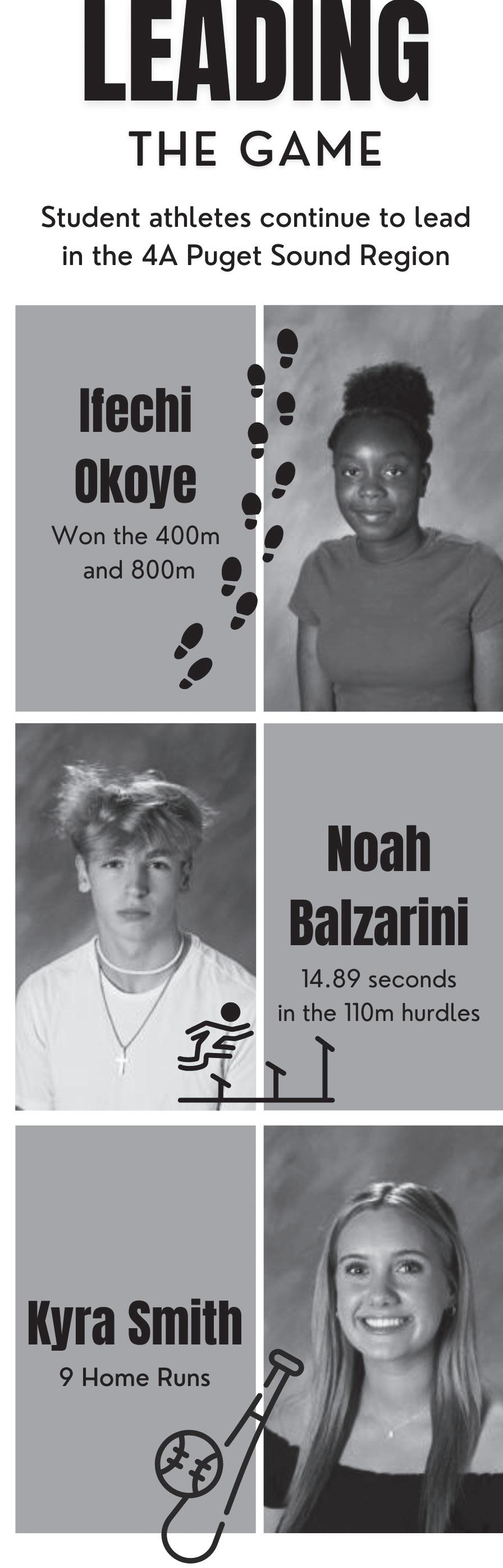
Junior Mason Pike has stunned the competition with his 95 mph fastball all season long, so let’s take a closer look at this spring athlete.
Hunter Ihlen, Gloria Perez-Cruz, Quinn Taute Staff
Q: How long have you been playing baseball?
A: “I’ve been playing for 14 years.”
Q: What got you into the sport?
A: “I just played every sport and baseball was what I loved most.”
Q: How did you decide your position?
A: “I just want to be the best player on the field and usually the shortstop or middle infield guys are the best player and then I started pitching. I just started throwing hard so they put me on the mound.”
Q: What’s your favorite pitch to throw?
A: “My favorite throw is fastball because I like to throw hard.”
Q: What is your most reliable pitch?
A: “Fastpitch because they usually can’t catch up so I throw it by them.”
Q: What type of training did you put in to throw that that fast?
A: “I lift every day and throw a lot.”
Q: Why did you choose Oregon State?
A: “It was just my dream school ever since I was little, they’ve always been good. So that’s why I wanted to go.”
Q: If you could be in any MLB team, what team would it be?
A: “Probably the Mariners so they have a better chance at winning because they’re not very good.”
Q: Was it hard to get to where you are now in your career?
A: “It took a lot of work and I’ve been doing this forever, so I put in a lot of work to get where I am now.”
Q: What was your favorite baseball experience you’ve ever had in the past 14 years that you’ve played?
A: “It was probably going down to Cooperstown when I was little like 12 years old, that was super fun you got to stay with your team in dorms and it was a good experience.”
Concussions Continue Leaving Impacts
Sienna Hanson Sports Editor
For most athletes, sports injuries are as common as missing sixth period for a match or gorging on Goldfish crackers because it’s a game day. They miss a practice, they get taped by the athletic trainer and they’re back in the game.
Not every injury, however, is as easy as one, two, three.
“I think with concussions, they’re all different. Sometimes it could be, you know, as soon as a couple of days, or I’ve dealt with concussion that have lasted for over a year. It just depends on that individual. Everybody’s different,” athletic trainer Joshua Garcia said.
After sustaining a concussion or a cerebral injury, which results in unwanted movement of the brain, it’s possible for athletes to struggle to remember their identity, their name or even what sport they were playing. Along with memory problems, students can suffer from dizziness, nausea and frequent headaches.
Katie Akeson, CTE teacher and a former physical therapist, says her view on concussions has to do with the amount of activity a student’s brain undergoes every day, whether or not it’s realized.
“Brain injuries are really hard in the fact that like your brain is always working. A lot of times, people are continuing to do things and you don’t really realize how much you’re actually using your brain,” Akeson said. “You’re using your brain all the time. You’re using your brain to move your body around, you’re using your brain to walk, you’re using your brain to think, you’re using the brain to play games or talk on the phone or anything like that.”
Because of this immense amount of activity, brain injuries such as concussions can lead to tough recoveries.
“If there’s a big trauma, a lot of times people will go to therapy first. They can do different exercises to fix your vision or get rid of those headaches, sometimes you’ll have a neck pain involved with it,” Akeson said. “There’s a lot of expenses when it comes to just on the medical side of things. Usually, they
have to get numerous CAT scans or imaging, those kinds of things to make sure that there’s not significant damage to the brain.”
The first and most basic step to concussion recovery, however, is to rest and give the symptoms time to calm down. According to some of the common concussion myths, rest isn’t the only comeback method. Whether these stereotypes prove true or not is up to the professionals.
“Back in the day, they used to say that you had to be in a dark room with all the lights turned off and no electronics. But that’s actually been disproven by research. Now it’s whenever you can tolerate it. So, if the light doesn’t bother you, then it’s okay to have light around,” Garcia said.
Today, it’s up to an individual’s level of tolerance to decide whether they should be exposed to light or not.
“A lot of times people say don’t go to sleep after because people are afraid you’re not going to wake up,” Akeson said. “That is a myth that has been proven as of recently that sleep is actually
good for a concussion.”
Rylie Hangca, a senior and varsity volleyball athlete, sustained several concussions over the years. Hangca says the worst concussion took place in Kansas City, on her birthday.
“My 13’s year was probably the worst concussion I had. We were in a serving warm up and I was standing right by the net, and someone just served it,” Hangca said. “Immediate effects were [an] instant headache. After I got hit [I felt] dizziness, fatigue. It kind of just felt like I was out of it or in a haze.”
After the impact, a crowd of concerned family and friends rushed over.
“There’s a lot of instant rushing towards me, just to make sure I was okay and just to instantly check my symptoms just because it can be so life threatening,” Hangca said.
Page 8 } May 3, 2024 } The Viking Vanguard } Sports
edited for space.
Story
To view the full story, visit the website at www.vikingvanguard. com