Digital Experience Design Principles for 2026

Page 1


Why Digital Experience Design Is the New Growth Engine

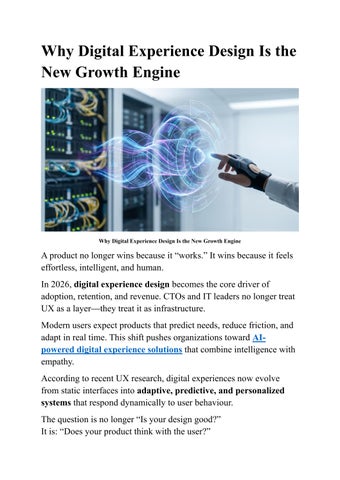
Why Digital Experience Design Is the New Growth Engine

Aproduct no longer wins because it “works.” It wins because it feels effortless, intelligent, and human.

In 2026, digital experience design becomes the core driver of adoption, retention, and revenue. CTOs and IT leaders no longer treat UX as a layer they treat it as infrastructure.

Modern users expect products that predict needs, reduce friction, and adapt in real time. This shift pushes organizations toward AIpowered digital experience solutions that combine intelligence with empathy.

According to recent UX research, digital experiences now evolve from static interfaces into adaptive, predictive, and personalized systems that respond dynamically to user behaviour.

The question is no longer “Is your design good?” It is: “Does your product think with the user?”

What Is Digital Experience Design in 2026?

It is the practice of designing intelligent, adaptive, and humancentered interactions across digital touchpoints.

Digital experience design in 2026 goes beyond UI. It integrates:

• AI-driven personalization

• Behavioural data insights

• Real-time interaction adaptation

• Cross-platform consistency

Modern systems shift from static flows to context-aware ecosystems that evolve with each user interaction.

This evolution aligns with what many experts call “UX as a system of intelligence,” where design influences not just usability but decision-making and trust.

Why Do Enterprises Prioritize Digital Experience Design Now?

Because experience directly impacts revenue, retention, and scalability.

In enterprise environments, poor experience creates:

1. High churn rates

2. Low product adoption

3. Increased support costs

On the other hand, optimized digital experience solutions:

• Reduce friction in onboarding and workflows

• Improve conversion rates

• Strengthen brand trust

Research shows that better UX directly improves discovery, engagement, and conversion performance across digital platforms.

For CTOs, this makes digital experience not just a design concern but a business-critical strategy.

How DoesAI Transform Digital Experience Design?

AI shifts design from reactive interfaces to predictive systems.
AI introduces capabilities such as:

• Predictive UX: Anticipates user intent

• Conversational interfaces: Natural interaction replaces rigid navigation

• Adaptive UI: Layouts change based on behaviour

• Automated accessibility: Inclusive design at scale

In 2026,AI is no longer an add-on feature it becomes the core layer of digital experience design.

However, the real challenge lies in balance. AI must enhance not replace human-centered thinking.

Core Principles of Digital Experience Design in 2026

1. Design for Invisible Complexity

Users want powerful systems but without effort.

Great products hide complexity behind:

• Clean interfaces

• Smart defaults

• Context-aware actions

Modern UX succeeds when users don’t notice the system only the outcome.

2. Prioritize AI-Powered Personalization

Personalization is no longer optional it is expected.

Key approaches include:

• Behaviour-driven content

• Dynamic navigation paths

• Real-time interface adaptation

AI enables experiences that feel uniquely tailored to every user, improving engagement significantly.

3. Build Human-CenteredAI Experiences

AI without empathy creates friction.

Design must ensure:

• Transparency inAI decisions

• User control over automation

• Clear feedback loops

Human-centeredAI frameworks emphasize trust, usability, and ethical interaction.

4. Create Seamless Omnichannel Experiences

Users move across devices constantly.

Your design must ensure:

• Consistent experience across platforms

• Unified data flow

• Context continuity

Afragmented experience today equals a lost customer tomorrow.

5. Focus on Speed, Performance, and Simplicity

Performance is experience.

Key priorities:

• Fast load times

• Minimal cognitive load

• Clear interaction flows

Modern UX shifts from feature-heavy designs to intelligent simplicity.

6. Design forAccessibility First

Accessibility is no longer compliance it is strategy.

Inclusive design:

• Expands your user base

• Improves usability for all

• Enhances brand perception

Accessibility-first design significantly boosts engagement and satisfaction.

7. EmbraceAdaptive and Predictive Interfaces

Interfaces evolve in real time.

Examples include:

• Smart dashboards

• Context-aware suggestions

• Predictive workflows

This creates experiences that feel alive, responsive, and intuitive.

How Can Product Teams Implement These Principles?

By aligning design, data, andAI into a unified strategy.

Product teams should:

• IntegrateAI early in the design process

• Use data to continuously optimize UX

• Build scalable design systems

• Collaborate across engineering, design, and business teams

What Challenges Do Teams Face in 2026?

Balancing intelligence, usability, and trust.

Common challenges include:

• Over-automation leading to confusion

• Lack of transparency inAI decisions

• Data privacy concerns

• Maintaining consistency across platforms

The solution lies in designing experiences that are:

• Smart but explainable

• Automated but controllable

• Personalized but ethical

Why Digital Experience Design Becomes a Competitive Advantage

In 2026, products compete on experience not features.

Organizations that invest in AI-powered digital experience solutions

• Deliver faster innovation

• Build stronger customer relationships

• Achieve higher ROI

Those that don’t risk becoming invisible in a crowded digital ecosystem. Ready to Transform Your Digital Experience Strategy?

If your product still relies on static interfaces and reactive workflows, it is time to rethink your approach.

Modern enterprises need intelligent, scalable, and human-centered digital experience solutions that evolve with users.

Partner with experts who understand both technology and experience design.

Explore how ViitorCloud’s digital experience consulting & services help organizations build adaptive,AI-driven products that scale with confidence.

Turn static files into dynamic content formats.

Create a flipbook