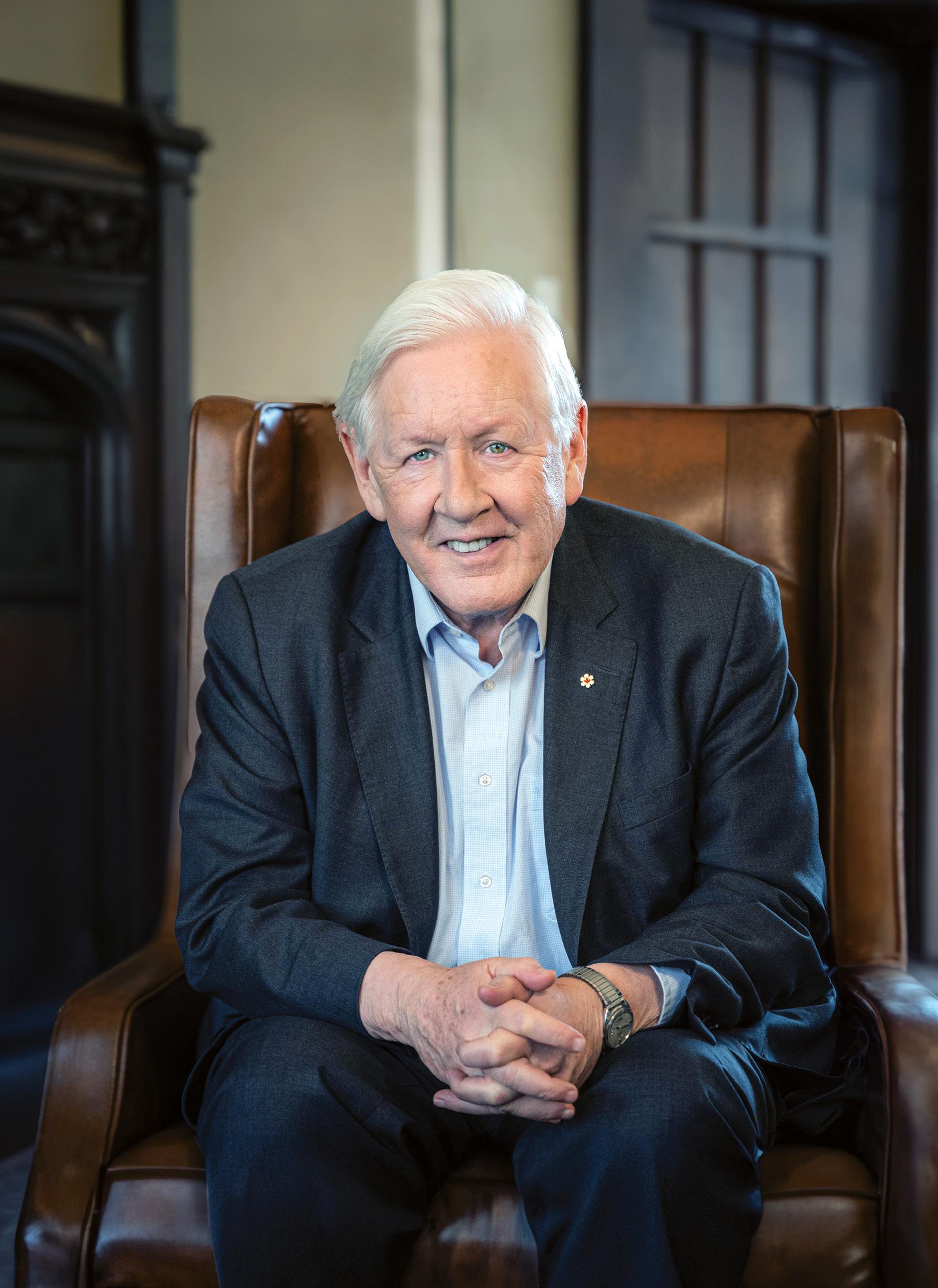
IN THE CLASSROOM
Bob Rae, Vic U faculty and alumni shaping public life and the next generation
SPRING 2026
PLUS: Students turning lived experience into research | Faith and mental health | Defending literary culture
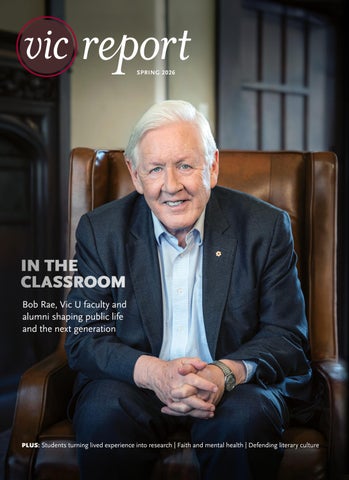
Bob Rae, Vic U faculty and alumni shaping public life and the next generation
SPRING 2026
PLUS: Students turning lived experience into research | Faith and mental health | Defending literary culture
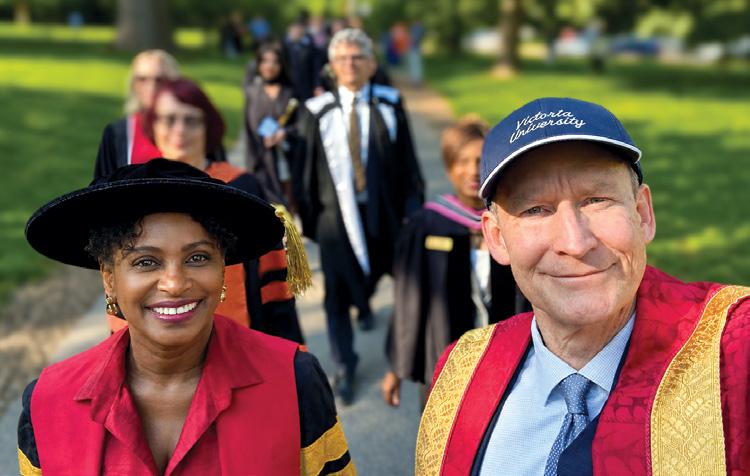
In this edition of Vic Report, we celebrate the individuals who teach, mentor and inspire our students. Our faculty define the Vic U experience, and this issue spotlights the people whose ideas and lived experience shape our community.
A defining strength of a Vic U education is the opportunity to learn from people whose work in politics, science, literature, and spiritual and community leadership extends beyond the classroom. This fall, we welcome Bob Rae back to our teaching community. Canada’s ambassador to the United Nations until recently, he brings decades of public service. In this issue, he is in conversation with Vic Professor David Wright, a former Canadian ambassador to NATO.
Our community is also strengthened by Ira Wells and Nazila Isgandarova, whose work invites students to think deeply about culture, social justice and spiritual care.
The strength of a Vic U education is evident not only in the classroom, but in the achievements of our students and alumni across disciplines, including the sciences. In this issue, we celebrate distinguished alumna and climate scientist Katharine Hayhoe, highlight student
research on Alzheimer’s disease, and recognize emerging leaders in nursing and climate advocacy.
Taken together, these profiles speak to the breadth of learning at Vic U and to the faculty who help make that learning possible.
While this issue focuses on our faculty, I would also like to acknowledge a leader who has had a profound impact on our students. As Nick Saul Vic 9T0 concludes his tenure as chancellor this summer, I offer my personal thanks for his generosity, wisdom and unwavering commitment to Vic U.
Nick’s leadership in food advocacy through Community Food Centres Canada has helped shape national conversations around food security and dignity. He brought that commitment directly to campus, connecting with students passionate about these issues and encouraging them to think about how they can make a difference.
He has been a thoughtful presence, a strong advocate for our students and a valued partner. I have been deeply grateful for his counsel, his friendship and the many ways he strengthened our community. We also had a lot of fun working together.
Nick leaves big shoes to fill. I am delighted that Steve Paikin will step into the role of chancellor, and I know he will bring his insight, curiosity and commitment to public life to our campus.

Dr. Rhonda N. McEwen President and Vice-Chancellor, Victoria University in the University of Toronto
Vic Report Spring 2026
Volume LIV No. 1
Publisher: Victoria University
Editor-in-Chief: Leslie Shepherd
Web Editor: Dan Blackwell
Photo Editor: Neil Gaikwad
Design: Randall Van Gerwen
Cover Photo: Neil Gaikwad
Vic Report is published regularly each year; ISSN 0315-5072.
Publications Mail Agreement No. 40741521.
Send milestones and undeliverable
Canadian addresses to:
Vic Report, c/o the department of Alumni Affairs & Advancement
73 Queen’s Park Crescent Toronto, ON M5S 1K7
Tel: 416-585-4500
Toll-free: 1-888-262-9775
Email: vic.alumni@utoronto.ca
Website: www.vicu.utoronto.ca
Do we have your correct address?
Please send your updated address, phone number and email address to the department of Alumni Affairs & Advancement.
If you would like to write to Vic Report, please email vicu.media@utoronto.ca
Victoria University respects your privacy and does not rent, trade or sell its mailing lists.
Ira Wells is a writer, critic and academic program director at Victoria College. We spoke with him about his new role as president of PEN Canada, the urgency of defending literary culture, and how his work as a teacher and writer continues to be shaped by the classroom.
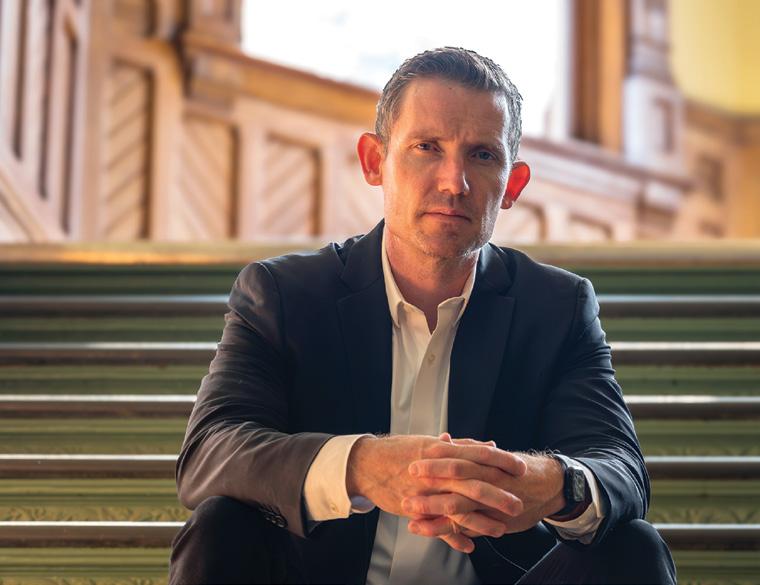
Q. You’ve taken on the role of president of PEN Canada this year. What drew you to that role, and what are you hoping to accomplish?
A. Not to sound alarmist, but my honest sense is that our society is inching toward an inflection point. The loss of a shared literary culture, the rise of book banning and normalization of censorship, and the devaluation of reading are existential issues for PEN, and they are all happening at once. PEN Canada’s role is to ensure that the values of literature—imagination, knowledge, curiosity, empathy, continuity—survive and guide us in the years ahead. My job is to ensure that PEN is part of the cultural and political conversation, that we are helping to illuminate a path forward. I would be especially gratified if I could help our organization connect with young Canadians.
Q. Your latest book, On Book Banning, grew out of current events. What happened, and how did those events shape your thinking?
A. In the fall of 2023, CBC reported that schools in Peel Region had liquidated thousands of books from their library shelves. We don’t know how many books were culled, but any book published more than 15 years prior was subject for removal. Because these books were considered “harmful,” they could not be donated; instead, they were destroyed. This book banning initiative was undertaken by progressive educators in Ontario. At the same time, populists and evangelicals have been pushing their own book banning efforts in Alberta and throughout the United States. Both sides believe they are saving children from “harm.” My argument is that, in banning books, censors are introducing new sources of harm—cutting children off from narratives that may have enriched their lives, whitewashing the past, teaching them that censorship is the solution, and convincing them that they are fragile receptacles of potentially damaging material, rather than critical readers and thinkers.
Q. You’re not only a writer but also academic program director at Victoria College. What do you see as the value of studying literature today?
A. Studying literature can be a great platform for students to cultivate their own critical judgment, to think through ethical problems and social dilemmas, and experience lives that are unlike their own. Literature is still our best technology of selftranscendence. At the same time, when we read, we are also learning something about ourselves. We are informing and shaping our future selves. “Studies pass into character,” as the college’s motto says, and literature is a conduit for that transformation.
Q. You spend a great deal of time in the classroom. What do you get back from your students, and how do their perspectives shape your thinking as a writer and teacher?
A. My students keep it real. There’s no fooling them. If an idea is too abstract, too vague, too disconnected from reality, they will say so. They also bring experiences from around the world, along with an extraordinary enthusiasm and energy. As I leave one of my Vic seminars I always have a spring in my step, my mind swimming with new ideas. I know others feel exactly the same way. My Vic One colleague Prof. Bob Davidson and I sometimes text each other after class, to the effect of: “These students are amazing, and we are the luckiest professors in the world.”
Q. How have you seen the student experience in your classroom shift since you started teaching here?
A. I don’t think it has. The world has changed, but our students are as passionate and committed as ever. They are encountering these ideas for the first time. New worlds are opening. I’m so incredibly privileged to be able to share these moments with them.
By Sally Szuster
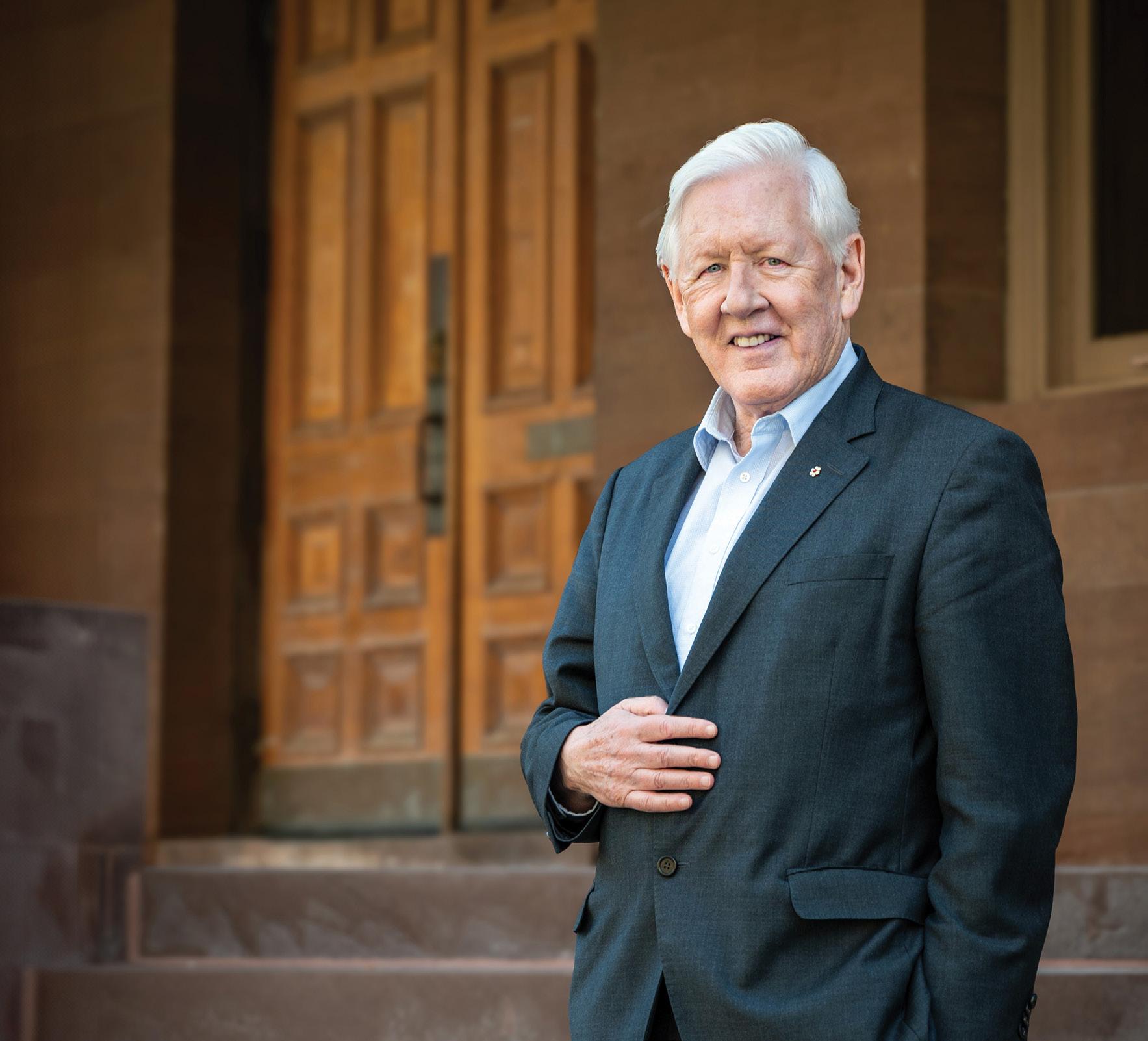
Bob Rae has spent the past five years in one of the world’s most scrutinized rooms, representing Canada at the United Nations during a period defined by pandemic, war and geopolitical strain.
This fall, he returns to a very different setting: a first-year seminar at Victoria College, where those same global challenges will be examined through discussion and debate rather than high stakes diplomacy.
Rae will teach in Vic One, the university’s flagship interdisciplinary program that brings small groups of students into discussion-based courses. He taught in the program before 2019; however, this return carries a different immediacy. He arrives fresh from the UN, with the global events his students are trying to understand.
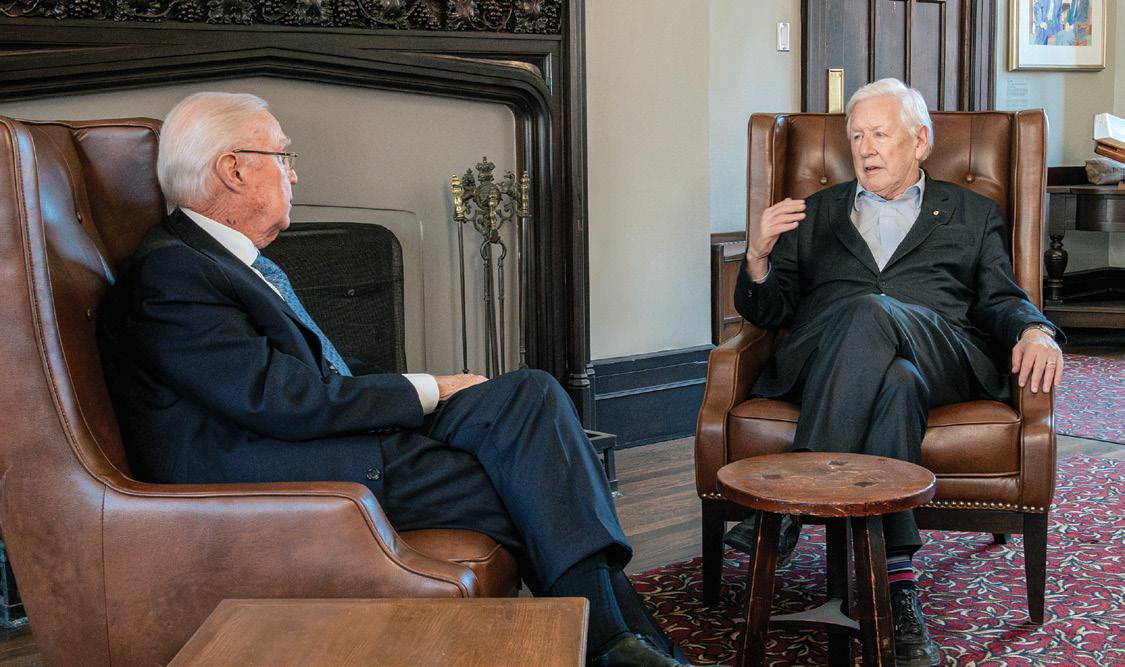
On a recent afternoon, Rae sat down in the Common Room beside Burwash Dining Hall with David Wright, the Kenneth and Patricia
Taylor Distinguished Professor of Foreign Affairs, who also teaches in Vic One. Wright, a former Canadian ambassador to NATO, has spent years teaching at Victoria College, helping students navigate international events as they unfold. The two colleagues and diplomats were reconnecting while comparing notes on what it means to teach in a moment that feels unusually unsettled.
“It’s going to be a very challenging year for our students,”
Wright says. Students are arriving after a year marked by the wars in Ukraine and the Middle East “and Trump all over the map, creating chaos.”
Wright begins each lecture by asking what has happened since the previous week, inviting students to interpret events before he adds context. The approach keeps the discussion grounded in the present, but it also reveals how relentless that present can feel. “If you go sort of week by week, event by event… it drives you nuts,” he says.
Rae recognizes that same pressure. After years working within institutions designed to manage global crises, he has seen how quickly events accumulate and how difficult it can be to maintain perspective. The pace of change, he suggests, is part of what students are learning to navigate.
“Teaching is really about intergenerational dialogue,” he says. That dialogue reflects a shift in how this generation of students approach learning. The difference is especially visible in how students gather information. “I find I’m asking students, ‘Have you read this? And they’ll say, ‘Are you listening to that podcast?’”
He plans to ground his teaching in writers like George Orwell and Aldous Huxley, using their work to bring order to what can feel like a constant rush of events. The exercise, he explains, is about “looking at who got it right and who got it wrong” as a way of “trying to understand the movement of events as we see them,” from “displacement, famine and hunger and the results of conflict” to the reality that “we have more conflicts than we’ve ever had before.”
From there, the questions widen. “What does living through warfare tell us?… what does it tell us about how to find solutions?”
Rae asks, extending that inquiry to newer pressures that echo the worlds Orwell and Huxley imagined, including “AI technology, surveillance societies that become very, very intrusive into people’s lives,” and the enduring importance of values like “freedom” and “equality.”
Both professors are working within a program that has built a reputation for this kind of dialoguebased learning. “I think Vic One has been a hugely successful experiment,” Rae says. He points to the way similar models have spread, but also to the students themselves. “I’m really impressed by their level of interest in making sure that what they’re getting is as good as possible,” Rae says.
That engagement is central to how both instructors think about their role. Wright emphasizes building confidence, asking students to write policy memos and make recommendations as if advising decision-makers. Rae focuses on something more foundational.
“The essential gift that really comes with a university education isn’t about filling your head with a certain fixed amount of knowledge,” he says. “It’s about how do I actually
think and keep on thinking as I go through life.”
Back in the Common Room, the conversation moves easily between global institutions and classroom practice. The setting may be quieter than the UN or NATO headquarters, but the questions are not smaller. They are simply being asked earlier, by students who are just beginning to form their own answers.
Rae’s return to Vic won’t be limited to the classroom. This fall, he will join former Conservative Party leader Erin O’Toole for the inaugural Great Canadian Debate at Victoria University, a new public forum on the issues shaping Canada, moderated by Heather Hiscox Vic 8T6, a former news anchor and host of CBC Morning Live. The debate will support the Dr. Jean Augustine Professorship in Transformative Education at Victoria University. For more information contact Aimee Esparaz, Director of Philanthropy, Alumni Affairs & Advancement: aimee.esparaz@utoronto.ca.
By Leslie Shepherd
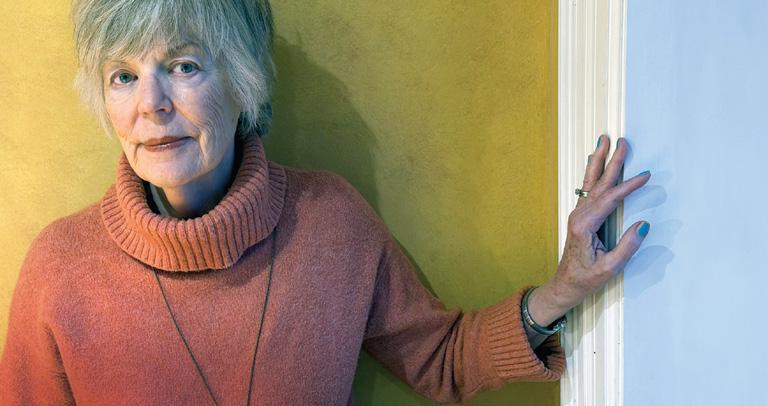
When Marni Jackson Vic 6T8, arrived at Victoria College with a love of reading and writing, she found herself surrounded by teachers and peers who were shaping Canadian literature, criticism and cultural thought, and others who would soon follow.
She would go on to join their ranks, building a career as one of Canada’s most distinctive journalistic voices and an award-winning author of fiction and nonfiction. Victoria University and the Alumni Association of Victoria College are recognizing that lifetime of achievements with a Distinguished Alumni Award, an honour Jackson said leaves her “flattered and honoured... and very gratified.”
Jackson came to Vic in the mid-1960s with little sense of what to expect.
“I went in rather blind, but I really lucked out because it was perfect for me and I had great, great teachers.”
As an English Language and Literature student, she studied with Northrop Frye and Dennis Lee, while Marshall McLuhan was also part of the broader campus environment.
Frye, she recalled, “was incredibly impressive, and very open to first-year students… there was no question too stupid for him.”
Lee became a writing mentor and Jackson later worked briefly for him at House of Anansi Press.
“I was always interested in poetry from my teens on,” she said. “What I didn’t realize is that there were very few universities that offered Canadian poetry on their curricula. But guess what? Because Dennis Lee taught it, I had the opportunity to read and learn more about it in high course.”
Marshall McLuhan was teaching at the University of Toronto and held a graduate seminar at 671 Spadina Ave., where Jackson lived at the time, and where the House of Anansi press was launched. “I remember coming home and stepping over his legs on the way into the hallway.”
These figures didn’t feel “famous” at the time, Jackson said, just deeply engaged teachers and thinkers who were part of everyday campus life.
Outside the classroom, she immersed herself in campus life, participating in student productions, including the Bob Revue. She acted in a Hart House Theatre production directed by William Hutt and contributed to Acta Victoriana, where she occasionally ran into a young Margaret Atwood.
“I remember going to a poetry reading by her in the Victoria College building and being very impressed, thinking ‘well, that girl’s got talent’.” I was surrounded by exceptional writers and didn’t quite realize it.”
After graduating in 1968, Jackson built a career in journalism and nonfiction, writing for publications including Maclean’s, Saturday Night, Rolling Stone and The Walrus. She held the Rogers Chair in Literary Journalism at the Banff Centre and was on the faculty of Mountain and Wilderness Writing there for 20 years.
Her bestselling 1992 memoir The Mother Zone was shortlisted for the Stephen Leacock Memorial Medal for Humour. She published several other nonfiction works, as well as a collection of short fiction.
She also worked across film, theatre, TV and literary journalism. She was a cohost of the book show Imprint on TVO, and co-wrote with her husband Brian D. Johnson the documentary film Al Purdy Was Here. She has collaborated on a Dora award-winning stage show about the poet called The Shape of Home: Songs in Search of Al Purdy.
More recently, she has written candidly about being diagnosed with Parkinson’s disease. She is currently working on a new nonfiction book about the body.
Jackson said that budding writers studying at Vic are in the right place and that the only way to become a better writer is to write.
“If you write daily, if you do 500 words a day, in 150 days you’ll have a book. And it’s kind of that simple.”
By Sally Szuster
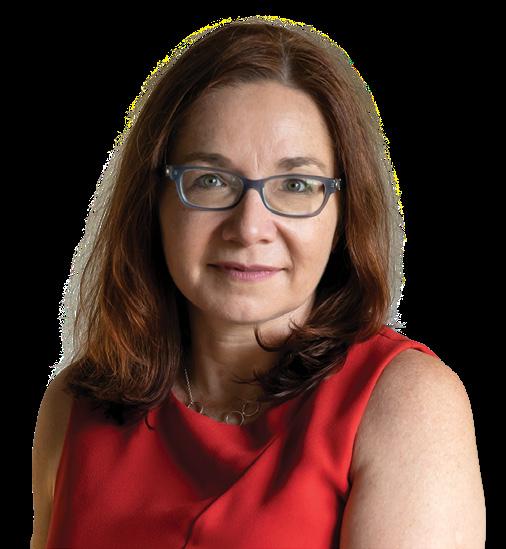
Katharine Hayhoe Vic 9T4 has advice for university students who are worried about climate change: there’s so much to do, and no one can do it alone.
“Think about a Venn diagram—what needs to be done, what you’re good at and what gives you joy,” she says. “Study what you’re passionate about and apply it to building a better future. Whoever you are, we need your skill set. If math gives you hives, don’t do it. Study psychology, or theatre, or whatever you love instead. We need those skills too!
Hayhoe’s own academic path to becoming one of the world’s most respected climate scientists and communicators began with an undergraduate degree in physics and astronomy earned while a student at Victoria College.
Today, Hayhoe is chief scientist for The Nature Conservancy and a professor at Texas Tech University in Lubbock, Texas. She works with people trained in journalism, marketing, psychology, economics, engineering, conservation, public administration, health care and more.
That experience has shaped her belief that to effectively address global challenges like climate change, we need to understand people, values and the stories that make change possible.
“So much climate information paints a dire picture of what will happen if we don’t act,” she said. “But neuroscience tells us that the human brain is wired to move toward something better, not something worse. Physical science has a hard time painting that picture of something better. But humanities, especially the arts, can do that. They can show what the world could look like and how our lives could be different. We also need philosophy and ethics: what is the right decision, for whom and how decisions are even made.”
That view aligns closely with Victoria University’s long-standing emphasis on interdisciplinary education.
Hayhoe points to programs like Vic One as examples of how the college intentionally brings students from different disciplines into shared intellectual space.
“I would have wanted to participate in the Vic One program if it had existed back then,” she said. “The more I advance in my career, the more I realize how essential the humanities and social sciences are.”
Hayhoe comes from a long line of Vic graduates, including both her parents and her great-aunt. Her son just finished his first year at Vic, studying physics and astronomy, like his mother and grandfather.
Author and activist Naomi Klein was a student at Vic at the same time as Hayhoe, though the two didn’t know each other then. “I think of Vic as a garden bed,” Hayhoe says. “You don’t always know what’s sprouting there at the time, but you see the fruit later.”
Hayhoe received an honorary Doctorate in Humane Letters from Victoria University in 2019, alongside her aunt, Ruth Hayhoe, a professor in the Department of Leadership, Higher and Adult Education in the Ontario Institute for Studies in Education.
This spring she is being recognized with a Victoria College Distinguished Alumni Award, an honour she describes as deeply meaningful, given the strength of Vic’s alumni community.
“Look at the quality of our graduates today,” she said. “With all the amazing things they are doing, it’s going to get harder and harder to choose the distinguished alumni. So, I’m grateful I made it in.”
The Distinguished Alumni and Emerging Leader Awards are chosen by the AVC, an association of Victoria College alumni volunteers and staff who lead and organize events, such as the annual Alumni Reunion, regional reunions, online networking and professional development opportunities and more. To learn about how you can participate in alumni events contact the alumni office at 416-585-4500 or vic.alumni@utoronto.ca
Enxhi Kondi Vic 1T7 and Aliénor Rougeot Vic 2T2 each received an Emerging Leader Award. The award recognizes recent graduates, 40 years of age or under, who have excelled professionally or demonstrated notable accomplishments through professional work or volunteer service, including community work, humanitarianism and philanthropy.
Enxhi Kondi Vic 1T7
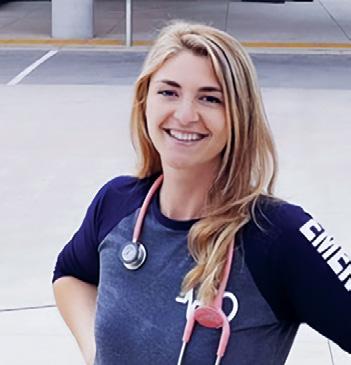
A registered nurse in the emergency department at Cortellucci Vaughan Hospital, Kondi has built her career around leadership, advocacy and visible impact while working on the front lines of Ontario’s health- care system. Her passion for leadership developed during her undergraduate years at Victoria College, where she served on VUSAC, including a term as vice-president, and was an Orientation executive. “I spent more time in the student council office than anywhere else,” she said. After graduating with an Honours Bachelor of Arts & Science specializing in health and disease, Kondi chose nursing to pursue meaningful, immediate impact. “I wanted to see direct, visible impact,” she said.
During the COVID -19 pandemic, Kondi wrote a series of Toronto Star articles examining Ontario’s nursing crisis, earning widespread recognition. She now trains and precepts new nurses in emergency care, serves as a clinical teacher at Humber College, and holds a Master of Nursing degree from Athabasca University, focused on teaching and leadership. “Nurses are leaders,” she said, “and our voices need to be heard.”
Aliénor Rougeot Vic 2T2
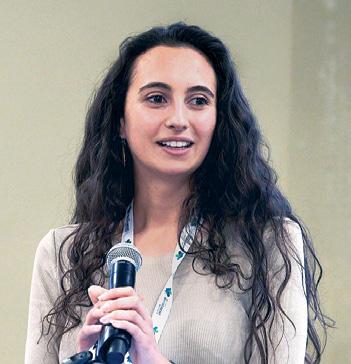
From organizing student strikes to shaping national conversations on energy policy, Rougeot has emerged as a leading voice for climate justice in Canada. She graduated with an Honours BA in economics and public policy and was named a University of Toronto Alumni Association Scholar.
As a co-founder of Fridays for Future Toronto, she helped mobilize tens of thousands of young people, including more than 50,000 participants in the 2019 Toronto school strike for climate. Her ability to engage and inspire a new generation of advocates has been central to her work. “You are never alone in this work,” she said. “A big part of organizing for change is finding others to join forces.”
At Victoria College, Rougeot served as an Orientation Leader, an experience that sparked her interest in community building and mentorship. Until summer 2025, she worked at Environmental Defence as a climate and energy program manager and later senior program manager, advocating for a fair and equitable energy transition. She is now pursuing a Master of Public Policy degree at the University of Oxford and remains active in community education and civic engagement.
Click here for the full-length version of the story.
By Leslie Shepherd
Look closely at the walls of Alumni Hall and you’ll see more than artwork. You’ll now find stories of people, places and ideas that have shaped Victoria University across generations.
A professor quietly practicing his golf swing in an attic. Northrop Frye in the clouds. Four versions of a Margaret Atwood portrait in different media. Two new works by Indigenous women artists.
The university used the opportunity of a recent refresh to not just repaint the room and replace the floor, but to rethink what the hall could represent. The result is a carefully curated new art display in which every work honours alumni in some way.
“Either the artists are alumni, the people represented are alumni, the works were commissioned to mark Vic U milestones, or they entered the collection through alumni gifts,” said Gerrie Loveys, Victoria University’s art curator.
Near the entrance is one of the most immediately recognizable alumni connections: a group of four studies of Margaret Atwood Vic 6T1.
The works, created by artist Christian Corbet, include a drawing, a painting, a linocut print and the linoleum plate used to produce the print.
One of the largest artworks is a monumental mixed-media collage by alumna and former Victoria College English professor Mary-Lou (M.L.) Knight Vic 4T9, The Truth Shall Make You Free. It was commissioned in 1992 to mark the 100th anniversary of the Old Vic building and takes its title from the motto over the front entrance.
Constructed from more than 100 materials, including fabric, cardboard, dowels, glass, beads and paper, it’s a richly layered visual history of the university.
Knight spent months researching Vic U’s past, assembling not only official milestones but stories, rumours and everyday moments of campus life. A procession of students from different eras moves across the foreground, led by Nellie Greenwood Vic 1884, the first woman to complete her entire undergraduate degree at Victoria College.
Above the procession, Northrop Frye appears mid-lecture, tipping

back in his chair, teaching a class on Blake, flanked by cherubs and trees drawn from the poet’s imagery.
“Mary-Lou wanted to tell as much of the building’s first hundred years as she could. It’s not just the big names, it’s the spaces, the staff, the atmosphere of the place.”
Frye appears again nearby in Douglas Martin’s 1972 portrait commonly known as Frye in the Sky, as it shows the critic floating above the clouds. There are prints by Claire Pratt Vic 4T4, daughter of poet E.J. Pratt, and watercolours by geologist and explorer A.P. Coleman Vic1880.
Recent acquisitions of contemporary Inuit art by Eva Aittauq Qirniq Noah and Nicotye Samayualie were made possible through an endowed gift from alumna Shelly Jameson Vic 8T0.
Many spaces on Vic’s beautiful campus are available as rental spaces. Planning a special event? The events team is always happy to help you plan your wedding, conference, or celebration. Contact vic.spaces@utoronto.ca
By Leslie Shepherd
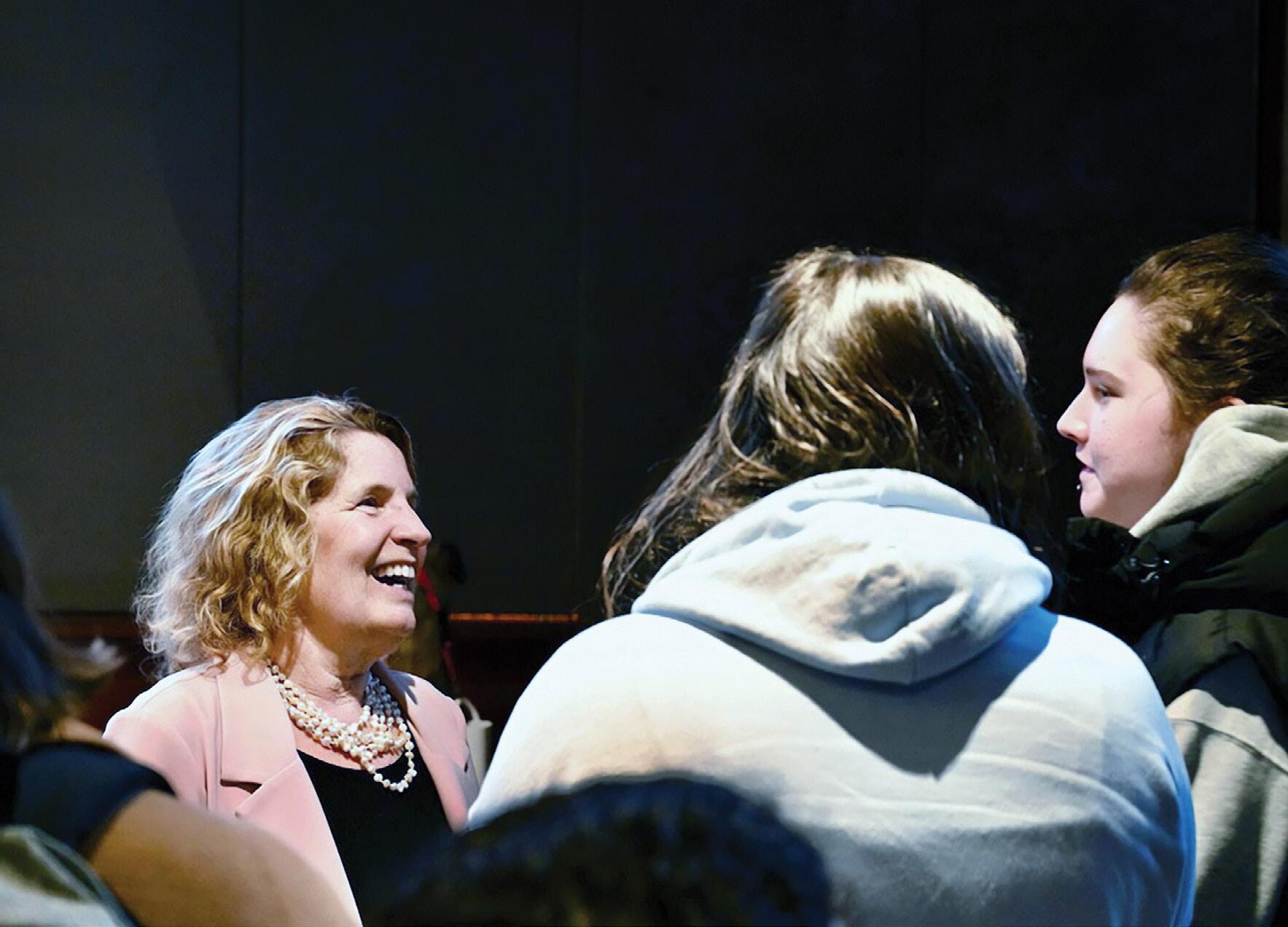
Kathleen Wynne spent years navigating the complexities of public life. Now, in her classroom at Victoria College, the former premier of Ontario is helping a new generation make sense of a rapidly changing world. She says she feels optimistic about the future every day she meets with her knowledgeable, tech savvy students.
Wynne, who holds the Hon. Newton W. Rowell professorship, has a unique perspective on undergraduate life. In the fall, she teaches in the Vic One program, working with first-year students just beginning their university journey. In the winter, she leads a fourth-year seminar in the Ethics, Society and Law program at Trinity College, engaging students on the cusp of graduation.
“I feel hopeful every day I come out of class,” she said. “When people ask me about my teaching, why am I doing it, am I enjoying it, I say it’s all about the students. They’re so smart. They know so much.”
Today’s students arrive at university with a different knowledge base than previous generations, she said. Many have a strong understanding of Indigenous histories and perspectives, providing a foundation for conversations about truth and reconciliation. They are also highly fluent in technology, comfortable discussing artificial intelligence and its role in their education.
“It’s instructive and illuminating,” Wynne said. “I can have conversations with students about AI that I can’t have with people
my own age. It’s a really interesting meeting of the generations.”
They’re also accustomed to communicating in shorter, more compressed forms shaped by social media, a shift Wynne sees as evidence of how language continues to evolve, rather than a loss of complexity.
She still prints out first-year journals and marks them by hand with a red pen—a habit that amuses her students but, she says, reflects her belief in giving them “as good a start as possible.”
However, Wynne sees mounting pressure. Students are grappling with the lingering effects of pandemic disruption while absorbing a steady stream of news about economic uncertainty, climate change and political instability
in the United States. For many, concerns about the future and their job prospects create a constant undercurrent of anxiety.
That anxiety often shows an intense focus on grades. Students push for near perfect marks, sometimes returning to ask whether an 85 per cent grade can become a 90.
“It withers my soul to have that conversation,” Wynne said. “I want to talk to them about the issues in the paper more than I want to talk about the grade.”
The heightened concern about grades reflects a broader shift she finds troubling, the growing framing or positioning of universities as pipelines to employment.
“Of course that is part of it,” she said. “But it is also about educating citizens, having people in our society who are critical thinkers, who will question the decisions of leaders, who will be engaged in the democratic process.”
In her classes, students are encouraged to lead discussion, challenge one another—and her— and connect course material to current events unfolding beyond the classroom. The goal is not consensus but engagement and helping students build confidence in expressing and defending their ideas.
“I want these young people to think about what public policy means and how decisions get made and then formulate opinions about particular issues,” she said. “If we don’t feel we can question decision-makers, then we’re giving free rein to people who may or may not have our best interests at heart.”
Wynne resists making the comparison whether she accomplished more shaping the next generation as premier or as professor.
“I got into elected politics because of publicly funded education,” she said.
She points first to the lasting impact of public policy, such as full- day kindergarten, which she helped implement as education minister.
At the same time, she has come to value a different kind of influence in the classroom. Some of the most meaningful moments, she said, have been with students she debated intensely, who later returned to say that sustained disagreement reshaped how they viewed issues such as basic income.
“I have felt that in a number of instances over the last five years that I have had a significant impact on some of the young people’s lives,” she said. “I have students who have gone on and done political internships, who have gotten involved even in partisan politics. I’ve had students, some of whom we really locked horns with about our worldviews, come to me and say, you know, it was great to be able to have these conversations and you’ve changed my perspective.”
She doesn’t think students are intimidated by the fact their professor was once premier of Canada’s largest province. Many are from outside of Ontario or were young when she resigned as Ontario Liberal Party leader in 2018.
If her political history does register, it tends to emerge gradually rather than shaping the classroom dynamic. Students get to know who she is over the course of the term, she said, and the process feels mutual. “They get to know who I am and we kind of learn together.”
1.Don’t let toxic politics push you away
Politics can sometimes feel frustrating, angry or divisive. But disengaging only leaves important decisions to others. I believe staying involved, even when the conversation gets difficult, is part of strengthening democracy.
2.Listen to other people
Public engagement begins with paying attention to the experiences and concerns of others. We all come from different backgrounds and communities, and democracy works best when we hear those different perspectives and try to understand them.
3.Turn frustration into action
Feeling upset about injustice or social problems can be productive if it motivates action. Volunteer, attend meetings, support a cause, contact elected officials or help organize your community.
4.Ask questions and think critically
Being engaged means more than following headlines. It means questioning decisions, thinking about how policies affect people and understanding the larger context of what is happening in society.
5.See compromise as a strength, not a weakness
Progress often comes through collaboration and negotiation. Civic engagement is not just about winning arguments, it’s about helping communities solve problems together.
By Leslie Shepherd
For Landon See and Nina Yue, Alzheimer’s disease has never been just a chapter in a textbook. It has been a defining feature of their lives.
That personal connection led both students to get involved separately in Alzheimer’s research as undergraduates at Victoria College.
The drive to understand the brain began at home for both. See watched his parents struggle to navigate what he describes as “indigestible” medical information while caring for two grandparents with dementia. Yue’s father was diagnosed with early- onset Alzheimer’s disease at just 37 years old.
See, who is graduating this spring with a BSc in pathobiology and biochemistry and a minor in science, technology and society, worked to make dementia research accessible outside of academic journals.
Through the Dementia Awareness Initiative, a University of Toronto student organization where he served as co -president, See reviewed peer-reviewed Alzheimer’s research and helped translate it into clear, accurate posts aimed at students, caregivers and families. Topics included symptoms such as sundowning, emerging findings on music and memory, and practical ways to support people living with cognitive decline.
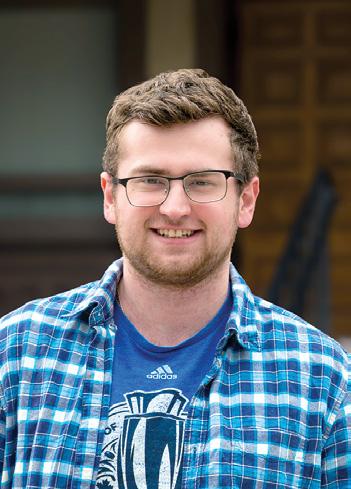
“The goal wasn’t just to summarize research,” See said. “It was to make it usable.”
Yue, who is also graduating this spring, completed undergraduate research in a laboratory setting. A double major in human biology and psychology, Yue conducted research at Baycrest Health Sciences’ VisAge Lab, where scientists study how aging and dementia affect visual cognition, including facial recognition. The work explores whether subtle changes in visual processing may appear earlier in Alzheimer’s disease than memory loss, making it potentially relevant for early detection.
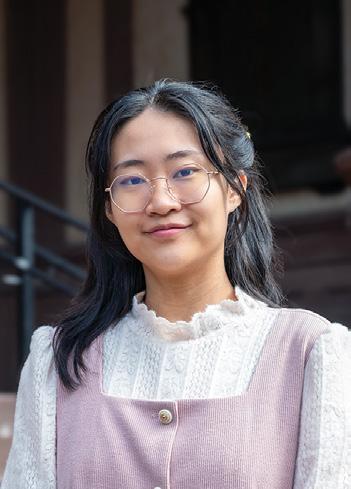
“We were looking at how facial recognition changes over time,” Yue said. “Those changes may happen very early.”
Alongside laboratory work, Yue volunteered with the Alzheimer Society, served as a residence don and senior don at Vic, and founded SPARK Health, a student initiative that supports undergraduates interested in health research and academic publishing.
Victoria College Principal Alex Hernandez said that supporting undergraduate research is a priority for the college.
“One of the things that makes Vic special is how actively we encourage students to pursue research early in their academic careers,” Hernandez said.
That support includes dedicated infrastructure for undergraduate research. Victoria College is the only college within the Faculty of Arts and Science at the University of Toronto with a research co-ordinator focused specifically on undergraduates, a role held by Professor Shaun Ross.
As they prepare to graduate, both students plan to continue working at the intersection of research and care. See is considering medical school while also exploring teaching, building on his experience as a chemistry peer tutor and lab instructor. Yue plans to pursue medical training, with long-term interests in neurology or psychiatry focused on aging and dementia.
“When students are given the support to explore their questions as undergraduates, their work can be both rigorous and deeply meaningful.”
Victoria College Principal Alex Hernandez
By Sally Szuster
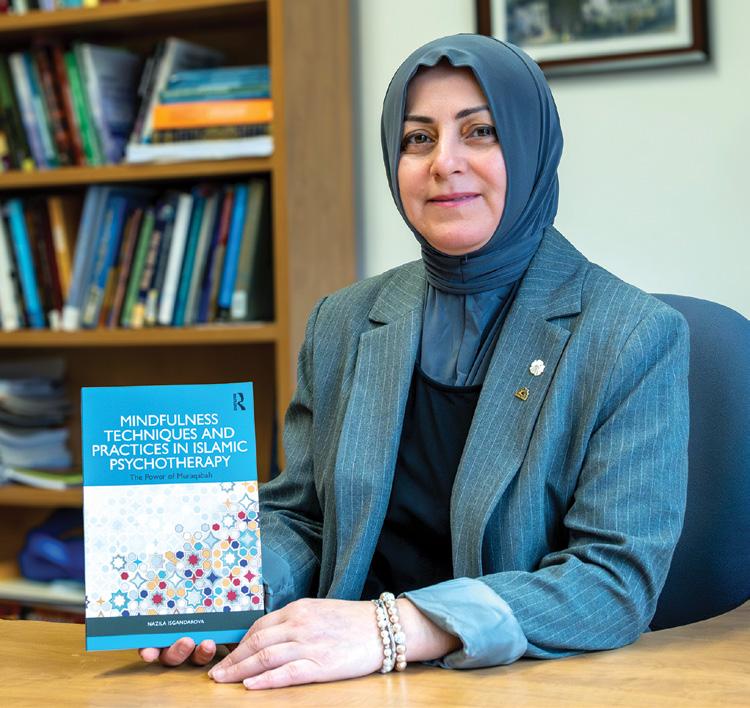
One in three Canadians who meet the criteria for a mental health disorder report that their care needs are only partially met or not met at all, according to Statistics Canada a gap that continues to challenge how care is delivered. Into that gap steps Dr. Nazila Isgandarova, an associate professor at Emmanuel College, the post-graduate interfaith college at Victoria University in the University of Toronto. Her new book, Mindfulness Techniques and Practices in Islamic Psychotherapy: The Power of Muraqabah, reflects growing interest in approaches that integrate spirituality with clinical care. It centres on muraqabah, a form of Islamic mindfulness she presents as a framework for addressing anxiety, trauma and emotional distress.
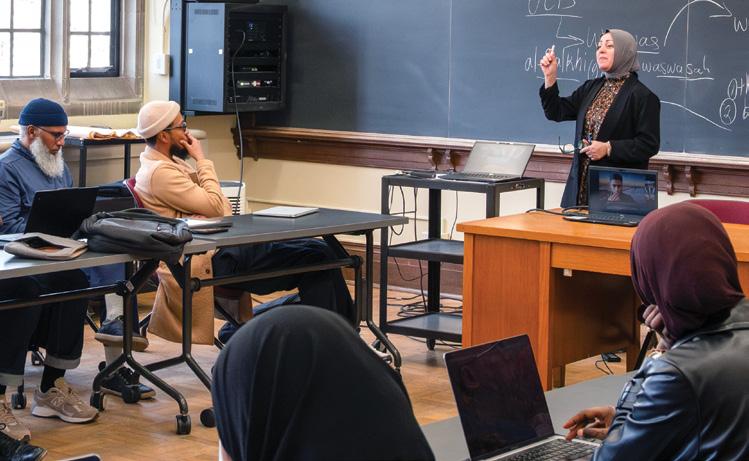
At Emmanuel College, Isgandarova is director of the Supervised Psychospiritual Education program, where she has helped shape a model of care that bridges clinical training and spiritual insight. By training practitioners in these approaches, the program is expanding access to mental health care through a broader range of techniques and more practitioners equipped to use them.
“There is a growing interest in how to integrate spirituality in psychology and to think about psychotherapy as care of the soul,” she said. That approach has helped drive growth in college’s Master
of Psychospiritual Studies program, which has tripled in enrolment over the past decade.
For Isgandarova, this integration is not new. Inspired by the Qur’an, Islamic traditions have long integrated care for the soul alongside treatment of the body. By the ninth century, hospitals across the Muslim world were attending to patients’ emotional and spiritual well-being alongside their physical health. “I wanted this book to be practical, with techniques people can actually use, not just theory,” she said.
The response to the book has been strong across faith communities and among mental health practitioners.
“Dr. Isgandarova connects muraqabah to Christian, Buddhist and Jewish practices,” said Thomas St. James O’Connor, professor emeritus at Martin Luther University College of Wilfrid Laurier University. “It is a great resource for scholars as well as practitioners.”
Salih Yucel, associate professor at Charles Sturt University, described the book as “a significant contribution,” noting that it brings Islamic mindfulness into conversation with modern psychotherapy.
“Prof. Isgandarova’s academic excellence reflects a deep commitment to integrating scholarship, teaching of spiritual care and community engagement,” Emmanuel College Principal HyeRan Kim-Cragg said. “She has helped position Emmanuel College as a leader in psychospiritual education while equipping students to serve their communities with both clinical excellence and sustained compassion.”
As interest in more holistic approaches to mental health grows, Isgandarova’s work is helping to shape how that care is understood, not as a departure from tradition, but as a return to it.
By Leslie Shepherd

Graeme Dymond Vic 0T6 remembers the assignment clearly. His kindergarten teacher asked students to draw a picture of what they wanted to do when they grew up. As a child, he took the question literally. What did he enjoy doing most? Playing with LEGO. So that’s what he drew.
“The teacher, in a very caring and sincere way, said, ‘This is wonderful. I hope you do keep playing with LEGO when you grow up. But why don’t we draw another picture with a job you’d like to have?’”
He did, but LEGO remained a passion and became his profession.
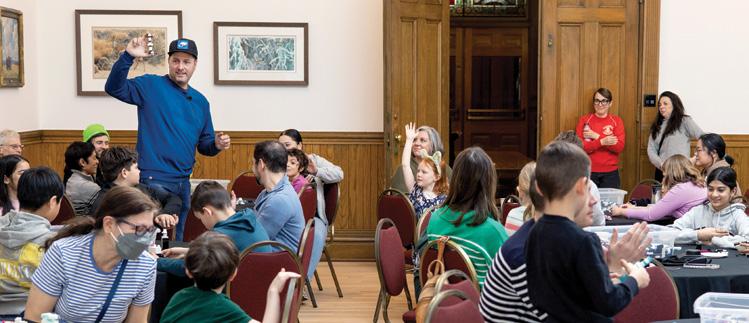
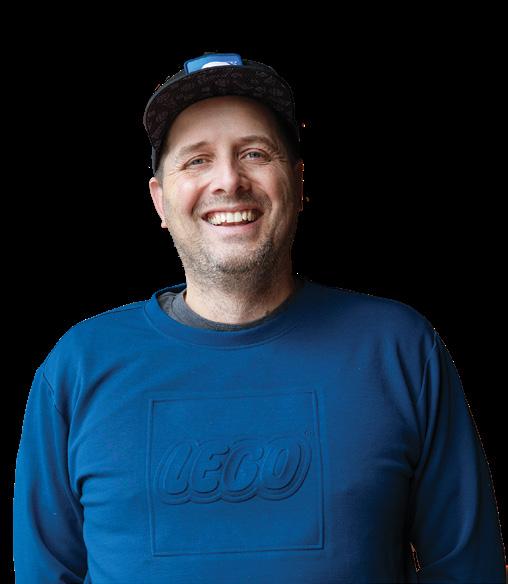
Today, Dymond is one of only a small number of LEGO Certified Professionals in the world and runs his own business, Dymond Bricks. He recently returned to Victoria University to share his enthusiasm for the plastic interlocking blocks and skills in building with them.
Dymond was a commuter student at Vic, but he immersed himself in university life. He was the VUSAC representative for commuter students, helped produce a newsletter and performed in a student play written by David West Read Vic 0T6, who later wrote for Schitt’s Creek and & Juliet. LEGO was another way to unwind between papers and assignments en route to an honours B.A. in history, linguistic and semiotic anthropology.
Some of the most lasting influences came from the classroom, where certain courses and professors shaped how he understood art, ideas and storytelling.
Courses in Renaissance Studies taught by Kenneth Bartlett and Konrad Eisenbichler introduced him to the
long tradition of artists working on commission. During the Renaissance, wealthy families and nobility funded artists like Leonardo da Vinci and Michelangelo to produce works that reflected their power and influence.
Dymond is quick to note—with a laugh—that he’s not putting himself in the same league as those masters. Still, he sees a parallel in the underlying idea: artists using their craft to communicate, shape perception, and bring complex ideas to life.
His own work follows a similar logic: taking abstract concepts and turning them into physical form such as LEGO models of buildings or large-scale installations.
“I’m effectively now running my own little bottega, my own little art studio, where we’re creating our own art, but also art that’s commissioned for clients around the globe and large corporations, whether it’s Amazon or Disney or Google,” he said.
Dymond was first a LEGOLAND Master Model Builder, creating large-scale sculptures and leading public programming, all for Legoland. He later established his own studio as a LEGO Certified Professional, an independent role that allows him to take on commissioned work for clients around the world. There are only about 25 LEGO Certified Professionals worldwide.
Some projects stand out.
One was a model of IBM’s quantum computer, a chandelier-like structure of suspended disks and intricate wiring that looked straight out of science fiction. The months-long build combined creative design with technical problem-solving, including the challenge of suspending its complex components.
Another was more personal: a Duplo castle he built with his children at a fan event, which quickly became a gathering place for other kids.
“Sometimes Lego can seem like a very individualized activity. It’s here’s your pieces, here’s a set and go and build. But I love to see it as a way of building bridges and building those connections and bringing people together.”
As a member of our vibrant alumni community, your milestone deserves to be celebrated! Click here for a link to our submission form or email your news to vic.alumni@utoronto.ca.
Please send us a high-resolution image for our consideration!
Frances M. Wood Vic 9T1, a partner at Wood Gold LLP in Mississauga, was appointed a judge of the Superior Court of Justice of Ontario, Family Court, in Kitchener. bit.ly/MilestonesSpring2026
Helen Hayes Vic 1T8 has been named to the 2026 Forbes 30 Under 30 list. She was recognized in the education category for her work to engage young people in digital policymaking for AI and social media, and for teaching in both undergraduate and graduate programs at McGill University.
Want to read the e-edition of Vic Report and support our sustainability efforts? Send us your email and we will stop sending you the paper copy! Please write vic.alumni@utoronto.ca or call 416 585-4500.
Alaine Hutton Vic 1T1 directed a new version of the one-woman show, VITALS, about the real-life experience of a Toronto paramedic, updated to reflect how health care has been reshaped by the pandemic and other events. It ran at the Factory Theatre in Toronto May 2–10.
Screenwriter Lauren Greenwood Vic 0T6 is expanding her creative reach with a series of new film projects. Her short film & Other Concerns, which she wrote and co-produced, premiered April 16 on CBC Gem as part of the Canadian Reflections program. Greenwood, who has worked professionally as a screenwriter for the past six years, also has another short, Red Balloon, currently available on Apple TV+. Looking ahead, she will step behind the camera for the first time as director of Swathe, a short film slated to shoot this May and expected for release in late 2026.
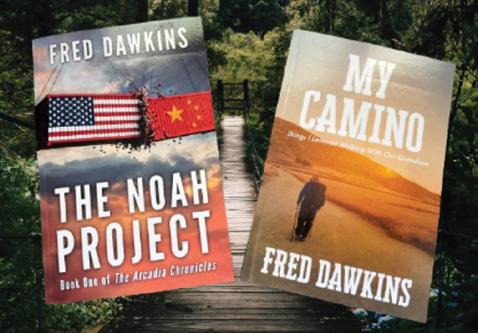
Fred Dawkins Vic6T7 has published two new books, a geopolitical thriller The Noah Project focused on the weaponization of trade, and My Camino: Things I Learned Walking with Our Grandson, an account of walking the 800-kilometre Camino trail in Spain with his 22-year-old grandson.
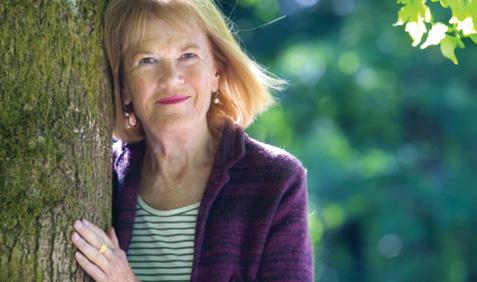
For information on gift and estate planning and the five steps you can take to plan your legacy, please email sharon.gregory@utoronto.ca or call 416-813-4050. If you are considering a bequest in your Will to Victoria or Emmanuel, here is suggested wording:
I give and bequeath to the Board of Regents of Victoria University, Toronto, Ontario, the sum of $ or % or shares of my estate.