EC News FALL 2026
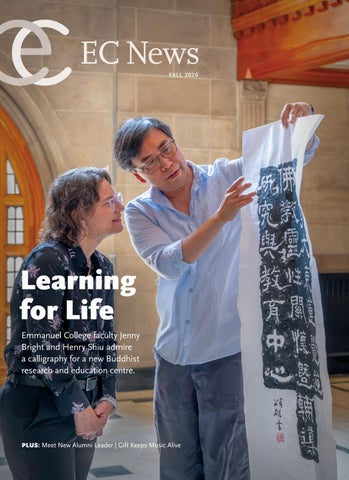
Learning for Life Emmanuel College faculty Jenny Bright and Henry Shiu admire a calligraphy for a new Buddhist research and education centre.
PLUS: Meet New Alumni Leader | Gift Keeps Music Alive
Principal’s Welcome
Principal HyeRan Kim-Cragg
EC News Fall 2026
Know an Outstanding Emmanuel Alumni? This is your chance to recognize Emmanuel alumni whose service deserves to be celebrated. Nominating someone for an Emmanuel College Alumni Award is quick and easy— and a meaningful way to honour those making a difference in the world. Go to uoft.me/ECAlumniAwards2026 to learn more about the awards and submit a nomination for an Emmanuel College Alumni Award. Nominations are due by Dec. 31, 2026. Read about the 2025 award winners at uoft.me/ ECAlumniAwardsRecipients. Questions? Please contact Helena Herscovici, alumni affairs officer, at h.herscovici@utoronto.ca.
Please forward address changes to:
Editor: Leslie Shepherd
EC News is published by: Office of the Principal Emmanuel College 75 Queen’s Park Crescent E. Toronto ON M5S 1K7 Tel: 416-585-4539
emm.alumni@utoronto.ca or Victoria Alumni Office 73 Queen’s Park Crescent Toronto ON M5S 1K7
Photo Editor: Neil Gaikwad
Web Editor: Dan Blackwell Design: Randall Van Gerwen Cover photo by Neil Gaikwad www.emmanuel.utoronto.ca
Photo: Neil Gaikwad
M
y summer vacation was a staycation this year. I was able to spend time reading and writing my new book on preaching ecologically, a project that gave me the opportunity to pay closer attention to the more-than-human world around us. Take the oak tree. We have a magnificent oak tree in the Indigenous Healing Garden outside of Emmanuel College and many others grow around the campus. One of the most astonishing facts I learned is that oak trees emerged more than 56 million years ago. Some of the earliest known oak fossils were discovered near Salzburg, Austria. The oldest North American oak remains were found in Nunavut, where a fossil of a white oak lineage appeared roughly 45 million years ago. Today, oaks are foundational to countless ecosystems, with more than 500 species growing across five continents. How did oaks endure so many geological and climatic changes and still stand strong in such diverse places? What conditions allowed this tree to thrive and flourish, and what do these oak trees teach those of us engaged in theological education at Emmanuel College? Their longevity has been made possible by qualities such as adaptability, co-operation, diversity, hybridization and resilience. These qualities are not only characteristics of healthy ecosystems; they are also qualities that help communities and institutions flourish and offer excellent guidance for the work we do at Emmanuel College. This issue of EC News highlights the launches of two centres under the umbrella of Lifelong Interfaith
Learning at Emmanuel College: The Emmanuel College Professional Advancement and Continuing Training Centre and the Tung Lin Kok Yuen, Canada Society Research & Education Centre for Buddhist Spiritual Care and Counselling. With the example of the oak trees in mind, I am excited about the possibilities these centres will bring and the conditions they may help cultivate to enhance theological education. It is my sincere prayer that the work of these centres may also lead to deeper conversations about the natural world and how we may continue to sustain the web of life entrusted to us. I am deeply grateful to the donors and supporters whose generosity will enable these centres to take root and begin their important work.
Walking Through the Door Lisa Wilvert's Journey from Student to Alumni President By Leslie Shepherd
this profoundly while taking a Sufi studies course, the mystical Islamic belief and practice. While I knew almost nothing about the faith and practice, I felt such warmth and encouragement from the other students and the professor. This is the gift of the interfaith experience and what makes Emmanuel College unique.” As a student, Wilvert served on hiring committees, and later was asked to serve on the Emmanuel College Advisory Committee as the alumni representative for the Buddhist stream and became increasingly involved in alumni activities. Wilvert speaks enthusiastically about alumni events, where graduates reconnect with classmates and professors, learn about new initiatives and continue the conversations that began during their studies. She believes continuing education will be an important way to bring alumni back into the Emmanuel community. “A lot of Emmanuel graduates identify as lifelong learners,” she said. “Creating opportunities for people to reconnect through continuing education and shared interests is really important.”
Photos: Neil Gaikwad, Shawn Kazubowski-Houston
S
tanding outside of Emmanuel College for the first time, Lisa Wilvert Emm 2T0 paused before walking through its doors. She had spent years considering graduate studies, exploring programs that never quite felt like the right fit. Then she discovered Emmanuel's Buddhist-focused Master of Pastoral Studies program, now known as the Master of Psychospiritual Studies. The program immediately caught her attention, but it was a visit to campus that convinced her she had found where she belonged. “I remember pausing as I was going to walk through the big doors,” she recalled. “I somehow knew and felt that in crossing the threshold that I was stepping into the next part of my life.” The feeling has never left her. “I just knew this was the start of something new,” she said in a recent interview from her Stratford, Ont., home. “I get a shiver right now even saying that.” Wilvert is beginning another new chapter at Emmanuel as president of the Emmanuel College Alumni Association. She is the first graduate of Emmanuel's Buddhist stream to serve in the role. Wilvert came to Emmanuel as a mature student who had already established a professional practice. What drew her to Emmanuel was the opportunity to bring together her psychotherapy work, her Buddhist faith and her interest in contemplative approaches to healing. One of her particular interests was the therapeutic use of sound. After studying Tibetan singing bowls in Nepal and incorporating sound practices into her work with clients, she wanted to explore how sound could be integrated into a psychotherapeutic context. Wilvert describes Emmanuel as a place filled with people who were motivated not simply by career goals, but also by curiosity, the purpose to serve and give back and a desire for personal growth. “It was the support that I experienced as a student at Emmanuel that stands out for me,” she said. “I felt
Lisa Wilvert plays Himalayan singing bowls while offering a sound meditation at an Emmanuel College colloquium in 2020.
EC NEWS FALL 2026
3
Emmanuel Invests in Lifelong Learning By Leslie Shepherd
Professor Henry Shiu wrote the full Chinese name of the TLKYCS Centre in a modern form of Black Tiger calligraphy, a southern Chinese style that recreates the appearance of traditional stone rubbings. Rather than using conventional brushstrokes, the calligrapher applies ink around the characters, allowing them to emerge through negative space. The inscription is rendered in clerical script (lishu), a Han dynasty style that came into maturity when Buddhism was first introduced to China.
Photo: Neil Gaikwad
Continuing the Journey
E
mmanuel College is making a major investment in continuing education with the launch of Lifelong Interfaith Learning at Emmanuel College. This renewed and expanded initiative will offer clergy, laity, spiritual care providers and community members new opportunities to continue learning throughout their careers and spiritual journeys. Bringing together a range of learning opportunities, from short courses and certificates to conferences and research initiatives, the program spans Christian, Buddhist, Muslim and interfaith traditions. Learners will be able to strengthen their practice, build new skills and connect with colleagues across faith communities and professional fields.
EC NEWS FALL 2026
4
A New Home for Buddhist Spiritual Care
Responding to the Needs of Ministers and Practitioners The new program reflects the needs Emmanuel has been hearing about from graduates and practitioners for years. Research conducted by the college found a growing demand among Christian ministers for continuing education in core areas of ministry, including pastoral care, leadership and community engagement. Church leaders, particularly those serving rural and remote communities, also expressed a desire for practical training and stronger peer networks. Graduates of Emmanuel's Master of Psychospiritual Studies program identified similar needs for ongoing professional development in spiritually integrated psychotherapy and care across Buddhist, Christian, Muslim and interfaith settings. In response, Lifelong Interfaith Learning will offer flexible opportunities to build new skills through programming focused on effective leadership, innovative ministry and spiritually integrated care.
Wing Yi Wong Emm 2T5
Creating New Opportunities for Christian Leadership Much of the Christian leadership, ministry and psychospiritual programming will be offered through the Emmanuel College Professional Advancement and Continuing Training (EMPACT) Centre, one of two new centres created as part of Lifelong Interfaith Learning. “The world is changing so fast now,” said Wing Yi Wong Emm 2T5, the newly appointed director of the EMPACT Centre. “Many people, including ministers and lay leaders, are seeking to learn more, to equip themselves to better serve their communities in today's world. My hope is that EMPACT can become a place of connection, connecting the needs of ministers or lay people in today's world and offering the resources of Emmanuel College.” This centre will also become the new home of Emmanuel's Psychospiritual Continuing Education Program and the Cantonese Christian Continuing Education Program.
Another major focus of Lifelong Interfaith Learning is to respond to the growing field of Buddhist spiritual care and counselling, which is finding increasing applications in a wide range of caregiving professions, from health care and chaplaincy to psychotherapy and community support. Lifelong Interfaith Learning is supported by two major philanthropic investments that establish new homes for continuing education and research at Emmanuel. The Tung Lin Kok Yuen Canada Society Research & Education Centre for Buddhist Spiritual Care and Counselling will support research, continuing education and scholarly exchange exploring how Buddhist understandings of suffering, compassion and resilience can help caregivers respond to challenges such as burnout, compassion fatigue and moral injury. Alongside Buddhist-focused offerings, learners will also find courses rooted in Christian, Muslim and other spiritual traditions. Jennifer Bright, the Wutai Shan Venerable Dayi Assistant Professor of Buddhist Spiritual Care, who will direct the TLKYCS Centre, said the work fills an important gap.
Photos: Neil Gaikwad
“One message we consistently hear from alumni is that learning doesn't stop at graduation,” said Emmanuel College Principal HyeRan Kim-Cragg. “People want opportunities to return for professional development, new skills, peer learning and deeper reflection at different stages of their lives and careers. Through our lifelong learning initiative, we are creating pathways that will allow Emmanuel to remain a learning community for alumni and practitioners long after they leave our degree programs.”
Jennifer Bright
EC NEWS FALL 2026
5
Donor Impact
$1M U.S.
Lilly Endowment grant supporting the creation of the EMPACT Centre and expanded Christian leadership education.
$750K “Our goal is to create a home for Buddhist spiritual care, psychospiritual therapies, and practical theology,” she said. “The academic study of Buddhism has traditionally been approached from an outsider perspective. We're creating a space to engage Buddhist traditions productively from within, exploring how they can inform and be informed by contemporary challenges and concerns.” Henry Shiu, the Shi Wu De Associate Professor of Chinese Buddhism, said Buddhist spiritual care is an emerging profession with few institutional hubs bringing scholars and practitioners together. “Buddhist spiritual care is not just for Buddhists,” Shiu said. “The focus is on how contemplative and compassionate approaches can help people who are caring for others, whether they are chaplains, psychotherapists, health-care professionals, clergy or community workers.” Research will also be central to the centre, including the launch of the International Journal of Buddhist Spiritual Care, co-edited by Bright and Shiu and to be published by the University of Toronto Press.
Building the Future of Lifelong Learning The EMPACT Centre is being developed through a $1 million (U.S.) Lilly Endowment grant, awarded in 2025 through the Pathways for Tomorrow Initiative, together with support from individual donors. Rooted in Emmanuel's historic relationship with The United Church of Canada while welcoming learners from diverse faith communities, the centre will support Christian leadership, ministry and psychospiritual education. The TLKYCS Centre is being established through a $750,000 gift from the Vancouver-based Tung Lin Kok Yuen, Canada Society. The centre will serve as the program's hub for Buddhist theology, spiritual care, counselling, continuing education and scholarly collaboration.
$150K
Gift from Jessica Qing and Mark Price supporting Psychospiritual Continuing Education courses for Master of Psychospiritual Studies alumni and other practitioners who require ongoing professional development through the College of Registered Psychotherapists of Ontario and other regulating bodies.
Launch Event Join Emmanuel College on Sept. 18, 2026, for the opening ceremony of the TLKYCS Research & Education Centre for Buddhist Spiritual Care and Counselling. The celebration will feature a plaque unveiling, a lecture on Korean Buddhist ritual traditions and a tour of Victoria University's Indigenous Healing Garden.
Photos: Neil Gaikwad
Mark Price and Jessica Qing Price at a signing ceremony for their gift supporting Psychospiritual Continuing Education courses.
Gift from the Tung Lin Kok Yuen Canada Society establishing the TLKYCS Centre.
Register here: tinyurl.com/ TLKYCS-Centre-Launch
EC NEWS FALL 2026
6
Bringing the Pieces Together By Leslie Shepherd
“This model is a seed that was planted at Emmanuel,” she said. A professor encouraged her to explore Sufi traditions after noticing similarities between them and Ayad's writing. The Seven Valleys model also inspired Ayad's recently published first novel, What is Real? The story follows a woman who inherits an ancestral mansion in the Egyptian desert and embarks on a journey of self-discovery. The novel traces the same seven-stage journey that lies at the heart of Ayad's developing framework, offering readers a more accessible way to engage with its ideas. Ayad also works full time as a spiritual care practitioner at Scarborough Health Network while maintaining a private psychotherapy practice, leading retreats, teaching courses, creating mixed-media art and writing books. She also finds time to volunteer for the Emmanuel College Alumni Association executive. She has written six non-fiction books in addition to her novel. Her work has been translated into more than 10 languages and is used by readers around the world. Her advice for current or prospective Emmanuel students is to be curious, open and grounded in their own traditions. “Just listen, listen to what your heart is telling you, because our heart knows the answer,” she said. “It (Emmanuel) is very welcoming and at the same time, it doesn't force you into any direction. Actually, it helps you to be who you truly are, to grow into who you truly are.”
EC NEWS FALL 2026
Photo: Neil Gaikwad
M
any people spend a lifetime building one career. Amira Ayad Emm 2T0 has built several: pharmacist, natural health consultant, psychotherapist, spiritual care practitioner, author, artist and educator. Yet she insists they are all part of the same story. That story is her lifelong search for answers to some of humanity's oldest questions: Who are we? Why are we here? And what gives life meaning? Ayad's search began in her native Egypt, where she developed an early interest in health and well-being. She trained as a pharmacist, then earned a PhD in natural health and worked as a consultant. Yet she still had big questions about life and living. “I was looking for the missing link and I guess it was spirituality,” she said. A friend recommended Emmanuel College's Master of Psychospiritual Studies program. When she arrived, she knew she had found something special. “It just felt like the belonging and connection I was looking for,” she recalled. Ayad, a Muslim, said she was especially drawn to the college's approach to interfaith learning. “We're all grounded in our own theology, yet we were living and learning with one another and genuinely curious about our cultural tradition and learning,” she said. At Emmanuel College, the various strands of her life began to come together. What had once seemed like separate interests became part of a single exploration of healing, self-knowledge and spiritual growth. That environment helped shape her current work. Ayad is developing a psychospiritual framework called the Seven Valleys model, rooted in Sufism, the mystical tradition within Islam. The model explores how people come to know themselves, discover meaning and move through periods of personal transformation.
7
Honouring a Life in Sacred Music By Leslie Shepherd
W
hen Drs. Patricia and William Wright Vic 6T1, Emm 6T4 decided it was time to part with their beloved Blüthner grand piano, they knew exactly where they wanted it to go: Emmanuel College, where William studied theology, taught church music and helped lay the foundation for Canada's only Master of Sacred Music program. The piano has found its new home in the Emmanuel College Chapel, where it supports worship services, Master of Sacred Music examinations, rehearsals and performances. “This seemed like the perfect home for it,” Patricia said. “William graduated from Emmanuel, I taught there and both of us cared deeply about the college and its students.” The piano's journey to Emmanuel began nearly a decade ago. After the Wrights shipped a Canadian piano to William's daughter, Carolina, in Germany, they needed a replacement. They purchased a Blüthner grand piano, crafted by the renowned German piano maker. The piano became a cherished part of their home. But over time, the couple played less frequently. Patricia has rheumatoid arthritis,
Gifts-in-kind to Victoria University are eligible for a charitable receipt for the fair market value of the gift. For more information about making a gift-in-kind to Victoria University, please contact the Alumni Affairs & Advancement Office at vic.alumni@utoronto.ca.
Photo: Neil Gaikwad
Patricia Wright
and after William retired in 2022, they began considering what should happen to the instrument. When Patricia raised the possibility of donating the piano to Emmanuel College after William died, the response was swift. “Within a week they had an appraiser looking at it,” she said. “I was thrilled when they agreed to accept it. William would have been thrilled, too.” The timing was fortuitous. Dr. Lim Swee Hong, director of Emmanuel's Master of Sacred Music program, said the chapel's previous piano was unable to hold its tuning. “This piano has a really nice, warm tone,” Lim said. “It is the kind of instrument more likely to be found in a concert hall than in a seminary chapel.” For Patricia, the gift is also a tribute to the program she and her husband helped create. Alongside Dr. Fred Graham, the Wrights were instrumental in establishing Emmanuel's Master of Sacred Music program, which launched in 2008 and remains the only one of its kind in Canada. The founders believed church musicians and clergy should learn alongside one another. “Many of our best church musicians had to go to the United States for this kind of training,” Patricia said. “We wanted a program in Canada.” William was a graduate of Victoria College (as was his mother and grandmother) as well as Emmanuel College. He served for 20 years as Victoria University's official organist, taught at the University of Toronto's Faculty of Music for 37 years, performed across North America and Europe, and received an honorary Doctor of Divinity from Victoria University in 2009. He also taught church music at Emmanuel.
www.emmanuel.utoronto.ca EC NEWS FALL 2026
8