Strategic Planning Framework
Statement of Purpose:
Virginia Highlands Community College engages in a proactive and inclusive strategic planning process to create a shared vision, set institutional priorities, develop outcomes, guide decision-making, allocate resources, assess progress toward results, and drive continuous improvement.
As such, VHCC has over time developed a strategic planning process that is customized and tailored to the unique context and needs of the institution while drawing from several models and examples. The process is aligned with the history, culture, and spirit of the institution, and it provides a good framework to accommodate external performance, compliance mandates, and internal organizational development priorities. This strategic planning process is embedded within the over-arching institutional effectiveness goals of the college.
Overview of Planning Process:
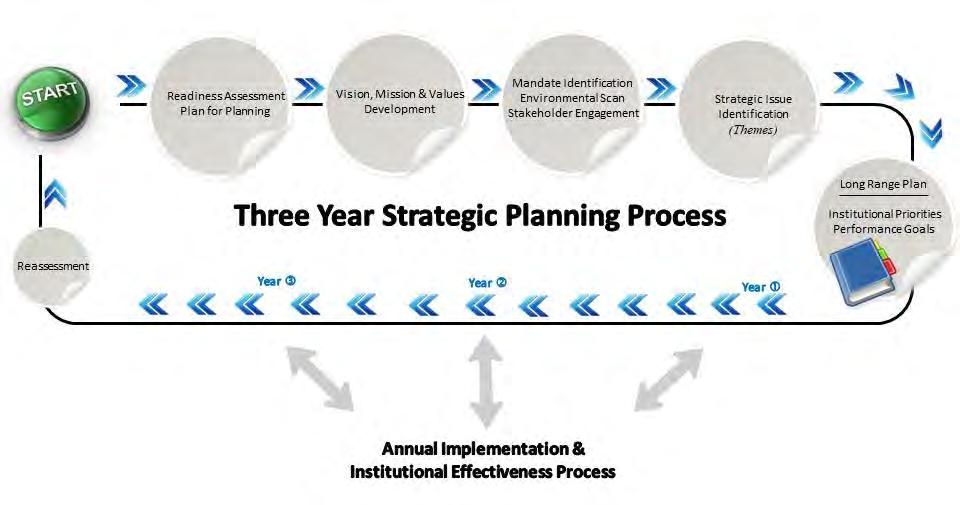
VHCC’s strategic planning operates on a three-year development cycle, depending upon environmental conditions. The process begins with an assessment of previous strategic planning efforts, as well as a review of the institution’s vision, mission, and values. Key intellectual resources of the institution are compiled, evaluated, and packaged for use as foundational references for various planning activities. Examples of the types of documents that comprise this “information bundle” include previous strategic plans, a college data overview, an environmental scan report, performance measure data, and a master facility plan.
VHCC conducts forums with a variety of internal and external groups to kick-off the stakeholder engagement component of the strategic planning process. These forums begin with a condensed presentation of the “information bundle” to provide participants a common and shared background. Stakeholders are then given several discussion prompts that are designed to fuel reflection and discussion. Forum participants’ contributions are recorded, sorted for commonalities, and analyzed.
Utilizing these contributions, a strategic planning workgroup references the background information and stakeholder feedback to develop a draft strategic plan which includes such things as strategic issues and institutional priorities. Several representative groups, including the VHCC Board, President’s Advisory Council, and the President’s Cabinet, review and make several rounds edits to the draft plan, ultimately resulting in a finalized strategic plan.
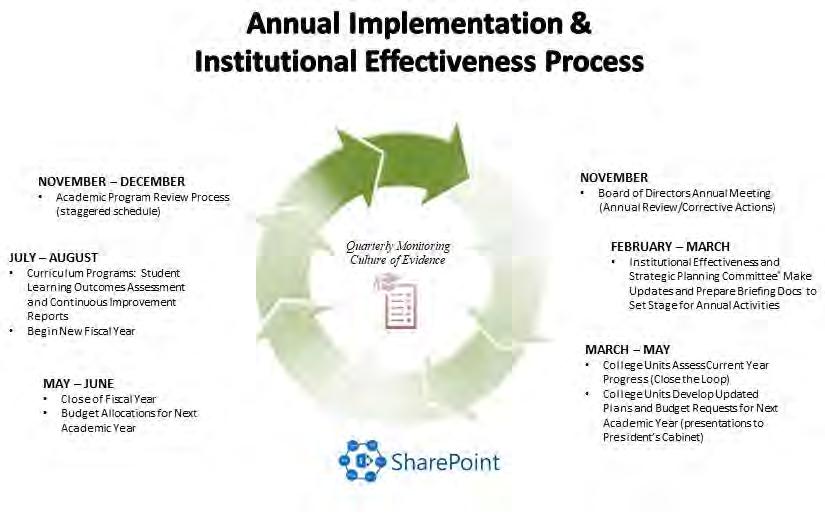
On an annual basis, implementation plans and budgets are created and implemented from the strategic plan to the planning unit level, and those levels incrementally contribute to one or more aspects of the strategic plan. Work is monitored and reported horizontally and vertically throughout the institution, with adjustments and course corrections being made as needed.
A graphic depiction of both a three-year planning process and the accompanying annual implementation and institutional effectiveness process can be found below.
2022-2025 Strategic Issues:
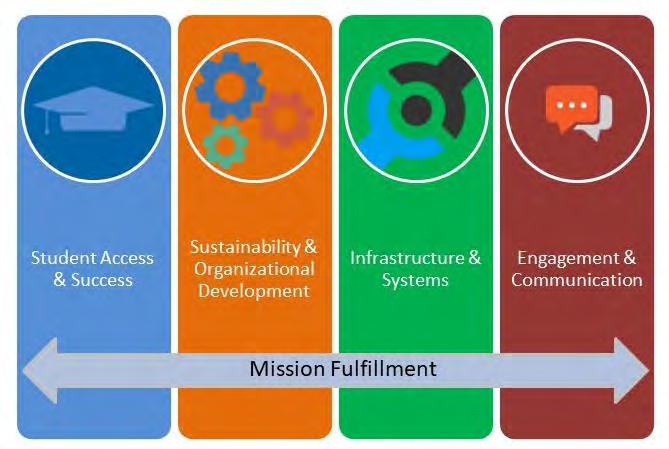
Four strategic issue areas were identified through VHCC’s planning process for this Vision 2025 strategic plan, incorporating the contributions of more than 100 stakeholders through focus groups and surveys These issue areas served as the foundation for priority development – including goals, major college initiatives, and tracking measures:
Plan Scope and Implementation:
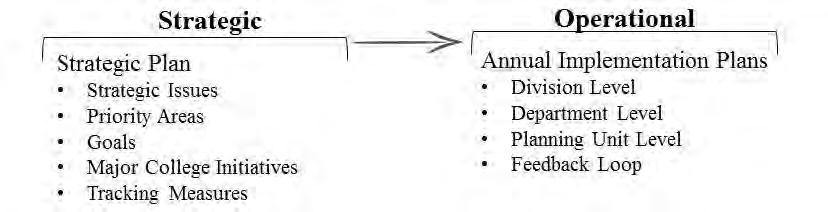
As illustrated below, this document focuses on the long-term or strategic direction of VHCC and encompasses priority areas, goals, major college initiatives, and tracking measures for use over a three-year period. These ideas represent substantial efforts to be undertaken by the college which will contribute to its fulfillment of its vision and mission.
The plan does not outline activities, action steps, benchmarks, and budgets needed to accomplish the goals outlined herein. Rather, implementation plans will be developed annually at all levels of VHCC that will include these specific operational or tactical elements These elements provide a means for management and staff to break down the larger scale strategic goals into workable tasks, making the achievement of the strategic goals possible. Finally, the plan does not detail the ongoing core business practices of VHCC – those things that it carries out as a matter of course.
The President’s Cabinet and the representative President’s Advisory Council have the primary responsibility for monitoring and reporting progress toward achieving VHCC’s vision as depicted in this strategic plan. Progress reports will be given to governance and stakeholder groups on a semi-annual basis utilizing an institutional scorecard and, where applicable, more expansive annual reports.
Priority Area I: Student Access & Success
Practice effective enrollment management to increase student access, retention, success, and completion. This is accomplished through active recruitment, relevant programming, high-quality instruction and comprehensive student support services.
Goal 1: Improve access, persistence, and completion for all student groups
Major College Initiatives
a. Implement existing three-year Strategic Enrollment Management Plan
b. Reduce achievement gaps for students of color and students with low socioeconomic status
c. Redesign and implement SDV course for student success
Goal 2: Ensure academic program relevance and sustainability
Major College Initiatives
a. Identify and implement new career and technical education programs of study (degree and non-degree) reflecting community economic development initiatives
b. Develop and implement a process to evaluate and maintain the rigor, relevance, and efficacy of instructional programs and courses
c. Implement program pathways and VHCC’s Transfer Framework
d. Strengthen use of program advisory committees
Priority Area II: Sustainability and Organizational Development
Ensure the success, security, and stability of the College through effective and efficient administrative processes, a diverse and supported workforce, and ongoing resource stewardship.
Goal 1: Strengthen processes, systems and supports to advance faculty and staff success and excellence and reduce employee turnover
Major College Initiatives
a. Improve employee recruiting, hiring, onboarding, and offboarding processes
b. Improve faculty and staff diversity through recruitment and retention of underrepresented populations
c. Increase employee use of flex time and alternative work schedules to improve college operations, student services, and employee productivity
d. Revise professional development and ongoing education policy to improve opportunities for employees
Goal 2: Develop systematic approach to organizational operations and succession planning
Major College Initiatives
a. Conduct comprehensive review and update of all college policies and procedures
b. Develop and implement an updated Business Continuity Plan
c. Develop and implement a college Leadership Succession Plan
d. Expand cross-training opportunities for employees
Goal 3: Expand opportunities to increase connections and giving for unfunded needs and priorities
Major College Initiatives
a. Conduct an assessment of the scope and processes of Institutional Advancement
b. Develop and implement a three-year Institutional Advancement Plan
Priority Area III: Infrastructure and Systems
Utilize current and effective technology to support the educational, administrative and workforce systems of the college. Use efficient technology and other solutions to improve student access and success, strengthen VHCC’s operational effectiveness, enhance connections with educational, workforce and community partners, and support the evaluation of college initiatives and processes.
Goal I: Enhance student learning environment with a focus on student engagement and success
Major College Initiatives
a. Develop an updated campus master plan
b. Renovate or modernize key campus student environments
Goal 2: Ensure information technology (IT) systems resiliency and effectiveness
Major College Initiatives
a. Engage in continuity planning and documentation for IT operations
b. Systematically evaluate and manage the life cycle and integration of IT systems
c. Acquire and/or develop IT management tools to better support student lifecycle management
Goal 3: Enhance campus infrastructure safety and security
Major College Initiatives
a. Enhance campus safety and security awareness for employees and students
b. Enhance campus safety/security monitoring and communications
Priority Area IV: Engagement and Communication
Cultivate understanding and engagement among constituents and stakeholders through positive and informative communication. Collaborate with educational, workforce, and community partners to establish pathways to regional jobs, supporting the development of a strong workforce and providing economic stability.
Goal 1: Enhance student connections to regional jobs
Major College Initiatives
a. Expand work-based learning opportunities (work-place shadowing, internships, preapprenticeships, registered apprenticeships, etc.) with local businesses and industry
b. Expand direct connections with regional employers
c. Increase the number of students completing programs for which there is a regional workforce demand
Goal 2: Support the development of new and existing businesses
Major College Initiatives
a. Coordinate business outreach efforts with local workforce and economic development partners to prioritize economic priorities
b. Increase workforce and economic development activities through customized training, regionally relevant workforce programs, and small business support
c. Increase consulting services to businesses and industry
Goal 3: Expand community engagement and brand awareness
Major College Initiatives
a. Increase the number and frequency of VHCC-sponsored and/or -partnered community events
b. Develop and update college information and marketing collateral to reflect current brand standards
Goal 4: Improve College-wide communication
Major College Initiatives
a. Increase cross-departmental collaborations
b. Increase the frequency of college listening sessions
c. Improve the college’s mechanisms for information sharing, such as the AwareWolf intranet
Tracking Measures
Priority Area I: Student Access and Success
1. Institution-Wide
Number of state performance measures met or exceeded
2. Curriculum/Degree Areas:
Peer-review online course approval process
Annual unduplicated headcount
High school yield rate
Dual enrolled students
Adult students
Number of new students
Number of returning (stop-out) students
Representation of racial/ethnic minority students
Proportion of students persisting from year 1 to year 2
Proportion of students earning 12 college credits in 1 year
Proportion of students earning 24 college credits in 2 years
Student progress over 5 years
Course success and retention by modality
Percent of high school equivalency completers to enroll in curriculum courses
Annual number of degrees, diplomas, certificates, and industry-recognized credentials
Program wage and outcomes (SCHEV data)
3. Continuing Education/Non-Degree Areas:
Annual unduplicated headcount
Representation of racial/ethnic minority students
Annual number of certificates and industry-recognized credentials
Priority Area II: Sustainability and Organizational Development
1. Processes and systems to ensure faculty and staff success
Revised and published hiring, onboarding, and offboarding processes
Faculty and staff diversity that reflects the demographics of the VHCC service region
Flexible/Alternative/Telework work policy implemented
Revised Educational Assistance policy and funded opportunities for employees
2. Business continuity and succession planning
VHCC policies and procedures updates
Development and implementation of an updated Business Continuity Plan
Development and implementation of a VHCC Leadership Succession Plan
Number of employees trained in multiple functions; cross-training events conducted
3. Institutional Advancement
Institutional Advancement assessment completed
Development and implementation of Institutional Advancement Plan
Annual donations and gifts
Giving participation (VHCC Boards and full-time employees)
Annual leveraged resources (non-cash donations and volunteer time)
Annual revenue generated by grants, contracts, and categorical funding
Priority Area III: Infrastructure and Systems
1. Learning Environment
Campus master plan, including signage and wayfinding
Renovation and remodeling projects
2. IT resiliency and effectiveness
Continuity plan developed
Operations catalogued and documented
Number of SalesForce users
3. Campus safety and security
Perceived safety and security of the campus environment (survey response)
Security system upgrades
Use of emergency notification system
Priority Area IV: Communication and Engagement
1. Enhance connections to regional jobs
Participation in and satisfaction with career-based information services (survey)
Student participation in work-based learning opportunities
Number of students completing programs related to the region’s demand occupation list
Participants in VHCC job fairs, industry visits, and similar events
2. Support the development of new and existing businesses
Small Business Development Center statistics
Number of customized or specialized training courses or services
Total number of companies participating in training and/or services
3. VHCC marketing and branding
Number of VHCC-sponsored and/or -partnered community events
Marketing and communication audit completed
Website content alignment completed
4. College-wide communication
Number of college-wide listening sessions
Employee satisfaction with information sharing improved
Employee engagement increased
Strategic Planning Workgroup
Dr. Adam Hutchison President
Dr. Stacy Thomas Vice President of Instruction & Student Services
Christine Fields Vice President of Financial & Administrative Services
Laura Pennington Vice President of Institutional Advancement
Dr. Beth Wright Interim Dean of Nursing
Dr. Beth Page Dean of Professional & Technical Studies (ret.)
Barbara Manuel Dean of Arts & Sciences
Michael McBride Dean of Enrollment Management & Student Services
Lee Hunt Dean of Professional & Technical Studies
Dr. Vickie Ratliff Interim Dean of Nursing
Robert Phillips Dean of Workforce Development
Ken Fairbanks Director of Learning Resources
Robert May Director of Institutional Research & Effectiveness
Leigh Ann Adams Coordinator of Upward Bound
Karen Cheers Director of EXCEL Programs
Pat Farmer Coordinator of Dual Enrollment & High School Programs
Paige Kelly Coordinator of Admissions & Records
Traci Mitchell Coordinator of Recruitment & Career Services
Ernest Nunley Superintendent of Buildings & Grounds
Mary Snead Finance Manager
Tiffany VanBuren Director of Human Resources
Kevin Widener Chief of Police
Ben Casteel Instructor of Horticulture and Faculty Senate President
Cathy Zeigler Admissions Assistant and Classified Staff Assoc. President
Mackenzie Tymon Student Government Association
Julie Little
Assistant Professor of Biology and Faculty Senate President
VHCC is an Equal Opportunity/Affirmative Action Institution. Si necesita ayuda en espanol, marque el numero 276-739-2559