
VCP Agency Overview

Page 1


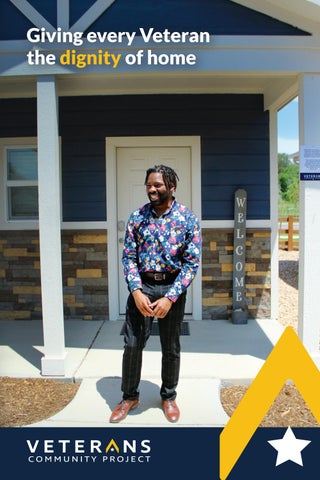
Giving every Veteran the dignity of home

Veteran homelessness is a problem in every U.S. city

On any given night in America, more than 30,000 Veterans experience homelessness.

Tens of thousands more are unaccounted for, living in secluded camps, couch surfing, sleeping in cars, or hiding in plain sight.

The causes of homelessness are varied and complex, rooted in issues around unemployment, mental or physical health, substance abuse, a break down in support, and more, all contributing to a loss of basic human needs.

1 in 10 Veterans report experiencing homelessness at some point in their adult lives

20% of homeless males are Veterans

51% have service-related disabilities

Veterans are 50% more likely to become homeless than those who haven’t served in the military

50% are 51 or older with a large portion having served in Vietnam

Women are the fastest growing demographic of Veterans experiencing homelessness

THE SOLUTION

Transitional housing with an 85% success rate

Founded in Kansas City, Missouri, in 2016 by a group of combat Veterans shaped by their military service, we began with a determination to do better for Veterans in need. Today, we’re growing nationwide to serve more Veterans everywhere, ensuring no one is left behind.

Our founders’ solution was simple: provide Veterans experiencing homelessness with a home of their own and wraparound case management services that leverage the support of the community to not only get them back on their feet, but ensure they continue standing.

We serve all Veterans with dignity, humility, and honesty, regardless of length or type of service, or discharge status.

VCP Village of Kansas City features 49 homes and a Village center.

Our transitional homes provide Veterans with privacy, safety and the dignity of home.

Home is more than just a place to live.

Home means having loved ones, support, pets, and personal belongings. Home provides stability, security, and dignity. Our mission is to provide every Veteran with the dignity of home.

Veterans Community Project is a radically effective model with an 85% success rate at getting Veterans back on their feet.
Here’s how we do it.

First. Dignity starts with a home, so we build Villages of homes, giving every Veteran “240 square feet of dignity.”

Second. Dignity grows with a community, so we surround our Veterans with wraparound services and skills-training.

Third. Dignity sustains in society, so we prepare our Veterans for reintegration and generations of change.

The importance of a current mailing address

When someone doesn’t have a home, it’s not just shelter that’s missing.

Without home, it’s harder to feel safe, harder to plan ahead, and harder to thrive. The simple routines many of us take for granted—like making a meal, having a quiet space to rest, or knowing where we’ll sleep each night— become uncertain. Without a home, the barriers multiply, making it harder to get back on your feet, to find stability, and to feel the warmth and safety that every Veteran deserves. Without home, it makes it exponentially harder to:

Open a bank account

Buy a car

Get a loan

Apply for jobs

Provide care, support, and stability for children

TIM’S STORY

The generational impact of an address

U.S. Army Veteran Tim was living with his wife and child. As his relationship deteriorated he became unhoused and in crisis. His biggest challenge was his mental health, due in large part to how deeply he missed his daughter. Once he was able to establish an address with VCP—and with the help of wraparound services—Tim was able to apply for custody, earning both visitation rights and custody for his daughter.

Eventually, she was able to join him and move into a family home at VCP Village. We never expected to reunite so many families, which is why every new Village includes more family homes to make an impact not just for Veterans, but for their entire families—all because of an address.

The importance of connection

More than 50% of Veterans aren’t enrolled in the benefits they deserve, and most of the Veterans we meet at VCP are in this group.

Beyond providing a home, we connect every Veteran with a case manager to help them navigate difficult systems and get them the support they deserve. In one case, we helped a Veteran change their status with the VA, unlocking over $250,000 in back pay.

We connect Veterans with community services that make a difference, serving as a one-stop shop where they find not just a home, but vital connections to the resources they need. Collaboration, not competition, drives our partnerships as we work together to deliver comprehensive support. At VCP, we know that a strong connection to the community is essential for a Veteran’s long-term success, and we’re committed to building those connections.

ACCESS TO HELP

The hospital turned him away, refusing to recognize him as a Veteran.

The federal government excludes these Veterans from health care under a complex and opaque system.

Veterans with the OTH label experience a higher risk of homelessness and are twice as likely to commit suicide.

Complex systems create significant barriers to accessing services

Accessing services like health care, housing, and benefits can be challenging for Veterans due to complex, often overwhelming systems. This is frequently cited as the top reason many Veterans don’t pursue the benefits they’ve earned. Barriers such as disputes over Veteran status, discharge conditions, or length and type of service often stand in the way.

At VCP, we take a different approach. To us, a Veteran is anyone who raised their hand and took the oath to protect this country.

Customized care makes all the difference

We believe every homeless Veteran has a unique story and deserves personalized support.

We have served hundreds and hundreds of Veterans over the years and every Veteran we meet has a different story.

• One of our residents is a Ph.D.

• Some are survivors of sexual trauma.

• Our Veterans range in age from 18 to 94.

• At intake, 30% of Veterans have jobs.

The H.O.M.E.S. Index

We have a two-part process to get Veterans back on their feet. When they arrive they take our H.O.M.E.S. Index to determine their area(s) of most need, which include:

• Health and well-being

• Opportunity for education and training

• Money management

• Earnings and income stability

• Support network

Their score helps us create a clear plan for what needs improvement in the coming months. Every month, our residents retake the H.O.M.E.S. Index, and we track their progress which shows us who’s nearing their goals and will be ready for permanent housing.

LEO’S STORY

The H.O.M.E.S. Index helps to bring a Veteran — and his dog — home

Leo, one our of VCP Alumni, found himself (and his dog Petey) unexpectedly homeless when his house caught fire. He came to VCP looking for a bus pass, and the team quickly determined that he didn’t have a place to stay. As a Korean War Veteran with no living family we got him into one of our houses.

When his H.O.M.E.S. Index indicated he was ready to transition to his own permanent housing, he moved into the apartment complex across the street because he wanted to stay close to his family: VCP.

Within a few months, Leo’s first gift of $500 arrived to our headquarters. About 20 days later, he sent another one for $5,000. Over the years, he has continued to send gifts to VCP totalling over $44,000 and he continues to provide gifts to the Veterans during group coffee visits at the Kansas City Village at least once a week.

What providing Veterans with the safety and dignity of home looks like

We are committed to serving every person who took the oath for our country.

A lot of people think we’re serving homeless people who need help, but that’s not how we see them. These men and women raised their hand, wore the uniform with pride, and pledged to uphold our safety at the cost of their own.

When a Veteran moves into one of our transitional homes, they step into a fully furnished space complete with appliances, furniture, pots, pans, towels, bedding, two weeks of groceries, and everything else they need to make the house feel like home.

Every home features a private kitchen and bathroom, with space for a bed and small furniture items. The houses are intentionally designed with past trauma and military post-traumatic stress in mind.

When Veterans are ready to transition to their own permanent housing, they take it all with them—ensuring a fresh start with the essentials already in place.

We start with houses, but what we really offer is dignity and respect. At the end of the day, maybe that’s our secret sauce.

Building a better nonprofit

Veterans face many challenges that require us to adapt how we deliver services. At Veterans Community Project, we’re redefining what it means to be a nonprofit by embracing flexibility, innovation, community empowerment, and strategic investment to fix Veteran homelessness with a focus on long-term impact.

By following proven business principles, we’ve created an efficient, scalable structure centered around national growth. That’s where we’re different.

Centralizing resources enables our locations to stay lean and empowers teams to focus on what matters most: serving Veterans, building partnerships, and driving lasting change. Focusing on long-term relationships with community-minded partners, while limiting our reliance on public dollars allows us to pivot quickly as circumstances change, ensuring we remain mission-focused.

Our investments in competitive salaries, technology, and training empower our teams to provide high-quality care. At VCP, we measure success by the depth of our impact, not just the number of Veterans served.

Together, with our community, we are building a nonprofit that not only serves Veterans but transforms lives.

Centralized support. Local focus.

Our central services team takes care of essential business operations like accounting, compliance, and program design so our local sites can focus on serving Veterans. We built it this way on purpose. By sharing these core services, we create consistency, reduce duplication, and give every site the strong foundation it needs to grow and thrive.

Veterans Support Services: Program design and standards, management, evaluation, and employee training.

Planning, Design, & Construction: Village design, planning & zoning, and construction project management and oversight.

Accounting: Financial management, accounts payable, and reporting. Compliance & Risk Management: Insurance, audit prep, IT, and legal.

Data Administration: CRM management and data analysis.

Human Resources: Payroll, benefits, recruitment, staff development, and training.

Fundraising: Strategy, grant management, and donor relations. Brand & Marketing: Media, PR, website, social campaigns, and brand awareness.

The life-changing impact of home sustains beyond VCP

Tracy

U.S. Army Veteran Tracy went from sleeping in the woods to helping his neighbors at VCP Village. During his time there, the former drill sergeant regained the pride with which he served over his 23-year military career. “Coming to VCP was the best decision of my life,” he said.

Scan the QR code to watch Tracy’s story.

These stories are a powerful testament to the life-changing impact home has on Veterans who once raised their hand to protect us. Each story is unique and reflects resilience, hope, and the profound impact that safe, supportive housing makes in rebuilding lives. Home is more than offering shelter; it’s about restoring dignity, fostering stability, and honoring the sacrifices these individuals have made for all of us.

Kyle

U.S. Marine Corps Veteran Kyle went from aimless unemployment to being promoted to supervisor at a job he loves. And more importantly, getting his life back on track at VCP led to him rebuilding relationships with his wife and kids. “I get up every morning with a sense of gratitude,” he said.

Scan the QR code to watch Kyle’s story.

Joann

U.S. Air Force Veteran Joann went from waking up with the anxiety of unsafe housing to decorating her own apartment. At VCP, her help from case managers included stabilizing her income by gaining access to her earned disability benefits.

“VCP made me a happier person,” she said.

JesusU.S. Army Veteran Jesus went from sleeping in his car to owning two homes as a real estate investor. At VCP, his case managers helped him get enrolled in college. Now, five years later, he recently celebrated his MBA graduation.

Reflecting back, he said, “VCP was a gift from God.”

Elvis

U.S. Marine Corps Veteran

Elvis went from recovering from a heart procedure in his car to cooking hot meals in his 240-square-foot home. These days, he is a proud ambassador in the community, and recently helped a fellow Veteran move into VCP Village. “I am eternally grateful,” he said.

Chris

U.S. Marine Corps Veteran

Chris went from flying a sign to inspiring thousands of people as a public speaker. Today, he recently closed on his new home, and some of the first people he told about it were those who helped him at VCP. “I feel like I can shoot for the stars now,” he said.

Turn static files into dynamic content formats.

Create a flipbook