VETAFFAIRS DVA’S FREE NEWSPAPER FOR AUSTRALIA'S VETERAN COMMUNITY
ISSN 0819-8934
Serving the nation
Vol. 37 No. 1 April 2021
pages 6–7 How the COVID-19 vaccination roll-out affects you
The Australian Defence Force (ADF) and ex-service community are often called upon to step up to help Australians during challenging times. Throughout the past 18 months, members of the ADF have offered a reassuring presence when supporting local communities, whether it be at coronavirus testing checkpoints, evacuating families from bushfire- or flood-ravaged areas or assisting with clean-up operations. Around 1,200 ADF personnel are currently assisting the Department of Health’s COVID-19 vaccine roll-out in aged-care and disability facilities, and supporting law enforcement agencies with mandatory quarantine arrangements among other duties through Operation COVID-19 Assist. The ADF is also working with civilian agencies to help residents and businesses in recovering from the devastating floods in eastern Australia, particularly around Kempsey, Port Macquarie and Taree on the NSW midnorth coast. DVA thanks ADF members for the work they have been doing and we remind them that we are here to
support all those who serve our nation, domestically and abroad. We encourage serving personnel, ex-serving personnel and their families to know and connect with the support and services provided by DVA. For instance, did you know that if an ADF member contracts COVID-19 as a result of their service they are able to lodge a claim for liability to ensure they receive ongoing treatment or compensation after they leave the ADF? And did you know that if you have served just one day in the ADF and you need mental health support, you may be eligible for free mental health treatment for life? Known as Non-Liability Health Care (NLHC), it is available to you whether or not there’s a link between your condition and your military service. Reservists without continuous full-time service who participated in disaster relief, such as the recent bushfires and floods and COVID19 Assist, border protection operations or who were involved in a serious service-related training accident may also
Open Arms – Veterans & Families Counselling provides mental health support 24/7 on 1800 011 046.
Meet Don Spinks AM – Repatriation Commissioner
page 16
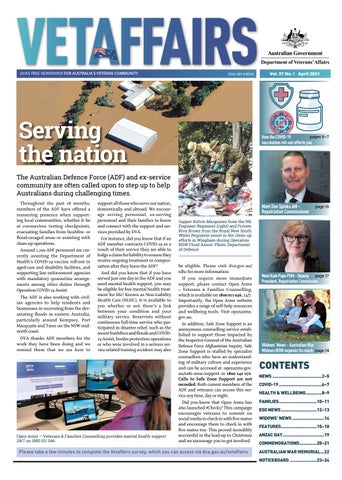
Sapper Kelvin Marquinez from the 5th Engineer Regiment (right) and Private Riva Brown from the Royal New South Wales Regiment assist in the clean-up efforts in Wingham during Operation NSW Flood Assist. Photo: Department of Defence
be eligible. Please visit dva.gov.au/ nlhc for more information. If you require more immediate support, please contact Open Arms – Veterans & Families Counselling, which is available on 1800 011 046, 24/7. Importantly, the Open Arms website provides a range of self-help resources and wellbeing tools. Visit openarms. gov.au. In addition, Safe Zone Support is an anonymous counselling service established to support those impacted by the Inspector-General of the Australian Defence Force Afghanistan Inquiry. Safe Zone Support is staffed by specialist counsellors who have an understanding of military culture and experience and can be accessed at: openarms.gov. au/safe-zone-support or 1800 142 072. Calls to Safe Zone Support are not recorded. Both current members of the ADF and veterans can access this service any time, day or night. Did you know that Open Arms has also launched #Check5? This campaign encourages veterans to commit on social media to check in with five mates and encourage them to check in with five mates too. This proved incredibly successful in the lead-up to Christmas and we encourage you to get involved.
Please take a few minutes to complete the Vetaffairs survey, which you can access via dva.gov.au/vetaffairs
Meet Kate Pope PSM – Deputy page 17 President, Repatriation Commission
Widows’ News – Australian War Widows NSW expands its reach page 14
CONTENTS NEWS.........................................2–5 COVID-19....................................6–7 HEALTH & WELLBEING..............8–9 FAMILIES...............................10–11 ESO NEWS..............................12–13 WIDOWS’ NEWS...........................14 FEATURES..............................15–18 ANZAC DAY..................................19 COMMEMORATIONS...............20–21 AUSTRALIAN WAR MEMORIAL....22 NOTICEBOARD.......................23–24
2 — Vetaffairs April 2021
N E W S NEWS FROM THE DEPARTMENT Liz Cosson AM CSC Secretary – Department of Veterans’ Affairs
Serving those who serve or have served our nation, and their families The past 18 months have presented many challenges to all Australians and impacted on many communities. We have experienced bushfires and floods and we continue to adjust to the presence of COVID-19. I am proud of the role the Australian Defence Force (ADF) has played in supporting communities, whether it be in responding to the pandemic, evacuating families from bushfires or flood-ravaged areas or in recovery operations. I am also proud of the department’s commitment to those who serve or have served in the ADF, and to their families. For example, DVA has been able to reach out with messages of assistance to veterans and their families living in postcodes impacted by the natural disasters and the COVID-19 lockdowns. I am also proud of ex-service and veterans support organisations who connect with the veteran communities to ensure they receive the support they need in times of need.
COVID-19
When it comes to the pandemic, the DVA website has a dedicated COVID-19 page (dva.gov.au/covid-19) for specific information about, for instance, the vaccine roll-out, your entitlements, and the services DVA is providing. DVA has taken steps to ensure veterans and their families are supported physically, mentally and emotionally during the COVID-19 pandemic. We have been actively reaching out to the veteran community, keeping people up to date on developments around the pandemic with special editions of our e-newsletter DVA e-news, and special sections in Vetaffairs. And we are keeping people informed on a daily basis via the Latest News for veterans page of our website. We have also provided a series of factsheets to ex-service organisations and service providers, and we have made full use of our social media channels to deliver important COVID-19 messages and support members of the veteran community dealing with isolation and mental health concerns.
Vetaffairs is printed by PMP on PEFC (Program for the Endorsement of Forest Certification) accredited paper.
We also sent letters via the Veterans MATES program to more than 70,000 medically vulnerable clients, more than 20,000 GPs and more than 2,000 aged-care facilities providing health advice on minimising the risk of contracting COVID-19, and the importance of continuing routine medical care. For more information about DVA services and support go to our website (dva.gov.au) or phone 1800 VETERAN (1800 838 372).
DVA’s ongoing transformation
Although COVID was disruptive and required us to work differently, DVA has continued its Veteran Centric Reform (VCR). For the past four years VCR has been transforming DVA to better know, connect, support and respect all veterans and their families. I want to acknowledge the following achievements: • We now know all ADF members from the moment they enlist; • We now connect with ADF personnel as they transition back to their civilian lives and reconnect with their communities; • More veterans are connecting with DVA than before the transformation began; • We have made it easier for people (serving or ex-serving) to register with DVA through MyService (dva. gov.au/myservice) and the Australian Defence Veterans’ Covenant (recognition.dva.gov.au). The Covenant serves to recognise and acknowledge the unique nature of military service and the contribution of veterans and their families. If you are a veteran or reservist and you haven’t already done so, I encourage you to apply to receive your Veteran Card, Lapel Pin and Oath; • We have consolidated 179 phone lines. You can now call us on 1800 VETERAN (1800 838 372; • We have digitised more than 400,000 client files; • We have introduced provisional access to medical treatment and I encourage veterans to take this
opportunity to continue treatment while waiting for their claims to be finalised; and • Open Arms – Veterans & Families Counselling continues to operate 24/7 on 1800 011 046. I am first to acknowledge that these improvements to our systems and processes have led to easier access and this has resulted in an increase in the number of claims being received by the department. But I want to assure readers that we are working hard to reduce the backlog and reduce the wait time. This includes early screening of all claims received to connect with those veterans or families needing immediate support, and establishing dedicated delegates to our most complex claims. I encourage you to continue to submit your claims and to contact the department if you need immediate support.
Addressing veteran suicide
You may be aware that a motion was passed in Parliament on 22 March calling for a Royal Commission into veteran suicide. Of course, any decision to call a Royal Commission into veteran suicides is a matter for the Government. Since the announcement of the appointment of an interim National Commissioner for Defence and Veteran Suicide Prevention, the department has committed to support Dr Bernadette Boss, including the independent review of past Defence and veteran suicides. The department remains committed to reducing the rate of suicide in the veteran community. We also continue to work to find ways to support veterans and their families to build and sustain wellbeing to support good mental health, recovery, and reducing veteran suicide as part of the whole-of-government approach towards zero suicides. We are now in year two of our Psychiatric Assistance Dog program, which is connecting veterans who live with PTSD with a trained and qualified dog to support their health and wellbeing.
I am encouraged that this program is proving to be so successful. DVA is also working closely with the RSL and state authorities to deliver Veteran Wellbeing Centres that are providing on-the-ground services and connection to support when and where it is needed most. I want to remind readers that we are a community that supports each other and that the department is here to support those who need it. In the leadup to Christmas last year, Open Arms – Veterans & Families Counselling launched its #Check5 campaign. The premise of #Check5 is simple: commit on social media to check in with five mates and encourage them to check in with five mates too. Connect with them, chat with them and motivate them to act. This is also available in the lead-up to Anzac Day. I encourage any veteran or family member who is troubled by the recent conversations around suicide to call Open Arms – Veterans and Families Counselling on 1800 011 046 or the department on 1800 VETERAN (1800 838 372).
Census 2021 I am very pleased to advise readers that our national Census this year will include an identifier question about service in the ADF. This is a great outcome and will help us ‘know’ our veteran community better, ensuring we can connect with and support all veterans and their families wherever they are in Australia. The results of the Census question will help us work with other government agencies to ensure we can provide the support and services where you need them most.
Anzac Day In late February, the Minister announced that the Australian Government-led overseas Anzac Day commemorative services will not proceed in 2021. I encourage you to tune in to the COVID-safe national broadcast of the Dawn Service at the Australian War Memorial or Light up the Dawn from your own driveways. Finally, as a veteran myself, I know that service in the ADF is as good for the individual as it is for our nation. Be proud that you have served your nation; Australia owes you a debt of gratitude. I am also very conscious of the role families play in supporting those who have served our nation. Thank you for your service.
Vetaffairs is published by the Department of Veterans’ Affairs as a free newspaper for Australia’s veteran community.
Follow DVA on Facebook DVAAus and Twitter @DVAAus. Browse DVA on YouTube DVAAus Channel
Editor Conan Elphicke email vetaffairs@dva.gov.au mail GPO Box 9998 Brisbane, QLD 4001
If you have an enquiry for DVA phone 1800 VETERAN (1800 838 372) web dva.gov.au
3 — Vetaffairs April 2021
N E W S FROM THE MINISTER @DarrenChesterMP
The Hon Darren Chester MP Minister for Veterans’ Affairs and Minister for Defence Personnel
Prioritising the wellbeing of veterans and their families Life has been challenging for our veteran community since December 2019, but Australians are at their best when they come together in times of need. I am proud that we have all supported one another and that the federal Government has put in place measures to ensure we are in the best possible position post-pandemic.
Since December 2019, when the devastating bushfires hit, to the ongoing support through the coronavirus pandemic, we have seen the single largest domestic effort by our Australian Defence Force (ADF) personnel since the Second World War. As Minister for Veterans’ Affairs and Minister for Defence Personnel, I have been privileged to see the passion, dedication and resilience of our ADF personnel, veterans and their families during this time. The ADF has been there to provide us with the care, assistance and assurance to keep us safe. Meanwhile, veterans have been out helping the community and we have put in measures to ensure they continue to be looked after. Last year many of us needed additional support to keep on top of our mental health. I am proud that in 2020, the Government made a record investment in funding for mental health services and support for those in the ex-service community. This included more than $100 million in additional funding through the 2020–21 Budget to further bolster mental health support, increasing fees for mental health service providers and expanding Open Arms – Veterans & Families Counselling. These are initiatives that will benefit veterans and their families for many years to come.
“The Government made a record investment in funding for mental health services and support for those in the ex-service community.” We have continued to increase our focus on the crucial period of transition from military to civilian life, with $17.7 million allocated in the last Budget for the establishment of the Joint Transition Authority, providing greater support during this critical time. The vast majority of the 6,000 ADF personnel who leave the military each year will have a smooth transition. There are countless stories of veterans who use the skills they developed in the ADF to go on to do great things for the community, whether that is starting their own business, working in private enterprise, or volunteering. I am certainly aware of the challenges many veterans face, but the Government has been listening to the concerns raised by those who have not had the best experiences with the departments of Veterans’ Affairs and Defence.
Research shows that veterans under 30 who discharge involuntarily can have a more difficult time transitioning. This has been a focus for the Government, and we have bolstered support for younger at-risk veterans during transition, including an additional 10 case coordinators to provide guidance to a further 170 young and vulnerable veterans leaving the military each year. On 29 March, I launched the Support for Employment program, which will provide specialised one-on-one support for veterans who have left the ADF to help them find employment. This program builds on existing DVA and the Department of Defence programs and will deliver pre- and postemployment assistance. The Government provided its interim response to the Productivity Commission report A Better Way to Support Veterans as part of the 2020–21 Budget. The final response will be delivered in the upcoming 2021–22 Budget, but it is significant to note that the Government rejected proposed changes to the Veteran Gold Card, which I trust provides clarity and assurance to many. The first of six Veteran Wellbeing Centres committed to at the 2019 election, which bring together a range of support services in one place, is already helping veterans in Western Australia. Work on the other five centres is progressing well. Further supporting veteran wellbeing, the first DVA-funded psychiatric assistance dogs were provided last year to veterans to complement treatment for post-traumatic stress disorder (PTSD). These dogs are specially trained to detect signs of distress and perform specific tasks to help alleviate those symptoms for their veteran handler. We are hearing stories frequently of how these dogs are changing the lives of veterans and improving their quality of life. So far, 24 psychiatric assistance dogs have been placed with veterans living with PTSD, and around 100 dogs are in training. Demonstrating just how life-changing this program has been to both veterans and their families, I received the following note from the partner of one of the first recipients of a psychiatric assistance dog: ‘I wanted to reach out and let you know this little mate has made such a difference. As a partner to [a veteran with] PTSD, I am forever grateful to DVA and all the people involved in the program. You are saving veterans.’ Last year also saw the appointment of Australia’s first ever Veteran Family Advocate, Ms Gwen Cherne. Commissioner Cherne is working to ensure the views of those who live with and support our veterans on a
daily basis are heard and factored into Government policy and decision-making. I am also proud of the way the department has maintained its priority support for veterans and their families during the coronavirus pandemic. From the outset, DVA remained ‘open for business’ and staff proactively reached out to thousands of our most vulnerable veterans and their families to check they were okay and that they had the support they needed. They sent thousands of text messages and contacted doctors treating veterans to make sure they were being taken care of.
“I am also proud of the way the department has maintained its priority support for veterans and their families during the coronavirus pandemic.” Two Economic Support Payments of $750 benefited around 225,000 veterans and their families, with two further payments of $250 provided to eligible veterans and their families toward the end of last year and on 1 March. Telehealth arrangements for accessing services by general practitioners, medical specialists, nurses, allied and mental health providers have supported more than 100,000 individual clients. Lastly, one of the most important ways we show respect for our current and former ADF personnel and their families is through commemoration. Although Anzac Day and events to mark 75 years since the end of the Second World War were different last year, I am heartened by how people commemorated in their own way. So many Australians ‘lit up the dawn’ and some 4.8 million people tuned in to the live broadcast and livestream of the 2020 Anzac Day service. That represents almost 20% of our entire population. It’s an amazing, and telling, statistic. I encourage you to take part in this year’s Anzac Day with the same degree of dedication. I am honoured and humbled to be part of a Government that puts such high importance on supporting veterans and their families, and commit to continuing to deliver outcomes for our veteran community regardless of any unforeseen challenges we might encounter in 2021.
4 — Vetaffairs April 2021
N E W S
Saying goodbye Changes to support mental and physical health to MyAccount of aged-care residents Services that veterans and their families currently use in MyAccount are being moved into MyService. The need for better online services has never been more important. Over the next six months, we will increase the services you can access on MyService. We will also be moving to a single, modern online platform for veterans to manage their business with DVA. To do this, MyAccount services are being moved to MyService over the coming months and we will say goodbye to MyAccount later this year. In addition to managing your income support needs, you can already use MyService to book transport and claim for travel reimbursements for approved medical treatment. You can use MyService to access official letters that confirm your DVA payments and concession entitlements. If you used MyAccount, the same letters you accessed are now available to you in MyService. When the new services become available in MyService you will notice that we ask some questions differently. That’s because we have taken on board feedback and not only simplified the way we ask for information, but reduced the amount we ask for. ‘The questions MyService asks are simpler because MyService makes better use of information that you have already told us,’ says Glen Yeomans, DVA’s Director for MyService. ‘This means that you don’t need to tell us your story every time you want to make a claim.’ ‘MyService will be the place for all your DVA online needs when MyAccount is no longer available. Of course, if you prefer to call us or submit a paper form you will still be able to do that. We are excited to be providing you with simpler ways to transact with us online.’ For more information and to register for a MyService account, visit dva.gov.au/myservice.
Support for homeless veterans
DVA clients are set to benefit from the Australian Government’s response to the Royal Commission into Aged Care Safety and Quality’s recommendations on the COVID-19 pandemic. This has led to the creation of new Medicare Benefits Schedule (MBS) items. The items will provide increased allied health services, including mental health services, to people in residential aged-care facilities during the pandemic. DVA clients who have been assessed as requiring a higher level of care as a resident in an aged-care facility will particularly benefit, as they do not typically have access to allied-health services under usual DVA arrangements. From 10 December 2020 to 30 June 2022, aged-care residents, including DVA clients, have access to as many as 20 mental health services a year from either general practitioners (GPs) or allied mental-health
providers. This is in line with the MBS Better Access program. Aged-care residents, including DVA clients, will also be able to access up to 10 allied-health services per calendar year under MBS chronic disease management arrangements. If ‘high care’ aged-care residents need more than 20 mental-health services or 10 allied-health services in a calendar year, these will be considered under DVA’s prior approval arrangements. ‘Low care’ aged-care residents can continue to access allied-health services as they currently do, under DVA card arrangements. To access the new services, DVA clients must be referred by their GP (or psychiatrist for mental health services) and meet the eligibility criteria. Clients are encouraged to speak to their GP if they would like to access these additional supports. For more information about this initiative, visit the Aged Care Covid Response webpage on Health Minister Greg Hunt’s website by googling ‘Additional $132.2 million’.
Inquiry into recognition for members and families of members of the Australian Defence Force who are injured, wounded or killed in or as a result of service The Defence Honours and Awards Appeals Tribunal has been directed to inquire into and report on recognition for members and families of members of the Australian Defence Force (ADF) who are injured, wounded or killed in or as a result of service. In particular, the Tribunal is to seek and receive submissions and consider whether it is appropriate that members of the ADF who are injured, wounded or killed in or as a result of service, or their families, receive an Australian honour or award, or another form of recognition for that service. Interested persons and organisations are invited to make a submission to the Tribunal, in accordance with the inquiry terms of reference.
The inquiry terms of reference and further information on how to make a submission can be obtained by contacting the Tribunal, via:
DVA provides support to veterans and their families who are homeless, or at risk of becoming homeless.
provided. If you know a veteran who is homeless or at risk of homelessness, please encourage them to contact DVA on 1800 VETERAN (1800 838 372).
Many of the risk factors that can contribute to veteran homelessness are similar to those for the general population. These include negative life events such as relationship breakdowns, unemployment and mental ill-health. DVA strives to ensure that these ex-serving Australian Defence Force (ADF) members have access to the services and support they and their families need. We can provide mental health support, social and peer support, and assistance with relationship or drug and alcohol problems. DVA can also check to ensure that veterans are receiving all the financial support they may be entitled to, which can help ease other contributing pressures. Case management services may also be
Telephone: 02 6266 1019 Email: DHA.Tribunal@defence.gov.au or Website: www.defence-honours-tribunal.gov.au Submissions can be mailed to: The Executive Officer Defence Honours and Awards Appeals Tribunal Level 1, 5 Tennant Street Fyshwick Locked Bag 7765 CANBERRA BC ACT 2610
Open Arms – Veterans & Families Counselling provides counselling and support services to current and former serving ADF members and their families, and operates a free telephone support line that is available 24 hours a day, 7 days a week, by calling 1800 011 046. Veterans and their family members can also talk with peers who have experienced military service, mental health issues, and recovery. In addition, Open Arms has the Crisis Accommodation Program which may be able to provide shortterm accommodation to eligible current and former serving ADF members and their partners; and support to address issues that contributed to the crisis. For more information, please visit the Homelessness Support Services page at dva.gov.au.
5 — Vetaffairs April 2021
N E W S
Pensions and allowances rise Veterans’ pensions were increased from 20 March 2021 following the latest round of indexation adjustments.
New pension rates from 20 March 2021 Service pension
Old rate (fortnightly)
New rate (fortnightly)
Increase (fortnightly)
As pension rates are calculated on a daily basis, the pension paid on payday 25 March 2021 was paid partly at the old rate and partly at the new rate. The first full payment at the new rates of pension was payday 8 April 2021. The maximum rate of single service pension has risen by $8.40 to $952.70 per fortnight and the maximum rate for couples has increased by $6.30 to $718.10 per fortnight (each). The Special Rate of Disability Pension (TPI Pension) has increased by $12.90 to $1464.70 per fortnight. Extreme Disablement Adjustment (EDA) has increased by $7.20 to $809.50 per fortnight and the 100 per cent General Rate of disability pension has increased by $4.60 to $520.80 per fortnight. The pension paid to war widow(er)s has increased by $8.50 to $968.90 per fortnight (including the energy supplement), while the ceiling rate of
the income support supplement has risen to $286.80 per fortnight.
Single person
$944.30
$952.70
$8.40
Couples (each)
$711.80
$718.10
$6.30
Payments have also increased for benefits under the Military Rehabilitation and Compensation Act 2004 (MRCA). The weekly MRCA wholly dependent partner payment has increased by $4.25 to $484.45 paid fortnightly.
Single person – transitional
$789.30
$796.30
$7.00
Couples (each) – transitional
$636.80
$642.40
$5.60
War widow(er)’s pension
$960.40
$968.90
$8.50
Income support supplement
$284.20
$286.80
$2.60
T&PI (Special rate)
$1451.80
$1,464.70
$12.90
Intermediate rate
$985.80
$994.60
$8.80
EDA
$802.30
$809.50
$7.20
100 per cent
$516.20
$520.80
$4.60
10 per cent
$58.55
$59.01
$0.46
Single Person
$1021.80
$1,031.10
$9.30
Couples (each)
$796.30
$803.50
$7.20
MRCA
Old rate (weekly)
New rate (weekly)
Increase (weekly)
Wholly dependent partner payment
$480.20
$484.45
$4.25
Special Rate Disability pension (SRDP)
$725.90
$732.35
$6.45
The indexation factor used to index pensions each March and September can be based on either the Consumer Price Index (CPI), the Pensioner and Beneficiary Living Cost Index (PBLCI) or Male Total Average Weekly Earnings (MTAWE). For 20 March 2021, the indexation was driven by CPI, which is the one that results in the best outcome for veterans. More information on the new pension rates is available from DVA on 1800 VETERAN (1800 838 372). Current and historical pension rates are available on the CLIK website (clik.dva.gov.au).
War widows
Disability pension
Veteran payment
The first full payment at the new rates was payday 8 April 2021.
VAPAC – helping veterans get the medicines they need The Veterans’ Affairs Pharmaceutical Advisory Centre (VAPAC) is a pharmaceutical phone centre that GPs or other health professionals can contact to get approval for medical scripts under the Repatriation Pharmaceutical Benefits Scheme. The Repatriation Pharmaceutical Benefits Scheme (RPBS) gives eligible Veteran Card holders access to additional pharmaceuticals and wound-care products, some of which are not available under the Pharmaceutical Benefits Scheme. The Veterans’ Affairs Pharmaceutical Advisory Centre (VAPAC) is a pharmaceutical phone centre that GPs or other health professionals can contact to get approval for medical scripts under the RPBS. VAPAC allows health professionals to access pharmaceuticals and wound-care products, which in turn helps veterans to access Government-subsidised pharmaceuticals.
New contract, same service The service has been refreshed following the conclusion of the previous workforce contract, with a new workforce employed under a new arrangement by DVA that took effect on 1 April 2021. But the service remains the same and the VAPAC will continue to be staffed by a professional team to deliver VAPAC services. The 24/7 (1800 552 580) phone line will remain in full operation out of the DVA Brisbane office. VAPAC is and will continue to be operated by DVA, and will continue to support eligible Veteran Card holders.
Cyber security guide for veterans
Scammers are currently using the spread of COVID-19 (Coronavirus) to take advantage of people across Australia. Email, SMS messages and phone calls are popular methods. These methods work in similar ways. The aim is to trick you into installing hostile programs (Malware) and giving the scammer your personal details, log-on information or access to your computer. Such attempts are known as phishing or spear phishing. Some scams may appear genuine. If you receive a message, email or phone call that seems appealing and tries to convince you to do something, you should assess the characteristics of the message before either replying, clicking on that link, opening an attachment or answering personal questions. For a quick summary of the key points that can be used to reduce the risk and protect yourself from scam emails, visit the Latest News for Veterans page of the DVA website (dva.gov.au/ latest-news) or scamwatch.gov.au.
6 — Vetaffairs April 2021
C O V I D - 1 9
How the COVID-19 vaccination roll-out affects you When I last wrote to you in
Vetaffairs, in July of last year, I could not have imagined that we would now be talking about not one, but a number of vaccines that are showing real-
DR TRISH BATCHELOR
world effectiveness against
Deputy Chief Health Officer
COVID-19 far beyond what we
Department of Veterans’ Affairs
had hoped was possible.
At time of going to print on 31 March, almost 125 million cases of COVID-19 have been reported and more than 2.7 million people have died from the infection worldwide. The good news
is we are starting to see a drop in daily reported cases, and a drop in deaths in some countries such as Israel and the UK, which are more advanced in their vaccine implementation. Real-world
What you need to know to get vaccinated The federal Department of Health website (health.gov.au) is your best source of up-to-date information about the COVID-19 vaccination roll-out. For instance, you may wish to read Australia’s COVID-19 vaccine national roll-out strategy (go to health.gov.au and search for ‘roll-out strategy’). The Services Australia website (servicesaustralia.gov.au) also has information on getting ready for your vaccinations. Everyone living in Australia will be offered a safe and effective COVID-19 vaccine. The vaccines are voluntary and free. You do not need a prescription to get vaccinated. Information on how you can access your vaccination is available on the Health Department website (Health. gov.au/covid19-vaccines). Around 4,600 general practices have been approved as authorised vaccination clinics. You can also access the vaccine from state- and territory-run vaccination clinics and GP Respiratory Clinics. Eventually, pharmacies will become involved. Your GP will be regularly updated on the roll-out in their region via their
state or territory health departments and primary healthcare networks.
What you need to get the vaccination If you have a Gold Card, bring that. If you have a White Card, bring your Medicare card as well. If you have an Orange Card, just bring your Medicare card. Please also bring photo ID if you have it. The Department of Health website provides information about what else you might need to bring if you’re receiving a vaccination as part of phase 1b of the roll-out. You might also wish to keep an eye on the DVA website (dva.gov.au). Also, make sure that your Medicare details are up to date. If you don’t have a Medicare card and you don’t know your Medicare number, phone Medicare on 132 011. If you don’t have a Medicare number, you can still get the COVID19 vaccine. We recommend you call
“It is clear that these are lifesaving vaccines – I urge you all to get the vaccine when you become eligible.” data is showing 85% to 95% protection against hospitalisation from COVID19 at 28 days post first vaccine dose for both of the vaccines that are being used in the Australian vaccination program. It is clear that these are lifesaving vaccines. More than 530 million doses of vaccine have been administered in 141 countries. Australia’s COVID-19 vaccination strategy has necessarily taken a riskbased approach, as we don’t yet have enough vaccine for everyone. However, vaccine accessibility will increase rapidly over the coming months. Being able to manufacture the vaccine in Australia puts us at a huge advantage. At this stage, the main goal of vaccination is to prevent death and severe disease, and we know that both vaccines available in Australia are highly effective in this respect. Medicare on 132 011 first, to check you are not enrolled with Medicare already. The staff member will help you to either enrol in Medicare or to apply for an Individual Healthcare Identifier (IHI) if you don’t already have one. Even if you are not in Medicare, you will have an IHI if you get a DVA pension or benefit. People who are not eligible for Medicare, for example a temporary resident, will need to attend a state- or territory-run vaccination clinic to get their COVID-19 vaccines. You can find more information about getting an IHI at servicesaustralia. gov.au/ihs on the Services Australia website. Taking, or not taking, the COVID-19 vaccine will not affect your DVA support or benefits, including health and financial benefits.
What you need to get your immunisation record When you get your COVID-19 vaccine, it will be recorded on the Australian Immunisation Register. You can see the vaccines recorded on the register with your immunisation history statement. You can get your statement from: • your Medicare online account, through myGov
The vaccinations are being rolled out in overlapping phases. The initial phase (1a), applies to people in the highest risk groups. They comprise people who face a higher likelihood of: exposure to the virus (e.g. quarantine workers or frontline healthcare workers); developing severe or fatal disease (e.g. aged care and disability care residents); or of transmitting the disease to the most vulnerable populations (e.g. aged-care and disability care staff). Phase 1b (which began 22 March) applies to older age groups (over 70 years), individuals with pre-existing illnesses that predispose them to more severe disease, and other occupational groups. Phases 2a and 2b apply to the rest of the adult population. There is a handy vaccine eligibility checker on the Australia.gov.au website that tells you which phase of the vaccine rollout you fit into.
• the Express Plus Medicare app • calling the Australian Immunisation Register on 1800 653 809 (select option 4 for a dedicated helpline for veterans), or • asking your health professional to print you a copy. Having a Medicare number in no way conflicts with your usual Veteran Card entitlements, but will make it easier to access your immunisation record online. If you don’t have a Medicare number and you want to access your immunisation summary online, you can do this with myHealth Record in myGov. You will need to link myHealth Record to your myGov account, using your IHI. See the My Health Record website (www.myhealthrecord.gov.au) for more information.
7 — Vetaffairs April 2021
C O V I D - 1 9
Frequently asked questions about the COVID-19 vaccination roll-out Dr Trish Batchelor Deputy Chief Health Officer
Some of the common questions I am being asked about the vaccines include: We currently have two vaccines in Australia – can I choose which one I get? Are they interchangeable? Currently the two vaccines available in Australia are known as ‘Pfizer’ or Cominarty and ‘Astra-Zeneca’. The vaccines use different technology and have different storage and transport requirements. The Pfizer vaccine has many logistical challenges due to its minus-70-degree storage requirements and is thus largely being distributed via specialised hubs in major centres. For those not in the initial 1a vaccine group, you are more likely to get the Astra-Zeneca vaccine which has the same storage requirements as the usual vaccines provided by GPs. Both vaccines require two doses, and you must use the same vaccine for both doses. The gap between doses is different – 21 days for Pfizer and ideally 3 months for Astra-Zeneca. You will not be able to choose which vaccine you get. The good news is that real world data is showing that both of these vaccines are offering excellent protection against both severe disease and death, and very high levels of protection against any symptoms at all.
These vaccines have been developed more quickly than usual – are they safe? There is a standard process for vaccine development that includes a series of clinical trials and many bureaucratic steps in between. There are also many pragmatic obstacles for new vaccine development including funding, finding volunteers for trials, low levels of the relevant disease in the community, and slow national approval processes. Due to the incredible impact of COVID-19 on the world, many of these barriers disappeared quickly – funding flowed from everywhere, volunteers were abundant, the level of disease transmission meant clinical trials could be completed rapidly as critical mass numbers of participants were reached quickly and bureaucratic blocks were lifted. In Australia, all medicines must be rigorously tested on thousands of people before being registered for use by the Therapeutic Goods Administration (TGA). The TGA has thoroughly assessed the COVID-19 vaccines we are using, and all of the usual regulatory steps have been followed. I have complete confidence in our processes. More information is on the TGA website (tga.gov.au).
What are the potential side effects? All vaccines can cause side effects and COVID-19 vaccines are no different. Side effects show that your immune system is being activated, but having no side effects does not mean the vaccine isn’t working. Side-effects from both COVID-19 vaccines are common but relatively mild and short lived – usually less
than a couple of days. The most common side effects are injection-site pain (up to 80% of those vaccinated), general muscle aches (up to 50%), general tiredness for a few days (up to 60%) and headache (up to 65%). For both vaccines, people under the age of 55 have slightly higher rates of side-effects. For the Pfizer vaccine there tends to be a higher incidence after the second dose, whereas the rates are lower after the second dose of the Astra-Zeneca vaccine. As with all vaccines, there is a small chance of having a severe allergic reaction known as anaphylaxis. This is easily treated and is the reason why you will be asked to stay at the vaccination centre for 15 minutes after the vaccine is administered. Recently, there have been reports from Europe of a very small number of cases of a rare type of blood clot (not your typical deep vein thrombosis in the leg) that may be linked to the Astra-Zeneca vaccine. There has been one potential case in Australia, which is being thoroughly investigated. Please speak with your GP if you have concerns about receiving the vaccine, or check the Department of Health website (health.gov.au).
Is it possible to get COVID-19 from the vaccines? Absolutely not. It isn’t possible because the vaccines we are using are not ‘live’ vaccines. This also means the vaccines can safely be given to people with weakened immune systems who can’t receive live vaccines such as those for measles.
Should I get the vaccine if I am pregnant, breastfeeding or planning pregnancy? Women who are planning pregnancy or who are breastfeeding can safely receive the vaccine. There is however limited data on the vaccine in pregnant women. The Health Department has developed a decision aid for pregnant women and their treating doctors. Go to health.gov.au and search for ‘COVID-19 vaccination decision guide’. If you are pregnant I would recommend discussing this with your GP as the decision is very much case by case, e.g. are you more at risk of exposure or more severe disease?
Can I still get my usual flu vaccine? What about other vaccines? Is a gap necessary between the vaccines? The flu vaccine is now available in Australia. A twoweek gap between the COVID-19 vaccine and the flu vaccine (and other commonly administered vaccines such as pneumonia, shingles or tetanus) is required.
Do I still need to follow handwashing and physical distancing behaviours once I’ve been vaccinated? The short answer is yes, at least for now and until a significant proportion of the population have been fully vaccinated.
What is herd immunity and when will that be achieved? Herd immunity occurs when enough people in a community are immune to a disease such that person to person spread can no longer occur. We still don’t know if herd immunity can be achieved by COVID19 vaccines as this depends on a number of factors, including understanding what percentage of the population needs to be immunised, and how long the vaccine is effective for. At this stage, it is considered likely that booster doses will be required in the future to sustain immunity, but we just don’t know.
The vaccine eligibility tracker says I am in phase 1b due to my underlying medical condition, but my GP clinic is not providing the vaccine. How do I prove my conditions to the vaccinating centre? If you have a ‘My Health Record’, you can download your health summary, or you can ask your GP for a letter or copy of your health summary on the practice’s computer system, or you can sign a declaration. The eligibility tracker lists the relevant health conditions.
What should I make of all the claims out there that the vaccines are not safe? Don’t listen to rumours. Always refer to your federal and state or territory health department websites for the most up to date information, or discuss any concerns you have with your GP. While some medical conditions, such as blood clotting, may be detected in the post-vaccination monitoring period, that does not mean they are caused by the vaccines. Countries are doing very careful post-vaccination monitoring on the various COVID-19 vaccines and any detected adverse events are being carefully examined by Australian experts. The Government has announced that the AstraZeneca vaccine is safe to use. Vaccines have been a major contributor to improvements in global health over the past century. Globally, vaccines save five lives every minute. I urge you all to get the vaccine when you become eligible. As a practising GP I am lucky enough to have received my vaccine. I can honestly say it was painless, and apart from a mild headache later that day I had no side effects.
8 — Vetaffairs April 2021
H E A L T H
&
W E L L B E I N G
#Check5 and other difficult conversations When someone you care about is going through a rough patch, it can be hard to know what to do or say. Open Arms – Veterans & Families Counselling has been encouraging people to check in with five mates, but not everyone finds it easy to talk. Luckily, there are resources and strategies available to help you talk to and care for a loved one.
DVA’s recovery program for post-traumatic stress
health support due to concerns about protecting their identity – including those in the Special Forces. Safe Zone Support’s specialist counsellors can offer help to veterans and their families without needing to know who they are. Calls to 1800 142 072 are answered 24/7, and are not recorded. For more Information visit: openarms.gov.au/ safe-zone-support. Your GP is another good place to start, with tailored health checks available for the ex-serving community, and the ability to direct your family member or friend to the appropriate professional care.
DVA funds a number of hospitals across Australia to deliver Trauma Recovery Programs. These programs focus on helping veterans living with post-traumatic stress disorder (PTSD) and other common challenges by supporting psychological growth and recovery. Each hospital provides a specialised program using evidenceinformed care. To be eligible you must be either a veteran who is a DVA client or a current-serving Australian Defence Force member. If you are currently serving, you will need to be referred to the program by Defence. To learn more about the program, please contact one of the hospitals in your state or territory and speak to the coordinators directly. A list of these contacts can be found on the Open Arms – Veterans & Families Counselling website (www.openarms.gov.au). The hospital will assess your eligibility and, where appropriate, allocate you to a treatment group. Wait times before treatment starts may vary. If you or a family member needs immediate help, please call Open Arms on 1800 011 046 for free and confidential 24/7 support.
Open Arms offers free access to LivingWorks Start, a onehour online program that teaches participants how to recognise when someone is thinking about suicide and how to connect them to professional help and support. Providing a safe space for someone to talk is important, though this might feel like a daunting task. Before you look out for others, you need to look out for yourself. If you’re not in the right headspace or you don’t think you’re the right person to have the conversation, try to think of someone else in their support network who could talk to them. Remember, when arranging a chat, plan the location listen carefully and follow up on both their and your own wellbeing.
Planning
Plan a time to talk without interruptions and have the conversation in private. You might find it helpful to talk while engaging in another activity, such as playing sport, washing the dishes, cleaning the yard, going for a walk or having a coffee. To start a conversation, keep it simple and direct. You might say: I’ve noticed X, Y and Z recently ... Are you ok? Just be yourself and take the time to listen. Listen to the person without judgement and reassure them that you care.
Talking
Actively listen to their answers. You do this by listening, reflecting what they’ve said, and seeking clarification: It sounds like you’re feeling angry because of XYZ, am I right? Take what they say seriously and don’t interrupt or rush the conversation. This is not the time to argue with them, to tell them you know how they feel, or try to solve their problems. This is the time to listen, reflect and clarify. Encourage them to explain: How are you feeling
about that? or How long have you felt that way? If they need time to think, sit patiently with them in silence. Allow them time to vent if they want to. Don’t be afraid to allow silence. While it is important not to jump to solutions or try to ‘fix their problems’, where appropriate it is useful to be positive about the role of professionals in getting through tough times. You could say: it might be useful to talk to someone who can support you. I’m happy to help you find the right person.
Seeking support
Reaching out to a professional can feel like a daunting step, so you might want to offer support for the person to do this. For example, you could choose a support person together or offer to make an appointment or take them to it. You can also encourage them to reach out to Open Arms. Open Arms is available 24/7 by calling 1800 011 046. The service is free and confidential and there is always a team member available who understands the military experience. The Open Arms website also offers a range of self-help tools that can help you or the person you care about feel calm, take some time out and think more clearly about a situation. Open Arms is also the host of an anonymous 24/7 support line – Safe Zone Support – which was created to help vulnerable veterans and their families who might not otherwise seek mental
Follow up
Put a follow-up reminder in your diary to call them in a couple of weeks. If they’re really struggling, follow up with them sooner. You could say: I’ve been thinking of you and wanted to know how you’ve been going since we last chatted. These types of conversations can be stressful to have, so you should seek help for yourself and debrief if required. For immediate help when life may be in danger, call 000.
#Check5
We encourage all veterans and their family members to square away their mental health and check in with 5 people in their lives. Connect with them, yarn with them and motivate them to act. See the Open Arms website (openarms. gov.au/check-5) for more information.
Using technology to support mental health Research shows that more veterans are heading online for information and tools to support their mental health. Devices and technology play an increasingly important role as our smartphones are almost always on-hand. This enables convenient access to support and information, at a time that best suits each individual. However, one of the challenges can be figuring out which resources have a strong evidence base and are created by reputable organisations and research teams. DVA, through the Open Arms – Living Well website, has brought together a range of resources and apps designed to support veterans’ and their families’ wellbeing. The Living Well site complements the apps, all of which can be downloaded free from the App Store and Google Play. Here are just some of the resources: • HighRes – can help to build resilience and mental fitness. • PTSD Coach – designed to assist trauma-impacted individuals to manage their emotions. • The Right Mix – designed to help manage alcohol consumption. • OP Life – designed for use with a mental health clinician to help people who are experiencing suicidal thoughts. • Head to Health – is a Department of Health portal that lists a range of mental health resources including help lines, websites and links to apps.
Are you a practitioner or ESO working with veterans? Phoenix Australia has resources available on their website (phoenixaustralia.org.au) for those working with veterans. One of these resources is the DVA General Advice Line. This free national service can provide advice to those working with veterans on general veteran mental health resources. The DVA General Advice Line is available 9am – 5pm Monday to Friday on 1800 838 777. Please note this is not a direct service for veterans or their families. Veterans can contact DVA by calling 1800 555 254 or Open Arms on 1800 011 046 for free counselling and support.
9 — Vetaffairs April 2021
H E A L T H
&
W E L L B E I N G
What to expect when seeking therapy
DR LORETTA POERIO Senior Mental Health Adviser Department of Veterans’ Affairs
As humans, we crave the known; we are creatures of habit. Routine gives us a sense of predictability and safety, which is critical for our survival on a range of levels. However, sometimes these habits, such as avoidance, can be unhelpful as they keep us in a spiral of behaviour that stunts our growth. Charles Darwin, in writing about the ‘survival of the fittest’ in his book, On the Origin of Species, emphasised the human capacity to adapt as the key to our success as a species. Those of our ancestors who were not able to adjust to their environment perished. Therapy can be seen as a modern mechanism to help us adapt, especially when we are a little bogged down in life. There are many misconceptions around what therapy is, what it looks like, and what you can do to ensure you are seeing a registered (or accredited professional, in the case of a social worker) mental health professional. What is essential in this process is that you know the therapist has the
Now that 2020 is behind us and 2021 is well and truly under way, it is important to reflect on what last year has taught us and build the resilience necessary for the year ahead. For some, this could mean a slight adjustment, for others, a major lifestyle shift. required understanding of the area that you wish to focus on. If it is trauma, then you can ask about their experience in this area, what the gold-standard treatments are, what are their academic qualifications, are they registered through the Australian Health Practitioner Regulation Agency (ahpra.gov. au)? For mental health social workers, are they an accredited through the Australian Association of Social Workers (aasw.asn.au)? These are important questions, as you want to be assured that the person has achieved a certain standard of practice, and that they know the evidence about what treatments are likely to work for you. You wouldn’t go to a medical professional who is not registered, so the same applies for therapists whether they be a psychiatrist, psychologist, clinical psychologist, mental health social worker or mental health occupational therapist. The second important element in the human adaptation journey is to ensure
Veterans’ Health Week 2020 Staying socially connected with family, friends and the local community was the theme for Veterans’ Health Week (VHW), which officially wrapped up on 1 November.
that you and the therapist are compatible, and that there is a sense of trust. If you do not feel a connection – and it is not just your ‘avoidance’ talking – then it is important to raise this with your therapist. Often, an open discussion can create a space to adjust perceptions. If this does not resolve the compatibility issues, then you need to find another therapist. The therapeutic alliance is what enables trust to build, and provides a context in which empathy and the courage to do the work required in therapy is cultivated. The third point is that there are many forms of psychotherapy, or talk-therapies. It is important to understand which ones have been shown to be effective for which conditions, and for whom. Ask your therapist questions about what they are doing, and what the research tells us works, and why. All talk therapies have the goal of reducing symptoms and enhancing wellbeing and quality of life. This is not something a therapist can do for you; you must want to be there and be willing to do the work necessary to help you help yourself. Being prepared to do the work also prepares you for the challenges that are part of therapy. Healing often comes with needing to sit with discomfort, recalling memories that you have spent years avoiding, changing how you deal with situations and how you see yourself – something that can be upsetting, even overwhelming. The therapist can act as a guide; a person who has the training and experience to be there with you and provide the tools you will need to help you navigate to a safe harbour.
A therapist can assist you to achieve a level of insight and acceptance, teach you more effective and skilful ways to deal with life’s struggles, and to discover new ways of being in the world.
Social connection is one of the most important aspects of mental health and wellbeing. Last year saw the way we usually connect with each other badly disrupted, so VHW was a great way to help get things back on track. Members of the veteran community took part in a record number of events across Australia, with a wide variety of
activities taking place online. This gave people the opportunity to connect with each other around the country and develop new skills in reaching out and establishing virtual connections with various events ranging from virtual fitness challenges to resin-pouring workshops, axe-throwing, horse riding, through to deliveries of delicious food packages. Many organisers made sure members of their local veteran community were involved when designing their events. Thanks to all of them for their hard work and creativity. We received almost 400 applications from event organisers. Among these were several new organisations who benefited from the funding available. We hope they continue their VHW journey into 2021 and beyond. By attending VHW events, veterans and their families can connect with a range of programs, initiatives and supports available through DVA. Make sure you check out the Veteran Health Week website (www.dva.gov. au/vhw) for this year’s dates and the list of events in your area.
Participants enjoying axe throwing hosted by Buddy Up Australia, in Brisbane.
What do you have to lose?
“A therapist can act as a guide; a person who has the training and experience to be there with you and provide the tools you will need to help you navigate to a safe harbour.”
Next steps Remember, if you have completed even one day’s service with the Australian Defence Force, you are entitled to unlimited mental health treatment for life with a mental health professional of your choice. You do not have to show that the condition is linked to service. You just need a Veteran White Card. For more information, see the DVA website (dva.gov.au and search for ‘free mental health care’). Alternatively, Open Arms – Veterans & Families Counselling can provide face-to-face or phone counselling, COVID permitting. Visit openarms. gov.au or phone 1800 011 046.
10 — Vetaffairs April 2021
F A M I L I E S A climate for action – bringing families into the conversation by Commissioner Gwen Cherne Veteran Family Advocate
My first several months as Veteran Family Advocate has been focused on building relationships, networks and a broader understanding of the needs and concerns of veteran families so that we can set the conversation and agenda for improved support now and into the future. My Veteran Family Advocate role is a part of the Repatriation Commission and the Military Rehabilitation and Compensation Commission (which are like boards of directors for DVA). I want you to know I am not doing this on my own. I am working closely with the other Commissioners to gain a better understanding of how the wide range of experiences and perspectives impact the factors of wellbeing for current-serving personnel, veterans and families. We all bring our own lived experience to our roles and engagements. Our purpose is to provide DVA with strategic advice and direction on how to engage and support veterans and families in the ways that they need, when they need it. As the Veteran Family Advocate is a newly minted position, it presents a unique opportunity to set the agenda on how to integrate a commitment to veteran families into the core business of DVA. I have been working closely with areas in DVA to design the inaugural Family Strategy. The Strategy will set out DVA’s commitment to recognising the contribution of families and provide a framework for DVA’s role in supporting them. I look forward to launching this strategy in the near future, and overseeing the implementation of initiatives and directions it contains. I have been in contact with hundreds of veterans and families since I started in August. I have also been to more than 100 meetings and roundtables with Government entities, the Minister, DVA, the Australian Defence Force (ADF), Open Arms – Veterans & Families Counselling, the National Mental Health Commission, ex-service organisations (ESOs), and others advocating for veteran families. I have been actively giving a voice to the concerns of veteran families as a member of the Prime Ministerial Advisory Council on Veterans’ Mental Health, DVA’s Female Veterans and Veterans Families Forum, the Council for Women and Families United by Defence Service, the Open Arms’ National Advisory Committee, and the Expert Advisory Group – Independent Review of Past Defence and Veteran Suicides. These forums provide valuable insights into the experiences of veteran families and how DVA can support them in ways that matter. Each
year, the Federal Budget also provides an opportunity to feed these insights into proposals DVA presents to Government for funding decisions. An area of great worry for many veterans and families has been the Inspector-General of the ADF Afghanistan (IGADF) Inquiry Report – regardless of whether they are directly or indirectly affected by the inquiry. In October last year, I spent time in Perth with the Defence Engagement Commissioner, Defence, DVA and the ESO community to help ensure appropriate support structures are in place for all of those impacted by this inquiry. Everyone affected is part of a family, and they may
I believe there is a great benefit in also focusing on the 23 hours we are not in a clinician’s office and how those around us can help us reduce risk of suicide, and live healthier more fulfilling lives. This leads me to my continued commitment to empower families in the treatment and management of mental health and suicide risks. I have been consulting with Dr Bernadette Boss (the interim National Commissioner for Defence and Veteran Suicide Prevention) and Christine Morgan (the Prime Minister’s National Suicide Prevention Adviser), connecting them with the experiences and feedback from my many engagements with veterans and families to support and inform their recommendations and actions. It is clear that we all want the same thing when it comes to suicide prevention, and that is to do everything we can to reduce the rate of suicide in the Defence and veteran community. It is imperative that we do not lose sight of that goal. For some a memorial that acknowledges the impact of suffering and the impact of loss and grief is an important restorative justice approach for community healing for serving personnel, veterans and families. As the Veteran Family Advocate, I have continued my work with a committee of other families and veterans, Defence, DVA and Australian War Memorial representatives to realise the Sufferings of War and Service Memorial (awm.gov. au) to be built as a part of the Memorial Sculpture Garden in the Australian War Memorial, Canberra. The installation will provide veterans, families and the Australian community with a place to grieve, reflect, remember, heal, honour and acknowledge the long-term costs of war and service – wounds both seen and unseen – and a place to start important discussions about topics that have to date been taboo.
“As the Veteran Family Advocate is a newly minted position, it presents a unique opportunity to set the agenda on how to integrate a commitment to veteran families into the core business of DVA.”
need support over the long-term to deal with the ongoing pressures and outcomes of the inquiry. If you know me, you know I am passionate about continuing to break the stigma about mental health and suicide. We have better awareness now than even four years ago, but we still have work to do on a wellbeing approach to addressing mental health issues. Now, burn-out, COVID-19, isolation, long periods of lockdown, being separated from family, the IGADF Inquiry, among other factors have added layers to an already complex picture of mental health risk. Frank conversations must continue about our internal struggles and the ways that families need support to enable their own recovery alongside our veterans. While improving clinical care is incredibly important, there are 24 hours in a day –
I would like to thank everyone who has taken the time to speak with me, especially for your honesty and willingness to open up about what are often very personal matters. I am here to listen to you. I have my own experiences and opinions, and I want to hear yours. I want to work with you to make sure that our current and future generations of veterans have the best possible support structures available to them and their families. I look forward to speaking with as many of you as possible in the coming months and years. Together we will be heard, we will make a difference and we will look towards a brighter future for our veterans and our families. For more on Commissioner Cherne, visit the DVA website (dva.gov.au and search for ‘Gwen Cherne’).
11 — Vetaffairs April 2021
F A M I L I E S Everyone has the right to have a safe place If you or someone you know is experiencing family or domestic violence, help is available 24/7. The pandemic has been a stressful time for many Australians, including veterans and their families. A hidden side effect of events like the coronavirus
pandemic or bushfires is the increased risk of family and domestic violence. Family and domestic violence can include any behaviour that is violent, threatening, coercive, controlling or intended to cause the family or household member to be fearful. If you or someone you know is being impacted by family and domestic violence, help is available. We can connect you to counselling services, financial support and crisis accommodation through Open Arms – Veterans & Families Counselling. Almost 1 in 6 Australian women and 1 in 16 Australian men have experienced domestic violence, with the majority of these cases occurring in their home. Survivors of family and domestic violence can be from any background, gender or age group, and include children, adults and the elderly. The Australian Institute of Criminology found that during the coronavirus pandemic there was a 4.6% increase in reports of women experiencing physical or sexual violence, a 5.8 % increase in women experiencing coercive control and an 11.6 % increase in women experiencing other forms of domestic and family violence. MensLine Australia also reported a significant increase in calls from men concerned about their own behaviour towards partners and children. More information: • Call triple zero (000) if you are in immediate danger. • 1800RESPECT is open 24/7 for national family violence and sexual assault counselling. It’s a free and confidential service. Call 1800RESPECT (or 1800 737 732) or visit their website (1800respect.org.au). • MensLine Australia provides free 24/7 help, support, referrals and counselling services for men via telephone or online. Call 1300 78 99 78 or visit their website (mensline.org.au). • Open Arms – Veterans & Families Counselling provides crisis support to veterans and their families, including accommodation. The service is free, confidential and open 24/7. Call 1800 011 046 or visit the Open Arms website. Visit the DVA website to read more about the DVA Family and Domestic Violence Strategy 2020–25.
Compassion, resilience and support Service in the ADF brings a unique set of challenges – both for those who serve and for those who support them. It also brings opportunities to learn first-hand the importance of resilience, mateship and compassion, and other skills we can use to strengthen our own wellbeing and to assist others in times of uncertainty. The foundation skills for living well are: • staying connected to friends, family and community • using exercise as a quick and effective way to distract yourself from negative thoughts and manage emotions • sleeping well • eating well While you are establishing or recalibrating these areas of your life, you can also try: • getting your information from reliable sources
• balancing your consumption of the media • calming your emotions with our self-help tools • practising kindness and gratitude Cultivating an attitude of gratitude also leads to better sleep, physical and mental health, selfesteem and resilience. It is also associated with increased empathy, decreased aggression, and building stronger relationships. Setting aside a time and place to deliberately think of what you are thankful for is important. Doing this with others allows you to inspire and be inspired by them. Friends and family can be a great source of support, but sometimes we are better served by that extra help from outside your usual circle. This can be especially true during periods of stress. Anyone impacted by the Inspector-General ADF Afghanistan Inquiry
(IGADF) report, for example, should consider support. Safe Zone Support offers anonymous and free support with specialised counsellors who have an understanding of military culture. They’re here to listen and help on 1800 142 072. Safe Zone Support is available 24/7 and calls are not recorded. Additional support information, including access to mental health, medical, legal, pastoral and social work services, is listed on the IGADF page of the DVA website (dva.gov.au). Throughout all these challenges, the Defence qualities of loyalty, resilience, teamwork, leadership, personal integrity, sacrifice and respect remain important. And it is important to remember that the Australian community remains very grateful for your service. We are stronger, together.
Help to support veterans’ children DVA’s Education Schemes support eligible students with their education and career training needs. With 2021 well underway, it is timely to remind veteran families of the DVA support available for children of current and former Australian Defence Force personnel who have either died or been severely injured as a result of their service. The Veterans’ Children Education Scheme and the Military Rehabilitation and Compensation Act Education and Training Scheme (also known as the Education Schemes) support eligible students with their education and career training needs. The support available may include one or more of the following: • education allowance • counselling • additional tuition to help students with their studies • special assistance provided in exceptional circumstances • education and career guidance • rent assistance to help with rent or board • fares allowances for tertiary students living away from home within Australia • Start-up and Relocation scholarships for tertiary students studying an approved course. One of the key benefits of the Education Schemes is the flexibility to support eligible students when and if a need arises, anytime throughout the year. In 2020, around 3,500 students received some form of support through the Education Schemes. If you, a family member, or someone you know, wants more Education Schemes information, including about eligibility and how to apply, you can visit the DVA website (dva.gov.au/education-schemes) or contact DVA on 1800 555 254.
Education Allowance rate increase On 23 February 2021, the Prime Minister announced a $50 per fortnight rate increase to payments such as JobSeeker Payment, Youth Allowance and certain rates of Education Allowance paid under DVA’s Education Schemes. Following the passage of legislation on 18 March 2021, the following recipients of the Education Allowance will receive the rate rise from 1 April 2021: • students aged 16 or over; • students aged under 16 and living away from home; • students aged under 16 and homeless; and • students who are double orphans (both parents have passed away). Remember, if the student’s circumstances have changed it is important to make sure their details are up to date with DVA.
12 — Vetaffairs April 2021
E S O
N E W S
Please be aware that articles in ESO News have been submitted and written by ex-service and related organisations. The articles do not necessarily represent the views of DVA. ESOs are welcome to submit stories for publication by emailing vetaffairs@dva.gov.au.
The Vietnam Requiem – 50 years on The 2021 premiere of the third in the Flowers of War series of national commemorative musical works – the Vietnam Requiem – is reaching its final stages of creative development. This epic concert will create a deeper understanding of the Vietnam War by showing all perspectives through the power of music and imagery. The Vietnam Requiem was created by some of Australia’s leading composers and will be performed by Little Pattie, Normie Rowe, John Schumann, the RMC Duntroon Band, Canberra Symphony Orchestra and choirs. It will take audiences on a musical journey, with 12 popular songs from the era and orchestral movements that will respond to stories or events that shaped our perceptions or experiences. In honouring service and acknowledging pain, dislocation and the terrible cost of war, the Vietnam Requiem will be performed as a gift to our veterans. ‘Telling the story of this war primarily through the Australian experience is complex,’ said Chris Latham, the Director of the Flowers of War and Artist in Residence at the Australian War Memorial.
The Vietnam Requiem will feature more than 120 performers, similar to 2018’s Diggers’ Requiem, co-commissioned by the DVA and the AWM.
‘This war was the most divisive in our history, and one where, to this day, there are many who have remained silent about their experiences. ‘This concert will respond to all those affected, including Australian, New Zealand and Vietnamese veterans; the medical staff who helped heal the wounded; the journalists, cameramen and photojournalists who reported back to the nation; the entertainers who toured to give some joy to the troops; the protesters and the boat people who fled to freedom and settled in our nation.
Professional advice when lodging DVA claims Submitting claims to DVA is a core service for the RSL DefenceCare team. The legislation and sometimes complex individual cases mean that veterans may need support during the lodgement process. That’s why thousands of veterans have come to RSL DefenceCare, seeking the support of a professional claims advisor. Our specialists are here to provide independent, professional advice and help you get the best possible result considering your circumstances. Our team, many of whom are veterans themselves, provide a comprehensive service and offer support, confidence and empathy for your unique circumstances. A client of ours gave the following recount of his experience with RSL DefenceCare: ‘I am a veteran of the Royal Australian Navy. After many years since separating from service, I was referred to RSL DefenceCare by another fellow veteran, as I had not got around to lodging claims to DVA. At the time of lodging my DVA claim, I had lost my job, due to multiple conditions suffered, both mentally and physically, as a result of my service. RSL DefenceCare advised of my eligibility to claim for Veteran Payment to assist me on a financial level until DVA determined my claims. When my claims were accepted, I was removed from Veteran Payment and RSL DefenceCare assisted with lodging a claim for incapacity loss of income.
With RSL DefenceCare’s help, I accessed a program that enabled me to receive the necessary treatment (surgery) whilst my claim was pending determination. RSL DefenceCare has provided me with services I never knew existed, along with guidance to access a case coordinator at DVA as my case was considered complex. The DefenceCare team, including former Defence personnel and partners of current serving members of the ADF, have your best interests at heart. With their professionalism and attention to detail, I strongly recommend DefenceCare to represent members of the ADF.’ RSL DefenceCare also provides advocacy at the Veterans’ Review Board for veterans who wish to have a previous claim reviewed, as well as a range of other wellbeing services. Find out more at www.rsldefencecare.org.au *RSL DefenceCare is a program of RSL LifeCare Veteran Services
‘We will be fair, accurate and even-handed in all our musical depictions, and wish for this work to do good.’ Please join us for this epic concert: • Saturday 5 and Sunday 6 June 2021 1–4pm Llewellyn Hall, ANU, Canberra • Book via Ticketek. More information is available on our website (theflowersofwar.org).
4th Annual Exhibition of Veterans Arts This April, the Australian National Veterans Arts Museum (ANVAM) will be hosting the annual exhibition of veterans’ art in Melbourne. This year the theme of Place is the focus for the ongoing ‘March to Art’ series of exhibitions. This series has included the themes of Identity, Community and Narratives. March to Art is also an invitation to see art, and the exhibition, as ways to commemorate service and celebrate our shared narrative. Works by veteran artists from across Australia, some exhibiting for the first time, have been assembled by ANVAM’s curator and veteran, Bruce Copland. Originally scheduled for 2020, the exhibition was delayed due to the pandemic. With this in mind, the theme of Place has, poignantly, become more significant, reinforcing our individual and collective relationships and understanding of Place. In a departure from previous years, the medium is exclusively digital imagery and video. Digital photography is particularly popular among the veteran community, being accessible and technically challenging at the same time. This year’s exhibition program includes artists’ talks and walks, music and performance. The final day of the exhibition is Anzac Day. Information about ANVAM and March to Art: Place is on our website: anvam.org.au
13 — Vetaffairs April 2021
E S O
N E W S
Please be aware that articles in ESO News have been submitted and written by ex-service and related organisations. The articles do not necessarily represent the views of DVA. ESOs are welcome to submit stories for publication by emailing vetaffairs@dva.gov.au.
Legacy – supporting those left behind Legacy started in 1923 to support the families of those who never made it home from war. Today, Legacy still works to keep the promise made in the trenches 98 years ago – to ‘look after the missus and the kids’ – not only to provide support to the families of those who died, but to families of veterans who gave their health in service to Australia. Vicki and Isabella are one of those Legacy families. Greg, their dedicated husband and father, tragically passed away in 2013 after a battle with Stage 4 melanoma. Greg joined the Australian Army when he was 18 and left 4 years later. After Greg’s passing, Vicki was devastated and overwhelmed by the thought of being a single mum on her own. At the suggestion of a friend, Vicki got in touch with Legacy – and instantly felt at ease. ‘It was like a lightbulb moment and they really understood what Isabella and I were going through,’ says Vicki. Since then, Legacy has provided a lot of assistance to make things a bit easier on the family – helping with Isabella’s school fees, books, and uniforms, as well as her out-of-school activities like swimming
42 for 42
By Sean Mulqueen, co-founder and President
42 for 42 is a non-profit organisation founded by 4 Afghanistan combat veterans in 2016. They established it to raise funds to build a memorial garden in Brisbane that would honour their fallen mates and educate the public about why the war occurred. An important aspect was to represent the unknown soldiers who were losing their battle back home and falling victim to suicide. The Afghanistan War Memorial Garden will be built as a storyline around each deployment, incorporating our fallen soldiers and our Victoria Cross winners. It has always been the main project of the 42 for 42, and has been a collaboration of many veterans, their families and proud Australians coming together to do their bit. It will continue to serve as a place to remember and honour all the deployments to Afghanistan and educate the next generations to come. 42 for 42 began with a 42-hour challenge, in which Afghanistan veteran Sean Mulqueen walked the concourse and stairs of Suncorp Stadium for 42 hours straight carrying 42 kilos in a military pack. As each
and netball. Vicki has also been provided with educational support, with Legacy helping her obtain a Certificate III in Education through the Legacy Westpac Education & Development Fund. Legacy helps 48,000 families nationally through their dedicated and caring volunteers – who they call Legatees – who provide personalised support for veterans’ families doing it tough. Depending on a family’s circumstance, it could be anything from helping with paperwork to making a claim with DVA, advocating on the family’s behalf, or giving them a person to talk with who has been through similar circumstances. Vicki and Isabella are supported by their Legatee, Meredith, who lost her veteran husband and wanted to give back by becoming a volunteer with Legacy. She got involved in 2011 and has since gone on to become Legacy South Australia & Broken Hill’s first female President in 2018/2019. Meredith knows the struggles these Legacy families may face and wants to make sure that they do not miss out on opportunities just because of their circumstances – even the smallest gesture of support can go a long way.
hour passed, a kilo was removed from the pack by members of the 42 – families of the fallen, veterans and supporters of the 42. It represented lightening the load for soldiers. This led to the annual 42-hour challenge at Suncorp Stadium every November for anyone to participate in. 42 represents the 41 soldiers Australia lost in Afghanistan, with the 42nd being the soldiers we have lost to suicide and those who are still struggling with their wounds and injuries post-war. The team quickly expanded as the 42 for 42 are dedicated to supporting the families of fallen Afghanistan soldiers as well as combat veterans who have returned from active duty in Afghanistan, and their families. The 42 for 42 members have worked hard to maintain a positive environment, where veterans and families can join, participate and contribute to the organisation as they wish. It supports the Afghanistan veteran community by helping acknowledge, establish, and increase awareness of events, groups, support programs, job help and financial assistance when required. Please feel free to contact 42 for 42 through their website (www.42for42.org.au) or follow them on social media and watch the memorial come to life.
Legatee Meredith (left) with Isabella and Vicki
‘[Vicki] has told me that being able to lean on me when needed takes a great weight off her shoulders,’ says Meredith. For Vicki it has meant a lot to have Legacy, and Meredith, in her corner. ‘Their support saves lives,’ Vicki says. To find out more about Legacy, or how you can help our veterans’ families, visit www.legacy.com.au.
Thank you, from Australia’s Lions Clubs by David Triffett – Lions Australia National Chairperson
The Lions Clubs of Australia wish to acknowledge and thank our country’s Defence Force for their service to us all over many years. We admire and respect those who have served and we remember those who have paid the ultimate sacrifice to allow us to live in this country we love. The Lions Clubs of Australia extend a hand of friendship and support to all our service men and women, both serving and ex-serving. We welcome you to join us, share our passion for service to our community and build our communities. Come and join in for a gathering of club members, a working bee or a social activity. You will be most welcome. Share your stories and experiences with our members. If you would like to catch up with a Lions Club near you, contact our National Office on either 02 4940 8033 or email LionsOpenArms@lions.org.au. We will find a Lions Club near you and make an introduction to meet our Club members. You can also visit our website (lionsclub.org.au). Thank you for your service. We too are proud Australians … let’s work together.
14 — Vetaffairs April 2021
W I D O W S ’
N E W S
Please be aware that articles in Widows’ News have been submitted and written by war widows’ organisations. The articles do not necessarily represent the views of DVA. Such organisations are welcome to submit stories for publication by emailing vetaffairs@dva.gov.au.
Our vision for 2021 and beyond… 2020 was a year of change for Australian War Widows NSW (AWWNSW) with 85% of members agreeing to change our constitution to include everyone with a connection to defence service. Importantly, this includes families of those who are serving or have served in the Australian Allied defence forces. Our expanded mission is to improve the lives of women and their families impacted by defence service through understanding their needs and advocating on their behalf. 2021 will see us expand and develop a new service offering that attracts and meets the needs of all members, women and families.
We will focus on advocacy and partnerships, service provision and building community. We will be the voice of women, and empower them and their families to live their best life. We will continue to use technology to communicate with our members and create opportunities to be involved and connected,
virtually, physically and emotionally, while finding ways to do things differently to meet the needs of our members. Our new leadership and team will help bring the updated constitution to life. Late last year we welcomed Renee Wilson. Renee has built a career in public service over the last 13 years. Throughout her career, Renee has led several significant projects and legal matters that have focused on delivering positive and strategic change within government organisations. Renee’s professional background includes working for both state and federal government agencies, including several years at DVA. Renee is the spouse of an Afghanistan veteran who was severely wounded during operations in 2010. Renee’s personal and professional experience and connection to our members will help us modernise our organisation. Although we strive for a bright future, we respect and uphold our history.
Stitches of Friendship
With so many restrictions in place last year, we are even more determined to ensure ceremonies of importance on the AWWNSW calendar continue throughout this new ‘COVID normal’. We will remain agile to move with the sometimes-changing restrictions.
The Field of Remembrance ceremony and Anzac Day are two important occasions on the War Widows calendar. We will promote ‘Light up the dawn’ to engage our community at home during Anzac Day and will hold acknowledgements of both days of reflection in line with current restrictions.
Healthy Living at Home – Let’s dance We are often told to keep moving to stay healthy. But how do you physically do that if you have limited mobility, painful joints or lack of flexibility? The answer is modified or seated dance. We also offer chair yoga classes and singing lessons. To find out more about the programs, see the program outline on the AWWNSW website (warwidowsnsw.com.au), email us at guild@warwidowsnsw.com.au or call 02 9267 6577.
During 2020, the effects of the COVID 19 pandemic meant that members of Australian War Widows Queensland (AWWQ), like many others, were at risk of becoming socially isolated. This was especially apparent during times of lock-down and at other times when older ladies, in particular, were staying at home. In addition, their usual AWWQ meetings and other social outlets were cancelled. AWWQ looked at ways to keep its members connected as well as having projects to be involved with while staying safe. The AWWQ ‘Friendship Quilt’ was one such program. The program involved participants being posted fabric squares with hearts stencilled on them. The ladies were encouraged to decorate these as they wished and return them to be part of the finished quilt. Members of all ages and backgrounds, including those residing in aged-care facilities, embraced this challenge. Ladies worked in small groups or individually; even mother and daughters worked together.
All skill levels were able to participate as the hearts could be simply or elaborately decorated. Ladies used techniques such as: embroidery, silk ribbon flowers, applique, patchwork, felt-work and painting as well as embellishments with buttons, beads, ribbons, braids and sequins. The top of the quilt has now been put together, with quilting, backing and binding to follow. Participants in the AWWQ Friendship Quilt program thoroughly enjoyed this process. Several ladies said it gave their day meaning while being isolated at home and are all eager to view the finished quilt. This will be displayed around the AWWQ sub branches located around Queensland as well as being showcased at the annual AWWQ Friendship Day gathering, which will take place this year at Maroochydore in September. The unique AWWQ Friendship Quilt is a wonderful display of the imagination, skill and connectedness of the ladies involved. Many are asking when the next quilt will be started!
15 — Vetaffairs April 2021
F E A T U R E S
Planning home improvements?
Vetaffairs Crossword
The rules around home improvements are more than a mere box-ticking exercise. There are ‘before and after renovation’ steps that Defence Service Homes (DSH) Insurance policyholders should keep in mind, as George Pipertzis, Assistant Director Underwriting at DSH Insurance, explains. ‘If you plan to carry out any structural works to your property, you should inform us to confirm you have sufficient cover in place,’ says George. ‘Altering the structure of the home could impact your home building insurance sum insured value.’
George’s key points to remember before and after the renovations: • First up, refer to your home building Product Disclosure Statement (PDS) to ensure your home is covered when under renovation. For instance, it may not cover you for work such as an opening in your roof, or for accidental damage. Contact us if unsure. • Consider project timelines from start to completion and whether you’ll be staying at the house or moving out during the work. • Ensure you have the necessary plans and permits. • Ensure your builder or tradespeople have the required insurance. Work undertaken by non-qualified tradespeople may contribute to damage that is not covered by your insurance policy, which can potentially mean a reduced claim payout or even rejection of your claim. Always refer to your policy wording to be on the safe side. Tradespeople need to have professional indemnity and public liability insurances in place.
Australia’s first use of a computer in a war zone By Lindsay Cooper, with research by Colin Dobie, John Mungoven and Stuart Bennington
With no publicity either at the time or in the years following, it is no surprise that little is known about Australia’s use of computers in country during the Vietnam War.
Once the renovations are complete, we suggest you calculate the adequacy of your sum insured via the building cost calculator on our website. If your sum insured is too low, you might not have adequate building or contents cover. Email us if you would like to increase your sum insured.
We hope you enjoy our first Vetaffairs crossword. If you would like to suggest a suitable theme for future crosswords, or have any other feedback on the content of Vetaffairs, please provide feedback via our online survey available through the website (dva.gov.au/vetaffairs). For help with the questions, in particular those relating to Anzac Day, you might want to visit DVA’s Anzac Portal (anzacportal.dva.gov.au). You will find the solution to this crossword on page 21. 1 2 3
4 5 7
8
9 10
Does that mean your insurance premium will go up? If your house increases in size due to the renovations and would cost more to rebuild in the event of a total loss claim, then your premium might increase depending on whether the current sum insured amount is adequate. You can check your sum insured through our home building calculator and notify us via email to update your policy details. Being insured is about being confident. Some people revel in home renovations; others balk at the thought. Whatever camp you fall into, it’s important to be sure you get back to normal if the unexpected happens.
6
11 12 13 14
15
16
Got questions? Email us: dsh@dva.gov.au or visit our website www.dsh.gov.au. Disclaimer: This article is based on general insurance advice that only applies to the DSH Insurance building Product Disclosure Statement (PDS). Each PDS is different, based on an individual’s unique needs, so please refer to your PDS before starting any renovations.
In the late 1960s, the highly secretive 547 Signals Troop began using an Olivetti Programma 101 personal computer followed by a DEC PDP8 computer to assist with calculations for the Single Station Location (SSL) direction-finding system. Australia was very likely the first western nation to deploy a computer in a war zone, apart from the United States. 27 March this year marked the 50-year anniversary of the Australian Intelligence Corps (AUSTINT) use of a computer in Vietnam. For the full story, see the DVA website (dva.gov. au/latest-news). Left: PDP8 computer with operators Cpl Lindsay Cooper and Cpl Geoff Purdue. Photo: Australian War Memorial.
We welcome articles written by members of the veteran community. Please email vetaffairs@dva.gov.au if you have a story in mind. Please note that responsibility for the accuracy of such articles lies with the author.
ACROSS 4 WWII warship; also a model of Chevrolet 7 Commander of Turkish forces at Gallipoli 8 An espadrille is a kind of __ 9 General Sir William ___ was ANZAC commander at Gallipoli 11 Vietnam War operation covered in this edition 12 Abbreviation of RAAF’s predecessor 14 The one- and two-dollar coins are made from copper, nickel and __ 15 The online portal replacing MyAccount
DOWN 1 A quadrille is a kind of __ 2 In which sport would you encounter a chukka? 3 Last word in RAAF’s motto 4 Someone skilled in making or solving crosswords 5 Descriptive of someone of few words 6 The DVA website’s digital assistant 10 The empire the Anzacs fought at Gallipoli 13 One higher than an OAM 15 A mandrill is a kind of __ 16 Months the Gallipoli campaign lasted
16 — Vetaffairs April 2021
F E A T U R E S Don Spinks AM – Repatriation Commissioner Don Spinks has had three jobs in his life – dairy farmer, soldier and, now, Repatriation Commissioner.
Raised on a dairy farm in the Upper Hunter region of NSW, Don had a good childhood but was expected to pitch in from an early age. ‘I was close to my family, and we never wanted for anything,’ he says. ‘But you were always doing something. It built a resiliency in me because at a young age you were entrusted to do certain things if you proved that you could do them. So you might be charged to start the afternoon milking at the age of 12, or trusted to plough a paddock.’ His parents hoped he would remain in the family business, but Don wanted to see the world. He finished school at 16, spent a year working on the farm full-time, then enlisted in the Army in January 1979. Don took to the Army immediately, and found the skills he’d learnt on the farm, the routine and demanding lifestyle very familiar. He remained in the Army for the next 40 years. ‘It was the mateship, the sense of belonging, the sense of purpose,’ he says. ‘Purpose is really important in a person’s life. That’s one of the challenges people face when they transition, especially if they’re not leaving by their own choice.’ Don encourages anyone transitioning from the Australian Defence Force (ADF) to engage early with DVA. ‘Ask the questions and seek the support. Plan for your transition, consider all your options and follow the bouncing ball through the process. You also have to prepare mentally for transition. It’s often challenging but stay determined to get through the process. Actively engage with your transition coach, listen to their advice and go to all appointments.’ By 1999, Don had been promoted to Warrant Officer Class One. The following year he was selected to attend the US Army Sergeants Majors Academy in Fort Bliss, Texas – first as a student for a year, then as an instructor. In 2004, he was deployed to the Sinai as part of the Multinational Force and Observers, overseeing the terms of the peace treaty between Israel and Egypt. For his service there and with the Royal Australian Armoured Corps, he was awarded the Medal of the Order of Australia in 2007. In 2010, he was sent to the United Arab Emirates (UAE) to join the Headquarters for Joint Task Force 633 – the headquarters for Australia’s Middle East Area of Operations (MEAO). There he provided direct
support to its then Commander, Major General John Cantwell AO DSC. As he and General Cantwell visited ADF and Coalition personnel in Afghanistan, Iraq and the broader MEAO, Don saw first-hand the impacts of war on service personnel and others. In July 2015, he was appointed as the 10th Regimental Sergeant Major of the Australian Army (RSM-A) – the Army’s most senior soldier. The role was a demanding one. Don was in effect the righthand man to (now) General Angus Campbell AO DSC who was then Chief of Army. But it was a huge honour. ‘I never dreamed of becoming RSM-A,’ he says. ‘My best advice for those aspiring to higher things is to do the job you’ve got, really well, take care of your people and respect others.’ Don was promoted to Member of the Order of Australia in June 2018. He transitioned from full-time service in September that year with a view to retiring but was asked to consider becoming the Repatriation Commissioner. This came as a bit of a surprise
Don with Vietnam veterans on the 50th anniversary of the Battle of Binh Ba, 2019, Australian War Memorial, Canberra.
the services; now it’s engaging with veterans (serving and ex-serving), their families, carers, ex-service organisations and others – listening to them and feeding their collective views back to the Minister, the Commissions and DVA. ‘For the majority of veterans and their families, DVA’s processes are pretty seamless. But for some, those processes can be long and convoluted. And with that comes stresses. Having said that, mechanisms have been introduced that are designed to take
“Ask the questions and seek the support. Plan for your transition, consider all your options...You also have to prepare mentally for transition.”
Don as RSM-A chatting with deployed troops in the UAE, around 2016.
because the position has traditionally been occupied by more senior retired ADF personnel. Don was appointed in mid-2019 for a period of five years. The Repatriation Commissioner is a statutory appointment, which means Don is technically not a public servant and is therefore not a departmental official. The Repatriation Commission also comprises the President (DVA Secretary Liz Cosson AM CSC), Deputy President Kate Pope PSM, Veteran Family Advocate Commissioner Gwen Cherne and Defence Engagement Commissioner Stuart Smith AO DSC. ‘The members of the Commission help administer the Veterans’ Entitlement Act to make sure that veterans and their families receive the benefits, entitlements, treatment and recognition that is warranted under that legislation,’ he explains. Don is also a part time member of the Military Rehabilitation and Compensation Commission. A significant part of his job as RSM-A and now as Repatriation Commissioner is gathering ‘groundtruth’. In the Army, it was talking to personnel across
pressure off, particularly in the mental health area. There’s the Veteran Payment, for example, Provisional Access to Medical Treatment and Non-Liability Health Care. But there’s more to be done. Is the system perfect? No. But it’s well positioned to provide support for veterans and their families. ‘One of the frustrations I currently have is with what I call the “hope-takers”. People who have a very negative attitude towards government, DVA and other agencies. What they may not realise is that their very vocal negative positions take hope away from the very people who should be reaching out and looking for support. I have no issue with personal views, but negatively influencing others may actually put them at risk. By saying “Don’t trust DVA or stay away, they won’t help you”, it removes hope. And hope is that one thing that we all need in life. ‘So, when needed, I strongly encourage veterans and their families to get in touch with DVA and other support agencies to see what supports are available. They’re ready and waiting to help.’
17 — Vetaffairs April 2021
F E A T U R E S Kate Pope PSM – Deputy President, Repatriation Commission Since joining DVA nearly five years ago, Kate Pope has helped DVA transform the way it delivers services to the veteran community. As the Repatriation Commission’s relatively new Deputy President, she is now focused on veteran wellbeing, transition and above all suicide prevention. Kate Pope grew up in the small town of Beechworth in Victoria, so sees herself as a country person at heart. As a teenager, she developed a passion for languages. They didn’t teach Indonesian and Japanese at her local high school so she studied them at night school, and did most of her Year 12 work by correspondence. She then went to the Australian National University where she completed an honours degree in Asian Studies. From there, it seemed a natural step to join the Australian Public Service. ‘I was offered a position at the Department of Immigration and I was lucky enough to find a job I loved right from the start,’ she says. Soon after joining Immigration, Kate was posted to Jakarta for two years, then Hanoi. Having completed a master’s degree in the US, she then ran the department’s office in Warsaw, which did everything from processing visa applications to monitoring and investigating people trafficking and deterring illegal immigration to Australia. After returning to Canberra in the late 1990s, she was ultimately promoted to First Assistant Secretary (equivalent to major-general) and was made responsible for implementing the Government’s community detention program.
Processing migration applications in the Australian Embassy in Jakarta, Indonesia, 1991.
“I believe in the transformation agenda passionately. I’m astonished by what has been achieved. That 175,000 people are registered on MyService is mind-blowing... Getting it all online has made a huge difference.” They hadn’t been focused on much before. Nor had they connected with one another. We ended up in tears as we listened to them discuss the difficulties they faced. I found that hugely motivating - we needed to improve things for them. ‘I believe in the transformation agenda passionately. I’m astonished by what has been achieved. That 175,000 people are registered on MyService is mind-blowing. The things that are taken for granted now in DVA were just not the case four and a half years ago. When I first came here, I visited our processing centre in Melbourne. I couldn’t believe the enormous piles of paper files! Getting it all online has made a huge difference. ‘DVA gets hammered for what it doesn’t do or what it does wrong. But it’s done so many amazing things – it’s won awards for innovation and process improvement and has made its processes so much more accessible. This is evidenced by how many more clients we have now. People are realising it isn’t a daunting process to put in a claim with DVA.
Kate with a group of refugee children in a detention centre in Lithuania, 1997.
‘We ended up renting 900 houses across Australia and moving families with children into those houses and arranging for them to go to school and live as normal a family life as possible,’ she says. ‘It had better outcomes and it was also cheaper than held detention. That was a really rewarding piece of work.’ Ms Pope was awarded the prestigious Public Service Medal for this work. In 2015, after nearly 30 years at Immigration, Kate moved to the Department of Health where she worked for Liz Cosson AM CSC (now DVA Secretary), improving the efficiency of the department’s $9 billion grants programs. When Ms Cosson moved back to DVA the following year, she asked Kate to come to the department to help implement DVA’s Veteran Centric Reform program. It was work Kate had enjoyed doing before and gained a reputation for doing well. ‘Encouraging and inspiring people to change is a challenging thing,’ she says. ‘You need to find ways for people to see change as a positive thing and to make it work that aren’t confrontational and difficult.’ It was work that needed to be done. ‘The most impactful thing we did was talk to veterans. For instance, soon after I came to DVA, I went with Liz to Brisbane and met with female veterans.
‘That’s why I say to anyone reading this, if you’ve had a bad experience with DVA in the past, please know that we’ve changed. We really want to help in the best way we can. Give us a call if you think you need help.’ In 2018, Kate moved to a role focused on policy and, in August 2020, she was appointed to Deputy President of the Repatriation Commission. ‘The Repatriation Commission and the Military Rehabilitation and Compensation Commission have a sacred responsibility to make sure the promises made a century ago are delivered, and that veteran care is protected and improved. The department works to the Commissions, not the other way round. My colleagues on the Commissions are excellent people and it’s a real privilege to work with them.’ As Deputy President, Kate’s policy priorities are to continue to improve the wellbeing of veterans and their families and suicide prevention. When it comes to the latter she says, ‘nothing is more important’. She is also keen for DVA to be more proactive when it comes to what Australian Defence Force personnel are likely to face in the future, whether it’s dealing with COVID and disaster relief here and overseas, or facing a changing global strategic environment. ‘The Commissions and DVA have to deliver on the sacred promise that, when someone enlists in the ADF, we’re there for them for the rest of their lives.’ Open Arms – Veterans & Families Counselling provides support for current and ex-serving ADF personnel and their families. Free and confidential help is available 24/7. Phone 1800 011 046 (international: +61 1800 011 046 or +61 8 8241 4546) or visit www.OpenArms.gov.au.
18 — Vetaffairs April 2021
F E A T U R E S
WRAAF’s greatest champion honoured with an OAM It’s been 70 years since the Women’s Royal Australian Air Force (WRAAF) was founded. Among its first 50 recruits was Shirley McLaren – now a vibrant and determined 89-year-old who has just been awarded the Medal of the Order of Australia for her services to the veteran community. The WRAAF was established in 1950. Eighteenyear-old Shirley was a physical education teacher holidaying in Byron Bay with five friends when she saw a newspaper ad inviting young women to join. She didn’t hesitate. ‘My friends and I all applied,’ she says. ‘We’d always done everything together – like the Australian Air League. We all went to join the Air Force, but I was the only one who passed the medicals.’ Along with its Army and Navy counterparts, the WRAAF was established to free up serving men to fight in Korea. It was the successor to the Women’s Auxiliary Australian Air Force (1941–47), which was set up during the Second World War. The WRAAF remained in existence until 1977 when it was absorbed into the mainstream RAAF. The 70th anniversary of its first swearing in of recruits was on 29 January this year. When Shirley completed basic training she was promoted to corporal and became a drill instructor. That became her role for the next four years, during which time she was promoted to sergeant – the highest non-commissioned rank women could attain. ‘It was definitely a full-time job. I was virtually on duty seven days a week. There was no leave for the recruits, so I didn’t leave the barracks either. I was the mother hen. It was often their first time away from Shirley and Roy at the Winter Dance, RAAF Fairbairn, ACT, 1953.
“Lifelong friendships; that’s what the Australian Defence Force is all about. If I was 18 again now, I would join the RAAF. It was a wonderful life and I loved every minute of it.” home. They felt homesick and couldn’t even sew or wash their clothes.’ It was a job she adored. ‘I loved the comradeship of the women. I adored the drill and the phys-ed. It was like being paid for recreation. I had found my niche.’ In 1953, she met Roy McLaren at a dance at the Albert Hall in Canberra when both were stationed at nearby RAAF Fairburn. They were soon engaged and the following year, Roy, an RAAF airframe fitter, was sent to Korea. It was a difficult time for Shirley. ‘I missed him terribly. But when he came back in late 1954, by great good fortune he was posted to RAAF Williamtown [north of Sydney] where I happened to be posted.’
“For years, she successfully fought to ensure that members of the WRAAF were awarded the Australian Defence Medal, which she now wears with enormous pride.” This good fortune lasted precisely three weeks. Shirley’s commanding officer felt that a sergeant fraternising with a leading aircraftman set a bad example. So Shirley was posted 1,000 kilometres away to Point Cook near Melbourne. ‘I was not a happy Vegemite,’ she says. In 1955, the couple married. Married women could not serve with the WRAAF so Shirley had to resign. She was as philosophical then as she is now. ‘I knew the rules when I joined. I was brought up in an era that said if there are rules, you obey the rules.’ Fast forward to Christmas Eve 1972. Shirley, Roy (now a warrant officer) and their three young kids were holidaying in Tathra on the NSW south coast. Shirley and Roy took a boat out on the water but on their return, Roy collapsed and died from a heart attack. By mid-1973, Shirley had relocated her family from Melbourne to Canberra, found work as a preschool assistant and, generally, put her life back together. ‘This is where you come up fighting; you come up very, very strong,’ she says. ‘You have to be to survive.’ RAAF friends provided support, not just then but over the coming decades. It’s one of the reasons
Shirley with her son Noel after a surprise ceremony at her retirement village in northern Sydney when she was awarded the Air Force Gold Commendation.
her enthusiasm for the WRAAF and RAAF remains undiminished. ‘Lifelong friendships; that’s what the Australian Defence Force is all about. If I was 18 again now, I would join the RAAF. It was a wonderful life and I loved every minute of it. I would encourage anybody to join.’ She remained a preschool assistant for the next 32 years. It stood her in good stead when she was approached to take part in the ABC TV series Old People’s Home for 4 Year Olds. It shows Shirley as a very active and inspirational octogenarian. Over the years, she has made enormous contributions to the veteran community, and remains tirelessly dedicated in her roles with the WRAAF branch of the RAAF Association, the War Widows Guild, Legacy, the Defence Force Welfare Association, among others. For years, she successfully fought to ensure that members of the WRAAF were awarded the Australian Defence Medal, which she now wears with enormous pride. She is also the recipient of an Air Force Gold Commendation award, and had the honour of presenting two medals at the Invictus Games. In the 2021 Australia Day Honours List, Shirley was awarded the Medal of the Order of Australia. Coincidentally, her son Noel, a Navy veteran, received an Australian Fire Service Medal in the same list. They will both be invested with their awards on the same day in May. ‘That absolutely blows my mind,’ says Shirley. You can see Shirley in action in Old People’s Home for 4 Year Olds on iView, in particular Series 1, Episode 4. The WRAAF website is www.wraaf.org.au.
19 — Vetaffairs April 2021
A N Z A C Anzac Day 2020, Sydney Opera House. Courtesy Daniel Boud
D A Y Anzac Day Schools’ Awards keep it local in 2021 Share how your community commemorates our servicemen and women and win some fantastic prizes!
Preparing for Anzac Day Anzac Day is the most sacred day of commemoration on the Australian calendar. As we saw last year, community spirit ensures the Anzac Day legacy continues in the face of the COVID-19 pandemic. Though few people were able to attend most of the services last year, we all found a way to honour the service and sacrifice of Australian defence personnel throughout our nation’s history, despite the circumstances. Nowhere was this more evident than in the driveway Dawn Services that flourished across the country. As COVID-19 restrictions ease, it should be possible to conduct relatively normal Anzac Day commemorations, with larger numbers of people being able to take part. While our traditional overseas commemorations, such as those in Turkey and
The RSL is helping Australians conduct services at home. Go to Lightupthedawn.com.au
France, will not proceed, the Australian Government is organising a National Commemorative Service at the Australian War Memorial in Canberra, which will be broadcast nationally on the ABC.
The 2021 Anzac Day Schools’ Awards have launched for another year. We ask that you encourage students and schools in your community to take part and learn more about veteran service and Australian wartime history. When many of the Anzac Day services last year did not proceed as usual, we saw Australians adapt and commemorate the day in their homes and neighbourhoods. In 2021, we want to continue the focus on local communities with this year’s Awards asking, ‘What does commemoration look like in your community?’. As always, there are a number of great prizes to be won, including up to $5,000, a plaque and certificates for your school. Entries for the 2021 Anzac Day Schools’ Awards close Wednesday, 30 June 2021. For more information, including about award categories, judging, criteria and how to apply, visit the Anzac Portal website (anzacportal.gov.au).
The RSL, ex-service organisations and community groups, supported by state and territory governments, are also organising events in other cities, and various towns throughout regional Australia. Whether we tune in to the national service, attend a local service, or pause in our driveways or in our homes, it is important that, as in 2020, the pandemic doesn’t prevent us from remembering the more than 102,000 Australians who have made the ultimate sacrifice. As always, please follow the latest health advice from your local authorities. Please keep an eye on our website (dva.gov. au) and that of your local RSL branch for upto-date information closer to 25 April.
Part of the entry from Golden Grove Public School, South Australia – national winner of the 2020 Anzac Day Schools’ Awards.
Online military research ‘gems’ In the past decade, researchers into Australian military history have benefited greatly from an enormous increase in the availability of online resources. These include a wealth of primary and secondary sources and useful reference material. While this is very exciting for researchers, the sheer amount of material can be overwhelming. So, it is always helpful to have a starting point from which to launch your own research. We’d like to share with you some of the online ‘gems’ that DVA historians often draw on in their own research. This is by no means an exhaustive list – you might find your own research goldmines. The Anzac Portal website also includes numerous resources on the history of Australian military service, and further information on how to research military history. Read the full story on Latest News for veterans (dva.gov.au/ latest-news).
20 — Vetaffairs April 2021
C O M M E M O R A T I O N S
RAAF marks its Centenary On 31 March, the Royal Australian Air Force (RAAF) marked 100 years of service. This makes it among the oldest air forces in the world. National events in Canberra on the day included a Queen’s Colour Parade and spectacular flypast. At RAAF bases around Australia, local activities will support the commemoration throughout the year. Because of the constantly changing COVID-19 requirements in different states and territories, the Air Force 2021 team is encouraging veterans to check the Air Force 2021 Centenary website (www.airforce.gov. au/100) for the latest information about the activities.
The website includes links to base activity announcements, the Royal Australian Mint’s 2021 coin collection, the Australia Post stamp collection and first day covers, and the Air Force Shop for memorabilia. A highlight of the commemorations is a special and personal recognition of former members who share the same birth year as the Air Force and therefore turn 100 during 2021. Framed mementos with certificates signed by Chief of Air Force and Warrant Officer of the Air Force are being presented to Centenarians in recognition of their service and their birth year. You’ll find more articles about the RAAF Centenary on the DVA website (dva.gov.au/latest-news) or airforce.gov.au/100.
50th anniversary of Operation Overlord, Vietnam On 7 June 2021, DVA will commemorate the 50th anniversary of Operation Overlord, including the Battle of Long Khanh – one of Australia’s last major operations in the Vietnam War. A National Commemorative Service will be held at the Australian Vietnam Forces National Memorial on Anzac Parade in Canberra. Named after the Allied invasion of Normandy with whose anniversary it coincided, Operation Overlord was undertaken after intelligence suggested the North Vietnamese Army was using a buffer zone between the Phuoc Tuy and Long Khanh provinces to train and equip troops. Operation Overlord began on 5 June 1971, when Australian troops were deployed to prevent the enemy from gaining a foothold in Phuoc Tuy Province. Operational personnel comprised members of the 3rd Battalion, the Royal Australian Regiment (3RAR) and HQ 1st Australian Task Force, along with a troop of armoured personnel carriers from A Squadron,
3rd Cavalry Regiment, tanks from C Squadron, 1st Armoured Regiment, sappers from 1st Field Squadron, Royal Australian Engineers, along with artillery support from 12th Field Regiment and air support from No 9 Squadron RAAF and 161 Recce Flight. On 7 June, Australian troops saw over eight hours of intense fighting, resulting in the defeat of enemy troops and the discovery of a bunker system comprising more than 100 bunkers. In the following days, the bunker system was explored and subsequently destroyed. The Battle of Long Khanh saw three Australians killed and numerous others wounded, with a further seven Australians killed five days later. On 7 June 2021, we mark 50 years since Operation Overlord, including the Battle of Long Khanh, and reflect on the qualities of courage and perseverance that characterised the Australians’ service in Vietnam. It is a day to commemorate their service and sacrifice, and reflect on the cost of operations like Overlord to those involved and their families back home.
Private Frank Jelen of 3RAR sitting on an armoured recovery vehicle during Operation Overlord on the border of Phuoc Tuy and Long Khanh Provinces, June 1971.
Applications now open for Saluting Their Service grants Applications for the 2021–22 Saluting Their Service Commemorative Grants Program are now open, so we encourage organisations to apply for funding to support their commemorative projects and activities.
The Saluting Their Service program is designed to preserve our military history, promote an understanding and appreciation of the experiences of service personnel and involve people around the nation in a wide range of activities that honour the service and sacrifice of Australians. Minister for Veterans’ Affairs Darren Chester said the program, now in its 25th year, had supported thousands of projects nationally, but there were more projects across the nation still to be done. ‘At the heart of commemoration is our communities and these grants will continue to provide the extra assistance that many need in order to remember their local wartime history and service personnel,’ Mr Chester said.
‘Projects and activities that these grants have supported include developing digital databases of Australians who have served, restoring commemorative sites of significance and producing resources that will keep the stories of our veterans alive for generations to come. ‘I am proud to see that so many community groups and organisations have applied for funding in past years, and that each year we continue to see high numbers of applications, a trend I look forward to seeing carry on in 2021.’ The Grant Opportunity Guidelines have been revised for 2021–22, with minor changes made following consultation with ex-service organisations. They include more information around coronavirus support and new batch opening and closing dates. It is important that you read these guidelines before you apply. For more information, including access to the latest guidelines and information on how to apply, visit the Community Grants Hub (communitygrants.gov.au).
21 — Vetaffairs April 2021
C O M M E M O R A T I O N S
Office of Australian War Graves – delivering on a solemn promise Brigadier Paul Nothard AM CSC CSM Director War Graves
Like many of you, my family and I share a deeply rooted connection to our military history, having had family members serve in our military at various times. Having personally served on multiple operational deployments I know what sacrifice means and I remain deeply passionate about DVA’s focus on the respect and recognition of the more than two million Australians who have served in our Defence Force. This recognition consists of commemorative services and information, historical publications and education, and community grants. For those who made the ultimate sacrifice, the program of official commemorations delivers on a solemn promise made in 1917, with the formation of the Imperial War Graves Commission (now the Commonwealth War Graves Commission) to mark the graves of the fallen and to care for them in perpetuity.
While walking through our war cemeteries in Australia and inspecting the graves of those who have died during or as a result of their war service, I am mindful of the legacy of those who undertook this work long before my appointment as the Director War Graves. On 11 November 1949, Admiral Sir Martin DunbarNasmith VC KCB delivered the Imperial War Graves Commission Vice-Chairman’s Remembrance Day Broadcast. He provided an update on the work of the Commission in constructing new war cemeteries and rebuilding First World War cemeteries that were damaged in battles during the Second World War. It was the scale of the Second World War that really added to the breadth of the Commission’s work. Dunbar-Nasmith wrote of the enormity of the challenge in marking the graves of our war dead ‘from above the Arctic Circle, in the deserts and swamps, in tropical jungles and among the more familiar surroundings of orchard, field and woodland’. The challenge of this work was ambitious to say the least, taking place across fractured countries and rubbled cities. The Commission went about its work diligently in France, Germany, Norway, Greece, Africa, Italy, Burma, Malaya (to name just a few), taking the
Lark Force survivor looks back on the Fall of Rabaul 100-year-old Barney Cain, who was born in Rye, Victoria on 6 June 1920, joined the Army on his 20th birthday. In 1941, he was sent to Rabaul on the north coast of New Britain as part of Lark Force where he served as a gunner with the 17th Anti-Tank Battery. When about 5,000 Japanese landed at Rabaul on 23 January 1942, the small 1,400-strong Australian garrison was quickly overwhelmed and around 800 personnel were captured. Most of those subsequently died when the Montevideo Maru on which they were being transported as prisoners of war was sunk by a US submarine. About 400 troops, including Barney, evaded capture. ‘We were running from the Japanese and you had one thing on your mind – feet, do your duty,’ he says.
Left: Bomana War Cemetery, PNG, Anzac Day 2018 Centre: Sydney War Cemetery, part of Rookwood General Cemetery in western Sydney Right: The grave of an unknown member of the HMAS Sydney’s crew, Geraldton Cemetery, Western Australia.
view that it was a privilege to mark every grave with a headstone, arrange for its care and unkeep, and ensure that it would never be disturbed. Dunbar-Nasmith went on to highlight the behind the scenes work in ensuring that: details engraved on headstones or cast into bronze were checked for accuracy with the next-of-kin (wherever possible); the headstone was transported, often over long distances, to the rightful grave; trees, border plants and homely flowers painted a befitting picture among green lawns; these places were cared for and maintained by ex-service members, Commission staff or local labour, in perpetuity. Read the full story on the DVA website (dva.gov.au/ vetaffairs).
Barney spent the next three and a half months evading the Japanese in the harsh jungles and mountains of New Britain. Eventually, he reached Port Moresby by boat in April 1942. Barney is possibly the only member of Lark Force still alive today. In November 2020, the Australian War Memorial published a long article on Barney and his experiences in the Second World War. Visit the AWM website (awm.gov.au and search for ‘Barney Cain’). More information on the Fall of Rabaul is on the Anzac Portal (anzacportal.gov.au).
Vetaffairs Crossword solution Across: 4 corvette; 7 Ataturk; 8 shoe; 9 Birdwood; 11 Overlord; 12 AFC; 14 aluminium; 15 MyService. Down: 1 dance; 2 polo; 3 astra; 4 cruciverbalist; 5 laconic; 6 Pat; 10 Ottoman; 13 AM; 14 monkey; 16 eight.
22 — Vetaffairs April 2021
AUSTRALIAN WAR MEMORIAL ITEMS FOR SALE Book & coin set: For Gallantry & Australian Bravery coin – limited number available Available exclusively from the Australian War Memorial, this book and coin set includes an author-signed copy of For Gallantry: Australians awarded the George Cross and the Cross of Valour by Craig Blanch and a limited edition Australian Bravery 2015 $5 gold-plated uncirculated coin, struck in honour of the inspiring bravery demonstrated by the recipients of these awards. Book also available for purchase separately.
The highly successful exhibition Ink in the Lines on display at the Australian War Memorial has been extended until 16 May 2021. Many serving members of the Australian Defence Force (ADF) and veterans have tattoos, and while their reasons for getting them are as varied as the people themselves, self-expression and belonging play a part. They also share a common purpose in getting inked: to remember. Inscribed on skin are their identities as veterans, the commemoration of loss, experiences of trauma and overcoming adversity, the bonds of family and friends, and acknowledging the experiences that make us who we are. It’s been a very popular exhibition since opening in September last year and is accompanied by our interactive online exhibition, diving into the history of tattoos within the ADF. The online interactive experience allows veterans to contribute alongside accompanying podcasts, videos and articles. Veterans can take a photo of commemorative and military tattoos and share them on social media using #InkintheLines to be included on the Ink in the Lines website (awm.gov.au and go to ‘current exhibitions’).
Enhance your outfit with the Memorial’s best-selling poppy scarf. Available in black or navy, these lightweight scarves feature a vibrant poppy design. An ideal gift for friends and family, each scarf comes in a presentation box.
Poppy brooches Designed exclusively for the Memorial, our poppy brooches evoke remembrance of those who gave their lives in times of war. Finished in striking red enamel and gold tones, each brooch is fastened by a rolling safety clasp and comes presented in a gift box.
✃
exhibition extended
Vibrant poppy scarves
ORDER FORM (please print clearly) PRICE
For Gallantry Book & coin set Book Scarves Black poppy scarf Navy poppy scarf Poppy brooches Small brooch (3 cm diameter) Large brooch (6 cm diameter)
NO OF ITEMS
TOTAL
$150.00 $69.99 $24.99 $24.99 $19.99 $39.99
*Postage & handling (per delivery address) 1–3 items $10.00 ; 4–9 items $15.00 ; 10 or more items $20.00
*Postage and handling $
Total amount $ Visa
Mastercard
Cheque/money order
(made payable to the Australian War Memorial)
CARDHOLDER NAME CARD NUMBER
EXPIRY DATE
SIGNATURE
DAYTIME CONTACT NUMBER
FULL NAME DELIVERY ADDRESS SUBURB/TOWN
STATE
POSTCODE
STATE
POSTCODE
DAYTIME CONTACT NUMBER SUBURB/TOWN
Please provide your email address if you would like to receive the Memorial Shop e-newsletter for updates about new releases, special offers etc
To order, simply complete the order form and post your cheque/money order or credit card details to (please allow up to 6 weeks for delivery): eSales Unit, Australian War Memorial, GPO Box 345, Canberra ACT 2601. Phone (02) 6243 4555 (select option 2). Or shop online at www.awm.gov.au/shop.
23 — Vetaffairs April 2021
N O T I C E B O A R D M E D A L S LO S T A N D FO U N D LO S T
FO U N D
Colin Michael Campbell 1200030
Lieutenant Maurice John YOUNG
We are seeking my brother’s medals that went missing just after Anzac Day 2020. They were worn by me then posted back to Logan, Qld. They went missing from Station Road, Woodridge. There were nine medals in total; eight Australian and one American. Colin served in Vietnam with 1 Field Squadron Engineers. Contact: David Campbell 0403 298 028
Louis Hindley – British WWI Medals: Regt No 20105. Victory, British and 15 Star My grandfather’s three medals were stolen in late 1993 from a house in Elizabeth, SA, and may have passed through a dealer in Adelaide. I would very much like them back. Contact: Vanessa Eason 0411 426 179 jveason@adam.com.au
Charles Samuel Greenwood Service No 17195 My father joined the Royal Marine Light Infantry Chatham Division in 1911 aged 17 and served on HMS Swiftsure and HMS Vanguard. He received the following medals: the Star, British war and Victory medals and also another medal for serving in India. Please if you know the whereabouts I would be most grateful. Contact: Bruce Greenwood berylgreenwood@gmail.com
Arthur James Donnelly WW1 Medal Trio My paternal grandfather’s medals, service records & letters were sold at auction by Noble’s in Melbourne in July 2010. I wish to contact either the seller or purchaser for any information they may have about these items. My father was Arthur James Donnelly’s only child, but never knew his father, and I am Arthur’s only surviving grandchild. Contact: Denise Barnes (nee Baragry) 02 4787 8592 denbardon@gmail.com
Charles Henry Brady #1869 Served in the RAN 1912–21. The medals are 1914–15 Star, War Medal and the Victory Medal. The medals apparently were sold to a pawnbroker in the late 1970s or 80s, possibly in the Sandgate area. Any information appreciated. Contact: Ailsa Harding 0427 720 744 ailsa2208@bigpond.com
Pacific Star medal only, no ribbon, issued to Lieutenant Young, VX104167, A.I.F. 24 Btn, Australian Infantry, KIA, New Guinea on 4 September 1943. Has been handed into Loxton RSL SubBranch, SA. We would dearly love to return it to his family. Contact: Lorraine Masters 0414 382 806 loxtonrslsubbranch@ gmail.com
Verne Tinden Buckingham 125044 Handed into the Mildura RSL, WWII medals of RAAF airman. Contact: Paul Mensch 0409 049 290 paulmensch@mildurarsl. com.au
Kinnane Russell Francis 1939–1945 Medal and the Pacific Star. Found in a roof cavity of a house in Melbourne. Member enlisted in Caulfield but was born in Ararat. Service number VX18212, and date of birth 15/4/1917. Contact: William Romans 0409 504 562 jill.romans1@bigpond.com
R D Champion QX35716 Found on the Gold Coast, QLD – War Medal and Australian Service Medal. Contact: Teague 07 3216 5258 secretary@geebungrsl.com.au
J W BROWNE QX4837 Found around Gold Coast, QLD. WWII Campaign Medals – Defence Medal, War Medal, Australian Service Medal, Pacific Star, African Star and 1939–1945 Star. Contact: Teague 07 3216 5258 secretary@geebungrsl.com.au
J M TROTMAN 217648 Vietnam Medal and Republic of Vietnam Campaign Medal. Contact: Teague 07 3216 5258 secretary@geebungrsl.com.au
W B Sullivan No VX18035 Kapiti Mana Police, New Zealand have a medal belonging to W B Sullivan. It was found in a stolen wallet and is being held by the Watch House Keeper. Contact: Senior Station Officer, Paraparamu Police (Jen) +64 42966800 or Fax no +64 0429668001
REUNIONS Please note that the following reunions may be affected by the COVID-19 pandemic. Please contact organisers for more information.
STEVO 35th – 50th Anniversary
104 Sig Sqn National Reunion 2021
22–27 April 2021, East Fremantle Bowls Club, WA Follow Stevo 35th on Facebook for more details. Contact: Blue Skimmings 0488 977 312 bluevicki1@hotmail.com
20–22 July 2021. Twin Towns Service Club, Gold Coast, QLD 55th anniversary reunion for all ex-members and families of 104 Sig Sqn, SVN and later. Other RASigs most welcome. Meet and Greet, Dinner, Memorial Service and Farewell Lunch. See Website and Facebook – 104 Sig Sqn National Reunion 2021 Reunion details Contact: Denis Hare 0419 334 535 reunion@au104.org http://2021.au104.org
817 Squadron 23 April 2021, Goolwa SA Calling all members, partners, family and friends. This reunion is also focusing on recognising the women’s services within 817 Sqn. Contact: Coralie Pratt or Knobby (Al) Clarke 0417 843 917 allen.clarke@hotmail.com 817 Sqn Facebook page
RAAF All Apprentice Reunion 23–26 April 2021, Wagga Wagga, NSW The RAAF Apprentice Association would like to invite all former RAAF Apprentices (Trades, JEATS, Radio and TechApp) to the Centenary of RAAF Reunion. The event will feature a meet and greet informal event, a trip to the Temora Air Museum, a sit down celebration dinner and RAAF base tour, Anzac Day Dawn services and a massed march through Wagga Wagga on 25 April. All information, reservations and ticketing will be via the RAAF Apprentices website. Contact: Dutchy Holland 0499 229 911 mholland@electriciansplus. com.au raafapprentices.com.au
Defence Platoon 40 Year Reunion 25 April 2021, Ballina RSL, NSW Open to all members and ex members of Defence Platoon HQCOY 3 Task Force. Contact: Ray Weiland (Wingnut) 0409 274 172 rjnvmweiland@hotmail.com
5 Transport COY/SQN 4–6 June 2021, Brisbane, QLD To register your expression of interest and contact details, please contact Paul ‘Tich’ Tyson, tich@plymptonvc.org.au or 0409 170 237. Alternatively, you can contact Stephen, the reunion President or visit the 5 Transport SQN Facebook group. Contact: Stephen J Fleming 0404 874 820 sjf_pud@hotmail.com
1st Armoured Regiment Association 23–25 July 2021, Port Macquarie, NSW A reunion for members of the Association, former members of the Regiment and other RAAC members. Meet and Greet, dinner and recovery breakfast. Please contact secretary@paratus.org.au, John or website for further details. Contact: John Atkinson 0431 583 718 johnnya955@gmail.com www.paratus.org.au/ reunion-2021
The 16th Minesweeping Squadron 30 July – 1 August 2021, Twin Towns Services Club, Tweed Heads, QLD Marks the 55th anniversary of the conclusion of ‘Confrontation’ between Indonesia and Malaysia. Crew members from the six Australian minesweepers involved in the conflict interested in a reunion are requested to make contact. Contact: John King 0419 688 391 jsking44@icloud.com
21 Engineer Support Troop rescheduled reunion 30 August – 3 September 2021, Forster Tuncurry, NSW All those who served in 21 EST and those from other units who worked with the troop are welcome to attend along with their partners. Widows of 21 EST veterans especially welcome. Please visit the website for further information or contact the below. Contact: Phil Hincks or Ian McLean 0414 761 032 or 0422 431 297 phil.hincks@gmail.com or jaim@homemail.com.au www.21est.org
Commemoration Operation Ivanhoe 1971 21 September 2021, Australian War Memorial, ACT
Members of supporting arms and services, who were involved with 4RAR/NZ (Anzac) Italian on both tours of South Vietnam or with 4RAR on earlier or later operational service are cordially invited to attend the reunion. Contact: Noel Fairley 0431 945 954 nfairley1944@gmail.com
2021 National Service Reunion 9–15 October 2021, Sawtell, NSW The reunion is open to all those who were called up in the 10th Intake (early October 1967) plus wives and partners. Contact: Richard Barry OAM 02 6792 3114 richyvon47@hotmail.com
Victualling Branch Reunion 2021 12–19 October 2021, Nuriootpa, Barossa Valley, SA Contact: Alan Antoney 0418 314 726 aantoney@optusnet.com.au
EOI Darings and FESR Ships reunion 2021 12 October 2021, North Coast, NSW Dates, costs (maybe around $200) and venues to be declared depending on numbers. Sponsored by Duchess, Vendetta and Vampire Assns. Voyager pending. Contact: Bruce (Bowie) Bowmaker 0403 243 795 d154shipsoffice@gmail.com
1 Fd Sqn Wksp 14–16 October 2021, Wodonga, VIC A get-together for members, regardless of CORP, to coincide with the pull-out of Nui Dat, 16 October 1970, 50 years ago. Contact: Mick Leonard 02 6059 2771 mick.jude@bigpond.com
All Navy Reunion 2021 21–24 October 2021, Maroochydore RSL, Qld Open to all branches and ranks. This reunion is now supported as a major function on the Navy calendar. Contact: Bill Hayward / Mark Reading 0411024985 / 0438 800 799 bloggshayward@yahoo.com www.allnavyreunion.co
RAN Health Services 22–23 October 2021, Canberra Rex Hotel, ACT The reunion is for all serving and ex-Health Services personnel. You do not have to belong to any ESO or association to attend. Contact: Peter Schilling 0402 648 333 peter62534@iinet.net.au
24 — Vetaffairs April 2021
N O T I C E B O A R D N AV Y Seeking Raymond MacPherson R96228 ABUC on HMAS Parramatta 1970/71. Lived in Townsville, Queensland. Contact: Leslie Horrocks 0401 137 833 horrocks@iinet.net.au
Lionel Cox Seeking the whereabouts of Lionel Cox who enlisted in the Navy from Darwin in 1962/63. Contact: Murray Walker 0400 520 153 balitiger8@icloud.com
Jack Tar Ceremony The monthly ceremonies arranged by the Naval Association of Australia highlight the service of members of the Navy. The idea of commemorating the legacy of one or two people every month is drawn from the Australian War Memorial’s moving Sunset Ceremony held every day of the year. The short ceremony is held at 11am on the last Thursday of the month at the Jack Tar statue in the South Brisbane Memorial Park. At each ceremony, a guest from the relevant part of the RAN tells their story. Contact: Jayne Keogh 0418 882 408 naaqldmedia@outlook.com www.naa.gov.au
HMAS Melbourne kit locker – free I have a large kit locker from the ex-aircraft carrier HMAS Melbourne (complete with multiple layers of paint) which is now excess to requirements. With its pending demise, I’m unable to donate to the QMM. Is anyone interested in collecting this from me in Brisbane; it would be sad to see it end up as landfill? Contact: Mark Chee 0416 295 200 markchee@y7mail.com
Seeking Peter (Dolly) Gray Dolly and I were in class 4B from the 49th Rhoades Division as junior recruits at HMAS Leeuwin in 1974/75. Sadly we’ve lost contact over the years. Many fond memories shared. Mate if you see this, or if you know Dolly, drop me a line. Contact: Mark Chee 0416 295 200 markchee@y7mail.com
Looking for Terry & Helen I’m Ying and I’m looking for the family who I was working for as a domestic helper during their posting in Singapore in the mid to late 90s. The father, known to me as Terry, was with the RAN. Terry, together with his wife Helen, as well as her son Ian, were living in Lagos Circle for about 3yrs. We had a great relationship during the 3yrs I was working for them, however due to my inefficiency in written
English, we lost contact after they finished their posting and returned to Australia. Hoping for an online reunion. Contact: Janice +65 9090 2178 Janicehwl79@gmail.com
Seeking Ronald Andrews Meet the Navy Exhibition, Katoomba NSW 1955. Was with the Vengeance? Love to make contact. Contact: Lillian Adams (Lilly) 07 5497 6080
ARMY Seeking Adrian Parry The former Lieutenant Adrian Parry was OIC, Gun Mentor Team, KMTC, Afghanistan in 2012, and is the last known next of kin of Trevor James ATTWOOD, a former D&E Platoon, HQ Coy, 1ATF soldier. A National 50-year Commemoration of Operation Overlord and the Battle of Long Khanh is scheduled at the National Vietnam Memorial, Canberra on 7 June 2021. Contact: Eddie Tricker 0422 924 498 etricker@ozemail.com.au
Looking for Sapper Michael Dunn’s family Urgently seeking contact details for the family of 3792645 Sapper Michael Earl DUNN, veteran of No 1 Field Squadron RAE. Contact: George Hulse OAM 0412 341 363 eddsniffer@optusnet.com.au 1fieldsappers.org
New book Down from the Mountain, Brian Vickery OAM The story of one man’s path through the Baby Boomers era including compulsory National Service and the drawcard of remaining in the Army leading to a series of adventures in Darwin, Brunei and Hong Kong. This is a memoir designed to entertain readers but with a military background. Good read. Contact: Brian Vickery 0412 720 868 bvi29049@bigpond.net.au www.brianvickerybooks.com
Seeking Susie Streeter Ex-WRAAC served with me at 1 Supply Depot at Enoggera Queensland late 60s. Would like to catch up again. Contact: Geoff Lander ramdas689@gmail.com
1 Field Regiment, Artillery, HQ BTY, Vietnam 1966–67 Seeking Tassie Riordan (Tasmania), Geoff Banks (NSW) and Barry Close (Rockhampton). Served in Orderly Room RHQ. Contact: Des MacDonald 0488 454 510
Seeking information on Fusilier S Hancock 2253860
It had to B.U. – the life story of 80 Squadron RAAF – Kittyhawks in the SWOA
He served in the First Battalion of the Royal Northumberland Fusiliers in Korea and later in Kenya. Contact: Paul Street vhstreet21@yahoo.com.au
I am after this book as my uncle was a member of 80 Squadron and would like to include it for the family history. It is currently out of print, so second-hand is what I’m after, as long as it has all pages and is in good condition. Contact: Jude irish.judy@hotmail.com
Seeking Members of 2-101 General Transport Company I am after information on my father’s WWII unit – working on where he deployed and any mates from this unit. Contact: John Graves 0408 204 410 jt_subs@hotmail.com
Exercise Jaywick, Singapore 1971 Seeking contact with participants in a canoe trip from Singapore into Indonesia in September 1971 by members of 108 Fd Bty – G Quilkey, P Jenkins, S Fowler, I Porter, R Hogan, D MacDonald, J Callaghan, R Robertson. Contact: Bob Lowry 0407 911 390 robertwlowry@hotmail.com
Seeking John Bowles 104/110 Signal Sqn He served in both 110 Sigs at Vung Tau and 104 Sigs at Nui Dat in 1969/70. Lived in Melbourne. Contact: Norm Jones 0417 678 188 caznormj@gmail.com
Seeking James Starkey, posted at 1 RTB in 1999 I have come into possession of a painting of a battle scene of Long Tan done by James Starkey in 1999, I assume while he was on staff at 1 RTB Kapooka. I would like to see the painting go back to James and, if that fails, sell it and donate the proceeds to one of the veteran help programs. If anyone can help find James that would be much appreciated. Contact: Andrew McTaggart ajm124@hotmail.com
A I R FO R C E Seeking Kay Isabel Peace Simpson Served with No 4 RAAF Hospital Butterworth in the early 1970s. Also served in Vietnam with the last medical team from Princess Alexandra Hospital. Sylvia would love to catch up with Kay after all these years. Contact: Sylvia Raddatz 07 5491 1584
Seeking Val Hughes (nee Starke) married to Bryan Hughes I have lost contact with Val who enlisted from Charters Towers in 1965. She was on the WRAAF course No. 151 at Edinburgh, and completed a teleprinter operator’s course at Laverton in the same year. Her husband, Bryan, was a radio officer. Contact: Faye Chatham 0419 194 701 faye.chatham@gmail.com
Seeking Des Runge Last known whereabouts was Caboolture Qld, served as surface finisher pre-1990. Contact: Les Fry 0427 277 232 lesfry52@gmail.com
Recruit Course 1594 1RTU EDN – Graduated Apr 1981 I’m compiling info re #1594 and would like to contact fellow members of the course. Contact: Rod Macdonald 0488 509 994 topedged@gmail.com
Seeking Denise Lees and Kerry Hunter – WRAAF They both became members of Course 202 on 16 August 1971. Contact: Margaret Marshall (nee Curtis) 03 9741 0706
Seeking those who joined in 19 January 1959 13th Intake of apprentices Neil Spence (Spiv) N.C. A219545; John Renfrew J.S. A219542; A.A. Reczek A219541; Bill Power W.J. A19306; G.F. Peters A219538; Colin Marr C.E.F A219535; Malt O.C. A19303; Livingstone G.B. A219530; Rex Lawler A19301; Laidlaw R. K. A314917; Barry King A56019; John Jackson A 219524; Cooper F.G. A219511; Connell N.F. A56011; John Christophers A19296; Cartledge R.J. A219509; G.J. Bradshaw A219505; John Barnie A219503; Clive Sweeney (C.F.) A56030; Bill Webb W.J. A56033; A. D. Webley A314931. Contact: Dick Tracy 0400 132 730
Air Movement Course No 15 Seeking these people who were on the course with me in the mid-1980s: LAC Krcevinac, CPL Hartman, LAC Mollard, CPL Jones, LAC Priest, SGT Henriksen, CPL McCormack, CPL Steel, LAC Stringfellow, CPL McAllister, LACW Grayson, FLGOFF Hales, FLGOFF Delahoy, CPL Thacker, CPL Bull. Wanting to let you know about reunion 26/27 June 2021. Contact: Paul Noble 0411 401 776
Identity of anchor I have an anchor which may be one supplied to Catalina FB Aircraft in wartime. It is made of 2” folded stainless steel with wide shaped patterned blades with holding ring. Weighs 76kg. Inscribed with ‘Northhill Co Inc
Los Ang Cal US pat 2075857’. Write to 19 Oakwood Rd, Rathmines NSW 2283. Contact: Alec N Howard friendsofrathmines@ gmail.com
MISCELLANEOUS Holiday Apartments DHNQ is a not-for-profit organisation set up by the soldiers of North QLD in 1972 to provide affordable holidays for current and ex-serving members of Defence. We own holiday apartments in Cairns and have an extensive agent network Australia wide. We pass on the discounts we receive from holiday providers and provide arguably the cheapest accommodation rates at our locations for Defence members. Contact: Caspar Coxon caspar.coxon@gmail.com
Calling all injured serving members from the 70s and early 80s Seeking those who suffered injuries and could not report them accordingly. Please send info in relation to what may have happened. Contact: A P Ford PO Box 93, Ouse, Tasmania 7140
Premiere of Vietnam Requiem – music to create a deeper understanding of the Vietnam War Saturday 5 and Sunday 6 June 2021, 1.30pm to 4.15pm. Llewellyn Hall, ANU, Canberra. Tickets on sale in early 2021. For more information, please visit theflowersofwar.org
Our Spirit book Our Spirit is a unique book of the creative works reflecting the service stories of 28 ADF women from the 1960s to today, together with a timeline of ‘firsts’ for ADF women. Supported by DVA’s Saluting Their Service Grant Program and the Women Veterans Network Australia, edited and published by Jennifer Crane BSSc, MLitt and Melanie Bird CSC. Book price $20 (including postage). Orders and queries to email address below. Contact: Jennifer Crane 0434 726 703 ourspiritcollection@ hotmail.com ourspiritcollection.weebly.com
Reluctant Heroes Portrait Project I’m an amateur photographer (Navy Veteran) offering free formal portrait sessions in SE Qld. Prints and framing offered at cost. My studio is in the Lockyer Valley but will travel up to 150km for in-home sessions. Contact: Michael Jones 0432 861 476 mickjonesphotography@ iinet.net.au mickjonesphotography.com/ projects/