VETAFFAIRS DVA’S FREE NEWSPAPER FOR AUSTRALIA'S VETERAN COMMUNITY
ISSN 0819-8934
COVID-19 and the veteran community Pages 4 and 5 of this edition of Vetaffairs contain useful information about how the COVID-19 pandemic affects you. Our acting Chief Health Officer Dr Trish Batchelor looks at: • Preventing the spread of COVID-19 • Telehealth medical appointments • Who needs to isolate • What to do if you develop symptoms
We also look at the effect of the pandemic on DVA services, such as our VAN offices and Open Arms – Veterans & Families Counselling, and what the Australian Government’s economic
stimulus package means for the veteran community. Our Mental Health Adviser Dr Loretta Poerio provides useful advice on managing your mental health, and that of your children. We also encourage you to read the columns from the DVA Secretary Liz Cosson AM CSC (page 2) and the Minister for Veterans’ Affairs and Minister for Defence Personnel Darren Chester (page 3). Please note that the information in this edition was accurate at time of
going to print (26 March). However, the COVID-19 situation and our response to it is changing quickly. For up-todate information on the pandemic as a whole, visit the Australian Government Department of Health’s website (health.gov.au) or phone the Coronavirus Health Information Line 24/7 on 1800 020 080. For how it affects DVA services and payments, please check our website (dva.gov.au), our social media or phone 1800 555 254.
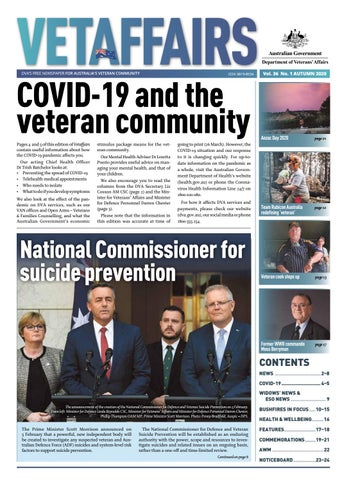
National Commissioner for suicide prevention
Vol. 36 No. 1 AUTUMN 2020
Anzac Day 2020
page 21
Team Rubicon Australia redefining ‘veteran’
page 12
Veteran cook steps up
page 13
Former WWII commando Moss Berryman
page 17
CONTENTS NEWS ....................................2–8 COVID-19............................. 4–5 WIDOWS’ NEWS & ESO NEWS............................9 The announcement of the creation of the National Commissioner for Defence and Veteran Suicide Prevention on 5 February. From left: Minister for Defence Linda Reynolds CSC, Minister for Veterans’ Affairs and Minister for Defence Personnel Darren Chester, Phillip Thompson OAM MP, Prime Minister Scott Morrison. Photo: Penny Bradfield, Auspic – DPS.
BUSHFIRES IN FOCUS......10–15
The National Commissioner for Defence and Veteran Suicide Prevention will be established as an enduring authority with the power, scope and resources to investigate suicides and related issues on an ongoing basis, rather than a one-off and time-limited review.
FEATURES.........................17–18
The Prime Minister Scott Morrison announced on 5 February that a powerful, new independent body will be created to investigate any suspected veteran and Australian Defence Force (ADF) suicides and system-level risk factors to support suicide prevention.
Continued on page 8
HEALTH & WELLBEING..........16
COMMEMORATIONS.........19–21 AWM........................................22 NOTICEBOARD..................23–24
2 — Vetaffairs Autumn 2020
N E W S N E W S F R O M T H E D E PA RT M E N T
LETTERS TO THE EDITOR Defence Covenant Dear Sir/ Ma’am, I thank you for your Summer Edition of Vetaffairs, and I note with interest the Veterans Covenant. As a former member of the [Australian Defence Force] and a TPI, I received a copy of the Veterans’ Covenant and accompanying Lapel Badge and I wear both proudly along with my TPI, RAS and RSL badges. I am at a loss that today’s generation and the general public are totally unaware of the significance of any of these lapel badges or what they represent. I grew up in a generation that were educated about these badges in primary school and their individual significance. In that the wearer is a ‘Totally and Permanently Incapacitated’ Returned Service Person. I feel the general public and school children need to be re-educated! So that our service is recognisable, not just by veterans! Joseph C Mercieca JP Donald, VIC
FROM THE EDITOR Welcome to this bumper edition of the new-look Vetaffairs. Apart from modernising the design of the newspaper, we’ve made the text a little larger and we’re including more stories about veterans. We will continue of course to provide news about DVA’s programs and initiatives. We are keen to hear from any veteran or family member with a good story for Vetaffairs. This newspaper is as much yours as it is the department’s.
Newsroom
If you want even more up to date news from DVA, go to the newly created Newsroom on the redeveloped DVA website. Just visit www.dva.gov.au/newsroom and click on the ‘Latest News for veterans’ tile. You can also follow us on our various social media channels.
Vetaffairs online
We will continue to mail you a printed version of each edition of Vetaffairs unless you tell us not to. However, if you’re just as happy to receive emails that link to the online version, please let us know. You can also subscribe to the more frequently published electronic newsletter, e-news. Email us (vetaffairs@dva.gov.au) or write to us (see below) and tell us which applies to you.
Vetaffairs for the vision-impaired
An audio recording of each issue is available online (www.dva. gov.au/vetaffairs) and on CD. Visit the website or email us saying you wish to receive a CD instead of a hard copy. Conan Elphicke, Vetaffairs editor
CORRECTION
In the Summer edition of Vetaffairs, we published an article titled ‘Travel insurance: worth the cost.’ The article incorrectly claimed that Medicare does not cover medical costs overseas. In fact, Medicare has reciprocal arrangements in place with 11 countries. Arrangements vary from country to country, and we recommend you get full details of the arrangements before you travel. Visit the Reciprocal Health Care Agreements (RHCA) page of the Department of Human Services website (www.humanservices.gov.au and search for ‘RHCA’). We apologise for this oversight. The online version of the article has been corrected.
Liz Cosson AM CSC Secretary – Department of Veterans’ Affairs
Dealing with a challenging 2020 There’s no doubt that 2020 is proving to be a challenging year so far. It began with bushfires and floods and continues with the COVID-19 pandemic. I’m sure many of you are still reeling from the devastating bushfires that swept through so much of the country. More than 50,000 veterans, families and DVA staff live in areas that were affected by the fires. To those of you who were impacted by these disasters, I offer my heartfelt wishes as you continue your recovery efforts. A large section of this Vetaffairs edition is focused on the bushfires (see pages 10–15). There you will read some impressive examples of how veterans have stepped up, often going to extraordinary lengths to help not only each other but strangers in communities a long way from their own. That commitment to service and the professionalism and competence with which they’ve gone about this work reinforces to me how proud I am of our veteran community. In addition, COVID-19 is uniting all our efforts to find ways to stop the spread across our communities. The department remains committed to your health and wellbeing and in this edition we highlight the importance of gaining up-todate information through reliable sources. Our priority remains the continuity of services to veterans and their families and we are particularly focused on providing support to our most vulnerable, including our older community and those with underlying health conditions. Our advice is you should consider accessing support remotely wherever possible to reduce the risk of exposure. I remain committed to the staff in DVA who are working tirelessly to support veterans and their families. We are working across Government to provide our staff with the resources and technology they need to respond effectively. DVA has already enacted our business continuity plans to continue to provide you with essential services. Should they be necessary, these measures will include: • replacement of face-to-face services with telephone services • redirection of services to less affected areas • relocating staff to business critical operational areas where necessary, and • prioritising essential services over less critical functions. DVA’s service providers are required to have business continuity plans and should there be
Vetaffairs is published by the Department of Veterans’ Affairs as a free newspaper for Australia’s veteran community. Editor Conan Elphicke Vetaffairs is printed by PMP on PEFC (Program for the Endorsement of Forest Certification) accredited paper.
email vetaffairs@dva.gov.au mail GPO Box 9998 Brisbane, QLD 4001
any disruptions to essential service delivery, DVA is working with providers to minimise the impact on veterans and their families. I encourage you to remain calm and to follow the advice provided by the Australian Government Department of Health and its relevant state or territory counterparts. Please also see page 4 and 5 of this edition of Vetaffairs but bear in mind, advice relating to the pandemic is ever-evolving, so please also keep an eye on our website (www.dva.gov.au) and social media. If you are feeling anxious about this issue or any other, please contact Open Arms – Veterans & Families Counselling for free and confidential support. This support is available 24/7 on 1800 011 046. In other news, many of you will be aware of the Prime Minister’s recent announcement of the creation of two new roles: the National Commissioner for Defence and Veteran Suicide Prevention, and the Veteran Family Advocate. Please see pages 1 and 6 for more information. Due to the unprecedented circumstances we face this year, we have had to cancel our Australian-led overseas Anzac Day commemorative services for 2020 and the Prime Minister’s Veterans’ Employment Awards evening at Parliament House. Anzac Day is such an important day in our national calendar and these Awards are so important to supporting jobs for veterans after they transition. Although not open to the public, the Australian War Memorial will be televising a national service. DVA is working with the Memorial and the RSL to support you to commemorate this important day wherever you are. We are updating our website with details for Anzac Day and also announcing the Award recipients via social and mainstream media. I would like to congratulate the Hon Darren Chester MP for his promotion to Cabinet as Minister for Veterans’ Affairs and Minister for Defence Personnel. The elevation of the portfolio to Cabinet recognises the importance of our work to the Government and all Australians. Finally, you may notice we’ve updated the look of Vetaffairs, and we are more frequently publishing e-news. This is in keeping with the recent redevelopment of the DVA website, which is now much clearer, simpler and easier to navigate. I encourage you to visit it at www.dva.gov.au.
Follow DVA on Facebook DVAAus and Twitter @DVAAus. Browse DVA on YouTube DVAAus Channel If you have an enquiry for DVA email generalenquiries@dva.gov.au phone freecall 1800 555 254 www.dva.gov.au
3 — Vetaffairs Autumn 2020
N E W S FROM THE MINISTER @DarrenChesterMP
The Hon Darren Chester MP Minister for Veterans’ Affairs Minister for Defence Personnel
Australians rising to the occasion Australia is a resilient country. That special quality has really been tested over the last few months, and will continue to be for some time.
COVID-19
The Australian Government is doing everything it can to protect Australians from the health and economic impacts of the COVID-19 pandemic, including those who have served our nation. All the actions we are putting in place are based on advice from Australia’s leading medical experts. The National Cabinet continues to urge all Australians to play their role in reducing the spread of COVID-19 through personal social distancing and hygiene measures. We are also doing everything in our power to ensure that as many services as possible remain available to the veteran community. A total of $189 billion is being injected into the economy by all arms of Government in order to keep Australians in work and businesses in business. This includes a $2.4 billion health package to protect all Australians from COVID-19, including vulnerable groups such as the elderly and those with chronic conditions. In addition, the Government’s economic stimulus package, which includes payments for which many veterans and their families are eligible, will help support our veteran community through this challenging time. Just as the Government continues to make tough decisions to protect the Australian
people, DVA remains focused on ensuring plans and processes are in place to ensure the ongoing support of veterans and their families. This includes telehealth consultations and home delivery of prescriptions to those at risk or in self isolation. I recognise that people may be feeling uncertain and anxious in these difficult circumstances. I strongly encourage everyone reading this to keep up to date with information regularly provided by the federal and state and territory governments, and to remember that the pandemic will, in due course, pass. I would encourage you all to keep up-to-date with the latest advice at australia.gov. au, the latest health advice at health.gov.au as well as the latest advice from DVA at dva. gov.au. I also remind you that if you do need additional support through these times to contact Open Arms — Veterans & Families Counselling to access free and confidential counselling and support. This is available 24 hours a day, seven days a week on 1800 011 046.
National Commissioner and Family Advocate
In February, Prime Minister Scott Morrison announced the establishment of two new positions: the National Commissioner for Defence and Veteran Suicide Prevention and the Veteran Family Advocate. I can’t emphasise enough how important this is. The Government has listened to
the stories of deep and ongoing grief told by our veteran community, ADF personnel and the families of those who have tragically been lost to suicide. The National Commissioner will be established as an enduring authority with powers equivalent to that of a royal commission, including the power to compel the production of evidence and summon witnesses. They will look to identify and investigate any systemic issues and make recommendations to Government on suicide prevention, to support the wellbeing of veterans and ADF personnel. They will set out the long-term path to help reduce suicide risks within the military and veteran community, and provide an annual report to Parliament. In addition, a new Veteran Family Advocate will be appointed to undertake engagement, liaison and advocacy across the veterans’ sector, drawing on the advice of families of veterans, to help shape veteran policy and the administration of veteran benefits and support. While many of the details are still being ironed out, the Advocate will sit within the Veterans’ Affairs portfolio. The Office of the National Commissioner will be a new statutory office within the Attorney-General’s portfolio. As you all know, suicide is a complex issue and an increased understanding of suicide in the context of military service and transitioning to civilian life will help the Government bolster support to veterans and their families, and help shape future policies and services.
Bushfires
At the start of this year, bushfires ravaged my electorate of Gippsland and many other parts of the country. The thing I noticed again and again was how people affected by the fires showed remarkable resilience and community spirit. I was particularly impressed
Transition programs get extra funding The Prime Minister Scott Morrison announced a significant funding boost to two programs that support veterans as they transition from the Australian Defence Force (ADF). The funding boost is intended to reduce the suicide rate among veterans. The Government is providing $4.8 million to the
Coordinated Client Support program, which already helps around 1,200 veterans facing difficult circumstances. Ten additional case coordinators will be appointed so that an extra 170 young and vulnerable veterans leaving the ADF annually will get guidance and a single point of contact.
The investment means the entire high-risk cohort of veterans leaving the ADF will now be covered under the Coordinated Client Support program. The Government will also boost the resources of the Personalised Career Employment Program by $5.6 million
by the response of our veterans and ADF members. Through voluntary organisations, or as individuals, members of the veteran community have done remarkable work rebuilding not just their own communities but others too. The bushfires showed precisely what our veterans and serving ADF personnel are made of. It’s proof that veterans are a valuable resource to employers, as well as to the nation. This also applies to the 3,000 Reservists the Government deployed to assist with the bushfires alongside the regular ADF as part of Operation Bushfire Assist. I cannot overstate how grateful communities are for the assistance veterans provided. I would also like to thank the support delivered by the defence forces of other countries, including New Zealand, the United States, Japan, Canada, Fiji, Singapore and Papua New Guinea. On behalf of Australians, and especially those in my community, I thank you for your service. You will no doubt have heard that Australian-led overseas Anzac Day commemorations have been cancelled due to the COVID-19 pandemic, as have domestic commemorations around the country. I can absolutely assure you that the decision was not taken lightly. While Anzac Day is one of the most important days in our national calendar, public health considerations have to come first. The Australian War Memorial will run a commemorative service on the morning of Anzac Day with coverage starting at around 5.00 am this year, which will be broadcast nationwide. Although you will not be able to attend a service, Anzac Day itself has not been cancelled. This year, Anzac Day is more important than ever and I encourage you all to watch the broadcast and to reflect on the resilience, dedication and service of our ADF personnel, from the original Anzacs to those still serving today. And we should
all remember and commemorate the service and sacrifice of the more than 102,000 Australians who have died in wars, conflicts and peacekeeping operations. On 18 February Australia commemorated the 50th anniversary of Operation Hammersley, one of Australia’s significant operations during the Vietnam War. It was an opportunity to remember all those who served in the operation, especially those who were killed or wounded. The following day, on 19 February, I had the privilege of attending a commemorative service for the bombing of Darwin, which took place 78 years ago. Tragically, more than 250 people were killed in the bombing. On 22 February 2020, the nation commemorated the 25th anniversary of the United Nations Assistance Mission in Rwanda, known as Operation TAMAR. The service provided us all with the opportunity to recognise the dedication and sacrifice of those who served in this conflict. Later this year on 15 August, we will acknowledge the 75th anniversary of the end of the Second World War on Victory in the Pacific Day. The Second World War is the focus of additional educational and online resources, DVA is recording the first-hand experiences of Second World War veterans as part of its ongoing oral history project, Veterans’ Stories, and the National Archives of Australia has Government funding to digitise the more than one million Second World War service records. The Second World War had a profound impact on our nation and we should never forget the sacrifice of the some 39,000 service men and women who died fighting to protect Australia and its allies and the almost one million men and women who fought in this terrible conflict that spanned more than half a decade.
and will expand its eligibility to another 1,600 ADF members each year looking for career development and job placement support as they set up for civilian life. When the Prime Minister announced this funding on 7 February, he said, ‘Research shows veterans under 30 who are involuntarily discharged as being at higher risk of suicide than the general
population so we want to ensure they get the support they need as they navigate the range of government services on offer’. ‘These programs are about reaching out to those veterans who need our help to ensure they get it.’ For more information on the programs, and how to access them, visit the DVA website (www.dva.gov.au).
4 — Vetaffairs Autumn 2020
C O V I D - 1 9
COVID-19 and the veteran community
DR TRISH BATCHELOR Acting Chief Health Officer
DVA has a Pandemic Business Continuity Plan in place to ensure that critical support and services remain available to the veteran community throughout the COVID-19 pandemic. We are closely monitoring the Government’s response and health advice and will adapt our planning accordingly. DVA’s nu mb er one priority is the health and wellbeing of Australia’s veteran community. For more information on COVID-19, visit the federal Department of Health’s website at health.gov.au or phone the Coronavirus Health Information Line 24/7 on 1800 020 080. You can also visit the Department of Health website in your state or territory for the latest updates. The Government now advises all Australians not to travel. Visit the Australian Government’s Smartraveller website for more information (smartraveller.gov.au).
Preventing the spread of COVID-19 Practising good hand and sneeze/cough hygiene is the
best defence against this virus. You should: • wash your hands frequently with soap and water, before and after eating, and after going to the toilet, • use alcohol-based hand sanitiser regularly, especially if you have been in public spaces, • cover your cough or sneeze, and dispose of tissues, and • if unwell, avoid contact with others. Most infections are transmitted by people when they have symptoms. These can include fever, a cough, sore throat, tiredness and shortness of breath. There is evidence that some people may be infectious for up to 24 hours before showing symptoms. Most persons infected with COVID-19 experience mild symptoms and recover within two to four weeks. However, some people experience a more serious illness that requires hospitalisation. The risk of serious illness rises with increasing age, and is higher in people with weakened immune systems or with underlying conditions such as diabetes, or heart and lung disease. There is little evidence supporting the widespread use of surgical masks to prevent transmission in public and this practice is not currently recommended by the Department of Health. A mask can however be very helpful in preventing transmission of disease from an infected person to others.
Another way to slow the spread of the virus is to practise social distancing and this is now recommended by the Department of Health. This includes measures such as: • stay home if you are sick • avoid handshaking and kissing others • avoid meetings (large gatherings are now banned by the government)
Telehealth and home delivery of medications To limit the spread of the virus, the Government has introduced bulk-billed telehealth Medicare appointments for general practitioners, specialists, midwives, some nurses and mental health professionals. Telehealth appointments are those conducted over the phone or via teleconferencing platforms such as Facetime or Skype. These appointments are available to the following groups: • people isolating themselves at home on the advice of a medical practitioner • people who meet the current national triage protocol criteria for suspected COVID-19 infection after consultation with either the national COVID19 hotline, state COVID-19 hotlines, a registered medical or nursing practitioner, or COVID-19 trained health clinic triage staff • people aged over 70 • Aboriginal and Torres Strait Islander people aged over 50
• people with chronic health conditions or who are immunocompromised • parents with new babies and people who are pregnant. On 23 March, the Government announced that telehealth support has moved to Stage 3 – vulnerable doctors can now offer telehealth consultations to all of their patients. ‘Vulnerable’ has the same definition as for patients. Stage 4 of telehealth implementation will see an expansion to allow all patients to access telehealth and will include allied health professionals. There is no set date for this expansion. This will support the goal of social distancing. More information is available on the Department of Health website (health.gov.au and search for ‘Telehealth’). Please contact your health provider to make arrangements. People in these groups are also eligible for the home delivery of medications. Please contact your local pharmacy to see if they have this facility. Small pharmacies may not have the capacity to support this initiative.
Who needs to isolate? To help limit the spread of COVID-19, and reduce the burden on the health system, you must isolate yourself in the following circumstances: • If you have returned from any country overseas you must isolate yourself for 14 days from the date of arrival in Australia. If you develop any symptoms during this
time you should contact your GP surgery by phone. • If you have been in close contact with a confirmed case of COVID-19, you must isolate yourself for 14 days from the date of last contact with the confirmed case. If you develop any symptoms during this time you should contact your GP surgery by phone. • People who must isolate need to stay at home and must not attend public places, in particular DO NOT come to work, go to school, childcare or university. Do not attend public offices such as Services Australia, your local VAN or the local shops. Only people who usually live in the household should be in the home. • Do not allow visitors into the home. Where possible, get others such as friends or family who are not required to be isolated to get food or other necessities for you. If you must leave the home to seek medical care, wear a mask if you have one and ensure you call the doctor’s clinic or hospital to forewarn them of your arrival.
What to do if you develop symptoms You should telephone your doctor’s surgery ahead of time and explain your circumstances. They can then advise you accordingly. Alternatively you can call the Coronavirus Health Information Line 24/7 on 1800 020 080 and be transferred to a Registered Nurse.
Services at DVA VAN offices
Open Arms – Veterans & Families Counselling Open Arms is open for business. If you are feeling unwell, or have concerns about the spread of COVID-19, call us on 1800 011 046 and we’ll reschedule your appointment or discuss options for conducting your session via telephone or video conferencing.
For the safety of both staff and the veteran community there will be some changes to the provision of face-to-face services at DVA VAN offices. These changes include restrictions on who will be allowed to access DVA premises. These restrictions align with the Australian Government’s advice to all Australians. The veteran community is advised not to enter a VAN office if they: • have returned from overseas within the last two weeks • have had close contact with someone suffering from the COVID-19 coronavirus • are feeling unwell.
Staff in VAN offices are following strict social distancing and personal hygiene practices. Although VAN offices remain open at the present time, the situation is very unpredictable and this may change as circumstances change. We recommend that you do not attend a VAN office unless the enquiry is urgent and it is absolutely necessary to undertake business face to face. We do not want vulnerable members of the veteran community travelling to VAN offices. Members of the veteran community who require assistance should call 1800 555 254 or lodge an online enquiry on the DVA website.
Please note that the information on these pages was accurate at time of going to print (26 March). However, the COVID-19 situation and our response to it is changing quickly. Please check our website (dva.gov.au), our social media or phone 1800 555 254.
5 — Vetaffairs Autumn 2020
C O V I D - 1 9
Economic Support Payments First payment
Second payment
On 12 March, the Australian Government announced a $17.6 billion stimulus package, including a one-off $750 payment to those who receive certain DVA benefits, including: • Service Pension, Partner Service Pension, Income Support Supplement or Veteran Payment • Disability Pension • Special Rate Disability pension • Permanent Impairment compensation • War Widow(er)’s Pension or Wholly Dependent Partner payment • Gold Cards, Commonwealth Seniors Health Cards and Pensioner Concession Cards
• DVA Education Schemes, where recipients are aged 16 and over • Age or Wife Pension paid by DVA These payments will be made automatically to eligible people’s nominated bank accounts from 31 March 2020 to people who will have been on one of the eligible payments any time between 12 March 2020 and 13 April 2020.
On 22 March, the Government released the second stage of its economic plan to cushion the economic impact of the coronavirus and help build a bridge to recovery.
There is no need to lodge a claim, but you should ensure that DVA has your correct bank details and address.
In addition to the first stimulus payment, the Government will provide a further $750 payment to social security recipients and those receiving the above DVA benefits. However, it will not be payable to those who receive the Coronavirus supplement, which is an additional $550 per fortnight on top of social security payments such as JobSeeker Payment.
To make sure your details are correct, log in to MyService or call DVA on 1800 555 254.
This second payment will be made automatically from 13 July 2020.
Please routinely check www.dva.gov.au for up to date information on the stimulus payments.
Managing your concerns about COVID-19 the Department of Health and other government sources.
Avoid overconsumption of media!
DR LORETTA POERIO Mental Health Adviser
Concern about our health and wellbeing due to the COVID19 pandemic is challenging for everyone. There are a range of reactions such as distress, fear, confusion, sadness, fatalism and frustration. Worries, however, can overwhelm us at times, and engender feelings of helplessness, making us vulnerable to poor mental health. With some reflection, high quality information, and self-care strategies, the current situation can be managed, and a level of predictability restored. This situation is one where problem solving can assist in managing the risk.
Know the facts Everyone is entitled to an opinion, of course, but only draw on reliable information sources. These include DVA,
Media outlets have a financial interest in encouraging you to engage with them frequently. They rely on the use of fear to make you think the outbreak is something you need to worry about constantly. It’s not. Limit the time you and your family spend watching or listening to sensational media coverage and instead focus on the things that are positive in your life and things you have control over.
Self-care strategies for promoting a healthy immune system As adults, we have all faced adversity. This is a good time to become re-acquainted with helpful coping strategies we know work well. In addition, the following tips for good self-care, which will boost your immune system, may be useful: • Exercise: Even 10 minutes a day of walking, housework, gardening or anything that gets you moving can be very beneficial. These
•
•
• •
•
activities need to be undertaken with social distancing principles in mind. Maintain at least 1 metre (3 feet) distance between yourself and anyone who is coughing or sneezing. Breathing and Relaxation Techniques: these techniques, which include yoga and mindfulness, have been found beneficial in treating anxiety. Eat well: Nutritious food fuels our body and brain, and can make all the difference in how we feel physically and mentally. Sleep: is critical to your mental and physical health. Social connection: If you are aware of people who are in isolation, make sure to connect via telephone, face-time, Skype, drop off some groceries, flowers, puzzles, books. This is especially relevant for people living alone. Limit alcohol consumption: Government Guidelines recommend that healthy adults drink no more than two standard drinks a day and no more than four standard drinks on a single occasion.
• QUIT smoking: Quitting smoking is the best thing most smokers can do to improve and protect their health.
Tips to help children and adolescents Including your children in your family’s health care plan will lead to better understanding, counter fear of the unknown, and help children and adolescents feel a sense of control. • Ask children what they have heard about coronavirus. • Provide age appropriate, accurate information and clarify any misinformation or misunderstanding they may have. • Encourage children to share their concerns, and let them know that parents and teachers are available to discuss thoughts and feelings. • The way parents behave can have a significant effect on children. Keep conversations calm and focussed on the facts. Emphasise efforts that are being taken to contain the infectious disease. • Model health-promoting behaviours for your children. For example, teach them to wash their hands with soap and water for 20 seconds – as long as it
takes to sing the happy birthday song twice. • Educate the entire family about good health habits. Talk about what each family member can do to help others outside of the immediate family. • Include children in family discussions and plans, in an age-appropriate way. • Address any misconceptions children may have that could result in stigmatising people or groups of people in the community.
Seek assistance early if you are feeling overwhelmed Symptoms of stress can be managed when you know what to look for, and strategies are put in place early. If you find it difficult to do the activities you need and want to do, and feel that life is out of control, then it is time to seek assistance. Please call Open Arms – Veterans & Families Counselling on 1800 011 064. Use of online resources: There are a number of very good online resources through the Department of Health’s Head to Health portal (headtohealth.gov. au), and the World Health Organization (who.int/healthtopics/coronavirus and who. int/news-room/q-a-detail/q-acoronaviruses).
Please note that the information on these pages was accurate at time of going to print (26 March). However, the COVID-19 situation and our response to it is changing quickly. Please check our website (dva.gov.au), our social media or phone 1800 555 254.
6 — Vetaffairs Autumn 2020
N E W S
DVA supports veteran’s award-winning son At the 2019 Illawarra Schools Excellence in VET Awards night in November, veteran Sean Robinson thought to himself the student who was about to win the School Based Apprentice Award sounded pretty impressive. ‘As they read out their achievements, I thought the winner’s done alright,’ Sean said. ‘Then I thought my son Mathew, the poor bugger, he’s missed out. But then they said his name! ‘My wife Louise and I were so proud to see him win after all of his hard work over the past two years at St Joseph’s Catholic High School in Albion Park.’ Sean joined the Army in 1986 and served 23 years in the infantry, with two deployments – one to Somalia in 1993 and another to East Timor in 1999. ‘When I retired from the military, I found out that my kids were eligible for support under DVA’s Veterans’ Children Education Schemes and we’ve been using it for the past 10 years,’ he said. ‘Because I was no longer working, the Schemes allowed my two kids to participate in everything they needed to, and to purchase equipment like laptops. ‘We’re really proud of the hard work that Mathew’s put into his apprenticeship while he was studying for his HSC. He was balancing work, study at TAFE, and high school, and because of his dedication, his school nominated him for the award.’ Mathew completed Year 12 last year, and is now working full-time as a second-year apprentice fitter and machinist for Prysmian Australia, a cable manufacturing business in Liverpool, Sydney.
Pensions and allowances rise Veterans’ pensions were increased from 20 March 2020 following the latest round of indexation adjustments. As pension rates are calculated on a daily basis, the pension paid on payday 26 March 2020 will be paid partly at the old rate and partly at the new rate. The first full payment at the new rates of pension will be payday 9 April 2020. The maximum rate of single service pension has risen by $10.90 to $944.30 per fortnight and the maximum rate for couples has increased by $8.30 to $711.80 per fortnight (each). The Special Rate of disability pension (T&PI pension) has increased by $17.10 to $1451.80 per fortnight. Extreme Disablement Adjustment (EDA) has increased by $9.50 to $802.30 per fortnight and the 100 per cent General Rate of disability pension has
Louise, Mathew and Sean Robinson.
‘Living in Wollongong and driving to Sydney every day can be hard, because I have to get up at 3.30am to start work at 6am,’ Mathew said. ‘But, it’s always something that I’ve wanted to do, because I like working with my hands, so I’m really loving it.’ His part-time TAFE studies over the past two years meant that Mathew entered the full-time workforce as a second-year apprentice. ‘I’d really recommend the Education Scheme to other veterans whose children are eligible, because it
increased by $6.10 to $516.20 per fortnight. The pension paid to war widow(er)s has increased by $11.30 to $960.40 per fortnight (including the energy supplement), while the ceiling rate of the income support supplement has risen to $284.20 per fortnight. Payments have also increased for benefits under the Military Rehabilitation and Compensation Act 2004 (MRCA). The weekly MRCA wholly dependent partner payment has increased by $5.65 to $480.20 paid fortnightly. The indexation factor used to index pensions each March and September can be based on either the Consumer Price Index (CPI), the Pensioner and Beneficiary Living Cost Index (PBLCI) or Male Total Average Weekly Earnings (MTAWE). For 20 March 2020, the indexation was driven by CPI.
helped out with all the unexpected costs and the items they need for school,’ Sean said. The Veterans’ Children Education Schemes support children of eligible veterans with education needs while they’re in primary, secondary and tertiary fulltime study. To find out more about the eligibility criteria and the type of student support available, you can go to the DVA website (www.dva.gov.au and search for Education Schemes).
NEW PENSION RATES FROM 20 MARCH 2020 SERVICE PENSION (total amount)
Old rate (fortnightly)
New rate (fortnightly)
Increase (fortnightly)
Single person
$933.40
$ 944.30
$ 10.90
Couples (each)
$703.50
$ 711.80
$ 8.30
Single person – transitional
$780.10
$ 789.30
$ 9.20
Couples (each) – transitional
$629.40
$ 636.80
$ 7.40
War widow(er)’s pension
$949.10
$ 960.40
$ 11.30
Income support supplement (ceiling rate)
$280.80
$ 284.20
$ 3.40
T&PI (Special rate)
$1,434.70
$ 1451.80
$ 17.10
Intermediate rate
$974.20
$ 985.80
$ 11.60
Single Person
$1009.80
$1021.80
$12.00
Couples (each)
$786.70
$796.30
$9.60
EDA
$792.80
$ 802.30
$ 9.50
100 per cent
$510.10
$ 516.20
$ 6.10
10 per cent
$57.94
$ 58.55
$ 0.61
MRCA
Old rate (weekly)
New rate (weekly)
Increase (weekly)
Wholly dependent partner payment
$474.55
$ 480.20
$ 5.65
Special Rate Disability pension (SRDP)
$717.35
$ 725.90
$ 8.55
WAR WIDOWS (total amount)
DISABILITY PENSION (total amount)
VETERAN PAYMENT
The first full payment at the new rates will be the payday 9 April 2020. More information on the new pension rates is available from DVA on 133 254 or from regional Australia free call 1800 555 254.
7 — Vetaffairs Autumn 2020
N E W S
Our new website is here The DVA website has been redesigned based on feedback from our veterans and their families. Launched on 4 March 2020, the new, easier-to-use website is better designed for veterans and their families and now available at www.dva.gov.au.
Community Nursing clients have their say In October 2019, the department conducted the first survey of clients receiving DVA-funded Community Nursing services. The anonymous survey aimed to understand the experience clients have with their Community Nursing services and identify any gaps in the information provided to clients. DVA funds registered community nursing providers to care for around 17,000 entitled persons in their homes. The aim of the service is to enhance the independence and health outcomes of the entitled person by avoiding early admission to hospital and/or residential care. Community Nursing services can assist with medication, wound care, hygiene and help with showering or dressing. Community Nursing services are provided by a mix of personnel including registered and enrolled nurses and nursing support staff.
Through Orima Research, who conduct the annual DVA Client Satisfaction Survey, DVA went out to more than 1,600 clients. The survey was extremely successful with 660 responses received – a 40 per cent response rate. The findings are very positive. Overall, 94 per cent of community nursing clients surveyed reported being either satisfied or very satisfied with their services. Ninety per cent of respondents indicated they felt cared for and were confident in the safety of their treatment, and 96 per cent reported that they are always treated with respect. The survey also asked about clients’ perception of their health and the impact of DVAfunded community nursing services. Eighty-five per cent of clients reported that their services have a positive impact on their health.
Family members and carers were also asked to take part in the survey with initial results indicating more than 90 per cent have a positive experience with their Community Nursing provider. We have identified areas for improvement, including the need to make people more aware of how to change providers. DVA is working on the development of a client and carer booklet to address some of the knowledge gaps. The booklet will also cover topics including services available through the program and other channels, how to find information on services, and clients’ rights and responsibilities. Thank you to all who took part; your time in responding to the survey is greatly appreciated. See the DVA website (www.dva.gov.au) for more information about Community Nursing services, including eligibility.
The new site provides information that is simple to find and easy to understand. Our focus was to ensure that all of our veteran community can quickly find the information they need and work out what to do next, such as how to make a claim or gain access to services and support. The valuable feedback from the veteran community told us our previous website was too confusing and hard to navigate. We were told it was designed for people who already knew about DVA programs and services and didn’t focus on the needs of the user. We listened, and with a clean look and feel the website groups information under five themes: health and treatment, financial support, civilian life, recognition and providers. More than 200 of the most important or popular pages have been completely rewritten to make them easier to understand. Other information has been transferred to the new website and will be reviewed and updated over time. Most excitingly, we’ve improved the search capability and introduced ‘Pat’ – a digital assistant who can answer your questions and direct you to the information you’re after. You might notice that our factsheets have disappeared. By presenting this information as normal pages on our website we have made it more accessible and easier to read. You can still print this information from the website if you would like a hard copy. A website is never finished and the department will continue to improve features and update the information on the site. We encourage you to provide feedback on your experience by using the feedback button on the website. The changes to the website do not affect MyService or the availability of existing forms. Visit the new website today and have a look around www.dva.gov.au
DSH Insurance and COVID-19 During this extraordinary time with COVID-19, DSH Insurance has put in place mechanisms to help protect you and our wider community. As part of how we do business, if it is necessary for our providers to attend your home to undertake repairs or assess damage, we will first ask you a range of questions regarding the health of your household. This will be part of our initial triage of any claims lodged. Questions will include if any members of your household are currently under any periods of isolation or quarantine and if you or any family members have recently returned from overseas. If you answer yes to any of these questions, we will put in place a plan for your claim / repair(s) to proceed. We have confirmed with our providers that they are following the Government’s directions in regards to social distancing and self-isolation and will check with you to see if you have any concerns around our providers attending your property. Asking these questions will help us protect you and our wider community in these times of uncertainty.
8 — Vetaffairs Autumn 2020
N E W S Government establishes National Commissioner for suicide prevention (Continued from page 1)
The Prime Minister said the Commissioner would also have the power to compel evidence and summons witnesses. ‘I have thought long and hard about the best response to this issue,’ he said. ‘I have spoken to veterans right across Australia and I have met with their families and also local, state and national organisations. I believe what we have developed addresses the needs of those veterans, their families and our serving men and women.’ The National Commissioner for Defence and Veteran Suicide Prevention will be empowered to perform two roles: • They will be an independent and permanent public accountability body, with the same broad powers of a royal commission to compel the production of evidence and summons witnesses, and make findings and recommendations to Government. • They will provide an ongoing inquiry function of individual cases of suicide, working
cooperatively with state and territory coronial offices. An interim National Commissioner will also commence and oversee a comprehensive review and analysis of the more than 400 suicide deaths in the Defence and Veteran communities since 2001. This review will have a set timeframe and Terms of Reference. An interim report will be delivered within 12 months, and a final report at 18 months. Families will be engaged in this process if they wish, with an opportunity to participate and tell their stories openly and safely. A Veteran Family Advocate will also be appointed to directly engage with the families of veterans, to improve the design of all veteran programs and services, including mental health supports and services. The new Veteran Family Advocate will focus on mental health and suicide prevention, and contribute to our understanding of risk factors relating to the wellbeing of veterans and their
families, particularly during transition from the ADF. The Advocate will represent the views of veterans and their families by engaging with them and reflecting their perspective to help shape policy and the administration of veteran benefits and support. The Veteran Family Advocate will sit on the Repatriation Commission and the Military Rehabilitation and Compensation Commission within the Veterans’ Affairs portfolio and will work closely with the National Commissioner and the Prime Minister’s National Suicide Prevention Adviser. A selection process to appoint the Veteran Family Advocate will begin shortly. The Government will invest an initial $40 million to support the announcements of 5 February 2020 . Open Arms – Veterans and Families Counselling providessupportandcounselling to current ADF members, veterans and their families and can be contacted 24/7 on 1800 011 046.
Apply for your Covenant pack today More than 83,000 veterans and Reservists have now applied for the Australian Defence Veterans’ Covenant (the Covenant), including the Oath, Lapel Pin and Veteran Card. Meanwhile, the business benefits component of the Veteran Card is continuing to expand with 177 additional businesses registering since its November launch. These new offers are available through the Australian Partners of Defence (APOD) online platform, where Veteran Card holders can access more than 10,000 unique offers and deals. A further 245 businesses are at various stages of the offercreation process, with interest in the program remaining strong thanks to support from the defence community.
To gain access to offers and discounts, existing DVA Health Card or Veteran Card holders can simply register with APOD at apod.com.au, which is entirely free for veterans and businesses. Veterans and eligible Reservists who don’t currently hold a DVA Health Card or Veteran Card can apply through MyService, where you can also pre-register with APOD. Card holders can then gain access to business offers by searching the APOD website, which includes geographical, veteran-owned and concession earch filters. It is important to read the ‘How to Redeem’ information on each offer as some businesses only require you to show your card, others require an online purchase, while others require an exclusive offer code.
Businesses range from small local and veteran-owned businesses through to large chains that operate nationally. They include retailers, travel and tourism operators, accommodation and car hire, entertainment, hospitality, restaurants, as well as service and trade industries from gyms to automotive mechanics. If businesses or community organisations in your area have not heard of the Veteran Card, encourage them to find out more and show their support.. If you would like to suggest a business to APOD, please email your recommendation to partners@apod.com.au. For more information about how to apply for and support the Covenant, including eligibility and other frequently asked questions, visit recognition.dva.gov.au.
DVA’s Nominal Rolls now on one website DVA has created a single portal for accessing our searchable Nominal Rolls. Our Nominal Rolls for the Second World War, Korean War and Vietnam War have moved to the new website, and the original websites have been decommissioned. Regular users of the original Nominal Roll sites who have bookmarked the pages will still be able to use any stored links as they’ll be automatically redirected to the new site: nominal-rolls.dva.gov.au. One of DVA’s key roles is acknowledging and commemorating the service and sacrifice of all those who served Australia and its allies in wars, conflicts and peace operations through commemorations, memorials, war graves and research. The World War Two Nominal Roll honours and commemorates some one million people who served in the armed services and the Merchant Navy from 3 September 1939 to 2 September 1945. The Nominal Roll of Australian Veterans of the Korean War honours and commemorates more than 18,000 veterans who served from 27 June 1950 to 19 April 1956 either in Korea or in the waters adjacent to Korea.
The Nominal Roll of Vietnam Veterans honours and commemorates about 61,000 people who served from 23 May 1962 to 29 April 1975 either in Vietnam or in the waters adjacent to Vietnam. The Preliminary Gulf War Nominal Roll honours and commemorates Australian Defence Force personnel involved in that conflict. It includes all personnel who served in the Persian Gulf from August 1990 to September 1991. If you need to contact someone about the Rolls, call the Nominal Roll toll-free hotline 1300 780 133 (local call charge), email nominal.rolls@dva.gov. au or write to The Director, Nominal Rolls, Department of Veterans’ Affairs, GPO Box 9998, CANBERRA ACT 2601. The Australian War Memorial manages rolls for personnel who served with the Australian Imperial Force (AIF) during the First World War as well as those who served in prior conflicts, including Sudan (1885), the Boer War (1899–1902) and the Boxer Uprising (1900–1901). The National Archives of Australia also provides the ability to search digitial copies of the service records of many Australians who served in the First and Second World Wars.
Are your bank details up to date? Did you know White Card holders may be eligible for financial supplements? In the past, DVA has not recorded bank details when issuing White Cards. The department is working to ensure all client details are complete and up to date. We encourage all DVA White Card clients to log into MyService and update their details. MyService can also be linked via myGov accounts. Once new bank details are recorded in MyService, any eligible financial supplements will be automatically calculated and generated. Log in to MyService via the DVA website www.dva.gov.au/ myservice or through your myGov account.
9 — Vetaffairs Autumn 2020
W I D O W S’ Anzac Field of Remembrance Memorial Service
Bushfires and older people
Due to the global outbreak of COVID-19 (Coronavirus), it was with deep sadness and regret that Australian War Widows NSW has cancelled the 2020 Anzac Field of Remembrance Memorial Service. The decision was made in the first instance in consideration of the best interests of our members, as well as following Government guidelines and the advice of medical experts in relation to social distancing measures. While it is very important for our members to be socially active, these are exceptional times and it is imperative that our members stay safe and be protected as much as possible from contracting the COVID-19 virus. If our members need any support or help, we are available on our office number or by email. Please contact War Widows NSW on 02 9267 6577 or guild@ warwidowsnsw.com.au.
Last year’s Anzac Field of Remembrance Memorial Service.
N E W S
The extract below is an adapted article by Dr Sue Ferguson published in the Australian War Widows NSW Digest. Although the immediate bushfire threat has passed, a lot of people have also been impacted by heavy storms and this advice is always useful. Many of us are feeling distressed and helpless about the recent bushfires, even if we are not directly affected. This is a normal reaction to the widespread threat to lives and homes, and the news of lives lost, scenes of destruction and injured and dead wildlife and stock. So what are the potential issues for older people in these situations, and how do we stay safe, help others, and manage our own distress? If you live in a potential bushfire area, check your insurance and make sure you aren’t underinsured. Make sure you have a bushfire survival plan and have discussed it with your family. Don’t be
E S O
embarrassed to ask for help preparing your home and yard for potential fires if you aren’t physically able to do it yourself. If you don’t drive, talk to family and neighbours about whether they can help evacuate you. Keep up to date with warnings via websites and apps such as the NSW Rural Fire Service ‘Fires near me’, or by listening to the ABC. Keep your mobile phone charged and with you. If you are a carer for someone with dementia there is a new guide available to help. If your (or your relatives’) homecare services have been disrupted, or your retirement community or nursing home evacuated, the OPAN (Older Persons Advocacy Network) can help you liaise to get continued support. If you are talking to someone who lives in a fire-affected
area, has been evacuated, or lost their home or loved one: • Listen, support and reassure them as best you can. • Put them in touch with services such as Centrelink and the Disaster Welfare Assistance Line on 1800 018 444. • If you’re worried that they (or you) may be having a more severe stress reaction, encourage them to talk to their GP, or to ring helplines such as: Beyondblue on 1300 22 46 36, Open Arms on 1800 011 046 or Lifeline on 13 11 14. • Ask how you can help. • Look after yourself too! Dr Sue Ferguson is a regular columnist for Council on the Ageing NSW. She is an Honorary Associate Lecturer in the Psychology Department at Macquarie University and has expertise in health psychology and positive ageing.
N E W S
For those who stand beside them Heather Evans, National President, Partners of Veterans Association of Australia Inc (PVA) The PVA was established in 1999 in NSW and is unique among ex-service organisations (ESOs). Our primary function is to support partners, dependants, ex-partners, family members and war widows/ers who live with and care for or have cared for a current or ex-serving member of the Australian Defence Force (ADF). The Association has grown since its early formative years to include state branches in NSW, Queensland, Western Australia, South Australia, Victoria and Tasmania, with the NSW State Branch responsible for the ACT and Northern Territory. There are now numerous sub-branches and groups throughout Australia where members meet for the support and understanding of those in similar situations. You can find these groups by visiting our website (www.pva.org.au). The Association has worked with all of the major ESOs. We have a seat at the Ex-Service Organisation Round Table (ESORT), the Australian Defence Services Organisation (ADSO), and members attend many forums and committees at all levels of government. Our aim is not only to support the partners and families of our generation, but also the needs of future generations and to have in place a support network that
was not available when many of our veterans returned from their service. We are your voice and over the past 20 years have contributed enormously to the recognition of partners and families, gaining many of the benefits that we receive today. Over these 20 years we have also been involved in assistance for our children. PVA and Defence Families of Australia (DFA) took the lead in lobbying the Minister for Veterans and Defence Personnel and the Defence Department for Kookaburra Kids to be granted funding for children living in a family affected by mental illness to attend camps and outings. The list of people who could benefit from getting involved with PVA is extensive. They include: carers of veterans; mothers, fathers and siblings caring for single ADF members; and grandparents who have custody or temporary care of the children of ADF or former ADF members. The latter group often need the understanding of people who have raised their children in the shadow of ADF service. We also identify schoolchildren in need of support whose parent or parents have served our country. For further information about eligibility for membership, location of groups, or to find out more about the work we do, please visit our website (www.pva.org. au) or call our national Support Line 1300 553 835 for assistance.
If you are a veteran, please pass this article on to your partner.
Join PVA between April and June 2020 and receive these months membership free of charge.
Submarines Association Australia Commodore Bob Trotter OAM RAN Ret’d, National President
The Submarines Association Australia (SAA) is an ex-service organisation formed to unite former and serving submariners for the purpose of mutual support whether that be social activities, welfare, medical and pensions support or advocacy in all matters pertaining to the health and welfare of submariners. It takes a submariner to understand the work environment of service in submarines, so it follows that the SAA is well placed to ensure authorities hear a strong, informed voice whenever there are matters of concern to some or all submariners. The SAA has had many successes regarding liabilities for service-related injury. It maintains trained Pension and Welfare Officers to assist those who have served or are serving in getting pension and compensation entitlements. It also has a charitable trust to assist those members in need of medical treatment, accommodation and social or community support. It liaises with and/or assists kindred organisations with similar aims and interests. See www.submarinesaustralia.com and contact the national or branch secretaries using the information on the website. Learn more about true submariners’ interaction in the ‘Up Periscope’ section (click on the ‘Links’ tab).
10 — Vetaffairs Autumn 2020
B U S H F I R E S
The bushfire crisis The bushfire crisis earlier in the year directly affected more than 50,000 DVA clients and their families. DVA implemented a range of measures to assist them including: a pause on debt recovery, the provision of rent assistance or crisis payments, and waiving the need for affected veterans or their families to produce evidence to submit new claims. We prioritised claims and reviews where there was an increase or granting of pension for impacted veterans, and members of the veteran community could access the Australian Government’s Disaster Recovery Payment. DVA identified 128 at-risk veterans managed within the Client Support Framework, and reached out to make sure
they received the support they needed. We did our best to support clients, whether it was through medical assistance, finding accommodation, mental health support, financial and insurance assistance or help in cleaning up fireaffected properties. In addition, the Government is providing $76 million through the National Bushfire Recovery Fund for mental health services and support. Many serving Australian Defence Force personnel, Reservists and veterans used their unique skills in firefighting activities and disaster recovery efforts. If you think we could be of assistance to you, please get in touch on 1800 555 254 or generalenquiries@dva.gov.au.
7th Battalion, Royal Australian Regiment Reconnaissance and Snipers Platoon conducted fire-mapping operations in support of the ACT Emergency Services Agency’s efforts against the Orroral Valley Fire in the ACT during February.
Replacements for lost medals
Medals that were lost or damaged in the bushfires may be replaced under the Defence Honours and Awards Replacement Medal Policy. Current and ex-serving members of the Australian Defence Force are entitled to one replacement set of medals. Holders of a deceased family member’s medals are also entitled to receive one replacement set, provided that replacements have not already been issued. Even if you do not know exactly what medals were lost or damaged, as long as you have the original recipient’s full name and date of birth, Defence can fulfil the request. To apply for replacement medals, please visit www.defence.gov.au/medals and complete the Defence Medals Online Application Form, selecting Replacement Medals as the application type. Replacement medals cannot be issued if any compensation for their loss or damage has already been received via insurance claims. You can buy replica medals from a range of sources such as coin and medal dealers.
DVA staff stepping up Several DVA staff around the country stepped up to help during the bushfire crisis and recovery. Mark, a Red Cross volunteer, provided psychological first aid in some of the hardest hit communities, such as the devastated towns of Cobargo, Bega and Bermagui in southern NSW.
NSW, killing all three crew on board. Len, an Army Reservist with the 4/19 Prince of Wales’s Light Horse Regiment, worked across east Victoria to transport personnel, carry out evacuations, conduct fire hazard reductions and door-knock threatened communities.
Bill commanded a platoon of Reservists from 4/3 University of NSW Regiment working in the Blue Mountains west of Sydney with the Rural Fire Service and the Australian Federal Police. Over nearly a month of continuous service, his platoon felled trees, cleared roads, managed traffic and more.
Alex was serving with Headquarters 2nd Division and was supporting inter-agency liaison with the State Emergency Coordination Centre.
Jayson’s Army Reserve platoon from 1/19 Royal NSW Regiment was part of the Nerriga fire clean-up in southern NSW, but was also one of the first units on the scene when the C-130 Hercules firefighting aircraft crashed near Cooma in
Challenged by long hours and arduous conditions, these staff members all displayed selflessness, resilience, resourcefulness and a spirit of mateship – qualities that they also bring to their roles in DVA every day.
Each of these staff members spoke of a sense of personal satisfaction from a job well done and of the appreciation of the communities they helped.
Several DVA staff who are Army Reservists took part in Operation Bushfire Assist.
11 — Vetaffairs Autumn 2020
B U S H F I R E S
Repat Commissioner lends helping hand As the bushfire emergency gripped the South Coast of NSW, Repatriation Commissioner Don Spinks AM and members of his Lions Club helped out at the Merimbula and Bega evacuation centres as volunteers. The Pambula Merimbula Lions Club provided support at several evacuation locations including Merimbula’s Club Sapphire, RSL Club and the Bega Civic Centre. ‘Our role was to assist with looking after the welfare and wellbeing of those who were at the evacuation centres,’ Mr Spinks said. ‘We helped blow up beds, collect and dispose of rubbish along with any general duties that needed doing. At meal
times, we assisted in serving meals and cleaning up afterwards.’ It was estimated that there were up to 1,000 people at Club Sapphire and around 400 at the RSL Club in Merimbula on 5 January. ‘It was calm but very sombre,’ Mr Spinks said. ‘People didn’t know the fate of their houses, properties, family members and friends. They were all very grateful for the support being provided to them by the centres and the community.’ He said he was glad to help out. ‘It was good to be able to contribute by supporting members of our community in a time of great need for so many people,’ Mr Spinks said.
Pambula Merimbula Lions Club volunteers, Alf Smith (left) and Don Spinks (right), help blow up air mattresses at the Merimbula Evacuation Centre on 5 January.
French raise money for bushfires Villers-Bretonneux has never forgotten Australia. In April 1918, against all odds, two Australian brigades helped liberate the French town from the Germans, at a cost of 1,200 killed. The Australian flag still flies over Villers-Bretonneux. A plaque outside the town hall tells the story of the events of 1918, and kangaroos feature over the building’s entrance.
The main street is named Rue de Melbourne. The children of VillersBretonneux are especially indebted to Australia. After the war, it was money collected by schoolchildren in Victoria that paid for the rebuilding of the town’s school. It was named Victoria School and a permanent plaque on the school façade recalls the diggers’ sacrifice.
That is why the town launched a fundraiser in February to raise money for bushfire relief. An online fundraising page has received donations from more than 800 people. The town also organised a solidarity march on 2 February. Almost 1,000 people braved the winter weather and walked from the town centre to the Australian National Memorial and Sir
John Monash Centre. There the local school choir sang a song specially written for the appeal, entitled ‘Australia, Stop Burning’. ‘Everyone here was talking about the fires, and we were all appalled,’ Mayor Patrick Simon told a News Corp reporter. By late February, some $37,000 had been collected by the town. Mayor Simon said some of the funds raised
Residents of Villers-Bretonneux taking part in a solidarity march to show their support for Australian communities affected by the bushfires.
would be donated to the firefighters of Robinvale, an Australian town that has been twinned with Villers-Bretonneux since the First World War when the son of Robinvale’s founding family was killed in air combat near VillersBretonneux. The rest of the funds will be donated to the Bega Valley Shire, identified as an area particularly devastated by the bushfires. The children in the local school drew pictures of the fires, which will be displayed in the town’s Franco-Australian Museum. Some of the pictures were sent to fire brigades across Australia. Many other fundraisers have taken place elsewhere in northern France, including a solidarity run in Vignacourt, which raised more than $8,000. A number of small villages, the town of Amiens and the Hauts-de-France region have all committed different donation amounts directed at either wildlife or replanting associations. Various concerts have been held throughout the region and local associations have knitted and sewn blankets and pouches for the affected wildlife. These remarkable acts of generosity further reinforce the strong bonds that have existed between Australia and this region of France for more than a century.
12 — Vetaffairs Autumn 2020
B U S H F I R E S
Veterans doing what they do best Team Rubicon Australia is helping redefine what it means to be a veteran.
Geoff Evans is a very determined man. As the Chief Executive Officer and cofounder of Team Rubicon Australia (TRA), he is committed to not only improving the mental health of veterans and supporting communities devastated by natural disasters, but redefining what it means to be a veteran. Vetaffairs spoke to him and Anastasia Bougesis, TRA’s Director of Development, in mid-February when the organisation was working at capacity, with more than 3,000 volunteers operating throughout Australia, particularly in those areas ravaged by bushfires. Geoff served in the Army for 20 years, including two tours of East Timor and two of Afghanistan where he was wounded. Medically discharged in 2010, he experienced an acute loss of purpose and identity. It is those things, according to Geoff and Anastasia, that TRA gives back to its volunteers, 85 per cent of whom are veterans, the rest being mostly first responders. ‘Mental health and suicide prevention are at the heart of everything we do, but we do that through service,’ says Geoff. ‘[Our volunteers] serve each other and serve the community. ‘A large part of what we’re trying to do is change the national narrative around what it means to be a veteran. Because if you say “veteran” in Australia, you think of an old man, or a young person in need of charity. You don’t think of a really smart young female naval warfare officer
who’s running 50 veterans and up to 150 other volunteers on the ground in south-east NSW right now to deliver disaster relief to people who’ve lost everything.’ Since it was founded in 2017, TRA has conducted 22 disaster relief missions both in Australia and overseas. During the bushfires, it was operating in East Gippsland, south-east NSW, the Adelaide Hills and Kangaroo Island, as well as conducting a droughtrelief mission across NSW.
If you can operate in a war zone you can operate in a disaster zone. Geoff and Anastasia point out that TRA’s virtue is that it achieves two mutually supporting objectives. The veterans who volunteer benefit from a huge boost in self-esteem and purpose from doing solid, meaningful work and in many cases getting skilled up for paid civilian employment. The communities they help also benefit enormously, not least because the volunteers, or ‘Greyshirts’, are so effective. Geoff puts this down to their military background. ‘Veterans have amazing skills and experience and when they leave the military, those skills are not utilised,’ he says. ‘[In establishing TRA], we saw an opportunity to put those skills and experience to work. In Australia, the emergency services and Army do
a fantastic job, but once they withdraw there’s no one there in the recovery space. Now, when those organisations withdraw, they are handing over to us. ‘Veterans are ideally suited to working in the disaster relief environment because of their skills and experience. If you can operate in a war zone you can operate in a disaster zone. ‘We’re 40 per cent female, and if you think about the demographics of the military that’s a very high percentage. We attract young women in droves because we genuinely recognise their skills. We’re not concerned about your gender or what you did before you joined; it’s what you can contribute now. If you’ve got the skills, the ability and the time, we’ve got the opportunity.’ Anastasia is one such example. A part-time paramedic she also has a background in sales and marketing. ‘The drawcard for me was an organisation that recognises the skills you have and allows you to deploy on the ground without the bureaucracy you find in many other organisations, and to be able to give back to the community,’ she says. When TRA arrives in a community, often one that is getting no assistance from anyone else, it provides such services as sifting through the ashes of destroyed houses looking for personal mementos, clearing fallen trees, cleaning up debris, fencing repairs, welfare assistance and staging community events. They often accompany survivors when they return to
what’s left of their house for the first time – obviously, an intensely distressing time for many people. ‘They are usually completely overwhelmed,’ says Geoff. ‘We work with them through the day, recovering their possessions, clearing off the block and usually, by the end of the day, they’re a different person. What we have actually done, is help them take the first step in their recovery. Once they have taken that first momentous step, they can take another, and another.’ TRA recognises that apart from familiarising volunteers with its procedures there’s not much they need to teach former military personnel. ‘We don’t waste time and money training people when the Australian Government has already spent millions of dollars training them,’ says Geoff. Preparing its volunteers for paid employment and encouraging them to pursue it has made TRA a victim of its own success. ‘One of the biggest problems we have is people leaving our organisation,’ says Anastasia. ‘Not because they want to leave, but because we’ve built them up enough that they’re able to transition to paid employment. It’s a great problem to have.’ Geoff says the value veterans bring include highly developed leadership skills, initiative, resourcefulness, self-sufficiency and an inherent attitude of service above self. ‘They’re just such a remarkable workforce,’ he says. ‘It really upsets me that when industry and business think about hiring a veteran, they
think they’re taking on a problem. It’s the opposite.’ TRA’s DVA-funded mental health training as well as the veterans’ own experience has led to some Greyshirts identifying suicidal people affected by the bushfires and successfully intervening. Volunteers have also stated that were it not for their involvement in TRA, they might well have suicided themselves. The Government has provided $15 million to TRA, Soldier On and the RSL to roll out employment-related programs through a oneoff grants package. Geoff is grateful for the support, and for DVA’s funding of TRA’s expansion program so they could respond to the Cuddlee Creek bushfire. ‘We work very closely with DVA and they’ve been amazing. When these fires were happening, we had DVA ringing us saying: in all the areas you’re working in, if you find a veteran who’s been affected, ring us straight away. All stops were pulled out.’ TRA’s immediate plans are to recruit new volunteers and expand the number of disaster relief teams around Australia. They are also working with businessman Andrew Forrest’s charity the Minderoo Foundation to become part of a national framework for better managing what are known as ‘spontaneous volunteers’ (volunteers who arrive unsolicited at disaster sites to help), in cooperation with the corporate sector. For more information, visit TRA’s website (www. teamrubiconaus.org).
13 — Vetaffairs Autumn 2020
B U S H F I R E S Once a soldier, always a soldier One morning in early January, Gary Sturdy, a former Army cook, saw a Facebook post from Dâve Pëtersen, the founder of Operation Veteran Assist (OVA) – a veteranled organisation formed in response to the bushfires in East Gippsland, Victoria. Dâve was calling for volunteers. Gary responded by offering to set up a field kitchen for the other volunteers. Over the next seven days, he prepared to move out, his wife Deanne and sister Kim helping pack food and other donations provided by the local community. ‘When Dâve rang, I had five dollars in my pocket,’ says Gary. ‘So I put a call to arms to my Catering Corps family. The response was instant. The biggest stumbling block was getting enough field equipment. Once that was secured the rest just happened, and quick!’ One of those Catering Corps mates was Sergeant Naomi Whiting, based at AlburyWodonga, who was able to provide him with a field kitchen. To get the equipment from Albury to Orbost, he contacted a friend at the trucking company Mainfreight who
also organised a friend to provide 15 pallets of bottled water, and arrange a 1200-litre fridge. Downey Engineering provided a generator and the Army supplied fuel. ‘I was originally going to Bruthen but the plan changed after the Army asked Dâve if we could cook for a detachment of 7th Battalion, the Royal Australian Regiment, which was working on bushfire relief in Orbost,’ says Gary. ‘These guys had the kitchen up and operational in less than 30 minutes. They hadn’t eaten a fresh meal for seven days.’
Never underestimate the power of the veteran community. Gary spent a week in Orbost working 19-hour days with a handful of other volunteers. He and his team were feeding around 250 people a day. Along with their team in Bruthen, they served a total of about 5,000 meals. He says the biggest challenge was the smoke, which stung their eyes
and required everyone to wear masks inside the tent and out. Gary spent 22 years in the Army, leaving with the rank of sergeant. Though he occasionally does voluntary work, Gary describes the work he did in Orbost as the biggest responsibility of his life. Gary has nothing but praise for the Army and emergency services personnel as well as the veterans and other volunteers he was supporting. He is also indebted to the people who volunteered to help him: veterans such as Peter White, Tanya Rusden, Leonie Hutcheson, Tim Bond, Matthew Blunt, Cam Derbyshire, Joe Bowden as well as Sharon Izzard, Max Smith, Tony Chester and other Catering Corps members. There was also Sarah Rainsbury who he didn’t know and isn’t a veteran but insisted on going to East Gippsland and proved to be ‘amazing’. He is also grateful to the Orbost RSL Sub-branch. ‘I’m blown away by what we achieved,’ he says. ‘Never underestimate the power of the veteran community. We’re just as much an asset
Former Army cook Gary Sturdy preparing a meal for volunteers in Orbost, Victoria.
to the broader community as serving ADF. Once a soldier, always a soldier.’ The Chief of the Defence Force General Angus Campbell AO DSC visited Gary’s kitchen with Minister for Veterans’ Affairs Darren Chester and other Members of Parliament. General Campbell presented Gary with a
Challenge Coin as a way of thanking him for his efforts. ‘This coin belongs to all of my team and anyone who contributed to our OVA campaign,’ says Gary. For more information on OVA, visit their website (www.operationveteranassist. com.au).
Open Arms advisor works in bushfire aftermath Veterans have made a huge contribution to the bushfire crisis over the summer. One example is Kris O’Brien, a former rifleman with the 7th Battalion, Royal Australian Regiment who’s now a Community and Peer Advisor with Open Arms – Veterans & Families Counselling. Community and Peer Advisors are ‘lived experience’ peers who work collaboratively with veterans, families, community
agencies and mental health clinicians. In January, Open Arms seconded Kris to Team Rubicon Australia (TRA), which uses the skills and experiences of veterans to rapidly deploy emergency response teams to natural disaster areas around Australia and the world. Ever since, he’s been operating in the field as a liaison between the two organisations, linking Open Arms community
engagement teams with TRA volunteers, known as ‘Greyshirts’. Kris also helps raise awareness among TRA volunteers and the veterans he encounters about the counselling services provided by Open Arms. And in addition, he provides communications and technical support to TRA as needed. Kris is eminently qualified for this role because in 2018 he became TRA’s National
Kris (centre) with Team Rubicon Australia CEO Geoff Evans and TRA’s Director of Development Anastasia Bougesis.
Technology Manager – a voluntary position that involves running a team responsible for establishing communications links such as radio and satellite communications while utilising GPS safety equipment and developing capability. Though busy, Kris describes his secondment as his dream job – one that he’s been working towards ever since he left the Army in 2014. He’s proving himself invaluable to Open Arms, TRA and the veterans he works with in bushfire-affected areas. At the time Vetaffairs spoke to him, Kris had just come back from two weeks in the Cuddlee Creek region near Adelaide and was about to head out to the similarly ravaged East Gippsland area. ‘One of the biggest things that is so inspiring is to see individuals stand up and bring communities back together,’ he says. ‘The people who’ve lost most have been some of the strongest leaders in these communities. And the ability
to offer some kind of support is great. I’m extremely lucky to be brought together with people who inspire me on a daily basis.’ Raising awareness of Open Arms is a crucial role. ‘You might not need it now but it’s important to know that these services are available. In the first few weeks after a disaster, the mental health side of things is not a priority for someone who’s lost everything, but in the next few months when the impact starts to hit home, having that information can be invaluable. ‘One of the biggest things instilled in you in the military is that you’re a veteran and that you’re different. But there are a lot of people out there feeling the same way but for different reasons. So there’s never a reason to suffer alone.’ For more information on the Community and Peer Program, visit www.openarms. gov.au and search for ‘peer’, or phone 1800 011 046.
14 — Vetaffairs Autumn 2020
B U S H F I R E S
Dealing with poor air quality As some of you may have read in the previous issue of Vetaffairs, I have recently been appointed to the new role of Deputy Chief Health Officer, assisting DVA’s Chief Health Officer, Dr Jenny Firman. Dr Firman and I will be taking turns in writing this column. I am currently acting Chief Health Officer. While the fires brought terrible suffering, it was inspiring to see how communities pulled together and supported each other through such challenging times. Many areas not immediately impacted by fires experienced unusually long periods of poor air quality – something we are not used to in Australia. As a result, many people have raised concerns about the possible impacts of this on their health. While the bushfire season is over, sadly the issue of bushfire smoke is likely to be a recurring one. Please note that the following comments do not apply to those involved in firefighting or directly at the fire front. Bushfire smoke is a form of air pollution, the health effects of which have been extensively studied over the past few decades. The challenge with studies on air
DR TRISH BATCHELOR Acting Chief Health Officer Department of Veterans’ Affairs
pollution is that they provide evidence on health effects for whole populations from which it is impossible to extrapolate to the level of individual risk. Most of the world’s air pollution is produced by human activity, mainly through the combustion of fossil fuels for the generation of energy. However, natural occurrences such as bushfires and volcanic explosions can produce sudden and extremely high levels of air pollution. Most people who are exposed to bushfire smoke will notice symptoms caused by the larger particles that affect our upper airways and eyes – symptoms like itchy eyes, a runny nose and sore throat. Though irritating,
these symptoms are not harmful and will disappear when exposure stops. While the vast majority will suffer no serious problems, some people are potentially more susceptible to serious health effects from bushfire smoke, in particular effects caused by the smaller particles known as PM 2.5. These tiny particles, too small for us to notice, have a diameter of less than 2.5 microns, which is about 1/30th the width of a human hair. These tiny particles can travel far into our respiratory systems and even into our blood stream. Studies have shown that some people, including those with pre-existing heart and/or lung disease, may be more sensitive to the negative effects of these particles. For people with underlying heart disease, exposure to smoke may increase the risk of chest pain, heart attacks or palpitations. Those with chronic airways disease or asthma may experience a flare-up. Taking your prescribed cardiac or respiratory medication as directed is particularly important when the air quality is poor, as is having an asthma or chronic airways disease action plan in place. Other groups considered to be potentially
more sensitive to the effects of smoke include young children, pregnant women and the elderly. It is recommended that they minimise exposure to smoke. It is impossible to predict if you personally will be affected, so anyone who may be sensitive is advised to minimise their exposure as far as is practical. From a comfort perspective, most people will feel the need to minimise their exposure when air quality is particularly bad.
Sadly the issue of bushfire smoke is likely to be a recurring one. Minimising exposure is the best way to protect yourself from any potential ill effects of bushfire smoke. Practical measures include staying inside (this may mean at home or in alternative wellsealed and air conditioned locations), avoiding outdoor exercise when air quality is poor, using an air purifier, and following air quality information and behavioural advice. Australia’s Chief Health Officer has stated that masks are not recommended for general
community use, and should be limited to those with significant health issues, outdoor workers or people returning to their properties in burned areas (visit www.health.gov. au and search for ‘masks’). There are several free apps that provide real time air quality readings and advice, such as Air Visual or Air Rater. Your state or territory health department website is also a good source of information, as is the federal Department of Health website (www.health. gov.au), for instance the ‘Chief Medical Officer’s and State and Territory Chief Health Officers’ guidance on health effects of exposure to bushfire smoke’ page. There is currently no evidence about the possible long-term effects of short exposures to high levels of pollution. A recent study of travellers spending a few weeks in highly polluted cities in Asia found that though many experienced respiratory symptoms and a small decrease in lung function while overseas, their symptoms resolved and lung function returned to normal on return to their home country – a very reassuring result. Until next time, stay well.
15 — Vetaffairs Autumn 2020
B U S H F I R E S Bushfires – resilience Learning to deal with uncertainty and recovery By Dr Stephanie Hodson CSC, National Manager, Open Arms – Veterans & Families Counselling
For individuals who have experienced trauma or mental health issues in the past, natural disasters may trigger memories or emotions. As a member of the veteran community, you may also be working hard to support others, facing new distressing experiences, losing sleep and working long hours. Friends and family members may be worried about how their loved ones are managing the aftermath of the bushfires and wonder what they can do to help? In all these scenarios, improving and maintaining resilience is important. There are a number of strategies we can use.
Stay connected to people who care • Maintain social connections and allow others to care for you. • Talk about events with those you trust and who can help you make sense of what is occurring. • Stay or get back involved with your local ex-service organisation (ESO). This provides connection to other veterans and the work our ESOs do to build resilience in our local communities.
Maintain your health • Remember to sleep, eat and drink plenty of fluids. • Do some physical exercise. • The physical care of your body will support your mental health and maintain resilience.
Build in time for activities you enjoy • Sometimes it can feel wrong to be enjoying yourself, but time out reduces stress and ensures that you are refreshed and able to help others.
Balance your exposure to media • Constant exposure to graphic images can be distressing. It is important to remain informed but this needs to be balanced with other content. • Social media can be an important tool for connection, but focus on content that does not make you distressed or angry.
Maintain or re-establish routines • Routine is important to having a sense of control or meaning in a day.
Take action to assist • This can be as simple as a donation to a charity, planing a holiday to a bushfire-impacted area or buying online from impacted businesses. • Donate blood or plasma at your local Red Cross. • Get active in an ESO. • Practise kindness and gratitude. • Take the time to thank frontline services personnel, the Australian Defence Force, our veteran community and other volunteers. • Take time to read the stories of courage, hope and recovery. If recent events are triggering distressing emotions or post-traumatic stress symptoms, remember that these are symptoms that you have managed in the past. The first step to dealing with triggers is acknowledging the impact they are having, and having a plan to lessen that impact. There are a number of simple strategies you can use:
1. Exercise Exercise is a quick and effective way to distract you from negative thoughts and manage emotion.
2. Relaxation The Open Arms High Res website (highres.dva. gov.au) has a number of relaxation tools including controlled breathing, grounding and muscle relaxation.
3. Accessing social support Redsix is an app that allows you to identify and link to ‘Battle buddies’ to support you. Visit the Redsix website (redsix.com.au). If you are struggling to use these strategies, it can help to talk to someone. You can call Open Arms on 1800 011 064 to get some hints and ideas.
The COVID-19 pandemic and recent bushfires have been a sobering beginning to 2020. My deepest sympathies to those who have been touched by either of these events. Concern regarding our health and wellbeing often shake our sense of predictability, a core need for us to feel safe and able to have agency in the world. Worrying about the safety of our family, our home, our business and our community is understandable. These worries can overwhelm us at times, and engender feelings of helplessness, making us vulnerable to poor mental health. With some reflection, high quality information, and a range of tools, that sense of being overwhelmed can be managed so that we are able to cope with our distress, problem-solve and make sound decisions that restore a sense of predictability. In the first instance, it is important to be prepared for dealing with intense feelings. Our knowledge of disasters such as the Bush Fires indicates that disillusionment often follows, and this can lead to much soul-searching, anger and anxiety about the future, as well as depression. The level of distress can be mild and short-lived through to severe and chronic. Early detection and intervention can make all the difference. Remember, if your worry becomes chronic and affects your ability to undertake everyday activities, then professional assistance is required, with a visit to the GP a good place to start.1 Spending time building strategies for dealing with psychological distress can
DR LORETTA POERIO Mental Health Adviser Department of Veterans’ Affairs
also mean you are better prepared physically, with reduced levels of worry and anxiety, better coping skills and more insight into what to look for in yourself and others. Understanding how you react to stress, and how others in your immediate environment react to stress, can mean you can nip symptoms in the bud before a spiral of avoiding anything upsetting settles in. For example, sitting around in a pub for hours drinking can become a way of distracting us from distressing emotions, but in the end, this strategy just perpetuates the stressful situation you are trying to avoid, which often makes the situation worse. A pro-active problem-solving approach provides options for action by breaking down seemingly overwhelming problems into manageable and logical steps. The GROW model2 is a simple and easy to use problem-solving tool. It has four steps: define the Goal; examine the Reality of the situation; brainstorm the possible Options; and establish the Will/Way forward. Good problem-solving can occur at the individual and group level. It can bring a
sense of control, which can often be diminished or absent after a disaster. The need for routine, order, a sense of purpose and predictability can be met, at least in part, by pro-active problem solving. It helps to ground us in the here-and-now. It can be used across a range of situations and helps distinguish what you can influence from what you can’t. The message here is don’t waste your time and emotional energy on things you can’t change! Problem-solving is not just helpful for dealing with practical issues; it can also assist in dealing with the more existential concerns that can arise. The process of defining your goal provides an opportunity to reflect on what matters in life – where you want to focus your energy. Research is showing us that it is the process of pursuing higher-order flexible goal-setting that facilitates a sense of meaning, purpose and wellbeing, and can reduce anxiety. Conscious self-reflection is critical in this process, and in tracking progress towards your chosen goal. Coming to terms with the aftermath of a disaster requires a long-term view. It is a marathon, not a sprint. Take one-step at a time, be flexible and have a starting point, no matter how small. This will make that next step seem much more doable, and provide a sense of hope. Being able to anchor ourselves in the moment, breathe, and ask ourselves, ‘What can I do here? / What is the issue?’ and having a model to support clear decision-making is a definite for our tool bag this challenging year.
1 Assistance is available through Open Arms, or through a referral to an allied mental health professional via your GP if you have a DVA White Card or Gold Card. Any kind of White Card entitles you to unlimited mental health care for life through Non-Liability Health Care (NLHC), whether or not your mental illness is related to service. 2 The model was originally developed in the 1980s by business coaches Graham Alexander, Alan Fine and Sir John Whitmore.
HELPFUL RESOURCES HEAD TO HEALTH Head to Health (headtohealth.gov.au) is a digital mental health gateway providing information on mental health resources, with a page tailored for veterans and their families. The site links to resources about recovery after a disaster. BLACK DOG INSTITUTE The Black Dog Institute (www.blackdoginstitute.org.au) delivers numerous mental health resources including self-help tools and apps to better understand and face challenges.
PHOENIX AUSTRALIA Phoenix Australia (www.phoenixaustralia.org/ recovery) provides information on how people react to and recover from trauma. AUSTRALIAN PSYCHOLOGICAL SOCIETY The Australian Psychological Society (www. psychology.org.au) has some helpful tips on coping with natural disasters. EMERGING MINDS Emerging Minds (emergingminds.com.au) has created a toolkit with resources to help and support adults and children experiencing a disaster.
16 — Vetaffairs Autumn 2020
H E A L T H
&
W E L L B E I N G
Veteran health check reminder Transitioning can be a busy and challenging time for veterans and their families. There are many competing priorities – finding a new home, new schools and a new job. Your health can often be forgotten.
The impact of the bushfires and COVID-19 is being felt across the nation and may present additional health challenges to veterans and their families. DVA understands these challenges and is committed to providing veterans with easier access to health care, particularly in times of crisis. All Australian Defence Force (ADF) members who transition on or after 1 July 2019, and who have served at least one day of continuous full-time service, can access a comprehensive fully-funded health assessment from their GP each year for the first five years following transition. The Veteran Health Check is specifically designed for veterans and can be accessed through your community or family GP. It can help you and your GP identify and address the
onset of physical and mental health conditions that are common in the years following transition. Your GP may make referrals for additional tests, treatment or assessments by other health professionals, and can refer you to relevant DVA services or programs. You will need your DVA Health Card to access annual Veteran Health Checks. Make sure to check that your GP accepts DVA Health Cards when making an appointment. If you transitioned from the ADF prior to 1 July 2019, you will still be able to access a one-off comprehensive Veteran Health Check (also known as the one-off ADF post-discharge health assessment) from your GP at any time after you transition. A Medicare rebate is available for this. To find out more, including how to apply for your DVA Health Card, please visit the DVA website (www.dva.gov.au) or watch our YouTube video. Just search for ‘Veteran Health Check’.
Health insurance that recognises veterans For more than 66 years, Defence Health has been supporting the health of Australian Defence Force (ADF) families. The private health insurer recognises the needs of Defence families with tailored hospital and extras packages available exclusively for serving families and Reservists. And there’s special recognition for those who have served. Defence Health understands the significance of transition and discharge for the men and women who’ve served our country. In the 12 months following discharge, Defence Health offers veterans a 10 per cent discount on their health insurance. Even if the veteran is added to an existing civilian family policy, the discount is applied to the total premium for hospital or combined cover. Defence Health also understands the thorough medical preparations that are made by veterans in the lead-up to discharge. For this reason, the insurer waives the waiting periods that would normally apply when a veteran joins the fund within two months of discharge. There’s also recognition for members who hold a DVA White Card, with an ongoing five per cent discount on the premium (as well as for any Gold Card holders who choose to cover themselves). Veterans who are younger than 30 can also access a long-term Youth Discount. This discount
Veterans’ MATES Module – Diabetes
(up to 10 per cent for people who take out cover before age 26) is available on selected hospital cover. If you meet the age threshold, the discount remains in place until age 41, and can be applied in conjunction with other veteran discounts. Defence Health has a genuine commitment to supporting the ADF community. Being a not-for-profit fund, it does not have to distribute dividends to shareholders or foreign owners. So it’s able to give more back in benefits to members. In 2019, the fund returned $0.91 in benefits to members for every $1.00 of premium revenue. Veterans should also note their extended family are eligible to join Defence Health too. Parents, brothers and sisters of ADF veterans can take advantage of their family’s Defence connection. If you’re looking for a health insurer you can trust, it makes sense to check out Defence Health. Phone 1800 335 425, email info@defencehealth.com.au or visit the website (defencehealth.com.au).
DVA’s Veterans’ Medicines Advice and Therapeutics Education Services (Veterans' MATES) latest release Diabetes: Self Care Really Matters is now available. The module will help you to understand: • How to take charge of diabetes • How diabetes affects your health • Knowing what tests and health checks you need • Who can be on your diabetes healthcare team One in six Gold Card holders aged over 65 years has diabetes. Your pancreas makes insulin to keep blood glucose (sugar) levels within a healthy range. When you have diabetes, your body does not use insulin properly or slowly loses the ability to produce enough insulin. The resulting high blood glucose levels may lead, over time, to complications that can affect the whole body, including the brain, skin, eyes, mouth, feet, heart, kidneys, blood vessels and nerves. Complications can include heart attacks,
strokes and poor blood flow to the legs. You can take charge of your diabetes by taking care of yourself, having regular tests and health checks and by talking to your GP. To find more information about diabetes, you can speak with your GP, diabetes educator or other members of your healthcare team. Taking care of yourself includes: • Being active each day • Losing weight if required • Eating a dietitian-recommended diet • Quitting smoking • Taking your medicines as prescribed by your doctor • Making sure you get the tests and health checks that you need. All of these can help you manage your blood glucose levels, weight and blood pressure. The following resources may also be useful for understanding your diabetes:
DVA – Diabetes www.veteransmates.net.au/dva.diabetes-services This link provides information about diabetes services available to you, including how to access DVA-funded membership of your local diabetes organisation. DVA – Heart Health Programme www.veteransmates.net.au/dva.heart-health-programme This is a 52-week program for eligible veterans, with topics including nutrition, physical activity, quitting smoking, responsible alcohol consumption, chronic conditions, stress management and maintaining a healthy heart. Diabetes Australia www.diabetesaustralia.com.au Diabetes Australia provides support, information and subsidised diabetes items for people living with all types of diabetes. It assists with administration of the National Diabetes Services Scheme (NDSS). Phone 1300 136 588 or visit www.ndss.com.au.
17 — Vetaffairs Autumn 2020
F E A T U R E S
Last of his kind Moss Berryman took part in one of the most daring commando raids in Australian military history. Just before midnight on 11 October 1943, a Japanese warship drew alongside the Krait – an unarmed sampan. On board the Krait, were Mostyn (Moss) Berryman and 13 other British and Australian personnel heading back to Australia after one of the most daring commando raids of the Second World War. They were in the Japanese-held Lombok Strait, flying the Japanese flag and posing as Malay fishermen. Moss had concealed himself but had his Bren gun trained on the warship. Everyone on the Krait waited anxiously for a searchlight to be turned on them, or to be hailed, or simply to be fired on. They had all been issued with cyanide capsules to be taken in the event they were captured. Moss had joined the Navy the previous year. He was still in training in Melbourne when he heard that two British officers were looking for volunteers ‘to go somewhere and do something’. During an interview, ‘we were asked if we could swim, whether we could sail or row boats, and if we could fire rifles and revolvers,’ says Moss. ‘About two dozen of us were selected.’ It was only when his training began in the Melbourne suburb of Frankston that Moss discovered he was now part of Z Force – a joint Allied special forces unit formed to operate behind Japanese lines in South-East Asia. ‘My mate and I looked sideways at each other,’ says Moss, who was 18 at the time. ‘We were basically Sunday school boys. We had no idea how we were going to learn to kill people.’ Shortly afterwards Moss and about 15 others were sent to Refuge Bay on the Hawkesbury River, north of Sydney, where their training continued. Their commanding officer Major Ivan Lyon was preparing them for Operation Jaywick – an audacious raid on Singapore harbour using collapsible canoes launched from the Krait. Originally called the Kofuku Maru, the Krait is a 21-metre Japanese sampan that was based in Singapore before the city was invaded by the Japanese. It had been requisitioned by the British to evacuate civilians before being acquired by Z Force.
Moss was among eight commandos chosen for Operation Jaywick, along with six crew. In late August 1943, the Krait set off for the US submarine base in Exmouth Gulf, halfway up the Western Australian coast. After provisioning, they left the base on 2 September, heading due north. It was only when they were at sea that Lyon told everyone aboard the nature of their mission. ‘We knew Singapore was thousands of miles away,’ says Moss. ‘We also knew that the Japanese did not have a good record of treating prisoners well. But Lyon was very shrewd when it came to keeping our confidence up. If we looked downcast, he would say, “This isn’t dangerous, it’s exciting”. ‘Still, I think if we had known [that we would be going to Singapore] some of us may not have volunteered [for Z Force],’ Moss laughs.
If we had known where we were going, some of us may not have volunteered. To get to Singapore, the Krait had to sail nearly 4,000 kilometres, much of that in Japanese-occupied territory. It took more than a fortnight. Life aboard the Krait was acutely uncomfortable. Most of the space below decks was filled with 44-gallon drums of oil; there was practically nowhere to sleep or eat. And there was the ever-present threat of detection. To disguise themselves, they wore sarongs and constantly applied foul-smelling brown dye to their skin. ‘It got easier as we went further into Japanese territory,’ says Moss. ‘We were just another boat. I spent a lot of the time at the top of the mast with binoculars looking out for any craft. I would yell out if I saw any and we would give them a wide berth. Occasionally, a Japanese float plane would fly over and we would stand in a circle pretending to unpick fishing lines.’ On 18 September, the Krait arrived near Singapore and offloaded six commandos in three two-man canoes. Much to their disappointment, Moss and
Some members of Operation Jaywick aboard the Krait en route to Singapore. The dye they used to disguise themselves required constant re-application. Moss Berryman is bottom right, applying dye to the back of a fellow commando. (Australian War Memorial 067336).
Moss Berryman in 2016. Photographed by Helen Roberts for the AIPP Reflections Project Honouring our WWII Veterans.
his mate Fred Marsh were told to stay behind and ‘babysit’ the Krait. For the next two weeks, the six canoeists remained completely out of touch with the Krait, stealing into Singapore Harbour and attaching time-delayed limpet mines to seven vessels. Having sunk or badly damaged all seven ships, the canoeists eluded Japanese patrols and tried to rendezvous with the Krait on the night of 1–2 October. Only one of the canoes turned up. Lyon had told the Krait’s crew to leave that night no matter what, but they ignored these orders and came back two nights later. Happily, the other two canoes appeared out of the dark. It was on the return journey that the Krait encountered the Japanese. Moss reckons the warship observed them for about 15 minutes, after which it simply peeled off and disappeared into the night. Why the Japanese took no action isn’t clear. ‘It was pure luck,’ says Moss. They returned to Exmouth on 19 October, having been away for 48 days. Operation Jaywick was one of the most successful clandestine raids in Australian history. However, it had a bitter aftermath. The Japanese authorities, humiliated by the attack and totally unaware of how it took place, inflicted savage reprisals on Singaporean civilians, who they suspected of mounting the attack. Lyon had intended that Jaywick be publicised to rattle the Japanese and boost Allied morale. But senior commanders decided against this as they wished to conduct similar raids in the future. One of these raids – Operation Rimau – was again led by Lyon. Sadly, Lyon and everyone else who took part was killed. After the war, Moss eventually became a stock broker. He married and had four daughters. Now 96, and in reasonably good health, he lives in a retirement village in his native Adelaide. He has visited the Krait several times since it was restored by the Australian National Maritime Museum in Sydney where it is now docked. On one memorable occasion, Museum staff took the Krait around Sydney Harbour with Moss and his family aboard. Several books have been written about the raid, and in the 1980s a miniseries was produced called The Heroes, which Moss says was fairly accurate. Moss is the only member of Operation Jaywick still alive.
18 — Vetaffairs Autumn 2020
C O M M E M O R A T I O N S
Leyte Gulf veterans return to Philippines
When General Douglas MacArthur escaped the Japanese advance into the Philippines in 1942, he vowed he would return, and on 20 October 1944, he did so. An enormous Allied invasion force, including Royal Australian Navy (RAN) vessels, delivered General MacArthur to Leyte Island, where he famously proclaimed: ‘People of the Philippines: I have returned’. Rear Admiral Guy Griffiths AO DSO DSC RAN (Ret’d) and David Mattiske were among the Australians who were part of that invasion force. Both served aboard HMAS Shropshire. David later recalled: Well, here we were in Shropshire, fulfilling a prophecy, a promise and creating history. The lowliest seaman can say to his grandchildren with pride, ‘I helped take MacArthur back’. In October 2019, David and Guy made their own return with other veterans and relatives of those who had served, participating in events to mark the 75th Anniversary of the Leyte Gulf landings and the Battle of Surigao Strait. The Battle of Leyte Gulf, one of the most significant naval engagements in world history, was a decisive sea and air battle that effectively crippled the Japanese fleet. On 20 October the group attended the 75th National Commemorative Ceremony at the MacArthur Landing Memorial as VIPs. The MacArthur Landing Memorial National Park is on Red Beach, where General MacArthur stepped ashore in 1944. A party of Australian sailors from HMAS Stuart, which was anchored offshore, was also in attendance and attracted much positive attention, serving as a reminder of Australia’s role in the Battle of Leyte Gulf. The next morning the Australian commemorative group boarded a ferry and travelled through waters where the Battle of Surigao Strait took place. In the Battle of Surigao Strait, Allied ships, including HMAS Shropshire, successfully defended against a night attack by the Japanese Southern Force on the landing forces. Battle of Surigao Strait Memorial and Museum.
Rear Admiral Guy Griffiths AO DSO DSC RAN (Ret’d) (left) and David Mattiske taking part in the Floral Offering at Sea Ceremony in Surigao Strait.
Guy later recalled the dramatic sights of the battle: The cruisers and battleships opened fire … and it was really a most incredible sight, because you had this line of ships all shooting in the one direction virtually to a focal point and they were firing tracer ammunition, and so you could see all this stuff hose-piping towards the lead ship of the Japanese force. The group also visited the newly built Battle of Surigao Strait Memorial and Museum, for a dawn commemorative service and the unveiling of a wall bearing a quotation from David during his 2018 visit: ‘Let us pray: that we never have another world war’. After the ceremony, the party boarded the Philippines Coast Guard BRP Malapascua for a Floral Offering at Sea Ceremony in Surigao Strait. The RAN commitment to the commemoration included HMAS Stuart, Leeuwin and Sirius accompanied by Philippine Navy ships, which steamed back and forth in the waters below the memorial as the service took place – a very special sight for those in attendance.
Bob Semple OAM BEM 1920–2020
Bob Semple OAM BEM, one of the last Rats of Tobruk, died on 16 January at the age of 99. The eldest of four children, Bob was born on 4 May 1920 in Essendon, the suburb in which he lived his entire life. His uncle was among the Anzacs killed during the Gallipoli landings on 25 April 1915, and Bob was determined to join up when the Second World War broke out. He was just 19, and had to get his parents’ permission. Bob joined the Royal Australian Artillery, was sent to the Middle East and found himself at Tobruk. For eight long months in 1941, 14,000 Australian and other Allied troops held the strategic Libyan port in what was to be one of the longest sieges in British military history. ‘You had to try and win the game because if you weren’t there to try and win the game, you were wasting your time,’ Bob said. He recalled the psychological and physical toll that holding Tobruk exacted on the defenders, particularly the incessant attacks from Stuka dive-bombers. An enduring and sad memory he carried was of the tragedy involving ten of his mates who were all killed when an artillery shell hit a truck in which they were travelling. Bob also served in Lebanon and at Al Alamein and later in New Guinea. When he returned to Melbourne on leave in 1944 he married his sweetheart, Isabel Buchanan, at his local church in Essendon. He ended the war in North Borneo. Bob attained the rank of sergeant and was discharged on 13 November 1945. Bob became Drum Major of the Hawthorn City Pipe Band and chieftain of Pipe Bands Australia. He performed in Red Square in Moscow and at the Royal Edinburgh Military Tattoo in Scotland four times. He also became President of the Victorian Rats of Tobruk Association. Bob returned three times to the desert, where he played the lament at the war cemetery at El Alamein, and visited the graves of his mates who are buried side-by-side in the desert sand. Looking back, he wondered how he managed to survive it all. ‘I’ve been at reunions where you would just look at one another, and say nothing, and the tears would just roll down the faces … to shed a tear is not a disgrace in my book.’ Bob featured in a commemorative stamp issued by DVA and Australia Post in 2018. A full account of his wartime experiences is on the Australian War Memorial website (www.awm.gov.au).
19 — Vetaffairs Autumn 2020
C O M M E M O R A T I O N S 50th anniversary of Operation Hammersley On 18 February 2020, DVA held a National Commemorative Service to commemorate the 50th anniversary of Operation Hammersley, conducted in Phuoc Tuy Province, Vietnam. The service took place at the Australian Vietnam Forces National Memorial in Canberra. More than 350 attendees paused to acknowledge and remember the service and sacrifice of all those who took part in the Operation. The next of the kin of those killed were among those who laid wreaths. Operation Hammersley began in February 1970 when C Company, 8th Battalion, the Royal Australian Regiment (8RAR), along with a troop of armoured personnel carriers from 3 Cavalry Regiment, tanks from 1 Armoured Regiment, sappers from the Royal Australian Engineers, a mortar section from 8RAR’s Support Company, along with air support, were deployed to secure a quarry site at the foot of the Long Hai Hills. The Long Hai Hills were a stronghold for the Viet Cong and had been the target of
previous operations and airstrikes. The Australians had early success during Operation Hammersley and the scope was increased until most of 8RAR became involved. While the Australians had the support of armoured vehicles, the enemy knew the lay of the land and were able to use the caves running beneath the Long Hai Hills to their advantage. When it seemed like the Australian troops were in a position to drive the enemy out of the area, they were ordered to withdraw to make way for a B-52 air strike. The strike was accurate, but few of the enemy were killed as they expected the raid. The Operation saw 12 Australians killed and 59 wounded, with a further two killed in the days following.
Veterans of Operation Hammersley are thanked for their service during the National Commemorative Service for the 50th anniversary of Operation Hammersley. Photo: Department of Defence.
Most of these casualties were caused by landmines. Dr Robert Hall, an 8RAR veteran of Operation Hammersley, delivered the Call to Remembrance. He said: Today is a day to reflect on the qualities of endurance and courage that characterised the Australians’ service in Vietnam, often in the most trying,
difficult and dangerous of circumstances. It is a day to reflect on what the war in Vietnam, and what operations like Hammersley, cost Australia – what it cost those who served, and what it cost their families. If you would like to watch the Operation Hammersley National Commemorative
Service, visit ‘Live videos’ on the DVA Facebook page (www. facebook.com/DVAAUS). More information about Operation Hammersley is available on DVA’s Anzac Portal (anzacportal.dva.gov.au and search for ‘Hammersley’) or on the Australian War Memorial website (www.awm.gov.au).
Operation TAMAR veterans honoured
A member of the catafalque party at the National Commemorative Service for the 25th aniversary of Operation TAMAR. Photo: Department of Defence.
On 22 February 2020, a National Commemorative Service was held for the 25th anniversary of the United Nations Assistance Mission in Rwanda (UNAMIR), Operation TAMAR at the Australian Peacekeeping Memorial in Canberra. countries … It’s the hand you most experienced service perAt the service, the Governorhold, the life you save, the differsonnel for what was awaiting General, His Excellency ence you make. We saved lives them in Rwanda. Both conGeneral the Honourable and prevented more tragedy. tingents were confronted David Hurley AC DSC prewith scenes of brutality that sented the Meritorious Unit In his Commemorative few other Australian peaceAddress, the Governor-GenCitation (MUC) Warrant to keepers had faced. eral said: each Service Chief, or their All three services were representative. Following Today, we remember the service represented during Operathe commemorative service, and sacrifice of all those who tion TAMAR, and the a reception at Anzac Hall in served on Operation TAMAR Australian contingents and the price many have paid the Australian War Memorial earned enormous respect and for the courage and selfless dediwas held, where a number of admiration for their compascation to the caring of others … Operation TAMAR veterans sion, professionalism and On behalf of all Australians, I were presented with their humanity. This National thank you for what you have individual MUC insignia. Commemorative Service done for us, the United Nations Operation TAMAR was provided Australia with the and for Rwanda. established in 1994, as opportunity to recognise The reading was delivered Rwanda was recovering from their dedication and sacrifice by Captain Amanda Garlick civil war and genocide, as part as well as to thank them for RAN who served as a nurse of the UNAMIR. Some 700 pertheir service. with Operation TAMAR: sonnel were deployed as part The Call to Remembrance ‘The care and protection we of the two Australian Services was delivered by Air Viceprovided gave hope to a comContingents that supported Marshal Tracy Smart AO who munity in disarray.’ the peacekeeping efforts. deployed with Operation If you would like to watch Australian peacekeepers TAMAR: the Operation TAMAR worked in the capital, Kigali, We remember that the service National Commemorative and travelled throughout the and sacrifice was not in vain. Service, visit ‘Live videos’ country, providing help to Rwanda has emerged from its on the DVA Facebook civilians. Even their advanced darkest hours to become one page (www.facebook.com/ training and prior deployDVAAUS). of Africa’s most successful ments could not prepare the
20 — Vetaffairs Autumn 2020
C O M M E M O R A T I O N S
Planning ahead In late 2019, a staff member in the Office of Australian War Graves (OAWG) received a call from a man whose father was a veteran of the Second World War. His father had just died and he’d left among his important papers the OAWG’s brochure about official commemoration and a note directing his family to ‘call Kerry at War Graves’ upon his passing.
The more thought you can give to these necessary arrangements, the easier you will make it for your loved ones. The veteran’s son was confronting what many of us will face at some point in our lives: negotiating loss and bereavement. It can be a truly overwhelming time for loved ones who are simultaneously grieving and having to manage arrangements for a final farewell. But for this son, his father was well prepared. He had spoken with DVA staff and established that he was
eligible for official commemoration. That is, he knew that the Government would pay for an ashes placement site, a plaque at the site of his burial or a plaque in a Garden of Remembrance because he had spoken with ‘Kerry’, who had sent him information about what he was entitled to. As such, he was able to make an informed choice about his final resting place and how that place would be marked and left a clear list of instructions about this. While we can’t be sure, it may be that he and his wife had discussed whether to accept the offer of official commemoration, and decided that when her time came she would join him at rest. Perhaps they had also discussed the funeral or memorial service: should it include a favourite poem, hymn or song; would they like the Returned and Services League (RSL) to contribute through a poppy ceremony and the playing of The Last Post. They may have settled on a private grave or niche placements alongside other family, but taken up the offer of official commemoration as a plaque placed within
an Australian Government Garden of Remembrance. Regardless of the form of official commemoration the veteran chose, he joins more than 325,000 Australian veterans who have died after their service of causes related to it. These official
commemorations are cared for by the OAWG in perpetuity. If your service-related condition has changed or if you have a new condition, approach DVA for advice as a claim or re-assessment may be beneficial – not just as it may relate to official
and secondary schools, while bringing engaging stories to a broader audience. You might notice that new content on the First World War has strong links to war service records in the National Archives of Australia and objects in the Australian War Memorial. This will help engage young people and teach them about the value of historical sources, while bringing our history and
artefacts together to share a unique and engaging story. We’ve tagged new web pages with broad search topics to help you find related content more easily. They also include a glossary of technical terms, clear links to related content, and recommendations about articles, books and other sites you might find interesting.
commemoration, but because you may have additional entitlements for support. Ring or email DVA (1800 555 254 or generalenquiries@dva.gov.au) and ask us to send you some information about official commemoration and ask if your entitlements include funeral benefits. If you use MyService, opt in for official commemoration if you are eligible. If you are not entitled to official commemoration, the OAWG can provide you with permission to use the relevant service badge on your privately arranged memorial in advance of your passing. This letter of permission can also be left with your important papers. It’s true that planning for these eventualities is not an enjoyable or indeed easy process; however, the more thought you can give to these necessary arrangements, the easier you will make it for your loved ones. And in doing so – you leave nothing to chance. DVA has a Planning Ahead booklet designed to help veterans and their families prepare for bereavement. It’s available on our website (www.dva.gov. au and search for ‘Planning ahead’) or if you are unable to download or print a copy, or you’d like to speak to a member of the OAWG team, contact DVA for assistance.
Anzac Portal refresh In 1942 Tom Kirkham, an Australian merchant seaman, was rescued from the ocean after German U-boat 160 torpedoed his ship off the coast of America. Soon after, he was enjoying the sights of New York and an Anzac Day dinner at the world-famous Waldorf Hotel. Personal accounts such as Mr Kirkham’s, along with other historical stories and imagery, can be found on the department’s refreshed Anzac Portal website (anzacportal.dva.gov.au). The Anzac Portal tells the stories of Australians who have served in wars, conflicts and military operations. Through sharing stories about the service and sacrifice of Australian service men and women and their families, the website aims to help people of all generations
learn about, commemorateand respect our military history. The new version of the website is more accessible. Digital versions of the department’s
“High quality commemorative and school publications are readily available to everyone.” and we’ve focused on supporting people who use assistive technologies to access digital content. Much of our content is linked to the National Curriculum to better support teachers and students across primary
Most importantly, we welcome your feedback. At
the bottom of every page, we invite you to tell us if you found the page helpful. You can also submit suggestions anonymously. Most of the feedback on our content has been very positive – and it has helped us to make many improvements. Gathering and sharing these important historical stories will continue into the future.
21 — Vetaffairs Autumn 2020
C O M M E M O R A T I O N S
ID tags returned Anzac Day 2020 home after 76 years
Minister for Veterans’ Affairs Darren Chester (at rear right) with Repatriation Commissioner Don Spinks AM (at rear left) and members of Flight Lieutenant Fell’s family, including his half-brother Kevin Fell (centre), his nephew Kevin Fell (second from left) and his half-sister Gai Winter (third from right).
The identification tags of one of Australia’s Second World War servicemen were reunited with family members, 76 years after the bomber pilot was killed near Héricourt in eastern France.
Minister for Veterans’ Affairs Darren Chester presented the family of Flight Lieutenant Kevin Fell with his identification tags at the Australian War Memorial on 3 February 2020. ‘Flight Lieuteant Fell was praised as a brilliant pilot with zeal and determination to get on with the job and I was honoured to present his relatives with his identification tags,’ Mr Chester said. On 15 March 1944, Flight Lieutenant Fell joined a large-scale attack on the German industrial centre of Stuttgart. Sadly, his Halifax failed to return to base in Yorkshire, and later that year in June the British Embassy in Switzerland confirmed his death. He was 31. The rest of his crew were also killed.
The news of Flight Lieutenant Fell’s tragic death confirmed his wife and family’s fears, and rocked his community of Forbes, New South Wales. The identification tags were recovered from a building, which had been a local Red Cross facility, when it was sold last year. The French Remembrance Committee in Héricourt then handed them to the Sir John Monash Centre at Villers-Bretonneux. In Canberra, the Office of Australian War Graves began the complex task of tracking down Flight Lieutenant Fell’s descendants. The identification tags were presented to the pilot’s half-brother and nephew, both also named Kevin Fell, and his half-sister Gai Winter. ‘Although we never knew him, my sister Gai and I both witnessed as growing children the grief experienced by our father, Lindsay James Fell, and his pride and love for his eldest son,’ said Flight Lieutenant Fell’s half-brother, Kevin. ‘We remember also today his young widow Elsie Fell, who never remarried after the loss of her beloved husband; and how we heard from people in Forbes of a smart, energetic young man who laughed a lot.’ Kevin Fell, the nephew, said: ‘The fact that two family members were named after him shows how highly regarded he was by all sides of our family. I still recall as a small child seeing him in uniform at a family
event, perhaps a farewell before he left for the war.’ Both men acknowledged that their family’s experience of loss was one shared by tens of thousands of Australian families in the Second World War. The recovery of the identification tags brought a renewed sense of loss, but they also felt pride in the bravery and sacrifice of their family member. The family has since donated the tags to the Forbes & District Historical Museum where they will be housed with other memorabilia relating to Kevin Fell, one of several local men who signed up with the RAAF during the Second World War. ‘I thank Flight Lieutenant Fell for his service and sacrifice and his family who shared the effects of loss and sacrifice,’ said Mr Chester. ‘Later this year, on 15 August, we will mark the 75th anniversary of the end of the Second World War. I encourage all Australians to commemorate the service and sacrifice of the service men and women in their community, just like the town of Forbes will remember Flight Lieutenant Fell.’ Flight Lieutenant Fell’s grave is in the Choloy War Cemetery in France where it is maintained in perpetuity by the Commonwealth War Graves Commission. A monument to the seven airmen was erected in Héricourt in 1994 on the 50th anniversary of the crash.
On 18 March, the Australian Government made the difficult decision to cancel Australian-led overseas Anzac Day services. The decision to cancel these services was made in close consultation with health authorities and with host nations, taking into account their response to the Coronavirus pandemic. For many Australians, attending an Anzac Day Dawn Service overseas, particularly at Gallipoli in Turkey or Villers-Bretonneux in France, has special significance and while many visitors will find this decision disappointing, the health and safety of all those attending commemorations has to be the primary consideration. Minister for Veterans’ Affairs Darren Chester said Anzac Day was one of the most important days on the national calendar, but expert advice within Australia and internationally that large public gatherings present an unacceptable risk to the community could not be ignored. ‘This decision has not been made lightly and has taken into consideration a number of key factors, primarily concerns about the welfare of Australians and other visitors travelling to Anzac Day services as well as views of host nations regarding visitors and large gatherings, the impact on health systems of overseas nations, and the welfare of staff and contractors travelling overseas,’ Mr Chester said. ‘Domestically, many of the services around the country have been cancelled and the Australian War Memorial is planning to broadcast the national Dawn Service to support individual reflection on this important day. However, this service will not be open to the public. While many of the domestic services are not open to the public we will be exploring opportunities to ensure all Australians have the opportunity to pay their respects and reflect on the service and sacrifice of our veterans. ‘Governments are committed to working with the Returned and Services League (RSL) and other veteran and community organisations on how we can best commemorate Anzac Day this year. The Government wanted to give Australians and other visitors as much notice about arrangements for this year’s services as possible and registered attendees will be contacted by DVA. This decision is for the 2020 commemorations only, and the Government through DVA will plan for next year’s commemorations. Australians are encouraged to mark Anzac Day in their own way, but we encourage you do so in a respectful and solemn manner. In doing so, Australians should also follow current health advice, which may mean holding private commemorations in their home. The department has developed a set of guidelines to assist in the delivery of a commemorative service, including protocols and procedures for the day. This also includes resources, such as the Ode of Remembrance and other poems that Australians may like to read. For more information, visit the Anzac Portal (anzacportal.dva.gov.au/commemoration/ event-planning).
22 — Vetaffairs Autumn 2020
AUSTRALIAN WAR MEMORIAL 2020 is set to be a big year at the Australian War Memorial, with various exhibitions on display and work beginning in earnest on the next stage of the Memorial’s development project.
ITEMS F OR SALE Poppy scarves Elevate your outfit this season with the Memorial’s newest poppy scarf. These lightweight scarves feature a vibrant poppy design and are available in black or navy. Presented in a gift box, these scarves make the ideal gift for friends and family. Black scarf – $24.99 Navy scarf – $24.99
Poppy glasses case Protect your specs with this attractive glasses case. Constructed with a hard outer shell and velveteen lining, the case features a snapclosure hinge to ensure that your glasses are securely stowed when not in use. $9.99
The Against all odds exhibition is open until June.
Poppy tote bag Practical and stylish, this tote bag sports a bright poppy design printed onto durable cotton canvas. The bag features double handles and the spacious main compartment includes a zip closure with a small inner pocket. Bag measures 34 cm (h) x 39 cm (w) x 11 cm (d). $24.99
Discover amazing stories of near misses and survival from the First World War to Afghanistan in the Memorial’s latest exhibition, Against all odds. Against all odds brings to life personal stories of escape and endurance, with objects on display serving as tangible reminders of desperate battles for survival. The exhibition is displayed on the mezzanine level of Anzac Hall until June 2020. Elsewhere in the Memorial, a new exhibition exploring the history and importance of humour to those in the armed forces is now on display in the Reading Room inside the Memorial’s Research Centre. Laughter: a powerful ally profiles comedians – including Gold Logie Award winner Tom Gleeson and Australian comedy icons Roy and H.G. – who were flown into conflict zones such as Timor, Afghanistan, and Iraq. It features a range of art, costumes and photographs from the Memorial’s collection. Finally, the Memorial will embark on the next phase of its development project with a series of community consultations in the coming months. Keep up-to-date with the Memorial’s development by subscribing to our free quarterly e-newsletter Our Next Chapter. It only takes a few seconds to sign up: awm.gov.au/form/ memorial-development-newsletter. To view our plans, and learn more about our continuing story, you can visit the AWM website (www.awm.gov.au) as well as our on-site Information Gallery, which is located outside Poppy’s Café. The Information Gallery is open daily from 8.15am – 4.30pm. The Australian War Memorial is closed to the public. Please check its website (awm.gov.au) over coming months.
A painting from the Laughter: a powerful ally exhibition.
ORDER FORM (please print clearly)
QUANTITY DETAILS
PRICE
Poppy scarves Black scarf Navy scarf Poppy glasses case Poppy tote bag
NUMBER OF ITEMS
$24.99
To order, simply complete the order form and post your cheque/money order or credit card details to:
$24.99 $9.99 $24.99
$ $
Postage & handling (per delivery address) 1–3 items $10.00, 4–9 items $15.00, 10 or more items $20.00
Total amount Mastercard
Cheque/money order
Phone (02) 6243 4555 (select option 2)
(made payable to the Australian War Memorial)
CARDHOLDER NAME CARD NUMBER
Please allow up to 6 weeks for delivery.
EXPIRY DATE
SIGNATURE
DAYTIME CONTACT NUMBER
ADDRESS
FULL NAME DELIVERY ADDRESS SUBURB/TOWN DAYTIME CONTACT NUMBER
eSales Unit Australian War Memorial GPO Box 345 Canberra ACT 2601
Or shop online at www.awm.gov.au/shop
✃
PAYMENT DETAILS
Visa
TOTAL
STATE EMAIL
POSTCODE
23 — Vetaffairs Autumn 2020
N O T I C E B O A R D R E U N I O N S
MEDALS – LOST & FOUND
LO S T Morris Johnson 419771 All medals awarded to him are missing. Contact: Deborah Williams 03 9893 9382 Dswilliams1@hotmail.com NX15537 Pte Frederick Gordon Herzog of 2nd/4th Infantry Battalion Family seeking my uncle’s original WWII medals. 1939–1945 Star, Africa Star, Defence Medal, War Medal 1939–1945, Australian Service Medal 1939–1945. He died in Brisbane in November 1969. Contact: Roy Lander 0420 275 047 jr_extra@westnet.com.au Christoper Gray WWI 1914–18 War Medal and 1914–19 Victory Medal of the late Christopher Gray, Regimental Number 143, enlisted in Nth Qld and his grandson, now in the US, has the 1914–15 Star. He would dearly like to complete the set. Contact: Gerry McCormack 02 9960 1836 gandgmcc@bigpond.net.au Frank Murray Johnson Korean War medals. Service number R28586. Contact: Phil Johnson 0419 798 951 skidmark8999@outlook.com Allan Fredrick Harrry Freeman NX26377 2/1 mgbn. After my grandfather died in 1996, his medals were not returned to his son. We are looking for information about them so they can be returned to my father. Contact: Joshua 0402 723 192 j_s_freeman@hotmail.com Major Clarence Rumball Stolen Military Cross awarded to Clarence who served with 10th Battalion in WWI. Contact: Mary Trott 08 8296 6352
FO U N D Private E V Hepworth 2934 WWI Victory Medal, 51st Battalion AIF, 7th Reinforcement Regiment. Regimental number 2934. Born Wilmington, SA and resided on Durlacher Street, Geraldton, WA. Died in 1936. We would like to return the medal to his family. Contact: Dennis Ireland 0404 477 437 doc.x.mlc@gmail M J Davies, 181279 Dog tags found in O’Connor, ACT. Contact: Ross Dunn 0410 562 478 r.dunn04@gmail.com MEDAL – CHERRY, LAUNCELOT ALFRED GEORGE 1914–18. Address, when enrolled, was Haberfield, NSW. Contact: John johnandgail@holloway.id.au Private N O Turville WWI Star medal, service number 2815, 19th Aust Infantry Battalion. Medal is missing ribbon. Contact: Bob Cantley 0414 318 911 Trebor10@tpg.com.au Albert James Wheatley HAWKE (Bert) WWI A.I.F #79 43rd Battalion L/Corporal No.1 Platoon A Company. Born in Hindmarsh SA, around 1890s. Mother was Louie. Enlisted in Adelaide 1915. Wife's maiden name was Kalms. Last known address was Henley Beach, SA. Operated a small engine workshop at 54 Henley Beach Rd, Mile End, SA, 1940–80. Contact: Jeff Morton 0409 535 038 jeffmortonx@gmail.com
Please note that the following reunions will almost certainly be postponed or cancelled due to the Coronavirus pandemic. Please contact organisers for more information. 3 Troop (Tunnel Rats) Reunion Vietnam Veterans 23–28 April 2020, Bairnsdale, VIC Email 3Troop2020@gmail.com or contact Robert (below). Contact: Robert Hewett 0422 165 003 / 03 5152 2578 ginnyhewett@hotmail.com HQ BTY – 103 BTY 1 FIELD REGIMENT RAA 1966–1967 24–25 April 2020, Terrigal, NSW Members, partners, friends and families welcome. Army has apartments at Bulwarra, Terrigal, 02 4385 3914 Contact: Graham McGuiness or Des MacDonald 0407 938 406 or 0407 938 406 Holdfast Reunion 1–4 May 2020, Townsville, QLD Open to all serving and ex-sappers, and those who have served with an Engineer Unit. Contact jori.cotter@bigpond.com, amansell55@yahoo.com or David (below) Contact: David Holt 07 4723 2360 slowzone@hotmail.com Facebook page: holdfast reunion 24 Intake RAAF Apprentice 50th Anniversary 15 May 2020, Coolum Beach RSL Sub Branch, QLD Let Ray know if you can make it. Contact: Ray Tuni 0409 905 569 helentuni@hotmail.com Naval Stores Branch & MLSC 15–17 May 2020, Sunshine Coast, QLD A reunion for ex Naval Stores Branch and serving MLSC members Contact: Ray Scott 0413 161 139 6 RAR Reunion 5–7 June 2020, Brisbane Three days to catch-up with old friends. All eras of the Battalion invited. 5 June, meet and greet; 6 June, Gala Dinner; 7 June, Memorial Service, 6 RAR Assoc AGM, spit roast lunch. Contact: Allan Whelan 0427 632 402 wheels6rarassn@gmail.com http://6rarassociation.com/ reunion2020.html RASIGS National Reunion – 95th Birthday 17–23 June 2020, Townsville, QLD Open to all members of the Corps – all ranks, trades, postings and era. Contact: Lofty Evans or Bruce Long 0408 062 316 / 0417 227 533 w ww.rasigs.com.au
HMAS Nirimba 29th Intake July 1970 2–7 July 2020, Coolangatta, QLD A reunion with a number of events is planned for members and their wives/partners and any member passing out with the 29th Intake. Come and join us and reminisce! Contact: Peter Jaques 0481 731 878 pfjaquesy@gmail.com 2020 JR reunion – Diamond Jubilee 60 Years First Intake 9–13 July 2020, Leeuwin Barracks, Fremantle, WA Thursday 9th ‘Raise the Flag – Ring the Bell’ Fremantle; Friday 10th ‘Tingira Boys Leeuwin Naval Salute’ Leeuwin Barracks; Saturday 11 and Sunday 12 ‘Sea Sailing Voyages’ STS Leeuwin; Monday 13, ‘Diamond Jubilee Reunion Dinner’, Optus Stadium. Book only on website – download newsletter & VoicePipe magazine. Contact: Mark Lee (Secretary) 0417 223 040 636 Tingirasec@gmail.com www.tingira.org.au 7 platoon B company 3RTB Singleton 10 July 2020, QLD An invitation is extended to all who served in the platoon starting April 1967, including Platoon Commander Peter Luffmen, Cpls Merv Webster and Cobbs Parker. Contact: David Thomas or Tony Green 0408 774 556 / 07 4928 5722 / 0418 749 521 cheryl.12@bigpond.com / tony@gcc.net.au RAN Rankin Division Intake July 1965 24 July 2020, Coffs Harbour, NSW The 55th anniversary of our entry into the RAN will be 29 July 2020 and we will hold our reunion the weekend prior. Contact Bogey, Spargo, KK or Casey. Contact: Casey Jones 0418 783 281 caseyjones1242@gmail.com Box Packers & Mushrooms Amberley Reunion 25 July 2020, Jets Hotel Football Club, Ipswich, QLD (from 5:00pm) Seeking all ex-suppliers and clerk suppliers who served at RAAF Base Amberley Contact: Paul Noble (ex-Amberley 1975–80) 07 5679 8744 / 0411 401 776 Supply/logistics/equipment personnel 25 July 2020, Jets Leagues Club, QLD (from 5:30pm) Calling any ex or current personnel who have worked anywhere at RAAF Amberley both commissioned and non-commissioned for the next reunion. Contact: Greg Lyons (Jacko) 0413 700 298 / 07 32940803 after 6pm djjacko58@bigpond.com
Nuclear test Veterans, Maralinga, Emu and Monte Bello 1 August 2020 (tbc), Maralinga Nuclear Test Range, SA A delegation of British nuclear test veterans is to visit Maralinga. Seeking nuclear service personnel, all services, who were involved in the British nuclear tests in Australia who may wish to join in and visit the test range with the visitors, and make a reunion of our specialised group memorable. Contact: Roy Vincent 0397 441 801 roy.v40@bigpond.com A Coy 3 RAR 2nd Tour Reunion 14–16 August 2020, Nuriootpa (Barossa Wine Region), SA Contact: Russell Campbell 0452 527 149 campbellrussell49@bigpond. com WRANS–RAN Women’s National Reunion 2020 27–30 August 2020, Hyatt Regency Hotel, Perth, WA Celebrating the 70th year since the re-formation of the WRANS. Calling on all ex and serving members of the WRANS and RAN Women to join us. All information is on our website with registrations/payments closing at COB 31 May 2020. Contact: Sue Hackett 0438 967 858 reunion2020@bigpond.com www.wrans-ranreunion2020. com 21 EST Reunion 31 August – 4 September 2020, Forster Tuncurry, NSW Approx cost is $150 per head. Wives and family welcome – let your fellow sappers know. For further information see the website or contact Ian McLean, jaim@homemail.com.au Contact: Stan Monkley 0411 506 787 www.21 est.org Ops Room Association 2–4 September 2020, Perth Visit website for further details. Contact: Barney Hanson 0439 903 654 nbarney_hanson@hotmail. com www. opsroomassociation. org.au RAN NAVY REUNION 1970 50th Anniversary 19–20 September 2020, HMAS Cerberus, VIC Expressions of interest from intakes & others. Contact: Andy Brown 0410 030 269 paulandybrown1@gmail.com
24 — Vetaffairs Autumn 2020
N O T I C E B O A R D N AV Y Seeking John Barry Chisholm John McFadden and Bill King are seeking their cousin, John Chisholm. John saw Vietnam service on HMAS Hobart during 1968. He served as an Acting Leading Engineering Mechanic. It’s been well over 60 years since Harry Chisholm’s grandsons were all in touch. We would welcome contact. Contact: John McFadden 02 6725 4082 john.mcfadden@bigpond.com RAN Service persons from 1967–1977 Seeking Ian Coopes R105731? RAN 24th Intake HMAS Leeuwin Collins Division, from Launceston, Tasmania, air frames and engines Albatross 1969; Malcom Watterson Ex Stocker HMAS Stalwart, HMAS Advance patrol boats Darwin 1975; Pearce Coleman ORD/Seaman on HMAS Sydney 1970, believed to have ended up ABUC, originally from Canberra (EX JR); Ivan Maunder Stocker HMAS Diamantina swapped drafts to HMAS Torrens with Andrew (Noddy) Holden Stocker 1970. Contact: Andrew Holden 0438 983 013 andola@bigpond.com Seeking new members to join the Naval Association of Australia (NAA) The NAA East Gippsland Subsection is seeking new members from serving and ex-serving Navy personnel, living and or working in East Gippsland, to join the Sub-section. Contact: Graham Thomas 0431 709 105 grahamthomas176@gmail.com www.navalassoc.org.au
ARMY Mobile Advisory teams SVN 1968 Just wondering if Sgt Kiwi Thurston, Pte Sid McCloud and Pte Mike (forgot last name) are still alive. We were members of the Mobile Advisory team stationed at LOGOM Popular Forces compound 1967–68. 28 January 2020 was the 52nd anniversary of our being blown out of our Rover just short of the compound. Contact: Mervyn Ryan (Pte Bob Ryan) 0408 650 256 mrya890@bigpond.net.au Photos for history file Seeking ex 88Tpt RAASC 1969–70 attached 106 Field Workshop, Nui Dat. Wanting photos of members and vehicles, particularly Land Rover 172-433 for history file. Contact: Alan Anderson 0459 380 843 spcqinc@hotmail.com
CPP Team 17 Members Leon Whelan and Paul Mercer Wheels and Merce, we are planning a 10-year team reunion in Brisbane for ANZAC Day 2020. Please let us know if you can attend. It would be great to see you. Contact: Kev Beaumont kevinjamesbeaumont@gmail. com Seeking Pte Paul A Atley 3411955 Served in Sth Vietnam with the 7th Battalion 1967–68, and 4th Battalion in 1971. I last saw Paul when we were posted to Duntroon on Ground Staff. Contact: Errol Moretti 0410 455 003 eggroll45@bigpond.com Seeking members of 101 Battery, 1 Field Regiment 54143 Clarence John WOOLHOUSE, 1200524 Victor William ROWE and John Alan Trevor BLACKMAN who all served with the Regiment in South Vietnam 1966/67. Please contact the 101 Bty Association. Contact: Brian Collins 0407 162 620 b.collins13@outlook.com 5 RAR 2nd tour Appreciate hearing from any members who served with Private H B (Brooke) Thomas, 3rd Platoon, A Company, 5 RAR from September 1969 to February 1970. If you have any stories or photos of my deceased mate, I would be very thankful. Contact: Ken Williams 0438 210 299 willows97@bigpond.com Seeking Ray Hammerton (Sig Corps) Ray, from WA, was in Vietnam 1971–72 with my husband Alan. Contact: Beryl Moloney 00447 257 515 The West Australian Battalion book My friend is seeking this book written by Neville Browning (WA) produced about 2004. Unit history of the 44th in which her father and my father served. If anyone has a copy no longer needed I would be pleased to hear from them. Contact: Robin Lyons 0408 077 736 robandcarole@bigpond.com Seeking Peter Wilson 5RAR My wife Helen (nee Woods) is looking for Peter who was involved in medivac on helicopters in Vietnam in 1967 or 69. He was a nurse and a minister with the Westland church in Melbourne. Peter’s wife is Dianne and they have three children. Contact: David Keating 0427 658 778 (call reverse
charges)
Seeking Major Sylvia Baillie Sylvia was in the Royal Australian Army Corps from the late 60s through 70s. During that time, Sylvia was at Watsonia Army Barracks. She trained at Austin Hospital in 1963 and was in school 131. Bud and Jan would love to catch up with for a reunion. Contact: Edith Heather Turner 0418 580 215 turner32@bigpond.net.au History of 1 Field Squadron Group, Royal Australian Engineers book Wife of a Sapper from 2 Troop wishes to purchase a copy of this book by Colonel Brian Florence. Contact: Prudence Smith 0428 433 028 malprue@bigpond.com Ankle Fusion Advice I served in SVN 1970/71 and wrecked both my ankles with a bad fall. Since then my ankle joints have deteriorated to the extent that my surgeon’s advice is to have them fused. I would be most grateful to hear from anyone who has had a total fusion of both ankles. My concern being my mobility after the fusion has been done. Contact: John Saunders 0418 368 880 j.c.saunders@bigpond.com
90 Transport Platoon RAASC Seeking anyone who served in the platoon in the early 1960s when it was based at Campbell Barracks Swanbourne adjacent to Trade Training Centre and the SAS Squadron.
Seeking any photographs of John Worthington A54736 John was killed in Rouse Hill in 1956. Hoping there are any cadet photographs of him. He was my biological father and I’m seeking any info and photos of him.
Contact: Lindsay Scott (Scotty) 0412 860 025 (Bribie Island, Qld) scott54188@gmail.com
Contact: Lance Pettit 0420 925 333 lance.pettit@outlook.com
Karen (Dawes) King - Army Cook Seeking a former colleague and friend from 1 Fd Hosp – we worked together 1992–1994. She married John King in 1993, and after they discharged, moved to the Toowoomba region.
MISCELLANEOUS
Contact: Sharon Monck 0405 031 879 smonck007@gmail.com Seeking information re: Peter Chitty I would like to hear from any survivors of Changi prison who knew Corporal Leslie Allan ‘Peter’ Chitty of Corryong, Victoria. Contact: Nigel Morris 0431 149 177 nigelrmorris@hotmail.com
A I R FO RC E RAAF No1 RTU Recruit
Course 1050 Chasing any former members for a possible 50th reunion in 2020.
Contact: Steve Thomson 0405 122 646 Dedication WWI Army Engineer stomson@live.com Memorial – Amiens 8 Aug 2020 1st Field Squadron Group RAE are 1546 & 1547 RAAF Training dedicating a memorial in Amiens, Squadrons 1980 I am seeking my old mates from France. The memorial is at Bailey 1546 & 1547 training squadrons, Bridge across the Somme Canal. RAAF Edinburgh 1980 & Irish 1OSU 8 Aug 2020 is the 102nd anni1981. versary of the Battle of Amiens. Contact: Rodney Furminger Boronia Travel 1800 035 350 or 0455 120 544 www.battlefieldtourspecialists. com.au have organised a tour in support of the Dedication.
Contact: Lt Col John Pritchard RAE (Retd) 0411 107 445 sappercentral@gmail.com www.1fieldsappers.org Seeking Geoffrey Ernest Allen Geoff served in 22 Supply Bn (RAAOC) in Singleton 1973–74. I would like to renew friendship and share photographs. He was originally from Modbury in Adelaide. Contact: Raymond Evans 08 9419 1736 raymondie5@bgpond.com 1 SIG REGT Ingleburn 1963–1966 Seeking members. Contact: Wally Bowman 0467 076 345 willows97@bigpond.com
rod.furminger2@gmail.com
Trying to locate the below Gary Cooling, Roger Tonkin, Donny Bax, Bernie Iser, Barry McLean, Bobby Otto, Wayne Stoddart, Wally Best, Ashley Dodsworth, Mal Olsen, Barbie Munt, Keith Steadman, Dave Fisher, Doug Grainger, Greg (Fang) Glasner, Kev Luck, Jim Etherson, Paul Argento, Darby Stevenson. Wanting to let them know about the Big Box Packers and Mushroom reunion on 25 July 2020. Contact: Paul Noble 07 5679 8744 or 0411 401 776
Malaya Veterans Did you serve in Malaya, Sabah, Sarawak, Singapore or East Timor, post WWII, with any Australian or Allied Armed Forces including 2/30 Bn RAR Rifle Company Butterworth? Sign on now with the National Malaya & Borneo Veterans Association Australia Inc. QLD 07 3396 6705, NSW/ACT 02 6258 8988, VIC 0414 238 698, TAS 03 6228 5034, SA/NT 08 8387 1672, WA 0414 238 698. Contact: Owen Marshall, National President NMBVAA Inc Avenel (Victoria) RSL Sub-Branch 2020 Anzac Day Avenel RSL is seeking interest from families who have Avenel (Victoria) District-born ancestors enlisted in WWI and members of general public who wish to attend the Avenel RSL Anzac Day event on 25 April 2020. The 2020 year marks the 100th year since the WWI monument was unveiled. Anyone with WWI memorabilia/photographs that we could photograph and display at the event, or wishes to know more, are asked to contact Joyce White 03 5796 2398. Contact: Helen Windsor-Ryley 0409 869 136 helen.ryley@bigpond.com.au Malaya/Malaysian Pilgrimage 2020 Expressions of Interest are invited from ex-service members who have served in SE Asia/ Malaya/Malaysia, to join the National Malaya & Borneo Veterans Association of Australia Tasmania Inc for their annual commemoration services in Ipoh, Malaysia, in June 2020. Contact the Liaison Officer; Ian Holthouse on 0477 160 097 or Ken. Contact: Ken McNeill 03 6383 4677 info@nmbvaatasinc.com www.nmbvaatasinc.com
Submissions for the Noticeboard can now be made online by visiting www.dva.gov.au/vetaffairs/noticeboard and completing the online submission form. Due to space constraints, not all notices can be published in the printed edition of Vetaffairs. Notices may be edited for readability. DVA does not necessarily endorse the products or services published in the Noticeboard section.