Old-Time Music in the Driftless: Honoring the Past to Nurture the Future
By Anna Rue with contributions from Beth Hoven Rotto
Since at least the late 1960s, people have been sounding the alarm that Norwegian-American old-time music in the Upper Midwest is on the verge of disappearing. However, regular old-time dances and music events held throughout the region ask us to update the refrain that this music is truly fading from our communities. Remarkable and tireless efforts are being undertaken by musicians, scholars, community members, libraries, and students working together to preserve, study, and revitalize old-time dance music so that it does not disappear.
Norwegian-American old-time dance music has existed in the Upper Midwest since Norwegian Americans first settled in the area. The Driftless Area in particular (the unglaciated areas of northeast Iowa, southeast Minnesota, southwest Wisconsin, and a small corner of northwest Illinois), includes many communities that still identify with their Nordic roots and have sustained their music traditions. For generations, old-time music and dance were central to the social fabric of the Driftless. Even in years when it lagged in popularity, residents surrounding Decorah, Iowa, and Spring Grove, Minnesota, had regular opportunities to hear old-time music at public performances and dances. The old-time dance music traditions of the Driftless demonstrate a continuity that has come from consistent gatherings and connections among musicians and dancers without the music becoming static or frozen in time. These traditions not only help connect to local past, but also remain relevant to our present and express a hopeful wish for the future.
Still, cultural continuity can be hard work, particularly in an era when there is so much competition for people’s time and our digital lives and the recent pandemic have made many feel more socially isolated than ever before. Despite these challenges (and perhaps somewhat in response
to them), Norwegian-American old-time music today continues to attract musicians and dancers, reasserting its place in connecting people through music, movement, and community. These old-time dances are drawing larger crowds, and what’s more, the multigenerational audiences are truly enjoying themselves and having a great time together. There are also meaningful efforts to support the revitalization of traditional music in the region that emerge from community artists connecting with, mobilizing, and improving institutional resources.
The work of distinguished folk musician Beth Hoven Rotto, in collaboration with the University of WisconsinMadison, is one example of how the passion and expertise of community musicians can help us remember important histories by making resources accessible and offering a beautiful new perspective on a tradition with deep roots in the region. In the spring of 2022, Hoven Rotto, fiddler of Decorah-based band Foot-Notes, accepted a Musicianin-Residence position at the Center for the Study of Upper Midwestern Cultures at the University of WisconsinMadison. Hoven Rotto’s residency was especially focused on welcoming more musicians into the Norwegian-American old-time music tradition, and she took a holistic approach to this work. Throughout the semester, she improved archived music collections, made old-time dance music more accessible to musicians, created a community of players to learn the music, raised awareness of this unique music tradition on the UW-Madison campus, and created opportunities to put this music into practice by holding community dances.
Hoven Rotto’s residency was aided by several archived music collections held at the Mills Music Library at UWMadison (Mills) – Arnold Munkel Collection, Leonard Finseth
4 Vesterheim
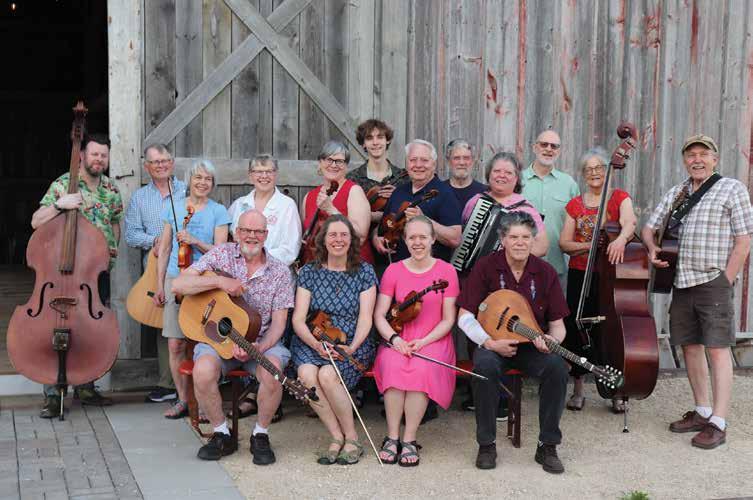
The Norwegian-American Old-Time Dance Music Ensemble, which Hoven Rotto formed at the beginning of her residency. Photo used with permission from the Sustaining Scandinavian Folk Arts in the Upper Midwest project at the University of Wisconsin-Madison.
Collection, LeRoy Larson Collection, Robert Andresen Collection, and Down Home Dairyland Collection. She spent months listening to hundreds of hours of old-time music recordings from all over the Driftless Area, compiling meticulous notes for corrections and providing additions to collection records from decades of her own research and experience as a musician in the area. She also transcribed tunes that are not generally accessible to the public. Her notes are being incorporated into the collections at Mills – a significant collection improvement – and her transcriptions formed the basis of a repertoire she created especially for the Norwegian-American Old-Time Dance Music Ensemble, which she formed at the beginning of her residency. This ensemble consists of roughly 20 regular participants, a mix of UW-Madison faculty, staff, undergraduate and graduate students, and community members from the Madison area. The group is continuing to meet even after the end of the residency. All of this work demonstrates that these tunes still have the power to attract new practitioners, and there are resources to support musicians in connecting more deeply to this music. We also benefit from being reminded of the real purpose of the music, which is to get people dancing and bring them together in community.
Thank You
Anna Rue and Beth Hoven Rotto would like to acknowledge and thank several UW-Madison students and staff for their help in supporting Hoven Rotto’s residency. Undergraduate student Kaden Buck lent his time and talents to translate Hoven Rotto’s musical shorthand into standardized musical notation using notation software. Graduate students Caitlin Vitale-Sullivan and John Walker documented the activities of the residency and conducted interviews with Hoven Rotto for the Nordic Folklife project. Vitale-Sullivan, an accomplished musician, also played fiddle in the Norwegian-American Old-Time Dance Music Ensemble in the spring. Graduate student Megan O’Sullivan contributed by helping project team members refine their archiving protocols, aiding in the organization of residency materials. Thanks as well to Dr. Susan Cook, Professor of Musicology and Director of the Mead Witter School of Music at UW-Madison; Marcus Cederström (Community Curator of Nordic-American Folklore in the German, Nordic, Slavic+ Department); Nathan Gibson (Audio-Visual Preservation Archivist at the Mills Music Library); and the staff of the Mills Music Library for their help in supporting the many activities of the Musician-in-Residence program.
Finally, community partner and ensemble member Mary Pat Kleven also helped to transcribe several tunes and is carrying on as organizer of the Scandinavian-American Old-Time Dance Music Ensemble. Kleven also facilitated the residency’s collaboration with the Minnesota State Fiddler’s Association.
Vol. 20, No. 2 2022 5
Featured Old-Time Musicians
The individuals on the following pages featured heavily in Hoven Rotto’s residency research and are all recorded within the Arnold Munkel Collection at Mills Music Library, portions of which have been digitized and are available for streaming online. Many of the recordings created by Munkel were made at Nordic Fest during the musical programs sponsored by Vesterheim and organized by former director, Dr. Marion J. Nelson. Hoven Rotto selected a tune to transcribe for each musician and includes descriptions of the tunes and links to online audio recordings. Scan the QR codes (and click “open in browser”), or type the links into your website browser to listen to the recordings. Enjoy learning about these wonderful musicians and hearing them perform! We hope you’ll pick up your instrument, whistle a tune, or dance along.
Johannes (John) Sollien (1897–1983)
Norwegian American Johannes (John) Sollien was born in Winneshiek County, Iowa, where he spent the majority of his life until he retired to nearby Mabel, Minnesota. Sollien was the middle child and second son of his immigrant parents. When Sollien picked up the violin as a young man in 1913, his father did not object, but evidently kept a close eye on him by imposing firm curfews on nights when Johannes would play house parties (Torres, p. 41). Johannes began playing the violin as a student at Luther College and took several lessons from fellow classmate Arthur Helgeson (Torres, p. 36-7). Soon Johannes Sollien was off and running, getting his start by filling in for principle fiddlers as they ate a midnight “lunch” (a common time for the main musicians to take a break from playing and dancers from dancing) and later became a principle fiddler himself. Before long, he was playing regularly for house parties, barn dances, and the occasional wedding.
As often happened with musicians who had to choose a different career to make a living and support growing families, Johannes put his fiddle aside to pursue a 50year career as a house painter and didn’t play for several decades. Following the death of his wife, he began playing again and gathered regularly with musician friends in and around Mabel, Minnesota, as much for company as for the music. A single recording from Johannes Sollien’s jam sessions is preserved in the Munkel Collection. It is also fortunate that there is a scanned copy of a tunebook handwritten by Johannes Sollien. That tunebook is also accessible online through the Mills Music Library and can be found here: https://digital.library.wisc.edu/1711.dl/ V6KXKKAE4BSGZ8S.
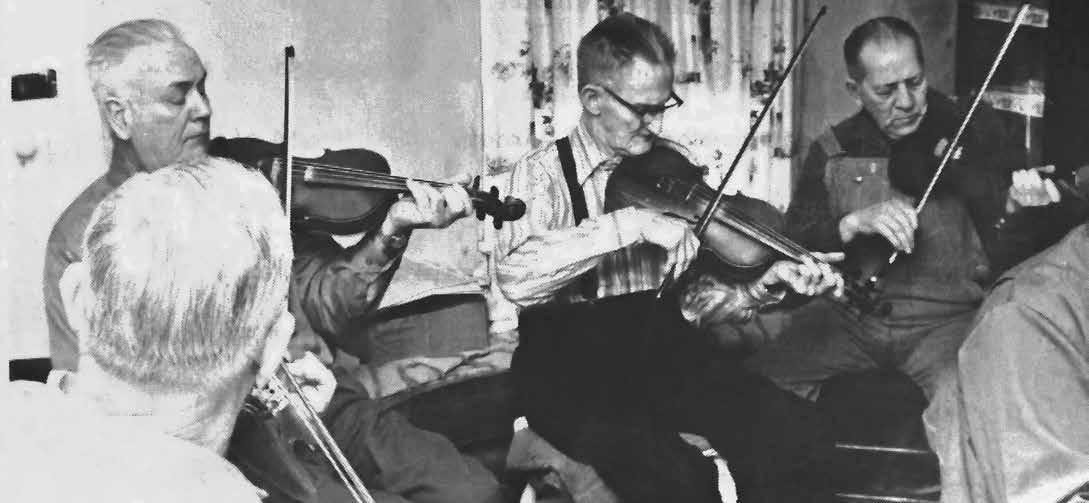 Johannes Sollien (center), photo by Alan Zarling, from the Luther College Archives. Reprinted with permission from Conversations With the Recent Past (a northeast Iowa oral history project edited by Luis Torres at Luther College, 1975).
6 Vesterheim
The Mabel Philharmonic Waltz
From Beth Hoven Rotto - I named this tune “Mabel Philharmonic Waltz,” but to complicate things, I later found it called “Oslo Waltz” in Johannes Sollien’s handwritten tunebook. There is a different tune in circulation called “Oslo Waltz,” so I’ve decided to continue to call this tune by my own name for it.
Luis Torres taught a folklore class at Luther College and was instrumental in starting regular dances at the schoolhouse in Highlandville, Iowa in the 1970s. When I first attended those dances, we fondly called the band “The Mabel Philharmonic.” Since the Sollien place, where the old-timers gathered, was near Mabel, Minnesota, and since Torres played with them there, perhaps he referred to the group that way, fondly, to his students. It’s a cute name and just my theory as to its origin. The group had about nine musicians, including Bill Sherburne, featured on the next page.
Unlike many fiddle jams, where most tunes are played in keys like D and G, and open (unfingered) notes are numerous, this group played many tunes in Bb and F (keys that rarely use open strings, usually making them more challenging to play). This tune has parts in C, F, and a nice D minor section as well.
This tune can be found on the recording “John Sollien’s House, June 9, 1975,” on Side 1 at 52 minutes, 21 seconds. I combined two versions of this tune found in the Arnold Munkel Collection to make this transcription. It is the version I play with my husband, Jon Rotto, and these are his chords, so there will be some slight variations compared with what you will hear on this recording.
The Mabel Philharmonic Waltz
LINK: https://digital.library.wisc.edu/1711.dl/26D4VJX425Q4H84

A recording of this tune can be found in the Mills Music Library, Madison, Wisconsin, in the Arnold Munkel Collection in the record called John Sollien's House, June 9, 1975 at 52:21. A group of musicians
33 25 17 9 D.S al Fine Fine D m D m A B♭ B♭ D m D m A D m A F B♭ C F G F C G m C D m F G D m C 2, 4 1, 3 1, 3 2, 4
Vol. 20, No. 2 2022 7
William (“Bill”) Sherburne (1903-1991)
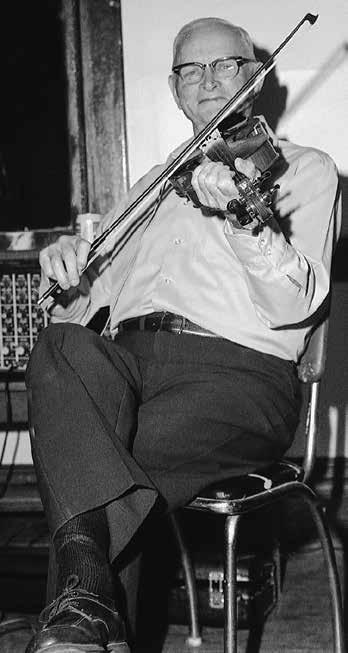
It would be negligent to talk about the persistence of old-time dances in this part of the world without mentioning Bill Sherburne. Sherburne was born into a family of fiddlers in Blackhammer Township (Fillmore County, Minnesota). A man with a remarkable memory, he came to be one of the best-known old-time fiddlers in the state of Minnesota and was celebrated for his remarkable skill as a musician and his extensive repertoire. His father was one of twelve children, all of whom played the fiddle, and these children were undoubtedly influenced by their mother, Bill’s grandmother, who was an accomplished fiddler herself and a popular performer at house parties when Bill was young (Robert Andresen Collection).
Sherburne began performing in the 1920s. He toured in the area and played regularly at barn dances and house parties as a young man. Later, he was best known for holding regular public dances in the old two-room schoolhouse in the little hamlet of Highlandville, Iowa, with his band, The Bill Sherburne Band (affectionately known by some as the Spring Grove Symphony). He carried hundreds of tunes from the house-party era of his youth to the Highlandville dances of the 1970s-1980s. Sherburne gained recognition as one of the region’s exceptional dance band leaders, performing at the Snoose Boulevard Festival in Minneapolis, the Norwegian-American Old-Time and Folk Music Festival at Decorah’s Nordic Fest, and as an invited performer at the Smithsonian Festival of American Folklife in Washington, D.C., in 1974 and again in 1976. Upper Midwestern folk music aficionado, musician, and radio host, Robert Andresen, played with Bill Sherburne at several Nordic Fests and wrote this about Sherburne’s musical style after his death:
There were once dozens of Norwegian-style fiddlers in Spring Grove, but Sherburne was always considered the best of them. His style really reflected his mixed Norwegian and old-stock American heritage. His Scandinavian tunes had a sort of New England or Anglo-Canadian feeling to them, while his “Yankee” tunes were molded into something a little more Norwegian. There was a hint of 1920s “pop” music in his playing too. His polkas often had catchy little ragtime endings. All of his music was somehow blended into a cohesive whole and carried the unmistakable Bill Sherburne stamp, with clear clean melodic notes and a highly danceable rhythm (Robert Andresen Collection).
Beth Hoven Rotto also describes the personalized touch Sherburne often applied to his tunes, noting that he frequently switched the keys of tunes other fiddlers might play, from the common keys of G or D to the lesscommon keys of C, F, or Bb. While Robert Andresen suggests in his writings about Bill Sherburne that the key changes Sherburne introduced were an aesthetic choice, Beth Hoven Rotto offers a different interpretation, which is that
Sherburne may have been searching for ways to stand out and show off his skills to other fiddlers by creating more challenging versions of common tunes.
While his style remained unmistakably his own, Sherburne passed much of his remarkable repertoire to Hoven Rotto during an Iowa Arts Council Apprenticeship in 1988. After his death in 1991, Foot-Notes has continued his legacy of making the area’s dance music accessible to musicians and dancers alike by carrying on dances in the same Highlandville schoolhouse where Bill’s band played.
8 Vesterheim
Bill Sherburne at the Highlandville Schoolhouse, photo by Charlie Langton.
Little Gem Polka
From Beth Hoven Rotto - Bill Sherburne never told me tune names, or even used tune names himself. When performing, he might just announce the key and start to play. The band would jump in a few notes (or bars) later when they figured out what he was playing. I prefer to associate a name with a tune, to help keep them retrievable in my head. Bill’s wife, Norma, or his accompanist, Virginia Faldet, knew the names if the tune had one.
This tune is “Little Gem Polka,” although there was some confusion with another tune collector who thought the tune was called “Little Jim” (along with a sing-song quality, Gs and Js are both pronounced as Ys in a Spring Grove/ Norwegian accent). This tune appears in one of LeRoy Larson’s tunebooks, but in the key of C. LeRoy said the piece was published by Marsh Music House in Decorah around 1920, composed by F. F. Knodle, although I have never located or seen a copy. I always heard Bill play this in the key of G, as in this transcription.
“Little Gem Polka,” featuring Bill Sherburne, Hazel Omodt, and Lester Storlie, can be found in the Norwegian-American Folk and Old-Time Music Festival at Nordic Fest recording from July 26, 1975, Part 2. The tune is played at 57 minutes, 47 seconds.
Little Gem Polka
LINK: https://digital.library.wisc.edu/1711.dl/27Q2QGR4VOPE28Z

I learned this from fiddler Bill Sherburne (1903- 1991) of Spring Grove, Minnesota. Several recordings of this tune can be found in the Mills Music Library, Madison, Wisconsin, in the Arnold Munkel Collection. One is in the recording from John Sollien’s house from June 9, 1975 on Side 2 at 4:10. LeRoy Larson
25 21 13 17 9 5 D.S al Fine Fine D G A D A D D G D D D G G G 2. 1.
Vol. 20, No. 2 2022 9
Arnold
(“Charlie”) Munkel (1918–2003)
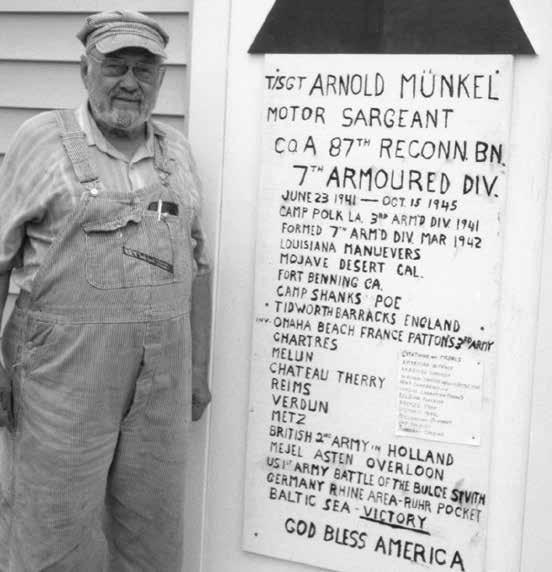
Arnold Munkel, or Charlie as he was called, should be credited for creating the incredible recorded collection from which Hoven Rotto transcribed roughly 80 of her favorite tunes out of the hundreds of distinct tunes during her recent residency at the Center for the Study of Upper Midwestern Cultures. The collection is truly unique, created by a man with a deep appreciation for Norwegian-American old-time music and a dedication to collecting tunes that, at the time, mostly existed in people’s memories. Munkel was born in Caledonia, Minnesota, in 1918 and lived just 13 miles away in Spring Grove, Minnesota, for most of his life, making a living as a mechanic and welder for the Houston County Highway Department.
Those who knew Munkel were well aware of his love for Norwegian-American old-time music, stemming from his childhood in the very musical area around Spring Grove. In 1997, Hoven Rotto made notes from conversations she had with Munkel about his early memories of music in the area. Her notes read, “Arnold Munkel’s parents always won dance contests for polka, waltz, and two-step. Arnold sat holding his knees on the edge of the stage, near the fiddler, while they danced” (Rotto correspondence). These moments clearly instilled in Munkel an early appreciation for local old-time music and, as an adult, he became known for frequenting live old-time performances throughout the Driftless, in particular at Decorah’s Nordic Fest during the Norwegian-American Folk Music Festival (also known as the Norwegian-American Folk and Old-Time Music Festival or Norwegian-American Old-Time and Folk Music Festival.)
Local musicians like Hoven Rotto and Foot-Notes bassist (and Spring Grove native) Bill Musser recalled how, in order to create the best possible recording, Munkel would
Schottische after Arnold Munkel
situate himself as close to the musician as he could – just as he would sit at the edge of the dance floor next to the fiddler as a child as he watched his parents dance.
Munkel had a practice of hitting “record” the second the music started up and then hitting “stop” as soon as a song concluded, thereby eliminating any announcements or song titles people might have mentioned during the performance. This may have been his strategy to use as much of the reel or cassette tape as possible for the music rather than the announcements, but from a preservation perspective, it makes it difficult to identify individual tunes. Anecdotes from artists like Hoven Rotto and Musser, who have expertise and deep knowledge of localized traditions, can contribute critical information for collection improvement.
After Munkel passed away in 2003, his recordings, equipment, and manuscript materials were donated to the Mills Music Library in Madison courtesy of Munkel’s surviving relatives. With funding from the National Endowment for the Humanities, these recordings were digitized and are accessible through streaming services at the Mills Music Library website. We owe a debt of gratitude to Munkel for capturing these performances and to Hoven Rotto for contributing her years of knowledge and amassed memories to making this collection more complete.
While Munkel did play the fiddle, he was not known for playing publicly and he seldom appears playing within his own collection. However, there are one or two examples of Munkel showcasing his musical talents by whistling, a strategy musicians sometimes use to commit tunes to memory. Hoven Rotto has transcribed an example of a schottische that Munkel recorded of himself whistling.
From Beth Hoven Rotto - Arnold Munkel was at many events that I attended in the 1980s. He arrived in his 1949 Ford automobile, looking dapper with his handlebar mustache. At Highlandville Dances, he came early to spread dance wax on the old wooden floor.
I didn’t know Mr. Munkel well, but I had several interesting conversations with him. He was a connoisseur of fiddling who appreciated a good tune and recognized a talented player. He encouraged public performances, whether at the local bar, an anniversary party, or a town festival.
On the recording used for this transcription, Mr. Munkel recorded himself to fill out the tape. The recording cuts off in less than 1 minute, but even in that time you can hear that he has a great musical sense. I’ve chosen a key that works for the fiddle. The whistled schottische can be found in the Norwegian-American Folk and Old-Time Music Festival at Nordic Fest recording from July 25, 1971, Side 1. The tune is played at 1 hour, 4 minutes, and 20 seconds.
LINK: https://digital.library.wisc.edu/1711.dl/KG5HNKIEWDVYC8N
Note: In this transcription, the second line should be repeated to end the tune or before going back to the beginning, when playing repetitions of the tune.

10 Vesterheim
Schottische after Arnold Munkel
Form: A B C B A B C
Arnold "Charlie" Munkel of Spring Grove, Minnesota loved music and was at many musical events
11 6 C C F C F C G C C G F C 2. 1. 2. 2. 1. 1.
Vol. 20, No. 2 2022 11
Arnold Munkel, photo by Beth Hoven Rotto.
Ellen Blagen (1919–2002) and Genette Leyse Burgess (1903–1977)
While it certainly is true that the fiddle has been played predominantly by men in the world of old-time music, there have been a significant number of talented women fiddlers performing over the years in the Driftless, not to mention women who supported the continuation of fiddling traditions in important ways without ever playing the instrument. Hoven Rotto has devoted particular attention over her musical career to including the stories of women fiddlers and musicians in her work and documentation, making sure they are remembered and that their contributions are not overlooked. Talented female musicians had more barriers to overcome than men in order to pursue an interest in music or become known for their music skills. In his book on Upper Midwestern old-time fiddlers, Farmhouse Fiddlers, Philip Martin wrote that, “[women] were expected to . . . play the piano – the instrument of church and parlor – rather than the fiddle of barn dance and saloon” (Martin, p. 78). Still, a number of women chose to play the fiddle and perhaps in greater numbers than we might expect.
Finding information about women fiddlers can be a challenge, partly because fewer people have recorded or documented them over the years. Hoven Rotto has kept a list of over a dozen area women fiddlers from the 19th and 20th centuries. One example she has lifted up in her work is Genette Burgess (sometimes referred to as Jeanette). Lifelong resident of northeast Iowa, Burgess was a talented fiddler who performed with The Scandinavian Orchestra, a nine-piece band out of Waukon, Iowa. Beth and FootNotes recorded a waltz after Burgess on their 1998 album,
Genette Burgess’ Waltz
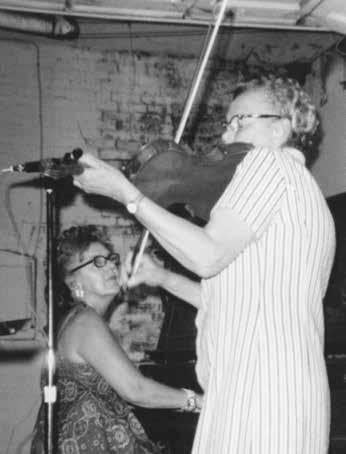
From Beth Hoven Rotto - Accompanists were often ignored in public performances and in printed programs, yet they sometimes saved a fiddler who forgot their tune under pressure, or mistakenly switched to a different tune midperformance. Ellen Blagen, often expected to accompany anyone without their own accompanist (usually without a rehearsal), sometimes dressed up like a clown and included comedy in some of her performances. I believe it was her way of being fearless and saying, “See me, hear me!”
Listening to festival performances, it became clear to me that crowds were often disrespectful of women fiddlers. They can be heard visiting at normal volume instead of listening, for example. One of the recordings from Decorah’s Nordic Fest includes a performance by Genette Burgess with Ellen Blagen as accompanist. Before Burgess’s performance, Blagen tells everyone how Burgess learned this tune from her father and that she recently had heart surgery, making sure everyone gave her a big hand before they began. This is the transcription I made from Ellen Blagen’s version of this waltz back in the 1990s.
You can hear Genette and Ellen playing “Genette Burgess’ Waltz” in the Norwegian-American Folk and Old-Time Music Festival recording from July 28, 1973, Side 2. Blagen speaks at 32 minutes and 15 seconds, and the tune is played at 33 minutes and 48 seconds.
LINK: https://digital.library.wisc.edu/1711.dl/RXDNWRD7HJLI28S

12 Vesterheim
Ellen Blagen accompanied by Genette Burgess, photo from the private collection of Beth Hoven Rotto.
My Father Was a Fiddler . . ., and the album’s liner notes introduce the waltz with this anecdote:
As a young girl, Genette had a burning desire to play, “Home, Sweet Home” on her father’s fiddle. It hung on the wall on the main floor of the house, but she was forbidden to touch it. Eventually she began to play it in secret, and, while practicing one day, she failed to notice her father, Edward Leyse, enter the cellar from outside. When he began rapping on the floor joists, she was petrified. To her relief, when he came up the steps he smiled and said in Norwegian, “Spel det igjen!” (“Play it again!”) Then he taught Genette this waltz.
Defying a father’s firm order to never touch a treasured family violin, only to be discovered by the surprisingly encouraging parent is a familiar story in fiddling circles, but rarely told in connection with women fiddlers. Burgess’s skill as a musician clearly prompted people to circulate this tale about her, claiming this story form for women as well as men. Playing on a par with men and being treated with the same respect as men, however, are two entirely different things, as the liner notes also illustrate: “[Burgess] once entered a fiddle contest as the only female competitor. Her daughter Mary, who was the accompanist, remembers the men laughing at Genette, until she began playing and won the competition.” Blowing away the competition was one way of silencing critics, but it’s easy to imagine that this kind of public treatment discouraged more women from playing the fiddle in public.
Still, Genette Burgess was not the only female fiddler in the Driftless Area who dared to enter and win fiddling contests normally dominated by men. Magdalene Ask
(1910–1956) of Frankville, Iowa, gained distinction as a musician when she won a Fiddlers and Jiggers contest in Spillville, Iowa in 1932. As the Decorah Republican newspaper recounted the event, out of a field of 20 fiddlers, “There were several ties which required play-offs, and Miss Magdalene Ask of Frankville, mowed down the entire group, winning the grand championship” (Decorah Republican, Oct. 20, 1932). Women like this were remarkable, not only for their musicianship, but because they dared to venture into spaces dominated by men and publicly demonstrate their skill. Sharing these stories helps more people connect in profound ways with the history of old-time music.
Through her efforts to uncover the stories of women musicians, Hoven Rotto gained a close friend in Ellen Blagen, a resident of the Decorah area. It was from Blagen that Hoven Rotto learned the Genette Burgess Waltz and heard stories about how she began to play. Blagen and Burgess played music together (Blagen chorded on the piano) and also regularly performed humorous sketches at Nordic Fest over the years. Blagen did not play the fiddle herself, but she was an accomplished pianist who learned many tunes from her father, Alfred, who played fiddle. Alfred, in turn, was influenced by Norwegian born fiddler, Johan Arndt Mostad (for more about Johan Arndt Mostad, see page 16). For years, Blagen was a steadfast accompanist to numerous performers on stage at Nordic Fest.
Ellen Blagen’s wit and musicianship were gifts to the community and they continue on through Foot-Notes’ productions, through the tunes Beth passes along to others, and now through the recordings in the Arnold Munkel Collection. Both Ellen and Genette Burgess appear as regular performers in the Munkel recordings from Nordic Fest.
Genette Burgess' Waltz
& # 4 3 . . . . Violin . œ J œ œ . œ J œ G œ œ œ œ . œ J œ C ˙ œ A m œ . œ J œ D œ œ œ 1 œ . œ J œ G ˙ œ 2 . œ J œ œ G . ˙ & # Vln. 11 . œ œ . œ œ . œ œ G . œ œ . œ œ . œ œ œ . œ J œ C ˙ œ A m . œ œ . œ œ . œ œ D . œ œ . œ œ . œ œ œ . œ j œ G ˙ œ & # Vln 1 9 . œ œ . œ œ . œ œ G . œ œ . œ œ . œ œ œ . œ J œ C ˙ œ A m œ . œ J œ G œ œ œ D . œ j œ œ G . ˙
Vol. 20, No. 2 2022 13
Leonard Finseth (1911–1991)
Leonard Finseth of Mondovi, Wisconsin, was a secondgeneration Norwegian American (third on his mother’s side) whose father had worked as a lumberjack in northern Wisconsin after emigrating from the Trondheim area in Norway as a teenager. Leonard Finseth grew up surrounded by talented musicians and his repertoire was estimated to include hundreds of melodies and songs, the majority of which were waltzes, the most popular dance in Norway after 1840 (Robert Andresen Collection).
The liner notes from the CD Scandinavian Old Time: Folk Fiddler from Wisconsin introduce Finseth with:
Although he is American-born, Leonard Finseth plays his tunes in a more authentic “old country” manner than did the fiddlers who influenced him. It is almost as though some type of musical genetic memory is at work within his system. Most of the many old-time dance tunes he plays are either of Norwegian origin or indigenous to the Upper Midwest. They are, however, constructed in the style of Norwegian prototypes. In a broader sense, Leonard’s music is actually a distinctly personal music because, regardless of the origin of his tunes, he imposes his mark upon them and molds them into his own.
Works Cited
Andresen, Robert. N.d. Box 2, Folder 28. Robert Andresen Collection, 1976–1994. Mills Music Library, University of Wisconsin–Madison, WI.
Decorah Republican, June 26, 1879. (https:// winneshiekcounty.advantage-preservation.com/ viewer/?k=bowery%20dance&i=f&d=0101185712311949&m=between&ord=k1&fn=decorah_republican_usa_ iowa_decorah_18790626_english_3&df=1&dt=10&cid=2701)
Decorah Republican, “Dance Pavilion At Trout Run,” May 18, 1921. (https://winneshiekcounty.advantage-preservation.com/ viewer/?k=build%20pavillion%20dance&i=f&d=0101185712311949&m=between&ord=k1&fn=decorah_public_opinion_usa_ iowa_decorah_19210518_english_2&df=1&dt=10&cid=2701)
Finseth, Leonard, 1911- performer. 1979. Scandinavian Old Time: Folk Fiddler from Wisconsin. Minneapolis, MN: Banjar Records. Foot-Notes (Musical group). My Father Was a Fiddler . . . [Decorah, Ia.]: Foot-Notes, 1998.
Gibson, Nathan D. and Anna Rue, “‘We Have All Been Neighbors Here’: Preservation, Access, and Engagement with the Arnold Munkel Collection,” edited by Tim Frandy and B. Marcus Cederström. Culture Work: Folklore for the Public Good. Madison, Wisconsin: The University of Wisconsin Press, 2022. Larson, LeRoy. 1975. Scandinavian-American Folk Dance Music of the Norwegians in Minnesota. Diss. University of Minnesota. Leary, James P. 2006. Polkabilly: How the Goose Island Ramblers Redefined American Folk Music. Oxford: Oxford University Press. Martin, Philip. 1994. Farmhouse Fiddlers: Music and Dance Traditions in the Rural Midwest. Mount Horeb, WI: Midwest Traditions. Rotto, Beth Hoven. April 6, 2022. Email correspondence with Anna Rue.
Torres, Luis, ed. Conversations With the Recent Past: Northeast Iowa Oral History Project. Luther College Press: Decorah, Iowa, 1975.
Finseth may have absorbed this “old country” sound through a neighbor fiddler, Ingvald Syverson, whose father had been a fiddler from Gudbrandsdalen, Norway, but he also tried to emulate the style of his uncle, Edwin Quall, an accomplished fiddler himself who helped a teenage Leonard order his first fiddle through the mail and gave him his first lessons. The borrowing and mixing of different melodies and styles from these musicians combined with Finseth’s personal execution of the music worked in concert to produce a sound that at the time, “probably best exemplifies the Norwegian-American fiddle style in the Upper Midwest” (Robert Andresen Collection).
Finseth continues to inspire regional musicians in their efforts to revitalize the mixed ethnic old-time repertoires of the Upper Midwest and his performances can be found on several albums of Norwegian-American folk music as well as live recordings from his own named music collection and the Arnold Munkel Collection, both housed at the Mills Music Library. Notably, musician Mike Sawyer has produced an album of Leonard Finseth’s tunes through the Minnesota Fiddle Tunes Project called Reviving the Wisconsin Barn Dance Tunes of Leonard Finseth
About the Authors
Anna Rue is Associate Director of the Center for the Study of Upper Midwestern Cultures and works on the Sustaining Scandinavian Folk Arts in the Upper Midwest Project. She holds an M.A. in American Studies from the UMass-Boston and an M.A. and Ph.D. in Scandinavian Studies and Folklore from UW-Madison. Rue teaches courses relating to folklore fieldwork and methodology, public folklore, and Scandinavian American and Upper Midwestern cultures.
Fidder Beth Hoven Rotto began playing violin in fifth grade on an instrument made by her great uncle. She played in school orchestras, including at Luther College, but didn’t take up fiddling until apprenticing with Bill Sherburne of Spring Grove, Minnesota, in 1988. She became passionate about collecting stories and tunes of the area’s NorwegianAmerican fiddlers after forming the dance band Foot-Notes. She lives in Winneshiek County, Iowa with her husband (and bandmate) Jon Rotto.
14 Vesterheim
Ole Bull’s Waltz
From Beth Hoven Rotto - Leonard Finseth called this tune “Ole Bull’s Waltz” and “an old waltz.” Ole Bull (1810-1880) was one of the first European touring musicians in America and was extremely popular wherever he performed. He promoted Norwegian nationalism by interpreting folk music, particularly music played on the Hardanger fiddle. There are a number of tunes in circulation called Ole Bull’s Waltz.
As with all these transcriptions, anyone who wants to play them should be sure to listen carefully to the field recording and then use the sheet music as a guide.
“Ole Bull’s Waltz” featuring Leonard Finseth and Mrs. Arnold Olson can be found in the Norwegian-American Folk and Old-Time Music Festival at Nordic Fest recording from July 29, 1973, Part 1. The tune is played at 11 minutes, 22 seconds.
Ole Bull's Waltz
LINK: https://digital.library.wisc.edu/1711.dl/ RXDNWRD7HJLI28S

Leonard Finseth (1911-1991), a fiddler from Mondovi, Wisconsin called this tune Ole Bull’s Waltz. Ole
(1810-1880) was
one of the first European touring musicians in America
extremely
Bull
and was
24 18 12 8 E D A D A A E A D A A E A E A A 2. 1. 2, 4 4 2 1, 3 1, 3
Vol. 20, No. 2 2022 15
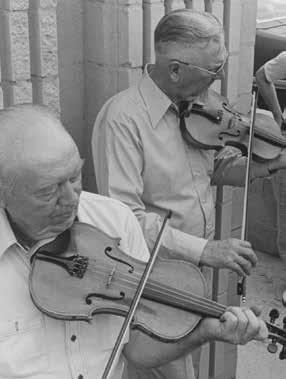
Leonard Finseth (left) with Bertel Malm (right), photo from Vesterheim collection.
Foot-Notes & Friends Play the Music of Johan Arndt Mostad –Lost Tunes from a Norwegian Immigrant’s Notebooks
Decorah’s Foot-Notes, with support from Vesterheim, invites you to check out the recording of the complete concert Foot-Notes & Friends Play the Music of Johan Arndt Mostad – Lost Tunes from a Norwegian Immigrant’s Notebooks at this link on YouTube youtu.be/R2uy6o2lpGg or at the QR code to the right.
Johan Arndt Mostad (1833-1909) was a member of a well-known family of musicians from the Frosta area of Trøndelag, Norway. Johan immigrated to northeast Iowa as an adult in 1869 and was a popular performer for local dances and house parties. Along with the performance, the concert includes stories about Mostad’s life in Norway and Iowa and anecdotes from old-time dance parties and barn dances in rural Iowa.
Musicians playing in the concert are Beth Hoven Rotto, fiddle and piano; Jon Rotto, guitar; Ann Streufert, violin and viola; Amy Shaw, flute; and Rob Hervey, bass, mandolin, and guitar. Guest musicians include participants in the Fourth Sunday Music Jam at Vesterheim: Bill D Bill Deutsch, Janette Dragvold, Tyler Hendrickson, Kailin Jolstad, Lindsey Scott, and Dianne Clark Prieditis, who is a great-granddaughter of Johan Arndt.
Hoven Rotto discovered Mostad’s tune books during a research project of music traditions for the Smithsonian Institute’s Folklife in Iowa Project in 1998. Through connections and conversations, Rotto heard of “a wonderful fiddler who kept tune books in a beautiful hand.” Ellen
Blagen, whose father had played fiddle with Mostad, was determined to help Hoven Rotto find the music, and, after many phone calls, she located them in the possession of Arndt’s great-granddaughter in Minnesota. The flowery script was extremely difficult to read and often lacked standard musical notation, so Hoven Rotto’s copies of the tune books sat untouched for years.

Recently, all 787 tunes and tune fragments were transcribed to standard notation by Otter Dreaming through an award from the American Scandinavian Foundation. This concert builds on that accomplishment by bringing this rare collection of music to life.
The musicians are thankful for funding support from the American Scandinavian Foundation and filming expertise from Vesterheim staff. The concert is dedicated in memory of Decorah musician John Goodin.
Foot-Notes originates from Decorah, Iowa, and has made a name for itself as a bearer of Norwegian-American dance music traditions in the Upper Midwest. The band has performed at local events and dances and are a tradition at Decorah’s Nordic Fest street dances. It has also appeared on regional, national, and Norwegian radio, at the Smithsonian’s Festival of American Folklife in Washington D.C., the Festival of Iowa Folklife in Des Moines, Iowa, and performed as part of the “Masters of Tradition” series at the Kennedy Center for the Performing Arts, Washington, D.C. It has produced several recordings, including Decorah Waltz and My Father Was a Fiddler.
Join Vesterheim
in sharing and celebrating traditional folk tunes!
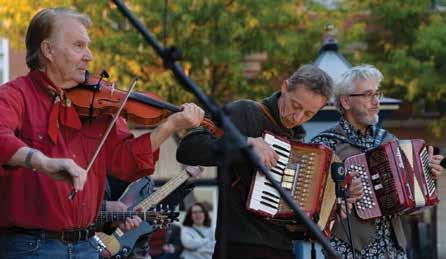
In September, Vesterheim hosted a street concert with Dalakopa, the traditional folk music group from Norway.
Over the years, Vesterheim has hosted many folk music concerts and workshops with musicians such as Kaivama, Baltic Crossing, Gangspil, JPP, Haugaard and Järvelä, The Nordic Fiddlers Bloc, Foot-Notes, Vidar Skrede, Dalakopa, Bernt Balchen (Jr.), LeRoy Larson & The Minnesota Scandinavian Ensemble, and more. Vesterheim Folk Art School values Scandinavian folk music as an important tradition to share and is pleased that there will be several onsite music workshops planned for 2023!
Please check vesterheim.org/folk-art-school for details, tickets, and registration as schedules are released quarterly each season – February 10, May 10, August 10, and November 10.
Vesterheim is also planning an exhibit about music opening in the summer of 2024. More details to come!
16 Vesterheim
