
Norwegian-American Architecture
By Darrell D. Henning and Kolbein Dahle
In the century from 1825 to 1925, over 800,000 persons left Norway bound for the New World. They left for a variety of reasons, but primary among them was an expanding rural population that put extreme pressure on the agricultural base of the economy. Compared to the rugged, mountainous land of Norway, dominated by forests, lakes, rivers, and fjords, North America’s seemingly limitless farmland was a lure few could ignore. So they packed their possessions and sailed for their new home. In their luggage were the tools to make textiles, food-related utensils, and the tools of the woodworker, blacksmith, and farmer. But most importantly, they brought their knowledge of how to use these tools in their traditional manner to weave, cook, farm, and construct their homes.
The immigrant home embodies both a survival of tradition and an adaptation to the new physical and cultural environment that confronted the immigrant in his vesterheim, or western home. Although the immigrants settled in a variety of locations and settings, the scope of our study is limited to those who left a rural, agricultural lifestyle and sought similar circumstances in the New World. Several house types that were commonly found in the Norwegian communities established in the American Upper Midwest had their origins in the homeland.
Among the first to study and describe Norwegian building traditions was Eilert Sundt in his seminal book from 1862, Om byggenings-eskikkerne på landet i Norge, where he described
different house types and their geographical distribution. Sundt was also interested in social differences as they related to house types.1
These included multi-generational occupation relative to the size and number of rooms of particular dwellings. Kolbein Dahle father offered a later example of this in the living arrangement of his parents’ house for the years between 1910 and 1930.
. . . my parents had the main room or kitchen. One grandmother had the chamber in connection with this room, and the [other set of] grandparents, the rooms on the other side of the entrance. Upstairs was rented away. Most people had it this way. And if the house contained rooms they did not need daily, they were used for guests, parties and receptions.2
There is little evidence that such multi-generational use was practiced often in the New World, although newly-arrived individuals or families were often temporarily put up in an established household. Usually a first-generation home continued to be occupied by the immigrant/builder; the next generation built a new and often larger home.
All of the houses described have a long history in the homeland dating from as early as the Middle Ages to the eighteenth and early nineteenth centuries. The study of rural
architecture in Norway tended to stop in the middle of the nineteenth century, therefore the ideals or dreams emigrants had for a dwelling when they started for the New World are not well known. A look at the recorded examples may shed some light on the experiences and mindset of the immigrants who made the transition from the Old World to the New during the century of migration.
Predominant house types vary between districts and valleys in Norway, but there seems to be little correlation between place of origin in Norway and the house form the immigrant built in America. The home district or valley from which a builder/occupant of a particular house illustrated here is identified wherever possible. But it appears that economic or social status was also a factor in determining the type of house that was built, rather than what might have been typical or expected from their former circumstances.
With the introduction of the cast-iron stove and cook range in the eighteenth and nineteenth centuries, some changes in house design and function were already underway in Norway before many left for the New World. In fact, one of the first major purchases of the typical immigrant must have been a cast-iron stove or range. With the exception of the oneroom houses, the “modern” stove was moved to a more central location, rather than the common practice of locating it in a corner of the main room.
The first substantial dwelling that the Norwegian immigrant constructed was most often a two-three-room house drawn from a long-standing tradition. The form can be traced back to the Middle Ages and continues to be a factor to the present day, although much modified or repurposed.
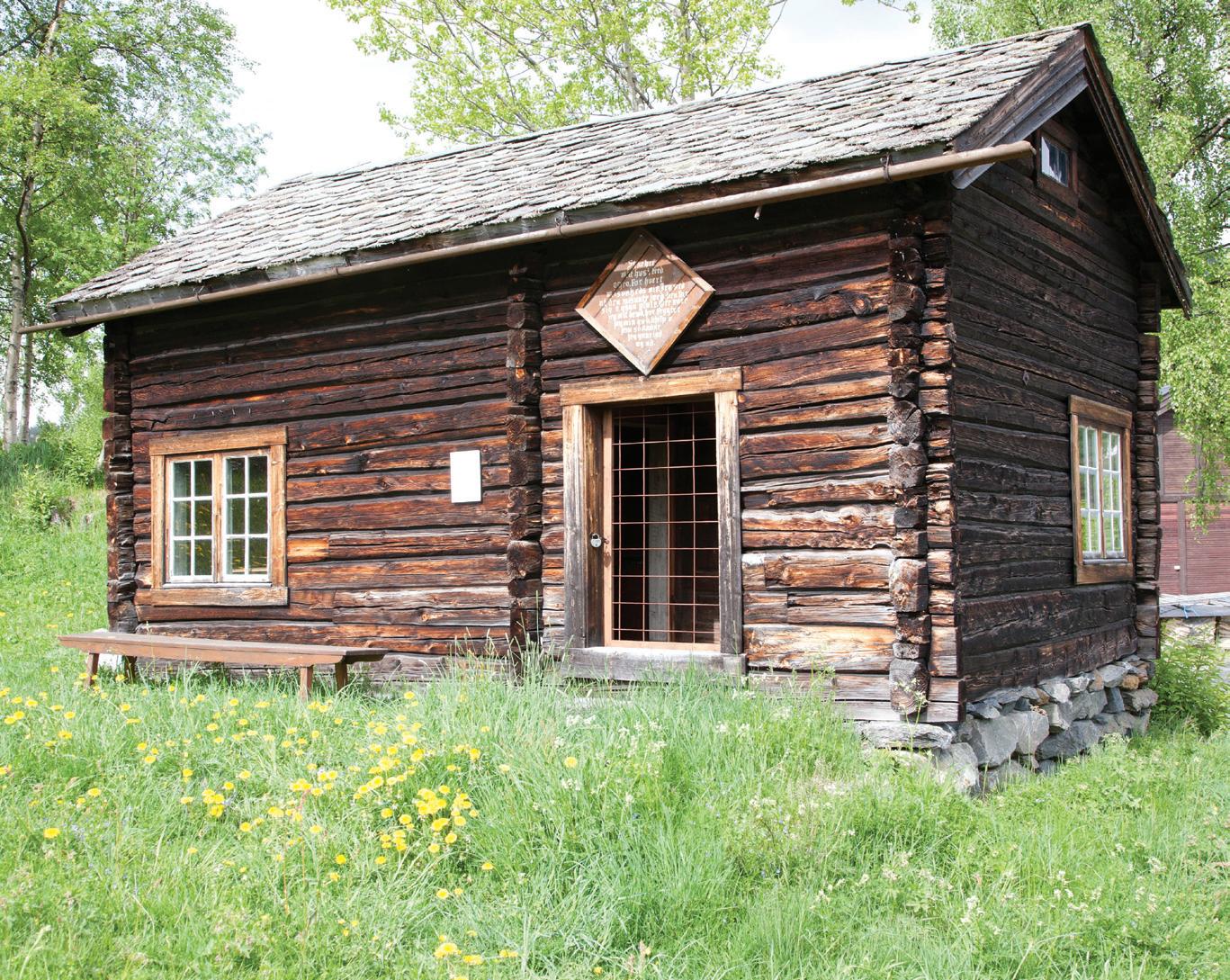
A Norwegian example is Jutulstua, from Uv, Rennebu, Sør Trøndelag (see photo). While only a part of the original entrance is preserved in the science museum in Trondheim, a copy has been reconstructed on the original site. Well-known similar houses from the same time period are found in Nore and Uvdal in Numedal and Aga in Hardanger. Later examples can be found all over sourthern Norway from Valdres westward, often separated both physically and culturally (language/dialect). These houses would have had a centrally-located open fireplace and a smoke hole in the roof.
By the seventeenth century, a fireplace with chimney, located in the corner of the main room (stue, or stugo) has replaced the centrally located open hearth of the medieval house. The floor plan (see drawing) is of the Andris Vang house, Vang in Valdres. The house is now at the Valdres Folkemusem in Fagernes. Though this house dates from the nineteenth century, it, like the earlier Jutulstue (thirteenth century), was constructed entirely of log, except for the dividing wall between the forstue (gang, or entryway) and kleve (kitchen annex).
Other examples from the medieval period were constructed using both log and timber-frame methods. In such examples, the main room was of log while the entryway and kitchen annex portion of the house were timber-frame, a construction technique that

continued to be employed for dwellings throughout the nineteenth century and occasionally into the twentieth, but commonly for a variety of outbuildings.
In the late eighteenth century, and in some locations earlier, the Akershus-plan house appeared, in which the entrance door was moved from the small room, or forstue, to the main room of the home. As a rule, a small, enclosed forstue was built over the door of this sub-type of the three-room-plan house, as illustrated in the plan drawing of the Andris Vang house (see photo).
In its simplest form, we find one-story examples with no attached forstue over the door. Many emigrants came from homes such as this, or from two-story examples with a fully-enclosed forstue like the late nineteenth-century house in Valdres (see photo).


Once in North America, the immigrant’s first substantial dwelling was most often the two/three room plan house. Drawing on long standing tradition as well as on the later developments in Norway, both the most primitive and the fully developed Akershus-plan homes could be found throughout the Norwegian American communities.3
Variations on the house type include the log-and-frame construction, where a square or rectangular log “pen” (the main room, or stue) was built with an attached but integral frame portion consisting of just the forstue, or the forstue and kleve. Entry was gained via a door in the gable end of the framed portion, as in the John Hanson house (see drawing bottom left), or from the side.
Often mistaken for a subsequent addition, the framed portion of such a house was an integral part of the initial concept and construction. Other variations involved construction of a cantilevered forebay over the framed entryway, as in the Forde house near Sattre in Pleasant Township, Winneshiek County, Iowa (see photo on page 29).
In America this house was usually built as a one-and-ahalf-story dwelling. In the examples with the entry door in the forstue, the access stair to the second story is located there. Occasionally, in the small and more primitive examples, and where the framed forstue is not divided, access to the main room is located in the center of the gable-end log wall. A heating device, usually a cast-iron cooking range, was then located to one side of this door in a corner. The main room of the house functioned as kitchen, dining room, living room, and often as a bedroom. The second floor served as bedroom(s).
The three-room Akershus-plan house is also well represented in the Norwegian-American communities in the Upper Midwest. Some examples were constructed entirely of log, such as the house built in Worth County, Iowa, by Sjur Helgeland in the 1870s and the one built by Paul Engum around 1890 and now located at Norskedalen Museum, Coon Valley, Wisconsin.
The three-room Akershus-plan house, as a result of relocating the entrance door, required some interior modifications. The stair to a second floor was now accessed from the main room through the dividing wall. The two smaller rooms were often reassigned as a pantry, or kleve, and an additional bedroom.
The three-room-plan house was common throughout southern and eastern Norway in the nineteenth century and formed the basis of the larger parstue, or paired-parlor house. By simply adding another room lengthwise to the three-room house, either with an addition or as an entirely new construct, a new and somewhat grander home was created. The entrance to this larger house was located in the center of the house, which, like the older forms of the three-room house, was accessed through a small forstue.
The additional room was used as a more formal gathering place, or a separate room for extended family. The stair to a second floor was in the entryway and the space behind the stair was divided from this hall and used as an auxiliary to the kitchen.
The parstue sported a pair of chimneys, the larger one identified the kitchen side of the house, the smaller one the parlor side. The chimneys followed the interior partition walls and exited the roof on either side of the central hall.

The Forde house was built by immigrants from Sogn, Norway, and modified over the years. The house was partially dismantled and approximately four logs were added to the middle of the construction, then the house was reassembled, thus effectively creating a full second story to what had been initially a story-anda-half house. Numerous examples of such modifications have been documented.


Akershus-plan house was built by Paul Engum as an addition to the one-room dwelling he built in 1867. The house was constructed as a single rectangular log pen structure divided into the traditional three-room plan

This nineteenth-century example of a parstue is from Fåberg, Gudbrandsdal, Norway, with an old-fashioned fireplace and room functions. Illustration courtesy of Kolbein Dahle.
In America, the parstue form often reflected the elevated social or economic status of the builder/owner. A few examples may have begun as three-room houses that had a parlor added as circumstances permitted. Most examples, however, appear to have been conceived and built as a fully developed parstue home from the onset.
A good example of the American parstue, the Blexrud house was built in the 1860s by a successful farmer, Niels Olsen Blixrud, (both spellings are found in the family record) near Spring Grove, Houston County, Minnesota. Blixrud emigrated from Norderhov, Buskerud, Norway in 1853.
In Norway, the svalgangstue, or veranda house, was a large house divided almost symmetrically into two rooms with a single, centrally located chimney and is found in the same

Blexrud house, southeast elevation. Such a large home likely illustrates an improved socio-economic status achieved in a relatively short period of time. A blurb in the Spring Grove Herald, March 22, 1900, indicates that John Blexrud (son of Niels) “. . . has built an addition to his house . . .,” perhaps the addition shown here. This house has been continuously occupied and a number of alterations have been made over the years. A modern bathroom has been incorporated into the space behind the stair, from what had originally been the kitchen annex with access to the kitchen. Photo courtesy of Paul Cutting.
areas and time period as the parstue. Access was by separate doors from a sval or covered veranda.
The sval, or veranda, could either be open, partially enclosed, or completely enclosed, but was normally unheated. Access to the second floor was via a stair located in the sval, which led to separate doors accessing the two upstairs rooms.
The svalgangstue is also a traditional house type associated with Norwegian-American rural communities. In Norway you could only move between the rooms on each floor by passing through the unheated sval. However, usually in the American examples there was a door between the two rooms on the ground floor, whether by design or subsequent alteration has not been determined. Even in the American examples, however, on the second floor you could only pass between rooms by going through the sval. The roof line, as viewed from the gable end, is symmetrical over the entire structure.
The typical svalgangstue was built combining both log and frame construction methods. One example from Wisconsin was built with a cantilevered forebay, while in another example from Minnesota, the builder, who was likely from Vraadal in Telemark, used the sill (base) log and plate (top) log, which extended out from the main body of the house, to frame in the entire sval. 4
Between 1720 and 1807, there was a long period of peace in the Nordic countries, accompanied by economic growth and increased population. One result was a significant rise in the numbers of “cottagers,” or tenant farmers, and tradesmen that caused significant changes in the society and traditional lifestyle. New homes built during this time were often small and relatively simple. The emigration that reached its zenith in the 1880s recruited many from this class.
It is from this level of society that we find the one-room houses that figured prominently as first-generation homes on the American frontier. It is likely that these houses, like the Eric Egge house now at Vesterheim, were equally as common as the two/three-room houses (see photo).
Typically the entry door in this small, rectangular, one-andone-half story house is found in the longer side wall, usually with a window immediately adjacent to the door. Access to the second floor was via an enclosed stair in the corner to the left or right of the door, relative to the window. (If the window was to

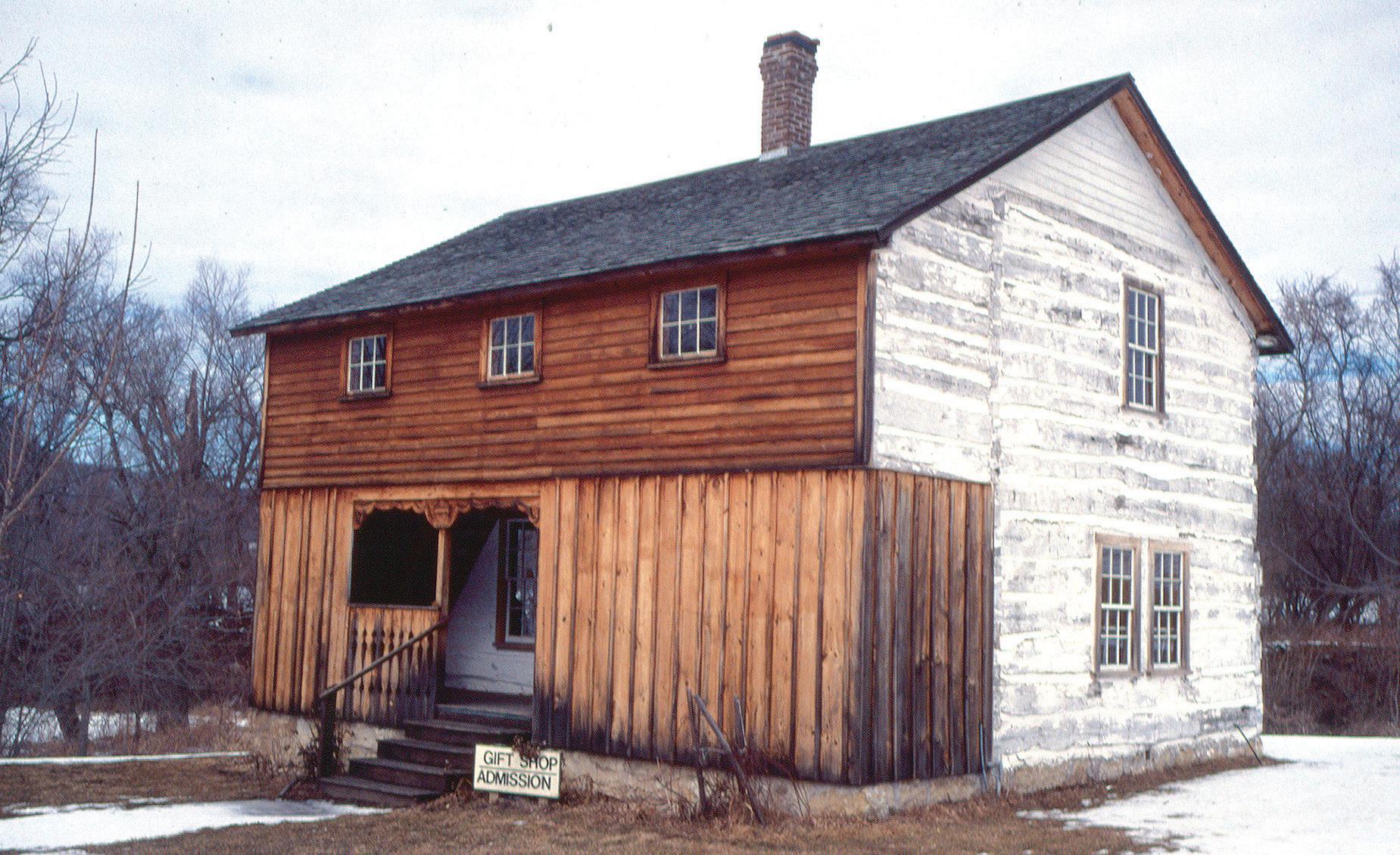
Haatvedt/Ekern house was built by
Olsen
in Dodson Hollow between Chaseburg and Coon Valley, Wisconsin. It is now at Norskedalen in Coon Valley, Wisconsin. The family emigrated in 1844, settling first in Koshkonong, Wisconsin, before moving to the Coon Valley area in 1855. Tollef’s first wife died in 1859 and he remarried in 1864. The house illustrated here was probably built in 1869.
by Darrell Henning.

A house like the Eric Egge house often became the first dwelling of the immigrant in rural Norwegian-American communities. Eric Egge, an immigrant from Hadeland, built this small (about 14 feet by 16 feet), one-room, one-and-one-half story house in Frankville Township, Winneshiek County, Iowa, in 1851-52. Eric and his wife, Helena, and family lived here until he built a larger, three-room-plan house in 1872. The house is now part of Vesterheim’s Open Air Division.
the right of the door, the stair would be to the left and vice-versa.)
A cast iron heating/cooking device was located in the corner behind the stair. A few one-room houses have been documented with the entry door located in the center or near center of the gable-end wall. Such houses are similar in form to some of the earliest log homes in Norway and to a variety of structures such as storehouses, bath houses, workshops, etc.
During the later years of the nineteenth century, due to short supply of suitable timber for a log house, traditional dwellings have been found where a variety of construction materials were used. The Andrew Wickney house, now at Vesterheim, was built on Wickney’s claim near Northwood, North Dakota, in 1879-80. Using balloon-frame construction, the original house was nearly identical in size and proportions to the 1851 Egge house. The lean-to addition was used as a bedroom/parlor and was added about 1900, when Andrew’s wife, Bertha, had a leg amputated and was no longer able to climb the stair to the upstairs bedroom (see photo).

Wickney emigrated from Sognefjord in western Norway.
Another example where modern construction methods were substituted for traditional building methods is the Ingvalson/Bjørgo house, which was built on the three-room Akershus plan by Ivor L. Takley (Takle) in 1902 for Gunvald Ingvalson in Highland Township, Winneshiek County, Iowa. Gunvald Ingvalson emigrated from Hemsedal, Hallingdal, Norway in 1850. This is likely the third house his family occupied before they moved to Newhouse, Minnesota, in 1916.
Ivor L. Takle, a well-known house builder from the area, was a second-generation Norwegian American whose family came from the Sognefjord area in western Norway. On the exterior, the Ingvalson/Bjørgo house appears typically American for the time period, with an open porch or veranda and second floor deck and clad with decorative shingle siding. The interior, however, is the traditional three-room plan (see photo).
Traditional houses were also built of stone and brick. A small house located on East Water Street in Decorah, Iowa, is one such example of a traditional three-room Akershus-plan house built of native stone. The main room even has hewn, exposed beams supporting the second floor.
Another example where non-traditional materials were used to construct a traditional home is the Bottolfson house, located in rural Allamakee County, Iowa. Nils Bottolfson built a rather grand parstue house on his farm in 1876. Nils, who trained as a shoemaker in Norway, emigrated in 1850 at the age of 26. Twenty-five years after he emigrated, he was building a large and imposing house along traditional lines, with major additions, on his farm in eastern Allamakee County, Iowa. The home he built represents a considerable step up in social and economic status from his humble beginnings in Norway (see photo).

The Ingvalson/Bjørgo house in Highland Township, Winneshiek County, Iowa. Moved to the Norwegian Emigrant Museum, Ottestad, Norway
Photo courtesy of Bill Musser, Decorah, Iowa.

Although the basic plan of the several Norwegian house types was most often the basis for a new home in America, it was soon modified and adapted to conform to the cultural and geographic realities encountered in the New World. One of the more pervasive adaptations occurred almost from the onset of settlement and shelter construction. Once past a temporary shelter, such as a dugout, cave, or claim shack dictated by the government, a first proper house, although usually built of logs, was accomplished using construction techniques more often associated with barn construction in Norway, or techniques associated with other immigrant groups.
Most Norwegians abandoned the long-established groovenotching and scribe-fit construction in favor of full dovetail corner notching, with gaps left between the logs that required chinking made up of wood scraps and mortar.5 The whole building was then whitewashed, both inside and out. Some examples of traditional lafting (log construction) have been documented but they are few in number.6
Other changes and adaptations to traditional building practices occurred soon after settlement. The practical and picturesque sod roof so often associated with Norwegian rural dwellings was quickly abandoned in the U.S., even as it was being replaced in Norway in favor of stone (slate), tile, wooden shingles (flis tak), or boards. Although there were early attempts at sod roofs, the climate and weather patterns of the Upper Midwest proved incompatible with them. The structure designed to support the weight of a sod or stone roof, however, has been found in a surprising number of immigrant log homes. Full length ridge beams and purlins (occasionally paired) are indicative of a holdover from the traditional roofing methods and materials. Even when a sod roof was attempted, it was quickly abandoned in favor of wood shingles applied to a framework of rafters and boards.
Few exterior doors were constructed by the builder, as these were readily available or simply copied giving the house that “American” look. Interior doors were far more likely to be made in a traditional fashion. These were often simple boardand-tapered-dovetail-batten constructs, or a three-panel door similar to many throughout Norway.
Windows were commonly purchased, 6 over 6 light, or later, 2 over 2 light double-hung sash. Casement type windows commonly used in Norway would have to have been made by hand. Few examples of the latter type have been found in the surveys of Norwegian-American homes.
Siding in the form of vertical tongue-and-groove, boardand-batten or horizontal weather board was often applied to the exterior of the traditional home. In the case of a log/frame construction, the frame portion was covered immediately, while the log portion of the house was often sided within 20 years of its initial construction. There are, of course, exceptions, as a few log homes have been left with exposed logs until the present day and treated with successive applications of whitewash. Interior surface treatments consisted of whitewash, later covered with lath and plaster, wainscoting, or both, as time, circumstances and American influence increased.
Typical additions to the traditional Norwegian house included, most commonly, a lean-to construct at the back of the house, which usually functioned as a kitchen. This involved cutting a door in the back wall of the main room and repurposing the function of that room. Another common change to the original house was to raise the ceiling by partially dismantling and adding several logs to raise the roof and create higher, more fashionable, ceilings. Dormers were often added, as was a porch to the front of the house. One end of the porch was often enclosed, creating a small storeroom. The changes and additions were accomplished as the immigrants adjusted and adapted to their new geographic and cultural circumstances. The exterior appearance became more and more “American,” but also changed functionally with subsequent additions. The basic forms and plans, however, remained surprisingly constant. The larger homes —the threeroom, parstue, and svalgangstue houses—are often found to have been occupied continuously to the present day, as upgrades such as modern plumbing, heating, and electrical service were often satisfactorily incorporated into these larger homes.
In spite of the additions and many layers of cosmetic surfaces, the original forms and construction can readily be determined. The arrangement of the rooms, the location of the chimney or chimneys, and the placement of the windows and doors provide the necessary clues to a home’s original appearance and origins. Few of the smaller, one-room-plan houses are found occupied today. They either have been abandoned, incorporated into larger dwellings, or repurposed, usually into summer kitchens. They have often been acquired by museums or historical agencies, where they are proudly displayed and interpreted as typical relics of their immigrant origins.
However important such preserved buildings might be, they tell only part of the story. By studying and understanding the several house building traditions of Norway and their somewhat camouflaged American counterparts, we can better understand both the persistence of tradition and changes the Norwegian immigrant community underwent in their continuing saga of becoming American. Perhaps, too, we might see the influence their traditions had on the overall built landscape wherever they settled.
Endnotes
1 Eilert Sundt, Om bygningsskiken på landet i Norge, 1862. Reprint. (Copenhagen: Gyldendal, 1976.).
2 Kolbein Dahle in conversation with co-author Darrell D. Henning.
3 The majority of houses considered here, and in most surveys of dwelling houses in Norwegian-American communities, are of log, or partially log, construction. Log construction for purposes here shall be defined as limited to the fitting of horizontally laid timbers or logs joined at the corners by some interlocking method. Such timbers may be left as found, i.e. round, or modified by shaping them in some predetermined fashion, such as sawing or hewing flat what would be the inside and outside surfaces. Building with logs was common to many groups of migrants from Europe. German, and to a considerably lesser extent, Swedish migrants, in the seventeeth and eighteenth centuries were among the first to bring the concept to the New World, but in the nineteenth century, a new wave of Germans, Swiss, Norwegians, Swedes, Finns, and a host of folks from Eastern Europe also came with fully developed, but often subtlety different, log construction traditions.
4 American examples of the traditional svalgangstue have been identified in Wisconsin, Minnesota, and Iowa. One example from Iowa (not illustrated) was divided on the ground floor into the three-room plan like the Gardsøy house (see illustration). The other examples were divided into two rooms above and below.
5 I am aware of only three surveys of principally Norwegian-American log buildings in addition to my own, which mostly resulted from historic restoration consultant work. One of these surveys was conducted by Vesterheim Norwegian-American Museum, another by William Tishler in the Coon Valley area of southwest Wisconsin. A third by Paul Cutting, still in progress, encompasses parts of Winneshiek, Allamakee, and Fayette Counties in Iowa and Houston and Fillmore counties in Minnesota. To date Cutting has documented well over 200 log buildings, only one of which was built using the scribe fit method. The Vesterheim survey located one granary and one house using this method. The house, the Carl Anton Carlsborg house, is now in the museum’s collection. I have documented another in Sturgeon Bay, Wisconsin, the Hans Hanson house, presently being restored at Crossroads at Big Creek in association with the Door County Historical Society. None were identified in Tishler’s survey. There are undoubtedly others, but they are relatively few in number compared to the simpler, non-scribe-fit log houses. None of the surveys are published, but the Tishler survey is in manuscript form at Nature and Heritage Center in Coon Valley, Wisconsin.
6 Scribe fit: a lengthwise groove (meddrag) cut into the underside of a log to match the shape of the log beneath it. Often called a moss groove because moss was placed as insulation on each log as the building was raised. Groove notch: one of several specialized locking corner joints where the ends of the log extend beyond the walls of the building.
Sources
Aas, Arne. Fagre Telemark: Perler i kultur og landskap. Oslo: Lunde Forlag og Bokhandel A/S, 1997. (Norwegian with English summary.)
Bakken, Reidar. “Acculturation in Buildings and Farmsteads in Coon Valley, Wisconsin from 1850 to 1930.” The Peoples Art Among the Norwegians in America. Ed. Marion Nelson. Northfield, Minnesota: The Norwegian American Historical Association, 1994.
Berg, Arne. Norske Tømmerhus Frå Mellomalderen. Band I Allment Oversyn Oslo: Landdruksforlaget, 1989. (Norwegian, with English and German summaries).
Brunvand, Jan Harold. “Norwegian Settlers in Alberta.” Canadian Centre for Folk Culture Studies. Paper No. 8, 1974.
Bugge, Gunnar og Christian Norberg-Schultz. Stav og Laft i Norge: Early wooden architecture in Norway. Oslo: Byggekunst, Norske Arkitekters Landsforbund, 1969. (Norwegian, photo captions in English.)
Erixon, Sigurd. “North-European Technique of Corner Timbering.” FolkLiv. Nr. 1 (1037), pp. 13-60.
Gjærder, Per. Vestnordisk byggeskikk, gjennom to tusen år: Tradisjon og forandring fra romertid til det 19 Århundre, Arkeologisk museum i Stavanger (SmS) Skrifter 7. (Norwegian with English summary.)
Glassie, Henry. Pattern in the Material Folk Culture of the Eastern United States. Monographs in Folklore and Folklife, No.1. University of Pennsylvania Press, 1968.
Fapso, Richard J. Norwegians in Wisconsin. State Historical Society of Wisconsin, 1977.
Henning, Darrell D. “The Norwegian Two-and-Three-Room Traditional House Type in America.” Perspectives in Vernacular Architecture, II, Ed. Camille Wells. Columbia, Missouri: University of Missouri Press, 1986.
Herateig, Asbjørn E. Borgund in Sunnmøre: Topography, history of construction, state of research. Middelaldermuseet i Borgund Kaupangen.
Holzhueter, Jack O. “Aslak Lie and the Challenge of the Artifact.” Wisconsin Magazine of History. Vol. 70, No. 1, Autumn, 1986.
Hovdhaugen, Einar. “Husmannstida (the time of the tenant farmer).” Norsk Kulturarv. Oslo: Det Norske Samlaget, 1975. (Norwegian, but the captions are in English.)
Jahn, Gunnar. Byggeskikker: På Den Norske Landsbygg, [Building tradition on the Norwegian Landscape]. Oslo: H. Aschehoug & Co. (W. Nygaard), 1925.
Jordan, Terry G. “Alpine, Alemannic, and American Log Architecture.” Annals of the Association of American Geographers. Vol. 70, No. 2, June 1980.
Jordan, Terry G. American Log Buildings: An Old World Heritage. Chapel Hill and London: University of North Carolina Press, 1985.
Kniffen, Fred and Henry Glassie. “Building in wood in the Eastern United States: a time-place perspective.” Geographical Review. Vol. 56, No.1, 1966. American Geographical Society of New York.
Mercer, Henry C., Sc.D. “The Origin of Log Houses in the United States. A Paper Read (by Mercer) at a Meeting of the Bucks County Historical Society at Doylestown, Pennsylvania, January 19, 1924.” Collection of Papers Read before The Bucks County Historical Society, Vol. V, pp. 568-583, with additions, 1976.
Metcalf, Fay. “Log Cabins in America: The Finnish Experience.” Teaching with Historic Places, a program of the National Park Service’s National Register of Historic Places and the National Trust for Historic Preservation.
Ohrn, Steven. Passing Time and Traditions: Contemporary Iowa Folk Artists. The Iowa Arts Council. Ames: Iowa State University Press, 1984.
Rempel, John I. Building with Wood: and other aspects of nineteenth-century building in central Canada. Revised edition. Toronto: University of Toronto Press, 1980.
Sundt, Eilert. Om bygningsskiken på landet i Norge, 1862. Reprint. (Copenhagen: Gyldendal, 1976.).
Tishler, William H., “Early Buildings, Farmsteads and Landscapes in the Coon Valley Norwegian Settlement of Wisconsin.” A research report with recommendations for the historic preservation and specific data on documented buildings. Prepared for Norskedalen, April, 1988.
About the Authors
Darrell D. Henning grew up in Decorah, Iowa. He graduated from the University of Missouri with a B.A. in anthropology/archaeology and earned his M.A. in history museum studies at the Cooperstown Graduate Program in New York. Henning worked at the Nassau County Historical Museum (Old Bethpage Village Restorations), Long Island, New York, for five years, before returning to Decorah as curator of Vesterheim. While in New York, Henning received a New York Arts Council grant to study barn and rural architecture on Long Island. At Vesterheim, he received a National Humanities Grant to study rural architecture in Norway. Henning retired from Vesterheim in 2001, after serving as curator, director, and again as curator. He has published articles on Norwegian-American architecture and Vesterheim’s collection and presented papers in both Norway and the United States, notably at the Smithsonian Institution on Washington, D.C., and the Norsk Institutt for Kulturminneforskning in Oslo, Norway.
Kolbein Dahle was born in Valdres, Norway in 1943. He has worked as curator at Glomdalsmuseet in Elverum, De Sandvigske Samlinger and Aulestad in Lillehammer, and as Director of Valdres Folkemuseum in Fagernes. Since 1977 he has been Cultural Heritage Adviser in Trøndelag and Svalbard (Spitsbergen). He has now retired and is based in Steinkjer, Nord-Trøndelag. Since retirement, he has worked as a private adviser, writer, and photographer. He has published several books and articles on architectural history. He is an active member of The Society for the Preservation of Norwegian Ancient Monuments [Foreningen til Norske Fortidsminnesmerkers Bevaring].