
A Place to Call Home Norwegian Small Towns on the Western Prairie
By Odd S. Lovoll
Historian Lewis Atherton, in his Main Stream on the Middle Border (1954), describes the country town as “a community in which people speak to one another as they pass along the street and a stranger is recognized as such the minute he arrives.” The federal census, limited as it is to a numerical interpretation of society, on the other hand, defines towns of 2,500 or fewer citizens as rural. They are, in other words, an integral part of the surrounding agricultural landscape. Historians of the West, scholars like Oliver Knight, have, however, generally disregarded population figures in defining urban places: “It is,” Knight writes, “the substance of an urban place—the function that it performs regardless of size—that will open our vision to the reality of the town on the frontier.”1
A long-standing interest in the country town and rural conditions induced me to make a systematic investigation of
three “Norwegian” country towns in west-central Minnesota, published in 2006 as Norwegians on the Prairie: Ethnicity and the Development of the Country Town. The selected towns were Starbuck in Pope County, Benson in Swift County, and Madison in Lac qui Parle County. They were all, from the start, commercial centers and became urban in their social, cultural, and commercial design and function. A strong Norwegian presence has been a distinguishing characteristic throughout their history – in 1900 from 43 percent in Benson, to 56 percent in Madison, and 70 percent in Starbuck. Only Benson of the three surpassed a population of 2,500, and then only in the 1930s. Large Norwegian farming communities existed in their environs.2
Norwegians exhibited a special bond to life in the country town and to farming. In 1900, 49.5 percent of all Norwegianborn “heads of household” were engaged in farming as
owners or renters, or as agricultural laborers. As many as 54.1 percent of American-born children of the immigrants made a living in farming. No other immigrant nationality came even close. Norwegians lived on farms or in the country towns that dotted the landscape. Towns sprang up as if by magic; an urban frontier became a part of the advancing westward settlement of new land as railroad companies platted town sites at regular intervals; many of these railroad towns became thriving frontier business ventures. The three towns under consideration all owe their existence to the railroad, Benson platted in 1870, Starbuck in 1882, and Madison in 1884.3
Major attention will be given to the history of Benson as the earliest of the three towns, with relevant and broad comparisons to the other two towns. Norwegian pioneers were among the very first settlers in Swift County, requiring a reconsideration of the belief that Norwegians were rarely the first to settle on the frontier. Minnesota historian Edward Neill wrote in 1882: “The advance guard of the army of civilization that first penetrated the solitude of Swift County, was a small body of Norwegians, who in 1866 settled at Camp Lake.” Some themes of the study that apply to all three country towns will first be weighed. They all became the place called home for those who stayed, as well as for those who left these small country towns in west-central Minnesota. And even though Norwegians were the largest group, they shared the towns and surrounding agricultural areas with other nationalities. They became a place called home for all of them. How they became place-specific homes shared with other nationalities is a major theme of the study. Benson, Starbuck, and Madison and their surrounding uplands conveyed for those who grew up there, to paraphrase the sociologist James Duncan, a sense of themselves and of the landscape and the places they inhabited and thought about. Duncan claims that every person has a need for place, a landscape that is carried within. In other words, landscape and place define who we are.4
The flat and ponderous prairie landscape of west-central Minnesota was, of course, vastly different from the dramatic landscape immigrants had left behind in Norway. Regional diversity transplanted from Norway played a significant role
in patterns of settlement and social interaction. Norwegian settlements may be defined, not only by nationality, but just as much by the rural Norwegian community from which the settlers hailed. Norwegians in Swift County hailed mainly from the districts of Nordfjord, Sogn, Valdres, Hallingdal, Gudbrandsdalen, and Trøndelag. They created a new place called home on the prairie by recreating familiar conditions and cultivating their local Norwegian cultural heritage. In 2013 one may still encounter people who master a local vernacular transferred by grandparents from a Norwegian rural community and speak English with a distinct Norwegian settlement accent. Norwegians harbored strong local loyalties. St. Olaf College professor Arthur C. Paulson claimed that “customs, jealousies, and ideals which had been implanted in the lives of the inhabitants of a bygd by several hundred years of isolation within a narrow mountain valley were retained with almost religious fervor.” Regional tensions and prejudice existed and these might even be reinforced by direct contact on the western prairie.5
Norwegian old-timers in western Minnesota recall that lines, or boundaries, existed toward Irish, French-Canadian, and German settlers; Norwegians were closer to Danish and Swedish residents. In a small town like Benson, as well as in Starbuck and Madison, regional and national boundaries were never as firm as in the Norwegian farming communities. Yet, also there, as in the countryside, there was a surprisingly high degree of in-marriage, Norwegians marrying other Norwegians. It suggested national segregation also there.
People moved to Benson from the agricultural communities. The interaction between country and town was intimate, even spectacular, in its persistence and impact on both the town itself and the outlying communities. Others moved from farther east, or directly from Europe. Norwegian immigrants participated in and influenced political life, social activities, and business enterprise. Small towns, such as the three dealt with in this essay, became a sanctuary for the church-going middle class; what in general is considered American middle-class values were created in the small-town environment. In their adjustment to the new social reality,
 Andrew Anderson Tofte clearing land with a team of oxen near Madison, Minnesota, in Lac qui Parle County, circa 1880.
Photo courtesy of Norsk Utvandrermuseum, Ottestad, Norway.
Andrew Anderson Tofte clearing land with a team of oxen near Madison, Minnesota, in Lac qui Parle County, circa 1880.
Photo courtesy of Norsk Utvandrermuseum, Ottestad, Norway.

Norwegian immigrants and their descendants accepted these values as Norwegian, rather than American, middleclass values and, to be sure, Norwegians in their Lutheran religiosity, social and cultural customs, and devotion to national Norwegian traditions and symbols might indeed— when they were numerically strong—help shape these values.
Norwegian immigrants created a home in country towns and their uplands by embracing a general allegiance to both American citizenship and transplanted national adherence. There was no conflict in this position. Jon Gjerde in his prizewinning Minds of the West (1997) describes the situation as “complementary identities,” stating that “Immigrants celebrated life in the United States because it enabled them to retain beliefs that originated outside of it.” Simultaneously they placed themselves within an American assimilative context—America was indeed their new home. In writing about his fellow immigrants from Sogn, John Ollis, originally Olson, had the following to say in 1903: “The Sogning women as well as the Sogning men love freedom and accept equality, and they are therefore well suited for democracy and the American state of affairs, institutions and conditions as a whole, so that they will live long over here to the honor of their country and their people.”6
“The country town,” the Norwegian-American social critic Thorstein Veblen wrote in 1923, “is one of the great American institutions; perhaps the greatest, in the sense that it has had and continues to have a greater part than any other in shaping public sentiment and giving character to American culture.” The three towns under consideration exhibit in their histories what happens if the national origin and characteristics of the residents are taken into account. The Norwegian population in west-central Minnesota became, to quote from
the study, “a part of a balance sheet as a new society took shape on the western prairie.”7
A railroad town, the village of Benson became a central marketplace through the sale and transportation of farm products; it was also a county administrative center for Swift County; and it was a place where newspapers were published. In Benson, like in Starbuck and Madison and many other marketplaces in regions of Norwegian settlement, it was mainly a Norwegian business community; it met the needs of fellow Norwegians in town and in their hinterlands in their own language, a service competing Yankee stores could not easily offer. It made these small commercial centers seem like Norwegian towns.
The ordinances adopted in Benson after its incorporation in 1877 established a village council consisting of a president, three trustees, and a recorder. The council’s only Norwegian member was a trustee. The Yankee elite exercised major political power in the nineteenth century. In county affairs, Norwegian-born Knud Frovold, after attending Luther College and a business school in Decorah, Iowa, served as county auditor and in other positions in the auditor’s office. The political role of Norwegians increased both in village and county affairs through the years. When Benson became a city in 1908, Norwegian-born Andrew J. Hoiland, a prominent


businessman, was one of three members of the city charter board. And, indeed, as election returns show, Norwegians took part in civic life to a higher degree than did other populations in the state of Minnesota.
Politically—and heavily swayed by the Norwegian Lutheran church—Norwegians in west-central Minnesota generally voted Republican; they might harbor anti-Catholic prejudices and were heavily involved in the temperance movement. Nonetheless, they made new alliances that weakened the Republican sway in order to ensure their economic self-interest. Town and country might have divergent interests and did not always see eye to eye, but even so, the many townspeople dependent on the sale, storage, and transportation of agricultural products for their livelihoods—even members of the business community, as well as Yankee bankers with investments in grain elevators might side with the farmers. The Farmers’ Alliance, formed in Chicago in 1880, gained strength among Norwegian farmers in Minnesota and had considerable political strength among wheat farmers throughout western Minnesota. In the 1890s, Norwegian farmers joined forces with Democratic and Populist forces, hoping through political action to get control over the marketing of their products, diminish the power of the railroad companies, and establish a better credit system. Reformist forces were much in evidence in all counties in westcentral Minnesota. By the 1920s, Norwegians in west-central Minnesota had to a great extent moved into the DemocraticFarmer-Labor reform movement.
Madison became the county seat of Lac qui Parle County, but only after a dramatic and well documented county seat war, with local Norwegians leading the battle between the contenders. In November 1886, a “posse” forcefully removed the courthouse from Lac qui Parle Village, the county seat from the beginning of county government in 1871, and transferred it to Madison. It was an act that risked armed confrontation, led by Norwegian-born Jacob F. Jacobson, known as “The Norwegian Giant from Lac qui Parle,” or “King Jake”; one may well imagine the acrimonious debate in Norwegian in which both sides engaged. Distinctive personalities had a decisive voice in securing the prosperity of the city.8
There were similarities in the experience and adjustment process of the three towns, but also a few notable differences. Norwegians in Benson and even more so in Starbuck, were heavily engaged in working class occupations. Starbuck, not being a county seat, was at a disadvantage. Benson had few Norwegians in professional occupations before 1900. Such working-class pursuits as being a blacksmith, day laborer, railroad section hand, or carpenter occupied many men; women worked as domestic servants, laundresses, and clerks; a larger percentage of Norwegian women worked outside the home than in other nationalities, suggesting a greater need in the Norwegian community. Madison also housed a large Norwegian class of common laborers, though proportionately smaller than in the two other towns. Norwegians’ numerical dominance in a rapidly expanding population gave opportunity for ambitious men; a large number of them were either of the second generation or had arrived in America as children. Madison had, as a consequence, a larger professional class. The Norwegian-language newspaper, Madison Tidende Madison being the only town of the three to have a separate Norwegian journal— advertised in the mid-1890s in Norwegian the services of local Norwegian midwives, nurses, doctors, and lawyers.
A Norwegian-American intellectual and religious elite played a significant role, as evidenced by Madison’s Lutheran Normal School (Den lutherske Normalskole), owned by the United Norwegian Lutheran Church (Den forenede kirke), and moved to Madison in 1892 from St. Ansgar in Iowa. Its stated purpose was “to prepare teachers to instruct the children in Christian education and also supply Christian teachers in the public school.” The public school might thus be conquered from within by its Norwegian Lutheran teachers.
The Norwegian Lutheran church in its conflicting manifestations had a strong institutional base in both country and town. In the smallest of the three towns, Starbuck, with only 469 residents in 1900, 70 percent of Norwegian stock, Norwegian-American Lutheranism dominated and enjoyed a near religious monopoly; it expressed itself in the Minnewaska Congregation, founded in 1887, and from the late 1890s as a member congregation of The Lutheran Free Church; the Fron Congregation, member of the liturgical Norwegian Synod,

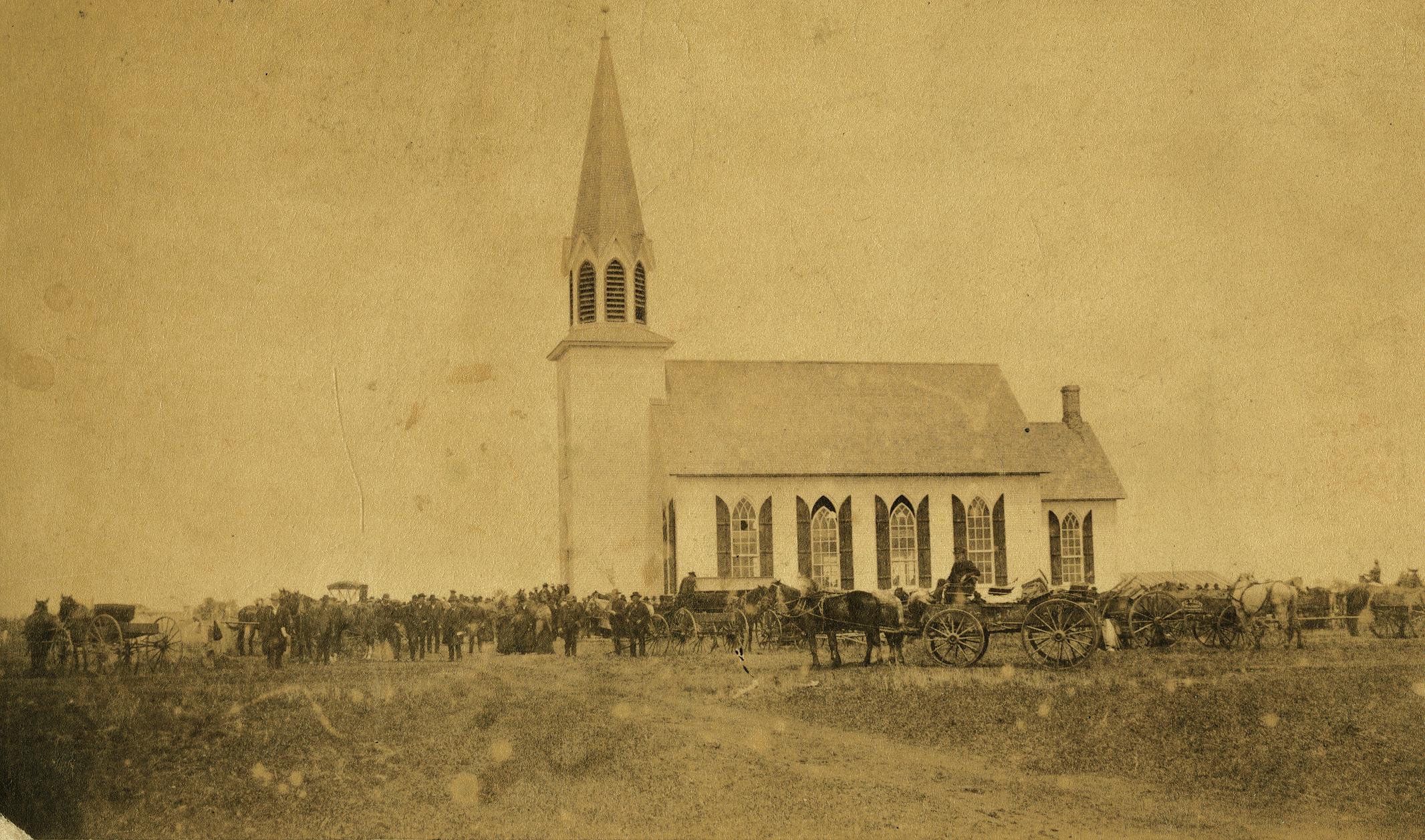
founded 1888, was the second church to locate in Starbuck. American religious conventions influenced Norwegian churches and redefined their social responsibility within the Norwegian-American community; it manifested itself in the early founding of congregational groups like ladies aid, youth societies, young women’s societies, and singing societies. These groups showed how the Norwegian Lutheran church responded to new demands and became a sanctuary for its members.
Benson and Madison showed greater denominational diversity than Starbuck, but there also Norwegian-American Lutheran congregations were preeminent institutions with a social as well as religious function extending well beyond the congregational fold. Benson had by 1900 a population of 1,525. Theological debate on doctrine and polity set boundaries between Norwegian Lutherans. The congregations, in spite of splits along theological differences, nevertheless had identical functions. The two Norwegian congregations founded in Benson belonged to different synodical camps; the congregation of the high-church Norwegian Synod (Den norske Synode) was founded in 1870 and the one joining the Conference (Konferensen) in 1877.
Madison’s citizens at the turn of the last century numbered 1,336. As the first president of the Lutheran Normal School, Ole Lokensgaard gained influence within the United Norwegian Lutheran Church and in Madison in general; he was joined by his brother Knute Lokensgard (the second a dropped); their influence in local affairs is suggested by the reference to them in the local press as “The Lokensgaard brothers.”
Through strong leadership and a spirit of cooperation, Madison provided health care on an interdenominational basis, when the Ebenezer Hospital, now the Madison Hospital, opened its doors in 1902; it operated under the auspices of directors that represented the conflicting directions within Norwegian Lutheranism in America, represented by the local congregation of the broad-church United Lutheran Church and local congregation of the highly pietist low-church Hauge’s Synod. The low-and-broad-church directions made the most progress in gaining member congregations in Lac qui Parle County. The high-church persuasion gained fewer
converts there, but had greater strength in Swift and Pope counties.
In addition to the two Lutheran congregations, Madison housed two Catholic congregations. The mutual prejudice between Catholics and Protestants—in this case Norwegian Lutherans—existed widely whenever they encountered each other. Tensions appear to have been especially high in Madison. The minority Catholics appear to have been at a great disadvantage in their relationship with the majority of Norwegian Lutherans; on occasion, from all accounts, they experienced hurtful discrimination. The denominational landscape was augmented by a Congregational Church. A marketplace of competing religious convictions, within the Norwegian Lutheran church itself and with non-Lutheran denominations, was clearly a reality also in the small-town environment.
A constant problem for all Lutheran congregations, whether in town or in the country, was securing a place of worship; the homes of members or school houses might become meeting places. The congregations also struggled with the irregular and infrequent visits by pastors who served several congregations. All Norwegian Lutheran churches inculcated a pietistic way of life, engaging in strict church discipline. In addition to its religious mission, the church became an important social institution and a cohesive social force of Norwegian immigrant communities; the pastors’ homes were the chief centers of culture, the pastors the social and intellectual leaders. The following quote gives a sense of the role played by the Norwegian Lutheran church in America:
The church on the prairies and in the wooded groves of the middle-west provided an array of social activities; mutual support in times of need; comforting rituals associated with baptism, confirmation, marriage, and burial; and solemnity and a sense of security in unfamiliar surroundings.9
The many church edifices, their steeples proudly identifying Norwegian Lutheran congregations in town and country, were erected with great sacrifice by the members and bear witness to the support given by lay and learned under difficult conditions.


Ethnocentric forces did not, however, prevent participation in community and civic activities. The temporal sphere more easily than the sacred was incorporated into village life and gained broad acceptance. Norwegian smalltown life here diverged from the Norwegian colonies in large metropolitan areas like Chicago, which operated as separate worlds in competition with other nationalities. Ethnic groups in small western towns instead frequently interacted as a community. In Benson, the observance of May 17, Norway’s Constitution Day, was from the beginning a community affair, though one sponsored by local Norwegian organizations. In comparison, in Chicago the day was observed as an exclusive ethnic event.
May 17, Syttende Mai, was for the first time celebrated in Benson in 1876; it had broad participation by Norwegians from town and country who were joined by townies of other ethnic backgrounds; shared historical memories relating to the day were celebrated with great loyalty to transplanted Norwegian traditions. These were later slowly altered in the new environment. The 1883 observance introduced events more common to July 4 and enjoyed participation by prominent Benson citizens with no connection to Norway. It is important to keep in mind that the festivities were arranged by first-generation Norwegians, not by latter-day Norwegian Americans, who would be more likely to stray from established traditions. It was, however, evidence of a familiar path. Norwegians, like other ethnic groups, re-created and reinvented a Norwegian heritage and ethnic identity over time. By their strong presence, Norwegians, to quote, “added color and had a cultural impact on the social and political structure of all three towns”. . . . “Their new identity was thus tied to the town—the place called home—and was strengthened generation by generation.”10
Endnotes
1 Lewis Eldon Atherton, Main Stream on the Middle Border (Bloomington: Indiana University Press, 1954), 285; Oliver Knight, “Toward an Understanding of the Western Town,” The Western Historical Quarterly 4 (1973), 27-28.
2 Odd S. Lovoll, Norwegians on the Prairie: Ethnicity and the Development of the Country Town (St. Paul: Minnesota Historical Society Press, 2006), 88, 89, 145.
3 Odd S. Lovoll, The Promise of America: A History of the Norwegian-American People (Minneapolis: University of Minnesota Press, rev. ed., 1999), 126-28; Lovoll, Norwegians on the Prairie, 4, 46, 134, 145.
4 Edward D. Neill, History of Minnesota Valley (Minneapolis. North Star Publishing Company, 1882), 950; Lovoll, Norwegians on the Prairie, 231.
5 Lovoll, Norwegians on the Prairie, 65-71, quote 66.
6 Lovoll, Norwegians on the Prairie, 67, 191-94, 234-39: Jon Gjerde, Minds of the West: Ethnocultural Evolution in the Rural Middle West, 1830-1917 (Chapel Hill: University of North Carolina Press, 1997), 8.
7 Lovoll, Norwegians on the Prairie, 9, 207, 209, 211; Thorstein Veblen, “The Country Town,” The Freeman 12 (11 July 1923), 418.
8 Johannes B. Wist, long-time editor of Decorah-Posten, captures the spirit of the fight for the county seat in Lac qui Parle County in his lively fictional account, Jonasville, of two Red River Valley towns contending to gain the county seat.
9 Lovoll, Norwegians on the Prairie, 118.
10 Lovoll, Norwegians on the Prairie, 75-76, 88, 110-11, 114, 119-23, 13941, 145-49, 150, 152-53, 153-56, 158, 178, 204-05, 210-13; quotes 118, 173, 270; Theodore T. Blegen, Norwegian Migration to America: The American Transition (Northfield: The Norwegian-American Historical Association,1940), 555.
About the Author
Odd S. Lovoll is professor Emeritus of history at St. Olaf College, Northfield, Minnesota, and has authored numerous books, including The Promise of America: A History of the Norwegian-American People; The Promise Fulfilled: A Portrait of Norwegian Americans Today; and Norwegians on the Prairie: Ethnicity and the Development of the Country Town. Lovoll was born in Norway and immigrated to the United States in 1946. He holds an M.A. in United States history from the University of North Dakota, where he served on the faculty from 1967 to 1970, and a Ph.D. in United States history with specialization in immigration from the University of Minnesota. He retired from the King Olav V Chair in Scandinavian-American Studies at St. Olaf College on December 31, 2000, after serving 30 years on the St. Olaf faculty. From 1980 until 2001 he served as Publication Editor for The NorwegianAmerican Historical Association. Lovoll continues in his professorship, a part-time appointment in history at the University of Oslo, Norway.