Metalwork: Pieces from Vesterheim’s Collection
Tom Latané
As a blacksmith, I gravitate toward the ironwork displayed at Vesterheim. There are some nice lighting devices in the furnished room displays in the Museum Building and a good collection of tools housed in the Painter-Bernatz Mill. In the Bauder-Landsgard Collection Study Center, which can be toured by appointment, there are some impressive locks and some more lighting. Almost half of the storage space in the study center is taken up by trunks, which held the belongings of families immigrating to the United States. All of these wooden containers have iron hardware, most of it hand-forged by blacksmiths and much of it imaginatively decorated. The collection of trunks is often studied by painters looking at the rosemaling decoration, but much of the ironwork is equally ornamental. Keyhole escutcheons, the straps on the front that balance the hinge straps on the backs, lid straps, corner bands, and corner brackets are embellished by blacksmiths with a variety of skills. Edges are finished with chiseled-cut profiles and filed bevels. Surfaces are chisel-pierced, chased, and embossed.
The trunks in which the immigrants brought their possessions across the ocean were essential in keeping their few worldly possessions safe. Locks secured the trunks to keep random folks from accessing the inside, and corner brackets and straps protected the wood that surrounded them from punctures and knocks on their long and rough journeys.
The trunks were almost always fitted with spring-loaded locks that snapped shut every time the lid was closed. Because the owner would address the keyhole with the
necessary key whenever accessing the trunk, special effort seems to have been given to the keyhole escutcheon. The iron escutcheon is more resistant to wear than the wood behind, and the keyhole is the first line of defense in the security the lock offers. A key that does not fit in the profile of the keyhole will not go any further to open the chest.
Most of these locks are designed so that, when the key is rotated to its limit, it will hold the lock in the unlocked position, so the lid may be closed temporarily while dealing with the trunk. However, when the key is removed, the lock engages once again. The locks are generally secured from the inside with nails clinched through the front board of the trunk. On a few of the examples in the collection, there are scars where the clinched nails have been removed. I am guessing that those with minimal damage were pried out from the inside to repair a failing lock, and those with more external damage were dug out and punched through from the outside to open a locked trunk with a lost key.
During a recent visit, I studied some of the examples of chest hardware that I found most appealing. A collection of that size is somewhat overwhelming, so I am sure I missed a few trunks with impressively forged hardware. Enjoy the examples on the following pages of the intricate and interesting metalwork used by Norwegian immigrant ancestors!
Trunks with Keyhole Escutcheons that Stand Alone
The most basic of the escutcheons are those that stand alone in the upper center of the front of the chest.
Vesterheim trunk 1970.029.001 shows an escutcheon that is irregular and crooked, yet a very pleasing shape. It
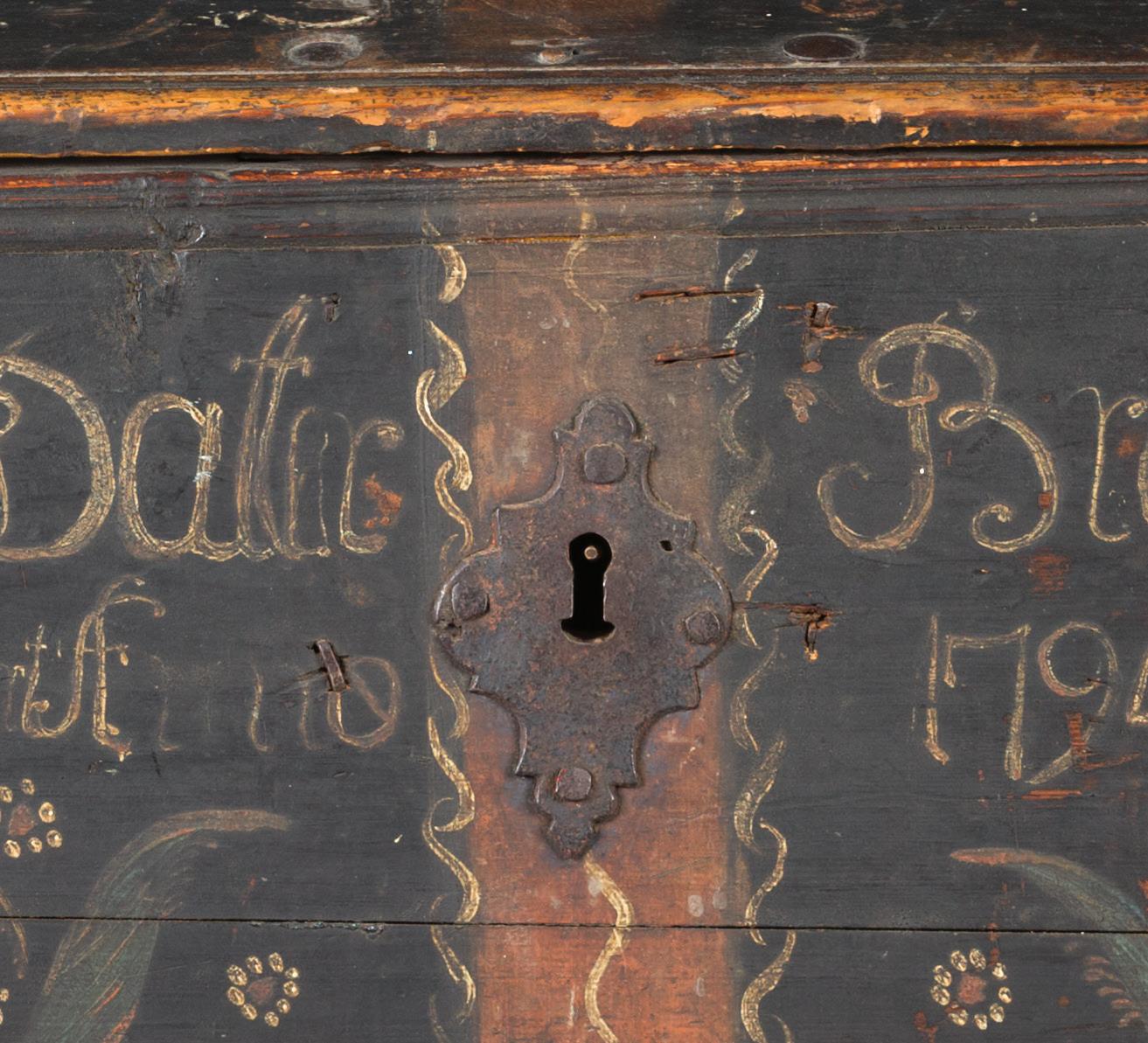
appears to have been forged from bar rather than mill-rolled sheet. The edges taper and there are nicely filed bevels on the thicker material near the center.
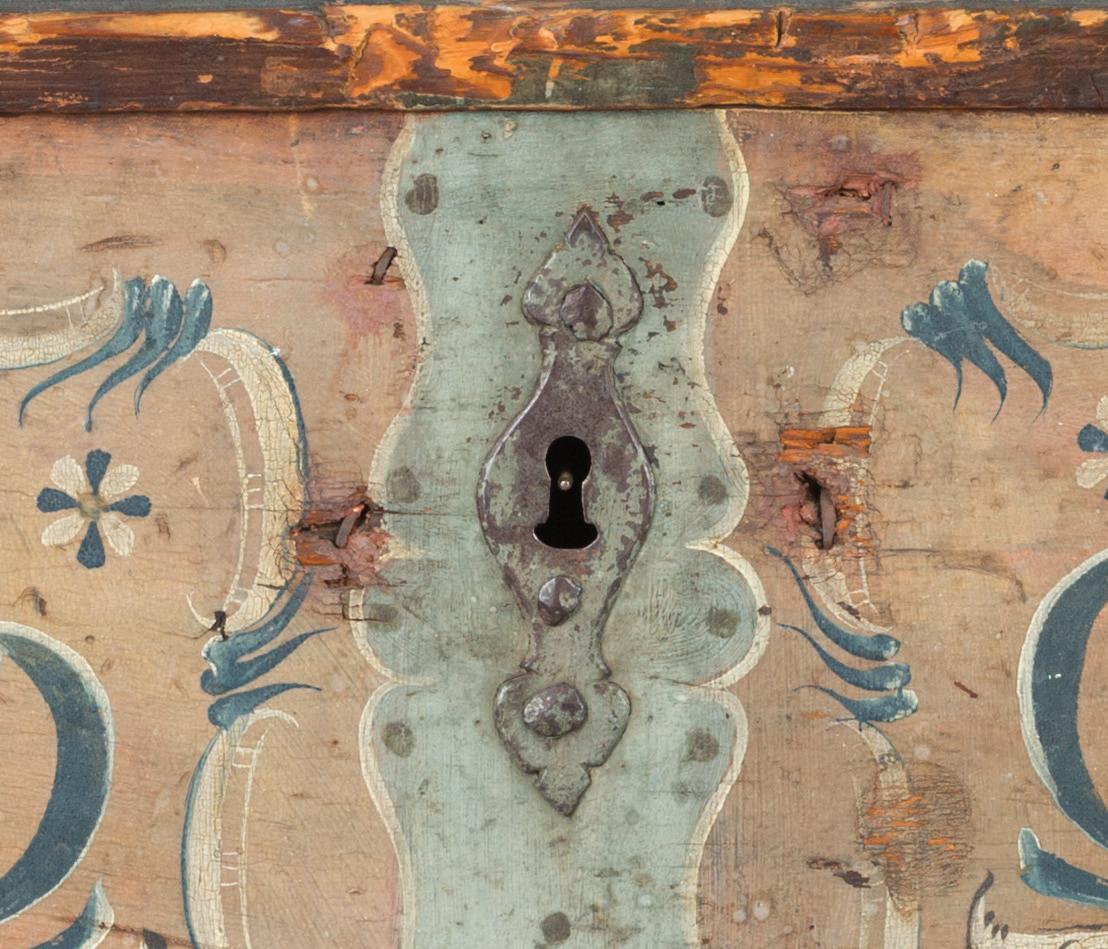
The escutcheon in 2015.015.001 has been embossed with tools from the back. Around the raised running bead on the front, a row of chisel marks has been made to create a shadow on either side of the bead to set it off well. Unfortunately, much of the chisel work has been filled in with paint. The metalwork is somewhat crude but effective. The lock has been removed from this trunk – the scars from the clinched nails show no replacement nails.
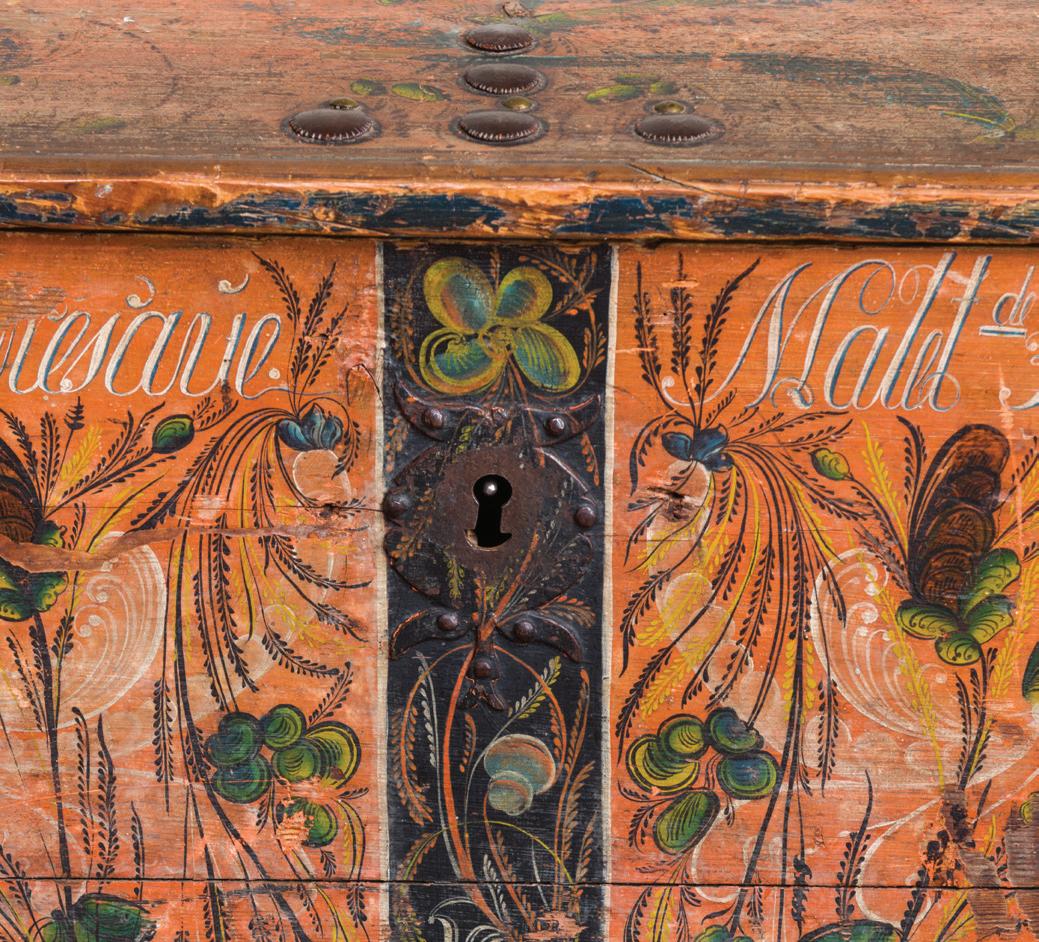
Trunk 2022.021.001 shows what happens when a painter regards the chest as his canvas alone and paints a straight “strap” over a pleasing escutcheon in a color that hides the ironwork. Scars show visibly from the removal of the clinched nails that secured the lock. The nails have been replaced, and a lock is there. The pin around which a hollow key would rotate shows in the keyhole. Perhaps the lock was subsequently screwed in place.
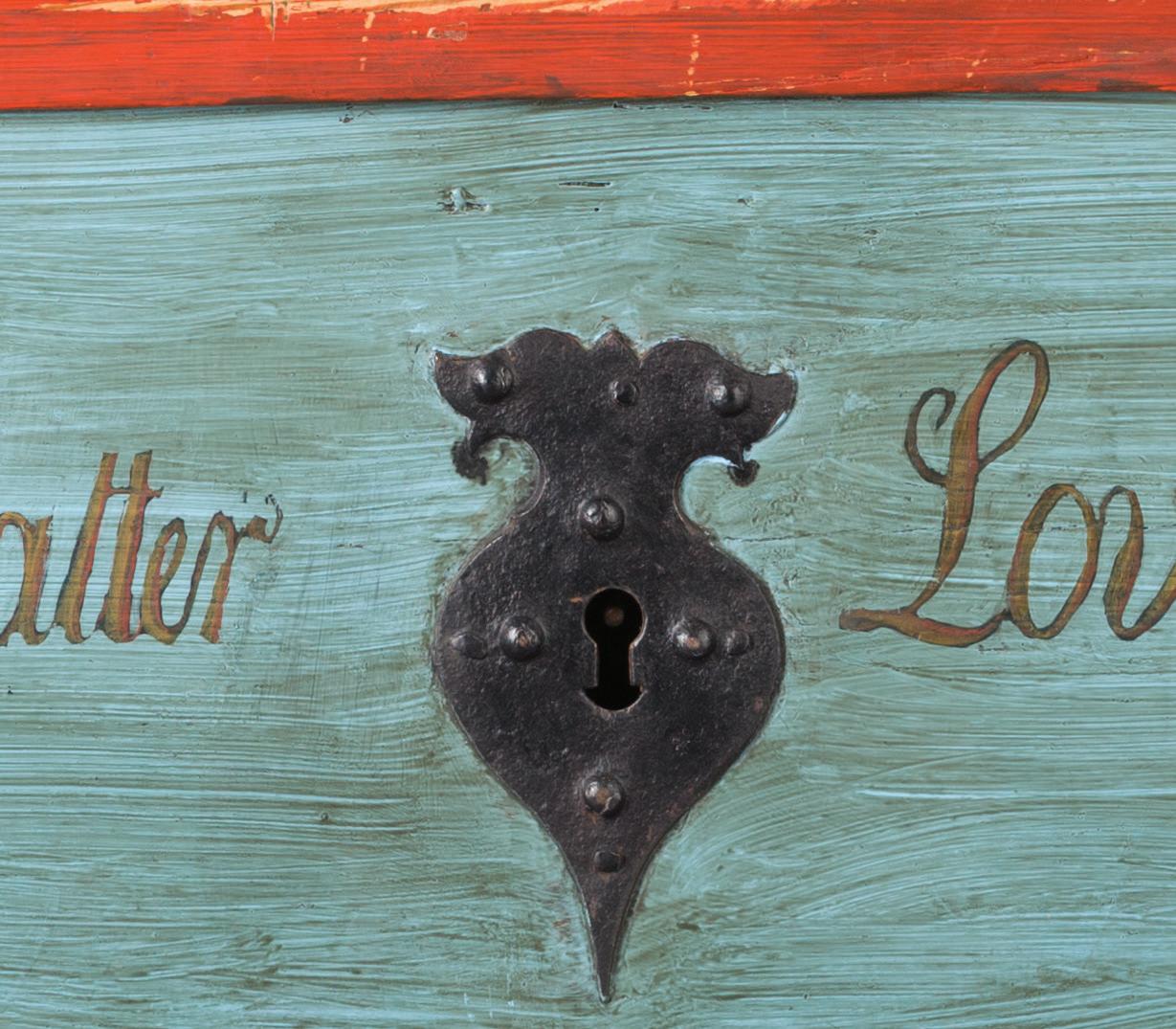
Trunk LC0602 shows an escutcheon painted the same color as the surrounding background, which is a design that complements the escutcheon shape. Because the paint is a light color, the shadow of the edges of the escutcheon
would show off its shape. Scars in the wood are evident from the lock being removed (maybe more than once) and replaced again with clinched nails.
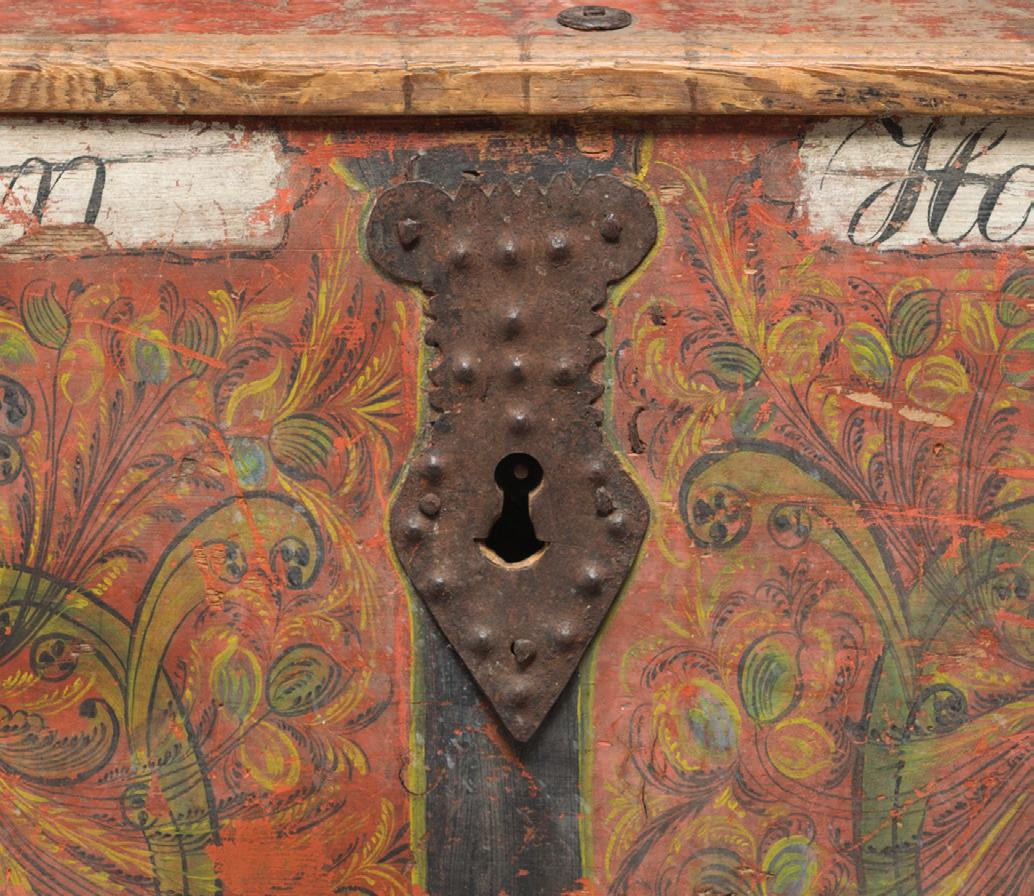
Trunk 1997.079.001 shows an escutcheon with false nails bumped out from behind. Beside these nail-shaped bumps are the more modest-sized heads of the nails that hold the piece in place.
Trunk 1982.075.001 shows an escutcheon which, though not as graceful as the others, has even more embossed “nails.” Nails add up in cost – monetary or time. A bump that imitates a nail head can be made in the time it takes to punch a hole for a nail. On nicer chests the real nails are made to blend with the simulated nail bumps and located within the pattern.
The trunk LC4278 has straps with chiseled profiles on either side that are placed in line with the hinges. These straps are held on with a great number of very nicely forged nails. There are nails all along the edge of the lid. I’m impressed! The uniformity of these nails appears to have been accomplished by “swaging” the heads with a handheld tool with a cup-shaped hollow at the end after they were partially formed with a hammer. This produces uniform domes on the nail heads. There is some variation because
some nail heads did not completely fill the swage cavity. Others that more than filled the cavity have a “rim” of iron left on some edges.
Some chests have nails that were simply hammered by eye, usually in a rough dome shape. Others have nails that were filed a little bit to make the forged heads more regular. Those that were swaged were the finest.
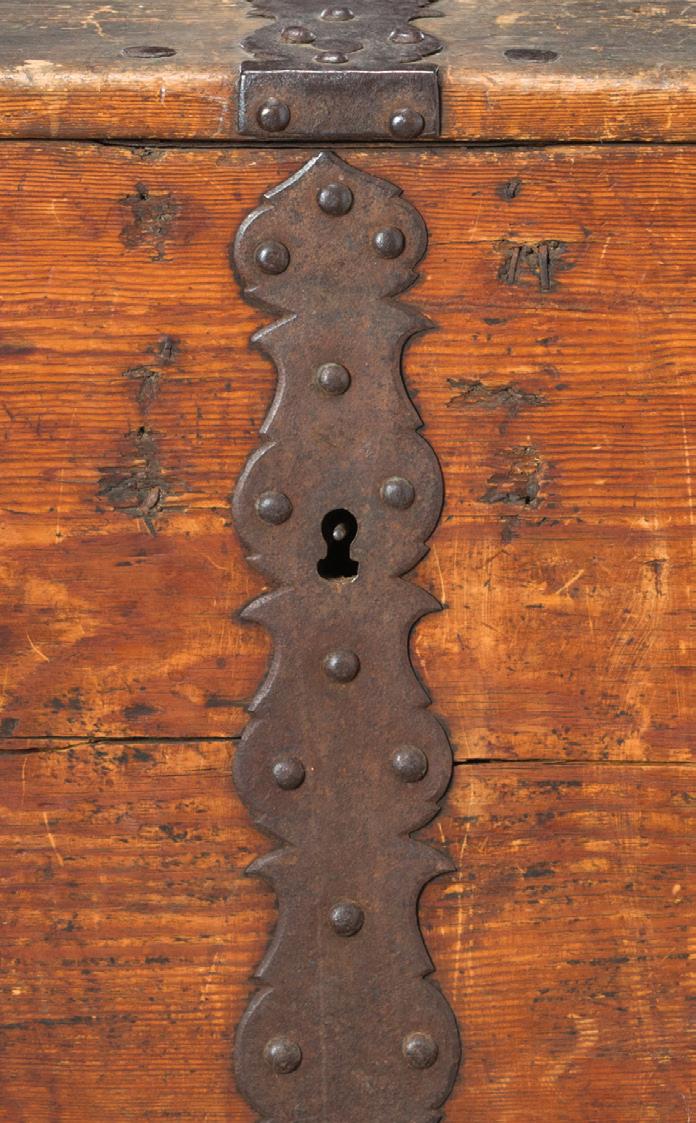
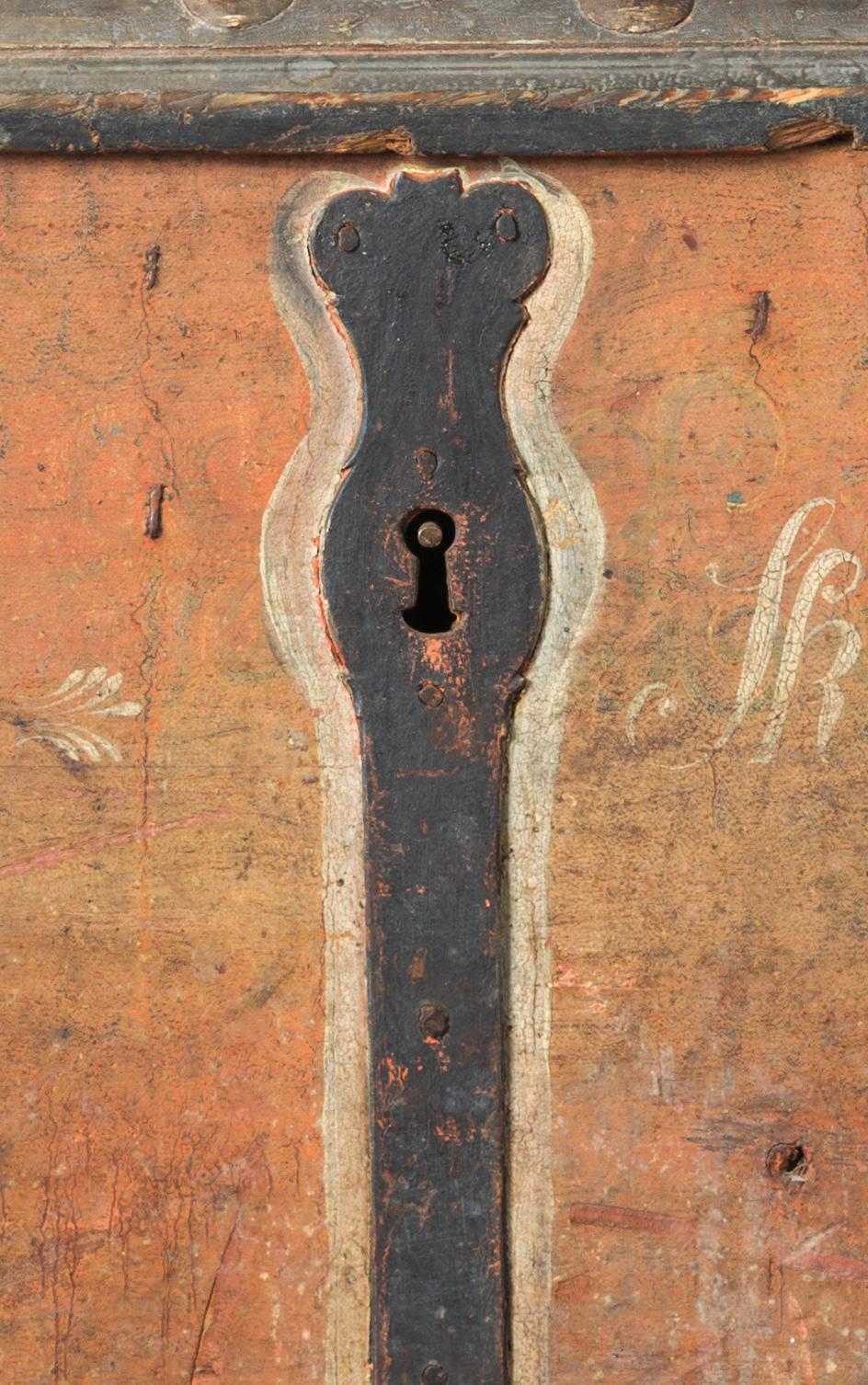
Trunks with Profiled Center Straps as Escutcheons
These trunks show keyholes cut into center straps that have been chiseled full length with decorative profiles. All three trunk lids have center straps to match. All have many nails with nicely formed bold dome heads – those on the first appear swaged and those on the second are hammered by eye and filed some. Trunk LC7048 has multiple clinched
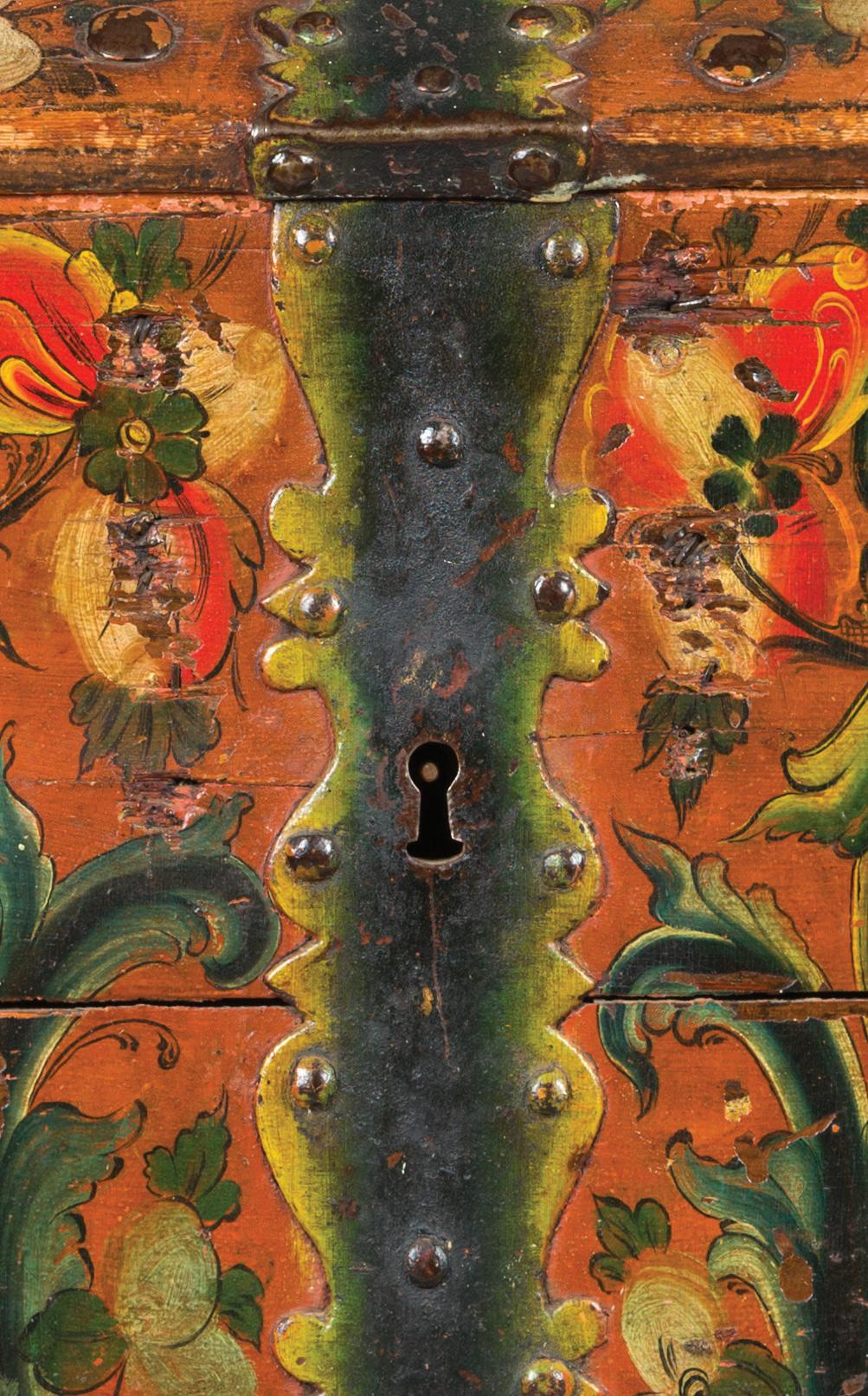
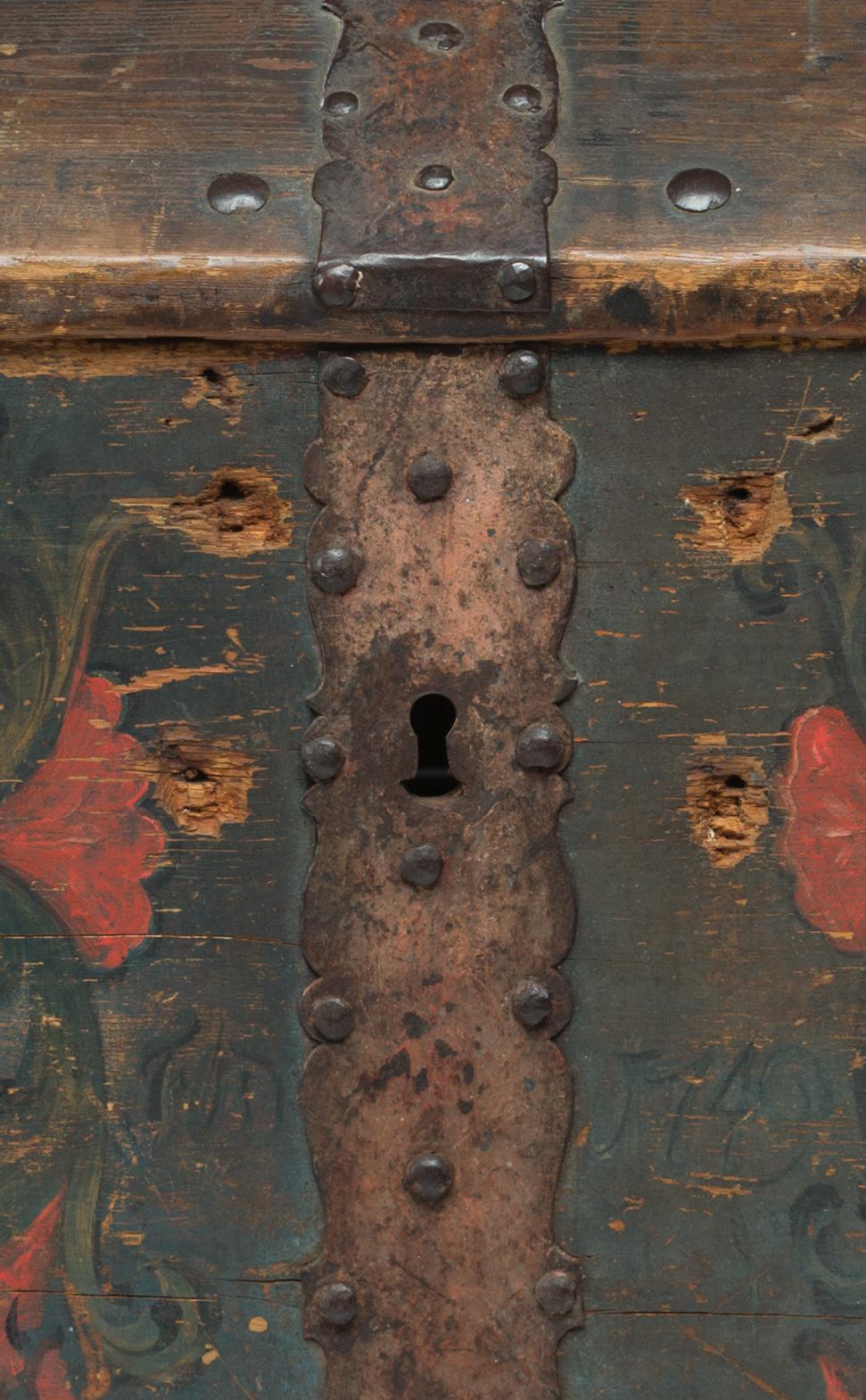
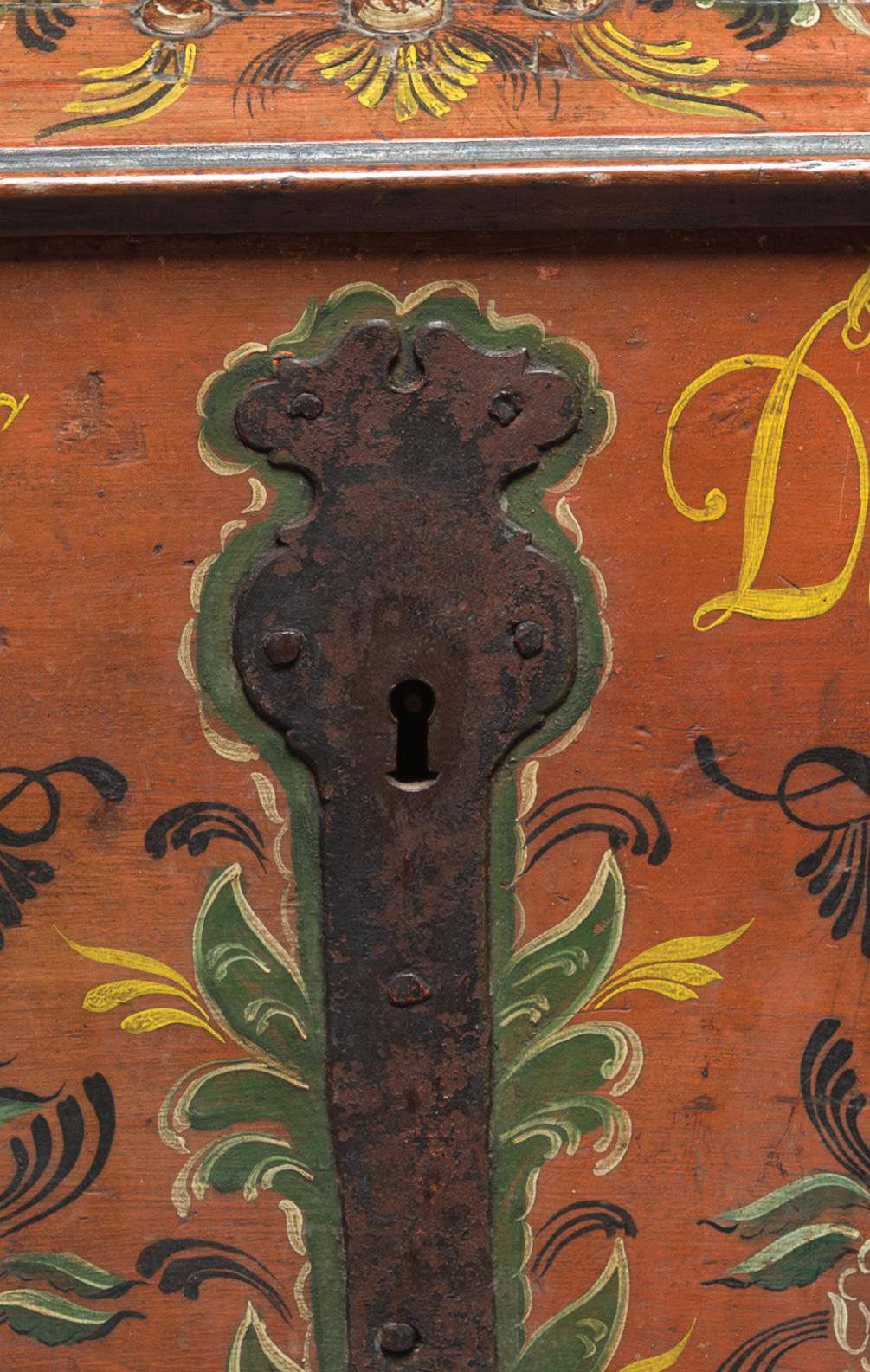
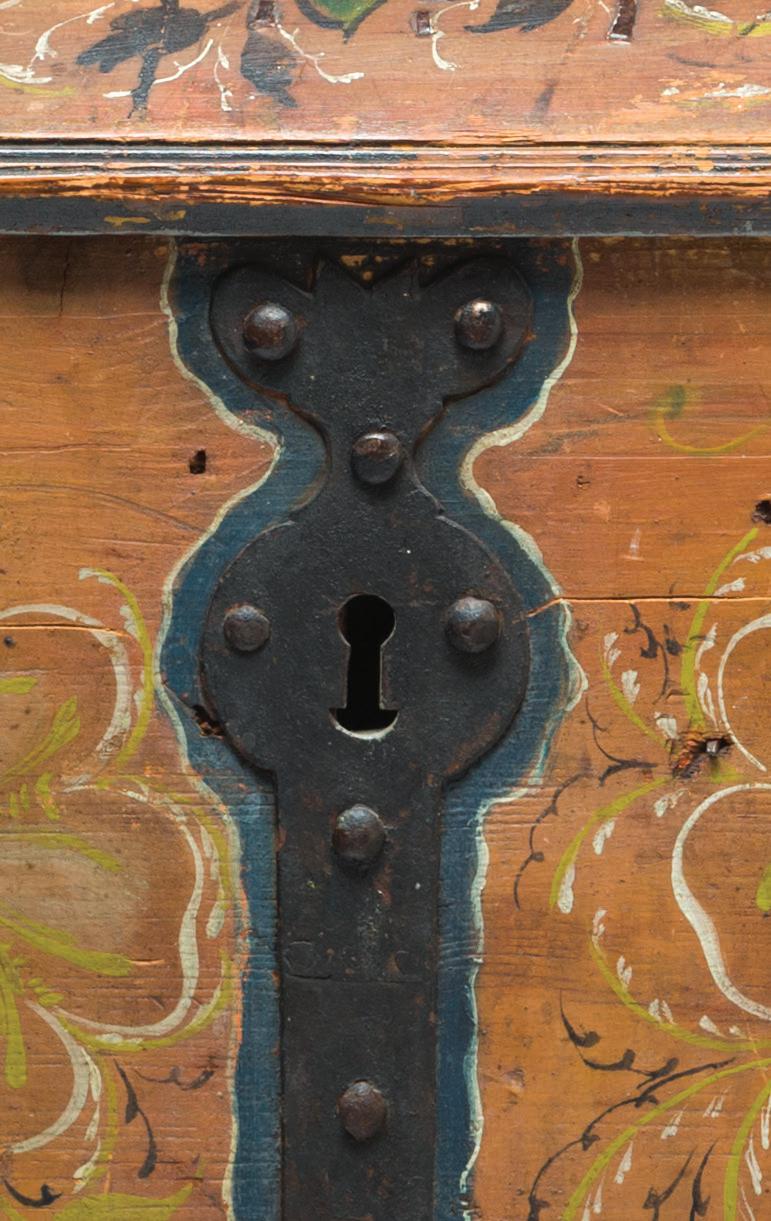
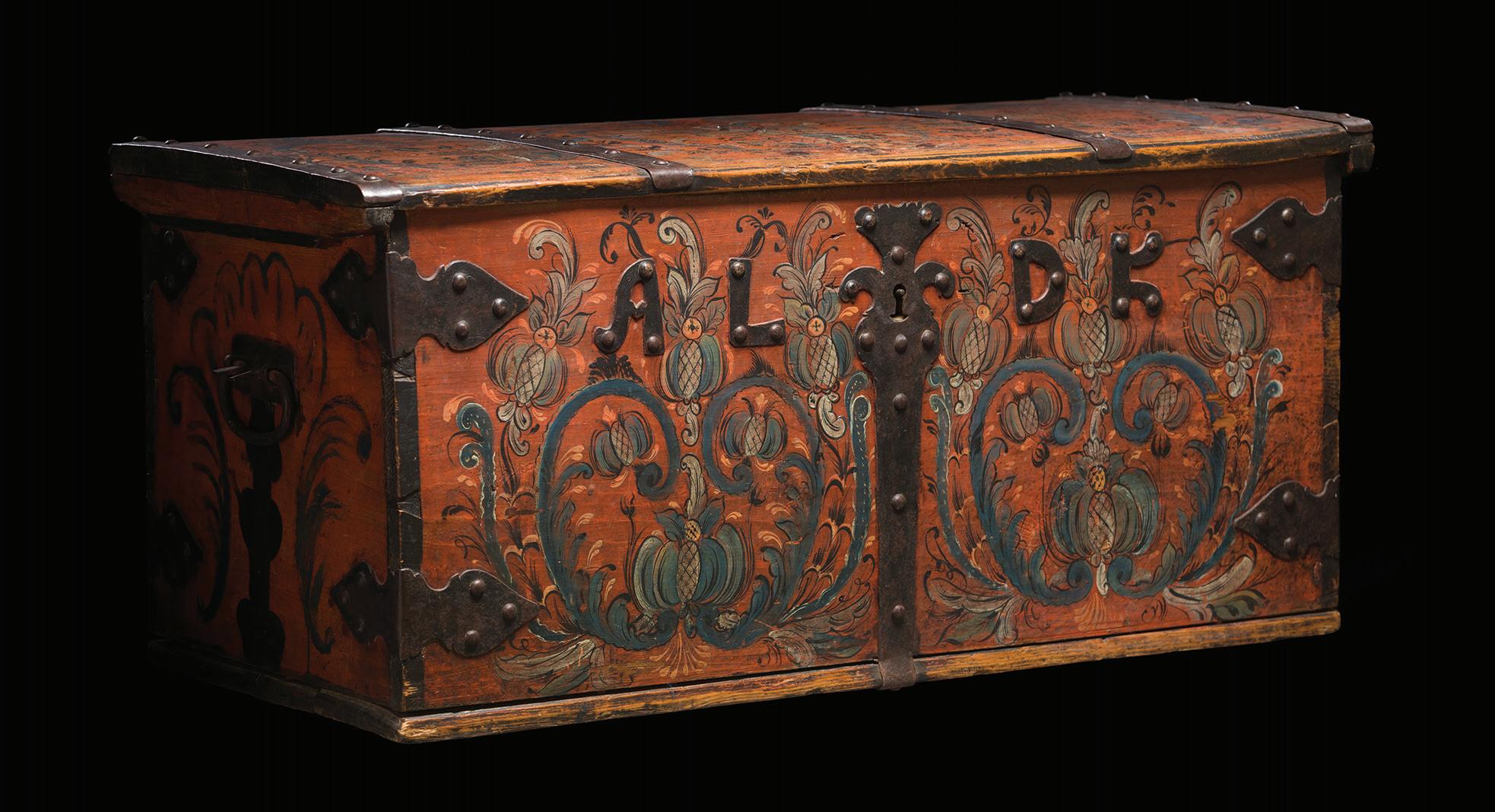
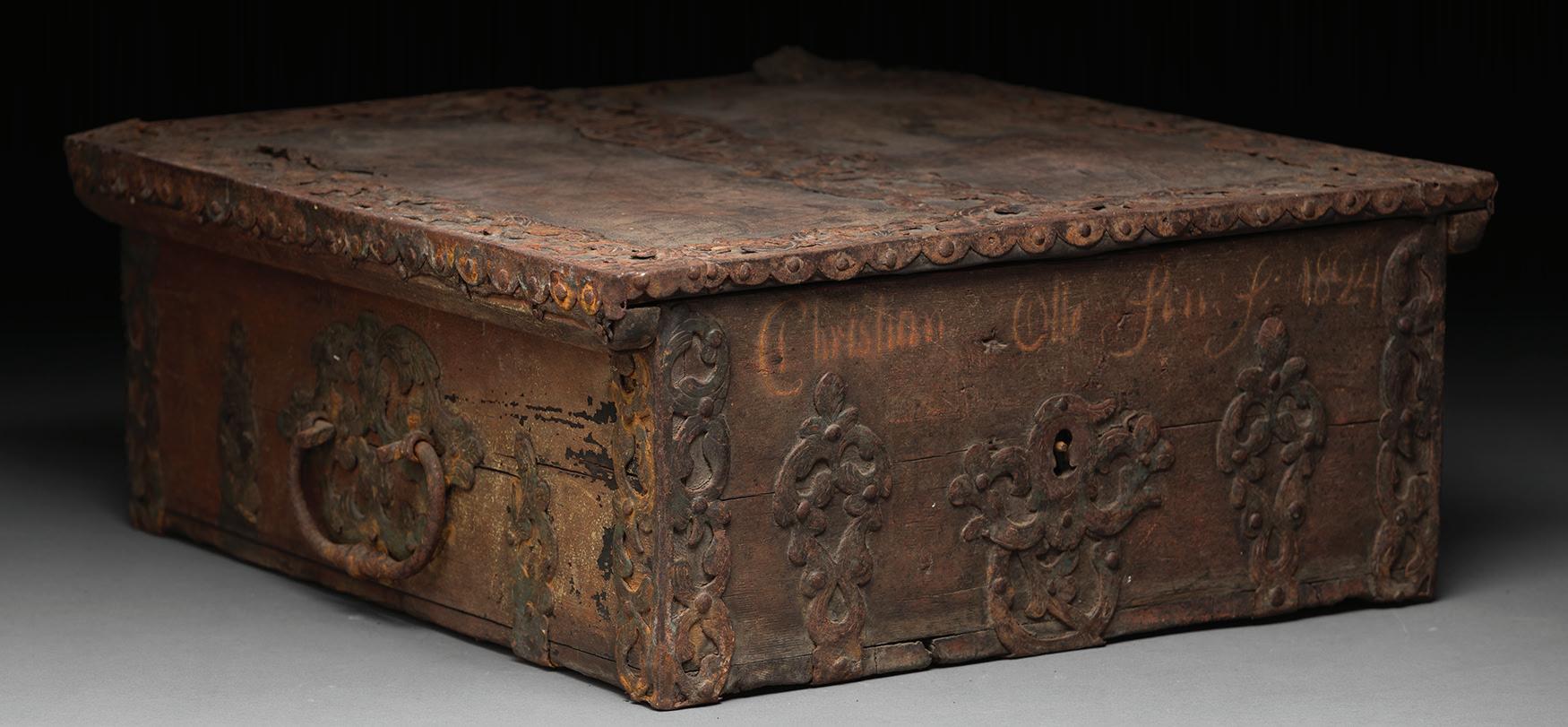
nails in each spot where there would be a corresponding nail hole in the lock. Trunks 1978.001.001 and LC5575 have major scars where the clinched lock nails were removed. This is probably a result of punching the nails through from the outside to open a locked lid. Trunk 1978.001.001 has had the lock replaced but the lock on LC5575 is gone.
Escutcheons at the End of Plain Central Straps
These pieces show nicely formed chisel-cut designs at the tops of plain straps. Such straps often continue over the bottom molding and under the chest a few inches to help
secure the bottom boards. Notice how the painters of some chests left the escutcheons in a field of contrasting color and others surrounded them with paint that emphasized the metalwork, but none obliterated the hardware.
Trunk 1973.008.057 shows a particularly fine example. While the others are rather flat, this strap is thicker in the center and thinned toward the edges. This design makes the filed bevels more dramatic. The nail heads on LC5987 and 2023.019.001 are poorly formed and those on 2021.016.001 appear to have been swaged.
Pierced Escutcheons
Trunk 1993.096.001 shows a pierced center strap with the keyhole. This one is unusual because of the keyhole cover. The two hearts and the piercing in the crest above the keyhole are set off nicely with the wood behind the piercings painted a contrasting orange. The iron is thicker in the center, making the filed bevels on the hearts more noticeable. The nails in this strap have minimal heads that hardly show.
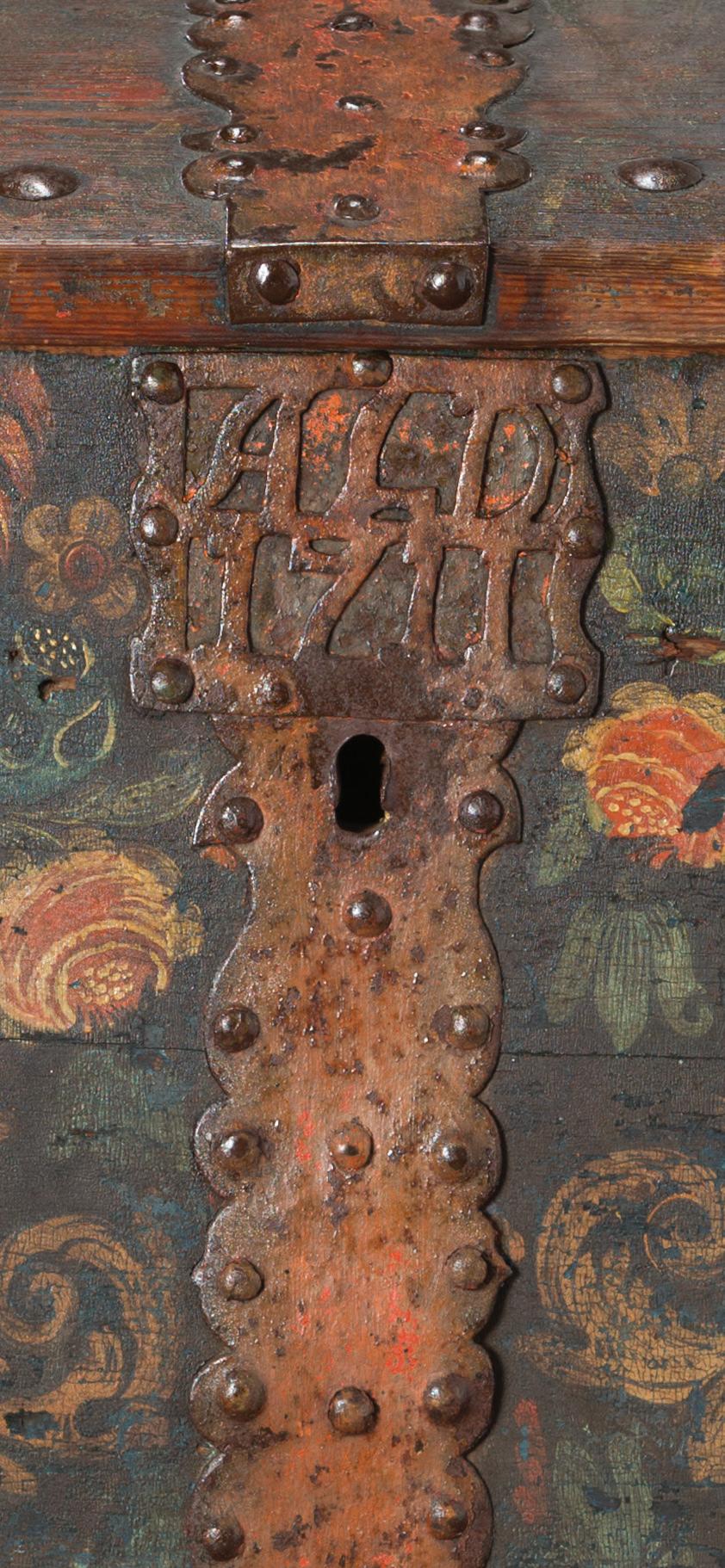
Trunk 1996.066.001 shows a keyhole in a profiled strap above which the initials, A L D, and the date, 1711, have been created by chisel piercing. It appears that the iron was once painted a contrasting color, though much paint has been lost. These nails must have been swaged.
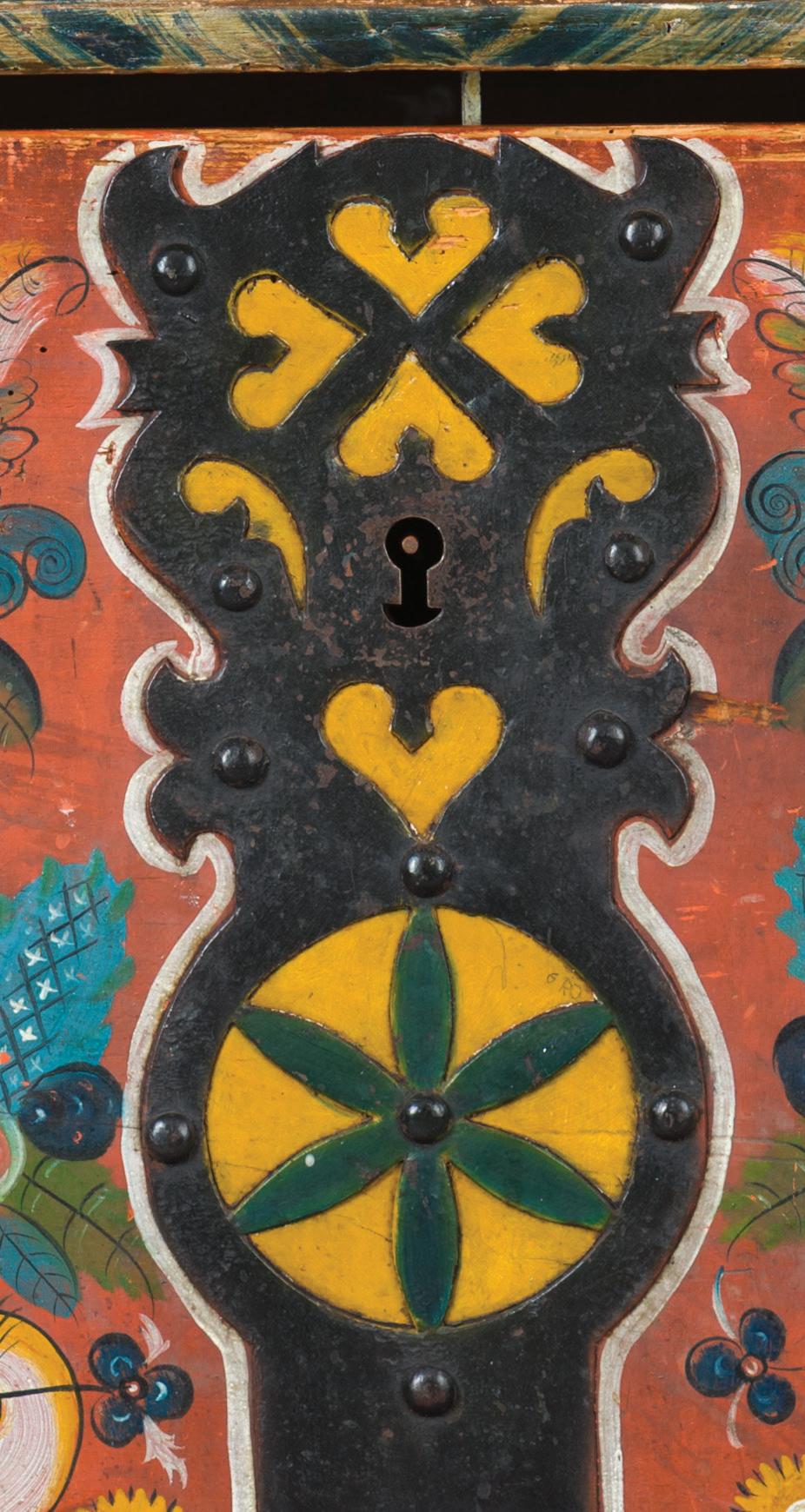
The striking pierced center strap on trunk 2014.015.001 is a nice design chisel cut in some sheet that appears so flat it must have been rolled at the iron furnace. The design is emphasized by brightly contrasting paint on the wood behind the piercings. The very uniform nails were swaged, if not formed by machine.
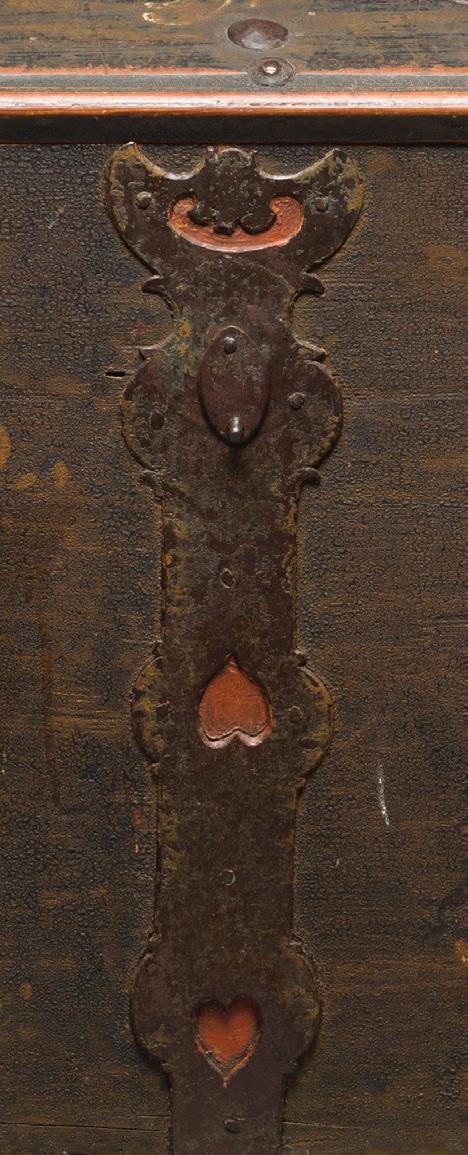
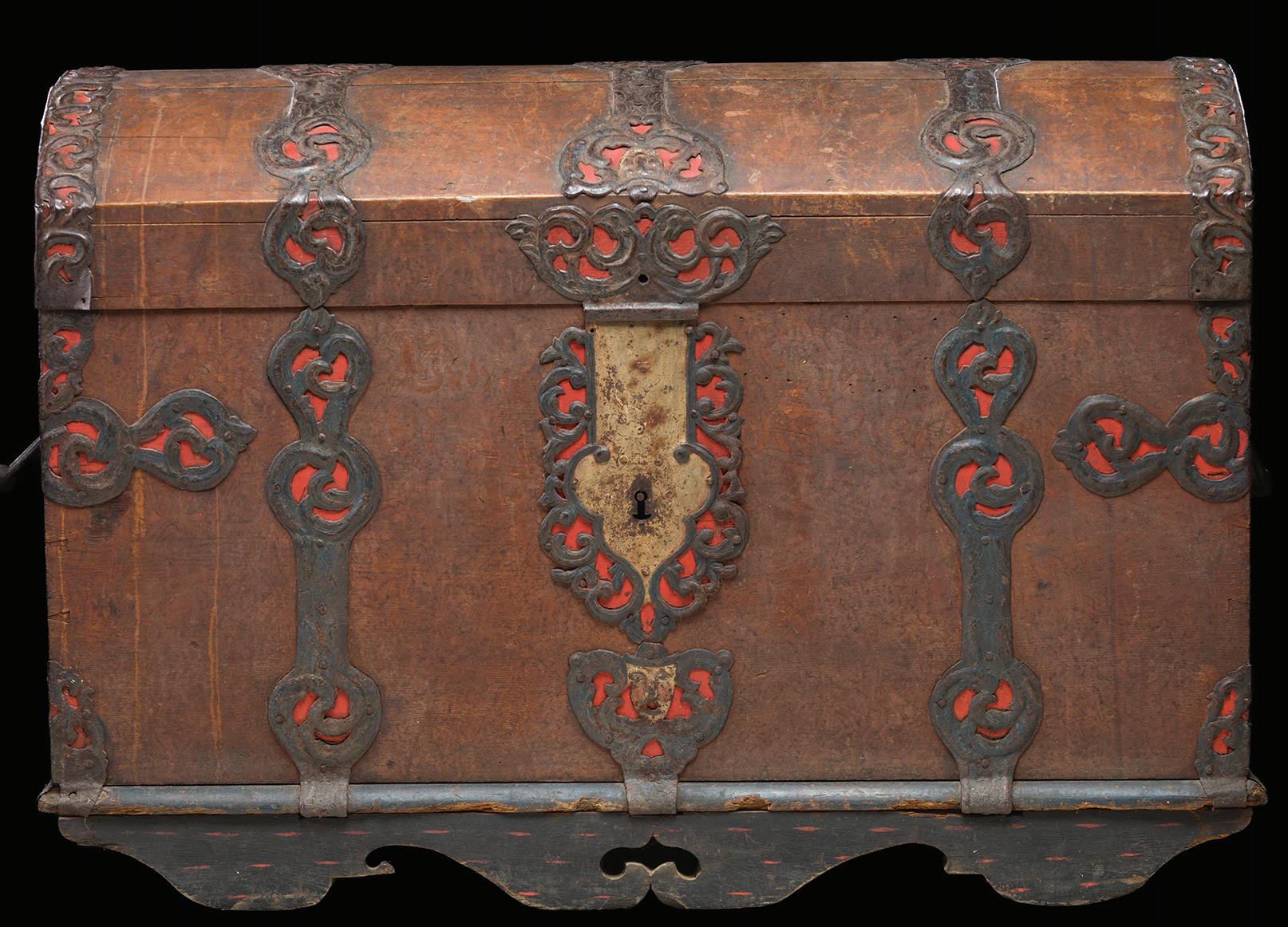
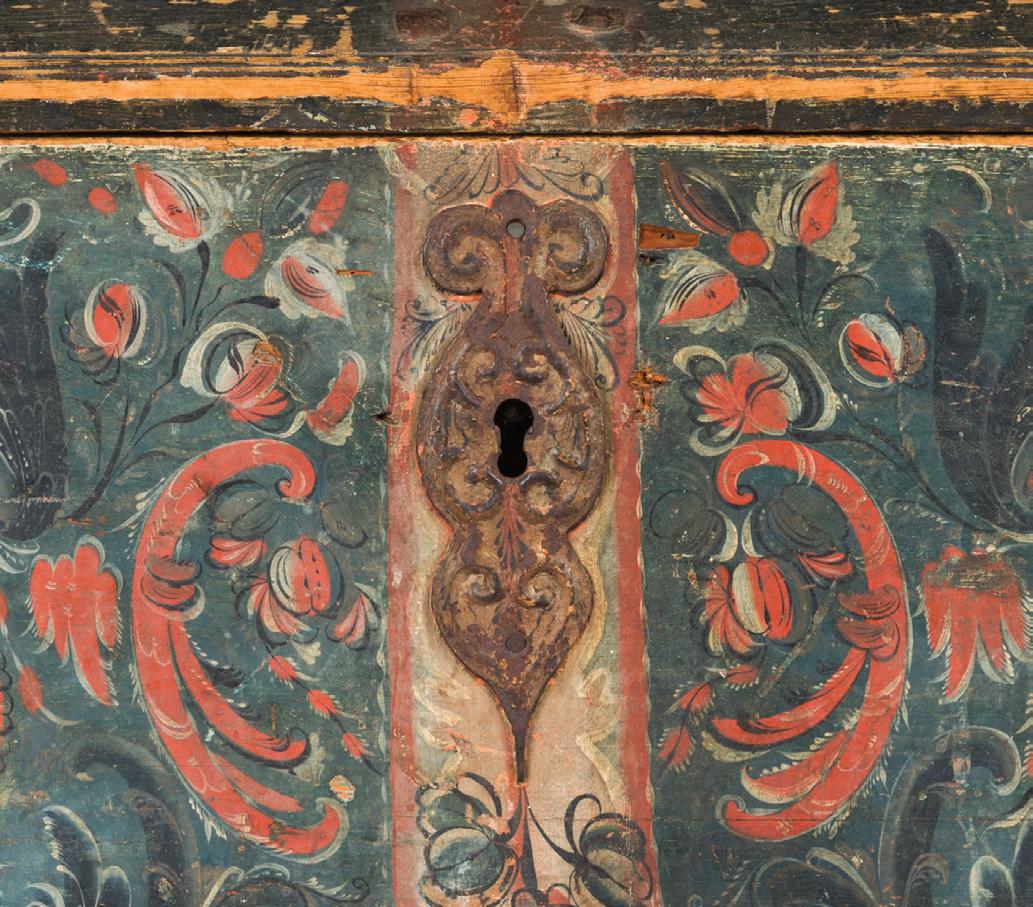
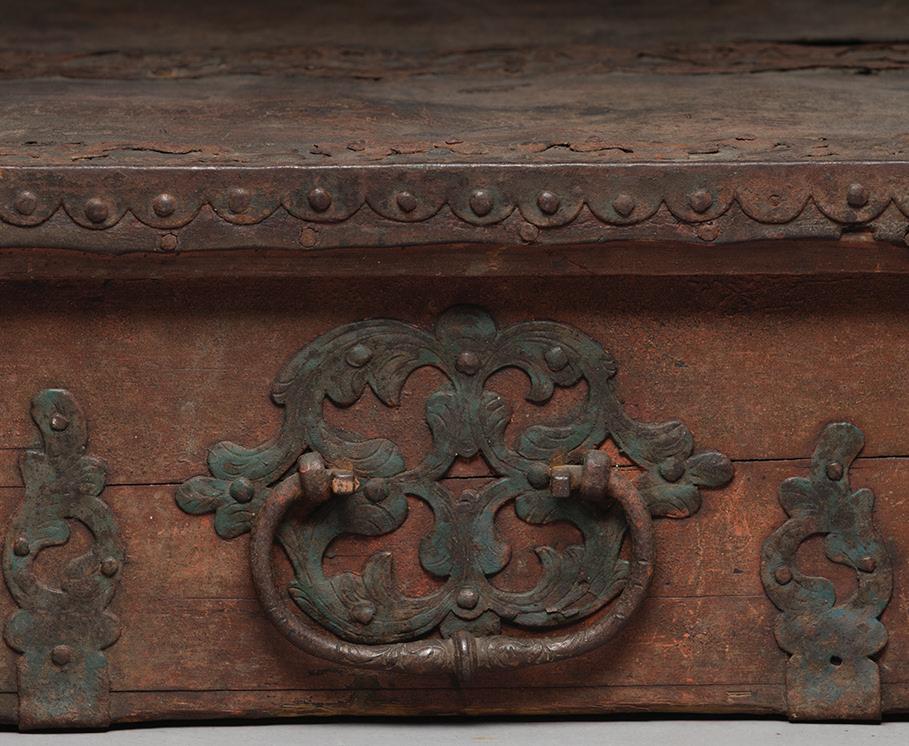
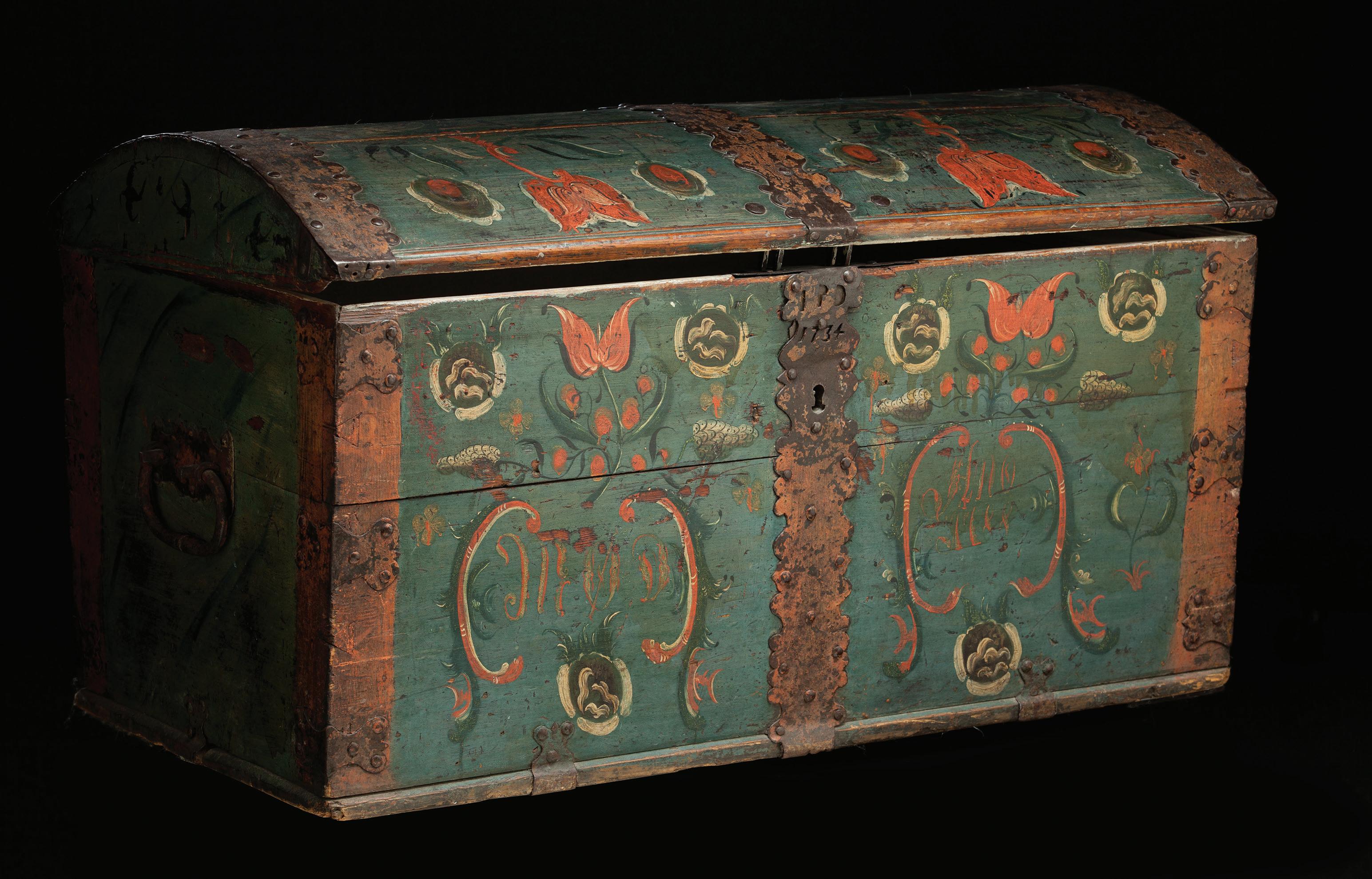
The complex piercing of the hardware on trunk LC7023 (see images on page 22) has been embossed and chiselchased in a Baroque folate pattern and extends to straps as well as the keyhole escutcheon. The bold nail heads show some pleasing variation. The paint on the wood and iron may have contrasted at one time but has weathered into a pleasing overall patina.
The pierced, filed, chased, and embossed design of the escutcheon on trunk LC7049 (see images on page 23) is set off by contrasting orange paint on the wood showing in the piercings. The escutcheon itself is painted with contrasting colors. The modest nail heads do not detract from the appearance of this piece. The chisel chasing was done before the embossing and the chisel cuts opened up as the metal was stretched by embossing. This procedure can be done over a wooden stump, whereas embossing followed by chasing requires that the blacksmith set the sheet of iron in pitch to prevent the chasing from crushing the embossing.
Handles
Almost all of the trunks in the collection were made with a forged handle secured to each end by a pair of eyes with tails clinched through the end board. Most of these have an escutcheon of sheet iron under each eye, or a single escutcheon connecting the eyes, to protect the wood from the turned-out ends of the handles that bear against it when the chest is lifted. The bent ends of the handles hold them away from the walls of the trunk so hands are not pinched. There is visible damage to the wood on examples without escutcheons.
Though the ends of the trunk where the handles are mounted do not show as prominently as the front, the handles are important to anyone moving the trunk, and they offer another place where embellishment can be appreciated.
Trunk LC4278 shows a simple handle with a center collar suggested by minimal filing. The wood is well protected by the crossed straps behind the handle.
Trunk 1973.012.001 shows a handle that has been forged from heavier stock and thinned toward the ends, leaving a swelling in the center. A smaller piece was probably then wrapped around the center and forge-welded to produce the center collar. It was then set off by reducing the crosssection on either side of the collar to produce the final appearance. Some light chasing was done with a chisel to
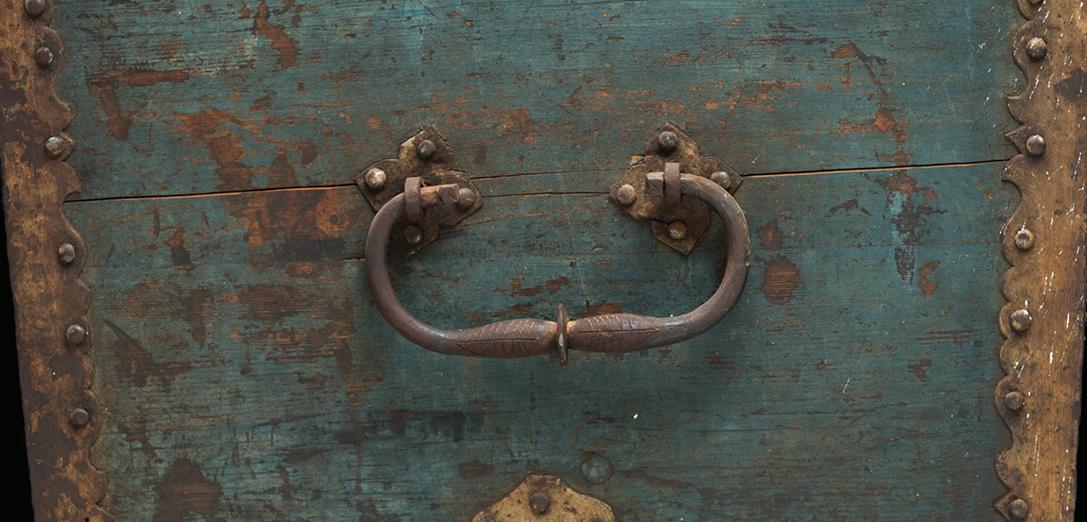
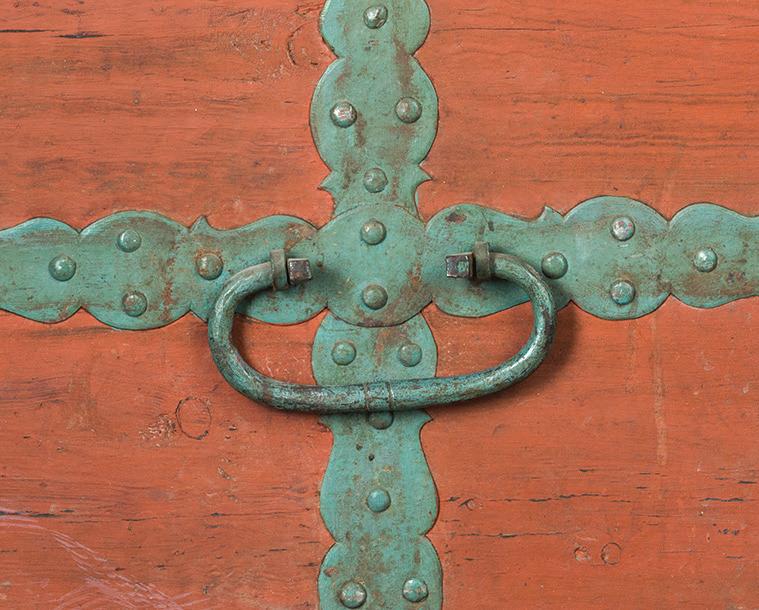
create the idea of leaf forms on either side of the collar. The eyes that hold the ends of the handle are passed through two individual escutcheons held from rotating or pulling up at the edges by four nails. This common form of escutcheon was made by notching the four sides of a square piece of sheet. Heavier sheet would have better resisted the pressure applied by the ends of the handles when lifted, which have here dented and even torn through. The wood is not protected from the collar in the center of the handle by this arrangement, and a dent can be seen.
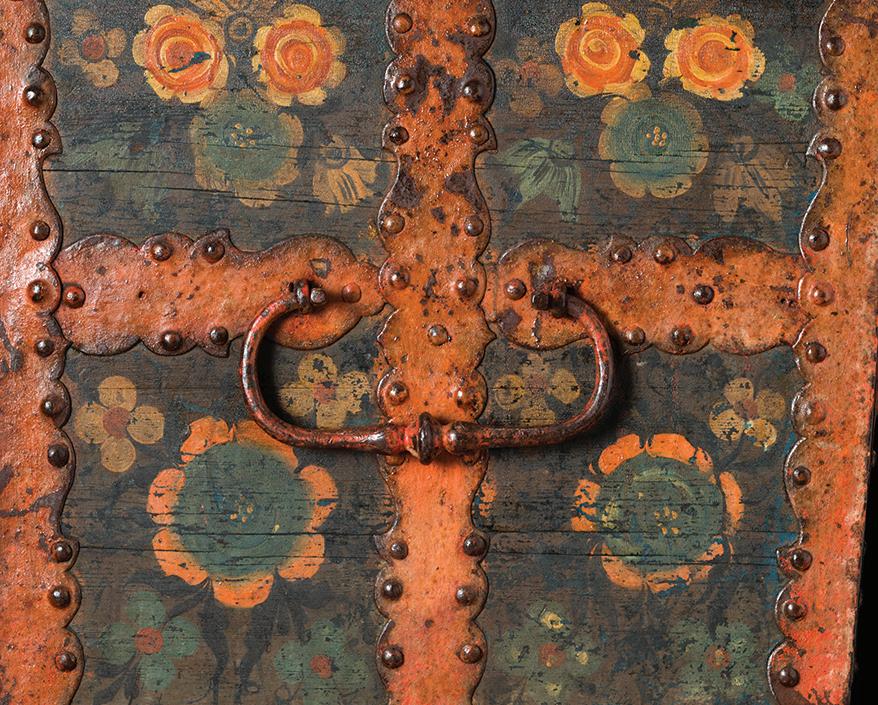
Trunk 1996.066.001 shows a handle mounted on a vertical strap at a junction with cross straps. The bold collar in the center of the handle rests on the vertical strap and the tabs at the ends of the handle have pressed small dents into the cross straps. A combination of real nails and bumped out “false nails” has been employed.
The handle in trunk LC7023 has been forged with a bold collar and the bulbous swells on either side are chased with a more refined acanthus design. The escutcheon has been chisel-pierced and nicely filed. It has been boldly chased and given minimal embossing.
Corner Brackets and Straps
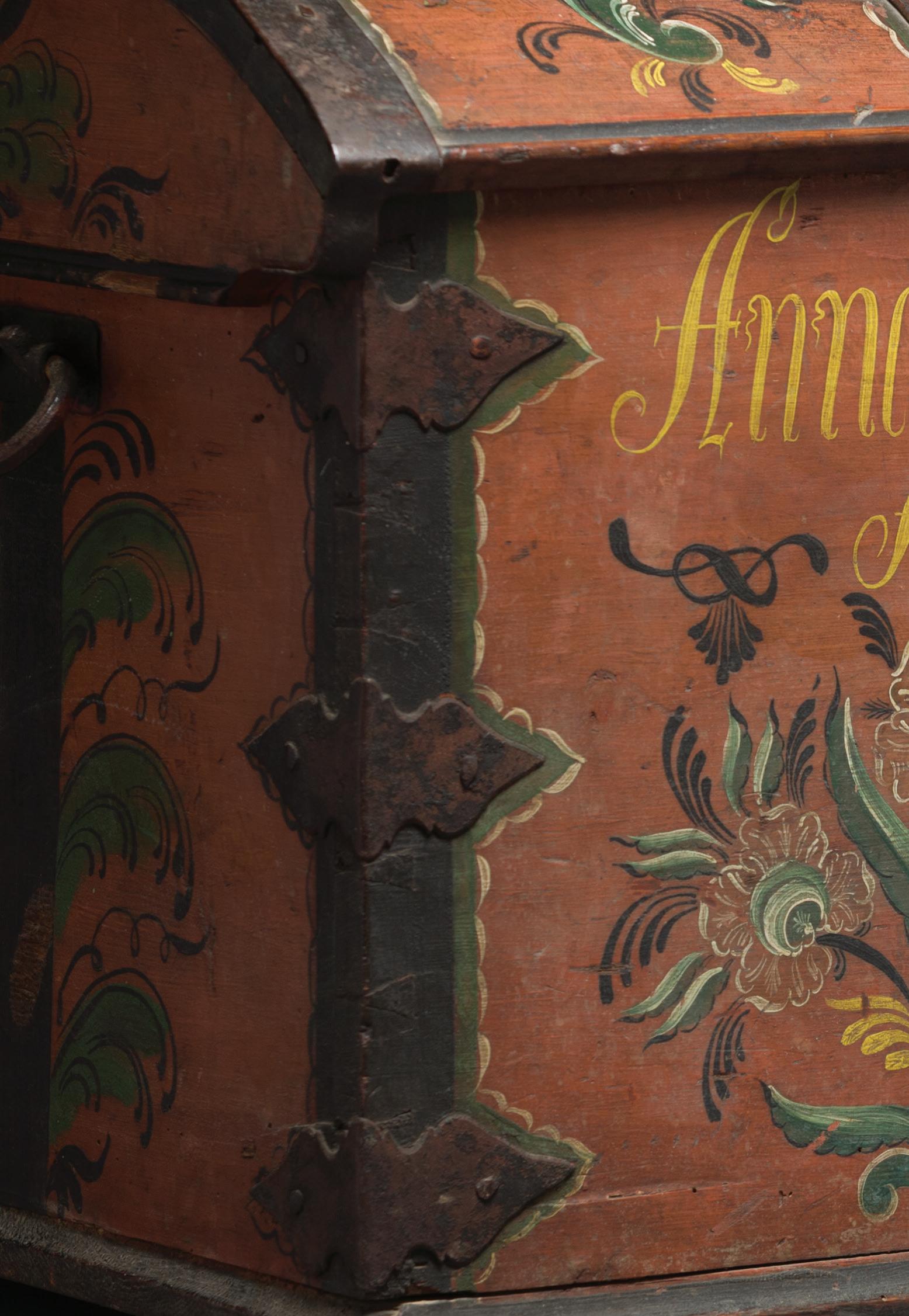
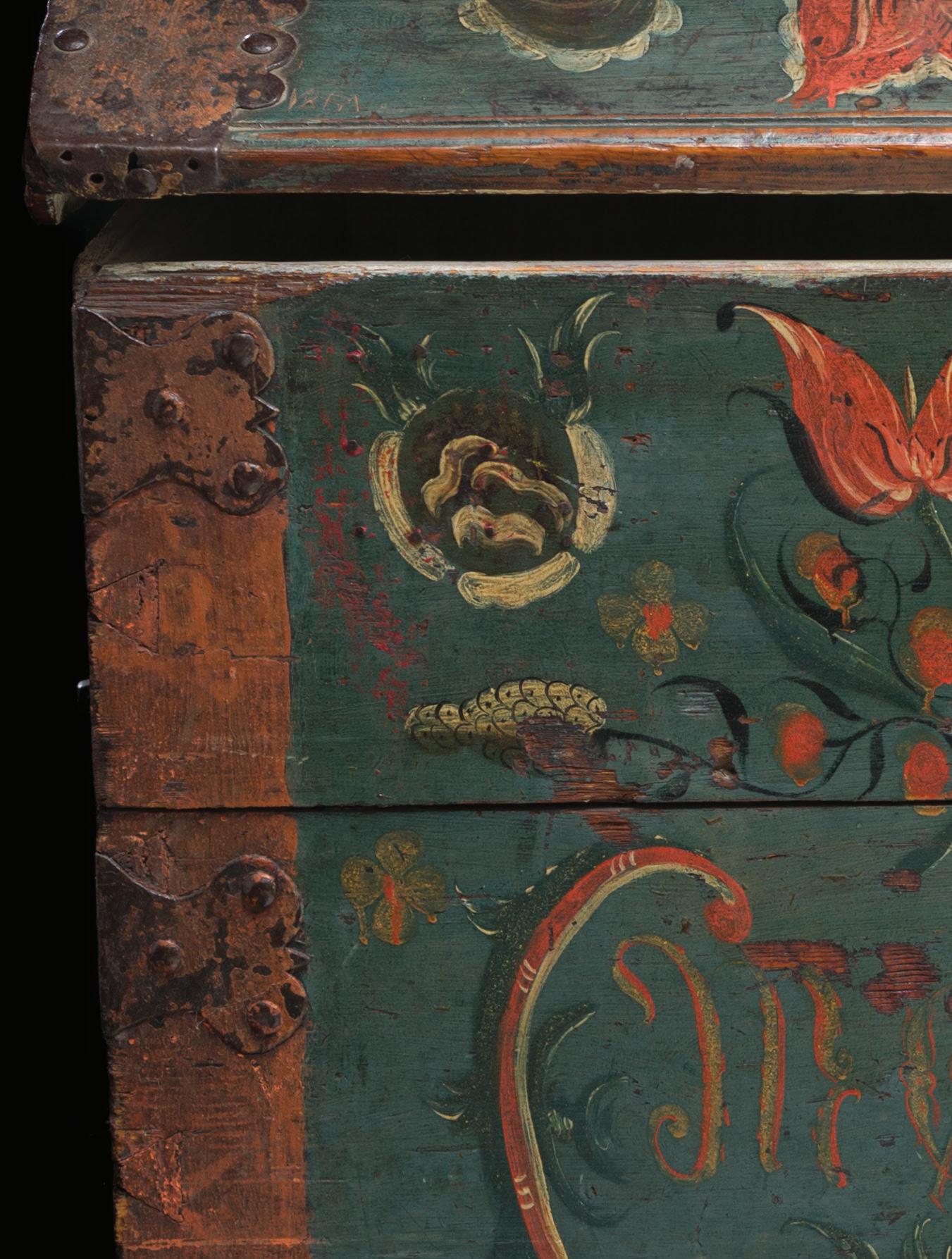
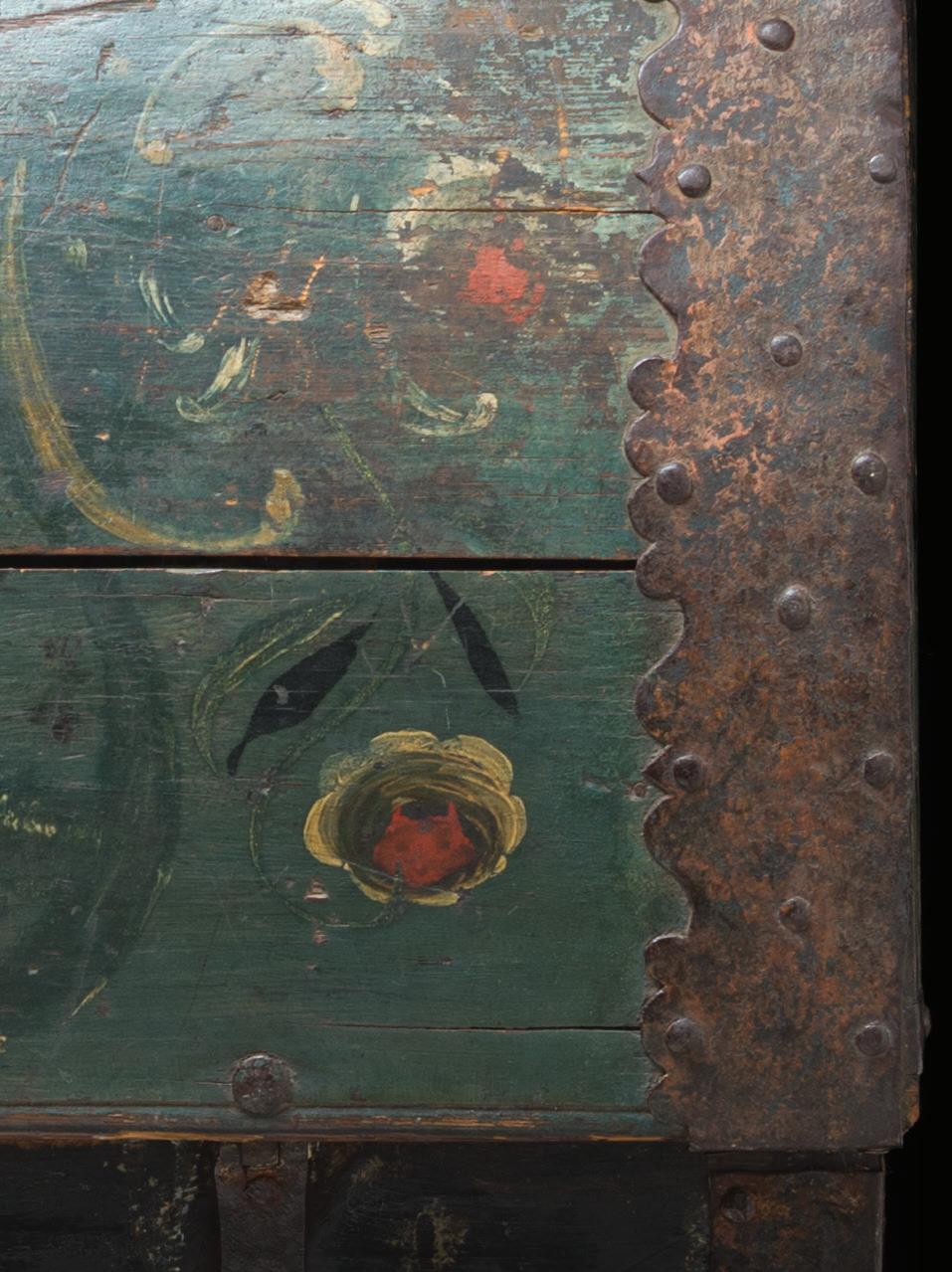
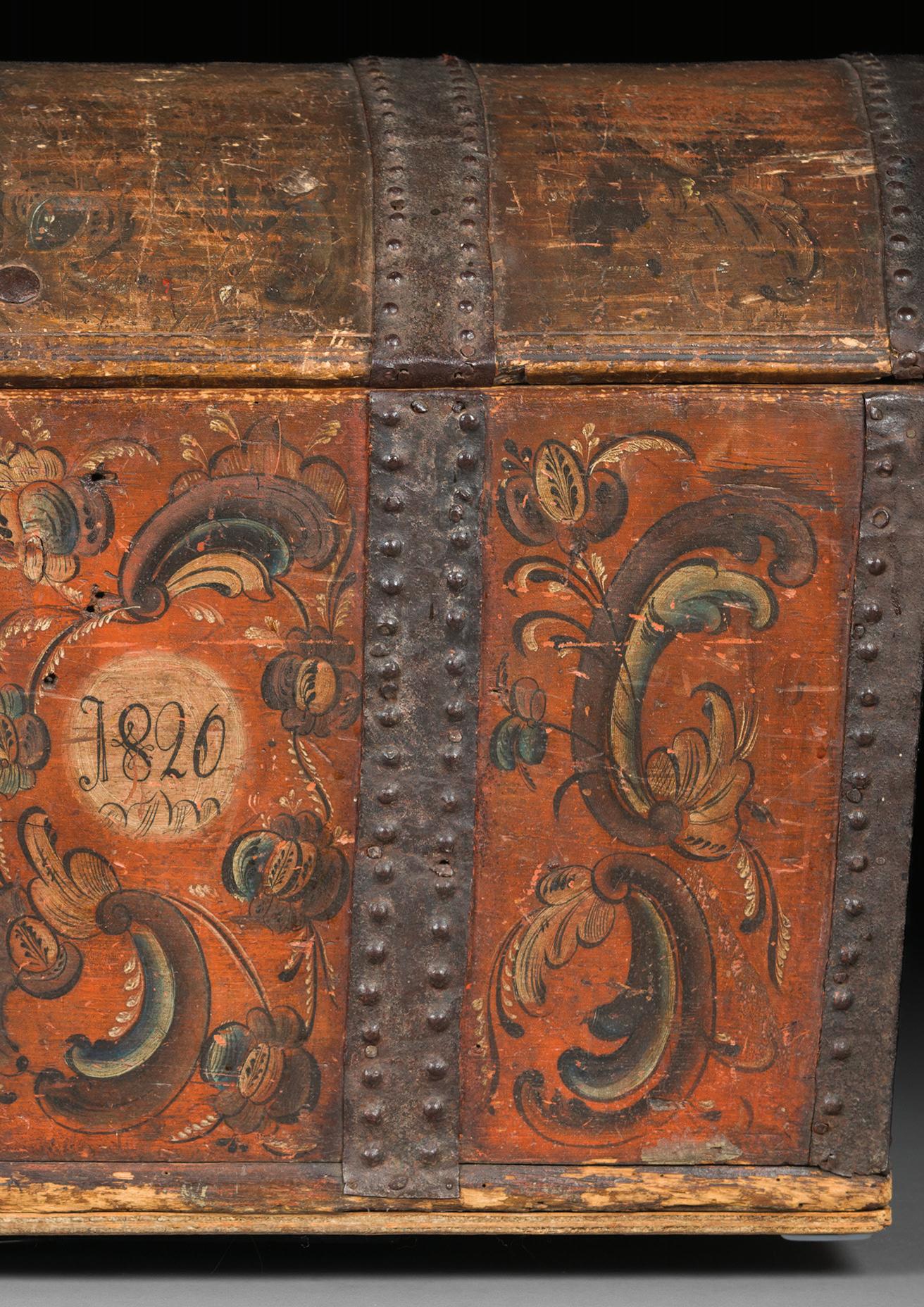
Corner brackets and straps serve to reinforce dovetail joints, which can slide apart in one direction though not the other. I prefer the smaller corner brackets, which let
2018.014.001 - Gift of Nancy F. Morgan.
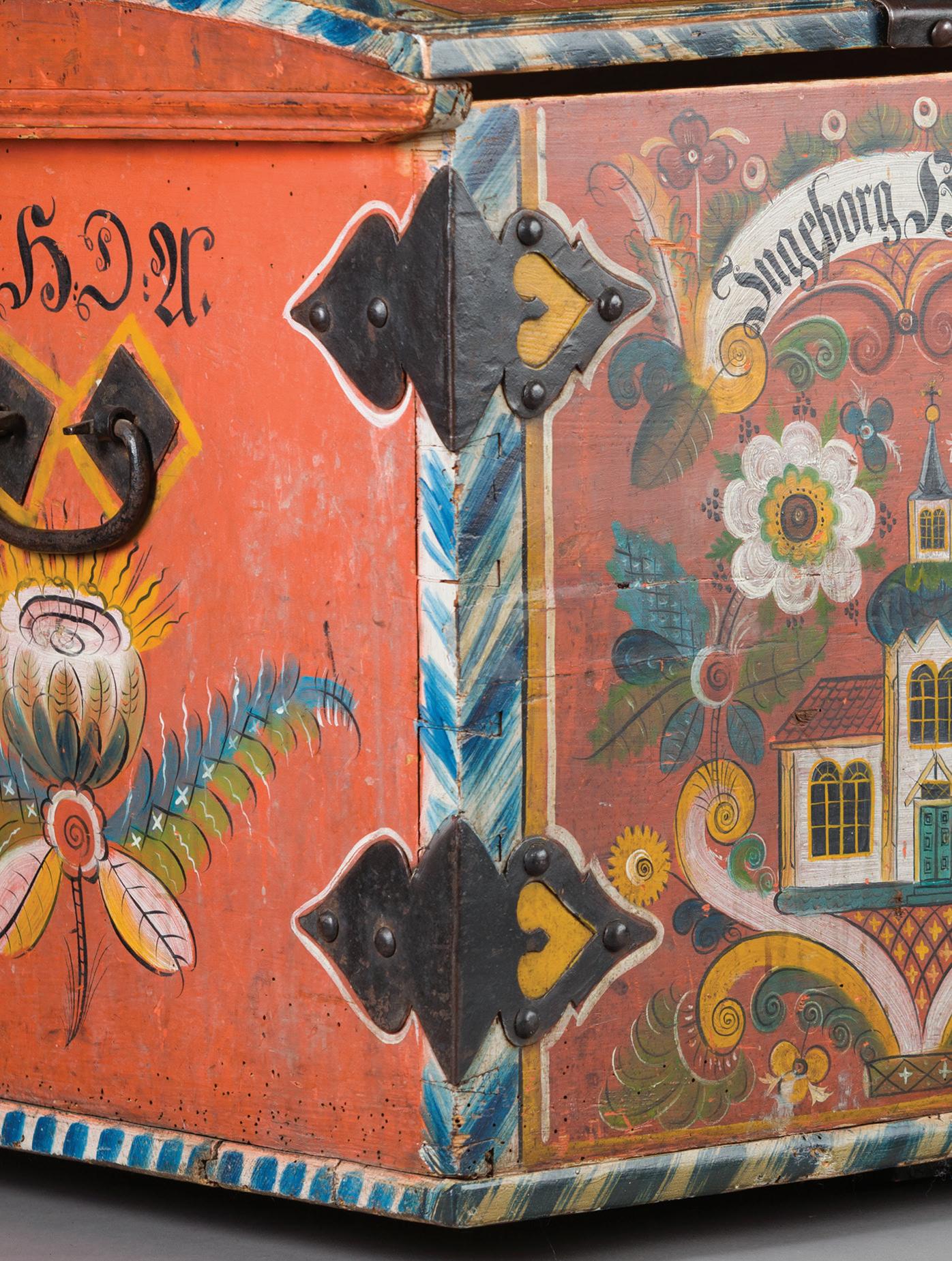
the dovetails show between the iron elements. Solid straps, however, represent more work on the part of the smith and take more nails. I would bet that, if checked, the solid straps do not hide poorly cut dovetails.
Trunk LC5987 presents a nicely formed corner bracket that the painter has respected. It is held by one nail on each side.
Trunk 2021.016.001 (see image on page 22) shows a very similar bracket with three nails per side, so uniform that they may have been machine made.
The brackets in trunk 2023.002.001 are pleasing and are held with three nicely forged nails per side, but were disregarded by the painter.
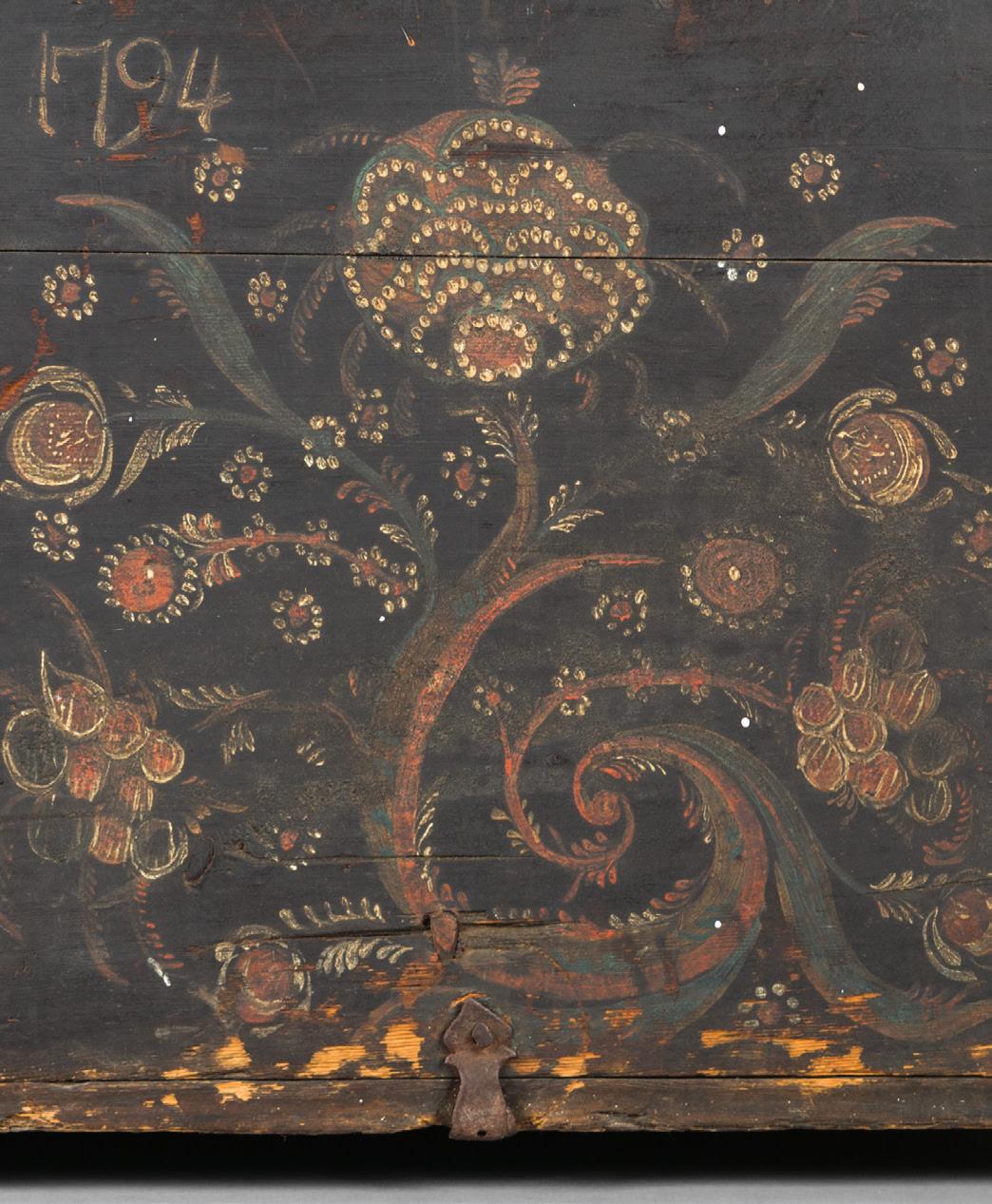
Trunk 2014.015.001 shows pierced corner brackets set off by their paint. The uniform flatness of the sheet iron suggests it was rolled at the mill, and the perfection of the nails was likely produced by machine.
The bottom bracket on trunk 1970.029.001 is crude but appealing. The bottom bracket on trunk 2022.021.001 is better looking than 1970.029.001, but the nice bottom molding was cut away to apply the bracket.
Trunk 2023.002.001 shows a thin sheet corner strap with a well-cut profile and many well-formed nails.
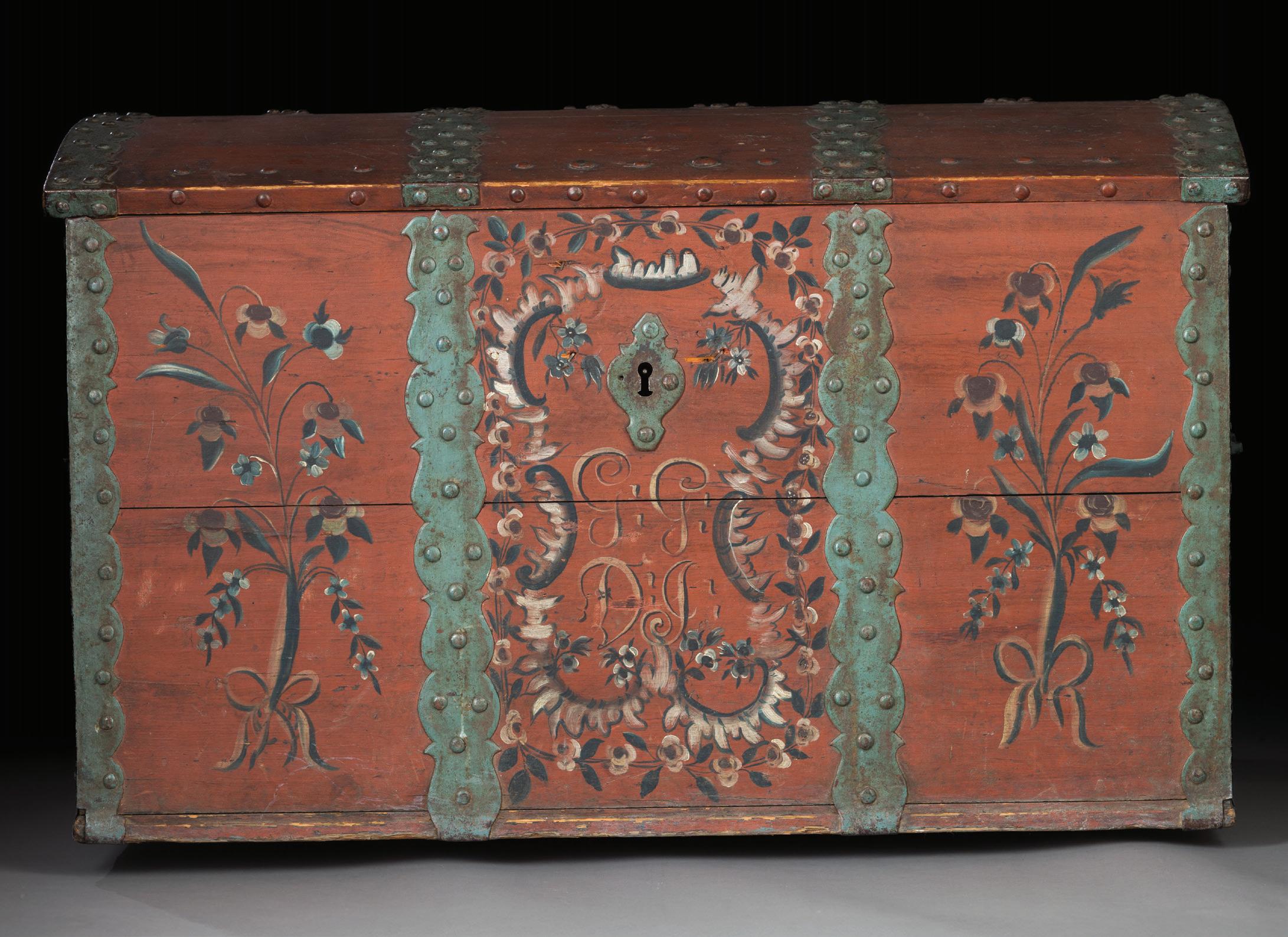
The plain straight straps in trunk 2018.014.001 have many bumped up “false nails” with no attempt to fit similarly shaped true nail heads into the rows.
Trunk LC7023 (see image on page 22) shows wellformed elaborately pierced, chased, and embossed straps in line with the hinges, holding the bottom on along with the keyhole escutcheon and at the corners.
About the Author
Tom Latané started forging reproduction colonial and early American ironwork in Maryland in the early 1970s. After moving to the Midwest in 1981, he was introduced to the creative whimsy of Norwegian folk iron. Tom and his wife, Catherine, have a shop in Pepin, Wisconsin, where Tom repairs antiques and creates original pieces using a traditional design vocabulary and historic hand techniques. Tom has demonstrated for blacksmith groups and has taught at folk schools around the country. Some of Tom’s ironwork can be seen in Vesterheim’s Westby-Torgerson Education Center.
2014.015.001 - Museum purchase with funds from Amy Ahrens, Margaret Andrews, Louise Bath, Mary Bennett, John and Veronna Capone, Norma Carlson, Jenna DiSalvo, Barbara Doran, Marilyn Edlund, Marlene Evenson, Mariyn Fahrney, Sandra Fleming, Terry Flynn, Susan Frechette, Patricia and James Goke, Ruth and Dennis Green, Karen Hammarberg, Judith Mithun Hartnett, Cynthia Hayashi, Andrea Herkert, Ronald E. Hovda, Helen Howe, Anita Hubanks, Jerry Johnson, Jane Kemp, Arlene Knudsen, Karen Aamot Lowman, Kate Martinson, Barbara Morgan, Nancy and Fred Morgan, Linda Nelson, Nisse Rosemalers, Jan Norsetter, Janice Northey, Roger and Nancy Odalen, Clarence and Louise Olson, Diana Olson, Donald G. Oss, Loretta Paulman, Ardys Pfundheller, Cheryl Schumacher, Mary Schwartzlow, Bonnie Selje and Dean Selje, Naoko Seto, Kelly and Kim Sime, Eugene R. and Sandra K. Somdahl, Sons of Norway Valdres Lodge #1-503, Sally E. Stocking, Sonija Straavaldsen, Shannon Suddeth, Karen Syens, Terrace Mill Foundation Rosemaling Assn., Edith and Roland Thorstensson, Patty Tofsland, Norma Wangsness, Western Rosemalers Assn., Dawnine Wheeler, Wisconsin State Rosemaling Assn.