
Following Where the Nails Are
by Harley Refsal
My first Christmas holiday spent away from home and apart from family was in the late 1960s, while I was a student enrolled at the University in Oslo. During November, as street lights came on earlier and earlier in the afternoon, I began to watch for announcements of upcoming Christmas concerts or pageants, holiday craft markets, etc. I didn’t have any firm plans for the holidays, but I was certain I would be able to find a wide variety of Christmas-related events and activities in the Oslo area.
But then an unexpected invitation arrived. A Norwegian friend, then living in the United States, asked if I would be interested in spending the holiday with his mother in a small town in the fjord country of western Norway. Although widowed and living alone, she would have plenty of company—children and grandchildren—for a few days right around December 25, but if I was interested, I was welcome to spend two to three weeks with her, from mid-December until early January, when classes resumed at the University.

Great! I immediately answered “Ja, takk. . . with pleasure.” And soon a handwritten letter of invitation arrived—in Norwegian, of course—from Anna herself, saying that I was welcome to come and spend as much time as I wanted. She would appreciate the company, and if I arrived a while before Christmas, I could help her with preparations. “Take the train to Bergen, then the northbound Coastal Express. Unless the weather is bad, the boat trip won’t take you more than ten hours or so. “Hjertelig velkommen, og god tur. (A hearty welcome, and have a good trip.)”
On the evening of the day my fall semester classes ended, I shouldered my already-packed backpack and made my way to the Oslo East railroad station, where I joined a throng of fellow travelers bound for Bergen. As we left the lights of the city behind, I looked out the train window and realized that my eyes soon adjusted to the level of light out in the countryside. Despite some of the rumors I had heard about it being pitch dark during the long nights of a Norwegian winter, it wasn’t really dark. Okay, it wasn’t exactly light either, but I could easily make out snow-covered trees and fences, farm buildings, and—as we passed through small stations— the occasional spruce tree decorated, not with colored lights, but entirely with white lights—an Advent spruce.
Away from the distraction of lights and colorful advertisements of the city, my thoughts began to reel back to

. . . the farm . . . was watched over by a little fellow called a haugbui, or “the one who dwells in the mound.” When the weather turned really cold, it was thought that the haugbui may well have spent his nights indoors, in the warm barn, with the cows. (Doesn’t it sound like he could have eventually evolved into the nisse?) Haugbui and nisse, 2013, carved by Harley Refsal. Photos courtesy of the artist.

the twenty-some Christmases I had experienced growing up in America. What would I be doing right now if I were back in Minnesota? What would family members and friends be doing? Having been raised in a Norwegian home, on a farm in a community peopled primarily by Norwegian and/or Swedish Americans, I was certainly familiar with foods that graced our holiday table: lutefisk, lefse, krumkake, potato sausage, etc.
In our local school we always performed a Christmas concert, complete with a carol or two sung in Norwegian or Swedish. The year I was in fourth grade, Esther, one of the cooks in the school cafeteria, left her apron in the kitchen, gathered all of us in grades one through six around her in the gymnasium, and taught us the words to the Swedish carol När juldags morgon glimmar (When Christmas morn is dawning). Jeg er så glad hver julekveld was pretty standard at Christmas events too, regardless of the setting: school concert, a church service, or a Sunday School program.

We had a party in each classroom on the last day of school before Christmas vacation. After we sang carols and ate treats, we received permission from our teacher to open the gift we had received from a classmate who had drawn our name back in early December. And finally, we opened the gift each of us had received from Teacher.
In our homes, those of us with Norwegian or Swedish ancestry opened our gifts on Christmas Eve, while it seemed that my classmates of German descent—fewer in number than those of us with Scandinavian ancestry—opened their gifts on
At Lands Lutheran Church, our annual Sunday School Christmas program was held on the evening of December 26. In my mind, that event marked the end of Christmas. My parents, both raised in Minnesota, occasionally reminisced julebukking between Christmas and New Year’s, but that tradition was no longer practiced in our community, at least not as far as I knew.
Would my family back home have their Christmas tree set up and decorated yet, even though it was only mid-December? I had always heard that folks in Norway don’t typically bring in and decorate their tree until around Dec 24, so I assumed I would be able to help Anna with that. . . something I looked forward to. Would it have electric lights? And if so, would the bulbs be colored, like ours at home, or all white? Or would there be candles? Strings of Norwegian flags? I looked forward to the food as well. Would we be eating lutefisk, lefse? If so, when? And what other Christmas customs and traditions would be new to me? During my growing up years, we always Norwegian. . . I can’t recall ever hearing used in common parlance until I moved here to Norway. Would I notice many differences between a Norwegian vs. a Norwegian-American Christmas? make an appearance on Christmas? Would we set out a bowl of rømmegrøt for him? We never did that on our farm in Minnesota, but I had read that the custom was still practiced on some farms in Norway, especially among families with young children.
I had a window seat on the right side of the train, so the trip west through the mountains afforded a mesmerizing light show starring Aurora Borealis. Inspired by the Northern Lights, I tried to let myself free-fall back in time, and imagine myself living here a century ago—four centuries ago—a thousand years ago—before the celebration of Christmas had even reached this part of the world. Beneath the undulating colors of these same Northern Lights, they too—a thousand years ago—must certainly have observed a midwinter festival of some kind. What did celebrating consist of? Would we recognize some of their symbols and customs yet today?
As the train pulled into Bergen I noticed that a couple of public spaces sported spruce trees with white lights, more “Advent trees,” as I heard a fellow passenger say. Christmas trees would appear, in all their colored glory, closer Lillejulaften (Little Christmas Eve, itself.

The boat ride north along the coast was uneventful weather-wise—but electric with excitement. Students and other young people, most of whom, I gathered, had moved from farms and small towns here on the West Coast to larger urban areas, were on their way home for Christmas.
Two taxis stood parked near the pier, as their drivers stood outside in the early evening chill, having a smoke. Did they know Anna? “Yup. Hop in.”
We stopped in front of a two-story white frame house built in the mid 1800s or so, surrounded by a white wooden fence. A fresh snowfall had transformed the scene into a winter wonderland, complete with a sheaf of wheat called a julenek fastened to a pole beside the unshoveled sidewalk. Home for Christmas.
On December 22, Anna asked if I’d like to decorate the parlor, dining room, and entryway on the 23rd, since some of her children and grandchildren would be stopping by to celebrate Lillejulaften. I said I’d love to, but I didn’t know which decorations I should use, nor where they should be placed.
“Start in the entryway, then move to the parlor and the dining room. Hang them wherever you’d like, but I think you’ll figure out where they go. Just follow where the nails are.”
And with that, on the forenoon of Lillejulaften, I began to follow the trail of nails as Anna disappeared into the kitchen. Some of the nails were large, and of an older style—square nails, I was used to calling them—suggesting that they had supported heavier decorations here in the entryway: a wreath, perhaps? Sure enough, in one of the boxes of decorations Anna had me carry downstairs, there lay a heavy wooden wreath, with a metal sign fastened to it which read Velkommen. The wreath was hand-carved, and judging from the weathered surface and faded green and red paint, at one time it must have hung outdoors. Could it have hung outside the shop owned and operated by Anna’s late husband?
A long, horizontal row of daintier, smaller nails had probably held this red and green garland. I reasoned that two small nails at approximately eye level on walls in the dining room had probably held the well-worn, hand-carved wooden spoons found in box number 2: courting spoons that Anna had received decades ago, perhaps? And on I went, until both boxes were empty. Only a couple of nails remained undecorated. . . . I must have hung two items on one nail, or perhaps one or two of the nails had held a live branch of evergreen or a marzipan pig, neither of which had survived last year’s Christmas.
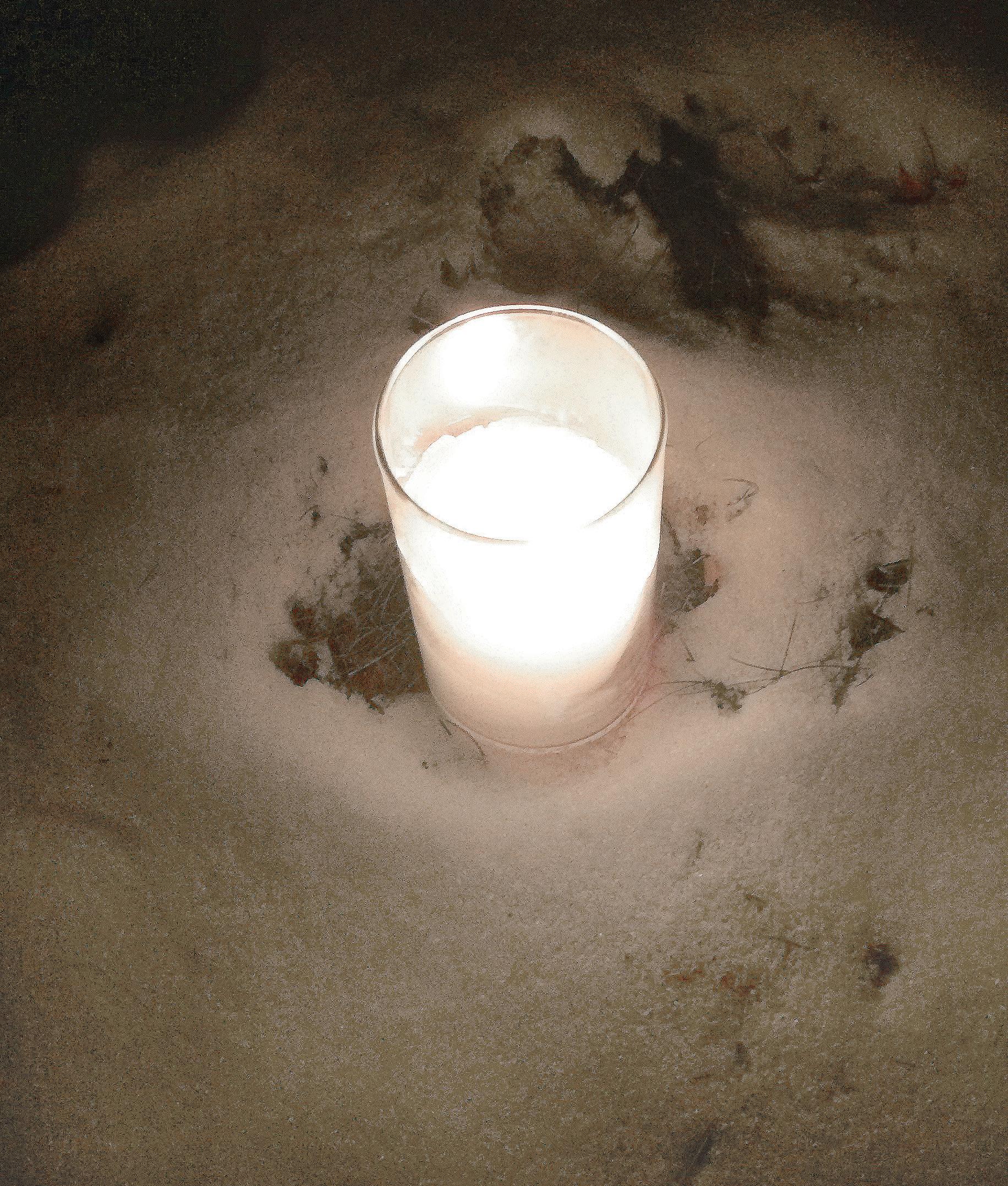
I couldn’t help but think about material I had read about the ancient origins of this annual ritual, rooted in pre-Christian times, when candles or flames on graves of the farm’s ancestors at this darkest time of the year succeeded in pushing back at the blackness and cold, preparing the way for brighter and warmer days that were sure to follow. It’s likely that each farm, at least those of any size, once had its own private family burial site or cemetery right there on the farm, which was watched over by a little fellow called a haugbui, or “he one who dwells in the mound.” When the weather turned really cold, it was thought that the haugbui might well have spent his nights indoors, in the warm barn, with the cows. (Doesn’t it sound like he could have eventually evolved into the nisse?)
At 4:00 p.m., church bells ring throughout the entire country, signaling the start of the Christmas Eve service. This annual four-o’clock ringing serves as the “opening event” of Christmas for everyone, whether one attends church services or not.
Later, back at the house, now joined by still more family members—dressed in our finest, including a few in bunader we feasted on pinnekjøtt (slowly steamed dried mutton) and pork sausage—time-honored celebratory fare in this part of the country. Stories of past Christmases abounded: the year
“Tusen takk. Beautiful!” Anna praised. “All finished before the family arrives.”
Lillejulaften was not celebrated in our little corner of Norwegian America, but here it was an age-old tradition, I was told. Family members arrived, dressed informally, and we enjoyed rice porridge, complete, with an almond hidden somewhere in the kettle. When one of the grandchildren asked what the prize would be for the person who discovered the almond in the porridge, Anna said the winner would get to help her wash and dry the dishes. No one discovered the almond. . . . Anna must have forgotten to put it in, we all decided.
When I came downstairs the next morning I saw that some of my decorations had been moved to other nails. I noticed, but said nothing. . . nor did Anna. She knew exactly where they belonged, and now everything hung on its proper nail. The rooms looked perfect. . . . All that was left now was the tree, which son Arne brought into the parlor in the forenoon, so it could warm up before we decorated it.
After decorating the tree in the afternoon, some of us drove to the local churchyard, where we placed and lit candles on the graves of several generations of family members. The candles, shielded from wind in their clear plastic or glass receptacles, cast overlapping circles of white on the snowcovered graves, visually weaving together grandfather to greatgrandfather, great-grandmother to great-great grandmother.

Reproduction of a high seat cloth made in 1792 in Bø, Telemark, in the collection of Norsk Folkemuseum. Both “trees of life“ and birds were symbols of the connection and transition between the human and spiritual worlds. The female figures hold flowers for love, and rhombic motifs for fertility.
Reproduction made by Helga Fahre Bergland, Lunde, Telemark, and Torild Aavik, Bø, Telemark, in 2009. Vesterheim 2010.007.001 —Gift of Mary B. Kelly.


This bentwood box dates to about 1864. It is covered with incised motifs, many of which are pre-Christian in origin and each carries significant meaning. Detail 1 is an example of a valknut (a square with loops at the corners) and it was thought to provide protection fto both the owner of the box and its contents. Detail 2 shows rosettes, symbols of the sun, which represent the goodness holiness. In detail 3 the “trees of life,” with their roots in the earth and their leaves in the sky, helped link the human and spiritual worlds. The equal-armed cross on the lid represented the crossroads between the underworld and spiritual world. Vesterheim 1986.064.001—Museum Purchase.
A mangle board, or mangletre, was often carved by a man and given to his intended as a betrothal gift, though it also had a practical use as an iron. This mangle board has four panels separated by initials and a date of 1764. Each panel features an ancient sacred symbol. Vesterheim LC1000—Luther College Collection.


At the far end, there is an example of an Olavsknut, or Olav’s Knot This was seen as a symbol of protection and could also help ensure that love endured.
This panel boasts a rosette, a symbol for the good and the holy. It is one of the oldest symbols and represents the sun, which brought light, warmth, goodness, and rebirth.


Nets and grids are also seen as symbols of protection.

one of the lit candles on the Christmas tree leaned to one side and set the neighboring branch on fire. Bestefar had jumped to the rescue, clapping out the flame with his bare hands.
And how about the glorious Christmas of 1945, when, after five long years of occupation, they finally dared to decorate the tree with strings of paper Norwegian flags?
It was good to have Else home this Christmas holiday from her au pair job in London. The pinnekjøtt was delicious, Bestemor Skål! God Jul! Takk for maten!
After dishes, we all gathered in two concentric circles around the decorated tree, which stood, not in a corner, but in the middle of the parlor. Perhaps it was just my imagination, but as we joined hands and walked around the tree—the inner circle walking one direction, the outer circle the opposite direction—it felt like I was walking in a shallow circular path worn into the wooden floor by a century of singers. Just follow
where the nails are. “Jeg er så glad hver julekveld.” “Glade Jul.” “Deilig er jorden.”
Then it was time for gifts—toys, clothing, books— followed, of course, by coffee and Christmas pastries, served on a well-worn oval platter carved by Anna’s father. From Anna I received a red, knitted stocking cap—a gift I treasure and use to this day.
By tradition, December 25, the first day of Christmas, was a day of home, hearth, and family. No one left the house to visit neighbors or friends. Children and grandchildren gathered at Anna’s, played board games or worked on puzzles received as gifts on Christmas Eve.
In response to questions I posed, adults shared and discussed what they knew about some of the ancient preChristian, or pagan, midwinter customs and symbols that continued after the arrival of Christianity and have become
absorbed into the modern era as well. Although it’s difficult, or perhaps impossible, to know the answers for sure, our discussion generated many thought-provoking questions: did zig-zag borders, carved into wooden containers as protection from evil forces, live on in knitting designs for mittens and sweaters? Or, it’s known that the pre-Christian midwinter festival was called Jol. In most other cultures and language groups where Christmas is celebrated, the word or term for the holiday employs some form of the word Christ (Christ Mass) or Nativity. Jol to Jul.
As I lay awake in bed that Christmas night, I replayed in my mind many of the events and discussions of the past few days. Just as I had done on the Northern Lights train ride from Oslo to Bergen, I tried to stage those events in an earlier era. How would Christmas have been different, or similar, during the years of occupation—the Christmases of 1940-44? How about Christmas, 1905—the year Norway became an independent country—when family members arrived on foot, or traveled in a horse-drawn sleigh? Despite obvious differences—electricity, for instance—many may well have been similar. And how about a bit earlier, when family members and neighbors had begun to immigrate to America or Canada, to vesterheim, Norway West. What kind of discussions took place as family members gathered that last Christmas before Ole, Serine, and the children set sail for America? Which objects did they purposely try to leave behind? And which objects earned part of the precious space in their wooden trunks? Tools? Books? Kitchen utensils? Jewelry? A bunad? What did my own ancestors pack in their trunks to help them remember? Photos? A crochet sampler? A tiny

The fine line drawing in the bowl of the spoon on the left is a nice example of a decorative technique known as kolrosing. Birds are symbolically linked to the spirit world. It is believed that the spoon on the right was made by the donor in 1914. It is a fine example of acanthus design.
LC2307—Luther College Collection. LC0322—Luther College Collection, gift of Johannes Kraabel.
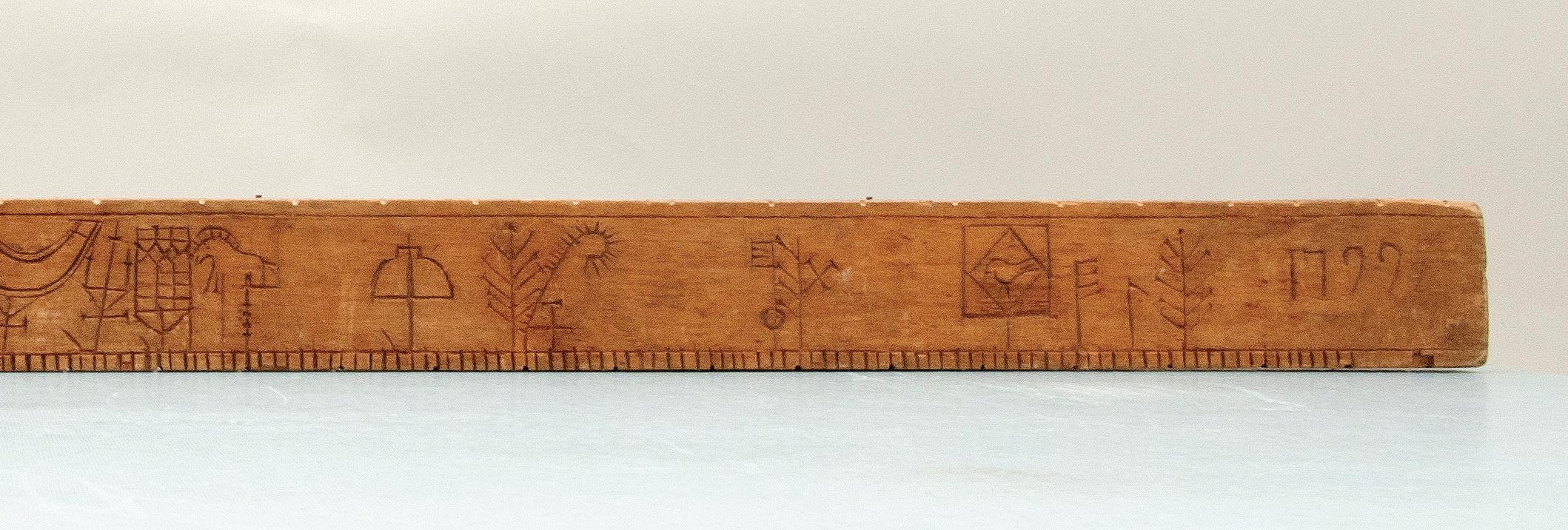
This primstav/calendar stick may date to 1773, or it may be a reproduction that was made in the 1900s. Either way, it is accurate and nicely illustrates the winter drinking horn, marking what we now call Christmas, but harkening back to the brewing and toasting traditions of the Viking jol. Vesterheim LC0289—Gift of Inga Norstog


designs carved into that mangletre or painted on a wooden container were not simply there as decoration? Closed symbols such as a valknut or six-leaf rose were able to entrap evil forces and securely lock them inside the symbol, neutralizing their power. . . preventing the contents of the container from spoiling.
Then I set my mental time machine to 1536, the year Lutheranism replaced Catholicism as the official religion in Norway. From 1000 AD or so, when Christianity arrived in Norway, until 1536, religious life—including its symbolism— was governed by the Church in Rome. Much of daily life was guided by a primstav, a two-sided wooden calendar staff with approximately 365 tick marks carved into its surfaces, half on the “summer side”, half on the “winter side.” Important fixed days throughout the year that Christians were required to observe, such as Christmas, along with a large number of saint’s days, were represented by symbols carved into the staff: a celebratory drinking horn on December 25; a depiction of the Midsummer sun on June 24 (St. Hans, the Feast of St. John, a.k.a. John the Baptist); an axe on July 29, symbolizing the death of King Olav at the Battle of Stiklestad in 1030 AD, etc.
And the evolution of symbols continued: Even long after the establishment of Lutheranism in 1536, decreed by the King of Denmark/Norway, the medieval primstav remained relevant—not necessarily because of its original religious significance, but through centuries tof its taking on an overlay of practical advice and significance in rural, largely agricultural
Norway. If one didn’t have beer brewing or dried cod soaking in water by December 8 (The Feast of the Immaculate Conception), it would not be ready in time for Christmas.
Even though I had celebrated Christmas—my favorite holiday season—every year of my life, and continue to do so, the Christmas spent with Anna steered me onto a fascinating trail of Christmas-related traditions and symbols that has continued to lead me from room to room, following where the nails are. My appetite was whetted, and my interest only continues to grow.
About the Author
Harley Refsal is a Vesterheim Gold Medalist who has taught Scandinavian figure carving throughout the United States and Norway. He was honored by H. M. Harald V, King of Norway, with the St. Olav Medal of Honor for his efforts in reinvigorating Scandinavian figure carving in both the United States and Norway. A retired professor of Scandinavian folk art at Luther College in Decorah, he also regularly demonstrates and gives many presentations about Norwegian folk art and traditions. He is the author of several books, including Art & Technique of Scandinavian Style Woodcarving. Harley was named the 2012 Woodcarver of the Year by the magazine Wood Carving Illustrated