Weaving Wheat: Traditions of Fertility and Faith
by Beverly Schrandt

Leave it to the folks who brought the world the julebukk (Christmas goat) and Norwegian meatballs to give us an artistic heritage that takes advantage of one of Norway’s agricultural crops. Traditional hvetevefting (wheat weaving) isn’t just a December craft; you’ll find wedding knots displayed next to holiday ornaments and wall hangings everywhere Scandinavian crafts are produced. Just like in many other countries, the weaving done in Norway has its own history and uniqueness.
Norwegians have among their Christmas customs some that can be traced back to the paganism of their Viking forefathers. Even Jul as a name for the holiday, dates back to pre-Christian times. Historians agree that the pagan Jul was a feast for promoting the fertility of the land, thus ensuring next year’s good harvest. It also seemed to honor the dead. To many of us this may seem like a strange combination.
In the northern hemisphere, from mid-September to mid-December, the days grow shorter until the arrival of the winter solstice, around December 22. This is the shortest day of the year, when the sun is the furthest from the equator. In Norway these days can be very short indeed, and the long periods of darkness reinforced belief in ghosts and spirits.
People left food and drink for the Yule ghosts who roamed the countryside around the time of the winter solstice. They even gave up their beds to them, covering the floors of their
homes with straw and sleeping on that instead. Later, as the days started to lengthen, they believed that the spirits were pleased with them and so had brought back the sun.
This tradition of scattering straw dates to the time when all buildings and homes had earthen floors. The straw also served to keep the family warmer as they slept on it. Even after homes had wooden floors, the custom continued. With the advent of Christianity, this tradition was interpreted to mean that Christ was born on straw and thus all man should be equal. The straw was then swept up, with the heads or
This straw mobile, called an uro, was made from the Christmas straw and hung above the table to ensure that there would be a bountiful harvest the next year and that there would not be a shortage of bread in the house before the next autumn. The meaning of the mobile’s parts were meant to evoke the sparkling, life-giving rays of sunshine, just when the days of the year are the shortest and the darkest. This uro was made by William Jacobsen, Shell Rock, Iowa, who learned the craft as a child in Denmark. 1981.010.001—Museum purchase.


kernels spread on the snow. The future could be predicted by the grains that fell off of the straw. Good quality grain meant a good crop could be expected, but if poor quality grain was found, they should plan on a poor harvest.
Straw mobiles, or “crowns,” were hung from the ceilings in many homes. In most areas, the custom was to make these “crowns” from the straw that had been swept off the floor. Vesterheim has a great example of a straw mobile.
Crosses and kitchen witches were often woven by early weavers. These also date to pagan times. Crosses were painted with tar above doors to keep out witches and spirits. Brooms were left outside these doors for the witches to use on their ride to the witches’ sabbath in order to pacify them so they would do no mischief. Today the kitchen witch can protect the baker from burnt holiday cookies and cakes enjoyed during the holiday season. Everyone, whether Norwegian or not, needs at least one or two.

Crosses were also fashioned from the gathered-up straw. These were hung over the front doors of homes for protection. Some crosses were taken to the barns to cure sick cattle and others were scattered in the fields to ensure a good harvest.
Another common belief was that the spirit of the grain lived in the field, moved from bundle to bundle and was then caught in the last sheaf. Certain areas of Norway saved this sheaf and hung it out for the birds, thus the juleneg. Some believed this wasn’t just to please the birds, but was really to keep them from damaging the next year’s crop. In other areas this last sheaf was fed to the farm animals to make them thrive the following year.
In still other areas these sheaves were made into Christmas goats. If made correctly, these julebukker were shaped from a single sheaf.
The goat as a holiday symbol has a long history—it was Thor’s sacred animal, and the Giver of Gifts was said to come riding on a goat. Of Swedish origin, the Christmas billy goat soon spread to all Nordic countries. He was a popular figure made of plaited straw, with long braided horns bound with red ribbon. They appear in all Nordic countries. They appear in all sizes, and no household would be complete without at least one at Christmas time.
Let’s not forget the nisse. The small but respected and feared ghost had changed over time, becoming less dangerous and more leprechaun-like. The nisse was believed to have headquartered in barns and protected the farm—as long as one stayed on good terms with him. At Christmas he had to have a bowl of porridge if one was to avoid trouble. To keep on good terms I have provided my nisse with skis and a swing. He has changed from the gray with the drab grey clothing to the gray with the bright red cap shown below. Mine have also been known to bring home fish from the sea and swing from the ladders sharing joy to all who believe in them.
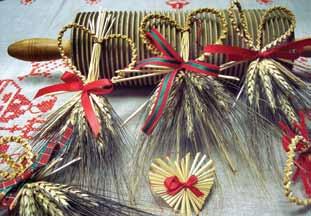
Flettehjerter (woven heart baskets) may be the reason so many wheat weavings are done in the shape of hearts. The colorful ornaments are usually made from a combination of braids done in 3 or 4 pieces of wheat. Some use the heads as part of the decoration, others are braided without heads. All are tied in red and sport red ribbon, which stands for warmth and love.
Christian symbols are also very popular. Three-cornered weaves represent the Trinity, while woven candles would have been placed in windows to show where a Christian Christmas would be celebrated.
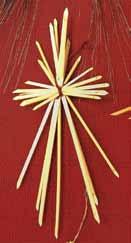
The five-pointed star is very popular, in sizes from as small as two inches to as large as can be made from the longest straws available.
The traditional use of jul chalm, Christmas straw, was kept up in Norway into the late nineteenth century. Now very little is left of it, with the exception of a few handmade ornaments that are sold as Christmas decorations. Many of these are made to be exported to other countries to keep alive the straw tory. After reading this, it’s my hope you’ll try your hand at weaving your own holiday memories. Don’t be too concerned if they don’t turn out all alike. Handmade isn’t to be perfect. Some of my mistakes are the designs I like best.


Projects to Try
In Norway, barley was the usual grain until the early 1900. The generic word for grain) meant barley. Wheat was very hard to grow because of the damp climate. Barley and oats were much more common. However, when I use the word straw in my weavings, I’m referring to wheat, which is more common today. Most of the wheat I use is of the black-bearded type, which is raised in North Dakota. Golden-bearded wheat is also easy to weave and makes beautiful ornaments. If you’re not up to threshing wheat to get your craft material, you’ll find everything you need at a hobby shop or on line.
The most basic straw art technique is called plaiting (pronounced with a short a) and is also known as braiding, or wheat weaving. Plaits can be made from whole, hollow stems of grass or wheat, etc., or from split straws. The directions are very simple and supplies easily assembled.
Supplies
Start by cleaning the wheat: To prepare the grain for use, break or cut just above the first joint. Discard the sheath. which is actually a leaf.
All projects are created with damp wheat. Soak the cleaned wheat in warm water for approximately 60 minutes (longer if using black wheat.) Remove the wheat from the water and wrap in a damp towel. Soak only what is needed for the project. (Leftover wheat may be frozen to use later.)
Other material needed are tying string (I like D.M.C.- 5), ribbon (color of your choice), ruler, and scissors.
Now that we have the wheat prepared and supplies ready, lets start.

Miniature Jul Neg
Wheat, 4 or 5 pieces (depending on size ), about 6 inches long with heads
Tying string, 12 inches long
Ribbon, 6 inches
Tie wheat together at heads. Pull on ends to get all heads at knot. Tie hanger. Cover the knot with ribbon.
Lady or Angel (depending on ribbon choice)
A Lady uses red ribbon and red straw flowers, an Angel uses white ribbon and white straw flowers. Essentially this is the only difference.
7 pieces of wheat, 6 inches long
Tying string, 14 inches long
6 inches of ribbon
4-6 small dry flowers
Lay tying string on table.
Center wheat on top of string, approximately 1 inch from end of wheat and tie in a simple pull knot.
Place finger on knot and pull one end of the string (at this point you may wish you had three hands) This causes wheat to spread. Now tie again tightly.
Clip ends into point.
Loop the ribbon around the end of the straw like a shawl and then tie the ribbon in place with the string.
With the remaining string make a hanger.
To form arms on Lady/Angel, measure down 1 inch on outside two wheat pieces.
At 1 inch mark, crease each outside with your fingernail and fold across horizontally and then tie in place., making crossed arms.
Now tie in straw flowers.
Trim arm straws to size.
Starting at center of skirt, flat cut center piece of wheat. To flat cut, lay scissor just below and at the same angle as the wheat stem, cut with scissors at that angle. This gives a nice open end.
Work out to corners of skirt, cutting each stem shorter.