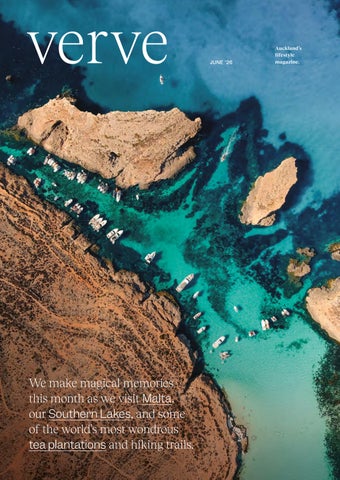
We make magical memories this month as we visit Malta , our Southern Lakes, and some of the world's most wondrous tea plantations and hiking trails.
bluntumbrellas.co.nz
We make magical memories this month as we visit Malta , our Southern Lakes, and some of the world's most wondrous tea plantations and hiking trails.
bluntumbrellas.co.nz
Congratulations to Auckland FC, who made history for the second year in a row by securing their first A-League Championship title, and best of luck to the All Whites as they head across the Pacific for the World Cup.
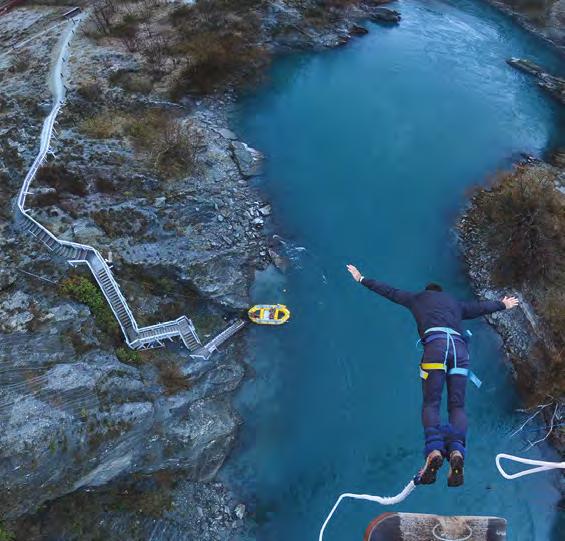
Aotearoa New Zealand, of course, gave the world a sport of a very different kind when the first commercial bungy jump launched from Kawarau Bridge in 1988. We take a look at that legacy as part of a beautiful Southern Lakes feature that travels from the snowy peaks of Queenstown and Wānaka to the autumnal magnificence of Arrowtown.
Keeping with the outdoor spirit, we also bring you some of the world’s most wondrous hikes – with a couple of Kiwi inclusions, of course – as well as journeys through otherworldly tea plantations (take another bow New Zealand), and explorations of some truly gorgeous retail spaces (and again, Aotearoa).
This month’s pièce de résistance is undoubtedly our Malta feature: a spectacular, sprawling examination of one of the Mediterranean’s most magical – and underrated –destinations.
We’re never anything less than proud of every issue of Verve , but the whole team agrees that even by our own very high standards, this one is something special. Arna and Yamin, take a bow too.
Enjoy the issue – you’re in for a real treat.
Jamie
Editorial & Creative Directors
Arna Kennedy
Jamie Christian Desplaces
Graphic Designer / Social Media
Yamin Cook
Contributors
Eleanor Hughes, Denise Stephens, Jessica Waddell, Karen McMillan, Lucy Kennedy, Paul Leuschke, Steve Huỳnh, Tim Warren
Subscriptions arna@vervemagazine.co.nz
Published by V24 Limited PO Box 16040, Sandringham Auckland 1041
Editorial Enquiries arna@vervemagazine.co.nz jamie@vervemagazine.co.nz
Advertising Enquiries fran@vervemagazine.co.nz kate@vervemagazine.co.nz pam@vervemagazine.co.nz vernene@vervemagazine.co.nz
Cover photo
Blue Lagoon located on the island of Comino in Malta - courtesy of VisitMalta
ISSN 2253-1300 (print) ISSN 2253-1319 (online)
Verve is published monthly (except in January) and has an estimated readership of 60,000. It is a free lifestyle magazine delivered to cafes and businesses throughout Auckland.
For distribution details or to sign up for your free monthly digital copy please visit our website vervemagazine.co.nz
Verve is printed by Blue Star, 8 Collard Place, Henderson, Auckland. It is distributed by Verve, ERC Contracting and Mailchimp.
The entire content of this publication is protected by copyright. All rights reserved. No part of this publication may be reproduced or transmitted in any form or by any means, without prior permission in writing of the copyright owner. Any material submitted for publication is at the owner’s risk. Neither V24 Limited nor its agents accept any responsibility for loss or damage. Although every effort has been made to ensure accuracy of information contained in this publication, the publisher cannot accept any liability for inaccuracies that may occur. The views and suggestions expressed in this magazine are those of individual contributors and are not necessarily supported by V24 Limited.
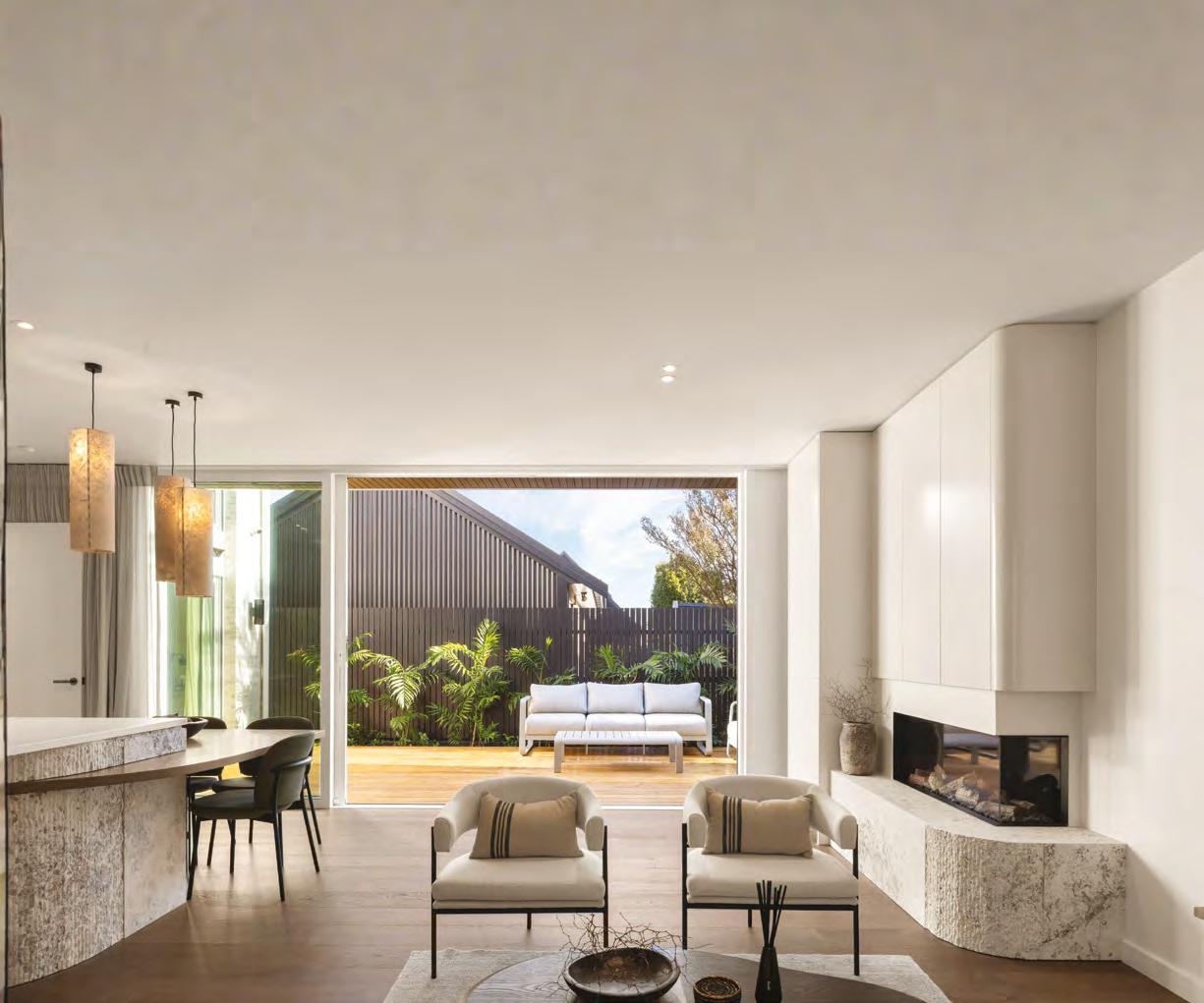
You may already have the vision.
What you need now is the right team to bring it to life.
At Landmark Homes Auckland, we work with clients who have invested in architectural plans, only to find the cost to build does not align with their expectations. It is a common point in the journey, but it does not mean starting again. With the right expertise, your plans can often be refined into a more achievable outcome without losing the essence of the design. Our approach brings design, cost planning and construction together from the outset. Every decision is considered not only for how it looks, but
for how it will be built and how it aligns with your level of investment, creating a more seamless path from concept to construction.
Whether you are working with your own architect or rethinking your next step, our team can review your plans with a practical, experienced perspective. The focus is on refining, resolving and moving your project forward with clarity.
Before you set your plans aside, explore what is possible.
Bring your plans to Landmark Homes Auckland or visit one of our Auckland Showhomes to experience a true Landmark.

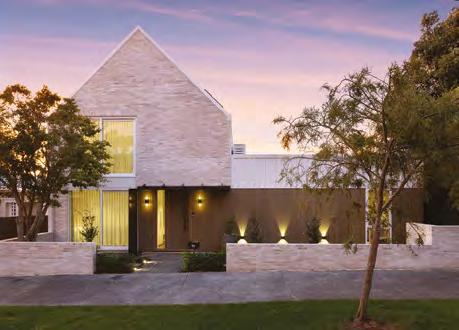



Retire to Waterford and discover free weekly fees & so much more*
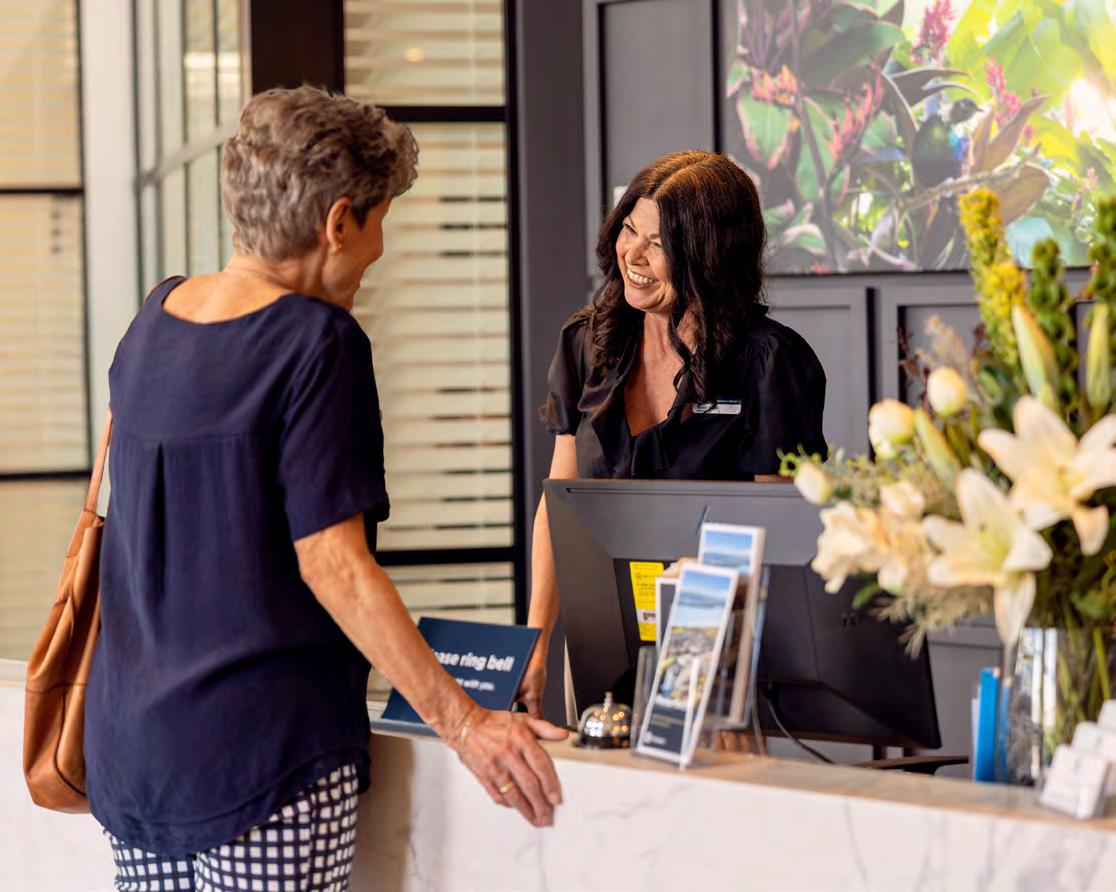
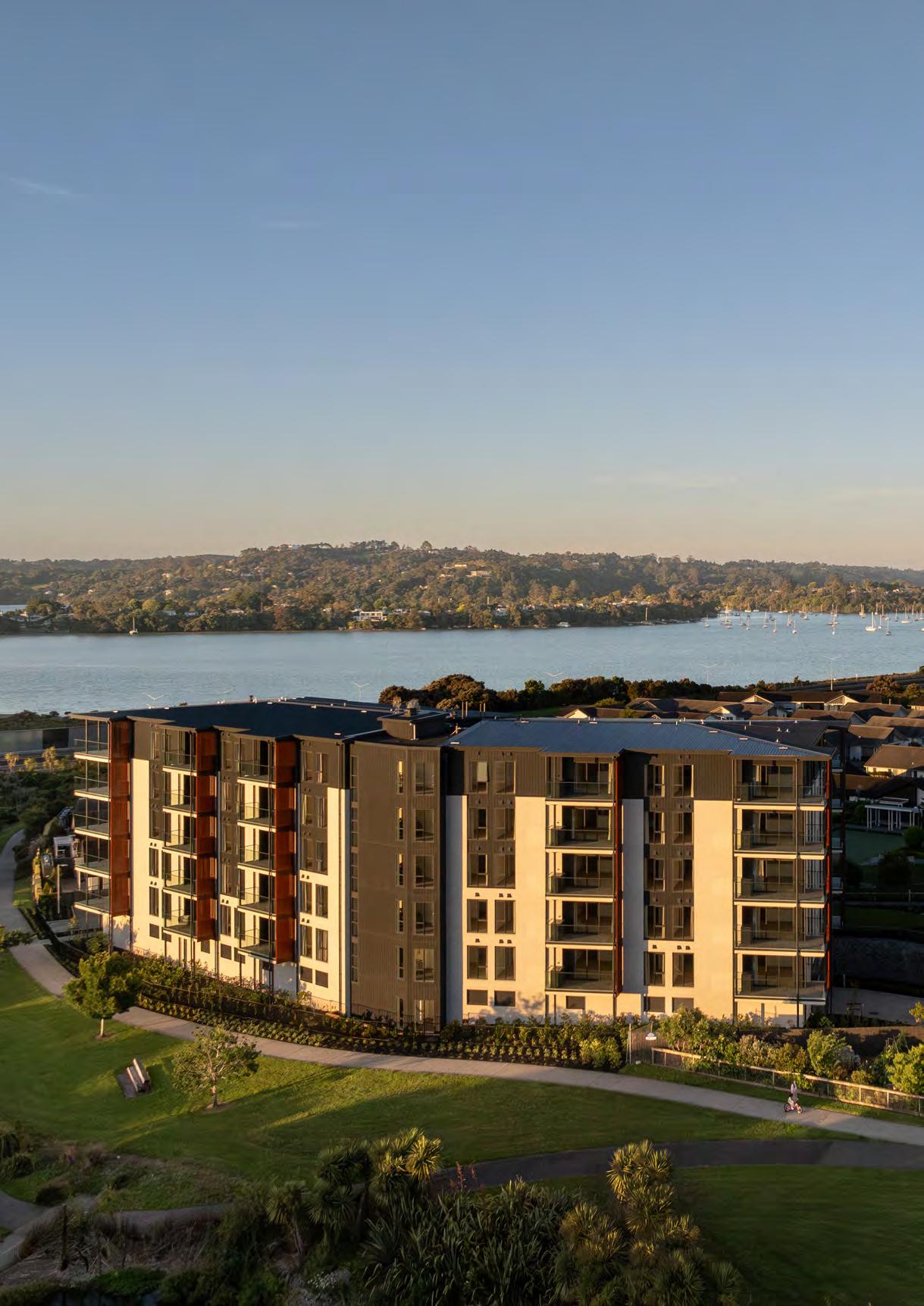
When you move into Waterford at Hobsonville Point, we want you to feel like it’s been home all along. Which is hard when there are lawyers to meet with, movers to organise and bills to pay.
We created The Warm Welcome Package to help lift some of that load. Covering many of the moving costs to ensure your retirement starts with a smile, rather than a truck load of stress.
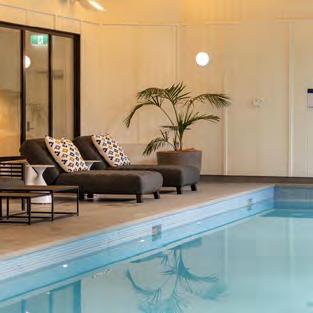
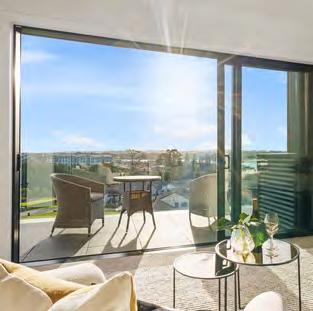
So, if you’re looking for a boutique retirement village with glorious views, a warm community and an idyllic location, Waterford has it allincluding a moving package to give you the perfect welcome.
To learn more, call Tracey on 09 954 7140 or visit waterfordvillage.co.nz.
*Terms, and conditions and eligibility criteria apply. For residents 70 years and above. For full T&Cs visit waterfordvillage.co.nz

$2,000 for legal fees with our Warm Welcome Package*.
Associate Professor Richard Martin from Skinscape 360 explains how cutting-edge 3D imaging and AI-assisted analysis are changing the landscape of skin cancer detection in New Zealand.

What is Skinscape 360 and how does the technology actually work?
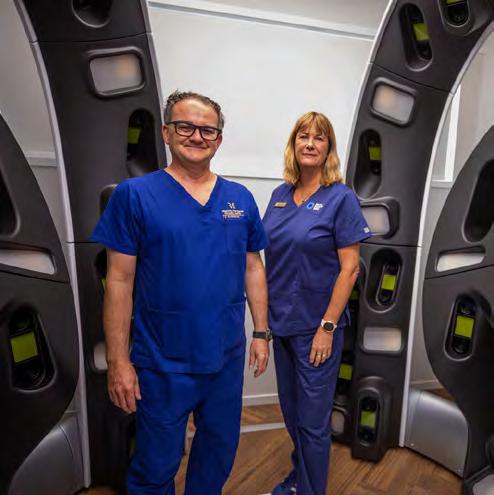
Skinscape 360 uses advanced total body imaging to support the early detection and monitoring of skin cancers. In just one second, the VECTRA WB360 captures 92 high-resolution images of the skin to create a precise 3D avatar – or digital skin twin – of the patient’s body. This allows skin cancer professionals to examine the skin from multiple angles, zoom in on individual lesions, and, crucially, compare changes over time with the assistance of AI technology.
Tracking change is critical in detecting skin cancer. Regular 3D scans can help identify new or evolving lesions that may indicate melanoma, basal cell carcinoma, or squamous cell carcinoma. Artificial intelligence supports the process by highlighting areas that appear unusual or have changed between scans. However, AI is currently used as a support tool rather than a standalone diagnostic system. All findings are reviewed by qualified skin cancer professionals alongside a full clinical examination and dermoscopy.
How does the VECTRA WB360 system improve early detection compared to traditional skin checks?
The system’s high-resolution cameras provide intricate detail of the skin and individual lesions, while AI-assisted analysis helps clinicians identify suspicious changes that may otherwise be difficult to detect during traditional skin checks.
How does Skinscape 360 help patients track changes in their skin over time?
The Canfield software, Dermagraphix, compares a patient’s original avatar with subsequent scans to track changes over time and highlight any new lesions. Stable lesions that do not change are generally not skin cancers, making longterm monitoring particularly valuable.
can expect the most advanced and comprehensive skin cancer assessment currently available in New Zealand.
What role does AI play in supporting clinicians during skin analysis at Skinscape?
The VECTRA WB360 and Canfield software utilise AI in three key ways:
1. The lesion visualiser can highlight atypical lesions.
2. The DEXI dermoscopic software provides a risk score from 1–10, with 10 indicating a lesion highly likely to be skin cancer. The latest DEXI 3.0 update has now been recognised by the FDA in the United States as a diagnostic tool rather than simply an experimental aid.
3. AI-powered change tracking highlights anything new or changing between scans.
How accurate is 3D total body imaging when it comes to identifying suspicious lesions?
The technology is highly accurate, with more than 30 published studies to date examining the use of the VECTRA WB360 system.
What should patients expect during a full Skinscape 360 scan appointment?
Patients can expect the most advanced and comprehensive skin cancer assessment currently available in New Zealand. In just one second, the entire body is scanned and recorded before the software creates a detailed digital avatar for ongoing monitoring and comparison.
Is Skinscape 360 suitable for people with no visible concerns, or only high-risk patients?
Skinscape 360 offers different levels of assessment and is particularly well suited to people who:
• have a large number of moles
• have experienced significant sunburn
• have fair skin that burns easily and does not tan
• have blue eyes
• have fair or red hair
• have previously been diagnosed with melanoma
• have a family history of melanoma
• have had previous skin cancers, including BCC or SCC
How does Skinscape 360 reduce the risk of missed or latediagnosed skin cancers?
The advanced imaging and AI-assisted technology support skin cancer specialists by helping ensure that suspicious or changing lesions are less likely to be overlooked.
Why is education around sun safety and regular skin checks so important in New Zealand?
New Zealand has the highest rate of melanoma and skin cancer in the world, including the highest mortality from melanoma. The UV environment is one of the harshest in the world, and prevention is the best approach, along with early detection.

Scan here to find out more about Skinscape 360.
09 8699 360 3 Anzac Street, Takapuna




These extraordinary walks – crossing several continents and every kind of landscape – offer some of the most rewarding adventures on Earth.

Few landscapes stop you in your tracks quite like The Wave. Tucked into the Utah-Arizona border within the Paria Canyon –Vermilion Cliffs Wilderness, this extraordinary formation of swirling petrified sandstone shifts through bands of orange, pink and red as the sun moves overhead. Getting here is half the adventure – 3km of rugged backcountry navigation with no cell service. Getting a permit is the other half; just 20 visitors are allowed in daily via a fiercely contested lottery.
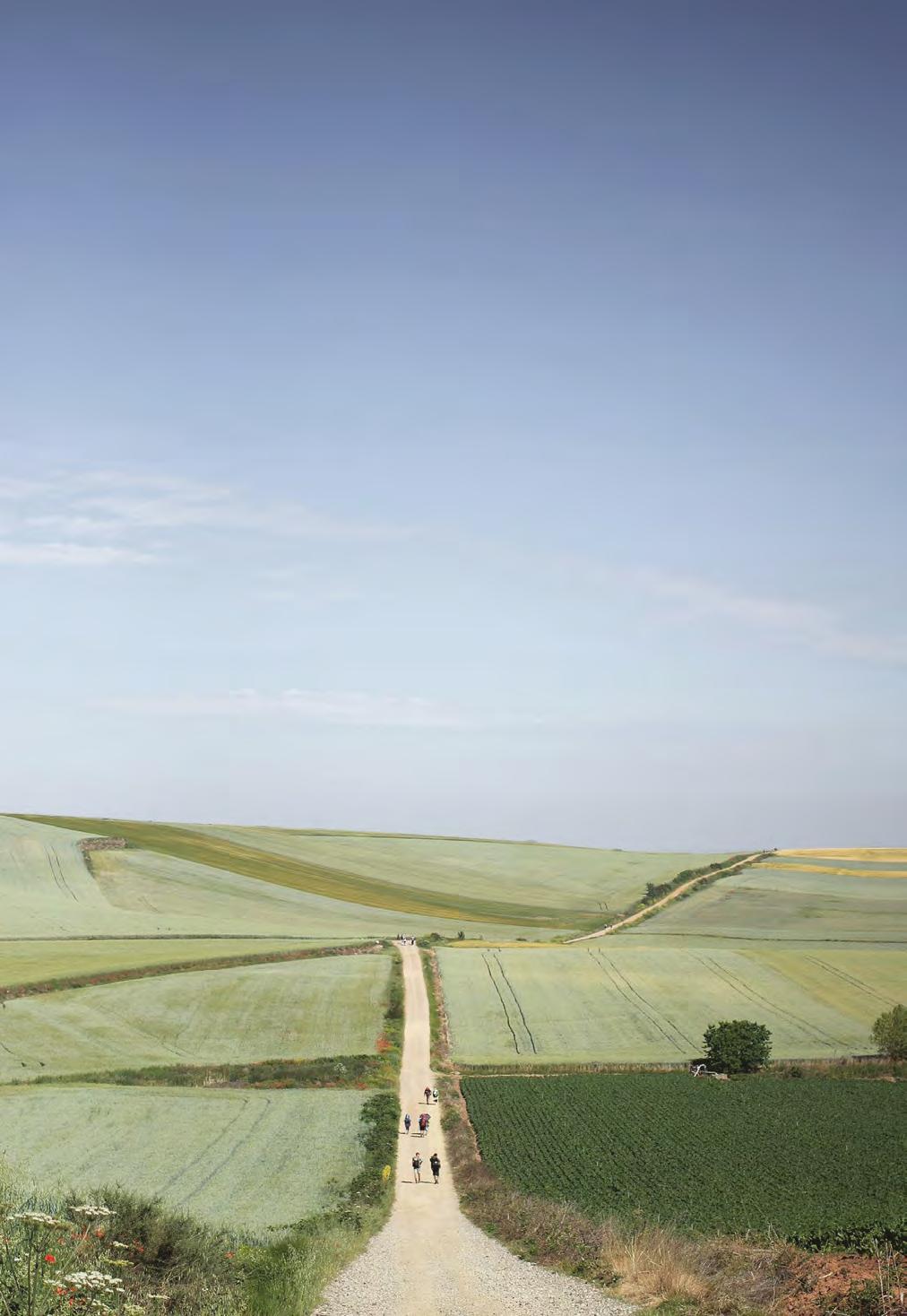
One of the world's great pilgrimages, the Camino de Santiago winds across northern Spain through Roman sites, mountain villages and medieval monasteries, ending at the spectacular Unesco-listed cathedral of Santiago de Compostela. Along the way, Pamplona – immortalised by Hemingway – and the Gothic grandeur of Burgos Cathedral demand exploration. Whether walked for spiritual, cultural or purely adventurous reasons, few long-distance routes deliver such a rich tapestry of history, architecture and human stories.
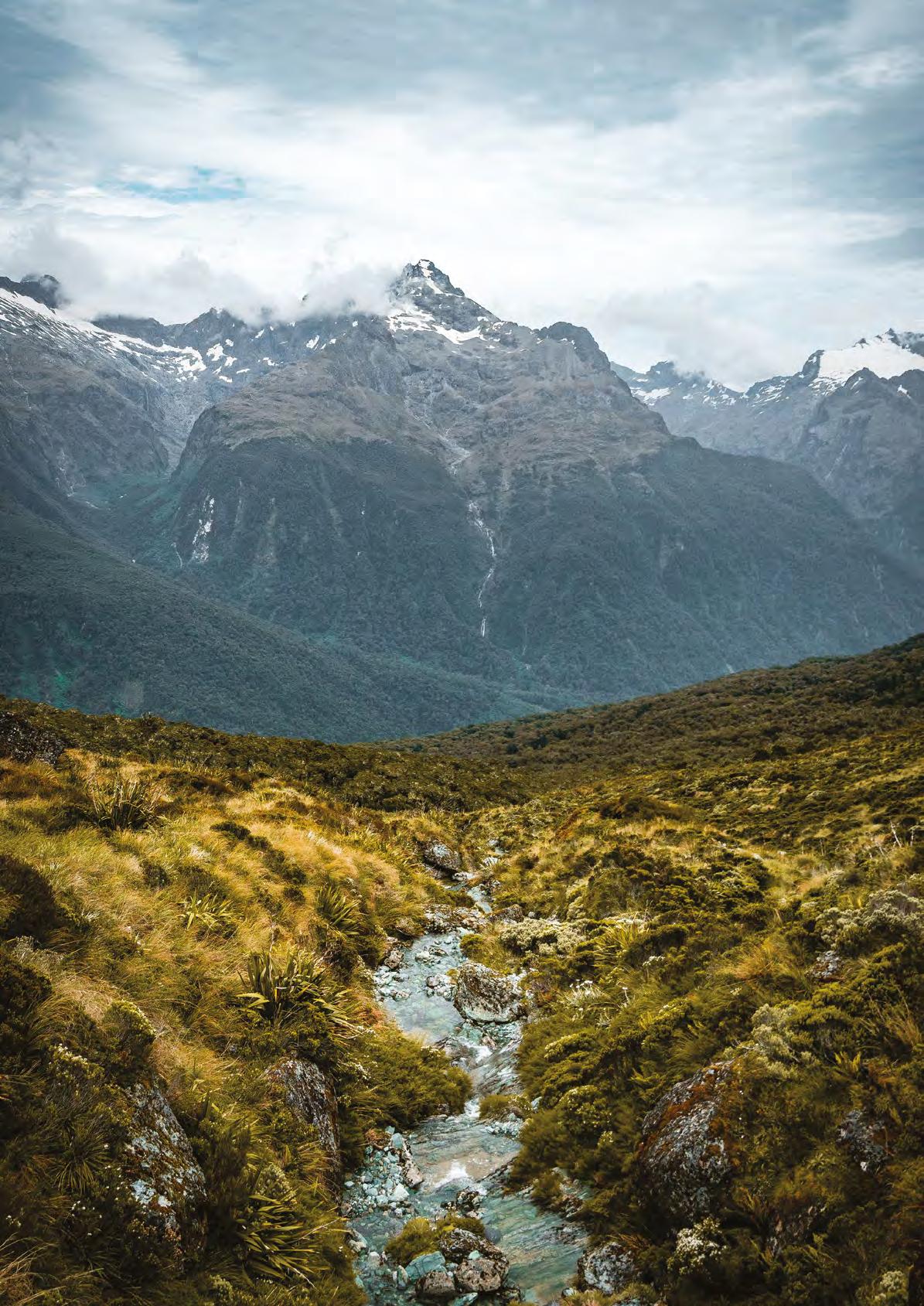
ROUTEBURN TRACK, AOTEAROA
Linking Fiordland and Mt Aspiring National Parks across 31km over three days, the Routeburn Track is one of our finest alpine walks. Snow-capped peaks, sparkling lakes, immense valleys and lush rainforest mark the route, with the highlight being Harris Saddle – at 1,255m it offers panoramic backcountry views. The track also connects with the Greenstone and Caples Tracks to make a circuit.
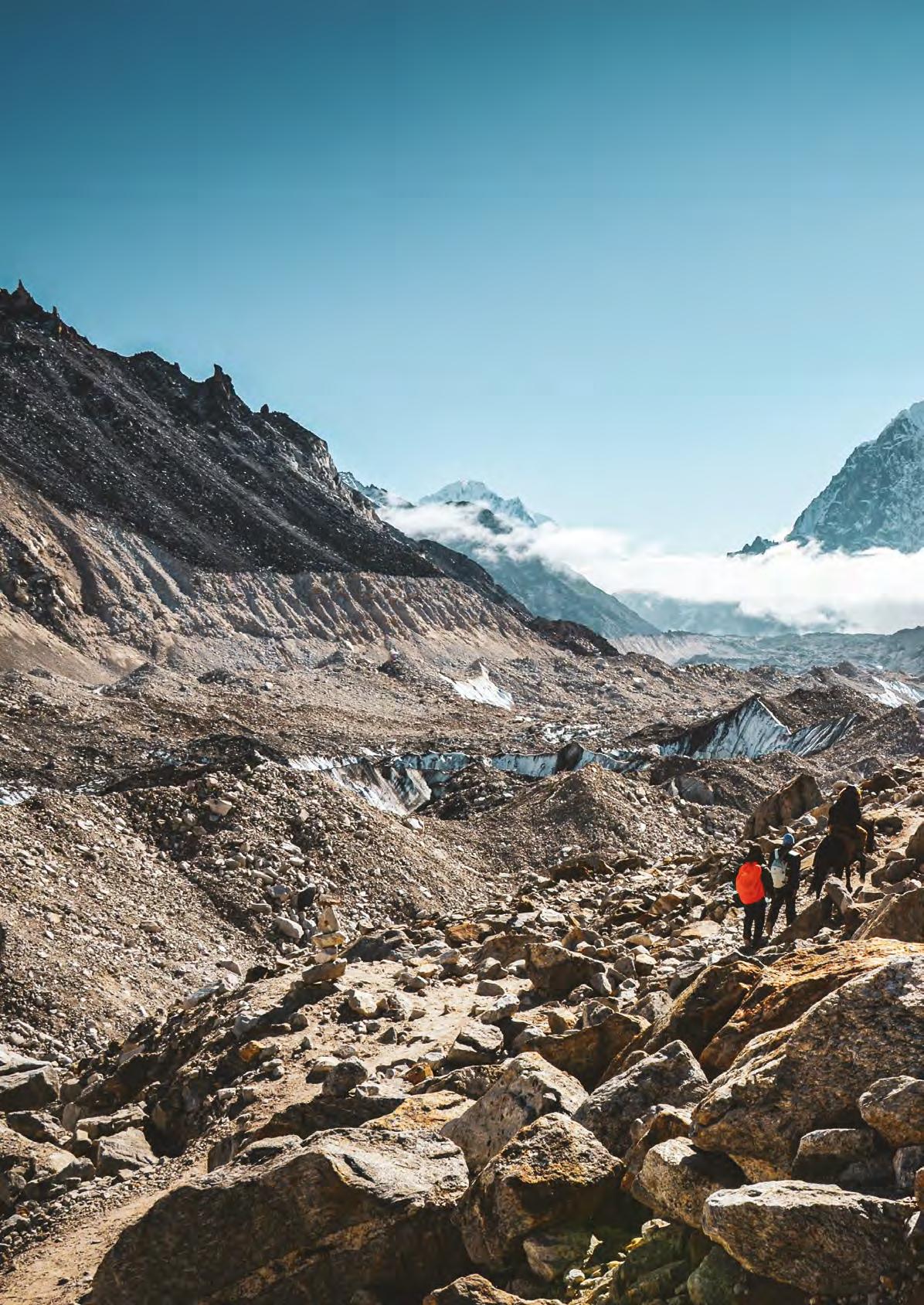
Few experiences match standing at the foot of the world's tallest mountain, an experience especially meaningful to Kiwis given the Sir Edmund Hillary connection. At nearly 9km high (around the cruising height of a jetliner), Everest – Sagarmatha in Nepali, Chomolangma in Tibetan – dominates the Nepal-Tibet border in spectacular fashion. Don’t be fooled by the name, Everest Base Camp is still 5,364m up which means that around two weeks need to be set aside to tackle the trek to acclimatise and reduce the risk of altitude sickness.


Winding through Iceland's spectacular Highland interior from the geothermal landscapes of Landmannalaugar to the birch-filled valley of Þórsmörk, the Laugavegur Trail is one of Europe's great multi-day hikes. Colourful rhyolite mountains, steaming hot springs, black sand deserts and glacier valleys make every stage extraordinary. Its name means ‘the way of the water’ – and the landscape lives up to every drop.

Leading to Machu Picchu through Andean cloud forests and over the infamous ‘Dead Woman's Pass’ at 4,215m, the 43km Inca Trail is South America's most celebrated hike – and one of its most coveted. Designed and built over 600 years ago by Inca engineers, the trail is now strictly protected, with the Peruvian government limiting tourists to around 200 daily passes. The result? Permits sell out fast, so booking well ahead is essential.
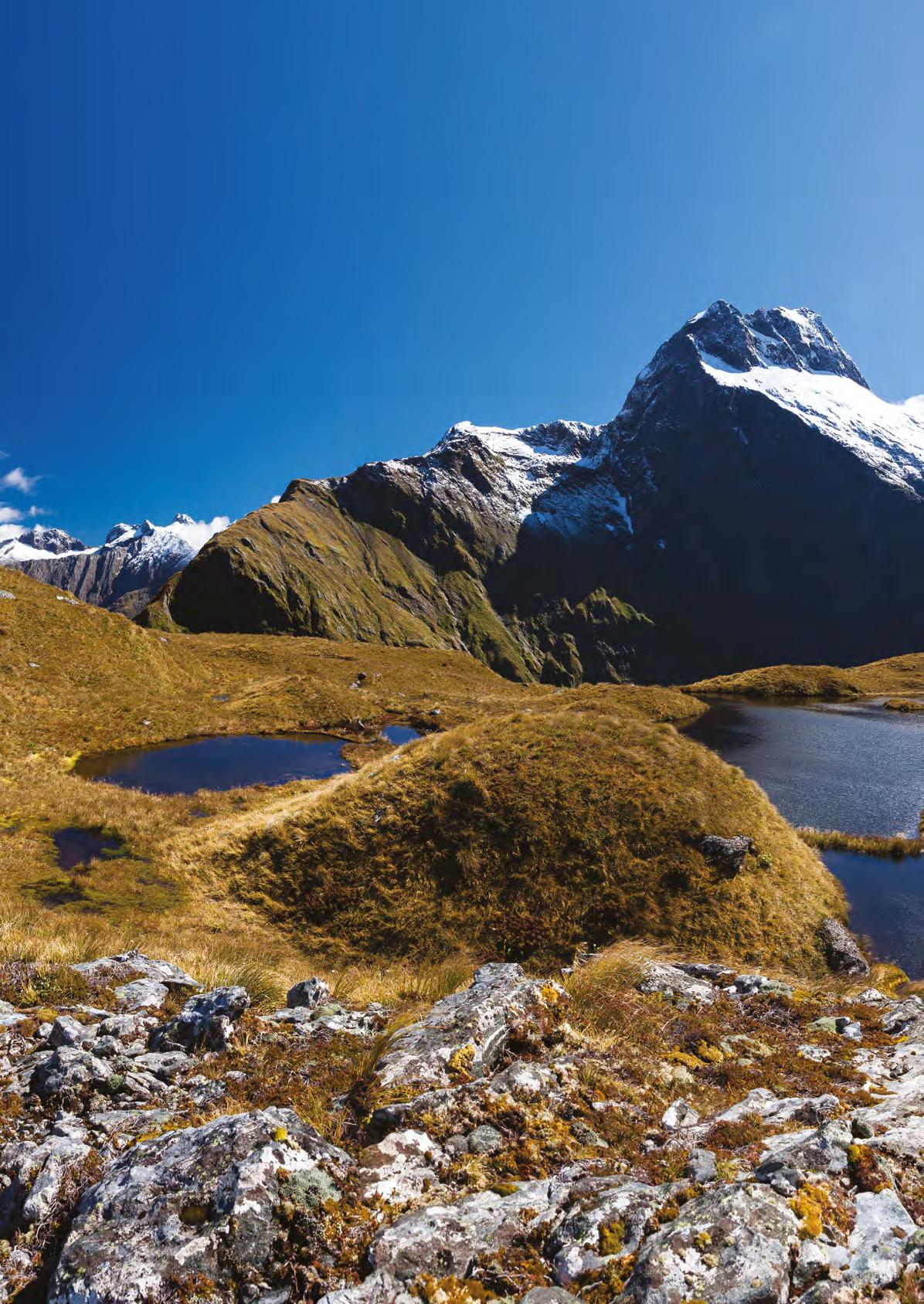
Spanning 53.5km over four days through the heart of Fiordland National Park, the historic Milford Track is probably Aotearoa New Zealand's greatest of Great Walks. Rainforests, glaciers and soaring alpine peaks accompany the route from Lake Te Anau to Piopiotahi/Milford Sound. The highlight is Mackinnon Pass – at 1,154m it offers views that will change your perception of beauty.
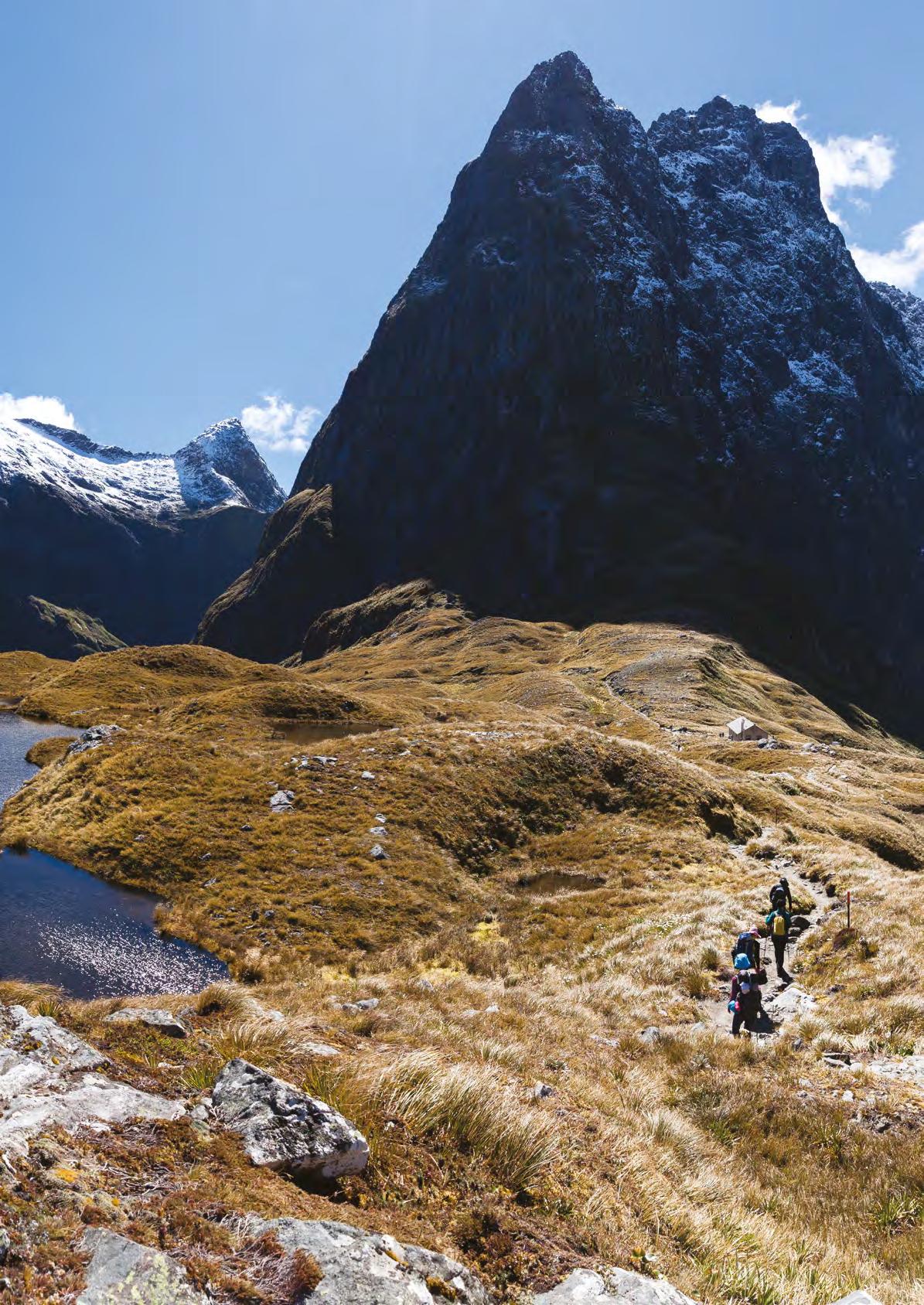

The story of the hiking boot begins not in a factory, but on a frozen European Alpine mountainside.
Ötzi the Iceman, who lived over 5,000 years ago, was discovered wearing shoes crafted from deer hide uppers, bear skin soles and dried grass for insulation – a remarkably sophisticated design that, in principle, isn't far removed from a traditional alpine boot today!
In fact, the earliest known footwear dates back even further, with woven sandals some 12,000 years old and leather-soled shoes from 3,200 BC, their straps designed to improve traction on rocky terrain.
For most of human history, sturdy footwear was purely functional. Medieval soldiers, shepherds and messengers relied on thick leather boots reinforced with hobnails – heavy, rigid and uncomfortable, but built to endure long days in punishing conditions. It wasn't until the late 18th century, when Romanticism inspired a new appetite for exploring nature, that walking began to shift from necessity to leisure. The first ascent of Mont Blanc in 1786 by Jacques Balmat and Michel-Gabriel Paccard is seen as a milestone moment – their iron-nailed leather boots making it possible to cross ice and rock more safely, and sparking a new era of specialist footwear development.
By the early 20th century, cobblers in northern Italy – drawn by a strong shoemaking tradition and the lure of the nearby Dolomites – began tailoring boots specifically for hikers.
But keeping feet dry remained the industry's great unsolved problem. A 1943 US patent complained that leather boots were “defenseless against water,” while a 1949 invention proposed pumping sweat out through pipes running up the boot with each step. Needless to say, that one didn’t catch on!
The real revolution came in 1979, when Gore-Tex entered the boot market. Lightweight, waterproof and immediately comfortable, Gore-Tex transformed hiking footwear almost overnight, with synthetic materials like EVA and polyurethane soon following.
Today, most hikers opt for lightweight shoes or trail runners, though traditional leather boots retain a loyal following in Europe for their durability and longevity – a fitting tribute to a 5,000-year-old tradition.
The world's most iconic boots all share one thing – they were built to do a job first, and become a legend second.
USA icon Timberland was forged by New England’s unforgiving outdoors and shaped by three generations of family vision – the iconic yellow boot debuted in 1973 and became a cultural legend. Today, that heritage lives on in two standouts: the Timberland® 25 6-Inch Boot – same iconic style, 25% lighter – and the easy-on/ off Cortina Valley, both built with recycled materials and a commitment to protecting the planet. Get them at Pat Menzies! patmenziesshoes.co.nz



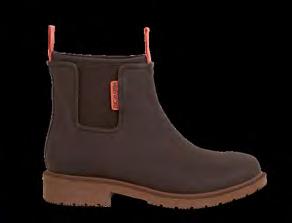

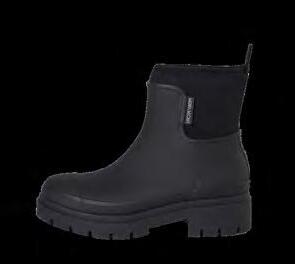
Merry People was born in 2014 when founder Dani Pearce – farm girl turned city dweller – couldn’t find a boot that worked for both worlds. Starting out at farmers’ markets, she built a grassroots brand around the idea that gumboots belong in everyday life. Today, Merry People is a global brand with 30,000 five-star reviews. merrypeople.com


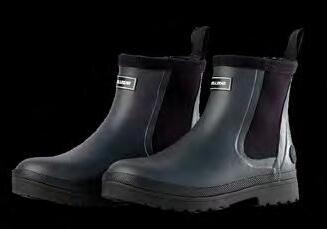
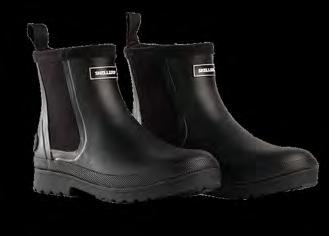
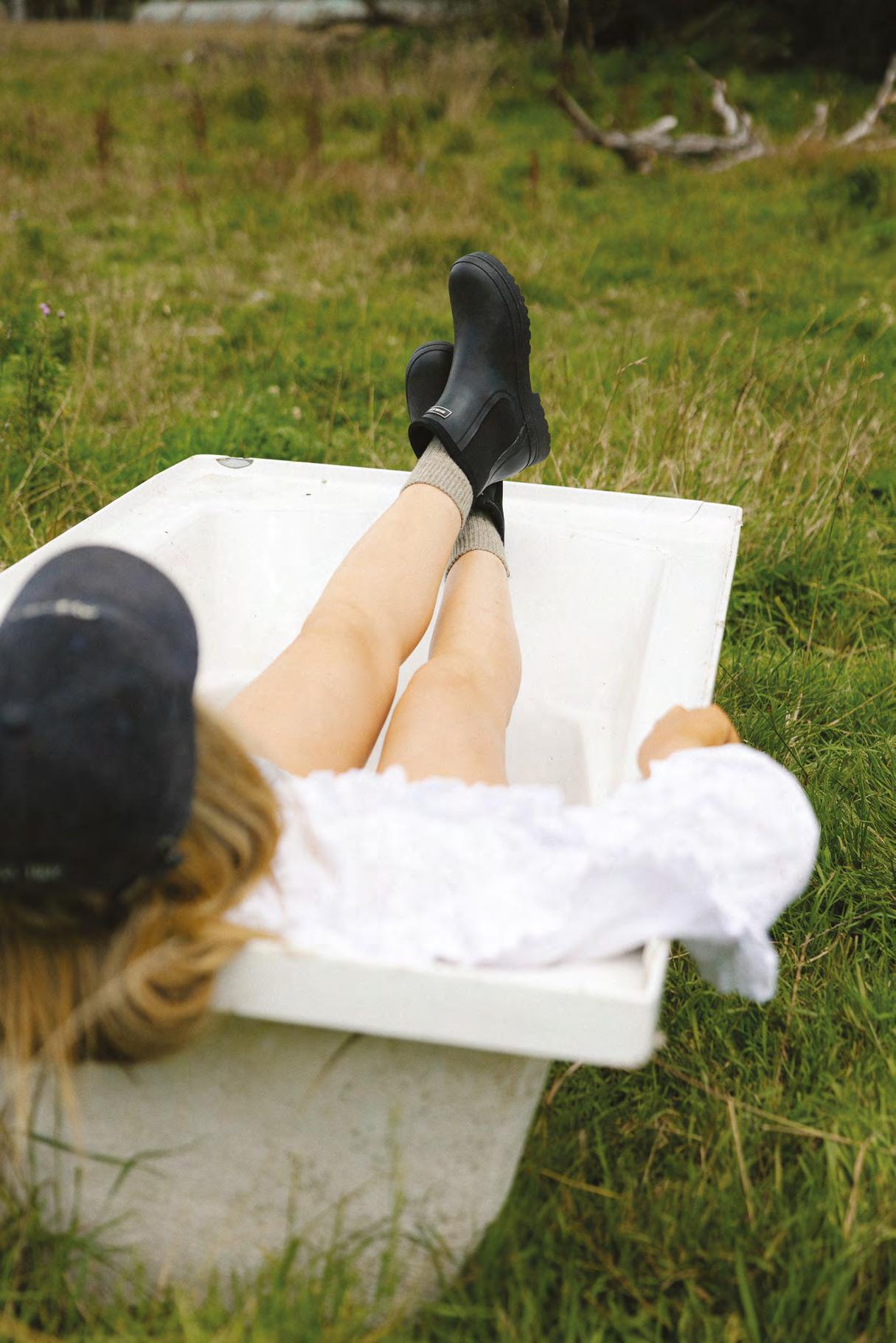
Skellerup’s footwear business grew out of Marathon Rubber Footwear, founded in Christchurch in 1939. On 21 October 1958, the first Red Band rolled off the production line – the world’s first mid-calf gumboot –quickly becoming a beloved Kiwiana icon. With a heritage dating back to the 1930s, Skellerup has long been trusted for quality rubber footwear made for life outdoors and now enters a new chapter with Skellerup Lifestyle shaped by the rhythm of daily life, with its first release, the Meadow Ankle Boot, available now. skellerupfootwear.com
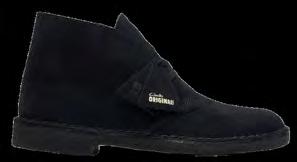
Founded in 1825 in Street, Somerset, Clarks has spent two centuries quietly redefining footwear. Its greatest contributions – the Desert Boot, designed by Nathan Clark after spotting British Army officers in crepe-soled suede in the second world war, and the Wallabee, a moccasin-style loafer remain virtually unchanged, adopted by beatniks, mods, and Jamaican rude boys, and still among the most effortlessly cool boots ever made. Pat Menzies are celebrating 50 years of selling them! patmenziesshoes.co.nz



The Dr. Martens story begins in 1945, when Dr. Klaus Maertens, a German army doctor, designed an air-cushioned sole to aid his recovery from a broken foot. By 1959, British manufacturer R. Griggs Group had acquired the rights, incorporating the now-trademark yellow stitching and launching the iconic eight-hole 1460 boot in 1960. From an inexpensive workwear staple to subcultural symbol adopted by skinheads, punks, and grunge kids alike, few boots have walked a more extraordinary, or iconic, path. That path stretched to Aotearoa thanks to Pat Menzies. patmenziesshoes.co.nz

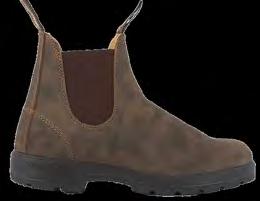
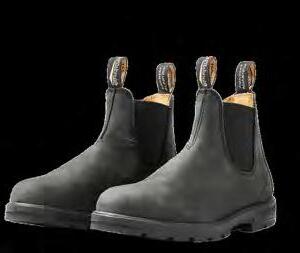
John Blundstone arrived in Hobart, Tasmania after a 93-day voyage from England, founding his bootmaking business in 1870. Over 150 years, that commitment to quality has endured the Great Depression, two world wars and every shift in fashion from 1960s counterculture to festival season. The iconic #500 Chelsea boot series, created in the 1960s, became a global phenomenon – equally at home on building sites, farm tracks and city streets the world over. Fun fact, they first arrived to Pat Menzies from Tasmania in a sack – no boxes, just twine! patmenziesshoes.co.nz
Barbour
Founded in 1894 in South Shields, Barbour has spent over a century defining British countryside style – from oilskins for sailors to one of the world’s most recognisable heritage brands. Its wellington boots carry the same commitment: iconic, beautifully crafted, and built for muddy paddocks and city pavements alike. barbour.co.nz



NORDIC WALKING
Nordic Walking is a fitness activity which uses specifically designed poles to enhance and intensify the natural way of walking. It’s essential to learn the correct technique, as the well-performed Nordic Walking action incorporates the upper body, improves posture and engages 90% of muscles, giving a ‘total body workout’.
nordicwalking.co.nz
The Nakasendo Road winds through centuries-old villages and forests in the Japanese Alps.
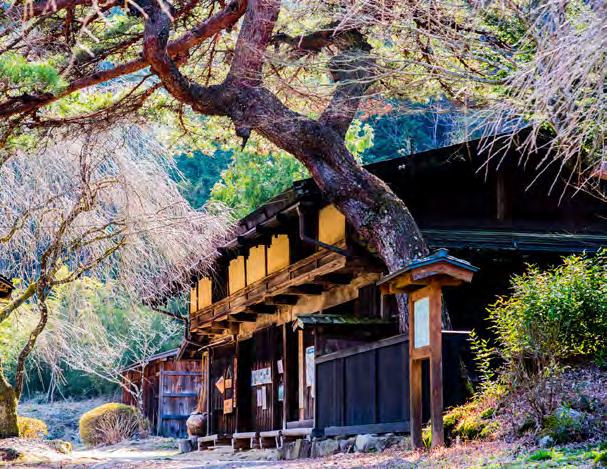
Traditional dark wooden buildings line the paved street with no power lines or cars in sight, reminiscent of another age. I’m in Magome, a preserved post town that is the starting point for one of the most popular walks along Japan’s Nakasendo Road.
Nakasendo means central mountain route, and in Edo era Japan it was one of two roads between Tokyo and Kyoto. Feudal lords travelled along it to visit the emperor’s court in Kyoto, passing through 69 post towns along the way that provided lodging and food.
Magome is still providing lodging and food today. A short uphill walk brings me to Hillbilly Coffee Roasters, and after sipping a silky-smooth cappuccino, I head off through the town.
Souvenir shops are just opening. Water races through channels at the side of the road, feeding into water wheels and bamboo pipes to irrigate gardens. I pass the honjin where lords and highranking travellers stayed in centuries past. It’s now a museum dedicated to Toson Shimazaki, one of Japan’s literary giants. A little further is the waki-honjin, Magome’s local museum.
The path levels out at an observation point looking over the Kiso Valley, where I look back at Magome, and the hills folding into the distance. Out here in the countryside locals tend fields of vegetables and rice, with clumps of
purple, yellow and white irises growing wild around the edges.
I walk into the forest, where the air is scented with cryptomeria, the Japanese cedar. Its cool shade is a welcome relief after the uphill walk. Stone monuments rest among the trees, their inscriptions illegible after years of weathering by the elements. In the background are sounds of birdsong and water flowing in a stream somewhere out of sight.
Bears inhabit this area, so bells are placed along the trail to warn them off. When I arrive at the first bell, I ring it loudly, but I don’t feel unsafe. There are other walkers making enough noise with their chatter and footsteps to keep any bears away.
Two kilometres into the walk, I reach the Magome Pass, the highest point on this section of the Nakasendo. Across the main road a soba noodle shop is open for hungry walkers, but I walk past it to go downhill for the remaining 5km to Tsumago. Here and there the trail passes a farm or shrine, or goes through a sleepy hamlet with a few old houses. After walking for nearly two hours, I spot a rustic building in the middle of nowhere that seems to buzz with activity.
Tateba Chaya is a tea house that is over 200 years old. I step inside to find tables arranged on an earth floor. On the raised wood floor at the other side of the room, an elderly gentleman is boiling water in
a kettle suspended over a smoky open fireplace. He’s one of the volunteers who welcome visitors and provide tea in return for donations to help preserve the tea house. I find a seat at a table where I chat with walkers from Canada and the United Kingdom over a cup of green tea. After resting my legs for a while, I’m ready to move on.
A quick detour off the main trail leads to the Otaki and Metaki waterfalls. Although they’re small, it’s refreshing sitting by the rushing water as the day warms up. Back on the trail, the signposts show that Tsumago is getting closer, and now I’m beginning to feel hungry.
The town finally comes into view, across the main road and down the hill. Like Magome, the street is lined with traditional black wooden buildings, but fortunately it’s flatter. I wander past Tsumago’s honjin and waki-honjin, looking for somewhere to eat. My first stop is for a chestnut ice cream to cool down while I check out the local restaurants. Soba is a local specialty and just what I need after a long walk, so I enter one of the old houses where I’m served a steaming bowl of noodles.
Although my legs are starting to ache, walking the Nakasendo Road has taken me through a slice of traditional Japan. I decide to end the day by soaking in an onsen, just as travellers in feudal times did.
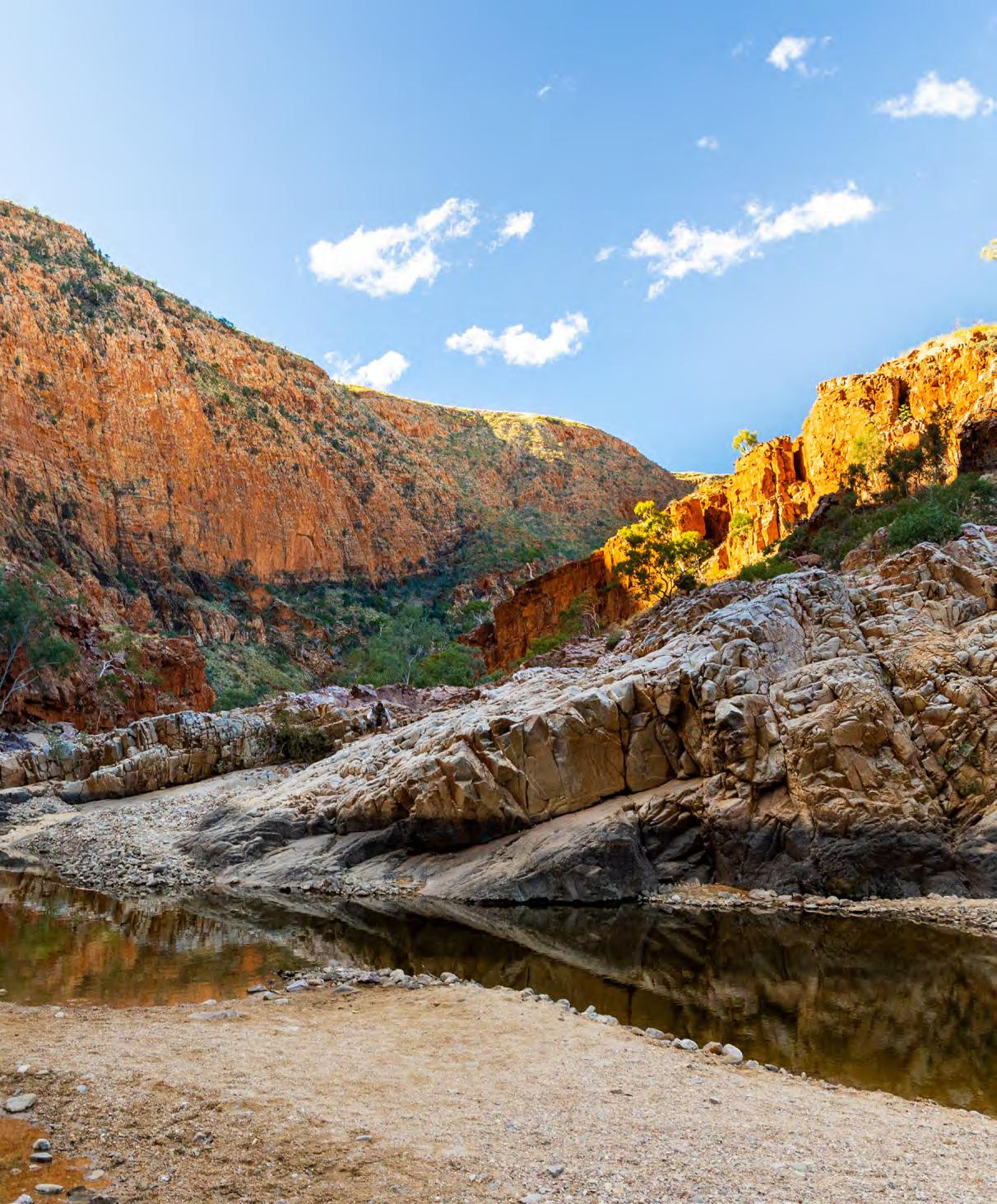
Alice Springs Telegraph Station, built in the early 1870s, helped connect Australia with the world. From here, the eastern trailhead of Northern Territory’s 223km Larapinta Trail, which traverses the West MacDonnell Ranges – or Tjoritja as the traditional Arrernte owners know them – I will connect with country and culture.
Along red dirt trails scattered with white quartz and rust-coloured rocks, our two guides point out bush tomatoes, the apple bush’s apple-scented purple flowers, and silvery-grey mulga trees – their ash used for paint by Aboriginal people, wood for spears, ground seeds and flowers for flour – and the witchetty tree, its roots home to witchetty grubs, a staple of Indigenous diet.
An ascending, rust-coloured rock trail leads to Euro Ridge, according to legend the spine of a wallaroo. Far below, grey-green country, distant white clusters marking Alice Springs’ suburbs, is hemmed by ranges. Wide horizontal stripes of red and green along their faces make them look painted. It’s a vast, watercolour-like landscape.
The day ends at World Expeditions’ awardwinning, semi-permanent eco-camp, one of three we’ll stay in over six days. Solar lighting, showers – hot water in a bucket with a shower rose at its base – sofas, kitchen and dining area below an awning resembling rolling hills, large tents with stretchers and canvas swags… Add in three-course meals and only having to hike with a daypack, it’s certainly a comfort tour.
On the valley floor, golden sand, shaded by red gums, surrounds shimmering waterholes.
Brodie, from Kungkas Can Cook, a local Indigenous food business, presents bush tucker. Cut open, brown, woody, tennisball-sized bush coconuts, made by scale insects, reveal white, bitter flesh and a large larvae. I decline the larvae. Acacia and wattle seeds ground into dukkah, red quandong fruit made into jam, bush tomato chutney, and kangaroo meat are all delicious.
Walking through grassland, four emus cross our path the next morning. An upside-down river, water running below the sand, leads to Simpson’s Gap. White sandy banks contrast against towering orange, black and red schist-like cliffs that taper to a V-shaped gap. Greenish water runs between, the cloudless blue sky above; two black rock-wallabies spring amongst black boulders.
At Standley Chasm, William, an Aboriginal guide, points out bat-leaved coral trees, lemongrass for cooking, river red gum which provides wood for bowls and tools, and ancient MacDonnell Ranges cycads. A dry stream bed weaves past orange rock faces to reach soaring red cliffs, which cast shadow over the narrow gap between them. White boulders clutter the chasm end, beyond a motionless, clear waterhole. To traditional owners it’s called Angkerle Atwatye –“this place where water moves between”.
Later, William explains skin names – Aboriginal kinship systems which
determine who people may marry or even speak to. It’s complex.
Morning in Serpentine Gorge is cool, only the upper cliff faces flame with colour where the sun hits. White-barked gums stud the dry rock bed weaving snake-like between them. Thought to be home to a fierce water serpent, people only came here to drink from the shallow waterhole if desperate. A breeze ripples its surface; silence broken only by chirping zebra finches.
My heart thumps on a 700m climb over 3km through landscape dotted with spiky grey-green spinifex, and red, purple and yellow-flowered native shrubs which provide bush tucker and medicine. Southwards, the striped range is backdropped by golden dune-like hills. Far below, a parched valley is bordered by the jagged Chewing Range, resembling a giant breaking wave from 1,170m-high Counts Point. Distant Mt Sonder peaks, Larapinta’s official end; faraway Gosse Bluff, a comet crater, rises like Uluru. In this infinite landscape, a tiny dot of a car travels an indistinguishable highway.
Inarlanga Pass is a ceremonial place for Western Arrernte people; a meeting point for traders, and the boundary between different communities’ lands. Clambering over rocks into the pass, I shiver, the sun yet to rise above the orange rock faces where layers curve snake-like, pushed up and buckled over millions of years.
Benjamin, a local Aboriginal guide, leads us to the Ochre Pits. Red, white and yellow ochre swirl across the 10m-high cliff faces. Used in ceremonies for generations, the ochre is important in Dreamtime (creation) stories, one of which tells of seven sisters dancing across the land, forming valleys and mountains.
At 3.15am, we’re a line of bobbing glowworms hiking through black nothingness, ascending Mt Sonder. The sky turns light purple, clouds darken; we summit as the sun blazes the horizon. Streaking sky and clouds orange, it reveals a landscape of shadowy peaks, Gosse Bluff, and a pale green valley hemmed by tilted multi-hued ranges.
Ascending sparsely treed hills, I look over Ormiston Pound, a 46.5-sq-km mountain-bound enclosure from which Aboriginal people apparently herded kangaroos into Ormiston Gorge. On the valley floor, golden sand, shaded by red gums, surrounds shimmering waterholes. We walk between towering pink, orange and purple rock faces; schist-like blocks of rock look like they may fall at any moment. Ascending to Ghost Gum Lookout, where whitebarked gums stand, I look over this stunning landscape. Our final day. I have connected with country and culture.
Eleanor travelled courtesy of World Expeditions.
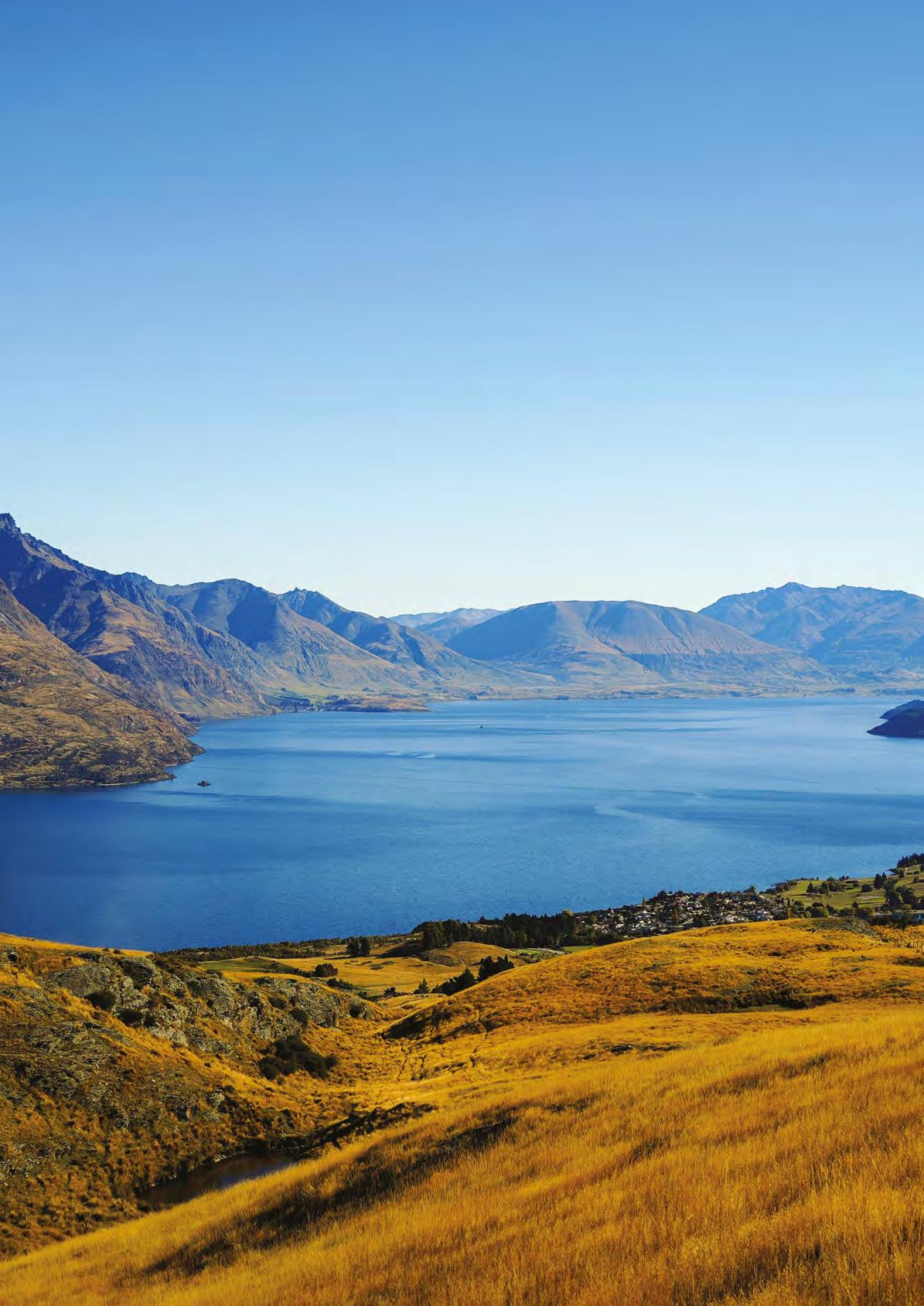
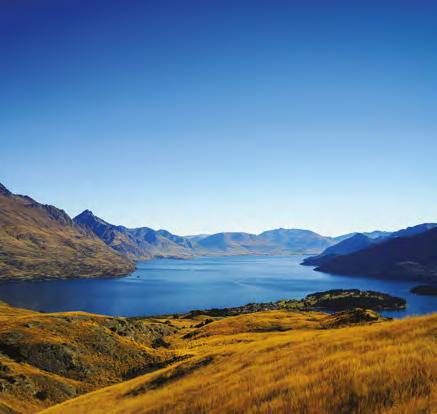
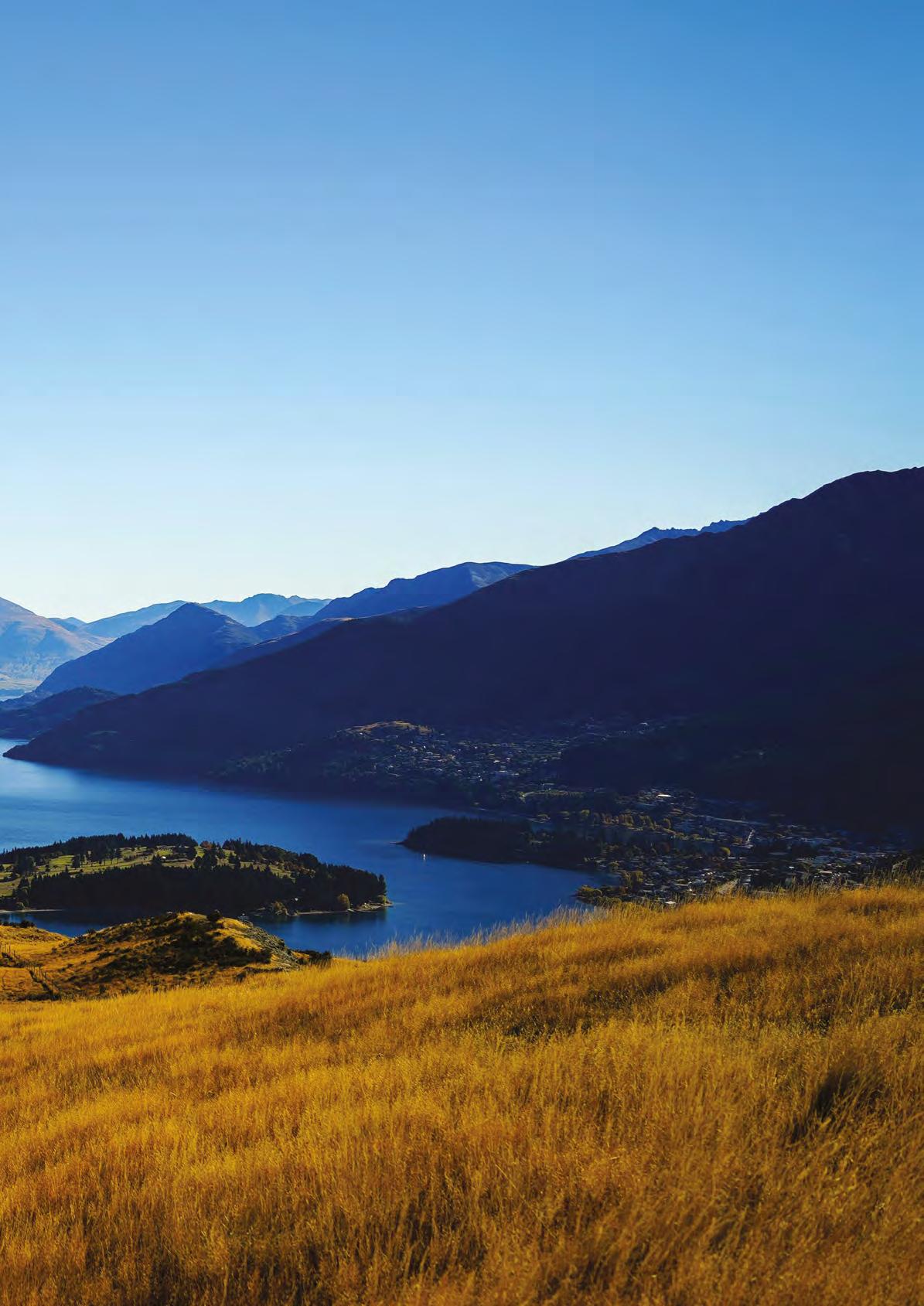
From the adrenaline-soaked streets of Queenstown to the laid-back shores of Wānaka and the gold-rush charm of Arrowtown, Aotearoa New Zealand's Southern Lakes region is one of the most compelling destinations on earth.
AJ Hackett Bungy NZ operates two sites in and around Queenstown, each offering a different flavour of freefall.
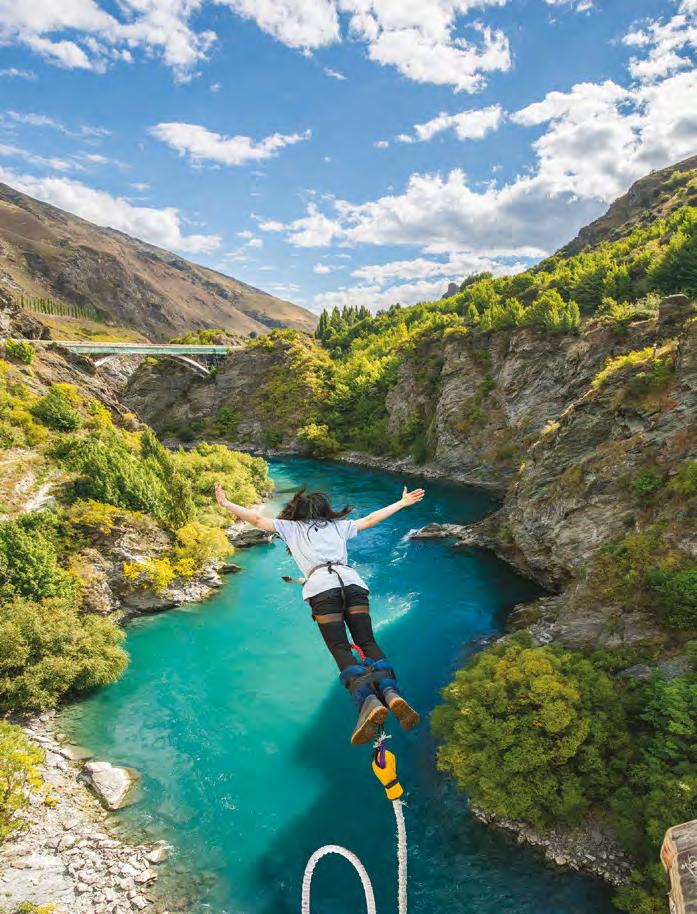
At Kawarau Bridge, you leap 43m above the river's turquoise waters while spectators watch from the viewing deck below. A zip ride alongside the bridge adds a gentler but no less exhilarating option, reaching 60km/h over 130m, while the Kawarau Swing dangles thrill-seekers from the platform before letting them release themselves over the river when ready.
For the ultimate experience, Nevis Bungy is the highest in Australasia at 134m and with over eight seconds of freefall above the dramatic Nevis Valley gorge. The Nevis Swing - the world's most famous - offers a 300m arc, while the Nevis Catapult, the world's biggest human catapult, launches riders 150m across the ravine at almost 100km/h in just 1.5 seconds, hitting 3G of force.
The birthplace of commercial bungy jumping, Kawarau Suspension Bridge sits 20 minutes east of Queenstown above the cobalt swirls of its namesake river, with green cliffs looming dramatically on either side. Built in 1880 at the height of the gold rush, the 120m bridge was an engineering landmark in its day, its innovative cable design earning designer Harry Higginson an international award. Today it's famous for something rather different – a 43m leap into the gorge below.
The roots of bungy jumping stretch back centuries to Vanuatu's Pentecost Island, where a ritual called land-diving sees islanders leap from wooden towers with vines tied to their ankles – an act of heroism still practised today.
The modern version traces to April Fool's Day 1979, when Oxford University's selfstyled Dangerous Sports Club dressed in top hats and tails leapt from Bristol's Clifton Suspension Bridge using elastic cords. They were promptly arrested, but footage of the stunt caught the attention of Aucklander AJ Hackett, who together with business partner Henry van Asch committed to making it consistently safeand commercially viable.
Throughout the 1980s, AJ Hackett and business partner Henry van Asch refined the concept – reengineering parachute harnesses and developing cords with the help of Auckland University scientists –before pulling off one final publicity stunt: an illegal jump from the Eiffel Tower. The arrest was brief and the global headlines priceless.
On 12 November 1988, Hackett and van Asch launched the world's first commercial bungy operation at Queenstown's Kawarau Suspension Bridge. Twenty-eight people paid $75 each to take the plunge, and an industry was born.
Queenstown certainly doesn’t lack luxury stays or good restaurants, but Coronet Ridge Resort seems to understand exactly why people visit in the first place.
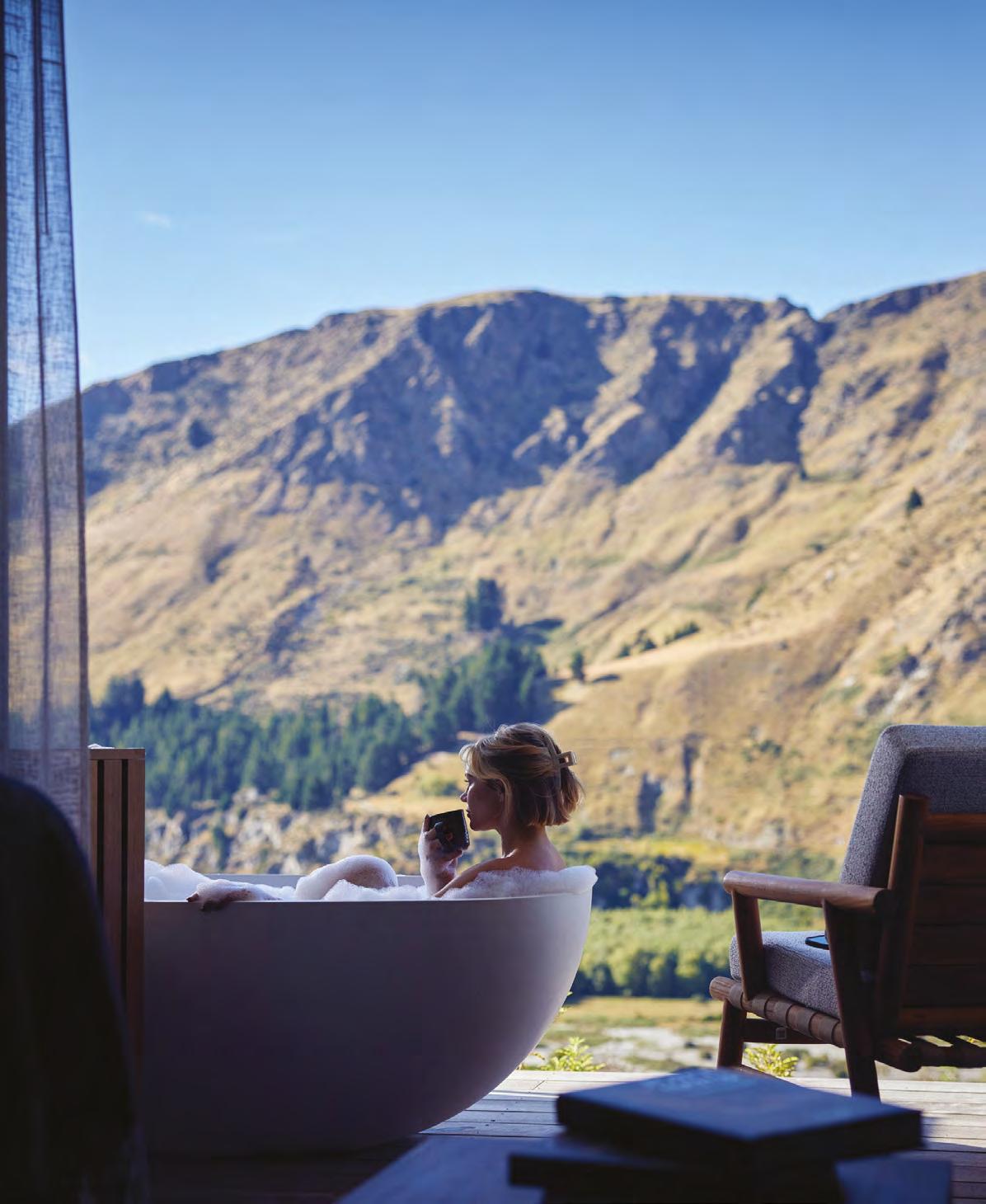
Leaning into the landscape with everything from the architecture to the food, and to the quiet moments spent staring out over the Shotover River. It really is designed to make you stop and take it all in.
You’re never disappointed when you land in Queenstown either. The nature, sights, activities, eateries, people. It just has an overall vibe that draws you in. Coronet Ridge Resort is a welcome addition, and boy does it suit the location.
continued over page
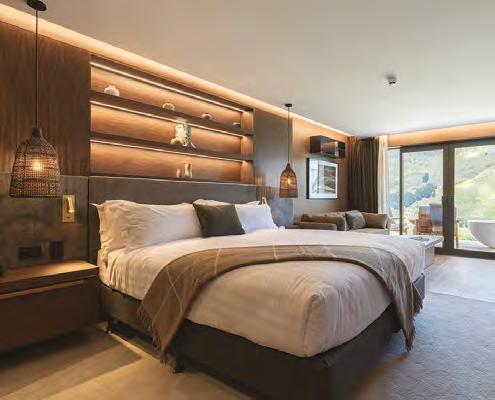
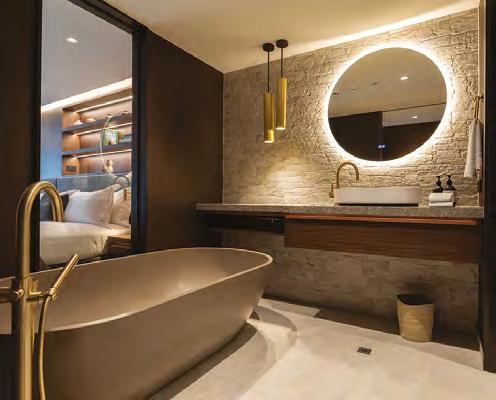
Perched above the iconic Shotover in Arthur’s Point, the newly opened five-star resort manages to feel tucked away and central at the same time. It’s less than 10 minutes from the heart of Queenstown yet once you arrive, the outside world feels very far away.
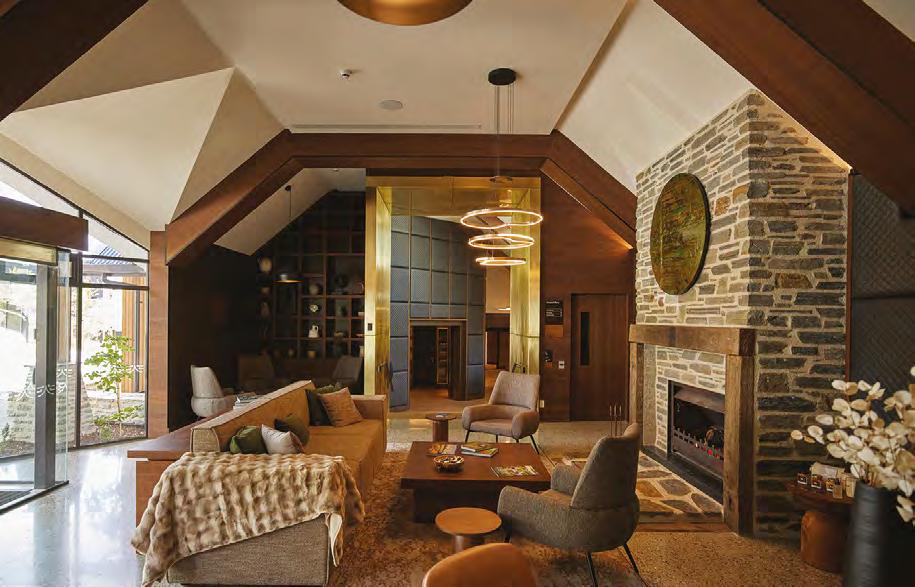
We were warmly welcomed by the staff, with an even warmer introduction in front of the fireplace just inside the front doors. There’s an immediate sense of calm about the property. Soft lighting, earthy tones, timber finishes and floor-to-ceiling windows drawing your eye straight toward the mountains beyond.
We were treated to a lovely tour of the resort, which includes a Roman-inspired spa complete with an indoor heated pool, sauna and steam room, outdoor hot tubs, fitness centre, private cinema, and many beautifully designed shared spaces.
Our Superior Shotover Room overlooked the river and alpine beauty beyond. Standing on the balcony, your eyes take a few moments to adjust to the view, almost tricking you into thinking it’s a painting. In the thick of autumn, it’s like fifty shades of orange waiting to greet you – aside from the evergreens and crystal-clear slate blues of the river.
The room struck that perfect balance between comfort and understated luxury. Perfectly heated and cosy, with elegant finishes, generous storage, and enough space to properly settle in. The minibar was amply stocked and the bathroom is more than spacious, complete with a bathtub that absolutely knows its place in the chilly weather.
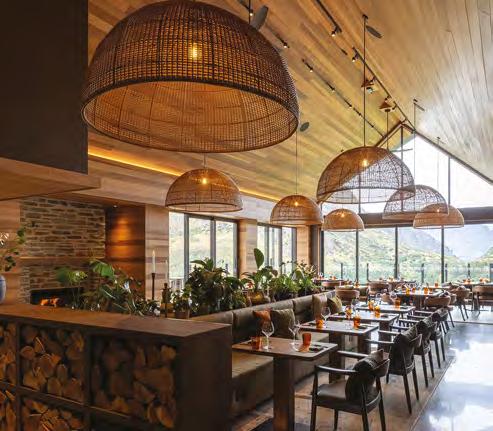
Elevation Bar & Restaurant, the resort’s dining space, easily stands its ground as a destination restaurant. With panoramic views stretching across the Wakatipu Basin and toward the Remarkables, it’s a little hard to focus on the menu at first.
We ended up having both lunch and dinner there that day, because honestly, why would you leave when you have a roaring fireplace, lush blankets, mountain views, champagne and… baked brie! The melty goodness was topped with toasted walnuts, cranberries and honey. Again, a very convincing argument to stay put.
Lunch also included a dish called Truffle Inspiration, which I can only describe as heaven in a bite. Encased in delicate pastry was a creamy truffle mousse style filling, topped with mushrooms and edible petals that look like they were foraged by an artist.
That artist, you could say, is Executive Chef Dominic Dsouza, who leads the kitchen and whose background spans Michelin-starred kitchens and classical French training. His dishes feel exceptionally grounded in local ingredients with thoughtful execution.
One thing I adored is how the restaurant itself mirrors the landscape outside.
Soaring pitched ceilings echo the surrounding mountain peaks, while the interior pulls from the colours of the region and view. Deep charcoals, warm browns, earthy greens and burnt orange tones all layered through timber, textiles and glassware.
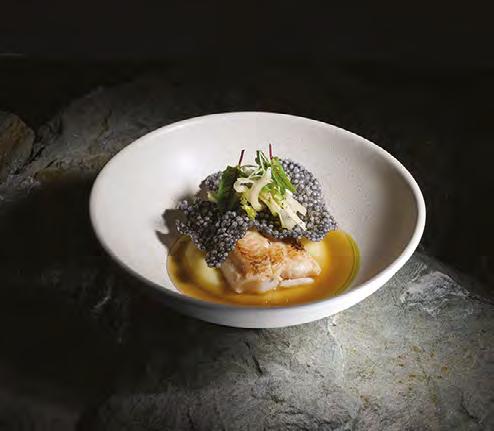
Dinner was genuinely exceptional. We tried the Spiced Duck Croquettes; Mt Cook Salmon with puffed potatoes, beetroot, wasabi emulsion and cured yolk; Royalburn Lamb with cauliflower purée, pickled radish, walnut crumble, black garlic and charred leek; alongside the Market Fish served with fennel, olive agria mash, mushroom broth, herb oil and tapioca crisp.
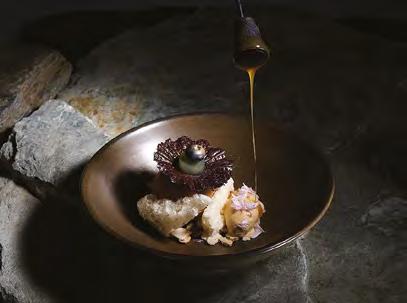
And for dessert, the NZ Whiskey Parfait with Whittaker’s chocolate, caramel and almond, all with a hand-poured drizzle of The Southerly’s whisky-infused mānuka honey. The perfect finish.
The wine list is nicely curated too, rather than overwhelming, with a strong focus on local and New Zealand producers that pair naturally with the menu.
Retreating back to the room after a delightful dinner, for what was possibly one of the best sleeps I’ve had in a long time, felt dangerously easy. Between the comfortable bed and absolute silence
outside, sleeping through an alarm feels very possible here, especially with the addition of blackout curtains.
The next morning started with Eggs Royale – poached free range eggs nestled on kumara rosti and toasted brioche with hollandaise, crispy pancetta, roquette and Mt Cook alpine salmon. The two cups of freshly brewed coffee also went down a treat while watching the mountains happily start their day with the morning light.
Queenstown will always tempt you outdoors no matter the weather, but coming back to this kind of comfort at the end of the day is what makes the experience complete. The resort effortlessly finds its place beside the crisp alpine air and extraordinary landscape that makes Queenstown so special in the first place.


Queenstown's two main ski fields, The Remarkables and Coronet Peak, are generally open from mid-June through to late September or early October.
Thirty minutes from Queenstown, The Remarkables sits in a natural north-facing alpine amphitheatre – a stunning suntrap with something for every ability level. Wide groomed runs, backcountry terrain, narrow chutes and rock drops are all on offer, with lifts rising from a 1,622m base to 1,943m and a vertical drop of 357m.
Just twenty minutes from town, Coronet Peak is the more accessible of the two and despite sitting lower than The Remarkables, it actually boasts a greater vertical drop (481m). Famed for its expansive rolling pistes, it's a favourite with beginners and intermediates but also hosts international competitions on its more advanced runs. On selected Wednesday and Friday nights throughout winter, the slopes are floodlit for night skiing – a rare and exhilarating option unique to Coronet Peak.
karamatapeak.co.nz
From its pre-eminent position above Lake Wakatipu, Karamata Peak offers a rare opportunity to design your perfect home and experience the richly layered Queenstown lifestyle.
Taking its name from te reo (for 'summit') it sits high on Queenstown Hill / Te Tapunui ('mountain of intense sacredness'), an exclusive residential development that sits above all others on Queenstown Hill to date.
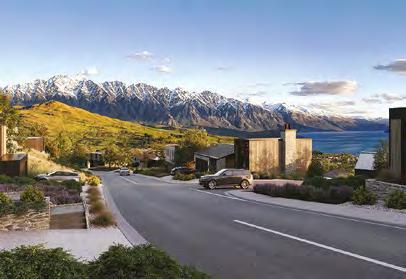
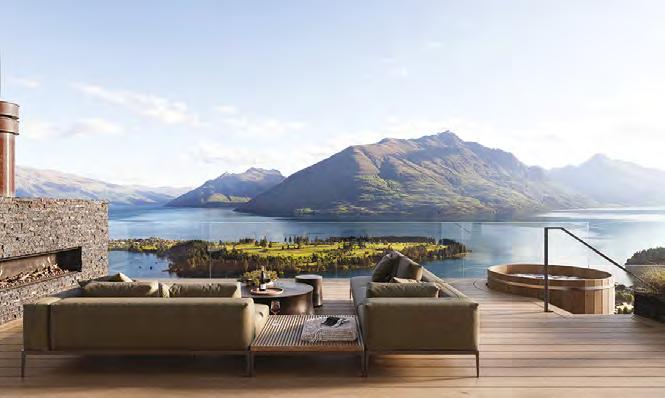
The location, immersed in the prominent mountain ranges, uniquely juxtaposes natural beauty with the convenience and energy of downtown Queenstown, just 2km away.
The enclave comprises 96 freehold sections, with two stunning releases currently available, from $1.1 million. Build with confidence knowing that the Karamata Peak Master Plan and Build Design Guide protect the distinctive character of the surroundings, ensuring
a cohesive, complementary set of architectural and landscape outcomes.
Elevated, considered, and deeply connected to its environment, Karamata Peak offers a chance to build a bespoke, timeless residence and to enjoy an address that will be cherished today and by future generations to come.
Karamata Peak, Queenstown Hill, Queenstown-Lakes
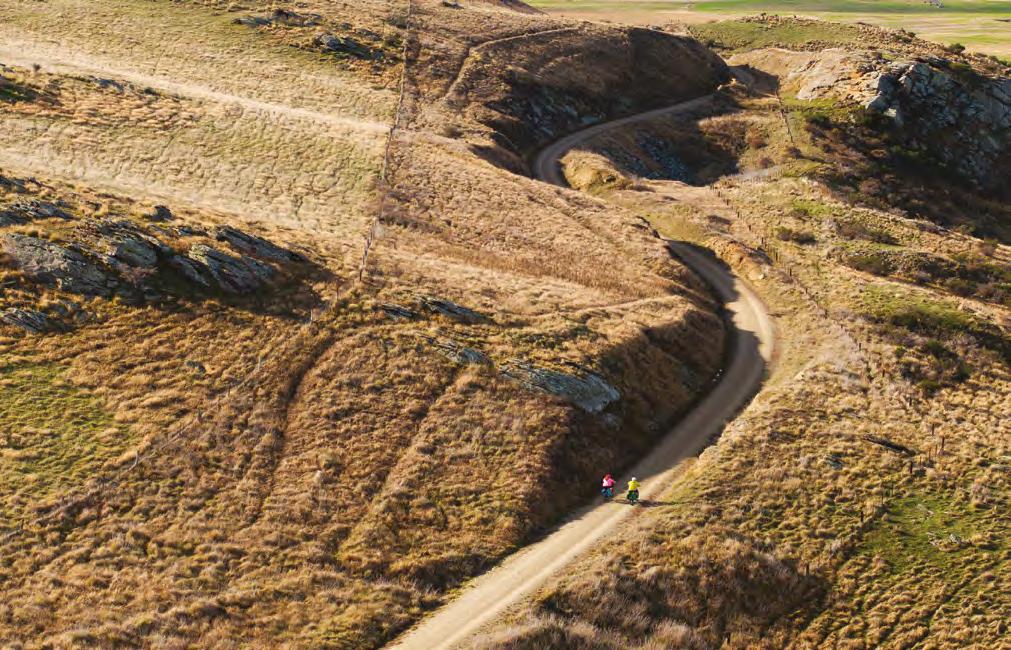


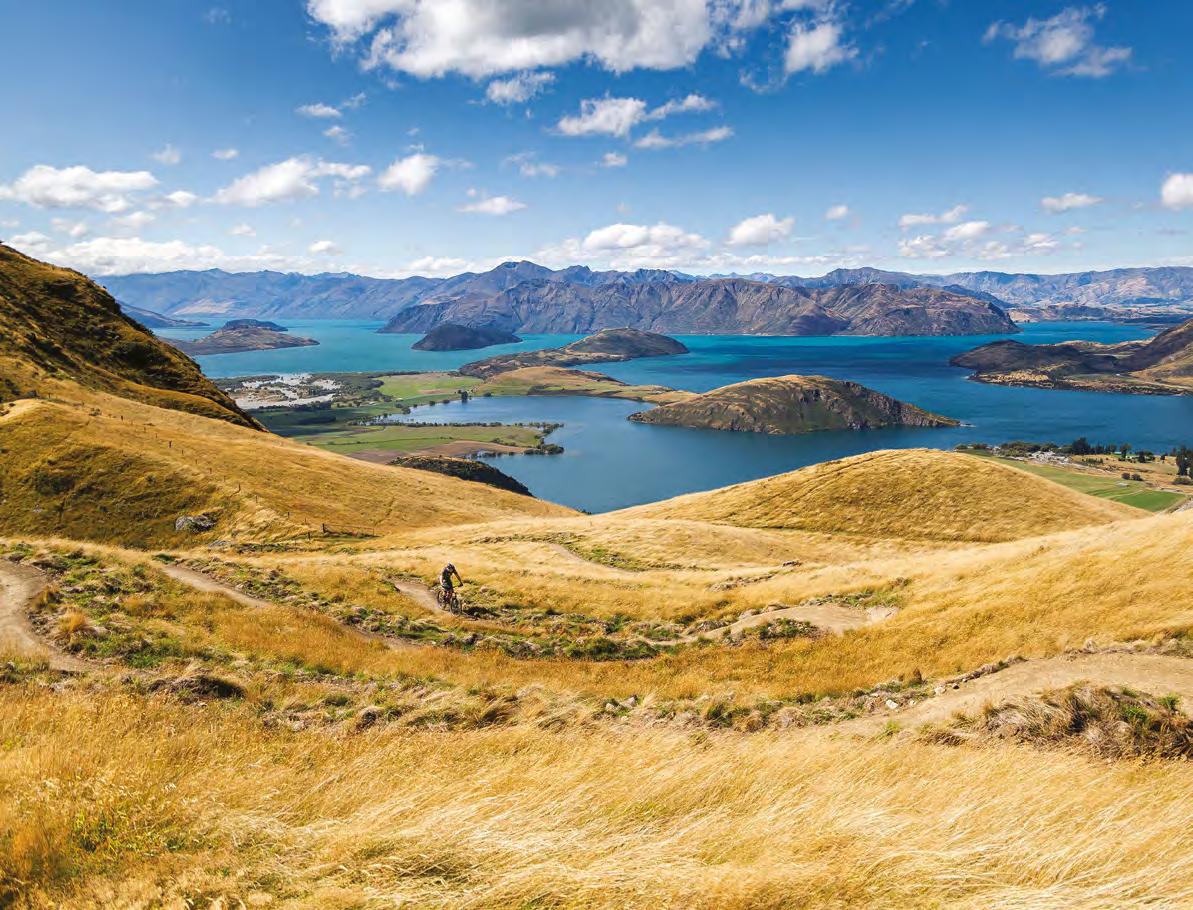
New Zealand's most popular Great Ride, the Queenstown Trail is a network of interlinking shorter tracks stretching over 150km around the Wakatipu Basin, connecting Queenstown, Arrowtown and Gibbston. Routes cater for beginners through to intermediate riders, and can be tackled in a few hours or spread across up to four days. Highlights include river gorges, mining ruins, suspension bridge crossings and no shortage of vineyards to stop at along the way. Tracks can also be hiked.
The Lake Dunstan Trail links Clyde and Cromwell through some of Central Otago's most dramatic landscapes –
tracing Lake Dunstan, the Kawarau River, past Bannockburn vineyards and sites steeped in Māori and pioneer history. The Grade 2–3 ride is the newest of the Ngā Haerenga Great Rides network.
Nestled between Wānaka, Glendhu Bay and Mount Aspiring National Park, Bike Glendhu (pictured) is a world-class mountain bike destination 250 million years in the making! Trails weave through kānuka scrub, wetlands and rivers, with truly mesmeric views.
WONDROUS WĀNAKA
Laid-back Wānaka may live in the shadow of its more illustrious neighbour Queenstown, an hour or so to the south across the Crown Range, but it more than holds its own. The town sits on the southeastern shore of beautiful Lake Wānaka, founded during the gold rush and transformed a century later by the arrival of mass tourism. Today it serves as the main gateway to the spectacular hiking trails of Tititea/Mount Aspiring National Park, while closer to town the renowned ski slopes of Cardrona, Treble Cone and Snow Farm all compete for your attention alongside the likes of jet boating, white-water paddling, wine and craft beer tasting, the acclaimed
Warbirds and Wheels Museum and the mind-bending Puzzling World.
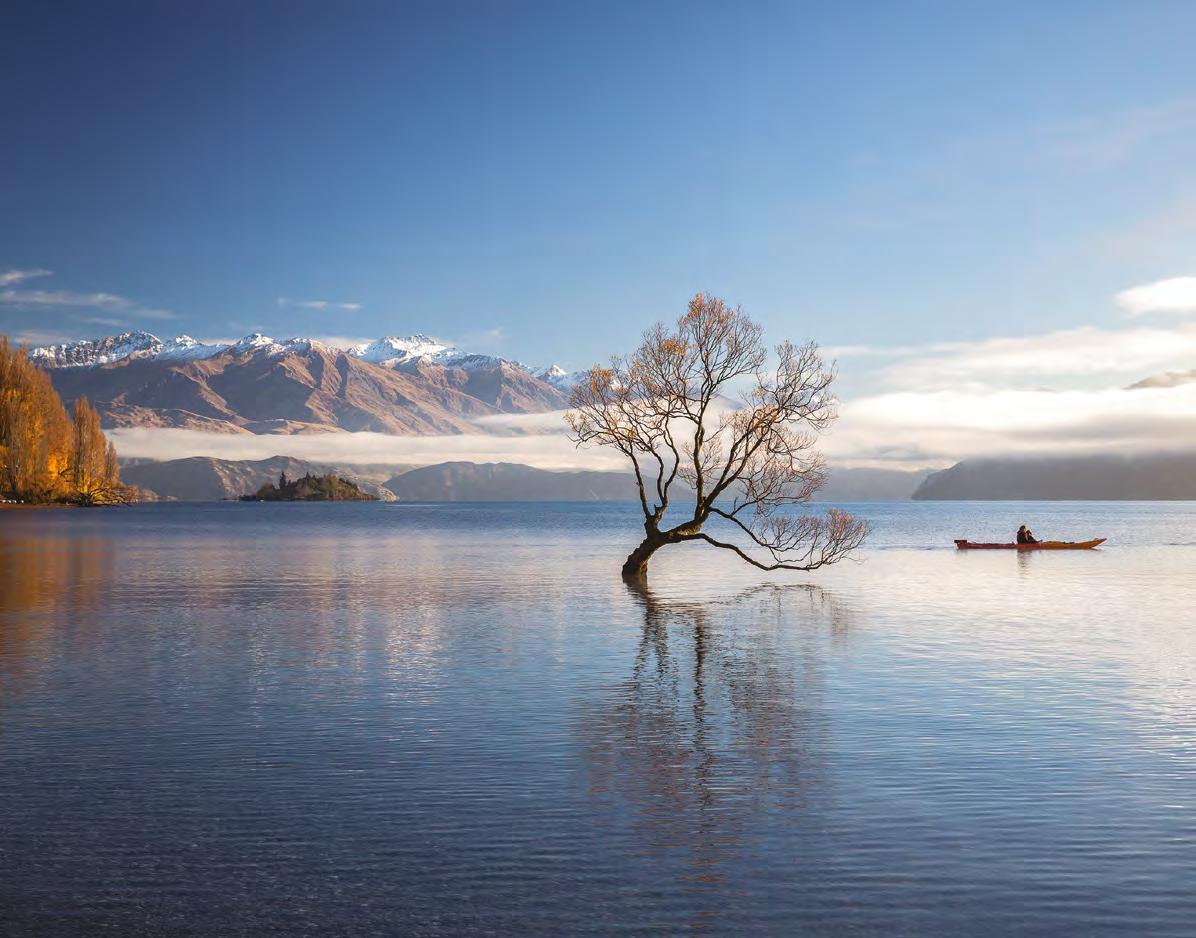
At the southern corner of Roy's Bay grows a lonesome willow that has become, improbably, New Zealand's most photographed tree. The legend of #thatwanakatree was born from humble origins – a branch used as a makeshift fencepost that took root and slowly grew into an icon. Today its gnarled trunk leans lazily out of the water, skeletal limbs reaching skyward against a backdrop of snowy peaks and ridgelines. Photographers come from around the world to capture it in every light and season.
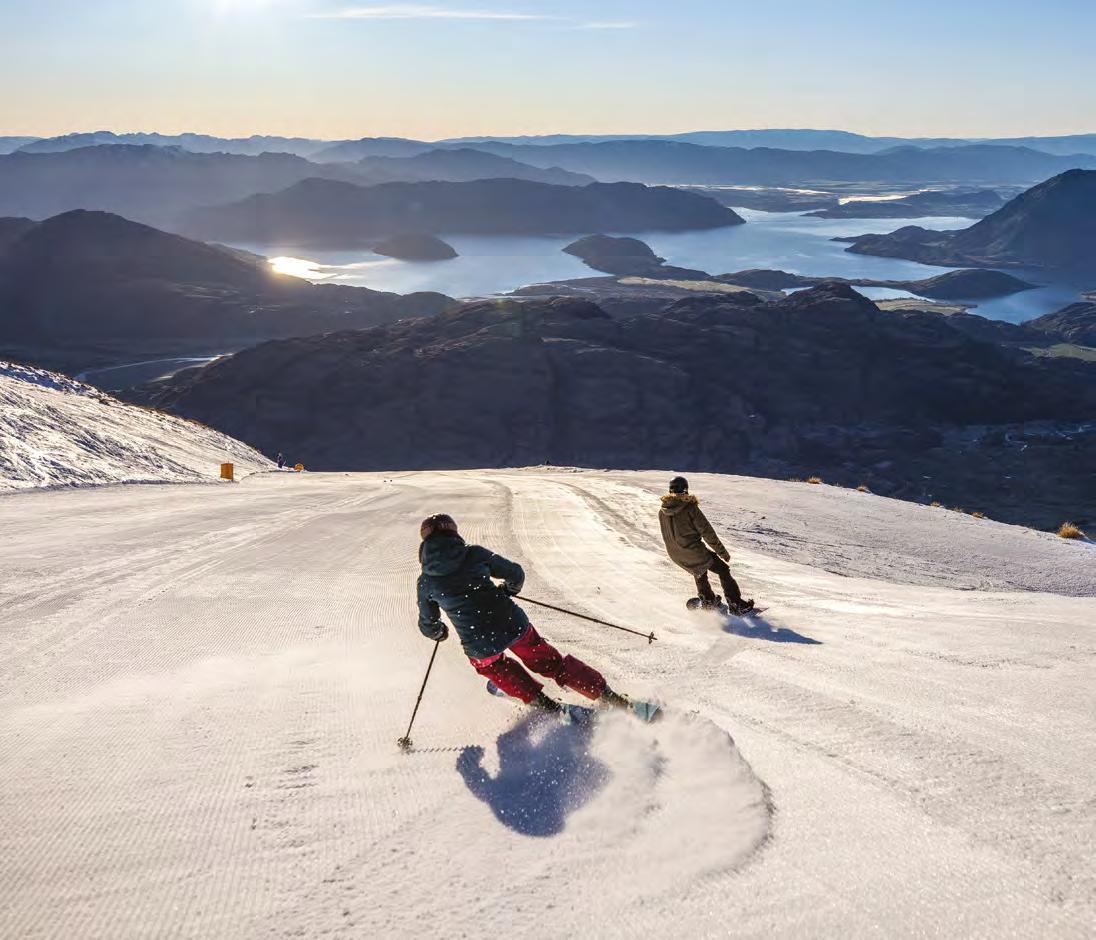
Wānaka's three ski areas each offer a distinct experience. Cardrona Alpine Resort is the most family-friendly of the trio, with an abundance of gentle slopes boasting views stretching from Lake Wānaka to Queenstown. Lifts rise from a 1,670m base to 1,860m with a maximum 600-metre descent, and there's a solid freestyle offering including half-pipes and a gravity cross.
Thirty minutes from Wānaka, Treble Cone is the pick of the three for serious skiers, spreading across four basins with some of the country's longest trails, a 700m vertical drop, open powder fields, natural half-pipes and outstanding
off-piste terrain. At 1,960m it's among the highest ski fields in the country, attracting an abundance of high-quality powder snow.
For something altogether different, Snow Farm is one of the southern hemisphere's premier cross-country ski destinations, offering 55km of trails for all abilities alongside fat biking, ski touring, snowshoeing and dogsledding. Night skiing is available in winter, and in summer the farm opens for trekking, mountain biking and nature watching.
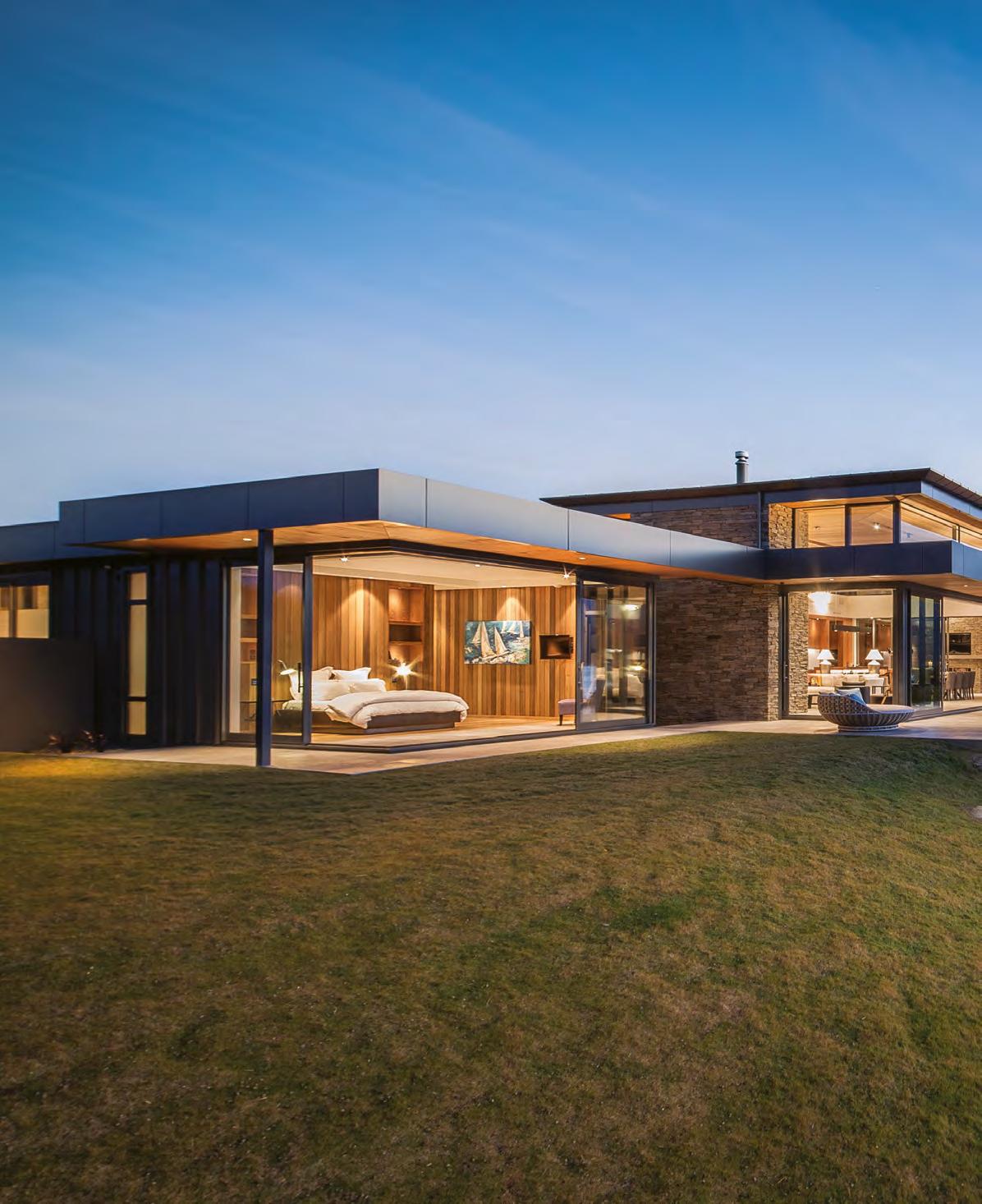
At The Dacha, the architecture doesn't compete with the landscape. It simply gets out of the way.
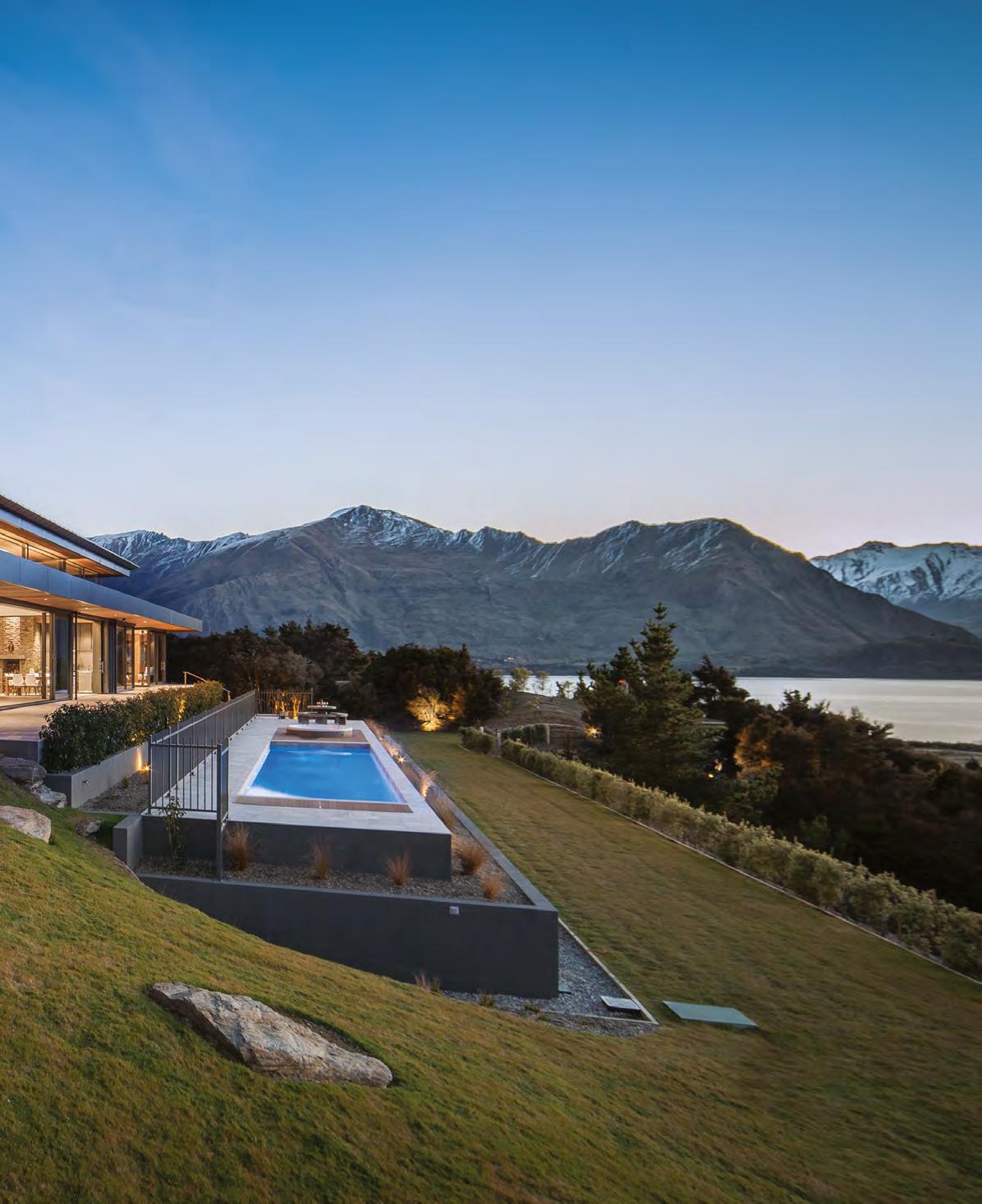
There is a phrase that guided every decision in the design of The Dacha. The client repeated it so often it became less a brief and more a kind of mantra: Don't let the house get in the way of the view. It's all about the view.
It sounds simple. It is, in fact, one of the hardest things to achieve in architecture. Stand at the terrace edge and you understand immediately what they were after. Lake Wānaka stretches below, for as far as the eye can see. The Southern Alps shift colour through the hours – dusky pinks and pale gold at first light, slate-blue by afternoon, fired copper before dark. On certain mornings, when a blanket of mist sits low on the water and the mountains emerge slowly through cloud, the landscape holds you so completely that everything else falls quietly away.
continued over page
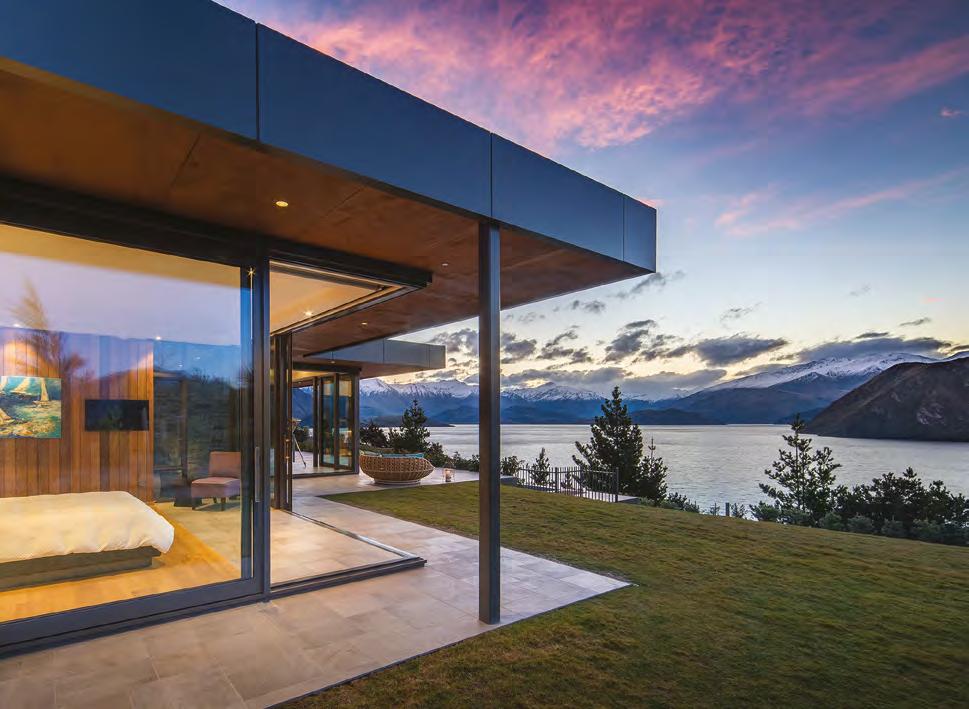
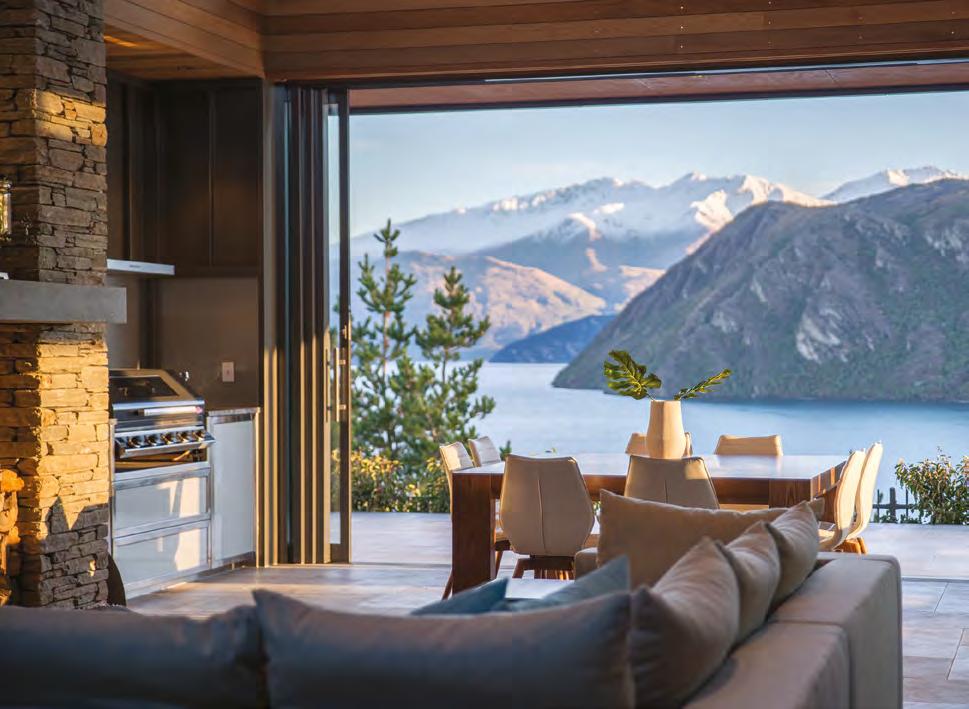
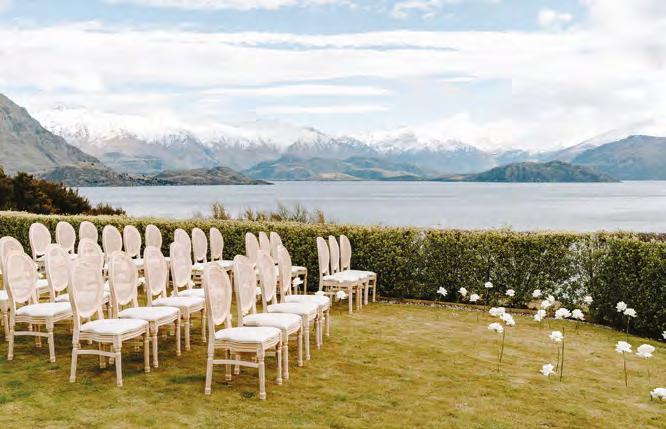
There is a phrase that guided every decision in the design of The Dacha. The client repeated it so often it became less a brief and more a mantra: Don't let the house get in the way of the view.
It sounds simple. It is, in fact, one of the hardest things to achieve in architecture.
Stand at the terrace edge and you understand immediately what they were after. Lake Wānaka stretches below as far as the eye can see. The Southern Alps shift colour through the hours — dusky pinks and pale gold at first light, slateblue by afternoon, fired copper before dark. On certain mornings, when mist sits low on the water and the mountains emerge slowly through cloud, the landscape holds you so completely that everything else falls quietly away.
Completed in 2016 and winner of the New Zealand Institute of Architects Southern Architecture Award, The Dacha is the work of Wānaka-based Eliška Lewis Architects. Perched on a steep hillside above the lake, it is anchored by a long spine of stacked stone, running unbroken inside and out — that divides arrival and service from the glassy, view-facing side of the house. Raw and considered at once. The stone connects the building to the earth. The glass dissolves the boundary between interior and everything beyond.
The layout was conceived around an obsession with view — not just the
obvious panorama, but the incidental ones. Views through corners. Rooms that look through other rooms. The landscape woven into every space.
The Dacha comprises five guest rooms in the main residence. The Master Suite occupies the east wing, where morning light arrives first. At the western end, The Georgia, The Charlotte, and two bunk rooms gather around a snug built for easy, unhurried company. Perched separately on the hillside, The Banya is a private studio retreat with its own verandah and unimpeded views — suspended in landscape. Together, the property holds up to sixteen guests. It holds two equally as well.
Outside, the pool appears to hover at the edge of the world, its surface aligned with the lake below. Four hundred and twenty square metres of terraces offer themselves up according to the light.
The word dacha is Russian for 'a home away from home' — and something in that translation feels true to what this place asks of you. Not expectation. Not schedule. Simply presence.
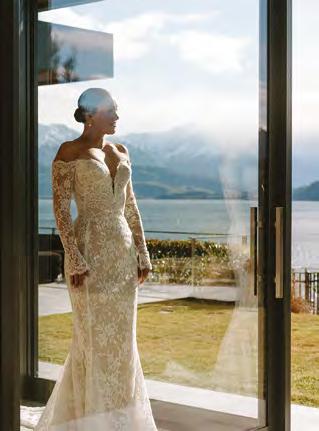
For couples seeking something more personal than a traditional venue, the landscape becomes ceremony. Vows exchanged with the Southern Alps as witness. A table laid for the people who matter most. Champagne as the mountains lose their colour. A
morning-after breakfast with the lake still, its turquoise waters mirroring the mountains below. Milestone gatherings, private retreats, and winter escapes all share the same intimacy: one property, one party, one landscape that changes with every glance. An atmosphere that becomes an integral part of the story.
Five minutes from the centre of Wānaka and within easy reach of Queenstown and Arrowtown, The Dacha sits at the heart of the South Island's most celebrated region — world-renowned walking trails, Central Otago vineyards, legendary ski fields. A dedicated concierge team shapes bespoke itineraries tailored to individual tastes. Experiences can be elevated with enhancements including services of a personal chef, massage treatments, private yoga sessions, in-house wine tastings, and curated regional golf tours.
Whether you're after adventure, restoration, family connection, or an intimate celebration steeped in meaning, The Dacha prioritises luxury through space, stillness, and emotional warmth.
Some places you visit. Others quietly etch meaningful moments that create memories for life — much like this landscape, it’s impressions are timeless, grounding and impossible to forget.
thedacha.co.nz
concierge@thedacha.co.nz
lunalodge.co.nz
Tucked just a short stroll from the lakefront and the heart of Wānaka, Luna Lodge Wānaka offers a relaxed, beautifully considered, and effortlessly easy stay.
Newly refurbished and designed with a clean, contemporary sensibility, the boutique accommodation strikes a smart balance between an alpine adventure base and laid-back retreat.
Fashionable rooms boast warm timber accents and crisp linens all thoughtfully curated and styled by Verity Lawrence Design. Guests can choose from a range of options, from cosy garden-view doubles through to spacious lake-view suites suited to families or longer stays. Expect practical luxuries like underfloor bathroom heating, air-conditioning, quality coffee and tea facilities, smart TVs and seamless digital check-in.
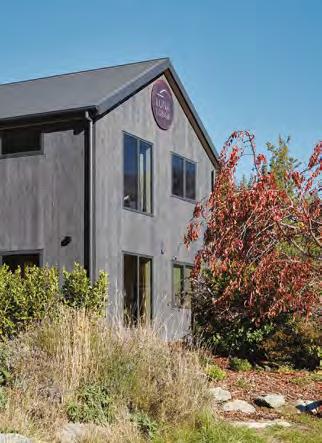
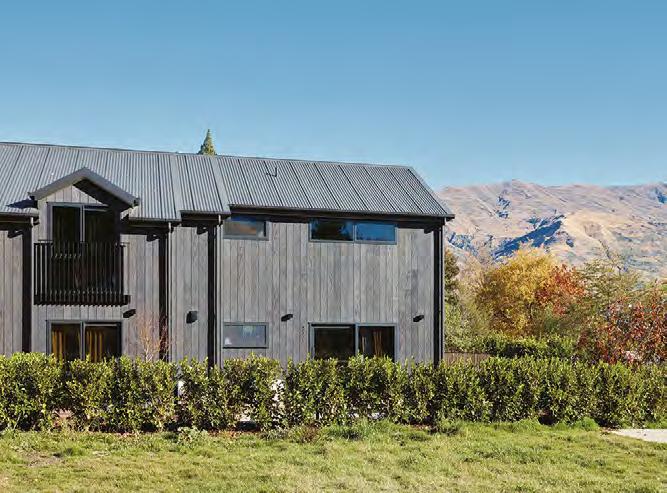
What sets Luna Lodge apart is its understanding of the modern Central Otago traveller – this is not a place designed for staying indoors all day, rather it acts as a stylish launchpad into one of Aotearoa New Zealand’s great outdoor playgrounds.
In winter, the ski drying room and secure storage make early starts to Cardrona and Treble Cone a cinch. During the warmer months, the lodge becomes an ideal base for mountain biking, hiking and lake adventures, with secure bike lock-up and easy access to Wānaka’s endless trail network.
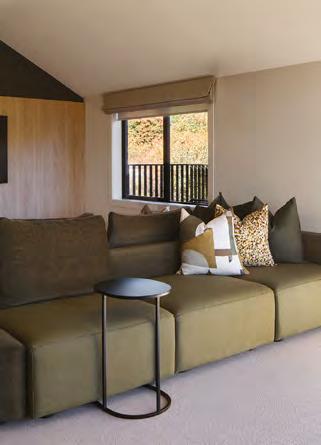
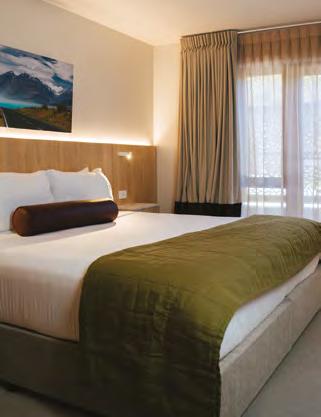
And then there’s the location. Leave the car parked and wander into town for morning coffee, long lunches or a lakeside sunset stroll. Nearby favourites like Puzzling World, Wānaka Lavender Farm and the region’s wineries are all within easy reach, while the surrounding mountains provide a cinematic backdrop at every turn.
There’s an understated confidence to Luna Lodge. For couples escaping the city, families exploring the Southern Lakes, or remote workers blending business with adventure, Luna Lodge delivers Wānaka at its most relaxed and accessible.
24 Tenby Street, Wānaka
marinaterrace.co.nz
Framed by the shimmering waters of Lake Wānaka and the dramatic Southern Alps, Marina Terrace Apartments offer a refined escape where luxury and landscape exist in perfect harmony.
Just moments from Wānaka’s vibrant cafes, boutiques and lakefront promenades, these elegant two- and three-bedroom apartments are designed for travellers who appreciate space, style and serenity.
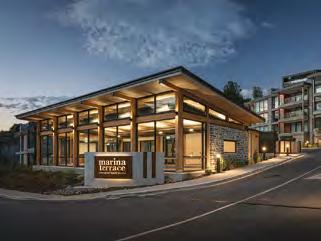
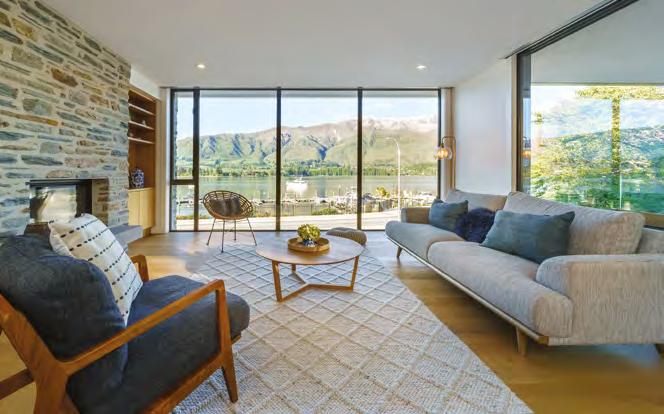
Each beautifully appointed residence features expansive open-plan living, sophisticated interiors, and private balconies that capture breathtaking lake and mountain vistas from sunrise to dusk. Whether enjoying morning coffee overlooking the water or unwinding fireside after a day on the slopes, every detail has been thoughtfully curated for effortless comfort.
Designer kitchens, indulgent bathrooms, full laundry facilities and generous entertaining spaces make Marina
Terrace equally suited to romantic getaways, family holidays or extended luxury stays. Guests also enjoy access to premium onsite amenities including an indoor heated pool, hot tub and well equipped gym.
At Marina Terrace Apartments, the beauty of Central Otago is not simply admired – it becomes part of the everyday experience.
Marina Terrace Apartments 65-93 Lakeside Road, Lake Wānaka
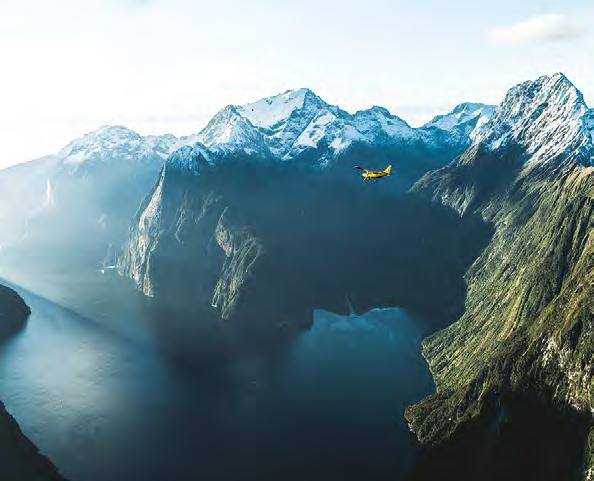
MILFORD SOUND GLACIER FLIGHT & CRUISE FROM WĀNAKA
Experience the Eighth Wonder of the World from above from window seats with spectacular views of 2 National Parks, the Southern Alps, Glaciers Galore, Mt Aspiring, Olivine Ice Plateau, Mitre Peak and much, much more! Touch down at Milford Sound and transfer from sky to water to cruise the entire fiord. Your return flight to Wānaka is on a different breathtaking flightpath.
Southern Alps Air/Siberia Experience 0800 345 666 info@southernalpsair.co.nz southernalpsair.co.nz
WIN a Milford Sound Glacier Flight & Cruise. To enter visit vervemagazine.co.nz , click WIN then follow the directions.
Conditions apply; valid for 12 months.
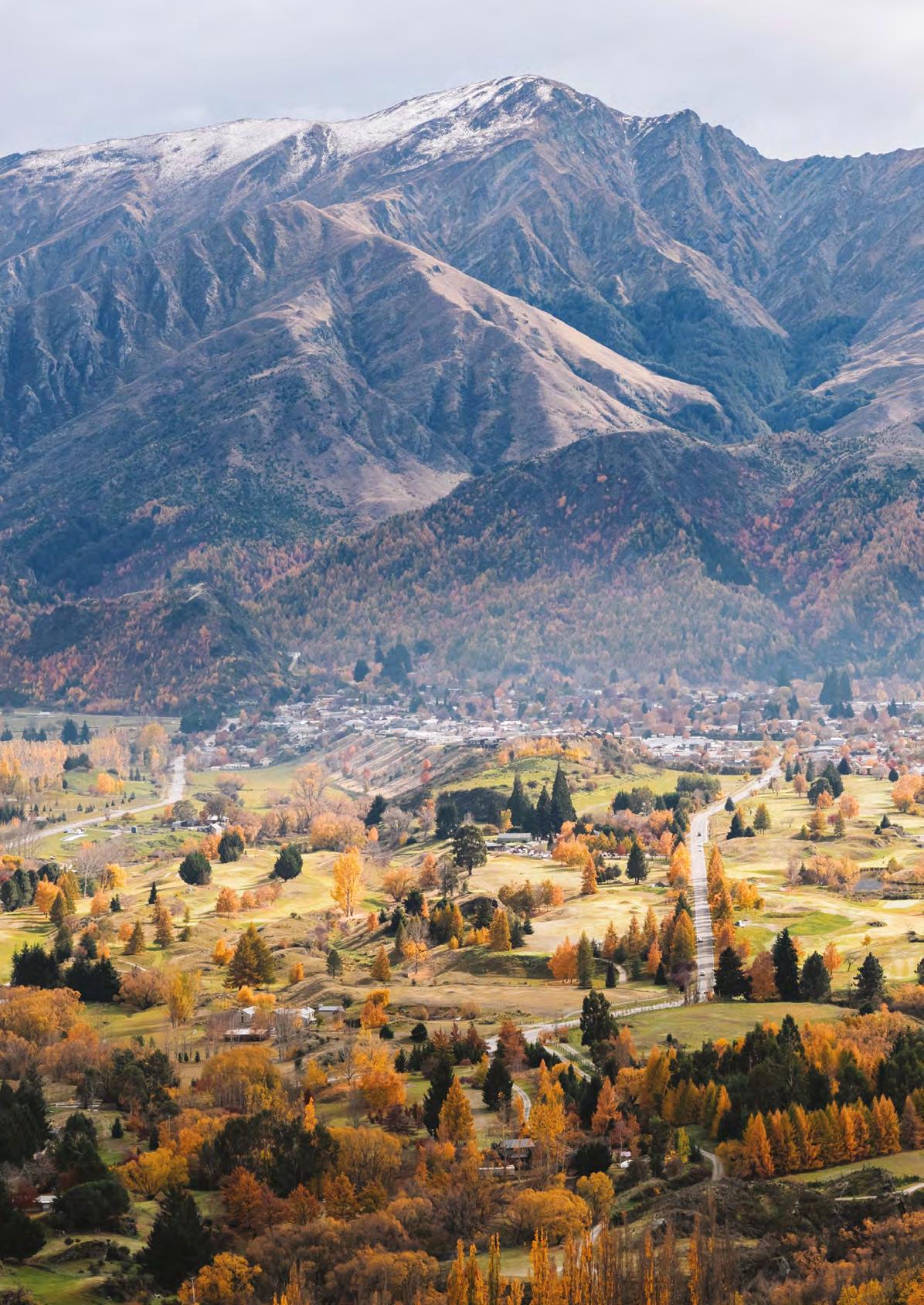

Enchanting Arrowtown sits in the glacially carved Arrow Basin northeast of Queenstown, a place once frequented by early Māori for hunting and collecting pounamu. Gold was discovered in the Arrow River in the mid-19th century, and for a time the river contained among the world's highest concentrations of the precious metal. Today, its well-preserved, tree-lined streets and historic architecture, make the town feel like a time machine to the gold-rush era.
The settlement was established in 1862, initially known as Fox's after William Fox, who led a group of miners secretly working the Arrow River and was so determined to conceal his find that he'd reportedly abandon his camp under cover of night to shake off followers. Gold was discovered by a shearer named Jack Tewa – also known as Māori Jack – and by the end of 1862 over 1,500 miners were camped on the riverbanks. In early 1863 alone, a remarkable 340kg of gold was extracted from the area. Over 70 historical buildings survive today as testament to that feverish era.
The gold rush also brought a wave of Chinese immigrants, invited from Guangdong province in the 1860s to work mines the Europeans had often supposedly exhausted. Industrious and resourceful, many found missed gold reserves and established their own businesses. Discriminatory policies followed, and it was a complicated and often painful chapter in New Zealand's past – one the government formally acknowledged in 2002 with an official apology to China.
On the banks of Bush Creek, the Arrowtown Chinese Settlement preserves this difficult history through a partially restored collection of 19th-century buildings maintained by DoC. Storyboards detail the community's story, including the tale of Ah Lum, a local store owner who became a unlikely hero by saving a European man from drowning – a poignant act given the mistreatment his community endured.
By the 1950s, visitors began arriving in growing numbers, drawn by Arrowtown's extraordinary autumn colours, well-preserved streetscapes and gold-rush romance. That trickle became a flood, and today the town has embraced its role as one of Aotearoa New Zealand's most charming heritage destinations.
giraffeart.co.nz
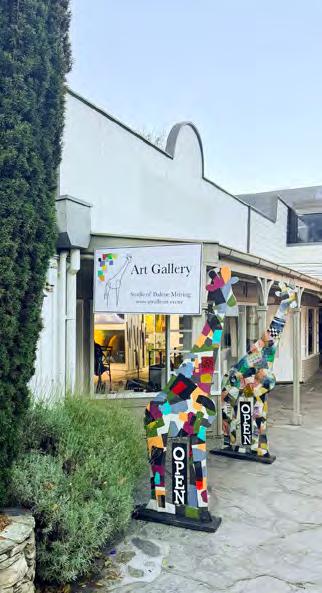
Verve sits down with Arrowtownbased artist Dalene Meiring who runs gallery and working studio Giraffe Art, with her husband Pieter.
How did the name Giraffe Art originate?
I’ve always loved giraffes. Looking for a name for our business almost 30 years ago, that was the only name we loved. Also, giraffes are quirky, with their long necks they observe far beyond what we can see. We hope that represents the way we see and approach art in all forms.
What was it about Arrowtown town that you love?
We always loved the South Island. On a visit to Arrowtown, we saw the premises available and we knew we had to apply. Arrowtown has a large arts community that are really supportive and inclusive of all artists.
How do you balance your own practice with championing other artists?
When you love art and think it becomes second nature to appreciate other art and artists and give them an opportunity to sell their work.
How do you choose who to show?
We have three local artists that we represent and three visiting ones. We rotate the visiting artists between 12-18 months, so we can always have their work on the wall. We do not have storage areas, so work is always displayed.
Pieter, what's your role in the gallery day to day?
I do all the associated tasks –the website, social media, sales packaging and sending work locally, internationally. I also go and hang artworks personally for local buyers.
What does a perfect day off look like for the two of you?
Smiling customers and collectors admiring the art on display. Being part of the Arrowtown community, and also meeting people from all over the world.
inlinenutrition.co.nz
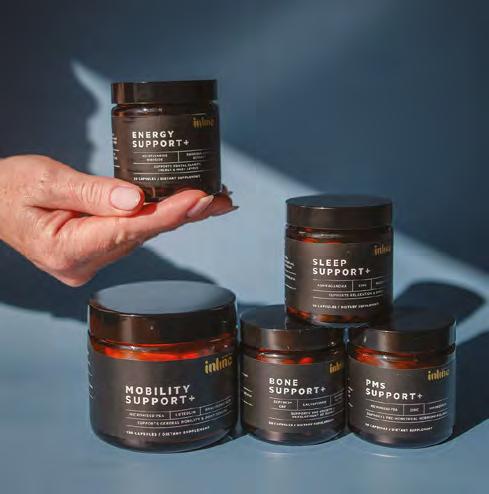
Founded in Dunedin and proudly New Zealand owned, Inline Nutrition creates premium, science-backed supplements designed to support modern wellbeing –from performance and recovery to sleep, energy and everyday vitality.
Thoughtfully formulated, third-party tested, and crafted to help you feel the difference, naturally.
87 Saint David Street, North Dunedin info@inlinenutrition.co.nz




Today’s most imaginative retail spaces blur the line between shop and spectacle, here’s our curation of the coolest…
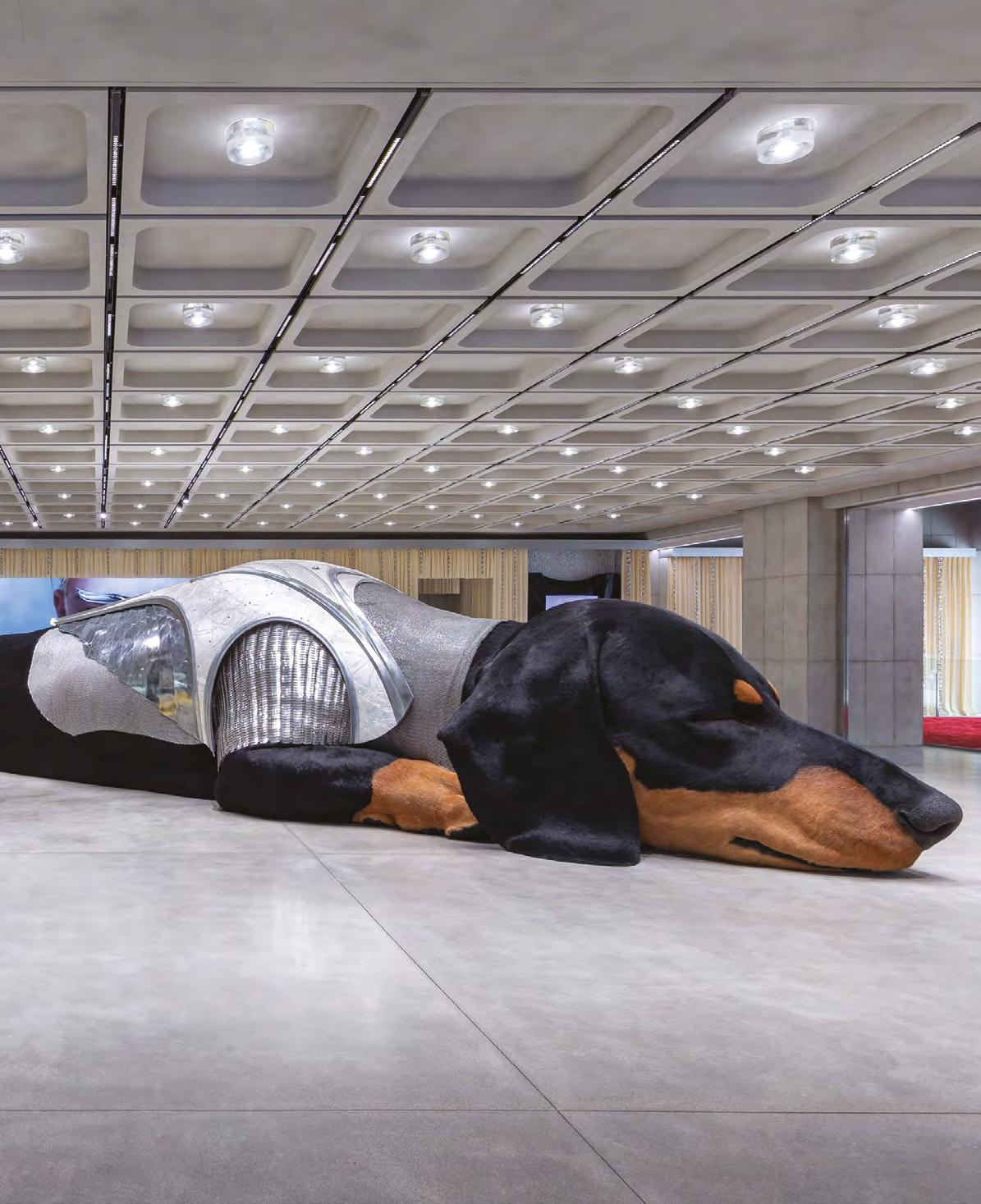
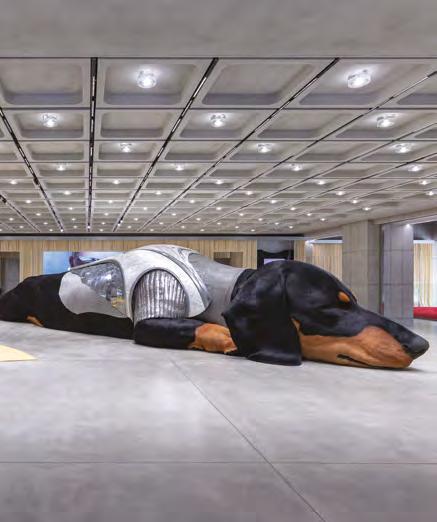
Situated in Seoul, Gentle Monster’s flagship store ‘Sacrifice’ blends art, design, and retail... surreally! Across three floors, visitors are invited to explore imaginative installations like Max Siedentopf’s More Is More and Sunshine – a giant dachshund shifting between dreamlike and futuristic forms. The first-floor garden features the striking statue, ‘Eye of God’ statue, making this experimental space a must-visit for its creativity and photo-worthy design.
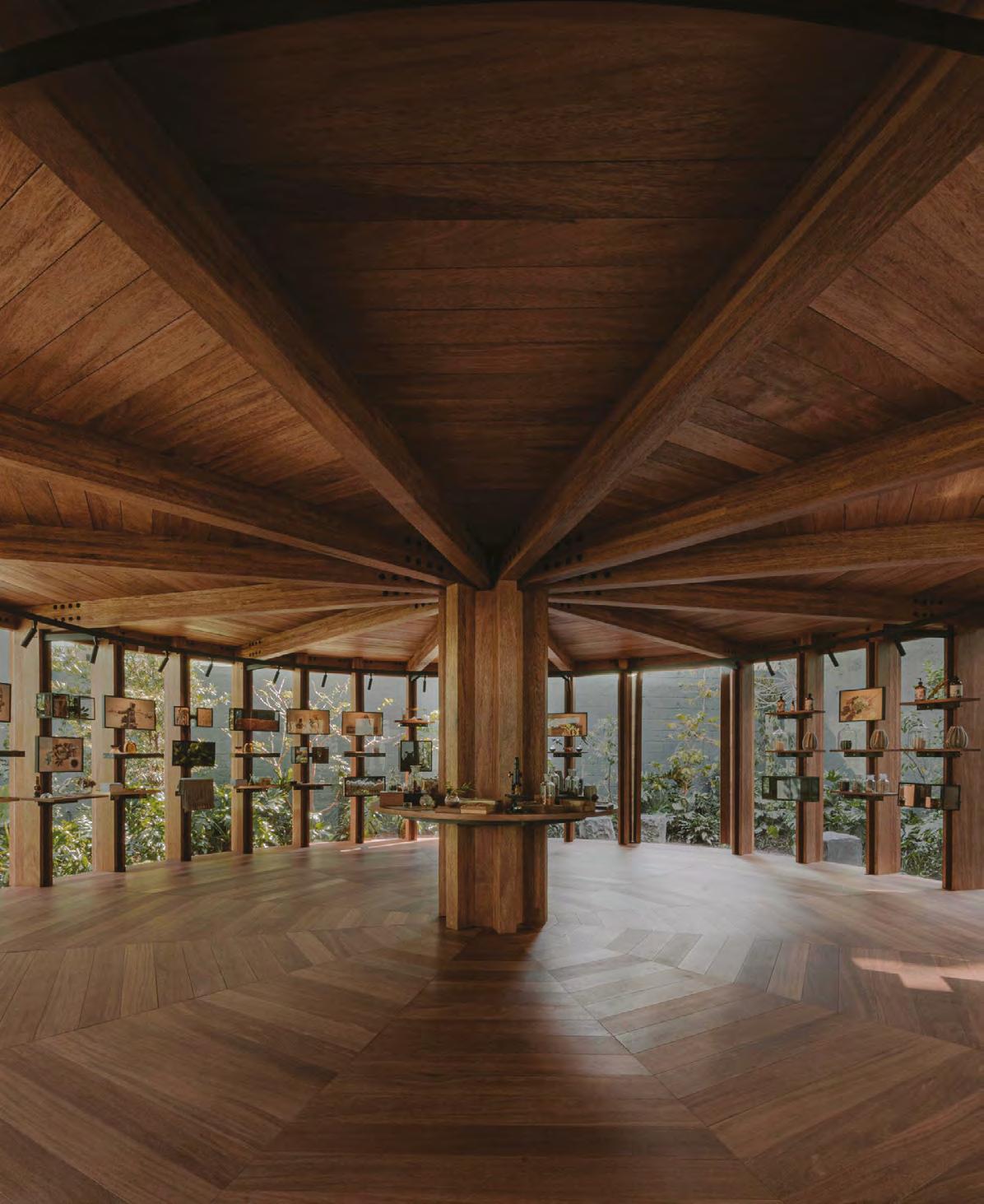
Set within a lush garden in Mexico City’s Juárez neighbourhood, Xinú Marsella transforms a former car workshop into a serene, scented haven. Designed by Esrawe + Cadena, the rounded wooden pavilion invites visitors on a sensory journey through scents, candles, and botanicals. Expansive windows blur boundaries between outside and in, creating a tranquil space that celebrates craft and the art of fragrance.
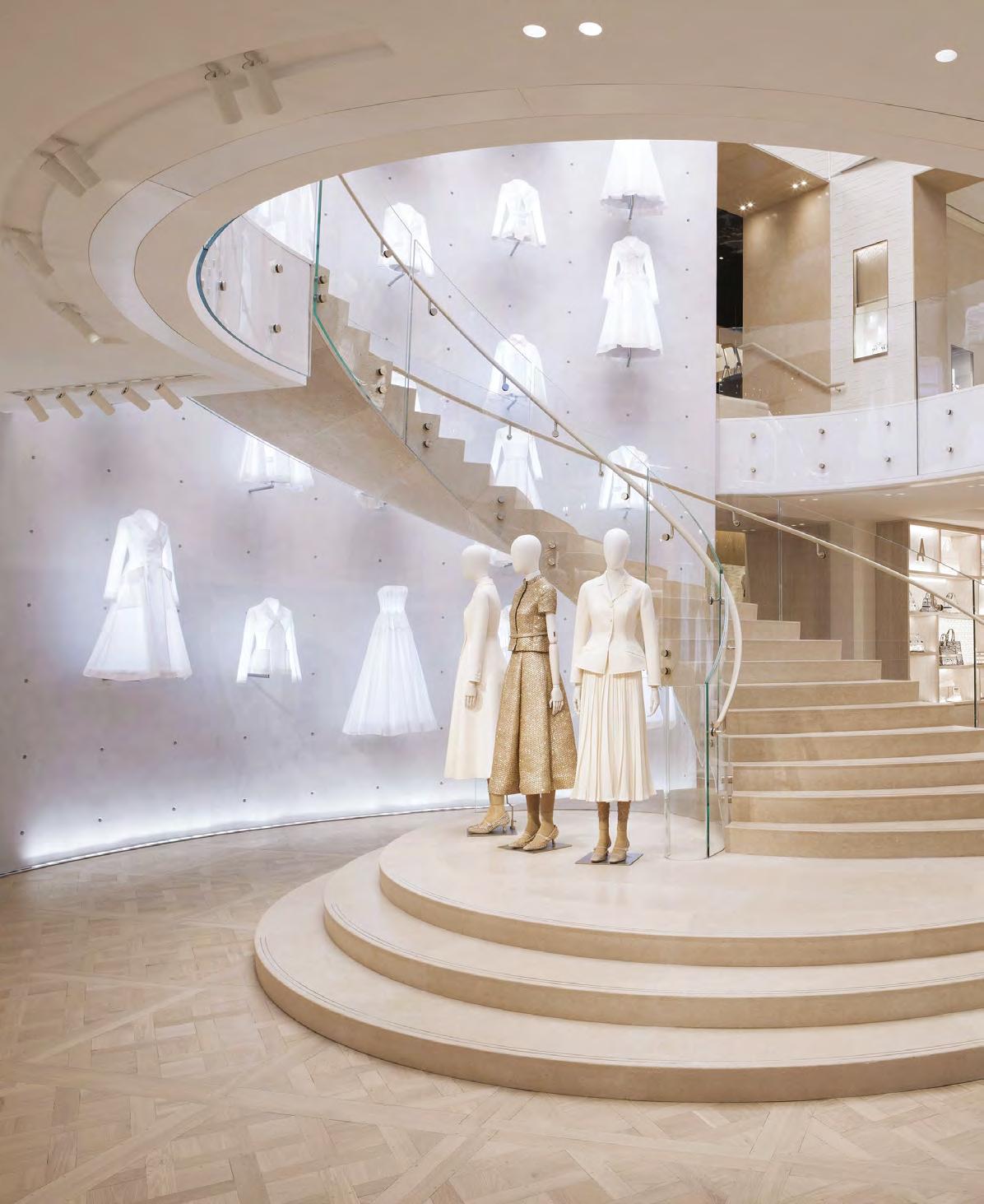
In Paris – where else! – Dior’s historic townhouse celebrates French art de vivre under Chef Yannick Alléno, who oversees the Monsieur Dior restaurant, Le Jardin pâtisserie, and Café Dior. The boutique’s ground floor showcases the women's and men's fashion creations by Jonathan Anderson, while the first floor features fine jewellery, couture, and Dior Maison. A serene Beauty Room offers bespoke treatments and luxury experiences.
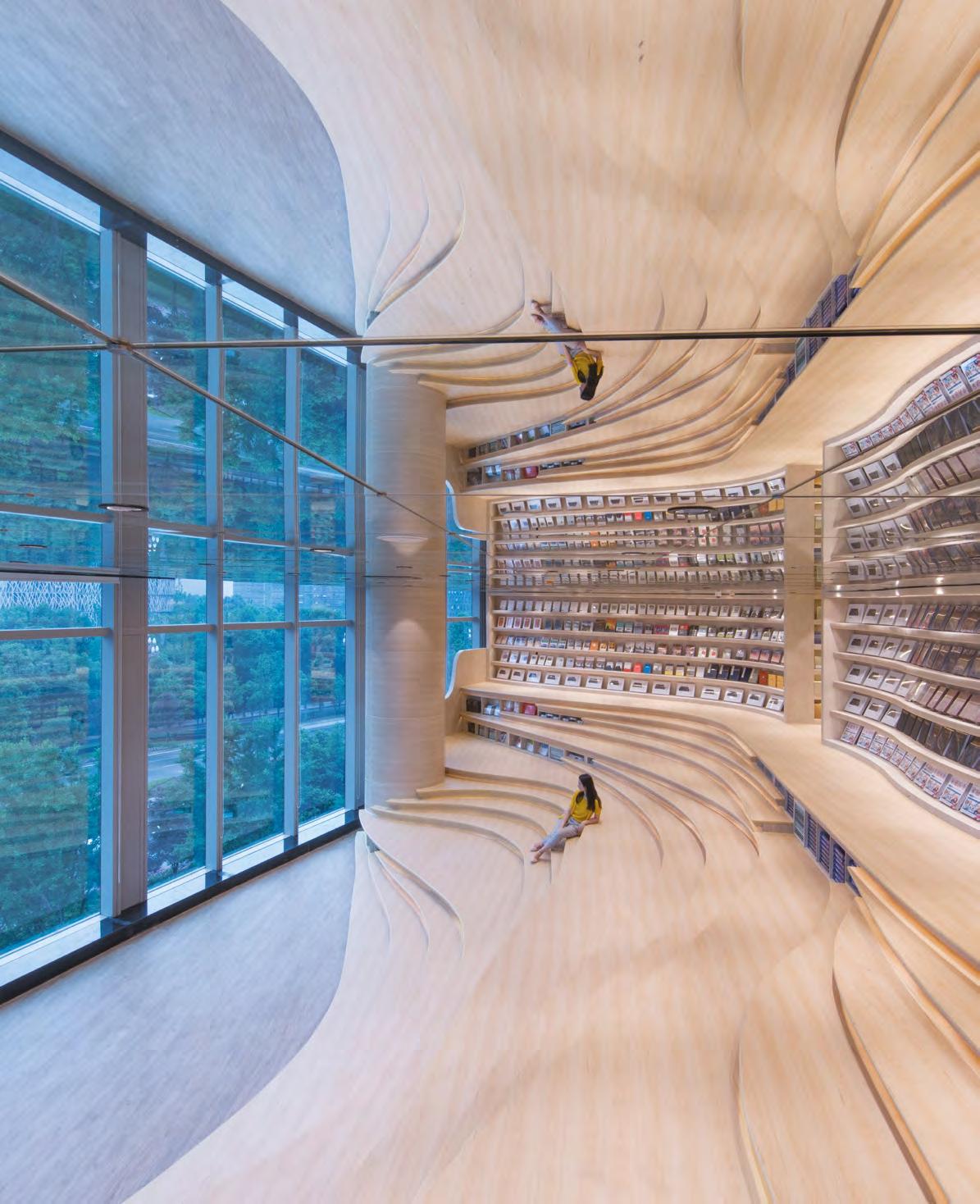
Zhongshuge bookstore at Chengdu's Yintai Center lures visitors with a striking glass text wall and bamboo-shaped shelves that celebrate local culture. A whimsical children's area features panda murals and 'mushroom' bookshelves beneath a mirror ceiling, while a soaring red brick wall anchors intimate reading zones. The perfect destination for losing yourself in a book on a lazy afternoon.
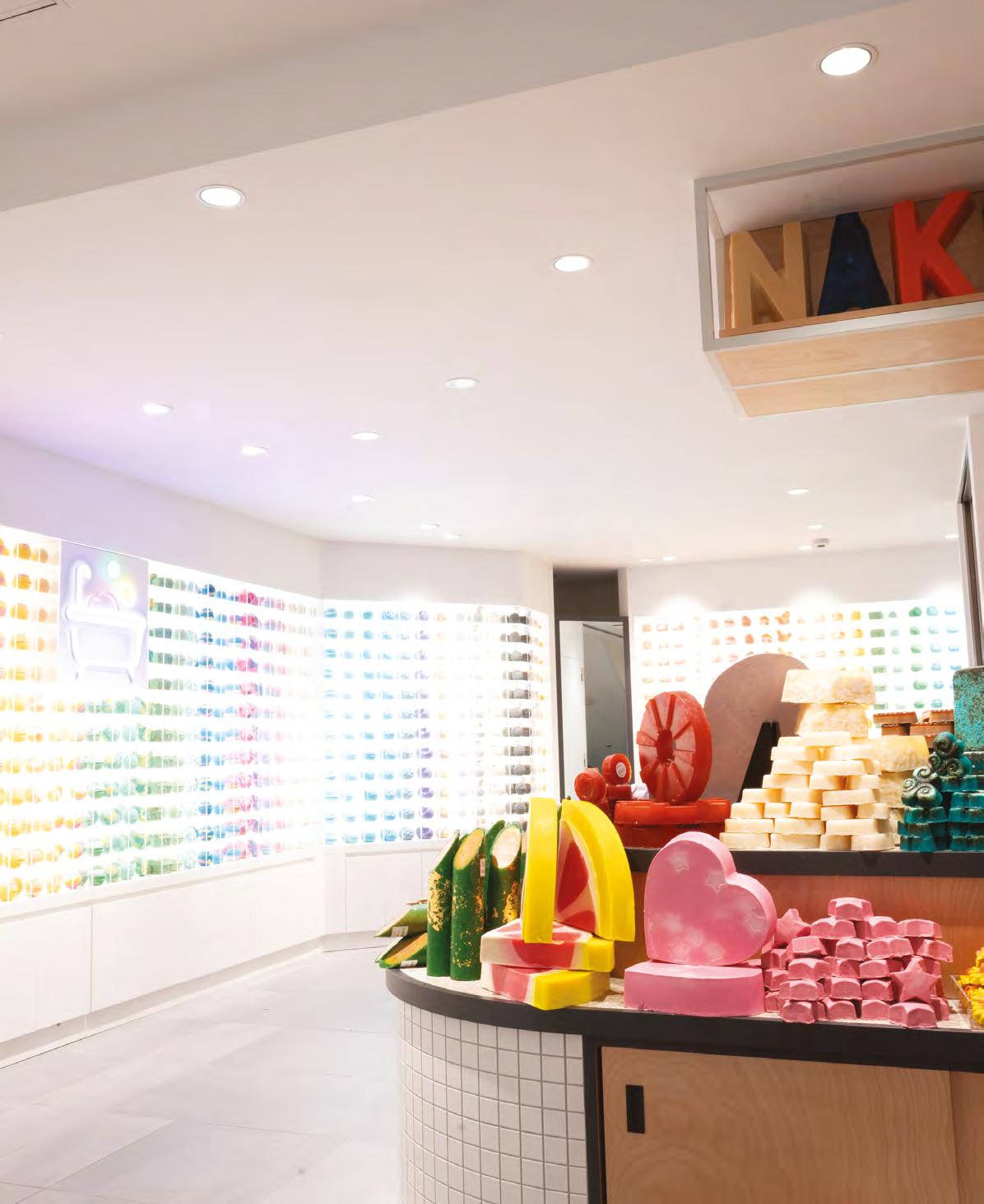
Opened in 2019 inside Japan’s Shinjuku Station –the world's busiest – Lush Shinjuku is Asia's largest Lush store and one of retail's most forward-thinking spaces: across four experiential floors, tech does the talking. Lens technology showcases products in use via video, reducing the need for packaging and cutting water waste, a quietly radical rethink of what a beauty store can be. Visit Lush here in Aotearoa in their newest store located at Sylvia Park.
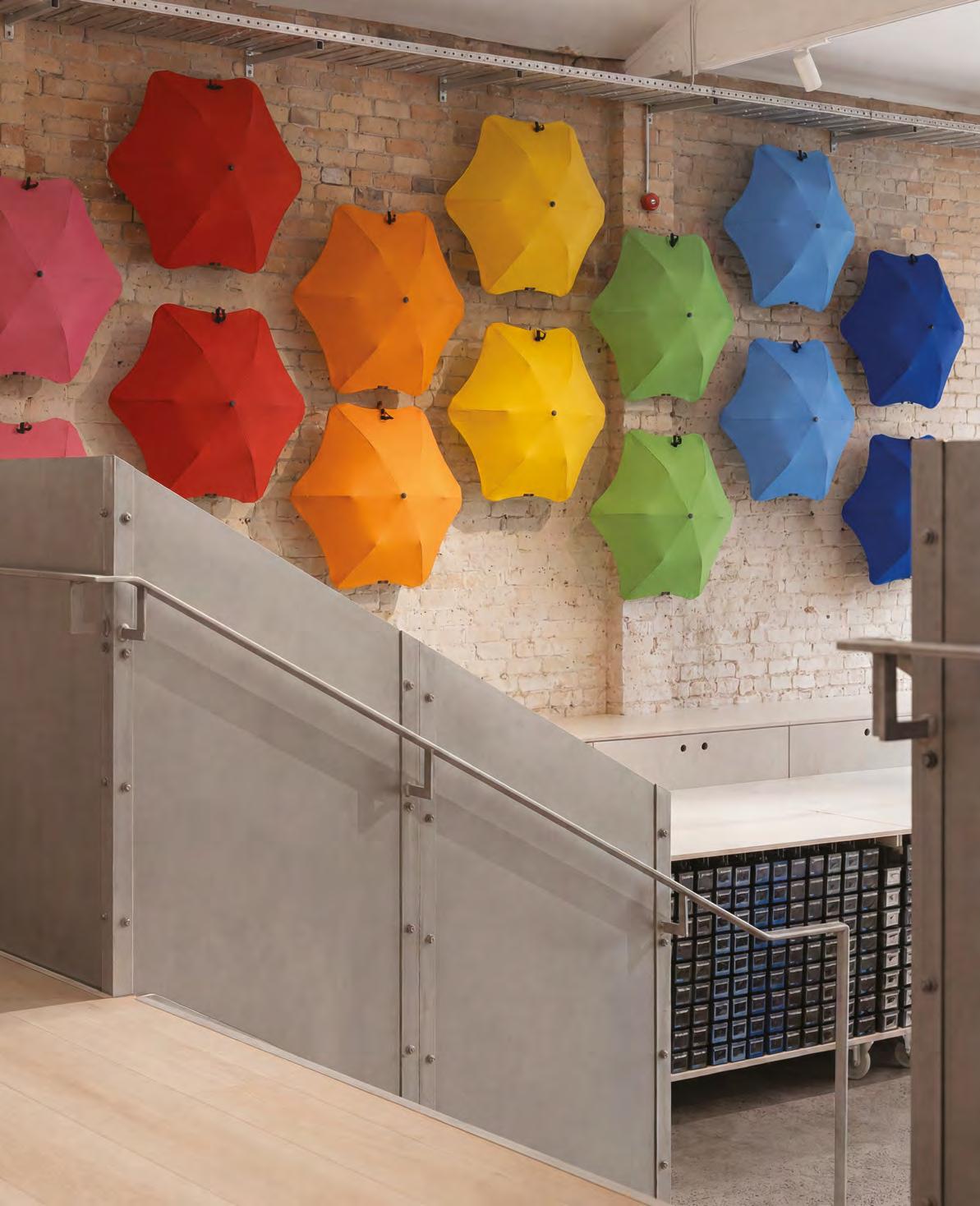
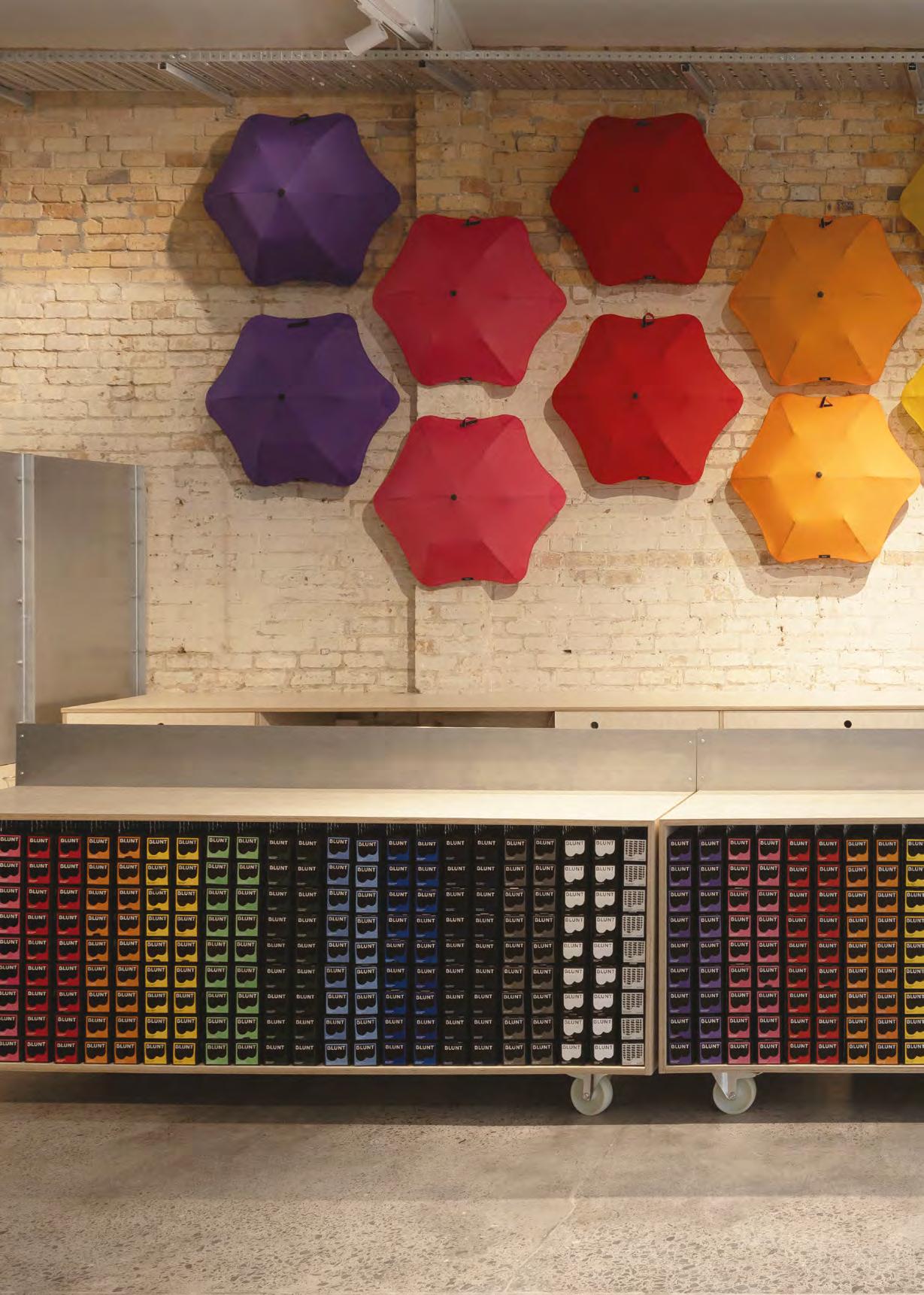
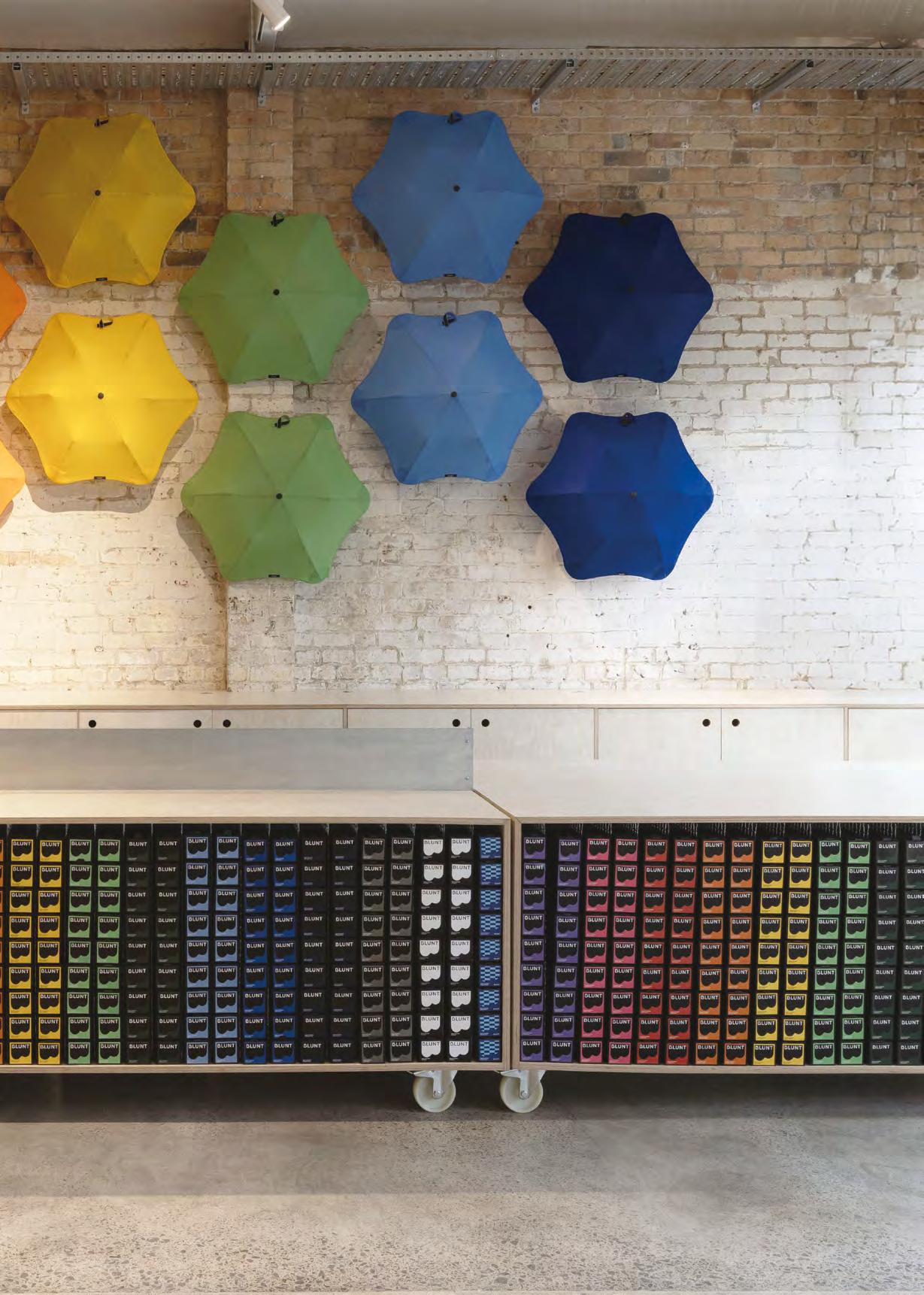
BLUNT Umbrellas' new global headquarters transforms a building steeped in New Zealand cultural history. A working head office alongside a public showroom and first-ever walk-in repair studio, this is BLUNT's founding philosophy of engineering joy brought to life in bricks and mortar.
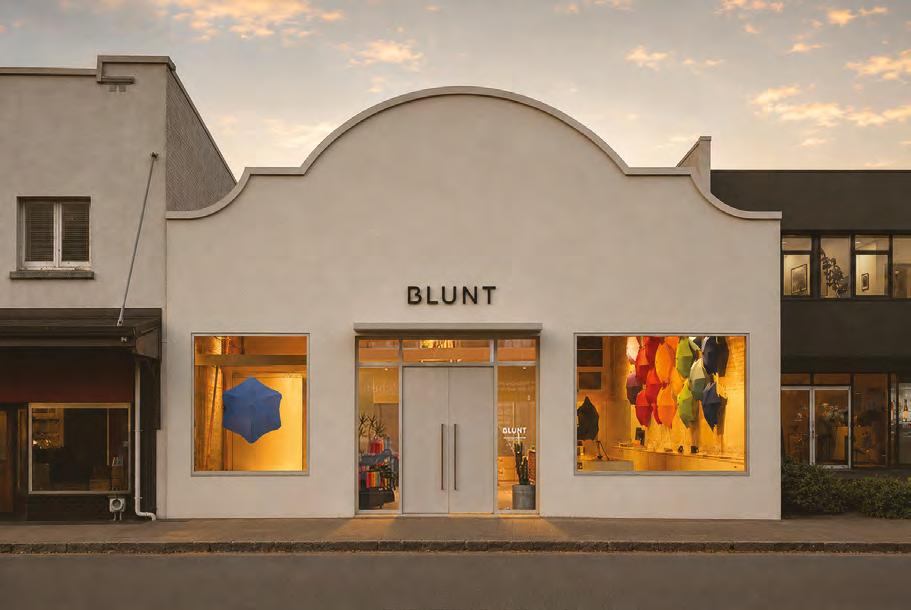
bluntumbrellas.co.nz
That man was Greig Brebner, and that moment became BLUNT.
Two decades, multiple international markets and awards, and a B Corp certification later, BLUNT has just made its boldest move yet: purchasing and transforming a landmark Auckland building in Epsom into a world-class global headquarters, complete with the brand’s first-ever public showroom.
“A move as deliberate and considered as the products themselves”
Designed by Auckland studio Wonder Group and built by Bufton Construction,
Twenty years ago, a frustrated New Zealander stood on a rain-soaked London street watching yet another umbrella turn inside out, and decided there had to be a better way.
the space honours the building’s storied past, having been home to Cordy’s, New Zealand’s longest-standing fine art and antiques auction house, for over 35 years. There is something quietly poetic about a brand built around longevity and craftsmanship taking the reins from an institution that spent decades preserving beautiful things.
The new headquarters houses more than 20 head office staff and serves as the operational hub for BLUNT’s growing footprint across New Zealand, Australia, the UK, US, Europe and Asia. But it is the store and showroom, open Monday to Friday, 9am to 5pm, that
feels like the real statement. Visitors can browse the full BLUNT range and, in a world of throwaway retail, have their umbrella repaired on the spot. Engineering joy, in the most literal sense.
As BLUNT marks 20 years, this is a brand that has always known exactly what it stands for: precision, durability, and the radical idea that an everyday object can be genuinely, lastingly brilliant and beloved the world over.
Visit, browse the full range, and have your umbrella restored on the spot at 180 Great South Road, Epsom.
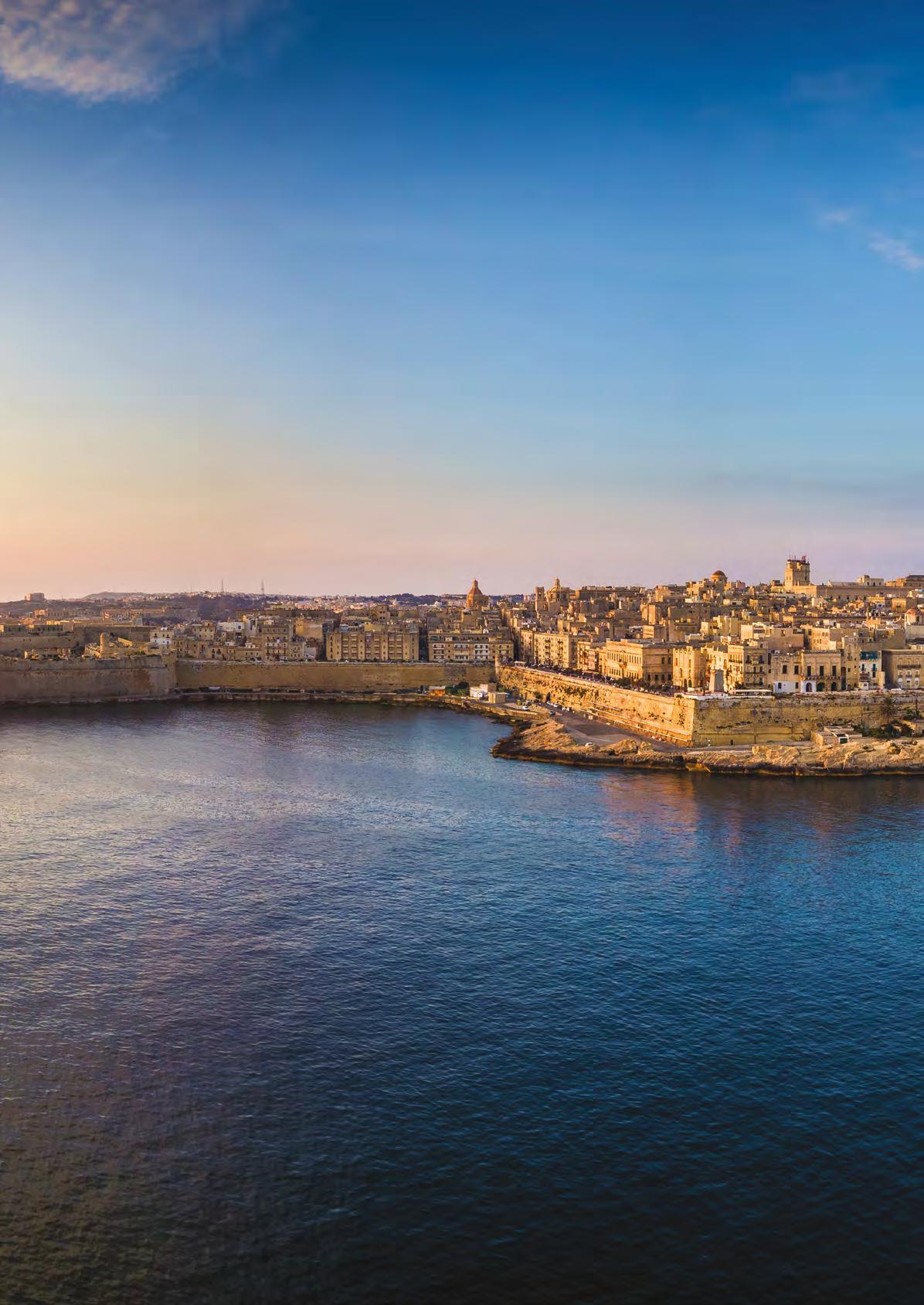
The Maltese archipelago sits at the heart of the Mediterranean, a stunning group that includes three inhabited islands – Malta, Gozo and Comino – with at least 8,500 years of history etched into every sun-baked stone.

Tiny but mighty, Malta's sunny capital Valletta is one of the Mediterranean's most storied cities, and one of its most rewarding to explore. Built on a slender peninsula just 1km by 600m, the city was hewn from honey-coloured limestone in the 16th century by the Knights Hospitaller (a powerful Catholic military order founded in Jerusalem in the 12th century) who decreed it should be "a city built by gentlemen for gentlemen". That founding ambition endures today. Phoenicians, Romans, Greeks, Arabs and the British have all left their mark on this strategic crossroads, earning Valletta a place on Unesco's World Heritage List and, in 2018, the title of European Capital of Culture.
Walking Valletta's limestone walls is one of the city's great pleasures, with dramatic views over both Grand Harbour and the harbour Marsamxett rewarding every step. Designed by Italian military engineer Francesco Laparelli and largely complete by the 1570s, the walls remain in remarkable condition. At the peninsula's seaward tip, Fort St Elmo – first built in 1552 and rebuilt after the Great Siege of 1565 – now houses the National War Museum, whose star exhibit is the George Cross awarded to Malta's entire population in 1942.
continued over page
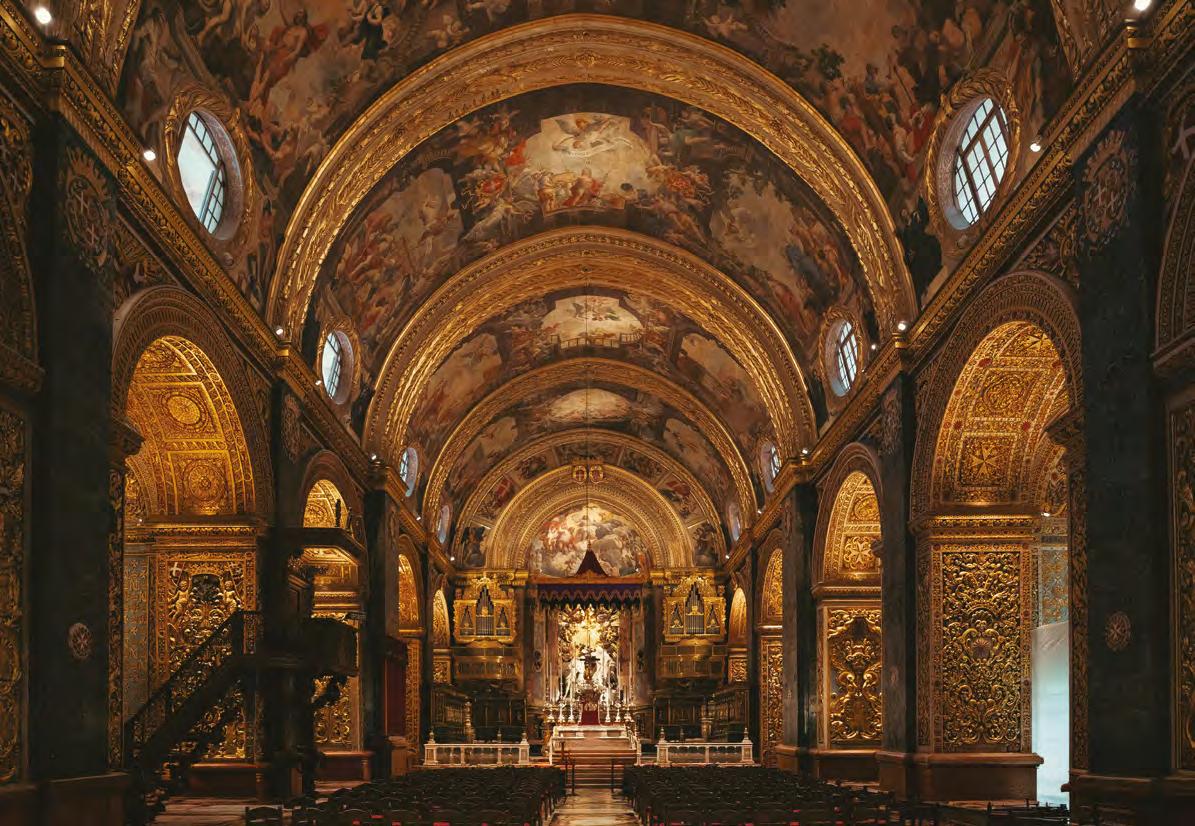
Its austere fortress-like facade gives little away, but step inside St John's Co-Cathedral and the contrast is breathtaking – a riot of Baroque extravagance with ornate carved limestone walls, a painted vaulted ceiling and 400 marble tombstones covering the floor, each marking a buried knight. The cathedral also houses Caravaggio's ‘Beheading of Saint John the Baptist’ – his largest work and the only painting he ever signed. Sir Walter Scott, visiting in 1831, called it the most striking interior he had ever seen.
MUŻA
Malta National-Community Art Museum
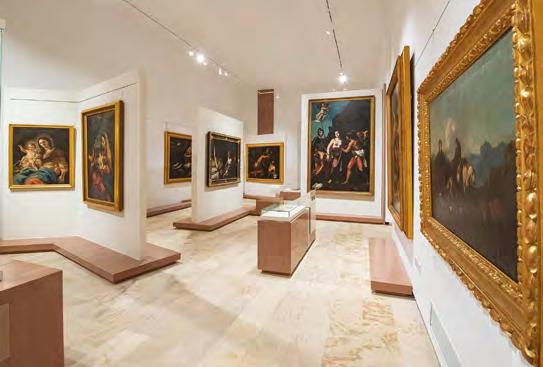
Housed in the beautifully restored late 16thcentury Auberge d'Italie, MUŻA – Malta's National Community Art Museum – opened as one of the flagship projects of Valletta's 2018 European Capital of Culture year. Its collection spans the 14th century to the present day, tracing Malta's artistic journey through its Mediterranean roots, the Knights of St John, British rule and beyond. The museum's restaurant, set around a lovely Mediterranean courtyard, is a worthy stop in its own right.
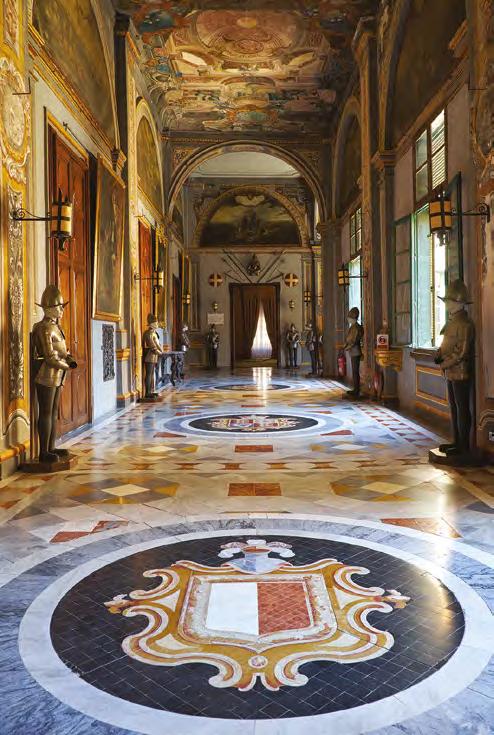
The stern exterior of the Grand Master's Palace belies a sumptuous interior. Built as the residence of the Knights' Grand Masters and Malta's parliamentary seat until 2015, it's now the office of the President. The recently restored Armoury is the star attraction – over 6,000 pieces survive (500 of which are full suits of armour) from an original 25,000, the rest lost to Napoleon's plundering and British neglect. Highlights include La Valette's breastplate and a breathtaking gold-inlaid suit made for Grand Master Alof de Wignacourt.
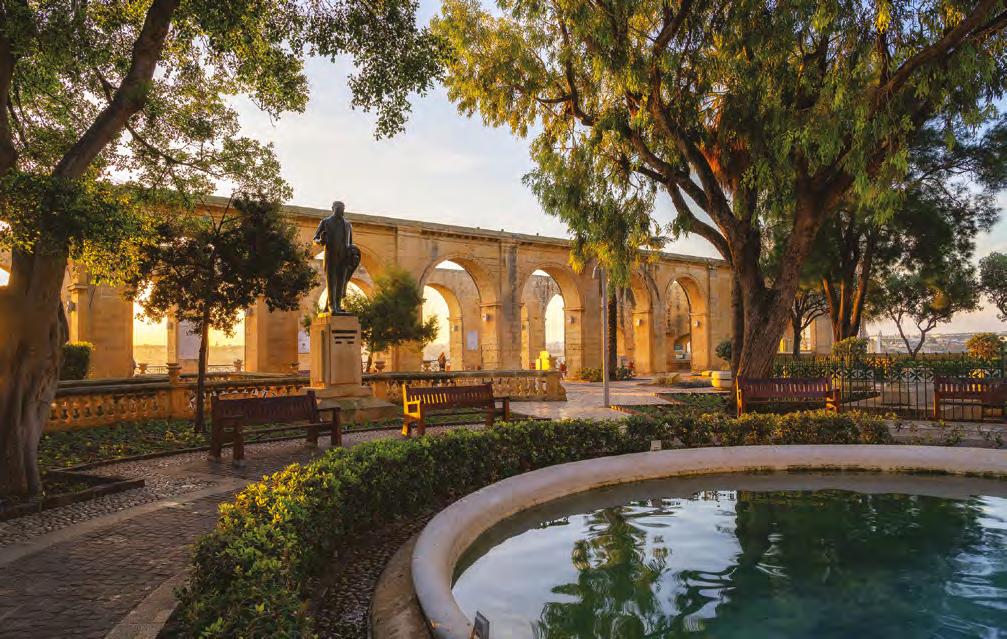
Perched at Valletta's highest point, the elegantly colonnaded Upper Barrakka Gardens date to the early 17th century, originally built as a private retreat for the knights. Today they're open to all, and the sweeping views over Grand Harbour towards the old towns of Senglea and Vittoriosa are among the finest in Malta. Time your visit for noon or 4pm Monday to Saturday and you'll witness the cannon fired from the Saluting Battery just below.

Malta's coastline is a natural spectacle, defined by rugged limestone cliffs and luminous sea caves sculpted by the Mediterranean Sea.
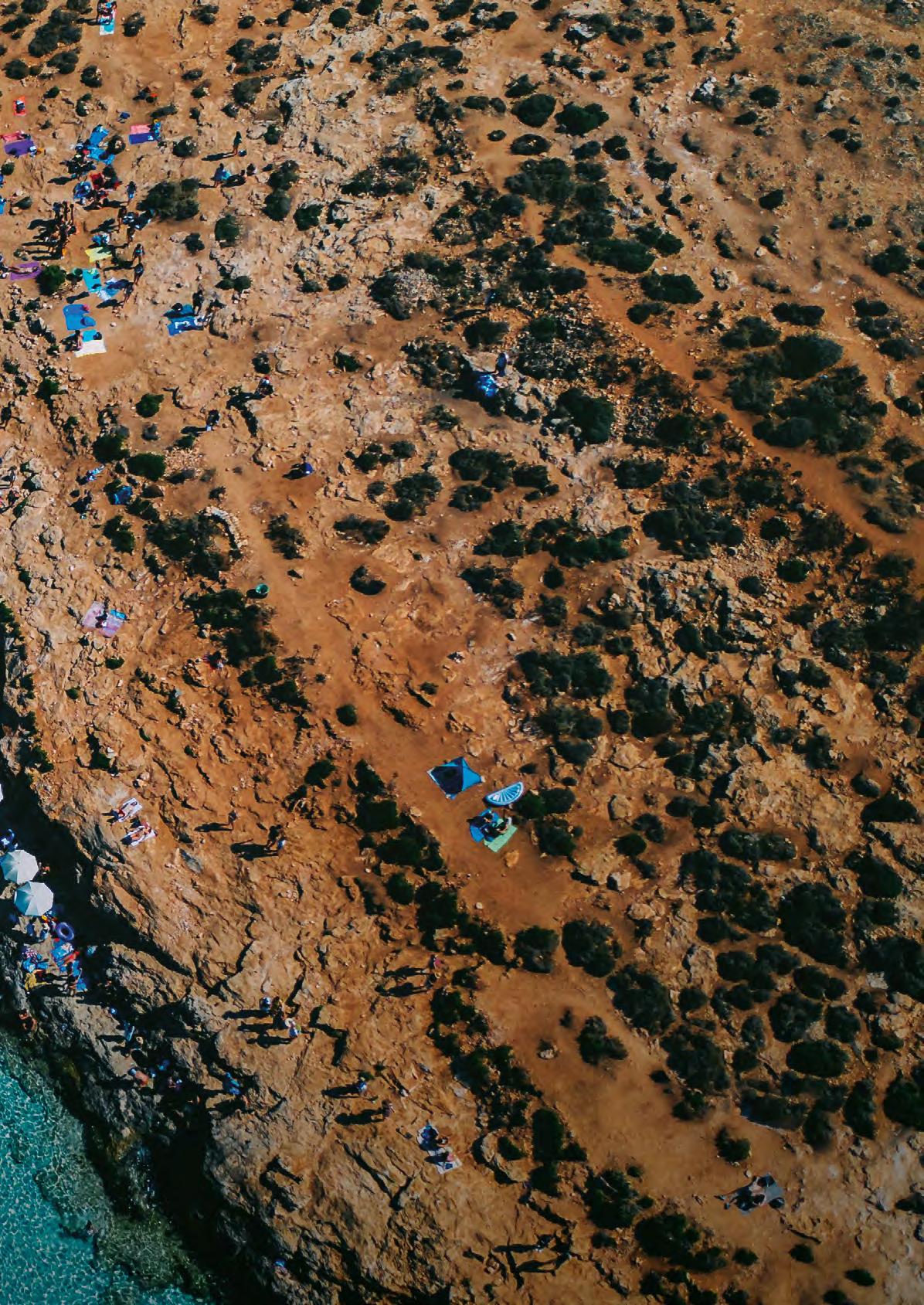
Often dubbed the most beautiful spot in the Mediterranean, the Blue Lagoon lives up to its reputation – a breathtaking stretch of crystal-clear azure water nestled between the tiny islands of Comino and Cominotto. Malta's most visited attraction, it's now a protected Natura 2000 site (a network of Europe's most important natural areas safeguarded under EU law), with access to the shore requiring a governmentissued ticket booked online in advance.
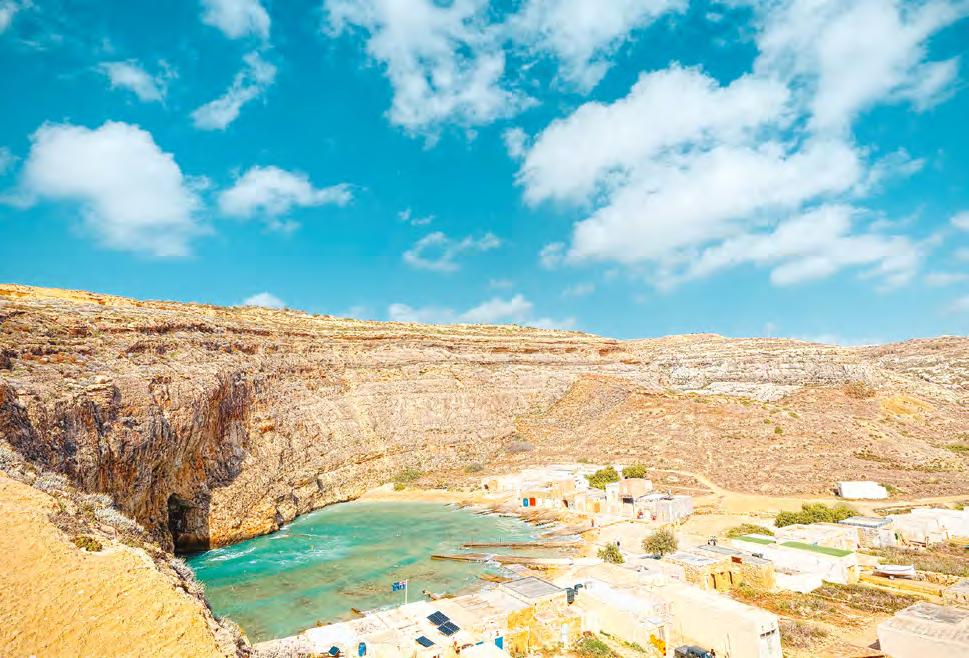
On Gozo's dramatic western coast, Dwejra's Inland Sea – known locally as Il-Qawra – is a sheltered lagoon connected to the open Mediterranean through a narrow sea tunnel carved into towering cliffs. Formed by the collapse of an ancient sea cave, it's a hauntingly beautiful spot popular with divers and snorkellers exploring the tunnel's rich marine life, and equally rewarding for those simply soaking up the scenery.
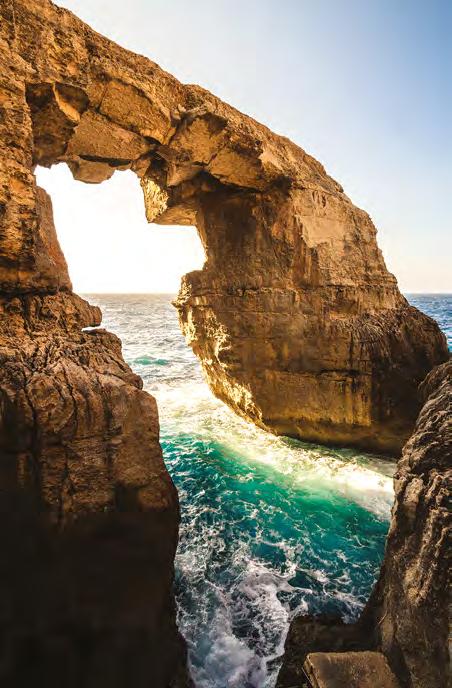
Since the collapse of Gozo's famous Azure Window into the sea during a storm in 2017 – immortalised by its appearance in Game of Thrones – the nearby Wied il-Mielah Window (meaning "Salt Valley") has become the island's last surviving natural limestone arch. Perched on the north-western coast near Gharb, this dramatic formation offers stunning coastal walks, rock climbing and diving through hidden sea caves.
Carved into the limestone cliffs on Malta's southern coast, Għar Ħasan – Hasan's Cave – is as rich in legend as it is in views. The cave takes its name from a Saracen called Hasan, said to have sought refuge here, though the story has at least five wildly different endings – most involving a kidnapped Maltese girl and someone plunging off the cliffs. Bring a torch, wear sturdy shoes, and pick up a guidebook to make sense of the cave's intriguing and decidedly murky history.
Malta’s Megalithic Temples
Malta's megalithic temples are among the oldest free-standing structures on earth –older than the pyramids and Stonehenge – with sites such as Ħaġar Qim, Mnajdra and Tarxien offering a remarkable window into the island's prehistoric past.
The Ancient City of Mdina
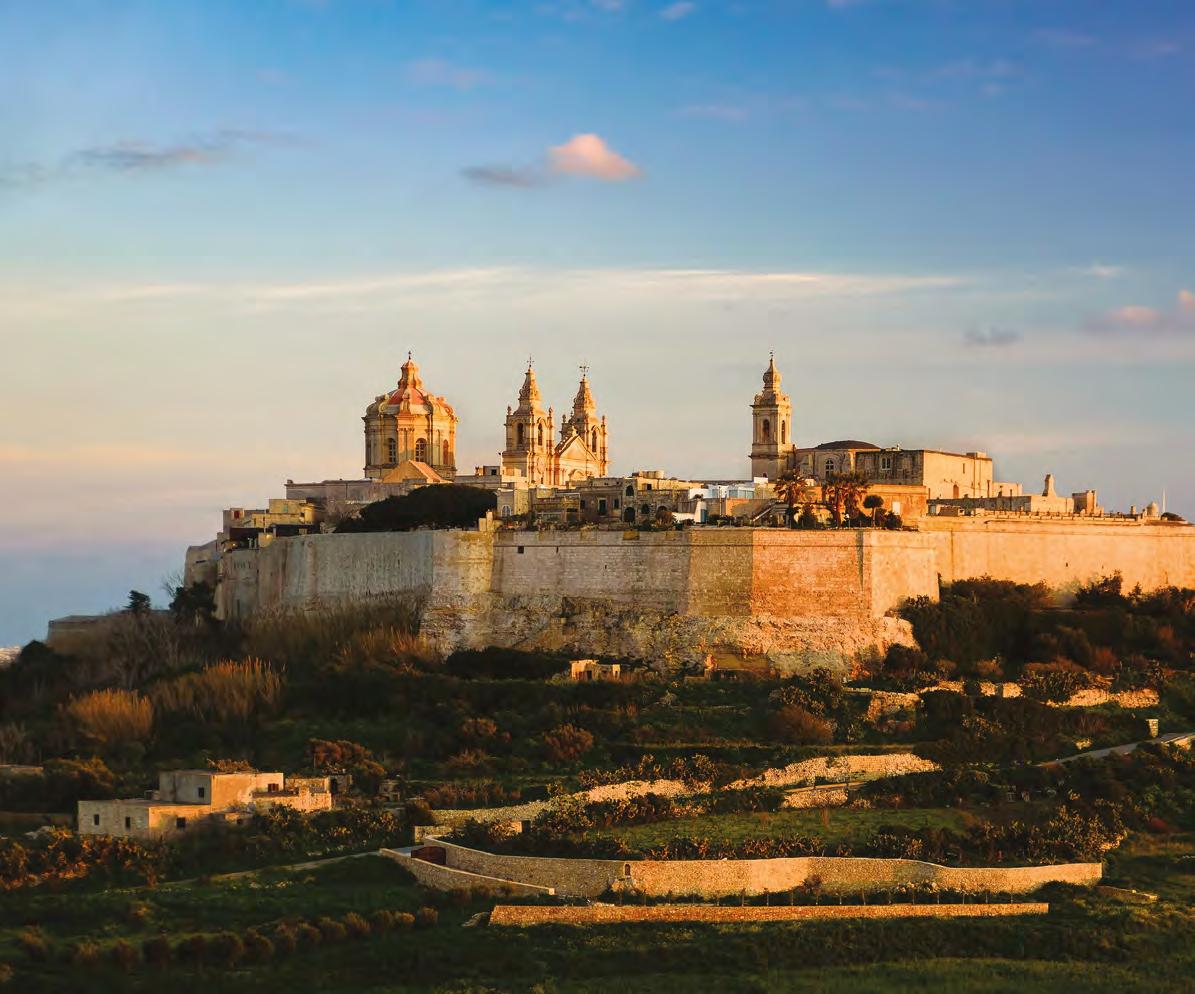
Perched on a hilltop at Malta's heart, the medieval walled city of Mdina – known as the Silent City – offers labyrinthine streets, centuries-old architecture and sweeping views across the island.
The Three Cities
Across Grand Harbour from Valletta sit Vittoriosa, Senglea and Cospicua –collectively known as the Three Cities. Predating Valletta itself, these tightly knit historic towns were once the naval base of the Knights of St John, their deep harbours forming one of the Mediterranean's finest natural ports. Today they offer a quieter, less visited alternative to Valletta, with narrow streets and a proud maritime heritage.
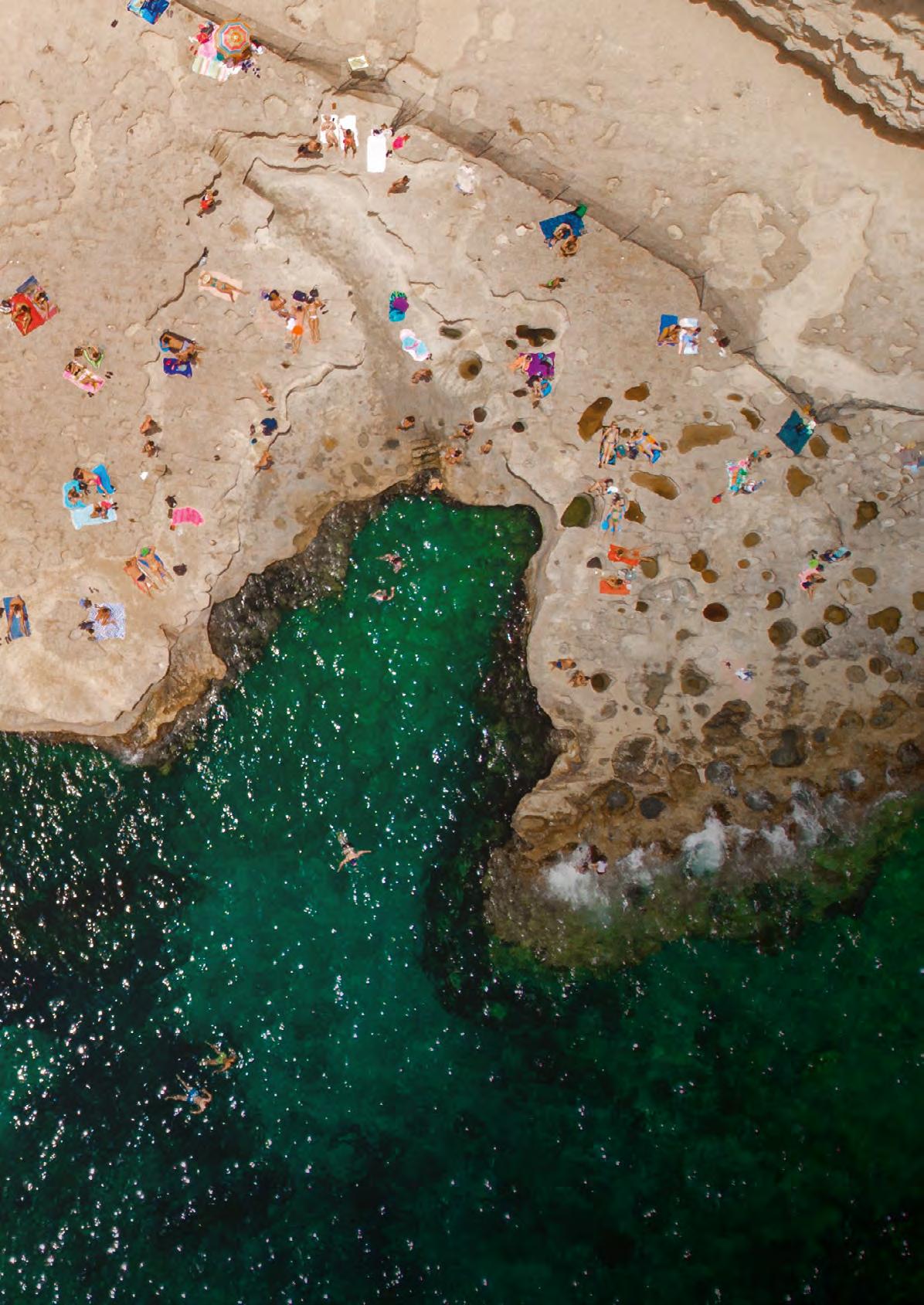
Arguably Malta's most beautiful beach, Golden Bay on the north-western coast is a sweeping curve of orange-gold sand shelving gently into the deep-blue Mediterranean – perfect for swimming, watersports or simply lazing in the sun.
Malta's most remote beach, Fomm irRiħ – "mouth of the wind" – rewards the effort of its steep, tricky descent with the clearest of water, magnificent coastal views and blissful solitude.
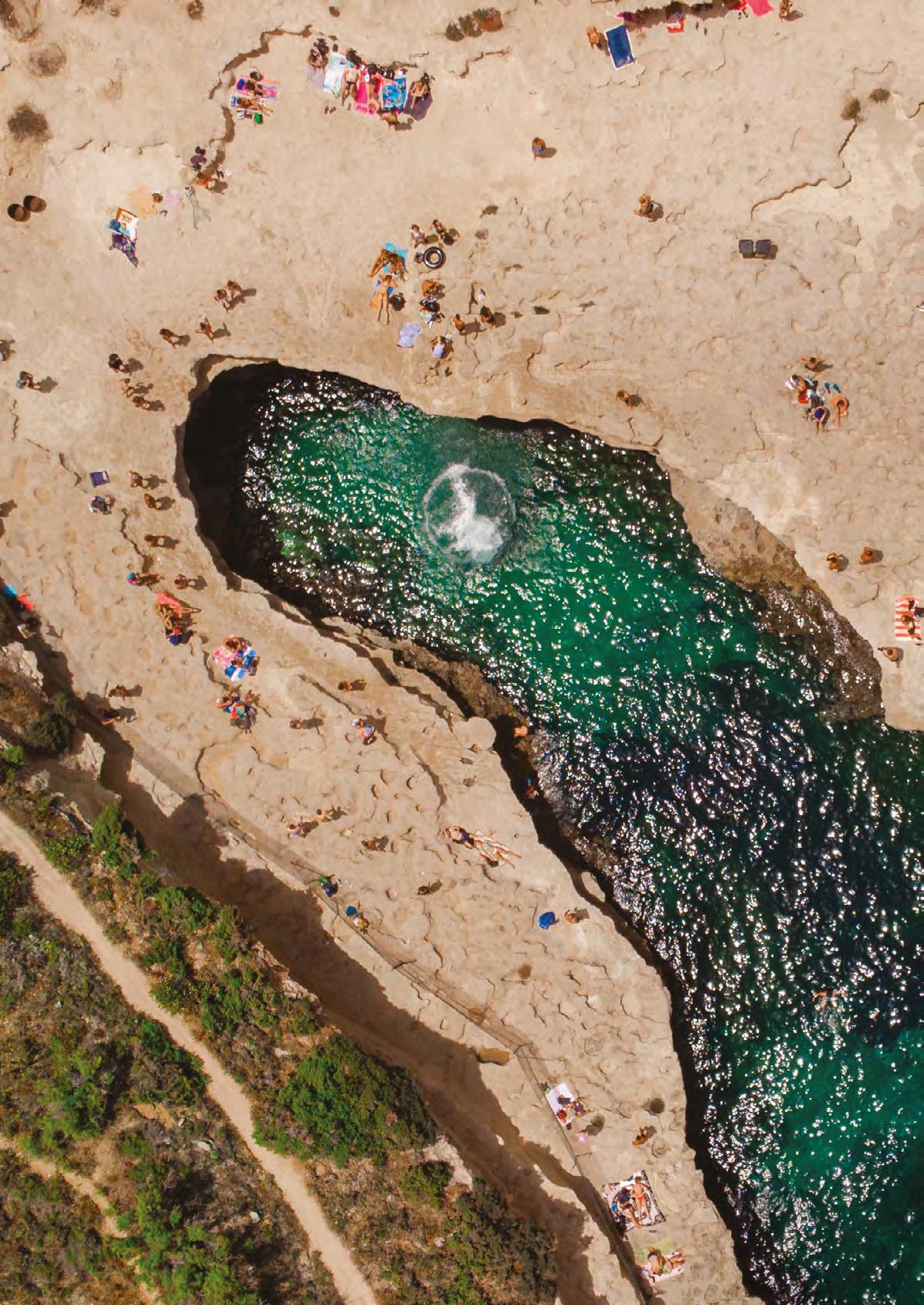
On Malta's south-eastern coast, St Peter's Pool is one of the island's most picturesque natural swimming spots – a ladle-shaped hollow sculpted from coastal rock that forms a sheltered lagoon perfect for a dip, with flat rocks surrounding it ideal for basking in the sun. Nearby Il-Kalanka Bay offers a quieter alternative, though its jumping platform is considerably higher, so extra care is advised.
continued over page
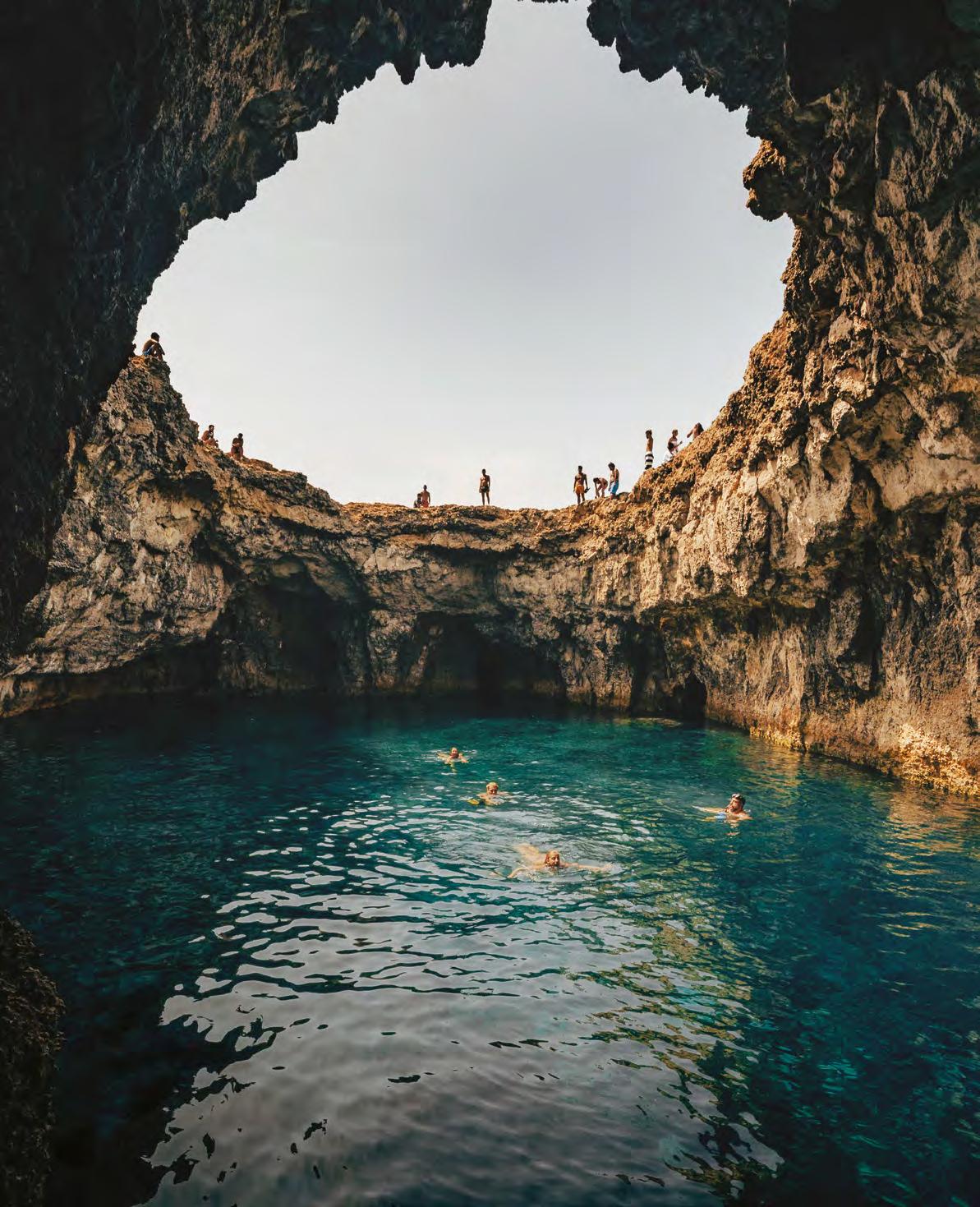
MELLIEĦA BAY
Malta's largest sandy beach, Mellieħa Bay is the island's watersports hub – a reliable north-easterly breeze makes it ideal for windsurfing, kitesurfing and parasailing, with canoeing, waterskiing and banana boating also on offer.
A couple of kilometres north of the beach, Coral Lagoon offers another cool, cooling-off spot.
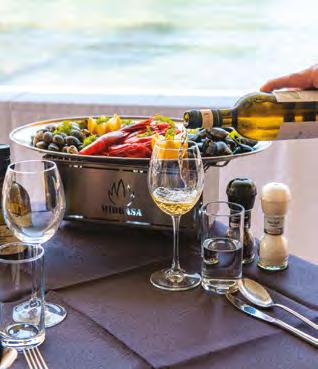
Influenced by Italian, Mediterranean, and North African traditions, Malta’s cuisine is rich in seafood, olive oil, fragrant herbs, and locally grown produce. Don’t leave without trying pastizzi – flaky pastries filled with ricotta or peas – or fenek, the island’s beloved rabbit stew. Long lunches and lingering dinners are part of everyday life here, with meals designed to be shared slowly among family and
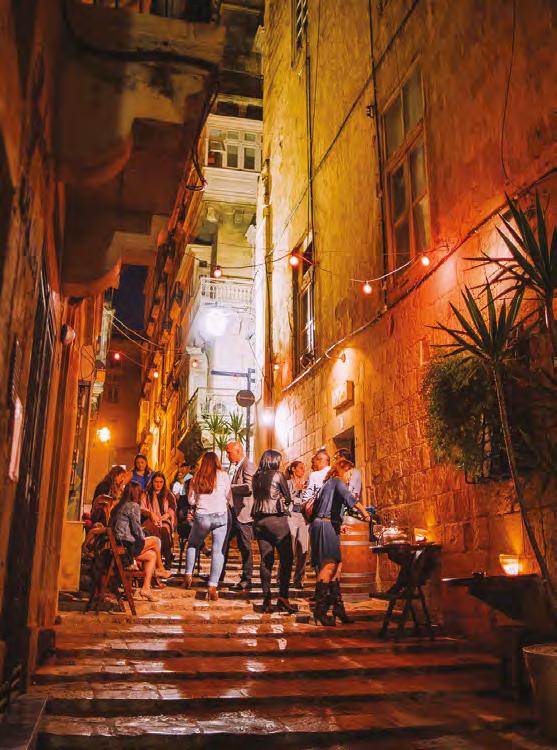
friends. Whether it’s a seaside café, rustic local eatery, or Michelin-starred restaurant, Malta serves up unforgettable flavours at every turn.
As the sun slips beneath Malta’s honeycoloured skyline, the islands come alive with a nightlife scene that feels both sophisticated and effortlessly fun. Whether you’re sipping cocktails atop
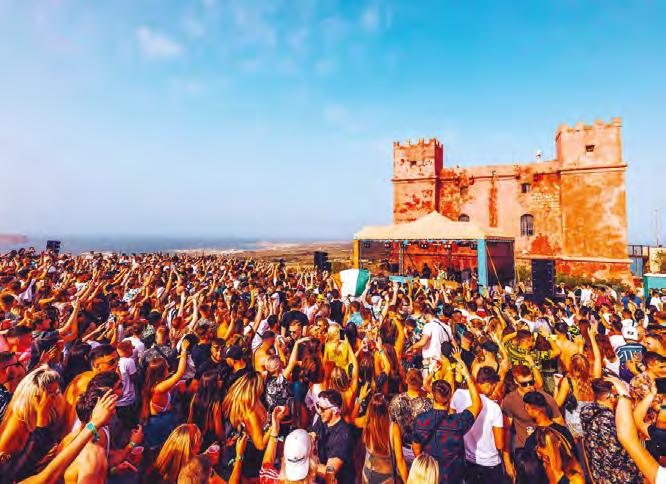
a rooftop bar in Valletta, dancing until dawn in Paceville, or catching live music by the sea, no two nights in Malta are ever quite the same.
From stylish wine bars and buzzing beach clubs to theatres, casinos, and open-air dancefloors, there’s something here for every kind of night owl.
Partygoers flock to Gianpula Village, an iconic open-air club complex known for its themed nights and international DJs, while St Julian’s pulses with energy long after midnight.
Few people are better placed to champion Malta's extraordinary appeal than Mario Farrugia Borg. The diplomat and former politician now serves as the Director of the Malta Tourism Authority for Australia and New Zealand.
“Most first-time visitors come to Malta expecting sunshine, beaches, and a typical Mediterranean holiday,” he tells Verve . “What surprises them is how much history and culture the islands offer within such short distances. You can hear Arabic influences in the language, taste Mediterranean and Middle Eastern flavours in the food, notice British touches like red phone boxes and driving on the left, and see architecture ranging from prehistoric temples to beautiful Baroque cities.”
What are the most underrated corners of Malta?
While many visitors naturally focus on Valletta and the Three Cities, some of Malta’s most memorable places are the quieter and more relaxed areas. Mdina, the old silent city, becomes especially magical in the evening after the crowds leave, with its honey-coloured streets and unique atmosphere.
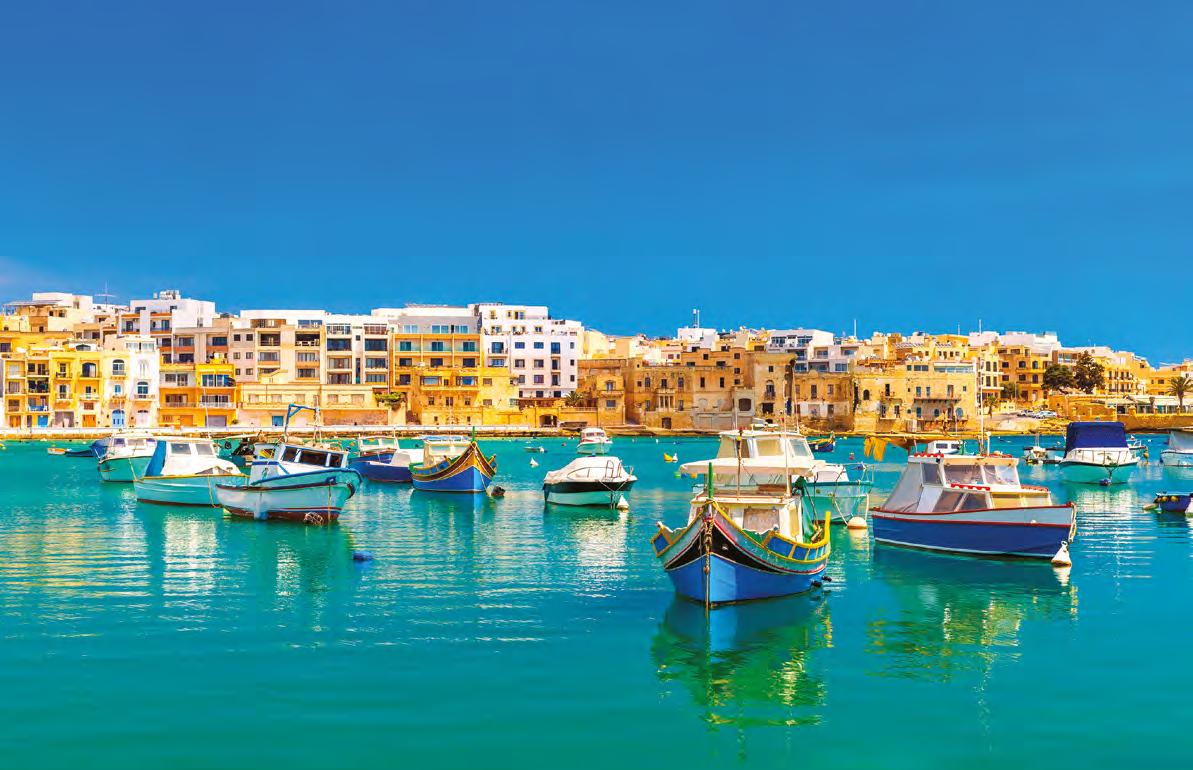
I also believe the south of Malta deserves more attention. Marsaxlokk is well known for its traditional fishing boats, but nearby places like Żurrieq and Birżebbuġa offer a more authentic glimpse of everyday local life. The Dingli Cliffs, especially at sunset, remain one of the most peaceful and dramatic locations on the islands.
On our sister island Gozo, villages such as Xagħra and Għarb still preserve a more traditional way of life, with local bakeries, small village squares, and family-run restaurants that give visitors a genuine sense of the island’s character.
Which beaches or swimming spots do locals keep to themselves?
Golden Bay is one of Malta’s classic postcard beaches, but nearby, Għajn Tuffieħa is considered by many to be even more scenic. Reached by a long staircase, it offers a quieter and more natural setting, surrounded by clay hills and open countryside.
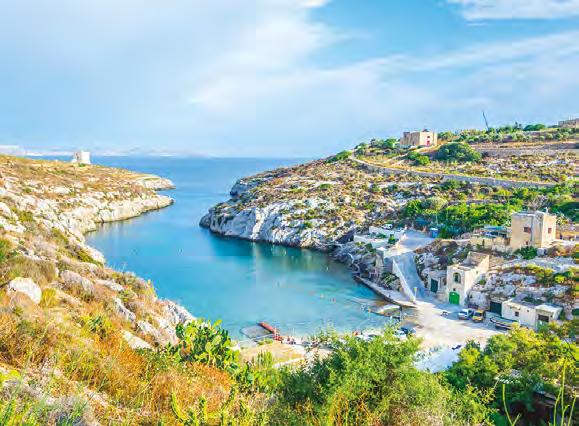
On Gozo, Mġarr ix-Xini has a hidden and peaceful feel, with a narrow bay opening out into the Mediterranean Sea. Hondoq irRummien, near Qala, is also very popular for its calm, crystalclear water and its beautiful views of Comino.
What should visitors be eating and drinking in Malta?
Maltese food is full of flavour and strongly influenced by both Sicily and North Africa. Visitors should definitely try ftira, the traditional Maltese bread, often filled with tuna, tomatoes, capers, and olive oil. Rabbit stew is one of Malta’s most traditional dishes, especially popular in countryside restaurants on Gozo. Pastizzi, flaky pastries filled with ricotta or mushy peas, are a local favourite and are best eaten hot from a traditional pastizzeria.
Seafood is excellent around Marsaxlokk, where many restaurants still serve fish caught earlier that same day. For a more authentic experience, visitors should also look for familyrun village restaurants rather than only the main tourist places.
Malta has also built a strong reputation for its boutique wineries, many of which produce exceptional wines using both local and international grape varieties. Many visitors are pleasantly surprised by the quality of Maltese wines. Beer lovers should also try the local Cisk lager, which has been part of Maltese life for generations. And of course, no visit is complete without tasting Kinnie, Malta’s famous bittersweet soft drink.
What are some cultural must-dos?
The festas are an essential part of Maltese culture. Every summer, village saint celebrations take over entire towns with fireworks, marching bands, religious processions, street food, and large community dinners. They are lively, colourful, and deeply connected to Maltese identity. For visitors, they are also a great way to experience local life alongside residents.
Architecturally, Valletta is extraordinary. Built by the Knights of St John, it is a beautiful Baroque city that still feels alive and lived in rather than preserved as a museum piece. St John’s Co-Cathedral often surprises visitors with its richly decorated interior and its famous Caravaggio painting.
Malta’s contemporary cultural scene has also developed strongly in recent years, especially in Valletta. New spaces such as MICAS, Malta’s national centre for contemporary art, and MUŻA, the national art museum focused on community and heritage, have added an important new dimension to the islands’ cultural offer, alongside small galleries, independent festivals, and restored historic venues hosting performances and exhibitions.
Visitors should also check what events are happening during their stay through the VisitMalta Events Calendar. From Carnival and the annual Fireworks Festival to Isle of MTV, the BBC Concert Orchestra performance, the magical BirguFest Candlelight Festival, the Rolex Middle Sea Race for sailing enthusiasts, and family events such as Christmas Fairyland, there is almost always something happening where visitors can enjoy the atmosphere together with locals.
What’s your favourite ‘Maltese Memory’?
One of my strongest memories is my summer holidays when still a child – going to swim practically every day, then returning home to a light summer dinner, frequently eaten on our roof-top, hearing distant festa fireworks echo across the sky while the limestone buildings glowed gold under the streetlights. Malta has this rare ability to feel both ancient and intensely alive at the same time – and in moments like that, you understand why people keep returning.
What’s the first thing you do when you go back there? By nature, I’m a countryside lover, so one must-do thing for me as soon as I am back home is to go for a long walk! Fomm ir-Riħ is an absolute favourite. The wildest and most rugged countryside walk on the main island. A remote valley descends to a secluded bay reachable only on foot. Expect terraced farmland, cliffs, caves, and almost no development – one of the best if you want untouched scenery. Victoria Lines is another gem, often called Malta’s ‘Great Wall’. These historic British-era fortifications cut across the island and create surprisingly dramatic walking routes through valleys and ridges. And then there is Wied il-Għasel, a gentler countryside walk through a lush valley with old farmhouses, terraced fields, caves, and seasonal wildflowers. Excellent in spring.
And after a long walk, a lunch of fried rabbit or octopus stew completes my arrival back home…
For information visitmalta.com
MAKES: 8–10 pies
PREPARATION: 40 minutes + 45 minutes resting
COOKING: 40 minutes
INGREDIENTS:
Pastry
500g plain flour, plus extra for dusting
1 teaspoon salt
250g chilled butter, diced
2 eggs – 1 lightly beaten, for brushing
60ml (¼ cup) iced water
Spinach and anchovy filling
80 g English spinach
1 tablespoon olive oil
1 medium onion, finely diced
1 garlic clove, finely chopped
4 anchovy fillets, chopped, plus 1 teaspoon oil from the jar
50g green olives, pitted and finely chopped
1 egg
1 teaspoon cornflour salt and pepper
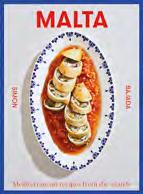
Edited recipe extract from Malta by Simon Bajada, published by Hardie Grant Books. Available in stores nationally, RRP$50.
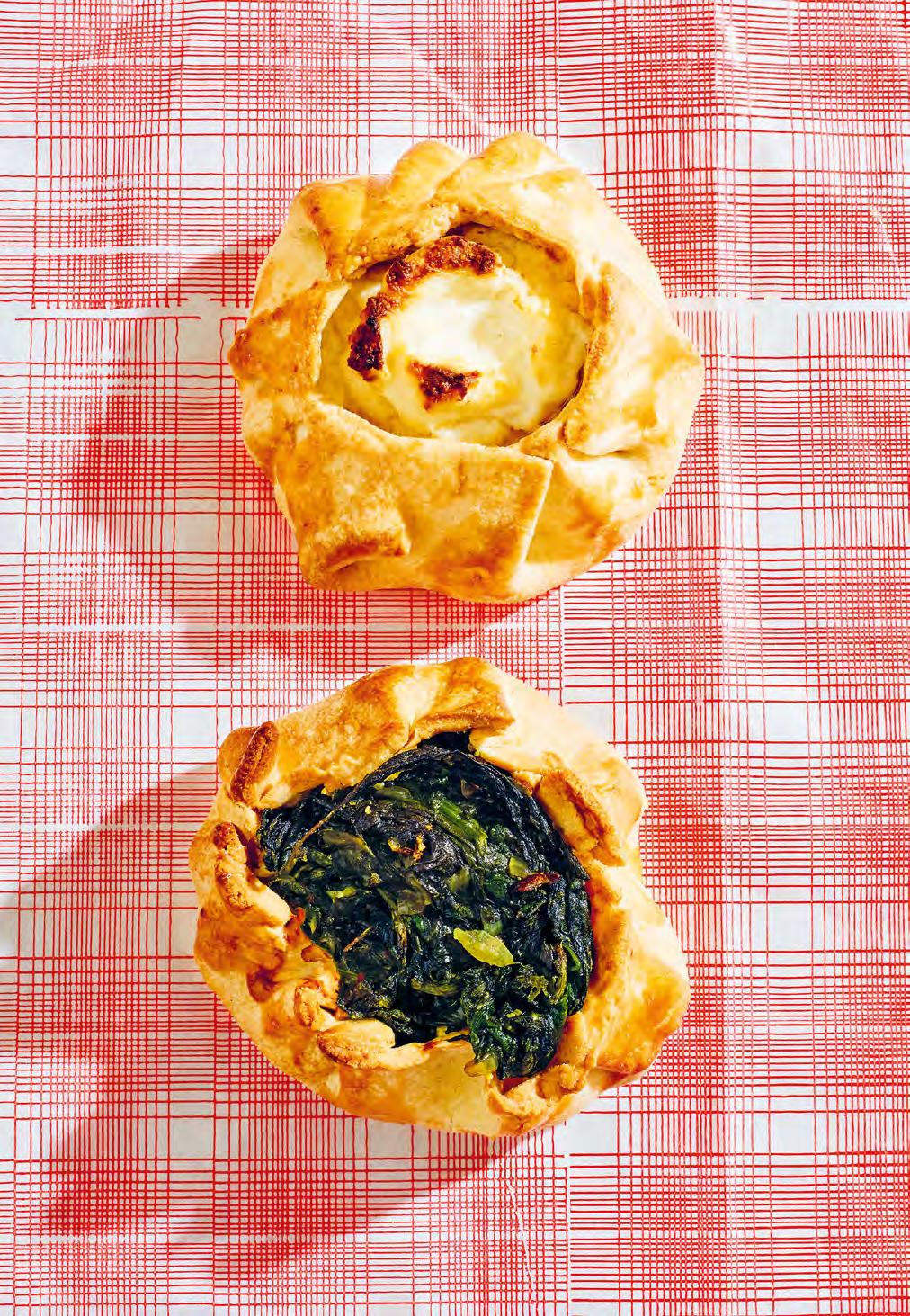
Qassatat is a word derived from the Sicilian cassata, which is thought to stem from the Latin caseus, meaning cheese – the most traditional filling of these pies. This street food is consumed second only to pastizzi, and wherever you find pastizzi in Malta, this is likely to be sitting to the side. This recipe has a spinach and anchovy filling, but to make cheese qassatat, use the filling on page 40 (the pea filling can also be used). Or try making them filled with ricotta and raisins as is done on the island of Gozo.
Start by rubbing the flour, salt and butter together with your fingers until the mixture resembles breadcrumbs or rough sand. Mix in 1 egg, then gradually add the water to form a dough. Shape into a ball, then press into a disc and cover in plastic wrap. Chill for 45 minutes.
For the spinach and anchovy filling, slice off the spinach roots, then wash and drain the leaves. Remove the excess water by tipping onto a clean tea towel (dish towel) and patting dry. Chop smaller at the stem end, larger at the leaf end. Heat the oil in a frying pan over a low–medium heat and sauté the onion, garlic, anchovies and their oil until soft (about 8–10 minutes). Increase the heat and add the spinach and olives, cooking until the spinach wilts. Leave to cool.
Whisk the egg and cornflour together in a large bowl. Drain off any water from the spinach and stir the spinach mixture into the egg, then season with salt and pepper.
Roll the pastry out on a floured surface and cut into circles 15cm (6 in) in diameter. Put a heaped spoon of filling in the middle of a circle and wet the edges of the pastry with a little water. Bring the pastry sides up over the filling but leave a gap where you can see the filling in the centre, and pleat the edges all around like a money bag. Continue making pies with the remaining pastry and filling.
Preheat the oven to 180°C. Brush the pastry with the lightly beaten egg. Bake the pies in the oven for 25–30 minutes, until golden.
PHOTOGRAPHY: SIMON BAJADA
SERVES: 4-6
PREPARATION: 30 minutes
COOKING: 1 hour 15 minutes
INGREDIENTS:
Beef olives
250g minced (ground) pork
250g minced (ground) beef
100g smoked speck, diced (or use bacon)
1 onion, finely diced
2 garlic cloves, finely chopped
50g fresh breadcrumbs, or torn bread without crusts from a continental-style loaf
50g parmesan, grated
2 tablespoons chopped flat-leaf (Italian) parsley
salt and pepper
8 large thinly cut topside or round beef steaks (around 600g)
1 tablespoon olive oil
Sauce
1 onion, chopped
2 garlic cloves, finely chopped
1 medium carrot, grated
1 tablespoon olive oil
2 tablespoons tomato paste (concentrated purée)
250ml (1 cup) red wine (a slightly sweet wine works well)
250ml (1 cup) beef stock
2 bay leaves
salt and pepper
150g peas, rinsed if frozen
Edited recipe extract from Malta by Simon Bajada, published by Hardie Grant Books. Available in stores nationally, RRP$50.
This Maltese staple does not actually contain olives. The word ‘olive’ in reference to sliced meat encasing a stuffing comes from the old French word ‘alou’, meaning lark. The shape of the meat rolls was thought to resemble these birds without their heads.
For celebratory occasions, Maltese families are sure to grace the table with bragioli. Each household has its own version, with some using boiled eggs in the stuffing, and others braising the olives in tomato ragu or adding spice. My recipe honours the dish’s fundamentals, using old bread and smoked pork, and peas to finish the sauce. Serve bragioli with boiled or mashed potatoes and a salad. The sauce is traditionally enjoyed over spaghetti as an entree.
To make the stuffing, combine the minced meats, speck, onion, garlic, breadcrumbs, parmesan and parsley in a large bowl. Season well with salt and pepper and mix thoroughly.
Using a mallet or heavy glass bottle, pound the steaks between pieces of plastic wrap until 5 mm–1cm (1/4–1/2 in) thick. Thinner is better, but be careful not to tear the meat.
Take an eighth of the filling and place it in the middle of a flattened steak. Fold one end of the steak over the filling, tuck in the sides, and roll up. Secure with toothpicks or tie with kitchen string and place on a plate seam-side down. Continue to make rolls with the remaining steak and stuffing. Season the rolls on both sides.
Heat a heavy-based frying pan over a medium heat and add the oil and beef olives. Gently colour them on two sides, then transfer to a plate.
In the same pan, begin the sauce by sautéing the onion, garlic and carrot with the olive oil over a medium heat. Cook for 5 minutes without browning, then add the tomato paste, wine, stock, bay leaves, some salt and pepper and the beef olives. The liquid should come at least a third of the way up the beef (top up with water if needed). Place a lid or foil over the pan and simmer over a low heat for 1 hour. Turn the olives after 30 minutes and check the liquid level, adding water if necessary. Finish with the peas, cooking for a few minutes more. Remove from the heat and allow to sit for 10 minutes before serving.
PHOTOGRAPHY: SIMON BAJADA
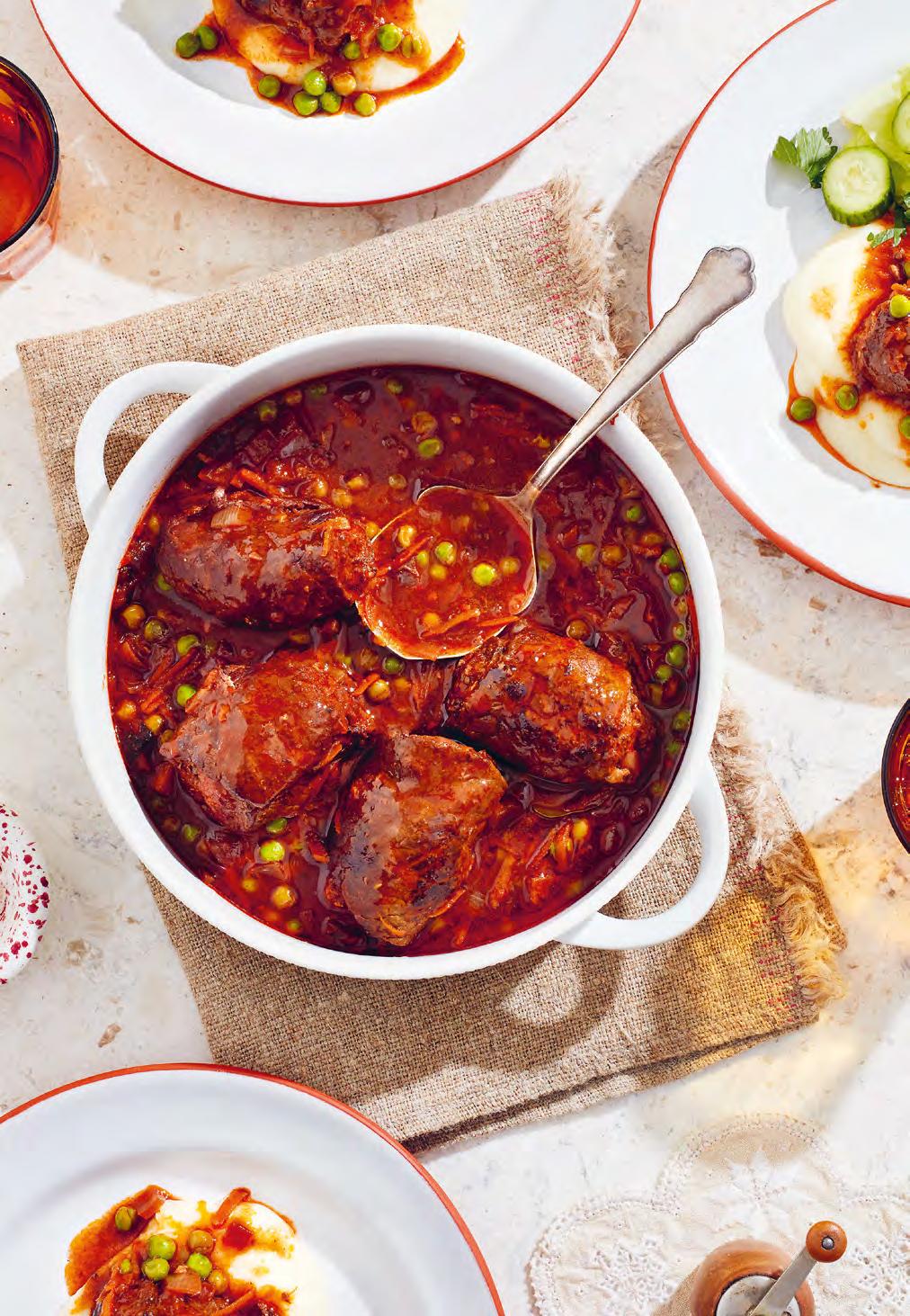
PREPARATION: 10 minutes
COOKING: 15 minutes
INGREDIENTS:
1 teaspoon fennel seeds
50g butter
½ large fennel bulb (about 200g), finely diced
2 small shallots, finely diced
1 generous pinch of saffron threads
150ml dry white wine
1kg medium-sized clams (vongole)
2 tablespoons finely chopped
A relative of saffron called the yellow-throated crocus (Crocus longiflorus) grows on Malta. It is not nearly as famous as Crocus sativus, but still fragrant and colourful. But the families who know where to find it are unlikely to divulge any information!
Wild fennel is a little easier to come across. In this dish, fennel seeds, saffron, wine and clams marry to make one of the most divine broths that ħobż (crusty white bread) ever had the pleasure to dive into.
HOW TO:
Toast the fennel seeds in a medium saucepan over a medium heat until fragrant. Add the butter, diced fennel and shallots and sauté for 5–8 minutes, until soft and translucent. Meanwhile, mix the saffron with the wine in a glass.
Increase the heat of the pan to high and add the clams. Stir them around with the fennel and shallots, then pour in the wine and saffron. Cover with a lid and cook for 3–5 minutes. Once the clams have opened, remove the lid, stir in the parsley, reduce the heat and simmer for a minute longer. Serve with bread and salad.
Edited recipe extract from Malta by Simon Bajada, published by Hardie Grant Books. Available in stores nationally, RRP$50.
PHOTOGRAPHY: SIMON BAJADA
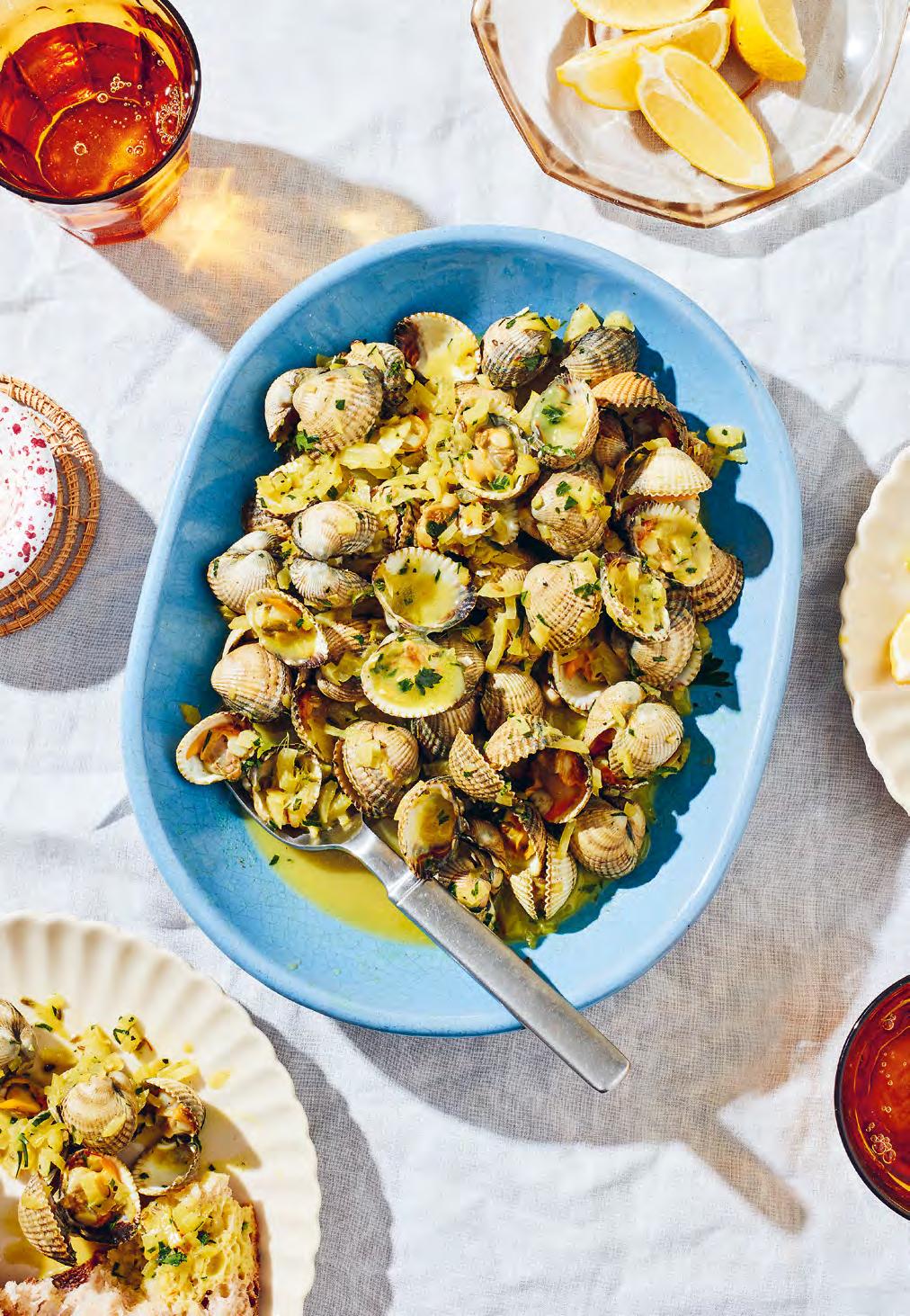
SERVES: 8-10
PREPARATION: 25 MINUTES + 30 MINUTES CHILLING
COOKING: 45 minutes
INGREDIENTS:
Sweet shortcrust pastry
150g (1 cup) plain flour, plus extra for dusting
50g icing sugar
75g butter, chilled and diced
1 egg yolk
1 tablespoon iced water
Blood orange curd
3 large eggs
150g caster sugar
Grated zest of ½ blood orange, plus 100ml juice
1 tablespoon lemon juice
110g butter, softened and diced
1 blood orange for garnish (sliced into thin discs)
Edited recipe extract from Malta by Simon Bajada, published by Hardie Grant Books. Available in stores nationally, RRP$50.
The culinary bible Larousse Gastronomique cites ‘sauce Maltaise’ as a savoury preparation of hollandaise flavoured with blood orange. For a while, blood oranges were known as ‘Maltese oranges’ – so prized they were sent annually to Marie Antoinette in Versailles. This recipe captures the deliciousness of blood orange in a velvety curd, delivered in a delicate crust.
Combine the flour, sugar and butter in a bowl and rub together with your fingertips until the mixture resembles breadcrumbs or rough sand. Add the egg yolk and water to form a dough. Shape into a ball, then flatten into a disc. Cover in plastic wrap and chill in the refrigerator for 30 minutes.
While the pastry is chilling, make the curd. Combine the eggs, sugar, zest and juices in a medium heatproof bowl and whisk together. Set the bowl above a saucepan of simmering water set over a low–medium heat. Cook, stirring often with a wooden spoon, for 15–20 minutes, or until the mixture thickens to a curd. It is ready when you are able to draw a line through the curd on the back of the spoon and it doesn’t run. Stir in the butter until well blended and remove from the heat.
Preheat the oven to 170°C and butter a 24cm (9½ in) loose-based flan (tart) tin. Roll the pastry out on a floured surface until large enough to cover the tin. Line the tin with the pastry, pressing it into the sides. Trim the excess by rolling the pin across the top of the tin. Line with baking paper and fill with dried beans or rice (or weights) for blind baking. Bake for 15 minutes, then lift out the paper and contents and bake for 5 minutes more.
Allow the pastry shell to cool for at least 5 minutes, then fill with the curd. Bake for another 10 minutes. Leave the tart to cool, then chill in the refrigerator and serve cold.
For the blood orange garnish, slice the orange into thin discs. Place them on a wire rack and cook them in the oven for the last 5 minutes of the tart cooking. Leave them in the oven when you turn it off, with the door slightly ajar.
PHOTOGRAPHY: SIMON BAJADA
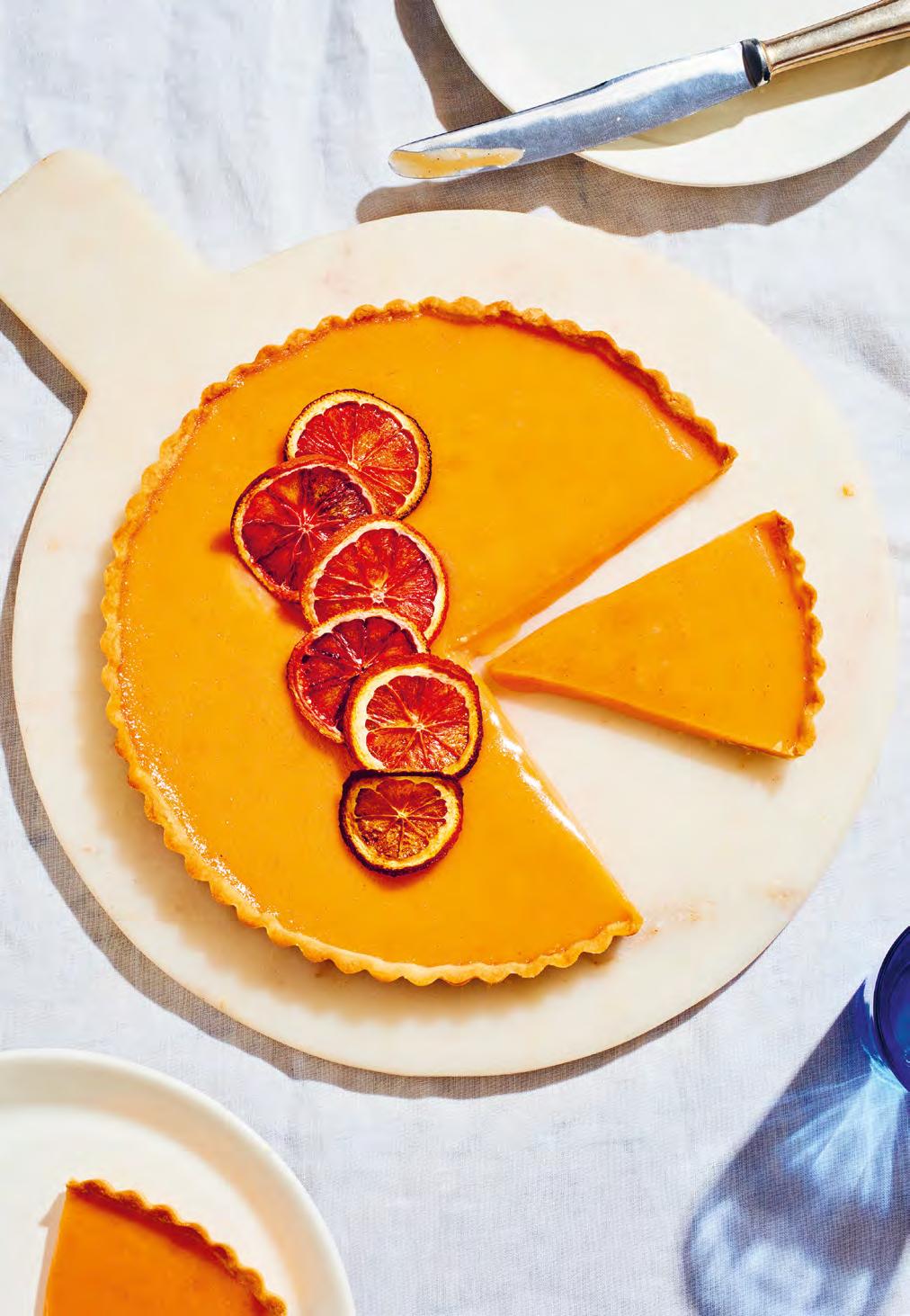

KOLUKKUMALAI TEA ESTATE, INDIA
Perched at well over 2,000m in the hills above Munnar, Kolukkumalai is home to the world's highest tea plantations – and the views alone are worth the white-knuckle jeep ride required to reach them! A charming 1930s factory still processes tea using traditional methods, while the estate's unique high-altitude microclimate gives Kolukkumalai's tea a distinctively rich flavour prized by connoisseurs worldwide.

From the cherry-blossomed hillsides of China to an unlikely corner of Aotearoa, tea has never looked – or tasted – so extraordinary.
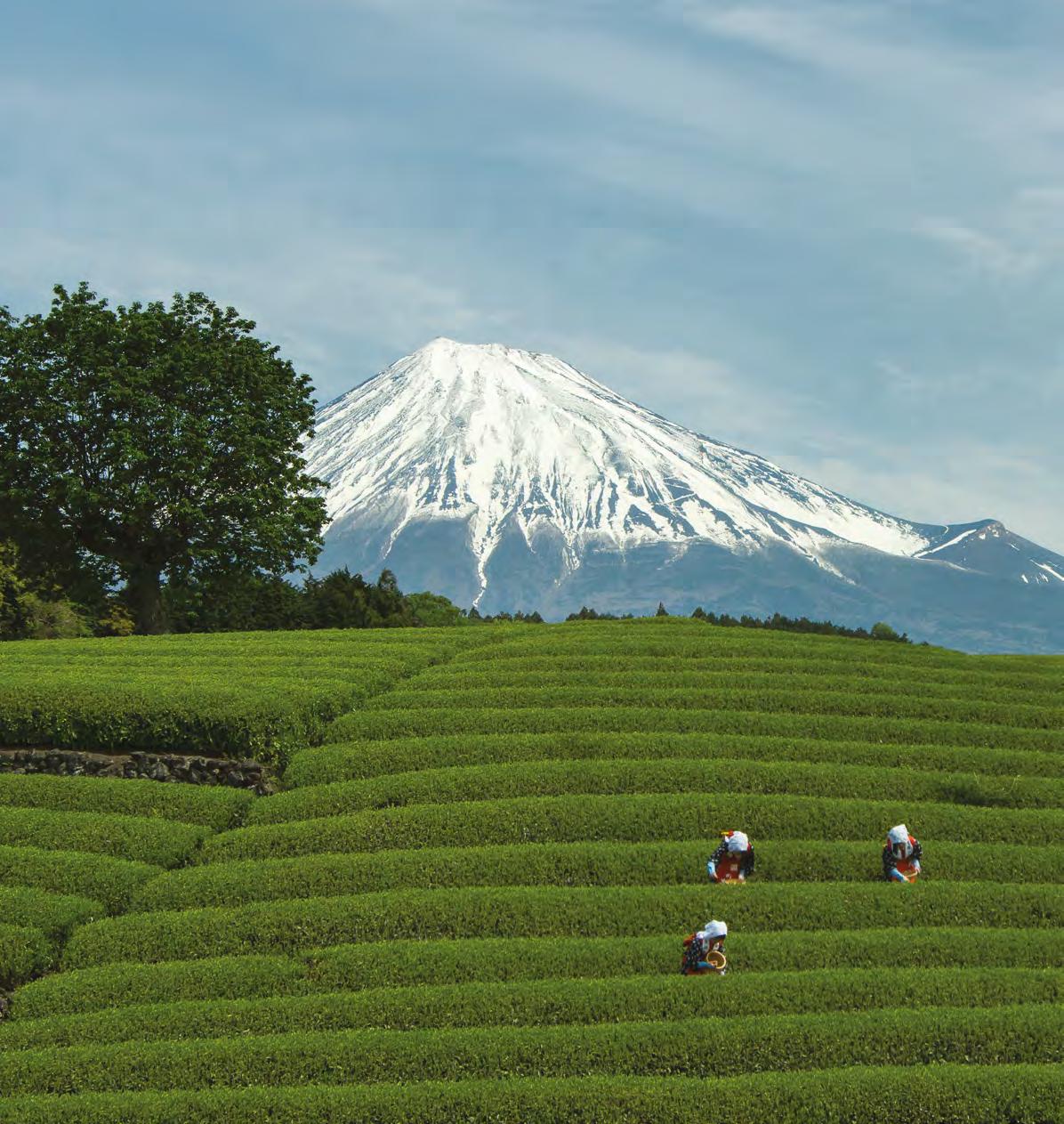
OBUCHI SASABA, JAPAN
Tucked towards the southern foot of Mount Fuji in Shizuoka Prefecture, Obuchi Sasaba is one of Japan's most photographed tea plantations –and one of its most unspoiled. Its rows of tea bushes framing Fuji's perfect cone look much as they did when Hokusai immortalised the region in his celebrated Thirty-six Views of Mount Fuji — the iconic 1830s print series by one of Japan's greatest artists, whose sweeping depictions of everyday life against Fuji's backdrop influenced everyone from the French Impressionists to Van Gogh.
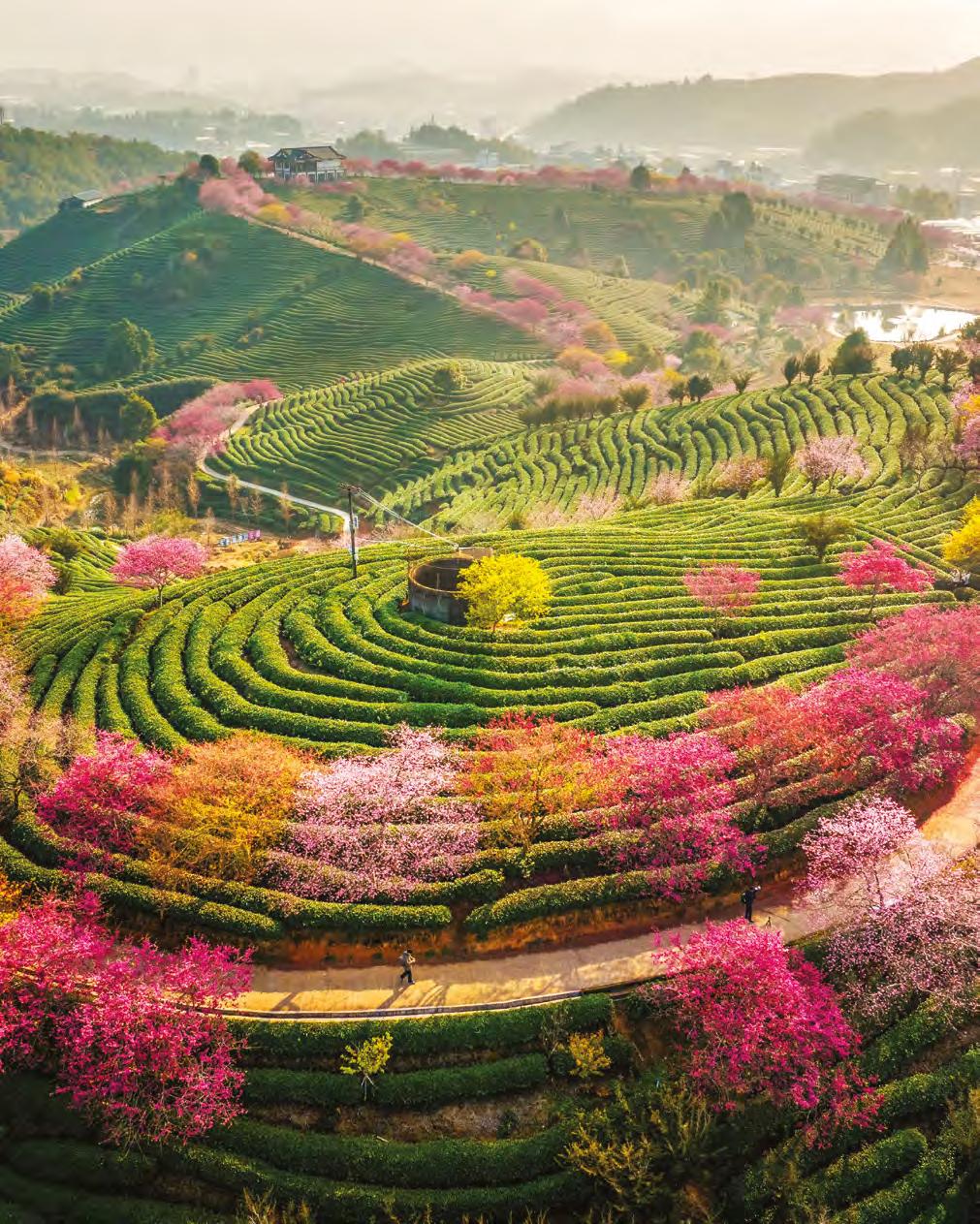
In the rolling hills of Fujian Province, the tea gardens of Yongfu town in Zhangping offer a spectacular double attraction – tens of thousands of cherry trees in dozens of varieties blooming among the tea bushes each spring. The vision of Taiwanese farmer Xie Dongqing, who planted his first tea seedling here in 1997, the site has since grown into what many consider China's most beautiful cherry blossom destination.

Blooming from the rolling Waikato countryside near Hamilton, Zealong Tea Estate is New Zealand's only commercial tea plantation – an unlikely but utterly charming addition to the world tea map. All teas are 100% certified organic and grown on-site, ranging from a refreshing green to a floral oolong and a bold black. Visitors can tour the plantation, take part in a traditional tea tasting ceremony, then settle in for a signature high tea or seasonal lunch, all served with sweeping views over the estate's terraced tea fields.

chapter.co.nz
Positioned in the heart of Mt Eden Village, Chapter Book & Tea Shop is the kind of place that feels increasingly rare: independent, personal, and built around passion rather than trends.
Part bookshop, part cosy cafe, Chapter has quietly become an institution over the past couple of decades – a sanctuary for readers and tea lovers alike.
The business occupies the original site of Mt Eden’s first dedicated tea shop, established in 1995. When current owner Frances Loo took over in 2005, she initially had a very different vision in mind.
“Back then, I wanted to open a romance bookshop,” Frances tells Verve. “But after looking at a few possible locations, I decided to concentrate on finding something close to my family’s fruit shop business in Mt Eden.”
Fate intervened when she discovered the owners of Tea Time were considering selling, and Frances made an offer.
“I knew straightaway that I was going to keep the tea retail and cafe operations,” she says. “I felt that they were compatible with selling romance books.”
That instinct proved remarkably prescient. Today, Chapter’s shelves hold around 300 teas sourced from respected suppliers including Metropolitan Tea, Tea Total, Harney & Sons, New Zealand-grown OKU and New Zealand-grown Zealong. Loose leaf blends span black, green, white, oolong, herbal and fruit teas, with native ingredients like kawakawa, mānuka leaf and horopito adding a distinctly local flavour.
The cafe itself has become a destination in its own right, serving espresso coffee alongside cakes, savouries and what many regulars would argue are some of Auckland’s best chai and matcha lattes. Over time, the tea side of the business evolved even more dramatically than Frances expected.
... Chapter’s unusual blend of cafe, tea retail and books has created a kind of built-in resilience.
“The tea side of the business has grown more than I anticipated,” she says. “This has happened as a result of industry developments – such as the introduction of the luxury tea bag and using native ingredients – as well as our decision to adopt a multi-brand strategy.”
The romance fiction side, however, tells a more turbulent story — one that mirrors the wider upheavals of the publishing industry itself.
Initially, Chapter’s romance sales climbed steadily, peaking around 2012, before the rise of e-books and aggressive online discounting changed the landscape almost overnight.
Rather than retreat, Chapter adapted. More floor space was dedicated to tea and accessories, helping offset the decline in books. Then, unexpectedly, romance fiction roared back during the pandemic years.
“As people spent more time at home, demand for the genre surged because readers sought comforting escapism and happy endings,” Frances explains. “Platforms like TikTok and TV shows such as Bridgerton reinforced this trend.”
Romance fiction today looks very different to the genre Chapter first stocked in 2005. Contemporary romance and ‘romantasy’ – fantasy-infused romance – now dominate shelves once ruled by historical paperbacks. Readers increasingly seek diverse characters, darker themes and beautifully produced collector editions with sprayed edges.
“Romance books now tend to be spicier, darker and more diverse than when we started,” Frances says.
Still, at its core, the genre continues to shape the identity of the store itself.
“I think our range of romance fiction titles reinforces our identity as a warm, welcoming and bright place.”
That sense of warmth is Chapter’s greatest strength. While many independent retailers struggle to survive shifting consumer habits and rising operating costs, Chapter’s unusual blend of cafe, tea retail and books has created a kind of built-in resilience.
“When one part of the business is quiet, we usually find that another part is performing well,” Frances says.
Equally important is the loyalty of its customer base. Repeat visitors return not only for favourite teas or trusted authors, but also for familiarity.
“We do have a lot of repeat customers in each of our three businesses,” Frances says. “That has allowed us to be resilient over the past two decades.”
Her own involvement in the Mt Eden community has also helped strengthen those roots. Frances has been involved with the local business association since 2010, while Chapter itself continues to favour local suppliers and maintain notably low staff turnover – increasingly rare in hospitality and retail alike.
Looking ahead, Frances doesn’t envision radical reinvention.
“The changes in the business will tend to be incremental,” she says. “Unless I win Powerball, in which case I would add an upstairs level to the store!
“My customers are the primary personal motivation for me. I find it very satisfying to successfully problem-solve for a customer, whether it’s custom-blending a tea similar to one they experienced overseas or helping them complete a collection of books. I definitely get a kick out of seeing our customers walk out of the store with smiles on their faces.”
442 Mt Eden Road, Mt Eden, open Tues-Sun from 10am-4pm 09 623 2319 | 021 635 027 info@chapter.co.nz | chapter.co.nz
Entering is simple. Visit VERVEMAGAZINE.CO.NZ and click WIN then follow the directions. Follow us on Facebook and Instagram @vervemagazine
BASILUR TEA NZ
teastore.nz
Sit back and relax with the finest Ceylon tea. Basilur offers a wide selection of 100% pure Ceylon tea, crafted to elevate your daily ritual into a truly authentic experience. Freshly handplucked and sourced directly from the island's premier estates, explore their award-winning premium grades today.
Instagram: teastore.nz
WIN one of 20 vouchers worth $20 which you can spend online, instore (Basilur Tea Shop in Auckland), or at one of many Auckland events they’re in.
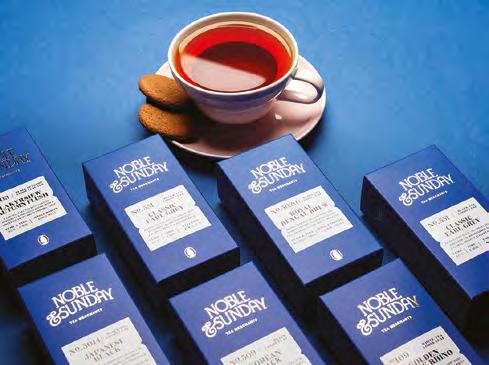
NOBLE & SUNDAY
nobleandsunday.co.nz
For people who care about what’s in the cup… Noble & Sunday curates exceptional teas from some of the world’s most respected tea-growing regions, working directly with artisan producers across Japan, Sri Lanka and beyond. Elegant green teas, refined black teas and vibrant matcha for modern rituals, slow mornings and beautifully considered living.
Instagram: nobleandsunday
WIN a handcrafted matcha bowl set paired with two exceptional single-origin Japanese matchas and our new roasted hōjicha; worth over $260.
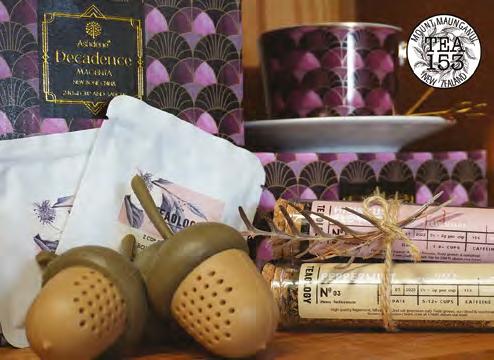
TEAOLOGY
teaology.co.nz
There’s more to Teaology than delicious brews! As members of the Ethical Tea Partnership, they aim to give consumers a clear view of where tea is grown and made. It considers the quality of life for tea workers, including fair pay, health, and housing, similar to Fairtrade.
Instagram: tea153mountmaunganui
WIN a Teaology gift pack which includes their famous-in-New Zealand Choccomint Rooibos, the exquisite White Monkey Paw, and a sampling of wellness blends.
on choosing the most energy efficient window furnishings.
As the temperature drops, it's worth thinking about where your home's warmth is actually going. Up to 45% of heat can be lost through windows, which means the right window treatment can make a genuine difference to both your comfort and your heating bills.
For those who love the look of elegant fabric, lined curtains are hard to beat for style and energy efficiency. Protection Plus linings from Lahood® Window Furnishings come in three options to suit different rooms and needs. Armourguard offers maximum blockout and thermal insulation, ideal for bedrooms. InsulPro provides excellent warmth while still allowing some light through, so perfect for living areas. Serenity is a lighter option suited
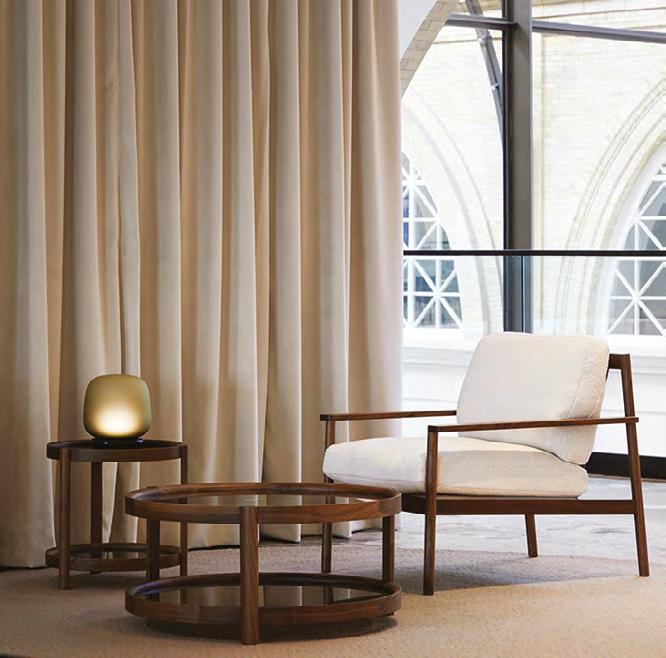
to sheers or rooms where soft light diffusion is preferred. All three can be used with curtains or roman blinds, and for extra flexibility, a double track system lets you switch between lined curtains in winter and breezy sheers in summer.
For the maximum in energy efficiency and a sleek contemporary look, Luxaflex® Duette® Shades are worth serious consideration. Their innovative honeycomb structure traps air in pockets, creating a thermal barrier that stops cold enter in winter and hot air in summer. Consumer NZ* testing rated this type of cellular blind as the most efficient window furnishing for conserving heat in a room (up to 63%),
providing 33% more insulation than double-glazing. For rooms with singleglazed windows, the Duette® Architella takes this further still, with a cell-within-acell construction for even greater efficiency.
Fit matters as much as fabric
Whichever option you choose, proper fitting is essential. Gaps around edges allow cold air in and warmth out. Curtains should extend beyond the window frame and brush the floor, while blinds fitted within a recess should sit as snugly as possible against the frame.
Of course, you don't have to choose between curtains and blinds. Layering both on the same window gives you the best of both worlds, added insulation, privacy, and a beautifully considered interior.
June promotion
Now is a great time to buy thermal window furnishings as Lahood are offering 15% off Luxaflex Duette Shades (including automation) and 15% off Lahood Protection Plus Linings during June.
Lahood's design consultants are happy to guide you through the options. Visit lahood.co.nz or pop into the showroom at 104 Mt Eden Road to get started.
*Refer Lahood blog, Are your Windows Costing You Money?
Tangier Medium Occasional Table
The perfect sculptural accent for living room, entryway, or bedside. Striking angular design, triangular base. Works beautifully as a pair or plinth for art. leopoldhall.co.nz
Arnie Sofa
The Arnie Sofa is a great new slim arm sofa ideal for making the most of your seating area in either a commercial or residential setting. Tailor made in New Zealand in your choice of fabric or leather. trenzseater.com
Tribeca 8 Light Chandelier
Princetown Bench
Crafted from leather and iron, this versatile bench works beautifully throughout the home or office and is available in two timeless finishes: Mountain Black or Brown Leather. refinedliving.nz
Bebop Low Table Round
Tristan Lohner designed Bebop with a purity of form that feels at home indoors or in the garden. The collection’s varying heights shine when mixed together. jardin.co.nz
Make a bold yet refined statement with this eight-light chandelier. Sleek black metal, tapered white fabric shades, and warm diffused glow. Perfect for dining rooms, living areas, or grand entryways. leopoldhall.co.nz
Bronx Chair
Bronx brings New York grit and enticing curves for big-city sophistication. Equal parts chic and practical, this modular suite pairs a rounded lounge form with a steel chassis. kovacs.co.nz


Jori Ascot Table
Side table, sliding table, round or square. The Ascot collection is design genius. Light, easy to move, and finished in saddle leather or lacquer. Jean-Pierre Audebert’s practical simplicity defines any space without overwhelming it. The finishing touch for every interior. sourcemondial.co.nz/jori
Athens Rug
Hand-knotted by skilled artisans, the Athens rug blends premium NZ Wool with radiant Art Silk. This versatile design can be customised in 100% wool and scales perfectly into a runner. Every step from yarn dyeing to the final finish is crafted by hand, creating an enduring piece that reflects true artisan dedication. sourcemondial.co.nz
Vivienne Fergus Pendant
Delicate and beautiful, Vivienne features an oriental weave that requires gentle care. This light pendant looks amazing when clustered at different heights, creating a stunning focal point in any space. mrralph.co.nz
Tuscan Style Ironsand Lamp
Brody Armchair
A sculptural black terracotta urn lamp brings a modern yet classic lift, perfect for wabi-sabi, farmhouse, or paredback interiors on a sideboard, console, or occasional table with an alternative shade. leopoldhall.co.nz
The Brody Armchair features high comfort and timeless design in Mountain Black premium leather. Complete the look with the matching Brody Footstool. refinedliving.nz
Hunter Round Dining Table
Available in Black or Antique Grey, the contemporary Hunter Round Dining Table features sleek cross legs in oak veneer and serves as the perfect modern centrepiece for any dining space. refinedliving.nz
Roma Velvet Swivel Lounge Chair
This Italian-designed lounge chair features plush velvet upholstery and a curved silhouette. A generous seat and supportive backrest offer refined comfort, while the smooth 360-degree swivel base. designitalia.co.nz
How houses have changed. I was bought up in a villa in Epsom – open fireplaces, rattling single glazed window, no insulation. Really just a roof to keep the rain out.
I remember those cold winter mornings. I didn't want to get out of my warm bed, but we did and survived. We put on wool in winter and cotton in summer.
Now I’m bombarded with healthy homes and passive home requirements. Airtight houses, super insulated, double glazed, thermally broken joinery, and 24/7 air conditioning.
This all makes sense if it snowed in Auckland, but it doesn't, and, unlike Scandinavian countries, we Aucklanders like to open doors and windows and to be outside. We like fresh air and hate being enclosed inside. There is constant talk of inside-outside flow.
When you make your house airtight you need to mechanically have fresh air introduced in. Think of a mob hit.
Plastic bag over your head, no fresh air – death. So, the passive house needs air conditioning to introduce fresh air, but this isn't emphasised.
You can't open a window with the air conditioning running because as it was explained to me, you are trying to aircondition Auckland.
With the efficient double glazing and insulation, we now face our houses overheating – especially if both partners work during the day. To combat heat buildup, we have always used skylights but now we use motorised opening ones with rain detectors in every house to purge the heat build-up. They come double glazed.
They are real value for money.
Auckland's weather is different from the South Island’s. We have quick weather changes. Rain in the summer and sunny hot days in the winter. In-slab heating just doesn't work in Auckland, but is perfect for the South Island. One year
three clients wanted in-slab heating. One installed it and on a cold day turned it on. By the time it had warmed the floor slab the weather had changed. He never put it on again and the other two never completed the install.
Heat pumps are perfect for Auckland, with their quick response, but shouldn't be treated as a heater, turning it off and on. When you do this, you are constantly paying to heat and reheat the house interior. Better to modify the temperature to suit the day. We reduce the desired temperature during the day and increase it in the evening.
I'm not against warm dry houses, but you need to consider regional lifestyle. paul@leuschkekahn.co.nz
021 894 895 leuschkekahn.co.nz


Keeping your home warm doesn't mean compromising on style. Honeycomb blinds like Luxaflex® Duette® Shades are proven by Consumer NZ* to be the most effective window covering for retaining heat, conserving up to 63% of a room's warmth – an elegant way to reduce energy costs.
Visit the Lahood Showroom at 104 Mount Eden Road, call 0800 524 663 or book a complimentary in-home consultation online.
Wild and expressive, floral motifs offer an endless source of inspiration for your interiors. These spaces are blooming with fresh ideas. Whether you’re inclined towards nostalgia, a fan of the classics, a bohemian at heart or all about the mix.
Inspired by the richness and spontaneity of florals, colour can completely shift the atmosphere of a space, bringing warmth, depth and personality into the home in a way that feels both expressive and timeless. This season, interiors are embracing rich natural hues, earthy greens and layered colours that echo the tones found in petals, foliage and blooming gardens, creating spaces with a sense of comfort, creativity and connection.
Deep muted shades introduce softness and sophistication, while greens bring balance and grounding energy. Together, these tones work beautifully to create interiors that feel welcoming and considered, whether used across entire rooms or introduced through smaller accents and details.
For those wanting to experiment with stronger colour, brighter shades can instantly energise a room and create focal points that feel playful yet refined. Like flowers in full bloom, these brighter tones add life and personality to a space without losing sophistication.
Even small moments of colour – painted shelving, furniture, planters or decorative objects – will completely transform the feel of a room.
One of the strengths of working with colour is its versatility. Soft layered tones can feel calm and restorative, while bolder combinations create energy and personality. Mixing muted shades with brighter accents allows interiors to feel dynamic without becoming overwhelming.
Whether refreshing a single room or rethinking an entire home, thoughtful use of colour helps create spaces that feel more personal, inviting and alive. Inspired by the beauty and variation found in florals and nature, these palettes offer endless opportunities to experiment, layer and bring individuality into everyday living.
Resene ColorShops and the Resene website offer a comprehensive array of options visit resene.co.nz
The hobby of flower pressing gets a modern update, as does the art of layering artworks. And who wouldn’t swoon for an azure blue velvet sofa to tie it all together? Add Resene Plum – a fruity purple that is both provocative and intense – to bring richness, drama and depth to the space.

A dramatic, colour-washed feature wall provides the perfect backdrop for an equally striking arrangement of flowers, statement vases and layered artworks. Flowers - opulent by nature - are displayed in customised vintage vessels, stacked and affixed together to create an intriguing old-meets-new object. Ground the space with Resene All Black, an iconic New Zealand black that is strong, bold and unapologetically timeless.

Grouped against a verdant kitchen wall, this avant-garde collection of artworks, postcards, vintage photographs, objets and touches of kitsch creates a layered composition that feels almost painterly in both palette and mood. Bringing freshness to a space with Resene Spring Rain – a pastel freshwater green that feels brisk, uplifting and quietly revitalising.

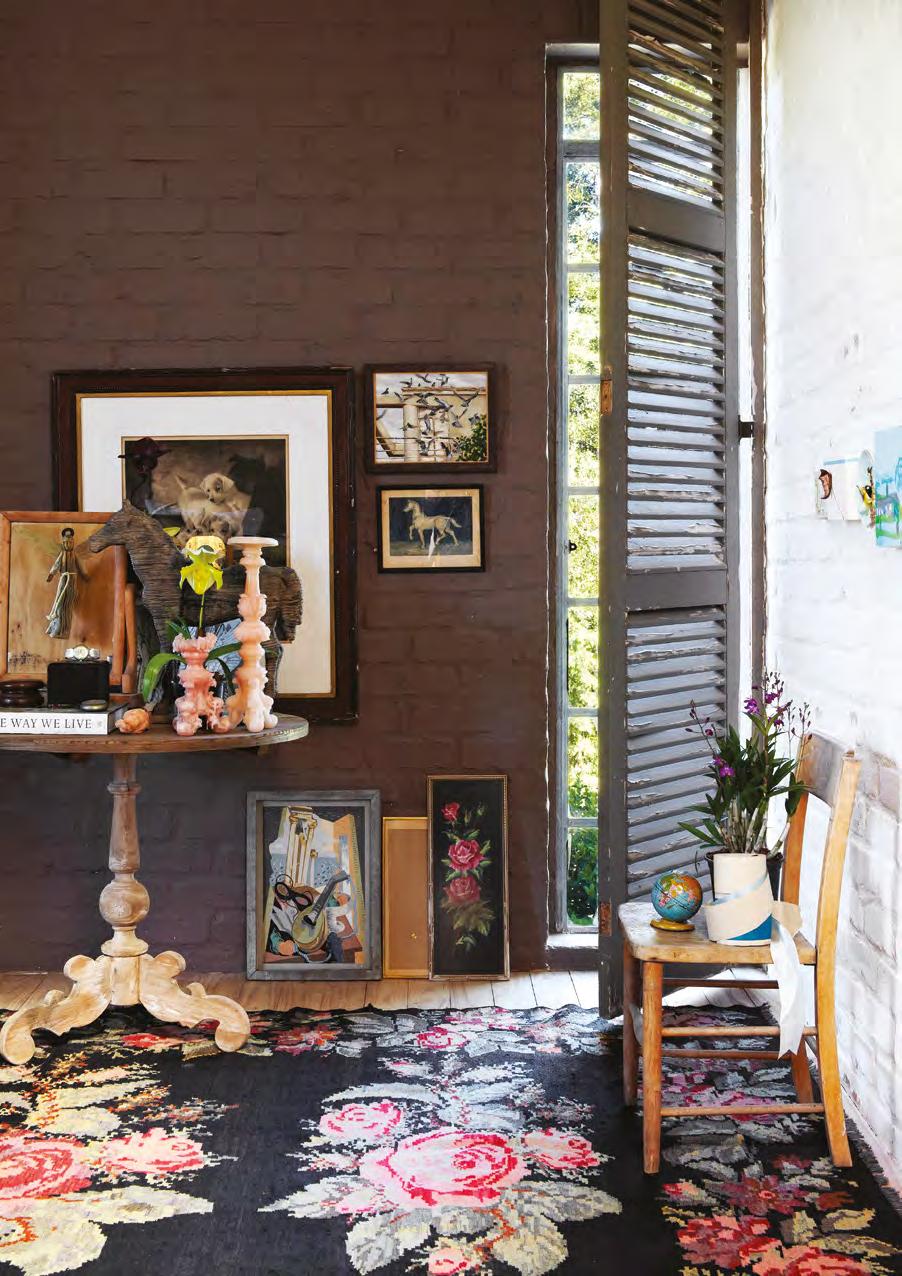
A large statement rug brings instant visual impact and helps set the tone for the entire room, anchoring the space with texture and personality. Complete the look with Resene Indian Tan – a deep copper brown with warm, rustic character that adds richness and depth.

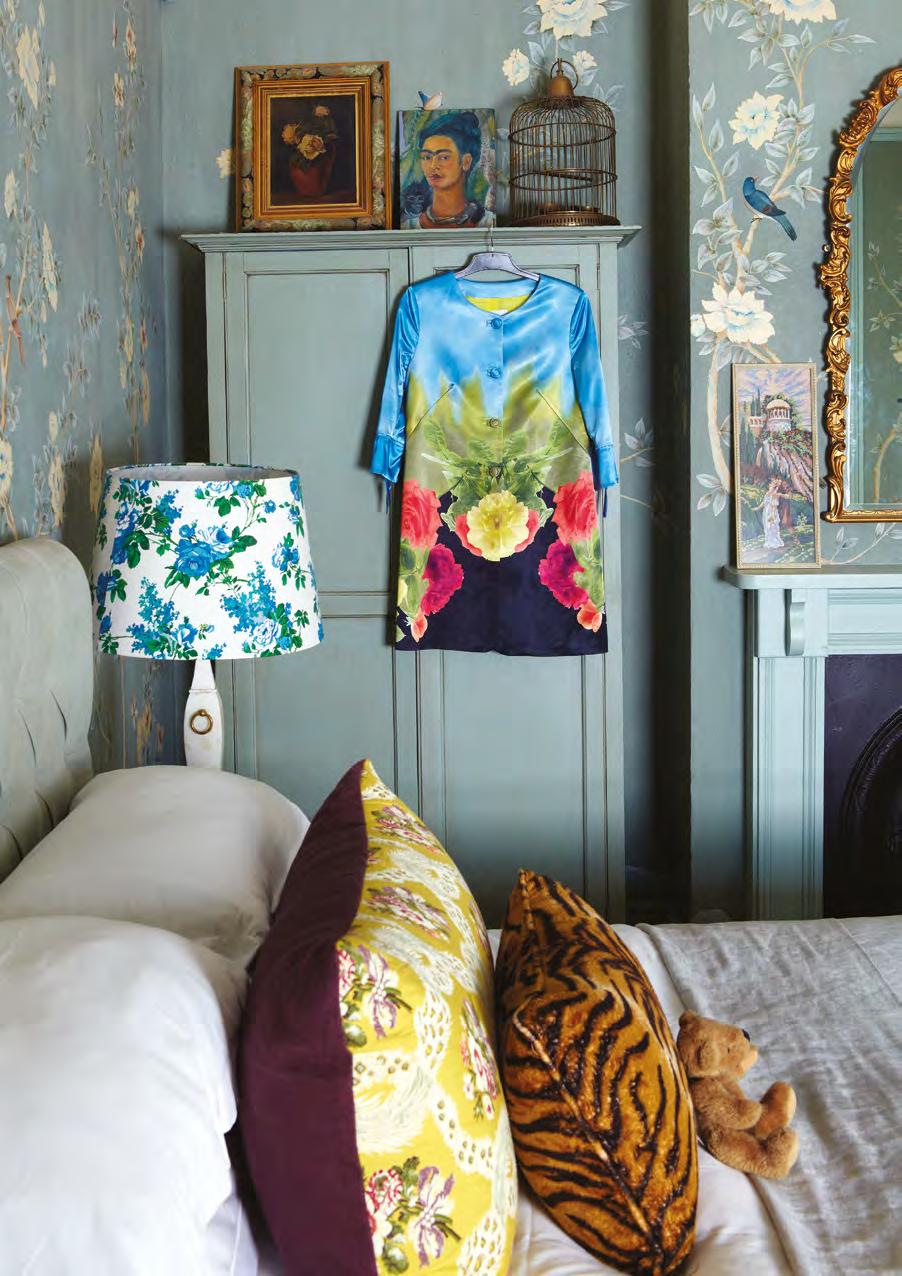
This bohemian bedroom comes to life through a playful mix of prints, statement walls, quirky flea market finds and timeless pieces, all layered within a sophisticated palette punctuated by vibrant bursts of colour. Adding a sense of calm and softness is Resene Eau De Nil – a pale green with a tranquil, restorative quality.

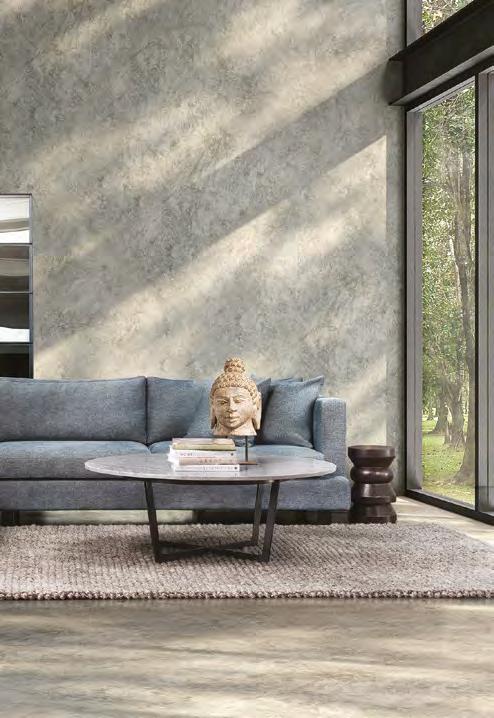
Redefine your living space this June with $1,000 off every sofa at Corso Interiors.
Discover our collection of exquisite New Zealand designed sofas, crafted with integrity and designed to last. From bespoke designs tailored to your space to our curated floorstock, enjoy $1,000 off the retail price. A rare opportunity to bring home enduring comfort and thoughtful design at exceptional value.
Call us or visit our store on the edge of Parnell and Newmarket to explore our sofa design options. Our bespoke consultation service is complimentary – start today, and enjoy $1,000 off this June.
Corso Interiors 8 George St, Newmarket | 09 307 9166 corso.co.nz

continuous.co.nz
Upgrade your boundary with Barracuda’s stylish metal fencing – where function meets sharp design.
Ideal for screening wheelie bins, hiding unsightly areas, or creating privacy from neighbouring properties, these fences deliver a clean, architectural finish that lasts. Made from high-quality steel, they’re low-maintenance and built for modern Kiwi homes. Whether you’re a DIY enthusiast looking for a supply-only option or prefer a full professional install, we’ve got you covered.
Explore the range at barracuda.net.nz/steel-fencing
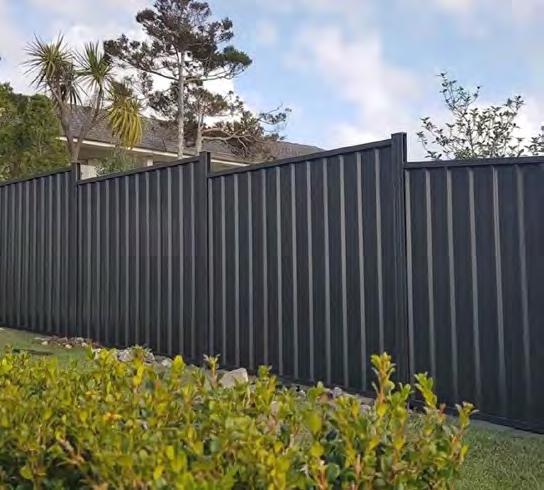
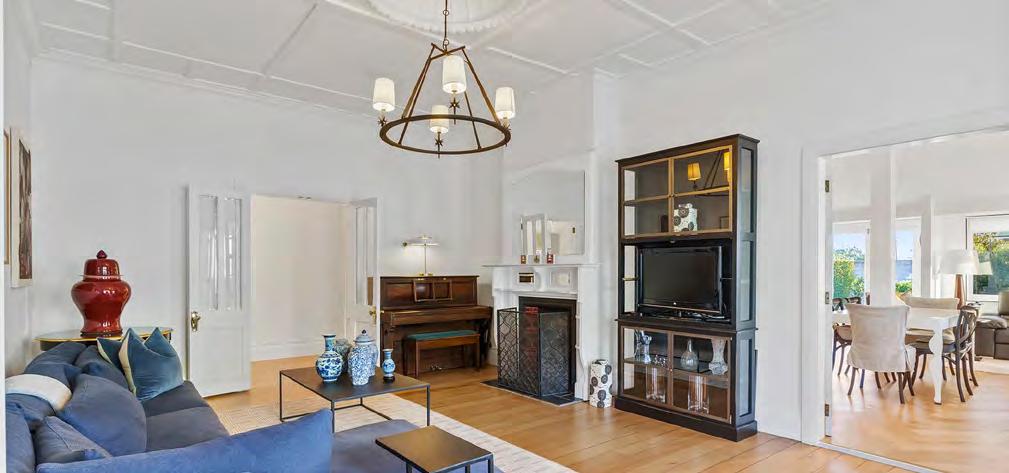
BY WALL TREATS MASTER PAINTERS
They're the unnoticed character in every photo you take at home. Somehow, part of the family too.
Pencil marks behind the pantry door. A faint patch where the framed wedding photo hung before you moved it. A shadow above the couch from a painting that lived there for 15 years. Houses keep a record, and most of it lives on the walls.
Most days, we stop seeing them. They turn into weather. Background. Something for the couch to lean against. Then, one Sunday afternoon, you notice the hallway has gone a colour you don't remember choosing, and the children whose height you used to mark are now taller than the doorframe.
That's usually when people start asking us about paint.
We tell them that in heritage homes, paint is the easy part. Walls themselves are the conversation. A century-old kauri tongue-and-groove behaves nothing like the GIB in the new extension off the kitchen. A bathroom wall that gets steamed twice a day wants a different
system from the south-facing exterior that takes Auckland's sideways rain on the chin every winter. Plaster in the dining room may have a hairline story to tell about the foundations before it ever has one about colour.
Wallpaper changes the conversation again. Done well, it disappears into the room and lets the furniture, the art, and the people do the work. Done badly, it announces itself every time someone takes a selfie there. The difference is almost always in what happens before the first strip goes up. Lining paper. Moisture in the substrate. The patience to let the glue cure properly in an Auckland summer.
None of this is what people come to us for. They come for a refreshed living room, a redone hallway, a bedroom that finally feels finished. What they actually want is harder to put a name to. Something that holds together while life happens loudly in front of it.
Walls in Auckland villas or bungalows don't ask for much. A coat that suits the substrate. A colour you choose for the
light the room actually gets. A finish that won't flake the first time a teenager slams a door.
In return, they hold the height marks. They keep the shape of the framed photos. They watch the dinners, the Sundays, the long arguments and the longer reconciliations.
“These walls are stage and witness, both at once.

When you're ready for walls that hold up to the life you're living in front of them, find us at walltreats.co.nz

barfoot.co.nz
Barfoot & Thompson Remuera realtor Claudia Wright grew up in a family of real estate agents in Wellington where she learnt all facets of the industry from staging through to selling.
Hear from one of Claudia’s satisfied clients below.
“Martelli Buyers worked with Claudia to secure an investment property in Remuera for our offshore client. Claudia was exceptionally professional and delightful to work with. She helped us with every step of due diligence and whenever an issue came up she was proactive to find a solution. The result was a great property secured for our client and a very positive experience for Martelli Buyers working with Claudia. We would recommend her to any vendor seeking a hard working, solutions focussed professional.”
You can email Claudia at c.wright@barfoot.co.nz or call 022 040 2942 to find out more.
0800 953 273
goodtitle.co.nz
hello@goodtitle.co.nz
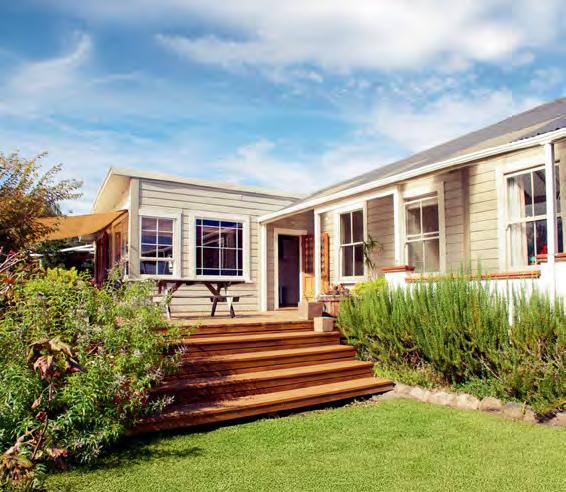
timecapsulegallery.net
Laura Tait (Puhoi Farmhouse), a popular and beloved artist known for her floral compositions, is back in Devonport at the Time Capsule Gallery!

After her highly successful and warmly received exhibition in October, she will be presenting new masterpieces between 22 June and 4 July.
The exhibition opens on Monday, 22 June at 6pm, and we look forward to welcoming everyone interested in her lovely art, flowers and a good atmosphere!

Of course, with the usual high-quality hospitality, refreshments, snacks and small gifts.
Visit the gallery to register in person for the opening of the exhibition and the following events by Laura Tait and the lectures by the gallery, or register by email at gallerytimecapsule@gmail.com 30 Victoria Road, Devonport

TURUA GALLERY
Kindred
Alicia Beech and Helen Dean
12 – 24 June
Bringing together two distinct yet intuitively connected artistic practices, Kindred explores the unexpected parallels between artists’ creative journeys and shared sensibilities. The exhibition pairs Dean’s expressive, gestural abstraction with Beech’s intricate, nature-inspired floral works – a dynamic contrast that delivers both harmony and tension. Together, their work offers a rich interplay of movement and precision, colour and form, capturing a sense of joy and light during the winter months.
10A Turua Street turuagallery.co.nz
CURATED BY — LUCY KENNEDY
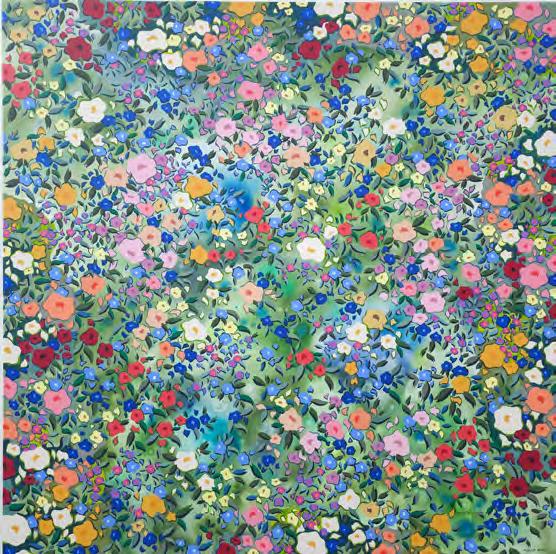
SANDERSON GALLERY
Sacrosanct
Mickey Smith
27 May – 21 June
Mickey Smith is deeply attentive to the fragility of knowledge systems, their inevitable decay and their survival. For more than two decades the Americanborn, Aotearoa-based artist has closely examined libraries in the US, New Zealand and the Pacific. Sacrosanct is an expansion on her decades-long inquiry into the physical and social significance of texts and archives, she turns her gaze to libraries cloistered in monasteries. This exhibition is part of the Auckland Festival of Photography.
Osborne Lane, 2-4 Kent Street, Newmarket sanderson.co.nz
STUDIO ONE TOI TŪ
He Taonga Ānō te Hau: Treasures That Still Breathe Siniva Mokaraka
25 June – 23 July
He Taonga Ānō te Hau: Treasures That Still Breathe weaves together new and earlier works by multidisciplinary artist Siniva Mokaraka. Each fine art digital print is composed from taonga of personal significance, printed on archival Hahnemühle paper, and framed in handcarved rimu. Created for Matariki, the works speak to remembrance, renewal, and ancestral connection, encouraging reflection on the taonga, stories, and relationships that continue to shape whānau and whakapapa.
1 Ponsonby Road studioone.org.nz

OREXART in conjunction with AUCKLAND FESTIVAL OF PHOTOGRAPHY
Viky Garden
29 May – 20 June
In conjunction with the 2026 Auckland Festival of Photography, Orexart is showing the extraordinary pinhole photographs of Viky Garden. In 2018, Garden entered two photographic images into the international Julia Margaret Cameron 12th annual Photographic Award in Barcelona. Out of over 6,000 entries worldwide, both images won the Alternative Processes Award. Garden states that the results of her pinhole photography technique are “...light and time crafted”.
This will be Garden’s first solo exhibition in Auckland of pinhole photographs.
221 Ponsonby Road orexart.co.nz
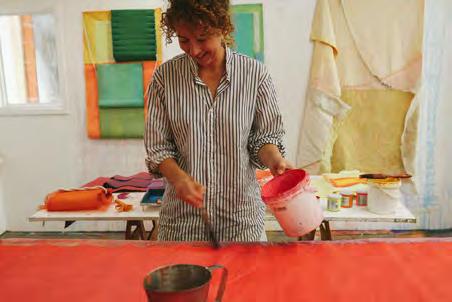
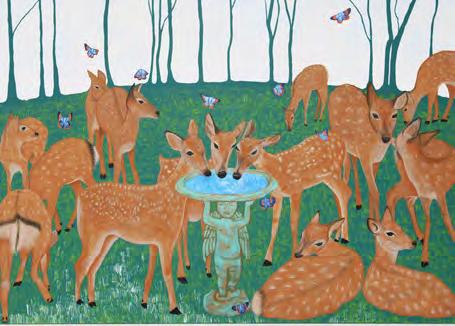
MELANIE ROGER GALLERY
Emerald Pools
Emma Fitts
10 June – 27 June
Emma Fitts’ upcoming solo exhibition with Melanie Roger Gallery revisits and reconfigures previously presented bodies of work. This exhibition traces an ongoing process of adjustment and translation, where materials, forms, and decisions are continually tested against changing conditions of site and display. In its original outdoor context, the work was subject to exposure –shifting sunlight, rain marking and softening edges, wind subtly displacing elements over time. Tāmaki Makaurau’s conditions remain embedded within the materials, even as they are encountered anew.
444 Karangahape Road melanierogergallery.com
GOW LANGSFORD GALLERY
Claudia Kogachi
27 June – 25 July
Born in Japan in 1995, Claudia Kogachi is an emerging contemporary artist now based in Tāmaki Makaurau Auckland. This is her first solo exhibition with Gow Langsford, having had representation announced in 2025.
4 Princes Street, Onehunga gowlangsfordgallery.co.nz
WORDS — STEVE HUỲNH
Analoging is no longer a stranger to the younger generations and continues to grow in popularity for its enduring and intentional nature.
In response to the resurgence of film photography and the growing creative community surrounding it, Fujifilm recently opened its newest flagship House of Photography in Albany to contribute to Aotearoa’s photography scene and create a space where creatives can connect, collaborate, and exhibit their work.
The House of Photography is the first of its kind in New Zealand, a combined head office and showroom complex offering studio hire, retail, workshops and opportunities to partner and learn from local experts. More than $1 million was invested in this 1,100sqm building in order to deliver a unique experience for both professional and beginner photographers. It’s a reflection of Fujifilm’s commitment to the revival of creating, nurturing the next generation, and strengthening the Kiwi photography community.
Fujifilm’s vice president Masato Yamamoto expressed that Auckland was chosen as the home for House of Photography because of the local cultural scene and harmony amongst the existing community within the space.

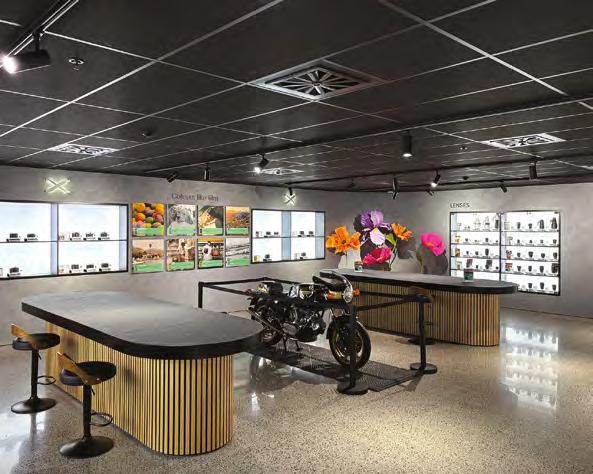

Beyond Instax, the House of Photography features a curated collection of Fujifilm’s leading cameras, from the X Series and GFX mirrorless systems to classic film photography equipment – thoughtfully catering to photographers at every stage of their creative journey.
For beginners and aspiring creatives, the Fujifilm family offers both technical guidance and industry insight, creating an approachable environment for learning and experimentation. More than just a retail space, the House of Photography opens up conversation and community, reminding creatives that they are not alone on their artistic path.
Like many artistic professions, life as a photographer is not always sustainable. Many young creatives are often underpaid and overworked in exchange for little besides experience and exposure. The House of Photography is more than just a creative hub; it becomes a place for artists to share the joy, the hardship, and the vision of those who tell stories through visual art. For what it’s worth, Fujifilm embraces slow living with intention and mindfulness. Not just a trend, but a mindset.
House of Photography, 2C William Pickering Drive, Rosedale


This month's beauty edit glows with pride, petals, and skin-renewing freshness.

Elizabeth Arden
Ceramide Skin
Renewing Cleanser
With a ceramide and amino acid complex, this gel-to-foam formula gently removes makeup, sunscreen, and impurities. It preps skin for future products, boosts serum absorption, and leaves skin soft, supple, and refreshed.
BOOST LAB
ElastafirmX Collagen
Firming Serum
Visibly smooths wrinkles, lifts sagging skin, and improves firmness. ElastafirmX™, a peptide complex, collagen, and amino acids work together to reduce wrinkles, boost elasticity, and refine texture.
Glasshouse Fragrances
Born to Be Extra
This June, Glasshouse Fragrances is honouring Global Pride Month with the launch a limitededition candle designed to celebrate self-expression in full colour.
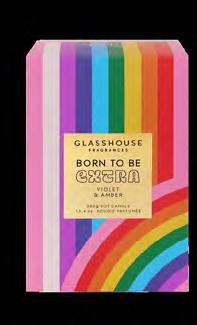



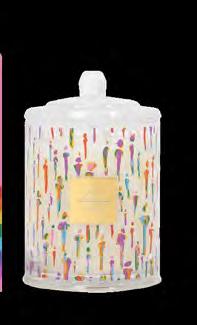
Lush
Angels on Bare Skin Cleanser
Packed with ground almonds, this cleanser is known for its deeply soothing properties, comforting scent and gentle exfoliation.



The Breakout Hack Body Milk
This body milk is here to smooth things over (literally). Lightweight, fast-absorbing and made for all skin types, but especially the dry, sensitive and the slightly dramatic type.
Jean Paul Gaultier
La Belle Rosea
A luminous floral-aquatic blend of crystalline aquatic notes, peony and rose, softened by vanilla and musk for a sensual, glowing trail.

MOR
Marshmallow Perfume Mist
Delivering modern, feminine fragrance with a hydrating touch. Infused with vitamin E and aloe vera, this mist leaves a soft glow and a beautifully lingering scent.
re-dental.co.nz
As the season shifts and social calendars move indoors, there’s something quietly powerful about feeling confident in your smile.
At re-dental, every treatment is approached with precision, artistry, and calm expertise. From subtle aesthetic enhancements to routine dental care, each experience is designed to be personal and reassuring from the moment you arrive.


This winter, invest in confidence that lasts well beyond the season. Book a consultation to explore tailored treatment options designed around your individual needs.
WINTER SPECIAL
Enjoy a complimentary cosmetic consultation. The tailored, expert experience explores every option of your smile.
Book online at re-dental.co.nz 09 600 1739 | info@re-dental.co.nz
Reveal your best skin with the Genesis Laser Treatment at About Skin's Laser Clinic Auckland – the legendary "Hollywood Facial" favoured by Kendall Jenner and Amanda Seyfried.
This non-invasive laser boosts collagen, diminishes acne scars, and reduces redness, fine lines, and hyperpigmentation. Our certified clinicians tailor each treatment to your skin goals.
Walk in, glow out. Get back to life instantly.



45-minute treatment exclusively For $170
As New Zealand moves into winter, life naturally becomes more social and indulgent: hearty dinners, weekend getaways, cafe catch-ups, richer comfort food and a glass of wine by the fire.
For those wanting to keep their winter wellness routine simple and considered, OXYENERGY Milk Thistle Extract 300mg is a timely seasonal pick.
With milk thistle extract as the hero ingredient, it is a plant-based supplement created for adults who want a simple addition to their everyday wellness routine. It fits naturally alongside modern life: busy weeks, meals out, travel, social occasions and shifting seasonal rhythms.
As OXYENERGY NZ Certified Nutritionist Michelle explains.

"What makes OXYENERGY Milk Thistle stand out is that it isn't a single-ingredient product. The formula brings together milk thistle with turmeric, kudzu root and inositol, a considered blend for adults who want a simple, plantbased supplement that fits easily into real New Zealand lifestyles."
That is why it works as a winter recommendation. It is not a dramatic cleanse or complicated reset, but a gentle, plant-based addition that fits alongside breakfast, water or an existing supplement routine.
"Whether I'm enjoying latenight bites in Seoul, a long winter dinner back in New Zealand, or the occasional glass of wine with friends, I like keeping my routine simple. Milk Thistle has become one of those small daily wellness habits that travels with me."
For Kadi, it is less about restriction and more about consistency. "I still want to enjoy good food, travel, social moments and the occasional glass of wine," she says. "For me, Milk Thistle is simply one steady habit I can keep wherever I am."
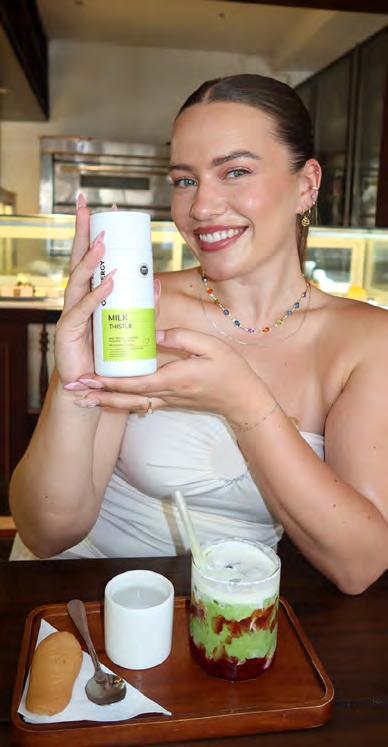

OXYENERGY TIP
For busy winter days, OXYENERGY MEGA B COMPLEX is another simple addition, formulated with B vitamins to support adults' everyday nutrition routine.

lgskinclinic.co.nz
Whether you've never had a treatment before or you've been meaning to do something about your skin for a while,
Whether you've never had a treatment before or you've been meaning to do something about your skin for a while, cooler months are genuinely the best time to start.
Less sun exposure means your skin can do the work properly, recover well, and build real results over time.
At LG Skin Clinic, we build personalised skin plans around what your skin actually needs. Not a one-size-fits-all approach. These aren't just one-off treatments; they're an investment in the longevity of your skin. Whether that's Chemical Peels to tackle pigmentation and uneven texture, Skin Needling to stimulate collagen and firm the skin from


within, or a Skin Rejuvenation Facial to deeply reset and nourish, winter is when these treatments work hardest.
IPL Hair Removal works on the same principle. Starting now, on untanned skin, means each session builds on the last, delivering long-lasting smoothness with genuine longevity, keeping you effortlessly ahead season after season.
Consistent, planned care doesn't just improve how your skin looks today, it's
an investment in future-proofing your skin for the years ahead.
Come in for a consultation with our team and let's build something that works for you, this season and beyond.

2/224 Kepa Road, Mission Bay 09 528 9010 | lgskinclinic.co.nz
visageplasticsurgery.co.nz
Auckland-based plastic surgeon Dr Katarzyna Mackenzie provides an insight into the physical and emotional benefits of breast reduction surgery.
Breast reduction surgery is one of the most successful and immediately satisfying procedures, thanks to the life-changing physical and emotional benefits. “Women seek out the surgery because large breasts make them feel uncomfortable both physically and psychologically and often someone in their life has told them about the surgery and the difference it made to them,” shares Dr Mackenzie. “Patients post breast reduction are often the most satisfied group of patients I see due to the improvements in both the aesthetic and the physical aspects.”
Dr Mackenzie’s approach begins with a comprehensive consultation, where time is taken to understand both the anatomy and the patient’s personal vision.
Surgical planning is meticulous. The aim is to create a result that feels proportionate, and naturally aligned with the individual’s body, rather than simply reducing volume.

Attention is given to shape, symmetry, scar placement and the long-term longevity of the result.
Dr Mackenzie focuses on achieving outcomes that continue to refine over time, with an emphasis on subtle scarring and enduring contour.
Dr Mackenzie says: “When performed with care and expertise, breast reduction becomes more than a procedure – it is a transformation in comfort, confidence, and quality of life.”
The biggest shift in the cosmetic industry, and medicine in general, has been the move from fixing to future-proofing.
At Clinic 42, that means leaning into regenerative technology and treatments – subtle, evidence -led options designed to support the skin you have today and maintain skin health over time.
Let’s start with the some of the language. ‘Collagen banking’ is a useful way to describe a preventative approach: investing early in treatments that help preserve the skin’s structure. We know that natural collagen production begins to decline from our late 20s, contributing to fine lines, laxity, and changes in skin quality. The goal isn’t to overcorrect – it’s to maintain. While supplements may help support your internal organs there is often not enough left to reach the skin level.
So that is where skin bio -modellers, biostimulators, and polynucleotides come in…
Bio-modellers are often hyaluronic acid (HA)–based injectables used in a way that prioritises structure and hydration over volume. Rather than changing how you look, they support existing tissue by improving elasticity and dermal hydration. Elasticity refers to the skin’s ability to stretch and return to its original shape. When elasticity is strong, skin looks firm and lifted, lines and folds are less pronounced, hydration equals natural bounce and plumpness. Think of biomodellers as subtle scaffolding – working with your anatomy, not against it.
Bio-stimulators go a step further. These treatments are designed to stimulate your body’s own collagen production –the heavy lifter that provides the overall framework and strength. Holding your tissues together and reducing skin laxity and thinning. Ingredients such as calcium hydroxyapatite or poly-L -lactic acid have been studied for their ability to encourage fibroblast activity, meaning results develop gradually and can look particularly natural. There’s no sudden shift – just a progressive improvement in skin firmness and quality.
Polynucleotides are one of the newer additions to the regenerative toolkit. Derived from highly purified DNA fragments, they’re used to support tissue repair, hydration, and cellular turnover. Early clinical evidence suggests they may help improve skin texture and resilience, particularly in delicate areas like under the eyes. Again, the emphasis is on supporting the skin biologically.
At Clinic 42, these treatments are not approached in isolation. Experience and clinical judgement are central. The same product can deliver very different outcomes depending on technique, depth, and patient selection. That’s why consultation is key to understanding your baseline skin health, your goals, and whether preventative treatment is appropriate for you.
It’s also worth being clear about expectations. Regenerative treatments are not instant, and they’re not a replacement for surgery where that may be indicated. What they can offer is incremental, evidence - supported improvement and a strategy for maintaining skin health over time. The ‘less, but better’ philosophy runs through everything.
Safety matters too. Working with medically qualified practitioners who understand facial anatomy, product science, and complication management is essential.
So, can you really future -proof your face? Not entirely. Ageing is inevitable. But with a thoughtful, science -led approach, it is possible to support your skin so that changes happen more gradually – and on your terms.
Regenerative medicine isn’t about chasing youth. It’s about maintaining what you’ve got, as well as you can, for as long as it feels right for you.
If you would like to discuss treatment options, you can book a free consultation with one of our nurses or add a consult to your next doctor’s appointment. Book online clinic42.co.nz or call 09 638 4242.
Bowel health is a topic that many avoid, yet silence around it can have deadly consequences. This June, Waitematā Endoscopy is proud to support Bowel Cancer Awareness Month to break the “poo taboo” and encourage open conversations about symptoms, risk factors, and early action.
New Zealand has one of the highest rates of bowel cancer in the world, where it is the second leading cause of cancer death, with more than 3,000 diagnoses and over 1,200 deaths each year.
Despite this, awareness remains low, and one of the biggest barriers is not a lack of knowledge about the disease itself, but discomfort around talking about bowel habits. Blood in the stool, changes in bowel motion, abdominal discomfort, or unexplained fatigue are often dismissed or self-managed in silence. Many people hope symptoms will settle on their own, but persistent change is never something to ignore.
Breaking the “poo taboo” is not about creating alarm, it is about creating openness. Normalising conversations about bowel health allows symptoms to be addressed earlier, investigations to happen sooner, and outcomes to improve. In many cases, early assessment leads to reassurance. In others, it allows

pre-cancerous changes to be identified and treated before they progress. No one ever died of embarrassment, but they do die of bowel cancer!
A Colonoscopy is a common and safe procedure that allows us to investigate the inside of the bowel and remove pre-cancerous polyps at the same time. It is one of the most effective tests available for both diagnosing and preventing bowel cancer at an early, and often preventable stage.
At Waitematā Endoscopy, we aim to make taking a proactive approach to your bowel health easy. Our experienced team will help to put you at ease when it comes to your endoscopy. Take a virtual tour of the patient journey and our clinic for an insight of what to expect at waitemataendoscopy.co.nz/locations
Dr John Perry | Gastroenterologist and Endoscopist
Waitematā Endoscopy

DISCLOSURE DAY
11 June
If you found out we weren't alone, if someone showed you, proved it to you, would that frighten you? This June, the truth belongs to seven billion people. We are coming close to… Disclosure Day. Starring Emily Blunt, Josh O'Connor, Colin Firth, Colman Domingo, and directed by Steven Spielberg.
18 June
He was no hero. Robin Hood grapples with his past life of crime and murder while in the hands of a mysterious woman after being badly injured. Starring Hugh Jackman and directed by Michael Sarnoski (Pig and A Quiet Place: Day One).
STORY 5 18 June
The toys are back in Disney and Pixar's Toy Story 5, and this time around it's Toy meets Tech. Buzz, Woody, Jessie and the rest of the gang's jobs get exponentially harder when they go head to head with this all-new threat to playtime – a tablet device called Lilypad.
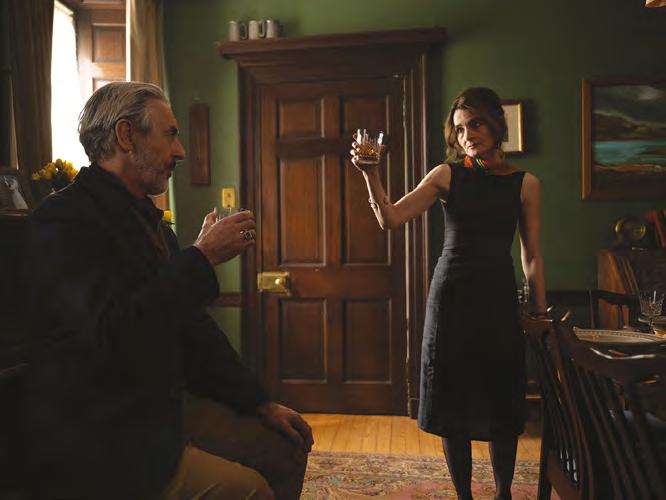
18 June
After almost 40 years in Chicago, Donal (Alan Cumming) reluctantly returns to the Scottish Highlands to make amends with his estranged older brother, Sandy (Brian Cox). Sandy needs Donal to take over the family business and secure the family’s legacy. But Donal has another reason to return. While Donal struggles to deal with the memories of his youth, his devious actions in the present threaten the reconciliation so longed for by his older brother.







LIGHT X 4
5 – 26 June
Rosie’s Gallery, Parnell
OPERA GALA 2026
28 June
Auckland Town Hall
Four award-winning New Zealand photographers – Karen MoffattMcLeod, Mark Burgess, Rolf Siggaard, and Lynn Clayton – exhibit large-format work at Little Rosie’s Gallery as part of the Auckland Festival of Photography, showcasing decades of expertise in portraiture, landscape, and creative photography. Daily, 7am-3pm.
parnell.net.nz
The Auckland Opera Studio and Manukau Symphony Orchestra unite for a thrilling Opera Gala , spanning Verdi’s grandeur, Puccini’s passion, and beloved moments from Carmen, Pagliacci, Faust, and more. A feast of melody, drama, and the raw power of the human voice – opera at its most electric and accessible.
aucklandoperastudio.co.nz


24 June –12 August
Various locations
The Oscar-qualifying Doc Edge Festival returns nationwide, and features 49 feature films, 26 shorts, 12 immersive projects, and 28 world premieres. Highlights include a landmark takeover of the Smith and Caughey building, hosting New Zealand’s first combined World Press Photo and immersive documentary exhibition.
docedge.nz

AUCKLAND LIVE CABARET FESTIVAL
24 June – 5 July
The Civic
The Auckland Live Cabaret Festival returns to The Civic, transforming Auckland’s most iconic venue into a winter playground of music, comedy, theatre, circus, burlesque, and the utterly undefinable. Free pop-up performances, cocktails, fabulous outfits, and artists mingling with audiences — a joyful, anything-goes escape from the cold.
aucklandlive.co.nz
2-19 July
Q Theatre Loft
Nick Payne’s acclaimed play reimagined through a te ao Māori lens by Nī Dekkers-Reihana, set beneath the stars of Matariki. An astrophysicist and beekeeper meet, their love story unfolding across infinite realities — tender, devastating, and transforming. Intimate yet expansive, Constellations asks what changes when fate, choice, and culture shift the context of connection.
qtheatre.co.nz
26 – 28 June
Kiri Te Kanawa Theatre, Aotea Centre
Auckland’s National Youth Theatre brings Disney’s The Little Mermaid to life with 250-plus young performers staging the beloved Hans Christian Andersen tale and classic Disney film. A splash-hit whānau show not to be missed!
aucklandlive.co.nz

NGĀ REO O TE RANGI – VOICES OF THE STARS
10 July
Great Hall, Auckland Town Hall
A stunning Matariki celebration blending waiata, kapa haka, and storytelling to honour the Māori new year. Stan Walker, Troy Kingi, and Maisey Rika headline, alongside kapa haka group Te Rōpū Manutaki. Professor Rangi Mātāmua hosts a live Q&A on the significance of the stars. Presented by Ngāti Tamaoho with Auckland Council Events.
aucklandlive.co.nz
SONS OF VAO
18 June – 5 July
ASB Waterfront Theatre
A landmark world premiere from Auckland Theatre Company – the first Niuean story they’ve staged. Playwright Vela Manusaute’s award-winning Pasifika drama, Sons of Vao, follows three brothers across four decades, from Niue village life to Ponsonby suburbia. A raw, funny, and powerful exploration of migration, masculinity, and breaking cycles of inherited violence.
atc.co.nz

Why simple wills no longer work in complex families

Modern families rarely fit the traditional mould. Second marriages, stepchildren, new partners later in life, and children living across different households are now commonplace. While these relationships enrich our lives, they also create legal complexities that a standard will, or outdated trust simply can’t handle.
If your family has changed over the years, it may be time to consider whether your current estate plan still achieves what you want it to.
Why blended families pose unique risks
Many people assume their existing will is “good enough”, but blended families present challenges that standard templates don’t cover. Without proper planning, your assets may not end up where you intended. Common issues we see include:
• Risk of “Mirror Wills”:
Couples in blended families often create “mirror wills”, where each leaves their estate to the other, and on the death of the survivor, the combined estate is distributed among all children from both sides of the family. This structure can create a significant risk for the children of the first partner to die, as their inheritance becomes contingent on the goodwill of their step-parent.
• Claims under the Property (Relationships) Act 1976 (PRA): The PRA provides another avenue for claims that can disrupt testamentary
wishes in a blended family. If a willmaker leaves most of their estate to their children, the surviving spouse can elect to make a claim under the PRA.
Family Protection Act challenges: If your estate plan is unclear or favours one side of the family, disputes may arise, often resulting in costly and lengthy court involvement.
These risks can be avoided with a tailored plan that recognises your family’s unique shape.
Why simple wills often fall short:
A basic will does not provide enough structure for blended families, it may not offer:
• Flexibility, when balancing the needs of a new partner with obligations to children.
• Guidance for trustees on how to distribute assets fairly.
• Protection for assets brought into a relationship later in life.
• Certainty about how you want family heirlooms, personal items, or inherited property handled.
How a modern will, can protect your blended family:
• Protect children’s inheritances. Your will can clearly direct how particular assets (such as savings, investments or family heirlooms) are to pass to your biological children, helping
to ensure they are not unintentionally diluted or redirected.
• Support a new partner while safeguarding long-term intentions. Many people want to provide for a new spouse or partner but also preserve assets for their children. A will can include tailored clauses, such as rights to the family home or specific gifts, so both sets of interests are balanced fairly.
• Reduce the likelihood of disputes. A clear will, with specific instructions and up-to-date wording, significantly lowers the risk of disagreements between children, stepchildren and surviving partners. When your intentions are expressed plainly, they are easier to follow and harder to challenge.
If your family circumstances have changed, whether through separation, remarriage, the arrival of new children or shifting family dynamics, your estate plan should change too. The best time to update it is before life becomes complicated.
If you would like advice tailored to your family situation, or if you would like a review of your will or trust, our friendly team is here to help.
Claire Endean – Director/Lawyer dawsonslawyers.co.nz 09 272 0002 Kohimarama | East Tamaki
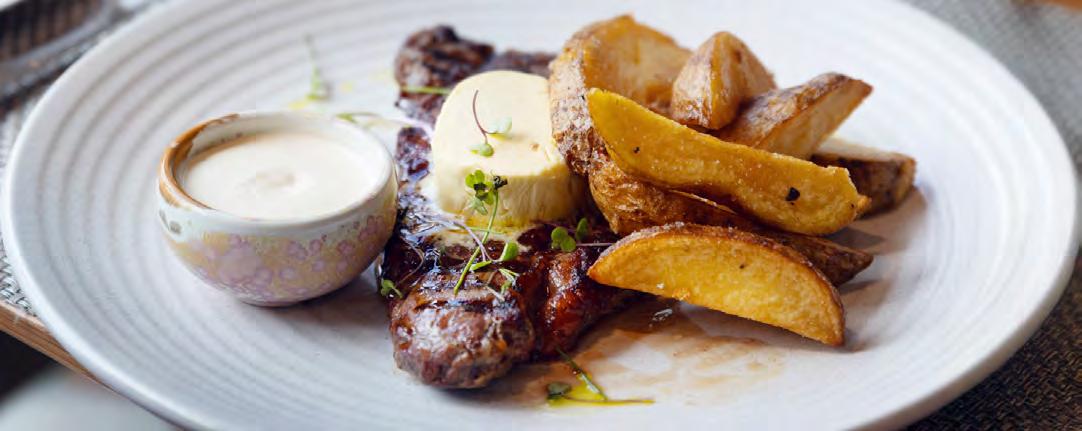
Join us this winter as The Terraces Restaurant unveils a new seasonal menu celebrating refined seasonal favourites and exceptional dining experiences.
Our new winter menu features beautifully crafted dishes designed for the cooler months, including our much-loved seafood chowder, always a seasonal favourite, alongside a rich Wagyu daube de boeuf with slow-braised beef cheek, parsnip and barley purée, and seasonal greens.
Held on the last Saturday of every month, our High Tea is a firm favourite, featuring elegant treats created by our Head Pastry Chef and the team. Why not enhance the experience with a glass of French champagne while enjoying live piano accompaniment.
Limited tables available — book now. Saturday 27 June | from 2pm
$58 PER PERSON
Our collaboration with renowned Auckland chef Tony Astle for the Antoine’s Nostalgia Experience has now sold out — a testament to the excitement around this special onenight-only event on 19 June.
We are also proud to share that 5% of proceeds from the event will be donated to Tony’s chosen charity, the Breast Cancer Foundation, with plans to bring this unique experience back next year.


The Foundation is a place for you to enjoy your retirement with security, vitality and community. Contact us today to book a tour of our new show apartment and experience The Foundation’s immense potential first-hand.
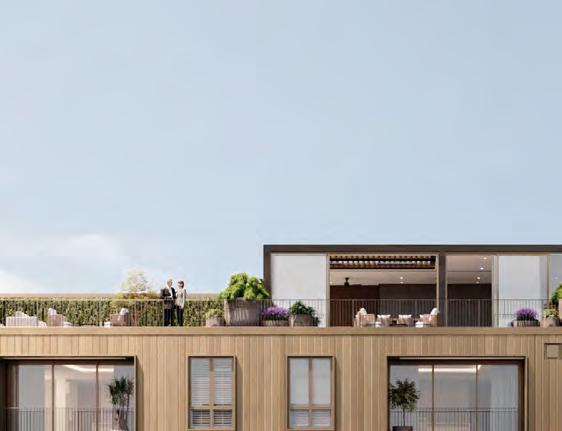
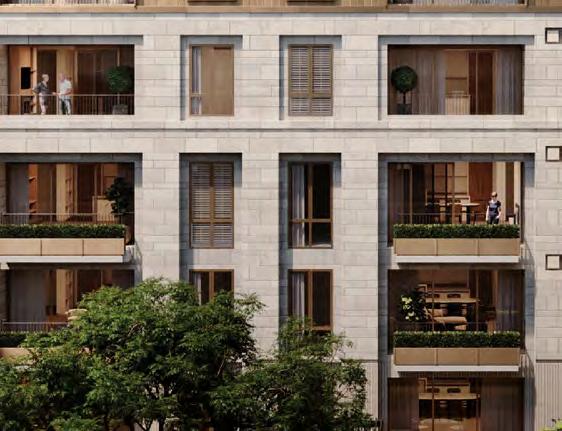

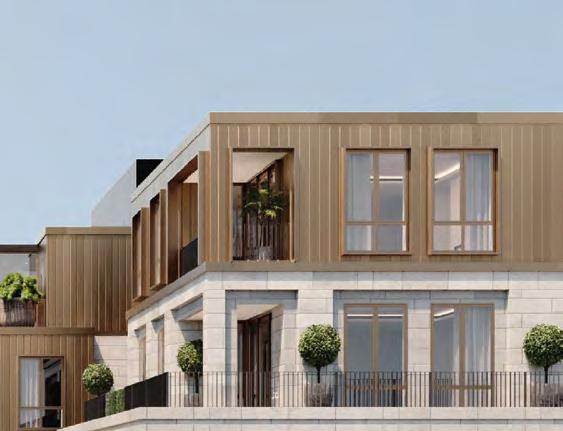
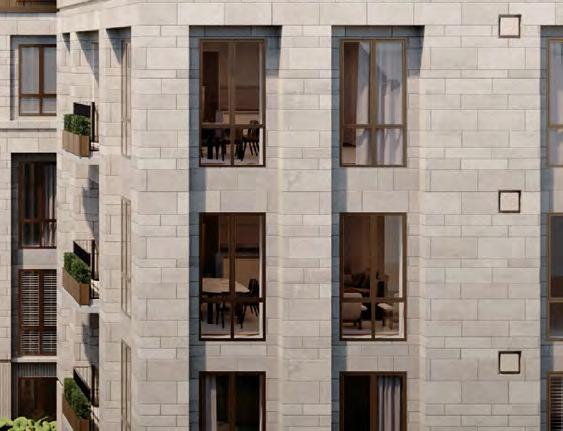

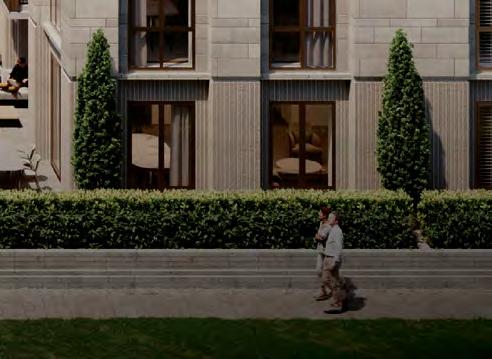
Apartments priced from $1,825,000 541 Parnell Road, Parnell, Auckland
WORDS — KAREN MCMILLAN , bestselling author karenm.co.nz | nzbooklovers.co.nz

Riley Chance
Weeping Angels was shortlisted for the NZ Booklovers Award, and Riley Chance’s new thriller is again a pageturning, thought-provoking read that brings back former US agent Marla Simmons and New Zealand journalist Grace ‘Ace’ Marks. A bomb explodes in the Wellington union offices, echoing the 1984 Trade Hall blast, and Ace is injured. Was she the target, or just in the wrong place at the wrong time?
Two Roads, RRP $40
THE SPIRIT REMAINS
Donna Goodacre
Set in the 1890s. Lucy Chappell has lost her great love, and now she must raise their children on her own in New Zealand. Meanwhile, in the UK, Colin Greenwood is also mourning the loss of his partner. When Charles Patterson arrives, secrets emerge from the family’s tangled past. In the present day, Ngaroma investigates the lives of her ancestors. A story of love, loss, resilience and connection.
Good Acre Books, RRP $38

Vanessa De Carvalho
Perfect for fans of Marian Keyes. Sometimes motherhood isn’t what you expected, something that friends Saffi, Lena and Violet know intimately. One faces postnatal depression, another relationship problems, and the other envies women who conceive easily, desperate to have another child when the odds are stacked against her. Each woman finds themselves at different crossroads. Will they survive the challenges?
De Opalho Publishing, RRP $40
Anna Woods
A debut literary suspense novel by an award-winning writer, this is a slowburning, elegant and atmospheric read. The architecture practice LIT is in financial ruin, and the three partners are in turmoil. Billy was supposed to be dead, but Gin starts catching glimpses of him while she tries to care for Clary, his fragile ex-girlfriend. All of them are hiding secrets. This is a novel about control and obsession.
Echo Publishing, RRP $38
Entering is simple. Visit VERVEMAGAZINE.CO.NZ and click WIN then follow the directions. Follow us on Facebook and Instagram @vervemagazine

Known as the ‘Hollywood Facial’, About Skin’s Genesis Laser Treatment is a non-invasive laser treatment that helps boost collagen production while targeting redness, fine lines, acne scarring and pigmentation. The result is smoother, brighter, more even-looking skin – what’s more, there’s zero downtime!
WIN this superstar Genesis Laser Treatment, valued at $170.

Skinscape 360 uses advanced 3D imaging to create a fullbody digital “skin twin” in just one second. AI then helps track and highlight any changing or unusual lesions over time. Clinicians review everything, combining tech with expertise, to support earlier detection of melanoma and other skin cancers in a highly thorough way.
WIN a vital health check by way of a Vectra Scan and Dermoscopy gift card valued at $449.

Mesoestetic Mesoprotech Melan 130 Pigment Control SPF50 is a lightweight tinted emulsion providing SPF50+ UVA/ UVB protection for all skin types, including those prone to pigmentation. The water-resistant formula offers a natural tint while helping to soften the appearance of imperfections and promote a more visibly even, unified skin tone.
WIN one of these sun-smart skincare essentials, valued at $95.

DMK’s Beta Gel is an immune-boosting serum designed to calm redness, inflammation, acne, rosacea, and reactive skin while supporting healing and skin regeneration. Hydrating Masque deeply replenishes moisture, helping to firm, soothe, and plump dry or sensitive skin for a fresher, more youthfullooking complexion.
WIN one of each of these skincare heroes and give dry, stressed skin the boot!


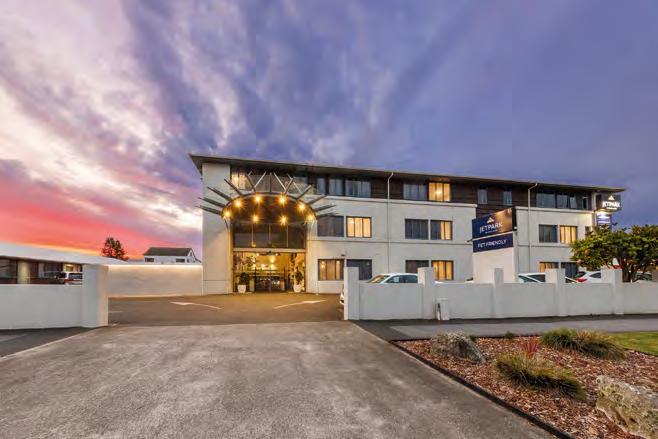
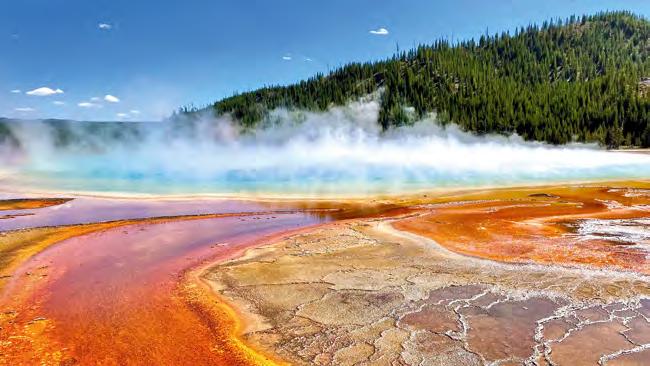
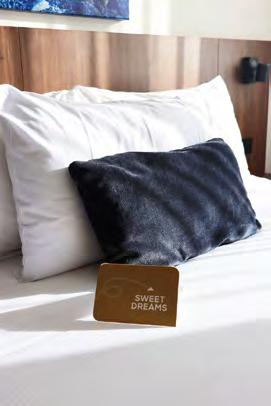

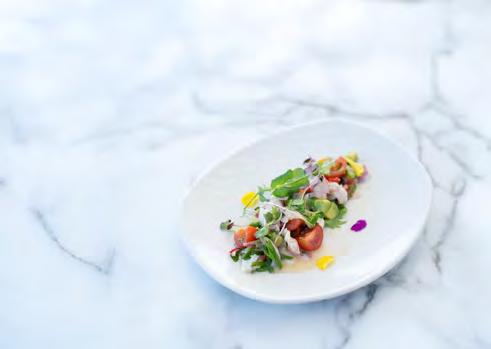
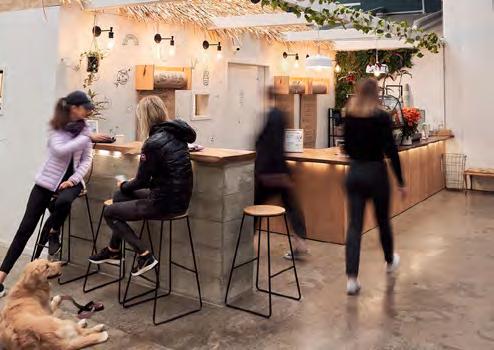











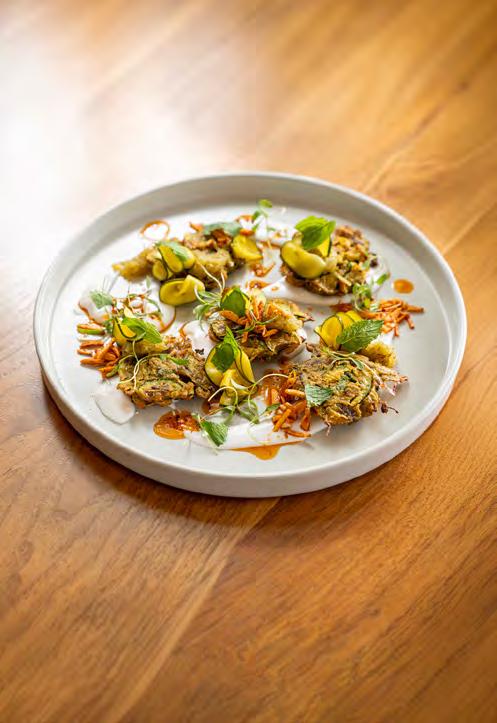





















NEW ZEALAND'S MOST LUXURIOUS SLEEP.
Expertly handcrafted in New Zealand with soft wool and silk fibres, our top-of-the-range Sanctuary bed offers unparalleled comfort and luxury. The Sanctuary range features:
A unique Sensorzone support system with vertical and horizontal zoning designed to contour perfectly to your body and eliminate partner disturbance.
An adjustable compatible mattress that can be used on Sleepyhead adjustable bases.
OpiTemp heat dissipation technology to make your sleep more comfortable for over 12 hours, whether you sleep hot or cold.
Genius Memory Foam for responsive support and instant comfort.

www.bedsrus.co.nz
Scan the QR code to view our range online.