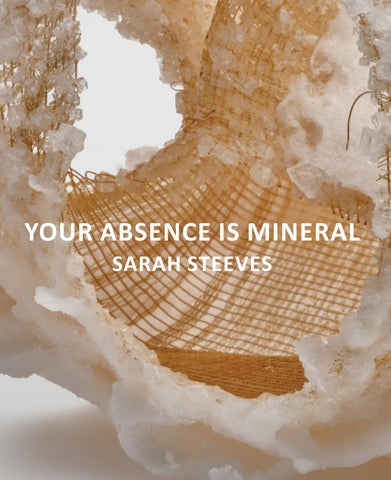
YOUR ABSENCE IS MINERAL SARAH STEEVES
YOUR ABSENCE IS MINERAL SARAH STEEVES SEPTEMBER 1 - OCTOBER 7, 2026
VERNON PUBLIC ART GALLERY
EXHIBITION STATEMENT
Your Absence Is Mineral introduces the work of Vancouver-based artist Sarah Steeves in her first institutional solo exhibition. Steeves’s work rings with a subtle but persistent truth: humans are not separate from the Earth; we are intrinsically linked to it. The exhibition includes nine sculptures, a video work, and a durational installation. Steeves weaves intricate pieces of copper into textile-like forms, which are then immersed in a saline mixture and left to crystallize. These mineral interventions—specifically salt crystallization— reproduce processes of geological weathering that elicit transformation. By mirroring the ways natural forces break down rock, the work draws a parallel to how humans experience psychological weathering through accumulated grief and trauma. At the heart of the exhibition is an exploration of grief, loss, and transformation. For Steeves, absence is not a void but a shifting into another form. The exhibition title takes inspiration from Jón Kalman Stefánsson’s novel Your Absence Is Darkness, a saga about an isolated rural community in Iceland. Steeves gently pushes back against the notion of absence as darkness, instead proposing something more materially grounded: mineral. Her title reflects a belief that we are so deeply interconnected with the Earth’s systems that nothing truly disappears, but instead transforms. Titles also play an important role throughout Steeves’s practice. Using geological naming conventions often employed by researchers to catalogue discoveries, Steeves creates coded references to her own personal world and artistic influences. These subtle naming systems act as quiet gestures toward memory, place, and lineage. Integral to the exhibition is an evolving installation in which viewers can observe the salt crystallization process unfold over the course of the exhibition. The sculptures become simultaneous representations of erosion and creation, inviting viewers to witness slow, almost imperceptible change over time. Through this durational process, Your Absence Is Mineral offers a contemplative space to consider transformation, interconnectedness, and the cyclical nature of life. The work suggests that creation and erosion are not opposites, but part of the same continuous process of becoming. Sarah Steeves would like to thank the Canada Council for the Arts for its support in making this exhibition possible.
5
MC’26’CE, 2026. Copper, salt crystals. 12x20x16 cm.
6
CURATORIAL ESSAY | WHAT CONTINUES TO BECOME VICTORIA VERGE
There is a strange intimacy in encountering an artwork before it has settled into the certainty of an exhibition. When I visited Sarah Steeves’ downtown Vancouver studio, the sculptures that would eventually become Your Absence is Mineral rested quietly on worktables, shelves, and improvised supports. I was invited to hold them. They were unexpectedly light, their woven copper skins soft enough to suggest fabric yet rigid enough to preserve the memory of a body. Salt crystals bloomed across their surfaces like coral, frost, or bone. They seemed at once geological specimens, marine organisms, archaeological fragments, and something unmistakably human. Only later did I learn the deeply personal story that threads through these forms. Suddenly their material language became inseparable from grief—not as illustration, but as process. Steeves’ exhibition does not attempt to represent loss directly. Instead, it considers loss through material transformation, memory, and different scales of time. The exhibition unfolds like a slow descent beneath the surface of the North Atlantic Ocean, the body of water that has shaped both the artist’s life and her understanding of absence. Having lost her father to the sea, Steeves approaches the Atlantic not as picturesque landscape but as a place where transformation is continuous. Oceans conceal and preserve, but they also erode, dissolve, disperse and transform. Nothing remains unchanged. This continual transformation is echoed in the projection of marine snow that drifts across one gallery wall. Marine snow is composed of organic matter, microorganisms, shell fragments, sediment, and other particles slowly settling toward the ocean floor.1 Within the exhibition, this continual descent offers a material model for transformation: organic matter breaks down and settles, becoming part of other biological and geological processes. What appears as disappearance is also change. The projection establishes the temporal rhythm of the exhibition, asking viewers to think beyond the human scale and toward the slower processes through which landscapes, minerals, and memory are continually remade. That expanded understanding of time runs throughout Steeves’ practice. She has described textiles and geology as its two foundations: weaving provides a method of making, while geology offers a way of thinking. Influenced by the writing of geologist Marcia Bjornerud, Steeves understands rocks not as static objects but as active participants in an environment that is always changing, even when those changes escape human perception. Bjornerud’s concept of “timefulness” asks us to develop a greater awareness of the immense timescales through which geological processes unfold.2 For 1 “What Is ‘Marine Snow’?” NOAA Ocean Exploration, National Oceanic and Atmospheric Administration, oceanexplorer.noaa.gov/ocean-fact/marinesnow/. Accessed Aug 10. 2026. 2 Marcia Bjornerud, Timefulness: How Thinking Like a Geologist Can Help Save the World, Princeton University Press, 2018. 7
Steeves, this provides a way of placing human experience alongside processes that began long before us and will continue beyond us. Your Absence is Mineral adopts this same temporal framework. The exhibition is less concerned with preserving a memory than with observing how memory changes. Copper gathers crystals. Salt accumulates. Marine snow falls continuously. Grief remains deeply personal, but the exhibition places that experience alongside material processes of accumulation, erosion, and change. Rather than asking only what remains after loss, Steeves asks what continues to become. This shift in thinking is reflected in the sculptures themselves. Distributed throughout the gallery on custom-fabricated steel supports, the woven copper forms occupy a state of deliberate uncertainty. Some rest gently on flat platforms while others are suspended within claw-like structures that seem equally capable of supporting or restraining them. They recall museum displays, scientific specimens, and archaeological artifacts, yet their precarious placement complicates the stability and certainty typically associated with these modes of presentation. The sculptures are not presented as fixed objects but as participants in an unfolding process. Together, the nine sculptures establish a sparse, almost submerged environment. Their isolation from one another and the focused lighting make each appear momentarily suspended within the marine snow’s continual descent. Moving among them, the viewer occupies the same uncertain space between suspension and settling. Although they inevitably evoke the body, the sculptures resist becoming figurative. Their woven surfaces suggest lungs, shells, coral, abandoned garments, geological cavities, and the interiors of bones without fully resolving into any one image. What connects these associations is not resemblance so much as structure: Steeves builds volume incrementally, allowing repeated loops of wire to enclose space without making it solid. Textile practices carry long histories of domestic labour, shared knowledge, and forms of making that have often taken place outside the institutions of fine art. Across Atlantic Canada, practices including quilting, rug hooking, knitting, and sewing have developed within distinct cultural and community contexts, carrying different histories of necessity, labour, skill, and exchange. Steeves approaches this broader history through her own familial experience. She traces her relationship to making to childhood and to the quilting bees held in her grandmother’s basement3, where textile knowledge was embedded in the routines of domestic and communal life. This inheritance connects her practice to forms of labour historically associated with women and the home—work that has frequently been positioned outside the institutional categories of fine art and treated as ordinary, useful, or amateur rather than as a source of artistic knowledge.4 For Steeves, this history is more than a point of reference: it establishes making by hand as a form of knowledge in itself. The repetitive, tactile process of weaving carries this embodied knowledge into her sculptural practice, connecting inherited ways of making with her broader interest in how materials change over time. This attention to process also complicates the relationship between maker and material. Anthropologist Tim Ingold has used weaving to describe a model of making in which form develops through the 3 Sarah Steeves, unpublished artist statement supplied to the author, 2026. 4 Catharine Mastin, Marion Nicoll: Life & Work, Art Canada Institute, 2022, “Balancing ‘Fine Art’ and ‘Craft. 8
maker’s engagement with material rather than being imposed upon it from the outset.5 Steeves’ sculptures make this relationship tangible: the copper is manipulated by hand, but its behaviour also shapes what the woven form can become. The subsequent process of crystallization extends this relationship beyond the act of weaving. As copper interacts with saline solution, evaporation, gravity, and time, crystalline surfaces develop in ways that Steeves can facilitate but cannot fully determine. She establishes the conditions for growth without prescribing its precise outcome, making the finished forms the result of both artistic intention and material process. Copper itself complicates any clear division between the geological and the made. Before becoming the fine wire Steeves weaves by hand, it exists as mineral deposits formed through geological processes over immense periods of time. Extraction and refinement convert this material into an industrial product, obscuring the geological origins. Steeves’ interest in copper has led her to consider not only these processes of transformation but also the histories of resource accumulation and land exploitation that accompany them.6 In Your Absence is Mineral, the material undergoes another transformation: industrial wire is woven by hand and then subjected to crystallization, allowing crystalline growth to accumulate across its surface. The movement is not a simple return to nature, but a reminder that copper never ceased to carry geological properties and histories of its own. The installation in the Up-Front Gallery makes this ongoing process visible as it unfolds during the exhibition itself. Suspended above an illuminated tank of saline solution, a length of woven copper slowly gathers crystals over the course of the exhibition. Visitors witness not only an object but the conditions from which its changing surface emerges. There is a degree of control in Steeves’ careful construction of the experiment: the concentration of the solution, the placement of the copper, the vessel and its environment can all be established in advance. What cannot be prescribed is precisely how the crystals will form. The distinction is important. Steeves controls the conditions of transformation without controlling transformation itself. Thinking back to that afternoon in Sarah’s studio, I remember how carefully I held those woven forms in my hands, conscious of their fragility. At the time, their material delicacy seemed inseparable from the deeply personal story they carried. Encountered within Your Absence is Mineral, however, that fragility takes on a broader significance. The sculptures remind us that materials possess histories of their own, and that change is not always something we witness directly. Like minerals forming beneath immense pressure or marine snow settling silently through the Atlantic, transformation often takes place beyond the limits of our perception. The exhibition asks us to slow down long enough to recognize that these processes are happening all around us—in the earth, in the ocean, in the materials we shape, and in ourselves. Within this expanded understanding of time, absence is not presented as an empty space left behind, but as something that continues to shape the present.
5 Tim Ingold, The Textility of Making, Cambridge Journal of Economics, vol. 34, no. 1, 2010, pp. 91–102. 6 Sarah Steeves, unpublished artist statement supplied to the author, 2026. 9
JKS’26’CE, 2026. Copper, salt crystals. 14x18x18 cm.
10
CURRICULUM VITAE SARAH STEEVES ARTIST BIO Sarah Steeves is a Canadian sculptor working on the unceded, ancestral territories of the xʷməθkʷəy̓əm, Sḵwxw̱ u7mesh and səliQ lwətaʔɬ peoples. She centres her practice on the loom, a traditional tool she approaches in unconventional ways, weaving with fine strands of copper which she then treats with naturally occurring geologic materials. Through this durational process, the work explores how internal states shift and find new form through external pressures, eliciting a meditation on the interconnectedness between the biologic self and geologic transformation. Steeves holds a Bachelor of Fine Arts from Concordia University Montreal, and her work has been exhibited across Canada, the United States and France. EDUCATION 2000 - 2004 Bachelor of Fine Arts (Fibre Arts), Concordia University, Montreal, Canada. EXHIBITIONS 2026 Your Absence is Mineral, Vernon Public Art Gallery, Vernon, Canada. (Solo) 2026 16th International Biennial of Contemporary Textile and Fibre Art “Scythia”, Ivano-Frankivs’k, Ukraine. (Group) 2026 Arts 2026, Surrey Art Gallery, Surrey, Canada. (Group) 2026 Coffin Farm Summer Show, Coffin Farm Sculpture Park, Redmond, USA. (Group) 2025 Cachan Contemporary Art Biennale; L’Orangerie, Cachan, France. (Group) PUBLIC WORKS 2026 A Spark Between Two Silences, Similkameen Sculpture Corral, Keremeos, Canada. COLLABORATIVE PROJECTS 2019 Corazón del Espantapájaros (performance), costume design for artist Naufus Ramírez-Figueroa. PuSh Interational Performing Arts Festival, Audain Gallery, Vancouver, Canada. AWARDS 2026 2024
Canada Council for the Arts: Artistic Creation Grant Canada Council for the Arts: Explore & Create - Research & Creation
RESIDENCIES 2026 Similkameen Artist Residency, Keremeos, Canada.
11
This publication was produced in conjunction with the exhibition: Your Absence is Mineral: Sarah Steeves, September 1 - October 7, 2026 Editor: Victoria Verge Production: Vernon Public Art Gallery Layout and graphic design: Vernon Public Art Gallery Front cover image: JKS’26’CE (detail), 2026. Copper, salt crystals. 14x18x18 cm. Photography: Rachel Topham Photography Copyright © 2026, Vernon Public Art Gallery All rights reserved. Except as permitted under the Copyright Act (Canada), no part of this publication may be reproduced or transmitted in any form or by any means, electronic or mechanical, including photocopying, recording, or through any information storage or retrieval system, without prior written permission from the appropriate copyright holder. Requests for permission to reproduce text or images from this publication should be addressed to the Vernon Public Art Gallery, 3228 31st Avenue, Vernon, BC V1T 2H3, Canada. Telephone: 250-545-3173. Website: www.vernonpublicartgallery.com The Vernon Public Art Gallery is a registered not-for-profit society. We gratefully acknowledge the financial support of the Greater Vernon Advisory Committee/RDNO, the Province of BC’s Gaming Policy and Enforcement Branch, British Columbia Arts Council, the Government of Canada, corporate donors, sponsors, general donations and memberships. Charitable Organization # 108113358RR
Vernon Public Art Gallery 3228 - 31st Avenue, Vernon BC, V1T 2H3 250.545.3173 vernonpublicartgallery.com
Sponsored in part by: