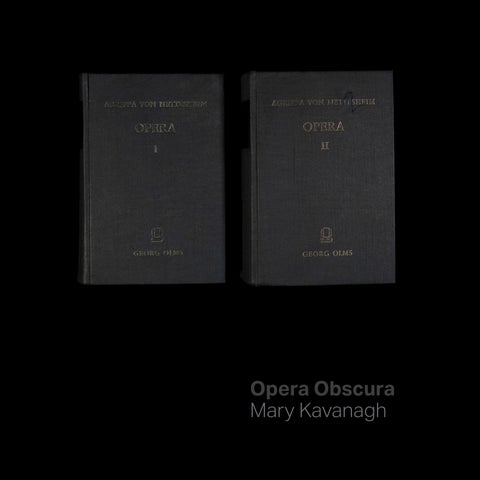
Opera Obscura Mary Kavanagh Opera Obscura | Mary Kavanagh | 2026
1
2
Opera Obscura | Mary Kavanagh | 2026
Opera Obscura Mary Kavanagh
Vernon Public Art Gallery August 7 - October 7, 2026
Opera Obscura | Mary Kavanagh | 2026
3
4
Opera Obscura | Mary Kavanagh | 2026
for Clare
Opera Obscura | Mary Kavanagh | 2026
5
Catalogue of an exhibition Vernon Public Art Gallery 3228 - 31st Avenue, Vernon, British Columbia, V1T 2H3, Canada August 7 — October 7, 2026 Production: Vernon Public Art Gallery Editorial Input: Mary Kavanagh, Victoria Verge Design: Edison del Canto Photography: Yuri Akuney, Mary Kavanagh Front cover: Mary Kavanagh, Black Book Study 01a | 2026 Back cover: Mary Kavanagh, Black Book Study 01a | 2026 Courtesy of the artist. Printing: Get Colour Copies, Vernon, British Columbia, Canada ISBN # 978-1-927407-99-8 Copyright © 2026 Vernon Public Art Gallery All rights reserved. Except as permitted under the Copyright Act (Canada), no part of this publication may be reproduced or transmitted in any form or by any means, electronic or mechanical, including photocopying, recording, or through any information storage or retrieval system, without prior written permission from the appropriate copyright holder. Requests for permission to reproduce text or images from this publication should be addressed to the Vernon Public Art Gallery, 3228 31st Avenue, Vernon, BC V1T 2H3, Canada. Telephone: 250-545-3173. Website: www.vernonpublicartgallery.com The Vernon Public Art Gallery is a registered not-for-profit society. We gratefully acknowledge the financial support of the Greater Vernon Advisory Committee/RDNO, the Province of BC’s Gaming Policy and Enforcement Branch, British Columbia Arts Council, the Government of Canada, corporate donors, sponsors, general donations and memberships. Charitable Organization # 108113358RR. This exhibition is sponsored in part by:
6
Opera Obscura | Mary Kavanagh | 2026
Contents 5
Dedication
9
Executive Director’s Foreword Dauna Kennedy
11
Opera Obscura: The Afterlife of Books Victoria Verge, Curator
23
Opera Obscura: Seeing in the Dark Jessica Jacobson-Konefall
30-39
Exhibition Documentation
41
Artist Statement | Mary Kavanagh
43-77
Black Book Studies
78-84
Black Book Studies Annotated Bibliography
85
Artist Biography | Mary Kavanagh
87
Artist Acknowledgements | Mary Kavanagh
88-91
Artist CV | Mary Kavanagh
Opera Obscura | Mary Kavanagh | 2026
7
8
Opera Obscura | Mary Kavanagh | 2026
Foreword Opera Obscura Mary Kavanagh
Taking place during the onset of the Bradley Creek wildfire, the installation of Mary Kavanagh’s Opera Obscura unfolded against a landscape of falling ash and smoke. As fires burned across the lake, destroying homes, forests, and familiar landscapes, Kavanagh worked diligently to install a body of work that itself contemplates loss, erasure, and what remains. Her work silently but boldly confronts the loss that occurs when vast bodies of knowledge, history, and contextual memory are discarded without recognition of what disappears with them. The installation has us, quite literally, view the weight of the loss, 2000 volumes from just one institution. When we consider this process multiplied across libraries and archives, the scale of what is removed, forgotten, or rendered inaccessible becomes staggering. Please join us as we explore and experience the work of Mary Kavanagh, Canadian visual artist, Professor of Art, and Board of Governors Research Chair at the University of Lethbridge. We are pleased to include in this publication an essay by guest writer Jessica Jacobson-Konefall, Assistant Professor of Art History and Museum Studies at the University of Lethbridge. An art historian and writer, her research examines decolonial practices. Victoria Verge, Curator at the Vernon Public Art Gallery, introduces Kavanagh’s work with a curatorial essay and will also lead a Community Conversation Panel in September exploring many of the questions and themes that emerge from this body of work. I would like to extend my sincere thanks to Mary Kavanagh for bringing Opera Obscura to the Vernon Public Art Gallery. I also thank the Men’s Shed Vernon for assisting with the construction needs of the exhibition, and our funders, whose support enables VPAG to provide artists with opportunities to share their work with our community. Thank you to the Regional District of the North Okanagan, the Province of British Columbia, the BC Arts Council, and our donors, sponsors, and members for continued support. Dauna Kennedy Executive Director
Opera Obscura | Mary Kavanagh | 2026
9
10
Opera Obscura | Mary Kavanagh | 2026
Opera Obscura: The Afterlife of Books Victoria Verge, Curator 2026 There is an ecology of care that underpins every public collection. Long before a visitor encounters a book on a library shelf or a work of art in a gallery, countless acts of care have already taken place. Books are catalogued, repaired, re-shelved, and conserved. Collections are expanded, reassessed, digitized, and reduced in turn. Librarians, archivists, conservators, registrars, and collections staff perform the largely invisible labour of deciding which evidence of knowledge and culture remains accessible, to whom, and for how long. Care, in this sense, is not simply protective. It is an ongoing negotiation between access and loss, permanence and expediency, stewardship and erosion. As knowledge systems migrate to digital platforms, physical collections are assessed through new metrics of accessibility, circulation, and use value. Within the emerging AI paradigm, balancing the preservation of intellectual history with the practical demands of contemporary scholarship becomes fraught terrain. Opera Obscura begins within this often-unseen ecology of care. The circumstances of its installation made that ecology unusually palpable. During the second week of installing Opera Obscura, wildfires burning around the Vernon area brought evacuation orders to neighbouring communities and heavy smoke across the region.1 As evacuees arrived in the city, plans for the exhibition’s opening were reconsid1 The Bradley Creek and Quilpituk Creek wildfires were discovered on July 31, 2026, during the installation of Opera Obscura. The Bradley Creek wildfire spread rapidly through Okanagan Indian Band territory northwest of Vernon, forcing widespread evacuations and destroying an estimated 230 homes. The Quilpituk Creek wildfire, burning farther south along the west side of Okanagan Lake, prompted evacuation orders and alerts affecting communities along the North Westside, including the Fintry, La Casa, Killiney, and Westshore Estates areas (Associated Press; Central Okanagan Emergency Operations). Together, the fires displaced residents throughout the region and brought significant wildfire smoke into the Okanagan Valley during the final days of the exhibition’s installation.
ered and ultimately postponed; visitors cancelled travel, and Kavanagh completed the installation before returning home to Lethbridge. The exhibition therefore came into being amid an atmosphere of uncertainty, displacement, and collective responsibility. These events are not the subject of Opera Obscura, but they sharpened the conditions through which the work could be encountered: a project concerned with preservation, loss, and the structures through which we care for what we inherit was assembled at a moment when those questions had become immediate beyond the gallery walls. At the exhibition’s centre are approximately two thousand deaccessioned books which artist Mary Kavanagh sourced from the annual collection review of the University of Lethbridge
Opera Obscura | Mary Kavanagh | 2026
11
Library. Upon entering the gallery, visitors are immediately confronted with a monumental field of blackened books. Arranged in a precise rectilinear grid across a low platform, the books have left one system of order to enter another. The encounter is charged, visceral, conjuring the charred remains of book burnings, memorials, or fields laid to waste. Each volume has been hand-inked in turn. Gilded titles, embossed surfaces, library markings, and traces of use remain partially visible beneath layers of black. A tension between erasure and preservation extends through a companion series of black-on-black photographs in which individual volumes are isolated, lit, and slowly disclosed. Drawn principally from modern languages and psychology, these deaccessioned volumes span nearly two centuries of scholarly publishing and encompass forty-three identified languages and numerous language-family studies. They include dictionaries, grammars, collected works, encyclopaedias, and other foundational tools through
12
Opera Obscura | Mary Kavanagh | 2026
which knowledge has long been organized and preserved. Kavanagh has described this body of material as a shadow collection: one removed from public circulation that nonetheless continues through her transformative intervention. The phrase echoes her 2004 project Shadow Archive,2 signalling an ongoing interest in the afterlives of collections. Throughout her thirty-year art practice, Kavanagh has approached the archive as an active site: evidence of place, narrative, and witness, where the accumulation of objects, writings, and residues become the ground for new investigations. She transforms collected materials, creating conditions through which they continue to generate meaning after their original purposes have ended. Opera Obscura extends this methodology by treating the deaccessioned library not as an ending, but as the beginning of another form of collection. To build the installation, each book passes through the artist’s hands. Working with the volumes individually, Kavanagh prepares a custom alcohol ink and carefully brushes the covers, spines, and page edges until they acquire a deep black surface. The process is painstaking, repetitive, and meditative, requiring an extraordinary investment of time and attention. Each brushstroke responds to the absorbency of cloth, paper, and board; each stain migrates through the fibres of the page. This is drawing as duration — ink recording the time and trace of touch. What initially reads as concealing gradually reveals itself as a more subtle obscuring. The books are not erased. Their pages remain intact, framed by a ribbon of ink bleeding inward from their edges. Her repeated gestures become almost devotional, the staging of two thousand intimate encounters between artist and object. 2 Mary Kavanagh, Shadow Archive, 2004. Installation comprising 100 collected household residues in labelled transparent bags, gathered from the artist’s family home at the time of its sale and organized into a grid. Through processes of collecting, cataloguing, and ordering, the work considers the construction and reconstruction of memory, and the ways material residues can both preserve a sense of place and reveal its instability. 3 Lucy R. Lippard, Eva Hesse (New York University Press, 1976). Lippard discusses Hesse’s use of repetition and serial structures alongside her embrace of material irregularity and process, qualities that complicated the impersonality and formal control associated with Minimalism.
Only once this prolonged process of inking is complete does the cumulative effect of these gestures find expression in the gallery. The installation recalls the visual language of the archive – the ordered logic of library stacks, museum storage, catalogue systems, and collections management – but also the modernist grid, long associated with ideals of rationality, neutrality, and formal order. Like Eva Hesse’s reworking of Minimalist seriality,3 however, Kavanagh allows material mutability, spillage, and irregularities of the hand to quietly unsettle that order. If the library organizes knowledge for retrieval, the gallery organizes it for reflection. The books are deliberately ordered, yet their accessibility has fundamentally changed. Volumes positioned deep within the grid can no longer be reached.
Opera Obscura | Mary Kavanagh | 2026
13
Others disappear beneath neighbouring stacks, visible only in part or concealed altogether. The knowledge they contain has not vanished, but access has become contingent upon a different set of relationships. Presence, Kavanagh suggests, is not synonymous with availability. This subtle shift—from retrieval to contemplation—invites us to consider how institutions shape our encounters with knowledge. Jacques Derrida argues in Archive Fever that the archive is never a neutral repository of history but an active site where memory is continually produced, ordered, and transformed.4 Archives safeguard their contents while establishing the frameworks through which the past becomes legible in the present. Every act of preservation is therefore also an act of selection, and every act of selection inevitably carries the possibility of omission. Far from existing outside history, the archive participates in its continual rewriting. Opera Obscura makes these otherwise invisible structures tangible. Removed from circulation yet meticulously cared for, Kavanagh’s books occupy an ambiguous space between presence and absence, use and remembrance. Arranged together in quiet procession, they assume an elegiac quality, recalling not only the knowledge they contain but the transformation of cultural memory itself. The work asks that we pause to consider our own complicity in the systems of stewardship through which knowledge is perpetually inherited, relinquished, and reimagined. Kavanagh’s own hand is not exempt from this reckoning: to ink a book is to shield it from disappearance and to withhold it further, an act of care that is also, unmistakably, a lament. If the sculptural field occupying the centre of the gallery invites us to experience the accumulated weight of loss, the accompanying suite of thirty-two photographs invites a different mode of looking. Enlarged and presented in a measured sequence along the gallery wall, each image isolates a single volume against an even darker ground. Together, the photographs and the installation offer complementary ways of encountering the same body of material. One asks us to consider accumulation, 4 Derrida, Jacques. Archive Fever: A Freudian Impression, trans. by Eric Prenowitz (University of Chicago Press, 1996).
14
Opera Obscura | Mary Kavanagh | 2026
systems, and the life of the archive; the other restores our attention to the singular object, reminding us that every collection is ultimately composed of individual histo-
Opera Obscura | Mary Kavanagh | 2026
15
Seven Skies of Maralinga | 2024 Inkjet prints on Ilford Cotton Rag mounted on Aluminum Panels; Dimensions: 24” x 48” x 1” (x7) | total width 16’
ries. Titled Black Book Studies, the series is accompanied by a Legend that provides a descriptive bibliographic record for each volume, identifying the publication, the photographed view, and its place within the history of scholarship. This is the kind of material rigour that characterizes Kavanagh’s work more broadly; each decision taut with precision. These are not documentary photographs. The books have already undergone Kavanagh’s intervention before entering the frame. Their exteriors have been inked, absorbing light into deep matte surfaces that obscure the distinctions of publisher, binding, and identity. Yet when opened to the camera, their pages appear almost luminous, a quiet glow emanating from the darkness of their newly unified forms. Roland Barthes writes in Camera Lucida that every photograph carries the quiet assertion ça a été—”that-has-been.”5 A photograph bears witness to the existence of its subject while simultaneously marking its passage through time, holding presence and ab-
5 Roland Barthes, Camera Lucida: Reflections on Photography, trans. Richard Howard (Hill and Wang, 1981).
16
Opera Obscura | Mary Kavanagh | 2026
sence in delicate tension. Kavanagh’s photographs operate within this register. They do not describe the books as they once existed, but note their transformed status,
Cyanometer | 2024 Watercolour on Arches paper Dimensions: 15” x 15”
while attending to their afterlives. Photography has long been bound to portraiture, a tradition that focuses on a singular subject, usually a person. Kavanagh applies this tradition to objects. Each volume is afforded the dignity of being individually observed, pulled from among the mass of stacks. The photographs suggest a recognition grounded not in information but in material presence. This approach to photography recurs throughout Kavanagh’s practice. Rather than illustrating historical events directly, her images ask how photographs register what
6 Mary Kavanagh, Seven Skies of Maralinga, 2024. Seven inkjet photographs on Ilford Cotton Rag mounted on aluminium panels, each 24 × 48 in. The photographs were made above seven former British nuclear test sites (1956–57) at Maralinga in South Australia, where Kavanagh travelled in May 2024.
exceeds immediate visibility. In Seven Skies of Maralinga,6 Kavanagh photographs the skies above seven former British nuclear test sites in South Australia. Nothing within them announces the histories of nuclear testing, environmental contamination, or the displacement of Anangu communities that unfolded beneath these expanses of
Opera Obscura | Mary Kavanagh | 2026
17
Cyanometer, Heavens | Diptychs, and [After] Air de Paris continue the inquiry begun in Seven Skies of Maralinga, where the sky is understood not as an empty vista but as a material and political field. Photographed above the former British nuclear test site, the seven skies evoke an atmosphere implicated in radioactive fallout beyond visible and territorial boundaries. The related works extend this inquiry through attempts to measure, represent, value, and contain the atmospheric: the cyanometer classifies blue; lapis lazuli and gold leaf invoke the celestial; and Duchamp’s ampoule transforms air into a collectible object. Across these works, the sky emerges as substance and archive—shared, permeable, and inseparable from the histories carried through it.
Heavens | Diptych | 2024 Genuine Gold Leaf; Lapis Lazuli, birch panels Dimensions: 10” x 10” x 1” (x2)
blue. Instead, the photographs ask viewers to confront the limits of vision itself. They remind us that absence is not emptiness, and that the most consequential histories are often those least visible to the eye. Within the gallery, restricted access becomes a way of seeing — a condition to sit with rather than resolve. Hannah Arendt asserts that attention is fundamental to civic life, that democracy depends upon access to information and a willingness to question the institutions, narratives, and systems through which knowledge is produced. For Arendt, to think is to resist passive acceptance, to refuse inherited assumptions, and to exercise judgement rather than surrender it.7 [After] Air de Paris (50 cc d’air de Paris), Marcel Duchamp, 1919 | 2024 Graphite on BFK Rives paper (detail) Dimensions:15”x 11”
This ethic feels especially urgent today. Across North America and elsewhere, libraries, museums, and schools have become sites of political struggle, where books are banned, curricula rewritten, and histories contested. At a moment when information circulates with unprecedented speed, increasingly mediated by AI systems indifferent to provenance or particularity, and when confidence in public institutions is increasingly fragile, Kavanagh’s project offers neither nostalgia nor certainty. It reminds
7 Hannah Arendt, The Life of the Mind, vol. 1, Thinking (Harcourt Brace Jovanovich, 1978).
18
Opera Obscura | Mary Kavanagh | 2026
us that knowledge is not simply inherited but must be continually examined, cared for, and interrogated through public engagement. Opera Obscura connects the library as
commons to the civic responsibility of remaining attentive to the systems that shape what we know – and what we are led to forget. It is about whose voices are preserved, whose experiences are made visible, and whose histories risk being forgotten. The circumstances in which Opera Obscura came together offered an unexpected reminder that these systems of care are never abstract. As smoke settled over Vernon and neighbouring communities were displaced, the work of installing an exhibition became entangled with decisions about safety, responsibility, and when cultural life should yield to more immediate forms of care. The exhibition that remains carries no record of those days, yet they have become part of its history. Perhaps this, too, belongs to the afterlife of books: the circumstances through which objects pass accrue around them, shaping how they are held, remembered, and encountered in turn.
Author Bio Victoria Verge is an artist and Curator at the Vernon Public Art Gallery. Her curatorial practice engages contemporary art through feminist, decolonial, and artist-centred approaches, with an emphasis on place and regional contexts. Her art practice in installation and sculpture draws on found objects and personal and collective histories to explore home, belonging, memory, and displacement. She holds an MFA in Visual Arts from the University of British Columbia Okanagan and a BFA from Memorial University of Newfoundland.
Opera Obscura | Mary Kavanagh | 2026
19
20
Opera Obscura | Mary Kavanagh | 2026
Opera Obscura | Mary Kavanagh | 2026
21
22
Opera Obscura | Mary Kavanagh | 2026
Opera Obscura: Seeing in the Dark Jessica Jacobson-Konefall 2026 A Klee painting named ‘Angelus Novus’ shows an angel looking as though he is about to move away from something he is fixedly contemplating. His eyes are staring, his mouth is open, his wings are spread. This is how one pictures the angel of history. His face is turned toward the past. Where we perceive a chain of events, he sees one single catastrophe which keeps piling wreckage and hurls it in front of his feet. The angel would like to stay, awaken the dead, and make whole what has been smashed. But a storm is blowing in from Paradise; it has got caught in his wings with such a violence that the angel can no longer close them. The storm irresistibly propels him into the future to which his back is turned, while the pile of debris before him grows skyward. This storm is what we call progress. Walter Benjamin, “Theses on the Philosophy of History” Globalization takes place only in capital and data. Everything else is damage control. Information command has ruined knowing and reading. Therefore, we don’t really know what to do with information. Gayatri Chakravorty Spivak, An Aesthetic Education in the Era of Globalization
Opera Obscura stands in the storm of progress. Ink-stained books displayed on a low platform conjure a land mass surrounded by water. Ink floods, seeps, and blurs straight edges, threatens to engulf page, object, objects, in blackness. Seeing in the dark 1 requires me to look slowly, deliberately, allowing my eyes to adjust to the enveloping condition. The work unfolds in waves. It pulls in, absorbing light. And it gives out, or yields, flushing my body with the aesthetic force of innumerable voices. In Walter Benjamin’s description of Paul Klee’s Angelus Novus,2 the angel of history faces the accumulating wreckage of the past while a storm drives him helplessly into the future. “This storm,” Benjamin writes, “is what we call progress.” Mary Kavanagh’s edgework occupies this difficult temporal space, holding discarded books in the interval between use and disposal, preservation and disappearance, asking us to remain with what progress leaves behind. 1 In conversations with the artist, the phrase “seeing in the dark” emerged as a mode of looking central to her process. 2 Walter Benjamin, “Theses on the Philosophy of History,” thesis IX, in Illuminations, ed. Hannah Arendt, trans. Harry Zohn (Schocken Books, 1968), 253–64.
Her darkly seductive installation transforms approximately two thousand volumes, deaccessioned from the University of Lethbridge Library. The collection includes extensive holdings in modern languages and psychology, spanning nearly fifty languages. Books enrobed or saturated with black ink create a dark
Opera Obscura | Mary Kavanagh | 2026
23
field, gridded piles varying in number, dimension, and optical tonality. The result is not a single, unbroken blackness but a gathering of differences within a cohesive whole. The inking process as artistic accretion is repetitive, emotional labour: the work of witnessing and attending to what has been “got rid of.” Kavanagh’s labour becomes a responsive echo to the work already held within the books. Her gestures sumptuously enshrine the voices of the past. Obscura considers the wasting of “who and what must be gotten rid of for wider systems, structures, and cultures to persist and maintain themselves.” 3 With the transition to digital repositories and the deaccession of material holdings, the library becomes a scene of “love’s labour lost”: works once directed toward future relationships with readers risk appearing fruitless or wasted. What is at stake in the discarded pile is the work of past writers, their communities, and their worlds. In dialogue with the sculptural field, Black Book Studies occupies an adjacent wall. The black-on-black photographs isolate particular volumes from the larger installation: closed or opened, stacked, doubled, or unfolded to reveal pages that extend like an accordion. What recedes within the mass returns in concentrated form. Typography, bindings, embossed covers, library markings, maps, illustrations, annotations, and signs of wear emerge through the ink. Particular voices and forms become newly legible, while the blackened covers create an indeterminacy between semantic name as foreground and material support as background. One photograph offers a concentrated example. An inked cover reveals an embossed cameo of Alexander Pushkin, his raised profile encircled by a laurel wreath in the manner of ancient Roman portraiture. Pushkin’s African ancestry has often been diminished within dominant accounts of Russian literary history.4 Here black ink does not simply conceal the volume; it makes the relief of the portrait newly palpable. The image gathers several histories at once: classical authority, literary canonization, racial suppression, institutional collecting, and the book’s own passage out of circu3 Max Liboiron and Josh Lepawsky, Discard Studies: Wasting, Systems, and Power (MIT Press, 2022), 61. 4 Morgan Jerkins, “Pushkin’s Blackness,” Book Riot, https://bookriot.com/alexander-pushkins-blackness. 5 Saidiya Hartman, “Venus in Two Acts,” Small Axe, vol. 12, no. 2 (2008): 1–14.
24
Opera Obscura | Mary Kavanagh | 2026
lation.5 Like A Chorus of Grammars, another image within the photographic series, it suggests that the archive does not speak in a single voice. At the books’ edges, ink presses against the white field of the page, interrupting the apparent neutrality of the rectangular surface. The white page evokes terra nullius,
the colonial fiction through which Indigenous land is imagined as empty and therefore available for occupation. Tech visions of digital terrain repeat this fantasy of an unclaimed surface awaiting inscription. The book, the map, the gridded parcel of land, and the digital screen all participate in histories of partition and inscription—empty surfaces available to be ordered, occupied, or converted into data. Kavanagh’s handmade borders resist that abstraction. They bleed, feather, pool, and refute. The installation’s grid remains visible, but its order is continually unsettled.6 Kavanagh devotes four photographs to Opera I and II, the collected writings of the sixteenth-century polymath Heinrich Cornelius Agrippa von Nettesheim.7 Opera, the plural of opus, means “the works.” The exhibition’s title holds artistic production and labour together: opera as art; opera as work. It evokes the embodied, communal event of musical performance alongside its recording, classification, and preservation as cultural property. Agrippa’s heterogeneous corpus—bringing occult knowledge and Christian religiosity into contact with discourses increasingly identified as rational or modern—also troubles any simple story in which one system of knowledge cleanly supersedes another. Opera Obscura enters a much longer history of libraries and institutional authority. Some of the earliest libraries were repositories assembled by centralized powers in West Asia and ancient China. Written records served governance as well as memory: they codified property, trade, labour, law, and social hierarchy. 8 Across later empires, states, churches, and universities, systems of collection and classification determined what could be preserved, transmitted, and authorized as knowledge. Knowledge not 6 Lorenzo Veracini, “Settler Colonialism in the Digital Worlds” (paper presented at Capitalism, Crisis and Global Reordering, Alternate Routes: Critical Social Research Conference, Milan, Italy, June 23–24, 2026). 7 Heinrich Cornelius Agrippa von Nettesheim, Opera, vols. I–II [Collected Works], c. 1580, facsimile ed., intro. Richard H. Popkin (Georg Olms Verlag, 1970); “Heinrich Cornelius Agrippa,” Wikipedia, Wikimedia Foundation, accessed July 4, 2026, https://en.wikipedia.org/wiki/Heinrich_Cornelius_Agrippa. 8 Martha T. Roth, Law Collections from Mesopotamia and Asia Minor, 2nd ed., Writings from the Ancient World 6 (Scholars Press, 1997), 71–142.
sanctioned by empire was deemed primitive, invalid, evil, and targeted for eradication. Iniskim — sacred buffalo stones, and the Niitsitapi name gifted to the University of Lethbridge — persist still in ranchers’ fields, separated from kin, from sacred knowledge and practice, on land where, for Blackfoot peoples, apocalypse has already taken place. On these lands the most salient resonance for this author is colonial state violence: a stain edging what can be known. Another thrust to privatize the commons rips through universities in the form of austerity budgets and compulsory dependence on proprietary data infrastructures and artificial-intelligence platforms. Is this
Opera Obscura | Mary Kavanagh | 2026
25
still capitalism, or “something worse?” 9 McKenzie Wark describes a ruling class that may own land and the means of production but, most consequentially, owns information. Surpassing the level of abstraction reached by the book, information becomes “language (all that which signifies)” rendered “abstract therefore easily manipulable.”10 Kavanagh’s work has consistently addressed subjects ripe with difficulty; effigy, grief, memorial, and temporality recur across critical writing on her practice. These concerns connect Opera Obscura to her longstanding engagement with epochal and cataclysmic technological entanglements. Writing about Kavanagh’s exhibition, Daughters of Uranium, Peter C. van Wyck cites Mariko Nagai’s Irradiated Cities: “We are still in the before the after. The not yet.” 11 While Daughters of Uranium considers “the multiple and varied modes through which the nuclear archive is conceptualized (material, gestural, narrative, documentary, memorial, etc.),”12 Opera Obscura confronts a moment in which algorithmic technologies are displacing the regimes of knowledge associated with earlier modernities. Both exhibitions attend to material residues and histories whose effects remain unfinished. The discarded books of Opera Obscura afford what Gayatri Spivak calls “aesthetic education,” convoked through both positive content and aesthetic negativity, in the shades, shading, of inks. Spivak emphasizes its importance in regions where local knowledges encounter those enshrined as legacies of “the Enlightenment.”13 The university as a state institution has been a repository of ‘public’ knowledge, facilitating its access, preservation, and performance. It remains a training ground for labour 9 McKenzie Wark, Capital Is Dead: Is This Something Worse? (Verso, 2019). 10 Kathy Acker, quoted in McKenzie Wark, Capital Is Dead: Is This Something Worse? (Verso, 2019), 1.
26
subsidized and facilitated by the Canadian nation-state. And yet, it is also a site of aesthetic education, decolonizing knowledge, and artistic praxis — an ambivalent space of autonomy for artists and cultural workers. Opera Obscura darkly circles this
11 Mariko Nagai, quoted in Peter C. van Wyck, “Daughters of Uranium: Reading the Remains,” in Daughters of Uranium (Southern Alberta Art Gallery, 2020), 45–53.
tension, suggesting the threat that top-down bureaucracies pose to aesthetic and
12 Peter C. van Wyck, “Daughters of Uranium: Reading the Remains,” in Daughters of Uranium (Southern Alberta Art Gallery, 2020), 45–53.
The darkness of Opera Obscura is consequently more than an image of loss. It is also
13 Gayatri Chakravorty Spivak, An Aesthetic Education in the Era of Globalization (Harvard University Press, 2012), 4.
surfaces require adjustment. They withhold themselves from the quick glance, the
Opera Obscura | Mary Kavanagh | 2026
educative practices, and to the critical acuity they sustain. opacity: a limit placed upon immediate access and compulsory legibility. The black scan, and the demand that everything become instantly available. To disappear into
a book once meant surrendering one’s attention to another world. In an environment of continuous tracking and ubiquitous surveillance, it may also describe the relief of going unseen. Kavanagh creates a space apart from what Jonathan Crary calls the “compulsory functionality” of a relentlessly operative 24/7 world. Darkness becomes refuge, concentration, and unmeasured time.14 To fall asleep reading: a dark paradise. Yet this darkness offers more than refuge; through atramentous surfacing and beautiful circlusion, it also takes the form of memorial. The books are not presented as depleted, ruined, or hopeless objects. Their arrest between circulation and disposal recalls Eve Tuck’s call to “suspend damage”: to refuse accounts that make loss the sole truth of a person, community, or thing.15 Kavanagh does not conceal the violence of discard, but neither does she allow discard to determine the books’ final meaning. Darkened and elevated in the gallery, the books form a paradoxical memorial — materially articulate, withdrawn yet newly gathered, inaccessible as a circulating collection yet insistently present, offering an occasion to honour the lives, communities, and histories embedded in the material record. Opera Obscura, standing in the storm of progress, becomes a raft for what remains: a 14 Jonathan Crary, 24/7: Late Capitalism and the Ends of Sleep (Verso, 2014). 15 Eve Tuck, “Suspending Damage: A Letter to Communities,” Harvard Educational Review 79, no. 3 (Fall 2009): 409.
space with/in the ruins, a darkness in which to choose how to value these out-of-circulation objects. Kavanagh’s work carries successive waves of displacement, eradication, and replacement. May we learn to see in the dark. May we go unseen. May we find our way back to each other.
Author Bio Jessica Jacobson-Konefall is an art historian, writer, and Assistant Professor of Art History and Museum Studies at the University of Lethbridge. Her research and writing engage Canadian and Indigenous art, critical theory, Marxist feminism, political ecology, and the role of archives in contemporary art. She is currently completing Red Sky: Art to End Settler Colonialism, a book manuscript under contract with Manchester University Press.
Opera Obscura | Mary Kavanagh | 2026
27
28
Opera Obscura | Mary Kavanagh | 2026
Opera Obscura | Mary Kavanagh | 2026
29
Opera Obscura Concept Study # 2 | 2026 Watercolour on Arches paper Dimensions: 11” x 11” 30
Opera Obscura | Mary Kavanagh | 2026
Opera Obscura Exhibition Views
Opera Obscura | Mary Kavanagh | 2026
31
32
Opera Obscura | Mary Kavanagh | 2026
Opera Obscura | Mary Kavanagh | 2026
33
34
Opera Obscura | Mary Kavanagh | 2026
Opera Obscura | Mary Kavanagh | 2026
35
36
Opera Obscura | Mary Kavanagh | 2026
Opera Obscura | Mary Kavanagh | 2026
37
38
Opera Obscura | Mary Kavanagh | 2026
Opera Obscura | Mary Kavanagh | 2026
39
40
Opera Obscura | Mary Kavanagh | 2026
Artist Statement Mary Kavanagh 2026 In the summer of 2025, I was gifted approximately two thousand books deaccessioned through the University of Lethbridge Library’s annual collection review: historic, out-of-print, and often beautiful objects. Confronted by the physicality of this collection and the criteria that rationalize the books’ removal from public circulation, I responded by covering their surfaces with black ink, one book, then another—gestures of memorialization that paradoxically unfolded as preservation. The more I worked, the more I felt the intellectual and emotional labour embedded in each book, and the communities encircling each author. Inking became a form of witnessing, of sitting with what Walter Benjamin describes as the collector’s bind: that books do not belong to us so much as we belong to them, inhabited by what we have gathered. One encounter proved formative: beholding the two-volume complete works by Agrippa von Nettesheim (1486–1535), Opera I and Opera II. Brick-like in heft, each facsimile volume has gold foil lettering stamped across its front and spine. Interior pages of Latin text are framed by the bleeding stain of my own inking. From these volumes, the title for the project emerged: opera—the plural of the Latin opus (work, labour, effort)—suggests not a single work but a body of works, the product of sustained human toil; obscura—from obscurus (dark, hidden, withdrawn)—names both a material condition and a state of erasure. The title carries an echo of camera obscura, where seeing depends on darkness—an optical logic extended through a companion series of photographs, in which individual books are lit and slowly disclosed. Opera Obscura extends my long engagement with the archive as material evidence bound to histories and territories. Here, that inquiry turns to the library as repository and site of cultural negotiation—an institution through which knowledge is ordered, preserved, overwritten, or removed. Technological change, economic pressure, and shifting political priorities operate incrementally rather than catastrophically, enacting epistemological violence that reshapes how knowledge circulates and endures.
Opera Obscura | Mary Kavanagh | 2026
41
Referencing Hannah Arendt’s understanding of attention as a civic act, the work recognizes noticing—naming, acknowledging—as responsibility. To allow the material record to diminish without note becomes a form of consent. Opera Obscura refutes that consent, gives loss a body and articulates its weight. As I finalized the installation, out-of-control wildfires raged along the western shore of Okanagan Lake, consuming forests and threatening communities. Smoke and heat hung in the air as displaced residents arrived at the emergency reception centre in Vernon. Evacuations multiplied, opening events were postponed, and the extent of the destruction remained unknown. I spent my final day in the gallery walking among the stacks, measuring, placing books, and reflecting on how the violence of the fires found acute form in the blackened collection—an echo of the extraction and indifference that erode what sustains life: forests, air, water, and the shared worlds written into existence and held in the body of the book. When I left the gallery, the installation stood complete: a gridded field, both catalogue and cenotaph.
42
Opera Obscura | Mary Kavanagh | 2026
Black Book Studies
Opera Obscura | Mary Kavanagh | 2026
43
44
Opera Obscura | Mary Kavanagh | 2026
Black Book Studies is a photographic investigation of selected publications from Opera Obscura. Each study illuminates a single volume or multi-volume work, allowing aspects of its material, bibliographic, and intellectual identity to emerge from the larger sculptural field. Since its founding in 1967, the University of Lethbridge Library has developed its research holdings through decades of public investment, librarian and faculty expertise, donations, and institutional partnerships. As with all research libraries, its collections evolve in response to changing patterns of study, disciplinary shifts, and technological developments. Opera Obscura comprises approximately two thousand volumes withdrawn from the Library’s circulating collection through its 2025 annual collection review. The review focused principally on modern languages and psychology, and the resulting shadow collection preserves particularly strong holdings in both. More than eight hundred psychology titles are represented, alongside substantial holdings in language and philology encompassing forty-three identified languages and numerous comparative linguistic and language-family studies. The collection is distinguished by a concentration of scholarly tools—dictionaries, grammars, concordances, encyclopaedias, critical editions, collected works, readers, and other reference publications. Transformed through the application of black ink yet remaining accessible through their interior pages, the volumes form a discrete research collection that persists outside public circulation. Each photograph is accompanied by an annotated bibliographic record.
Opera Obscura | Mary Kavanagh | 2026
45
01a
46
Opera Obscura | Mary Kavanagh | 2026
01b
Opera Obscura | Mary Kavanagh | 2026
47
01c
48
Opera Obscura | Mary Kavanagh | 2026
01d
Opera Obscura | Mary Kavanagh | 2026
49
02a
50
Opera Obscura | Mary Kavanagh | 2026
02c
Opera Obscura | Mary Kavanagh | 2026
51
02e
52
Opera Obscura | Mary Kavanagh | 2026
03a
Opera Obscura | Mary Kavanagh | 2026
53
03b
54
Opera Obscura | Mary Kavanagh | 2026
03e
Opera Obscura | Mary Kavanagh | 2026
55
04a
56
Opera Obscura | Mary Kavanagh | 2026
04b
Opera Obscura | Mary Kavanagh | 2026
57
04e
58
Opera Obscura | Mary Kavanagh | 2026
04f
Opera Obscura | Mary Kavanagh | 2026
59
05a
60
Opera Obscura | Mary Kavanagh | 2026
05c
Opera Obscura | Mary Kavanagh | 2026
61
05d
62
Opera Obscura | Mary Kavanagh | 2026
06a
Opera Obscura | Mary Kavanagh | 2026
63
06b
64
Opera Obscura | Mary Kavanagh | 2026
06c
Opera Obscura | Mary Kavanagh | 2026
65
07a
66
Opera Obscura | Mary Kavanagh | 2026
07d
Opera Obscura | Mary Kavanagh | 2026
67
10a
68
Opera Obscura | Mary Kavanagh | 2026
11a
Opera Obscura | Mary Kavanagh | 2026
69
11b
70
Opera Obscura | Mary Kavanagh | 2026
13a
Opera Obscura | Mary Kavanagh | 2026
71
14a
72
Opera Obscura | Mary Kavanagh | 2026
17a
Opera Obscura | Mary Kavanagh | 2026
73
20a
74
Opera Obscura | Mary Kavanagh | 2026
27c
Opera Obscura | Mary Kavanagh | 2026
75
28b
76
Opera Obscura | Mary Kavanagh | 2026
31a
Opera Obscura | Mary Kavanagh | 2026
77
Black Book Studies Annotated Bibliography Black Book Study 01 | Agrippa von Nettesheim, Heinrich Cornelius. Opera [Collected Works]. Volumes I and II. Originally published as Henrici Cornelii Agrippae, ab Nettesheym, armatae militiae equitis aurati, & iuris utriusque ac medicinae doctoris, Opera... (Lugduni [Lyon]: per Beringos fratres, ca. 1580). Facsimile ed., introduction by Richard H. Popkin. Hildesheim and New York: Georg Olms Verlag, 1970.
01a/01b/01c/01d
Heinrich Cornelius Agrippa von Nettesheim (1486–1535) occupies a central position in Renaissance intellectual history. His Opera gathers writings on philosophy, rhetoric, theology, law, medicine, politics, natural philosophy, and the occult sciences. For Agrippa and his contemporaries, magic, astrology, Cabala, mathematics, medicine, theology, and natural philosophy were understood as interconnected forms of knowledge rather than distinct disciplines. First issued in collected form during the late sixteenth century, the Opera became one of the principal vehicles through which Renaissance humanism, natural philosophy, and Western esoteric traditions were transmitted to subsequent generations of readers.
Black Book Study 02 | Hartwig, Georg. The Polar and Tropical Worlds: A Description of Man and Nature in the Polar and Equatorial Regions of the Globe. Two volumes in one book. Embracing accounts of Arctic exploration from the discovery of Iceland to Charles Francis Hall’s final expedition, together with the discoveries and travels of Louis Agassiz, David Livingstone, Alfred Russel Wallace, and others in tropical regions. Edited, with additional chapters, by Alfred Hudson Guernsey. New edition, with an account of Hall’s final expedition, a summary of Arctic exploration, and new maps of the Arctic regions. Illustrated with nearly two hundred engravings. Guelph, Ontario: J. W. Lyon, 1874.
02a/02c/02e
78
Opera Obscura | Mary Kavanagh | 2026
The Polar and Tropical Worlds belongs to a nineteenth-century tradition of illustrated geographical compendia that brought natural history, physical geography, exploration, ethnographic description, and travel narrative together for a general readership. Its paired organization presents the polar and tropical regions as climatic and environmental opposites, arranging human societies and nonhuman nature within a comparative global framework characteristic of Victorian geography. Guernsey’s additions—including accounts of recent Arctic expeditions—allowed successive editions to absorb contemporary exploration into an expanding body of popular knowledge. Issued in numerous North American editions and sold by subscription, the work also attests to the commercial circulation of lavishly illustrated reference books beyond specialist scientific institutions.
Black Book Study 03 | Pushkin, Alexander (А. С. Пушкин). Полное собрание сочинений в шестнадцати томах [Complete Works in Sixteen Volumes], issued in 20 books. Edited by V. D. Bonch-Bruevich et al. Jubilee edition commemorating the centenary of Pushkin’s death, 1837–1937. Moscow and Leningrad: Academy of Sciences of the USSR, 1937–1959.
03a/03b/03e
Published by the Academy of Sciences of the USSR between 1937 and 1959, this Jubilee edition remains one of the most important scholarly editions of Alexander Pushkin’s writings. Prepared over more than two decades by a large editorial committee, it established authoritative texts based on manuscripts, early editions, and archival sources, accompanied by an extensive historical, textual, and bibliographical apparatus. Conceived to commemorate the centenary of Pushkin’s death, the edition embodies twentieth-century philological scholarship and affirms the central place accorded to Pushkin within Russian literary and cultural history.
Black Book Study 04 | Pushkin, Alexander (А. С. Пушкин). Полное собрание сочинений в десяти томах [Complete Works in Ten Volumes]. Том второй: Стихотворения 1820–1826 [Volume II: Poems, 1820–1826]. Edited by the Institute of Russian Literature (Pushkin House), Academy of Sciences of the USSR. Moscow: Publishing House of the Academy of Sciences of the USSR, 1963.
04a/04b/04e/04f
Published under the direction of the Institute of Russian Literature (Pushkin House), this ten-volume edition continues the editorial and philological study of Alexander Pushkin undertaken by the Academy of Sciences of the USSR during the post-war period. Building upon earlier collected editions, it presents critically established texts accompanied by scholarly annotation and editorial commentary intended for both researchers and a broader educated readership. The edition demonstrates the sustained institutional commitment to textual scholarship that has made Pushkin’s writings among the most extensively edited and documented in world literature.
Opera Obscura | Mary Kavanagh | 2026
79
Black Book Study 05 | Словарь русского языка в четырёх томах [Dictionary of the Russian Language in Four Volumes]. Том I: А–Й [Volume I: А–Й]. Edited by A. P. Evgenyeva. Academy of Sciences of the USSR, Institute of Linguistics. Moscow: State Publishing House of Foreign and National Dictionaries, 1957. This four-volume Dictionary of the Russian Language became one of the principal descriptive dictionaries of modern literary Russian. Compiled from extensive historical and contemporary sources, it identifies vocabulary, meanings, usage, grammatical forms, and idiomatic expressions while documenting the lexicographical standards of Soviet linguistic scholarship. The dictionary remains an important reference for the study of twentieth-century Russian language and philology. Institutional stamps record the passage of this set through a Soviet scientific-technical library before it entered the University of Lethbridge Library.
05a/05c/05d
Black Book Study 06 | Sanders, Daniel. Wörterbuch der deutschen Sprache: mit Belegen von Luther bis auf die Gegenwart [Dictionary of the German Language: with Citations from Luther to the Present Day]. Two volumes in three books. Leipzig: Verlag von Otto Wigand, 1860–1865. Wörterbuch der deutschen Sprache is a comprehensive historical dictionary of the German language documenting vocabulary through citations from Martin Luther to nineteenth-century usage. Published in three parts in 1860, 1863, and 1865, it records meanings, etymologies, variant forms, and literary attestations drawn from a broad corpus of German texts. The work represents one of the major lexicographical achievements of nineteenth-century German scholarship and underscores the period’s sustained interest in historical philology, language standardization, and documentary evidence.
06a/06b/06c
07a/07d
Black Book Study 07 | Arnauld, Antoine, and Claude Lancelot. Grammaire générale et raisonnée: contenant les fondemens de l’art de parler, expliqués d’une manière claire et naturelle; les raisons de ce qui est commun à toutes les langues, & des principales différences qui s’y rencontrent; et plusieurs remarques nouvelles sur la langue françoise [General and Rational Grammar]. Paris: Pierre Le Petit, 1660. Facsimile edition, Stuttgart-Bad Cannstatt: Friedrich Frommann Verlag (Günther Holzboog), 1969. Grammaire générale et raisonnée advances a theory of universal grammar grounded in logic and the shared structures of human thought. First published in Paris in 1660, it is a work of seventeenth-century linguistic and philosophical scholarship. Widely reprinted and studied, it became one of the foundational texts in the history of grammar and exerted lasting influence on philosophy, linguistics, and language education.
80
Opera Obscura | Mary Kavanagh | 2026
Black Book Study 10 | Hobhouse, Leonard Trelawny. Mind in Evolution. London: Macmillan and Co., Limited; New York: The Macmillan Company, 1915.
10a
British sociologist and philosopher Leonard T. Hobhouse published Mind in Evolution in 1901, examining the development of intelligence, social organization, morality, and conceptual thought across animal and human societies. Drawing on evolutionary theory, psychology, anthropology, and comparative sociology, he argues that the human mind develops through increasingly complex forms of cognition and social life. Widely read in the early twentieth century, the work contributed to debates on evolution, ethics, and the emergence of human culture.
Black Book Study 11 | Minor, Vernon Hyde. Art History’s History. Englewood Cliffs, New Jersey: Prentice Hall, Inc.; New York: Harry N. Abrams, Inc., 1994.
11a/11b
Written by art historian Vernon Hyde Minor, Art History’s History surveys the development of art history as a discipline from antiquity to the late twentieth century. Organized around major historiographical traditions, the volume examines changing approaches to artistic interpretation, including biography, connoisseurship, formal analysis, iconography, social history, and critical theory. Widely adopted as a university text, it provides an overview of the intellectual foundations and evolving methodologies of art historical scholarship.
Black Book Study 13 | Lavaud, René, and René Nelli. Les Troubadours [The Troubadours]. Volume I: Jaufre, Flamenca, Barlaam et Josaphat [Jaufre, Flamenca, Barlaam and Josaphat]. Bibliothèque européenne [European Library]. Textes choisis et présentés par Jacques Barzun et Joseph Bédier [Texts Selected and Presented by Jacques Barzun and Joseph Bédier]. Paris: Desclée de Brouwer, 1960.
13a
Les Troubadours surveys medieval Occitan literature, presenting troubadour lyric, Arthurian romance, hagiographic narrative, literary commentary, selected texts, and manuscript reproductions. The volume situates major works including Jaufre and Flamenca within the literary culture of medieval Occitania and documents twentieth-century scholarship devoted to preserving and interpreting the troubadour tradition.
Opera Obscura | Mary Kavanagh | 2026
81
Black Book Study 14 | Tharu, Susie, and K. Lalita, editors. Women Writing in India, 600 B.C. to the Present. Two volumes. Volume I: 600 B.C. to the Early Twentieth Century. New Delhi: Oxford University Press, 1991. Volume II The Twentieth Century. New Delhi: Oxford University Press, 1993.
14a
First published in 1991–1993, this anthology significantly expanded the literary and historical canon by recovering, translating, and contextualizing writings by women from diverse linguistic, regional, religious, and political traditions across the Indian subcontinent. Bringing together fiction, poetry, autobiography, essays, letters, speeches, and political writings, it remains a foundational work in feminist literary scholarship and South Asian studies.
Black Book Study 17 | Wan, Grace, and Wallace Johnson. An Advanced Reader in Chinese History. University of Kansas Humanistic Studies, no. 43. Lawrence: University of Kansas Publications, 1973.
17a
Designed for advanced study, this reader brings together Chinese historical texts with scholarly annotation for students developing proficiency in reading historical sources. Published within the University of Kansas Humanistic Studies series, it illustrates the expansion of Chinese language instruction and area studies in North American universities during the later twentieth century and serves as a specialized resource for the integrated study of Chinese history, language, and textual analysis.
Black Book Study 20 | Harris, Richard L., editor. A Chorus of Grammars: The Correspondence of George Hickes and his Collaborators on the Thesaurus linguarum septentrionalium. Publications of the Dictionary of Old English, no. 4. Toronto: Pontifical Institute of Mediaeval Studies, 1992.
20a
82
Opera Obscura | Mary Kavanagh | 2026
Published as part of the Publications of the Dictionary of Old English series, this volume presents the correspondence of the seventeenth-century antiquary George Hickes and his collaborators during the preparation of the Thesaurus linguarum septentrionalium. The collection documents the collaborative scholarship underlying one of the earliest comprehensive studies of the Germanic and northern European languages and stands as a valuable resource for the history of philology, lexicography, and medieval studies.
27c
Black Book Study 27 | De Stefanis Ciccone, Stefania, Ilaria Bonomi, and Andrea Masini. La Stampa Periodica Milanese della Prima Metà dell’Ottocento: Testi e Concordanze [The Milanese Periodical Press of the First Half of the Nineteenth Century: Texts and Concordances]. Volume 1, Testi [Texts]. Introduction by Stefania De Stefanis Ciccone. Analysis and implementation of electronic procedures by Remo Bindi and Eugenio Picchi, Istituto di Linguistica Computazionale, Consiglio Nazionale delle Ricerche [Institute for Computational Linguistics, National Research Council of Italy]. Orientamenti Linguistici [Linguistic Orientations], no. 19. Pisa: Giardini Editori e Stampatori, 1983. Published as Number Nineteen in the Orientamenti Linguistici series, this volume documents the language of the Milanese periodical press during the first half of the nineteenth century through edited texts and computer-generated concordances. Produced through collaboration between Italian literary scholars and the Institute for Computational Linguistics of the Italian National Research Council and supported in part by the Social Sciences and Humanities Research Council of Canada, the set exemplifies the international and interdisciplinary character of early computational humanities research.
28b
Black Book Study 28 | Z Polskich Studiów Slawistycznych [From Polish Slavic Studies]. Series 2, Językoznawstwo [Linguistics]. Edited by Witold Doroszewski. Opening essay by Tadeusz Lehr-Spławiński, “Konsekwent zawsze słowianin” [“Always Consistently a Slav”]. Komitet Słowianoznawstwa Polskiej Akademii Nauk [Committee of Slavic Studies, Polish Academy of Sciences]. Warsaw: Państwowe Wydawnictwo Naukowe [Polish Scientific Publishers], 1963. Published by the Polish Academy of Sciences, this volume presents research from the Second International Congress of Slavic Studies, bringing together scholarship on Slavic linguistics by leading Polish researchers. The essays document historical, comparative, and dialectological investigations central to mid-tentieth-century Slavic scholarship, reflecting the Polish Academy’s role in advancing the systematic study of Slavic languages and their regional variation.
Opera Obscura | Mary Kavanagh | 2026
83
Black Book Study 31 | Ninth Annual Report of the Board of Regents of the Smithsonian Institution, Showing the Operations, Expenditures, and Condition of the Institution, for the Year 1854. Washington, D.C.: A. O. P. Nicholson, Public Printer, 1855.
31a
84
Opera Obscura | Mary Kavanagh | 2026
The Annual Reports of the Board of Regents of the Smithsonian Institution constitute one of the principal serial publications in the history of nineteenth- and twentieth-century American science. Initiated shortly after the founding of the Smithsonian Institution in 1846, the reports served as a major vehicle for the publication and dissemination of scientific papers, expedition reports, lectures, technical reports, and scholarly essays. As the Smithsonian expanded from a national scientific institution into a complex of museums, research centres, libraries, archives, and cultural collections, the series came to document an increasingly broad range of inquiry across the sciences, humanities, and arts. Issued annually under the authority of the Board of Regents, the reports embodied the Institution’s founding mandate, articulated by its first Secretary, Joseph Henry, to promote the “increase and diffusion of knowledge.”
Artist Biography Mary Kavanagh is a Canadian visual artist, Professor of Art,
and Board of Governors Research Chair at the University of Lethbridge. For three decades, she has developed projects through fieldwork, residencies, military embeds, archival research, and interdisciplinary collaboration, often through sustained engagement with remote and restricted sites. Her work has been presented in solo and group exhibitions in Canada and internationally. Working across photography, moving image, drawing, and installation, Kavanagh investigates sites shaped by nuclear colonialism, militarization, and industrial extraction. Her practice engages collecting, memory, inscription, and visibility, approaching the archive as material evidence bound to histories and territories. This research is articulated through formally restrained, spatial, and sensory works that respond to conceptual, political, and felt imperatives. Critical writing on Kavanagh’s work has been published in specialized art and scholarly journals including Esse, Arena, Ciel variable, Canadian Art, Border Crossings, and Canadian Military History. Her work has also been discussed in books and exhibition catalogues such as War Art in Canada: A Critical History (2021), Through Post-Atomic Eyes (2020), The Bomb in the Wilderness: Photography and the Nuclear Era in Canada (2020), Voices: artists on art | 2017–1967 (2020), and the monograph Mary Kavanagh | Daughters of Uranium (2020). As Principal Investigator of a Social Sciences and Humanities Research Council Insight Grant, Kavanagh undertook sustained fieldwork at the Trinity atomic bomb test site in New Mexico, establishing an ongoing project that examines atomic aftermath. She is a Fellow of the Royal Society of Canada and a Member of the Royal Canadian Academy of Arts.
Opera Obscura | Mary Kavanagh | 2026
85
86
Opera Obscura | Mary Kavanagh | 2026
Artist Acknowledgements For the invitation to exhibit new work and for her deep en-
gagement throughout the making of Opera Obscura, I thank Victoria Verge, Curator of the Vernon Public Art Gallery. I thank Dauna Kennedy, Executive Director, for supporting the project; the gallery staff for installation expertise; and Men’s Shed Vernon for constructing the large platform. I am grateful to Victoria Verge and Jessica Jacobson-Konefall for contributing perceptive essays that expand the reach of the work, and to Edison del Canto for catalogue design. I am indebted to the University of Lethbridge Library for donating the full collection of books deaccessioned during its 2025 collection review. My thanks to Beth Cormier, Curriculum Librarian; Sandra Cowan, Fine Arts Librarian; and Nicole Eva, Associate University Librarian. My gratitude goes to Royce Howland of Royce Howland Print Studio for printing the photographic series; Scott and Melina Warnock of L.A. Gallery 2.0 for framing; and Scott Herian for assistance with packing and shipping. I also thank Nahid Pouzesh and Maria Madacky for studio assistance, and Maria for accompanying me across the mountains to deliver the work. Many conversations sustained me over the past year of research and production, each finding its way into the project and helping to shape it. For these exchanges, I thank Victoria Baster, Michael Campbell, Ian Carr-Harris, Helen Colton, Christina Cuthbertson, Dagmar Dahle, Katie Doyle, Linda Duval, Anne Dymond, Mona Fischer, Blake Fitzpatrick, Marianne Gerlinger, Don Gill, Hali Heavyshield, Hester Jiskoot, Carol Kavanagh, Cathy Kavanagh, Yvonne Lammerich, James Lerager, Lani Maestro, Annie Martin and the students of ART 4095: Professional Practice in Studio, Sara Matthews, David Miller, Mary Clare Preston, Catherine Ross, Julie Salverson, Susan Shantz, Darlene St. Georges, Judy Tuwaletstiwa, Paul Vasey, Nick Wade, David Wargowski, and Carol Williams. Finally, to Edison I owe my deepest gratitude for his discerning eye and intellectual integrity—and for being there from the start. I gratefully acknowledge the financial support of the Canada Council for the Arts and the Alberta Foundation for the Arts.
Opera Obscura | Mary Kavanagh | 2026
87
Mary Kavanagh | Selected Curriculum Vitae Visual Artist | Professor of Art | www.marykavanagh.ca Education 2003 MA, Art History, University of Western Ontario 1995 MFA, Art Studio, University of Saskatchewan 1992 BA Honours, Visual Art Studio, University of Guelph Academic Appointments 2018– Professor, Department of Art, Faculty of Fine Arts, University of Lethbridge 2006–11, Chair, Department of Art, Faculty of Fine Arts, 2021–22 University of Lethbridge 2009–17 Chair, MFA/MMus Program, School of Graduate Studies, University of Lethbridge 2005–18 Associate Professor, Department of Art, Faculty of Fine Arts, University of Lethbridge 2000–05 Assistant Professor, Department of Art, Faculty of Fine Arts, University of Lethbridge Academic Honours 2020-27 Board of Governors Research Chair, Tier I in Fine Arts, University of Lethbridge 2024– Member, Royal Canadian Academy of Arts 2021– Fellow, Royal Society of Canada, The Academy of the Arts and Humanities Solo Exhibitions (* denotes exhibition catalogue) 2026 Opera Obscura | curator Victoria Verge Vernon Public Art Gallery, Vernon, BC * 2024–25 Dust to Dust | curator Darcy Logan Art Gallery at Casa, Lethbridge, AB 2023 Trinity | Then and Now | Grebel Gallery, Centre for Peace Advancement University of Waterloo, Waterloo, ON 2020 Trinity ³ | curator Crystal Mowry Kitchener-Waterloo Art Gallery, Kitchener, ON * 2019–20 Daughters of Uranium | curator Lindsey Sharman Founders’ Gallery, The Military Museums, University of Calgary, Calgary, AB 2019 Daughters of Uranium | curator Christina Cuthbertson Southern Alberta Art Gallery, Lethbridge, AB * 2012 Atomic Suite | curator Anne Ewan Art Gallery of Calgary, Calgary, AB 2006 Seeking Georgia | curator Joan Stebbins Southern Alberta Art Gallery, Lethbridge, AB * 1995– Early solo exhibitions include presentations at
88
Opera Obscura | Mary Kavanagh | 2026
2005 A Space Gallery (Toronto), Galerie La Centrale Powerhouse(Montreal), SAW Gallery (Ottawa), Ace Art (Winnipeg), Mendel Art Gallery (Saska toon), Harcourt House (Edmonton), and others. Group Exhibitions (* denotes exhibition catalogue) 2028–29 Where the Wind Blows: Fall-out in the Atomic Age | curators JD Mittmann + Paul Brown Exhibition tour in Western Australia * (forthcoming) 2027 Mountain Time | curator Nicholas Bell Glenbow Museum, Calgary, AB * (forthcoming) 2024 The Energy Futures Portfolio Project | coordinator Eveline Kolijn Leighton Art Centre, Calgary, AB; VISAC Galler ies, Trail, BC; Harcourt House, Edmonton, AB 2023–24 SOS: A Story of Survival, Part II – The Body | curator Darryn Doull Kitchener-Waterloo Art Gallery, Kitchener, ON 2023 Radiant Objects: encounters in the nuclear age | curator Jessica Holtaway Fringe Arts Bath Festival, Bath, UK 2022–23 Unsettling Sites of War | curator Atif Khan [under the direction of Barbara Fischer] Jackman Humanities Institute, Daniels School of Architecture, University of Toronto, Toronto, ON 2022 From Remote Stars: Buckminster Fuller, Lodon, and Speculative Futures | curators Kirsty Robertson and Sarah E. K. Smith | Museum London, London, ON * 2021 a wave in other words: works from the perma nent collection | curator Crystal Mowry Kitchener-Waterloo Art Gallery, Kitchener, ON 2020 Trinity: Reflections on the Bomb | curator Joseph Traugott Albuquerque Museum, Albuquerque, NM 2019 Nuclear Visions | curator elin o’Hara slavick John and June Alcott Gallery, The University of North Carolina, Chapel Hill, NC 2017–18 Voices: artists on art | 2017-1967: Contempo rary Art 50 Years After Sculpture ‘67 | curators Ian Carr-Harris and Yvonne Lammerich Harbourfront Centre Gallery, Toronto, ON Southern Alberta Art Gallery, Lethbridge, AB Al Fanoun Gallery, Zayed University, Abu Dhabi; Library Tower Space, Dubai 2018 Legacies: Canadian Forces Artists Program | curator Joanne Stober Canadian War Museum, Ottawa, ON
2015–16 Group 6: Canadian Forces Artists Program, 2012-13 | curator Laura Brandon Diefenbunker: Canada’s Cold War Museum, Carp, ON * 2015 Future Station: 2015 Alberta Biennial of Con temporary Art | curator Kristy Trinier Art Gallery of Alberta, Edmonton, AB * 2015 From Trinity to Hiroshima and Beyond: Atomic Photographers Guild Bank of Japan, A-bombed Building, Hiroshima, Japan 2013 Ecotone | curators Ryan Doherty and Christine Sowiak Nickle Galleries, University of Calgary, Calgary, AB Southern Alberta Art Gallery, Lethbridge, AB 2007–08 Living Utopia and Disaster: 2007 Alberta Biennial of Contemporary Art | curators Catherine Crowston and Sylvie Gilbert* Walter Phillips Art Gallery, Banff, AB Art Gallery of Alberta, Edmonton, AB 2006 Current | guest curator Allan Mackay Southern Alberta Art Gallery, Lethbridge, AB 1995– Early group exhibitions include presentations at 2005 Art Gallery of Greater Victoria (Victoria), Santa Fe Art Institute (Santa Fe), Kenderdine Art Gallery (Saskatoon), and others. Artist and Research Residencies 2024 Artist Residency, Bundanon, North Nowra, NSW, Australia 2016 Artist Residency, Terra Vivente, Guardia Sanfra mondi, Province of Campania, Italy 2012–13 Artist Residency, Canadian Forces Artists Program (CFAP), Department of National Defence, Ottawa, ON 2010–11 Artist Residency, Center for Land Use In terpretation (CLUI), Wendover Complex, Wendover, UT 2008 Research Residency, Beinecke Rare Book and Manuscript Library, Yale University, New Haven, CT 2005–06 Artist Residency, Santa Fe Art Institute, Santa Fe, NM 2005 Research Residency, Georgia O’Keeffe Museum Research Center, Santa Fe, NM
External Grants | University of Lethbridge 2026 Project Grant, Visual Arts and New Media, Alberta Foundation for the Arts 2026 Explore and Create | Micro Grant | Canada Council for the Arts 2024 International Residencies Grant, Canada Council for the Arts 2024 Project Grant, Visual Arts and New Media, Alberta Foundation for the Arts 2022 Explore and Create | Research and Creation, Canada Council for the Arts 2021 Project Grant, Visual Arts and New Media, Alberta Foundation for the Arts 2017–21 PI, Insight Grant (Research-Creation), Social Sciences and Humanities Research Council of Canada 2017 Project Grant, Visual Arts and New Media, Alberta Foundation for the Arts 2016 International Residencies Grant, Canada Coun cil for the Arts 2015 Project Grant, Visual Arts and New Media, Alberta Foundation for the Arts 2014 Project Grant, Visual Arts and New Media, Alberta Foundation for the Arts 2013 Project Grant, Assistance to Visual Artists, Canada Council for the Arts 2012 Project Grant, Visual Arts and New Media, Alberta Foundation for the Arts 2011 Project Grant, Assistance to Visual Artists, Canada Council for the Arts 2009 Project Grant, Alberta Creative Development Initiative (ACDI) Canada Council for the Arts | Alberta Founda tion for the Arts 2008–09 Banff Centre for the Arts, Banff, AB | Alberta Foundation for the Arts 2008 Project Grant, Multidisciplinary Grant Program, Alberta Foundation for the Arts 2006 Joan Mitchell Foundation Grant, Santa Fe Art Institute 2004 Project Grant, Visual Arts Program, Alberta Foundation for the Arts 2002 Project Grant, Visual Arts Program, Alberta Foundation for the Arts Internal Grants | University of Lethbridge 2001-26 Travel Award (granted annually) 2017 VPR Strategic Opportunities Award, Research Services 2016 Internal SSHRC Grant, Research Services
Opera Obscura | Mary Kavanagh | 2026
89
2013 Community of Research Excellence Develop ment Opportunities (CREDO) 2013, University of Lethbridge Research Fund (ULRF) 2006 Award, Research Services 2012 VP Internal Artistic/Creation Grant, Office of Research Services Lectures | Presentations | Panels 2026 “Opera Obscura,” University of British Columbia Okanagan, Kelowna, BC (forthcoming). 2026 “Opera Obscura,” Vernon Public Art Gallery, Vernon, BC. 2023 “Trinity: Then and Now,” Department of Fine Arts, University of Waterloo, Waterloo, ON. 2022 Trinity³ | Screening and Discussion with Mary Kavanagh and Sara Matthews, Museum London, London, ON. 2021 “before the after,” Bombhead Lecture Series, Kelowna Art Gallery, Kelowna, BC. 2021 “before the before the after,” Invited Speaker, Board of Governors, University of Lethbridge. 2020 “Trinity³,” Women of Influence for Women’s Art Lecture Series, Kitchener-Waterloo Art Gallery, Kitchener, ON. 2019 “Equivalents,” Grow Op [panel: Maria Thereza Alves, Mary Kavanagh; moderator: Katie Law son] Gladstone Hotel, Toronto, ON 2019 “Daughters of Uranium,” Nickle at Noon Lecture Series, University of Calgary, Calgary, AB. 2019 “Daughters of Uranium,” Articulations Lecture Series, Southern Alberta Art Gallery, Lethbridge, AB [with co-curators Christina Cuthbertson and Lindsey Sharman]. 2019 “Daughters of Uranium,” Art NOW Speaker Series, University of Lethbridge, Lethbridge, AB. 2017 “Nuclear Anxiety and Activism,” Non-fiction Art, Instrumentalism and Social Practice, Visible Evidence XXIV, Buenos Aires, Argentina [panel: Mary Kavanagh, Jackson 2bears, and David Miller; moderator: Don Gill]. 2017 “Atomic Tourist: Trinity,” Nuclear Families From Trinity to Nagasaki, 2017 SPE Nationa Conference, Orlando, FL [panel: Mary Kavanagh, Mark Klett, and Katy McCormick; moderator: Claude Baillargeon]. 2016 “Georgia’s Bed,” Art NOW Speaker Series, University of Lethbridge. 2016 “Georgia’s Bed,” Art, Archive, and the Documen tary Impulse, Visible Evidence XXIII, Bozeman, MT [panel: Mary Kavanagh and Jackson 2bears; moderator: Don Gill].
90
Opera Obscura | Mary Kavanagh | 2026
2016 “Atomic Tourist: Trinity,” Nuclear Light: Reve lation and Apocalypse, The Inventions of Light: Invention de la Lumière Symposium, School of Image Arts, Ryerson University, Toronto, ON [panel: Robert Del Tredici, Mary Kavanagh, and Katy McCormick; moderator: Blake Fitzpatrick]. 2015 “Group 6: Canadian Forces Artists Program,” Diefenbunker: Canada’s Cold War Museum, Carp, ON [panel: Leslie Reid, Thomas Knebühler, Rhonda Weppler, Leslie Hossack, and Mary Kavanagh]. 2014 “Sensing Rain and Ruin, Speaking Up, Fallin Out,” Articulations Lecture Series, Southern Alberta Art Gallery, Lethbridge, AB. 2014 “Georgia O’Keeffe, New Mexico and The Bomb,” Women’s Scholars Speakers Series, University of Lethbridge, Lethbridge, AB. 2008 “Artist Lecture,” Nickle at Noon, Department of Art, Faculty of Fine Arts, University of Calgary, Calgary, AB PUBLICATIONS Published Works (Writing and Artist Projects) by Mary Kavanagh 2022-23 “Mendeleyev’s Dream” (artist project). Reimag ining Fire: Artists and Writers on the Future of Energy. Edited by Eveline Kolijn. Calgary, AB: Durvile and UpRoute Books, 2023. 2020 “Atomic Tourist: Trinity” (artist project). Through Post-Atomic Eyes. Edited by John O’Brian and Claudette Lauzon. Montreal, QC, and Kingston, ON: McGill-Queen’s University Press, 2020. 2016 “Annotations” (essay). Glass: Judy Tuwaletsti wa. Santa Fe, NM: Radius Books, 2016. 2015 “Atomic Suite” (artist project). Prefix Photo, issue 32, “Occupying Forces,” Fall/Winter 2015. 2013 “Atomic Tourist: Trinity Site, New Mexico” (arti cle). On Site Review, issue 29, “Geology,” Spring 2013. Catalogue Essays | Books featuiring Mary Kavanagh’s Work 2022 Diaz, Eva, Kirsty Robertson, and Sarah E. K.Smith. From Remote Stars: Buckminster Fuller, London, and Speculative Futures. London, ON: Museum London, 2022. 2021 Brandon, Laura. War Art in Canada: A Critical History. Toronto, ON: Art Canada Institute / Institut de l’art canadien, 2021.
2020 Mary Kavanagh: Daughters of Uranium. Exhibi tion catalogue. Lethbridge, AB: Southern Alberta Art Gallery; Calgary, AB: Founders’ Gallery, University of Calgary; Kitchener, ON: Kitchener-Waterloo Art Gallery, 2020. Essays by Christina Cuthbertson, Lindsey Sharman, Jayne Wilkinson, and Peter C. van Wyck. 2015 Moure, Erín. “Forma Vita.” senselikeblueplace. Lethbridge, AB: Trianon Gallery, 2015. 2011 Legris, Sylvia. “Arsenal: Mary Kavanagh Fea tured Artist.” Grain Magazine, Winter 2011. 2008 Moray, Gerta. “An Archaeology of Desire.” Mary Kavanagh | Seeking Georgia. Lethbridge, AB: Southern Alberta Art Gallery, 2008. 2008 Karp, Dianne. “Welcome to O’Keeffe Country.” Mary Kavanagh | Seeking Georgia. Lethbridge, AB: Southern Alberta Art Gallery, 2008. 2005 Ghaznavi, Corinna. Recollect: Mary Kavanagh, Carol Sawyer. Toronto, ON: A Space Gallery, 2005. 2004 Warland, Betsy. “Awkwardly Toward One Another: Mary Kavanagh’s polish.” Mary Kava nagh | polish. Medicine Hat, AB: Medicine Hat Museum and Art Gallery, 2004. 2000 Warland, Betsy. “Coming to Light.” Ruth Cham bers and Mary Kavanagh: Pneuma and Prelude. Saskatoon, SK: Mendel Art Gallery, 2000. Reviews | Articles feauturing Mary Kavanagh’s Work 2025 Lawson, Katie. “Toxic Intimacies: Extraction, the Nuclear-Industrial Complex, and Contemporary Art.” Esse Magazine, Fall 2025. 2024 Strom, Tim. “Los Alamos to Neuralink.” ARENA: Critical and Radical Thinking for Australia and the Earth, no. 17, Autumn 2024. 2023 Lee, David. “AUKUS and the Labor Tradition.” ARENA: Critical and Radical Thinking for Aus tralia and the Earth, no. 14, Winter 2023. 2020 Fitzpatrick, Blake. “Embodied Politics in the Work of Mary Kavanagh.” Ciel Variable: Art Photo Médias Culture, Summer 2020. 2020 Clark, Carol A. “Art Exhibition Examines Atomic Legacies as 75th Anniversary of First Nuclear Detonation Approaches.” Los Alamos Daily Post, July 15, 2020. 2020 Wilkinson, Jayne. “Interview: Mary Kavanagh.” Canadian Art, February 12, 2020.
2019 Stewart, Tyler J. “Daughters of Uranium: Mary Kavanagh Looks at the Atomic Age’s Lingering Residue on Humanity.” Galleries West, March 20, 2019. 2017 Conley, Christine. “Material, Trace, Trauma: Notes on Some Recent Acquisitions at the Canadian War Museum and the Legacy of WWII.” Canadian Military History, vol. 26, no. 1, Winter 2017. 2017 Sharman, Lindsey. “Constituent Parts: Recent Portraiture in Canadian Military Art.” Canadian Military History, vol. 26, no. 1, Winter 2017. 2016 MacFarlane, John. “Group 6: The Canadian Forces Artists Program at the Diefenbunker.” Argonauta, vol. 23, no. 2, Spring 2016. 2015 Dymond, Anne. “senselikeblueplace.” Canadian Art, Spring 2015. 2012 O’Brian, John. “Atomic Suite: An Exhibition by Mary Kavanagh.” Border Crossings, vol. 31, no. 4, issue 124, December 2012. 2007 Black, Anthea. “2007 Alberta Biennial of Contemporary Art: ‘Living Utopia and Disaster.’” Border Crossings, vol. 26, no. 4, issue 104, December 2007. 2007 Tousley, Nancy. “Utopia and Disaster: Unease, Anxiety Undercurrent of Alberta Biennial.” Calgary Herald, August 11, 2007. 2006 Dymond, Anne. “Mary Kavanagh.” Border Crossings, vol. 25, no. 2, issue 98, June 2006. 2004 Moore, Jake. “ReCollection, Exhibition Galerie La Centrale.” Canadian Art, Summer 2004. 1999 Legris, Sylvia. “Suspended Memory; Sus pended Breath.” Border Crossings, vol. 18, no. 1, issue 69, January 1999. Membership in Professional Organizations 2025–27 Secretary and member of the Governance and Executive Committee, Board of Directors, Southern Alberta Art Gallery, Lethbridge, AB 2014–25 Member, Advisory Committee, Atomic Photographers Guild, Montreal, QC
Opera Obscura | Mary Kavanagh | 2026
91
92
Opera Obscura | Mary Kavanagh | 2026
Opera Obscura | Mary Kavanagh | 2026
93
94
Opera Obscura | Mary Kavanagh | 2026