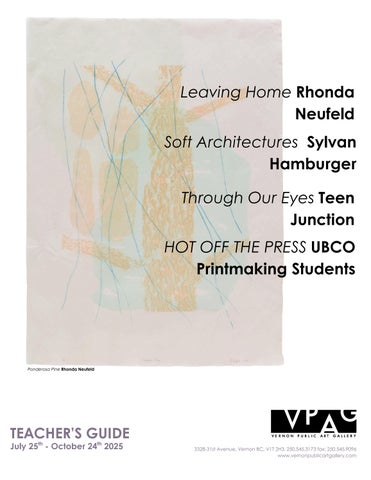
Leaving Home Rhonda Neufeld Soft Architectures Sylvan Hamburger Through Our Eyes Teen Junction HOT OFF THE PRESS UBCO Printmaking Students
Ponderosa Pine Rhonda Neufeld
TEACHER’S GUIDE
July 25th - October 24th 2025
3328-31st Avenue, Vernon BC, V1T 2H3. 250.545.3173 fax: 250.545.9096 www.vernonpublicartgallery.com
Dear Educators, Welcome, and thank you for choosing to engage with the Vernon Public Art Gallery. Our educational programs are thoughtfully designed to complement our exhibitions, promote visual literacy, and deepen understanding of contemporary art practices. This guide will help you prepare for your upcoming tour and includes post-visit activities to extend the learning experience. By engaging in the suggested activities both before and after your visit, students will be better equipped to grasp key concepts introduced during the tour, ensuring a more meaningful and connected experience that continues in the classroom. We look forward to welcoming you and your students to the Gallery. Warm regards, The Vernon Public Art Gallery Land acknowledgement The VPAG acknowledges our presence on the ancestral, and unceded tm̓ xʷúlaʔxʷ (land) of the syilx / Okanagan people who have resided here since time immemorial. We recognize, honour, and respect the syilx / Okanagan lands upon which we live, work, and play.
CONTENTS Before You Get Here 4 Intro for Exhibitions 5 From the Artist 6 Vocabulary 9 Prescribed Learning Outcomes 10 Post Visit Activities 12
BEFORE YOU GET HERE TOUR PREPARATION To maximize your students’ experience, please review the relevant vocabulary, the exhibition background, and the gallery etiquette/rules (see below). Also ask the children to wear “art appropriate” clothing. NAME TAGS To facilitate art educator-student interaction, we ask that each child wear a clearly legible nametag. It helps a lot! Thank you for having them distributed before arriving. GALLERY ETIQUETTE/RULES Please remind students that appropriate behavior is expected in the gallery at all times. It is important for all visitors to remember these rules of the gallery: Look with your eyes only. Please stay at least 12 inches away from the art. This includes works on the walls and any sculptural works on the floor. Walk, don’t run to the art. Please be respectful of the Gallery space and very careful around the artworks. Most artworks are very fragile. Quiet voices. The Gallery is a public space, please keep voices low in respect of others who work in and visit the Gallery. No food or drink is permitted in the Gallery. Be respectful of the art educator, listening carefully and responding thoughtfully. VOLUNTEER CHAPERONES Please bring 3 volunteer helpers. Please also warn them to dress “art appropriately”. To ensure that everyone enjoys their gallery experience, please pass on the following requests for Chaperones: Please turn off your cell phones. A ringing phone or a phone conversation is very distracting during the tour and workshop demonstration. PARKING – Sorry, but there is no free parking available. Paid parking is available at the parkade, or using metered parking on the street. SNACKS – Snacks are generally not permitted in the Vernon Public Art Gallery, however we are sensitive to children’s nutritional needs. Please let us know ahead of time if you require a snack break. Unfortunately we do not have a water fountain for drinking. BE A ROLE MODEL - It is important for the children to see you paying attention when the classroom teacher and art educator are speaking. Modeling good behavior by listening to and following the Gallery Rules encourages the students to do the same. EMERGENCIES In case of emergencies, the Vernon Public Art Gallery staff will provide instructions on getting out of the building safely. Once out of the building, you can assume responsibility for your students. CANCELLATION FEE We require one week’s notice of cancellation or a $35.00 fee will be charged to your school.
EXHIBITIONS Leaving Home Rhonda Neufeld
There Are Green Parrots Rhonda Neufeld
Soft Architectures Sylvan Hamburger
Sylvan Hamburger
HOT OFF THE PRESS UBCO Printmaking Students HOT OFF THE PRESS UBCO Printmaking Students
Through Our Eyes Teen Junction Flower Amy W.
FROM THE ARTIST
Rhonda Neufeld Central to my work is my relationship with the land, where I live and where I travel. I explore the relationship between the land and my body that exists literally, metaphorically and philosophically. Walking is a way of becoming aware of the intimate details of the land, whether I am following the path of a feral animal or a path of my own direction. I perceive the sounds, smells, textures, colours, changing light and contours of the land with all of my senses and this connects me with the earth and the actual ground that I stand on.
I want to get closer and more personal in my interactions with the natural world and blur the edges of where we overlap. Leaning into sun warmed, body temperature stone, as the heat radiates back into the night, is like being within the folds of another body. Leaning into the trunk of a tree with its rough skin, so like my own aging skin, I become aware of the pulse of its deeply rooted life. There is joy and wonder in all of these experiences that I want to record in the most direct way. Later in my studio as I work with my gathered materials and my art materials I extend my immersed and embodied experience of each place. The works in this exhibition, “Leaving Home”, are mainly from the place that I knew so well, that was our home(land) for forty three years, and which became the source of my subject matter over these decades. My home included the locales within my walking distance; the lake at the end of the road, the mountain above us (with so much animal life), and the rock cliffs and worked fields close by. The trees in this exhibition are the trees of home. When I make rubbings of trees and stone my hands are on my subject in a very intimate way, where we are interacting at our own life-sized scale. I transfer these rubbings to copper plates, wood blocks or lithographic stones to etch or cut the image into the surface. By printing multiple impressions from this matrix I can use this repetition to amplify an idea, as in the lithographic prints in the installation piece “Beyond the Aspen Grove”. There is also something devotional and meditative about the process of printing an edition of multiples. Printmaking has been my main means of expression for a very long time, the inherent qualities of the various methods are embedded in how I think about making art. One of the most wonderful things about printmaking, because the image prints opposite from what I see on a plate or block, is that the first impression is always a surprise. The element of chance delights me, and offers another opportunity to further respond to the developing image, extending my time with the residue of my experiences in the natural world.
FROM THE ARTIST
Sylvan Hamburger My practice is grounded in corresponding acts of public intervention and personal recollection. I employ printmaking, textiles, architecture and colour to reimagine experiences of place and self within changing contemporary landscapes. To look outside is to look inside, and vice versa. The surface of architecture, the contours of landscapes, the patterns of everyday life offer a textured impression of the city and its inhabitants— our fears, desires and tenuous states of belonging. This creative process is often collaborative and site-specific, resulting in theatrical installations that exist in reciprocity with their surroundings. Soft Architectures presents the mono-printed impressions of salvaged architectural surfaces. These prints emerged from the rapid upheaval of real estate within contemporary built environments. Over the last five years, I have worked to collect, carve and print the debris of demolished homes onto bedsheets and other found textiles. The resulting impressions trace shifting notions of place, memory and belonging to create monumental installations that reimagine residential debris as unconventional printmaking matrixes. Much of the work was initially created and presented in outdoor public spaces with participation from local residents. In representing these soft impressions at the Vernon Public Art Gallery, I look to reconsider their composition and installation within a new gallery and regional context. Much of the work was made in response to the rapid gentrification and redevelopment of my childhood community on Vancouver’s east side. As a point of conception, Soft Architectures references writer Lisa Robertson’s Office for Soft Architecture; a literary project which, in her words, “came into being as I watched the city of Vancouver dissolve in the fluid called money. Buildings disappeared into newness. I tried to recall spaces and what I remembered was surfaces.” Like Robertson, I feel a perturbed curiosity by the rate of development throughout the city. Equally, I’m fascinated by the ways in which the marks and traces of surfaces can conceal, hold and reveal histories while also reflecting absence—a phenomenon that extends far beyond the particular vernaculars of Vancouver.
EXHIBITIONS
HOT OFF THE PRESS UBCO Printmaking Students HOT OFF THE PRESS showcases a diverse selection of new work created by students in the printmaking program at UBC Okanagan. Ranging from traditional techniques such as intaglio and relief printing to experimental, mixed-media approaches, the exhibition offers a vibrant crosssection of contemporary student print practices. Selected with the guidance of UBCO professor Briar Craig and sessional lecturer Dr. Darian Goldin Stahl—who also led the courses from which these works emerged—the exhibition reflects the rigour, play, and conceptual inquiry fostered in the studio. With students at different stages in their academic and artistic journeys, the exhibition highlights both those just beginning to explore the fundamentals of printmaking and those using the medium to push the boundaries of process and form. Together, these prints speak to the evolving possibilities of printmaking as both a technical and expressive medium. HOT OFF THE PRESS celebrates the creative voices of a new generation of artists, offering insight into the thoughtful, hands-on, and critically engaged work being produced in UBCO’s dynamic printmaking studios.
Through Our Eyes Teen Junction Through Our Eyes is a community-based exhibition created by youth from the Teen Junction Youth Centre in partnership with the Vernon Public Art Gallery. This ongoing project gives voice to the lived experiences of Vernon’s youth, offering a platform for expression, representation, and connection through the arts. Teen Junction provides a safe, supportive after-school space for youth to connect, learn, and access resources when needed.
VOCABULARY Abstract: a style of art in which shapes, designs, textures and colors are represented in a way that may look unrealistic, but that emphasizes moods or feelings. Abstract art is characterized by the use of geometric lines and shapes and bright, bold colors. Contemporary: Created in the last thirty years. Most contemporary artists are living artists. Challenging traditional boundaries, many contemporary artists use a limitless range of materials and ideas to reflect, explore and comment on today’s world. Context: Circumstances influencing the creation and interpretation of a visual artwork. Context includes social, cultural, historical, and personal circumstances. Exhibition: a public display of works of art or items of interest, held in an art gallery or museum or at a trade fair. Foreground: the part of a work of art that appears to be in the front, nearest to the viewer, usually in the lower part of the picture.
Form: The visual element that pertains to an actual or implied two or three-dimensional shape of an image. Forms may be geometric or organic. Image Source: The starting point or inspiration for an artwork. Intensity: relative brightness or dullness of a color.
Materials: Refers to the substances used to make visual images (e.g., paper, paint, ink, fabric, clay, found materials). Print: a kind or artwork in which ink or paint is put onto a block (wood, linoleum, etc) which has a design carved into it. The block is then pressed onto paper to make a print (copy) of the design. Rubbing: an artwork in which a copy of a textured surface is made by rubbing the edge of a crayon, pastel or other drawing tool over a piece of paper which rest on its surface. Sculpture: the branch of the visual arts that operates in three dimensions. Symbol: something that stands for something else, especially a letter, figure or sign that represents a real object or an idea.
Space: an empty place (negative) or area in which something exists (positive).
GUIDED TOUR
PRESCRIBED LEARNING OUTCOMES The tours and hands-on activities will focus on specific prescribed learning standards, big ideas and core competencies from BC’s new curriculum in the area of Arts Education. All tours and hands-on activities at the VPAG are adapted to meet the requirements of each grade and at times will tie into other curricular areas. Examples of some of the Big Ideas, Curricular Competencies, and Content you can expect to cover in our tours are as follows:
GRADES K – 3 Big Ideas • People create art to express who they are as individuals and community • Inquiry through the arts creates opportunities for risk taking • Engagement in the arts creates opportunities for inquiry through purposeful play • Creative expression develops our unique identity and voice • The arts connect our experiences to the experiences of others • People connect to the hearts and minds of others in a variety of places and times through the arts Curricular Competencies • Create artistic works collaboratively and as an individual, using ideas inspired by imagination, inquiry, experimentation, and purposeful play • Observe, listen, describe, inquire, and predict how artists use processes, materials, movements, technologies, tools, and techniques • Describe and respond to visual art pieces • Develop processes and technical skills in a variety of art forms to nurture motivation, development, and imagination • Interpret symbols and how they can be used to express meaning through the arts Content • Elements in the Arts such as the elements of design: line, shape, texture, colour; principles of design: pattern, repetition • Processes, materials, movements, technologies, tools and techniques to support arts activities • A variety of local works of art and artistic traditions from diverse cultures and communities • Image development strategies • Traditional and contemporary Aboriginal arts and arts-making processes (when exhibition appropriate) • Symbolism as a means of expressing specific meaning
GRADES 4 – 9 Big Ideas • Artists experiment in a variety of ways to discover new possibilities • Engaging in creative expression and experiences expands people’s sense of identity and belonging • Works of art influence and are influenced by the world around us • Experiencing art is a means to develop empathy for others’ perspectives and experiences • Experiencing art challenges our point of view and expands our understanding of others • Engaging in the arts develops people’s ability to understand and express complex ideas Curricular Competencies • Intentionally select and apply materials, movements, technologies, environments, tools, and techniques by combining and arranging artistic elements, processes, and principles in art making • Demonstrate an understanding and appreciation of personal, social, cultural, historical, and environmental contexts in relation to the arts • Reflect on works of art and creative processes to understand artists’ intentions • Interpret works of art using knowledge and skills from various areas of learning • Examine relationships between the arts and the wider world • Express, feelings, ideas, and experiences through the arts • Explore connections to identity, place, culture, and belonging through creative expression • Observe, listen, describe, inquire and predict how artists (dancers, actors, musicians, and visual artists) use processes, materials, movements, technologies, tools, techniques, and environments to create and communicate Content • Visual arts: elements of design: line, shape, space, texture, colour, form, value; principles of design: balance, pattern, repetition, contrast, emphasis, rhythm, unity, harmony, variety, proportion • Processes, materials, technologies, tools and techniques to support creative works • Traditional and contemporary Aboriginal arts and arts-making processes (when exhibition appropriate) • A variety of regional and national works of art and artistic traditions from diverse cultures, communities, times, and places • Manipulation of elements and principles to create meaning in the arts • Symbolism and metaphor to explore ideas and perspective
GRADES 10-12 For more information on prescribed learning outcomes for grades 10,11, and 12, please reach out to our Education Coordinator at Education@vernonpublicartgallery.com or reach out to education board for SD22.
WHO ARE THE ARTISTS? POST-TOUR ACTIVITY OBJECTIVE Students are encouraged to think deeply and critically about the artwork they experienced on the gallery tour. PROCESS Grades K -3 To adapt this activity for the primary grades sit around in a circle and discuss as a class: What did the students think about the artwork they saw? Did the artwork bring Did it remind them of anything in their lives? Can the students remember any of the titles of the artwork they saw? What material(s) were used? Grades 4-12 Divide the class into small groups. Give each group one of the categories from the Artist Information Sheet (p. 15), and ask them to consider what they need to find out in order to complete their section. Have students conduct research using the internet, either at home or at school. Ask each group to find and describe a piece of work by the artist and add it to the space provided on the worksheet. Have each group present their information while the rest of the students fill in their worksheets. CONCLUSION Discuss the following: What were some of the most interesting things that students learned or discovered? Which works are students curious to see in the exhibitions? Are there any artists, ways of working or ideas that the students would like to know more about?
GRADES 4-12 | WHO ARE THE ARTISTS? PRE-TOUR ACTIVITY STUDENT WORKSHEET
(FILL IN THE CHART WITH THE FOLLOWING)
Exhibition
tell me about them
fun fact
known for
name an artwork
Emergence
Nicola Tibbetts