Williston Observer 2/26/2026

Page 1


In search of forever homes

Families push to change the way Vermont cares for adults with developmental disabilities

For Donna Savage and other parents of Vermont’s young adults with developmental disabilities, the day-to-day challenges of helping their kids find their way in the adult world after so many years in the care of public schools can be overwhelming. Yet they are also finding the time and summoning the energy to promote a novel idea for the state: a group living model where adults with disabilities can live together as peers supported by professional caregiving staff.

The families have formed a Developmental Disabilities Housing Initiative (DDHI). It consists of about 175 families whose collective voice has been growing stronger in the halls of the Statehouse. Members have tabled at the Statehouse weekly during the legislative session and hosted an annual ice cream social, where lawmakers meet and mingle with some of the estimated 600 adults with developmental disabilities for whom parents are seeking new housing solutions.

“I just no longer want to wake up in the middle of the night and think ‘what is going to happen to him when I’m not here,’” Savage said of her son, Jack. “We are motivated to make change happen. We need to know our kids are going to be OK.”

Jack Savage was part of the CVU High School community

IT TAKES A VILLAGE

McQuiston and Savage live in the same Williston neighborhood and help lead a Chittenden County subgroup of the DDHI. McQuiston is a member of the Williston Housing Committee. They are always on the lookout for property that could be the site of a service supported group home, either through new construction or a retrofit of an existing building.

“We’ve been reaching out to the various developers, and they’ve been supportive but have not necessarily had something to (offer),” McQuiston said.

Their ideal would be to find a setting in Williston, near the commercial center of Taft Corners, for developmentally disabled people who come through the Champlain Valley School District to settle into as adults.

until age 22. He turns 25 this March. To Donna, his graduation three years ago felt like the edge of a cliff.

“It was all that community — all the kids and having friends and aides at school and getting out and doing things — and it just ended,” she said.

Jack needs around-the-clock support with what caregivers call “activities of daily living.” He spends 13 hours a week with a visiting staff member from the Howard Center and works at a grocery store for one hour a week. Donna has cut back on her work hours to fill in the gaps.

“He is home a lot,” she said.

“His options are limited.”

CULTIVATING STATE SUPPORT

The DDHI group began to make headway with the Legislature in 2021. By 2022, they had won the

passage of Act 186, which set in motion three pilot projects to model the service supported group housing concept. The Riverflow Community opened with several rooms in Monkton in 2024, a 10room home in Burlington is nearing completion and a smaller project in a Randolph farmhouse is in the works.

It’s a small fraction of the need and has not slowed the DDHI group’s advocacy efforts. They continue to lobby for state support in the form of housing staff in the Agency of Human Services, housing vouchers and the empaneling of an advisory committee to ensure follow through on future projects.

“I feel like we’re finally getting the Legislature to be very aware of (the issue),” Savage said. “We have the state’s attention now, but it’s a battle.”

Aside from living with parents,

the only other option for Vermont adults with developmental disabilities has been a foster care model.

Foster families receive compensation from the state for providing living space and care in their homes. It’s an arrangement that is inherently unstable and hard for the state to oversee.

“If you are in foster care, and the person decides they don’t want to do it anymore, it’s over,” said Marla McQuiston, a mother of a 28-year-old CVU graduate with Down syndrome. “Moving is very destabilizing.”

Savage describes the foster care model as “being a stranger in a series of people’s homes.”

“It’s working for some, but for someone with higher needs, it doesn’t work well. It’s almost kind of cruel,” she said. “The state needs to do better … Our kids deserve forever homes.”

“Our kids have grown up here all the way from elementary, to middle school, to high school,” said Savage. “They know each other, and people in the community know them. It would be very nice if they could stay in their community.”

The Williston subgroup has reached out to the Williston Selectboard and has ongoing conversations with the Champlain Housing Trust to identify possible parcels.

“If you might have land to donate for a wonderful cause, we have one,” they wrote in an appeal to landowners. “We are wondering if there is some land suitable for building that might be donated or offered at a discounted price to build a residence in Williston … This is one of those efforts that takes a village!”

Email McQuiston with any leads at: marlamcq@yahoo.com.

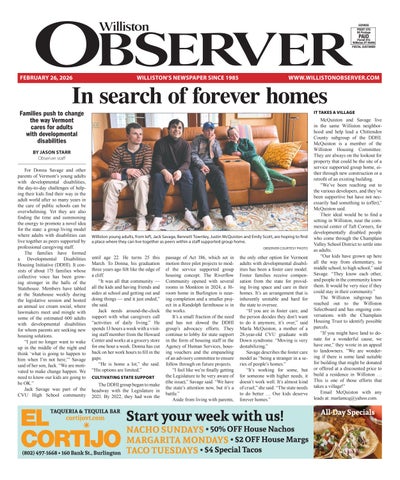
Williston young adults, from left, Jack Savage, Bennett Townley, Justin McQuiston and Emily Scott, are hoping to find a place where they can live together as peers within a staff supported group home.
OBSERVER COURTESY PHOTO

Around Town

Virtual pet loss support group convenes Mar. 3

Losing a beloved pet is one of life’s most difficult experiences. Williston-based BEVS sponsors a free support group to provide a welcoming environment where people can share feelings, honor their pet’s memory and connect with others who understand their loss.

The group is led by Shannon Lucy, LISCW, who holds a master’s degree in social work from the University of North Dakota. She strives to create a nonjudgmental environment where participants can

share openly, feel understood and begin healing. The group meets on the first Tuesday of each month from 7-8 p.m. Contact petloss@bevsvt. com to obtain the Zoom link.

Bring cereal when you vote Tuesday

The Williston Community Food Shelf will be holding a cereal drive at the polls on Town Meeting Day. Cereal donations may be dropped off at the National Guard Armory during voting from 7 a.m.-7 p.m. on Tuesday, Mar. 3. The food shelf hopes to collect 500 boxes.

Aging in place…

Safely!

Are you currently functioning independently in your home? Paula Smith and Scott Bushweller, long-timeVermonters and physical therapists, want you to remain active and live in your home safely for the long term...

• In-Home Age-Appropriate Fitness Screening

• Fall Prevention Education

• Develop Physical Activity Plan

• Community Resource Opportunities

• Financial Scam Education

COMMUNITY CALENDAR

EMAIL EVENT LISTINGS TO EDITOR@WILLISTONOBSERVER.COM

SATURDAY, FEB. 28

Wellness and ailment prevention session. Tips to prevent and overcome health problems and reduce stress. 2:303:30 p.m. Dorothy Alling Memorial Library. Presented by Janet Smith, Vermont TM Center. Register by emailing jsmith@tm.org or call/text (802) 923-6782.

MONDAY, MARCH 2

Champlain Valley School District Annual Meeting. 5 p.m. CVU High School.

Annual Town Meeting. 7 p.m. Williston Central School.

TUESDAY, MARCH 3

Town Meeting Day. 7 a.m.-7 p.m. Voting at the National Guard Armory on Williston Road.

Visit our website to learn more: OneStepAheadAtHome. clientsecure.me

Paula Smith and Scott Bushweller Longtime Vermonters and physical therapists Accepting New Clients Call today! (802) 922-4642

scottbushweller@gmail.com | 802-922-4642 | Williston

Virtual Pet Loss Support Group. Led by Shannon Lucy, LISCW. 7-8 p.m. Visit https://bevsvt.com/pet-losssupport-group/ for information.

THURSDAY, MARCH 5

SBA Vermont District Office Open House. Meet the new staff at SBA Vermont. 8 a.m.-4:30 p.m. 400 Cornerstone Drive, Williston. Williston-Richmond Rotary Club breakfast meeting.

Speaker David Rose, Rose Computer Technology Services. 7:15 a.m. Williston Federated Church. RSVP to RotaryClubofWillistonVTgmail.com.

FRIDAY, MAR. 13

American Red Cross blood drive at CVU. Champlain Valley Union High School Main Gym, Hinesburg. 8 a.m.-2 p.m. To make an appointment, go to redcrossblood. org and search by zip code or call 800-733-2767.

Cereal donations will be collected at the National Guard Armory in Williston during Town Meeting Day voting from 7 a.m.-7 p.m., Tuesday, Mar. 3. CONTRIBUTED PHOTO

Town seeking partners for Williston Green Fair

The Town of Williston has announced the Williston Green Fair, taking place on Saturday, May 2. The community event encourages participation in Vermont’s Green Up Day tradition while offering hands-on education and resources focused on energy resilience.

This year’s Williston Green Fair combines the 5th Annual Town Fair on Green Up Day with the Williston Energy Fair that has previously taken place in the fall. The format will be similar to past Town Fairs, but with even more vendor partners and interactive activities. Community members are invited stop by before and after greening up Williston’s roadsides.

Williston businesses and organizations are invited to submit applications to participate. The

What: Williston Green Fair

Event Partners Application Form is now live, with a submission deadline of Monday, March 30 at 9 a.m. There are many ways and no fees to participate. Read the form to learn more and submit your ideas.

Questions can be directed to Williston Senior Planner Emily Heymann at eheymann@ willistonvt.org or 802-878-6704.

When: Saturday, May 2 | 9 a.m.–12 p.m.

Where: Village Green, 40 Central School Drive

Police Chief Foley to retire

Williston’s Police Chief Patrick T. Foley, who has led the town’s police department for over eight years, has announced he will retire this July.

“After careful thought, reflection and discussion with my wife and family, I have come to the decision that after many, many years of public service in a long career in law enforcement, now is the appropriate time for me to retire,” Chief Foley said. “I wish nothing but the best for the Town of Williston and the Williston Police Department.”

Foley began as Williston’s police chief in October 2017. He will retire in his 50th year in law enforcement and 40th as a chief. He previously served as chief of the Windsor, Vt. and Douglas, Mass. police departments. He began his career working for the City of Burlington as a patrol officer and served as a special agent for the Federal Drug Enforcement Administration during the 1980s.

In a press release, the town noted that Chief Foley led the Williston Police Department

through the COVID-19 pandemic and has been instrumental in shaping the future of the department as the community continues to grow and the demand for services continues to increase.

“Chief Foley is often on scene to assist with anything needed for the Town’s public safety response, from operational management to directing traffic or starting CPR on a patient in advance of the Fire

Department’s arrival. On most days he is at the station starting at 4 a.m. to check in on the night shift and review what is happening statewide,” the town’s release noted.

“I want to thank Chief Foley for his many years of dedicated service to the community of Williston,” said Town Manager Erik Wells. “The position of Chief of Police is a 24/7/365 role for a community, and Chief Foley has exemplified professionalism and community policing throughout his tenure leading our department. I wish him well in his retirement as he concludes an exceptional career in law enforcement.”

The Town has contracted with J.W. Leadership Consulting to lead the national search for Chief Foley’s replacement. The firm recently completed hiring processes for police chiefs in South Burlington, Hinesburg and Stowe. The town’s goal is to have a new chief join the department in July prior to Chief Foley’s retirement. —Observer staff

Police Chief Foley

GREEN

Essay challenge for Vermont’s 4th, 5th, and 6th graders

Attorney General Clark announces Sixth Annual Earth Day Essay Challenge

Attorney General Charity Clark wants to hear young Vermonters’ thoughts on the environment. For the sixth year in a row, the Attorney General’s Office is holding an Earth Day Essay Challenge for Vermont students.

“I look forward to this essay challenge every year. These essays provide hope for the future and make me especially proud of our state,” Attorney General Clark said. “It’s inspiring to see the ideas, passion, creativity, and research that the students provide in their essays. I also really

appreciate the teachers who inspire and support these students in their work.”

The Earth Day Essay Challenge is open to any fourth-, fifth-, or sixth-grade student in Vermont, including home-schooled students. The challenge will run from

now until April 17, 2026.

Students can submit other types of writing instead of an essay if they would like—for example, a story, poem, or biographical piece about someone.

Ideas for topics include things like: What do you love about

Vermont’s environment? How do you enjoy Vermont’s environment?

What do you care most about and what does Earth Day mean to you?

What are your concerns about the future of Vermont’s environment? What do you think we should do to help protect the environment?

Participants do not need to cover all these topics—these are just ideas.

All submissions will be posted on the Attorney General Office’s website for Earth Day (April 22) 2026. Posted essays will include a participant’s first name and school. Please indicate with your submission if you prefer that your essay not be posted.

Participants will receive a note about their essay from a member of the Attorney

General’s Office and will be entered in a drawing to have Attorney General Clark speak with their classroom after the essay challenge is over. Members of the Environmental Protection Unit are also available to speak with participating classes about the environmental work of the Attorney General’s Office during the essay submission period.

For more information on the Attorney General’s Earth Day Essay Challenge, including how to submit your essay, please see the Earth Day Essay Challenge webpage, ago. vermont.gov/attorney-generalsoffice-divisions-and-units/ environmental-protection-unit/ earth-day-essay-challenge.

Kids who are passionate about Vermont’s environment are encouraged to share their views in this year’s Earth Day Essay Challenge. CONTRIBUTED PHOTO

GREEN

For the birds — and so much more

The quiet impact of Vermont’s Nongame Fund

Rosalind Renfrew works at the Vermont Fish & Wildlife Department as the Wildlife Diversity Program manager. In this role, she helps oversee the conservation and management of Vermont’s full range of native biodiversity, from Vermont’s state mushroom, the bear head tooth to the hermit thrush, the state bird. The good news: Vermont residents can help by checking a donation box on their state tax forms to support conservation through Vermont’s Nongame Wildlife Fund. In this conversation, Renfrew talks about why public contributions matter and why protecting species before they become endangered is more important than ever.

Q. What is the Nongame Wildlife Fund?

A. The nongame fund is an initiative to generate private donations, mostly through the state income tax form checkoff option

but also through license plate funds. The private fundraising we do helps support our wildlife diversity program. It deals with all the plants, herbaceous plants in the state, and also all the animal species that are not hunted or fished, so that’s the vast majority of species.

Q. Where is the money from the fund and the tax checkoff going?

Most of the non-game checkoff funds go towards the work that this wildlife diversity program does and a lot of our funding also comes from federal dollars. The non-game fund dollars match those federal dollars. We literally can’t spend the federal funds without that match. The other piece that I think is equally important is just the engagement of people in our care for wildlife and plants. And so you know, that’s a way that people can contribute. We have an annual newsletter that we send out. You don’t have to contribute to receive it. So that helps keep people in touch with what we have been up to for the past year and what your funds have gone towards.

Q. Since the Trump administration’s defunding of certain programs, is this program more vital to Vermont biodiversity than in previous years?

A. Federal funding for this

program began in 2002. We started developing wildlife action plans in 2005. Those are required to receive this federal funding. It’s this particular funding source called the State Wildlife Grants, and this funding was one of the many, many funds that were put on the chopping block and zero-funded by the administration. Fortunately, both the House and Senate Appropriations Committees did not go along

with the recommendation from the administration, and they have maintained funding so far for the program. So we’re really pleased about that. It’s always had bipartisan support and even in this time when that’s rare, it still received that bipartisan support. So yay! It’s like a little shining light and we hope that will continue.

Q. Why should Vermonters care about this fund?

A. This program is really

dealing with the leading edge of biodiversity loss. And I know that in Vermont, a lot of people are here because of what the state offers in terms of ecosystems and outdoor experiences. So it seems to me it’s consistent with the values here and the priorities of the state. I think people here really value having that experience to pass along to future generations, and I think they value species just for their innate value and inherent value.

Q. What does this fund mean for preventing biodiversity loss?

A. We’re dealing with the species that are in trouble, usually. A lot of our efforts deal with all the listed species, the endangered and threatened species. But we’re also really focused on preventing species from ever becoming so rare that they have to be listed. And it’s been shown in a lot of research that it’s much less expensive to save wildlife before it’s on the brink. So we’re always trying to do all of it and it’s all connected.

Vermont residents can learn more and contribute to the Nongame Wildlife Fund at www. vtfishandwildlife.com/supportthe-nongame-wildlife-fund.

The Community News Service is a University of Vermont journalism program.

Rosalind Renfrew
A female bobolink.
PHOTO COURTESY OF ALLAN STRONG

As expected, it’s been a particularly busy and intense session so far in Montpelier. We remain committed to making progress on Vermont’s interrelated

Notes from the Legislature

affordability challenges including a dire housing shortage, the highest healthcare costs in the nation and unsustainable increases in property taxes due to our education funding system, while at the same time attempting to mitigate the harm caused by decisions

made at the federal level.

One of the most immediate concerns on the federal front is the deadly immigration enforcement actions of some federal agents. We stand with so many in our community who denounce and call for an end to these unlawful actions. It is painful to know that ICE surveillance activities are taking place right here in Williston.

Community Newspaper Since 1985

www.willistonobserver.com P.O. Box 1401, Williston, VT 05495 | 802-489-5499

ADVERTISING

Rick Cote, Associate Publisher rick@willistonobserver.com 802-373-2136

EDITOR

Jason Starr editor@willistonobserver.com

PRODUCTION & DESIGN

Jan Kenney

jan@willistonobserver.com

PUBLISHER

Susan T. Cote susan@willistonobserver.com

BILLING INQUIRIES

Michael McCaffrey office@willistonobserver.com

ADVERTISING SPACE DEADLINE

Friday at 5 p.m. for the next Thursday issue rick@willistonobserver.com, 802-373-2136

CLASSIFIED ADS

Deadline is Friday 5 p.m. There is a fee for business, real estate, help wanted and legal ads. Free classifieds must be 25 words or fewer and are printed on a space available basis.

SUBMISSIONS & LETTERS

Deadline is Monday noon for Thursday issue. News/ story tips are welcomed. Letters to the Editor should be 300 words or fewer and include your name, address and a daytime phone number so that we can verify the letter’s author.

The Williston Observer reserves the right to edit or refuse submissions or advertising. Opinions expressed in the paper are those of the writer and do not necessarily reflect the opinion of the paper.

publication of Twin Ponds Publishing LLC

Two bills that passed the Senate recently, S. 208 and S.209, are currently being considered by the House Committee on Judiciary, where Rep. Arsenault serves. S.208 would establish minimum identification requirements and prohibit most mask-wearing for all law enforcement officers in Vermont. S.209 would expand the list of places in which no civil arrest may be made. Current law prohibits such arrests in a courthouse, and the bill proposes to extend protections to schools, summer camps, places of worship, health care facilities, polling places and social services facilities (such as domestic violence shelters and substance use treatment centers). Discussion continues on both of these bills – which we support – and we expect passage soon after the mid-March crossover week.

The Committee also began work on a bill that would create a state statute that allows people to bring a civil suit against a federal, state, or local official who violates a person’s constitutional rights. Current federal law only grants this cause of action in cases involving state or local officials, not federal officials. H.849 would create a pathway for Vermonters to seek damages or injunctive relief against federal officials, as well.

We’ve heard from folks all over the state who would like to see a bill passed that would require Vermont to create a program through which any person detained in Vermont for federal immigration enforcement purposes would be provided with legal counsel (H.742). Though there is a real need for this type of program, it is likely cost prohibitive in our current budget climate, and there is uncertainty as to which state entity could take on the work. House Judiciary will most likely take a closer look at this proposal after crossover, as well.

Last year, Vermont took a major step forward in addressing our housing shortage by creating the Community and Housing

Infrastructure Program (CHIP) as part of Act 181. This program allows communities to use future property tax revenue from new housing developments to pay for the infrastructure those homes need today (especially wastewater). By solving the upfront infrastructure funding challenge that stops many housing projects before they start, CHIP could unlock thousands of new homes across Vermont. We are watching the implementation closely and anticipate there may be some changes to the legislation to ensure we are truly working towards our state’s housing goals.

The House and Senate Education Committees have continued to deliberate on the implementation of last year’s sweeping education reform law, Act 73. There exist significant disagreements about the thorniest issues in our system including the role of private schools that use public education dollars but operate under different rules and governance structures, the ongoing challenge of declining enrollment and how best (if at all) to “right size” our schools and system, and the pressure that increases in health care see LEGISLATURE page 7

costs put on our education fund that will not be resolved by any education policy or systems changes.

Although we opposed the final version of Act 73 last session, we know we are likely on the precipice of major educational change in Vermont, and we have to get it right. There is a great deal of focus on new district maps, which provide an easy-to-understand visual of the potential change ahead, but they offer no details about the potentially enormous changes created by the shift to a foundation formula. To that end, Rep. Brady, who serves on the House Education Committee, and Rep. Bridget Burkhardt (CH-8) introduced a bill last week in the House Ways and Means Committee to focus on the need for a cost of labor adjustment mechanism in any foundation formula that may be established as a result of Act 73.

A core purpose of Act 73 is to expand and strengthen educational opportunities for students and just last week the Governor emphasized that goal in his public statement. We certainly hope Vermont’s path to closing the “opportunity gap” is not to level down opportunities. A funding formula that does not adequately reflect regional cost realities will penalize districts that have already consolidated, operate at scale, and have already made deep reductions to deliver responsible budgets. Many of the largest districts, including CVSD, that operate class and school sizes at or above the goals outlined in Act 73 will have no choice but to reduce opportunities for students. The most consequential education reform of a generation must deliver benefits for all Vermonters. We will not waver in our support for our school district and a strong public education system that supports all students.

Lastly, we want to address a topic that’s been raised and debated recently on Williston‘s Front Porch Forum: the potential tax on second homes and general discussion of tax policies and the values they reflect. The economic divide that has been growing for decades and affordability are understandably top of mind for many today.

According to a recent editorial in the Wall Street Journal (Greg Ip, 2/9/26), “Profits have soared since the pandemic, and the market value attached to those profits even more. The result: Capital, which includes businesses, shareholders and superstar employees, is triumphant, while the average worker ekes out marginal gains.”

The American economy is fundamentally tilted in favor of those already at the top and we must make efforts to address this in Vermont where possible. Development of a new non-homestead property class for second homes is part of the tax policy that passed with Act 73. The Tax Department is currently working on plans to implement this change. It is clear that seasonal properties (like hunting camps) will not be treated as second homes and there will also be changes to protect renters from bearing the cost of increased tax rates. We welcome anyone with questions on this, and any other topic, to reach out to us for the facts.

There are also a few proposals floating around the state house that contemplate a higher marginal tax rate on income over a certain amount, let’s say $1 million. We support this idea in theory because we know that, due to the passage of H.R.1 (One Big ‘Beautiful’ Bill Act), the top 1% of Vermont income-earners are set to receive an average federal tax cut of $57,000 per filer in 2026. At the same time, too many Vermonters are struggling to make ends meet, and reduced federal funding for programs on which Vermonters rely is putting additional pressure on Vermont families and our state budget. Now more than ever, it’s time for the wealthiest Vermonters to pay their fair share of taxes.

We invite you to join our next Community Conversation at the Dorothy Alling Memorial Library on Wednesday, Mar. 4 at 6 p.m. There’s a lot to talk about! If you can’t make it then, you can always reach us by email: erin.brady@vtleg.gov and angela.arsenault@vtleg.gov.

Erin Brady and Angela Arsenault represent Williston in the Vermont House of Representatives.

OFFICIAL TOWN WARNING TOWN OF WILLISTON

MARCH 2 & 3, 2026

Please note the starting time

Town Meeting Activities (March 2, 2026)

7:00 PM Official Town Meeting

Following Official Meeting:

- Town Australian Ballot Articles Public Information Hearing

- School Budget Presentation

The legal voters of the Town of Williston are hereby warned and notified to meet at the Williston Central School Auditorium in Williston, Vermont at 7:00 PM on Monday, March 2, 2026, for the Annual Town Meeting. Following the meeting, the Articles to be voted by Australian ballot will be reviewed during a public information hearing and there will be an opportunity for questions and comments.

Article 1: To elect a Moderator

Article 2: Shall the voters authorize that current taxes be paid to the Town Treasurer in three equal installments with due dates of August 18, November 16 and February 16 as authorized by 32 V.S.A. § 4871?

Article 3: Shall the voters of the Town of Williston accept the reports of the Town Officials as presented in the Town Report?

Article 4: To transact any other business to be brought before said meeting.

The legal voters of the Town of Williston are hereby further warned and notified to meet on Tuesday, March 3, 2026, at Vermont Army National Guard Armory located at 7846 Williston Road beginning at 7:00 AM, at which time the polls will open, until 7:00 PM, at which time the polls will close, to vote by Australian ballot upon the following articles:

Article 5: Shall the voters authorize General Fund Expenditures of $17,015,375 of which $9,010,000 shall be raised by taxes, for the year beginning July 1, 2026, and ending June 30, 2027?

Article 6: Shall the voters authorize renovation and expansion of the Dorothy Alling Memorial Library and associated improvements to the Village Green and the issuance of general obligation bonds or notes of the Town in an amount not to exceed Thirteen Million Nine Hundred Thousand and 00/100 Dollars ($13,900,000.00), subject to reduction by grants-in-aid and funds then available to the Town, to pay the capital costs and related other costs of the project?

Article 7: Shall the Town of Williston establish a reserve fund (which may be initially funded at some later date) to be used solely for the initial and recurrent training, certification, and recertification of emergency medical technicians, including, but not limited to, advanced emergency medical technicians, paramedics, and mobile integrated health care providers employed by the Williston Fire Department?

Article 8: Shall a tax of one half of one cent continue to be assessed on the grand list with the proceeds (estimated to be $110,000) to be deposited into the Town’s Environmental Reserve Fund for the purpose of permanent preservation and protection of open space areas and public lands within the Town of Williston?

Article 9: Shall the voters elect to the Selectboard one member for a term of two years beginning March, 2026?

Article 10: Shall the voters elect to the Selectboard one member for a term of three years beginning March, 2026?

Article 11: Shall the voters elect the office of Town Clerk for a term of three years beginning March, 2026?

Article 12: Shall the voters elect to the Board of Listers one member for a term of three years beginning March, 2026?

Article 13: Shall the voters elect to the Board of Listers one member for two years remaining on an unexpired three-year term that began in March, 2025?

Article 14: Shall the voters elect a representative to the Champlain Water District for a term of three years beginning March, 2026?

Article 15: Shall the voters elect to the Library Board of Trustees one member for a term of five years beginning March, 2026?

Article 16: Shall the voters elect to the Champlain Valley School District Board one director for a term of three years beginning March, 2026?

Article 17: Shall the town employ or contract a professionally qualified assessor and eliminate the office of elected lister by deleting the title and all of the present text in Section 14(c)(3) of the Charter of the Town of Williston and replacing them with the following underlined text?

§ 156-14. Local elected officials

(c) Elected officers; duties, responsibilities, and conduct

(3) Assessment of Propert y

(A) The Town shall employ or contract with a professionally qualified assessor who meets, prior to conducting any assessment work for the Town, the training requirements established by the Director of Property Valuation and Review under 32 V.S.A. § 4052 (as amended from time to time).

(B) The professionally qualified assessor hired or appointed in (A) above shall have the same powers, discharge the same duties, proceed in the discharge of those duties in the same manner, and be subject to the same liabilities as are prescribed for listers or the board of listers under the provisions of Title 32, Vermont Statutes Annotated.

(C) The term of office of any lister in office on the date the Town votes to eliminate the office of listers shall expire on the 45th day after the vote or the date upon which an assessor is hired or appointed pursuant to (A) above, whichever last occurs.

Copies of the complete Charter amendment proposal are on file for public inspection in the office of the Williston Town Clerk at the Town Offices and copies thereof shall be made available to members of the public upon request.

HOW TO REGISTER TO VOTE: There is no deadline to register to vote. You will be able to register to vote on the day of the election. You can register prior by visiting the Town Clerk’s Office or going online to vote.vermont.gov

REQUEST EARLY or ABSENTEE BALLOTS: You or a family member can request early or absentee ballots from the Town Clerk at any time during the year of the election at the Town Clerk’s Office in person, in writing, by telephone, email, or online at vote.vermont.gov

Dated this 20th day of January 2026.

Time to confront ICE and Border Patrol abuse

I’ve spent the past twenty years advocating for immigrants’ rights and a humane immigration system, in California, Arizona and Vermont, most of that time with the ACLU. Looking back at the past year of escalating, violent attacks by immigration agents on American communities and in ICE detention centers, I share the anger and revulsion felt by so many people across the country and here in Vermont.

I’m also feeling deep frustration over the sheer predictability of it all — because what we are witnessing is in many ways nothing new. Experience has also taught me to be skeptical that our elected representatives will pursue meaningful solutions, at least absent sustained public pressure.

At the same time, I’m also finding inspiration, and some hope, in the way that our communities are responding to this moment, and in the growing recognition that ICE and Border Patrol cannot be reformed.

Looking back, I started my career providing legal services

to people in detention centers in southern California. I represented asylum seekers and unaccompanied children, and my clients routinely reported verbal and physical abuse by Border Patrol agents — something that had been well-documented for decades.

A few years later, as an ACLU staff attorney in Tucson, I represented the family of Jose Antonio Elena Rodriguez, who was killed when Border Patrol agent Lonnie Swartz fired his weapon from the U.S. side of the border wall into Nogales, Mexico. Jose Antonio was sixteen, unarmed, and posed no threat to anyone at the time of his death.

In southern Arizona, I met many more people impacted by Border Patrol violence — communities surrounded by interior checkpoints, where agents would interrogate, threaten, and assault local residents. Many of these attacks occurred far from any border. Meanwhile, the systemic abuse of children and families in Border Patrol and ICE custody continued unabated.

All of this happened long before Donald Trump, during the

Obama administration.

Almost as galling as Border Patrol’s culture of impunity is the indifference with which it has been met in the halls of power. I gave my first Congressional testimony on Border Patrol abuse in 2013, reporting many of the very same tactics now being deployed on city streets from Chicago to Minneapolis and beyond — as Vermont journalist Garret Graff recently did for Illinois Governor Pritzker’s “Accountability Commission.”

My own testimony was met with polite nods but no further action. Unfortunately, that has been the response of so many policymakers charged with agency oversight, both Democrats and Republicans, for decades.

Rather than rein in these agencies, lawmakers have increased funding for their abuses, year after year. Before last year, ICE and CBP budgets had tripled over the prior two decades — ICE’s budget hit $9.6 billion in 2024, CBP’s was $19.6 billion — with bipartisan support.

The last immigration “reform” proposal to gain momentum under the Biden administration included harsh

restrictions on asylum and $20 billion in funding for thousands more agents and tens of thousands of detention beds — again, it had strong, bipartisan support.

Then came the One Big Beautiful Bill Act (OBBBA). Over the next four years, taxpayers struggling to afford housing and healthcare will spend $170 billion on immigration agencies that are now actively recruiting right-wing extremists to their ranks.

And yet, despite all of that, I have some optimism that we may be approaching a turning point — that too many people have finally seen not only what these agencies are capable of, but what they fundamentally are.

A significant majority of Americans — 62% — now believe immigration agents are making our communities less safe, an astounding number. One of the most remarkable things about this moment is how many people can plainly see that these agencies are simply beyond reform.

The question, now, is really what can we do about it?

Vermont’s Congressional delegation deserves credit for opposing more DHS funding in the

latest budget fight. Democrats and some Republicans backed Bernie Sanders’ proposal to repeal $75 billion in ICE funding to undo the recent, obscene cuts to Medicaid. That effort fell short, but it’s a start.

In the short term, we can unfortunately expect Congressional leaders to continue talking about the kinds of minimal reforms that won’t change a fundamentally toxic agency culture. Congress has essentially created a police reform problem from hell—the fact is, there is no real way to fix what law enforcement leaders openly refer to as “the Green Monster.” Body cameras and additional training mean little if an agency believes, essentially, that it is above the law and can do whatever it wants.

Ultimately, the only way to rein in ICE and Border Patrol and to address the threat they pose is to cut their funding and start over, from scratch, with something else. For that to happen, our elected representatives need to keep hearing from us.

James Duff Lyall is the executive director at the ACLU of Vermont.

Bill would establish ‘Vermont Libraries Day’ in October

S.232 also aims to help libraries gain access to funding

Sen. Ruth Hardy, D-Addison, is a self-proclaimed “huge fan of libraries.” She hopes S.232, the third public libraries bill she has sponsored, would help them make incremental improvements.

The bill would clarify what program funding public libraries are eligible for and name the third Monday in October “Vermont Libraries Day.”

“(Libraries) are really important institutions of gathering and knowledge and support for our towns, especially people in really rural places,” Hardy said in an interview with Community News Service. “Often, the library is the only resource in the entire town.”

Hardy said Vermont Libraries Day would be an opportunity for libraries to have simultaneous programming, events and speakers to promote and celebrate their spaces.

S.232 would also allocate a portion of the state’s sales tax on cannabis to public library programs. Margaret Woodruff, director of the Charlotte Public Library and chair of the Vermont Libraries Association’s government relations committee, said librarians are looking for help – mostly in the form of money.

“Many Vermont libraries face huge capital needs to offer spaces that are safe and accessible to everybody who wants to come there,” she said, citing state data showing that library buildings have $260 million of deferred maintenance.

Woodruff cited her own library as an example of what proper funding could do. After receiving funding from the Vermont Bond Bank, which provides loans for construction projects, the space underwent a metamorphosis.

“We completed a much-needed expansion renovation project in 2020 that has transformed our space into a community hub,” she said. “Story times, cooking lessons, book discussions, health consultations.”

S.232 would enable libraries to receive guidance from the Vermont Bond Bank about municipal bonds they are eligible for, a step that Hardy said is important.

Afterschool and summer programs are integral to children’s literacy and overall development, according to Hardy, and municipal bonds can help libraries build new space to accommodate them.

Hardy said the passage of S.232 would not result in new taxes or appropriations.

Because the bill has eight additional sponsors and support from librarians across the state, Hardy said she has high hopes that S.232 will pass.

young kids learn how to read, and this bill helps to further that goal,” she said.

programs throughout Vermont.

“Public libraries have a really important role to play to help

believes is important now more than ever.

Suzanne Krohn, director of Richmond Free Library, said library directors around the state have been briefed on the bill and what it could mean for them, sparking conversations about Vermont Library Day and future

Already, her library is involved in programming that goes beyond reading, like crafting events, collaborations with the local senior center, flood resilience education and mahjong.

S.232 aims to protect one of the last remaining third spaces in Vermont, a concept that Krohn

“We are really one of the last places people can exist in public for free,” she said. “You don’t have to buy a coffee to hang out here.”

Community News Service is a University of Vermont journalism internship.

Children try Lego robotics at Charlotte Public Library
PHOTO COURTESY OF MARGARET WOODRUFF

Faith Climate Action Day shortens the distance between science and religion at the State House

After almost six years of lobbying, faith-based activists have added a new piece to their annual tradition.

As the sun began to set over Montpelier on Thursday evening, the verses of “We Shall Overcome” echoed across the State House lawn. The song was paired with hymns, moments of prayer and speeches from members of Vermont religious groups who believe their faith is a key force in climate change advocacy.

This was the scene at the

first-ever Earth Vigil, the coda to Faith Climate Action Day. The annual event drew about 20 people to Montpelier to learn about climate-based policy and engage directly with lawmakers.

Vermont Interfaith Power and Light (VTIPL), a faith-based organization that educates different religious communities on environmental stewardship, has been hosting Faith Climate Action Day since 2020.

The organization partnered with other groups, such as Vermont Interfaith Action, VPIRG, 350Vermont and the Vermont Natural Resources Council, to host poster making and legislative information sessions. VTIPL also put written letters from their members

in legislators’ mailboxes.

Melissa Battah, executive director of the advocacy group Vermont Interfaith Action shared that these faith groups believe their traditions and values have a place to ignite Vermont policy.

“We are a unique group with a unique voice,” said Ron McGarvey, the president of Vermont Interfaith Power and Light, who followed her.

Woodbury resident Alissa Klar, a member of the Jewish Community of Greater Stowe synagogue, said legislators regularly hear from oil companies and environmental groups. Faith-based groups have another perspective, she said.

“I think the concept of, ‘We don’t own the planet. We’re just here to preserve it for the future…’ crosses

through every religion,” she said in an interview with Community News Service. “It’s definitely in the forefront of Judaism.”

Klar has also seen climate devastation firsthand. Klar and her husband moved to Vermont in 2023, right after the summer flooding. Prior to that, they lived in California and had to evacuate from the 2020 wildfires.

As President Donald Trump’s administration — a cabinet known to have received endorsement from conservative religious groups — recently canceled clean energy funding, Klar said it’s critical to try on the state level to “hold the line” against fossil fuels, an expressed priority of the group.

Traditionally, following member

training and poster making, VTIPL hosts a press conference to announce climate policy the group is prioritizing. This year is the first year the group instead held an Earth Vigil.

At the vigil, attendees held signs, reading, “People of faith demand climate action in VT” and “Climate is changing, why aren’t we?” The posters were illuminated by the attendees’ LED candles as they listened to Vermont faith leaders speak about how their faith can fuel action.

“How we treat the earth reveals who we are,” said Rev. Don Chatfield from All Souls Interfaith Gathering in Shelburne. “Environmental policy is not only economic policy, it is moral policy.”

Chatfield was joined by faith leaders across the state. Along with them, Sen. Anne Watson, D-Washington, joined vigil speakers to review bills that would interest the group. She expressed how her relationship to religion energizes her work as a legislator.

“My political work here in this building is really about how I can better be a person who is a vehicle for God’s love,” she said to the crowd.

Chelsea Steinauer-Scudder, the organization’s coordinator, called the vigil “the beating heart of this work that we’re doing.”

“It’s nice to have these interfaith spaces and just seeing people coming together on this shared platform across different parts of the state, different religious affiliations,” she said. “Religion does community really well.”

Sen. Anne Watson, D-Washington, delivers a message of hope to the Earth Vigil attendees.
PHOTO BY KATE KAMPNER

Immigrant students could gain more protections under new bill

Increased ICE presence has caused

Last year, Winooski became a sanctuary school district, citing a growing lack of safety for immigrant students.

The rest of Vermont may follow in the Onion City’s footsteps after the introduction of S.227, a bill that would adopt many of the district’s sanctuary school policies statewide.

“We decided to put together a bill that would ensure that schools were sensitive spaces,” Sen. Martine Larocque Gulick, D-Chittenden-11, the bill’s co-sponsor, said in an interview with Community News Service. “A lot of what’s in this bill is actually modeled after what Winooski School District did.”

Gulick said S.227 would consider school buildings “sensitive spaces,” places where government agents wouldn’t be allowed to enter without a warrant.

She stressed that now, more than ever, it is important to “adopt policies that make it very clear what the protocol is in the event that there is intrusion by government agents.”

Winooski School District Superintendent Wilmer Chavarria was at the forefront of the sanctuary school policy passed in early

2025, explaining it as a way to “prepare for aggressive policies against many of our families.”

Chavarria is a U.S. citizen, originally from Nicaragua. Last summer, he was detained at the Houston airport for six hours and has been an outspoken advocate for immigration protection ever since, especially following the recent detention of Winooski students by ICE.

After he received pushback on the policy, Chavarria “made a personal decision that as a leader, (he) would not be complacent with

that censorship,” he told Community News Service.

As of today, Winooski is the only Vermont school district with a sanctuary school policy in place. But S.227 aims to give more protections to students across the state.

As it stands, “most office assistants would not know what to do or what to ask of a federal agent requesting entry into a building,” according to Chavarria.

S.227 aims to create uniform, statewide protocols for interacting with government officials such as ICE, the Department of Homeland Security and border patrol agents. For example, the bill says the superintendent would have the lone authority to admit immigration authorities into classrooms, cafeterias, playgrounds and other “nonpublic” spaces.

Rebecca Callahan, professor of Educational Leadership and Policy Studies at the University of Vermont, said she has high hopes for the bill, but she also fears there will be major pushback.

“I understand that there are tensions between how much this will cost and its implementation,” she told the Senate Committee on Education on Feb. 12. “I’m hopeful, however, that this is something we can do to protect

our students.”

Callahan provided research showing the effect immigration raids have on students. A 2022 study she cited, for instance, noted a 400% increase in immigrant student absences after a raid in Hendrickson, Tennessee. The study also found an increase in substance use disorder, sexual abuse and suicide attempts among students following the raid.

“The probable pushback that this bill will have with school districts across the state is that this only covers a minority of students because there’s so few of them in the state,” Chavarria said. “People could argue that the impact on many school districts would be zero.”

Despite the potential controversy, Charvarria said all students deserve to feel safe and welcomed in their learning environment.

“It’s a type of segregation, saying we have protections over here, and we don’t have protections over here,” he said. “A second grader who’s not able to play with the friend they made just last week because they got deported – this has a ripple effect on all of our communities.”

Community News Service is a University of Vermont journalism internship.

Students in a classroom.
PHOTO COURTESY NATIONAL CENTER FOR EDUCATION STATISTICS

How the Rev. Jesse Jackson helped shape Vermont’s progressive moment

The civil rights icon, who died Feb. 17 at 84, campaigned for president in Vermont at a key turning point for the state’s progressive movement.

“We are nothing, here in Vermont, if not tenacious.”

So began a letter to the Rev. Jesse Jackson from Ellen David Friedman, then-committee member of the Rainbow Coalition of Vermont, asking him — for the second time — to visit the state for his 1988 presidential campaign.

Jackson eventually agreed, speaking in Montpelier in December 1987, and at the University of Vermont on the eve of the Vermont Democratic primary in February 1988. The visit coincided with an endorsement of Jackson from U.S. Sen. Bernie Sanders, I-Vt., who was the mayor of Burlington at the time, one of the few white leaders in the country to publicly support him.

Although Jackson won the Democratic caucus that year, he later tied Michael Dukakis for Vermont’s Democratic delegates and lost the national primary by a wide margin. But his failed presidential runs helped lay the groundwork for a political movement that later became the Vermont Progressive Party.

After Jackson’s death was announced, some Vermont lawmakers praised him as a civil rights icon. Jackson played a key role in the civil rights movement of the 1960s and spent decades advocating for racial justice.

“What his life was dedicated to was making sure that everyone has an equal footing,” said Sen. Joe Major, D-Windsor. “And so he marched with Dr. (Martin Luther) King, and then when Dr. King was assassinated, he took up that mantle of the leader of the civil rights movement.”

Major met Jackson when he ran a health club in Washington, D.C. in the 1990s and described Jackson as surprisingly downto-earth. He said Jackson helped set the template for Black people such as Major to become politicians.

“It paved the way for people that look like me to become not only a state senator, but (for) the Cory Bookers of the world to become U.S. senators, the Wes Moores of the world to become governors, the Kamala Harrises of the world to become vice presidents, and the Barack Obamas of the world to become president,” Major said.

Yet Jackson not only served as a civil rights icon, but as a progressive political leader able to attract Democratic support even in the extremely white state of Vermont. It was a contradiction Jackson’s supporters openly admitted at the time of his presidential run.

“What we’re showing the entire country is that the state of Vermont — the whitest state in the nation — is able to look beyond race and vote for the candidate addressing the real issues,” Sanders was quoted as saying after Jackson’s caucus win in 1988.

Karen Glitman served as

Jackson’s campaign director in Vermont in 1984. She recalled the Democratic National Convention that year as “an

absolute hoot.”

Jackson fondly referred to her as “Sister Glitman,” she said.

He also had some memorable

advice to share with her from his track record as an orator.

“He said, ‘Sister Glitman, this is how you give a speech. You start low, go slow, you reach high, you take five and you sit down,’” she said.

She said Jackson’s campaign came at a time of shifting political demographics. Recent migrants from the back-to-theland movement of the 1970s were beginning to shape the state’s races, like Sanders’ successful run for Burlington mayor in 1981.

“It was really the beginning of some of that reaching into that progressive group within the state,” she said. “It was here and obviously has been ascendant since, but he was able to tap into that.”

Jackson specifically tapped environmental groups for support and visited Williamstown, which was undergoing a crisis tied to alleged widespread contamination of its groundwater, she said.

“You think about Jesse Jackson, you know, from Chicago, coming to this rural area in Vermont, and making a connection from class, and from

Bernie Sanders supported Jesse Jackson’s presidential candidacy in 1988.
Presidential candidate Jesse Jackson speaks in St. Albans during a 1984 bus tour of the state.
PHOTO BY GLENN RUSSELL
see JACKSON page 13

Jackson

continued from page 12

being downtrodden, and from being people who were being taken advantage of by corporations,” Glitman said.

David Friedman said Jackson founded the Rainbow Coalition to help create solidarity across racial and ethnic lines for social justice causes. In a statement on Tuesday, Sanders praised the Rainbow Coalition movement as a “revolutionary idea” of a grassroots movement of working-class people.

The coalition “laid the foundation for the modern progressive movement which is continuing to fight for his vision of economic, racial, social and environmental justice,” Sanders said in the statement.

After his failed 1988 run, Jackson asked Rainbow Coalition chapters across the country to disband, and most did — but Vermont’s did not, David Friedman said.

“We’d already had so much experience with third-party politics through Bernie, and we liked it,” she said. “We thought it was really interesting, and we wanted to keep doing it.”

The coalition spent several election cycles endorsing Democratic candidates who espoused more progressive values, which they termed “rainbow Democrats,” she said. But

the members began seeing the limitations of that system as their candidates fell more along party lines after being elected.

So, she said, the Rainbow Coalition founders joined forces with other progressive-leaning organizations to begin the arduous process of forming a political party in Vermont: The Vermont Progressive Party, which remains one of the few political third parties with elected state representatives to this day.

David Friedman sees the legacy of Jackson in modern-day progressive candidates like Chris Tackett, who recently achieved a surprise victory in Fort Worth, Texas. What they have in common, in her view, is that they are unafraid to say that “the last 50 years of neoliberalism has been a period of just deepening precarity for everybody but the billionaires,” she said.

That was a recurring message from Jackson.

“He would say that with tremendous moral, and intellectual, and political integrity and authority, just as Bernie does in his own way, and that is what is painfully and disastrously missing from most U.S. politics,” she said.

Editor’s note: Karen Glitman is the spouse of VTDigger photographer Glenn Russell.

Presidential candidate Jesse Jackson, above, speaks in St. Albans during a 1984 bus tour of the state.
Presidential candidate Jesse Jackson greets supporters, right, in Burlington during a 1984 bus tour of the state.
PHOTOS BY GLENN RUSSELL

Redhawks rally over Raiders

CLOCKWISE (from right): The CVU Redhawks celebrate a Zyler Yandow goal during their 3 - 2 win over the U32 Raiders on Feb. 21 at Cairns Arena. Goal tender Tommy Barnes makes a stick save despite the traffic in front of his net. Brady Jones and U32’s Liam Weller battle for puck possession. Zavier Barnes stares down the Raider goalie as he lines up his shot. Jack Bryan wins the draw, slapping the puck away from U32’s Camden Leno. Ethan Whitcomb threads his way through two U32 defenders.

Dorothy Alling Memorial Library hours:

• Monday and Wednesday: 9 a.m.-7 p.m.

• Tuesday, Thursday, Friday: 9 a.m.-6 p.m.

• Saturday: 10 a.m.- 3 p.m. Visit www.damlvt.org to register for programs. Need help? Call 878-4918 or email daml@damlvt.org.

YOUTH PROGRAMS

Children 4th grade and younger must be supervised by someone over 16 years of age.

BABY TIME

Wednesday, March 4, 10:30-11 a.m. Suggested ages 0-18 months. Enjoy gentle literacy, bonding, and socializing activities.

AFTER SCHOOL GAMES & PUZZLES

Wednesday, March 4, 2-3 p.m. Relax with games or puzzles after school.

MUSIC AND PLAYTIME

Thursdays, March 5 & 12, 10:30-11:30 a.m. Drop in for music, and stay to play.

SATURDAY STORYTIME

Saturday, March 7, 10:30-11 a.m. Start your weekend off with Cindy’s Storytime.

AFTER SCHOOL MOVIE

Wednesday, March 11, 2-3:40 p.m. Rated PG. Explore the Pacific in this adventurous Disney sequel.

MULTI-AGE PROGRAMS

3:15-4:20 p.m. Call to sign up for a 15-minute session to read to (or hang out with) Trooper the therapy cat.

READ TO A DOG (ROCKO)

Thursday, March 12, 3-4 p.m. Call to sign up for a 10-minute session to read to (or hang out with) Rocko the therapy dog.

ADULT PROGRAMS

For online programs or to join a book club, email daml@damlvt.org.

TEA CLUB: DA HONG PAU OOLONG (AVAILABLE MARCH 2)

While supplies last.

ADULT MEDITATION (ONLINE)

Friday, Feb. 27 and March 6, 12-12:30 p.m. Join our guided meditation to relax and re-center.

MAH-JONGG

Friday, Feb. 27 and March 5, 1-3 p.m. All skill levels welcome.

This is not a competition. This is for people who love Scrabble and would like to spend a cozy afternoon playing with words. We will have boards, dictionaries, cocoa and cookies! No registration required.

TECH TUTOR

Tuesday, March 3, 1-4 p.m. Slots are available to meet with our tutor.

ADULT CRAFTERNOON: FLOWER FAIRIES

Tuesday, March 3, 2-3 p.m. Greet the spring by making your own flower fairy.

SPANISH CONVERSATION (ONLINE)

Wednesday, March 4, 5-6 p.m. All skill levels welcome!

ADULT RPG*

Wednesday, March 4, 6-8:30 p.m. Have some role-playing fun with our group and join the campaign.

LET’S TALK ABOUT IT

LET’S PLAY SCRABBLE

Saturday, Feb. 28, 12-2 p.m.

Saturday, March 7, 12-1 p.m.

CURRENT EVENTS (HYBRID)

Wednesday, March 11, 10:30 a.m.-12 p.m. Drop in to discuss a variety of topics with community members.

LIFE STORIES (ONLINE)

Wednesday, March 11, 2-3:30 p.m. This group is a great way to get to know community members through their stories.

OCCUPATIONAL THERAPY TALK: INTERACTIVE METRONOME

Wednesday, March 11, 5-6 p.m. Interactive Metronome is a neuroscience-based training program that improves cognitive and motor skills by opening new neural pathways through feedback training. This talk will be given by Nadia Yala, MS, OTR/L on behalf of Flow Therapy Vermont.

Come to this in-person chat group with topics that may include events in the community, current events, hobbies, etc. This group occurs on the first Saturday of every month.

Curran Addis “Spike” Robinson

Curran Addis “Spike” Robinson, 86, passed away peacefully at home on Feb. 14, 2026, surrounded by his loving children.

Spike was born on Nov. 12, 1939, in Newfane, Vt. to Addis and Harriet Robinson. He grew up in southern Vermont and graduated from St. Michael’s High School in Brattleboro. He continued his education at Saint Michael’s College in Colchester, where he built the foundation for a life devoted to service, leadership, and community.

Spike began his career as a math teacher at Winooski High School. In 1962, he answered the call to serve his country by joining the United States Air Force, where he became a navigator. He later continued his military service with the Vermont Air National Guard, retiring in 1997 after a distinguished career as Vice Commander and Colonel.

A devout Catholic, Spike’s commitment to his faith and parish was evident in his countless roles

at Our Lady of the Holy Rosary Catholic Church. These roles included doing whatever his parish needed, Eucharistic Minister, Lector, Parish Council Member, Cemetery Commissioner and Buildings & Grounds Committee Member. Spike was a proud member of the Knights of Columbus Rosary Council #4684, serving as a Fourth Degree Knight and Financial Secretary for decades. His faith was central to his life.

Spike was deeply rooted in the Richmond community and the state as a whole. For 40 years, you couldn’t attend a little league game without seeing Spike behind the plate. Every 4th of July, Spike could be seen at Harrington’s, organizing the parade as part of the Richmond Parade Committee. He proudly served as a board member and later President of the Vermont Federal Credit Union, as well as a member of the local Rotary Club. Spike even served the community as a Vermont State Representative. Wherever there was work to be done or support to be given, he was your guy.

Nothing was more important to Spike than his family. He married the love of his life, Linda Williams Robinson, on April 16, 1973. They shared a life filled with love, laughter, dancing, and travel. Many commented on what wonderful dancers they were and Spike was often the life of the party. They raised four children, showing them daily what true love looked like. Spike was an amazing husband and father, so it was no surprise that he took the role of Grandpa or “Pa” seriously and found great joy and pride in his many grandchildren.

Spike deeply enjoyed the

OBITUARIES

outdoors, especially deer hunting at his camp in Stratton. He loved to travel, particularly with Linda, and could always be found cheering on his children and grandchildren at games and events. He stayed busy, remained involved in nearly every aspect of his community, and lived a life defined by service, faith, and love.

Spike was predeceased by his parents, his lovely wife, Linda and his eldest son, Vaughn.

Spike is survived by his children and grandchildren: Mark and his wife Shelley, and their children Nicholas, Kali, and Curran; Mathew and his wife Molly, and their children Jack, Lila, Elle, and Anna; his daughter Hila; and Vaughn’s children, Dylan, Jordan, William, Amanda, Emily, and Heaven, as well as his great grandchildren. He is also survived by his sisters, Jo Gregory; Kay Clough; and Judith Bagge and her husband John, and many nieces and nephews.

The family of Spike would like to recognize his many special friends, neighbors and caregivers who brought kindness, care and joy to the last years of his life; you know who you are. A very special thank you to Jill Allen and her boy, Hudson, for loving Spike like family and providing the care that kept him home.

A wake/calling hour will be held Feb. 27 from 5-7pm at Gifford funeral home in Richmond.

Funeral mass will be held Feb. 28 at 11 a.m. at Holy Rosary Parish in Richmond with a reception to follow. In lieu of flowers donations may be made in Spike’s name to Bayada Hospice or the Knights of Columbus Rosary Council #4684.

Funeral arrangements are

under the care of Gifford Funeral Home.

Fay C. “Joe” Bruce Jr.

Fay C. “Joe” Bruce Jr. of Williston, passed away peacefully on Fe. 18, 2026.

Born in Colchester, to Fay C. Bruce Sr. and Vera (Cota) Bruce, Fay lived a life rooted in family, hard work, and laughter. Fay proudly served as a member of the US Army during the Vietnam War. In 1975, he married the love of his life, Sharon (Blow) Bruce, and together they built a life filled with devotion and cherished memories.

Fay dedicated 37 years of service to the Medical Center in Burlington, retiring in 2012. He was a hardworking and loyal man who took great pride in providing for his family.

He loved going on the fishing boat and hunting, but more than anything, he loved being surrounded by his family. Fay was

known for his sense of humor he was a true joker who loved to tease and pick on those he cared about most. His playful spirit and quick wit will be deeply missed by all who knew him.

He is survived by his three children: Glen Bruce of Savannah, Georgia; Christopher Bruce and his girlfriend Megan Hodgkins of Williston; and Heather King and her husband Andrew King of Freeport, Florida. He also leaves behind four grandsons: Andrew Bruce of St. George; Ian Raymond of Williston; Jonathon Remick of Williston; and Jacob Remick of St. George; and two granddaughters, Olivia Bruce of Waterbury, Connecticut, and Kailey Bruce of Williston.

Fay is survived by his sisters Diane, Lydia, Shirley, Kathy, and Noreen, and his brother Michael, along with many nieces, nephews, and extended family members who loved him dearly.

He was predeceased by his parents, Fay C. Bruce Sr. and Vera Bruce; his brother Dave Bruce; and his sister Monica Rondeau.

Joe (Fay’s) legacy of love, laughter, and devotion to family will live on in all who were fortunate enough to know him.

A graveside memorial service was held on Feb. 24 in the family lot in Resurrection Park Cemetery, South Burlington.

Roderic K Hood

Roderic K. Hood of Williston passed away at home on Sunday, Feb. 22. A funeral mass will be held at Immaculate Heart of Mary Church in Williston on Saturday, March 7 at 11 a.m.

Cool Colorado

Welcome to Colorado! This western state is also considered part of the Southwest, the Mountain West and the Four Corners region, bordering Arizona, New Mexico and Utah.

Colorado became a state in 1876. Its capital is Denver, the Mile-High City. It’s the eighth-largest state by area in our country.

Colorado history

Native Americans and their ancestors have been in the region for many thousands of years. Ancient Pueblo, Ute, Apache and Comanche peoples, among others, lived in the region.

Later, American settlers traveling west on the Santa Fe Trail went through the southeastern portion of Colorado. Much of eastern Colorado was part of the Kansas Territory until 1861.

In the late 1800s, silver and gold were mined in central Colorado, bringing more people to the state.

Living in Colorado

About 6 million people live in Colorado, with more than 700,000 in Denver. The state has many different geographical features, including the Rocky Mountains, deep canyons, deserts with vast sand dunes in the south-central portion of the state, and high plains in the east.

Denver lies on the eastern edge of the

Try ’n’ Find

Mini Fact: Great Sand Dunes National Park and Preserve has the tallest dunes in North America.

Colorado Icons

• Mikaela Shiffrin, who was born in Vail, is considered the best alpine skier of all time. Her parents were both ski racers. Mikaela won the Olympic gold medal in slalom at age 18 and the gold in giant slalom four years later. She planned to participate in the 2026 Olympics.

Rocky Mountains, called the Front Range. Colorado is home to 58 peaks over 14,000 feet tall, called “fourteeners.” That’s the most of any state.

On the Western Slope of the Rockies, ski resorts attract winter sports enthusiasts.

Coloradans work in agriculture and tourism, along with food processing, manufacturing and beer brewing. The U.S. Air Force Academy is near Colorado Springs. People also work at four national parks and 11 national forests in the state. Colorado fun

Along with skiing, hiking, biking, river rafting and other sports, Coloradans can follow their favorite professional sports teams: the Colorado Rockies (MLB), the Denver Broncos (NFL), the Denver Nuggets (NBA) and the Colorado Rapids (MLS).

The University of Colorado, Colorado State University and the Colorado School of Mines, among others, are public universities in the state.

Words that remind us of Colorado are hidden in this puzzle. Some words are hidden backward or diagonally, and some letters are used twice. See if you can find:

• Supreme Court Justice Neil Gorsuch was born in Denver. He was nominated by President Donald Trump and was sworn in on April 10, 2017. Before he rose to the Supreme Court, he was an appeals court judge.

• Chief Ouray (YUR-ay) was a leader of the Ute people in Colorado in the late 19th century. Ouray was responsible for negotiating treaties with the U.S. government on behalf of the Utes. The town of Ouray lies in the southwestern part of the state, and the Ute Indian Museum is near land that once belonged to him and his wife.

the Web:

bit.ly/49EoRSX

the library:

“National Parks of the USA” by Kate

“Colors of Colorado: Animals in Camouflage” by Linda Cox

Mini Jokes

Cal: What’s a mountain’s favorite type of music? Caroline: Rock ‘n’ roll!

Cindy: What is a Coloradan’s favorite food? Conrad: Rocky Road ice cream!

Next Week: Leprechauns!
Founded by Betty Debnam Issue 09, 2026
photo by Jack McLane
photo courtesy Mia & Steve Mestdagh
photo by Lisa Ferdinando
photo by Franz Jantzen
photo
A girl skis in Breckenridge, Colorado.
Mikaela Shiffrin
Neil Gorsuch
Chief Ouray

south-central portion of the state, and high plains in the east.

Denver lies on the eastern edge of the

Try ’n’ Find

Words that remind us of Colorado are hidden in this puzzle. Some words are hidden backward or diagonally, and some letters are used twice. See if you can find:

BIKING, COLORADO, DENVER, DUNES, FOURTEENERS, GOLD, GORSUCH, HIKING, MOUNTAIN, OLYMPICS, OURAY, PARKS, PLAINS, PUEBLO, SILVER, SKIING, SOUTHWEST, TOURISM, UTE.

Cook’s Corner

Chilaquiles

You’ll need:

• 1/4 cup butter

• 1/4 onion, chopped

• 1 tomato, chopped

• 1 (4.5-ounce ) can chopped green chilies, drained

What to do:

• 1/3 cup evaporated milk

• 3/4 cup sour cream

• 6 tortillas

Mini Jokes

Cal: What’s a mountain’s favorite type of music?

Caroline: Rock ‘n’ roll!

Cindy: What is a Coloradan’s favorite food? Conrad: Rocky Road ice cream!

Eco Note

1. Melt 1 tablespoon butter or margarine in a skillet over medium heat. Add onion, tomato and chilies. Cook for 10 minutes, stirring often. Add evaporated milk and bring to a boil. Stir often.

2. Remove from heat. Stir in sour cream. Mix well.

3. In another skillet, melt remaining butter. Heat tortillas, one at a time, for about 1 minute on each side.

4. Place one tortilla in a 2-quart casserole dish. Spread about 1/4 cup of chili mixture on top. Repeat layers with remaining tortillas and chili mixture. Place one tortilla on top.

5. Cook in a preheated 350-degree oven for 15 minutes. Serves 8.

You’ll need an adult’s help with this recipe.

Hundreds of native plant species are blooming in midwinter across the United Kingdom, a shift scientists say is a clear sign of climate change disrupting natural cycles. Data from the annual New Year Plant Hunt show that for every 1.8 degrees Fahrenheit of warming in November and December, an average of 2.5 additional species bloomed during the new year period. Volunteers recorded 310 native species in bloom, far more than the roughly 10 normally expected, with daisies and dandelions again appearing early in 2026. The trend highlights growing stress on ecosystems as Britain experiences its hottest years on record.

For later:

Look in your local newspaper for news about things happening in Colorado.

Dear Savvy Senior,

What are the rules regarding inherited IRAs? My brother and I recently inherited our father’s IRA when he passed away late last year and would like to know what we need to do to handle it properly.

Oldest Sibling

Dear Oldest,

I’m sorry to hear about the loss of your father, but you’re smart to be planning ahead. Inheriting an IRA

SAVVY SENIOR

How to navigate inheriting an IRA

from a parent comes with a unique set of rules. Understanding them can help you make the most of the money you inherit and avoid an unpleasant surprise at tax time. Here are some basics you should know.

SETTING IT UP

Many people assume they can roll an inherited IRA into their own IRA, but that’s not allowed for most beneficiaries. If you inherit an IRA from a parent, sibling, or anyone other than a spouse, you cannot treat the account as your own. Instead, your share must be transferred into a newly established inherited IRA, properly titled in the deceased owner’s name—for example, John Smith, deceased, for the benefit of Jane Smith.

If your father named multiple beneficiaries, the IRA can be split

into separate inherited accounts. This allows each beneficiary to manage withdrawals independently, as if they were the sole beneficiary. You can open an inherited IRA at most banks or brokerage firms, although the simplest option is often to set it up with the firm that already holds your father’s account.

THE 10-YEAR WITHDRAWAL RULE

Under the SECURE Act, signed into law in December 2019, most non-spouse beneficiaries must withdraw all the money from an inherited IRA by the end of the 10th year following the original owner’s death. This rule applies if the owner died in 2020 or later.

If your father had already begun taking required minimum distributions (RMDs), you generally

must continue taking annual RMDs while also emptying the account within 10 years. If he had not yet started RMDs, annual withdrawals aren’t required, as long as the entire IRA is withdrawn by the end of the 10-year period.

You may take withdrawals faster if you choose, but distributions from a traditional IRA are taxable as ordinary income in the year taken. Roth IRA withdrawals, however, are usually tax-free, provided the account has been open at least five years.

If you fail to take a required RMD, or don’t withdraw enough, the penalty is 25 percent of the amount you should have taken. That penalty can be reduced to 10 percent if the mistake is corrected within two years.

EXCEPTIONS TO THE RULE

Several beneficiaries are exempt from the 10-year rule, including a surviving spouse, a minor child, a disabled or chronically ill beneficiary, or someone who is within 10 years of age of the original IRA owner. These beneficiaries may be allowed to stretch withdrawals over a longer period.

MINIMIZE YOUR TAXES

As tempting as it may be to cash out an inherited IRA in a lump sum, or take large withdrawals over just a few years, proceed carefully. Doing so could trigger a hefty tax bill. Withdrawals from a traditional IRA are generally taxed as income at your regular tax rate.

For many heirs, spreading distributions over the 10-year period can help manage taxes and reduce the risk of being pushed into a higher tax bracket. Other strategies may make sense if your income fluctuates or you’re nearing retirement.

To help navigate these decisions, consider working with a financial advisor. If you don’t have one, you can find a fee-only, fiduciary financial planner through the National Association of Personal Financial Advisors at napfa.org.

Send your questions or comments to questions@savvysenior.org, or to Savvy Senior, P.O. Box 5443, Norman, OK 73070.

TODAY’S HISTORY

• In 1815, Napoleon Bonaparte escaped from exile on the island of Elba and began his return journey to France.

• In 1935, Adolf Hitler secretly ordered the Luftwaffe to be formed, in violation of the Treaty of Versailles.

• In 1993, a truck bomb exploded in the parking garage of the World Trade Center in New York City, killing six people and injuring more than 1,000.

TODAY’S FACT:

• In 1939, first lady Eleanor Roosevelt resigned from the Daughters of the American Revolution when it barred African American singer Marian Anderson from performing at Constitution Hall. Anderson performed at the Lincoln Memorial instead.

Advertising Clearinghouse for Chittenden County

SUDOKU SOLUTION Puzzle found on page 21

Town of St. George Public Hearing Notice March 18, 2026

The Town of St. George received $53,072 from the State of Vermont for a grant under the Vermont Community Development Program. A public hearing will be held at 6:00 p.m. on March 18, 2026 at the Town of St. George Special Selectboard meeting to obtain the views of citizens on community development, to furnish information concerning the range of community development activities that have been undertaken under this program, and to give affected citizens the opportunity to examine a statement of the use of these funds.

The VCDP Funds received have been used to accomplish the following activities: engineering studies and plans, cost estimating, grant writing, project management, and grant administration for redeveloping water, wastewater, and stormwater infrastructure at the St. George Community Cooperative.

The meeting will be held in person and virtually. To find information about the meeting location, a virtual attendance link, and/or ADA accessibility, please visit the Town’s webpage: www.stgeorgevt. com. The link for the Town Zoom info for virtual option: https://us06web.zoom. us/j/85786269072

Meeting ID: 857 8626 9072

Dial by your location: +1 646 931 3860 US / +1 929 205 6099 US (New York)

Or call Town Hall: (802)482-5272 or send email to: townclerk@stgeorgevt.com.

Information on this project may be obtained from Liz Curry of CommonLand Solutions, LLC, who can be reached at lcurry@commonlandsolutions.com or 802-578-5793.

LEGAL

The St. George Planning Commission will hold a public hearing at the Town Hall, located at 21 Barber Road, St. George, Vt. on Wednesday March 25, 2026; 6:00 pm

The public hearing will be held to receive public comment on the draft town plan which has been prepared by the planning commission to replace the current town plan dated February 15, 2018.

Copies of the draft town plan (Draft Town Plan 1-28-26) can be found on the town’s website on the documents page at https:// stgeorgevt.com or by stopping by the town hall to view a copy of the full text. The revisions proposed affect all of St. George.

The section headings that include proposed edits and/or additions are as follows: Introduction

Our People

Our Community

Our Environment

Our Town’s Future

For further information please contact Connie Kendall, Planning Commission at PC@stgeorgevt.com

Vermonters head to Massachusetts to help with aftermath of winter storm

When Vermont’s snow plows roll before breakfast, it’s usually for a mess on our roads. On Tuesday, it was for Massachusetts.

As Massachusetts and other parts of New England grapple with the aftermath of an intense snowstorm, VTrans stepped in to help. The agency sent over 30 pieces of equipment and 33 employees to its neighbor to the south Tuesday to aid with snow removal, according

to Greg Smith, the agency’s district transportation administrator for the capital region.

The fleet included dump trucks, bucket loaders for scooping snow and, of course, plows.

Some places in Massachusetts got over three feet of snow in the storm, according to the National Weather Service, prompting the state to request snow removal assistance from its neighbors.

The Vermont state employees will stay “as long as the state of Massachusetts needs their

help,” Smith said. They are currently deployed to Milton, a suburb south of Boston.

Amy Tatko, director of communications and public outreach at VTrans, said that the deployment will be paid for through the Emergency Management Assistance Compact, an agreement that facilitates states’ sharing of emergency resources.

It was a rapidly executed feat of logistics to get the equipment on the move, Smith said. He learned on Monday around noon that Massachusetts was asking for Vermont’s

assistance with the storm’s aftermath. From there, department employees worked fast to find out what equipment they could send, and how to get it all in place.

Early Tuesday — less than 24 hours after Smith found out about the request — the convoy was on its way.

“I’m just glad our folks have plenty of experience dealing with the snow this winter, and they can go down there and be subject matter experts and help out however they can,” Smith said.

Vermont Agency of Transportation vehicles assemble before driving to Massachusetts to assist with snow removal on Tuesday, Feb. 24. PHOTO COURTESY OF VERMONT AGENCY OF TRANSPORTATION

Turn static files into dynamic content formats.

Create a flipbook