

February 2026
This report was written by Abigail Chang, Rosemary D’Amour, and Lindsay Green-Barber.
Publication design by Abigail Chang with graphics contributed by Del&Co.
Cover image by the Vermont Community Foundation.
© 2026 Impact Architects
Content may be reproduced, shared, or disseminated with appropriate attribution.
The Vermont Community Foundation (VCF) was established in 1986 as an enduring source of philanthropic support for Vermont communities. A family of more than 1,000 funds, foundations, and supporting organizations, the Foundation makes it easy for the people who care about Vermont to find and fund the causes they love. The Community Foundation and its partners put nearly $80 million annually to work in Vermont communities and beyond. The heart of its work is closing the opportunity gap — the divide that leaves too many Vermonters struggling to get ahead, no matter how hard they work.
VCF also plays a leadership role beyond grantmaking by stepping in when Vermont faces crises, mobilizing partners and resources quickly, and investing for the long haul in issues that shape the state’s future, from health and housing to climate resilience, civic trust, and local leadership. Through efforts like Press Forward Vermont and leadership investments made possible by the Philanthropic Leadership Fund, VCF helps strengthen the civic infrastructure that communities rely on.


Impact Architects works at the nexus of research, philanthropy, and news and information. We support partners in developing high-impact strategies, clarifying purpose and goals, and measuring success. Learn more about our work at theimpactarchitects.com

Press Forward Vermont is a statewide effort led by the Vermont Community Foundation to strengthen local, trusted news as a public good — now and for generations to come. As a chapter of the national Press Forward network, the initiative invests in Vermont’s local news ecosystem by supporting independent journalism, fostering collaboration among newsrooms, and advancing sustainable models for local reporting. Press Forward Vermont also convenes news leaders and funders, grounds its work in statewide research and listening sessions, and helps ensure Vermonters have access to reliable, relevant information that reflects their communities. By stabilizing and growing local newspapers, radio, TV, and digital outlets, Press Forward Vermont supports informed civic engagement by ensuring access to trusted, local reporting — and helps communities stay connected, resilient, and engaged.
We are deeply grateful to the many organizations listed in the appendix that partnered with the Vermont Community Foundation to host listening sessions, and the organizational partners and local newsrooms who helped spread the word about the local news survey and participated in stakeholder interviews. We also thank the Press Forward Vermont advisors, including the UVM Center for Community News, VTDigger, Vermont Journalism Coalition founder, Paul Heintz, and the Press Forward Vermont Funders Circle, whose thoughtful feedback and sensemaking strengthened this work throughout the process. And we sincerely thank the many Vermonters who shared their experiences and insights through surveys and listening sessions, bringing the community’s voice to this report.
the stage for the report, revealing that despite a strong culture of local and civic engagement, the news ecosystem is facing market pressures and a slow erosion of capacity, and thus is struggling to accurately represent and reach some Vermonters
A summary of strategic recommendations for strengthening access, sustainability, and coordination across Vermont’s news and information sector, highlighting the major focus areas for action
quick, visual overview of the state’s characteristics, including data on demographics, income, and resources
A summary of the methodological approach for this project, including Impact Architect’s Local News and Information Ecosystem Framework, explanation of the community engagement efforts that inform this research, and details about the community survey
A deep dive into the state’s population and infrastructure, covering demographics, geography, and language diversity compared to national averages, exploring the environmental and social factors that shape how news is produced, distributed, and accessed throughout the state
A map of the current news landscape, detailing the types of journalistic information providers, their business models, distribution mediums, and the infrastructure that supports the ecosystem, such as the state of philanthropic investment
Explores the demand side of the ecosystem through rich community data, gathered with extensive community engagement efforts, outlining the news consumption habits and preferences of Vermonters, as well as which communities are served and where gaps in coverage, access, and trust remain
Summarizes the central challenge and offers a call to action for the future, synthesizing the report’s findings into a clear path forward for stakeholders
Vermont has long been a place where people show up for their neighbors, their towns, and their communities. From Town Meeting Day to the paper pull-tab signs on the library bulletin board to volunteer fire departments, life here is rooted in participation and trust.
Local news is easy to take for granted. For most of my lifetime, it’s simply been there, quietly shaping how we understand what’s happening around us. My first job out of high school was in the newsroom at WDEV in Waterbury, Vermont. Local news helps keep people connected and is a vital reflection of our community. Even when we do not all agree, we rely on it to make informed decisions based on what is happening where we live.
Our state is home to many locally owned, community-rooted outlets, but many operate with limited staff and resources. And the hard truth is, our newsrooms, from statewide outlets to hyperlocal publications, are struggling. Coverage continues, often through extraordinary personal commitment, making the system more fragile than it appears.
At the Vermont Community Foundation, donors, fundholders, and partners come together around challenges that affect communities across the state. Right now, that includes the future of local news. As part of the Press Forward Vermont initiative, the Foundation commissioned the Vermont News & Information Ecosystem report to identify opportunities to strengthen access, sustainability, and coordination statewide.
This report was shaped by the voices of Vermonters from across the state who shared their perspectives through surveys, community listening sessions, and interviews. The results reveal a shared understanding of Vermont’s local news and information ecosystem, highlighting what is working for Vermonters, where gaps remain, and what it will take to strengthen the system for the future.
The question before us is not whether local news matters here. The question is how we sustain it. Thankfully, this is the kind of work Vermonters do best. We don’t wait for someone else to fix what matters. We show up, we pitch in, and we take care of the things that hold our communities together.
We invite you to read this report, talk about it within your communities, and consider how together we can strengthen the connections that make Vermont home.
Thank you.

Dan Smith President & CEO, Vermont Community Foundation
In many ways, Vermont is unique in the context of the United States. Considered the most rural state in the country, Vermont has a widely distributed population living in a network of small towns and villages with few population centers. The state is connected by back roads and divided by hills, mountains, rivers, and lakes, with geography and limited highway infrastructure making travel around the state time-consuming, particularly in bad weather. These small communities have a strong culture of volunteerism, shared sense of community and identity, and a history of civic engagement and participatory democracy, rooted in the ongoing practice of Town Meeting Day and volunteer-governed municipalities. And while Vermont has made strides to increase access to broadband, there are still parts of the state where digital connectivity is challenging due to limited cell service or a lack of high speed internet. Together, these conditions shape how local news is produced, distributed, accessed, and sustained.
Vermont’s local news and information ecosystem is rich in assets but also marked by significant fragility. The state is home to a patchwork of 61 journalistic news and information providers, 80% of which are locally and
and accessible source for local news and information. However, as currently structured, the ecosystem does not equitably serve all of the state’s communities, with particular challenges for rural communities, immigrant and migrant communities, and younger residents, both in terms of inclusion in coverage as well as access to reporting on topics important to them.
Independence has not insulated Vermont newsrooms from the market pressures affecting local journalism nationwide. Outlets face the same market forces that are leading to consolidation and contraction everywhere: reduced advertising revenue and a shift in audience expectations about the cost of information and their resulting willingness or ability to pay for news.
As revenues stagnate or decline, newsrooms struggle to offer living wages or clear career pathways, making it difficult to recruit and retain early- and mid-career journalists. In many cases, coverage persists in Vermont because of the commitment of late-career journalists, some of whom are working unsustainable hours or without pay in order to keep their outlets running. While this dedication is a notable asset, it is not a long-term solution. Without intervention, this creates a slow erosion of capacity rather than a sudden collapse — coverage thins, beats disappear, and institutional knowledge is lost. And Vermonters are taking note of these gaps in real time. In our community survey, nearly 40% of respondents reported being “unsatisfied” with coverage of local or town issues.
Vermont’s population is changing, and local news outlets — already resource-strapped and navigating a fragmented information landscape — are struggling to meet the evolving needs of different communities throughout the state. The state’s population is aging: Those ages 60 and over are predicted to make up a third of the state population by 2030, while Vermont’s youth population has shrunk . News organizations are tasked with continuing to meet the information needs of older Vermonters while also endeavoring to reach younger audiences. The sector is aware that younger Vermonters are not being served by existing news offerings and are working to find ways to better engage them
Though Vermont’s population is still predominantly white, communities of color are growing. Among people we engaged with through listening sessions and interviews, including youth, immigrant, BIPOC, and LGBTQ+ communities, we heard that local news organizations often fail to cover the stories that matter the most to them and to include their perspectives and experiences in reporting. We heard how local news outlets are not meeting the information needs of Vermonters who are immigrants, refugees, and migrant workers due to a lack of reporting in languages other than English, limited or no content in the formats and on the platforms members of these communities prefer to use, and a sense that coverage of their communities is extractive or not geared towards them. And while technology is making strides in addressing language access issues, it does not solve for a lack of inclusion of these communities’ perspectives and experiences in coverage.
There are other barriers across Vermont that prevent residents from equitably accessing local news. Paywalls and the cost for subscriptions can be prohibitive, especially for younger residents. In our community survey, one quarter of respondents under age 45 said that the cost of a subscription was too much for their budget. While statewide news outlets, such as VTDigger, Vermont Public, and Seven Days are effective at digital distribution, many local outlets struggle to do the same, whether through their own websites and properties or via social media, where younger residents, digital natives, and immigrant and refugee communities primarily seek information. In addition to lagging digital transformation for many local news outlets that lack mobile- and user-friendly websites, rural pockets of the state face inadequate broadband and cell service availability, further cutting off many residents from digital news.
Even with these challenges, there are bright spots across the state that can serve as the foundation of Vermont’s local news and information ecosystem upon which to build a robust, equitable, and accessible sector. For example, there is strong state-wide reporting by newsrooms such as VTDigger and Vermont Public, which have the resources and expertise to do not only daily reporting, but also long-term explanatory and investigative work. And these organizations have made strides in supporting greater content sharing and coordination across regions, helping mitigate gaps in local coverage. However, local coverage is uneven: Some municipalities have local reporters and news outlets, while others do not. There is an opportunity to strengthen infrastructure for both content sharing and editorial collaboration across the journalism sector.
With respect to sustainability, 80% of Vermont’s news outlets are locally owned and operated, meaning their incentive structure is tilted in favor of serving community information needs (rather than generating profit for ownership groups). When compared with other ecosystems, there’s a large proportion of outlets that are volunteer-run or supported, generate support from local businesses, and count on significant revenue from individual contributors (via memberships, donations, and subscriptions). In our community survey, respondents across the state of Vermont agreed that local news and information should be treated as a public good, with 92% agreeing that local news should be available to all, regardless of ability to pay, and 77% agreeing that state or local governments should support local news.
In our community survey, respondents across the state of Vermont agree that local news and information should be treated as a public good.
While, from 2022 through 2024, there was more than $7.4 million invested in the local news and information ecosystem through grants, more than half of that was by the now defunct Corporation for Public Broadcasting, leaving significant questions on how to strategically place donor support going forward. Press Forward Vermont can contribute to future sustainability by leading a cohesive strategy for philanthropic support, building with already engaged donors, and generating additional philanthropic revenue, especially among individual donors. News organizations are also
supported by the Vermont Association of Broadcasters and the Vermont Press Association, and the newly formed Vermont Journalism Coalition provides a means for the sector to explore opportunities for advertising revenue-sharing (from both businesses and public advertising), especially for smaller publications, and continuing to partner with government to explore innovative ways to support local news and information with public resources.
To meet the needs of Vermont residents, there is opportunity to build connections and relationships among news organizations and the robust network of community-based nonprofit organizations serving migrant, immigrant, and historically underrepresented communities across the state. In many cases, these community-based organizations are already serving as the primary information source for their constituents, and stronger relationships with news organizations could help close persistent gaps in access and trust.
The presence of locally owned outlets, a culture that values civic participation, and early successes in collaboration provide a strong foundation for the Vermont local news ecosystem. The challenge ahead is to act before the ecosystem’s fragility leads to its decline, by stabilizing independent outlets, diversifying revenue, engaging in succession planning, and ensuring that the ecosystem evolves to serve Vermont’s changing communities, expanding beyond those it has historically reached and reflected.
• Expand on existing content-sharing agreements to develop infrastructure to support formal editorial, operations, and revenue collaborations among newsrooms to ensure adequate coverage across the state.
• Create relationships among Vermont’s robust networks of newsrooms and community-based organizations in order to ensure that there is both accurate and appropriate coverage of all Vermont residents and that all communities have access to relevant and trusted local information via trusted messengers and the platforms they prefer.
• Develop infrastructure to support small local newsrooms in creating succession and transition plans to secure their future financial health and operational viability after current leadership retires.
• Build on Vermont’s culture of volunteerism and strong community connections to develop a local, networked
Community data is from U.S. Census Bureau datasets, including the Census Urban and Rural data tables and 2023
American Communities Survey 5-year Estimates.
65
Voting data is from the Census Voting and Registration data tables for the November 2024 election. Civic engagement data is from the 2025 Vermont Civic Health Index, which draws on U.S. Census Current Population Survey (CPS) data.
Data for information providers is an aggregation of information from the 2024 State of Local News Project, the Center for Community Media, Corporation for Public Broadcasting, National Federation of Community Broadcasters, and local broadcast affiliate lists, based on versions of these data sources accessed in summer 2025. We also included information providers mentioned in interviews, focus groups, and listening sessions with local residents conducted from October 2025 to January 2026.
This local news and information ecosystem assessment draws on both qualitative and quantitative data to present a snapshot of Vermont — both the supply of local news and information and the community’s demand. Impact Architects (IA) applied our Local News and Information Ecosystem Framework in order to set a baseline for ecosystem health and to identify strengths and opportunities.
In addition to quantitative data, this report draws on a body of qualitative data gathered via a community survey of 441 Vermonters and listening sessions with a total of 82 Vermont residents that were led by Krista Siringo, engagement and facilitation consultant and Vermont resident. IA conducted interviews with 18 media, policy, and community stakeholders, and led two focus group conversations: one with four local news organizations, and one with the Vermont Community Foundation (VCF) Press Forward Vermont funders circle. VCF’s deep relationships across the state allowed us to reach a broad cross-section of communities. Listening sessions, interviews, and focus groups were crucial in providing context and deeper insight into trends in the quantitative data. That said, we recognize that they represent only a small number of perspectives and experiences in the state.
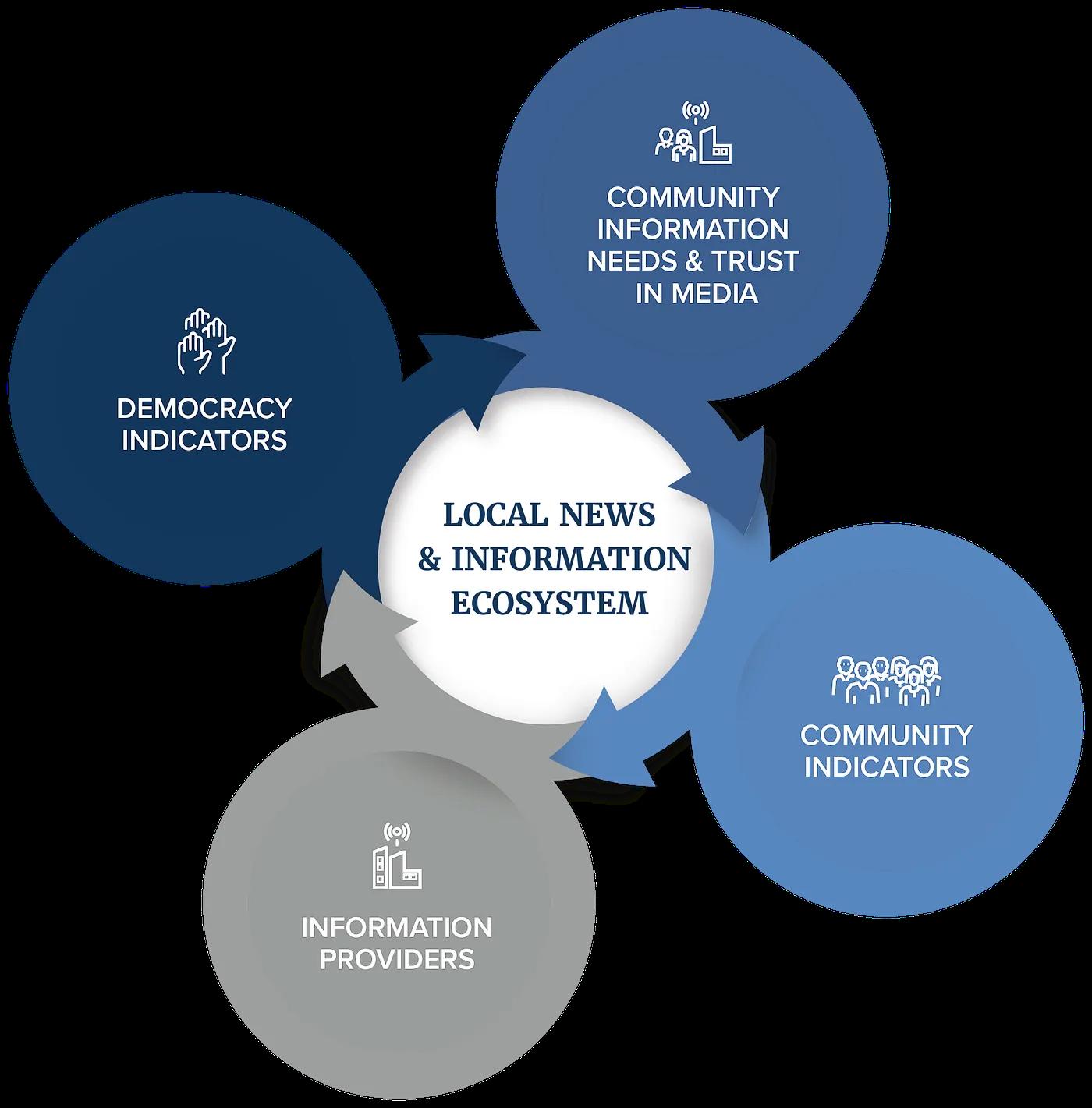
In total, IA documented more than 70 indicators across four categories: community; information providers; community information needs and trust in media; and civic engagement and democracy.
Research — both peer-reviewed, academic, and industry — has demonstrated that all indicators included in this framework connect to the health of local news and information ecosystems and community health. Study after study has shown that accurate, trusted local news and information has positive outcomes for communities, including for community connectedness and social cohesion as well as civic engagement and local democracy. This framework was originally developed in 2020 and has been updated regularly. A full news and information ecosystem playbook, updated in 2024, is free for communities to use. 1 The framework for this project, including indicators, definitions, and data sources, is available in Appendix A
1 To read more of IA’s news & information ecosystem work, see our website and playbook
In order to document the characteristics of an ecosystem’s population, IA’s framework relies on publicly available data, including data from the U.S. Census Bureau,2 National Center for Education Statistics, and the Institute of Museum and Library Services. We also referred to data compiled in Listening Post Collective and Information Futures Lab’s Civic Information Index
To document all news and information providers in an ecosystem, IA uses a multistep process that pulls from various databases of local news organizations. However, we recognize that even with this six-step search for local news sources, there are likely outlets that we did not encounter. Specifically, we could not systematically identify local podcasts, community newsletters, or community-specific social media groups, such as local Facebook groups. We also know that Vermonters may get local news and information from local social media influencers and content creators, but we did not include these providers in our analysis. We included only U.S.-based outlets, though we did hear from some listening session participants that they get news from Canadian outlets. And given the dynamic nature of local news, the list of news providers in the state may have changed from the time of compilation to the time of publication. While we primarily focused on news organizations based in Vermont, we know that many residents — particularly those in the Upper Valley along the Vermont-New Hampshire border, those living along the Vermont-New York border, and residents along the Vermont-Massachusetts border — get at least some of their news from outlets based in neighboring states. We have endeavored to include these outlets as well — so long as they do original reporting in Vermont — based on what we heard in community engagement activities and open-ended survey questions.
We included news and information providers that, at the time of compilation, were publishing at least some original news content for or about Vermont communities. We also looked to ensure that each news and information provider on our list had at least one staff member.
IA’s information provider mapping draws upon the following data sources:
1. University of Vermont (UVM) research: We used a list of Vermont media organizations, compiled by UVM researchers, that adhere to journalism guidelines and ethics as a starting point for identifying news and information providers.
2. State of Local News Project: We searched for the outlets listed for Vermont in the State of Local News Project’s 2024 map and manually checked each entry to ensure that outlets were still publishing original local content.
3. Broadcast TV: We manually searched for locally based ABC, CBS, NBC, PBS, Fox, Univision, and Telemundo affiliate stations, but not their local satellite stations.
2 We include indicators such as population size, rurality, population per square mile, age, race and ethnicity, language, households with a computer, broadband access, formal education levels, median household income, per capita income, and poverty rate.
4. Broadcast radio: We manually searched Corporation for Public Broadcasting (CPB) and National Federation of Community Broadcasters (NFCB) maps and included local public and community radio stations that broadcast news.
5. Center for Community Media (CCM): We searched CCM’s Asian, Black, and Latino Media Maps and Directories. For Vermont, we did not find any news outlets from these sources.
6. Stakeholder contributions: We added outlets mentioned in survey responses and community engagement activities that had not already surfaced in one of the above lists or databases.
We categorized every publication based on three dimensions. First, we noted outlets’ primary distribution medium (digital only, print only, print and digital, newsletter only, radio, and television). Next, we classified outlets by business model (nonprofit, public media, corporate ownership, local/state media group, and independent for-profit). While we know there are differences between media holding companies — which can include hedge fund ownership, ownership by a large media company like Gannett, or ownership by a smaller regional company — we consider a paper to have “corporate ownership” if the company that owns them has media holdings in multiple states. Finally, we determined if the outlet served a particular demographic community and identified which community.
In order to determine the amount of philanthropic investment in the ecosystem, we relied on the Media Impact Funders and Candid database. This database pulls from foundations’ tax filings, so it lags (at least) one year behind, and it often includes grants beyond the news and information sector. For example, some grants were for communications work at local nonprofits. We cleaned the data with the goal of including only grants for the local news and information sector in order to have the most accurate count possible of philanthropic funding for local news in the state. In order to do this, we took the following steps:
• In Candid’s database, we searched for the state of Vermont.
• We set date range filters for 2022, 2023, and 2024 to help offset the impact of any delayed tax filing data.
• We used the “Journalism, news and information” and “Media content and platforms” grants filters to narrow the search to grants for news organizations.
• We downloaded the data, grouped by grant recipient, for all grants that remained once these filters were applied.
• We went through the 87 grant recipients and removed any that were not local news and information providers.3
This left us with 35 grant recipients from Vermont’s local news and information sector and a total of $7.4 million invested. Notably, roughly half of this ($3.7 million) went to Vermont Public, and much of that funding was from the now defunct Corporation for Public Broadcasting.
For this report, in order to document the degree to which residents’ information needs are being met by the ecosystem’s
3 This number is based on data accessed and downloaded on July 17, 2025.
news and information providers, as well as levels of trust in media, we relied on a set of questions we fielded via a digital survey shared by VCF through local networks and individuals. IA analyzed responses to gauge the degree to which respondents feel they have local news and information sources that are providing them with the information they need, whether there are local news sources in their community that they trust, and whether they support local news outlets. Details about the distribution tactics are elaborated in the community engagement section below.
We included a set of indicators to assess the health of civic engagement and democracy in Vermont. We looked at voter turnout in the 2024 election, as well as the percentage of registered eligible voters. To this we added the 2024 Cost of Voting Index (COVI), which scores the ease or burden of voting at the state level. We also collected data on election and voting litigation and policy from Democracy Docket and Ballotpedia. In 2025, the Vermont Secretary of State’s office published a Vermont Civic Health Index report, including data on engagement with local issues and how Vermont compares to other U.S. states. We drew on the data compiled in this report in our analysis of civic engagement in Vermont. The framework also includes additional indicators about press freedom — drawn from The U.S. Press Freedom Tracker — documenting instances of physical intimidation and regulatory incidents.
We supplemented the publicly available quantitative data with community engagement. Community engagement efforts were designed by IA, in collaboration with VCF and its community engagement contractor, and were carried out by all parties.
In order to include as many community perspectives as possible, we conducted direct community outreach via a widely distributed digital survey, available in English, Spanish, and French. We did not receive sufficient responses in Spanish or French to conduct discrete analysis of these. We used IA’s standard community information needs, preferences, and habits survey as a starting point and adjusted the survey to meet the specific needs of Vermont and expand on questions surfaced by trends in the quantitative data. The full survey protocol is available in Appendix B
In total, the survey received 441 valid responses after data cleaning. Survey outreach included sharing the survey through dozens of individuals, networks, and organizations, including many local news outlets.
We screened potential respondents to show the full survey only to those who said they reside in Vermont at least six months of the year. We manually removed responses that listed a non-Vermont zip code or that left nearly all questions unanswered. We also manually reviewed responses to open-ended questions seeking out tells that the response might have been AI-generated and removed responses that included non sequiturs, were contradictory to the participant’s other survey responses, or otherwise did not answer the question. In total, we removed more than 100 responses from the full dataset.
B. Listening sessions
In addition to the digital survey, this project also included nine listening sessions with communities throughout Vermont, led by engagement and facilitation consultant Krista Siringo. All participants were compensated for their time with gift cards, and VCF provided food and refreshments for in-person sessions. Listening session locations and dates are listed in Appendix C
C. Focus groups
IA led a local media focus group in November 2025, including regional and hyperlocal news organizations in the state.
Of the eight organizations invited, four participated in the conversation. IA also led a focus group with VCF fundholders who support Press Forward Vermont.
D. Interviews
VCF identified 18 stakeholders and groups for IA to connect with further about the state of the local news ecosystem, including journalists and publishers, government officials, and leaders of local nonprofits. IA conducted interviews with these individuals, seeking to learn more about gaps, challenges, and opportunities in the news and information landscape for various communities in the state. For a complete list of interviewees, see Appendix D
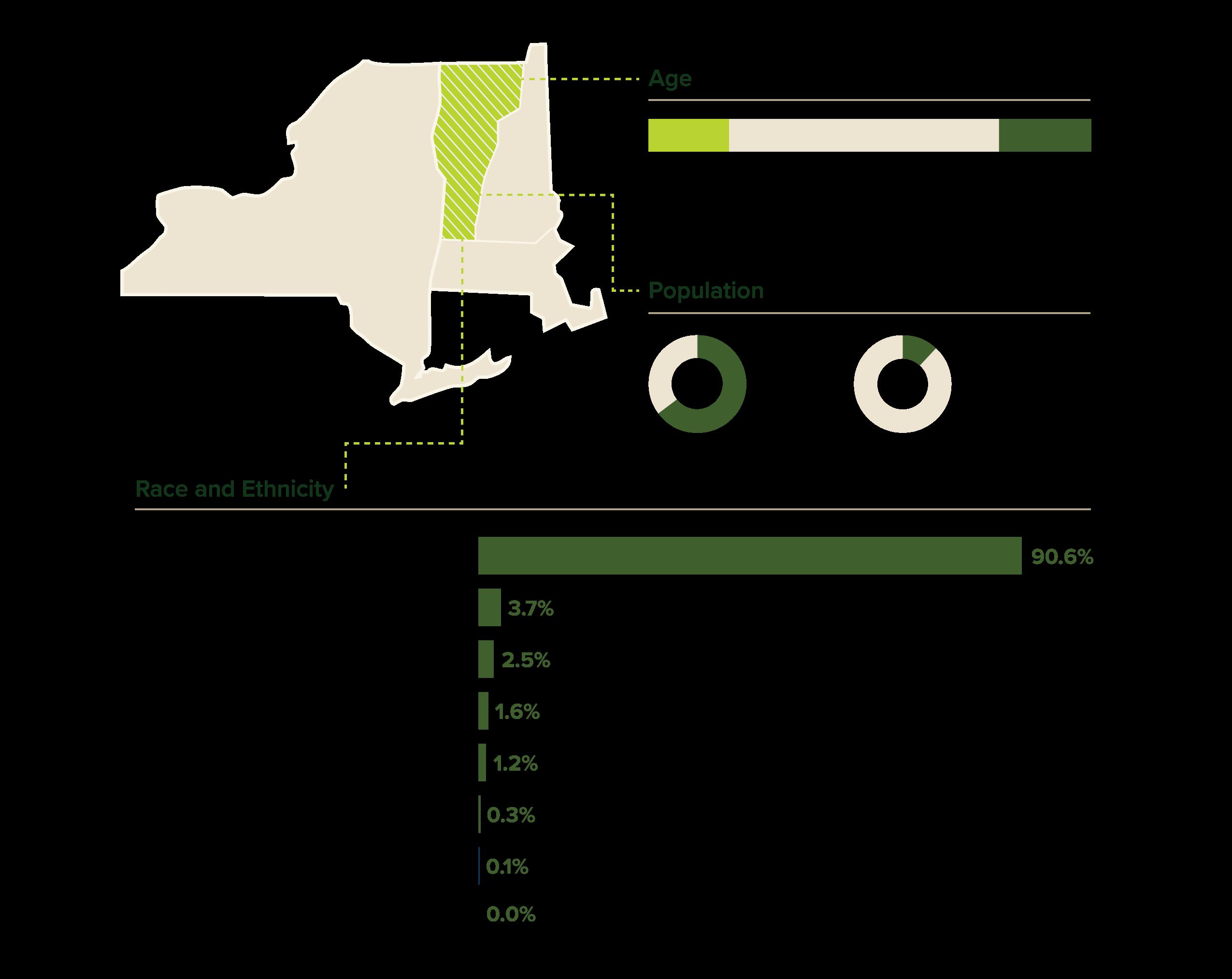
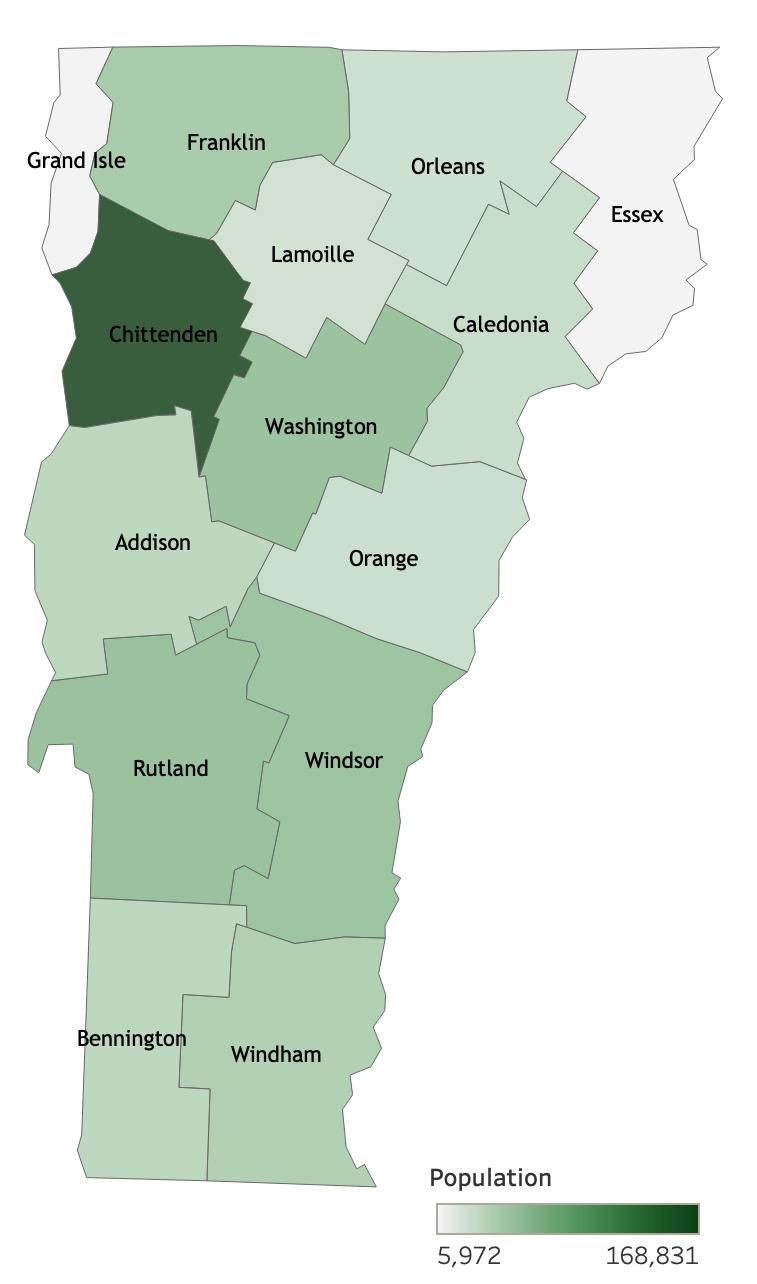
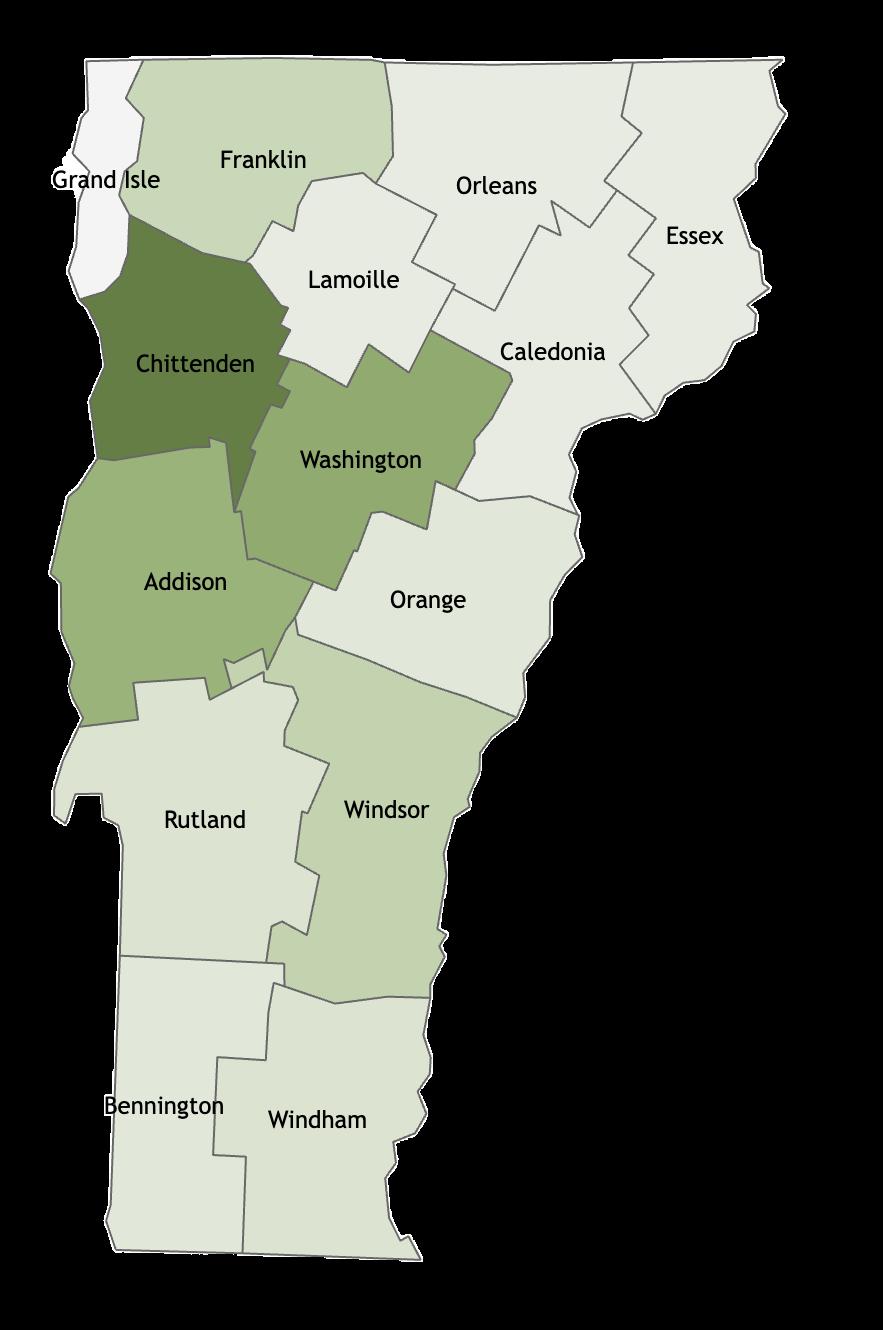
Vermont is home to more than 645,000 people, with a little more than a quarter of residents living in Chittenden County, where the state’s largest city, Burlington, is located. Vermont is the most rural state in the nation, with nearly two thirds (64.9%) of residents living in areas classified as rural by the U.S. Census Bureau. Population density for the state varies significantly: While there are 69.8 people per square mile for the state as whole, population density ranges from 8.9 people per square mile (Essex County) to 313.3 people per square mile (Chittenden County). Many communities have fewer than 1,500 residents and may be clustered in village centers with a library, town office, and a general store. School enrollments reflect the state’s small, rural, and aging population: Not all towns have an elementary school, and those that exist are often quite small. Vermont ranks 46th nationally in terms of school size.
The state is made up of several regions and has a number of distinctive geographic features — which may impact information distribution and access. Vermont is divided vertically by the Green Mountains and is bound by the Connecticut River to its east, separating it from New Hampshire. Some news providers span the Connecticut River Valley, serving residents of both states. Lake Champlain divides the state from New York to the northwest, and nearly 7,400 Vermonters live among the Champlain Islands, connected to the mainland by bridges and ferries. Many Vermonters live on unpaved roads, miles from state maintained roads and highways.
Vermont has the second largest proportion of white residents of all U.S. states, with more than 90% of the population identifying as white alone, meaning they do not identify as any other race or as Hispanic or Latino. The state has smaller populations identifying as all other Census race and ethnicity categories compared to the U.S. overall. It is important to note that, while these percentages are small, they represent at least 40,000 Vermonters who identify as people of color, based on 2023 Census data. Current Census data alone does not provide a complete picture of racial and ethnic diversity in the state. The state is becoming increasingly racially and ethnically diverse, with data from the 2010 to 2020 Census showing the Hispanic and Latino population grew by 68% and the Black community increased by nearly 44%, according to the Associated Press. And, relative to its small population size, Vermont has large immigrant and refugee populations, particularly in Chittenden and Windham Counties.
Age
Indian or Alaska Native
Native Hawaiian or Other Pacific Islander
Middle Eastern or North African 0.8% 0.3%
Language
Speaks a language other than English
Speaks another IndoEuropean language
Speaks an Asian or Pacific Island language 3.5% 0.8% Limited English-speaking households 4.2% 0.6%
Data is from the U.S. Census Bureau’s 2023 American Communities Survey five-year estimates and the 2020 Decennial Census.
* Population is below the percentage reporting threshold for the Census Bureau.
There is significant diversity in languages spoken in the state. Vermont is home to a larger-than-average French-speaking population, given both its proximity to Canada and being home to migrants from Francophone Africa. And while the percentage of people who speak Spanish at home is below the national average, there is a significant population of seasonal and migrant farm workers, particularly in Franklin and Addison Counties, who are primarily Spanish-speaking and who may not be counted in decennial Census data.
The state, and the Burlington area in particular, is home to significant refugee populations who have resettled from countries such as Bhutan, the Democratic Republic of the Congo, Eritrea, Iraq, Russia, Somalia, Syria, and Ukraine since the 1980s. The Vermont Office of Racial Equity’s 2023 Language Access Report recommends translation of language access availability notices into 14 languages. 4 More than 1,200 refugees were resettled in Vermont from October 2017 through December 2024, according to data from the American Immigration Council, and roughly half of those ages 16 or older reported no proficiency in English. Even so, there are no news outlets in the state that consistently provide coverage in languages other than English. Instead, non-traditional news and information providers, such as local nonprofits and community groups, often serve as key information sources for non-English speaking communities.
Relative to the U.S. overall, Vermont has a larger-than-average population ages 65 and older. And the population is aging: The Vermont Department of Health noted that the older population is the fastest growing age group in the state and predicted that a third of residents would be 60 or older by 2030. Vermont’s aging population — and declining younger population — has significantly impacted the state, particularly in areas such as elder care, the state’s workforce, and the school system. This trend also intersects with and impacts the news and information landscape in the state. Residents remain attached to traditional news sources such as local print and digital newspapers, and the state still has a large number of small, independently owned news outlets. However,
4 Arabic, Bosnian, Burmese, Dari, French, Kirundi, Simplified Chinese, Nepali, Pashto, Somali, Spanish, Swahili, Ukrainian, and Vietnamese.
participants in this research raised concerns about the future of the news landscape given that some of these local outlets are struggling financially, lack a clear succession plan for when the current owners retire, and have faced challenges reaching and engaging younger audiences.
Vermont is on par with the U.S. overall when it comes to both median household income and per capita income. However, the cost of living is comparatively high. The MIT Living Wage Calculator, which estimates a living wage based on the cost of essential goods and services like food, housing, and healthcare, estimates that the required annual income for a single adult with no children in Vermont is $49,826, about $5,500 more than per capita income in the state. The Calculator predicts that a living wage in Vermont would be $23.95, while the actual minimum wage is only $14.42.
The MIT Living Wage Calculator estimates $13,706 in housing costs for a single adult in Vermont. The lack of affordable housing is a known issue in the state. For the last several decades, new housing construction has not kept up with demand, which only grew during the pandemic. This shrinking supply has driven up the cost of renting and buying; according to Vermont’s 2025 Housing Needs Assessment, more than half of all renters and about a quarter of all homeowners spend more than 30% — considered a threshold for affordability — of their income on housing.
& Infrastructure
Another critical factor in understanding information access, particularly in rural states like Vermont, is digital connectivity and the presence of community resource hubs like public libraries and universities. Census Bureau data shows that Vermont, at 87.9%, sits just below the national figure (89.7%) for households with a broadband internet subscription. Broadband subscriptions vary across Vermont counties, peaking at 92.3% in Grand Isle County, and with the lowest percentage of households (79.0%) in Windham County. The state broadband map provides more details as to which communities are underserved in addition to those that may experience slow upload and download speeds. Vermont has been working to increase broadband access over the last several years, creating the Vermont Community Broadband Board and Vermont Community Broadband Fund in 2021 to advance this work, and municipalities have come together to form communications union districts that establish and own local broadband infrastructure. Vermont is currently seeking to use federal funds — in addition to state
and private funding — to expand broadband access rates in the state to 99%. This could allow more residents to access news and information digitally from their homes.
Libraries and colleges also play an important role in terms of accessing local news. There are 192 public libraries in Vermont, according to the Institute of Museum and Library Services, or about one library for every 3,361 residents. Libraries can serve as important means for accessing free print and digital information resources, as well as gathering places for community events. Stakeholders in the news and information sector have been working to develop partnerships with local libraries. And in listening sessions, participants told us how they turn to their local libraries to determine the accuracy of information they find from other sources, underscoring the key role of these institutions in the news and information sector.
Universities and colleges can serve as information ecosystem resource hubs. In Vermont’s case, the University of Vermont is working to advance the local news sector, both within the state and across the U.S. UVM’s Center for Community News (CCN) serves as a hub for research, advocacy, and support for university-led student reporting in the local news sector nationally. UVM’s Community News Service (CNS) is a partnership with local news organizations across Vermont that aims to increase coverage of local stories and provide experience and training to young journalists. Student-journalists produce coverage under the direction of professional editors, and stories are published by partner news outlets. Outlets can republish stories from CNS’s website at no cost. The CNS program publishes between 400 and 500 stories a year across Vermont, according to Richard Watts, who co-founded CCN with Meg Little Reilly and serves as its director.
Research has shown the connection between high quality, relevant, local news and information and local civic engagement. Understanding civic and community participation can help us understand how local news is currently impacting engagement — and how it might continue to do so in the future.
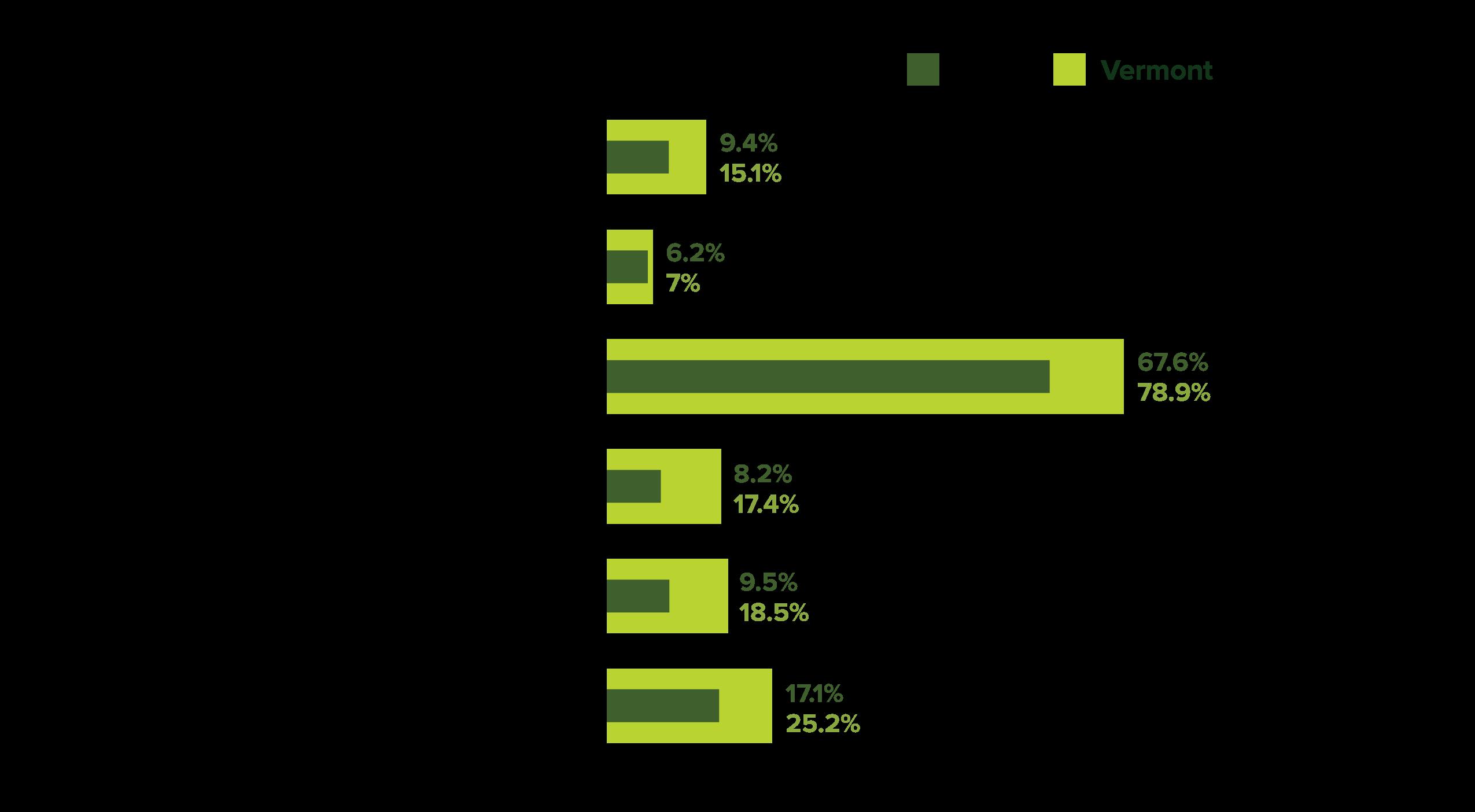
The 2025 Vermont Civic Health Index found that participation in the state is well above the national averages in areas like voting, volunteering, political involvement, and interacting with family, friends, and neighbors. In fact, Vermont ranks second among all U.S. states and D.C. for the percentage of people who made donations to a political organization (15.1%); frequently discussed political, societal or local issues with neighbors (14.2%); frequently read, watched, or listened to news or information about political, societal or local issues (78.9%); attended a public meeting (17.4%); and contacted a public official (18.5%). These findings perhaps align with many Vermonters’ assumptions about the culture of the state, which has supported participation-centered practices
like Town Meeting Day and Green Up Day. However, while Vermont outperforms many U.S. states in these civic participation metrics, the percentages show there is still opportunity for growth. The report also cautions against an overly rosy interpretation of the data: “While Vermont generally has a strong reputation when it comes to civic engagement, we acknowledge that people of different socio-economic backgrounds, and from different places across the state experience aspects of civic health differently. So, while we celebrate the areas of strength identified in our Civic Health Index, it is our responsibility to ensure that those experiences are accessible and welcoming to all Vermonters.”
Participants in our research also raised concerns about the durability of civic engagement in the state, noting that older Vermonters are perhaps bolstering volunteering and engagement numbers, and it remains unclear to participants whether younger generations will participate at the same levels. According to the Civic Health Index, youth in grades 6-12 reported volunteering at higher rates than other age groups (more than 45%), though likely due to opportunities and requirements within Vermont’s public education system. Those 30-44 and 46-64 volunteer less than those 65+. Beyond potential generational shifts, some interviewees also pointed to declining participation overall, citing lower attendance of public meetings. Some pointed specifically to the role of local news in providing insight into what is happening in local government. Kelly Nottermann, the communications director at Vermont Sustainable Jobs Fund, has sat on several local boards in her town and said that people do still turn out for meetings where a major issue is up for discussion. “But those everyday,
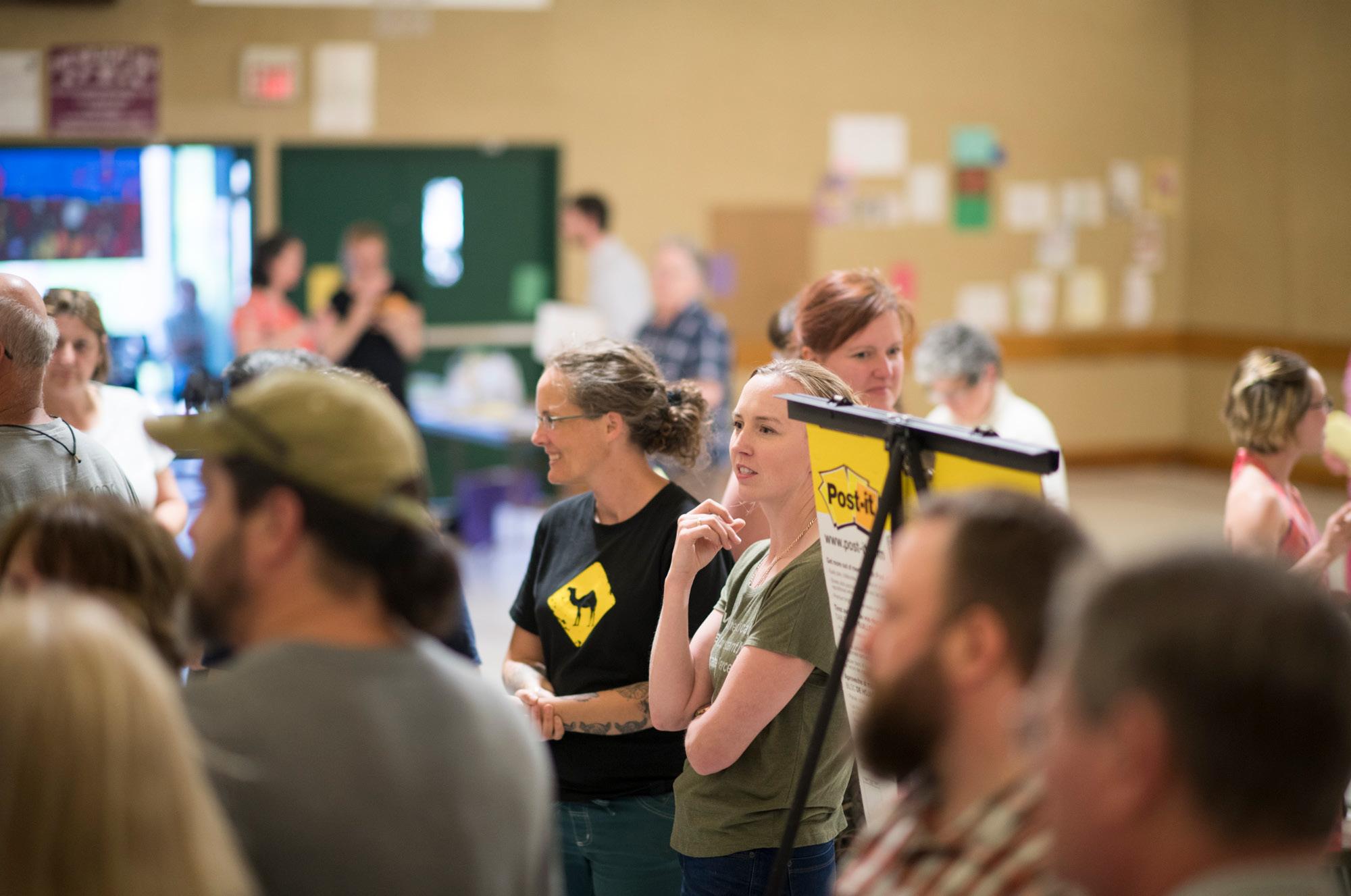
by Caleb Kenna
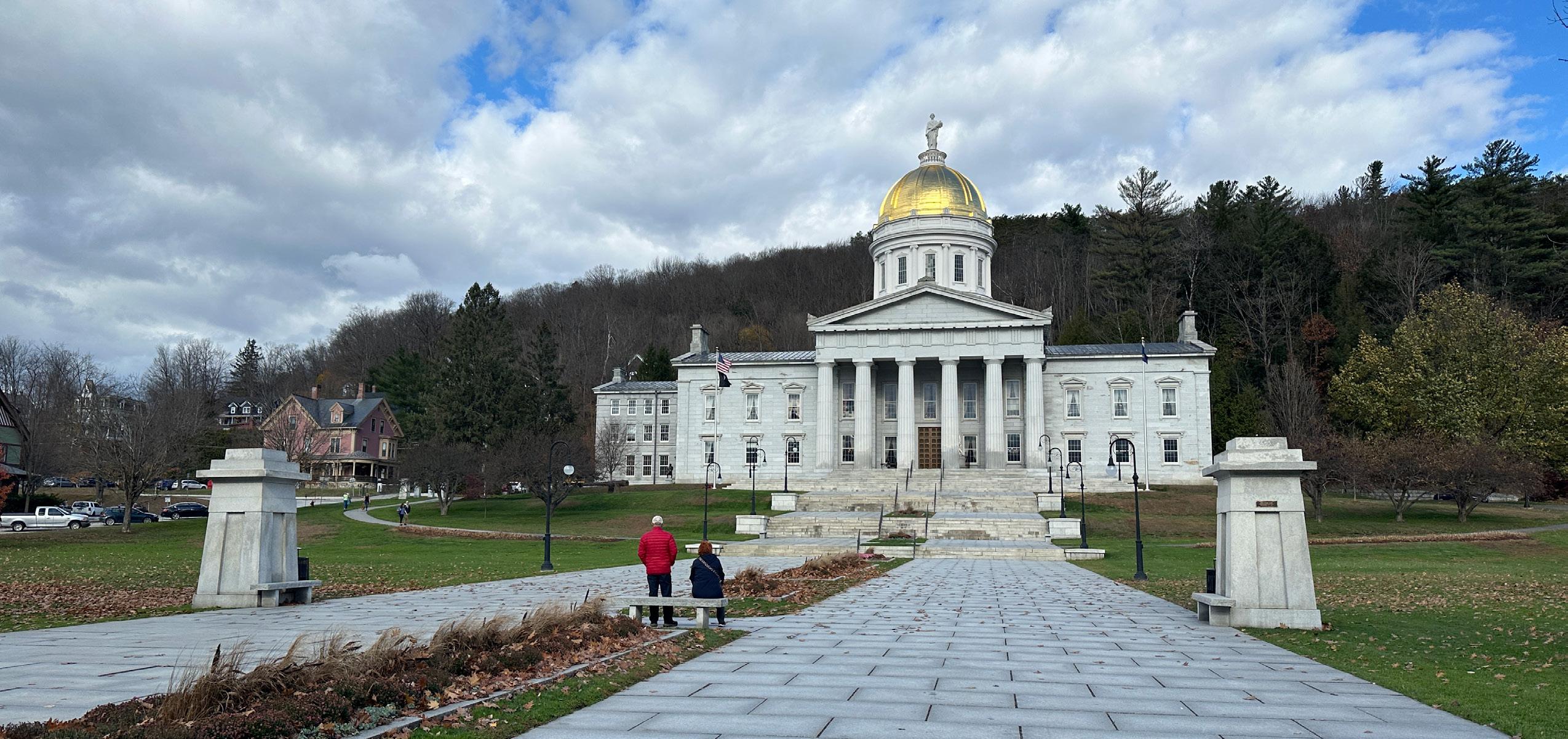
Vermont’s voting laws are expansive and prioritize participation from all demographic groups relative to most other U.S. states and territories. The state allows Election Day registration, does not require residents to reside in the state for a minimum number of days before they are eligible to register, does not revoke the voting rights of people convicted of a felony, and permits people who are currently incarcerated to vote. At -2.152, Vermont’s 2024 Cost of Voting Index value, a calculation of the ease or burden of voting in each U.S. state based on state election laws and policy, suggests that voting in the state is easier relative to most other U.S. states. In the index, a lower score indicates greater ease in voting than a higher score. Vermont is the state with the fifth lowest COVI score in the country.
At the municipal level, some towns and cities have worked to expand voting rights to populations excluded at the federal level. In 2018, the state legislature approved a local charter allowing noncitizen, legal residents to vote in local City of Montpelier elections, and in recent years, the cities of Burlington and Winooski enacted similar extensions of voting privileges. However at the time of this publication, Burlington’s charter extending these rights is being challenged in Vermont’s Supreme Court. Additionally, in 2023, the legislature approved the local charter allowing qualified youth ages 16-18 to vote in municipal elections in Brattleboro
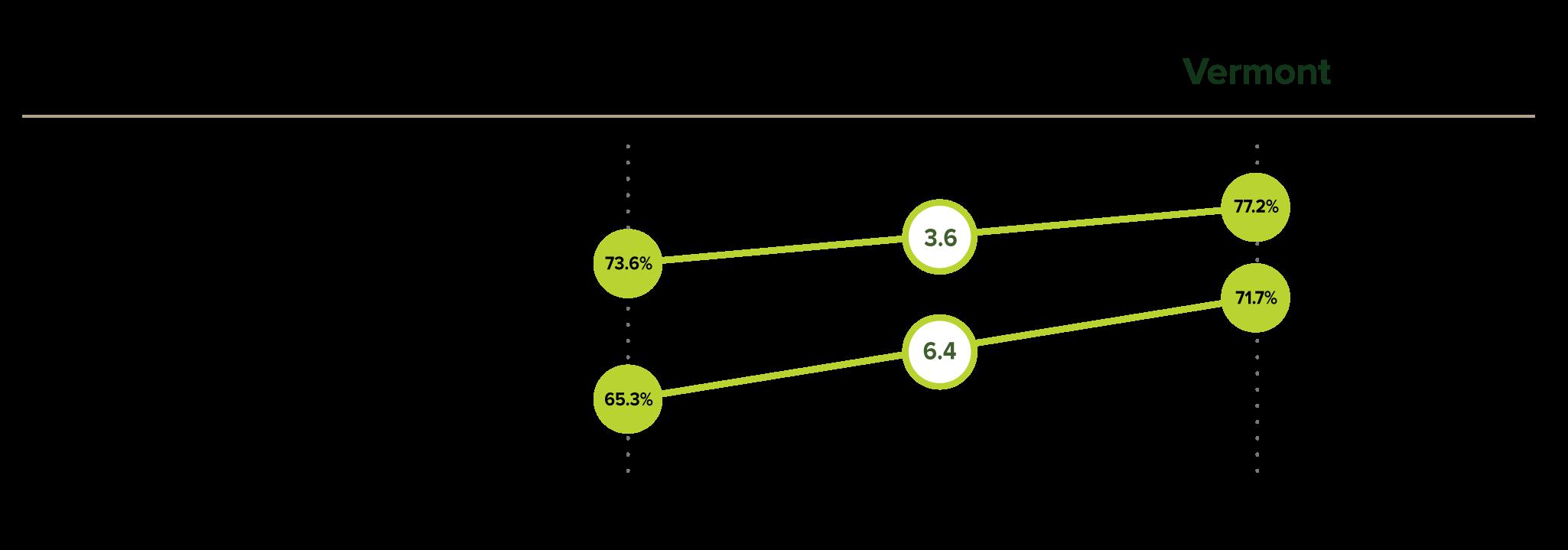
Census Bureau data for the 2024 general election shows that Vermont sits above the national figure for registered eligible voters, 77.2% in Vermont compared to 73.6% for the U.S. overall. Vermont’s voter turnout is also higher than the national average: 71.7% of eligible voters in Vermont cast a ballot in 2024, compared to 65.3% in the U.S. as a whole.5
5 While they can provide a sense of how the state compares to the U.S. and other states, the voting numbers reported by the Census Bureau, are estimates based on reported voting and registration, so they do not necessarily reflect the exact percentages of registered eligible voters and ballots cast. Data from the Vermont Secretary of State’s office shows turnout among registered voters was 71.4%. The Census Bureau voting data cited here is from the Current Population Survey (CPS) Voting and Registration Supplement for 2024.
Vermont still has many independently owned local news sources, including a large contingent of newspapers offering both digital and print content. However, while looking at the numbers alone might suggest that the news and information ecosystem is robust, interviewees cautioned that many news outlets, particularly small community newspapers, are barely staying afloat. “I think the fact that we still have 25 or so community papers is a really good indication of something,” Richard Watts, co-founder and director of UVM’s CCN, said. “And then on the flip side of that is many of them are struggling to survive.”
In fact, we identified at least one newspaper, the Brandon Reporter, that shuttered during the course of this research, though community members in Brandon and Pittsford are rallying to revive the publication . In some cases, news providers are being sustained by passionate owners who are working unsustainable hours — or potentially even at a financial loss — to continue providing local coverage to their communities. This has led some news ecosystem stakeholders to raise concerns about succession planning and the future of Vermont’s news and information providers.
“The fragility, though, for our ecosystem is there are just individual people in all of these places and, you know, if you knock out one person, then you’ve lost a media outlet. And there just isn’t much of a bench,” said Cathy Resmer, deputy publisher and co-owner of Seven Days. “We’re all talking to each other, at least, but I don’t know that we’re solving the problems fast enough. A lot of these smaller places don’t have the business and the technical expertise that they need to be able to execute, or to raise enough money to fund their operations.”
“...if you knock out one person, then you’ve lost a media outlet. And there just isn’t much of a bench.”
Cathy Resmer, Deputy publisher, coowner | Seven Days
In this section, we explore Vermont’s news and information landscape, describing the kinds of outlets providing news to local communities, bright spots in the ecosystem, and challenges and concerns raised by those who work in or frequently interact with the news and information sector.
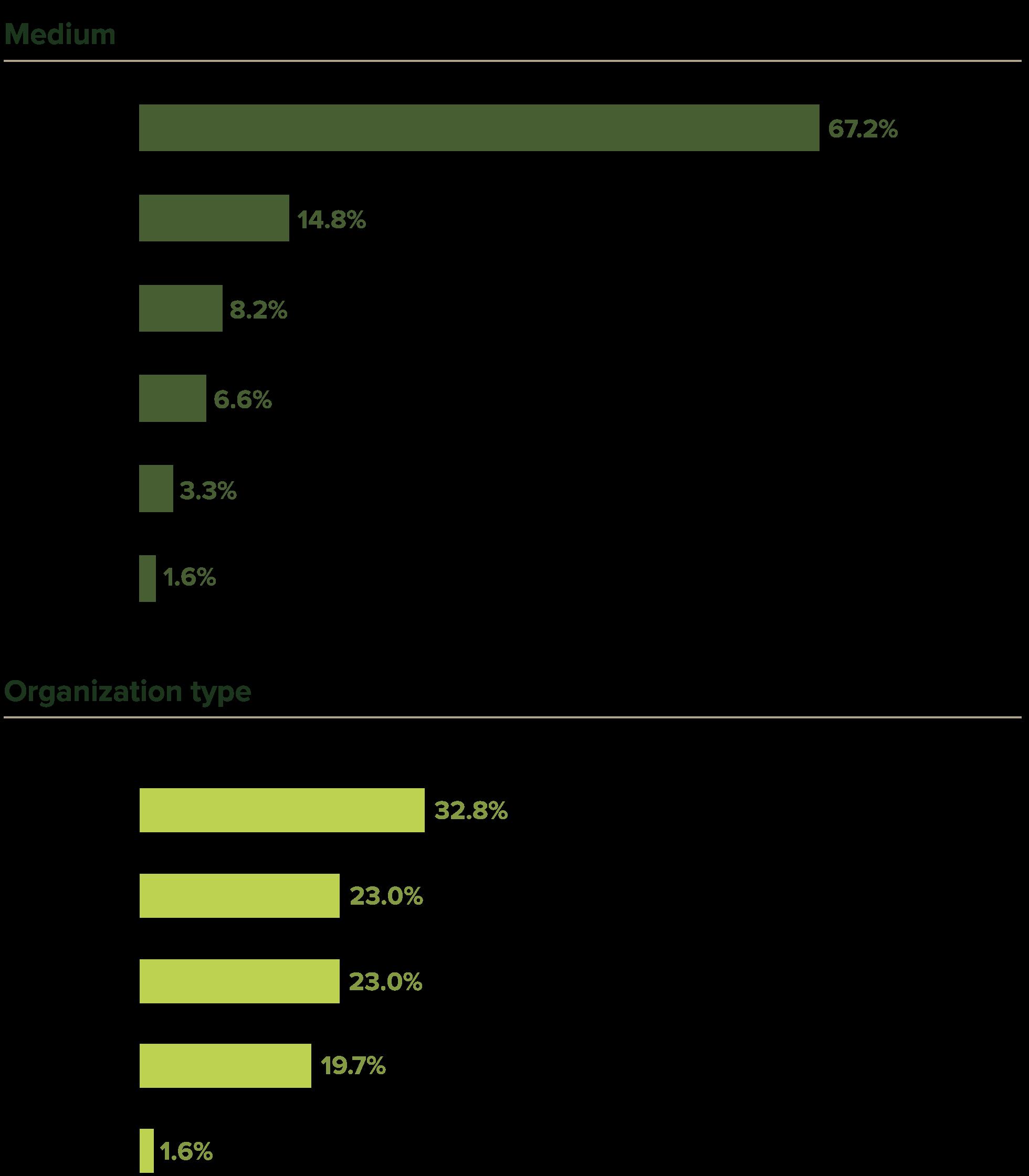
We identified a total of 61 news and information providers based in and serving Vermont communities, 80% of which are locally owned.6 Twenty are independent for-profit, and another 14 are owned by a local media group,
6 For a complete methodology, see the “Approach” section. For the list of 61 news and information providers, see Appendix E
meaning a media company that owns multiple Vermont outlets but is based in the state — or in neighboring parts of New York or New Hampshire, in a few cases. Most of these outlets are owned by Vermont Community Newspaper Group, based in Stowe, and Vermont News and Media LLC, which owns papers in southern Vermont. Vermont has relatively few news outlets owned by national media holding companies, which make up only 20% of the news and information providers in the state. Vermont also has 14 nonprofit news outlets, accounting for a little under a quarter of all news and information providers in the state.
Note: Vermont Public is listed twice in the public media column to represent both radio and television offerings.
Vermont lacks news outlets serving communities of color, providing coverage in languages other than English, dedicated to serving LGBTQ+ Vermonters, or otherwise serving specific affinity or demographic communities. However, we know that many communities, particularly non-English speaking communities, turn to local nonprofits and other community organizations for critical news and information. For example, the Association of Africans Living in Vermont (AALV) has a robust channel for communicating information relevant to their community through WhatsApp and worked with the Vermont Language Justice Project to make sure critical news and emergency information was translated and shared after the 2023 floods. These kinds of nontraditional news and information providers are not captured in existing lists and databases of news outlets throughout Vermont and the U.S. For this reason, we were not able to systematically identify these kinds of information providers and include them in the list we compiled for this report. Through interviews and community listening sessions, we did learn more about the networks residents turn to when they are not served by current news and information resources.
Highlights
• There is a high density of news outlets compared to other markets in the U.S. and relative to the size of Vermont’s population.
• 80% of Vermont’s local news providers are locally owned and operated, which incentivizes serving essential community information needs over generating profit.
• Statewide infrastructure solutions for reporting and content sharing already exist, pioneered by newsrooms like VTDigger and Vermont Public, which can help address existing gaps and support more robust coverage in underserved regions.
• There is strong, high quality, state-level coverage available from established outlets which provides a critical foundation of in-depth explanatory and investigative journalism that is essential for a wellinformed population and a healthy statewide civic life.
• There is a willingness from many news outlets to provide freely accessible news in digital and print formats to ensure that all residents have access to essential local information.
• There is growing collaboration among new outlets, as evidenced by the Vermont Journalism Coalition, to formalize partnerships for editorial and financial support, which can secure more comprehensive and financially stable local coverage across the state.
While the news ecosystem is fragile with respect to revenue and financial sustainability, staffing, and succession planning, Vermont still has a large number of local news outlets relative to the size of the population, even as national trends have led to the closure or consolidation of many local outlets in other parts of the U.S. The continued existence of a large proportion of small, locally-owned news outlets feels like a major strength in the news ecosystem to many interviewed stakeholders, as it means that, in many communities, there are opportunities to support and innovate within the existing news resources rather than needing to work to fill gaps from scratch.
There are opportunities to support and innovate within the existing news resources rather than needing to work to fill gaps from scratch.
Another major strength in Vermont is the propensity to bring together resources from within the state to develop local solutions to local problems. The Community News Service, for example, brings together resources from UVM to fill gaps in the local news ecosystem, providing experience for student-journalists and added capacity for local newsrooms. The digital nonprofit news outlet VTDigger has worked to fill gaps by
providing daily statewide coverage and investigative and accountability reporting. The outlet has served as a leader among local nonprofit newsrooms around the U.S.
We heard from stakeholders working in the local news and information ecosystem that the sector has become much more collaborative over the last several years. While a sense of competition was more prevalent among news organizations in the past, the culture in the sector has changed such that more organizations are coming together to fill gaps, share resources, and come up with solutions together. “We’ve been experimenting with editorial collaboration and thinking hard about how to deepen partnerships — both in our journalism and in how we fund it and get it out into the world. While we still love a good scoop, we see the future as less about competing with one another and more about joining forces where it makes sense, especially to counter the mis- and disinformation threatening our civic fabric,” said Schuyler “Sky” Barsch, chief executive officer of VTDigger. There is widespread content sharing across the news ecosystem, including stories produced by the Community News Service to local outlets, and stories originally published in VTDigger or by Vermont Public, which both also share a reporter focused on housing.
Given this shift, there are opportunities to expand coordination and partnership between newsrooms beyond content sharing or individual joint reporting projects. The newly formed Vermont Journalism Coalition is providing a new avenue for collaborations across media types. Stakeholders in the local news ecosystem identified a need for more business-side collaboration.
“The most urgent issue is perhaps not an editorial one, but a revenue one,” said Mark Davis, news director at Vermont Public and board member of the Vermont Journalism Coalition. “And yet, the editorial side people seem to be the lead, and we all end up knowing each other really well, whereas the money side people, that’s not necessarily the case. What a lot of these papers need is money, so how do we translate that? How do we foster that level of collaboration?”
While many news and information providers cover news at the county, region, town, or hyperlocal level, Vermont also has a strong contingent of statewide news sources, many of which provide news at no cost. Residents are served by Vermont Public, a statewide, combined radio and television public media station formed by the 2021 merger of Vermont Public Radio and Vermont PBS. VTDigger has reporters distributed across the state. Seven Days, an independent newsweekly based in Burlington, offers all of its coverage for free in print and online. It is known for its rigorous reporting and magazine-quality writing about local news, arts, culture and food. It produces the annual “Seven Daysies” local readers’ picks and the Vermont Tech Jam. Sixteen employees together own 49 percent of the company.
One distinguishing feature of the Vermont news and information landscape is the presence of free, volunteer-run, hyperlocal news sources, some of which have both print and digital versions. The East Montpelier Signpost publishes hyperlocal news for the roughly 2,600 residents of East Montpelier six times a year. The publication is available digitally and is also mailed to residents for free: These printing and mailing costs are covered by the town and local businesses, according to the
Signpost’s website. Nonprofits The Hinesburg Record and The Cabot Chronicle are also primarily volunteer run. Similar to the Signpost, the Chronicle is mailed to local residents for free. These kinds of publications point to potential opportunities to engage local residents in producing and supporting news for their communities at a hyperlocal scale. They also highlight how there may be opportunities to gain institutional support from local governments and organizations.
Vermont has a network of 24 public access media centers, the Vermont Access Network (VAN). These allow residents to participate in news and information dissemination and provide broadcasts of public meetings and other events. As an example, CCTV Center for Media and Democracy, a founding member of the network, provides local government coverage in Chittenden County via Town Meeting TV, recording and archiving primary source material, and offering a way for community members to tell their own stories directly. “VAN as a whole produces around 18,000 hours of primary source content. We are recording, airing, and archiving local meetings and other community-based event content across the state,” said Meghan O’Rourke, CCTV Executive Director. “This is an important, essential resource for both journalists and the public and could be leveraged more by traditional media and local communities.” VAN stations play a critical role in sharing community-generated news content, with some helping to fill gaps in the local news ecosystem for communities that are not served by traditional news outlets, such as Spanish-speaking Vermonters.
The news ecosystem in Vermont faces a number of challenges — some of which are consistent with trends found across the U.S. such as decreased advertising revenue, an ever-evolving digital and social media landscape, and difficulties sustaining coverage and operations with dwindling resources. However, some challenges are specific to Vermont, such as widespread concerns about the journalism pipeline, a potential lack of succession planning for small local newspapers, and changing norms around access to government and other public information.
Many interviewees for this research highlighted how a decreased number of local reporters — and a declining number of experienced reporters, in particular — has significantly impacted the depth and breadth of local reporting in newsrooms across Vermont. News outlets also face pipeline challenges on the business side. In a focus group of local news outlets in the state, one participant mentioned how her organization relied on ad revenue but has struggled to find sales people.
“I think that as I look at the landscape overall, probably the greatest challenge is along the level of the number of journalists and the experience level of the journalists,” WCAX News Director Roger Garrity
“There just isn’t that level of experience and knowledge that there once was across all media outlets that makes sure that Vermonters are being served in the best way possible.”
Roger Garrity, News director | WCAX
said. “There just isn’t that level of experience and knowledge that there once was across all media outlets that makes sure that Vermonters are being served in the best way possible.”
Evidence of a decreasing number of local journalists is supported by employment data. A report by Dan McLean for the Center for Community News at UVM shows significant decreases in journalist employment from 2000 to 2023, based on state labor data. The report shows a decrease of nearly 1,100 journalism jobs at local newspapers in Vermont since 2000, dropping to 358 employees in 2023, about a 75% decrease. While the research is focused on newspapers, and only includes data for digital-only news sources starting in 2022, it still illustrates how the sector has constricted over the last few decades.
Even for news outlets that have not seen their reporting staff shrink, there are still experience gaps. According to stakeholder interviewees, early-career reporters often do not stay long, moving on to larger papers or out of the state to larger markets with higher paying positions. As an increasing number of experienced reporters reach retirement age, this trend has led to concerns about a missing middle corps of experienced reporters who have deep knowledge and connections in the state and are ready to take over in leadership roles at small local outlets.
News consumers noted how the declining number of journalists and a lack of experience across the news ecosystem has appeared to impact local reporting. Many interviewees said that they have seen a decrease in hyperlocal coverage, which they attribute to limited reporting capacity at local news outlets. Others highlighted how new reporters might not have the historical or place-based context to provide in-depth coverage.
Respondents to our community information needs survey were also aware of the challenges the ecosystem faces when it comes to staffing local news outlets — as well as how that can impact coverage. When asked how news outlets could improve coverage for their local area, 11% of respondents specifically highlighted that news outlets need more funding, more reporters, or better pay for reporters. In some cases, respondents connected all three of these challenges. One respondent wrote, “If they had more money they could pay more people to report. Our local journalists are wonderful but spread thin, and expected to do it more out of love than a livable salary.” In fact, more survey respondents mentioned hiring more reporters and finding ways to increase funding for local news than mentioned reducing bias, which has been the most commonly listed improvement in community surveys IA has conducted in other U.S. regions.
Several interviewees and focus group participants pointed to valuable local news providers that have sprung up to fill gaps as local community papers
“If they had more money they could pay more people to report. Our local journalists are wonderful but spread thin, and expected to do it more out of love than a livable salary.”
have closed. Many participants in this research mentioned the Waterbury Roundabout, founded after the town’s paper, the Waterbury Record, closed in 2020. However, these outlets are often sustained by dedicated and experienced founders working long hours, and interviewees worried who might be willing to serve in these roles in the future. A 2024 Seven Days article chronicled how local outlets of different sizes were weathering the changing news landscape, including how editors sometimes worked for reduced — or no — pay in order to keep their outlets running.
Echoing trends felt in news ecosystems throughout the country, Vermont’s news and information providers have struggled to navigate the ups and downs of a rapidly evolving funding and revenue landscape. News organization leaders and other stakeholders in the industry pointed to a decline in advertising revenue and how it has impacted their bottom line. One focus group participant said ad revenue was, at one point, close to 60% of their revenue and now is significantly less. The pandemic exacerbated these trends at many small local outlets in the state, forcing them to reduce staff, cut their print editions, or close.
In line with national trends, some outlets have shifted to a nonprofit model, seeking new and diverse revenue streams to support their work. A focus group participant who runs a nonprofit news outlet said he thinks the model is a major
opportunity area for the state and noted that they’ve had inquiries from others who are interested in it. However, another participant worried that the expansion of the nonprofit news sector could mean more local outlets competing for residents’ attention and a finite pool of funding from philanthropic sources.
To better understand the funding landscape for local news in Vermont, we reviewed grantmaking data from Media Impact Funders and Candid’s database for 2022-2024. We found that 35 news and information providers received grant money during that three-year period, totaling $7.4 million. About half of that figure ($3.7 million) went to Vermont Public, and nearly all of it ($3.6 million) came from the Corporation for Public Broadcasting (CPB). Congress rescinded CPB’s federal funding in summer 2025, meaning the nonprofit corporation will no longer provide funding to public media stations across the U.S. In an announcement posted after the passage of the rescission package, Vermont Public shared that it will lose $2 million in funding each year without CPB, which provided about 10% of the station’s annual funding. CPB was by far the largest grantmaker in the Vermont news ecosystem, based on Candid’s data, and over the last three years, most grant funding for local news in the state came from CPB and national funders. The state of Vermont does not currently fund local public media outlets, one of 17 states that does not do so as of 2022. The data suggests that there’s an opportunity — and a growing need — to cultivate a network of local funders for local news in Vermont. A participant in the fundholder focus group cautioned, however, that, to have an impact, funders should be focused on building common infrastructure that supports the entire ecosystem, rather than scattershot donations.
There is also evidence of opportunities to continue developing innovative strategies for publicly funding local news. At the June 2025 Vermont Journalism Conference, hosted by the UVM Center for Community News, participants discussed funding and economic policy ideas, including advocacy for public funding and the possibility of requiring a certain amount of local or state ad spending in local media.
Through an effort spearheaded by State Senator Andrew Perchlik, the 2025 state legislature directed $50,000 from the state budget to establish the Local Civic Journalism Awards. The Vermont Community Foundation’s Press Forward Vermont chapter matched this funding with an additional $50,000. The awards are administered by the office of the Vermont Secretary of State, and 16 regional and community-based news outlets were selected in November by an independent committee and received $5,000 or $10,000. “In order for Vermonters to be able to work together to shape and improve their communities, it’s essential to have access to trustworthy, transparent local news outlets,” Secretary of State Sarah Copeland Hanzas said in a press release about the awards. “An investment in Vermont’s local and regional news is an investment in an informed, connected, and engaged citizenry.” This is a promising sign that
“An investment in Vermont’s local and regional news is an investment in an informed, connected, and engaged citizenry.”
Sarah Copeland Hanzas, Vermont Secretary of State
there is broader recognition of the role of local news in supporting civic participation. “I am so excited to see these civic journalism awards help to strengthen our civic fabric,” Perchlik said in the same press release. “The growing attention paid to the critical value of local, fact-based journalism gives me hope for our democracy.”
The recently formed Vermont Journalism Coalition (VJC) has also been working to advocate for local news outlets and help ensure their future financial sustainability. The Coalition is currently housed at UVM’s Center for Community News, receiving seed funding and support from CCN and the Vermont Community Foundation as part of Press Forward Vermont. It is on track to become an independent nonprofit. The Coalition is a “big tent” strategy designed to represent news organizations across all mediums and financial models, advocating for financial security and first amendment rights, explained Paul Heintz, who has worked in journalism in Vermont for more than 15 years and has been leading the effort.
Local news outlets are also navigating an evolving digital landscape. In some cases, this has meant shifting to different mediums or prioritizing different kinds of content. Many outlets have reduced the frequency of print editions or switched to digital only models, particularly amid added financial pressures during and after the COVID-19 pandemic.
News ecosystem stakeholders described how they feel they are now competing with social media for people’s attention, and they say it has been challenging to engage younger audiences who prefer to consume content in formats Vermont news outlets have not previously produced, such as short-form video. In survey responses and listening sessions, we heard how some audiences — youth, young adults, and immigrant communities, in particular — rely on social media for finding important information, in part because they can access those resources for free.
Many residents use Front Porch Forum (FPF) — a moderated forum with about 250,000 active members, designed to help connect neighbors throughout Vermont as well as parts of New York and Massachusetts — to find information and discuss what is going on in their local communities. “Front Porch Forum is not in the journalism business — we do not employ reporters.” said Michael Wood-Lewis, co-founder and CEO of FPF. “That said, we believe journalism is an essential ingredient to democracy, and that for us to fulfill our social mission of strong, resilient local communities, healthy local journalism is vital to that.”
In late 2025, FPF began testing a new “local news” posting category that is only available to local outlets partnering with FPF for the pilot. Outlets can post a recap of top stories with links to their sites each week, said FPF Chief of Staff Jason Van Driesche, and FPF pushes these posts higher in users’ feeds. “Our goal there is to increase awareness of and appreciation for local news organizations by having them be a steady, recurring, predictable feature on FPF,” Van Driesche said.
While it appears reporters and news organizations in Vermont are not facing widespread or systemic intimidation, threats, or regulatory challenges that impact their ability to report on local communities and issues, interviewees working in the local news and information ecosystem highlighted how changing laws and norms related to information access have impacted reporters’ ability to get important information in a timely manner.
Early in his career, Roger Garrity described how he used to be able to call up state government agencies to request a dataset or report, and he would receive it in the mail or pick it up in person. “Nowadays, you pretty much have to file a public records request for anything you want, even the most rudimentary type of information that’s readily available,” he said. The review process for records requests leads to delays, which can mean outlets don’t have added context or information from requested documents in time for daily stories, he said.
Interviewees also described violations of public meeting laws, which they acknowledged may be inadvertent. While the COVID-19 pandemic increased access to local government meetings for some, as many municipalities began offering meeting livestreams, it also presented new challenges for access and accountability. This raises concerns among some journalists that local officials could have conversations outside of the public eye before hitting “record” if no reporters were physically present in the room.
The number of exemptions to the state’s public records law has grown over the years, making it increasingly challenging to access government information. The Vermont Journalism Coalition hopes to engage in a revision of the law, Heintz said, and they are also advocating to allow journalists to access criminal records online, as the judiciary and others involved with the criminal justice system do. Currently, reporters have to go to a courthouse to access records.
In a local news and information ecosystem, infrastructure is a set of shared functions that enable newsrooms to operate, collaborate, and sustain their efforts over time. In Vermont, there are a number of initiatives underway across the journalism sector to share content and to coordinate and advocate for the sector, but they are not always working in lock-step toward a clearly articulated and shared vision for the future. In successful local news and information ecosystems across the U.S., IA has consistently found that backbone organizations serve a critical role in organizing, coordinating, and catalyzing the development of the information sector. In Vermont, there is opportunity to coordinate the various infrastructure work happening to ensure that efforts are not duplicated and that all critical functions of a backbone entity are being carried out.
For example, VTDigger has long shared its content with other outlets across the state at no cost and has explored different partnerships with peers. And the previously mentioned CCN at UVM supports local reporting that can be freely published by outlets across the state. The Vermont Community Foundation, as the leader of the Press
Forward Vermont chapter, is the primary entity housing pooled philanthropic funds that can be strategically invested to support local news at the sector, statewide, regional and local level, and it has the potential for growth. And the Vermont Journalism Coalition aims to “represent the shared interests of professional news organizations in Vermont and to advocate for the principles of journalism.” VJC’s website says it “supports its members through education, public policy development, business and legal support, and more.”
Paula Routly — Seven Days co-founder, publisher, and editor-in-chief — explained that the paper is working with two out-of-state fiscal sponsors to fund some of the outlet’s editorial coverage, including a Report for America corps member. “We would have loved to have had a fiscal sponsor in Vermont,” Routly said, adding that the gap is one that “could be easily fixed.” Her experience underscores how the absence of even one infrastructure function can create barriers for local news organizations.
There is opportunity to coordinate the various infrastructure work happening to ensure that efforts are not duplicated and that all critical functions of a backbone entity are being carried out.
A central goal of this research is to better understand Vermonters’ information needs, the extent to which those needs are currently being met, and the relationship between news and information providers and communities in Vermont. To achieve this goal, we used a community survey to ask questions about information needs, consumption habits and preferences, and perceptions of local news providers. We complemented the survey with listening sessions that included 82 local residents, two focus groups, and interviews with 18 stakeholders about their experiences.
Who took the survey?
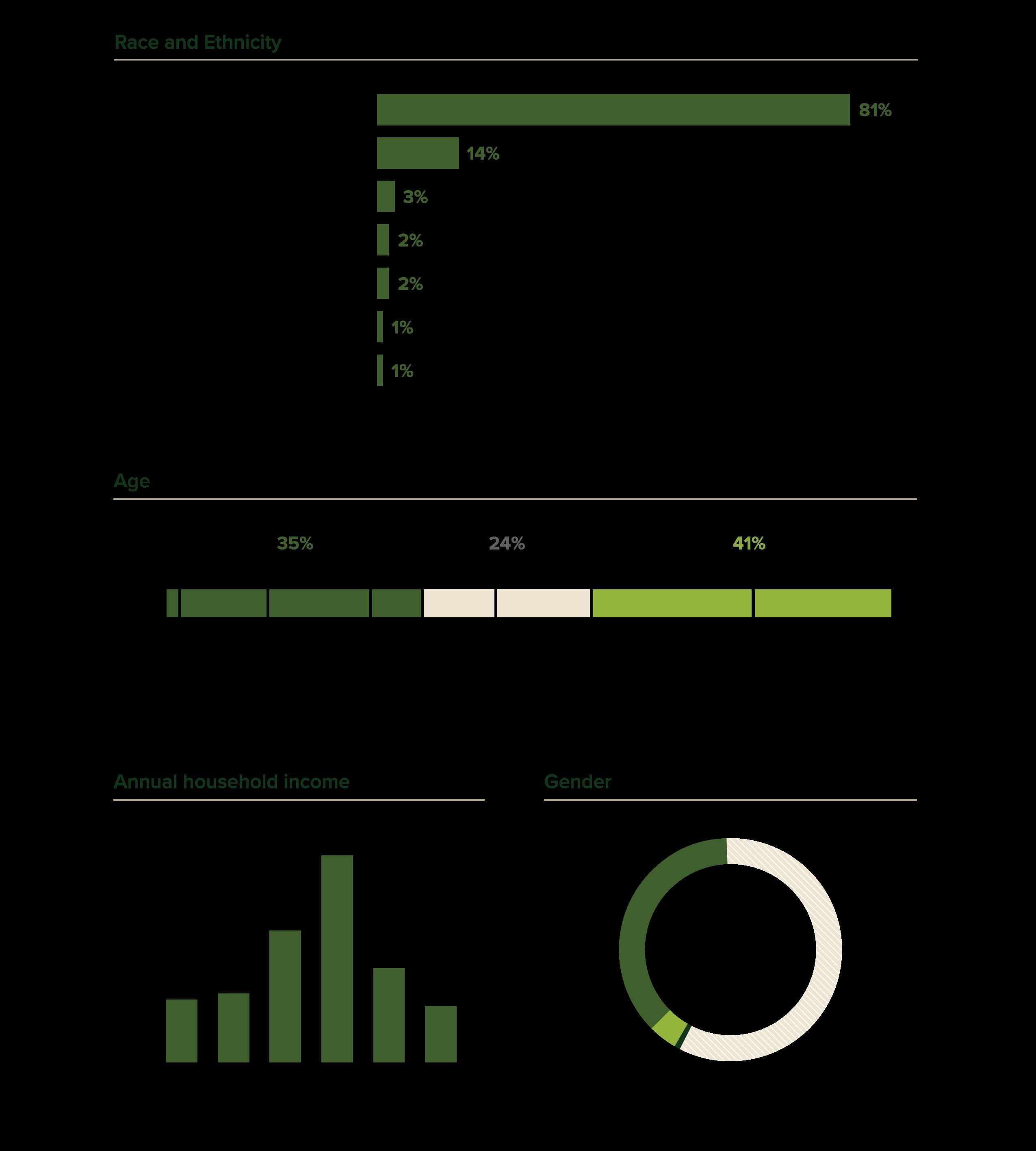
In fall 2025, Impact Architects fielded a survey about communities’ local news needs, habits, and preferences. The survey was shared through the Vermont Community Foundation’s local networks and partners and was available in English, Spanish, and French. Due to a lack of sufficient responses to the Spanish and French versions, we have analyzed only the English-language survey responses for this report. After data cleaning, the survey received more than 400 responses, and residents participated from all but Grand Isle County, with Chittenden County residents making up the largest share, at 29%.
We know that survey responses do not reflect the demographic make-up of the state, and some communities are under- or over-represented in the data. For example, residents who participated in the survey are likely more engaged with the local news ecosystem than the average Vermonter. Nearly 80% of respondents said that they pay for local news, a much higher percentage than IA has seen for similar surveys in other news ecosystems. And while it is certainly possible that a greater proportion of Vermonters do pay for local news than do residents of other states, we recognize that those who are already more engaged with the local news ecosystem are likely more motivated to complete a
Even so, we believe the survey provides useful insight into the ways some sectors of Vermont communities are engaging with local news and information.
White (not Hispanic or Latino) Asian
Black/African American
American Indian/Alaska Native
Hispanic or Latino
Middle Eastern or North African
Native Hawaiian or other Pacific Islander
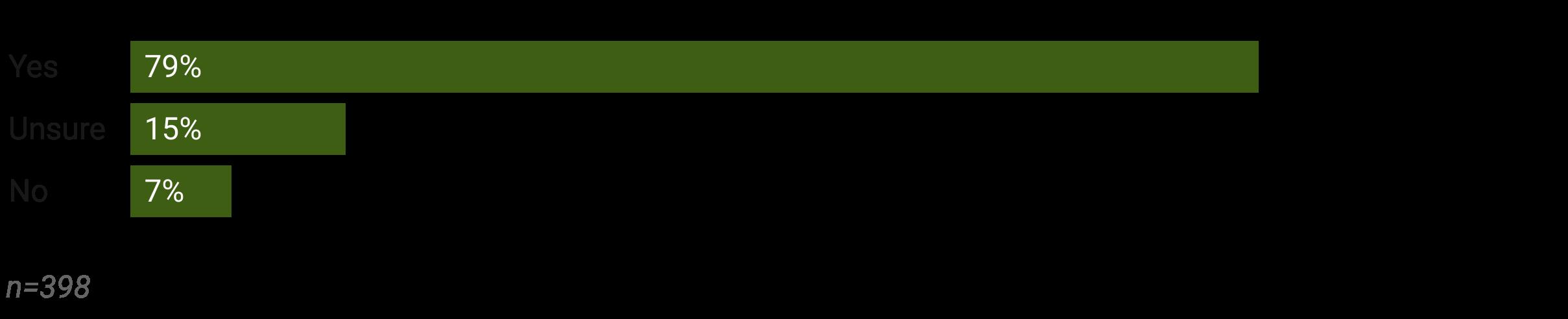
The vast majority of survey respondents (79%) agreed that their community has a trustworthy and accessible source for local news and information. This could be due in part to the large number of local news outlets still available in the state, with many serving residents at the county or more local level, in addition to outlets providing statewide coverage. In general, stakeholder interviewees said that local news outlets in Vermont do not face the same kinds of challenges with trust that national media or local outlets in other states experience. Some did express concerns about how negative narratives about the media in national politics might threaten trust in local news providers.
Do you feel your community in Vermont has a trustworthy and accessible source for local news and information?
Nearly two-thirds of survey respondents said that they felt local journalists in their area were “in touch” with the local community — a relatively high proportion compared to other geographies in the U.S., but still leaving room for improvement.
A listening session attendee highlighted that existing community relationships enable residents to voice concerns directly with local media. They provided an example where the local paper had not reported on the impending end of the pandemic-era motel housing program. This prompted one resident to call the local paper directly, stating that a program participant on a breathing machine was “going to be in the woods tomorrow.” The attendee noted that because of these close, small-town relationships, there is “some ability to get more of a spotlight put on certain situations.”
Overall, would you say that local journalists in your area are mostly in touch or out of touch with your local community?

While the survey respondents generally report having a positive relationship with local news organizations, we also heard in interviews and focus groups that traditional news sources are often not meeting the needs of communities of color, immigrant and refugee communities, LGBTQ+ residents, and low-income Vermonters, particularly when it comes to engaging deeply with those communities.
Many communities in the state remain underserved and feel disconnected from existing local news infrastructure. In an English-speaking listening session with community members who are refugees, in partnership with the Association of Africans Living in Vermont (AALV), one participant said, “A lot of valuable local knowledge about housing, health, education, even civic opportunities, circulates outside of traditional media. If local outlets could build bridges to those informal networks, information would [be] more inclusive.”
Interviewees and listening session participants described a lack of cultural competency among local news outlets, with some attributing this to a lack of representation of their communities in local newsrooms. A consistent theme across all listening sessions was a desire for news organizations to feature the voices of people with lived experience.
“A lot of valuable local knowledge... circulates outside of traditional media. If local outlets could build bridges to those informal networks, information would [be] more inclusive.”
Listening session participant
This could mean hiring reporters who reflect those communities, as well as highlighting the voices of members of those communities in coverage. This was an especially common theme as it related to LGBTQ+ residents, Vermonters of color, youth, and people experiencing homelessness. Interviewees and focus group participants described how communities not seeing their lived experiences reflected could erode trust and, in some cases, had done harm to individuals or communities.
Participants in the listening session with English-speaking refugees said they were interested in being informed and involved in their towns, but a major barrier was feeling they were only invited in when “needed” for something, rather than being consistently and deeply engaged by local stakeholders. Participants also described how misrepresentation of their communities in local news outlets, including racist or discriminatory depictions, displayed a “total lack of cultural empathy” and diminished trust.
What are the most important actions local news organizations could take to increase your trust?
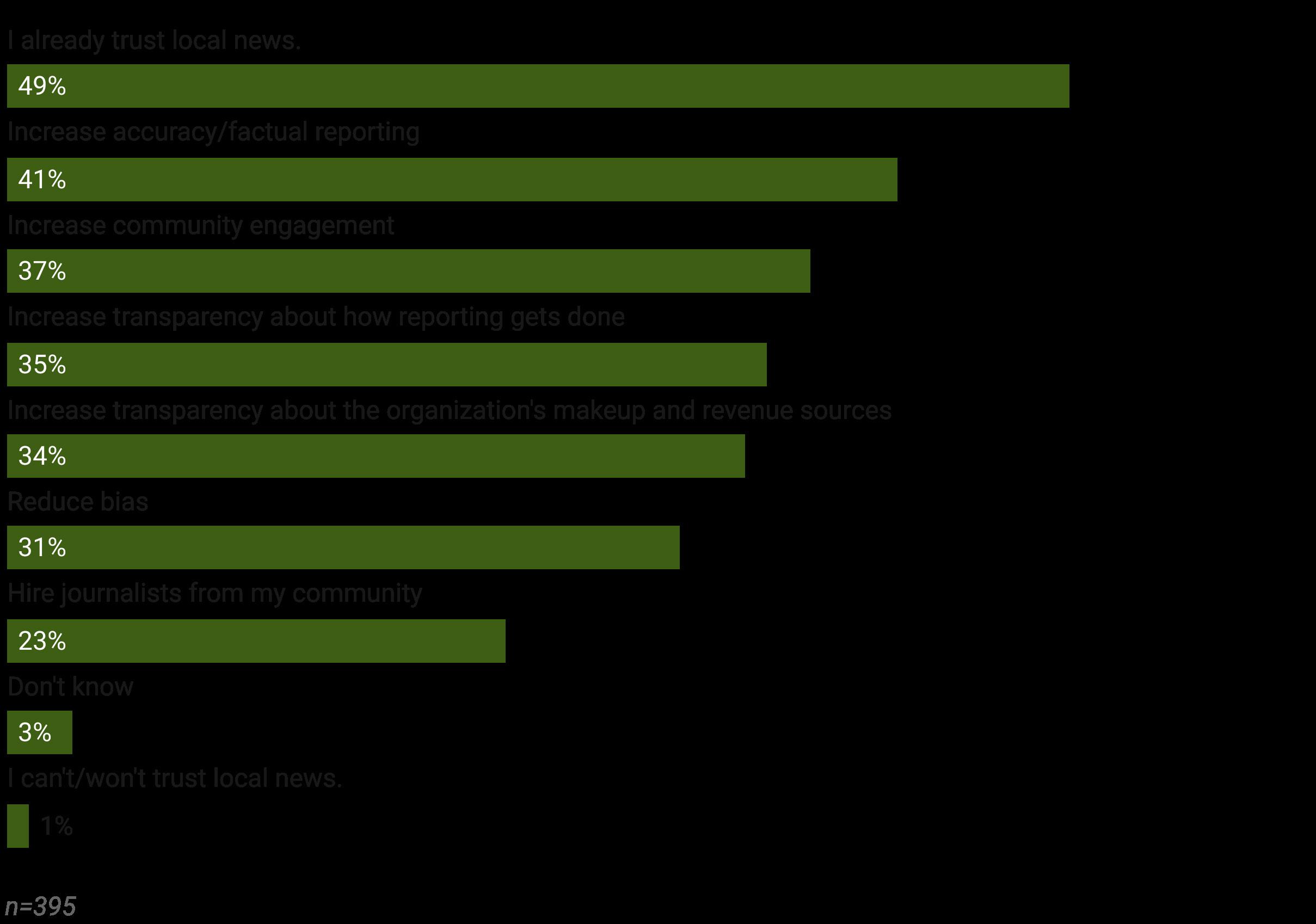
When asked how local news organizations could increase trust in their work, about half of survey respondents (49%) said they already trust local news, but 41% said that news organizations could increase accuracy/factual reporting. While we know nearly all news organizations in Vermont have practices and standards for journalistic integrity, factchecking, and acknowledging errors in reporting when they occur, this finding helps illustrate community perception
of reporting practices, suggesting opportunities for greater transparency about internal policies as well as education about journalism standards and practices. Increasing community engagement and transparency about reporting and organizations’ revenue sources were also frequently selected in the survey, again pointing to opportunities for local news outlets to engage communities further about their work in order to build stronger relationships.
While very few survey respondents said they cannot or will not trust local news, a little less than a quarter said that hiring journalists from their community would increase their trust, aligning with findings in community listening sessions that some communities in the state feel their voices and experiences are not represented in traditional news sources. One listening session participant, at risk of losing food assistance during the government shutdown in fall 2025, described being disappointed that none of the coverage of food assistance funding cuts that they had seen in local outlets included perspectives from people who would lose their benefits, calling the reporting “oversimplified and not really that helpful to someone being impacted by the issue.”
In order to understand the role of local news in Vermonters’ lives, we asked survey participants to share ways in which local news had impacted them. Perhaps unsurprisingly, more than 80% said that they had learned new information about a topic, the most frequently selected type of impact. Respondents also said news had connected them to resources, events, or their communities. In fact, only 4% of respondents said local news had not impacted them in any of the listed ways. This suggests that local news organizations are playing a key role, not only in keeping sectors of the state informed, but also in ensuring they have the resources and information they need to participate more fully in their communities. Given the important role local news plays in connecting Vermonters to their communities, community members who feel they are not served by existing options are missing out on that opportunity for connection.
Has local news had any of the following impacts on your life?
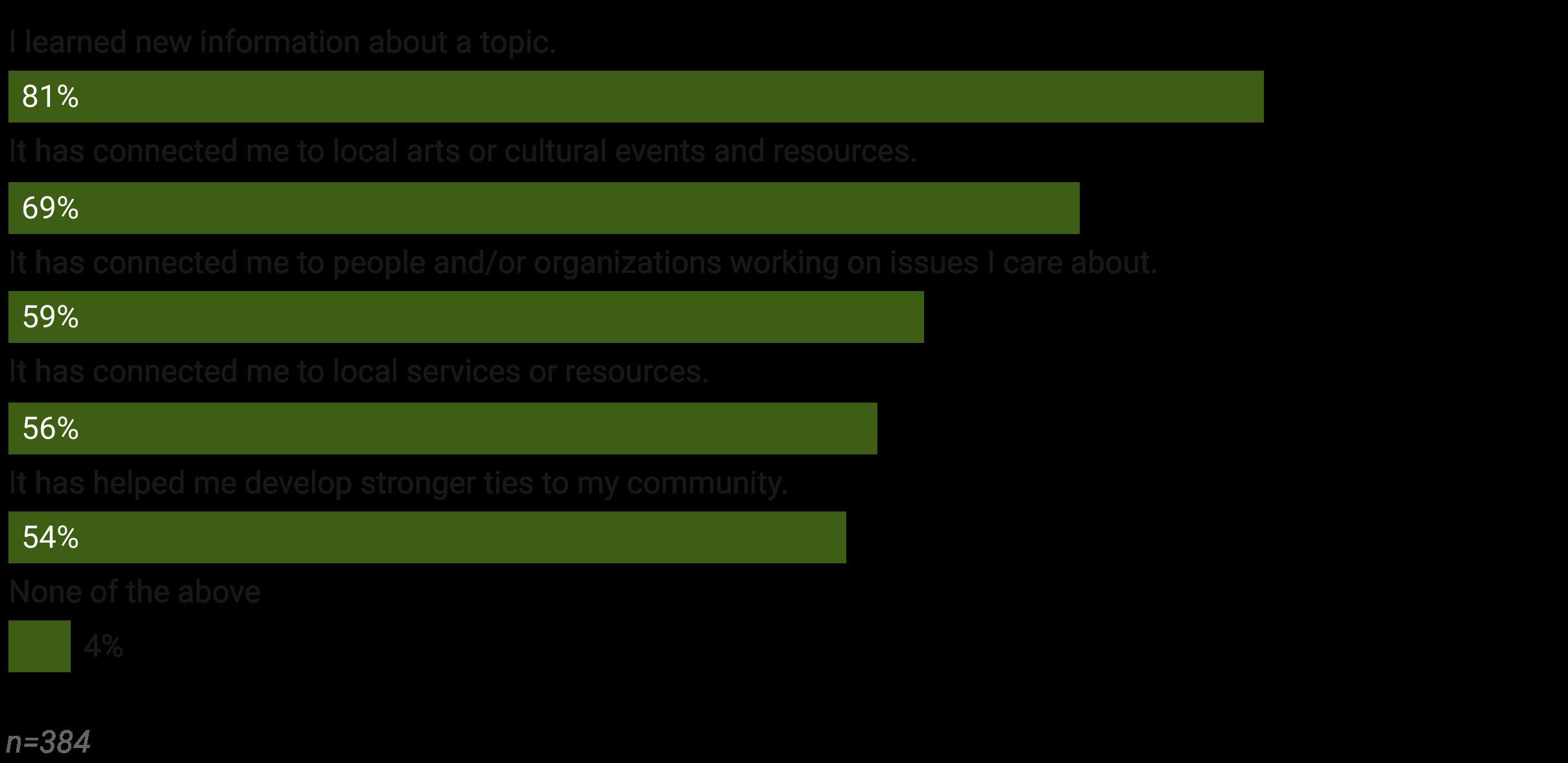
Listening session participants described how the modern information environment makes getting trustworthy information more challenging. Fragmentation of the landscape, with news and information available through traditional media, social media, and local networks and groups, means people need to look to a greater number of sources to find information about issues and topics they care about. Some described a feeling of “information overload” — that there was too much information to sift through, and limited time and resources made it difficult to navigate. One participant said that “you are still so inundated by it in one way or another… and I don’t know what to believe anymore.” In other conversations, some people noted that a lack of media literacy could make it harder for people to navigate the information space, and there was a perception that this is especially true for younger people, although this was not a core challenge identified by younger Vermonters themselves. At a listening session for youth, one participant noted that many of their peers were not engaging with news. “Some of my friends say they aren’t interested because it’s too upsetting. It’s giving them too much anxiety,” they said.
In many cases, participants described doing work to “fact-check” information they came across, sometimes by searching to see if they could find the information in additional sources. In listening sessions with refugees, participants described how a lot of information is shared secondhand, via word of mouth or social media, and they are often relying on trusted messengers more than traditional news outlets. Information is often shared through Facebook groups or the WhatsApp messaging app, and it falls on those with English proficiency to communicate news and try to verify information, participants said.
Interviewees, focus group participants, and listening session attendees raised concerns about youth media literacy and whether students received enough education about navigating the media landscape in school. In a listening session for youth, hosted by Vermont Afterschool, participants highlighted how teachers sometimes shy away from discussing current events out of concern that they may be perceived as too political, but this means youth may not be having conversations about how to evaluate information. Youth participants did say that efforts to increase youth media literacy would be useful, and suggested ideas such as exposure to kid-friendly media that would follow students from kindergarten through high school, as well as subscribing students to local news sources in the state. However, youth participants were also aware of the challenges of the current information landscape and said they often work to verify what they see online by searching for more information.
Participants in the youth listening session recommended including and uplifting youth voices in the local news ecosystem, such as by allowing them to participate in the production and dissemination of information to their peers. The need to better include youth voices in local news was also raised in open-ended responses to the survey, and interviewees pointed to youth as a critical group to engage as well. Many highlighted the value of the
UVM Community News Service’s work to involve college students in reporting local news, and some wondered whether there might be an opportunity to engage high school students in a similar way. Other organizations in the state are also working to uplift youth voices, such as through the Young Writers Project , highlighting capacity for and interest in engaging this age group.
In interviews, listening sessions, and the community survey, we sought to better understand residents’ information needs, meaning barriers to access and gaps in coverage in the current news and information landscape.
Where respondents get local news compared to where they prefer to get it
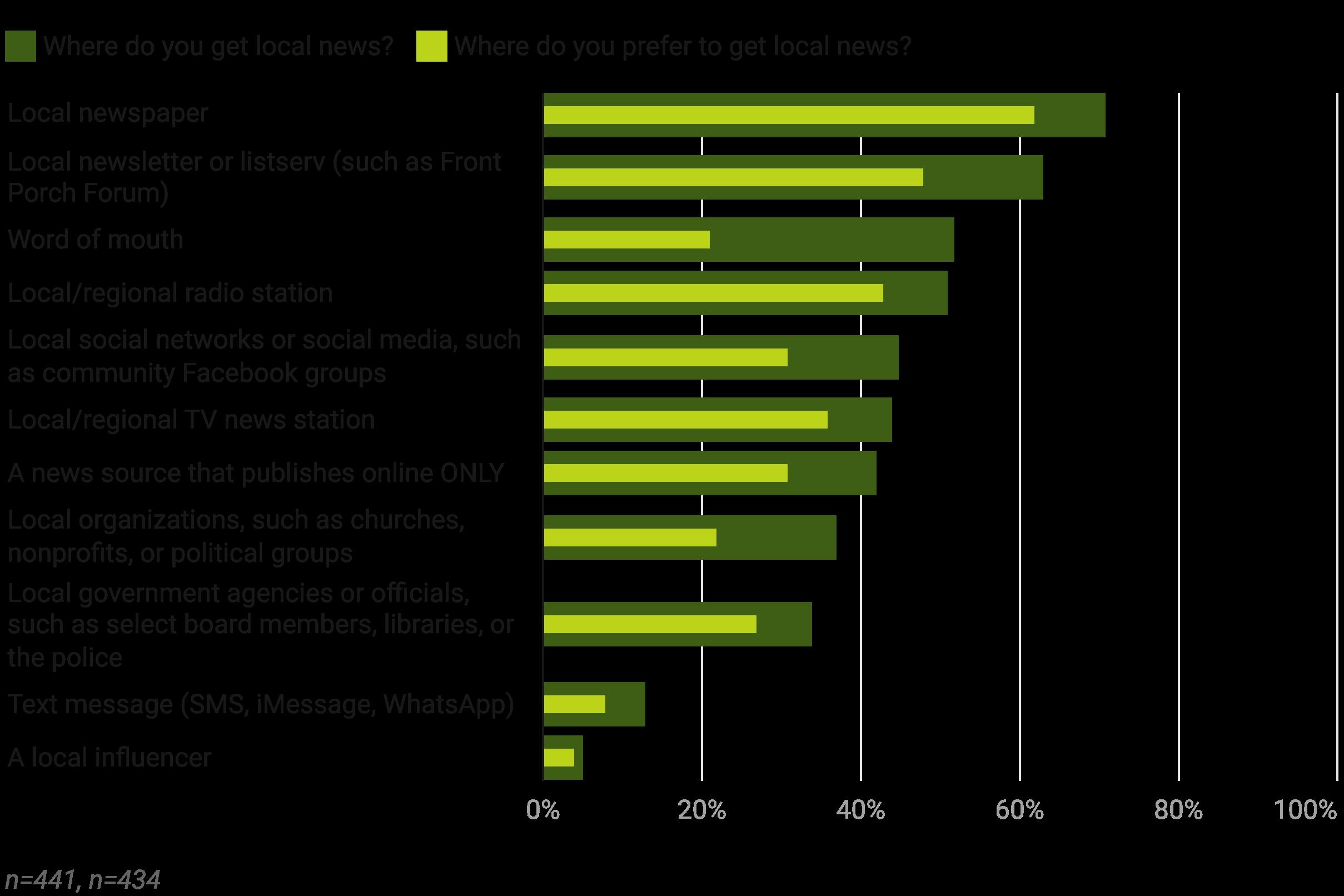
Respondents to the survey indicated that news is generally available in the formats that they prefer. While “word of mouth” is typically the most selected information source in surveys IA has fielded in other states, “local newspaper” and “local newsletter or listserv” (including Front Porch Forum) were the most frequently selected options in Vermont. More than 70% of respondents said they get their news from a local newspaper, and more than 60% listed that as their preferred format for getting local news. Notably, there is a gap between the percentage of respondents who said they get their local news via word of mouth (52%) compared to the percentage who prefer to get their local news that way (21%).
The news sources residents said in the survey that they use and prefer for getting local news look different when broken down by age group. While more than 80% of those 65 and older — and those ages 45 to 64 — reported getting local news from a newspaper, the percentage getting news from a local paper decreased among younger age groups. Among respondents under 45, “local social networks” was the most frequently selected source for getting local news.
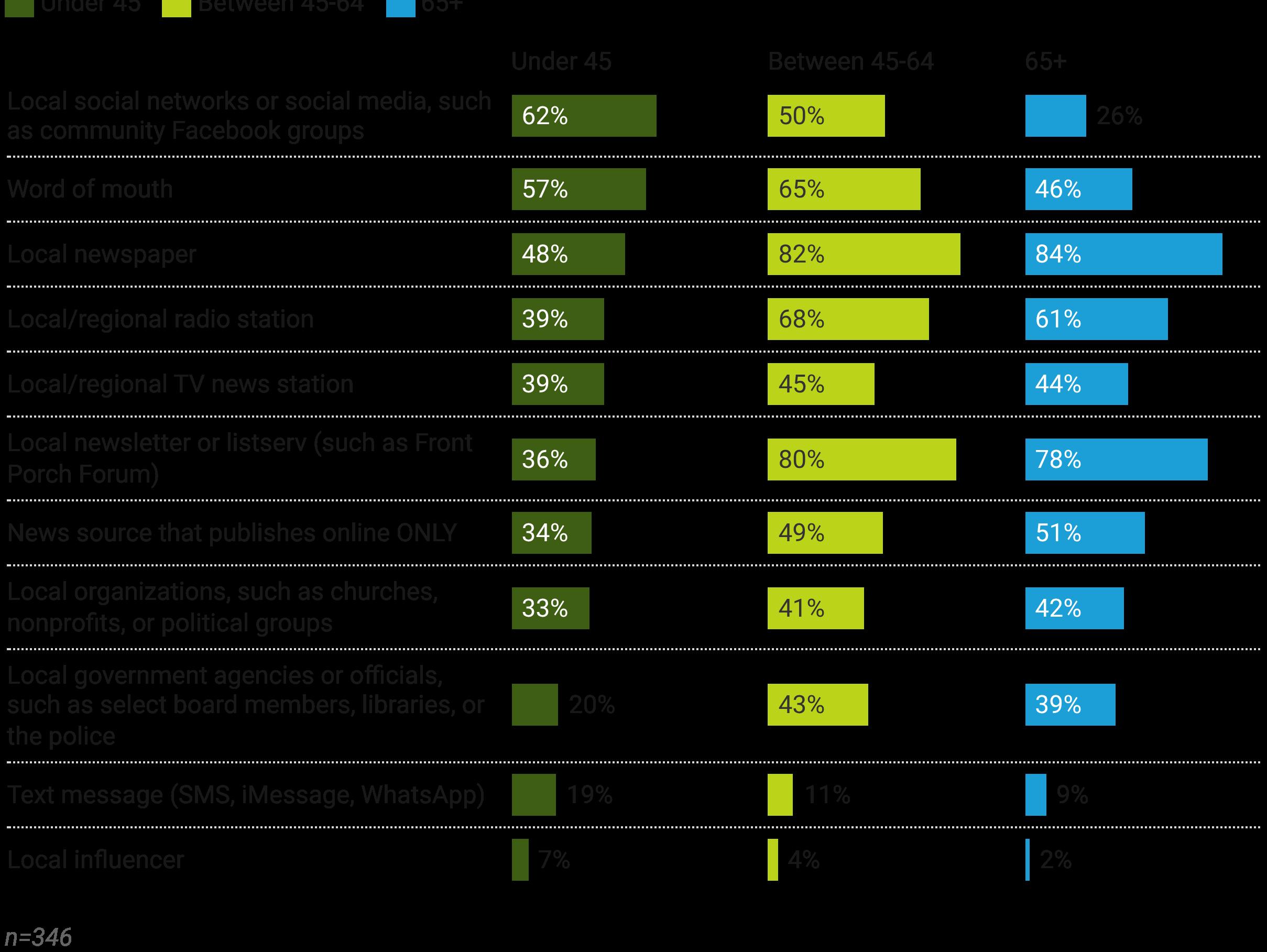
When it comes to preferred sources for local news, “local newspaper” remained the most frequently selected option by far among those 65 and older. For respondents between 45 and 64, “local newsletter or listserv” (63%) and “local newspaper” (61%) were the most frequently selected preferred sources. For those under 45, “local social networks” remained the most frequently selected source (48%), but it was followed closely by “local newspaper” (46%). While a majority of people under 45 and 45 to 64 reported getting local news via word of mouth, a much smaller percentage prefer to get news that way: 31% of those under 45 and 17% of those 45-64. The data aligns with assumptions among those working in the news and information ecosystem that younger Vermonters rely on and prefer getting local news from social media and social networks, while older residents
rely on and prefer more traditional sources like newspapers. It underscores how news organizations may need to expand content to new formats in order to meet younger audiences where they are. Many outlets are aware of this need, and ecosystem stakeholders and focus group participants referred to it in our conversations. And in 2025, VTDigger engaged in a community listening project centered on young and rural Vermonters.
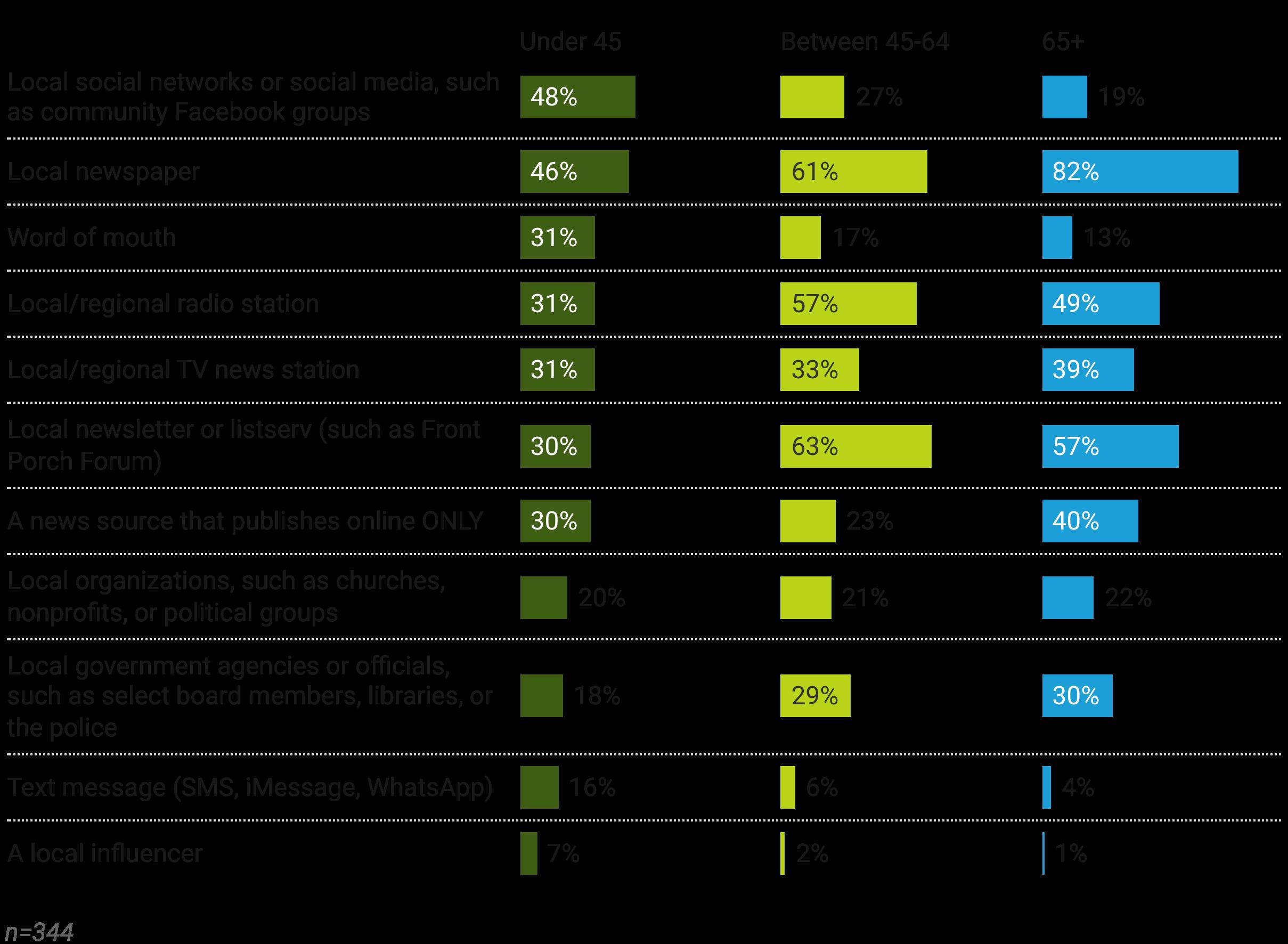
While the survey represents the views of residents who are likely already engaged with the local news ecosystem to some degree, in listening sessions and interviews we heard that some communities are not being served by existing local news formats. Conversations with Vermont residents consistently highlighted a problem with “last mile” delivery of news: While local news outlets may be covering the topics that residents are seeking information about, that news is often not getting into their hands. This occurs for a variety of reasons, including that news is cost-prohibitive to access and that it is not available in the formats, on the platforms, or in the languages that residents require.
No Vermont news outlet consistently produces coverage in languages other than English. In one of the community listening sessions with members of the immigrant and refugee communities, a participant expressed how, in their home country, news coverage is shared in multiple languages at the top of the hour. The absence of such a practice in Vermont makes it difficult for non-English speakers to engage with local news and makes them feel less welcome to participate in local communities.
While the Spanish-speaking population in the state is small, it is growing rapidly, said Will Lambek, the policy and communications director for Migrant Justice. Migrant Justice is a worker-founded human rights organization that advocates for migrant farmworkers. Lambek said that Vermont Public sometimes produces Spanish-language versions of audio and web stories where the outlet has worked closely with Migrant Justice throughout the reporting process. “That could be something that other outlets follow suit in,” he said. “I think that is a way to make particular stories accessible. Though that’s not a holistic strategy. It’s not the same as saying, ‘We are going to create a news ecosystem that is targeted to and accessible for Spanish-speaking immigrants in the state.’”
Some described how information is not shared effectively, even when translated, highlighting how limited news and information in residents’ languages can create problems. For example, for a Winooski bridge project, flyers placed in residents’ mailboxes were poorly translated into Nepali leading to confusion about when the bridge would be closed.
As the availability of translation software increases and more people can translate text using their phones, language has become less of a barrier than the format in which news outlets choose to share information. For example, Lambek said that Spanish-speaking migrant farmworkers are typically not engaging with traditional news formats like newspaper articles, even if they are translated into Spanish. Instead, many seek information on social media, such as Facebook groups or short-form video platforms like TikTok. According to Lambek, local newsrooms are not producing content for this audience on TikTok, and our research did not find any evidence to contradict this assessment.
News available in text format, even if it is translated, may not be accessible to people with a variety of education backgrounds and literacy levels, some interviewees and community listening session participants pointed out. Local news outlets could make content more accessible by providing more audio and video content. And news organizations and residents alike pointed to the need for updated websites and digital transformation among many of Vermont’s local publications.
In a listening session in St. Johnsbury, participants recognized that not everyone has access to traditional local news sources due to the cost of a subscription. Residents hit paywalls when trying to access news online,
but they are also concerned about consuming misinformation when searching for freely available news and information on social media platforms. And in the survey, 14% of respondents said that the cost of a subscription was too much for their budget.
These access issues extend even to community institutions designed to bridge digital and financial divides. A librarian at one of the listening sessions, for example, noted that this challenge also extends to their work at the local library providing access to digital media subscriptions free of charge to library patrons. “There is not a way for us to contract with the Addison Independent to either have digital access on our public workstations, or to pay for a model where… a community member [could] sign in with their... library card and PIN number,” they said.
Do you face any of the following barriers to accessing local news and information?
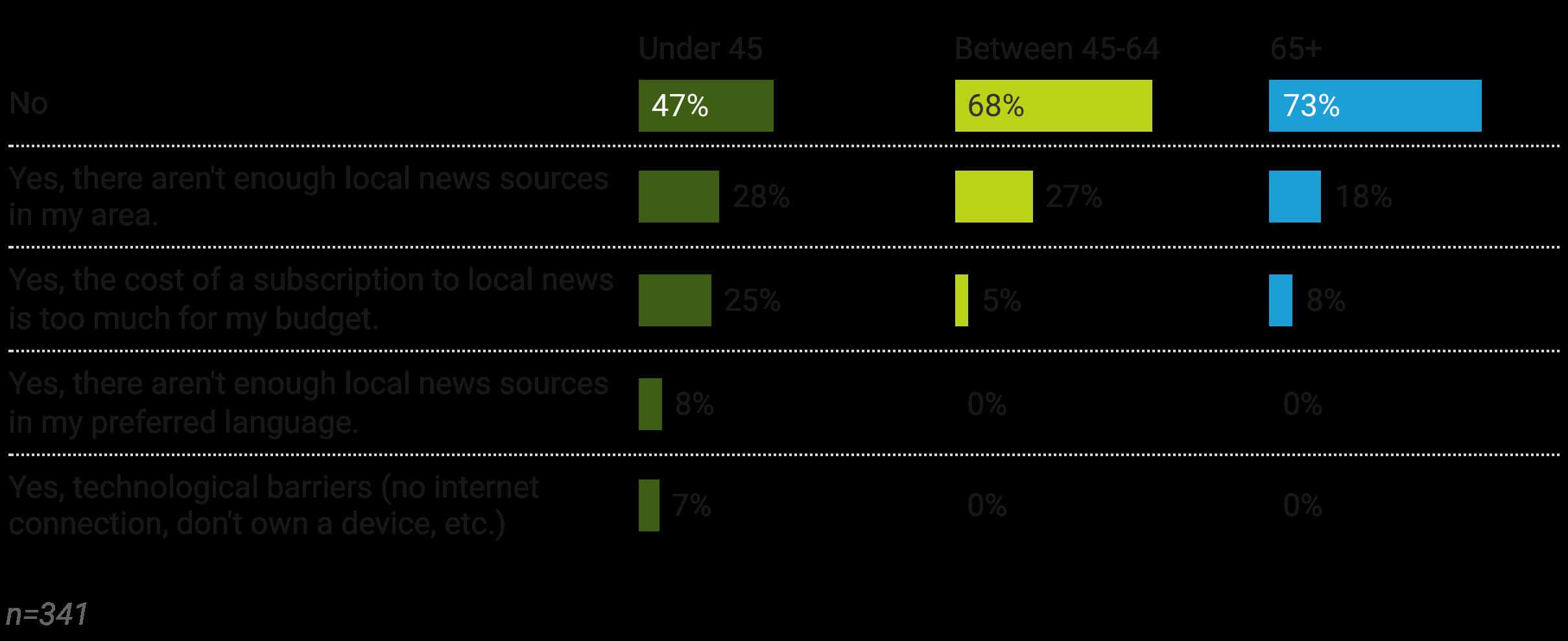
In our survey, younger respondents said cost was a barrier more frequently than those in older age groups. A quarter of respondents under 45 said the cost of a subscription was too much for their budget, compared to 5% of those 45 to 64, and 8% of those 65 and older. This barrier could be another contributor to the sense among news ecosystem stakeholders that younger residents are not engaging with local news sources as much as older generations. Given the high cost of living and difficulties finding affordable housing, younger residents may not have the ability to pay for local news.
In our survey, younger respondents said cost was a barrier more frequently than those in older age groups.
How much do you agree or disagree with the following statements?
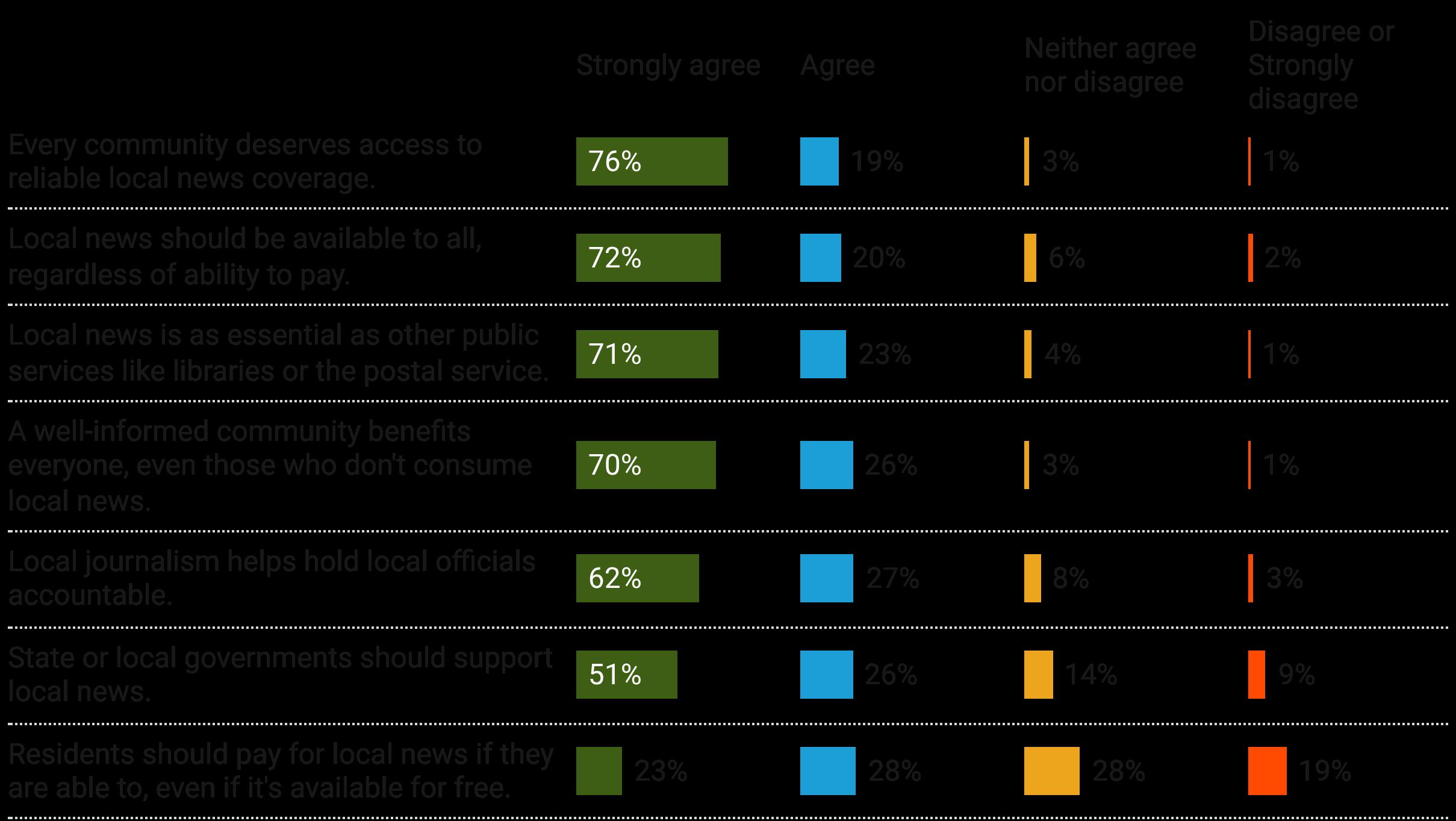
The vast majority of respondents (92%) agreed or strongly agreed that local news should be available to all, regardless of ability to pay, though about half said that residents should pay for local news if they are able, even if it is available for free. More than threequarters of respondents said that state or local governments should support local news. The data shows a sense among respondents that local news is a public good and should be accessible to all. Nearly all respondents felt local news was an essential service and that every community should have access to reliable local coverage. This underscores the value of local news to Vermont communities and suggests there is interest in systematic efforts to ensure that it remains or becomes available to local residents.
More than three-quarters of respondents said that state or local governments should support local news.
When asked if and how they would support local news organizations to keep local news available to their communities, two-thirds of respondents said they would pay for local news. A majority (54%) said they would provide feedback about how local news outlets could better meet communities’ needs. Responses also suggest an appetite for participating in the production of local news, including volunteering to support the operations of local outlets (25%) and to report stories (23%).
In order to keep local news available to your community, would you be willing to support news organizations in your area in any of the following ways?
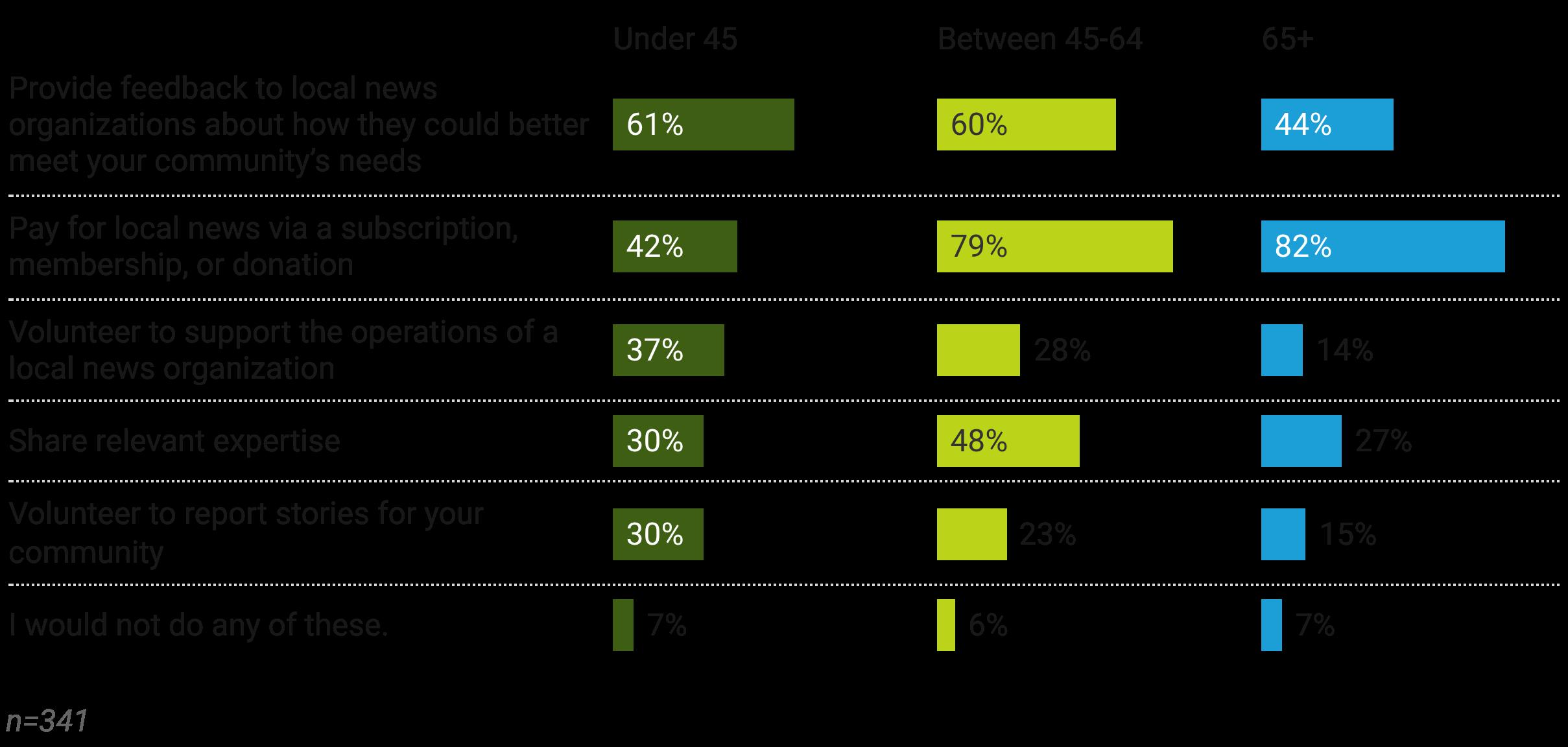
A larger proportion of younger respondent were willing to volunteer their time to support the operations of local news organizations or report stories than respondents in the 45 to 64 and 65+ age groups.
Vermonters also highlighted gaps in coverage including specific topics, perspectives featured, and the target audiences served by local outlets. Interviewees and focus group participants mentioned a need for more coverage of topics like healthcare and mental health services, housing, and homelessness. Many interviewees described a need for hyperlocal coverage of municipal issues and government, especially as small community newspapers have closed or been forced to decrease coverage.
Ted Brady is the executive director of the Vermont League of Cities and Towns, which represents all 248 cities and towns in Vermont. “The greatest need is for accurate and timely information to be shared with people in a non-judgemental way that allows them to make their own decisions on how they live their life, how they engage with public entities, how they vote, where they send their kids to school — go down the long list of decisions that a Vermonter has to make on a daily basis,” Brady said. He felt that, in general, it has become increasingly hard to find accurate and timely information about government at all levels — whether federal, state, or municipal. While efforts to fill gaps in coverage like the Community News Service have helped increase reporting capacity for hyperlocal issues, student journalists can’t replace experienced local reporters, Brady said. A challenge for hyperlocal outlets remains filling the “missing middle” in their staffing.
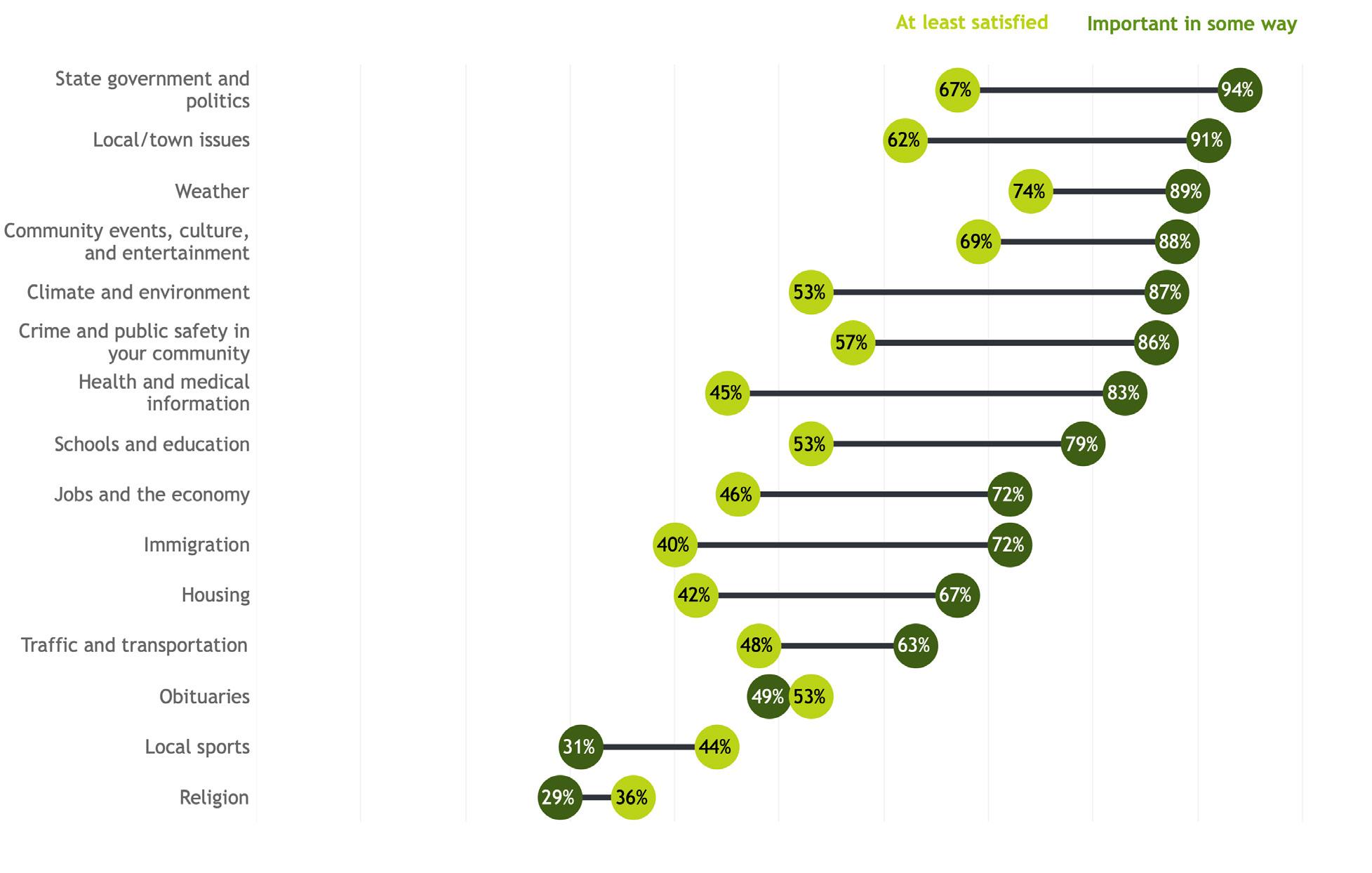
Results from the community survey show that respondents think “state government and politics” and “local/town issues” are important topics for coverage — more than 90% of respondents selected those two topics. A smaller portion of respondents reported being satisfied or very satisfied with coverage of those topics. The results reflect how decreased reporting capacity may be impacting the volume and depth of coverage of state and local government.
Interviewees and listening session participants also described a need for coverage that “localizes” national stories, exploring or explaining how national issues or policies are impacting Vermonters at the local level. In one example, Robyn Freedner-Maguire — senior director of communications and culture change at Outright Vermont, an organization that supports LGBTQ+ youth in the state — described a lack of coverage of how recent federal actions would impact queer and trans youth at the local level in Vermont. Residents turned to Outright Vermont to find that information, she said. In another example, Kelly Nottermann from Vermont Sustainable Jobs Fund described how local residents and organizations came together to support their community in the face of federal funding cuts for food assistance, raising more than $7,000 and bringing together local farms to donate food. Organizations involved put out a press release to get the word out, and this was picked up by local news outlets, but their efforts did not receive coverage by local journalists, Nottermann said.
In general, Vermonters seem to be looking for more solutions-oriented coverage and news that lifts up positive stories in the state, such as the efforts of Vermont’s robust mutual aid networks. Interviewees said that this kind
of coverage is important for connecting Vermonters to their communities and building trust between neighbors — and between residents and local news organizations.
The need for coverage of successes and positive stories was especially emphasized in listening sessions with refugee and immigrant communities and conversations with stakeholders at organizations supporting communities of color. People said they felt that stories of how immigrants and people of color are contributing to and changing the state are not being told by local news outlets. “There are folks out there that are doing wonderful things, building businesses, moving up in their careers, and serving as success stories and community builders, and yet that work never makes the front page, the second page, or the back page. It just doesn’t get out there,” said Tino Rutanhira, cofounder and co-executive director of Vermont Professionals of Color Network. Founded in 2019, the organization supports professional development and entrepreneurship among people of color in the state. “We are the future firefighters, we are the future legislators, we are the future educators and entrepreneurs and all of that,” Rutanhira said. “And that story isn’t being written.”
“There are folks out there that are doing wonderful things, building businesses, moving up in their careers, and serving as success stories and community builders, and yet that work never makes the front page, the second page, or the back page. It just doesn’t get out there,”
Tino Rutanhira, co-founder and co-executive director | Vermont Professionals of Color Network
In addition to gaps in the topics and communities that are covered, listening session participants and interviewees identified other ways that coverage does not feel inclusive. Some interviewees described how local news coverage often feels like it aligns with an “establishment” perspective, upholding a sense of Vermont exceptionalism or an idea of the culture of the state that interviewees believe is rooted in the past and not growing alongside the state’s changing communities. While Vermont prides itself on being a welcoming, community-oriented, and progressive place, focus group participants and interviewees said this is not the reality for all residents. Listening session participants said there was a perception that news organizations fail to incorporate perspectives from minority groups, with one participant noting, “They use us when it’s convenient and they need some kind of diversity.” Others shared how they feel news is geared towards a highly educated audience and is not as accessible to Vermonters with different education backgrounds.
Local nonprofits and community organizations have stepped up to fill gaps in the news and information landscape, especially when it comes to providing information to communities currently underserved by the existing local news
resources. For example, Will Lambek from Migrant Justice described how the organization shares information via WhatsApp, social media, and a half-hour news program they produce through public access television and also distribute on YouTube and social media. Vermont Professionals of Color Network has a monthly newsletter where members write about things that are impacting the BIPOC community. “That information, those articles, everything that’s in the newsletter — it’s for us and by us,” Rutanhira said. Listening session attendees and interviewees discussed how they get information from local organizations and informal networks about everything from immigration issues to housing insecurity to local agricultural and food systems news. One listening session participant noted that they primarily get news from newsletters because “it provides a mix of urgent [news] and joyous events to balance it out… and I really appreciate that there is always a call to action.” Another participant said it would be helpful to have “stronger relationships between those who are in the position to be able to disseminate information with those who are on the ground helping people to respond to whatever the needs are.”
One listening session participant noted that they primarily get news from newsletters because “it provides a mix of urgent [news] and joyous events to balance it out…and I really appreciate that there is always a call to action.”
These kinds of nontraditional news and information providers are playing a critical role in the news ecosystem — serving as trusted messengers and sharing stories that are absent or infrequent in traditional news sources. There are opportunities for local news outlets to develop sustained partnerships with these organizations, which already have deep relationships with local communities, to better serve and reach new audiences.
Vermont is a unique state with a robust tradition of civic engagement and a variety of locally owned and operated news organizations. At the same time, actors across sectors, including from philanthropy, journalism, and government, all recognize that the future of local news is not a given. The research presented in this report highlights opportunities for what actors across the state can do to shore up the infrastructure that still exists, while also building a more resilient, robust, and equitable local news and information ecosystem for the future.
• Journalism organizations should explore partnership opportunities with community organizations already engaged in providing information to underserved communities. With limited capacity and resources, newsrooms must seek innovative ways to produce linguistically and culturally relevant reporting for all the diverse communities living in the state. They can partner with organizations that are already serving these communities to inform editorial decisions, connect reporters with their communities, and serve as a conduit to their communities. There are also opportunities to train and empower community members to report in and for their communities.
• Newsrooms must address “last mile” content delivery and engagement issues to ensure that the reporting that is being done can reach all residents. This will require community engagement to learn about the barriers to residents accessing information, and shifts in content distribution and audience engagement efforts on the part of news organizations.
• Newsrooms can expand localized, solutions-oriented journalism on key issues for Vermonters. While Vermonters are more satisfied than many across the U.S. with current coverage of local issues, there is opportunity to increase reporting on key issues — such as housing, homelessness, and healthcare — spur community connection by including diverse perspectives and voices in coverage, and do solutions-oriented reporting to illustrate what is working in communities.
• Deepen collaboration among news providers — beyond content-sharing. There is experience in the local news ecosystem with content sharing, and the relationships that have been established over time can serve as the foundation for deeper editorial collaboration, audience engagement efforts, and more. This work likely will require a backbone organization to facilitate relationship-building and collaboration.
• Further cultivate backbone institutions for Vermont local news. The journalism community is eager for more collaboration, but needs a strong actor — or actors — to step in to fill the coordination role. While some
current initiatives may fill portions of this space in Vermont, there could be new actors to take on the critical role of organizing, coordinating, and catalyzing the development of the information sector to ensure that support is comprehensive without being duplicative.
• Take advantage of Vermonters’ strong civic engagement muscles to develop citizen journalism initiatives. Covering local news, such as government meetings, consistently and thoroughly requires compensation, but it also might not require a full-time local reporter. Programs like City Bureau’s Documenters initiative train local residents to cover community meetings and events, then pay them for contributing stories to local news organizations.
• Cultivate more donor support of news. Local news and information is connected to every issue in communities, from housing to civic engagement to education. Press Forward Vermont is well positioned to communicate the importance of this work, together with the challenges facing the local news industry, to generate additional philanthropic support for local journalism, both through direct giving to organizations and through the Press Forward Vermont pooled fund.

• Establish public funding for local news. Vermont’s state government recognizes the importance of local news for having informed and engaged residents. There is opportunity to continue to engage with state and local governments to create innovative strategies for public support for local news.
• Develop a shared vision for the future of local news. Local outlets and community stakeholders must collaboratively define a clear vision for the ecosystem, articulating statewide goals and the path to better outcomes for Vermonters.
Indicator
Community Indicators
Demographics
Population
Population per square mile
Rural
Under 18
65 and over
White alone
Two or more races
Hispanic or Latino
Asian
Black or African American
American Indian or Alaska Native
Native Hawaiian or Other Pacific Islander
Middle Eastern or North African
Language
Speaks a language other than English
Speaks Spanish
Speaks another Indo-European language
Speaks an Asian or Pacific Island language
Definition
Data Source
Total population
Number of people per square mile
Percent of population living in areas classified as rural (2020)
Percent of population under age of 18
2023: ACS 5-year Estimates (DP05 ACS Demographic and Housing Estimates)
U.S. Census Bureau Quick Facts
U.S. Census Bureau Urban and Rural
2023: ACS 5-year Estimates (DP05 ACS Demographic and Housing Estimates)
Percent of population age 65 and over 2023: ACS 5-year Estimates (DP05 ACS Demographic and Housing Estimates)
Percent of population identifying as white alone
Percent of population identifying as two or more races
Percent of population identifying as Hispanic/Latino
Percent of population identifying as Asian alone
Percent of population identifying as Black or African American alone
Percent of population identifying as American Indian or Alaska Native alone
Percent of population identifying as Native Hawaiian or other pacific islander alone
Percent of population identifying as Middle Eastern or North African
Percent and number of people ages 5+ that speak a language other than English at home
Percent and number of people ages 5+ that speak Spanish at home
Percent and number of people ages 5+ that speak another Indo-European language at home
Percent and number of people ages 5+ that speak an Asian or Pacific Island language at home
Limited English-speaking households Percent and number of limited English-speaking households
Economics
2023: ACS 5-year Estimates (DP05 ACS Demographic and Housing Estimates)
2023: ACS 5-year Estimates (DP05 ACS Demographic and Housing Estimates)
2023: ACS 5-year Estimates (DP05 ACS Demographic and Housing Estimates)
2023: ACS 5-year Estimates (DP05 ACS Demographic and Housing Estimates)
2023: ACS 5-year Estimates (DP05 ACS Demographic and Housing Estimates)
2023: ACS 5-year Estimates (DP05 ACS Demographic and Housing Estimates)
2023: ACS 5-year Estimates (DP05 ACS Demographic and Housing Estimates)
2020: DEC Detailed Demographics and Housing Characteristics File A
2023: ACS 5-year Estimates (S1601 Language Spoken at Home)
2023: ACS 5-year Estimates (S1601 Language Spoken at Home)
2023: ACS 5-year Estimates (S1601 Language Spoken at Home)
2023: ACS 5-year Estimates (S1601 Language Spoken at Home)
2023: ACS 5-year Estimates (S1602 Limited English Speaking Households)
Median household Income
Per capita income
Poverty rate
Education
High school degree
Bachelor’s degree
Literacy
Resources & Infrastructure
Households with computer
Broadband access
Institutions of higher education
Definition
Median household income of population (in 2022 dollars)
Per capita income of population (in 2022 dollars)
Percent of population below the poverty level
Percent of people ages 25+ who have a high school diploma or its equivalent
Percent of people ages 25+ who have received a bachelor's degree from a college or university, or a master's, professional, or doctorate degree
Population ages 16-74 who are ≤ Level 1 reading proficiency. According to the PIAAC, "adults at this level can be considered at risk for difficulties using or comprehending print material." Note: The most recent PIAAC data at the time of analysis was from 2017.
2023: ACS 5-year Estimates (DP03 Selected Economic Characteristics)
2023: ACS 5-year Estimates (DP03 Selected Economic Characteristics)
2023: ACS 5-year Estimates (S1701 Poverty Status in the Past 12 Months)
2023: ACS 5-year Estimates (S1501 Educational Attainment)
2023: ACS 5-year Estimates (S1501 Educational Attainment)
Population per institution
Libraries
Population per library
Civic Engagement & Democracy
Voting
Registered eligible voters of most recent even-year election
Ballots cast in most recent even-year election
Households with a computer (including desktop and laptop computers, smartphones, and tablets)
Households with a broadband internet subscription
Institutions of higher education, including colleges, universities, and trade schools (filtered for institutions in Vermont that award a bachelor's, associate's, or advanced degree)
Population divided by number of institutions of higher education in the community
Number of libraries, library branches, and bookmobiles in the community
Population divided by number of libraries in the community
Percent of registered eligible voters of most recent even-year election (2024 General Election)
Number of ballots cast in most recent even-year election (2024 General Election)
2023: ACS 5-year Estimates (S2801 Types of Computers and Internet Subscriptions)
2023: ACS 5-year Estimates (S2801 Types of Computers and Internet Subscriptions)
NCES, states
Institute of Museum and Library Services, Library Search & Compare
U.S. Census Bureau Voting and Registration data
Vermont Election Archives, U.S. Census Bureau Voting and Registration data,
Voter turnout among eligible voters
Voter turnout among registered voters
Cost of Voting Index (COVI) Score
Election/voting litigation
Election/voting policy
Donations to political organization ($25 or more)
Post your views about political, societal or local issues on the internet or social media (frequently)
Read, watch or listen to news or information about political, societal or local issues (frequently)
Attended a public meeting
Contacted or visited public official
Bought or boycotted a product or service
Definition
Percent of eligible voters participating in most recent presidential, midterm, or local municipal elections (2024 General Election)
Percent of registered voters participating in most recent presidential, midterm, or local municipal elections (2024 General Election)
An index of scores for the ease/ burden of voting by state (2024)
Litigation that challenges some aspect of your community’s redistricting, voting, or elections policy
Bills that altered voting and elections policy in Vermont in the last three years (2022-2024)
Percent of population that reported donating $25 or more to a political organization in the past 12 months
Percent of population that reported posting their views on social media frequently in the past 12 months
Percent of population that reported consuming news or information about political, societal or local issues frequently in the past 12 months
Percent of population that reported attending a public meeting in the past 12 months
Percent of population that reported contacting a public official in the past 12 months
Percent of population that reported they bought or boycotted a product or service in the past 12 months
Number of incidents of physical intimidation of journalists from 2022 through 2023
U.S. Census Bureau Voting and Registration data
Vermont Secretary of State’s Office Election Data
Cost of Voting Index
Democracy Docket database
Manual research, Ballotpedia tracker
incidents
Regulatory policy
Number of regulatory incidents that restrict media operations and/ or production abilities from 2022 through 2023
Policies proposed that would restrict media operations and/or production abilities
Vermont Civic Health Index, Census CPS September Volunteering/Civic Engagement Supplement, 2021
Vermont Civic Health Index, Census CPS September Volunteering/Civic Engagement Supplement, 2021
Vermont Civic Health Index, Census CPS September Volunteering/Civic Engagement Supplement, 2021
Vermont Civic Health Index, Census CPS September Volunteering/Civic Engagement Supplement, 2021
Vermont Civic Health Index, Census CPS September Volunteering/Civic Engagement Supplement, 2021
Vermont Civic Health Index, Census CPS September Volunteering/Civic Engagement Supplement, 2021
Press Freedom Tracker
Number of organizations
Number of journalism organizations based within the community
State of Local News Project, INN network directory, Center for Community Media at the Craig Newmark School of Journalism maps & directories, Corporation for Public Broadcasting, National Federation of Community Broadcasters, Local broadcast affiliates (ABC, CBS, NBC, PBS, Fox, Telemundo, and Univision), Stakeholder contributions (outlets mentioned in interviews or focus groups that were not surfaced in one of the above lists/databases).
Population per organization
Mediums
Print and digital
Digital
Television stations
Radio stations
Newsletter
Independent for-profit
Corporate ownership
Local/state media group
Population divided by number of journalism organizations in the community
Number of news and information providers in the community that publish in print and digitally in the community, such as newspapers, alt weeklies, or magazines
Number of news and information providers in the community that only have a digital presence, such as a news website, social media account, or email newsletter
Number of news and information providers in the community that are print-only, such as print-only newspapers, alt weeklies, or monthly magazines.
Number of broadcast television stations in the community
Number of broadcast radio stations in the community
Number of news and information providers that offer a newsletter only
Number of independent, for-profit, news and information providers in the community
Number of news and information providers owned by a multi-state organization, including those owned by national newspaper companies like Gannett, hedge funds like Alden Global Capital, or national broadcast companies
Number of news and information providers owned by a local or in-state media company, such as a statewide newspaper group
See “Number of organizations” Data Source list.
See “Number of organizations” Data Source list.
See “Number of organizations” Data Source list.
See “Number of organizations” Data Source list.
See “Number of organizations” Data Source list.
See “Number of organizations” Data Source list.
See “Number of organizations” Data Source list.
See “Number of organizations” Data Source list.
See “Number of organizations” Data Source list.
Nonprofit
Public media
Black / African American
Hispanic / Latino
Asian / Asian American
Indigenous / Native American
Native Hawaiian and other Pacific Islander
Middle Eastern or North African
LGBTQ+
Journalists
Number of newspaper journalists
Definition
Number of nonprofit journalism organizations in the community, meaning those with 501(c)3 status, not including NPR stations, PBS affiliates or community broadcast media
Number of public media outlets in the community, including NPR stations and PBS affiliates
Number of media outlets in community produced for and by African American, Black, and Afro-Caribbean communities
Number of media outlets in community produced for and by Latino or Hispanic communities, or in Spanish
Number of media outlets in community produced for and by Asian or Asian American communities
Number of media outlets in community produced for and by Indigenous or Native American communities
Number of media outlets in community produced for and by Native Hawaiian and other Pacific Islander communities
Number of media outlets in community produced for and by Middle Eastern and North African communities
Number of media outlets in community produced for and by members of the LGBTQ+ community
Number of journalists employed by newspapers based in the geographic area indicated for most recent available year (2023 unless otherwise noted).
See “Number of organizations” Data Source list.
Local Journalist Equivalents (LJEs) per 100k people
Philanthropic dollars over the three previous year
Number of LJEs per 100k people in the geographic area indicated based on data from Muck Rack.
Number of philanthropic dollars invested in media and information in the community from 2022 through 2024 ("Journalism, news and information" and "Media content and platforms" grants filters). Accessed July 17, 2025.
See “Number of organizations” Data Source list.
See “Number of organizations” Data Source list.
See “Number of organizations” Data Source list.
See “Number of organizations” Data Source list.
See “Number of organizations” Data Source list.
See “Number of organizations” Data Source list.
See “Number of organizations” Data Source list.
See “Number of organizations” Data Source list.
Journalist Employment Report, UVM CCM
Local Journalist Index 2025
Foundation Center - Media Impact Funders (Journalism News and Information)
Recipients
Invested per capita
Definition
Number of recipients of philanthropic funding for media and information in the community from 2022 through 2024 ("Journalism, news and information" and "Media content and platforms" grants filters)
Number of philanthropic dollars invested in media and information in the community from 2022 through 2024, divided by the population of the community ("Journalism, news and information" and "Media content and platforms" grants filters)
Foundation Center - Media Impact Funders (Journalism News and Information)
The Vermont Community Foundation is partnering with local newsrooms to better understand the kind of information Vermont residents need and want about their communities. We’ve engaged Impact Architects, a national strategy and research firm, to help conduct this survey.
Si prefiere realizar la encuesta en español, haga clic aquí.
Si vous préférez répondre à ce sondage en français, veuillez cliquer ici.
This survey asks about your experience with local news and information — coverage of events, issues, and people in your town or city, your county, or the state of Vermont that involves more than just your friends or family.
We estimate this survey will take you about 12 minutes to complete. You can skip any questions you prefer not to answer. Participation is voluntary, and all responses are anonymous.
We value your help with this project. In appreciation for your participation, at the end of the survey you will have the option to enter a raffle for a small gift. Raffle participants must have a Vermont address to enter.
Do you reside in Vermont for at least six months of the year?
o Yes
o No Where do you get local news and information? Please select all that apply.
☐ Local/regional TV news station
☐ Local newspaper
☐ Local/regional radio station
☐ A news source that publishes online ONLY
☐ Local newsletter or listserv (such as Front Porch Forum)
☐ Local government agencies or officials, such as select board members, libraries, or the police
☐ Local organizations, such as churches, nonprofits, or political groups
☐ Local social networks or social media, such as community Facebook groups
☐ Text message (SMS, iMessage, WhatsApp)
☐ Word of mouth
☐ A local influencer
Where do you prefer to get local news and information? Please select all that apply.
☐ Local/regional TV news station
☐ Local newspaper
☐ Local/regional radio station
☐ A news source that publishes online ONLY
☐ Local newsletter or listserv (such as Front Porch Forum)
☐ Local government agencies or officials, such as select board members, libraries, or the police
☐ Local organizations, such as churches, nonprofits, or political groups
☐ Local social networks or social media, such as community Facebook groups
☐ Text message (SMS, iMessage, WhatsApp)
☐ Word of mouth
☐ A local influencer
☐ Other (please specify)
Which social media platform(s) and network(s) do you use to get local news and information? Please select all that apply.
☐ Bluesky
☐ TikTok
☐ Truth Social
☐ X (formerly Twitter)
☐ Discord
☐ Front Porch Forum
☐ I don’t get local news and information from social media.
☐ Other (please specify)
What news source do you turn to most often for local news and information? Please list the name of one specific local news organization or other local information source.
Do you currently support local news in any of the following ways? Please select all that apply.
☐ Pay for local news via a subscription, membership, or donation
☐ Volunteer to report stories for my community
☐ Volunteer to support the operations of a local news organization
☐ Share relevant expertise
☐ Provide feedback to local news organizations about how they could better meet my community’s needs
☐ Write opinion pieces or letters-to-the-editor
☐ I do not do any of these.
Do you face any of the following barriers to accessing local news and information? Please select all that apply.
☐ Yes, there aren’t enough local news sources in my area.
☐ Yes, there aren’t enough local news sources in my preferred language.
☐ Yes, the cost of a subscription to local news is too much for my budget.
☐ Yes, technological barriers (no internet connection, don’t own a device, etc.)
☐ No
How important or interesting is information about each of the following local topics for your daily life?
Important for my daily life Important to know about, but I don’t need to keep up with it daily
but not important to me
and
State government and politics (including government services, elections, voting)
Community events, culture, and entertainment
Health and medical information (including finding and paying for care)
Housing (including finding and paying for housing)
Jobs and the economy (including finding jobs, financial decisions and support)
Local/town issues (select board activities, town services)
How unsatisfied or satisfied are you with the information you are able to get for each of the following topics?
Weather
Crime and public safety in your community
Traffic and transportation
Schools and education
State government and politics (including government services, elections, voting)
Community events, culture, and entertainment
Local sports
Health and medical information (including finding and paying for care)
Housing (including finding and paying for housing)
Jobs and the economy (including finding jobs, financial decisions and support)
Obituaries
Religion
Immigration
Climate and environment
Local/town issues (select board activities, town services)
Thinking specifically about the role of news and information in your local community, how important is it that outlets do the following?
Give me information about emergencies
Hold leaders in politics, business, and other institutions accountable for their actions
Present different perspectives
Inform me about state and local politics
Explore solutions to problems
Connect me to my community
Hire people who represent the population of my local community
Give local context to national stories
Help me decide places to go or things to see
Are entertaining
Host community events
Report fairly about a wide range of local topics and events
Overall, would you say that local journalists in your area are mostly in touch or out of touch with your local community?
o In touch
o Out of touch
o There are few to no local journalists in my area
o Unsure
How often do you consume (read, watch, or listen to) LOCAL news?
o Every day
o A few times a week
o About once a week
o A few times a month
o Once a month
o Less than once a month
Do you feel your community in Vermont has a trustworthy and accessible source for local news and information?
o Yes
o No
o Unsure
What are the most important actions local news organizations could take to increase your trust? Please select all that apply.
☐ Increase accuracy/factual reporting
☐ Reduce bias
☐ Increase transparency about how reporting gets done
☐ Increase community engagement
☐ Hire journalists from my community
☐ I already trust local news.
☐ I can’t/won’t trust local news.
☐ Increase transparency about the organization’s makeup and revenue sources
☐ Don’t know
☐ Other (please specify)
How has news coverage of a local event, issue, or topic led you to take action, if at all? Actions might include sharing information with others, attending a public meeting, or voting in a local election.
Has local news had any of the following impacts on your life? Please select all that apply.
☐ I learned new information about a topic.
☐ It has connected me to local services or resources.
☐ It has connected me to local arts or cultural events and resources.
☐ It has connected me to people and/or organizations working on issues I care about.
☐ It has helped me develop stronger ties to my community.
☐ Other (please specify)
☐ None of the above
How much do you agree or disagree with the following statements? Strongly agree Agree
Local news should be available to all, regardless of ability to pay.
Residents should pay for local news if they are able to, even if it’s available for free.
State or local governments should support local news.
Local journalism helps hold local officials accountable.
Local news is as essential as other public services like libraries or the postal service.
Every community deserves access to reliable local news coverage.
A well-informed community benefits everyone, even those who don’t consume local news.
agree nor disagree
disagree
In order to keep local news available to your community, would you be willing to support news organizations in your area in any of the following ways? Please select all that apply.
☐ Pay for local news via a subscription, membership, or donation
☐ Volunteer to report stories for your community
☐ Volunteer to support the operations of a local news organization
☐ Share relevant expertise
☐ Provide feedback to local news organizations about how they could better meet your community’s needs
☐ I would not do any of these.
In your opinion, how can local news organizations improve their coverage of local issues that matter to you?
We have some questions about you, which will help us understand who has taken the survey and ensure we have broad representation from all of Vermont. All questions are optional.
What year were you born?
What is your gender?
o Male
o Female
o Non-binary / third gender
o Prefer not to say
What county do you reside in?
What is your zip code?
What is your current annual household income?
o Under $25,000
o $25,000 to $50,000
o $50,000 to $100,000
o $100,000 to $150,000
o $150,000 to $200,000
o More than $200,000
What is your preferred language?
o English
o Spanish
o French
o Other (please specify)
Which of the following best describes your race or ethnicity?
☐ American Indian or Alaska Native
☐ Asian
☐ Black or African American
☐ Native Hawaiian or Pacific Islander
☐ White
☐ Middle Eastern or North African
☐ Hispanic/Latino
☐ Self identify Where would you position your political views on the following scale? To record a response, you must click the dot on the slider, even if it is already in the position you will select.
Very liberal Moderate Very conservative
Krista
IA interviewed 18 local residents who are stakeholders in the local news and information ecosystem or otherwise interact with information providers. We invited nine people from news and information providers throughout the state to participate in a focus group, and a total of four invitees attended.
Andrew Heyward
Andrew Perchlik
Bridget Higdon
Cathy Resmer
Ellen Kahler
Media professional; UVM Center for Community News, advisory board member
Vermont Statehouse, state senator
Interview
Interview
Saint Albans Messenger, Essex Reporter, Colchester Sun and Milton Independent, publisher Focus group
Seven Days, deputy publisher, co-owner Interview
Vermont Sustainable Jobs Fund, executive director Interview
Geoffrey Gevalt The Hinesburg Record, managing editor Focus group
Holly Sullivan The Winooski News, editor Focus group
Jason Van Driesche Front Porch Forum, chief of staff Interview
Kelly Nottermann
Mark Davis
Vermont Sustainable Jobs Fund, communications director Interview
Vermont Public, news director Interview
Meghan O'Rourke CCTV, executive director Interview
Michael Wood-Lewis Front Porch Forum, co-founder and CEO Interview
Paul Heintz
Vermont Journalism Coalition, founder Interview
Paula Routly Seven Days, publisher, editor-in-chief, co-founder Interview
Randy Holhut
Richard Watts
Robyn Freedner-Maguire
Roger Garrity
Sarah Copeland Hanzas
Ted Brady
Tino Rutanhira
Will Lambek
The Commons, news editor Focus group
UVM Center for Community News, co-founder and director Interview
Outright Vermont, senior director of communications and culture change Interview
WCAX, news director Interview
Vermont Secretary of State Interview
VT League of Cities and Towns, executive director Interview
VT Professionals of Color Network, co-executive director, co-founder Interview
Migrant Justice, policy and communications director Interview
To document all news and information providers in an ecosystem, IA uses a multistep process that pulls from existing databases of local news organizations. However, we recognize that even with this six-step search for local news sources, there are likely outlets that we did not encounter. Specifically, we were unable to systematically identify and include local podcasts, community newsletters, community-specific social media groups (such as local Facebook groups), local influencers providing news content via social media, and Canadian outlets providing Vermont news. And given the dynamic nature of local news, the list of news providers in the state may have changed from the time of compilation to the time of publication.
Addison Independent
Barton Chronicle
Bennington Banner
Bradford Journal Opinion
Brandon Reporter
Brattleboro Reformer
Burlington Free Press
Cabot Chronicle
Caledonia Record
Chester Telegraph
Colchester Sun
and digital
and digital
and digital
and digital
and digital
and digital
and digital
and digital
and digital
Addison
for-profit Orleans
media group Bennington
for-profit Orange
Addison
media group Windham
Chittenden
Washington
for-profit Caledonia
only Independent for-profit Windsor
only
Franklin
Daybreak Newsletter Independent for-profit Cannot identify
Deerfield Valley News Print and digital
Eagle Times
East Montpelier Signpost
Essex Reporter
Hardwick Gazette
Lakes Region Free Press
Manchester Journal
Milton Independent
Montpelier Bridge
Mountain Gazette
Mountain Times
NBC5/WPTZ
Newport Daily Express
and digital
only
and digital
and digital
and digital
only
and digital
only
and digital
Windham
media group Cannot identify
Washington
Franklin
Orleans
media group Cannot identify
media group Bennington
Chittenden
Washington
for-profit Chittenden
media group Rutland
broadcast chain Chittenden
Print and digital Corporate
Orleans
Newport Dispatch Digital only Independent for-profit Orleans
News and Citizen Print and digital Local/state media group Lamoille
North Star Monthly
and digital
for-profit Caledonia
Northfield News
Print and digital Independent for-profit Cannot identify
Poultney Journal Newsletter Independent for-profit Rutland
Rutland Herald Print and digital
Corporate ownership Rutland
Seven Days Print and digital Independent for-profit Chittenden
Shelburne News
Print and digital
Sidenote Newsletter
Springfield Reporter
St. Albans Messenger
Stowe Reporter
Stowe Today
Print and digital
Print and digital
Print and digital
Digital only
The Charlotte News Print and digital
The Citizen
and digital
The Commons Print and digital
The Hinesburg Record Print and digital
The Islander
The Other Paper
The Times Ink
Local/state media group Lamoille
Independent for-profit Orange
Corporate ownership Cannot identify
Corporate ownership Franklin
Local/state media group Lamoille
Local/state media group Lamoille
Chittenden
media group Lamoille
Windham
Chittenden
Print and digital Independent for-profit Grand Isle
Print and digital
Print and digital
Local/state media group Lamoille
Chittenden
Town Meeting TV Television Nonprofit Chittenden
Valley News
Print and digital Local/state media group Cannot identify
Valley Reporter Print and digital
Vermont Business Magazine/ VermontBiz
Vermont Journal/Shopper Newspaper
Vermont Public
Vermont Standard
VTDigger
and digital
and digital
and digital
only
Waterbury Roundabout Digital only
WCAX Television
WDEV
White River Valley Herald
Print and digital
Williston Observer Print and digital
Winooski News Digital only
for-profit Washington
for-profit Chittenden
for-profit Windsor
Chittenden
for-profit Windsor
Washington
Washington
ownership Chittenden
Local/state media group Washington
for-profit Orange
for-profit Chittenden
Chittenden