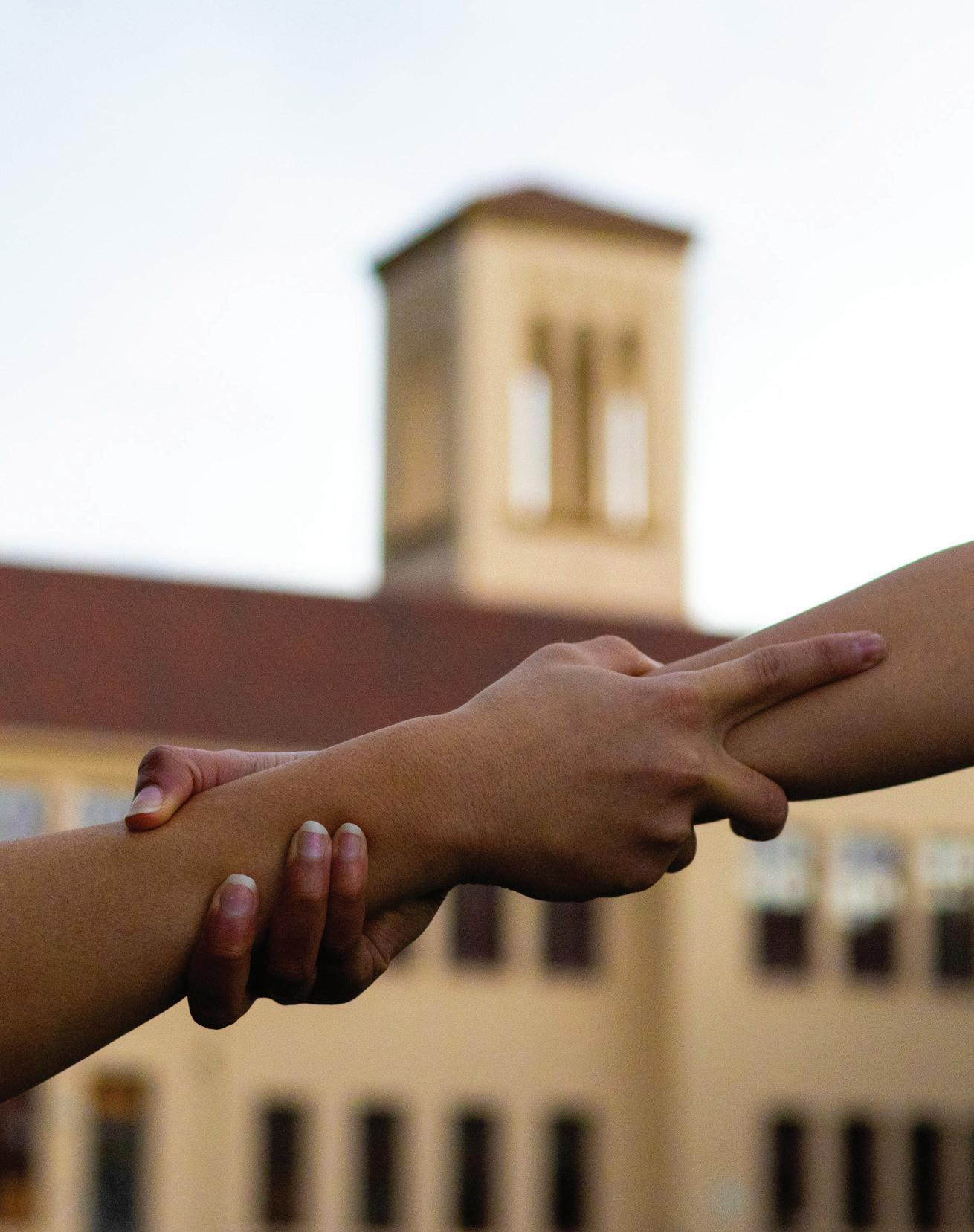
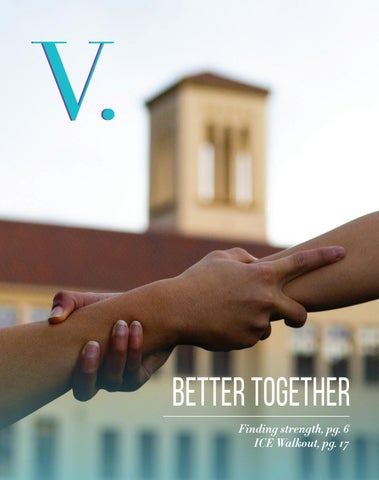

Two hands reach out and clasp onto each other in a gesture of support, captured by Editor-in-Chief Kensie Pao.
The Verde “V” logo is colored in suicide awareness month hues, symbolizing our community’s commitment to supporting youth mental health.
Publication policy
Verde Magazine, a news and features magazine published by the students in Palo Alto High School’s Magazine Journalism class, is a designated open forum for student expression and discussion of issues of concern to its readership. Verde is distributed to its readers and the student body at no cost.
Letters to the editors
The staff welcomes letters to the editors but reserves the right to edit all submissions for length, grammar, potential libel, invasion of privacy and obscenity. Send all letters to verdemagazine1@gmail. com or 50 Embarcadero Rd Palo Alto, CA 94301.
Advertising
The staff publishes advertisements with signed contracts providing they are not deemed by the staff inappropriate for the magazine’s audience. For more information about advertising with Verde, please contact our business manager at verdebusiness5@ gmail.com.
Printing & distribution
Verde is printed five times a year in October, December, February, April and May by Folger Graphics in Hayward, California. The Paly Parent Teacher Student Association mails Verde to every student’s home. All Verde work is available at verdemagazine.com.
Editors-in-Chief
Chloe Huang
Kensie Pao
Managing Editors
Eva Chang
Lilia Kuzmicheva
Lara Saslow
Features Editors
Chris Jeon
Ryan Saket
Profiles Editors
Lilo Sayag
Yardenne Sternheim
Culture Editor
Tessa Berney
Perspectives Editor
Stefan Eriksson
News Editors
Leela Kulkarni
Julie Yang
Manager of Business Operations
Stefan Eriksson
Social Media Managers
Ananya Adya
Angela Fang
Photo Director
Shaurya Thummalapalli
Art Director
Ethan Bradley
Launch Editor
Ananya Adya
Webmaster
Ethan Zhang
Staff Writers
Justin Chen
Jacob Domingo
Joshua Joo
Rohan Kini
Jaron Leung
Keira Ling
Alma Michlin
Asaf Milman
Anisha Shetty
Ryan Shin
Kai Schoebel
April Yuan
Adviser
Paul Kandell

32
If the initial months of the new year have revealed anything, we feel social issues are at the forefront of citizens’ minds. Along with this has come the community determination to defend our rights and values together. Across the nation and within our own communities, more and more people are choosing to step forward and lend their voices to advocacy.
In our feature story “Flooding the streets,” writers Angela Fang and Joshua Joo interviewed student protestors from the Palo Alto area who walked out of class on Jan. 30 in solidarity with the “National Shutdown” movement. This was arranged in an effort to denounce the U.S. Immigration and Customs Enforcement’s escalating tactics and fatal shootings of Renee Good and Alex Pretti in Minneapolis.
Educators, the underpaid pillars of our education system, have similarly decided to unite as a union, to speak out on their own about low wages which have long-been acknowledged as disproportionate to their important work. In the news story, “District board reverses planned staff cuts,” News Editors Leela Kulkarni and Julie Yang covered a PAUSD board meeting, featuring speakers from the Palo Alto Educators Association who argued that teachers — and their support staff — are the backbone to student achievement and student mental health. Following widespread community support for teachers, the PAUSD administration reversed course and reinstated the staff members they had originally planned to lay off.
Sadly, following our campus tragedy earlier this month, Paly needed to collectively advocate for something much more personal
and painful — our mental health and the safety of our students. Our gratitude editorial seeks to applaud past and present community actions intended to support students’ well-being and mourn collectively. It is important to remember that, although many may feel the need to seek out explanations in times of tragedy, pinning blame on one entity is rarely accurate or productive. It’s crucial the community comes together to strengthen suicide prevention, expand teen mental health services and support organizations like Track Watch, The Jed Foundation and The Trevor Project.
Such efforts are clearly highlighted in “Peace of Mind for Our Youth” by Feature Editor Tessa Berney and additional reporting by Rohan Kini, which explores the first youth psychiatric facility to open in Santa Clara County — a pivotal step in addressing mental health among young people residing in Palo Alto. Similarly, action within the community prompted more local measures, with the district seriously considering closing the Churchill pedestrian crossing, and Paly junior Julia Curtis promptly created a petition, trying to reinstate active in-person guards.
With all the uncertainty caused by current events — many of which are beyond our individual control — it is easy to feel overburdened and unable to act. We hope that this edition reminds you of the power the community can hold in shaping our future. As Coretta Scott King once said, “The greatness of a community is most accurately measured by the compassionate actions of its members.”
— KENSIE, CHLOE, EVA, LILIA, LARA
The Verdicts
Disclaimer: The following content discusses themes of suicide. Resources are listed at the bottom of this article for any person struggling with depression or suicidal thoughts.
IN OCTOBER 2015, Sources of Strength, a mental health promotion program, was introduced to Palo Alto High School as part of a school-wide suicide prevention initiative to address Paly’s second suicide cluster in less than a decade. This effort, led by teacher advisers and student leaders, signified a strong, community-led step in addressing mental health in our schools.
Following the tragic loss of Paly junior Summer Mehta on the train tracks earlier this month, it is time for us to individually and collectively nurture our sources of strength once more.
We have a lot of strong organizations and individuals making a positive difference already.
For example, Track Watch, a community-based prevention effort consisting of Palo Alto parents, saw a resurgence of volunteers in March 2025 after a Paly student suicide.
“Our goal is to get more people to come and volunteer right now, and to build that awareness,” Rani Jayakumar, a Track Watch volunteer, told Verde. “It may seem like nobody cares, but the adults in the community really do care, and we’re trying to help.” We value you, Track Watchers. Thank you.
Another promising program — collaborating with the district this year for the first time — is The Jed Foundation. This national nonprofit works to protect young people’s emotional health via programs with schools and colleges. With city funds, JED works to provide postvention counseling and evaluate current city and school prevention efforts. Thank you.
Individuals like Paly junior Julia Curtis are also leading efforts for change. Following the suicide, she started a petition for active crossing guard supervision of the train tracks, which had gained 3,500 signatures as of Feb.
12. She is also advocating for the closure of the railroad crossing on Churchill Avenue with the support of Superintendent Don Austin. Thank you.
Additionally, many teachers contributed positive change by adjusting their daily routines. Some relaxed their agendas, postponed tests, extended deadlines and maintained flexibility on graded assessments.
Hunter Reardon, who teaches English and Living Skills, dedicated class time for students to write down their thoughts and emotions, and encouraged students to discuss how they felt if they were comfortable doing so. Thank you.
Photography teacher Kenna Gallagher set out tables with coloring pages and markers for students who needed a simple activity to take their mind off of other matters. Additionally, they directed their teaching assistants to put up posters around school about mental health resources. For students who might hesitate to visit the Wellness Center, this initiative offered a more accessible and less intimidating way to explore available support systems. Thank you.
Then, there were administrators who posted Schoology messages informing students of campus resources, such as the Wellness Center, where students can speak to professionals, engage in a variety of fun activities, or simply lounge if they need a quiet place to unwind. Thank you.
Beyond campus, allcove Palo Alto, a free mental health center for people ages 12 to 25, made an Instagram post reminding youth of its regular drop-in sessions, as well as specific grief support sessions. Thank you.
Another way of channeling grief came from Mehta’s family in the form of a fundraising page on the website of The Trevor Project, a suicide prevention nonprofit for LGBTQ+ youth. This fundraiser had raised
Resources for dealing with mental health crises
Call 24/7 suicide and crisis hotline: 988
Crisis Text Line: Text HOME to 741741
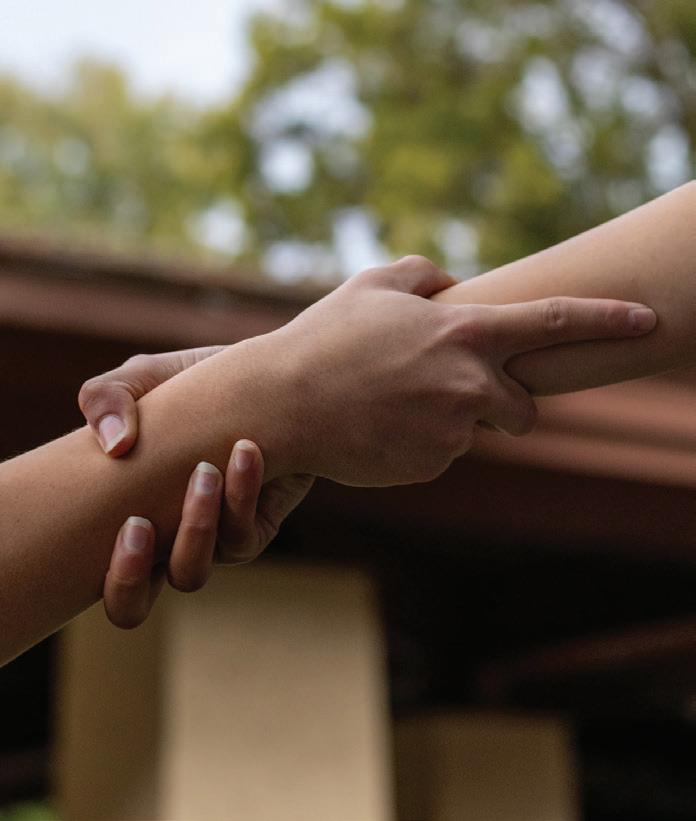
HAND — Two hands grasp one another in solidarity. “There are small things you can do that have a big impact,” Paly
over $430,000 as of Feb. 12, with a goal of reaching $1 million for the project’s 24/7 crisis intervention and suicide prevention services. Thank you.
Despite all of these positive responses, we empathize with people’s frustrations. Sometimes, it can feel like no action is enough. Public health experts in suicidology remind us that there are many different factors that may lead someone to take their life.
Moving forward is only possible when we stop pointing fingers and commit to creating real change, which includes community efforts to strengthen suicide prevention and expand student support services. Thank you to all who have contributed.
And to the Mehta family, we offer our deepest heartfelt condolences.
There is still much work to be done in ad dressing youth mental health, but for now, our strength can be found in each other. Simple habits like checking in with peers, taking con cerns seriously and paying attention to shifts in behavior can help someone feel seen and supported. Small, consistent acts of care create a culture where we can feel safe speaking about our mental health. It’s time to come together, Palo Alto. It’s time to be better together.
Call The Trevor Project’s 24/7 crisis support hotline: (866) 488-7386
To volunteer for Track Watch, email TrackWatchPaloAlto@gmail.com
To donate to the Trevor Project go to https://give.thetrevorproject.org/fundraiser/6961929
To sign the petition to close the Churchill crossing, visit https://www.change.org/p/petition-for-active-suicide-prevention-at-pausd

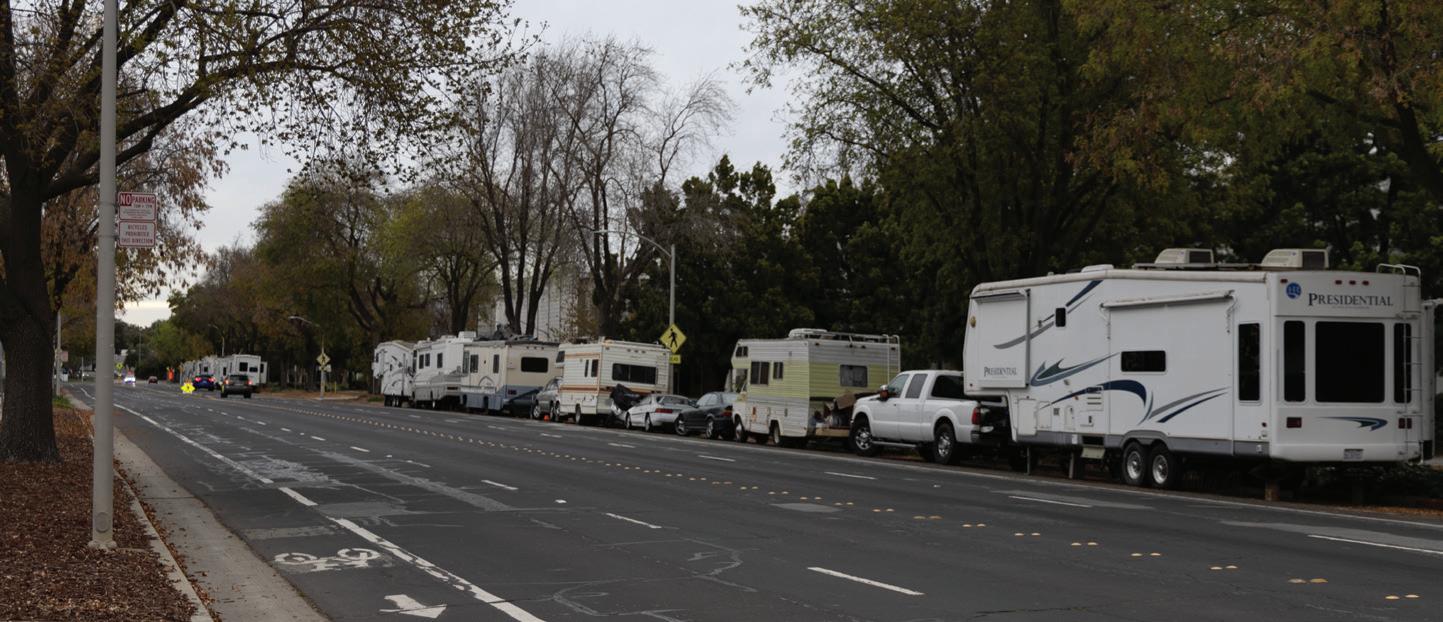
THE PALTO ALTO CITY Council recently approved two ordinances which prohibit public parking of detached trailers and prevent RV landlords, or “vanlords,” from renting out RVs for long-term housing on city streets.
While other Bay Area cities have implemented total bans on RVs, Palo Alto has taken a more measured approach, aiming to support residents who struggle with housing while also addressing concerns about exploitative rental practices and health and safety violations.
If Palo Alto wants this policy to be fair and effective, the ban on vanlording must be paired with investment in other alternatives like safe parking, social services and affordable housing.
According to Redfin, the median home sales price in Palo Alto has reached $3.5 million. For RV residents priced out of traditional housing, living in vehicles has become the most viable option, though RV housing presents its own set of challenges.
“We’re not offered amenities such as access to water, electricity, gas, the sewage system and garbage pickup like other [traditionally-housed] residents,” a Palo Alto RV resident who requested to remain anonymous told Verde.
City officials emphasize that this policy
Photo by ASAF MILMAN
is designed to target landlords rather than residents.
Another issue this policy should address is using public streets for private profit.
“People should not be able to make a profit off of what is public land that we all have an equal right to,” Palo Alto Vice Mayor Greer Stone said.
For long-term success, City Council member Lythcott-Haims says the city needs to invest in safe and legal parking to avoid pushing RV residents into neighboring cities.
While the city works to achieve affordability, Lythcott-Haims believes that the focus should be on temporary and permanent housing with built-in resources like social workers, medical providers and mental health support

as alternatives to RV renting. The city and the nonprofit LifeMoves are co-developing Homekey Palo Alto, a modular interim housing shelter to open in early 2026 to partially address this issue.
Moving forward, the success of this policy will depend on the actions that accompany it. RV living should not be a permanent solution, but unless the city provides viable housing alternatives, residents who rely on RVs deserve stability and protection rather than uncertainty. v
MOTIONLESS MOBILES — RVs line Fabian Way in front of businesses and residences. “I’m excited about solutions that recognize that our society is at such a low place of unaffordability that some people have no better choice than to live in a vehicle,” Lythcott-Haims said.
: What is the likelihood of ICE coming to our county, and of us being in the same position as Minnesota?
: ICE is already here. They have an office in South San Jose. We have a network called the Rapid Response Network which is called and alerted. Anytime there is suspected ICE activity, they show up with cell phones ready to document just in case. There is so much more happening than meets the eye, than even comes to the media news.
: To what degree do you expect these new policies to blunt the impact of ICE in Santa Clara County, should
: Policies are only as good as enforcement, and the county, the board of supervisors, our policy-setting body, does not have enforcement powers. Those are in the hands of all of the police departments and the sheriff’s
: Is there anything we can do as Santa Clara County residents if we see suspect ICE activity in our
: Call the Rapid Response Network. … This is definitely a situation of “If you see something, say
Find the full interview on our website: verdemagazine.com
Photo courtesy of SUSAN ELLENBERG



Q: What is ASB working on right now?
A: “Currently, ASB is working on love week for Valentine’s Day in February. There’s gonna be a little bit of a change in ValGrams [small gifts students can send to each other]. We’re gonna do a little bit differently this year. It’s gonna be a lot more exciting. So we hope students will enjoy it. We’re also really focused on prom planning right now. We just finished a meeting with our congregator and we’re figuring out decorations, activities and just how the venue is going to turn out.”
Q: What events and activites can students look forward to this year?
A: “We’re going to be continuing our traditions of Cookies on the Quad and Snack and Study, as well as more school wide events.”

Art by Angelika Gera

Text, design and photos by
VERBATIM: What are your opinions on the school start time possibly moving to 8:45 a.m.?

“I think it’s unnecessary because what can I do with 15 minutes earlier? I don’t want to change my whole morning routine.”
— Ray Riley, junior
“I’m already always late by a couple of minutes of school, and by moving the time back, it would make me have to readjust my sleep schedule even more.”
— Bill Dang, sophomore


“I do think it would be good to implement because for people who do sports or any other activities, they’ll have a little more breathing room and time after school.”
— Neja Rajan, freshman
What are “Thoughts on paper?”
We asked students to share their opinions on current events, giving them one minute to express their thoughts through a drawing on a Post-It


What are your thoughts on ASAP Rocky’s new album “Don’t Be Dumb?”
— Sabrina Meyers, junior
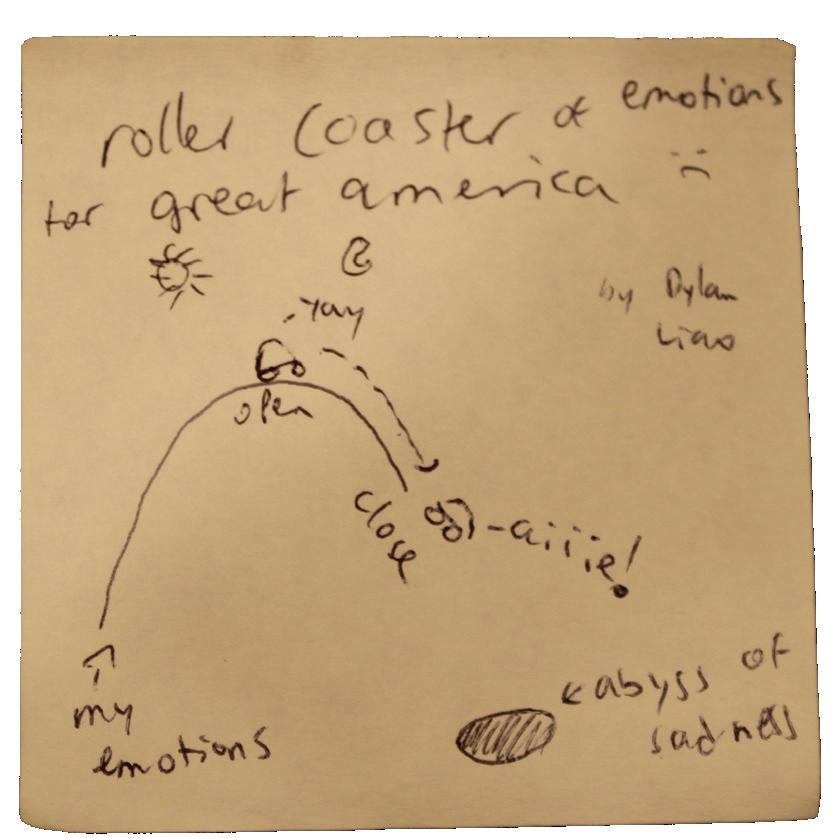
How do you feel about Great America closing?
— Dylan Liao, senior (See page 45) (See page 22)
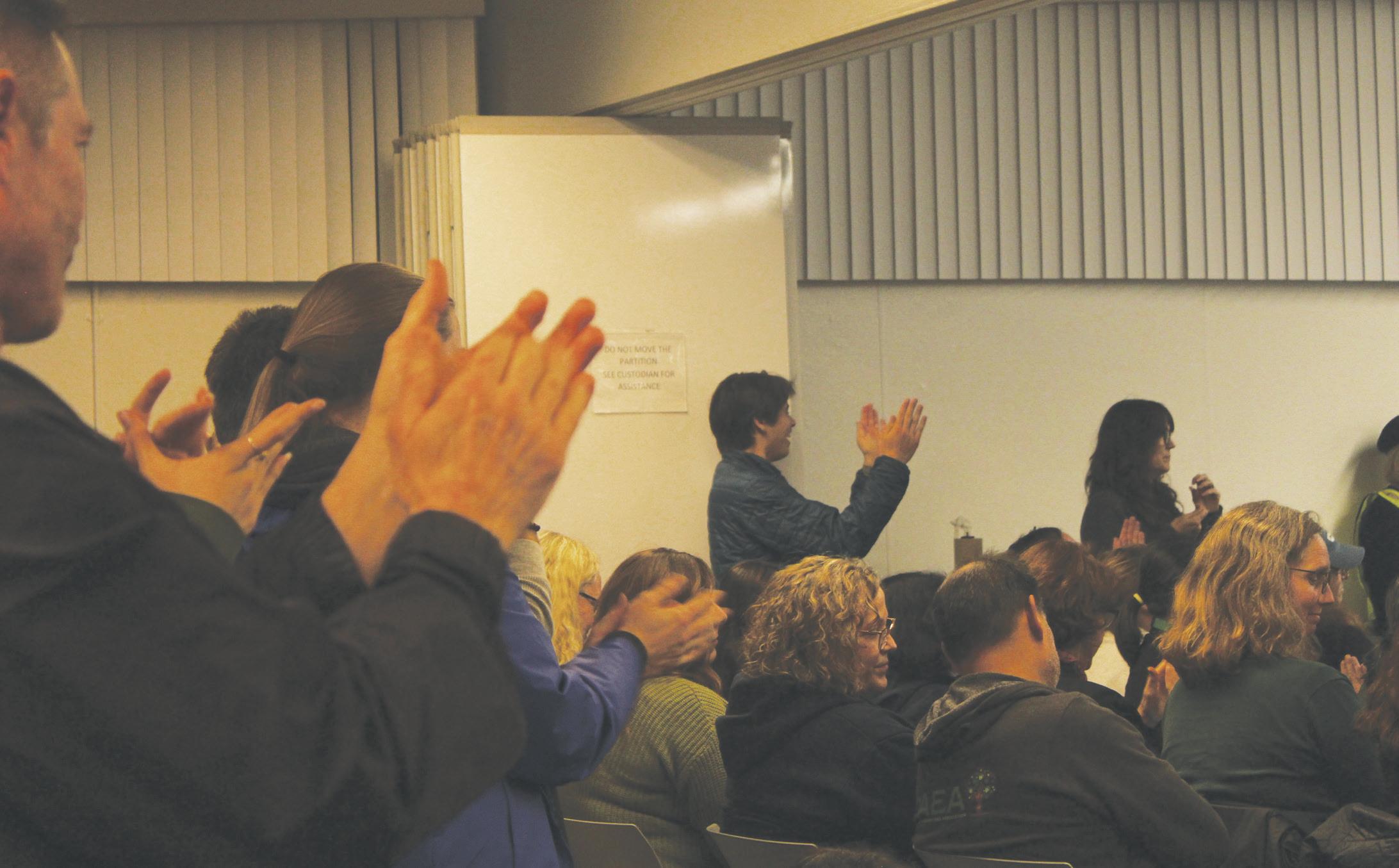
to
cuts,” Howles-Banerji said. “Those
Palo Alto Unified School District teachers and staff are celebrating following a district decision during the Feb. 10 board meeting to pause changes in student support services.
These services include copy technicians, as well as English learner, reading, and math specialists.
District officials faced backlash from more than 150 teachers and staff who said the changes would have a negative impact.
Palo Alto High School science teacher Samuel Howles-Banerji spoke during the meeting about the importance of the people in these roles.
“In order to build up our students, we need teachers and support systems,” Howles-Banerji said. “The actions of the management negotiations team and the board are decidedly aimed at gutting the
foundation of our schools.”
The board decided to reverse cuts following discussion and some public comments.
“We are returning to the status quo we had a few weeks ago,” Board Vice President Rowena Chiu told the crowd.
Paly social studies teacher Eric Bloom addressed the recent firing of Veronica Rodriguez, Paly’s copy technician, as an action that needs to be reversed because of what he said was the importance of her role for the school.
“I am an advocate for non-digital learning,” Bloom said. “The value and support she offers makes me a better teacher and makes my students smarter.”
Howles-Banerji emphasized the necessity of a good relationship between teachers and the district. He said that in looking at
the factors that support student outcomes, both academic and mental health, it's not administration, it's the teachers.
“A strong system is not established with top heavy, bloated administration and bureaucracy,” Howles-Banerji said. “A strong district requires the best teachers and the best support staff for those teachers and students.”
He highlighted the importance of having good relationships between students and teachers.
“You support students by making teachers feel valued and allowing teachers to spend more time with their students,” Howles-Banerji said.
by LEELA KULKARNI and JULIE YANG
Edited and designed by LEELA KULKARNI and JULIE YANG
The following content contains mentions of sucide.
Students, teachers and district officials are calling for action following a student suicide on Feb 3.
On Feb. 10, Principal Brent Kline and the Associated Student Body organized a student forum at lunch where students had the chance to share concerns and possible solutions to address the frequency of student deaths.
Senior Xander Yap expressed concerns regarding crossing the Churchill Avenue tracks twice daily on his way to and from school, claiming that even as an overall positive person, knowing what has happened on them messes with his wellbeing.
One student at the lunch forum suggested adding more mental health advocacy in freshman advisory classes to prevent freshmen from quickly molding into Paly’s academically competitive nature. During the forum people also suggested school-wide events and assemblies to address mental stigma.
Junior Olivia Carlstrom emphasizes the importance of adding a sign-out option on the classroom kiosk to go to the Wellness Center, in replacement of asking the teacher for permission. She said overcoming this barrier might allow a lot more students to reach the support they need.
Classes and educational programs are available at the new Bryant Street Community Center located in Downtown Palo Alto.
At the intersection of Bryant Street and Lytton Avenue, the community center is walkable from University Avenue, making it easily accessible for many Palo Alto residents.
One of the main programs featured at the Community Center is a dedicated space for teenagers.
Palo Alto City staff members will operate a Teen Center with foosball tables, TV’s, and ample space to work.
The Teen Center will open in Spring of 2026, according to Mitchell Park Teen Services.
The center has dance classes currently available for enrollment, however certain aspects of the building are still in the works. City staff members are working on furnishing the facility and putting up decorations in the Teen Center to make it more inviting.
Freshman Viv Bojinov appreciates the
“No one wants to go to a teacher and [worry that] someone in class might hear,” Carlstrom said. “You shouldn't have to explain [to go] to the Wellness Center.”
At the Feb. 10 Board of Education meeting, Student Board Representative Dylan Chen said that transgender bullying and discrimination is an active problem at Palo Alto High School and addressed the need for support in the trans community. According to the Trevor Project, 61% of transgender and non-binary students experienced bullying nationwide.
“People don’t end their lives because they’re stressed; they do it because they feel alone and feel hopeless,” Chen said. “If students feel unsafe and unwelcome at their own school, no amount of posters or headlines will ever solve this issue. There must be a fundamental shift at Paly and across PAUSD.”
Superintendent Don Austin expressed his approval for a temporary closure of the Churchill pedestrian crossing.
“A temporary closure is just what we need right now,” Austin said. “It [the CalTrain] is a constant daily reminder.”
Call or text 988 for the National Sucide Prevention Hotline Text "HOME" to 741-741 for the Crisis Text Line
by LILIA KUZMICHEVA and JULIE YANG

BIKING BY THE BUILDING A person bikes by the newly opened Bryant Street Community Center. Inclusion is a key part of the center's goals. "It's a center for all," Facility Manager Sharon Eva said. Photo: Tessa Berney
numerous programs that the new community center will offer for teens.
“I think it's a good addition, because it can provide opportunities for students who need them,” Bojinov said.
According to Bryant Street Facility Manager Sharon Eva, the Community Center also lends the space to local busi-
nesses and nonprofits to use. Currently, the Palo Alto Children’s Theatre holds occupancy over one of the rooms and uses it for piano lessons.
“The city wanted to see how we can try to accommodate them and make it make by TESSA BERNEY
Palo Alto High School’s community members have opposing views regarding the removal of the 12 portable classrooms scheduled for this summer.
The renovation aims to remove the portables and replace them with landscaping, according to Nov. 4 Board of Education meeting documents. In a $313,950 deal, the SVA Architect is contracted to remove portables at Paly and Gunn High schools, along with district office portables D, E and F.
While some say the removals at Paly brings needed changes, for some the change is creating anxiety because the plan will result in the displacement of multiple programs, and the administration has not indicated where all of them will go next year.
Paly students and teachers, but also Palo Alto Adult School classes, use the portables for a variety of reasons stretching from yoga to Advancement Placement testing.
Jerry Berkson, an assistant principal at Paly, said the construction will progress starting from summer and will probably stretch longer into the new school year.
“That area [portable classrooms] is going to be fenced off for a while as they work on it,” Berkson said. “It's gonna take a while.”
Principal Brent Kline said the renovation would be a benefit to the school.
“It’ll be a refreshing change to get those [portables] out of there and give some more spaces for students to hang out … and to make it more green for students,”
Kline said.
One group that opposes the removal is the Paly Speech and Debate program, which uses portable classroom P-6. The renovation means an uncertain future for a space senior debater Motoko Iwata said serves as a vital part of the Speech and Debate community.
“It [portable classroom P-6] has been a place where people have been able to connect, to meet people from across sub-teams, and it's become sort of a living room for a family, where it's been a really connecting space,” Itawa said.
Kyle Hietala, who directs Paly’s Speech and Debate team, said the team’s loss of recreational space would be a major shift.
“They [students] kind of view this space as like a home on campus,” Hietala said. “I hope that others in our school district will appreciate that third space for students where they can feel a sense of belonging."
Special education programs, ASB storage areas, and adult school programs will also be impacted by the removal of the portables.
Palo Alto Adult School’s Odaiko class, a place to play traditional Japanese percussion instruments, also will be affected by the removal project. Kensuke Sumii, the teacher of the taiko and odaiko class, said the class he teaches did not receive any notice of the removal project from the school. Sumii said the Odaiko class depends on being on the Paly campus.
“It's hard to do [odaiko] in a residen-
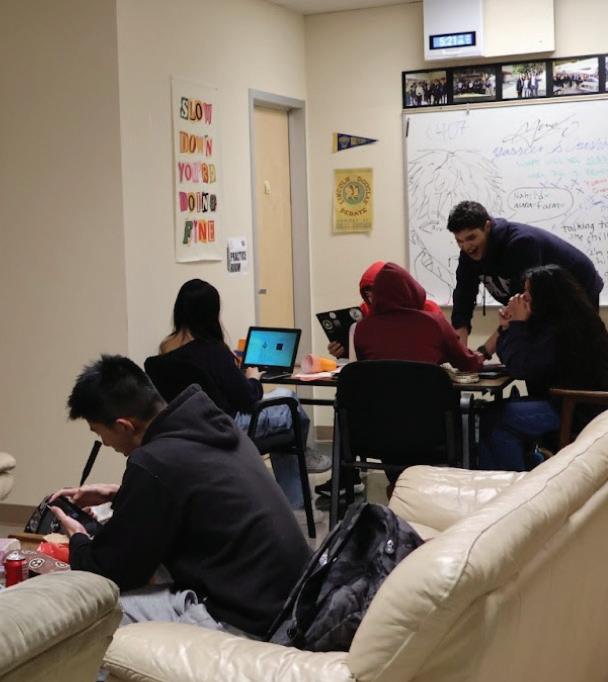
USING THE SPACE After school, P-8, a portable used by the Speech and Debate community, is left open for students to use as a space to recline and socialize. Sophomore Helen Li, a member of the Speech and Debate Community, shared her disappointment with a useful space for her community. “It's a place where there's couches, so if you're sick and you have a prep or something, you can go take a nap, and there's usually snacks,” Li said. Photo: Joshua Joo
tial area,” Sumii said.
Another concern of the Odaiko class is making sure there is a place to store the instruments.
“You can carry your tennis rackets, your violin, or your clarinet,” Sumii said. “These you can always bring with you. Taiko is different. You have to store it somewhere, otherwise you can’t practice it.”
by JOSHUA JOO
The Palo Alto Unified School District is considering pushing start times 15 minutes earlier for high schools starting next year, according to Superintendent Don Austin.
Austin, in a weekly update on Jan. 9, stated that PAUSD is considering the move after a request by the Palo Alto Educators’ Association.
“It looks like that can happen without creating unintended consequences,” Austin wrote. “While this is not official yet, I wanted to foreshadow the potential minor adjustment for next year.”
Assistant principal Michael Stieren supports the potential schedule change because it allows extracurriculars to start earlier, letting students return home earlier in the day.
“The later start pushes the end of the school day out past 4
p.m. on many days, which has a cascading effect of pushing after school activities like athletic practice, theatrical or musical rehearsals, club meetings, study sessions and other things later into the night,” Stieren said. “Students who are working or participating in activities return home later, eat dinner later, and start homework later.”
Paly junior Moksh Jain agrees that school times being pushed earlier will boost productivity later in the day.
“I wouldn't mind it [earlier start times],” Jain said. “I think it's a bit annoying because I would have to wake up earlier, but it would be better for sports and just getting out earlier [from school].”
by JARON LEUNG and RYAN SAKET
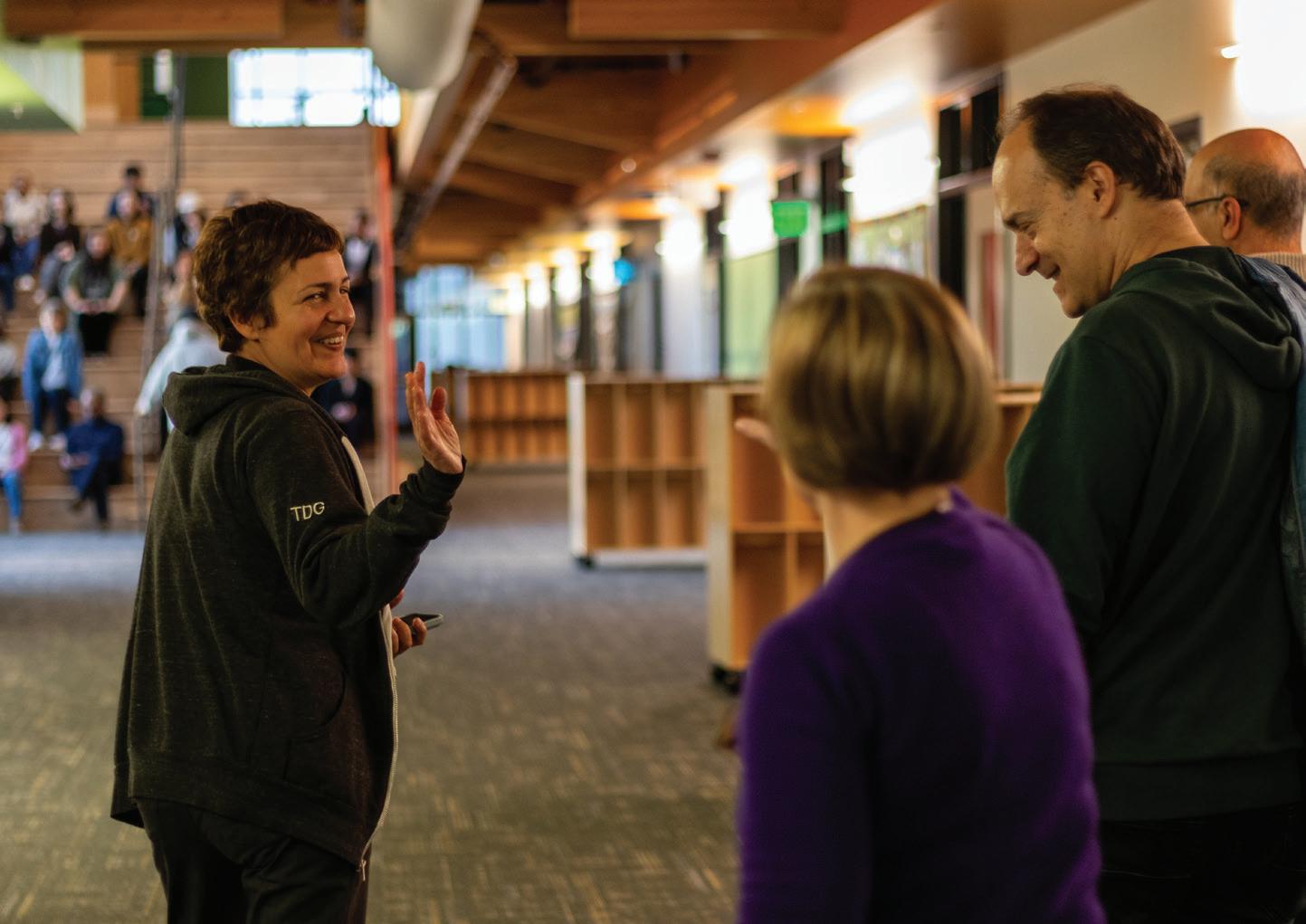
The Palo Alto community celebrated the reopening of Hoover Elementary School on Jan 22 following years of construction.
According to Palo Alto Online, construction began shortly after the demolition of the school’s original campus in the spring of 2024, with the plan to open the campus up in time for students to return for the beginning of the 2025-2026. At first, only small sections of the original campus were meant to be upgraded, but the pandemic along with new building requirements for the state ultimately caused the district to revamp the entire campus as a whole.
Minor delays caused the reopening to take place in the middle of the school year, but Principal Nikole Manou said the reintegration was done smoothly.
“The kids seamlessly. Picked up the new routines,” said Manou. “You know, we prepared them for it. We had assemblies before we moved.”
architectural style fits well within the rest of Palo Alto.
In addition, the campus added a new bike lane, upgraded the playgrounds, and built an outdoor reading space.
A notable new addition is the new Innovation Design Lab, which will introduce students to STEM-related subjects.
“They're [the students] going to look at different opportunities with computer sciences. Different things they can do with computer science,” Manou said. And then fifth grade is doing health sciences or architectures and kindergarten, and it's really exposing them to these hands-on pieces.”
With many more stylistic features, the campus has an open environment that allows students to connect with the nature that surrounds it.
With a sustainable, carbon-zero design and new buildings with unique purposes, the school is on track to become one to inspire students to find and pursue their own passions.
The large, beige wooden beams paired with massive windows allow for an earthy and cozy atmosphere. The campus’s new by
SHAURYA THUMMALAPALLI
BTS, a Korean Pop boy band, is performing at Stanford Stadium from May 16 to 19, spreading a buzz of excitement among Palo Alto High School students, although there is a concern in the mix.
Palo Alto High School sophomore Maya Moura will be attending the concert this May, but said it was difficult to acquire tickets because of how popular BTS is in the Bay Area.
“Getting tickets was a multistep process because you needed to get an ARMY [the BTS fanbase] membership first, then apply for the presale in specific cities, then access the presale as soon as it opened,” Moura said. “Once it’s your turn to get tickets, you can see all the seats being taken so it’s a bit stressful.”
Before their performance in Palo Alto, the band is kicking off their “Arirang” World Tour in South Korea in April.
BTS has had multiple #1 songs on the Billboard Hot 100, with the songs “Butter” and “Dynamite” blowing up between the years 2020 and 2021. When tickets for their world tour were released, they sold out almost immediately in all 41 of their tour locations.
This year, Palo Alto High School Prom night will also be hosted on May 16, overlapping with one of the concert nights.
Alyssa Bond, director of the ASB department at Paly, is working with the ASB committee to figure out a solution to avoid conflict with the concert.
“We are exploring multiple other pickup and dropoff options for Prom, to avoid not only traffic, but also increased stress due to overcrowding and unnecessary interaction with the concert traffic," Bond said.
by ANISHA SHETTY
Palo Alto High School’s varsity football program is facing significant changes after a 0-10 season.
Edward Tonga is replacing Dave DeGeronimo as the head coach. Tonga, a former Paly football defense coordinator and linebacker coach, as well as a Paly special education teacher, has decades of experience in coaching and playing football.
These changes come after a turbulent season that included controversy surrounding assistant coach Jason Fung, who was placed on administrative leave after an altercation with a Sacred Heart Preparatory player during an away game.
The team also struggled on the field, prompting a focus on bonds between players and coaches as much as performance.
Tonga emphasized that the lessons from last season extend beyond wins and losses.
“We need to build from the top down,” Tonga said. “It’s important that we as coaches are being something that they can emulate as far as student-athletes. That means good connection and communication between the coaches. If we do that right at the top, I think it will help the players.”
Tonga was optimistic about the next season, praising his coaching staff and expressing confidence in player potential.
“Some of these players have been just waiting to show their ability. Under this coaching staff, we have the right set of men to get them where they need to be,” Tonga said.
Dave DeGeronimo, a physical education teacher at Greene Middle School and the Paly football head coach for three years, was released by the school administration on Jan. 16.
The Palo Alto Vikings will start their 2026 season in a home game against Leigh High School on Aug. 28.
by JUSTIN CHEN and ASAF MILMAN

be built. " I think of it [the new
icated education space,"
Anewly approved lease extension is allowing Elizabeth F. Gamble Garden to move forward with an $8 million renovation aimed at transforming how students learn about horticulture.
The 2028 Horticultural Complex Project, Gamble Garden’s first major expansion in decades, will include updated greenhouse, nursery and staff spaces, along with a new multi-purpose room for horticulture classes.
Gamble Garden Executive Director Mica Pirie said the project will involve the tearing down of the garden’s current horticultural support facilities, which include the original greenhouse, lath house and offices, replacing them with a new building.
The complex will consist of a classroom for horticultural education, new working spaces and storage for Gamble Garden’s staff, creating more hands-on learning and community engagement opportunities.
“Our elementary school field trip program, Roots and Shoots, will be able to host more classes,” Pirie said. “Next would be an internship program, so college students or graduates in horticultural-related fields would have a place to work here and have hands-on experience in the garden. And we’re putting a lot of work into expanding our class offerings to host them more often and with more variety.”
The new dedicated education area and additional space also supports Gamble Garden’s efforts to better serve young adults
and new families in the community.
According to Pirie, the project has been in the works since before 2021, when it was formally approved by the board of directors. The team aimed to address ongoing challenges, which included technical issues in the greenhouse and office spaces.
Despite having planned a renovation for many years, Gamble Garden was unable to take action until the City of Palo Alto approved a 50-year lease extension in November, giving donors confidence in the garden’s long-term stability.
“We want to know that we’re going to be here for 50 years, and it’s pretty important to some of our longtime supporters to have that sense of security before supporting such a massive project,” Pirie said.
To fund the project, Gamble Garden is accepting external donations with naming opportunities and has launched its first fundraising capital campaign since the garden’s founding in 1985. Currently at 40% of its $8 million goal, the Horticultural Complex Project aims to expand Gamble Garden’s reach and establish the space as the horticultural hub of Palo Alto.
“At any level, we are volunteer-powered, and there’s a way to come and engage that creates a sense of community in and of itself,” Pirie said. “If you just look at where we are in the middle of Old Palo Alto, there’s nothing else really like this.”
by CHRIS JEON







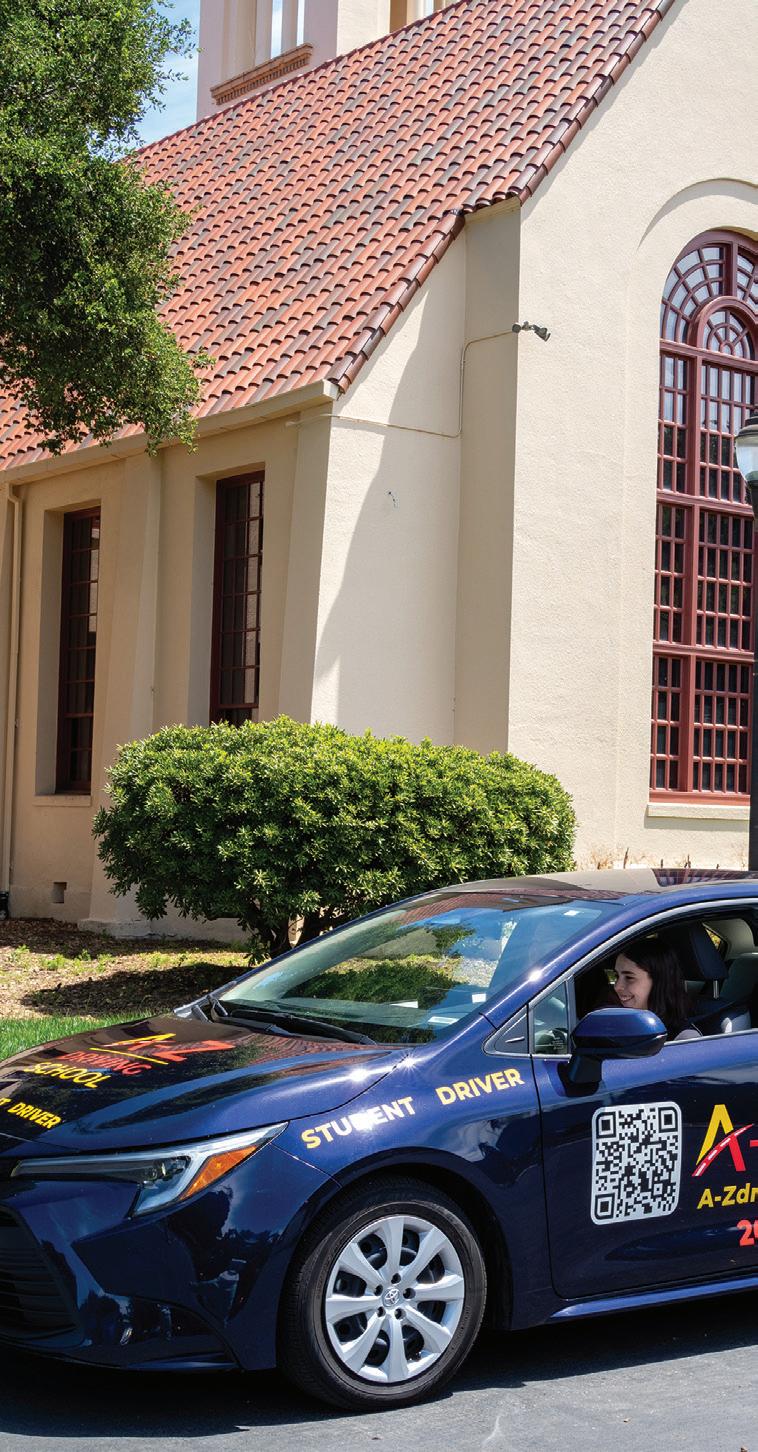



FLAUNT
junior and organizer
a
promoting love. “I saw a lot of passion and emotion in our student body,” Leilani said.
CHANTS OF “Melt the ICE” intensify amid the sounds of cars honking and matracas shaking, as waves of students storm sidewalks, proudly parading flags and giant cardboard signs.
On Jan. 30, over 1,000 students, according to student protest organizers, from the Palo Alto area marched out of class at noon to partake in a nationwide protest against U.S. Immigration and Customs Enforcement.
Text by ANGELA FANG and JOSHUA JOO

Editors’ note: We have chosen to remove the last names of all underage students to protect their identities online. In an evolving age of artificial intelligence, participating in protests has encountered a concern of privacy and government retaliation. Recently, federal agencies like ICE have reportedly begun employing facial recognition software and other biometric surveillance technologies for protest activity, according to a number of eyewitness accounts in Minneapolis.
Sign-wielding students from Palo Alto High School, Castilleja School and Henry M. Gunn High School gathered at the intersection of El Camino Real and Embarcadero Road, before spreading out and marching as far as Stanford Avenue.
In response to the Trump administration’s immigration crackdowns and the fatal shootings of Renee Good and Alex Pretti by federal agents in Minneapolis, the walkout in Palo Alto was one of thousands of student-led demonstrations across the country standing in solidarity on the day of “National Shutdown.” The “ICE Out of Everywhere” movement encouraged Americans to skip work and school, and to avoid shopping in a general strike.
to participate in civic activities like political protests.
“ It shouldn’t have to be happening to Palo Alto for Palo Alto to stand up for it.”
— BRIAN, Paly junior and organizer
According to former California Senator Connie Leyva who authored the act, K-12 schools do not prioritize civic instruction, and the purpose of SB 955 is to prepare youth for democratic participation by getting students more involved in government and their community.
Paly junior and walkout organizer Brian said he hoped the local protest would bring attention and widespread awareness to students about recent ICE activity.
“The people in Minneapolis probably never thought ICE would be raiding their towns and cities,” Brian said. “It doesn’t have to be Palo Alto for us to want change. It shouldn’t have to be happening to Palo Alto for Palo Alto to stand up for it.”
While waving flags and raising signs that read “Fund education, not deportation,” “Murdered by ICE” and “We are skipping our lessons to teach you one,” protesters chanted “Melt the ICE” which was met with supportive honking from passing cars.
To Gunn senior Dylan, who brandished an upended U.S. flag, actions by the Trump administration are disregarding constitutional rights.
Public school students in California were able to freely miss class due to the state’s Senate Bill 955, which authorizes one excused day of absence per school year
“If people can be aware of what’s going on, if people can actively have this on their minds, that’s a big thing for me,” Brian said. Some might question the impact of protesting in cities like Palo Alto where ICE is not active, but Brian disagrees with the idea of the city being a “safety net.”
“Our government was built on the principles of everybody having rights, no matter if they’re an American citizen or even on American soil,” Dylan said. “The fact that our Constitution is being disrespected is a big sign. That’s why I’m out [here] with an upside down American flag — because it represents what our country is going through right now.”

Dylan said his own goals for the protest covered numerous concerns.
“Whether it’s about getting ICE out of the streets, education reform, reproductive rights, the issue in Palestine and the suffering in Gaza, or any other issue, I think we have to spread every message we can and positivity,” Dylan said.
Paly sophomore Vedika said that seeing the large turnout and the community unify gave her hope.
“I’m so proud of Paly for all the people coming out — the people in their cars that are driving and making noise and honking,” Vedika said. “We never know what’s going to happen, and I’m so glad that [our community] had the courage to come out today.”
make a statement and bring attention to the protest. It’s also a symbol for what we’re trying to end, because ICE is taking away Mexican and Latin American people.”
The protesters were not limited to high school students. Paly alumnus and author Joanna Ho, who brought her kids with her to the demonstration, said she hopes student activism inspires future generations to be outspoken about their beliefs.
“Whether it’s about getting ICE out of the streets, ... we have to spread every message we can and positivity.”
— DYLAN, Gunn senior
“I hope they [my children] leave feeling empowered and not afraid about what is happening,” Ho said. “Hopefully, this is one way of teaching them that they [my children] have a voice and they can make change.”


VOICING A MESSAGE (LEFT) — Paly junior and walkout organizer Brian talks into a microphone in front of traffic. “The youth are what start the change, and we have to be aware,” Brian said. Photo: Shaurya Thummalapalli
SEA OF STUDENTS (TOP MIDDLE) — Protesters swarm around cars in the streets and sidewalks. “We’re making sure our community knows that we are immigrants, we stand with immigrants, and we will not stop standing up for them,” Paly junior Leilani said. Photo: Kensie Pao
Some students raised awareness for the protests through their cultures by waving country flags symbolizing their heritage. Meanwhile, Paly junior Sofia shook a matraca, a traditional Mexican and Latin American musical instrument that makes a uniquely rambunctious sound.
“I chose to bring it [the matraca] because it’s pretty loud,” Sofia said. “It helps
While the tangible impact of the protest is immeasurable, to Paly parent Briana Yarbrough, showing up means more than driving policy change. It’s also standing up for neighbors.
“Many people’s families are already being affected by this and feeling the stress of it,” Yarbrough said. “It [protesting] is just an act of love to show your community that you’re there for them, and that’s what’s im-
SPIRITED SIGNS (TOP RIGHT) — A sign saying “Coward-ICE” portrays ICE agents as pigs. “If everyone works together and speaks up against any kind of regime, we can all stand together,” Paly sophomore Tucker said. Photo: Joshua Joo
HONORING HERITAGE (BOTTOM) — From the back of a car, a student waves a Mexican flag in the air. “Showing solidarity with your neighbors is important because many people are afraid right now,” Paly parent Briana Yarbrough said. Photo: Kensie Pao
JOE SIMITIAN WAS RUSHING off to his second holiday party of the night, in 2014, when he was stopped by Sigrid Pinsky.
“I’m standing in the kitchen, and she [Pinsky] said, ‘I’m troubled by the fact that if a young person, a teenager in Santa Clara County, needs a secure mental health facility, there’s no place for them to go, and that we have to send kids out of the county,’” Simitian, the former Santa Clara County Supervisor, said. “And I said, ‘well, that can’t be right.’”
After doing his own research, Simitian was appalled to find out Pinsky was correct.
For adolescents living in Santa Clara County, the only options for acute mental health treatment were in East Bay or Marin.

FUTURE OF THE FACILITY (LEFT) —
The Behavioral Health Center is located on the Santa Clara County Medical campus giving patients access to other medical services. “We have a bridge that will connect to the hospital so that patients can be transported securely, discreetly and humanely,” Senior Project Manager Craig Blackhurst said.
NOT YOUR AVERAGE JOE (RIGHT) — 56 years after graduating from Palo Alto High School, Joe Simitian’s actions are directly impacting students from his alma mater. “I’ve got kids who are taking their own lives who are going to the same high school that I went to back in the day,” Simitian said. “And you know, to me, that was troubling.”
an average of six days in facilities often far away from home,” Simitian said.
In spring 2026, Santa Clara County will open its first acute mental health facility designed for adolescents. Planning for the Behavioral Health Center has been in motion for 10 years and is pending permits before opening to the public.
The $500 million building, located in the Santa Clara Medical Center, will have 77 beds available to adolescents. The county received $80 million in state grants from California and dipped into the local general improvement funds to finance the rest of the project.
“
While the mission was to provide beds for adolescents, with more money, beds are also available to children and adults as well. Senior Project Manager Craig Blackhurst, who works at HGA, a national architecture and engineering firm, explains how the architects took extra precautions in treating patients of different ages.
to fresh air in individual rooms,” Zborowsky said. “It’s the thoughtfulness that goes into how we create these really wonderful spaces that still make people feel a part of the world and give them some choice.”
Finding someone to facilitate the building was the first hurdle Simitian encountered. In 2016, the county drafted a request for proposal (RFP) where they would pay independent companies to open a Behavioral Health Center in Santa Clara County. Unfortunately, the RFP was declined by all potential bidders.
Somebody walked up to me at a party and a little more than
10 years later, these [psychiatric] beds will be there for generations of students to come.”
— JOE SIMITIAN, former Santa Clara County Supervisor
“When they transport patients … they will escort patients through secure spaces, but adults and children will never be in the same space at the same time,” Blackhurst said.
The Behavioral Health Center is one of the few centers in the U.S. that prioritizes choice in a place where choice is normally taken away. The center has safely imple mented features such as the patient’s ability to choose if their lights are on, how much sunlight enters and access to fresh air in their rooms. Terri Zborowsky, a senior de sign researcher at HGA, helped implement evidence-based solutions into the final de sign. Her research reveals the hidden truth of most behavioral health centers.
“99.5% [of patients] do not have access
“What I heard informally [from companies] was, ‘we all want to be part of the solution. We’d all like to have the benefit of having a facility like this in the county, but we’re not in a position to create the facility consistent with the request for proposal,’” Simitian said.
Simitian realized that Santa Clara County would have to take on the burden of running the facility. After urging the Board of Supervisors to approve development of the center, Simitian convinced them in 2018 to construct a county-run inpatient psychiatric service for children and adolescents.
Even though the center marks a significant improvement in mental health resources available, Simitian highlights the need for a continuum of care, where help is available for every step of recovery once adolescents leave the Behavioral Health Center.
Allcove, a youth mental health resource located in Palo Alto and San Jose, is one example. Allcove has helped support students with vastly different needs: their programs range from fun teen-bonding activities to meetings with
trained medical professionals.
Gail Price previously served on the Palo Alto Board of Education and City Council and shares similar views to Joe Simitian: during her terms, she advocated relentlessly for more mental health support.
“I think it’s extremely important for families, community members, nonprofits, providers of services, city and county elected officials and members of the public to continue to advocate for the need for additional services,” Price said.
With the opening of the Behavioral Health Center, Santa Clara County will be able to cover adolescent needs from the least extreme measures to the most, and it all materialized from a single conversation between Simitian and Pinsky.
“There’s skepticism … that people have about whether or not one person can make a difference,” Simitian said. “But somebody walked up to me at a party and a little more than 10 years later, these [psychiatric] beds will be there for generations of students to come.” v
Additional reporting by Rohan Kini
Any person who is feeling depressed, troubled or suicidal can call 988, the mental health crisis hotline, to speak with a crisis counselor. People can reach trained coun selors at Crisis Text Line by texting RENEW to 741741.

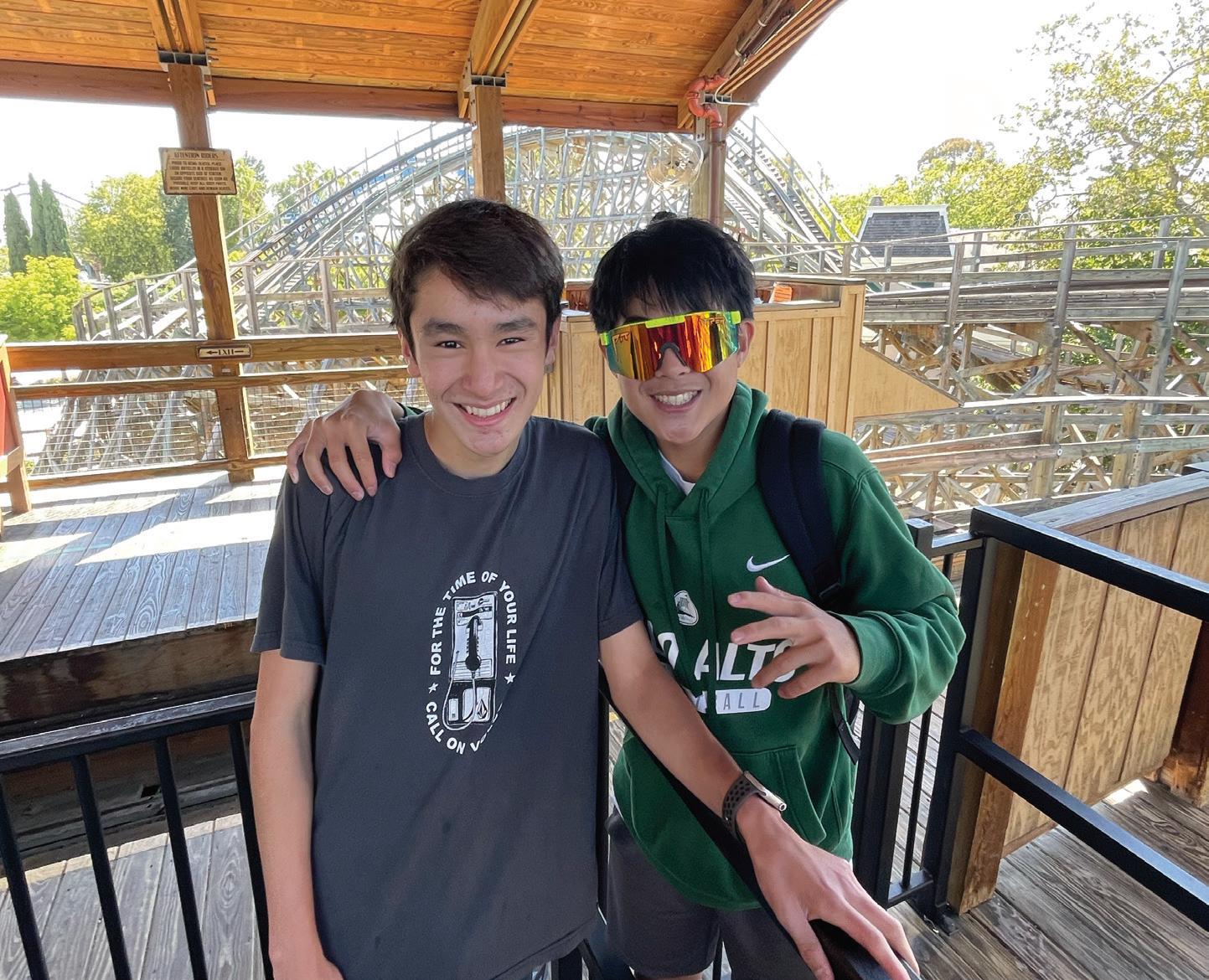
CARS LINED THE last stretch of highway before the exit that read “Great America Pkwy.” The smell of gas and a symphony of honks and beeps greeted the thousands of families and teenagers waiting patiently. Children squirmed in their car seats, near-bursting with the suspense of passing by the same small, faded ticket booth, the same never-ending parking lot where families applied sunscreen and forgot where they parked and the same long walk to the entrance. These were clear signs of an unforgettable day at the Great America amusement park and a hardearned weekend well-spent.
Even within the park, the long lines continue throughout the 112-acre facility, with 4th of July festivities in the scorching heat and WinterFest days still warm from the commotion and liveliness. Especially on weekends and school holidays, students would always find a way to make time for the park.
“It was like a dopamine explosion,” said Steve Foug, a Palo Alto High School history teacher who has been going to Great America since he was 6 years old. “I remember being beyond excited driving that same exit or just waiting out by the gate.”
company Prologis Inc. in 2022. On May 2025, Six Flags Investor Day, Brian Witherow, the chief financial officer of Six Flags Entertainment Corporation, officially announced Great America’s closure.
“Unless we decide to extend and exercise one of our options to extend that lease, that park’s last year without that extension would be after the ’27 season,” Witherow said.
“ It [Great America] is really impactful to youth and teens.”
— KYLE CHEN, Paly sophomore
Foug’s memories are like those of many Paly students, but soon they might be just that — memories. Even as California’s Great America announced it would be celebrating its 50th anniversary this year, the park has also announced a closure that could occur as early as fall of 2027, with the park’s parent company, Six Flags, already having sold the land to the real estate
Referring to revenue from the company’s 42 parks, Witherow said that Great America is “very low on the ranking of margins.” The current lease runs until June 2028, but has the potential to be extended through 2033.
The effects of the park closure take shape in different forms. Now, parkgoers interested in purchasing tickets in three of the four seasons of the year are led to a “temporarily closed” message on the official website. As the end draws closer, it’s hard to deny that the amusement park has found its spot in the hearts of many children and teenagers.
Foug considers the park a staple in his adolescence among other entertainment centers that are now non-existent in the Bay Area, like Marine World, Castle Golf and Games and Malibu
Grand Prix. While Marine World relocated out of Redwood City to Vallejo in 1986 due to a lack of expansion space, the latter two faced challenges with declining popularity that led to their closure. All three had an issue with high property and operational costs, which Great America faces today.
Paly sophomore Kyle Chen has also noticed the decline in entertainment hotspots.
“It [Great America] is really impactful to youth and teens,” Chen said. “When I’m hanging out with my friends, we often don’t know what to do. Great America is basically the only significant amusement park in the Bay Area, and without it, the choices for a fun day out are even more limited.”
Foug says that with the disappearance of entertainment centers, the novelty of visiting has also been diminished.
“I don’t want to say something is missing from today, … but it’s definitely different,” Foug said. “It [an amusement park] is just not as much of an attraction anymore.”
The decrease in third spaces, categorized as informal gathering places between the leisure of home and formal business areas, has opened up opportunities for digital entertainment to step in.
Paly senior Nina Faust says that when making plans with friends, she finds herself more drawn to online experiences because of their ease and
accessibility.
“I ask them, “Where do you guys want to go?” and it usually takes us a good five or 10 minutes just to think of something, and that thing is usually to go to a park or something else,” Faust said. “But I’ve noticed that because of that, it’s become more tempting for me to ask them to play online games like Minecraft.”
Turns out, it isn’t just Faust experiencing this. Dan Hipp, the senior research coordinator at Children and Screens Institute of Digital Media and Child Development, observes that this phenomenon is present in data as well, and that digital media steps in when physical experiences are not readily available.
“They [digital media

tools] are self-contained amusement parks in our pockets in their own right,” Hipp said. “They’re bright, they’re loud, they’re persuasively designed and algorithmically tailored to keep users’ attention, including kids and teens.”
Chen recalls one of his favorite memories at Great America when he and a few friends would go there almost every week of his seventh grade summer.
“Every single time I’ve gone, it’s been a great time,” Chen said. “One time, we went on a Wednesday, and there was no one at all. We rode rides until we were dizzy and sick.”
Hipp mentions that, these days, teens use screens for many hours on end. To satisfy young
people’s constant need for excitement and thrill, digital media is often the outlet they turn to because of convenience.
Though digital media may give off the same dopamine rush a rollercoaster would, Hipp warns that screens lack the social and physical benefits of real-world interactions.
“The idea of a shared space on the Internet is just not equivalent, or even really analogous, to a shared space in the physical world,” Hipp said. “If you [and some friends] are in the line to go to a roller coaster, … you’ve now not only had a delay before your gratification — so different from the phone — but now you’ve engaged in something in the physical world together, which is like a mutual reward experience.”
where your friends are. You want to be with your friends.”
“What matters is not a space, it’s people.”
— SUNNY LIU, director of research at Stanford Social Media Lab
Liu emphasizes that there are many factors that contribute to the preference of digital media over third spaces, such as costs being a burden on families and the inconvenience of transporting them there. But more specifically, Liu says that a reason third spaces for entertainment are becoming less popular compared to social media is because of heightened concerns for safety after the COVID-19 pandemic.
more to the dopamine rewards from devices — which are very quick and come in this streamlined way — than those available in the outside world,” Hipp said. “What we have is people designing their brains for digital experience by exposing their brains to digital experience for eight to nine hours a day.”
This 2025 season, Bay Area students saw the cancellation of the annual WinterFest event, and the park will only reopen late March.
As a longtime parkgoer, Faust said that now the park is closing, she feels a sense of urgency to squeeze in a few more visits in its final years.
Hipp adds that not only is digital media not up to par with in-person experiences, it could very well be what is causing the disappearances of third spaces.
“The explosion of the digital world has made the … physical world less accessible in some ways,” Hipp said. “It [people staring at screens] just wasn’t the case prior to the past 20 years. … That provides important context for understanding why social events are happening the way they are, including the closure of major theme parks that for generations have been entertaining people and providing a common landmark and common experience for everyone.”
Paly senior Annika Chu always loved visiting Great America with friends and family, and would often go when she was younger because of how close the park was. Nevertheless, she agrees that the decline in popularity of amusement parks may be the result of growing digitalization.
“If more teens are spending their free time on social media and using that to talk to their friends instead of hanging out with them and talking face-to-face, then it makes sense that we’d see more hangout spots like Great America closing,” Chu said.
However, Sunny Liu, director of research at Stanford Social Media Lab, adds that kids using digital media to replace physical interaction is not necessarily a bad thing, and teenagers can easily connect with friends online.
“What matters is not a space, it’s people,” Liu said. “So you just want to find
“For them [parents], [being] indoor with screens actually are safer for them,” Liu said. “That’s one way to think about it: what is the environment out of the schools, out of the homes, and is that really safe?”
However, Hipp said the digital experience has its own sets of dangers, with more subjective issues revolving around addiction, online predators and extortion.
“It [a screen] warps and caricatures things in strange ways: worse sleep, more obesity and also just a brain calibrated
“I used to go a lot when I was younger, so it just kind of feels sad seeing a part of your childhood go away,” Faust said.
Foug also plans to go to Great America one last time before the closure, and expresses his disappointment that future generations won’t be able to enjoy the magnificence of the amusement park that shaped his childhood.
“There’s one fewer place to go with your own time,” Foug said. “It was such an instant thing you can be like, ‘hey guys, Great America this Saturday. Let’s go.’ It [Great America] is going to be missed.” v



Text by STEFAN ERIKSSON and KAI SCHOEBEL
being condensed into two.
FOR THE FIRST TIME, every freshman at Palo Alto High School walked into their history classes and didn’t start with learning about World History, but instead their own identity.
This school year, Palo Alto Unified School District has implemented a new mandatory freshman course focused on identity, race and ethnicity. Ethnic Studies should have been required for all high schools in California after a mandate in 2021, but due to it being omitted from the state budget, many schools haven’t implemnted the class. PAUSD has gone forward with it anyway.
The focus of the class is on four major ethnic groups in California’s Bay Area region: African Americans, Native Americans, Asian Americans and Latin Americans. Designed for analyzing the histories of these groups, students are taught to examine sources, such as research articles, and then think critically about the author and their relevant biases.
Katya Villalobos, an Ethnic Studies teacher at Paly, said these initial goals in the course were accomplished.
“We obviously wanted them … to understand what happens to these main groups as a whole, the commonalities and differences between them, and then bring them into modern examples,” Villalobos said.
Ethnic Studies covers five units: “Ethnic Studies introduction,” ”Identity,” “Power, Privilege and Oppression,” “Resilience and Resistance” and “Action and Civil Engagement.”
Paly freshman Swarat Parab was among the first group of freshmen to take the course. He said that the class was beneficial in the way that it exposed him to various new topics.
“I wouldn’t say it changed my view, but it really opened my eyes to see what really happened,” Parab said. “Redlining was really interesting… I always knew certain demographical areas live in certain places, but I never knew — like they [different ethnicities] couldn’t even buy a house.”
Ethnic Studies is a course that replaces a portion of sophomore Contemporary World History. Before there were three semesters of World History, including Contempoorary World History, which now are
Paly Contemporary World History teacher Stephen Foug said the addition of Ethnic Studies causes issues with the pacing of the course.
“Unfortunately, we can’t cover as many areas of the world as we used to,” Foug said.
As the implementation of Ethnic Studies developed, it came with controversy. Some thought the ideology of ‘oppressor vs oppressed’ would give students misguided views. In reality, the class was specifically designed to avoid this.
“Yes, we talked about oppression, but we grounded it in historical context and made sure students understood what we meant,” Villalobos said.
She believes a lot of the pushback came from parents’ fears and protective instincts.
“They were fearful because it was something new. … It was fear based on the unknown,” Villalobos said. “And I think once, once they [students] were here in the class with their teacher, that fear went away”.
Ethnic studies has pros and cons, but the only way to see if the course change was beneficial is to wait for time to prevail.
“We’re going to use feedback from our students,” Villalobos said. “We’re going to see what worked, what didn’t and we’re going to go from there.” v
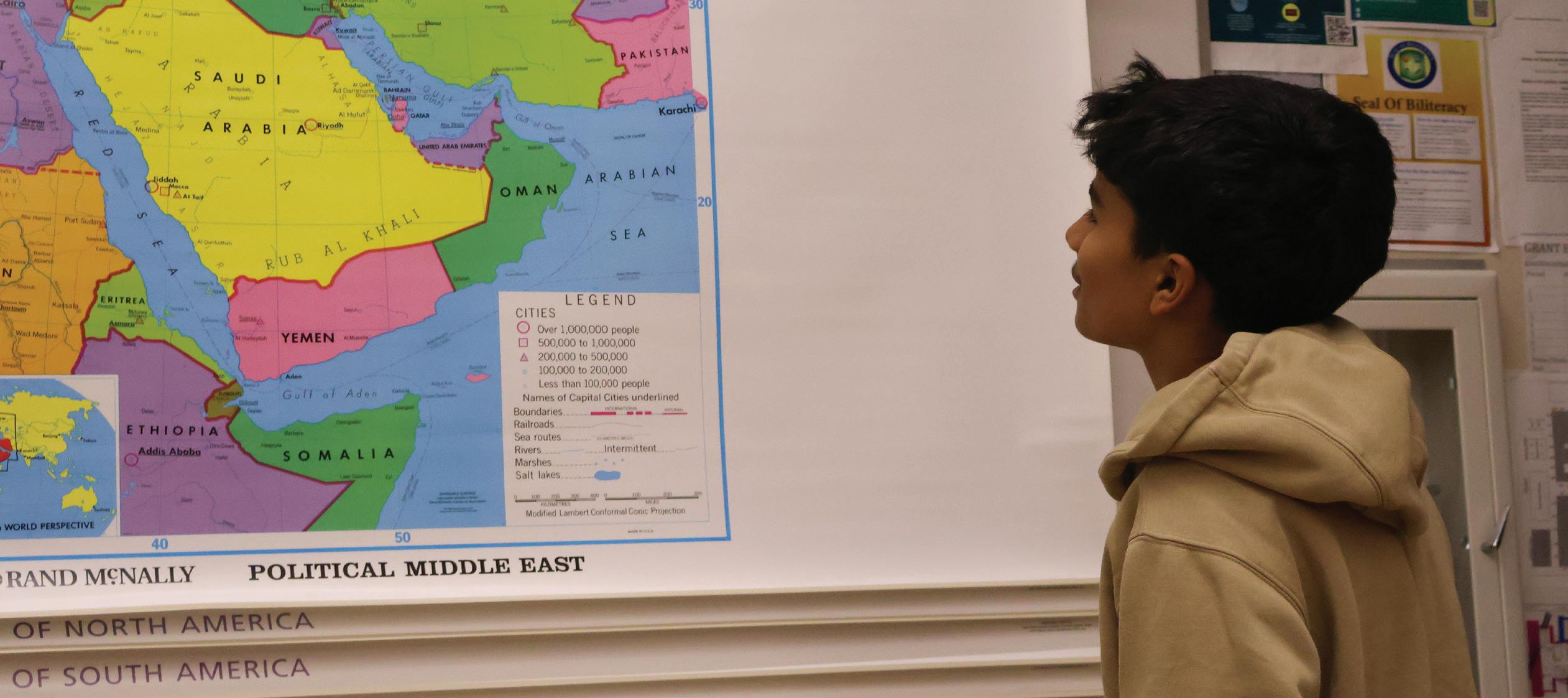
A REFRESHING REVISIT — Freshman Swarat Parab studies a map of the Middle East while revisiting the Social Studies department. “Some people could have gotten burned out or, discouraged by, the workload, but I think overall it’s pretty good class,” Parab said.
Photo: Shuarya Thummapalli
junior Victor Chen recalls riding public transportation to San Francisco. Instead of taking Caltrain the whole way, he gets off of the train short of his destination, at the Millbrae station, just to get back on BART to finish the trip to San Francisco.
According to transit advocacy organization Seamless Bay Area, around one third of Caltrain riders at the Millbrae station transfer to and from BART.
For many commuting to San Francisco on public transportation, having to navigate multiple different forms of transportation is a daily reality.
According to BART spokesperson Alicia Trost, this is because of the Bay Area’s unique transit situation.
“The Bay Area was just designed a bit differently than other [cities],” Trost said. “You go to Los Angeles, it’s all LA. Metro, if you go to Chicago, it’s all under the Chicago Transity Authority umbrella. … In the Bay Area, we have 27 transit agencies, and it’s not necessarily the transit agency’s fault. That is how the government set up these different transit systems.”
Jon Goodwin, spokesperson for the Metropolitan Transportation Committee, said that the Bay Area’s divided public transportation system leads to problems for
both transit agencies and commuters.
“It [divided public transportation] constantly creates problems by making things more difficult for people who want to take transit trips across multiple jurisdictions, and most of us in a region of almost 8 million people are going to cross jurisdictional lines during the course of the day,” Goodwin said.
Chen agrees that divided public transportation limits its effectiveness.
“A con to riding the Caltrain is definitely lack of accessibility,” Chen said. “If the place you want to go to is far from the Caltrain, like Cupertino or Valley Fair, you have to drive.”
the remaining 29%.
After the COVID-19 Pandemic, ridership drastically declined to 6% of pre-pandemic levels. In 2021, revenue collapsed to $69 million, 13 percent of 2019’s revenue.
“ It [divided public transportation] constantly creates problems by making things more difficult for people who want to take transit trips.”
— JON GOODWIN, MTC Spokesperson
Efforts to improve accessibility connectivity between public transportation systems, like the proposed BART extension to Santa Clara County’s Silicon Valley, have been hindered by the COVID-19 pandemic, Trost said.
According to BART, in 2019, fare revenue and parking fees generated $520 million, covering 71% of all operating expenses, with local, state and federal subsidies generated from tax revenue covering
With $69 million dollars, the revenue could only cover 9% of all operating expenses. Through the CARES Act, the CRRSAA act and the ARP, BART was given federal emergency assistance totalling $1.6 billion to pay employees and continue operations and transporting essential workers during the pandemic, along with at least $400 million in state funds.
According to Trost, even now in 2026, the recovery of Bay Area public transportation is still slow and uncertain. With major Bay Area employers, especially ones in the technology sector, increasingly transitioning to remote work, ridership levels stay low.
“Right now, our ridership is at about 200,000 trips [daily], whereas before the pandemic, we were at 410,000 trips,” Trost said. “The Bay Area has embraced remote work at higher rates than any other part of
the country, and so we don’t believe we will get back to 410,000 trips anytime soon.”
As ridership level trends slowly increase to pre-pandemic levels, budget issues are still a major concern.
“Each year we gain more and more riders, but not nearly at the level that will resolve our budget deficit problems,” Trost said.
According to BART, billions of dollars in federal and state financial assistance will run out this year, and has already been forced to decrease service efficiency, reduce peak-period service and implement hiring freezes and healthcare cuts for employees.
The transit agency is in an ongoing structural financial deficit of $400 million annually, and that figure is expected to rise to $2.3 billion by 2032. BART’s 2025 revenue still only covers 32% of operating expenses, less than half that of pre-pandemic levels.
BART is not the only Bay Area transit agency that faces budget concerns.
Caltrain faces a projected annual deficit of $75 million between 2027 and 2035, compounded with the recent completion of the $2.4 billion Caltrain rail electrification project, The Daily Journal reported. If more funding is not allocated, Caltrain will be forced to close more than one-third of stations, completely remove weekend service, reduce service frequency to once an hour and end operations by 9 p.m.
er emergency funds are provided for BART, that is where we would have to really cut service and do layoffs and other dramatic budget cutting moves,” she said.
According to Oaklandside, this situation has caused both agencies to further seek state subsidization through California State Senate Bill 63, which allows Bay Area voters to decide on a regional tax measure that would generate nearly $1 billion annually for transit agencies.
Trost further emphasized the importance of this measure.
“We would be looking at a 30 to 50% fare increase, potentially closing 10 to 15 stations, [and] running just far fewer trains,” Trost said.
San Jose and Santa Clara through four new stations.
According to Trost, despite agency funding issues, the $12 billion BSVII construction remains on time and on budget as of December 2025 due to close coordination between different transportation agencies.
“We would be looking at a 30 to 50% fare increase, potentially closing 10 to 15 stations, [and] running just far fewer trains.”
— ALICIA TROST, BART Spokesperson
According to the MTC, if this tax measure was approved by Bay Area voters, a half-cent sales tax would be placed on Santa Clara, San Mateo, Alameda and Contra Costa counties, and a one-cent sales tax in San Francisco for a period of 14 years.
SB 63 has passed both houses of the state legislature and has been signed into law by Governor Gavin Newsom, clearing the way for a multi-county-level public vote in November 2026.
“ A con to riding the Caltrain is definitely lack of accessibility. If the place you want to go to is far from the Caltrain, you have to drive.”
— VICTOR CHEN, Paly junior
According to Trost, BART would similarly have to cut back on services if funds are not supplied.
“If the ballot measure fails and no oth-
According to the VTA, the Silicon Valley BART extension is a two phase project that extends the BART from Alameda County into Santa Clara County.
Phase I of the BSV was completed in 2020, which connected Fremont to Milpitas and North San Jose. BSVII, which is currently in construction, would further extend BART by six miles into downtown
“They [VTA] are paying for the project, building the project and then, when it’s all done, they will turn it over to BART to operate,” Trost said. “They’re responsible for finding the money in a way that does not impact BART’s operating funds.”
Goodwin further expanded on the interagency coordination.
“And that is a great introduction into, on the one hand, capital needs, on the other, operating needs,” Goodwin said. “It is the operating needs of Bay Area transit agencies that are very much at the forefront of the transportation discussion here in the Bay Area, and really metropolitan areas all around the country in the wake of the COVID-19 pandemic.”
Trost thinks that BSV would have profound impacts on future Bay Area public transportation and act as a catalyst for future development.
“But it [BSV] would realize a wonderful vision for the Bay Area of rail ‘ringing’ the Bay, which has been a long goal of the region, where it’s Caltrain, and then BART, and then we meet, and it just ‘rings’ the Bay with rail,” she said.
“When high speed rail comes in, that’s a whole other ball game,” Trost said. “And then there is the idea of having a second transbay tube, no matter what kind of train technology it is, that would really add the rail needed to support the Bay area’s economy and regional mobility for decades to come. So those are the big, ambitious rail projects in the next many decades.” v
Text by SHAURYA THUMMALAPALLI and ETHAN ZHANG
Weir, Jerry Garcia, Ron “Pigpen” McKernan, Phil Lesh and Bill Kreutzmann in Palo Alto in 1965. Both Kreautzmann and McKernan attended Palo Alto High School, though McKernan didn’t graduate.
ITEND TO THINK OF DEATH as the last and best reward for a life well-lived,” Bob Weir said in a March 2025 interview with Rolling Stone. Now, nearly a year later, the veteran musician finally received that reward.
On Jan. 10, Bob Weir, guitarist, vocalist and founding member of California alternative rock band, the Grateful Dead, passed away from lung
The band, signified by its elaborate live improvisations, drastically varying instrumentation and eclectic, genre-defying fusion of style ranging from jazz to folk, cultivated an extensive international following over the course of its 30 year career.
more Theodore Williams, the Grateful Dead was a staple of his childhood.
“My dad has been listening to [the Grateful Dead] for as long as I can remember — probably as long as he’s been alive,” Williams said.
“Me and my dad, we’d drive around [and] he’d always have the Grateful Dead playing.”
It has made me listen back to some of my favorite songs and appreciate them more.”
— THEODORE WILLIAMS, Paly sophomore “

Weir was widely known for his legendary musical work for the band, which was founded in the Bay Area and shaped an entire generation — many of whom live in Palo Alto.
According to dead. net, the Grateful Dead was founded by


The Grateful Dead left its legacy by marking its name in history as one of America’s premier psychedelic rock bands of the ‘60s. Despite their commercial success, the band’s ubiquity never translated to radio, with the band having only registered one top 40 hit on the Billboard Hot 100.
Today, fans of the group, commonly referred to as “Deadheads,” continue to pass their love of the Grateful Dead’s music along, with many Deadheads who grew up on Weir and his groupmates’ work introducing their children to the iconic band that resonated with their youth.
For Palo Alto High School sopho-

For Deadheads like Wil liams and his father, the Grate ful Dead’s influence transcends beyond the music.
“A lot of his [my father’s] mannerisms reconnect to the themes they talk about in those songs,” Williams said.
“Peace and love, he’s always go- ing about that. Like the usual 60s, 70s hippie thing. That’s what my father does, and I appreciate him for that.”

Initially known as the Warlocks, the Grateful Dead began its journey playing in local bars and clubs. The original name was changed after the members realized another band had already claimed it.
The new name was chosen after one of the members flipped through a dictionary and was intrigued by its meaning — “the soul of a dead person, or his angel, showing gratitude to someone who, as an act of charity, arranged their burial,” according to an article by Vernonmatters.
The band’s Bay Area connections don’t just end with its inception. Even as their fame skyrocketed and they became internationally recognized, the Grateful Dead always maintained close cultural ties with their home. Over the years, the band performed more than 300 shows in San Francisco alone, with multiple performances at iconic stages like Fillmore West and The Warfield.
But for many Deadheads across the Bay Area, Golden Gate Park remains the definitive stage for the iconic folk band, a side effect of the Grateful Dead’s long history of performing there. Williams remembers going to one of these concerts.
“ A lot of his [my father’s] mannerisms reconnect to the themes they talk about in those songs.”
— THEODORE WILLIAMS, sophomore
“This past summer, we saw them [The Grateful Dead] at Golden Gate Park,” Williams said. “We saw Bob Weir months before he died, and that was really interesting to see.”
Even today, the band’s presence can be felt in the Bay Area through the many themes including anti-authoritarianism, festival culture, recreational drug use and a free-spirited drive to live life boundless of expectations and limits. These integral foundations ingrained in the very core of the Bay Area’s cultural DNA were all heavily championed by Weir and his
bandmates back in the day. For Weir, a life chained by the imaginary rules and expectations of others isn’t one worth living at all.

The Grateful Dead’s song, titled “Liberty,” highlights these themes through messages of guiding oneself through life and find ing one’s own path.
have a society that’s trying to make sure that nobody gets any adventures because adventures are dangerous, … that’s the prevailing attitude of this entire society,” Weir said in a 1991 interview conducted alongside bandmate Jerry Garcia for Interview Magazine. “That’s dangerous.”

While Weir’s passing was inevitable, he leaves behind an extensive legacy marked by the societal and musical impacts he engraved on this world. For Williams, Weir’s absence has only furthered his connection with the band’s music.
“It has made me listen back to some of my favorite songs and appreciate them more,” Williams said. “That’s when all of them were there. They were all making that music.” v
Text by APRIL YUAN and YARDENNE STERNHEIM

dance when she was just a toddler, eventually making her way to the big stage.
“My mom put me into dance at a pretty young age,” Gordon said. “I think I was around three, and that was because she did dance growing up. And ever since then, I
Talent Agency at the age of 10, but is now signed with Clear Talent Group, an agency based in Los Angeles. Being from the Bay Area, Gordon also is a part of a local modeling agency.
“I was at a dance convention, and one
personalities like Tricia Miranda and Amari Marshall.
She was also a member of the Golden State Warriors Junior Jam Squad, a group of young professional dancers that perform at Warriors games during halftime.

DANCING WITH THE STARS Palo Alto High School freshman Alana Gordon poses, signaling the end of the choreography performed by the Paly Dance Team. “So I think just finding time to still be social and pursue my passion is what I do,” Gordon said. Photo: Shaurya Thummalapalli
Alanna Williamson, head coach of the Paly Varsity Dance team, applauds Gordon’s efforts to remain humble in the midst of her success.
“There are many dancers who would be at that level and let that give them a big ego and a big head,” Williamson said. “And she is not like that at all.”
Williamson said Gordon has earned her respect, as talent alone doesn’t mean anything if not paired with the right person.
“The fact that she is so easy to work with and such a nice person, as well as being so talented, will make her a huge asset in the industry,” Williamson said.
Though her career is challenging, Gordon said she is motivated by her desire to stay in the industry when she is older.
“After facing rejections throughout her career, Alana Gordon has taken her mother’s principle to heart.
Along with rejections, Alana Gordon is faced with making crucial decisions.
At a loss for time, many of her colleagues sacrificed attending school in order to pursue their careers.
Rather than homeschooling, Alana Gordon decided to stick with traditional schooling at Paly.
I love the fact that ... she always comes and does 110 percent.”
— CYNTHIA GORDON, Alana Gordon’s mother
“I definitely want to go to college and be on … a college dance team, and then after that, I would aspire to be a choreographer and continue working in the industry,” Gordon said.
Gordon said she hopes to be on the dance team at Louisiana State University or San Diego State University.
“As both Gordon’s mother and her mentor, Cynthia Gordon describes Alana Gordon as the hardest worker she has ever met. Not for the success she has achieved, but rather the effort she puts in.
“It’s definitely hard socially sometimes, because everyone just knows you as the dancer,” she said, adding that she wanted the experience of being a “normal” high-schooler, rather than allowing her life to be centered around dance.
With choosing going to school, Alana Gordon recognizes the challenges that it can bring.
I definitely want to be on a college dance team.”
“Sometimes I have to prioritize hanging out with some friends or doing homework over dance, but I also do really prioritize my passion,” Alana Gordon said.
— ALANA GORDON, Paly freshman
“I love the fact that … she always comes and does 110 percent,” Cynthia Gordon said. “ She’s there to work. She is so grateful. She’s super kind to everyone.”
Cynthia Gordon said the key to success in the hyper-competitive industry is to not take things personally.
“It’s really hard to work in an industry where the majority of the time you’re rejected,” Cynthia Gordon said.
Focusing on her social integration while also working in the industry is important to her.
Rejections are a big part of the industry, but Alana Gordon reminds herself not to let these small hurdles slow her down, and instead, to focus on where life takes her.
“I’ve kind of learned through trial and error, you can’t really take everything too seriously,” she said. “If you get cut or you don’t get the job, it’s really not that serious, and you’re just meant to do something else.”
v



Text by KEIRA LING and KAI SCHOEBEL

HEARTS — Palo Alto High School sophomore Amber Li makes crochet hearts for students during Valentine’s week on behalf of the Paly Crochet Club. “We always try to do events that have a meaningful purpose,” Li said. “We’ve always done either events or projects that serve other people, whether through things we make or through our time and efforts.” Photo: Keira Ling
for them, grabbing at the ends of strings.
Palo Alto High School’s Crochet Club has provided a relaxing space for students to learn and practice crochet for over three years. While some students take the opportunity to learn about the craft, others simply enjoy the warm, welcoming environment in room 219 every Wednesday during lunch.
“ I hope for this club to be a community of people who not only crochet, but support each other. I want it to be a welcoming space.”
— VERONICA QIU, Paly Crochet club president
On a typical day of the Crochet Club, members often find themselves chatting with friends or working on their personal crochet projects.
“The club is really chill,” Paly senior
worked on countless projects over the past few years. The club’s president, Paly senior Veronica Qiu, explained that these projects are designed for fun, as well as to increase the outreach of the club.
“We do a lot of community projects, usually,” Qiu said. “Last year, we made tree sweaters that are outside the library. It was something that all the club members worked together on. We’ve also made and passed out mini hearts for Valentine’s Day, as well as crochet stars for Teacher’s Appreciation Day.”
but the community it hopes to build.
“I hope for this club to be a community of people who not only crochet, but support each other,” Qiu said. “I want it to be a welcoming space, whether that be learning how to crochet or meeting new people.”
For students like Chen, this hope for a community of mutual support became a reality as she grew from a beginner into someone who was able to help teach the art to others.
“I first heard about the Crochet Club through the club fair,” Chen said. “As I learned more, I was able to teach other people how to crochet and kind of give back in that way. … In my sophomore year, I learned how to crochet, but in my junior year, I helped teach others.” v

Text by JACOB DOMINGO and ASAF MILMAN
ATENNIS BALL POPS up in the air as Palo Alto High School freshman Akina Ogawa swings her racket to return a serve during her tennis practice. Her feet slide across the asphalt court as she resets, preparing for her opponent’s return.
On the court, Ogawa stays hyper-focused on every point, approaching each point with the seriousness of an experienced competitor. Her practices reflect the level she plays at, with little room for distraction or error.
Off the court, that same level of commitment follows as she juggles schoolwork, social life and the demanding expectations needed to play at a high level.
Ogawa didn’t just make the varsity team her freshman year; she won the Santa Clara Valley Athletic League singles title and reached the finals of the 2025 Central Coast Section championship, going undefeated in seven matches along the way.
when I first started playing tournaments, and that’s when I got a recruit ranking, like UTR [Universal Tennis Rating],” Ogawa said. “That’s when it became kind of competition heavy.”
Because it is a global rating, a strong UTR demonstrates that she is not just excelling locally, but that she also qualifies to compete against elite players from across the country.
From the age of 11, competitions meant more time commitment.
“Every night I would sit down with my parents and talk about what the agenda is going to be like the next day,” Ogawa said. “Last year I went online [for school] just for tennis so I could play more.”
“ I didn’t really get to socialize that much, so I lost some friendships. ”
Those accomplishments prove she’s more than just a promising freshman — she’s already among the top competitors in her section. To understand her success, we must look at what got her to this level beforehand.
— AKINA OGAWA, Paly freshman
After graduating from middle school, Ogawa delayed her high school enrollment and started online school for a year to focus on tennis. While online school helped with prioritizing tennis and training, it also affected her social life and life outside of tennis.
Taking online classes meant that she wasn’t able to interact with her friends who were already in high school.


Tennis became a big part of Ogawa’s life long before she entered tournaments and competitive events. The start of her career was strongly influenced by her family.
“I started tennis when I was around 5,” Ogawa said. “My mom played, so she got me into the sport by taking me to practice. She was the one who practiced with me every day, and so did my grandpa.”
As Ogawa grew older, tennis started to demand more structure and commitment. It gradually became less casual and more competitive.
“When I was around 10 or 11, that’s
“I wasn’t really with my friends in-person, and I was really, really focused on tennis,” Ogawa said. “I didn’t really get to socialize that much, so I lost some friendships.”
Even though moving to online school threatened friendships, she said that upon returning to school, it was easy to gain those friends back. The harder challenge Ogawa faced after coming back to school was the difficulties of reclassifying to stay as a freshman this year.
Reclassing is when a student changes their graduation year, mostly done by aspiring athletes to gain a competitive edge in their sport and further recognition in
POINT PROVEN — Paly freshman Akina Ogawa prepares for her opponent's next move at a tennis tournament at Austin Tennis Academy on Oct. 21, 2025. “I would have to leave on a Wednesday or a Thursday, so I would need to bring all my school supplies with me,” Ogawa said.
college recruiting.
“One of the biggest challenges is fitting in, because people in my class, like at the beginning of the year, were like, ‘Weren’t you like in the grade above?’” Ogawa said. “So it was kind of difficult for them to understand why I did it [reclass].”
Traveling for tournaments still shapes Ogawa’s routine, even after returning to in-person school.
“I would have to leave on a Wednesday or a Thursday,” Ogawa said. “So I would need to bring all my school supplies with me, talk to my teacher, and just try finding a time to really sit down and do it while I’m, for example, in a different state.”
Currently, Ogawa is taking many difficult classes, and tennis continues to dictate her tight daily routine. Still, she finds time for friends and tennis, whether that’s on a weekend without a tournament or after school to study with them. v



LAST DECEMBER, millions of people huddled around their TVs, watching the final seconds of “Stranger Things” trickle down as their hands flung to their temples in disbelief.
After nearly a decade, Stranger Things has finally come to an end. As one of the most watched Netflix original series, many Palo Alto High School students feel that they grew up right alongside the show.
The show starts off with an ordinary storyline
that many children experience: fun board games, biking with friends and Halloween costumes.
“I feel like I could really relate to the characters because they were all my age,” Paly sophomore Josiah Duckworth said.
The Duffer Brothers, the creators of the show, take this familiar childhood experience and slowly unravel it into a story both dark and exciting, as the “Stranger Things” kids begin to enter alternate dimensions and slowly leave behind their normal lives to fight monsters.
“ I feel like I could really relate to the characters because they were all my age.”
— JOSIAH DUCKWORTH, Paly sophomore
“volumes.” While the season answers some questions, like what the Upside Down really is, it leaves more behind. How did they all teleport instantly to the top of a cliff during the final battle? Where were all of the demogorgons during the final fight? These questions led fans on the Internet to develop a theory that the final episode had plot holes on purpose, all to lead to a secret finale, a fan theory called ‘Conformity-gate.’
This theory suggested that the happy ending was a false illusion created by the villain Vecna and that a new episode was on its way.

The new mysteries that these kids face excited many viewers as they learned about a fantastical world unlike theirs.
“I really got into it [“Stranger Things”]. Paly sophomore Liani Ragade said. “I just liked all the mystery.”
With the fifth season finally here, the finale marked the end of a series that lasted nine and a half years. Like season four, it was released in multiple parts, called
“It’s a really good theory, but … I just don’t think the Duffer brothers thought too deeply into the last season,” Paly sophomore Ashley Wu said.
Duckworth said that while he originally enjoyed the ending, online speculation later shaped his view on the finale.
“I really enjoyed the epilogue, but when I started seeing theories online about all the inconsistencies and all the plot holes, I was really disappointed and it kind of influenced my vision of the finale, which was kind of sad,” Duckworth said.
Although opinions on the finale still vary, “Stranger Things” ultimately brought many people together and created a buzzing community of fans connected by years of excitement. For longtime viewers like Duckworth, saying goodbye to the series was bittersweet.
“I’ve been watching the show for a long time, so it’s sad when it finally comes to an end.” v
“I really like the whole plot, I thought it was really interesting. I also really love the dynamic between Robin, Steve, Dustin and Erica when they’re in the Russian base and they’re trying to find out the code.”
— Josiah Duckworth, sophomore

“I really liked the cinematography ... the character devel opment and the story plot in general. However, for the last episode, I thought that it was a little bit rushed. I thought that the fight, for example, was done really fast.”
— Artin Irani, junior
“I like how they went back near the end of the episode and showed what happened to all the different characters, and what they’re doing now. I guess I kind of like in the end, how nothing’s for certain, but most of the story is still pretty resolved.”
— Liani Ragade, sophomore


“I think it [the show] was good, but I just think they kind of got lazy on the finale. … There were a lot of plot holes that still hadn’t been answered yet, and in general it seemed really rushed.”
— Ashley Wu, sophomore


Text by ANGELA FANG and ALMA MICHLIN
FOR APPRECIATING THE
arts, Palo Alto offers an array of small-scale local galleries along with a few public museums on Stanford campus. While there are opportunities to enjoy fine arts, the scene is missing exhibits that feature the most influential artists that lead the creative market today.
Swiss-based art gallery and dealership Hauser & Wirth, which operates 19 brickand-mortar locations worldwide, plans to open a location on the corner of Hamilton Avenue and Emerson Street in the fall, bringing influential artists and visionary exhibitions to the Bay Area art collector community.
Hauser & Wirth plans to transform the historic building known as Downing Block that once housed the United States Post Office from 1909–28.
With a reputation for restoring older culturally significant buildings into flourishing contemporary art spaces, Hauser & Wirth intends to maintain the historical intergrity of the building.
Longtime Palo Alto residents might mistakenly think of the white stucco exterior and Spanish Revival-style arches of the
more prominent 1930s downtown post office three blocks away, but Downing Block, which stands across from Palo Alto Creamery, is at 201-225 Hamilton Ave.
Architect Luis Laplace, who has a longstanding relationship with the company, will be in charge of designing and remodeling the interior of the new gallery. The art will be the main attraction, but the building will be a work of art in itself, making this new location a must-see.
According to Palo Alto Senior Historic Planner Steven Switzer, Laplace plans to replace the original green doors and awnings with yellow in order to add a pop of color.
“
rary and modern art gallery worldwide over the past two decades.
“If an artist is represented by Hauser & Wirth, they are well acknowledged as one of the great contemporary artists of our day,” David Hornik said.
Hauser & Wirth’s Palo Alto location will be the only high profile art gallery serving the Bay Area since Pace Gallery and Gagosian Gallery closed in 2020 and 2021, respectively. That can be defined as a top-tier commercial art space with multiple international locations, and industry leaders with control in the primary art market.
The ambiance is just special when you're seeing stuff in person.”
“There will be some interior work to accommodate the new gallery spaces, but for the most part, they’re keeping most of the historic fabric of the building,” Switzer said.

— ANJA NILSEN, Paly senior
The company, which quietly announced the new gallery on their website, has remained discreet about their choice to expand in Palo Alto specifically. Meanwhile, some of the greater art community has viewed these initiatives as efforts to tap into wealthy Silicon Valley art collectors.
According to Palo Alto-based art collectors and Institute of Contemporary Art San Francisco founding members Pamela and David Hornik, Hauser & Wirth has established itself as a stand-out contempo-
According to Hauser & Wirth President Marc Payot, the company is proud to cultivate a new art center, expanding their West Coast presence from the two active Los Angeles locations.
“Northern California occupies an
equally powerful position as home to a fantastically dedicated community of collectors and the museums they have built,” Payot said.
Pamela Hornik said she hopes the incoming Hauser & Wirth might emulate the community aspect of the former Pace Gallery, which consolidated their West Coast operations in the more convenient artist hub of Los Angeles, according to Pace Gallery President and CEO Marc Glimcher.
“
incentivising young people interested in art to stop by and appreciate the exhibits.

Anytime you can bring more amazing art to the community is a lucky time."
— DAVID HORNIK, art collector
“Pace would have fabulous shows,”
Such person is Palo Alto High School senior Anja Nilsen, who enjoys visiting local galleries and museums.
In an age where art can be viewed through a computer screen, Nilsen said seeing art in person allows for people to connect with the details, patterns and textures up close, transforming their experience.
“The way galleries and museums are set up is different than how you would be
Photo by SHAURYA THUMMALAPALLI
“The ambiance is just special when you’re seeing stuff in person.”
From experienced art collectors to locals searching for a new form of entertainment, the addition of Hauser & Wirth serves as a bridge to bring together Palo Alto through art.
“Anytime you can bring more amazing art to the community is a lucky time,” David Hornik said. “To have one of the great galleries of the world set up shop in your backyard is extraordinary.” v
HAMILTON — This historic building, named Downing Block, sits on the intersection of Hamilton Avenue and Emerson Street. It was built in 1909 and used to house the U. S. Post Office. Over the years, the secoond floor meeting hall has been used by various orginizations. “Early on in its days, it was the original post office for the city, and stayed there until almost twenty years,” Palo Alto Senior Historic Planner Steven Switzer said.
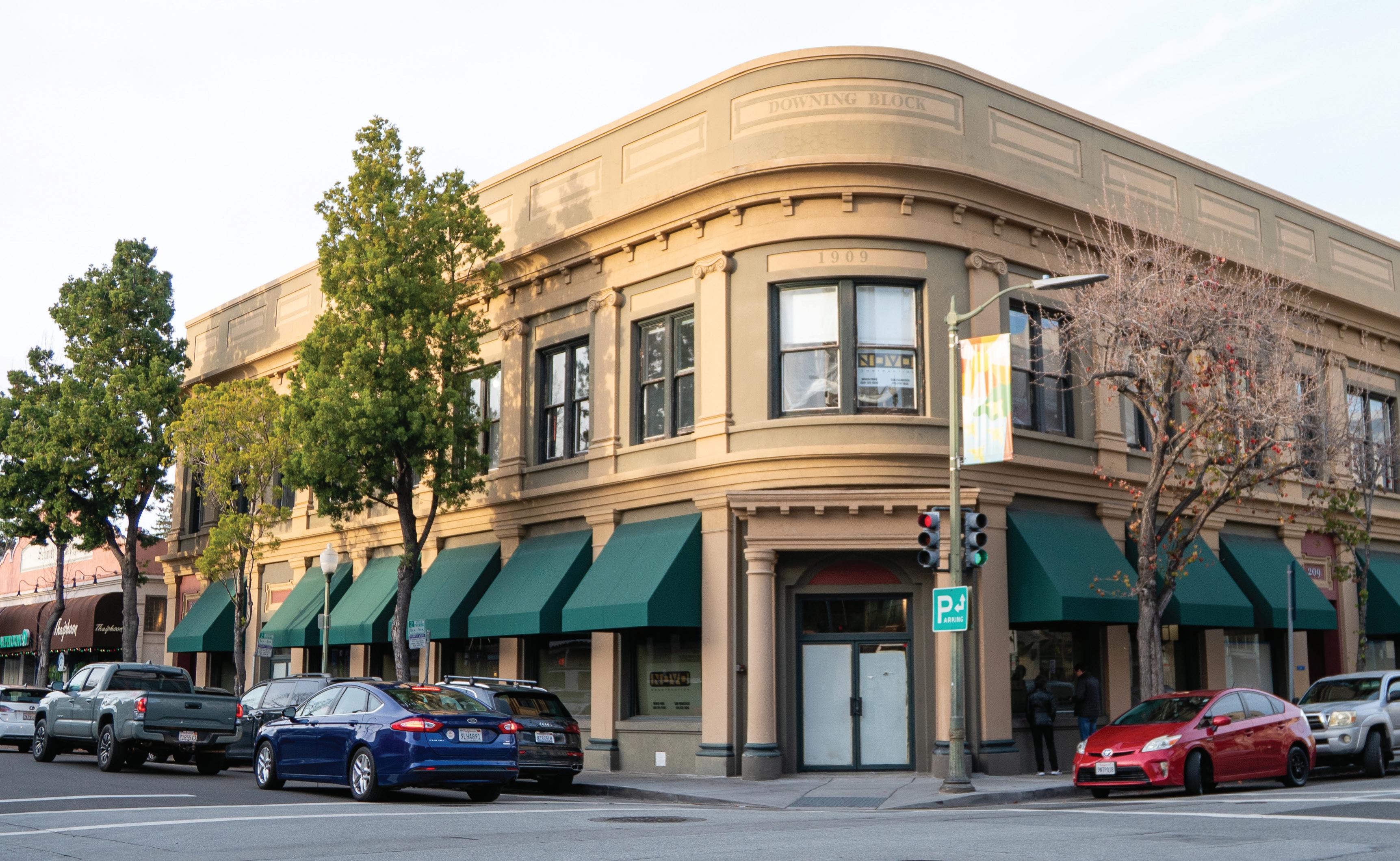
THE SOUNDS OF CHIMES can be heard when customers flood in-and-out of the Goodthing Coffee. Inside, the coffee bean grinder roars, as the ground beans get transferred into a dripper and its flavor pre-
Nestled in Town and Country Village, one of Palo Alto’s most recent additions is Hatched, which resides in Roost & Roast’s previous space, sharing the same owners.
The vision for a brunch cafe was started between three people: the Poon brothers. According to Craighton Poon, the youngest, he grew up in the restaurant industry.
“[My] parents owned a restaurant called Express 7 in Mountain View, so it’s kind of in the family,” Poon said.
This family restaurant was one of the influences that made Craighton and his other younger brother quit their corporate jobs to help his oldest brother develop professional restaurants.
“Both my little brother and I, we did corporate world for 10 plus years,” Poon said. He was a CPA [certified public accountant] and I was a mechanical engineer, and we ended up leaving those jobs and joining our older brother to
pares to be extracted. Tables and chairs surround the central service counter, creating a space that is lively and suitable for both quick visits or long productive hours.
Palo Alto’s cafe landscape is evolving quickly, with several establishments opening in the area. From new openings of specialty coffee shops to brunch cafes, these new additions reflect the growing appetite for quality drinks, unique atmospheres and collaborative work spaces.
Each of these cafes embrace distinct menu items that separate themselves from
the rest of the crowd, adding more to Palo Alto’s cafe scene.
With the number of cafes increasing, competition has shifted the attention from quantity to quality. Whether that is their drinks, food or atmosphere, each cafe approaches that experience differently, offering a take on what makes a spot worth returning to.
build more restaurants.”
Unlike traditional cafes where there is space to sit and study, Hatched is mostly takeout, with its only seating options being the chairs outside. With its opening on Jan. 6, Hatched serves breakfast and brunch, as well as high quality matcha and coffee drinks.

Verde set out to explore this new and evolving cafe landscape, highlighting three new cafes that have opened in the past year.


We ordered a Mango Coconut Matcha Latte ($7.50) with regular sweetness, whole milk and served cold. The coconut cream floated on the matcha, with mango jam sitting at the bottom. To enjoy all the flavors best, we mixed everything together.
The rich mango jam was sweet and contrasted with the bitter matcha. The coconut foam was not overpowering, forming a smooth, well-rounded drink.
The BFF Sandwich ($11) is the simplest and cheapest sandwich on the menu. It contains scrambled eggs mixed in with
cheese and arugula, topped off with caramelized onions and a garlic aioli served between two toasted buns. The scrambled eggs are creamy and soft, melting into your mouth and the melted cheese added richness to the eggs. The arugula balances the platter, and the garlic aioli adds depth. Overall a solid egg sandwich.

On 170 University Avenue in downtown Palo Alto lies Yummy Future. Opening in October 2025, the cafe implements robot technology into a cafe setting, by using robots to autonomize the process of making coffee. According to Yummy Future’s website, people are at the center. The robot is the servant: it handles the busy work so that conversations can breathe, giving each person spark and a destination for connection.
This shop differentiates itself by having a robot barista, which is a onearm machine that has the ability to transfer cups to various machines, ensuring that each drink is made with consistency and speed. Although the robot can create a majority of its drinks automated by itself, some drinks still need
input from human baristas, as the arm is unable to pour, shake or stir.
Yummy Future believes in amplified hospitality, with baristas creating more moments for interaction with customers without having to do the job that its robot counterpart handles. With these values reflected as the mantra, they aim to make sure to be meaningful in every neighborhood served.
Yummy Future has a plethora of seating and long business hours for productive study to complete work, or get together and grab quality drinks.
The Iced Caramel Macchiato ($6) from Yummy Future is a very refreshing addition to the many drinks they offer. The beverage contains one shot of espresso sitting above a mixture of milk and vanilla syrup. The
sweetness of the vanilla syrup along with the milk help contrast the bitterness of the espresso shot. The caramel drizzled on top adds a rich buttery flavor to the drink, which complimented the other drink elements.
The drink was sometimes too sweet as there was lots of sugar and carmel syrup added, but we would recommend this to anyone who enjoys sweet coffee and has a sweet tooth.

Just a couple of blocks away from Yummy Future lies another new high caliber cafe, Goodthing Coffee. With a modern and minimalistic atmosphere, The shop has an front-of-house service counter, with a handful of seating options inside and outside. Goodthing Coffee features a vast selection of unique menu items that have modern twists on traditional coffee.
Located on 532 Ramona Street, this marks the brand’s second location, adding onto its original location in Burlingame. The shops specialty is the Pistachio Einspänner, traditonally a Viennese coffee drink with sweet whipped cream on top of espresso.
The history behind these drinks is that Austrian carriage drivers needed to keep their hot drinks insulated so they topped them with whipped cream to keep them warm and also prevent any spillage when handling the horse carriage.
The drink has travelled across the globe, becoming more popularized with different variations and flavors representing the drink. Whether you are a coffee connoisseur, or looking for a comfortable place to spend the day, Goodthing Coffee offers both a welcoming atmosphere and quality drinks.
The most popular item, the Pistachio Einspanner ($9), is a drink with sweet pistachio whipped cream on top of espresso and milk. The thick sweet cream has strong pistachio flavor on its own, but when mixing the drink together, it seemed to get overpowered by the espresso. The milk doesn’t do much to smooth out the bitterness of the coffee, but adds to the creaminess as a whole. If you are a coffee person, we would recommend this drink as the espresso flavor can be tasted strongly.
Additional reporting by Rohan Kini


Text by LILO SAYAG and
RAKIM ATHELSON MAYERS
has never shied away from unconventionality. From his genre-bending mixtapes to his daring fashion sense, the 37-year-old Harlem rapper, known commonly by his stage name, A$AP Rocky, has long forgone the rigid confinements of normality for experimentation.
In the beginning, that meant joining rap group A$AP Mob in 2007 — then in its infancy — and collaborating with cloud rap pioneers Clams Casino and Main Attrakionz to craft spacey, atmospheric trap rap signified by its abrasive, hard-hitting bass and narcotic-centric lyrical content.
Later, it meant adopting protege Playboi Carti — long before the Atlanta rapper blew up with 2020 album “Whole Lotta Red” — and fostering a new generation of alternative hip hop hinging on the founda tions he himself established a decade earlier.
Then, in 2018, it meant releasing perhaps his most polarizing project yet in “Testing,” an indie-infused solo album that alienated fans as much as enthralled others.
“Don’t be Dumb” is no different. The new album, released on Jan. 16, does not slack in the slightest. Despite being Rocky’s first solo album in nearly eight years, it’s business as usu al for the now-veteran mu sician, with the New York rapper returning from his self-imposed hiatus, hungrier than ever to break new ground.
That sentiment can be felt throughout the project. Lead single “Punk Rocky” sheds Rocky’s usual
trap snares for a down tempo, guitar-driven midwest emo track sonically closer to 2000s bands like American Football or Mom Jeans than anything he had released prior. “Whiskey (RELEASE ME)” recruits underground legend Westside Gunn and Gorillaz frontman Damon Albarn for an eerie four-minute trap opera characterized by a distinctive, hauntingly repetitive hook from the latter and shrill, off-kilter adlibs from the former. Both tracks utilize experimentation to their advantage, crafting unique, avant-garde songs that, while not immediately sonically pleasing, make their mark and cultivate Rocky’s thirst for innovation. But innovation can be hit or miss, and as much as Rocky tries, some experiments just don’t land. “ROBBERY” featuring Doechii is a notable culprit. Shrill, jarringly out of place piano
“My only criticism is that it took so long to release the album.”
—YUVAN VISHAKAN, Paly senior
keys and nonsensical lyrics reminiscent to the feature artist’s similarly unpalatable “Anxiety” render the track unlistenable. The album’s finale, aptly titled “THE END,” is likewise grating. Subdued, childlike chants from feature artist Jessica Pratt, while initially effectively haunting, swiftly lose their charm with repetition. But even as experimentation falters, the effort alone deserves flowers — in an age where other artists simply settle for what works, Rocky’s affinity for testing is always welcome.
Even songs that may not deviate greatly from the standard still try new things. The opening track, “ORDER OF PROTECTION,” both calls back the Rocky of the old and breaks new ground, with braggadocious rhymes reminiscent of the rest of his discography bolstered by a bass-boosted backdrop that teeters away from Rocky’s rigid routine of cloud rap beats.

Experimentation is bound to bring forth division, and just as expected, opinion on the new release is similarly split.
“It was a little bit of a disappointment,” Palo Alto High School junior Sepi Hafizi said. “There were a few good hits, like ‘THE END’ and ‘STAY HERE 4 LIFE,’ but I was a little let down. I was excited, because he hasn’t dropped in a while. But overall, it was
Paly senior Yuvan Vishakan’s opinions are slightly more positive.
“I think it does live up to the hype,” Vishakan said. “My only criticism is that it took so long to release the album.”
Vishakan agrees with Hafizi on their favorite tracks,
“I especially like ‘STAY HERE 4 LIFE’ with the Brent Faiyaz feature,” Vishakan said. “His voice sounded very beautiful on the song.” v
Text by ANANYA ADYA
AT 5 YEARS OLD we already had two reasons we smiled.
For me, it was the wax from the crayons, the sticky residue that plastered itself across my cheeks as I was nose-deep into craft paper, scribbling my bursting thoughts in my mini storybook.
For him, it was the clunky metal parts he dismantled with our dad’s screwdriver, squinting his eyes to see each and every
reason behind the churning mechanics of a car toy.
That same year, he started to grow taller. They were small growth spurts at first, but now my 6-foot-6 twin brother continues to loom over me, just like he towers above almost everyone else.
His growth didn’t just change him. It changed how I was treated.
When my family went out for dinner, I was often given the “under-10” child menu up until I was 12. The whole deal too, the three “C’s”— crosswords, colorings and crayons. However, when I went out with my friends, restaurants never gave me that menu. I found this odd but didn’t think much of it at the time.
sumed that he didn’t want them. My mom often asked for an extra set so he could have one too.
His growth didn’t just change him. It changed how I was treated.
When I turned 12 years old and still received these activity sheets, I began to realize that my brother looked older and taller in front of me, so I was seen as younger by comparison.When he talked to servers, strangers or even people who knew we were the same age, such as extended family or family friends, they gave his behavior quiet approval, as if he was expected to be more mature. When I spoke, adults gave me those soft smiles and comments like, “aw she’s so well-spoken for her age.” It was as if most people kept forgetting that we were born at the same time.
Until I was 10, I still enjoyed the games and activity sheets restaurants handed out to kids. My brother rarely received them. He looked older for his age, so servers as-
We used to laugh it off, saying that we know it’s hard to believe and joking that he stole my nutrients when we were growing.
But the moment I felt that I was going to be coddled, I used to blurt out “he may
be a foot taller, but I’m a minute older,” hoping that those 60 seconds of extra “experience” might shift how I was perceived. But it didn’t.
At 12 years old, I started hating the fact that I was a twin and blamed my brother for how people treated me in such an infantilizing manner, even though it wasn’t his fault. I thought that the only way people could learn about my true self was if no one ever found out that he was my brother.
It was hard for me to try distancing myself from him and build my own persona because my mom put us in the same activities for years. From every sport, to every art camp, to every summer program, people always found out that we were twins, and the cycle continued.
For a long time, I thought that independence meant getting rid of our shared experiences. As we entered high school, we naturally separated into our own interests. He leaned towards basketball and robotics, whereas I leaned towards ice skating and the arts.
and closeness exist to gether.

For a long time, I thought independence meant getting rid of our shared experiences.
It became clearer what kind of person we each were becoming as we each explored what gave us joy, but it also emphasized the truth of how different we truly are.
My grandmother said that she always knew from the start.
“You two have always been different in terms of face, nature and personality,” she told me recently. “You guys are very oppo site.”
Even with these major differences that may make us seem “untwin-like,” my grandmother said that the similarity that we do carry is the help we provide for each other.
“You guys have a strong connection with each other, not one I’ve seen with other people,” she said. “You two care for each other.”
When someone who watched us grow up our entire lives pointed out the care my brother and I had for each other, it changed the way I viewed my relationship with him. My grand mother helped me realize that my twin and I have a bond where our differences
One time, I re member crying on the sofa, clutching my fingers on a pillow as I struggled to grasp a math concept. I explained to my dad that I just could not understand, and that I was sorry I had wasted so much time because I knew my brother would have never given it a second thought. My twin came into the room quietly, and he only spoke a few words, but meaningful ones. We call him the “guru” of our house, because he speaks logically and from the mind. He calmed me down and told me that stress wasn’t going to get me anywhere.
In other instances, I’ve helped him think emotionally and from the heart, as that is something I’m used to doing. When he was deciding what to write for a summer application, I convinced him to express who he is and what he felt shaped his life, rather than solely listing achievements. This allowed him to look into the emotional authenticity of his character, which was
dreams or my craziest “what if” situations, my arms moving hummingbird-fast as my excitement grew. He would patiently listen, not uttering a single word. Eventually, I realized that his quiet presence was something I needed; he let me process the world verbally without judgement.
Now, it’s the graphite from the Dixon Ticonderoga pencils that blanket my fingertips while I transition to the laptop for further polishing of my circling thoughts.
For him, it’s the grinding from a milling machine and the creation of robotic bodies.
Even through our busy high school lives, we continue to revisit our random memories from our childhoods, whether they were of shared experiences or little stories.

Text by RYAN SAKET
IDON'T KNOW HOW MANY things you’re good at, but you’re great at this.”
My head instructor had said this to me during my black belt test, a
was just another extracurricular activity that my parents signed me up for. I remember looking up to all the black belts, and thinking it would be cool to get one someday. But at that point, I didn’t have the necessary strength, coordination or balance to become a great martial artist.
So by around age 7, I assumed at some point I would quit as I got older. After all, only about 10 percent of people who start Taekwondo training end up achieving their black belt, according to Today's Taekwondo,
black belt in the summer of 2022. However, a few months before I decided to go for my black belt, I almost quit. Going to the classes took up a lot of my time, as the studio was 20 minutes away and the classes were an hour long. Many times I’d be hanging out with my friends when my mom would call, telling me it was time to come home and go to taekwondo. This made martial arts feel like a forced chore, rather than something I genuinely enjoyed. I felt like I was wasting time on something I didn’t like, and wasn’t very

Photos by SHAURYA THUMMALAPALLI
me from what truly mattered — my own progress.
I realized that if I wanted to get my black belt, I needed to be all-in and committed. I needed to stop focusing on others and focus on myself, because that’s the only variable one can control. I did not want to feel like I wasted a decade of training. And most importantly, I had to enjoy it, because without passion, even the greatest accomplishments become hollow. I wasn't just going to be given a black belt, I had to go and take it.
The months of training leading up to the test were physically taxing. Every Sunday morning, before most people were awake, my class met at the beach for three-hour training sessions. The sand was uneven, shifting with every step as we ran miles through the cold morning air along the beach. On the steep slope near the water where the sand and water collided, we crawled up the sand on our hands and knees in army and bear crawls, dragged each other like firemen and did wheelbarrow drills along the incline. We trained with sticks — short, wooden batons used to practice striking, blocking and control.
We drilled forms until they were nearly perfect, and practiced sparring to the sound of the crashing waves. By the end of each session, my body was exhausted. But I left the beach feeling stronger, sharper and more controlled than when I arrived, all qualities of a black belt.
Despite all this preparation, when the test arrived, I still questioned if I had what it took to pass.
On the first day of the black belt test, each student took turns stepping forward to earn what were called “energy stripes.” The task sounded simple: throw a punch and scream until you embodied the energy of a black belt. But after countless tries, I hadn’t passed.
At first, I treated it like a test of volume — just yell as loud as possible and
move on. But my instructor saw through that. I realized it wasn’t a test about noise, but rather about presence. My instructor told me that after I threw each punch, I looked at her for validation. I realized it wasn’t about if she thought I was a black belt, but rather if I thought I was one.
So the next time I went up, I screamed as loud as I could. The difference was that this time, I didn’t look to her. I stared straight forward, eyes locked in on the imaginary target, with full confidence in my own ability.
At the end of the day, the black belt is just a piece of fabric. It’s the journey and the memories of all the hard work and dedication that make it special.
Time seemed to freeze in that moment, as I stood there holding the punch. After a few moments of long, quiet silence, she told me congratulations and that I had passed. As I took a sigh of relief, I realized that I had just displayed a powerful strength that I didn’t know I possessed. For the first time, my scream was louder than my doubt.
My peers often called me a ‘quiet storm,’ because I’ve always been quieter and more reserved than most. I don’t always draw attention to myself, or have the loudest voice, but yet people can still feel my energy.
This reflects a truth that I’ve come to accept: that the most powerful changes often happen quietly, beneath the surface, in the effort no one sees. Others only see the results, not the steps that went into it.
From the outside, progress can look sudden or effortless, but that hides the hours of unseen work, the failures no one witnesses and the choice to not give up when quitting would have been easiest.
At the end of the day, the black belt is just a piece of fabric. It’s the journey and the memories of all the hard work and dedication that make it special.
Achieving the black belt changed how I approach things outside of martial arts. It reshaped the way I view success, not as the end result, but as the process itself. I learned that progress is not linear, and that being consistent and stacking days even when progress feels slow or invisible eventually leads to success. Setbacks are no longer failures, but dips in a long term trajectory of growth.
After three hours of intense sparring and conditioning, when the test was finally over, I felt nothing but relief. I didn’t immediately think about the fact I got my black belt. In that moment, the achievement felt secondary compared to the weight of everything it took to get there. My mind drifted to the several months of frustration, self-doubt and quiet persistence that shaped me more than the belt itself ever could. v
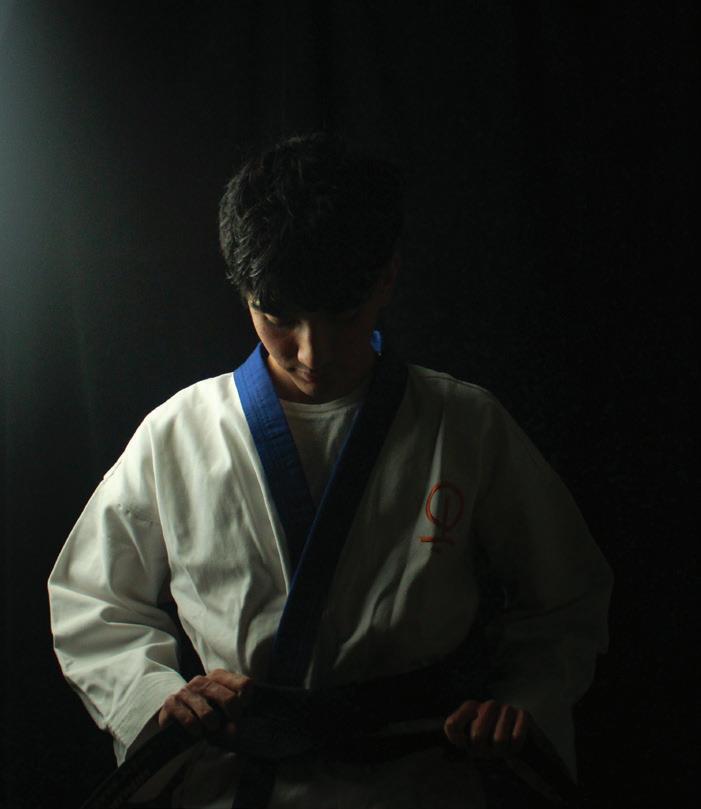
REFLECTING ON THE PAST — I look down at my
Art by ETHAN BRADLEY

THE BELL RINGS IN THE classroom of Mr. Smith, a local Analysis teacher. In the hoards of sophomores and juniors rushing out of the room to get to lunch, knees hit the face of Julian Jones, who recently entered preschool, leaving after lunch to take math at Palo Alto High School.
“Julian is a pleasure to have in my class,” Smith said. “Although I will say that grading drool-soaked paper has proven to be a unique challenge.”
The toddler’s predicament may lead one to believe that he has faced pressure to do more advanced math, but as his mother explains, the case is anything but.
“My son, of his own free will, decided to take the skip test to enter Analysis before pre-K,” Jane Jones said. “In between
‘Paw Patrol’ episodes, he told me he wanted ‘a competitive advantage for college.’ His words, not mine. If the district doesn’t give him a math lane high enough, what will he do in high school?” When asked for his comments on the situation, Julian babbled and attempted to bite the microphone.
“
In between ‘Paw Patrol’ episodes, he told me he wanted a competitive advantage for college.”
— JANE JONES, local mother
she’s already behind! She’s only gotten 35 national awards, and a few of those were second place,” Fakina Nombre, another parent of a child taking accelerated math, said. “It almost feels like by not providing further course options, the district is trying to discourage us from moving her from Counting 101 to Geometry Honors.”
The concern Jones holds is one shared by many parents: accelerated children left without paths through high school.
“My daughter is five years old, and
Both Jones and Nombre are part of a growing movement to introduce higher math lanes to the Palo Alto Unified School District.
PAUSD is now offering classes on quantum physics, measure theory and how to get a life on campus for college credit. v
Text by ANISHA SHETTY
MICRO TRENDS CIRCULATE through the lives of teens in a matter of weeks. For many Palo Alto High School students, including me, keeping up has become less of a choice and more of an expectation.
So, what are microtrends? Microtrends, which are fueled by social media, are defined by the Harvard Crimson as “short-lived, specific trends, often in fashion and aesthetics, that rapidly gain huge popularity on social media for a brief period.” Algorithms on social media platforms like Tiktok are constantly pushing fads forward due to the constant need for “newness.”
TikToks of influencers reviewing or styling new products, such as viral lip glosses, trendy shoes, or reusable water bottles, reach the eyes of the student population, thus beginning a microtrend. For the next few months, that product will seem to be everywhere. Think about the last time you gave in to a trend. Was it within the last week? Two? The lifespan of trends seems to be decreasing rapidly, along with the attention spans of teenagers.
When asked how microtrends contribute to waste, Paly Economics teacher Eric Bloom compares the lifespan of one trend to a season.
“If we used to have four seasons, now we have hundreds of seasons,” Bloom said.
Waste is one of many problems that arise from microtrends. Due to the brief amount of time the trend survives, a person is constantly consuming more and more.
Old products are lost to the past, lucky to even be touched after their time has passed. Sometimes, once a product I own loses its trendiness, I realize the product has little worth. For example, I remember buying white crocs in middle school and decorating them with little charms known as Jibbitz. In the moment, I thought they were really cute. However, as soon as that trend went sour, so did my view of the product.
Overconsumption of microtrends also leads to a loss of personal style and an increased pressure to fit in. When I make a decision to buy something in the mall, I automatically view a trending product as something that would be cool to have. For example, the other day,
I was at the Stanford Shopping Center with a friend. We were walking around and spotted the Coach store. I had never noticed Coach was in Stanford mall, but because one of the Coach bags is currently trending, we decided to walk in and browse.
Walking around school, I don’t see a majority expressing themselves in unique ways. Many seem to be wearing almost the exact same outfit. Not participating in a trend breaks this pattern, but may leave a person feeling isolated. I think this is a sad truth. Everyone should be able to express themselves through whatever style they choose without judgement.
Businesses profit off of microtrends much more than we do. Overpricing, poor quality and short lifespan are all directly benefiting companies that sell these products. When I walk into stores that feel trendy or cater to teens, they often charge more than what their product is worth. Like many Paly students, I use a lot of brands like Alo Yoga or Lululemon for athletic clothing because they have good quality products. However, when compared to Target or Amazon, the price difference is quite significant, even when quality is similar. I often question if their products are worth the price, or if they are raising them solely because teens continue to support them.
Beyond the personal effects, I’ve also become more aware of the environmental and economic damage caused by microtrends. Microtrends encourage careless spending, making it acceptable to constantly buy new things and get rid of them within a few months. According to the United States Enviornmental Protect Agency, items that aren’t being used end up contributing to over 292 million tons of landfill disposed annually in the U.S. alone.
Despite these problems, the solution might be simpler than you think. We should be more aware of microtrends’ impact. If I decide I want to go shopping, then next time I might take an extra minute or two to think about if a product is really worth my money. Going thrifting is another great way to stop the cycle because you are reusing and upcycling old products. Especially now, with 2000s fashion back in style, it will be easier to find a pair of low rise flare jeans or a babydoll top. Just taking a moment to think about these other options will greatly decrease overconsumption and underusage, and I guarantee your wallet will thank you. All of this said, the next time a new trend floods my feed, I’ll probably still feel the need to overconsume. However, I am beginning to adjust my habits to reuse, upcycle, or thrift the accessories, clothing, room decor, or whatever other products become a trend now that I am more aware of what they cost — not just to my wallet or the environment, but to my own individuality. v

Text by LEELA KULKARNI
IINEVITABLY END UP covered in flour when I bake. Or maybe I’ll get an oil stain on my jeans, or chocolate on my white shirt.
Even though it’s messy, I love how baking allows me to become my most confident self. I feel in control and I trust my instincts, and that’s changed the way I see myself.
Baking will always be special because of this. I think everyone should find a passion that teaches them as much as baking has taught me about myself.
My love for baking started during the pandemic when I was 11 or 12, when I didn’t have anything else to do. I don’t remember the first thing I made, but I remember loving it.
I got to use my hands to make something that I could instantly enjoy. It was a good break from staring at a screen all day for school.
For example, I could make a sheet tray
was satisfying for me to see my creations and appreciate my hard work.
When I started learning to bake, I didn’t know anything. But that didn’t matter, because I realized it’s pretty straightforward — just follow the recipe. I started off with simple recipes that were easy to complete: the classic chocolate chip cookies, poundcakes and scones (which I still make today).
I kept baking, making everything from shortbread cookies to sponge cakes to bread rolls.
Baking is a time when I can decompress. I feel less overwhelmed by everything knowing that I’m in control of whatever’s in front of me: the flour, or sugar or baking powder.
I think everyone should find a passion that teaches them as much as baking has taught me about myself.
My kitchen has probably been home to over 200 baking projects. As a self taught baker, to keep up with constant baking, I read lots of cookbooks and regularly watch baking videos.
I bake when I need a break from life. It’s a good distraction for me because I need to be focused. I don’t have to think about anything else if I don’t want to.
Doing a mindless task like portioning out cookie dough allows me to slow down and just focus on the moment. I know what I’m doing, so I don’t have to think hard about every single step.

I don’t do the simple recipes the same as when I started. There are lots of tricks and shortcuts I have learned just from making so many mistakes. I have crystallized caramel and burned cookies. Cakes have gotten stuck in their pans and bread has baked flat. But all of those failures have just made me more determined to remake them correctly.
And I have. I have learned to add water to my caramel and let my cookies cool on a rack. Now I know the best way to butter a cake pan and properly activate yeast. I taught myself how to bake, mostly through practice. As I have gotten better at this skill, baking has become easier.
One project that I learned a lot from was croissants.
This project was one of the hardest things I ever made. This took two days and so many sticks of butter. Making croissants is stressful because if the butter melts at any

point in the process, the dough is ruined. The butter needs to stay cold the whole time, even as it gets rolled and folded. After making the dough, it rests in the fridge overnight. The next day it gets shaped and baked. When I finally got to try one, I was surprised. The croissants were misshapen and unevenly browned, but they were also flaky, buttery and delicious.
I’m glad I made croissants once, but for me, they aren’t worth the time and effort. Croissants are something I can buy at any bakery.
I love making desserts at home that are worth it, foods that taste better when made at home.
That’s why I love making pie. Pie feels special and unique to home kitchens.
Pies aren’t made to look pretty in a window display — they’re made because they taste delicious. The emphasis is on the filling, not on how it looks.
This past Thanksgiving, I made three key lime pies. The recipe for the

filling is simple: just key lime juice, key lime zest, sweetened condensed milk and eggs. It referenced another recipe for the cookie crumb crust. I crushed the cookies in a food processor and then grad ually added the melted butter.

I didn’t hesitate or question what I was doing at all. When I started baking, I would have carefully read and reread the recipe. But I remember ignoring this recipe completely.
That confidence has helped me outside of baking as well. I have learned to trust myself because I have faith in my abilities.
When I’m taking a test or driving a car, I have learned to recognize my first reaction. My first instinct is usually right.
Since starting to bake, I have learned a lot and had so much fun.
So many dessert recipes call for vanilla extract, and at some point I stopped measuring it.
I just pour some in. I trust myself.
In all the recipes I’ve ever made, I’ve never put in too much vanilla. v
PLATEFUL OF COOKIES — I hold a plate of oatmeal chocolate pecan cookies that I made earlier this month. I overbaked them a little, but they were still delicious. Photo courtesy of Sunil Kulkarni

Text by CHRIS JEON

Art by ETHAN BRADLEY
STEPPING OFF THE PLANE, I felt the air grow heavier as sticky droplets formed on my forearms — the East Asian summer was announcing its presence. It was 2018, and I was bursting with excitement to spend my summer break in Korea. Inside Incheon International Airport, as I passed by familiar Korean signs, beauty advertisements and a brightly lit convenience store, I knew I was in the right place.
Today, millions of people across the world encounter South Korea through K-pop and iconic media like “Squid Game.” For many, this recent surge in popularity has been their first introduction to the country.
But long before Korean culture entered the global mainstream, it had already shaped my everyday life. Through family routines and years of visits, I came to know a version of Korea that most people never see, built on everyday behaviors and values far from the flashy headlines.
Before I was old enough to remember anything, my exposure to Korean culture had already begun. At six weeks old, while my parents balanced work and graduate school in the United States, I spent a year living with my maternal grandparents in Korea.
In South Korea, raising a child isn’t
just confined to the mother and father, but also to grandparents and extended family, especially in households where long working hours are the norm. Even as an infant, this system surrounded me. My paternal grandparents and aunts would drive hours each month to spend time with me, and by the time I left Korea, I was calling my grandfather “mom.” In my parents’ absence, I was still surrounded by loved ones, reflecting how family involvement in Korea is a shared responsibility.
By the time I returned in 2016 as a 7-year-old, conscious enough to take in all my surroundings, I noticed details of Korea that weren’t just surface level. That summer, while exploring Seoul’s concrete jungle with my aunts, I had my first encounter with a Korean convenience store. Inside were endless rows of Pepero, Buldak and triangle-shaped gimbap, but what stood out the most was the intention. The food was simple, affordable and filling, designed for Korea’s busy bees who needed something quick during school days or late work nights.
This same hyper-functionality was made even clearer to me on the Korean subway. At each stop, mobs of students, families and employees moved in and out, with everyone rushing to where they needed to be. Yet despite the volume, it felt nothing
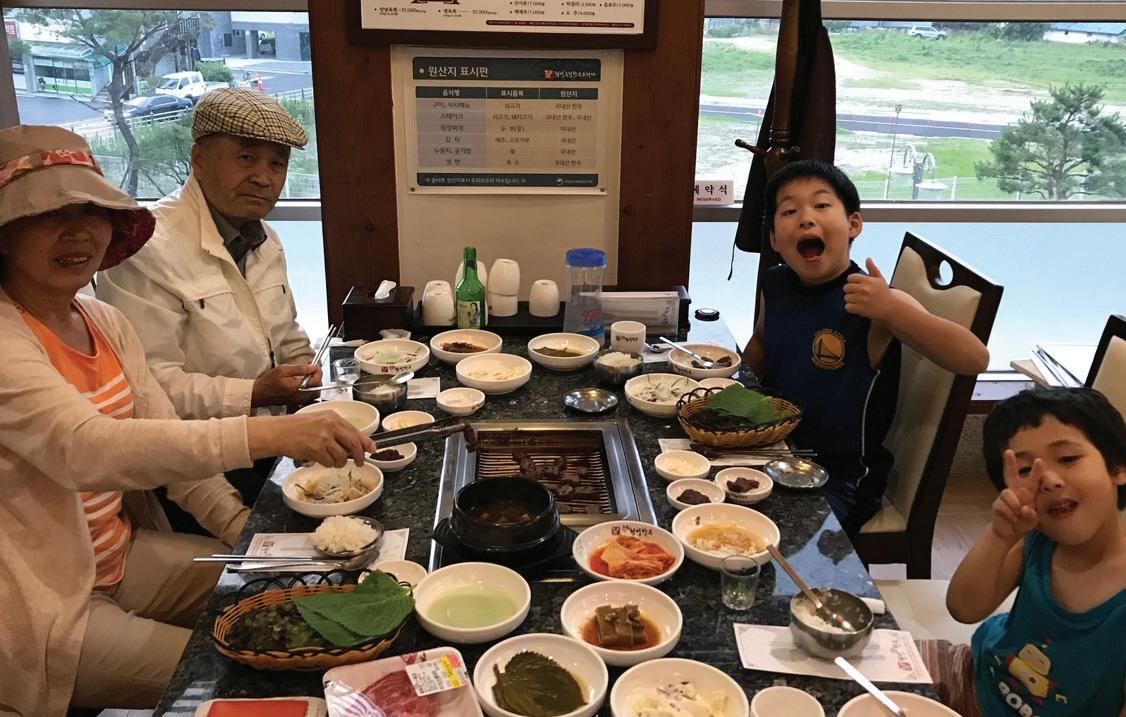
like public transportation in the U.S. Safety screen doors, precise schedules and clean stations made a well-oiled machine that was engineered for maximum efficiency. Returning to America later made clear to me the differences in their cul tures and engrained in me Korea’s constant motion.
Traveling to Korea once or twice a year became more routine, and by 2018, after finishing third grade, I was beginning to under stand the intricacies of its cul ture. That summer, my family spent over a month at my grandparents’ home, during which I lived in the shoes of a Korean student. In the afternoons, I attended hagwons — Korean after-school academies — where I practiced taekwondo and took music lessons, surrounded by native-born peers speaking rapid-fire Korean.
I began to realize then that for Korean kids, “free time” wasn’t truly free.
pared to the U.S., where afternoons and weekends are reserved for sports, hobbies and hanging out with friends, being a student in South Korea is practically a fulltime job. From the moment they can pick up a pencil, parents enroll their children in rigorous academies to gain every advantage, cultivating a culture of extreme pressure and high expectations. In the same way that South Korea engineers its transit systems and city infrastructure for efficiency, it engineers the lives of its youth.

But even after the sun set, kids my age, still dressed in their school uniforms, filed into night hagwons where they studied math, English and science until 10 p.m.
I began to realize then that for Korean kids, “free time” wasn’t truly free. Com-
In March 2022, we returned to Korea after a multi-year gap due to COVID-19, but this time, we weren’t going to play. That spring, I attended my first funeral for my grandfather. The service took place in a hospital over three days, with a completely different environment from that of a Western funeral. Unlike American services, which are brief and somber, my grandfather’s funeral was a more drawn-out communal event, with a significant emphasis on social gathering. In our designated room, an altar displayed his casket, topped with chrysanthemums and lilies, along with an assortment of fruits and sweets, all
meant to express grief and respect.
Over the three days, friends and extended relatives stopped by the funeral hall to honor my grandfather and pay their respects, staying for hours at a time. As people came to support my dad’s family in their time of need, I saw how Koreans care for their loved ones and how thoughtful they are in every aspect of life, not just in studying or work.
Today, I see how the little moments over the years, from 4 a.m. jetlag-induced snack runs to family weddings and gatherings, have shown me that Korean culture isn’t defined by K-pop music or kimchi. It lives in bustling streets and hagwons, in relationships across generations and in traditions like my grandfather’s funeral. South Korea is more than just a modern nation with novel trends and tourist attractions. It’s a country that values family, respect and intention, where people are constantly moving — a place I will always be proud to call my second home. v
Palo Alto Unified School District
Palo Alto High School
50 Embarcadero Road
Palo Alto, CA, 94301