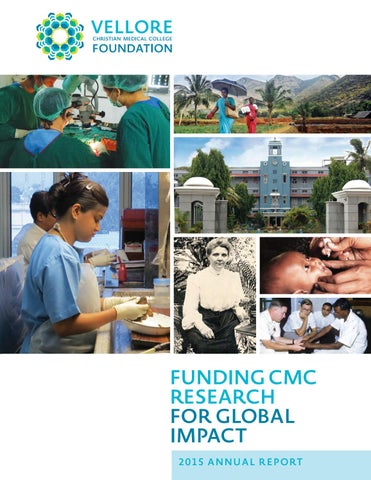
FUNDING CMC RESEARCH FOR GLOBAL IMPACT 2 0 15 A N N UA L R E PORT
CMC’S CENTRE FOR STEM CELL RESEARCH
A $22 million grant seeks new treatments for brain and blood disorders.
In a bold move to support stem cell research in India, the Department of Biotechnology (DBT), Government of India has called upon CMC’s Centre for Stem Cell Research, a unit of inStem (CSCR), and three other top Indian institutes, to execute a project called ‘Accelerating the application of Stem cell technology in Human Disease’ (ASHD). The National Centre for Biological Sciences (NCBS), the Institute for Stem Cell and Regenerative Medicine (inStem) and the National Institute for Mental Health and Neurosciences (NIMHANS) make up a major collaborative with the CSCR, supported by a $22 million grant over 5 years to use stem cells in research, diagnostics and therapeutics. The Program will also partner with the Centre for iPS Cell Research and Application (CiRA), Kyoto University, Japan, which is led by Prof. Shinya Yamanaka, a leading pioneer in stem cell technology. The ASHD program has two broad components which deal with human diseases of national importance. The first is a joint venture between inStem, NCBS and NIMHANS, involving the use of stem cells to study the genetic bases of mental illnesses (such as schizophrenia, bi-polar disease and attention deficit disorders); the second, led by CMC and CSCR, will address a large unmet need in India using novel approaches to study and treat some of the major hematological disorders. The program at CMC / CSCR, called Novel Approaches to Hematological Disorders (NAHD), involves developing modern methods including gene therapy for hereditary blood disorders such as hemophilia, thalassemia and sickle cell disease, all of which are causes of major morbidity and mortality in India. In order to have maximum impact on hereditary hemoglobin diseases in the population at risk, this initiative combines these Dr. Alok Srivastava efforts with a community outreach program for the control of major hemoglobin disorders. Dr. Alok Srivastava (Batch of ’81) is coordinating the NAHD program. He has had major success in recent years using gene therapy in the major hemoglobin diseases as well as bleeding disorders like hemophilia. Several clinical and laboratory departments from CMC are engaged in the program which will utilize the large patient base of NIMHANS and CMC to create a database of blood and body fluid samples. These samples will be analyzed by researchers in the program with the goal of eventually developing and testing targeted treatment techniques for brain and blood diseases. The CSCR was sanctioned in December, 2005 and opened in 2007 – the first of its kind in India for translational stem cell research. It is a unique collaborative project between CMC and the DBT and became the translational research unit of inStem in 2011. Part of the Center’s goal is to conduct early-phase clinical trials with stem cells processed within its own cGMP facility. It also supports various training programs for students and scientists.
The major translational research themes currently being pursued at CSCR • Gene Therapy for hemophilia and major hemoglobin
disorders, coordinated by Dr. Alok Srivastava (Batch of ‘76) and currently working on a project in collaboration with scientists at Emory University in Atlanta, the University of Florida, Gainesville including the Powell Gene Therapy Centre. • Osteoarticular Regeneration, coordinated by Dr. Vrisha Madhuri (Batch of ‘76) and currently working in collaboration with University of Southern Denmark, University of Aarhus, Denmark Karolinska University
Hospital, Stockholm, Sree Chitra Tirunal Institute for Medical Sciences & Technology, Trivandrum and Indian Institute of Technology, Kanpur in India. • Cellular Reprogramming and its Applications – Disease Modelling and Haplobanking, with Dr. Dolly Daniel (Batch of ‘83) and Dr. R. V. Shaji (PhD alumnus of CMC, 2001) coordinating the field and laboratory aspects of the effort. This highly technical work is described in detail on the Foundation Website and also in the CSCR’s 2015 Annual Report. Please visit www.vellorecmc.org.
11